EP0204144B1 - Fluoroalkoxy cyclic phosphonitrile esters - Google Patents
Fluoroalkoxy cyclic phosphonitrile esters Download PDFInfo
- Publication number
- EP0204144B1 EP0204144B1 EP86105872A EP86105872A EP0204144B1 EP 0204144 B1 EP0204144 B1 EP 0204144B1 EP 86105872 A EP86105872 A EP 86105872A EP 86105872 A EP86105872 A EP 86105872A EP 0204144 B1 EP0204144 B1 EP 0204144B1
- Authority
- EP
- European Patent Office
- Prior art keywords
- units
- repeating
- formula
- compound
- range
- Prior art date
- Legal status (The legal status is an assumption and is not a legal conclusion. Google has not performed a legal analysis and makes no representation as to the accuracy of the status listed.)
- Expired
Links
- -1 Fluoroalkoxy cyclic phosphonitrile esters Chemical class 0.000 title claims description 21
- 238000006243 chemical reaction Methods 0.000 claims description 10
- 125000005739 1,1,2,2-tetrafluoroethanediyl group Chemical group FC(F)([*:1])C(F)(F)[*:2] 0.000 claims description 9
- AQYSYJUIMQTRMV-UHFFFAOYSA-N hypofluorous acid Chemical compound FO AQYSYJUIMQTRMV-UHFFFAOYSA-N 0.000 claims description 8
- 150000002148 esters Chemical class 0.000 claims description 4
- 238000004519 manufacturing process Methods 0.000 claims description 4
- 238000000034 method Methods 0.000 claims description 4
- 125000005843 halogen group Chemical group 0.000 claims description 2
- 150000004820 halides Chemical class 0.000 claims 1
- 150000001875 compounds Chemical class 0.000 description 36
- 239000003921 oil Substances 0.000 description 35
- YXFVVABEGXRONW-UHFFFAOYSA-N Toluene Chemical compound CC1=CC=CC=C1 YXFVVABEGXRONW-UHFFFAOYSA-N 0.000 description 24
- 239000007789 gas Substances 0.000 description 18
- 239000000203 mixture Substances 0.000 description 17
- 238000009835 boiling Methods 0.000 description 12
- NFHFRUOZVGFOOS-UHFFFAOYSA-N palladium;triphenylphosphane Chemical compound [Pd].C1=CC=CC=C1P(C=1C=CC=CC=1)C1=CC=CC=C1.C1=CC=CC=C1P(C=1C=CC=CC=1)C1=CC=CC=C1.C1=CC=CC=C1P(C=1C=CC=CC=1)C1=CC=CC=C1.C1=CC=CC=C1P(C=1C=CC=CC=1)C1=CC=CC=C1 NFHFRUOZVGFOOS-UHFFFAOYSA-N 0.000 description 11
- 229940126062 Compound A Drugs 0.000 description 10
- NLDMNSXOCDLTTB-UHFFFAOYSA-N Heterophylliin A Natural products O1C2COC(=O)C3=CC(O)=C(O)C(O)=C3C3=C(O)C(O)=C(O)C=C3C(=O)OC2C(OC(=O)C=2C=C(O)C(O)=C(O)C=2)C(O)C1OC(=O)C1=CC(O)=C(O)C(O)=C1 NLDMNSXOCDLTTB-UHFFFAOYSA-N 0.000 description 10
- 239000000047 product Substances 0.000 description 10
- 239000000126 substance Substances 0.000 description 10
- DGAQECJNVWCQMB-PUAWFVPOSA-M Ilexoside XXIX Chemical compound C[C@@H]1CC[C@@]2(CC[C@@]3(C(=CC[C@H]4[C@]3(CC[C@@H]5[C@@]4(CC[C@@H](C5(C)C)OS(=O)(=O)[O-])C)C)[C@@H]2[C@]1(C)O)C)C(=O)O[C@H]6[C@@H]([C@H]([C@@H]([C@H](O6)CO)O)O)O.[Na+] DGAQECJNVWCQMB-PUAWFVPOSA-M 0.000 description 8
- 239000007983 Tris buffer Substances 0.000 description 8
- UXJHQBVRZUANLK-UHFFFAOYSA-N azanylidyne(dichloro)-$l^{5}-phosphane Chemical compound ClP(Cl)#N UXJHQBVRZUANLK-UHFFFAOYSA-N 0.000 description 8
- 238000010586 diagram Methods 0.000 description 8
- 229910052708 sodium Inorganic materials 0.000 description 8
- 239000011734 sodium Substances 0.000 description 8
- PSQZJKGXDGNDFP-UHFFFAOYSA-N 2,2,3,3,3-pentafluoropropan-1-ol Chemical compound OCC(F)(F)C(F)(F)F PSQZJKGXDGNDFP-UHFFFAOYSA-N 0.000 description 7
- 238000000862 absorption spectrum Methods 0.000 description 6
- 239000000314 lubricant Substances 0.000 description 6
- 238000000425 proton nuclear magnetic resonance spectrum Methods 0.000 description 6
- 239000011541 reaction mixture Substances 0.000 description 6
- 238000001819 mass spectrum Methods 0.000 description 5
- 238000001228 spectrum Methods 0.000 description 5
- FAPWRFPIFSIZLT-UHFFFAOYSA-M Sodium chloride Chemical compound [Na+].[Cl-] FAPWRFPIFSIZLT-UHFFFAOYSA-M 0.000 description 4
- 238000004817 gas chromatography Methods 0.000 description 4
- 238000000655 nuclear magnetic resonance spectrum Methods 0.000 description 4
- 239000003208 petroleum Substances 0.000 description 4
- 239000011347 resin Substances 0.000 description 4
- 229920005989 resin Polymers 0.000 description 4
- 239000000243 solution Substances 0.000 description 4
- JUGSKHLZINSXPQ-UHFFFAOYSA-N 2,2,3,3,4,4,5,5-octafluoropentan-1-ol Chemical compound OCC(F)(F)C(F)(F)C(F)(F)C(F)F JUGSKHLZINSXPQ-UHFFFAOYSA-N 0.000 description 3
- UHOVQNZJYSORNB-UHFFFAOYSA-N Benzene Chemical compound C1=CC=CC=C1 UHOVQNZJYSORNB-UHFFFAOYSA-N 0.000 description 3
- YCKRFDGAMUMZLT-UHFFFAOYSA-N Fluorine atom Chemical compound [F] YCKRFDGAMUMZLT-UHFFFAOYSA-N 0.000 description 3
- UFHFLCQGNIYNRP-UHFFFAOYSA-N Hydrogen Chemical compound [H][H] UFHFLCQGNIYNRP-UHFFFAOYSA-N 0.000 description 3
- 238000010521 absorption reaction Methods 0.000 description 3
- QVGXLLKOCUKJST-UHFFFAOYSA-N atomic oxygen Chemical compound [O] QVGXLLKOCUKJST-UHFFFAOYSA-N 0.000 description 3
- 238000005229 chemical vapour deposition Methods 0.000 description 3
- 238000001312 dry etching Methods 0.000 description 3
- HOXINJBQVZWYGZ-UHFFFAOYSA-N fenbutatin oxide Chemical compound C=1C=CC=CC=1C(C)(C)C[Sn](O[Sn](CC(C)(C)C=1C=CC=CC=1)(CC(C)(C)C=1C=CC=CC=1)CC(C)(C)C=1C=CC=CC=1)(CC(C)(C)C=1C=CC=CC=1)CC(C)(C)C1=CC=CC=C1 HOXINJBQVZWYGZ-UHFFFAOYSA-N 0.000 description 3
- 229910052731 fluorine Inorganic materials 0.000 description 3
- 239000011737 fluorine Substances 0.000 description 3
- 230000005484 gravity Effects 0.000 description 3
- 239000001257 hydrogen Substances 0.000 description 3
- 229910052739 hydrogen Inorganic materials 0.000 description 3
- 239000001301 oxygen Substances 0.000 description 3
- 229910052760 oxygen Inorganic materials 0.000 description 3
- 239000004065 semiconductor Substances 0.000 description 3
- XLYOFNOQVPJJNP-UHFFFAOYSA-N water Substances O XLYOFNOQVPJJNP-UHFFFAOYSA-N 0.000 description 3
- QGZKDVFQNNGYKY-UHFFFAOYSA-N Ammonia Chemical compound N QGZKDVFQNNGYKY-UHFFFAOYSA-N 0.000 description 2
- XEEYBQQBJWHFJM-UHFFFAOYSA-N Iron Chemical compound [Fe] XEEYBQQBJWHFJM-UHFFFAOYSA-N 0.000 description 2
- 238000005481 NMR spectroscopy Methods 0.000 description 2
- XYFCBTPGUUZFHI-UHFFFAOYSA-N Phosphine Chemical compound P XYFCBTPGUUZFHI-UHFFFAOYSA-N 0.000 description 2
- WYURNTSHIVDZCO-UHFFFAOYSA-N Tetrahydrofuran Chemical compound C1CCOC1 WYURNTSHIVDZCO-UHFFFAOYSA-N 0.000 description 2
- 229910052783 alkali metal Inorganic materials 0.000 description 2
- 150000001340 alkali metals Chemical class 0.000 description 2
- 238000004458 analytical method Methods 0.000 description 2
- 238000001816 cooling Methods 0.000 description 2
- 239000012043 crude product Substances 0.000 description 2
- 238000000151 deposition Methods 0.000 description 2
- 230000008021 deposition Effects 0.000 description 2
- 238000011156 evaluation Methods 0.000 description 2
- 238000002290 gas chromatography-mass spectrometry Methods 0.000 description 2
- 238000002329 infrared spectrum Methods 0.000 description 2
- 239000007788 liquid Substances 0.000 description 2
- 239000010802 sludge Substances 0.000 description 2
- 239000011780 sodium chloride Substances 0.000 description 2
- 239000002904 solvent Substances 0.000 description 2
- VZGDMQKNWNREIO-UHFFFAOYSA-N tetrachloromethane Chemical compound ClC(Cl)(Cl)Cl VZGDMQKNWNREIO-UHFFFAOYSA-N 0.000 description 2
- 239000013638 trimer Substances 0.000 description 2
- LENZDBCJOHFCAS-UHFFFAOYSA-N tris Chemical compound OCC(N)(CO)CO LENZDBCJOHFCAS-UHFFFAOYSA-N 0.000 description 2
- 239000010913 used oil Substances 0.000 description 2
- RYHBNJHYFVUHQT-UHFFFAOYSA-N 1,4-Dioxane Chemical compound C1COCCO1 RYHBNJHYFVUHQT-UHFFFAOYSA-N 0.000 description 1
- 238000005160 1H NMR spectroscopy Methods 0.000 description 1
- VXEGSRKPIUDPQT-UHFFFAOYSA-N 4-[4-(4-methoxyphenyl)piperazin-1-yl]aniline Chemical compound C1=CC(OC)=CC=C1N1CCN(C=2C=CC(N)=CC=2)CC1 VXEGSRKPIUDPQT-UHFFFAOYSA-N 0.000 description 1
- ZAMOUSCENKQFHK-UHFFFAOYSA-N Chlorine atom Chemical compound [Cl] ZAMOUSCENKQFHK-UHFFFAOYSA-N 0.000 description 1
- RTZKZFJDLAIYFH-UHFFFAOYSA-N Diethyl ether Natural products CCOCC RTZKZFJDLAIYFH-UHFFFAOYSA-N 0.000 description 1
- ZAFNJMIOTHYJRJ-UHFFFAOYSA-N Diisopropyl ether Chemical compound CC(C)OC(C)C ZAFNJMIOTHYJRJ-UHFFFAOYSA-N 0.000 description 1
- LFQSCWFLJHTTHZ-UHFFFAOYSA-N Ethanol Chemical compound CCO LFQSCWFLJHTTHZ-UHFFFAOYSA-N 0.000 description 1
- 229920002449 FKM Polymers 0.000 description 1
- VEXZGXHMUGYJMC-UHFFFAOYSA-N Hydrochloric acid Chemical compound Cl VEXZGXHMUGYJMC-UHFFFAOYSA-N 0.000 description 1
- CTQNGGLPUBDAKN-UHFFFAOYSA-N O-Xylene Chemical compound CC1=CC=CC=C1C CTQNGGLPUBDAKN-UHFFFAOYSA-N 0.000 description 1
- BLRPTPMANUNPDV-UHFFFAOYSA-N Silane Chemical compound [SiH4] BLRPTPMANUNPDV-UHFFFAOYSA-N 0.000 description 1
- XUIMIQQOPSSXEZ-UHFFFAOYSA-N Silicon Chemical compound [Si] XUIMIQQOPSSXEZ-UHFFFAOYSA-N 0.000 description 1
- 229910000831 Steel Inorganic materials 0.000 description 1
- 230000005856 abnormality Effects 0.000 description 1
- 239000002253 acid Substances 0.000 description 1
- 150000007513 acids Chemical class 0.000 description 1
- 150000001298 alcohols Chemical class 0.000 description 1
- 229910021529 ammonia Inorganic materials 0.000 description 1
- RBFQJDQYXXHULB-UHFFFAOYSA-N arsane Chemical compound [AsH3] RBFQJDQYXXHULB-UHFFFAOYSA-N 0.000 description 1
- OEYOHULQRFXULB-UHFFFAOYSA-N arsenic trichloride Chemical compound Cl[As](Cl)Cl OEYOHULQRFXULB-UHFFFAOYSA-N 0.000 description 1
- 239000000460 chlorine Substances 0.000 description 1
- 229910052801 chlorine Inorganic materials 0.000 description 1
- 238000005520 cutting process Methods 0.000 description 1
- 238000007872 degassing Methods 0.000 description 1
- MROCJMGDEKINLD-UHFFFAOYSA-N dichlorosilane Chemical compound Cl[SiH2]Cl MROCJMGDEKINLD-UHFFFAOYSA-N 0.000 description 1
- 230000000694 effects Effects 0.000 description 1
- 229920001971 elastomer Polymers 0.000 description 1
- 238000005530 etching Methods 0.000 description 1
- 150000002170 ethers Chemical class 0.000 description 1
- 239000012530 fluid Substances 0.000 description 1
- 238000005194 fractionation Methods 0.000 description 1
- 239000011521 glass Substances 0.000 description 1
- 229910052736 halogen Inorganic materials 0.000 description 1
- 150000002366 halogen compounds Chemical class 0.000 description 1
- 150000002367 halogens Chemical class 0.000 description 1
- 238000010438 heat treatment Methods 0.000 description 1
- 239000010720 hydraulic oil Substances 0.000 description 1
- 229930195733 hydrocarbon Natural products 0.000 description 1
- 229910000041 hydrogen chloride Inorganic materials 0.000 description 1
- IXCSERBJSXMMFS-UHFFFAOYSA-N hydrogen chloride Substances Cl.Cl IXCSERBJSXMMFS-UHFFFAOYSA-N 0.000 description 1
- 238000005468 ion implantation Methods 0.000 description 1
- 229910052742 iron Inorganic materials 0.000 description 1
- 238000012423 maintenance Methods 0.000 description 1
- 239000000463 material Substances 0.000 description 1
- 150000001247 metal acetylides Chemical class 0.000 description 1
- 239000002480 mineral oil Substances 0.000 description 1
- 235000010446 mineral oil Nutrition 0.000 description 1
- 238000000199 molecular distillation Methods 0.000 description 1
- 239000003960 organic solvent Substances 0.000 description 1
- 239000002245 particle Substances 0.000 description 1
- 229910000073 phosphorus hydride Inorganic materials 0.000 description 1
- OBCUTHMOOONNBS-UHFFFAOYSA-N phosphorus pentafluoride Chemical compound FP(F)(F)(F)F OBCUTHMOOONNBS-UHFFFAOYSA-N 0.000 description 1
- LVTJOONKWUXEFR-FZRMHRINSA-N protoneodioscin Natural products O(C[C@@H](CC[C@]1(O)[C@H](C)[C@@H]2[C@]3(C)[C@H]([C@H]4[C@@H]([C@]5(C)C(=CC4)C[C@@H](O[C@@H]4[C@H](O[C@H]6[C@@H](O)[C@@H](O)[C@@H](O)[C@H](C)O6)[C@@H](O)[C@H](O[C@H]6[C@@H](O)[C@@H](O)[C@@H](O)[C@H](C)O6)[C@H](CO)O4)CC5)CC3)C[C@@H]2O1)C)[C@H]1[C@H](O)[C@H](O)[C@H](O)[C@@H](CO)O1 LVTJOONKWUXEFR-FZRMHRINSA-N 0.000 description 1
- 230000035484 reaction time Effects 0.000 description 1
- 238000007670 refining Methods 0.000 description 1
- 238000010992 reflux Methods 0.000 description 1
- SPVXKVOXSXTJOY-UHFFFAOYSA-N selane Chemical compound [SeH2] SPVXKVOXSXTJOY-UHFFFAOYSA-N 0.000 description 1
- 229910000058 selane Inorganic materials 0.000 description 1
- 229910000077 silane Inorganic materials 0.000 description 1
- 229910052710 silicon Inorganic materials 0.000 description 1
- 239000010703 silicon Substances 0.000 description 1
- 239000005049 silicon tetrachloride Substances 0.000 description 1
- ABTOQLMXBSRXSM-UHFFFAOYSA-N silicon tetrafluoride Chemical compound F[Si](F)(F)F ABTOQLMXBSRXSM-UHFFFAOYSA-N 0.000 description 1
- 239000007787 solid Substances 0.000 description 1
- 239000010959 steel Substances 0.000 description 1
- 239000000758 substrate Substances 0.000 description 1
- TXEYQDLBPFQVAA-UHFFFAOYSA-N tetrafluoromethane Chemical compound FC(F)(F)F TXEYQDLBPFQVAA-UHFFFAOYSA-N 0.000 description 1
- YLQBMQCUIZJEEH-UHFFFAOYSA-N tetrahydrofuran Natural products C=1C=COC=1 YLQBMQCUIZJEEH-UHFFFAOYSA-N 0.000 description 1
- 239000010409 thin film Substances 0.000 description 1
- 239000008096 xylene Substances 0.000 description 1
Images



Classifications
-
- C—CHEMISTRY; METALLURGY
- C07—ORGANIC CHEMISTRY
- C07F—ACYCLIC, CARBOCYCLIC OR HETEROCYCLIC COMPOUNDS CONTAINING ELEMENTS OTHER THAN CARBON, HYDROGEN, HALOGEN, OXYGEN, NITROGEN, SULFUR, SELENIUM OR TELLURIUM
- C07F9/00—Compounds containing elements of Groups 5 or 15 of the Periodic Table
- C07F9/02—Phosphorus compounds
- C07F9/547—Heterocyclic compounds, e.g. containing phosphorus as a ring hetero atom
- C07F9/6564—Heterocyclic compounds, e.g. containing phosphorus as a ring hetero atom having phosphorus atoms, with or without nitrogen, oxygen, sulfur, selenium or tellurium atoms, as ring hetero atoms
- C07F9/6581—Heterocyclic compounds, e.g. containing phosphorus as a ring hetero atom having phosphorus atoms, with or without nitrogen, oxygen, sulfur, selenium or tellurium atoms, as ring hetero atoms having phosphorus and nitrogen atoms with or without oxygen or sulfur atoms, as ring hetero atoms
- C07F9/65812—Cyclic phosphazenes [P=N-]n, n>=3
-
- C—CHEMISTRY; METALLURGY
- C10—PETROLEUM, GAS OR COKE INDUSTRIES; TECHNICAL GASES CONTAINING CARBON MONOXIDE; FUELS; LUBRICANTS; PEAT
- C10M—LUBRICATING COMPOSITIONS; USE OF CHEMICAL SUBSTANCES EITHER ALONE OR AS LUBRICATING INGREDIENTS IN A LUBRICATING COMPOSITION
- C10M105/00—Lubricating compositions characterised by the base-material being a non-macromolecular organic compound
- C10M105/74—Lubricating compositions characterised by the base-material being a non-macromolecular organic compound containing phosphorus
-
- C—CHEMISTRY; METALLURGY
- C10—PETROLEUM, GAS OR COKE INDUSTRIES; TECHNICAL GASES CONTAINING CARBON MONOXIDE; FUELS; LUBRICANTS; PEAT
- C10M—LUBRICATING COMPOSITIONS; USE OF CHEMICAL SUBSTANCES EITHER ALONE OR AS LUBRICATING INGREDIENTS IN A LUBRICATING COMPOSITION
- C10M2223/00—Organic non-macromolecular compounds containing phosphorus as ingredients in lubricant compositions
- C10M2223/02—Organic non-macromolecular compounds containing phosphorus as ingredients in lubricant compositions having no phosphorus-to-carbon bonds
- C10M2223/049—Phosphite
-
- C—CHEMISTRY; METALLURGY
- C10—PETROLEUM, GAS OR COKE INDUSTRIES; TECHNICAL GASES CONTAINING CARBON MONOXIDE; FUELS; LUBRICANTS; PEAT
- C10N—INDEXING SCHEME ASSOCIATED WITH SUBCLASS C10M RELATING TO LUBRICATING COMPOSITIONS
- C10N2040/00—Specified use or application for which the lubricating composition is intended
- C10N2040/30—Refrigerators lubricants or compressors lubricants
-
- C—CHEMISTRY; METALLURGY
- C10—PETROLEUM, GAS OR COKE INDUSTRIES; TECHNICAL GASES CONTAINING CARBON MONOXIDE; FUELS; LUBRICANTS; PEAT
- C10N—INDEXING SCHEME ASSOCIATED WITH SUBCLASS C10M RELATING TO LUBRICATING COMPOSITIONS
- C10N2040/00—Specified use or application for which the lubricating composition is intended
- C10N2040/32—Wires, ropes or cables lubricants
-
- C—CHEMISTRY; METALLURGY
- C10—PETROLEUM, GAS OR COKE INDUSTRIES; TECHNICAL GASES CONTAINING CARBON MONOXIDE; FUELS; LUBRICANTS; PEAT
- C10N—INDEXING SCHEME ASSOCIATED WITH SUBCLASS C10M RELATING TO LUBRICATING COMPOSITIONS
- C10N2040/00—Specified use or application for which the lubricating composition is intended
- C10N2040/34—Lubricating-sealants
-
- C—CHEMISTRY; METALLURGY
- C10—PETROLEUM, GAS OR COKE INDUSTRIES; TECHNICAL GASES CONTAINING CARBON MONOXIDE; FUELS; LUBRICANTS; PEAT
- C10N—INDEXING SCHEME ASSOCIATED WITH SUBCLASS C10M RELATING TO LUBRICATING COMPOSITIONS
- C10N2040/00—Specified use or application for which the lubricating composition is intended
- C10N2040/36—Release agents or mold release agents
-
- C—CHEMISTRY; METALLURGY
- C10—PETROLEUM, GAS OR COKE INDUSTRIES; TECHNICAL GASES CONTAINING CARBON MONOXIDE; FUELS; LUBRICANTS; PEAT
- C10N—INDEXING SCHEME ASSOCIATED WITH SUBCLASS C10M RELATING TO LUBRICATING COMPOSITIONS
- C10N2040/00—Specified use or application for which the lubricating composition is intended
- C10N2040/38—Conveyors or chain belts
-
- C—CHEMISTRY; METALLURGY
- C10—PETROLEUM, GAS OR COKE INDUSTRIES; TECHNICAL GASES CONTAINING CARBON MONOXIDE; FUELS; LUBRICANTS; PEAT
- C10N—INDEXING SCHEME ASSOCIATED WITH SUBCLASS C10M RELATING TO LUBRICATING COMPOSITIONS
- C10N2040/00—Specified use or application for which the lubricating composition is intended
- C10N2040/40—Generators or electric motors in oil or gas winning field
-
- C—CHEMISTRY; METALLURGY
- C10—PETROLEUM, GAS OR COKE INDUSTRIES; TECHNICAL GASES CONTAINING CARBON MONOXIDE; FUELS; LUBRICANTS; PEAT
- C10N—INDEXING SCHEME ASSOCIATED WITH SUBCLASS C10M RELATING TO LUBRICATING COMPOSITIONS
- C10N2040/00—Specified use or application for which the lubricating composition is intended
- C10N2040/42—Flashing oils or marking oils
-
- C—CHEMISTRY; METALLURGY
- C10—PETROLEUM, GAS OR COKE INDUSTRIES; TECHNICAL GASES CONTAINING CARBON MONOXIDE; FUELS; LUBRICANTS; PEAT
- C10N—INDEXING SCHEME ASSOCIATED WITH SUBCLASS C10M RELATING TO LUBRICATING COMPOSITIONS
- C10N2040/00—Specified use or application for which the lubricating composition is intended
- C10N2040/44—Super vacuum or supercritical use
-
- C—CHEMISTRY; METALLURGY
- C10—PETROLEUM, GAS OR COKE INDUSTRIES; TECHNICAL GASES CONTAINING CARBON MONOXIDE; FUELS; LUBRICANTS; PEAT
- C10N—INDEXING SCHEME ASSOCIATED WITH SUBCLASS C10M RELATING TO LUBRICATING COMPOSITIONS
- C10N2040/00—Specified use or application for which the lubricating composition is intended
- C10N2040/50—Medical uses
Definitions
- the present invention relates to novel fluoroalkoxy cyclic phosphonitrile esters.
- Petroleum lubricant heretofore widely used as rotary pump oil is prepared from a petroleum lubricant fraction having a kinematic viscosity of 30 to 150 centistokes at 40°C, by refining the fraction by fractionation such as molecular distillation.
- the lubricant is very low in vapor pressure, has high heat resistance and meets various requirements.
- the rotary pump oil for the dry etching apparatus for producing semiconductors is exposed to an active gas such as a gas mixture of tetrafluoromethane (Flon-14) and oxygen, so that the conventional petroleum rotary pump oil, if used, is prone to a rise of viscosity or deposition of sludge within a short period of time, therefore needs frequent replacement and requires much time and labor for the maintenance of the rotary pump.
- an active gas such as a gas mixture of tetrafluoromethane (Flon-14) and oxygen
- the apparatus which are presently used and in which an active gas is used or needs to be discharged include dry etching apparatus, semiconductor manufacturing apparatus which are typically ion implantation apparatus and plasma chemical vapor deposition (CVD) apparatus, CVD apparatus for producing cutting tools of cemented carbides, apparatus for producing halogen lamps, degassing apparatus for preparing iron and steel, and apparatus for producing electrically superconductive materials.
- dry etching apparatus semiconductor manufacturing apparatus which are typically ion implantation apparatus and plasma chemical vapor deposition (CVD) apparatus
- CVD apparatus for producing cutting tools of cemented carbides for producing halogen lamps
- degassing apparatus for preparing iron and steel
- apparatus for producing electrically superconductive materials include dry etching apparatus, semiconductor manufacturing apparatus which are typically ion implantation apparatus and plasma chemical vapor deposition (CVD) apparatus, CVD apparatus for producing cutting tools of cemented carbides, apparatus for producing halogen lamps, degassing apparatus for preparing iron and steel, and apparatus for producing electrically superconductive materials.
- CVD chemical vapor deposition
- active gases examples include phosphine, arsine, diborane, hydrogen selenide, arsenic trichloride, silane, silicon tetrachloride, hydrogen chloride, dichlorosilane, Flon-14, ammonia, phosphorus pentafluoride, silicon tetrafluoride, carbon tetrachloride and oxygen. These gases are used singly, or at least two of them are used in combination.
- the oil must have a very low viscosity, a low vapor pressure, the satisfactory low-temperature characteristic of being minus tens of degrees in solidifying point, and heat resistance to withstand the heat developed from the operation of the pump, and all of these requirements need to be fulfilled by a single chemical structure.
- these are characteristics which conflict with one another and nevertheless need to be realized at the same time.
- a reduced molecular weight provides a lower viscosity but results in a higher vapor pressure.
- Attempts to obtain low-temperature characteristics tend to lower the upper limit of temperature where satisfactory oil properties are available.
- difficulties are encountered in molecular design.
- the chemical substance obtained with these characteristics must further have exceedingly high stability against chemical substances such as acids and alkalis, especially active gases. Extreme difficulties are therefore encountered in preparing a novel chemical substance having all of these required characteristics in good balance.
- An object of the invention is to provide a compound which is excellent in heat resistance, viscosity, compatibility with resins and low-temperature characteristic, as well as in lubricant performance and resistance to active gases.
- the present invention provides a fluoroalkoxy cyclic phosphonitrile ester represented by the formula (1) wherein fCF 2 CF 2 ) m is a single segment comprised of an integral number of repeating units (CF 2 CF 2 ) or indicates conjoint presence of segments having different chain lengths and each comprised of an integral number of units (CF 2 CF 2 ), wherein m is 2 in the case of the single segment or, in the case of the presence of segments of different chain lengths, represents the average number of repeating units (CF 2 CF 2 ) and is in the range of 1.3 ⁇ m :-5 2.8, I is in the range of 2n - 1 £ 1 s 1, and n is the number of repeating PN units of the phosphonitrile cyclic skeleton, or when rings of different numbers of repeating units are conjointly present represents the average number of repeating PN units and is a real number in the range of 3 ⁇ n ⁇ 4.3.
- the fluoroalkoxy cyclic phosphonitrile ester of the formula (1) is a novel compound not disclosed in literature and is prepared from an oligomer of phosphonitrile halide and a fluoroalcohol as described in the example given later.
- the cyclic phosphonitrile ester of the formula (1) is prepared by reacting an oligomer of phosphonitrile halide of the formula wherein X is halogen atom, n represents the number of repeating PN units or when rings of different numbers of repeating units are conjointly present represents the average number of repeating PN units and is a real number in the range of 3 Z n Z 4.3, a fluoroalcohol of the formula and a fluoroalcohol of the formula wherein m means the average number of repeating units. (CF 2 CF 2 ) and is in the range of 1.3 ⁇ m ⁇ 2.8.
- Examples of useful oligomers of phosphonitrile halides are phosphonitrile chloride trimer, phosphonitrile chloride tetramer and a mixture of such oligomers.
- Examples of useful fluoroalcohols are 1,1,3-trihydroperfluoropropanol, 1,1,5-trihydroperfluoropentanol and like 1,1,w-trihydroperfluoroalcohols, mixtures of such an alcohol and 2,2,3,3,3-pentafluoropropanol.
- the fluoroalkoxy cyclic phosphonitrile ester of the formula (1) is prepared by reacting sodium or like alkali metal with a mixture of at least one 1,1, ⁇ -trihydroperfluoroalcohols and 2,2,3,3,3-pentafluoropropanol to obtain an alcoholate and subsequently reacting the alcoholate with an oligomer of phosphonitrile halide.
- the latter is usually used in an amount of about 2.02 to 2.25 moles per one unit mole of the former as calculated in terms of PNX 2 .
- the fluoroalcohol is preferably converted into an alcoholate beforehand by the reaction thereof with sodium or like alkali metal.
- the reaction is conducted preferably in an organic solvent such as benzene, toluene, xylene and like hydrocarbons ethyl ether, isopropyl ether, tetrahydrofuran, dioxane and like ethers, etc.
- the reaction temperature is preferably from about 10°C to reflux temperature, and particularly from room temperature to 100°C.
- the reaction time is not particularly determined but is preferably about 2 to 10 hours.
- the present desired compound can be isolated and purified by a known method and for example is washed with water, dried, concentrated and then purified by a precision fractionator, etc.
- fluoroalkoxy cyclic phosphonitrile esters represented by the formula (1) preferable are, for example, mixed fluoroalkoxytetraphosphonitriles, of the formula (1) wherein n is 4, m is 2 and I is in the range of 1 1 1 2 7.
- the compounds of the present invention are useful as nonflammable lubricants, hydraulic oils, etc., especially as rotary pump oils.
- the ester When I is 0, the ester has a high viscosity at room temperature and requires an excessively great torque for starting pumps, possibly causing damage to the electric motor. If I is 8, the ester is solid at room temperature and is unusable as a fluid. Accordingly, such esters are not suited to use.
- a 605 g quantity of an oily crude product was obtained by preparing an alcoholate in the same manner as in Example 1, adding dropwise a solution of 178 g of phosphonitrile chloride trimer in toluene to the alcoholate, and reacting and after-treating the mixture in the same manner as in Example 1.
- the product was distilled at 130 to 195°C/0.75 to 0.03 mmHg and thereafter fractionated by the precision fractionator HP-9000B. The fractions were checked to identify the following compounds produced.
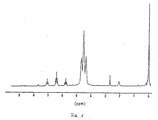
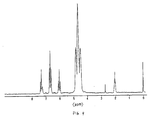
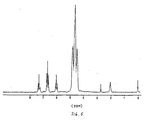
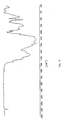
- Figs. 4, 5 and 6 show the NMR spectra of bis(2,2,3,3,3-pentafluoropropoxy)tetrakis(1,1,5-trihydro- perfluoropentyloxy)cyclotriphosphonitrile, tris(2,2,3,3,3-pentaftuoropropoxy)tris(1,1,5-trihydroperftuoro- pentyloxy)cyclotriphosphonitrile and tetrakis(2,2,3,3,3-pentafluoropropoxy)bis(1,1,5-trihydroperfluoro- pentyloxy)cyclotriphosphonitrile, respectively, among other compounds obtained as above.
- Fig. 7 shows the IR absorption spectrum of tetrakis(2,2,3,3,3-pentafluoropropoxy)bis(1,1,5-trihydropen ⁇ luoro- pentyloxy)cyclotriphosphonitrile.
- Example 2 Into the same reactor as used in Example 1 were placed 178 g (0.384 mole) of phosphonitrile chloride tetramer and 1000 ml of toluene, and the tetramer was completely dissolved. To the solution was added dropwise an alcoholate prepared from 480 g (2.06 moles) of 1,1,5-trihydroperfluoropentanol and 45.5 g (1.98 moles) of sodium in 1000 ml of toluene. The mixture was reacted at 50°C for 4 hours.
- the compound obtained was identified as bis(2,2,3,3,3-pentafluoropropoxy)bis(1,1,3-tri- hydroperfluoropropoxy)tetrakis(1,1,5-trihydroperfluoropentylloxy)cyclotetraphosphonitrile by gas chromatography, mass analysis and proton NMR spectrum.
- the compound had a refractive index of 1.3567 at 20°C.
- Fig. 8 shows the proton NMR spectrum of the product, and Fig. 9 the IR absorption spectrum thereof.
- An alcoholate was prepared in the same manner as in Example 1 from a mixture of 63 g of 2,2,3,3,3-pentafluoropropanol, 56 g of 1,1,-trihydrotetrafluoropropanol and 98 g of 1,1,5-trihydrooctafluoropentanol and then reacted with phosphonitrile chloride tetramer.
- the reaction mixture was treated in the same manner as in Example 1 to collect 235g of a fraction of 160 to 185°C/0.03mmHg.
- the product was a colorless transparent oily substance (hereinafter referred to as "compound B") which was 1.73 in specific gravity (20°C), 285 cps in viscosity (40°C) and -35°C in pour point.
- compound B a colorless transparent oily substance which was 1.73 in specific gravity (20°C), 285 cps in viscosity (40°C) and -35°C in pour point.
- the product (hereinafter referred to as "compound C”) was 1.74 in specific gravity (20°C), 340cps in viscosity (40°C) and -35°C in pour point.
- Compound A was poured into a mechanical vacuum pump completely cleaned with a solvent.
- the oil temperature, degree of vacuum and power consumption were measured on start-up and during one-week continuous operation.
- Table 1 shows the results, which reveal that the compound is usable as a vacuum pump oil without any problem.
- Compound B was poured into a mechanical vacuum pump completely cleaned with a solvent, and the pump was used for operating an experimental plasma generator wherein a mixture of Flon-14 and hydrogen was used. No abnormalities were found in the motor current value during operation for 30 days.
- the oil was drawn off and checked, a small amount of reddish brown liquid was found on the oil.
- the oil had a viscosity of 280cps at 40°C, while the oil before use had a viscosity of 285cps at the same temperature, hence almost no change in viscosity.
- IR, NMR and MS (mass spectrum) analyses revealed no difference beween the used oil and the fresh oil.
- the reddish brown liquid which appeared attributable to the plasma or the etched work, caused no trouble to the operation of the rotary pump.
- a mechanical vacuum pump (exhaust rate 960 liters/min, amount of oil 2.2 liters) was operated with compound A placed therein for a dry etching apparatus for etching silicon substrates with use of a mixture of Flon-14 and oxygen in a semiconductor manufacturing process.
- Fluorine rubber which is frequently used for applications where resistance to chemicals is required was tested for resistance to the present compound.
- a Viton O-Ring V#4640,4 DG-30, product of Asahi Chemicals Co., Ltd., was immersed in compound A at 80°C for 15 days and thereafter checked for the resulting change in volume. The volume increase ratio was 2.2%.
- the above procedure was repeated using in place of compound A hexakis(1,1,5-trihydrooctafluoropentyl)triphosphoniltrile ("active gas resistant rotary pump oil A" disclosed in Japanese Unexamined Patent Publication No. 1983-164698).
- the volume increase ratio was 9.55%.
Landscapes
- Chemical & Material Sciences (AREA)
- Organic Chemistry (AREA)
- Chemical Kinetics & Catalysis (AREA)
- General Chemical & Material Sciences (AREA)
- Oil, Petroleum & Natural Gas (AREA)
- Health & Medical Sciences (AREA)
- Life Sciences & Earth Sciences (AREA)
- Biochemistry (AREA)
- General Health & Medical Sciences (AREA)
- Molecular Biology (AREA)
- Lubricants (AREA)
Applications Claiming Priority (2)
| Application Number | Priority Date | Filing Date | Title |
|---|---|---|---|
| JP94296/85 | 1985-04-30 | ||
| JP9429685 | 1985-04-30 |
Publications (3)
| Publication Number | Publication Date |
|---|---|
| EP0204144A2 EP0204144A2 (en) | 1986-12-10 |
| EP0204144A3 EP0204144A3 (en) | 1987-01-28 |
| EP0204144B1 true EP0204144B1 (en) | 1989-03-15 |
Family
ID=14106304
Family Applications (1)
| Application Number | Title | Priority Date | Filing Date |
|---|---|---|---|
| EP86105872A Expired EP0204144B1 (en) | 1985-04-30 | 1986-04-29 | Fluoroalkoxy cyclic phosphonitrile esters |
Country Status (4)
| Country | Link |
|---|---|
| US (1) | US4724264A (enExample) |
| EP (1) | EP0204144B1 (enExample) |
| JP (1) | JPS6253996A (enExample) |
| DE (1) | DE3662399D1 (enExample) |
Families Citing this family (8)
| Publication number | Priority date | Publication date | Assignee | Title |
|---|---|---|---|---|
| US5099055A (en) * | 1989-10-05 | 1992-03-24 | The Dow Chemical Company | (Fluorinated phenoxy)(3-perfluoro-alkylphenoxy)-cyclic phosphazenes |
| US5015405A (en) * | 1989-10-05 | 1991-05-14 | The Dow Chemical Company | (Fluorinated phenoxy)(3-perfluoroalkylphenoxy)-cyclic phosphazenes |
| US5230964A (en) * | 1989-10-05 | 1993-07-27 | The Dow Chemical Company | Magnetic recording media a comprising magnetic particles binder and (fluorinated phenoxy)(3-perfluoroalkylphenoxy)-cyclic phosphazene lubricant |
| US5073284A (en) * | 1989-12-07 | 1991-12-17 | Ethyl Corporation | Phosphonitrilic mixed esters |
| IT1256304B (it) * | 1992-11-10 | 1995-11-30 | Ausimont Spa | Derivati fosfazenici e loro impiego come stabilizzanti per oli e grassi a base di perfluoropolieteri |
| US7658994B2 (en) * | 2003-12-30 | 2010-02-09 | 3M Innovative Properties Company | Substrates and compounds bonded thereto |
| EP1704415A1 (en) * | 2003-12-30 | 2006-09-27 | 3M Innovative Properties Company | Substrates and compounds bonded thereto |
| WO2007043450A1 (ja) * | 2005-10-03 | 2007-04-19 | Matsumura Oil Research Corp. | パーフルオロポリエーテル化合物、およびこれを用いた潤滑剤ならびに磁気ディスク |
Family Cites Families (4)
| Publication number | Priority date | Publication date | Assignee | Title |
|---|---|---|---|---|
| US2876247A (en) * | 1957-07-03 | 1959-03-03 | Olin Mathieson Chemcial Corp | Polymeric polyfluoroalkyl phosphonitrilates |
| BE790016A (fr) * | 1971-10-13 | 1973-04-12 | Horizons Research Inc | Preparation de polyphosphazenes |
| JPS6046154B2 (ja) * | 1982-03-24 | 1985-10-14 | 株式会社松村石油研究所 | 耐活性ガス性ロ−タリポンプ油 |
| US4601843A (en) * | 1985-04-02 | 1986-07-22 | Borg-Warner Chemicals, Inc. | Phosphazene based functional fluid compositions |
-
1986
- 1986-04-28 US US06/856,360 patent/US4724264A/en not_active Expired - Lifetime
- 1986-04-29 DE DE8686105872T patent/DE3662399D1/de not_active Expired
- 1986-04-29 EP EP86105872A patent/EP0204144B1/en not_active Expired
- 1986-04-30 JP JP61101287A patent/JPS6253996A/ja active Granted
Also Published As
| Publication number | Publication date |
|---|---|
| EP0204144A2 (en) | 1986-12-10 |
| JPS6253996A (ja) | 1987-03-09 |
| EP0204144A3 (en) | 1987-01-28 |
| US4724264A (en) | 1988-02-09 |
| JPH0572916B2 (enExample) | 1993-10-13 |
| DE3662399D1 (en) | 1989-04-20 |
Similar Documents
| Publication | Publication Date | Title |
|---|---|---|
| US5602270A (en) | Phosphazene derivatives and use of same as stabilizers for oils and greases based on perfluoropolyethers | |
| US2500388A (en) | Fluorocarbon ethers | |
| EP0203347B1 (en) | Stabilizers with arylphosphinic structure for perfluoropolyether oils and greases | |
| JPS60500498A (ja) | フッ素化エーテルの製造方法 | |
| US4724264A (en) | Fluoroalkoxy cyclic phosphonitrile esters | |
| US4465609A (en) | Method of operating a heat pump or a thermal engine with a chloro-fluorinated hydrocarbon having an increased thermal stability | |
| WO2013120827A2 (en) | (PER)FLUOROPOLYETHERS WITH bi- OR ter-PHENYL END GROUPS | |
| US3531550A (en) | Phosphorus ester amides | |
| EP0629205B1 (en) | Intermediates for thermally stable, fluorine-containing polysiloxanes and glass fiber coated therewith | |
| US3291865A (en) | Cyclic polymeric phosphonitrilate compositions | |
| US4308393A (en) | Fluorine containing organosilicon compounds | |
| US2943103A (en) | Bis(alkoxysilylpropyl) amines | |
| US5453528A (en) | Optimized process for inert fluorinated silanes | |
| US3435078A (en) | Alpha,omega-bis(fluoroperhaloisopropoxy) - perfluoroalkanes and process for preparing them | |
| CA1090365A (en) | ¬perfluoroalkyl(alkoxy)phenyl|methyldichlorosilane s and method of preparing same | |
| US2914548A (en) | Process for producing aryloxyphenyl silanes | |
| US3308208A (en) | Polyfluorinated phosphate esters | |
| US7569527B2 (en) | Fluoro derivative-substituted aryl pnictogens and their oxides | |
| Bollinger et al. | Physical properties of the solvent mixtures triethylphosphate+ hexamethylphosphoric triamide at 25° C | |
| US3308207A (en) | Polyfluorinated phosphate esters | |
| USRE31324E (en) | Fluorine containing organosilicon compounds | |
| US7285673B2 (en) | Process for fluoro derivative-substituted aryl pnictogens and their oxides | |
| EP0514270A1 (en) | Novel organosilicon compound | |
| JPS6046154B2 (ja) | 耐活性ガス性ロ−タリポンプ油 | |
| US3485862A (en) | Bicyclo and aromatic silicon-fluorine compounds and methods of preparation |
Legal Events
| Date | Code | Title | Description |
|---|---|---|---|
| PUAI | Public reference made under article 153(3) epc to a published international application that has entered the european phase |
Free format text: ORIGINAL CODE: 0009012 |
|
| AK | Designated contracting states |
Kind code of ref document: A2 Designated state(s): DE FR GB IT |
|
| PUAL | Search report despatched |
Free format text: ORIGINAL CODE: 0009013 |
|
| AK | Designated contracting states |
Kind code of ref document: A3 Designated state(s): DE FR GB IT |
|
| 17P | Request for examination filed |
Effective date: 19870306 |
|
| 17Q | First examination report despatched |
Effective date: 19880629 |
|
| GRAA | (expected) grant |
Free format text: ORIGINAL CODE: 0009210 |
|
| AK | Designated contracting states |
Kind code of ref document: B1 Designated state(s): DE FR GB IT |
|
| REF | Corresponds to: |
Ref document number: 3662399 Country of ref document: DE Date of ref document: 19890420 |
|
| ET | Fr: translation filed | ||
| ITF | It: translation for a ep patent filed | ||
| PLBE | No opposition filed within time limit |
Free format text: ORIGINAL CODE: 0009261 |
|
| STAA | Information on the status of an ep patent application or granted ep patent |
Free format text: STATUS: NO OPPOSITION FILED WITHIN TIME LIMIT |
|
| 26N | No opposition filed | ||
| ITTA | It: last paid annual fee | ||
| PGFP | Annual fee paid to national office [announced via postgrant information from national office to epo] |
Ref country code: FR Payment date: 20000427 Year of fee payment: 15 |
|
| PGFP | Annual fee paid to national office [announced via postgrant information from national office to epo] |
Ref country code: DE Payment date: 20000629 Year of fee payment: 15 |
|
| PG25 | Lapsed in a contracting state [announced via postgrant information from national office to epo] |
Ref country code: FR Free format text: THE PATENT HAS BEEN ANNULLED BY A DECISION OF A NATIONAL AUTHORITY Effective date: 20010430 |
|
| REG | Reference to a national code |
Ref country code: GB Ref legal event code: IF02 |
|
| PG25 | Lapsed in a contracting state [announced via postgrant information from national office to epo] |
Ref country code: DE Free format text: LAPSE BECAUSE OF NON-PAYMENT OF DUE FEES Effective date: 20020201 |
|
| REG | Reference to a national code |
Ref country code: FR Ref legal event code: ST |
|
| PGFP | Annual fee paid to national office [announced via postgrant information from national office to epo] |
Ref country code: GB Payment date: 20020409 Year of fee payment: 17 |
|
| PG25 | Lapsed in a contracting state [announced via postgrant information from national office to epo] |
Ref country code: GB Free format text: LAPSE BECAUSE OF NON-PAYMENT OF DUE FEES Effective date: 20030429 |
|
| GBPC | Gb: european patent ceased through non-payment of renewal fee | ||
| PG25 | Lapsed in a contracting state [announced via postgrant information from national office to epo] |
Ref country code: IT Free format text: LAPSE BECAUSE OF NON-PAYMENT OF DUE FEES Effective date: 20050429 |