EP0201762B2 - Catalyst for hydroconversion of heavy oils - Google Patents
Catalyst for hydroconversion of heavy oils Download PDFInfo
- Publication number
- EP0201762B2 EP0201762B2 EP86105476A EP86105476A EP0201762B2 EP 0201762 B2 EP0201762 B2 EP 0201762B2 EP 86105476 A EP86105476 A EP 86105476A EP 86105476 A EP86105476 A EP 86105476A EP 0201762 B2 EP0201762 B2 EP 0201762B2
- Authority
- EP
- European Patent Office
- Prior art keywords
- catalyst
- nickel
- per
- pores
- pore size
- Prior art date
- Legal status (The legal status is an assumption and is not a legal conclusion. Google has not performed a legal analysis and makes no representation as to the accuracy of the status listed.)
- Expired - Lifetime
Links
- 239000003054 catalyst Substances 0.000 title claims abstract description 88
- 239000000295 fuel oil Substances 0.000 title claims abstract description 16
- 239000011148 porous material Substances 0.000 claims abstract description 71
- PXHVJJICTQNCMI-UHFFFAOYSA-N Nickel Chemical compound [Ni] PXHVJJICTQNCMI-UHFFFAOYSA-N 0.000 claims abstract description 59
- 229910052759 nickel Inorganic materials 0.000 claims abstract description 24
- 239000002253 acid Substances 0.000 claims abstract description 14
- PNEYBMLMFCGWSK-UHFFFAOYSA-N aluminium oxide Inorganic materials [O-2].[O-2].[O-2].[Al+3].[Al+3] PNEYBMLMFCGWSK-UHFFFAOYSA-N 0.000 claims abstract description 13
- VYPSYNLAJGMNEJ-UHFFFAOYSA-N Silicium dioxide Chemical compound O=[Si]=O VYPSYNLAJGMNEJ-UHFFFAOYSA-N 0.000 claims abstract description 12
- ZOKXTWBITQBERF-UHFFFAOYSA-N Molybdenum Chemical compound [Mo] ZOKXTWBITQBERF-UHFFFAOYSA-N 0.000 claims abstract description 9
- 229910052750 molybdenum Inorganic materials 0.000 claims abstract description 9
- 239000011733 molybdenum Substances 0.000 claims abstract description 9
- 229910017052 cobalt Inorganic materials 0.000 claims abstract description 6
- 239000010941 cobalt Substances 0.000 claims abstract description 6
- GUTLYIVDDKVIGB-UHFFFAOYSA-N cobalt atom Chemical compound [Co] GUTLYIVDDKVIGB-UHFFFAOYSA-N 0.000 claims abstract description 6
- 239000000377 silicon dioxide Substances 0.000 claims abstract description 6
- 238000009826 distribution Methods 0.000 claims description 19
- 239000000203 mixture Substances 0.000 claims description 7
- 238000001354 calcination Methods 0.000 claims description 6
- 238000003795 desorption Methods 0.000 claims description 3
- 238000002429 nitrogen sorption measurement Methods 0.000 claims description 3
- 238000004519 manufacturing process Methods 0.000 claims description 2
- 150000002815 nickel Chemical class 0.000 claims 1
- 239000007833 carbon precursor Substances 0.000 abstract description 10
- 238000000034 method Methods 0.000 description 20
- IJGRMHOSHXDMSA-UHFFFAOYSA-N Atomic nitrogen Chemical compound N#N IJGRMHOSHXDMSA-UHFFFAOYSA-N 0.000 description 8
- JKQOBWVOAYFWKG-UHFFFAOYSA-N molybdenum trioxide Chemical compound O=[Mo](=O)=O JKQOBWVOAYFWKG-UHFFFAOYSA-N 0.000 description 8
- 239000003921 oil Substances 0.000 description 8
- 230000003197 catalytic effect Effects 0.000 description 7
- 238000006243 chemical reaction Methods 0.000 description 7
- 230000000694 effects Effects 0.000 description 6
- 229910052739 hydrogen Inorganic materials 0.000 description 6
- 239000001257 hydrogen Substances 0.000 description 6
- 238000012360 testing method Methods 0.000 description 6
- UFHFLCQGNIYNRP-UHFFFAOYSA-N Hydrogen Chemical compound [H][H] UFHFLCQGNIYNRP-UHFFFAOYSA-N 0.000 description 5
- NINIDFKCEFEMDL-UHFFFAOYSA-N Sulfur Chemical compound [S] NINIDFKCEFEMDL-UHFFFAOYSA-N 0.000 description 5
- 238000004458 analytical method Methods 0.000 description 5
- 239000000843 powder Substances 0.000 description 5
- 239000000243 solution Substances 0.000 description 5
- 229910052717 sulfur Inorganic materials 0.000 description 5
- 239000011593 sulfur Substances 0.000 description 5
- OKTJSMMVPCPJKN-UHFFFAOYSA-N Carbon Chemical group [C] OKTJSMMVPCPJKN-UHFFFAOYSA-N 0.000 description 4
- 239000000571 coke Substances 0.000 description 4
- 238000005984 hydrogenation reaction Methods 0.000 description 4
- 229910052757 nitrogen Inorganic materials 0.000 description 4
- 239000002245 particle Substances 0.000 description 4
- 238000012546 transfer Methods 0.000 description 4
- GWEVSGVZZGPLCZ-UHFFFAOYSA-N Titan oxide Chemical compound O=[Ti]=O GWEVSGVZZGPLCZ-UHFFFAOYSA-N 0.000 description 3
- 230000009849 deactivation Effects 0.000 description 3
- 238000006356 dehydrogenation reaction Methods 0.000 description 3
- 239000003208 petroleum Substances 0.000 description 3
- XLYOFNOQVPJJNP-UHFFFAOYSA-N water Chemical compound O XLYOFNOQVPJJNP-UHFFFAOYSA-N 0.000 description 3
- MCMNRKCIXSYSNV-UHFFFAOYSA-N Zirconium dioxide Chemical compound O=[Zr]=O MCMNRKCIXSYSNV-UHFFFAOYSA-N 0.000 description 2
- QGAVSDVURUSLQK-UHFFFAOYSA-N ammonium heptamolybdate Chemical compound N.N.N.N.N.N.O.O.O.O.O.O.O.O.O.O.O.O.O.O.O.O.O.O.O.O.O.O.O.O.[Mo].[Mo].[Mo].[Mo].[Mo].[Mo].[Mo] QGAVSDVURUSLQK-UHFFFAOYSA-N 0.000 description 2
- 239000012298 atmosphere Substances 0.000 description 2
- 238000004517 catalytic hydrocracking Methods 0.000 description 2
- 239000012153 distilled water Substances 0.000 description 2
- 150000002431 hydrogen Chemical class 0.000 description 2
- 239000000463 material Substances 0.000 description 2
- 229910052751 metal Inorganic materials 0.000 description 2
- 239000002184 metal Substances 0.000 description 2
- 150000002739 metals Chemical class 0.000 description 2
- 239000000047 product Substances 0.000 description 2
- 230000009257 reactivity Effects 0.000 description 2
- 239000004576 sand Substances 0.000 description 2
- 239000007787 solid Substances 0.000 description 2
- 239000007921 spray Substances 0.000 description 2
- RNAMYOYQYRYFQY-UHFFFAOYSA-N 2-(4,4-difluoropiperidin-1-yl)-6-methoxy-n-(1-propan-2-ylpiperidin-4-yl)-7-(3-pyrrolidin-1-ylpropoxy)quinazolin-4-amine Chemical compound N1=C(N2CCC(F)(F)CC2)N=C2C=C(OCCCN3CCCC3)C(OC)=CC2=C1NC1CCN(C(C)C)CC1 RNAMYOYQYRYFQY-UHFFFAOYSA-N 0.000 description 1
- XZMCDFZZKTWFGF-UHFFFAOYSA-N Cyanamide Chemical compound NC#N XZMCDFZZKTWFGF-UHFFFAOYSA-N 0.000 description 1
- KRHYYFGTRYWZRS-UHFFFAOYSA-M Fluoride anion Chemical compound [F-] KRHYYFGTRYWZRS-UHFFFAOYSA-M 0.000 description 1
- GRYLNZFGIOXLOG-UHFFFAOYSA-N Nitric acid Chemical compound O[N+]([O-])=O GRYLNZFGIOXLOG-UHFFFAOYSA-N 0.000 description 1
- UCKMPCXJQFINFW-UHFFFAOYSA-N Sulphide Chemical compound [S-2] UCKMPCXJQFINFW-UHFFFAOYSA-N 0.000 description 1
- 229910021536 Zeolite Inorganic materials 0.000 description 1
- 230000002378 acidificating effect Effects 0.000 description 1
- 239000008186 active pharmaceutical agent Substances 0.000 description 1
- 150000004645 aluminates Chemical class 0.000 description 1
- APUPEJJSWDHEBO-UHFFFAOYSA-P ammonium molybdate Chemical compound [NH4+].[NH4+].[O-][Mo]([O-])(=O)=O APUPEJJSWDHEBO-UHFFFAOYSA-P 0.000 description 1
- 229940010552 ammonium molybdate Drugs 0.000 description 1
- 235000018660 ammonium molybdate Nutrition 0.000 description 1
- 239000011609 ammonium molybdate Substances 0.000 description 1
- 239000007864 aqueous solution Substances 0.000 description 1
- 238000011021 bench scale process Methods 0.000 description 1
- 238000004364 calculation method Methods 0.000 description 1
- 238000006555 catalytic reaction Methods 0.000 description 1
- 239000003245 coal Substances 0.000 description 1
- 238000010960 commercial process Methods 0.000 description 1
- 239000002131 composite material Substances 0.000 description 1
- 238000001816 cooling Methods 0.000 description 1
- 229910052593 corundum Inorganic materials 0.000 description 1
- 239000010431 corundum Substances 0.000 description 1
- 239000010779 crude oil Substances 0.000 description 1
- 230000007423 decrease Effects 0.000 description 1
- 230000003247 decreasing effect Effects 0.000 description 1
- 238000006477 desulfuration reaction Methods 0.000 description 1
- 230000023556 desulfurization Effects 0.000 description 1
- HNPSIPDUKPIQMN-UHFFFAOYSA-N dioxosilane;oxo(oxoalumanyloxy)alumane Chemical compound O=[Si]=O.O=[Al]O[Al]=O HNPSIPDUKPIQMN-UHFFFAOYSA-N 0.000 description 1
- 238000004821 distillation Methods 0.000 description 1
- 239000000284 extract Substances 0.000 description 1
- 239000000706 filtrate Substances 0.000 description 1
- 239000008246 gaseous mixture Substances 0.000 description 1
- 230000005484 gravity Effects 0.000 description 1
- BHEPBYXIRTUNPN-UHFFFAOYSA-N hydridophosphorus(.) (triplet) Chemical compound [PH] BHEPBYXIRTUNPN-UHFFFAOYSA-N 0.000 description 1
- 229930195733 hydrocarbon Natural products 0.000 description 1
- 238000005470 impregnation Methods 0.000 description 1
- 229910052809 inorganic oxide Inorganic materials 0.000 description 1
- 150000002605 large molecules Chemical class 0.000 description 1
- 239000007788 liquid Substances 0.000 description 1
- 229920002521 macromolecule Polymers 0.000 description 1
- 229910001960 metal nitrate Inorganic materials 0.000 description 1
- 229910000480 nickel oxide Inorganic materials 0.000 description 1
- AOPCKOPZYFFEDA-UHFFFAOYSA-N nickel(2+);dinitrate;hexahydrate Chemical compound O.O.O.O.O.O.[Ni+2].[O-][N+]([O-])=O.[O-][N+]([O-])=O AOPCKOPZYFFEDA-UHFFFAOYSA-N 0.000 description 1
- KBJMLQFLOWQJNF-UHFFFAOYSA-N nickel(ii) nitrate Chemical compound [Ni+2].[O-][N+]([O-])=O.[O-][N+]([O-])=O KBJMLQFLOWQJNF-UHFFFAOYSA-N 0.000 description 1
- 229910017604 nitric acid Inorganic materials 0.000 description 1
- 239000012299 nitrogen atmosphere Substances 0.000 description 1
- 230000009022 nonlinear effect Effects 0.000 description 1
- GNRSAWUEBMWBQH-UHFFFAOYSA-N oxonickel Chemical compound [Ni]=O GNRSAWUEBMWBQH-UHFFFAOYSA-N 0.000 description 1
- 238000011056 performance test Methods 0.000 description 1
- 230000000704 physical effect Effects 0.000 description 1
- 239000002243 precursor Substances 0.000 description 1
- 238000010926 purge Methods 0.000 description 1
- 238000007670 refining Methods 0.000 description 1
- 238000011160 research Methods 0.000 description 1
- 238000005096 rolling process Methods 0.000 description 1
- 239000003079 shale oil Substances 0.000 description 1
- 239000002904 solvent Substances 0.000 description 1
- 239000011550 stock solution Substances 0.000 description 1
- 239000000126 substance Substances 0.000 description 1
- 238000010998 test method Methods 0.000 description 1
- 238000004227 thermal cracking Methods 0.000 description 1
- 238000006276 transfer reaction Methods 0.000 description 1
- 229910052720 vanadium Inorganic materials 0.000 description 1
- LEONUFNNVUYDNQ-UHFFFAOYSA-N vanadium atom Chemical compound [V] LEONUFNNVUYDNQ-UHFFFAOYSA-N 0.000 description 1
- 238000005406 washing Methods 0.000 description 1
- 239000010457 zeolite Substances 0.000 description 1
Classifications
-
- B—PERFORMING OPERATIONS; TRANSPORTING
- B01—PHYSICAL OR CHEMICAL PROCESSES OR APPARATUS IN GENERAL
- B01J—CHEMICAL OR PHYSICAL PROCESSES, e.g. CATALYSIS OR COLLOID CHEMISTRY; THEIR RELEVANT APPARATUS
- B01J35/00—Catalysts, in general, characterised by their form or physical properties
- B01J35/60—Catalysts, in general, characterised by their form or physical properties characterised by their surface properties or porosity
- B01J35/66—Pore distribution
-
- B—PERFORMING OPERATIONS; TRANSPORTING
- B01—PHYSICAL OR CHEMICAL PROCESSES OR APPARATUS IN GENERAL
- B01J—CHEMICAL OR PHYSICAL PROCESSES, e.g. CATALYSIS OR COLLOID CHEMISTRY; THEIR RELEVANT APPARATUS
- B01J21/00—Catalysts comprising the elements, oxides, or hydroxides of magnesium, boron, aluminium, carbon, silicon, titanium, zirconium, or hafnium
- B01J21/12—Silica and alumina
-
- B—PERFORMING OPERATIONS; TRANSPORTING
- B01—PHYSICAL OR CHEMICAL PROCESSES OR APPARATUS IN GENERAL
- B01J—CHEMICAL OR PHYSICAL PROCESSES, e.g. CATALYSIS OR COLLOID CHEMISTRY; THEIR RELEVANT APPARATUS
- B01J23/00—Catalysts comprising metals or metal oxides or hydroxides, not provided for in group B01J21/00
- B01J23/70—Catalysts comprising metals or metal oxides or hydroxides, not provided for in group B01J21/00 of the iron group metals or copper
- B01J23/76—Catalysts comprising metals or metal oxides or hydroxides, not provided for in group B01J21/00 of the iron group metals or copper combined with metals, oxides or hydroxides provided for in groups B01J23/02 - B01J23/36
- B01J23/84—Catalysts comprising metals or metal oxides or hydroxides, not provided for in group B01J21/00 of the iron group metals or copper combined with metals, oxides or hydroxides provided for in groups B01J23/02 - B01J23/36 with arsenic, antimony, bismuth, vanadium, niobium, tantalum, polonium, chromium, molybdenum, tungsten, manganese, technetium or rhenium
- B01J23/85—Chromium, molybdenum or tungsten
- B01J23/88—Molybdenum
-
- B—PERFORMING OPERATIONS; TRANSPORTING
- B01—PHYSICAL OR CHEMICAL PROCESSES OR APPARATUS IN GENERAL
- B01J—CHEMICAL OR PHYSICAL PROCESSES, e.g. CATALYSIS OR COLLOID CHEMISTRY; THEIR RELEVANT APPARATUS
- B01J23/00—Catalysts comprising metals or metal oxides or hydroxides, not provided for in group B01J21/00
- B01J23/70—Catalysts comprising metals or metal oxides or hydroxides, not provided for in group B01J21/00 of the iron group metals or copper
- B01J23/76—Catalysts comprising metals or metal oxides or hydroxides, not provided for in group B01J21/00 of the iron group metals or copper combined with metals, oxides or hydroxides provided for in groups B01J23/02 - B01J23/36
- B01J23/84—Catalysts comprising metals or metal oxides or hydroxides, not provided for in group B01J21/00 of the iron group metals or copper combined with metals, oxides or hydroxides provided for in groups B01J23/02 - B01J23/36 with arsenic, antimony, bismuth, vanadium, niobium, tantalum, polonium, chromium, molybdenum, tungsten, manganese, technetium or rhenium
- B01J23/85—Chromium, molybdenum or tungsten
- B01J23/88—Molybdenum
- B01J23/883—Molybdenum and nickel
-
- B—PERFORMING OPERATIONS; TRANSPORTING
- B01—PHYSICAL OR CHEMICAL PROCESSES OR APPARATUS IN GENERAL
- B01J—CHEMICAL OR PHYSICAL PROCESSES, e.g. CATALYSIS OR COLLOID CHEMISTRY; THEIR RELEVANT APPARATUS
- B01J35/00—Catalysts, in general, characterised by their form or physical properties
- B01J35/60—Catalysts, in general, characterised by their form or physical properties characterised by their surface properties or porosity
-
- B—PERFORMING OPERATIONS; TRANSPORTING
- B01—PHYSICAL OR CHEMICAL PROCESSES OR APPARATUS IN GENERAL
- B01J—CHEMICAL OR PHYSICAL PROCESSES, e.g. CATALYSIS OR COLLOID CHEMISTRY; THEIR RELEVANT APPARATUS
- B01J35/00—Catalysts, in general, characterised by their form or physical properties
- B01J35/60—Catalysts, in general, characterised by their form or physical properties characterised by their surface properties or porosity
- B01J35/64—Pore diameter
- B01J35/647—2-50 nm
-
- B—PERFORMING OPERATIONS; TRANSPORTING
- B01—PHYSICAL OR CHEMICAL PROCESSES OR APPARATUS IN GENERAL
- B01J—CHEMICAL OR PHYSICAL PROCESSES, e.g. CATALYSIS OR COLLOID CHEMISTRY; THEIR RELEVANT APPARATUS
- B01J35/00—Catalysts, in general, characterised by their form or physical properties
- B01J35/60—Catalysts, in general, characterised by their form or physical properties characterised by their surface properties or porosity
- B01J35/64—Pore diameter
- B01J35/651—50-500 nm
-
- B—PERFORMING OPERATIONS; TRANSPORTING
- B01—PHYSICAL OR CHEMICAL PROCESSES OR APPARATUS IN GENERAL
- B01J—CHEMICAL OR PHYSICAL PROCESSES, e.g. CATALYSIS OR COLLOID CHEMISTRY; THEIR RELEVANT APPARATUS
- B01J37/00—Processes, in general, for preparing catalysts; Processes, in general, for activation of catalysts
- B01J37/0009—Use of binding agents; Moulding; Pressing; Powdering; Granulating; Addition of materials ameliorating the mechanical properties of the product catalyst
-
- B—PERFORMING OPERATIONS; TRANSPORTING
- B01—PHYSICAL OR CHEMICAL PROCESSES OR APPARATUS IN GENERAL
- B01J—CHEMICAL OR PHYSICAL PROCESSES, e.g. CATALYSIS OR COLLOID CHEMISTRY; THEIR RELEVANT APPARATUS
- B01J37/00—Processes, in general, for preparing catalysts; Processes, in general, for activation of catalysts
- B01J37/08—Heat treatment
- B01J37/10—Heat treatment in the presence of water, e.g. steam
-
- C—CHEMISTRY; METALLURGY
- C10—PETROLEUM, GAS OR COKE INDUSTRIES; TECHNICAL GASES CONTAINING CARBON MONOXIDE; FUELS; LUBRICANTS; PEAT
- C10G—CRACKING HYDROCARBON OILS; PRODUCTION OF LIQUID HYDROCARBON MIXTURES, e.g. BY DESTRUCTIVE HYDROGENATION, OLIGOMERISATION, POLYMERISATION; RECOVERY OF HYDROCARBON OILS FROM OIL-SHALE, OIL-SAND, OR GASES; REFINING MIXTURES MAINLY CONSISTING OF HYDROCARBONS; REFORMING OF NAPHTHA; MINERAL WAXES
- C10G45/00—Refining of hydrocarbon oils using hydrogen or hydrogen-generating compounds
- C10G45/02—Refining of hydrocarbon oils using hydrogen or hydrogen-generating compounds to eliminate hetero atoms without changing the skeleton of the hydrocarbon involved and without cracking into lower boiling hydrocarbons; Hydrofinishing
- C10G45/04—Refining of hydrocarbon oils using hydrogen or hydrogen-generating compounds to eliminate hetero atoms without changing the skeleton of the hydrocarbon involved and without cracking into lower boiling hydrocarbons; Hydrofinishing characterised by the catalyst used
- C10G45/06—Refining of hydrocarbon oils using hydrogen or hydrogen-generating compounds to eliminate hetero atoms without changing the skeleton of the hydrocarbon involved and without cracking into lower boiling hydrocarbons; Hydrofinishing characterised by the catalyst used containing nickel or cobalt metal, or compounds thereof
- C10G45/08—Refining of hydrocarbon oils using hydrogen or hydrogen-generating compounds to eliminate hetero atoms without changing the skeleton of the hydrocarbon involved and without cracking into lower boiling hydrocarbons; Hydrofinishing characterised by the catalyst used containing nickel or cobalt metal, or compounds thereof in combination with chromium, molybdenum, or tungsten metals, or compounds thereof
Definitions
- the invention relates to improved catalysts for the hydroconversion of heavy oils and particularly those which contain Ramsbottom carbon precursors.
- These precursors include asphaltenes which can be converted to distillate oils but which also can thermally decompose to coke during distillation or in downstream operations.
- Heavy oils which contain Ramsbottom carbon precursors include, atmospheric and vacuum reduced crude petroleum, far sand extracts, shale oil, products from coal liquefaction, raffinates from solvent de-asphalting and heavy crude oils such as Venezuelan Orinoco and Mexican Maya.
- Process conditions for the catalytic hydroconversion of these oils to lighter distillates are necessarily so severe that a high degree of hydrodesulfurization (HDS), hydrodenitrogenation (HDN) and hydrodemetallation (HDM) also occurs.
- HDS hydrodesulfurization
- HDN hydrodenitrogenation
- HDM hydrodemetallation
- the catalyst of this invention comprises nickel and molybdenum on an alumina support and has a specific narrow pore size distribution. Both the pore size distribution and the chemical state of the supported nickel component in the catalyst are important to the purpose of the invention which is to catalytically convert an increased proportion of the Ramsbottom carbon precursors to distillates while reducing the loss to coke.
- Catalytic hydroprocessing of heavy oils falls into two major classes of processes. Of the first class are those processes designed for hydrodesulfurization, hydrodenitrogenation and hydrodemetallation. Most of these processes use a catalyst consisting of nickel or cobalt with molybdenum on alumina. Such processes usually provide little if any hydroconversion of the Ramsbottom Carbon precursors to distillate oils.
- the second class of processes are those designed for hydroconversion which includes hydrogenation and hydrocracking. Most of these processes use catalysts that contain a strongly acidic material such as an ion-exchanged zeolite or a fluoride ion. Many hydrocracking processes have two stages, each stage using a different catalyst. The first stage uses an HDS-HDN type of catalyst and the second stage uses a hydroconversion type of catalyst. It is unusual in the prior art to find significant hydroconversion in processes using an HDS-HDN type catalyst which has no strong-acid function.
- One kind of commercial process for hydroconversion of heavy oils employs catalysts that do not have the usual strong acid sites found on most catalysts for hydroconversion of distillate oils. This process is known as the ebullated bed process.
- Specific ebullated bed processes are the H-Oil Process developed by Hydrocarbon Research Inc., Trenton, N.J. and the LC-Fining Process developed by Lummus Engineering Co. of Bloomfield, N.J.
- any inert solids of small particle size e.g. sand
- any HDS-HDN type of catalyst was said to be satisfactory provided that it would form an ebullated bed.
- the catalysts of the invention are suitable for use in processes using either ebullated bed reactors or fixed bed reactors.
- the catalysts described in U.S. patent No. 4,051,021 have a pore size distribution similar to that of the catalyst of the present invention.
- the prior art catalysts contain high amounts of acid extractable cobalt.
- the lower proportion of acid extractable nickel is an advantage.
- a method of making the catalyst composition of the present invention is defined in claim 2.
- the invention provides improved catalysts for the hydroconversion of heavy oils which contain Ramsbottom Carbon precursors in concentrations from about 2% to about 50% by wt of the oil.
- One important feature of the invention is the narrow pore size distribution in the catalyst.
- the porosity properties of a catalyst embodying the invention can be defined as follows:
- Pore radius for the above definitions are measured by the nitrogen desorption cycle of the nitrogen sorption isotherm at 77.4°K using an instrument such as the Aminco Adsorptomat manufactured by the American Instrument Co., Maryland or the Autosorb-6 manufactured by the Quantochrome Corp., Syosset, N.Y.
- the mathematical analysis of the isotherm used to obtain pore size distribution is that of Barrett, Joyner and Halenda (Journ. Am. Chem. Soc., 73 , 373, 1951).
- Nitrogen thickness values used in the calculation are obtained using the method of Shull (Journ. Am. Chem. Soc., 70 , 1410, 1948).
- Median pore radius is defined as that pore radius from which 50% of the total nitrogen pore volume is in smaller pores and 50% is in larger pores.
- the catalyst of this invention contains nickel and molybdenum on a porous alumina support.
- the alumina support may contain in addition to alumina minor amounts of other inorganic oxides such as titania, zirconia, silica, phosphorous and the like.
- the catalytic metals are deposited on the support. First the molybdenum is deposited, for example as an aqueous ammonium heptamolybdate solution by the pore saturation procedure. Then the product may be dried and calcined to decompose the ammonium molybdate to MoO 3 .
- the extrudates may be impregnated with a solution of nickel nitrate and again dried and calcined to decompose the metal nitrate to NiO.
- the catalytic metals may be impregnated all in a single solution. The temperature of the final calcination after impregnation is found to determine the ratio of free Ni to combined Ni in the catalyst.
- the free nickel oxide which is acid extractable, is believed to be loosely associated with the small particles of MoO 3 present.
- Combined nickel is not readily acid-extractable and is believed to be combined by reaction with the support to form aluminates called spinets which are believed to be catalytically inactive.
- a lower proportion of acid extractable Ni to the total Ni content is desirable, preferably only about 10-35% by weight of the Ni is extractable, more preferably about 15-30% and most preferably from 20-28%.
- the final catalyst calcination temperature must be above 538°C (1000°F) to reduce the proportion of extractable nickel to a value in this range.
- the pores cannot be primarily in the range of 5-9nm (50 - 90 ⁇ ) diameter as taught by Adams et at (U.S. 3,509,044) and by Gustafson (U.S. 3,966,644) because such small pores did not provide easy access for asphaltenes and other large molecules.
- Hydrogen transfer activity probably occurs in pore spaces in the vicinity of surface sites containing nickel. Depending upon the availability of hydrogen in those pore spaces, the predominating reactions will be either hydrogenation or dehydrogenation.
- the hydrogen transfer activity of the catalyst is reduced. With reduced hydrogen-transfer reactivity. it is easier for the hydrogen supply to keep up with the rate of hydrogen consumption and hydrogenation predominates over dehydrogenation.
- Catalysts having the narrow pore size distribution specified above and containing 0.5 - 5% NiO and 1.8% - 18% of MoO 3 are prepared as described in the following detailed examples. To monitor the ratio of "free” to "combined” Ni we have developed the following analysis.
- Nickel content varied from about 3 to about 5% and extractable nickel varied from about 1/3 to about 3/4 of the total nickel.
- a catalyst support was prepared which had an appropriate narrow pore size distribution in the range defined above.
- a state-of-the-art spray dried alumina-silica powder was selected for use to make the support.
- Other powders for example pure alumina, alumina-boria, alumina-titania, etc can be used instead provided their micro pore volumes are sufficiently high.
- the pore volume of the selected alumina-silica powder was 0.76 ml/g in pores between 3.5 and 20nm (35 and 200 ⁇ ) diameter.
- Suitable powders can be made by procedures described in the following U.S. patents to Malley et al: 3,124,418; 3,032,514; 2,980,632; 3,086,845; and to Adams et al; 3,509,044.
- Sample A Half of the oven dried extrudates. Sample A, were calcined at 593°C (1100°F) for one hour in an externally fired rotary calciner. The other half, Sample B, were calcined at 704°C (1300°F) for one hour in the same calciner. In making Sample B, the atmosphere over the catalyst bed in the calciner was almost totally steam, whereas in making Sample A a purge of fresh air was continuously swept through the calciner to keep the water vapor content in the atmosphere very low.
- Sample B is the support selected to make the catalyst of the invention because of its suitable median pore diameter.
- the catalyst remaining in the calciner was further heated from 437°C (820°F) to 604°C (1120°F) in about 5 minutes and held for another 10 minutes at 604°C (1120°F.)
- the catalyst was discharged and marked for identification as Catalyst Sample D.
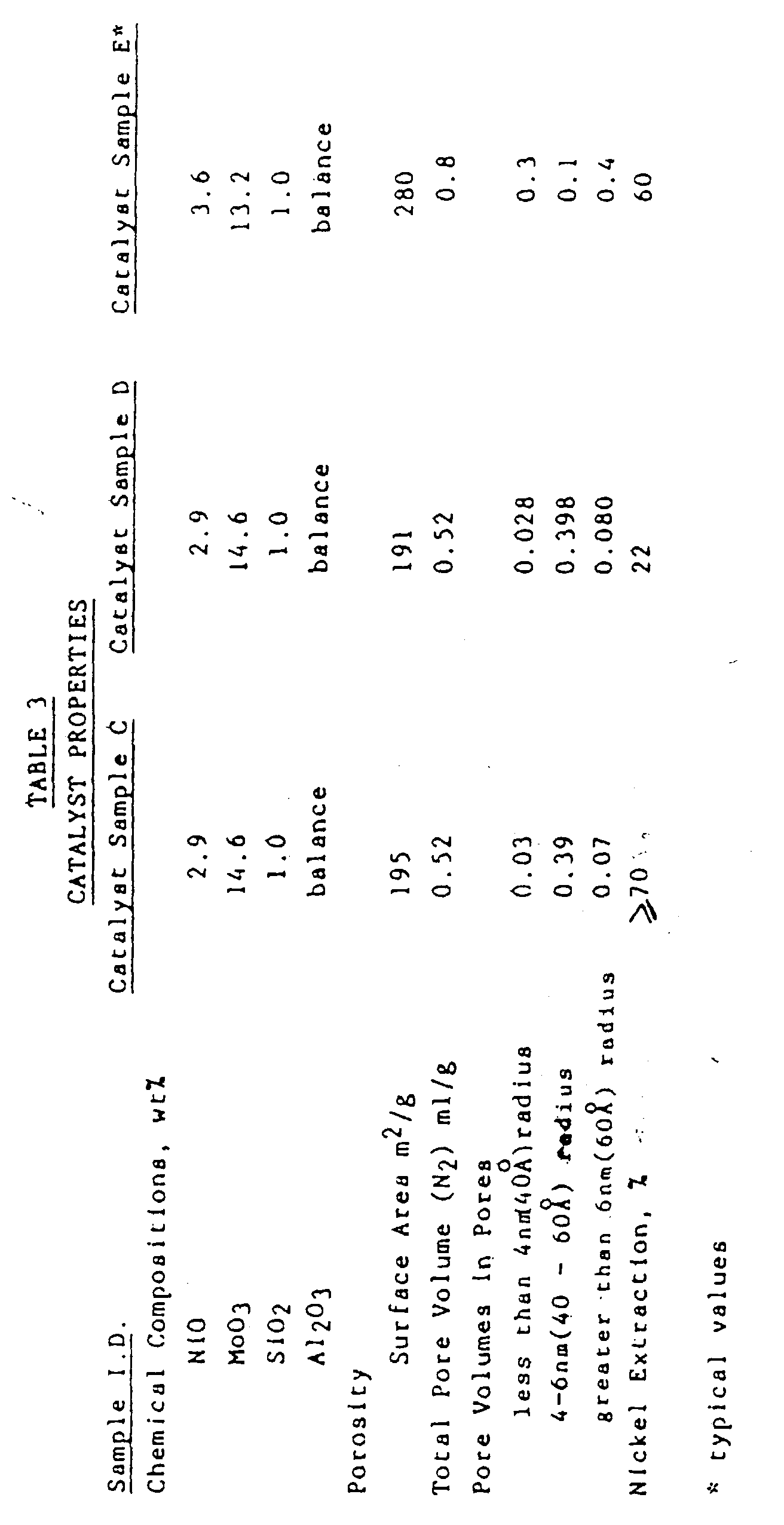
- Catalyst Samples C, D and E Measured properties for Catalyst Samples C, D and E are shown in Table 3.
- the Catalyst Sample D is the catalyst of the invention.
- a 50-50 (by volume) mixture of the catalyst to be tested and inert corundum of about the same particle size as the catalyst was charged to a fixed-bed bench-scale reactor in which the catalysts were pretreated in a nitrogen atmosphere at 315°C (600°F) to ensure dryness. Then the catalysts were converted from oxide to sulfide by contact with a gaseous mixture of 90 mole percent H 2 and 10 mole percent H 2 S at 315-371°C (600-700°F) for 2 hours at a pressure of 343kPa (35 psig) in the reactor.
Landscapes
- Chemical & Material Sciences (AREA)
- Engineering & Computer Science (AREA)
- Organic Chemistry (AREA)
- Chemical Kinetics & Catalysis (AREA)
- Materials Engineering (AREA)
- Oil, Petroleum & Natural Gas (AREA)
- General Chemical & Material Sciences (AREA)
- Physics & Mathematics (AREA)
- Thermal Sciences (AREA)
- Catalysts (AREA)
- Production Of Liquid Hydrocarbon Mixture For Refining Petroleum (AREA)
Abstract
Description
- The invention relates to improved catalysts for the hydroconversion of heavy oils and particularly those which contain Ramsbottom carbon precursors. These precursors include asphaltenes which can be converted to distillate oils but which also can thermally decompose to coke during distillation or in downstream operations. Heavy oils which contain Ramsbottom carbon precursors include, atmospheric and vacuum reduced crude petroleum, far sand extracts, shale oil, products from coal liquefaction, raffinates from solvent de-asphalting and heavy crude oils such as Venezuelan Orinoco and Mexican Maya. As the world's petroleum reserves are depleted, it becomes important not to lose as coke the 2 - 50 % of Ramsbottom carbon precursors present in the heavy oils. Process conditions for the catalytic hydroconversion of these oils to lighter distillates are necessarily so severe that a high degree of hydrodesulfurization (HDS), hydrodenitrogenation (HDN) and hydrodemetallation (HDM) also occurs.
- The catalyst of this invention comprises nickel and molybdenum on an alumina support and has a specific narrow pore size distribution. Both the pore size distribution and the chemical state of the supported nickel component in the catalyst are important to the purpose of the invention which is to catalytically convert an increased proportion of the Ramsbottom carbon precursors to distillates while reducing the loss to coke.
- Catalytic hydroprocessing of heavy oils falls into two major classes of processes. Of the first class are those processes designed for hydrodesulfurization, hydrodenitrogenation and hydrodemetallation. Most of these processes use a catalyst consisting of nickel or cobalt with molybdenum on alumina. Such processes usually provide little if any hydroconversion of the Ramsbottom Carbon precursors to distillate oils. The second class of processes are those designed for hydroconversion which includes hydrogenation and hydrocracking. Most of these processes use catalysts that contain a strongly acidic material such as an ion-exchanged zeolite or a fluoride ion. Many hydrocracking processes have two stages, each stage using a different catalyst. The first stage uses an HDS-HDN type of catalyst and the second stage uses a hydroconversion type of catalyst. It is unusual in the prior art to find significant hydroconversion in processes using an HDS-HDN type catalyst which has no strong-acid function.
- The use of catalysts of narrow pore size distribution for HDS or HDN is known. Prior art was reviewed in U.S. Patent 4,069,139, which itself described and claimed catalysts having a narrow pore size distribution similar to, but of larger pore size than, the hydroconversion catalysts of the present invention. However, none of the prior art described catalysts having both the narrow pore size distribution and the low proportion of acid-extractable nickel as in catalysts of the present invention.
- One kind of commercial process for hydroconversion of heavy oils employs catalysts that do not have the usual strong acid sites found on most catalysts for hydroconversion of distillate oils. This process is known as the ebullated bed process. Specific ebullated bed processes are the H-Oil Process developed by Hydrocarbon Research Inc., Trenton, N.J. and the LC-Fining Process developed by Lummus Engineering Co. of Bloomfield, N.J.
- Originally the ebullated bed processes were aimed at HDM and HDS refining of heavy oils. In the case of HDM, as described in U.S. Patent No. 2,987,470, any inert solids of small particle size, e.g. sand, would suffice as catalyst, the requirement being that it could form an ebullated bed of the small particles in the reactor. In the case of HDS, as described in U.S. Patent No. 2,987,467, any HDS-HDN type of catalyst was said to be satisfactory provided that it would form an ebullated bed. The catalysts of the invention are suitable for use in processes using either ebullated bed reactors or fixed bed reactors.
- As more effective catalysts were developed, higher degrees of hydroconversion and HDS became achievable. A second generation of such catalysts was based on the concept of macropores to provide access of heavy oils to the micropores which contain the catalytically active sites. Examples of specified macropore volumes in the prior art descriptions are 10-40% of the pore volume in pores greater than 100nm (1000Å) diameter, as described in U.S. Patent No. 3,630,888 or 0.1 to 0.6 cc/g in pores with diameter greater than 25nm (250Å) as described in U.S. Patent No. 3,622,500. There was no mention of any need for a narrow pore size distribution in pores having diameter smaller than 25nm (250Å.) There was also no description of a way to reduce the catalyst deactivation rate by decreasing the amount of acid extractable Ni in the catalysts.
- The catalysts described in U.S. patent No. 4,051,021 have a pore size distribution similar to that of the catalyst of the present invention. However, the prior art catalysts contain high amounts of acid extractable cobalt. For the hydro-conversion of heavy oils, particularly resid stocks containing Ramsbottom carbon precursors, the lower proportion of acid extractable nickel is an advantage.
- According to the present invention there is a catalyst composition provided which is useful in the hydro-conversion of heavy oils, said catalyst composition being defined in claim 1.
- A method of making the catalyst composition of the present invention is defined in claim 2.
- The invention provides improved catalysts for the hydroconversion of heavy oils which contain Ramsbottom Carbon precursors in concentrations from about 2% to about 50% by wt of the oil. One important feature of the invention is the narrow pore size distribution in the catalyst. The porosity properties of a catalyst embodying the invention can be defined as follows:
- 1. Total Pore Volume: 0.5 to 1.5 ml g
- 2. Pore Volume in pores of 4-6nm (40-60Å) pore radius: at least 70% of Total Pore Volume
- 3. Pore Volume in pores of less than 4nm (40Å) pore radius: not more than 0.03 ml/g
- 4. Pore Volume in pores of greater than 6nm (60Å) pore radius: 0.05 to 0.10 ml/g.
- Pore radius for the above definitions are measured by the nitrogen desorption cycle of the nitrogen sorption isotherm at 77.4°K using an instrument such as the Aminco Adsorptomat manufactured by the American Instrument Co., Maryland or the Autosorb-6 manufactured by the Quantochrome Corp., Syosset, N.Y. The mathematical analysis of the isotherm used to obtain pore size distribution is that of Barrett, Joyner and Halenda (Journ. Am. Chem. Soc., 73, 373, 1951). Nitrogen thickness values used in the calculation are obtained using the method of Shull (Journ. Am. Chem. Soc., 70, 1410, 1948). Median pore radius is defined as that pore radius from which 50% of the total nitrogen pore volume is in smaller pores and 50% is in larger pores.
- The catalyst of this invention contains nickel and molybdenum on a porous alumina support. The alumina support may contain in addition to alumina minor amounts of other inorganic oxides such as titania, zirconia, silica, phosphorous and the like. Using conventional procedures, the catalytic metals are deposited on the support. First the molybdenum is deposited, for example as an aqueous ammonium heptamolybdate solution by the pore saturation procedure. Then the product may be dried and calcined to decompose the ammonium molybdate to MoO3. After cooling, the extrudates may be impregnated with a solution of nickel nitrate and again dried and calcined to decompose the metal nitrate to NiO. Alternatively, the catalytic metals may be impregnated all in a single solution. The temperature of the final calcination after impregnation is found to determine the ratio of free Ni to combined Ni in the catalyst. The free nickel oxide, which is acid extractable, is believed to be loosely associated with the small particles of MoO3 present. Combined nickel is not readily acid-extractable and is believed to be combined by reaction with the support to form aluminates called spinets which are believed to be catalytically inactive. These concepts are clearly described in the article by Bachelier et al in the Journal of Catalysis 87 pp. 292-304 (1984). To maximize HDS catalytic activity one should maximize the proportion of acid extractable Ni. As Bachelier points out, this is done by keeping the final calcining temperature well below 538°C (1000°F).
- We have found, surprisingly, that for hydroconversion of heavy oils, a lower proportion of acid extractable Ni to the total Ni content is desirable, preferably only about 10-35% by weight of the Ni is extractable, more preferably about 15-30% and most preferably from 20-28%. The final catalyst calcination temperature must be above 538°C (1000°F) to reduce the proportion of extractable nickel to a value in this range.
- We suppose that the combination of the defined narrow pore size distribution and the low proportion of acid extractable Ni prevents the catalyst from being deactivated almost immediately with respect to its hydroconversion activity. Both of these properties of the catalyst are necessary for preventing such immediate deactivation. That would explain the surprisingly improved combination of high catalytic hydroconversion activity and slower catalytic deactivation rate observed when the catalyst is tested.
- The requirement for the defined pore size results from compromise between opposing considerations.
- The pores cannot be primarily in the range of 5-9nm (50 - 90Å) diameter as taught by Adams et at (U.S. 3,509,044) and by Gustafson (U.S. 3,966,644) because such small pores did not provide easy access for asphaltenes and other large molecules.
- If the pores were mostly above about 12nm (120Å) diameter as taught by Riley (U.S. 4,069,139) by Scott et al (Advances in Chemistry Series 103, page 117, ACS 1971) and others, then the surface area of the catalyst and correspondingly its activity would be too low.
- Hydrogen transfer activity probably occurs in pore spaces in the vicinity of surface sites containing nickel. Depending upon the availability of hydrogen in those pore spaces, the predominating reactions will be either hydrogenation or dehydrogenation.
- When the catalyst has been calcined at an appropriately high temperature (sufficient to reduce the extractable Ni to the specified range) the hydrogen transfer activity of the catalyst is reduced. With reduced hydrogen-transfer reactivity. it is easier for the hydrogen supply to keep up with the rate of hydrogen consumption and hydrogenation predominates over dehydrogenation.
- In the opposite case, using catalysts where the hydrogen-transfer reactivity is too high, the transport rate for supplying hydrogen to the active sites cannot keep up with the hydrogen-transfer reaction rates at those sites: then dehydrogenation predominates, coke forms and the catalyst is deactivated.
- From U.S. Patent No. 4 013 547, there was known a cobalt-molybdenum-alumina catalyst characterized by certain physical properties of surface area, pore volume, and pore size distribution. However, that catalyst was specifically provided for the desulfurization of residual petroleum oils which is a field completely different from that of hydroconversion, particularly from the conversion of the Ramsbottom carbon precursors to distillates, to which the present invention refers.
- In U.S. Patent No. 4 414 141, there is disclosed a catalyst for hydrotreating of heavy feed stock, containing a catalytically effective amount of nickel and molybdenum as well as optionally a catalytically effective amount of cobalt, supported on an alumina carrier. That catalyst shows a particular pore size distribution which is not suitable for the hydroconversion of heavy oils which contains Ramsbottom carbon precursors.
- Catalysts having the narrow pore size distribution specified above and containing 0.5 - 5% NiO and 1.8% - 18% of MoO3 are prepared as described in the following detailed examples. To monitor the ratio of "free" to "combined" Ni we have developed the following analysis.
- Dilute 10 ml of c.p. conc. HCI with 400 ml of distilled water to prepare a stock solution of dilute (ca. 0.9%) HCl. Place a 10 gram sample of the catalyst to be tested and 20 ml of the dilute HCI in a 60ml (2 oz.) bottle. Keep the sealed bottle in motion for one hour in a shaking or rolling apparatus. Filter the catalyst and wash with three 25 ml portions of distilled water. Weigh the combined filtrate plus washings and analyze the solution for Ni. Knowing the nickel content of the original catalyst sample, one can readily calculate the percentage that was extracted by the dilute HCI solution.
- A number of commercial nickel-containing HDS catalysts were analyzed using the above analysis. Nickel content varied from about 3 to about 5% and extractable nickel varied from about 1/3 to about 3/4 of the total nickel.
- For catalysts containing about 3% NiO and about 15% MoO3 on alumina, the percent extractable nickel correlates inversely with calcination temperatures. Results in Table 1 illustrate the correlation.

- A catalyst support was prepared which had an appropriate narrow pore size distribution in the range defined above. A state-of-the-art spray dried alumina-silica powder was selected for use to make the support. Other powders, for example pure alumina, alumina-boria, alumina-titania, etc can be used instead provided their micro pore volumes are sufficiently high. The pore volume of the selected alumina-silica powder was 0.76 ml/g in pores between 3.5 and 20nm (35 and 200Å) diameter. Suitable powders can be made by procedures described in the following U.S. patents to Malley et al: 3,124,418; 3,032,514; 2,980,632; 3,086,845; and to Adams et al; 3,509,044.
- 25 Pounds of the spray dried powder (75% solids) were mixed with 10kg (22 lb) of 0.06 molar nitric acid. The composite was mixed in a muller for one hour. Then the doughy mix from the muller was extruded into 0.8mm (1/32") diameter cylindrical strands. The strands were dried for one hour in an oven at 121°C (250°F).
- Half of the oven dried extrudates. Sample A, were calcined at 593°C (1100°F) for one hour in an externally fired rotary calciner. The other half, Sample B, were calcined at 704°C (1300°F) for one hour in the same calciner. In making Sample B, the atmosphere over the catalyst bed in the calciner was almost totally steam, whereas in making Sample A a purge of fresh air was continuously swept through the calciner to keep the water vapor content in the atmosphere very low.
- Porosity data for these supports, Samples A and B are tabulated in Table 2.
TABLE 2 Sample Support Sample A Support Sample B Surface Area m2/g - 192 Pore Volume ml/g 0.76 0.75 Medium Pore Diameter A 60 130 - Sample B is the support selected to make the catalyst of the invention because of its suitable median pore diameter.
- Five pounds of Support Sample B were impregnated by pore saturation with 1620 ml of an aqueous solution containing 311 gm nickel nitrate hexahydrate and 493 gm ammonium heptamolybdate. The impregnated extrudates were transferred at ambient temperature to a rotary calciner and the material was heated to 437°C (820°F) over a period of about 1 hour and then held at 437°C (820°F) for another hour in the calciner. About half of the catalyst was discharged. This sample was marked for identification as Catalyst Sample C.
- The catalyst remaining in the calciner was further heated from 437°C (820°F) to 604°C (1120°F) in about 5 minutes and held for another 10 minutes at 604°C (1120°F.) The catalyst was discharged and marked for identification as Catalyst Sample D.
- Measured properties for Catalyst Samples C, D and E are shown in Table 3. The Catalyst Sample D is the catalyst of the invention.
- American Cyanamid HDS-1443 B is a commercially available, state-of-the-art, catalyst sold for use in hydrotreating resid oils. A sample of this catalyst (Catalyst Sample E) and Catalyst Sample D were evaluated for resid hydrotreating under the test conditions described in Example 3 below. The results of this test, tabulated in Table 4, show that the catalyst of this invention was 28 to 60% more active than the state-of-the-art catalyst, depending upon the category considered.
- Performance tests using Catalyst Samples D and E were run using as the feedstock, Kuwait vacuum residua having the following average analysis:
Gravity °API 7-9 Ramsbottom Carbon Residue ca. 20% Sulfur ca. 5% Nitrogen ca. 4000 ppm Nickel ca. 30 ppm Vanadium ca. 100 ppm - The following test procedure was used to evaluate the Catalysts D and E. The hydrotreating temperature for this test was higher than usual to provide some degree of thermal cracking and to increase the hydrogenation reaction rates.
- A 50-50 (by volume) mixture of the catalyst to be tested and inert corundum of about the same particle size as the catalyst was charged to a fixed-bed bench-scale reactor in which the catalysts were pretreated in a nitrogen atmosphere at 315°C (600°F) to ensure dryness. Then the catalysts were converted from oxide to sulfide by contact with a gaseous mixture of 90 mole percent H2 and 10 mole percent H2S at 315-371°C (600-700°F) for 2 hours at a pressure of 343kPa (35 psig) in the reactor.
- Hydrogen gas and the resid feedstock were fed to the reactor under the following conditions
Temperature (825°F)441°C Liquid Hourly Space Velocity 2.5 Total Pressure (2250 psi)15,514kPa - For all of the catalysts tested there was a steep initial non-linear activity decline through the first day on test. Consequently. data on hydrodesulfurization and conversion of Ramsbottom Carbon Residue were measured on the third day of the test. Those data are tabulated in Table 4.
TABLE 4 CATALYST ACTIVITY TESTING Catalyst D E Operating Conditions Temp (°F) °C (825)441 (825)441 LHSV, hr-1 2.5 2.5 Pressure,(psig) kPa (2250)15,514 (2250)15,514 Conversion, wt % Total Sulfur 87.3 72.4 Ramsbottom Carbon Residue 73.4 57.5 Non-RCR 84.0 76.0 Sulfur in (975°F+) 524°C 93.8 85.9 Rate Constants, hr-1 Total Sulfur 5.15 3.22 Ramsbottom Carbon Residues 3.30 2.14 Non-RCR 4.57 3.57 Sulfur in(975°F+) 524°C 6.94 4.89
Claims (2)
- A catalyst composition useful in the hydroconversion of heavy oils, containing 0.5-5% nickel and 1.8-18% molybdenum calculated as the oxides on a porous alumina support containing 1-3% silica, said catalyst having 10-35% of the nickel in an acid extractable form, a total pore volume (PV) of 0.5 - 1.5 ml per g and a pore size distribution ofat least 70% of total PV in pores of 4-6 nm (40-60 Å) radius;not more than 0.03 ml per g of pore volume in pores of less than 4 nm (40 Å) radius;at least 0.05 ml per g and not more than 0.1 ml per g of pores greater than 6 nm (60 Å) radius;said pore size distribution being calculated from desorption data of the nitrogen sorption isotherm.
- A method of making a catalyst composition useful in the hydroconversion of heavy oils, containing 0.5 - 5% nickel and 1.8 - 18% molybdenum calculated as the oxides on a porous alumina support containing 1 - 3% silica, said catalyst having 10 - 35% of the nickel or cobalt in an acid extractable form, a total pore volume of 0.5 - 1.5 ml per gram and a pore size distribution ofat least 70% of total PV in pores of 4-6 nm (40-60 Å) radius);not more than 0.03 ml per g of pore volume in pores of less than 4 nm (40 Å) radius;at least 0.05 ml per g and not more than 0.1 ml per g of pores greater than 6 nm (60 Å) radius;said pore size distribution being calculated from desorption data of the nitrogen sorption isotherm,comprising the steps of:(a) calcining alumina extrudates under steam to adjust the medium pore size diameter to a suitable value to obtain the defined pore size distribution in the finished catalyst,(b) impregnating the steamed extrudates with molybdenum and nickel salts, and(c) calcining the impregnated extrudates at a temperature of at least 593°C (1100°F) and sufficiently high to reduce the acid extractable nickel to the defined value in the finished catalyst.
Priority Applications (1)
| Application Number | Priority Date | Filing Date | Title |
|---|---|---|---|
| AT86105476T ATE69255T1 (en) | 1985-05-06 | 1986-04-21 | CATALYSTS FOR THE HYDROGENIC CONVERSION OF HEAVY OILS. |
Applications Claiming Priority (2)
| Application Number | Priority Date | Filing Date | Title |
|---|---|---|---|
| US06/730,619 US4652545A (en) | 1985-05-06 | 1985-05-06 | Catalyst for hydroconversion of heavy oils and method of making the catalyst |
| US730619 | 1985-05-06 |
Publications (4)
| Publication Number | Publication Date |
|---|---|
| EP0201762A2 EP0201762A2 (en) | 1986-11-20 |
| EP0201762A3 EP0201762A3 (en) | 1988-06-01 |
| EP0201762B1 EP0201762B1 (en) | 1991-11-06 |
| EP0201762B2 true EP0201762B2 (en) | 1997-04-02 |
Family
ID=24936074
Family Applications (1)
| Application Number | Title | Priority Date | Filing Date |
|---|---|---|---|
| EP86105476A Expired - Lifetime EP0201762B2 (en) | 1985-05-06 | 1986-04-21 | Catalyst for hydroconversion of heavy oils |
Country Status (7)
| Country | Link |
|---|---|
| US (1) | US4652545A (en) |
| EP (1) | EP0201762B2 (en) |
| JP (1) | JP2537193B2 (en) |
| AT (1) | ATE69255T1 (en) |
| CA (1) | CA1264726A (en) |
| DE (1) | DE3682319D1 (en) |
| MX (1) | MX163973B (en) |
Families Citing this family (26)
| Publication number | Priority date | Publication date | Assignee | Title |
|---|---|---|---|---|
| US4786404A (en) * | 1986-10-28 | 1988-11-22 | Shell Oil Company | Process for hydrotreating hydrocarbon feeds |
| US4786403A (en) * | 1986-10-28 | 1988-11-22 | Shell Oil Company | Process for hydrotreating hydro carbon feeds |
| US4941964A (en) * | 1988-03-14 | 1990-07-17 | Texaco Inc. | Hydrotreatment process employing catalyst with specified pore size distribution |
| US5047142A (en) * | 1988-05-13 | 1991-09-10 | Texaco Inc. | Catalyst composition and method for hydroprocessing petroleum feedstocks |
| US4969990A (en) * | 1988-06-29 | 1990-11-13 | Union Oil Company Of California | Hydroprocessing with a catalyst having a narrow pore size distribution |
| US5868923A (en) * | 1991-05-02 | 1999-02-09 | Texaco Inc | Hydroconversion process |
| EP0526988A3 (en) * | 1991-07-10 | 1993-03-31 | Texaco Development Corporation | Hydrotreatment process employing a mono-modal catalyst with specified pore size distribution |
| US5210061A (en) * | 1991-09-24 | 1993-05-11 | Union Oil Company Of California | Resid hydroprocessing catalyst |
| US5192734A (en) * | 1991-10-25 | 1993-03-09 | W. R. Grace & Co.- Conn. | Hydroprocessing catalyst composition |
| US5322616A (en) * | 1992-03-30 | 1994-06-21 | Texaco Inc. | Mild hydrocracking of heavy hydrocarbon feedstocks employing lithia promoted catalysts |
| US5320743A (en) * | 1992-05-29 | 1994-06-14 | Texaco Inc. | Mild hydrocracking of heavy hydrocarbon feedstocks employing silica-alumina catalysts |
| US5397456A (en) * | 1993-02-19 | 1995-03-14 | Texaco Inc. | Hydroconversion process employing catalyst with specified pore size distribution |
| US5928499A (en) * | 1993-10-01 | 1999-07-27 | Texaco Inc | Hydroconversion process employing catalyst with specified pore size distribution, median pore diameter by surface area, and pore mode by volume |
| US6015485A (en) * | 1994-05-13 | 2000-01-18 | Cytec Technology Corporation | High activity catalysts having a bimodal mesopore structure |
| US5968348A (en) * | 1994-05-16 | 1999-10-19 | Texaco Inc. | Hydroconversion process employing a phosphorus loaded NiMo catalyst with specified pore size distribution |
| US6387248B2 (en) | 1997-11-06 | 2002-05-14 | Texaco Inc. | Method of preparing a catalyst for use in the hydrotreating of high boiling hydrocarbon feedstocks |
| GC0000065A (en) * | 1998-09-01 | 2004-06-30 | Japan Energy Corp | Hydrocracking catalyst, producing method threof, and hydrocracking method. |
| US6508999B1 (en) | 2000-11-21 | 2003-01-21 | Shell Oil Company | Aluminum trihydroxide phase |
| US6589908B1 (en) * | 2000-11-28 | 2003-07-08 | Shell Oil Company | Method of making alumina having bimodal pore structure, and catalysts made therefrom |
| EP1552880B1 (en) * | 2002-10-10 | 2014-07-02 | China Petroleum & Chemical Corporation | A silicon-containing alumina support, preparation thereof and a catalyst comprising the alumina support |
| JP4493997B2 (en) * | 2003-12-10 | 2010-06-30 | 財団法人石油産業活性化センター | Hydrodesulfurization catalyst for hydrocarbon oil and method for producing the same |
| US20100240522A1 (en) | 2009-03-23 | 2010-09-23 | Tomoyuki Inui | Catalyst exhibiting hydrogen spillover effect |
| US10400184B2 (en) * | 2011-08-31 | 2019-09-03 | Exxonmobil Research And Engineering Company | Hydroprocessing of heavy hydrocarbon feeds using small pore catalysts |
| JP6134334B2 (en) | 2011-12-22 | 2017-05-24 | アドバンスド・リフアイニング・テクノロジーズ・エルエルシー | Silica-containing alumina support, catalyst produced therefrom and method of use thereof |
| MX345342B (en) | 2012-08-20 | 2017-01-24 | Inst Mexicano Del Petróleo | Process for improving heavy and extra heavy crude oil. |
| US10537883B2 (en) | 2016-10-07 | 2020-01-21 | King Fahd University Of Petroleum And Minerals | Method for producing a hydrodesulfurization catalyst |
Family Cites Families (13)
| Publication number | Priority date | Publication date | Assignee | Title |
|---|---|---|---|---|
| US3383301A (en) * | 1966-01-20 | 1968-05-14 | Gulf Research Development Co | Residue desulfurization with catalyst whose pore volume is distributed over wide range of pore sizes |
| US3509044A (en) * | 1967-06-26 | 1970-04-28 | Exxon Research Engineering Co | Hydrodesulfurization of petroleum residuum |
| US4113661A (en) * | 1973-08-09 | 1978-09-12 | Chevron Research Company | Method for preparing a hydrodesulfurization catalyst |
| US4069139A (en) * | 1975-12-29 | 1978-01-17 | Exxon Research & Engineering Co. | Hydrodesulfurization of oil utilizing a narrow pore size distribution catalyst |
| US4048060A (en) * | 1975-12-29 | 1977-09-13 | Exxon Research And Engineering Company | Two-stage hydrodesulfurization of oil utilizing a narrow pore size distribution catalyst |
| US4013547A (en) * | 1976-01-22 | 1977-03-22 | Union Oil Company Of California | Desulfurization of residual petroleum oils with a catalyst calcined at higher temperatures |
| US4051021A (en) * | 1976-05-12 | 1977-09-27 | Exxon Research & Engineering Co. | Hydrodesulfurization of hydrocarbon feed utilizing a silica stabilized alumina composite catalyst |
| JPS5527036A (en) * | 1978-08-16 | 1980-02-26 | Shokubai Kasei Kogyo Kk | Hydrogenation and desulfurization catalyst for heavy hydrocabron oil |
| JPS55119445A (en) * | 1979-03-07 | 1980-09-13 | Shokubai Kasei Kogyo Kk | Desulfurization catalyst of petroleum base heavy hydrocarbon oil |
| US4414141A (en) * | 1980-11-21 | 1983-11-08 | The Lummus Company | Hydrotreating catalyst |
| JPS594440A (en) * | 1982-06-29 | 1984-01-11 | Shokubai Kasei Kogyo Kk | Manufacture of hydrogenation purification catalyst |
| JPS59115743A (en) * | 1982-12-23 | 1984-07-04 | Res Assoc Petroleum Alternat Dev<Rapad> | Carrier of catalyst for hydrogen treating heavy hydrocarbon residue oil |
| US4500424A (en) * | 1983-04-07 | 1985-02-19 | Union Oil Company Of California | Desulfurization catalyst and process |
-
1985
- 1985-05-06 US US06/730,619 patent/US4652545A/en not_active Expired - Lifetime
-
1986
- 1986-04-21 AT AT86105476T patent/ATE69255T1/en not_active IP Right Cessation
- 1986-04-21 DE DE8686105476T patent/DE3682319D1/en not_active Expired - Lifetime
- 1986-04-21 EP EP86105476A patent/EP0201762B2/en not_active Expired - Lifetime
- 1986-04-29 MX MX2343A patent/MX163973B/en unknown
- 1986-05-02 CA CA000508208A patent/CA1264726A/en not_active Expired - Lifetime
- 1986-05-02 JP JP61101224A patent/JP2537193B2/en not_active Expired - Lifetime
Also Published As
| Publication number | Publication date |
|---|---|
| ATE69255T1 (en) | 1991-11-15 |
| EP0201762B1 (en) | 1991-11-06 |
| JP2537193B2 (en) | 1996-09-25 |
| MX163973B (en) | 1992-07-07 |
| EP0201762A2 (en) | 1986-11-20 |
| JPS61287448A (en) | 1986-12-17 |
| US4652545A (en) | 1987-03-24 |
| CA1264726A (en) | 1990-01-23 |
| DE3682319D1 (en) | 1991-12-12 |
| EP0201762A3 (en) | 1988-06-01 |
Similar Documents
| Publication | Publication Date | Title |
|---|---|---|
| EP0201762B2 (en) | Catalyst for hydroconversion of heavy oils | |
| US4255282A (en) | Hydrotreating catalyst and process for its preparation | |
| EP0876443B1 (en) | Hydroconversion process employing a catalyst with specified pore size distribution and no added silica | |
| US4520128A (en) | Catalyst having high metal retention capacity and good stability for use in the demetallization of heavy crudes and method of preparation of same | |
| US4431526A (en) | Multiple-stage hydroprocessing of hydrocarbon oil | |
| US4460707A (en) | Hydroprocessing catalyst and method for preparing it | |
| US5616530A (en) | Hydroconversion process employing catalyst with specified pore size distribution | |
| US4431525A (en) | Three-catalyst process for the hydrotreating of heavy hydrocarbon streams | |
| EP2864042B1 (en) | Improved resid hydrotreating catalyst containing titania | |
| US5334307A (en) | Resid hydroprocessing catalyst | |
| KR20100071016A (en) | Hydrodemetallization and hydrodesulphurization catalysts, and use in a single formulation in a concatenated process | |
| US4119531A (en) | Large-pore hydrodemetallization catalyst and process employing same | |
| EP0341893A2 (en) | Hydroprocessing catalyst and method of preparation | |
| EP0696632A1 (en) | Hydrodearomatisation of hydrocarbon oils using phosphorus-treated carbon-supported metal sulphide catalysts | |
| EP1733787A1 (en) | Catalyst for hydrogenation treatment of hydrocarbon oil and method for preparation thereof, and method for hydrogenation treatment of hydrocarbon oil | |
| EP0349223B1 (en) | Hydroprocessing catalytic composition and the preparation and use thereof | |
| US4548710A (en) | Hydrocarbon processing | |
| EP1392431B1 (en) | High-macropore hydroprocessing catalyst and its use | |
| US4844792A (en) | Hydroprocessing with a specific pore sized catalyst containing non-hydrolyzable halogen | |
| CA1248513A (en) | Residual hydrocarbon demetalation and desulfurization | |
| US4394302A (en) | Hydrodesulfurization catalyst on lithium-containing support and method for its preparation | |
| US4579649A (en) | Process for demetallization of heavy crudes using a catalyst having high metal retention capacity and good stability | |
| US4969990A (en) | Hydroprocessing with a catalyst having a narrow pore size distribution | |
| JPH0435519B2 (en) | ||
| CA2306947A1 (en) | Hydrotreating catalyst for heavy oil, carrier for the catalyst, and process for the preparation of the catalyst |
Legal Events
| Date | Code | Title | Description |
|---|---|---|---|
| PUAI | Public reference made under article 153(3) epc to a published international application that has entered the european phase |
Free format text: ORIGINAL CODE: 0009012 |
|
| AK | Designated contracting states |
Kind code of ref document: A2 Designated state(s): AT BE CH DE FR GB IT LI LU NL SE |
|
| PUAL | Search report despatched |
Free format text: ORIGINAL CODE: 0009013 |
|
| AK | Designated contracting states |
Kind code of ref document: A3 Designated state(s): AT BE CH DE FR GB IT LI LU NL SE |
|
| 17P | Request for examination filed |
Effective date: 19881121 |
|
| 17Q | First examination report despatched |
Effective date: 19900117 |
|
| GRAA | (expected) grant |
Free format text: ORIGINAL CODE: 0009210 |
|
| AK | Designated contracting states |
Kind code of ref document: B1 Designated state(s): AT BE CH DE FR GB IT LI LU NL SE |
|
| PG25 | Lapsed in a contracting state [announced via postgrant information from national office to epo] |
Ref country code: SE Effective date: 19911106 Ref country code: AT Effective date: 19911106 |
|
| REF | Corresponds to: |
Ref document number: 69255 Country of ref document: AT Date of ref document: 19911115 Kind code of ref document: T |
|
| REF | Corresponds to: |
Ref document number: 3682319 Country of ref document: DE Date of ref document: 19911212 |
|
| ET | Fr: translation filed | ||
| ITF | It: translation for a ep patent filed | ||
| PG25 | Lapsed in a contracting state [announced via postgrant information from national office to epo] |
Ref country code: LU Free format text: LAPSE BECAUSE OF NON-PAYMENT OF DUE FEES Effective date: 19920430 Ref country code: LI Effective date: 19920430 Ref country code: CH Effective date: 19920430 |
|
| PLBI | Opposition filed |
Free format text: ORIGINAL CODE: 0009260 |
|
| 26 | Opposition filed |
Opponent name: AKZO N.V. Effective date: 19920804 |
|
| NLR1 | Nl: opposition has been filed with the epo |
Opponent name: AKZO N.V. |
|
| REG | Reference to a national code |
Ref country code: CH Ref legal event code: PL |
|
| PLAB | Opposition data, opponent's data or that of the opponent's representative modified |
Free format text: ORIGINAL CODE: 0009299OPPO |
|
| R26 | Opposition filed (corrected) |
Opponent name: AKZO NOBEL N.V. Effective date: 19920804 |
|
| PLAW | Interlocutory decision in opposition |
Free format text: ORIGINAL CODE: EPIDOS IDOP |
|
| PLAW | Interlocutory decision in opposition |
Free format text: ORIGINAL CODE: EPIDOS IDOP |
|
| PUAH | Patent maintained in amended form |
Free format text: ORIGINAL CODE: 0009272 |
|
| STAA | Information on the status of an ep patent application or granted ep patent |
Free format text: STATUS: PATENT MAINTAINED AS AMENDED |
|
| 27A | Patent maintained in amended form |
Effective date: 19970402 |
|
| AK | Designated contracting states |
Kind code of ref document: B2 Designated state(s): AT BE CH DE FR GB IT LI LU NL SE |
|
| REG | Reference to a national code |
Ref country code: CH Ref legal event code: AEN Free format text: MAINTIEN DU BREVET DONT L'ETENDUE A ETE MODIFIEE |
|
| ET3 | Fr: translation filed ** decision concerning opposition | ||
| NLR2 | Nl: decision of opposition | ||
| NLR3 | Nl: receipt of modified translations in the netherlands language after an opposition procedure | ||
| REG | Reference to a national code |
Ref country code: GB Ref legal event code: IF02 |
|
| PGFP | Annual fee paid to national office [announced via postgrant information from national office to epo] |
Ref country code: GB Payment date: 20040302 Year of fee payment: 19 |
|
| PGFP | Annual fee paid to national office [announced via postgrant information from national office to epo] |
Ref country code: FR Payment date: 20050214 Year of fee payment: 20 |
|
| PGFP | Annual fee paid to national office [announced via postgrant information from national office to epo] |
Ref country code: BE Payment date: 20050405 Year of fee payment: 20 |
|
| PGFP | Annual fee paid to national office [announced via postgrant information from national office to epo] |
Ref country code: NL Payment date: 20050420 Year of fee payment: 20 |
|
| PG25 | Lapsed in a contracting state [announced via postgrant information from national office to epo] |
Ref country code: GB Free format text: LAPSE BECAUSE OF NON-PAYMENT OF DUE FEES Effective date: 20050421 |
|
| PGFP | Annual fee paid to national office [announced via postgrant information from national office to epo] |
Ref country code: IT Payment date: 20050426 Year of fee payment: 20 |
|
| PGFP | Annual fee paid to national office [announced via postgrant information from national office to epo] |
Ref country code: DE Payment date: 20050513 Year of fee payment: 20 |
|
| GBPC | Gb: european patent ceased through non-payment of renewal fee |
Effective date: 20050421 |
|
| PG25 | Lapsed in a contracting state [announced via postgrant information from national office to epo] |
Ref country code: NL Free format text: LAPSE BECAUSE OF EXPIRATION OF PROTECTION Effective date: 20060421 |
|
| NLV7 | Nl: ceased due to reaching the maximum lifetime of a patent |
Effective date: 20060421 |
|
| BE20 | Be: patent expired |
Owner name: *AMERICAN CYANAMID CY Effective date: 20060421 |