EP0201071B1 - 2-substituted-1-naphthols as 5-lipoxygenase inhibitors - Google Patents
2-substituted-1-naphthols as 5-lipoxygenase inhibitors Download PDFInfo
- Publication number
- EP0201071B1 EP0201071B1 EP86106122A EP86106122A EP0201071B1 EP 0201071 B1 EP0201071 B1 EP 0201071B1 EP 86106122 A EP86106122 A EP 86106122A EP 86106122 A EP86106122 A EP 86106122A EP 0201071 B1 EP0201071 B1 EP 0201071B1
- Authority
- EP
- European Patent Office
- Prior art keywords
- naphthol
- treating
- mole
- acid
- product
- Prior art date
- Legal status (The legal status is an assumption and is not a legal conclusion. Google has not performed a legal analysis and makes no representation as to the accuracy of the status listed.)
- Expired
Links
- -1 2-substituted-1-naphthols Chemical class 0.000 title claims abstract description 53
- 239000000867 Lipoxygenase Inhibitor Substances 0.000 title abstract description 6
- 125000000217 alkyl group Chemical group 0.000 claims abstract description 29
- 229910052794 bromium Inorganic materials 0.000 claims abstract description 26
- 229910052801 chlorine Inorganic materials 0.000 claims abstract description 26
- 125000001997 phenyl group Chemical group [H]C1=C([H])C([H])=C(*)C([H])=C1[H] 0.000 claims abstract description 24
- 125000000753 cycloalkyl group Chemical group 0.000 claims abstract description 11
- 125000000392 cycloalkenyl group Chemical group 0.000 claims abstract description 8
- 229910052740 iodine Inorganic materials 0.000 claims abstract description 7
- 125000000304 alkynyl group Chemical group 0.000 claims abstract description 6
- 125000003118 aryl group Chemical group 0.000 claims abstract description 5
- 125000003342 alkenyl group Chemical group 0.000 claims abstract description 4
- 150000001875 compounds Chemical class 0.000 claims description 196
- 239000000203 mixture Substances 0.000 claims description 94
- LFQSCWFLJHTTHZ-UHFFFAOYSA-N Ethanol Chemical compound CCO LFQSCWFLJHTTHZ-UHFFFAOYSA-N 0.000 claims description 93
- VEXZGXHMUGYJMC-UHFFFAOYSA-N Hydrochloric acid Chemical compound Cl VEXZGXHMUGYJMC-UHFFFAOYSA-N 0.000 claims description 66
- 238000000034 method Methods 0.000 claims description 53
- KJCVRFUGPWSIIH-UHFFFAOYSA-N 1-naphthol Chemical compound C1=CC=C2C(O)=CC=CC2=C1 KJCVRFUGPWSIIH-UHFFFAOYSA-N 0.000 claims description 34
- QTBSBXVTEAMEQO-UHFFFAOYSA-N Acetic acid Chemical compound CC(O)=O QTBSBXVTEAMEQO-UHFFFAOYSA-N 0.000 claims description 31
- 239000000460 chlorine Substances 0.000 claims description 28
- MZRVEZGGRBJDDB-UHFFFAOYSA-N N-Butyllithium Chemical compound [Li]CCCC MZRVEZGGRBJDDB-UHFFFAOYSA-N 0.000 claims description 24
- 125000006239 protecting group Chemical group 0.000 claims description 23
- 125000002496 methyl group Chemical group [H]C([H])([H])* 0.000 claims description 22
- 239000003153 chemical reaction reagent Substances 0.000 claims description 16
- 125000001570 methylene group Chemical group [H]C([H])([*:1])[*:2] 0.000 claims description 15
- 239000002904 solvent Substances 0.000 claims description 15
- 125000004178 (C1-C4) alkyl group Chemical group 0.000 claims description 14
- QAOWNCQODCNURD-UHFFFAOYSA-N Sulfuric acid Chemical compound OS(O)(=O)=O QAOWNCQODCNURD-UHFFFAOYSA-N 0.000 claims description 12
- 239000002585 base Substances 0.000 claims description 12
- CURLTUGMZLYLDI-UHFFFAOYSA-N Carbon dioxide Chemical compound O=C=O CURLTUGMZLYLDI-UHFFFAOYSA-N 0.000 claims description 11
- 239000002253 acid Substances 0.000 claims description 11
- DKGAVHZHDRPRBM-UHFFFAOYSA-N Tert-Butanol Chemical compound CC(C)(C)O DKGAVHZHDRPRBM-UHFFFAOYSA-N 0.000 claims description 10
- VSCWAEJMTAWNJL-UHFFFAOYSA-K aluminium trichloride Chemical compound Cl[Al](Cl)Cl VSCWAEJMTAWNJL-UHFFFAOYSA-K 0.000 claims description 10
- 239000003795 chemical substances by application Substances 0.000 claims description 10
- 229910052731 fluorine Inorganic materials 0.000 claims description 10
- 239000003054 catalyst Substances 0.000 claims description 9
- 150000002576 ketones Chemical class 0.000 claims description 9
- 125000000051 benzyloxy group Chemical group [H]C1=C([H])C([H])=C(C([H])=C1[H])C([H])([H])O* 0.000 claims description 8
- 229910052739 hydrogen Inorganic materials 0.000 claims description 8
- 238000004519 manufacturing process Methods 0.000 claims description 8
- JOXIMZWYDAKGHI-UHFFFAOYSA-N toluene-4-sulfonic acid Chemical compound CC1=CC=C(S(O)(=O)=O)C=C1 JOXIMZWYDAKGHI-UHFFFAOYSA-N 0.000 claims description 8
- WKBOTKDWSSQWDR-UHFFFAOYSA-N Bromine atom Chemical compound [Br] WKBOTKDWSSQWDR-UHFFFAOYSA-N 0.000 claims description 7
- GDTBXPJZTBHREO-UHFFFAOYSA-N bromine Substances BrBr GDTBXPJZTBHREO-UHFFFAOYSA-N 0.000 claims description 7
- LPNYRYFBWFDTMA-UHFFFAOYSA-N potassium tert-butoxide Chemical compound [K+].CC(C)(C)[O-] LPNYRYFBWFDTMA-UHFFFAOYSA-N 0.000 claims description 7
- XHLHPRDBBAGVEG-UHFFFAOYSA-N 1-tetralone Chemical compound C1=CC=C2C(=O)CCCC2=C1 XHLHPRDBBAGVEG-UHFFFAOYSA-N 0.000 claims description 6
- ILAHWRKJUDSMFH-UHFFFAOYSA-N boron tribromide Chemical compound BrB(Br)Br ILAHWRKJUDSMFH-UHFFFAOYSA-N 0.000 claims description 6
- JHIVVAPYMSGYDF-UHFFFAOYSA-N cyclohexanone Chemical compound O=C1CCCCC1 JHIVVAPYMSGYDF-UHFFFAOYSA-N 0.000 claims description 6
- 229910052760 oxygen Inorganic materials 0.000 claims description 6
- AOJFQRQNPXYVLM-UHFFFAOYSA-N pyridin-1-ium;chloride Chemical compound [Cl-].C1=CC=[NH+]C=C1 AOJFQRQNPXYVLM-UHFFFAOYSA-N 0.000 claims description 6
- LEHBURLTIWGHEM-UHFFFAOYSA-N pyridinium chlorochromate Chemical compound [O-][Cr](Cl)(=O)=O.C1=CC=[NH+]C=C1 LEHBURLTIWGHEM-UHFFFAOYSA-N 0.000 claims description 6
- 229910052717 sulfur Inorganic materials 0.000 claims description 6
- AQRLNPVMDITEJU-UHFFFAOYSA-N triethylsilane Chemical compound CC[SiH](CC)CC AQRLNPVMDITEJU-UHFFFAOYSA-N 0.000 claims description 6
- NGNBDVOYPDDBFK-UHFFFAOYSA-N 2-[2,4-di(pentan-2-yl)phenoxy]acetyl chloride Chemical compound CCCC(C)C1=CC=C(OCC(Cl)=O)C(C(C)CCC)=C1 NGNBDVOYPDDBFK-UHFFFAOYSA-N 0.000 claims description 5
- 150000001299 aldehydes Chemical class 0.000 claims description 5
- 239000001569 carbon dioxide Substances 0.000 claims description 5
- 229910002092 carbon dioxide Inorganic materials 0.000 claims description 5
- 125000000956 methoxy group Chemical group [H]C([H])([H])O* 0.000 claims description 5
- 239000007800 oxidant agent Substances 0.000 claims description 5
- 125000006552 (C3-C8) cycloalkyl group Chemical group 0.000 claims description 4
- 239000003638 chemical reducing agent Substances 0.000 claims description 4
- BGTOWKSIORTVQH-UHFFFAOYSA-N cyclopentanone Chemical compound O=C1CCCC1 BGTOWKSIORTVQH-UHFFFAOYSA-N 0.000 claims description 4
- 125000002541 furyl group Chemical group 0.000 claims description 4
- 125000004076 pyridyl group Chemical group 0.000 claims description 4
- 125000001544 thienyl group Chemical group 0.000 claims description 4
- BVKZGUZCCUSVTD-UHFFFAOYSA-L Carbonate Chemical compound [O-]C([O-])=O BVKZGUZCCUSVTD-UHFFFAOYSA-L 0.000 claims description 3
- ZAMOUSCENKQFHK-UHFFFAOYSA-N Chlorine atom Chemical compound [Cl] ZAMOUSCENKQFHK-UHFFFAOYSA-N 0.000 claims description 3
- 229910006074 SO2NH2 Inorganic materials 0.000 claims description 3
- HCHKCACWOHOZIP-UHFFFAOYSA-N Zinc Chemical compound [Zn] HCHKCACWOHOZIP-UHFFFAOYSA-N 0.000 claims description 3
- VMWNQDUVQKEIOC-CYBMUJFWSA-N apomorphine Chemical compound C([C@H]1N(C)CC2)C3=CC=C(O)C(O)=C3C3=C1C2=CC=C3 VMWNQDUVQKEIOC-CYBMUJFWSA-N 0.000 claims description 3
- QUPDWYMUPZLYJZ-UHFFFAOYSA-N ethyl Chemical compound C[CH2] QUPDWYMUPZLYJZ-UHFFFAOYSA-N 0.000 claims description 3
- QMGFOJFQKMUHRF-UHFFFAOYSA-N ethyl 5-(1-hydroxynaphthalen-2-yl)pent-4-enoate Chemical compound C1=CC=CC2=C(O)C(C=CCCC(=O)OCC)=CC=C21 QMGFOJFQKMUHRF-UHFFFAOYSA-N 0.000 claims description 3
- 125000004184 methoxymethyl group Chemical group [H]C([H])([H])OC([H])([H])* 0.000 claims description 3
- BQQWXPQFVOAOIO-UHFFFAOYSA-N methyl 7-(1-hydroxynaphthalen-2-yl)hept-5-ynoate Chemical compound C1=CC=CC2=C(O)C(CC#CCCCC(=O)OC)=CC=C21 BQQWXPQFVOAOIO-UHFFFAOYSA-N 0.000 claims description 3
- 229910052757 nitrogen Inorganic materials 0.000 claims description 3
- 239000012038 nucleophile Substances 0.000 claims description 3
- SXGZZKOBTKWQQC-UHFFFAOYSA-N 2-(furan-2-ylmethyl)naphthalen-1-ol Chemical compound C1=CC2=CC=CC=C2C(O)=C1CC1=CC=CO1 SXGZZKOBTKWQQC-UHFFFAOYSA-N 0.000 claims description 2
- HPJGETYZSVQVEO-UHFFFAOYSA-N 2-(thiophen-2-ylmethyl)naphthalen-1-ol Chemical compound C1=CC2=CC=CC=C2C(O)=C1CC1=CC=CS1 HPJGETYZSVQVEO-UHFFFAOYSA-N 0.000 claims description 2
- PSEVIFSIPMZEDI-UHFFFAOYSA-N 2-[(3,4,5-trimethoxyphenyl)methyl]naphthalen-1-ol Chemical compound COC1=C(OC)C(OC)=CC(CC=2C(=C3C=CC=CC3=CC=2)O)=C1 PSEVIFSIPMZEDI-UHFFFAOYSA-N 0.000 claims description 2
- OPQAGKGZXHWJPS-UHFFFAOYSA-N 2-[(3,4-dimethoxyphenyl)methyl]naphthalen-1-ol Chemical compound C1=C(OC)C(OC)=CC=C1CC1=CC=C(C=CC=C2)C2=C1O OPQAGKGZXHWJPS-UHFFFAOYSA-N 0.000 claims description 2
- KWGHSFDXFQUJHX-UHFFFAOYSA-N 2-[(3-chlorophenyl)methyl]naphthalen-1-ol Chemical compound C1=CC2=CC=CC=C2C(O)=C1CC1=CC=CC(Cl)=C1 KWGHSFDXFQUJHX-UHFFFAOYSA-N 0.000 claims description 2
- SUMZRFZVYOPDSE-UHFFFAOYSA-N 2-[(4-bromophenyl)methyl]naphthalen-1-ol Chemical compound C1=CC2=CC=CC=C2C(O)=C1CC1=CC=C(Br)C=C1 SUMZRFZVYOPDSE-UHFFFAOYSA-N 0.000 claims description 2
- YYFKPFDHALEREI-UHFFFAOYSA-N 2-[(4-ethoxyphenyl)methyl]naphthalen-1-ol Chemical compound C1=CC(OCC)=CC=C1CC1=CC=C(C=CC=C2)C2=C1O YYFKPFDHALEREI-UHFFFAOYSA-N 0.000 claims description 2
- 125000004432 carbon atom Chemical group C* 0.000 claims description 2
- CGZZMOTZOONQIA-UHFFFAOYSA-N cycloheptanone Chemical compound O=C1CCCCCC1 CGZZMOTZOONQIA-UHFFFAOYSA-N 0.000 claims description 2
- 229910052725 zinc Inorganic materials 0.000 claims description 2
- 239000011701 zinc Substances 0.000 claims description 2
- WTEOIRVLGSZEPR-UHFFFAOYSA-N boron trifluoride Chemical compound FB(F)F WTEOIRVLGSZEPR-UHFFFAOYSA-N 0.000 claims 2
- 239000012649 demethylating agent Substances 0.000 claims 2
- 229910015900 BF3 Inorganic materials 0.000 claims 1
- XBOWNCBAEUNFOB-UHFFFAOYSA-N FC=1C=C(C=CC1)CC1=C(C2=CC=CC=C2C=C1)O.OC1=C(C=CC2=CC=CC=C12)CCCC(C(=O)OCC)C(=O)OCC Chemical compound FC=1C=C(C=CC1)CC1=C(C2=CC=CC=C2C=C1)O.OC1=C(C=CC2=CC=CC=C12)CCCC(C(=O)OCC)C(=O)OCC XBOWNCBAEUNFOB-UHFFFAOYSA-N 0.000 claims 1
- 125000004397 aminosulfonyl group Chemical group NS(=O)(=O)* 0.000 claims 1
- 125000000325 methylidene group Chemical group [H]C([H])=* 0.000 abstract description 12
- 201000004681 Psoriasis Diseases 0.000 abstract description 5
- 206010061218 Inflammation Diseases 0.000 abstract description 3
- 230000004054 inflammatory process Effects 0.000 abstract description 3
- 125000000623 heterocyclic group Chemical group 0.000 abstract 2
- MALIONKMKPITBV-UHFFFAOYSA-N 2-(3-chloro-4-hydroxyphenyl)-n-[2-(4-sulfamoylphenyl)ethyl]acetamide Chemical compound C1=CC(S(=O)(=O)N)=CC=C1CCNC(=O)CC1=CC=C(O)C(Cl)=C1 MALIONKMKPITBV-UHFFFAOYSA-N 0.000 abstract 1
- 208000011623 Obstructive Lung disease Diseases 0.000 abstract 1
- XEKOWRVHYACXOJ-UHFFFAOYSA-N Ethyl acetate Chemical compound CCOC(C)=O XEKOWRVHYACXOJ-UHFFFAOYSA-N 0.000 description 106
- VLKZOEOYAKHREP-UHFFFAOYSA-N n-Hexane Chemical compound CCCCCC VLKZOEOYAKHREP-UHFFFAOYSA-N 0.000 description 101
- YMWUJEATGCHHMB-UHFFFAOYSA-N Dichloromethane Chemical compound ClCCl YMWUJEATGCHHMB-UHFFFAOYSA-N 0.000 description 96
- 239000000243 solution Substances 0.000 description 83
- HIXDQWDOVZUNNA-UHFFFAOYSA-N 2-(3,4-dimethoxyphenyl)-5-hydroxy-7-methoxychromen-4-one Chemical compound C=1C(OC)=CC(O)=C(C(C=2)=O)C=1OC=2C1=CC=C(OC)C(OC)=C1 HIXDQWDOVZUNNA-UHFFFAOYSA-N 0.000 description 65
- RTZKZFJDLAIYFH-UHFFFAOYSA-N ether Substances CCOCC RTZKZFJDLAIYFH-UHFFFAOYSA-N 0.000 description 65
- WYURNTSHIVDZCO-UHFFFAOYSA-N Tetrahydrofuran Chemical compound C1CCOC1 WYURNTSHIVDZCO-UHFFFAOYSA-N 0.000 description 46
- 239000007787 solid Substances 0.000 description 46
- 239000000047 product Substances 0.000 description 45
- 239000012043 crude product Substances 0.000 description 44
- XLYOFNOQVPJJNP-UHFFFAOYSA-N water Substances O XLYOFNOQVPJJNP-UHFFFAOYSA-N 0.000 description 43
- 238000000605 extraction Methods 0.000 description 38
- 239000000543 intermediate Substances 0.000 description 36
- 229940093499 ethyl acetate Drugs 0.000 description 35
- 235000019439 ethyl acetate Nutrition 0.000 description 35
- 238000010992 reflux Methods 0.000 description 28
- YXFVVABEGXRONW-UHFFFAOYSA-N Toluene Chemical compound CC1=CC=CC=C1 YXFVVABEGXRONW-UHFFFAOYSA-N 0.000 description 24
- 239000003921 oil Substances 0.000 description 23
- 235000019198 oils Nutrition 0.000 description 23
- YLQBMQCUIZJEEH-UHFFFAOYSA-N tetrahydrofuran Natural products C=1C=COC=1 YLQBMQCUIZJEEH-UHFFFAOYSA-N 0.000 description 23
- HEMHJVSKTPXQMS-UHFFFAOYSA-M Sodium hydroxide Chemical compound [OH-].[Na+] HEMHJVSKTPXQMS-UHFFFAOYSA-M 0.000 description 21
- 238000006243 chemical reaction Methods 0.000 description 21
- CSCPPACGZOOCGX-UHFFFAOYSA-N Acetone Chemical compound CC(C)=O CSCPPACGZOOCGX-UHFFFAOYSA-N 0.000 description 18
- 238000003756 stirring Methods 0.000 description 17
- ZMXDDKWLCZADIW-UHFFFAOYSA-N N,N-Dimethylformamide Chemical compound CN(C)C=O ZMXDDKWLCZADIW-UHFFFAOYSA-N 0.000 description 16
- 239000004480 active ingredient Substances 0.000 description 16
- UHOVQNZJYSORNB-UHFFFAOYSA-N Benzene Chemical compound C1=CC=CC=C1 UHOVQNZJYSORNB-UHFFFAOYSA-N 0.000 description 15
- XDTMQSROBMDMFD-UHFFFAOYSA-N Cyclohexane Chemical compound C1CCCCC1 XDTMQSROBMDMFD-UHFFFAOYSA-N 0.000 description 15
- 239000003208 petroleum Substances 0.000 description 15
- 238000010561 standard procedure Methods 0.000 description 14
- 125000002887 hydroxy group Chemical group [H]O* 0.000 description 13
- WEVYAHXRMPXWCK-UHFFFAOYSA-N Acetonitrile Chemical compound CC#N WEVYAHXRMPXWCK-UHFFFAOYSA-N 0.000 description 12
- 150000002148 esters Chemical class 0.000 description 12
- BWHMMNNQKKPAPP-UHFFFAOYSA-L potassium carbonate Chemical compound [K+].[K+].[O-]C([O-])=O BWHMMNNQKKPAPP-UHFFFAOYSA-L 0.000 description 12
- 239000000463 material Substances 0.000 description 11
- 229920006395 saturated elastomer Polymers 0.000 description 11
- KZMGYPLQYOPHEL-UHFFFAOYSA-N Boron trifluoride etherate Chemical compound FB(F)F.CCOCC KZMGYPLQYOPHEL-UHFFFAOYSA-N 0.000 description 10
- 239000008194 pharmaceutical composition Substances 0.000 description 10
- QGZKDVFQNNGYKY-UHFFFAOYSA-N Ammonia Chemical compound N QGZKDVFQNNGYKY-UHFFFAOYSA-N 0.000 description 9
- OKKJLVBELUTLKV-UHFFFAOYSA-N Methanol Chemical compound OC OKKJLVBELUTLKV-UHFFFAOYSA-N 0.000 description 9
- 229960000583 acetic acid Drugs 0.000 description 9
- 150000001732 carboxylic acid derivatives Chemical class 0.000 description 9
- 238000001914 filtration Methods 0.000 description 9
- 125000002524 organometallic group Chemical group 0.000 description 9
- 230000002829 reductive effect Effects 0.000 description 9
- 102000001381 Arachidonate 5-Lipoxygenase Human genes 0.000 description 8
- 108010093579 Arachidonate 5-lipoxygenase Proteins 0.000 description 8
- CSNNHWWHGAXBCP-UHFFFAOYSA-L Magnesium sulfate Chemical compound [Mg+2].[O-][S+2]([O-])([O-])[O-] CSNNHWWHGAXBCP-UHFFFAOYSA-L 0.000 description 8
- 239000013078 crystal Substances 0.000 description 8
- 125000001979 organolithium group Chemical group 0.000 description 8
- 239000000843 powder Substances 0.000 description 8
- 238000001953 recrystallisation Methods 0.000 description 8
- 0 *C(C(C1C=CCCC1C1=O)=O)=C1O Chemical compound *C(C(C1C=CCCC1C1=O)=O)=C1O 0.000 description 7
- NLXLAEXVIDQMFP-UHFFFAOYSA-N Ammonia chloride Chemical compound [NH4+].[Cl-] NLXLAEXVIDQMFP-UHFFFAOYSA-N 0.000 description 7
- 239000012230 colorless oil Substances 0.000 description 7
- 239000000706 filtrate Substances 0.000 description 7
- 238000001819 mass spectrum Methods 0.000 description 7
- UMGDCJDMYOKAJW-UHFFFAOYSA-N thiourea Chemical compound NC(N)=S UMGDCJDMYOKAJW-UHFFFAOYSA-N 0.000 description 7
- CZTSOXCSVFEFIK-UHFFFAOYSA-N 2-benzylnaphthalen-1-ol Chemical compound C1=CC2=CC=CC=C2C(O)=C1CC1=CC=CC=C1 CZTSOXCSVFEFIK-UHFFFAOYSA-N 0.000 description 6
- KFZMGEQAYNKOFK-UHFFFAOYSA-N Isopropanol Chemical compound CC(C)O KFZMGEQAYNKOFK-UHFFFAOYSA-N 0.000 description 6
- KWYUFKZDYYNOTN-UHFFFAOYSA-M Potassium hydroxide Chemical compound [OH-].[K+] KWYUFKZDYYNOTN-UHFFFAOYSA-M 0.000 description 6
- DNIAPMSPPWPWGF-UHFFFAOYSA-N Propylene glycol Chemical compound CC(O)CO DNIAPMSPPWPWGF-UHFFFAOYSA-N 0.000 description 6
- RWRDLPDLKQPQOW-UHFFFAOYSA-N Pyrrolidine Chemical compound C1CCNC1 RWRDLPDLKQPQOW-UHFFFAOYSA-N 0.000 description 6
- 238000001816 cooling Methods 0.000 description 6
- 238000010511 deprotection reaction Methods 0.000 description 6
- RAXXELZNTBOGNW-UHFFFAOYSA-N imidazole Natural products C1=CNC=N1 RAXXELZNTBOGNW-UHFFFAOYSA-N 0.000 description 6
- HQKMJHAJHXVSDF-UHFFFAOYSA-L magnesium stearate Chemical compound [Mg+2].CCCCCCCCCCCCCCCCCC([O-])=O.CCCCCCCCCCCCCCCCCC([O-])=O HQKMJHAJHXVSDF-UHFFFAOYSA-L 0.000 description 6
- CTSLXHKWHWQRSH-UHFFFAOYSA-N oxalyl chloride Chemical compound ClC(=O)C(Cl)=O CTSLXHKWHWQRSH-UHFFFAOYSA-N 0.000 description 6
- 229910000027 potassium carbonate Inorganic materials 0.000 description 6
- 102000003820 Lipoxygenases Human genes 0.000 description 5
- 108090000128 Lipoxygenases Proteins 0.000 description 5
- 230000015572 biosynthetic process Effects 0.000 description 5
- 239000002775 capsule Substances 0.000 description 5
- 238000004587 chromatography analysis Methods 0.000 description 5
- 239000003814 drug Substances 0.000 description 5
- 125000000524 functional group Chemical group 0.000 description 5
- 239000001257 hydrogen Substances 0.000 description 5
- UAEPNZWRGJTJPN-UHFFFAOYSA-N methylcyclohexane Chemical compound CC1CCCCC1 UAEPNZWRGJTJPN-UHFFFAOYSA-N 0.000 description 5
- 239000011541 reaction mixture Substances 0.000 description 5
- 230000009467 reduction Effects 0.000 description 5
- 238000006722 reduction reaction Methods 0.000 description 5
- 239000000126 substance Substances 0.000 description 5
- 239000000725 suspension Substances 0.000 description 5
- 238000003786 synthesis reaction Methods 0.000 description 5
- 239000003826 tablet Substances 0.000 description 5
- NQMUGNMMFTYOHK-UHFFFAOYSA-N 1-methoxynaphthalene Chemical compound C1=CC=C2C(OC)=CC=CC2=C1 NQMUGNMMFTYOHK-UHFFFAOYSA-N 0.000 description 4
- HEDRZPFGACZZDS-UHFFFAOYSA-N Chloroform Chemical compound ClC(Cl)Cl HEDRZPFGACZZDS-UHFFFAOYSA-N 0.000 description 4
- MHAJPDPJQMAIIY-UHFFFAOYSA-N Hydrogen peroxide Chemical compound OO MHAJPDPJQMAIIY-UHFFFAOYSA-N 0.000 description 4
- UFWIBTONFRDIAS-UHFFFAOYSA-N Naphthalene Chemical compound C1=CC=CC2=CC=CC=C21 UFWIBTONFRDIAS-UHFFFAOYSA-N 0.000 description 4
- JUJWROOIHBZHMG-UHFFFAOYSA-N Pyridine Chemical compound C1=CC=NC=C1 JUJWROOIHBZHMG-UHFFFAOYSA-N 0.000 description 4
- PXIPVTKHYLBLMZ-UHFFFAOYSA-N Sodium azide Chemical compound [Na+].[N-]=[N+]=[N-] PXIPVTKHYLBLMZ-UHFFFAOYSA-N 0.000 description 4
- UIIMBOGNXHQVGW-UHFFFAOYSA-M Sodium bicarbonate Chemical compound [Na+].OC([O-])=O UIIMBOGNXHQVGW-UHFFFAOYSA-M 0.000 description 4
- YZXBAPSDXZZRGB-DOFZRALJSA-N arachidonic acid Chemical compound CCCCC\C=C/C\C=C/C\C=C/C\C=C/CCCC(O)=O YZXBAPSDXZZRGB-DOFZRALJSA-N 0.000 description 4
- 208000006673 asthma Diseases 0.000 description 4
- UORVGPXVDQYIDP-UHFFFAOYSA-N borane Chemical compound B UORVGPXVDQYIDP-UHFFFAOYSA-N 0.000 description 4
- 239000013058 crude material Substances 0.000 description 4
- 230000000694 effects Effects 0.000 description 4
- 239000007903 gelatin capsule Substances 0.000 description 4
- 230000002401 inhibitory effect Effects 0.000 description 4
- 238000002955 isolation Methods 0.000 description 4
- 229910052943 magnesium sulfate Inorganic materials 0.000 description 4
- 235000019341 magnesium sulphate Nutrition 0.000 description 4
- 230000003389 potentiating effect Effects 0.000 description 4
- QELSKZZBTMNZEB-UHFFFAOYSA-N propylparaben Chemical compound CCCOC(=O)C1=CC=C(O)C=C1 QELSKZZBTMNZEB-UHFFFAOYSA-N 0.000 description 4
- 239000007858 starting material Substances 0.000 description 4
- 125000001424 substituent group Chemical group 0.000 description 4
- 125000000565 sulfonamide group Chemical group 0.000 description 4
- 150000003509 tertiary alcohols Chemical class 0.000 description 4
- HJUGFYREWKUQJT-UHFFFAOYSA-N tetrabromomethane Chemical compound BrC(Br)(Br)Br HJUGFYREWKUQJT-UHFFFAOYSA-N 0.000 description 4
- FYSNRJHAOHDILO-UHFFFAOYSA-N thionyl chloride Chemical compound ClS(Cl)=O FYSNRJHAOHDILO-UHFFFAOYSA-N 0.000 description 4
- 230000009466 transformation Effects 0.000 description 4
- RIOQSEWOXXDEQQ-UHFFFAOYSA-N triphenylphosphine Chemical compound C1=CC=CC=C1P(C=1C=CC=CC=1)C1=CC=CC=C1 RIOQSEWOXXDEQQ-UHFFFAOYSA-N 0.000 description 4
- 238000010626 work up procedure Methods 0.000 description 4
- VFWCMGCRMGJXDK-UHFFFAOYSA-N 1-chlorobutane Chemical compound CCCCCl VFWCMGCRMGJXDK-UHFFFAOYSA-N 0.000 description 3
- ZHOKFMVXIRHAMR-UHFFFAOYSA-N 2-prop-2-enylnaphthalen-1-ol Chemical compound C1=CC=C2C(O)=C(CC=C)C=CC2=C1 ZHOKFMVXIRHAMR-UHFFFAOYSA-N 0.000 description 3
- GUBGYTABKSRVRQ-XLOQQCSPSA-N Alpha-Lactose Chemical compound O[C@@H]1[C@@H](O)[C@@H](O)[C@@H](CO)O[C@H]1O[C@@H]1[C@@H](CO)O[C@H](O)[C@H](O)[C@H]1O GUBGYTABKSRVRQ-XLOQQCSPSA-N 0.000 description 3
- VHUUQVKOLVNVRT-UHFFFAOYSA-N Ammonium hydroxide Chemical compound [NH4+].[OH-] VHUUQVKOLVNVRT-UHFFFAOYSA-N 0.000 description 3
- UFHFLCQGNIYNRP-UHFFFAOYSA-N Hydrogen Chemical compound [H][H] UFHFLCQGNIYNRP-UHFFFAOYSA-N 0.000 description 3
- GUBGYTABKSRVRQ-QKKXKWKRSA-N Lactose Natural products OC[C@H]1O[C@@H](O[C@H]2[C@H](O)[C@@H](O)C(O)O[C@@H]2CO)[C@H](O)[C@@H](O)[C@H]1O GUBGYTABKSRVRQ-QKKXKWKRSA-N 0.000 description 3
- KDLHZDBZIXYQEI-UHFFFAOYSA-N Palladium Chemical compound [Pd] KDLHZDBZIXYQEI-UHFFFAOYSA-N 0.000 description 3
- KEAYESYHFKHZAL-UHFFFAOYSA-N Sodium Chemical compound [Na] KEAYESYHFKHZAL-UHFFFAOYSA-N 0.000 description 3
- ZMANZCXQSJIPKH-UHFFFAOYSA-N Triethylamine Chemical compound CCN(CC)CC ZMANZCXQSJIPKH-UHFFFAOYSA-N 0.000 description 3
- XSQUKJJJFZCRTK-UHFFFAOYSA-N Urea Natural products NC(N)=O XSQUKJJJFZCRTK-UHFFFAOYSA-N 0.000 description 3
- 229910021529 ammonia Inorganic materials 0.000 description 3
- 235000019270 ammonium chloride Nutrition 0.000 description 3
- 208000003455 anaphylaxis Diseases 0.000 description 3
- 150000008064 anhydrides Chemical class 0.000 description 3
- 229940114079 arachidonic acid Drugs 0.000 description 3
- AGEZXYOZHKGVCM-UHFFFAOYSA-N benzyl bromide Chemical compound BrCC1=CC=CC=C1 AGEZXYOZHKGVCM-UHFFFAOYSA-N 0.000 description 3
- 150000001733 carboxylic acid esters Chemical group 0.000 description 3
- KRKNYBCHXYNGOX-UHFFFAOYSA-N citric acid Chemical compound OC(=O)CC(O)(C(O)=O)CC(O)=O KRKNYBCHXYNGOX-UHFFFAOYSA-N 0.000 description 3
- 150000001925 cycloalkenes Chemical class 0.000 description 3
- 239000002552 dosage form Substances 0.000 description 3
- 239000003937 drug carrier Substances 0.000 description 3
- 125000001495 ethyl group Chemical group [H]C([H])([H])C([H])([H])* 0.000 description 3
- 210000000224 granular leucocyte Anatomy 0.000 description 3
- 230000007062 hydrolysis Effects 0.000 description 3
- 238000006460 hydrolysis reaction Methods 0.000 description 3
- INQOMBQAUSQDDS-UHFFFAOYSA-N iodomethane Chemical compound IC INQOMBQAUSQDDS-UHFFFAOYSA-N 0.000 description 3
- 239000008101 lactose Substances 0.000 description 3
- GWNVDXQDILPJIG-NXOLIXFESA-N leukotriene C4 Chemical compound CCCCC\C=C/C\C=C/C=C/C=C/[C@H]([C@@H](O)CCCC(O)=O)SC[C@@H](C(=O)NCC(O)=O)NC(=O)CC[C@H](N)C(O)=O GWNVDXQDILPJIG-NXOLIXFESA-N 0.000 description 3
- 239000008297 liquid dosage form Substances 0.000 description 3
- 235000019359 magnesium stearate Nutrition 0.000 description 3
- 235000010270 methyl p-hydroxybenzoate Nutrition 0.000 description 3
- 125000001624 naphthyl group Chemical group 0.000 description 3
- 229940094443 oxytocics prostaglandins Drugs 0.000 description 3
- LXCFILQKKLGQFO-UHFFFAOYSA-N p-hydroxybenzoic acid methyl ester Natural products COC(=O)C1=CC=C(O)C=C1 LXCFILQKKLGQFO-UHFFFAOYSA-N 0.000 description 3
- 238000002360 preparation method Methods 0.000 description 3
- 235000010232 propyl p-hydroxybenzoate Nutrition 0.000 description 3
- 150000003180 prostaglandins Chemical class 0.000 description 3
- 208000017520 skin disease Diseases 0.000 description 3
- 239000012312 sodium hydride Substances 0.000 description 3
- 229910000104 sodium hydride Inorganic materials 0.000 description 3
- FVAUCKIRQBBSSJ-UHFFFAOYSA-M sodium iodide Chemical compound [Na+].[I-] FVAUCKIRQBBSSJ-UHFFFAOYSA-M 0.000 description 3
- YBBRCQOCSYXUOC-UHFFFAOYSA-N sulfuryl dichloride Chemical compound ClS(Cl)(=O)=O YBBRCQOCSYXUOC-UHFFFAOYSA-N 0.000 description 3
- BDZBKCUKTQZUTL-UHFFFAOYSA-N triethyl phosphite Chemical compound CCOP(OCC)OCC BDZBKCUKTQZUTL-UHFFFAOYSA-N 0.000 description 3
- WXWHIUDPMSNHKY-UHFFFAOYSA-N 1-(methoxymethoxy)naphthalene-2-carbaldehyde Chemical compound C1=CC=C2C(OCOC)=C(C=O)C=CC2=C1 WXWHIUDPMSNHKY-UHFFFAOYSA-N 0.000 description 2
- VBICKXHEKHSIBG-UHFFFAOYSA-N 1-monostearoylglycerol Chemical compound CCCCCCCCCCCCCCCCCC(=O)OCC(O)CO VBICKXHEKHSIBG-UHFFFAOYSA-N 0.000 description 2
- 150000004782 1-naphthols Chemical class 0.000 description 2
- CUWPMJFMTYHWHF-UHFFFAOYSA-N 1-phenylmethoxy-2-prop-2-enylnaphthalene Chemical compound C=CCC1=CC=C2C=CC=CC2=C1OCC1=CC=CC=C1 CUWPMJFMTYHWHF-UHFFFAOYSA-N 0.000 description 2
- QPTJKESOGQLCLE-UHFFFAOYSA-N 2-(4-diethoxyphosphorylbutyl)-1-methoxynaphthalene Chemical compound C1=CC=CC2=C(OC)C(CCCCP(=O)(OCC)OCC)=CC=C21 QPTJKESOGQLCLE-UHFFFAOYSA-N 0.000 description 2
- JNRAEZULKWNOQO-UHFFFAOYSA-N 2-benzylidene-3,4-dihydronaphthalen-1-one Chemical compound C1CC2=CC=CC=C2C(=O)C1=CC1=CC=CC=C1 JNRAEZULKWNOQO-UHFFFAOYSA-N 0.000 description 2
- BKOOMYPCSUNDGP-UHFFFAOYSA-N 2-methylbut-2-ene Chemical compound CC=C(C)C BKOOMYPCSUNDGP-UHFFFAOYSA-N 0.000 description 2
- YYROPELSRYBVMQ-UHFFFAOYSA-N 4-toluenesulfonyl chloride Chemical compound CC1=CC=C(S(Cl)(=O)=O)C=C1 YYROPELSRYBVMQ-UHFFFAOYSA-N 0.000 description 2
- 206010002198 Anaphylactic reaction Diseases 0.000 description 2
- CIWBSHSKHKDKBQ-JLAZNSOCSA-N Ascorbic acid Chemical compound OC[C@H](O)[C@H]1OC(=O)C(O)=C1O CIWBSHSKHKDKBQ-JLAZNSOCSA-N 0.000 description 2
- IJGRMHOSHXDMSA-UHFFFAOYSA-N Atomic nitrogen Chemical compound N#N IJGRMHOSHXDMSA-UHFFFAOYSA-N 0.000 description 2
- 208000006545 Chronic Obstructive Pulmonary Disease Diseases 0.000 description 2
- OIFBSDVPJOWBCH-UHFFFAOYSA-N Diethyl carbonate Chemical compound CCOC(=O)OCC OIFBSDVPJOWBCH-UHFFFAOYSA-N 0.000 description 2
- IAZDPXIOMUYVGZ-UHFFFAOYSA-N Dimethylsulphoxide Chemical compound CS(C)=O IAZDPXIOMUYVGZ-UHFFFAOYSA-N 0.000 description 2
- IYXGSMUGOJNHAZ-UHFFFAOYSA-N Ethyl malonate Chemical compound CCOC(=O)CC(=O)OCC IYXGSMUGOJNHAZ-UHFFFAOYSA-N 0.000 description 2
- 238000005727 Friedel-Crafts reaction Methods 0.000 description 2
- WQZGKKKJIJFFOK-GASJEMHNSA-N Glucose Natural products OC[C@H]1OC(O)[C@H](O)[C@@H](O)[C@@H]1O WQZGKKKJIJFFOK-GASJEMHNSA-N 0.000 description 2
- 206010020751 Hypersensitivity Diseases 0.000 description 2
- KWYHDKDOAIKMQN-UHFFFAOYSA-N N,N,N',N'-tetramethylethylenediamine Chemical compound CN(C)CCN(C)C KWYHDKDOAIKMQN-UHFFFAOYSA-N 0.000 description 2
- UIIMBOGNXHQVGW-DEQYMQKBSA-M Sodium bicarbonate-14C Chemical compound [Na+].O[14C]([O-])=O UIIMBOGNXHQVGW-DEQYMQKBSA-M 0.000 description 2
- 230000002378 acidificating effect Effects 0.000 description 2
- 150000001350 alkyl halides Chemical class 0.000 description 2
- 239000002168 alkylating agent Substances 0.000 description 2
- 229940100198 alkylating agent Drugs 0.000 description 2
- 125000002947 alkylene group Chemical group 0.000 description 2
- 208000026935 allergic disease Diseases 0.000 description 2
- 230000007815 allergy Effects 0.000 description 2
- 150000001412 amines Chemical class 0.000 description 2
- 230000036783 anaphylactic response Effects 0.000 description 2
- 230000003110 anti-inflammatory effect Effects 0.000 description 2
- 239000011260 aqueous acid Substances 0.000 description 2
- 235000021342 arachidonic acid Nutrition 0.000 description 2
- 239000012298 atmosphere Substances 0.000 description 2
- 229910000085 borane Inorganic materials 0.000 description 2
- 206010006451 bronchitis Diseases 0.000 description 2
- 239000000969 carrier Substances 0.000 description 2
- 238000009903 catalytic hydrogenation reaction Methods 0.000 description 2
- 210000004027 cell Anatomy 0.000 description 2
- OSASVXMJTNOKOY-UHFFFAOYSA-N chlorobutanol Chemical compound CC(C)(O)C(Cl)(Cl)Cl OSASVXMJTNOKOY-UHFFFAOYSA-N 0.000 description 2
- 239000007891 compressed tablet Substances 0.000 description 2
- 230000018044 dehydration Effects 0.000 description 2
- 238000006297 dehydration reaction Methods 0.000 description 2
- 238000005906 dihydroxylation reaction Methods 0.000 description 2
- 229940079593 drug Drugs 0.000 description 2
- DNJIEGIFACGWOD-UHFFFAOYSA-N ethanethiol Chemical compound CCS DNJIEGIFACGWOD-UHFFFAOYSA-N 0.000 description 2
- BJYQCDMXMKBCEV-UHFFFAOYSA-N ethyl 5-(1-hydroxynaphthalen-2-yl)pentanoate Chemical compound C1=CC=CC2=C(O)C(CCCCC(=O)OCC)=CC=C21 BJYQCDMXMKBCEV-UHFFFAOYSA-N 0.000 description 2
- 238000001704 evaporation Methods 0.000 description 2
- 230000008020 evaporation Effects 0.000 description 2
- 239000011521 glass Substances 0.000 description 2
- 229910052736 halogen Inorganic materials 0.000 description 2
- 150000002367 halogens Chemical class 0.000 description 2
- 125000004435 hydrogen atom Chemical group [H]* 0.000 description 2
- 238000000338 in vitro Methods 0.000 description 2
- VNYSSYRCGWBHLG-AMOLWHMGSA-N leukotriene B4 Chemical compound CCCCC\C=C/C[C@@H](O)\C=C\C=C\C=C/[C@@H](O)CCCC(O)=O VNYSSYRCGWBHLG-AMOLWHMGSA-N 0.000 description 2
- YEESKJGWJFYOOK-IJHYULJSSA-N leukotriene D4 Chemical compound CCCCC\C=C/C\C=C/C=C/C=C/[C@H]([C@@H](O)CCCC(O)=O)SC[C@H](N)C(=O)NCC(O)=O YEESKJGWJFYOOK-IJHYULJSSA-N 0.000 description 2
- 150000002617 leukotrienes Chemical class 0.000 description 2
- 239000007788 liquid Substances 0.000 description 2
- 239000012280 lithium aluminium hydride Substances 0.000 description 2
- 210000004072 lung Anatomy 0.000 description 2
- 239000011777 magnesium Substances 0.000 description 2
- 229910052749 magnesium Inorganic materials 0.000 description 2
- DJSXLDQPVHRKMJ-UHFFFAOYSA-N methyl 7-(1-phenylmethoxynaphthalen-2-yl)hept-5-ynoate Chemical compound COC(=O)CCCC#CCC1=CC=C2C=CC=CC2=C1OCC1=CC=CC=C1 DJSXLDQPVHRKMJ-UHFFFAOYSA-N 0.000 description 2
- OMXLWHYIBRYSSS-UHFFFAOYSA-N methyl 7-hydroxy-7-(1-phenylmethoxynaphthalen-2-yl)hept-5-ynoate Chemical compound COC(=O)CCCC#CC(O)C1=CC=C2C=CC=CC2=C1OCC1=CC=CC=C1 OMXLWHYIBRYSSS-UHFFFAOYSA-N 0.000 description 2
- 239000004292 methyl p-hydroxybenzoate Substances 0.000 description 2
- GYNNXHKOJHMOHS-UHFFFAOYSA-N methyl-cycloheptane Natural products CC1CCCCCC1 GYNNXHKOJHMOHS-UHFFFAOYSA-N 0.000 description 2
- 229960002216 methylparaben Drugs 0.000 description 2
- 239000002480 mineral oil Substances 0.000 description 2
- 235000010446 mineral oil Nutrition 0.000 description 2
- 230000004048 modification Effects 0.000 description 2
- 238000012986 modification Methods 0.000 description 2
- 229940097496 nasal spray Drugs 0.000 description 2
- 239000007922 nasal spray Substances 0.000 description 2
- 239000002674 ointment Substances 0.000 description 2
- 239000012074 organic phase Substances 0.000 description 2
- 239000003182 parenteral nutrition solution Substances 0.000 description 2
- 235000019271 petrolatum Nutrition 0.000 description 2
- 239000000244 polyoxyethylene sorbitan monooleate Substances 0.000 description 2
- 235000010482 polyoxyethylene sorbitan monooleate Nutrition 0.000 description 2
- 229940068968 polysorbate 80 Drugs 0.000 description 2
- 229920000053 polysorbate 80 Polymers 0.000 description 2
- 150000003141 primary amines Chemical class 0.000 description 2
- 125000002924 primary amino group Chemical group [H]N([H])* 0.000 description 2
- 125000001436 propyl group Chemical group [H]C([*])([H])C([H])([H])C([H])([H])[H] 0.000 description 2
- 239000004405 propyl p-hydroxybenzoate Substances 0.000 description 2
- 229960003415 propylparaben Drugs 0.000 description 2
- UMJSCPRVCHMLSP-UHFFFAOYSA-N pyridine Natural products COC1=CC=CN=C1 UMJSCPRVCHMLSP-UHFFFAOYSA-N 0.000 description 2
- SMQUZDBALVYZAC-UHFFFAOYSA-N salicylaldehyde Chemical compound OC1=CC=CC=C1C=O SMQUZDBALVYZAC-UHFFFAOYSA-N 0.000 description 2
- 150000003839 salts Chemical class 0.000 description 2
- 235000017557 sodium bicarbonate Nutrition 0.000 description 2
- 229910000030 sodium bicarbonate Inorganic materials 0.000 description 2
- 239000012279 sodium borohydride Substances 0.000 description 2
- 229910000033 sodium borohydride Inorganic materials 0.000 description 2
- GEHJYWRUCIMESM-UHFFFAOYSA-L sodium sulfite Chemical compound [Na+].[Na+].[O-]S([O-])=O GEHJYWRUCIMESM-UHFFFAOYSA-L 0.000 description 2
- YNJORDSKPXMABC-UHFFFAOYSA-M sodium;2-hydroxypropane-2-sulfonate Chemical compound [Na+].CC(C)(O)S([O-])(=O)=O YNJORDSKPXMABC-UHFFFAOYSA-M 0.000 description 2
- 239000003381 stabilizer Substances 0.000 description 2
- 239000006228 supernatant Substances 0.000 description 2
- 239000012730 sustained-release form Substances 0.000 description 2
- 208000024891 symptom Diseases 0.000 description 2
- BCNZYOJHNLTNEZ-UHFFFAOYSA-N tert-butyldimethylsilyl chloride Chemical compound CC(C)(C)[Si](C)(C)Cl BCNZYOJHNLTNEZ-UHFFFAOYSA-N 0.000 description 2
- 238000012360 testing method Methods 0.000 description 2
- VZGDMQKNWNREIO-UHFFFAOYSA-N tetrachloromethane Chemical compound ClC(Cl)(Cl)Cl VZGDMQKNWNREIO-UHFFFAOYSA-N 0.000 description 2
- 229940124597 therapeutic agent Drugs 0.000 description 2
- 150000003573 thiols Chemical class 0.000 description 2
- 238000000844 transformation Methods 0.000 description 2
- JIAARYAFYJHUJI-UHFFFAOYSA-L zinc dichloride Chemical compound [Cl-].[Cl-].[Zn+2] JIAARYAFYJHUJI-UHFFFAOYSA-L 0.000 description 2
- ZUFIYCWBWHBUBX-UHFFFAOYSA-N (3-benzyl-4-hydroxynaphthalen-1-yl)-phenylmethanone Chemical compound C1=C(C(=O)C=2C=CC=CC=2)C2=CC=CC=C2C(O)=C1CC1=CC=CC=C1 ZUFIYCWBWHBUBX-UHFFFAOYSA-N 0.000 description 1
- OEDHKNVUWXBBSW-UHFFFAOYSA-N (3-benzyl-4-hydroxynaphthalen-1-yl)-thiophen-2-ylmethanone Chemical compound C1=C(C(=O)C=2SC=CC=2)C2=CC=CC=C2C(O)=C1CC1=CC=CC=C1 OEDHKNVUWXBBSW-UHFFFAOYSA-N 0.000 description 1
- UIODVDQFJCBEQR-UHFFFAOYSA-N (3-benzyl-4-methoxynaphthalen-1-yl)-thiophen-2-ylmethanone Chemical compound C1=C(C(=O)C=2SC=CC=2)C2=CC=CC=C2C(OC)=C1CC1=CC=CC=C1 UIODVDQFJCBEQR-UHFFFAOYSA-N 0.000 description 1
- BHKMTQVECXURFI-UHFFFAOYSA-N (4-acetyl-2-benzylnaphthalen-1-yl) acetate Chemical compound C1=C(C(C)=O)C2=CC=CC=C2C(OC(=O)C)=C1CC1=CC=CC=C1 BHKMTQVECXURFI-UHFFFAOYSA-N 0.000 description 1
- DDMOUSALMHHKOS-UHFFFAOYSA-N 1,2-dichloro-1,1,2,2-tetrafluoroethane Chemical compound FC(F)(Cl)C(F)(F)Cl DDMOUSALMHHKOS-UHFFFAOYSA-N 0.000 description 1
- KEQGZUUPPQEDPF-UHFFFAOYSA-N 1,3-dichloro-5,5-dimethylimidazolidine-2,4-dione Chemical compound CC1(C)N(Cl)C(=O)N(Cl)C1=O KEQGZUUPPQEDPF-UHFFFAOYSA-N 0.000 description 1
- QSOBILIYPNQGIV-UHFFFAOYSA-N 1-(3-benzyl-4-hydroxynaphthalen-1-yl)ethanone Chemical compound OC=1C2=CC=CC=C2C(C(=O)C)=CC=1CC1=CC=CC=C1 QSOBILIYPNQGIV-UHFFFAOYSA-N 0.000 description 1
- REELDIWIMZYNLC-UHFFFAOYSA-N 1-(methoxymethoxy)naphthalene Chemical compound C1=CC=C2C(OCOC)=CC=CC2=C1 REELDIWIMZYNLC-UHFFFAOYSA-N 0.000 description 1
- ABDDQTDRAHXHOC-QMMMGPOBSA-N 1-[(7s)-5,7-dihydro-4h-thieno[2,3-c]pyran-7-yl]-n-methylmethanamine Chemical compound CNC[C@@H]1OCCC2=C1SC=C2 ABDDQTDRAHXHOC-QMMMGPOBSA-N 0.000 description 1
- GGYRPULQAFEWNM-UHFFFAOYSA-N 1-[1-(methoxymethoxy)naphthalen-2-yl]cyclohexan-1-ol Chemical compound C1=CC2=CC=CC=C2C(OCOC)=C1C1(O)CCCCC1 GGYRPULQAFEWNM-UHFFFAOYSA-N 0.000 description 1
- NIDSRGCVYOEDFW-UHFFFAOYSA-N 1-bromo-4-chlorobutane Chemical compound ClCCCCBr NIDSRGCVYOEDFW-UHFFFAOYSA-N 0.000 description 1
- OITQDWKMIPXGFL-UHFFFAOYSA-N 1-hydroxy-2-naphthaldehyde Chemical class C1=CC=C2C(O)=C(C=O)C=CC2=C1 OITQDWKMIPXGFL-UHFFFAOYSA-N 0.000 description 1
- SJJCQDRGABAVBB-UHFFFAOYSA-N 1-hydroxy-2-naphthoic acid Chemical compound C1=CC=CC2=C(O)C(C(=O)O)=CC=C21 SJJCQDRGABAVBB-UHFFFAOYSA-N 0.000 description 1
- VPMICVLTBHRPNL-UHFFFAOYSA-N 1-methoxynaphthalene-2-carbaldehyde Chemical compound C1=CC=C2C(OC)=C(C=O)C=CC2=C1 VPMICVLTBHRPNL-UHFFFAOYSA-N 0.000 description 1
- ARNKHYQYAZLEEP-UHFFFAOYSA-N 1-naphthalen-1-yloxynaphthalene Chemical compound C1=CC=C2C(OC=3C4=CC=CC=C4C=CC=3)=CC=CC2=C1 ARNKHYQYAZLEEP-UHFFFAOYSA-N 0.000 description 1
- KOHDANNYKFMYAA-UHFFFAOYSA-N 1-phenylmethoxynaphthalene-2-carbaldehyde Chemical compound O=CC1=CC=C2C=CC=CC2=C1OCC1=CC=CC=C1 KOHDANNYKFMYAA-UHFFFAOYSA-N 0.000 description 1
- LTMRRSWNXVJMBA-UHFFFAOYSA-L 2,2-diethylpropanedioate Chemical compound CCC(CC)(C([O-])=O)C([O-])=O LTMRRSWNXVJMBA-UHFFFAOYSA-L 0.000 description 1
- JKWVWSIKQBXESO-UHFFFAOYSA-N 2-(3-aminopropyl)naphthalen-1-ol;hydrochloride Chemical compound Cl.C1=CC=CC2=C(O)C(CCCN)=CC=C21 JKWVWSIKQBXESO-UHFFFAOYSA-N 0.000 description 1
- LIMSDIPKHLXZKX-UHFFFAOYSA-N 2-(3-bromopropyl)naphthalen-1-ol Chemical compound C1=CC=C2C(O)=C(CCCBr)C=CC2=C1 LIMSDIPKHLXZKX-UHFFFAOYSA-N 0.000 description 1
- GSXJUVWDBAJZON-UHFFFAOYSA-N 2-(3-hydroxypropyl)naphthalen-1-ol Chemical compound C1=CC=CC2=C(O)C(CCCO)=CC=C21 GSXJUVWDBAJZON-UHFFFAOYSA-N 0.000 description 1
- LDRGUKHREZACPA-UHFFFAOYSA-N 2-(3-methoxypropyl)naphthalen-1-ol Chemical compound C1=CC=CC2=C(O)C(CCCOC)=CC=C21 LDRGUKHREZACPA-UHFFFAOYSA-N 0.000 description 1
- QKJDPBJRRJAELR-UHFFFAOYSA-N 2-(3-sulfanylpropyl)naphthalen-1-ol Chemical compound C1=CC=C2C(O)=C(CCCS)C=CC2=C1 QKJDPBJRRJAELR-UHFFFAOYSA-N 0.000 description 1
- RAISJVVUMAHVET-UHFFFAOYSA-N 2-(4-chlorobutyl)-1-methoxynaphthalene Chemical compound C1=CC=C2C(OC)=C(CCCCCl)C=CC2=C1 RAISJVVUMAHVET-UHFFFAOYSA-N 0.000 description 1
- WTXBUNNGPKUXRE-UHFFFAOYSA-N 2-(4-chlorobutyl)naphthalen-1-ol Chemical compound C1=CC=C2C(O)=C(CCCCCl)C=CC2=C1 WTXBUNNGPKUXRE-UHFFFAOYSA-N 0.000 description 1
- PZKJCUZXRYXYPI-UHFFFAOYSA-N 2-(4-diethoxyphosphorylbutyl)naphthalen-1-ol Chemical compound C1=CC=CC2=C(O)C(CCCCP(=O)(OCC)OCC)=CC=C21 PZKJCUZXRYXYPI-UHFFFAOYSA-N 0.000 description 1
- LASXROSTGCIFHZ-UHFFFAOYSA-N 2-(5-hydroxy-5-methylhexyl)naphthalen-1-ol Chemical compound C1=CC=CC2=C(O)C(CCCCC(C)(O)C)=CC=C21 LASXROSTGCIFHZ-UHFFFAOYSA-N 0.000 description 1
- HCYBIFVLWLULDQ-UHFFFAOYSA-N 2-(5-hydroxypentyl)naphthalen-1-ol Chemical compound C1=CC=CC2=C(O)C(CCCCCO)=CC=C21 HCYBIFVLWLULDQ-UHFFFAOYSA-N 0.000 description 1
- IMMQXJRUOQFZBG-UHFFFAOYSA-N 2-(5-methylhex-4-enyl)naphthalen-1-ol Chemical compound C1=CC=CC2=C(O)C(CCCC=C(C)C)=CC=C21 IMMQXJRUOQFZBG-UHFFFAOYSA-N 0.000 description 1
- ONONEWXVNTXZIT-UHFFFAOYSA-N 2-(5-methylhexyl)naphthalen-1-ol Chemical compound C1=CC=CC2=C(O)C(CCCCC(C)C)=CC=C21 ONONEWXVNTXZIT-UHFFFAOYSA-N 0.000 description 1
- YJYNCMWISNXFOQ-UHFFFAOYSA-N 2-(cyclohexen-1-yl)naphthalen-1-ol Chemical compound C1=CC2=CC=CC=C2C(O)=C1C1=CCCCC1 YJYNCMWISNXFOQ-UHFFFAOYSA-N 0.000 description 1
- QHMJHDLTEKLBHP-UHFFFAOYSA-N 2-(cyclohexylmethyl)-1-methoxynaphthalene Chemical compound C1=CC2=CC=CC=C2C(OC)=C1CC1CCCCC1 QHMJHDLTEKLBHP-UHFFFAOYSA-N 0.000 description 1
- MKWDYWPACFISIR-UHFFFAOYSA-N 2-(cyclohexylmethyl)naphthalen-1-ol Chemical compound C1=CC2=CC=CC=C2C(O)=C1CC1CCCCC1 MKWDYWPACFISIR-UHFFFAOYSA-N 0.000 description 1
- OFHSFXQHQJBJKO-UHFFFAOYSA-N 2-(pyridin-3-ylmethyl)naphthalen-1-ol Chemical compound C1=CC2=CC=CC=C2C(O)=C1CC1=CC=CN=C1 OFHSFXQHQJBJKO-UHFFFAOYSA-N 0.000 description 1
- FOELVAMHQNTTMM-UHFFFAOYSA-N 2-[(2-bromophenyl)methyl]-1-phenylmethoxynaphthalene Chemical compound BrC1=CC=CC=C1CC1=CC=C(C=CC=C2)C2=C1OCC1=CC=CC=C1 FOELVAMHQNTTMM-UHFFFAOYSA-N 0.000 description 1
- RCTSPIJCLVGXIM-UHFFFAOYSA-N 2-[(2-hydroxyphenyl)methyl]naphthalen-1-ol Chemical compound OC1=CC=CC=C1CC1=CC=C(C=CC=C2)C2=C1O RCTSPIJCLVGXIM-UHFFFAOYSA-N 0.000 description 1
- QTOSHGHQFMHMIN-UHFFFAOYSA-N 2-[(3-fluorophenyl)methyl]naphthalen-1-ol Chemical compound C1=CC2=CC=CC=C2C(O)=C1CC1=CC=CC(F)=C1 QTOSHGHQFMHMIN-UHFFFAOYSA-N 0.000 description 1
- JGPFAFBADNJWMJ-UHFFFAOYSA-N 2-[(3-hydroxyphenyl)methyl]naphthalen-1-ol Chemical compound OC1=CC=CC(CC=2C(=C3C=CC=CC3=CC=2)O)=C1 JGPFAFBADNJWMJ-UHFFFAOYSA-N 0.000 description 1
- WBSLDVIWBFLMCJ-UHFFFAOYSA-N 2-[(4-methylsulfonylphenyl)methyl]naphthalen-1-ol Chemical compound C1=CC(S(=O)(=O)C)=CC=C1CC1=CC=C(C=CC=C2)C2=C1O WBSLDVIWBFLMCJ-UHFFFAOYSA-N 0.000 description 1
- OPUSKQYDUJTYDZ-UHFFFAOYSA-N 2-benzhydryl-1-methoxynaphthalene Chemical compound C1=CC2=CC=CC=C2C(OC)=C1C(C=1C=CC=CC=1)C1=CC=CC=C1 OPUSKQYDUJTYDZ-UHFFFAOYSA-N 0.000 description 1
- LVLAXKADEVGADQ-UHFFFAOYSA-N 2-benzhydrylnaphthalen-1-ol Chemical compound C1=CC2=CC=CC=C2C(O)=C1C(C=1C=CC=CC=1)C1=CC=CC=C1 LVLAXKADEVGADQ-UHFFFAOYSA-N 0.000 description 1
- BKJVFFJWTSFEEB-UHFFFAOYSA-N 2-benzyl-1-methoxy-4-phenylnaphthalene Chemical compound C1=C(C=2C=CC=CC=2)C2=CC=CC=C2C(OC)=C1CC1=CC=CC=C1 BKJVFFJWTSFEEB-UHFFFAOYSA-N 0.000 description 1
- ZFZSMCIZARXSOV-UHFFFAOYSA-N 2-benzyl-1-methoxynaphthalene Chemical compound C1=CC2=CC=CC=C2C(OC)=C1CC1=CC=CC=C1 ZFZSMCIZARXSOV-UHFFFAOYSA-N 0.000 description 1
- CWPICKUXRJVTSO-UHFFFAOYSA-N 2-benzyl-4-bromo-1-methoxynaphthalene Chemical compound C1=C(Br)C2=CC=CC=C2C(OC)=C1CC1=CC=CC=C1 CWPICKUXRJVTSO-UHFFFAOYSA-N 0.000 description 1
- AMFQREJTNUBNEH-UHFFFAOYSA-N 2-benzyl-4-bromonaphthalen-1-ol Chemical compound C1=C(Br)C2=CC=CC=C2C(O)=C1CC1=CC=CC=C1 AMFQREJTNUBNEH-UHFFFAOYSA-N 0.000 description 1
- NDHBKTIABVAUAD-UHFFFAOYSA-N 2-benzyl-4-phenylnaphthalen-1-ol Chemical compound C1=C(C=2C=CC=CC=2)C2=CC=CC=C2C(O)=C1CC1=CC=CC=C1 NDHBKTIABVAUAD-UHFFFAOYSA-N 0.000 description 1
- MYMDEADWTCWLJG-UHFFFAOYSA-N 2-benzyl-5,8-dimethylnaphthalen-1-ol Chemical compound C=1C=C2C(C)=CC=C(C)C2=C(O)C=1CC1=CC=CC=C1 MYMDEADWTCWLJG-UHFFFAOYSA-N 0.000 description 1
- FLYPZWDELZKIOY-UHFFFAOYSA-O 2-carboxyethyl(triphenyl)phosphanium Chemical compound C=1C=CC=CC=1[P+](C=1C=CC=CC=1)(CCC(=O)O)C1=CC=CC=C1 FLYPZWDELZKIOY-UHFFFAOYSA-O 0.000 description 1
- NEAQRZUHTPSBBM-UHFFFAOYSA-N 2-hydroxy-3,3-dimethyl-7-nitro-4h-isoquinolin-1-one Chemical compound C1=C([N+]([O-])=O)C=C2C(=O)N(O)C(C)(C)CC2=C1 NEAQRZUHTPSBBM-UHFFFAOYSA-N 0.000 description 1
- LBLYYCQCTBFVLH-UHFFFAOYSA-M 2-methylbenzenesulfonate Chemical compound CC1=CC=CC=C1S([O-])(=O)=O LBLYYCQCTBFVLH-UHFFFAOYSA-M 0.000 description 1
- VCZANYLMPFRUHG-UHFFFAOYSA-N 2-naphthalen-2-ylethanol Chemical class C1=CC=CC2=CC(CCO)=CC=C21 VCZANYLMPFRUHG-UHFFFAOYSA-N 0.000 description 1
- 125000003903 2-propenyl group Chemical group [H]C([*])([H])C([H])=C([H])[H] 0.000 description 1
- LINXWXNNMGQQGX-UHFFFAOYSA-N 3-(1-hydroxynaphthalen-2-yl)propylthiourea;hydrochloride Chemical compound Cl.C1=CC=C2C(O)=C(CCCNC(S)=N)C=CC2=C1 LINXWXNNMGQQGX-UHFFFAOYSA-N 0.000 description 1
- DTVFKTGEZTYMOF-UHFFFAOYSA-N 3-(1-phenylmethoxynaphthalen-2-yl)propan-1-ol Chemical compound OCCCC1=CC=C2C=CC=CC2=C1OCC1=CC=CC=C1 DTVFKTGEZTYMOF-UHFFFAOYSA-N 0.000 description 1
- RAWYEXFQOPOFTB-UHFFFAOYSA-N 3-(1-phenylmethoxynaphthalen-2-yl)propyl 4-methylbenzenesulfonate Chemical compound C1=CC(C)=CC=C1S(=O)(=O)OCCCC1=CC=C(C=CC=C2)C2=C1OCC1=CC=CC=C1 RAWYEXFQOPOFTB-UHFFFAOYSA-N 0.000 description 1
- QYZWHVHZRSOIKL-UHFFFAOYSA-N 3-(1-tert-butyl-4,5-dimethyl-3-silyloxynaphthalen-2-yl)propan-1-ol Chemical compound OCCCC1=C(C2=CC=CC(=C2C(=C1O[SiH3])C)C)C(C)(C)C QYZWHVHZRSOIKL-UHFFFAOYSA-N 0.000 description 1
- HCDMJFOHIXMBOV-UHFFFAOYSA-N 3-(2,6-difluoro-3,5-dimethoxyphenyl)-1-ethyl-8-(morpholin-4-ylmethyl)-4,7-dihydropyrrolo[4,5]pyrido[1,2-d]pyrimidin-2-one Chemical compound C=1C2=C3N(CC)C(=O)N(C=4C(=C(OC)C=C(OC)C=4F)F)CC3=CN=C2NC=1CN1CCOCC1 HCDMJFOHIXMBOV-UHFFFAOYSA-N 0.000 description 1
- UUEANYZLQYTLJD-UHFFFAOYSA-N 3-[1-[tert-butyl(dimethyl)silyl]oxynaphthalen-2-yl]propylthiourea;hydrochloride Chemical compound Cl.C1=CC=C2C(O[Si](C)(C)C(C)(C)C)=C(CCCNC(N)=S)C=CC2=C1 UUEANYZLQYTLJD-UHFFFAOYSA-N 0.000 description 1
- WNEODWDFDXWOLU-QHCPKHFHSA-N 3-[3-(hydroxymethyl)-4-[1-methyl-5-[[5-[(2s)-2-methyl-4-(oxetan-3-yl)piperazin-1-yl]pyridin-2-yl]amino]-6-oxopyridin-3-yl]pyridin-2-yl]-7,7-dimethyl-1,2,6,8-tetrahydrocyclopenta[3,4]pyrrolo[3,5-b]pyrazin-4-one Chemical compound C([C@@H](N(CC1)C=2C=NC(NC=3C(N(C)C=C(C=3)C=3C(=C(N4C(C5=CC=6CC(C)(C)CC=6N5CC4)=O)N=CC=3)CO)=O)=CC=2)C)N1C1COC1 WNEODWDFDXWOLU-QHCPKHFHSA-N 0.000 description 1
- QCXCADRSZMNKPN-UHFFFAOYSA-N 3-benzyl-4-hydroxynaphthalene-1-carboxamide Chemical compound OC=1C2=CC=CC=C2C(C(=O)N)=CC=1CC1=CC=CC=C1 QCXCADRSZMNKPN-UHFFFAOYSA-N 0.000 description 1
- KLYSMSOKAMIIQU-UHFFFAOYSA-N 3-benzyl-4-hydroxynaphthalene-1-carboxylic acid Chemical compound OC=1C2=CC=CC=C2C(C(=O)O)=CC=1CC1=CC=CC=C1 KLYSMSOKAMIIQU-UHFFFAOYSA-N 0.000 description 1
- GPAGLTJYUATJGO-UHFFFAOYSA-N 3-benzyl-4-hydroxynaphthalene-1-sulfonamide Chemical compound OC=1C2=CC=CC=C2C(S(=O)(=O)N)=CC=1CC1=CC=CC=C1 GPAGLTJYUATJGO-UHFFFAOYSA-N 0.000 description 1
- RCFCXSBLRODUOF-UHFFFAOYSA-N 3-benzyl-4-methoxynaphthalene-1-carboxamide Chemical compound C1=C(C(N)=O)C2=CC=CC=C2C(OC)=C1CC1=CC=CC=C1 RCFCXSBLRODUOF-UHFFFAOYSA-N 0.000 description 1
- DGLPAUOFSZRMFY-UHFFFAOYSA-N 3-benzyl-4-methoxynaphthalene-1-carboxylic acid Chemical compound C1=C(C(O)=O)C2=CC=CC=C2C(OC)=C1CC1=CC=CC=C1 DGLPAUOFSZRMFY-UHFFFAOYSA-N 0.000 description 1
- CXIZNQLONHKJEL-UHFFFAOYSA-N 3-benzyl-4-methoxynaphthalene-1-sulfonamide Chemical compound C1=C(S(N)(=O)=O)C2=CC=CC=C2C(OC)=C1CC1=CC=CC=C1 CXIZNQLONHKJEL-UHFFFAOYSA-N 0.000 description 1
- RLFMRKCSSHLBET-UHFFFAOYSA-N 3-benzyl-4-methoxynaphthalene-1-sulfonic acid Chemical compound C1=C(S(O)(=O)=O)C2=CC=CC=C2C(OC)=C1CC1=CC=CC=C1 RLFMRKCSSHLBET-UHFFFAOYSA-N 0.000 description 1
- PMANTJVGTQMYJP-UHFFFAOYSA-N 3-benzyl-4-methoxynaphthalene-1-sulfonyl chloride Chemical compound C1=C(S(Cl)(=O)=O)C2=CC=CC=C2C(OC)=C1CC1=CC=CC=C1 PMANTJVGTQMYJP-UHFFFAOYSA-N 0.000 description 1
- NHQDETIJWKXCTC-UHFFFAOYSA-N 3-chloroperbenzoic acid Chemical compound OOC(=O)C1=CC=CC(Cl)=C1 NHQDETIJWKXCTC-UHFFFAOYSA-N 0.000 description 1
- ATVJXMYDOSMEPO-UHFFFAOYSA-N 3-prop-2-enoxyprop-1-ene Chemical compound C=CCOCC=C ATVJXMYDOSMEPO-UHFFFAOYSA-N 0.000 description 1
- AQQXDWQXMMHACU-UHFFFAOYSA-N 4-(1-hydroxynaphthalen-2-yl)butanenitrile Chemical compound C1=CC=C2C(O)=C(CCCC#N)C=CC2=C1 AQQXDWQXMMHACU-UHFFFAOYSA-N 0.000 description 1
- RHAQQLBBDQLKQA-UHFFFAOYSA-N 4-chloro-1-(1-hydroxynaphthalen-2-yl)butan-1-one Chemical compound C1=CC=C2C(O)=C(C(=O)CCCCl)C=CC2=C1 RHAQQLBBDQLKQA-UHFFFAOYSA-N 0.000 description 1
- IPLKGJHGWCVSOG-UHFFFAOYSA-N 4-chlorobutanoic acid Chemical compound OC(=O)CCCCl IPLKGJHGWCVSOG-UHFFFAOYSA-N 0.000 description 1
- HIQIXEFWDLTDED-UHFFFAOYSA-N 4-hydroxy-1-piperidin-4-ylpyrrolidin-2-one Chemical compound O=C1CC(O)CN1C1CCNCC1 HIQIXEFWDLTDED-UHFFFAOYSA-N 0.000 description 1
- FJKROLUGYXJWQN-UHFFFAOYSA-N 4-hydroxybenzoic acid Chemical compound OC(=O)C1=CC=C(O)C=C1 FJKROLUGYXJWQN-UHFFFAOYSA-N 0.000 description 1
- 229940124125 5 Lipoxygenase inhibitor Drugs 0.000 description 1
- FNAPOEQHYDKULA-UHFFFAOYSA-N 5-(1-hydroxynaphthalen-2-yl)-1-pyrrolidin-1-ylpentan-1-one Chemical compound C1=CC2=CC=CC=C2C(O)=C1CCCCC(=O)N1CCCC1 FNAPOEQHYDKULA-UHFFFAOYSA-N 0.000 description 1
- XRRRAUJFAALHQZ-UHFFFAOYSA-N 5-(1-hydroxynaphthalen-2-yl)pentanamide Chemical compound C1=CC=CC2=C(O)C(CCCCC(=O)N)=CC=C21 XRRRAUJFAALHQZ-UHFFFAOYSA-N 0.000 description 1
- IWNHLJXJXYKKIH-UHFFFAOYSA-N 5-(1-phenylmethoxynaphthalen-2-yl)pentanamide Chemical compound NC(=O)CCCCC1=CC=C2C=CC=CC2=C1OCC1=CC=CC=C1 IWNHLJXJXYKKIH-UHFFFAOYSA-N 0.000 description 1
- VXAFHIBXKDQUBD-UHFFFAOYSA-N 5-(1-phenylmethoxynaphthalen-2-yl)pentanoic acid Chemical compound OC(=O)CCCCC1=CC=C2C=CC=CC2=C1OCC1=CC=CC=C1 VXAFHIBXKDQUBD-UHFFFAOYSA-N 0.000 description 1
- MJLTVYRSUJUBHO-UHFFFAOYSA-N 6,6,6-trimethoxyhex-1-yne Chemical compound COC(OC)(OC)CCCC#C MJLTVYRSUJUBHO-UHFFFAOYSA-N 0.000 description 1
- ZCYVEMRRCGMTRW-UHFFFAOYSA-N 7553-56-2 Chemical compound [I] ZCYVEMRRCGMTRW-UHFFFAOYSA-N 0.000 description 1
- CYJRNFFLTBEQSQ-UHFFFAOYSA-N 8-(3-methyl-1-benzothiophen-5-yl)-N-(4-methylsulfonylpyridin-3-yl)quinoxalin-6-amine Chemical group CS(=O)(=O)C1=C(C=NC=C1)NC=1C=C2N=CC=NC2=C(C=1)C=1C=CC2=C(C(=CS2)C)C=1 CYJRNFFLTBEQSQ-UHFFFAOYSA-N 0.000 description 1
- QTBSBXVTEAMEQO-UHFFFAOYSA-M Acetate Chemical compound CC([O-])=O QTBSBXVTEAMEQO-UHFFFAOYSA-M 0.000 description 1
- 208000016557 Acute basophilic leukemia Diseases 0.000 description 1
- 206010002199 Anaphylactic shock Diseases 0.000 description 1
- FERIUCNNQQJTOY-UHFFFAOYSA-N Butyric acid Natural products CCCC(O)=O FERIUCNNQQJTOY-UHFFFAOYSA-N 0.000 description 1
- 241000700199 Cavia porcellus Species 0.000 description 1
- VEXZGXHMUGYJMC-UHFFFAOYSA-M Chloride anion Chemical compound [Cl-] VEXZGXHMUGYJMC-UHFFFAOYSA-M 0.000 description 1
- 238000006214 Clemmensen reduction reaction Methods 0.000 description 1
- 229920002261 Corn starch Polymers 0.000 description 1
- FBPFZTCFMRRESA-FSIIMWSLSA-N D-Glucitol Natural products OC[C@H](O)[C@H](O)[C@@H](O)[C@H](O)CO FBPFZTCFMRRESA-FSIIMWSLSA-N 0.000 description 1
- FBPFZTCFMRRESA-KVTDHHQDSA-N D-Mannitol Chemical compound OC[C@@H](O)[C@@H](O)[C@H](O)[C@H](O)CO FBPFZTCFMRRESA-KVTDHHQDSA-N 0.000 description 1
- 102000004190 Enzymes Human genes 0.000 description 1
- 108090000790 Enzymes Proteins 0.000 description 1
- 108010010803 Gelatin Proteins 0.000 description 1
- DGAQECJNVWCQMB-PUAWFVPOSA-M Ilexoside XXIX Chemical compound C[C@@H]1CC[C@@]2(CC[C@@]3(C(=CC[C@H]4[C@]3(CC[C@@H]5[C@@]4(CC[C@@H](C5(C)C)OS(=O)(=O)[O-])C)C)[C@@H]2[C@]1(C)O)C)C(=O)O[C@H]6[C@@H]([C@H]([C@@H]([C@H](O6)CO)O)O)O.[Na+] DGAQECJNVWCQMB-PUAWFVPOSA-M 0.000 description 1
- 239000003810 Jones reagent Substances 0.000 description 1
- 239000004166 Lanolin Substances 0.000 description 1
- 229940122142 Lipoxygenase inhibitor Drugs 0.000 description 1
- WHXSMMKQMYFTQS-UHFFFAOYSA-N Lithium Chemical compound [Li] WHXSMMKQMYFTQS-UHFFFAOYSA-N 0.000 description 1
- FYYHWMGAXLPEAU-UHFFFAOYSA-N Magnesium Chemical compound [Mg] FYYHWMGAXLPEAU-UHFFFAOYSA-N 0.000 description 1
- 241000124008 Mammalia Species 0.000 description 1
- 229930195725 Mannitol Natural products 0.000 description 1
- AFVFQIVMOAPDHO-UHFFFAOYSA-N Methanesulfonic acid Chemical compound CS(O)(=O)=O AFVFQIVMOAPDHO-UHFFFAOYSA-N 0.000 description 1
- 229920000168 Microcrystalline cellulose Polymers 0.000 description 1
- 229930192627 Naphthoquinone Natural products 0.000 description 1
- GRYLNZFGIOXLOG-UHFFFAOYSA-N Nitric acid Chemical compound O[N+]([O-])=O GRYLNZFGIOXLOG-UHFFFAOYSA-N 0.000 description 1
- 206010030113 Oedema Diseases 0.000 description 1
- 235000019502 Orange oil Nutrition 0.000 description 1
- 239000004264 Petrolatum Substances 0.000 description 1
- ZLMJMSJWJFRBEC-UHFFFAOYSA-N Potassium Chemical compound [K] ZLMJMSJWJFRBEC-UHFFFAOYSA-N 0.000 description 1
- VYPSYNLAJGMNEJ-UHFFFAOYSA-N Silicium dioxide Chemical compound O=[Si]=O VYPSYNLAJGMNEJ-UHFFFAOYSA-N 0.000 description 1
- DWAQJAXMDSEUJJ-UHFFFAOYSA-M Sodium bisulfite Chemical compound [Na+].OS([O-])=O DWAQJAXMDSEUJJ-UHFFFAOYSA-M 0.000 description 1
- FAPWRFPIFSIZLT-UHFFFAOYSA-M Sodium chloride Chemical compound [Na+].[Cl-] FAPWRFPIFSIZLT-UHFFFAOYSA-M 0.000 description 1
- 229920002472 Starch Polymers 0.000 description 1
- 235000021355 Stearic acid Nutrition 0.000 description 1
- CZMRCDWAGMRECN-UGDNZRGBSA-N Sucrose Chemical compound O[C@H]1[C@H](O)[C@@H](CO)O[C@@]1(CO)O[C@@H]1[C@H](O)[C@@H](O)[C@H](O)[C@@H](CO)O1 CZMRCDWAGMRECN-UGDNZRGBSA-N 0.000 description 1
- 229930006000 Sucrose Natural products 0.000 description 1
- UCKMPCXJQFINFW-UHFFFAOYSA-N Sulphide Chemical compound [S-2] UCKMPCXJQFINFW-UHFFFAOYSA-N 0.000 description 1
- 241000906446 Theraps Species 0.000 description 1
- 238000007239 Wittig reaction Methods 0.000 description 1
- OCCJCCQAFSBCIC-UHFFFAOYSA-N [2-(3-bromopropyl)naphthalen-1-yl]oxy-tert-butyl-dimethylsilane Chemical compound C1=CC=C2C(O[Si](C)(C)C(C)(C)C)=C(CCCBr)C=CC2=C1 OCCJCCQAFSBCIC-UHFFFAOYSA-N 0.000 description 1
- VPQZBXXTHZHXKG-UHFFFAOYSA-N [2-[(3-bromophenyl)methyl]naphthalen-1-yl]oxy-tert-butyl-dimethylsilane Chemical compound C1=CC2=CC=CC=C2C(O[Si](C)(C)C(C)(C)C)=C1CC1=CC=CC(Br)=C1 VPQZBXXTHZHXKG-UHFFFAOYSA-N 0.000 description 1
- WMJMABVHDMRMJA-UHFFFAOYSA-M [Cl-].[Mg+]C1CCCCC1 Chemical compound [Cl-].[Mg+]C1CCCCC1 WMJMABVHDMRMJA-UHFFFAOYSA-M 0.000 description 1
- 238000010521 absorption reaction Methods 0.000 description 1
- 150000001241 acetals Chemical class 0.000 description 1
- DPXJVFZANSGRMM-UHFFFAOYSA-N acetic acid;2,3,4,5,6-pentahydroxyhexanal;sodium Chemical compound [Na].CC(O)=O.OCC(O)C(O)C(O)C(O)C=O DPXJVFZANSGRMM-UHFFFAOYSA-N 0.000 description 1
- WETWJCDKMRHUPV-UHFFFAOYSA-N acetyl chloride Chemical compound CC(Cl)=O WETWJCDKMRHUPV-UHFFFAOYSA-N 0.000 description 1
- 239000012346 acetyl chloride Substances 0.000 description 1
- 150000000475 acetylene derivatives Chemical class 0.000 description 1
- 150000008065 acid anhydrides Chemical class 0.000 description 1
- 239000003377 acid catalyst Substances 0.000 description 1
- 239000012445 acidic reagent Substances 0.000 description 1
- 230000009471 action Effects 0.000 description 1
- 230000004913 activation Effects 0.000 description 1
- 239000013543 active substance Substances 0.000 description 1
- 238000005917 acylation reaction Methods 0.000 description 1
- 230000004931 aggregating effect Effects 0.000 description 1
- 230000001476 alcoholic effect Effects 0.000 description 1
- 150000001298 alcohols Chemical class 0.000 description 1
- 125000003172 aldehyde group Chemical group 0.000 description 1
- 125000003545 alkoxy group Chemical group 0.000 description 1
- 150000004791 alkyl magnesium halides Chemical class 0.000 description 1
- 125000005600 alkyl phosphonate group Chemical group 0.000 description 1
- 125000001118 alkylidene group Chemical group 0.000 description 1
- 230000000172 allergic effect Effects 0.000 description 1
- 150000001408 amides Chemical group 0.000 description 1
- 238000010171 animal model Methods 0.000 description 1
- 150000001450 anions Chemical class 0.000 description 1
- 230000001088 anti-asthma Effects 0.000 description 1
- 230000003064 anti-oxidating effect Effects 0.000 description 1
- 239000000924 antiasthmatic agent Substances 0.000 description 1
- 239000007864 aqueous solution Substances 0.000 description 1
- 239000007900 aqueous suspension Substances 0.000 description 1
- 230000002917 arthritic effect Effects 0.000 description 1
- 150000004792 aryl magnesium halides Chemical class 0.000 description 1
- 235000010323 ascorbic acid Nutrition 0.000 description 1
- 239000011668 ascorbic acid Substances 0.000 description 1
- 229960005070 ascorbic acid Drugs 0.000 description 1
- 208000010668 atopic eczema Diseases 0.000 description 1
- 238000010533 azeotropic distillation Methods 0.000 description 1
- 150000001540 azides Chemical class 0.000 description 1
- 229960000686 benzalkonium chloride Drugs 0.000 description 1
- RWCCWEUUXYIKHB-UHFFFAOYSA-N benzophenone Chemical compound C=1C=CC=CC=1C(=O)C1=CC=CC=C1 RWCCWEUUXYIKHB-UHFFFAOYSA-N 0.000 description 1
- 239000012965 benzophenone Substances 0.000 description 1
- PASDCCFISLVPSO-UHFFFAOYSA-N benzoyl chloride Chemical compound ClC(=O)C1=CC=CC=C1 PASDCCFISLVPSO-UHFFFAOYSA-N 0.000 description 1
- 125000001797 benzyl group Chemical group [H]C1=C([H])C([H])=C(C([H])=C1[H])C([H])([H])* 0.000 description 1
- CADWTSSKOVRVJC-UHFFFAOYSA-N benzyl(dimethyl)azanium;chloride Chemical compound [Cl-].C[NH+](C)CC1=CC=CC=C1 CADWTSSKOVRVJC-UHFFFAOYSA-N 0.000 description 1
- 230000000903 blocking effect Effects 0.000 description 1
- 230000037396 body weight Effects 0.000 description 1
- 238000009835 boiling Methods 0.000 description 1
- UWTDFICHZKXYAC-UHFFFAOYSA-N boron;oxolane Chemical compound [B].C1CCOC1 UWTDFICHZKXYAC-UHFFFAOYSA-N 0.000 description 1
- 239000012267 brine Substances 0.000 description 1
- 229940124630 bronchodilator Drugs 0.000 description 1
- 239000000168 bronchodilator agent Substances 0.000 description 1
- 239000000872 buffer Substances 0.000 description 1
- 125000000484 butyl group Chemical group [H]C([*])([H])C([H])([H])C([H])([H])C([H])([H])[H] 0.000 description 1
- 229910052799 carbon Inorganic materials 0.000 description 1
- 235000011089 carbon dioxide Nutrition 0.000 description 1
- 125000002915 carbonyl group Chemical group [*:2]C([*:1])=O 0.000 description 1
- 239000001768 carboxy methyl cellulose Substances 0.000 description 1
- 125000002843 carboxylic acid group Chemical group 0.000 description 1
- 150000001735 carboxylic acids Chemical class 0.000 description 1
- 230000003197 catalytic effect Effects 0.000 description 1
- 239000001913 cellulose Substances 0.000 description 1
- 229920002678 cellulose Polymers 0.000 description 1
- 235000010980 cellulose Nutrition 0.000 description 1
- KXZJHVJKXJLBKO-UHFFFAOYSA-N chembl1408157 Chemical compound N=1C2=CC=CC=C2C(C(=O)O)=CC=1C1=CC=C(O)C=C1 KXZJHVJKXJLBKO-UHFFFAOYSA-N 0.000 description 1
- 150000005829 chemical entities Chemical class 0.000 description 1
- 238000001311 chemical methods and process Methods 0.000 description 1
- 239000005482 chemotactic factor Substances 0.000 description 1
- 229960004926 chlorobutanol Drugs 0.000 description 1
- XTHPWXDJESJLNJ-UHFFFAOYSA-N chlorosulfonic acid Substances OS(Cl)(=O)=O XTHPWXDJESJLNJ-UHFFFAOYSA-N 0.000 description 1
- 238000000576 coating method Methods 0.000 description 1
- 238000004040 coloring Methods 0.000 description 1
- 238000004440 column chromatography Methods 0.000 description 1
- 239000008120 corn starch Substances 0.000 description 1
- 229940099112 cornstarch Drugs 0.000 description 1
- 239000006184 cosolvent Substances 0.000 description 1
- 239000006071 cream Substances 0.000 description 1
- HASGOCLZFTZSTN-UHFFFAOYSA-N cyclohexane;hexane Chemical compound CCCCCC.C1CCCCC1 HASGOCLZFTZSTN-UHFFFAOYSA-N 0.000 description 1
- 238000010908 decantation Methods 0.000 description 1
- 239000008121 dextrose Substances 0.000 description 1
- MHDVGSVTJDSBDK-UHFFFAOYSA-N dibenzyl ether Chemical class C=1C=CC=CC=1COCC1=CC=CC=C1 MHDVGSVTJDSBDK-UHFFFAOYSA-N 0.000 description 1
- VILAVOFMIJHSJA-UHFFFAOYSA-N dicarbon monoxide Chemical compound [C]=C=O VILAVOFMIJHSJA-UHFFFAOYSA-N 0.000 description 1
- ZBQUMMFUJLOTQC-UHFFFAOYSA-N dichloronickel;3-diphenylphosphaniumylpropyl(diphenyl)phosphanium Chemical compound Cl[Ni]Cl.C=1C=CC=CC=1[PH+](C=1C=CC=CC=1)CCC[PH+](C=1C=CC=CC=1)C1=CC=CC=C1 ZBQUMMFUJLOTQC-UHFFFAOYSA-N 0.000 description 1
- ZBQUMMFUJLOTQC-UHFFFAOYSA-L dichloronickel;3-diphenylphosphanylpropyl(diphenyl)phosphane Chemical compound Cl[Ni]Cl.C=1C=CC=CC=1P(C=1C=CC=CC=1)CCCP(C=1C=CC=CC=1)C1=CC=CC=C1 ZBQUMMFUJLOTQC-UHFFFAOYSA-L 0.000 description 1
- 229940087091 dichlorotetrafluoroethane Drugs 0.000 description 1
- BULWTOFIMNEDGN-UHFFFAOYSA-N diethyl 2-[3-(1-hydroxynaphthalen-2-yl)propyl]propanedioate Chemical compound C1=CC=CC2=C(O)C(CCCC(C(=O)OCC)C(=O)OCC)=CC=C21 BULWTOFIMNEDGN-UHFFFAOYSA-N 0.000 description 1
- WOHAKGJGRKSXHP-UHFFFAOYSA-N diethyl 2-[3-(1-phenylmethoxynaphthalen-2-yl)propyl]propanedioate Chemical compound CCOC(=O)C(C(=O)OCC)CCCC1=CC=C2C=CC=CC2=C1OCC1=CC=CC=C1 WOHAKGJGRKSXHP-UHFFFAOYSA-N 0.000 description 1
- 125000004177 diethyl group Chemical group [H]C([H])([H])C([H])([H])* 0.000 description 1
- 239000003085 diluting agent Substances 0.000 description 1
- 238000006073 displacement reaction Methods 0.000 description 1
- 238000001035 drying Methods 0.000 description 1
- ZWJMOOXLEOKMSR-UHFFFAOYSA-N ethyl 2-[(1-hydroxynaphthalen-2-yl)methyl]benzoate Chemical compound CCOC(=O)C1=CC=CC=C1CC1=CC=C(C=CC=C2)C2=C1O ZWJMOOXLEOKMSR-UHFFFAOYSA-N 0.000 description 1
- JCJRSWQVIFQKNO-UHFFFAOYSA-N ethyl 2-[(1-phenylmethoxynaphthalen-2-yl)methyl]benzoate Chemical compound CCOC(=O)C1=CC=CC=C1CC1=CC=C(C=CC=C2)C2=C1OCC1=CC=CC=C1 JCJRSWQVIFQKNO-UHFFFAOYSA-N 0.000 description 1
- WPWVIPDYSRZYMH-UHFFFAOYSA-N ethyl 2-[2-[(1-hydroxynaphthalen-2-yl)methyl]phenoxy]acetate Chemical compound CCOC(=O)COC1=CC=CC=C1CC1=CC=C(C=CC=C2)C2=C1O WPWVIPDYSRZYMH-UHFFFAOYSA-N 0.000 description 1
- GKOQVDAGVTZSIE-UHFFFAOYSA-N ethyl 3-(1-hydroxynaphthalen-2-yl)prop-2-enoate Chemical compound C1=CC=CC2=C(O)C(C=CC(=O)OCC)=CC=C21 GKOQVDAGVTZSIE-UHFFFAOYSA-N 0.000 description 1
- AQZBITOADVVNBT-UHFFFAOYSA-N ethyl 3-(1-hydroxynaphthalen-2-yl)propanoate Chemical compound C1=CC=CC2=C(O)C(CCC(=O)OCC)=CC=C21 AQZBITOADVVNBT-UHFFFAOYSA-N 0.000 description 1
- XKCBZENUTDISDF-UHFFFAOYSA-N ethyl 3-[(1-hydroxynaphthalen-2-yl)methyl]benzoate Chemical compound CCOC(=O)C1=CC=CC(CC=2C(=C3C=CC=CC3=CC=2)O)=C1 XKCBZENUTDISDF-UHFFFAOYSA-N 0.000 description 1
- HYGWPGQIIWTUKL-UHFFFAOYSA-N ethyl 3-benzyl-4-hydroxynaphthalene-1-carboxylate Chemical compound OC=1C2=CC=CC=C2C(C(=O)OCC)=CC=1CC1=CC=CC=C1 HYGWPGQIIWTUKL-UHFFFAOYSA-N 0.000 description 1
- LAFIZFPNABDZPU-UHFFFAOYSA-N ethyl 4-(1-hydroxynaphthalen-2-yl)but-3-enoate Chemical compound C1=CC=CC2=C(O)C(C=CCC(=O)OCC)=CC=C21 LAFIZFPNABDZPU-UHFFFAOYSA-N 0.000 description 1
- PYABZCPUVMRAOQ-UHFFFAOYSA-N ethyl 5-(1-phenylmethoxynaphthalen-2-yl)pentanoate Chemical compound CCOC(=O)CCCCC1=CC=C2C=CC=CC2=C1OCC1=CC=CC=C1 PYABZCPUVMRAOQ-UHFFFAOYSA-N 0.000 description 1
- OAMZXMDZZWGPMH-UHFFFAOYSA-N ethyl acetate;toluene Chemical compound CCOC(C)=O.CC1=CC=CC=C1 OAMZXMDZZWGPMH-UHFFFAOYSA-N 0.000 description 1
- 125000004494 ethyl ester group Chemical group 0.000 description 1
- 238000011049 filling Methods 0.000 description 1
- CNUDBTRUORMMPA-UHFFFAOYSA-N formylthiophene Chemical compound O=CC1=CC=CS1 CNUDBTRUORMMPA-UHFFFAOYSA-N 0.000 description 1
- 238000007710 freezing Methods 0.000 description 1
- 230000008014 freezing Effects 0.000 description 1
- 210000001035 gastrointestinal tract Anatomy 0.000 description 1
- 239000008273 gelatin Substances 0.000 description 1
- 229920000159 gelatin Polymers 0.000 description 1
- 235000019322 gelatine Nutrition 0.000 description 1
- 235000011852 gelatine desserts Nutrition 0.000 description 1
- 239000012362 glacial acetic acid Substances 0.000 description 1
- 239000008103 glucose Substances 0.000 description 1
- YQEMORVAKMFKLG-UHFFFAOYSA-N glycerine monostearate Natural products CCCCCCCCCCCCCCCCCC(=O)OC(CO)CO YQEMORVAKMFKLG-UHFFFAOYSA-N 0.000 description 1
- SVUQHVRAGMNPLW-UHFFFAOYSA-N glycerol monostearate Natural products CCCCCCCCCCCCCCCCC(=O)OCC(O)CO SVUQHVRAGMNPLW-UHFFFAOYSA-N 0.000 description 1
- 150000002334 glycols Chemical class 0.000 description 1
- 150000004820 halides Chemical class 0.000 description 1
- 125000005843 halogen group Chemical group 0.000 description 1
- 230000036541 health Effects 0.000 description 1
- 238000010438 heat treatment Methods 0.000 description 1
- RBBOWEDMXHTEPA-UHFFFAOYSA-N hexane;toluene Chemical compound CCCCCC.CC1=CC=CC=C1 RBBOWEDMXHTEPA-UHFFFAOYSA-N 0.000 description 1
- 239000008240 homogeneous mixture Substances 0.000 description 1
- IXCSERBJSXMMFS-UHFFFAOYSA-N hydrogen chloride Substances Cl.Cl IXCSERBJSXMMFS-UHFFFAOYSA-N 0.000 description 1
- 229910000041 hydrogen chloride Inorganic materials 0.000 description 1
- 125000004029 hydroxymethyl group Chemical group [H]OC([H])([H])* 0.000 description 1
- 238000005462 in vivo assay Methods 0.000 description 1
- 230000004941 influx Effects 0.000 description 1
- 230000005764 inhibitory process Effects 0.000 description 1
- 239000007924 injection Substances 0.000 description 1
- 238000002347 injection Methods 0.000 description 1
- 239000011630 iodine Substances 0.000 description 1
- HVTICUPFWKNHNG-UHFFFAOYSA-N iodoethane Chemical compound CCI HVTICUPFWKNHNG-UHFFFAOYSA-N 0.000 description 1
- 125000001449 isopropyl group Chemical group [H]C([H])([H])C([H])(*)C([H])([H])[H] 0.000 description 1
- 210000001503 joint Anatomy 0.000 description 1
- 229940039717 lanolin Drugs 0.000 description 1
- 235000019388 lanolin Nutrition 0.000 description 1
- 239000010410 layer Substances 0.000 description 1
- 230000003902 lesion Effects 0.000 description 1
- 210000000265 leukocyte Anatomy 0.000 description 1
- OTZRAYGBFWZKMX-JUDRUQEKSA-N leukotriene E4 Chemical compound CCCCCC=CCC=C\C=C\C=C\[C@@H](SC[C@H](N)C(O)=O)[C@@H](O)CCCC(O)=O OTZRAYGBFWZKMX-JUDRUQEKSA-N 0.000 description 1
- 238000000622 liquid--liquid extraction Methods 0.000 description 1
- 229910052744 lithium Inorganic materials 0.000 description 1
- 239000006210 lotion Substances 0.000 description 1
- IWCVDCOJSPWGRW-UHFFFAOYSA-M magnesium;benzene;chloride Chemical compound [Mg+2].[Cl-].C1=CC=[C-]C=C1 IWCVDCOJSPWGRW-UHFFFAOYSA-M 0.000 description 1
- 239000000594 mannitol Substances 0.000 description 1
- 235000010355 mannitol Nutrition 0.000 description 1
- LWJROJCJINYWOX-UHFFFAOYSA-L mercury dichloride Chemical compound Cl[Hg]Cl LWJROJCJINYWOX-UHFFFAOYSA-L 0.000 description 1
- 229910052751 metal Inorganic materials 0.000 description 1
- 239000002184 metal Substances 0.000 description 1
- NSPJNIDYTSSIIY-UHFFFAOYSA-N methoxy(methoxymethoxy)methane Chemical class COCOCOC NSPJNIDYTSSIIY-UHFFFAOYSA-N 0.000 description 1
- 229920000609 methyl cellulose Polymers 0.000 description 1
- 150000005217 methyl ethers Chemical class 0.000 description 1
- 239000001923 methylcellulose Substances 0.000 description 1
- DVSDBMFJEQPWNO-UHFFFAOYSA-N methyllithium Chemical compound C[Li] DVSDBMFJEQPWNO-UHFFFAOYSA-N 0.000 description 1
- 229940016286 microcrystalline cellulose Drugs 0.000 description 1
- 235000019813 microcrystalline cellulose Nutrition 0.000 description 1
- 239000008108 microcrystalline cellulose Substances 0.000 description 1
- 238000002156 mixing Methods 0.000 description 1
- 125000000896 monocarboxylic acid group Chemical group 0.000 description 1
- 150000002791 naphthoquinones Chemical class 0.000 description 1
- 230000000802 nitrating effect Effects 0.000 description 1
- 150000002828 nitro derivatives Chemical class 0.000 description 1
- 125000000449 nitro group Chemical group [O-][N+](*)=O 0.000 description 1
- 239000012434 nucleophilic reagent Substances 0.000 description 1
- QIQXTHQIDYTFRH-UHFFFAOYSA-N octadecanoic acid Chemical compound CCCCCCCCCCCCCCCCCC(O)=O QIQXTHQIDYTFRH-UHFFFAOYSA-N 0.000 description 1
- OQCDKBAXFALNLD-UHFFFAOYSA-N octadecanoic acid Natural products CCCCCCCC(C)CCCCCCCCC(O)=O OQCDKBAXFALNLD-UHFFFAOYSA-N 0.000 description 1
- 239000010502 orange oil Substances 0.000 description 1
- 239000012044 organic layer Substances 0.000 description 1
- 150000002905 orthoesters Chemical class 0.000 description 1
- 201000008482 osteoarthritis Diseases 0.000 description 1
- 230000001590 oxidative effect Effects 0.000 description 1
- 235000019629 palatability Nutrition 0.000 description 1
- 150000002940 palladium Chemical class 0.000 description 1
- 238000007911 parenteral administration Methods 0.000 description 1
- 230000002093 peripheral effect Effects 0.000 description 1
- 229940066842 petrolatum Drugs 0.000 description 1
- 230000003285 pharmacodynamic effect Effects 0.000 description 1
- 239000008363 phosphate buffer Substances 0.000 description 1
- 229920001223 polyethylene glycol Polymers 0.000 description 1
- 239000011591 potassium Substances 0.000 description 1
- 229910052700 potassium Inorganic materials 0.000 description 1
- NNFCIKHAZHQZJG-UHFFFAOYSA-N potassium cyanide Chemical compound [K+].N#[C-] NNFCIKHAZHQZJG-UHFFFAOYSA-N 0.000 description 1
- 239000003755 preservative agent Substances 0.000 description 1
- 239000002599 prostaglandin synthase inhibitor Substances 0.000 description 1
- 230000001185 psoriatic effect Effects 0.000 description 1
- 230000002685 pulmonary effect Effects 0.000 description 1
- 238000000746 purification Methods 0.000 description 1
- QJZUKDFHGGYHMC-UHFFFAOYSA-N pyridine-3-carbaldehyde Chemical compound O=CC1=CC=CN=C1 QJZUKDFHGGYHMC-UHFFFAOYSA-N 0.000 description 1
- 150000004059 quinone derivatives Chemical class 0.000 description 1
- 150000004053 quinones Chemical class 0.000 description 1
- 230000008707 rearrangement Effects 0.000 description 1
- 238000012552 review Methods 0.000 description 1
- 206010039073 rheumatoid arthritis Diseases 0.000 description 1
- 238000000526 short-path distillation Methods 0.000 description 1
- 239000000741 silica gel Substances 0.000 description 1
- 229910002027 silica gel Inorganic materials 0.000 description 1
- 239000002002 slurry Substances 0.000 description 1
- 239000011734 sodium Substances 0.000 description 1
- 229910052708 sodium Inorganic materials 0.000 description 1
- WXMKPNITSTVMEF-UHFFFAOYSA-M sodium benzoate Chemical compound [Na+].[O-]C(=O)C1=CC=CC=C1 WXMKPNITSTVMEF-UHFFFAOYSA-M 0.000 description 1
- 239000004299 sodium benzoate Substances 0.000 description 1
- 235000010234 sodium benzoate Nutrition 0.000 description 1
- 235000019812 sodium carboxymethyl cellulose Nutrition 0.000 description 1
- 229920001027 sodium carboxymethylcellulose Polymers 0.000 description 1
- 239000011780 sodium chloride Substances 0.000 description 1
- QDRKDTQENPPHOJ-UHFFFAOYSA-N sodium ethoxide Chemical compound [Na+].CC[O-] QDRKDTQENPPHOJ-UHFFFAOYSA-N 0.000 description 1
- 235000010267 sodium hydrogen sulphite Nutrition 0.000 description 1
- 235000009518 sodium iodide Nutrition 0.000 description 1
- 229960001922 sodium perborate Drugs 0.000 description 1
- 235000010265 sodium sulphite Nutrition 0.000 description 1
- HPALAKNZSZLMCH-UHFFFAOYSA-M sodium;chloride;hydrate Chemical compound O.[Na+].[Cl-] HPALAKNZSZLMCH-UHFFFAOYSA-M 0.000 description 1
- YKLJGMBLPUQQOI-UHFFFAOYSA-M sodium;oxidooxy(oxo)borane Chemical compound [Na+].[O-]OB=O YKLJGMBLPUQQOI-UHFFFAOYSA-M 0.000 description 1
- 239000007909 solid dosage form Substances 0.000 description 1
- 238000000638 solvent extraction Methods 0.000 description 1
- 239000000600 sorbitol Substances 0.000 description 1
- 235000012424 soybean oil Nutrition 0.000 description 1
- 239000003549 soybean oil Substances 0.000 description 1
- 239000008107 starch Substances 0.000 description 1
- 235000019698 starch Nutrition 0.000 description 1
- 239000008117 stearic acid Substances 0.000 description 1
- 239000000758 substrate Substances 0.000 description 1
- 239000005720 sucrose Substances 0.000 description 1
- 150000004763 sulfides Chemical class 0.000 description 1
- BDHFUVZGWQCTTF-UHFFFAOYSA-M sulfonate Chemical compound [O-]S(=O)=O BDHFUVZGWQCTTF-UHFFFAOYSA-M 0.000 description 1
- 150000003457 sulfones Chemical group 0.000 description 1
- 150000003462 sulfoxides Chemical class 0.000 description 1
- 238000013268 sustained release Methods 0.000 description 1
- 210000001179 synovial fluid Anatomy 0.000 description 1
- 239000006188 syrup Substances 0.000 description 1
- 235000020357 syrup Nutrition 0.000 description 1
- 239000000454 talc Substances 0.000 description 1
- FKHIFSZMMVMEQY-UHFFFAOYSA-N talc Chemical compound [Mg+2].[O-][Si]([O-])=O FKHIFSZMMVMEQY-UHFFFAOYSA-N 0.000 description 1
- 229910052623 talc Inorganic materials 0.000 description 1
- WUTONJZAPBFBJO-UHFFFAOYSA-N tert-butyl-dimethyl-(2-prop-2-enylnaphthalen-1-yl)oxysilane Chemical compound C1=CC=C2C(O[Si](C)(C)C(C)(C)C)=C(CC=C)C=CC2=C1 WUTONJZAPBFBJO-UHFFFAOYSA-N 0.000 description 1
- VXUXDFQSKPFWIW-UHFFFAOYSA-N tert-butyl-dimethyl-[2-[(4-methylsulfonylphenyl)methyl]naphthalen-1-yl]oxysilane Chemical compound C1=CC2=CC=CC=C2C(O[Si](C)(C)C(C)(C)C)=C1CC1=CC=C(S(C)(=O)=O)C=C1 VXUXDFQSKPFWIW-UHFFFAOYSA-N 0.000 description 1
- 238000010998 test method Methods 0.000 description 1
- UEUXEKPTXMALOB-UHFFFAOYSA-J tetrasodium;2-[2-[bis(carboxylatomethyl)amino]ethyl-(carboxylatomethyl)amino]acetate Chemical compound [Na+].[Na+].[Na+].[Na+].[O-]C(=O)CN(CC([O-])=O)CCN(CC([O-])=O)CC([O-])=O UEUXEKPTXMALOB-UHFFFAOYSA-J 0.000 description 1
- 125000000101 thioether group Chemical group 0.000 description 1
- 238000011200 topical administration Methods 0.000 description 1
- 239000012049 topical pharmaceutical composition Substances 0.000 description 1
- 229910052723 transition metal Inorganic materials 0.000 description 1
- 150000003624 transition metals Chemical class 0.000 description 1
- ITMCEJHCFYSIIV-UHFFFAOYSA-M triflate Chemical compound [O-]S(=O)(=O)C(F)(F)F ITMCEJHCFYSIIV-UHFFFAOYSA-M 0.000 description 1
- MWOOGOJBHIARFG-UHFFFAOYSA-N vanillin Chemical compound COC1=CC(C=O)=CC=C1O MWOOGOJBHIARFG-UHFFFAOYSA-N 0.000 description 1
- FGQOOHJZONJGDT-UHFFFAOYSA-N vanillin Natural products COC1=CC(O)=CC(C=O)=C1 FGQOOHJZONJGDT-UHFFFAOYSA-N 0.000 description 1
- 235000012141 vanillin Nutrition 0.000 description 1
- 239000003871 white petrolatum Substances 0.000 description 1
- 239000011592 zinc chloride Substances 0.000 description 1
- 235000005074 zinc chloride Nutrition 0.000 description 1
Classifications
-
- C—CHEMISTRY; METALLURGY
- C07—ORGANIC CHEMISTRY
- C07D—HETEROCYCLIC COMPOUNDS
- C07D295/00—Heterocyclic compounds containing polymethylene-imine rings with at least five ring members, 3-azabicyclo [3.2.2] nonane, piperazine, morpholine or thiomorpholine rings, having only hydrogen atoms directly attached to the ring carbon atoms
- C07D295/16—Heterocyclic compounds containing polymethylene-imine rings with at least five ring members, 3-azabicyclo [3.2.2] nonane, piperazine, morpholine or thiomorpholine rings, having only hydrogen atoms directly attached to the ring carbon atoms acylated on ring nitrogen atoms
- C07D295/18—Heterocyclic compounds containing polymethylene-imine rings with at least five ring members, 3-azabicyclo [3.2.2] nonane, piperazine, morpholine or thiomorpholine rings, having only hydrogen atoms directly attached to the ring carbon atoms acylated on ring nitrogen atoms by radicals derived from carboxylic acids, or sulfur or nitrogen analogues thereof
- C07D295/182—Radicals derived from carboxylic acids
- C07D295/185—Radicals derived from carboxylic acids from aliphatic carboxylic acids
-
- C—CHEMISTRY; METALLURGY
- C07—ORGANIC CHEMISTRY
- C07C—ACYCLIC OR CARBOCYCLIC COMPOUNDS
- C07C215/00—Compounds containing amino and hydroxy groups bound to the same carbon skeleton
- C07C215/46—Compounds containing amino and hydroxy groups bound to the same carbon skeleton having hydroxy groups bound to carbon atoms of at least one six-membered aromatic ring and amino groups bound to acyclic carbon atoms or to carbon atoms of rings other than six-membered aromatic rings of the same carbon skeleton
- C07C215/48—Compounds containing amino and hydroxy groups bound to the same carbon skeleton having hydroxy groups bound to carbon atoms of at least one six-membered aromatic ring and amino groups bound to acyclic carbon atoms or to carbon atoms of rings other than six-membered aromatic rings of the same carbon skeleton with amino groups linked to the six-membered aromatic ring, or to the condensed ring system containing that ring, by carbon chains not further substituted by hydroxy groups
- C07C215/54—Compounds containing amino and hydroxy groups bound to the same carbon skeleton having hydroxy groups bound to carbon atoms of at least one six-membered aromatic ring and amino groups bound to acyclic carbon atoms or to carbon atoms of rings other than six-membered aromatic rings of the same carbon skeleton with amino groups linked to the six-membered aromatic ring, or to the condensed ring system containing that ring, by carbon chains not further substituted by hydroxy groups linked by carbon chains having at least three carbon atoms between the amino groups and the six-membered aromatic ring or the condensed ring system containing that ring
-
- C—CHEMISTRY; METALLURGY
- C07—ORGANIC CHEMISTRY
- C07C—ACYCLIC OR CARBOCYCLIC COMPOUNDS
- C07C255/00—Carboxylic acid nitriles
-
- C—CHEMISTRY; METALLURGY
- C07—ORGANIC CHEMISTRY
- C07C—ACYCLIC OR CARBOCYCLIC COMPOUNDS
- C07C309/00—Sulfonic acids; Halides, esters, or anhydrides thereof
-
- C—CHEMISTRY; METALLURGY
- C07—ORGANIC CHEMISTRY
- C07C—ACYCLIC OR CARBOCYCLIC COMPOUNDS
- C07C317/00—Sulfones; Sulfoxides
-
- C—CHEMISTRY; METALLURGY
- C07—ORGANIC CHEMISTRY
- C07C—ACYCLIC OR CARBOCYCLIC COMPOUNDS
- C07C323/00—Thiols, sulfides, hydropolysulfides or polysulfides substituted by halogen, oxygen or nitrogen atoms, or by sulfur atoms not being part of thio groups
-
- C—CHEMISTRY; METALLURGY
- C07—ORGANIC CHEMISTRY
- C07C—ACYCLIC OR CARBOCYCLIC COMPOUNDS
- C07C335/00—Thioureas, i.e. compounds containing any of the groups, the nitrogen atoms not being part of nitro or nitroso groups
- C07C335/30—Isothioureas
- C07C335/32—Isothioureas having sulfur atoms of isothiourea groups bound to acyclic carbon atoms
-
- C—CHEMISTRY; METALLURGY
- C07—ORGANIC CHEMISTRY
- C07C—ACYCLIC OR CARBOCYCLIC COMPOUNDS
- C07C39/00—Compounds having at least one hydroxy or O-metal group bound to a carbon atom of a six-membered aromatic ring
- C07C39/12—Compounds having at least one hydroxy or O-metal group bound to a carbon atom of a six-membered aromatic ring polycyclic with no unsaturation outside the aromatic rings
- C07C39/14—Compounds having at least one hydroxy or O-metal group bound to a carbon atom of a six-membered aromatic ring polycyclic with no unsaturation outside the aromatic rings with at least one hydroxy group on a condensed ring system containing two rings
-
- C—CHEMISTRY; METALLURGY
- C07—ORGANIC CHEMISTRY
- C07C—ACYCLIC OR CARBOCYCLIC COMPOUNDS
- C07C39/00—Compounds having at least one hydroxy or O-metal group bound to a carbon atom of a six-membered aromatic ring
- C07C39/205—Compounds having at least one hydroxy or O-metal group bound to a carbon atom of a six-membered aromatic ring polycyclic, containing only six-membered aromatic rings as cyclic parts with unsaturation outside the rings
- C07C39/225—Compounds having at least one hydroxy or O-metal group bound to a carbon atom of a six-membered aromatic ring polycyclic, containing only six-membered aromatic rings as cyclic parts with unsaturation outside the rings with at least one hydroxy group on a condensed ring system
-
- C—CHEMISTRY; METALLURGY
- C07—ORGANIC CHEMISTRY
- C07C—ACYCLIC OR CARBOCYCLIC COMPOUNDS
- C07C39/00—Compounds having at least one hydroxy or O-metal group bound to a carbon atom of a six-membered aromatic ring
- C07C39/23—Compounds having at least one hydroxy or O-metal group bound to a carbon atom of a six-membered aromatic ring polycyclic, containing six-membered aromatic rings and other rings, with unsaturation outside the aromatic rings
-
- C—CHEMISTRY; METALLURGY
- C07—ORGANIC CHEMISTRY
- C07C—ACYCLIC OR CARBOCYCLIC COMPOUNDS
- C07C39/00—Compounds having at least one hydroxy or O-metal group bound to a carbon atom of a six-membered aromatic ring
- C07C39/24—Halogenated derivatives
- C07C39/38—Halogenated derivatives with at least one hydroxy group on a condensed ring system containing two rings
-
- C—CHEMISTRY; METALLURGY
- C07—ORGANIC CHEMISTRY
- C07C—ACYCLIC OR CARBOCYCLIC COMPOUNDS
- C07C43/00—Ethers; Compounds having groups, groups or groups
- C07C43/02—Ethers
- C07C43/03—Ethers having all ether-oxygen atoms bound to acyclic carbon atoms
- C07C43/14—Unsaturated ethers
- C07C43/178—Unsaturated ethers containing hydroxy or O-metal groups
- C07C43/1782—Unsaturated ethers containing hydroxy or O-metal groups containing six-membered aromatic rings
-
- C—CHEMISTRY; METALLURGY
- C07—ORGANIC CHEMISTRY
- C07C—ACYCLIC OR CARBOCYCLIC COMPOUNDS
- C07C43/00—Ethers; Compounds having groups, groups or groups
- C07C43/02—Ethers
- C07C43/20—Ethers having an ether-oxygen atom bound to a carbon atom of a six-membered aromatic ring
- C07C43/23—Ethers having an ether-oxygen atom bound to a carbon atom of a six-membered aromatic ring containing hydroxy or O-metal groups
-
- C—CHEMISTRY; METALLURGY
- C07—ORGANIC CHEMISTRY
- C07C—ACYCLIC OR CARBOCYCLIC COMPOUNDS
- C07C43/00—Ethers; Compounds having groups, groups or groups
- C07C43/02—Ethers
- C07C43/257—Ethers having an ether-oxygen atom bound to carbon atoms both belonging to six-membered aromatic rings
- C07C43/295—Ethers having an ether-oxygen atom bound to carbon atoms both belonging to six-membered aromatic rings containing hydroxy or O-metal groups
-
- C—CHEMISTRY; METALLURGY
- C07—ORGANIC CHEMISTRY
- C07C—ACYCLIC OR CARBOCYCLIC COMPOUNDS
- C07C59/00—Compounds having carboxyl groups bound to acyclic carbon atoms and containing any of the groups OH, O—metal, —CHO, keto, ether, groups, groups, or groups
- C07C59/40—Unsaturated compounds
- C07C59/58—Unsaturated compounds containing ether groups, groups, groups, or groups
- C07C59/64—Unsaturated compounds containing ether groups, groups, groups, or groups containing six-membered aromatic rings
- C07C59/66—Unsaturated compounds containing ether groups, groups, groups, or groups containing six-membered aromatic rings the non-carboxylic part of the ether containing six-membered aromatic rings
- C07C59/68—Unsaturated compounds containing ether groups, groups, groups, or groups containing six-membered aromatic rings the non-carboxylic part of the ether containing six-membered aromatic rings the oxygen atom of the ether group being bound to a non-condensed six-membered aromatic ring
-
- C—CHEMISTRY; METALLURGY
- C07—ORGANIC CHEMISTRY
- C07C—ACYCLIC OR CARBOCYCLIC COMPOUNDS
- C07C65/00—Compounds having carboxyl groups bound to carbon atoms of six—membered aromatic rings and containing any of the groups OH, O—metal, —CHO, keto, ether, groups, groups, or groups
- C07C65/01—Compounds having carboxyl groups bound to carbon atoms of six—membered aromatic rings and containing any of the groups OH, O—metal, —CHO, keto, ether, groups, groups, or groups containing hydroxy or O-metal groups
- C07C65/105—Compounds having carboxyl groups bound to carbon atoms of six—membered aromatic rings and containing any of the groups OH, O—metal, —CHO, keto, ether, groups, groups, or groups containing hydroxy or O-metal groups polycyclic
- C07C65/11—Compounds having carboxyl groups bound to carbon atoms of six—membered aromatic rings and containing any of the groups OH, O—metal, —CHO, keto, ether, groups, groups, or groups containing hydroxy or O-metal groups polycyclic with carboxyl groups on a condensed ring system containing two rings
-
- C—CHEMISTRY; METALLURGY
- C07—ORGANIC CHEMISTRY
- C07C—ACYCLIC OR CARBOCYCLIC COMPOUNDS
- C07C65/00—Compounds having carboxyl groups bound to carbon atoms of six—membered aromatic rings and containing any of the groups OH, O—metal, —CHO, keto, ether, groups, groups, or groups
- C07C65/21—Compounds having carboxyl groups bound to carbon atoms of six—membered aromatic rings and containing any of the groups OH, O—metal, —CHO, keto, ether, groups, groups, or groups containing ether groups, groups, groups, or groups
- C07C65/24—Compounds having carboxyl groups bound to carbon atoms of six—membered aromatic rings and containing any of the groups OH, O—metal, —CHO, keto, ether, groups, groups, or groups containing ether groups, groups, groups, or groups polycyclic
-
- C—CHEMISTRY; METALLURGY
- C07—ORGANIC CHEMISTRY
- C07D—HETEROCYCLIC COMPOUNDS
- C07D213/00—Heterocyclic compounds containing six-membered rings, not condensed with other rings, with one nitrogen atom as the only ring hetero atom and three or more double bonds between ring members or between ring members and non-ring members
- C07D213/02—Heterocyclic compounds containing six-membered rings, not condensed with other rings, with one nitrogen atom as the only ring hetero atom and three or more double bonds between ring members or between ring members and non-ring members having three double bonds between ring members or between ring members and non-ring members
- C07D213/04—Heterocyclic compounds containing six-membered rings, not condensed with other rings, with one nitrogen atom as the only ring hetero atom and three or more double bonds between ring members or between ring members and non-ring members having three double bonds between ring members or between ring members and non-ring members having no bond between the ring nitrogen atom and a non-ring member or having only hydrogen or carbon atoms directly attached to the ring nitrogen atom
- C07D213/24—Heterocyclic compounds containing six-membered rings, not condensed with other rings, with one nitrogen atom as the only ring hetero atom and three or more double bonds between ring members or between ring members and non-ring members having three double bonds between ring members or between ring members and non-ring members having no bond between the ring nitrogen atom and a non-ring member or having only hydrogen or carbon atoms directly attached to the ring nitrogen atom with substituted hydrocarbon radicals attached to ring carbon atoms
- C07D213/44—Radicals substituted by doubly-bound oxygen, sulfur, or nitrogen atoms, or by two such atoms singly-bound to the same carbon atom
- C07D213/46—Oxygen atoms
- C07D213/50—Ketonic radicals
-
- C—CHEMISTRY; METALLURGY
- C07—ORGANIC CHEMISTRY
- C07D—HETEROCYCLIC COMPOUNDS
- C07D295/00—Heterocyclic compounds containing polymethylene-imine rings with at least five ring members, 3-azabicyclo [3.2.2] nonane, piperazine, morpholine or thiomorpholine rings, having only hydrogen atoms directly attached to the ring carbon atoms
- C07D295/04—Heterocyclic compounds containing polymethylene-imine rings with at least five ring members, 3-azabicyclo [3.2.2] nonane, piperazine, morpholine or thiomorpholine rings, having only hydrogen atoms directly attached to the ring carbon atoms with substituted hydrocarbon radicals attached to ring nitrogen atoms
- C07D295/08—Heterocyclic compounds containing polymethylene-imine rings with at least five ring members, 3-azabicyclo [3.2.2] nonane, piperazine, morpholine or thiomorpholine rings, having only hydrogen atoms directly attached to the ring carbon atoms with substituted hydrocarbon radicals attached to ring nitrogen atoms substituted by singly bound oxygen or sulfur atoms
- C07D295/096—Heterocyclic compounds containing polymethylene-imine rings with at least five ring members, 3-azabicyclo [3.2.2] nonane, piperazine, morpholine or thiomorpholine rings, having only hydrogen atoms directly attached to the ring carbon atoms with substituted hydrocarbon radicals attached to ring nitrogen atoms substituted by singly bound oxygen or sulfur atoms with the ring nitrogen atoms and the oxygen or sulfur atoms separated by carbocyclic rings or by carbon chains interrupted by carbocyclic rings
-
- C—CHEMISTRY; METALLURGY
- C07—ORGANIC CHEMISTRY
- C07D—HETEROCYCLIC COMPOUNDS
- C07D307/00—Heterocyclic compounds containing five-membered rings having one oxygen atom as the only ring hetero atom
- C07D307/02—Heterocyclic compounds containing five-membered rings having one oxygen atom as the only ring hetero atom not condensed with other rings
- C07D307/34—Heterocyclic compounds containing five-membered rings having one oxygen atom as the only ring hetero atom not condensed with other rings having two or three double bonds between ring members or between ring members and non-ring members
- C07D307/38—Heterocyclic compounds containing five-membered rings having one oxygen atom as the only ring hetero atom not condensed with other rings having two or three double bonds between ring members or between ring members and non-ring members with substituted hydrocarbon radicals attached to ring carbon atoms
- C07D307/40—Radicals substituted by oxygen atoms
- C07D307/46—Doubly bound oxygen atoms, or two oxygen atoms singly bound to the same carbon atom
-
- C—CHEMISTRY; METALLURGY
- C07—ORGANIC CHEMISTRY
- C07D—HETEROCYCLIC COMPOUNDS
- C07D333/00—Heterocyclic compounds containing five-membered rings having one sulfur atom as the only ring hetero atom
- C07D333/02—Heterocyclic compounds containing five-membered rings having one sulfur atom as the only ring hetero atom not condensed with other rings
- C07D333/04—Heterocyclic compounds containing five-membered rings having one sulfur atom as the only ring hetero atom not condensed with other rings not substituted on the ring sulphur atom
- C07D333/06—Heterocyclic compounds containing five-membered rings having one sulfur atom as the only ring hetero atom not condensed with other rings not substituted on the ring sulphur atom with only hydrogen atoms, hydrocarbon or substituted hydrocarbon radicals, directly attached to the ring carbon atoms
- C07D333/22—Radicals substituted by doubly bound hetero atoms, or by two hetero atoms other than halogen singly bound to the same carbon atom
-
- C—CHEMISTRY; METALLURGY
- C07—ORGANIC CHEMISTRY
- C07F—ACYCLIC, CARBOCYCLIC OR HETEROCYCLIC COMPOUNDS CONTAINING ELEMENTS OTHER THAN CARBON, HYDROGEN, HALOGEN, OXYGEN, NITROGEN, SULFUR, SELENIUM OR TELLURIUM
- C07F9/00—Compounds containing elements of Groups 5 or 15 of the Periodic Table
- C07F9/02—Phosphorus compounds
- C07F9/28—Phosphorus compounds with one or more P—C bonds
- C07F9/38—Phosphonic acids [RP(=O)(OH)2]; Thiophosphonic acids ; [RP(=X1)(X2H)2(X1, X2 are each independently O, S or Se)]
- C07F9/40—Esters thereof
- C07F9/4003—Esters thereof the acid moiety containing a substituent or a structure which is considered as characteristic
- C07F9/4056—Esters of arylalkanephosphonic acids
Definitions
- European Patent Application 0082005 filed December 13, 1982 by Nelson et al. discloses antiinflammatory naphthoxyalkylamines of the formula wherein Y is halo, alkoxy, or alkyl; a is 0 or 1; b is an integer from 2-12 with the proviso that if b is 2 or 3, a cannot be O; and x is selected from -OH, OR 1 , and -NHCONHR 2 in which each R 1 is independently alkyl or phenyl or in -NR , both R 1 together are alkylene; and R 2 is cycloalkyl or phenyl.
- 1-naphthol as a lipoxygenase inhibitor, including T. Nakadate et al., Gann. 75. 214 (1984); J. Van Wauwe and J. Goossens, Prostaglandins, 26, 725 (1983); and R. V. Panganamala et al.. Prostaglandins, 14, 261 (1977).
- British Patent 1 271 132 discloses antiinflammatory beta-(2-naphthyl)-ethanols which can be substituted with a variety of substituents such as a hydroxyl group on the naphthalene ring. This hydroxyl group can appear at any position on the ring including the 1-position.
- a pharmaceutical composition comprising a suitable pharmaceutical carrier and a lipoxygenase inhibiting amount of a compound having the formula: wherein
- compositions preferred for their 5-lipoxygenase activity contain a compound of Formula (I) where:
- lipoxygenase inhibitory activity Specifically preferred for their lipoxygenase inhibitory activity are:
- novel 2-substituted-1-naphthols within Formula (I) which are defined by Formula (II). wherein
- Specifically preferred novel compounds are the same ones specifically preferred for their lipoxygenase activity except compounds c, d, e, f, g and i.
- lower alkyl means a straight chain or a branched-chain alkyl of 1 to 4 carbon atoms.
- novel compounds of Formula (II) may be prepared using the reactions and techniques described in this section.
- the reactions are usually performed in a solvent appropriate to the reagents and materials employed, and suitable for the transformation being effected. Unless stated otherwise, the reactions are performed at temperatures between -78° and the boiling point of the solvent used, as appropriate for a reasonable rate of reaction and the stability of the reagents, solvents, and products involved.
- protecting groups include benzyl ethers, methyl ethers, and methoxymethyl ethers to protect hydroxyl groups, ketals and acetals to protect carbonyl groups, and trialkyl orthoesters to protect esters.
- protecting groups are affected by the type of transformations to be performed upon the protected material, as well as the types of functionality elsewhere in the molecule which must be stable to the conditions used to remove the protecting group after it has served its purpose.
- a review of protecting group chemistry is T. W. Greene,
- the letter “Z” in the Formulas represents the portion of R 4 which is not already included in the formula, or the portion of R 4 not involved in the manipulations illustrated in the Schemes.
- the letters “Pr” represent a protecting group for the naphthol hydroxyl which is suitable for the transformations being illustrated, and which may be removed under conditions which will not affect the remainder of the compound. Examples of such protected hydroxyl groups are methyl, benzyl, methoxymethyl, and trialkylsilyl ethers. The choice of a suitable protecting group will be apparent to one skilled in the art.
- a suitable 1-(protected hydroxy)-2-naphthaldehyde (III) may be treated with tetrabromomethane and triphenylphosphine to provide the intermediate acetylenic compound (VIII).
- This intermediate may then be treated with a strong base such as n-butyllithium and an electrophilic reagent such as an alkyl halide to provide the intermediate (VII).
- a strong base such as n-butyllithium
- an electrophilic reagent such as an alkyl halide
- the intermediate (XI) may be converted to the intermediate cycloolefin (XII) by dehydration using standard methods such as treatment with an acid, e.g., hydrochloric acid or p-toluenesulfonic acid.
- the protecting group of (XII) may then be removed using appropriate techniques to provide the desired (II).
- An organolithium derivative (X) prepared from a suitable protected 1-naphthol (IX), may be treated with an aldehyde ZCH 2 CHO.
- the intermediate alcohol (XVI) may then be dehydrated using standard methods such as treatment with an acid, e.g., hydrochloric acid or p-toluenesulfonic acid.
- the resulting intermediate (XV) may then be deprotected using appropriate techniques to provide the desired (II).
- a suitable naphthol (XVII) may be treated with a suitable carboxylic acid derivative, such as the free acid, acid halide, or anhydride, in the presence of a suitable acid catalyst (the Friedel-Crafts reaction). Examples of this type of reaction are reported by G. Xi, X. Guo, and R. Chen, Yaoxue Xuebao 15, 548 (1980), and by G. Faway and L. F. Fieser, J. Amer. Chem. Soc. 72, 996 (1950).
- the intermediate ketone (XVIII) may be converted to the desired (II) by standard methods, for instance by treatment with amalgamated zinc in the presence of hydrochloric acid (the Clemmensen reduction technique), or by conversion of the naphthol hydroxyl group to an ethyl carbonate followed by treatment with sodium borohydride, a technique reported by V. G. Wurm et al., Arzneistoff-Forschung 34, 652 (1984).
- Compounds of Formula (II) where R 4 is CH 2 -R 7 , where R 7 is an aromatic group may also be prepared by the method shown in Scheme 6.
- a suitable 1-tetralone (XIX) may be treated with an aryl or heteroaryl aldehyde in the presence of a base such as potassium hydroxide or potassium t-butoxide in an alcoholic solvent. If the base/solvent combination is potassium t-butoxide and t-butanol, the 2-arylmethyl-1-naphthol (-(II) where R 4 is CH 2 -R 7 ) is obtained after workup with aqueous acid.
- Compounds of Formula (II) where R 4 is CH(R 21 )R 7 may be prepared by the methods shown in Scheme 7.
- An organolithium derivative (X) prepared from a suitable protected 1-naphthol (IX), may be treated with a ketone to provide the tertiary alcohol (XXI) after aqueous workup.
- a ketone (XXII) prepared by protection of the hydroxyl group of a ketone (XVIII), where Z is either R 7 or R 21 , may be treated with an organometallic reagent Z'M, where Z' is R 7 (if Z is R 21 ) or R 21 (if Z is R 7 ), and M is a metal such as lithium or magnesium halide.
- the intermediate (XXI) resulting from either of these reactions may be converted to the intermediate (XXIII) using standard methods of reductive dehydroxylation. Removal of the protecting group from (XXIII) will then provide the desired (II).
- Compounds of Formula (II) where R 4 is A-R 6 may also be prepared from certain compounds of Formula (II) having an olefinic group for R 4 (which may be prepared according to the routes shown in Scheme 4). Reduction of the multiple bond may be performed using standard methods, for instance treatment with hydrogen in the presence of a catalyst such as palladium on charcoal.
- Compounds of Formula (II) where R 4 is A-R 6 may also be prepared by the route shown in Scheme 8.
- An organolithium derivative (X) prepared from a suitable protected 1-naphthol (IX), may be treated with an alkylating agent such as an alkyl halide to provide the intermediate (XXIV).
- the resulting intermediate may then be deprotected using appropriate techniques to provide the desired (II).
- Compounds of Formula (II) may also be prepared from other compounds of Formula (II) by functional group interconversions which are well known to those skilled in the art. Examples of such functional group interconversions are given herein.
- Compounds of Formula (II) where R 4 contains the group C(R 10 )(R 11 )OH may be prepared from the corresponding compounds where this group is replaced by a carboxylic ester or carboxylic acid, as shown in Scheme 10.
- the ester or acid (XXIX) may be treated with an appropriate organometallic reagent such as an alkyllithium or alkylmagnesium halide to provide the desired compound (XXX), where R 10 and R 11 are the same.
- the corresponding compound (XXX) may be prepared by treating the ester or carboxylic acid (XXIX) with an appropriate organometallic reagent to provide the intermediate alkyl ketone (XXXI). Treatment of this intermediate with either a reducing agent such as sodium borohydride or with a second organometallic reagent will then provide the desired compound (XXX).
- Compounds of Formula (II) where R 4 contains an aliphatic halogen atom may be prepared from the corresponding alcohol using standard procedures. Compounds of this type may also be converted into compounds with a different halogen using standard procedures.
- Compounds of Formula (II) where R 4 contains an aliphatic nitrile, malonic ester, phosphonic ester, sulfide, amine, ether, or SC(NH)NH 2 group may be prepared from the corresponding compound containing a suitable leaving group such as Cl, Br, I, methanesulfonate, toluenesulfonate, or trifluoromethanesulfonate by treatment with an appropriate nucleophilic reagent such as sodium cyanide, diethyl sodiomalonate, triethyl phosphite, potassium thiomethylate, sodium ethoxide, thiourea, etc.
- a suitable leaving group such as Cl, Br, I, methanesulfonate, toluenesulfonate, or trifluoromethanesulfonate
- an appropriate nucleophilic reagent such as sodium cyanide, diethyl sodiomalonate, trieth
- Sulfonate leaving groups may be prepared by treatment of the corresponding alcohol with the appropriate sulfonyl chloride or sulfonic anhydride in the presence of a base such as triethylamine or pyridine.
- a base such as triethylamine or pyridine.
- thiourea may be used as the nucleophile, in which case basic hydrolysis of the intermediate isothiourea provides the thiol.
- R 4 contains NH 2 sodium azide may be used as the nucleophile, in which case catalytic hydrogenation of the intermediate azide provides the primary amine.
- Compounds of Formula (II) where R 4 contains an ether or sulfide group may be prepared by treatment of the corresponding alcohol or thiol (in which the naphthol hydroxyl has been suitably protected) with a strong base such as sodium hydride, followed by treatment with an appropriate alkylating agent such as methyl iodide or ethyl iodide, and removal of the protecting group.
- Compounds of Formula (II) where R 4 contains a carboxylic ester may be prepared from the corresponding compound where R 4 contains a halogen such as Br or CI and the naphthol has been suitably protected, by conversion to the corresponding organolithium or organomagnesium halide and allowing this intermediate to react with a dialkyl carbonate to provide the corresponding ester, followed by deprotection.
- the corresponding carboxylic acid may be prepared by allowing the organometallic intermediate to react with carbon dioxide, followed by deprotection.
- Compounds of Formula (II) where R 1 is CI or Br may be prepared from the corresponding compound (II) where R 1 is H, by treatment with chlorine or bromine in a suitable solvent such as acetic acid, optionally in the presence of a suitable catalyst. In some cases, it may be preferable to mask the naphthol hydroxyl group prior to reaction with bromine or chlorine, in which case deprotection is required to provide the desired product (II).
- a suitable acylating reagent such as an acid chloride, acid anhydride, or mixed anhydride
- a catalyst such as aluminum chloride or zinc chloride (the Friedel-Crafts reaction).
- the hydroxyl group will react with the acylating agent in the course of the acylation reaction to provide the corresponding ester of the desired (II), in which case hydrolysis of the ester provides the desired (II).
- the hydroxyl group of (II) may be protected to provide (XXXIII).
- the intermediate (XXXIII) may then be treated with bromine in a suitable solvent such as acetic acid to provide (XXXIV).
- This intermediate may then be converted to an organometallic intermediate (XXXV) such as the corresponding organomagnesium halide or the corresponding organolithium reagent using standard chemical techniques.
- the organometallic intermediate may then be treated with with a suitable aldehyde R 17 -CHO to provide (XXXVI), which may then be oxidized to the corresponding ketone (XXXVII), using reagents such as pyridinium chlorochromate, Jones reagent, or other standard oxidizing agents. Removal of the protecting group on the hydroxyl group using suitable techniques then provides the desired (II).
- Compounds of Formula (II) where R 1 is COOR 18 may be prepared from organometallic intermediates of Formula (XXXV) with a carboxylating agent such as carbon dioxide, a dialkyl carbonate, or an alkyl chloroformate. Removal of the protecting group on the hydroxyl using suitable techniques then provides the desired (II).
- a carboxylating agent such as carbon dioxide, a dialkyl carbonate, or an alkyl chloroformate. Removal of the protecting group on the hydroxyl using suitable techniques then provides the desired (II).
- Compounds of Formula (II) where R 1 is phenyl may be prepared by treatment of intermediates of Formula (XXXIV) with an appropriate arylmagnesium halide, in the presence of a suitable transition metal catalyst such as 1,3-bis-(diphenylphosphino)propane nickel (II) chloride, followed by removal of the protecting group on the hydroxyl using suitable techniques.
- a suitable transition metal catalyst such as 1,3-bis-(diphenylphosphino)propane nickel (II) chloride
- Compounds of Formula (II) wherein R 1 is S(O) x R or S0 2 NH 2 may be prepared by treatment of compounds of Formula (XXXIII) with chlorosulfonic acid to provide the corresponding sulfonyl chloride, followed by standard functional group manipulations, well known to one skilled in the art, to convert the sulfonyl chloride to the desired group S(O) x R or S0 2 NH 2 . Removal of the hydroxyl protecting group will then provide the desired (II).
- Compounds of Formula (II) wherein R 1 is NR 12 R 13 may be prepared from compounds of Formula (XXXIII) by reaction with a suitable nitrating agent in a suitable solvent, such as fuming nitric acid in acetic acid.
- a suitable nitrating agent such as fuming nitric acid in acetic acid.
- Compounds of Formula (II) containing ester functional groups may be converted to the corresponding compounds containing carboxylic acid groups by acidic or basic hydrolysis using standard conditions.
- Carboxylic acids may be converted to esters, and esters may be converted to esters of different alcohols, using standard techniques, for instance, by treatment with a catalytic amount of a strong acid such as sulfuric acid in the appropriate alcohol as solvent, optionally with an inert cosolvent to improve solubility of the starting material.
- Compounds of Formula (II) containing an amide functional group attached through the carbonyl carbon may be prepared from the corresponding compounds containing a carboxylic acid functional group by protecting the naphthol hydroxyl group, converting the carboxylic acid to an acid chloride using standard techniques, and allowing the acid chloride to react with ammonia or an appropriate amine. Deprotection of the hydroxyl group then provides the desired (II).
- Compounds of Formula (II) containing sulfoxide or sulfone functional groups may be prepared from the corresponding sulfides by protecting the naphthol hydroxyl group and treating with an oxidizing agent such as m-chloroperoxybenzoic acid or any of a number of other oxidants, followed by removal of the protecting group.
- an oxidizing agent such as m-chloroperoxybenzoic acid or any of a number of other oxidants
- protected 2-formyl-1-naphthols of Formula (III) may be prepared from a suitably protected 1-naphthol (IX) by treatment with a strong base such as n-butyllithium, followed by treatment with a formylating agent such as N,N-dimethylformamide, as described by N. S. Narasimhan, R. S. Mali, and M. V. Barve, Synthesis, 906 (1979).
- a 1-hydroxy 2-naphthoic acid may be converted to the naphthyl ether - carboxylic ester using standard techniques, and the ester moiety converted to an aldehyde group, again using standard techniques.
- Example 1 The compounds of Example 1, as well as other compounds which can be prepared for the pharmaceutical composition by the procedure of Example 1, are shown in Table 1.
- Example 5 The compound of Example 5, as well as other compounds which can be prepared for the pharmaceutical composition by the procedure of Example 5, are shown in Table 2.
- the crude material was isolated by extraction with ethyl acetate and chromatographed with 10% ether/petroleum ether, then was dissolved in absolute ethanol (200 mL), treated with 3 drops of sulfuric acid, and heated at reflux for 18 hours. After cooling, the solution was diluted with water and the crude product mixture isolated by extraction with ethyl acetate. This was chromatographed with 85:15 petroleum ether/ether to provide two different solids. The first one to elute was recrystallized (hexane) to provide the Z isomer of the title compound (0.43 g, 17%) as a pale yellow solid, mp 75-77 ° . The second solid was recrystallized (hexane) to provide the E isomer (0.23 g. 9%) as a white solid, mp 63-640.
- Example 33 The compound of Example 33 (7.0 g, 0.02 mole) was combined with 10% palladium/charcoal (0.70 g) and ethanol (100 mL) in a pressure bottle. The container was pressurized with hydrogen at 50 psi and agitated at room temperature for 16 hours. It was then vented, and the reaction mixture was filtered and the catalyst rinsed with additional ethanol. The combined filtrates were evaporated, and the residue was chromatographed with 8:2 petroleum ether/ether to provide an off-white solid. This was recrystallized (carbon tetrachloride) to give the title compound (3.94 g, 77%) as a white solid, mp 100-101 ° .
- Example 65 A mixture of the compound of Example 65 (3.60 g, 0.012 mole), ethanol (100 mL), and sulfuric acid (0.25 mL) was heated at reflux for 4 hours. It was cooled to room temperature, then to 0°, and the title compound was collected by filtration as a tan powder (2.68 g, 66%), mp 124-125 ° .
- the title compound was prepared from the compound of Example 36 using the procedure of Part A of Example 88. It was obtained as a colorless oil in quantitative yield.
- Example 13 Part C Using the procedure of Example 13 Part C, the compound of Part A was converted to the title compound, which was recrystallized (acetonitrile) to provide a tan solid (68%), mp 203-206 ° (decomposes).
- Example 94 Part E Using the procedure of Example 94 Part E, the compound of Part A was converted to the title compound, which was obtained in 56% yield as a white solid (mp 219-220 dec.) after recrystallization from toluene.
- Example 13 Part C Using the procedure of Example 13 Part C, the compound of Part A was converted to the title compound, which was obtained as a white solid (73% yield, mp 132-134") after recrystallization from methylcyclohexane.
- Example 94 Part A The product of Example 94 Part A (3.0g, 0.012 mole) was added in portions to concentrated sulfuric acid (10ml) at -10°. The mixture was stirred at -10 for 2 hours and poured into water. Sodium bicarbonate (1.0g) was added, and the crude product was isolated by extraction with ethyl acetate. The title compound (2.0g, 52%) was obtained as a brown oil after chromatography (1:1 hexane/ethyl acetate; then 99:1 ethyl acetate/acetic acid; then methanol).
- Part A 3-(1-t-Butyldimethylsilyloxy-2-naphthyl)propyl- isothiourea hydrochloride
- Example 122 Part C A mixture of the product of Example 122 Part C (1.55 g, 0.004 mole), thiourea (0.31 g, 0.004 mole), and absolute ethanol (8.0 mL) was heated at reflux for 7 hours. The cooled solution was treated with water (5.0 mL), cooled to 0° , and treated with concentrated hydrochloric acid (5.0 mL). The precipitated solid was isolated by filtration, rinsed with water and air-dried to provide the title compound (1.45 g, 86%) as a white powder, mp 190-194 ° .
- Example 122 Part C A mixture of the product of Example 122 Part C (2.00 g, 0.005 mole), pyrrolidine (4.40 mL, 0.053 mole), potassium carbonate (1.10 g, 0.008 mole), and acetonitrile (20 mL) was heated at reflux for 16 hours. The cooled solution was filtered, and the filtrate chromatographed with 98:2 methylene chloride/methanol chloride to give a light tan oil. This was dissolved in ether, treated with ethereal hydrogen chloride, and stirred at room temperature.
- the precipitated solid was isolated by filtration, washed with ether, washed further with a small amount of acetonitrile, and air-dried to provide the title compound (1.17 g, 76%) as a white powder, mp 198-201 ° .
- the product from Part A (5.00 g, 0.020 mole) was dissolved in acetone (50 mL) and treated with sodium iodide (6.00 g, 0.040 mole). The solution was heated at reflux for 3.5 hours, cooled to room temperature, and extracted with methylene chloride. The resulting material was combined with triethyl phosphite (15 mL) and stirred at 150" for 17 hours. After cooling, the excess triethyl phosphite was removed under reduced pressure, and the residue was chromatographed with ethyl acetate to provide the title compound (3.90 g, 56%) as a pale yellow oil.
- Example 122 Part C A mixture of the product of Example 122 Part C (3.79 g, 0.010 mole), potassium cyanide (0.72 g, 0.011 mole), ethanol (15 mL) and water (2 mL) was heated at reflux for 20 hours. The cooled mixture was poured into water and extracted with ethyl acetate. The crude product was chromatographed with 1:1 ether/hexane and recrystallized (cyclohexane/toluene) to provide the title compound (0.73 g, 35%) as a white solid, mp 76-780.
- Example 87 Part A Using the procedure of Example 87 Part A, the compound of Example 117 Part A was converted into the title compound, a pale yellow oil, in 100% yield.
- the lipoxygenase inhibitors of this invention can be administered to treat inflammation, including but not limited to rheumatoid arthritis, dermatoses, allergy, chronic obstructive lung diseases such as asthma and bronchitis, or psoriasis.
- the compounds of this invention may also be useful in the treatment of osteoarthritis. They may be administered by any means that produces contact of the active agent with the agent's site of action in the body of a mammal. They can be administered by any conventional means available for use in conjunction with pharmaceuticals, either as individual therapeutic agents or in a combination of therapeutic agents. They can be administered alone, but are generally administered with a pharmaceutical carrier selected on the basis of the chosen route of administration and standard pharmaceutical practice.
- the dosage administered will, of course, vary depending upon known factors such as the phar- macodynamic characteristics of the particular agent, and its mode and route of administration; age, health, and weight of the recipient; nature and extent of symptoms, kind of concurrent treatment, frequency of treatment, and the effect desired.
- a daily dosage of active ingredient can be about 0.1 to 100 milligrams per kilogram of body weight.
- 0.5 to 50, and preferably 1 to 10 milligrams per kilogram per day given in divided doses 1 to 6 times a day or in sustained release form is effective to obtain desired results.
- Dosage forms (compositions) suitable for internal administration contain from about 1 milligram to about 500 milligrams of active ingredient per unit.
- the active ingredient will ordinarily be present in an amount of about 0.5 - 95% by weight based on the total weight of the composition.
- the active ingredient can be administered orally in solid dosage forms, such as capsules, tablets, and powders, or in liquid dosage forms, such as elixirs, syrups, and suspensions. It can also be administered parenterally, in sterile liquid dosage forms, by inhalation in the form of a nasal spray or lung inhaler, or topically as an ointment, cream or lotion.
- Gelatin capsules contain the active ingredient and powdered carriers, such as lactose, sucrose mannitol, starch, cellulose derivatives, magnesium stearate, stearic acid, and the like. Similar diluents can be used to make compressed tablets. Both tablets and capsules can be manufactured as sustained release products to provide for continuous release of medication over a period of hours. Compressed tablets can be sugar coated or film coated to mask any unpleasant taste and protect the tablet from the atmosphere, or enteric coated for selective disintegration in the gastrointestinal tract.
- powdered carriers such as lactose, sucrose mannitol, starch, cellulose derivatives, magnesium stearate, stearic acid, and the like. Similar diluents can be used to make compressed tablets. Both tablets and capsules can be manufactured as sustained release products to provide for continuous release of medication over a period of hours. Compressed tablets can be sugar coated or film coated to mask any unpleasant taste and protect the tablet from the atmosphere, or enteric coated for selective disintegration in the gastrointestinal
- Liquid dosage forms for oral administration can contain coloring and flavoring to increase patient acceptance.
- parenteral solutions In general, water, a suitable oil, saline, aqueous dextrose (glucose), and related sugar solutions and glycols such as propylene glycol or polyethylene glycols are suitable carriers for parenteral solutions.
- Solutions for parenteral administration contain the active ingredient, suitable stabilizing agents, and if necessary, buffer substances.
- Anti-oxidizing agents such as sodium bisulfite, sodium sulfite, or ascorbic acid either alone or combined are suitable stabilizing agents.
- citric acid and its salts and sodium EDTA are also used.
- parenteral solutions can contain preservatives, such as benzalkonium chloride, methyl or propyl-paraben, and chlorobutanol.
- Suitable pharmaceutical carriers are described in Remington's Pharmaceutical Sciences, A. Osol, a standard reference text in this field.
- Useful pharmaceutical dosage forms for administration of the compounds of this invention can be illustrated as follows:
- a large number of unit capsules are prepared by filling standard two-piece hard gelatin capsules each with 50 milligrams of powdered active ingredient, 175 milligrams of lactose, 24 milligrams of talc, and 6 milligrams of magnesium stearate.
- a mixture of active ingredient in soybean oil is prepared and injected by means of a positive displacement pump into gelatin to form soft gelatin capsules containing 50 milligrams of the active ingredient.
- the capsules are washed in petroleum ether and dried.
- a large number of tablets are prepared by conventional procedures so that the dosage unit is 50 milligrams of active ingredient, 6 milligrams of magnesium stearate, 70 milligrams of microcrystalline cellulose, 11 milligrams of cornstarch and 225 milligrams of lactose.
- Appropriate coatings may be applied to increase palatability or delay absorption.
- a parenteral composition suitable for administration by injection is prepared by stirring 1.5% by weight of active ingredient in 10% by volume propylene glycol and water. The solution is sterilized by commonly used techniques.
- An aqueous suspension is prepared for oral administration so that each 5 milliliters contain 25 milligrams of finely divided active ingredient, 200 milligrams of sodium carboxymethyl cellulose, 5 milligrams of sodium benzoate, 1.0 grams of sorbitol solution, U.S.P., and 0.025 milliliters of vanillin.
- An aqueous solution is prepared such that each 1 milliliter contains 10 milligrams of active ingredient, 1.8 milligrams methylparaben, 0.2 milligrams propylparaben and 10 milligrams methylcellulose.
- the solution is dispensed into 1 milliliter vials.
- a homogeneous mixture of the active ingredient in polysorbate 80 is prepared such that the final concentration of the active ingredient will be 10 milligrams per container and the final concentration of polysorbate 80 in the container will be 1% by weight.
- the mixture is dispensed into each can, the valves are crimped onto the can and the required amount of dichlorotetrafluoroethane is added under pressure.
- An ointment for topical administration may be prepared by adding the active ingredient to a mixture of 48% by weight white petrolatum, 10% liquid petrolatum, 8% glycerol monostearate, 3% isopropyl myristate and 20% lanolin at 70 ° C. After thorough mixing, a warm solution of methyl and propyl parabens in water containing sodium acetone bisulfite is added such that the final concentrations of each paraben is 0.15%, of water is 8% and of sodium acetone bisulfite is 0.5%. The mixture is stirred until it has reached room temperature.
- the compounds of this invention have been shown to inhibit 5-lipoxygenase in an in vitro test system using rat basophilic leukemia (RBL-1) cells as the source of enzyme.
- RBL-1 rat basophilic leukemia
- the test method is a modification of the procedures developed by Jakschik et al (Prostaglandins, 16, 733-748 (1978), Biochem. Biophys. Res. Comm., 95, 103-110 (1980). 102, 624-629 (1981).
- the 10.000 xg supernatant from homogenized RBL-1 cells was incubated with drug in a pH 7.0 phosphate buffer for five minutes. 14C-arachidonic acid was added to initiate the reaction which was allowed to continue at 37 ° C for two minutes.
- the reaction was stopped by freezing in a dry ice/ethanol slurry, and the 5-lipoxygenase products were separated from the substrate on silica gel columns. The amount of individual lipoxygenase products produced was determined and the
- the enzyme 5-lipoxygenase catalyzes the first reaction in the biosynthesis of the potent biological mediators, the leukotrienes (LTB 4 , LTC 4 , LTD 4 , LTE 4 ) from arachidonic acid.
- LTC 4 , LTD 4 , and L TE4 are the materials which used to be known as slow reacting substance of anaphylaxis (SRS-A) before they were chemically characterized as leukotrienes.
- SRS-A slow reacting substance of anaphylaxis
- LTC 4 and L TD4 are extremely potent mediators of anaphylaxis and seem to be particularly effective at reducing the air flow in peripheral airways. In animal models, reduction of the synthesis of SRS-A leads to a reduction in the symptoms following an allergic challenge.
- L TB4 is a potent leukocyte chemotactic factor and aggregating agent.
- Polymorphonuclear leukocytes (PMN) are particularly sensitive to activation by LTB 4 .
- Reduction of the synthesis of L TB4 by blocking 5-lipoxygenase should reduce the influx of PMN to an inflamed site-either an arthritic joint or a psoriatic lesion.
- Elevated levels of L TB4 have been found in both the synovial fluid of rheumatoid patients and in the plaque area of psoriasis patients.
- a 5-lipoxygenase inhibitor by reducing the production of these potent biological mediators, is useful for the treatment of inflammation, chronic obstructive lung diseases such as asthma and bronchitis, and skin diseases such as psoriasis.
- 5-lipoxygenase inhibiting compounds of this invention were found to inhibit arachidonic acid-induced ear edema.
- This in vivo assay is a modification of the procedure described by Young et al. (J. Invest. Derm., 80, 48-52, 1983) and indicates a specific use in the treatment of skin diseases such as psoriasis.
Landscapes
- Chemical & Material Sciences (AREA)
- Organic Chemistry (AREA)
- Health & Medical Sciences (AREA)
- Life Sciences & Earth Sciences (AREA)
- Biochemistry (AREA)
- General Health & Medical Sciences (AREA)
- Molecular Biology (AREA)
- Organic Low-Molecular-Weight Compounds And Preparation Thereof (AREA)
- Acyclic And Carbocyclic Compounds In Medicinal Compositions (AREA)
- Pharmaceuticals Containing Other Organic And Inorganic Compounds (AREA)
- Pyrrole Compounds (AREA)
- Heterocyclic Compounds Containing Sulfur Atoms (AREA)
- Furan Compounds (AREA)
- Thiazole And Isothizaole Compounds (AREA)
- Pyridine Compounds (AREA)
- Heterocyclic Carbon Compounds Containing A Hetero Ring Having Nitrogen And Oxygen As The Only Ring Hetero Atoms (AREA)
Abstract
Description
- European Patent Application 0082005 filed December 13, 1982 by Nelson et al., discloses antiinflammatory naphthoxyalkylamines of the formula


- European Patent Application 0036502 filed February 25, 1981 by G. Wurm discloses naphthoquinones of the formula

- European Patent Application 0127726 filed January 27, 1984 by Slapke et al., discloses aromatic hydroxamic acid derivatives as 5-lipoxygenase inhibitors useful in the treatment of asthma. Included is the compound having the formula

- U. K. Patent 2055097 issued February 25, 1981 to Terao et al. discloses quinone derivatives of the formula


- G. Xi et al. in Yaoxue Xuebao 15. 548 (1980) discloses the synthesis of antiasthmatic quinones of the formula

- A number of references disclose 1-naphthol as a lipoxygenase inhibitor, including T. Nakadate et al., Gann. 75. 214 (1984); J. Van Wauwe and J. Goossens, Prostaglandins, 26, 725 (1983); and R. V. Panganamala et al.. Prostaglandins, 14, 261 (1977).
- M. Shiraishi and S. Tereo in J. Chew. Soc. Perkin Trans. I, 1591 (1983) disclose ethylenic and acetylenic quinones which inhibit 5-lipoxygenase.
- A number of references disclose 2-alkyl-1-naphthols as intermediates in the preparation of other chemical compounds including N. S. Narasimhan and R. S. Mali. Tetrahedron, 31, 1005 (1975); Newman et al., J. Org. Chem, 43, 524 (1978); B. Miller and W. Lin, J. Org. Chem, 43, 4441 (1978); K. A. Parker and J. L. Kallmerton, Tetrahedron Letters, 14, 1197 (1979); D. W. Cameron et al., Aust J. Chem, 35, 1481 (1982); P. Barua et al., Chem Ind. 303 (1984); T. Kometani et al., J. Org. Chem., 48, 2630 (1983);
T. Z hong and M. Huang, Hua Hseuh Hseuh Pao, 39, 229 (1981); C. Pac et al., Synthesis, 589 (1978); I. A. Akhtar and J. J. McCullough in J. Org. Chem., 46, 1447 (1981); R. Alonso Cermona et al., An. Quim., Ser. C, 78, 9 (1982); I. M. Andreeva et al., Khim. Geterotsikl. Soedin. 2, 181 (1983); D. Berney and K. Schuh, Helv. Chim. Acta, 62, 1268 (1979); S. P. Starkov, Izv. Vyssh. Uchebn. Zaved., Khim. Khim. Tekhnol. 20, 1099 (1977); M. R. Saidi, Indian J. Chem., 474 (1982); L. Z. Oblasova and G. D. Kharlampovich, Khim. Pro-St. (Moscow), 10, 776 (1977); F. T. Sher and G. A. Berchtold. J. Org. Chem, 42, 2569 (1977); M. Mully et al., Helv. Chim. Acta, 58, 610 (1975); T. R. Kasturi and R. Sivaramakrishnan, Proc. Indian Acad. Sci., 86, 309 (1977) and T. Hirashima et., in Japanese Patent No. 7010339 issued April 14, 1970. - A number of references disclose 2-benzyl-1-naphthol as a chemical entity, such as B. Miller and W. Lin, J. Org. Chem, 44, 887 (1979) and Z. Aizenshtat et al., J. Org. Chem, 42, 2386 (1977).
- British Patent 1 271 132 discloses antiinflammatory beta-(2-naphthyl)-ethanols which can be substituted with a variety of substituents such as a hydroxyl group on the naphthalene ring. This hydroxyl group can appear at any position on the ring including the 1-position.
- According to the present invention there is provided a pharmaceutical composition comprising a suitable pharmaceutical carrier and a lipoxygenase inhibiting amount of a compound having the formula:

- R1 is H, CH3, Br, Cl, OCH3, OC2H5, COR17, COOR18, CONR19R20, phenyl, -N(R12)(R13),

- R2 and R3 independently are H, CH3, C2H5, OCH3, or OC2H5;
- R4 is straight-chain or branched alkyl of 1-12 carbons,
- straight-chain or branched alkenyl of 2-12 carbons,
- straight-chain or branched alkynyl of 2-12 carbons,
- cycloalkyl or cycloalkenyl of 5-7 carbons,
- CH2-C≡C-(CH2)mR5 where m is 1 - 4,
- CH=CH-(CH2)nR5 where n is 0 - 3 and the olefinic bond has either the Z or E configuration
- A-R6, or

- A is a chain of 2-6 methylene groups optionally substituted at any one of the methylene carbons by a group R8;
- with the proviso that compounds where R4 is AR6 wherein A=2 methylene groups optionally substituted at any one of the methylene carbons by a group R8 are disclosed;
- R5 is C5-C7 cycloalkyl, phenyl, COOR9,
- R6 is C5-C7 cycloalkyl, phenyl, COOR9,
- CON(R12)(R13), CN, CH(COOR9)2,
- C(R10)(R11)OR9, P(O)(OR9)2, S(O)WR9
- where w is 0 - 2 with the proviso that if w = 1 then R9 is not H; SC(NH)NH2, N(R12)-(R13), OR9, OC(O)R9, Cl, Br, or I;
- R7 is C3-C8 cycloalkyl


- R8 is C1-C4 alkyl, C5-C7 cycloalkyl, or phenyl;
- R9, R10, and R11 are independently H or C1-C4 alkyl;
- R12 and R13 independently are H, C1-C4 alkyl, or together are (CH2)4-5;
- R14 is H, C 1-C 4 alkyl, OR9, O-phenyl, OCH2COOR9, O-benzyl, COOR9, CF3, Cl, Br, I, N-(R12)(R13), or S(O)wR9 where w is 0 - 2 with the proviso that if w is 1 then R9 is not H;
- R15 and R16 are independently H, C1-C4 alkyl, OR9, O-benzyl, F, or Cl;
- R17 is lower alkyl, phenyl, optionally monosubstituted with Cl, Br, F, CH3, CH30, pyridyl, thienyl or furyl;
- R18 is H or lower alkyl;
- R19 and R20 independently are H or lower alkyl, or taken together are (CH2)4 -5; and
- R21 is H, lower alkyl, phenyl, optionally monosubstituted with Cl, Br, F, CH3, CH30, pyridyl, thienyl, or furyl;
- Pharmaceutical compositions preferred for their 5-lipoxygenase activity contain a compound of Formula (I) where:
- R4 is straight-chain or branched alkyl of 1-6 carbons;
- allyl optionally substituted on the double bond carbons with methyl or ethyl groups;
- cycloalkyl or cycloalkenyl of 5-6 carbons;
- CH2-C≡C-(CH2)mR5 where m is 3 and R5 is COOR9 or phenyl;
- CH=CH-(CH2)nR5 where n is 0 - 2, the olefinic bond has either the Z or E configuration, and R5 is COOR9, or phenyl;
- A-R6; or
- CH2- R7; where
- A, R6 and R7 are as defined above, preferably
- A is a chain of 2-6 unsubstituted methylene groups;
- R6 is phenyl, COOR9, CON(R12)(R13), CN, CH(COOR9)2, C(R10)(R11)OR9, P-(0)(OR9)2, S(O)wR9, SC(NH)NH2, N(R12)(R13), OR9, OC(O)R9, Cl, Br, or I;
- R7 is as defined above except that X is restricted to S, O, or N-CH3;
- R14 is as defined above except for O-phenyl, O-benzyl, and OCH2COOR9;
- R15 and R16 are independently H, OR9, F, or Cl; and
- w, R 9, R10, R11 R12 and R13 are as defined above.
- Specifically preferred for their lipoxygenase inhibitory activity are:
- a. methyl 7-(1-hydroxy-2-naphthyl)-5-heptynoate
- b. ethyl 5-(1-hydroxy-2-naphthyl)-4-pentenoate, Z isomer
- c. ethyl 3-(1-hydroxy-2-naphthyl)-propenoate, E isomer
- d. 2-(2-propenyl)-1-naphthol
- e. ethyl 3-(1-hydroxy-2-naphthyl)-propanoate
- f. ethyl 5-(1-hydroxy-2-naphthyl)-pentanoate
- g. 2-(5-methylhexyl)-1-naphthol
- h. diethyl [3-(1-hydroxy-2-naphthyl)propyl]propanedioate
- i. 2-(phenylmethyl)-1-naphthol
- j. 2-(3-fluorophenylmethyl)-1-naphthol
- k. 2-[(3,4,5-trimethoxyphenyl)methyl]-1-naphthol
- I. 2-(2-furylmethyl)-1-naphthol
- m. 2-[(3,4-dimethoxyphenyl)methyl]-1-naphthol
- n. 2-(2-thienylmethyl)-1-naphthol
- o. 2-(3-chlorophenylmethyl)-1-naphthol
- p. 2-(4-ethoxyphenylmethyl)-1-naphthol
- q. 2-(4-bromophenylmethyl)-1 -naphthol
- r. 5,8-dimethyl-2-(phenylmethyl)-1-naphthol
- Also provided in the invention are novel 2-substituted-1-naphthols within Formula (I) which are defined by Formula (II).

- R1 is H, CH3, Br, Cl, OC2H5, COR17, COOR18, CONR19R20, phenyl, -S(O)p lower alkyl, where p is 0, 1 or 2, -N(R12)(R13),

- lower alkyl, SO2NH2,
- -NHS02 lower alkyl optionally substituted with F;
- R2 and R3 independently are H, CH3, C2H5, CH30, or C2H50;
- R4 is straight-chain or branched alkynyl of 2-12 carbons,
- C5-C7 cycloalkenyl,
- CH2-C≡C-(CH2)mR5 where m is 1 - 4, CH=CH(CH2)nR5 where n is 1 - 3 and the olefinic bond has either the Z or E configuration,
- A-R6, or

- A is a chain of 2-6 methylene groups; with the proviso that compounds where R4 is AR6 wherein A=2 methylene groups optionally substituted at any one of the methylene carbons by a group R8 are disclaimed;
- R5 is C5-C7 cycloalkyl, phenyl, COOR9;
- R6 is C3-C6 alkenyl, C5-C7 cycloalkyl, CON(R12)(R13), CN, CH(COOR9)2, C(R10)(R11)-OR9, P(O)(OR9)2, S(O)wR9 where w is 0 - 2 with the proviso that if w is 1 then R9 is not H, SC(NH)NH2, N(R12)(R13), OR9, Cl, Br, or I;
- R7 is C3-C8 cycloalkyl,


- R9, R10, and R11 are independently H or C1-C4 alkyl;
- R12 and R13 independently are H, C1-C4 alkyl, or together are (CH2)4-5;
- R14 is C1-C4 alkyl, OR9, O-phenyl, OCH2COOR9, O-benzyl, COOR9, CF3, Cl, Br, I, N-(R12)(R13), or S(O)wR9 where w is 0 - 2 with the proviso that if w is 1 then R9 is not H; and
- R15 and R16 are independently H, C1-C4 alkyl, OR9, O-benzyl, F or Cl;
- R17 is lower alkyl, phenyl optionally monosubstituted with Cl, Br, F, CH3, CH30, pyridyl, thienyl or furyl;
- R18 is H or lower alkyl;
- R19 and R20 independently are H or lower alkyl, or taken together are (CH2)4 -5; and
- R 21 is H; subject to the following provisos:
- 1. if R1, R2, and R3 are all H, then R4 is not 4-chlorophenylmethyl, 4-methylphenylmethyl, or 2-furylmethyl;
- 2. if R2 or R3 is 6-OCH3, then R4 is not 4-chlorophenylmethyl or 4-methylphenylmethyl;
- 3. if R1 is CI then R4 is not 4-aminophenylmethyl; and
- 4. R4 is not CH2CH2CN.
- Preferred for their lipoxygenase activity are those novel compounds of Formula (II) where:
- R 4 is cycloalkenyl of 5-6 carbons;
- CH2-C≡C-(CH2)mR5 where m is 3 and R5 is COOR9 or phenyl;
- CH=CH-(CH2)nR5 where n is 1 - 2, the olefinic bond has either the Z or E configuration and R5 is COOR9 or phenyl;
- A-R6; or
- CH2-R7; where A, R6 and R7 are as defined above, preferably
- A is a chain of 2-6 unsubstituted methylene groups;
- R6 is CON(R12)(R13), CN, CH(COOR9)2, C(R10)(R11)OR9, P(O)(OR9)2, S(O)-wR9, SC(NH)NH2, N(R12)(R13), OR9, Cl, Br, or I;
- R7 is as defined above except that X is restricted to S, O, or N-CH3;
- R14 is as defined above except for O-phenyl, O-benzyl, and OCH2COOR9;
- R15 and R16 are independently H, OR9, F, or Cl; and
- w, R 9, R10, R11, R12 and R13 are as defined above.
- Specifically preferred novel compounds are the same ones specifically preferred for their lipoxygenase activity except compounds c, d, e, f, g and i.
- As used herein, the term "lower alkyl" means a straight chain or a branched-chain alkyl of 1 to 4 carbon atoms.
- The novel compounds of Formula (II) may be prepared using the reactions and techniques described in this section. The reactions are usually performed in a solvent appropriate to the reagents and materials employed, and suitable for the transformation being effected. Unless stated otherwise, the reactions are performed at temperatures between -78° and the boiling point of the solvent used, as appropriate for a reasonable rate of reaction and the stability of the reagents, solvents, and products involved.
- Throughout the following section, the preparation of certain compounds of Formula (II) by the methods described will require that functional groups on the starting materials be protected, by the use of standard protecting groups reported in the chemical literature. These cases will be readily recognized by one skilled in the art. Examples of suitable protecting groups include benzyl ethers, methyl ethers, and methoxymethyl ethers to protect hydroxyl groups, ketals and acetals to protect carbonyl groups, and trialkyl orthoesters to protect esters. The choice of protecting groups is affected by the type of transformations to be performed upon the protected material, as well as the types of functionality elsewhere in the molecule which must be stable to the conditions used to remove the protecting group after it has served its purpose. A review of protecting group chemistry is T. W. Greene,
- "Protective Groups in Organic Synthesis" (John Wiley and Sons, 1981). In the cases where a protecting group is required, this group must often be removed in a separate step after performing those steps of the synthetic route with which the unprotected functionality is not compatible.
- Throughout the following section, not all compounds of Formula (II) falling into a given class may necessarily be prepared by all methods described for that class. Substituents on the starting materials may be incompatible with some of the reaction conditions required in some of the methods described. Such restrictions in the substituents which are compatible with the reaction conditions will be readily apparent to one skilled in the art. Alternative methods described in the following section may then be used to prepare such compounds.
- Throughout the following section, the letter "Z" in the Formulas represents the portion of R4 which is not already included in the formula, or the portion of R4 not involved in the manipulations illustrated in the Schemes. The letters "Pr" represent a protecting group for the naphthol hydroxyl which is suitable for the transformations being illustrated, and which may be removed under conditions which will not affect the remainder of the compound. Examples of such protected hydroxyl groups are methyl, benzyl, methoxymethyl, and trialkylsilyl ethers. The choice of a suitable protecting group will be apparent to one skilled in the art.
- Compounds of Formula (II) where R4 is an alkynyl group attached to the naphthalene ring through a methylene group may be prepared by the route shown in Scheme 1. A suitable 1-(protected hydroxy)-2-naphthaldehyde (III) may be treated with an alkynyl organometallic reagent such as an organolithium reagent to provide the intermediate alcohol (IV). This intermediate compound may be converted to the intermediate protected naphthol (V) using standard methods of hydroxyl group removal, for instance by treatment with a trialkylsilane in the presence of an acid reagent such as boron trifluoride etherate. An example of this reductive dehydroxylation method is described by J. L. Fry et al., Tetrahedron Letters, 2995 (1976). The protecting group of (V) may then be removed using appropriate techniques to provide the desired (II).

- Compounds of Formula (II) where R4 is an alkynyl group attached to the naphthalene ring through one of the acetylenic carbons may be prepared as shown in Scheme 2. A suitable 1-(protected hydroxyl)-2-bromonaphthalene (VI) may be treated with a 1-alkyne in the presence of a suitable catalyst such as a palladium salt, for instance as reported by W. B. Austin et al., J. Org. Chem. 46, 2280 (1981), to provide the intermediate protected alkynyl naphthol (VII). Alternatively, a suitable 1-(protected hydroxy)-2-naphthaldehyde (III) may be treated with tetrabromomethane and triphenylphosphine to provide the intermediate acetylenic compound (VIII). This intermediate may then be treated with a strong base such as n-butyllithium and an electrophilic reagent such as an alkyl halide to provide the intermediate (VII). (This method of forming substituted acetylenes is reported by E. J. Corey and P. L. Fuchs, Tetrahedron Letters, 3769 (1972).) The protecting group of (VII) may then be removed using appropriate techniques to provide the desired (II).
- Compounds of Formula (II) where R4 is CH2-C=C-(CH2)mR5 may be prepared by the route shown in Scheme 1.

- Compounds of Formula (II) where R4 is a cycloalkenyl group may be prepared as shown in Scheme 3. A suitable protected 1-naphthol (IX) may be treated with a strong base such as n-butyllithium to provide the organolithium intermediate (X). An example of this transformation is reported by D. A. Shirley and C. F. Cheng, J. Organometallic Chem. 20, 251 (1969). The organolithium derivative (X) may then be treated with a suitable ketone, such as cyclopentanone, cyclohexanone, or cycloheptanone, to provide the intermediate tertiary alcohol (XI). The intermediate (XI) may be converted to the intermediate cycloolefin (XII) by dehydration using standard methods such as treatment with an acid, e.g., hydrochloric acid or p-toluenesulfonic acid. The protecting group of (XII) may then be removed using appropriate techniques to provide the desired (II).


- Compounds of Formula (II) where R4 is CH=CH-(CH2)nR5 may be prepared by the route shown in Scheme 4. A suitable 1-(protected hydroxy)-2-naphthaldehyde (III) may be treated with a reagent such as an alkylidene triarylphosphorane (XIII) or the anion of a dialkyl alkylphosphonate (XIV) (the Wittig reaction) to provide the protected intermediate (XV), which may be obtained as either the Z or the E isomer, or as a mixture of the two. The protecting group may be removed using appropriate techniques to provide the desired (II).
- Compounds of Formula (II) where R4 is CH=CH-(CH2)nR5 may also be prepared by an alternative route also shown in Scheme 4. An organolithium derivative (X), prepared from a suitable protected 1-naphthol (IX), may be treated with an aldehyde ZCH2CHO. The intermediate alcohol (XVI) may then be dehydrated using standard methods such as treatment with an acid, e.g., hydrochloric acid or p-toluenesulfonic acid. The resulting intermediate (XV) may then be deprotected using appropriate techniques to provide the desired (II).


- Compounds of Formula (II) where R4 is CH2-R7 may be prepared by the method illustrated in Scheme 1.
- Compounds of Formula (II) where R4 is CH2-R7 may also be prepared by the method illustrated in Scheme 5. A suitable naphthol (XVII) may be treated with a suitable carboxylic acid derivative, such as the free acid, acid halide, or anhydride, in the presence of a suitable acid catalyst (the Friedel-Crafts reaction). Examples of this type of reaction are reported by G. Xi, X. Guo, and R. Chen, Yaoxue Xuebao 15, 548 (1980), and by G. Faway and L. F. Fieser, J. Amer. Chem. Soc. 72, 996 (1950). The intermediate ketone (XVIII) may be converted to the desired (II) by standard methods, for instance by treatment with amalgamated zinc in the presence of hydrochloric acid (the Clemmensen reduction technique), or by conversion of the naphthol hydroxyl group to an ethyl carbonate followed by treatment with sodium borohydride, a technique reported by V. G. Wurm et al., Arzneimittel-Forschung 34, 652 (1984).

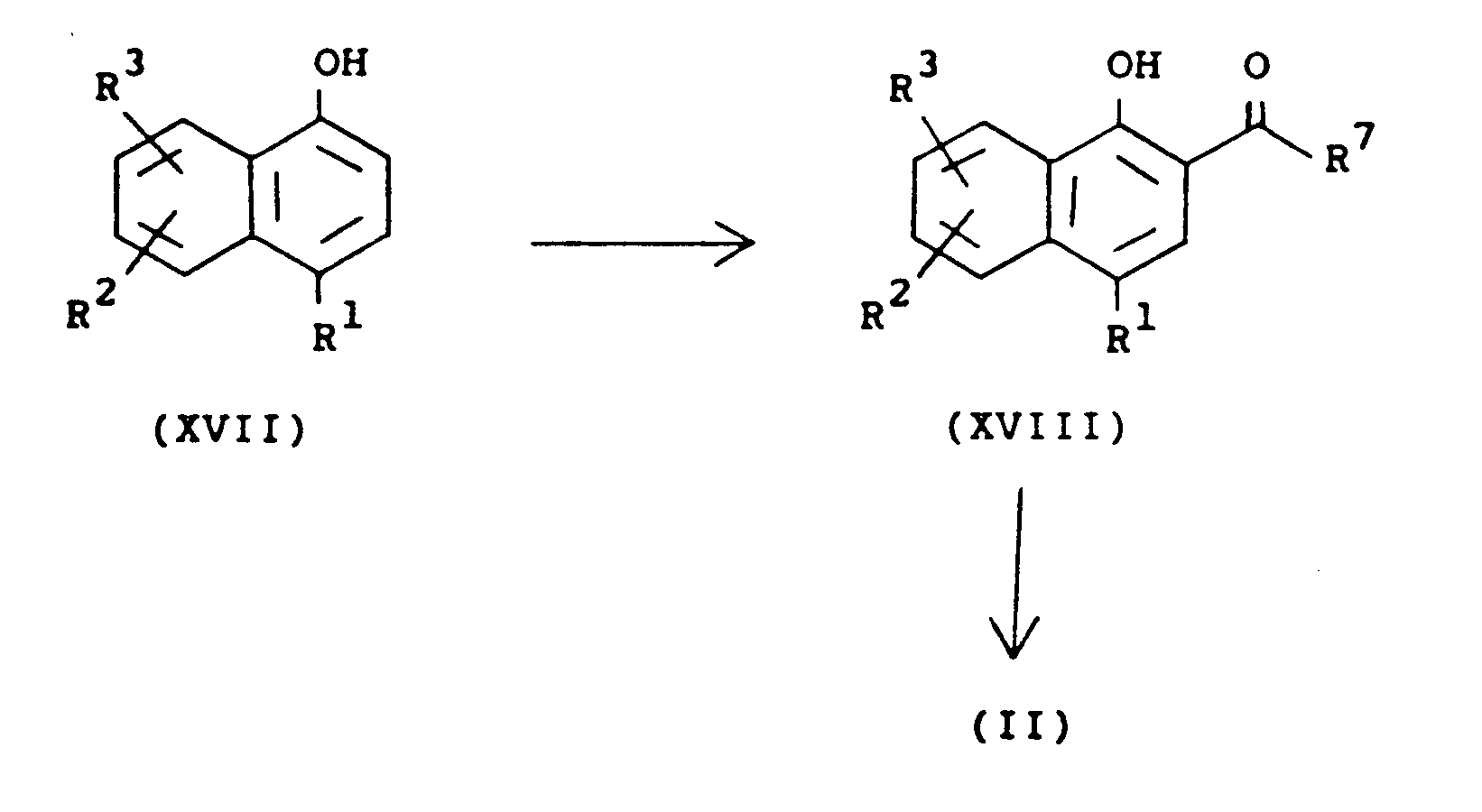
- Compounds of Formula (II) where R4 is CH2-R7 , where R7 is an aromatic group, may also be prepared by the method shown in Scheme 6. A suitable 1-tetralone (XIX) may be treated with an aryl or heteroaryl aldehyde in the presence of a base such as potassium hydroxide or potassium t-butoxide in an alcoholic solvent. If the base/solvent combination is potassium t-butoxide and t-butanol, the 2-arylmethyl-1-naphthol (-(II) where R4 is CH2-R7) is obtained after workup with aqueous acid. If the base/solvent combination is potassium hydroxide and ethanol, an intermediate benzylidene tetralone (XX) is isolated, as reported by Z. Aizenshtat, M. Hausmann, Y. Pickholtz, D. Tal, and J. Blum, J. Org. Chem. 42, 2386 (1977). This intermediate may then be treated with potassium t-butoxide in
t-butanol to provi de(II ) where R4 is CH2 R7 after workup with aqueous acid, as reported by D. H. R. Barton, J. H. Bateson, S. C. Datta, and P. D. Magnus, J. Chem. Soc., Perkin Trans. I, 503 (1976).
- Compounds of Formula (II) where R4 is CH(R21)R7 may be prepared by the methods shown in Scheme 7. An organolithium derivative (X), prepared from a suitable protected 1-naphthol (IX), may be treated with a ketone to provide the tertiary alcohol (XXI) after aqueous workup. Alternatively, a ketone (XXII) prepared by protection of the hydroxyl group of a ketone (XVIII), where Z is either R7 or R21, may be treated with an organometallic reagent Z'M, where Z' is R7 (if Z is R21) or R21 (if Z is R7), and M is a metal such as lithium or magnesium halide. The intermediate (XXI) resulting from either of these reactions may be converted to the intermediate (XXIII) using standard methods of reductive dehydroxylation. Removal of the protecting group from (XXIII) will then provide the desired (II).

- Compounds of Formula (II) where R4 is A-R6 may be prepared by the routes shown in Schemes 1 or 5.
- Compounds of Formula (II) where R4 is A-R6 may also be prepared from certain compounds of Formula (II) having an olefinic group for R4 (which may be prepared according to the routes shown in Scheme 4). Reduction of the multiple bond may be performed using standard methods, for instance treatment with hydrogen in the presence of a catalyst such as palladium on charcoal.
- Compounds of Formula (II) where R4 is A-R6 may also be prepared by the route shown in Scheme 8. An organolithium derivative (X), prepared from a suitable protected 1-naphthol (IX), may be treated with an alkylating agent such as an alkyl halide to provide the intermediate (XXIV). The resulting intermediate may then be deprotected using appropriate techniques to provide the desired (II).


- Compounds of Formula (II) where R4 is (CH2)3-OH may be prepared by the route shown in Scheme 9. The allyl ether of a suitable 1-naphthol (XXV) may be converted to the 2-allyl-1-naphthol (XXVI) by thermal rearrangement, for instance as described by K. A. Parker and J. L. Kallmerten, Tetrahedron Letters, 1197 (1979). The intermediate (XXVI) may then be converted to a protected form (XXVII), and converted to the protected hydroxyl compound (XXVIII) by treatment with borane-tetrahydrofuran complex followed by a standard oxidative workup. Deprotection of (XXVIII) will then provide the desired (II).
- Compounds of Formula (II) where R4 is (CH2)nOH, where n is 2-6, may also be prepared from the corresponding compounds of Formula (II) where R4 is (CH2)n-lR6, where R6 is a carboxylic acid, carboxylic ester, or aldehyde, by treatment with a reducing agent such as lithium aluminum hydride.

- Compounds of Formula (II) may also be prepared from other compounds of Formula (II) by functional group interconversions which are well known to those skilled in the art. Examples of such functional group interconversions are given herein.
- Compounds of Formula (II) where R4 contains the group C(R10)(R11)OH may be prepared from the corresponding compounds where this group is replaced by a carboxylic ester or carboxylic acid, as shown in Scheme 10. The ester or acid (XXIX) may be treated with an appropriate organometallic reagent such as an alkyllithium or alkylmagnesium halide to provide the desired compound (XXX), where R10 and R11 are the same. If R10 and R11 are different, the corresponding compound (XXX) may be prepared by treating the ester or carboxylic acid (XXIX) with an appropriate organometallic reagent to provide the intermediate alkyl ketone (XXXI). Treatment of this intermediate with either a reducing agent such as sodium borohydride or with a second organometallic reagent will then provide the desired compound (XXX).

- Compounds of Formula (II) where R4 contains a C3-C6 alkylene group may be prepared from compounds of Formula (XXX) by dehydration using standard techniques.
- Compounds of Formula (II) where R4 contains an aliphatic halogen atom may be prepared from the corresponding alcohol using standard procedures. Compounds of this type may also be converted into compounds with a different halogen using standard procedures.
- Compounds of Formula (II) where R4 contains an aliphatic nitrile, malonic ester, phosphonic ester, sulfide, amine, ether, or SC(NH)NH2 group may be prepared from the corresponding compound containing a suitable leaving group such as Cl, Br, I, methanesulfonate, toluenesulfonate, or trifluoromethanesulfonate by treatment with an appropriate nucleophilic reagent such as sodium cyanide, diethyl sodiomalonate, triethyl phosphite, potassium thiomethylate, sodium ethoxide, thiourea, etc. (Sulfonate leaving groups may be prepared by treatment of the corresponding alcohol with the appropriate sulfonyl chloride or sulfonic anhydride in the presence of a base such as triethylamine or pyridine.) In the case where R4 contains SH, thiourea may be used as the nucleophile, in which case basic hydrolysis of the intermediate isothiourea provides the thiol. In the case where R4 contains NH2, sodium azide may be used as the nucleophile, in which case catalytic hydrogenation of the intermediate azide provides the primary amine.
- Compounds of Formula (II) where R4 contains an ether or sulfide group may be prepared by treatment of the corresponding alcohol or thiol (in which the naphthol hydroxyl has been suitably protected) with a strong base such as sodium hydride, followed by treatment with an appropriate alkylating agent such as methyl iodide or ethyl iodide, and removal of the protecting group.
- Compounds of Formula (II) where R4 contains a carboxylic ester may be prepared from the corresponding compound where R4 contains a halogen such as Br or CI and the naphthol has been suitably protected, by conversion to the corresponding organolithium or organomagnesium halide and allowing this intermediate to react with a dialkyl carbonate to provide the corresponding ester, followed by deprotection. The corresponding carboxylic acid may be prepared by allowing the organometallic intermediate to react with carbon dioxide, followed by deprotection.
- Compounds of Formula (II) where R1 is CI or Br may be prepared from the corresponding compound (II) where R1 is H, by treatment with chlorine or bromine in a suitable solvent such as acetic acid, optionally in the presence of a suitable catalyst. In some cases, it may be preferable to mask the naphthol hydroxyl group prior to reaction with bromine or chlorine, in which case deprotection is required to provide the desired product (II).
- Compounds of Formula (II) where R1 is C(=O)R17 may be prepared from compounds of Formula (II) where R1 is hydrogen by treatment with a suitable acylating reagent such as an acid chloride, acid anhydride, or mixed anhydride, in the presence of a catalyst such as aluminum chloride or zinc chloride (the Friedel-Crafts reaction). In some cases, it may be preferable to mask the naphthol hydroxyl group prior to reaction with the acylating reagent, in which case deprotection is required to provide the desired (II). In some cases, the hydroxyl group will react with the acylating agent in the course of the acylation reaction to provide the corresponding ester of the desired (II), in which case hydrolysis of the ester provides the desired (II).
- Compounds of Formula (II) where R1 is C(=O)R17 may also be prepared from compounds of Formula (II) where R1 is hydrogen by the route shown in Scheme 11. The hydroxyl group of (II) may be protected to provide (XXXIII). The intermediate (XXXIII) may then be treated with bromine in a suitable solvent such as acetic acid to provide (XXXIV). This intermediate may then be converted to an organometallic intermediate (XXXV) such as the corresponding organomagnesium halide or the corresponding organolithium reagent using standard chemical techniques. The organometallic intermediate may then be treated with with a suitable aldehyde R17-CHO to provide (XXXVI), which may then be oxidized to the corresponding ketone (XXXVII), using reagents such as pyridinium chlorochromate, Jones reagent, or other standard oxidizing agents. Removal of the protecting group on the hydroxyl group using suitable techniques then provides the desired (II).


- Compounds of Formula (II) where R1 is COOR18 may be prepared from organometallic intermediates of Formula (XXXV) with a carboxylating agent such as carbon dioxide, a dialkyl carbonate, or an alkyl chloroformate. Removal of the protecting group on the hydroxyl using suitable techniques then provides the desired (II).
- Compounds of Formula (II) where R1 is phenyl may be prepared by treatment of intermediates of Formula (XXXIV) with an appropriate arylmagnesium halide, in the presence of a suitable transition metal catalyst such as 1,3-bis-(diphenylphosphino)propane nickel (II) chloride, followed by removal of the protecting group on the hydroxyl using suitable techniques.
- Compounds of Formula (II) wherein R1 is S(O)xR or S02NH2 may be prepared by treatment of compounds of Formula (XXXIII) with chlorosulfonic acid to provide the corresponding sulfonyl chloride, followed by standard functional group manipulations, well known to one skilled in the art, to convert the sulfonyl chloride to the desired group S(O)xR or S02NH2. Removal of the hydroxyl protecting group will then provide the desired (II).
- Compounds of Formula (II) wherein R1 is NR12R13 may be prepared from compounds of Formula (XXXIII) by reaction with a suitable nitrating agent in a suitable solvent, such as fuming nitric acid in acetic acid. The intermediate nitro derivative may then be converted to the compound of Formula (II) wherein R1 is NH2 by standard techniques of nitro group reduction, such as catalytic hydrogenation. Standard functional group manipulations well known to one skilled in the art can then be used to convert the primary amine to other desired substituents NR12R13, NHC(=O)alkyl, or NHS02 alkyl.
- Compounds of Formula (II) containing ester functional groups may be converted to the corresponding compounds containing carboxylic acid groups by acidic or basic hydrolysis using standard conditions. Carboxylic acids may be converted to esters, and esters may be converted to esters of different alcohols, using standard techniques, for instance, by treatment with a catalytic amount of a strong acid such as sulfuric acid in the appropriate alcohol as solvent, optionally with an inert cosolvent to improve solubility of the starting material.
- Compounds of Formula (II) containing an amide functional group attached through the carbonyl carbon may be prepared from the corresponding compounds containing a carboxylic acid functional group by protecting the naphthol hydroxyl group, converting the carboxylic acid to an acid chloride using standard techniques, and allowing the acid chloride to react with ammonia or an appropriate amine. Deprotection of the hydroxyl group then provides the desired (II).
- Compounds of Formula (II) containing sulfoxide or sulfone functional groups may be prepared from the corresponding sulfides by protecting the naphthol hydroxyl group and treating with an oxidizing agent such as m-chloroperoxybenzoic acid or any of a number of other oxidants, followed by removal of the protecting group.
- Starting materials for the synthetic routes described above, such as 1-naphthols, protected 1-naphthols, and 1-tetralones, are either commercially available, are described in the chemical literature, or may be prepared from known compounds by routes described in the chemical literature.
- In particular, protected 2-formyl-1-naphthols of Formula (III) may be prepared from a suitably protected 1-naphthol (IX) by treatment with a strong base such as n-butyllithium, followed by treatment with a formylating agent such as N,N-dimethylformamide, as described by N. S. Narasimhan, R. S. Mali, and M. V. Barve, Synthesis, 906 (1979). Alternatively, a 1-hydroxy 2-naphthoic acid may be converted to the naphthyl ether - carboxylic ester using standard techniques, and the ester moiety converted to an aldehyde group, again using standard techniques.
- The compounds of this invention and their preparation are illustrated further in the following Examples. All temperatures are in degrees Centigrade and parts and percentages by volume. In these Examples, unless otherwise indicated; the reactions were performed under an atmosphere of dry nitrogen; "isolation by extraction" refers to the liquid-liquid extraction of a water-containing mixture with an indicated solvent, followed by drying the organic phase over magnesium sulfate,filtering, and evaporation of the solvent under reduced pressure; chromatography refers to the method of medium-pressure column chromatography described by W. C. Still, M. Kahn, and A. Mitra, J. Org. Chem. 43, 2923 (1978).
- A solution of 1,1,1-trimethoxy-5-hexyne (3.90 g, 0.023 mole) in dry tetrahydrofuran (50 mL) was stirred at -78° and treated with n-butyllithium (1.6 M in hexane; 15 mL, 0.024 mole). The solution was stirred for 30 minutes, then treated with a solution of 1-benzyloxy-2-naphthaldehyde (4.25 g, 0.016 mole) in dry tetrahydrofuran (12 mL). The reaction mixture was allowed to warm to room temperature, stirred for 4 hours, and poured into water. The crude product was isolated by extraction with ether and chromatographed with 3:1 ether/hexane. This afforded the title compound (6.15 g, 97%) as an oil.
- To a solution of boron trifluoride etherate (5.0 mL, 0.041 mole) in methylene chloride (150 mL) at 0°, triethylsilane (20 mL, 0.126 mole) was added, followed by a solution of methyl 7-(1-benzyloxy-2-naphthyl)-7-hydroxy-5-heptynoate (5.00 g, 0.013 mole) in methylene chloride (20 mL). The mixture was stirred for 30 minutes, then poured into saturated aqueous potassium carbonate. The crude product was isolated by extraction with ether, and chromatographed with 1:1 ether/hexane. This provided the title compound (2.42 g, 50%) as an oil.
- A solution of ethanethiol (12.0 mL, 0.162 mole) and boron trifluoride etherate (6.0 mL, 0.049 mole) was stirred at room temperature. A solution of methyl 7-(1-benzyloxy-2-naphthyl)-5-heptynoate (2.05 g, 0.006 mole) in methylene chloride (8 mL) was added, and the mixture was stirred for 1.5 hours, then poured into water. The crude product was isolated by extraction with ether, and chromatographed with 2:1 ether/hexane. The title compound (1.09 g, 71 %) was obtained as a colorless oil. Mass spectrum: m/z = 282.
- The compounds of Example 1, as well as other compounds which can be prepared for the pharmaceutical composition by the procedure of Example 1, are shown in Table 1.

- A solution of 1-methoxymethoxy-naphthalene (3.76 g, 0.020 mole) in dry ether (40 mL) was treated with n-butyllithium (1.6 M in hexane; 25.0 mL, 0.040 mole) at room temperature over a period of 15 minutes. After stirring for an additional 1.5 hours, a solution of cyclohexanone (4.90 g, 0.050 mole) in ether (15 mL) was added and the resulting mixture was stirred at room temperature for 2 hours. It was then quenched with saturated aqueous ammonium chloride and the crude product was isolated by extraction with ether. Chromatography with 9:1 hexane/ethyl acetate provided the title compound as a colorless oil (3.30 g, 58%).
- A solution of the product of Part A (3.30 g, 0.012 mole) in ethanol (100 mL) and 1.0 N hydrochloric acid (100 mL) was stirred at room temperature for 5 hours. The ethanol was removed under reduced pressure, and the crude product was isolated by extraction with ethyl acetate. Chromatography with 95:5 hexane/ethyl acetate provided a white solid which was recrystallized (hexane) to give the title compound (1.59 g, 62%) as white crystals, mp 82-83 °.
- The compound of Example 5, as well as other compounds which can be prepared for the pharmaceutical composition by the procedure of Example 5, are shown in Table 2.

- A suspension of sodium hydride (60% in mineral oil: 1.94 g, 0.049 mole) in dry tetrahydrofuran (20 mL) was stirred at 0°. A solution of 1-methoxymethoxy-2-naphthaldehyde (2.00 g. 0.009 mole) and 2-carboxyethyl-triphenylphosphonium bromide(prepared by the procedure of H. S. Corey. J. R. D. McCor- mick, and W. E. Swensen, J. Am. Chem. Soc. 86, 1884 (1964); 9.60 g, 0.023 mole) in dry dimethyl sulfoxide (15 mL) was added over 20 minutes. The mixture was allowed to warm to room temperature over 1.25 hours, then stirred at room temperature for 30 minutes. 1.0 N hydrochloric acid (10 mL) was added dropwise, followed by stirring for an additional 20 minutes. The crude material was isolated by extraction with ethyl acetate and dissolved in absolute ethanol (200 mL), treated with 10 drops of concentrated sulfuric acid, and heated at reflux for 6 hours. The cooled solution was diluted with water, and the crude product isolated by extraction with ethyl acetate. The resulting oil was chromatographed with 9:1 petroleum ether/ether, to provide a solid which was recrystallized (hexane) to give the title compound (0.35 g, 15%) as a tan solid, mp 83-840.
- A mixture of potassium t-butoxide (2.10 g, 0.019 mole) and 4-carbethoxypropyl-triphenylphosphonium bromide (prepared according to the procedure of P. E. Sonnet. J. Org. Chem. 34, 1147 (1964); 8.40 g, 0.018 mole) in dry tetrahydrofuran (15 mL) was stirred at 0 ° . After 45
minutes, a solut ion of 1-methoxymethoxy-2-naphthaldehyde (2.00 g, 0.009 mole) in dry tetrahydrofuran (7.5 mL) was added over 10 minutes. The resulting mixture was stirred at 0 for 2 hours, then was poured into water. The crude material was isolated by extraction with ethyl acetate and chromatographed with 10% ether/petroleum ether, then was dissolved in absolute ethanol (200 mL), treated with 3 drops of sulfuric acid, and heated at reflux for 18 hours. After cooling, the solution was diluted with water and the crude product mixture isolated by extraction with ethyl acetate. This was chromatographed with 85:15 petroleum ether/ether to provide two different solids. The first one to elute was recrystallized (hexane) to provide the Z isomer of the title compound (0.43 g, 17%) as a pale yellow solid, mp 75-77 ° . The second solid was recrystallized (hexane) to provide the E isomer (0.23 g. 9%) as a white solid, mp 63-640. - The compounds of Examples 8-10, along with other compounds which can be prepared for the pharmaceutical composition using the procedures of Examples 8-10, are shown in Table 3.

- A mixture of 1-methoxynaphthalene (7.9 g, 0.05 mole) and cyclohexane (20 mL) was added to a solution of n-butyllithium (1.6 M in hexane; 31 mL 0.05 mole) and N,N,N1,Nl-tetramethylethylenediamine (5.8 g, 0.05 mole) in cyclohexane (10 mL). The solution was stirred at room temperature for 2 hours, when a solution of benzophenone (9.1 g, 0.05 mole) in cyclohexane (10 mL) was added. The resulting mixture was stirred overnight and poured into water. The crude product was isolated by extraction with ether, and chromatographed with 19:1 hexane/ethyl acetate. The resulting product was triturated with petroleum ether to provide the title compound (6.13 g, 36%) as a white powder, mp 123-124.5 ° .
- A mixture of boron trifluoride etherate (8.08 g, 0.057 mole) and methylene chloride (150 mL) was stirred at 0 ° . Triethylsilane (14.56 g, 0.125 mole) was added, followed by a solution of the product of Part A (4.50 g, 0.013 mole) in methylene chloride (20 mL). The mixture was stirred at 0 for 30 minutes and poured into saturated aqueous potassium carbonate. The crude product was isolated by extraction with ether, and triturated with petroleum ether to provide the title compound (4.20 g, 100%) as a white powder, mp 119-121 ° .
- A mixture of boron tribromide (1.0 M in methylene chloride; 10 mL, 10 mmole) in methylene chloride (75 mL) was stirred at -78°. A solution of the product of Part B (2.5 g, 7.7 mmole) was added, and the mixture stirred for 1 hour at -78 ° . The reaction was then warmed to room temperature, stirred for 5 hours, and poured carefully into water. The crude product was isolated by extraction with ether, and chromatographed with 19:1 hexane/ethyl acetate. The resulting solid was triturated with petroleum ether to provide the title compound (1.06 g. 44%) as a white powder, mp 87-89 ° .
- A solution of cyclohexylmagnesium chloride (2.0 M in ether; 10 mL, 0.02 mole) in dry ether (10 mL) was stirred at 0°. A solution of 1-methoxy-2-naphthaldehyde (1.88 g, 0.01 mole) in dry ether (15 mL) was added dropwise, and the mixture allowed to warm to room temperature. After stirring for 1 hour, the mixture was poured into 1.0 N hydrochloric acid (100 mL). The crude product was isolated by ether extraction and chromatographed with 19:1 toluene-ethyl acetate to provide the title product (1.7 g, 65%) as a pale yellow glass.
- Using the procedure of Example 13, Part B, the product of Part A was converted in 77% yield to the title compound, a pale yellow oil. Mass spectrum: m/z 254.
- Using the procedure of Example 13, Part C, the product of Part B was converted in 15% yield to the title compound, a pale orange solid, mp 53-560.
- The compounds of Examples 13 and 14, along with other compounds which were or can be prepared for the pharmaceutical composition using the procedure of one of these Examples are shown in Table 4.

- A solution of 1-tetralone (5.85 g, 0.040 mole) and pyridine-3-carboxaldehyde (4.28 g, 0.40 mol) in t-butanol (400 mL) was treated with potassium t-butoxide (0.98 g, 0.080 mol) and the resulting mixture heated at reflux for 16 hours. After cooling to room temperature, the solution was poured into stirred 1.0 N hydrochloric acid, and the pH of the resulting mixture was adjusted to 7.0 with 10% aqueous sodium hydroxide.
- After isolation by extraction with ethyl acetate, the crude product was recrystallized (benzene) to provide the title compound (4.86 g, 52%) as a tan solid, mp 170-172 ° .
- A solution of 1-tetralone (5.85 g, 0.040 mole) and salicylaldehyde (4.88 g, 0.040 mole) in t-butanol (400 mL) was treated with potassium t-butoxide (17.6g, 0.160 mole) and heated at reflux for 16 hours. After cooling to room temperature, the solution was poured into stirred 1.0 N hydrochloric acid. After isolation by extraction with ethyl acetate, the crude product was chromatographed with 4:1 petroleum ether/ether, to provide a tan solid. This was recrystallized (cyclohexane/chloroform) to give the title compound as white needles (5.24 g, 52%), mp 124-1250.
- The compounds of Examples 26 and 27, along with other compounds which were and can be prepared for the pharmaceutical composition using the procedures of Examples 26 and 27, are shown in Table 5.


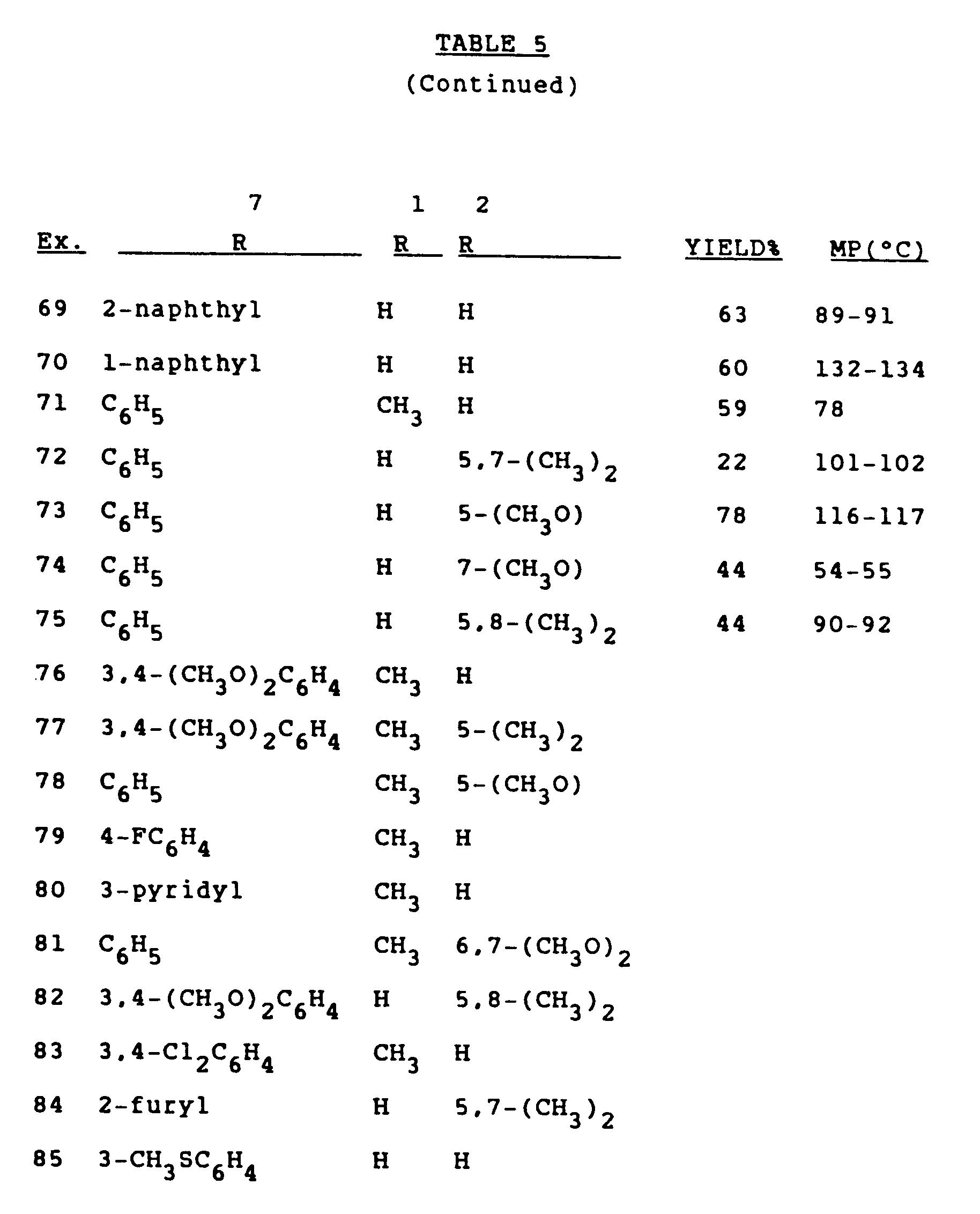
- The compound of Example 33 (7.0 g, 0.02 mole) was combined with 10% palladium/charcoal (0.70 g) and ethanol (100 mL) in a pressure bottle. The container was pressurized with hydrogen at 50 psi and agitated at room temperature for 16 hours. It was then vented, and the reaction mixture was filtered and the catalyst rinsed with additional ethanol. The combined filtrates were evaporated, and the residue was chromatographed with 8:2 petroleum ether/ether to provide an off-white solid. This was recrystallized (carbon tetrachloride) to give the title compound (3.94 g, 77%) as a white solid, mp 100-101 ° .
- A mixture of the compound of Example 34 (6.0 g, 0.019 mole), benzyl bromide (3.4 mL, 0.029 mole), potassium carbonate (5.3 g, 0.038 mole), and acetone (100 mL) was heated at reflux for 19 hours. The cooled solution was filtered and the filtrate was evaporated. The resulting oil was heated at 140 ° /0.5 mm to remove residual benzyl bromide, then was chromatographed with 3:1 hexane-toluene to provide the title compound (7.2 g. 94%) as a colorless oil.
- A solution of the product of Part A (3.00 g, 0.007 mole) in dry tetrahydrofuran (15 mL) was added to dried magnesium chips (0.22 g, 0.009 mole). A crystal of iodine was added and the mixture heated at reflux for 2 hours, then cooled to room temperature. Diethyl carbonate (4.5 mL, 0.037 mole) was added, stirring was continued for 16 hours, and the mixture was then poured into 1.0 N hydrochloric acid. After isolation by extraction with ether, the crude product was chromatographed with 9:1 petroleum ether/ether, to provide the title compound (0.60 g. 20%) as an oil.
- The product of Part B (0.60 g, 0.0015 mole) was hydrogenated in ethanol by the procedure of Example 86. Recrystallization of the crude product (hexane/ether) provided the title compound (0.33 g, 71 %) as a waxy solid, mp 86-880.
- A mixture of the compound of Example 32 (7.38 g, 0.024 mole), t-butyldimethylsilyl chloride (4.36 g, 0.029 mole), and imidazole (4.08 g, 0.060 mole) in N,N-dimethylformamide (20 mL) was stirred at room temperature. After 17 hours, the reaction mixture was poured into saturated aqueous sodium bicarbonate, and the crude product isolated by extraction with ether as a white, waxy solid (10.1 g, 98%), mp 72-740.
- The product of Part A was converted to the corresponding ethyl ester using the procedure of Part B of Example 87. The title compound was obtained as a colorless oil in 52% yield.
- A solution of the product of Part B (1.00 g, 0.002 mole) in a mixture of absolute ethanol (50 mL) and 1.0 N hydrochloric acid (50mL) was heated at reflux for 5 hours. The mixture was cooled to room temperature and the crude product isolated by extraction with ethyl acetate. This material was chromatographed with 4:1 petroleum ether/ether, and the resulting solid recrystallized (hexane) to provide the title compound (0.38 g, 62%) as white crystals, mp 86-87 ° .
- A mixture of the compound of Example 65 (3.60 g, 0.012 mole), ethanol (100 mL), and sulfuric acid (0.25 mL) was heated at reflux for 4 hours. It was cooled to room temperature, then to 0°, and the title compound was collected by filtration as a tan powder (2.68 g, 66%), mp 124-125 ° .
- The title compound was prepared from the compound of Example 36 using the procedure of Part A of Example 88. It was obtained as a colorless oil in quantitative yield.
- A solution of the product of Part A (2.00 g, 0.005 mole) in glacial acetic acid (25 mL) was treated with solid sodium perborate (1.81 g, 0.011 mole) and was stirred at room temperature for 20 hours. The mixture was poured into water and the crude product isolated by extraction with ether. This material was chromatographed with 7:3 petroleum ether/ether and recrystallized (hexane) to provide the title compound (1.38 g. 63%) as white crystals, mp 109-110 ° .
- A mixture of the product from Part B (1.18 g, 0.003 mole), ethanol (50 mL) and 1.0 N hydrochloric acid (50 mL) was heated at reflux for 3 hours and cooled to room temperature . The crude product was isolated by extraction with ethyl acetate, and recrystallized (cyclohexane/benzene) to provide the title compound (0.75 g, 80%) as white needles, mp 144-145 ° .
- A solution of 2-(phenylmethyl)-1-naphthol (1.00 g, 4.3 mmole) in acetic acid (20 mL) was stirred at room temperature. A solution of bromine (0.7 g, 4.3 mmole) in acetic acid (6 mL) was added dropwise over 10 minutes. The mixture was stirred for another 5 minutes, then poured into water. The resulting solid was collected by filtration and recrystallized (cyclohexane) to provide the title compound (1.21 g, 88%) as off-white needles, mp 123-125 ° .
- A mixture of aluminum chloride (1.25 g, 9.4 mmole) in methylene chloride (25 mL) was stirred at 0 and treated dropwise with benzoyl chloride (1.1 mL, 9.4 mmole) and stirred for 5 minutes. A solution of 2-(phenylmethyl)-1-naphthol (2.0 g, 8.5 mmole) in methylene chloride (6 mL) was added dropwise over 15 minutes, and stirring was continued at 0 for 3 hours. The mixture was poured into 1.0 N hydrochloric acid, and the crude product was isolated by extraction with methylene chloride. Recrystallization from toluene provided the title compound (1.15 g, 40%) as pale yelow crystals, mp 152-155 ° .
- A mixture of aluminum chloride (5.02 g, 0.038 mole) in methylene chloride (50 mL) was stirred at 0 and treated dropwise with acetyl chloride (2.7 mL, 0.038 mole). After stirring the mixture for 10 minutes, a solution of 2-(phenylmethyl)-1-naphthol (4.00 g, 0.017 mole) in methylene chloride (10 mL) was added dropwise and stirring continued at 0 ° for 4 hours. The mixture was warmed to room temperature and stirred for 17 hours, then poured into 1.0 N hydrochloric acid. The crude product was isolated by extraction with methylene chloride, and chromatographed (98:2 toluene/ethyl acetate). The resulting material was recrystallized (isopropanol) to provide the title compound (1.52 g, 32%) as white needles, mp 118-120 ° .
- A solution of the compound prepared according to Part A (1.90 g, 6.0 mmole) and concentrated sulfuric acid (1.0 mL) in ethanol (150 mL) was heated at reflux for 24 hours, cooled, and poured into water. The resulting solid was collected by filtration and recrystallized (toluene) to provide the title compound (1.40 g, 84%) as a white solid, mp 139-141 ° .
- A mixture of 2-phenylmethyl-1-naphthol (40.0 g, 0.17 mole), methyl iodide (36.4 g, 0.26 mole), potassium carbonate (35.9 g, 0.26 mole) and acetone (1000 mL) was heated at reflux with stirring for 17 hours, then cooled and filtered. The acetone was removed under vacuum, and the residue was dissolved in ethyl acetate, washed with water and brine, dried over magnesium sulfate and concentrated. The residual oil was distilled in a short-path distillation apparatus at approximately 160-180 °/0.2 torr to provide the title compound (41.5 g, 98°) as an off-white solid, mp 56-590.
- A solution of the compound of Part A (20.5 g, 0.083 mole) in acetic acid (400 mL) was stirred at room temperature and treated dropwise with a solution of bromine (13.2 g, 0.083 mole) in acetic acid (125 mL). After the mixture was stirred for an additional 15 minutes, it was diluted with water, and the crude product isolated by extraction with methylene chloride. This material was distilled at 155-160 °/0.2 torr to provide the title compound (23.25 g, 86%) as a viscous yellow oil.
- A solution of the compound of Part B (2.00 g, 6.1 mmole) in dry tetrahydrofuran (20 mL) was stirred at -78° and treated dropwise with n-butyllithium (1.55 M in hexane; 4.4 mL, 6.7 mmole). The mixture was stirred at -78 for one hour, then treated dropwise with a solution of thiophene-2-carboxaldehyde (0.75 g, 6.7 mmole) in dry tetrahydrofuran (10 mL). After stirring for 15 minutes, saturated aqueous ammonium chloride was added and the crude product isolated by extraction with methylene chloride. This material was chromatographed (85:15 hexane/ethyl acetate) and triturated in hexane to provide the title compound (1.90 g, 86%) as a white crystalline solid, mp 122-124 ° .
- A solution of the compound of Part C (1.50 g, 4.2 mmole) in methylene chloride (90 mL) was treated with pyridinium chlorochromate (2.28 g, 10.6 mmole) and stirred at room temperature for 1.5 hours. The mixture was filtered through florisil and concentrated under vacuum to provide the crude product. This was recrystallized (hexane/1-chlorobutane) to provide the title compound (1.17 g, 79%) as a white solid, mp 111-113°.
- A mixture of the compound of Part D (0.58 g, 1.6 mmole) and pyridine hydrochloride (3.48 g, 0.03 mole) was heated at 190" for 3 hours. The cooled reaction mass was then partitioned between methylene chloride and 1.0 N hydrochloric acid, and the organic phase was dried over magnesium sulfate and concentrated under vacuum. The residue was recrystallized (hexane/1-chlorobutane) to provide the title compound (0.50 g, 89%) as a pale yellow solid, mp 150-152 ° .
- A solution of the compound of Example 94 Part B (5.00 g, 0.015 mole) in dry tetrahydrofuran (50 mL) was cooled to -78° and treated dropwise with n-butyllithium (1.55 M in hexane; 10.9 mL, 0.017 mole). The mixture was stirred at -78 for 45 minutes, and a stream of gaseous carbon dioxide was directed onto the surface of the stirred solution. The cooling bath was removed from the reaction vessel and the addition of carbon dioxide was continued for 5 minutes. The mixture was then poured into 1.0 N hydrochloric acid, and the crude product isolated by extraction with methylene chloride. This was recrystallized (methylcyclohexane) to provide the title compound (4.0 g, 90%) as a pale yellow solid, mp 146-148 ° .
- Using the procedure of Example 13 Part C, the compound of Part A was converted to the title compound, which was recrystallized (acetonitrile) to provide a tan solid (68%), mp 203-206 ° (decomposes).
- A solution of the compound of Example 95 (2.55 g. 9.2 mmole) and concentrated sulfuric acid (3 drops) in ethanol (125 mL) was heated at reflux for 80 hours. The mixture was cooled and diluted with water, and the crude product was isolated by extraction with ethyl acetate. This was chromatographed (9:1 hexane/ethyl acetate) and recrystallized (hexane) to provide the title compound (1.74 g, 62%) as white needles, mp 79-800.
- A mixture of the compound of Example 95 Part A (3.00 g, 10.3 mmole), oxalyl chloride (6.50 g, 0.051 mole) and benzene (30 mL) was stirred at room temperature for 20 hours, and concentrated under vacuum. The residue was dissolved in dry tetrahydrofuran (30 mL) and added dropwise with stirring to aqueous ammonia (28%) which was cooled on an ice/acetone bath. Stirring was continued for 6 hours, while the reaction mixture was allowed to warm to room temperature. The ammonia and tetrahydrofuran were then removed under vacuum, and the product was isolated by extraction with ethyl acetate and methylene chloride. After recrystallization (isopropanol), the title product was obtained (2.69 g, 87%) as white needles, mp 199-201 ° .
- Using the procedure of Example 94 Part E, the compound of Part A was converted to the title compound, which was obtained in 56% yield as a white solid (mp 219-220 dec.) after recrystallization from toluene.
- A solution of the compound of Example 94 Part B (5.00 g, 15.3 mmole) and bis-(1,3-diphenyl- phosphino)propane nickel(II) chloride (0.40 g, 0.74 mmole) in dry ether was stirred at 0 ° . Phenylmagnesium chloride (2.0 M in ether; 9.5 mL, 19.0 mmole) was added dropwise, and the mixture was stirred at room temperature for 2 hours. The mixture was then poured into 1.0 N hydrochloric acid, and the crude product was isolated by extraction with methylene chloride. This was chromatographed to provide the title product (4.26 g, 86%) as a white solid. A small sample recrystallised from hexane melted at 103-105 ° .
- PART B: 4-Phenyl-2-(phenylmethyl)-1-naphthol
- Using the procedure of Example 13 Part C, the compound of Part A was converted to the title compound, which was obtained as a white solid (73% yield, mp 132-134") after recrystallization from methylcyclohexane.
- The product of Example 94 Part A (3.0g, 0.012 mole) was added in portions to concentrated sulfuric acid (10ml) at -10°. The mixture was stirred at -10 for 2 hours and poured into water. Sodium bicarbonate (1.0g) was added, and the crude product was isolated by extraction with ethyl acetate. The title compound (2.0g, 52%) was obtained as a brown oil after chromatography (1:1 hexane/ethyl acetate; then 99:1 ethyl acetate/acetic acid; then methanol).
- A mixture of the product of Part A (1.80g, 5.5 mmole), thionyl chloride (10mL), and N,N-dimethylformamide (1 drop) was heated at reflux for one hour. The excess thionyl chloride was removed at reduced pressure to provide the title compound (2.3g) as a brown oil, which was used without further purification.
- A solution of the product of Part B (4.65g, 0.013 mole) in tetrahydrofuran was added dropwise to a solution of aqueous ammonia (28%, 125ml). After 10 minutes, the solvent was removed at reduced pressure, and the aqueous residue was acidified. The crude product was isolated by extraction with ethyl acetate. Chromatography (1:1 hexane/ethyl acetate) and recrystallization (1-chlorobutane) provided the title compound (1.0g, 46%) as a white solid, mp 159-161 ° .
- Using the procedure of Example 13, Part C, the product of Part C was converted in 85% yield to the title compound, mp 167-168 ° .
- The compounds of Examples 86-99, along with other compounds which were or can be prepared for the pharmaceutical composition using one of the methods described in Examples 86-99 or in the general synthetic discussions are shown in Table 6.


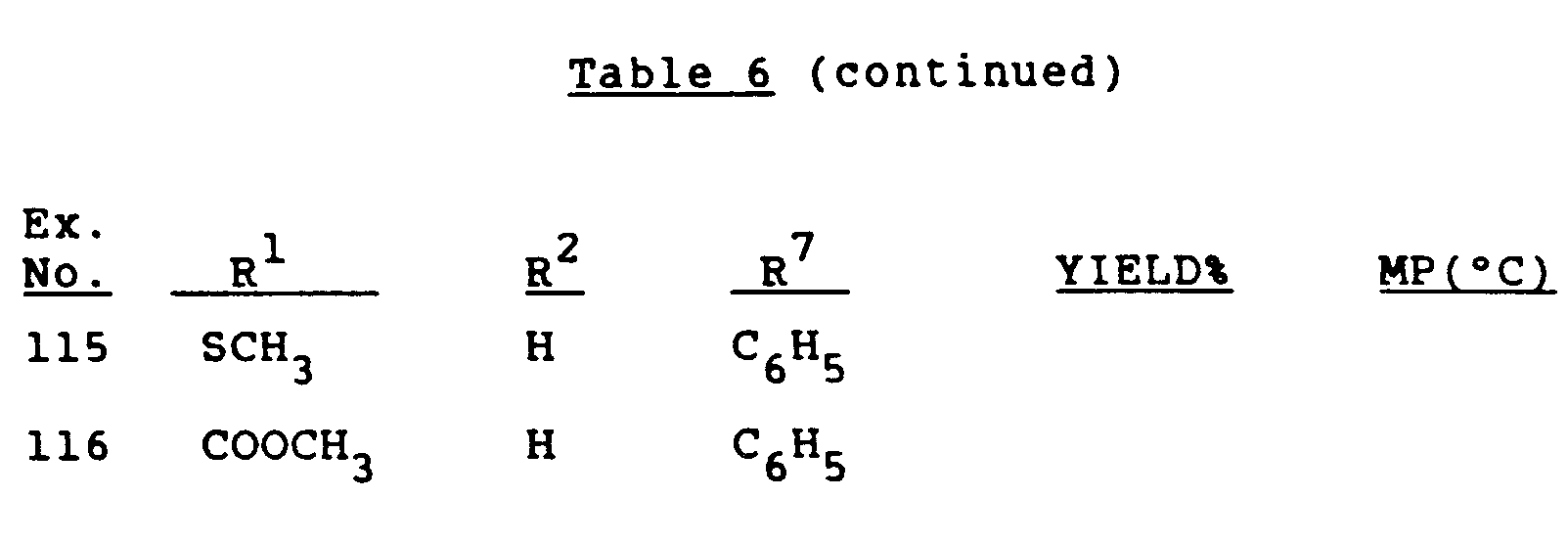
- The title compound was prepared as reported by G. Xi, X. Guo, and R. Chen, Yaoxue Xuebao 15, 548 (1980).
- A solution of the product of Part A (2.00 g, 0.007 mole) in dry tetrahydrofuran (10 mL) was added dropwise to a mixture of lithium aluminum hydride (0.28 g, 0.007 mole) in dry tetrahydrofuran (20 mL) at 0°. The mixture was heated at reflux for 30 minutes, then cooled to room temperature. Water (0.28 mL), then 3.0 N aqueous sodium hydroxide (0.28 mL), then water (0.60 mL) were added, and the mixture was stirred at room temperature for 10 minutes, then filtered. The filtrate was diluted with water and extracted with ethyl acetate. The resulting material was chromatographed with 7:3 toluene/ethyl acetate to provide the title compound (1.10 g, 65%) as a waxy solid, mp 43-46 ° .
- The title compound was prepared by the procedure of J. St. Pyrek, O. Achmatowicz, and A. Zamojski, Tetrahedron 33, 673 (1977).
- A mixture of the product of Part A (12.80 g, 0.070 mole), benzyl bromide (10.75 mL, 0.090 mole), and potassium carbonate (19.20 g, 0.139 mole) in acetone (150 mL) was heated at reflux for 3 hours. The cooled solution was filtered and the filtrate evaporated. The residual oil was distilled to provide the title compound (12.91 g, 68%) as a pale yellow liquid, bp 150-151 ° (0.1 torr).
- A solution of borane (1.0 M in tetrahydrofuran; 100 mL, 0.100 mole) was treated at 0 with a solution of 2-methyl-2-butene (2.0 M in tetrahydrofuran; 100 mL, 0.200 mole) over 40 minutes, and the resulting solution stirred at 0° for 2 hours. A solution of 2-(2-propenyl)-1-benzyloxynaphthalene (27.40 g, 0.100 mole) in dry tetrahydrofuran (50 mL) was added over 25 minutes, and stirring was continued for 40 minutes. Water (4.0 mL) was then added, followed by 3.0 M aqueous sodium hydroxide (34 mL), followed by 30% aqueous hydrogen peroxide (34 mL). After the mixture was warmed to room temperature, it was extracted with ether. The residue was chromatographed with 1:1 ether/hexane and recrystallized (cyclohexane) to provide the title compound (16.10 g, 55%) as a white solid, mp 80-81 ° .
- The product of Part C (1.00 g, 0.003 mole) was combined with 10% palladium/charcoal (0.20 g) and ethanol (35 mL) in a pressure bottle. The container was pressurized with hydrogen at 50 psi, and agitated at room temperature for 4 hours. It was then vented, and the reaction mixture was filtered and the catalyst rinsed with additional ethanol. The combined filtrates were evaporated, and the residue was recrystallized (cyclohexane) to give the title compound (0.52 g, 74%) as off-white crystals, mp 85-86 ° .
- A solution of the product of Example 117 Part A (2.00 g, 0.007 mole) in dry tetrahydrofuran (20 mL) was stirred at 0 and treated with methyllithium (1.5 M in ether; 20 mL, 0.030 mole) over 10 minutes. Stirring was continued for 1.25 hours at 0 °, then for 1.5 hours at room temperature. The mixture was again cooled to 0°, and treated with saturated ammonium chloride solution, then warmed to room temperature and extracted with ether. The crude product was recrystallized (toluene) to give the title compound (1.70 g, 89%) as white crystals, mp 101-102 ° .
- A solution of the compound of Example 119 (0.45 g, 0.002 mole) and p-toluenesulfonic acid (4-5 crystals) in toluene (20 mL) was heated at reflux with azeotropic removal of water. After 18 hours, the cooled solution was washed with saturated aqueous sodium bicarbonate and evaporated to provide the title compound (0.45 g, 100%) as an oil; mass spectrum: m/z 240.
- A mixture of 1-naphthol (15.14 g, 0.105 mole), 4-chlorobutyric acid (9.90 mL, 0.100 mole), and boron trifluoride etherate (75 mL) was heated on a steam bath for 4 hours. The mixture was then treated slowly with 100 mL of water, and heating continued for 30 minutes. The mixture was poured into water, stirred, and the solution decanted. The residue was triturated with water, then crystallized from ethanol to provide the title compound (9.50 g, 38%) as a pale green solid, mp 73-790.
- A mixture of granular zinc (6.50 g, 0.099 mole), mercury (II) chloride (0.2 g), concentrated hydrochloric acid (0.6 mL), and water (10 mL) was stirred at room temperature for 30 minutes, then washed with water by decantation. To the solid was added the product of Part A (5.00 g, 0.020 mole), ethanol (125 mL), and concentrated hydrochloric acid (35 mL). The mixture was stirred at reflux overnight, cooled, and the supernatant was diluted with water. The crude product was isolated by extraction with ethyl acetate and chromatographed with 98:2 hexane/ether. The title compound was obtained as a light brown oil (2.00 g, 43%), mass spectrum m/z = 234, 236.
- A mixture of 2-(2-propenyl)-1-naphthol (Example 118 Part A; 101.9 g, 0.550 mole), t-butyldimethylsilyl chloride (100.0 g, 0.660 mole), and imidazole (93.6 g, 1.375 mole) in N,N'-dimethylformamide was stirred at room temperature for 6.5 hours. It was then poured into saturated aqueous sodium bicarbonate, and the crude product isolated by extraction with hexane. The residue was distilled at reduced pressure to provide the title compound (155.2 g, 95%), bp 135-140 (0.1 torr).
- A solution of the product of Part A (29.80 g, 0.100 mole) in dry tetrahydrofuran was treated at 0 with borane (1.0 M in tetrahydrofuran; 38 mL, 0.038 mole) over 30 minutes. Water (7.0 mL) was added, followed by 3.0 N aqueous sodium hydroxide (14 mL), after which the reaction flask was again cooled to 0°. 30% Aqueous hydrogen peroxide (14 mL) was added over 10 minutes, and the mixture was warmed to room temperature, stirred for 30 minutes, and heated to 50 with a warm water bath. After 30 minutes, the cooled mixture was diluted with water, and the crude product extracted with ether. The residue was recrystallized (cyclohexane) to provide the title compound (22.70 g, 72%) as a white solid, mp 91-93 ° .
- A solution of the product of Part B (15.80 g, 0.050 mole) and carbon tetrabromide (33.10 g, 0.100 mole) in ether (150 mL) was treated at room temperature with a solution of triphenylphosphine (26.20 g, 0.100 mole) in ether (110 mL). After 2.75 hours, the mixture was filtered, and the filtrate was evaporated. The residue was chromatographed with petroleum ether to provide the title compound (18.00 g, 95%) as a colorless oil.
- A solution of the product of Part C (2.60 g, 0.007 mole) in ethanol (50 mL) was mixed with 1.0 N aqueous hydrochloric acid (30 mL) and heated at reflux. After 3.5 hours, the mixture was cooled to room temperature, and diluted with water. The crude product was isolated by extraction with methylene chloride, and chromatographed with 9:1 hexane/ethyl to acetate provide an orange solid. This was recrystallized from hexane to give the title compound (0.51 g, 28%) as a tan solid, mp 53-55 ° .
- A mixture of the product of Example 122 Part C (1.55 g, 0.004 mole), thiourea (0.31 g, 0.004 mole), and absolute ethanol (8.0 mL) was heated at reflux for 7 hours. The cooled solution was treated with water (5.0 mL), cooled to 0° , and treated with concentrated hydrochloric acid (5.0 mL). The precipitated solid was isolated by filtration, rinsed with water and air-dried to provide the title compound (1.45 g, 86%) as a white powder, mp 190-194 ° .
- A mixture of the product of Part A (0.65 g, 0.002 mole), ethanol (6 mL), and 1.0 N aqueous hydrochloric acid (10 mL) was heated at reflux for 2 hours. After cooling, the ethanol was removed by evaporation at reduced pressure, and the solid collected by filtration and washed with water. The title compound was obtained (0.42 g, 84%) as a white powder, mp 184-188 ° .
- A mixture of the product from Example 123 Part B (0.90 g, 0.002 mole), ethanol (4.0 mL), and 4.0 N aqueous sodium hydroxide (10.0 mL) was heated at reflux for 2 hours. The cooled solution was acidified with concentrated hydrochloric acid and extracted with methylene chloride. The crude product was chromatographed with 97:3 hexane/ethyl acetate to provide the title compound (0.50 g, 97%) as an orange oil. Mass spectrum: m/z 218.
- A mixture of the product of Example 122 Part C (2.00 g, 0.005 mole), pyrrolidine (4.40 mL, 0.053 mole), potassium carbonate (1.10 g, 0.008 mole), and acetonitrile (20 mL) was heated at reflux for 16 hours. The cooled solution was filtered, and the filtrate chromatographed with 98:2 methylene chloride/methanol chloride to give a light tan oil. This was dissolved in ether, treated with ethereal hydrogen chloride, and stirred at room temperature. The precipitated solid was isolated by filtration, washed with ether, washed further with a small amount of acetonitrile, and air-dried to provide the title compound (1.17 g, 76%) as a white powder, mp 198-201 ° .
- A solution of the product of Example 122 Part C (2.00 g, 0.005 mole) in N,N-dimethylformamide (3.4 mL) was added over a period of 5 minutes to a stirred suspension of sodium azide (0.41 g, 0.006 mole) in N,N-dimethylformamide (4 mL) at 105°. After the mixture was stirred for 4 hours, it was cooled to room temperature, poured into water, and extracted with methylene chloride. The residue was stirred in a mixture of ethanol (100 mL) and 1.0 N hydrochloric acid (100 mL) at reflux for 2 hours. The cooled mixture was extracted with methylene chloride, and the crude product was hydrogenated using the procedure of Example 110 Part D in 17% chloroform/ethanol. The resulting material was boiled in acetonitrile, then isolated by filtration to provide the title compound (0.87 g, 73%) as a tan solid, mp 213-218° (decomposes).
- A solution of N,N,N',N'-tetramethylenediamine (18.12 mL, 0.120 mole) in cyclohexane (36 mL) was treated with n-butyllithium (1.55 M in hexane; 79.8 mL, 0.123 mole) at room temperature. A solution of 1-methoxynaphthalene (17.4 mL, 0.120 mole) in cyclohexane (20 mL) was added over 30 minutes, and the resulting solution was stirred for 1.5 hours. It was then cooled to 0°, and 1-bromo-4-chlorobutane (27.0 mL, 0.234 mole) was added over 15 minutes. The mixture was warmed to room temperature and stirred for 17 hours, then poured into saturated aqueous ammonium chloride and extracted with ethyl acetate. The crude product was chromatographed with 98:2 hexane/ether to provide the title compound (11.60 g, 39%) as a pale yellow oil.
- The product from Part A (5.00 g, 0.020 mole) was dissolved in acetone (50 mL) and treated with sodium iodide (6.00 g, 0.040 mole). The solution was heated at reflux for 3.5 hours, cooled to room temperature, and extracted with methylene chloride. The resulting material was combined with triethyl phosphite (15 mL) and stirred at 150" for 17 hours. After cooling, the excess triethyl phosphite was removed under reduced pressure, and the residue was chromatographed with ethyl acetate to provide the title compound (3.90 g, 56%) as a pale yellow oil.
- A solution of diethyl 4-(1-methoxy-2-naphthyl)-butylphosphonate (5.50 g, 0.016 mole) in methylene chloride (80 mL) was stirred at -78°, and treated with boron tribromide (1.0 M in methylene chloride; 24.0 mL, 0.024 mole) over 20 minutes. Stirring was continued for 2 hours at this temperature, then at room temperature for 16 hours. Water (80 mL) was added, and the mixture was extracted with ether. The organic layer was extracted with 1.0 N aqueous sodium hydroxide, the aqueous layer was acidified with concentrated hydrochloric acid, and the crude product was isolated from this by extraction with ether. The residue was recrystallized (hexane) to provide the title compound (2.10 g, 40%) as a white solid, mp 90-91°.
- A solution of the product of Example 118 Part C (9.10 g, 0.031 mole) in pyridine (150 mL) was stirred at 0° and treated with p-toluenesulfonyl chloride (6.70 g, 0.035 mole), then stirred for 16 hours at room temperature. The solution was poured into water, and the mixture extracted with ethyl acetate. The resulting oil was chromatographed with 4:1 hexane/ether to provide the title compound (3.20 g, 23%) as an oil.
- Sodium (0.08 g, 0.004 mole) was dissolved in ethanol (5 mL) and the resulting solution was treated with diethyl malonate (0.51 mL, 0.004 mole) and stirred at room temperature for 10 minutes. A solution of the product from Part A (1.00 g, 0.002 mole) in ethanol (5 mL) was added, and the mixture was stirred at reflux for 3.5 hours. The cooled solution was poured into 1.0 N hydrochloric acid, and the crude product was isolated by extraction with ethyl acetate.This was chromatographed with 9:1 petroleum ether/ether to provide the title compound (0.70 g, 72%) as an oil.
- Using the procedure of Example 118, Part D the product of Part B was converted in 84% yield to the title compound, an orangish oil. Mass spectrum: m/z 344.
- A mixture of the product of Example 122 Part C (3.79 g, 0.010 mole), potassium cyanide (0.72 g, 0.011 mole), ethanol (15 mL) and water (2 mL) was heated at reflux for 20 hours. The cooled mixture was poured into water and extracted with ethyl acetate. The crude product was chromatographed with 1:1 ether/hexane and recrystallized (cyclohexane/toluene) to provide the title compound (0.73 g, 35%) as a white solid, mp 76-780.
- A suspension of sodium hydride (60% in mineral oil; 0.28 g, 0.007 mole) in dry tetrahydrofuran (5 mL) was stirred at 0°. A solution of the product of Example 122 Part B (2.00 g, 0.006 mole) was added slowly, and the mixture warmed to room temperature. Methyl iodide (0.8 mL, 0.013 mole) was added, the mixture was stirred for 3 hours, then was poured into 1.0 N hydrochloric acid. The crude material was isolated by extraction with methylene chloride, dissolved in a mixture of methanol (20 mL) and 1.0 N hydrochloric acid (20 mL), and heated at reflux for 20 hours. The cooled solution was extracted with methylene chloride, and the residue was chromatographed with 9:1 petroleum ether/ether to provide the title compound (0.90 g, 66%) as a colorless oil. Mass spectrum: m/z 216.
- Using the procedure of Example 87 Part A, the compound of Example 117 Part A was converted into the title compound, a pale yellow oil, in 100% yield.
- A mixture of the compound of Part A (6.10 g, 0.017 mole), ethanol (10 mL), and 1.0 N aqueous sodium hydroxide was heated at reflux for 17 hours and cooled to 0°. Concentrated hydrochloric acid was added until the mixture was acidic, then stirring was continued for 3 days. The crude product was isolated by filtration, dissolved in hot isopropanol, filtered and concentrated. The residue was recrystallized (cyclohexane-hexane) to yield the title compound (3.7 g, 65%) as a tan solid, mp 70-77 ° .
- A mixture of the product of Part B (1.00 g, 3.0 mmole), oxalyl chloride (1.3 mL, 15.0 mmole) and benzene (10 mL) was stirred at room temperature for 16 hours. The mixture was concentrated under vacuum to provide a tan, viscous oil which was dissolved in dry tetrahydrofuran (8 mL) and added dropwise with stirring to aqueous ammonia (28%, 50 mL) at -12°. The mixture was warmed to room temperature and stirred for 6 hours, then concentrated under vacuum to remove the ammonia and tetrahydrofuran. The crude product was isolated by extraction with ethyl acetate as a yellow glass (1.0 g, 100%).
- The compound of Part C (1.0 g, 3.0 mmole) was hydrogenated in ethanol by the procedure of Example 86. Recrystallization of the crude product (cyclohexane/ethylacetate) provided the title compound (0.35 g, 48%) as a white solid, mp 75-780.
- A mixture of the compound of Example 131 Part B (1.00 g, 3.0 mmole), oxalyl chloride (1.3 mL, 15.0 mmole) and benzene (10 mL) was stirred at room temperature for 21 hours and concentrated under vacuum. The residue was dissolved in methylene chloride (10 mL) and added dropwise to a stirred solution of pyrrolidine (0.53 mL, 6.3 mmole) in methylene chloride (10 mL) at 0°. After 6.5 hours, the mixture was diluted with ether, washed with water and 1.0 N hydrochloric acid, then dried over magnesium sulfate and concentrated under vacuum. The crude material was hydrogenated using the procedure of Example 86. Recrystallization of the crude product (ethyl acetate/ethanol) provided the title compound (0.63 g, 76%) as an off-white solid, mp 166-160 ° .
- The compounds of Examples 117 to 132, as well as other compounds which can be prepared for the pharmaceutical composition using one of the procedures described in Examples 117 to 132 or in the general synthetic discussion, are shown in Table 7.


- The lipoxygenase inhibitors of this invention can be administered to treat inflammation, including but not limited to rheumatoid arthritis, dermatoses, allergy, chronic obstructive lung diseases such as asthma and bronchitis, or psoriasis. In addition, the compounds of this invention may also be useful in the treatment of osteoarthritis. They may be administered by any means that produces contact of the active agent with the agent's site of action in the body of a mammal. They can be administered by any conventional means available for use in conjunction with pharmaceuticals, either as individual therapeutic agents or in a combination of therapeutic agents. They can be administered alone, but are generally administered with a pharmaceutical carrier selected on the basis of the chosen route of administration and standard pharmaceutical practice.
- The dosage administered will, of course, vary depending upon known factors such as the phar- macodynamic characteristics of the particular agent, and its mode and route of administration; age, health, and weight of the recipient; nature and extent of symptoms, kind of concurrent treatment, frequency of treatment, and the effect desired. Usually a daily dosage of active ingredient can be about 0.1 to 100 milligrams per kilogram of body weight. Ordinarily 0.5 to 50, and preferably 1 to 10 milligrams per kilogram per day given in divided doses 1 to 6 times a day or in sustained release form is effective to obtain desired results.
- Dosage forms (compositions) suitable for internal administration contain from about 1 milligram to about 500 milligrams of active ingredient per unit. In these pharmaceutical compositions the active ingredient will ordinarily be present in an amount of about 0.5 - 95% by weight based on the total weight of the composition.
- The active ingredient can be administered orally in solid dosage forms, such as capsules, tablets, and powders, or in liquid dosage forms, such as elixirs, syrups, and suspensions. It can also be administered parenterally, in sterile liquid dosage forms, by inhalation in the form of a nasal spray or lung inhaler, or topically as an ointment, cream or lotion.
- Gelatin capsules contain the active ingredient and powdered carriers, such as lactose, sucrose mannitol, starch, cellulose derivatives, magnesium stearate, stearic acid, and the like. Similar diluents can be used to make compressed tablets. Both tablets and capsules can be manufactured as sustained release products to provide for continuous release of medication over a period of hours. Compressed tablets can be sugar coated or film coated to mask any unpleasant taste and protect the tablet from the atmosphere, or enteric coated for selective disintegration in the gastrointestinal tract.
- Liquid dosage forms for oral administration can contain coloring and flavoring to increase patient acceptance.
- In general, water, a suitable oil, saline, aqueous dextrose (glucose), and related sugar solutions and glycols such as propylene glycol or polyethylene glycols are suitable carriers for parenteral solutions. Solutions for parenteral administration contain the active ingredient, suitable stabilizing agents, and if necessary, buffer substances. Anti-oxidizing agents such as sodium bisulfite, sodium sulfite, or ascorbic acid either alone or combined are suitable stabilizing agents. Also used are citric acid and its salts and sodium EDTA. In addition, parenteral solutions can contain preservatives, such as benzalkonium chloride, methyl or propyl-paraben, and chlorobutanol.
- Suitable pharmaceutical carriers are described in Remington's Pharmaceutical Sciences, A. Osol, a standard reference text in this field.
- Useful pharmaceutical dosage forms for administration of the compounds of this invention can be illustrated as follows:
- A large number of unit capsules are prepared by filling standard two-piece hard gelatin capsules each with 50 milligrams of powdered active ingredient, 175 milligrams of lactose, 24 milligrams of talc, and 6 milligrams of magnesium stearate.
- A mixture of active ingredient in soybean oil is prepared and injected by means of a positive displacement pump into gelatin to form soft gelatin capsules containing 50 milligrams of the active ingredient. The capsules are washed in petroleum ether and dried.
- A large number of tablets are prepared by conventional procedures so that the dosage unit is 50 milligrams of active ingredient, 6 milligrams of magnesium stearate, 70 milligrams of microcrystalline cellulose, 11 milligrams of cornstarch and 225 milligrams of lactose. Appropriate coatings may be applied to increase palatability or delay absorption.
- A parenteral composition suitable for administration by injection is prepared by stirring 1.5% by weight of active ingredient in 10% by volume propylene glycol and water. The solution is sterilized by commonly used techniques.
- An aqueous suspension is prepared for oral administration so that each 5 milliliters contain 25 milligrams of finely divided active ingredient, 200 milligrams of sodium carboxymethyl cellulose, 5 milligrams of sodium benzoate, 1.0 grams of sorbitol solution, U.S.P., and 0.025 milliliters of vanillin.
- An aqueous solution is prepared such that each 1 milliliter contains 10 milligrams of active ingredient, 1.8 milligrams methylparaben, 0.2 milligrams propylparaben and 10 milligrams methylcellulose. The solution is dispensed into 1 milliliter vials.
- A homogeneous mixture of the active ingredient in polysorbate 80 is prepared such that the final concentration of the active ingredient will be 10 milligrams per container and the final concentration of polysorbate 80 in the container will be 1% by weight. The mixture is dispensed into each can, the valves are crimped onto the can and the required amount of dichlorotetrafluoroethane is added under pressure.
- An ointment for topical administration may be prepared by adding the active ingredient to a mixture of 48% by weight white petrolatum, 10% liquid petrolatum, 8% glycerol monostearate, 3% isopropyl myristate and 20% lanolin at 70 ° C. After thorough mixing, a warm solution of methyl and propyl parabens in water containing sodium acetone bisulfite is added such that the final concentrations of each paraben is 0.15%, of water is 8% and of sodium acetone bisulfite is 0.5%. The mixture is stirred until it has reached room temperature.
- The compounds of this invention have been shown to inhibit 5-lipoxygenase in an in vitro test system using rat basophilic leukemia (RBL-1) cells as the source of enzyme. The test method is a modification of the procedures developed by Jakschik et al (Prostaglandins, 16, 733-748 (1978), Biochem. Biophys. Res. Comm., 95, 103-110 (1980). 102, 624-629 (1981). The 10.000 xg supernatant from homogenized RBL-1 cells was incubated with drug in a pH 7.0 phosphate buffer for five minutes. 14C-arachidonic acid was added to initiate the reaction which was allowed to continue at 37 ° C for two minutes. The reaction was stopped by freezing in a dry ice/ethanol slurry, and the 5-lipoxygenase products were separated from the substrate on silica gel columns. The amount of individual lipoxygenase products produced was determined and the percent inhibition calculated.
- The enzyme 5-lipoxygenase catalyzes the first reaction in the biosynthesis of the potent biological mediators, the leukotrienes (LTB4, LTC4, LTD4, LTE4) from arachidonic acid. Collectively LTC4, LTD4, and L TE4 are the materials which used to be known as slow reacting substance of anaphylaxis (SRS-A) before they were chemically characterized as leukotrienes. LTC4 and L TD4 are extremely potent mediators of anaphylaxis and seem to be particularly effective at reducing the air flow in peripheral airways. In animal models, reduction of the synthesis of SRS-A leads to a reduction in the symptoms following an allergic challenge. L TB4 is a potent leukocyte chemotactic factor and aggregating agent. Polymorphonuclear leukocytes (PMN) are particularly sensitive to activation by LTB4. Reduction of the synthesis of L TB4 by blocking 5-lipoxygenase should reduce the influx of PMN to an inflamed site-either an arthritic joint or a psoriatic lesion. Elevated levels of L TB4 have been found in both the synovial fluid of rheumatoid patients and in the plaque area of psoriasis patients. Thus a 5-lipoxygenase inhibitor, by reducing the production of these potent biological mediators, is useful for the treatment of inflammation, chronic obstructive lung diseases such as asthma and bronchitis, and skin diseases such as psoriasis.
- Some of the 5-lipoxygenase inhibiting compounds of this invention were found to inhibit arachidonic acid-induced ear edema. This in vivo assay is a modification of the procedure described by Young et al. (J. Invest. Derm., 80, 48-52, 1983) and indicates a specific use in the treatment of skin diseases such as psoriasis.
- In addition. two of the 5-lipoxygenase inhibiting compounds of this invention were tested in vitro using sensitized guinea pig pulmonary parenchymal strips and found to be active. This test utilizes procedures described by Fleish et al. (J. Pharm. Exp. Therap., 221, 146-151, 1982) and Drazen et al. (Proc. Acad. of Sci. USA, 77, 4354-4358, 1980) and is indicative of anti-asthmatic potential.
Claims (18)


comprising:


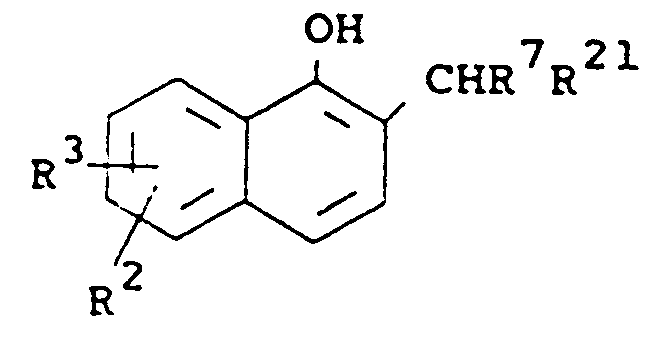

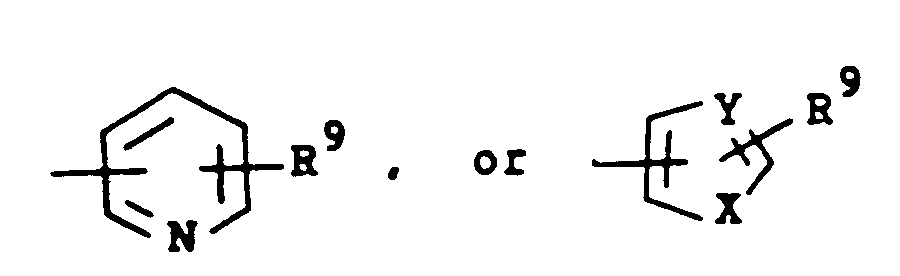


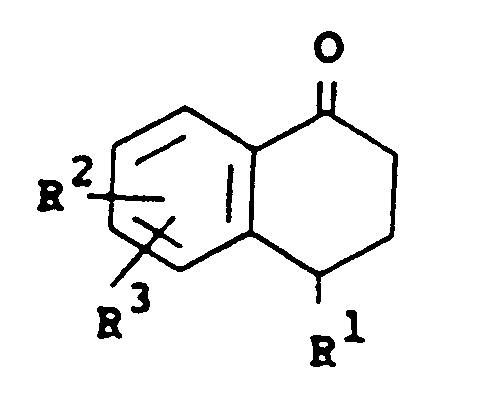
Priority Applications (1)
| Application Number | Priority Date | Filing Date | Title |
|---|---|---|---|
| AT86106122T ATE73121T1 (en) | 1985-05-08 | 1986-05-05 | 2-SUBSTITUTED 1-NAPHTHOLS AS INHIBITORS OF 5-LIPOXYGENASE. |
Applications Claiming Priority (4)
| Application Number | Priority Date | Filing Date | Title |
|---|---|---|---|
| US73179185A | 1985-05-08 | 1985-05-08 | |
| US06/839,912 US4833164A (en) | 1985-05-08 | 1986-03-19 | 2-substituted-1-naphthols, pharmaceutical compositions of, and their use as 5-lipoxygenase inhibitors |
| US731791 | 1986-03-19 | ||
| US839912 | 1986-03-19 |
Publications (3)
| Publication Number | Publication Date |
|---|---|
| EP0201071A2 EP0201071A2 (en) | 1986-11-12 |
| EP0201071A3 EP0201071A3 (en) | 1988-08-10 |
| EP0201071B1 true EP0201071B1 (en) | 1992-03-04 |
Family
ID=27112301
Family Applications (1)
| Application Number | Title | Priority Date | Filing Date |
|---|---|---|---|
| EP86106122A Expired EP0201071B1 (en) | 1985-05-08 | 1986-05-05 | 2-substituted-1-naphthols as 5-lipoxygenase inhibitors |
Country Status (17)
| Country | Link |
|---|---|
| US (1) | US4833164A (en) |
| EP (1) | EP0201071B1 (en) |
| JP (1) | JP2554322B2 (en) |
| AT (1) | ATE73121T1 (en) |
| CA (1) | CA1302417C (en) |
| DE (1) | DE3684034D1 (en) |
| DK (2) | DK211286A (en) |
| ES (2) | ES8801780A1 (en) |
| FI (1) | FI90974C (en) |
| GR (1) | GR861195B (en) |
| HU (1) | HU194796B (en) |
| IE (1) | IE58426B1 (en) |
| IL (1) | IL78719A (en) |
| MX (1) | MX164789B (en) |
| NO (1) | NO164592C (en) |
| NZ (1) | NZ216081A (en) |
| PT (1) | PT82543B (en) |
Cited By (2)
| Publication number | Priority date | Publication date | Assignee | Title |
|---|---|---|---|---|
| US7067148B2 (en) | 2001-02-15 | 2006-06-27 | King Pharmaceutical Research & Development, Inc. | Stabilized pharmaceutical and thyroid hormone compositions and method of preparation |
| US7101569B2 (en) | 2001-08-14 | 2006-09-05 | Franz G Andrew | Methods of administering levothyroxine pharmaceutical compositions |
Families Citing this family (16)
| Publication number | Priority date | Publication date | Assignee | Title |
|---|---|---|---|---|
| SU1600627A3 (en) * | 1985-05-08 | 1990-10-15 | Е.И.Дюпон Де Немур Энд Компани (Фирма) | Method of producing 2-substituted 1-napthols |
| US5026759A (en) * | 1985-05-08 | 1991-06-25 | Du Pont Merck Pharmaceutical | 2-substituted-1-naphthols as 5-lipoxygenase inhibitors |
| US4939169A (en) * | 1985-09-20 | 1990-07-03 | The Upjohn Company | 1,4-naphthalenediol and 1,4-hydroquinone derivatives |
| WO1987001698A2 (en) * | 1985-09-20 | 1987-03-26 | The Upjohn Company | 1,4-naphthalenediol and 1,4-hydroquinone derivatives |
| US5225436A (en) * | 1987-05-15 | 1993-07-06 | Schering Corporation | Aryl substituted naphthalene derivatives |
| WO1990003374A1 (en) * | 1988-09-28 | 1990-04-05 | The Upjohn Company | 1,4-dihydrothionapthoquinone and heterocyclic congeners which inhibit lipoxygenase enzymes |
| US5091379A (en) * | 1989-08-31 | 1992-02-25 | Du Pont Merck Pharmaceutical Company | Topical antinflammatory compositions with minimal systemic absorption |
| US5006555A (en) * | 1990-01-17 | 1991-04-09 | E. I. Du Pont De Nemours And Company | Esters of 2-arylmethyl-1-naphthol derivatives as 5-lipoxygenase inhibitors |
| US5278343A (en) * | 1992-02-27 | 1994-01-11 | Kuraray Company, Ltd. | Process for producing 2-methyl-1-naphthol |
| DE4230262A1 (en) * | 1992-09-10 | 1994-03-17 | Behringwerke Ag | Substituted phenols, processes for their preparation and their use for the treatment of cell proliferation-related diseases |
| WO1999043636A2 (en) | 1998-02-27 | 1999-09-02 | The United States Of America As Represented By Thesecretary Of The Department Of Health And Human Services | Disubstituted lavendustin a analogs and pharmaceutical compositions comprising the analogs |
| AU2002223966A1 (en) * | 2000-12-20 | 2002-07-01 | Warner Lambert Company | Non-halogenated naphthol compounds and antimicrobial compositions containing the same |
| WO2011137363A1 (en) | 2010-04-30 | 2011-11-03 | Allergan, Inc. | Novel treatment for age related macular degeneration and ocular ischemic disease associated with complement activation by targeting 5-lipoxygenase |
| RU2551655C1 (en) * | 2014-05-15 | 2015-05-27 | Федеральное государственное бюджетное учреждение науки Новосибирский институт органической химии им. Н.Н. Ворожцова Сибирского отделения Российской академии наук (НИОХ СО РАН) | Method for producing (3-hydroxypropyl)naphthols |
| JP6992932B2 (en) * | 2019-10-25 | 2022-02-03 | Dic株式会社 | Polyfunctional phenol resin, polyfunctional epoxy resin, curable resin composition containing them and cured product thereof |
| CN115959977B (en) * | 2022-12-28 | 2024-06-11 | 陕西泰合利华工业有限公司 | Preparation method of 1, 1-tris (3, 5-dimethoxy methyl-4-hydroxyphenyl) ethane |
Family Cites Families (16)
| Publication number | Priority date | Publication date | Assignee | Title |
|---|---|---|---|---|
| US3641161A (en) * | 1968-07-02 | 1972-02-08 | Syntex Corp | Naphthyl alkanols |
| US3761526A (en) * | 1971-04-14 | 1973-09-25 | Sandoz Ag | Aryl and cycloalkyl substituted naphthols |
| JPS567737A (en) | 1979-07-02 | 1981-01-27 | Takeda Chem Ind Ltd | Physiologically active quinone and its preparation |
| DE3007367C2 (en) | 1980-02-27 | 1982-07-08 | Zyma GmbH, 8000 München | 2-alkyl-5-hydroxy-1,4-naphthoquinones, processes for their preparation and pharmaceuticals |
| GB2072174B (en) * | 1980-03-17 | 1984-05-23 | Minnesota Mining & Mfg | Naphtholic compounds |
| DE3141443A1 (en) * | 1981-10-19 | 1983-05-05 | Basf Ag, 6700 Ludwigshafen | METHOD FOR PRODUCING VITAMINS K (DOWN ARROW) 3 (DOWN ARROW) AND K (DOWN ARROW) 4 (DOWN ARROW) AND THEIR DERIVATIVES |
| AU9145782A (en) | 1981-12-14 | 1983-06-23 | Syntex (U.S.A.) Inc. | Naphthoxy ackylamines and related compounds |
| US4593120A (en) * | 1982-10-27 | 1986-06-03 | Syntex (U.S.A.) Inc. | Naphthalene anti-psoriatic agents |
| US4466981A (en) * | 1982-10-27 | 1984-08-21 | Syntex (U.S.A.) Inc. | Naphthalene anti-psoriatic agents |
| DD242802A1 (en) | 1983-02-28 | 1987-02-11 | Univ Berlin Humboldt | PROCESS FOR PREPARING NEW W (2'-NAPHTHOXY) HYDROXAMIC ACIDS CONTAINING PHARMACEUTICAL PREPARATIONS AND THEIR SALTS |
| JPS6035436A (en) * | 1983-08-03 | 1985-02-23 | 株式会社日立製作所 | Fault indicator |
| JPS6036434A (en) * | 1983-08-08 | 1985-02-25 | Otsuka Pharmaceut Factory Inc | Alkoxynaphthalene derivative |
| EP0149588A3 (en) * | 1984-01-13 | 1986-05-07 | Sandoz Ag | N-(naphthyl-alkyl)-hydroxylamines |
| JPS60252441A (en) * | 1984-05-28 | 1985-12-13 | Otsuka Pharmaceut Factory Inc | Naphthalene and naphthoquinone derivative |
| US4625034A (en) * | 1985-02-04 | 1986-11-25 | Usv Pharmaceutical Corp. | 1,2-Dihydro; 1,2,3,4-tetrahydro; 5,8 dihydro; and 5,6,7,8-tetrahydroquinoline derivatives |
| JPH0710339B2 (en) | 1986-06-24 | 1995-02-08 | 三菱重工業株式会社 | Carbon monoxide adsorbent |
-
1986
- 1986-03-19 US US06/839,912 patent/US4833164A/en not_active Expired - Lifetime
- 1986-05-05 AT AT86106122T patent/ATE73121T1/en not_active IP Right Cessation
- 1986-05-05 EP EP86106122A patent/EP0201071B1/en not_active Expired
- 1986-05-05 DE DE8686106122T patent/DE3684034D1/en not_active Expired - Lifetime
- 1986-05-06 CA CA000508534A patent/CA1302417C/en not_active Expired - Lifetime
- 1986-05-07 FI FI861903A patent/FI90974C/en not_active IP Right Cessation
- 1986-05-07 IL IL78719A patent/IL78719A/en not_active IP Right Cessation
- 1986-05-07 NZ NZ216081A patent/NZ216081A/en unknown
- 1986-05-07 HU HU861892A patent/HU194796B/en not_active IP Right Cessation
- 1986-05-07 JP JP61103246A patent/JP2554322B2/en not_active Expired - Lifetime
- 1986-05-07 DK DK211286A patent/DK211286A/en not_active Application Discontinuation
- 1986-05-07 NO NO861829A patent/NO164592C/en not_active IP Right Cessation
- 1986-05-08 GR GR861195A patent/GR861195B/en unknown
- 1986-05-08 IE IE121886A patent/IE58426B1/en not_active IP Right Cessation
- 1986-05-08 ES ES554763A patent/ES8801780A1/en not_active Expired
- 1986-05-08 MX MX2420A patent/MX164789B/en unknown
- 1986-05-08 PT PT82543A patent/PT82543B/en not_active IP Right Cessation
-
1987
- 1987-09-25 ES ES557756A patent/ES8802214A1/en not_active Expired
-
1992
- 1992-03-25 DK DK039392A patent/DK39392A/en not_active Application Discontinuation
Cited By (2)
| Publication number | Priority date | Publication date | Assignee | Title |
|---|---|---|---|---|
| US7067148B2 (en) | 2001-02-15 | 2006-06-27 | King Pharmaceutical Research & Development, Inc. | Stabilized pharmaceutical and thyroid hormone compositions and method of preparation |
| US7101569B2 (en) | 2001-08-14 | 2006-09-05 | Franz G Andrew | Methods of administering levothyroxine pharmaceutical compositions |
Also Published As
| Publication number | Publication date |
|---|---|
| DK39392D0 (en) | 1992-03-25 |
| DE3684034D1 (en) | 1992-04-09 |
| FI861903A7 (en) | 1986-11-09 |
| MX164789B (en) | 1992-09-24 |
| ES557756A0 (en) | 1988-04-16 |
| JPS61263943A (en) | 1986-11-21 |
| HUT43551A (en) | 1987-11-30 |
| NZ216081A (en) | 1989-01-27 |
| PT82543A (en) | 1986-06-01 |
| FI90974B (en) | 1994-01-14 |
| IL78719A0 (en) | 1986-08-31 |
| ES554763A0 (en) | 1988-02-16 |
| NO164592C (en) | 1990-10-24 |
| ATE73121T1 (en) | 1992-03-15 |
| HU194796B (en) | 1988-03-28 |
| FI90974C (en) | 1994-04-25 |
| PT82543B (en) | 1988-08-17 |
| IL78719A (en) | 1993-05-13 |
| CA1302417C (en) | 1992-06-02 |
| GR861195B (en) | 1986-09-09 |
| ES8802214A1 (en) | 1988-04-16 |
| EP0201071A2 (en) | 1986-11-12 |
| NO861829L (en) | 1986-11-10 |
| DK211286D0 (en) | 1986-05-07 |
| EP0201071A3 (en) | 1988-08-10 |
| DK39392A (en) | 1992-03-25 |
| FI861903A0 (en) | 1986-05-07 |
| IE58426B1 (en) | 1993-09-22 |
| DK211286A (en) | 1986-11-09 |
| JP2554322B2 (en) | 1996-11-13 |
| ES8801780A1 (en) | 1988-02-16 |
| NO164592B (en) | 1990-07-16 |
| US4833164A (en) | 1989-05-23 |
| IE861218L (en) | 1986-11-08 |
Similar Documents
| Publication | Publication Date | Title |
|---|---|---|
| US4833164A (en) | 2-substituted-1-naphthols, pharmaceutical compositions of, and their use as 5-lipoxygenase inhibitors | |
| US4939133A (en) | N-substituted-2-hydroxy-α-oxo-benzeneacetamides and pharmaceutical compositions having activity as modulators of the arachidonic acid cascade | |
| US4393075A (en) | Quinone compounds and their use in suppressing the production of SRS-A in mammals | |
| EP0142801B1 (en) | Indene derivatives useful as paf-antagonists | |
| AU614949B2 (en) | Phenylalkyl hydroxamic acids as lipoxygenase inhibitory compounds | |
| EP0401517B1 (en) | Substituted 2-alkynylphenols with anti-inflammatory action, a process for their preparation and pharmaceutical compositions thereof | |
| AU653398B2 (en) | Substituted carboxylic acid derivatives | |
| AU631822B2 (en) | Novel naphthalene carboxylic acids | |
| US5110831A (en) | Vinylogous hydroxamic acids and derivatives thereof as 5-lipoxygenase inhibitors | |
| US4731382A (en) | Lipoxygenase inhibitory phenylalkanohydroxamic acids | |
| EP0142283A2 (en) | Phenylethylamines, process for their preparation and compositions containing them | |
| JPH0481577B2 (en) | ||
| AU628324B2 (en) | Compounds for inhibiting the biosynthesis of lipoxygenase -derived metabolites of arachidonic acid | |
| US4985442A (en) | 2-substituted-1-naphthols as 5-lipoxygenase inhibitors | |
| US4791216A (en) | Para ethyl amino phenol pharmaceutical compounds | |
| EP0223410A2 (en) | Ethanolamine Derivatives | |
| US5026759A (en) | 2-substituted-1-naphthols as 5-lipoxygenase inhibitors | |
| US4590291A (en) | Thrombin inhibitory new dihydroxybenzene ether derivatives | |
| AU606034B2 (en) | 2-substituted -1- naphthols as 5-lipogenase inhibitors | |
| IE891161L (en) | New heteroarotinoid derivatives, processes for preparing¹them and pharmaceutical compositions containing them | |
| US4730005A (en) | Leukotriene antagonist | |
| US4778931A (en) | Certain [3-(1-hydroxy hexyl-tetrahydro)naphthalenes], the corresponding naphthalenes having anti-inflammatory and anti-allergic activity | |
| US4624964A (en) | Aryl oxo-alkynoates as 5-lipoxygenase inhibitors | |
| KR810001557B1 (en) | Preparation of ketone derivatives | |
| HU195638B (en) | Process for producing leukotriene-antagonistic compounds and pharmaceutical compositions containing them as active components |
Legal Events
| Date | Code | Title | Description |
|---|---|---|---|
| PUAI | Public reference made under article 153(3) epc to a published international application that has entered the european phase |
Free format text: ORIGINAL CODE: 0009012 |
|
| AK | Designated contracting states |
Kind code of ref document: A2 Designated state(s): AT BE CH DE FR GB IT LI LU NL SE |
|
| PUAL | Search report despatched |
Free format text: ORIGINAL CODE: 0009013 |
|
| AK | Designated contracting states |
Kind code of ref document: A3 Designated state(s): AT BE CH DE FR GB IT LI LU NL SE |
|
| 17P | Request for examination filed |
Effective date: 19880917 |
|
| 17Q | First examination report despatched |
Effective date: 19900329 |
|
| RAP1 | Party data changed (applicant data changed or rights of an application transferred) |
Owner name: THE DU PONT MERCK PHARMACEUTICAL COMPANY |
|
| GRAA | (expected) grant |
Free format text: ORIGINAL CODE: 0009210 |
|
| AK | Designated contracting states |
Kind code of ref document: B1 Designated state(s): AT BE CH DE FR GB IT LI LU NL SE |
|
| REF | Corresponds to: |
Ref document number: 73121 Country of ref document: AT Date of ref document: 19920315 Kind code of ref document: T |
|
| ET | Fr: translation filed | ||
| REF | Corresponds to: |
Ref document number: 3684034 Country of ref document: DE Date of ref document: 19920409 |
|
| ITF | It: translation for a ep patent filed | ||
| PLBE | No opposition filed within time limit |
Free format text: ORIGINAL CODE: 0009261 |
|
| STAA | Information on the status of an ep patent application or granted ep patent |
Free format text: STATUS: NO OPPOSITION FILED WITHIN TIME LIMIT |
|
| 26N | No opposition filed | ||
| EPTA | Lu: last paid annual fee | ||
| EAL | Se: european patent in force in sweden |
Ref document number: 86106122.4 |
|
| REG | Reference to a national code |
Ref country code: FR Ref legal event code: CD Ref country code: FR Ref legal event code: CA |
|
| REG | Reference to a national code |
Ref country code: CH Ref legal event code: PFA Free format text: THE DU PONT MERCK PHARMACEUTICAL COMPANY TRANSFER- DUPONT PHARMACEUTICALS COMPANY |
|
| NLT1 | Nl: modifications of names registered in virtue of documents presented to the patent office pursuant to art. 16 a, paragraph 1 |
Owner name: DUPONT PHARMACEUTICALS COMPANY |
|
| PGFP | Annual fee paid to national office [announced via postgrant information from national office to epo] |
Ref country code: SE Payment date: 20010417 Year of fee payment: 16 |
|
| PGFP | Annual fee paid to national office [announced via postgrant information from national office to epo] |
Ref country code: DE Payment date: 20010430 Year of fee payment: 16 |
|
| PGFP | Annual fee paid to national office [announced via postgrant information from national office to epo] |
Ref country code: GB Payment date: 20010502 Year of fee payment: 16 Ref country code: CH Payment date: 20010502 Year of fee payment: 16 |
|
| PGFP | Annual fee paid to national office [announced via postgrant information from national office to epo] |
Ref country code: LU Payment date: 20010510 Year of fee payment: 16 |
|
| PGFP | Annual fee paid to national office [announced via postgrant information from national office to epo] |
Ref country code: AT Payment date: 20010514 Year of fee payment: 16 |
|
| PGFP | Annual fee paid to national office [announced via postgrant information from national office to epo] |
Ref country code: FR Payment date: 20010518 Year of fee payment: 16 |
|
| PGFP | Annual fee paid to national office [announced via postgrant information from national office to epo] |
Ref country code: NL Payment date: 20010531 Year of fee payment: 16 |
|
| PGFP | Annual fee paid to national office [announced via postgrant information from national office to epo] |
Ref country code: BE Payment date: 20010625 Year of fee payment: 16 |
|
| REG | Reference to a national code |
Ref country code: GB Ref legal event code: IF02 |
|
| PG25 | Lapsed in a contracting state [announced via postgrant information from national office to epo] |
Ref country code: LU Free format text: LAPSE BECAUSE OF NON-PAYMENT OF DUE FEES Effective date: 20020505 Ref country code: GB Free format text: LAPSE BECAUSE OF NON-PAYMENT OF DUE FEES Effective date: 20020505 Ref country code: AT Free format text: LAPSE BECAUSE OF NON-PAYMENT OF DUE FEES Effective date: 20020505 |
|
| PG25 | Lapsed in a contracting state [announced via postgrant information from national office to epo] |
Ref country code: SE Free format text: LAPSE BECAUSE OF NON-PAYMENT OF DUE FEES Effective date: 20020506 |
|
| PG25 | Lapsed in a contracting state [announced via postgrant information from national office to epo] |
Ref country code: LI Free format text: LAPSE BECAUSE OF NON-PAYMENT OF DUE FEES Effective date: 20020531 Ref country code: CH Free format text: LAPSE BECAUSE OF NON-PAYMENT OF DUE FEES Effective date: 20020531 Ref country code: BE Free format text: LAPSE BECAUSE OF NON-PAYMENT OF DUE FEES Effective date: 20020531 |
|
| PG25 | Lapsed in a contracting state [announced via postgrant information from national office to epo] |
Ref country code: NL Free format text: LAPSE BECAUSE OF NON-PAYMENT OF DUE FEES Effective date: 20021201 |
|
| PG25 | Lapsed in a contracting state [announced via postgrant information from national office to epo] |
Ref country code: DE Free format text: LAPSE BECAUSE OF NON-PAYMENT OF DUE FEES Effective date: 20021203 |
|
| GBPC | Gb: european patent ceased through non-payment of renewal fee |
Effective date: 20020505 |
|
| BECA | Be: change of holder's address |
Free format text: 20020312 *DUPONT PHARMACEUTICAL CY:CHESTNUT RUN PLAZA, 974 CENTRE ROAD, USA - WILMINGTON, DELAWARE 19805 |
|
| EUG | Se: european patent has lapsed | ||
| REG | Reference to a national code |
Ref country code: CH Ref legal event code: PL |
|
| PG25 | Lapsed in a contracting state [announced via postgrant information from national office to epo] |
Ref country code: FR Free format text: LAPSE BECAUSE OF NON-PAYMENT OF DUE FEES Effective date: 20030131 |
|
| NLV4 | Nl: lapsed or anulled due to non-payment of the annual fee |
Effective date: 20021201 |
|
| REG | Reference to a national code |
Ref country code: FR Ref legal event code: ST |
|
| PG25 | Lapsed in a contracting state [announced via postgrant information from national office to epo] |
Ref country code: IT Free format text: LAPSE BECAUSE OF NON-PAYMENT OF DUE FEES;WARNING: LAPSES OF ITALIAN PATENTS WITH EFFECTIVE DATE BEFORE 2007 MAY HAVE OCCURRED AT ANY TIME BEFORE 2007. THE CORRECT EFFECTIVE DATE MAY BE DIFFERENT FROM THE ONE RECORDED. Effective date: 20050505 |