EP0200702A2 - Fil de nylon partiellement orienté et son procédé de fabrication - Google Patents
Fil de nylon partiellement orienté et son procédé de fabrication Download PDFInfo
- Publication number
- EP0200702A2 EP0200702A2 EP86870049A EP86870049A EP0200702A2 EP 0200702 A2 EP0200702 A2 EP 0200702A2 EP 86870049 A EP86870049 A EP 86870049A EP 86870049 A EP86870049 A EP 86870049A EP 0200702 A2 EP0200702 A2 EP 0200702A2
- Authority
- EP
- European Patent Office
- Prior art keywords
- yarn
- branching agent
- filament
- sheath
- sheath component
- Prior art date
- Legal status (The legal status is an assumption and is not a legal conclusion. Google has not performed a legal analysis and makes no representation as to the accuracy of the status listed.)
- Withdrawn
Links
Images
Classifications
-
- D—TEXTILES; PAPER
- D01—NATURAL OR MAN-MADE THREADS OR FIBRES; SPINNING
- D01D—MECHANICAL METHODS OR APPARATUS IN THE MANUFACTURE OF ARTIFICIAL FILAMENTS, THREADS, FIBRES, BRISTLES OR RIBBONS
- D01D5/00—Formation of filaments, threads, or the like
- D01D5/28—Formation of filaments, threads, or the like while mixing different spinning solutions or melts during the spinning operation; Spinnerette packs therefor
- D01D5/30—Conjugate filaments; Spinnerette packs therefor
- D01D5/34—Core-skin structure; Spinnerette packs therefor
-
- D—TEXTILES; PAPER
- D01—NATURAL OR MAN-MADE THREADS OR FIBRES; SPINNING
- D01F—CHEMICAL FEATURES IN THE MANUFACTURE OF ARTIFICIAL FILAMENTS, THREADS, FIBRES, BRISTLES OR RIBBONS; APPARATUS SPECIALLY ADAPTED FOR THE MANUFACTURE OF CARBON FILAMENTS
- D01F8/00—Conjugated, i.e. bi- or multicomponent, artificial filaments or the like; Manufacture thereof
- D01F8/04—Conjugated, i.e. bi- or multicomponent, artificial filaments or the like; Manufacture thereof from synthetic polymers
- D01F8/12—Conjugated, i.e. bi- or multicomponent, artificial filaments or the like; Manufacture thereof from synthetic polymers with at least one polyamide as constituent
-
- Y—GENERAL TAGGING OF NEW TECHNOLOGICAL DEVELOPMENTS; GENERAL TAGGING OF CROSS-SECTIONAL TECHNOLOGIES SPANNING OVER SEVERAL SECTIONS OF THE IPC; TECHNICAL SUBJECTS COVERED BY FORMER USPC CROSS-REFERENCE ART COLLECTIONS [XRACs] AND DIGESTS
- Y10—TECHNICAL SUBJECTS COVERED BY FORMER USPC
- Y10T—TECHNICAL SUBJECTS COVERED BY FORMER US CLASSIFICATION
- Y10T428/00—Stock material or miscellaneous articles
- Y10T428/29—Coated or structually defined flake, particle, cell, strand, strand portion, rod, filament, macroscopic fiber or mass thereof
- Y10T428/2913—Rod, strand, filament or fiber
- Y10T428/2922—Nonlinear [e.g., crimped, coiled, etc.]
- Y10T428/2924—Composite
-
- Y—GENERAL TAGGING OF NEW TECHNOLOGICAL DEVELOPMENTS; GENERAL TAGGING OF CROSS-SECTIONAL TECHNOLOGIES SPANNING OVER SEVERAL SECTIONS OF THE IPC; TECHNICAL SUBJECTS COVERED BY FORMER USPC CROSS-REFERENCE ART COLLECTIONS [XRACs] AND DIGESTS
- Y10—TECHNICAL SUBJECTS COVERED BY FORMER USPC
- Y10T—TECHNICAL SUBJECTS COVERED BY FORMER US CLASSIFICATION
- Y10T428/00—Stock material or miscellaneous articles
- Y10T428/29—Coated or structually defined flake, particle, cell, strand, strand portion, rod, filament, macroscopic fiber or mass thereof
- Y10T428/2913—Rod, strand, filament or fiber
- Y10T428/2927—Rod, strand, filament or fiber including structurally defined particulate matter
-
- Y—GENERAL TAGGING OF NEW TECHNOLOGICAL DEVELOPMENTS; GENERAL TAGGING OF CROSS-SECTIONAL TECHNOLOGIES SPANNING OVER SEVERAL SECTIONS OF THE IPC; TECHNICAL SUBJECTS COVERED BY FORMER USPC CROSS-REFERENCE ART COLLECTIONS [XRACs] AND DIGESTS
- Y10—TECHNICAL SUBJECTS COVERED BY FORMER USPC
- Y10T—TECHNICAL SUBJECTS COVERED BY FORMER US CLASSIFICATION
- Y10T428/00—Stock material or miscellaneous articles
- Y10T428/29—Coated or structually defined flake, particle, cell, strand, strand portion, rod, filament, macroscopic fiber or mass thereof
- Y10T428/2913—Rod, strand, filament or fiber
- Y10T428/2929—Bicomponent, conjugate, composite or collateral fibers or filaments [i.e., coextruded sheath-core or side-by-side type]
Definitions
- nylon 66 shall mean those synthetic linear polyamides containing in the polymer molecule at least 85% by weight of recurring structural units of the formula Historically, certain nylon 66 apparel yarns were spun at low speeds of up to about 1400 meters per minute and packaged. The spun yarns were then drawn on a second machine and packaged again. The drawn yarn was then false-twist textured at slow speeds of the order of 55-230 meters per minute by the pin-twist method, yielding a very high quality stretch yarn suitable for stretch garments such as leotards.
- An exemplary false-twisting element for the pin-twist texturing process is disclosed in Raschle U.S. 3,475,895.
- Friction-twisting permits considerably higher texturing speeds than pin-twisting, with yarn speeds currently at about 700-900 mpm. Such high texturing speeds are more economical than those attained by the pin-twist process.
- PON feeder yarns for false-twist texturing have had RV's in the range from the middle or upper thirties to the low forties, as indicated by U.S. 3,994,121. Such yarns have more than adequate tenacity for conventional apparel end uses. With conventional nylon 66 polymerization techniques, increasing the polymer RV is expensive and leads to increased rates of gel formation, with consequent shortening of spinning pack (filter) life. High RV polymer is therefore ordinarily not used unless required for some special purpose, such as when high yarn tenacity is required.
- a further and substantial improvement in the art is provided by a novel PON feeder yarn, permitting formation of a friction-twist textured yarn having in some cases markedly higher crimp development than even some pin-twist yarns. This permits either or both of increased stretching capability in a fabric of equivalent covering power.
- the yarns of the invention are, broadly, false-twist texturing feed yarns spun at high speeds and characterized by a sheath-core conjugate structure, with the sheaths formed from nylon 66 polymer containing a higher amount of branching agent than the polymer forming the cores.
- the mechanism or precise reason for the improved results of the present invention are not entirely understood.
- an apparel yarn having an elongation between 45% and 150% and comprising a filament spun at a spinning speed of at least 2000 MPM, the filament having a nylon 66 sheath component surrounding a core component, the sheath component containing a larger amount of branching agent than the core component.
- a process for spinning a sheath-core filament comprising generating a molten stream comprising a nylon 66 sheath component containing a given quantity of branching agent and core component containing a lower quantity of branching agent (perferably none) than the sheath component, extruding the stream through a spinneret capillary, quenching the stream into a filament, and withdrawing the filament at a spinning speed of at least 2000 MPM.
- a process for producing a textured yarn comprising friction-twist texturing a yarn having an elongation between 45% and 150%, the yarn comprising a filamnt spun at a spinning speed of at least 2000 MPM, the filament having a nylon 66 sheath component surrounding a core component, the sheath component containing a larger effective amount of branching agent than the core component.
- the core component is also preferably nylon 66, and if the yarn is to be used as a feed yarn for false-twist texturing, the branching agent preferably constitutes between 0.01 and 1 (optimally between 0.05 and 0.15) mole percent of the sheath component.
- the sheath component preferably comprises less than 50% (optimally between 10% and 40%) by weight of the filament. For best results the spinning speed is selected such that the yarn has an elongation lower than 100%, with optimum results achieved when the elongation is between 60% and 90%.
- the preferred branching agents are trifunctional amines, such as TAN or BHMT, or trifunctional acids, such as trimesic acid.
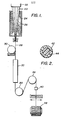
- molten polymer streams 20 are extruded through capillaries in spinneret 22 downwardly into quench zone 24 supplied with transversely directed quenching air at room temperature.
- Streams 20 solidify into filaments 26 at some distance below the spinneret within the quench zone.
- Filaments 26 are converged to form yarn 28 and pass through interfloor conditioner tube 30.
- a conventional spin-finish is applied to yarn 28 by finish roll 32.
- Yarn 28 next passes in partial wraps about godets 34 and 36 and is wound on package 38.
- the filaments may be entangled as desired, as by pneumatic tangle chamber 40.
- godets 34 and 36 perform the functions of withdrawing filaments 26 from streams 20 at a spinning speed determined by the peripheral speed of godet 34, and of reducing the tension in yard 28 from the rather high level just prior to godet 34 to an acceptable level for winding onto package 38.
- Winding tensions within the range of 0.03 to 0.25 grams per denier are preferred, with tensions of about 0.1 grams per denier being particularly preferred.
- Godets 34 and 36 may be dispensed with if the yarn winding tension immediately prior to the winder in the absence of the godets is within the yarn tension ranges indicated in this paragraph.
- "Winding tension” as used herein means the yarn tension as measured just prior to the yarn traversing and winding mechanism.
- Some commercially available winders include an auxiliary roll designed to both assist in yarn traversing and to permit reducing the yarn tension as the yarn is wound onto the bobbin or package. Such winders may be of assistance when using the upper portions of the yarn tension ranges indicated in this paragraph.
- Nylon 66 polymer having an RV of 39 is extruded through a conventional spinning pack and spinneret at a melt temperature of 385°C.
- Spinneret 22 contains 34 capillaries having lengths of 0.012" (0.3mm.) and diameters of 0.009" (0.229 mm.)
- Quench zone 24 is 35 inches in height, and is supplied with 20°C. quench air having an average horizontal velocity of 1 foot (30.5 cm.) per second.
- Filaments 26 are converged into yarn 28 approximately 36 inches (91.4 cm.) below the spinneret.
- Conditioner tube 30 is 72 inches (183 cm.) long and is of the type disclosed in Koschinek U.S.
- 4,181,697 i.e., a steamless tube heated to 120°C. through which yarn 28 passes.
- the speed of godets 34 and 36 are 4100 meters per minute and 4140 meters per minute, respectively, to prevent the yarn from wrapping on godet 36.
- the polymer metering rate is selected such that the yarn wound has a denier of 89.
- the winder used is the Toray 601, and the winder speed is adjusted to provide a winding tension of 0.1 grams per denier.
- the yarn has an elongation-to-break of 68%, and an RV of 41.
- the spun yarn is then simultaneously drawn and friction-twist textured on a Barmag FK6-L900 texturing machine using a 2i meter primary heater and a Barmag disc-aggregate with Kyocera ceramic discs in a draw zone between a feed and a draw or mid roll.
- the heater temperature is 225°C.
- the ratio of the peripheral speed of the discs to draw roll speed (the D/Y ratio is 1.95.
- the draw roll speed is set at 750 meters per minute, and the feed roll speed is adjusted to some lower speed to control the draw ratio and hence the draw-texturing tension (the yarn tension between the exit of the heater and the aggregate).
- the draw ratio is changed by adjustment of the feed roll speed so that the draw-texturing tension is high enough for stability in the false twist zone and yet low enough that the filaments are not broken, this being the operable texturing tension range.
- the "maximum texturing tension” is defined as the tension producing the maximum initial crimp development without an unacceptable level of broken filaments (frays). More than 10 broken filaments per kilogram are unacceptable in commercial use.
- the operable texturing tension range is quite narrow when draw-texturing at 750 meters per minute.
- the maximum texturing tension is found to be about 0.43 grams per draw roll denier, and the aged crimp development is about 15%.
- the draw roll denier is defined as the spun yarn denier divided by the mechanical draw ratio provided by the different surface speeds of the feed roll feeding the yarn to the heater and of the draw or mid roll just downstream of the false-twist device.
- the texturing tension is more than 0.45 grams per draw roll denier, an unacceptable level of broken filaments is produced.
- the textured yarn has a nominal denier of 70.
- FIGURE 2 illustrates the preferred sheath-core filament according to the invention, with sheath 40 surrounding core 42.
- Spinneret pack designs for forming such sheath-core filaments are well known in the art.
- sheath 40 is nylon 66 containing a branching agent as more fully disclosed below.
- Example 1 This is an example according to the invention.
- the apparatus described in Example 1 is used except the spinneret pack used in Examples 1 and 2 above is replaced by a spinneret pack designed to produce 34 sheath-core filaments.
- a first batch of nylon 66 polymer containing 0.34 mol% acetic acid and 0.125 mol% TAN is dried to produce nominal 49 yarn RV
- a second batch of conventional nylon 66 polymer containing 0.34 mol% acetic acid and no chain branching agent is dried to produce nominal 37 yarn RV.
- the polymers are spun under the conditions set forth in Example 1 above as sheath-core filaments with the polymer containing the TAN forming the sheaths.and the second polymer forming the cores.
- the sheath-core volumetric ratio are 2 to 3. That is, the sheaths constitute 40% of the volume of the filaments, the remaining 60% being the core component.
- the PON yarn has a denier of 107 and an elongation of 86%, to provide
- the textured yarn When the PON yarn is drawtextured by the friction twist method at its maximum texturing tension (225°C. heater), the textured yarn has an aged crimp development of 18.9%. This is substantially greater than the crimp development levels achieved by friction twist texturing of conventional 40 RV PON, and is comparable to the-high RV yarn of Example 2 herein.
- Example 3 is repeated except the first polymer is further dried to produce nominal 60 RV.
- the resulting textured yarn has an aged crimp development well above 20%, clearly superior to the Example 2 yarn.
- the increased crimp development provides for greater stretch and covering power in fabrics made from the textured yarn of the invention.
- the improved results according to the invention are not achieved unless the spinning speed is at least 2200 MPM, with speeds above 3000 MPM being preferred. Spinning speeds above 3400 MPM are particularly advantageous.
- branching agents While the invention is above exemplified using TAN, numerous other branching agents may be used.
- BHMT is another example of such an agent with functional groups reactive with the carboxyl groups in nylon 66 polymer
- trimesic acid is an example of an agent with functional groups reactive with the amine groups in nylon 66 polymer. Any necessary adjustment of the amount of branching agent can readily be done by trial and error.
- Suitable branching agents generally contain three or more functional groups reactive with amine or carboxylic end groups under the conditions used for polymerization the polymer, and generally increase the polymer molecular weight.
- Alpha-amino-epsilon-caprolactam is noted a another suitable material which has the requisite number of functional groups, some of which react with amines and some which react with carboxyl groups. If the branching agent contains more than three such functional groups, it may be necessary to reduce the level of branching agent significantly below those indicated above as preferred with TAN.
- TAN is the trifunctional branching agent 4(aminomethyl)-1,8-diaminooctane having the following structural formula:
- BHMT bis-hexamethylene triamine
- All yarn packages to be tested are conditioned at 21 degrees C. arid 65% relative humidity for one day prior to testing.
- the yarn elongation-to-break (commonly referred to as "elongation") is measured one week after spinning. Fifty yards of yarn are stripped from the bobbin and discarded. Elongation-to-break is determined using an Instron tensile testing instrument. The gage length (initial length) of yarn sample between clamps on the instrument) is 25 cm., and the crosshead speed is 30cm. per minute. The yarn is extended until it breaks. Elongation-to-break is defined as the increase in sample length at the time of maximum load or force (stress) applied, expressed as a percentage of the original gage length (25cm.).
- Crimp development is measured as follows. Yarn is wound at a positive tension less than 2 grams on a Suter denier reel or equivalent to provide a 1-1/8 meter circumference skein. The number of reel revolutions is determined by 2840/yarn denier, to the nearest revolution. This provides a skein of approximately 5680 skein denier and an initial skein length of 9/16 meter. A 14.2 gram weight or load is suspe.nded from the skein, and the loaded skein is placed in a forced-air oven maintained at 180°C. for 5 minutes.
- the skein is then removed from the oven and conditioned for 1 minute at room temperature with the 14.2 gram weight still suspended from the skein, at which time the skein length L2 is measured to the nearest 0.1 cm.
- the 14.2 gram weight is then replaced with a 650 gram weight. Thirty seconds after the 650 gram weight is applied to the skein, the skein length L3 is measured to the nearest 0.1 cm.
- Percentage crimp development is defined as L3-L2/L3 x 100. Crimp development decreases with time as the textured yarn ages on the bobbin, rapidly for the first hours and days, then more slowly. When "initial crimp development" is specified herein, the measurement is made about one day after texturing.
- Relative viscosity is determined by ASTM D789-81, using 90% formic acid.
- Broken filaments are determined visually, by counting the number of broken filaments on the exposed surfaces of the packages.
Landscapes
- Engineering & Computer Science (AREA)
- Textile Engineering (AREA)
- Chemical & Material Sciences (AREA)
- Chemical Kinetics & Catalysis (AREA)
- General Chemical & Material Sciences (AREA)
- Mechanical Engineering (AREA)
- Yarns And Mechanical Finishing Of Yarns Or Ropes (AREA)
- Multicomponent Fibers (AREA)
- Artificial Filaments (AREA)
Applications Claiming Priority (2)
| Application Number | Priority Date | Filing Date | Title |
|---|---|---|---|
| US725693 | 1985-04-22 | ||
| US06/725,693 US4596742A (en) | 1985-04-22 | 1985-04-22 | Partially oriented nylon yarn and process |
Publications (2)
| Publication Number | Publication Date |
|---|---|
| EP0200702A2 true EP0200702A2 (fr) | 1986-11-05 |
| EP0200702A3 EP0200702A3 (fr) | 1989-01-18 |
Family
ID=24915594
Family Applications (1)
| Application Number | Title | Priority Date | Filing Date |
|---|---|---|---|
| EP86870049A Withdrawn EP0200702A3 (fr) | 1985-04-22 | 1986-04-21 | Fil de nylon partiellement orienté et son procédé de fabrication |
Country Status (5)
| Country | Link |
|---|---|
| US (1) | US4596742A (fr) |
| EP (1) | EP0200702A3 (fr) |
| JP (1) | JPS61245312A (fr) |
| KR (1) | KR880001018B1 (fr) |
| CA (1) | CA1274659A (fr) |
Cited By (2)
| Publication number | Priority date | Publication date | Assignee | Title |
|---|---|---|---|---|
| WO2001061087A1 (fr) * | 2000-02-14 | 2001-08-23 | Basf Corporation | Filage a vitesse elevee de fibres a deux composantes ame/gaine |
| WO2002042531A1 (fr) * | 2000-11-23 | 2002-05-30 | Basf Aktiengesellschaft | Fibre a plusieurs composants |
Families Citing this family (9)
| Publication number | Priority date | Publication date | Assignee | Title |
|---|---|---|---|---|
| US5272005A (en) * | 1992-03-25 | 1993-12-21 | Board Of Supervisors Of Louisiana State University And Agricultural And Mechanical College | Sheath/core composite materials |
| US5605739A (en) * | 1994-02-25 | 1997-02-25 | Kimberly-Clark Corporation | Nonwoven laminates with improved peel strength |
| US5424115A (en) * | 1994-02-25 | 1995-06-13 | Kimberly-Clark Corporation | Point bonded nonwoven fabrics |
| US5534339A (en) * | 1994-02-25 | 1996-07-09 | Kimberly-Clark Corporation | Polyolefin-polyamide conjugate fiber web |
| US5746046A (en) * | 1996-08-05 | 1998-05-05 | Guilford Mills, Inc. | Method for forming comingled composite yarn |
| US6037421A (en) * | 1997-09-30 | 2000-03-14 | Solutia Inc. | Functionalized polymers |
| US5876840A (en) * | 1997-09-30 | 1999-03-02 | Kimberly-Clark Worldwide, Inc. | Crimp enhancement additive for multicomponent filaments |
| US6410138B2 (en) | 1997-09-30 | 2002-06-25 | Kimberly-Clark Worldwide, Inc. | Crimped multicomponent filaments and spunbond webs made therefrom |
| US20070110998A1 (en) * | 2005-11-15 | 2007-05-17 | Steele Ronald E | Polyamide yarn spinning process and modified yarn |
Family Cites Families (16)
| Publication number | Priority date | Publication date | Assignee | Title |
|---|---|---|---|---|
| US2708617A (en) * | 1951-05-12 | 1955-05-17 | Du Pont | Formation of films and filament directly from polymer intermediates |
| GB750629A (en) * | 1953-10-07 | 1956-06-20 | Ici Ltd | Manufacture of moulded articles from polyamides |
| NL302296A (fr) * | 1962-12-21 | |||
| US3536802A (en) * | 1965-08-02 | 1970-10-27 | Kanebo Ltd | Method for spinning composite filaments |
| US3589956A (en) * | 1966-09-29 | 1971-06-29 | Du Pont | Process for making a thermally self-bonded low density nonwoven product |
| US3549601A (en) * | 1968-08-20 | 1970-12-22 | Peter A Fowell | Polyamide molding resin obtained by polymerizing polyamide precursors in the presence of a critical proportion of end capping agent: branching agent |
| US3687904A (en) * | 1970-12-04 | 1972-08-29 | Ici Ltd | Polyamides |
| HU165832B (fr) * | 1973-02-20 | 1974-11-28 | ||
| AR204352A1 (es) * | 1974-04-03 | 1975-12-22 | Du Pont | Hilo polihexametilenadipamida sin estirar vaporizado y procedimiento para su obtencion |
| AR207365A1 (es) * | 1974-06-25 | 1976-09-30 | Monsanto Co | Hilado de nylon 66 con alto modulo en rotura bajo modulo en elongacion de 10% indice en tension positivo y uniformidad de denier una bobina que tiene devanado sobre la misma el hilado y un procedimiento para la hilatura en estado de fusion de nylon 66 |
| US4181697A (en) * | 1975-04-05 | 1980-01-01 | Zimmer Aktiengessellschaft | Process for high-speed spinning of polyamides |
| AR207251A1 (es) * | 1975-05-22 | 1976-09-22 | Monsanto Co | Procedimiento para producir un hilado partiendo de un polimero de poliamida termoplastica para la hilatura en estado de fusion |
| US4271233A (en) * | 1979-11-02 | 1981-06-02 | Monsanto Company | Crimped polyamide filament |
| GB2098536B (en) * | 1981-05-18 | 1984-10-10 | Davy Mckee Ag | High speed spin-drawn fibres |
| US4424257A (en) * | 1981-11-12 | 1984-01-03 | Monsanto Company | Self-crimping multi-component polyamide filament wherein the components contain differing amounts of polyolefin |
| US4521484A (en) * | 1984-06-07 | 1985-06-04 | E. I. Du Pont De Nemours And Company | Self-crimping polyamide filaments |
-
1985
- 1985-04-22 US US06/725,693 patent/US4596742A/en not_active Expired - Fee Related
-
1986
- 1986-04-21 JP JP61091965A patent/JPS61245312A/ja active Pending
- 1986-04-21 CA CA000507119A patent/CA1274659A/fr not_active Expired - Lifetime
- 1986-04-21 KR KR1019860003070A patent/KR880001018B1/ko not_active Expired
- 1986-04-21 EP EP86870049A patent/EP0200702A3/fr not_active Withdrawn
Cited By (3)
| Publication number | Priority date | Publication date | Assignee | Title |
|---|---|---|---|---|
| WO2001061087A1 (fr) * | 2000-02-14 | 2001-08-23 | Basf Corporation | Filage a vitesse elevee de fibres a deux composantes ame/gaine |
| US6332994B1 (en) | 2000-02-14 | 2001-12-25 | Basf Corporation | High speed spinning of sheath/core bicomponent fibers |
| WO2002042531A1 (fr) * | 2000-11-23 | 2002-05-30 | Basf Aktiengesellschaft | Fibre a plusieurs composants |
Also Published As
| Publication number | Publication date |
|---|---|
| CA1274659C (fr) | 1990-10-02 |
| CA1274659A (fr) | 1990-10-02 |
| KR860008303A (ko) | 1986-11-14 |
| JPS61245312A (ja) | 1986-10-31 |
| KR880001018B1 (ko) | 1988-06-14 |
| US4596742A (en) | 1986-06-24 |
| EP0200702A3 (fr) | 1989-01-18 |
Similar Documents
| Publication | Publication Date | Title |
|---|---|---|
| US4425293A (en) | Preparation of amorphous ultra-high-speed-spun polyethylene terephthalate yarn for texturing | |
| US4301102A (en) | Self-crimping polyamide fibers | |
| EP0191746B1 (fr) | Fil de nylon pré-orienté et procédé pour sa fabrication | |
| US4069657A (en) | Yarn texturing process | |
| US4596742A (en) | Partially oriented nylon yarn and process | |
| US4521484A (en) | Self-crimping polyamide filaments | |
| WO2001023651A1 (fr) | Fil retors en terephtalate de polypropylene et son procede de production | |
| US3956878A (en) | High speed texturing | |
| US5993712A (en) | Process for the processing of polymer mixtures into filaments | |
| US4583357A (en) | Partially oriented nylon yarn and process | |
| US4804508A (en) | Process for spinning polyamide at high speed | |
| US3939637A (en) | Unstreteched polyethylene terephthalate yarn in continuous stretching and false twist texturizing processes | |
| JP2724214B2 (ja) | 分繊用弾性糸及びその製造方法 | |
| CA1274660A (fr) | Fil nylon partiellement oriente, et sa fabrication | |
| AU605693B2 (en) | Self-crimpable nylon 66 carpet yarn | |
| CA1272568A (fr) | Fil nylon partiellement oriente, et sa fabrication | |
| EP0126055B1 (fr) | Fil partiellement orienté, en nylon et procédé pour sa fabrication | |
| USRE33059E (en) | Partially oriented nylon yarn and process | |
| US4646514A (en) | Partially oriented nylon yarn and process | |
| US20030004301A1 (en) | Method of spinning, spooling, and stretch texturing polyester filaments and polyester filaments thereby produced | |
| US4287713A (en) | Process for low-torque textured yarn | |
| US4302929A (en) | Hairy monocomponent yarn | |
| US4760691A (en) | Partially oriented nylon yarn and process | |
| US4816550A (en) | Polyamide feed yarn for air-jet texturing | |
| EP0250664A1 (fr) | Procédé pour la combinaison et le co-étirage de filaments antistatiques avec des filaments non étirés en nylon |
Legal Events
| Date | Code | Title | Description |
|---|---|---|---|
| PUAI | Public reference made under article 153(3) epc to a published international application that has entered the european phase |
Free format text: ORIGINAL CODE: 0009012 |
|
| AK | Designated contracting states |
Kind code of ref document: A2 Designated state(s): DE FR GB IT NL |
|
| PUAL | Search report despatched |
Free format text: ORIGINAL CODE: 0009013 |
|
| AK | Designated contracting states |
Kind code of ref document: A3 Designated state(s): DE FR GB IT NL |
|
| 17P | Request for examination filed |
Effective date: 19890620 |
|
| 17Q | First examination report despatched |
Effective date: 19900807 |
|
| STAA | Information on the status of an ep patent application or granted ep patent |
Free format text: STATUS: THE APPLICATION IS DEEMED TO BE WITHDRAWN |
|
| 18D | Application deemed to be withdrawn |
Effective date: 19901103 |
|
| RIN1 | Information on inventor provided before grant (corrected) |
Inventor name: SELIVANSKY, DROR Inventor name: SOUTHERN, JOHN HOYLE |