EP0198626A2 - Verfahren zum Aufbauen von Reifen - Google Patents
Verfahren zum Aufbauen von Reifen Download PDFInfo
- Publication number
- EP0198626A2 EP0198626A2 EP86302374A EP86302374A EP0198626A2 EP 0198626 A2 EP0198626 A2 EP 0198626A2 EP 86302374 A EP86302374 A EP 86302374A EP 86302374 A EP86302374 A EP 86302374A EP 0198626 A2 EP0198626 A2 EP 0198626A2
- Authority
- EP
- European Patent Office
- Prior art keywords
- tyre
- inner core
- outer casing
- mould
- plastics material
- Prior art date
- Legal status (The legal status is an assumption and is not a legal conclusion. Google has not performed a legal analysis and makes no representation as to the accuracy of the status listed.)
- Granted
Links
Images
Classifications
-
- B—PERFORMING OPERATIONS; TRANSPORTING
- B29—WORKING OF PLASTICS; WORKING OF SUBSTANCES IN A PLASTIC STATE IN GENERAL
- B29D—PRODUCING PARTICULAR ARTICLES FROM PLASTICS OR FROM SUBSTANCES IN A PLASTIC STATE
- B29D30/00—Producing pneumatic or solid tyres or parts thereof
- B29D30/02—Solid tyres ; Moulds therefor
-
- B—PERFORMING OPERATIONS; TRANSPORTING
- B29—WORKING OF PLASTICS; WORKING OF SUBSTANCES IN A PLASTIC STATE IN GENERAL
- B29C—SHAPING OR JOINING OF PLASTICS; SHAPING OF MATERIAL IN A PLASTIC STATE, NOT OTHERWISE PROVIDED FOR; AFTER-TREATMENT OF THE SHAPED PRODUCTS, e.g. REPAIRING
- B29C33/00—Moulds or cores; Details thereof or accessories therefor
- B29C33/12—Moulds or cores; Details thereof or accessories therefor with incorporated means for positioning inserts, e.g. labels
- B29C33/123—Moulds or cores; Details thereof or accessories therefor with incorporated means for positioning inserts, e.g. labels for centering the inserts
-
- B—PERFORMING OPERATIONS; TRANSPORTING
- B29—WORKING OF PLASTICS; WORKING OF SUBSTANCES IN A PLASTIC STATE IN GENERAL
- B29C—SHAPING OR JOINING OF PLASTICS; SHAPING OF MATERIAL IN A PLASTIC STATE, NOT OTHERWISE PROVIDED FOR; AFTER-TREATMENT OF THE SHAPED PRODUCTS, e.g. REPAIRING
- B29C70/00—Shaping composites, i.e. plastics material comprising reinforcements, fillers or preformed parts, e.g. inserts
- B29C70/68—Shaping composites, i.e. plastics material comprising reinforcements, fillers or preformed parts, e.g. inserts by incorporating or moulding on preformed parts, e.g. inserts or layers, e.g. foam blocks
- B29C70/70—Completely encapsulating inserts
Definitions
- This invention relates to solid tyres for vehicles.
- the expression solid tyres is to be taken to mean tyres which do not have internal spaces in which air under pressure is maintained.
- the invention is primarily concerned with solid tyres for vehicles such as fork-lift trucks, cranes, or other mechanical handling equipment or other vehicles not generally used on highways.
- a method of manufacturing a tyre from plastics materials characterised by the steps of forming an inner core of a relatively soft resilient plastics material, then placing the inner core in a mould having the shape of the finished tyre, the inner core being located within the mould so that, when the mould is filled with a resilient relatively hard wearing plastics material, an outer casing is formed around the core, the outer casing having at least an outer peripheral wall and side walls.
- the inner core includes an annular tubular membrane, within which the relatively soft resilient material is contained.
- the membrane is formed as a tube with a peripheral joint which is secured before introduction of the relatively soft resilient material.
- the tube may comprise one or more layers or plies.
- keying means may be placed on the exterior suface of the membrane for engagement with the outer casing as it is moulded around the membrane.
- the keying means may be grooves or other indentations or projections on the external surface of the membrane.
- Reinforcement may be placed in the mould prior to moulding of the outer casing, such reinforcement being preferably at least in the region of the bead of the tyre.
- the reinforcement may be metal or other material mesh, having holes through which the material of the outer casing can penetrate as the mould is filled.
- the plastics material used for the inner core is a polyurethane.
- the hardness is in the range 10 -60 Shore "A” Durometer and the elongation is in the range 200 -400%.
- the plastics material used for the outer casing is a polyurethane.
- the hardness is in the range 60 -90 Shore "A” Durometer and the elongation is in the range 400 - 800%.
- the mould in which the outer casing is formed may have means for supporting the inner core away from the sides of the mould, so that upon filling with the material for the outer casing, the inner core is completely or partially enclosed in that material.
- Gravity casting, injection casting, centrifugal casting or reaction injection moulding methods may be employed in making the inner core.
- a tyre as produced by the said method and comprising an inner core of relatively soft resilient plastics material and an outer casing of resilient relatively hard wearing plastics material.
- Varying hardness and flexibility in differing parts of the tyre outer casing may be achieved by using materials of different properties.
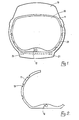
- the tyre illustrated in Figure 1 is intended for use on a wheel having a recessed rim of conventional kind, the rim however being of the split type, including two, three or four components, to enable the tyre to be fitted.
- the tyre is typically for use on trucks or other vehicles not primarily intended for use on highways but in which tyre wear must be minimised and in which risk of puncture is eliminated.
- the tyre will have low rolling resistance and may be used on floors on which it will not leave a mark.
- the tyre is also resistant to oil, chemicals and solvents.
- the tyre comprises an inner core 10 of generally circular section.
- the inner core includes and is an enclosing annular, tubular membrane 11, also shown in Figure 2.
- This membrane 11 is formed from a resilient material such as a suitable moulded polymer.
- the membrane 11 is preferably a multi-layer or multiply structure. It has a relatively thin wall section, but at the base of the tyre section it is thickened and includes a separable joint 12 made up of a bead and groove combination, the resilience of the material allowing these to be engaged when required.
- On the external surface of the membrane 11 are re-entrant or dovetail grooves 13, forming keying means.
- the inner core is formed by first moulding the membrane, preferably by a low pressure moulding process, then after removing this from its mould, the joint 12 is engaged, thus forming a hollow annular tube.
- the material for the core 10 is next introduced, through a suitable entry hole, with this being introduced under pressure. Pressurisation provides some degree of prestress within the core.
- the inner core 10 is produced from a relatively soft resilient material which may be a urethane or other equivalent plastics material.
- a suitable material is polyurethane being in one example a quasi-prepolymer based on a toluene diisocyanate, a mixture of low molecular weight polyols with some oil extension.
- the polyurethane mixture was pre-blended in the ratio 1:1 by volume. However, other ratios can be used. This was introduced into the interior of the membrane 11 at 30 ° C. After filling and plugging, the assembly is then heated or may be transferred to a circulating air oven operating at 35 to 40°C. The curing of the inner core can take place in these conditions over 48 hours.
- the physical properties of the inner core in this example were as follows:
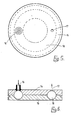
- the inner core may be moulded in a two-part mould 14, 15 such as that shown in Figures 5 and 6 in which the material in liquid form is introduced through an entry port 16, air being allowed to escape through an outlet 17 from an internal generally circular section cavity 18.
- the inner core 10 may, in this case, be enclosed in a fabric covering.
- This is in the form of a band of fabric applied to the outside of the inner core 10 by winding at 45°.
- a band 2t" wide and of plain weave polyester fabric may be suitable. Wire mesh may be substituted for the fabric band.
- Such a band is shown diagrammatically in Figure 4 at 29.
- An outer casing 19 is made from a resilient relatively hard wearing plastics material which is also a utherane material. This material is therefore substantially harder than that used for the inner core 10.
- This outer casing 14 has a profile corresponding to that of a conventional tyre, having bead portions 20, 21 engageable with beads on the wheel rim. Tread formations (not shown) may be provided, if required on the external surfaces.
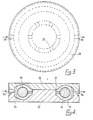
- the outer casing 19 is formed in a mould shown in Figures 3 and 4. This is a circular two part mould comprising components 22, 23. A cavity 24 is defined within the mould, being the shape of the finished tyre. At one side an entry port 25 and at the diametrically opposite side an outlet port 26 are provided.
- the inner core is supported within the cavity 24 by means of spacers 27. These are positioned at intervals around the mould, six being shown at the internal peripheral surface of the cavity 24. When the inner core has been supported in the cavity on the spacers, the remaining volume is filled to form the outer casing.
- the mould is placed in a circulating air oven at 100°C.
- a polyurethane composition based on a toluene diisochanatelpolytetramethylene ether glycol prepolymer crosslinked with 44' melthylene bis ortho chlorinaline can be used.
- Curing takes place at 100°C over a period of a predetermined period. After cooling the finished moulding is removed and any flash trimmed off.
- the physical properties of the outer casing 19 are as follows:
- reinforcement 28 is included within the outer casing 19. This may be in the form of wires or other metal strips or sections of metal or other material mesh.
- the reinforcement 28 is provided in the bead portions 20, 21 and also the section between the bead portions, the latter providing a stiff bridge which greatly strengthens the tyre in this area. It also serves to tend to prevent the tyre from slipping on the wheel.
- the reinforcement 28 is placed in the mould prior to moulding the outer casing. As the material enters the mould it flows through holes in the mesh or other spaces between portions of the reinforcement.
- Varying hardness of the portions of the outer casing can be achieved by selection of different material mixes for producing the portions comprising the bead portions, sidewall portions and tread portion but the desired flexibility may be achieved by suitable variation of thickness or combination of these techniques.
- Reinforcements in the form of wire or fabric mesh are embedded in the outer casing and provide varying strengths over different areas of the tyre, so as to provide greater or lesser flexibility as required.
- a tread pattern may be provided if required on the outer peripheral face and/or on parts of the side walls.
- centrifugal casting injection casting, reaction injection moulding or other appropriate method may be used for the formation of the inner core.
- centrifugal casting, reaction injection moulding may be used to make the outer casing.
- the materials chosen may determine or influence the choice of technique used for production.
- materials for the inner core include polyurethanes of the prepolymer, quasi prepolymer or one shot polymer types.
- Materials suitable for the outer casing include any of those suitable for the inner core as well as thermoplastic grades which can be used in centrifugal casting or blow moulding.
- the outer casing entirely surrounds the inner core but in other examples, the inner core may be exposed at the bead area, where it is protected by the wheel when the tyre is in place.
Landscapes
- Engineering & Computer Science (AREA)
- Mechanical Engineering (AREA)
- Chemical & Material Sciences (AREA)
- Composite Materials (AREA)
- Heating, Cooling, Or Curing Plastics Or The Like In General (AREA)
- Tyre Moulding (AREA)
- Moulds For Moulding Plastics Or The Like (AREA)
- Casting Or Compression Moulding Of Plastics Or The Like (AREA)
- Processing And Handling Of Plastics And Other Materials For Molding In General (AREA)
- Tires In General (AREA)
Priority Applications (1)
| Application Number | Priority Date | Filing Date | Title |
|---|---|---|---|
| AT86302374T ATE44686T1 (de) | 1985-04-10 | 1986-04-01 | Verfahren zum aufbauen von reifen. |
Applications Claiming Priority (2)
| Application Number | Priority Date | Filing Date | Title |
|---|---|---|---|
| GB858509154A GB8509154D0 (en) | 1985-04-10 | 1985-04-10 | Tyre constructional method |
| GB8509154 | 1985-04-10 |
Publications (3)
| Publication Number | Publication Date |
|---|---|
| EP0198626A2 true EP0198626A2 (de) | 1986-10-22 |
| EP0198626A3 EP0198626A3 (en) | 1987-08-19 |
| EP0198626B1 EP0198626B1 (de) | 1989-07-19 |
Family
ID=10577385
Family Applications (1)
| Application Number | Title | Priority Date | Filing Date |
|---|---|---|---|
| EP86302374A Expired EP0198626B1 (de) | 1985-04-10 | 1986-04-01 | Verfahren zum Aufbauen von Reifen |
Country Status (9)
| Country | Link |
|---|---|
| EP (1) | EP0198626B1 (de) |
| JP (1) | JPS61241132A (de) |
| AT (1) | ATE44686T1 (de) |
| AU (1) | AU581304B2 (de) |
| DE (1) | DE3664428D1 (de) |
| ES (1) | ES8701598A1 (de) |
| GB (1) | GB8509154D0 (de) |
| IL (1) | IL78433A0 (de) |
| ZA (1) | ZA862656B (de) |
Cited By (3)
| Publication number | Priority date | Publication date | Assignee | Title |
|---|---|---|---|---|
| EP0257865A3 (en) * | 1986-08-19 | 1989-02-08 | Watts Industrial Tyres Limited | Tyre construction method |
| FR2624783A1 (fr) * | 1987-12-21 | 1989-06-23 | Procal | Dispositif de moulage pour la realisation de coupes radiales de bagues d'etancheite |
| WO1999003663A1 (en) * | 1997-07-17 | 1999-01-28 | Daniel Huang | Method for forming roller wheel tire |
Families Citing this family (4)
| Publication number | Priority date | Publication date | Assignee | Title |
|---|---|---|---|---|
| JP6208923B2 (ja) * | 2011-10-13 | 2017-10-04 | 横浜ゴム株式会社 | 非空気入りタイヤの製造方法およびそれを用いた非空気入りタイヤ |
| JP6069856B2 (ja) * | 2012-03-07 | 2017-02-01 | 横浜ゴム株式会社 | 非空気入りタイヤおよびその製造方法 |
| JP5990938B2 (ja) * | 2012-03-08 | 2016-09-14 | 横浜ゴム株式会社 | 非空気入りタイヤおよびその製造方法 |
| JP6315214B2 (ja) * | 2016-06-13 | 2018-04-25 | 横浜ゴム株式会社 | 非空気入りタイヤの製造方法およびそれを用いた非空気入りタイヤ |
Family Cites Families (4)
| Publication number | Priority date | Publication date | Assignee | Title |
|---|---|---|---|---|
| US3348597A (en) * | 1965-06-17 | 1967-10-24 | Borg Warner | Vehicle tire |
| GB1365341A (en) * | 1971-11-29 | 1974-09-04 | Raleigh Industries Ltd | Moulding of annular foamed material articles |
| GB2047637B (en) * | 1979-01-24 | 1983-01-12 | Macpherson Ind Coatings Ltd | Wheels with moulded tyres |
| FR2462280A1 (fr) * | 1979-07-30 | 1981-02-13 | Peugeot | Pneumatique increvable pour bicyclette ou analogue et son procede de fabrication |
-
1985
- 1985-04-10 GB GB858509154A patent/GB8509154D0/en active Pending
-
1986
- 1986-04-01 EP EP86302374A patent/EP0198626B1/de not_active Expired
- 1986-04-01 DE DE8686302374T patent/DE3664428D1/de not_active Expired
- 1986-04-01 AT AT86302374T patent/ATE44686T1/de not_active IP Right Cessation
- 1986-04-08 IL IL78433A patent/IL78433A0/xx unknown
- 1986-04-08 AU AU55760/86A patent/AU581304B2/en not_active Ceased
- 1986-04-09 ES ES553840A patent/ES8701598A1/es not_active Expired
- 1986-04-09 ZA ZA862656A patent/ZA862656B/xx unknown
- 1986-04-10 JP JP61081232A patent/JPS61241132A/ja active Pending
Cited By (3)
| Publication number | Priority date | Publication date | Assignee | Title |
|---|---|---|---|---|
| EP0257865A3 (en) * | 1986-08-19 | 1989-02-08 | Watts Industrial Tyres Limited | Tyre construction method |
| FR2624783A1 (fr) * | 1987-12-21 | 1989-06-23 | Procal | Dispositif de moulage pour la realisation de coupes radiales de bagues d'etancheite |
| WO1999003663A1 (en) * | 1997-07-17 | 1999-01-28 | Daniel Huang | Method for forming roller wheel tire |
Also Published As
| Publication number | Publication date |
|---|---|
| ES8701598A1 (es) | 1986-12-01 |
| ZA862656B (en) | 1986-11-26 |
| ATE44686T1 (de) | 1989-08-15 |
| EP0198626A3 (en) | 1987-08-19 |
| EP0198626B1 (de) | 1989-07-19 |
| AU581304B2 (en) | 1989-02-16 |
| GB8509154D0 (en) | 1985-05-15 |
| ES553840A0 (es) | 1986-12-01 |
| JPS61241132A (ja) | 1986-10-27 |
| IL78433A0 (en) | 1986-08-31 |
| DE3664428D1 (en) | 1989-08-24 |
| AU5576086A (en) | 1986-10-16 |
Similar Documents
| Publication | Publication Date | Title |
|---|---|---|
| EP1186401B1 (de) | Verfahren zur Herstellung einer Gummikomponente für einen Luftreifen, Luftreifen enthaltend zumindest eine solche Komponente, sowie Verfahren zur Herstellung eines Luftreifens unter Verwendung mindestens einer solchen Komponente | |
| CA1156545A (en) | Pneumatic tires and method of building pneumatic tires | |
| EP0026728A2 (de) | Gegossener Reifen und Verfahren zur Herstellung | |
| US3143155A (en) | Tire | |
| EP0198626B1 (de) | Verfahren zum Aufbauen von Reifen | |
| EP1065042A4 (de) | Verfahren zum herstellen von dichtungsmaterial enthaltenden reifen, und dichtungsmaterial enthaltender reifen | |
| EP0374081A2 (de) | Anisotropischer Luftreifen | |
| US2650642A (en) | Method of preventing blows in manufacture of pneumatic tires | |
| EP1800843A2 (de) | Verfahren zum Formen eines Luftreifen. | |
| EP1256439A3 (de) | Vorrichtung zur Herstellung eines unvulkanisierten Gummibestandteiles für Luftreifen und danach hergestellter Bestandteil | |
| US4140165A (en) | Reinforced tire and method of manufacturing same | |
| KR20060050097A (ko) | 공기 타이어의 형성 방법 | |
| US5397616A (en) | Unvulcanized tread material for pneumatic tire, method of manufacturing pneumatic tire, and pneumatic tire obtained by method | |
| US3975490A (en) | Method of molding a reinforced tire from two preformed sections | |
| KR910011441A (ko) | 고횡단곡률의 원환 프로파일을 갖는 뉴마틱 타이어의 제조방법, 제조용장치 및 그로부터 얻어지는 뉴마틱 타이어 | |
| EP0305617B1 (de) | Valukanisierungsform für Luftreifen | |
| EP0257865B1 (de) | Verfahren zum Aufbau von Reifen | |
| EP1454732A4 (de) | Herstellungsverfahren für nicht vulkanisierte kautschukelemente und reifen | |
| KR100460552B1 (ko) | 공기 주입 타이어 및 타이어 성형용 금형 그리고 공기주입 타이어의 제조 방법 | |
| US1392576A (en) | Method of manufacturing solid tires | |
| EP2002966A9 (de) | Verfahren zur herstellung eines luftreifens | |
| US5468316A (en) | Methods of manufacturing and installing elastomeric fills for use in pneumatic tire casings | |
| CN109501335B (zh) | 一种免充气轮胎内侧抽空式模芯及轮胎成型模具 | |
| JP2003236949A (ja) | 空気入りタイヤの製造方法、及び空気入りタイヤ | |
| JPH0645188B2 (ja) | 空気入りタイヤの製造方法 |
Legal Events
| Date | Code | Title | Description |
|---|---|---|---|
| PUAI | Public reference made under article 153(3) epc to a published international application that has entered the european phase |
Free format text: ORIGINAL CODE: 0009012 |
|
| AK | Designated contracting states |
Kind code of ref document: A2 Designated state(s): AT BE CH DE FR GB IT LI LU NL SE |
|
| PUAL | Search report despatched |
Free format text: ORIGINAL CODE: 0009013 |
|
| AK | Designated contracting states |
Kind code of ref document: A3 Designated state(s): AT BE CH DE FR GB IT LI LU NL SE |
|
| 17P | Request for examination filed |
Effective date: 19870909 |
|
| 17Q | First examination report despatched |
Effective date: 19880324 |
|
| ITF | It: translation for a ep patent filed | ||
| GRAA | (expected) grant |
Free format text: ORIGINAL CODE: 0009210 |
|
| AK | Designated contracting states |
Kind code of ref document: B1 Designated state(s): AT BE CH DE FR GB IT LI LU NL SE |
|
| PG25 | Lapsed in a contracting state [announced via postgrant information from national office to epo] |
Ref country code: NL Effective date: 19890719 Ref country code: LI Effective date: 19890719 Ref country code: CH Effective date: 19890719 Ref country code: AT Effective date: 19890719 |
|
| REF | Corresponds to: |
Ref document number: 44686 Country of ref document: AT Date of ref document: 19890815 Kind code of ref document: T |
|
| REF | Corresponds to: |
Ref document number: 3664428 Country of ref document: DE Date of ref document: 19890824 |
|
| ET | Fr: translation filed | ||
| REG | Reference to a national code |
Ref country code: CH Ref legal event code: PL |
|
| NLV1 | Nl: lapsed or annulled due to failure to fulfill the requirements of art. 29p and 29m of the patents act | ||
| PG25 | Lapsed in a contracting state [announced via postgrant information from national office to epo] |
Ref country code: SE Effective date: 19900201 |
|
| PG25 | Lapsed in a contracting state [announced via postgrant information from national office to epo] |
Ref country code: GB Effective date: 19900401 |
|
| PG25 | Lapsed in a contracting state [announced via postgrant information from national office to epo] |
Ref country code: LU Free format text: LAPSE BECAUSE OF NON-PAYMENT OF DUE FEES Effective date: 19900430 Ref country code: BE Effective date: 19900430 |
|
| PLBE | No opposition filed within time limit |
Free format text: ORIGINAL CODE: 0009261 |
|
| STAA | Information on the status of an ep patent application or granted ep patent |
Free format text: STATUS: NO OPPOSITION FILED WITHIN TIME LIMIT |
|
| 26N | No opposition filed | ||
| BERE | Be: lapsed |
Owner name: WATTS INDUSTRIAL TYRES LTD Effective date: 19900430 |
|
| GBPC | Gb: european patent ceased through non-payment of renewal fee | ||
| PG25 | Lapsed in a contracting state [announced via postgrant information from national office to epo] |
Ref country code: FR Effective date: 19901228 |
|
| PG25 | Lapsed in a contracting state [announced via postgrant information from national office to epo] |
Ref country code: DE Effective date: 19910101 |
|
| REG | Reference to a national code |
Ref country code: FR Ref legal event code: ST |
|
| PG25 | Lapsed in a contracting state [announced via postgrant information from national office to epo] |
Ref country code: IT Free format text: LAPSE BECAUSE OF NON-PAYMENT OF DUE FEES Effective date: 20050401 |