EP0196879A2 - Verfahren zur Erzeugung von unbehaarten Schweinen - Google Patents
Verfahren zur Erzeugung von unbehaarten Schweinen Download PDFInfo
- Publication number
- EP0196879A2 EP0196879A2 EP86302264A EP86302264A EP0196879A2 EP 0196879 A2 EP0196879 A2 EP 0196879A2 EP 86302264 A EP86302264 A EP 86302264A EP 86302264 A EP86302264 A EP 86302264A EP 0196879 A2 EP0196879 A2 EP 0196879A2
- Authority
- EP
- European Patent Office
- Prior art keywords
- hair
- pigs
- hairless
- pig
- gene
- Prior art date
- Legal status (The legal status is an assumption and is not a legal conclusion. Google has not performed a legal analysis and makes no representation as to the accuracy of the status listed.)
- Withdrawn
Links
- 241000282887 Suidae Species 0.000 title claims abstract description 102
- 238000000034 method Methods 0.000 title claims abstract description 39
- 108090000623 proteins and genes Proteins 0.000 claims abstract description 125
- 210000004209 hair Anatomy 0.000 claims abstract description 68
- 241001515965 unidentified phage Species 0.000 claims abstract description 16
- 238000010353 genetic engineering Methods 0.000 claims abstract description 6
- 230000013011 mating Effects 0.000 claims description 30
- 210000004940 nucleus Anatomy 0.000 claims description 15
- 210000000349 chromosome Anatomy 0.000 claims description 8
- 241000711573 Coronaviridae Species 0.000 claims description 2
- 241000702263 Reovirus sp. Species 0.000 claims description 2
- 230000003071 parasitic effect Effects 0.000 claims description 2
- 239000003053 toxin Substances 0.000 claims description 2
- 231100000765 toxin Toxicity 0.000 claims description 2
- 208000005577 Gastroenteritis Diseases 0.000 claims 1
- 230000002068 genetic effect Effects 0.000 abstract description 20
- 238000011160 research Methods 0.000 abstract description 11
- 239000000126 substance Substances 0.000 abstract description 3
- 231100001261 hazardous Toxicity 0.000 abstract 1
- 238000012956 testing procedure Methods 0.000 abstract 1
- 241000282898 Sus scrofa Species 0.000 description 56
- 230000000694 effects Effects 0.000 description 25
- 210000004681 ovum Anatomy 0.000 description 18
- 108020004414 DNA Proteins 0.000 description 16
- 210000004027 cell Anatomy 0.000 description 13
- 238000002474 experimental method Methods 0.000 description 12
- 241001465754 Metazoa Species 0.000 description 11
- 235000013601 eggs Nutrition 0.000 description 10
- 108700005079 Recessive Genes Proteins 0.000 description 9
- 102000052708 Recessive Genes Human genes 0.000 description 8
- 235000013305 food Nutrition 0.000 description 8
- 238000012360 testing method Methods 0.000 description 8
- 238000012545 processing Methods 0.000 description 7
- 241000255969 Pieris brassicae Species 0.000 description 6
- 230000004069 differentiation Effects 0.000 description 6
- 230000008569 process Effects 0.000 description 6
- 235000018102 proteins Nutrition 0.000 description 6
- 102000004169 proteins and genes Human genes 0.000 description 6
- 210000004291 uterus Anatomy 0.000 description 6
- 210000003128 head Anatomy 0.000 description 5
- 235000013372 meat Nutrition 0.000 description 5
- 238000009395 breeding Methods 0.000 description 4
- 230000001488 breeding effect Effects 0.000 description 4
- 238000011161 development Methods 0.000 description 4
- 239000003814 drug Substances 0.000 description 4
- 239000000428 dust Substances 0.000 description 4
- 238000011282 treatment Methods 0.000 description 4
- UXVMQQNJUSDDNG-UHFFFAOYSA-L Calcium chloride Chemical compound [Cl-].[Cl-].[Ca+2] UXVMQQNJUSDDNG-UHFFFAOYSA-L 0.000 description 3
- 102000002322 Egg Proteins Human genes 0.000 description 3
- 108010000912 Egg Proteins Proteins 0.000 description 3
- -1 antibodies Proteins 0.000 description 3
- 230000008901 benefit Effects 0.000 description 3
- 239000007853 buffer solution Substances 0.000 description 3
- 210000003855 cell nucleus Anatomy 0.000 description 3
- 230000002759 chromosomal effect Effects 0.000 description 3
- 210000000805 cytoplasm Anatomy 0.000 description 3
- 210000005069 ears Anatomy 0.000 description 3
- 230000004720 fertilization Effects 0.000 description 3
- 238000004519 manufacturing process Methods 0.000 description 3
- 108020004999 messenger RNA Proteins 0.000 description 3
- 244000005700 microbiome Species 0.000 description 3
- 239000013612 plasmid Substances 0.000 description 3
- 230000005855 radiation Effects 0.000 description 3
- 230000001373 regressive effect Effects 0.000 description 3
- 238000001356 surgical procedure Methods 0.000 description 3
- 241000238876 Acari Species 0.000 description 2
- 102000004190 Enzymes Human genes 0.000 description 2
- 108090000790 Enzymes Proteins 0.000 description 2
- 241000282412 Homo Species 0.000 description 2
- VEXZGXHMUGYJMC-UHFFFAOYSA-N Hydrochloric acid Chemical compound Cl VEXZGXHMUGYJMC-UHFFFAOYSA-N 0.000 description 2
- 230000003187 abdominal effect Effects 0.000 description 2
- 230000009471 action Effects 0.000 description 2
- 235000001014 amino acid Nutrition 0.000 description 2
- 150000001413 amino acids Chemical class 0.000 description 2
- 230000015572 biosynthetic process Effects 0.000 description 2
- 239000001110 calcium chloride Substances 0.000 description 2
- 229910001628 calcium chloride Inorganic materials 0.000 description 2
- 238000012993 chemical processing Methods 0.000 description 2
- 238000006243 chemical reaction Methods 0.000 description 2
- 239000003086 colorant Substances 0.000 description 2
- 230000001276 controlling effect Effects 0.000 description 2
- 230000006378 damage Effects 0.000 description 2
- 229940079593 drug Drugs 0.000 description 2
- 238000009802 hysterectomy Methods 0.000 description 2
- 230000033001 locomotion Effects 0.000 description 2
- 239000003471 mutagenic agent Substances 0.000 description 2
- 231100000707 mutagenic chemical Toxicity 0.000 description 2
- 239000003758 nuclear fuel Substances 0.000 description 2
- 230000024241 parasitism Effects 0.000 description 2
- 235000020989 red meat Nutrition 0.000 description 2
- 210000000582 semen Anatomy 0.000 description 2
- 238000004659 sterilization and disinfection Methods 0.000 description 2
- 238000003786 synthesis reaction Methods 0.000 description 2
- LJGHYPLBDBRCRZ-UHFFFAOYSA-N 3-(3-aminophenyl)sulfonylaniline Chemical compound NC1=CC=CC(S(=O)(=O)C=2C=C(N)C=CC=2)=C1 LJGHYPLBDBRCRZ-UHFFFAOYSA-N 0.000 description 1
- 108700028369 Alleles Proteins 0.000 description 1
- 241000269350 Anura Species 0.000 description 1
- 241000304886 Bacilli Species 0.000 description 1
- 241000193830 Bacillus <bacterium> Species 0.000 description 1
- 230000006820 DNA synthesis Effects 0.000 description 1
- 108700003861 Dominant Genes Proteins 0.000 description 1
- 108010010803 Gelatin Proteins 0.000 description 1
- 241000238631 Hexapoda Species 0.000 description 1
- 102100034343 Integrase Human genes 0.000 description 1
- 206010028400 Mutagenic effect Diseases 0.000 description 1
- 206010028980 Neoplasm Diseases 0.000 description 1
- 241001674048 Phthiraptera Species 0.000 description 1
- 108010092799 RNA-directed DNA polymerase Proteins 0.000 description 1
- 108020005202 Viral DNA Proteins 0.000 description 1
- 241000700605 Viruses Species 0.000 description 1
- 241000269368 Xenopus laevis Species 0.000 description 1
- 238000004458 analytical method Methods 0.000 description 1
- 230000003217 anti-cancerogenic effect Effects 0.000 description 1
- 230000004596 appetite loss Effects 0.000 description 1
- 230000001580 bacterial effect Effects 0.000 description 1
- RQPZNWPYLFFXCP-UHFFFAOYSA-L barium dihydroxide Chemical compound [OH-].[OH-].[Ba+2] RQPZNWPYLFFXCP-UHFFFAOYSA-L 0.000 description 1
- 229910001863 barium hydroxide Inorganic materials 0.000 description 1
- 230000003796 beauty Effects 0.000 description 1
- 230000009286 beneficial effect Effects 0.000 description 1
- 230000036760 body temperature Effects 0.000 description 1
- 210000004958 brain cell Anatomy 0.000 description 1
- 159000000007 calcium salts Chemical class 0.000 description 1
- 201000011510 cancer Diseases 0.000 description 1
- 210000000845 cartilage Anatomy 0.000 description 1
- 210000002421 cell wall Anatomy 0.000 description 1
- 230000008859 change Effects 0.000 description 1
- 238000012824 chemical production Methods 0.000 description 1
- 239000013611 chromosomal DNA Substances 0.000 description 1
- 238000004040 coloring Methods 0.000 description 1
- 238000001816 cooling Methods 0.000 description 1
- 239000000645 desinfectant Substances 0.000 description 1
- 201000010099 disease Diseases 0.000 description 1
- 208000037265 diseases, disorders, signs and symptoms Diseases 0.000 description 1
- 239000000975 dye Substances 0.000 description 1
- 238000005516 engineering process Methods 0.000 description 1
- 210000003743 erythrocyte Anatomy 0.000 description 1
- 150000002148 esters Chemical class 0.000 description 1
- 210000003608 fece Anatomy 0.000 description 1
- 230000035558 fertility Effects 0.000 description 1
- 210000003754 fetus Anatomy 0.000 description 1
- 238000007710 freezing Methods 0.000 description 1
- 230000008014 freezing Effects 0.000 description 1
- 229920000159 gelatin Polymers 0.000 description 1
- 239000008273 gelatin Substances 0.000 description 1
- 235000019322 gelatine Nutrition 0.000 description 1
- 235000011852 gelatine desserts Nutrition 0.000 description 1
- 230000003779 hair growth Effects 0.000 description 1
- 230000013632 homeostatic process Effects 0.000 description 1
- 238000009396 hybridization Methods 0.000 description 1
- 230000016784 immunoglobulin production Effects 0.000 description 1
- 230000006698 induction Effects 0.000 description 1
- 239000003317 industrial substance Substances 0.000 description 1
- 230000036512 infertility Effects 0.000 description 1
- 230000009027 insemination Effects 0.000 description 1
- 238000007689 inspection Methods 0.000 description 1
- 230000000968 intestinal effect Effects 0.000 description 1
- 235000021266 loss of appetite Nutrition 0.000 description 1
- 208000019017 loss of appetite Diseases 0.000 description 1
- 210000004072 lung Anatomy 0.000 description 1
- 239000000463 material Substances 0.000 description 1
- 229940127554 medical product Drugs 0.000 description 1
- 239000012528 membrane Substances 0.000 description 1
- 230000004060 metabolic process Effects 0.000 description 1
- 239000000203 mixture Substances 0.000 description 1
- 238000012986 modification Methods 0.000 description 1
- 230000004048 modification Effects 0.000 description 1
- 230000003505 mutagenic effect Effects 0.000 description 1
- 231100000243 mutagenic effect Toxicity 0.000 description 1
- 230000035772 mutation Effects 0.000 description 1
- 210000002445 nipple Anatomy 0.000 description 1
- 239000003895 organic fertilizer Substances 0.000 description 1
- 230000016087 ovulation Effects 0.000 description 1
- 239000003973 paint Substances 0.000 description 1
- 244000045947 parasite Species 0.000 description 1
- 244000052769 pathogen Species 0.000 description 1
- 230000001717 pathogenic effect Effects 0.000 description 1
- 230000035479 physiological effects, processes and functions Effects 0.000 description 1
- 239000000049 pigment Substances 0.000 description 1
- 229920000642 polymer Polymers 0.000 description 1
- 230000001105 regulatory effect Effects 0.000 description 1
- 230000010076 replication Effects 0.000 description 1
- 238000012827 research and development Methods 0.000 description 1
- 108091008146 restriction endonucleases Proteins 0.000 description 1
- 238000003307 slaughter Methods 0.000 description 1
- 210000000813 small intestine Anatomy 0.000 description 1
- 239000000243 solution Substances 0.000 description 1
- 241000894007 species Species 0.000 description 1
- 238000006467 substitution reaction Methods 0.000 description 1
- 230000002195 synergetic effect Effects 0.000 description 1
- 238000002560 therapeutic procedure Methods 0.000 description 1
- 210000001519 tissue Anatomy 0.000 description 1
- 238000012546 transfer Methods 0.000 description 1
- 238000002054 transplantation Methods 0.000 description 1
- 125000000391 vinyl group Chemical group [H]C([*])=C([H])[H] 0.000 description 1
- 229920002554 vinyl polymer Polymers 0.000 description 1
- 238000005406 washing Methods 0.000 description 1
- XLYOFNOQVPJJNP-UHFFFAOYSA-N water Substances O XLYOFNOQVPJJNP-UHFFFAOYSA-N 0.000 description 1
Images
Classifications
-
- C—CHEMISTRY; METALLURGY
- C12—BIOCHEMISTRY; BEER; SPIRITS; WINE; VINEGAR; MICROBIOLOGY; ENZYMOLOGY; MUTATION OR GENETIC ENGINEERING
- C12N—MICROORGANISMS OR ENZYMES; COMPOSITIONS THEREOF; PROPAGATING, PRESERVING, OR MAINTAINING MICROORGANISMS; MUTATION OR GENETIC ENGINEERING; CULTURE MEDIA
- C12N15/00—Mutation or genetic engineering; DNA or RNA concerning genetic engineering, vectors, e.g. plasmids, or their isolation, preparation or purification; Use of hosts therefor
- C12N15/09—Recombinant DNA-technology
- C12N15/87—Introduction of foreign genetic material using processes not otherwise provided for, e.g. co-transformation
- C12N15/90—Stable introduction of foreign DNA into chromosome
-
- A—HUMAN NECESSITIES
- A01—AGRICULTURE; FORESTRY; ANIMAL HUSBANDRY; HUNTING; TRAPPING; FISHING
- A01K—ANIMAL HUSBANDRY; AVICULTURE; APICULTURE; PISCICULTURE; FISHING; REARING OR BREEDING ANIMALS, NOT OTHERWISE PROVIDED FOR; NEW BREEDS OF ANIMALS
- A01K67/00—Rearing or breeding animals, not otherwise provided for; New or modified breeds of animals
- A01K67/02—Breeding vertebrates
-
- A—HUMAN NECESSITIES
- A01—AGRICULTURE; FORESTRY; ANIMAL HUSBANDRY; HUNTING; TRAPPING; FISHING
- A01K—ANIMAL HUSBANDRY; AVICULTURE; APICULTURE; PISCICULTURE; FISHING; REARING OR BREEDING ANIMALS, NOT OTHERWISE PROVIDED FOR; NEW BREEDS OF ANIMALS
- A01K67/00—Rearing or breeding animals, not otherwise provided for; New or modified breeds of animals
- A01K67/027—New or modified breeds of vertebrates
- A01K67/0275—Genetically modified vertebrates, e.g. transgenic
-
- C—CHEMISTRY; METALLURGY
- C12—BIOCHEMISTRY; BEER; SPIRITS; WINE; VINEGAR; MICROBIOLOGY; ENZYMOLOGY; MUTATION OR GENETIC ENGINEERING
- C12N—MICROORGANISMS OR ENZYMES; COMPOSITIONS THEREOF; PROPAGATING, PRESERVING, OR MAINTAINING MICROORGANISMS; MUTATION OR GENETIC ENGINEERING; CULTURE MEDIA
- C12N15/00—Mutation or genetic engineering; DNA or RNA concerning genetic engineering, vectors, e.g. plasmids, or their isolation, preparation or purification; Use of hosts therefor
- C12N15/09—Recombinant DNA-technology
- C12N15/63—Introduction of foreign genetic material using vectors; Vectors; Use of hosts therefor; Regulation of expression
- C12N15/79—Vectors or expression systems specially adapted for eukaryotic hosts
- C12N15/85—Vectors or expression systems specially adapted for eukaryotic hosts for animal cells
- C12N15/8509—Vectors or expression systems specially adapted for eukaryotic hosts for animal cells for producing genetically modified animals, e.g. transgenic
-
- A—HUMAN NECESSITIES
- A01—AGRICULTURE; FORESTRY; ANIMAL HUSBANDRY; HUNTING; TRAPPING; FISHING
- A01K—ANIMAL HUSBANDRY; AVICULTURE; APICULTURE; PISCICULTURE; FISHING; REARING OR BREEDING ANIMALS, NOT OTHERWISE PROVIDED FOR; NEW BREEDS OF ANIMALS
- A01K2217/00—Genetically modified animals
- A01K2217/05—Animals comprising random inserted nucleic acids (transgenic)
-
- A—HUMAN NECESSITIES
- A01—AGRICULTURE; FORESTRY; ANIMAL HUSBANDRY; HUNTING; TRAPPING; FISHING
- A01K—ANIMAL HUSBANDRY; AVICULTURE; APICULTURE; PISCICULTURE; FISHING; REARING OR BREEDING ANIMALS, NOT OTHERWISE PROVIDED FOR; NEW BREEDS OF ANIMALS
- A01K2227/00—Animals characterised by species
- A01K2227/10—Mammal
- A01K2227/108—Swine
-
- A—HUMAN NECESSITIES
- A01—AGRICULTURE; FORESTRY; ANIMAL HUSBANDRY; HUNTING; TRAPPING; FISHING
- A01K—ANIMAL HUSBANDRY; AVICULTURE; APICULTURE; PISCICULTURE; FISHING; REARING OR BREEDING ANIMALS, NOT OTHERWISE PROVIDED FOR; NEW BREEDS OF ANIMALS
- A01K2267/00—Animals characterised by purpose
- A01K2267/02—Animal zootechnically ameliorated
Definitions
- This invention relates to a method for raising (producing) pigs with no body hair or with fuzz.
- the object of the present invention is to provide a method for producing hairless pigs that overcomes the above drawbacks 1 to 16 of the conventional art.
- Pigs with heritable qualities such as no hair or sparse, short fine, soft hair, rapid growth, meaty except around head and feet, and have red meat in fatty portions and marbled red meat, and the sows of which are very fertile, having many teats and producing many youg, can be utilized in a number of industrial areas, including pig-raising, food processing, chemical processing, medicine, pharmacology, and in experimental research involving radioactivity and nuclear power.
- Such pigs can also be utilized in experiments, research and tests involving nuclear power and related radioactivity, drugs, medical products, new organisms produced by gene conversion and other such areas involving direct or indirect risk to the life of animal and other organisms.
- a method of producing hairless pigs comprising the steps of removing one or more fertilised ova from a sow, introducing a bacteriophage into the DNA of the hair producing chromosome in the fertilised nucleus whereby the DNA becomes a non-hair gene or inherited gene thereof, and replacing the treated ova into the or another sow.
- a method of producing hairless pigs obtained by mating pigs possessing no-hair genes with other pigs possessing no-hair genes.
- no-hair gene pigs There are two types of no-hair gene pigs. One type has a latent no-hair gene, which may not be manifested externally, so the pig may have hair; the other type actually displays a hairless appearance.
- a possible method of producing a pig that has hair but which possesses the no-hair gene is to take a hairless pig produced by the method of the present invention, said pig possessing the no-hair gene, and cross it with an ordinary hairy pig. Basically, however, in a hairy pig which has been provided with the no-hair gene of a hairless pig by genetic manipulation, the no-hair gene is latent.
- incorporating the genes of a hairless pig into the genes of a hairy pig produces a hairy pig which has no-hair genes.
- Mating or artificial fertilization is used to make the pig pregnant.
- the fertilized egg is extracted from the uterus and manipulation of the genes, etc., is carried out, or the ovum is removed from the uterus and fertilization and genetic and sex manipulation performed externally and the fertilized egg is implanted into a sow used exclusively for breeding to mass-produce pigs of the same sex and quality in a short time.
- the method of manipulating the genes of a hairless pig into the genes of a hairy pig comprises the following.
- the nucleus of the fertilized egg contains the various chromosomes and DNA material of the genes.
- these chromosomes is one that results in the pig having hair.
- a bacteriophage (a virus that infects and kills only bacilli; in appearance, it consists of a hexagonal adductor and insect-like hairs, and uses its tail to break the cell wall, enter and multiply) is introduced into the DNA of that chromosome, whereupon the bacteriophage multiplies, breaking down part of the chromosome's DNA, the bacteriophage thereby acting as a restriction enzyme (an enzyme which cuts the DNA chain at a specific base sequence).
- the result of breaking the sequence of the hair gene is to covnert it into a no-hair gene.
- Table 1-1 Shown in Table 1-1 are hypothetical genetic manipulations for the addition and replication of DNA segments, and Table 1-2 shows estimated junctions of no-hair DNA sections.
- a colorless calcium salt that readily dissolves in water is administered orally, in combination with a 0.1M calcium chloride culture solution of coli into the uterus.
- the body temperature is rapidly raised to around 37°C by fighting or the like, then abruptly cooled, so that the walls (cells) of the coli in the uterus are suitably broken down, and dissolved by the bacteriophage, facilitating parasitism.
- the bacteriophage enters by dissolving part of the chromosomal genes (plasmids, which are loops of DNA in the coli cells). As a result, part of the DNA of the hair gene is dissolved, giving rise to no-hair chromosomal genes. That is, a no-hair chromosomal gene is produced in the DNA loop which is cut by bacteriophagic action.
- plasmids which are loops of DNA in the coli cells
- the preferred bacteriophage is a corona virus of TGE (T. Epdic Gastroenteristis) parasitic on Coli and a reovirus of weak toxin rotta on Coli.
- the preferred method uses fertilised ova, which may be fertilised by mating or by artificial insemination. Within 24 to 32 hours after fertilisation, one or more fertilised ova are removed. The sow's uterus is disinfected and irrigated, then the disinfectant is washed out with buffer solution. The buffer solution is injected into the uterus by means of a balloon catheter and the outflow is collected. From the collected outflow one or more ferti ova can be selected and removed for treatment with the bacteriophage.
- the fertilised ova is dissolved or placed in calcium chloride solution and the existing plasmids confirmed. After cooling, the bacteriophage is added and attacks the ovum by tracing a portion of a spermatozoon. The treated ova can then be replaced into the same or another sow.
- the bacteriophage affects preferentially the 61-83 aminoacids which are those which control hair growth.
- one or more ova are removed from a sow during ovulation after esters.
- Spermatozoa removed from a boar and kept without buffer solution are added to the ova.
- the spermatozoa dissolve a part of the ovum membrane to enter within, the bacteriophage entering through the same dissolved portion.
- the treated, fertilised ova are then implanted.
- no-hair genetic plasmid DNA gene vector, one-hundredth of the chromosomal DNA
- viral DNA viral DNA
- the no-hair gene is transferred, through bacterial contact, to another bacillus which, now with the no-hair gene, enters the chromosomes of hair genes, and therein multiplies. This gives rise to the basic genes having hair genetic molecules and no-hair genetic molecules. Contained in each fertilized cell nucleus is the genetic information that is essential for such vital phenomena as multiplication,differentiation and metabolism.
- the varied structures of the fertilized nucleus possessing hair and no-hair genetic molecules are believed to be related to the appearance of hairless pigs.
- the possibility of differentiation of no-hair genes signifies a stability of their structure and function, and the physiological foundation of the no-hair genes lies in the synthesis of special proteins.
- the protein molecules can exist in a higher form, and as the hairless appearance can be changed by external factors, the hairless pig responds to the stimulus of the outside world, and antibodies can provide protection with respect to external changes. Proteins formed thus have various effects and morphologies.
- the differentiation into different organisms of nucleic cell molecules of fertilized eggs possessing hair genes and no-hair genes is attested to by the actual birth of hairless pig with a different genetic structure, and with changes in genetic character being an evolution from the origin of the pig species , the nature of the hairless pig is decided by genetic DNA molecules. That is, a hairless pig has altered genetic DNA molecules. This is a matter of course, and is not a chance mutation.
- Tadpoles which developed from transplanted nuclei did not exhibit the genetic characteristics of the cytoplasm of the cell from which the nucleus came. This fact was further demonstrated by taking cell nuclei from colored tadpoles and implanting them into the eggs of non-colored tadpoles, resulting in colored offspring only. On the basis of these transplantation studies it has been postulated that genes are present within the cell nucleus, bu that their manifestation is regulated by the cytoplasm. It became clear that by transplanting the nucleus of a brain cell or mature erythrocyte which normally did not synthesize DNA to an egg from which the nucleus had been removed resulted in DNA synthesis.
- the no-hair gene is recessive, it does not show externally that it has been inherited. This manifestation is done by the following method.
- a pig's development, physiology, presence or absence of hair and other quantitative features are a result of heredity and environment. While the character is controlled by the genes, the expression thereof is affected by the body of the mother, the raising process, the controlling environment, atmospheric pressure, climate and the like; phenotype selection is not solely a genetic function.
- the F1 product will be a product of the parents, and it can be inferred that it is related to many gene multiples of the no-hair genetic character.
- the effect of the character expression thereof is such that the effect of dominance, recessiveness, homeostasis, heterostasis, etc. of large numbers of genes does not pose much of a problem.
- the mating variant induction effect is synergized by the no-hair mutagenic effect of each side, causing expression of the no-hair character. That is, the hair gene being dominant, in the case of one gene, it is the character of the hair gene that is expressed.
- the no-hair gene being regressive, the synergistic effect alters the hair gene so that the recessive no-hair gene changes to the phenotype, and is expressed. That is, with an expressed no-hair recessive gene and a dominant hair gene, the character of the dominant hair gene is expressed. In the case of a pair having the no-hair recessive gene and the dominant hair gene, the result is the following.
- Table 1-3 lists the matings of Hampshires and Landraces each possessing no-hair genes.
- the recessive hairless gene is independent.
- body type also, there were sepatate, independent no-hair and hair genes for large, medium-size and small types.
- the effectivre action of the no-hair genes is proportional to their numbers, and does not vary even if they are substituted. With respect to Table 1-3, it is estimated that the gametes Aa and Cc have a single breed effect, and that AC, Ac, aC and ac have a two-breed effect.
- Table 2 shows the mating of Hampshires (Aa) and large Whites (Bb).
- the estimated effect of gametes Aa and Bb is 1 breed with respect to Fl, AB, Ab, aB and ab show a 2-breed effect.
- the shape of the face is Hampshire, overall the coloring is large White, and the body type is a mixture of Hampshire and large White, being half and half, and around the eyes and on the rear part are black patches. This thus shows the phenotypical effects of both breeds.
- the arithmetic effect is such that substituting males and females does not change the effect very much.
- Table 3 shows the following effects of three types of estimated gene values from the mating of AaBb (HW) and AaCc (HL) having the estimated genes.
- Substitution produces a difference in the effect of the estimated gene value. That is because the dominance or recessiveness of the alleles causes the manifestation of hair in the case of the dominant effect of the dominant genes of the particular breed, or the manifestation of no hair in the case of the recessive effect of the recessive genes of the particular breed.
- Table 5 shows an example of the mating of the gene No. 26 Aabc males (phenotypes were hairy H strain, estimated genes were H, W, L) with gene number 37 AaBb dams (phenotypes were HW strain, estimated genes were H, W, L).
- the result was the appearance in a ratio of 6 : 1 of hairless pigs with the estimated recessive genes aabc (H strain, estimated genes H, L) and aacc (HL strain, estimated genes H, L).
- Mating Aabc phenotype strain, estimated gene values H, W, L
- aaBc phenotype W strain, estimated gene values H, W, L
- the first litter consisted of 10 pigs with hair and 4 without; the second litter consisted of 9 pigs with hair and 4 without.
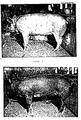
- the reference photograph affixed to the specification as Fig. 1 is that of a living hairless pig (female 228-11) born in accordance with the present embodiment.
- Reference photograph as Fig. 2 is also that of a hairless pig (female 228-12) born at the same time.
- Tabel 8 shows a method of taking the estimated no-hair genes of one type of pig to provide another type of pig with the no-hair genes.
- Estimated phenotype aabc is H strain, estimated genes are H, W, and L.
- the estimated phenotypes of the receptor pig were D strain, and estimated genes were D, d.
- aabc gametes are ab and ac; DDdd gametes are Dd; Fl are abDd and acDd.
- the gametes are aD, ad, bD, bd, aD, ab, cD, and cd..
- estimated no-hair genes are implanted.
- the D strain had a 3 : 1 estimated gametic value ratio, 12 hairy and 4 hairless pigs.
- mating aadd (estimated phenotype D strain, estimated genes H, W, D) with aadd (estimated phenotype D strain, estimated genes H, W, D) gives gametes ad and bd, at F1 adad and adbd.
- F2 gametes are a a, ad, da, dd, ab, ad, bd, and dd
- estimated phenotype values of the hairless pigs are H strain, HD strain 3, D strain 8; and even among D strains, because of repetitions of addd, bddd, dddd:
- pigs with incorporated no-hair genes become pure hairless pigs, and as such this is an effective way of producing a pure strain of hairless pigs.
- hairless pigs - 1 Examples of uses for hairless pigs - 1 .
- the advantage and effect of hairless pigs produced by chis meonod is that it is easy to mutate any breed of p i g to produce hairless pigs of that breed.
- hairless pigs can be reproduced by the method of the present invention, and such hairless pigs can be reproducibly developed (born) in an artificial state.
- hairless pigs can be expected to be more economic to feed as they should develop and fatten at a rate over and above that accounted for by the lack of hair.
- hairless pigs produced by the method of this invention have wide utility, and if the utility is considered, the effect therefore is immeasurable.
Landscapes
- Life Sciences & Earth Sciences (AREA)
- Health & Medical Sciences (AREA)
- Genetics & Genomics (AREA)
- Engineering & Computer Science (AREA)
- Zoology (AREA)
- Biotechnology (AREA)
- Wood Science & Technology (AREA)
- Chemical & Material Sciences (AREA)
- Organic Chemistry (AREA)
- Environmental Sciences (AREA)
- Bioinformatics & Cheminformatics (AREA)
- General Engineering & Computer Science (AREA)
- Biomedical Technology (AREA)
- Molecular Biology (AREA)
- General Health & Medical Sciences (AREA)
- Animal Behavior & Ethology (AREA)
- Physics & Mathematics (AREA)
- Animal Husbandry (AREA)
- Plant Pathology (AREA)
- Veterinary Medicine (AREA)
- Microbiology (AREA)
- Biodiversity & Conservation Biology (AREA)
- Biophysics (AREA)
- Biochemistry (AREA)
- Mycology (AREA)
- Cosmetics (AREA)
- Micro-Organisms Or Cultivation Processes Thereof (AREA)
- Peptides Or Proteins (AREA)
- Medicines Containing Material From Animals Or Micro-Organisms (AREA)
Applications Claiming Priority (2)
| Application Number | Priority Date | Filing Date | Title |
|---|---|---|---|
| JP59640/85 | 1985-03-26 | ||
| JP60059640A JPS61219329A (ja) | 1985-03-26 | 1985-03-26 | 無毛の豚の生産方法 |
Publications (2)
| Publication Number | Publication Date |
|---|---|
| EP0196879A2 true EP0196879A2 (de) | 1986-10-08 |
| EP0196879A3 EP0196879A3 (de) | 1988-03-16 |
Family
ID=13119019
Family Applications (1)
| Application Number | Title | Priority Date | Filing Date |
|---|---|---|---|
| EP86302264A Withdrawn EP0196879A3 (de) | 1985-03-26 | 1986-03-26 | Verfahren zur Erzeugung von unbehaarten Schweinen |
Country Status (2)
| Country | Link |
|---|---|
| EP (1) | EP0196879A3 (de) |
| JP (1) | JPS61219329A (de) |
Cited By (5)
| Publication number | Priority date | Publication date | Assignee | Title |
|---|---|---|---|---|
| CN106982782A (zh) * | 2017-03-10 | 2017-07-28 | 建水县银霜焰畜联有限公司 | 生猪生态养殖方法 |
| CN112119973A (zh) * | 2020-09-24 | 2020-12-25 | 通威股份有限公司 | 一种提高牛蛙蝌蚪前期成活率的方法 |
| US10893667B2 (en) | 2011-02-25 | 2021-01-19 | Recombinetics, Inc. | Non-meiotic allele introgression |
| CN113684282A (zh) * | 2021-08-20 | 2021-11-23 | 中国农业大学 | 一种基于edar基因表达量检测猪无毛性状的方法及其应用 |
| CN113940313A (zh) * | 2021-11-17 | 2022-01-18 | 北京市华都峪口禽业有限责任公司 | 一种肉禽性状选择方法 |
Families Citing this family (5)
| Publication number | Priority date | Publication date | Assignee | Title |
|---|---|---|---|---|
| JP6201265B2 (ja) * | 2014-10-22 | 2017-09-27 | 静岡県 | 所望の形質を有する豚の作出方法 |
| CN104472420A (zh) * | 2014-11-06 | 2015-04-01 | 凤冈县恒泰秀竹生态科技有限公司 | 一种香猪的养殖方法 |
| CN105123618B (zh) * | 2015-09-20 | 2017-12-08 | 贵州优匹克生态农业发展有限公司 | 一种培育白洗猪杂优配套系的方法 |
| CN108990905B (zh) * | 2018-09-12 | 2020-07-03 | 寿县永丰畜牧养殖有限责任公司 | 一种生猪提高免疫力的养殖方法 |
| CN111838066B (zh) * | 2019-07-12 | 2022-10-14 | 上海吉辉实验动物饲养有限公司 | 一种自发性突变无毛SHJHhr/hr早衰老小鼠动物模型培育方法 |
-
1985
- 1985-03-26 JP JP60059640A patent/JPS61219329A/ja active Pending
-
1986
- 1986-03-26 EP EP86302264A patent/EP0196879A3/de not_active Withdrawn
Non-Patent Citations (3)
| Title |
|---|
| F. FENNER et al.: "The biology of animal viruses", 2nd edition, 1974, Academic Press, Inc., New York, US, Chapter 1, pages 26,27,31; chapter 3, pages 121-123, 139-143; chapter 6, pages 256,257, 266-272; chapter 9, pages 356-359. * |
| J.D. WATSON et al.: "Recombinant DNA a short course", 1983, Scientific American Books, distributed by W.H. Freeman and Co., New York, US, Chapter 16, pages 200-210. * |
| Trends in Biochemical Technology, Vol. 5, January 1987, pages 20-24, Elsevier Science Publishers N.V., Amsterdam, NL; A.J. CLARK et al.: "Pharmaceuticals from transgenic livestock", whole article. * |
Cited By (7)
| Publication number | Priority date | Publication date | Assignee | Title |
|---|---|---|---|---|
| US10893667B2 (en) | 2011-02-25 | 2021-01-19 | Recombinetics, Inc. | Non-meiotic allele introgression |
| US10920242B2 (en) | 2011-02-25 | 2021-02-16 | Recombinetics, Inc. | Non-meiotic allele introgression |
| CN106982782A (zh) * | 2017-03-10 | 2017-07-28 | 建水县银霜焰畜联有限公司 | 生猪生态养殖方法 |
| CN112119973A (zh) * | 2020-09-24 | 2020-12-25 | 通威股份有限公司 | 一种提高牛蛙蝌蚪前期成活率的方法 |
| CN113684282A (zh) * | 2021-08-20 | 2021-11-23 | 中国农业大学 | 一种基于edar基因表达量检测猪无毛性状的方法及其应用 |
| CN113684282B (zh) * | 2021-08-20 | 2023-09-26 | 中国农业大学 | 一种基于edar基因表达量检测猪无毛性状的方法及其应用 |
| CN113940313A (zh) * | 2021-11-17 | 2022-01-18 | 北京市华都峪口禽业有限责任公司 | 一种肉禽性状选择方法 |
Also Published As
| Publication number | Publication date |
|---|---|
| EP0196879A3 (de) | 1988-03-16 |
| JPS61219329A (ja) | 1986-09-29 |
Similar Documents
| Publication | Publication Date | Title |
|---|---|---|
| Pradeep et al. | Optimal conditions for cold-shock induction of triploidy in red tilapia | |
| Boglione et al. | Skeletal anomalies in dusky grouper Epinephelus marginatus (Lowe 1834) juveniles reared with different methodologies and larval densities | |
| Tvedt et al. | Gynogenesis and sex determination in Atlantic halibut (Hippoglossus hippoglossus) | |
| Gilbert | Developmental plasticity and developmental symbiosis: the return of eco-devo | |
| Nollen | Patterns of sexual reproduction among parasitic platyhelminths | |
| Håstein | Animal welfare issues relating to aquaculture | |
| EP0196879A2 (de) | Verfahren zur Erzeugung von unbehaarten Schweinen | |
| Bryan | Biological sciences: further studies on consecutive matings in the Anopheles gambiae complex | |
| Kaastrup et al. | Development of a simple method to optimize the conditions for producing gynogenetic offspring, using albino rainbow trout, Salmo gairdneri Richardson, females as an indicator for gynogenesis | |
| CN106614116A (zh) | 一种同源精子诱导中华鲟雌核发育的方法 | |
| Van Eenennaam | What is the future of animal biotechnology? | |
| EP4577041A1 (de) | Genetisch veränderte eukaryotische organismen, systeme und verfahren zur in-vivo-vorspannung des geschlechtsverhältnisses von populationen | |
| Abit et al. | Successful hybridization between Clarias microstomus♂ and Clarias gariepinus♀ | |
| Ntsoli et al. | Embryonic and Larval Development of Reciprocal Crosses between Clarias gariepinus (Burchell, 1822) and Clarias jaensis (Boulenger, 1909) in West Cameroon | |
| Yalew et al. | Genetic engineering application in animal breeding-review | |
| D’Silva | Campaigning against transgenic technology | |
| FLOURIZEL et al. | Aquaculture advancement in biotechnology | |
| Zakaria et al. | Embryonic and larval development of lemon fin barb hybrid (♂ Hypsibarbus wetmorei x♀ Barbonymus gonionotus | |
| Nwokwa | The review of recent advances in fish genetics and biotechnology | |
| Rutland | The Cow: A Natural and Cultural History | |
| Ali et al. | The effect of heat shock on the embryonic development of tetraploid Clarias gariepinus | |
| Tyler | Introduction: Problems and procedures of comparative gametology and syngamy | |
| Nicolae et al. | Schistosomus reflexus in a Romanian Black and White calf | |
| Rey et al. | Impact of higher temperatures on yolk sac absorption and early development in hybrid | |
| Franjić | Dolly and the history of cloning |
Legal Events
| Date | Code | Title | Description |
|---|---|---|---|
| PUAI | Public reference made under article 153(3) epc to a published international application that has entered the european phase |
Free format text: ORIGINAL CODE: 0009012 |
|
| AK | Designated contracting states |
Kind code of ref document: A2 Designated state(s): AT BE CH DE FR GB IT LI LU NL SE |
|
| RBV | Designated contracting states (corrected) |
Designated state(s): BE CH DE FR GB IT LI NL SE |
|
| PUAL | Search report despatched |
Free format text: ORIGINAL CODE: 0009013 |
|
| AK | Designated contracting states |
Kind code of ref document: A3 Designated state(s): BE CH DE FR GB IT LI NL SE |
|
| 17P | Request for examination filed |
Effective date: 19880913 |
|
| 17Q | First examination report despatched |
Effective date: 19900507 |
|
| STAA | Information on the status of an ep patent application or granted ep patent |
Free format text: STATUS: THE APPLICATION IS DEEMED TO BE WITHDRAWN |
|
| 18D | Application deemed to be withdrawn |
Effective date: 19900918 |