EP0196232B1 - Plating bath and method for electroplating tin and/or lead - Google Patents
Plating bath and method for electroplating tin and/or lead Download PDFInfo
- Publication number
- EP0196232B1 EP0196232B1 EP86302269A EP86302269A EP0196232B1 EP 0196232 B1 EP0196232 B1 EP 0196232B1 EP 86302269 A EP86302269 A EP 86302269A EP 86302269 A EP86302269 A EP 86302269A EP 0196232 B1 EP0196232 B1 EP 0196232B1
- Authority
- EP
- European Patent Office
- Prior art keywords
- bath
- lead
- sulphonic acid
- tin
- formula
- Prior art date
- Legal status (The legal status is an assumption and is not a legal conclusion. Google has not performed a legal analysis and makes no representation as to the accuracy of the status listed.)
- Expired - Lifetime
Links
Classifications
-
- C—CHEMISTRY; METALLURGY
- C25—ELECTROLYTIC OR ELECTROPHORETIC PROCESSES; APPARATUS THEREFOR
- C25D—PROCESSES FOR THE ELECTROLYTIC OR ELECTROPHORETIC PRODUCTION OF COATINGS; ELECTROFORMING; APPARATUS THEREFOR
- C25D3/00—Electroplating: Baths therefor
- C25D3/02—Electroplating: Baths therefor from solutions
- C25D3/56—Electroplating: Baths therefor from solutions of alloys
- C25D3/60—Electroplating: Baths therefor from solutions of alloys containing more than 50% by weight of tin
-
- C—CHEMISTRY; METALLURGY
- C25—ELECTROLYTIC OR ELECTROPHORETIC PROCESSES; APPARATUS THEREFOR
- C25D—PROCESSES FOR THE ELECTROLYTIC OR ELECTROPHORETIC PRODUCTION OF COATINGS; ELECTROFORMING; APPARATUS THEREFOR
- C25D3/00—Electroplating: Baths therefor
- C25D3/02—Electroplating: Baths therefor from solutions
- C25D3/30—Electroplating: Baths therefor from solutions of tin
- C25D3/32—Electroplating: Baths therefor from solutions of tin characterised by the organic bath constituents used
-
- C—CHEMISTRY; METALLURGY
- C25—ELECTROLYTIC OR ELECTROPHORETIC PROCESSES; APPARATUS THEREFOR
- C25D—PROCESSES FOR THE ELECTROLYTIC OR ELECTROPHORETIC PRODUCTION OF COATINGS; ELECTROFORMING; APPARATUS THEREFOR
- C25D3/00—Electroplating: Baths therefor
- C25D3/02—Electroplating: Baths therefor from solutions
- C25D3/34—Electroplating: Baths therefor from solutions of lead
- C25D3/36—Electroplating: Baths therefor from solutions of lead characterised by the organic bath constituents used
-
- H—ELECTRICITY
- H05—ELECTRIC TECHNIQUES NOT OTHERWISE PROVIDED FOR
- H05K—PRINTED CIRCUITS; CASINGS OR CONSTRUCTIONAL DETAILS OF ELECTRIC APPARATUS; MANUFACTURE OF ASSEMBLAGES OF ELECTRICAL COMPONENTS
- H05K3/00—Apparatus or processes for manufacturing printed circuits
- H05K3/30—Assembling printed circuits with electric components, e.g. with resistors
- H05K3/32—Assembling printed circuits with electric components, e.g. with resistors electrically connecting electric components or wires to printed circuits
- H05K3/34—Assembling printed circuits with electric components, e.g. with resistors electrically connecting electric components or wires to printed circuits by soldering
- H05K3/3465—Application of solder
- H05K3/3473—Plating of solder
Definitions
- This invention relates to the electrodeposition of tin, lead, or tin-lead alloys, and particularly to a plating bath which is free of fluorborates and which deposits smooth, level and bright tin and/or lead coatings.
- Aqueous acidic plating baths for depositing tin and/or lead coatings on substrates are known, and most of these baths contain, in addition to water-soluble tin and/or lead salts, fluoborates, fluosilicates, sulphates, sulphamates, etc.
- Plating baths containg fluoborate have been used widely to permit high-speed, uniform metal plating of tin, lead or tin-lead alloys.
- baths containing fluoborates are generally quite corrosive and toxic requiring special equipment which is expensive and presents difficulties in operation, including the disposal of waste water.
- the plating bath described in US-A-3,785,939 for producing bright deposits of tin-lead alloys comprises a combination of a nonionic polyoxyalkylated surfactant, a lower aliphatic aldehyde, an aromatic aldehyde, and an amine.
- plating bath formulations which provide for the deposition of tin and/or lead coatings wherein the baths contain no fluoborates.
- US-A-4,459,185 describes a plating bath which is prepared by adding one or more specified cationic, amphoteric and/or nonionic surfactants and one or more leveling agents to a principal plating bath which contains an alkane sulphonic or alkanol sulphonic acid and either a divalent tin salt or a divalent lead salt of the sulphonic acids or a mixture of these.
- the patentees suggest that the performance of such plating baths is comparable or even superior to plating baths containing borofluoride.
- the plating baths contain certain specified surfactants which may be cationic, amphoteric, or nonionic surfactants.
- the smoothness of the coating is improved by the synergistic effect obtained by the combination of the specified surfactants and certain leveling agents.
- leveling agents including benzaldehyde derivatives is described in the patent.
- Tin-lead alloy plating baths including hydroxyalkyl sulphonic acids are described in US-A-4,132,610.
- the baths do not contain fluoborates or phenol sulphonates, but do contain the reaction product of o -toluidine with acetaldehyde as a brightener.
- US-A-3,905,878 describes tin-lead plating baths containing at least one sulphonate salt of tin and lead as well as free phenolsulphonic acid and/or free cresolsulphonic acid. Additionally, the plating baths contain a brightening agent which is prepared by reacting an aliphatic aldehyde with an aromatic primary amine under alkaline conditions. The plating baths also contain acetaldehyde and, optionally, surface active agents.
- olefinic compounds as brighteners in tin and tin-lead alloy plating baths, salts of fluoboric acid or sulphuric acid, is described in US-A-3,875,029.
- the olefinic compounds useful as brighteners are characterized by the general formula: formula from page 2 where R1 is a carboxy, carboxamide, alkali carboxylate, ammonium carboxylate, amine carboxylate, or alkyl carboxylate group, and R2, R3 and R4 are each hydrogen, methyl, or lower alkyl.
- Such olefins are utilized in combination with a naphthalene monocarboxyldehyde.
- US-A-774,049 describes a process for electrolytically depositing lead peroxide on lead plates.
- the baths include a sulphonic acid or oxysulphonic acid derivative of methane and its hydroxy-substituted derivatives such as methyl sulphonic acid, methylene disulphonic acid, oxymethylene disulphonic acid, etc.
- Tin or tin and lead plating baths containing aromatic sulphones and mono- and poly-sulphonic acids of benzene, phenol and cresol are described in US-A-2,313,371 and GB-A-555,929.
- aromatic sulphonic acids form soluble salts of tin and lead, and the disulphonic acids are particularly preferred because they provide extremely soluble salts.
- US-A-No.3,984,291 describes a plating bath which does not contain any fluoride or fluoborate. These plating baths are based on pyrophosphate and Rochelle salts. The bath is prepared, for example, by dissolving stannous pyrophosphate, potassium pyrophosphate and Rochelle salts (NaK tartrate) together with a lead salt such as lead tartrate or lead pyrophosphate in water. Generally, these types of electrolytic baths are operated at a pH of from 8.0 to 10.
- Electroplating baths containing an alkane sulphonate ion wherein the alkyl group contains between 1 and 5 carbon atoms are described in US-A-2,525,942.
- the sulphonate ions are the principal or sole anions in the plating bath.
- the metallic ions contained in the electrochemical baths may be lead, nickel, chromium, copper, zinc, iron, cobalt, cadmium and silver.
- the baths are described as being especially suitable for the electroplating of lead and nickel.
- the plating baths of the present invention comprise a mixture of tin ions, lead ions, or a mixture of tin and lead ions; at least one alkane sulphonic acid or alkanol sulphonic acid; at least one surfactant; at least one primary brightening agent, and at least one secondary brightening agent.
- the plating baths of the present invention will comprise a mixture of the free sulphonic acid with the tin, lead, or a mixture of tin and lead salts of sulphonic acids, which salts are soluble in the plating baths.
- Alkane sulphonic acids which may be utilized in the present invention have the following formula: RSO3H (I) wherein R is an alkyl group suitably containing from 1 to 12 carbon atoms and more preferably, from 1 to 6 carbon atoms.
- alkane sulphonic acids include, for example, methane sulphonic acid, ethane sulphonic acid, propane sulphonic acid, 2-propane sulphonic acid, butane sulphonic acid, 2-butane sulphonic acid, pentane sulphonic acid, hexane sulphonic acid, decane sulphonic acid and dodecane sulphonic acid.
- the individual alkane sulphonic acids or mixtures of any of the above alkane sulphonic acids can be utilized in the plating baths of the invention.
- Alkanol sulphonic acids which are useful in the present invention have the formula: wherein n is 0 or an integer from 1 to 10, m is an integer from 1 to 11 and the sum of m + n is up to 12.
- the hydroxy group may be a terminal or internal hydroxy group.
- alkanol sulphonic acids examples include 2-hydroxy ethyl-1-sulphonic acid, 1-hydroxy propyl-2-sulphonic acid, 2-hydroxy propyl-1-sulphonic acid, 3-hydroxy propyl-1-sulphonic acid, 2-hydroxy butyl-1-sulphonic acid, 4-hydroxy butyl-1-sulphonic acid, 2-hydroxy-pentyl-1-sulphonic acid, 4-hydroxy-pentyl-1-sulphonic acid, 2-hydroxy-hexyl-1-sulphonic acid, 2-hydroxy decyl-1-sulphonic acid, and 2-hydroxydodecyl-1-sulphonic acid.
- alkane sulphonic acids and alkanol sulphonic acids are available commercially and can also be prepared by a variety of methods known in the art.
- One method comprises the catalytic oxidation of mercaptans or aliphatic sulphides having the formula R1S n R2 wherein R1 or R2 are alkyl groups and n is a positive integer between 1 and 6.
- Air or oxygen may be used as the oxidizing agent, and various nitrogen oxides can be employed as catalysts.
- the oxidation generally is effected at temperatures below about 150°C. Such oxidation processes are described and claimed in US-A-2,433,396 and US-A-2,433,395.
- chlorine can be used as the oxidizing agent.
- the bath When the plating bath is to be a tin plating bath, the bath will contain at least one alkane or alkanol sulphonic acid as described above and a tin salt thereof. Likewise, a lead plating bath contains at least one alkane or alkanol sulphonic acid and a lead salt thereof. Mixtures of said acids and salts are useful.
- the tin-lead alloy plating baths will contain at least one alkane or alkanol sulphonic acid and the tin and lead salts thereof.
- the divalent tin and divalent lead salts of alkane sulphonic acids and alkanol sulphonic acids can be readily prepared by the reaction of a divalent tin or divalent lead salt with the desired sulphonic acid.
- tin and lead salts which can be reacted with the sulphonic acid to form the desired metal sulphonate include the oxides of tin and lead.
- the total concentration of metal ion or ions in the bath may vary over a wide range depending upon the desired properties of the plating to be deposited in the substrate. Generally, from 0.5 to 350 grams per litre or more of the metal ion or ions is included in the bath, and more generally, the bath will contain from 10 to 100 grams per litre of metal ion or ions. Obviously, when a tin deposit is desired, the lead ion should be omitted from the bath, and, conversely, when a lead deposit is desired, the tin ion is omitted from the bath.
- the concentration of the free alkane or alkanol sulphonic acid (b) in the plating baths of the invention is suitably from 10 to 500 grams per litre, and more preferably from 50 to 200 grams per litre of bath.
- the plating baths of the invention contain at least one nonionic, cationic or amphoteric surfactant.
- a group of nonionic surfactants which can be utilized in the present invention are the condensation products of ethylene oxide and/or propylene oxide with compounds containing a hydroxy, mercapto or amino group containing at least one N-H.
- materials containing hydroxyl groups include alkyl phenols, styrenated phenols, fatty alcohols, fatty acids, polyalkalene glycols, etc.
- materials containing amino groups include alkylamines and polyamines, fatty acid amides, etc.
- nonionic surfactants useful in the plating baths of the invention include ether containing surfactants having the formula: R ⁇ O ⁇ [(CH2) n O] x H (A) wherein R is an aryl or alkyl group containing from 6 to 20 carbon atoms, n is 2 or 3 and x is an integer of from 1 to 100.
- Such surfactants are produced generally by treating fatty alcohols or alkyl or alkoxy substituted phenols or naphthols with excess ethylene oxide or propylene oxide.
- the alkyl carbon chain may contain from 14 to 24 carbon atoms and may be derived from a long chain fatty alcohol such as oleyl alcohol or stearyl alcohol.
- Nonionic polyoxyethylene compounds of this type are described in US-A-3,855,085. Such polyoxyethylene compounds are available commercially under the general trade designations "Surfynol” by Air Products and Chemicals, Inc. of Wayne, Pennsylvania, and under the designation “Pluronic” or “Tetronic” by BASF Wyandotte Corp. of Wyandotte, Michigan. Examples of specific polyoxyethylene condensation products useful in the invention include “Surfynol 465" which is a product obtained by reacting about 30 moles of ethylene oxide with tetramethyldecynediol. "Pluronic L 35" is a product obtained by reacting about 22 moles of ethylene oxide with polypropylene glycol obtained by the condensation of about 16 moles of propylene oxide.
- Alkoxylated amine, long chain fatty amine, long chain fatty chain, alkanol amines, diamines, amides, alkanol amides and polyglycol-type surfactants known in the art ate also useful.
- One type of amine surfactant found particularly useful in a tin or lead plating bath is the group obtained by the addition of a mixture of propylene oxide and ethylene oxide to diamines. More specifically, compounds formed by the addition of propylene oxide to ethylene diamine followed by the addition of ethylene oxide are useful and are available commercially from BASF Wyandotte Ind. Chemical Group under the general trade designation "Tetronic".
- Carbowax-type surfactants which are polyethylene glycols having different molecular weights also are useful.
- Carbowax No. 1000 has a molecular weight range of from about 950 to 1,050 and contains from 20 to 24 ethoxy units per molecule.
- Carbowax No.4000 has a molecular weight range of from 3000 to 3700 and contains from 68 to 85 ethoxy units per molecule.
- Other known nonionic glycol derivatives such as polyalkylene glycol ethers and methoxy polyethylene glycols which are available commercially can be utilized as surfactants in the compositions of the invention.
- Ethylene oxide condensation products with fatty acids are also useful nonionic surfactants. Many of these are available commercially such as under the general tradename "Ethofat” from Armak Ind. Examples include condensate of coco acids, oleic acid, etc. Ethylene oxide condensates of fatty acid amides, e.g. oleamide, also are available from Armak Ind.
- polyoxyalkylated glycols, phenols and/or naphthols are included.
- ethylene oxide and propylene oxide condensates with aliphatic alcohols, sorbitan alkyl esters, alkyl, alkoxy and styrenated phenols and naphthols are useful additives.
- About 6 to about 40 moles of the oxide may be condensed with the above identified compounds.
- Many of these condensates are available commercially under such trade names as "Tween” from ICI America, “Triton” from Rohm & Haas Co., "Tergitol” from Union Carbide, and "Igepal” from General Aniline and Film Corp.
- the surfactants utilized in the plating baths of the present invention may be amphoteric surfactants.
- the preferred amphoteric surfactants include betaines and sulphobetaines, and sulphated or sulphonated adducts of the condensation products of ethylene oxide and/or propylene oxide with an alkyl amine or diamine.
- the betaines may be represented by the general formula: wherein R1 is an alkyl group containing from about 8 to 20 carbon atoms, and R2 and R3 are alkyl groups containing from 1 to about 4 carbon atoms.
- Typical betaines include lauryldimethylammonium betaine and stearyl dimethylammonium beatine.
- Sulphated and sulphonated adducts include Triton QS-15 (Rohm & Haas Co.), a sulphated adduct of an ethoxylated alkylamine, Miranol HS, a sodium salt of a sulphonated lauric derivative, Miranol OS, a sodium salt of a sulphonated oleic acid, etc.
- Cationic surfactants also are useful in the plating baths of the present invention and such surfactants may be higher alkyl amine salts, quaternary ammonium salts, alkyl pyridinium salts or alkylimidazolium salts.
- Cationic surfactants obtained by condensation of various amounts of ethylene oxide or propylene oxide with primary fatty amines are useful and may be represented by formula in which R is a fatty acid alkyl group containing from about 8 to about 22 carbon atoms, R1 is an alkylene radical contianing up to about 5 carbon atoms, R2 and R3 are each independently an ethylene or propylene group, a is o or 1, and x, y and z are each independently integers from 1 to about 30, and the sum of x, y, and z is an integer of from about 2 to about 50.
- alkoxylated amines utilized in the baths of the invention may be epresented by the formulae wherein R4 is a fatty acid alkyl group containing from 12 to 18 carbon atoms, and x, y and z are as defined about for formula C.
- the above described cationic surfactants are known in the art and are available from a variety of commercial sources.
- the surfactants of the type represented by formula D can be prepared by condensing various amounts of ethylene oxide with primary fatty amines which may be a single amine or a mixture of amines such as are obtained by the hydrolysis of tallow oils, sperm oils, coconut oils, etc.
- fatty acid amines containing from 8 to 22 carbon atoms include saturated as well as unsaturated aliphatic amines such as octyl amine, decyl amine, lauryl amine, stearyl amine, oleyl amine, myristyl amine, palmityl amine, dodecyl amine, and octadecyl amine.
- alkoxylated amines which are useful in the plating baths of the invention can be prepared as mentioned above, by condensing alkylene oxides with the above-described primary amines by techniques known to those in the art. A number of such alkoxylated amines is commercially avaiable from a variety of sources.
- the above described amines can be prepared, as mentioned above, by condensing alkylene oxides with the above-described primary amines by techniques known to those in the art.
- a number of such alkoxylated amines is commercially available from a variety of sources.
- the alkoxylated amines of the type represented by formula B are available from the Armak Chemical Division of Akzona, Inc., Chicago, Illinois, under the general trade designation "Ethomeen".
- Ethomeen C/15 which is an ethylene oxide condensate of a coconut fatty amine containing about 5 moles of ethylene oxide
- Ethomeen T/15” and T/25" which are ethylene oxide condensation products of tallow amine containing about 5 and 15 moles of ethyleme oxide per mole of amine respectively.
- alkoxylated amines of the type represented by formula C include "Ethoduomeen T/13" and "T/20" which are ethyleme oxide condensation products of N-tallow trimethylene diamine containing about 3 and 10 moles of ethylene oxide per mole of diamine respectively.
- the cationic surfactant also may be a quaternary ammonium salt of the formula wherein X represents a halogen, a hydroxyl group, or the residue of a C1 ⁇ 5 alkanesulphonic acid; R1 represents a C8 ⁇ 20 alkyl group, R, and R'' each represent a C1 ⁇ 4 alkyl group and R''' represents a C1 ⁇ 10 alkyl group or a benzyl group; a pyridinium salt of the formula wherein X represents a halogen, a hydroxyl group, the residue of a C1 ⁇ 5 alkanesulphonic acid, R1 represent a C8 ⁇ 20 alkyl group, and R a represents hydrogen or a C1 ⁇ 4 alkyl group; an imidazolinium salt of the formula wherein X represents a halogen, a hydroxyl group, or the residue of a C1 ⁇ 10 alkanesulphonic acid; R1 represents a C8 ⁇ 20 alkyl group;
- the surfactants descrbed above may be used in the plating baths of the present invention in a concentration of from 0.01 to 50 grams per litre and more preferably from 0.05 to 20 grams per litre.
- Plating baths of the present invention also contain an effective amount of at least one primary brightening agent which generally are aromatic aldehydes or ketones.
- the aromatic aldehydes may be the benzaldehydes. naphthaldehydes, pyridinecarboxaldehyes, thiophenecarboxaldehydes and furaldehydes.
- Suitable benzaldehydes include derivatives of the formula wherein X is hydrogen or a nitro, halo, amino, alkoxy or lower alkyl group. Specific examples of benzaldehydes include benzaldehyde, o -chloro-benzaldehyde, tolualdehyde, cinnamaldehyde and anisaldehyde.
- Suitable naphthaldehydes are substituted or unsubstituted 1-naphthaldehydes or 2-naphthaldehydes of the following formula wherein X1 and X2 are independently hydrogen, hydroxy, alkoxy, chloro or bromo, and the alkyl group of the alkoxy group contains from about 1 to 5 carbon atoms.
- naphthaldehydes include 1-naphthaldehyds 2-napthaldehyde, 2-methoxy-1-naphthaldehyde, 2-hydroxy-1-naphthaldehyde, 2-ethoxy-1-naphthaldehyde, 4-methoxy-1-naphthaldehyde, 4-ethoxy-1-naphthaldehyde, 4-hydroxy-1-naphthaldehyde, 2-chloro-1-naphthaldehyde, 4-chloro-1-naphthaldehyde, etc.
- Suitable pyridinecarboxaldehydes which can be utilized as the primary brightening agents may have the formula wherein X is hydrogen, hydroxy, alkoxy, chloro, or bromo, and the alkyl group of the alkoxy group contains from 1 to 5 carbon atoms.
- aldehydes include pyridine-2-carboxaldehyde, pyridine-3-carboxaldehyde, pyridine-4-carboxaldehyde, and 6-methoxy-pyridine-2-carbox-aldehyde.
- Suitable thiophenecarboxaldehydes may be represented by the formula wherein X is as defined above for formula L. Specific examples of such carboxaldehydes include 2-thiophenecarboxaldehyde, 3-thiophebecarboxaldehyde, etc.
- Suitable furaldehydes include those represented by the following general formula wherein X is as defined above for formlula L. Specific examples of such furaldehydes include 2-furaldehyde and 3-furaldehyde.
- the primary brightenning agent utilized in the plating baths of the present invention also may be an acetophenone of the formula wherein X1 and X2 are each independently hydrogen and chlorine. Examples of such compounds are acetophenone and 3',4'-dichloroacetophenone.
- the primary brightening agent is a carbonyl compound having the formula wherein Ar is a phenyl, naphthyl, pyridyl, thiophenyl or furyl group.
- the carbonyl compound can be represented by the formula wherein X1 and X2 may be hydrogen, hydroxyl, alkoxy, chlorine or bromine, and the alkyl group of the alkoxy group may contain from about 1 to about 5 carbon atoms.
- X1 and X2 may be hydrogen, hydroxyl, alkoxy, chlorine or bromine, and the alkyl group of the alkoxy group may contain from about 1 to about 5 carbon atoms.
- Examples of such compounds include benzylidine acetone and 3'-chlorobenzylidine acetone.
- Carbonyl compound of formula III wherein Ar is a naphthyl group can be represented by the formula wherein X1 and X2 are as defined above for formula P.
- a specific example of such a brightener is 4(1-naphthyl)-3-butene-2-one.
- the pyridyl, thiophenyl and furyl containing carbonyl compounds may be represented by the formulae wherein X1 is as defined above for formula P.
- Specific examples of such carbonyl compounds include 4-(2-furyl)-3-butene-2-one, 4-(pyridyl-2-)-3-butene-2-one, and 4-(thiophenyl-2-)-3-butene-2-one.
- the amount of the above described primary brightening agents utilized in the plating baths of the present invention can suitable range from 0.05 to 5 grams per litre and more generally is from 0.2 to 1 gram per litre of plating bath.
- the plating baths of the present invention also contain (E) an effective amount of a secondary brightening agent which is a low aliphatic aldehydes or substituted olefin of the formula.
- a secondary brightening agent which is a low aliphatic aldehydes or substituted olefin of the formula.
- R1 is a carboxy, carboxamide, alkali metal carboxylate, ammonium carboxylate amine carboxylate or allyl carboxylate group
- R2 R3 and R4 are each independently hydrogen or lower alkyl groups.
- aldehydes include formaldehyde, acetaldehyde, paraldehyde, butyraldehyde, propionaldehyde, acrolein, crotonaldehyde and 3-hydroxy-butanal.
- the olefinic compounds of formula IV are alpha unsaturated carboxylic acids, amides or esters.
- examples of such materials include acrylic acid, methacrylic acid, methyl acrylate, methyl methacrylate, ethacrylic acid, ethyl acrylate, acrylamide, methacrylamide, crotonic acid, cinnamic acid, butyl methacrylate, etc.
- alpha unsaturated compounds are generally added to the plating bath as aqueous or alcoholic (e.g., methyl, ethyl, propyl and isopropyl alcohol) solutions to ensure good dispersion in the plating bath.
- the amount of secondary brightening agents (E) utilized in the plating baths of the present invention may suitably be from 0.1 to 20 grams per litre of and more preferably from 0.5 to 10 grams per litre.
- the tin, lead, and tin-lead plating baths of the present invention which contain no fluoride or fluoborate ions deposit a bright level coating of the metal or alloy on substrates at any conventional temperature used or normally used with tin and/or lead plating baths, and over a wide current density range.
- the following examples illustrate the plating baths of the invention. Unless otherwise indicated in the following examples and elsewhere in the specification and claims, all parts and percentages are by weight, and temperatures are in °C.
- An aqueous plating bath was prepared by mixing with water, sufficient quantities of stannous methane sulphonate to provide 20 g/l of stannous ion, 100 g/l of free methane sulphonic acid, 5 g/l of a nonionic surfactant which is nonylphenol condensed with 10 moles of ethylene oxide, 1 g/l of methyl methacrylate, and 0.2 g/l of benzylidine acetone.
- the utility of the plating baths of the present invention in depositing tin and tin-lead coatings was demonstrated by conducting plating tests in standard 267 ml Hull cells using as the anode, a tin or tin-lead alloy (60/40, tin/lead). Steel panels were plated at a current of 2 amps for a period of five minutes. Mechanical bath agitation has employed, and the bath temperature was maintained at about 20 to 25°C. The results of the plating tests are summarized in the following Table.
- the improved tin, lead, and tin-lead, alloy plating baths containing the brightener compositions of the invention may be operated on a continuous or intermittent basis, and from time time, components of the bath have to be replenished.
- the various components may be added singularly as required or may be added in combination.
- the amounts of the various additive compositions to be added to the plating baths may be varied over a wide range depending on the nature and performance of the plating bath to which the composition is added. Such amounts can be determined readily by one skilled in the art.
- the major advantage of the plating baths of the present invention is that they contain no fluoride or fluoborate ions which eliminates the need for the recovery and disposal of these undesirable ions.
- the fluoride and fluoborate ions are undesirable because of the environmental pollution problems created on disposal, and further because of their corrosive nature when present in plating baths.
- the plating baths of the present invention which do not contain fluoride or fluoborate ions are less corrosive to machinery and glass parts, and also permit the use of titanium and titanium alloy anode baskets. It also has been observed that anode dissolution is improved in the plating baths of the present invention which results in less anode polarization and a reduced amount of stannate tin in the bath.
- the coating deposited from the plating baths of the invention are useful in electronic circuits, electronic devices and electrical connectors.
- the surface layers of tin, lead and tin-lead alloys can be used as protective layers to prevent corrosion or in a patterning procedure during the fabrication of printed circuits or integrated circuits.
- the coatings also provide chemically stable surfaces for soldering on printed wire boards, etc.
Landscapes
- Chemical & Material Sciences (AREA)
- Engineering & Computer Science (AREA)
- Chemical Kinetics & Catalysis (AREA)
- Electrochemistry (AREA)
- Materials Engineering (AREA)
- Metallurgy (AREA)
- Organic Chemistry (AREA)
- Electroplating And Plating Baths Therefor (AREA)
Description
- This invention relates to the electrodeposition of tin, lead, or tin-lead alloys, and particularly to a plating bath which is free of fluorborates and which deposits smooth, level and bright tin and/or lead coatings.
- Aqueous acidic plating baths for depositing tin and/or lead coatings on substrates are known, and most of these baths contain, in addition to water-soluble tin and/or lead salts, fluoborates, fluosilicates, sulphates, sulphamates, etc. Plating baths containg fluoborate have been used widely to permit high-speed, uniform metal plating of tin, lead or tin-lead alloys. However, baths containing fluoborates are generally quite corrosive and toxic requiring special equipment which is expensive and presents difficulties in operation, including the disposal of waste water.
- In addition to the basic ingredients, there have been suggested improvements in tin and/or lead plating baths by including additives which will improve on the brightness of the deposit obtained from such baths. For example, in US-A-3,875,029, the use of naphthalene monocarboxaldehyde either alone or in combination with certain substituted olefins results in an improvement in the brightness of the deposit. Other ingredients which have been suggested as being useful additives in tin and/or lead plating baths include various combinations of aldehydes, ketones, nonionic surfactants, and amines. The plating bath described in US-A-3,785,939 for producing bright deposits of tin-lead alloys comprises a combination of a nonionic polyoxyalkylated surfactant, a lower aliphatic aldehyde, an aromatic aldehyde, and an amine.
- More recently, plating bath formulations have been suggested which provide for the deposition of tin and/or lead coatings wherein the baths contain no fluoborates. For example, US-A-4,459,185 describes a plating bath which is prepared by adding one or more specified cationic, amphoteric and/or nonionic surfactants and one or more leveling agents to a principal plating bath which contains an alkane sulphonic or alkanol sulphonic acid and either a divalent tin salt or a divalent lead salt of the sulphonic acids or a mixture of these. The patentees suggest that the performance of such plating baths is comparable or even superior to plating baths containing borofluoride. The plating baths contain certain specified surfactants which may be cationic, amphoteric, or nonionic surfactants. The smoothness of the coating is improved by the synergistic effect obtained by the combination of the specified surfactants and certain leveling agents. A variety of leveling agents including benzaldehyde derivatives is described in the patent.
- Tin-lead alloy plating baths including hydroxyalkyl sulphonic acids are described in US-A-4,132,610. The baths do not contain fluoborates or phenol sulphonates, but do contain the reaction product of o-toluidine with acetaldehyde as a brightener.
- US-A-3,905,878 describes tin-lead plating baths containing at least one sulphonate salt of tin and lead as well as free phenolsulphonic acid and/or free cresolsulphonic acid. Additionally, the plating baths contain a brightening agent which is prepared by reacting an aliphatic aldehyde with an aromatic primary amine under alkaline conditions. The plating baths also contain acetaldehyde and, optionally, surface active agents.
- The use of olefinic compounds as brighteners in tin and tin-lead alloy plating baths, salts of fluoboric acid or sulphuric acid, is described in US-A-3,875,029. The olefinic compounds useful as brighteners are characterized by the general formula:
formula from page 2
where R₁ is a carboxy, carboxamide, alkali carboxylate, ammonium carboxylate, amine carboxylate, or alkyl carboxylate group, and R₂, R₃ and R₄ are each hydrogen, methyl, or lower alkyl. Such olefins are utilized in combination with a naphthalene monocarboxyldehyde. - US-A-774,049 describes a process for electrolytically depositing lead peroxide on lead plates. The baths include a sulphonic acid or oxysulphonic acid derivative of methane and its hydroxy-substituted derivatives such as methyl sulphonic acid, methylene disulphonic acid, oxymethylene disulphonic acid, etc.
- Tin or tin and lead plating baths containing aromatic sulphones and mono- and poly-sulphonic acids of benzene, phenol and cresol are described in US-A-2,313,371 and GB-A-555,929. The aromatic sulphonic acids form soluble salts of tin and lead, and the disulphonic acids are particularly preferred because they provide extremely soluble salts.
- US-A-No.3,984,291 describes a plating bath which does not contain any fluoride or fluoborate. These plating baths are based on pyrophosphate and Rochelle salts. The bath is prepared, for example, by dissolving stannous pyrophosphate, potassium pyrophosphate and Rochelle salts (NaK tartrate) together with a lead salt such as lead tartrate or lead pyrophosphate in water. Generally, these types of electrolytic baths are operated at a pH of from 8.0 to 10.
- Electroplating baths containing an alkane sulphonate ion wherein the alkyl group contains between 1 and 5 carbon atoms are described in US-A-2,525,942. The sulphonate ions are the principal or sole anions in the plating bath. The metallic ions contained in the electrochemical baths may be lead, nickel, chromium, copper, zinc, iron, cobalt, cadmium and silver. The baths are described as being especially suitable for the electroplating of lead and nickel.
- It has now been found that a smooth, level and bright deposit of tin, lead or tin-alloy can be deposited on a substrate from an aqueous plating bath which contains no fluoride or fluoborates. The aqueous plating baths of the invention comprise (a) at least one bath-soluble metal salt which is a stannous salt, a lead salt, or a mixture of stannous and lead salts, (b) at least one alkane sulphonic acid or alkanolsulphonic acid, (c) at least one nonionic, cationic or amphoteric surfactant, (d) an effective amount of at least one primary brightening agent which is an aromatic aldehyde, an acetophenone or a carbonyl compound of the general formula:
Ar-C(H)=C(H)-C(O)-CH₃ (III)
wherein Ar is a phenyl, naphthyl, pyridyl, thiophenyl or furyl group, and (e) an effective amount of a secondary brightening agent which is a lower aliphatic aldehyde or a substituted olefin of the formula:
wherein R₁ is a carboxy, carboxamide, alkali metal carboxylate, ammonium carboxylate, amine carboxylate or allyl carboxylate group, and R₂, R₃ and R₄ are each independently hydrogen or lower alkyl groups. - The plating baths of the present invention comprise a mixture of tin ions, lead ions, or a mixture of tin and lead ions; at least one alkane sulphonic acid or alkanol sulphonic acid; at least one surfactant; at least one primary brightening agent, and at least one secondary brightening agent. Generally, the plating baths of the present invention will comprise a mixture of the free sulphonic acid with the tin, lead, or a mixture of tin and lead salts of sulphonic acids, which salts are soluble in the plating baths.
- Alkane sulphonic acids which may be utilized in the present invention have the following formula:
RSO₃H (I)
wherein R is an alkyl group suitably containing from 1 to 12 carbon atoms and more preferably, from 1 to 6 carbon atoms. Examples of such alkane sulphonic acids include, for example, methane sulphonic acid, ethane sulphonic acid, propane sulphonic acid, 2-propane sulphonic acid, butane sulphonic acid, 2-butane sulphonic acid, pentane sulphonic acid, hexane sulphonic acid, decane sulphonic acid and dodecane sulphonic acid. The individual alkane sulphonic acids or mixtures of any of the above alkane sulphonic acids can be utilized in the plating baths of the invention. - Alkanol sulphonic acids which are useful in the present invention have the formula:

wherein n is 0 or an integer from 1 to 10,m is an integer from 1 to 11 and the sum of m + n is up to 12. As can be seen from formula II, the hydroxy group may be a terminal or internal hydroxy group. Examples of useful alkanol sulphonic acids include 2-hydroxy ethyl-1-sulphonic acid, 1-hydroxy propyl-2-sulphonic acid, 2-hydroxy propyl-1-sulphonic acid, 3-hydroxy propyl-1-sulphonic acid, 2-hydroxy butyl-1-sulphonic acid, 4-hydroxy butyl-1-sulphonic acid, 2-hydroxy-pentyl-1-sulphonic acid, 4-hydroxy-pentyl-1-sulphonic acid, 2-hydroxy-hexyl-1-sulphonic acid, 2-hydroxy decyl-1-sulphonic acid, and 2-hydroxydodecyl-1-sulphonic acid. - The alkane sulphonic acids and alkanol sulphonic acids are available commercially and can also be prepared by a variety of methods known in the art. One method comprises the catalytic oxidation of mercaptans or aliphatic sulphides having the formula R¹SnR² wherein R¹ or R² are alkyl groups and n is a positive integer between 1 and 6. Air or oxygen may be used as the oxidizing agent, and various nitrogen oxides can be employed as catalysts. The oxidation generally is effected at temperatures below about 150°C. Such oxidation processes are described and claimed in US-A-2,433,396 and US-A-2,433,395. Alternatively, chlorine can be used as the oxidizing agent.
- When the plating bath is to be a tin plating bath, the bath will contain at least one alkane or alkanol sulphonic acid as described above and a tin salt thereof. Likewise, a lead plating bath contains at least one alkane or alkanol sulphonic acid and a lead salt thereof. Mixtures of said acids and salts are useful. The tin-lead alloy plating baths will contain at least one alkane or alkanol sulphonic acid and the tin and lead salts thereof. The divalent tin and divalent lead salts of alkane sulphonic acids and alkanol sulphonic acids can be readily prepared by the reaction of a divalent tin or divalent lead salt with the desired sulphonic acid. Examples of tin and lead salts which can be reacted with the sulphonic acid to form the desired metal sulphonate include the oxides of tin and lead.
- The total concentration of metal ion or ions in the bath may vary over a wide range depending upon the desired properties of the plating to be deposited in the substrate. Generally, from 0.5 to 350 grams per litre or more of the metal ion or ions is included in the bath, and more generally, the bath will contain from 10 to 100 grams per litre of metal ion or ions. Obviously, when a tin deposit is desired, the lead ion should be omitted from the bath, and, conversely, when a lead deposit is desired, the tin ion is omitted from the bath.
- The concentration of the free alkane or alkanol sulphonic acid (b) in the plating baths of the invention is suitably from 10 to 500 grams per litre, and more preferably from 50 to 200 grams per litre of bath.
- In addition to the above components, it is necessary that the plating baths of the invention contain at least one nonionic, cationic or amphoteric surfactant. A group of nonionic surfactants which can be utilized in the present invention are the condensation products of ethylene oxide and/or propylene oxide with compounds containing a hydroxy, mercapto or amino group containing at least one N-H. Examples of materials containing hydroxyl groups include alkyl phenols, styrenated phenols, fatty alcohols, fatty acids, polyalkalene glycols, etc. Examples of materials containing amino groups include alkylamines and polyamines, fatty acid amides, etc.
- Examples of nonionic surfactants useful in the plating baths of the invention include ether containing surfactants having the formula:
R―O―[(CH₂)nO]xH (A)
wherein R is an aryl or alkyl group containing from 6 to 20 carbon atoms, n is 2 or 3 and x is an integer of from 1 to 100. Such surfactants are produced generally by treating fatty alcohols or alkyl or alkoxy substituted phenols or naphthols with excess ethylene oxide or propylene oxide. The alkyl carbon chain may contain from 14 to 24 carbon atoms and may be derived from a long chain fatty alcohol such as oleyl alcohol or stearyl alcohol. - Nonionic polyoxyethylene compounds of this type are described in US-A-3,855,085. Such polyoxyethylene compounds are available commercially under the general trade designations "Surfynol" by Air Products and Chemicals, Inc. of Wayne, Pennsylvania, and under the designation "Pluronic" or "Tetronic" by BASF Wyandotte Corp. of Wyandotte, Michigan. Examples of specific polyoxyethylene condensation products useful in the invention include "Surfynol 465" which is a product obtained by reacting about 30 moles of ethylene oxide with tetramethyldecynediol. "Pluronic L 35" is a product obtained by reacting about 22 moles of ethylene oxide with polypropylene glycol obtained by the condensation of about 16 moles of propylene oxide.
- Alkoxylated amine, long chain fatty amine, long chain fatty chain, alkanol amines, diamines, amides, alkanol amides and polyglycol-type surfactants known in the art ate also useful. One type of amine surfactant found particularly useful in a tin or lead plating bath is the group obtained by the addition of a mixture of propylene oxide and ethylene oxide to diamines. More specifically, compounds formed by the addition of propylene oxide to ethylene diamine followed by the addition of ethylene oxide are useful and are available commercially from BASF Wyandotte Ind. Chemical Group under the general trade designation "Tetronic".
- Carbowax-type surfactants which are polyethylene glycols having different molecular weights also are useful. For example Carbowax No. 1000 has a molecular weight range of from about 950 to 1,050 and contains from 20 to 24 ethoxy units per molecule. Carbowax No.4000 has a molecular weight range of from 3000 to 3700 and contains from 68 to 85 ethoxy units per molecule. Other known nonionic glycol derivatives such as polyalkylene glycol ethers and methoxy polyethylene glycols which are available commercially can be utilized as surfactants in the compositions of the invention.
- Ethylene oxide condensation products with fatty acids are also useful nonionic surfactants. Many of these are available commercially such as under the general tradename "Ethofat" from Armak Ind. Examples include condensate of coco acids, oleic acid, etc. Ethylene oxide condensates of fatty acid amides, e.g. oleamide, also are available from Armak Ind.
- In some of the baths, improved results are obtained when polyoxyalkylated glycols, phenols and/or naphthols are included. For example ethylene oxide and propylene oxide condensates with aliphatic alcohols, sorbitan alkyl esters, alkyl, alkoxy and styrenated phenols and naphthols are useful additives. About 6 to about 40 moles of the oxide may be condensed with the above identified compounds. Many of these condensates are available commercially under such trade names as "Tween" from ICI America, "Triton" from Rohm & Haas Co., "Tergitol" from Union Carbide, and "Igepal" from General Aniline and Film Corp.
- The surfactants utilized in the plating baths of the present invention may be amphoteric surfactants. The preferred amphoteric surfactants include betaines and sulphobetaines, and sulphated or sulphonated adducts of the condensation products of ethylene oxide and/or propylene oxide with an alkyl amine or diamine. The betaines may be represented by the general formula:

wherein R¹ is an alkyl group containing from about 8 to 20 carbon atoms, and R² and R³ are alkyl groups containing from 1 to about 4 carbon atoms. - Typical betaines include lauryldimethylammonium betaine and stearyl dimethylammonium beatine. Sulphated and sulphonated adducts include Triton QS-15 (Rohm & Haas Co.), a sulphated adduct of an ethoxylated alkylamine, Miranol HS, a sodium salt of a sulphonated lauric derivative, Miranol OS, a sodium salt of a sulphonated oleic acid, etc.
- Cationic surfactants also are useful in the plating baths of the present invention and such surfactants may be higher alkyl amine salts, quaternary ammonium salts, alkyl pyridinium salts or alkylimidazolium salts.
- Cationic surfactants obtained by condensation of various amounts of ethylene oxide or propylene oxide with primary fatty amines are useful and may be represented by formula

in which R is a fatty acid alkyl group containing from about 8 to about 22 carbon atoms,
R¹ is an alkylene radical contianing up to about 5 carbon atoms, R² and R³ are each independently an ethylene or propylene group,
a is o or 1, and
x, y and z are each independently integers from 1 to about 30, and the sum of x, y, and z is an integer of from about 2 to about 50.
More particularly, the alkoxylated amines utilized in the baths of the invention may be epresented by the formulae
wherein R⁴ is a fatty acid alkyl group containing from 12 to 18 carbon atoms, and x, y and z are as defined about for formula C. - The above described cationic surfactants are known in the art and are available from a variety of commercial sources. The surfactants of the type represented by formula D can be prepared by condensing various amounts of ethylene oxide with primary fatty amines which may be a single amine or a mixture of amines such as are obtained by the hydrolysis of tallow oils, sperm oils, coconut oils, etc. Specific examples of fatty acid amines containing from 8 to 22 carbon atoms include saturated as well as unsaturated aliphatic amines such as octyl amine, decyl amine, lauryl amine, stearyl amine, oleyl amine, myristyl amine, palmityl amine, dodecyl amine, and octadecyl amine.
- The alkoxylated amines which are useful in the plating baths of the invention can be prepared as mentioned above, by condensing alkylene oxides with the above-described primary amines by techniques known to those in the art. A number of such alkoxylated amines is commercially avaiable from a variety of sources.
- The above described amines can be prepared, as mentioned above, by condensing alkylene oxides with the above-described primary amines by techniques known to those in the art. A number of such alkoxylated amines is commercially available from a variety of sources. The alkoxylated amines of the type represented by formula B are available from the Armak Chemical Division of Akzona, Inc., Chicago, Illinois, under the general trade designation "Ethomeen". Specific examples of such products include "Ethomeen C/15" which is an ethylene oxide condensate of a coconut fatty amine containing about 5 moles of ethylene oxide; "Ethomeen C/20" and "C/25" which also are ethylene oxide condensation products from coconut fatty amine containing about 10 and 15 moles of ethylene oxide respectively; "Ethomeen S/15" and "S/20" which are ethylene oxide condensation products with stearyl amine containing about 5 and 10 moles of ethylene oxide per mole of amine repectively; and "Ethomeen T/15" and T/25" which are ethylene oxide condensation products of tallow amine containing about 5 and 15 moles of ethyleme oxide per mole of amine respectively. Commercially available examples of the alkoxylated amines of the type represented by formula C include "Ethoduomeen T/13" and "T/20" which are ethyleme oxide condensation products of N-tallow trimethylene diamine containing about 3 and 10 moles of ethylene oxide per mole of diamine respectively.
- The cationic surfactant also may be a quaternary ammonium salt of the formula

wherein X represents a halogen, a hydroxyl group, or the residue of a C₁₋₅ alkanesulphonic acid; R₁ represents a C₈₋₂₀ alkyl group, R, and R'' each represent a C₁₋₄ alkyl group and R''' represents a C₁₋₁₀ alkyl group or a benzyl group; a
pyridinium salt of the formula
wherein X represents a halogen, a hydroxyl group, the residue of a C₁₋₅ alkanesulphonic acid, R₁ represent a C₈₋₂₀ alkyl group, and Ra represents hydrogen or a C₁₋₄ alkyl group;
an imidazolinium salt of the formula
wherein X represents a halogen, a hydroxyl group, or the residue of a C₁₋₁₀ alkanesulphonic acid; R₁ represents a C₈₋₂₀ alkyl group; Rd represents a hydroxy-containing C₁₋₅ alkyl group; and R''' represents a C₁₋₅ alkyl group or a benzyl group; or
A higher alkyl amine salt of the formula
(1)
wherein R₁ represents a C₈₋₂₀ alkyl group; and n is 0 or from 1 to about 4
Examples of the above described cationic surfactants, in the form of salts, are lauryltrimethylammonium salt, cetyltrimethylammonium salt, octadecyldimethylethylammonium salt, dimethylbenzyllaurylammonium salt, cetyldimethylbezylammonium salt, octadecyldimethylbezylammonium salt, trimethylbenzylammonium salt triethylbezylammonium salt, hexadecylpyridinium salt, laurylpyridinium salt, dodecylpicolinium salt, 1-hydroxyethyl-1-benzyl-2-lauryl-imidazolinium salt, 1-hydroxyethyl-1-benzyl-2-oleylimidazolinium salt, stearylamine acetate, laurylamine acetate, and octadecylamine acetate. - The surfactants descrbed above may be used in the plating baths of the present invention in a concentration of from 0.01 to 50 grams per litre and more preferably from 0.05 to 20 grams per litre.
- Plating baths of the present invention also contain an effective amount of at least one primary brightening agent which generally are aromatic aldehydes or ketones. The primary brightening agents are selected from aromatic aldehydes, acetophenones, and carbonyl compounds having the general formula
Ar-C(H)=C(H)-C(O)-CH₃ III
wherein Ar is a phenyl, napthyl, thiophenyl or furyl group. - The aromatic aldehydes may be the benzaldehydes. naphthaldehydes, pyridinecarboxaldehyes, thiophenecarboxaldehydes and furaldehydes.
- Suitable benzaldehydes include derivatives of the formula
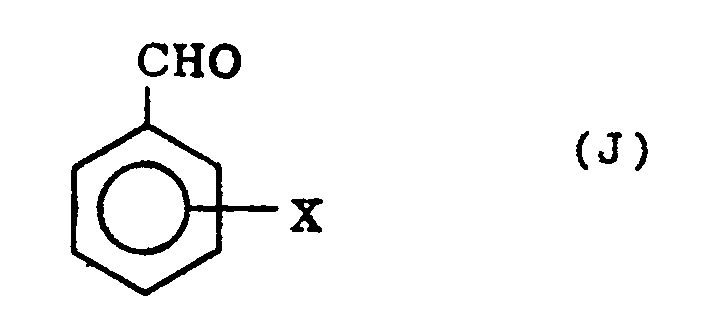
wherein X is hydrogen or a nitro, halo, amino, alkoxy or lower alkyl group. Specific examples of benzaldehydes include benzaldehyde, o-chloro-benzaldehyde, tolualdehyde, cinnamaldehyde and anisaldehyde. - Suitable naphthaldehydes are substituted or unsubstituted 1-naphthaldehydes or 2-naphthaldehydes of the following formula

wherein X₁ and X₂ are independently hydrogen, hydroxy, alkoxy, chloro or bromo, and the alkyl group of the alkoxy group contains from about 1 to 5 carbon atoms. Specific examples of such naphthaldehydes include 1-naphthaldehyds 2-napthaldehyde, 2-methoxy-1-naphthaldehyde, 2-hydroxy-1-naphthaldehyde, 2-ethoxy-1-naphthaldehyde, 4-methoxy-1-naphthaldehyde, 4-ethoxy-1-naphthaldehyde, 4-hydroxy-1-naphthaldehyde, 2-chloro-1-naphthaldehyde, 4-chloro-1-naphthaldehyde, etc. - Suitable pyridinecarboxaldehydes which can be utilized as the primary brightening agents may have the formula

wherein X is hydrogen, hydroxy, alkoxy, chloro, or bromo, and the alkyl group of the alkoxy group contains from 1 to 5 carbon atoms. Specific examples of such aldehydes include pyridine-2-carboxaldehyde, pyridine-3-carboxaldehyde, pyridine-4-carboxaldehyde, and 6-methoxy-pyridine-2-carbox-aldehyde. - Suitable thiophenecarboxaldehydes may be represented by the formula

wherein X is as defined above for formula L. Specific examples of such carboxaldehydes include 2-thiophenecarboxaldehyde, 3-thiophebecarboxaldehyde, etc. - Suitable furaldehydes include those represented by the following general formula

wherein X is as defined above for formlula L. Specific examples of such furaldehydes include 2-furaldehyde and 3-furaldehyde. - The primary brightenning agent utilized in the plating baths of the present invention also may be an acetophenone of the formula

wherein X₁ and X₂ are each independently hydrogen and chlorine. Examples of such compounds are acetophenone and 3',4'-dichloroacetophenone. - In another preferred embodiment, the primary brightening agent is a carbonyl compound having the formula

wherein Ar is a phenyl, naphthyl, pyridyl, thiophenyl or furyl group. - When Ar is a phenyl group, the carbonyl compound can be represented by the formula

wherein X₁ and X₂ may be hydrogen, hydroxyl, alkoxy, chlorine or bromine, and the alkyl group of the alkoxy group may contain from about 1 to about 5 carbon atoms. Examples of such compounds include benzylidine acetone and 3'-chlorobenzylidine acetone. - Carbonyl compound of formula III wherein Ar is a naphthyl group can be represented by the formula

wherein X₁ and X₂ are as defined above for formula P. A specific example of such a brightener is 4(1-naphthyl)-3-butene-2-one. - The pyridyl, thiophenyl and furyl containing carbonyl compounds may be represented by the formulae

wherein X₁ is as defined above for formula P. Specific examples of such carbonyl compounds include 4-(2-furyl)-3-butene-2-one, 4-(pyridyl-2-)-3-butene-2-one, and 4-(thiophenyl-2-)-3-butene-2-one. - The amount of the above described primary brightening agents utilized in the plating baths of the present invention can suitable range from 0.05 to 5 grams per litre and more generally is from 0.2 to 1 gram per litre of plating bath.
- In addition to the primary brightening agent, the plating baths of the present invention also contain (E) an effective amount of a secondary brightening agent which is a low aliphatic aldehydes or substituted olefin of the formula.

wherein R₁ is a carboxy, carboxamide, alkali metal carboxylate, ammonium carboxylate amine carboxylate or allyl carboxylate group and R₂ R₃ and R₄ are each independently hydrogen or lower alkyl groups. - The aliphatic aldehydes which are useful as secondary brightening agent as preferably lower aliphatic aldehydes containing up to about 6 atoms, and the aliphatic group may be either saturated or unsaturated. Example of such aldehydes include formaldehyde, acetaldehyde, paraldehyde, butyraldehyde, propionaldehyde, acrolein, crotonaldehyde and 3-hydroxy-butanal.
- In a preferred embodiment, the olefinic compounds of formula IV are alpha unsaturated carboxylic acids, amides or esters. Examples of such materials include acrylic acid, methacrylic acid, methyl acrylate, methyl methacrylate, ethacrylic acid, ethyl acrylate, acrylamide, methacrylamide, crotonic acid, cinnamic acid, butyl methacrylate, etc. These alpha unsaturated compounds are generally added to the plating bath as aqueous or alcoholic (e.g., methyl, ethyl, propyl and isopropyl alcohol) solutions to ensure good dispersion in the plating bath.
- The amount of secondary brightening agents (E) utilized in the plating baths of the present invention may suitably be from 0.1 to 20 grams per litre of and more preferably from 0.5 to 10 grams per litre.
- The tin, lead, and tin-lead plating baths of the present invention which contain no fluoride or fluoborate ions deposit a bright level coating of the metal or alloy on substrates at any conventional temperature used or normally used with tin and/or lead plating baths, and over a wide current density range. The following examples illustrate the plating baths of the invention. Unless otherwise indicated in the following examples and elsewhere in the specification and claims, all parts and percentages are by weight, and temperatures are in °C.
- An aqueous plating bath was prepared by mixing with water, sufficient quantities of stannous methane sulphonate to provide 20 g/l of stannous ion, 100 g/l of free methane sulphonic acid, 5 g/l of a nonionic surfactant which is nonylphenol condensed with 10 moles of ethylene oxide, 1 g/l of methyl methacrylate, and 0.2 g/l of benzylidine acetone.
- Additional plating baths were prepared in accordance with the present invention following the general procedure of Example 1.
-

-

-

-

-

-

-

-

-

-

-

- The utility of the plating baths of the present invention in depositing tin and tin-lead coatings was demonstrated by conducting plating tests in standard 267 ml Hull cells using as the anode, a tin or tin-lead alloy (60/40, tin/lead). Steel panels were plated at a current of 2 amps for a period of five minutes. Mechanical bath agitation has employed, and the bath temperature was maintained at about 20 to 25°C. The results of the plating tests are summarized in the following Table.


- In practice, the improved tin, lead, and tin-lead, alloy plating baths containing the brightener compositions of the invention may be operated on a continuous or intermittent basis, and from time time, components of the bath have to be replenished. The various components may be added singularly as required or may be added in combination. The amounts of the various additive compositions to be added to the plating baths may be varied over a wide range depending on the nature and performance of the plating bath to which the composition is added. Such amounts can be determined readily by one skilled in the art.
- As mentioned above, the major advantage of the plating baths of the present invention is that they contain no fluoride or fluoborate ions which eliminates the need for the recovery and disposal of these undesirable ions. The fluoride and fluoborate ions are undesirable because of the environmental pollution problems created on disposal, and further because of their corrosive nature when present in plating baths. The plating baths of the present invention which do not contain fluoride or fluoborate ions are less corrosive to machinery and glass parts, and also permit the use of titanium and titanium alloy anode baskets. It also has been observed that anode dissolution is improved in the plating baths of the present invention which results in less anode polarization and a reduced amount of stannate tin in the bath.
- The coating deposited from the plating baths of the invention are useful in electronic circuits, electronic devices and electrical connectors. The surface layers of tin, lead and tin-lead alloys can be used as protective layers to prevent corrosion or in a patterning procedure during the fabrication of printed circuits or integrated circuits. The coatings also provide chemically stable surfaces for soldering on printed wire boards, etc.
Claims (10)
- An aqueous tin, lead or tin-lead alloy plating bath free of fluoride or fluoborate ions and comprising:(A) a bath-soluble metal salt which is a stannous salt, a lead salt, or a mixture of stannous and lead salts;(B) an alkane sulphonic acid or alkanol sulphonic acid;(C) a nonionic, cationic or amphoteric surfactant;(D) a primary brightening agent which is an aromatic aldehyde, an acetophenone or a carbonyl compound of the formula:
Ar-CH=CH-CO-CH₃ (III)
in which Ar is a substituted or unsubstituted phenyl, naphthyl, pyridyl, thiophenyl or furyl group; and(E) a secondary brightening agent which is a lower aliphatic aldehyde or a substituted olefin of the formula:
- A bath as claimed in claim 1 characterized in that the bath-soluble metal salts (A) are alkane sulphonic acid and/or alkanol sulphonic acid salts.
- A bath as claimed in claim 1 or claim 2 characterized in that it contains from 0.5 to 350 grams per litre of bath-soluble metal salts (A).
- A bath as claimed in any one of the preceding claims characterized in that the alkane sulphonic acid has the formula:
RSO₃H (I)
(in which R is a C₁-C₂ aliphatic group), and/or the alkanol sulphonic acid has the formula:
- A bath as claimed in any one of the preceding claims characterized in that it contains from 10 to 500 grams per litre of alkane sulphonic acid and/or sulphonic acid.
- A bath as claimed in any one of the preceding claims characterized in that the primary brightening agent is a naphthaldehyde or a benzylidene acetone.
- A bath as claimed in any one of the preceding claims characterized in that it contains from 0.05 to 5 grams per litre of primary brightening agent.
- A bath as claimed in any one of the preceding claims characterized in that the secondary brightening agent is a lower aliphatic aldehyde or a compound of formula (IV) in which R₁ is a carboxy group.
- A bath as claimed in any one of the preceding claims characterized in that it contains from 0.1 to 20 grams per litre of secondary brightening agent.
- A method of electrodepositing a bright tin and/or lead deposit on a substrate characterized in that it comprises electroplating the substrate with a plating bath as claimed in any one of the preceding claims.
Applications Claiming Priority (2)
| Application Number | Priority Date | Filing Date | Title |
|---|---|---|---|
| US06/716,260 US4582576A (en) | 1985-03-26 | 1985-03-26 | Plating bath and method for electroplating tin and/or lead |
| US716260 | 1985-03-26 |
Publications (3)
| Publication Number | Publication Date |
|---|---|
| EP0196232A2 EP0196232A2 (en) | 1986-10-01 |
| EP0196232A3 EP0196232A3 (en) | 1987-04-01 |
| EP0196232B1 true EP0196232B1 (en) | 1991-11-21 |
Family
ID=24877357
Family Applications (1)
| Application Number | Title | Priority Date | Filing Date |
|---|---|---|---|
| EP86302269A Expired - Lifetime EP0196232B1 (en) | 1985-03-26 | 1986-03-26 | Plating bath and method for electroplating tin and/or lead |
Country Status (5)
| Country | Link |
|---|---|
| US (1) | US4582576A (en) |
| EP (1) | EP0196232B1 (en) |
| JP (1) | JPS61223193A (en) |
| CA (1) | CA1257220A (en) |
| DE (1) | DE3682520D1 (en) |
Cited By (1)
| Publication number | Priority date | Publication date | Assignee | Title |
|---|---|---|---|---|
| US7357853B2 (en) | 2003-08-08 | 2008-04-15 | Rohm And Haas Electronic Materials Llc | Electroplating composite substrates |
Families Citing this family (54)
| Publication number | Priority date | Publication date | Assignee | Title |
|---|---|---|---|---|
| US5094726B1 (en) * | 1981-09-11 | 1993-12-21 | I. Nobel Fred | Limiting tin sludge formation in tin or tin/lead electroplating solutions |
| US5066367B1 (en) * | 1981-09-11 | 1993-12-21 | I. Nobel Fred | Limiting tin sludge formation in tin or tin/lead electroplating solutions |
| US4717460A (en) * | 1983-12-22 | 1988-01-05 | Learonal, Inc. | Tin lead electroplating solutions |
| US4662999A (en) * | 1985-06-26 | 1987-05-05 | Mcgean-Rohco, Inc. | Plating bath and method for electroplating tin and/or lead |
| JP2763072B2 (en) * | 1987-11-13 | 1998-06-11 | エヌ・イーケムキヤツト 株式会社 | Tin-nickel alloy plating liquid |
| JPH0730478B2 (en) * | 1987-12-10 | 1995-04-05 | リーローナル インコーポレーテッド | Tin, lead or tin / lead alloy electrolyte for high speed electroplating and electroplating method |
| EP0652306B1 (en) * | 1987-12-10 | 2000-09-27 | LeaRonal, Inc. | Tin, lead or tin/lead alloy electrolytes for high-speed electroplating |
| US5174887A (en) * | 1987-12-10 | 1992-12-29 | Learonal, Inc. | High speed electroplating of tinplate |
| US4844780A (en) * | 1988-02-17 | 1989-07-04 | Maclee Chemical Company, Inc. | Brightener and aqueous plating bath for tin and/or lead |
| JPH01242795A (en) * | 1988-03-24 | 1989-09-27 | Okuno Seiyaku Kogyo Kk | Tin-lead alloy plating bath |
| US4849059A (en) * | 1988-09-13 | 1989-07-18 | Macdermid, Incorporated | Aqueous electroplating bath and method for electroplating tin and/or lead and a defoaming agent therefor |
| DE3902042A1 (en) * | 1989-01-25 | 1990-07-26 | Blasberg Oberflaechentech | AQUEOUS, ACID SOLUTIONS FOR THE ELECTROLYTIC DEPOSITION OF TIN AND / OR LEAD / TIN ALLOYS |
| US4885064A (en) * | 1989-05-22 | 1989-12-05 | Mcgean-Rohco, Inc. | Additive composition, plating bath and method for electroplating tin and/or lead |
| US5110423A (en) * | 1990-05-25 | 1992-05-05 | Technic Inc. | Bath for electroplating bright tin or tin-lead alloys and method thereof |
| JPH0713299B2 (en) * | 1990-10-22 | 1995-02-15 | 株式会社コサク | Electroless solder plating bath composition |
| GB9026747D0 (en) * | 1990-12-08 | 1991-01-30 | Yorkshire Chemicals Plc | Electrolyte compositions |
| AU2927392A (en) * | 1991-11-01 | 1993-06-07 | National-Standard Company | Age resistant solder coatings |
| US5196053A (en) * | 1991-11-27 | 1993-03-23 | Mcgean-Rohco, Inc. | Complexing agent for displacement tin plating |
| ES2037614B1 (en) * | 1991-12-26 | 1994-02-01 | Tudor Acumulador | PROCEDURE FOR THE PREPARATION OF PLATES OR BIPOLAR LEAD-BIOXIDE LEAD ELECTRODES FOR ELECTRIC ACCUMULATORS. |
| EP0573918A1 (en) * | 1992-06-05 | 1993-12-15 | Matsushita Electric Industrial Co., Ltd. | Composite plating coatings |
| US5282953A (en) * | 1993-06-28 | 1994-02-01 | Technic Incorporated | Polyoxyalklene compounds terminated with ketone groups for use as surfactants in alkanesulfonic acid based solder plating baths |
| US5391402A (en) * | 1993-12-03 | 1995-02-21 | Motorola | Immersion plating of tin-bismuth solder |
| DE4440176C2 (en) * | 1994-02-05 | 1996-06-27 | Heraeus Gmbh W C | Bath for the electrodeposition of silver-tin alloys |
| ES2117995T3 (en) * | 1994-02-05 | 1998-09-01 | Heraeus Gmbh W C | BATH FOR GALVANIC DEPOSIT OF SILVER-TIN ALLOYS. |
| US5651873A (en) * | 1994-06-30 | 1997-07-29 | Mitsubishi Materials Corporation | Electroplating solution for forming Pb-Sn alloy bump electrodes on semiconductor wafer surface |
| US5562814A (en) * | 1995-09-01 | 1996-10-08 | Dale Electronics, Inc. | Sludge-limiting tin and/or lead electroplating bath |
| US5554211A (en) * | 1995-11-15 | 1996-09-10 | Mcgean-Rohco, Inc. | Aqueous electroless plating solutions |
| US5928790A (en) * | 1996-04-23 | 1999-07-27 | Mcgean-Rohco, Inc. | Multilayer circuit boards and processes of making the same |
| US6022467A (en) * | 1997-10-14 | 2000-02-08 | Usx Corporation | Electrolytic tin plating process with reduced sludge production |
| US6284309B1 (en) | 1997-12-19 | 2001-09-04 | Atotech Deutschland Gmbh | Method of producing copper surfaces for improved bonding, compositions used therein and articles made therefrom |
| US6508927B2 (en) * | 1998-11-05 | 2003-01-21 | C. Uyemura & Co., Ltd. | Tin-copper alloy electroplating bath |
| US6267863B1 (en) * | 1999-02-05 | 2001-07-31 | Lucent Technologies Inc. | Electroplating solution for electroplating lead and lead/tin alloys |
| JP2001171119A (en) * | 1999-12-22 | 2001-06-26 | Canon Inc | Liquid ejection recording head |
| JP3455712B2 (en) * | 2000-04-14 | 2003-10-14 | 日本ニュークローム株式会社 | Pyrophosphate bath for copper-tin alloy plating |
| US7122108B2 (en) * | 2001-10-24 | 2006-10-17 | Shipley Company, L.L.C. | Tin-silver electrolyte |
| JP2004002970A (en) * | 2002-03-05 | 2004-01-08 | Shipley Co Llc | Limitation of tin loss by oxidation in tin or tin alloy electroplating baths |
| US20070037005A1 (en) * | 2003-04-11 | 2007-02-15 | Rohm And Haas Electronic Materials Llc | Tin-silver electrolyte |
| US7713859B2 (en) * | 2005-08-15 | 2010-05-11 | Enthone Inc. | Tin-silver solder bumping in electronics manufacture |
| EP2032743B1 (en) * | 2006-05-24 | 2010-10-27 | ATOTECH Deutschland GmbH | Metal plating composition and method for the deposition of copper-zinc-tin suitable for manufacturing thin film solar cell |
| US7905994B2 (en) * | 2007-10-03 | 2011-03-15 | Moses Lake Industries, Inc. | Substrate holder and electroplating system |
| US20090188553A1 (en) * | 2008-01-25 | 2009-07-30 | Emat Technology, Llc | Methods of fabricating solar-cell structures and resulting solar-cell structures |
| JP5583894B2 (en) * | 2008-06-12 | 2014-09-03 | ローム・アンド・ハース・エレクトロニック・マテリアルズ,エル.エル.シー. | Electrotin plating solution and electrotin plating method |
| JP2012506628A (en) * | 2008-10-21 | 2012-03-15 | アトテツク・ドイチユラント・ゲゼルシヤフト・ミツト・ベシユレンクテル・ハフツング | Method for forming a solder deposit on a substrate |
| US8262894B2 (en) | 2009-04-30 | 2012-09-11 | Moses Lake Industries, Inc. | High speed copper plating bath |
| JP5033979B1 (en) * | 2011-09-29 | 2012-09-26 | ユケン工業株式会社 | Acidic aqueous composition for plating comprising tin |
| US8888984B2 (en) | 2012-02-09 | 2014-11-18 | Rohm And Haas Electronic Materials Llc | Plating bath and method |
| US8980077B2 (en) | 2012-03-30 | 2015-03-17 | Rohm And Haas Electronic Materials Llc | Plating bath and method |
| JP6133056B2 (en) * | 2012-12-27 | 2017-05-24 | ローム・アンド・ハース電子材料株式会社 | Tin or tin alloy plating solution |
| US20150122662A1 (en) | 2013-11-05 | 2015-05-07 | Rohm And Haas Electronic Materials Llc | Plating bath and method |
| US20150122661A1 (en) * | 2013-11-05 | 2015-05-07 | Rohm And Haas Electronic Materials Llc | Plating bath and method |
| KR102233334B1 (en) * | 2014-04-28 | 2021-03-29 | 삼성전자주식회사 | Tin plating solution, Tin plating equipment and method for fabricating semiconductor device using the tin plating solution |
| JP6618241B2 (en) | 2014-06-11 | 2019-12-11 | 上村工業株式会社 | Tin electroplating bath and tin plating film |
| JP2024500793A (en) | 2020-12-18 | 2024-01-10 | ビーエーエスエフ ソシエタス・ヨーロピア | Composition containing a smoothing agent for tin or tin alloy electroplating |
| KR20250040959A (en) | 2022-07-26 | 2025-03-25 | 바스프 에스이 | Composition for electroplating of tin or tin alloy containing leveling agent |
Citations (1)
| Publication number | Priority date | Publication date | Assignee | Title |
|---|---|---|---|---|
| US3984291A (en) * | 1975-10-14 | 1976-10-05 | Amp Incorporated | Electrodeposition of tin-lead alloys and compositions therefor |
Family Cites Families (8)
| Publication number | Priority date | Publication date | Assignee | Title |
|---|---|---|---|---|
| US774049A (en) * | 1904-01-04 | 1904-11-01 | Julius Diamant | Process of electrolytically producing lead-peroxid layers upon positive accumulator-plates. |
| US2313371A (en) * | 1940-06-28 | 1943-03-09 | Carnegie Illinois Steel Corp | Electrodeposition of tin and its alloys |
| US2525942A (en) * | 1945-06-29 | 1950-10-17 | Standard Oil Co | Electrodepositing bath and process |
| US3785939A (en) * | 1970-10-22 | 1974-01-15 | Conversion Chem Corp | Tin/lead plating bath and method |
| US3905878A (en) * | 1970-11-16 | 1975-09-16 | Hyogo Prefectural Government | Electrolyte for and method of bright electroplating of tin-lead alloy |
| US3875029A (en) * | 1974-02-19 | 1975-04-01 | R O Hull & Company Inc | Plating bath for electrodeposition of bright tin and tin-lead alloy |
| US4132610A (en) * | 1976-05-18 | 1979-01-02 | Hyogo Prefectural Government | Method of bright electroplating of tin-lead alloy |
| JPS5967387A (en) * | 1982-10-08 | 1984-04-17 | Hiyougoken | Tin, lead and tin-lead alloy plating bath |
-
1985
- 1985-03-26 US US06/716,260 patent/US4582576A/en not_active Expired - Fee Related
- 1985-11-14 CA CA000495362A patent/CA1257220A/en not_active Expired
-
1986
- 1986-01-21 JP JP61009055A patent/JPS61223193A/en active Pending
- 1986-03-26 EP EP86302269A patent/EP0196232B1/en not_active Expired - Lifetime
- 1986-03-26 DE DE8686302269T patent/DE3682520D1/en not_active Expired - Fee Related
Patent Citations (1)
| Publication number | Priority date | Publication date | Assignee | Title |
|---|---|---|---|---|
| US3984291A (en) * | 1975-10-14 | 1976-10-05 | Amp Incorporated | Electrodeposition of tin-lead alloys and compositions therefor |
Cited By (1)
| Publication number | Priority date | Publication date | Assignee | Title |
|---|---|---|---|---|
| US7357853B2 (en) | 2003-08-08 | 2008-04-15 | Rohm And Haas Electronic Materials Llc | Electroplating composite substrates |
Also Published As
| Publication number | Publication date |
|---|---|
| JPS61223193A (en) | 1986-10-03 |
| DE3682520D1 (en) | 1992-01-02 |
| EP0196232A2 (en) | 1986-10-01 |
| US4582576A (en) | 1986-04-15 |
| EP0196232A3 (en) | 1987-04-01 |
| CA1257220A (en) | 1989-07-11 |
Similar Documents
| Publication | Publication Date | Title |
|---|---|---|
| EP0196232A2 (en) | Plating bath and method for electroplating tin and/or lead | |
| EP0207732B1 (en) | Plating bath and method for electroplating tin and/or lead | |
| US4384930A (en) | Electroplating baths, additives therefor and methods for the electrodeposition of metals | |
| US5698087A (en) | Plating bath and method for electroplating tin and/or lead | |
| US4139425A (en) | Composition, plating bath, and method for electroplating tin and/or lead | |
| CA1078323A (en) | Acid copper plating baths | |
| KR100394315B1 (en) | Aqueous radio plating solution | |
| JP4603812B2 (en) | Improved tin plating method | |
| US7150781B2 (en) | Pyrophosphoric acid bath for use in copper-tin alloy plating | |
| JP5048003B2 (en) | Tin plating | |
| US4565609A (en) | Bath and process for plating tin, lead and tin-lead alloys | |
| US4701244A (en) | Bath and process for electroplating tin, lead and tin/alloys | |
| US6063172A (en) | Aqueous immersion plating bath and method for plating | |
| JPS62196391A (en) | Preparation of tin-lead electroplating bath | |
| US4135991A (en) | Bath and method for electroplating tin and/or lead | |
| CA1308057C (en) | Aqueous electroplating bath and method for electroplating tin and/or lead | |
| US4599149A (en) | Process for electroplating tin, lead and tin-lead alloys and baths therefor | |
| US20050029112A1 (en) | Electrolyte and method for depositing tin-silver alloy layers | |
| EP1754805B1 (en) | Tin electroplating solution and tin electroplating method | |
| KR20010040038A (en) | Alloy composition and plating method | |
| US20060065538A1 (en) | Alloy composition and plating method | |
| US3850765A (en) | Bright solder plating | |
| JPS624895A (en) | Aqueous plating bath | |
| JP2000328285A (en) | Acid tin-copper alloy plating bath | |
| JP2006144073A (en) | Lead-free tin-silver alloy or tin-copper alloy electroplating bath |
Legal Events
| Date | Code | Title | Description |
|---|---|---|---|
| PUAI | Public reference made under article 153(3) epc to a published international application that has entered the european phase |
Free format text: ORIGINAL CODE: 0009012 |
|
| AK | Designated contracting states |
Kind code of ref document: A2 Designated state(s): DE GB SE |
|
| PUAL | Search report despatched |
Free format text: ORIGINAL CODE: 0009013 |
|
| AK | Designated contracting states |
Kind code of ref document: A3 Designated state(s): DE GB SE |
|
| 17P | Request for examination filed |
Effective date: 19870806 |
|
| 17Q | First examination report despatched |
Effective date: 19890425 |
|
| GRAA | (expected) grant |
Free format text: ORIGINAL CODE: 0009210 |
|
| AK | Designated contracting states |
Kind code of ref document: B1 Designated state(s): DE GB SE |
|
| PG25 | Lapsed in a contracting state [announced via postgrant information from national office to epo] |
Ref country code: SE Effective date: 19911121 |
|
| REF | Corresponds to: |
Ref document number: 3682520 Country of ref document: DE Date of ref document: 19920102 |
|
| PGFP | Annual fee paid to national office [announced via postgrant information from national office to epo] |
Ref country code: GB Payment date: 19920316 Year of fee payment: 7 |
|
| PGFP | Annual fee paid to national office [announced via postgrant information from national office to epo] |
Ref country code: DE Payment date: 19920430 Year of fee payment: 7 |
|
| PLBE | No opposition filed within time limit |
Free format text: ORIGINAL CODE: 0009261 |
|
| STAA | Information on the status of an ep patent application or granted ep patent |
Free format text: STATUS: NO OPPOSITION FILED WITHIN TIME LIMIT |
|
| 26N | No opposition filed | ||
| PG25 | Lapsed in a contracting state [announced via postgrant information from national office to epo] |
Ref country code: GB Effective date: 19930326 |
|
| GBPC | Gb: european patent ceased through non-payment of renewal fee |
Effective date: 19930326 |
|
| PG25 | Lapsed in a contracting state [announced via postgrant information from national office to epo] |
Ref country code: DE Effective date: 19931201 |