EP0192008A1 - Detektor für dampfförmige Alkalimetalle - Google Patents
Detektor für dampfförmige Alkalimetalle Download PDFInfo
- Publication number
- EP0192008A1 EP0192008A1 EP85402598A EP85402598A EP0192008A1 EP 0192008 A1 EP0192008 A1 EP 0192008A1 EP 85402598 A EP85402598 A EP 85402598A EP 85402598 A EP85402598 A EP 85402598A EP 0192008 A1 EP0192008 A1 EP 0192008A1
- Authority
- EP
- European Patent Office
- Prior art keywords
- gold
- antimony
- conductive element
- detector according
- detector
- Prior art date
- Legal status (The legal status is an assumption and is not a legal conclusion. Google has not performed a legal analysis and makes no representation as to the accuracy of the status listed.)
- Granted
Links
- 229910052751 metal Inorganic materials 0.000 title description 2
- 239000002184 metal Substances 0.000 title description 2
- PCHJSUWPFVWCPO-UHFFFAOYSA-N gold Chemical compound [Au] PCHJSUWPFVWCPO-UHFFFAOYSA-N 0.000 claims abstract description 35
- 229910052737 gold Inorganic materials 0.000 claims abstract description 30
- 239000010931 gold Substances 0.000 claims abstract description 30
- 229910052787 antimony Inorganic materials 0.000 claims abstract description 21
- WATWJIUSRGPENY-UHFFFAOYSA-N antimony atom Chemical compound [Sb] WATWJIUSRGPENY-UHFFFAOYSA-N 0.000 claims abstract description 21
- 229910052783 alkali metal Inorganic materials 0.000 claims abstract description 14
- 150000001340 alkali metals Chemical class 0.000 claims abstract description 14
- 239000004020 conductor Substances 0.000 claims abstract description 8
- 238000006243 chemical reaction Methods 0.000 claims abstract description 3
- 230000001419 dependent effect Effects 0.000 claims abstract description 3
- DGAQECJNVWCQMB-PUAWFVPOSA-M Ilexoside XXIX Chemical group C[C@@H]1CC[C@@]2(CC[C@@]3(C(=CC[C@H]4[C@]3(CC[C@@H]5[C@@]4(CC[C@@H](C5(C)C)OS(=O)(=O)[O-])C)C)[C@@H]2[C@]1(C)O)C)C(=O)O[C@H]6[C@@H]([C@H]([C@@H]([C@H](O6)CO)O)O)O.[Na+] DGAQECJNVWCQMB-PUAWFVPOSA-M 0.000 claims description 16
- 229910052708 sodium Inorganic materials 0.000 claims description 16
- 239000011734 sodium Substances 0.000 claims description 16
- 238000001514 detection method Methods 0.000 claims description 6
- 239000000956 alloy Substances 0.000 claims description 4
- 229910045601 alloy Inorganic materials 0.000 claims description 4
- 230000004913 activation Effects 0.000 claims description 2
- 230000005611 electricity Effects 0.000 abstract 1
- 238000000034 method Methods 0.000 description 4
- 239000000203 mixture Substances 0.000 description 4
- PNEYBMLMFCGWSK-UHFFFAOYSA-N aluminium oxide Inorganic materials [O-2].[O-2].[O-2].[Al+3].[Al+3] PNEYBMLMFCGWSK-UHFFFAOYSA-N 0.000 description 3
- 238000004544 sputter deposition Methods 0.000 description 3
- 238000002474 experimental method Methods 0.000 description 2
- 239000000463 material Substances 0.000 description 2
- 238000002360 preparation method Methods 0.000 description 2
- RYGMFSIKBFXOCR-UHFFFAOYSA-N Copper Chemical compound [Cu] RYGMFSIKBFXOCR-UHFFFAOYSA-N 0.000 description 1
- 241000218202 Coptis Species 0.000 description 1
- 235000002991 Coptis groenlandica Nutrition 0.000 description 1
- ZLMJMSJWJFRBEC-UHFFFAOYSA-N Potassium Chemical compound [K] ZLMJMSJWJFRBEC-UHFFFAOYSA-N 0.000 description 1
- 230000032683 aging Effects 0.000 description 1
- 239000003513 alkali Substances 0.000 description 1
- 230000003321 amplification Effects 0.000 description 1
- FAWGZAFXDJGWBB-UHFFFAOYSA-N antimony(3+) Chemical compound [Sb+3] FAWGZAFXDJGWBB-UHFFFAOYSA-N 0.000 description 1
- 150000001768 cations Chemical class 0.000 description 1
- 229910052802 copper Inorganic materials 0.000 description 1
- 239000010949 copper Substances 0.000 description 1
- 238000010586 diagram Methods 0.000 description 1
- 239000003085 diluting agent Substances 0.000 description 1
- 238000001035 drying Methods 0.000 description 1
- 230000000694 effects Effects 0.000 description 1
- 230000005684 electric field Effects 0.000 description 1
- 239000012530 fluid Substances 0.000 description 1
- 239000011521 glass Substances 0.000 description 1
- 239000012761 high-performance material Substances 0.000 description 1
- 150000002500 ions Chemical class 0.000 description 1
- 238000003199 nucleic acid amplification method Methods 0.000 description 1
- 229910052700 potassium Inorganic materials 0.000 description 1
- 239000011591 potassium Substances 0.000 description 1
- 238000001953 recrystallisation Methods 0.000 description 1
- 238000005488 sandblasting Methods 0.000 description 1
- 238000007650 screen-printing Methods 0.000 description 1
- 239000004065 semiconductor Substances 0.000 description 1
- 238000007493 shaping process Methods 0.000 description 1
- 238000005245 sintering Methods 0.000 description 1
- 238000006467 substitution reaction Methods 0.000 description 1
- 239000010409 thin film Substances 0.000 description 1
- 230000000007 visual effect Effects 0.000 description 1
Images
Classifications
-
- G—PHYSICS
- G01—MEASURING; TESTING
- G01N—INVESTIGATING OR ANALYSING MATERIALS BY DETERMINING THEIR CHEMICAL OR PHYSICAL PROPERTIES
- G01N27/00—Investigating or analysing materials by the use of electric, electrochemical, or magnetic means
- G01N27/02—Investigating or analysing materials by the use of electric, electrochemical, or magnetic means by investigating impedance
- G01N27/04—Investigating or analysing materials by the use of electric, electrochemical, or magnetic means by investigating impedance by investigating resistance
- G01N27/12—Investigating or analysing materials by the use of electric, electrochemical, or magnetic means by investigating impedance by investigating resistance of a solid body in dependence upon absorption of a fluid; of a solid body in dependence upon reaction with a fluid, for detecting components in the fluid
Definitions
- the invention relates to a vapor detector of an alkali metal, in particular sodium.
- the molten alkali metals are placed in metal enclosures brought to temperatures which can exceed 1000 ° C., the vapor pressures then reach pressures of several bars. These enclosures are also subjected to thermal cycles. These technically severe conditions reveal constraints which can lead to damage to the heat pipe, (cracks, aging of the welds). Leaks can then appear which can cause alkaline fires which are particularly difficult to control. These fires constitute a danger for personnel. A very rigorous control of the alkali partial pressure must therefore be carried out in order to prevent such accidents.
- the present invention proposes to provide an alkali metal vapor detector, in particular sodium, capable of fulfilling this mission.
- the invention is based on the property that a gold wire or a layer of gold or antimony react quickly with the vapors of an alkali metal, especially sodium, with significant variation in its electrical conductivity. This variation in electrical conductivity can be used to generate a signal controlling the interruption of the electrical supply to the oven and the actuation of an alarm.
- the invention relates to an alkali metal vapor detector, characterized in that it comprises a sensor comprising an electrically conductive element in gold or antimony, connected at its ends to two electrical conductors, means, connected to said conductors, for detecting a significant variation in the electrical resistance of the conductive element in gold or antimony, or of another electrical quantity dependent on said electrical resistance, resulting from the reaction of gold or antimony with vapors of an alkali metal, and a safety device controlled by said detection means.
- the electrically conductive element can be a gold wire or a layer of gold or antimony deposited on a suitable support.
- the invention applies mainly to the detection of sodium vapors but could also be used for the detection of potassium or other alkali metal vapors.
- the invention will be described below more particularly with regard to the detection of sodium vapors.
- the invention is based on the fact that a gold or antimony element reacts quickly with sodium vapors with significant variation in its electrical conductivity.
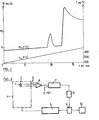
- the increase in the resistance of the layer occurs around 230 ° C, temperature at which the partial pressure of sodium P Na is of the order of 0.13 Pa (10 -3 mm Hg).
- a detector according to the invention based on gold therefore makes it possible to detect a partial sodium pressure of 0.13 Pa and more in the space of a few tens of seconds.
- the increase occurs quickly and reaches its maximum in about 30 seconds.
- the partial pressure of sodium PN is of the order of 42 Pa (3 X 10 -1 mmHg).
- a detector according to the invention based on antimony therefore makes it possible to detect a partial sodium pressure of 42 Pa at approximately 360 ° C. in the space of a few tens of seconds.
- the conductive element of the sensor can be a gold wire, for example a few tens of micrometers in diameter, or else a layer of gold or antimony deposited on an appropriate insulating support, by example of alumina.
- the layer of gold or antimony can be produced by techniques known as a thick layer or a thin layer.
- Thick layer conductive elements can be manufactured by screen printing of a composition based on gold on a suitable support, for example in alumina, drying and baking at high temperature intended to effect sintering.
- Gold-based compositions useful for forming conductive patterns are well known in the field of printed circuits and commercially available from various manufacturers (in particular cios EI du Pont de Nemours and Company). These compositions generally include gold powder, a glass frit and a suitable diluent. Similar compositions based on antimony can be produced without difficulty. The layers thus produced have thicknesses in the range of 5 to 50 micrometers.
- Thin film elements can be obtained by sputtering. It is well known that when a large potential difference is established between two electrodes immersed in an ionizable medium (rarefied gas), a projection of material from the cathode occurs.
- an ionizable medium IR gas
- the layers thus produced have thicknesses in the range of 0.01 to 1 micrometer.
- a value of the layer resistance adapted to the measuring devices can be obtained by sandblasting the layer.
- gold is meant both pure gold and alloys containing a major proportion of gold. It is the same for antimony.
- the senor will be able to operate in different temperature ranges.
- the gold layers obtained by the so-called thick layer technique are generally stable in the range from 20 to 700 ° C. approximately, being usually annealed around 850 ° C.
- the gold layers obtained by cathode sputtering present a recrystallization phenomenon at 550 ° C which disturbs their electrical conductivity. They will therefore be used for applications in which they will be exposed to lower temperatures.
- Gold threads will be useful for applications involving very high temperatures (above 700 ° C).
- the layers of antimony they will be suitable for use in a temperature range from 250 to 500 ° C.
- FIG. 2 is a block diagram of this detector.
- the detector shown in FIG. 2 comprises a sensor 1 consisting of a thin layer of gold 2 of 0.1 ⁇ m thickness deposited on an alumina support and of two conductors 3, for example of copper tightened on the small opposite sides of layer 2 which has a rectangular shape (10 mm x 1 mm).
- This sensor can be placed, for example, in an electric oven 4 with sodium heat pipes supplied with electric energy by a source 5.
- the conductors 3 and the layer 2 are traversed by a current of constant low intensity I.
- the resistance of layer 2 being equal to R (approximately 3 ohms initially), the voltage V across the terminals of layer 2 is equal to the product RI.
- voltage V is compared in comparator 7 to a reference voltage Vref. If V is equal to Vref or is little different from it, no signal comes out of comparator 7.
- the gold layer 2 reacts with sodium vapors, its resistance 5 increases sharply and the voltage across the terminals of layer 2 will also increase sharply, typically by a factor of 2, in the space of a few tens seconds.
- the comparator 7 will then emit a signal which after shaping at 8 will activate the safety device 9. The latter will deactivate the source 5 of electrical energy and trigger the alarm 10, which can be, for example, audible and / or visual.
- the device 9 could also control the activation of a specific fire extinguisher for alkali metal fires.
Landscapes
- Chemical & Material Sciences (AREA)
- Analytical Chemistry (AREA)
- General Health & Medical Sciences (AREA)
- Physics & Mathematics (AREA)
- Health & Medical Sciences (AREA)
- Life Sciences & Earth Sciences (AREA)
- Chemical Kinetics & Catalysis (AREA)
- Biochemistry (AREA)
- Electrochemistry (AREA)
- General Physics & Mathematics (AREA)
- Immunology (AREA)
- Pathology (AREA)
- Investigating Or Analyzing Materials By The Use Of Electric Means (AREA)
- Other Investigation Or Analysis Of Materials By Electrical Means (AREA)
- Investigating Or Analyzing Non-Biological Materials By The Use Of Chemical Means (AREA)
Priority Applications (1)
| Application Number | Priority Date | Filing Date | Title |
|---|---|---|---|
| AT85402598T ATE49808T1 (de) | 1985-01-07 | 1985-12-23 | Detektor fuer dampffoermige alkalimetalle. |
Applications Claiming Priority (2)
| Application Number | Priority Date | Filing Date | Title |
|---|---|---|---|
| FR8500127A FR2575832B1 (fr) | 1985-01-07 | 1985-01-07 | Detecteur de vapeurs d'un metal alcalin |
| FR8500127 | 1985-01-07 |
Publications (2)
| Publication Number | Publication Date |
|---|---|
| EP0192008A1 true EP0192008A1 (de) | 1986-08-27 |
| EP0192008B1 EP0192008B1 (de) | 1990-01-24 |
Family
ID=9315039
Family Applications (1)
| Application Number | Title | Priority Date | Filing Date |
|---|---|---|---|
| EP85402598A Expired - Lifetime EP0192008B1 (de) | 1985-01-07 | 1985-12-23 | Detektor für dampfförmige Alkalimetalle |
Country Status (4)
| Country | Link |
|---|---|
| EP (1) | EP0192008B1 (de) |
| AT (1) | ATE49808T1 (de) |
| DE (1) | DE3575606D1 (de) |
| FR (1) | FR2575832B1 (de) |
Cited By (1)
| Publication number | Priority date | Publication date | Assignee | Title |
|---|---|---|---|---|
| AT404995B (de) * | 1996-11-07 | 1999-04-26 | Ica Innoconsult Ag | Verfahren zum dosieren von korrosionsschutzmitteln |
Citations (3)
| Publication number | Priority date | Publication date | Assignee | Title |
|---|---|---|---|---|
| FR2202596A5 (de) * | 1972-10-06 | 1974-05-03 | Westinghouse Electric Corp | |
| US3950980A (en) * | 1974-03-27 | 1976-04-20 | Minnesota Mining And Manufacturing Company | Vapor sampling device |
| FR2316597A1 (fr) * | 1975-07-02 | 1977-01-28 | Westinghouse Electric Corp | Methode et appareil pour la detection extremement sensible de vapeur metallique |
-
1985
- 1985-01-07 FR FR8500127A patent/FR2575832B1/fr not_active Expired
- 1985-12-23 DE DE8585402598T patent/DE3575606D1/de not_active Expired - Lifetime
- 1985-12-23 AT AT85402598T patent/ATE49808T1/de not_active IP Right Cessation
- 1985-12-23 EP EP85402598A patent/EP0192008B1/de not_active Expired - Lifetime
Patent Citations (3)
| Publication number | Priority date | Publication date | Assignee | Title |
|---|---|---|---|---|
| FR2202596A5 (de) * | 1972-10-06 | 1974-05-03 | Westinghouse Electric Corp | |
| US3950980A (en) * | 1974-03-27 | 1976-04-20 | Minnesota Mining And Manufacturing Company | Vapor sampling device |
| FR2316597A1 (fr) * | 1975-07-02 | 1977-01-28 | Westinghouse Electric Corp | Methode et appareil pour la detection extremement sensible de vapeur metallique |
Cited By (1)
| Publication number | Priority date | Publication date | Assignee | Title |
|---|---|---|---|---|
| AT404995B (de) * | 1996-11-07 | 1999-04-26 | Ica Innoconsult Ag | Verfahren zum dosieren von korrosionsschutzmitteln |
Also Published As
| Publication number | Publication date |
|---|---|
| FR2575832A1 (fr) | 1986-07-11 |
| EP0192008B1 (de) | 1990-01-24 |
| ATE49808T1 (de) | 1990-02-15 |
| DE3575606D1 (de) | 1990-03-01 |
| FR2575832B1 (fr) | 1987-03-27 |
Similar Documents
| Publication | Publication Date | Title |
|---|---|---|
| US3872419A (en) | Electrical elements operable as thermisters, varisters, smoke and moisture detectors, and methods for making the same | |
| US2100187A (en) | Entrance insulation for electrical conductors | |
| GB2085166A (en) | Semiconductor gas sensor | |
| FR3057403B1 (fr) | Composant integrant une varistance thermoprotegee et un eclateur en serie | |
| EP1416508A1 (de) | Thermische Legierungsschmelzsicherung und Draht für ein Sicherungselement | |
| US7064648B2 (en) | Alloy type thermal fuse and material for a thermal fuse element | |
| US4276535A (en) | Thermistor | |
| US3827142A (en) | Tuning of encapsulated precision resistor | |
| JP5205555B2 (ja) | ガス放電管 | |
| US20040100355A1 (en) | Alloy type thermal fuse and material for a thermal fuse element | |
| US20030185280A1 (en) | Contact temperature probe and process | |
| US7199697B2 (en) | Alloy type thermal fuse and material for a thermal fuse element | |
| EP0473439B1 (de) | Elektronischer Schalter mit einem photoempfindlichen Halbleiter | |
| EP0192008B1 (de) | Detektor für dampfförmige Alkalimetalle | |
| EP1424713B1 (de) | Thermische Legierungsschmelzsicherung und Material für ein Sicherungselement | |
| GB2085168A (en) | Semiconductor gas sensor | |
| Gray et al. | A survey of possible mechanisms of activation and erosion of relay contacts | |
| KR19990023758A (ko) | Smd-소자를 포함하는 회로 장치, 특히 온도 센서, 및 온도 센서 제조 방법 | |
| US5291056A (en) | Electronic switch comprising a photosensitive semiconductor | |
| GB1439775A (en) | Gas-filled discharge tubes annular elem | |
| US3905004A (en) | Sensor device and method for making | |
| EP0038078B1 (de) | Gas Detektor | |
| RU2367051C1 (ru) | Высоковольтный резистор-предохранитель | |
| US20160089740A1 (en) | Bonding Method for Thin Film Diamond Providing Low Vapor Pressure at High Temperature | |
| US3227581A (en) | Process for rendering ceramics slightly conductive |
Legal Events
| Date | Code | Title | Description |
|---|---|---|---|
| PUAI | Public reference made under article 153(3) epc to a published international application that has entered the european phase |
Free format text: ORIGINAL CODE: 0009012 |
|
| AK | Designated contracting states |
Kind code of ref document: A1 Designated state(s): AT BE CH DE FR GB IT LI LU NL |
|
| 17P | Request for examination filed |
Effective date: 19861216 |
|
| 17Q | First examination report despatched |
Effective date: 19880804 |
|
| GRAA | (expected) grant |
Free format text: ORIGINAL CODE: 0009210 |
|
| AK | Designated contracting states |
Kind code of ref document: B1 Designated state(s): AT BE CH DE FR GB IT LI LU NL |
|
| PG25 | Lapsed in a contracting state [announced via postgrant information from national office to epo] |
Ref country code: AT Effective date: 19900124 |
|
| REF | Corresponds to: |
Ref document number: 49808 Country of ref document: AT Date of ref document: 19900215 Kind code of ref document: T |
|
| REF | Corresponds to: |
Ref document number: 3575606 Country of ref document: DE Date of ref document: 19900301 |
|
| GBT | Gb: translation of ep patent filed (gb section 77(6)(a)/1977) | ||
| ITF | It: translation for a ep patent filed | ||
| PLBE | No opposition filed within time limit |
Free format text: ORIGINAL CODE: 0009261 |
|
| STAA | Information on the status of an ep patent application or granted ep patent |
Free format text: STATUS: NO OPPOSITION FILED WITHIN TIME LIMIT |
|
| ITTA | It: last paid annual fee | ||
| 26N | No opposition filed | ||
| EPTA | Lu: last paid annual fee | ||
| PGFP | Annual fee paid to national office [announced via postgrant information from national office to epo] |
Ref country code: FR Payment date: 19951020 Year of fee payment: 11 |
|
| PGFP | Annual fee paid to national office [announced via postgrant information from national office to epo] |
Ref country code: GB Payment date: 19951215 Year of fee payment: 11 |
|
| PGFP | Annual fee paid to national office [announced via postgrant information from national office to epo] |
Ref country code: DE Payment date: 19951229 Year of fee payment: 11 Ref country code: CH Payment date: 19951229 Year of fee payment: 11 |
|
| PGFP | Annual fee paid to national office [announced via postgrant information from national office to epo] |
Ref country code: NL Payment date: 19951230 Year of fee payment: 11 |
|
| PGFP | Annual fee paid to national office [announced via postgrant information from national office to epo] |
Ref country code: LU Payment date: 19960101 Year of fee payment: 11 |
|
| PGFP | Annual fee paid to national office [announced via postgrant information from national office to epo] |
Ref country code: BE Payment date: 19960117 Year of fee payment: 11 |
|
| PG25 | Lapsed in a contracting state [announced via postgrant information from national office to epo] |
Ref country code: LU Free format text: LAPSE BECAUSE OF NON-PAYMENT OF DUE FEES Effective date: 19961223 Ref country code: GB Effective date: 19961223 |
|
| PG25 | Lapsed in a contracting state [announced via postgrant information from national office to epo] |
Ref country code: LI Effective date: 19961231 Ref country code: CH Effective date: 19961231 Ref country code: BE Effective date: 19961231 |
|
| BERE | Be: lapsed |
Owner name: CENTRE NATIONAL D'ETUDES SPATIALES Effective date: 19961231 |
|
| PG25 | Lapsed in a contracting state [announced via postgrant information from national office to epo] |
Ref country code: NL Effective date: 19970701 |
|
| GBPC | Gb: european patent ceased through non-payment of renewal fee |
Effective date: 19961223 |
|
| REG | Reference to a national code |
Ref country code: CH Ref legal event code: PL |
|
| PG25 | Lapsed in a contracting state [announced via postgrant information from national office to epo] |
Ref country code: FR Effective date: 19970829 |
|
| NLV4 | Nl: lapsed or anulled due to non-payment of the annual fee |
Effective date: 19970701 |
|
| PG25 | Lapsed in a contracting state [announced via postgrant information from national office to epo] |
Ref country code: DE Effective date: 19970902 |
|
| REG | Reference to a national code |
Ref country code: FR Ref legal event code: ST |