EP0190657A2 - Silica glass optical conductor - Google Patents
Silica glass optical conductor Download PDFInfo
- Publication number
- EP0190657A2 EP0190657A2 EP86101161A EP86101161A EP0190657A2 EP 0190657 A2 EP0190657 A2 EP 0190657A2 EP 86101161 A EP86101161 A EP 86101161A EP 86101161 A EP86101161 A EP 86101161A EP 0190657 A2 EP0190657 A2 EP 0190657A2
- Authority
- EP
- European Patent Office
- Prior art keywords
- silica glass
- varnish
- optical conductor
- ppm
- glass optical
- Prior art date
- Legal status (The legal status is an assumption and is not a legal conclusion. Google has not performed a legal analysis and makes no representation as to the accuracy of the status listed.)
- Granted
Links
Images
Classifications
-
- G—PHYSICS
- G02—OPTICS
- G02B—OPTICAL ELEMENTS, SYSTEMS OR APPARATUS
- G02B6/00—Light guides; Structural details of arrangements comprising light guides and other optical elements, e.g. couplings
- G02B6/04—Light guides; Structural details of arrangements comprising light guides and other optical elements, e.g. couplings formed by bundles of fibres
- G02B6/06—Light guides; Structural details of arrangements comprising light guides and other optical elements, e.g. couplings formed by bundles of fibres the relative position of the fibres being the same at both ends, e.g. for transporting images
Definitions
- the present invention relates to a silica gleN eptieal conductor, such as an optical fiber for telecommunication, a multiple fiber for an image scope, and a light guide for illumination.
- a silica gleN eptieal conductor such as an optical fiber for telecommunication, a multiple fiber for an image scope, and a light guide for illumination.
- silica glass optical conductors which are prepared by drawing their preforms and applying a primary coating layer ( hereinafter the term, primary coating layer being briefly referred to as precoating layer ) on the surface thereof, have excellent radiation resistance as compared with multi-component glass optical conductors and, therefore, is suitable to be used in nuclear facilities. According to the studies of the present inventors, however, the radiation resistance of the silica glass optical conductors are various, and are varied by the material of the precoating layer.
- An object of the present invention is to provide a radiation and heat resistant silica glass optical conductor.
- Another object of the present invention is to provide a radiation and heat resistant optical fiber used for telecommunication.
- Still another object of the present invention is to provide a radiation and heat resistant multiple optical fiber used for various industrial facilities, meducal equipments and nuclear facilities.
- Still another object of the present invention is to provide a radiation and heat resistant light guide used for illumination.
- the present invention provides a silica glass optical conductor having a precoating layer composed of a polyimide whose total content of sodium element and potassium element is less than 50 ppm.
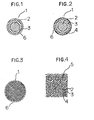
- FIG. 1 and 2 are cross-sectional views of an optical fiber for telecommunication or a light guide for illumination in accordance with the present invention.
- Fig. 3 is a cross-sectional view of a multiple optical fiber in accordance with the present invention.
- Fig.4 is a magnified view of Fig. 3 in a portion of the cross-section.
- each optical conductor 1 comprises a core 2 and a cladding layer 3.
- the optical conductor 1 shown in Fig. 2 has furthermore a supporting layer 4 formed on the cladding layer 3.
- the optical conductore 1 shown in Fig. 3, which is a multiple optical conductor, has such a structure that a plurality of unit optical conductors 5 each of which consists of a core 2, a cladding layer 3 and a supporting layer 4 are fused together.
- Each of the optical conductores of Figs. 1 to 3 has a precoating layer 6 on the cladding layer 3 or on the supporting layer 4.
- the core 2, the cladding layer 3 and the supporting layer 4 is composed of a natural or synthetic silica glass doped with or without a dopant, respectively.
- the core 2 is composed of a pure silica glass having a purity of at least 99.99 % by weight
- the cladding layer 3 is composed of a pure silica glass doped with boron and / or fluorine
- the supporting layer 4 is composed of a pure silica glass having a purity of at least 99.9 % by weight.
- Preferable polyimides to be used in the present invention are less than 10 ppm, especially less than 5 ppm in the total content of sodium element and potassium element, becauce the lower the above total content is,the more excellent in radiation resistance of the silica glass optical conductor.
- a great variety of organic polymer having an imide group in main chain thereof may be used as polyimide in the present invention so far as it satisfies the requirement concerning the sodium-potassium content mentioned above.
- such a polyimide is preferably used, which is at least 30 mole % , more preferably at least 50 mole % in the content of the recurring imide group represented by the following formula (1):
- the recurring imide group is defined as the same recurring imide group of a polyimide which is prepared by reacting a diamine or a diisocyanate with a tetracarboxylic acid or a derivative thereof and thenafter by heating the polyamide acid thus obtained in order to change it to the polyimide, and the R,,R 2 in the formula (1) are tetra-valent organic group of aliphatic, alicyclic, aromatic,or heterocyclic nature having a total carbon number of from about 4 to about 50, especially from about 6 to about 20, decided by the reacting raw materials used.
- diamine examples include meta-phenylene diamine; para- phenylene diamine; 2,2-bis(4-amino p henyl)propane; 4,4'-diaminodiphenyl methane; 4,4'-diaminodiphenyl sulfide; 4,4'-diaminodiphenyl sulfone; 3,3'-diaminodiphenyl sulfone; 4,4'-diaminodiphenyl ether; 2,6-diaminopyridine; bis(4-aminophenyl)diethyl silane; bis(4-aminophenyl)diphenyl silane; benzidine; 3,3'-dichlorobenzidine; 3,3'-dimethoxybenzidine; bis(4-aminophenyl)ethyl phosphine oxide; 4,4'-diaminobenzophenone; bis(4-aminophenyl)pheny
- diisocyanate examples include ethylene diisocyanate; 1,4-tetramethylene diisocyanate; 1,6-hexamethylene diisocyanate; 1,12-dodecane diisocyanate; cyclobutene-1,3-diisocyanate; cyclohexane-1,3 and-1,4-diisocyanate; 1,3- and 1,4-phenylene diisocyanate; 2,4-and 2,6-tolylene diisocyanate; and mixtures thereof.
- tetra-carboxylic acid or derivatives thereof are pyromellitic dianhydride; 2,3,6.7-naphthalenetetracarboxylic dianhydride; 1,2,5,6-naphthalene-tetra- carboxylic anhydride; 3,4,9,10-perylene tetracarboxylic dianhydride; naphthalene-1,2,4,5-tetracarboxylic dianhydride; naphthalene-1,4,5,8-tetracarboxylic dianhydride; 2,6-di- chloronaphthalene-1,4,5,8-tetracarboxylic dianhydride; 2,7-dichIoronaphghalene-1,4,5,8-tetracarboxylic dianhydride; 2,3,6,7-tetrachloronaphthalene-1,4,5,8-tetracarboxylic dianhydride; phenanthrene-1,8,9.10-tetracarboxylic dianhydr
- polyamides useful in the present invention are conventional polyimides,that is those substantially 100 mol % in the amount of imide group represented
- the precoating layer 6 can be formed easily by coating on the surface of a naked silica glass optical conductor with for example, a commercially available polyimide varnish which satisfies the above mentioned requirement concerning sodium-potassium content, and then by baking the varnish layer.
- the coating of the varnish is conducted preferably as soon as the naked silica glass optical conductor is just formed by heat-drawing a preform thereof.
- the thickness of the precoating layer 6 is preferably at least 5,um from a standpoint of obtaining a silica glass optical conductor having more excellent radiation resistance , furtheremore at least 10 ⁇ m, especially in the case of obtaining a silica glass multiple optical fiber.
- the optical fibers each of which has a three-layer structure consisting of a pure silica glass core, a cladding layer composed of a silica glass doped with boron and fluorine, and a support layer composed of a natural silica glass, were filled compactly in a natural silica glass tube. and then the tube was drawn by heating to a temperature of 2,100 °C to form a multiple optical fiber having an outer diameter of 1.0 mm.
- the multiple optical fiber was coated with a polyimide varnish ( hereinafter referred to as Varnish A ) of Du.Pont Co. ( U.S.A.) 65 ppm in potassium content,and 19 ppm in sodium content, and baked to form a baked polyimide precoating layer 50 ⁇ m in thickness on the surface of the multiple optical fiber.
- Varnish A of Du.Pont Co.
- a multiple optical fiber was produced in the same manner as in Comparative Example 1 except that a polyimide varnish ( Varnish B ) of Tore Co. ( Japan ) 80 ppm in potassium content and 20 ppm in sodium content was used instead of Varnish A.
- a polyimide varnish ( Varnish B ) of Tore Co. ( Japan ) 80 ppm in potassium content and 20 ppm in sodium content was used instead of Varnish A.
- a multiple optical fiber was prod,uced in the same manner as in Comparative Example 1 except that a polyimide varnish ( Varnish C ) of Ube Kosan Co. ( Japan )110 ppm in potassium content and 30 ppm in sodium content was used instead of Varnish A.
- a multiple optical fiber was produced in the same manner as in Comparative Example 1 except that a polyimide varnish ( Varnish D ) which is obtained by refining Varnish A and is 0.5 ppm in potassium content and 0.2 ppm in sodium content was used instead of Varnish A.
- a polyimide varnish Varnish D which is obtained by refining Varnish A and is 0.5 ppm in potassium content and 0.2 ppm in sodium content was used instead of Varnish A.
- a multiple optical fiber was produced in the same manner as in Comparative Example 1 except that a polyimide varnish ( Varnish E ) which is obtained by refining Varnish A and is 6.2 ppm in potassium content and 2.4 ppm in sodium content was used instead of Varnish A.
- a polyimide varnish Varnish E which is obtained by refining Varnish A and is 6.2 ppm in potassium content and 2.4 ppm in sodium content was used instead of Varnish A.
- a multiple optical fiber was produced in the same manner as In Comparative Example 1 except that a polyimide varnish ( Varnish F ) which is obtained by refining Varnish B and is 0.8 ppm in potassium content and 0.3 ppm in sodium content was used instead of Varnish A.
- a polyimide varnish Varnish F which is obtained by refining Varnish B and is 0.8 ppm in potassium content and 0.3 ppm in sodium content was used instead of Varnish A.
- a multiple optical fiber was produced in the same manner as in Comparative Example 1 except that a polyimide varnish ( Varnish G ) which is obtained by refining Varnish C and is 2.9 ppm in potassium content and 0.8 ppm in sodium content was used instead of Varnish A.
- a varnish to be determined was treated under the condition of 200°C, 0.01 mm Hg to remove thoroughly the solvent included.
- Ten gram of sample taken from the varnish thus treated was burned,thenafter completely laid in ashes by heating at 800 "C in a platinum crucible.
- the ashes in the crucible were dissolved in 50 cc of 1 N-Hcl aqueous solution and subjected to quantitative determination of potassium element and sodium element by means of an atomic absorption spectrophotometer.
- a silica glass optical multiple fiber was irradiated by gamma rays from Co at a temperature of 250°C for total doses of 416,500 Rad.
- a test specimen was bended in U-Ietter shape and 50 mm in radius of curvature, and the both ends thereof were rotated at a rate of 60 r.p.m. around the center axis of the fiber to mutually opposite directions ( in other words, the test specimen was rotated without being twisted ), and the number of rotation taken to cut the test specimen in fatigue was measuared.
- test results are shown in Table below.
- the number of those which cut at rotation numbers of less than 10 is shown in the column of " Less than 10 rotations ", while the number of those which cut at rotation numbers falling in a range of from 10 to 100 is shown in the column of " 10 to 100 rotations ".
Landscapes
- Physics & Mathematics (AREA)
- General Physics & Mathematics (AREA)
- Optics & Photonics (AREA)
- Optical Fibers, Optical Fiber Cores, And Optical Fiber Bundles (AREA)
- Surface Treatment Of Glass Fibres Or Filaments (AREA)
- Macromolecular Compounds Obtained By Forming Nitrogen-Containing Linkages In General (AREA)
Abstract
Description
- The present invention relates to a silica gleN eptieal conductor, such as an optical fiber for telecommunication, a multiple fiber for an image scope, and a light guide for illumination.
- It has been proposed or tried to use an optical condutor as a means for telecommunication, measurement, and control in nuclear facilities,such as a nuclear reactor where the optical conductor is possibly exposed to nuclear radiation at a high temperature.
- It is well-known that silica glass optical conductors, which are prepared by drawing their preforms and applying a primary coating layer ( hereinafter the term, primary coating layer being briefly referred to as precoating layer ) on the surface thereof, have excellent radiation resistance as compared with multi-component glass optical conductors and, therefore, is suitable to be used in nuclear facilities. According to the studies of the present inventors, however, the radiation resistance of the silica glass optical conductors are various, and are varied by the material of the precoating layer.
- An object of the present invention is to provide a radiation and heat resistant silica glass optical conductor.
- Another object of the present invention is to provide a radiation and heat resistant optical fiber used for telecommunication.
- Still another object of the present invention is to provide a radiation and heat resistant multiple optical fiber used for various industrial facilities, meducal equipments and nuclear facilities.
- Still another object of the present invention is to provide a radiation and heat resistant light guide used for illumination.
- More specifically, the present invention provides a silica glass optical conductor having a precoating layer composed of a polyimide whose total content of sodium element and potassium element is less than 50 ppm.
- Each of Figs. 1 and 2 is a cross-sectional view of an optical fiber for telecommunication or a light guide for illumination in accordance with the present invention. Fig. 3 is a cross-sectional view of a multiple optical fiber in accordance with the present invention. Fig.4 is a magnified view of Fig. 3 in a portion of the cross-section.
- Referring now to Figs. 1 to 4, each
optical conductor 1 comprises acore 2 and a cladding layer 3. Theoptical conductor 1 shown in Fig. 2 has furthermore a supportinglayer 4 formed on the cladding layer 3. Theoptical conductore 1 shown in Fig. 3, which is a multiple optical conductor, has such a structure that a plurality of unitoptical conductors 5 each of which consists of acore 2, a cladding layer 3 and a supportinglayer 4 are fused together. Each of the optical conductores of Figs. 1 to 3 has a precoatinglayer 6 on the cladding layer 3 or on the supportinglayer 4. Thecore 2, the cladding layer 3 and the supportinglayer 4 is composed of a natural or synthetic silica glass doped with or without a dopant, respectively. - Preferably, the
core 2 is composed of a pure silica glass having a purity of at least 99.99 % by weight, the cladding layer 3 is composed of a pure silica glass doped with boron and / or fluorine, and the supportinglayer 4 is composed of a pure silica glass having a purity of at least 99.9 % by weight. - In the present invention a polyimide whose total content of sodium element and potassium element is less than 50 ppm, is used as the material of the precoating
layer 6. - A silica glass optical conductor with a polyimide, as a material of the precoating layer, whose total content of sodium element and potassium element is more than 50 ppm is poor in radiation resistance, and therefore is unsuitable for use in the radioactive environments as mentioned above.
- Preferable polyimides to be used in the present invention are less than 10 ppm, especially less than 5 ppm in the total content of sodium element and potassium element, becauce the lower the above total content is,the more excellent in radiation resistance of the silica glass optical conductor.
- A great variety of organic polymer having an imide group in main chain thereof may be used as polyimide in the present invention so far as it satisfies the requirement concerning the sodium-potassium content mentioned above.
- Among them, such a polyimide is preferably used, which is at least 30 mole % , more preferably at least 50 mole % in the content of the recurring imide group represented by the following formula (1):

- The recurring imide group is defined as the same recurring imide group of a polyimide which is prepared by reacting a diamine or a diisocyanate with a tetracarboxylic acid or a derivative thereof and thenafter by heating the polyamide acid thus obtained in order to change it to the polyimide, and the R,,R2 in the formula (1) are tetra-valent organic group of aliphatic, alicyclic, aromatic,or heterocyclic nature having a total carbon number of from about 4 to about 50, especially from about 6 to about 20, decided by the reacting raw materials used.
- Examples of the diamine are meta-phenylene diamine; para- phenylene diamine; 2,2-bis(4-aminophenyl)propane; 4,4'-diaminodiphenyl methane; 4,4'-diaminodiphenyl sulfide; 4,4'-diaminodiphenyl sulfone; 3,3'-diaminodiphenyl sulfone; 4,4'-diaminodiphenyl ether; 2,6-diaminopyridine; bis(4-aminophenyl)diethyl silane; bis(4-aminophenyl)diphenyl silane; benzidine; 3,3'-dichlorobenzidine; 3,3'-dimethoxybenzidine; bis(4-aminophenyl)ethyl phosphine oxide; 4,4'-diaminobenzophenone; bis(4-aminophenyl)phenyl phosphine oxide; bis-(4-aminophenyl)-N-butylamine; bis(4-aminophenyl)-N-methylamine; 1,5-diaminonaphthalene; 3,3'-dimethyl-4,4'-diaminobiphenyl; N-(3-aminophenyl)-4-aminobenzamide; 4-aminophenyl-3-amionobenzoate; 2,4-bis(beta-amino-t-butyl)toluene; bis-(p-beta-amino-t-butylphenyl)ether; p-bis(2-methyl-4-aminopentyl)benzene; p-bis(1,l-dimethyl-5-aminopentyl)benzene; m-xylylene diamine; p-xylylene diamine, bis(4-aminophenyl)-N-phenylamine; and mixtures thereof.
- Examples of the diisocyanate are ethylene diisocyanate; 1,4-tetramethylene diisocyanate; 1,6-hexamethylene diisocyanate; 1,12-dodecane diisocyanate; cyclobutene-1,3-diisocyanate; cyclohexane-1,3 and-1,4-diisocyanate; 1,3- and 1,4-phenylene diisocyanate; 2,4-and 2,6-tolylene diisocyanate; and mixtures thereof.
- Examples of the tetra-carboxylic acid or derivatives thereof are pyromellitic dianhydride; 2,3,6.7-naphthalenetetracarboxylic dianhydride; 1,2,5,6-naphthalene-tetra- carboxylic anhydride; 3,4,9,10-perylene tetracarboxylic dianhydride; naphthalene-1,2,4,5-tetracarboxylic dianhydride; naphthalene-1,4,5,8-tetracarboxylic dianhydride; 2,6-di- chloronaphthalene-1,4,5,8-tetracarboxylic dianhydride; 2,7-dichIoronaphghalene-1,4,5,8-tetracarboxylic dianhydride; 2,3,6,7-tetrachloronaphthalene-1,4,5,8-tetracarboxylic dianhydride; phenanthrene-1,8,9.10-tetracarboxylic dianhydride; pyrizine-2,3,5,6-tetracarboxylic dianhydride; benzerne-1,2,3,4-tetracarboxylic dianhyudride; thiophene-2,3,4,5-tetracarboxylic dianhydride; and mixtures thereof.
- Illustrative of polyamides useful in the present invention are conventional polyimides,that is those substantially 100 mol % in the amount of imide group represented
- by the formula (1), such as those described in U.S.P. 2,710,853, U.S.P.2,712.543, U.S.P.2,731,447, U.S.P.2,880,230, U.S.P.2.900.369, etc, polyamideimides, such as those described in U.S.P.2,421.024, U.S.P.3,182.073,etc, poly- esterimides, such as those descrived in U.S.P.4,329,397, etc.
- In the present invention the precoating
layer 6 can be formed easily by coating on the surface of a naked silica glass optical conductor with for example, a commercially available polyimide varnish which satisfies the above mentioned requirement concerning sodium-potassium content, and then by baking the varnish layer. The coating of the varnish is conducted preferably as soon as the naked silica glass optical conductor is just formed by heat-drawing a preform thereof. The thickness of the precoatinglayer 6 is preferably at least 5,um from a standpoint of obtaining a silica glass optical conductor having more excellent radiation resistance , furtheremore at least 10 µm, especially in the case of obtaining a silica glass multiple optical fiber. - The following examples illustrate in greater detail the optical conductor of the present invention, but they are not to be construed as limiting the scope of the present invention. Comparative Example 1;
- About 10,000 of the optical fibers each of which has a three-layer structure consisting of a pure silica glass core, a cladding layer composed of a silica glass doped with boron and fluorine, and a support layer composed of a natural silica glass, were filled compactly in a natural silica glass tube. and then the tube was drawn by heating to a temperature of 2,100 °C to form a multiple optical fiber having an outer diameter of 1.0 mm. Just after drawing, the multiple optical fiber was coated with a polyimide varnish ( hereinafter referred to as Varnish A ) of Du.Pont Co. ( U.S.A.) 65 ppm in potassium content,and 19 ppm in sodium content, and baked to form a baked polyimide precoating layer 50 µm in thickness on the surface of the multiple optical fiber.
- A multiple optical fiber was produced in the same manner as in Comparative Example 1 except that a polyimide varnish ( Varnish B ) of Tore Co. ( Japan ) 80 ppm in potassium content and 20 ppm in sodium content was used instead of Varnish A.
- A multiple optical fiber was prod,uced in the same manner as in Comparative Example 1 except that a polyimide varnish ( Varnish C ) of Ube Kosan Co. ( Japan )110 ppm in potassium content and 30 ppm in sodium content was used instead of Varnish A.
- A multiple optical fiber was produced in the same manner as in Comparative Example 1 except that a polyimide varnish ( Varnish D ) which is obtained by refining Varnish A and is 0.5 ppm in potassium content and 0.2 ppm in sodium content was used instead of Varnish A.
- A multiple optical fiber was produced in the same manner as in Comparative Example 1 except that a polyimide varnish ( Varnish E ) which is obtained by refining Varnish A and is 6.2 ppm in potassium content and 2.4 ppm in sodium content was used instead of Varnish A.
- A multiple optical fiber was produced in the same manner as In Comparative Example 1 except that a polyimide varnish ( Varnish F ) which is obtained by refining Varnish B and is 0.8 ppm in potassium content and 0.3 ppm in sodium content was used instead of Varnish A.
- A multiple optical fiber was produced in the same manner as in Comparative Example 1 except that a polyimide varnish ( Varnish G ) which is obtained by refining Varnish C and is 2.9 ppm in potassium content and 0.8 ppm in sodium content was used instead of Varnish A.
- Potassium and sodium contents in the varnish used was determined by the following method;
- A varnish to be determined was treated under the condition of 200°C, 0.01 mm Hg to remove thoroughly the solvent included. Ten gram of sample taken from the varnish thus treated was burned,thenafter completely laid in ashes by heating at 800 "C in a platinum crucible. The ashes in the crucible were dissolved in 50 cc of 1 N-Hcl aqueous solution and subjected to quantitative determination of potassium element and sodium element by means of an atomic absorption spectrophotometer.
- The radiation resistance of each silica glass multiple optical fiber of Comparative Examples 1 to 3 and Examples 1 to 4 was evaluated by the following manners;
- A silica glass optical multiple fiber was irradiated by gamma rays from Co at a temperature of 250°C for total doses of 416,500 Rad. Ten of test specimens, each 30 cm long, were sampled at random from the above fiber thus irradiated. A test specimen was bended in U-Ietter shape and 50 mm in radius of curvature, and the both ends thereof were rotated at a rate of 60 r.p.m. around the center axis of the fiber to mutually opposite directions ( in other words, the test specimen was rotated without being twisted ), and the number of rotation taken to cut the test specimen in fatigue was measuared.
- The test results are shown in Table below. Among 10 test specimens, the number of those which cut at rotation numbers of less than 10 is shown in the column of " Less than 10 rotations ", while the number of those which cut at rotation numbers falling in a range of from 10 to 100 is shown in the column of " 10 to 100 rotations ".

- From the test results, it is obvious that the multiple optical fibers of Examples 1 to 4 keep excellent mechanical strength even after being irradiated.
Claims (4)
Applications Claiming Priority (2)
| Application Number | Priority Date | Filing Date | Title |
|---|---|---|---|
| JP19131/85 | 1985-02-01 | ||
| JP60019131A JPS61177402A (en) | 1985-02-01 | 1985-02-01 | Optical transmission body of quartz glass |
Publications (3)
| Publication Number | Publication Date |
|---|---|
| EP0190657A2 true EP0190657A2 (en) | 1986-08-13 |
| EP0190657A3 EP0190657A3 (en) | 1988-06-01 |
| EP0190657B1 EP0190657B1 (en) | 1992-04-15 |
Family
ID=11990909
Family Applications (1)
| Application Number | Title | Priority Date | Filing Date |
|---|---|---|---|
| EP86101161A Expired EP0190657B1 (en) | 1985-02-01 | 1986-01-29 | Silica glass optical conductor |
Country Status (4)
| Country | Link |
|---|---|
| EP (1) | EP0190657B1 (en) |
| JP (1) | JPS61177402A (en) |
| CA (1) | CA1280919C (en) |
| DE (1) | DE3684792D1 (en) |
Cited By (1)
| Publication number | Priority date | Publication date | Assignee | Title |
|---|---|---|---|---|
| GB2214653A (en) * | 1988-01-21 | 1989-09-06 | Stc Plc | High Temperature optical cables |
Families Citing this family (1)
| Publication number | Priority date | Publication date | Assignee | Title |
|---|---|---|---|---|
| EP2098548B1 (en) | 2008-03-05 | 2009-10-21 | Sika Technology AG | Compound with improved adhesion to porous substrates |
Family Cites Families (5)
| Publication number | Priority date | Publication date | Assignee | Title |
|---|---|---|---|---|
| DE2462944C2 (en) * | 1974-06-14 | 1984-08-23 | Sumitomo Electric Industries, Ltd., Osaka | A method of coating a transmission optical fiber with a thermoplastic resin |
| DE2729648A1 (en) * | 1977-06-30 | 1979-01-04 | Siemens Ag | TENSION-RESISTANT LIGHT WAVE GUIDE |
| JPS5598706A (en) * | 1979-01-23 | 1980-07-28 | Nippon Telegr & Teleph Corp <Ntt> | Glass fiber for optical transmission and its production |
| DE2907650C3 (en) * | 1979-02-27 | 1981-08-13 | Heraeus Quarzschmelze Gmbh, 6450 Hanau | Multimode light guide |
| US4367918A (en) * | 1980-01-22 | 1983-01-11 | Times Fiber Communications, Inc. | Plastic clad optical fibers |
-
1985
- 1985-02-01 JP JP60019131A patent/JPS61177402A/en active Granted
-
1986
- 1986-01-22 CA CA000500088A patent/CA1280919C/en not_active Expired - Lifetime
- 1986-01-29 DE DE8686101161T patent/DE3684792D1/en not_active Expired - Lifetime
- 1986-01-29 EP EP86101161A patent/EP0190657B1/en not_active Expired
Cited By (1)
| Publication number | Priority date | Publication date | Assignee | Title |
|---|---|---|---|---|
| GB2214653A (en) * | 1988-01-21 | 1989-09-06 | Stc Plc | High Temperature optical cables |
Also Published As
| Publication number | Publication date |
|---|---|
| CA1280919C (en) | 1991-03-05 |
| JPH0476084B2 (en) | 1992-12-02 |
| EP0190657A3 (en) | 1988-06-01 |
| DE3684792D1 (en) | 1992-05-21 |
| JPS61177402A (en) | 1986-08-09 |
| EP0190657B1 (en) | 1992-04-15 |
Similar Documents
| Publication | Publication Date | Title |
|---|---|---|
| US6232428B1 (en) | Essentially colorless, transparent polyimide coatings and films | |
| KR101896885B1 (en) | Resin precursor, resin composition containing said resin precursor, resin film, method for producing said resin film, laminate, and method for producing said laminate | |
| US4657832A (en) | Photosensitive polymers as coating materials | |
| CA1142004A (en) | Method for producing bundled optical fibers | |
| EP0446947B1 (en) | Gas separating asymmetric membrane | |
| JPH08504967A (en) | Light-limited optical waveguide | |
| KR960014984A (en) | Single-mode optical fiber base material with a constant thermal conductivity slope of optical fiber cross section and its manufacturing method | |
| JPS6430621A (en) | Gas separating apparatus and method | |
| JPH06511222A (en) | Glass fiber coated with photocurable polyimide | |
| EP0190657A2 (en) | Silica glass optical conductor | |
| Canterna | Metal abundances of Draco and eight galactic globular clusters | |
| EP0371826B1 (en) | Optical fiber production method | |
| US4528216A (en) | Process for forming heat-resistant resin films of polyimide and organosilicic reactants | |
| JPS60184218A (en) | Optical fiber core | |
| Guzzi et al. | Spectroradiometer for ground-based atmospheric measurements related to remote sensing in the visible from a satellite | |
| Ohmori et al. | Loss increase in silicone-coated fibres with heat treatment | |
| JP3286018B2 (en) | Carbon coated optical fiber | |
| GR3003728T3 (en) | ||
| JPH04288331A (en) | Optical polyimide material | |
| JP2765039B2 (en) | Fiber optic cable | |
| JPS5654407A (en) | Submarine optical cable | |
| EP0490364A2 (en) | Process for producing polyisoimide | |
| JPH02289450A (en) | Optical fiber | |
| JPS60195039A (en) | Manufacture of optical fiber | |
| JPH04171407A (en) | Fused and stretched optical fiber coupler |
Legal Events
| Date | Code | Title | Description |
|---|---|---|---|
| PUAI | Public reference made under article 153(3) epc to a published international application that has entered the european phase |
Free format text: ORIGINAL CODE: 0009012 |
|
| AK | Designated contracting states |
Kind code of ref document: A2 Designated state(s): DE FR GB IT |
|
| PUAL | Search report despatched |
Free format text: ORIGINAL CODE: 0009013 |
|
| AK | Designated contracting states |
Kind code of ref document: A3 Designated state(s): DE FR GB IT |
|
| RAP1 | Party data changed (applicant data changed or rights of an application transferred) |
Owner name: MITSUBISHI CABLE INDUSTRIES, LTD. Owner name: DORYOKURO KAKUNENRYO KAIHATSU JIGYODAN |
|
| RIN1 | Information on inventor provided before grant (corrected) |
Inventor name: ISHITOBI, MASAMI KANSAI PLANT (ITAMI BRANCH) Inventor name: NAKAMOTO,KOICHIRO,O-ARAI ENG.CTR.OF DORYOKURO Inventor name: RINDO,HIROSHI,O-ARAI ENG.CTR.OF DORYOKURO KAKUNEN Inventor name: ARA,KUNIAKI,O-ARAI ENG.CTR.OF DORYOKURO,KAKUNENRYO |
|
| 17P | Request for examination filed |
Effective date: 19880825 |
|
| 17Q | First examination report despatched |
Effective date: 19910314 |
|
| GRAA | (expected) grant |
Free format text: ORIGINAL CODE: 0009210 |
|
| AK | Designated contracting states |
Kind code of ref document: B1 Designated state(s): DE FR GB IT |
|
| ITF | It: translation for a ep patent filed | ||
| REF | Corresponds to: |
Ref document number: 3684792 Country of ref document: DE Date of ref document: 19920521 |
|
| ET | Fr: translation filed | ||
| PLBE | No opposition filed within time limit |
Free format text: ORIGINAL CODE: 0009261 |
|
| STAA | Information on the status of an ep patent application or granted ep patent |
Free format text: STATUS: NO OPPOSITION FILED WITHIN TIME LIMIT |
|
| 26N | No opposition filed | ||
| REG | Reference to a national code |
Ref country code: FR Ref legal event code: CD Ref country code: FR Ref legal event code: CA |
|
| REG | Reference to a national code |
Ref country code: GB Ref legal event code: IF02 |
|
| PGFP | Annual fee paid to national office [announced via postgrant information from national office to epo] |
Ref country code: FR Payment date: 20030110 Year of fee payment: 18 |
|
| PGFP | Annual fee paid to national office [announced via postgrant information from national office to epo] |
Ref country code: GB Payment date: 20030129 Year of fee payment: 18 |
|
| PGFP | Annual fee paid to national office [announced via postgrant information from national office to epo] |
Ref country code: DE Payment date: 20030206 Year of fee payment: 18 |
|
| PG25 | Lapsed in a contracting state [announced via postgrant information from national office to epo] |
Ref country code: GB Free format text: LAPSE BECAUSE OF NON-PAYMENT OF DUE FEES Effective date: 20040129 |
|
| PG25 | Lapsed in a contracting state [announced via postgrant information from national office to epo] |
Ref country code: DE Free format text: LAPSE BECAUSE OF NON-PAYMENT OF DUE FEES Effective date: 20040803 |
|
| GBPC | Gb: european patent ceased through non-payment of renewal fee |
Effective date: 20040129 |
|
| PG25 | Lapsed in a contracting state [announced via postgrant information from national office to epo] |
Ref country code: FR Free format text: LAPSE BECAUSE OF NON-PAYMENT OF DUE FEES Effective date: 20040930 |
|
| REG | Reference to a national code |
Ref country code: FR Ref legal event code: ST |
|
| PG25 | Lapsed in a contracting state [announced via postgrant information from national office to epo] |
Ref country code: IT Free format text: LAPSE BECAUSE OF NON-PAYMENT OF DUE FEES;WARNING: LAPSES OF ITALIAN PATENTS WITH EFFECTIVE DATE BEFORE 2007 MAY HAVE OCCURRED AT ANY TIME BEFORE 2007. THE CORRECT EFFECTIVE DATE MAY BE DIFFERENT FROM THE ONE RECORDED. Effective date: 20050129 |