EP0189983B1 - Polyimidschaum, Polyimidmehrschichtstoffe und Verfahren zu deren Herstellung - Google Patents
Polyimidschaum, Polyimidmehrschichtstoffe und Verfahren zu deren Herstellung Download PDFInfo
- Publication number
- EP0189983B1 EP0189983B1 EP19860300210 EP86300210A EP0189983B1 EP 0189983 B1 EP0189983 B1 EP 0189983B1 EP 19860300210 EP19860300210 EP 19860300210 EP 86300210 A EP86300210 A EP 86300210A EP 0189983 B1 EP0189983 B1 EP 0189983B1
- Authority
- EP
- European Patent Office
- Prior art keywords
- foam
- polyimide
- laminate
- diamine
- aromatic
- Prior art date
- Legal status (The legal status is an assumption and is not a legal conclusion. Google has not performed a legal analysis and makes no representation as to the accuracy of the status listed.)
- Expired
Links
- 239000006260 foam Substances 0.000 title claims description 95
- 229920001721 polyimide Polymers 0.000 title claims description 84
- 239000004642 Polyimide Substances 0.000 title claims description 64
- 238000000034 method Methods 0.000 title claims description 13
- 238000002360 preparation method Methods 0.000 title description 6
- 150000004985 diamines Chemical class 0.000 claims description 24
- 239000000853 adhesive Substances 0.000 claims description 23
- 230000001070 adhesive effect Effects 0.000 claims description 23
- 150000000000 tetracarboxylic acids Chemical class 0.000 claims description 23
- 150000002148 esters Chemical class 0.000 claims description 22
- 150000004984 aromatic diamines Chemical class 0.000 claims description 20
- 150000001993 dienes Chemical class 0.000 claims description 18
- 238000010438 heat treatment Methods 0.000 claims description 18
- 229920000642 polymer Polymers 0.000 claims description 15
- 239000012790 adhesive layer Substances 0.000 claims description 14
- 125000003118 aryl group Chemical group 0.000 claims description 14
- -1 heterocyclic diamine Chemical class 0.000 claims description 14
- 230000009970 fire resistant effect Effects 0.000 claims description 13
- 239000004604 Blowing Agent Substances 0.000 claims description 12
- 239000007788 liquid Substances 0.000 claims description 11
- 239000000178 monomer Substances 0.000 claims description 11
- 150000008064 anhydrides Chemical class 0.000 claims description 10
- 125000000391 vinyl group Chemical group [H]C([*])=C([H])[H] 0.000 claims description 10
- 229920002554 vinyl polymer Polymers 0.000 claims description 10
- 125000004432 carbon atom Chemical group C* 0.000 claims description 9
- 239000007787 solid Substances 0.000 claims description 8
- NLHHRLWOUZZQLW-UHFFFAOYSA-N Acrylonitrile Chemical compound C=CC#N NLHHRLWOUZZQLW-UHFFFAOYSA-N 0.000 claims description 6
- 150000004982 aromatic amines Chemical class 0.000 claims description 6
- ZBCBWPMODOFKDW-UHFFFAOYSA-N diethanolamine Chemical compound OCCNCCO ZBCBWPMODOFKDW-UHFFFAOYSA-N 0.000 claims description 6
- 229910052739 hydrogen Inorganic materials 0.000 claims description 6
- 239000001257 hydrogen Substances 0.000 claims description 6
- RNFJDJUURJAICM-UHFFFAOYSA-N 2,2,4,4,6,6-hexaphenoxy-1,3,5-triaza-2$l^{5},4$l^{5},6$l^{5}-triphosphacyclohexa-1,3,5-triene Chemical compound N=1P(OC=2C=CC=CC=2)(OC=2C=CC=CC=2)=NP(OC=2C=CC=CC=2)(OC=2C=CC=CC=2)=NP=1(OC=1C=CC=CC=1)OC1=CC=CC=C1 RNFJDJUURJAICM-UHFFFAOYSA-N 0.000 claims description 5
- GYCMBHHDWRMZGG-UHFFFAOYSA-N Methylacrylonitrile Chemical compound CC(=C)C#N GYCMBHHDWRMZGG-UHFFFAOYSA-N 0.000 claims description 5
- 125000000217 alkyl group Chemical group 0.000 claims description 5
- 150000005690 diesters Chemical class 0.000 claims description 5
- 239000003063 flame retardant Substances 0.000 claims description 5
- 239000010410 layer Substances 0.000 claims description 5
- 125000002496 methyl group Chemical group [H]C([H])([H])* 0.000 claims description 5
- YBRVSVVVWCFQMG-UHFFFAOYSA-N 4,4'-diaminodiphenylmethane Chemical group C1=CC(N)=CC=C1CC1=CC=C(N)C=C1 YBRVSVVVWCFQMG-UHFFFAOYSA-N 0.000 claims description 4
- UITKHKNFVCYWNG-UHFFFAOYSA-N 4-(3,4-dicarboxybenzoyl)phthalic acid Chemical compound C1=C(C(O)=O)C(C(=O)O)=CC=C1C(=O)C1=CC=C(C(O)=O)C(C(O)=O)=C1 UITKHKNFVCYWNG-UHFFFAOYSA-N 0.000 claims description 4
- HLBLWEWZXPIGSM-UHFFFAOYSA-N 4-Aminophenyl ether Chemical group C1=CC(N)=CC=C1OC1=CC=C(N)C=C1 HLBLWEWZXPIGSM-UHFFFAOYSA-N 0.000 claims description 4
- PPBRXRYQALVLMV-UHFFFAOYSA-N Styrene Natural products C=CC1=CC=CC=C1 PPBRXRYQALVLMV-UHFFFAOYSA-N 0.000 claims description 4
- 238000005187 foaming Methods 0.000 claims description 4
- 125000000962 organic group Chemical group 0.000 claims description 4
- VLDPXPPHXDGHEW-UHFFFAOYSA-N 1-chloro-2-dichlorophosphoryloxybenzene Chemical compound ClC1=CC=CC=C1OP(Cl)(Cl)=O VLDPXPPHXDGHEW-UHFFFAOYSA-N 0.000 claims description 3
- 239000004812 Fluorinated ethylene propylene Substances 0.000 claims description 3
- UFHFLCQGNIYNRP-UHFFFAOYSA-N Hydrogen Chemical compound [H][H] UFHFLCQGNIYNRP-UHFFFAOYSA-N 0.000 claims description 3
- 125000002947 alkylene group Chemical group 0.000 claims description 3
- NBVXSUQYWXRMNV-UHFFFAOYSA-N fluoromethane Chemical compound FC NBVXSUQYWXRMNV-UHFFFAOYSA-N 0.000 claims description 3
- 125000004435 hydrogen atom Chemical group [H]* 0.000 claims description 3
- 230000002209 hydrophobic effect Effects 0.000 claims description 3
- 229920009441 perflouroethylene propylene Polymers 0.000 claims description 3
- 125000000843 phenylene group Chemical group C1(=C(C=CC=C1)*)* 0.000 claims description 3
- 150000001875 compounds Chemical class 0.000 claims description 2
- 125000003011 styrenyl group Chemical group [H]\C(*)=C(/[H])C1=C([H])C([H])=C([H])C([H])=C1[H] 0.000 claims description 2
- ZZYXNRREDYWPLN-UHFFFAOYSA-N pyridine-2,3-diamine Chemical group NC1=CC=CN=C1N ZZYXNRREDYWPLN-UHFFFAOYSA-N 0.000 claims 1
- 238000006243 chemical reaction Methods 0.000 description 15
- 150000001412 amines Chemical class 0.000 description 14
- KAKZBPTYRLMSJV-UHFFFAOYSA-N Butadiene Chemical compound C=CC=C KAKZBPTYRLMSJV-UHFFFAOYSA-N 0.000 description 12
- 229920001577 copolymer Polymers 0.000 description 11
- OKKJLVBELUTLKV-UHFFFAOYSA-N Methanol Chemical compound OC OKKJLVBELUTLKV-UHFFFAOYSA-N 0.000 description 10
- 210000004027 cell Anatomy 0.000 description 10
- 230000004888 barrier function Effects 0.000 description 7
- LFQSCWFLJHTTHZ-UHFFFAOYSA-N Ethanol Chemical compound CCO LFQSCWFLJHTTHZ-UHFFFAOYSA-N 0.000 description 6
- XLYOFNOQVPJJNP-UHFFFAOYSA-N water Substances O XLYOFNOQVPJJNP-UHFFFAOYSA-N 0.000 description 6
- 229920000459 Nitrile rubber Polymers 0.000 description 5
- 239000004809 Teflon Substances 0.000 description 5
- 229920006362 Teflon® Polymers 0.000 description 5
- 239000002253 acid Substances 0.000 description 5
- 210000003850 cellular structure Anatomy 0.000 description 5
- 239000011541 reaction mixture Substances 0.000 description 5
- NTXGQCSETZTARF-UHFFFAOYSA-N buta-1,3-diene;prop-2-enenitrile Chemical compound C=CC=C.C=CC#N NTXGQCSETZTARF-UHFFFAOYSA-N 0.000 description 4
- 239000011521 glass Substances 0.000 description 4
- 238000010992 reflux Methods 0.000 description 4
- GTDPSWPPOUPBNX-UHFFFAOYSA-N ac1mqpva Chemical compound CC12C(=O)OC(=O)C1(C)C1(C)C2(C)C(=O)OC1=O GTDPSWPPOUPBNX-UHFFFAOYSA-N 0.000 description 3
- 239000011248 coating agent Substances 0.000 description 3
- 238000000576 coating method Methods 0.000 description 3
- 239000000463 material Substances 0.000 description 3
- 239000002245 particle Substances 0.000 description 3
- 238000006116 polymerization reaction Methods 0.000 description 3
- VHNQIURBCCNWDN-UHFFFAOYSA-N pyridine-2,6-diamine Chemical group NC1=CC=CC(N)=N1 VHNQIURBCCNWDN-UHFFFAOYSA-N 0.000 description 3
- 239000004094 surface-active agent Substances 0.000 description 3
- VVJKKWFAADXIJK-UHFFFAOYSA-N Allylamine Chemical compound NCC=C VVJKKWFAADXIJK-UHFFFAOYSA-N 0.000 description 2
- RRHGJUQNOFWUDK-UHFFFAOYSA-N Isoprene Chemical compound CC(=C)C=C RRHGJUQNOFWUDK-UHFFFAOYSA-N 0.000 description 2
- 125000001931 aliphatic group Chemical group 0.000 description 2
- 230000005540 biological transmission Effects 0.000 description 2
- VHRGRCVQAFMJIZ-UHFFFAOYSA-N cadaverine Chemical compound NCCCCCN VHRGRCVQAFMJIZ-UHFFFAOYSA-N 0.000 description 2
- 238000004581 coalescence Methods 0.000 description 2
- 239000002131 composite material Substances 0.000 description 2
- 238000007796 conventional method Methods 0.000 description 2
- 239000012530 fluid Substances 0.000 description 2
- 125000005842 heteroatom Chemical group 0.000 description 2
- 238000009413 insulation Methods 0.000 description 2
- 230000008018 melting Effects 0.000 description 2
- 238000002844 melting Methods 0.000 description 2
- 239000002184 metal Substances 0.000 description 2
- 239000000203 mixture Substances 0.000 description 2
- 150000002825 nitriles Chemical class 0.000 description 2
- 229920003223 poly(pyromellitimide-1,4-diphenyl ether) Polymers 0.000 description 2
- KIDHWZJUCRJVML-UHFFFAOYSA-N putrescine Chemical compound NCCCCN KIDHWZJUCRJVML-UHFFFAOYSA-N 0.000 description 2
- 238000010526 radical polymerization reaction Methods 0.000 description 2
- 239000000779 smoke Substances 0.000 description 2
- 150000003440 styrenes Chemical class 0.000 description 2
- XFNJVJPLKCPIBV-UHFFFAOYSA-N trimethylenediamine Chemical compound NCCCN XFNJVJPLKCPIBV-UHFFFAOYSA-N 0.000 description 2
- WZCQRUWWHSTZEM-UHFFFAOYSA-N 1,3-phenylenediamine Chemical compound NC1=CC=CC(N)=C1 WZCQRUWWHSTZEM-UHFFFAOYSA-N 0.000 description 1
- CBCKQZAAMUWICA-UHFFFAOYSA-N 1,4-phenylenediamine Chemical compound NC1=CC=C(N)C=C1 CBCKQZAAMUWICA-UHFFFAOYSA-N 0.000 description 1
- WTFAGPBUAGFMQX-UHFFFAOYSA-N 1-[2-[2-(2-aminopropoxy)propoxy]propoxy]propan-2-amine Chemical compound CC(N)COCC(C)OCC(C)OCC(C)N WTFAGPBUAGFMQX-UHFFFAOYSA-N 0.000 description 1
- VOZKAJLKRJDJLL-UHFFFAOYSA-N 2,4-diaminotoluene Chemical compound CC1=CC=C(N)C=C1N VOZKAJLKRJDJLL-UHFFFAOYSA-N 0.000 description 1
- RLYCRLGLCUXUPO-UHFFFAOYSA-N 2,6-diaminotoluene Chemical compound CC1=C(N)C=CC=C1N RLYCRLGLCUXUPO-UHFFFAOYSA-N 0.000 description 1
- LXJLFVRAWOOQDR-UHFFFAOYSA-N 3-(3-aminophenoxy)aniline Chemical compound NC1=CC=CC(OC=2C=C(N)C=CC=2)=C1 LXJLFVRAWOOQDR-UHFFFAOYSA-N 0.000 description 1
- LJGHYPLBDBRCRZ-UHFFFAOYSA-N 3-(3-aminophenyl)sulfonylaniline Chemical compound NC1=CC=CC(S(=O)(=O)C=2C=C(N)C=CC=2)=C1 LJGHYPLBDBRCRZ-UHFFFAOYSA-N 0.000 description 1
- ICNFHJVPAJKPHW-UHFFFAOYSA-N 4,4'-Thiodianiline Chemical compound C1=CC(N)=CC=C1SC1=CC=C(N)C=C1 ICNFHJVPAJKPHW-UHFFFAOYSA-N 0.000 description 1
- LBSXSAXOLABXMF-UHFFFAOYSA-N 4-Vinylaniline Chemical compound NC1=CC=C(C=C)C=C1 LBSXSAXOLABXMF-UHFFFAOYSA-N 0.000 description 1
- 0 CCC(CC)(*N)C(C)=CC Chemical compound CCC(CC)(*N)C(C)=CC 0.000 description 1
- OKTJSMMVPCPJKN-UHFFFAOYSA-N Carbon Chemical compound [C] OKTJSMMVPCPJKN-UHFFFAOYSA-N 0.000 description 1
- MQJKPEGWNLWLTK-UHFFFAOYSA-N Dapsone Chemical compound C1=CC(N)=CC=C1S(=O)(=O)C1=CC=C(N)C=C1 MQJKPEGWNLWLTK-UHFFFAOYSA-N 0.000 description 1
- 239000005700 Putrescine Substances 0.000 description 1
- 229920006356 Teflon™ FEP Polymers 0.000 description 1
- 238000005299 abrasion Methods 0.000 description 1
- 150000008065 acid anhydrides Chemical class 0.000 description 1
- 239000002313 adhesive film Substances 0.000 description 1
- 125000005907 alkyl ester group Chemical group 0.000 description 1
- 125000005233 alkylalcohol group Chemical group 0.000 description 1
- XYLMUPLGERFSHI-UHFFFAOYSA-N alpha-Methylstyrene Chemical compound CC(=C)C1=CC=CC=C1 XYLMUPLGERFSHI-UHFFFAOYSA-N 0.000 description 1
- 125000006157 aromatic diamine group Chemical group 0.000 description 1
- 230000015572 biosynthetic process Effects 0.000 description 1
- 125000006267 biphenyl group Chemical group 0.000 description 1
- IRLQAJPIHBZROB-UHFFFAOYSA-N buta-2,3-dienenitrile Chemical group C=C=CC#N IRLQAJPIHBZROB-UHFFFAOYSA-N 0.000 description 1
- 125000002837 carbocyclic group Chemical group 0.000 description 1
- YACLQRRMGMJLJV-UHFFFAOYSA-N chloroprene Chemical compound ClC(=C)C=C YACLQRRMGMJLJV-UHFFFAOYSA-N 0.000 description 1
- 230000001419 dependent effect Effects 0.000 description 1
- 125000006840 diphenylmethane group Chemical group 0.000 description 1
- 238000001035 drying Methods 0.000 description 1
- 230000000694 effects Effects 0.000 description 1
- 230000032050 esterification Effects 0.000 description 1
- 238000005886 esterification reaction Methods 0.000 description 1
- 125000001495 ethyl group Chemical group [H]C([H])([H])C([H])([H])* 0.000 description 1
- 239000004744 fabric Substances 0.000 description 1
- 239000000945 filler Substances 0.000 description 1
- 239000003517 fume Substances 0.000 description 1
- 229910002804 graphite Inorganic materials 0.000 description 1
- 239000010439 graphite Substances 0.000 description 1
- NAQMVNRVTILPCV-UHFFFAOYSA-N hexane-1,6-diamine Chemical compound NCCCCCCN NAQMVNRVTILPCV-UHFFFAOYSA-N 0.000 description 1
- 238000011065 in-situ storage Methods 0.000 description 1
- 238000004519 manufacturing process Methods 0.000 description 1
- VNWKTOKETHGBQD-UHFFFAOYSA-N methane Natural products C VNWKTOKETHGBQD-UHFFFAOYSA-N 0.000 description 1
- OJURWUUOVGOHJZ-UHFFFAOYSA-N methyl 2-[(2-acetyloxyphenyl)methyl-[2-[(2-acetyloxyphenyl)methyl-(2-methoxy-2-oxoethyl)amino]ethyl]amino]acetate Chemical compound C=1C=CC=C(OC(C)=O)C=1CN(CC(=O)OC)CCN(CC(=O)OC)CC1=CC=CC=C1OC(C)=O OJURWUUOVGOHJZ-UHFFFAOYSA-N 0.000 description 1
- 150000004702 methyl esters Chemical class 0.000 description 1
- 229920000768 polyamine Polymers 0.000 description 1
- 229920001451 polypropylene glycol Polymers 0.000 description 1
- 239000000843 powder Substances 0.000 description 1
- 125000001436 propyl group Chemical group [H]C([*])([H])C([H])([H])C([H])([H])[H] 0.000 description 1
- ABYXFACYSGVHCW-UHFFFAOYSA-N pyridine-3,5-diamine Chemical compound NC1=CN=CC(N)=C1 ABYXFACYSGVHCW-UHFFFAOYSA-N 0.000 description 1
- 229920005604 random copolymer Polymers 0.000 description 1
- 239000000376 reactant Substances 0.000 description 1
- 230000035484 reaction time Effects 0.000 description 1
- 239000012779 reinforcing material Substances 0.000 description 1
- 238000007711 solidification Methods 0.000 description 1
- 230000008023 solidification Effects 0.000 description 1
- 239000000126 substance Substances 0.000 description 1
- 229920002994 synthetic fiber Polymers 0.000 description 1
- 239000012209 synthetic fiber Substances 0.000 description 1
- 125000006158 tetracarboxylic acid group Chemical group 0.000 description 1
- BFKJFAAPBSQJPD-UHFFFAOYSA-N tetrafluoroethene Chemical group FC(F)=C(F)F BFKJFAAPBSQJPD-UHFFFAOYSA-N 0.000 description 1
- 231100000331 toxic Toxicity 0.000 description 1
- 230000002588 toxic effect Effects 0.000 description 1
- 231100000419 toxicity Toxicity 0.000 description 1
- 230000001988 toxicity Effects 0.000 description 1
Classifications
-
- C—CHEMISTRY; METALLURGY
- C08—ORGANIC MACROMOLECULAR COMPOUNDS; THEIR PREPARATION OR CHEMICAL WORKING-UP; COMPOSITIONS BASED THEREON
- C08J—WORKING-UP; GENERAL PROCESSES OF COMPOUNDING; AFTER-TREATMENT NOT COVERED BY SUBCLASSES C08B, C08C, C08F, C08G or C08H
- C08J9/00—Working-up of macromolecular substances to porous or cellular articles or materials; After-treatment thereof
- C08J9/34—Chemical features in the manufacture of articles consisting of a foamed macromolecular core and a macromolecular surface layer having a higher density than the core
-
- B—PERFORMING OPERATIONS; TRANSPORTING
- B32—LAYERED PRODUCTS
- B32B—LAYERED PRODUCTS, i.e. PRODUCTS BUILT-UP OF STRATA OF FLAT OR NON-FLAT, e.g. CELLULAR OR HONEYCOMB, FORM
- B32B27/00—Layered products comprising a layer of synthetic resin
- B32B27/06—Layered products comprising a layer of synthetic resin as the main or only constituent of a layer, which is next to another layer of the same or of a different material
- B32B27/08—Layered products comprising a layer of synthetic resin as the main or only constituent of a layer, which is next to another layer of the same or of a different material of synthetic resin
-
- C—CHEMISTRY; METALLURGY
- C08—ORGANIC MACROMOLECULAR COMPOUNDS; THEIR PREPARATION OR CHEMICAL WORKING-UP; COMPOSITIONS BASED THEREON
- C08G—MACROMOLECULAR COMPOUNDS OBTAINED OTHERWISE THAN BY REACTIONS ONLY INVOLVING UNSATURATED CARBON-TO-CARBON BONDS
- C08G73/00—Macromolecular compounds obtained by reactions forming a linkage containing nitrogen with or without oxygen or carbon in the main chain of the macromolecule, not provided for in groups C08G12/00 - C08G71/00
- C08G73/06—Polycondensates having nitrogen-containing heterocyclic rings in the main chain of the macromolecule
- C08G73/10—Polyimides; Polyester-imides; Polyamide-imides; Polyamide acids or similar polyimide precursors
- C08G73/1042—Copolyimides derived from at least two different tetracarboxylic compounds or two different diamino compounds
-
- C—CHEMISTRY; METALLURGY
- C08—ORGANIC MACROMOLECULAR COMPOUNDS; THEIR PREPARATION OR CHEMICAL WORKING-UP; COMPOSITIONS BASED THEREON
- C08J—WORKING-UP; GENERAL PROCESSES OF COMPOUNDING; AFTER-TREATMENT NOT COVERED BY SUBCLASSES C08B, C08C, C08F, C08G or C08H
- C08J2379/00—Characterised by the use of macromolecular compounds obtained by reactions forming in the main chain of the macromolecule a linkage containing nitrogen with or without oxygen, or carbon only, not provided for in groups C08J2361/00 - C08J2377/00
- C08J2379/04—Polycondensates having nitrogen-containing heterocyclic rings in the main chain; Polyhydrazides; Polyamide acids or similar polyimide precursors
- C08J2379/08—Polyimides; Polyester-imides; Polyamide-imides; Polyamide acids or similar polyimide precursors
Definitions
- This invention relates to polyimide foams, laminates formed from polyimide foam and methods for their preparation.
- Embodiments disclose laminates of closed cell polyimide foam having a flexible, hydrophobic non-porous, vapour-impermable skin on one surface thereof.
- U.S. Patent No. 4,488,619 describes a multilayered polyimide foam laminate that provides a foam barrier, foam facing acoustical composite with superior flammability, smoke and toxicity resistance.
- This laminate comprises a polyimide foam having bonded thereto a fire-resistant adhesive layer and a flame retardant layer adhered to the polyimide foam by said fire resistant adhesive layer.
- Foams of the type there described are useful in aircraft cabins, space vehicles, land and sea transport equipment, as well as other applications where relatively non-flammable and negligible smoke-emitting characteristics are desirable.
- such polyimide foams are prepared by reacting an alkyl diester of a tetracarboxylic acid with one or more aromatic and/or heterocyclic diamines.
- a tetracarboxylic dianhydride is reacted with methanol or ethanol to form the corresponding diester which is then reacted with the amine or amines to form the corresponding polyamide-acid-ester which can then be converted to a polyimide by further heating.
- a cellular structure is developed, because both water and a lower alkyl alcohol corresponding to the alcohol portion of the ester is generated in situ during the reaction.
- foams produced in accordance with the foregoing concepts possess an open cellular structure and therefore do not have significantly high vapor-barrier qualities to facilitate their use in, for example, fire-resistant, anti-sweat submarine hull insulation.
- adhesives can be prepared by reaction of tetracarboxylic acid dianhydride with amine-terminated butadiene acrylonitrile to produce polyimide adhesives. Because of the viscosity and molecular weight of such amine-terminated butadiene-acrylonitrile copolymers, such amines are not capable of reaction with tetracarboxylic acid dianhydrides to provide flexible, resilient closed cell foams.
- the present invention seeks to provide a polyimide foam and a polyimide laminate which can be used under conditions of high humidity to provide high vapour characteristics.
- the present invention further seeks to provide a polyimide foam laminate having a tough, resilient, heat resistant surface which has even further improved vapour barrier characteristics.
- a method of preparing a polyimide foam having a flexible, non-porous skin on one surface thereof comprising the step of heating at least one surface of a polyimide foam under conditions of heat and pressure sufficient to melt the surface of the foam and cause the cells thereof to coalesce to form a flexible, non-porous, vapour-impermeable skin, the polyimide foam being prepared from (a) an organic tetracarboxylic acid or its anhydride or ester derivative, (b) an aromatic diamine having the formula: H2N - R2 - NH2 wherein R2 is an aromatic group containing 5 to 16 carbon atoms, and (c) an organic liquid diamine containing at least 50% by weight of a conjugated diene, said skin produced by heating at least one surface of the foam to coalesce the polyimide on the surface to form the flexible, non-porous, vapour-impermeable skin on the surface.
- the organic liquid diamine is selected from the group consisting of a polymer having the formula: wherein R is either a phenylene group or an alkylene group, R1 is hydrogen or methyl, x and y are each independently integers ranging from 1 to 25 and n is an integer, preferably below 20.
- the foam is prepared in the presence of a solid blowing agent.
- the aromatic diamine is diaminopyridine.
- a laminate comprising a polyimide foam having bonded thereto a fire-resistant adhesive layer and a flame retardant layer adhered to the polyimide foam by said fire resistant adhesive layer, characterised in that
- the adhesive is a fluorocarbon film.
- the polyimide film is formed from pyromellitic dianhydride or a diester thereof and an aromatic diamine.
- aromatic diamine of said film is oxydianiline.
- the adhesive is a fluorinated ethylene-propylene copolymer.
- the organic diamine is an amine-terminated polymer of at least 50% by weight of a conjugated diene alone or copolymerized with at least one vinyl monomer copolymerizable therewith which is end blocked with an aliphatic or aromatic amine.
- the vinyl monomer is selected from the group consisting of styrene, acrylonitrile, methacrylonitrile, and combinations thereof.
- the tetracarboxylic acid is a di(C1 to C3 alkyl) ester of benzophenone tetracarboxylic acid.
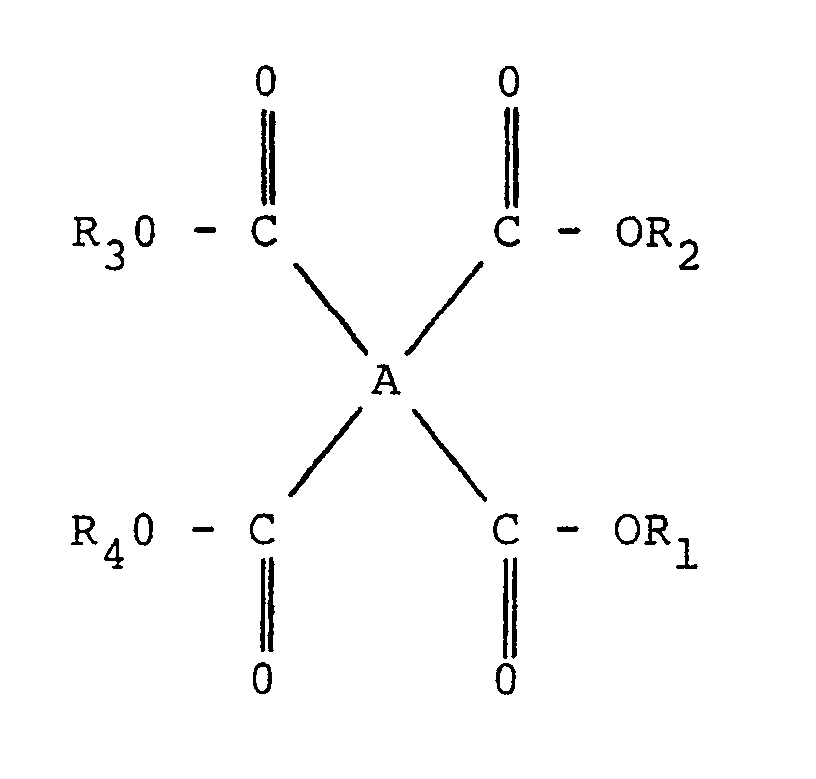
- the tetracarboxylic acid derivative is a compound having the formula: wherein A is a tetravalent organic group and R1 to R4 are each selected from the group consisting of hydrogen and C1 to C3 alkyl.
- said aromatic diamine of said foam is methylene dianiline.
- An embodiment includes at least one aromatic and at least one heterocyclic diamine.
- Another embodiment includes at least one aliphatic diamine.
- the surface of the foam is contacted with a heated surface under conditions of heat and pressure sufficient to coalesce the cells of the foam to form the flexible, non-porous, vapour-impermeable skin.
- the surface is heated to a temperature within the range of 225 to 320°C.
- a method of preparing a laminate having a flexible, non-porous surface comprising the steps of heating at least one surface of a polyimide foam in contact with a fire-resistant, heat-activated adhesive layer and a polyimide film in contact with the adhesive layer under conditions of heat and pressure sufficient to melt the surface of the foam and cause the cells thereof to coalesce to form a flexible, non-pourous, vapour-impermeable skin to which the polyimide is bonded by means of adhesive, said polyimide foam being prepared from a prepolymer formed from (1) an organic tetracarboxylic acid or anhydride or ester derivative, (2) an aromatic diamine having the formula: H2N - R2 - NH2 wherein R2 is an aromatic group containing 5 to 16 carbon atoms, and (3) an organic liquid diamine containing at least 50% by weight of a conjugated diene, said foam having a vapour-impermeable skin on one surface thereof formed by heating one surface of the foam
- the surface of the foam is heated to a temperature within the range of 225 to 320°C for at least 0.75 minutes.
- the organic diamine is an amine-terminated polymer of at least 50%by weight of a conjugated diene alone or copolymerized with at least one vinyl monomer copolymerizable therewith which is end blocked with a aliphatic or aromatic amine.
- the foam is prepared in the presence of a solid blowing agent.
- the laminate of the present invention provides greater flexibility in the foam and added puncture resistance.
- the laminate has further improved vapour barrier characteristics.
- the polyimide foam is one prepared by reaction of an organic tetracarboxylic acid or its anhydride or ester derivative with an aromatic diamine and an organic diamine which is an amine-terminated polymer of at least 50% by weight of a conjugated diene, either alone or copolymerized with at least one vinyl monomer copolymerized therewith.
- Such copolymers can be end blocked with an aliphatic or aromatic unsaturated amine to provide the desired amine termination.
- a number of vinyl monomers copolymerizable with a conjugated diene may be used including styrene as well as substituted styrenes, such as alphamethylstyrene and various other substitute styrenes.
- conjugated diene use can be made of butadiene as well as other well-known conjugated dienes such as chloroprene, isoprene.
- the copolymer of the conjugated diene and the vinyl monomer, when the amine-terminated copolymer contains a vinyl monomer, is preferably one formed by free radical polymerization.
- the conjugated diene polymer or copolymer has a low molecular weight, preferably less than about 3000 to insure that it is sufficiently fluid to react in the formation of the polyimide as well as sufficiently fluid so as to be capable of foaming.
- the resulting polymer or copolymer can then be end-capped with either aromatic or aliphatic unsaturated amines in accordance with conventional techniques.
- the amine-terminated butadiene-nitrile copolymer has the general formula: wherein R is either a phenylene group or an alkylene group, R1 is hydrogen or methyl, and x and y are each independently integers ranging from 1 to 25 and n is an integer, preferably below 20.
- the amine-terminated butadiene-nitrile copolymer is a butadiene-nitrile rubber wherein butadiene constitutes at least 50 percent by weight of the total of the butadiene and nitrile.
- the nitrile monomer copolymerized with the butadiene can either be acrylonitrile or methacrylonitrile and the polymerization reaction can be carried out in accordance with conventional free radical polymerization techniques.
- the copolymer produced is a random copolymer containing both butadiene and acrylonitrile or methacrylonitrile in the polymer backbone.
- the amine functionality is introduced by end-capping of the copolymer with, for example, paraaminostyrene or allylamine in accordance with conventional conventional techniques.
- the organic tetracarboxylic acid in the form of its diester from methanol or ethanol is reacted with one of the foregoing diamines, either alone or in combination with other amines to form a polyamide-acid/ester prepolymer which can be foamed and cured, either alone or in the presence of a blowing agent, to provide the desired polyimide foam.
- tetracarboxylic acids or derivatives thereof preferably employed in the practice of the invention are those having the general formula: wherein A is a tetravalent organic group and R1 to R4, inclusive, are each selected from the group consisting of hydrogen and methyl, ethyl or propyl.
- the tetravalent organic group A is preferably one having one of the following structures: wherein x is one or more of the following:
- tetracarboxylic acid and derivatives thereof is 3,3',4,4'-benzophenone tetracarboxylic acid and its corresponding C1 - C3 alkyl (preferably C1 - C3 dialkyl) esters.
- aromatic diamines As the organic diamine, use is preferably made of one or more aromatic and/or heterocyclic diamines which are themselves known to the art.
- aromatic diamines can be represented by the structure: H2N-R2-NH2 wherein R2 is an aromatic diamine group containing 5 to l6 carbon atoms and containing up to one hetero atom in the ring, the hetero atom being selected from the group consisting of -N-, -O- and -S-. Also included herein are those R2 groups wherein R2 is a diphenyl group or a diphenylmethane group. Representative of such diamines are:
- aliphatic diamines are preferably alpha-omega diaminoalkanes having the general formula: HN2 - (CH2) a - NH2 wherein a is an integer from 2 to 16.
- Representative of such diamines include 1,3-diaminopropane, 1,4-diamino-butane, 1,5-diaminopentane, 1,6-diaminohexane, etc.
- aliphatic amines use can also be made of the polyamines marketed by Texaco Chemical Company under the trademark JEFFAMINE. Those amines can be described as polyoxypropylene amines, and have the formula: NH2CH(CH3)CH2 ⁇ OCH2CH(CH3) ⁇ x NH2 wherein x varies from 1 to about 5.
- the polyamide-acid/ester prepolymer is formed by reaction of a dialkyl ester of the organic tetracarboxylic acid with the amines described above.
- the relative proportions used in the preparation of the prepolymer can be varied to relatively wide limits to provide good foams. In general, it is preferred to employ between 0.5 to 1.5 total moles of amine per mole of the tetra- carboxylic acid dianhydride or ester derivative thereof.
- the aromatic amine generally constitutes from 92.5 to 99.9999 mole % based on the number of moles of the tetracarboxylic acid or derivative, while the proportion of the amine-terminated diene polymer constitutes 0.0001 to 7.5 mole % based on the total moles of tetracarboxylic acid or derivative thereof.
- the aliphatic amine described above it is generally used in an amount ranging from 1 to 40 percent based on the total moles of the acid anhydride or ester employed.
- the tetracarboxylic acid dianhydride derivative is reacted with the diamine o diamines at a temperature at or below the reflux temperature of the reaction mixture.
- the prepolymer is formed of a low-molecular weight polyamide-acid/ester which can then be heated to complete the polymerization reaction.
- the prepolymer can thus be in the form of a liquid or a solid having a low molecular weight, so long as it is capable of being converted by further reaction to a high-molecular weight polyimide polymer.
- the resulting alcohol produced in the reaction as well as the water released during the reaction can be used as the blowing agent during polymerization to form the desired polyimide foams.
- blowing agents such as the solid blowing agents described in European Patent A 110723.
- the homogeneity of the cellular structure of the resulting polyimide foam can be more accurately controlled by controlling the particle size of the solid blowing agent, when such a blowing agent is employed. It has been found that the particle size of the solid blowing agent is preferably less than 0.02 cm in diameter, with 98% of the blowing agent particle sizes being less than 0.015 cm in diameter.
- the temperatures at which the prepolymer is converted to the polyimide polymer are generally those temperatures used in the preparation of other polyimide polymers. As a general rule, temperatures ranging from 200 to 400°C can be used, with heating times ranging from 5 to 60 minutes or longer. As those skilled in the art will appreciate, the time for carrying out the reaction is somewhat dependent on the reaction temperature, higher temperatures enabling the use of shorter reaction times. It is also possible to heat to a lower temperature in the first stage of the reaction and than higher temperatures in the later stages.
- Heating can be carried out in a conventional oven if desired.
- the foaming and curing of the prepolymer into a polyimide polymer can be effected by means of microwave heating. It has been found that the prepolymer can be converted to the corresponding polyimide foam by exposing the prepolymer for 1 to 120 minutes to radio frequencies within the range 915 to 2450 MHz, with the power output ranging from 1 to 100 kW.
- the power output to prepolymer weight ratio generally reads from 0.1 to 100 kW per kg).
- the laminate is formed by coating at least one surface of the foam with the adhesive and laying down the polyimide film on top of the adhesive layer. Thereafter, heating is applied to the polyimide film under conditions of temperature and pressure sufficient to melt the surface of the foam and cause the cells thereof to coalesce and thereby form a skin on the surface. At the same time, the heat-activated adhesive is also activated under conditions of temperature to cause the polyimide film to be securely formed on the surface of the foam.
- the foam is contacted with a heated surface at a pressure sufficient to cause the cells of the foam to coalesce and for a time sufficient to cause complete melting and solidification of the polyimide foam thus melted into the skin.
- the temperature is sufficient to activate the heat-activated adhesive to insure that the polyimide foam is bonded to the skin simultaneously formed.
- the surface of the foam is heated to a temperature within the range of 200 to 350°C, and preferably 260 to 290°C.
- a heated platen fabricated of either a metal or metal-coated with a non-stick tetrafluoroethylene material such as Teflon, marketed by DuPont.
- Teflon-coated glass cloths which are heated to the desired temperature and contacted with foam.
- the foam be contacted with the heated surface for a period of at least 0.75 minutes, and generally within the range of 1 to 5 minutes, with 3 to 4 minutes being preferred, depending in part on the thickness of the skin desired. As will be appreciated by those skilled in the art, both shorter and longer contact times can be employed. In general, a slight positive pressure of the heated surface on the surface of the foam is desirable to accelerate the melting and coalescence of the foam. In general, pressures of 1.746 to 34.475 KPa (0.25 to 5 psi) can be used for that purpose.
- the polyimide film adhered to the skin on the foam is one film having good toughness.
- the preferred polyimide film employed in the practice of this invention is a polyimide film prepared by reaction of an organic tetracarboxylic acid or anhydride or ester derivative of the type described above and one of the aromatic diamines described above.
- the adhesive is, as indicated, a fire-resistant, heat-activated adhesive, such adhesives themselves being known to those skilled in the art.
- a fire-resistant, heat-activated adhesive such adhesives themselves being known to those skilled in the art.
- One adhesive that has been found to provide particularly good results are the fluorocarbon films manufactured by Dupont, usually in the form of a fluorinated ethylene-propylene copolymer.
- Such an adhesive is commercially available from Dupont, and has been found to be particularly well suited for use in the practice of the present invention.
- the thickness of the polyimide film adhered to the skin of the foam is not critical and can be varied within relatively broad ranges. Good results are usually obtained when the polyimide film ranges from 0.0000254 to 0.254 cm (0.00001 to 0.1 inches).
- the thickness of the adhesive can likewise be varied within relatively wide ranges, best results usually being obtained with an adhesive film thickness of 0.00000254 to 0.254 cm (0.000001 to 0.01 inches).
- This example illustrates the practice of the present invention in the use of the amine-terminated butadiene-acrylonitrile copolymer.
- the remaining diamines (2,6-diaminopyridine (32.70g) and p,p'-methylenedianiline (138.45g)) are then added individually and allowed to mix for 15 minutes before the addition of the next diamine while maintaining the batch temperature above 50°C.
- the reaction mixture is heated to between 65-70°C for 5 to 200 minutes. After the reaction is complete, the mixture is cooled to 60°C, and 11.53g of a surfactant is added. Conversion to powder is accomplished by drying for 90 to 120 minutes at 65°C, then at 65°C and 170.65 mbar (128 mm Hg) pressure from 45 to 75 minutes, then at 65°C and 36.66 mbar (26 mm Hg) pressure from 45 to 75 minutes. The resulting friable-material is then pulverised and passed through a 0.06cm (600 micron) sieve.
- Foams are prepared by exposure to microwave energy 1.4 to 100 KW for 6 to 200 minutes and then cured for 30 to 200 minutes at 232-300°C.
- An electrically-heated platen press is heated to between 271 to 316 C (520 to 600 F), only the bottom platen being heated.
- the heated platen is then covered with a sheet of Teflon-coated glass fabric or Teflon coating to prevent sticking.
- a piece of polyimide film in the form of KAPTON polyimide film having a thickness of 0.00254 cm (0.001 inches) having a coating on one surface with a thickness of 0.00127 cm (0.0005 inches) of heat-activated adhesive, Teflon FEP 54A fluorocabon is laid on top of the Teflon-coated glass sheet with the adhesive layer facing upwardly.
- a 3.175 cm (1.25-inch) thick sheet of the closed cell polyimide foam described above is placed on top of the film and the press is closed to a gap of 2.54cm (1.0 inch).
- the press is held in the closed position for 30 to 120 seconds for the adhesive to melt and flow and to form a skin on the polyimide film.
- the pressure is released and it is found that the polyimide film is securely adhered to the skin, resulting in a flexible composite which is resistant to abrasion, puncture, fire and the passage of water vapor.
- This example illustrates the relative vapor barrier characteristics of the various components employed in the manufacture of the laminate embodiments of the present invention relative to the laminate itself.
- the laminate of the present invention provides improved water vapor transmission characteristics.
Landscapes
- Chemical & Material Sciences (AREA)
- Health & Medical Sciences (AREA)
- Chemical Kinetics & Catalysis (AREA)
- Medicinal Chemistry (AREA)
- Polymers & Plastics (AREA)
- Organic Chemistry (AREA)
- Engineering & Computer Science (AREA)
- Materials Engineering (AREA)
- Manufacture Of Porous Articles, And Recovery And Treatment Of Waste Products (AREA)
- Laminated Bodies (AREA)
Claims (23)
- Laminat aus einem Polyimidschaum mit einer damit verbundenen feuerbeständigen Klebeschicht und einer feuerhemmenden Schicht, die durch die feuerbeständige Klebeschicht fest mit dem Polyimidschaum verbunden ist, dadurch gekennzeichnet, daß(a) der Polyimidschaum durch die Bildung eines Prepolymers aus (1) einer organischen Tetracarbonsäure oder -anhydrid oder Esterderivat, (2) einem aromatischen Diamin der Formel:
H₂N - R₂ - NH₂
,
worin R₂ für eine aromatische Gruppe mit 5 bis 16 Kohlenstoffatomen steht, und (3) einem organischen flüssigen Diamin, das mindestens 50 Gew.% eines konjugierten Diens enthält, hergestellt wird, wobei der Schaum auf seiner einen Oberfläche eine dampfundurchlässige Haut aufweist, die durch Erhitzen einer Oberfläche des Schaums zum Koaleszieren des Polyimids an der Oberfläche gebildet wird;(b) wobei die feuerbeständige Klebeschicht durch Wärme aktiviert wird und die Haut überzieht; und(c) die feuerhemmende Schicht einen Polyimidfilm umfaßt, der durch die Klebeschicht fest mit der Haut verbunden ist. - Laminat nach Anspruch 1, worin das Klebemittel ein Fluorkohlenstoff-Film ist.
- Laminat nach Anspruch 1 oder 2, worin der Polyimidfilm aus Pyromellithsäuredianhydrid oder einem Diester daraus und einem aromatischen Diamin gebildet wird.
- Laminat nach Anspruch 3, worin das aromatische Diamin des Films Oxydianilin ist.
- Laminat nach einem der Ansprüche 1 bis 4, worin das Klebemittel ein fluoriertes Äthylen-Propylen-Copolymer ist.
- Laminat nach einem der Ansprüche 1 bis 5, worin das organische Diamin ein Polymer mit endständigem Amin ist, das zu mindestens 50 Gew.% aus lediglich einem konjugierten Dien besteht oder mit mindestens einem damit copolymerisierbaren Vinylmonomer, das mit einem aliphatischen oder aromatischen Amin am Ende blockiert ist, copolymerisiert ist.
- Laminat nach Anspruch 6, worin das Vinylmonomer aus der Gruppe Styrol, Acrylonitril, Methacrylonitril und Kombinationen davon ausgewählt wird.
- Laminat nach einem der Ansprüche 1 bis 7, worin die Tetracarbonsäure ein Di-(C₁ bis C₃)alkylester der Benzophenon-tetracarbonsäure ist.
- Laminat nach einem der Ansprüche 1 bis 7, worin das Tetracarbonsäure-Derivat eine Verbindung der Formel ist:
- Laminat nach einem der Ansprüche 1 bis 9, worin das aromatische Diamin des Schaums Methylendianilin ist.
- Laminat nach einem der Ansprüche 1 bis 10, das mindestens ein aromatisches und mindestens ein heterocyclisches Diamin enthält.
- Laminat nach einem der Ansprüche 1 bis 10, das mindestens ein aliphatisches Diamin enthält.
- Laminat nach einem der Ansprüche 1 bis 12, worin die Oberfläche des Schaums unter der Einwirkung von Wärme und Druck mit einer erhitzten Oberfläche in Kontakt gebracht wird, wobei Temperatur und Druck so hoch sind, daß die Zellen des Schaums koaleszieren unter Bildung einer flexiblen, nicht-porösen, dampfundurchlässigen Haut.
- Laminat nach einem der Ansprüche 1 bis 13, worin die Oberfläche auf eine Temperatur im Bereich von 225° bis 320° erhitzt wird.
- Verfahren zur Herstellung eines Laminats mit einer flexiblen, nicht-porösen Oberfläche, das die folgenden Stufen umfaßt: Erhitzen mindestens einer Oberfläche eines Polyimidschaums im Kontakt mit einer feuerbeständigen Klebeschicht, die durch Wärme aktiviert ist, und eines Polyimidfilms im Kontakt mit der Klebeschicht unter der Einwirkung von Wärme und Druck, wobei Temperatur und Druck so hoch sind, daß die Oberfläche des Schaums schmilzt und die Zellen des Schaums koaleszieren unter Bildung einer flexiblen, nicht- porösen, dampfundurchlässigen Haut, mit der das Polyimid durch ein Klebemittel verbunden wird, wobei der Polyimidschaum aus einem Prepolymer hergestellt wird, das aus (1) einer organischen Tetracarbonsäure oder -anhydrid oder einem Esterderivat, (2) einem aromatischen Diamin der Formel
H₂N - R₂ - NH₂
,
worin R₂ für eine aromatische Gruppe mit 5 bis 16 Kohlenstoffatomen steht, und (3) einem organischen flüssigen Diamin, das mindestens 50 Gew.% eines konjugierten Diens enthält, gebildet wird, wobei der Schaum auf seiner einen Oberfläche eine dampfundurchlässige Haut aufweist, die durch Erhitzen einer Oberfläche des Schaums zum Koaleszieren des Polyimids an der Oberfläche gebildet wurde. - Verfahren nach Anspruch 15, worin die Oberfläche des Schaums mindestens 0,75 Minuten lang auf eine Temperatur im Bereich von 225° bis 320° C erhitzt wird.
- Verfahren nach einem der Ansprüche 15 oder 16, worin das organische Diamin ein Polymer mit endständigem Amin ist, das zu mindestens 50 Gew.% aus lediglich einem konjugierten Dien besteht oder mit mindestens einem damit copolymerisierbaren Vinylmonomer, das mit einem aliphatischen oder aromatischen Amin am Ende blockiert ist, copolymerisiert wird.
- Verfahren nach einem der Ansprüche 15 bis 17, worin der Schaum in Gegenwart eines festen Treibmittels hergestellt wird.
- Polyimidschaum-Formkörper mit einer flexiblen, hydrophoben, nicht-porösen, dampfundurchlässigen Haut auf seiner einen Oberfläche aus einem Polyimidschaum, der hergestellt wurde durch Verschäumen eines Prepolymers, das aus (a) einer organischen Tetracarbonsäure oder deren Anhydrid oder einem Esterderivat, (b) einem aromatischen Diamin der Formel:
H₂N - R₂ - NH₂
,
worin R₂ für eine aromatische Gruppe mit 5 bis 16 Kohlenstoffatomen steht, und (c) einem organischen flüssigen Diamin, das mindestens 50 Gew.% eines konjugierten Diens enthält, hergestellt wurde, wobei die Haut durch Erhitzen mindestens einer Oberfläche des Schaums zum Koaleszieren des Polyimids an der Oberfläche und zur Bildung der flexiblen, nicht-porösen, dampfundurchlässigen Haut auf der Oberfläche erzeugt wurde. - Verfahren zur Herstellung eines Polyimidschaums mit einer flexiblen, nicht-porösen Haut auf einer Oberfläche desselben, bei dem mindestens eine Oberfläche eines Polyimidschaums unter der Einwirkung von Wärme und Druck erhitzt wird, wobei Temperatur und Druck so hoch sind, daß die Oberfläche des Schaums schmilzt und die Zellen des Schaums koaleszieren unter Bildung einer flexiblen, nicht-porösen, dampfundurchlässigen Haut, wobei der Polyimidschaum aus (a) einer organischen Tetracarbonsäure oder deren Anhydrid oder einem Esterderivat, (b) einem aromatischen Diamin der Formel:
H₂N - R₂ - NH₂
,
worin R₂ für eine aromatische Gruppe mit 5 bis 16 Kohlenstoffatomen steht, und (c) einem organischen flüssigen Diamin, das mindestens 50 Gew.% eines konjugierten Diens enthält, hergestellt wird, wobei die Haut dadurch erzeugt wird, daß mindestens eine Oberfläche des Schaums so erhitzt wird, daß das Polyimid an der Oberfläche koalesziert unter Bildung einer flexiblen, nicht-porösen, dampfundurchlässigen Haut auf der Oberfläche. - Verfahren nach Anspruch 20, worin das organische flüssige Diamin aus der Gruppe ausgewählt wird, die besteht aus einem Polymer der Formel:

- Verfahren nach Anspruch 20 oder 21, worin der Schaum in Gegenwart eines festen Treibmittels hergestellt wird.
- Verfahren nach einem der Ansprüche 20 bis 22, worin das aromatische Diamin Diaminopyridin ist.
Applications Claiming Priority (4)
| Application Number | Priority Date | Filing Date | Title |
|---|---|---|---|
| US696007 | 1985-01-29 | ||
| US06/696,007 US4562112A (en) | 1985-01-29 | 1985-01-29 | Polyimide foam and process for the preparation of same |
| US754774 | 1985-07-15 | ||
| US06/754,774 US4576862A (en) | 1985-07-15 | 1985-07-15 | Polyimide laminant and process for the preparation of same |
Publications (3)
| Publication Number | Publication Date |
|---|---|
| EP0189983A2 EP0189983A2 (de) | 1986-08-06 |
| EP0189983A3 EP0189983A3 (en) | 1988-05-04 |
| EP0189983B1 true EP0189983B1 (de) | 1991-04-03 |
Family
ID=27105701
Family Applications (1)
| Application Number | Title | Priority Date | Filing Date |
|---|---|---|---|
| EP19860300210 Expired EP0189983B1 (de) | 1985-01-29 | 1986-01-14 | Polyimidschaum, Polyimidmehrschichtstoffe und Verfahren zu deren Herstellung |
Country Status (4)
| Country | Link |
|---|---|
| EP (1) | EP0189983B1 (de) |
| JP (1) | JP2575279B2 (de) |
| CA (1) | CA1285696C (de) |
| DE (1) | DE3678457D1 (de) |
Families Citing this family (2)
| Publication number | Priority date | Publication date | Assignee | Title |
|---|---|---|---|---|
| DE68926961T2 (de) * | 1989-10-13 | 1997-03-20 | Illbruck Prod | Verfahren zur Herstellung einer flammbeständigen Polyimideschaumisolierung und die so hergestellte Isolierung |
| AT411040B (de) * | 2002-03-25 | 2003-09-25 | Intumex Gmbh | Brandgeschützte polyisocyanurat-, polyisocyanuratimid- oder polyimid-schaumstoffenthaltende verbundsysteme |
Family Cites Families (3)
| Publication number | Priority date | Publication date | Assignee | Title |
|---|---|---|---|---|
| US4298705A (en) * | 1980-05-07 | 1981-11-03 | Arco Polymers, Inc. | Rubber-modified fire-retardant imide copolymers |
| US4539342A (en) * | 1984-04-03 | 1985-09-03 | Imi-Tech Corporation | Polyimide foam prepared from amino terminated butadiene acrylonitrile reactant |
| US4488619A (en) * | 1984-04-11 | 1984-12-18 | Neill Justin T O | Foam-barrier-foam-facing acoustical composite |
-
1986
- 1986-01-08 CA CA000499218A patent/CA1285696C/en not_active Expired - Lifetime
- 1986-01-14 DE DE8686300210T patent/DE3678457D1/de not_active Expired - Lifetime
- 1986-01-14 EP EP19860300210 patent/EP0189983B1/de not_active Expired
-
1993
- 1993-06-24 JP JP5153089A patent/JP2575279B2/ja not_active Expired - Lifetime
Also Published As
| Publication number | Publication date |
|---|---|
| DE3678457D1 (de) | 1991-05-08 |
| JPH06157810A (ja) | 1994-06-07 |
| EP0189983A2 (de) | 1986-08-06 |
| CA1285696C (en) | 1991-07-02 |
| EP0189983A3 (en) | 1988-05-04 |
| JP2575279B2 (ja) | 1997-01-22 |
Similar Documents
| Publication | Publication Date | Title |
|---|---|---|
| US4576862A (en) | Polyimide laminant and process for the preparation of same | |
| US4562112A (en) | Polyimide foam and process for the preparation of same | |
| US4535099A (en) | Polyimide foam from mixture of silicon containing diamine and different aromatic diamine | |
| US4535101A (en) | Polyimide of 2,2-bis(4-(4-aminophenoxy)phenyl)-hexafluoropropane and process for the preparation of same | |
| US4539342A (en) | Polyimide foam prepared from amino terminated butadiene acrylonitrile reactant | |
| US4305796A (en) | Methods of preparing polyimides and artifacts composed thereof | |
| US4425441A (en) | Closed cell polyimide foams and methods of making same | |
| US4407980A (en) | Closed cell polyimide foams and methods of making same | |
| US4367296A (en) | Structural materials and components | |
| US4476254A (en) | Low density, modified polyimide foams and methods of making same | |
| US4363690A (en) | Structural materials and components | |
| EP0141481A2 (de) | Verfahren zur Herstellung eines Polyimid-Schaum-Vorläufers | |
| US3310506A (en) | Cellular polyimide product | |
| US3249561A (en) | Forming a foamed polyimide article | |
| US4604409A (en) | Polyamide-imide foams and methods of making same | |
| CN103232599A (zh) | 聚酰亚胺泡沫及其制备方法 | |
| US4442283A (en) | Polyimide adhesive from lactam, aromatic dianhydride, aliphatic dianhydride and diamine | |
| US4241114A (en) | Polyimides | |
| US4585805A (en) | Polyamide-imide foams and methods of making same | |
| EP0189983B1 (de) | Polyimidschaum, Polyimidmehrschichtstoffe und Verfahren zu deren Herstellung | |
| EP4384389A2 (de) | Wärmeschutzlaminate | |
| CA1081400A (en) | Method for making crosslinked resin foams from an ethylenically unsaturated dicarboxylic acid anhydride and a polyisocyanate | |
| US5124199A (en) | Cured coated composites and their production | |
| US20020094443A1 (en) | High-density polyimide foam insulation | |
| US6814910B2 (en) | Aromatic polyimide foam |
Legal Events
| Date | Code | Title | Description |
|---|---|---|---|
| PUAI | Public reference made under article 153(3) epc to a published international application that has entered the european phase |
Free format text: ORIGINAL CODE: 0009012 |
|
| AK | Designated contracting states |
Kind code of ref document: A2 Designated state(s): CH DE FR GB IT LI NL SE |
|
| PUAL | Search report despatched |
Free format text: ORIGINAL CODE: 0009013 |
|
| RHK1 | Main classification (correction) |
Ipc: B32B 5/18 |
|
| AK | Designated contracting states |
Kind code of ref document: A3 Designated state(s): CH DE FR GB IT LI NL SE |
|
| 17P | Request for examination filed |
Effective date: 19880701 |
|
| 17Q | First examination report despatched |
Effective date: 19890512 |
|
| GRAA | (expected) grant |
Free format text: ORIGINAL CODE: 0009210 |
|
| ITF | It: translation for a ep patent filed | ||
| AK | Designated contracting states |
Kind code of ref document: B1 Designated state(s): CH DE FR GB IT LI NL SE |
|
| REF | Corresponds to: |
Ref document number: 3678457 Country of ref document: DE Date of ref document: 19910508 |
|
| ET | Fr: translation filed | ||
| PLBE | No opposition filed within time limit |
Free format text: ORIGINAL CODE: 0009261 |
|
| STAA | Information on the status of an ep patent application or granted ep patent |
Free format text: STATUS: NO OPPOSITION FILED WITHIN TIME LIMIT |
|
| 26N | No opposition filed | ||
| EAL | Se: european patent in force in sweden |
Ref document number: 86300210.1 |
|
| PGFP | Annual fee paid to national office [announced via postgrant information from national office to epo] |
Ref country code: FR Payment date: 19951213 Year of fee payment: 11 |
|
| PGFP | Annual fee paid to national office [announced via postgrant information from national office to epo] |
Ref country code: SE Payment date: 19951215 Year of fee payment: 11 |
|
| PGFP | Annual fee paid to national office [announced via postgrant information from national office to epo] |
Ref country code: NL Payment date: 19951218 Year of fee payment: 11 |
|
| PGFP | Annual fee paid to national office [announced via postgrant information from national office to epo] |
Ref country code: GB Payment date: 19951228 Year of fee payment: 11 Ref country code: DE Payment date: 19951228 Year of fee payment: 11 |
|
| PGFP | Annual fee paid to national office [announced via postgrant information from national office to epo] |
Ref country code: CH Payment date: 19960123 Year of fee payment: 11 |
|
| PG25 | Lapsed in a contracting state [announced via postgrant information from national office to epo] |
Ref country code: GB Effective date: 19970114 |
|
| PG25 | Lapsed in a contracting state [announced via postgrant information from national office to epo] |
Ref country code: SE Effective date: 19970115 |
|
| PG25 | Lapsed in a contracting state [announced via postgrant information from national office to epo] |
Ref country code: LI Effective date: 19970131 Ref country code: CH Effective date: 19970131 |
|
| PG25 | Lapsed in a contracting state [announced via postgrant information from national office to epo] |
Ref country code: NL Effective date: 19970801 |
|
| GBPC | Gb: european patent ceased through non-payment of renewal fee |
Effective date: 19970114 |
|
| REG | Reference to a national code |
Ref country code: CH Ref legal event code: PL |
|
| PG25 | Lapsed in a contracting state [announced via postgrant information from national office to epo] |
Ref country code: FR Effective date: 19970930 |
|
| NLV4 | Nl: lapsed or anulled due to non-payment of the annual fee |
Effective date: 19970801 |
|
| PG25 | Lapsed in a contracting state [announced via postgrant information from national office to epo] |
Ref country code: DE Effective date: 19971001 |
|
| EUG | Se: european patent has lapsed |
Ref document number: 86300210.1 |
|
| REG | Reference to a national code |
Ref country code: FR Ref legal event code: ST |
|
| PG25 | Lapsed in a contracting state [announced via postgrant information from national office to epo] |
Ref country code: IT Free format text: LAPSE BECAUSE OF NON-PAYMENT OF DUE FEES Effective date: 20050114 |