EP0189286A2 - Process for making foamed, sulfur-cured polymer blend compositions - Google Patents
Process for making foamed, sulfur-cured polymer blend compositions Download PDFInfo
- Publication number
- EP0189286A2 EP0189286A2 EP86300302A EP86300302A EP0189286A2 EP 0189286 A2 EP0189286 A2 EP 0189286A2 EP 86300302 A EP86300302 A EP 86300302A EP 86300302 A EP86300302 A EP 86300302A EP 0189286 A2 EP0189286 A2 EP 0189286A2
- Authority
- EP
- European Patent Office
- Prior art keywords
- parts
- sulfur
- composition
- polymer blend
- polymer
- Prior art date
- Legal status (The legal status is an assumption and is not a legal conclusion. Google has not performed a legal analysis and makes no representation as to the accuracy of the status listed.)
- Withdrawn
Links
Classifications
-
- C—CHEMISTRY; METALLURGY
- C08—ORGANIC MACROMOLECULAR COMPOUNDS; THEIR PREPARATION OR CHEMICAL WORKING-UP; COMPOSITIONS BASED THEREON
- C08J—WORKING-UP; GENERAL PROCESSES OF COMPOUNDING; AFTER-TREATMENT NOT COVERED BY SUBCLASSES C08B, C08C, C08F, C08G or C08H
- C08J9/00—Working-up of macromolecular substances to porous or cellular articles or materials; After-treatment thereof
- C08J9/0061—Working-up of macromolecular substances to porous or cellular articles or materials; After-treatment thereof characterized by the use of several polymeric components
-
- C—CHEMISTRY; METALLURGY
- C08—ORGANIC MACROMOLECULAR COMPOUNDS; THEIR PREPARATION OR CHEMICAL WORKING-UP; COMPOSITIONS BASED THEREON
- C08J—WORKING-UP; GENERAL PROCESSES OF COMPOUNDING; AFTER-TREATMENT NOT COVERED BY SUBCLASSES C08B, C08C, C08F, C08G or C08H
- C08J2323/00—Characterised by the use of homopolymers or copolymers of unsaturated aliphatic hydrocarbons having only one carbon-to-carbon double bond; Derivatives of such polymers
- C08J2323/02—Characterised by the use of homopolymers or copolymers of unsaturated aliphatic hydrocarbons having only one carbon-to-carbon double bond; Derivatives of such polymers not modified by chemical after treatment
- C08J2323/04—Homopolymers or copolymers of ethene
- C08J2323/08—Copolymers of ethene
-
- C—CHEMISTRY; METALLURGY
- C08—ORGANIC MACROMOLECULAR COMPOUNDS; THEIR PREPARATION OR CHEMICAL WORKING-UP; COMPOSITIONS BASED THEREON
- C08J—WORKING-UP; GENERAL PROCESSES OF COMPOUNDING; AFTER-TREATMENT NOT COVERED BY SUBCLASSES C08B, C08C, C08F, C08G or C08H
- C08J2327/00—Characterised by the use of homopolymers or copolymers of compounds having one or more unsaturated aliphatic radicals, each having only one carbon-to-carbon double bond, and at least one being terminated by a halogen; Derivatives of such polymers
- C08J2327/02—Characterised by the use of homopolymers or copolymers of compounds having one or more unsaturated aliphatic radicals, each having only one carbon-to-carbon double bond, and at least one being terminated by a halogen; Derivatives of such polymers not modified by chemical after-treatment
-
- C—CHEMISTRY; METALLURGY
- C08—ORGANIC MACROMOLECULAR COMPOUNDS; THEIR PREPARATION OR CHEMICAL WORKING-UP; COMPOSITIONS BASED THEREON
- C08J—WORKING-UP; GENERAL PROCESSES OF COMPOUNDING; AFTER-TREATMENT NOT COVERED BY SUBCLASSES C08B, C08C, C08F, C08G or C08H
- C08J2423/00—Characterised by the use of homopolymers or copolymers of unsaturated aliphatic hydrocarbons having only one carbon-to-carbon double bond; Derivatives of such polymers
-
- C—CHEMISTRY; METALLURGY
- C08—ORGANIC MACROMOLECULAR COMPOUNDS; THEIR PREPARATION OR CHEMICAL WORKING-UP; COMPOSITIONS BASED THEREON
- C08J—WORKING-UP; GENERAL PROCESSES OF COMPOUNDING; AFTER-TREATMENT NOT COVERED BY SUBCLASSES C08B, C08C, C08F, C08G or C08H
- C08J2427/00—Characterised by the use of homopolymers or copolymers of compounds having one or more unsaturated aliphatic radicals, each having only one carbon-to-carbon double bond, and at least one being terminated by a halogen; Derivatives of such polymers
Definitions
- This invention relates to a process for foaming and sulfur-curing blends of an ethylene/vinyl ester/carbon monoxide or ethylene/vinyl ester/sulfur dioxide copolymer with a polyvinyl or polyvinylidene halide, such as, for example, polyvinyl chloride or polyvinylidene chloride.
- foam and cure polymers and polymer blends such as, for example, ethylene/vinyl acetate/carbon monoxide terpolymers or blends of such terpolymers with polyvinyl chloride; see, U.S. Patents 4,370,423 and 4,391,923, both to Rys-Sikora. Curing of the foamable polymer compositions of those patents is accomplished by means of free radicals. Those compositions, therefore, contain free radical generators, such as peroxides, peresters, or azides.
- Foaming and curing polymer blends in the manner described in the above-cited Rys-Sikora Patent 4,391,923 has certain shortcomings. Firstly, free radicals are sensitive to, and are destroyed by, oxygen. As a result, foaming and curing cannot be carried out in the presence of air, for example, in an oven, but normally would be carried out by compression molding, in the absence of air. This, in turn, makes it impossible to produce cured foams by a continuous process, where the composition is at the same time foamed and cured in an oven or a heat tunnel.
- a second drawback of the free-radical cures is that free radicals are easily consumed by various conventional compounding ingredients, such as, for example, antioxidants, certain extending oils, and plasticizers, and thus quickly become depleted, leaving the composition uncured or only partially cured. Such conventional compounding ingredients are, therefore, often omitted from those compositions.
- a process for producing, a foamed, cured composition comprising a polymer blend of
- the E/X/Y copolymers used in the present invention either are available commercially or can be made according to published information.
- the vinyl ester comonomer X can be, for example, vinyl acetate, vinyl propionate, vinyl butyrate etc., but the most commonplace comonomer, vinyl acetate, is preferred.
- An ethylene/vinyl acetate/carbon monoxide terpolymer is available from the assignee of this invention under the trademark Elvaloy®.
- the polymer can be made according to the procedures described in U.S. Patent 3,780,140 to Hammer and U.S. Patent 2,495,286 to Brubaker.
- Other copolymers, in which X is another vinyl ester can be prepared in the same manner.
- Sulfur dioxide-containing copolymers can be made by the process of U.S. Patent 3,684,778 to Hammer.
- copolymers can also contain a fourth comonomer, which can be, for example, an ethylenically unsaturated carboxylic acid .(for example, acrylic or methacrylic acid), an ester of such an acid, acrylonitrile, or an a-olefin.
- a fourth comonomer can be, for example, an ethylenically unsaturated carboxylic acid .(for example, acrylic or methacrylic acid), an ester of such an acid, acrylonitrile, or an a-olefin.
- the vinyl halide polymer can be, for example, polyvinyl chloride or polyvinyl bromide; and the vinylidene halide polymer can be, for example, polyvinylidene chloride or polyvinylidene bromide.
- Polyvinyl chloride is commercially available from many sources, including Conoco, Inc., while polyvinylidene chloride is available, for example, from Dow Chemical Co.
- Other polymers of those types can be made as described, for example; in Encyclopedia of PVC, edited by L. J. Nass, Marcel Dekker, Inc. New York (1976).
- the vulcanizing agent that is added to, and dispersed in, the polymer blend is one of those normally employed in the vulcanization of rubber and can be elemental sulfur or a compound that releases sulfur at vulcanization temperatures, i.e., a sulfur donor, or mixtures thereof, which compounds are well known in the industry.
- a sulfur donor i.e., a sulfur donor
- Extensive descriptions of sulfur vulcanizing systems that can be used in this invention have been published, for example, in Hofmann, "Vulcanization and Vulcanizing Agents", Palmerton Pub. Co., N.Y. 1967; and Alliger and Sjothun, "Vulcanization of Elastomers", Reinhold Pub. Corp., N.Y., 1964.
- thiuram polysulfides e.g., dipentamethylene thiuram tetrasulfide or hexasulfide, tetramethyl thiuram disulfide
- amine disulfides e.g., di-morpholyl disulfide
- sodium polysulfide e.g., sodium polysulfide
- thioplasts e.g., thioplasts.
- Organic accelerators can be, and generally are, used in combination with the vulcanizing agent and dispersed throughout the polymer blend in order to shorten the vulcanization times and lower curing temperatures. Further, the amount of vulcanizing agent can be reduced when a curing accelerator is used. Any conventional accelerator or mixtures thereof normally used to vulcanize rubber can be used in the present invention including: the thiazoles; mercapto accelerators such as mercaptobenzothiazole; and sulphenamide accelerators, e .
- guanidine accelerators e.g., diphenylguanidine (DPG) and di-o-tolylguanidine ( D OTG); thiurams, such as thiuram monosulfides and thiuram disulfides; and dithiocarbamates.
- DPG diphenylguanidine
- D OTG di-o-tolylguanidine
- thiurams such as thiuram monosulfides and thiuram disulfides
- dithiocarbamates dithiocarbamates.
- the amount of accelerator used can vary over a wide range and the amount depends on the particular chemical composition, the accelerator and the intended use of the elastomer. Generally, the amount of accelerator used will be about 0.2-4, preferably 0.5-2 parts, per 100 parts of polymer blend.
- Fillers, processing aids, plasticizers, and oils can be added if desired.
- carbon black, calcium carbonate, talc, magnesium oxide, and zinc oxide can be mentioned as quite commonplace in the rubber industry.
- Zinc oxide also serves as an activator for azodicarbonamide when the latter is used as a blowing agent.
- Plasticizers of the types used in plasticizing polyvinyl chloride can be used in E/VA/CO terpolymer/polyvinyl chloride blends.
- Suitable plasticizers include, for example, aryl phosphates such as triphenyl phosphate, phthalate esters such as dioctyl phthalate and tributyl phthalate, trimellitate esters such as tri(2-ethylhexyl)trimellitate, and adipate esters such as diisodecyl adipate. Also see “the Technology of Plasticizers" by J. Kern Sears and Joseph R. Darby, John Wiley and Sons, Pub. (1982). The amount of plasticizer depends on the end use and the stiffness appropriate for the end use, but it preferably should not exceed the level of polyvinyl chloride present in the compositions.
- the polymers, fillers, and plasticizers can be mixed in a batch mixer, such as a Banbury mixer, or a continuous mixer, such as a Farrell continuous mixer, at a suitable temperature, usually about 160-200°C, preferably 165-175°C.
- a suitable temperature usually about 160-200°C, preferably 165-175°C.
- the temperature should be adequate to facilitate mixing but not so high as to cause polymer discoloration or degradation.
- the blowing agent, activator, curing agent, and accelerator can be added to the blend on a roll mill, usually at a roll temperature in the range of 50-130°C. Usually, these materials are not added all at once but gradually, over a period of several minutes.
- the roll temperature is chosen so as to avoid both premature curing of the polymer blend and decomposition of the blowing agent during the blending operation. The appropriate temperature thus will depend, among others, on the activities of the blowing and curing systems used as well as on the composition and the softening temperature of the blend.
- Curing and foaming are carried out simultaneously within a temperature range of about 100 to 180°C. This can be done, for example, in a circulating oven, a salt bath, a hot air tunnel, or another heating arrangement.
- the operation can be either batchwise or continuous.
- a completely compounded polymer blend composition containing both the curing and the foaming agents, as well as any accelerators and activators, is continuously extruded into the heating zone at a rate such that both foaming and curing are substantially complete at the time the composition leaves the heating zone; the cured material is cooled to ambient temperature, cut into appropriate lengths, if necessary, and removed to a storage area.
- one or a series of compression molds are filled with the completely compounded composition and heated to an appropriate temperature for a suitable time to adequately crosslink the polymer and decompose the blowing agent; the mold is then opened and expansion of the foam occurs.
- PVC polyvinyl chloride
- a stabilized polymer blend was prepared as follows:
- the blend was made in two steps. First, all ingredients except the E/VA/CO terpolymer were combined in a high speed dry blender (Welex). This dry blend was then added to a Banbury internal mixer, along with the E/VA/CO terpolymer, and was mixed at high speed for 10-15 minutes at a temperature of 190°C. This material is referred to as polymer blend A.
- foamable and curable compositions designated a, b, c, and d were prepared by intimately mixing all ingredients on a two-roll rubber mill operating at a temperature below the decomposition temperature of the chemical blowing agent, about 120°C. They were then foamed and cured in a press at 165°C and a force of 188,000 N.
- the stabilized and plasticized polymer blend used in this example was prepared in the manner described in Example 1 from the following components and is referred to as polymer blend B.
- composition was prepared in two stages using a two-roll rubber mill.
- the mill was then allowed to cool to 110°C and the ingredients of part II of the formulation shown in Table 2 were blended in at that temperature.
- the curing conditions and physical properties of foams resulting from these compositions also are shown in Table 2.
- This example illustrates the preparation of a filled, sulfur-cured, low density, closed cell foam by extrusion and continuous oven cure.
- the stabilized polymer blend used in this example had the following composition:
- Blend C All of the ingredients in Blend C, except the E/VA/CO terpolymer, were first blended in a high speed mixer (Welex) in 3000 g batches. The dry blend was then placed in a lined drum along with the terpolymer, and the blend was tumble-blended on a drum tumbler. The resulting blend was melt-extruded using a 28 mm single screw extruder operated at 220 rpm with the barrel temperature set at 180-200°C and the die temperature at about 220-230°C. Polymer C was further compounded as follows:
- Polymer Blend C in pelletized form, was charged to a Banbury mixer and melted, whereupon the other ingredients listed above were added, and mixing was continued at 165°C for 10 minutes. Each blend was then discharged and rolled into a sheet on a roll mill. These materials are referred to as Banbury compounds.
- the Banbury compounds were blended with a blowing agent, a blowing agent accelerator, and sulfur curing agents on a roll mill set at 80°C.
- the milled compound was taken off the roll as sheets which were cut into strips and fed into a 3.75 cm Royale single screw extruder equipped with a vacuum screw with an L/D ratio of 15 and a streamlined 1.25 cm diameter circular hole die and extruded at a melt temperature of about 100°C.
- the smooth extruded rod was cured in a tunnel with two heating zones, 140°C and 154°C, with a residence time of 8 minutes in each zone.
- a soft foam with a smooth outer skin and having a density of 0.16 gm/cm 3 was obtained.
- PVC, stabilizers, and processing aids (Ba/Cd laurate through Acryloid® K120 in Table 2) were combined in a high intensity mixer (Welex); then the other ingredients of Part I were combined in a Banbury mixer at 180°C for 10-15 minutes.
- Part I and Part II were combined at a maximum temperature of about 120°C.
- Foams were made by compression molding at 165°C for 3-5 minutes followed by an oven cure of 9-10 minutes at 170°C.
- Samples of a commercial nitrile rubber-PVC foam were compared with the above E/VA/CO-PVC foam in a static ozone exposure test. Ozone concentration was 3 ppm at 37.8°C. Samples 2.5 cm wide, 1.25 cm thick, and 15 cm long were attached at one end and bent over a 5 cm mandrel; a weight was affixed to the free end. Samples were observed after exposure to the ozone, and both failure and failure time were recorded. Samples were checked daily except on weekends. Therefore, a time range is recorded for time to break.
- Part I ingredients were blended in a Banbury internal mixer for 10 min. at 160°C.
- Ingredients of Part II were blended with the Part I blend on a two-roll rubber mill at 50°C.
- the above composition was fed to a single screw extruder operating at 88°C, exiting through a ribbon die into a 6-meter air-heated tunnel with an air temperature of 175°C.
- the rate of feed was controlled so that the total residence time in the tunnel was 7.5 min.
- the resulting closed-cell foam had a density of 0.39 g/c m 3 .
Landscapes
- Chemical & Material Sciences (AREA)
- Engineering & Computer Science (AREA)
- Materials Engineering (AREA)
- Health & Medical Sciences (AREA)
- Chemical Kinetics & Catalysis (AREA)
- Medicinal Chemistry (AREA)
- Polymers & Plastics (AREA)
- Organic Chemistry (AREA)
- Manufacture Of Porous Articles, And Recovery And Treatment Of Waste Products (AREA)
- Compositions Of Macromolecular Compounds (AREA)
Abstract
Description
- This invention relates to a process for foaming and sulfur-curing blends of an ethylene/vinyl ester/carbon monoxide or ethylene/vinyl ester/sulfur dioxide copolymer with a polyvinyl or polyvinylidene halide, such as, for example, polyvinyl chloride or polyvinylidene chloride.
- It is known to foam and cure polymers and polymer blends such as, for example, ethylene/vinyl acetate/carbon monoxide terpolymers or blends of such terpolymers with polyvinyl chloride; see, U.S. Patents 4,370,423 and 4,391,923, both to Rys-Sikora. Curing of the foamable polymer compositions of those patents is accomplished by means of free radicals. Those compositions, therefore, contain free radical generators, such as peroxides, peresters, or azides.
- It also is known to foam and sulfur-cure diene elastomers such as, for example, natural rubber, SBR, and similar materials. Foams made by such processes are readily available commercially.
- Further, it is known to sulfur-cure ethylene/vinyl acetate/carbon monoxide (E/VA/CO) terpolymers, as described in U.S. Patent 4,172,939 to Hoh.
- Foaming and curing polymer blends in the manner described in the above-cited Rys-Sikora Patent 4,391,923 has certain shortcomings. Firstly, free radicals are sensitive to, and are destroyed by, oxygen. As a result, foaming and curing cannot be carried out in the presence of air, for example, in an oven, but normally would be carried out by compression molding, in the absence of air. This, in turn, makes it impossible to produce cured foams by a continuous process, where the composition is at the same time foamed and cured in an oven or a heat tunnel. A second drawback of the free-radical cures is that free radicals are easily consumed by various conventional compounding ingredients, such as, for example, antioxidants, certain extending oils, and plasticizers, and thus quickly become depleted, leaving the composition uncured or only partially cured. Such conventional compounding ingredients are, therefore, often omitted from those compositions.
- It is, therefore, desirable to be able to produce foams of such polymer blends by a process which would not suffer from those limitations.
- According to the present invention, there is provided a process for producing, a foamed, cured composition comprising a polymer blend of
- (1) 5 to 95 parts of a copolymer E/X/Y, wherein
- E is ethylene;
- X is a vinyl ester; and
- Y is carbon monoxide or sulfur dioxide; and
- (2) 95 to 5 parts of a polymer of a vinyl halide or vinylidene halide, the total amount of polymers (1) plus (2) being 100 parts;
- (a) about 0.2 to 5 parts of sulfur and (b) about 0.2 to 15 parts of an agent capable of releasing elemental sulfur under the cure conditions; and
- (B) heating said blend containing the blowing agent and the curing agent at a temperature of about 100-180°C, at which both foaming and curing take place, for a sufficient time to obtain substantially complete foaming and curing.
- There also is provided a foamed and cured composition produced by the above process.
- The E/X/Y copolymers used in the present invention either are available commercially or can be made according to published information. The vinyl ester comonomer X can be, for example, vinyl acetate, vinyl propionate, vinyl butyrate etc., but the most commonplace comonomer, vinyl acetate, is preferred. An ethylene/vinyl acetate/carbon monoxide terpolymer is available from the assignee of this invention under the trademark Elvaloy®. The polymer can be made according to the procedures described in U.S. Patent 3,780,140 to Hammer and U.S. Patent 2,495,286 to Brubaker. Other copolymers, in which X is another vinyl ester, can be prepared in the same manner. Sulfur dioxide-containing copolymers can be made by the process of U.S. Patent 3,684,778 to Hammer.
- These copolymers can also contain a fourth comonomer, which can be, for example, an ethylenically unsaturated carboxylic acid .(for example, acrylic or methacrylic acid), an ester of such an acid, acrylonitrile, or an a-olefin.
- The vinyl halide polymer can be, for example, polyvinyl chloride or polyvinyl bromide; and the vinylidene halide polymer can be, for example, polyvinylidene chloride or polyvinylidene bromide. Polyvinyl chloride is commercially available from many sources, including Conoco, Inc., while polyvinylidene chloride is available, for example, from Dow Chemical Co. Other polymers of those types can be made as described, for example; in Encyclopedia of PVC, edited by L. J. Nass, Marcel Dekker, Inc. New York (1976).
- The vulcanizing agent that is added to, and dispersed in, the polymer blend is one of those normally employed in the vulcanization of rubber and can be elemental sulfur or a compound that releases sulfur at vulcanization temperatures, i.e., a sulfur donor, or mixtures thereof, which compounds are well known in the industry. Extensive descriptions of sulfur vulcanizing systems that can be used in this invention have been published, for example, in Hofmann, "Vulcanization and Vulcanizing Agents", Palmerton Pub. Co., N.Y. 1967; and Alliger and Sjothun, "Vulcanization of Elastomers", Reinhold Pub. Corp., N.Y., 1964. Representative vulcanizing agents that release sulfur at vulcanization temperatures include thiuram polysulfides, e.g., dipentamethylene thiuram tetrasulfide or hexasulfide, tetramethyl thiuram disulfide; amine disulfides, e.g., di-morpholyl disulfide; sodium polysulfide, and thioplasts. When the temperature of the terpolymer is increased during vulcanization, the sulfur donors liberate part of their loosely bound sulfur which is then consumed in the formation of crosslinks.
- Organic accelerators can be, and generally are, used in combination with the vulcanizing agent and dispersed throughout the polymer blend in order to shorten the vulcanization times and lower curing temperatures. Further, the amount of vulcanizing agent can be reduced when a curing accelerator is used. Any conventional accelerator or mixtures thereof normally used to vulcanize rubber can be used in the present invention including: the thiazoles; mercapto accelerators such as mercaptobenzothiazole; and sulphenamide accelerators, e.g., derivatives of mercaptobenzothiazole; guanidine accelerators, e.g., diphenylguanidine (DPG) and di-o-tolylguanidine (DOTG); thiurams, such as thiuram monosulfides and thiuram disulfides; and dithiocarbamates. The amount of accelerator used can vary over a wide range and the amount depends on the particular chemical composition, the accelerator and the intended use of the elastomer. Generally, the amount of accelerator used will be about 0.2-4, preferably 0.5-2 parts, per 100 parts of polymer blend.
- Fillers, processing aids, plasticizers, and oils can be added if desired. Among the fillers that can be used, carbon black, calcium carbonate, talc, magnesium oxide, and zinc oxide can be mentioned as quite commonplace in the rubber industry. Zinc oxide also serves as an activator for azodicarbonamide when the latter is used as a blowing agent.
- Organic plasticizers of the types used in plasticizing polyvinyl chloride can be used in E/VA/CO terpolymer/polyvinyl chloride blends. Suitable plasticizers include, for example, aryl phosphates such as triphenyl phosphate, phthalate esters such as dioctyl phthalate and tributyl phthalate, trimellitate esters such as tri(2-ethylhexyl)trimellitate, and adipate esters such as diisodecyl adipate. Also see "the Technology of Plasticizers" by J. Kern Sears and Joseph R. Darby, John Wiley and Sons, Pub. (1982). The amount of plasticizer depends on the end use and the stiffness appropriate for the end use, but it preferably should not exceed the level of polyvinyl chloride present in the compositions.
- The polymers, fillers, and plasticizers can be mixed in a batch mixer, such as a Banbury mixer, or a continuous mixer, such as a Farrell continuous mixer, at a suitable temperature, usually about 160-200°C, preferably 165-175°C. The temperature should be adequate to facilitate mixing but not so high as to cause polymer discoloration or degradation.
- The blowing agent, activator, curing agent, and accelerator can be added to the blend on a roll mill, usually at a roll temperature in the range of 50-130°C. Usually, these materials are not added all at once but gradually, over a period of several minutes. The roll temperature is chosen so as to avoid both premature curing of the polymer blend and decomposition of the blowing agent during the blending operation. The appropriate temperature thus will depend, among others, on the activities of the blowing and curing systems used as well as on the composition and the softening temperature of the blend.
- Curing and foaming are carried out simultaneously within a temperature range of about 100 to 180°C. This can be done, for example, in a circulating oven, a salt bath, a hot air tunnel, or another heating arrangement.
- The operation can be either batchwise or continuous. When it is continuous, a completely compounded polymer blend composition containing both the curing and the foaming agents, as well as any accelerators and activators, is continuously extruded into the heating zone at a rate such that both foaming and curing are substantially complete at the time the composition leaves the heating zone; the cured material is cooled to ambient temperature, cut into appropriate lengths, if necessary, and removed to a storage area. In a batch operation, one or a series of compression molds are filled with the completely compounded composition and heated to an appropriate temperature for a suitable time to adequately crosslink the polymer and decompose the blowing agent; the mold is then opened and expansion of the foam occurs.
- This invention is now illustrated by the following examples of certain representative embodiments thereof, where all parts, proportions, and percentages are by weight, unless indicated otherwise. "PVC" stands for polyvinyl chloride. All measurements made and results obtained in units other than SI have been converted to SI units.
- A stabilized polymer blend was prepared as follows:

- The blend was made in two steps. First, all ingredients except the E/VA/CO terpolymer were combined in a high speed dry blender (Welex). This dry blend was then added to a Banbury internal mixer, along with the E/VA/CO terpolymer, and was mixed at high speed for 10-15 minutes at a temperature of 190°C. This material is referred to as polymer blend A.
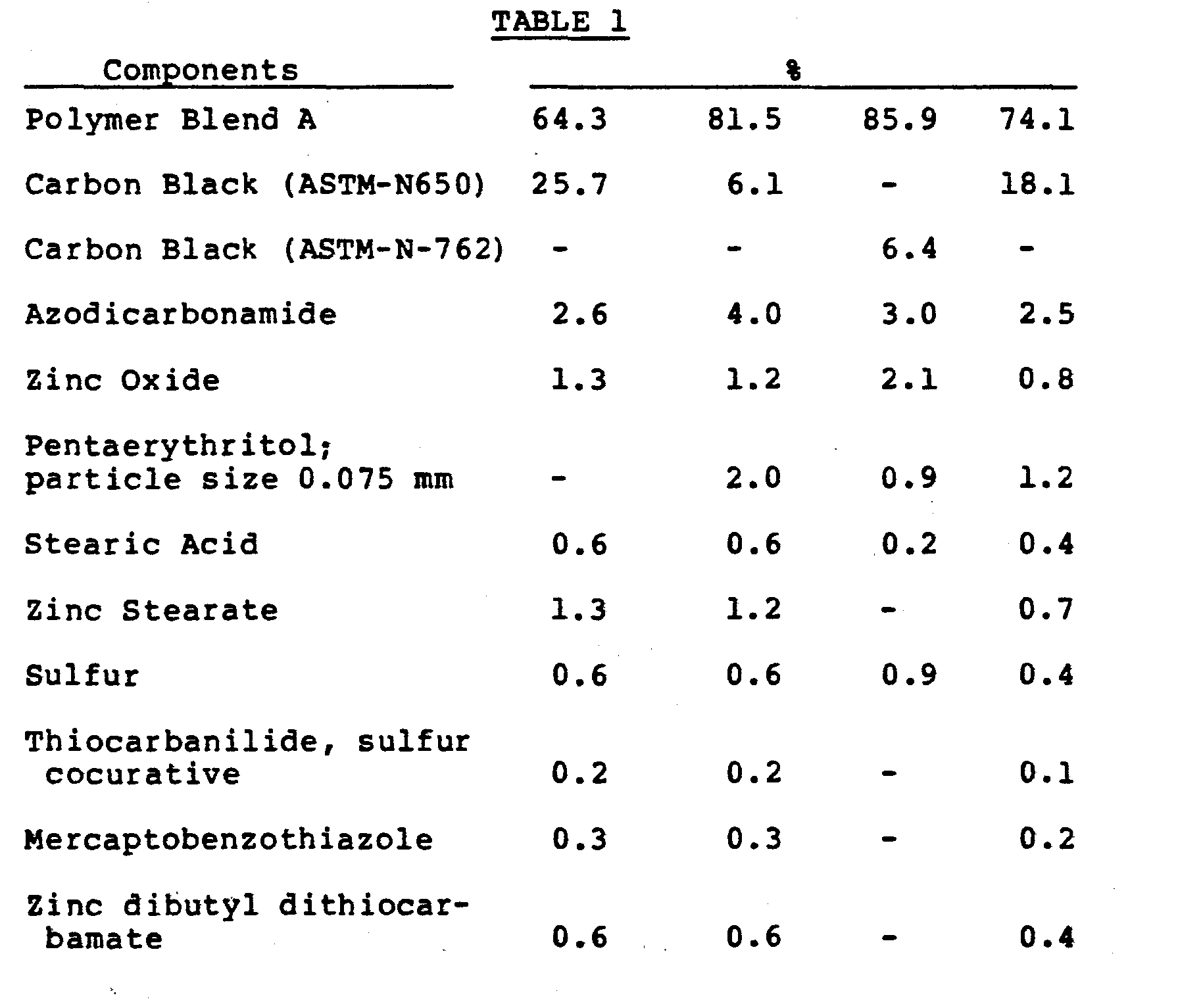
- Four foamable and curable compositions designated a, b, c, and d were prepared by intimately mixing all ingredients on a two-roll rubber mill operating at a temperature below the decomposition temperature of the chemical blowing agent, about 120°C. They were then foamed and cured in a press at 165°C and a force of 188,000 N.
- Compounding and curing information as well as the physical properties of the resulting foams are summarized in Table 1 below.

- The stabilized and plasticized polymer blend used in this example was prepared in the manner described in Example 1 from the following components and is referred to as polymer blend B.

- The composition was prepared in two stages using a two-roll rubber mill. The ingredients of part I of the formulation shown in Table 2, below, were blended at a temperature of 150°C. The mill was then allowed to cool to 110°C and the ingredients of part II of the formulation shown in Table 2 were blended in at that temperature. The curing conditions and physical properties of foams resulting from these compositions also are shown in Table 2.


- This example illustrates the preparation of a filled, sulfur-cured, low density, closed cell foam by extrusion and continuous oven cure.
- The stabilized polymer blend used in this example had the following composition:

- All of the ingredients in Blend C, except the E/VA/CO terpolymer, were first blended in a high speed mixer (Welex) in 3000 g batches. The dry blend was then placed in a lined drum along with the terpolymer, and the blend was tumble-blended on a drum tumbler. The resulting blend was melt-extruded using a 28 mm single screw extruder operated at 220 rpm with the barrel temperature set at 180-200°C and the die temperature at about 220-230°C. Polymer C was further compounded as follows:
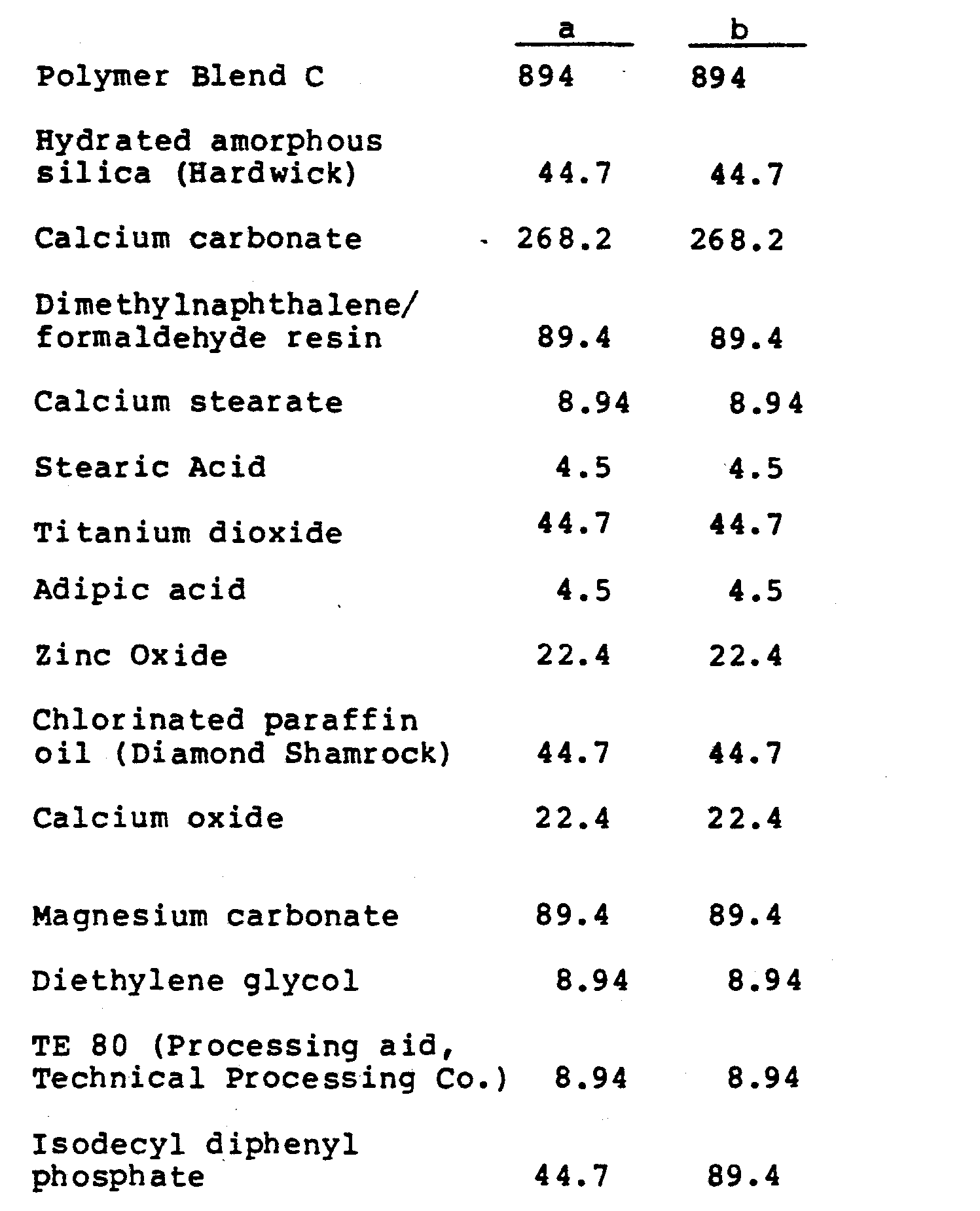
- Polymer Blend C, in pelletized form, was charged to a Banbury mixer and melted, whereupon the other ingredients listed above were added, and mixing was continued at 165°C for 10 minutes. Each blend was then discharged and rolled into a sheet on a roll mill. These materials are referred to as Banbury compounds.
- The Banbury compounds were blended with a blowing agent, a blowing agent accelerator, and sulfur curing agents on a roll mill set at 80°C.
- The milled compound was taken off the roll as sheets which were cut into strips and fed into a 3.75 cm Royale single screw extruder equipped with a vacuum screw with an L/D ratio of 15 and a streamlined 1.25 cm diameter circular hole die and extruded at a melt temperature of about 100°C. The smooth extruded rod was cured in a tunnel with two heating zones, 140°C and 154°C, with a residence time of 8 minutes in each zone. A soft foam with a smooth outer skin and having a density of 0.16 gm/cm3 was obtained.
- The formulations shown here exhibit greatly improved ozone resistance over nitrile rubber/PVC foams:
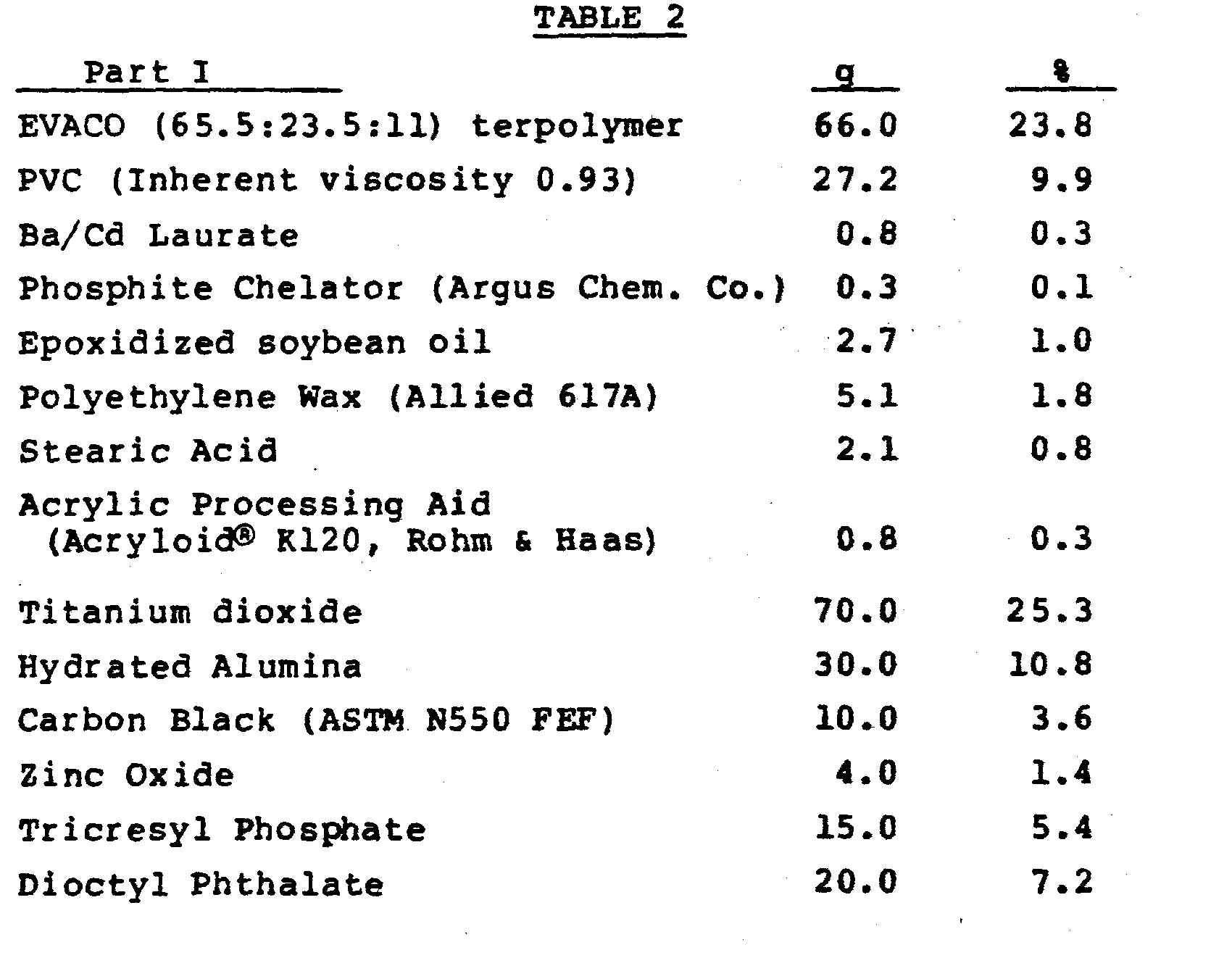

- PVC, stabilizers, and processing aids (Ba/Cd laurate through Acryloid® K120 in Table 2) were combined in a high intensity mixer (Welex); then the other ingredients of Part I were combined in a Banbury mixer at 180°C for 10-15 minutes.
- On a roll mill, Part I and Part II were combined at a maximum temperature of about 120°C.
- Foams were made by compression molding at 165°C for 3-5 minutes followed by an oven cure of 9-10 minutes at 170°C.
- Samples of a commercial nitrile rubber-PVC foam were compared with the above E/VA/CO-PVC foam in a static ozone exposure test. Ozone concentration was 3 ppm at 37.8°C. Samples 2.5 cm wide, 1.25 cm thick, and 15 cm long were attached at one end and bent over a 5 cm mandrel; a weight was affixed to the free end. Samples were observed after exposure to the ozone, and both failure and failure time were recorded. Samples were checked daily except on weekends. Therefore, a time range is recorded for time to break.

- The following blends were prepared

- Part I ingredients were blended in a Banbury internal mixer for 10 min. at 160°C. Ingredients of Part II were blended with the Part I blend on a two-roll rubber mill at 50°C.
- The above composition was fed to a single screw extruder operating at 88°C, exiting through a ribbon die into a 6-meter air-heated tunnel with an air temperature of 175°C. The rate of feed was controlled so that the total residence time in the tunnel was 7.5 min. The resulting closed-cell foam had a density of 0.39 g/cm 3.
said process comprising: (A) uniformly dispersing in said polymer blend an effective amount of a blowing agent and at least one curing agent selected from
Claims (19)
said process comprising:
Applications Claiming Priority (2)
| Application Number | Priority Date | Filing Date | Title |
|---|---|---|---|
| US06/692,634 US4540719A (en) | 1985-01-18 | 1985-01-18 | Process for making foamed, sulfur-cured polymer blend compositions |
| US692634 | 1985-01-18 |
Publications (2)
| Publication Number | Publication Date |
|---|---|
| EP0189286A2 true EP0189286A2 (en) | 1986-07-30 |
| EP0189286A3 EP0189286A3 (en) | 1988-01-27 |
Family
ID=24781390
Family Applications (1)
| Application Number | Title | Priority Date | Filing Date |
|---|---|---|---|
| EP86300302A Withdrawn EP0189286A3 (en) | 1985-01-18 | 1986-01-17 | Process for making foamed, sulfur-cured polymer blend compositions |
Country Status (7)
| Country | Link |
|---|---|
| US (1) | US4540719A (en) |
| EP (1) | EP0189286A3 (en) |
| JP (1) | JPS61190532A (en) |
| CN (1) | CN86100270A (en) |
| BR (1) | BR8600122A (en) |
| CA (1) | CA1230449A (en) |
| ZA (1) | ZA86369B (en) |
Families Citing this family (3)
| Publication number | Priority date | Publication date | Assignee | Title |
|---|---|---|---|---|
| JPH11286549A (en) * | 1998-02-05 | 1999-10-19 | Canon Inc | Photosensitive resin, resist using the photosensitive resin, exposure apparatus and exposure method using the resist, and semiconductor device obtained by the exposure method |
| JP2001106785A (en) * | 1999-08-05 | 2001-04-17 | Canon Inc | Photosensitive resin, resist composition using the photosensitive resin, pattern forming method using the resist composition, device manufactured by the pattern forming method, and exposure method using a resist having the photosensitive resin |
| PL219515B1 (en) * | 2010-05-10 | 2015-05-29 | Termo Organika Spółka Z Ograniczoną Odpowiedzialnością | Agent for modifying foaming and foamed plastics and modified foaming and foamed plastics |
Family Cites Families (7)
| Publication number | Priority date | Publication date | Assignee | Title |
|---|---|---|---|---|
| US4172939A (en) * | 1978-08-29 | 1979-10-30 | E. I. Du Pont De Nemours And Company | Vulcanizable ethylene/vinyl acetate/carbon monoxide terpolymers |
| US4370423A (en) * | 1981-09-18 | 1983-01-25 | Bata Limited | Fast-curing foamable composition based on ethylene terpolymers |
| US4394459A (en) * | 1981-09-18 | 1983-07-19 | E. I. Du Pont De Nemours & Co. | Fast-curing foamable composition based on ethylene terpolymers |
| US4391922A (en) * | 1982-05-06 | 1983-07-05 | E. I. Du Pont De Nemours And Company | Blowing agents as curatives for ethylene/carbon monoxide copolymers |
| US4434253A (en) * | 1982-09-27 | 1984-02-28 | E. I. Du Pont De Nemours And Company | Low density closed-cell foamed articles from ethylene copolymer/vinyl or vinylidene halide blends |
| US4391923A (en) * | 1982-09-27 | 1983-07-05 | E. I. Du Pont De Nemours & Co. | Low density closed-cell foamed articles from ethylene copolymer/vinyl or vinylidene halide blends |
| US4480054A (en) * | 1983-07-15 | 1984-10-30 | E. I Du Pont De Nemours And Company | Foamable polymer blend compositions |
-
1985
- 1985-01-18 US US06/692,634 patent/US4540719A/en not_active Expired - Lifetime
- 1985-06-27 CA CA000485663A patent/CA1230449A/en not_active Expired
-
1986
- 1986-01-14 BR BR8600122A patent/BR8600122A/en unknown
- 1986-01-16 JP JP61005157A patent/JPS61190532A/en active Pending
- 1986-01-17 EP EP86300302A patent/EP0189286A3/en not_active Withdrawn
- 1986-01-17 ZA ZA86369A patent/ZA86369B/en unknown
- 1986-01-18 CN CN198686100270A patent/CN86100270A/en active Pending
Also Published As
| Publication number | Publication date |
|---|---|
| BR8600122A (en) | 1986-09-23 |
| EP0189286A3 (en) | 1988-01-27 |
| CA1230449A (en) | 1987-12-15 |
| ZA86369B (en) | 1987-09-30 |
| CN86100270A (en) | 1986-08-27 |
| JPS61190532A (en) | 1986-08-25 |
| US4540719A (en) | 1985-09-10 |
Similar Documents
| Publication | Publication Date | Title |
|---|---|---|
| JP2515155B2 (en) | Thermoplastic elastomer composition | |
| US4391923A (en) | Low density closed-cell foamed articles from ethylene copolymer/vinyl or vinylidene halide blends | |
| WO2020059916A1 (en) | Resin composition containing composite blowing agent with improved whiteness | |
| WO2020059917A1 (en) | Resin composition with improved shrinkage comprising mixed blowing agent | |
| EP1427774B1 (en) | Masterbatch comprising rubber compounds, fillers, plasticizers and curatives | |
| US4540719A (en) | Process for making foamed, sulfur-cured polymer blend compositions | |
| US3461087A (en) | Method of making a foamable polymer and foamable composition obtained therefrom | |
| US4454250A (en) | Low density cellular polyvinyl chloride | |
| CA1206700A (en) | Low density cellular polyvinyl chloride | |
| US4555528A (en) | Process for making foamed, sulfur-cured polymer blend compositions | |
| JP3095355B2 (en) | Foaming composition and foam | |
| CA1053826A (en) | Nitrile-pvc blends | |
| EP0004175A1 (en) | Smoke retarded polymers and method for preparing them | |
| JPS6236058B2 (en) | ||
| JPS63125535A (en) | Extrusion-foamable flexible vinyl chloride resin composition | |
| JP2805681B2 (en) | Thermoplastic elastomer composition | |
| JPH07330935A (en) | Crystalline polyolefin foam | |
| JPH0774286B2 (en) | Flexible vinyl chloride foamed molded product with small permanent set | |
| JP2675240B2 (en) | Rigid polyvinyl chloride foam material | |
| JPS63139927A (en) | Extrusion-foamable flexible vinyl chloride resin composition | |
| JPS61276835A (en) | Production of crosslinked soft polyvinyl chloride foam | |
| JPS63125536A (en) | Foamed flexible vinyl chloride molding and its production | |
| JP2003012845A (en) | Foamed vinyl chloride resin molding | |
| JPH07107106B2 (en) | Flexible vinyl chloride foamed molded product with small permanent set | |
| JPS63139928A (en) | Flexible vinyl chloride resin foam and its production |
Legal Events
| Date | Code | Title | Description |
|---|---|---|---|
| PUAI | Public reference made under article 153(3) epc to a published international application that has entered the european phase |
Free format text: ORIGINAL CODE: 0009012 |
|
| AK | Designated contracting states |
Kind code of ref document: A2 Designated state(s): DE FR GB IT NL |
|
| PUAL | Search report despatched |
Free format text: ORIGINAL CODE: 0009013 |
|
| AK | Designated contracting states |
Kind code of ref document: A3 Designated state(s): DE FR GB IT NL |
|
| 17P | Request for examination filed |
Effective date: 19880304 |
|
| STAA | Information on the status of an ep patent application or granted ep patent |
Free format text: STATUS: THE APPLICATION HAS BEEN WITHDRAWN |
|
| 18W | Application withdrawn |
Withdrawal date: 19881209 |
|
| RIN1 | Information on inventor provided before grant (corrected) |
Inventor name: LOOMIS, GARY LEE |