EP0186121B1 - Tragbarer Behälter für gefährlichen Abfall - Google Patents
Tragbarer Behälter für gefährlichen Abfall Download PDFInfo
- Publication number
- EP0186121B1 EP0186121B1 EP85116171A EP85116171A EP0186121B1 EP 0186121 B1 EP0186121 B1 EP 0186121B1 EP 85116171 A EP85116171 A EP 85116171A EP 85116171 A EP85116171 A EP 85116171A EP 0186121 B1 EP0186121 B1 EP 0186121B1
- Authority
- EP
- European Patent Office
- Prior art keywords
- container
- base
- waste
- hazardous waste
- walls
- Prior art date
- Legal status (The legal status is an assumption and is not a legal conclusion. Google has not performed a legal analysis and makes no representation as to the accuracy of the status listed.)
- Expired - Lifetime
Links
- 239000002920 hazardous waste Substances 0.000 title claims abstract description 26
- XLYOFNOQVPJJNP-UHFFFAOYSA-N water Substances O XLYOFNOQVPJJNP-UHFFFAOYSA-N 0.000 claims description 17
- 229920000642 polymer Polymers 0.000 claims description 5
- -1 polyethylene Polymers 0.000 claims description 3
- 239000004698 Polyethylene Substances 0.000 claims description 2
- 229920000573 polyethylene Polymers 0.000 claims description 2
- 239000002699 waste material Substances 0.000 abstract description 40
- 238000000034 method Methods 0.000 abstract description 9
- 239000007788 liquid Substances 0.000 abstract description 8
- 239000000463 material Substances 0.000 abstract description 3
- 230000008569 process Effects 0.000 abstract description 3
- 230000001105 regulatory effect Effects 0.000 abstract description 3
- 230000005484 gravity Effects 0.000 abstract description 2
- 238000007789 sealing Methods 0.000 abstract 1
- 239000004927 clay Substances 0.000 description 8
- 230000008901 benefit Effects 0.000 description 5
- 239000003673 groundwater Substances 0.000 description 5
- 239000002689 soil Substances 0.000 description 4
- 239000000523 sample Substances 0.000 description 3
- 239000000126 substance Substances 0.000 description 3
- 241000196324 Embryophyta Species 0.000 description 2
- 230000007797 corrosion Effects 0.000 description 2
- 238000005260 corrosion Methods 0.000 description 2
- 239000000383 hazardous chemical Substances 0.000 description 2
- 238000007373 indentation Methods 0.000 description 2
- 238000012986 modification Methods 0.000 description 2
- 230000004048 modification Effects 0.000 description 2
- 238000012544 monitoring process Methods 0.000 description 2
- 239000007787 solid Substances 0.000 description 2
- 244000025254 Cannabis sativa Species 0.000 description 1
- 206010007269 Carcinogenicity Diseases 0.000 description 1
- 235000008733 Citrus aurantifolia Nutrition 0.000 description 1
- 239000005062 Polybutadiene Substances 0.000 description 1
- 235000011941 Tilia x europaea Nutrition 0.000 description 1
- 238000003915 air pollution Methods 0.000 description 1
- 239000004067 bulking agent Substances 0.000 description 1
- 239000006227 byproduct Substances 0.000 description 1
- 230000007670 carcinogenicity Effects 0.000 description 1
- 231100000260 carcinogenicity Toxicity 0.000 description 1
- 239000012611 container material Substances 0.000 description 1
- 230000006378 damage Effects 0.000 description 1
- 238000001514 detection method Methods 0.000 description 1
- 239000000428 dust Substances 0.000 description 1
- 230000003628 erosive effect Effects 0.000 description 1
- 239000010881 fly ash Substances 0.000 description 1
- 230000036541 health Effects 0.000 description 1
- 238000010438 heat treatment Methods 0.000 description 1
- 230000000887 hydrating effect Effects 0.000 description 1
- 230000006872 improvement Effects 0.000 description 1
- 238000002386 leaching Methods 0.000 description 1
- 239000004571 lime Substances 0.000 description 1
- 238000004519 manufacturing process Methods 0.000 description 1
- 239000002184 metal Substances 0.000 description 1
- 239000002245 particle Substances 0.000 description 1
- 229920002857 polybutadiene Polymers 0.000 description 1
- 229920001748 polybutylene Polymers 0.000 description 1
- 239000000047 product Substances 0.000 description 1
- 230000008439 repair process Effects 0.000 description 1
- 230000000284 resting effect Effects 0.000 description 1
- 238000005070 sampling Methods 0.000 description 1
- 230000001988 toxicity Effects 0.000 description 1
- 231100000419 toxicity Toxicity 0.000 description 1
- 238000003911 water pollution Methods 0.000 description 1
Images
Classifications
-
- B—PERFORMING OPERATIONS; TRANSPORTING
- B65—CONVEYING; PACKING; STORING; HANDLING THIN OR FILAMENTARY MATERIAL
- B65F—GATHERING OR REMOVAL OF DOMESTIC OR LIKE REFUSE
- B65F1/00—Refuse receptacles; Accessories therefor
- B65F1/02—Refuse receptacles; Accessories therefor without removable inserts
-
- Y—GENERAL TAGGING OF NEW TECHNOLOGICAL DEVELOPMENTS; GENERAL TAGGING OF CROSS-SECTIONAL TECHNOLOGIES SPANNING OVER SEVERAL SECTIONS OF THE IPC; TECHNICAL SUBJECTS COVERED BY FORMER USPC CROSS-REFERENCE ART COLLECTIONS [XRACs] AND DIGESTS
- Y10—TECHNICAL SUBJECTS COVERED BY FORMER USPC
- Y10S—TECHNICAL SUBJECTS COVERED BY FORMER USPC CROSS-REFERENCE ART COLLECTIONS [XRACs] AND DIGESTS
- Y10S588/00—Hazardous or toxic waste destruction or containment
- Y10S588/90—Apparatus
Definitions
- the present invention concerns the handling and disposal of hazardous wastes and, more specifically, containers in which such wastes can be transported and stored.
- Hazardous wastes are substances which are usually unwanted byproducts of industrial processes, and are a present or potential danger to the health of humans or other living organisms because they exhibit undesirable properties such as toxicity, carcinogenicity, non-degradability, biological magnification, or the like. Under present technology, a wide variety of useful products cannot be manufactured without also producing some hazardous wastes. It is not presently possible to recycle all of the wastes, so safe means of disposal must be found.
- wastes from contaminating the ground water supply is a major concern.
- this problem is often addressed by excavating the landfill pit in soil that is naturally rich in clay, a substance which is relatively impermeable to water, and then adding an additional layer of compacted clay on top of the excavated surface.
- a layer of gravel is often placed on top of the compacted clay.
- Government regulations sometimes require an additional artificial lining layer on top of the compacted clay and gravel.
- Wastes to be buried in the landfill are usually solidified, if they are originally liquid, by adding a bulking agent such as kiln dust, fly ash, or lime (all of which have hydrating characteristics).
- the solidified waste is then dumped in the bottom of the landfill, and covered with a material that will help seal the waste from the elements, thus forming a waste "cell". This process is repeated each day so the landfill gradually fills up with cells of covered waste, each covered with an individual clay cap when full.
- a final cover which might be a two foot thick layer of clay, is placed over the top. Grass might be planted on top to help control erosion.
- the success of the clay and artificial liners in preventing leaching of the wastes from the landfill into the surrounding ground water must be monitored.
- One way of doing so is to build a sump at the bottom of the gravel layer.
- a pipe or tube can be used to connect this sump to the surface, so the nature of the liquid in the sump can be tested periodically.
- Another way is to drill water sampling wells at several points around the landfill. If hazardous substances can be detected in the water taken from these wells, the wastes may be leaking from the landfill.
- landfills or pits are located adjacent to or within the confines of plants that generate hazardous wastes. However, many disposal areas are at remote locations, so the waste must be transported from the point of generation to the point of disposal. The dangers of exposure to the waste require that strict precautions be taken when it is shipped. For example, the container in which it is shipped must be strong enough to prevent leakage. If the waste containers are to be shipped on the highways, they should be able to withstand the stress exerted by a collision between the truck which is carrying them and another vehicle.
- the present invention is an improvement in hazardous waste technology which can help solve some of the problems of both transportation and disposal, and can give the public greater confidence in the safety of those operations.
- a portable hazardous waste container comprises:
- a portable hazardous waste container which comprises a rectangular base, four walls integrally connected to each other and to the base, a lid fitting into the upper opening defined by the walls, and a plurality of hollow linear tubes located on the upper surface of the base and each having a plurality of holes in its surface.
- the container consists of sheet metal.
- the base and the tubes on the upper surface of the base are not sloped downward from one end to the opposite end. No means for detecting water in the tubes are provided.
- DE-B2-2 854 863 shows a container for not-indicated items or substances, which consists of a resinous polymer.
- a portable hazardous waste container in accordance with the present invention includes a plurality of members that define an enclosed volume, the members being substantially impermeable to water, corrosion resistant, and having structural strength sufficient to withstand being filled with waste, lifted, transported, and stacked in a landfill.
- Members is meant to include walls, tops, bottoms, and the like.
- Such a container can be used both to store and to transport waste. For example, in the cleanup of an existing dump where the waste is in rusted barrels, the waste can be transferred from the barrels to containers in accordance with the present invention. And if the waste has contaminated the soil, thereby potentially threatening or actually polluting the ground water, the contaminated soil can be excavated and placed within the containers. If the site is otherwise acceptable, the waste can safely be stored there in the containers until adequate disposal facilities can be permitted and constructed or new technology is developed that will allow reclamation or destruction of the hazardous materials.
- Containers in accordance with the present invention should be useful in aboveground storage facilities as well as in below ground landfills.
- the present invention has significant advantages over previously used hazardous waste technology in terms of simplicity, suitability for multiple uses, and ability to increase public confidence in hazardous waste handling.
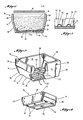
- Figure 1 is a cross-sectional view of a portable hazardous waste container in accordance with the present invention viewed from the side.
- FIG. 2 is a cross-sectional view of the tubes designated by reference numeral 22 in Figures 1 and 3.
- Figure 3 is a perspective cut-away view of a container in accordance with the present invention.
- Figure 4 is a perspective view from below of a container in accordance with the present invention.
- Portable hazardous waste containers in accordance with the present invention can take many forms.
- One suitable form has a rectangular top and bottom and four walls connecting them.
- the dimensions of such a container would depend upon the density of the waste and on the applicable weight and width regulations for transportation. For example, if the waste is to be transported by truck and is contaminated soil which has a density of 2,500 pounds per cubic yard, U. S. highway weight and width regulations may make it appropriate for the container to have a volume of about 15 to 20 cubic yards. A container 13 feet long, 8 feet wide, and 4 feet tall would fall within this range.
- FIG. 1 shows a portable hazardous waste container in accordance with the present invention in cross-section from the side.
- the container 10 has a base 12, walls 14, and a lid 16.
- the base 12 and walls 14 form an integral unit.
- the size of the lid 16 permits it to slide into the opening defined by the walls 14, forming a sealed unit.
- the base 12 is preferably not of uniform thickness, but instead has a horizontal bottom surface 18 and an upper surface 20 which has a greater elevation at one end than at the other.
- the purpose of this sloping of the upper surface 20 of the base 12 is to cause any liquids which enter the container 10 to flow by gravity toward the lowest end. Causing liquids to collect in this way will aid in detecting them, and thus will aid in detecting leaks in the container.
- One useful way of preventing leakage of the waste out of the container into the surrounding ground water supply is to monitor leakage of water into the container. This can be done because the waste in the container is always solidified before burying, according to government regulations, so no water should be present inside the container. Thus, if leakage of the waste out of the container is to occur, first some liquid must get into the container to act as a carrier for the leakage. Therefore, monitoring the lowest point of the container for the presence of water is a valuable way of preventing pollution of surrounding ground water supplies if the container should develop a leak.
- the tubes 22 can have located on the upper surface 20 of its base 12 a series of hollow tubes 22.
- the tubes 22 preferably extend linearly from the end of the base 12 with the highest elevation to the end with the lowest elevation.
- Figure 3 shows that there can be a plurality of these tubes 22 parallel to each other.
- the tubes have a plurality of holes 24 in them.
- the holes 24 should be sized so that solid particles of earth and the like will not fit through them.
- the tubes 22 can suitably have a semi-circular cross-section.
- the tubes 22 feed into a sump 26, shown in both Figure 1 and Figure 3. It is the sump 26 which is monitored for the presence of water, and this monitoring can be done in several ways.
- One way which is especially advantageous if a large number of the containers are to be stacked in a landfill is to have an electronic water sensing probe 27 in the sump 26.
- the probe for each container in a landfill can be electronically connected to a panel of warning lights in a central control room. If one or more containers develop a leak and water intrudes, the water will collect in the sumps of those containers and their specific warning lights will flash. This system permits the operator to know the specific containers that are leaking, and to focus repair efforts on them.
- the container shown there has walls 14 which each have an upper segment 28 and a lower segment 30.
- the upper segments 28 are perpendicular to the bottom surface 18 of the base 12. Therefore, if the base 12 is rectangular, there will be four walls 14. There will also be four upper segments 28, which will define a rectangular top opening.
- the four lower segments 30 each slope outwardly from the point where they join the base 12 to the point where they join the upper segments 28. Thus, if one took a horizontal cross-section of the container 10, it would be rectangular whether taken at the level of the upper segments 28 or that of the lower segments 30. In this embodiment, the area of the horizontal cross-section will be greater at the level of the upper segments 28 than at the lower segments 30.
- the purpose of having upper and lower segments 28 and 30 in the walls 14 is to adapt the container to different volumes of waste. If the container 10 is filled full with waste, the lid 16 can be slid into the opening defined by the upper segments 28 until it is flush with the top of those segments. Alternatively, if the waste is relatively dense and the container 10 cannot be filled all the way to the top because of highway weight limits or the like, the lid 16 can be slid down until it comes into contact with the waste, as shown by the dotted lines in Figure 1. Thus, no matter how full the container is filled, the lid 16 will be resting on the waste, which will give the lid added support.
- the container 10 can be sealed in a number of ways, depending upon the material from which it is made and other factors. If the container 10 is constructed of a resinous polymer such as polyethylene, it can be sealed by heating so that the lid 16 will melt into the upper segments 28. Other resinous polymers that might be useful are polybutylene and polybutadiene. Different container materials might be required depending on the properties of the waste to be enclosed.
- the full containers can be picked up by a crane.
- the overall thickness of the base will be greater at one end than the other.
- One way to minimize the weight increase caused by this thickness differential is shown in Figure 4.
- a plurality of tapering ribs 34 are located on the bottom of the base 12. The bottom surfaces of these ribs 34 are horizontal. At the end at which the elevation of the base's upper surface 20 (represented by a dotted line in Figure 3) is highest, the ribs will have a given height. The ribs 34 decrease in height towards the opposite end, tapering down to zero height at the opposite end. Thus, the space inbetween the ribs 34 will be open and accordingly will not unnecessarily contribute to the overall weight of the container 10.
- the ribs could also be spaced so as to enable the container to be carried conveniently on a roll-off truck.
- a truck has longitudinal rails on its bed, and a hydraulic system with an attached cable to pull a container onto the bed.
- the container usually has some type of rails on its bottom which fit against the rails on the bed, thereby preventing the container from moving from side to side.
- Properly spaced ribs on the bottom of a container in accordance with the present invention will fit against the rails on a roll-off truck, thereby allowing the container to be transported on such a truck.
- Containers in accordance with the present invention can be used in hazardous waste handling as follows. Waste, whether in a leaking container, a pit, or in a process stream being produced by a plant, is placed into the container. The lid is put in place and sealed. The sealed container can then be loaded onto a truck and transported to the site where it will be stored. (Alternatively, if the waste is merely being transferred from an unsatisfactory container, the new container can be placed exactly where the old one was.) The container is then unloaded and placed in the disposal site, whether above or below ground. The containers can be placed side by side and stacked on top of each other to make the most efficient use of space. If the containers include water sensing means, the means for each container can be connected to a separate warning light in a control center, to aid in the location of leaks, if they occur.
Landscapes
- Engineering & Computer Science (AREA)
- Mechanical Engineering (AREA)
- Processing Of Solid Wastes (AREA)
- Packages (AREA)
- Refuse Receptacles (AREA)
- Refuse Collection And Transfer (AREA)
Claims (4)
- Tragbarer Behälter (10) für gefährlichen Abfall, mit:einer rechteckigen Basis (12), deren obere Oberfläche (20) von ihrem einen Ende zu ihrem entgegengesetzten Ende schräg nach unten verläuft;vier Wänden (14), die einstückig miteinander und mit der Basis (12) verbunden sind, wobei jede Seite ein oberes Segment (28) und ein unteres Segment (30) beinhaltet und wobei die oberen Segmente (28) rechtwinklig zu der Basis (12) verlaufen und eine rechteckige obere Öffnung definieren und die unteren Segmente (30) bei ihrer Erstreckung nach oben von der Basis (12) weg schräg nach außen verlaufend ausgebildet sind;einem Deckel (16), der derart in die obere Öffnung paßt, daß sich ein dicht verschließbarer Behälter (10) bilden läßt;einem Sumpf (26), der sich an dem Ende der Basis (12) mit der geringsten Erhebung befindet;einer Mehrzahl hohler linearer Röhren (22), die sich auf der oberen Oberfläche (20) der Basis (12) befinden, wobei sich die Röhren (22) von dem Ende der Basis (12) mit der höchsten Erhebung zu dem Ende der Basis (12) mit der geringsten Erhebung erstrecken und wobei jede Röhre (22) in ihrer Oberfläche eine Mehrzahl von Löchern (24) besitzt und jede Röhre (22) in den Sumpf (26) mündet; und miteiner Einrichtung (27) zum Detektieren von Wasser in dem Sumpf (26).
- Tragbarer Behälter (10) für gefährlichen Abfall (10) nach Anspruch 1, gekennzeichnet durch eine Greifeinrichtung (32) außen an dem Behälter (10) zur Unterstützung beim Anheben desselben.
- Tragbarer Behälter (10) für gefährlichen Abfall nach Anspruch 1 oder 2, dadurch gekennzeichnet, daß die Basis (10), die Seiten (14) und der Deckel (16) aus einem Harzpolymer gebildet sind.
- Tragbarer Behälter (10) für gefährlichen Abfall nach Anspruch 3, dadurch gekennzeichnet, daß es sich bei dem Harzpolymer um Polyäthylen handelt.
Priority Applications (1)
| Application Number | Priority Date | Filing Date | Title |
|---|---|---|---|
| AT85116171T ATE61995T1 (de) | 1984-12-19 | 1985-12-18 | Tragbarer behaelter fuer gefaehrlichen abfall. |
Applications Claiming Priority (2)
| Application Number | Priority Date | Filing Date | Title |
|---|---|---|---|
| US06/683,597 US4650086A (en) | 1984-12-19 | 1984-12-19 | Portable hazardous waste container |
| US683597 | 2002-01-23 |
Publications (3)
| Publication Number | Publication Date |
|---|---|
| EP0186121A2 EP0186121A2 (de) | 1986-07-02 |
| EP0186121A3 EP0186121A3 (en) | 1988-06-08 |
| EP0186121B1 true EP0186121B1 (de) | 1991-03-27 |
Family
ID=24744714
Family Applications (1)
| Application Number | Title | Priority Date | Filing Date |
|---|---|---|---|
| EP85116171A Expired - Lifetime EP0186121B1 (de) | 1984-12-19 | 1985-12-18 | Tragbarer Behälter für gefährlichen Abfall |
Country Status (7)
| Country | Link |
|---|---|
| US (1) | US4650086A (de) |
| EP (1) | EP0186121B1 (de) |
| JP (1) | JPS61150901A (de) |
| AT (1) | ATE61995T1 (de) |
| CA (1) | CA1250751A (de) |
| DE (1) | DE3582319D1 (de) |
| MX (1) | MX164822B (de) |
Families Citing this family (21)
| Publication number | Priority date | Publication date | Assignee | Title |
|---|---|---|---|---|
| US4900500A (en) * | 1987-01-20 | 1990-02-13 | Isolyser Co., Inc. | Point-of-use infectious waste disposal system |
| US4816307A (en) * | 1987-01-20 | 1989-03-28 | Honeycutt Travis W | Novel infectious waste containment |
| US4983282A (en) * | 1988-12-12 | 1991-01-08 | Westinghouse Electric Corp. | Apparatus for removing liquid from a composition and for storing the deliquified composition |
| DE3939511A1 (de) * | 1989-06-05 | 1990-12-20 | Bartholomaeus Bitsch | Muellsammelgefaess mit entlueftungseinrichtung |
| US5227060A (en) * | 1989-11-16 | 1993-07-13 | Westinghouse Electric Corp. | Apparatus and method for removing liquid from a composition and for storing the deliquified composition |
| US5022995A (en) * | 1989-11-16 | 1991-06-11 | Westinghouse Electric Corp. | Apparatus and method for removing liquid from a composition and for storing the deliquified composition |
| US5002101A (en) * | 1990-01-05 | 1991-03-26 | Mcleod Andrew | Hose draining and recovery system |
| USD330427S (en) | 1990-04-19 | 1992-10-20 | Winfield Corporation | Combined disposable bag and disinfectant container for sterilizing infectious waste |
| US5471065A (en) * | 1994-01-27 | 1995-11-28 | Harrell; James L. | Macroencapsulation of hazardous waste |
| NL9400744A (nl) * | 1994-05-04 | 1995-12-01 | Gerard Den Breejen | Houder. |
| US5908133A (en) * | 1994-09-08 | 1999-06-01 | Ropak Corporation | Container incorporating liquid draining means, and related method |
| US5710362A (en) * | 1996-05-20 | 1998-01-20 | Duke University | Landfill liner for capturing certain leachate contaminants in the event of leakage |
| US6004070A (en) * | 1996-07-08 | 1999-12-21 | Van Camp; John W. | Waste storage containment cell, method of operating, and apparatus therefore |
| US5992632A (en) * | 1997-07-16 | 1999-11-30 | Karren; Glen | Portable reusable hazardous waste container system |
| US6010444A (en) * | 1997-09-05 | 2000-01-04 | Isolyser Company, Inc. | Infectious waste containment system |
| US6132356A (en) * | 1998-10-15 | 2000-10-17 | The United States Of America As Represented By The Secretary Of The Army | Portable system for vapor, aerosol or airborne hazard suppression of hazardous environmental spills |
| KR100441687B1 (ko) * | 2002-04-29 | 2004-07-27 | 한국원자력연구소 | 방사성 폐기물 저장용기 |
| US8999703B2 (en) * | 2008-05-05 | 2015-04-07 | Daniel P. Welch | Cell container |
| US8123939B2 (en) * | 2009-12-14 | 2012-02-28 | Institute Of Nuclear Energy Research | Collection can for precipitated powder substance and the use thereof |
| US11097891B1 (en) * | 2019-01-29 | 2021-08-24 | Michael T. Patak | Roll-off tub style container |
| CN116135127B (zh) * | 2021-11-17 | 2025-10-21 | 深圳银星智能集团股份有限公司 | 一体式水箱和基站 |
Family Cites Families (17)
| Publication number | Priority date | Publication date | Assignee | Title |
|---|---|---|---|---|
| US2603670A (en) * | 1949-12-02 | 1952-07-15 | Christopher F Pahler | Storage battery |
| US3466445A (en) * | 1967-10-06 | 1969-09-09 | Atomic Energy Commission | Container for radioactive fuel elements |
| US3534796A (en) * | 1967-10-13 | 1970-10-20 | Goodyear Tire & Rubber | Flexible container |
| US4107044A (en) * | 1976-08-25 | 1978-08-15 | Epicor, Inc. | Method of and apparatus for purifying fluids with radioactive impurities |
| US4082390A (en) * | 1976-12-22 | 1978-04-04 | C. H. Stuart Inc. | Convertible tray cabinet |
| US4166536A (en) * | 1977-03-16 | 1979-09-04 | The Carborundum Company | Corrosive chemical containment system |
| US4108609A (en) * | 1977-08-04 | 1978-08-22 | Petzinger Manfred Wilhelm Augu | Compost container |
| DE2737237A1 (de) * | 1977-08-18 | 1979-03-01 | Panick Fa Johann | Stapelbarer behaelter |
| DE2741661C2 (de) * | 1977-09-16 | 1986-12-11 | Gesellschaft für Strahlen- und Umweltforschung mbH, 8000 München | Verfahren zur Umkleidung von Abfallfässern mit einer auslaugsicheren, geschlossenen Hülle |
| FR2412468A1 (fr) * | 1977-12-20 | 1979-07-20 | Allibert Exploitation | Bac gerbable-emboitable |
| US4156147A (en) * | 1977-12-30 | 1979-05-22 | The Carborundum Company | Neutron absorbing article |
| US4213883A (en) * | 1977-12-30 | 1980-07-22 | The Carborundum Company | Method for manufacture of neutron absorbing articles |
| US4218622A (en) * | 1978-01-17 | 1980-08-19 | The Carborundum Company | Neutron absorbing article and method for manufacture thereof |
| DE2940415C2 (de) * | 1979-10-05 | 1982-07-22 | Georg Ing.(grad.) 8081 Türkenfeld Klaß | Wannenförmiger Transportbehälter |
| US4362434A (en) * | 1980-10-28 | 1982-12-07 | Stabatrol Corporation | Permanent disposal vault for hazardous chemical waste materials |
| US4422964A (en) * | 1981-11-30 | 1983-12-27 | Capolupo & Gundal, Inc. | Radioactive waste container with immobilization compartment and method |
| US4464081A (en) * | 1983-06-29 | 1984-08-07 | Rollins Environmental Services, Inc. | Process and structure for storing and isolating hazardous waste |
-
1984
- 1984-12-19 US US06/683,597 patent/US4650086A/en not_active Expired - Fee Related
-
1985
- 1985-12-10 CA CA000497283A patent/CA1250751A/en not_active Expired
- 1985-12-18 DE DE8585116171T patent/DE3582319D1/de not_active Expired - Lifetime
- 1985-12-18 MX MX1011A patent/MX164822B/es unknown
- 1985-12-18 EP EP85116171A patent/EP0186121B1/de not_active Expired - Lifetime
- 1985-12-18 JP JP60286827A patent/JPS61150901A/ja active Pending
- 1985-12-18 AT AT85116171T patent/ATE61995T1/de not_active IP Right Cessation
Also Published As
| Publication number | Publication date |
|---|---|
| EP0186121A3 (en) | 1988-06-08 |
| EP0186121A2 (de) | 1986-07-02 |
| ATE61995T1 (de) | 1991-04-15 |
| JPS61150901A (ja) | 1986-07-09 |
| DE3582319D1 (de) | 1991-05-02 |
| CA1250751A (en) | 1989-03-07 |
| MX164822B (es) | 1992-09-28 |
| US4650086A (en) | 1987-03-17 |
Similar Documents
| Publication | Publication Date | Title |
|---|---|---|
| EP0186121B1 (de) | Tragbarer Behälter für gefährlichen Abfall | |
| US5201609A (en) | Cellular landfill process and apparatus | |
| EP0130773B1 (de) | Vorrichtung und Verfahren zum Halten von gefährlichen Abfällen | |
| US4352601A (en) | Permanent bin for temporary storage of hazardous materials | |
| US5992632A (en) | Portable reusable hazardous waste container system | |
| US6860680B2 (en) | Waste containment and processing facilities formed contemporaneously with the disposal of mineral refuse, and related methods | |
| EP0167404A2 (de) | Einrichtung zur Konditionierung von nuklearen Abfallstoffen | |
| US4513205A (en) | Inner and outer waste storage vaults with leak-testing accessibility | |
| CA2666435C (en) | A method and system for cuttings disposal on a cuttings pad | |
| WO2009094738A2 (en) | System for final disposal of waste by compaction and bagging | |
| CA1290947C (en) | Waste disposal system | |
| US6004070A (en) | Waste storage containment cell, method of operating, and apparatus therefore | |
| US4415459A (en) | Waste disposal systems and methods | |
| US5244311A (en) | Method for increasing the capacity of an active landfill | |
| CZ178398A3 (cs) | Zařízení na odplynování skládky | |
| CN116658215A (zh) | 一种贯穿式危废填埋岩洞及其施工和填埋方法 | |
| EP0168219A2 (de) | Module zur Konditionierung von nuklearen Abfallstoffen | |
| US5059066A (en) | System and method for disposal of waste | |
| WO2001036120A1 (en) | Waste storage containment cell method of operating and apparatus therefore | |
| Slimak | Landfill disposal systems | |
| Stegmann | Sanitary landfilling in the Federal Republic of Germany | |
| AU723852B2 (en) | Bund for storage facilities | |
| EP0647482B1 (de) | Verfahren zur Bearbeitung von festen Abfällen durch Kompaktierung und Verpacken | |
| Bogatsu | TOWARDS EFFECTIVE WASTE DISPOSAL IN DEVELOPING | |
| Pizzuto et al. | The land and hazardous waste management |
Legal Events
| Date | Code | Title | Description |
|---|---|---|---|
| PUAI | Public reference made under article 153(3) epc to a published international application that has entered the european phase |
Free format text: ORIGINAL CODE: 0009012 |
|
| AK | Designated contracting states |
Kind code of ref document: A2 Designated state(s): AT BE CH DE FR GB IT LI LU NL SE |
|
| PUAL | Search report despatched |
Free format text: ORIGINAL CODE: 0009013 |
|
| AK | Designated contracting states |
Kind code of ref document: A3 Designated state(s): AT BE CH DE FR GB IT LI LU NL SE |
|
| 17P | Request for examination filed |
Effective date: 19881115 |
|
| 17Q | First examination report despatched |
Effective date: 19890421 |
|
| GRAA | (expected) grant |
Free format text: ORIGINAL CODE: 0009210 |
|
| AK | Designated contracting states |
Kind code of ref document: B1 Designated state(s): AT BE CH DE FR GB IT LI LU NL SE |
|
| PG25 | Lapsed in a contracting state [announced via postgrant information from national office to epo] |
Ref country code: SE Effective date: 19910327 Ref country code: NL Effective date: 19910327 Ref country code: LI Effective date: 19910327 Ref country code: IT Free format text: LAPSE BECAUSE OF FAILURE TO SUBMIT A TRANSLATION OF THE DESCRIPTION OR TO PAY THE FEE WITHIN THE PRESCRIBED TIME-LIMIT;WARNING: LAPSES OF ITALIAN PATENTS WITH EFFECTIVE DATE BEFORE 2007 MAY HAVE OCCURRED AT ANY TIME BEFORE 2007. THE CORRECT EFFECTIVE DATE MAY BE DIFFERENT FROM THE ONE RECORDED. Effective date: 19910327 Ref country code: CH Effective date: 19910327 Ref country code: BE Effective date: 19910327 Ref country code: AT Effective date: 19910327 |
|
| REF | Corresponds to: |
Ref document number: 61995 Country of ref document: AT Date of ref document: 19910415 Kind code of ref document: T |
|
| REF | Corresponds to: |
Ref document number: 3582319 Country of ref document: DE Date of ref document: 19910502 |
|
| REG | Reference to a national code |
Ref country code: CH Ref legal event code: PL |
|
| EN | Fr: translation not filed | ||
| PG25 | Lapsed in a contracting state [announced via postgrant information from national office to epo] |
Ref country code: FR Effective date: 19910816 |
|
| NLV1 | Nl: lapsed or annulled due to failure to fulfill the requirements of art. 29p and 29m of the patents act | ||
| PG25 | Lapsed in a contracting state [announced via postgrant information from national office to epo] |
Ref country code: LU Free format text: LAPSE BECAUSE OF NON-PAYMENT OF DUE FEES Effective date: 19911231 |
|
| PLBE | No opposition filed within time limit |
Free format text: ORIGINAL CODE: 0009261 |
|
| STAA | Information on the status of an ep patent application or granted ep patent |
Free format text: STATUS: NO OPPOSITION FILED WITHIN TIME LIMIT |
|
| 26N | No opposition filed | ||
| PG25 | Lapsed in a contracting state [announced via postgrant information from national office to epo] |
Ref country code: DE Effective date: 19920901 |
|
| REG | Reference to a national code |
Ref country code: FR Ref legal event code: ST |
|
| PGFP | Annual fee paid to national office [announced via postgrant information from national office to epo] |
Ref country code: GB Payment date: 19921204 Year of fee payment: 8 |
|
| PG25 | Lapsed in a contracting state [announced via postgrant information from national office to epo] |
Ref country code: GB Effective date: 19931218 |
|
| GBPC | Gb: european patent ceased through non-payment of renewal fee |
Effective date: 19931218 |