EP0184792B1 - Apparatus for recording and reproducing images produced by an electron microscope - Google Patents
Apparatus for recording and reproducing images produced by an electron microscope Download PDFInfo
- Publication number
- EP0184792B1 EP0184792B1 EP85115557A EP85115557A EP0184792B1 EP 0184792 B1 EP0184792 B1 EP 0184792B1 EP 85115557 A EP85115557 A EP 85115557A EP 85115557 A EP85115557 A EP 85115557A EP 0184792 B1 EP0184792 B1 EP 0184792B1
- Authority
- EP
- European Patent Office
- Prior art keywords
- image sensor
- dimensional image
- electron beam
- image
- light
- Prior art date
- Legal status (The legal status is an assumption and is not a legal conclusion. Google has not performed a legal analysis and makes no representation as to the accuracy of the status listed.)
- Expired
Links
- OAICVXFJPJFONN-UHFFFAOYSA-N Phosphorus Chemical compound [P] OAICVXFJPJFONN-UHFFFAOYSA-N 0.000 claims description 123
- 238000010894 electron beam technology Methods 0.000 claims description 74
- 230000004936 stimulating effect Effects 0.000 claims description 51
- 238000001000 micrograph Methods 0.000 claims description 22
- 230000015572 biosynthetic process Effects 0.000 claims description 14
- 230000003287 optical effect Effects 0.000 claims description 14
- 238000005520 cutting process Methods 0.000 claims description 5
- 230000005540 biological transmission Effects 0.000 description 19
- 239000000203 mixture Substances 0.000 description 16
- 229910052794 bromium Inorganic materials 0.000 description 15
- 229910052801 chlorine Inorganic materials 0.000 description 15
- 239000000460 chlorine Substances 0.000 description 15
- 229910052740 iodine Inorganic materials 0.000 description 13
- 239000011575 calcium Substances 0.000 description 10
- 229910052791 calcium Inorganic materials 0.000 description 9
- 230000005855 radiation Effects 0.000 description 9
- 229910052712 strontium Inorganic materials 0.000 description 9
- 229910052736 halogen Inorganic materials 0.000 description 8
- 150000002367 halogens Chemical class 0.000 description 8
- 239000011777 magnesium Substances 0.000 description 8
- 229910052749 magnesium Inorganic materials 0.000 description 7
- 229910052793 cadmium Inorganic materials 0.000 description 6
- 229910052751 metal Inorganic materials 0.000 description 6
- 239000002184 metal Substances 0.000 description 6
- 229910052725 zinc Inorganic materials 0.000 description 6
- 239000011701 zinc Substances 0.000 description 6
- 229910052693 Europium Inorganic materials 0.000 description 5
- 229910052771 Terbium Inorganic materials 0.000 description 5
- 239000010410 layer Substances 0.000 description 5
- 229910052684 Cerium Inorganic materials 0.000 description 4
- 229910052772 Samarium Inorganic materials 0.000 description 4
- 229910052788 barium Inorganic materials 0.000 description 4
- 229910052790 beryllium Inorganic materials 0.000 description 4
- 150000001875 compounds Chemical class 0.000 description 4
- 239000011521 glass Substances 0.000 description 4
- 238000000034 method Methods 0.000 description 4
- 230000008569 process Effects 0.000 description 4
- 230000035945 sensitivity Effects 0.000 description 4
- ZCYVEMRRCGMTRW-UHFFFAOYSA-N 7553-56-2 Chemical compound [I] ZCYVEMRRCGMTRW-UHFFFAOYSA-N 0.000 description 3
- WKBOTKDWSSQWDR-UHFFFAOYSA-N Bromine atom Chemical compound [Br] WKBOTKDWSSQWDR-UHFFFAOYSA-N 0.000 description 3
- OYPRJOBELJOOCE-UHFFFAOYSA-N Calcium Chemical compound [Ca] OYPRJOBELJOOCE-UHFFFAOYSA-N 0.000 description 3
- ZAMOUSCENKQFHK-UHFFFAOYSA-N Chlorine atom Chemical compound [Cl] ZAMOUSCENKQFHK-UHFFFAOYSA-N 0.000 description 3
- 229910052688 Gadolinium Inorganic materials 0.000 description 3
- 229910052689 Holmium Inorganic materials 0.000 description 3
- FYYHWMGAXLPEAU-UHFFFAOYSA-N Magnesium Chemical compound [Mg] FYYHWMGAXLPEAU-UHFFFAOYSA-N 0.000 description 3
- 229910052779 Neodymium Inorganic materials 0.000 description 3
- 229910052775 Thulium Inorganic materials 0.000 description 3
- 229910052769 Ytterbium Inorganic materials 0.000 description 3
- HCHKCACWOHOZIP-UHFFFAOYSA-N Zinc Chemical compound [Zn] HCHKCACWOHOZIP-UHFFFAOYSA-N 0.000 description 3
- 229910052784 alkaline earth metal Inorganic materials 0.000 description 3
- 150000001342 alkaline earth metals Chemical class 0.000 description 3
- ATBAMAFKBVZNFJ-UHFFFAOYSA-N beryllium atom Chemical compound [Be] ATBAMAFKBVZNFJ-UHFFFAOYSA-N 0.000 description 3
- GDTBXPJZTBHREO-UHFFFAOYSA-N bromine Substances BrBr GDTBXPJZTBHREO-UHFFFAOYSA-N 0.000 description 3
- BDOSMKKIYDKNTQ-UHFFFAOYSA-N cadmium atom Chemical compound [Cd] BDOSMKKIYDKNTQ-UHFFFAOYSA-N 0.000 description 3
- 230000001419 dependent effect Effects 0.000 description 3
- 239000011630 iodine Substances 0.000 description 3
- CIOAGBVUUVVLOB-UHFFFAOYSA-N strontium atom Chemical compound [Sr] CIOAGBVUUVVLOB-UHFFFAOYSA-N 0.000 description 3
- 229910052716 thallium Inorganic materials 0.000 description 3
- 229910052692 Dysprosium Inorganic materials 0.000 description 2
- 229910052691 Erbium Inorganic materials 0.000 description 2
- VYPSYNLAJGMNEJ-UHFFFAOYSA-N Silicium dioxide Chemical compound O=[Si]=O VYPSYNLAJGMNEJ-UHFFFAOYSA-N 0.000 description 2
- 229910004369 ThO2 Inorganic materials 0.000 description 2
- -1 TlO2 Chemical compound 0.000 description 2
- MCMNRKCIXSYSNV-UHFFFAOYSA-N Zirconium dioxide Chemical compound O=[Zr]=O MCMNRKCIXSYSNV-UHFFFAOYSA-N 0.000 description 2
- TZCXTZWJZNENPQ-UHFFFAOYSA-L barium sulfate Chemical compound [Ba+2].[O-]S([O-])(=O)=O TZCXTZWJZNENPQ-UHFFFAOYSA-L 0.000 description 2
- 229910052792 caesium Inorganic materials 0.000 description 2
- 229910052733 gallium Inorganic materials 0.000 description 2
- YBMRDBCBODYGJE-UHFFFAOYSA-N germanium dioxide Chemical compound O=[Ge]=O YBMRDBCBODYGJE-UHFFFAOYSA-N 0.000 description 2
- 229910052738 indium Inorganic materials 0.000 description 2
- 229910052746 lanthanum Inorganic materials 0.000 description 2
- 229910052744 lithium Inorganic materials 0.000 description 2
- 229910052748 manganese Inorganic materials 0.000 description 2
- ZKATWMILCYLAPD-UHFFFAOYSA-N niobium pentoxide Chemical compound O=[Nb](=O)O[Nb](=O)=O ZKATWMILCYLAPD-UHFFFAOYSA-N 0.000 description 2
- 229910052700 potassium Inorganic materials 0.000 description 2
- 229910052701 rubidium Inorganic materials 0.000 description 2
- 229910052706 scandium Inorganic materials 0.000 description 2
- 239000004065 semiconductor Substances 0.000 description 2
- 229910052708 sodium Inorganic materials 0.000 description 2
- ZCUFMDLYAMJYST-UHFFFAOYSA-N thorium dioxide Chemical compound O=[Th]=O ZCUFMDLYAMJYST-UHFFFAOYSA-N 0.000 description 2
- XOLBLPGZBRYERU-UHFFFAOYSA-N tin dioxide Chemical compound O=[Sn]=O XOLBLPGZBRYERU-UHFFFAOYSA-N 0.000 description 2
- 229910052727 yttrium Inorganic materials 0.000 description 2
- MYLBTCQBKAKUTJ-UHFFFAOYSA-N 7-methyl-6,8-bis(methylsulfanyl)pyrrolo[1,2-a]pyrazine Chemical compound C1=CN=CC2=C(SC)C(C)=C(SC)N21 MYLBTCQBKAKUTJ-UHFFFAOYSA-N 0.000 description 1
- 229910052765 Lutetium Inorganic materials 0.000 description 1
- 239000007832 Na2SO4 Substances 0.000 description 1
- 229910052777 Praseodymium Inorganic materials 0.000 description 1
- PMZURENOXWZQFD-UHFFFAOYSA-L Sodium Sulfate Chemical compound [Na+].[Na+].[O-]S([O-])(=O)=O PMZURENOXWZQFD-UHFFFAOYSA-L 0.000 description 1
- QCWXUUIWCKQGHC-UHFFFAOYSA-N Zirconium Chemical compound [Zr] QCWXUUIWCKQGHC-UHFFFAOYSA-N 0.000 description 1
- 239000000654 additive Substances 0.000 description 1
- 230000000996 additive effect Effects 0.000 description 1
- 230000002411 adverse Effects 0.000 description 1
- 229910052782 aluminium Inorganic materials 0.000 description 1
- PNEYBMLMFCGWSK-UHFFFAOYSA-N aluminium oxide Inorganic materials [O-2].[O-2].[O-2].[Al+3].[Al+3] PNEYBMLMFCGWSK-UHFFFAOYSA-N 0.000 description 1
- 238000004458 analytical method Methods 0.000 description 1
- 229910052925 anhydrite Inorganic materials 0.000 description 1
- 229910052785 arsenic Inorganic materials 0.000 description 1
- RQNWIZPPADIBDY-UHFFFAOYSA-N arsenic atom Chemical compound [As] RQNWIZPPADIBDY-UHFFFAOYSA-N 0.000 description 1
- 239000011230 binding agent Substances 0.000 description 1
- 229910052797 bismuth Inorganic materials 0.000 description 1
- OSGAYBCDTDRGGQ-UHFFFAOYSA-L calcium sulfate Chemical compound [Ca+2].[O-]S([O-])(=O)=O OSGAYBCDTDRGGQ-UHFFFAOYSA-L 0.000 description 1
- 229910052923 celestite Inorganic materials 0.000 description 1
- 229910052804 chromium Inorganic materials 0.000 description 1
- 229910052681 coesite Inorganic materials 0.000 description 1
- 229910052593 corundum Inorganic materials 0.000 description 1
- 229910052906 cristobalite Inorganic materials 0.000 description 1
- 239000013078 crystal Substances 0.000 description 1
- 230000007547 defect Effects 0.000 description 1
- 230000000593 degrading effect Effects 0.000 description 1
- 238000001514 detection method Methods 0.000 description 1
- 238000007599 discharging Methods 0.000 description 1
- 230000000694 effects Effects 0.000 description 1
- 230000005611 electricity Effects 0.000 description 1
- 229910052731 fluorine Inorganic materials 0.000 description 1
- 238000010191 image analysis Methods 0.000 description 1
- 239000012535 impurity Substances 0.000 description 1
- PJXISJQVUVHSOJ-UHFFFAOYSA-N indium(III) oxide Inorganic materials [O-2].[O-2].[O-2].[In+3].[In+3] PJXISJQVUVHSOJ-UHFFFAOYSA-N 0.000 description 1
- 229910052742 iron Inorganic materials 0.000 description 1
- MRELNEQAGSRDBK-UHFFFAOYSA-N lanthanum oxide Inorganic materials [O-2].[O-2].[O-2].[La+3].[La+3] MRELNEQAGSRDBK-UHFFFAOYSA-N 0.000 description 1
- 229910052745 lead Inorganic materials 0.000 description 1
- 239000005355 lead glass Substances 0.000 description 1
- SQQMAOCOWKFBNP-UHFFFAOYSA-L manganese(II) sulfate Chemical compound [Mn+2].[O-]S([O-])(=O)=O SQQMAOCOWKFBNP-UHFFFAOYSA-L 0.000 description 1
- 229910000357 manganese(II) sulfate Inorganic materials 0.000 description 1
- 238000004519 manufacturing process Methods 0.000 description 1
- 229910044991 metal oxide Inorganic materials 0.000 description 1
- 150000004706 metal oxides Chemical class 0.000 description 1
- 150000002739 metals Chemical class 0.000 description 1
- 238000012986 modification Methods 0.000 description 1
- 230000004048 modification Effects 0.000 description 1
- 229910052759 nickel Inorganic materials 0.000 description 1
- YOYLLRBMGQRFTN-SMCOLXIQSA-N norbuprenorphine Chemical compound C([C@@H](NCC1)[C@]23CC[C@]4([C@H](C3)C(C)(O)C(C)(C)C)OC)C3=CC=C(O)C5=C3[C@@]21[C@H]4O5 YOYLLRBMGQRFTN-SMCOLXIQSA-N 0.000 description 1
- KTUFCUMIWABKDW-UHFFFAOYSA-N oxo(oxolanthaniooxy)lanthanum Chemical compound O=[La]O[La]=O KTUFCUMIWABKDW-UHFFFAOYSA-N 0.000 description 1
- 239000002245 particle Substances 0.000 description 1
- 230000002093 peripheral effect Effects 0.000 description 1
- 239000000049 pigment Substances 0.000 description 1
- 239000011241 protective layer Substances 0.000 description 1
- 230000002285 radioactive effect Effects 0.000 description 1
- 238000001454 recorded image Methods 0.000 description 1
- 230000004044 response Effects 0.000 description 1
- 150000003839 salts Chemical class 0.000 description 1
- SIXSYDAISGFNSX-UHFFFAOYSA-N scandium atom Chemical compound [Sc] SIXSYDAISGFNSX-UHFFFAOYSA-N 0.000 description 1
- 229910052710 silicon Inorganic materials 0.000 description 1
- 239000010703 silicon Substances 0.000 description 1
- 239000000377 silicon dioxide Substances 0.000 description 1
- 235000012239 silicon dioxide Nutrition 0.000 description 1
- 229910052938 sodium sulfate Inorganic materials 0.000 description 1
- 235000011152 sodium sulphate Nutrition 0.000 description 1
- 229910052682 stishovite Inorganic materials 0.000 description 1
- PBCFLUZVCVVTBY-UHFFFAOYSA-N tantalum pentoxide Inorganic materials O=[Ta](=O)O[Ta](=O)=O PBCFLUZVCVVTBY-UHFFFAOYSA-N 0.000 description 1
- DXIGZHYPWYIZLM-UHFFFAOYSA-J tetrafluorozirconium;dihydrofluoride Chemical compound F.F.F[Zr](F)(F)F DXIGZHYPWYIZLM-UHFFFAOYSA-J 0.000 description 1
- 238000000904 thermoluminescence Methods 0.000 description 1
- 229910052723 transition metal Inorganic materials 0.000 description 1
- 150000003624 transition metals Chemical class 0.000 description 1
- 229910052905 tridymite Inorganic materials 0.000 description 1
- WFKWXMTUELFFGS-UHFFFAOYSA-N tungsten Chemical compound [W] WFKWXMTUELFFGS-UHFFFAOYSA-N 0.000 description 1
- 229910052721 tungsten Inorganic materials 0.000 description 1
- 239000010937 tungsten Substances 0.000 description 1
- 229910052720 vanadium Inorganic materials 0.000 description 1
- 229910052724 xenon Inorganic materials 0.000 description 1
- FHNFHKCVQCLJFQ-UHFFFAOYSA-N xenon atom Chemical compound [Xe] FHNFHKCVQCLJFQ-UHFFFAOYSA-N 0.000 description 1
- 229910001845 yogo sapphire Inorganic materials 0.000 description 1
- 229910052726 zirconium Inorganic materials 0.000 description 1
Images




Classifications
-
- H—ELECTRICITY
- H01—ELECTRIC ELEMENTS
- H01J—ELECTRIC DISCHARGE TUBES OR DISCHARGE LAMPS
- H01J37/00—Discharge tubes with provision for introducing objects or material to be exposed to the discharge, e.g. for the purpose of examination or processing thereof
- H01J37/02—Details
- H01J37/22—Optical, image processing or photographic arrangements associated with the tube
- H01J37/224—Luminescent screens or photographic plates for imaging; Apparatus specially adapted therefor, e. g. cameras, TV-cameras, photographic equipment or exposure control; Optical subsystems specially adapted therefor, e. g. microscopes for observing image on luminescent screen
Definitions
- the present invention relates to an apparatus for recording and reproducing an image produced by an electron microscope comprising the features i)-v) of claim 1.
- An apparatus of this type has been described in EP-A-0.178.672, which is a document according to Article 54(3) EPC. More particularly, the present invention relates to an apparatus for recording electron microscope images with high sensitivity and for reproducing the recorded electron microscope images in the form of electric signals in order to allow the images to be processed in various ways.
- the electron microscopes for obtaining a magnified image of a specimen by deflecting a beam of electrons transmitted through the specimen with an electric or magnetic field.
- the electron beam having passed through the specimen forms a diffraction pattern on the rear focal plane of the objective lens, and the diffracted beams interfere with each other again to produce the magnified image of the specimen.
- the magnified specimen image can be observed as a transmission image by projecting the image onto a screen with a projector lens.
- the rear focal plane of the objective lens may be projected for enabling the user to observe the magnified diffraction pattern of the image.
- the magnified transmission image or the diffraction pattern may be produced selectively as desired by adjusting the focal length of the intermediate lens.
- the magnified image or the diffraction pattern (hereinafter referred to collectively as a "transmitted electron-beam image)
- a photographic film On the image formation plane of the projector lens for exposure to the transmitted electron-beam image.
- an image intensifier is employed to amplify the transmitted electron-beam image for projection.
- the use of photographic films is however disadvantageous in that their sensitivity to electron beams is low and the process of developing the films is complex.
- the image intensifier also has drawbacks in that the images produced thereby have poor sharpness and are likely to become distorted.
- Transmitted electron-beam images are often processed to make them easier to see.
- the transmitted electron-beam images are subjected to various signal processing modes such as tone processing, frequency emphasis, density processing, subtractive processing, and additive processing.
- the images are also processed to reconstruct three-dimensional images by Fourier analysis, digitize the images, and measure particle diameters.
- the diffraction patterns are also processed to analyze crystal information and find lattice constants, dislocations, and lattice defects.
- image and diffraction pattern processing it has been customary to convert the electron microscope image on a developed photographic film into an electric signal with a microphotometer, convert the electric signal into a digital signal, and then process the digital signal with a computer. This process has proven unsatisfactory since it is quite complex.
- the present invention provides an apparatus for recording and reproducing an image of a specimen produced by an electron microscope, as described in claim 1.
- the stimulating means includes a deflecting element for deflecting the stimulating energy toward the two-dimensional image sensor.
- the deflecting element may be movable between a first position in which it substantially faces the center of the two-dimensional image sensor to direct the stimulating energy toward the two-dimensional image sensor and a second position in which it is retracted out of the path of the electron beam toward the two-dimensional image sensor.
- the two-dimensional image sensor may be movable between a recording position in which it lies substantially perpendicularly to the path or axis of the electron beam and a read-out position in which it lies obliquely to the path of the electron beam.
- the deflecting element of the stimulating means may be located in a position in which it substantially faces the center of the two-dimensional image sensor and is out of the path of the electron beam.
- the two-dimensional image sensor may be fixed in the image formation plane of the electron microscope which lies perpendicularly to the axis of the electron beam, or may be fixed obliquely to the axis of the electron beam. Where the two-dimensional image sensor lies obliquely to the axis of the electron beam, the apparatus also includes a signal processor for converting the image recorded on the two-dimensional image sensor into an image on the image formation plane normal to the electron beam axis.
- the two-dimensional image sensor Upon exposure to the electron beam, the two-dimensional image sensor can temporarily store at least part of the electron beam energy.
- the stimulating energy is subsequently applied to the two-dimensional image sensor which stores the electron beam energy
- the two-dimensional image sensor can discharge at least part of the stored energy in a detectable form such as light, electricity, or sound.
- the two-dimensional image sensor preferably comprises a stimulable phosphor sheet as disclosed in Japanese Unexamined Patent Publication No. JP-A-56(1981)-11395 and United States Patent Nos. US-A-4,258,264, US-A-4,276,473, US-A-4,315,318 and US-A-4,387,428 for example.
- Certain phosphors when exposed to a radiation such as an electron beam, store a part of the energy of the radiation. When the phosphor exposed to the radiation is exposed to stimulating rays such as visible light, the phosphor emits light (stimulated emission) in proportion to the stored energy of the radiation.
- Such a phosphor is called a stimulable phosphor
- the stimulable phosphor sheet is generally composed of a support and a stimulable phosphor layer disposed on the support.
- the stimulable phosphor layer may be formed by dispersing the stimulable phosphor in a suitable binder.
- the stimulable phosphor layer may itself be a stimulable phosphor sheet if it is self-supporting. Examples of stimulable phosphors which the stimulable phosphor sheet can be made of are described in Japanese Patent Application No. 56(1984)-214680 (US-A-4.155.350)
- the two-dimensional sensor may also be in the form of a thermoluminescent phosphor sheet as disclosed in Japanese Patent Publication Nos. JP-A-55(1980)-47719 and JP-A-55(1980)-47720, for example.
- the thermoluminescent phosphor sheet emits stored radiation energy as thermoluminescence when heat is applied to the sheet.
- the thermoluminescent phosphor sheet may be constructed in the same manner as the stimulable phosphor sheet.
- the stimulating means may comprise X - Y deflecting means comprising a stimulating light source such as an He - Ne laser or a semiconductor laser or a heat source such as a CO2 laser, and X and Y deflecting members such as galvanometer mirrors, rotatable polygonal mirrors, hologram scanners, and acoustooptic deflectors.
- a stimulating light source such as an He - Ne laser or a semiconductor laser or a heat source such as a CO2 laser
- X and Y deflecting members such as galvanometer mirrors, rotatable polygonal mirrors, hologram scanners, and acoustooptic deflectors.
- the two-dimensional sensor is placed in the image formation plane of the electron microscope, and the electron microscope image is recorded on the two-dimensional sensor by the electron beam transmitted through the specimen. Then, the two-dimensional sensor on which the electron microscope image is stored is scanned in X and Y directions, i.e. two-dimensionally, by stimulating rays such as visible light or heat to enable the image sensor to emit the stored electron beam energy as light. The emitted light is then photoelectrically read by the photoelectric transducer such as a photomultiplier or CCD (charge-coupled device) which produces an electric signal indicative of the transmitted electron-beam image. The photoelectric transducer is positioned in close contact with or near the two-dimensional image sensor remotely from the side thereof which was scanned by the stimulating rays.
- the photoelectric transducer such as a photomultiplier or CCD (charge-coupled device) which produces an electric signal indicative of the transmitted electron-beam image.
- the photoelectric transducer is positioned in close contact with or near the two-dimensional image sensor
- An optical filter for cutting off light having the wavelength of the stimulating rays or infrared radiation and a light shutter which opens when the emitted light is read by the photoelectric transducer, are interposed between the photoelectric transducer and the two-dimensional image sensor. It is preferable for a support for the two-dimensional image sensor to have the function of the optical filter.
- the electric image signal thus generated may be employed to display the electron microscope image on a display unit such as a CRT, or to record the electron microscope image permanently as a hard copy, or to store the electron microscope image temporarily on a recording medium such as a magnetic tape, a magnetic disk, an optical disc, a photomagnetic disc, or the like.
- the electron microscope images can be recorded with high sensitivity using the two-dimensional image sensor of the type described above. Damage to the specimen can be reduced since the amount of the electron beam to which the specimen is exposed can be reduced.
- the electric image signals produced from the two-dimensional image sensor can easily be processed in various modes, such as tone processing and frequency emphasis, for example.
- the processing of diffraction patterns, and image analyses such as the reconstruction of three-dimensional images and image digitization can simply and quickly be performed by applying the electric signal to a computer.
- the two-dimensional image sensor remains positioned in a vacuum system connected to the electron microscope. Therefore, it is not necessary to inactivate the vacuum system each time the recorded image on the two-dimensional image sensor is to be read out. Since the two-dimensional image sensor is two-dimensionally scanned by the stimulating means, the apparatus requires no means for moving the two-dimensional image sensor in a subscanning direction, and hence can be small in size.
- the photoelectric transducer is positioned in close contact with or near the two-dimensional image sensor remotely from its scanned side, with the optical filter and the light shutter being interposed between the photoelectric transducer and the two-dimensional image sensor, so that the angle through which the light emitted by the image sensor is detected by the photoelectric transducer is large, assuring a high S/N (signal/noise) ratio.
- the deflecting element of the stimulating means may comprise the X or Y deflecting member such as galvenometer mirrors, or another deflecting member such as a reflecting mirror for reflecting a light or heat beam from the X - Y deflecting means toward the two-dimensional image sensor.
- the diameter of the scanning spot of the light or heat beam and the length of the beam do not vary widely between the center and ends of the image sensor. Therefore, the diameter of the scanning light or heat beam spot can be uniformized sufficiently by an ordinary two-dimensional f ⁇ lens, with the result that the electron microscope image recorded on the two-dimensional image sensor can be read out highly accurately by the scanning beam spot.
- the electron beam image recorded on the image sensor is distorted.
- the electric signal produced by the photoelectric transducer is processed by the signal processor into a proper electron microscope image on the image formation plane normal to the electron beam axis.
- the stimulable phosphor employed in the stimulable phosphor sheet according to the present invention may comprise phosphors expressed by the composition formulas: SrS:Ce, Sm; SrS:Eu, Sm; ThO2:Er; and La2O2S:Eu, Sm, as disclosed in U.S. Patent No. US-A-3,859,527.
- the stimulable phosphor may also comprise phosphors expressed by the composition formulas: ZnS:Cu,Pb; BaO ⁇ xAl2O3:Eu [where 0.8 ⁇ x ⁇ 10]; and M II O ⁇ xSiO2:A [where M II is Mg, Ca, Sr, Zn, Cd, or Ba; A is Ce, Tb, Eu, Tm, Pb, Tl, Bi, or Mn; and 0.5 ⁇ x ⁇ 2.5], as disclosed in United States Patent No. US-A-4,236,078.
- the stimulable phosphor may also comprise phosphors expressed by the composition formula: (Ba 1-x-y Mg x Ca y )FX:aEu 2+ [where X is at least one of Cl and Br; 0 ⁇ x + y ⁇ 0.6, xy ⁇ 0, and 10 ⁇ 6 ⁇ a ⁇ 5 x 10 ⁇ 2 ], as disclosed in Japanese Unexamined Patent Publication No. JP-A-55(1980)-12143.
- the stimulable phosphor may also comprise phosphors expressed by the composition formula: LnOX:xA [where Ln is at least one of La, Y, Gd, and Lu; X is at least one of Cl and Br; A is at least one of Ce and Tb; and 0 ⁇ x ⁇ 0.1], as disclosed in United States Patent No. US-A-4,236,078.
- the stimulable phosphor may also comprise phosphors expressed by the composition formula: (Ba 1-x , M II x )FX:yA [where M II is at least one of Mg, Ca, Sr, Zn, and Cd, X is at least one of Cl, Br, and I; A is at least one of Eu, Tb, Ce, Tm, Dy, Pr, Ho, Nd, Yb, and Er; 0 ⁇ x ⁇ 0.6, and 0 ⁇ y ⁇ 0.2], as disclosed in United States Patent No. US-A-4,239,968.
- the stimulable phosphor may also comprise phosphors expressed by the composition formula: M II FX ⁇ xA:yLn [where M II is at least one of Ba, Ca, Sr, Mg, Zn, and Cd; A is at least one of BeO, MgO, CaO, SrO, BaO, ZnO, Al2O3, Y2O3, La2O3, In2O3, SiO2, TlO2, ZrO2, GeO2, SnO2, Nb2O5, Ta2O5, and ThO2; Ln is at least one of Eu, Tb, Ce, Tm, Dy, Pr, Ho, Nd, Yb, Er, Sm, and Gd; X is at least one of Cl, Br, and I; 5 x 10 ⁇ 5 ⁇ x ⁇ 0.5, and 0 ⁇ y ⁇ 0.2], as disclosed in Japanese Unexamined Patent Publication No. JP-A-55(1980)-160078
- the stimulable phosphor may also comprise phosphors expressed by the composition formula: (Ba 1-x M II x )F2 ⁇ aBaX2:yEu2+, zA [where M II is at least one of beryllium, magnesium, calcium, strontium, zinc, and cadmium; X is at least one of chlorine, bromine, and iodine; A is at least one of zirconium and scandium; 0.5 ⁇ a ⁇ 1.25, 0 ⁇ x ⁇ 1, 10 ⁇ 6 ⁇ y ⁇ 2 x 10 ⁇ 1, and 0 ⁇ z ⁇ 10 ⁇ 2], as disclosed in Japanese Unexamined Patent Publication No. JP-A-56(1981)-116777.
- the stimulable phosphor may also comprise phosphors expressed by the composition formula: (Ba 1-x M II x )F2 ⁇ aBaX2:yEu2+, zB [where M II is at least one of beryllium, magnesium, calcium, strontium, zinc, and cadmium; X is at least one of chlorine, bromine and iodine; 0.5 ⁇ a ⁇ 1.25, 0 ⁇ x ⁇ 1, 10 ⁇ 6 ⁇ y ⁇ 2 x 10 ⁇ 1, and 0 ⁇ z ⁇ 10 ⁇ 1], as disclosed in United States Patent No. US-A-4,336,154.
- M II is at least one of beryllium, magnesium, calcium, strontium, zinc, and cadmium
- X is at least one of chlorine, bromine and iodine
- the stimulable phosphor may also comprise phosphors expressed by the composition formula: (Ba 1-x M II x )F2 ⁇ aBaX2:yEu2+, zA [where M II is at least one of beryllium, magnesium, calcium, strontium, zinc, and cadmium; X is at least one of chlorine, bromine, and iodine; A is at least one of arsenic and silicon; 0.5 ⁇ a ⁇ 1.25, 0 ⁇ x ⁇ 1, 10 ⁇ 6 ⁇ y ⁇ 2 x 10 ⁇ 1, and 0 ⁇ z ⁇ 5 x 10 ⁇ 1], as disclosed in Japanese Unexamined Patent Publication No. JP-A-57(1982)-23675.
- the stimulable phosphor may also comprise phosphors expressed by the composition formula: (Ba 1-x M x/2 L x/2 FX:yEu2+ [where M is at least one alkaline metal selected from the group consisting of Li, Na, K, Rb, and Cs; L is at least one trihydric metal selected from the group consisting of Sc, Y, La, Ce, Pr, Nd, Pm, Sm, Gd, Tb, Dy, Ho, Er, Tm, Yb, Lu, Al, Ga, In, and Tl; X is at least one halogen selected from the group consisting of Cl, Br, and I; 10 ⁇ 2 ⁇ x ⁇ 0.5, and 0 ⁇ y ⁇ 0.1], as disclosed in Japanese Unexamined Patent Publication No. JP-A-58(1983)-206678
- the stimulable phosphor may also comprise phosphors expressed by the composition formula: BaFX ⁇ xA:yEu2+ [where X is at least one halogen selected from the group consisting of Cl, Br, and I; A is a calcined tetrafluoroboric compound; 10 ⁇ 6 ⁇ x ⁇ 0.1, and 0 ⁇ y ⁇ 0.1], as disclosed in Japanese Unexamined Patent Publication No. JP-A-59(1984)-27980.
- the stimulable phosphor may also comprise phosphors expressed by the composition formula: BaFX ⁇ xA:yEu2+ [where X is at least one halogen selected from the group consisting of Cl, Br, and I; A is at least one calcined compound selected from the group consisting of the salts of monohydric or dihydric metals of hexafluorosilicic acid, hexafluorotitanic acid, and hexafluorozirconic acid; 10 ⁇ 6 ⁇ x ⁇ 0.1, and 0 ⁇ y ⁇ 0.1], as disclosed in Japanese Unexamined Patent publication No. JP-A-59(1984)-47289.
- the stimulable phosphor may also comprise phosphors expressed by the composition formula: BaFX ⁇ xNaX': aEu2+ [where each of X and X' is at least one of Cl, Br, and I; 0 ⁇ x ⁇ 2, and 0 ⁇ a ⁇ 0.2], as disclosed in Japanese Unexamined Patent Publication No. JP-A-59(1984)-56479.
- the stimulable phosphor may also comprise phosphors expressed by the composition formula: M II FX ⁇ xNaX': yEu2+, zA [where M II is at least one alkaline earth metal selected from the group consisting of Ba, Sr, and Ca; each of X and X' is at least one halogen selected from the group consisting of Cl, Br, and I; A is at least one transition metal selected from the group consisting of V, Cr, Mn, Fe, Co, and Ni; 0 ⁇ x ⁇ 2, 0 ⁇ y ⁇ 0.2, and 0 ⁇ z ⁇ 10 ⁇ 2], as disclosed in United States Patent No. US-A-4,505,989.
- the stimulable phosphor may also comprise phosphors expressed by the composition formula: M II FX ⁇ aM I X' bM' II X''2 ⁇ cM III X'''3 ⁇ xA:yEu2+ [where M II is at least one alkaline earth metal selected from the group consisting of Ba, Sr, and Ca; M I is at least one alkaline metal selected from the group consisting of Li, Na, K, Rb, and Cs; M' II is at least one dihydric metal selected from the group consisting of Be and Mg; M III is at least one trihydric metal selected from the group consisting of Al, Ga, In, and Tl; A is a metal oxide; X is at least one halogen selected from the group consisting of Cl, Br, and I; X', X'', and X''' are at least one halogen selected from the group consisting of F, Cl, Br, and I; 0 ⁇ a ⁇ 2, 0 ⁇ b ⁇ 10 ⁇
- the stimulable phosphor may also comprise phosphors expressed by the composition formula: M II X2 ⁇ aM II X'2:xEu2+ [where M II is at least one alkaline earth metal selected from the group consisting of Ba, Sr, and Ca; X and X' are at least one halogen selected from the group consisting of Cl, Br, and I with X ⁇ X'; 0.1 ⁇ a ⁇ 10.0 and 0 ⁇ x ⁇ 0.1], as disclosed in Japanese Unexamined Patent Publication No. JP-A-59(1984)-193161.
- the stimulable phosphor which can be employed in the present invention is however not limited to the aforesaid phosphors, but may be any phosphor capable of stimulated emission upon exposure to stimulating light after it has been irradiated with a radiation such as an electron beam.
- thermoluminescent phosphors that can be used in the present invention include compounds produced by adding a small amount of at least one of Mn, Dy, and Tm to sulphuric compounds such as Na2SO4, MnSO4, CaSO4, SrSO4, and BaSO4.
- the phosphor sheet may additionally have a protective layer which may be electrically conductive for preventing the phosphor sheet from being charged up by the electron beam applied thereto.
- the phosphor layer of the phosphor sheet may be colored with a pigment or a dye as disclosed in United States Patent No. US-A-4,394,581.
- FIG. 1 shows an apparatus for recording and reproducing electron microscope images according to an embodiment of the present invention.
- An electron microscope 1 has a tubular lens barrel 1a housing an electron gun 3 for emitting an electron beam 2 at a uniform speed, at least one convergent lens 4 comprising a magnetic lens or an electrostatic lens for converging the electron beam 2 toward a specimen 8, a specimen support 5, an objective lens 6 identical to the convergent lens 4, and a projector lens 7.
- the electron beam 2 having passed through the specimen 8 placed on the specimen support 5 is converged by the objective lens 6 to form a magnified transmission image 8a of the specimen 8.
- the magnified transmission image 8a is focused by the projector lens 7 as an image 8b on an image formation plane 9.
- the apparatus for recording and reproducing electron microscope images which is generally denoted at 10, is disposed below the lens barrel 1a.
- the apparatus 10 comprises a two-dimensional image sensor 11 such as a stimulable phosphor sheet, a stimulating means composed of a stimulating light source 12 and an optical scanning system 13 for scanning the stimulable phosphor sheet 11, a photoelectric transducer 15 such as a photomultiplier positioned in confronting relation to the stimulable phosphor sheet 11 through a light-transmissive window 14 in a peripheral wall of the lens barrel 1a, and an erasing light source 16.
- the stimulable phosphor sheet 11 comprises a stimulable phosphor layer deposited on a transparent support.
- the stimulating light source 12 comprises an He - Ne laser or a semiconductor laser for emitting a stimulating laser beam 12a.
- the optical scanning system 13 includes a first light deflector 13a, a second light deflector 13b, and a fixed mirror 13c.
- Each of the first and second light deflectors 13a, 13b may be a known light deflector such as a galvanometer mirror, a polygonal mirror, a hologram scanner, or an acoustooptic deflector.
- the stimulating laser beam 12a emitted from the stimulating light source 12 is reflected by the first light reflector 13a in a first direction, and then reflected by the second light reflector 13b in a direction normal to the first direction as indicated by the arrow A.
- the deflected light beam 12a is passed through a sheet of lead glass fitted in a light-transmissive wall member 21 defined in the wall of the lens barrel 1a, and then deflected by the fixed mirror 13c to impinge upon the stimulable phosphor sheet 11.
- the stimulable phosphor sheet 11 is two-dimensionally scanned in X and Y directions by the laser beam 12.
- the laser beam 12a is preferably passed through a filter (not shown) for cutting off the wavelength region of light emitted from the stimulable phosphor sheet 11, then adjusted in beam diameter by a beam expander (not shown) before being deflected by the light deflectors 13a, 13b, and finally passed through an f ⁇ lens 13d into a uniform beam diameter prior to application to the stimulable phosphor sheet 11.
- the f ⁇ lens 13d may comprise an ordinary two-dimensional f ⁇ lens.
- the erasing light source 16 emits light 16a in the same wavelength region as that of stimulating light to be applied to the stimulable phosphor sheet 11.
- a mirror 17 is positioned for angular movement between a first position in the path of the laser beam 12a between the second light deflector 13b and the fixed mirror 13c and a second position out of the path of the laser beam 12a.
- erasing light 19a emitted from the erasing light source 16 is gathered by a lens 18 and reflected by the mirrors 17, 13c to fall on the stimulable phosphor sheet 11 over its entire surface.
- a shutter 19 for shutting off the electron beam 2 is angularly movably positioned between the stimulable phosphor sheet 11 and the lens barrel 1a.
- a sheet 20 of glass fitted in the window 14 has an optical filter for allowing light emitted from the stimulable phosphor sheet 11 to pass therethrough while cutting off the stimulating light beam 12a.
- a light shutter 24 is disposed between the glass sheet 20 and the photomultiplier 15. The interior of the lens barrel 1a including the portion accommodating the stimulable phosphor sheet 11 is kept under vacuum by a vacuum pump (not shown).
- the shutter 19 When the shutter 19 is opened as illustrated, the stimulable phosphor sheet 11 disposed in the image formation plane 9 is exposed to the electron beam 2 to store the energy of the electron beam 2 which carries the magnified transmission image 8b of the specimen 8.
- the light shutter 24 should preferably be closed while the stimulable phosphor sheet 11 is being exposed to the electron beam 2. Then, the shutter 19 is closed and the light shutter 24 is opened.
- the stimulating light source 12 is energized to emit the stimulating light beam 12a which is deflected in the X and Y directions to scan the stimulable phosphor sheet 11 two-dimensionally.
- the stimulable phosphor sheet 11 now emits light in an intensity commensurate with the energy level of the electron beam 2 which was applied to the sheet 11.
- the light thus emitted from the sheet 11 is photoelectrically detected by the photomultiplier 15 through the glass sheet 20, while at the same time the optical filter therein removes the stimulating light beam 12a.
- the photomultiplier 15 In response to detection of the light emitted from the stimulable phosphor sheet 11, the photomultiplier 15 generates an electric signal which is processed by an image signal processor 22, and the processed signal is fed to an image reproducer 23 such as a CRT display or an image recording apparatus which optically scans a photosensitive film to record the image thereon. Therefore, the magnified transmission image 8b borne by the stimulated emission from the stimulable phosphor sheet 11 can be reproduced by employing the electric signal commensurate with the amount of the light emitted from the stimulable phosphor sheet 11.
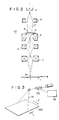
- FIG 3 shows an image scanning recorder which can be used as the image reproducer 23.
- a photosensitive film 130 is scanned transversely in the direction of the arrow X (main scanning) by a laser beam 131 while at the same time the photosensitive film 130 is moved in the direction of the arrow Y (subscanning).
- the laser beam 131 is modulated by an acoustooptic modulator 132 based on the image signal supplied from the image processor 22 for thereby forming a visible image on the photosensitive film 130.
- the size of the visible image reproduced on the photosensitive film 130 is selected to be larger than the size of the image formation area 9 (i.e., the area in which the radiation image energy is recorded on the sheet 11). Therefore, the magnified transmission image 8b is reproduced on the photosensitive film 130 at a scale greater than that on the image formation plane 9.
- the image reproduced at the enlarged scale on the photosensitive film 130 is of sufficiently good quality since the magnified transmission image 8b can be defined highly sharply by using the stimulable phosphor sheet 11.
- the stimulable phosphor sheet 11 may be of a relatively small size, and the photomultiplier 15 may also be small in size, with the result that the overall apparatus may be small in size.
- the density of scanning lines employed in the image scanning recorder should be coarser than the density of scanning lines used in reading image information from the stimulable phosphor sheet 11. More specifically, it is preferable to set the scanning line density to 10 pixels/mm or more, particularly within the range from 15 pixels/mm to 100 pixels/mm, for reading sufficient image information from the stimulable phosphor sheet 11 of a relatively small size.
- the scanning line density for recording the image is selected to be coarser than the above scanning line density and preferably in the range from 5 pixels/mm to 20 pixels/mm.
- optical filter in the glass sheet 20, the light shutter 24, and the photomultiplier 15 are shown as being disposed outside of the vacuum system in the lens barrel 1a, being arranged in named order away from the scanned side of the stimulable phosphor sheet 11, they may be disposed in the vacuum system in close contact with the stimulable phosphor sheet 11.
- the light shutter 24 is closed and the mirror 17 is swung upwardly into the first position in the optical path of the light beam 12a.
- the erasing light source 16 is then energized to apply the erasing light 16a to the surface of the stimulable phosphor sheet 11 via the mirrors 17, 13c. Any residual image which may be left on the sheet 11 due to electron beam energy remaining thereon after exposure of the sheet 11 to the stimulating light beam 12a, can be removed from the stimulable phosphor sheet 11 by exposure to the erasing light, which can then be recycled.
- the erasing light source 16 may comprise a tungsten lamp, a halogen lamp, an infrared lamp, a xenon flash lamp, or a laser beam source, as disclosed in United States Patent No. US-A-4,470,619.
- the stimulating light source 12 may double as a light source for emitting the erasing light 16a.
- the focusing process may be performed, as with conventional electron microscopes, by displaying the magnified transmission image 8b on a phosphor screen positioned near the shutter 19 and allowing the operator to turn a focusing knob (not shown) of the electron microscope while observing the displayed image through an observation window in the wall of the lens barrel 1a.
- the magnified transmission image recorded on the stimulable phosphor sheet 11 may reproduced as a focus-checking image on the image reproducer 23, and the operator may turn the focusing knob while observing the reproduced image for its focused condition.
- a focus-checking image should be erased by the erasing light 16a, and a properly focused magnified transmission image should be recorded again on the stimulable phosphor sheet 11 and read again therefrom as a final output image for the purpose of observing the specimen 8.
- the focus-checking image may be obtained as a partial image by applying the stimulating light beam to a portion of the frame of the final output image and detecting light emitted from such a portion of the image frame. In this manner, the time required to reproduce the focus-checking image can be shortened, and hence the focusing efficiency can be increased.
- the focusing efficiency may also be improved by reading a focus-checking image at more pixels than those required for reproducing a final output image.
- the focus-checking image may be employed not only for focusing the magnified transmission image 8b, but also for determining the field of the final output image.
- a shutter may be disposed in the lens barrel 1a between the specimen 8 and the electron gun 3 for cutting off the electron beam 2 when the sheet 10 is not exposed to the electron beam 2, so that the specimen 8 will be less subject to damage due to bombardment by the electron beam 2.
- FIG. 2 is explanatory view of another electron microscope used for recording and reproducing such a diffraction pattern 8c of the specimen 8.
- the electron microscope generally denoted at 40, has an intermediate lens 41 disposed between the objective lens 6 and the projector lens 7.
- the diffraction pattern 8c of the specimen 8 which is formed on the rear focal plane of the objective lens 7, is magnified by the intermediate lens 41 and the projector lens 7 with their focal points on the rear focal plane of the objective lens 7 and is projected onto the image formation plane 9.
- the magnified image of the diffraction pattern 8c can be recorded by the electron beam 2 on the stimulable phosphor sheet 11.
- the recorded diffraction pattern 8c can be read in the same manner as described with reference to Figure 1, and the read image can be displayed on the CRT or printed as a hard copy.
- the recorded pattern or recorded information is determined by the recorded condition of a transmitted electron-beam image (magnified transmission image or magnified diffraction pattern) recorded on the stimulable phosphor sheet 11, the nature of the specimen 8, and the manner of recording the image.
- a transmitted electron-beam image magnified transmission image or magnified diffraction pattern
- Such recorded information should be obtained prior to the reproduction of a visible image by which the specimen can be observed.
- the read-out gain of the photomultiplier 15 should be adjusted or the image-dependent signal should be processed on the basis of the obtained recorded information.
- the generation of a reproduced image which can effectively be observed requires that a recording scale factor be determined in order to optimize the resolution of the reproduced image dependent on the contrast of the recorded pattern.
- One way of obtaining the recorded information on the stimulable phosphor sheet 11 before a visible image is produced for observing the specimen 8 is disclosed in Japanese Unexamined Patent Publication No. JP-A-58(1983)-89245. More specifically, prior to the generation of a visible image for observing the specimen 8 (main reading mode), the recorded information stored in the stimulable phosphor sheet 11 is read (preliminary reading mode) with stimulating light having a lower level of energy than that of stimulating light to be applied in the main reading mode. Based on the recorded information thus obtained, the read-out gain is suitably adjusted or a recording scale factor is determined for the main reading mode, or the signal generated in the main reading mode is appropriately processed.
- the image produced for focusing purpose may be reproduced on the display such as a CRT, and the operator may determine a suitable read-out gain, a recording scale factor, or signal processing conditions while observing the focusing image displayed on the display. Then, the final image may be read out according to the determined read-out gain or the scale factor, or the image signal may be processed under the determined processing conditions.
- the stimulable phosphor sheet may comprise a thermofluorescent phosphor sheet.
- the sheet may be scanned by thermal radiation emitted from a heat source such as a CO2 laser source.
- a heat source such as a CO2 laser source.
- Figure 4 illustrates an apparatus for recording and reproducing electron microscope images according to another embodiment of the present invention.
- the apparatus shown in Figure 4 differs from the apparatus of Figure 1 in that the optical scanning system 13 includes, in place of the mirror 13c, an mirror 13e movably disposed in the lens barrel 1a of the electron microscope 1.
- the mirror 13e is movable, manually or by a suitable actuator, along a pair of guide bars 25 between an operating position in which it substantially faces the center of the stimulable phosphor sheet 11 or is located in the path of the electron beam 2, and a retracted position (shown by the dotted lines) in which it is retracted out of the path of the electron beam 2 to allow the stimulable phosphor sheet 11 to be exposed to the electron beam 2.
- the mirror 13e For exposing the stimulable phosphor sheet 11 to the electron beam 2, the mirror 13e is moved to the retracted position to allow the electron beam 2 to impinge upon the stimulable phosphor sheet 11.
- the electron beam 2 bearing the magnified transmission image 8b of the specimen 8 is applied to the stimulable phosphor sheet 11, which now stores the energy of the applied electron beam 2.
- the mirror 13e When the stored electron beam energy is to be read out, the mirror 13e is displaced to the operating position, and the stimulating laser beam 12a emitted from the stimulating light source 12 is deflected by the first and second light deflectors 13a, 13b, passes through the f ⁇ lens 13d, and then is directed by the mirror 13e to fall on the stimulable phosphor sheet 11 to scan the same two-dimensionally, i.e.
- the stimulating laser beam 12a is directed toward the stimulable phosphor sheet 11 by the mirror 13e located in a position which is substantially opposite the center of the stimulable phosphor sheet 11, the diameter of the scanning spot of the laser beam 12a on the stimulable phosphor sheet 11 and the length of the laser beam 12a do not vary widely between the center and ends of the sheet 11. Therefore, the diameter of the stimulable laser beam spot can be uniformized sufficiently by the f ⁇ lens 13d, with the result that the electron microscope image recorded on the stimulable phosphor sheet 11 can be read out highly accurately by the scanning beam spot. Accordingly, the image information stored in the stimulable phosphor sheet 11 can be read out highly accurately to reproduce the magnified transmission image 8b properly without image distortion.
- the mirror 13e remains located in the operating position while the erasing light 16a is applied to the stimulable phosphor sheet 11 to discharge any remaining electron beam energy and noise therefrom. After the remaining electron energy and noise have been eliminated from the stimulable phosphor sheet 11, the mirror 13e is moved back to the retracted position to make the stimulable phosphor sheet 11 ready for another cycle of image recording and reproducing operation.
- the second light deflector 13b and the f ⁇ lens 13d of the optical scanning system 13 are disposed in the lens barrel 1a and are made movable along a guide bar 25 between the operating and retracted positions.
- the stimulating laser beam 12a from the stimulating laser source 12 is directed by the first and second light deflectors 13a, 13b and the f ⁇ lens 13d to scan the stimulable phosphor sheet 11 two-dimensionally.
- the scanning beam spot remains substantially uniform over the stimulable phosphor sheet 11, assuring accurate read-out of the image information on the stimulable phosphor sheet 11.
- the erasing light 16a emitted from the erase light source 16 can also be directed by the first and second light deflectors 13a, 13b to scan the stimulable phosphor sheet 11.
- Figure 6 illustrates an apparatus according to a still further embodiment of the present invention.
- the stimulable phosphor sheet 11 is angularly movable, manually or by an actuator, along an arcuate guide bar 26 in the direction of the arrow B between a recording position, indicated by solid lines, in which the stimulable phosphor sheet 11 lies substantially perpendicularly to the axis C of the electron beam 2, and a read-out position, indicated by dotted lines, in which the stimulable phosphor sheet 11 lies obliquely to the axis C of the electron beam 2.
- the second light deflector 13b is substantially opposite the center of the stimulable phosphor sheet 11 and is positioned out of the path of the electron beam 2 so as not to interfere with the exposure of the stimulable phosphor sheet 11 to the electron beam 2.
- the stimulable phosphor sheet 11 When the stimulable phosphor sheet 11 is to be exposed to the electron beam 2, it is held in the recording position. After the energy of the electron beam 2 is stored in the stimulable phosphor sheet 11, when it is to be read out, the stimulable phosphor sheet 11 is brought to the read-out position. Then, the stimulable phosphor sheet 11 is two-dimensionally scanned by the stimulating laser beam 12a emitted from the stimulating laser source 12 and directed by the first and second light deflectors 13a, 13b.
- Figure 7 shows an apparatus according to still another embodiment, in which a mirror 13f is fixed in substantially opposing relation to the center of the stimulable phosphor sheet 11 in the read-out position.
- the stimulating laser beam 12a is applied via the first and second light deflectors 13a, 13b and the fixed mirror 13f to the stimulable phosphor sheet 11 for two-dimensionally scanning the same.
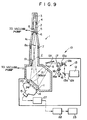
- Figure 8 is explanatory view of a still further embodiment in which the stimulable phosphor sheet 11 is fixedly positioned obliquely to the axis C of the electron beam 2, and the second light deflector 13b is substantially opposite the center of the stimulable phosphor sheet 11 which is fixed in position.
- the magnified transmission image 8b recorded on the stimulable phosphor sheet 11 thus inclined to the axis C is distorted, i.e., the image 8b is elongated in the direction in which the sheet 11 is inclined, and is more magnified toward the edge of the sheet 11 which the electron beam 2 travels a longer path before reaching.
- the output signal produced by the photomultiplier 15 when the stimulable phosphor sheet 11 is two-dimensionally scanned by the stimulating laser beam 12a is processed by a signal processor 27 to remove the image elongation and magnification resulting from the inclined disposition of the sheet 11 for thereby producing the magnified transmission image 8b on the image formation plane normal to the axis C of the electron beam 2.
- a fixed mirror 13f is disposed in substantially opposing relation to the center of the stimulable phosphor sheet 11 fixed obliquely to the axis C of the electron beam 2 for directing the stimulating laser beam 12a deflected by the first and second light deflectors 13a, 13b toward the stimulable phosphor sheet 11.
- Figure 10 shows another electron microscope employed for recording and reproducing the diffraction pattern of a specimen.
- the electron microscope of Figure 10 is substantially the same as the electron microscope shown in Fig. 2 except that the stimulable phosphor sheet 11 is inclined with respect to the axis C of the electron beam 2.
- the magnified specimen diffraction pattern recorded on the inclined stimulable phosphor sheet 11 is distorted and can be corrected by processing the output signal from the photomultiplier 15 ( Figures 8 and 9) with the signal processor 27.
Landscapes
- Chemical & Material Sciences (AREA)
- Analytical Chemistry (AREA)
- Conversion Of X-Rays Into Visible Images (AREA)
Description
- The present invention relates to an apparatus for recording and reproducing an image produced by an electron microscope comprising the features i)-v) of claim 1. An apparatus of this type has been described in EP-A-0.178.672, which is a document according to Article 54(3) EPC. More particularly, the present invention relates to an apparatus for recording electron microscope images with high sensitivity and for reproducing the recorded electron microscope images in the form of electric signals in order to allow the images to be processed in various ways.
- There are known electron microscopes for obtaining a magnified image of a specimen by deflecting a beam of electrons transmitted through the specimen with an electric or magnetic field. As is well known, the electron beam having passed through the specimen forms a diffraction pattern on the rear focal plane of the objective lens, and the diffracted beams interfere with each other again to produce the magnified image of the specimen. The magnified specimen image can be observed as a transmission image by projecting the image onto a screen with a projector lens. Alternatively, the rear focal plane of the objective lens may be projected for enabling the user to observe the magnified diffraction pattern of the image. Where an intermediate lens is positioned between the objective lens and the projector lens, the magnified transmission image or the diffraction pattern may be produced selectively as desired by adjusting the focal length of the intermediate lens.
- For observing the magnified image or the diffraction pattern (hereinafter referred to collectively as a "transmitted electron-beam image), it has been the general practice to place a photographic film on the image formation plane of the projector lens for exposure to the transmitted electron-beam image. According to another design, an image intensifier is employed to amplify the transmitted electron-beam image for projection. The use of photographic films is however disadvantageous in that their sensitivity to electron beams is low and the process of developing the films is complex. The image intensifier also has drawbacks in that the images produced thereby have poor sharpness and are likely to become distorted.
- Transmitted electron-beam images are often processed to make them easier to see. Specifically, the transmitted electron-beam images are subjected to various signal processing modes such as tone processing, frequency emphasis, density processing, subtractive processing, and additive processing. The images are also processed to reconstruct three-dimensional images by Fourier analysis, digitize the images, and measure particle diameters. The diffraction patterns are also processed to analyze crystal information and find lattice constants, dislocations, and lattice defects. For such image and diffraction pattern processing, it has been customary to convert the electron microscope image on a developed photographic film into an electric signal with a microphotometer, convert the electric signal into a digital signal, and then process the digital signal with a computer. This process has proven unsatisfactory since it is quite complex.
- In view of the aforesaid problems of the prior electron microscope image recording devices, it is an object of the present invention to provide an apparatus for recording and reproducing electron microscope images with high sensitivity and quality and in a manner enabling direct production of electric signals representing the images so that the images can be processed in various ways.
- The present invention provides an apparatus for recording and reproducing an image of a specimen produced by an electron microscope, as described in claim 1.
- The dependent claims set out particular embodiments of the invention
- The stimulating means includes a deflecting element for deflecting the stimulating energy toward the two-dimensional image sensor. The deflecting element may be movable between a first position in which it substantially faces the center of the two-dimensional image sensor to direct the stimulating energy toward the two-dimensional image sensor and a second position in which it is retracted out of the path of the electron beam toward the two-dimensional image sensor.
- The two-dimensional image sensor may be movable between a recording position in which it lies substantially perpendicularly to the path or axis of the electron beam and a read-out position in which it lies obliquely to the path of the electron beam.
- The deflecting element of the stimulating means may be located in a position in which it substantially faces the center of the two-dimensional image sensor and is out of the path of the electron beam.
- The two-dimensional image sensor may be fixed in the image formation plane of the electron microscope which lies perpendicularly to the axis of the electron beam, or may be fixed obliquely to the axis of the electron beam. Where the two-dimensional image sensor lies obliquely to the axis of the electron beam, the apparatus also includes a signal processor for converting the image recorded on the two-dimensional image sensor into an image on the image formation plane normal to the electron beam axis.
- Upon exposure to the electron beam, the two-dimensional image sensor can temporarily store at least part of the electron beam energy. When the stimulating energy is subsequently applied to the two-dimensional image sensor which stores the electron beam energy, the two-dimensional image sensor can discharge at least part of the stored energy in a detectable form such as light, electricity, or sound.
- The two-dimensional image sensor preferably comprises a stimulable phosphor sheet as disclosed in Japanese Unexamined Patent Publication No. JP-A-56(1981)-11395 and United States Patent Nos. US-A-4,258,264, US-A-4,276,473, US-A-4,315,318 and US-A-4,387,428 for example. Certain phosphors, when exposed to a radiation such as an electron beam, store a part of the energy of the radiation. When the phosphor exposed to the radiation is exposed to stimulating rays such as visible light, the phosphor emits light (stimulated emission) in proportion to the stored energy of the radiation. Such a phosphor is called a stimulable phosphor, and the stimulable phosphor sheet is generally composed of a support and a stimulable phosphor layer disposed on the support. The stimulable phosphor layer may be formed by dispersing the stimulable phosphor in a suitable binder. However, the stimulable phosphor layer may itself be a stimulable phosphor sheet if it is self-supporting. Examples of stimulable phosphors which the stimulable phosphor sheet can be made of are described in Japanese Patent Application No. 56(1984)-214680 (US-A-4.155.350)
- The two-dimensional sensor may also be in the form of a thermoluminescent phosphor sheet as disclosed in Japanese Patent Publication Nos. JP-A-55(1980)-47719 and JP-A-55(1980)-47720, for example. The thermoluminescent phosphor sheet emits stored radiation energy as thermoluminescence when heat is applied to the sheet. The thermoluminescent phosphor sheet may be constructed in the same manner as the stimulable phosphor sheet.
- The stimulating means may comprise X - Y deflecting means comprising a stimulating light source such as an He - Ne laser or a semiconductor laser or a heat source such as a CO₂ laser, and X and Y deflecting members such as galvanometer mirrors, rotatable polygonal mirrors, hologram scanners, and acoustooptic deflectors.
- The two-dimensional sensor is placed in the image formation plane of the electron microscope, and the electron microscope image is recorded on the two-dimensional sensor by the electron beam transmitted through the specimen. Then, the two-dimensional sensor on which the electron microscope image is stored is scanned in X and Y directions, i.e. two-dimensionally, by stimulating rays such as visible light or heat to enable the image sensor to emit the stored electron beam energy as light. The emitted light is then photoelectrically read by the photoelectric transducer such as a photomultiplier or CCD (charge-coupled device) which produces an electric signal indicative of the transmitted electron-beam image. The photoelectric transducer is positioned in close contact with or near the two-dimensional image sensor remotely from the side thereof which was scanned by the stimulating rays. An optical filter for cutting off light having the wavelength of the stimulating rays or infrared radiation and a light shutter which opens when the emitted light is read by the photoelectric transducer, are interposed between the photoelectric transducer and the two-dimensional image sensor. It is preferable for a support for the two-dimensional image sensor to have the function of the optical filter. The electric image signal thus generated may be employed to display the electron microscope image on a display unit such as a CRT, or to record the electron microscope image permanently as a hard copy, or to store the electron microscope image temporarily on a recording medium such as a magnetic tape, a magnetic disk, an optical disc, a photomagnetic disc, or the like.
- The electron microscope images can be recorded with high sensitivity using the two-dimensional image sensor of the type described above. Damage to the specimen can be reduced since the amount of the electron beam to which the specimen is exposed can be reduced. The electric image signals produced from the two-dimensional image sensor can easily be processed in various modes, such as tone processing and frequency emphasis, for example. The processing of diffraction patterns, and image analyses such as the reconstruction of three-dimensional images and image digitization can simply and quickly be performed by applying the electric signal to a computer.
- The two-dimensional image sensor remains positioned in a vacuum system connected to the electron microscope. Therefore, it is not necessary to inactivate the vacuum system each time the recorded image on the two-dimensional image sensor is to be read out. Since the two-dimensional image sensor is two-dimensionally scanned by the stimulating means, the apparatus requires no means for moving the two-dimensional image sensor in a subscanning direction, and hence can be small in size. The photoelectric transducer is positioned in close contact with or near the two-dimensional image sensor remotely from its scanned side, with the optical filter and the light shutter being interposed between the photoelectric transducer and the two-dimensional image sensor, so that the angle through which the light emitted by the image sensor is detected by the photoelectric transducer is large, assuring a high S/N (signal/noise) ratio.
- The deflecting element of the stimulating means may comprise the X or Y deflecting member such as galvenometer mirrors, or another deflecting member such as a reflecting mirror for reflecting a light or heat beam from the X - Y deflecting means toward the two-dimensional image sensor.
- Since the light beam or heat is directed toward the two-dimensional image sensor by the deflecting element located in a position which is substantially opposite the center of the two-dimensional image sensor, the diameter of the scanning spot of the light or heat beam and the length of the beam do not vary widely between the center and ends of the image sensor. Therefore, the diameter of the scanning light or heat beam spot can be uniformized sufficiently by an ordinary two-dimensional fϑ lens, with the result that the electron microscope image recorded on the two-dimensional image sensor can be read out highly accurately by the scanning beam spot.
- In the event the two-dimensional image sensor is positioned obliquely to the axis of the electron beam applied thereto, the electron beam image recorded on the image sensor is distorted. However, the electric signal produced by the photoelectric transducer is processed by the signal processor into a proper electron microscope image on the image formation plane normal to the electron beam axis.
- The stimulable phosphor employed in the stimulable phosphor sheet according to the present invention may comprise phosphors expressed by the composition formulas: SrS:Ce, Sm; SrS:Eu, Sm; ThO₂:Er; and La₂O₂S:Eu, Sm, as disclosed in U.S. Patent No. US-A-3,859,527.
- The stimulable phosphor may also comprise phosphors expressed by the composition formulas: ZnS:Cu,Pb; BaO·xAl₂O₃:Eu [where 0.8 ≦ x ≦ 10]; and MIIO·xSiO₂:A [where MII is Mg, Ca, Sr, Zn, Cd, or Ba; A is Ce, Tb, Eu, Tm, Pb, Tl, Bi, or Mn; and 0.5 ≦ x ≦ 2.5], as disclosed in United States Patent No. US-A-4,236,078.
- The stimulable phosphor may also comprise phosphors expressed by the composition formula: (Ba1-x-y Mgx Cay)FX:aEu²⁺ [where X is at least one of Cl and Br; 0 <x + y ≦ 0.6, xy ≠ 0, and 10⁻⁶ ≦ a ≦ 5 x 10⁻²], as disclosed in Japanese Unexamined Patent Publication No. JP-A-55(1980)-12143.
- The stimulable phosphor may also comprise phosphors expressed by the composition formula: LnOX:xA [where Ln is at least one of La, Y, Gd, and Lu; X is at least one of Cl and Br; A is at least one of Ce and Tb; and 0 < x < 0.1], as disclosed in United States Patent No. US-A-4,236,078.
- The stimulable phosphor may also comprise phosphors expressed by the composition formula: (Ba1-x, MII x)FX:yA [where MII is at least one of Mg, Ca, Sr, Zn, and Cd, X is at least one of Cl, Br, and I; A is at least one of Eu, Tb, Ce, Tm, Dy, Pr, Ho, Nd, Yb, and Er; 0 ≦ x ≦ 0.6, and 0 ≦ y ≦ 0.2], as disclosed in United States Patent No. US-A-4,239,968.
- The stimulable phosphor may also comprise phosphors expressed by the composition formula: MIIFX· xA:yLn [where MII is at least one of Ba, Ca, Sr, Mg, Zn, and Cd; A is at least one of BeO, MgO, CaO, SrO, BaO, ZnO, Al₂O₃, Y₂O₃, La₂O₃, In₂O₃, SiO₂, TlO₂, ZrO₂, GeO₂, SnO₂, Nb₂O₅, Ta₂O₅, and ThO₂; Ln is at least one of Eu, Tb, Ce, Tm, Dy, Pr, Ho, Nd, Yb, Er, Sm, and Gd; X is at least one of Cl, Br, and I; 5 x 10⁻⁵ < x < 0.5, and 0 < y < 0.2], as disclosed in Japanese Unexamined Patent Publication No. JP-A-55(1980)-160078
- The stimulable phosphor may also comprise phosphors expressed by the composition formula: (Ba1-x MII x)F₂·aBaX₂:yEu²⁺, zA [where MII is at least one of beryllium, magnesium, calcium, strontium, zinc, and cadmium; X is at least one of chlorine, bromine, and iodine; A is at least one of zirconium and scandium; 0.5 ≦ a ≦ 1.25, 0 ≦ x ≦ 1, 10⁻⁶ ≦ y ≦ 2 x 10⁻¹, and 0 < z ≦ 10⁻²], as disclosed in Japanese Unexamined Patent Publication No. JP-A-56(1981)-116777.
- The stimulable phosphor may also comprise phosphors expressed by the composition formula: (Ba1-x MII x)F₂·aBaX₂:yEu²⁺, zB [where MII is at least one of beryllium, magnesium, calcium, strontium, zinc, and cadmium; X is at least one of chlorine, bromine and iodine; 0.5 ≦ a ≦ 1.25, 0 ≦ x ≦ 1, 10⁻⁶ ≦ y ≦ 2 x 10⁻¹, and 0 < z ≦ 10⁻¹], as disclosed in United States Patent No. US-A-4,336,154.
- The stimulable phosphor may also comprise phosphors expressed by the composition formula: (Ba1-x MII x)F₂·aBaX₂:yEu²⁺, zA [where MII is at least one of beryllium, magnesium, calcium, strontium, zinc, and cadmium; X is at least one of chlorine, bromine, and iodine; A is at least one of arsenic and silicon; 0.5 ≦ a ≦ 1.25, 0 ≦ x ≦ 1, 10⁻⁶ ≦ y ≦ 2 x 10⁻¹, and 0 < z ≦ 5 x 10⁻¹], as disclosed in Japanese Unexamined Patent Publication No. JP-A-57(1982)-23675.
- The stimulable phosphor may also comprise phosphors expressed by the composition formula: (Ba1-x Mx/2 Lx/2 FX:yEu²⁺ [where M is at least one alkaline metal selected from the group consisting of Li, Na, K, Rb, and Cs; L is at least one trihydric metal selected from the group consisting of Sc, Y, La, Ce, Pr, Nd, Pm, Sm, Gd, Tb, Dy, Ho, Er, Tm, Yb, Lu, Al, Ga, In, and Tl; X is at least one halogen selected from the group consisting of Cl, Br, and I; 10⁻² ≦ x ≦ 0.5, and 0 < y ≦ 0.1], as disclosed in Japanese Unexamined Patent Publication No. JP-A-58(1983)-206678
- The stimulable phosphor may also comprise phosphors expressed by the composition formula: BaFX· xA:yEu²⁺ [where X is at least one halogen selected from the group consisting of Cl, Br, and I; A is a calcined tetrafluoroboric compound; 10⁻⁶ ≦ x ≦ 0.1, and 0 < y ≦ 0.1], as disclosed in Japanese Unexamined Patent Publication No. JP-A-59(1984)-27980.
- The stimulable phosphor may also comprise phosphors expressed by the composition formula: BaFX· xA:yEu²⁺ [where X is at least one halogen selected from the group consisting of Cl, Br, and I; A is at least one calcined compound selected from the group consisting of the salts of monohydric or dihydric metals of hexafluorosilicic acid, hexafluorotitanic acid, and hexafluorozirconic acid; 10⁻⁶ ≦ x ≦ 0.1, and 0 < y ≦ 0.1], as disclosed in Japanese Unexamined Patent publication No. JP-A-59(1984)-47289.
- The stimulable phosphor may also comprise phosphors expressed by the composition formula: BaFX·xNaX': aEu²⁺ [where each of X and X' is at least one of Cl, Br, and I; 0 < x ≦ 2, and 0 < a ≦ 0.2], as disclosed in Japanese Unexamined Patent Publication No. JP-A-59(1984)-56479.
- The stimulable phosphor may also comprise phosphors expressed by the composition formula: MIIFX· xNaX': yEu²⁺, zA [where MII is at least one alkaline earth metal selected from the group consisting of Ba, Sr, and Ca; each of X and X' is at least one halogen selected from the group consisting of Cl, Br, and I; A is at least one transition metal selected from the group consisting of V, Cr, Mn, Fe, Co, and Ni; 0 < x ≦ 2, 0 < y ≦ 0.2, and 0 < z ≦ 10⁻²], as disclosed in United States Patent No. US-A-4,505,989.
- The stimulable phosphor may also comprise phosphors expressed by the composition formula: MIIFX·aMIX' bM'IIX''₂·cMIIIX'''3·xA:yEu²⁺ [where MII is at least one alkaline earth metal selected from the group consisting of Ba, Sr, and Ca; MI is at least one alkaline metal selected from the group consisting of Li, Na, K, Rb, and Cs; M'II is at least one dihydric metal selected from the group consisting of Be and Mg; MIII is at least one trihydric metal selected from the group consisting of Al, Ga, In, and Tl; A is a metal oxide; X is at least one halogen selected from the group consisting of Cl, Br, and I; X', X'', and X''' are at least one halogen selected from the group consisting of F, Cl, Br, and I; 0 ≦ a ≦ 2, 0 ≦ b ≦ 10⁻², 0 ≦ c ≦ 10⁻², and a + b + c ≧ 10⁻⁶; 0 < x ≦ 0.5 and 0 < y ≦ 0.2], as disclosed in Japanese Unexamined Patent Publication No. JP-A 59(1984)-75200 filed by the present applicant.
- The stimulable phosphor may also comprise phosphors expressed by the composition formula: MIIX₂· aMIIX'₂:xEu²⁺ [where MII is at least one alkaline earth metal selected from the group consisting of Ba, Sr, and Ca; X and X' are at least one halogen selected from the group consisting of Cl, Br, and I with X ≠ X'; 0.1 ≦ a ≦ 10.0 and 0 < x ≦ 0.1], as disclosed in Japanese Unexamined Patent Publication No. JP-A-59(1984)-193161.
- The stimulable phosphor which can be employed in the present invention is however not limited to the aforesaid phosphors, but may be any phosphor capable of stimulated emission upon exposure to stimulating light after it has been irradiated with a radiation such as an electron beam.
- Preferred thermoluminescent phosphors that can be used in the present invention include compounds produced by adding a small amount of at least one of Mn, Dy, and Tm to sulphuric compounds such as Na₂SO₄, MnSO₄, CaSO₄, SrSO₄, and BaSO₄.
- The phosphor sheet may additionally have a protective layer which may be electrically conductive for preventing the phosphor sheet from being charged up by the electron beam applied thereto. The phosphor layer of the phosphor sheet may be colored with a pigment or a dye as disclosed in United States Patent No. US-A-4,394,581.
- The above and other objects, features and advantages of the present invention will become more apparent from the following description when taken in conjunction with the accompanying drawings in which preferred embodiments of the present invention are shown by way of illustrative example.
- Figure 1 is a vertical cross-sectional view of an apparatus for recording and reproducing images produced by an electron microscope according to an embodiment of the present invention;
- Figure 2 is a schematic view of an electron microscope of another embodiment which can be employed in the apparatus of the present invention;
- Figure 3 is a perspective view of an image reproducer for reproducing an electron microscope image recorded by the apparatus of the invention;
- Figures 4 through 9 are vertical cross-sectional views of apparatus for recording and reproducing images produced by an electron microscope according to other embodiments of the present invention; and
- Figure 10 is a schematic view of an electron microscope of still another embodiment which can be incorporated in the apparatus shown in Figures 8 and 9.
- Like or corresponding parts are denoted by like or corresponding reference characters throughout several views.
- Figure 1 shows an apparatus for recording and reproducing electron microscope images according to an embodiment of the present invention. An electron microscope 1 has a tubular lens barrel 1a housing an
electron gun 3 for emitting anelectron beam 2 at a uniform speed, at least oneconvergent lens 4 comprising a magnetic lens or an electrostatic lens for converging theelectron beam 2 toward aspecimen 8, aspecimen support 5, anobjective lens 6 identical to theconvergent lens 4, and aprojector lens 7. Theelectron beam 2 having passed through thespecimen 8 placed on thespecimen support 5 is converged by theobjective lens 6 to form a magnifiedtransmission image 8a of thespecimen 8. The magnifiedtransmission image 8a is focused by theprojector lens 7 as animage 8b on animage formation plane 9. - The apparatus for recording and reproducing electron microscope images, which is generally denoted at 10, is disposed below the lens barrel 1a. The
apparatus 10 comprises a two-dimensional image sensor 11 such as a stimulable phosphor sheet, a stimulating means composed of a stimulatinglight source 12 and anoptical scanning system 13 for scanning thestimulable phosphor sheet 11, aphotoelectric transducer 15 such as a photomultiplier positioned in confronting relation to thestimulable phosphor sheet 11 through a light-transmissive window 14 in a peripheral wall of the lens barrel 1a, and an erasinglight source 16. - The
stimulable phosphor sheet 11 comprises a stimulable phosphor layer deposited on a transparent support. The stimulatinglight source 12 comprises an He - Ne laser or a semiconductor laser for emitting astimulating laser beam 12a. Theoptical scanning system 13 includes a firstlight deflector 13a, a secondlight deflector 13b, and a fixed mirror 13c. Each of the first and secondlight deflectors laser beam 12a emitted from the stimulatinglight source 12 is reflected by thefirst light reflector 13a in a first direction, and then reflected by the secondlight reflector 13b in a direction normal to the first direction as indicated by the arrow A. The deflectedlight beam 12a is passed through a sheet of lead glass fitted in a light-transmissive wall member 21 defined in the wall of the lens barrel 1a, and then deflected by the fixed mirror 13c to impinge upon thestimulable phosphor sheet 11. Thestimulable phosphor sheet 11 is two-dimensionally scanned in X and Y directions by thelaser beam 12. Thelaser beam 12a is preferably passed through a filter (not shown) for cutting off the wavelength region of light emitted from thestimulable phosphor sheet 11, then adjusted in beam diameter by a beam expander (not shown) before being deflected by thelight deflectors fϑ lens 13d into a uniform beam diameter prior to application to thestimulable phosphor sheet 11. Thefϑ lens 13d may comprise an ordinary two-dimensional fϑ lens. - The erasing
light source 16 emits light 16a in the same wavelength region as that of stimulating light to be applied to thestimulable phosphor sheet 11. Amirror 17 is positioned for angular movement between a first position in the path of thelaser beam 12a between the secondlight deflector 13b and the fixed mirror 13c and a second position out of the path of thelaser beam 12a. When themirror 17 is in the first position, erasing light 19a emitted from the erasinglight source 16 is gathered by alens 18 and reflected by themirrors 17, 13c to fall on thestimulable phosphor sheet 11 over its entire surface. - A
shutter 19 for shutting off theelectron beam 2 is angularly movably positioned between thestimulable phosphor sheet 11 and the lens barrel 1a. Asheet 20 of glass fitted in thewindow 14 has an optical filter for allowing light emitted from thestimulable phosphor sheet 11 to pass therethrough while cutting off the stimulatinglight beam 12a. Alight shutter 24 is disposed between theglass sheet 20 and thephotomultiplier 15. The interior of the lens barrel 1a including the portion accommodating thestimulable phosphor sheet 11 is kept under vacuum by a vacuum pump (not shown). - Operation of the
apparatus 10 for recording and reproducing an electron microscope image will be described below. When theshutter 19 is opened as illustrated, thestimulable phosphor sheet 11 disposed in theimage formation plane 9 is exposed to theelectron beam 2 to store the energy of theelectron beam 2 which carries the magnifiedtransmission image 8b of thespecimen 8. Thelight shutter 24 should preferably be closed while thestimulable phosphor sheet 11 is being exposed to theelectron beam 2. Then, theshutter 19 is closed and thelight shutter 24 is opened. The stimulatinglight source 12 is energized to emit the stimulatinglight beam 12a which is deflected in the X and Y directions to scan thestimulable phosphor sheet 11 two-dimensionally. Thestimulable phosphor sheet 11 now emits light in an intensity commensurate with the energy level of theelectron beam 2 which was applied to thesheet 11. The light thus emitted from thesheet 11 is photoelectrically detected by thephotomultiplier 15 through theglass sheet 20, while at the same time the optical filter therein removes the stimulatinglight beam 12a. - In response to detection of the light emitted from the
stimulable phosphor sheet 11, thephotomultiplier 15 generates an electric signal which is processed by animage signal processor 22, and the processed signal is fed to animage reproducer 23 such as a CRT display or an image recording apparatus which optically scans a photosensitive film to record the image thereon. Therefore, the magnifiedtransmission image 8b borne by the stimulated emission from thestimulable phosphor sheet 11 can be reproduced by employing the electric signal commensurate with the amount of the light emitted from thestimulable phosphor sheet 11. - Figure 3 shows an image scanning recorder which can be used as the
image reproducer 23. Aphotosensitive film 130 is scanned transversely in the direction of the arrow X (main scanning) by alaser beam 131 while at the same time thephotosensitive film 130 is moved in the direction of the arrow Y (subscanning). At this time, thelaser beam 131 is modulated by anacoustooptic modulator 132 based on the image signal supplied from theimage processor 22 for thereby forming a visible image on thephotosensitive film 130. - The size of the visible image reproduced on the
photosensitive film 130 is selected to be larger than the size of the image formation area 9 (i.e., the area in which the radiation image energy is recorded on the sheet 11). Therefore, the magnifiedtransmission image 8b is reproduced on thephotosensitive film 130 at a scale greater than that on theimage formation plane 9. The image reproduced at the enlarged scale on thephotosensitive film 130 is of sufficiently good quality since the magnifiedtransmission image 8b can be defined highly sharply by using thestimulable phosphor sheet 11. As a consequence, thestimulable phosphor sheet 11 may be of a relatively small size, and thephotomultiplier 15 may also be small in size, with the result that the overall apparatus may be small in size. - For producing a magnified image from the image scanning recorder shown in Figure 3, the density of scanning lines employed in the image scanning recorder should be coarser than the density of scanning lines used in reading image information from the
stimulable phosphor sheet 11. More specifically, it is preferable to set the scanning line density to 10 pixels/mm or more, particularly within the range from 15 pixels/mm to 100 pixels/mm, for reading sufficient image information from thestimulable phosphor sheet 11 of a relatively small size. For reproducing a magnified image without degrading its quality, the scanning line density for recording the image is selected to be coarser than the above scanning line density and preferably in the range from 5 pixels/mm to 20 pixels/mm. - While the optical filter in the
glass sheet 20, thelight shutter 24, and thephotomultiplier 15 are shown as being disposed outside of the vacuum system in the lens barrel 1a, being arranged in named order away from the scanned side of thestimulable phosphor sheet 11, they may be disposed in the vacuum system in close contact with thestimulable phosphor sheet 11. - After the image has been read from the
stimulable phosphor sheet 11, thelight shutter 24 is closed and themirror 17 is swung upwardly into the first position in the optical path of thelight beam 12a. The erasinglight source 16 is then energized to apply the erasing light 16a to the surface of thestimulable phosphor sheet 11 via themirrors 17, 13c. Any residual image which may be left on thesheet 11 due to electron beam energy remaining thereon after exposure of thesheet 11 to the stimulatinglight beam 12a, can be removed from thestimulable phosphor sheet 11 by exposure to the erasing light, which can then be recycled. Upon exposure to the erasing light 16a, noise arising from a radioactive element such as ²²⁶Ra contained as an impurity in the phosphor of thesheet 11 can also be discharged. The erasinglight source 16 may comprise a tungsten lamp, a halogen lamp, an infrared lamp, a xenon flash lamp, or a laser beam source, as disclosed in United States Patent No. US-A-4,470,619. The stimulatinglight source 12 may double as a light source for emitting the erasing light 16a. - When recording the magnified
transmission image 8b on thestimulable phosphor sheet 11, it is necessary to focus the magnifiedtransmission image 8b properly on thestimulable phosphor sheet 11. The focusing process may be performed, as with conventional electron microscopes, by displaying the magnifiedtransmission image 8b on a phosphor screen positioned near theshutter 19 and allowing the operator to turn a focusing knob (not shown) of the electron microscope while observing the displayed image through an observation window in the wall of the lens barrel 1a. Alternatively, the magnified transmission image recorded on thestimulable phosphor sheet 11 may reproduced as a focus-checking image on theimage reproducer 23, and the operator may turn the focusing knob while observing the reproduced image for its focused condition. After the desired focused condition has been achieved, such a focus-checking image should be erased by the erasing light 16a, and a properly focused magnified transmission image should be recorded again on thestimulable phosphor sheet 11 and read again therefrom as a final output image for the purpose of observing thespecimen 8. Where the focus-checking image is employed for focusing purposes, it is not necessary for the focus-checking image to be in the same size as that of the final output image. The focus-checking image may be obtained as a partial image by applying the stimulating light beam to a portion of the frame of the final output image and detecting light emitted from such a portion of the image frame. In this manner, the time required to reproduce the focus-checking image can be shortened, and hence the focusing efficiency can be increased. The focusing efficiency may also be improved by reading a focus-checking image at more pixels than those required for reproducing a final output image. - The focus-checking image may be employed not only for focusing the magnified
transmission image 8b, but also for determining the field of the final output image. - A shutter may be disposed in the lens barrel 1a between the
specimen 8 and theelectron gun 3 for cutting off theelectron beam 2 when thesheet 10 is not exposed to theelectron beam 2, so that thespecimen 8 will be less subject to damage due to bombardment by theelectron beam 2. - The principles of the present invention can be employed for recording and reproducing the diffraction pattern of a specimen. Figure 2 is explanatory view of another electron microscope used for recording and reproducing such a
diffraction pattern 8c of thespecimen 8. The electron microscope, generally denoted at 40, has anintermediate lens 41 disposed between theobjective lens 6 and theprojector lens 7. Thediffraction pattern 8c of thespecimen 8, which is formed on the rear focal plane of theobjective lens 7, is magnified by theintermediate lens 41 and theprojector lens 7 with their focal points on the rear focal plane of theobjective lens 7 and is projected onto theimage formation plane 9. By placing thestimulable phosphor sheet 11 in theimage formation plane 9, the magnified image of thediffraction pattern 8c can be recorded by theelectron beam 2 on thestimulable phosphor sheet 11. The recordeddiffraction pattern 8c can be read in the same manner as described with reference to Figure 1, and the read image can be displayed on the CRT or printed as a hard copy. - The recorded pattern or recorded information is determined by the recorded condition of a transmitted electron-beam image (magnified transmission image or magnified diffraction pattern) recorded on the
stimulable phosphor sheet 11, the nature of thespecimen 8, and the manner of recording the image. For eliminating any adverse effect arising from varied recording conditions or for obtaining an electron microscope image which can clearly be observed, such recorded information should be obtained prior to the reproduction of a visible image by which the specimen can be observed. The read-out gain of thephotomultiplier 15 should be adjusted or the image-dependent signal should be processed on the basis of the obtained recorded information. Furthermore, the generation of a reproduced image which can effectively be observed requires that a recording scale factor be determined in order to optimize the resolution of the reproduced image dependent on the contrast of the recorded pattern. - One way of obtaining the recorded information on the
stimulable phosphor sheet 11 before a visible image is produced for observing thespecimen 8 is disclosed in Japanese Unexamined Patent Publication No. JP-A-58(1983)-89245. More specifically, prior to the generation of a visible image for observing the specimen 8 (main reading mode), the recorded information stored in thestimulable phosphor sheet 11 is read (preliminary reading mode) with stimulating light having a lower level of energy than that of stimulating light to be applied in the main reading mode. Based on the recorded information thus obtained, the read-out gain is suitably adjusted or a recording scale factor is determined for the main reading mode, or the signal generated in the main reading mode is appropriately processed. - Alternatively, the image produced for focusing purpose may be reproduced on the display such as a CRT, and the operator may determine a suitable read-out gain, a recording scale factor, or signal processing conditions while observing the focusing image displayed on the display. Then, the final image may be read out according to the determined read-out gain or the scale factor, or the image signal may be processed under the determined processing conditions.
- The stimulable phosphor sheet may comprise a thermofluorescent phosphor sheet. For discharging the stored energy from the thermofluorescent phosphor sheet, the sheet may be scanned by thermal radiation emitted from a heat source such as a CO₂ laser source. For more details, reference should be made to Japanese Patent Publication No. JP-A-55(1980)-47720.
- Figure 4 illustrates an apparatus for recording and reproducing electron microscope images according to another embodiment of the present invention. The apparatus shown in Figure 4 differs from the apparatus of Figure 1 in that the
optical scanning system 13 includes, in place of the mirror 13c, anmirror 13e movably disposed in the lens barrel 1a of the electron microscope 1. - The
mirror 13e is movable, manually or by a suitable actuator, along a pair of guide bars 25 between an operating position in which it substantially faces the center of thestimulable phosphor sheet 11 or is located in the path of theelectron beam 2, and a retracted position (shown by the dotted lines) in which it is retracted out of the path of theelectron beam 2 to allow thestimulable phosphor sheet 11 to be exposed to theelectron beam 2. - For exposing the
stimulable phosphor sheet 11 to theelectron beam 2, themirror 13e is moved to the retracted position to allow theelectron beam 2 to impinge upon thestimulable phosphor sheet 11. Theelectron beam 2 bearing the magnifiedtransmission image 8b of thespecimen 8 is applied to thestimulable phosphor sheet 11, which now stores the energy of the appliedelectron beam 2. When the stored electron beam energy is to be read out, themirror 13e is displaced to the operating position, and the stimulatinglaser beam 12a emitted from the stimulatinglight source 12 is deflected by the first and secondlight deflectors fϑ lens 13d, and then is directed by themirror 13e to fall on thestimulable phosphor sheet 11 to scan the same two-dimensionally, i.e. the X and Y directions. Since the stimulatinglaser beam 12a is directed toward thestimulable phosphor sheet 11 by themirror 13e located in a position which is substantially opposite the center of thestimulable phosphor sheet 11, the diameter of the scanning spot of thelaser beam 12a on thestimulable phosphor sheet 11 and the length of thelaser beam 12a do not vary widely between the center and ends of thesheet 11. Therefore, the diameter of the stimulable laser beam spot can be uniformized sufficiently by thefϑ lens 13d, with the result that the electron microscope image recorded on thestimulable phosphor sheet 11 can be read out highly accurately by the scanning beam spot. Accordingly, the image information stored in thestimulable phosphor sheet 11 can be read out highly accurately to reproduce the magnifiedtransmission image 8b properly without image distortion. - The
mirror 13e remains located in the operating position while the erasing light 16a is applied to thestimulable phosphor sheet 11 to discharge any remaining electron beam energy and noise therefrom. After the remaining electron energy and noise have been eliminated from thestimulable phosphor sheet 11, themirror 13e is moved back to the retracted position to make thestimulable phosphor sheet 11 ready for another cycle of image recording and reproducing operation. - According to still another embodiment shown in Figure 5, the second
light deflector 13b and thefϑ lens 13d of theoptical scanning system 13 are disposed in the lens barrel 1a and are made movable along aguide bar 25 between the operating and retracted positions. When the secondlight deflector 13b and thefϑ lens 13d are located in the operating position, the stimulatinglaser beam 12a from the stimulatinglaser source 12 is directed by the first and secondlight deflectors fϑ lens 13d to scan thestimulable phosphor sheet 11 two-dimensionally. The scanning beam spot remains substantially uniform over thestimulable phosphor sheet 11, assuring accurate read-out of the image information on thestimulable phosphor sheet 11. The erasing light 16a emitted from the eraselight source 16 can also be directed by the first and secondlight deflectors stimulable phosphor sheet 11. - Figure 6 illustrates an apparatus according to a still further embodiment of the present invention. In the apparatus of Figure 6, the
stimulable phosphor sheet 11 is angularly movable, manually or by an actuator, along anarcuate guide bar 26 in the direction of the arrow B between a recording position, indicated by solid lines, in which thestimulable phosphor sheet 11 lies substantially perpendicularly to the axis C of theelectron beam 2, and a read-out position, indicated by dotted lines, in which thestimulable phosphor sheet 11 lies obliquely to the axis C of theelectron beam 2. When thestimulable phosphor sheet 11 is in the read-out position, the secondlight deflector 13b is substantially opposite the center of thestimulable phosphor sheet 11 and is positioned out of the path of theelectron beam 2 so as not to interfere with the exposure of thestimulable phosphor sheet 11 to theelectron beam 2. - When the
stimulable phosphor sheet 11 is to be exposed to theelectron beam 2, it is held in the recording position. After the energy of theelectron beam 2 is stored in thestimulable phosphor sheet 11, when it is to be read out, thestimulable phosphor sheet 11 is brought to the read-out position. Then, thestimulable phosphor sheet 11 is two-dimensionally scanned by the stimulatinglaser beam 12a emitted from the stimulatinglaser source 12 and directed by the first and secondlight deflectors - Figure 7 shows an apparatus according to still another embodiment, in which a
mirror 13f is fixed in substantially opposing relation to the center of thestimulable phosphor sheet 11 in the read-out position. For reading out the electron beam energy from thestimulable phosphor sheet 11, the stimulatinglaser beam 12a is applied via the first and secondlight deflectors mirror 13f to thestimulable phosphor sheet 11 for two-dimensionally scanning the same. - Figure 8 is explanatory view of a still further embodiment in which the
stimulable phosphor sheet 11 is fixedly positioned obliquely to the axis C of theelectron beam 2, and the secondlight deflector 13b is substantially opposite the center of thestimulable phosphor sheet 11 which is fixed in position. The magnifiedtransmission image 8b recorded on thestimulable phosphor sheet 11 thus inclined to the axis C is distorted, i.e., theimage 8b is elongated in the direction in which thesheet 11 is inclined, and is more magnified toward the edge of thesheet 11 which theelectron beam 2 travels a longer path before reaching. The output signal produced by thephotomultiplier 15 when thestimulable phosphor sheet 11 is two-dimensionally scanned by the stimulatinglaser beam 12a is processed by a signal processor 27 to remove the image elongation and magnification resulting from the inclined disposition of thesheet 11 for thereby producing the magnifiedtransmission image 8b on the image formation plane normal to the axis C of theelectron beam 2. - In still another embodiment shown in Figure 9, a fixed
mirror 13f is disposed in substantially opposing relation to the center of thestimulable phosphor sheet 11 fixed obliquely to the axis C of theelectron beam 2 for directing the stimulatinglaser beam 12a deflected by the first and secondlight deflectors stimulable phosphor sheet 11. - Figure 10 shows another electron microscope employed for recording and reproducing the diffraction pattern of a specimen. The electron microscope of Figure 10 is substantially the same as the electron microscope shown in Fig. 2 except that the
stimulable phosphor sheet 11 is inclined with respect to the axis C of theelectron beam 2. The magnified specimen diffraction pattern recorded on the inclinedstimulable phosphor sheet 11 is distorted and can be corrected by processing the output signal from the photomultiplier 15 (Figures 8 and 9) with the signal processor 27. - Although certain preferred embodiments have been shown and described, it should be understood that many changes and modifications may be made therein without departing from the scope of the appended claims.
Claims (9)
- An apparatus for recording and reproducing an image of a specimen produced by an electron microscope (1), comprising:i) a two-dimensional image sensor (11) for storing the energy of an electron beam (2) having passed through the specimen (8);ii) stimulating means (12) for scanning said two-dimensional image sensor (11) with stimulating energy to discharge the stored electron beam energy as light from the two-dimensional image sensor;iii) a photoelectric transducer (15) for photoelectrically detecting the light discharged from said two-dimensional image sensor;iv) erasing means (16) for applying erasing energy to said two-dimensional image sensor (11) to discharge energy remaining thereon after the light has been photoelectrically detected and in whichv) the photoelectric transducer (15) has a light receiving face which is larger than the image recording area of the two-dimensional image sensor (11), and the light discharged from the two-dimensional image sensor is photoelectrically detected by the photoelectric transducer (15) when the two-dimensional image sensor (11) is in a fixed position.
- An apparatus according to claim 1, wherein said two-dimensional image sensor (11) comprises a stimulable phosphor sheet.
- An apparatus according to claim 1, further comprising an optical filter (20) for cutting off light having a wavelength in the wavelength region of the stimulating energy, and a light shutter (24) openable when the light discharged from said two-dimensional image sensor (11) is photoelectrically detected by said photoelectric transducer (15) and closable when the remaining energy is discharged from said two-dimensional image sensor (11) by said erase means (16), said optical filter (20) and said light shutter (24) being interposed between said two-dimensional image sensor (11) and said photoelectric transducer (15) remotely from the side of said two-dimensional image sensor (11) which is scanned with said stimulating energy.
- An apparatus according to claim 1, wherein said stimulating means comprises a deflecting element (13) for deflecting the stimulating energy toward said two-dimensional image sensor (11).
- An apparatus according to claim 4, wherein said deflecting element (13c) is fixed.
- An apparatus according to claim 4, wherein said deflecting element 13b is movable between a first position in which the deflecting element is substantially opposite the center of said two-dimensional image sensor (11) and directs the stimulating energy toward said two-dimensional image sensor (11) and a second position in which the deflecting element is retracted out of the path of the electron beam (2) toward said two-dimensional image sensor (11) (fig 5)
- An apparatus according to claim 1, wherein said two-dimensional image sensor (11) is fixed in the image formation plane (9) normal to the axis of the electron beam (2).
- An apparatus according to claim 1,
characterized in that the two-dimensional image sensor (11) is movable between a recording position in which the two-dimensional image sensor (11) lies substantially perpendicularly to the axis of the electron beam (2) and a read-out position in which the two-dimensional image sensor (11) lies obliquely to the axis of the electron beam (2), said stimulating means (12) including a deflecting element (13b) for deflecting the stimulating energy toward said two-dimensional image sensor (11), said defelecting element 13b being positioned to be substantially opposite the center of said two-dimensional image sensor (11) in said read-out position and out of the path of said electron beam (2) (figs. 6 and 7) - An apparatus according to claim 1,
characterized in that the two-dimensional image sensor (11) is fixed obliquely to the axis of the electron beam (2), said stimulating means (12) including a deflecting element (13f) for deflecting the stimulating energy toward said two-dimensional image sensor (11), said deflecting element (13f) being positioned to be substantially opposite the center of said two-dimensional image sensor (11) and out of the path of said electron beam (2), further including a signal processor (27) for converting an output signal from said photoelectric transducer (15) indicative of the electron microscope image on said two-dimensional image sensor (11) lying obliquely to the axis of the electron beam (2) into a signal representing an electron microscope image on an image formation plane of the electron microscope which lies perpendicularly to the axis of the electron beam (2) (fig. 8, 9 and 10).
Applications Claiming Priority (8)
| Application Number | Priority Date | Filing Date | Title |
|---|---|---|---|
| JP258783/84 | 1984-12-07 | ||
| JP59258783A JPH0616397B2 (en) | 1984-12-07 | 1984-12-07 | Electron microscope image recording / reading device |
| JP60081801A JPS61240549A (en) | 1985-04-17 | 1985-04-17 | Method for recording and reading electron-microscopic image |
| JP81800/85 | 1985-04-17 | ||
| JP60081799A JPS61240547A (en) | 1985-04-17 | 1985-04-17 | Method for recording and reading electron-microscopic image |
| JP60081800A JPS61240548A (en) | 1985-04-17 | 1985-04-17 | Method for recording and reading electron-microscopic image |
| JP81801/85 | 1985-04-17 | ||
| JP81799/85 | 1985-04-17 |
Publications (2)
| Publication Number | Publication Date |
|---|---|
| EP0184792A1 EP0184792A1 (en) | 1986-06-18 |
| EP0184792B1 true EP0184792B1 (en) | 1991-09-04 |
Family
ID=27466622
Family Applications (1)
| Application Number | Title | Priority Date | Filing Date |
|---|---|---|---|
| EP85115557A Expired EP0184792B1 (en) | 1984-12-07 | 1985-12-06 | Apparatus for recording and reproducing images produced by an electron microscope |
Country Status (3)
| Country | Link |
|---|---|
| US (2) | US4851677A (en) |
| EP (1) | EP0184792B1 (en) |
| DE (1) | DE3583994D1 (en) |
Families Citing this family (7)
| Publication number | Priority date | Publication date | Assignee | Title |
|---|---|---|---|---|
| AT392857B (en) * | 1987-07-13 | 1991-06-25 | Ims Ionen Mikrofab Syst | DEVICE AND METHOD FOR INSPECTING A MASK |
| DE3728750A1 (en) * | 1987-08-28 | 1989-03-09 | Philips Patentverwaltung | DEVICE FOR READING A STORAGE PHOSPHORUS RECORDER |
| JP2557265B2 (en) * | 1989-04-20 | 1996-11-27 | 富士写真フイルム株式会社 | Energy subtraction method |
| US5838425A (en) * | 1995-11-23 | 1998-11-17 | Carl Zeiss Jena Gmbh | Exposure control for the photographic recording of a microscope image |
| US6885445B2 (en) | 1998-05-09 | 2005-04-26 | Renishaw Plc | Electron microscope and spectroscopy system |
| EP0995086B1 (en) * | 1998-05-09 | 2007-11-14 | Renishaw plc | Electron microscope and spectroscopy system |
| JP6173862B2 (en) * | 2013-09-30 | 2017-08-02 | 株式会社日立ハイテクノロジーズ | electronic microscope |
Family Cites Families (18)
| Publication number | Priority date | Publication date | Assignee | Title |
|---|---|---|---|---|
| US3883748A (en) * | 1967-06-29 | 1975-05-13 | Matsushita Electric Industrial Co Ltd | Phosphor for thermoluminescent type radiation dosimeter |
| NL7215105A (en) * | 1971-11-30 | 1973-06-04 | ||
| US3859527A (en) * | 1973-01-02 | 1975-01-07 | Eastman Kodak Co | Apparatus and method for producing images corresponding to patterns of high energy radiation |
| US3975637A (en) * | 1973-10-23 | 1976-08-17 | Matsushita Electric Industrial Co., Ltd. | Device for storage and display of a radiation image |
| NL7905433A (en) * | 1978-07-12 | 1980-01-15 | Fuji Photo Film Co Ltd | METHOD AND APPARATUS FOR RECORDING AND DISPLAYING A RADIATION IMAGE |
| JPS5944333B2 (en) * | 1978-07-12 | 1984-10-29 | 富士写真フイルム株式会社 | Radiographic image conversion method |
| JPS5512429A (en) * | 1978-07-12 | 1980-01-29 | Fuji Photo Film Co Ltd | Radioactive image reader |
| US4315318A (en) * | 1978-12-26 | 1982-02-09 | Fuji Photo Film Co., Ltd. | Method and apparatus for processing a radiation image |
| US4346295A (en) * | 1978-12-26 | 1982-08-24 | Fuji Photo Film Co., Ltd. | Radiation image read out device |
| JPS55116340A (en) * | 1979-02-28 | 1980-09-06 | Fuji Photo Film Co Ltd | Method and device for processing gradation of radiation picture |
| JPS5923400B2 (en) * | 1979-06-07 | 1984-06-01 | 富士写真フイルム株式会社 | Radiographic image conversion panel |
| JPS5611392A (en) * | 1979-07-11 | 1981-02-04 | Fuji Photo Film Co Ltd | Method and device for converting radiation image |
| JPS56104645A (en) * | 1979-12-25 | 1981-08-20 | Fuji Photo Film Co Ltd | Radiation picture treating method and its device |
| US4336154A (en) * | 1981-07-14 | 1982-06-22 | Kasei Optonix, Ltd. | Phosphor and radiation image storage panel utilizing the same |
| JPS5866930A (en) * | 1981-10-16 | 1983-04-21 | Fuji Photo Film Co Ltd | Radiation picture recorder |
| JPS5889245A (en) * | 1981-11-25 | 1983-05-27 | 富士写真フイルム株式会社 | Reading out of radioactive image information |
| JPS58143284A (en) * | 1982-02-22 | 1983-08-25 | Toshiba Corp | Two-dimensional radiation detector |
| JPS5956480A (en) * | 1982-09-27 | 1984-03-31 | Fuji Photo Film Co Ltd | Phosphor and radiation image conversion panel using same |
-
1985
- 1985-12-05 US US06/804,775 patent/US4851677A/en not_active Expired - Lifetime
- 1985-12-06 DE DE8585115557T patent/DE3583994D1/en not_active Expired - Lifetime
- 1985-12-06 EP EP85115557A patent/EP0184792B1/en not_active Expired
-
1988
- 1988-11-03 US US07/267,736 patent/US4866274A/en not_active Expired - Lifetime
Also Published As
| Publication number | Publication date |
|---|---|
| EP0184792A1 (en) | 1986-06-18 |
| US4851677A (en) | 1989-07-25 |
| US4866274A (en) | 1989-09-12 |
| DE3583994D1 (en) | 1991-10-10 |
Similar Documents
| Publication | Publication Date | Title |
|---|---|---|
| EP0177973B1 (en) | Method of recording and reproducing images produced by an electron microscope | |
| US4889990A (en) | Method and apparatus for recording and reproducing electron microscope image | |
| EP0184810B1 (en) | Method of detecting a focus defect of an electron microscope image | |
| US4866274A (en) | Apparatus for recording and reproducing images produced by an electron microscope | |
| US4694171A (en) | Electron microscope image focusing using instantaneous emission of stimulable phosphor sheet | |
| EP0181507B1 (en) | Device for recording images produced by an electron microscope | |
| US4700071A (en) | Method of recording and reproducing an electron microscope image | |
| EP0178672B1 (en) | Electron microscope | |
| US4801801A (en) | Transmission-type electron microscope | |
| US4873440A (en) | Electron microscope image output method and apparatus | |
| JPH0616397B2 (en) | Electron microscope image recording / reading device | |
| US5006707A (en) | Electron microscope image recording and read-out method | |
| US4847497A (en) | Apparatus for recording images produced by an electron microscope | |
| JPH0616394B2 (en) | Electron microscope image recording / reproducing method | |
| JPH0616393B2 (en) | Electron microscope image recording / reproducing method | |
| JPH0616396B2 (en) | Electron microscope image recording / reproducing method | |
| JPH0616398B2 (en) | Defocus amount measuring method for electron microscope | |
| JPS62145635A (en) | Transmission type electron microscope | |
| JPS61240549A (en) | Method for recording and reading electron-microscopic image | |
| JPS61240547A (en) | Method for recording and reading electron-microscopic image | |
| JPS61138442A (en) | Recording and reproducing method for image of electron microscope | |
| JPH0552627B2 (en) | ||
| JPH01176645A (en) | Reading method for electron microscope image record and device thereof | |
| JPH067469B2 (en) | Electron microscope equipped with X-ray prevention means by energy filter |
Legal Events
| Date | Code | Title | Description |
|---|---|---|---|
| PUAI | Public reference made under article 153(3) epc to a published international application that has entered the european phase |
Free format text: ORIGINAL CODE: 0009012 |
|
| AK | Designated contracting states |
Kind code of ref document: A1 Designated state(s): DE FR NL |
|
| 17P | Request for examination filed |
Effective date: 19860723 |
|
| 17Q | First examination report despatched |
Effective date: 19880114 |
|
| GRAA | (expected) grant |
Free format text: ORIGINAL CODE: 0009210 |
|
| AK | Designated contracting states |
Kind code of ref document: B1 Designated state(s): DE FR NL |
|
| ET | Fr: translation filed | ||
| REF | Corresponds to: |
Ref document number: 3583994 Country of ref document: DE Date of ref document: 19911010 |
|
| PLBE | No opposition filed within time limit |
Free format text: ORIGINAL CODE: 0009261 |
|
| STAA | Information on the status of an ep patent application or granted ep patent |
Free format text: STATUS: NO OPPOSITION FILED WITHIN TIME LIMIT |
|
| 26N | No opposition filed | ||
| PGFP | Annual fee paid to national office [announced via postgrant information from national office to epo] |
Ref country code: NL Payment date: 20021217 Year of fee payment: 18 Ref country code: FR Payment date: 20021217 Year of fee payment: 18 |
|
| PGFP | Annual fee paid to national office [announced via postgrant information from national office to epo] |
Ref country code: DE Payment date: 20030129 Year of fee payment: 18 |
|
| PG25 | Lapsed in a contracting state [announced via postgrant information from national office to epo] |
Ref country code: NL Free format text: LAPSE BECAUSE OF NON-PAYMENT OF DUE FEES Effective date: 20040701 Ref country code: DE Free format text: LAPSE BECAUSE OF NON-PAYMENT OF DUE FEES Effective date: 20040701 |
|
| PG25 | Lapsed in a contracting state [announced via postgrant information from national office to epo] |
Ref country code: FR Free format text: LAPSE BECAUSE OF NON-PAYMENT OF DUE FEES Effective date: 20040831 |
|
| NLV4 | Nl: lapsed or anulled due to non-payment of the annual fee |
Effective date: 20040701 |
|
| REG | Reference to a national code |
Ref country code: FR Ref legal event code: ST |