EP0184385A2 - N-[(4,6-Dimethoxypyrimidin-2-YL)Aminocarbonyl]-3-trifluoromethylpyridine-2-sulfonamide or salts thereof, herbicidal composition containing the same, and processs for the production of the compound - Google Patents
N-[(4,6-Dimethoxypyrimidin-2-YL)Aminocarbonyl]-3-trifluoromethylpyridine-2-sulfonamide or salts thereof, herbicidal composition containing the same, and processs for the production of the compound Download PDFInfo
- Publication number
- EP0184385A2 EP0184385A2 EP85308652A EP85308652A EP0184385A2 EP 0184385 A2 EP0184385 A2 EP 0184385A2 EP 85308652 A EP85308652 A EP 85308652A EP 85308652 A EP85308652 A EP 85308652A EP 0184385 A2 EP0184385 A2 EP 0184385A2
- Authority
- EP
- European Patent Office
- Prior art keywords
- trifluoromethylpyridine
- compound
- sulfonamide
- group
- aminocarbonyl
- Prior art date
- Legal status (The legal status is an assumption and is not a legal conclusion. Google has not performed a legal analysis and makes no representation as to the accuracy of the status listed.)
- Granted
Links
- 0 *CCCC=C1[C@](CC2CCCCC2)CCNC1* Chemical compound *CCCC=C1[C@](CC2CCCCC2)CCNC1* 0.000 description 2
- HGCIXCUEYOPUTN-UHFFFAOYSA-N C1CC=CCC1 Chemical compound C1CC=CCC1 HGCIXCUEYOPUTN-UHFFFAOYSA-N 0.000 description 1
- GDOPTJXRTPNYNR-UHFFFAOYSA-N CC1CCCC1 Chemical compound CC1CCCC1 GDOPTJXRTPNYNR-UHFFFAOYSA-N 0.000 description 1
Classifications
-
- C—CHEMISTRY; METALLURGY
- C07—ORGANIC CHEMISTRY
- C07D—HETEROCYCLIC COMPOUNDS
- C07D401/00—Heterocyclic compounds containing two or more hetero rings, having nitrogen atoms as the only ring hetero atoms, at least one ring being a six-membered ring with only one nitrogen atom
- C07D401/02—Heterocyclic compounds containing two or more hetero rings, having nitrogen atoms as the only ring hetero atoms, at least one ring being a six-membered ring with only one nitrogen atom containing two hetero rings
- C07D401/12—Heterocyclic compounds containing two or more hetero rings, having nitrogen atoms as the only ring hetero atoms, at least one ring being a six-membered ring with only one nitrogen atom containing two hetero rings linked by a chain containing hetero atoms as chain links
-
- C—CHEMISTRY; METALLURGY
- C07—ORGANIC CHEMISTRY
- C07D—HETEROCYCLIC COMPOUNDS
- C07D521/00—Heterocyclic compounds containing unspecified hetero rings
-
- A—HUMAN NECESSITIES
- A01—AGRICULTURE; FORESTRY; ANIMAL HUSBANDRY; HUNTING; TRAPPING; FISHING
- A01N—PRESERVATION OF BODIES OF HUMANS OR ANIMALS OR PLANTS OR PARTS THEREOF; BIOCIDES, e.g. AS DISINFECTANTS, AS PESTICIDES OR AS HERBICIDES; PEST REPELLANTS OR ATTRACTANTS; PLANT GROWTH REGULATORS
- A01N47/00—Biocides, pest repellants or attractants, or plant growth regulators containing organic compounds containing a carbon atom not being member of a ring and having no bond to a carbon or hydrogen atom, e.g. derivatives of carbonic acid
- A01N47/08—Biocides, pest repellants or attractants, or plant growth regulators containing organic compounds containing a carbon atom not being member of a ring and having no bond to a carbon or hydrogen atom, e.g. derivatives of carbonic acid the carbon atom having one or more single bonds to nitrogen atoms
- A01N47/28—Ureas or thioureas containing the groups >N—CO—N< or >N—CS—N<
- A01N47/36—Ureas or thioureas containing the groups >N—CO—N< or >N—CS—N< containing the group >N—CO—N< directly attached to at least one heterocyclic ring; Thio analogues thereof
-
- C—CHEMISTRY; METALLURGY
- C07—ORGANIC CHEMISTRY
- C07D—HETEROCYCLIC COMPOUNDS
- C07D213/00—Heterocyclic compounds containing six-membered rings, not condensed with other rings, with one nitrogen atom as the only ring hetero atom and three or more double bonds between ring members or between ring members and non-ring members
- C07D213/02—Heterocyclic compounds containing six-membered rings, not condensed with other rings, with one nitrogen atom as the only ring hetero atom and three or more double bonds between ring members or between ring members and non-ring members having three double bonds between ring members or between ring members and non-ring members
- C07D213/04—Heterocyclic compounds containing six-membered rings, not condensed with other rings, with one nitrogen atom as the only ring hetero atom and three or more double bonds between ring members or between ring members and non-ring members having three double bonds between ring members or between ring members and non-ring members having no bond between the ring nitrogen atom and a non-ring member or having only hydrogen or carbon atoms directly attached to the ring nitrogen atom
- C07D213/60—Heterocyclic compounds containing six-membered rings, not condensed with other rings, with one nitrogen atom as the only ring hetero atom and three or more double bonds between ring members or between ring members and non-ring members having three double bonds between ring members or between ring members and non-ring members having no bond between the ring nitrogen atom and a non-ring member or having only hydrogen or carbon atoms directly attached to the ring nitrogen atom with hetero atoms or with carbon atoms having three bonds to hetero atoms with at the most one bond to halogen, e.g. ester or nitrile radicals, directly attached to ring carbon atoms
- C07D213/62—Oxygen or sulfur atoms
- C07D213/70—Sulfur atoms
- C07D213/71—Sulfur atoms to which a second hetero atom is attached
Definitions
- the present invention relates to N-[(4,6-dimethoxypyrimidin-2-yl)aminocarbonyl]-3-trifluoromethylpyridine-2-sulfonamide or a salt thereof useful as a herbicide which has an extremely high herbicidal effect against a wide variety of weeds including strongly noxious weeds but which shows a high safety against tomato and turfs.
- N-[(4,6-dimethoxypyrimidin-2-yl)aminocarbonyl]-3-trifluoromethylpyridine-2-sulfonamide of the present invention is included in the substituted pyridinesulfonamide compounds widely expressed by a general formula of U.S. Patent 4,435,206, it is not specifically disclosed in this U.S. patent.
- U.S. Patent 4,435,206 describes that N-(heterocyclicaminocarbonyl)pyridinesulfonamides are useful as a herbicide and discloses a number of specific compounds. But only N-[(4,6-dimethylpyrimidin-2-yl)aminocarbonyl]pyridine-2-sulfonamide is proven to have an activity against plants. The herbicidal activity of this compound is, however, still low as compared with that which is expected in practical use. Accordingly, this U.S. patent merely suggests that the N-(heterocyclicamino- carbonyl)pyridinesulfonamides may be used as a herbicide.
- An object of the present invention is to provide N-[(4,6-dimethoxypyrimidin-2-yl)aminocarbonyl]-3-trifluoromethylpyridine-2-sulfonamide or a salt thereof.
- Another object of the present invention is to provide a herbicidal composition containing as an active ingredient N-[(4,6-dimethoxypyrimidin-2-yl)aminocarbonyl]-3-trifluoromethylpyridine-2-sulfonamide or a salt thereof.
- a further object of the present invention is to provide a method for controlling noxious weeds by applying N-[(4,6-dimethoxypyrimidin-2-yl)aminocarbonyl]-3-trifluoromethylpyridine-2-sulfonamide or a salt thereof.
- An even another object of the present invention is to provide a process for the production of N-[(4,6-dimethoxypyrimidin-2-yl)aminocarbonyl]-3-trifluoromethylpyridine-2-sulfonamide.
- An even further object of the present invention is to provide as an intermediate a 3-trifluoromethylpyridine compound represented by the following general formula (I): wherein X 1 represents a halogen atom, an amino group, an isocyanato group, or a phenoxycarbonylamino group.
- salts of N-[(4,6-dimethoxypyrimidin-2-yl)aminocarbonyl]-3-trifluoromethylpyridine-2-sulfonamide according to the present invention include salts of alkali metals such as sodium and potassium, salts of alkaline earth metals such as magnesium and calcium, and salts of amines such as dimethylamine and triethylamine.
- the compound of the present invention can be prepared in the following reaction scheme. wherein X 1 ' represents an amino group, an isocyanato group, or a phenoxycarbonylamino group; X 2 represents a phenoxycarbonylamino group, an amino group, or an isocyanato group; and Y represents a methoxy group or a halogen atom, provided that when X 1 ' represents an amino group, then X 2 represents a phenoxycarbonylamino group or an isocyanato group; when X 1 ' represents an isocyanato group or a phenoxycarbonylamino group, then X 2 represents an amino group; and that when Y represents a halogen atom, then X 1 ' represents an amino group and X 2 represents an isocyanato group.
- the compound of the present invention can be specifically synthesized by either one of the following methods [A] to [E].
- HAL means a halogen atom
- the above reactions may be carried out in the presence of a solvent, if desired.
- a solvent which can be used include aromatic hydrocarbons such as benzene, toluene, xylene,. and chlorobenzene; cyclic or non-cyclic aliphatic hydrocarbons such as chloroform, carbon tetrachloride, methylene chloride, dichloroethane, trichloroethane, hexane, and cyclohexane; ethers such as diethyl ether, methylethyl ether, dioxane, and tetrahydrofuran; nitriles such as acetonitrile, propiononitrile, and acrylonitrile; and aprotic polar solvents such as dimethyl sulfoxide and sulfolane.
- the starting compound of the general formula (II) can be prepared by, for example, the following methods.
- HAL means a halogen atom
- R represents an alkyl group
- reaction conditions for preparing the starting compound such as reaction temperature, reaction time, a solvent which is optionally used, an alkaline substance, etc., can be suitably selected from those of the conventional analogous reactions.
- the 3-trifluoromethylpyridine compound of the general formula (I) which can be used as an intermediate can be derived into N-[(4,6-dimethoxypyrimidin-2-yl)aminocarbonyl]-3-trifluoromethylpyridine-2-sulfonamide, and it is useful because the thus-derived compound exhibits a high herbicidal activity as demonstrated in the test examples described hereunder.
- the compound of the present invention can control a wide variety of weeds such as Cyperaceae, e.g., rice flatsedge (Cyperus iria L.), purple nutsedge (Cyperus rotundus L.), and Cyperus brevitolius HASSK.; Leguminosae, e.g., white clover (Trifolium repens L.), narrowleaf vetch (Vicia sativa L.), and sicklepod (Cassia tora L.); Oxalidaceae, e.g., creeping woodsorrel (Oxalis corniculata L.) and pink woodsorrel (Oxalis martiana ZUCC.); Compositae, e.g., common cocklebur (Xanthium strumarium L.), annual fleabane (Erigeron annuus L.), common mugwort (Artemisia vulgaris L.), and broadleaved fleabane
- Herbicides containing the compound according to the present invention as the active ingredient will find many other applications such as agricultural fields, e.g., upland farms, orchards, and mulberry fields and non- agricultural fields, e.g., forests, farm roads, " playgrounds, factory sites, and turf fields.
- agricultural fields e.g., upland farms, orchards, and mulberry fields and non- agricultural fields, e.g., forests, farm roads, " playgrounds, factory sites, and turf fields.
- the compound of the present invention does not damage warm-season turfs such as Zoysia sp., e.g., Zoysia japonia and Zoysia metrella and Cymodon sp., e.g., tifton and common bermuda grass and is safe against tomato, and therefore, it is very useful.
- warm-season turfs such as Zoysia sp., e.g., Zoysia japonia and Zoysia metrella
- Cymodon sp. e.g., tifton and common bermuda grass and is safe against tomato, and therefore, it is very useful.
- the herbicidal compound of the present invention is usually formulated into various forms such as granules, dust, wettable powder, or water-soluble powder by optionally incorporating conventional agriculturally acceptable adjuvants, for example, a carrier, diluent, solvent, spreader, or surfactant.
- a suitable mixing ratio of the active ingredient to the adjuvant(s) ranges from 0.5:99.5 to 90:10 by weight and preferably from 1:99 to 60:40 by weight.
- an optimum amount of the active ingredient applied cannot be unequivocally defined because it varies according to various factors such as the climate condition, the weather condition, the soil condition, the form of the chemical, the type of weeds to be controlled, or the time of application, but the amount of the active ingredient is usually from 0.01 to 100 g per are (100 m 2 ) and preferably from 0.1 to 10 g per are.
- the herbicidal composition of the present invention can be applied by soil treatment or foliar treatment.
- the herbicidal composition of the present invention can be mixed or used together with other agricultural chemicals, fertilizers, soil, or safeners. Sometimes, such a conjoint use brings about a more excellent effect or action. Examples of other herbicides which can be mixed with the herbicidal composition of the present invention are listed below.
- the ingredients (1) to (3) are mixed and pulverized to form a dust.
- the ingredients (1) to (3) are mixed to form a water-soluble powder.
- a mixture of the ingredients (1) to (4) and the compound of the invention are mixed in a weight ratio of 4:1 tp form a wettable powder.
- the ingredients (1) to (4) are mixed to form a wettable powder.
- the ingredients (1) to (4) are mixed to form a wettable powder.
- test compounds used in the test examples are shown in Table 1.
- Each 1/10,000 are (1/100 m 2 ) pot was charged with upland soil, and predetermined amounts of seeds of various test plants were sown.
- an aqueous dispersion prepared by diluting a wettable powder containing a predetermined amount of each of the test compounds shown in Table 2 with 5 1/are of water was foliarly applied on the plant by means of a small-sized sprayer.- Thirty days after the application, the degree of growth of the plant was visually observed. The results are shown in Table 2.
- the weed control shown in Table 2 was evaluated on a scale of 10 grades in which 10 indicates that the plant was completely killed and 1 indicates one the same as untreated check.
- Test Example 3 The same procedures as in Test Example 1 were repeated except that the test plants were changed to sicklepod (1-leaf stage), large crabgrass (2-leaf stage), and purple nutsedge (5- to 6-leaf stage) and that the rate of the active ingredient was changed as shown in Table 3. The results are shown in Table 3.
- Test Example 1 germinated tubers of purple nutsedge were planted in a pot, and when the purple nutsedge had reached a 4-leaf stage, the same treatment as in Test Example 1 was carried out. The results are shown in Table 4.
- Mats of Zoysia metrella were sodded in a 1/2,000 are (1/20 m 2 ) pot and mowed about 4 times every two weeks. Seedings of tomato of 4-leaf stage were transplanted in a 1/2,000 are (1/20 m 2 ) pot. When the tomato had reached a 8-leaf stage, an aqueous dispersion prepared by diluting a wettable powder containing a predetermined amount of each of the test compounds shown in Table 5 with 5 1/are of water was foliarly applied on the plant by means of a small-sized sprayer. The degree of growth of the plant was visually observed 35 days after the application for Zoysia metrella and 25 days after the application for tomato, respectively. The degree of growth was evaluated on a scale of 10 grades in the same manner as in Test Example 1. The results are shown in Table 5.
Landscapes
- Chemical & Material Sciences (AREA)
- Organic Chemistry (AREA)
- Life Sciences & Earth Sciences (AREA)
- Dentistry (AREA)
- Pest Control & Pesticides (AREA)
- Plant Pathology (AREA)
- Health & Medical Sciences (AREA)
- Engineering & Computer Science (AREA)
- Agronomy & Crop Science (AREA)
- General Health & Medical Sciences (AREA)
- Wood Science & Technology (AREA)
- Zoology (AREA)
- Environmental Sciences (AREA)
- Agricultural Chemicals And Associated Chemicals (AREA)
- Plural Heterocyclic Compounds (AREA)
- Organic Low-Molecular-Weight Compounds And Preparation Thereof (AREA)
Abstract
Description
- The present invention relates to N-[(4,6-dimethoxypyrimidin-2-yl)aminocarbonyl]-3-trifluoromethylpyridine-2-sulfonamide or a salt thereof useful as a herbicide which has an extremely high herbicidal effect against a wide variety of weeds including strongly noxious weeds but which shows a high safety against tomato and turfs.
- Although N-[(4,6-dimethoxypyrimidin-2-yl)aminocarbonyl]-3-trifluoromethylpyridine-2-sulfonamide of the present invention is included in the substituted pyridinesulfonamide compounds widely expressed by a general formula of U.S. Patent 4,435,206, it is not specifically disclosed in this U.S. patent.
- U.S. Patent 4,435,206 describes that N-(heterocyclicaminocarbonyl)pyridinesulfonamides are useful as a herbicide and discloses a number of specific compounds. But only N-[(4,6-dimethylpyrimidin-2-yl)aminocarbonyl]pyridine-2-sulfonamide is proven to have an activity against plants. The herbicidal activity of this compound is, however, still low as compared with that which is expected in practical use. Accordingly, this U.S. patent merely suggests that the N-(heterocyclicamino- carbonyl)pyridinesulfonamides may be used as a herbicide.
- In order to develop a herbicide which can kill various noxious weeds at a small dosage, the present inventors have made extensive investigations about the relation between the chemical structure of such types of compounds of U.S. Patent 4,435,206 and biological activity thereof and attained the present invention. That is, it has been found that a compound having an N-[(pyrimidin-2-yl)aminocarbonyl]pyridine-2-sulfonamide skeleton and having a trifluoromethyl group at the 3-position of the pyridine moiety thereof and a methoxy group at each of the 4- and 6-positions of the pyrimidine moiety thereof not only has a high herbicidal activity and a wide herbicidal spectrum as compared with the specific compound of the above-cited U.S. patent, the herbicidal effect of which was confirmed, as well as analogues thereof but also exhibits an excellent herbicidal effect against strongly noxious weeds which are considered to be difficultly controlled, such as purple nutsedge. Further, it has been found that the compound of the present invention is safe against tomato and turfs and can well control weeds which grow in the cultivation field of tomato or turfs, as compared with a number of analogues disclosed in U.S. Patent 4,435,206.
- An object of the present invention is to provide N-[(4,6-dimethoxypyrimidin-2-yl)aminocarbonyl]-3-trifluoromethylpyridine-2-sulfonamide or a salt thereof.
- Another object of the present invention is to provide a herbicidal composition containing as an active ingredient N-[(4,6-dimethoxypyrimidin-2-yl)aminocarbonyl]-3-trifluoromethylpyridine-2-sulfonamide or a salt thereof.
- A further object of the present invention is to provide a method for controlling noxious weeds by applying N-[(4,6-dimethoxypyrimidin-2-yl)aminocarbonyl]-3-trifluoromethylpyridine-2-sulfonamide or a salt thereof.
- An even another object of the present invention is to provide a process for the production of N-[(4,6-dimethoxypyrimidin-2-yl)aminocarbonyl]-3-trifluoromethylpyridine-2-sulfonamide.
- An even further object of the present invention is to provide as an intermediate a 3-trifluoromethylpyridine compound represented by the following general formula (I):

- Examples of salts of N-[(4,6-dimethoxypyrimidin-2-yl)aminocarbonyl]-3-trifluoromethylpyridine-2-sulfonamide according to the present invention include salts of alkali metals such as sodium and potassium, salts of alkaline earth metals such as magnesium and calcium, and salts of amines such as dimethylamine and triethylamine.
- The compound of the present invention can be prepared in the following reaction scheme.

wherein X1' represents an amino group, an isocyanato group, or a phenoxycarbonylamino group; X2 represents a phenoxycarbonylamino group, an amino group, or an isocyanato group; and Y represents a methoxy group or a halogen atom, provided that when X1' represents an amino group, then X2 represents a phenoxycarbonylamino group or an isocyanato group; when X1' represents an isocyanato group or a phenoxycarbonylamino group, then X2 represents an amino group; and that when Y represents a halogen atom, then X1' represents an amino group and X2 represents an isocyanato group. - In the above reaction, when X1' represents an amino group, X2 represents an isocyanato group, and Y represents a halogen atom, after the condensation reaction, a conventional methoxylation reaction is carried out.
- The compound of the present invention can be specifically synthesized by either one of the following methods [A] to [E].


- In the above formulae, HAL means a halogen atom.
- The above reactions may be carried out in the presence of a solvent, if desired. Examples of the solvent which can be used include aromatic hydrocarbons such as benzene, toluene, xylene,. and chlorobenzene; cyclic or non-cyclic aliphatic hydrocarbons such as chloroform, carbon tetrachloride, methylene chloride, dichloroethane, trichloroethane, hexane, and cyclohexane; ethers such as diethyl ether, methylethyl ether, dioxane, and tetrahydrofuran; nitriles such as acetonitrile, propiononitrile, and acrylonitrile; and aprotic polar solvents such as dimethyl sulfoxide and sulfolane.
- The starting compound of the general formula (II) can be prepared by, for example, the following methods.


- In the above formulae, HAL means a halogen atom, and R represents an alkyl group.
- The reaction conditions for preparing the starting compound, such as reaction temperature, reaction time, a solvent which is optionally used, an alkaline substance, etc., can be suitably selected from those of the conventional analogous reactions.
- Synthesis examples of N-[(4,6-dimethoxypyr- imidin-2-yl)aminocarbonyl]-3-trifluoromethylpyridine-2-sulfonamide are shown below.
-
- [1] 5.0 g of 2-mercapto-3-trifluoromethylpyridine was added to a solution of 25 ml of acetic acid and 50 ml of water, and chlorine gas was passed therethrough under cooling with salt-ice at -10°C or lower for 30 minutes. 50 ml of water was added thereto, and a crystal of precipitated 3-trifluromethylpyridine-2-sulfonyl chloride (m.p.: 56-59°C) was filtered off and dried. Thereafter, the thus-obtained crystal was added to 50 ml of a 28% aqueous ammonia solution under cooling with ice, and the mixture was reacted with stirring for 2 hours. After completion of the reaction, the reaction mixture was washed with ethyl acetate, and the aqueous ammonia solution was distilled off under reduced pressure to obtain a crystal. This crystal was filtered off, washed with water, and then dried to obtain 2.35 g of 3-trifluoromethylpyridine-2-sulfonamide having a melting point of 135 to 140°C.
- [2] To a solution of 120 mg of 3-trifluoromethylpyridine-2-sulfonamide obtained in [1] above and 150 mg of 2-phenoxycarbonylamino-4,6-dimethoxypyrimidine in 1 ml of anhydrous acetonitrile was added 83 mg of 1,5-diazabicyclo[5,4,0]-5-nonen dissolved in 1 ml of anhydrous acetonitrile with stirring at room temperature, and the mixture was reacted for 1.5 hours. After completion of the reaction, the reaction mixture was poured into 50 ml of ice water, made weakly acidic with concentrated hydrochloric acid, and then allowed to stand for 2 hours. A precipitated crystal was filtered off and dried to obtain 130 mg of a desired product having a melting point of 154 to 159°C.
-
- [1] 0.354 g of sodium hydride (purity: 60%) was added to 5 ml of dimethylformamide, and a solution of 2.0 g of 3-trifluoromethylpyridine-2-sulfonamide in 10 ml of dimethylformamide was added dropwise thereto with stirring under cooling with ice. A solution of 1.89 g of diphenyl carbonate in 10 ml of dimethylformamide was then added dropwise thereto. Thereafter, the mixture was reacted with stirring at room temperature for 3 days. After completion of the reaction, the reaction mixture was added to a mixed solution of 50 ml of dilute hydrochloric acid and 50 ml of ethyl acetate. The ethyl acetate layer was separated, washed with water, and dried over anhydrous sodium sulfate, and the ethyl acetate was distilled off under reduced pressure to obtain a residue. This residue was recrystallized from a mixed solvent of diethyl ether and n-hexane to obtain 1.63 g of N-phenoxycarbonyl-3-trifluoromethylpyridine-2-sulfonamide having a melting point of 130 to 133.5°C.
- [2] 0.5 g of N-phenyoxycarbonyl-3-trifluoromethylpyridine-2-sulfonamide and 0.286 g of 2-amino-4,6-dimethoxypyrimidine were added to 10 ml of dioxane, and the mixture was reacted with stirring at 100°C for one hour. After completion of the reaction, the reaction mixture was stood for cooling and poured into water. A precipitated crystal was filtered off and dried to obtain 0.42 g of a desired product. A 3-trifluoromethylpyridine compound represented by the general formula (I):
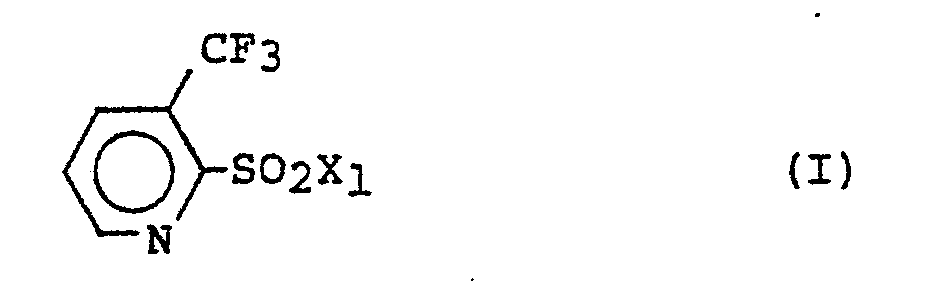
- The 3-trifluoromethylpyridine compound of the general formula (I) which can be used as an intermediate can be derived into N-[(4,6-dimethoxypyrimidin-2-yl)aminocarbonyl]-3-trifluoromethylpyridine-2-sulfonamide, and it is useful because the thus-derived compound exhibits a high herbicidal activity as demonstrated in the test examples described hereunder.
- The compound of the present invention can control a wide variety of weeds such as Cyperaceae, e.g., rice flatsedge (Cyperus iria L.), purple nutsedge (Cyperus rotundus L.), and Cyperus brevitolius HASSK.; Leguminosae, e.g., white clover (Trifolium repens L.), narrowleaf vetch (Vicia sativa L.), and sicklepod (Cassia tora L.); Oxalidaceae, e.g., creeping woodsorrel (Oxalis corniculata L.) and pink woodsorrel (Oxalis martiana ZUCC.); Compositae, e.g., common cocklebur (Xanthium strumarium L.), annual fleabane (Erigeron annuus L.), common mugwort (Artemisia vulgaris L.), and broadleaved fleabane (Erigeron sumatrensis RETZ.); Polygonaceae, e.g., green smartweed (Polygonum lapathifolium L.) and broadleaf dock (Rumex japonicus HOUTTUYN); Gramineae, e.g., large crabgrass (Digitaria adscendens HENR.), common barnyardgrass (Echinochloa crus-galli L.), quackgrass (Agropyron repens L.), and wild oat (Avena fatua L.); Amaranthaceae, e.g., slender amaranth (Amaranthus viridis L.) and livid amaranth (Amaranthus lividus L.); Chenopodiaceae, e.g., common lambsquarters (Chenopodium album L.); Caryophyl- laceae, e.g., common chickweed (Stellaria media CRY.) and startwort (Stellaria alsine GRIMM.); Convolvulaceae, e.g., common morningglory (Pharbitis purpurea VOIGT.) and Portulacaceae, e.g., common purslane (Portulaca oleracea L.).
- Herbicides containing the compound according to the present invention as the active ingredient will find many other applications such as agricultural fields, e.g., upland farms, orchards, and mulberry fields and non- agricultural fields, e.g., forests, farm roads, " playgrounds, factory sites, and turf fields.
- In particular, the compound of the present invention does not damage warm-season turfs such as Zoysia sp., e.g., Zoysia japonia and Zoysia metrella and Cymodon sp., e.g., tifton and common bermuda grass and is safe against tomato, and therefore, it is very useful.
- Almost all of conventional herbicides used in the turf field have an effect only against broad-leaved weeds, and no chemicals can simultaneously control a wide range of weeds including strongly noxious weeds such as Cyperaceae and Gramineae. Accordingly, the compound of the present invention is very useful.
- When a herbicidal composition of the present invention is applied, the herbicidal compound of the present invention is usually formulated into various forms such as granules, dust, wettable powder, or water-soluble powder by optionally incorporating conventional agriculturally acceptable adjuvants, for example, a carrier, diluent, solvent, spreader, or surfactant. A suitable mixing ratio of the active ingredient to the adjuvant(s) ranges from 0.5:99.5 to 90:10 by weight and preferably from 1:99 to 60:40 by weight. An optimum amount of the active ingredient applied cannot be unequivocally defined because it varies according to various factors such as the climate condition, the weather condition, the soil condition, the form of the chemical, the type of weeds to be controlled, or the time of application, but the amount of the active ingredient is usually from 0.01 to 100 g per are (100 m2) and preferably from 0.1 to 10 g per are.
- The herbicidal composition of the present invention can be applied by soil treatment or foliar treatment.
- The herbicidal composition of the present invention can be mixed or used together with other agricultural chemicals, fertilizers, soil, or safeners. Sometimes, such a conjoint use brings about a more excellent effect or action. Examples of other herbicides which can be mixed with the herbicidal composition of the present invention are listed below.
- Potassium 4-amino-3,5,6-trichloro-2-pyridincarboxylate Ethyl 2,4-dichlorophenoxyacetate Ethyl 2-methyl-4-chlorophenoxyacetate 4-Amino-6-tert-butyl-3-(methylthio)-l,2,4-triazin-5(4H)-one 2-(2-Chloro-4-ethylamino-s-triazin-6-ylamino)-2-methylpropionitrile 2-Chloro-4,6-bis(ethylamino)-s-triazine 2-Chloro-4-ethylamino-6-isopropylamino-s-triazine N'-[5-(l,l-Dimethylethyl)-3-isoxazol]-N,N-dimethylurea 3-(3,4-Dichlorophenyl)-1,1-dimethylurea 3-(3,4-Dichlorophenyl)-l-methoxy-l-methylurea 3,5-Dinitro-N',N'-dipropylsulfanylamide 2-Methylthio-4-ethylamino-6-isopropylamino-s-triazine n-Butyl a-[4-(5-trifluoromethyl-2-pyridyloxy)phenoxy]-propionate Methyl α-[4-(2,4-dichlorophenoxy)phenoxy]propionate Methyl a-[4-(3-chloro-5-trifluoromethyl-2-pyridyloxy)-phenoxy]propionate 2-[l-(Ethoxyimino)-butyl]-5-(2-ethylthiopropyl)-3-hydroxy-2-cyclohexen-l-one l,l'-Dimethyl-4,4'-bipyridylium dichloride and isopropylamine salt of N-(phosphonomethyl)glycine Sodium N'-methoxycarbonylsulfanylamide Sodium 2,2-dichloropropionate 3,4-Dichloropropionanilide 1,2-Dimethyl-3,5-diphenyl-1H-pyrazolium methylsulfate Ethyl N-benzoyl-N-(3-chloro-4-fluorophenyl)-2-amino- propionate 3,4-Dimethyl-2,6-dinitro-N-(l-ethyl)propylaniline α,α,α-Trifluoro-2,6-dinitro-N,N-dipropyl-p-toluidine 2-Chloro-2',6'-diethyl-N-(methoxymethyl)acetanilide 2-Chloro-N-(2-ethyl-6-methylphenyl)-N-(2-methoxy-l-methylethyl)acetamide 5'-(Trifluoromethanesulfonamido)aceto-2'4'-xylidide 2-Chloro-N-isopropylacetanilide 3,5-Dibromo-4-hydroxybenzonitrile 3,5-Diiodo-4-octanoyloxybenzonitrile 4-Chlorobutyn-2-yl-N-(3-chlorophenyl)carbamate
- Some typical formulation examples of the herbicidal composition of the present invention are shown below.
-

- The ingredients (1) to (3) are mixed and pulverized to form a dust.
-
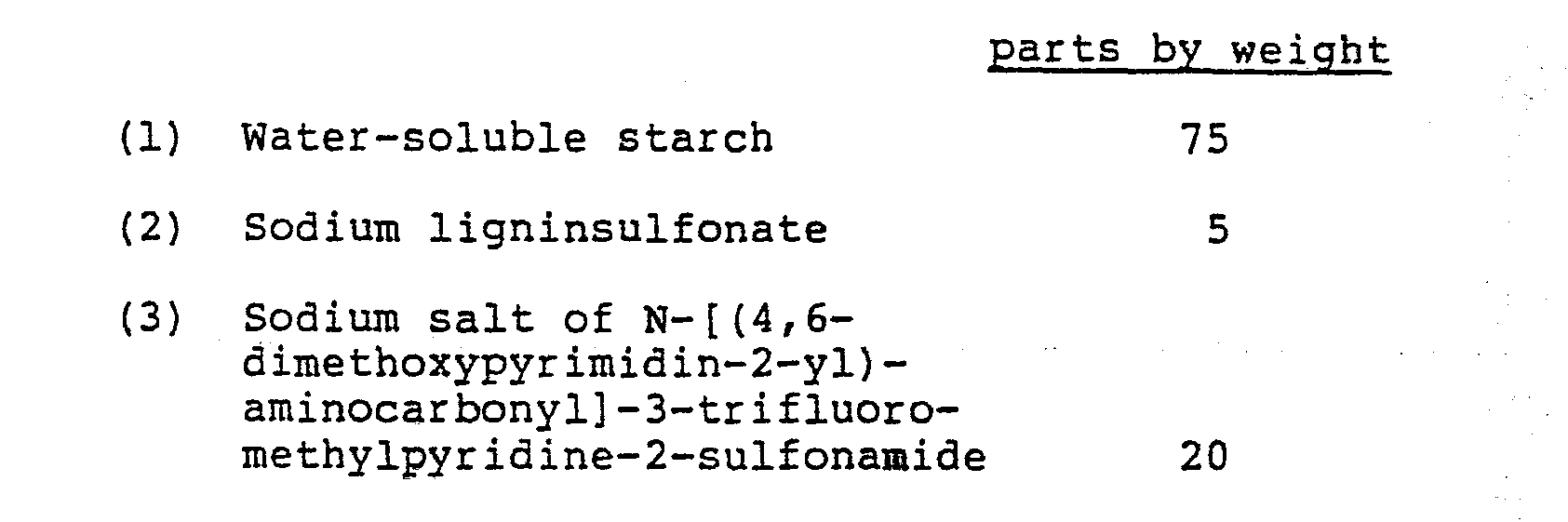
- The ingredients (1) to (3) are mixed to form a water-soluble powder.
-
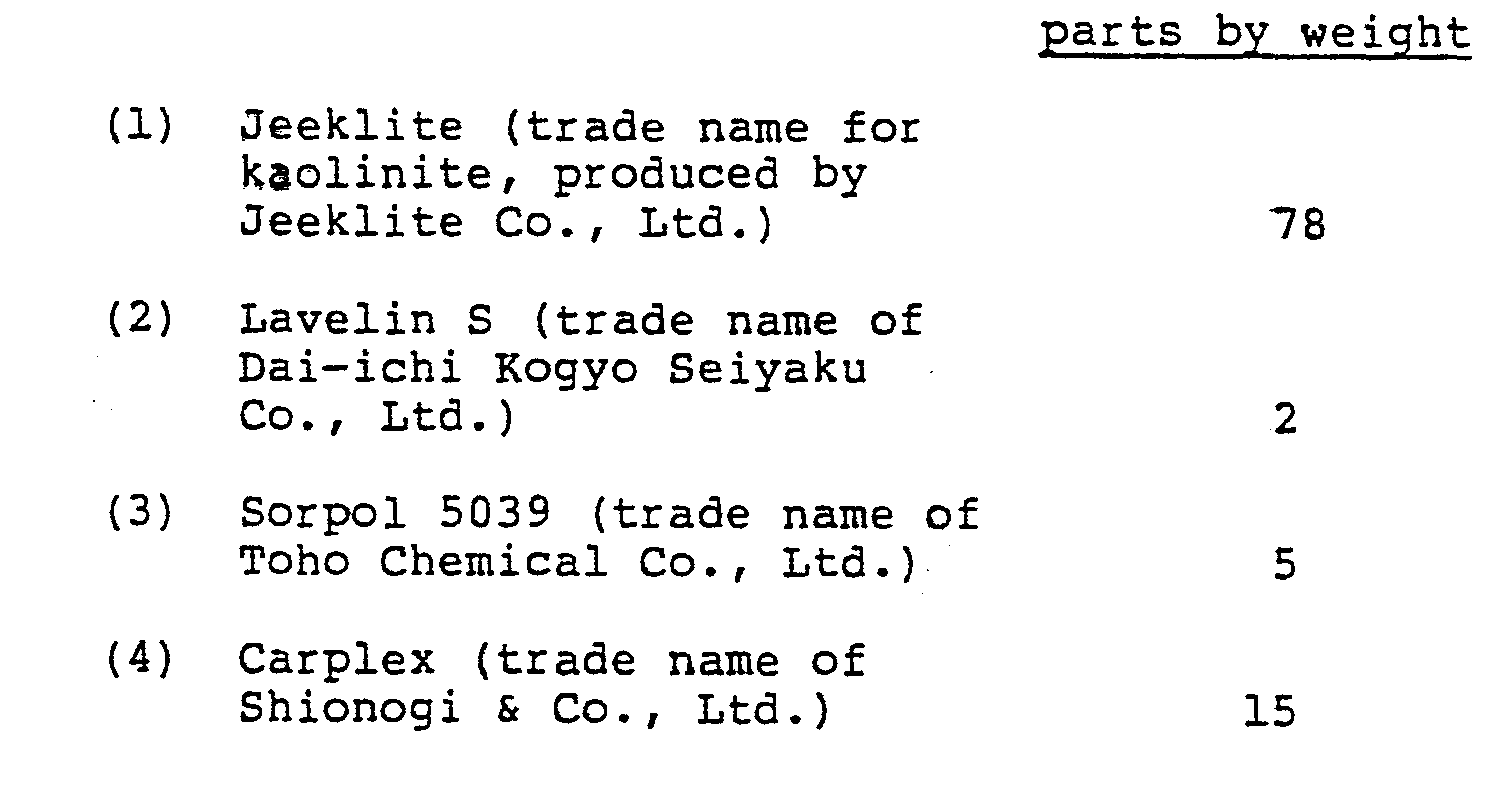
- A mixture of the ingredients (1) to (4) and the compound of the invention are mixed in a weight ratio of 4:1 tp form a wettable powder.
-

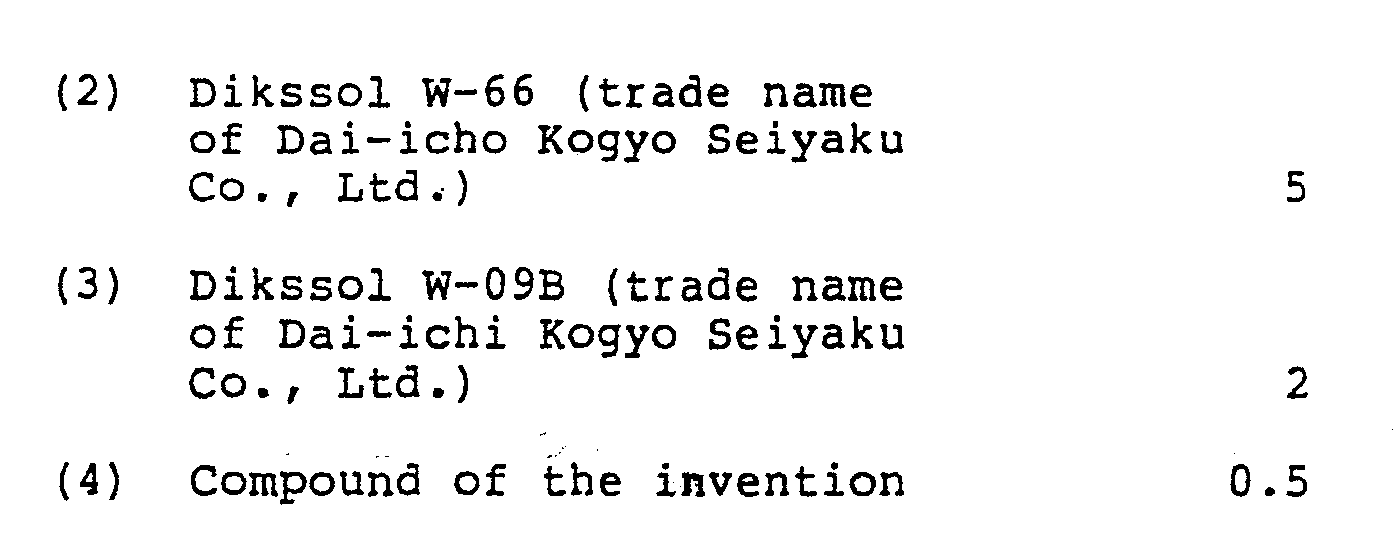
- The ingredients (1) to (4) are mixed to form a wettable powder.
-
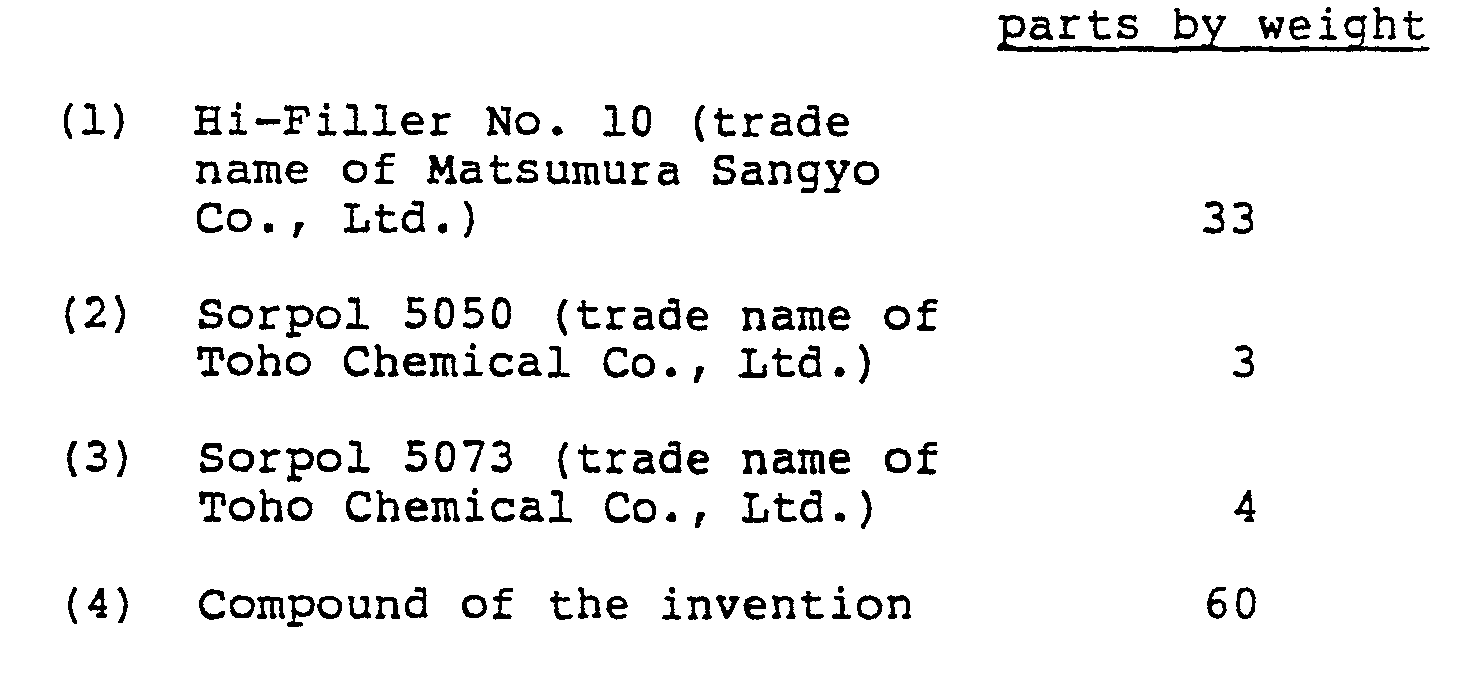
- The ingredients (1) to (4) are mixed to form a wettable powder.
- The herbicidal activity testing of the compound of the present invention and results obtained are shown below.
- The test compounds used in the test examples are shown in Table 1.


- Each 1/10,000 are (1/100 m2) pot was charged with upland soil, and predetermined amounts of seeds of various test plants were sown. When the test plants had respectively reached the prescribed growth stage as set forth below, an aqueous dispersion prepared by diluting a wettable powder containing a predetermined amount of each of the test compounds shown in Table 2 with 5 1/are of water was foliarly applied on the plant by means of a small-sized sprayer.- Thirty days after the application, the degree of growth of the plant was visually observed. The results are shown in Table 2. The weed control shown in Table 2 was evaluated on a scale of 10 grades in which 10 indicates that the plant was completely killed and 1 indicates one the same as untreated check.
- A: common cocklebur --- 2-leaf stage
- B: common morningglory --- 2-leaf stage
- C: green smartweed --- 4-leaf stage
- D: sicklepod --- 1-leaf stage
- E: wild oat --- 2-leaf stage
- F: barnyardgrass --- 2-leaf stage
- G: large crabgrass --- 2-leaf stage
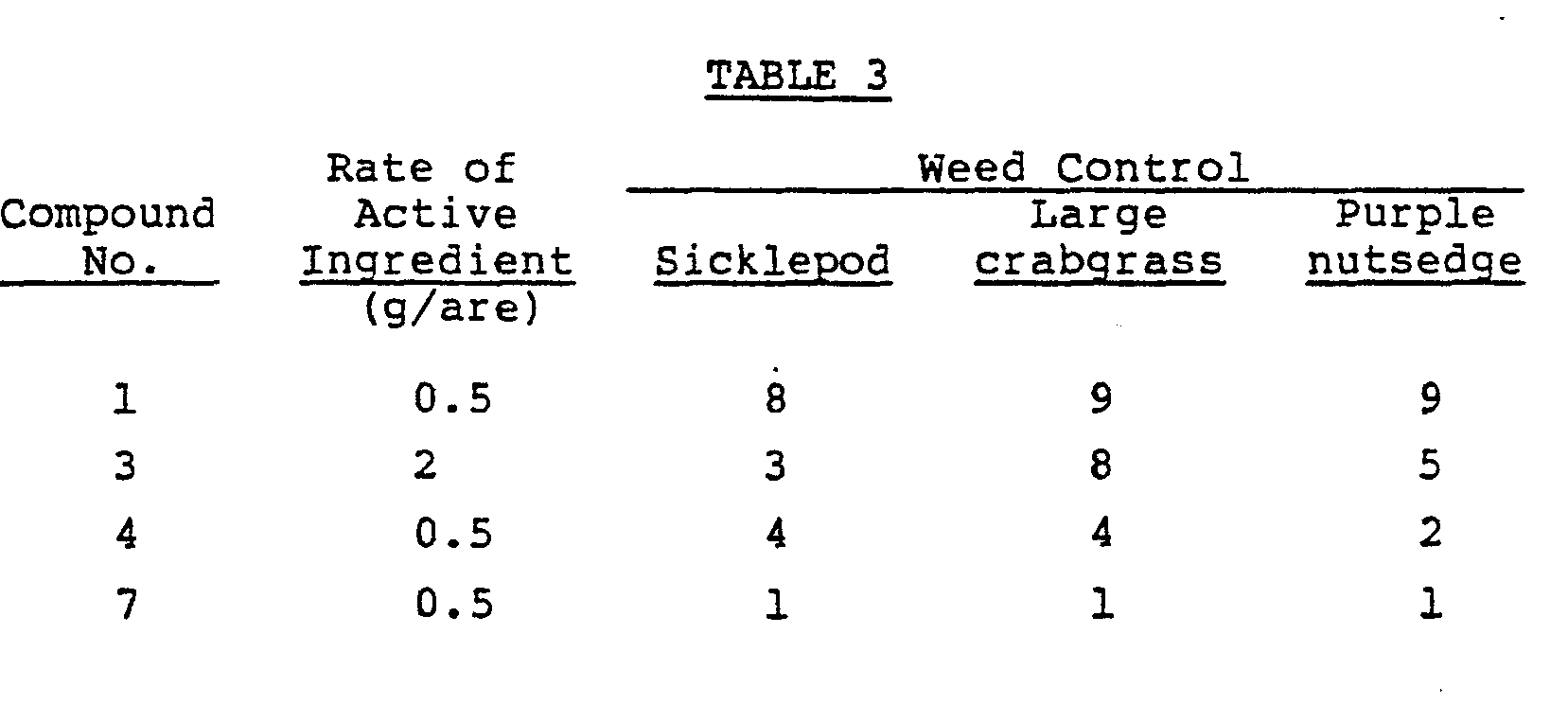
- The same procedures as in Test Example 1 were repeated except that the test plants were changed to sicklepod (1-leaf stage), large crabgrass (2-leaf stage), and purple nutsedge (5- to 6-leaf stage) and that the rate of the active ingredient was changed as shown in Table 3. The results are shown in Table 3.
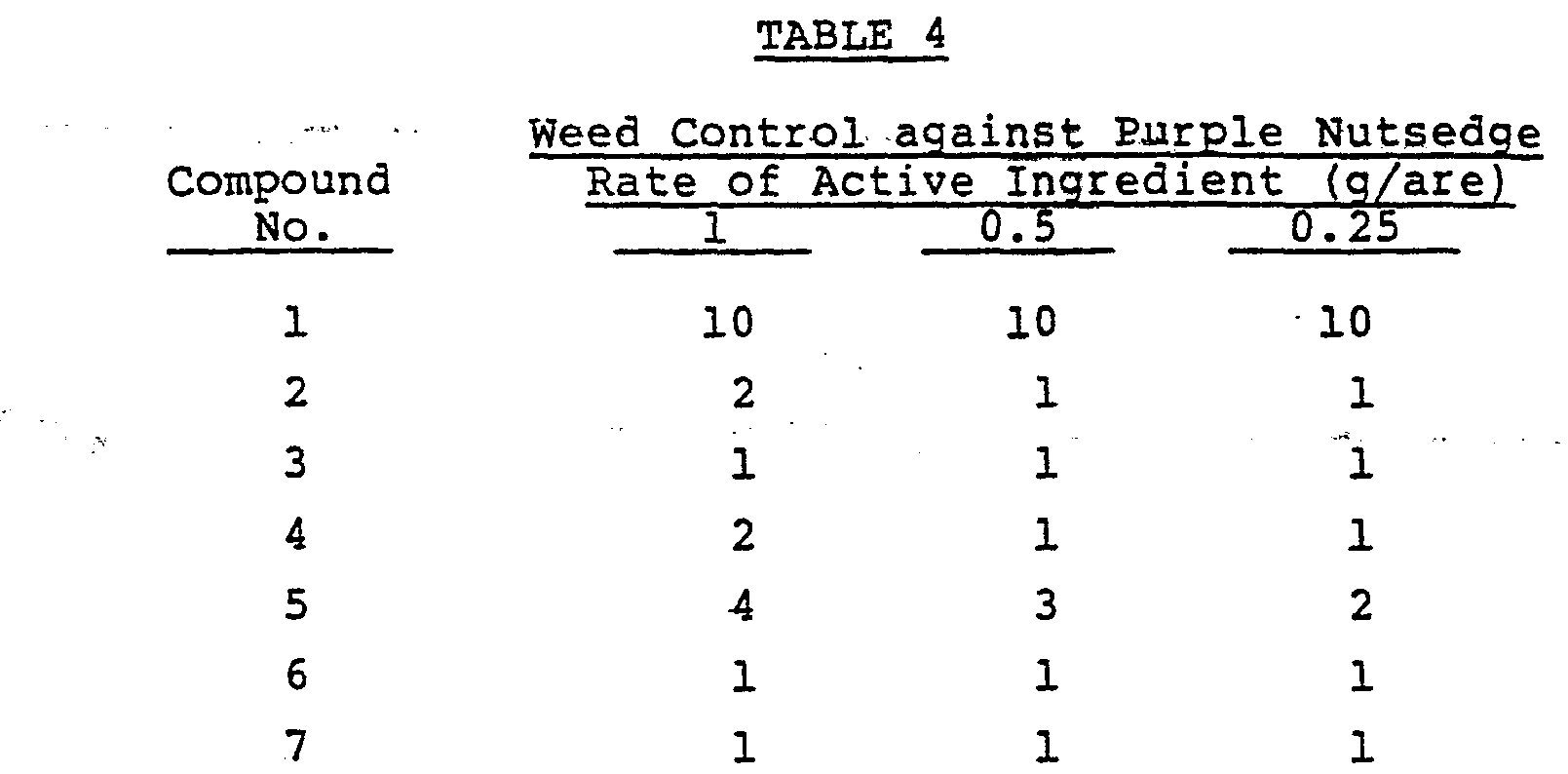
- In Test Example 1, germinated tubers of purple nutsedge were planted in a pot, and when the purple nutsedge had reached a 4-leaf stage, the same treatment as in Test Example 1 was carried out. The results are shown in Table 4.
- Mats of Zoysia metrella were sodded in a 1/2,000 are (1/20 m2) pot and mowed about 4 times every two weeks. Seedings of tomato of 4-leaf stage were transplanted in a 1/2,000 are (1/20 m2) pot. When the tomato had reached a 8-leaf stage, an aqueous dispersion prepared by diluting a wettable powder containing a predetermined amount of each of the test compounds shown in Table 5 with 5 1/are of water was foliarly applied on the plant by means of a small-sized sprayer. The degree of growth of the plant was visually observed 35 days after the application for Zoysia metrella and 25 days after the application for tomato, respectively. The degree of growth was evaluated on a scale of 10 grades in the same manner as in Test Example 1. The results are shown in Table 5.

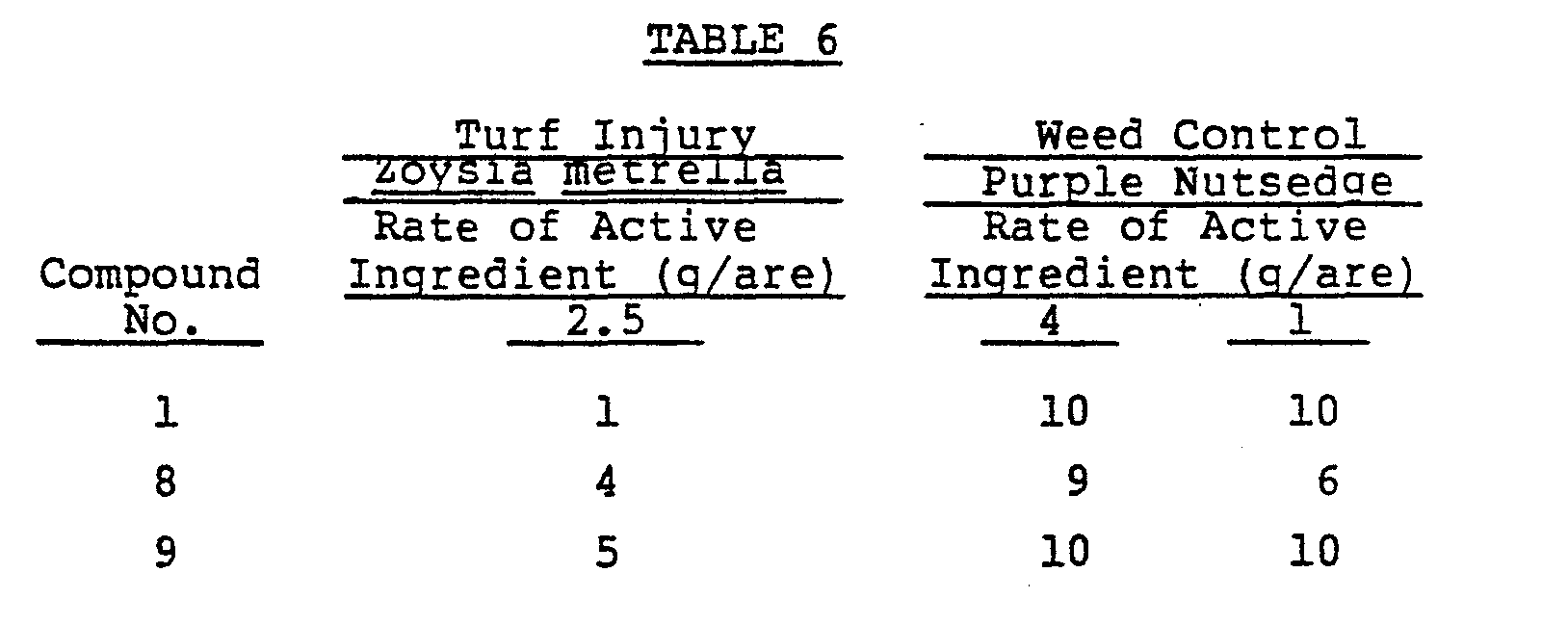
- Seedings of Zoysia metrella were sodded in a 1/2,000 are (1/20 m2) pot and mowed about 4 times every two weeks. Thereafter, tubers of purple nutsedge were sodded in the pot. When the purple nutsedge had reached a 6-leaf stage, the same procedures as in Test Example 1 were repeated. The results are shown in Table 6.
- While the invention has been described in detail and with reference to specific embodiments thereof, it will be apparent to one skilled in the art that various changes and modifications can be made therein without departing from the spirit and scope thereof.
wherein Xl represents a halogen atom, an amino group, an isocyanato group, or a phenoxycarbonylamino group, is considered to be a novel compound.

Claims (19)


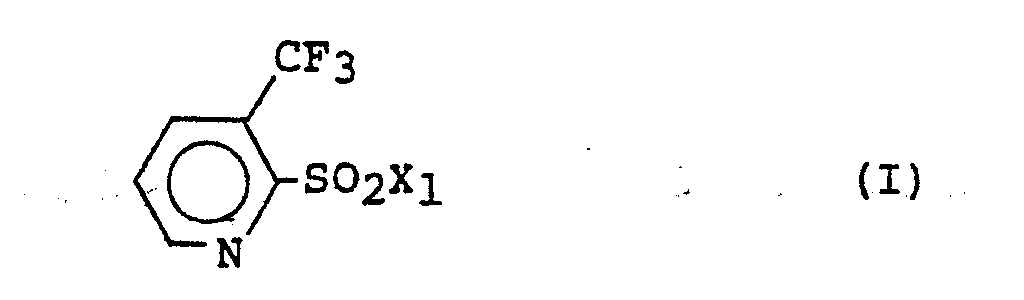
wherein Xl respresents a halogen atom, an amino group, an isocyanato group, or a phenoxycarbonylamino group.
Priority Applications (1)
| Application Number | Priority Date | Filing Date | Title |
|---|---|---|---|
| MYPI87001613A MY100100A (en) | 1984-12-06 | 1987-09-09 | N-[(4,6-dimethoxypyrimidin-2-y1) aminocarbonyl]-3- trifluoromethylpyridine-2- sulfonamide or salts thereof, herbicidal composition containing the same, and process for the production of the compound |
Applications Claiming Priority (2)
| Application Number | Priority Date | Filing Date | Title |
|---|---|---|---|
| JP258186/84 | 1984-12-06 | ||
| JP25818684 | 1984-12-06 |
Publications (3)
| Publication Number | Publication Date |
|---|---|
| EP0184385A2 true EP0184385A2 (en) | 1986-06-11 |
| EP0184385A3 EP0184385A3 (en) | 1987-09-30 |
| EP0184385B1 EP0184385B1 (en) | 1990-09-26 |
Family
ID=17316706
Family Applications (1)
| Application Number | Title | Priority Date | Filing Date |
|---|---|---|---|
| EP85308652A Expired - Lifetime EP0184385B1 (en) | 1984-12-06 | 1985-11-28 | N-[(4,6-Dimethoxypyrimidin-2-YL)Aminocarbonyl]-3-trifluoromethylpyridine-2-sulfonamide or salts thereof, herbicidal composition containing the same, and processs for the production of the compound |
Country Status (14)
| Country | Link |
|---|---|
| US (1) | US4744814A (en) |
| EP (1) | EP0184385B1 (en) |
| JP (1) | JPH0660173B2 (en) |
| KR (1) | KR910004431B1 (en) |
| CN (1) | CN1009152B (en) |
| AU (1) | AU580355B2 (en) |
| BR (1) | BR8506081A (en) |
| DE (1) | DE3579891D1 (en) |
| DK (1) | DK164166C (en) |
| ES (1) | ES8700230A1 (en) |
| HN (1) | HN1993004031A (en) |
| MY (1) | MY100100A (en) |
| NZ (1) | NZ214447A (en) |
| PH (1) | PH20866A (en) |
Cited By (21)
| Publication number | Priority date | Publication date | Assignee | Title |
|---|---|---|---|---|
| WO1989002700A3 (en) * | 1987-09-28 | 1989-04-20 | Du Pont | Herbicidal o-carbomethoxysulfonylureas |
| EP0427174A1 (en) * | 1989-11-06 | 1991-05-15 | Nissan Chemical Industries Ltd. | Pyridinesulfonamide derivatives and herbicides |
| EP0462585A1 (en) * | 1990-06-20 | 1991-12-27 | Ishihara Sangyo Kaisha, Ltd. | Herbicidal composition |
| FR2666723A1 (en) * | 1990-09-13 | 1992-03-20 | Ishihara Mining & Chemical Co | HERBICIDE COMPOSITION CONTAINING 1- (4,6-DIMETHOXYPYRIMIDIN-2-YL) -3- (3-TRIFLUOROMETHYL-2-PYRIDYLSULFONYL) UREA AND N-PHOSPHONOMETHYLGLYCIN OR A PARAQUAT OR DIQUAT SALT AND PROCESS FOR PREPARING THE SAME . |
| US5102444A (en) * | 1986-12-08 | 1992-04-07 | E. I. Du Pont De Nemours And Company | Herbicidal pyridinesulfonylureas |
| EP0416319A3 (en) * | 1989-08-23 | 1992-09-02 | Bayer Ag | Process for the preparation of sulfonylisoureas |
| EP0508348A1 (en) * | 1991-04-11 | 1992-10-14 | Hoechst Schering AgrEvo GmbH | Process for the preparation of 2-pyridylsulfonylureas and thiadiazolopyridines as intermediates in this process |
| US5209770A (en) * | 1989-05-26 | 1993-05-11 | E. I. Du Pont De Nemours And Company | Herbicidal pyridinesulfonylureas |
| US5215570A (en) * | 1988-10-20 | 1993-06-01 | Ciba-Geigy Corporation | Sulfamoylphenylureas |
| EP0661001A1 (en) * | 1993-12-28 | 1995-07-05 | Japan Tobacco Inc. | Herbicidal composition for the control of annual bluegrass |
| LT3943B (en) | 1993-12-23 | 1996-05-27 | Ciba Geigy Ag | Remedy for cultured plants protection, use of sulphamoyl-phenyl-carbamides for cultured plant protection, herbicidal preparation, process for preparing sulphamoyl-phenyl-carbamides |
| US5663118A (en) * | 1992-06-08 | 1997-09-02 | Hoechst Schering Agrevo Gmbh | Fluoromethylsulfonyl-substituted pyridylsulfonylureas as herbicides, process for their preparation, and their use |
| EP1911748A1 (en) | 1999-09-28 | 2008-04-16 | Bayer CropScience AG | Method for producing substituted phenylsulfonyl ureas from sulfohalogenides |
| EP2052606A1 (en) | 2007-10-24 | 2009-04-29 | Bayer CropScience AG | Herbicide combination |
| WO2009128512A1 (en) | 2008-04-18 | 2009-10-22 | 石原産業株式会社 | Method for producing pyrimidine compound |
| DE102008037620A1 (en) | 2008-08-14 | 2010-02-18 | Bayer Crop Science Ag | Herbicide combination with dimethoxytriazinyl-substituted difluoromethanesulfonylanilides |
| WO2012049266A1 (en) | 2010-10-15 | 2012-04-19 | Bayer Cropscience Ag | Use of als inhibitor herbicides for control of unwanted vegetation in als inhibitor herbicide tolerant beta vulgaris plants |
| WO2012150333A1 (en) | 2011-05-04 | 2012-11-08 | Bayer Intellectual Property Gmbh | Use of als inhibitor herbicides for control of unwanted vegetation in als inhibitor herbicide tolerant brassica, such as b. napus, plants |
| WO2014090760A1 (en) | 2012-12-13 | 2014-06-19 | Bayer Cropscience Ag | Use of als inhibitor herbicides for control of unwanted vegetation in als inhibitor herbicide tolerant beta vulgaris plants |
| CN111116557A (en) * | 2019-12-30 | 2020-05-08 | 大连九信精细化工有限公司 | Flazasulfuron crystal form and preparation method thereof |
| WO2023062184A1 (en) | 2021-10-15 | 2023-04-20 | KWS SAAT SE & Co. KGaA | Als inhibitor herbicide tolerant beta vulgaris mutants |
Families Citing this family (16)
| Publication number | Priority date | Publication date | Assignee | Title |
|---|---|---|---|---|
| DE59008552D1 (en) * | 1989-01-11 | 1995-04-06 | Ciba Geigy Ag | Antidots to improve the crop tolerance of agrochemical agents. |
| US5391539A (en) * | 1990-06-20 | 1995-02-21 | Ishihara Sangyo Kaisha, Ltd. | Herbicidal composition comprising glufosinate and a heterocyclic sulfonylurea herbicide |
| US5434123A (en) * | 1990-09-13 | 1995-07-18 | Ishihara Sangyo Kaisha, Ltd. | Herbicidal composition comprising glyphosate and 1-(4,6-dimethoxypyrimidin-2-yl)-3-(3-trifluoromethyl-2-pyridylsulfonyl)urea |
| EP2255637A1 (en) * | 2009-05-02 | 2010-12-01 | Bayer CropScience AG | Method for weed control in lawn or turf |
| US9179679B2 (en) * | 2010-02-03 | 2015-11-10 | Dow Agrosciences Llc | Synergistic herbicidal composition containing penoxsulam and flazasulfuron |
| JP5753405B2 (en) | 2010-03-03 | 2015-07-22 | 石原産業株式会社 | How to reduce unwanted effects on turfgrass |
| JP5829044B2 (en) * | 2010-05-06 | 2015-12-09 | 石原産業株式会社 | Herbicidal composition |
| JP5875924B2 (en) * | 2011-04-14 | 2016-03-02 | 石原産業株式会社 | Herbicidal composition |
| CN104686555A (en) * | 2013-12-05 | 2015-06-10 | 南京华洲药业有限公司 | Mixed herbicide containing flazasulfuron and bensulfuron methyl |
| CN104686543A (en) * | 2013-12-05 | 2015-06-10 | 南京华洲药业有限公司 | Mixing herbicide containing flazasulfuron and butachlor |
| CN104686548A (en) * | 2013-12-05 | 2015-06-10 | 南京华洲药业有限公司 | Mixed herbicide containing flazasulfuron and cyclosulfamuron |
| CN104686549A (en) * | 2013-12-05 | 2015-06-10 | 南京华洲药业有限公司 | Mixed herbicide containing flazasulfuron and flumetsulam |
| CN104686554A (en) * | 2013-12-05 | 2015-06-10 | 南京华洲药业有限公司 | Mixed herbicide containing flazasulfuron and dithiopyr |
| CN104686547A (en) * | 2013-12-05 | 2015-06-10 | 南京华洲药业有限公司 | Mixed herbicide containing flazasulfuron and pyributicarb |
| CN104396998B (en) * | 2014-11-30 | 2016-06-29 | 南京华洲药业有限公司 | A kind of mixed herbicide containing flazasulfuron, butachlor and fluroxypyr |
| CN111004217A (en) * | 2019-12-30 | 2020-04-14 | 大连九信精细化工有限公司 | Flazasulfuron crystal form and preparation method thereof |
Family Cites Families (32)
| Publication number | Priority date | Publication date | Assignee | Title |
|---|---|---|---|---|
| US4435206A (en) * | 1978-12-04 | 1984-03-06 | E. I. Du Pont De Nemours And Company | Agricultural pyridinesulfonamides |
| US4544401A (en) * | 1979-10-22 | 1985-10-01 | E. I. Du Pont De Nemours And Company | Agricultural pyridinesulfonamides |
| US4522645A (en) * | 1978-12-04 | 1985-06-11 | E. I. Du Pont De Nemours And Company | Agricultural pyridinesulfonamides |
| DK468979A (en) * | 1978-12-04 | 1980-06-05 | Du Pont | AGRICULTURAL PYRIDINE SULPHONAMIDES |
| US4342587A (en) * | 1979-07-20 | 1982-08-03 | E. I. Du Pont De Nemours And Company | Herbicidal pyridinsulfonamides |
| US4301286A (en) * | 1979-08-20 | 1981-11-17 | E. I. Du Pont De Nemours And Company | Herbicidal O-alkyl sulfonylisoureas |
| US4339267A (en) * | 1980-01-18 | 1982-07-13 | E. I. Du Pont De Nemours And Company | Herbicidal sulfonamides |
| US4456469A (en) * | 1980-03-07 | 1984-06-26 | E. I. Du Pont De Nemours And Company | Pyridyl sulfone herbicides |
| US4605432A (en) * | 1980-03-07 | 1986-08-12 | E. I. Du Pont De Nemours And Company | Pyridyl sulfone herbicides |
| US4333760A (en) * | 1980-08-22 | 1982-06-08 | E. I. Du Pont De Nemours And Company | Herbicidal sulfonamides |
| US4372778A (en) * | 1980-09-29 | 1983-02-08 | E. I. Du Pont De Nemours And Company | Herbicidal N-(pyridinylaminocarbonyl)benzenesulfonamides |
| US4629494A (en) * | 1981-12-07 | 1986-12-16 | E. I. Du Pont De Nemours And Company | Herbicidal sulfonamides |
| DK536582A (en) * | 1981-12-07 | 1983-06-08 | Du Pont | HERBICIDE SULPHONAMIDES |
| US4655823A (en) * | 1981-12-07 | 1987-04-07 | E. I. Du Pont De Nemours And Company | Herbicidal sulfonamides |
| MA19680A1 (en) * | 1982-01-11 | 1983-10-01 | Novartis Ag | N- ARYLSULFONYL - N '- PYRIMIDINYLUREES. |
| US4496392A (en) * | 1982-05-12 | 1985-01-29 | E. I. Du Pont De Nemours And Company | Herbicidal heterocyclic alkylaminocarbonylsulfonamides |
| MA19797A1 (en) * | 1982-06-14 | 1983-12-31 | Ciba Geigy Ag | N-HETEROCYCLOSULFONYL -N- PYRIMIDINYL AND TRIAZINYLUREES. |
| US4518776A (en) * | 1982-07-19 | 1985-05-21 | Ciba Geigy Corporation | Process for producing sulfonylureas |
| US4425155A (en) * | 1982-07-26 | 1984-01-10 | E. I. Du Pont De Nemours And Company | Herbicidal sulfonamide N-oxides |
| US4579583A (en) * | 1982-09-08 | 1986-04-01 | Ciba-Geigy Corporation | Novel sulfonylureas |
| US4521597A (en) * | 1982-10-25 | 1985-06-04 | Ciba Geigy Corporation | Process for producing sulfonylureas having a herbicidal action |
| US4565567A (en) * | 1983-03-14 | 1986-01-21 | E. I. Du Pont De Nemours And Company | Herbicidal heterocyclic alkylaminocarbonylsulfonamides |
| DE3474447D1 (en) * | 1983-07-18 | 1988-11-10 | Ciba Geigy Ag | Process for the preparation of sulfonyl urea |
| US4643760A (en) * | 1983-12-08 | 1987-02-17 | Ciba-Geigy Corporation | Herbicidal sulfonylureas |
| US4932997A (en) * | 1984-04-11 | 1990-06-12 | Ciba-Geigy Corporation | N-heterocyclosulfonyl-N'-pyrimidinylureas and N-heterocyclosulfonyl-N'-triazinylureas |
| US4659361A (en) * | 1984-06-11 | 1987-04-21 | E. I. Du Pont De Nemours And Company | Herbicidal iodopyrimidines |
| US4668279A (en) * | 1984-08-08 | 1987-05-26 | E. I. Du Pont De Nemours And Company | Herbicidal pyridinesulfonamides |
| US4666506A (en) * | 1984-08-08 | 1987-05-19 | E. I. Du Pont De Nemours And Company | Herbicidal pyrimidines |
| US4659369A (en) * | 1984-08-27 | 1987-04-21 | E. I. Du Pont De Nemours And Company | Herbicidal acetals and ketals |
| US4657578A (en) * | 1984-11-15 | 1987-04-14 | E. I. Du Pont De Nemours And Company | Herbicidal ortho-heterocyclic sulfonamides |
| US4666501A (en) * | 1984-12-11 | 1987-05-19 | E. I. Du Pont De Nemours And Company | Herbicidal sulfonamides |
| US4662933A (en) * | 1985-02-21 | 1987-05-05 | E. I. Du Pont De Nemours And Company | Herbicidal sulfonamides |
-
1985
- 1985-11-27 US US06/802,279 patent/US4744814A/en not_active Expired - Lifetime
- 1985-11-28 PH PH33108A patent/PH20866A/en unknown
- 1985-11-28 DE DE8585308652T patent/DE3579891D1/en not_active Expired - Lifetime
- 1985-11-28 EP EP85308652A patent/EP0184385B1/en not_active Expired - Lifetime
- 1985-12-03 AU AU50733/85A patent/AU580355B2/en not_active Expired
- 1985-12-04 CN CN85109761A patent/CN1009152B/en not_active Expired
- 1985-12-05 NZ NZ214447A patent/NZ214447A/en unknown
- 1985-12-05 DK DK563285A patent/DK164166C/en not_active IP Right Cessation
- 1985-12-05 KR KR1019850009144A patent/KR910004431B1/en not_active Expired
- 1985-12-05 BR BR8506081A patent/BR8506081A/en not_active IP Right Cessation
- 1985-12-06 JP JP60274579A patent/JPH0660173B2/en not_active Expired - Lifetime
- 1985-12-06 ES ES549673A patent/ES8700230A1/en not_active Expired
-
1987
- 1987-09-09 MY MYPI87001613A patent/MY100100A/en unknown
-
1993
- 1993-04-29 HN HN1993004031A patent/HN1993004031A/en unknown
Cited By (38)
| Publication number | Priority date | Publication date | Assignee | Title |
|---|---|---|---|---|
| US5393733A (en) * | 1986-12-08 | 1995-02-28 | E. I. Du Pont De Nemours And Company | Herbicidal pyridinesulfonylureas |
| US5102444A (en) * | 1986-12-08 | 1992-04-07 | E. I. Du Pont De Nemours And Company | Herbicidal pyridinesulfonylureas |
| EP0314302A3 (en) * | 1987-09-28 | 1989-08-02 | E.I. Du Pont De Nemours And Company | Herbicidal o-carbomethoxy-sulfonylureas |
| WO1989002700A3 (en) * | 1987-09-28 | 1989-04-20 | Du Pont | Herbicidal o-carbomethoxysulfonylureas |
| US5215570A (en) * | 1988-10-20 | 1993-06-01 | Ciba-Geigy Corporation | Sulfamoylphenylureas |
| US5209770A (en) * | 1989-05-26 | 1993-05-11 | E. I. Du Pont De Nemours And Company | Herbicidal pyridinesulfonylureas |
| EP0416319A3 (en) * | 1989-08-23 | 1992-09-02 | Bayer Ag | Process for the preparation of sulfonylisoureas |
| EP0427174A1 (en) * | 1989-11-06 | 1991-05-15 | Nissan Chemical Industries Ltd. | Pyridinesulfonamide derivatives and herbicides |
| US5116405A (en) * | 1989-11-06 | 1992-05-26 | Nissan Chemical Industries Ltd. | Pyridinesulfonamide derivatives and herbicides |
| US5354731A (en) * | 1989-11-06 | 1994-10-11 | Nissan Chemical Industries Ltd. | Pyridinesulfonamide derivatives as herbicides |
| EP0462585A1 (en) * | 1990-06-20 | 1991-12-27 | Ishihara Sangyo Kaisha, Ltd. | Herbicidal composition |
| TR25377A (en) * | 1990-06-20 | 1993-03-01 | Ishihara Sangyo Kaisha | A HERBISID WITH A WIDE HERBISIDAL SPECTRUM AND A PERMANENT HERBICIDAL EFFECT |
| EP0475392A3 (en) * | 1990-09-13 | 1992-10-14 | Ishihara Sangyo Kaisha, Ltd. | Herbicidal composition |
| BE1005202A3 (en) * | 1990-09-13 | 1993-05-25 | Ishihara Sangyo Kaisha | Composition herbicide. |
| AU637717B2 (en) * | 1990-09-13 | 1993-06-03 | Ishihara Sangyo Kaisha Ltd. | Herbicidal composition |
| TR27041A (en) * | 1990-09-13 | 1994-10-10 | Ishihara Sangyo Kaisha | A herbicide composition with a broad spectrum of herbicides, high activity and permanent herbicide effect. |
| FR2666723A1 (en) * | 1990-09-13 | 1992-03-20 | Ishihara Mining & Chemical Co | HERBICIDE COMPOSITION CONTAINING 1- (4,6-DIMETHOXYPYRIMIDIN-2-YL) -3- (3-TRIFLUOROMETHYL-2-PYRIDYLSULFONYL) UREA AND N-PHOSPHONOMETHYLGLYCIN OR A PARAQUAT OR DIQUAT SALT AND PROCESS FOR PREPARING THE SAME . |
| US5235050A (en) * | 1991-04-11 | 1993-08-10 | Hoechst Aktiengesellschaft | Thiadiazolopyridines |
| US5284945A (en) * | 1991-04-11 | 1994-02-08 | Hoechst Aktiengesellschaft | Process for the preparation of 2-pyridylsulfonylureas |
| EP0508348A1 (en) * | 1991-04-11 | 1992-10-14 | Hoechst Schering AgrEvo GmbH | Process for the preparation of 2-pyridylsulfonylureas and thiadiazolopyridines as intermediates in this process |
| US5663118A (en) * | 1992-06-08 | 1997-09-02 | Hoechst Schering Agrevo Gmbh | Fluoromethylsulfonyl-substituted pyridylsulfonylureas as herbicides, process for their preparation, and their use |
| LT3943B (en) | 1993-12-23 | 1996-05-27 | Ciba Geigy Ag | Remedy for cultured plants protection, use of sulphamoyl-phenyl-carbamides for cultured plant protection, herbicidal preparation, process for preparing sulphamoyl-phenyl-carbamides |
| EP0661001A1 (en) * | 1993-12-28 | 1995-07-05 | Japan Tobacco Inc. | Herbicidal composition for the control of annual bluegrass |
| US5559079A (en) * | 1993-12-28 | 1996-09-24 | Japan Tobacco Inc. | Herbicidal composition for the control of annual bluegrass comprising xanthomonas campestris and sulfonylurea herbicides |
| EP1911748A1 (en) | 1999-09-28 | 2008-04-16 | Bayer CropScience AG | Method for producing substituted phenylsulfonyl ureas from sulfohalogenides |
| EP2052606A1 (en) | 2007-10-24 | 2009-04-29 | Bayer CropScience AG | Herbicide combination |
| WO2009128512A1 (en) | 2008-04-18 | 2009-10-22 | 石原産業株式会社 | Method for producing pyrimidine compound |
| KR20110003339A (en) | 2008-04-18 | 2011-01-11 | 이시하라 산교 가부시끼가이샤 | Method for producing pyrimidine compound |
| EP2450353A1 (en) | 2008-04-18 | 2012-05-09 | Ishihara Sangyo Kaisha, Ltd. | Method for producing pyrimidine compound |
| US8440824B2 (en) | 2008-04-18 | 2013-05-14 | Ishihara Sangyo Kaisha, Ltd. | Method for producing pyrimidine compound |
| DE102008037620A1 (en) | 2008-08-14 | 2010-02-18 | Bayer Crop Science Ag | Herbicide combination with dimethoxytriazinyl-substituted difluoromethanesulfonylanilides |
| WO2012049266A1 (en) | 2010-10-15 | 2012-04-19 | Bayer Cropscience Ag | Use of als inhibitor herbicides for control of unwanted vegetation in als inhibitor herbicide tolerant beta vulgaris plants |
| EP3284346A1 (en) | 2010-10-15 | 2018-02-21 | Bayer Intellectual Property GmbH | Use of als inhibitor herbicides for control of unwanted vegetation in als inhibitor herbicide tolerant beta vulgaris plants |
| WO2012150333A1 (en) | 2011-05-04 | 2012-11-08 | Bayer Intellectual Property Gmbh | Use of als inhibitor herbicides for control of unwanted vegetation in als inhibitor herbicide tolerant brassica, such as b. napus, plants |
| US9370183B2 (en) | 2011-05-04 | 2016-06-21 | Bayer Intellectual Property Gmbh | Use of ALS inhibitor herbicides for control of unwanted vegetation in ALS inhibitor herbicide tolerant Brassica, such as B. napus, plants |
| WO2014090760A1 (en) | 2012-12-13 | 2014-06-19 | Bayer Cropscience Ag | Use of als inhibitor herbicides for control of unwanted vegetation in als inhibitor herbicide tolerant beta vulgaris plants |
| CN111116557A (en) * | 2019-12-30 | 2020-05-08 | 大连九信精细化工有限公司 | Flazasulfuron crystal form and preparation method thereof |
| WO2023062184A1 (en) | 2021-10-15 | 2023-04-20 | KWS SAAT SE & Co. KGaA | Als inhibitor herbicide tolerant beta vulgaris mutants |
Also Published As
| Publication number | Publication date |
|---|---|
| US4744814A (en) | 1988-05-17 |
| KR910004431B1 (en) | 1991-06-27 |
| AU580355B2 (en) | 1989-01-12 |
| NZ214447A (en) | 1988-06-30 |
| DK164166C (en) | 1992-10-12 |
| AU5073385A (en) | 1986-06-12 |
| KR860004880A (en) | 1986-07-14 |
| EP0184385B1 (en) | 1990-09-26 |
| ES8700230A1 (en) | 1986-10-16 |
| DK563285D0 (en) | 1985-12-05 |
| DE3579891D1 (en) | 1990-10-31 |
| PH20866A (en) | 1987-05-25 |
| DK563285A (en) | 1986-06-07 |
| EP0184385A3 (en) | 1987-09-30 |
| JPH0660173B2 (en) | 1994-08-10 |
| BR8506081A (en) | 1986-08-19 |
| JPS61267576A (en) | 1986-11-27 |
| MY100100A (en) | 1989-10-10 |
| CN85109761A (en) | 1986-12-17 |
| ES549673A0 (en) | 1986-10-16 |
| DK164166B (en) | 1992-05-18 |
| CN1009152B (en) | 1990-08-15 |
| HN1993004031A (en) | 1999-04-23 |
Similar Documents
| Publication | Publication Date | Title |
|---|---|---|
| EP0184385B1 (en) | N-[(4,6-Dimethoxypyrimidin-2-YL)Aminocarbonyl]-3-trifluoromethylpyridine-2-sulfonamide or salts thereof, herbicidal composition containing the same, and processs for the production of the compound | |
| EP0388994B1 (en) | Substituted pyridinesulfonamide compounds, herbicidal composition containing them, and method of preparing these compounds | |
| EP0739341B1 (en) | Herbicidal aryl and heteroaryl pyrimidines | |
| JPH0774206B2 (en) | Heterocyclic 2-alkoxyphenoxysulphonylureas, process for their production and herbicides containing them | |
| US4104051A (en) | Substituted bromo- or chloro-acetamide herbicides | |
| JPH05194492A (en) | Salts of pyridylsulfonylurea compounds as herbicides or plant growth retardants, their production and method of using them | |
| EP0451468B2 (en) | Substituted pyridinesulfonamide compounds, herbicidal compositions containing them, and process for their production | |
| EP0161905A2 (en) | Herbicidal halopyrimidines | |
| JP2787587B2 (en) | Heterocyclic-substituted alkyl- and alkenylsulfonylureas, processes for their preparation and their use as herbicides or plant growth regulators | |
| HU206592B (en) | Herbicide and growth controlling compositions containing substituted sulfonyl-diamide derivatives as active components and process for producing the active components | |
| JP2787590B2 (en) | Heterocyclic-substituted phenoxysulfonylureas, their production and use as herbicides or plant growth regulators | |
| EP0496608B1 (en) | Substituted pyridinesulfonamide compound or its salt, process for preparing the same, and herbicide containing the same | |
| US4447260A (en) | N-Substituted phenyl-1-methylcyclopropanecarboxamides, and their herbicidal use | |
| JP2997287B2 (en) | Phenoxysulfonylureas based on 3-substituted alkyl salicylates, their preparation and their use as herbicides and plant growth regulators | |
| US4835282A (en) | Isothiazoles as intermediates for herbicidal sulfonamides | |
| US5354731A (en) | Pyridinesulfonamide derivatives as herbicides | |
| JP2007217336A (en) | Sulfonylurea compound and herbicide | |
| EP0425247A2 (en) | 5-Substituted-2,4-diphenylpyrimidine derivatives, their production and herbicidal use | |
| KR100604693B1 (en) | Optically active uracil compounds | |
| EP0579469A2 (en) | N-acyldihydroquinoline derivatives as herbicides | |
| HUT70686A (en) | Naphtol derivatives, a method for producing the same and herbicidal compositions containing them | |
| EP0562731A1 (en) | Substituted pyridinesulfonamide compounds or their salts, process for preparing the same, and herbicides containing the same | |
| JP2007246477A (en) | Sulfonylurea compound and herbicide | |
| BG61491B2 (en) | Fluoroalkoxy amino triazines for control of weeds in sugar beets | |
| JPH07252253A (en) | Iminosulfonylurea derivative and herbicide |
Legal Events
| Date | Code | Title | Description |
|---|---|---|---|
| PUAI | Public reference made under article 153(3) epc to a published international application that has entered the european phase |
Free format text: ORIGINAL CODE: 0009012 |
|
| AK | Designated contracting states |
Kind code of ref document: A2 Designated state(s): CH DE FR GB IT LI NL |
|
| 17P | Request for examination filed |
Effective date: 19870313 |
|
| PUAL | Search report despatched |
Free format text: ORIGINAL CODE: 0009013 |
|
| AK | Designated contracting states |
Kind code of ref document: A3 Designated state(s): CH DE FR GB IT LI NL |
|
| 17Q | First examination report despatched |
Effective date: 19890428 |
|
| GRAA | (expected) grant |
Free format text: ORIGINAL CODE: 0009210 |
|
| AK | Designated contracting states |
Kind code of ref document: B1 Designated state(s): CH DE FR GB IT LI NL |
|
| ET | Fr: translation filed | ||
| REF | Corresponds to: |
Ref document number: 3579891 Country of ref document: DE Date of ref document: 19901031 |
|
| ITF | It: translation for a ep patent filed | ||
| PLBE | No opposition filed within time limit |
Free format text: ORIGINAL CODE: 0009261 |
|
| STAA | Information on the status of an ep patent application or granted ep patent |
Free format text: STATUS: NO OPPOSITION FILED WITHIN TIME LIMIT |
|
| 26N | No opposition filed | ||
| ITTA | It: last paid annual fee | ||
| REG | Reference to a national code |
Ref country code: GB Ref legal event code: 732E |
|
| REG | Reference to a national code |
Ref country code: CH Ref legal event code: SPCF Free format text: CHSPCFOFAG-NO W 5781/19981211, 19990603 |
|
| REG | Reference to a national code |
Ref country code: FR Ref legal event code: CP Free format text: PRODUCT NAME: FLAZASULFURON; NAT. REGISTRATION NO/DATE: 97 000 70 19990719; FIRST REGISTRATION: CH - W 5781 19981211 Spc suppl protection certif: 00C0002 Filing date: 20000112 |
|
| REG | Reference to a national code |
Ref country code: FR Ref legal event code: C1 Free format text: FRC1 2000C0002, 20000112 |
|
| REG | Reference to a national code |
Ref country code: FR Ref legal event code: CP |
|
| REG | Reference to a national code |
Ref country code: FR Ref legal event code: C2 Free format text: FRC2 2000C0002, 20000112, EXPIRES: 20101127 |
|
| NLUE | Nl: licence registered with regard to european patents |
Free format text: ZENECA LIMITED |
|
| REG | Reference to a national code |
Ref country code: FR Ref legal event code: CL |
|
| REG | Reference to a national code |
Ref country code: CH Ref legal event code: PLI Owner name: ISHIHARA SANGYO KAISHA LIMITED TRANSFER- ZENECA LI |
|
| REG | Reference to a national code |
Ref country code: GB Ref legal event code: IF02 |
|
| REG | Reference to a national code |
Ref country code: FR Ref legal event code: CD Ref country code: FR Ref legal event code: CA |
|
| REG | Reference to a national code |
Ref country code: GB Ref legal event code: 732E |
|
| NLUE | Nl: licence registered with regard to european patents |
Effective date: 20030306 |
|
| REG | Reference to a national code |
Ref country code: FR Ref legal event code: RL |
|
| PGFP | Annual fee paid to national office [announced via postgrant information from national office to epo] |
Ref country code: NL Payment date: 20041103 Year of fee payment: 20 |
|
| PGFP | Annual fee paid to national office [announced via postgrant information from national office to epo] |
Ref country code: FR Payment date: 20041109 Year of fee payment: 20 |
|
| PGFP | Annual fee paid to national office [announced via postgrant information from national office to epo] |
Ref country code: GB Payment date: 20041124 Year of fee payment: 20 |
|
| PGFP | Annual fee paid to national office [announced via postgrant information from national office to epo] |
Ref country code: DE Payment date: 20041125 Year of fee payment: 20 |
|
| PGFP | Annual fee paid to national office [announced via postgrant information from national office to epo] |
Ref country code: CH Payment date: 20041129 Year of fee payment: 20 |
|
| PG25 | Lapsed in a contracting state [announced via postgrant information from national office to epo] |
Ref country code: GB Free format text: LAPSE BECAUSE OF EXPIRATION OF PROTECTION Effective date: 20051127 |
|
| PG25 | Lapsed in a contracting state [announced via postgrant information from national office to epo] |
Ref country code: NL Free format text: LAPSE BECAUSE OF EXPIRATION OF PROTECTION Effective date: 20051128 |
|
| REG | Reference to a national code |
Ref country code: GB Ref legal event code: PE20 |
|
| REG | Reference to a national code |
Ref country code: CH Ref legal event code: PL |
|
| NLV7 | Nl: ceased due to reaching the maximum lifetime of a patent |
Effective date: 20051128 |
|
| REG | Reference to a national code |
Ref country code: CH Ref legal event code: SPCL Spc suppl protection certif: C00184385/01 |