EP0184019A1 - Thermostable alpha-amylase-producing, thermophilic anaerobic bacteria, thermostable alpha-amylase and process for producing the same - Google Patents
Thermostable alpha-amylase-producing, thermophilic anaerobic bacteria, thermostable alpha-amylase and process for producing the same Download PDFInfo
- Publication number
- EP0184019A1 EP0184019A1 EP85114174A EP85114174A EP0184019A1 EP 0184019 A1 EP0184019 A1 EP 0184019A1 EP 85114174 A EP85114174 A EP 85114174A EP 85114174 A EP85114174 A EP 85114174A EP 0184019 A1 EP0184019 A1 EP 0184019A1
- Authority
- EP
- European Patent Office
- Prior art keywords
- amylase
- activity
- thermostable
- amylases
- producing
- Prior art date
- Legal status (The legal status is an assumption and is not a legal conclusion. Google has not performed a legal analysis and makes no representation as to the accuracy of the status listed.)
- Granted
Links
- 238000000034 method Methods 0.000 title claims description 12
- 241001148471 unidentified anaerobic bacterium Species 0.000 title claims description 5
- 102000004139 alpha-Amylases Human genes 0.000 title abstract 6
- 108090000637 alpha-Amylases Proteins 0.000 title abstract 6
- 229940024171 alpha-amylase Drugs 0.000 title 2
- 239000004382 Amylase Substances 0.000 claims abstract description 94
- 241000894006 Bacteria Species 0.000 claims abstract description 66
- 229940025131 amylases Drugs 0.000 claims abstract description 38
- 241000193403 Clostridium Species 0.000 claims abstract description 16
- 238000012258 culturing Methods 0.000 claims abstract description 4
- 230000000694 effects Effects 0.000 claims description 89
- 239000000758 substrate Substances 0.000 claims description 10
- 159000000007 calcium salts Chemical class 0.000 claims description 8
- OYPRJOBELJOOCE-UHFFFAOYSA-N Calcium Chemical compound [Ca] OYPRJOBELJOOCE-UHFFFAOYSA-N 0.000 abstract description 25
- 239000011575 calcium Substances 0.000 abstract description 25
- 229910052791 calcium Inorganic materials 0.000 abstract description 25
- 239000002253 acid Substances 0.000 abstract description 9
- 238000004519 manufacturing process Methods 0.000 abstract description 8
- 235000000346 sugar Nutrition 0.000 abstract description 3
- 229920002472 Starch Polymers 0.000 description 32
- 235000019698 starch Nutrition 0.000 description 32
- 239000008107 starch Substances 0.000 description 29
- 108090000790 Enzymes Proteins 0.000 description 25
- 102000004190 Enzymes Human genes 0.000 description 25
- 229940088598 enzyme Drugs 0.000 description 25
- 235000010633 broth Nutrition 0.000 description 22
- 239000007789 gas Substances 0.000 description 19
- 238000006243 chemical reaction Methods 0.000 description 18
- 239000006228 supernatant Substances 0.000 description 18
- 238000002360 preparation method Methods 0.000 description 15
- 239000002609 medium Substances 0.000 description 13
- 239000000243 solution Substances 0.000 description 13
- 238000010438 heat treatment Methods 0.000 description 12
- 239000007788 liquid Substances 0.000 description 11
- XKRFYHLGVUSROY-UHFFFAOYSA-N Argon Chemical group [Ar] XKRFYHLGVUSROY-UHFFFAOYSA-N 0.000 description 10
- 238000010828 elution Methods 0.000 description 10
- 238000012360 testing method Methods 0.000 description 10
- 239000001888 Peptone Substances 0.000 description 9
- 230000002378 acidificating effect Effects 0.000 description 9
- 239000008399 tap water Substances 0.000 description 9
- 235000020679 tap water Nutrition 0.000 description 9
- XLYOFNOQVPJJNP-UHFFFAOYSA-N water Substances O XLYOFNOQVPJJNP-UHFFFAOYSA-N 0.000 description 9
- 241000194108 Bacillus licheniformis Species 0.000 description 8
- 229920005654 Sephadex Polymers 0.000 description 8
- FAPWRFPIFSIZLT-UHFFFAOYSA-M Sodium chloride Chemical compound [Na+].[Cl-] FAPWRFPIFSIZLT-UHFFFAOYSA-M 0.000 description 8
- 238000005259 measurement Methods 0.000 description 8
- 239000000126 substance Substances 0.000 description 8
- 229920001817 Agar Polymers 0.000 description 7
- 239000008272 agar Substances 0.000 description 7
- 239000000203 mixture Substances 0.000 description 7
- 239000002808 molecular sieve Substances 0.000 description 7
- GNSKLFRGEWLPPA-UHFFFAOYSA-M potassium dihydrogen phosphate Chemical compound [K+].OP(O)([O-])=O GNSKLFRGEWLPPA-UHFFFAOYSA-M 0.000 description 7
- 238000007789 sealing Methods 0.000 description 7
- URGAHOPLAPQHLN-UHFFFAOYSA-N sodium aluminosilicate Chemical compound [Na+].[Al+3].[O-][Si]([O-])=O.[O-][Si]([O-])=O URGAHOPLAPQHLN-UHFFFAOYSA-N 0.000 description 7
- GNBVPFITFYNRCN-UHFFFAOYSA-M sodium thioglycolate Chemical compound [Na+].[O-]C(=O)CS GNBVPFITFYNRCN-UHFFFAOYSA-M 0.000 description 7
- 239000000872 buffer Substances 0.000 description 6
- 239000007979 citrate buffer Substances 0.000 description 6
- BNIILDVGGAEEIG-UHFFFAOYSA-L disodium hydrogen phosphate Chemical compound [Na+].[Na+].OP([O-])([O-])=O BNIILDVGGAEEIG-UHFFFAOYSA-L 0.000 description 6
- 229940046307 sodium thioglycolate Drugs 0.000 description 6
- WQZGKKKJIJFFOK-GASJEMHNSA-N Glucose Natural products OC[C@H]1OC(O)[C@H](O)[C@@H](O)[C@@H]1O WQZGKKKJIJFFOK-GASJEMHNSA-N 0.000 description 5
- 229910052786 argon Inorganic materials 0.000 description 5
- 239000000706 filtrate Substances 0.000 description 5
- 239000008103 glucose Substances 0.000 description 5
- 238000004811 liquid chromatography Methods 0.000 description 5
- WRUGWIBCXHJTDG-UHFFFAOYSA-L magnesium sulfate heptahydrate Chemical compound O.O.O.O.O.O.O.[Mg+2].[O-]S([O-])(=O)=O WRUGWIBCXHJTDG-UHFFFAOYSA-L 0.000 description 5
- 229940061634 magnesium sulfate heptahydrate Drugs 0.000 description 5
- 229910052751 metal Inorganic materials 0.000 description 5
- 239000002184 metal Substances 0.000 description 5
- 150000003839 salts Chemical class 0.000 description 5
- 244000063299 Bacillus subtilis Species 0.000 description 4
- 235000014469 Bacillus subtilis Nutrition 0.000 description 4
- CSNNHWWHGAXBCP-UHFFFAOYSA-L Magnesium sulfate Chemical compound [Mg+2].[O-][S+2]([O-])([O-])[O-] CSNNHWWHGAXBCP-UHFFFAOYSA-L 0.000 description 4
- 230000007062 hydrolysis Effects 0.000 description 4
- 238000006460 hydrolysis reaction Methods 0.000 description 4
- 238000004255 ion exchange chromatography Methods 0.000 description 4
- VNWKTOKETHGBQD-UHFFFAOYSA-N methane Chemical compound C VNWKTOKETHGBQD-UHFFFAOYSA-N 0.000 description 4
- 238000012545 processing Methods 0.000 description 4
- 238000011084 recovery Methods 0.000 description 4
- 239000002002 slurry Substances 0.000 description 4
- 239000011780 sodium chloride Substances 0.000 description 4
- 239000006188 syrup Substances 0.000 description 4
- 235000020357 syrup Nutrition 0.000 description 4
- QTBSBXVTEAMEQO-UHFFFAOYSA-N Acetic acid Chemical compound CC(O)=O QTBSBXVTEAMEQO-UHFFFAOYSA-N 0.000 description 3
- 229920000856 Amylose Polymers 0.000 description 3
- IJGRMHOSHXDMSA-UHFFFAOYSA-N Atomic nitrogen Chemical compound N#N IJGRMHOSHXDMSA-UHFFFAOYSA-N 0.000 description 3
- 241000193830 Bacillus <bacterium> Species 0.000 description 3
- BHPQYMZQTOCNFJ-UHFFFAOYSA-N Calcium cation Chemical compound [Ca+2] BHPQYMZQTOCNFJ-UHFFFAOYSA-N 0.000 description 3
- 108010080698 Peptones Proteins 0.000 description 3
- 241001148470 aerobic bacillus Species 0.000 description 3
- 229910001424 calcium ion Inorganic materials 0.000 description 3
- 229940041514 candida albicans extract Drugs 0.000 description 3
- 239000006285 cell suspension Substances 0.000 description 3
- 238000005119 centrifugation Methods 0.000 description 3
- KRKNYBCHXYNGOX-UHFFFAOYSA-N citric acid Chemical compound OC(=O)CC(O)(C(O)=O)CC(O)=O KRKNYBCHXYNGOX-UHFFFAOYSA-N 0.000 description 3
- 230000007423 decrease Effects 0.000 description 3
- 238000011033 desalting Methods 0.000 description 3
- 238000009990 desizing Methods 0.000 description 3
- 229910001873 dinitrogen Inorganic materials 0.000 description 3
- 238000000855 fermentation Methods 0.000 description 3
- 230000004151 fermentation Effects 0.000 description 3
- 239000008187 granular material Substances 0.000 description 3
- 244000005700 microbiome Species 0.000 description 3
- 235000015097 nutrients Nutrition 0.000 description 3
- 150000007524 organic acids Chemical class 0.000 description 3
- 235000005985 organic acids Nutrition 0.000 description 3
- 235000019319 peptone Nutrition 0.000 description 3
- 239000012138 yeast extract Substances 0.000 description 3
- VTYYLEPIZMXCLO-UHFFFAOYSA-L Calcium carbonate Chemical compound [Ca+2].[O-]C([O-])=O VTYYLEPIZMXCLO-UHFFFAOYSA-L 0.000 description 2
- UXVMQQNJUSDDNG-UHFFFAOYSA-L Calcium chloride Chemical compound [Cl-].[Cl-].[Ca+2] UXVMQQNJUSDDNG-UHFFFAOYSA-L 0.000 description 2
- SIKJAQJRHWYJAI-UHFFFAOYSA-N Indole Chemical compound C1=CC=C2NC=CC2=C1 SIKJAQJRHWYJAI-UHFFFAOYSA-N 0.000 description 2
- PXHVJJICTQNCMI-UHFFFAOYSA-N Nickel Chemical compound [Ni] PXHVJJICTQNCMI-UHFFFAOYSA-N 0.000 description 2
- 239000012507 Sephadex™ Substances 0.000 description 2
- 238000002835 absorbance Methods 0.000 description 2
- 230000006399 behavior Effects 0.000 description 2
- 239000001110 calcium chloride Substances 0.000 description 2
- 229910001628 calcium chloride Inorganic materials 0.000 description 2
- 239000012141 concentrate Substances 0.000 description 2
- 235000008504 concentrate Nutrition 0.000 description 2
- 239000008367 deionised water Substances 0.000 description 2
- 229910021641 deionized water Inorganic materials 0.000 description 2
- 238000011161 development Methods 0.000 description 2
- 238000005516 engineering process Methods 0.000 description 2
- 230000002255 enzymatic effect Effects 0.000 description 2
- 238000006911 enzymatic reaction Methods 0.000 description 2
- 239000000835 fiber Substances 0.000 description 2
- 238000001914 filtration Methods 0.000 description 2
- 239000012530 fluid Substances 0.000 description 2
- 238000004108 freeze drying Methods 0.000 description 2
- 239000000499 gel Substances 0.000 description 2
- 239000012535 impurity Substances 0.000 description 2
- 239000011630 iodine Substances 0.000 description 2
- 229910052740 iodine Inorganic materials 0.000 description 2
- 150000002500 ions Chemical class 0.000 description 2
- 229910052943 magnesium sulfate Inorganic materials 0.000 description 2
- 235000019341 magnesium sulphate Nutrition 0.000 description 2
- 239000012528 membrane Substances 0.000 description 2
- 238000005374 membrane filtration Methods 0.000 description 2
- 238000006386 neutralization reaction Methods 0.000 description 2
- 239000000049 pigment Substances 0.000 description 2
- 239000000843 powder Substances 0.000 description 2
- 230000001681 protective effect Effects 0.000 description 2
- 238000000746 purification Methods 0.000 description 2
- 238000000926 separation method Methods 0.000 description 2
- 238000009633 stab culture Methods 0.000 description 2
- 150000008163 sugars Chemical class 0.000 description 2
- HDTRYLNUVZCQOY-UHFFFAOYSA-N α-D-glucopyranosyl-α-D-glucopyranoside Natural products OC1C(O)C(O)C(CO)OC1OC1C(O)C(O)C(O)C(CO)O1 HDTRYLNUVZCQOY-UHFFFAOYSA-N 0.000 description 1
- KEQXNNJHMWSZHK-UHFFFAOYSA-L 1,3,2,4$l^{2}-dioxathiaplumbetane 2,2-dioxide Chemical compound [Pb+2].[O-]S([O-])(=O)=O KEQXNNJHMWSZHK-UHFFFAOYSA-L 0.000 description 1
- OWEGMIWEEQEYGQ-UHFFFAOYSA-N 100676-05-9 Natural products OC1C(O)C(O)C(CO)OC1OCC1C(O)C(O)C(O)C(OC2C(OC(O)C(O)C2O)CO)O1 OWEGMIWEEQEYGQ-UHFFFAOYSA-N 0.000 description 1
- ZCYVEMRRCGMTRW-UHFFFAOYSA-N 7553-56-2 Chemical compound [I] ZCYVEMRRCGMTRW-UHFFFAOYSA-N 0.000 description 1
- OKTJSMMVPCPJKN-UHFFFAOYSA-N Carbon Chemical compound [C] OKTJSMMVPCPJKN-UHFFFAOYSA-N 0.000 description 1
- 102000016938 Catalase Human genes 0.000 description 1
- 108010053835 Catalase Proteins 0.000 description 1
- 241001112695 Clostridiales Species 0.000 description 1
- RWSOTUBLDIXVET-UHFFFAOYSA-N Dihydrogen sulfide Chemical compound S RWSOTUBLDIXVET-UHFFFAOYSA-N 0.000 description 1
- KCXVZYZYPLLWCC-UHFFFAOYSA-N EDTA Chemical compound OC(=O)CN(CC(O)=O)CCN(CC(O)=O)CC(O)=O KCXVZYZYPLLWCC-UHFFFAOYSA-N 0.000 description 1
- 241000233866 Fungi Species 0.000 description 1
- 102100022624 Glucoamylase Human genes 0.000 description 1
- 108050008938 Glucoamylases Proteins 0.000 description 1
- DGAQECJNVWCQMB-PUAWFVPOSA-M Ilexoside XXIX Chemical compound C[C@@H]1CC[C@@]2(CC[C@@]3(C(=CC[C@H]4[C@]3(CC[C@@H]5[C@@]4(CC[C@@H](C5(C)C)OS(=O)(=O)[O-])C)C)[C@@H]2[C@]1(C)O)C)C(=O)O[C@H]6[C@@H]([C@H]([C@@H]([C@H](O6)CO)O)O)O.[Na+] DGAQECJNVWCQMB-PUAWFVPOSA-M 0.000 description 1
- 244000017020 Ipomoea batatas Species 0.000 description 1
- 235000002678 Ipomoea batatas Nutrition 0.000 description 1
- 150000008575 L-amino acids Chemical class 0.000 description 1
- FYYHWMGAXLPEAU-UHFFFAOYSA-N Magnesium Chemical compound [Mg] FYYHWMGAXLPEAU-UHFFFAOYSA-N 0.000 description 1
- GUBGYTABKSRVRQ-PICCSMPSSA-N Maltose Natural products O[C@@H]1[C@@H](O)[C@H](O)[C@@H](CO)O[C@@H]1O[C@@H]1[C@@H](CO)OC(O)[C@H](O)[C@H]1O GUBGYTABKSRVRQ-PICCSMPSSA-N 0.000 description 1
- PWHULOQIROXLJO-UHFFFAOYSA-N Manganese Chemical compound [Mn] PWHULOQIROXLJO-UHFFFAOYSA-N 0.000 description 1
- 229910002651 NO3 Inorganic materials 0.000 description 1
- NHNBFGGVMKEFGY-UHFFFAOYSA-N Nitrate Chemical compound [O-][N+]([O-])=O NHNBFGGVMKEFGY-UHFFFAOYSA-N 0.000 description 1
- 102000004316 Oxidoreductases Human genes 0.000 description 1
- 108090000854 Oxidoreductases Proteins 0.000 description 1
- ZLMJMSJWJFRBEC-UHFFFAOYSA-N Potassium Chemical compound [K] ZLMJMSJWJFRBEC-UHFFFAOYSA-N 0.000 description 1
- 244000061456 Solanum tuberosum Species 0.000 description 1
- 235000002595 Solanum tuberosum Nutrition 0.000 description 1
- 229930006000 Sucrose Natural products 0.000 description 1
- CZMRCDWAGMRECN-UGDNZRGBSA-N Sucrose Chemical compound O[C@H]1[C@H](O)[C@@H](CO)O[C@@]1(CO)O[C@@H]1[C@H](O)[C@@H](O)[C@H](O)[C@@H](CO)O1 CZMRCDWAGMRECN-UGDNZRGBSA-N 0.000 description 1
- 241000589596 Thermus Species 0.000 description 1
- HDTRYLNUVZCQOY-WSWWMNSNSA-N Trehalose Natural products O[C@@H]1[C@@H](O)[C@@H](O)[C@@H](CO)O[C@@H]1O[C@@H]1[C@H](O)[C@@H](O)[C@@H](O)[C@@H](CO)O1 HDTRYLNUVZCQOY-WSWWMNSNSA-N 0.000 description 1
- 108010046334 Urease Proteins 0.000 description 1
- 101100020289 Xenopus laevis koza gene Proteins 0.000 description 1
- 240000008042 Zea mays Species 0.000 description 1
- 235000005824 Zea mays ssp. parviglumis Nutrition 0.000 description 1
- 235000002017 Zea mays subsp mays Nutrition 0.000 description 1
- HCHKCACWOHOZIP-UHFFFAOYSA-N Zinc Chemical compound [Zn] HCHKCACWOHOZIP-UHFFFAOYSA-N 0.000 description 1
- 239000003513 alkali Substances 0.000 description 1
- HDTRYLNUVZCQOY-LIZSDCNHSA-N alpha,alpha-trehalose Chemical compound O[C@@H]1[C@@H](O)[C@H](O)[C@@H](CO)O[C@@H]1O[C@@H]1[C@H](O)[C@@H](O)[C@H](O)[C@@H](CO)O1 HDTRYLNUVZCQOY-LIZSDCNHSA-N 0.000 description 1
- 150000003863 ammonium salts Chemical class 0.000 description 1
- QVGXLLKOCUKJST-UHFFFAOYSA-N atomic oxygen Chemical compound [O] QVGXLLKOCUKJST-UHFFFAOYSA-N 0.000 description 1
- 230000015572 biosynthetic process Effects 0.000 description 1
- VSGNNIFQASZAOI-UHFFFAOYSA-L calcium acetate Chemical compound [Ca+2].CC([O-])=O.CC([O-])=O VSGNNIFQASZAOI-UHFFFAOYSA-L 0.000 description 1
- 239000001639 calcium acetate Substances 0.000 description 1
- 229960005147 calcium acetate Drugs 0.000 description 1
- 235000011092 calcium acetate Nutrition 0.000 description 1
- 229910000019 calcium carbonate Inorganic materials 0.000 description 1
- AXCZMVOFGPJBDE-UHFFFAOYSA-L calcium dihydroxide Chemical compound [OH-].[OH-].[Ca+2] AXCZMVOFGPJBDE-UHFFFAOYSA-L 0.000 description 1
- 239000000920 calcium hydroxide Substances 0.000 description 1
- 229910001861 calcium hydroxide Inorganic materials 0.000 description 1
- 229910052799 carbon Inorganic materials 0.000 description 1
- 239000003795 chemical substances by application Substances 0.000 description 1
- 229910017052 cobalt Inorganic materials 0.000 description 1
- 239000010941 cobalt Substances 0.000 description 1
- GUTLYIVDDKVIGB-UHFFFAOYSA-N cobalt atom Chemical compound [Co] GUTLYIVDDKVIGB-UHFFFAOYSA-N 0.000 description 1
- 235000005822 corn Nutrition 0.000 description 1
- 238000007865 diluting Methods 0.000 description 1
- 238000010790 dilution Methods 0.000 description 1
- 239000012895 dilution Substances 0.000 description 1
- -1 disodium hydrogen Chemical class 0.000 description 1
- 238000001641 gel filtration chromatography Methods 0.000 description 1
- 239000008273 gelatin Substances 0.000 description 1
- 229920000159 gelatin Polymers 0.000 description 1
- 239000001257 hydrogen Substances 0.000 description 1
- 229910052739 hydrogen Inorganic materials 0.000 description 1
- 229910000037 hydrogen sulfide Inorganic materials 0.000 description 1
- 230000003100 immobilizing effect Effects 0.000 description 1
- PZOUSPYUWWUPPK-UHFFFAOYSA-N indole Natural products CC1=CC=CC2=C1C=CN2 PZOUSPYUWWUPPK-UHFFFAOYSA-N 0.000 description 1
- RKJUIXBNRJVNHR-UHFFFAOYSA-N indolenine Natural products C1=CC=C2CC=NC2=C1 RKJUIXBNRJVNHR-UHFFFAOYSA-N 0.000 description 1
- 229910017053 inorganic salt Inorganic materials 0.000 description 1
- 229940057995 liquid paraffin Drugs 0.000 description 1
- 238000000464 low-speed centrifugation Methods 0.000 description 1
- 239000002932 luster Substances 0.000 description 1
- 239000011777 magnesium Substances 0.000 description 1
- 229910052749 magnesium Inorganic materials 0.000 description 1
- 229910052748 manganese Inorganic materials 0.000 description 1
- 239000011572 manganese Substances 0.000 description 1
- 235000013336 milk Nutrition 0.000 description 1
- 239000008267 milk Substances 0.000 description 1
- 210000004080 milk Anatomy 0.000 description 1
- 230000000877 morphologic effect Effects 0.000 description 1
- 229910052759 nickel Inorganic materials 0.000 description 1
- 239000006916 nutrient agar Substances 0.000 description 1
- 239000010815 organic waste Substances 0.000 description 1
- 239000001301 oxygen Substances 0.000 description 1
- 229910052760 oxygen Inorganic materials 0.000 description 1
- 238000010979 pH adjustment Methods 0.000 description 1
- 230000002093 peripheral effect Effects 0.000 description 1
- 230000001766 physiological effect Effects 0.000 description 1
- 239000002504 physiological saline solution Substances 0.000 description 1
- 238000006116 polymerization reaction Methods 0.000 description 1
- 239000011591 potassium Substances 0.000 description 1
- 229910052700 potassium Inorganic materials 0.000 description 1
- 229920001592 potato starch Polymers 0.000 description 1
- 239000000047 product Substances 0.000 description 1
- 102000004169 proteins and genes Human genes 0.000 description 1
- 108090000623 proteins and genes Proteins 0.000 description 1
- 230000000717 retained effect Effects 0.000 description 1
- 238000005185 salting out Methods 0.000 description 1
- 239000012488 sample solution Substances 0.000 description 1
- 239000011734 sodium Substances 0.000 description 1
- 229910052708 sodium Inorganic materials 0.000 description 1
- 239000007858 starting material Substances 0.000 description 1
- 239000005720 sucrose Substances 0.000 description 1
- 230000019086 sulfide ion homeostasis Effects 0.000 description 1
- 239000011701 zinc Substances 0.000 description 1
- 229910052725 zinc Inorganic materials 0.000 description 1
Images


Classifications
-
- C—CHEMISTRY; METALLURGY
- C12—BIOCHEMISTRY; BEER; SPIRITS; WINE; VINEGAR; MICROBIOLOGY; ENZYMOLOGY; MUTATION OR GENETIC ENGINEERING
- C12N—MICROORGANISMS OR ENZYMES; COMPOSITIONS THEREOF; PROPAGATING, PRESERVING, OR MAINTAINING MICROORGANISMS; MUTATION OR GENETIC ENGINEERING; CULTURE MEDIA
- C12N9/00—Enzymes; Proenzymes; Compositions thereof; Processes for preparing, activating, inhibiting, separating or purifying enzymes
- C12N9/14—Hydrolases (3)
- C12N9/24—Hydrolases (3) acting on glycosyl compounds (3.2)
- C12N9/2402—Hydrolases (3) acting on glycosyl compounds (3.2) hydrolysing O- and S- glycosyl compounds (3.2.1)
- C12N9/2405—Glucanases
- C12N9/2408—Glucanases acting on alpha -1,4-glucosidic bonds
- C12N9/2411—Amylases
- C12N9/2414—Alpha-amylase (3.2.1.1.)
- C12N9/2417—Alpha-amylase (3.2.1.1.) from microbiological source
-
- C—CHEMISTRY; METALLURGY
- C12—BIOCHEMISTRY; BEER; SPIRITS; WINE; VINEGAR; MICROBIOLOGY; ENZYMOLOGY; MUTATION OR GENETIC ENGINEERING
- C12N—MICROORGANISMS OR ENZYMES; COMPOSITIONS THEREOF; PROPAGATING, PRESERVING, OR MAINTAINING MICROORGANISMS; MUTATION OR GENETIC ENGINEERING; CULTURE MEDIA
- C12N1/00—Microorganisms, e.g. protozoa; Compositions thereof; Processes of propagating, maintaining or preserving microorganisms or compositions thereof; Processes of preparing or isolating a composition containing a microorganism; Culture media therefor
- C12N1/20—Bacteria; Culture media therefor
- C12N1/205—Bacterial isolates
-
- C—CHEMISTRY; METALLURGY
- C12—BIOCHEMISTRY; BEER; SPIRITS; WINE; VINEGAR; MICROBIOLOGY; ENZYMOLOGY; MUTATION OR GENETIC ENGINEERING
- C12R—INDEXING SCHEME ASSOCIATED WITH SUBCLASSES C12C - C12Q, RELATING TO MICROORGANISMS
- C12R2001/00—Microorganisms ; Processes using microorganisms
- C12R2001/01—Bacteria or Actinomycetales ; using bacteria or Actinomycetales
- C12R2001/145—Clostridium
-
- Y—GENERAL TAGGING OF NEW TECHNOLOGICAL DEVELOPMENTS; GENERAL TAGGING OF CROSS-SECTIONAL TECHNOLOGIES SPANNING OVER SEVERAL SECTIONS OF THE IPC; TECHNICAL SUBJECTS COVERED BY FORMER USPC CROSS-REFERENCE ART COLLECTIONS [XRACs] AND DIGESTS
- Y10—TECHNICAL SUBJECTS COVERED BY FORMER USPC
- Y10S—TECHNICAL SUBJECTS COVERED BY FORMER USPC CROSS-REFERENCE ART COLLECTIONS [XRACs] AND DIGESTS
- Y10S435/00—Chemistry: molecular biology and microbiology
- Y10S435/8215—Microorganisms
- Y10S435/822—Microorganisms using bacteria or actinomycetales
- Y10S435/842—Clostridium
Definitions
- the first aspect of the present invention relates to anaerobic bacteria used for producing a novel a-amylase, particularly thermostable a-amylase-producing thermophilic anaerobic bacteria suitable for liquefaction reaction of starch in processing starch into glucose etc. and in desizing fiber.
- the second aspect of the present invention relates to novel a-amylase and a process for producing the same, particularly to a thermostable a-amylase suitable for liquefaction reaction of starch in starch processing, desizing etc. and a process for producing the same.
- Enzymes have a high substrate selectivity and are characterized in that they can catalyze reactions even under ordinary temperature and atmospheric pressure, but in general, they are very unstable to heating and pH change. Recently, it has become possible to produce an isomerized syrup or an L-amino acid by immobilizing an enzyme. In operating such a reactor, it is desired to operate it in a temperature range of 60°C or above which is higher than ordinary temperature, for preventing the propagation of various undesirable bacteria and/or fungi and for increasing the reaction rate. Therefore, in place of conventional ordinary-temperature enzymes, so-called thermostable enzymes stable to both heating and pH change have heretofore been developed. Conventional thermostable enzymes are produced from aerobic bacteria sources.
- a-Amylases have heretofore been produced mainly by culturing bacteria belonging to Bacillus which are typical aerobic bacteria (Campbell et al., J. Biol Chem., 236, 2952 (1961)).
- Bacillus subtilis and Bacillus licheniformis are already industrially produced and are used for processing starch into isomerized syrup, glucose or the like and for desizing fiber. None of these well-known a-amylases of which identity is a protein per se can exhibit their thermostabilities, but they may exhibit the thermostabilities only in the presence of calcium ions.
- thermostability of the conventional thermostable a-amylases for example, a-amylases derived from Bacillus licheniformis extraordinarily decreases in the absence of calcium or the presence of 1 mM or less, if any (see Japanese Patent Application Kokai (Laid-Open) Nos.
- a-amylases In general, the optimum pH of a-amylases is 6 or higher, and there are known a very few a-amylases which have a high activity even in acidic pH ranges.
- a-amylase of Bacillus licheniformis As an acid a-amylase, a-amylase of Bacillus licheniformis is known (Tanaka et al.: Japanese Patent Application Kokai (Laid-Open) No. 151,970/77, and Saito: Japanese Patent Application Kokai (Laid-Open) No. 358,083/ 73).
- starch slurry prepared by suspending the starch in a concentration of 10 to 40%, usually 30%, and it has a pH of 5 or lower, frequently 4 or lower because of impurities, organic acids contained in the starting starch. Therefore, as in Ueno: Japanese Patent Application Kokai (Laid-Open) No. 19,049/74 and Nakajima: Japanese Patent Application Kokai (Laid-Open) No. 55,857/74, the starch slurry is always neutralized with calcium hydroxide or calcium carbonate so as to adjust the pH to 6 to 7 and then treated with a-amylase.
- the present inventors searched an enzyme and a microorganism for production of the enzyme in order to obtain an a-amylase which is excellent in thermostability, has a high activity even in acidic pH ranges, and has a slight calcium requirement.
- a strictly anaerobic bacterium belonging to Clostridium a clostridial bacterium RS-0001, clostridium sp RS-0001, FERM No. 7,918 produces novel a-amylase which is different from conventional a-amylases in enzymatic characteristics, in particular, calcium requirement and pH range for action.
- the first object of this invention is to provide a novel a-amylase-producing microorganism which is excellent in thermostability, has a very slight calcium requirement in thermoresistance, and has a high activity even in acidic pH ranges.
- the second object of this invention is to provide a novel a-amylase which is derived from an obligate anaerobic bacterium, is excellent in thermostability, and has a very slight calcium requirement, and a process for producing the same.
- Clostridiumsp of this invention is separated from a high-temperature methane fermentation slurry of concentrated organic waste fluid as a source.
- the present bacterium was separated in the following manner: First, the methane fermentation slurry was subjected to low-speed centrifugation (1,000 r.p.m., 5 minutes) to precipitate and remove coarse granules, after which the supernatant was diluted with sterilized physiological saline. The diluted supernatant was used as a cell suspension and coated on an agar plate containing starch granules as a carbon source under a nitrogen gas atmosphere, after which the starch granules were anaerobically dissolved at 60°C and colonies which grew were separated. Further, vegetative cells were isolated from a dilution of the aforesaid colonies by means of a micromanipulator.
- the separation using an agar plate and the separation by means of a micromanipulator were repeated several times to obtain the bacterium of this invention.
- the clostridium (Clostridium sp RS-0001) of this invention was deposited in Institute of Microorganism Industrial Science and Technology, Agency of Industrial Science and Technology (Receipt number: Bikoken Kinki
- the vegetative cells are a straight bacillus having a size of 0.4 - 0.8 x 2 - 5 ⁇ m.
- vegetative cells having the aforesaid shape exist individually and linked vegetative cells are also produced. The same phenomenon as described above is also observed in the case of submerged culture.
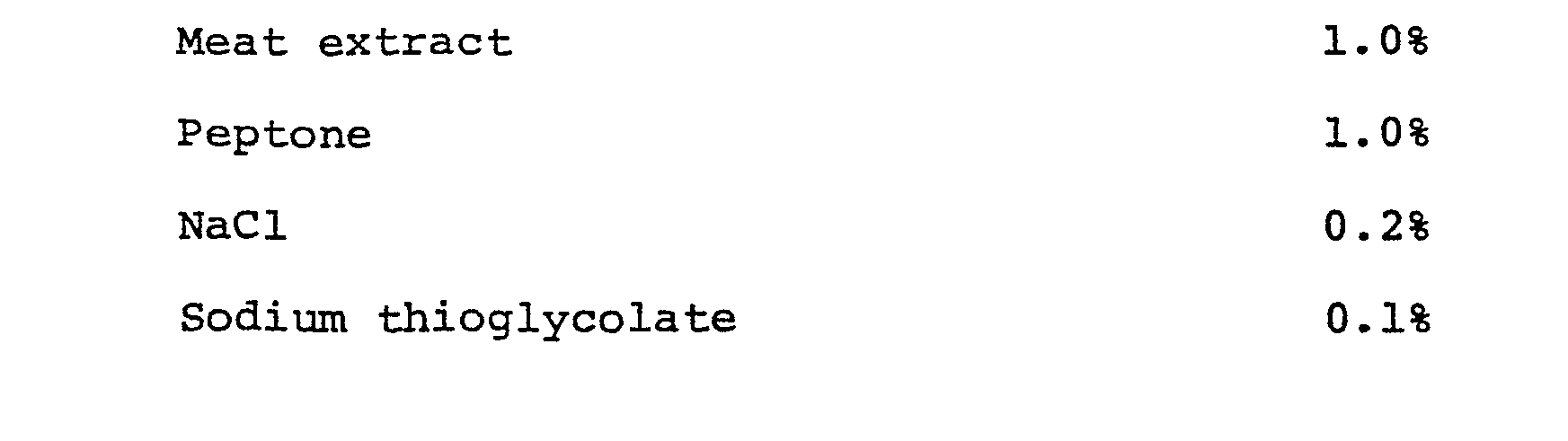
- the composition of the starch-peptone medium is shown below:
- composition of the starch-peptone medium Composition of the starch-peptone medium
- Colonies formed in agar plate culture using the starch-peptone medium have the shape of a flat disc of which the center is slightly protuberant, and their peripheral portions are entire. No pigment is formed in the colonies, and the colonies have a luster on the surface and are milk white and opaque. They are cohesive.
- Said bacteria grow with production of a gas containing H 2 and C0 2 .
- the rutrient agar is divided in 2 or 3 places.
- Said bacteria grow only in an anaerobic atmosphere.
- the culture is accompanied by production of a gas, and the medium coagulates hard and is reddended by production of an acid.
- Said bacteria grow at 40°C to 63°C and do not grow at 30°C. Its growth is satisfactory at about 60°C.
- Said bacteria grow at pH 5 to 7.
- the growth is satisfactory in the vicinity of pH 5.6.
- Said bacteria do not grow under an atmosphere of air and is negative. Under anaerobic conditions in a liquid paraffin multilayer, said bacteria grow and produces an acid, so that the culture is yellowed.
- compositions of organic acids produced from 1 various media are shown in Table 2:
- said bacteria were identified as bacteria belonging to Clostridium according to the manual of classifying anaerobic bacteria of Holdeman.
- thermostable a-amylase obtained by using the bacterium of this invention
- the dextrinizing ability was measured by Blue value method (Chemical Society of Japan, Jikken Kagaku Koza, Vol. 24, Biochemistry II, p279, Maruzen Co., Ltd. (1969)).
- This method uses the principle that with the progress of hydrolysis of starch molecules, the level of blue color produced due to a starch-iodine complex decreases in proportion to a decrease of the molecular weight.
- 2 ml of a starch solution having a concentration of 2 mg/ml and 1 ml of 0.1 M citrate buffer (pH 4.0) were placed in a test tube, and the test tube was shaken in a water bath at 60°C for 5 minutes.
- the a-amylase activity was calculated from the following equation:
- the enzyme produced by the bacteria of this invention is liquid-type a-amylase which hydrolyzes starches of potato, corn, sweet potato, etc.
- Action-pH curves of well-known typical a-amylases are shown in Fig. 1.
- the a-amylase derived from Bacillus subtilis which has been reported by Ogasawara et al. (J. Biochem. 67, 65 (1970)) and is shown by curve 4, the a-amylase of Japanese Patent Application Kokai (Laid-Open) No. 12,946/71 shown by curve 5, and the a-amylase derived from Bacillus licheniformis (Japanese Patent Application Kokai (Laid-Open) No. 35,083/73) which has been reported by Saito et al.
- curve 6 have a suitable pH range (a pH range where each a-amylase has 80% of the activity at the optimum pH) at pH 4 to 11.
- the a-amylase derived from Bacillus licheniformis which has reported by Tanaka et al. and has the highest activity on the acidic side among heretofore well-known acid a-amylases (Japanese Patent Application Kokai (Laid-Open) No. 151,970/77, curve 3) has a suitable pH range at pH 3.5 to 6.3 and has no activity at all at pH 2.
- a-amylase I (curve 1) and a-amylase II (curve 2) produced by the bacterium of this invention have an optimum pH range at 60°C at a pH of about 4, have a suitable pH range at pH 2 to 5.7 or pH 2 to 6.3, respectively, and have a high activity even on a more acidic side as compared with the conventional acid a-amylases. That is to say, at pH 2, the conventional acid a-amylases have no activity at all, while the a-amylases produced by the bacterium of this invention have a high activity of 95% or 81%, respectively.
- the a-amylases produced by the bacterium of this invention are different in action pH range from the conventional acid a-amylase, it is evident that they are novel a-amylases.
- a-amylases I and II produced by the bacterium of this invention was incubated at pH 2, 4, 6 or 7 (0.025 M citrate buffer) at 60°C for 30 minutes.
- the reaction solution was diluted and then adjusted to pH 4, after which the residual activity was assayed by using amylose as substrate.
- both a-amylases entirely retained their activities after the pH treatment described above. Accordingly, the present a-amylases are characterized in that they are stable even in acidic pH ranges.
- both of the optimum temperatures at the optimum pH of 4.0 of a-amylases I (curve 11) and II (curve 12) produced by the bacterium of this invention are about 80°C.
- Their suitable temperature a temperature at which each a-amylase has 80% of the activity at the optimum temperature
- 0.025 M citrate buffer was used for the reaction.
- a-Amylase II produced by the bacterium of this invention was heated at 60° to 97°C at pH 6.0 in the presence of 20 P M calcium chloride, and the residual activity was measured. On the basis of the measured values, the half-life of activity at each temperature was determined. The results obtained are shown in Fig. 3. The half-lives of activity (without addition of substrate) at 80°C and 90°C are 8 hours and 0.5 hour, respectively. Thus, a-amylase II is excellent in thermostability. a-Amylase I has a half-life of activity at 90°C of about 0.5 hours, and it is thus equal to a-amylase II in thermostability.
- a-amylase preparations prepared from culture broths of an a-amylase-producing bacterium belonging to Bacillus licheniformis and an a-amylase-producing bacterium belonging to Bacillus subtilis, and their half-lives of activity were measured at a calcium concentration of 20 mM. The results obtained are also shown in Fig. 3.
- the reaction was carried out by use of citrate buffer at pH 6.0 which is the optimum pH of both a-amylases.
- the half-life of activity at 80°C of the former a-amylase was 0.6 hour, and the half-life of activity at 70°C of the latter was 0.6 hour.
- thermostable a-amylases produced by the bacterium of this invention (curve 21) is inferior to a known thermostable a-amylase of Thermus but is by no means inferior to a thermostable a-amylase of Bacillus (a thermostable a-amylase derived from Bacillus licheniformis SP, curve 22).
- thermostability of a-amylase II produced by the bacterium of this invention are shown in Table 3.
- Each of various metal salts was added to an aqueous a-amylase II solution so as to adjust the metal salt concentration to 5 mM, after which the resulting solution was heated and the activity was measured.
- the percentage of the activity after the heat treatment based on the activity before the heat treatment, namely, the residual activity is shown in terms of %.
- the heat treatment and the activity measurement are conducted under the following conditions:
- the activity measurement was conducted under the following conditions after diluting each sample solution. It was confirmed that addition of each metal salt at said adding concentration had no influence on the activity measurement.
- the concentration of calcium required of said a-amylase is 100 uM (4 ppm) as shown in curve 31 in Fig. 4, and said a-amylase is sufficiently stabilized at the calcium concentration in tap water. Further, this enzyme retains 65% of the activity even at a calcium concentration of 1 pM or less.
- a-Amylase I has a calcium requirement equal to that of a-amylase II.
- an a-amylase partially purified from an a-amylase-producing bacterium belonging to Bacillus licheniformis requires 30 mM of calcium ion as shown in curve 32 in Fig. 4.
- the heat treatment was carried out by heating at 80°C for 30 minutes at pH 6 for both enzymes, and the activity measurement was conducted at 60°C at respective optimum pH's.
- thermostable a-amylase of Bacillus subtilis has a concentration of calcium required of 3 to 10 mM (Japanese Patent Application Kokai (Laid-Open) Nos. 44,690/76 and 34,117/83).
- the a-amylases of this invention have a much smaller calcium requirement as compared with the known thermostable a-amylases.
- An a-amylase-producing bacterium according to this invention was inoculated into a liquid medium containing starch, peptone and yeast extract, and cultured under anaerobic conditions at 60°C for 1 to 3 days. Cells and other insoluble substances are removed from the culture broth by centrifugation and the like to obtain a so-called culture filtrate. Subsequently, concentration of a-amylases produced by the bacterium of this invention and removal of impurities are conducted by properly applying well-known methods such as molecular sieve membrane filtration, ion-exchange chromatography, gel filtration chromatography, salting out and the like to the culture filtrate.
- the molecular weights of the a-amylases produced according to this invention have not yet been confirmed, they are estimated to be 20,000 or more from their behaviors in molecular sieve membrane filtration.
- thermostable a-amylases produced by the bacterium of this invention are markedly different particularly in action pH and calcium requirement from thermostable enzymes produced by conventional aerobic bacteria.
- starch as a starting material is first liquefied by using a-amylase and then saccharified by using clucoamylase. In the liquefaction, the starting starch is charged at as high a concentration as several tens percent, so that the pH of the resulting liquid is acidic. Therefore, in using a conventional a-amylase, a starch fluid is neutralized with an alkali, after which the starch is liquefied. After the liquefaction, the pH of the liquid should be adjusted so as to be acidic again by addition of an acid because well-known glucoamylases are active in an acidic pH range.
- thermostable a-amylase derived from the strictly anaerobic bacterium of this invention
- mere employment of water to be charged containing as much calcium as tap water does will do and addition of a calcium agent becomes unnecessary.
- Ph adjustments in the liquefaction and saccharification steps become unnecessary, so that the burden on a desalting step after the reaction can be greatly reduced.
- thermostable a-amylase produced by culturing the thermophilic anaerobic bacterium belonging to Clostridium of this invention is used for hydrolysis (liquefaction) of starch
- water to be charged containing as much calcium as tap water can be used, and conventional addition of calcium becomes unnecessary.
- neutralizations in the starch liquefaction and saccharification steps become unnecessary, and as a result, the burden on a desalting step after the reaction can be greatly reduced.
- thermostable a-amylase produced by the process of this invention is used for hydrolysis (liquefaction) of starch, it is sufficient that water to be charged containing as much calcium as tap water does is used, and conventional addition of calcium becomes unnecessary. Moreover, the neutralizations in the starch liquefaction and saccharification steps become unnecessary, so that the burden on a desalting step after the reaction can be greatly reduced.
- Fig. 1 is a characteristic graph showing the effect of pH on the a-amylase activity (dextrinizing ability) of the thermostable a-amylases produced by the bacterium of this invention and conventional thermostable a-amylases.
- Fig. 2 is a characteristic graph showing the effect of temperature on the a-amylase activity of the thermostable a-amylases produced by the bacterium of this invention.
- Fig. 3 is a characteristic graph showing the thermostability of the thermostable a-amylase produced by the bacterium of this invention and conventional thermostable a-amylases.
- Fig. 1 is a characteristic graph showing the effect of pH on the a-amylase activity (dextrinizing ability) of the thermostable a-amylases produced by the bacterium of this invention and conventional thermostable a-amylases.
- Fig. 2 is a characteristic graph showing the effect of temperature on the a-amylase activity
- thermostable a-ainylase produced by the bacterium of this invention and a conventional thermostable a-amylase.
- Fig. 5 is an a-amylase activity elution pattern graph of a molecular sieve liquid chromatography using crosslinked dextran gel of the thermostable a-amylase produced by the bacterium of this invention.
- Fig. 6 is an a-amylase activity elution pattern graph of an ion-exchange liquid chromatography using diethylaminoethylated crosslinked dextran gel of the thermostable a-amylases produced by the bacterium of this invention.
- a water-sealing trap is attached to the gas outlet, and the gas phase portion in each fermenter was sufficiently replaced with argon gas, after which the bacterium was cultured under anaerobic conditions.
- the pH of the culture broth was automatically adjusted to 6.0 and its temperature was also automatically adjusted to 60°C.
- the culture broths were combined and centrifuged at 6,000 r.p.m. to remove cells. The supernatant had a specific activity of 49 units/g.
- the elution was carried out with deionized water and the eluate was fractionated into 100-ml fractions. As shown in Fig. 6, a-amylase activity was observed in the fractions at volumes of eluate of 1.2 to 2 liters. The residual supernatant was also subjected to the same liquid chromatography as described above, and the a-amylase fractions thus obtained were combined with those obtained in the above. The preparation thus obtained was freeze-dried under a vacuum of 40 torr to obtain 2.7 g of dry crude powder.
- the specific activity of said crude enzyme dried preparation was 39,000 units/g which was about 800 times the specific activity of the supernatant.
- the yield of activity was about 60%.
- Table 4 are shown the specific activity, yield of activity and recovery of activity of the preparations from the supernatant to the crude enzyme dried preparation.
- the aforesaid crude enzyme dried preparation was purified by an ion-exchange chromatography (column size: diameter 25 mm, length 400 mm) using diethylaminoethylated crosslinked dextran gel (DEAE-Sephadex, mfd. by Pharmacia Chemicals).
- Diethylaminoethylated crosslinked dextran gel DEAE-Sephadex, mfd. by Pharmacia Chemicals.
- Tris-HC1 buffer pH 7.5
- Insoluble substances were removed therefrom by filtration, and the residue was charged into a gel column buffered with the same buffer as described above and was then washed. Subsequently, development was carried out while increasing the sodium chloride concentration in the buffer with a linear gradient (curve 43).
- the elution pattern of a-amylase activity is shown in Fig. 6. Two peaks having a-amylase activity were observed at elution positions corresponding to sodium chloride concentrations of 0.04 M and 0.08 M. The former peak is due to a-amylase I (curve 41) and the latter is due to a-amylase II (curve 42).
- the activity layer of a-amylase I was 30% of the total adsorbed activity, while that of a-amylase II was 60% of the total adsorbed activity.
- the specific activities of a-amylase I and a-amylase II obtained by freeze-drying each of the two fractions were 390 units/mg and 880 units/mg, respectively, which were 10 times and 23 times, respectively, the specific activity of the crude enzyme dried preparation.
- the recoveries of the activities based on the centrifugation supernatant of the culture broth were 19% and 35%, respectively.
- Monod's test tube having a capacity of 40 ml was placed 25 ml of liquid media (pH 6.4) containing 1.5% of glucose, 0.5% of polypeptone, 0.7% of mono potassium dihydrogen phosphate, 0.35% of disodium hydrogen phosphate, 0.01% of magnesium sulfate heptahydrate, 0.1% of sodium thioglycolate and tap water, and iterilized at 120°C for 20 minutes.
- a water-sealing trap is attached to the gas outlet, and the gas phase portion in the fermenter was sufficiently replaced with argon, after which the bacteria were cultured under anaerobic conditions at 60°C for 46 hours.
- the culture broth thus obtained was centrifuged at 6,000 r.p.m. to remove cells.
- the supernatant had a specific activity of 10 units/g.
- Monod's test tube having a capacity of 40 ml was placed 25 ml of a liquid medium (pH 6.4) containing 1.5 g of sucrose, 0.5% of polypeptone, 0.7% of monopotassium dihydrogen phosphate, 0.35% of disodium hydrogen phosphate, 0.01% of magnesium sulfate heptahydrate, 0.1% of sodium thioglycollate and city water, and sterilized at 120°C for 20 minutes.
- a culture broth of the clostridium of this invention anaerobically cultured in the same media as described above.
- a water-sealing trap was attached to the gas outlet, and the gas phase portion in the fermenter was sufficiently replaced with argon, after which the bacteria were cultured under anaerobic conditions at 60°C for 46 hours.
- the culture broth thus obtained was centrifuged at 6,000 r.p.m. to remove cells.
- the supernatant had a specific activity of 15 units/g.
- Monod's test tube having a capacity of 40 ml was placed 25 ml of liquid media (pH 6.3) containing 1.5% of trehalose, 0.5% of polypeptone, 0.7% of monopotassium dihydrogen phosphate, 0.35% of disodium hydrogen phosphate, 0.01% of magnesium sulfate hehta- hydrate, 0.1% of sodium thioglycolate and top water, and sterilized at 120°C for 20 minutes.
- a water-sealing trap was attached to the gas outlet, and the gas phase portion in the fermenter was sufficiently replaced with argon, after which the bacteria was cultured under anaerobic conditions at 60°C for 46 hours.
- the culture broth thus obtained was centrifuged at 6,000 r.p.m. to remove cells.
- the supernatant had a specific activity of 11 units/g.
- Monod's test tube having a capacity of 40 ml was placed 25 ml of liquid media (pH 6.2) containing 2.0% of maltose, 0.5% of polypeptone, 0.7% of monopotassium dihydrogen phosphate, 0.35% of disodium hydrogen phospahte, 0.01% of magnesium sulfate heptahydrate, 0.1% of sodium thioglycolate and tap water, and sterilized by heat treatment at 120°C for 20 minutes.
- a water-sealing trap was attached to the gas outlet, and the gas phase portion in the fermenter was sufficiently replaced with nitrogen gas of high purity, after which the bacteria were cultured under anaerobic conditions at 60°C for 46 hours.
- the culture broth thus obtained was centrifuged at 6,000 r.p.m. to remove cells.
- the supernatant had a specific activity of 15 units/g.
- Monod's test tube having a capacity of 40 ml was placed 25 ml of liquid media (pH 6.3) containing 1.5% of D-xylase, 0.7% of monopotassium dihydrogen phosphate, 0.35% of disodium hydrogen phosphate, 0.01% of magnesium sulfate haptahydrate, 0.5% of polypeptone, 0.1% of sodium thioglycolate and top water, and sterilized by heat treatment at 120°C for 20 minutes.
- a water-sealing trap was attached to the gas outlet, and the gas phase portion in the fermenter was sufficiently replaced with nitrogen gas of high purity, after which the bacteria were anaerobically cultured at 60°C for 46 hours.
- the culture broth thus obtained was centrifuged at 6,000 r.p.m. to remove cells.
- the supernatant had an a-amylase activity of 12 units/g.
- liquid media containing 1.5% of soluble starch, 0.5% of polypeptone, 0.5% of yeast extract, 0.7% of monopotassium dihydrogen phosphate, 0.35% of disodium hydrogen phosphate, 0.01% of magnesium sulfate heptahydrate, 0.1% of sodium thioglycolate and tap water was divided into three equal parts, and 1.52 g of the media was placed in each of three culture tanks having a dapacity of 5 liters and sterilized at 120°C for 20 minutes. To the media in each fermenter was added 80 g of a cell suspension of the clostridium separated by the present inventors which had been anaerobically cultured in the same media as described above.
- a water-sealing trap was attached to the gas outlet, and the gas phase portion in each fermenter was sufficiently replaced with argon gas, after which the bacteria were cultured under anaerobic conditions.
- the pH of the culture broth was automatically adjusted to 6.0 and its temperature was also automatically adjusted to 60°C.
- the culture broths were combined and centrifuged at 6,000 r.p.m. to remove cells.
- the sypernatant had a specific activity of 49 units/g.
- a-amylase activity was observed in the fractions at volumes of eluate of 1.2 to 2 liters.
- the residual supernatant was also subjected to the same liquid chromatography as described above, and the a-amylase fractions thus obtained were combined with those obtained in the above.
- the preparation thus obtained was freeze-dried under a vacuum of 40 torr to obtain 2.7 g of dry crude powder.
- the specific activity of said crude enzyme dried preparation was 39,000 units/g which was about 800 times the specific activity of the supernatant.
- the yield of activity was about 60%.
- Table 4 are shown the specific activity, yield of activity and recovery of activity of the preparations from the supernatant to the crude enzyme dried preparation.
- the crude enzyme dried preparation prepared in Example 1 was purified by an ion-exchange chromatography (column size: 25 ⁇ x 400 mm) using diethylaminoethylated crosslinked dextran gel (DEAE-Sephadex, mfd. by Pharmacia Chemicals).
- Diethylaminoethylated crosslinked dextran gel DEAE-Sephadex, mfd. by Pharmacia Chemicals.
- Tris-HC1 buffer pH 7.5
- Insoluble substances were removed therefrom by filtration, and the residue was charged into a gel column buffered with the same buffer as described above and was then washed. Subsequently, development was carried out while increasing the sodium chloride concentration in the buffer with a linear gradient (curve 43).
- the elution pattern of a-amylase activity is shown in Fig. 5. Two peaks having a-amylase activity were observed at elution position corresponding to sodium chloride concentrations of 0.04 M and 0.08 M. Curve 41 shows a-amylase I and curve 42 a-amylase II.
- the activity layer of a-amylase I was about 30% of the total adsorbed activity, while that of a-amylase II was 60% by the total adsorbed activity.
- the specific activities of a-amylase I and a-amylase II obtained by freeze-drying each of the two fractions were 390 units/mg and 880 units/mg, respectively, which were 10 times and 23 times, respectively, the specific activity of the crude enzyme dried preparation.
- the recoveries of the activities based on the centrifugation supernatant of the culture broth were 19% and 35%, respectively.
Landscapes
- Life Sciences & Earth Sciences (AREA)
- Health & Medical Sciences (AREA)
- Chemical & Material Sciences (AREA)
- Engineering & Computer Science (AREA)
- Wood Science & Technology (AREA)
- Biotechnology (AREA)
- Organic Chemistry (AREA)
- Zoology (AREA)
- Bioinformatics & Cheminformatics (AREA)
- Genetics & Genomics (AREA)
- Biomedical Technology (AREA)
- Medicinal Chemistry (AREA)
- Microbiology (AREA)
- Biochemistry (AREA)
- General Engineering & Computer Science (AREA)
- General Health & Medical Sciences (AREA)
- Molecular Biology (AREA)
- Virology (AREA)
- Tropical Medicine & Parasitology (AREA)
- Enzymes And Modification Thereof (AREA)
- Micro-Organisms Or Cultivation Processes Thereof (AREA)
Abstract
Description
- The first aspect of the present invention relates to anaerobic bacteria used for producing a novel a-amylase, particularly thermostable a-amylase-producing thermophilic anaerobic bacteria suitable for liquefaction reaction of starch in processing starch into glucose etc. and in desizing fiber.
- The second aspect of the present invention relates to novel a-amylase and a process for producing the same, particularly to a thermostable a-amylase suitable for liquefaction reaction of starch in starch processing, desizing etc. and a process for producing the same.
- Enzymes have a high substrate selectivity and are characterized in that they can catalyze reactions even under ordinary temperature and atmospheric pressure, but in general, they are very unstable to heating and pH change. Recently, it has become possible to produce an isomerized syrup or an L-amino acid by immobilizing an enzyme. In operating such a reactor, it is desired to operate it in a temperature range of 60°C or above which is higher than ordinary temperature, for preventing the propagation of various undesirable bacteria and/or fungi and for increasing the reaction rate. Therefore, in place of conventional ordinary-temperature enzymes, so-called thermostable enzymes stable to both heating and pH change have heretofore been developed. Conventional thermostable enzymes are produced from aerobic bacteria sources. a-Amylases have heretofore been produced mainly by culturing bacteria belonging to Bacillus which are typical aerobic bacteria (Campbell et al., J. Biol Chem., 236, 2952 (1961)). Among then, a-amylases derived from Bacillus subtilis and Bacillus licheniformis are already industrially produced and are used for processing starch into isomerized syrup, glucose or the like and for desizing fiber. None of these well-known a-amylases of which identity is a protein per se can exhibit their thermostabilities, but they may exhibit the thermostabilities only in the presence of calcium ions. They require a calcium concentration of at least 1 mM (Saito: Japanese Patent Application Kokai (Laid-Open) No. 35,083/73), and the reaction is usually carried out by adding several millimoles to 20 millimoles of a calcium salt (Hattori: Japanese Patent Application Kokai (Laid-Open) Nos. 44,652/ 76 and 44,690/76). Accordingly, the thermostability of the conventional thermostable a-amylases, for example, a-amylases derived from Bacillus licheniformis extraordinarily decreases in the absence of calcium or the presence of 1 mM or less, if any (see Japanese Patent Application Kokai (Laid-Open) Nos. 12,946/71 and 35,083/73). Therefore, at a very low calcium concentration of 100 pM or less which is equal to the calcium concentration of tap water, a-amylase inactivates during liquefaction reaction of starch, so that a large amount of expensive enzymes are consumed. Accordingly, the reaction is usually carried out by adding several millimoles of a soluble calcium salt such as calcium chloride, calcium acetate or the like. However, when a calcium salt is added, removal of calcium in a subsequent step becomes necessary in producing isomerized syrup or glucose which are product of starch processing.
- In general, the optimum pH of a-amylases is 6 or higher, and there are known a very few a-amylases which have a high activity even in acidic pH ranges. For example, as an acid a-amylase, a-amylase of Bacillus licheniformis is known (Tanaka et al.: Japanese Patent Application Kokai (Laid-Open) No. 151,970/77, and Saito: Japanese Patent Application Kokai (Laid-Open) No. 358,083/ 73). In liquefying a starch, there is used a so-called starch slurry prepared by suspending the starch in a concentration of 10 to 40%, usually 30%, and it has a pH of 5 or lower, frequently 4 or lower because of impurities, organic acids contained in the starting starch. Therefore, as in Ueno: Japanese Patent Application Kokai (Laid-Open) No. 19,049/74 and Nakajima: Japanese Patent Application Kokai (Laid-Open) No. 55,857/74, the starch slurry is always neutralized with calcium hydroxide or calcium carbonate so as to adjust the pH to 6 to 7 and then treated with a-amylase.
- The present inventors searched an enzyme and a microorganism for production of the enzyme in order to obtain an a-amylase which is excellent in thermostability, has a high activity even in acidic pH ranges, and has a slight calcium requirement. As a result, the present inventors have found that a strictly anaerobic bacterium belonging to Clostridium (a clostridial bacterium RS-0001, clostridium sp RS-0001, FERM No. 7,918) produces novel a-amylase which is different from conventional a-amylases in enzymatic characteristics, in particular, calcium requirement and pH range for action.
- The first object of this invention is to provide a novel a-amylase-producing microorganism which is excellent in thermostability, has a very slight calcium requirement in thermoresistance, and has a high activity even in acidic pH ranges.
- The second object of this invention is to provide a novel a-amylase which is derived from an obligate anaerobic bacterium, is excellent in thermostability, and has a very slight calcium requirement, and a process for producing the same.
- The Clostridiumsp of this invention is separated from a high-temperature methane fermentation slurry of concentrated organic waste fluid as a source.
- The present bacterium was separated in the following manner: First, the methane fermentation slurry was subjected to low-speed centrifugation (1,000 r.p.m., 5 minutes) to precipitate and remove coarse granules, after which the supernatant was diluted with sterilized physiological saline. The diluted supernatant was used as a cell suspension and coated on an agar plate containing starch granules as a carbon source under a nitrogen gas atmosphere, after which the starch granules were anaerobically dissolved at 60°C and colonies which grew were separated. Further, vegetative cells were isolated from a dilution of the aforesaid colonies by means of a micromanipulator. The separation using an agar plate and the separation by means of a micromanipulator were repeated several times to obtain the bacterium of this invention. The clostridium (Clostridium sp RS-0001) of this invention was deposited in Institute of Microorganism Industrial Science and Technology, Agency of Industrial Science and Technology (Receipt number: Bikoken Kinki
- No. 7,918 (FERM P-7918)). Details of micological properties of the present bacterium are explained below:
- When said bacterium is cultured on an agar plate of the following starch-peptone medium in an anaerobic atmosphere at 60°C for 2 days, the vegetative cells are a straight bacillus having a size of 0.4 - 0.8 x 2 - 5 µm. When said bacterium is cultured for 3 days or more, vegetative cells having the aforesaid shape exist individually and linked vegetative cells are also produced. The same phenomenon as described above is also observed in the case of submerged culture. The composition of the starch-peptone medium is shown below:
-

- Formation of spores is observed in agar plate culture using the starch-peptone medium and in submerged culture.
- Colonies formed in agar plate culture using the starch-peptone medium have the shape of a flat disc of which the center is slightly protuberant, and their peripheral portions are entire. No pigment is formed in the colonies, and the colonies have a luster on the surface and are milk white and opaque. They are cohesive.
- (2) Said bacteria are grown by agar plate culture and stab culture both using a putrient broth. The same colonies as in the case of the starch-peptone medium are formed.
-

- Said bacteria grow with production of a gas containing H2 and C02. As a result, the rutrient agar is divided in 2 or 3 places.
- Said bacteria grow only in an anaerobic atmosphere.
-

- Said bacteria do not grow.

- The culture is accompanied by production of a gas, and the medium coagulates hard and is reddended by production of an acid.
- Said bacteria grow at 40°C to 63°C and do not grow at 30°C. Its growth is satisfactory at about 60°C.
- Said bacteria grow at
pH 5 to 7. The growth is satisfactory in the vicinity of pH 5.6. - Strictly anaerobic
- Said bacteria do not grow under an atmosphere of air and is negative. Under anaerobic conditions in a liquid paraffin multilayer, said bacteria grow and produces an acid, so that the culture is yellowed.
-

- Negative.
- Negative.
- Positive; the culture is reddened.
- Measurement is impossible because said bacteria do not grow in aqueous peptone.
- Negative in the case of using a Klingrer medium.
- Positive. Not only soluble starches but also granular starches such as potato starch are hydrolyzed.
- Negative in the case of using a Simmons medium.
- Measurement is impossible because said bacteria do not grow in aqueous peptone.
- Negative.
- Negative.
- Negative.
- Negative.
- In the following table are shown utilization of sugars and the result of observing whether gas is produced or not by using a Durham fermentation tube.

- Said bacteria do not grow.
- The compositions of organic acids produced from 1 various media are shown in Table 2:

-

- From these results, said bacteria were identified as bacteria belonging to Clostridium according to the manual of classifying anaerobic bacteria of Holdeman.
- Next, enzymatic characteristics of the thermostable a-amylase obtained by using the bacterium of this invention are described below:
- The a-amylase activity was assayed in the following manner.
- The dextrinizing ability was measured by Blue value method (Chemical Society of Japan, Jikken Kagaku Koza, Vol. 24, Biochemistry II, p279, Maruzen Co., Ltd. (1969)). This method uses the principle that with the progress of hydrolysis of starch molecules, the level of blue color produced due to a starch-iodine complex decreases in proportion to a decrease of the molecular weight. First, 2 ml of a starch solution having a concentration of 2 mg/ml and 1 ml of 0.1 M citrate buffer (pH 4.0) were placed in a test tube, and the test tube was shaken in a water bath at 60°C for 5 minutes. Subsequently, 1 ml of culture filtrate was added as a crude enzyme solution, and the resulting solution was subjected to reaction for 30 minutes. After the reaction is complete, 0.4 ml of the reaction solution was collected and immediately mixed with 2 ml of a 0.5 M acetic acid solution to stop the enzyme reaction. Next, 1 ml of the solution thus obtained was added to 10 ml of 1/3000 N iodine solution, and the absorbance at 680 nm was measured by means of a spectrophotometer. On the other hand, a part of the reaction solution immediately after the addition of the enzyme solution was collected and subjected to coloration in the same manner as described above, and the absorbance was measured. As the starch, an amylose having a degree of polymerization of about 2,000 was used.
- The a-amylase activity was calculated from the following equation:

- The enzyme produced by the bacteria of this invention is liquid-type a-amylase which hydrolyzes starches of potato, corn, sweet potato, etc.
- Action-pH curves of well-known typical a-amylases are shown in Fig. 1. The a-amylase derived from Bacillus subtilis which has been reported by Ogasawara et al. (J. Biochem. 67, 65 (1970)) and is shown by curve 4, the a-amylase of Japanese Patent Application Kokai (Laid-Open) No. 12,946/71 shown by
curve 5, and the a-amylase derived from Bacillus licheniformis (Japanese Patent Application Kokai (Laid-Open) No. 35,083/73) which has been reported by Saito et al. and is shown bycurve 6, have a suitable pH range (a pH range where each a-amylase has 80% of the activity at the optimum pH) at pH 4 to 11. The a-amylase derived from Bacillus licheniformis which has reported by Tanaka et al. and has the highest activity on the acidic side among heretofore well-known acid a-amylases (Japanese Patent Application Kokai (Laid-Open) No. 151,970/77, curve 3) has a suitable pH range at pH 3.5 to 6.3 and has no activity at all atpH 2. - On the other hand, a-amylase I (curve 1) and a-amylase II (curve 2) produced by the bacterium of this invention have an optimum pH range at 60°C at a pH of about 4, have a suitable pH range at
pH 2 to 5.7 orpH 2 to 6.3, respectively, and have a high activity even on a more acidic side as compared with the conventional acid a-amylases. That is to say, atpH 2, the conventional acid a-amylases have no activity at all, while the a-amylases produced by the bacterium of this invention have a high activity of 95% or 81%, respectively. - The following reaction system was used for the enzyme reaction:
- Enzyme solution: 0.6 to 1.3 pg/ml
- Substrate : amylose 1 mg/ml
- Citrate buffer : 0.025 M.
- From the fact that as described above, the a-amylases produced by the bacterium of this invention are different in action pH range from the conventional acid a-amylase, it is evident that they are novel a-amylases.
- Each of a-amylases I and II produced by the bacterium of this invention was incubated at
pH - As shown in Fig. 2, both of the optimum temperatures at the optimum pH of 4.0 of a-amylases I (curve 11) and II (curve 12) produced by the bacterium of this invention are about 80°C. Their suitable temperature (a temperature at which each a-amylase has 80% of the activity at the optimum temperature) is 65° to 87°C. For the reaction, 0.025 M citrate buffer was used.
- a-Amylase II produced by the bacterium of this invention was heated at 60° to 97°C at pH 6.0 in the presence of 20 PM calcium chloride, and the residual activity was measured. On the basis of the measured values, the half-life of activity at each temperature was determined. The results obtained are shown in Fig. 3. The half-lives of activity (without addition of substrate) at 80°C and 90°C are 8 hours and 0.5 hour, respectively. Thus, a-amylase II is excellent in thermostability. a-Amylase I has a half-life of activity at 90°C of about 0.5 hours, and it is thus equal to a-amylase II in thermostability. On the other hand, as examples of conventional a-amylases, there were used partially pulified a-amylase preparations prepared from culture broths of an a-amylase-producing bacterium belonging to Bacillus licheniformis and an a-amylase-producing bacterium belonging to Bacillus subtilis, and their half-lives of activity were measured at a calcium concentration of 20 mM. The results obtained are also shown in Fig. 3. The reaction was carried out by use of citrate buffer at pH 6.0 which is the optimum pH of both a-amylases. The half-life of activity at 80°C of the former a-amylase was 0.6 hour, and the half-life of activity at 70°C of the latter was 0.6 hour. In thermostability, the a-amylases produced by the bacterium of this invention (curve 21) is inferior to a known thermostable a-amylase of Thermus but is by no means inferior to a thermostable a-amylase of Bacillus (a thermostable a-amylase derived from Bacillus licheniformis SP, curve 22).
- The effects of metal salts on the thermostability of a-amylase II produced by the bacterium of this invention are shown in Table 3. Each of various metal salts was added to an aqueous a-amylase II solution so as to adjust the metal salt concentration to 5 mM, after which the resulting solution was heated and the activity was measured. The percentage of the activity after the heat treatment based on the activity before the heat treatment, namely, the residual activity is shown in terms of %. The heat treatment and the activity measurement are conducted under the following conditions:
- Heat treatment conditions
- pH 6.0
- Heating temperature: 80°C
- Holding time : 30 minutes

- The activity measurement was conducted under the following conditions after diluting each sample solution. It was confirmed that addition of each metal salt at said adding concentration had no influence on the activity measurement.
- Activity measurement conditions pH 4.0 (0.025 M citrate buffer) Activity measurement temperature: 60°C
- As is obvious from Table l, calcium ion has a protective effect for a-amylase, while ions of sodium, potassium and magnesium have no marked protective effect. On the other hand, ions of nickel, cobalt, zinc and manganese make the thermostability lowered. It was also confirmed that said a-amylase lost its thermostability in the presence of 0.5 pM EDTA.
- The concentration of calcium required of said a-amylase is 100 uM (4 ppm) as shown in
curve 31 in Fig. 4, and said a-amylase is sufficiently stabilized at the calcium concentration in tap water. Further, this enzyme retains 65% of the activity even at a calcium concentration of 1 pM or less. a-Amylase I has a calcium requirement equal to that of a-amylase II. - On the other hand, an a-amylase partially purified from an a-amylase-producing bacterium belonging to Bacillus licheniformis requires 30 mM of calcium ion as shown in
curve 32 in Fig. 4. The heat treatment was carried out by heating at 80°C for 30 minutes atpH 6 for both enzymes, and the activity measurement was conducted at 60°C at respective optimum pH's. - On the other hand, thermostable a-amylase of Bacillus subtilis has a concentration of calcium required of 3 to 10 mM (Japanese Patent Application Kokai (Laid-Open) Nos. 44,690/76 and 34,117/83).
- Accordingly, the a-amylases of this invention have a much smaller calcium requirement as compared with the known thermostable a-amylases.
- Since the purification method is described in detail in Examples, it is briefly explained here.
- An a-amylase-producing bacterium according to this invention was inoculated into a liquid medium containing starch, peptone and yeast extract, and cultured under anaerobic conditions at 60°C for 1 to 3 days. Cells and other insoluble substances are removed from the culture broth by centrifugation and the like to obtain a so-called culture filtrate. Subsequently, concentration of a-amylases produced by the bacterium of this invention and removal of impurities are conducted by properly applying well-known methods such as molecular sieve membrane filtration, ion-exchange chromatography, gel filtration chromatography, salting out and the like to the culture filtrate.
- Although the molecular weights of the a-amylases produced according to this invention have not yet been confirmed, they are estimated to be 20,000 or more from their behaviors in molecular sieve membrane filtration.
- As described above, the novel thermostable a-amylases produced by the bacterium of this invention are markedly different particularly in action pH and calcium requirement from thermostable enzymes produced by conventional aerobic bacteria.
- In producing glucose, isomerized syrup or the like, starch as a starting material is first liquefied by using a-amylase and then saccharified by using clucoamylase. In the liquefaction, the starting starch is charged at as high a concentration as several tens percent, so that the pH of the resulting liquid is acidic. Therefore, in using a conventional a-amylase, a starch fluid is neutralized with an alkali, after which the starch is liquefied. After the liquefaction, the pH of the liquid should be adjusted so as to be acidic again by addition of an acid because well-known glucoamylases are active in an acidic pH range.
- When there is used the novel thermostable a-amylase derived from the strictly anaerobic bacterium of this invention, mere employment of water to be charged containing as much calcium as tap water does will do and addition of a calcium agent becomes unnecessary. Moreover, the Ph adjustments in the liquefaction and saccharification steps become unnecessary, so that the burden on a desalting step after the reaction can be greatly reduced.
- When the novel thermostable a-amylase produced by culturing the thermophilic anaerobic bacterium belonging to Clostridium of this invention is used for hydrolysis (liquefaction) of starch, water to be charged containing as much calcium as tap water can be used, and conventional addition of calcium becomes unnecessary. Furthermore, the neutralizations in the starch liquefaction and saccharification steps become unnecessary, and as a result, the burden on a desalting step after the reaction can be greatly reduced.
- When the novel thermostable a-amylase produced by the process of this invention is used for hydrolysis (liquefaction) of starch, it is sufficient that water to be charged containing as much calcium as tap water does is used, and conventional addition of calcium becomes unnecessary. Moreover, the neutralizations in the starch liquefaction and saccharification steps become unnecessary, so that the burden on a desalting step after the reaction can be greatly reduced.
- Fig. 1 is a characteristic graph showing the effect of pH on the a-amylase activity (dextrinizing ability) of the thermostable a-amylases produced by the bacterium of this invention and conventional thermostable a-amylases. Fig. 2 is a characteristic graph showing the effect of temperature on the a-amylase activity of the thermostable a-amylases produced by the bacterium of this invention. Fig. 3 is a characteristic graph showing the thermostability of the thermostable a-amylase produced by the bacterium of this invention and conventional thermostable a-amylases. Fig. 4 is a characteristic graph showing the effect of calcium concentration in heat treatment on the a-amylase activity of the thermostable a-ainylase produced by the bacterium of this invention and a conventional thermostable a-amylase. Fig. 5 is an a-amylase activity elution pattern graph of a molecular sieve liquid chromatography using crosslinked dextran gel of the thermostable a-amylase produced by the bacterium of this invention. Fig. 6 is an a-amylase activity elution pattern graph of an ion-exchange liquid chromatography using diethylaminoethylated crosslinked dextran gel of the thermostable a-amylases produced by the bacterium of this invention.
- This invention is further explained below in more detail with reference to Examples.
- 4.56 Kilograms of liquid media (pH 6.4) containing 1.5% of soluble starch, 0.5% of polypeptone, 0.5% of yeast extract, 0.7% of mono potassium dihydrogen phosphate, 0.35% of disodium hydrogen phosphate, 0.01% of magnesium sulfate heptahydrate, 0.1% of sodium thioglycolate and tap water was divided into three equal parts, and 1.52 g of the media was placed in each of three culture tanks having a capacity of 5 liters and sterilized at 120°C for 20 minutes. To the media in each tank was added 80 g of a cell suspension of the clostridium separated by the present inventors which had been anaerobically cultured in the same media as described above. Subsequently, a water-sealing trap is attached to the gas outlet, and the gas phase portion in each fermenter was sufficiently replaced with argon gas, after which the bacterium was cultured under anaerobic conditions. The pH of the culture broth was automatically adjusted to 6.0 and its temperature was also automatically adjusted to 60°C. After the bacteria were cultured for 46 hours, the culture broths were combined and centrifuged at 6,000 r.p.m. to remove cells. The supernatant had a specific activity of 49 units/g.
- Next, 3.5 Kg of the aforesaid supernatant were filtered through a molecular sieve membrane (cut-off molecular weight: 20,000) and the filtrate was concentrated to a volume of 1.5 Kg. The concentrate was divided into two equal parts and 0.75 Kg thereof was charged into a column (diameter: 100 mm, length: 450 mm) packed with crosslinked dextran gel (cut-off molecular weight: 2,500, mfd. by Pharmacia Chemicals) and subjected to molecular sieve liquid chromatography. The elution pattern of a-amylase activity in this case is shown in Fig. 6. The elution was carried out with deionized water and the eluate was fractionated into 100-ml fractions. As shown in Fig. 6, a-amylase activity was observed in the fractions at volumes of eluate of 1.2 to 2 liters. The residual supernatant was also subjected to the same liquid chromatography as described above, and the a-amylase fractions thus obtained were combined with those obtained in the above. The preparation thus obtained was freeze-dried under a vacuum of 40 torr to obtain 2.7 g of dry crude powder.
- The specific activity of said crude enzyme dried preparation was 39,000 units/g which was about 800 times the specific activity of the supernatant. The yield of activity was about 60%. In Table 4 are shown the specific activity, yield of activity and recovery of activity of the preparations from the supernatant to the crude enzyme dried preparation.
-

- The aforesaid crude enzyme dried preparation was purified by an ion-exchange chromatography (column size: diameter 25 mm, length 400 mm) using diethylaminoethylated crosslinked dextran gel (DEAE-Sephadex, mfd. by Pharmacia Chemicals). In 0.05 M Tris-HC1 buffer (pH 7.5) was dissolved 2.4 g of the crude enzyme dried preparation. Insoluble substances were removed therefrom by filtration, and the residue was charged into a gel column buffered with the same buffer as described above and was then washed. Subsequently, development was carried out while increasing the sodium chloride concentration in the buffer with a linear gradient (curve 43). The elution pattern of a-amylase activity is shown in Fig. 6. Two peaks having a-amylase activity were observed at elution positions corresponding to sodium chloride concentrations of 0.04 M and 0.08 M. The former peak is due to a-amylase I (curve 41) and the latter is due to a-amylase II (curve 42). The activity layer of a-amylase I was 30% of the total adsorbed activity, while that of a-amylase II was 60% of the total adsorbed activity. The specific activities of a-amylase I and a-amylase II obtained by freeze-drying each of the two fractions were 390 units/mg and 880 units/mg, respectively, which were 10 times and 23 times, respectively, the specific activity of the crude enzyme dried preparation. The recoveries of the activities based on the centrifugation supernatant of the culture broth were 19% and 35%, respectively.
- In Monod's test tube having a capacity of 40 ml was placed 25 ml of liquid media (pH 6.4) containing 1.5% of glucose, 0.5% of polypeptone, 0.7% of mono potassium dihydrogen phosphate, 0.35% of disodium hydrogen phosphate, 0.01% of magnesium sulfate heptahydrate, 0.1% of sodium thioglycolate and tap water, and iterilized at 120°C for 20 minutes. To the media was added 1 ml of a culture broth of the clostridium of this invention anaerobically cultured in the same media as described above. Subsequently, a water-sealing trap is attached to the gas outlet, and the gas phase portion in the fermenter was sufficiently replaced with argon, after which the bacteria were cultured under anaerobic conditions at 60°C for 46 hours. The culture broth thus obtained was centrifuged at 6,000 r.p.m. to remove cells. The supernatant had a specific activity of 10 units/g.
- In Monod's test tube having a capacity of 40 ml was placed 25 ml of a liquid medium (pH 6.4) containing 1.5 g of sucrose, 0.5% of polypeptone, 0.7% of monopotassium dihydrogen phosphate, 0.35% of disodium hydrogen phosphate, 0.01% of magnesium sulfate heptahydrate, 0.1% of sodium thioglycollate and city water, and sterilized at 120°C for 20 minutes. To the media was added 1 ml of a culture broth of the clostridium of this invention anaerobically cultured in the same media as described above. Subsequently, a water-sealing trap was attached to the gas outlet, and the gas phase portion in the fermenter was sufficiently replaced with argon, after which the bacteria were cultured under anaerobic conditions at 60°C for 46 hours. The culture broth thus obtained was centrifuged at 6,000 r.p.m. to remove cells. The supernatant had a specific activity of 15 units/g.
- In Monod's test tube having a capacity of 40 ml was placed 25 ml of liquid media (pH 6.3) containing 1.5% of trehalose, 0.5% of polypeptone, 0.7% of monopotassium dihydrogen phosphate, 0.35% of disodium hydrogen phosphate, 0.01% of magnesium sulfate hehta- hydrate, 0.1% of sodium thioglycolate and top water, and sterilized at 120°C for 20 minutes. To the media was added 1 ml of a culture broth of the bacteria belonging to Clostridium of this invention which had been anaerobically cultured in the same media as described above. Subsequently, a water-sealing trap was attached to the gas outlet, and the gas phase portion in the fermenter was sufficiently replaced with argon, after which the bacteria was cultured under anaerobic conditions at 60°C for 46 hours. The culture broth thus obtained was centrifuged at 6,000 r.p.m. to remove cells. The supernatant had a specific activity of 11 units/g.
- In Monod's test tube having a capacity of 40 ml was placed 25 ml of liquid media (pH 6.2) containing 2.0% of maltose, 0.5% of polypeptone, 0.7% of monopotassium dihydrogen phosphate, 0.35% of disodium hydrogen phospahte, 0.01% of magnesium sulfate heptahydrate, 0.1% of sodium thioglycolate and tap water, and sterilized by heat treatment at 120°C for 20 minutes. To the media was added 1 ml of a culture broth of the bacteria belonging to Clostridium of this invention which had been anaerobically cultured in the same media as described above. Subsequently, a water-sealing trap was attached to the gas outlet, and the gas phase portion in the fermenter was sufficiently replaced with nitrogen gas of high purity, after which the bacteria were cultured under anaerobic conditions at 60°C for 46 hours. The culture broth thus obtained was centrifuged at 6,000 r.p.m. to remove cells. The supernatant had a specific activity of 15 units/g.
- In Monod's test tube having a capacity of 40 ml was placed 25 ml of liquid media (pH 6.3) containing 1.5% of D-xylase, 0.7% of monopotassium dihydrogen phosphate, 0.35% of disodium hydrogen phosphate, 0.01% of magnesium sulfate haptahydrate, 0.5% of polypeptone, 0.1% of sodium thioglycolate and top water, and sterilized by heat treatment at 120°C for 20 minutes. To the media was added 1 ml of a culture broth of the bacteria belonging to Clostridium of this invention which had been anaerobically cultured in the same media as described above. Subsequently, a water-sealing trap was attached to the gas outlet, and the gas phase portion in the fermenter was sufficiently replaced with nitrogen gas of high purity, after which the bacteria were anaerobically cultured at 60°C for 46 hours. The culture broth thus obtained was centrifuged at 6,000 r.p.m. to remove cells. The supernatant had an a-amylase activity of 12 units/g.
- 4.56 Kg of liquid media (pH 6.4) containing 1.5% of soluble starch, 0.5% of polypeptone, 0.5% of yeast extract, 0.7% of monopotassium dihydrogen phosphate, 0.35% of disodium hydrogen phosphate, 0.01% of magnesium sulfate heptahydrate, 0.1% of sodium thioglycolate and tap water was divided into three equal parts, and 1.52 g of the media was placed in each of three culture tanks having a dapacity of 5 liters and sterilized at 120°C for 20 minutes. To the media in each fermenter was added 80 g of a cell suspension of the clostridium separated by the present inventors which had been anaerobically cultured in the same media as described above. Subsequently, a water-sealing trap was attached to the gas outlet, and the gas phase portion in each fermenter was sufficiently replaced with argon gas, after which the bacteria were cultured under anaerobic conditions. The pH of the culture broth was automatically adjusted to 6.0 and its temperature was also automatically adjusted to 60°C. After the bacteria were cultured for 46 hours, the culture broths were combined and centrifuged at 6,000 r.p.m. to remove cells. The sypernatant had a specific activity of 49 units/g.
- Next, 3.5 kg of the aforesaid supernatant was filtered through a molecular sieve membrane (cut-off molecular weight: 20,000) and the filtrate was concentrated to a volume of 1.5 kg. The concentrate was divided into two equal parts and 0.75 kg thereof was charged into a column (diameter: 100 mm, length: 450 mm) packed with crosslinked dextran gel (cut-off of molecular weight: 2,500, mfd. by Pharmacia Chemicals) and subjected to molecular sieve liquid chromatography. The elution pattern of a-amylase activity in this case is shown in Fig. 6. The elution was carried out with deionized water and the eluate was fractionated into 100-ml fractions. As shown in Fig. 6, a-amylase activity was observed in the fractions at volumes of eluate of 1.2 to 2 liters. The residual supernatant was also subjected to the same liquid chromatography as described above, and the a-amylase fractions thus obtained were combined with those obtained in the above. The preparation thus obtained was freeze-dried under a vacuum of 40 torr to obtain 2.7 g of dry crude powder.
- The specific activity of said crude enzyme dried preparation was 39,000 units/g which was about 800 times the specific activity of the supernatant. The yield of activity was about 60%. In Table 4 are shown the specific activity, yield of activity and recovery of activity of the preparations from the supernatant to the crude enzyme dried preparation.

- The crude enzyme dried preparation prepared in Example 1 was purified by an ion-exchange chromatography (column size: 25φ x 400 mm) using diethylaminoethylated crosslinked dextran gel (DEAE-Sephadex, mfd. by Pharmacia Chemicals). In 0.05 M Tris-HC1 buffer (pH 7.5) was dissolved 2.4 g of the crude enzyme dried preparation. Insoluble substances were removed therefrom by filtration, and the residue was charged into a gel column buffered with the same buffer as described above and was then washed. Subsequently, development was carried out while increasing the sodium chloride concentration in the buffer with a linear gradient (curve 43). The elution pattern of a-amylase activity is shown in Fig. 5. Two peaks having a-amylase activity were observed at elution position corresponding to sodium chloride concentrations of 0.04 M and 0.08
M. Curve 41 shows a-amylase I and curve 42 a-amylase II. The activity layer of a-amylase I was about 30% of the total adsorbed activity, while that of a-amylase II was 60% by the total adsorbed activity. The specific activities of a-amylase I and a-amylase II obtained by freeze-drying each of the two fractions were 390 units/mg and 880 units/mg, respectively, which were 10 times and 23 times, respectively, the specific activity of the crude enzyme dried preparation. The recoveries of the activities based on the centrifugation supernatant of the culture broth were 19% and 35%, respectively.
Claims (9)
Applications Claiming Priority (4)
| Application Number | Priority Date | Filing Date | Title |
|---|---|---|---|
| JP23691584A JPS61115484A (en) | 1984-11-09 | 1984-11-09 | Thermophilic anaerobic bacteria producing thermostable α-amylase |
| JP236915/84 | 1984-11-09 | ||
| JP23691784A JPS61115491A (en) | 1984-11-09 | 1984-11-09 | Heat-stable α-amylase and method for producing the same |
| JP236917/84 | 1984-11-09 |
Publications (2)
| Publication Number | Publication Date |
|---|---|
| EP0184019A1 true EP0184019A1 (en) | 1986-06-11 |
| EP0184019B1 EP0184019B1 (en) | 1991-03-06 |
Family
ID=26532945
Family Applications (1)
| Application Number | Title | Priority Date | Filing Date |
|---|---|---|---|
| EP85114174A Expired - Lifetime EP0184019B1 (en) | 1984-11-09 | 1985-11-07 | Thermostable alpha-amylase-producing, thermophilic anaerobic bacteria, thermostable alpha-amylase and process for producing the same |
Country Status (3)
| Country | Link |
|---|---|
| US (1) | US4778760A (en) |
| EP (1) | EP0184019B1 (en) |
| DE (1) | DE3582020D1 (en) |
Cited By (9)
| Publication number | Priority date | Publication date | Assignee | Title |
|---|---|---|---|---|
| FR2577237A1 (en) * | 1985-02-08 | 1986-08-14 | Cpc International Inc | NEW THERMOSTABLE ACIDOPHILIC ALPHA-ANYLASE, PROCESS FOR PRODUCING THE SAME AND ITS APPLICATION TO STARCH HYDROLYSIS |
| EP0258050A3 (en) * | 1986-08-27 | 1988-08-10 | Oy Alko Ab | An amylase of a new type |
| EP0268193A3 (en) * | 1986-11-17 | 1988-08-24 | Kali-Chemie Aktiengesellschaft | Process for promoting the excretion of amylolytic enzymes from bacteria, and enzymes produced according to this process |
| EP0286007A3 (en) * | 1987-04-09 | 1989-06-28 | Kali-Chemie Aktiengesellschaft | Thermally stable amylases and pullulanases from two anaerobic microorganisms |
| EP0276806A3 (en) * | 1987-01-29 | 1989-06-28 | Kali-Chemie Aktiengesellschaft | Thermally stable amylases and pullulanases from two anaerobic microorganisms |
| WO1991002786A1 (en) * | 1988-04-13 | 1991-03-07 | Wolfgang Klietmann | Transport medium for microorganisms |
| EP0646647A1 (en) * | 1993-10-05 | 1995-04-05 | Ville De Dax, Regie Municipale Des Eaux Et De L'assainissement | Process for preparing thermal muds, muds thus obtained and their uses |
| WO2004055178A1 (en) * | 2002-12-17 | 2004-07-01 | Novozymes A/S | Thermostable alpha-amylases |
| EP1888835A4 (en) * | 2004-12-02 | 2013-11-13 | Novozymes North America Inc | Desizing process |
Families Citing this family (4)
| Publication number | Priority date | Publication date | Assignee | Title |
|---|---|---|---|---|
| DE3909096A1 (en) * | 1989-03-20 | 1990-09-27 | Garabed Antranikian | ALPHA AMYLASE |
| US5158887A (en) * | 1990-09-09 | 1992-10-27 | Hsu Edward J | Process for massive conversion of clostridia in synchronized cells of elongated length or refractile endospores |
| US5578479A (en) * | 1992-06-09 | 1996-11-26 | The Johns Hopkins University | Alpha-amylase from hyperthermophilic archaebacterium |
| US6803218B1 (en) * | 1999-09-24 | 2004-10-12 | Genencor Intl., Inc. | Enzymes which dehydrate glycerol |
Citations (1)
| Publication number | Priority date | Publication date | Assignee | Title |
|---|---|---|---|---|
| EP0131253A1 (en) * | 1983-07-13 | 1985-01-16 | Cpc International Inc. | Novel thermostable, aciduric alpha-amylase and method for its production |
Family Cites Families (3)
| Publication number | Priority date | Publication date | Assignee | Title |
|---|---|---|---|---|
| ES8602115A1 (en) * | 1983-10-11 | 1985-11-01 | Espanola Petrol | A process for producing thermostable alpha-amylases by culturing micro-organisms at elevated temperatures. |
| US4600693A (en) * | 1984-02-13 | 1986-07-15 | Corning Glass Works | Thermostable alpha amylase having a low requirement for calcium ions, derived from a bacillus microorganism |
| US4613570A (en) * | 1985-02-08 | 1986-09-23 | Cpc International Inc. | Novel thermostable, aciduric alpha-amylase and method for its production |
-
1985
- 1985-11-07 US US06/795,774 patent/US4778760A/en not_active Expired - Fee Related
- 1985-11-07 EP EP85114174A patent/EP0184019B1/en not_active Expired - Lifetime
- 1985-11-07 DE DE8585114174T patent/DE3582020D1/en not_active Expired - Lifetime
Patent Citations (1)
| Publication number | Priority date | Publication date | Assignee | Title |
|---|---|---|---|---|
| EP0131253A1 (en) * | 1983-07-13 | 1985-01-16 | Cpc International Inc. | Novel thermostable, aciduric alpha-amylase and method for its production |
Non-Patent Citations (5)
| Title |
|---|
| CHEMICAL ABSTRACTS, vol. 30, no. 4, 20th February 1936, column 1077/9 - column 1078/1, Columbus, Ohio, US; W.W. JOHNSTON et al.: "The amylase of Clostridium acetobutylicum", & J. BACT. 30, 491-501(1935) * |
| CHEMICAL ABSTRACTS, vol. 39, no. 20, 20th October 1945, column 5261/9, Columbus, Ohio, US; H. BLASCHKO: "Cysteic acid decarboxylase", & BIOCHEM. J. 39, 76-8(1945) * |
| CHEMICAL ABSTRACTS, vol. 50, no. 10, 25th May 1956, column 7217 h, Columbus, Ohio, US; R.V. FENIKSOVA et al.: "The preparation of bacterial amylase", & TRUDY VSESOYUZ. NAUCH.-ISSLEDOVATEL. INST. SPIRTOVOI PROM. 1954, No. 3, 128-39; REFERAT. ZHUR. KHIM., BIOL. KHIM. 1955, No. 13338 * |
| CHEMICAL ABSTRACTS, vol. 60, no. 13, 22nd June 1964, column 16234 e, Columbus, Ohio, US; MIKIO TOMOEDA et al.: "Alpha-amylase in Clostridium acetobutylicum", & GIFU DAIGAKU NOGAKUBU KENKYU HOKOKU 16, 151-4(1962) * |
| CHEMICAL ABSTRACTS, vol. 60, no. 6, 16th March 1964, column 7173 h, Columbus, Ohio, US; G.J. WALKER et al.: "Degradation of starch granules by some amylolytic bacteria from the rumen of sheep", & BIOCHEM. J. 90(2), 398-404(1964) * |
Cited By (17)
| Publication number | Priority date | Publication date | Assignee | Title |
|---|---|---|---|---|
| FR2577237A1 (en) * | 1985-02-08 | 1986-08-14 | Cpc International Inc | NEW THERMOSTABLE ACIDOPHILIC ALPHA-ANYLASE, PROCESS FOR PRODUCING THE SAME AND ITS APPLICATION TO STARCH HYDROLYSIS |
| EP0258050A3 (en) * | 1986-08-27 | 1988-08-10 | Oy Alko Ab | An amylase of a new type |
| US4971906A (en) * | 1986-08-27 | 1990-11-20 | Oy Aiko Ab | Amylase of a new type |
| EP0268193A3 (en) * | 1986-11-17 | 1988-08-24 | Kali-Chemie Aktiengesellschaft | Process for promoting the excretion of amylolytic enzymes from bacteria, and enzymes produced according to this process |
| EP0276806A3 (en) * | 1987-01-29 | 1989-06-28 | Kali-Chemie Aktiengesellschaft | Thermally stable amylases and pullulanases from two anaerobic microorganisms |
| EP0286007A3 (en) * | 1987-04-09 | 1989-06-28 | Kali-Chemie Aktiengesellschaft | Thermally stable amylases and pullulanases from two anaerobic microorganisms |
| US4929557A (en) * | 1987-04-09 | 1990-05-29 | Kali-Chemie Ag | Thermostable amylases and pullulanases from two anaerobic microorganisms |
| WO1991002786A1 (en) * | 1988-04-13 | 1991-03-07 | Wolfgang Klietmann | Transport medium for microorganisms |
| EP0646647A1 (en) * | 1993-10-05 | 1995-04-05 | Ville De Dax, Regie Municipale Des Eaux Et De L'assainissement | Process for preparing thermal muds, muds thus obtained and their uses |
| FR2710921A1 (en) * | 1993-10-05 | 1995-04-14 | Dax Regie Municipale Eaux Assa | Process for the preparation of thermal muds, sludges obtained and their applications |
| WO2004055178A1 (en) * | 2002-12-17 | 2004-07-01 | Novozymes A/S | Thermostable alpha-amylases |
| US7189552B2 (en) | 2002-12-17 | 2007-03-13 | Novozymes A/S | Thermostable alpha-amylases |
| CN100412191C (en) * | 2002-12-17 | 2008-08-20 | 诺和酶股份有限公司 | Thermostable alpha-amylase |
| US8039241B2 (en) | 2002-12-17 | 2011-10-18 | I Novozymes A/S | Thermostable alpha-amylases |
| US9394533B2 (en) | 2002-12-17 | 2016-07-19 | Novozymes A/S | Thermostable alpha-amylases |
| US9938512B2 (en) | 2002-12-17 | 2018-04-10 | Novozymes A/S | Thermostable alpha-amylases |
| EP1888835A4 (en) * | 2004-12-02 | 2013-11-13 | Novozymes North America Inc | Desizing process |
Also Published As
| Publication number | Publication date |
|---|---|
| US4778760A (en) | 1988-10-18 |
| EP0184019B1 (en) | 1991-03-06 |
| DE3582020D1 (en) | 1991-04-11 |
Similar Documents
| Publication | Publication Date | Title |
|---|---|---|
| US4536477A (en) | Thermostable glucoamylase and method for its production | |
| EP0184019B1 (en) | Thermostable alpha-amylase-producing, thermophilic anaerobic bacteria, thermostable alpha-amylase and process for producing the same | |
| EP0131253B1 (en) | Novel thermostable, aciduric alpha-amylase and method for its production | |
| US4734365A (en) | Process for liquefying starch | |
| EP0195802B1 (en) | Thermostable g(b)-amylase - | |
| JPH0118717B2 (en) | ||
| JP3026857B2 (en) | Novel pullulanase and method for producing the same | |
| JPH0460637B2 (en) | ||
| EP0255124A2 (en) | Thermostable glucoamylase, a method for production of glucose using same and a plant for production thereof | |
| JPH05292962A (en) | New branch-cleaving enzyme and its production | |
| JPH0928375A (en) | Trehalose phosphorylase and its preparation | |
| JPS62283988A (en) | Production of maltooligosaccharide | |
| CA1131142A (en) | Glucoamylase from stachybotrys subsimplex | |
| JPH062071B2 (en) | Saccharide manufacturing method | |
| JPH0365149B2 (en) | ||
| JPH0324197B2 (en) | ||
| JP3119523B2 (en) | Novel isoamylase, method for producing the same, and method for producing saccharides using the same | |
| JP3027449B2 (en) | Novel cyclomaltodextrinase, method for producing the same, and microorganism producing the enzyme | |
| JP2866460B2 (en) | Saccharification method of polysaccharide | |
| JPH04211369A (en) | Halophilic alkali amylase and production thereof | |
| JPS6331195B2 (en) | ||
| JPH0425794B2 (en) | ||
| JPH0681598B2 (en) | Method for producing glucose by saccharification of starch | |
| JPH0683668B2 (en) | Method for producing thermostable α-amylase | |
| JPH0378990B2 (en) |
Legal Events
| Date | Code | Title | Description |
|---|---|---|---|
| PUAI | Public reference made under article 153(3) epc to a published international application that has entered the european phase |
Free format text: ORIGINAL CODE: 0009012 |
|
| AK | Designated contracting states |
Kind code of ref document: A1 Designated state(s): DE FR GB NL |
|
| 17P | Request for examination filed |
Effective date: 19861024 |
|
| 17Q | First examination report despatched |
Effective date: 19880622 |
|
| GRAA | (expected) grant |
Free format text: ORIGINAL CODE: 0009210 |
|
| AK | Designated contracting states |
Kind code of ref document: B1 Designated state(s): DE FR GB NL |
|
| REF | Corresponds to: |
Ref document number: 3582020 Country of ref document: DE Date of ref document: 19910411 |
|
| ET | Fr: translation filed | ||
| PLBE | No opposition filed within time limit |
Free format text: ORIGINAL CODE: 0009261 |
|
| STAA | Information on the status of an ep patent application or granted ep patent |
Free format text: STATUS: NO OPPOSITION FILED WITHIN TIME LIMIT |
|
| 26N | No opposition filed | ||
| PGFP | Annual fee paid to national office [announced via postgrant information from national office to epo] |
Ref country code: NL Payment date: 19941130 Year of fee payment: 10 |
|
| PGFP | Annual fee paid to national office [announced via postgrant information from national office to epo] |
Ref country code: DE Payment date: 19950126 Year of fee payment: 10 |
|
| PGFP | Annual fee paid to national office [announced via postgrant information from national office to epo] |
Ref country code: FR Payment date: 19950915 Year of fee payment: 11 |
|
| PGFP | Annual fee paid to national office [announced via postgrant information from national office to epo] |
Ref country code: GB Payment date: 19951027 Year of fee payment: 11 |
|
| PG25 | Lapsed in a contracting state [announced via postgrant information from national office to epo] |
Ref country code: NL Effective date: 19960601 |
|
| NLV4 | Nl: lapsed or anulled due to non-payment of the annual fee |
Effective date: 19960601 |
|
| PG25 | Lapsed in a contracting state [announced via postgrant information from national office to epo] |
Ref country code: DE Effective date: 19960801 |
|
| PG25 | Lapsed in a contracting state [announced via postgrant information from national office to epo] |
Ref country code: GB Effective date: 19961107 |
|
| GBPC | Gb: european patent ceased through non-payment of renewal fee |
Effective date: 19961107 |
|
| PG25 | Lapsed in a contracting state [announced via postgrant information from national office to epo] |
Ref country code: FR Effective date: 19970731 |
|
| REG | Reference to a national code |
Ref country code: FR Ref legal event code: ST |