EP0182402A2 - Verfahren und Gerät zur Auswertung der Reaktion auf visuelle Reize - Google Patents
Verfahren und Gerät zur Auswertung der Reaktion auf visuelle Reize Download PDFInfo
- Publication number
- EP0182402A2 EP0182402A2 EP85201681A EP85201681A EP0182402A2 EP 0182402 A2 EP0182402 A2 EP 0182402A2 EP 85201681 A EP85201681 A EP 85201681A EP 85201681 A EP85201681 A EP 85201681A EP 0182402 A2 EP0182402 A2 EP 0182402A2
- Authority
- EP
- European Patent Office
- Prior art keywords
- pattern
- visual
- sweeping
- contrast
- observer
- Prior art date
- Legal status (The legal status is an assumption and is not a legal conclusion. Google has not performed a legal analysis and makes no representation as to the accuracy of the status listed.)
- Ceased
Links
Images

Classifications
-
- A—HUMAN NECESSITIES
- A61—MEDICAL OR VETERINARY SCIENCE; HYGIENE
- A61B—DIAGNOSIS; SURGERY; IDENTIFICATION
- A61B5/00—Measuring for diagnostic purposes; Identification of persons
- A61B5/24—Detecting, measuring or recording bioelectric or biomagnetic signals of the body or parts thereof
- A61B5/316—Modalities, i.e. specific diagnostic methods
- A61B5/369—Electroencephalography [EEG]
- A61B5/377—Electroencephalography [EEG] using evoked responses
- A61B5/378—Visual stimuli
-
- A—HUMAN NECESSITIES
- A61—MEDICAL OR VETERINARY SCIENCE; HYGIENE
- A61B—DIAGNOSIS; SURGERY; IDENTIFICATION
- A61B5/00—Measuring for diagnostic purposes; Identification of persons
- A61B5/24—Detecting, measuring or recording bioelectric or biomagnetic signals of the body or parts thereof
- A61B5/316—Modalities, i.e. specific diagnostic methods
- A61B5/369—Electroencephalography [EEG]
- A61B5/377—Electroencephalography [EEG] using evoked responses
-
- F—MECHANICAL ENGINEERING; LIGHTING; HEATING; WEAPONS; BLASTING
- F02—COMBUSTION ENGINES; HOT-GAS OR COMBUSTION-PRODUCT ENGINE PLANTS
- F02B—INTERNAL-COMBUSTION PISTON ENGINES; COMBUSTION ENGINES IN GENERAL
- F02B75/00—Other engines
- F02B75/02—Engines characterised by their cycles, e.g. six-stroke
- F02B2075/022—Engines characterised by their cycles, e.g. six-stroke having less than six strokes per cycle
- F02B2075/027—Engines characterised by their cycles, e.g. six-stroke having less than six strokes per cycle four
Definitions
- This invention relates to methods and apparatus for visual-evoked response, and is in particular directed to improvements in the method and apparatus for evoking visual response, as well as methods and apparatus for assessing such response.
- any visual evoked response technique lies in stimulus retrieval and the response presentation.
- Stimulus retrieval had commonly been effected by computer averaging.
- Averaging requires repeated presentations of the same stimulus and consequently is slow.
- the averaging technique also causes problems such as the inherent adaptation of the person who is looking at the stimulus.
- the signal is retrieved in real time. This has the important consequence that, if the response is being retrieved as it occurs, then it is possible to change the stimulation in order to evaluate the impact thereof on the response.
- the stimulation may be electronically swept in the course of a run whose duration need only be, for example, 20 seconds.
- the apparatus employed for assessment of visual performance may be generally comprised of a display, such as a television screen, upon which a pattern is presented.
- Scalp electrodes over visual cortex pick up electrical potentials generated by the neural response to visual stimulation.
- the pattern is reversed, i.e., the black and white areas of the pattern are changed at a determined rate.
- the visual-evoked potentials is retrieved by demodulating the scalp potential at the pattern reversal rate.
- Demodulation is performed by a lock-in amplifier.
- the signal-to-noise enhancement performed by a lock-in amplifier may be viewed as the result of extreme frequency selectivity.
- Different parameters of the visual display can be swept electronically.
- the stimulus value at which the signal level responding to the stimulus falls to zero, or rises from zero, depending upon the sweep direction, is defined as the patient's threshold for the parameter which was swept.
- the output of a run i.e., the output in response to sweeping of a given parameter for a determined time such as 20 seconds, is a graphical, complete description of the desired stimulus-response function.
- it is thus necessary to assess the relative time of occurrence of the start or end of the response.
- the criticality of phase of a conventional phase-sensitive detector and the noise sensitivity of vector retrieval render the determination of threshold difficult.
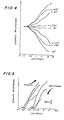
- phase sensitive detection at a plurality of reference phases may be employed, the graphical presentation of the outputs of the different phase sensitive detectors generally converging to or diverging from a common threshold value.
- the further evaluatable parameter of latency can be measured.
- Such measurements when run over very broad swept reversal rate ranges, provide a measure of response frequency spectrum of the individual to the stimulus. This measure permits the selection of stimulus frequencies which produce the highest responses or the lowest noise.
- phase-sensitive detectors in themselves are unsatisfactory for indicating latency.
- signals for assessing latency or response frequency spectrum may be derived by vector retrieval methods.
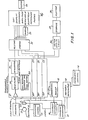
- FIG. 1 a patient or observer 10 is positioned to view the presentation on the screen of a CRT, the screen of the CRT being scanned, for example, in conventiona manner, to form a raster.
- Video signals for application to the CRT are derived from a pattern generator 12, of conventional form.
- the pattern generator may generate a checkerboard pattern for application to the C RT , it is preferred that a bar pattern generator be provided, preferably also with the provision of orientation control 13 enabling the orientation of the bars of the screen to be varied, as an example, the orientation control may be adapted to enable the display of the bars vertically, horizontally, and at each 45° orientation with respect to the vertical and horizontal.
- the frequency of the pattern generator i.e., the cycles of the pattern per degree of arc of the observer's vision, may be varied by a frequency control 14.
- tests are made with the frequency of a bar pattern at 1, 4 and 8 bars per degree of the visual arc of the observer.
- the displayed pattern is reversed at a determined rate.
- a reversal generator 15 is provided to control the reversal rate of the pattern.
- the pattern generator video signals may be varied in amplitude (display contrast) by means of a contrast adjustment device 16, for example a gain controlled amplifier.
- a contrast adjustment device 16 for example a gain controlled amplifier.
- the contrast of the signals Prior to a test run, the contrast of the signals is held constant, while during one method of operation, the contrast is varied preferably logarithmically from, for example, 0.1% to 20% contrast.
- a logarithmic contrast sweep circuit 18 is provided to control the contrast adjustment device 16, the sweep being initiated by means of a switch 17.
- EE G electrodes 20 applied in conventional manner to the observer's scalp are connected to a pre-amplifier 21, the output of the pre-amplifier being applied to synchronous demodulators 22, 23, 24 and 25.
- a reference signal from the pattern generator 12, at the frequency of the reversing generator 15, is also applied to each of the synchronous modulators.
- the input scalp potential applied to synchronous modulator 22 is amplified and applied to a multiplier 28.
- the reference signal from the pattern generator is applied to a local reference signal generator and phase shifter 29 for the generation of a sine wave reference signal having a phase of zero degrees with reference to the reversing generator signal.
- the output of the local reference generator and phase shifter 29 is applied to the multiplier 28 as a reference signal, with the output'thereof being integrated in integrator circuit.
- the synchronous demodulator 22 hence comprises a phase sensitive detector.
- Each of the synchronous demodulators 23, 24 and 25 are constructed in a similar manner, with the exception that the respective local reference generators and phase shifters provide sine wave reference outputs at 45°, 90°, and 135 0 respectively with reference to the reversing generator output.
- the outputs of the synchronous demodulators are applied to a response storage 32, for example a digital storage device, for storing the received signals over a given period of time (the sweep time).
- the four outputs of the response storage 32, corresponding to the input thereto, are each applied directly and by way of an invertor 33 to a CRT display 34, the output of the CRT display may apply, if desired, to a conventional plotter 35.
- the vector lock-in circuit 36 in the embodiment of Figure 1, combines the two input signals employing analog computational circuitry, (1) in a root mean square algorithm, and (2) an arctangent algorithm. These signals may be stored in storage device 37, such as a digital memory, and applied to a conventional plotter 38.
- a varying optical pattern is applied to the screen of the CRT, for a determined period of time, preferably although not limited to 20 seconds, and the scalp potentials received during this period are analyzed, in order to enable assessment of the response of the observer.
- the varying visual pattern may constitute, for example, a swept contrast or a swept spatial frequency.
- contrast is swept, the contrast of the pattern is slowly increased or swept, preferably upwardly from a very weak initial value. Eventually a pattern becomes visible on the screen, and grows from a washed out appearance to a vividly distinct appearance.
- the evoked potential amplitude i.e., the scalp potential responding to the stimulus
- the point at which the response first appears defines an absolute contrast threshold for the particular pattern chosen.
- an analagous sweep in spatial frequency might proceeds from coarse gratings to stripes too fine to resolve.
- the point at which evoked response disappears defines an acuity limit. In this case, with a downward sweep, the response strength falls to the threshold value. Upward sweeps, however are always preferable in clinical practice because of their freedom from adaptation as discussed below.
- contrast is swept logarithmically with time. This logarithmic transformation of the stimulus input is more nearly a straight line as a function of time. Resolution is also improved since a logarithmic sweep renders contrast changes gradual in the threshold region. While equipment employed may not provide true logarithmic functions, it has been found that imperfect linearization does not impair threshold determination.
- Spatial frequency sweeps are preferably performed linearly with time, since human pattern sensitivity is itself a logarithmic function of spatial frequency near the acuity limit.
- the stimulus response function describes the amount of evoked response in micro volts elicited when presenting stimuli of varying strength, measured in percent contrast or in grating spatial frequency. When strength is varied by changing spatial frequency, it is only the response fall off at very high spatial frequencies that is of concern. The fall off is used to infer the acuity limit.
- the visual pattern is modulated by a reference temporal frequency signal that cyclically reverses the pattern at a determined rate.
- noise energy at other frequencies
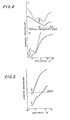
- the synchronous demodulators are phase sensitive, their noise immunity is greater than with phase insensitive vector retrieval, of the type provided in the vector lock-in circuit 36. For example, as illustrated in Figures 2a and 2b, showing 20 second runs employing spatial frequency variation and contrast variation respectively, the solid curves showing phase sensitive detection response are less influenced by noise than vector retrieved response.
- the outputs of the integrators of the phase-sensitive detectors may be at any of a wide range of positive or negative values with respect to electrical zero, at the time a run, i.e., a test for a determined period of time, is commenced.
- the visually evoked response is added to a widely displaced starting level.
- thresholds had been defined by extrapolation to a base line chosen either at absolute zero voltage or at an average noise level. It has been found, however, that these techniques do not provide a correct response in a biological recording situation. Only if the output level at the beginning of the response is used as a base line, will extrapolation of the response slope yield identical threshhold estimates.
- the indication of threshold may be incorrect. If, on the other hand a single phase-sensitive detector is employed to determine threshold, the selection of the phase of the reference signal is critical. In accordance with the present invention, however, by employing a plurality of phase-sensitive detectors set to detect at different phases, the reference phase is no longer critical. For example, if the reference phase is 180° from the optimal phase, response is inverted but still retains the maximum amplitude (slope) and indicates the same threshold.
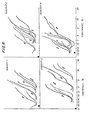
- Adaptation effects are illustrated in Figure 5, showing the visual-evoked response thresholds.
- stripes 1/2 degree on a side were modulated at 7 reversals per second and swept either upward in contrast or downward, these runs being shown in solid lines. Sweeping upward from a sub- threshold contrast produced lower inferred contrast thresholds and sweeping downward. (Instrumental delay artifacts would cause the opposite difference).
- Threshold was restored for a downward contrast sweep when the pattern was continuously rotated during the run (as illustrated in the dashed line). This indicates that an orientation-specific adaptation effect causes threshold elevations whenever contrast is swept downward from high values. Orientation selectivity suggests a cortical origin for the effect.
- the stimulus-sweep speed should be adjusted with respect to the chosen,instrument time constant so that the instrument will track the true response slope.
- the dominant factor in up/down threshold differences is adaptation. This is especially true for sweep paradigms in which the spatial configuration of the stimulus is constant.
- the difference in thresholds inferred from an upward and a downward sweep of contrast provides a direct, objective, electrophysiological index of adaptation.
- Threshold differences are seen because "Upward” and "Downward” sweeps provide different opportunities for adaptation.
- An upward sweep is defined in terms of strength of the stimulation; here, an upward sweep was always begun with sub- threshold values (low contrast or unresolvably high spatial frequencies for contrast and acquity limit runs respectively). Thus, on an upward sweep, the subject had no prior exposure to the stimulus at the moment threshold is determined. In contrast, on downward sweeps there is a continuous exposure until threshold is reached. The difference inferred threshold between an upward and downward sweep may be used as an index of adaptation.
- Such contrast threshold elevation is selective for stimulus dimensions such as orientation and spatial frequency.
- the selectivity function has been employed in psychophysical research to define "channels" in the human visual system thought to be related to findings at the cellular level in neurophysiology.
- the present invention provides a technique and apparatus rendering it possible to express cortical adaptation as a threshold elevation measurement employing evoked potential responses. Induction of adaptation and assessment of threshold elevation are economically combined in a pair of 20-second data collection periods. It has been demonstrated in accordance with the invention that reliable threshold displacements occur on upward versus downward sweeps of stimulus intensity.
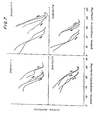
- the visual-evoked response index of adaptation for swept contrasts for four individuals is illustrated in figure 6, wherein each of the separate graph portions correspond to a separate individual. Responses indicated by solid arrows were swept from below threshold (0.1%) to 20% contrast, while responses indicated by the outline arrows began at 20% contrast and swept downwardly toward threshold. In each case it is apparent that the downward swept runs showed higher threshold levels than the upward swept runs.
- the solid lines in the left of each graph correspond to runs in which contrast increased with time, and the solid lines to the right of each graph, having the highest thresholds, correspond to runs in which the contrast decreased with time.
- the dotted lines show the response with contrast decreasing with time, and, as opposed to the other runs, with the grating constantly rotated at approximately 6 revolutions per minute.
- the broken lines correspond to visual-evoked response with contrast increasing with time, but wherein the subject was pre adapted for one minute to 75% contrast grating of the same orientation and spatial frequency.
- threshold differences arise when visual-evoked potential inferred contrast sensitivity is obtained from runs in which contrast is either increased in time from a negligible starting value, or decreased toward threshold from a high contrast value. Similar smaller differences occur for upward and downward swept frequency runs. Each of these differences is an index of cortical adaptation. The adaptation index depends upon separating technical from biological causes o: apparent threshold shifts observed in swept stimulus experiments. In considering delays with the instrumentation, it is important to draw the distinction between the time required for the instrument's integrator to begin charging, and the time required for it to assymptotically approach its final value. The time to begin to begin charging is the significant one for determining the start of the evoked response, which in turn determines the inferred threshold.
- This delay is ideally zero; in practice, the delay is 0.9 seconds.
- the delay in either sweep direction is constant, however, and works against the reported effects. With delay on a downward sweep for example, spatial frequency will have progressed to finer stripes in contrast to lower values before the instrument is able to indicate that threshold has been reached. In spite of this, it has been found that theshhold is elevated. Consequently, this elevation must be biological in origin. The differences in visual-evoked potential inferred thresholds with up and downward swept displays thus reflects visual systems properties.
- Orientation selectivity in the geniculocortical pathway prior to striate cortex is mild, in part dependent on cortical downfeed, and occurs as a slight modulation in excitability, not a sharp response flanked by silencing inhibition, as in the cortex.
- the cortex is also the site for sharp and varied spatial frequency selectivity. Spatial frequency optima differences at a given retinal eccentricity are due primarily to the presence of WXY ganglion cell classes. As each class has different central destinations and functional specializations, these retinal-level tuning differences are unlikely to be the basis for discrimination of spatial frequencies in one visual field locus or one cortical projection area.
- the threshold shift is sharply orientation and spatial frequency selective (see Figs. 6 & 7 dotted line downward sweeps).
- the threshold shifts therefore are believed to be a selective adaptation effect of cortical origin.
- the swept technique in accordance with the invention hence emerges as an effective means both inducing and quantitatively measuring large threshold elevation after effects.
- Threshold . difference between up and downward sweeps provides a convenient, rapid, objective index or cortical adaptation which is electro- physiologically and psychophysically interpretable.
- routine visual assessment is preferably performed with stimulus strength programmed to go upward from theshhold, not downward toward it. Because it uses a single presentation of a stimulation beginning below threshold, the upward swept display technique offers an advantage in giving more accurate, less adapted thresholds.
- the adaptation effect is somewhat smaller with acuity limit (spatial frequency) sweeps than with contrast threshold determinations. This is attributable to changes in spatial frequency of over two octaves inherent in these acuity runs. Because the adaptation effect originates in the visual cortex where neurons are spatial-frequency selective, responses will be evoked from previously unstimulated spatial frequency channels as the test sweep progresses. These unstimulated channels are not adapted. Threshold improvement of downward sweeps (strong stimulus initially) with added stimulus orientation is more complete for acuity limit than for contrast threshold determinations. This must be due in part to the fact that the two stimulus dimensions are being swept to previously unseen values.
- acuity and contrast thresholds vary slightly with stimulus orientation. Sensitivity is superior for horizontal and vertical orientations. This is termed the oblique effect.
- the present methods are capable of detecting these small differences in threshold. It is known that there are at least two fiber systems from retina to cortex, termed X and Y systems, that the X system responds preferentially to low temporal and high spatial frequencies and conversely for the Y system, and that the X system has oblique effect properties and the Y system does not.
- Evidence indicates to the identification of potentials evoked at temporal frequencies of three reversals per second or below and spatial frequencies of 4 cycles per degree or above with an X-dominated generator and to potentials at 43 Hz or one cycle per degree and any reversal rate down at least to 3 reversals per second with a Y-dominated generator.
- the oblique effect can be elicited with low temporal frequencies and high spatial frequencies, while rapid reversal rate or low spatial frequencies are each alone sufficient to abolish it.
- the presence of the oblique effect is a marker for an X-dominated scalp potential; When the oblique-effect is abolished, the scalp potential is Y-dominated.
- the provision of threshold-level and adaptation-free responses separate, and non-invasively test, the performance of X and Y retinocortical pathways.
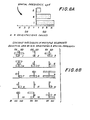
- Figure 8B illustrates the.responses of the 15 cases, each graph showing abnormally high contrast of thresholds in at least one orientation and in at least one eye (X indicates that a parameter was not tested). This is a higher diagnostic yield than with any other clinical testing method.
- Contrast sensitivity can hence be measured, in accordance with the invention, reliably in a clinical setting with swept visual evoked response.
- the test is rapid enough to permit testing of several orientation and spatial-frequency values in each eye separately.
- tests may be made sweeping the contrast of the display, for example employing the apparatus of Figure 1, or the spatial frequency of the pattern (for example cycles of a bar pattern per degree of visual arc of the observer) may be swept.
- a circuit such as disclosed in Figure 9 may be employed, wherein the pattern generator 12 is controlled in spatial frequency by a ramp generator 50 adapted to cause either upwardly or downwardly ramping spatial frequency (cycles of the pattern per degree of visual arc) as desired.
- the start of a run may be effected by means of a switch 51 connected to the ramp generator, in order to commence the run at a low EEG activity level, as discussed above.
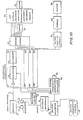
- the reversal rate is swept in frequency, by means of swept frequency quadrature oscillator 60. Since it is not feasible, in this case, to employ a local reference generator and phase shifter in the sychronous demodulators 62-65, in view of the inability of such local generation to properly follow the reference, the swept frequency quadrature generator 60 also provides output reference signals at zero degrees, 45 degrees, 90 degrees and 135 degrees, for application to the multipliers 28 of the synchronous modulators. In the arrangement of figure 11, the sweep of the frequency of reversals is commenced by means of the switch 61.
- the reversal rate itself can become a dimension of interest rather than merely a reference signal for the synchronous modulation.
- This technique provides a measure of latency. Latency is a measure of the time it takes for a response to go from the visual input to the eye to an observable electrical activity in the scalp potential.
- prior visually evoked response techniques employing computer averaging, a discrete stimulus was applied, and the delay in the response constituted a measure of latency. Since a single response could not be seen, it was necessary to repeat the test, for example, 128 times, in order to obtain a measureable potential. From an engineering point of view, looking at the temporal modulation continuum, i.e., the frequency spectrum, prior techniques measure one point on the frequency spectrum. This is the latency at a very low temporal frequency.
- a sweep of the reversal rate may be varied, for example, from 3 reversals per second to 50 reversals per second or more, during the 20 seconds or the like of the run.
- the run in this case thereby fully characterizes the temporal transfer function of the system.
- Latency may be measured at any temporal frequency. Latency measurement at more than one temporal frequency has an important biological utility as well, since the visual pathways can be divided into at least three different pathways which are called the WXY type pathways.
- the pathways are characterized by many structural and functional differences in which one of the primary structural differences is that the WXY pathways have different fiber diameters, increasing in that order. The larger an axon fiber diameter, the faster is the conduction obtained.
- the fastest-conducting system is also the most, if not the only, responsive system at high temporal frequencies. There is currently increasing interest in whether different forms of different diseases differentially attack these different pathways.
- a disease that affects, for example, the higher speed system, latency is more greatly affected than if the disease is primarily directed to a slow speed system.
- a disease if a disease is present that affects the high speed system, it can be singled out for measurement by looking at the latency at a high temporal reversal rate. Consequently, measurements of latency which can be made at any temporal frequency, enable one, in terms of biological and medical applicability, to separately assess different pathways or different neural populations.
- the invention enables the measurement of latency in a readily interpretable way, not in terms of wave form, but in terms of understood aspects of visual performance.
- the different test runs may be made in different small portions of the total spectrum, for example, from 3 to 13, or 5 to 15, etc. reversals per second.
- the output of interest in this case is a phase function curve. The slope of the phase line provides a measure of latency.
- a vector lock-in circuit 36 is employed.
- Vector lock-in circuits by taking the ratio of the outputs of two phases demodulated at 90 degrees with respect to one another, are able to calculate phase information as a tangent function.
- the provision of the vector lock-in circuit 36 hence enables the measurement of latency. In view of its sensitivity to noise, however, vector computation methods are is not generally preferred for the other above discussed measurements.
Landscapes
- Health & Medical Sciences (AREA)
- Life Sciences & Earth Sciences (AREA)
- Biomedical Technology (AREA)
- Molecular Biology (AREA)
- Psychology (AREA)
- Biophysics (AREA)
- Pathology (AREA)
- Engineering & Computer Science (AREA)
- Psychiatry (AREA)
- Heart & Thoracic Surgery (AREA)
- Medical Informatics (AREA)
- Physics & Mathematics (AREA)
- Surgery (AREA)
- Animal Behavior & Ethology (AREA)
- General Health & Medical Sciences (AREA)
- Public Health (AREA)
- Veterinary Medicine (AREA)
- Measurement And Recording Of Electrical Phenomena And Electrical Characteristics Of The Living Body (AREA)
- Measurement Of The Respiration, Hearing Ability, Form, And Blood Characteristics Of Living Organisms (AREA)
Applications Claiming Priority (2)
| Application Number | Priority Date | Filing Date | Title |
|---|---|---|---|
| US06/671,474 US4676611A (en) | 1984-11-14 | 1984-11-14 | Method and apparatus for visual-evoked responses |
| US671474 | 1984-11-14 |
Publications (2)
| Publication Number | Publication Date |
|---|---|
| EP0182402A2 true EP0182402A2 (de) | 1986-05-28 |
| EP0182402A3 EP0182402A3 (de) | 1987-04-22 |
Family
ID=24694671
Family Applications (1)
| Application Number | Title | Priority Date | Filing Date |
|---|---|---|---|
| EP85201681A Ceased EP0182402A3 (de) | 1984-11-14 | 1985-10-14 | Verfahren und Gerät zur Auswertung der Reaktion auf visuelle Reize |
Country Status (4)
| Country | Link |
|---|---|
| US (1) | US4676611A (de) |
| EP (1) | EP0182402A3 (de) |
| JP (1) | JPS61154533A (de) |
| CA (1) | CA1242277A (de) |
Cited By (1)
| Publication number | Priority date | Publication date | Assignee | Title |
|---|---|---|---|---|
| WO1987000745A1 (en) * | 1985-07-30 | 1987-02-12 | Swinburne Limited | Electroencephalographic consciousness and anaesthetic monitor |
Families Citing this family (26)
| Publication number | Priority date | Publication date | Assignee | Title |
|---|---|---|---|---|
| US5331969A (en) * | 1985-07-30 | 1994-07-26 | Swinburne Limited | Equipment for testing or measuring brain activity |
| US4861154A (en) * | 1986-08-06 | 1989-08-29 | Westinghouse Electric Corp. | Automated visual assessment system with steady state visual evoked potential stimulator and product detector |
| US4846567A (en) * | 1986-08-06 | 1989-07-11 | Sutter Erich E | Retinal area response mapping using simultaneous multi-area stimulation with binary sequences and objective response analysis |
| US4852018A (en) * | 1987-01-07 | 1989-07-25 | Trustees Of Boston University | Massively parellel real-time network architectures for robots capable of self-calibrating their operating parameters through associative learning |
| JPH02167133A (ja) * | 1987-03-28 | 1990-06-27 | Toyo Medical Kk | 網膜電位図の波形処理方法及び装置 |
| US5065767A (en) * | 1988-08-26 | 1991-11-19 | The Australian National University | Method for use in diagnosis of glaucoma |
| US5088810A (en) * | 1989-01-23 | 1992-02-18 | Galanter Stephen M | Vision training method and apparatus |
| US5295495A (en) * | 1991-05-13 | 1994-03-22 | The Australian National University | Glaucoma testing from observations of optokinetic nystagmus |
| AU645420B2 (en) * | 1991-05-13 | 1994-01-13 | Australian National University, The | Glaucoma testing from observations of optokinetic nystagmus |
| US5204703A (en) * | 1991-06-11 | 1993-04-20 | The Center For Innovative Technology | Eye movement and pupil diameter apparatus and method |
| WO1994005202A1 (en) * | 1992-09-01 | 1994-03-17 | President And Fellows Of Harvard College | Determining pathologic conditions, in particular dyslexia |
| US5526143A (en) * | 1992-09-16 | 1996-06-11 | Scitex Corporation Ltd. | Apparatus and technique for generating a screened reproduction of an image |
| US5392788A (en) * | 1993-02-03 | 1995-02-28 | Hudspeth; William J. | Method and device for interpreting concepts and conceptual thought from brainwave data and for assisting for diagnosis of brainwave disfunction |
| US5860936A (en) * | 1996-08-02 | 1999-01-19 | Levin; David N. | Method and apparatus for measurement, analysis, characterization, emulation, and translation of perception |
| US6093153A (en) * | 1996-08-02 | 2000-07-25 | Levin; David N. | Method and apparatus for measurement, analysis, characterization, emulation, and translation of perception |
| US6025829A (en) * | 1996-10-28 | 2000-02-15 | Welch Allyn, Inc. | Image generator for video display |
| US5953102A (en) * | 1997-07-23 | 1999-09-14 | Berry; Francis D. | Method for substantially objective testing of the visual capacity of a test subject |
| AUPP354898A0 (en) | 1998-05-15 | 1998-06-11 | Swinburne Limited | Mass communication assessment system |
| AUPP354798A0 (en) | 1998-05-15 | 1998-06-11 | Swinburne Limited | Decentralised patient management system |
| CN1248426A (zh) * | 1999-10-29 | 2000-03-29 | 清华大学 | 基于脑电稳态诱发响应的控制装置 |
| JP2003159253A (ja) * | 2001-11-27 | 2003-06-03 | Communication Research Laboratory | 脳機能測定のための被験者への刺激提示装置 |
| US20090062676A1 (en) * | 2003-05-06 | 2009-03-05 | George Mason Intellectual Property | Phase and state dependent eeg and brain imaging |
| ITRM20100439A1 (it) * | 2010-08-04 | 2012-02-05 | Ingenesi Di Gualtiero Regini | Metodo e sistema di soppressione degli artefatti di luminanza dei monitor lcd in elettrofisiologia della visione |
| US8777405B2 (en) | 2011-06-27 | 2014-07-15 | David Joseph Anschel | Self-adhering visual stimulator |
| US10007336B2 (en) | 2013-09-10 | 2018-06-26 | The Board Of Regents Of The University Of Texas System | Apparatus, system, and method for mobile, low-cost headset for 3D point of gaze estimation |
| JP6675535B2 (ja) * | 2015-09-30 | 2020-04-01 | 東海光学株式会社 | 脳活動検出システム、脳活動検出システムを使用した脳活動の解析方法、そのような脳活動の解析方法による個人特性の評価方法及び個人の見え方の評価方法 |
Family Cites Families (4)
| Publication number | Priority date | Publication date | Assignee | Title |
|---|---|---|---|---|
| US3574450A (en) * | 1969-05-19 | 1971-04-13 | Carroll T White | Method and apparatus for determining the effectiveness of spatial vision |
| DE3009049A1 (de) * | 1979-03-12 | 1980-09-18 | John Spencer Dobson | Vorrichtung zum pruefen des sehvermoegens |
| US4365873A (en) * | 1979-11-28 | 1982-12-28 | Ginsburg Arthur P | Spatial frequency and contrast sensitivity test chart |
| US4493539A (en) * | 1982-06-30 | 1985-01-15 | The United States Of America As Represented By The Secretary Of The Air Force | Method and apparatus for objective determination of visual contrast sensitivity functions |
-
1984
- 1984-11-14 US US06/671,474 patent/US4676611A/en not_active Expired - Fee Related
-
1985
- 1985-10-14 EP EP85201681A patent/EP0182402A3/de not_active Ceased
- 1985-11-01 CA CA000494405A patent/CA1242277A/en not_active Expired
- 1985-11-14 JP JP60253883A patent/JPS61154533A/ja active Pending
Cited By (1)
| Publication number | Priority date | Publication date | Assignee | Title |
|---|---|---|---|---|
| WO1987000745A1 (en) * | 1985-07-30 | 1987-02-12 | Swinburne Limited | Electroencephalographic consciousness and anaesthetic monitor |
Also Published As
| Publication number | Publication date |
|---|---|
| JPS61154533A (ja) | 1986-07-14 |
| EP0182402A3 (de) | 1987-04-22 |
| US4676611A (en) | 1987-06-30 |
| CA1242277A (en) | 1988-09-20 |
Similar Documents
| Publication | Publication Date | Title |
|---|---|---|
| US4676611A (en) | Method and apparatus for visual-evoked responses | |
| Purpura et al. | Light adaptation in the primate retina: analysis of changes in gain and dynamics of monkey retinal ganglion cells | |
| Jones et al. | Visual evoked response as a function of grating spatial frequency. | |
| Sokol et al. | Evoked potential and preferential looking estimates of visual acuity in pediatric patients | |
| Weiskrantz et al. | Parameters affecting conscious versus unconscious visual discrimination with damage to the visual cortex (V1). | |
| King‐Smith et al. | Pattern and flicker detection analysed by subthreshold summation. | |
| Vogels et al. | How well do response changes of striate neurons signal differences in orientation: a study in the discriminating monkey | |
| EP0375737B1 (de) | Verfahren und vorrichtung zum bestimmen der antwort der netzhaut auf lichtreize | |
| Blakemore et al. | On the existence of neurones in the human visual system selectively sensitive to the orientation and size of retinal images | |
| Poggio et al. | Foveal striate cortex of behaving monkey: single-neuron responses to square-wave gratings during fixation of gaze | |
| US5539482A (en) | Glaucoma testing using non-linear systems identification techniques | |
| CN110251065A (zh) | 基于运动视觉诱发电位的对比敏感度检测方法 | |
| EP0444150A1 (de) | Durch sinnesfunktion gesteuerter regler. | |
| Parks et al. | Functional imaging of the retina using the multifocal electroretinograph: a control study. | |
| Bodis-Wollner et al. | Electrophysiological and psychophysical responses to modulation of contrast of a grating pattern | |
| CN110251064A (zh) | 基于运动视觉诱发电位的视敏度检测方法 | |
| Sahraie et al. | Psychophysical and pupillometric study of spatial channels of visual processing in blindsight | |
| Hasegawa et al. | Mapping of glaucomatous visual field defects by multifocal VEPs | |
| Riddell et al. | Comparison of measures of visual acuity in infants: Teller acuity cards and sweep visual evoked potentials | |
| Leynes et al. | Context influences the FN400 recognition event-related potential | |
| US7278742B2 (en) | Systems and apparatus for assessment of visual field functions | |
| CN113349731A (zh) | 一种测量和评估视觉功能的方法及应用 | |
| Telage et al. | Temporal summation effects on lingual vibrotactile thresholds | |
| Hunter et al. | Visual signal detection measured by event-related potentials | |
| Mitsuyuª et al. | Visually Evoked Cortical Potentials¹ |
Legal Events
| Date | Code | Title | Description |
|---|---|---|---|
| PUAI | Public reference made under article 153(3) epc to a published international application that has entered the european phase |
Free format text: ORIGINAL CODE: 0009012 |
|
| AK | Designated contracting states |
Kind code of ref document: A2 Designated state(s): AT BE CH DE FR GB IT LI LU NL SE |
|
| PUAL | Search report despatched |
Free format text: ORIGINAL CODE: 0009013 |
|
| AK | Designated contracting states |
Kind code of ref document: A3 Designated state(s): AT BE CH DE FR GB IT LI LU NL SE |
|
| 17P | Request for examination filed |
Effective date: 19870831 |
|
| 17Q | First examination report despatched |
Effective date: 19890602 |
|
| STAA | Information on the status of an ep patent application or granted ep patent |
Free format text: STATUS: THE APPLICATION HAS BEEN REFUSED |
|
| 18R | Application refused |
Effective date: 19901202 |
|
| RIN1 | Information on inventor provided before grant (corrected) |
Inventor name: NELSON, JEREMIAH Inventor name: KUPERSMITH, MARK JEFFREY |