EP0181663A1 - Process for activating siliceous catalysts - Google Patents
Process for activating siliceous catalysts Download PDFInfo
- Publication number
- EP0181663A1 EP0181663A1 EP85201720A EP85201720A EP0181663A1 EP 0181663 A1 EP0181663 A1 EP 0181663A1 EP 85201720 A EP85201720 A EP 85201720A EP 85201720 A EP85201720 A EP 85201720A EP 0181663 A1 EP0181663 A1 EP 0181663A1
- Authority
- EP
- European Patent Office
- Prior art keywords
- zeolite
- catalyst
- reactor
- zsm
- hydrochloric acid
- Prior art date
- Legal status (The legal status is an assumption and is not a legal conclusion. Google has not performed a legal analysis and makes no representation as to the accuracy of the status listed.)
- Withdrawn
Links
- 238000000034 method Methods 0.000 title claims abstract description 56
- 239000003054 catalyst Substances 0.000 title claims abstract description 55
- 230000003213 activating effect Effects 0.000 title claims abstract description 7
- 230000008569 process Effects 0.000 title description 32
- 239000010457 zeolite Substances 0.000 claims abstract description 103
- VYPSYNLAJGMNEJ-UHFFFAOYSA-N Silicium dioxide Chemical compound O=[Si]=O VYPSYNLAJGMNEJ-UHFFFAOYSA-N 0.000 claims abstract description 78
- VSCWAEJMTAWNJL-UHFFFAOYSA-K aluminium trichloride Chemical compound Cl[Al](Cl)Cl VSCWAEJMTAWNJL-UHFFFAOYSA-K 0.000 claims abstract description 36
- VEXZGXHMUGYJMC-UHFFFAOYSA-N Hydrochloric acid Chemical compound Cl VEXZGXHMUGYJMC-UHFFFAOYSA-N 0.000 claims abstract description 35
- 239000000377 silicon dioxide Substances 0.000 claims abstract description 18
- 239000011261 inert gas Substances 0.000 claims abstract description 13
- 238000011282 treatment Methods 0.000 claims abstract description 7
- 239000002253 acid Substances 0.000 claims abstract description 3
- 239000000203 mixture Substances 0.000 claims description 18
- IJGRMHOSHXDMSA-UHFFFAOYSA-N Atomic nitrogen Chemical compound N#N IJGRMHOSHXDMSA-UHFFFAOYSA-N 0.000 claims description 15
- 239000007789 gas Substances 0.000 claims description 8
- 229910052757 nitrogen Inorganic materials 0.000 claims description 7
- 239000008240 homogeneous mixture Substances 0.000 claims 1
- 239000007792 gaseous phase Substances 0.000 abstract 1
- HNPSIPDUKPIQMN-UHFFFAOYSA-N dioxosilane;oxo(oxoalumanyloxy)alumane Chemical compound O=[Si]=O.O=[Al]O[Al]=O HNPSIPDUKPIQMN-UHFFFAOYSA-N 0.000 description 91
- 229910021536 Zeolite Inorganic materials 0.000 description 83
- DIOQZVSQGTUSAI-UHFFFAOYSA-N decane Chemical compound CCCCCCCCCC DIOQZVSQGTUSAI-UHFFFAOYSA-N 0.000 description 64
- 235000012239 silicon dioxide Nutrition 0.000 description 28
- 229910002026 crystalline silica Inorganic materials 0.000 description 26
- 230000003197 catalytic effect Effects 0.000 description 23
- 230000009466 transformation Effects 0.000 description 22
- 239000000243 solution Substances 0.000 description 21
- XLYOFNOQVPJJNP-UHFFFAOYSA-N water Chemical compound O XLYOFNOQVPJJNP-UHFFFAOYSA-N 0.000 description 21
- 238000001994 activation Methods 0.000 description 17
- 230000004913 activation Effects 0.000 description 16
- OKKJLVBELUTLKV-UHFFFAOYSA-N Methanol Chemical compound OC OKKJLVBELUTLKV-UHFFFAOYSA-N 0.000 description 15
- 229910004298 SiO 2 Inorganic materials 0.000 description 14
- 238000006243 chemical reaction Methods 0.000 description 13
- 229910018072 Al 2 O 3 Inorganic materials 0.000 description 12
- XAGFODPZIPBFFR-UHFFFAOYSA-N aluminium Chemical compound [Al] XAGFODPZIPBFFR-UHFFFAOYSA-N 0.000 description 12
- 238000001354 calcination Methods 0.000 description 11
- 229910052782 aluminium Inorganic materials 0.000 description 10
- 238000002360 preparation method Methods 0.000 description 8
- KRHYYFGTRYWZRS-UHFFFAOYSA-N Fluorane Chemical compound F KRHYYFGTRYWZRS-UHFFFAOYSA-N 0.000 description 6
- HEMHJVSKTPXQMS-UHFFFAOYSA-M Sodium hydroxide Chemical compound [OH-].[Na+] HEMHJVSKTPXQMS-UHFFFAOYSA-M 0.000 description 6
- WTEOIRVLGSZEPR-UHFFFAOYSA-N boron trifluoride Chemical compound FB(F)F WTEOIRVLGSZEPR-UHFFFAOYSA-N 0.000 description 6
- 239000012071 phase Substances 0.000 description 6
- PNEYBMLMFCGWSK-UHFFFAOYSA-N aluminium oxide Inorganic materials [O-2].[O-2].[O-2].[Al+3].[Al+3] PNEYBMLMFCGWSK-UHFFFAOYSA-N 0.000 description 5
- 230000000694 effects Effects 0.000 description 5
- 125000002887 hydroxy group Chemical group [H]O* 0.000 description 5
- 238000001228 spectrum Methods 0.000 description 5
- 239000004411 aluminium Substances 0.000 description 4
- 238000004458 analytical method Methods 0.000 description 4
- 230000007062 hydrolysis Effects 0.000 description 4
- 238000006460 hydrolysis reaction Methods 0.000 description 4
- 238000002329 infrared spectrum Methods 0.000 description 4
- 229910015900 BF3 Inorganic materials 0.000 description 3
- PEDCQBHIVMGVHV-UHFFFAOYSA-N Glycerine Chemical compound OCC(O)CO PEDCQBHIVMGVHV-UHFFFAOYSA-N 0.000 description 3
- UFHFLCQGNIYNRP-UHFFFAOYSA-N Hydrogen Chemical compound [H][H] UFHFLCQGNIYNRP-UHFFFAOYSA-N 0.000 description 3
- 238000004517 catalytic hydrocracking Methods 0.000 description 3
- 229910052681 coesite Inorganic materials 0.000 description 3
- 229910052906 cristobalite Inorganic materials 0.000 description 3
- 239000001257 hydrogen Substances 0.000 description 3
- 229910052739 hydrogen Inorganic materials 0.000 description 3
- 238000006317 isomerization reaction Methods 0.000 description 3
- BASFCYQUMIYNBI-UHFFFAOYSA-N platinum Chemical compound [Pt] BASFCYQUMIYNBI-UHFFFAOYSA-N 0.000 description 3
- 239000000843 powder Substances 0.000 description 3
- 238000003756 stirring Methods 0.000 description 3
- 229910052682 stishovite Inorganic materials 0.000 description 3
- 229910052905 tridymite Inorganic materials 0.000 description 3
- 229910002012 Aerosil® Inorganic materials 0.000 description 2
- NLXLAEXVIDQMFP-UHFFFAOYSA-N Ammonia chloride Chemical compound [NH4+].[Cl-] NLXLAEXVIDQMFP-UHFFFAOYSA-N 0.000 description 2
- QGZKDVFQNNGYKY-UHFFFAOYSA-O Ammonium Chemical compound [NH4+] QGZKDVFQNNGYKY-UHFFFAOYSA-O 0.000 description 2
- 239000004115 Sodium Silicate Substances 0.000 description 2
- 150000003863 ammonium salts Chemical class 0.000 description 2
- 230000015572 biosynthetic process Effects 0.000 description 2
- 150000001768 cations Chemical class 0.000 description 2
- 229910052593 corundum Inorganic materials 0.000 description 2
- 239000002178 crystalline material Substances 0.000 description 2
- 150000002500 ions Chemical class 0.000 description 2
- 238000010926 purge Methods 0.000 description 2
- 239000011541 reaction mixture Substances 0.000 description 2
- 238000010992 reflux Methods 0.000 description 2
- 239000011734 sodium Substances 0.000 description 2
- NTHWMYGWWRZVTN-UHFFFAOYSA-N sodium silicate Chemical compound [Na+].[Na+].[O-][Si]([O-])=O NTHWMYGWWRZVTN-UHFFFAOYSA-N 0.000 description 2
- 229910052911 sodium silicate Inorganic materials 0.000 description 2
- 239000007787 solid Substances 0.000 description 2
- 238000009987 spinning Methods 0.000 description 2
- QAOWNCQODCNURD-UHFFFAOYSA-N sulfuric acid Substances OS(O)(=O)=O QAOWNCQODCNURD-UHFFFAOYSA-N 0.000 description 2
- 238000003786 synthesis reaction Methods 0.000 description 2
- 229910001845 yogo sapphire Inorganic materials 0.000 description 2
- USFZMSVCRYTOJT-UHFFFAOYSA-N Ammonium acetate Chemical compound N.CC(O)=O USFZMSVCRYTOJT-UHFFFAOYSA-N 0.000 description 1
- 239000005695 Ammonium acetate Substances 0.000 description 1
- VHUUQVKOLVNVRT-UHFFFAOYSA-N Ammonium hydroxide Chemical compound [NH4+].[OH-] VHUUQVKOLVNVRT-UHFFFAOYSA-N 0.000 description 1
- CPELXLSAUQHCOX-UHFFFAOYSA-M Bromide Chemical compound [Br-] CPELXLSAUQHCOX-UHFFFAOYSA-M 0.000 description 1
- KKCBUQHMOMHUOY-UHFFFAOYSA-N Na2O Inorganic materials [O-2].[Na+].[Na+] KKCBUQHMOMHUOY-UHFFFAOYSA-N 0.000 description 1
- 238000010521 absorption reaction Methods 0.000 description 1
- ANBBXQWFNXMHLD-UHFFFAOYSA-N aluminum;sodium;oxygen(2-) Chemical compound [O-2].[O-2].[Na+].[Al+3] ANBBXQWFNXMHLD-UHFFFAOYSA-N 0.000 description 1
- 229940043376 ammonium acetate Drugs 0.000 description 1
- 235000019257 ammonium acetate Nutrition 0.000 description 1
- 235000019270 ammonium chloride Nutrition 0.000 description 1
- 239000007864 aqueous solution Substances 0.000 description 1
- 239000002585 base Substances 0.000 description 1
- 230000001588 bifunctional effect Effects 0.000 description 1
- 239000003153 chemical reaction reagent Substances 0.000 description 1
- 239000000571 coke Substances 0.000 description 1
- 230000000052 comparative effect Effects 0.000 description 1
- 239000013078 crystal Substances 0.000 description 1
- 230000009849 deactivation Effects 0.000 description 1
- 150000004985 diamines Chemical class 0.000 description 1
- 238000009826 distribution Methods 0.000 description 1
- 238000001035 drying Methods 0.000 description 1
- 238000004817 gas chromatography Methods 0.000 description 1
- 238000010438 heat treatment Methods 0.000 description 1
- 230000000977 initiatory effect Effects 0.000 description 1
- 238000005342 ion exchange Methods 0.000 description 1
- JEIPFZHSYJVQDO-UHFFFAOYSA-N iron(III) oxide Inorganic materials O=[Fe]O[Fe]=O JEIPFZHSYJVQDO-UHFFFAOYSA-N 0.000 description 1
- 239000007791 liquid phase Substances 0.000 description 1
- 239000010687 lubricating oil Substances 0.000 description 1
- 239000000463 material Substances 0.000 description 1
- 239000011159 matrix material Substances 0.000 description 1
- 230000007246 mechanism Effects 0.000 description 1
- 238000002156 mixing Methods 0.000 description 1
- SYSQUGFVNFXIIT-UHFFFAOYSA-N n-[4-(1,3-benzoxazol-2-yl)phenyl]-4-nitrobenzenesulfonamide Chemical class C1=CC([N+](=O)[O-])=CC=C1S(=O)(=O)NC1=CC=C(C=2OC3=CC=CC=C3N=2)C=C1 SYSQUGFVNFXIIT-UHFFFAOYSA-N 0.000 description 1
- QJGQUHMNIGDVPM-UHFFFAOYSA-N nitrogen group Chemical group [N] QJGQUHMNIGDVPM-UHFFFAOYSA-N 0.000 description 1
- 238000000655 nuclear magnetic resonance spectrum Methods 0.000 description 1
- 239000003921 oil Substances 0.000 description 1
- 239000002245 particle Substances 0.000 description 1
- 150000003057 platinum Chemical class 0.000 description 1
- 238000007670 refining Methods 0.000 description 1
- 230000008929 regeneration Effects 0.000 description 1
- 238000011069 regeneration method Methods 0.000 description 1
- 150000004760 silicates Chemical class 0.000 description 1
- 229910001388 sodium aluminate Inorganic materials 0.000 description 1
- 239000007858 starting material Substances 0.000 description 1
- 239000000725 suspension Substances 0.000 description 1
- IBWGNZVCJVLSHB-UHFFFAOYSA-M tetrabutylphosphanium;chloride Chemical compound [Cl-].CCCC[P+](CCCC)(CCCC)CCCC IBWGNZVCJVLSHB-UHFFFAOYSA-M 0.000 description 1
- DDFYFBUWEBINLX-UHFFFAOYSA-M tetramethylammonium bromide Chemical compound [Br-].C[N+](C)(C)C DDFYFBUWEBINLX-UHFFFAOYSA-M 0.000 description 1
- BGQMOFGZRJUORO-UHFFFAOYSA-M tetrapropylammonium bromide Chemical compound [Br-].CCC[N+](CCC)(CCC)CCC BGQMOFGZRJUORO-UHFFFAOYSA-M 0.000 description 1
Images

Classifications
-
- B—PERFORMING OPERATIONS; TRANSPORTING
- B01—PHYSICAL OR CHEMICAL PROCESSES OR APPARATUS IN GENERAL
- B01J—CHEMICAL OR PHYSICAL PROCESSES, e.g. CATALYSIS OR COLLOID CHEMISTRY; THEIR RELEVANT APPARATUS
- B01J29/00—Catalysts comprising molecular sieves
- B01J29/04—Catalysts comprising molecular sieves having base-exchange properties, e.g. crystalline zeolites
- B01J29/06—Crystalline aluminosilicate zeolites; Isomorphous compounds thereof
- B01J29/70—Crystalline aluminosilicate zeolites; Isomorphous compounds thereof of types characterised by their specific structure not provided for in groups B01J29/08 - B01J29/65
- B01J29/703—MRE-type, e.g. ZSM-48
-
- B—PERFORMING OPERATIONS; TRANSPORTING
- B01—PHYSICAL OR CHEMICAL PROCESSES OR APPARATUS IN GENERAL
- B01J—CHEMICAL OR PHYSICAL PROCESSES, e.g. CATALYSIS OR COLLOID CHEMISTRY; THEIR RELEVANT APPARATUS
- B01J29/00—Catalysts comprising molecular sieves
- B01J29/03—Catalysts comprising molecular sieves not having base-exchange properties
- B01J29/035—Microporous crystalline materials not having base exchange properties, such as silica polymorphs, e.g. silicalites
-
- B—PERFORMING OPERATIONS; TRANSPORTING
- B01—PHYSICAL OR CHEMICAL PROCESSES OR APPARATUS IN GENERAL
- B01J—CHEMICAL OR PHYSICAL PROCESSES, e.g. CATALYSIS OR COLLOID CHEMISTRY; THEIR RELEVANT APPARATUS
- B01J29/00—Catalysts comprising molecular sieves
- B01J29/04—Catalysts comprising molecular sieves having base-exchange properties, e.g. crystalline zeolites
- B01J29/06—Crystalline aluminosilicate zeolites; Isomorphous compounds thereof
- B01J29/40—Crystalline aluminosilicate zeolites; Isomorphous compounds thereof of the pentasil type, e.g. types ZSM-5, ZSM-8 or ZSM-11, as exemplified by patent documents US3702886, GB1334243 and US3709979, respectively
-
- B—PERFORMING OPERATIONS; TRANSPORTING
- B01—PHYSICAL OR CHEMICAL PROCESSES OR APPARATUS IN GENERAL
- B01J—CHEMICAL OR PHYSICAL PROCESSES, e.g. CATALYSIS OR COLLOID CHEMISTRY; THEIR RELEVANT APPARATUS
- B01J29/00—Catalysts comprising molecular sieves
- B01J29/90—Regeneration or reactivation
-
- B—PERFORMING OPERATIONS; TRANSPORTING
- B01—PHYSICAL OR CHEMICAL PROCESSES OR APPARATUS IN GENERAL
- B01J—CHEMICAL OR PHYSICAL PROCESSES, e.g. CATALYSIS OR COLLOID CHEMISTRY; THEIR RELEVANT APPARATUS
- B01J2229/00—Aspects of molecular sieve catalysts not covered by B01J29/00
- B01J2229/30—After treatment, characterised by the means used
- B01J2229/36—Steaming
-
- B—PERFORMING OPERATIONS; TRANSPORTING
- B01—PHYSICAL OR CHEMICAL PROCESSES OR APPARATUS IN GENERAL
- B01J—CHEMICAL OR PHYSICAL PROCESSES, e.g. CATALYSIS OR COLLOID CHEMISTRY; THEIR RELEVANT APPARATUS
- B01J2229/00—Aspects of molecular sieve catalysts not covered by B01J29/00
- B01J2229/30—After treatment, characterised by the means used
- B01J2229/40—Special temperature treatment, i.e. other than just for template removal
-
- B—PERFORMING OPERATIONS; TRANSPORTING
- B01—PHYSICAL OR CHEMICAL PROCESSES OR APPARATUS IN GENERAL
- B01J—CHEMICAL OR PHYSICAL PROCESSES, e.g. CATALYSIS OR COLLOID CHEMISTRY; THEIR RELEVANT APPARATUS
- B01J2229/00—Aspects of molecular sieve catalysts not covered by B01J29/00
- B01J2229/30—After treatment, characterised by the means used
- B01J2229/42—Addition of matrix or binder particles
-
- Y—GENERAL TAGGING OF NEW TECHNOLOGICAL DEVELOPMENTS; GENERAL TAGGING OF CROSS-SECTIONAL TECHNOLOGIES SPANNING OVER SEVERAL SECTIONS OF THE IPC; TECHNICAL SUBJECTS COVERED BY FORMER USPC CROSS-REFERENCE ART COLLECTIONS [XRACs] AND DIGESTS
- Y02—TECHNOLOGIES OR APPLICATIONS FOR MITIGATION OR ADAPTATION AGAINST CLIMATE CHANGE
- Y02P—CLIMATE CHANGE MITIGATION TECHNOLOGIES IN THE PRODUCTION OR PROCESSING OF GOODS
- Y02P30/00—Technologies relating to oil refining and petrochemical industry
- Y02P30/20—Technologies relating to oil refining and petrochemical industry using bio-feedstock
Definitions
- the present invention relates to a process for activating siliceous catalysts chosen from zeolites with a high silica content, organosilicates, polymorphic crystalline silicas and zeolites deactivated by steam treatments.
- catalysts of the zeolite type with a high silica content deactivated by dealumination of their framework can be reactivated by re-alumination of the siliceous matrix.
- the zeolitic catalyst has excellent properties for the dewaxing of lubricating oils.
- the waxy n-paraffins are transformed into lighter products (gas and gasoline components).
- the zeolitic catalyst can be used in applications aimed at lowering the pour point without loss of starting material as in the previous case.
- Curves b of Figures 1, 2 and 3 appended hereto make it possible to compare the catalytic activity of the crystalline silica activated according to Example 2 (a) with that of the crystalline silica not activated according to Example 1 (a).
- the non-activated zeolite catalyst ZSM-11 prepared in (a) was used and the zeolite catalyst ZSM-11 activated as described in (b) for the transformation of n-decane, according to the procedure described in Example j (b).
- reaction temperature at which 50% of the n-decane was converted was 247 ° C when using the zeolite catalyst ZSM-11 not activated and 177 ° C when the use of the same catalyst activated as described in (b) in the present example.
Landscapes
- Chemical & Material Sciences (AREA)
- Engineering & Computer Science (AREA)
- Materials Engineering (AREA)
- Organic Chemistry (AREA)
- Chemical Kinetics & Catalysis (AREA)
- Crystallography & Structural Chemistry (AREA)
- Catalysts (AREA)
- Organic Low-Molecular-Weight Compounds And Preparation Thereof (AREA)
- Low-Molecular Organic Synthesis Reactions Using Catalysts (AREA)
- Production Of Liquid Hydrocarbon Mixture For Refining Petroleum (AREA)
Abstract
Procédé d'activation de catalyseurs choisis parmi les zéolites à forte teneur en silice, les organosilicates, les silices polymorphes cristallines et les zéolites désactivés par traitement à la vapeur d'eau, dans lequel on traite thermiquement un catalyseur de ce type à l'aide de chlorure d'aluminium et d'un acide halohydrique. Suivant l'invention, on fait agir sur le catalyseur du chlorure d'aluminium et de l'acide chlorhydrique, tous deux en phase gazeuse, à une température comprise entre environ 150 et 600°C dans un même réacteur et on élimine l'excès éventuel d'acide chlorhydrique gazeux à l'aide d'un gaz inerte.Method for activating catalysts chosen from zeolites with a high silica content, organosilicates, crystalline polymorphic silicas and zeolites deactivated by steam treatment, in which a catalyst of this type is heat treated using aluminum chloride and a hydrohalic acid. According to the invention, aluminum chloride and hydrochloric acid, both in the gaseous phase, are made to act on the catalyst, at a temperature between approximately 150 and 600 ° C. in the same reactor and the excess is eliminated. possible gaseous hydrochloric acid using an inert gas.
Description
La présente invention est relative à un procédé pour activer des catalyseurs siliceux choisis parmi les zéolites à forte teneur en silice, les organosilicates, les silices cristallines polymorphes et les zéolites désactivés par des traitements à la vapeur d'eau.The present invention relates to a process for activating siliceous catalysts chosen from zeolites with a high silica content, organosilicates, polymorphic crystalline silicas and zeolites deactivated by steam treatments.
On sait que les catalyseurs du type zéolite à forte teneur en silice désactivés par déalumination de leur ossature peuvent être réactivés par re-alumination de la matrice siliceuse.It is known that catalysts of the zeolite type with a high silica content deactivated by dealumination of their framework can be reactivated by re-alumination of the siliceous matrix.
On admet généralement que la capacité d'échange ionique d'un zéolite cristallin dépend directement de sa teneur en aluminium. Si les cations nécessaires pour contrebalancer l'électronégativité du zéolite sont des protons, ils confèrent une activité catalytique remarquable au zéolite. Par ailleurs, les zéolites à forte teneur en silice ne contenant sensiblement pas d'aluminium possèdent de nombreuses propriétés et caractéristiques importantes et un degré élevé de stabilité structurelle, en sorte qu' ils peuvent être utilisés dans divers procédés catalytiques.It is generally accepted that the ion exchange capacity of a crystalline zeolite depends directly on its aluminum content. If the cations necessary to counterbalance the electronegativity of the zeolite are protons, they confer remarkable catalytic activity on the zeolite. On the other hand, high silica zeolites containing substantially no aluminum have many important properties and characteristics and a high degree of structural stability, so that they can be used in various catalytic processes.
Comme exemples de tels zéolites à forte teneur en silice, on peut citer, entre autres, les suivants :
- - ZSM-5 et ZSM-11 (brevet U.S.A. n° 3.709.979) ;
- - ZSM-12 (brevet U.S.A. n° 3.832.449) ;
- - ZSM-48 (brevet européen 23.089) ;
- - organosilicates exempts d'aluminium ayant la structure du ZSM-5 (brevet U.S.A. n° 3.941.871) ;
- - silices cristallines microporeuses ou organosilicates contenant de l'aluminium à l'état de traces (brevets U.S.A. n° 4.061.724, 4.073.865 et 4.104.294).
- - ZSM-5 and ZSM-11 (US Patent No. 3,709,979);
- - ZSM-12 (USA patent n ° 3,832,449);
- - ZSM-48 (European patent 23.089);
- - aluminum-free organosilicates having the structure of ZSM-5 (US Patent No. 3,941,871);
- - microporous or organosilicate crystalline silicas containing trace amounts of aluminum (US Pat. Nos. 4,061,724, 4,073,865 and 4,104,294).
Plusieurs procédés ont été récemment proposés pour augmenter l'activité de ces zéolites ou silicates cristallins à faible teneur en alumine.Several methods have recently been proposed for increasing the activity of these zeolites or crystalline silicates with a low alumina content.
Ainsi, dans le brevet U.S.A. n° 4.427.786, on propose un procédé pour augmenter l'activité d'un zéolite cristallin ayant un rapport silice:alumine de plus de 100, ce procédé consistant à traiter le zéolite synthétisé à partir d'un mélange réactionnel contenant des ions volumineux, comme suit :
- - calcination du zéolite à une température comprise entre 200 et 600°C ;
- - mise en contact du zéolite calciné avec du fluorure de bore sec à une température de 0 à 100°C jusqu'à saturation ;
- - élimination de l'excès de fluorure de bore du zéolite par purge ;
- - hydrolyse du fluorure de bore adsorbé à l'aide d'une solution d'un sel d'ammonium pour obtenir le zéolite supporté, et
- - re-calcination du zéolite supporté.
- - calcination of the zeolite at a temperature between 200 and 600 ° C;
- - contacting the calcined zeolite with dry boron fluoride at a temperature of 0 to 100 ° C until saturation;
- - removal of excess boron fluoride from the zeolite by purging;
- - hydrolysis of the boron fluoride adsorbed using a solution of an ammonium salt to obtain the supported zeolite, and
- - re-calcination of the supported zeolite.
Par ailleurs, le brevet U.S.A. n° 4.438.215 décrit un procédé pour augmenter l'activité catalytique des mêmes zéolites synthétisés à partir d'un mélange réactionnel contenant des ions tétralkylammonium, ce procédé consistant à :
- - calciner le zéolite synthétisé à une température comprise entre 200 et 600°C ;
- - traiter le zéolite calciné à l'aide de chlorure d' aluminium à une température de 100 à 600°C ;
- - hydrolyser le chlorure d'aluminium adsorbé sur la matière cristalline à l'aide d'eau ;
- - calciner la matière cristalline en vue d'obtenir une activité catalytique améliorée.
- - calcining the synthesized zeolite at a temperature between 200 and 600 ° C;
- - treating the calcined zeolite using aluminum chloride at a temperature of 100 to 600 ° C;
- - hydrolyze the aluminum chloride adsorbed on the crystalline material using water;
- - calcining the crystalline material in order to obtain an improved catalytic activity.
Enfin, le brevet U.S.A. n° 4.444.900 décrit un procédé pour augmenter l'activité catalytique d'un zéolite cristallin poreux synthétique ayant un rapport silice : alumine de plus de 100, ce zéolite ayant été synthétisé en présence d'une diamine comme source de cations. Ce procédé comporte les phases suivantes :
- - réaction du zéolite synthétisé avec une solution diluée 0,1 à 5 N d'acide fluorhydrique à une température de 0 à 30°C pendant moins de 60 minutes ;
- - mise en contact du zéolite traité à l'acide fluorhydrique avec du chlorure d'aluminium à une température comprise entre 100 et 850°C ;
- - traitement du zéolite mis en contact avec du chlorure d'aluminium, à l'aide d'une solution d'un sel d'ammonium ;
- - calcination de la matière obtenue.
- - reaction of the synthesized zeolite with a 0.1 to 5 N dilute solution of hydrofluoric acid at a temperature of 0 to 30 ° C for less than 60 minutes;
- - bringing the zeolite treated with hydrofluoric acid into contact with aluminum chloride at a temperature between 100 and 850 ° C;
- - treatment of the zeolite brought into contact with aluminum chloride, using a solution of an ammonium salt;
- - calcination of the material obtained.
Les procédés connus d'amélioration de l'activité catalytique de zéolites, sommairement décrits ci-dessus, nécessitent des phases multiples comportant notamment des traitements de calcination et des réactions en phase liquide.The known methods for improving the catalytic activity of zeolites, briefly described above, require multiple phases including in particular calcination treatments and reactions in the liquid phase.
La présente invention concerne un procédé d'activation des catalyseurs des types susmentionnés, qui peut être mis en oeuvre dans un seul réacteur et dans lequel l'activation s'effectue à l'aide de réactifs peu coûteux en phase gazeuse.The present invention relates to a method for activating catalysts of the aforementioned types, which can be carried out in a single reactor and in which the activation is carried out using inexpensive reagents in the gas phase.
Il est à noter que l'isomérisation et l'hydrocraquage de n-paraffines, en particulier du n-décane, par un mécanisme bifonctionnel, ont été étudiés sur des zéolites ayant des rapports molaires SiO2/Al2O3 élevés (J. Martens, J. Weitkamp, M. Tielen, P. Jacobs, Zéolites 4, 98 (1984)). Cette publication révèle clairement que, lors de ces réactions, l'acidité des zéolites est un facteur déterminant pour la vitesse de ces réactions. Les principaux produits obtenus sont des isomères d' alimentation et/ou des produits hydrocraqués. La répartition de ces deux groupes de produits détermine la sélectivité globale des zéolites. Au niveau du raffinage d'huiles, des rendements élevés en produits hydrocraqués indiquent que le catalyseur zéolitique possède d'excellentes propriétés pour le déparaffinage d'huiles lubrifiantes. Dans ce cas, les n-paraffines cireuses sont transformées en produits plus légers (gaz et composants d'essence). Lorsqu'un rendement élevé en isomères est obtenu, le catalyseur zéolitique peut être utilisé dans les applications visant à abaisser le point d'écoulement sans perte de produit de départ comme dans le cas précédent.It should be noted that the isomerization and hydrocracking of n-paraffins, in particular n-decane, by a bifunctional mechanism, have been studied on zeolites having high SiO 2 / Al 2 O 3 molar ratios (J. Martens, J. Weitkamp, M. Tielen, P. Jacobs, Zéolites 4, 98 (1984)). This publication clearly reveals that, during these reactions, the acidity of the zeolites is a determining factor for the speed of these reactions. The main products obtained are feed isomers and / or hydrocracked products. The distribution of these two groups of products determines the overall selectivity of the zeolites. In terms of refining oils, high yields of hydrocracked products indicate that the zeolitic catalyst has excellent properties for the dewaxing of lubricating oils. In this case, the waxy n-paraffins are transformed into lighter products (gas and gasoline components). When a high yield of isomers is obtained, the zeolitic catalyst can be used in applications aimed at lowering the pour point without loss of starting material as in the previous case.
Le procédé suivant la présente invention, dans lequel on active un catalyseur choisi parmi les zéolites à forte teneur en silice, les organosilicates, les silices _polymorphes cristallines et les zéolites désactivés par traitement à la vapeur d'eau, en traitant ce catalyseur thermiquement à l'aide de chlorure d'aluminium et d'un acide halohydrique, est caractérisé essentiellement par le fait qu'on fait agir sur le catalyseur du chlorure d'aluminium et de l'acide chlorhydrique, tous deux en phase gazeuse, à une température comprise entre environ 150 et 600°C dans un même réacteur et on élimine l'excès éventuel d'acide chlorhydrique gazeux à l'aide d'un gaz inerte.The process according to the present invention, in which a catalyst selected from zeolites with a high silica content, organosilicates, crystalline polymeric silicas and zeolites deactivated by steam treatment is activated by treating this catalyst thermally with water. using aluminum chloride and a hydrohalic acid, is essentially characterized by the fact that aluminum chloride and hydrochloric acid, both in the gas phase, are made to act on the catalyst, at a temperature comprised between about 150 and 600 ° C in the same reactor and any excess hydrochloric acid gas is removed using an inert gas.
Dans une forme de réalisation particulière du procédé suivant l'invention, on porte un mélange de catalyseur et de chlorure d'aluminium introduit dans le réacteur à une température propre à déshydrater le mélange dans un courant d'un gaz inerte, puis on introduit dans le réacteur un courant d'un gaz inerte contenant de l'acide chlorhydrique à l'état gazeux et on chauffe le réacteur à une température d'environ 500 à 600°C pendant plusieurs heures.In a particular embodiment of the process according to the invention, a mixture of catalyst and aluminum chloride introduced into the reactor is brought to a temperature suitable for dehydrating the mixture in a stream of an inert gas, then it is introduced into the reactor a stream of an inert gas containing hydrochloric acid in gaseous state and the reactor is heated to a temperature of about 500 to 600 ° C for several hours.
Selon une particularité du procédé suivant l'invention, on introduit un courant d'un gaz inerte contenant de l'acide chlorhydrique gazeux dans le réacteur chargé du mélange déshydraté de catalyseur et de chlorure d'aluminium à une température d'environ 150°C et on élève la température du réacteur jusqu'à environ 500 à 600°C en l'espace de plusieurs heures pendant lesquelles on continue à y introduire ledit courant gazeux contenant de l'acide chlorhydrique.According to a feature of the process according to the invention, a stream of an inert gas containing gaseous hydrochloric acid is introduced into the reactor charged with the dehydrated mixture of catalyst and aluminum chloride at a temperature of approximately 150 ° C. and the temperature of the reactor is raised to about 500 to 600 ° C in the space of several hours during which the introduction of said gaseous stream containing hydrochloric acid is continued therein.
Le courant de gaz inerte, tel que de l'azote, contient avantageusement environ 20 % d'acide chlorhydrique gazeux sec.The inert gas stream, such as nitrogen, advantageously contains about 20% dry gaseous hydrochloric acid.
Les exemples suivants illustrent l'invention à titre non limitatif :The following examples illustrate the invention without limitation:
On a préparé une silice cristalline ayant un diffractogramme aux rayons X identique à celui de silicalite, au départ des deux solutions suivantes :
- solution 1 : 5,3 g de NaOH dans 20 ml d'eau ; 5 g de NH4OH dans 10 ml d'eau ; 22 g de Si02 (aerosil) ; 800 ml d'une solution aqueuse 1N de bromure de tétrapropylammonium.
- solution 2 : 500 g de glycérol.
- solution 1: 5.3 g of NaOH in 20 ml of water; 5 g NH 4 OH in 10 ml of water; 22 g of S i0 2 (aerosil); 800 ml of a 1N aqueous solution of tetrapropylammonium bromide.
- solution 2: 500 g of glycerol.
La solution 1 a été ajoutée à la solution 2 en agitant vigoureusement et le mélange a été chauffé dans un autoclave à 150°C pendant 3 jours.
La silice cristalline obtenue a été ensuite calcinée à 500°C et chauffée sous reflux dans un excès centuple (100X) de chlorure d'ammonium et calcinée à nouveau à 450°C.The crystalline silica obtained was then calcined at 500 ° C and heated under reflux in a hundredfold excess (100X) of ammonium chloride and calcined again at 450 ° C.
La silice cristalline obtenue présentait, sur une base anhydre, la composition molaire suivante :
- (Al2O3)1 (SiO2)5000
- (Al 2 O 3 ) 1 (SiO 2 ) 5000
2 g de la silice cristalline obtenue de la manière décrite ci-dessus en (a) a été imprégnée de 0,034 g de Pt(NH3)4Cl dans 2 ml d'eau. Après séchage et calcination à 500°C, 750 mg de la poudre obtenue ont été pressés, broyés et tamisés.2 g of the crystalline silica obtained in the manner described above in (a) was impregnated with 0.034 g of Pt (NH 3 ) 4 Cl in 2 ml of water. After drying and calcination at 500 ° C, 750 mg of the powder obtained were pressed, crushed and sieved.
500 mg de la fraction d'une granulométrie de 0,5 à 0,8 mm ont été chargés dans un réacteur tubulaire à flux continu, en vue d'être utilisés comme catalyseur.500 mg of the fraction with a particle size of 0.5 to 0.8 mm was loaded into a tubular flow reactor, for use as a catalyst.
Le catalyseur chargé dans le réacteur a été pré-réduit à l'aide d'hydrogène à 400°C et refroidi à 100°C. A cette température, on a fait passer du n-décane et de l'hydrogène sur le catalyseur dans un rapport molaire H2/C10H24 de 20 et un débit spatial horaire en décane de 0 , 6 h-1.The catalyst charged to the reactor was pre-reduced using hydrogen to 400 ° C and cooled to 100 ° C. At this temperature, was passed through the n-decane and hydrogen over the catalyst in a molar ratio H 2 / C 10 H 24 20 and a space-time rate in decane 0, 6 h - 1.
Après 3 heures, la transformation en isomères et produits hydrocraqués a été constatée par chromatographie gazeuse en capillaire.After 3 hours, the conversion to products and isomers hydrocra q SIU was ascertained by gas chromatography capillary.
On a ensuite élevé la température par paliers de 10°C et on a chaque fois déterminé la composition de l'effluent du réacteur.The temperature was then raised in steps of 10 ° C and each time the composition of the reactor effluent was determined.
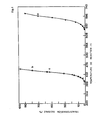
Les courbes de la figure 1 des dessins ci-annexés (dans laquelle la température de la réaction est indiquée en abscisse et la transformation globale en % est indiquée en ordonnée) montrent les résultats obtenus. Le degré de transformation du n-décane au contact du catalyseur de silice cristalline est indiqué en a à la figure 1. La teneur en isomère d'alimentation à différentes températures est montrée en b à la figure 1 et la quantité de produits hydrocraqués est donnée en c à la figure 1.The curves of Figure 1 of the accompanying drawings (in which the reaction temperature is indicated on the abscissa and the overall transformation in% is indicated on the ordinate) show the results obtained. The degree of transformation of n-decane in contact with the crystalline silica catalyst is indicated in a in FIG. 1. The content of feed isomer at different temperatures is shown in b in FIG. 1 and the quantity of hydrocracked products is given. at c in Figure 1.
On a déterminé le spectre NMR 27Al de la silice cristalline comme suit :
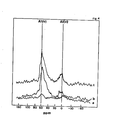
- On a chargé 0,5 g de la poudre de silice cristalline restante du présent exemple 1 (a) dans le rotor d'un spectromètre NMR à résolution élevée de 400 MHz et le spectre NHR 27Al a été enregistré selon le mode de spinning à angle magique, en utilisant du Al(H2O)6 3+ comme référence. La ligne de résonnance 27Al du catalyseur à base de silice cristalline est montrée en A à la figure 4 des dessins ci-annexés. Le catalyseur ne contenait qu'une faible quantité d'aluminium tétraédrique (IV) et d'aluminium octaédrique (VI).
- 0.5 g of the remaining crystalline silica powder of this Example 1 (a) was loaded into the rotor of a 400 MHz high resolution NMR spectrometer and the NHR 27 Al spectrum was recorded in spinning mode at magic angle, using Al (H 2 O) 6 3+ as a reference. The resonance line 27 A1 of the crystalline silica catalyst is shown at A in FIG. 4 of the attached drawings. The catalyst contained only a small amount of tetrahedral aluminum (IV) and octahedral aluminum (VI).
On a aussi déterminé le spectre infra-rouge des groupes OH superficiels de la silice cristalline comme suit :
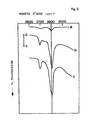
- 10 mg de la poudre de silice cristalline restante du présent exemple 1 (b) ont été pressés pour former une gaufrette auto-portante qui a été mise en suspension dans le porte-échantillon d'une cellule infra-rouge et dégazée à 400°C sous un vide de 10-5 bar. Le spectre de la région du plateau hydroxylique est montré en a à la figure 5 des dessins ci-annexés. On voit qu'il n'y a qu'une faible bande OH à 3600 cm-1. bande 3600 cm-1.
- 10 mg of the remaining crystalline silica powder of this Example 1 (b) was pressed to form a self-supporting wafer which was suspended in the sample holder of an infrared cell and degassed at 400 ° C under a vacuum of 10 -5 bar. The spectrum of the hydroxyl plateau region is shown in a in Figure 5 of the accompanying drawings. We see that there is only a weak OH band at 3600 cm -1 .
strip 3600 cm -1 .
On a broyé 1 g de la silice cristalline préparée dans la partie (a) de l'exemple 1 avec 0,133 g de AlCl3.6H2O. Le mélange broyé a été chargé dans un réacteur tubulaire à flux continu semblable à celui utilisé dans la partie (b) de l'exemple 1. Le mélange chargé dans le réacteur a été chauffé à 500°C sous un courant d'azote sec à un débit de 60 ml/minute pour le déshydrater, après quoi on a refroidi la charge du réacteur jusqu'à 150°C. A ce stade, on a fait passer un courant gazeux contenant 20 % de HCl gazeux sec dans de l'azote sec dans le réacteur que l'on a chauffé à 550°C en l'espace de 5 heures. Pendant toute cette période, on a continué à faire passer le courant d'azote chargé de HCl.1 g of the crystalline silica prepared in part (a) of Example 1 was ground with 0.133 g of AlCl 3 .6H 2 O. The ground mixture was loaded into a tubular continuous flow reactor similar to that used in part (b) of Example 1. The mixture loaded into the reactor was heated to 500 ° C. under a stream of dry nitrogen at a rate of 60 ml / minute to dehydrate it, after which the reactor charge was cooled to 150 ° C. At this point, a gas stream containing 20% dry HCl gas in dry nitrogen was passed through the reactor which was heated to 550 ° C over 5 hours. Throughout this period, the stream of nitrogen laden with HCl continued to pass.
Le réacteur a enfin été purgé à l'aide d'azote sec pour éliminer l'excès de HCl et refroidi. On a ainsi obtenu de la silice cristalline activée.The reactor was finally purged using dry nitrogen to remove the excess HCl and cooled. Activated crystalline silica was thus obtained.
On a utilisé la silice cristalline activée obtenue dans la partie (a) du présent exemple 2 de la manière décrite dans la partie (b) de l'exemple 1.The activated crystalline silica obtained in part (a) of this example 2 was used as described in part (b) of example 1.
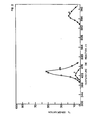
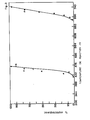
Les courbes b des figures 1, 2 et 3 ci-annexées permettent de comparer l'activité catalytique de la silice cristalline activée selon l'exemple 2 (a) à celle de la silice cristalline non activée selon l'exemple 1 (a).Curves b of Figures 1, 2 and 3 appended hereto make it possible to compare the catalytic activity of the crystalline silica activated according to Example 2 (a) with that of the crystalline silica not activated according to Example 1 (a).
Cette comparaison révèle que la courbe de transformation globale est déplacée vers des températures bien plus basses, en sorte que des taux de conversion équivalents sont obtenus avec la silice cristalline activée par le procédé suivant l'invention (exemple 2a) à des températures inférieures de 250°C à celles appliquées avec la silice cristalline non activée. Il en est de même, comme on le voit aux figures 1, 2 et 3, pour les activités d'hydrocraquage et d'isomérisation respectives de la silice cristalline non activée et de la silice cristalline activée conformément à la présente invention.This comparison reveals that the overall transformation curve is shifted to much lower temperatures, so that equivalent conversion rates are obtained with the crystalline silica activated by the process according to the invention (example 2a) at temperatures below 250 ° C to those applied with unactivated crystalline silica. The same is true, as can be seen in FIGS. 1, 2 and 3, for the respective hydrocracking and isomerization activities of the non-activated crystalline silica and of the crystalline silica activated in accordance with the present invention.
La figure 2 révèle, en outre, que le rendement maximal en isomère a augmenté de 19 % (avec la silice cristalline non activée) à 59 % (avec la silice cristalline activée).Figure 2 further reveals that the maximum isomer yield increased from 19% (with unactivated crystalline silica) to 59% (with activated crystalline silica).
Les analyses suivantes auxquelles a été soumise la silice microcristalline activée par le procédé suivant l'invention dans l'exemple 2 (a) montrent des différences remarquables entre la siljce cristalline non activée de l'exemple 1 (a) et la silice cristalline activée de l'The following analyzes to which was subjected the microcrystalline silica activated by the process according to the invention in Example 2 (a) show remarkable differences between the non-activated crystalline silica of Example 1 (a) and the activated crystalline silica of
Le spectre NMR 27Al de la silice cristalline activée de l'exemple 2 (a) déterminé de la manière décrite dans la partie c de l'exemple 1, au départ de 0,5 g de cette silice cristalline activée, est montré à la figure 4, tracé b. Ce tracé montre que la silice microcristalline activée contient une quantité considérable d'aluminium tétraédrique.The NMR 27 Al spectrum of the activated crystalline silica of Example 2 (a) determined as described in part c of Example 1, starting from 0.5 g of this activated crystalline silica, is shown in the Figure 4, plot b. This plot shows that the activated microcrystalline silica contains a considerable amount of tetrahedral aluminum.
Par ailleurs, le spectre infra-rouge des groupes hydroxyle superficiels de la silice microcristalline déterminé, au départ d'un échantillon de 10 mg de cette silice, de la manière décrite dans la partie c de l'exemple 1, montre (voir la courbe b à la figure 5) que l'intensité de l'absorption dans la région des groupes OH à 3600 cm-1 a augmenté considérablement, si on la compare à celle obtenue (voir courbe a à la figure 5) de la silice microcristalline non activée préparée dans l'exemple 1 (a).Furthermore, the infrared spectrum of the surface hydroxyl groups of microcrystalline silica determined, starting from a 10 mg sample of this silica, as described in part c of Example 1, shows (see the curve b in FIG. 5) that the intensity of the absorption in the region of the OH groups at 3600 cm -1 has increased considerably, if we compare it to that obtained (see curve a in FIG. 5) of non-microcrystalline silica activated prepared in Example 1 (a).
On a préparé un zéolite du type ZMS-5 cristallin en ajoutant au mélange des solutions 1 et 2 de l'exemple 1(a) une troisième solution contenant 1,2 g de Al(NO3)3.9H2O dans 10 ml d'eau, en agitant vigoureusement. Le mélange obtenu a été ensuite traité de la manière décrite dans l'exemple 1 (a).A crystalline ZMS-5 type zeolite was prepared by adding to the mixture of
Le zéolite cristallin ainsi obtenu possédait un diffractogramme aux rayons X identique au zéolite ZMS-5 et avait la composition molaire suivante :
- (Na2O)0,05 (Al2O3)1 (SiO2)40.
- (Na 2 O) 0.05 (Al 2 O 3 ) 1 (SiO 2 ) 40 .
2 g du zéolite de référence ZSM-5 préparé dans la partie a du présent exemple ont été traités de la manière décrite dans l'exemple 1 (b) et du n-décane et de l'hydrogène ont été amenés à passer sur le catalyseur de la manière décrite dans l'exemple 1 (b).2 g of the reference zeolite ZSM-5 prepared in part a of the present example were treated as described in example 1 (b) and n-decane and hydrogen were caused to pass over the catalyst as described in Example 1 (b).
Les courbes c des figures 1, 2 et 3 montrent l'activité catalytique du catalyseur à base du zéolite de référence ZSM-5 préparé dans la partie a du présent exemple.Curves c of FIGS. 1, 2 and 3 show the catalytic activity of the catalyst based on the reference zeolite ZSM-5 prepared in part a of the present example.
L'examen des figures 1 et 3 révèle que le zéolite de référence ZSM-5 du présent exemple et la silice cristalline activée par le procédé suivant l'invention (voir exemple 2 (a)) ont la même activité catalytique (courbes b et c) en ce qui concerne le taux de transformation globale du n-décane (figure 1) et le taux d'hydrocraquage (figure 3).Examination of FIGS. 1 and 3 reveals that the reference zeolite ZSM-5 of the present example and the crystalline silica activated by the process according to the invention (see example 2 (a)) have the same catalytic activity (curves b and c ) with regard to the overall conversion rate of n-decane (Figure 1) and the hydrocracking rate (Figure 3).
Cependant, en comparant les courbes b et c de la figure 2, on voit qu'en ce qui concerne le taux d'isomérisation, l'activité catalytique du zéolite de référence ZSM-5 (courbe c) est nettement inférieure à celle de la silice cristalline activée (courbe b) par le procédé suivant l'invention (exemple 2a).However, by comparing curves b and c in FIG. 2, it can be seen that with regard to the isomerization rate, the catalytic activity of the reference zeolite ZSM-5 (curve c) is significantly lower than that of crystalline silica activated (curve b) by the process according to the invention (example 2a).
Cette comparaison montre que lorsqu'on applique le procédé d'activation suivant la présente invention à une silice cristalline ayant un diffractogramme aux rayons X semblable à celui d'un zéolite.du type ZSM-5, on obtient une silice cristalline activÉe dont les propriétés catalytiques sont supérieures à celles d'un zéolite ZSM-5 dans lequel le rapport molaire SiO2/Al2O3 est de 40,This comparison shows that when the activation method according to the present invention is applied to a crystalline silica having an X-ray diffractogram similar to that of a zeolite. Of the ZSM-5 type, an activated crystalline silica is obtained whose properties are higher than those of a ZSM-5 zeolite in which the SiO 2 / Al 2 O 3 molar ratio is 40,
Ces constatations sont d'autant plus étonnantes que le spectre NMR 27Al et le spectre infra-rouge des groupes OH superficiels du zéolite ZSM de référence susdit, montrés par les courbes c respectivement aux figures 4 et 5 sont les mêmes que ceux (courbes b) de la silice cristalline activée obtenue par le procédé suivant l'invention (exemple 2a), les spectres NMR et IR du zéolite de référence ZSM-5 ayant été déterminés respectivement au départ de 0,5 g et de 10 mg de ce zéolite ZSM-5 en opérant exactement de la manière décrite dans la partie c de l'exemple 1.These observations are all the more surprising since the NMR 27 Al spectrum and the infrared spectrum of the surface OH groups of the reference ZSM zeolite above, shown by curves c respectively in Figures 4 and 5 are the same as those (curves b) of activated crystalline silica obtained by the process according to the invention (Example 2a), the NMR and IR spectra of the ZSM reference zeolite -5 having been determined respectively from 0.5 g and 10 mg of this zeolite ZSM-5 by operating exactly as described in part c of Example 1.
On a préparé un zéolite ZSM-5 ayant un rapport molaire Si02/A1203 de 250 en opérant de la manière décrite dans l'exemple 3 (a), si ce n'est que l'on a utilisé 0,2 g (au lieu de 1,2 g) de Al(NO3)3.9H2O dans 10 ml d'eau comme troisième solution.A ZSM-5 zeolite having an SiO 2 / A1 2 0 3 molar ratio of 250 was prepared by operating as described in Example 3 (a), except that 0.2 was used. g (instead of 1.2 g) of Al (NO 3 ) 3 .9H 2 O in 10 ml of water as a third solution.
1 g du zéolite ZSM-5 préparé comme décrit dans la partie a du présent exemple a été activé par le procédé suivant l'invention, de la manière décrite dans l'exemple 2 (a).1 g of the zeolite ZSM-5 prepared as described in part a of the present example was activated by the process according to the invention, as described in example 2 (a).
Ces deux zéolites ont été chacun séparément traités comme décrit dans l'exemple 1 (b) et utilisés comme catalyseurs pour la conversion de n-décane de la manière décrite aussi dans l'exemple 1 (b).These two zeolites were each separately treated as described in Example 1 (b) and used as catalysts for the conversion of n-decane as described also in Example 1 (b).
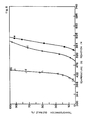
Le taux de transformation globale de n-décane est montré pour le catalyseur à base de zéolite ZSM-5 (SiO2/Al2O3 = 250) non activé et pour le même catalyseur activé par le procédé suivant l'invention par les courbes de la figure 6. La courbe a de la figure 6 est celle relative au catalyseur à base dudit zéolite non activé, tandis que la courbe b concerne un catalyseur à base du même zéolite activé par le procédé suivant l'invention. La figure 6 montre clairement que l'activité catalytique du zéolite ZSM-5 a été considérablement accrue par l'activation.The overall conversion rate of n-decane is shown for the zeolite catalyst ZSM-5 (SiO 2 / Al 2 O 3 = 250) which is not activated and for the same catalyst activated by the process according to the invention by the curves. in FIG. 6. The curve a in FIG. 6 is that relating to the catalyst based on said non-activated zeolite, while the curve b relates to a catalyst based of the same zeolite activated by the process according to the invention. Figure 6 clearly shows that the catalytic activity of zeolite ZSM-5 was considerably increased by activation.
En comparant la courbe b de la figure 6 à la courbe c de la figure 1 (ces courbes étant identiques), on constate qu'un zéolite ZSM-5 ayant un rapport molaire--SiO2/Al2O3 initial de 250 possède, après activation par le procédé suivant la présente invention (exemple 4 b), la même activité catalytique qu'un zéolite ZSM-5 ayant un rapport SiO2/Al2O3 de 40, soit un rapport bien moins élevé.By comparing curve b in FIG. 6 to curve c in FIG. 1 (these curves being identical), it can be seen that a ZSM-5 zeolite having an initial molar ratio - SiO 2 / Al 2 O 3 of 250 has , after activation by the process according to the present invention (Example 4 b), the same catalytic activity as a ZSM-5 zeolite having an SiO 2 / Al 2 O 3 ratio of 40, ie a much lower ratio.
Le zéolite ZSM-5 préparé dans l'exemple 4 (a) a été activé par le procédé décrit dans le brevet U.S.A. n° 4.438.215, en opérant comme suit :
- On a mélangé 1 g dudit zéolite ZSM-5 avec 0,133 g de A1C13.6H20. On a ensuite chauffé le mélange obtenu dans un courant d'azote sec à 500°C, puis on l'a purgé à cette température, refroidi, hydrolysé avec 50 ml d'eau, séché à l'air et calciné à nouveau à 540°C.
- 1 g of said zeolite ZSM-5 was mixed with 0.133 g of A1Cl 3 .6H 2 0. The mixture obtained was then heated in a stream of dry nitrogen at 500 ° C., then it was purged at this temperature, cooled, hydrolyzed with 50 ml of water, air dried and calcined again at 540 ° C.
On a procédé exactement de la même manière qu'avec la silice cristalline dans l'exemple 1 (b).The procedure was exactly the same as with crystalline silica in Example 1 (b).
La courbe c de la figure 6 montre l'activité catalytique pour la transformation du n-décane.Curve c in FIG. 6 shows the catalytic activity for the transformation of n-decane.
En comparant sur cette figure 6 les activités relatives du zéolite ZSM-5 non activé (courbe a de la figure 6), du même zéolite ZSM-5 activé par le procédé selon le brevet U.S.A. n° 4.438.215 (courbe c de la figure 6) et du même zéolite ZSM-5 activé paw le procédé suivant la présente invention (courbe b de la figure 6), on voit que le zéolite ZSM-5 activé conformément à la présente invention (exemple 5 a) a une activité catalytique nettement meilleure.By comparing in this FIG. 6 the relative activities of the non-activated zeolite ZSM-5 (curve a of FIG. 6), of the same zeolite ZSM-5 activated by the method according to US Patent No. 4,438,215 (curve c of the FIG. 6) and of the same zeolite ZSM-5 activated by the process according to the present invention (curve b of FIG. 6), it can be seen that the zeolite ZSM-5 activated in accordance with the present invention (Example 5 a) has a catalytic activity significantly better.
Etant donné que, dans le procédé selon le brevet U.S.A. n° 4.438.215, l'hydrolyse du mélange constitue une étape clef du procédé d'activation des zéolites, on a effectué un essai visant à déterminer si, dans le procédé suivant la présente invention, une phase d'hydrolyse permettrait d'augmenter encore l'activité catalytique des zéolites.Since in the process according to US Patent No. 4,438,215, the hydrolysis of the mixture constitutes a key step in the process for activating zeolites, a test was carried out to determine whether, in the process according to the present invention, a hydrolysis phase would further increase the catalytic activity of zeolites.
A cette fin, le zéolite ZSM-5 activé de la manière décrite dans l'exemple 5 (a) (conformément à la présente invention) a été hydrolysé dans 50 ml d'eau à la température ambiante.To this end, the zeolite ZSM-5 activated as described in Example 5 (a) (in accordance with the present invention) was hydrolyzed in 50 ml of water at room temperature.
L'activité catalytique du zéolite ZSM-5 activé ainsi hydrolysé a été déterminée en utilisant ce dernier zéolite pour la transformation de n-décane de la manière décrite dans l'exemple 1 (b).The catalytic activity of the thus hydrolyzed activated ZSM-5 zeolite was determined using the latter zeolite for the transformation of n-decane as described in Example 1 (b).
La courbe d de la figure 6 montre l'activité -catalytique du zéolite ZSM-5 activé et hydrolysé. Cette courbe d se confond avec la courbe b relative à l'activité catalytique du même zéolite ZSM-5 activé, mais non hydrolysé (exemple 5 b). Ceci montre que la phase d'hydrolyse à l'eau du zéolite activé est inutile, puisqu'elle n'améliore pas l'effet catalytique du zéolite activé.Curve d in FIG. 6 shows the catalytic activity of the activated and hydrolyzed zeolite ZSM-5. This curve d merges with the curve b relating to the catalytic activity of the same zeolite ZSM-5 activated, but not hydrolyzed (example 5 b). This shows that the hydrolysis phase with water of the activated zeolite is useless, since it does not improve the catalytic effect of the activated zeolite.
On a utilisé le zéolite ZSM-5 de référence préparé dans l'exemple 3 (a) pour transformer du méthanol en essence.The reference zeolite ZSM-5 prepared in Example 3 (a) was used to convert methanol to gasoline.
A cette fin, on a fait passer, dans le réacteur tubulaire de l'exemple 1 (b), du méthanol sur 3 g du catalyseur (zéolite ZSM-5 de référence) à 500°C et à un débit VSHW de 20 h-1. La transformation du méthanol était initialement de 100 %. Après 150 heures d'utilisation, le catalyseur était complètement désactivé, la transformation du méthanol étant tombée à 12 % seulement.To this end, we passed through the reactor tube of Example 1 (b), methanol on 3 g of the catalyst (reference zeolite ZSM-5) at 500 ° C and at a VSHW flow rate of 20 h -1 . Methanol transformation was initially 100%. After 150 hours of use, the catalyst was completely deactivated, the transformation of methanol having fallen to only 12%.
Le catalyseur a alors été déchargé du réacteur et calciné à l'air à 600°C.The catalyst was then discharged from the reactor and calcined in air at 600 ° C.
Une première fraction du catalyseur de référence ZSM-5 désactivé a été imprégnée d'un sel de platine et utilisée pour la transformation de n-décane de la manière décrite dans l'exemple 1 (b).A first fraction of the deactivated reference catalyst ZSM-5 was impregnated with a platinum salt and used for the transformation of n-decane as described in Example 1 (b).
. La courbe b de la figure 7 montre l'activité catalytique dudit catalyseur désactivé, en termes de taux de conversion globale du n-décane, en fonction de la température.. Curve b in FIG. 7 shows the catalytic activity of said deactivated catalyst, in terms of overall conversion rate of n-decane, as a function of the temperature.
A la figure 7, la courbe a montre, à titre comparatif, l'activité de base du catalyseur ZSM-5 de référence.In FIG. 7, curve a shows, for comparison, the basic activity of the reference ZSM-5 catalyst.
Une seconde fraction (1 g) du catalyseur de référence ZSM-5 désactivé calciné a été re-activée par le procédé suivant la présente invention, en la mélangeant avec 0,050 g de AlCl3.6H2O et en chauffant le mélange dans un courant d'azote contenant de l'acide chlorhydrique, comme décrit dans l'exemple 2 (a).A second fraction (1 g) of the calcined deactivated reference catalyst ZSM-5 was re-activated by the process according to the present invention, by mixing it with 0.050 g of AlCl 3 .6H 2 O and by heating the mixture in a current. nitrogen containing hydrochloric acid, as described in Example 2 (a).
On a utilisé le catalyseur re-activé obtenu en c dans le présent exemple pour transformer du n-décane de la manière décrite dans l'exemple 1 (b).The re-activated catalyst obtained in c in the present example was used to transform n-decane as described in example 1 (b).
La courbe c de la figure 7 montre l'activité catalytique exprimée par les taux de transformation globale du n-décane en fonction de la température.Curve c in Figure 7 shows the catalytic activity expressed by the overall transformation rates n-decane as a function of temperature.
La comparaison des courbes a, b et c de la figure 7 révèle que l'activité initiale d'un zéolite ZSM-5 désactivé par la réaction de transformation de méthanol en essence ne peut pas être complètement régénérée en éliminant le coke formé sur le catalyseur, de manière classique, par calcination, alors qu'une telle régénération est possible par le procédé suivant la présente invention.The comparison of curves a, b and c in FIG. 7 reveals that the initial activity of a zeolite ZSM-5 deactivated by the reaction for converting methanol into gasoline cannot be completely regenerated by eliminating the coke formed on the catalyst , conventionally, by calcination, while such regeneration is possible by the method according to the present invention.
A une solution de silicate de sodium contenant 10,68 % de Na20, 27,72 % de Si02 et 61,60 % d'eau, on a ajouté 2,1 g de chlorure de tétrabutylphosphonium dissous dans 38 ml d'eau.To a solution of sodium silicate containing 10.68% of Na 2 0, 27.72% of Si0 2 and 61.60% of water, 2.1 g of tetrabutylphosphonium chloride dissolved in 38 ml of was added water.
A la solution obtenue, on a ajouté successivement et en agitant vigoureusement 0,02 g d'aluminate de sodium dissous dans 50 g d'eau et 1 ml d'acide sulfurique concentré.To the solution obtained, 0.02 g of sodium aluminate dissolved in 50 g of water and 1 ml of concentrated sulfuric acid was added successively and with vigorous stirring.
On a obtenu un gel que l'on a chauffé à 160°C pendant 24 heures dans un autoclave.A gel was obtained which was heated at 160 ° C for 24 hours in an autoclave.
La matière solide obtenue, présentant le diffractogramme aux rayons X du zéolite ZSM-11, a été lavée à l' eau, séchée, calcinée à 550°C, refroidie jusqu'à la température ambiante et chauffée au reflux dans un excès centuple (100X) d'une solution 1 molaire d'acétate d'ammonium.The solid obtained, showing the X-ray diffractogram of zeolite ZSM-11, was washed with water, dried, calcined at 550 ° C, cooled to room temperature and heated to reflux in a hundredfold excess (100X ) of a 1 molar solution of ammonium acetate.
Le zéolite ZSM-11 obtenu avait un rapport molaire SiO2/Al2O3 de 500.The ZSM-11 zeolite obtained had an SiO 2 / Al 2 O 3 molar ratio of 500.
On a activé 1 g du zéolite ZSM-11 préparé comme décrit ci-dessus par le procédé suivant l'invention, en suivant le mode opératoire décrit dans l'exemple 2 (a).1 g of zeolite ZSM-11 prepared as described above was activated by the method according to the invention, following the procedure described in Example 2 (a).
On a utilisé le catalyseur de zéolite ZSM-11 non activé préparé en (a) et le catalyseur de zéolite ZSM-11 activé comme décrit en (b) pour la transformation de n-décane, selon le mode opératoire décrit dans l'exemple j (b).The non-activated zeolite catalyst ZSM-11 prepared in (a) was used and the zeolite catalyst ZSM-11 activated as described in (b) for the transformation of n-decane, according to the procedure described in Example j (b).
On a constaté, lors de ces essais, que la température de réaction à laquelle 50 % du n-décane étaient transformés, était de 247°C lors de l'utilisation du catalyseur zéolite ZSM-11 non activé et de 177°C lors de l'utilisation du même catalyseur activé de la manière décrite en (b) dans le présent exemple.It was found during these tests that the reaction temperature at which 50% of the n-decane was converted was 247 ° C when using the zeolite catalyst ZSM-11 not activated and 177 ° C when the use of the same catalyst activated as described in (b) in the present example.
Ces constatations indiquent que le procédé d'activation suivant la présente invention augmente considérablement l'activité catalytique pour la transformation du n-décane, puisque la température à laquelle 50 % du n-décane sont transformés est inférieure de 70°C avec le zéolite ZSM-11 activé à la température nécessaire avec le même zéolite non activé.These findings indicate that the activation process according to the present invention considerably increases the catalytic activity for the transformation of n-decane, since the temperature at which 50% of the n-decane is transformed is lower by 70 ° C. with the zeolite ZSM. -11 activated at the required temperature with the same zeolite not activated.
A 20 g de la solution de silicate de sodium de l'exemple 7 (a), on a ajouté successivement, en agitant vigoureusement, 4,2 g de bromure de tétraméthylammonium, 1 g d'acide sulfurique concentré et 0,04 g de Al(NO3)3.9H2O dans 20 ml d'eau.To 20 g of the sodium silicate solution of Example 7 (a) was added successively, with vigorous stirring, 4.2 g of tetramethylammonium bromide, 1 g of concentrated sulfuric acid and 0.04 g of Al (NO 3 ) 3 .9H 2 O in 20 ml of water.
Le gel obtenu a été chauffé à 150°C en autoclave pendant 2 jours et la matière solide obtenue, qui avait le diffractogramme dn zéolite ZSM-48, a ensuite été traitée de la manière décrite dans l'exemple 7 (a).The gel obtained was heated at 150 ° C in an autoclave for 2 days and the solid obtained, which had the diffractogram of zeolite ZSM-48, was then treated as described in Example 7 (a).
On a activé 1 g du zéolite ZSM-48 préparé en (a) par le procédé suivant l'invention, dans les conditions et suivant le mode opératoire décrits dans l'exemple 2 (a).1 g of zeolite ZSM-48 prepared in (a) was activated by the method according to the invention, under the conditions and according to the procedure described in Example 2 (a).
On a procédé à des essais comparatifs de transformation de n-décane sur du zéolite ZSM-48 non activé et sur le même zéolite activé comme décrit en (b) dans le présent exemple.Comparative tests of n-decane transformation were carried out on non-activated ZSM-48 zeolite and on the same activated zeolite as described in (b) in the present example.
Ces essais ont montré que les températures auxquelles 50 % de n-décane sont transformés sont respectivement de 267°C avec le ZSM-48 non activé et de 217°C avec le ZSM-48 activé. Ceci démontre que le procédé suivant l'invention permet aussi d'activer les catalyseurs du type ZSM-48 à forte teneur en silice.These tests have shown that the temperatures at which 50% of n-decane are transformed are respectively 267 ° C. with the ZSM-48 not activated and 217 ° C. with the ZSM-48 activated. This demonstrates that the process according to the invention also makes it possible to activate catalysts of the ZSM-48 type with a high silica content.
On a traité 2 g du zéolite de référence ZSM-5 préparé dans l'exemple 3 (a) par de la vapeur d'eau sous 1 atmosphère à une température de 750°C.2 g of the reference zeolite ZSM-5 prepared in Example 3 (a) were treated with steam under 1 atmosphere at a temperature of 750 ° C.
Le zéolite traité à la vapeur a été ensuite .prpparé pour servir de catalyseur et il a été testé dans un essai de transformation de n-décane dans les conditions décrites dans l'exemple 1 (b).The steam treated zeolite was then. p r pp aré to serve as catalyst and it was tested in a test of transformation of n-decane under the conditions described in example 1 (b).
La température à laquelle 50 % du n-décane avaient été transformés était de 210°C.The temperature at which 50% of the n-decane had been transformed was 210 ° C.
Une autre fraction du même zéolite traité à la vapeur d'eau a été activée par le procédé suivant la présente invention, en opérant de la manière décrite dans l'exemple 2 (a) pour la silice cristalline.Another fraction of the same zeolite treated with steam was activated by the process according to the present invention, operating as described in example 2 (a) for crystalline silica.
Le zéolite activé obtenu a été soumis à un essai d'utilisation comme catalyseur pour la transformation de. n-décane dans les conditions décrites plus haut (exemple 1 b).The activated zeolite obtained was tested for use as a catalyst for the transformation of. n-decane under the conditions described above (example 1b).
La température à laquelle 50 % du n-décane ont été transformés sur le catalyseur à base de zéolite de référence ZSM-5 traité à la vapeur et activé conformément à la présente invention était de 175°C.The temperature at which 50% of the n-decane was transformed on the reference zeolite catalyst ZSM-5 steam treated and activated in accordance with the present invention was 175 ° C.
On voit ainsi que le procédé suivant l'invention permet aussi d'activer notablement des zéolites préalablement désactivés par traitement à la vapeur d'eau.It can thus be seen that the process according to the invention also makes it possible to notably activate zeolites previously deactivated by treatment with steam.
Claims (8)
Applications Claiming Priority (2)
| Application Number | Priority Date | Filing Date | Title |
|---|---|---|---|
| LU85614A LU85614A1 (en) | 1984-10-29 | 1984-10-29 | PROCESS FOR ACTIVATION OF SILICEOUS CATALYSTS |
| LU85614 | 1984-10-29 |
Publications (1)
| Publication Number | Publication Date |
|---|---|
| EP0181663A1 true EP0181663A1 (en) | 1986-05-21 |
Family
ID=19730347
Family Applications (1)
| Application Number | Title | Priority Date | Filing Date |
|---|---|---|---|
| EP85201720A Withdrawn EP0181663A1 (en) | 1984-10-29 | 1985-10-22 | Process for activating siliceous catalysts |
Country Status (4)
| Country | Link |
|---|---|
| US (1) | US4656149A (en) |
| EP (1) | EP0181663A1 (en) |
| JP (1) | JPS61171540A (en) |
| LU (1) | LU85614A1 (en) |
Cited By (1)
| Publication number | Priority date | Publication date | Assignee | Title |
|---|---|---|---|---|
| CN104205899A (en) * | 2012-03-20 | 2014-12-10 | 高通股份有限公司 | Network security configuration using short-range wireless communication |
Families Citing this family (2)
| Publication number | Priority date | Publication date | Assignee | Title |
|---|---|---|---|---|
| US5041401A (en) * | 1990-03-28 | 1991-08-20 | Mobil Oil Corporation | Thermally stable noble metal-containing zeolite catalyst |
| US10300476B2 (en) * | 2017-05-17 | 2019-05-28 | Chevron Phillips Chemical Company Lp | Methods of regenerating aromatization catalysts with a decoking step between chlorine and fluorine addition |
Citations (4)
| Publication number | Priority date | Publication date | Assignee | Title |
|---|---|---|---|---|
| US3644220A (en) * | 1969-11-13 | 1972-02-22 | Exxon Research Engineering Co | Metal halide containing zeolites and method for their preparation |
| US4361713A (en) * | 1981-06-26 | 1982-11-30 | Mobil Oil Corporation | Para-selective zeolite catalysts treated with halogen compounds |
| US4438215A (en) * | 1981-11-09 | 1984-03-20 | Mobil Oil Corporation | Activity enhancement of high silica zeolites |
| EP0114726A2 (en) * | 1983-01-17 | 1984-08-01 | Mobil Oil Corporation | Reactivation of steam-deactivated catalysts |
Family Cites Families (4)
| Publication number | Priority date | Publication date | Assignee | Title |
|---|---|---|---|---|
| US3375064A (en) * | 1964-11-23 | 1968-03-26 | Mobil Oil Corp | Production of the hydrogen ion exchanged form of a crystalline zeolite |
| US3630965A (en) * | 1969-03-11 | 1971-12-28 | Exxon Research Engineering Co | Hydrocarbon conversion catalyst |
| US4427786A (en) * | 1982-03-08 | 1984-01-24 | Mobil Oil Corporation | Activation of high silica zeolites |
| US4444900A (en) * | 1982-05-05 | 1984-04-24 | Mobil Oil Corporation | Activation of zeolites |
-
1984
- 1984-10-29 LU LU85614A patent/LU85614A1/en unknown
-
1985
- 1985-10-22 EP EP85201720A patent/EP0181663A1/en not_active Withdrawn
- 1985-10-29 US US06/792,403 patent/US4656149A/en not_active Expired - Fee Related
- 1985-10-29 JP JP60243800A patent/JPS61171540A/en active Pending
Patent Citations (4)
| Publication number | Priority date | Publication date | Assignee | Title |
|---|---|---|---|---|
| US3644220A (en) * | 1969-11-13 | 1972-02-22 | Exxon Research Engineering Co | Metal halide containing zeolites and method for their preparation |
| US4361713A (en) * | 1981-06-26 | 1982-11-30 | Mobil Oil Corporation | Para-selective zeolite catalysts treated with halogen compounds |
| US4438215A (en) * | 1981-11-09 | 1984-03-20 | Mobil Oil Corporation | Activity enhancement of high silica zeolites |
| EP0114726A2 (en) * | 1983-01-17 | 1984-08-01 | Mobil Oil Corporation | Reactivation of steam-deactivated catalysts |
Cited By (1)
| Publication number | Priority date | Publication date | Assignee | Title |
|---|---|---|---|---|
| CN104205899A (en) * | 2012-03-20 | 2014-12-10 | 高通股份有限公司 | Network security configuration using short-range wireless communication |
Also Published As
| Publication number | Publication date |
|---|---|
| US4656149A (en) | 1987-04-07 |
| JPS61171540A (en) | 1986-08-02 |
| LU85614A1 (en) | 1986-06-11 |
Similar Documents
| Publication | Publication Date | Title |
|---|---|---|
| EP0175399B1 (en) | Process for obtaining ethylene from ethanol | |
| EP0074900B1 (en) | Process for the preparation of synthetic zeolites and zeolites obtained by this process | |
| FR2894850A1 (en) | PROCESS FOR THE PREPARATION OF A CATALYST CONTAINING MODIFIED ZEOLITHE AND USE THEREOF IN OLIGOMERIZATION OF LIGHT OLEFINS | |
| LU82916A1 (en) | SYNTHETIC COMPOSITIONS OF CRYSTALLINE BOROSILICATE AND PROCESSES FOR THE PREPARATION AND ACTIVATION THEREOF | |
| EP0461171B1 (en) | Mordenite-based catalyzer containing at least one metal from the iia, ivb or iva groups and its use in the isomerization of an aromatic c8 fraction | |
| FR2565847A1 (en) | SYNTHESIS AND USE OF PREFORMED ZEOLITES | |
| EP0363253B1 (en) | Mordenite-based catalyst with at least one group viii metal and its use in the isomerisation of an aromatic c8 fraction | |
| EP0196965B1 (en) | Catalyst for the isomerisation of fractions rich in normal paraffins | |
| EP0601924B1 (en) | Process for the synthesis of a crystalline aluminosilicate enriched in silica having the mazzite structure, the aluminosilicate thus obtained and its use as catalyst in the conversion of hydrocarbons | |
| Song et al. | Si-OH defect healing treatments of ZSM-22 zeolites for enhanced performance and alcohol resistance in n-alkanes hydroisomerization | |
| LU85614A1 (en) | PROCESS FOR ACTIVATION OF SILICEOUS CATALYSTS | |
| EP0118382A1 (en) | Crystalline aluminosilicate or zeolite having the structure of offretite | |
| JP2019034879A (en) | MFI type zeolite | |
| EP0480026B1 (en) | Zeolite catalyst with hexagonal structure and its application | |
| FR2660578A1 (en) | CATALYST BASED ON HIGH-RATIO FAUJASITE IF: AL SYNTHESIS AND ITS APPLICATION TO ACID CATALYSIS REACTIONS CARRIED OUT ON HYDROCARBONIC LOADS. | |
| JP7839874B2 (en) | Hydrogenation-acid catalyst dual-function catalyst, method for preparing the same, and its use. | |
| FR2504510A1 (en) | SYNTHETIC SILICATE AND BOROSILICATE METALLIC CRYSTALLINE COMPOSITIONS, PREPARATION METHOD AND APPLICATIONS THEREOF | |
| EP0434491B1 (en) | Use of gallium-containing aluminosilicate catalyst in aromatizing light fractions containing 5 to 7 carbon atoms | |
| EP0789008B1 (en) | Process for the dismutation and/or transalkylation of alkylaromatic hydrocarbons using a catalyst based on a mazzite zeolite comprising at least one metal of the groups IIa, IVB, IIB or IVA | |
| EP0500413B1 (en) | Use of a gallo-aluminosilicate type catalyst in the aromatisation of hydrocarbons having 2 to 7 carbon atoms | |
| FR2698863A1 (en) | Process for the synthesis of zeolites of the ZSM-48 type, products obtained and their application in adsorption and catalysis. | |
| EP0842116B1 (en) | Activated silica enriched mazzite, production method and application thereof | |
| EP0825151B1 (en) | Modified zeolite with the NES structure, and the use thereof for the dismutation and/or transalkylation of alkylaromatic hydrocarbons | |
| EP0573347A1 (en) | Use of a modified mordenite zeolite catalyst for isomerizing an aromatic C8-fraction | |
| FR2463746A1 (en) | CHROMIUM SILICATE CATALYST, PROCESS FOR PRODUCING THE SAME AND APPLICATION THEREOF TO HYDROCARBON TREATMENT |
Legal Events
| Date | Code | Title | Description |
|---|---|---|---|
| PUAI | Public reference made under article 153(3) epc to a published international application that has entered the european phase |
Free format text: ORIGINAL CODE: 0009012 |
|
| AK | Designated contracting states |
Kind code of ref document: A1 Designated state(s): AT BE CH DE FR GB IT LI NL SE |
|
| 17P | Request for examination filed |
Effective date: 19861117 |
|
| 17Q | First examination report despatched |
Effective date: 19871209 |
|
| STAA | Information on the status of an ep patent application or granted ep patent |
Free format text: STATUS: THE APPLICATION HAS BEEN WITHDRAWN |
|
| 18W | Application withdrawn |
Withdrawal date: 19880615 |
|
| RIN1 | Information on inventor provided before grant (corrected) |
Inventor name: UYTTERHOEVEN, JAN B. Inventor name: TIELEN, MIA Inventor name: JACOBS, PIERRE A. |