EP0177288A2 - Brustprothese mit Markierung und Verfahren zum Anzeigen und Vorhersagen eines Prothesenbruches - Google Patents
Brustprothese mit Markierung und Verfahren zum Anzeigen und Vorhersagen eines Prothesenbruches Download PDFInfo
- Publication number
- EP0177288A2 EP0177288A2 EP85306881A EP85306881A EP0177288A2 EP 0177288 A2 EP0177288 A2 EP 0177288A2 EP 85306881 A EP85306881 A EP 85306881A EP 85306881 A EP85306881 A EP 85306881A EP 0177288 A2 EP0177288 A2 EP 0177288A2
- Authority
- EP
- European Patent Office
- Prior art keywords
- prosthesis
- envelope
- silicone elastomer
- radioopaque
- strips
- Prior art date
- Legal status (The legal status is an assumption and is not a legal conclusion. Google has not performed a legal analysis and makes no representation as to the accuracy of the status listed.)
- Withdrawn
Links
Images


Classifications
-
- A—HUMAN NECESSITIES
- A61—MEDICAL OR VETERINARY SCIENCE; HYGIENE
- A61B—DIAGNOSIS; SURGERY; IDENTIFICATION
- A61B5/00—Measuring for diagnostic purposes; Identification of persons
-
- A—HUMAN NECESSITIES
- A61—MEDICAL OR VETERINARY SCIENCE; HYGIENE
- A61F—FILTERS IMPLANTABLE INTO BLOOD VESSELS; PROSTHESES; DEVICES PROVIDING PATENCY TO, OR PREVENTING COLLAPSING OF, TUBULAR STRUCTURES OF THE BODY, e.g. STENTS; ORTHOPAEDIC, NURSING OR CONTRACEPTIVE DEVICES; FOMENTATION; TREATMENT OR PROTECTION OF EYES OR EARS; BANDAGES, DRESSINGS OR ABSORBENT PADS; FIRST-AID KITS
- A61F2/00—Filters implantable into blood vessels; Prostheses, i.e. artificial substitutes or replacements for parts of the body; Appliances for connecting them with the body; Devices providing patency to, or preventing collapsing of, tubular structures of the body, e.g. stents
- A61F2/02—Prostheses implantable into the body
- A61F2/12—Mammary prostheses
-
- A—HUMAN NECESSITIES
- A61—MEDICAL OR VETERINARY SCIENCE; HYGIENE
- A61F—FILTERS IMPLANTABLE INTO BLOOD VESSELS; PROSTHESES; DEVICES PROVIDING PATENCY TO, OR PREVENTING COLLAPSING OF, TUBULAR STRUCTURES OF THE BODY, e.g. STENTS; ORTHOPAEDIC, NURSING OR CONTRACEPTIVE DEVICES; FOMENTATION; TREATMENT OR PROTECTION OF EYES OR EARS; BANDAGES, DRESSINGS OR ABSORBENT PADS; FIRST-AID KITS
- A61F2250/00—Special features of prostheses classified in groups A61F2/00 - A61F2/26 or A61F2/82 or A61F9/00 or A61F11/00 or subgroups thereof
- A61F2250/0058—Additional features; Implant or prostheses properties not otherwise provided for
- A61F2250/0096—Markers and sensors for detecting a position or changes of a position of an implant, e.g. RF sensors, ultrasound markers
- A61F2250/0098—Markers and sensors for detecting a position or changes of a position of an implant, e.g. RF sensors, ultrasound markers radio-opaque, e.g. radio-opaque markers
Definitions
- Surgical procedures to alter the appearance of the human female breast comprise a substantial portion of the surgery performed by plastic surgeons. It has been estimated that 16 percent of the income derived by plastic surqeons in the United States results from such surgery.
- the surgical procedures frequently involve implantation of silicone based prostheses. Silicone implant mam- moplasty is indicated in a variety of conditions, including cosmetic augmentation in micromastia, reconstructive augmentation in mammary asymmetry, and total reconstruction after mastectomy.
- the most commonly used breast implants are constructed of silicone gel contained within a silicone elastomer envelope.
- Human Adjuvant Disease may be a systemic effect of paraffin or silicone fluid instillation and is apparently an autoimmune connective tissue disorder that manifests as mixed connective tissue disease, rheumatoid arthritis, systemic scleroderma, or systemic lupus erythematosus.
- Onset of Adjuvant Disease has been reported as early as 2 years and as many as 25 years following instillation of breast augmentation agents such as paraffin or silicone fluid. In some cases, remission of the disease has followed removal of the augmentation agents; and in two cases, the disease has proved fatal.
- silicone gel contained in these prostheses is composed of 96 to 98 percent extractable polydimethylsiloxanes (silicone fluid).
- silicone gel prostheses There are a number of causes of rupture of silicone elastomer enveloped, silicone gel prostheses.
- the prostheses can be punctured or torn accidently during implantation procedures. If, after implantation, fluid which must be removed accumulates in the prosthetic pocket, a needle inserted to aspirate the fluid may pierce the silicone elastomer envelope. In 10 to 30 percent of patients receiving a prosthetic implant, a tight periprosthetic capsule forms which must be released. A closed capsulotomy, during which the breast is compressed forcefully by the surgeon's hands, is a procedure used to break the capsule and soften the feel of the breast. In approximately 30 percent of patients, a closed capsulotomy causes rupture of the prosthetic silicone elastomer envelope.
- rupture of the silicone elastomer envelope can result from biodegradation of the envelope by tissue enzymes. Because of the relatively poor tear resistance of the silicone elastomer envelope, once a rupture or tear has occurred, it will propagate upon only minimal manipulation of the breast, freeing the silicone gel to escape into the prosthetic cavity and beyond.
- Fold-fault failure also has been shown to be a cause of rupture of silicone elastomer envelopes, especially in prostheses containing saline.
- the prosthetic envelope After implantation into the prosthetic cavity, the prosthetic envelope can become folded persistently along a particular line. By abrasion against itself along the fold line, the envelope progressively will wear away causing it to rupture along the fold line.
- Fold-fault failure of saline containing prostheses creates an emergency because the saline which leaks from the ruptured envelope is absorbed into the surrounding tissues. Absorption of the saline causes the prosthetic cavity to shrink.
- the ruptured prosthesis must be removed immediately after rupture and replaced.
- roentgenography enables determination of whether the silicone gel remains in the prosthetic cavity but provides no indication of whether the silicone gel is contained within the envelope or has escaped into the cavity thus freeing the gel to migrate into surrounding or distant soft tissues and provides no way of predicting an impending fold-fault failure.
- Implantation of a prosthesis composed of a silicone elastomer envelope marked with a material which absorbs electromagnetic energy to an extent different from silicone gel and different from the surrounding tissue enables production of an image, by irradiating the tissue bearing a marked implant with electromagnetic energy, which shows the location of the silicone gel relative to the silicone elastomer envelope.
- An image showing no silicone gel between the surrounding tissue and the silicone elastomer envelope establishes that the silicone gel remains within the envelope.
- the image produced shows silicone gel interposed between the surrounding tissue and the silicone elastomer envelope, it is clear that the envelope has ruptured.
- the material that absorbs electromagnetic energy to an extent different from silicone gel and different human soft tissue used to mark the silicone elastomer envelope can be incorporated within the envelope during manufacture or can be applied to the envelope following manufacture of the prosthesis. Marking the silicone elastomer envelope with one of several readily available radioopaque materials and producing an image by X-irradiation of the breast, as is done in mammography, has proved a successful application of this invention. However, the present invention equally is applicable to evaluating the prosthetic envelope status by examining images produced by irradiating breasts bearing appropriately marked prostheses with energy from other segments of the electromagnetic spectrum.
- the present innovation also is applicable to determining the status of other types of silicone elastomer enveloped, silicone gel prostheses and other types of silicone elastomer prostheses.
- Such other types of prostheses include various facial implants, penile implants, testicular implants, and carpal, metacarpal, and interphalangeal joint replacements and similar joint replacements used in the feet.
- marking the silicone elastomer envelope of saline containing prostheses provides a method for predicting fold-fault failure.
- two or more serial electromagnetic energy produced images such as mammograms, are compared. If the same fold line persists, the probability that rupture along that fold line will occur is enhanced.
- a mammogram obtained while the breast was compressed along its lateral and medial aspects can be compared to one obtained absent breast compression. If the same fold line appears in the compressed and non- compressed mammograms, the probability that the identified fold line is persistent and will be a point of rupture is increased. Once a persistent fold line is detected, the surgeon can employ external manipulation or other techniques to alleviate the persistent fold, thus preventing rupture of the prosthetic envelope.
- Applicant is unaware of any prior art teaching marking the silicone elastomer envelope of silicone gel containing prostheses with materials that absorb electromagnetic energy to an extent different from silicone gel and different from breast tissue, any prior art which teaches using electromagnetic energy to produce images of breasts bearing implants so marked to ascertain whether the silicone elastomer envelopes of the prostheses have ruptured or any prior art which teaches using electromagnetic energy to produce images of breasts so marked to enable prediction of fold-fault failure of prosthetic silicone elastomer envelopes.
- Prior art does teach the use of radioopaque markers to enable roentgenographic determination of the location of various types of medical devices.
- catheters placed in the subclavian veins for administration of intravenous hyperalimentation bear X-ray detectable markers so that proper positioning of the catheter can be confirmed prior to initiation of administration of the hyperalimentation fluid.
- Similar position-indicating markers also are used on chest tubes, cardiac catheters, surgical sponges, and other intravascular devices. These markers enable roentgenographic determination of the course and location of the device; but no information about the volume or configuration of the device and no information about whether the device remains volumetrically intact can be gained using position-indicating markers.
- the prior art also teaches using radioopaque agents such as barium sulfate to determine the configuration and patency of the lumen of the gastrointestinal tract.
- radioopaque agents such as barium sulfate to determine the configuration and patency of the lumen of the gastrointestinal tract.
- the present invention is directed to breast prostheses composed of silicone gel contained within a silicone elastomer envelope labeled with a radioopaque marker which enables roentgenographic determination of whether the envelope has ruptured, to a method for using roentgenographic imaging to determine whether silicone elastomer envelopes of silicone gel containing prostheses have ruptured and to a method for using roentgenographic imaging to predict impending fold-fault failure of prosthetic silicone elastomer envelopes.
- a breast prosthesis composed of silicone gel or silicone gel and saline contained in a silicone elastomer envelope which has been labeled with a radioopaque marker to enable roentgenographic determination of whether the envelope has ruptured.
- a further object of the present invention is to provide a method for using roentgenographic imaging to determine whether the silicone elastomer envelope of a silicone gel containing prosthesis has ruptured.
- a still further object of the present invention is to provide a method for using roentgenographic imaging to predict fold-fault failure of prosthetic silicone elastomer envelopes.
- the present applicant recognizes that it is commercially preferable to incorporate the radioopaque material into the silicone elastomer envelope of a prosthesis during its manufacture, in this and the subsequent examples the radioopaque material was applied to the envelopes of previously manufactured prostheses.
- a mammary prosthesis constructed of silicone gel contained within a soft, seamless silicone elastomer envelope was labeled with two narrow, elastic strips of radioopaque material.
- the prosthesis selected is marketed by Wright Dow Corning, Inc., under its registered “Silastic” trademark.
- the strips of radioopaque material were taken from roentgenographically-detectable surgical sponges sold by Johnson & Johnson Products, Inc., under its registered “Ray-Tec” trademark.
- the radioopaque strips were attached to the prosthesis by positioning the strips on the prosthetic envelope, completely covering the strips with a small amount of silicone rubber, and recuring the prosthesis by heating to affix the radioopaque label to the envelope permanently.
- Figure 3 shows a mammogram of a breast bearing a labeled prosthesis in which the prosthetic envelope (a) has ruptured and a small portion of the silicone gel (c) has escaped the envelope.
- Rupture of the silicone elastomer envelope is established by the presence of material corresponding to the X-ray density of silicone gel (c) interposed between the breast tissue (b) and the labeled silicone elastomer envelope (a).
- Figure 4 shows a mammogram of a breast bearing a labeled prosthesis in which the prosthetic envelope (a) has ruptured, and most of the silicone gel (c) has moved out of the envelope.
- so large a quantity of free silicone gel (c) has become interposed between the breast tissue (b) and the silicone elastomer envelope (a) that the labeled envelope (a) has been pushed back against the chest wall (d).
- radioopaque label strips as described in this example also makes possible predicting whether fold-fault failure of the silicone elastomer envelope of implanted prostheses is impending.
- the mammogram shown in Figure 2 shows two locations of folding (c) and (d) of the prosthetic envelope. Folding in these same locations of the prosthetic envelope appearing on subsequent mammograms indicates that the folds are persistant and suggests that rupture of the envelope along the fold may occur.
- Another technique for determining whether a fold is persistent is to compare a mammogram of the breast taken without compressing the breast to the mammogram shown in Figure 2 which was taken with breast compression along the lateral and medial aspects of the breast.
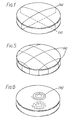
- the radioopaque strips were attached in another presently preferred configuration which differs from that described previously. As shown in Figure 8, two strips of radioopaque material have been attached to the silicone elastomer envelope so that one strip encircles the prosthesis in its vertical plane, and the other strip encircles the prosthesis in its horizontal plane.
- the radioopaque strips were attached in another presently preferred configuration which differs from that described in the previous example.
- one strip of radioopaque material (a) was affixed to the top external surface of the silicone elastomer envelope in a coiled configuration; and a second such strip was affixed to the bottom external surface of the silicone elastomer envelope in a coiled configuration.
- Mammography of breasts bearing prostheses labeled as described in this example also was used to evaluate the status of the prosthesis. As long as the silicone elastomer envelope of a prosthesis remained intact, no silicone gel was found between the breast tissue and the labeled prosthetic envelope. However, once the envelope had ruptured, the labeled silicone elastomer envelope was forced away from the surrounding breast tissue; and silicone gel which had migrated from the confines of the envelope was found interposed between the breast tissue and the envelope.
- the radioopaque strips were attached in a presently preferred configuration which differs from those described in the previous examples.
- several strips of radioopaque material (a) were affixed to the external surface of the silicone elastomer envelope in a mesh-like configuration encasing the entire envelope.
- the size of the openings in the mesh shown in Figure 5 is merely one possibility; mesh openings much smaller than or larger than those shown in Figure 5 would perform equally well.
- the radioopaque strips were attached in another presently preferred configuration which differs from those previously described.
- patches of strips of radioopaque material in a mesh-like configuration (a) were applied to the external surface of the silicone elastomer envelope.
- mammography of breasts bearing prostheses as described in this example was used to determine whether the silicone elastomer envelope of an implanted prosthesis remained intact.
- the same type of breast prosthesis as was used in Example 1 was employed.
- the entire surface of the silicone elastomer envelope of the prosthesis was labeled with a radioopaque material.
- Barium sulfate was selected as the radioopaque material.
- a quantity of barium sulfate sufficient to produce the desired radio- opacity was mixed with silicone rubber which was then applied in a thin layer to the silicone elastomer envelope of a prosthesis.
- the prosthesis was then recured by heating to affix the silicone rubber bearing the radioopaque label to the envelope permanently.
- Breasts bearing prostheses labeled as described in this example were evaluated by mammography to ascertain whether the prosthetic envelope remained intact. As previously described, a mammogram showing silicone gel interposed between the breast tissue and the labeled silicone elastomer envelope established that the enveloped had ruptured.
- the present invention is well suited and adapted to attain the objects and ends and has the advantages mentioned as well as others inherent therein.
Landscapes
- Health & Medical Sciences (AREA)
- Life Sciences & Earth Sciences (AREA)
- General Health & Medical Sciences (AREA)
- Animal Behavior & Ethology (AREA)
- Engineering & Computer Science (AREA)
- Biomedical Technology (AREA)
- Heart & Thoracic Surgery (AREA)
- Veterinary Medicine (AREA)
- Public Health (AREA)
- Vascular Medicine (AREA)
- Cardiology (AREA)
- Oral & Maxillofacial Surgery (AREA)
- Transplantation (AREA)
- Physics & Mathematics (AREA)
- Biophysics (AREA)
- Pathology (AREA)
- Medical Informatics (AREA)
- Molecular Biology (AREA)
- Surgery (AREA)
- Prostheses (AREA)
- Materials For Medical Uses (AREA)
Applications Claiming Priority (2)
| Application Number | Priority Date | Filing Date | Title |
|---|---|---|---|
| US65730184A | 1984-10-03 | 1984-10-03 | |
| US657301 | 1984-10-03 |
Publications (2)
| Publication Number | Publication Date |
|---|---|
| EP0177288A2 true EP0177288A2 (de) | 1986-04-09 |
| EP0177288A3 EP0177288A3 (de) | 1986-08-13 |
Family
ID=24636610
Family Applications (1)
| Application Number | Title | Priority Date | Filing Date |
|---|---|---|---|
| EP85306881A Withdrawn EP0177288A3 (de) | 1984-10-03 | 1985-09-27 | Brustprothese mit Markierung und Verfahren zum Anzeigen und Vorhersagen eines Prothesenbruches |
Country Status (9)
| Country | Link |
|---|---|
| EP (1) | EP0177288A3 (de) |
| JP (1) | JPS61100257A (de) |
| KR (1) | KR860002999A (de) |
| AU (1) | AU4798785A (de) |
| DK (1) | DK447885A (de) |
| ES (1) | ES8801982A1 (de) |
| FI (1) | FI853840A7 (de) |
| NO (1) | NO853894L (de) |
| PT (1) | PT81245B (de) |
Cited By (9)
| Publication number | Priority date | Publication date | Assignee | Title |
|---|---|---|---|---|
| GB2203342A (en) * | 1987-04-07 | 1988-10-19 | Julian Garth Ellis | Radio-opaque tracer for surgical implants |
| WO1995021581A1 (en) * | 1994-02-08 | 1995-08-17 | Douglas Diethard Wing Wendler | The x-ray visible internal tissue replacement device |
| EP0656768A4 (de) * | 1992-08-20 | 1996-03-06 | Lipomatrix Inc | Penisimplantat mit triglyceridfüllung. |
| US5653758A (en) * | 1992-11-18 | 1997-08-05 | Lipomatrix, Incorporated | Method of using a radiolucent organ displacement device for radiation therapy |
| US6060639A (en) * | 1994-03-04 | 2000-05-09 | Mentor Corporation | Testicular prosthesis and method of manufacturing and filling |
| US6290723B1 (en) | 1994-06-14 | 2001-09-18 | Winston A. Andrews | Method of making a synthetic triglyceride filler material |
| EP2177237A1 (de) * | 2008-10-20 | 2010-04-21 | Hoc Age CTA | Kernfüllungen für Prothesen |
| EP2076213A4 (de) * | 2006-10-10 | 2011-10-12 | Aortech Internat Plc | Weichteil-implantat |
| US11751806B2 (en) | 2019-08-12 | 2023-09-12 | Tyler Richard Train | Biophotonic medical imaging device for detection of abnormalities in human tissue and methods for using same |
Families Citing this family (3)
| Publication number | Priority date | Publication date | Assignee | Title |
|---|---|---|---|---|
| EP1985320B1 (de) * | 1998-12-01 | 2017-06-21 | Cook Biotech, Inc. | Medizinische Vorrichtung aus mehrfach geformten Kollagenbiomaterial |
| US9949821B2 (en) * | 2015-12-22 | 2018-04-24 | Biosense Webster (Israel) Ltd. | Colored silicone for implant safety |
| KR102375907B1 (ko) * | 2021-11-15 | 2022-03-16 | 순천향대학교 산학협력단 | 소형 유방 보형물 삽입기 |
Family Cites Families (7)
| Publication number | Priority date | Publication date | Assignee | Title |
|---|---|---|---|---|
| US3521640A (en) * | 1967-12-07 | 1970-07-28 | Jane T Carey | Surgical apparatus for use with a diseased lung or the like and related method |
| US3836776A (en) * | 1973-03-01 | 1974-09-17 | E Gullekson | Three dimensional x-ray opaque foreign body marker device |
| US4205401A (en) * | 1978-05-25 | 1980-06-03 | Dow Corning Corporation | Mammary prosthesis which resists capsular contracture |
| AU525696B2 (en) * | 1978-05-26 | 1982-11-25 | O'Keefe, Paul John | Mammary prosthesis and scar tissue prevention |
| DE7832684U1 (de) * | 1978-11-03 | 1980-04-10 | B. Braun Melsungen Ag, 3508 Melsungen | Katheter mit wendelfoermig angeordneten kontraststreifen zum einmaligen gebrauch |
| US4264990A (en) * | 1979-01-24 | 1981-05-05 | Hamas Robert S | Mammary prosthesis |
| AT364444B (de) * | 1979-04-09 | 1981-10-27 | Anderl Hans Dr | Prothese |
-
1985
- 1985-09-27 EP EP85306881A patent/EP0177288A3/de not_active Withdrawn
- 1985-09-27 AU AU47987/85A patent/AU4798785A/en not_active Abandoned
- 1985-10-02 DK DK447885A patent/DK447885A/da not_active Application Discontinuation
- 1985-10-02 KR KR1019850007256A patent/KR860002999A/ko not_active Withdrawn
- 1985-10-02 NO NO853894A patent/NO853894L/no unknown
- 1985-10-02 PT PT81245A patent/PT81245B/pt unknown
- 1985-10-03 FI FI853840A patent/FI853840A7/fi not_active Application Discontinuation
- 1985-10-03 ES ES547580A patent/ES8801982A1/es not_active Expired
- 1985-10-03 JP JP60221712A patent/JPS61100257A/ja active Pending
Cited By (10)
| Publication number | Priority date | Publication date | Assignee | Title |
|---|---|---|---|---|
| GB2203342A (en) * | 1987-04-07 | 1988-10-19 | Julian Garth Ellis | Radio-opaque tracer for surgical implants |
| GB2203342B (en) * | 1987-04-07 | 1991-12-11 | Julian Garth Ellis | Radio-opaque tracer for surgical implants |
| EP0656768A4 (de) * | 1992-08-20 | 1996-03-06 | Lipomatrix Inc | Penisimplantat mit triglyceridfüllung. |
| US5653758A (en) * | 1992-11-18 | 1997-08-05 | Lipomatrix, Incorporated | Method of using a radiolucent organ displacement device for radiation therapy |
| WO1995021581A1 (en) * | 1994-02-08 | 1995-08-17 | Douglas Diethard Wing Wendler | The x-ray visible internal tissue replacement device |
| US6060639A (en) * | 1994-03-04 | 2000-05-09 | Mentor Corporation | Testicular prosthesis and method of manufacturing and filling |
| US6290723B1 (en) | 1994-06-14 | 2001-09-18 | Winston A. Andrews | Method of making a synthetic triglyceride filler material |
| EP2076213A4 (de) * | 2006-10-10 | 2011-10-12 | Aortech Internat Plc | Weichteil-implantat |
| EP2177237A1 (de) * | 2008-10-20 | 2010-04-21 | Hoc Age CTA | Kernfüllungen für Prothesen |
| US11751806B2 (en) | 2019-08-12 | 2023-09-12 | Tyler Richard Train | Biophotonic medical imaging device for detection of abnormalities in human tissue and methods for using same |
Also Published As
| Publication number | Publication date |
|---|---|
| EP0177288A3 (de) | 1986-08-13 |
| DK447885A (da) | 1986-04-04 |
| ES8801982A1 (es) | 1987-02-16 |
| DK447885D0 (da) | 1985-10-02 |
| KR860002999A (ko) | 1986-05-19 |
| ES547580A0 (es) | 1987-02-16 |
| JPS61100257A (ja) | 1986-05-19 |
| FI853840L (fi) | 1986-04-04 |
| PT81245A (en) | 1985-11-01 |
| FI853840A7 (fi) | 1986-04-04 |
| PT81245B (en) | 1986-12-22 |
| AU4798785A (en) | 1986-04-10 |
| FI853840A0 (fi) | 1985-10-03 |
| NO853894L (no) | 1986-04-04 |
Similar Documents
| Publication | Publication Date | Title |
|---|---|---|
| US4795463A (en) | Labeled breast prosthesis and methods for detecting and predicting rupture of the prosthesis | |
| Hartofilakidis et al. | Total hip arthroplasty for congenital hip disease | |
| Charnley | Low friction arthroplasty of the hip: theory and practice | |
| WO1993022987A2 (en) | Gel composition for implant and method | |
| EP0320133A1 (de) | Brustprothese mit mehreren Kammern | |
| Dunn et al. | Breast implant materials: sense and safety | |
| US20210244856A1 (en) | Composite implant material | |
| JPS61100257A (ja) | 標識化した胸部充填具と充填具の破裂検知並びに破裂予測方法 | |
| Uski et al. | MRI of penile prostheses: the challenge of diagnosing postsurgical complications | |
| Grove Jr | Orbital trauma and computed tomography | |
| Eto et al. | Elbow arthrography with the application of tomography | |
| Bretland | Pulled elbow in childhood | |
| Peters et al. | Biomaterials in plastic surgery: breast implants | |
| Reynolds | Evaluation of the augmented breast | |
| Park et al. | The detection of breast implant rupture using ultrasound | |
| PERSELLIN et al. | Detection of migratory silicone pseudotumor with use of magnetic resonance imaging | |
| AU683223B2 (en) | Breast implant with radiolucent shell | |
| BERGER et al. | Arthrotomography of the wrist: the palmar radiocarpal ligaments | |
| DOLINSKAS et al. | The painful Charnley total hip replacement | |
| James et al. | Silicone in the sputum after rupture of a calf implant | |
| Rosenthal et al. | Finger arthrography. | |
| CA2979385C (en) | Composite implant material | |
| Hughes et al. | Unusual masses found within ruptured silicone gel breast prostheses | |
| Young | Overview of the development and testing of trilucent™ breast implants | |
| Newman | Mammographic evaluation of the augmented breast |
Legal Events
| Date | Code | Title | Description |
|---|---|---|---|
| PUAI | Public reference made under article 153(3) epc to a published international application that has entered the european phase |
Free format text: ORIGINAL CODE: 0009012 |
|
| AK | Designated contracting states |
Kind code of ref document: A2 Designated state(s): AT BE CH DE FR GB IT LI LU NL SE |
|
| PUAL | Search report despatched |
Free format text: ORIGINAL CODE: 0009013 |
|
| RHK1 | Main classification (correction) |
Ipc: A61F 2/12 |
|
| AK | Designated contracting states |
Kind code of ref document: A3 Designated state(s): AT BE CH DE FR GB IT LI LU NL SE |
|
| 17P | Request for examination filed |
Effective date: 19870121 |
|
| 17Q | First examination report despatched |
Effective date: 19880817 |
|
| STAA | Information on the status of an ep patent application or granted ep patent |
Free format text: STATUS: THE APPLICATION IS DEEMED TO BE WITHDRAWN |
|
| 18D | Application deemed to be withdrawn |
Effective date: 19881228 |
|
| RIN1 | Information on inventor provided before grant (corrected) |
Inventor name: GEROW, FRANK JUDSON |