EP0175583A2 - Hygienische Anordnung - Google Patents
Hygienische Anordnung Download PDFInfo
- Publication number
- EP0175583A2 EP0175583A2 EP85306699A EP85306699A EP0175583A2 EP 0175583 A2 EP0175583 A2 EP 0175583A2 EP 85306699 A EP85306699 A EP 85306699A EP 85306699 A EP85306699 A EP 85306699A EP 0175583 A2 EP0175583 A2 EP 0175583A2
- Authority
- EP
- European Patent Office
- Prior art keywords
- gel
- sanitant
- arrangement
- animal
- needle
- Prior art date
- Legal status (The legal status is an assumption and is not a legal conclusion. Google has not performed a legal analysis and makes no representation as to the accuracy of the status listed.)
- Withdrawn
Links
- 241001465754 Metazoa Species 0.000 claims abstract description 122
- 230000009974 thixotropic effect Effects 0.000 claims abstract description 30
- 239000003921 oil Substances 0.000 claims abstract description 25
- 239000000126 substance Substances 0.000 claims abstract description 25
- VYPSYNLAJGMNEJ-UHFFFAOYSA-N Silicium dioxide Chemical compound O=[Si]=O VYPSYNLAJGMNEJ-UHFFFAOYSA-N 0.000 claims abstract description 18
- 229940075614 colloidal silicon dioxide Drugs 0.000 claims abstract description 15
- 241001474791 Proboscis Species 0.000 claims description 30
- 238000000034 method Methods 0.000 claims description 10
- 238000003780 insertion Methods 0.000 claims description 2
- 230000037431 insertion Effects 0.000 claims description 2
- 238000002347 injection Methods 0.000 abstract description 31
- 239000007924 injection Substances 0.000 abstract description 31
- 238000011012 sanitization Methods 0.000 description 22
- 235000019198 oils Nutrition 0.000 description 19
- 230000001954 sterilising effect Effects 0.000 description 16
- 208000015181 infectious disease Diseases 0.000 description 14
- 239000000243 solution Substances 0.000 description 13
- 229960005486 vaccine Drugs 0.000 description 12
- 206010011409 Cross infection Diseases 0.000 description 11
- 206010029803 Nosocomial infection Diseases 0.000 description 11
- 230000008901 benefit Effects 0.000 description 8
- 230000007794 irritation Effects 0.000 description 6
- LFQSCWFLJHTTHZ-UHFFFAOYSA-N Ethanol Chemical compound CCO LFQSCWFLJHTTHZ-UHFFFAOYSA-N 0.000 description 5
- 238000004140 cleaning Methods 0.000 description 5
- 210000004767 rumen Anatomy 0.000 description 5
- 239000002562 thickening agent Substances 0.000 description 5
- 230000009471 action Effects 0.000 description 4
- 230000015572 biosynthetic process Effects 0.000 description 4
- 239000002775 capsule Substances 0.000 description 4
- 230000000694 effects Effects 0.000 description 4
- 239000007788 liquid Substances 0.000 description 4
- 239000012528 membrane Substances 0.000 description 4
- 239000000203 mixture Substances 0.000 description 4
- 230000003252 repetitive effect Effects 0.000 description 4
- 244000273618 Sphenoclea zeylanica Species 0.000 description 3
- 230000000740 bleeding effect Effects 0.000 description 3
- 239000003795 chemical substances by application Substances 0.000 description 3
- 239000011248 coating agent Substances 0.000 description 3
- 238000000576 coating method Methods 0.000 description 3
- 239000008188 pellet Substances 0.000 description 3
- 241000283690 Bos taurus Species 0.000 description 2
- RTZKZFJDLAIYFH-UHFFFAOYSA-N Diethyl ether Chemical compound CCOCC RTZKZFJDLAIYFH-UHFFFAOYSA-N 0.000 description 2
- 241000282412 Homo Species 0.000 description 2
- 235000019864 coconut oil Nutrition 0.000 description 2
- 239000003240 coconut oil Substances 0.000 description 2
- 239000000645 desinfectant Substances 0.000 description 2
- 239000003814 drug Substances 0.000 description 2
- 230000035876 healing Effects 0.000 description 2
- 238000010438 heat treatment Methods 0.000 description 2
- 230000005923 long-lasting effect Effects 0.000 description 2
- 239000000463 material Substances 0.000 description 2
- 238000004806 packaging method and process Methods 0.000 description 2
- 230000002285 radioactive effect Effects 0.000 description 2
- 230000000717 retained effect Effects 0.000 description 2
- 239000007921 spray Substances 0.000 description 2
- 229910002016 Aerosil® 200 Inorganic materials 0.000 description 1
- 241000283707 Capra Species 0.000 description 1
- 241000282994 Cervidae Species 0.000 description 1
- 206010021703 Indifference Diseases 0.000 description 1
- 206010067482 No adverse event Diseases 0.000 description 1
- 241001494479 Pecora Species 0.000 description 1
- 239000004480 active ingredient Substances 0.000 description 1
- 230000002411 adverse Effects 0.000 description 1
- 238000013019 agitation Methods 0.000 description 1
- DWTTZBARDOXEAM-GXTWGEPZSA-N alpha-Zearalanol Chemical compound O=C1O[C@@H](C)CCC[C@H](O)CCCCCC2=CC(O)=CC(O)=C21 DWTTZBARDOXEAM-GXTWGEPZSA-N 0.000 description 1
- 239000007864 aqueous solution Substances 0.000 description 1
- 239000008280 blood Substances 0.000 description 1
- 210000004369 blood Anatomy 0.000 description 1
- 239000003599 detergent Substances 0.000 description 1
- 229940079593 drug Drugs 0.000 description 1
- 210000005069 ears Anatomy 0.000 description 1
- 230000002045 lasting effect Effects 0.000 description 1
- 235000021056 liquid food Nutrition 0.000 description 1
- 230000007774 longterm Effects 0.000 description 1
- 238000002483 medication Methods 0.000 description 1
- 238000012986 modification Methods 0.000 description 1
- 230000004048 modification Effects 0.000 description 1
- -1 n-decyl Chemical group 0.000 description 1
- 230000007935 neutral effect Effects 0.000 description 1
- 230000003647 oxidation Effects 0.000 description 1
- 238000007254 oxidation reaction Methods 0.000 description 1
- 230000035515 penetration Effects 0.000 description 1
- 239000000843 powder Substances 0.000 description 1
- 239000000047 product Substances 0.000 description 1
- 150000003856 quaternary ammonium compounds Chemical class 0.000 description 1
- 239000000941 radioactive substance Substances 0.000 description 1
- 229940115271 ralgro Drugs 0.000 description 1
- 230000029058 respiratory gaseous exchange Effects 0.000 description 1
- 230000002441 reversible effect Effects 0.000 description 1
- 238000000926 separation method Methods 0.000 description 1
- 235000012239 silicon dioxide Nutrition 0.000 description 1
- 239000000377 silicon dioxide Substances 0.000 description 1
- 239000002904 solvent Substances 0.000 description 1
- 238000005507 spraying Methods 0.000 description 1
- 230000007480 spreading Effects 0.000 description 1
- 238000004659 sterilization and disinfection Methods 0.000 description 1
- 239000013589 supplement Substances 0.000 description 1
- 238000005406 washing Methods 0.000 description 1
Images



Classifications
-
- A—HUMAN NECESSITIES
- A01—AGRICULTURE; FORESTRY; ANIMAL HUSBANDRY; HUNTING; TRAPPING; FISHING
- A01K—ANIMAL HUSBANDRY; AVICULTURE; APICULTURE; PISCICULTURE; FISHING; REARING OR BREEDING ANIMALS, NOT OTHERWISE PROVIDED FOR; NEW BREEDS OF ANIMALS
- A01K11/00—Marking of animals
- A01K11/001—Ear-tags
- A01K11/002—Pliers specially adapted for fixing ear-tags to ears
-
- A—HUMAN NECESSITIES
- A61—MEDICAL OR VETERINARY SCIENCE; HYGIENE
- A61D—VETERINARY INSTRUMENTS, IMPLEMENTS, TOOLS, OR METHODS
- A61D1/00—Surgical instruments for veterinary use
- A61D1/02—Trocars or cannulas for teats; Vaccination appliances
- A61D1/025—Vaccination appliances
-
- A—HUMAN NECESSITIES
- A61—MEDICAL OR VETERINARY SCIENCE; HYGIENE
- A61M—DEVICES FOR INTRODUCING MEDIA INTO, OR ONTO, THE BODY; DEVICES FOR TRANSDUCING BODY MEDIA OR FOR TAKING MEDIA FROM THE BODY; DEVICES FOR PRODUCING OR ENDING SLEEP OR STUPOR
- A61M5/00—Devices for bringing media into the body in a subcutaneous, intra-vascular or intramuscular way; Accessories therefor, e.g. filling or cleaning devices, arm-rests
- A61M5/178—Syringes
- A61M5/31—Details
- A61M5/32—Needles; Details of needles pertaining to their connection with syringe or hub; Accessories for bringing the needle into, or holding the needle on, the body; Devices for protection of needles
- A61M5/3205—Apparatus for removing or disposing of used needles or syringes, e.g. containers; Means for protection against accidental injuries from used needles
- A61M5/321—Means for protection against accidental injuries by used needles
- A61M5/3243—Means for protection against accidental injuries by used needles being axially-extensible, e.g. protective sleeves coaxially slidable on the syringe barrel
-
- A—HUMAN NECESSITIES
- A61—MEDICAL OR VETERINARY SCIENCE; HYGIENE
- A61M—DEVICES FOR INTRODUCING MEDIA INTO, OR ONTO, THE BODY; DEVICES FOR TRANSDUCING BODY MEDIA OR FOR TAKING MEDIA FROM THE BODY; DEVICES FOR PRODUCING OR ENDING SLEEP OR STUPOR
- A61M5/00—Devices for bringing media into the body in a subcutaneous, intra-vascular or intramuscular way; Accessories therefor, e.g. filling or cleaning devices, arm-rests
- A61M5/001—Apparatus specially adapted for cleaning or sterilising syringes or needles
Definitions
- This invention relates to a sanitant arrangement for cleaning and sanitizing implements, articles and attachments such as might be used with animals.
- animals may include sheep, cattle, goats, deer and the like.
- At least one member of such arrangements and implements may well pass through the skin or hide of an animal, thus causing bleeding and irritation to the animal. The risk of infection is always present therefor.
- a forward moment or movement is thereafter applied to the applicator, which causes the proboscis to move rearwardly over the needle thus at least partially exposing an end of the needle which is caused to pass through the skin or hide and into the animal.
- Actuating means are provided so that once at least a forward end of the needle is exposed, matter within the chamber is caused to pass through the needle and into the animal.
- Valving such as for example a one way valve, connects the chamber and needle.
- a plunger is usually mounted within the chamber and is capable of axial movement therewithin.
- a handle is attached to the end of the plunger and finger or hand grips can for example be provided part way along the outer surface of the chamber. In use, an operator grips the arrangement and inserts the needle through the skin or hide of an animal. Once the needle has been located in the appropriate position, a downward or inward pressure is applied to the plunger to cause a predetermined or desired amount of matter from within the chamber to pass through the needle and into the animal concerned.
- applicator arrangements can be connected for example to a reservoir or chamber, which carries a multiple dose of vaccine and the applicator can be used on a repeat basis until such time as the vaccine or matter has been exhausted.
- a sterilising cap can be attached to an applicator arrangement which cap contains a radioactive substance to provide a radioactive sterilising field through which the point of the needle moves prior to and/or after each use. It is suggested for example that a radio active coating could be provided on the internal walls of the cap.
- an arrangement may incorporate a fitment or cap, which is attached to the forward end of an applicator, the fitment or cap incorporating a sponge which is impregnated with a sterilising solution.
- the needle will pass through the sponge before and after each injection. It is maintained that by using this arrangement the needle is subjected to the sterilising solution impregnated into the sponge.
- the above arrangements have real disadvantages, in that the sponge which is duly impregnated with a sterilising solution, is subjected to the passage of a needle on a multiple basis.
- the needle will pass through the sponge on each movement in substantially the same place.
- the needle passes through the sponge on both its forward and rearward stroke, at substantially the same position.
- a hole or passage tends to be formed in this sponge, which tends to be loosened or enlarged somewhat so that after a period of time there is unlikely to be satisfactory contact between the sponge and needle, and thus an unsatisfactory contact and/or coating of the needle with any sterilising solution.
- tags which are attached to the skin of an animal. It is particularly well known to provide tags for application to the ears of animals. These arrangements all include part of a tag, or a tool for applying a tag, which pierces and/or passes through the skin or hide of an animal.
- ear tag For example, one such ear tag is well known throughout the world under the trade mark 'ALLFLEX' (registered trade mark). Such an ear tag is described and disclosed in United States Patent Specification No.3,731,414.
- an ear tag which has a hollow stem leading from a disc or tab of a component, the disc or tab being capable of carrying marking matter or indicia.
- the hollow stem is formed with a pointed our sharpened end.
- the stem is hollow and thus has a bore extending therethrough.
- a second component is provided which also has a bore and a recess portion, the arrangement being such that the sharpened end of stem is passed through the ear of an animal by way of force, and thereafter passing through the second component of the other side of the ear of an animal, and engaging within the recess. This then holds the tag section in position so that the animal is readily identifiable.
- an applicator tool is provided-which is basically a "pliers" type tool having handles leading into two jaws being an upper jaw and a lower jaw.
- the upper jaw has a downwardly extending pin or shaft, which locates within the bore of the hollow stem of the tag.
- the lower jaw is provided with a recess or opening and also with means to locate said second tag component.
- the tool is placed about the ear of the animal and the handles are brought together so that the jaws in turn are brought together.
- the upper jaw member and pin mounting the stem of the first component is driven through the ear of an animal to engage with the second component.
- the jaws are is then moved apart (such as for example by spring bias) and the pin is withdrawn from the ear.
- the passage of the stem through the ear means that the pin of the tool also passes through the ear and as it is withdrawn is subject to blood and the like caused by the passage of the stem through the ear.
- ear tags are also known such as those which are generally described and known as “one piece” or “unitary” ear tags.
- a tag is disclosed in United States patent specification No. 4,010,563.
- These tags include a shaft or neck also, which must be passed through the ear of an animal (by a suitable applicator tool), in order to securely locate and anchor the tag relative to the ear of an animal.
- Relatively simple hand operated applicator tools can be used, or alternatively applicators which operate in a substantially "pliers" like manner can be used.
- such applicators include a pin which is adapted to pass through and pierce the skin or hide of the ear of an animal.
- a tag is applied to that pin and the driving movement of the pin through the skin or hide, passes at least an end portion of such a tag, and the shaft or neck through the ear of an animal, the pin of the applicator then being withdrawn from the ear of the animal and the tag being retained in and relative to the animal ear.
- the passage of the pin through the ear of the animal will cause bleeding and irritation to the animal.
- repeated use of the tool without cleansing or sanitizing may well result in infection and cross-infection.
- a sanitant which is capable of cleaning and sanitizing an implement (or part thereof), or an area of an animal which is to come into contact with a part of implement or appliance, especially when the implement and appliance is likely to have been involved with multiple use or applications with other animals.
- aqueous sanitants and cleansing agents do not apply and hold themselves adequately to the area of the animal concerned, for as long as desirable.
- the aqueous cleaning and sanitizing solutions used up until this time have not always been as effective and thorough as they might be.
- a sanitant arrangement for the application of matter and/or one or more articles to an animal; including a member which pierces the skin or hide of said animal; said arrangement including a thixotropic sanitant gel, into or through which said member passes before and/or after each use.
- a sanitant arrangement in the form of a vaccinator including an elongate needle being at least partially covered by a shroud or proboscis; a thixotropic sanitant gel being provided within said proboscis, such that at least part of said needle passes through the gel before and/or after use.
- an arrangement in the form of a veterinary appliance including an elongate member for piercing the skin or hide of an animal; said appliance including a thixotropic sanitant gel through which said member passes before and/or after each use.
- a sanitant arrangement in the form of a veterinary appliance including two spaced apart jaw members pivotally connected together so as to operate in a substantially "pliers" like manner; an elongate applicator pin being mounted to at least one jaw member and extending outwardly therefrom; said pin being adapted to mount at least part of an animal identification tag and being adapted to move towards and through a spaced apart second jaw member so as to pass at least part of said tag therethrough and through the skin or hide of said animal; at least said second jaw member and/or said tag including a thixotropic sanitant gel so that said elongate pin will pass through said gel before and/or after each use.
- a non-aqueous, thixotropic sanitant gel including an oil base; from about 5% to 9% (W/W)colloidal silicon dioxide and from about 1% to about 10% (W/W) sanitant substance.
- a non-aqueous thixotropic sanitant gel having an oil base; from about 5% to about 9% (W/W) colloidal silicon dioxide and from about 1% to about 10% (W/W) sanitant substance.
- a method of forming a non-aqueous thixotropic sanitant gel including mixing together an oil base; between about 5% and about 9% (W/W) colloidal silicon dioxide; and about 1% to about 10% (W/W) sanitant substance, for a period of time between 30 and 60 minutes, until a homogeneous gel is formed.
- a method of forming a non-aqueous,thixogropic sanitant gel including mixing together an oil base; about 1% to about 10% (W/W) sanitant substance at a temperature of between about 80°C and about 100°C for a period of between 30 and 60 minutes; thereafter adding from about 5% to about 9% (W/W) colloidal silicon dioxide and further mixing until a homogeneous gel is formed.
- the present invention involves the use of a sanitant gel through which a needle or injection member passes before and/or after each use.
- the sanitant gel of the present invention is preferably a non-aqueous, thixotropic, sanitant gel.
- the various preferred uses and applications of the gel will be described hereinafter, with reference to the drawings, but we now describe and refer to the sanitant gel of the present invention.
- the thixotropic sanitant gel of the present invention is formed such that it is particularly suited to use with applicators and implements, such as those of the present invention. For example, those for use in piercing the skin or hide of an animal, as described.
- the gel of the present invention is also satisfactory when applied to the site of an injection or penetration, before, during or indeed after application. Because of the nature and inherent properties of the gel of the present invention, it readily forms to a surface, skin or hide and is difficult to rub off, wash off or remove. Thus, a relatively long lasting or long term use and sanitizing effect is possible.
- the sanitant gel has an oil base, and the oil is for example a "MIGLYOL" (registered trade mark) neutral oil, being preferably a fractionated coconut oil.
- MIGLYOL registered trade mark
- the oil has been found to have particular advantages in that in comparison with other oils, it has a relatively high stability against oxidation; has spreading powers on a skin, hide or surface; irritation to skin or hide is minimised, and the oil does not impede or at least minimises impedence of skin respiration.
- such oil is capable of being used so that no obvious visible oil film appears on the skin surface. Additionally, it has excellent solvent properties and has a basic chemical indifference to medications which may be used or combined with such a gel. For example if it is desired to medicate the gel.
- oil base of fractionated coconut oil such as that referred to above.
- This oil is used as a base for the gel of the present invention, to which is added and mixed an appropriate sanitizing agent or a mixture of sanitizing agents.
- a sanitant in the form of a germicidally active quaternary ammonium compound is has been found to be particularly appropriate to use a sanitant in the form of a germicidally active quaternary ammonium compound.
- a sanitant known and available under the trade mark 'BARDAC' registered trade mark.
- the gel of the present invention also includes an appropriate thickening agent and it has been found that in order to provide appropriate thickness to the gel, such as to form the appropriate thixotropic sanitant gel, a col.loidal silicon dioxide may be used.
- a col.loidal silicon dioxide may be used.
- the preferred thickening agent, in the form of a colloidal silicon dioxide, that is used in the present invention is that manufactured and sold under the name 'AEROSIL 200' (registered trade mark).
- the product 'CAB-0-SIL' could be used. If desired other appropriate thickening agents can be used to form the gel.
- the resultant non-aqueous thixotropic gel enables a needle or injector device, or indeed a member of any applicator, to pass therethrough or become associated therewith, the nature of the gel being such that it will hold about the needle or member, so as to adequately ensure that the needle or member is covered or coated with the sanitant gel, such as to be adequately cleaned and sanitized.
- the non-aqueous and thixotropic nature of the sanitant gel means that the gel tends to hold to surfaces to which it is applied, or surfaces that it passes through, so that a continuing sanitizing action takes place. It is thus particularly advantageous in the present invention where a needle, injection device or member, passes through the gel before and/or after passing into, through, and/or from the hide or skin or an animal.
- the sanitant substance ensures that the gel is sufficiently sanitizing, as to remove or minimise infection, cross-infection and the like.
- the sanitant gel of the present invention may, in one form of the invention, be composed of the following:
- the sanitant gel includes from about 6% to about 8% (W/W) colloidal silicon dioxide and from about 8% to about 10% (W/W) sanitant substance, the remainder being oil base.
- the amount of sanitant substance is likely to be nearer to 10% (W/W) sanitant substance.
- the oil base is mixed together with between about 5% and about 9% (W/W) colloidal silicon dioxide, and about 1% to about 10% (W/W) sanitant substance. This mixture is for a period of about 30 and about 60 minutes. The. mixing is carried out in a container by any known or appropriate means, until a homogeneous gel has been formed, being a non-aqueous, thixotropic gel.
- the sanitant gel may be used in an applicator, injection device or appliance, which is going to be sterilised for use.
- the gel may be incorporated into an injector device or applicator during assembly, the injection device or applicator then being subjected to sterilising (such as by heat and the like), prior to packaging, sale and use.
- a different method of formation of the gel can be used in that the sanitant substance may include combustibles, such as for example alcohol in the form of ethanol.
- combustibles such as for example alcohol in the form of ethanol.
- the gel is formed by first mixing tog.ether a mixture of the oil base and the sanitant substance, being about 1% to about 10% (W/W) sanitant substance. The mixture is then heated together at about 80% to about 100% for a period of for example between about 30 and about 60 minutes. This pre-heating then substantially disposes of combustibles, such as for example ethanol. Following this, the colloidal silicon dioxide or thickening agent is added in the amount of about 5% to about 9% (W/W). Mixing then continues until a homogeneous gel is formed, any air being removed by appropriate known means.
- a gel formed by this method can then be incorporated into a device, article or member, which can then itself be subjected to heat (such as in an autoclave), for the purpose of sterilisation. There will then be no adverse reaction in or from the gel.
- heat such as in an autoclave
- the effect of the heat on the sanitant substance in the gel will be particularly adverse both on the form of the gel and in all probability on the device or article as a whole.
- sanitant gel has application in other areas. It is envisaged that the sanitant gel of the present invention has uses in the wiping of hands and arms (such as before veterinary or human medical use), and for example during milking and calving in so far as cows are concerned. It is also envisaged that the sanitant gel of the present invention can be used for example for the coating of thermometers and similar articles, before and during use in agricultural, veterinary and human areas.
- Figures 1 and 2 of the drawings show partially exploded view of an applicator.
- the applicator can be such as that disclosed and described in our New Zealand patent specification No. 199049/201756. This is by way of example only however.
- Figures 1 and 2 of the drawings show a proboscis 2 which is mounted to an end of an applicator for applying matter such as vaccine, drench and the like.
- the proboscis 2 is in the preferred form of the invention mounted for axial movement over and relative to an elongate needle 3.
- the proboscis 2 On pressure being applied to a forward end 4 of the proboscis 2, the proboscis 2 moves rearwardly over the needle 3, (and against the bias of a spring 5) so as to at least partially expose the end of the needle 3 to allow its passage into for example skin or hide of an animal or human.
- the exposed needle 3, following rearward axial movement of the proboscis 2 over the needle, is shown by way of example only in Figure 2 of the drawings.
- a chamber 7 is formed at a forward end of the proboscis 2 into which an appropriate sanitant gel 8 is inserted.
- an appropriate sanitant gel 8 is inserted.
- a radially extended washer or flange is provided, within the proboscis or nose cone, and which is provided with a central hole or bore through which the needle passes.
- the washer 10 extends radially outwardly of the needle 2, and is of such a width that it locates under shoulders 11, being inwardly extending shoulders 11 on an inner surface of the forward end of the proboscis 2. This then defines the forward chamber 7 of the proboscis.
- the sanitant gel 8 Forward of the washer or flange 10, the sanitant gel 8 is located, the gel 8 preferably being a non-aqueous, thixotropic, sanitant gel.
- the gel surrounds the needle 3 within the forward chamber 7 of the proboscis 2, and when the chamber 2 moves rearwardly over the needle 3, thus exposing at least an end of the needle 3, the needle 3 has passed through and been coated by or subjected to, the gel.
- the needle 3 is substantially santized by the gel 8.
- the proboscis 2 On a needle 3 being withdrawn from the skin or hide of an animal, the proboscis 2 will return to its position of rest, substantially about and covering the needle 3 (as shown in Figure 1 of the drawings), in accordance with the urging of the spring 5.
- the proboscis 2 also protects and covers the needle 3.
- the needle 3 will be caused to retract within the sanitant gel 8 so as to be surrounded by the sanitant gel. Again therefore, the needle 3 will be coated with or subjected to the gel 8, which will sanitize and clean the needle after and before use.
- an inner guide or journal 12 extends inwardly of the forward most end of the proboscis 2, to assist in allowing and guiding movement of the proboscis 2 over and relative to the needle 3.
- At least one secondary washer or radial flange 20 is provided and this is mounted on and extends radially outwardly from the needle 3, within the forward chamber 7 of the proboscis 2.
- the secondary flange 20 is so mounted about the needle 3, (such as by the needle passing through a hole therein), that it will frictionally engage with and about the needle 3, so as to allow for restricted movement thereof relative to the needle, but so as to prevent free movement. Certainly the engagement will be such that movement of the secondary flange within the chamber 7 will be possible.
- FIG. 3 of the drawings shows a cover or nose cone 30 of an applicator or injection device, although the formation of the nose cone is by way of example only. If desired, it can be substantially cylindrical and elongate in formation. Other shapes and forms can also be used.
- the nose cone 30 is at the forward end of an injection device (not shown) such as a device which has a chamber carrying an appropriate amount of vaccine, liquid food and the like. Actuating means (not shown) are provided to allow the matter within the chamber to be passed through a needle 3 and into an animal or human.
- the cover or nose cone 30 is shown as locating or housing an amount of sanitant gel 8, which surrounds the needle 3 and in particular the forward most end of the needle 3 (which will pass into the animal or human).
- the nose cone or cover 30 is provided in or adjacent its forward end (or in any appropriate position) with the sanitizing gel 8 so that at least part of the needle 3 and in particular the forward part of the needle 3 (that is to pass into or pierce the skin or hide of the animal or human) has contact with the gel 8 for the purpose of the needle being cleaned and sanitized.
- a chamber is formed forwardly of and within the cover or nose cone 30 having a hole or orifice through a dividing wall, through which the end of the needle 3 is inserted so as to pass into and through the sanitant gel.
- the nose cone or cover 30 is removed when the injection device is to be used and is replaced following use, so that as indicated, the sanitant gel may be passed about and have contact with the needle before and/or after use of the needle.
- Figure 4 of the accompanying drawings shows an attachment or fitment 40 in the form of a capsule or chamber, which can be provided at a forward end of an injection device.
- This can be integrally formed with the injection device or alternatively can be a separate attachment or fitment, capable of being attached in any suitable manner and by any known means, to an injection device.
- Figure 4 of the invention discloses an arrangement which is a fitment, we refer to our earlier comments regarding United Kingdom patent specification No. 2,080,688. In referring to that earlier United Kingdom patent specification, we indicated that it was our view that the use of such a fitment detracted from the overall efficiency of a device, given that further time and effort were required to attend to the attachment of the device.
- a forward chamber or fitment 40 can be provided which has a base wall 42, through which a hole is provided to enable the needle 3 to pass.
- a forward end of the chamber is provided with a wall or membrane 41 which is capable of being pierced on a forward movement of the needle relative to the cover of the injection device.
- a sanitant gel 8 is provided or located within the fitment chamber 40.
- An amount of the matter to be applied then passes from the chamber and through the needle and into the animal or person concerned.
- the needle 3 can then be withdrawn into the chamber or fitment, for repeat or multiple operations.
- the needle passes into and through the sanitant gel and is able to be effectively cleaned and sanitized between each use.
- means can be provided at or adjacent a forward end of an injection device, to apply an amount of the sanitant gel to, or adjacent, the site of the injection or piercing of the skin or hide.
- an injection device to apply an amount of the sanitant gel to, or adjacent, the site of the injection or piercing of the skin or hide.
- the site of the injection or piercing of the skin or hide, and the needle or member passing therethrough, will be sanitized by coming into contact with the gel .
- Such an arrangement could for example include a pad or the like at the forward end of an applicator.
- the pad would be impregnated with the gel of the present invention, and would provide advantages associated with such a non-aqueous, thixotropic gel.
- the gel of the present invention does not easily rub, wipe or wash off.
- the gel is likely to remain on and close about the surface of the skin or hide, to which an injection or applicator device is to be applied.
- an applicator 11 for applying matter internally of an animal, such as for example applying matter to the rumen of an animal by means of a Rumen injector.
- This includes an elongate needle or applicator member 22 which is at least partially surrounded by a shroud 33 which is in turn axially movable over and relative to the needle 22.
- a shroud 33 which is in turn axially movable over and relative to the needle 22.
- a chamber 15 is provided at or adjacent a forward end of the shroud, so that as the shroud 33 and/or needle 22 move relative to each other, during and following application of the needle to the animal, the needle will be caused to pass through a sanitant gel 8 within the forward chamber 15, thus applying the gel 8 to the needle 22, for the purposes of cleaning and sanitizing before and after use.
- the sanitant gel 8 can be used in conjunction with an applicator 17 before applying for example pellets 18 to an animal, such as for example supplement pellets or those applied and known under the name 'RALGRO' (registered trade mark).
- the applicator 17 is provided with a magazine 19, which includes or incorporates a plurality of pellets 18, which are actuated such as to pass through an applicator member 16 so as to be lodged in the animal, whereafter the active ingredient is dissipated.
- an appropriate tube member or squeeze applicator 23 (shown in Figure 9 of the drawings), may be provided, which may be filled or incorporate an amount of sanitant gel 8.
- the sanitant gel 8 is applied to that part of the applicator 17 which is going to come into contact with the animal so that the gel 8 is applied thereto before, during and/or after application to the animal for the purpose of providing or minimising infection, cross-infection and the like.
- feed or supply means can be provided in association with the applicator 17, so as to automatically dispense amounts of gel 8, onto or adjacent the site of the injection or entry into the animal.
- FIGS. 5, 6 and 8 of the accompanying drawings relate to the use of a sanitant gel 8 in connection with an identification system such as for example a system of applying identification tags (such as ear tags), to animals.
- an identification system such as for example a system of applying identification tags (such as ear tags), to animals.
- an ear tag component 25 having a main indicia section 120 to which marking or the like can be applied in any suitable or known manner.
- Extending outwardly and away from the indicia section 120 is an elongate shank or shaft 121, the shank or shaft 121 having an end 122, which is adapted to pass through the skin or hide (preferably of the ear) of an animal.
- the end 122 is preferably sharpened or pointed.
- At least the shank 121 is substantially hollow, having an elongate bore 123 therethrough.
- the sharpened or pointed end 122 is also hollow, having a bore 122a which may be provided with an exit hole 122b in the end thereof.
- the component 25 being a first or male component of an ear tag
- the shank 121 pierces and passes through the ear of an animal, the shank 121 and pointed end 122 thereafter engaging with a second or female component (not shown) on the other side of the ear.
- a second or female component not shown
- suitable applicator means 130 are provided to engage with and essentially drive the elongate shank 121 through the ear of the animal.
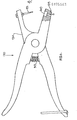
- applicator tool 130 is shown which has an elongate applicator pin 131.
- the applicator pin 131 in use, is located within the bore 23 of the shaft 121.
- the pin 131 moves downwardly and the shank 121 of the tag, engaged on the pin 131, is cuased to be driven and passed through the ear of the animal. Thereafter it may engage with a secone or female member located relative to a slot or recess 140 in the lower jaw 135 of the applicator tool. In use the lower jaw 135 will be positioned on a lower or underside of the ear. The engagement of the components being the male and female components, will hold and retain the tag in position relative to the ear of an animal.
- the present invention provides for a sanitant gel 8 to be located within the bore 123, so that the pin 131 of the applicator is inserted into sanitant gel 8 for the purpose of carrying the ear tag component 125 (and in particular the shank 121) downwardly through the ear of the animal.
- the pin On this action being completed, and on an upper jaw 134 of the applicator 130 moving away from the lower jaw 135, (and thus on the pin being removed from within the bore of the shank 121), this being achieved by the bias of the spring 50, the pin will have gel 8 applied thereto, so that on withdrawal from the ear of the animal, again when it passes through the ear of a further animal, infection, cross-infection and the like will be avoided or at least minimised.
- the sanitant gel of the present invention is preferably a non-aqueous thixotropic sanitant gel such as hereinbefore described. Because of the viscosity and thixotropic nature of the gel, an amount thereof inserted into the shank 121, will not run out and will be retained therein. As will be appreciated, a sanitant solution such as known up until this time, having regard to its general aqueous nature, would probably run out and will. not remain in position for effective use, over a period of time.
- a tag can be formed with a gel 8 inserted in the shank 121, and a thin cover, cap or membrane can be placed or formed over the upper end thereof, so as to prevent the entry of extraneous matter into the bore which might be likely to be mixed with the gel. This avoids also, the gel being tipped out by agitation, during packaging and the like. It is envisaged that in use, the pin 131 will pierce the membrane such as when the shank 121 is being located relative to the applicator pin 131.
- the pointed or sharpened end 122 of the shank 121 may have a hole or orifice in the end thereof, such that in some cases, the end of the pin 131 will extend therethrough for the purpose of applying a tag to the ear of an animal. It is envisaged also that where there is a hole 122b downward movement of the applicator pin 131 within the bore 123, may cause some of the gel 8 to exit from the end of the shaft 121, and through the hole 122b. Thus, gel 8 on the tip of the sharpened or pointed end 122b will also be applied to that area of the ear, immediately adjacent the tag, as the end of the tag passes through the ear. This then aids in the healing of the wound formed by the tag passing through the ear.
- the use of such gel 8 also prevents or at least minimises infection and cross-infection, resulting from that wound.
- the hole 122b allows an amount of gel from within the bore 123, to exit therefrom over a period of time, adjacent to the wound or cut formed in the ear for the location of the tag, this exiting of gel over a period of time, contacting the wound and thus assisting in the healing thereof. Additionally, this gel 8 will diminish irritation, infection and the like resulting from the wound.
- the gel 8 can be formed into or incorporated into an appropriate capsule or container 55, having a flangeable outer covering.
- a capsule 55 of the gel 8 can be inserted into the bore 123.
- the location and/or driving movement of the pin 131 was in the bore (such as to drive the tag through the ear of an animal) will pierce, break, shatter or open the capsule 55, or cover thereof, such as to release the gel 8 within the bore. This will then subject at least part of the pin 131 to the gel 8.
- the applicator is provided with means which incorporate a sanitizing gel.
- the applicator 131 operates in a substantially "pliers" like manner and has handles which are spring biased apart, each handle leading into forward jaw members, being an upper jaw member 134 and a lower jaw member 135.
- An elongate applicator pin 131 is associated with and extends outwardly and downwardly from the upper jaw member 134.
- a hole or slot 140 is provided in the lower jaw 135, and a sanitant gel or material impregnated with a sanitant gel may be inserted into the hole or slot 140. In this way, on the handles being brought together (against the bias of the spring 50), the jaw members 134 and 135 are brought together, the pin 131 moving downwardly and through the hole 140.
- an ear tag (not shown) is mounted on the pin 131 so that the ear tag and pin pass through the hole or slot 140.
- the end of the ear tag (such as the pointed end of the shank) will pass through the gel and have gel affixed thereto.
- said pin 131 will be withdrawn through the sanitant gel 8 in the recess 140. The application of gel 8 to the pin 131 will therefore prevent or minimise infection, cross-infection and the like, when the pin is used further on another animal.
- a unitary or "one piece” ear tag can be provided.
- tags are well known in the art, and for example include a main body or indicia section and an elongate shank, the shank usually having an enlarged head at one end thereof.
- the "one piece” tag is attached or mounted to an applicator pin (such as the applicator pin 131), and is then driven through the ear of an animal, so that the enlarged head is replaced on a reverse side of the ear, thus retaining the tag in a predetermined or desired position relative to the ear of an animal.
- An applicator 130 can be used for applying such a unitary or one piece tag to the ear of an animal and the tag is mounted to the pin 131.
- the pin 131 and the tag mounted thereon passing through the ear of the animal, both the pin and a head or end portion of the tag will pass through the gel 8.
- a sanitant gel can be impregnated into an ear tag (for example at least into the elongate shank or neck of an ear tag).
- a sanitant gel will be present to be passed to the skin of the ear of the animal, to thus act against irritation, infection and the like, as may result from the wound in the animal.
Landscapes
- Health & Medical Sciences (AREA)
- Life Sciences & Earth Sciences (AREA)
- Veterinary Medicine (AREA)
- Engineering & Computer Science (AREA)
- Animal Behavior & Ethology (AREA)
- Environmental Sciences (AREA)
- Zoology (AREA)
- Public Health (AREA)
- General Health & Medical Sciences (AREA)
- Heart & Thoracic Surgery (AREA)
- Biodiversity & Conservation Biology (AREA)
- Biomedical Technology (AREA)
- Anesthesiology (AREA)
- Birds (AREA)
- Vascular Medicine (AREA)
- Animal Husbandry (AREA)
- Hematology (AREA)
- Environmental & Geological Engineering (AREA)
- Surgery (AREA)
- Wood Science & Technology (AREA)
- Medicinal Preparation (AREA)
- Infusion, Injection, And Reservoir Apparatuses (AREA)
- Medicines That Contain Protein Lipid Enzymes And Other Medicines (AREA)
- Pharmaceuticals Containing Other Organic And Inorganic Compounds (AREA)
Applications Claiming Priority (6)
| Application Number | Priority Date | Filing Date | Title |
|---|---|---|---|
| NZ209630 | 1984-09-21 | ||
| NZ20963184A NZ209631A (en) | 1984-09-21 | 1984-09-21 | Device, such as hypodermic needle or ear tag applicator, with sanitant gel; thixotropic sanitant gel |
| NZ209629 | 1984-09-21 | ||
| NZ209631 | 1984-09-21 | ||
| NZ20963084A NZ209630A (en) | 1984-09-21 | 1984-09-21 | Device, such as hypodermic needle or ear tag applicator, with sanitant gel; thixotropic sanitant gel |
| NZ20962984A NZ209629A (en) | 1984-09-21 | 1984-09-21 | Device, such as hypodermic needle or ear tag applicator, with sanitant gel; thixotropic sanitant gel |
Publications (2)
| Publication Number | Publication Date |
|---|---|
| EP0175583A2 true EP0175583A2 (de) | 1986-03-26 |
| EP0175583A3 EP0175583A3 (de) | 1988-08-24 |
Family
ID=27353525
Family Applications (1)
| Application Number | Title | Priority Date | Filing Date |
|---|---|---|---|
| EP85306699A Withdrawn EP0175583A3 (de) | 1984-09-21 | 1985-09-20 | Hygienische Anordnung |
Country Status (5)
| Country | Link |
|---|---|
| US (1) | US4666436A (de) |
| EP (1) | EP0175583A3 (de) |
| AU (1) | AU4762385A (de) |
| CA (1) | CA1235343A (de) |
| DK (1) | DK424485A (de) |
Cited By (1)
| Publication number | Priority date | Publication date | Assignee | Title |
|---|---|---|---|---|
| US11007327B2 (en) | 2012-10-25 | 2021-05-18 | Novo Nordisk A/S | Pre-filled disposable injection device |
Families Citing this family (44)
| Publication number | Priority date | Publication date | Assignee | Title |
|---|---|---|---|---|
| GB8612826D0 (en) * | 1986-05-27 | 1986-07-02 | Boots Co Plc | Insecticidal compositions |
| US4958452A (en) * | 1989-09-27 | 1990-09-25 | Zoecon Corporation | Animal identification ear tag assembly |
| US5163908A (en) * | 1989-10-16 | 1992-11-17 | Lambert William S | Fail safe composite hypodermic syringe with reversible needle and guard assembly |
| AU7885691A (en) * | 1990-05-11 | 1991-12-10 | Gerardo Castaldo | Protective hypodermic needle |
| US5167641A (en) * | 1991-05-29 | 1992-12-01 | Arnis, Inc. | Auto-retracting needle injector system |
| DE4205036C1 (en) * | 1992-02-19 | 1993-06-17 | Henke-Sass, Wolf Gmbh, 7200 Tuttlingen, De | Injection cylinder for subcutaneous vaccination - comprises first hollow cylindrical tube in which is fitted telescopically second tube with reduced dia. |
| US5267974A (en) * | 1992-06-04 | 1993-12-07 | Lambert William S | Hypodermic syringe with foam sponge reservoir |
| US5902547A (en) * | 1996-04-04 | 1999-05-11 | Bryan D. Hill | Method for disinfecting a tagging gun needle |
| FR2790660B1 (fr) * | 1999-03-12 | 2001-08-10 | Albert Gourlandt | Dispositif d'injection automatique et procede d'injection automatique |
| KR20010077178A (ko) * | 2000-02-01 | 2001-08-17 | 장은수 | 인식 표기용 침을 이용한 비씨지 접종 기구 |
| US20030060414A1 (en) * | 2001-09-10 | 2003-03-27 | Mchardy Nicholas | Bio-security system |
| IL157981A (en) | 2003-09-17 | 2014-01-30 | Elcam Medical Agricultural Cooperative Ass Ltd | Auto injector |
| IL160891A0 (en) | 2004-03-16 | 2004-08-31 | Auto-mix needle | |
| BRPI0923252A2 (pt) * | 2008-12-04 | 2016-11-01 | Merial Ltd | vedador de bico de seio intramamário |
| JP6483676B2 (ja) | 2013-10-31 | 2019-03-13 | ノボ・ノルデイスク・エー/エス | 針カニューレを備える注射デバイス |
| PL3122173T5 (pl) | 2014-03-26 | 2024-08-05 | Scr Engineers Ltd | System lokalizacji żywego inwentarza |
| WO2015150179A1 (en) * | 2014-04-03 | 2015-10-08 | Novo Nordisk A/S | A needle arrangement |
| EP3142725B1 (de) * | 2014-05-13 | 2019-08-07 | Novo Nordisk A/S | Stiftartiger arzneimittelinjektor mit mehrfach verwendbarem nadelmodul mit integriertem reinigungsmittelreservoir |
| US11071279B2 (en) | 2014-09-05 | 2021-07-27 | Intervet Inc. | Method and system for tracking health in animal populations |
| US10986817B2 (en) | 2014-09-05 | 2021-04-27 | Intervet Inc. | Method and system for tracking health in animal populations |
| ES2806983T3 (es) | 2015-04-10 | 2021-02-19 | Novo Nordisk As | Dispositivo médico de inyección que tiene un protector |
| EP3288610B1 (de) * | 2015-04-28 | 2020-06-10 | Novo Nordisk A/S | Medizinische injektionsvorrichtung mit teleskopischem nadelschutz mit einer reinigungskammer für die nadel |
| EP3341044B1 (de) | 2015-08-25 | 2020-01-29 | Novo Nordisk A/S | Medizinische injektionsvorrichtung mit einer reinigungskammer |
| WO2017050694A1 (en) | 2015-09-22 | 2017-03-30 | Novo Nordisk A/S | A medical injection device having a sealable cleaning reservoir |
| US10773029B2 (en) | 2016-06-30 | 2020-09-15 | Novo Nordisk A/S | Medical injection device with needle cleaning |
| PL3518664T3 (pl) | 2016-09-28 | 2022-05-02 | Scr Engineers Ltd | Uchwyt na inteligentny znacznik monitorujący dla krów |
| US11832584B2 (en) | 2018-04-22 | 2023-12-05 | Vence, Corp. | Livestock management system and method |
| FR3086837B1 (fr) | 2018-10-03 | 2021-06-18 | Allflex Europe | Pince pour la manipulation d’un dispositif d’identification d’un animal et/ou de prelevement d’un tissu d’un animal comprenant des moyens de maintien a moyens d’actionnement deportes |
| WO2020075174A1 (en) | 2018-10-10 | 2020-04-16 | Scr Engineers Ltd | Livestock dry off method and device |
| AU2019428657B2 (en) | 2019-02-08 | 2025-10-23 | Allflex Australia Pty Ltd | Determining the location of an animal |
| EP3921761B1 (de) | 2019-02-08 | 2024-09-18 | Allflex Australia Pty Ltd | Synchronisierung von lesegeräten zur elektronischen tieridentifikation |
| WO2020160587A1 (en) | 2019-02-08 | 2020-08-13 | Allflex Australia Pty Ltd | Electronic animal tag reader |
| WO2021040540A1 (en) | 2019-08-28 | 2021-03-04 | Lic Automation Limited | Devices for analysis of a fluid |
| USD990063S1 (en) | 2020-06-18 | 2023-06-20 | S.C.R. (Engineers) Limited | Animal ear tag |
| IL275518B (en) | 2020-06-18 | 2021-10-31 | Scr Eng Ltd | Animal tag |
| USD990062S1 (en) | 2020-06-18 | 2023-06-20 | S.C.R. (Engineers) Limited | Animal ear tag |
| IL275812B (en) | 2020-07-01 | 2022-01-01 | Scr Eng Ltd | System and method for placing devices |
| US11960957B2 (en) | 2020-11-25 | 2024-04-16 | Identigen Limited | System and method for tracing members of an animal population |
| IL280374B2 (en) | 2021-01-24 | 2023-11-01 | Scr Eng Ltd | System and method for controlling animal marking |
| IL280744A (en) | 2021-02-09 | 2022-09-01 | Scr Eng Ltd | A system and method for determining animal population welfare |
| CA206812S (en) | 2021-04-08 | 2023-04-11 | Chevillot Sas | Tag applicator for animals |
| CA206747S (en) | 2021-04-08 | 2024-12-30 | Chevillot Sas | Tag applicator for animals |
| IL283741A (en) | 2021-06-03 | 2022-07-01 | Scr Eng Ltd | A system and method for estimating greenhouse gas emissions in an environment that houses animals |
| US12402596B2 (en) | 2022-05-03 | 2025-09-02 | S.C.R. (Engineers) Limited | Milk channel and feed inlet coupled thereto, and system and method for conserving wash fluid in a washing process for cleaning a milkmeter system |
Family Cites Families (5)
| Publication number | Priority date | Publication date | Assignee | Title |
|---|---|---|---|---|
| GB770341A (en) * | 1954-11-18 | 1957-03-20 | Russell Paul Dunmire | Hypodermic syringe |
| US3354881A (en) * | 1964-11-03 | 1967-11-28 | Universal Oil Prod Co | Hypodermic needle protector |
| US3731414A (en) * | 1971-02-05 | 1973-05-08 | B Murphy | Animal ear tags and applicators therefor |
| GB2080689B (en) * | 1980-07-29 | 1984-10-31 | Dent Hugh Robert | Sterilising fitments for injection devices |
| AU553605B2 (en) * | 1982-01-14 | 1986-07-24 | Sterimatic Holdings Ltd. | Fitment for needle sterilization |
-
1985
- 1985-09-18 DK DK424485A patent/DK424485A/da unknown
- 1985-09-19 AU AU47623/85A patent/AU4762385A/en not_active Abandoned
- 1985-09-19 CA CA000491166A patent/CA1235343A/en not_active Expired
- 1985-09-19 US US06/777,839 patent/US4666436A/en not_active Expired - Fee Related
- 1985-09-20 EP EP85306699A patent/EP0175583A3/de not_active Withdrawn
Cited By (1)
| Publication number | Priority date | Publication date | Assignee | Title |
|---|---|---|---|---|
| US11007327B2 (en) | 2012-10-25 | 2021-05-18 | Novo Nordisk A/S | Pre-filled disposable injection device |
Also Published As
| Publication number | Publication date |
|---|---|
| CA1235343A (en) | 1988-04-19 |
| DK424485A (da) | 1986-03-22 |
| EP0175583A3 (de) | 1988-08-24 |
| US4666436A (en) | 1987-05-19 |
| DK424485D0 (da) | 1985-09-18 |
| AU4762385A (en) | 1986-03-27 |
Similar Documents
| Publication | Publication Date | Title |
|---|---|---|
| US4666436A (en) | Sanitant arrangement | |
| US4507118A (en) | Fitments for injection devices | |
| US10549078B2 (en) | Antiseptic applicator | |
| US4482348A (en) | Fitments for injection devices | |
| US5326492A (en) | Disinfectant mixture containing water soluble lubricating and cleaning agents and method | |
| US5961494A (en) | Marking syringe | |
| AU2006207455B2 (en) | Applicator for inserting an implant | |
| US8057445B2 (en) | Direct delivery applicator assembly and method of use | |
| US20070203504A1 (en) | Skin-marking devices and their use | |
| US20040220527A1 (en) | Animal treatment and marking system | |
| US20170055901A1 (en) | Therapeutic agent delivering biopsy needle device and method of use | |
| US5273528A (en) | Livestock inoculator | |
| NZ209629A (en) | Device, such as hypodermic needle or ear tag applicator, with sanitant gel; thixotropic sanitant gel | |
| US8844193B2 (en) | Apparatus for killing and removing ticks | |
| WO2004101060A2 (en) | Automatic injector for mass injections | |
| US9474849B2 (en) | Apparatus and method for reducing incidence of tick borne infections | |
| US11401103B2 (en) | Dispenser apparatus and method of using same | |
| US20070293831A1 (en) | Medicament Application Device | |
| US20070092545A1 (en) | Aerosol coolant spray for killing and removing ticks | |
| AU2011201911B2 (en) | Storage unit for at least one device for identifying animals and/or collecting animal tissue, and corresponding method for identifying or collecting tissue | |
| US9981081B2 (en) | Tissue retractor | |
| GB2478935A (en) | Liquid dispensing animal grooming brush | |
| US20230023561A1 (en) | Nail Sanitizer | |
| CN220557161U (zh) | 一种畜牧耳标穿孔装置 | |
| GB2416696A (en) | Injection fly deterrent applicator |
Legal Events
| Date | Code | Title | Description |
|---|---|---|---|
| PUAI | Public reference made under article 153(3) epc to a published international application that has entered the european phase |
Free format text: ORIGINAL CODE: 0009012 |
|
| 17P | Request for examination filed |
Effective date: 19850928 |
|
| AK | Designated contracting states |
Kind code of ref document: A2 Designated state(s): BE DE FR GB IT NL |
|
| PUAL | Search report despatched |
Free format text: ORIGINAL CODE: 0009013 |
|
| AK | Designated contracting states |
Kind code of ref document: A3 Designated state(s): BE DE FR GB IT NL |
|
| STAA | Information on the status of an ep patent application or granted ep patent |
Free format text: STATUS: THE APPLICATION IS DEEMED TO BE WITHDRAWN |
|
| 18D | Application deemed to be withdrawn |
Effective date: 19900403 |
|
| RIN1 | Information on inventor provided before grant (corrected) |
Inventor name: ORBELL, WILLIAM GEORGE Inventor name: O'LEARY, ARTHUR JOHN Inventor name: MCDONALD, HAMISH |