EP0172288B1 - The use of polymeric alkylenephosphoric acid piperazine derivatives for scale control in flue gas desulfurization - Google Patents
The use of polymeric alkylenephosphoric acid piperazine derivatives for scale control in flue gas desulfurization Download PDFInfo
- Publication number
- EP0172288B1 EP0172288B1 EP84305723A EP84305723A EP0172288B1 EP 0172288 B1 EP0172288 B1 EP 0172288B1 EP 84305723 A EP84305723 A EP 84305723A EP 84305723 A EP84305723 A EP 84305723A EP 0172288 B1 EP0172288 B1 EP 0172288B1
- Authority
- EP
- European Patent Office
- Prior art keywords
- compound
- independently
- gas
- calcium
- radical
- Prior art date
- Legal status (The legal status is an assumption and is not a legal conclusion. Google has not performed a legal analysis and makes no representation as to the accuracy of the status listed.)
- Expired
Links
- 238000006477 desulfuration reaction Methods 0.000 title claims description 11
- 230000023556 desulfurization Effects 0.000 title claims description 11
- 239000002253 acid Substances 0.000 title description 18
- 239000003546 flue gas Substances 0.000 title description 9
- UGFAIRIUMAVXCW-UHFFFAOYSA-N Carbon monoxide Chemical compound [O+]#[C-] UGFAIRIUMAVXCW-UHFFFAOYSA-N 0.000 title description 8
- 150000004885 piperazines Chemical class 0.000 title 1
- 229940066771 systemic antihistamines piperazine derivative Drugs 0.000 title 1
- 239000007789 gas Substances 0.000 claims description 26
- IMUDHTPIFIBORV-UHFFFAOYSA-N aminoethylpiperazine Chemical compound NCCN1CCNCC1 IMUDHTPIFIBORV-UHFFFAOYSA-N 0.000 claims description 22
- 238000000034 method Methods 0.000 claims description 22
- 150000001875 compounds Chemical class 0.000 claims description 17
- -1 C20 compound Chemical class 0.000 claims description 12
- 239000000047 product Substances 0.000 claims description 12
- XTQHKBHJIVJGKJ-UHFFFAOYSA-N sulfur monoxide Chemical class S=O XTQHKBHJIVJGKJ-UHFFFAOYSA-N 0.000 claims description 12
- 229910052815 sulfur oxide Inorganic materials 0.000 claims description 12
- 239000007788 liquid Substances 0.000 claims description 11
- 239000002002 slurry Substances 0.000 claims description 11
- WSLDOOZREJYCGB-UHFFFAOYSA-N 1,2-Dichloroethane Chemical compound ClCCCl WSLDOOZREJYCGB-UHFFFAOYSA-N 0.000 claims description 9
- 229910052739 hydrogen Inorganic materials 0.000 claims description 9
- 239000001257 hydrogen Substances 0.000 claims description 8
- 125000004435 hydrogen atom Chemical group [H]* 0.000 claims description 8
- VTYYLEPIZMXCLO-UHFFFAOYSA-L Calcium carbonate Chemical compound [Ca+2].[O-]C([O-])=O VTYYLEPIZMXCLO-UHFFFAOYSA-L 0.000 claims description 7
- 230000015572 biosynthetic process Effects 0.000 claims description 7
- 239000003112 inhibitor Substances 0.000 claims description 7
- XLYOFNOQVPJJNP-UHFFFAOYSA-N water Chemical compound O XLYOFNOQVPJJNP-UHFFFAOYSA-N 0.000 claims description 7
- 239000007864 aqueous solution Substances 0.000 claims description 6
- 229910000019 calcium carbonate Inorganic materials 0.000 claims description 6
- 239000007795 chemical reaction product Substances 0.000 claims description 5
- 150000003254 radicals Chemical class 0.000 claims description 5
- 229940043430 calcium compound Drugs 0.000 claims description 4
- 150000001674 calcium compounds Chemical class 0.000 claims description 4
- 125000005843 halogen group Chemical group 0.000 claims description 4
- QGZKDVFQNNGYKY-UHFFFAOYSA-O Ammonium Chemical compound [NH4+] QGZKDVFQNNGYKY-UHFFFAOYSA-O 0.000 claims description 3
- 229910052783 alkali metal Inorganic materials 0.000 claims description 3
- 238000010438 heat treatment Methods 0.000 claims description 3
- GAWIXWVDTYZWAW-UHFFFAOYSA-N C[CH]O Chemical group C[CH]O GAWIXWVDTYZWAW-UHFFFAOYSA-N 0.000 claims description 2
- 150000001340 alkali metals Chemical class 0.000 claims description 2
- 125000002496 methyl group Chemical group [H]C([H])([H])* 0.000 claims description 2
- 150000002894 organic compounds Chemical class 0.000 claims description 2
- JGIATAMCQXIDNZ-UHFFFAOYSA-N calcium sulfide Chemical compound [Ca]=S JGIATAMCQXIDNZ-UHFFFAOYSA-N 0.000 claims 1
- 238000011084 recovery Methods 0.000 claims 1
- OSGAYBCDTDRGGQ-UHFFFAOYSA-L calcium sulfate Chemical compound [Ca+2].[O-]S([O-])(=O)=O OSGAYBCDTDRGGQ-UHFFFAOYSA-L 0.000 description 24
- 239000000243 solution Substances 0.000 description 21
- 239000003795 chemical substances by application Substances 0.000 description 11
- 238000010791 quenching Methods 0.000 description 10
- 238000001556 precipitation Methods 0.000 description 9
- ISIJQEHRDSCQIU-UHFFFAOYSA-N tert-butyl 2,7-diazaspiro[4.5]decane-7-carboxylate Chemical compound C1N(C(=O)OC(C)(C)C)CCCC11CNCC1 ISIJQEHRDSCQIU-UHFFFAOYSA-N 0.000 description 8
- 229910021645 metal ion Inorganic materials 0.000 description 7
- VEXZGXHMUGYJMC-UHFFFAOYSA-N Hydrochloric acid Chemical compound Cl VEXZGXHMUGYJMC-UHFFFAOYSA-N 0.000 description 6
- 150000001412 amines Chemical class 0.000 description 6
- 230000000052 comparative effect Effects 0.000 description 6
- WSFSSNUMVMOOMR-UHFFFAOYSA-N Formaldehyde Chemical compound O=C WSFSSNUMVMOOMR-UHFFFAOYSA-N 0.000 description 5
- 239000006096 absorbing agent Substances 0.000 description 5
- 125000004432 carbon atom Chemical group C* 0.000 description 5
- 238000006243 chemical reaction Methods 0.000 description 5
- 229920000642 polymer Polymers 0.000 description 5
- 238000010992 reflux Methods 0.000 description 5
- 150000003467 sulfuric acid derivatives Chemical class 0.000 description 5
- IKHGUXGNUITLKF-UHFFFAOYSA-N Acetaldehyde Chemical compound CC=O IKHGUXGNUITLKF-UHFFFAOYSA-N 0.000 description 4
- NBBJYMSMWIIQGU-UHFFFAOYSA-N Propionic aldehyde Chemical compound CCC=O NBBJYMSMWIIQGU-UHFFFAOYSA-N 0.000 description 4
- 238000000151 deposition Methods 0.000 description 4
- 229940090960 diethylenetriamine pentamethylene phosphonic acid Drugs 0.000 description 4
- DUYCTCQXNHFCSJ-UHFFFAOYSA-N dtpmp Chemical compound OP(=O)(O)CN(CP(O)(O)=O)CCN(CP(O)(=O)O)CCN(CP(O)(O)=O)CP(O)(O)=O DUYCTCQXNHFCSJ-UHFFFAOYSA-N 0.000 description 4
- 229910052751 metal Inorganic materials 0.000 description 4
- 239000002184 metal Substances 0.000 description 4
- 238000012856 packing Methods 0.000 description 4
- OYPRJOBELJOOCE-UHFFFAOYSA-N Calcium Chemical compound [Ca] OYPRJOBELJOOCE-UHFFFAOYSA-N 0.000 description 3
- YDONNITUKPKTIG-UHFFFAOYSA-N [Nitrilotris(methylene)]trisphosphonic acid Chemical compound OP(O)(=O)CN(CP(O)(O)=O)CP(O)(O)=O YDONNITUKPKTIG-UHFFFAOYSA-N 0.000 description 3
- 229910052925 anhydrite Inorganic materials 0.000 description 3
- 239000011575 calcium Substances 0.000 description 3
- 229910052791 calcium Inorganic materials 0.000 description 3
- 230000008021 deposition Effects 0.000 description 3
- CUHVTYCUTYWQOR-UHFFFAOYSA-N formaldehyde Chemical compound O=C.O=C CUHVTYCUTYWQOR-UHFFFAOYSA-N 0.000 description 3
- 239000000446 fuel Substances 0.000 description 3
- 239000002244 precipitate Substances 0.000 description 3
- 239000011541 reaction mixture Substances 0.000 description 3
- 230000035484 reaction time Effects 0.000 description 3
- 239000007921 spray Substances 0.000 description 3
- 239000002562 thickening agent Substances 0.000 description 3
- BRLQWZUYTZBJKN-UHFFFAOYSA-N Epichlorohydrin Chemical compound ClCC1CO1 BRLQWZUYTZBJKN-UHFFFAOYSA-N 0.000 description 2
- QAOWNCQODCNURD-UHFFFAOYSA-L Sulfate Chemical compound [O-]S([O-])(=O)=O QAOWNCQODCNURD-UHFFFAOYSA-L 0.000 description 2
- NINIDFKCEFEMDL-UHFFFAOYSA-N Sulfur Chemical compound [S] NINIDFKCEFEMDL-UHFFFAOYSA-N 0.000 description 2
- 150000007513 acids Chemical class 0.000 description 2
- 150000001299 aldehydes Chemical class 0.000 description 2
- 239000012298 atmosphere Substances 0.000 description 2
- 239000000539 dimer Substances 0.000 description 2
- 230000000694 effects Effects 0.000 description 2
- 150000002170 ethers Chemical class 0.000 description 2
- 235000019256 formaldehyde Nutrition 0.000 description 2
- 125000002768 hydroxyalkyl group Chemical group 0.000 description 2
- 150000002500 ions Chemical class 0.000 description 2
- 239000000203 mixture Substances 0.000 description 2
- 239000012071 phase Substances 0.000 description 2
- 238000002360 preparation method Methods 0.000 description 2
- 239000000376 reactant Substances 0.000 description 2
- 238000005201 scrubbing Methods 0.000 description 2
- 229910052717 sulfur Inorganic materials 0.000 description 2
- 239000011593 sulfur Substances 0.000 description 2
- XNQFDUDDZOGADD-UHFFFAOYSA-N 1,2-dichloroethane;2-piperazin-1-ylethanamine Chemical compound ClCCCl.NCCN1CCNCC1 XNQFDUDDZOGADD-UHFFFAOYSA-N 0.000 description 1
- YHRUOJUYPBUZOS-UHFFFAOYSA-N 1,3-dichloropropane Chemical compound ClCCCCl YHRUOJUYPBUZOS-UHFFFAOYSA-N 0.000 description 1
- WQPMYSHJKXVTME-UHFFFAOYSA-N 3-hydroxypropane-1-sulfonic acid Chemical compound OCCCS(O)(=O)=O WQPMYSHJKXVTME-UHFFFAOYSA-N 0.000 description 1
- ZCYVEMRRCGMTRW-UHFFFAOYSA-N 7553-56-2 Chemical compound [I] ZCYVEMRRCGMTRW-UHFFFAOYSA-N 0.000 description 1
- QGZKDVFQNNGYKY-UHFFFAOYSA-N Ammonia Chemical compound N QGZKDVFQNNGYKY-UHFFFAOYSA-N 0.000 description 1
- ZNSMNVMLTJELDZ-UHFFFAOYSA-N Bis(2-chloroethyl)ether Chemical compound ClCCOCCCl ZNSMNVMLTJELDZ-UHFFFAOYSA-N 0.000 description 1
- WKBOTKDWSSQWDR-UHFFFAOYSA-N Bromine atom Chemical compound [Br] WKBOTKDWSSQWDR-UHFFFAOYSA-N 0.000 description 1
- 239000004215 Carbon black (E152) Substances 0.000 description 1
- 239000004970 Chain extender Substances 0.000 description 1
- ZAMOUSCENKQFHK-UHFFFAOYSA-N Chlorine atom Chemical compound [Cl] ZAMOUSCENKQFHK-UHFFFAOYSA-N 0.000 description 1
- YMWUJEATGCHHMB-UHFFFAOYSA-N Dichloromethane Chemical compound ClCCl YMWUJEATGCHHMB-UHFFFAOYSA-N 0.000 description 1
- 239000003109 Disodium ethylene diamine tetraacetate Substances 0.000 description 1
- ZGTMUACCHSMWAC-UHFFFAOYSA-L EDTA disodium salt (anhydrous) Chemical compound [Na+].[Na+].OC(=O)CN(CC([O-])=O)CCN(CC(O)=O)CC([O-])=O ZGTMUACCHSMWAC-UHFFFAOYSA-L 0.000 description 1
- 235000019738 Limestone Nutrition 0.000 description 1
- 238000006683 Mannich reaction Methods 0.000 description 1
- 239000004698 Polyethylene Substances 0.000 description 1
- 230000002745 absorbent Effects 0.000 description 1
- 239000002250 absorbent Substances 0.000 description 1
- 229910052784 alkaline earth metal Inorganic materials 0.000 description 1
- 125000000217 alkyl group Chemical group 0.000 description 1
- HRQGCQVOJVTVLU-UHFFFAOYSA-N bis(chloromethyl) ether Chemical compound ClCOCCl HRQGCQVOJVTVLU-UHFFFAOYSA-N 0.000 description 1
- GDTBXPJZTBHREO-UHFFFAOYSA-N bromine Substances BrBr GDTBXPJZTBHREO-UHFFFAOYSA-N 0.000 description 1
- 229910052794 bromium Inorganic materials 0.000 description 1
- 125000001246 bromo group Chemical group Br* 0.000 description 1
- ZTQSAGDEMFDKMZ-UHFFFAOYSA-N butyric aldehyde Natural products CCCC=O ZTQSAGDEMFDKMZ-UHFFFAOYSA-N 0.000 description 1
- AXCZMVOFGPJBDE-UHFFFAOYSA-L calcium dihydroxide Chemical compound [OH-].[OH-].[Ca+2] AXCZMVOFGPJBDE-UHFFFAOYSA-L 0.000 description 1
- 239000000920 calcium hydroxide Substances 0.000 description 1
- 229910001861 calcium hydroxide Inorganic materials 0.000 description 1
- 159000000007 calcium salts Chemical class 0.000 description 1
- GBAOBIBJACZTNA-UHFFFAOYSA-L calcium sulfite Chemical compound [Ca+2].[O-]S([O-])=O GBAOBIBJACZTNA-UHFFFAOYSA-L 0.000 description 1
- 235000010261 calcium sulphite Nutrition 0.000 description 1
- 125000002057 carboxymethyl group Chemical group [H]OC(=O)C([H])([H])[*] 0.000 description 1
- 230000009920 chelation Effects 0.000 description 1
- 229910052801 chlorine Inorganic materials 0.000 description 1
- 239000000460 chlorine Substances 0.000 description 1
- 150000001805 chlorine compounds Chemical class 0.000 description 1
- 239000003245 coal Substances 0.000 description 1
- 239000008367 deionised water Substances 0.000 description 1
- 229910021641 deionized water Inorganic materials 0.000 description 1
- 238000010586 diagram Methods 0.000 description 1
- 235000019301 disodium ethylene diamine tetraacetate Nutrition 0.000 description 1
- 238000001914 filtration Methods 0.000 description 1
- 229910052736 halogen Inorganic materials 0.000 description 1
- 150000002367 halogens Chemical class 0.000 description 1
- 229930195733 hydrocarbon Natural products 0.000 description 1
- 150000002430 hydrocarbons Chemical class 0.000 description 1
- XLYOFNOQVPJJNP-UHFFFAOYSA-M hydroxide Chemical compound [OH-] XLYOFNOQVPJJNP-UHFFFAOYSA-M 0.000 description 1
- 125000002887 hydroxy group Chemical group [H]O* 0.000 description 1
- 229910052500 inorganic mineral Inorganic materials 0.000 description 1
- 239000011630 iodine Substances 0.000 description 1
- 229910052740 iodine Inorganic materials 0.000 description 1
- 125000002346 iodo group Chemical group I* 0.000 description 1
- 239000006028 limestone Substances 0.000 description 1
- 239000007791 liquid phase Substances 0.000 description 1
- 238000005259 measurement Methods 0.000 description 1
- 150000002736 metal compounds Chemical class 0.000 description 1
- 150000002739 metals Chemical class 0.000 description 1
- 239000011707 mineral Substances 0.000 description 1
- UEZVMMHDMIWARA-UHFFFAOYSA-M phosphonate Chemical compound [O-]P(=O)=O UEZVMMHDMIWARA-UHFFFAOYSA-M 0.000 description 1
- 229920000768 polyamine Polymers 0.000 description 1
- 229920000573 polyethylene Polymers 0.000 description 1
- 230000001376 precipitating effect Effects 0.000 description 1
- 239000012429 reaction media Substances 0.000 description 1
- 230000003134 recirculating effect Effects 0.000 description 1
- 238000004064 recycling Methods 0.000 description 1
- 150000003839 salts Chemical class 0.000 description 1
- 229920006395 saturated elastomer Polymers 0.000 description 1
- 239000012047 saturated solution Substances 0.000 description 1
- 239000002455 scale inhibitor Substances 0.000 description 1
- 238000005507 spraying Methods 0.000 description 1
- 238000003756 stirring Methods 0.000 description 1
- 239000013638 trimer Substances 0.000 description 1
- 238000005406 washing Methods 0.000 description 1
Images

Classifications
-
- C—CHEMISTRY; METALLURGY
- C02—TREATMENT OF WATER, WASTE WATER, SEWAGE, OR SLUDGE
- C02F—TREATMENT OF WATER, WASTE WATER, SEWAGE, OR SLUDGE
- C02F5/00—Softening water; Preventing scale; Adding scale preventatives or scale removers to water, e.g. adding sequestering agents
- C02F5/08—Treatment of water with complexing chemicals or other solubilising agents for softening, scale prevention or scale removal, e.g. adding sequestering agents
- C02F5/10—Treatment of water with complexing chemicals or other solubilising agents for softening, scale prevention or scale removal, e.g. adding sequestering agents using organic substances
- C02F5/14—Treatment of water with complexing chemicals or other solubilising agents for softening, scale prevention or scale removal, e.g. adding sequestering agents using organic substances containing phosphorus
-
- B—PERFORMING OPERATIONS; TRANSPORTING
- B01—PHYSICAL OR CHEMICAL PROCESSES OR APPARATUS IN GENERAL
- B01D—SEPARATION
- B01D53/00—Separation of gases or vapours; Recovering vapours of volatile solvents from gases; Chemical or biological purification of waste gases, e.g. engine exhaust gases, smoke, fumes, flue gases, aerosols
- B01D53/34—Chemical or biological purification of waste gases
- B01D53/46—Removing components of defined structure
- B01D53/48—Sulfur compounds
- B01D53/50—Sulfur oxides
- B01D53/501—Sulfur oxides by treating the gases with a solution or a suspension of an alkali or earth-alkali or ammonium compound
-
- B—PERFORMING OPERATIONS; TRANSPORTING
- B01—PHYSICAL OR CHEMICAL PROCESSES OR APPARATUS IN GENERAL
- B01D—SEPARATION
- B01D53/00—Separation of gases or vapours; Recovering vapours of volatile solvents from gases; Chemical or biological purification of waste gases, e.g. engine exhaust gases, smoke, fumes, flue gases, aerosols
- B01D53/34—Chemical or biological purification of waste gases
- B01D53/46—Removing components of defined structure
- B01D53/48—Sulfur compounds
- B01D53/50—Sulfur oxides
- B01D53/501—Sulfur oxides by treating the gases with a solution or a suspension of an alkali or earth-alkali or ammonium compound
- B01D53/502—Sulfur oxides by treating the gases with a solution or a suspension of an alkali or earth-alkali or ammonium compound characterised by a specific solution or suspension
Definitions
- the present invention according to claim 1 provides just such a method.
- Particular methylenephos- phonates have been discovered which will keep the metal ions in solution during the contacting phase and allow precipitation in a subsequent step.
- Aralkylene dihalides can also be employed having the formula X-H 2 C-Ar-CH 2 -X wherein Ar is wherein R may be hydrogen, halogen, alkyl, having 1 to 4 carbon atoms, hydroxy and hydroxyalkyl, having 1 to 4 carbon atoms and X is a halogen atom.
- the dihalides may also be unsaturated.
- 1.2-dichloroethene, 1.4-dichloro-2-butene and the like may be employed.
- the conditions for making the polymer are to employ the reactants in an amount of from about 0.2 to about 1 mole of the chain extender compound, preferably from 0.2 to 0.8 mole, more preferably from about 0.25 to about 0.6, i. e. the dihalo- or epoxyhalo-compound, per mole of AEP.
- the temperature of reaction is from about 50° to about 100 °C. preferably 70°-80 °C at a pressure sufficient to maintain the reactants in the liquid phase.
- the phosphonomethylation (Mannich reaction) is then carried out on the product in the presence of a strong acid to maintain the pH at less than 1.
- methanal (formaldehyde) is preferred, other alkanals (aldehydes) may be employed in place of methanal such as ethanal (acetaldehyde), propanal (propionaldehyde), and the like, wherein the alkanal may contain a straight or branched chain containing up to ten carbon atoms.
- the compounds of the present invention can be represented by the formula wherein A is an organic radical having the formula wherein Z is hydrogen, hydroxyethyl, hydroxypropyl, or BA wherein M is hydrogen, an alkali metal or ammonium, and wherein B is a divalent radical derived from a dihalo, diepoxy or haloepoxy organic compound having one of the following structures wherein n is 1-10, n' is 1-3, and wherein R is hydrogen or methyl and R' is hyrogen, an alkyl radical or a hydroxyalkyl radical having 1 to 4 carbons, a hydroxy radical or a halogen atom, m is 1-10 and at least 50 percent of the Z groups are groups.
- the amount of threshold agent i. e. the phosphonomethylated AEP polymeric products, usually employed is from about 0.5 to about 500 ppm depending upon the particular agent and upon the amount of metal ions present in solution, which in turn depends upon the volume of gas and concentration of sulfur oxides therein.
- the Figure is a schematic diagram of a typical absorber tower and associated equipment employed in a gas desulfurization process.
- an absorbent tower 10 and a feed tank 11.
- stirring means 23 driven by motor m.
- absorber tower 10 is packed section 21 for contacting gas and liquid, and a second packed section 22 for demisting the gas prior to exiting outlet pipe 27.
- the gas to be desulfurized enters the tower 10 through inlet pipe 26.
- Conduits 31 and 33 for circulating liquid lead from feed tank 11 to absorber tower 10 and conduit 35 for recirculating liquid from quench sump 51 leads to tower 10 ; liquid distributor means, e. g. spray nozzels 41, 42, 43 and 44 are connected to conduits 31, 37, 33 and 35, respectively.
- the threshold agent of the present invention is added to the aqueous feed in tank 11 or into the feed in conduit pipes 31 and 33 at a point just prior to their entrance into tower 10.
- the aqueous solution and/or slurry of CaC0 3 is fed into the upper portion of tower 10 from feed tank 11 via conduits 31 and 33 and through distributors 41 and 43.
- the gas stream to be desulfurized enters tower 10 at its lower end through pipe 26 at a temperature of about 85 °C where it first contacts quench liquid from quench sump 51 which is pumped via conduit 35 to distributor 44.
- Precipitation of calcium sulfate scale on the packing was noted with time and calcium remaining in solution was determined by filtering a sample of the solution through a millipore filter (4-5.5 ⁇ m diameter openings) and titrating with standard disodium ethylenediaminetetraacetate. While circulating at a temperature of 54 °C without any scale inhibitor, nearly half the calcium sulfate present had precipitated, forming scale, within 30 minutes to one hour. The amount of CaS0 4 present in solution at the start of the test was 3 985 ppm, after 30 minutes circulation only 2162 ppm remained and 2067 ppm (this is approximately the amount in a saturated solution of CaS0 4 at 54 °C) after 70 minutes.
- Aminoethylpiperazine the compound from which the methylenephosphonate of the present invention is made, was reacted with formaldehyde and phosphorous acid to make its trimethylenephosphonic acid derivative. This was used at 10 ppm (active acid) as in Comparative Example B. Little, if any, calcium sulfate scale was observed on the packing at either 54° or 75 °C. As in Comparative Example B, the aminoethylpiperazinetrimethylenephosphonic acid inhibitor is not suited for use in the desulfurization unit since it would not allow the calcium sulfate to precipitate at 75 °C, but kept it in solution at both temperatures.
Landscapes
- Chemical & Material Sciences (AREA)
- Engineering & Computer Science (AREA)
- General Chemical & Material Sciences (AREA)
- Environmental & Geological Engineering (AREA)
- Chemical Kinetics & Catalysis (AREA)
- Biomedical Technology (AREA)
- Analytical Chemistry (AREA)
- Health & Medical Sciences (AREA)
- Oil, Petroleum & Natural Gas (AREA)
- Life Sciences & Earth Sciences (AREA)
- Hydrology & Water Resources (AREA)
- Water Supply & Treatment (AREA)
- Organic Chemistry (AREA)
- Treating Waste Gases (AREA)
Description
- Power plants which burn carbonaceous fuels, especially soft coal, as a source of energy must scrub the gases from the burning fuel to remove sulfur oxides in order to avoid pollution of the atmosphere. The use of limestone (CaC03) as an aqueous slurry has long been employed for the purpose of scrubbing the sulfur oxides from the flue gas. Normally it is employed in towers which contact the gas with the calcium carbonate slurry in a countercurrent manner. The reaction between the sulfur oxides in the gas and the aqueous slurry of calcium carbonate forms a precipitate of calcium sulfite and sulfate, thus removing sulfur from the gas stream.
- One of the problems in removing the sulfur oxides by reacting with the calcium carbonate, or other soluble alkaline earth metal salts, is that when the metal sulfate precipitates it forms scale on the contacting surfaces. Thus, it is desirable that the scale be prevented from depositing during the contacting process, but that it subsequently be allowed to precipitate and be separated from the solution. Thus, the solution can be reconstituted and recycled to the process of removing the sulfur oxides from the flue gas without recycling a major portion of the scalant.
- In the past, various methods have been tried to inhibit the scale or counteract its effect. Thus, intermittent washing of the contacting surfaces was attempted, but was useful only with low gas volume or low sulfur content of the gas. When chelating or threshold agents were employed, the scale was prevented from forming during the contacting stage, but then could not be easily precipitated in the settling tanks unless the threshold or chelation limits were exceeded. In this the scale would form in both the contacting stage and the settling tanks.
- It would be desirable to find a means by which the metal ions could be maintained in solution during the contacting phase to avoid scale formation, but then be permitted to precipitate so that their sulfate salts could be removed.
- The present invention according to claim 1 provides just such a method. Particular methylenephos- phonates have been discovered which will keep the metal ions in solution during the contacting phase and allow precipitation in a subsequent step.
- Polymethylenephosphonic acid derivatives of polymers of N-aminoethylpiperazine have now been found to be particularly useful in a flue gas desulfurization process in which the subject polymers act as threshold agents in the control of metal ions in the gas-contacting step of the process, but allow subsequent precipitation of these ions as sulfates in a later step.
- The polymeric methylenephosphonated amines, primarily dimers and trimers of N-aminoethylpiperazine (AEP), useful in the present invention are made by reacting N-aminoethylpiperazine (AEP) with a dihalo or epoxyhalo compound and subsequently reacting the polymer formed thereby with phosphorous acid and an alkanal (aldehyde) at a low pH, usually provided by the presence of a mineral acid, e. g. hydrochloric acid. N-aminoethylpiperazine has the structure :

- The AEP can be reacted with any number of dihalo or epoxyhalo compounds in order to form a dimer or polymer. Any suitable epoxyhaloalkane (epihalohydrin) may be reacted, 1.2-epoxy-3-chloropropane (epichlorohydrin) being preferred. Generally, the epoxyhalo compound will have 3-10 carbon atoms. Other epichlorohydrin-type compounds include: 1.2-epoxy-4-chlorobutane, 2.3-epoxy-4-chlorobutane, 1.2-epoxy-5-chloropentane, 2.3-epoxy-5-chloropentane, etc. In general, the chloro derivatives are preferred, although the corresponding bromo or iodo compounds may be employed. Mixtures of epoxyhaloal- kanes may also be employed.
- Dihalides having from 1-20 carbon atoms may be used. Saturated dihalides having the formula X(CHs)nX. where X may be chlorine, bromine, iodine or combinations thereof and wherein n is an integer of from 1 to about 10, but preferably 2 to 6, may be employed. Thus, for example, dichloromethane (methylene chloride), 1.2-dichloroethane (ethylene dichloride), 1.2- or 1.3-dichloropropane, 1.4- or 1.2-dibromobutane and the like may be employed.
- Aralkylene dihalides can also be employed having the formula X-H2C-Ar-CH2-X wherein Ar is

- Dihaloalkylene ethers can also be employed, e. g. bis(chloromethyl) ether or bis(chloroethyl) ether. Formulas for such ethers also include X-GH2CH2(OCH2CH2)nX wherein n is 1 to 3 and

- The dihalides may also be unsaturated. Thus, 1.2-dichloroethene, 1.4-dichloro-2-butene and the like may be employed.
- The conditions for making the polymer are to employ the reactants in an amount of from about 0.2 to about 1 mole of the chain extender compound, preferably from 0.2 to 0.8 mole, more preferably from about 0.25 to about 0.6, i. e. the dihalo- or epoxyhalo-compound, per mole of AEP. The temperature of reaction is from about 50° to about 100 °C. preferably 70°-80 °C at a pressure sufficient to maintain the reactants in the liquid phase.
- The phosphonomethylation (Mannich reaction) is then carried out on the product in the presence of a strong acid to maintain the pH at less than 1.
- While the reaction will proceed at temperatures over a wide range, i. e., from 85° to 150 °C, it is preferred that the reaction medium be maintained at refluxing. The reaction is preferably conducted at atmospheric pressure, although sub-atmospheric and superatmospheric pressures may be utilized if desired. Reaction times will vary, depending upon a number of variables, but the preferred reaction time is 1 to 5 hours, and the most preferred reaction time is 2 to 4 hours.
- Although the phosphorous acid and the alkanal may be added together or separately in any order to the reaction mixture, it is prefered to add the phosphorous acid to the polyamine and then to slowly add the alkanal under refluxing conditions.
- Approximately equimolar amounts of alkanal and phosphorous acid are employed for he phosphonomethylation of the amine. Excess of either the alkanal or acid can be utilized although large excesses of either would be uneconomical. The preferred process will use an amount of alkanal equivalent to the amine hydrogens available and a slight stoichiometric excess of the phosphorous acid.
- Although methanal (formaldehyde) is preferred, other alkanals (aldehydes) may be employed in place of methanal such as ethanal (acetaldehyde), propanal (propionaldehyde), and the like, wherein the alkanal may contain a straight or branched chain containing up to ten carbon atoms.
- Thus, the compounds of the present invention can be represented by the formula


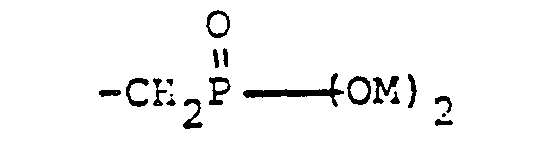
- Preferred compounds useful in the invention are those wherein the B moiety is derived from 1.2-epoxy-3-chloropropane (epichlorohydrin) or 1.2-dichloride, wherein m is 1 or 2, the Z moiety is

- The threshold active compounds used in the invention are effective in preventing precipitation of metal ions, e. g. Ca++ as scale, when water soluble compounds containing these metals are employed in aqueous scrubbing solutions employed to scrub sulfur oxides from flue gas from the burning of sulfur- containing hydrocarbon fuels.
- The compounds useful in the invention are effective in preventing metal ion precipitation at temperatures up to about 70 °C. At higher temperatures they are less effective and will allow CaS04 to precipitate in solutions containing 804° and Ca++ ions.
- This unexpected special property allows their use in the above described flue gas desulfurization process wherein the flue gases are contacted with an aqueous solution or slurry of calcium compounds, e. g. CaC03 or Ca(OH)2, or other metal compounds which will remove S02 and S03 from gas streams contacted therewith. Following such contact, and in accordance with the present invention, wherein these ions are prevented from precipitating as the metal sulfates during the contacting by the presence of the subject threshold agents, a portion of the aqueous solution is circulated to a quench sump wherein it is heated to a temperature sufficient to reduce the activity of the threshold agent, (usually to above about 70 °C) and cause precipitation of the metal ions as sulfates. A side stream containing the precipitated sulfates is withdrawn and sent to a thickener and subsequently disposed of.
- The amount of threshold agent, i. e. the phosphonomethylated AEP polymeric products, usually employed is from about 0.5 to about 500 ppm depending upon the particular agent and upon the amount of metal ions present in solution, which in turn depends upon the volume of gas and concentration of sulfur oxides therein.
- The Figure is a schematic diagram of a typical absorber tower and associated equipment employed in a gas desulfurization process. In the Figure is shown an
absorbent tower 10 and a feed tank 11. In the feed tank 11 is containedstirring means 23 driven by motor m. Inabsorber tower 10 is packedsection 21 for contacting gas and liquid, and a second packedsection 22 for demisting the gas prior to exitingoutlet pipe 27. The gas to be desulfurized enters thetower 10 throughinlet pipe 26.Conduits tower 10 andconduit 35 for recirculating liquid fromquench sump 51 leads totower 10 ; liquid distributor means,e. g. spray nozzels conduits section 21 and intocollector 52 in order to contact the gas coming intotower 10 viapipe 26. Distributor means 42 conducts water into packedsection 22 to remove particulate moisture from the upwardly flowing gas prior to its exit viapipe 27. Distributor means 44 sprays a slurry fromquench sump 51 which contacts and cools gas entering the bottom of the column throughpipe 26.Collector 52 carries substantially all of the absorbing liquid admitted totower 10 viaconduits conduit 34. Anoverflow conduit 38 permits replenishment of thequench sump 51 from feed tank 11 as needed when portions of the quench sump bottoms are sent to a thickener (not shown) viaconduit 36. Pumps in the system are indicated by the letter p. - In the operation of the flue gas desulfurization process in the apparatus described above the threshold agent of the present invention is added to the aqueous feed in tank 11 or into the feed in
conduit pipes tower 10. The aqueous solution and/or slurry of CaC03 is fed into the upper portion oftower 10 from feed tank 11 viaconduits distributors tower 10 at its lower end throughpipe 26 at a temperature of about 85 °C where it first contacts quench liquid from quenchsump 51 which is pumped viaconduit 35 todistributor 44. From thence the gas flows upwardly to contact sprayed liquid emanating from distributors (spray nozzles) 43 and 41, the latter spraying the liquid onto packedsection 21. The flue gas, having had substantially all the sulfur oxides removed therefrom, is then passed through a second packedsection 22 where it contacts water fromconduit 37 which is sprayed throughdistributor 42. This effectively removes any particulate moisture and any slurry remaining in the gas stream, which then passes out the top of the tower throughpipe 27 and is vented to the atmosphere. The absorber liquid having been contacted by the gas stream falls toward the bottom of the tower, but a substantial part is caught bycollector 52 and is carried back to feed tank 11 viaconduit 34. The level ofsump 51 is maintained by adding absorber liquid from feed tank 11 viaconduit 38. This is necessary because a portion of the sump recycle inconduit 35 is taken off in either continuous or intermittent manner and sent to a settling tank or thickener (not shown) where the calcium sulfate is removed and the water taken off and recycled to the process viaconduit 37. - In the above described gas desulfurization process, the temperature achieved during the contacting step in the upper portion of the tower is normally 55-60 °C while the temperature in the quench sump is typically 70-80 °C. An ideal inhibitor should prevent deposition in the packed (contact) section of the tower but allow precipitation to occur in the sump.
- The following examples illustrate the preparation and use as threshold agents of the phosphonomethylated amines as well as comparative examples employing the products known to the art for such use.
- An N-aminoethylpiperazine (AEP) based amine was prepared by reacting 22.7 g of N-aminoethylpiperazine (0.176 mole), 9.8 g of 1.2-dichloroethane (DCE) (0.099 mole), and 17.5 g of deionized water (DCE/AEP mole ratio = 0.56) in a 500 ml round-bottom reaction flask equipped with a water-cooled reflux condenser, mechanical stirrer, thermometer with a temperature controller, and an addition funnel. The reaction product was then phosphonomethylated by adding approximately 75 g of concentrated hydrochloric acid and 32.6 g (0.40 mole) of phosphorous acid to the aqueous amine solution and the reaction mixture heated to reflux and maintained for one hour. Aqueous 37 % methanal (formaldehyde) solution, 28.1 g (0.35 mole), was added through the addition funnel over a one and one-half hour period. The reaction mixture was heated at reflux for an additional three hours and then cooled. The product was evaluated by employing it in the laboratory circulating apparatus described below.
- Conditions found in the above described desulfurization process were simulated in the laboratory using the following apparatus : a packed column was connected at its upper and lower ends by tubing to a vessel containing a supersaturated solution of calcium sulfate (initial pH 3.5-4). This solution was circulated through the column by introducing the said solution at its upper end and returning it through the tubing connecting its lower end to the said vessel. The column was packed with pieces of polyethylene tubing, 0.375" long x 0.375" diameter (0.95 cm x 0.95 cm). Precipitation of calcium sulfate scale on the packing was noted with time and calcium remaining in solution was determined by filtering a sample of the solution through a millipore filter (4-5.5 µm diameter openings) and titrating with standard disodium ethylenediaminetetraacetate. While circulating at a temperature of 54 °C without any scale inhibitor, nearly half the calcium sulfate present had precipitated, forming scale, within 30 minutes to one hour. The amount of CaS04 present in solution at the start of the test was 3 985 ppm, after 30 minutes circulation only 2162 ppm remained and 2067 ppm (this is approximately the amount in a saturated solution of CaS04 at 54 °C) after 70 minutes.
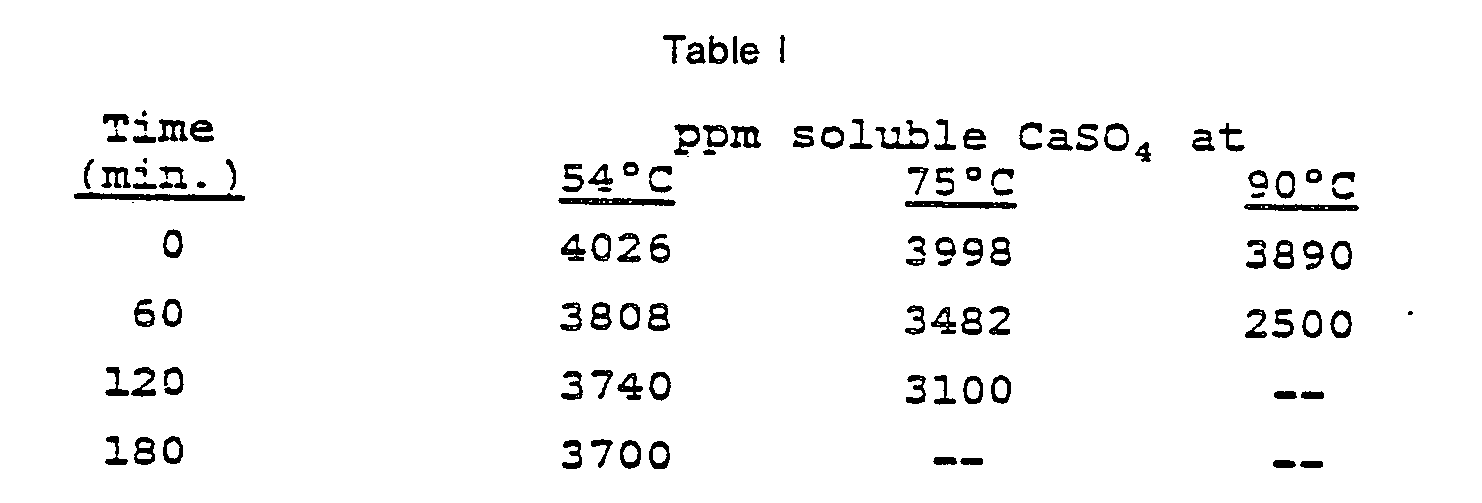
- The product of Example 1 was evaluated in the test equipment of Example A at 10 ppm (active acid) at temperatures of 54 °C, 75 °C, and 90 °C. The data is summarized in Table I. The data indicates the effectiveness of the DCE/AEP phosphonate inhibitor. It prevents deposition of scale at 54 °C (as in the contacting section) but then allows the calcium sulfate to precipitate on heating (as in the sump section). Dashed lines indicate that no measurement was taken.
- A supersaturated solution of calcium sulfate was prepared containing 10 ppm of aminot- rimethylenephosphonic acid (ATMPA), a commercially available organophosphonic acid inhibitor. The solution was circulated at 54 °C and titrated periodically for soluble calcium. The same thing was done, but employing a commercially available aminomethylenephosphonic acid, diethylenetriaminepentamethylenephosphonic acid (DETA-MPA), again at 10 ppm based on the weight of solution. The results are tabulated in Table II.

- A significant amount of calcium sulfate had accumulated on the packing with ATMPA after 1-2 hours. This data indicates that the inhibitor is not effective in maintaining the calcium in solution, i. e. preventing scale formation, in the packed contacting section of the desulfurization process described. Very little calcium sulfate scale was noticed on the packing when using DETA-MPA either at 54 °C or 75 °C. This shows that the diethylenetriaminepentamethylenephosphonic acid was effective at controlling scale formation at 54 °C in the same packed contacting section but would not allow precipitation to occur on heating at 75 °C as in the sump section of the described process. A repeat run at 90 °C did not result in deposition of calcium sulfate.
- Aminoethylpiperazine, the compound from which the methylenephosphonate of the present invention is made, was reacted with formaldehyde and phosphorous acid to make its trimethylenephosphonic acid derivative. This was used at 10 ppm (active acid) as in Comparative Example B. Little, if any, calcium sulfate scale was observed on the packing at either 54° or 75 °C. As in Comparative Example B, the aminoethylpiperazinetrimethylenephosphonic acid inhibitor is not suited for use in the desulfurization unit since it would not allow the calcium sulfate to precipitate at 75 °C, but kept it in solution at both temperatures.
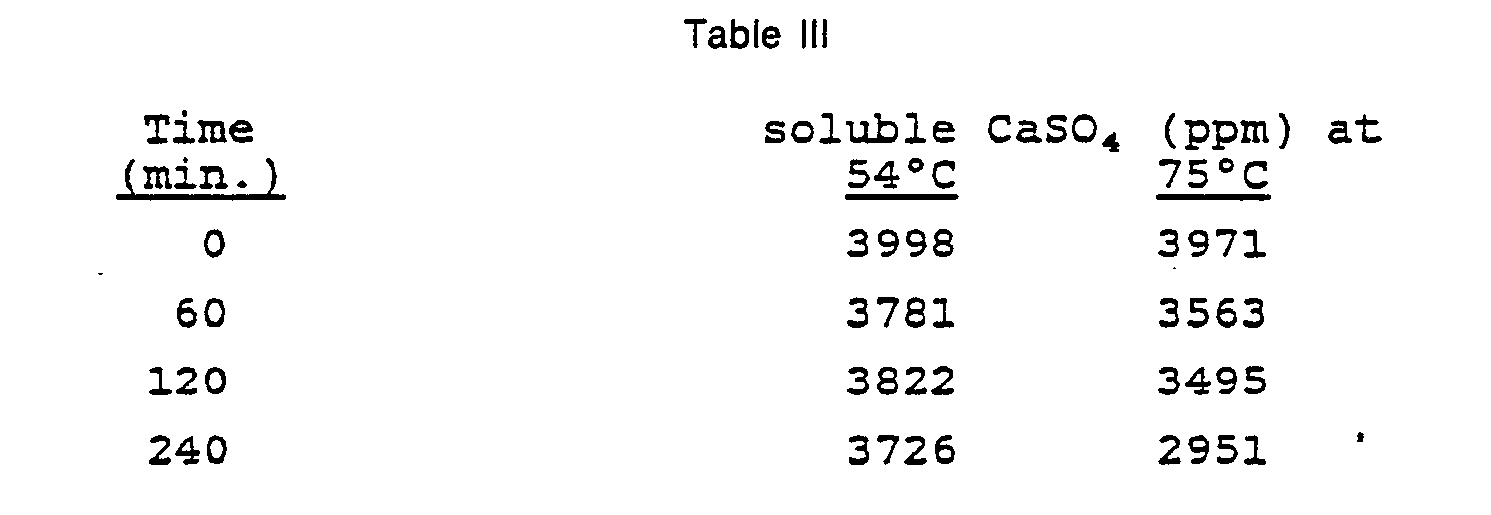
- An aminoethylpiperazine derived amine was prepared by reacting aminoethylpiperazine and 1.2-dichloroethane in a DCE/AEP mole ratio of 0.80. The product was phosphonomethylated with phosphorous acid and methanal (formaldehyde) in the presence of hydrochloric acid to give the methylenephosphonic acid derivative. The product was evaluated at 10 ppm (active acid) at temperatures of 54 °C and 75 °C as in Example 2. Results are shown in Table III.
- The compounds that have been shown to be effective in the process are methylenephosphonic acids derived from the phosphonomethylation of N-aminoethylpiperazine-1.2-dichloroethane reaction products. In addition to the acid derivatives themselves various metal and alkali metal salts ; ammonium and amine salts ; partial salts of the methylenephosphonic acids ; and mixtures thereof can be employed.
- The preferred products are those that have had the aminohydrogens fully replaced by methylenephosphonic acid groups. However, some aminohydrogens can be left unreacted if desired. Preferably, at least 50 % of the aminohydrogens are reacted. Also, functionality in addition to the methylenephosphonic acid group can be incorporated into the compounds. Typical groups are hydroxyalkyl, methylenesulfonate, hydroxypropylsulfonate, carboxymethyl, etc.
- Thus, the present invention is an improvement in the process of gas desulfurization in which the gas is contacted with an aqueous solution or slurry of a calcium salt or hydroxide to remove the sulfur oxides contained therein. This contact causes the formation of calcium sulfate which precipitates as scale on the surfaces wherein the contact occurs. The invention is to employ a particular threshold agent which will inhibit the scale formation on the contact surfaces, but permit it to occur in another part of the system.
- Since, in the system described herein, the contact occurs at a lower temperature than in the quench section, it was discovered that a particular threshold agent which was effective at these contact temperatures, became less effective at the higher temperatures found in the quench. Thus, it was advantageous to use this agent to inhibit scale formation on the contact surfaces since it would allow precipitation of the scale in a later stage so that it could be removed and disposed of satisfactorily.
Claims (6)


Priority Applications (1)
| Application Number | Priority Date | Filing Date | Title |
|---|---|---|---|
| DE8484305723T DE3467303D1 (en) | 1984-08-22 | 1984-08-22 | The use of polymeric alkylenephosphoric acid piperazine derivatives for scale control in flue gas desulfurization |
Applications Claiming Priority (1)
| Application Number | Priority Date | Filing Date | Title |
|---|---|---|---|
| US06/434,676 US4469663A (en) | 1982-10-15 | 1982-10-15 | Scale control in flue gas desulfurization |
Publications (2)
| Publication Number | Publication Date |
|---|---|
| EP0172288A1 EP0172288A1 (en) | 1986-02-26 |
| EP0172288B1 true EP0172288B1 (en) | 1987-11-11 |
Family
ID=23725208
Family Applications (1)
| Application Number | Title | Priority Date | Filing Date |
|---|---|---|---|
| EP84305723A Expired EP0172288B1 (en) | 1982-10-15 | 1984-08-22 | The use of polymeric alkylenephosphoric acid piperazine derivatives for scale control in flue gas desulfurization |
Country Status (6)
| Country | Link |
|---|---|
| US (1) | US4469663A (en) |
| EP (1) | EP0172288B1 (en) |
| JP (1) | JPS6161617A (en) |
| AU (1) | AU573617B2 (en) |
| CA (1) | CA1215822A (en) |
| IN (1) | IN161736B (en) |
Families Citing this family (17)
| Publication number | Priority date | Publication date | Assignee | Title |
|---|---|---|---|---|
| FI78846B (en) * | 1985-04-24 | 1989-06-30 | Tampella Oy Ab | FOERFARANDE FOER AVLAEGSNANDE AV GASFORMIGA SVAVELFOERENINGAR OCH SVAVELDIOXID UR ROEKGASER I EN PANNA. |
| US4783327A (en) * | 1987-08-13 | 1988-11-08 | The Dow Chemical Company | Sulfur dioxide removal from gas streams using hydroxyalkyl substituted piperazinones |
| US4735787A (en) * | 1987-08-17 | 1988-04-05 | Nalco Chemical Company | Scale inhibitor for intermittent washed mist eliminators in flue gas desulfurization systems |
| US4786329A (en) * | 1987-09-09 | 1988-11-22 | The Dow Chemical Company | Asphalt compositions containing anti-stripping additives prepared from amines or polyamines and phosphonates |
| HUT51924A (en) * | 1988-05-26 | 1990-06-28 | Jednotne Zemedelske Druzstvo P | Method and apparatus for removing the hydrocarbons and their derivatives from gas mixtures |
| DE3925424A1 (en) * | 1989-08-01 | 1991-02-07 | Basf Ag | METHOD FOR REDUCING THE OXIDATION SPEED OF SULPHATE SOLUTIONS |
| US5120516A (en) * | 1990-01-08 | 1992-06-09 | Physical Sciences, Inc. | Process for removing nox emissions from combustion effluents |
| US5098681A (en) * | 1990-08-16 | 1992-03-24 | The Dow Chemical Company | Process for absorption of sulfur compounds from fluids |
| US5236678A (en) * | 1990-08-16 | 1993-08-17 | The Dow Chemical Company | Process for absorption of sulfur compounds from fluids using piperidines |
| US5108723A (en) * | 1990-08-16 | 1992-04-28 | The Dow Chemical Company | Process for absorption of sulfur compounds from fluids |
| CA2049244A1 (en) * | 1990-08-16 | 1992-02-17 | Steven H. Christiansen | Process for absorption of sulfur compounds from fluids using heterocyclic compounds having at least one ring nitrogen atom |
| JPH06502349A (en) * | 1991-08-13 | 1994-03-17 | ザ ダウ ケミカル カンパニー | Compositions and methods for simultaneous absorption of sulfur dioxide and nitrogen oxide |
| US5202103A (en) * | 1991-12-20 | 1993-04-13 | Union Carbide Chemicals & Plastics Technology Corporation | Removal of sulfur dioxide from gas streams |
| DE10204818C2 (en) | 2002-02-06 | 2003-11-27 | Eurotope Entwicklungsgesellsch | Device and method for loading implantation needles with radiation sources from radiation source chains for interstitial brachytherapy of tissue |
| DE50307128D1 (en) * | 2003-06-03 | 2007-06-06 | Eckert & Ziegler Eurotope Gmbh | Apparatus and method for loading implanted hollow needles with radiation sources from radiation source chains for interstitial brachytherapy of tissue |
| US9303214B2 (en) * | 2012-02-29 | 2016-04-05 | Uop Llc | Process, vessel, and apparatus for removing one or more sulfur compounds |
| CN102580504A (en) * | 2012-03-07 | 2012-07-18 | 武汉兴能环保技术有限公司 | Novel ammonia desulphurization absorption device |
Family Cites Families (21)
| Publication number | Priority date | Publication date | Assignee | Title |
|---|---|---|---|---|
| US3303139A (en) * | 1962-01-27 | 1967-02-07 | Henkel & Cie Gmbh | Aminophosphonic acids and their derivatives as complex formers for metal ions |
| US3859211A (en) * | 1968-10-17 | 1975-01-07 | Petrolite Corp | Water clarification with nitrogen-heterocyclic phosphonic acids |
| US3799893A (en) * | 1971-03-31 | 1974-03-26 | Petrolite Corp | Methylene phosphonates of glycidyl reacted polyamines |
| US3883639A (en) * | 1971-08-12 | 1975-05-13 | Pullman Inc | Method of removing sulfur-containing gases from waste gas |
| US4003848A (en) * | 1974-12-10 | 1977-01-18 | Union Carbide Corporation | Method for the adsorption of sulfur dioxide |
| US4148615A (en) * | 1974-12-30 | 1979-04-10 | Kennecott Copper Corporation | Prevention of scale formation in wet lime scrubbers |
| DE2551717C3 (en) * | 1975-11-18 | 1980-11-13 | Basf Ag, 6700 Ludwigshafen | and possibly COS from gases |
| SE435456B (en) * | 1976-01-07 | 1984-10-01 | Calgon Corp | COMPOSITION AND PROCEDURE TO CONTROL THE BUILDING OF THE FLAVOR IN GAS WASHER |
| US4171292A (en) * | 1976-08-05 | 1979-10-16 | Betz Laboratories, Inc. | Compositions for treating aqueous mediums containing magnesium sulfite trihydrate |
| US4118318A (en) * | 1976-10-26 | 1978-10-03 | Calgon Corporation | Gas scrubber scale and deposit control |
| DE2657971A1 (en) * | 1976-12-21 | 1978-06-29 | Kobe Steel Ltd | METHOD OF REMOVING SULFUR DIOXIDE FROM A GAS |
| US4100256A (en) * | 1977-03-18 | 1978-07-11 | The Dow Chemical Company | Hydrolysis of carbon oxysulfide |
| US4138353A (en) * | 1977-04-01 | 1979-02-06 | The Mogul Corporation | Corrosion inhibiting composition and process of using same |
| US4150096A (en) * | 1977-10-31 | 1979-04-17 | Nelms William M | Process for treating combustion gases |
| US4177245A (en) * | 1978-05-24 | 1979-12-04 | Battelle Development Corporation | Scale suppression in lime and limestone scrubbers |
| HU181873B (en) * | 1978-08-22 | 1983-11-28 | Egyt Gyogyszervegyeszeti Gyar | Plant growth regulating and/or insecticide composition containing 2-/propagyl-oxy-imino/-1,7,7-trimethyl-byciclo/2.2.1/heptane further process for preparing the active suastance |
| US4216087A (en) * | 1978-12-18 | 1980-08-05 | The Dow Chemical Company | Scrubber scale prevention |
| BR8103078A (en) * | 1980-05-24 | 1982-02-09 | Hoelter H | PROCESS AND DEVICE FOR THE DISPOSAL OF Sulfurous Anhydride AND OTHER HARMFUL SUBSTANCES OF SMOKE GAS |
| US4409192A (en) * | 1982-04-26 | 1983-10-11 | Betz Laboratories, Inc. | Gas scrubbing methods |
| CA1207211A (en) * | 1982-09-27 | 1986-07-08 | Dionisio G. Cuisia | Composition and method for inhibiting scale |
| US4489203A (en) * | 1982-09-27 | 1984-12-18 | The Dow Chemical Company | Polyumeric alkylene phosphoric acid piperazine derivatives as scale inhibitors |
-
1982
- 1982-10-15 US US06/434,676 patent/US4469663A/en not_active Expired - Fee Related
-
1984
- 1984-08-20 CA CA000461337A patent/CA1215822A/en not_active Expired
- 1984-08-22 EP EP84305723A patent/EP0172288B1/en not_active Expired
- 1984-08-31 AU AU32597/84A patent/AU573617B2/en not_active Expired - Fee Related
- 1984-09-03 JP JP59182917A patent/JPS6161617A/en active Pending
- 1984-09-04 IN IN675/MAS/84A patent/IN161736B/en unknown
Also Published As
| Publication number | Publication date |
|---|---|
| AU3259784A (en) | 1986-03-06 |
| JPS6161617A (en) | 1986-03-29 |
| AU573617B2 (en) | 1988-06-16 |
| CA1215822A (en) | 1986-12-30 |
| IN161736B (en) | 1988-01-30 |
| EP0172288A1 (en) | 1986-02-26 |
| US4469663A (en) | 1984-09-04 |
Similar Documents
| Publication | Publication Date | Title |
|---|---|---|
| EP0172288A1 (en) | The use of polymeric alkylenephosphoric acid piperazine derivatives for scale control in flue gas desulfurization | |
| US4834955A (en) | Chemical formulation and combined process for inhibiting deposition and corrosion in cooling water and gypsum scaling in flue gas desulfurization scrubber systems | |
| US2917528A (en) | Alkanolaminealkanephosphonic acids and salts thereof | |
| US3799893A (en) | Methylene phosphonates of glycidyl reacted polyamines | |
| US4051110A (en) | Methylene phosphonates of polymerized polyalkylenepolyamines | |
| US3923876A (en) | Complex formers for polyvalent metal ions | |
| US5489666A (en) | Control of scale formation in aqueous systems | |
| US3956164A (en) | Chelating agents | |
| US4079006A (en) | Methods of scale inhibition | |
| US4409192A (en) | Gas scrubbing methods | |
| EP0172950B1 (en) | Polymeric alkylenephosphoric acid piperazine derivatives as scale inhibitors | |
| US5616278A (en) | Inhibition of scale and corrosion in aqueous systems | |
| US4462976A (en) | Method for the treatment of chloride-containing waste waters | |
| US5871691A (en) | Inhibition of corrosion in aqueous systems | |
| KR900006083B1 (en) | Polymeric alkylene phosphoric acid piperazine derivatives for scale control in flue gas desulfurization | |
| US3393150A (en) | Methods of scale inhibition | |
| US4012440A (en) | Methylene phosphonates of oxyalkylated polyalkylene polyamines and uses therefor | |
| US4088574A (en) | Employing methylene phosphonates of oxyalkylated polyalkylene polyamines in chelation and/or scale inhibition | |
| US3453301A (en) | Tris-betahydroxyethyl phosphonomethylene ammonium compounds | |
| US4216087A (en) | Scrubber scale prevention | |
| CA1090818A (en) | 2,2,2-tris (hydroxymethyl) ethylphosphonic acid and method for its preparation | |
| US4680396A (en) | Bis(aminoalkyl)piperazine derivatives and their use as metal ion control agents | |
| NO843343L (en) | PROCEDURE FOR GAS desulfurization. | |
| US4243591A (en) | Poly(vinyl phosphonomethylene amino carboxylates) and process for preparation | |
| US3974209A (en) | Substituted tertiary amines and processes for preparing the same |
Legal Events
| Date | Code | Title | Description |
|---|---|---|---|
| PUAI | Public reference made under article 153(3) epc to a published international application that has entered the european phase |
Free format text: ORIGINAL CODE: 0009012 |
|
| AK | Designated contracting states |
Designated state(s): DE FR GB IT NL SE |
|
| 17P | Request for examination filed |
Effective date: 19860611 |
|
| 17Q | First examination report despatched |
Effective date: 19870227 |
|
| GRAA | (expected) grant |
Free format text: ORIGINAL CODE: 0009210 |
|
| AK | Designated contracting states |
Kind code of ref document: B1 Designated state(s): DE FR GB IT NL SE |
|
| REF | Corresponds to: |
Ref document number: 3467303 Country of ref document: DE Date of ref document: 19871217 |
|
| ET | Fr: translation filed | ||
| ITF | It: translation for a ep patent filed | ||
| PLBE | No opposition filed within time limit |
Free format text: ORIGINAL CODE: 0009261 |
|
| STAA | Information on the status of an ep patent application or granted ep patent |
Free format text: STATUS: NO OPPOSITION FILED WITHIN TIME LIMIT |
|
| 26N | No opposition filed | ||
| PG25 | Lapsed in a contracting state [announced via postgrant information from national office to epo] |
Ref country code: GB Effective date: 19890822 |
|
| PG25 | Lapsed in a contracting state [announced via postgrant information from national office to epo] |
Ref country code: SE Effective date: 19890823 |
|
| PG25 | Lapsed in a contracting state [announced via postgrant information from national office to epo] |
Ref country code: NL Effective date: 19900301 |
|
| NLV4 | Nl: lapsed or anulled due to non-payment of the annual fee | ||
| GBPC | Gb: european patent ceased through non-payment of renewal fee | ||
| PG25 | Lapsed in a contracting state [announced via postgrant information from national office to epo] |
Ref country code: FR Effective date: 19900427 |
|
| PG25 | Lapsed in a contracting state [announced via postgrant information from national office to epo] |
Ref country code: DE Effective date: 19900501 |
|
| REG | Reference to a national code |
Ref country code: FR Ref legal event code: ST |
|
| EUG | Se: european patent has lapsed |
Ref document number: 84305723.3 Effective date: 19900418 |