EP0169374B1 - Method of preventing stress corrosion cracking in machines or machine parts made of austenitic cast iron - Google Patents
Method of preventing stress corrosion cracking in machines or machine parts made of austenitic cast iron Download PDFInfo
- Publication number
- EP0169374B1 EP0169374B1 EP19850107588 EP85107588A EP0169374B1 EP 0169374 B1 EP0169374 B1 EP 0169374B1 EP 19850107588 EP19850107588 EP 19850107588 EP 85107588 A EP85107588 A EP 85107588A EP 0169374 B1 EP0169374 B1 EP 0169374B1
- Authority
- EP
- European Patent Office
- Prior art keywords
- cast iron
- scc
- austenitic cast
- type
- machine
- Prior art date
- Legal status (The legal status is an assumption and is not a legal conclusion. Google has not performed a legal analysis and makes no representation as to the accuracy of the status listed.)
- Expired
Links
- 229910001018 Cast iron Inorganic materials 0.000 title claims description 53
- 238000000034 method Methods 0.000 title claims description 20
- 230000007797 corrosion Effects 0.000 title claims description 15
- 238000005260 corrosion Methods 0.000 title claims description 15
- 238000005336 cracking Methods 0.000 title claims description 7
- 230000010287 polarization Effects 0.000 claims description 16
- 150000003839 salts Chemical class 0.000 claims description 11
- XLYOFNOQVPJJNP-UHFFFAOYSA-N water Substances O XLYOFNOQVPJJNP-UHFFFAOYSA-N 0.000 claims description 11
- FAPWRFPIFSIZLT-UHFFFAOYSA-M Sodium chloride Chemical compound [Na+].[Cl-] FAPWRFPIFSIZLT-UHFFFAOYSA-M 0.000 description 26
- 238000012360 testing method Methods 0.000 description 22
- 239000013535 sea water Substances 0.000 description 19
- 239000011780 sodium chloride Substances 0.000 description 13
- 239000003973 paint Substances 0.000 description 9
- 229910052751 metal Inorganic materials 0.000 description 7
- 239000002184 metal Substances 0.000 description 7
- XEEYBQQBJWHFJM-UHFFFAOYSA-N Iron Chemical compound [Fe] XEEYBQQBJWHFJM-UHFFFAOYSA-N 0.000 description 6
- VEXZGXHMUGYJMC-UHFFFAOYSA-M Chloride anion Chemical compound [Cl-] VEXZGXHMUGYJMC-UHFFFAOYSA-M 0.000 description 5
- HCHKCACWOHOZIP-UHFFFAOYSA-N Zinc Chemical compound [Zn] HCHKCACWOHOZIP-UHFFFAOYSA-N 0.000 description 5
- 229910052782 aluminium Inorganic materials 0.000 description 5
- XAGFODPZIPBFFR-UHFFFAOYSA-N aluminium Chemical compound [Al] XAGFODPZIPBFFR-UHFFFAOYSA-N 0.000 description 5
- 229910000963 austenitic stainless steel Inorganic materials 0.000 description 5
- 229910052725 zinc Inorganic materials 0.000 description 5
- 239000011701 zinc Substances 0.000 description 5
- 239000000203 mixture Substances 0.000 description 4
- 229920005989 resin Polymers 0.000 description 4
- 239000011347 resin Substances 0.000 description 4
- HEMHJVSKTPXQMS-UHFFFAOYSA-M Sodium hydroxide Chemical compound [OH-].[Na+] HEMHJVSKTPXQMS-UHFFFAOYSA-M 0.000 description 3
- 230000000694 effects Effects 0.000 description 3
- 238000002474 experimental method Methods 0.000 description 3
- 229910052742 iron Inorganic materials 0.000 description 3
- 239000000463 material Substances 0.000 description 3
- 150000002739 metals Chemical class 0.000 description 3
- 239000000843 powder Substances 0.000 description 3
- OKTJSMMVPCPJKN-UHFFFAOYSA-N Carbon Chemical compound [C] OKTJSMMVPCPJKN-UHFFFAOYSA-N 0.000 description 2
- UFHFLCQGNIYNRP-UHFFFAOYSA-N Hydrogen Chemical compound [H][H] UFHFLCQGNIYNRP-UHFFFAOYSA-N 0.000 description 2
- FYYHWMGAXLPEAU-UHFFFAOYSA-N Magnesium Chemical compound [Mg] FYYHWMGAXLPEAU-UHFFFAOYSA-N 0.000 description 2
- TWRXJAOTZQYOKJ-UHFFFAOYSA-L Magnesium chloride Chemical compound [Mg+2].[Cl-].[Cl-] TWRXJAOTZQYOKJ-UHFFFAOYSA-L 0.000 description 2
- 229910000831 Steel Inorganic materials 0.000 description 2
- 238000013461 design Methods 0.000 description 2
- 239000003822 epoxy resin Substances 0.000 description 2
- 229910002804 graphite Inorganic materials 0.000 description 2
- 239000010439 graphite Substances 0.000 description 2
- 229910052739 hydrogen Inorganic materials 0.000 description 2
- 239000001257 hydrogen Substances 0.000 description 2
- 229910052749 magnesium Inorganic materials 0.000 description 2
- 239000011777 magnesium Substances 0.000 description 2
- 239000007769 metal material Substances 0.000 description 2
- 229920000647 polyepoxide Polymers 0.000 description 2
- 230000002265 prevention Effects 0.000 description 2
- 239000010959 steel Substances 0.000 description 2
- RWSOTUBLDIXVET-UHFFFAOYSA-N Dihydrogen sulfide Chemical compound S RWSOTUBLDIXVET-UHFFFAOYSA-N 0.000 description 1
- YZCKVEUIGOORGS-UHFFFAOYSA-N Hydrogen atom Chemical compound [H] YZCKVEUIGOORGS-UHFFFAOYSA-N 0.000 description 1
- 229910001209 Low-carbon steel Inorganic materials 0.000 description 1
- 239000004115 Sodium Silicate Substances 0.000 description 1
- 229910045601 alloy Inorganic materials 0.000 description 1
- 239000000956 alloy Substances 0.000 description 1
- 238000010349 cathodic reaction Methods 0.000 description 1
- 238000006243 chemical reaction Methods 0.000 description 1
- 238000001816 cooling Methods 0.000 description 1
- 230000007547 defect Effects 0.000 description 1
- 238000011161 development Methods 0.000 description 1
- ZOMNIUBKTOKEHS-UHFFFAOYSA-L dimercury dichloride Chemical class Cl[Hg][Hg]Cl ZOMNIUBKTOKEHS-UHFFFAOYSA-L 0.000 description 1
- 238000004090 dissolution Methods 0.000 description 1
- 239000012530 fluid Substances 0.000 description 1
- -1 for example Inorganic materials 0.000 description 1
- 238000010438 heat treatment Methods 0.000 description 1
- 229910000037 hydrogen sulfide Inorganic materials 0.000 description 1
- 238000007654 immersion Methods 0.000 description 1
- 230000003993 interaction Effects 0.000 description 1
- NPURPEXKKDAKIH-UHFFFAOYSA-N iodoimino(oxo)methane Chemical compound IN=C=O NPURPEXKKDAKIH-UHFFFAOYSA-N 0.000 description 1
- 229910001629 magnesium chloride Inorganic materials 0.000 description 1
- 230000000750 progressive effect Effects 0.000 description 1
- 230000002035 prolonged effect Effects 0.000 description 1
- 230000005476 size effect Effects 0.000 description 1
- NTHWMYGWWRZVTN-UHFFFAOYSA-N sodium silicate Chemical compound [Na+].[Na+].[O-][Si]([O-])=O NTHWMYGWWRZVTN-UHFFFAOYSA-N 0.000 description 1
- 229910052911 sodium silicate Inorganic materials 0.000 description 1
- 230000006641 stabilisation Effects 0.000 description 1
- 238000011105 stabilization Methods 0.000 description 1
- 229910001220 stainless steel Inorganic materials 0.000 description 1
- 239000010935 stainless steel Substances 0.000 description 1
- 239000000126 substance Substances 0.000 description 1
- 239000000758 substrate Substances 0.000 description 1
- 238000010998 test method Methods 0.000 description 1
Images

Classifications
-
- C—CHEMISTRY; METALLURGY
- C23—COATING METALLIC MATERIAL; COATING MATERIAL WITH METALLIC MATERIAL; CHEMICAL SURFACE TREATMENT; DIFFUSION TREATMENT OF METALLIC MATERIAL; COATING BY VACUUM EVAPORATION, BY SPUTTERING, BY ION IMPLANTATION OR BY CHEMICAL VAPOUR DEPOSITION, IN GENERAL; INHIBITING CORROSION OF METALLIC MATERIAL OR INCRUSTATION IN GENERAL
- C23F—NON-MECHANICAL REMOVAL OF METALLIC MATERIAL FROM SURFACE; INHIBITING CORROSION OF METALLIC MATERIAL OR INCRUSTATION IN GENERAL; MULTI-STEP PROCESSES FOR SURFACE TREATMENT OF METALLIC MATERIAL INVOLVING AT LEAST ONE PROCESS PROVIDED FOR IN CLASS C23 AND AT LEAST ONE PROCESS COVERED BY SUBCLASS C21D OR C22F OR CLASS C25
- C23F13/00—Inhibiting corrosion of metals by anodic or cathodic protection
- C23F13/02—Inhibiting corrosion of metals by anodic or cathodic protection cathodic; Selection of conditions, parameters or procedures for cathodic protection, e.g. of electrical conditions
Definitions
- the present invention relates to a method of preventing the occurrence of stress corrosion cracking in machine or machine parts made of austenitic cast iron.
- Austenitic cast iron i.e., ASTM A 436 of the flaky graphite type or ASTM A 439 of the nodular graphite type, containing 13.5-22 wt% of Ni (all percents noted hereinafter are by weight) exhibits good corrosion resistance in seawater and other corrosive environments containing chloride ions (CI-) and is preferentially used in pumps, valves and piping associated with the handling of concentrated or unconcentrated seawater.
- CI- chloride ions
- austenitic cast iron to general corrosion is such that the corrosion rate is only about 0.1 mm/year in seawater at ordinary temperatures. Unlike mild steels and cast iron, the increase in the rate of general corrosion in austenitic cast iron situated in flowing seawater over that in standing seawater is negligible, and if the seawater flows faster, the rate of corrosion is even seen to decrease. Additionally, austenitic cast iron is not susceptible to localized corrosions such as the crevice corrosion and pitting corrosion that are common to stainless steel. Because of the balanced resistance to various forms of corrosion, austenitic cast iron is extensively used in machines and machine parts that handle seawater and other corrosive fluids.
- Alloys having the austenitic structure such as Cr-Ni austenitic stainless steel are well known to be susceptible to SCC in chloride solutions, but very few cases have been reported on the occurrence of SCC at temperatures lower than 50°C. SCC may occur at ordinary temperatures as a result of hydrogen embrittlement, but the susceptibility of the austenitic structure to hydrogen embrittlement is low.
- the present inventors made various studies to unravel the behavior of austenitic cast iron in relation to its failure in seawater and other corrosive environments. As a results, the inventors have located the cause of such failure and devised a method for its prevention.
- the present invention therefore, provides a method for preventing the occurrence of SCC in machines or machine parts made of austenitic cast iron which are intended for handling salt water, or any type of the solutions that contain chloride ions CI- such as seawater, enriched seawater and diluted seawater.
- This method is characterized by cathodic polarization of the machine or machine part of interest.
- the ferritic cast iron species, JIS FC20, JIS FCD45, ES51 F and ES51, as well as the austenitic stainless steel JIS SCS 14 did not fail in a 2,000-hour period and not a single tiny crack developed in the test pieces.
- austenitic cast iron develops SCC in salt water in the vicinity of ordinary temperatures whereas ferritic cast iron and austenitic stainless steel are free from such phenomenon was first discovered by the present inventors. It was quite surprising and in conflict with metallurgical common sense to find that SCC should occur in austenitic cast iron submerged in salt water at ordinary temperatures or in its vicinity.
- a third way is to use an austenitic cast iron having a higher Ni content because the data in Table 2 shows that such cast iron had longer rupture periods.
- Table 2 shows that such cast iron had longer rupture periods.
- even such high Ni austenitic cast iron is susceptible to SCC, and additionally, the inclusion of much Ni increases the cost.
- the best way is to directly prevent the occurrence of SCC in austenitic cast iron; if this is possible, the machines or machine parts made of austenitic cast iron can be used in salt water without experiencing SCC-induced failure, and furthermore, economical machine design can be realized since the possibility of a drop in rupture stress within corrosive environments is eliminated.
- the mechanism behind SCC in austenitic cast iron must first be unravelled in order to devise a method for its prevention.
- Two types of SCC are generally known: an example of the first type of SCC is that which occurs in austenitic stainless steel under a chloride environment, and in this type of SCC, the anodic reaction causes progressive cracking; an example of the second type of SCC is that which occurs in high- strength steels in an environment containing hydrogen sulfide, and in this type of SCC, atomic hydrogen formed by cathodic reaction enters the structure to cause its embrittlement.
- the two types of SCC combine to accelerate cracking.
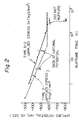
- Type 2 and Type D-2 samples Two sets of Type 2 and Type D-2 samples were provided; one set of samples was subjected to an SCC test while they were held at varying applied potentials, and the other set was tested under their natural potentials.
- the test pieces had a diameter of 3 mm.
- Type 2 samples were subjected to a stress of 15 kgf/ mm 2 and Type D-2 samples were subjected to a stress of 34.7 kgf/mm 2 .
- the samples were submerged in 7% NaCl at 33°C.
- the rupture times as a function of applied potential vs. SCE (saturated calomel electrode) was measured and are shown in Fig. 2.
- Type 2 failed at 4 hours, with the natural potential varying from -430 mV to -490 mV.
- Type D-2 failed at 23 hours, with the natural potential varying from -460 mV to -550 mV.
- the rupture times of both Type 2 and Type D-2 were appreciably reduced when they were held at potentials more noble than the natural potentials. On the other hand, the rupture times were considerably prolonged by setting the samples at potentials more base (less noble) than the natural potentials.
- -570 mV neither Type 2 nor Type D-2 cracked even after 350 hours. At more base -800 mV, no crack occurred in either type of samples after 420 hours.
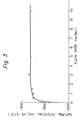
- Fig. 3 shows the relationship between the flow rate of the NaCI solution and the natural potential at 48 hours.
- the natural potential was initially -530 mV when the NaCl solution was not flowing, but the potential rapidly became noble as the flow rate increased, and at flow rates of 0.5 m/sec and higher, the potential remained substantially constant at about -440 mV.
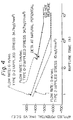
- Fig. 4 shows the applied potential vs. rupture time for Type D-2 under an applied stress of 34.7 kgf/mm 2.
- Type D-2 failed at 28 hours, with its natural potential varying from -410 mV to -435 mV.
- Type D-2 was held more base than the natural potential, the rupture time was extended and no crack occurred at -490 mV even after 1,200 hours.
- the present invention is based on the above findings and is characterized by preventing the occurrence of SCC in austenitic cast iron by means of cathodic polarization.
- the applied potential necessary for preventing the occurrence of SCC is preferably more base than about -570 mV in the case of a standing salt water in the vicinity of ordinary temperatures, and is preferably more base than about -490 mV if the salt water is flowing.
- the life of austenitic cast iron can be significantly extended by means of cathodic polarization.
- the natural potential of austenitic cast iron will vary depending upon the concentration of salt water, its temperature, flow rate and the immersion time.
- the natural potentials of the samples of austenitic cast iron were not sufficiently stabilized for examining the effects of applied potential on SCC. Therefore, another experiment was conducted to measure the natural potentials at 48 hours which was considered sufficiently long for their stabilization. The results are shown in Table 3, which also lists the applied potentials necessary for preventing the occurrence of SCC in austenitic cast iron.
- Cathodic polarization can be realized either by the impressed current method (forced drainage method) using a rectifier, battery or a dc generator, or by the galvanic anode method using the potential difference between dissimilar metals.
- the former method has the advantage that a desired potential can be selected.
- the anode for the galvanic anode method may be made of any of the metallic materials that are more base than austenitic cast iron, for example, iron, ferritic cast iron, zinc, aluminum, magnesium, and paint compositions having these metals dispersed in resins. These materials may be used either alone or in combination.
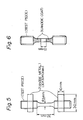
- Fig. 5 illustrates a test piece to which anode metal pieces 2 (30 x 30 x 10 mm) were attached.
- Fig. 6 shows a test piece provided with an anodic coat 3 formed from a paint composition having a powder of anodic metal dispersed in a resin.
- ferritic cast iron JIS FC20 ferritic cast iron JIS FC20
- mild steel JIS SS 41 pure iron
- aluminum zinc and magnesium
- the following two paint compositions were used: zinc paint and aluminum paint.
- the zinc paint contained 36 vol% of zinc in an epoxy resin whereas the aluminum paint contained 45 vol% of aluminum in an epoxy resin.
- Table 4 The test results are shown in Table 4.
Landscapes
- Chemical & Material Sciences (AREA)
- Engineering & Computer Science (AREA)
- Materials Engineering (AREA)
- Mechanical Engineering (AREA)
- Metallurgy (AREA)
- Organic Chemistry (AREA)
- Prevention Of Electric Corrosion (AREA)
Applications Claiming Priority (2)
| Application Number | Priority Date | Filing Date | Title |
|---|---|---|---|
| JP59127631A JPS619584A (ja) | 1984-06-22 | 1984-06-22 | オ−ステナイト鋳鉄機器の応力腐食割れを防止する方法 |
| JP127631/84 | 1984-06-22 |
Publications (3)
| Publication Number | Publication Date |
|---|---|
| EP0169374A2 EP0169374A2 (en) | 1986-01-29 |
| EP0169374A3 EP0169374A3 (en) | 1986-03-26 |
| EP0169374B1 true EP0169374B1 (en) | 1989-04-05 |
Family
ID=14964866
Family Applications (1)
| Application Number | Title | Priority Date | Filing Date |
|---|---|---|---|
| EP19850107588 Expired EP0169374B1 (en) | 1984-06-22 | 1985-06-19 | Method of preventing stress corrosion cracking in machines or machine parts made of austenitic cast iron |
Country Status (3)
| Country | Link |
|---|---|
| EP (1) | EP0169374B1 (enExample) |
| JP (1) | JPS619584A (enExample) |
| DE (1) | DE3569266D1 (enExample) |
Families Citing this family (5)
| Publication number | Priority date | Publication date | Assignee | Title |
|---|---|---|---|---|
| JPH0131030Y2 (enExample) * | 1986-08-20 | 1989-09-22 | ||
| US4796440A (en) * | 1987-01-28 | 1989-01-10 | Sanyei Corp. | Ice cream maker |
| US5577083A (en) * | 1994-05-09 | 1996-11-19 | General Electric Company | Method and apparatus for electro-protection of piping systems and reactor-internals from stress corrosion cracking |
| JP2009273880A (ja) | 2008-04-17 | 2009-11-26 | Canon Inc | 超音波診断装置及び超音波探触子の動作の試験方法 |
| ITMI20110861A1 (it) * | 2011-05-17 | 2012-11-18 | Fonderia Casati S P A | Ghisa a grafite sferoidale ad alto tenore di legante con struttura austenitica, uso di detta ghisa per la fabbricazione di componenti strutturali e componente strutturale realizzato con detta ghisa |
Family Cites Families (2)
| Publication number | Priority date | Publication date | Assignee | Title |
|---|---|---|---|---|
| CH548458A (de) * | 1971-08-23 | 1974-04-30 | Bbc Brown Boveri & Cie | Schutzueberzug gegen spannungsrisskorrosion. |
| US4152236A (en) * | 1977-08-05 | 1979-05-01 | American Can Company | Apparatus for controlled potential pitting corrosion protection of long, narrow stainless steel tubes |
-
1984
- 1984-06-22 JP JP59127631A patent/JPS619584A/ja active Granted
-
1985
- 1985-06-19 EP EP19850107588 patent/EP0169374B1/en not_active Expired
- 1985-06-19 DE DE8585107588T patent/DE3569266D1/de not_active Expired
Also Published As
| Publication number | Publication date |
|---|---|
| EP0169374A2 (en) | 1986-01-29 |
| DE3569266D1 (en) | 1989-05-11 |
| JPS619584A (ja) | 1986-01-17 |
| JPH0371519B2 (enExample) | 1991-11-13 |
| EP0169374A3 (en) | 1986-03-26 |
Similar Documents
| Publication | Publication Date | Title |
|---|---|---|
| Harsimran et al. | Overview of corrosion and its control: A critical review | |
| EP2377963A1 (en) | Corrosion-resistant steel material for crude oil tanker | |
| Neville et al. | Characterisation of high-grade alloy behaviour in severe erosion–corrosion conditions | |
| Kim et al. | An electrochemical study of cathodic protection of steel used for marine structures | |
| EP0169374A2 (en) | Method of preventing stress corrosion cracking in machines or machine parts made of austenitic cast iron | |
| DAGDAG | An overview of corrosion | |
| EP0169373B1 (en) | Machines or machine parts made of austenitic cast iron having resistance to stress corrosion cracking | |
| Skar et al. | A review of materials application limits in NORSOK M-001 and ISO 21457 | |
| US5667649A (en) | Corrosion-resistant ferrous alloys for use as impressed current anodes | |
| Copson | The influence of corrosion on the cracking of pressure vessels | |
| Skar et al. | Development of the NORSOK M-001 and ISO 21457 Standards–Basis for Defining Materials Application Limits | |
| Majed et al. | Mechanical properties and corrosion behavior of low carbon steel weldments | |
| Kim et al. | Electrochemical properties and corrosion protection of stainless steel for hot water tank | |
| Hango et al. | Comparative analysis of corrosion resistance in Ni-, Cu-and Co-based alloys in synthetic mine water | |
| Hadzihafizovic | Comparing NACE MR0175/ISO 15156 Vs NACE MR0103/ISO 17495-1 | |
| Adrian et al. | Effect of metallurgical development on the corrosion of carbon and low-alloy construction steels for ship building and harbour construction | |
| Naville et al. | Hydrogen stress cracking in power generator M42 galvanized martensitic carbon steel screws | |
| Byrne et al. | Corrosion Management of Assets Construction Super Duplex Stainless Steels Topside and Subsea–A Suppliers Perspective | |
| Karafyllias | The effect of acidity and salinity level in erosion-corrosion performance of metals | |
| Krakowiak et al. | Corrosion of stainless steel underwater constructions in the Baltic Sea environment | |
| Harvey et al. | Corrosion fatigue behavior of 90/10 copper-nickel cladding for marine structures | |
| Klechka et al. | Practical considerations for upper limits of cathodic protection | |
| Allen et al. | Cathodic protection of stainless steels against crevice corrosion | |
| Samusawa et al. | Development of carbon steel for pipe resistant to stress corrosion cracking in fuel grade Ethanol | |
| Baloun | Corrosion Testing in New York Reservoirs and Investigations of In-Service Corrosion |
Legal Events
| Date | Code | Title | Description |
|---|---|---|---|
| PUAI | Public reference made under article 153(3) epc to a published international application that has entered the european phase |
Free format text: ORIGINAL CODE: 0009012 |
|
| AK | Designated contracting states |
Designated state(s): DE FR GB IT SE |
|
| PUAL | Search report despatched |
Free format text: ORIGINAL CODE: 0009013 |
|
| AK | Designated contracting states |
Kind code of ref document: A3 Designated state(s): DE FR GB IT SE |
|
| 17P | Request for examination filed |
Effective date: 19860725 |
|
| 17Q | First examination report despatched |
Effective date: 19870605 |
|
| ITF | It: translation for a ep patent filed | ||
| GRAA | (expected) grant |
Free format text: ORIGINAL CODE: 0009210 |
|
| AK | Designated contracting states |
Kind code of ref document: B1 Designated state(s): DE FR GB IT SE |
|
| REF | Corresponds to: |
Ref document number: 3569266 Country of ref document: DE Date of ref document: 19890511 |
|
| ET | Fr: translation filed | ||
| PLBI | Opposition filed |
Free format text: ORIGINAL CODE: 0009260 |
|
| 26 | Opposition filed |
Opponent name: KSB AKTIENGESELLSCHAFT Effective date: 19900103 |
|
| ITTA | It: last paid annual fee | ||
| PGFP | Annual fee paid to national office [announced via postgrant information from national office to epo] |
Ref country code: SE Payment date: 19940524 Year of fee payment: 10 |
|
| PGFP | Annual fee paid to national office [announced via postgrant information from national office to epo] |
Ref country code: GB Payment date: 19940607 Year of fee payment: 10 |
|
| PGFP | Annual fee paid to national office [announced via postgrant information from national office to epo] |
Ref country code: FR Payment date: 19940628 Year of fee payment: 10 |
|
| PGFP | Annual fee paid to national office [announced via postgrant information from national office to epo] |
Ref country code: DE Payment date: 19940829 Year of fee payment: 10 |
|
| RDAG | Patent revoked |
Free format text: ORIGINAL CODE: 0009271 |
|
| STAA | Information on the status of an ep patent application or granted ep patent |
Free format text: STATUS: PATENT REVOKED |
|
| EUG | Se: european patent has lapsed |
Ref document number: 85107588.7 Effective date: 19950315 |
|
| 27W | Patent revoked |
Effective date: 19940824 |
|
| GBPR | Gb: patent revoked under art. 102 of the ep convention designating the uk as contracting state |
Free format text: 940824 |
|
| APAH | Appeal reference modified |
Free format text: ORIGINAL CODE: EPIDOSCREFNO |