EP0167919B1 - Benzodiazepine derivatives and pharmaceutical compositions containing them - Google Patents
Benzodiazepine derivatives and pharmaceutical compositions containing them Download PDFInfo
- Publication number
- EP0167919B1 EP0167919B1 EP85107842A EP85107842A EP0167919B1 EP 0167919 B1 EP0167919 B1 EP 0167919B1 EP 85107842 A EP85107842 A EP 85107842A EP 85107842 A EP85107842 A EP 85107842A EP 0167919 B1 EP0167919 B1 EP 0167919B1
- Authority
- EP
- European Patent Office
- Prior art keywords
- dihydro
- benzodiazepin
- methyl
- fluorophenyl
- phenyl
- Prior art date
- Legal status (The legal status is an assumption and is not a legal conclusion. Google has not performed a legal analysis and makes no representation as to the accuracy of the status listed.)
- Expired - Lifetime
Links
- 0 CC[C@@](*=C(c1ccccc1)c1cc(Cl)ccc1C)N=O Chemical compound CC[C@@](*=C(c1ccccc1)c1cc(Cl)ccc1C)N=O 0.000 description 15
- SEIMATXZNPJFHK-UHFFFAOYSA-N CC(C([I]=[I]C=C1)=C1N1)C1=O Chemical compound CC(C([I]=[I]C=C1)=C1N1)C1=O SEIMATXZNPJFHK-UHFFFAOYSA-N 0.000 description 1
- SGMQPODWRALRPM-UHFFFAOYSA-N CC1C(C2)C=[O]2C(C)C1 Chemical compound CC1C(C2)C=[O]2C(C)C1 SGMQPODWRALRPM-UHFFFAOYSA-N 0.000 description 1
Classifications
-
- C—CHEMISTRY; METALLURGY
- C07—ORGANIC CHEMISTRY
- C07D—HETEROCYCLIC COMPOUNDS
- C07D209/00—Heterocyclic compounds containing five-membered rings, condensed with other rings, with one nitrogen atom as the only ring hetero atom
- C07D209/02—Heterocyclic compounds containing five-membered rings, condensed with other rings, with one nitrogen atom as the only ring hetero atom condensed with one carbocyclic ring
- C07D209/44—Iso-indoles; Hydrogenated iso-indoles
- C07D209/48—Iso-indoles; Hydrogenated iso-indoles with oxygen atoms in positions 1 and 3, e.g. phthalimide
-
- C—CHEMISTRY; METALLURGY
- C07—ORGANIC CHEMISTRY
- C07D—HETEROCYCLIC COMPOUNDS
- C07D233/00—Heterocyclic compounds containing 1,3-diazole or hydrogenated 1,3-diazole rings, not condensed with other rings
-
- A—HUMAN NECESSITIES
- A61—MEDICAL OR VETERINARY SCIENCE; HYGIENE
- A61P—SPECIFIC THERAPEUTIC ACTIVITY OF CHEMICAL COMPOUNDS OR MEDICINAL PREPARATIONS
- A61P1/00—Drugs for disorders of the alimentary tract or the digestive system
-
- A—HUMAN NECESSITIES
- A61—MEDICAL OR VETERINARY SCIENCE; HYGIENE
- A61P—SPECIFIC THERAPEUTIC ACTIVITY OF CHEMICAL COMPOUNDS OR MEDICINAL PREPARATIONS
- A61P25/00—Drugs for disorders of the nervous system
-
- A—HUMAN NECESSITIES
- A61—MEDICAL OR VETERINARY SCIENCE; HYGIENE
- A61P—SPECIFIC THERAPEUTIC ACTIVITY OF CHEMICAL COMPOUNDS OR MEDICINAL PREPARATIONS
- A61P43/00—Drugs for specific purposes, not provided for in groups A61P1/00-A61P41/00
-
- C—CHEMISTRY; METALLURGY
- C07—ORGANIC CHEMISTRY
- C07C—ACYCLIC OR CARBOCYCLIC COMPOUNDS
- C07C271/00—Derivatives of carbamic acids, i.e. compounds containing any of the groups, the nitrogen atom not being part of nitro or nitroso groups
- C07C271/06—Esters of carbamic acids
- C07C271/08—Esters of carbamic acids having oxygen atoms of carbamate groups bound to acyclic carbon atoms
- C07C271/10—Esters of carbamic acids having oxygen atoms of carbamate groups bound to acyclic carbon atoms with the nitrogen atoms of the carbamate groups bound to hydrogen atoms or to acyclic carbon atoms
- C07C271/22—Esters of carbamic acids having oxygen atoms of carbamate groups bound to acyclic carbon atoms with the nitrogen atoms of the carbamate groups bound to hydrogen atoms or to acyclic carbon atoms to carbon atoms of hydrocarbon radicals substituted by carboxyl groups
-
- C—CHEMISTRY; METALLURGY
- C07—ORGANIC CHEMISTRY
- C07D—HETEROCYCLIC COMPOUNDS
- C07D209/00—Heterocyclic compounds containing five-membered rings, condensed with other rings, with one nitrogen atom as the only ring hetero atom
- C07D209/02—Heterocyclic compounds containing five-membered rings, condensed with other rings, with one nitrogen atom as the only ring hetero atom condensed with one carbocyclic ring
- C07D209/04—Indoles; Hydrogenated indoles
- C07D209/10—Indoles; Hydrogenated indoles with substituted hydrocarbon radicals attached to carbon atoms of the hetero ring
- C07D209/18—Radicals substituted by carbon atoms having three bonds to hetero atoms with at the most one bond to halogen, e.g. ester or nitrile radicals
- C07D209/20—Radicals substituted by carbon atoms having three bonds to hetero atoms with at the most one bond to halogen, e.g. ester or nitrile radicals substituted additionally by nitrogen atoms, e.g. tryptophane
-
- C—CHEMISTRY; METALLURGY
- C07—ORGANIC CHEMISTRY
- C07D—HETEROCYCLIC COMPOUNDS
- C07D243/00—Heterocyclic compounds containing seven-membered rings having two nitrogen atoms as the only ring hetero atoms
- C07D243/06—Heterocyclic compounds containing seven-membered rings having two nitrogen atoms as the only ring hetero atoms having the nitrogen atoms in positions 1 and 4
- C07D243/10—Heterocyclic compounds containing seven-membered rings having two nitrogen atoms as the only ring hetero atoms having the nitrogen atoms in positions 1 and 4 condensed with carbocyclic rings or ring systems
- C07D243/14—1,4-Benzodiazepines; Hydrogenated 1,4-benzodiazepines
- C07D243/16—1,4-Benzodiazepines; Hydrogenated 1,4-benzodiazepines substituted in position 5 by aryl radicals
- C07D243/18—1,4-Benzodiazepines; Hydrogenated 1,4-benzodiazepines substituted in position 5 by aryl radicals substituted in position 2 by nitrogen, oxygen or sulfur atoms
- C07D243/20—Nitrogen atoms
-
- C—CHEMISTRY; METALLURGY
- C07—ORGANIC CHEMISTRY
- C07D—HETEROCYCLIC COMPOUNDS
- C07D243/00—Heterocyclic compounds containing seven-membered rings having two nitrogen atoms as the only ring hetero atoms
- C07D243/06—Heterocyclic compounds containing seven-membered rings having two nitrogen atoms as the only ring hetero atoms having the nitrogen atoms in positions 1 and 4
- C07D243/10—Heterocyclic compounds containing seven-membered rings having two nitrogen atoms as the only ring hetero atoms having the nitrogen atoms in positions 1 and 4 condensed with carbocyclic rings or ring systems
- C07D243/14—1,4-Benzodiazepines; Hydrogenated 1,4-benzodiazepines
- C07D243/16—1,4-Benzodiazepines; Hydrogenated 1,4-benzodiazepines substituted in position 5 by aryl radicals
- C07D243/18—1,4-Benzodiazepines; Hydrogenated 1,4-benzodiazepines substituted in position 5 by aryl radicals substituted in position 2 by nitrogen, oxygen or sulfur atoms
- C07D243/22—Sulfur atoms
-
- C—CHEMISTRY; METALLURGY
- C07—ORGANIC CHEMISTRY
- C07D—HETEROCYCLIC COMPOUNDS
- C07D243/00—Heterocyclic compounds containing seven-membered rings having two nitrogen atoms as the only ring hetero atoms
- C07D243/06—Heterocyclic compounds containing seven-membered rings having two nitrogen atoms as the only ring hetero atoms having the nitrogen atoms in positions 1 and 4
- C07D243/10—Heterocyclic compounds containing seven-membered rings having two nitrogen atoms as the only ring hetero atoms having the nitrogen atoms in positions 1 and 4 condensed with carbocyclic rings or ring systems
- C07D243/14—1,4-Benzodiazepines; Hydrogenated 1,4-benzodiazepines
- C07D243/16—1,4-Benzodiazepines; Hydrogenated 1,4-benzodiazepines substituted in position 5 by aryl radicals
- C07D243/18—1,4-Benzodiazepines; Hydrogenated 1,4-benzodiazepines substituted in position 5 by aryl radicals substituted in position 2 by nitrogen, oxygen or sulfur atoms
- C07D243/24—Oxygen atoms
-
- C—CHEMISTRY; METALLURGY
- C07—ORGANIC CHEMISTRY
- C07D—HETEROCYCLIC COMPOUNDS
- C07D401/00—Heterocyclic compounds containing two or more hetero rings, having nitrogen atoms as the only ring hetero atoms, at least one ring being a six-membered ring with only one nitrogen atom
- C07D401/02—Heterocyclic compounds containing two or more hetero rings, having nitrogen atoms as the only ring hetero atoms, at least one ring being a six-membered ring with only one nitrogen atom containing two hetero rings
- C07D401/12—Heterocyclic compounds containing two or more hetero rings, having nitrogen atoms as the only ring hetero atoms, at least one ring being a six-membered ring with only one nitrogen atom containing two hetero rings linked by a chain containing hetero atoms as chain links
-
- C—CHEMISTRY; METALLURGY
- C07—ORGANIC CHEMISTRY
- C07D—HETEROCYCLIC COMPOUNDS
- C07D403/00—Heterocyclic compounds containing two or more hetero rings, having nitrogen atoms as the only ring hetero atoms, not provided for by group C07D401/00
- C07D403/02—Heterocyclic compounds containing two or more hetero rings, having nitrogen atoms as the only ring hetero atoms, not provided for by group C07D401/00 containing two hetero rings
- C07D403/06—Heterocyclic compounds containing two or more hetero rings, having nitrogen atoms as the only ring hetero atoms, not provided for by group C07D401/00 containing two hetero rings linked by a carbon chain containing only aliphatic carbon atoms
-
- C—CHEMISTRY; METALLURGY
- C07—ORGANIC CHEMISTRY
- C07D—HETEROCYCLIC COMPOUNDS
- C07D403/00—Heterocyclic compounds containing two or more hetero rings, having nitrogen atoms as the only ring hetero atoms, not provided for by group C07D401/00
- C07D403/02—Heterocyclic compounds containing two or more hetero rings, having nitrogen atoms as the only ring hetero atoms, not provided for by group C07D401/00 containing two hetero rings
- C07D403/12—Heterocyclic compounds containing two or more hetero rings, having nitrogen atoms as the only ring hetero atoms, not provided for by group C07D401/00 containing two hetero rings linked by a chain containing hetero atoms as chain links
-
- C—CHEMISTRY; METALLURGY
- C07—ORGANIC CHEMISTRY
- C07D—HETEROCYCLIC COMPOUNDS
- C07D405/00—Heterocyclic compounds containing both one or more hetero rings having oxygen atoms as the only ring hetero atoms, and one or more rings having nitrogen as the only ring hetero atom
- C07D405/02—Heterocyclic compounds containing both one or more hetero rings having oxygen atoms as the only ring hetero atoms, and one or more rings having nitrogen as the only ring hetero atom containing two hetero rings
- C07D405/12—Heterocyclic compounds containing both one or more hetero rings having oxygen atoms as the only ring hetero atoms, and one or more rings having nitrogen as the only ring hetero atom containing two hetero rings linked by a chain containing hetero atoms as chain links
-
- C—CHEMISTRY; METALLURGY
- C07—ORGANIC CHEMISTRY
- C07D—HETEROCYCLIC COMPOUNDS
- C07D409/00—Heterocyclic compounds containing two or more hetero rings, at least one ring having sulfur atoms as the only ring hetero atoms
- C07D409/02—Heterocyclic compounds containing two or more hetero rings, at least one ring having sulfur atoms as the only ring hetero atoms containing two hetero rings
- C07D409/04—Heterocyclic compounds containing two or more hetero rings, at least one ring having sulfur atoms as the only ring hetero atoms containing two hetero rings directly linked by a ring-member-to-ring-member bond
-
- C—CHEMISTRY; METALLURGY
- C07—ORGANIC CHEMISTRY
- C07D—HETEROCYCLIC COMPOUNDS
- C07D409/00—Heterocyclic compounds containing two or more hetero rings, at least one ring having sulfur atoms as the only ring hetero atoms
- C07D409/02—Heterocyclic compounds containing two or more hetero rings, at least one ring having sulfur atoms as the only ring hetero atoms containing two hetero rings
- C07D409/06—Heterocyclic compounds containing two or more hetero rings, at least one ring having sulfur atoms as the only ring hetero atoms containing two hetero rings linked by a carbon chain containing only aliphatic carbon atoms
-
- C—CHEMISTRY; METALLURGY
- C07—ORGANIC CHEMISTRY
- C07D—HETEROCYCLIC COMPOUNDS
- C07D409/00—Heterocyclic compounds containing two or more hetero rings, at least one ring having sulfur atoms as the only ring hetero atoms
- C07D409/02—Heterocyclic compounds containing two or more hetero rings, at least one ring having sulfur atoms as the only ring hetero atoms containing two hetero rings
- C07D409/12—Heterocyclic compounds containing two or more hetero rings, at least one ring having sulfur atoms as the only ring hetero atoms containing two hetero rings linked by a chain containing hetero atoms as chain links
-
- C—CHEMISTRY; METALLURGY
- C07—ORGANIC CHEMISTRY
- C07K—PEPTIDES
- C07K5/00—Peptides containing up to four amino acids in a fully defined sequence; Derivatives thereof
- C07K5/04—Peptides containing up to four amino acids in a fully defined sequence; Derivatives thereof containing only normal peptide links
- C07K5/06—Dipeptides
- C07K5/06008—Dipeptides with the first amino acid being neutral
- C07K5/06078—Dipeptides with the first amino acid being neutral and aromatic or cycloaliphatic
-
- C—CHEMISTRY; METALLURGY
- C07—ORGANIC CHEMISTRY
- C07K—PEPTIDES
- C07K5/00—Peptides containing up to four amino acids in a fully defined sequence; Derivatives thereof
- C07K5/04—Peptides containing up to four amino acids in a fully defined sequence; Derivatives thereof containing only normal peptide links
- C07K5/06—Dipeptides
- C07K5/06139—Dipeptides with the first amino acid being heterocyclic
-
- C—CHEMISTRY; METALLURGY
- C07—ORGANIC CHEMISTRY
- C07K—PEPTIDES
- C07K5/00—Peptides containing up to four amino acids in a fully defined sequence; Derivatives thereof
- C07K5/04—Peptides containing up to four amino acids in a fully defined sequence; Derivatives thereof containing only normal peptide links
- C07K5/06—Dipeptides
- C07K5/06191—Dipeptides containing heteroatoms different from O, S, or N
-
- C—CHEMISTRY; METALLURGY
- C07—ORGANIC CHEMISTRY
- C07K—PEPTIDES
- C07K5/00—Peptides containing up to four amino acids in a fully defined sequence; Derivatives thereof
- C07K5/04—Peptides containing up to four amino acids in a fully defined sequence; Derivatives thereof containing only normal peptide links
- C07K5/08—Tripeptides
- C07K5/0821—Tripeptides with the first amino acid being heterocyclic, e.g. His, Pro, Trp
-
- A—HUMAN NECESSITIES
- A61—MEDICAL OR VETERINARY SCIENCE; HYGIENE
- A61K—PREPARATIONS FOR MEDICAL, DENTAL OR TOILETRY PURPOSES
- A61K38/00—Medicinal preparations containing peptides
Definitions
- benzodiazepine derivatives for the manufacturing of pharmaceutical compositions for use in antagonizing cholecystokinin and gastrin and new benzodiazepine derivatives.
- the present invention concerns the use of benzodiazepine derivatives which have a substituent in the 3 - position of the seven - membered ring and pharmaceutically acceptable salts or pharmaceutically acceptable quaternary ammonium salts of said benzodiazepine derivatives for the manufacturing of pharmaceutical compositions for use in antagonizing cholecystokinin in gastrointestinal tissue and for antagonizing gastrin by binding to the corresponding cholecystokinin receptor or gastrin receptor.
- the present invention furthermore concerns new benzodiazepine derivatives.
- the benzodiazepine derivatives which are used according to the present invention comprise new chemical substances as well as also the benzodiazepine derivatives which are already disclosed in the prior art and which were already used as active ingredient of pharmaceutical compositions, however for other purposes than antagonizing cholecystokinin in gastrointestinal tissue and for antagonizing gastrin.
- Cholecystokinin is a neuropeptide composed of thirtythree aminoacids in its originally isolated form. See: Mutt and Jorpes, Biochem. J. 125 678 (1971). Also occurring in circulation are 39, 12, and 8 amino acid forms.
- the carboxyl terminal octapeptide (CCK - 8) is the minimum fully active sequence.
- Gastrin occurs in 34, 17 and 14 amino acid forms in cirulation and is related to CCK by indentity of the C - terminal pentapeptides Gly - Trp - Met - Asp - Phe - NHR 2 .
- Gastrin and CCK exist in both gastrointestinal tissue and the central nervous system (see V. Mutt, Gastrointestinal Hormones, G. B. J. Glass, Ed., Raven Press, N.Y., p. 169 and G. Nisson, ibid, p. 127).
- CCK is believed to play an important role in appetite regulation and CCK may be a physiological satiety hormone (see G.P. Smith, Eating and Its Disorders, A.J. Stunkard and E. Stellar, Eds, Raven Press, New York, 1984, p. 67).
- CCK Among additional effects of CCK are stimulation of colonic motility, stimulation of gall bladder contraction, stimulation of pancreatic enzyme secretion, and inhibition of gastric emptying.
- CCK reportedly co - exists with dopamine in certain mid - brain neurons and thus may also play a role in the functioning of dopaminergic systems in the brain, as well as serving as a neurotransmitter in its own right. See: A.J. Prange et al., "Peptides in the Central Nervous System", Ann. Repts. Med. Chem. 17 31, 33 (1982) and references cited therein; J.A. Williams, Biomed. Res. 3 107 (1982); and J.E. Morley, Life Sci. 30, 479, (1982).
- gastrin The primary role of gastrin appears to be stimulation of secretion of water and electrolytes from the stomach and it is therefore involved in control of gastric acid secretion.
- CCK antagonists are useful in the treatment and prevention of CCK- related disorders of the gastroin - testinal, central nervous and appetite regulatory systems of animals, specially humans. CCK antagonists are also useful in potentiating and prolonging opiate mediated analgesia and thus have utility in the treatment of pain [see P.L. Faris et al., Science 226, 1215 (1984)].
- One class comprises derivatives of cyclic nucleotides; detailed structure function studies have dem - onstrated that of the various members of this class, dibutyryl cyclic GMP is the most potent. See: N. Barlos et al., Am. J. Physiol., 242, G 161 (1982) and P. Robberecht et al., Mol., Pharmacol., 17, 268 (1980).
- the second class comprises peptide antagonists which are C- terminal fragments and analogs of CCK.
- CCK antagonists which are C- terminal fragments and analogs of CCK.
- Recent structure -function studies have shown that both shorter C-terminal fragments of CCK (Boc - Met - Asp - Phe - NH2 ,Met - Asp - Phe - NH2 ) as well as longer CCK fragments Cbz - Tyr(SO 3 H) - Met - Gly-Trp-Met-Asp-NH 2 ) can function as CCK antagonists.
- the latter compound was recently reported to be a partial agonist [see J.M. Howanrd et al., Gastroenterology 86(5) Part
- All of these compounds are relatively weak antagonists of CCK (IC so : 10- 4 -10- 6 M; generally, 10- 4 M but down to 10- 6 M in the case of peptides).
- the peptide antagonists have substantial stability and absorption problems.
- Gastrin antagonists are useful in the treatment and prevention of gastrin - related disorders of the gastrointestinal system in humans and animals such as ulcers, Zollinger-Ellison syndrome, central G cell hyperplasia and other conditions in which reduced gastrin activity is of therapeutic value.
- the third tested compound which is named diazepam differs from the compounds of formula A in that to the carbon atom in the position 3 of the seven - membered ring there are bonded two hydrogen atoms and no hydroxy group and in said compound the radical R is methyl and the benzene nucleus bonded to the carbon atom in the position 5 is unsubstituted.
- BZD benzodiazepine
- CNS central nervous system
- the benzene nucleus which is condensed with the 7-membered ring of said compounds of formula B can be either monosubstituted with trifluoromethyl or monosubstituted or disubstituted with a substituent selected from a group comprising alkyl, alkoxy, optionally hydroxy substituted alkylthio, nitro, amino, acylated amino, alkylsulphinyl, alkylsulphonyl, hydroxy or halogen and the benzene nucleus which is bonded to the carbon atom in the position 5 is optionally mono-substituted with a substituent selected from the group comprising alkyl, alkoxy, trifluoromethyl or halogen.
- examples 50 and 51 of said British patent corresponding compounds in which the radical R 3 is a phenyl or a 4-hydroxybenzyl group, the benzene nucleus which is condensed with the 7-membered ring is substituted with a chlorine atom in its position 7 and the benzene nucleus which is bonded to the carbon atom in the position 5 is unsubstituted.
- the corresponding benzodiazepine derivatives are useful as sedatives, as muscle - relaxant and as anticonvulsants and they may also be used for the relief of tension (see page 1, lines 38 - 41 of said British patent 972 968).
- the corresponding compounds are stated to produce a depression of the central nervous system when administered to mice and rats.
- benezene nucleus which is condensed with the 7-membered ring is optionally substituted with a halo atom, a nitro group or a trifluoromethyl group and the benzene nucleus which is bonded to the carbon atom in the position 5 of the 7-membered ring is optionally substituted with halogen.
- the compounds disclosed in said Swiss patent are not N-oxides but the nitrogen atom in the position 4 is unsubstituted.
- the benzene nucleus which is condensed with the 7-membered ring can be optionally substituted with 1 or 2 substituents which are selected from the group comprising halo, nitro, haloalkyl and alkylsulphonyl, and instead of the optionally substituted phenyl nucleus which is bonded to the carbon atom in the position 5 of the 7-membered ring there can be also bonded an aromatic heterocycle like thienyl.
- the benzene nucleus which is con - densed with the 7-membered aromatic ring can be optionally substituted with a haline atom and to the carbon atom in the position 5 of the 7-membered ring there can be bonded either an optionally substituted phenyl radical or a heteroaromatic radical like thienyl.
- the compounds disclosed in said British patent are stated to have a muscle relaxant effect, a sedative effect or an anticonvulsant effect.
- the benzene nucleus which is condensed with the 7-membered ring can be optionally substituted with 1 or 2 substituents and to the carbon atom in the position 5 of the heterocyclic ring there can be bonded instead of an optionally substituted phenyl nucleus also an alkyl group, a phenyl substituted alkyl group, a cycloalkyl group or a heterocyclic group.
- the benzene nucleus which is condensed with the 7-membered ring of the benzodiazepine structure is optionally substituted with 1 or 2 substituents.
- benzodiazepine derivatives described in said British patent are stated to have the activity of tranquilizers, muscle relaxants, antispasmodics, anticonvulsants and hypnotics (see page 2, right column, lines 77 - 83).
- the benzene nucleus which is condensed with the 7-membered ring has to be substituted with one halo atom or nitro group and the phenyl nucleus which is bonded to the carbon atom in the position 5 of the 7-membered ring is optionally substituted with one halo atom.
- the compounds described in said French patent are stated to have a sedatic, a tranquilizing, a muscle relaxant, an anticonvulsant and an anxiolitic activity.
- the phenyl radical which is bonded to the carbon atom in the position 5 of the 7-membered ring is an unsubstituted phenyl radical and the phenyl nucleus which is condensed with the 7-membered ring has to be substituted with one halo atom.
- One object of the present invention is the use of compounds of formula I or a pharmaceutically acceptable salt or a pharmaceutically acceptable quaternary ammonium salt of said compound of formula I in which compounds of formula I
- the active ingredients of formula I for use in the invention comprise compounds which are already described in the prior art, however not as antagonists of cholecystokinin and as antagonists of gastrin, as well as compounds which are new. It furthermore was surprisingly found out that the compounds used in the inventive process have the ability of binding strongly to CCK receptors, however only weakyl to benzodiazepine receptors, specially with increasing size of the substituents of the compounds of formula I.
- the stereo - chemistry of said compounds in the position 3 is R, which accordingly corresponds to a D-amino acid like D-tryptophan.
- the preferred stereo-chemistry of the prior art benzodiazepines in the position 3 is S, which accordingly would correspond to a L - amino acid, such as L-tryptophan.
- halo substituents of the compounds of formula I are fluoro, chloro, bromo or iodo.
- a further object of the present invention are new benzodiazepine derivatives which correspond to the following formula la wherein
- the pharmaceutically acceptable salts of the compounds of formula I used for the preparation of the pharmaceutical compositions are e.g. corresponding salts of the compounds of formula I with non-toxic inorganic acids or non-toxic organic acids.
- non-toxic salts include those derived from inorganic acids such as hydrochloric, hydrobromic, sulfuric, sulfamic, phosphoric, nitric and the like; and the salts prepared from organic acids such as acetic, propionic, succinic, glycolic, stearic, lactic, malic, tartaric, citric, ascorbic, pamoic, maleic, hydroxymaleic, phenylacetic, glutamic, benzoic, salicylic, sulfanilic, 2-acetoxybenzoic, fumaric, toluenesulfonic, methanesulfonic, ethane disulfonic, oxalic and isethionic.
- the pharmaceutically acceptable salts can be synthesized from the compounds of Formula I which contain a basic or acidic moiety by conventional chemical methods. Generally, the salts are prepared by reacting the free base or acid with stoichiometric amounts or with an excess of the desired salt forming inorganic or organic acid or base in a suitable solvent or various combinations of solvents.
- the pharmaceutically acceptable salts of the acid of Formula I are also readily prepared by conven - tional procedures such as treating an acid of Formula I with an appropriate amount of a base, such as an alkali or alkaline earth metal hydroxide e.g. sodium, potassium, lithium, calcium, or magnesium, or an organic base such as an amine, e.g., dibenzylethylenediamine, trimethylamine, piperidine, pyrrolidine and benzylamine, or a quaternary ammonium hydroxide such as tetramethylammonium hydroxide.
- a base such as an alkali or alkaline earth metal hydroxide e.g. sodium, potassium, lithium, calcium, or magnesium
- an organic base such as an amine, e.g., dibenzylethylenediamine, trimethylamine, piperidine, pyrrolidine and benzylamine, or a quaternary ammonium hydroxide such as tetramethylammonium hydroxide.
- compositions which contain compounds of Formula I are especially useful in the prevention and treatment of irritable bowel syndrome, ulcers, excess pancreatic or gastric secretion, acute pancreatitis and motility disorders.
- compositions contain the compounds of formula I or salts thereof either alone, or preferably, in combination with pharmaceutically acceptable carriers or diluents, according to standard pharmaceutical practice.
- the compositions can be administered orally or parenterally.
- Parenteral admin - istration includes intravenous, intramuscular, intraperitoneal, subcutaneous and topical administration.
- compositions can be administered, for example, in the form of tablets or capsules, or as an aqueous solution or suspension.
- carriers which are commonly used include lactose and corn starch, and lubricating agents, such as magnesium stearate, are commonly added.
- useful diluents are lactose and dried corn starch.
- aqueous suspensions are required for oral use, the active ingredient is combined with emulsifying and suspending agents. If desired, certain sweetening and/or flavoring agents can be added.
- sterile solutions of the active ingredient are usually prepared, and the pH of the solutions should be suitably adjusted and buffered.
- the total concentration of solutes should be controlled to render the preparation isotonic.
- the daily dosage will normally be determined by the prescribing physician. Moreover, the dosage will vary according to the age, weight, and response of the individual patient, as well as the severity of the patient's symptoms. However, in most instances, an effective daily dosage will be in the range from about 0.05 mg to about 50 mg/kg and preferably 0.5 mg to about 20 mg/kg in a single or divided doses. On the other hand, it may be necessary to use dosages outside these limits in some cases.
- R 1 and/or R 8 is an ester [(X 12 )COO - C 1 - C3 alkyl] moiety
- this group can be conventionally hydrolyzed to obtain the corresponding acid moiety or treated with NH 3 to obtain the corresponding amide moiety.
- 2-Aminoarylketones 1, (Scheme I) preferably 2 - amino - benzophenones containing various substituents in the aryl rings, preferably halo substituents, are coupled to N - protected D - amino acids 2 - (preferably, Boc-amino acids) using dicyclohexylcarbodiimide (DCC) or other conventional peptide coupling reagent.
- DCC dicyclohexylcarbodiimide
- the product 3 is N-deprotected by treatment with acid, preferably anhydrous HCI in ethyl acetate, to give the ⁇ - aminoacyl derivative 4 of the 2 - aminoarylketone.
- this same product is obtained by treatment of the 2-aminoarylk et one 1 with the acid chloride hydrochloride 5 of the D - amino acid, which is prepared from the amino acid with P C ls - AcCl.
- this ⁇ -aminoacyl derivative 4 with base, preferably aqueous sodium hydroxide in methanol, gives the free base 6 which is cyclized to the 3,5-disubstituted benzodiazepine 7 upon stirring in the methanolic base for 2-120 hours, preferably 48 hours.
- the 3,5 - dis u bstituted benzodiazepine 7 is obtained by heating the 2-aminoarylketone 1 with the ester 8, preferably methyl or ethyl, of the D-amino acid, preferably in refluxing pyridine, for 2 - 4 8 hours, preferably for 18 hours.
- the ketones 1 may be coupled with N - phthalylamino acids such as 2b to give the products 3b using DCC or other conventional peptide coupling reagent.
- 3,5 - Disubstituted benzodiazepines 7 (Scheme I) are also treated with sodium hydride in dimethylfor - mamide (DMF), followed by an alkyl halide, to give the 1 -alkyl derivatives 9.
- DMF dimethylfor - mamide
- alkyl halide an alkyl halide
- These or the parent 1 - unsubstituted compound 7 are reduced, preferably with sodium cyanoborohydride and acetic acid at 15°, to give the corresponding 4,5-dihydro compounds 10.
- These are alkylated on N 4 by treatment with alkyl halide or dialkyl sulfate.
- the 4,5 - dih yd ro compounds are acylated on N 4 by treatment with acyl halides or anhydrides, preferably in the presence of base such as triethylamine.
- the products are the alkyl and acyl derivatives 11.
- the 3,5 - disubstituted benzodiazepines 7 are treated with alkyl - or arylmagnesium halides, preferably methylmagnesium iodide, to give the dihydro compounds 12.
- the products are alkylated and acylated on nitrogen, as described for the 3,5 - disubstituted - 4,5 - dihydro derivatives, to give the derivatives 13.
- the 3,5 - disubstituted benzodiazepines 7 are treated with P 2 S 5 or Lawesson's reagent (2,4 - bis - (4 - methoxyphenyl)-2,4-dithioxo-1,3,2,4-dithiadiphosphetane) to give the 2-thiones 14. These are reduced with Raney nickel to the 2-unsubstituted compounds 15.
- the latter may be alkylated with alkyl halide or sulfate, acylated with acyl halide or anhydride, reduced with sodium cyanoborohydride, or substituted with alkyl - or aryl magnesium halide as described for 7 above.
- the 3,5 - disubstituted benzodiazepines 7 may also be oxidized, preferably with m - chloroperoxyben - zoic acid, to give the corresponding 4 - N - oxides 7a.
- the resulting salt may be alkylated to obtain 9 with, for example, benzyl bromide or gramine methiodide.
- the resulting racemates may be resolved to obtain the preferred 3(R) enantiomers, or may be used as such.
- the salt may be treated with an alkyl or aryl aldehyde, ketone, or acid halide or anhydride to give the 1 - hydroxymethylene compounds or or the 1 - ketomethylene derivatives and If the acid halide reaction is carried out in solvent containing peroxide, the 3 - and 5 - hydroxy analogs 20 and 21 (resp.) may be obtained.
- DBU 1,8 - diazabicyclo[5.4.0] un dec-7-ene
- alkylating agent such as alkyl halide or sulfate or, preferably, gramine methiodide.
- Resolution to obtain the preferred 3(R) enantiomer may be carried out as described above.
- the amines 23 give the corresponding ureas
- N - protected or unprotected a-amino acids and a coupling reagent such as DCC, EDC, or isobutyl chloroformate
- R 3 contains R 7 where R 7 is 1 - unsubstituted - 2 - or 3 - indolyl (Scheme llld)
- the compounds 24 may be further alkylated by treatment with sodium hydride followed by an alkyl halide or an acrylate, such as methyl or ethyl acrylate or acrylonitrile, or an activated amino acid such as Boc - phenylalanine anhydride to give the corresponding 1 -substituted indole compounds 24 (Scheme llld) in which R 8 is as defined herein and R 8 is other than hydrogen.
- the compounds 24 wherein R and/or R 8 is (CH 2 ) m - COOMe or (CH 2 ) m - COOEt may be treated with sodium hydroxide in an aqueous solvent, preferably aqueous solvent, preferably aqueous methanol, and then acidified to give the corresponding acids 24, wherein R and/or R 8 is (CH 2 ) n COOH.
- these same compounds may be treated with aqueous or anhydrous ammonia to give the amides 24 wherein R 1 and/or R 8 is (CH 2 ) m CONH 2 .
- the chirality at C 3 is controlled by the synthesis.
- racemic starting materials racemic products are obtained.
- the enantiomers may be separated by resolution.
- the biological activity of the compounds of Formula I have been evaluated using 1.)an 125l- CCK receptor binding assay and in vitro isolated tissue preparations and 2.) 125l- gastrin and 3 H - pentagastrin binding assays.
- CCK-33 was radiolabeled with 125l- Bolton Hunter reagent (2000 Ci/mmole) as described by Sankara et al. (J. Biol. Chem. 254: 9349-9351, 1979). Receptor binding was performed according to Innis and Snyder (Proc. Natl. Acad. Sci. 77: 6917-6921, 1980) with the minor modification of adding the additional protease inhibitors, phenylmethane sulfonyl fluoride and o - phenanthroline. The latter two compounds have no effect on the 125l- CCK receptor binding assay.
- Pellets were resuspended in Tris Buffer, centrifuged as above and resuspended in 200 volumes of binding assay buffer (50 mM Tris HCI, pH 7.7 at 25 °C, 5 mM dithiothrietol, 0.1 mM bacitracin, 1.2 mM phenylmethane sulfonyl fluoride and 0.5 mM o - phenanthroline).
- binding assay buffer 50 mM Tris HCI, pH 7.7 at 25 °C, 5 mM dithiothrietol, 0.1 mM bacitracin, 1.2 mM phenylmethane sulfonyl fluoride and 0.5 mM o - phenanthroline).
- 25 ⁇ l of buffer (for total binding) or unlabeled CCK - 8 sulfate to give a final concentration of 1 ⁇ M (for nonspecific binding) or the compounds of Formula I (for determination of inhibition of 125l - CCK binding) and 25 ⁇ l of 125l - CCK - 33 (30,000 - 40,000 cpm) were added to 450 ⁇ l of the membrane suspensions in microfuge tubes. All assays were run in duplicate or triplicate. The reaction mixtures were incubated at 37 °C for 30 minutes and centrifuged in a Beckman Microfuge (4 minutes) immediately after adding 1 ml of ice-cold incubation buffer.
- CCK-33 was radiolabeled and the binding was performed according to the description for the pancreas method with modifications according to Saito et al., J. Neurochem. 37:483-490, 1981.
- mice Male Hartley guinea pigs (300 - 500g) were sacrificed by decapitation and the brains were removed and placed in ice-cold 50 mM, Tris HCI plus 7.58 g/I Trizma-7.4 (pH 7.4 at 25°C). Cerebral cortex was dissected and used as a receptor source. Each gram of fresh guinea pig brain tissue was homogenized in 10 ml of Tris/Trizma buffer with a Brinkman polytron PT-10. The homogenates were centrifuged at 42,000 g for 15 minutes.
- Pellets were resuspended in Tris Buffer, centrifuged as above and resuspended in 200 volumes of binding assay buffer (10 mM N -2 - hydroxyethyl - piperazine - N' - 2 - ethane sulfonic acid (HEPES), 5 mM MgCl 2 , 0.25 mg/ml bacitracin, 1 mM ethylene glycol-bis-( ⁇ -aminoethylether-N,N'- tetraacetic acid) (EGTA), and 0.4% bovine serum albumin (BSA)).
- binding assay buffer 10 mM N -2 - hydroxyethyl - piperazine - N' - 2 - ethane sulfonic acid (HEPES), 5 mM MgCl 2 , 0.25 mg/ml bacitracin, 1 mM ethylene glycol-bis-( ⁇ -aminoethylether-N,
- the binding assay 25 ⁇ l of buffer (for total binding) or unlabeled CCK-8 sulfate to give a final concentration of 1 ⁇ m (for nonspecific binding) or the compounds of Formula I (for determination of inhibition of 125l- CCK binding) and 25 ⁇ l of 125l- CCK-33 (30,000-40,000 cpm) were added to 450 ⁇ l of the membrane suspensions in microfuge tubes. All assays were run in duplicate or triplicate. The reaction mixtures were incubated at 25 ° C for 2 hours and centrifuged in a Beckman Microfuge (4 minutes) immediately after adding 1 ml of ice-cold incubation buffer. The supernatant was aspirated and discarded, pellets were counted with a Beckman gamma 5000.
- the compounds of Formula I can be determined to be competitive antagonists of CCK according to the following essays.
- Mole Hartley guinea pigs (400-600 g) are sacrificed by decapitation.
- the whole gall bladder is dissected free from adjacent tissues and cut into two equal halves.
- the gall bladder strips are suspended along the axis of the bile duct in a 5 ml organ bath under 1 g tension.
- the organ bath contains a Kreb's bicarbonate solution (NaCI 118 mM, KCI 4.75 mM, CaCI 2.54 mM, KH 2 P0 4 1.19 mM, Mg S0 4 1.2 mM, NaHC0 3 25 mM and dextrose 11 mM) maintained at 32°C and bubbled with 95% 0 2 and 5% C0 2 .
- Isometric contractions are recorded using Statham (60 g; 0.12 mm) strain gauges and a Hewlett-Packard (77588) recorder. The tissues are washed every 10 minutes for 1 hour to obtain equilibrium prior to the beginning of the study. CCK - 8 is added cumulatively to the baths and EC 50 's determined using regression analysis. After washout (every 10 minutes for 1 hour), the compound of Formula I is added at least 5 minutes before the addition of CCk-8 and the EC 50 of CCK-8 in the presence of the compound of Formula I similarly determined.
- a piece of approximately 2 cm is suspended in 5 ml organ bath containing Krebs solution and bubbled with 95% 0 2 and 5% C0 2 at 37 0 C under 0.5 g tension.
- CCK-8 8 is added cumulatively to the baths and ECso values in the presence and absence of compounds of Formula I determined as described in the gall bladder protocol (above).
- Gastrin antagonist activity of compounds of Formula I is determined using the following assay.
- Guinea pig gastric mucosal glands were prepared by the procedure of Berglingh and Obrink Acta Physiol. Scand. 96: 150 (1976) with a slight modification according to Praissman et al. C. J. Receptor Res. 3: (1983).
- Gastric mucosa from guinea pigs ( 300-500 g body weight, male Hartley) were washed thoroughly and minced with fine scissors in standard buffer consisting of the following: 130 mM NaCI, 12 mM NaHC0 3 , 3 mM NaH 2 P0 4 , 3 mM Na 2 HP0 4 , 3 mM K 2 HP0 4 , 2 mM MgS0 4 , 1mM CaCI 2 , 5 mM glucose and 4 mM L-glutamine, 25 mM HEPES at pH 7.4.
- the minced tissues were washed and then incubated in a 37°C shaker bath for 40 minutes with the buffer containing 0.1 % collagenase and 0.1 % BSA and bubbled with 95% 0 2 and 5% C0 2 .
- the tissues were passed twice through a 5 ml glass syringe to liberate the gastric glands, and then filtered through 200 mesh nylon.
- the filtered glands were centrifuged at 270 g for 5 minutes and washed twice by resuspension and centrifugation.
- the washed guinea pig gastric glands prepared as above were resuspended in 25 ml of standard buffer containing 0.25 mg/ml of bacitracin.
- 10 ⁇ l of buffer (for total binding) or gastrin (1 ⁇ M final concentration, for nonspecific binding) or test compound and 10 ⁇ l of 125l- gastrin (NEN, 2200 Ci/mmole, 25 pM final) or 3 H - pentagastrin (NEN 22 Ci/mmole, 1 nM final) were added.
- the tubes were aerated with 95% 0 2 and 5% C0 2 and capped.
- reaction mixtures after incubation at 25°C for 30 minutes were filtered under reduced pressure on glass G/F B filters (Whatman) and immediately washed further with 4 x 4 ml of standard buffer containing 0.1% BSA.
- the radioactivity on the filters was measured using a Beckman gamma 5500 for 125l- gastrin or liquid scintillation counting for 3 H - pentagastrin.
- the preferred compounds of Formula I are those which inhibited specific 125l- CCK - 33 binding in a concentration dependent manner.
- Preferred compounds of Formula I are those wherein R' is H, methyl, ethyl, carboxymethyl, ethyl - carboxymethyl and carboxyethyl.
- R 2 is phenyl, p-chlorophenyl, o-chlorophenyl, p - fluorophenyl, o - fluorophenyl, 2 - 4 - dichlorophenyl, 2 - 6 - difluorophenyl, - CH 2 COO - t - butyl, or - CH 2 COOEt.
- R 3 is 2 - or 3 - indolylmethyl, - CO - thiophene, - NHCO - 2 - indolyl, NHCO - 2 - (1 - methylindolyl), NHCO - 2 - (5 - fluoroindolyl), NHCO-2-benzofuranyl, NHCO - 2 - benzothieyl, NHCO - 2 - (3 - methylindenyl), NHCO - (mono - or dihalophenyl), NHCO - phenylethenyl, NHCO - (mono - or dimethyl or trifluoromethylphenyl), NHCONH - (mono - or di - halophenyl), CO - 2 - (1 - methyl) - indolyl, CO - 3 - (1 - methyl)indolyl, or - CHOH
- R 9 is H or hydroxyl
- R 10 is H or hydroxyl
- R 13 is H.
- X 1 r is H, Cl, F, CF 3 , OH or N0 2 .
- TLC thin layer chromatography
- HPLC HPLC
- the NMR spectrum was consistent with the title structure.
- Example 1 The procedure of Example 1 was carried out using 2 - aminobenzophenone (1.97 g, 0.01 mole), Boc - D-tryptophan (3.04 g, 0.01 mole) and DCC (10 mL of 1M solution in methylene chloride (CH 2 CI 2 ) in THF (15 mL). The crude product obtained after filtration and evaporation of the mixture was deprotected and cyclized by the procedure of Example 2. The mixture was evaporated in vacuo, combined with water (50 mL) and extracted with chloroform (250 mL). The chloroform solution was hired over potassium carbonate, filtered, and evaporated to dryness in vacuo. Recrystallization from a mixture of acetone (50 mL) and ether (50 mL) gave a white solid which was dried in vacuo at 100°: (m.p. 260 - 263 0 (d)).
- the NMR spectrum was consistent with the title structure and verified the presence of acetone.
- the compound was 99.6% pure by HPLC.
- 1,3 - Dihydro - 3(S) - (3' - indolyl)methyl - 2H -1,4 - benzodiazepin - 2 - one - 5 - thione (450 mg, 1.4 mmole) was suspended in 30 ml of toluene, 8 ml of tetrahydrofuran, and 15 ml of 40% sodium hydroxide solution. This mixture was treated with 203 mg (0.6 mmole) of tetra - n - butylammonium sulfate and 0.25 ml (4.0 mmole) of iodomethane and stirred rapidly at room temperature.
- 1,3 - Dihydro - 3(S) - (3' - indolyl)methyl - 2H -1,4 - benzodiazepin - 2 - one - 5 - thione (450 mg, 1.4 mmole) was suspended in 30 ml of toluene, 8 ml of tetrahydrofuran, and 15 ml of 40% sodium hydroxide solution. The mixture was treated with 203 mg (0.6 mmole) of tetra - n - butylammonium sulfate and 0.25 ml (4.0 mmole) of iodomethane and stirred rapidly at room temperature.
- the organic phase was washed with sodium bicarbonate solution (sat.), and brine, then dried (MgS0 4 ) and concentrated.
- the analytical sample was obtain via preparative thick layer chromatography on silica gel (1:1 hexane - ethyl acetate v/v, multiple elutions).
- Example 1 The procedure of Example 1 was carried out using 2 - amino - 5 - chlorobenzophenone (2.32 gm, 0.01 mol), Boc - D - Phenylalanine (2.65 gm, 0.01 mol), and DCC (10 ml of 1.0 M solution in CH 2 Cl 2 ) in CH 2 Cl 2 (10 ml). After filtration and evaporation, the crude solid was deprotected and cyclized by the procedure of Example 2. After stirring 5 days, the mixture was evaporated in vacuo, treated with H 2 0 (50 ml), and extracted with EtoAc (2 x 100 ml).
- Example 1 The procedure of Example 1 was carried out using 2-amino-5-chlorobenzophenone (2.32 gm, 0.01 ml), Boc - D - Leucine monohydrate (2.49 gm, 0.01 mol), and DCC (10 ml of 1.0 M solution in CH 2 Cl 2 ) in CH 2 CI 2 (25 ml). Filtration, concentration in vacuo and chromatography (silica gel, 5% (v/v) Et 2 0 in CH 2 CI 2 ) gave a yellow oil which was deprotected and cyclized by the procedure of Example 2. After stirring 48 h, the mixture was evaporated in vacuo, treated with H 2 0 (50 ml), and extracted with EtOAc (2 x 200 ml).
- Example 1 The procedure of Example 1 was carried out using 2-amino-5-chlorobenzophenone (2.32 gm, 0.01 mol), N - Boc - O - Benzyl - D - serine (2.95 gm, 0.01 mol), and DCC (10 ml of 1.0 M solution in CH 2 Cl 2 ) in CH 2 CI 2 (10 ml). Filtration, concentration in vacuo and chromatography (silica gel, CH 2 Cl 2 ) gave a colorless oil which was deprotected and cyclized by the procedure of Example 2. After stirring 5 days, the mixture was evaporated in vacuo, treated with H 2 0 (50 ml), and extracted with EtOAc (2 x 100 ml).
- Example 1 The procedure of Example 1 was carried out using 2-amino-5-chlorobenzophenone (2.32 gm, 0.01 mol), N - Boc - O - Benzyl - D - Tyrosine (3.71 gm, 0.01 mol), and DCC (10 ml of 1.0 M solution in CH 2 Cl 2 ) in CH 2 CI 2 (10 ml). After filtration and evaporation, the crude solid was deprotected and cyclized by the procedure of Example 2. After stirring 5 days, the mixture was evaporated in vacuo, treated with H 2 0 (75 ml), and extracted with EtOAc (2 x 125 ml).
- Example 2 The procedure of Example 1 was carried out using 2-amino-5-chlorobenzophenone (845 mg, 3.65 mmol), N - Boc - ⁇ - DL - naphthylalanine (1.15 gm, 3.65 mmol), and DCC (3.65 ml of 1.0 M solution in CH 2 CI 2 ) in THF (5 ml). Filtration, concentration in vacuo and chromatography (silica gel, 1% (v/v) Et 2 0 in CH 2 CI 2 ) gave a light yellow foam which was deprotected and cyclized by the procedure of Example 2.
- Example 2 The procedure of Example 1 was carried out using 2-amino-5-chlorobenzophenone (845 mg, 3.65 mmol), N - Boc - ⁇ - DL - naphthylalanine (1.15 gm, 3.65 mmol), and DCC (3.65 ml of 1.0 M solution in CH 2 CI 2 ) in THF (5 ml). Filtration, concentration in vacuo and chromatography (silica gel, 1% (v/v) Et 2 0 in CH 2 CI 2 ) gave a foam which was deprotected and cyclized by the procedure of Example 2.
- Example 2 The procedure of Example 1 was carried out using 2-amino-2'-fluorobenzophenone (1.26 gm, 5.86 mmol), N - Boc - ⁇ - (2 - thienyl) - DL - alanine (1.75 gm, 6.45 mmol), and DCC (6.45 ml of 1.0M solution in CH 2 CI 2 ) in CH 2 CI 2 (25 ml). Filtration, concentration in vacuo and flash chromatography (silica gel, 1% (v/v) Et 2 0 in CH 2 CI 2 ) gave a white foam which was deprotected and cyclized by the procedure of Example 2.
- Example 1 The procedure of Example 1 was carried out using 2-amino-2'-fluorobenzophenone (1.59 g, 7.40 mmol), DL- ⁇ -Boc-amino-3-thiopheneacetic acid (2.0 gm, 7.77 mmol), and DCC (7.77 ml of 1.0M solution in CH 2 CI 2 ) in CH 2 CI 2 (15 ml). Filtration, concentration in vacuo and chromatography (silica gel, 3% (v/v) Et 2 0 in CH 2 CI 2 ) gave a white foam which was deprotected (HCI/EtoAc, 0°) and cyclized by heating (70 ° C oil bath) in MeOH for 48 hours. The solvent was removed in vacuo and the residue crystallized from Et 2 O. The compound was dried in vacuo at 65 ° C: (m.p. 219 - 23 ° C).
- the NMR spectrum was consistent with the title structure and verified the presence of hexane.
- the compound was greater than 97% pure by HPLC.
- Example 21 The procedure of Example 21 was carried out using the same reagents and amounts except N - Boc - D - leucine monohydrate was substituted for N - Boc - L - leucine monohydrate. After 24 hours a second portion of Boc - D - Leucine monohydrate (32 mg, 0.129 mmol), EDC (25 mg, 0.130 mmol), and HBT (17.5 mg; 0.130 mmol) was added and the pH readjusted to 9.0 - 9.5 with Et 3 N. The reaction was worked up as in Example 21, and the title compound was obtained as a foam. This was dried in vacuo at 65 ° C: (m.p. 135-48 ° C).
- Example 21 The procedure of Example 21 was carried out using the same reagents and quantities except 1,3-dihydro - 5 - (2 - fluorophenyl) - 3(R) - (3' - ⁇ - indolenyl) methyl - 2H -1,4 - benzodiazepin - 2 - one was substituted for the 3' - isomer. After 24 hours the reaction was worked up in the same manner and the title compound was obtained as a foam. This was dried in vacuo at 65 ° C: (m.p. 130 - 48 ° C).
- Example 23 The procedure of Example 23 was carried out using the same reagents and quantities except Boc - D - Leucine was substituted for Boc - L - Leucine. After 24 hours the reaction was worked up in the same manner and the title compound was obtained as a white foam. This was dried in vacuo at 65 ° C: (m.p. 130 -145 ° C).
- the NMR spectrum was consistent with the title structure and verified the presence of H 2 0.
- Example 25 The procedure of Example 25 was carried out using 1,3 - dihydro - 5 - (2 - fluorophenyl) - 3(R) - [3' - (1' - methylindolyl) - methyl] - 1 - methyl - 2H 1,4 - benzodiazepin - 2 - one (1.0 gm, 2.43 mmol) and so - dium cyanoborohydride (305 mg, 4.86 mmol) in glacial acetic acid (4 ml). The crude reduction product obtained upon evaporation of the EtOAc extracts was used without further purification.
- Example 1 The procedure of Example 1 was carried out using 2-amino-2',5-dichlorobenzophenone (2.66 g, 0.01 mole), Boc - D - tryptophan (3.04 g, 0.01 mole), and DCC (10 ml of 1 M solution in methylene chloride) in THF (15 ml).
- the crude product obtained after filtration and evaporation of the mixture was chromatog - raphed on silica gel (230-400 mesh, 9 inch (23 cm) column 55 mm diameter), using methylene chloride followed by 5% (v/v) ether/methylene chloride.
- the product fractions were evaporated in vacuo to give the product as a foam.
- the NMR spectrum was consistent with the title structure.
- the compound was 98% pure by HPLC.
- Example 1 The procedure of Example 1 was carried out using 2 - aminobenzophenone (1.35 g, 0.01 mole), Boc - D-tryptophan (3.04 g, 0.01 mole), and DCC (10 ml of 1M solution in methylene chloride) in THF (15 ml). The mixture was filtered, evaporated in vacuo and the residue chromatographed on silica gel (230-400 mesh, 9 inch (23 cm) column, 55 mm diameter) eluted with methylene chloride followed by 5%, 7-1/2% and 8% (v/v) ether/methylene chloride. The product fractions were evaporated in vacuo and the residue was deprotected and cyclized by the procedure of Example 2. The cyclization required seven days.
- the NMR spectrum was consistent with the title structure.
- the compound was 95.6% pure by HPLC.
- Example 4 The procedure of Example 4 was carried out using 7 - chloro -1,3 - dihydro - 3(R) - (3' - indolyl) - methyl - 5 - phenyl - 2H -1,4 - benzodiazepin - 2 - one etherate (0.1 g, 0.22 mmole) in place of 1,3-dihydro - 5 - (2 - fluorophenyl) - 3(R) - (3' - indolyl)methyl - 2H -1,4 - benzodiazepin - 2 - one, and 50% so - dium hydride in mineral oil (0.015 g, 0.31 mmole) in dry DMF (2 ml).
- the NMR spectrum was consistent with the title structure and verified the presence of approximately 1/2 mole of cyclohexane.
- the compound was 100% pure by HPLC.
- Example 4 The procedure of Example 4 was carried out using 7 - chloro -1,3 - dihydro - 3(R) - (3' - indolyl) - methyl-5-phenyl-2H-1,4-benzodiazepin-2-one etherate (0.1 g, 0.22 mmole) in place of 1,3-dihydro - 5 - (2 - fluorophenyl) - 3(R) - (3' - indolyl)methyl - 2H -1,4 - benzodiazepin - 2 - one, 50% sodium hydride in mineral oil (0.014 g, 0.29 mmole), and methyl iodide (0.045 g, 0.32 mmole) in DMF (2 ml).
- the NMR spectrum was consistent with the title structure.
- the compound was 98.9% pure by HPLC.
- Example 1 The procedure of Example 1 was carried out using 0.7 g (3.25 mmole) of 2 - amino - 2' fluoroben - zophenone, 0.99 g, (3.25 mmole) of Boc-L-tryptophan, and 3.25 ml (3.25 mmole) of 1M DCC/CH 2 Cl 2 in 5 ml of THF.
- the NMR spectrum was consistent with the title structure.
- the compound was 99.3% pure by HPLC.
- Example 4 The procedure of Example 4 was carried out using 7 - chloro -1,3 - dihydro - 3(S) - (3' - indolyl) - methyl - 5 - phenyl - 2H -1,4 - benzodiazepin - 2 - one etherate (0.1 g, 0.22 mmole) in place of 1,3-dihydro - 5 - (2 - fluorophenyl) - 3(R) - (3' - indolyl)methyl - 2H -1,4 - benzodiazepin - 2 - one, 50% sodium hydride in mineral oil (0.014 g, 0.29 mmole), and benzyl bromide (0.058 g, 0.34 mmole) in place of methyl iodide.
- the NMR spectrum was consistent with the title structure and showed 1/2 mole of cyclohexane.
- the compound was 99.3% pure by HPLC.
- the NMR spectrum was consistent with the title structure.
- the compound was 98.6% pure by HPLC.
- Example 4 The procedure of Example 4 was carried out using ethyl iodide (0.35 g, 2.25 mmole) in place of methyl iodide. Silica gel chromatography followed by evaporation in vacuo gave the product which was dried at room temperature in vacuo (mp 95 -113 ° ).
- the NMR spectrum was consistent with the title structure and showed the presence of approximately 0.15 mole of methylene chloride.
- the compound was 95.3% pure by HPLC.
- Example 4 The procedure of Example 4 was carried out using cyclopropylmethylbromide (0.30 g, 2.25 mmole) in place of methyl iodide.
- the product obtained by chromatography and evaporation was recrystallized from a mixture of methylene, chloride, ether, and hexane, and the resulting solid dried in vacuo at 80 ° : (mp 207.5 - 208.5 °
- the NMR spectrum was consistent with the title structure.
- the compound was 99.6% pure by HPLC.
- Example 4 The procedure of Example 4 was carried out using 1 - bromopentane (0.34 g, 2.25 mmole) in place of methyl iodide.
- the product obtained after silica gel chromatography and evaporation was crystallized from ether and dried in vacuo at 80 ° : (mp 150 -151 °
- the NMR spectrum was consistent with the title structure.
- the compound was 99.9% pure by HPLC.
- Example 4 The procedure of Example 4 was carried out using 1 - bromo - 3 - methylbutane (0.34 g, 2.25 mmole) in place of methyl iodide.
- the NMR spectrum was consistent with the title structure and showed the presence of 0.2 mole of ether.
- the compound was 99.9% pure by HPLC.
- Example 4 The procedure of Example 4 was carried out using 2,2,2-trifluoroethyl iodide (0.47 g, 2.25 mmole) in place of methyl iodide. Following addition of the trifluoroethyl iodide, the reaction was heated for 18 hours in an oil bath thermostatted at 65 ° . Workup and chromatography as described in Example 4 gave a product which was recrystallized from ether and dried in vacuo at 80 ° : (mp 189 -192 ° ).
- the NMR spectrum was consistent with the title structure.
- the compound was 99.2% pure by HPLC.
- Example 4 The procedure of Example 4 was carried out using 1 - chloro - 2 - (dimethylamino)propane (0.24 g, 2.25 mmole) in place of methyl iodide. Following addition of the chloride, the reaction was stirred at room temperature for 5 days and then worked up as described in Example 4. The chromatographed product was crystallized from methylene chloride/hexane and the resulting solid dried in vacuo at 80 ° : (mp 200-201 ° ).
- the NMR spectrum was consistent with the title structure.
- the compound was 99.6% pure by HPLC.
- Example 4 The procedure of Example 4 was carried out using ethyl bromoacetate (0.38 g, 2.25 mmole) in place of methyl iodide. The chromatographed product was evaporated and dried in vacuo at room temperature: (mp 88-100°).
- the NMR spectrum was consistent with the title structure and showed the presence of 0.24 mole of methylene chloride.
- the compound was 92.6% pure by HPLC.
- the NMR spectrum was consistent with the title structure and showed the presence of both ether and hexane.
- the compound was 97.2% pure by HPLC.
- Example 4 The method of Example 4 was employed except that the starting material was 1,3 - dihydro - 5 - (2 - fluorophenyl) - 3(R) - (3' - indolyl)methyl 1 - methyl - 2H -1,4 - benzodiazepin - 2 - one (1.3 g, 3.3 mmole). Fifty percent sodium hydride in mineral oil (0.16 g, 3.3 mmole) and methyl iodide (0.47 g, 3.3 mmole) were employed in 10 ml of dry DMF. Following workup and chromatography as in Example 4, the product was obtained having physical properties identical to those reported in Example 4.
- Example 4 The procedure of Example 4 was carried out using 1,3 - dihydro - 5 - (2 - fluorophenyl) - 3(R) - (3' - indolyl)methyl -1 - methyl - 2H -1,4 - benzodiazepin - 2 - one (0.345 g, 0.87 mmole) in place of 1,3-dihydro - 5 - (2 - fluorophenyl) - 3(R) - (3' - indolyl)methyl - 2H -1,4 - benzodiazepin - 2 - one, and p - chlorobenzoyl chloride (0.26 g, 1.5 mmole) in place of methyl iodide.
- Example 45 The procedure of Example 45 was carried out using 0.042 g (0.88 mmole) of 50% sodium hydride, and benzylbromide (0.16 g, 0.92 mmole) in place of p-chlorobenzoyl chloride. Reaction was conducted in 4 ml of dry DMF. Following silica gel chromatography and evaporation, the product was recrystallized from cyclohexane and dried in vacuo at 60 ° : (mp 77 - 80 ° (indistinct)).
- the NMR spectrum was consistent with the title structure and showed the presence of 1/3 mole of cyclohexane.
- the compound was 98.7% pure by HPLC.
- the lithium salt of 1,3 - dihydro - 1 - methyl - 5 - phenyl - 2H 1,4 - benzodiazepin - 2 - one (1.25 g, 5 mmole) was made according to the procedure of J. Org. Chem. 46, 3945 (1981) using 1.01 g (10 mmole) of diisopropylamine, and 6.7 ml of a 1.5 molar solution (10 mmole) of n - butylithium in hexane.
- This anion solution was added by syringe to a solution of 0.725 g (5 mmole) of indole-3-carboxaldehyde in 15 ml of dry THF stirred under nitrogen in a dry ice-acetone bath. The mixture was warmed to room temperature, stirred for 1 1/2 hours and then quenched by the addition of saturated sodium chloride solution. The mixture was separated and the aqueous layer extracted twice with methylene chloride (2 x 10 ml). The organic layers were dried over sodium sulfate, filtered and evaporated to dryness in vacuo.
- the NMR spectrum was consistent with the title structure.
- the compound was 90% pure by HPLC.
- Example 47 The procedure of Example 47 was carried out using thiophene-3-carbonyl chloride (730 mg, 5.0 mmol) in place of indole-3-carboxaldehyde. Following chromatography (silica gel, 5% (v/v) Et 2 0 in CH 2 CI 2 ), the product was evaporated to dryness and crystallized from Et 2 0. The solid was dried in vacuo at 65 ° C: (m.p. 205 - 8 ° C).
- the NMR spectrum was consistent with the title structure.
- the compound was greater than 92.4% pure by HPLC.
- Example 47 The procedure of Example 47 was carried out using thiophene-3-carboxaldehyde (560 mg, 5.0 mmol) in place of indole-3-carboxaldehyde. Following chromatography (silica gel, 15% (v/v) Et 2 0 in CH 2 CI 2 ), the product was evaporated to dryness and crystallized from Et 2 0. The solid was dried in vacuo at 65 ° C: (m.p. 189 - 91 ° C).
- the NMR spectrum was consistent with the title structure.
- the compound was greater than 99.0% pure by HPLC.
- Example 47 The procedure of Example 47 was carried out using 1 - methylindole - 3 - carboxaldehyde (797 mg, 5.0 mmol) in place of indole - 3 - carboxaldehyde.
- the product diastereomers were separated by chromatog - raphy (silica gel, 10% (v/v) Et 2 0 in CH 2 CI 2 ) and evaporated to dryness.
- Example 47 The procedure of Example 47 was carried out using benzyldehyde (0.53 g, 5 mmole) in place of indole - 3 - carboxaldehyde. The chromatographed product was crystallized from ether and dried in vacuo at 70°: (mp 192-193°).
- the NMR spectrum was consistent with the title structure and showed the presence of 0.1 mole of ether.
- the compound was 99.9% pure by HPLC.
- Example 47 The procedure of Example 47 was carried out using 2-thiophene-carboxaldehyde (0.56 g, 5 mmole) in place of indole - 3 - carboxaldehyde. The chromatographed and evaporated product was crystallized from ether and dried in vacuo at 70 ° : (mp 184 -185 ° ).
- Example 47 The procedure of Example 47 was carried out using 0.75 g (5 mmole) of 3-thienoyl chloride in place of indole-3-carboxaldehyde. In this reaction, the THF employed was subsequently shown to contain significant quantities of organic peroxides. Workup and chromatography as in Example 47 provided two products each of which was evaporated in vacuo and crystallized from ether.
- the reaction was poured into an Erlenmeyer flask with water (20 ml), and 5 g of NaHCO 3 was added. Water (100 ml) was added and the mixture was extracted with 4x50 ml of n - butanol. The n - butanol solution was washed with water (3x100 ml). The n - butanol solution was evaporated and the residue was dissolved in ether and purified by preparative TLC.
- Boc - DNP - D - Histidine (1.7 g, 4 mmol) and 2 - amino - 5 - chlorobenzophenone (0.9 g, 4 mmol) were combined in 10 ml of THF and stirred until a clear orange solution was obtained.
- 4.3 mL of DCC (1 M) in THF was added and the reaction was stirred overnight. The reaction was filtered and evaporated. The residue was purified by flash chromatography on a silica gel 60 column with a 90:10 chloroform ether solvent system.
- the resultant t - BOC protected compound was dissolved in 30 ml of ethyl acetate.
- the solution was cooled to - 25 ° C. HCI gas was added until the solution was saturated. The temperature was allowed to rise to 0 ° C.
- the ethyl acetate was evaporated and the residue was dissolved in methanol.
- the pH of the solution was adjusted with 10% aqueous sodium hydroxide to pH 9. After the reaction stirred overnight, the solvent was evaporated and the residue was chromatographed on a silica gel 60 column with chloroform, to give the title compound.
- This compound was obtained as a second product from the reaction sequence of Example 55.
- This material which had a positive Sanger test for histidine, eluted from the silica column after the compound of Example 55, HPLC: 87%.
- the compound was prepared according to the procedure of Example 59, using 6-fluorotryptophyl chloride hydrochloride in place of the 5-fluoro compound.
- the final product was obtained as a solid which crystallized in pure form from chloroform.
- Example 1 The procedure of Example 1 was carried out using 2-amino-2'-fluorobenzophenone (430 mg, 2.0 mmole), 2(R,S),3 - bis - (Boc - amino)propionic acid (617 mg, 2.03 mmole), and dicyclohexylcarbodiimide (2.03 ml of a 1.0 M solution in methylene chloride) in 10 ml of methylene chloride. Filtration, concentration in vacuo and flash chromatography (silica gel, 10% ethyl ether in methylene chloride) gave a foam, the PMR spectrum of which was consistent with the title compound.
- Example 2 The procedure of Example 2 was carried out in which 2 - N - [2(RS) - ((1,1 - dimethylethoxy)carbonyl) - amino - 3 - ((1,1 - dimethylethoxy)carbonyl)aminopropanoyl]amino - 2' -fluorobenzophenone (600 mg, 1.2 mmole) was reacted in succession with excess HCI gas in ethyl acetate (15 ml) at 0° and then sodium hydroxide (0.1 M solution) in aqueous methanol (10 ml). The pH of the reaction mixture was approximately 9.0. Work - up afforded the title compound as a solid, mp 168 -169 ° ; in 90% yield.
- Example 64 The procedure of Example 64 was followed whereby 2 - N - [2(R),6 - diphthalylaminohexanoyl]amino - 2'-fluorobenzophenone (5.4 g) was deprotected and cyclized with 10 ml of 95% hydrazine in 150 ml of methanol. Workup afforded 1.35 g of product which was purified via silica gel chromatography (chloroform - methanol - ammonia, 80:30:4 v/v).
- the organic phase was washed with 10% sodium hydroxide solution (1 x 20 ml) and then with 10% hydrochloric acid solution. From this acidic solution were deposited off-white crystals, after overnight standing. The solid was washed with water and dried to give 140 mg of the analytical product, mp 237-240° (An additional 70 mg of product was obtained as the free base after concentration of the organic extracts.) The analytical product was greater than 98% pure by HPLC.
- Example 77 The procedure of Example 77 was carried out using 3 - (3 - indolyl)propionic acid (0.076 g, 0.4 mmol) in place of BOC-L-tryptophan.
- the product was chromatographed on silica gel using a gradient of 1:1 Et 2 0/CH 2 CI 2 containing 0 to 2% CH 2 0H.
- the product was crystallized from acetone and dried in vacuo at 60°: (m.p. 176-182°).
- the mixture was treated with citric acid solution (10%, 3 ml) end CH 2 CI 2 (5 ml), shaken and separated.
- the aqueous phase was extracted with CH 2 CI 2 (2 x 5 ml).
- the combined organic layers were washed with citric acid (10%, 2 x 5 ml), sodium bicarbonate (10%, 2 x 5 ml), and H 2 0 (10 ml), dried over sodium sulfate, filtered, and evaporated to dryness in vacuo.
- the residue was chromatographed on silica gel (1:1 (v/v) Et 2 0/CH 2 CI 2 ) and the combined product fractions evaporated to dryness in vacuo.
- the residue was triturated with petroleum ether and the solid dried in vacuo at 70°: (m.p. 173 -177 (t)).
- Example 4 The procedure of Example 4 was carried out using 1,3 - dihydro - 3(RS) - (2 - indolecarbonylamino) - 5-phenyl-2H-1,4-benzodiazepin-2-one(0.87 g, 2.2 mmol) in place of 1,3dihydro-5-(2-fluorophenyl) - 3(R) - (3' - indolyl)methyl - 2H -1,4 - benzodiazepin - 2 - one and ethyl bromoacetate (0.38 g, 2.25 mmole) in place of methyl iodide.
- Example 4 The procedure of Example 4 was carried out using 1,3 - dihydro - 3(RS) - (2 - indolecarbonylamino) - 5-phenyl-2H-1,4-benzodiazepin-2-one(0.87 g, 2.2 mmol) in place of 1,3-dihydro-5-(2-fluorophenyl)-3(R)-(3'-indolyl)methyl-2H-1,4-benzodiazepin-2-one.Chromatography using 7% (v/v) diethyl ether in CH 2 CI 2 and evaporation of the product fractions in vacuo gave A and B which were each crystallized from ether and dried in vacuo at 80°.
- Example 4 The procedure of Example 4 was carried out using 1,3- dihydro - 5 - (2- fluorophenyl) - 3(RS) - (2 - indolecarbonylamino) - 2H 1,4 - benzodiazepin - 2 - one (0.91 g, 2.2 mmole) in place of 1,3 - dihydro - 5-(2-fluorophenyl)-3(R)(3'-indolyl)methyl - 2H -1,4-benzodiazepin-2-one.
- Example 82 The procedure of Example 82 was carried out using 3-(RS)-amino-1,3-dihydro-5-(2-fluorophenyl)-2H-1,4-benzodiazepin-2-onein place of 3-(RS)-amino-1,3-dihydro-5-phenyl-2H 1,4- benzodiazepin - 2 - one.
- the product was methylated using the procedure of Example 83 and the resulting methyl derivative was deprotected and separated using the procedure of Example 84.
- the separated isomers were each treated with phenyl isothiocyanate followed by TEA according to the method of Example 85 giving the 3(R) and 3(S) isomers of the title compound.
- Example 87 The procedure of Example 87 was carried out using 3(S)-(-)-3-amino-1,3-dihydro-5-(2-fluorophenyl)-1-methyl-2H-1,4-benzodiazepin-2-onein place of 3(S)-(-)-3-amino-1,3-dihydro-1-methyl - 5 - phenyl - 2H-1,4- benzodiazepin - 2 - one.
- the title compound was obtained as a foam: (m.p. 162-187°).
- Example 88 The procedure of Example 88 was carried out using 3(R)-(+)-3-amino-1,3-dihydro-5-(2-fluorophenyl)-1-methyl-2H-1,4-benzodiazepin-2-onein place of its 3(S)-(-) isomer.
- the title compound was obtained as a foam; (m.p. 162-187°)
- Example 90 The procedure of Example 90 was carried out using 3(S)-(-)-3-amino-1,3-dihydro-5-(2-fluorophenyl) -1- methyl 2H -1,4-benzodiazepin-2 - one in place of its 3(R)-(+)-isomer.
- the title compound was obtained as a foam; (m.p. 113-128°).
- Example 92 The procedure of Example 92 was carried out using 3(R)-(+)-3-amino-1,3-dihydro-1-methyl - 5-phenyl-2H-1,4-benzodiazepin-2-onein place of its 3(S)-(-) isomer.
- the title compound was obtained as a foam; (m.p. 120 -133 ° )
- Example 87 The procedure of Example 87 was carried out using 3(R)-(+)-3-amino-1,3-dihydro-1-methyl - 5-phenyl-2H-1,4-benzodiazepin-2-onein place of its 3(S)-(-) isomer.
- the title compound was obtained as a foam; (m.p. 168 -185 °).
- Example 77 The procedure of Example 77 was carried out using BOC - D-tryptophan in place of BOC- L-tryptophan.
- the chromatographed product was crystallizd from Et 2 0 and dried in vacuo at 80°: (m.p. 171 - 174° (t)).
- Example 77 The procedure of Example 77 was carried out using 4 - (3 - indolyl)butyric acid (0.082 g, 0.4 mmol) in place of BOC-L-tyrptophan.
- the product was chromatographed as in Example 75, crystallized from a mixture of acetone (1 ml) and ether (3 ml), and dried in vacuo at 80°: (m.p., 258 - 259 °
- Example 4 The procedure of Example 4 was carried out using acrylonitrile (0.12 g, 2,3 mmol) in place of methyl iodide. The chromatographed product, a mixture of A (85%) and B (15%) was dried in vacuo at 90°: (m.p. 97-105° (t)).
- Example 4 The procedure of Example 4 was carried out using ethyl acrylate (0.22 g, 2.2 mmole) in place of methyl iodide.
- the chromatographed product was evaporated in vacuo, dissolved in methanol (5 ml), treated with sodium hydroxide (0.91 ml of 1 M solution), and stirred at room temperaure for 24 hours.
- the mixture was evaporated in vacuo, and the residue was dissolved in water (10 ml), washed with ether (10 ml), acidified with 1 N HCI, and extracted with CH 2 CI 2 (3 x 10 ml).
- the reaction mixture was partitioned between methylene chloride and 10% citric acid solution. The phases were separated and the organic layer was washed in succession with 10% citric acid solution (1 x 30 ml), saturated sodium bicarbonate solution (2 x 30 ml) and brine. The dried (MgS0 4 ) extracts were concentrated to yield 83 mg of crude product. Preparative thick layer chromatography (chloroform - methanol - ammonia, 96:4:0.4 v/v) afforded the analytical sample (70 mg).
- the reaction mixture was partitioned between methylene chloride and 10% citric acid solution. The phases were separated and the organic layer was washed in succession with 10% citric acid solution (1 x 30 ml), saturated sodium bicarbonate solution (2 x 30 ml) and brine. The dried (MgS0 4 ) extracts were concentrated to yield 130mg of crude product. Preparative thick layer chromatography (chloroform - methanol - ammonia, 95:5:0.5 v/v) afforded the analytical sample, m.p. 259 - 260 °C.
- Example 4 The procedure of Example 4 was carried out using 1,3 - dihydro - 5 - (2 - fluorophenyl) - 3(RS) - (2 - indolecarbonylamino) - 2H - 1,4 - benzodiazepin - 2 - one (0.92 g, 2.2 mmole) in place of 1,3 - dihydro - 5 - (2 - fluorophenyl) - 3 - (R) - (3' - indolyl) - methyl - 2H - 1,4 - benzodiazepin - 2 - one, and ethyl bromoacetate (0.38 g, 2.25 mmol) in place of methyl iodide.
- the filtrate was pipeted onto a 2000 u Analtech preparative TLC plate which was developed in a 95:5:0.5 chloroform, methanol, water (CMW) solvent system.
- the product band was collected.
- the silica was washed with 90:10:1 CMW.
- the filtrate was evaporated and the residue was dissolved in methanol and placed in a small vial. The solvent was evaporated to yield 15.2 mg of product.
- the reaction mixture was partitioned between methylene chloride and 10% citric acid solution. The phases were separated and the organic layer was washed in succession with 10% citric acid solution (1 x 30 ml), saturated sodium bicarbonate solution (2 x 30 ml), and brine. The dried (MgS0 4 ) extrcts were concentrated to yield 130 mg of crude product. Preparative thick layer chromatography (hexane - ethyl acetate, 1:1 v/v) afforded the analytical sample.
- 1,3-Dihydro-3(RS)-amino-5-(2-fluorophenyl)-2H-1,4-benzodiazepin-2-one 100 mg, 0.37 mmol
- 2-quinoline carboxylic acid 70 mg, 0.40 mmol
- 1-ethyl-3-(3-dimethylaminopropyl)carbodiimide hydrochloride 76 mg, 0.40 mmole
- the pH of the reaction mixture was then adjusted to 8.5 with triethylamine and stirring was continued at room temperature for 48 hours.
- the reaction mixture was partioned between methylene chloride and 10% citric acid solution.
- the reaction mixture was partitioned between methylene chloride and 10% citric acid solution. The phases were separated and the organic layer was washed in succession with 10% citric acid solution (1 x 30 ml), saturated sodium bicarbonate solution (2 x 30 ml) and brine. The dried (MgS0 4 ) extracts were concentrated to yield 130 mg of crude product as a mixture of diastereomers. Preparative thick layer chromatography (chloroform - methanol - ammonia, 95:5:0.5, v/v) afforded the analytical sample.
- the filtrate was pipeted onto a 2000 ⁇ Analtech preparative TLC plate which was developed in a 95:5:0.5 chloroform, methanol, water (CMW) solvent system.
- the product band was collected.
- the silica was washed with 90:10:1 CMW.
- the filtrate was evaporated and the residue was dissolved in methanol and placed in a small vial. The solvent was evaporated to yield 16.4 mg of purified product.
- Example 114 The procedure of Example 114 was carried out using 5 - bromoindole - 2 - carboxylic acid chloride (113 mg, 0.438 mmole) in place of 5-fluoroindole-2-carboxylic acid chloride.
- 1,3-Dihydro-3R-(3-indolylmethyl)-(2-fluorophenyl)-2H-1,4-benzodiazepin-2-one (10 g, 26 mmol) was stirred in 120 ml of degassed DMF at 0°C under nitrogen with sodium hydride (1.25 g, 26 mmol) until homogeneous ( 1 hour).
- Ethylbromoacetate (2.88 ml, 26 mmol) was added and the reaction mixture was stirred at room temperature for 1 hour. The reaction was quenched in 1 I of water.
- the aqueous solution was extracted with 3 x 250 ml of methylene chloride.
- the methylene chloride solution was washed with 250 ml water.
- the organic phase was separated, dried over sodium sulfate and concentrated in vacuo.
- 1,3-Dihydro-3-(RS)-amino-5-phenyl-2H-1,4-benzodiazepin-2-one 500 mg, 1.98 mmole
- p-chlorobenzoyl chloride 255 ⁇ l, 2.00 mmole
- the reaction mixture was diluted with 70 ml of methylene chloride and washed with sodium bicarbonate solution (sat.) and brine.
- the organic extracts were dried (MgS0 4 ) and concentrated to give the crude product. Trituration with ether afforded the analytical sample as a white solid.
- Example 134 The procedure of Example 134 was carried out using p-methylbenzoyl chloride (24 mg, 0.156 mmole) in place of p-trifluoromethylbenzoyl chloride.
- the title compound was crystallized from CH 2 CI 2 (3 ml)/Et 2 0 (1 ml) and dried in vacuo at 90° : (m.p. 275-276° (d)).
- Example 134 The procedure of Example 134 was carried out using p-methoxybenzoyl chloride (26.6 mg, 0.156 mmole) in place of p-trifluoromethylbenzoyl chloride.
- the title compound was crystallized from CH 2 CI 2 (2 ml)/Et 2 0 (1 ml) and dried in vacuo at 90° : (m.p. 231 -233°).
- Example 137 The procedure of Example 137 was carried out using m-chlorobenzoyl chloride in place of o-chlorobenzoylchloride. The reaction was chromatographed using chloroform as the elution solvent.
- Example 126 The EDC procedure in Example 126 was carried out using 3,4-dichlorobenzoic acid in place of 5-methoxy - indole - 2 - carboxylic acid.
- the reaction product was dissolved in chloroform and chromatog - raphed with chloroform followed by 99:1 CHCl 3 :MeOH(CM).
- Example 126 The EDC procedure in Example 126 was carried out using 4 - methyl thiobenzoic acid in place of 5 - methoxyindole-2-carboxylic acid.
- the reaction solution was chromatographed on a silica gel column with chloroform followed by 99:1 CHCl 3 :MeOH (CM).
- Example 137 The procedure of Example 137 was carried out using 4-fluorobenzoyl chloride in place of o-chlorobenzoyl chloride. The reaction was chromatographed on silica gel using chloroform as the elution solvent.
- Example 137 The procedure of Example 137 was carried out using 4-trifluoromethylbenzoyl chloride in place of o-chlorobenzoyl chloride. The reaction was chromatographed on silica gel using chloroform as the elution solvent.
- Example 137 The procedure of Example 137 was carried out using 4-tert-butylbenzoyl chloride in place of o-chlorobenzoyl chloride. The reaction was chromatographed on silica gel using chloroform as the elution solvent.
- Example 126 The EDC procedure in Example 126 was carried out using 3,5-dichlorobenzoic acid in place of 5-methoxyindole-2-carboxylic acid. The reaction was diluted with chloroform and chromatographed on a silica gel column with chloroform as the elution solvent.
- Example 126 The EDC procedure in Example 126 was carried out using p-hydroxybenzoic acid in place of 5-methoxyindole-2-carboxylic acid. The reaction was chromatographed on silica gel with chloroform as the elution solvent.
- Example 137 The procedure in Example 137 was carried out using 4-cyanobenzoyl chloride in place of o-chlorobenzoyl chloride. The reaction was chromatographed on silica gel using chloroform followed by 98:2 CHCl 3 :MeOH (CM) as the elution solvents.
- CM MeOH
- Example 134 The procedure of Example 134 was carried out using 3(S) - (-)-3 - amino - 1,3-dihydro - 5 - phenyl - 1 - methyl-2H-1,4-benzodiazepin-2-one (41.4 mg, 0.156 mmole) in place of 1,3-dihydro - 3(RS)-amino-5-(2-fluorophenyl)-2H-1,4-benzodiazepin-2-one and 2-chlorobenzoylchloride (27.3 mg, 0.156 mmole) in place of p-trifluoromethylbenzoyl chloride.
- the product was chromatographed on silica gel (5% (v/v) Et 2 0 in CH 2 CI 2 elution). The combined product fractions were evaporated to dryness in vacuo to give the title compound which was dried in vacuo at 78°C: (m.p. 100-118°C).
- Example 134 The procedure of Example 134 was carried out using 3(R)-(+)-3-amino-1,3-dihydro-5-phenyl-1 - methyl - 2H-1,4 - benzodiazepin - 2 - one (41.4 mg, 0.156 mmole) in place of 1,3 - dihydro - 3(RS)-amino-5-(2-fluorophenyl)-2H-1,4-benzodiazepin-2-one, and 2-chlorobenzoyl chloride (27.3 mg, 0.156 mmole) in place of p-trifluoromethylbenzoyl chloride.
- the product was chromatographed on silica gel (5% (v/v) Et 2 0 in CH 2 CI 2 elution). The combined product fractions were evaporated to dryness in vacuo to give the title compound which was dried in vacuo at 78 °C: (m.p. 102-120°C).
- Example 134 The procedure of Example 134 was carried out using p-dimethylaminobenzoyl chloride (28.6 mg, 0.156 mmole) in place of p - trifluoromethylbenzoyl chloride. The citric acid and sodium bicarbonate washes were omitted. The title compound was crystallized from CH 2 CI 2 (6 ml)/Et 2 0 (5 ml) and dried in vacuo at 90° : (m.p. 256-258°C).
- Example 134 The procedure of Example 134 was carried out using 3,4-dimethoxybenzoyl chloride (31.3 mg, 0.156 mmole) in place of p-trifluoromethylbenzoyl chloride.
- the title compound was crystallized from CH 2 CI 2 -(1.5 ml)/Et 2 0 (3 ml) and dried in vacuo at 90° : (m.p. 206-207.5°C).
- Example 134 The procedure of Example 134 was carried out using 3(S)-(-)-3-amino-1,3-dihydro-5-(2-fluorophenyl)-1-methyl-2H-1,4-benzodiazepin-2-one (44.2 mg, 0.156 mmole) in place of 1,3-dihydro - 3(RS) - amino - 5 - (2 - fluorophenyl) - 2H -1,4 - benzodiazepin - 2 - one and 3 - bromobenzoyl chloride (34.2 mg, 0.156 mmole) in place of p-trifluoromethylbenzoyl chloride.
- the title compound was crystallized from Et 2 0 and dried in vacuo at 100°C: (m.p. 172-178°C).
- Example 134 The procedure of Example 134 was carried out using 3(S)-(-)-3-amino-1,3-dihydro-5-(2-fluorophenyl)-1-methyl-2H-1,4-benzodiazepin-2-one (44.2 mg, 0.156 mmole) in place of 1,3-dihydro - 3(RS) - amino - 5 - (2 - fluorophenyl) - 2H -1,4 - benzodiazepin - 2 - one and 4 - bromobenzoyl chloride (34.2 mg, 0.156 mmole) in place of p-trifluoromethylbenzoyl chloride.
- Example 134 The procedure of Example 134 was carried out using 3(S)-(-)-3-amino-1,3-dihydro-5-(2-fluorophenyl)-1-methyl-2H-1,4-benzodiazepin-2-one (44.2 mg, 0.156 mmole) in place of 1,3-dihydro - 3(RS) - amino - 5 - (2 - fluorophenyl)-2H -1,4 - benzodiazepin - 2-one and 4-t-butylbenzoyl chloride (30.7 mg, 0.156 mmole) in place of p-trifluoromethylbenzoyl chloride.
- Example 134 The procedure of Example 134 was carried out using pyrrole-2-carbonyl chloride (20.2 mg, 0.156 mmole) in place of p-trifluoromethylbenzoyl chloride. Without washing, the reaction mixture was chromatographed on silica gel (225:10:1:1 (v:v:v:v) CH 2 Cl 2 :MeOH:HOAc:H 2 O elution). The combined product fractions were evaporated to dryness in vacuo and crystallized from EtOAc to give the title compound which was dried in vacuo at 82 °C: (m.p. 271-274°C).
- Example 134 The procedure of Example 134 was carried out using 3(S)-(-)-3-amino-1,3-dihydro-5-(2-fluorophenyl)-1-methyl-2H-1,4-benzodiazepin-2-one(44.2 mg, 0.156 mmole) in place of 1,3-(dihydro - 3(RS) - amino - 5 - (2 - fluorophenyl) - 2H -1,4- benzodiazepin - 2 - one and 4 - iodobenzoyl chloride (41.6 mg, 0.156 mmole in place of p-trifluoromethylbenzoyl chloride.
- Example 134 The procedure of Example 134 was carried out using 3(RS) - amino - 1,3- dihydro - 5 - phenyl - 2H - 1,4-benzodiazepin-2-one(39.2 mg, 0.156 mmole) in place of 1,3-dihydro-3(RS)-amino-5-(2-fluorophenyl)-2H-1,4-benzodiazepin-2-oneand 2-naphthoyl chloride (29.7 mg, 0.156 mmole) in place of p-trifluoromethylbenzoyl chloride.
- the product was chromatographed on silica gel (15% (v/v) Et 2 0 in CH 2 C l 2 elution). The combined product fractions were evaporated to dryness in vacuo and crystallized from CH 2 CI 2 /EtOAc to give the title compound which was dried in vacuo at 82°C: ( m.p. 293 -294°C).
- Example 134 The procedure of Example 134 was carried out using 3(S)-(-)-3-amino-1,3-dihydro-5-(2-fluorophenyl)-1-methyl-2H-1,4-benzodiazepin-2-one(44.2 mg, 0.156 mmole) in place of 1,3-dihydro - 3(RS) - amino - 5 - (2 - fluorophenyl) - 2H -1,4 - benzodiazepin - 2 - one and 2 - bromobenzoyl chloride (34.2 mg, 0.156 mmole) in place of p-trifluoromethylbenzoyl chloride.
- Example 134 The procedure of Example 134 was carried out using 3(S)-(-)-3-amino-1,3-dihydro-5-(2-fluorophenyl)-1-methyl-2H-1,4-benzodiazepin-2-one(44.2 mg, 0.156 mmole) in place of 1,3-dihydro - 3(RS) - amino - 5 - (2 - fluorophenyl) - 2H -1,4 - benzodiazepin - 2 - one and 4 - cyanobenzoyl chloride (25.8 mg, 0.156 mmole) in place of p-trifluoromethylbenzoyl chloride.
- Example 134 The procedure of Example 134 was carried out using 3(RS) - amino - 1,3- dihydro - 5 - phenyl - 2H - 1,4-benzodiazepin-2-one(39.2 mg, 0.156 mmole) in place of 1,3-dihydro-3(RS)-amino-5-(2-fluorophenyl) - 2H1,4 - benzodiazepin - 2 - one and 4 - n - propylbenzoyl chloride (28.5 mg, 0.156 mmole) in place of p-trifluoromethylbenzoyl chloride.
- Example 134 The procedure of Example 134 was carried out using 3(RS) - amino - 1,3- dihydro - 5 - phenyl - 2H - 1,4-benzodiazepin-2-one(39.2 mg, 0.156 mmole) in place of 1,3-dihydro-3(RS)-amino-5-(2-fluorophenyl) - 2H1,4 - benzodiazepin - 2 - one and 4 - phenylbenzoyl chloride (33.8 mg, 0.156 mmole) in place of p - trifluoromethylbenzoyl chloride.
- Example 134 The procedure of Example 134 was carried out using 3(RS) - amino - 1,3- dihydro - 5 - phenyl - 2H - 1,4-benzodiazepin-2-one(39.2 mg, 0.156 mmole) in place of 1,3-dihydro-3(RS)-amino-5-(2-fluorophenyl) - 2H1,4 - benzodiazepin - 2 - one and 4 - n - pentylbenzoyl chloride (32.9 mg, 0.156 mmole) in place of p-trifluorobenzoyl chloride.
- the product was chromatographed on silica gel (15%, (v/v) Et 2 0 in CH 2 CI 2 elution). The combined product fractions were evaporated to dryness in vacuo and crystallized from Et 2 0 to give the title compound which was dried in vacuo at 82 ° C: (m.p. 203 - 2 0 5
- Example 134 The procedure of Example 134 was carried out using 3(RS) - amino - 1,3- dihydro - 5 - phenyl - 2H - 1,4-benzodiazepin-2-one(39.2 mg, 0.156 mmole) in place of 1,3-dihydro-3(RS)-amino-5-(2-fluorophenyl)-2H-1,4-benzodiazepin-2-one and 1-naphthoyl chloride (29.7 mg, 0.156 mmole) in place of p-trifluoromethylbenzoyl chloride.
- the product was chromatographed on silica gel (15% (v/v) Et 2 0 in CH 2 C l 2 elution). The combined product fractions were evaporated to dryness in vacuo and crystallized from Et 2 0 to give the title compound which was dried in vacuo at 65 ° C: (m.p. 162 -167 ° C ).
- Example 134 The procedure of Example 134 was carried out using 3(S)-(-)-3-amino-1,3-dihydro-5-(2-fluorophenyl)-1-methyl-2H-1,4-benzodiazepin-2-one(44.2 mg, 0.156 mmole) in place of 1,3-dihydro - 3(RS) - amino - 5 - (2 - fluorophenyl) - 2H -1,4-benzodiazepin - 2 - one and 3 - iodobenzoyl chloride (41.6 mg, 0.156 mmole) in place of p-trifluoromethylbenzoyl chloride.
- Example 134 The procedure of Example 134 was carried out using 3(R)-(+)-3-amino-1,3-dihydro-5-(2-fluorophenyl)-1-methyl-2H-1,4-benzodiazepin-2-one(44.2 mg, 0.156 mmole) in place of 1,3-dihydro - 3(RS) - amino - 5 - (2 - fluorophenyl) - 2H -1,4-benzodiazepin - 2 - one and 3 - iodobenzoyl chloride (41.6 mg, 0.156 mmole) in place of p-trifluoromethylbenzoyl chloride.
- Example 134 The procedure of Example 134 was carried out using 3(R)-(+)-3-amino-1,3-dihydro-5-(2-fluorophenyl)-1-methyl-2H-1,4-benzodiazepin-2-one(44.2 mg, 0.156 mmole) in place of 1,3-dihydro - 3(RS) - amino - 5 - (2 - fluorophenyl) - 2H -1,4- benzodiazepin - 2 - one, and 2 - iodobenzoyl chloride (41.6 mg, 0.156 mmole) in place of p-trifluoromethylbenzoyl chloride.
- Example 134 The procedure of Example 134 was carried out using 3(S)-(-)-3-amino-1,3-dihydro-5-(2-fluorophenyl)-1-methyl-2H-1,4-benzodiazepin-2-one(44.2 mg, 0.156 mmole) in place of 1,3-dihydro - 3(RS) - amino - 5 - (2 - fluorophenyl) - 2H -1,4-benzodiazepin - 2 - one and 2 - iodobenzoyl chloride (41.6 mg, 0.156 mmole) in place of p-trifluoromethylbenzoyl chloride.
- Example 134 The procedure of Example 134 was carried out using 3(R)-(+)-3-amino-1,3-dihydro-5-(2-fluorophenyl)-1-methyl-2H-1,4-benzodiazepin-2-one(44.2 mg, 0.156 mmole) in place of 1,3-dihydro - 3(RS) - amino - 5 - (2 - fluorophenyl) - 2H -1,4 - benzodiazepin - 2 - one and 2 - bromobenzoyl chloride (34.2 mg, 0.156 mmole) in place of p-trifluoromethylbenzoyl chloride.
- Example 134 The procedure of Example 134 was carried out using 3(R)-(+)-3-amino-1,3-dihydro-5-(2-fluorophenyl)-1-methyl-2H-1,4-benzodiazepin-2-one(44.2 mg, 0.156 mmole) in place of 1,3-dihydro - 3(RS) - amino - 5 - (2 - fluorophenyl) - 2H -1,4 - benzodiazepin - 2 - one and 2 - chlorobenzoyl chloride (27.3 mg, 0.156 mmole) in place of p-trifluoromethylbenzoyl chloride.
- Example 134 The procedure of Example 134 was carried out using benzoyl chloride (21.9 mg, 0.156 mmole) in place of p-trifluoromethylbenzoyl chloride. The title compound was crystallized from ethyl acetate and dried in va c uo at 75 ° C: (m.p. 243 - 244 ° C).
- Example 134 The procedure of Example 134 was carried out using 2-chlorobenzoyl chloride (27.3 mg, 0.156 mmole) in place of p-trifluoromethylbenzoyl chloride. The title compound was crystallized from ethyl acetate and dried in v a cuo at 75 ° C: (m.p. 224 - 224.5 ° C).
- Example 134 The procedure of Example 134 was carried out using benzyl chloroformate (26.6 mg, 0.156 mmole) in place of p-trifluoromethylbenzoyl chloride. The title compound was crystallized from ethyl acetate and dried in v a cuo at 75 ° C: (m.p. 208 ° C).
- reaction mixture was diluted to 150 ml with methylene chloride and washed in succession with 10% citric acid solution (3 x 50 ml), saturated sodium bicarbonate solution (3 x 50 ml) and brine (50 ml). Rotoevaporation of the dried (MgS0 4 ) organic phase gave a foam which on trituration with ether afforded a beige solid. Recrystallization from ethyl acetate afforded 612 mg of the title compound as a white powder in analytical purity: m.p. 198 - 199 C.
- the reaction mixture was diluted to 150 ml with methylene chloride and washed in succession with 10% citric acid solution (3 x 50 ml), saturated sodium bicarbonate solution (3 x 50 ml) and brine (50 ml). Rotoevaporation of the dried (MgS0 4 ) organic phase gave a foam which on trituration with ether afforded a beige solid.
- the mother liquors were concentrated and the residue chromatographed on silica gel (hexane-ethyl acetate, 1:1 v/v) to give the title compound.
- reaction mixture was warmed to 0 ° C over 15 minutes and quenched with the addition of 60 ml of cold water and 20 ml of glacial acetic acid. All solvents were removed under reduced pressure and the residue was partitioned between ethyl acetate (600 ml) and brine (100 ml). The phases were separated and the organic extracts were dried (Na2S04) and concentrated. The resulting semi - solid was triturated with ether to give 21 g of off-white solid. m.p. 234-235°C;
Landscapes
- Chemical & Material Sciences (AREA)
- Organic Chemistry (AREA)
- Health & Medical Sciences (AREA)
- General Health & Medical Sciences (AREA)
- Medicinal Chemistry (AREA)
- Life Sciences & Earth Sciences (AREA)
- Proteomics, Peptides & Aminoacids (AREA)
- Molecular Biology (AREA)
- Genetics & Genomics (AREA)
- Biophysics (AREA)
- Biochemistry (AREA)
- Nuclear Medicine, Radiotherapy & Molecular Imaging (AREA)
- General Chemical & Material Sciences (AREA)
- Public Health (AREA)
- Veterinary Medicine (AREA)
- Bioinformatics & Cheminformatics (AREA)
- Animal Behavior & Ethology (AREA)
- Chemical Kinetics & Catalysis (AREA)
- Pharmacology & Pharmacy (AREA)
- Engineering & Computer Science (AREA)
- Neurology (AREA)
- Neurosurgery (AREA)
- Biomedical Technology (AREA)
- Pharmaceuticals Containing Other Organic And Inorganic Compounds (AREA)
- Nitrogen Condensed Heterocyclic Rings (AREA)
- Plural Heterocyclic Compounds (AREA)
- Preparation Of Compounds By Using Micro-Organisms (AREA)
- Indole Compounds (AREA)
- Organic Low-Molecular-Weight Compounds And Preparation Thereof (AREA)
Abstract
Description
- Use of benzodiazepine derivatives for the manufacturing of pharmaceutical compositions for use in antagonizing cholecystokinin and gastrin and new benzodiazepine derivatives.
- The present invention concerns the use of benzodiazepine derivatives which have a substituent in the 3 - position of the seven - membered ring and pharmaceutically acceptable salts or pharmaceutically acceptable quaternary ammonium salts of said benzodiazepine derivatives for the manufacturing of pharmaceutical compositions for use in antagonizing cholecystokinin in gastrointestinal tissue and for antagonizing gastrin by binding to the corresponding cholecystokinin receptor or gastrin receptor.
- The present invention furthermore concerns new benzodiazepine derivatives. The benzodiazepine derivatives which are used according to the present invention comprise new chemical substances as well as also the benzodiazepine derivatives which are already disclosed in the prior art and which were already used as active ingredient of pharmaceutical compositions, however for other purposes than antagonizing cholecystokinin in gastrointestinal tissue and for antagonizing gastrin.
- Cholecystokinin (CCK) is a neuropeptide composed of thirtythree aminoacids in its originally isolated form. See: Mutt and Jorpes, Biochem. J. 125 678 (1971). Also occurring in circulation are 39, 12, and 8 amino acid forms. The carboxyl terminal octapeptide (CCK - 8) is the minimum fully active sequence.
- Gastrin occurs in 34, 17 and 14 amino acid forms in cirulation and is related to CCK by indentity of the C - terminal pentapeptides Gly - Trp - Met - Asp - Phe - NHR2.
- Gastrin and CCK exist in both gastrointestinal tissue and the central nervous system (see V. Mutt, Gastrointestinal Hormones, G. B. J. Glass, Ed., Raven Press, N.Y., p. 169 and G. Nisson, ibid, p. 127).
- CCK is believed to play an important role in appetite regulation and CCK may be a physiological satiety hormone (see G.P. Smith, Eating and Its Disorders, A.J. Stunkard and E. Stellar, Eds, Raven Press, New York, 1984, p. 67).
- Among additional effects of CCK are stimulation of colonic motility, stimulation of gall bladder contraction, stimulation of pancreatic enzyme secretion, and inhibition of gastric emptying. CCK reportedly co - exists with dopamine in certain mid - brain neurons and thus may also play a role in the functioning of dopaminergic systems in the brain, as well as serving as a neurotransmitter in its own right. See: A.J. Prange et al., "Peptides in the Central Nervous System", Ann. Repts. Med. Chem. 17 31, 33 (1982) and references cited therein; J.A. Williams, Biomed. Res. 3 107 (1982); and J.E. Morley, Life Sci. 30, 479, (1982).
- The primary role of gastrin appears to be stimulation of secretion of water and electrolytes from the stomach and it is therefore involved in control of gastric acid secretion.
- CCK antagonists are useful in the treatment and prevention of CCK- related disorders of the gastroin - testinal, central nervous and appetite regulatory systems of animals, specially humans. CCK antagonists are also useful in potentiating and prolonging opiate mediated analgesia and thus have utility in the treatment of pain [see P.L. Faris et al., Science 226, 1215 (1984)].
- Three distinct chemical classes of CCK receptor antagonists have been reported.
- One class comprises derivatives of cyclic nucleotides; detailed structure function studies have dem - onstrated that of the various members of this class, dibutyryl cyclic GMP is the most potent. See: N. Barlos et al., Am. J. Physiol., 242, G 161 (1982) and P. Robberecht et al., Mol., Pharmacol., 17, 268 (1980).
- The second class comprises peptide antagonists which are C-
terminal fragments and analogs of CCK. Recent structure -function studies have shown that both shorter C-terminal fragments of CCK (Boc - Met - Asp - Phe - NH2 ,Met - Asp - Phe - NH2 ) as well as longer CCK fragments Cbz - Tyr(SO3H) - Met - Gly-Trp-Met-Asp-NH2) can function as CCK antagonists. See: R.T. Jensen et al., Biochem. Biophys. Acta., 757, 250 (1983) and M. Spanarkel et al., J.Biol. Chem., 258, 6746 (1983). The latter compound was recently reported to be a partial agonist [see J.M. Howanrd et al., Gastroenterology 86(5) Part 2, 1118 (1984)]. - All of these compounds are relatively weak antagonists of CCK (ICso: 10-4 -10-6 M; generally, 10-4 M but down to 10-6 M in the case of peptides). The peptide antagonists have substantial stability and absorption problems.
- Gastrin antagonists are useful in the treatment and prevention of gastrin - related disorders of the gastrointestinal system in humans and animals such as ulcers, Zollinger-Ellison syndrome, central G cell hyperplasia and other conditions in which reduced gastrin activity is of therapeutic value. There are no effective receptor antagonists of the in vivo effects of gastrin. J.S. Morley, Gut Pept. Ulcer Proc., Hiroshima Symp. 2nd, 1983, p. I. Very weak in vitro antagonists such as proglumide and certain peptides have been reported, J. Martinez, J. Med. Chem., 27, 1597 (1984).
- In the publication of J. Bradwejn et al., Nature, 312, 363 (1984) three benzodiazepine derivatives were investigated as to their activity of antagonizing the CCK-induced activation of rat hippocampal neurones. There is stated in said publication that of the five molecular forms of cholecystokinin which comprise 39, 33, 13, 8 and 4 amino acid residues respectively which were detected in the central nervous system the corresponding sulphated octapeptide, abbreviated as CCK8 is the most abundant form and said form has a powerful excitatory effect on the neurones. Two of the three tested benzodiazepines correspond to the following formula A

-

- In both said compounds the benzene nucleus which is bonded to the carbon atom in the position 5 is substituted in its ortho position with a chlorine atom. The third tested compound which is named diazepam differs from the compounds of formula A in that to the carbon atom in the position 3 of the seven - membered ring there are bonded two hydrogen atoms and no hydroxy group and in said compound the radical R is methyl and the benzene nucleus bonded to the carbon atom in the position 5 is unsubstituted.
- Of the three tested compounds lorazepam had the highest antagonizing activity and there is nowhere stated in said publication that the three tested benzodiazepines are also able to antagonize cholecystokinin in the gut.
- The benzodiazepine (BZD) structure class has been widely exploited as therapeutic agents, specially as central nervous system (CNS) drugs. These compounds exhibit strong binding to "benzodiazepine recep - tors" in vitro, but have not been reported to bind to CCK or gastrin receptors. The large majority of reported BZD's do not contain substituents attached to the 3 - position of the seven - membered ring. It is well known in the art that 3-substituents result in decreasing CNS activity, specially as these substituents increase in size.
- However in the following publications there are described benzodiazepine derivatives which have a substituent in the 3 - position.
- In the British patent 972 968 there are disclosed benzodiazepine derivatives which correspond to the following formula B

- R2 is hydrogen, alkyl, hydroxyalkyl, aralkyl or alkenyl and the radical
- R3 is hydrogen, an alkyl group which is optionally substituted with alkoxy, alkylthio, hydroxy or hydroxyaryl or R3 is an aryl group.
- The benzene nucleus which is condensed with the 7-membered ring of said compounds of formula B can be either monosubstituted with trifluoromethyl or monosubstituted or disubstituted with a substituent selected from a group comprising alkyl, alkoxy, optionally hydroxy substituted alkylthio, nitro, amino, acylated amino, alkylsulphinyl, alkylsulphonyl, hydroxy or halogen and the benzene nucleus which is bonded to the carbon atom in the position 5 is optionally mono-substituted with a substituent selected from the group comprising alkyl, alkoxy, trifluoromethyl or halogen. Specifically disclosed are in examples 50 and 51 of said British patent corresponding compounds in which the radical R3 is a phenyl or a 4-hydroxybenzyl group, the benzene nucleus which is condensed with the 7-membered ring is substituted with a chlorine atom in its position 7 and the benzene nucleus which is bonded to the carbon atom in the position 5 is unsubstituted. There is stated in said British patent that the corresponding benzodiazepine derivatives are useful as sedatives, as muscle - relaxant and as anticonvulsants and they may also be used for the relief of tension (see page 1, lines 38 - 41 of said British patent 972 968).
- The benzodiazepine compounds disclosed in the British patent 1 173 320 as well correspond to the above stated formula B, except that they are not the corresponding N-oxides, but they have an unsubstituted tertiary nitrogen atom in the position 4 of the 7-membered ring. In said compounds the radical
- R2 is hydrogen or alkyl and the radical
- R3 is a phenyl nucleus which is substituted with one or two chloroatoms, one, two or three methoxy groups or with one methylene dioxy group.
- In said compounds there has to be furthermore present a chloro substituent in the benzene nucleus which is condensed with the 7-membered ring and the benzene nucleus which is bonded to the carbon atom in the position 5 of the 7-memberend ring has to be unsubstituted.
- The corresponding compounds are stated to produce a depression of the central nervous system when administered to mice and rats.
- In the Swiss patent 581 606 there are described benzodiazepine derivatives which as well correspond to the above stated formula B. In said compounds the radical R2 is a hydrogen atom, an alkyl radical having 1 - 6 carbon atoms or a cyclopropyl group and the radical
- R3 is methyl, ethyl, substituted ethyl, propyl, butyl, substituted butyl, benzyl, t - hydroxybenzyl or an indolyl substituted methyl group.
- Furthermore the benezene nucleus which is condensed with the 7-membered ring is optionally substituted with a halo atom, a nitro group or a trifluoromethyl group and the benzene nucleus which is bonded to the carbon atom in the position 5 of the 7-membered ring is optionally substituted with halogen. Also the compounds disclosed in said Swiss patent are not N-oxides but the nitrogen atom in the position 4 is unsubstituted.
- There is explained in column 3 of said Swiss patent that precursors of the corresponding compounds of formula B in which the 7-membered ring is cleaved between the nitrogen atom in the position 4 and the carbon atom in the position 5 are converted to the corresponding benzodiazepinones after they had been absorbed in the gut and that the tranquilizing and hypnotic activity of the precursors is due to their in vivo cyclization yielding the corresponding benzodiazepinone of the above stated formula B.
- In the French patent publication 2 239 464 there are as well described benzodiazepinones which correspond to the above stated formula B except that said compounds are not N-oxides. In said compounds the radical R2 is hydrogen and the radical R3 is an alkyl radical, a indolyl substituted methyl group, a benzyl group or a hydroxy benzyl group. The benzene nucleus which is condensed with the 7- membered ring is optionally substituted with haline or alkoxy and the benzene nucleus which is bonded to the carbon atom 5 can be optionally substituted with haline. There is explained on page 2, lines 31 - 35 of said publication that the corresponding compounds can be used for the treatment of different psychic illnesses and they for example can be used as tranquilizers or myorelaxants. The corresponding S-forms are far more pharmacologically active than the corresponding R-forms.
- In the French patent publication 1 437 376 there are as well described benzodiazepine N-oxides which correspond to the above stated formula B as well as the corresponding compounds in which the nitrogen atom in the position 4 is not an N-oxide but a corresponding tertiary amino nitrogen atom. In the compound disclosed in said French patent publication the radical
- R2 is hydrogen or an acyl group derived from a mono - carboxylic acid and the radical
- R3 is either a hydrogen atom or an acyloxy group derived from a monocarboxylic acid.
- The benzene nucleus which is condensed with the 7-membered ring can be optionally substituted with 1 or 2 substituents which are selected from the group comprising halo, nitro, haloalkyl and alkylsulphonyl, and instead of the optionally substituted phenyl nucleus which is bonded to the carbon atom in the position 5 of the 7-membered ring there can be also bonded an aromatic heterocycle like thienyl.
- Specifically disclosed are in said French patent publication corresponding compounds in which the acyl and the acyloxy group (R2 and R3) are derived from benzoic acid respectively phenyl acetic acid (see examples 12 and 13).
- There is furthermore mentioned in said French patent publication that the corresponding compounds which are acylated have a muscle relaxant activity and can be administered as anticonvulsant respectively some of the compounds furthermore have a tranquilizing effect or a sedative effect.
- In the British patent 1 034 872 there are as well disclosed benzodiazepine derivatives which about correspond to the above stated formula B, which however are not N-oxides, but the nitrogen atom in the position 4 of the 7-membered ring is the nitrogen atom of a corresponding tertiary amino group. In the compounds disclosed in said British patent the radical
- R2 is hydrogen or an alkyl group and the radical
- R3 is an unsubstituted amino group or a substituted amino group comprising up to 8 carbon atoms, like e.g. an alkyl amino group, a substituted alkyl amino group in which the substituent can be an aryl radical, an amino group, like an alkyl amino group, dialkyl amino group or cyclic amino group or said radical R3 can be a tertiary amino group, like a dialkyl amino group or the nitrogen atom of a heterocyclic structure, like piperidino, piperazino, morpholino or pyrrolidino (see page 1, lines 36 - 50 of said British patent publication).
- Furthermore in the compounds described in said British patent the benzene nucleus which is con - densed with the 7-membered aromatic ring can be optionally substituted with a haline atom and to the carbon atom in the position 5 of the 7-membered ring there can be bonded either an optionally substituted phenyl radical or a heteroaromatic radical like thienyl.
- The compounds disclosed in said British patent are stated to have a muscle relaxant effect, a sedative effect or an anticonvulsant effect.
- In the British patent 1 309 947 there are described benzodiazepine derivatives which about correspond to the above stated formula B, which compounds however are not N-oxides, but the nitrogen atom in the position 4 of the 7-membered ring is a corresponding tertiary amino group. In said compounds furthermore the radical
- R2 is hydrogen, halo, alkyl, substituted alkyl wherein the substituents are cyano, halo, cycloalkyl, alkoxy, alkylthio, alkenyloxy, carbamoyl, alkylcarbamoyl, acyloxy, alkylcarbonyl, alkoxycarbonyl, phenyl, substituted phenyl, an amino group or an acid amide group and the radical R2 furthermore can have the meaning of an alkenyl, an alkynyl or a phenyl group and the radical
- R3 is hydrogen, alkyl which is optionally substituted with alkoxy or alkylthio, phenyl which is optionally substituted by halo or alkoxy, benzyl or hydroxy benzyl.
- Furthermore in said compounds the benzene nucleus which is condensed with the 7-membered ring can be optionally substituted with 1 or 2 substituents and to the carbon atom in the position 5 of the heterocyclic ring there can be bonded instead of an optionally substituted phenyl nucleus also an alkyl group, a phenyl substituted alkyl group, a cycloalkyl group or a heterocyclic group. Furthermore the benzene nucleus which is condensed with the 7-membered ring of the benzodiazepine structure is optionally substituted with 1 or 2 substituents.
- The benzodiazepine derivatives described in said British patent are stated to have the activity of tranquilizers, muscle relaxants, antispasmodics, anticonvulsants and hypnotics (see page 2, right column, lines 77 - 83).
- In the French patent publication 2 220 269 there are described benzodiazepine derivatives which are closely related to the compounds of formula B stated before, which compounds however are not N-oxides, but the nitrogen atom in the position 4 of the 7-membered ring is the nitrogen atom of a tertiary amino group. In said compound the radical
- R2 is an alkyl group which is optionally substituted with halo or dialkyl amino and the radical
- R3 is a group of formula - CH2 - OR4, wherein R4 is hydrogen or an aliphatic or aromatic acyl group.
- Furthermore in the compounds described in said French patent publication the benzene nucleus which is condensed with the 7-membered ring has to be substituted with one halo atom or nitro group and the phenyl nucleus which is bonded to the carbon atom in the position 5 of the 7-membered ring is optionally substituted with one halo atom.
- The compounds described in said French patent are stated to have a sedatic, a tranquilizing, a muscle relaxant, an anticonvulsant and an anxiolitic activity.
- In the British patent 1 063 891 there are described benzodiazepine derivatives which are closely related to the compounds having the above stated formula B, which compounds however are not N-oxides, but corresponding compounds in which the nitrogen atom in the position 4 of the 7-membered ring is the nitrogen atom of a tertiary amino group. The radical
- R2 of said compound is a hydrogen atom, a methyl or ethyl group and the radical
- R3 is a hydrogen atom, an alkyl, phenyl or a p - hydroxy phenyl group.
- The phenyl radical which is bonded to the carbon atom in the position 5 of the 7-membered ring is an unsubstituted phenyl radical and the phenyl nucleus which is condensed with the 7-membered ring has to be substituted with one halo atom.
- The compounds described in said patent are stated to be useful as chemotherapeutics, specially for treating nervous disorders.
- In the U.S. patent 4 045 569 there are described benzodiazepine derivatives which have a tranquilizing activity and said compounds correspond to formula B stated before, except that they are not N-oxides, i.e. the nitrogen atom in the position 4 of the 7-membered ring is the nitrogen atom of a tertiary amino group. In said compounds furthermore the radical
- R2 is an alkyl group and the radical
- R3 is an alkyl group which is optionally substituted with a hydroxy group, a benzyl group which is optionally hydroxy substituted, an indolyl substituted methyl group or a phenyl group. The phenyl nucleus which is bonded to the carbon atom in the position 5 of the 7-membered ring is an unsubstituted phenyl group and the phenyl group which is condensed with the 7-membered ring is optionally substituted with one substituent selected from halo, nitro and trifluoro methyl. The corresponding compounds have to have an S-configuration, i.e. a hydrogen atom which is bonded to the carbon atom in the position 3 of the 7-membered ring lies above the plane of said 7-membered ring, while the radical R3 which is bonded to said carbon atom in the position 3 lies below the plane of the 7-membered ring.
- To sum up there are accordingly described in the prior art several benzodiazepine derivatives in which the carbon atom in the position 2 of the 7-membered ring is a carbonyl group. Some of said compounds have a substituent in the position 3 of the 7-membered ring and the corresponding compounds usually have a muscle relaxant activity, a sedative activity, a tranquilizing activity and some of them are hypnotics. Nowhere in the prior art, except the citation Nature, 312, pages 363 and 364, there is reported that the benzodiazepine 2-ones described in the prior art had the ability of antagonizing cholecystokinin or of antagonizing gastrin.
- Furthermore in the citation Nature there are only described three specific benzodiazepine 2-ones, which are closely related to each other and which compounds are able to antagonize the sulphated form of the cholecystokinin octapeptide in the brain.
- It was the aim of the present invention to prepare pharmaceutical preparations which are able to antagonize cholecystokinin not only in the brain but also in the gut and which furthermore are also able to antagonize gastrin, by using as active ingredient of said pharmaceutical composition benzodiazepine derivatives.
- It was now surprisingly found out that several benzodiazepine derivatives described in the prior art as well as new benzodiazepine derivatives have the desired activity.
- One object of the present invention is the use of compounds of formula I

- R is hydrogen, alkyl having 1 - 5 carbon atoms, alkenyl having up to 5 carbon atoms, alkynyl having up to 5 carbon atoms, or a group having the formulae -(CH2)mCOOR6, (CH2)n - C3 - -C5 -cycloalkyl, -(CH2)mNR4R5, -(CH2)mCONR4R5, -(CH2)-mCN, or -(CH2)n

- R4 and R5 are independently hydrogen, alkyl having 1 - 4 carbon atoms or cycloalkyl having 3 - 5 carbon atoms
- R6 is hydrogen, alkyl having 1 - 4 carbon atoms, cycloalkyl having 3 - 5 carbon atoms, unsubstituted phenyl, substituted phenyl, unsubstituted phenyl alkyl or substituted phenyl alkyl in which groups the substituents of the phenyl are 1 or 2 substituents selected from halo, alkyl having 1 - 4 carbon atoms, alkoxy having 1 - 4 carbon atoms, nitro or trifluoro methyl and wherein the alkyl moiety of the corresponding substituted or unsubstituted phenyl alkyl group compises 1 - 4 carbon atoms,
- X10 is fluoro, chloro or bromo,
- m is 1 - 4 and
- n is O - 4 ;
- R2 is hydrogen, alkyl having 1 - 4 carbon atoms, unsubstituted phenyl, substituted phenyl having 1 or 2 substituents selected from halo, alkyl having 1 - 4 carbon atoms, alkoxy having 1 - 4 carbon atoms, alkylthio having 1 - 4 carbon atoms, carboxysubstituted alkyl having 1 - 4 carbon atoms in the alkyl group, carboxyl, nitro, trifluoromethyl and hydroxy,
or the radical R2 is a group having the following formulae
- R6 and m are as defined with regard to the radical R1
- X2 and X3 are independently hydrogen, hydroxy, nitro, halo, alkyl having 1 - 4 carbon atoms, alkylthio having 1 - 4 carbon atoms or alkoxy having 1 - 4 carbon atoms,
- R3 is a group having the formulae - (CH2)mR7


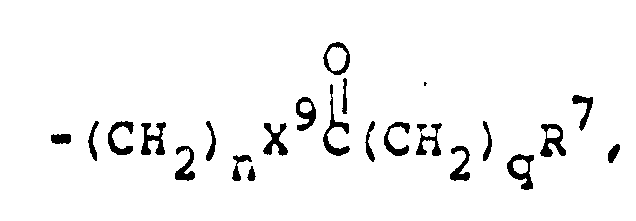


- R7 and R7 a are independently unsubstituted phenyl or substituted phenyl having 1 or 2 substituents which are selected from halo, nitro, hydroxy, alkyl having 1 - 4 carbon atoms, groups having the formulae CF3, CN, SCF3, C=CH, CH2SCF3,

- R7 and R7 a are alpha naphthyl or beta naphthyl or a group having the formulae
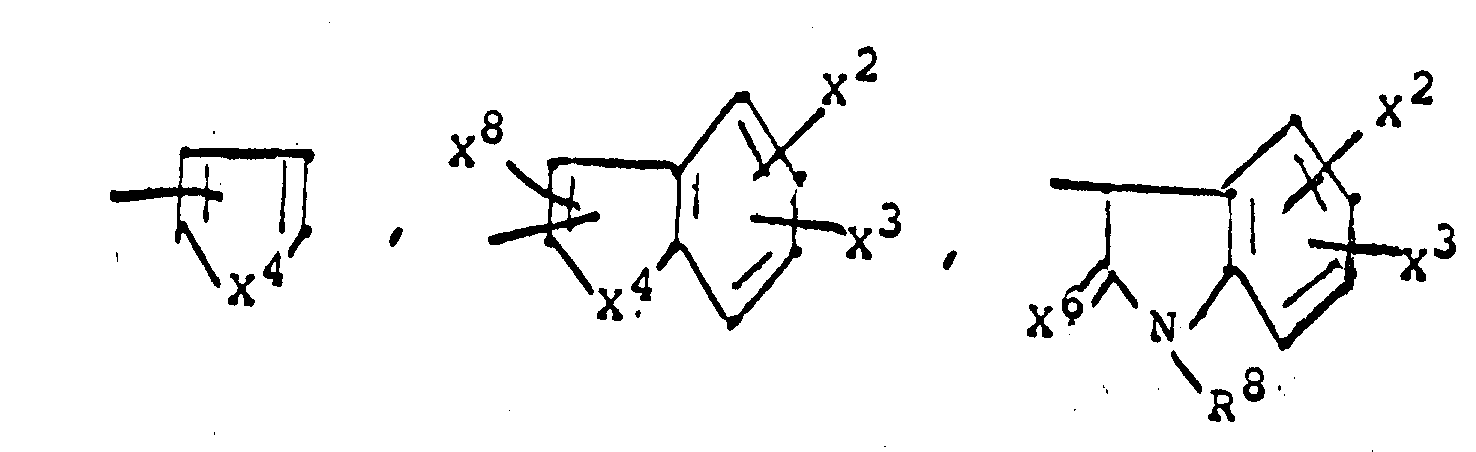


- R8 is hydrogen, alkyl having 1 - 4 carbon atoms, cycloalkyl having 3 - 5 carbon atoms which is bonded either directly or through an alkylene chain comprising 1 - 4 - CH2 - groups or R8 is a group having the formulae - (CH2)mCONH2, - (CH2)mCOOR6, - (CH2)mNR4 R5,


- X2 and X3 are as defined with regard to radical R2,
- X4 is S, O, CH2, or NR8, wherein R8 is as defined above,
- X5 is hydrogen, halo, nitro or a group of formulae CF3, CN, - COOR6, wherein R6 is as defined above,
- X6 is O or HH;
- X8 is hydrogen or alkyl having 1 - 4 carbon atoms,
- X9 and X9 a are independently groups of formulae - 0 - or - NR18 - wherein
- R18 is hydrogen, alkyl having 1 - 4 carbon atoms, formyl, acetyl, propionyl or butyryl,
- R11 and R12 are independently alkyl having 1 - 4 carbon atoms or cycloalkyl having 3 - 5 carbon atoms,
- R14 is alkyl having 1 - 4 carbon atoms or phenyl alkyl in which the alkyl group has 1 - 4 carbon atoms,
- R9 and R10 are independently hydrogen, hydroxy or methyl,
- R13 is hydrogen, alkyl having 1 - 4 carbon atoms, cycloalkyl having 3 - 5 carbon atoms, - O, formyl, acetyl, propionyl or butyryl,
- X1 is hydrogen, halo, alkyl having 1 - 4 carbon atoms, alkylthio having 1 - 4 carbon atoms, alkoxy having 1 - 4 carbon atoms or a group having the formulae -N02, CF3, CN, OH, (CH2)nCOCR6, or - NR4 R5; wherein
- R4, R5, R6 and n are as defined in connection with the radical R1, r is 1 or 2,
- X7 is O, S, HH, or NR15 wherein
- R15 is hydrogen, alkyl having 1 - 4 carbon atoms or a group of formula

- R16 and R17 are independently hydrogen or a group of formula

- X7 can be NR15 only when R is not H;
- q is O - 4
- - - - indicates a single bond or a double bond,
- p is O when its adjacent - - - is a double bond and is I, when its adjacent - - - is a single bond, except that when R13 is oxygen and p is I and - - - is a double bond and with the provision that if
- R3 is a group of formula - (CH2)nNH(CH2)qR7, wherein
- q is O or I, or
is a group of formula

- According to a preferred embodiment of the invention there are used compounds of formula I or pharmaceutically acceptable salts or pharmaceutically acceptable quaternary ammonium salts of the compounds of formula I for the manufacturing of the corresponding pharmaceutical compositions the pharmaceutically active ingredient in which compounds of formula I
- R17 is hydrogen, alkyl having 1 - 5 carbon atoms or a group of formula - (CH2)mCOOR6 wherein
- R6 and m are as defined in formula I,
- R2 is a group of formula -(CH2)mCOOR6 wherein
- R6 and m are as defined above or R2 is unsubstituted phenyl or substituted phenyl having 1 or 2 substituents selected from the group comprising halo, alkyl having 1 - 4 carbon atoms, alkoxy having 1 - 4 carbon atoms, carboxy substituted alkyl having 1 - 4 carbon atoms in the alkyl group, carboxyl, nitro, trifluoro methyl and hydroxy,
- R3 is a group having the formulae
- - (CH2)nR7


- -(CH2)nNH(CH2)qR7,

- -NH(CH2)2-3NHR7,

- -NH(CH2)2-3NHCOR', or

- - (CH2)nR7
- R7 is unsubstituted phenyl or substituted phenyl having 1 or 2 substituents which are selected from halo, nitro, hydroxy, alkyl having 1 - 4 carbon atoms, alkoxy having 1 - 4 carbon atoms, alkylthio having 1 - 4 carbon atoms, trifluoro methyl groups or groups having the formulae CN, -C=CH, SCF3,

- R4 and R5 are independently hydrogen or alkyl having 1 - 4 carbon atoms, or the radical
- R7 is alpha naphthyl or beta naphthyl or a group having the formulae


- R8 is hydrogen, alkyl having 1 - 4 carbon atoms or a group of formula

- R11 and R12 are independently alkyl having 1 - 4 carbon atoms,
- X2 and X3 are independently hydrogen, hydroxy, nitro, halo, alkylthio having 1 - 4 carbon atoms, alkyl having 1 - 4 carbon atoms or alkoxy having 1 - 4 carbon atoms,
- X4 is S, O, or NR8 wherein R8 is as defined above,
- X6 is O or HH;
- R14 is alkyl having 1 - 4 carbon atoms and
- q is O - 4,
- R9 and R10 are independently hydrogen, hydroxy or methyl,
- R13 is hydrogen, alkyl having 1 - 4 carbon atoms, - O, formyl, acetyl, propionyl or butyryl, X1 is hydrogen, halo, alkyl having 1 - 4 carbon atoms, alkylthio having 1 - 4 carbon atoms, alkoxy having 1 - 4 carbon atoms or a group having the formulae N02, CF3, CN, OH, - -(CH2)nCOOR6, or - NR4R5 ; wherein
- R6 is as defined in connection with radical R1 and R4 and R5 are as defined in connection with the radical R3,
- X7 is O
- m is 1 - 4
- n is O - 4
- - - - indicates a single bond or a double bond,
- p is O when the adjacent - - - is a double bond and is I, when its adjacent - - - is a single bond, except that when R13 is oxygen and p is I and - - - - is a double bond and r is I or 2.
- Still more preferred it is to use as pharmaceutically active ingredient a compound of formula I or a pharmaceutically acceptable salt or a pharmaceutically acceptable quaternary ammonium salt of said compound of formula I in which
- R1 is hydrogen, methyl, ethyl, carboxymethyl, or ethylcarboxymethyl;
- R2 is a group of formula - (CH2)1-2COOR6; wherein
- R6 is hydrogen or alkyl having 1 - 4 carbon atoms or
- R2 is unsubstituted phenyl or substituted phenyl comprising 1 or 2 substituents which are halo or carboxyl,
- R3 is a group having the formulae
- - (CH2)nR7,


- -(CH2)nNH(CH2)qR7,


- - (CH2)nR7,
- R7 is alpha naphthyl, beta naphthyl or substituted phenyl having 1 or 2 substituents which are selected from halo, trifluoromethyl and alkyl having 1 - 4 carbon atoms or
- R7 is a group having the formulae


- R 8 is hydrogen, methyl or ethyl,
- X2 and X3 are independently hydrogen, hydroxy, nitro or halo,
- R 14 is t - butyl;
- n is O - 4;
- q is O - 4; and
- R6 is as defined in connection with the radical R2,
- R9 and R10 are independently hydrogen, hydroxy or methyl,
- R13 is hydrogen, methyl or formyl,
- X1 is hydrogen, halo, or a group having the formulae - N02, CF3, CN or OH
- X7 is O;
- - - - indicates a single bond or a double bond,
- p is O when the adjacent - - - is a double bond and is I when its adjacent - - - is a single bond, and r is I or 2.
- The most preferred class of pharmaceutically active ingredients of the above stated preferred group corresponding to formula I are those compounds of formula I in which
- R1 is hydrogen, methyl or carboxymethyl,
- R2 is phenyl, o - fluorophenyl, p - fluorophenyl, o - chlorophenyl, p - chlorophenyl, o - car - boxyphenyl, 2,4 - dichlorophenyl, 2,6 - difluorphenyl, - -CH2COOEt, -CH2COO-t-Bu, -CH2CH2COOEt, or - CH2CH2COO - t - Bu;
- R3 is -(CH2)1-2R7,




- R7 is alpha naphthyl, beta naphthyl, monohalophenyl or dihalophenyl or a group having the formulae


- X2 and X3 are independently hydrogen, hydroxy, fluoro or chloro,
- R6 is hydrogen, methyl or ethyl,
- R 14 is t - butyl,
- R9 and R10 are independently hydrogen or hydroxy,
- R13 is hydrogen,
- X1 is hydrogen, 7-chloro, 7-fluoro, or 7-nitro;
- X7 is oxygen,
- - - - is a single bond or a double bond,
- p is O when its adjacent - - - is a double bond and is I, when its adjacent - - - is a single bond and
- r is I.
- As already outlined before the active ingredients of formula I for use in the invention comprise compounds which are already described in the prior art, however not as antagonists of cholecystokinin and as antagonists of gastrin, as well as compounds which are new. It furthermore was surprisingly found out that the compounds used in the inventive process have the ability of binding strongly to CCK receptors, however only weakyl to benzodiazepine receptors, specially with increasing size of the substituents of the compounds of formula I.
- As it can be seen from the above stated definition of the preferred compounds of formula I the stereo - chemistry of said compounds in the position 3 is R, which accordingly corresponds to a D-amino acid like D-tryptophan. Contrary to this the preferred stereo-chemistry of the prior art benzodiazepines in the position 3 is S, which accordingly would correspond to a L - amino acid, such as L-tryptophan.
- In the compounds of formula I corresponding substituents which occur more than once in any structure are intended to be independent of the corresponding definition elsewhere in the structure. This for instance is true for the different substituents as well as the symbols m, n and p. With the ring fragment


- The halo substituents of the compounds of formula I are fluoro, chloro, bromo or iodo.
- A further object of the present invention are new benzodiazepine derivatives which correspond to the following formula la

- X'' is S, HH or NR15 and wherein the remaining substituents and symbols have the same meaning as in formula I or salts or quaternary ammonium salts of said new compounds of formula la.
- The pharmaceutically acceptable salts of the compounds of formula I used for the preparation of the pharmaceutical compositions are e.g. corresponding salts of the compounds of formula I with non-toxic inorganic acids or non-toxic organic acids. For example, such conventional non-toxic salts include those derived from inorganic acids such as hydrochloric, hydrobromic, sulfuric, sulfamic, phosphoric, nitric and the like; and the salts prepared from organic acids such as acetic, propionic, succinic, glycolic, stearic, lactic, malic, tartaric, citric, ascorbic, pamoic, maleic, hydroxymaleic, phenylacetic, glutamic, benzoic, salicylic, sulfanilic, 2-acetoxybenzoic, fumaric, toluenesulfonic, methanesulfonic, ethane disulfonic, oxalic and isethionic.
- The pharmaceutically acceptable salts can be synthesized from the compounds of Formula I which contain a basic or acidic moiety by conventional chemical methods. Generally, the salts are prepared by reacting the free base or acid with stoichiometric amounts or with an excess of the desired salt forming inorganic or organic acid or base in a suitable solvent or various combinations of solvents.
- The pharmaceutically acceptable salts of the acid of Formula I are also readily prepared by conven - tional procedures such as treating an acid of Formula I with an appropriate amount of a base, such as an alkali or alkaline earth metal hydroxide e.g. sodium, potassium, lithium, calcium, or magnesium, or an organic base such as an amine, e.g., dibenzylethylenediamine, trimethylamine, piperidine, pyrrolidine and benzylamine, or a quaternary ammonium hydroxide such as tetramethylammonium hydroxide.
- The pharmaceutical preparations of compounds of Formula I. can be used for the treatment and the prevention of disorders of the gastrointestinal, and appetite regulatory systems of mammals, especially of man. Specifically, they are useful in treatment and prevention of disorders of gastric acid secretion, gastrointestinal motility, pancreatic secretions, and dopaminergic functions. The compositions which contain compounds of Formula I are especially useful in the prevention and treatment of irritable bowel syndrome, ulcers, excess pancreatic or gastric secretion, acute pancreatitis and motility disorders.
- The pharmaceutical compositions contain the compounds of formula I or salts thereof either alone, or preferably, in combination with pharmaceutically acceptable carriers or diluents, according to standard pharmaceutical practice. The compositions can be administered orally or parenterally. Parenteral admin - istration includes intravenous, intramuscular, intraperitoneal, subcutaneous and topical administration.
- For oral use of an antagonist of CCK or gastrin the compositions can be administered, for example, in the form of tablets or capsules, or as an aqueous solution or suspension. In the case of tablets for oral use, carriers which are commonly used include lactose and corn starch, and lubricating agents, such as magnesium stearate, are commonly added. For oral administration in capsule form, useful diluents are lactose and dried corn starch. When aqueous suspensions are required for oral use, the active ingredient is combined with emulsifying and suspending agents. If desired, certain sweetening and/or flavoring agents can be added. For intramuscular, intraperitoneal, subcutaneous and intravenous use, sterile solutions of the active ingredient are usually prepared, and the pH of the solutions should be suitably adjusted and buffered. For intravenous use, the total concentration of solutes should be controlled to render the preparation isotonic.
- When a composition containing a compound of Formula I or a salt thereof is used as an antagonist of CCK or gastrin in a human subject, the daily dosage will normally be determined by the prescribing physician. Moreover, the dosage will vary according to the age, weight, and response of the individual patient, as well as the severity of the patient's symptoms. However, in most instances, an effective daily dosage will be in the range from about 0.05 mg to about 50 mg/kg and preferably 0.5 mg to about 20 mg/kg in a single or divided doses. On the other hand, it may be necessary to use dosages outside these limits in some cases.
- The compounds of Formula I are prepared according to the following schemes.


- 2-Aminoarylketones 1, (Scheme I) preferably 2 - amino - benzophenones containing various substituents in the aryl rings, preferably halo substituents, are coupled to N - protected D - amino acids 2 - (preferably, Boc-amino acids) using dicyclohexylcarbodiimide (DCC) or other conventional peptide coupling reagent. The product 3 is N-deprotected by treatment with acid, preferably anhydrous HCI in ethyl acetate, to give the α - aminoacyl derivative 4 of the 2 - aminoarylketone. Alternatively, this same product is obtained by treatment of the 2-aminoarylk
et one 1 with the acid chloride hydrochloride 5 of the D - amino acid, which is prepared from the amino acid with PC ls - AcCl. - Treatment of this α -aminoacyl derivative 4 with base, preferably aqueous sodium hydroxide in methanol, gives the free base 6 which is cyclized to the 3,5-disubstituted benzodiazepine 7 upon stirring in the methanolic base for 2-120 hours, preferably 48 hours. Alternatively, the 3,5 - dis
u bstituted benzodiazepine 7 is obtained by heating the 2-aminoarylketone 1 with the ester 8, preferably methyl or ethyl, of the D-amino acid, preferably in refluxing pyridine, for 2 - 48 hours, preferably for 18 hours. - Alternatively (Scheme V), the ketones 1 may be coupled with N - phthalylamino acids such as 2b to give the products 3b using DCC or other conventional peptide coupling reagent. 3b may be deprotected and cyclized to 9 (
R 1 = H, R3 = (CH2)nX9 H) by treating with hydrazine. Alternatively,3b may be first alkylated by treatment with sodium hydride followed by an alkyl halide in dimethylformamide (DMF) to give the alkyl derivative 3c. Treating this product with hydrazine gives the N1 - alkylbenzodiazepine, 9 (R3 = (CH2)nX9 H). - 9 (R3
= (C H2)nX9 H) are alkylated by treatment with alkyl halide or dialkyl sulfate or acylated by treatment with acid halides or anhydrides, preferably in the presence of base such as triethyl amine. The products are the alkyl and acyl derivatives 9 (R3 = (CH2)nX9 (CH2)qR7 and
- Alternatively, protection of the 3-amino function in 9 (R3=(CH2)nNH2), preferably with benzylchloroformate affords the acyl derivative 27. Treatment of this material with P2S5 or preferably with Lawesson's reagent in toluene gives the thioamide 28 which is converted to the amine 29 with Raney nickel in ethanol. Deprotection of the resulting product 29 via hydrogenolysis, or preferably by the action of hydrobromic acid, yields the corresponding amino compound 30. Alkylation of 30 by treatment with alkyl halide or dialkyl sulfonate or acylation with carboxylic acid halide or carboxylic acid anhydride in the presence of an acid binding agent such as triethylamine or preferably with a carboxylic acid in the presence of a peptide coupling reagent such as dicyclohexyl-carbodiimide gives the alkyl or acyl derivatives 31.
- 3,5 - Disubstituted benzodiazepines 7 (Scheme I) are also treated with sodium hydride in dimethylfor - mamide (DMF), followed by an alkyl halide, to give the 1 -alkyl derivatives 9. These or the parent 1 - unsubstituted compound 7 are reduced, preferably with sodium cyanoborohydride and acetic acid at 15°, to give the corresponding 4,5-dihydro compounds 10. These are alkylated on N4 by treatment with alkyl halide or dialkyl sulfate. Alternatively, the 4,5 - dih
yd ro compounds are acylated on N4 by treatment with acyl halides or anhydrides, preferably in the presence of base such as triethylamine. The products are the alkyl and acyl derivatives 11. Alternatively, where R is -(CH2)mCOOR6 (R6 not = H), 9 are treated with a base such as sodium hydroxide in methanol to give the acids 9 (R1 =(CH2)mCOOH). - The 3,5 - disubstituted benzodiazepines 7 are treated with alkyl - or arylmagnesium halides, preferably methylmagnesium iodide, to give the dihydro compounds 12. The products are alkylated and acylated on nitrogen, as described for the 3,5 - disubstituted - 4,5 - dihydro derivatives, to give the derivatives 13.
- The 3,5 - disubstituted benzodiazepines 7 are treated with P2 S5 or Lawesson's reagent (2,4 - bis - (4 - methoxyphenyl)-2,4-dithioxo-1,3,2,4-dithiadiphosphetane) to give the 2-thiones 14. These are reduced with Raney nickel to the 2-unsubstituted compounds 15. The latter may be alkylated with alkyl halide or sulfate, acylated with acyl halide or anhydride, reduced with sodium cyanoborohydride, or substituted with alkyl - or aryl magnesium halide as described for 7 above.
- Where the 3 - position in a 3,5 - disubstituted benzodiazepine 7 bears a substituent containing an indole moiety, preferably 3 - indolylmethyl, reduction with triethylsilane/TFA provides the corresponding indoline 16. Alternatively, oxidation with HCI-dimethylsulfoxide provides the oxindole 17. 16 and 17 may be subjected to the reactions described for 7 to obtain alkyl, acyl, and dihydro derivatives. Dialkyl, alkylacyl, and trialkyl compounds may also be made using these methods.
- The 3,5 - disubstituted benzodiazepines 7 may also be oxidized, preferably with m - chloroperoxyben - zoic acid, to give the corresponding 4 - N - oxides 7a.
- Alternatively, (Scheme II) 3 - unsubstituted -
5 - substituted -1 - substituted or unsubstituted ben - zodiazepines 9 (R1 = H) (Scheme II) prepared as described in the prior art may be treated with base, preferably lithium diisopropylamide, in an inert solvent, preferably THF, according to the procedure of J. Org. Chem., 46 4945 (1981). The resulting salt may be alkylated to obtain 9 with, for example, benzyl bromide or gramine methiodide. The resulting racemates may be resolved to obtain the preferred 3(R) enantiomers, or may be used as such. - Alternatively, the salt may be treated with an alkyl or aryl aldehyde, ketone, or acid halide or anhydride to give the 1 - hydroxymethylene compounds


- The hydroxymethylene compounds
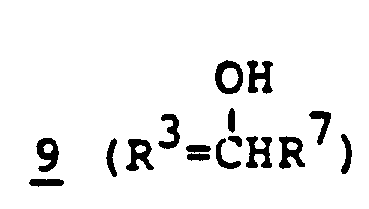
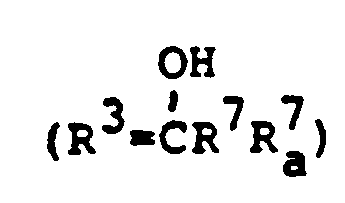
- Alternatively, 3-substituted benzodiazepines 9 may be obtained by treating the 3-unsubstituted compound 9 (R3=H) with 1,8 - diazabicyclo[5.4.0]
un dec-7-ene (DBU) and alkylating agent such as alkyl halide or sulfate or, preferably, gramine methiodide. Resolution to obtain the preferred 3(R) enantiomer may be carried out as described above. - 3 - Amino - 5 - substituted -1 - substituted or unsubstituted benzodiazepines 9 (R3 = NH2) are prepared as described in the prior art. Alternatively, 9 (R3 = NH2) are prepared as shown in Scheme IVb. Treatment of the 3 - unsubstituted compound 9 (R3 = H) with a suitable base, preferably potassium t - butoxide, followed by a nitrosating agent, preferably isoamyl nitrate, provides the oxime 9 (R3 = = NOH). Reduction, preferably with Raney nickel, gives the 3-amino compounds 9 (R3 = NH2).
- 3 - Amino and 3 - aminomethyl - 5 - substitute
d 1 - substituted or unsubstituted benzodiazepines 23 - (Scheme III) are alkylated with alkyl halides or with α - halo acids and esters to give the alkyl derivatives 24 (R3 = (CH2)nNH(CH2)qR7) and

- With isocyanates, the amines 23 give the corresponding ureas


- 3 - Hydroxy - 5 - substituted - 7 - substituted or unsubstituted - 1 - substituted or unsubstituted ben - zodiazepines 24 (R3 = OH) (Scheme lllb) are acylated with acyl halides to give the esters

- 3 - Chloro - 5 - substituted - 1 - substituted or unsubstituted benzodiazepines 24 (R3 = Cl) (Scheme IV) may be used to monoalkylate amines to give the 3 - substituted amino compounds 24 (R3 = NH2). The 3 - chloro compounds 29 may also be used to monoalkylate 1,2 - ethanediamine and 1,3 - propanediamine to give the compounds 24 (R3=NH(CH2)NH2). These may be alkylated to provide 24 (R3 = NH(CH2)nNH-(CH2)qR7) or acylated to give

- 3 - Substituted - 5 - substituted - 7 - substituted or unsubstituted benzodiazepines 24 (R1 = H) (Scheme lllc) may be treated with sodium hydride in a suitable solvent, such as DMF, followed by an alkyl halide to provide the 1 -alkyl derivatives 24. When an acrylate such as methyl or ethyl acrylate or acylonitrile is substituted for the alkyl halide, the 1 - (2 - substituted)ethyl compounds

- When R3 contains R7 where R7 is 1 - unsubstituted - 2 - or 3 - indolyl (Scheme llld), the compounds 24 may be further alkylated by treatment with sodium hydride followed by an alkyl halide or an acrylate, such as methyl or ethyl acrylate or acrylonitrile, or an activated amino acid such as Boc - phenylalanine anhydride to give the corresponding 1 -substituted indole compounds 24 (Scheme llld) in which R8 is as defined herein and R8 is other than hydrogen.
- The compounds 24 wherein R and/or R8 is (CH2)m - COOMe or (CH2)m - COOEt may be treated with sodium hydroxide in an aqueous solvent, preferably aqueous solvent, preferably aqueous methanol, and then acidified to give the corresponding acids 24, wherein R and/or R8 is (CH2)nCOOH. Alternatively, these same compounds may be treated with aqueous or anhydrous ammonia to give the amides 24 wherein R1 and/or R8 is (CH2)mCONH2.
- In cases where the starting materials are optically active, the chirality at C3 is controlled by the synthesis. When racemic starting materials are employed, racemic products are obtained. The enantiomers may be separated by resolution.
- The biological activity of the compounds of Formula I have been evaluated using 1.)an 125l- CCK receptor binding assay and in vitro isolated tissue preparations and 2.) 125l- gastrin and 3H - pentagastrin binding assays.
- CCK-33 was radiolabeled with 125l- Bolton Hunter reagent (2000 Ci/mmole) as described by Sankara et al. (J. Biol. Chem. 254: 9349-9351, 1979). Receptor binding was performed according to Innis and Snyder (Proc. Natl. Acad. Sci. 77: 6917-6921, 1980) with the minor modification of adding the additional protease inhibitors, phenylmethane sulfonyl fluoride and o - phenanthroline. The latter two compounds have no effect on the 125l- CCK receptor binding assay.
- Male Sprague - Dawley rats (200 - 350g) were sacrificed by decapitation. The whole pancreas was dissected free of fat tissue and was homogenized in 20 volumes of ice - cold 50 mM, Tris HCI (pH 7.7 at 25 °C) with a Brinkmann Polytron PT 10. The homogenates were centrifuged at 48,000 g for 10 min. Pellets were resuspended in Tris Buffer, centrifuged as above and resuspended in 200 volumes of binding assay buffer (50 mM Tris HCI, pH 7.7 at 25 °C, 5 mM dithiothrietol, 0.1 mM bacitracin, 1.2 mM phenylmethane sulfonyl fluoride and 0.5 mM o - phenanthroline). For the binding assay, 25 µl of buffer (for total binding) or unlabeled CCK - 8 sulfate to give a final concentration of 1 µM (for nonspecific binding) or the compounds of Formula I (for determination of inhibition of 125l - CCK binding) and 25 µl of 125l - CCK - 33 (30,000 - 40,000 cpm) were added to 450 µl of the membrane suspensions in microfuge tubes. All assays were run in duplicate or triplicate. The reaction mixtures were incubated at 37 °C for 30 minutes and centrifuged in a Beckman Microfuge (4 minutes) immediately after adding 1 ml of ice-cold incubation buffer. The supernatant was aspirated and discarded, pellets were counted with a Beckman gamma 5000. For Scatchard analysis (Ann. N.Y. Acad. Sci. 51: 660, 1949), 125l- CCK - 33 was progressively diluted with increasing concentrations of CCK-33.
- CCK-33 was radiolabeled and the binding was performed according to the description for the pancreas method with modifications according to Saito et al., J. Neurochem. 37:483-490, 1981.
- Male Hartley guinea pigs (300 - 500g) were sacrificed by decapitation and the brains were removed and placed in ice-cold 50 mM, Tris HCI plus 7.58 g/I Trizma-7.4 (pH 7.4 at 25°C). Cerebral cortex was dissected and used as a receptor source. Each gram of fresh guinea pig brain tissue was homogenized in 10 ml of Tris/Trizma buffer with a Brinkman polytron PT-10. The homogenates were centrifuged at 42,000 g for 15 minutes. Pellets were resuspended in Tris Buffer, centrifuged as above and resuspended in 200 volumes of binding assay buffer (10 mM N -2 - hydroxyethyl - piperazine - N' - 2 - ethane sulfonic acid (HEPES), 5 mM MgCl2, 0.25 mg/ml bacitracin, 1 mM ethylene glycol-bis-(β-aminoethylether-N,N'- tetraacetic acid) (EGTA), and 0.4% bovine serum albumin (BSA)). For the binding assay, 25 µl of buffer (for total binding) or unlabeled CCK-8 sulfate to give a final concentration of 1µm (for nonspecific binding) or the compounds of Formula I (for determination of inhibition of 125l- CCK binding) and 25 µl of 125l- CCK-33 (30,000-40,000 cpm) were added to 450 µl of the membrane suspensions in microfuge tubes. All assays were run in duplicate or triplicate. The reaction mixtures were incubated at 25 ° C for 2 hours and centrifuged in a Beckman Microfuge (4 minutes) immediately after adding 1 ml of ice-cold incubation buffer. The supernatant was aspirated and discarded, pellets were counted with a Beckman gamma 5000.
- The compounds of Formula I can be determined to be competitive antagonists of CCK according to the following essays.
- Mole Hartley guinea pigs (400-600 g) are sacrificed by decapitation. The whole gall bladder is dissected free from adjacent tissues and cut into two equal halves. The gall bladder strips are suspended along the axis of the bile duct in a 5 ml organ bath under 1 g tension. The organ bath contains a Kreb's bicarbonate solution (NaCI 118 mM, KCI 4.75 mM, CaCI 2.54 mM, KH2P04 1.19 mM, Mg S04 1.2 mM, NaHC03 25 mM and dextrose 11 mM) maintained at 32°C and bubbled with 95% 02 and 5% C02. Isometric contractions are recorded using Statham (60 g; 0.12 mm) strain gauges and a Hewlett-Packard (77588) recorder. The tissues are washed every 10 minutes for 1 hour to obtain equilibrium prior to the beginning of the study. CCK - 8 is added cumulatively to the baths and EC50's determined using regression analysis. After washout (every 10 minutes for 1 hour), the compound of Formula I is added at least 5 minutes before the addition of CCk-8 and the EC50 of CCK-8 in the presence of the compound of Formula I similarly determined.
- Longitudinal muscle strips with attached nerve plexus are prepared as described in Brit. J. Pharmac. 23: ; 356-363, 1964; J. Physiol. 194: 13-33, 1969. Male Hartley guinea pigs are decapitated and the ileum removed (10 cm of the terminal ileum is discarded and the adjacent 20 cm piece used). A piece (10 cm) of the ileum is stretched on a glass pipette. Using a cotton applicator to stroke tangentially away from the mesentery attachment at one end, the longitudinal muscle is separated from the underlying circular muscle. The longitudinal muscle is then tied to a thread and by gently pulling, stripped away from the entire muscle. A piece of approximately 2 cm is suspended in 5 ml organ bath containing Krebs solution and bubbled with 95% 02 and 5% C02 at 370 C under 0.5 g tension. CCK-8 8 is added cumulatively to the baths and ECso values in the presence and absence of compounds of Formula I determined as described in the gall bladder protocol (above).
- Gastrin antagonist activity of compounds of Formula I is determined using the following assay.
- Guinea pig gastric mucosal glands were prepared by the procedure of Berglingh and Obrink Acta Physiol. Scand. 96: 150 (1976) with a slight modification according to Praissman et al. C. J. Receptor Res. 3: (1983). Gastric mucosa from guinea pigs ( 300-500 g body weight, male Hartley) were washed thoroughly and minced with fine scissors in standard buffer consisting of the following: 130 mM NaCI, 12 mM NaHC03, 3 mM NaH2P04, 3 mM Na2HP04, 3 mM K2HP04, 2 mM MgS04, 1mM CaCI2, 5 mM glucose and 4 mM L-glutamine, 25 mM HEPES at pH 7.4. The minced tissues were washed and then incubated in a 37°C shaker bath for 40 minutes with the buffer containing 0.1 % collagenase and 0.1 % BSA and bubbled with 95% 02 and 5% C02. The tissues were passed twice through a 5 ml glass syringe to liberate the gastric glands, and then filtered through 200 mesh nylon. The filtered glands were centrifuged at 270 g for 5 minutes and washed twice by resuspension and centrifugation.
- The washed guinea pig gastric glands prepared as above were resuspended in 25 ml of standard buffer containing 0.25 mg/ml of bacitracin. For binding studies, to 220 µl of gastric glands in triplicate tubes, 10 µl of buffer (for total binding) or gastrin (1 µM final concentration, for nonspecific binding) or test compound and 10 µl of 125l- gastrin (NEN, 2200 Ci/mmole, 25 pM final) or 3H - pentagastrin (NEN 22 Ci/mmole, 1 nM final) were added. The tubes were aerated with 95% 02 and 5% C02 and capped. The reaction mixtures after incubation at 25°C for 30 minutes were filtered under reduced pressure on glass G/F B filters (Whatman) and immediately washed further with 4 x 4 ml of standard buffer containing 0.1% BSA. The radioactivity on the filters was measured using a Beckman gamma 5500 for 125l- gastrin or liquid scintillation counting for 3H - pentagastrin.
- The preferred compounds of Formula I are those which inhibited specific 125l- CCK - 33 binding in a concentration dependent manner.
- Scatchard analysis of specific 125l-CCK-33 receptor binding in the absence and presence of the compounds of Formula I indicated the compound of Formula I competitively inhibited specific 125l- CCK-33 receptor binding since it increased the KD (dissociation constant) without affecting the Bmax (maximum receptor number). A K; value (dissociation constant of inhibitor) of the compounds of Formula I was estimated.
- The data of Table 1 were obtained for compounds of Formula l.


- Preferred compounds of Formula I are those wherein R' is H, methyl, ethyl, carboxymethyl, ethyl - carboxymethyl and carboxyethyl.
- Other series of preferred compounds are those wherein R2 is phenyl, p-chlorophenyl, o-chlorophenyl, p - fluorophenyl, o - fluorophenyl, 2 - 4 - dichlorophenyl, 2 - 6 - difluorophenyl, - CH2COO - t - butyl, or - CH2COOEt.
- Other series of preferred compounds are those wherein R3 is 2 - or 3 - indolylmethyl, - CO - thiophene, - NHCO - 2 - indolyl, NHCO - 2 - (1 - methylindolyl), NHCO - 2 - (5 - fluoroindolyl), NHCO-2-benzofuranyl, NHCO - 2 - benzothieyl, NHCO - 2 - (3 - methylindenyl), NHCO - (mono - or dihalophenyl), NHCO - phenylethenyl, NHCO - (mono - or dimethyl or trifluoromethylphenyl), NHCONH - (mono - or di - halophenyl), CO - 2 - (1 - methyl) - indolyl, CO - 3 - (1 - methyl)indolyl, or - CHOH 1 - methylindol - 3 - yl.
- When p is 1 for any of R9, R10, or R13, it is preferred that R9 is H or hydroxyl, R10 is H or hydroxyl, and R13 is H.
- It is preferred that X1 r; is H, Cl, F, CF3, OH or N02.
- Examples of Formula I compounds are tabulated below.


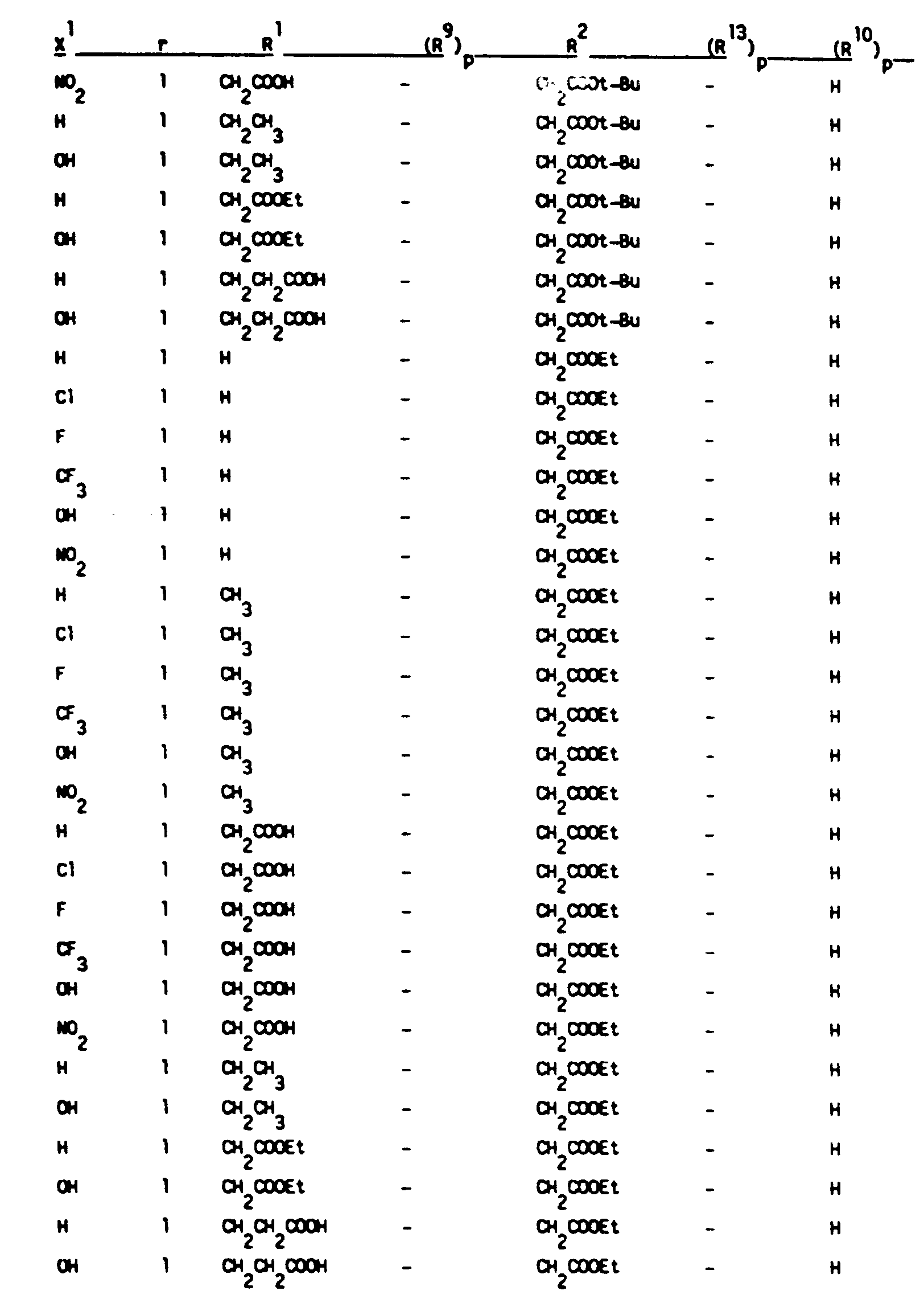


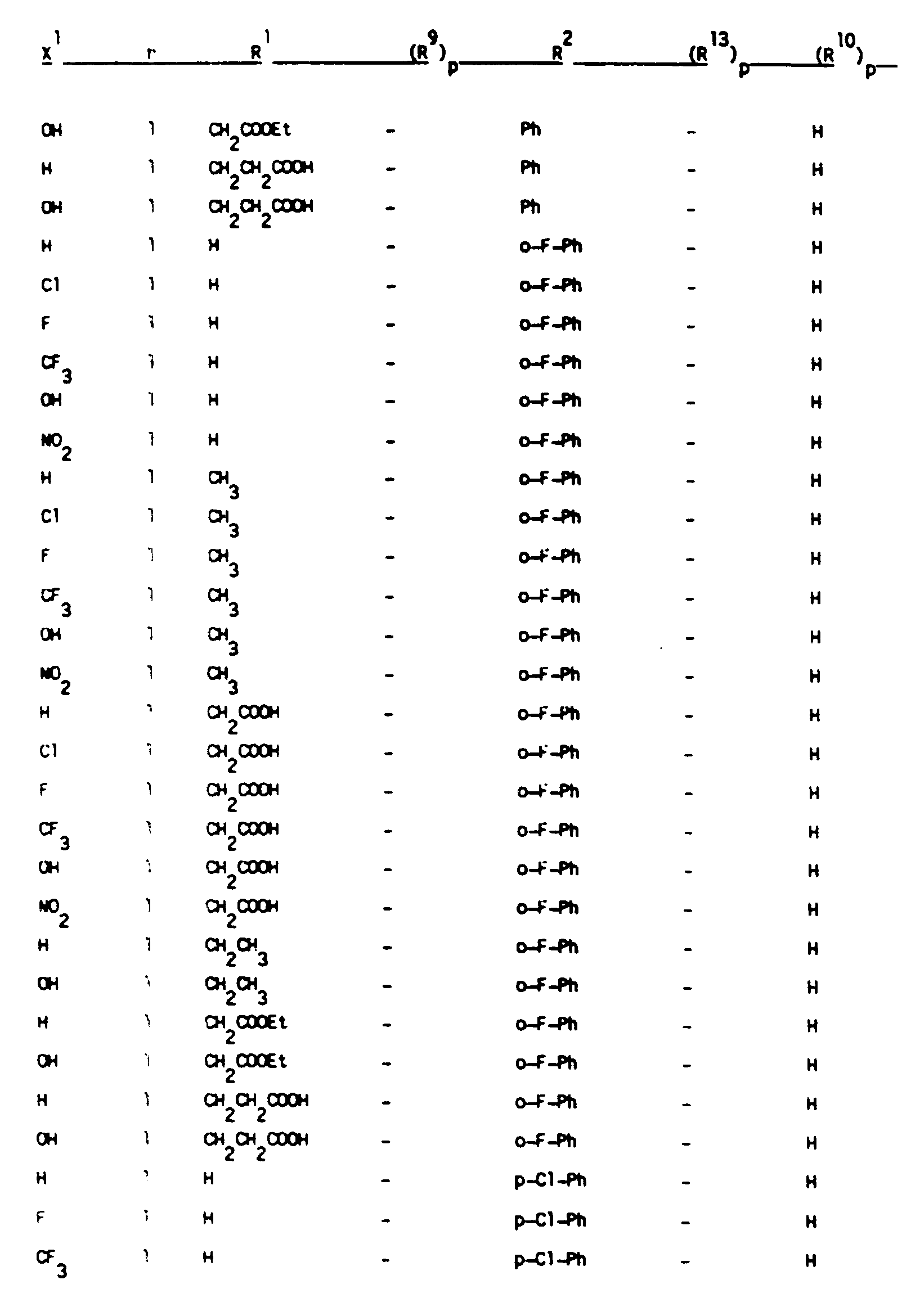


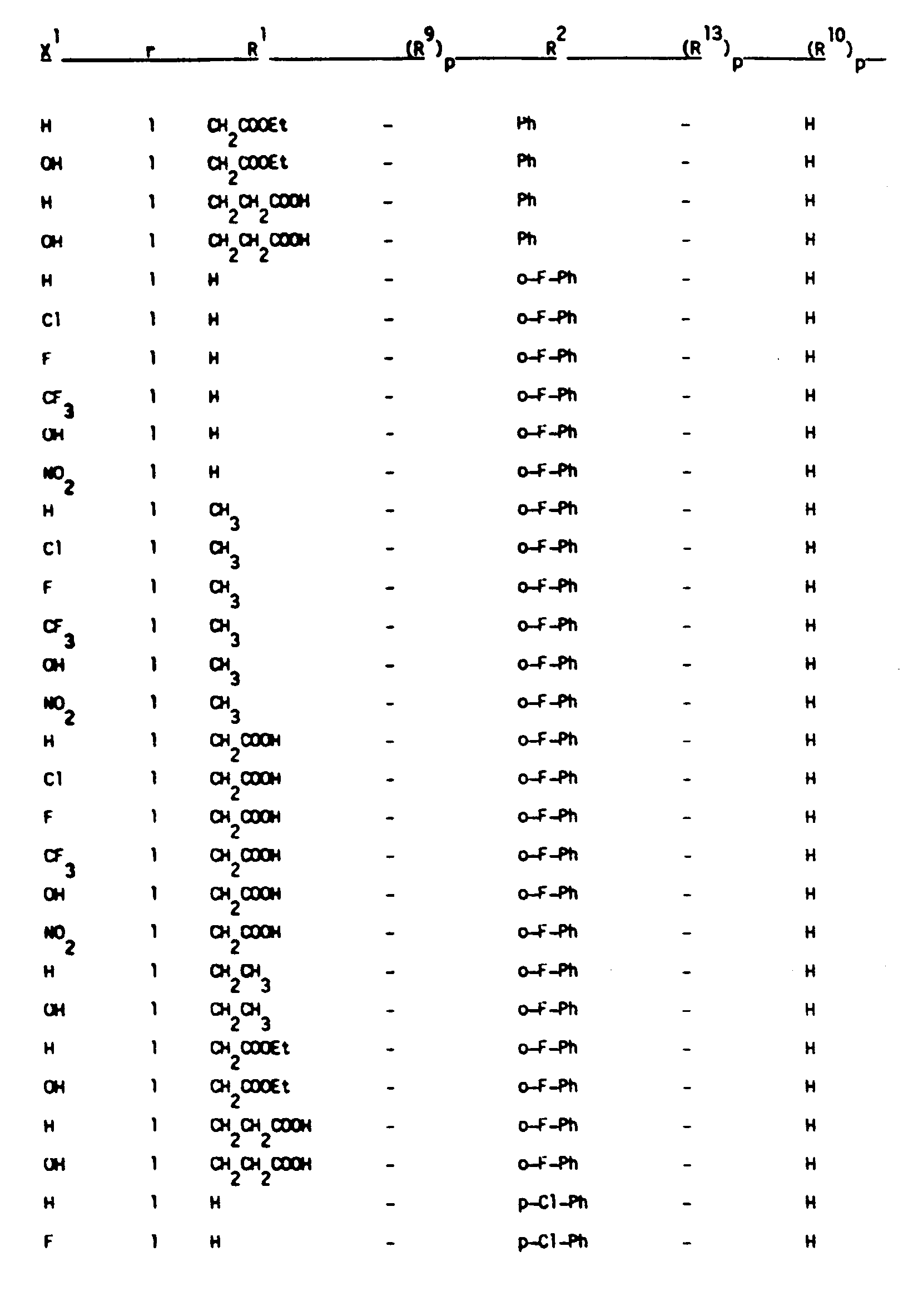


- Other compounds of Formula I are listed on the following table.


- The invention is further defined by reference to the following preparations and examples, which are intended to be illustrative and not limiting.
- All temperatures are in degrees Celsius.
- 2 Amino - 2' fluorobenzophenone (4 g, 18.6 mmole), Boc - D tryptophan (5.65 g, 18.6 mmole) and dicyclohexylcarbodiimide (DCC) (18.6 ml of a 1M solution in methylene chloride, 18.6 mmole) were combined in 28 ml of dry tetrahydrofuran stirred in an ice bath. The mixture was allowed to warm to room temperature and stirred overnight. The solids were removed by filtration and the filtrate evaporated in vacuo. The residue was chromatographed on 9" (23 cm) of silica gel (230-400 mesh) in a 55 mm diameter column using 1 L of each of methylene chloride and 2% and 3% (v/v) diethyl ether in methylene chloride.
- The product fractions were combined and evaporated in vacuo. The residue was crystallized from diethyl ether and the resulting solid dried in vacuo at 40 for 20 hours: (m.p. 64 - 67 ° ).
- The compound showed a single component by thin layer chromatography (TLC) (Rf=0.36, silica gel plate eluted with 6% (v/v) diethyl ether in methylene chloride). The NMR spectrum was consistent with the title structure and verified the presence of Et20.

- 2 - N - (Nα - Boc - D - tryptophanyl)amino - 2' - fluorobenzophenone (4.0 g = 8.0 mmole) in 37 ml of ethyl acetate was stirred in an ice bath and saturated with hydrogen chloride gas for 20 minutes. The mixture was evaporated to dryness in vacuo to give 2 - N - (D -tryptophanyl)amino - 2' -fluorobe - nzophenone hydrochloride. The residue in 125 ml of methanol was treated with 30 ml of water and the pH of the mixture adjusted to 8.5-9.0 with 10% sodium hydroxide solution. The mixture was stirred at room temperature for three days.
- The suspension was filtered and the resulting white solid dried in vacuo at 40° overnight: (m.p. 251 - 254°).
- The compound showed a single component by thin layer chromatography (TLC) (Rf=0.59, silica gel plate eluted with 1:1 (v/v) diethyl ether/methylene chloride) and by HPLC (greater than 99%). The NMR spectrum was consistent with the title structure. The mass spectrum showed a molecular ion at m/e = 383.

- 2-Amino-2'-fluorobenzophenone (12.5 g=58 mmole) was stirred in 100 ml of dry tetrahydrofuran in an ice bath. D-Tryptophan acid chloride hydrochloride (16 g = 62 mmole), slurried in 50 ml of tetrahydrofuran, was added over 10 minutes, and the mixture stirred 2 hours in the ice bath. The resulting solid was filtered, then added to 200 ml of methanol containing 200 ml of water. The pH was adjusted to 8.5-9.0 with 10% sodium hydroxide, the mixture was stirred for three days, then filtered. The solid was dried in vacuo at 40° .
-
- A 1,3 - Dihydro - 5 - (2 - fluorophenyl) - 3(R) - (3' - indolyl)methyl - 2H -1,4 - benzodiazepin - 2 - one (0.85 g, 2.2 mmole) and sodium hydride (0.11 g of a 50% suspension in mineral oil, 2.3 mmole) were stirred in 10 ml of dry, degassed dimethylformamide under nitrogen in an ice bath. After 40 minutes, methyl iodide (0.14 mL = 2.25 mmole) was added in one portion. The mixture was stirred for 1.5 hours at room temperature, then poured into 100 ml of water and extracted with methylene chloride (CH2Cl2) (3 x 30 mL). The CH2CI2 layers were washed with water, dried over potassium carbonate, filtered and evaporated in vacuo. The residue was chromatographed on 9" (23 cm) of silica gel (250-400 mesh) in a 55 mm diameter column eluted with 4% (v/v) diethyl ether in CH2Cl2. The first product eluted was A which was obtained as a glass upon evaporation. The solid was dried in vacuo at room temperature: (m.p. 97 -100 ° ( )).
The compound showed a single component by thin layer chromatography (Rf=0.57, silica gel plate eluted with 10% (v/v) diethyl ether in CH2CI2) and by HPLC (98%). The NMR spectrum was consistent with the title structure and verified the presence of CH2CI2. The mass spectrum showed a molecular ion at m/e = 411.
- B The second component eluted was the monomethyl compound B which was obtained as a foam (0.66 g) upon evaporation. Crystallization from hexane/CH2CI2 gave analytical material; (m.p. 80-85°( )).
The compound showed a single component by thin layer chromatography (silica gel plates eluted with 4% (v/v) diethyl ether in CH2CI2) and by HPLC (99%). The NMR spectrum was consistent with the title structure and verified the presence of CH2CI2.
- 2-Amino-5-chlorobenzophenone (1.2 g, 5.2 mmole) and D-tryptophan methyl ester hydrochloride (1.3 g, 5.1 mmole) were combined in dry pyridine (25 mL) and heated at reflux under nitrogen for 5 hrs. The mixture was evaporated in vacuo and the residue washed twice with pH 6 buffer and dissolved in ethyl acetate (50 mL). The ethyl acetate solution was dried over sodium sulfate, filtered, and evaporated in vacuo to give an oil which was chromatographed on a 13 inch (33 cm) column of silica gel (230-400 mesh) in a 25 mm diameter column eluted with 20% (v/v) ether methylene choride. The product fractions were evaporated in vacuo to give the title compound as a white solid which was dried in vacuo at 100°: (m.p. 130 -155° (
)) . - The compound showed a single spot by thin layer chromatography (Rf = 0.36, silica gel plate eluted with 4:1 CH2CI2/ether). The NMR spectrum was consistent with the title structure and verified the presence of ether. The compound was 99.8% pure by HPLC. The mass spectrum showed a molecular ion at m/e = 399.

- The procedure of Example 1 was carried out using 2 - aminobenzophenone (1.97 g, 0.01 mole), Boc - D-tryptophan (3.04 g, 0.01 mole) and DCC (10 mL of 1M solution in methylene chloride (CH2CI2) in THF (15 mL). The crude product obtained after filtration and evaporation of the mixture was deprotected and cyclized by the procedure of Example 2. The mixture was evaporated in vacuo, combined with water (50 mL) and extracted with chloroform (250 mL). The chloroform solution was hired over potassium carbonate, filtered, and evaporated to dryness in vacuo. Recrystallization from a mixture of acetone (50 mL) and ether (50 mL) gave a white solid which was dried in vacuo at 100°: (m.p. 260 - 263 0 (d)).
- The compound showed a single spot by TLC (Rf = 0.53, silica gel plate eluted with 1:1 CH2CI2/ether). The NMR spectrum was consistent with the title structure and verified the presence of acetone. The compound was 99.6% pure by HPLC. The mass spectrum showed a molecular ion at m/e = 365.

- 1,3 - Dihydro - 3(S) - (3' - indolyl)methyl - 2H -1,4 - benzodiazepin - 2 - one - 5 - thione (450 mg, 1.4 mmole) was suspended in 30 ml of toluene, 8 ml of tetrahydrofuran, and 15 ml of 40% sodium hydroxide solution. This mixture was treated with 203 mg (0.6 mmole) of tetra - n - butylammonium sulfate and 0.25 ml (4.0 mmole) of iodomethane and stirred rapidly at room temperature. After four hours the phases were separated and the aqueous layer extracted once with ethyl acetate. The combined organic extracts were washed with water (2 X 50 ml) and brine, then dried (MgS04) and concentrated in vacuo to afford a yellow oil. Preparative thick layer chromatography (hexane - ethyl acetate 2:1 v/v) afforded the title compound as a white solid. Rf = 0.45 (2:1 hexane - ethyl acetate). The analytical sample was recrystallized from ethyl acetate-ether, m.p. 170°C; TLC, HPLC: 99% pure. Pmr (CDCl3): according to theory (methyl proton resonate 2.46 ppm, 3.39 ppm, and 3.72 ppm respectively). MS (20 ev.): 363 (M+), 184, 144.

- 1,3 - Dihydro - 3(S) - (3' - indolyl)methyl - 2H -1,4 - benzodiazepin - 2 - one - 5 - thione (450 mg, 1.4 mmole) was suspended in 30 ml of toluene, 8 ml of tetrahydrofuran, and 15 ml of 40% sodium hydroxide solution. The mixture was treated with 203 mg (0.6 mmole) of tetra - n - butylammonium sulfate and 0.25 ml (4.0 mmole) of iodomethane and stirred rapidly at room temperature. After four hours the phases were separated and the aqueous layer extracted once with ethyl acetate. The combined organic extracts were washed with water (2 X 50 ml) and brine, then dried (MgS04) and concentrated in vacuo to afford a yellow oil. Preparative thick layer chromatography (hexane - ethyl acetate 2:1 v/v) afforded the title compound as a white solid. Rf = 0.40 (2:1 hexane- ethyl acetate). The analytical sample was recrystallized from ethyl acetate-ether, m.p. 90-91 °C. TLC, HPLC: 99% pure. Pmr (CDCl3): according to theory (methyl protons resonate at 2.45 ppm and 3.40 ppm, respectively). MS (20 ev): 349 (M+), 302, 220, 130.

- 1,3 - Dihydro - 5 - (2 - fluorophenyl) - 3(R) - (3' - idolyl)methyl - 2H -1,4 - benzodiazepin - 2 - one (120 mg, 0.31 mmole) was dissolved in 2 ml of trifluoroacetic acid. The resulting orange solution was treated with 0.5 ml (3.1 mmole) of triethylsilane and stirred rapidly at room temperature. After two hours, the reaction mixture was rotoevaporated to dryness and the residue was partitioned between water/ethyl acetate. The organic phase was washed with sodium bicarbonate solution (sat.), and brine, then dried (MgS04) and concentrated. The analytical sample was obtain via preparative thick layer chromatography on silica gel (1:1 hexane - ethyl acetate v/v, multiple elutions).
- Rf = 0.38 (2:1 ethyl acetate - hexane).
- Pmr (CDCl3): in accord with theory.
- MS (FAB): 386 (M + H).
- 1,3 - Dihydro - 5 - (2 - fluorophenyl) - 3(R) - (3' - indolyl)methyl - 2H -1,4 - benzodiazepin - 2 - one (120 mg, 0.31 mmole) was dissolved in 2 ml of trifluoroacetic acid. The resulting orange solution was treated with 0.5 ml (3.1 mmole) of triethylsilane and stirred rapidly at room temperature. After two hours, the reaction mixture was rotoevaporated to dryness and the residue was partitioned between water/ethyl acetate. The organic phase was washed with sodium bicarbonate solution (sat.), and brine, then dried (MgS04) and concentrated. The analytical sample was obtained via preparative thick layer chromatography on silica gel (1:1 hexane - ethyl acetate v/v, multiple elutions).
R f = 0.30 (2:1 ethyl acetate - hexane). Pmr (CDCl3): in accord with theory. MS (FAB): 386 (M + H).
- 1,3 - Dihydro - 5 - (2 - fluorophenyl) - 3(R) - (3' - indolyl)methyl - 2H -1,4 - benzodiazepin - 2 - one (6.98 g, 18.20 mmole) was refluxed with 4.41 g (10.92 mmole) of 2,4 - bis - (4 - methoxyphenyl) - 2,4 - dithioxo - 1,3,2,4-dithiadiphosphetane in 100 ml of toluene for 1.5 hours. The solvent was removed in vacuo and the residue partitioned between ethylacetate and 10% sodium hydroxide solution. The organic phase was washed with 10% sodium hydroxide (3 X 50 ml) and brine, then dried (MgS04) and rotoevaporated to give an orange oil (10 g). Plug filtration of the crude product through silica gel (100 g) afforded a solid which was recrystallized from ether to afford the analytical sample.
- m.p. 147 - 148 ° C.
- Pmr: according to theory.
- To a solution of 1,3 - dihydro - 5 - (2 - fluorophenyl) - 3(R) - (3' - indolyl)methyl - 2H 1,4-benzodiazepin-2-thione (178 mg, 0.44 mmole) in 20 ml of absolute ethanol was added at room temperature one spatula of moist (ethanol) Raney - nickel catalyst (freshly prepared according to Fieser and Fieser, "Reagents for Organic Synthesis", Vol. I, p. 729, John Wiley & Sons., Inc. N.Y., 1967). The resulting suspension was protected from moisture and stirred rapidly for one hour. The reaction mixture was filtered and the filtrate concentrated to give 150 mg of a yellow oil. Purification via silica gel chromatography (chloroform - methanol - ammonia 95:5:0.5 v/v) afforded the analytical sample.
- TLC, HPLC: confirmed purity.
- MS (20 ev): 369 (M+), 239, 212, 130, 83.
- Pmr (CDCl3): according to theory.
- The procedure of Example 1 was carried out using 2 - amino - 5 - chlorobenzophenone (2.32 gm, 0.01 mol), Boc - D - Phenylalanine (2.65 gm, 0.01 mol), and DCC (10 ml of 1.0 M solution in CH2 Cl2) in CH2 Cl2 (10 ml). After filtration and evaporation, the crude solid was deprotected and cyclized by the procedure of Example 2. After stirring 5 days, the mixture was evaporated in vacuo, treated with H20 (50 ml), and extracted with EtoAc (2 x 100 ml). The combined organic extracts were washed with brine (50 ml), dried over MgS04, filtered and evaporated to dryness in vacuo. Chromatography on silica gel eluted with 7.5% (v/v) Et20 in CH2CI2 gave a white foam which was crystallized from Et20. The solid was dried in vacuo at 65°C: (m.p. 154-7°C).
- The compound showed a single spot by TLC (Rf = 0.32, silica gel plate eluted with 10% (v/v) Et20 in CH2CI2). The NMR spectrum was consistent with the title structure. The compound was 100% pure by HPLC.

- The procedure of Example 1 was carried out using 2-amino-5-chlorobenzophenone (2.32 gm, 0.01 ml), Boc - D - Leucine monohydrate (2.49 gm, 0.01 mol), and DCC (10 ml of 1.0 M solution in CH2 Cl2) in CH2CI2 (25 ml). Filtration, concentration in vacuo and chromatography (silica gel, 5% (v/v) Et20 in CH2CI2) gave a yellow oil which was deprotected and cyclized by the procedure of Example 2. After stirring 48 h, the mixture was evaporated in vacuo, treated with H20 (50 ml), and extracted with EtOAc (2 x 200 ml). The combined organic extracts were washed with brine (50 ml), dried over MgS04, filtered, and evaporated to dryness in vacuo. Chromatography (silica gel, 7.5% (v/v) Et20 in CH2CI2) of the crude product gave a white foam which was crystallized from Et20. The solid was dried in vacuo at 65°C: (m.p. 156-60°C).
- The compound showed a single spot by TLC (Rf = 0.38, silica gel plate, 10% (v/v) Et20 in CH2CI2). The NMR spectrum was consistent with the title structure. The compound was 100% pure by HPLC.

- The procedure of Example 1 was carried out using 2-amino-5-chlorobenzophenone (2.32 gm, 0.01 mol), N - Boc - O - Benzyl - D - serine (2.95 gm, 0.01 mol), and DCC (10 ml of 1.0 M solution in CH2 Cl2 ) in CH2CI2 (10 ml). Filtration, concentration in vacuo and chromatography (silica gel,
CH 2Cl2) gave a colorless oil which was deprotected and cyclized by the procedure of Example 2. After stirring 5 days, the mixture was evaporated in vacuo, treated with H20 (50 ml), and extracted with EtOAc (2 x 100 ml). The combined organic extracts were washed with brine (50 ml), dried over MgS04, filtered, and evaporated to dryness in vacuo. Chromatography (silica gel, 75% (v/v) Et20 in CH2CI2) of the crude product gave a white foam which was crystallized from Et20. The solid was dried in vacuo at 65°C: (m.p. 113 - 5 ° C). - The compound showed a single spot by TLC (
R f = 0.27 , silica gel plate, 10% (v/v) Et20 in CH2Cl2). The NMR spectrum was consistent with the title structure and verified the presence of Et20 and H20. The compound was 100% pure by HPLC.
- The procedure of Example 1 was carried out using 2-amino-5-chlorobenzophenone (2.32 gm, 0.01 mol), N - Boc - O - Benzyl - D - Tyrosine (3.71 gm, 0.01 mol), and DCC (10 ml of 1.0 M solution in CH2 Cl2 ) in CH2CI2 (10 ml). After filtration and evaporation, the crude solid was deprotected and cyclized by the procedure of Example 2. After stirring 5 days, the mixture was evaporated in vacuo, treated with H20 (75 ml), and extracted with EtOAc (2 x 125 ml). The combined organic extracts were washed with brine (50 ml), dried over MgS04, filtered, and evaporated to dryness in vacuo. Chromatography (silica gel, 7.5% (v/v) Et20 in CH2CI2) of the crude product gave a white foam which was dried at 69°C in vacuo: (m.p. 97-101°C).
- The compound showed a single spot by TLC (Rf = 0.37, silica gel plate, 10% (v/v) Et20 in CH2Cl2). The NMR spectrum was consistent with the title structure. The compound was greater than 99.5% pure by HPLC.

- The procedure of Example 1 was carried out using 2-amino-5-chlorobenzophenone (845 mg, 3.65 mmol), N - Boc - α - DL - naphthylalanine (1.15 gm, 3.65 mmol), and DCC (3.65 ml of 1.0 M solution in CH2CI2) in THF (5 ml). Filtration, concentration in vacuo and chromatography (silica gel, 1% (v/v) Et20 in CH2CI2) gave a light yellow foam which was deprotected and cyclized by the procedure of Example 2. After stirring 14 days, the mixture was evaporated in vacuo, treated with H20 (25 ml), and extracted with CH2CI2 (2 x 50 ml). The combined organic extracts were washed with brine (25 ml), dried over MgS04, filtered, and evaporated to dryness in vacuo. Chromatography (silica gel, 3% (v/v) Et20 in CH2CI2) of the crude product gave a white foam which was crystallized from hexane. The solid was dried in vacuo at 100°C: (m.p. 180-2°C).
- The compound showed a single spot by TLC (Rf = 0.36. silica gel plate, 10% (v/v) Et20 in CH2Cl2). The NMR spectrum was consistent with the title structure. The compound was greater than 99.9% pure by HPLC.

- The procedure of Example 1 was carried out using 2-amino-5-chlorobenzophenone (845 mg, 3.65 mmol), N - Boc - β - DL - naphthylalanine (1.15 gm, 3.65 mmol), and DCC (3.65 ml of 1.0 M solution in CH2CI2) in THF (5 ml). Filtration, concentration in vacuo and chromatography (silica gel, 1% (v/v) Et20 in CH2CI2) gave a foam which was deprotected and cyclized by the procedure of Example 2. After stirring 24 hours, the mixture was evaporated in vacuo, treated with H20 (25 ml), and extracted with EtOAc (2 x 50 ml). The combined organic extracts were washed with brine (25 ml), dried over MgS04, filtered, and evaporated to dryness in vacuo. Chromatography (silica gel, 5% (v/v) Et20 in CH2CI2) of the crude product gave a foam which was crystallized from Et20/hexane. The solid was dried in vacuo at 100°C: (m.p. 140-2°C).
- The compound showed a single spot by TLC (Rf = 0.38, silica gel plate, 10% (v/v) Et20 in CH2Cl2). The NMR spectrum was consistent with the title structure. The compound was greater than 99.7% pure by HPLC.

- The procedure of Example 1 was carried out using 2-amino-2'-fluorobenzophenone (1.26 gm, 5.86 mmol), N - Boc - β - (2 - thienyl) - DL - alanine (1.75 gm, 6.45 mmol), and DCC (6.45 ml of 1.0M solution in CH2CI2) in CH2CI2 (25 ml). Filtration, concentration in vacuo and flash chromatography (silica gel, 1% (v/v) Et20 in CH2CI2) gave a white foam which was deprotected and cyclized by the procedure of Example 2. After stirring 3 days, the mixture was evaporated in vacuo, treated with H20 (50 ml) and extracted with EtOAc (2 x 100 ml). The combined organic extracts were washed with brine (50 ml), dried over MgS04, filtered, and evaporated to dryness in vacuo. The resulting foam was crystallized from Et20 to give the title compound as a white solid. The solid was dried in vacuo at 65 ° C: (m.p. 189 - 91 ° C).
- The compound showed a single spot by TLC (Rf=0.54, silica gel plate, 20% (v/v) Et20 in CH2Cl2).
- The NMR spectrum was consistent with the title structure. The compound was greater than 97.9% pure by HPLC.

- The procedure of Example 1 was carried out using 2-amino-2'-fluorobenzophenone (1.59 g, 7.40 mmol), DL-α-Boc-amino-3-thiopheneacetic acid (2.0 gm, 7.77 mmol), and DCC (7.77 ml of 1.0M solution in CH2CI2) in CH2CI2 (15 ml). Filtration, concentration in vacuo and chromatography (silica gel, 3% (v/v) Et20 in CH2CI2) gave a white foam which was deprotected (HCI/EtoAc, 0°) and cyclized by heating (70 ° C oil bath) in MeOH for 48 hours. The solvent was removed in vacuo and the residue crystallized from Et2O. The compound was dried in vacuo at 65 ° C: (m.p. 219 - 23 ° C).
- The compound showed a single spot by TLC (Rf=0.24, silica gel plate, 30% (v/v) EtOAc in hexane). The NMR spectrum was consistent with the title structure. The compound was greater than 98.5% pure by HPLC.

- 1,3 - Dihydro - 5 - (2 - fluorophenyl) - 3(R) - (3' - β - indolenyl)methyl - 2H -1,4 - benzodiazepin - 2 - one (100 mg, 0.259 mmol), N - Boc - L - Leucine monohydrate (64.7 mg, 0.259 mmol), 1 - ethyl - 3 - (3 - dimethylaminopropyl)carbodiimide hydrochloride (EDC, 49.8 mg, 0.259 mmol), and 1 - hydroxybenzotriazole hydrate (HBT, 35.0 mg, 0.259 mmol) were combined in freshly degassed dimethylformamide (DMF, 2 ml) and stirred at room temperature. The pH of the solution was adjusted to 9.0-9.5 with triethylamine (0.108 ml, 0.777 mmol) and stirring was continued for 24 hours. The mixture was evaporated in vacuo, treated with 10% Na2C03 (aq) (20 ml) and extracted with EtOAc (2 x 30 ml). The combined extracts were washed with H20 (20 ml) and brine (20 ml), dried over MgS04, filtered, and evaporated to dryness in vacuo. The residue was chromatographed (silica gel, 30% (v/v) EtOAc in hexane) to give the title compound as a foam. The foam was dried in vacuo at 65 ° C: (m.p. 118 - 30 ° C).
- The compound showed a single spot by TLC (Rf=0.38, silica gel plate, 40% (v/v) EtOAc in hexane). The NMR spectrum was consistent with the title structure and verified the presence of hexane. The compound was greater than 97% pure by HPLC. The mass spectrum showed a molecular ion at m/e = 598.
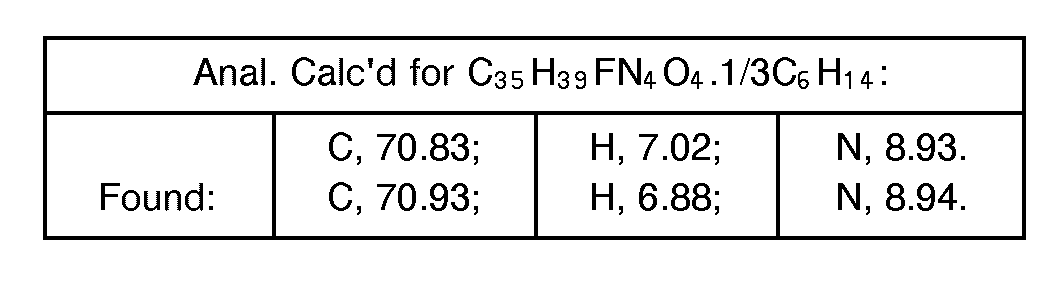
- The procedure of Example 21 was carried out using the same reagents and amounts except N - Boc - D - leucine monohydrate was substituted for N - Boc - L - leucine monohydrate. After 24 hours a second portion of Boc - D - Leucine monohydrate (32 mg, 0.129 mmol), EDC (25 mg, 0.130 mmol), and HBT (17.5 mg; 0.130 mmol) was added and the pH readjusted to 9.0 - 9.5 with Et3 N. The reaction was worked up as in Example 21, and the title compound was obtained as a foam. This was dried in vacuo at 65 ° C: (m.p. 135-48 ° C).
- The compound showed a single spot by TLC (Rf=0.37, silica gel plate, 40% (v/v) EtOAc in hexane). The NMR spectrum was consistent with the title structure. The compound was 87.5% pure by HPLC.

- The procedure of Example 21 was carried out using the same reagents and quantities except 1,3-dihydro - 5 - (2 - fluorophenyl) - 3(R) - (3' - α - indolenyl) methyl - 2H -1,4 - benzodiazepin - 2 - one was substituted for the 3' - isomer. After 24 hours the reaction was worked up in the same manner and the title compound was obtained as a foam. This was dried in vacuo at 65 ° C: (m.p. 130 - 48 ° C).
- The compound showed a single spot by TLC (Rf=0.39, silica gel plate, 40% (v/v) EtOAc in hexane). The NMR spectrum was consistent with the title compound. The compound was 91 % pure by HPLC,

- The procedure of Example 23 was carried out using the same reagents and quantities except Boc - D - Leucine was substituted for Boc - L - Leucine. After 24 hours the reaction was worked up in the same manner and the title compound was obtained as a white foam. This was dried in vacuo at 65 ° C: (m.p. 130 -145 ° C).
- The compound showed a single spot by TLC (Rf=0.39, silica gel plate, 40% (v/v) EtOAc in hexane). The NMR spectrum was consistent with the title structure. The compound was 95.1 % pure by HPLC.

- 7 - Chloro - -1,3,dihydro - 3(R) - (3' - indolyl)methyl - 5 - phenyl - 2H -1,4 - benzodiazepin - 2 - one etherate (240 mg, 0.506 mmol) was dissolved in acetic acid (10 ml) and cooled to 10 ° C. To the yellow solution was added sodium cyanoborohydride (63.6 mg, 1.01 mmol) all at once. After stirring 15 minutes at 10°C, the reaction was diluted with H20 (10 ml), basified with sat'd Na2 C03 (aq.), and extracted with EtOAc (2 x 25 ml). The combined organic extracts were washed with brine, dried over MgS04, filtered, and evaporated to dryness in vacuo. The residue was chromatographed (silica gel, 900/10/1/1 (v/v/v/v) of CH2Cl2/MeOH/H2O/HoAc) and the product fractions evaporated to dryness in vacuo. The residue was dissolved in absolute ethanol, filtered, and treated with 5.37 M HCI in ethanol until the solution was acidic. The product crystallized as fine white needles which were dried in vacuo at 82° C: (m.p. 198-204° C).
- The compound showed a single spot by TLC (Rf=0.35, silica gel plate, 300/10/1/1 (v/v/v/v) CH2CI2/MeOH/H20/HoAc). The NMR spectrum was consistent with the title structure and verified the presence of H20. The mass spectrum showed a molecular ion at m/e = 401.

- 7 - Chloro - -1,3 - dihydro - 3(S) - (3' - indolyl)methyl - 5 - phenyl - 2H -1,4 - benzodiazepin - 2 - one (300 mg, 0.750 mmol) was dissolved in acetic acid (10 ml) and cooled to 10 C. To the yellow solution was added sodium cyanoborohydride (63.6 mg, 1.01 mmol) all at once. After stirring 15 minutes at 10 ° C, the reaction was diluted with H20 (10 ml), basified with sat'd Na2C03(aq.), and extracted with EtOAc (2 x 25 ml). The combined organic extracts were washed with brine (10 ml), dried over MgS04, filtered, and evaporated to dryness in vacuo. The crude residue was dissolved in absolute ethanol (3 ml), filtered, and treated with 5.37M ethanolic HCI until the solution was acidic. The product crystallized as fine white needles which were dried in vacuo at 82°C: (m.p. 198-204°C).
- The compound showed a single spot by TLC (Rf=0.30, silica gel plate, 300/10/1/1 (v/v/v/v) of CH2CI2/MeOH/H20/HoAc). The NMR spectrum was consistent with the title structure and verified the presence of H20 and ethanol.

- The procedure of Example 25 was carried out using 1,3 - dihydro - 5 - (2 - fluorophenyl) - 3(R) - [3' - (1' - methylindolyl) - methyl] - 1 - methyl - 2H 1,4 - benzodiazepin - 2 - one (1.0 gm, 2.43 mmol) and so - dium cyanoborohydride (305 mg, 4.86 mmol) in glacial acetic acid (4 ml). The crude reduction product obtained upon evaporation of the EtOAc extracts was used without further purification.
- A The crude reduction product (200 mg, 0.484 mmol) was partitioned between CH2CI2 (6 ml) and H20 (5 ml) and cooled to 0 ° C. 1 N NaOH (0.73 ml) was added, followed by p - chlorobenzoyl chloride (.092 ml, 0.726 mmol). After 24 hours at ambient temperature, a second portion of 1 N NaOH (0.50 ml) and p - chlorobenzoyl chloride (.045 ml, 0.354 mmol) was added, and after 24 hours a third portion of 1 N NaOH ( 50 ml) and p - chlorobenzoylchloride (.045 ml, 0.354 mmol) was added. After another 24 hours, the mixture was extracted with CH2CI2 (3 x 10 ml). The combined organic layers were washed with 10% NaHCO3 (10 ml), H20 (10 ml), and brine (10 ml), dried over MgS04, filtered, and evaporated in vacuo. Chromatography (silica gel, 5% (v/v) Et20 in CH2CI2) of the crude residue gave a foam which was crystallized from Et20. The compound was dried in vacuo at 78°C: (m.p. 237-43°C).The compound showed a single spot by TLC (Rf=0.50, silica gel plate, 4% (v/v) Et20 in CH2CI2). The NMR spectrum was consistent with the title structure and verified the presence of Et20. The compound was greater than 99% pure by HPLC.

- B: The crude reduction product (200 mg, 0.484 mmol) was dissolved in CH2CI2 (10 ml) and 3 portions of acetyl chloride (each 0.026 ml, 0.363 mmol) and triethylamine (0.35 ml, 0.363 mmol) were added at 3 hour intervals. Water (2 ml) was then added and the mixture was extracted with CH2CI2 (3 x 10 ml). The combined organic layers, were washed with 10% Na2C03 (aq.) (10 ml), H20 (10 ml) and brine (10 ml), dried over MgS04, filtered, and evaporated in vacuo. Chromatography (silica gel, 5% (v/v) Et20 in CH2CI2) of the crude residue gave a white foam which was crystallized from Et20. The compound was dried in vacuo at 78 ° C: (m.p. 214 - 216.5 ° C).
The compound showed a single spot by TLC (Rf=0.41, silica gel plate, 15% (v/v) Et20 in CH2Cl2). The NMR spectrum was consistent with the title structure. The compound was greater than 99.5% pure by HPLC. The mass spectrum showed a molecular ion at m/e = 455.
- The procedure of Example 1 was carried out using 2-amino-2',5-dichlorobenzophenone (2.66 g, 0.01 mole), Boc - D - tryptophan (3.04 g, 0.01 mole), and DCC (10 ml of 1 M solution in methylene chloride) in THF (15 ml). The crude product obtained after filtration and evaporation of the mixture was chromatog - raphed on silica gel (230-400 mesh, 9 inch (23 cm) column 55 mm diameter), using methylene chloride followed by 5% (v/v) ether/methylene chloride. The product fractions were evaporated in vacuo to give the product as a foam. This material was deprotected and cyclized using the procedure of Example 2. The cyclization in this case required 15 days. At the end of this time the mixture was evaporated in vacuo, treated with water (10 ml), and extracted with methylene chloride (3 x 50 ml). The methylene chloride layers were dried over potassium carbonate, filtered, and evaporated in vacuo to give the crude product as a foam. This material was chromatographed on silica gel (230-400 mesh, 8 inch (20 cm) column, 25 mm diameter, elution with methylene chloride followed by 10% (v/v) ether/methylene chloride). The product fractions were evaporated in vacuo and the residue crystallized from ether by addition of cyclohexane. The title compound was obtained as a white solid which was dried in vacuo at 80 ° : (mp 140 -170 ° (d)).
- The compound showed a single spot by TLC (Rf = 0.61, silica gel plate eluted with 1:1 (v/v) ether/methylene chloride). The NMR spectrum was consistent with the title structure. The mass spectrum showed a molecular ion at m/e = 433. The compound was 98% pure by HPLC.

- The procedure of Example 1 was carried out using 2 - aminobenzophenone (1.35 g, 0.01 mole), Boc - D-tryptophan (3.04 g, 0.01 mole), and DCC (10 ml of 1M solution in methylene chloride) in THF (15 ml). The mixture was filtered, evaporated in vacuo and the residue chromatographed on silica gel (230-400 mesh, 9 inch (23 cm) column, 55 mm diameter) eluted with methylene chloride followed by 5%, 7-1/2% and 8% (v/v) ether/methylene chloride. The product fractions were evaporated in vacuo and the residue was deprotected and cyclized by the procedure of Example 2. The cyclization required seven days. The mixture was evaporated in vacuo and partitioned between water and methylene chloride. The methylene chloride layers were washed twice with water, dried over magnesium sulfate, filtered and evaporated in vacuo. The residue was chromatographed on silica gel (230-400 mesh, 11 inch (28 cm) column, 25 mm diameter, 1:1 and 2:1 (v/v) ether/methylene chloride elution). The product fractions were evaporated in vacuo to provide the title compound: (mp 185 -190 ° The compound was dried in vacuum at 100 overnight.
- The compound showed a single spot by TLC (Rf=0.29, silica gel plate eluted with 1:1 (v/v) ether/methylene chloride). The NMR spectrum was consistent with the title structure. The mass spectrum showed a molecular ion at m/e=303. The compound was 95.6% pure by HPLC.

- The procedure of Example 4 was carried out using 7 - chloro -1,3 - dihydro - 3(R) - (3' - indolyl) - methyl - 5 - phenyl - 2H -1,4 - benzodiazepin - 2 - one etherate (0.1 g, 0.22 mmole) in place of 1,3-dihydro - 5 - (2 - fluorophenyl) - 3(R) - (3' - indolyl)methyl - 2H -1,4 - benzodiazepin - 2 - one, and 50% so - dium hydride in mineral oil (0.015 g, 0.31 mmole) in dry DMF (2 ml). In place of methyl iodide, benzyl bromide (0.058 g, 0.34 mmole) was added to the mixture. Chromatography on a 6 inch (15 cm), 15 mm diameter silica gel column with 5% (v/v) ether/methylene chloride elution and evaporation of the product fractions gave a residue which was recrystallized from cyclohexane to provide the title compound which was dried in vacuo at 60 ° : (mp ca. 80 ° (indistinct)).
- The compound showed a single spot by TLC (Rf=0.66, silica gel plate eluted with 10% (v/v) ether/methylene chloride). The NMR spectrum was consistent with the title structure and verified the presence of approximately 1/2 mole of cyclohexane. The compound was 100% pure by HPLC. The mass spectrum showed a molecular ion at m/e = 489.

- The procedure of Example 4 was carried out using 7 - chloro -1,3 - dihydro - 3(R) - (3' - indolyl) - methyl-5-phenyl-2H-1,4-benzodiazepin-2-one etherate (0.1 g, 0.22 mmole) in place of 1,3-dihydro - 5 - (2 - fluorophenyl) - 3(R) - (3' - indolyl)methyl - 2H -1,4 - benzodiazepin - 2 - one, 50% sodium hydride in mineral oil (0.014 g, 0.29 mmole), and methyl iodide (0.045 g, 0.32 mmole) in DMF (2 ml). Chromatography on a six inch (15 cm), 15 mm diameter silica gel column provide the title compound which, after evaporation and in vacuo, was dissolved in acetone, precipitated with water and filtered. The resulting solid was dried in vacuo at 70 ° :(mp 134 - 152 (indistinct)).
- The compound showed a single spot by TLC (Rf=0.22, silica gel plate eluted with 5% (v/v) ether/methylene chloride. The NMR spectrum was consistent with the title structure. The compound was 98.9% pure by HPLC. The mass spectrum showed a molecular ion at m/e = 413.

- The procedure of Example 1 was carried out using 0.7 g (3.25 mmole) of 2 - amino - 2' fluoroben - zophenone, 0.99 g, (3.25 mmole) of Boc-L-tryptophan, and 3.25 ml (3.25 mmole) of 1M DCC/CH2Cl2 in 5 ml of THF. The product obtained by silica gel chromatography (10 inch (25 cm) column, 25 mm diameter, methylene chloride and 2% and 3% (v/v) ether/methylene chloride elution) was deprotected and cyclized according to the procedure of Example 2. The cyclization required three days. The resulting mixture was evaporated in vacuo, partitioned between water and methylene chloride, and separated. The aqueous layer was extracted twice with methylene chloride, and the combined methylene chloride layers were washed with water, dried over sodium sulfate, filtered, and evaporated in vacuo. The residue was recrystallized from acetone/ether, and the resulting solid dried in vacuo at 100 ° : (mp 255 - 257 ° ).
- The compound showed a single component by TLC (Rf=0.59, silica gel plate eluted with 1:1 (v/v) methylene chloride/ether. The NMR spectrum was consistent with the title structure. The mass spectrum showed a molecular ion at m/e = 383. The compound was 99.3% pure by HPLC.

- The procedure of Example 4 was carried out using 7 - chloro -1,3 - dihydro - 3(S) - (3' - indolyl) - methyl - 5 - phenyl - 2H -1,4 - benzodiazepin - 2 - one etherate (0.1 g, 0.22 mmole) in place of 1,3-dihydro - 5 - (2 - fluorophenyl) - 3(R) - (3' - indolyl)methyl - 2H -1,4 - benzodiazepin - 2 - one, 50% sodium hydride in mineral oil (0.014 g, 0.29 mmole), and benzyl bromide (0.058 g, 0.34 mmole) in place of methyl iodide. The reaction was run in 1.5 ml of dry DMF. Silica gel chromatography (8 inch (20 cm) column, 15 mm diameter, methylene chloride and 5% (v/v) ether/methylene chloride elution)) and evaporation of the product fractions in vacuo gave the title compound which was dried in vacuo at 60 ° : (mp 80 -120 (indistinct)).
- The compound showed a single component by TLC (Rf=0.40, silica gel plate eluted with 5% (v/v) ether/methylene chloride). The NMR spectrum was consistent with the title structure and showed 1/2 mole of cyclohexane. The compound was 99.3% pure by HPLC. The mass spectrum showed a molecular ion at m/e = 489.

- 7 - Chloro - -1,3 - dihydro - 3(R) - (3' - indolyl)methyl - 5 - phenyl - 2H -1,4 - benzodiazepin - 2 - one etherate (1.0 g, 2.1 mmole) and P2S5 (0.51 g, 2.3 mmole) were combined in dry pyridine (16 ml) and heated at reflux for 40 minutes. Pyridine was removed by evaporation in vacuo and the residue treated with ice water and extracted with methylene chloride. The methylene chloride layers were combined, dried over potassium carbonate, filtered, and evaporated in vacuo to give a foam. This material was chromatographed on silica gel (9 inch (23 cm) column, 25 mm diameter, 15% (v/v) ether/methylene chloride elution), and the product fractions evaporated. The residue was recrystallized from acetone/ethyl acetate and the solid dried in vacuo at 90 ° : (mp 279 - 280 ° ).
- The compound showed a single spot by thin layer chromatography (Rf=0.32, silica gel plate eluted with 10% (v/v) ether/methylene chloride). The NMR spectrum was consistent with the title structure. The compound was 98.6% pure by HPLC. The mass spectrum showed a molecular ion at m/e = 415.

- 1,3 - Dihydro - 5 - (2 - fluorophenyl) - 3(R) - (3' - indolyl)methyl - 2H -1,4 - benzodiazepin - 2 - thione (0.28 g, 0.7 mmole) and 3-thienoyl chloride (0.1 g, 0.7 mmole) were combined in ether (5 ml) and THF (1 ml) and stirred at room temperature. After one hour the mixture was filtered and evaporated in vacuo, and the residue chromatographed on silica gel (8 inch (20 cm) column, 25 mm diameter, 1 - 1/2% followed by 3% (v/v) methanol/methylene chloride elution). The product fractions were evaporated in vacuo and the resulting solid dried in vacuo at 70 ° : (mp 207 - 209 ° ( )).
- The compound showed a single spot by TLC (Rf=0.4, silica gel plate eluted with 5% (v/v) methanol/methylene chloride). The NMR spectrum was consistent with the title structure. The compound was 92% pure by HPLC.

- The procedure of Example 4 was carried out using ethyl iodide (0.35 g, 2.25 mmole) in place of methyl iodide. Silica gel chromatography followed by evaporation in vacuo gave the product which was dried at room temperature in vacuo (mp 95 -113 ° ).
- The compound showed a single spot by thin layer chromatography (Rf=0.44, silica gel plate eluted with 10% (v/v) ether/methylene chloride). The NMR spectrum was consistent with the title structure and showed the presence of approximately 0.15 mole of methylene chloride. The compound was 95.3% pure by HPLC. The mass spectrum showed a molecular ion at me =411.

- The procedure of Example 4 was carried out using cyclopropylmethylbromide (0.30 g, 2.25 mmole) in place of methyl iodide. The product obtained by chromatography and evaporation was recrystallized from a mixture of methylene, chloride, ether, and hexane, and the resulting solid dried in vacuo at 80 ° : (mp 207.5 - 208.5 °
- The compound showed a single component by TLC (Rf = 0.26, silica gel plate eluted with 4% (v/v) ether/methylene chloride). The NMR spectrum was consistent with the title structure. The compound was 99.6% pure by HPLC. The mass spectrum showed a molecular ion at m/e = 437.

- The procedure of Example 4 was carried out using 1 - bromopentane (0.34 g, 2.25 mmole) in place of methyl iodide. The product obtained after silica gel chromatography and evaporation was crystallized from ether and dried in vacuo at 80 ° : (mp 150 -151 °
- The compound showed a single component by thin layer chromatography (Rf = 0.37, silica gel plate eluted with 4% (v/v) ether/methylene chloride). The NMR spectrum was consistent with the title structure. The compound was 99.9% pure by HPLC. The mass spectrum showed a molecular ion at me =453.

- The procedure of Example 4 was carried out using 1 - bromo - 3 - methylbutane (0.34 g, 2.25 mmole) in place of methyl iodide. The product obtained after silica gel chromatography and evaporation was crystallized from ether and dried in vacuo at 80 ° : (mp = 198 -199.5 ° ).
- The compound showed a single component by thin layer chromatography (Rf = 0.30, silica gel plate eluted with 4% (v/v) ether/methylene chloride). The NMR spectrum was consistent with the title structure and showed the presence of 0.2 mole of ether. The compound was 99.9% pure by HPLC. The mass spectrum showed a molecular ion at m/e = 453.

- The procedure of Example 4 was carried out using 2,2,2-trifluoroethyl iodide (0.47 g, 2.25 mmole) in place of methyl iodide. Following addition of the trifluoroethyl iodide, the reaction was heated for 18 hours in an oil bath thermostatted at 65 ° . Workup and chromatography as described in Example 4 gave a product which was recrystallized from ether and dried in vacuo at 80 ° : (mp 189 -192 ° ).
- The compound showed a single component by thin layer chromatography (Rf = 0.50, silica gel plate eluted with 5% (v/v) ether/methylene chloride). The NMR spectrum was consistent with the title structure. The compound was 99.2% pure by HPLC. The mass spectrum showed a molecular ion at m/e = 465.

- The procedure of Example 4 was carried out using 1 - chloro - 2 - (dimethylamino)propane (0.24 g, 2.25 mmole) in place of methyl iodide. Following addition of the chloride, the reaction was stirred at room temperature for 5 days and then worked up as described in Example 4. The chromatographed product was crystallized from methylene chloride/hexane and the resulting solid dried in vacuo at 80 ° : (mp 200-201 ° ).
- The compound showed a single component by TLC (Rf = 0.30, silica gel plate eluted with 5% (v/v) methanol/methylene chloride). The NMR spectrum was consistent with the title structure. The compound was 99.6% pure by HPLC. The mass spectrum showed a molecular ion at m/e = 454.
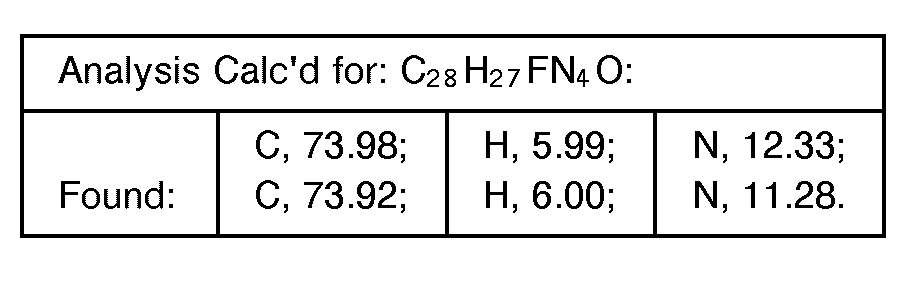
- The procedure of Example 4 was carried out using ethyl bromoacetate (0.38 g, 2.25 mmole) in place of methyl iodide. The chromatographed product was evaporated and dried in vacuo at room temperature: (mp 88-100°).
- The compound showed a single component by TLC (Rf = 0.42, silica gel plate eluted with 10% (v/v) ether/methylene chloride). The NMR spectrum was consistent with the title structure and showed the presence of 0.24 mole of methylene chloride. The compound was 92.6% pure by HPLC. The mass spectrum showed a molecular ion at m/e = 469.

- 1,3 - Dihydro - 1 - (ethoxycarbonylmethylene) - 5 - (2 - fluorophenyl) - 3(R) - (3' - indolyl)methyl - 2H - 1,4 - benzodiazepin - 2 - one (83.2 mg, 0.177 mmole), and 1 molar sodium hydroxide (0.18 ml, 0.18 mmole) were combined in 1 ml of methanol and stirred at room temperature for 24 hours. The solution was acidified with 1 molar hydrochloric acid, and the mixture evaporated in vacuo. The residue was taken up in methylene chloride, washed with water, dried over sodium sulfate, filtered, and evaporated in vacuo to dryness. The residue was triturated with ether followed by petroleum ether, and filtered to give the product which was dried in vacuo at 80 ° ; (mp 175 -180 ° ( )).
- The compound showed a single component by TLC (Rf = 0.52, silica gel plate eluted with 90:10:1:1 (v/v/v/v) methylene chloride/methanol/acetic acid/water). The NMR spectrum was consistent with the title structure and showed the presence of both ether and hexane. The compound was 97.2% pure by HPLC. The mass spectrum showed a molecular ion at m/e = 441.

- The method of Example 4 was employed except that the starting material was 1,3 - dihydro - 5 - (2 - fluorophenyl) - 3(R) - (3' - indolyl)methyl 1 - methyl - 2H -1,4 - benzodiazepin - 2 - one (1.3 g, 3.3 mmole). Fifty percent sodium hydride in mineral oil (0.16 g, 3.3 mmole) and methyl iodide (0.47 g, 3.3 mmole) were employed in 10 ml of dry DMF. Following workup and chromatography as in Example 4, the product was obtained having physical properties identical to those reported in Example 4.
- The procedure of Example 4 was carried out using 1,3 - dihydro - 5 - (2 - fluorophenyl) - 3(R) - (3' - indolyl)methyl -1 - methyl - 2H -1,4 - benzodiazepin - 2 - one (0.345 g, 0.87 mmole) in place of 1,3-dihydro - 5 - (2 - fluorophenyl) - 3(R) - (3' - indolyl)methyl - 2H -1,4 - benzodiazepin - 2 - one, and p - chlorobenzoyl chloride (0.26 g, 1.5 mmole) in place of methyl iodide. The reaction, employing 0.047 g (0.97 mmole) of 50% sodium hydride in mineral oil, was carried out in 10 ml of dry DMF. Silica gel chromatography as described in Example 4, followed by evaporation in vacuo and trituration with hexane, gave a solid which was dried in vacuo at 50 ° : (mp 75 ° ( )).
- The compound showed a single component by TLC (Rf = 0.57, silica gel plate eluted with 4% (v/v) ether/methylene chloride). The NMR spectrum was consistent with the title structure and verified the presence of approximately 0.3 mole of hexane. The compound was 99.3% pure by HPLC.

- The procedure of Example 45 was carried out using 0.042 g (0.88 mmole) of 50% sodium hydride, and benzylbromide (0.16 g, 0.92 mmole) in place of p-chlorobenzoyl chloride. Reaction was conducted in 4 ml of dry DMF. Following silica gel chromatography and evaporation, the product was recrystallized from cyclohexane and dried in vacuo at 60 ° : (mp 77 - 80 ° (indistinct)).
- The compound showed a single component by TLC (Rf = 0.59, silica gel plate eluted with 5% (v/v) ether/methylene chloride). The NMR spectrum was consistent with the title structure and showed the presence of 1/3 mole of cyclohexane. The compound was 98.7% pure by HPLC. The mass spectrum showed a molecular ion at m/e = 503.

- The lithium salt of 1,3 - dihydro - 1 - methyl - 5 - phenyl - 2H 1,4 - benzodiazepin - 2 - one (1.25 g, 5 mmole) was made according to the procedure of J. Org. Chem. 46, 3945 (1981) using 1.01 g (10 mmole) of diisopropylamine, and 6.7 ml of a 1.5 molar solution (10 mmole) of n - butylithium in hexane. This anion solution was added by syringe to a solution of 0.725 g (5 mmole) of indole-3-carboxaldehyde in 15 ml of dry THF stirred under nitrogen in a dry ice-acetone bath. The mixture was warmed to room temperature, stirred for 1 1/2 hours and then quenched by the addition of saturated sodium chloride solution. The mixture was separated and the aqueous layer extracted twice with methylene chloride (2 x 10 ml). The organic layers were dried over sodium sulfate, filtered and evaporated to dryness in vacuo. The residue was chromatographed on silica gel (230-400 mesh, 8 inch (20 cm) column, 25 mm diameter, 1:1 ether/methylene chloride elution). The evaporated product fractions were crystallized from ether and dried in vacuo at 70 ° : (mp 218 - 221 ° ).
- The compound showed a single component by TLC (Rf = 0.30, silica gel plate eluted with 1:1 (v/v) ether/methylene chloride). The NMR spectrum was consistent with the title structure. The compound was 90% pure by HPLC. The mass spectrum showed a molecular ion at me = 395.

- The procedure of Example 47 was carried out using thiophene-3-carbonyl chloride (730 mg, 5.0 mmol) in place of indole-3-carboxaldehyde. Following chromatography (silica gel, 5% (v/v) Et20 in CH2CI2), the product was evaporated to dryness and crystallized from Et20. The solid was dried in vacuo at 65 ° C: (m.p. 205 - 8 ° C).
- The compound showed a single spot by TLC (Rf=0.54, silica gel plate, 10% (v/v) Et20 in CH2CI2). The NMR spectrum was consistent with the title structure. The compound was greater than 92.4% pure by HPLC. The mass spectrum showed a molecular ion at m/e = 360.

- The procedure of Example 47 was carried out using thiophene-3-carboxaldehyde (560 mg, 5.0 mmol) in place of indole-3-carboxaldehyde. Following chromatography (silica gel, 15% (v/v) Et20 in CH2CI2), the product was evaporated to dryness and crystallized from Et20. The solid was dried in vacuo at 65 ° C: (m.p. 189 - 91 ° C).
- The compound showed a single spot by TLC (Rf=0.36, silica gel plate, 15% (v/v) Et20 in CH2Cl2). The NMR spectrum was consistent with the title structure. The compound was greater than 99.0% pure by HPLC. The mass spectrum showed a molecular ion at m/e = 362.

- The procedure of Example 47 was carried out using 1 - methylindole - 3 - carboxaldehyde (797 mg, 5.0 mmol) in place of indole - 3 - carboxaldehyde. The product diastereomers were separated by chromatog - raphy (silica gel, 10% (v/v) Et20 in CH2CI2) and evaporated to dryness.
- A: The faster running component (TLC - Rf = 0.41, silica gel plate, 60% (v/v) EtOAc in hexane) was crystallized from Et2O. The solid was dried in vacuo at 65 C: (m.p. 218-21 ° C).
The compound showed a single spot by TLC. The NMR spectrum was consistent with the title structure. The compound was greater than 96.7% pure by HPLC. The mass spectrum showed a molecular ion at m/e = 409.
- B: The slower running component (TLC-Rf=0.30, silica gel plate, 60% (v/v) EtOAc in hexane) was crystallized from Et2O. The solid was dried in vacuo at 65 ° C: (m.p. 125 - 30 ° C).
The compound was a single spot by TLC. The NMR spectrum was consistent with the title structure and cnfirmed the presence of Et20. The compound was greater than 95.7% pure by HPLC.The mass spectrum showed a molecular ion at m/e = 409).
- The procedure of Example 47 was carried out using benzyldehyde (0.53 g, 5 mmole) in place of indole - 3 - carboxaldehyde. The chromatographed product was crystallized from ether and dried in vacuo at 70°: (mp 192-193°).
- The compound showed a single component by TLC (Rf = 0.53, silica gel plate eluted with 1:1 (v/v) ether/methylene chloride). The NMR spectrum was consistent with the title structure and showed the presence of 0.1 mole of ether. The compound was 99.9% pure by HPLC. The mass spectrum showed a molecular ion at m/e = 338.

- The procedure of Example 47 was carried out using 2-thiophene-carboxaldehyde (0.56 g, 5 mmole) in place of indole - 3 - carboxaldehyde. The chromatographed and evaporated product was crystallized from ether and dried in vacuo at 70 ° : (mp 184 -185 ° ).
- The compound showed a single component by TLC (Rf = 0.54, silica gel plate eluted with 1:1 (v/v) ether/methylene chloride). The NMR spectrum was consistent with the title structure. The compound was 99.8% pure by HPLC.

- The procedure of Example 47 was carried out using 0.75 g (5 mmole) of 3-thienoyl chloride in place of indole-3-carboxaldehyde. In this reaction, the THF employed was subsequently shown to contain significant quantities of organic peroxides. Workup and chromatography as in Example 47 provided two products each of which was evaporated in vacuo and crystallized from ether.
- A: The first product obtained was A, which was dried in vacuo at 70 ° : (mp 193 -194 ° ).
The compound showed a single component by TLC (Rf = 0.57, silica gel plate eluted with 1:1 (v/v) methylene/chloride ether). The NMR spectrum was consistent with the title structure. The compound was 99.4% pure by HPLC. The mass spectrum showed a molecular ion at m/e = 376. The infrared spectrum showed a strong absorption at 1675 cm-1.
- B: The second compound obtained was B, which was dried in vacuo at 70 ° : (mp 173 -175 ° ).
The compound showed a single component by TLC (Rf = 0.64, silica gel plate eluted with 1:1 methylene chloride/ether). The NMR spectrum was consistent with the title structure. The mass spectrum showed a molecular ion at m/e = 376. The compound was 99.6% pure by HPLC. The infrared spectrum showed strong absorption at 1695 and 1720 cm-1.
- 7 - Chloro - -1,3 - dihydro - 3(R) - indolylmethyl - 5 - phenyl - 2H -1,4 - benzodiazepin - 2 - one (200 mg, 0.5 mmol) was dissolved in DMSO (4.8 g, 10 mmol) followed by the addition of concentrated HCI (5 mmol). The molar ratio of DMSO to HCI was 2:1. Additional reagents were added to drive the reaction to completion. The additions were:
-
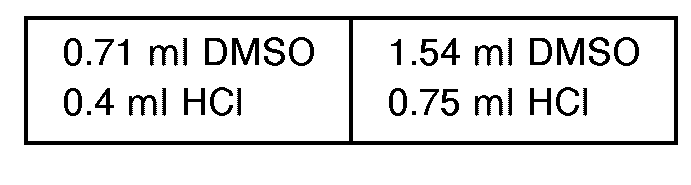
- When little starting material remained, the reaction was poured into an Erlenmeyer flask with water (20 ml), and 5 g of NaHCO3 was added. Water (100 ml) was added and the mixture was extracted with 4x50 ml of n - butanol. The n - butanol solution was washed with water (3x100 ml). The n - butanol solution was evaporated and the residue was dissolved in ether and purified by preparative TLC.
- The product was a pair of diasteriomers; the NMR spectrum was consistent with the title compound.
- HPLC indicated two components: 54% and 43%.
- TLC in 95/5/0.5 CHCl3 - -MeOH-H2O Rf=0.3 (silica gel GF)
- Mass Spec. gave a (M + 1) at 416.
- Boc - DNP - D - Histidine (1.7 g, 4 mmol) and 2 - amino - 5 - chlorobenzophenone (0.9 g, 4 mmol) were combined in 10 ml of THF and stirred until a clear orange solution was obtained. 4.3 mL of DCC (1 M) in THF was added and the reaction was stirred overnight. The reaction was filtered and evaporated. The residue was purified by flash chromatography on a silica gel 60 column with a 90:10 chloroform ether solvent system.
- The resultant t - BOC protected compound was dissolved in 30 ml of ethyl acetate. The solution was cooled to - 25 ° C. HCI gas was added until the solution was saturated. The temperature was allowed to rise to 0 ° C. When the reaction was complete by TLC, the ethyl acetate was evaporated and the residue was dissolved in methanol. The pH of the solution was adjusted with 10% aqueous sodium hydroxide to pH 9. After the reaction stirred overnight, the solvent was evaporated and the residue was chromatographed on a silica gel 60 column with chloroform, to give the title compound.
- HPLC: 91 %.
- TLC: Rf=0.6 in 90/10/1 CHCl3 -MeOH-aqueous ammonia (silica gel GF)
- Mass Spec. molecular ion at 516.
- NMR agreed with the title compound.

- This compound was obtained as a second product from the reaction sequence of Example 55. This material, which had a positive Sanger test for histidine, eluted from the silica column after the compound of Example 55, HPLC: 87%.
- TLC: Rf-0.3 in 90/10/1 CHCl3 -MeOH-aqueous ammonia (silica gel GF).
- Mass Spec. molecular ion at 350.
- NMR was consistent with the title compound.

- The synthesis was carried out as described for Example 55 starting with Boc - 5 - bromo - DL - tryptophan and 2-aminobenzophenone. The crude product was purified by column chromatography (silica gel) using 90/10 chloroform - ether as the elution solvent.
- HPLC: 99%.

- Mass Spec. molecular ion at 443.
- NMR: The NMR was in agreement with the title compound.
- 2-Amino-2'-carboxybenzophenone (2.41 g, 10 mmol) was suspended in THF, CH2CI2, EtOAc and tryptophanyl chloride hydrochloride (2.59 g, 10 mmol) was added. The mixture was stirred at room temperature until reaction was complete by TLC. A solid was collected by filtration, dried, and dissolved in 40 ml of methanol. The pH of the solution was adjusted to a pH of 8-10 with 10% aqueous sodium hyroxide. After standing at room temperature for about 3 days, the solution was acidified to a pH of about 3. The solvent was evaporated and the residue was dissolved in 95/5 CHCl3/CH3OH and flash chromatographed on a silica gel 60 column with a 95:5 and 90:10 chloroform - methanol solvent system to give the title compound.
- HPLC: 96%.

- Mass Spec. molecular ion observed at 409.
- NMR: The spectrum agreed with the title compound.
- 5 - Fluorotryptophyl chloride hydrochloride (1.38 g, 5 mmole), prepared from 5 - fluoro - DL - tryptophan and PCl5 in acetylchloride, was suspended in 15 ml of THF. 2-Amino-2'-fluorobenzophenone 1.07 g (5.0 mmol) was added to the stirred mixture. After stirring overnight the solvent was evaporated and the solid was dissolved in 50 ml of methanol. The pH of the solution was adjusted to 8 - with 10% aqueous sodium hydroxide. The solution stood for 24 hours at room temperature. The solvent was evaporated and the crude reaction product was purified by flash chromatography with 98:2 chloroform/methanol to give the title compound.
- TLC: Rf=0.3 in 97:3 CHCl3/CH3OH (silica gel GF).

- NMR was in agreement with the title compound.
- The compound was prepared according to the procedure of Example 59, using 6-fluorotryptophyl chloride hydrochloride in place of the 5-fluoro compound.
- The final product was obtained as a solid which crystallized in pure form from chloroform.
- TLC: Rf=0.4 in 97:3 CHCl3/CH3OH (silica gel GF)
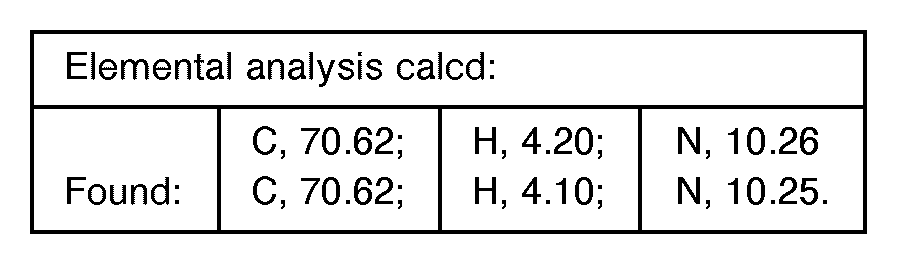
- NMR was in agreement with the title compound.
- The procedure of Example 1 was carried out using 2-amino-2'-fluorobenzophenone (430 mg, 2.0 mmole), 2(R,S),3 - bis - (Boc - amino)propionic acid (617 mg, 2.03 mmole), and dicyclohexylcarbodiimide (2.03 ml of a 1.0 M solution in methylene chloride) in 10 ml of methylene chloride. Filtration, concentration in vacuo and flash chromatography (silica gel, 10% ethyl ether in methylene chloride) gave a foam, the PMR spectrum of which was consistent with the title compound.
- 2 -Amino - 2' -fluorobenzophenone (2.10 g, 9.8 mmole) was reacted with 2,3 - diph - thalylaminopropionyl chloride (5 g, 9.8 mmole) in 100 ml of tetrahydrofuran. After 2.5 hours the reaction mixture was rotoevaporaed to give 7 g of a yellow foam. The foam was heated for 30 minutes in 6N hydrochloric acid (100ml) and the resulting off-white solid collected and dried. Recrystallization from ethyl acetate afforded the analytical sample, m.p. 210.5 - 211.5 ° . NMR (CD30D): in agreement with title compound.
-

- The procedure of Example 2 was carried out in which 2 - N - [2(RS) - ((1,1 - dimethylethoxy)carbonyl) - amino - 3 - ((1,1 - dimethylethoxy)carbonyl)aminopropanoyl]amino - 2' -fluorobenzophenone (600 mg, 1.2 mmole) was reacted in succession with excess HCI gas in ethyl acetate (15 ml) at 0° and then sodium hydroxide (0.1 M solution) in aqueous methanol (10 ml). The pH of the reaction mixture was approximately 9.0. Work - up afforded the title compound as a solid, mp 168 -169 ° ; in 90% yield.
- NMR (CDCl3): Spectrum in agreement with title compound.
- MS (14 ev.): 283 (M+) 253.

- 2 - N - [2(RS),3 - diphthalylaminopropanoyl]amino - 2' fluorobenzophenone (1.07 g, 1.90 mmole) was suspended in 55 ml of methanol and treated with 1 ml of 95% hydrazine. The reaction mixture was protected from moisture and stirred at room temperature. Within one hour, the reaction mixture became homogeneous. On further reaction, phthalhydrazide precipitated from solution. After 14 hours, the reaction was filtered and the filtrate concentrated. The residue was partitioned between methylene chloride and water; the organic phase was washed wth water until it was free of hydrazine (Tollen's reagent negative), then dried and concentrated to give 480 mg of an oil which crystallized on standing. Trituration of the resulting solid with ether gave the analytical sample, m.p. 168 -169 ° , identical spectroscopically with the material prepared in Example 63.
- The procedure of Example 64 was followed whereby 2 - N - [2(R),6 - diphthalylaminohexanoyl]amino - 2'-fluorobenzophenone (5.4 g) was deprotected and cyclized with 10 ml of 95% hydrazine in 150 ml of methanol. Workup afforded 1.35 g of product which was purified via silica gel chromatography (chloroform - methanol - ammonia, 80:30:4 v/v).
- NMR (CDCl3): in agreement with title compound.

- To a solution of 50 ml of methylene chloride containing 260 mg (0.91 mmol) of 1,3 - dihydro - 5 - (2 - fluorophenyl) - 3(RS) - aminomethyl - 2H -1,4 - benzodiazepin - 2 - one and 224 mg (1.83 mmol) of 4-dimethylaminopyridine was added 0.51 ml (3.57 mmol) of benzylchloroformate. The resulting reaction mixture was allowed to stand at room temperature overnight and then was diluted with methylene chloride (200 ml). The reaction was then washed in succession with saturated sodium bicarbonate solution and brine, then dried (MgS04) and concentrated. The residual oil was chromatographed on silica gel (chloroform- methanol - ammonia, 95:5:0.5 v/v elution) to afford 370 mg of the analytical product, m.p. 88 ° (soften), 90 - 92 ° C.
- TLC: Single component, Rf = 0.35 (95:5:0.5, chloroform - methanol - ammonia).
- NMR: Consistent with title structure.
- 1,3 - Dihydro - 5 - (2' - fluorophenyl) - 3(RS) - aminomethyl - 2H -1,4 - benzodiazepin - 2 - one (140 mg, 0.49 mmole) and 3-thiophenecarbonyl chloride (88 mg, 0.60 mmole) were dissolved in 10 ml of dry tetrahydrofuran at room temperature. To this solution was added 69 µl of triethylamine. After addition was complete, stirring was continued for 15 minutes more and the reaction mixture was partitioned between ethylacetate (60 ml) and sodium bicarbonate solution (sat.). The organic phase was washed with 10% sodium hydroxide solution (1 x 20 ml) and then with 10% hydrochloric acid solution. From this acidic solution were deposited off-white crystals, after overnight standing. The solid was washed with water and dried to give 140 mg of the analytical product, mp 237-240° (An additional 70 mg of product was obtained as the free base after concentration of the organic extracts.) The analytical product was greater than 98% pure by HPLC.
- MS (14 ev.): 393 (M - HCI), 266.
- NMR (DMSO - d6): in agreement with title compound.

- 1,3 - Dihydro - 5 - (2 - fluorophenyl) - 3(RS) - aminomethyl - 2H -1,4 - benzodiazepin - 2 - one (80 mg, 0.282 mmole) and indole-2-carbonyl chloride (53 mg, 0.30 mmol) were mixed in 5 ml of methylene chloride at room temperature. The homogeneous reaction mixture was protected from moisture and treated with 42 µl (0.30 mmole) of triethylamine. Within five min., triethylamine hydrochloride precipitated. The reaction mixture was stirred at room temperatre overnight and then partitioned between methylene chloride and saturated sodium bicarbonate solution. The resulting solid was collected, washed with water and dried over P2O5 at 70 ° C. In this way, 39 mg of the analytical product was obtained, m.p.: 315 - 317 (d).
- NMR(DMSO-d6): Consistent with the title structure.
- MS: Molecular ion at m/e = 426.
- 1,3 - Dihydro - 5 - (2' - fluorophenyl) - 3(RS) - aminomethyl - 2H -1,4 - benzodiazepin - 2 - one (60 mg, 0.21 mmole) was dissolved in 3 ml of isopropanol and treated with triethylamine (30 µl, 0.22 mmole). The resulting solution was heated to reflux for 18 hours, cooled and concentrated. The residual oil was chromatographed on silica gel (chloroform - methanol - ammonia, 90:10:1 v/v) to give 25 mg of the desired product as an off-white solid, mp 155 -158 ° (with gas evolution).
- MS (FAB): 550 (M + H), 549 (M+), 282 (base peak).
- NMR (CDCl3): in agreement with title compound.
- 1,3 - Dihydro - 5 - (2 - fluorophenyl) - 3 - (RS) - aminomethyl - 2H -1,4 - benzodiazepin - 2 - one (72 mg, 0.25 mmol), 2,6-dichloropyrazine (45 mg, 0.30 mmol)and anhydrous potassium carbonate (83 mg, 0.60 mmol) were combined at room temperature with 2 ml of dry dimethylformamide. The resulting suspension was stirred rapidly for 24 hours and 37 mg more of 2,6-dichlorpyrazine was added. After 72 hours total reaction time, the reaction mixture was poured into water (10 ml) and extracted with ethyl acetate (3 x 20 ml). The combined organic extracts were washed with water and brine, dried (MgSO4) and concentrated to give 70 mg of crude product. The analytical sample was obtained by preparative thick layer chromatography (chloroform - methanol - ammonia, 95:5:0.5 v/v one elution).
- Rf = 0.25, m.p. 140 (soften), 148 -152 ° .
- NMR (CDCI3): Consistent with the title structure.
- MS (14 ev): 395 (M+), 266, 254, 211.
- Following the procedure of Example 4, 2 - N - [2(RS),3 - diphthalylaminopropanoyl]amino - 2' - fluorobenzophenone (677 mg, 1.20 mmole) was converted to the title compound with sodium hydride (63 mg, 1.31 mmole) and methyliodide (81.5 µl, 1.31 mmole) in 5 ml of N,N-dimethylformamide. Work-up afforded the crude product which was purified by silica gel chromatography (ethyl acetate - hexane elution, 3:2 v/v); the analytical sample was obtained as white prisms by recrystallizing the chromatographed material from ethyl acetate, mp 252 ° .
- MS (14 ev.): 575 (M+), 453, 429, 309.
- NMR (CDCl3): in agreement with title compound.
- Following the procedure of Example 64, 2-N-methyl-N-[2(RS),3-diphthalylaminopropanoyl]-amino-2'-fluorobenzophenone (220 mg, 0.38 mmole) was converted to the title compound with 95% hydrazine (1 ml) in 40 ml of methanol. The analytical material was obtained via chromatography on silica gel (chloroform-methanol-ammonia, 90:10:1 v/v). The PMR spectrum (CDCl3) confirmed the structure of the product; N - methyl proton at 3.46 ppm.
- 3-(RS)-Amino-1,3-dihydro-5-phenyl-2H-1,4-benzodiazepin-2-one (75 mg, 0.298 mmol), and indole-2-carbonyl chloride (58.8 mg, 0.327 mmol) were combined in CH2CI2 (2 ml) and the pH adjusted to 9.0 with triethylamine (41 µl, 0.298 mmol). After stirring 10 min., the reaction was chromatog - raphed on silica gel (180/10/1/1 of CH2CI2/MeOH/H20/HOAc). The combined product factions were washed with dilute NaHCO3 (aq) (1X), H20 (1X) and brine (1X), dried over MgS04, filtered and stripped to give the title compound as a white solid from ether: (m.p. 265 - 268 °
- TLC: Silica GF (10% MeOH in CH2CI2), Rf = 0.63, single homogeneous component.
- NMR: Consistent with title structure and verifies the presence of 0.2 (C2H5)2O.
- HPLC: Greater than 99.2% pure.
- M.S.: Mol. lon = 394 m/e (free base).

- 3 - (RS) - Chloro -1,3, - dihydro - 5 - phenyl - 2H -1,4 - benzodiazepine - 2 - one(68 mg, 0.25 mmol), 3-(2-amionoethyl)indole(40 mg, 0.25 mmol) and sodium hydroxide (0.1 ml of 2.5N solution) were combined in methanol (4 ml) and stirred at room temperature for 18 hours. The mixture was evaporated in vacuo, and the residue was dissolved in methylene chloride and chromatographed on silica gel (5% v/v MeOH in CH2CI2). The product fractions were evaporated in vacuo and the resulting solid crystallized from ether and dried in vacuo at 60°: (m.p. 196 - 197.5 (d)). TLC: Single spot (Rf = 0.46, silica gel plate, 10% (v/v) MeOH in CH2CI2).
- NMR: The spectrum was consistent with the title structure and verified the presence of CH2CI2.
- HPLC: Greater than 94% pure.
- MS: A molecular ion at m/e = 394.
-
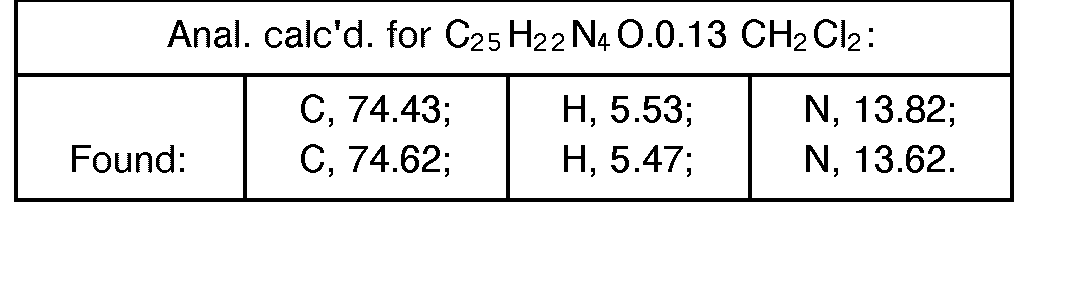
- The procedure of Example 77 was carried out using 3 - (3 - indolyl)propionic acid (0.076 g, 0.4 mmol) in place of BOC-L-tryptophan. The product was chromatographed on silica gel using a gradient of 1:1 Et20/CH2CI2 containing 0 to 2% CH20H. The product was crystallized from acetone and dried in vacuo at 60°: (m.p. 176-182°).
- TLC: Single spot (Rf = 0.66, silica gel plate, 10% (v/v) MeOH in CH2Cl2).
- NMR: The spectrum was consistent with the title structure.
- HPLC: 99.7% pure.
- MS: A molecular ion at m/e = 422.
-

- 3-(RS)-Amino-1,3-dihydro-5-phenyl-2H-1,4-benzodiazepin-2-one(75 mg, 0.298 mmol) and indole-3-acetyl chloride (57.8 mg, 0.298 mmol) were combined in CH2Cl2 (2 ml) and the pH adjusted to 9.0 with triethylamine (TEA) 41 ml, 0.298 mmol). After stirring 15 min., a second portion of indole-3- acetyl chloride (44 mg, 0.175 mmol) and TEA (30 µl, 0.215 mmol) were added and the reaction stirred an additional 15 min. The completed reaction was diluted with CH2CI2, washed with H20 (1X) and brine (1X), dried over MgS04, filtered and stripped to dryness in vacuo. The residue was chromatographed on silica gel (5% MeOH in CH2CI2) to give the title compound as a pinkish solid from Et20: (m.p. 264-265°).
- TLC: Silca GF (10% MeOH in CH2CI2), Rf = 0.44, single homogeneous component.
- NMR: Consistent with title structure.
- HPLC: Greater than 93.1 % pure.
- M.S.: molecular ion at m/e = 408.
- 3-(RS)-Amino-1,3-dihydro-5-phenyl-2H-1,4-benzodiazepin-2-one(0.1 g, 0.4 mmol), BOC-L-tryptophan (0.12 g, 0.4 mmol), and DCC (0.4 ml of a 1 M solution in CH2CI2, 0.4 mmol) were combined in 2 ml of THF to which were added 2 ml of DMF and 2 ml of CH2CI2. The mixture was treated with triethylamine (0.11 ml), stoppered, and stirred at room temperature for four days. The mixture was treated with citric acid solution (10%, 3 ml) end CH2CI2 (5 ml), shaken and separated. The aqueous phase was extracted with CH2CI2 (2 x 5 ml). The combined organic layers were washed with citric acid (10%, 2 x 5 ml), sodium bicarbonate (10%, 2 x 5 ml), and H20 (10 ml), dried over sodium sulfate, filtered, and evaporated to dryness in vacuo. The residue was chromatographed on silica gel (1:1 (v/v) Et20/CH2CI2) and the combined product fractions evaporated to dryness in vacuo. The residue was triturated with petroleum ether and the solid dried in vacuo at 70°: (m.p. 173 -177 (t)).
- TLC: Single spot (Rf = 0.56, silica gel plate, 10% (v/v) CH30H in CH2CI2).
- NMR: The spectrum was consistent with the title structure and verified the presence of two diastereomers.
- HPLC: Greater than 99.7% pure (36% and 63.7%).
- MS (FAB): a molecular ion at m/e = 537.

- The procedure of Example 4 was carried out using 1,3 - dihydro - 3(RS) - (2 - indolecarbonylamino) - 5-phenyl-2H-1,4-benzodiazepin-2-one(0.87 g, 2.2 mmol) in place of 1,3dihydro-5-(2-fluorophenyl) - 3(R) - (3' - indolyl)methyl - 2H -1,4 - benzodiazepin - 2 - one and ethyl bromoacetate (0.38 g, 2.25 mmole) in place of methyl iodide. The chromatographed product (7% ether in CH2CI2) (0.073 g, 0.15 mmol) and sodium hydroxide (0.2 ml, 1N, 0.2 mmol) were stirred together in CH30H (1 ml) at room temperature for 18 hours. The mixture was concentrated in vacuo, diluted to 3 ml with H20, made acidic with 1N HCI, and extracted with CH2Cl2 (3 x 5 ml). The combined organic layers were treated with methanol (1 ml) to dissolve precipitated solid, dried over Na2S04, filtered, and evaporated to dryness in vacuo. The residue was crystallized from ether (4 ml) and the solid dried in vacuo at 80°: (m.p. 275 - 278 ° (d) (t)).
- TLC: A single spot (Rf = 0.21, silica gel plate, 180:10:1:1 (v/v/v/v) CH2CI2:MeOH:HOAc: H20).
- NMR: Spectrum was consistent with the title structure and verified with presence of Et20 and CH2CI2.
- HPLC: Greater than 98.5% pure.
- MS: A molecular ion at m/e = 452.
- The procedure of Example 4 was carried out using 1,3 - dihydro - 3(RS) - (2 - indolecarbonylamino) - 5-phenyl-2H-1,4-benzodiazepin-2-one(0.87 g, 2.2 mmol) in place of 1,3-dihydro-5-(2-fluorophenyl)-3(R)-(3'-indolyl)methyl-2H-1,4-benzodiazepin-2-one.Chromatography using 7% (v/v) diethyl ether in CH2CI2 and evaporation of the product fractions in vacuo gave A and B which were each crystallized from ether and dried in vacuo at 80°.
-
- TLC: A single spot (Rf = 0.43, silica gel plate, 10% (v/v) Et20 in CH2Cl2).
- NMR: Spectrum was consistent with the title structure and verified the presence of Et20 and CH2CI2. HPLC: 99% pure.
- MS: A molecular ion at m/e = 408.
-
- TLC: A single spot (Rf = 0.67, silica gel plate, 10% (v/v) Et20 in CH2Cl2).
- NMR: Spectrum was consistent with the title structure.
- HPLC: Greater than 98.2% pure.
- MS: A molecular ion at m/e = 422.

- To a suspension of sodium hydride (50%) (84 mg, 1.82 mmole) in 4 ml of dry dimethylformamide at 0°C was added, under nitrogen, 1,3-dihydro-3(RS)-(4-chlorophenylcarbonyl)amino-5-(2-fluorophenyl)-2H-1,4-benzodiazepin-2-one(648 mg, 1.59 mmole). The resulting reaction mixture became homogeneous over a one - hour period, was stirred one hour more at 0 °C and then treated with iodomethane (108 µl, 1.74 mmole). The reaction mixture was warmed to room temperature and after one hour was quenched with brine. The aqueous mixture was extracted with ethyl acetate and the combined organic extracts were washed with brine. Rotoevaporation of the dried extracts (MgS04) gave a semi-solid which was chromatographed on silica gel (chloroform - methanol - ammonia 95:5:0.5 v/v elution) to give 130 mg of recovered starting material and 360 mg of the analytical sample Rf = 0.78, m.p. 171.5-172°C.
- NMR (CDCl3): consistent with the title structure
- MS (14 ev): 421 (M+) 282, 266, 255,241.
- The procedure of Example 4 was carried out using 1,3- dihydro - 5 - (2- fluorophenyl) - 3(RS) - (2 - indolecarbonylamino) - 2H 1,4 - benzodiazepin - 2 - one (0.91 g, 2.2 mmole) in place of 1,3 - dihydro - 5-(2-fluorophenyl)-3(R)(3'-indolyl)methyl - 2H -1,4-benzodiazepin-2-one. Chromatography using 10% (v/v) diethyl ether in CH2CI2 and evaporation of the product fractions in vacuo gave A and B which were each crystallized from Et2O/CH2Cl2 (2/1, v/v) and dried in vacuo at 40°C.
-
- TLC: A single spot (Rf = 0.53, silica gel plate, 10% (v/v) Et20 in CH2Cl2).
- NMR: The spectrum was consistent with the title structure and verified the presence of ether (1/2 mole) and
- CH2CI2 (3/4 mole).
- HPLC: Greater than 97% pure.
- MS: A molecular ion at m/e = 426.

-
- TLC: A single spot (Rf = 0.76, silica gel plate, 10% (v/v) Et20 in CH2Cl2).
- NMR: The spectrum was consistent with the title structure.
- HPLC: Greater than 89% pure.
- M.S.: A molecular ion at m/e = 440.

- 3-(RS)-Amino-1,3-dihydro-5-phenyl-2H-1,4-benzodiazepin-2-one(1.3 g, 5.17 mmole), Boc - L - phenylalanine (1.37 g, 5.17 mmole), HBT (0.70 g, 5.17 mmole), and EDC (0.99 g, 5.17 mmole) were combined in DMF (30 ml) and stirred at room temperature. The pH of the mixture was adjusted to 9.5 with triethylamine. After 1/2 hour, the DMF was removed in vacuo and the residue treated with 10% citric acid (10 ml), neutralized with Na2C03 and extracted with CH2Cl2 (3 x 15 ml). The combined organic layers were washed with water, dried over Na2S04, filtered, and evaporated to dryness in vacuo. The residue was chromatographed on silica gel (90/3/0.3/0.3 CH2CI2/MeOH/H20/HOAc) and the combined product fractions evaporated to dryness in vacuo. The residue was dissolved in CH2CI2 (10 ml), washed with saturated Na2C03 solution (2 ml), dried over Na2SO4, filtered and evaporated to dryness. The residue was treated with Et20 and evaporated five times to give the title compound as a mixture of diastereomers (m.p. 143-153 °C).
- TLC: silica gel (90/10/1/1 CH2CI2/MeOH/MoAc/H20), Rf=0.58
- NMR: consistent with structure
- HPLC: 97.5% pure (two diastereomers, 1:1)
- M.S.: A molecular ion at m/e = 498.

- 3(RS) - (2(S) - tert - Butoxycarbonylamino - 3 - phenylpropanoylamino) - -1,3- dihydro - 5 - phenyl - 2H - 1,4 - benzodiazepin - 2 - one (2.5 gm, 5.01 mmol) was dissolved in DMF (20 ml) cooled to 0 C, treated with a 50% oil dispersion of sodium hydride (241 mg, 5.01 mmol) and stirred 30 minutes. The resulting orange solution was treated with methyl iodide (711 mg, 5.01 mmol) and stirred 1 hour at 25 °C. The DMF was removed in vacuo, and the resulting residue treated with dilute Na2C03 (aqueous) and extracted with EtOAc (3x). The organic extracts were combined, washed with H20 (1x), dried over MgS04, filtered and evaporated to dryness in vacuo to give a yellow oil (3.57 gm). Flash chromatography on silica gel (15% EtOAc in CH2CI2) gave the title compound as a white foam (1.8 gm) from ether: (m.p. 117-20°C) (soften)).
- TLC: Silica GF (180/10/1/1 of CH2CI2/MeOH/H20/HoAc Rf=0.48, clean, homogeneous component
- NMR: Consistent with structure
- HPLC: 98.5% pure (as a 1/1 mixture of diastereomers)
- M.S.: Molecular ion at m/e = 512.

- 3(RS) - (2(S) - tert - Butoxycarbonylamino - 3 - phenylpropanoylamino) - -1,3- dihydro - 1 - methyl - 5 - phenyl - 2H 1,4 - benzodiazepin - 2 - one (1.8 gm, 3.51 mmol) was dissolved in EtOAc (25 ml), cooled to 0 °C, and the solution saturated with HCI (g) over a 10 minute period. After stirring an additional 10 minutes the solvent was removed in vacuo. The solid residue was dissolved in H20, basified with saturated Na2C03 (aq.) and extracted with EtOAc (3x). The organic layers were combined, washed with brine, dried over Na2S04, filtered and stripped to dryness in vacuo to give a grey foam (1.46 gm). Flash chromatography on silica gel (90/10/1/1 of CH2Cl2/MeOH/H20%HOAc) separated the 1/1 pair of diastereomers into a clean upper (Rf=0.36) and clean lower (Rf=0.24) component. Each component was evaporated to dryness in vacuo, dissolved in CH2CI2, washed with saturated Na2C02 (aq.) (1x), brine (1x), dried over Na2S04 and filtered. The individual filtrates were concentrated to dryness to give the separated diastereomers as white foams (upper component, 605 mg; lower component, 570 mg).
- Upper Component(3(S)isomer): (m.p. 92-108 °C (shrink and soften))
- TLC: Silica gel (90/10/1/1 of CH2Cl2/MeOH/H2O/HoAc) Rf=0.36, single, homogeneous component
- NMR: Consistent with structure.
- HPLC: Greater than 98.8% single component (100% diastereomerically pure).
- M.S.: Molecular ion at m/e = 412

- Lower Component(3(R)isomer): (m.p. 97-108 °C (shrink and soften))
- TLC: silica gel (90/10/1/1 of CH2Cl2/MeOH/H2O/HoAc) Rf=0.24, single, homogeneous component
- NMR: Consistent with structure.
- HPLC: Greater than 99.2% single component (containing less than 0.8% of upper component)
- M.S.: Molecular ion at m/e = 412
- 3(S) - (2(S) - amino - 3 - phenylpropanoylamino) - -1,3 - dihydro - 1 - methyl - 5 - phenyl - 2H -1,4 - benzodiazepin-2-one, (Example 84, upper component), (1.15 g, 2.79 mmole) was combined with phenylisothiocyanate (395 mg, 2.93 mmole) in CH2CI2 (20 ml) and the mixture concentrated on a steam bath. The resulting oil was twice diluted with CH2Cl2 (20 ml) and both times re-concentrated on the steam bath. The oil was evaporated in vacuo to a foam which was treated with TFA (15 ml) and warmed for 18 minutes in an oil bath thermostatted at 52°. The TFA was removed in vacuo. The residue was treated twice with CH2CI2 and with Et20, evaporated in vacuo after each treatment, and the resulting oil chromatographed on silica gel (90/10/1/1 of
- CH2CI2/MeOH/H20/HoAc). The product fractions were evaporated in vacuo, and the residue was dissolved in CH2CI2, washed with a small volume of 5% NaOH, dried over Na2SO4, filtered, and evaporated to give the levorotatory (3(S)) isomer of the title structure.
- TLC: Silica gel (90/10/1/1 CH2Cl2/MeOH/H2O/HoAc) Rf=0.31
- NMR: Consistent with structure, verifies presence of 0.15 mole of EtOAc
- HPLC: Greater than 97.6% pure
- M.S.: Molecular ion at m/e = 265
- [α]25 D = -236° (0.0033 g/ml, CH2CI2)
- 3(R) - (2(S) - amino - 3 - phenylpropanoylamino) - -1,3 - dihydro - 1 - methyl - 5 - phenyl - 2H -1,4-benzodiazepin - 2 - one (Example 84, lower component) was converted by the same procedure to the dextrorotatory (3(R) enantiomer of the title compound.
- TLC: Silica gel (90/10/1/1
- CH2 CI2/MeOH/H2 O/HoAc)
- Rf=0.31
- NMR: Consistent with structure, verifies presence of 0.15 mole of EtOAc
- HPLC: Greater than 96.7% pure
- M.S.: Molecular ion at m/e = 265
- [α]25 D = +227° (0.0033 g/ml, CH2CI2)

- The procedure of Example 82 was carried out using 3-(RS)-amino-1,3-dihydro-5-(2-fluorophenyl)-2H-1,4-benzodiazepin-2-onein place of 3-(RS)-amino-1,3-dihydro-5-phenyl-2H 1,4- benzodiazepin - 2 - one. The product was methylated using the procedure of Example 83 and the resulting methyl derivative was deprotected and separated using the procedure of Example 84. The separated isomers were each treated with phenyl isothiocyanate followed by TEA according to the method of Example 85 giving the 3(R) and 3(S) isomers of the title compound.
- 3(S) isomer:
- TLC: Silica gel (90/10/1/1 CH2Cl2/MeOH/H2O/HoAc), Rf=0.37
- NMR: Consistent with structure
- HPLC: 95% pure
- M.S.: Molecular ion at m/e = 283
- [α]25 D = -86.3° (0.0025 g/ml, CH2CI2)
- 3(R) isomer:
- TLC: Silica gel (90/10/1/1 CH2Cl2/MeOH/H2O/HoAc), Rf=0.37
- NMR: Consistent with structure
- M.S.: Molecular ion at m/e = 283
- [α]25 D = +71.4° (0.0028 g/ml, CH2Cl2)
- 3(S)-(-)-3-Amino-1,3-dihydro-1 methyl - 5 - phenyl - 2H 1,4- benzodiazepin - 2 - one (595 mg, 2.24 mmole) was dissolved in CH2Cl2 (15 ml) and treated with 2-indolecarbonyl chloride (403 mg, 2.24 mmole) followed by triethylamine (227 mg, 2.24 mmole). The mixture was stirred at room temperature for 30 minutes and concentrated in vacuo. The residue was chromatographed on silica gel (5% Et20/CH2CI2) and the combined product fractions evaporated to dryness in vacuo. Three times, Et20 (15 ml) was added and evaporated in vacuo to give the title compound: (m.p. 168 -185°
- TLC: Silica gel (6% Et2O/CH2Cl2), Rf=0.23
- NMR: Consistent with structure
- HPLC: Greater than 99% pure
- M.S.: Molecular ion at m/e = 408
- [α]25 D = -103° (0.0078 g/ml, CH2Cl2)

- The procedure of Example 87 was carried out using 3(S)-(-)-3-amino-1,3-dihydro-5-(2-fluorophenyl)-1-methyl-2H-1,4-benzodiazepin-2-onein place of 3(S)-(-)-3-amino-1,3-dihydro-1-methyl - 5 - phenyl - 2H-1,4- benzodiazepin - 2 - one. The title compound was obtained as a foam: (m.p. 162-187°).
- TLC: Silica gel (10% Et2O/CH2Cl2) Rf=0.30
- NMR: Consistent with structure, verifies presence of 0.2 Et20
- HPLC: Greater than 99.6% pure
- M.S.: Molecular ion at m/e = 426
- [α]25 D = +5.57° (0.0031 g/ml, CH2CI2)

- The procedure of Example 88 was carried out using 3(R)-(+)-3-amino-1,3-dihydro-5-(2-fluorophenyl)-1-methyl-2H-1,4-benzodiazepin-2-onein place of its 3(S)-(-) isomer. The title compound was obtained as a foam; (m.p. 162-187°)
- TLC: Silica gel (10% Et2O/CH2Cl2) Rf=0.30
- NMR: Consistent with structure, verifies presence of 0.1 Et20
- HPLC: Greater than 99.6% pure
- M.S.: Molecular ion at m/e = 426
- [α]25 D =-5.65° (0.0023 g/ml, CH2CI2)
- 3(R) - (+) - 3 - Amino - 1,3- dihydro - 5 - (2 - fluorophenyl) - 1 - methyl - 2H 1,4- benzodiazepin - 2 - one (350 mg, 1.24 mmole) was dissolved in CH2Cl2 (4 ml) and treated with 4-chlorobenzoyl chloride (217 mg, 1.24 mmole) followed by triethylamine (125 mg, 1.24 mmole). The mixture was stirred at room temperature for 30 minutes and concentrated in vacuo. The residue was chromatographed on silica gel (4% Et20/CH2CI2) and the combined product fractions evaporated to dryness in vacuo. Ether was added and removed in vacuo three times, giving the title compound as a foam; (m.p. 113-128 °
- TLC: Silica gel (10% Et2O/CH2Cl2) Rf=0.43
- NMR: Consistent with structure
- HPLC: Greater than 99.6% pure
- M.S.: Molecular ion at m/e = 421
- [α]25 D = -12.8° (0.0031 g/ml, CH2Cl2)
- The procedure of Example 90 was carried out using 3(S)-(-)-3-amino-1,3-dihydro-5-(2-fluorophenyl) -1- methyl 2H -1,4-benzodiazepin-2 - one in place of its 3(R)-(+)-isomer.The title compound was obtained as a foam; (m.p. 113-128°).
- TLC: Silica gel (10% Et2O/CH2Cl2) Rf=0.43
- NMR: Consistent with structure.
- HPLC: Greater than 99.6% pure
- M.S.: Molecular ion at m/e = 421
- [α]25 D = +13.2° (0.0032 g/ml, CH2Cl2).
- 3(S)-(-)-3-Amino-1,3-dihydro-1 methyl - 5 - phenyl - 2H 1,4- benzodiazepin - 2 - one (35 mg, 0.132 mmole) was dissolved in CH2CI2 (1 ml) and treated with 4-bromobenzoylchloride (29 mg, 0.132 mmole) followed by triethylamine (13.3 mg, 10.132 mmole). The mixture was stirred at room temperature for 30 minutes and concentrated in vacuo. The residue was chromatographed on silica gel (3% Et20/CH2CI2) and the combined product fractions evaporated to dryness in vacuo. Ether was added and removed in vacuo three times, giving the title compound as a foam; (m.p. 120-133°).
- TLC: Silica gel (7% Et2O/CH2Cl2), Rf=0.36
- NMR: Consistent with structure
- HPLC: Greater than 99.1 % pure
- M.S.: Molecular ion at m/e 447
- [α]25 D = -72.4° (0.0027 g/ml, CH2Cl2).
- The procedure of Example 92 was carried out using 3(R)-(+)-3-amino-1,3-dihydro-1-methyl - 5-phenyl-2H-1,4-benzodiazepin-2-onein place of its 3(S)-(-) isomer. The title compound was obtained as a foam; (m.p. 120 -133 ° )
- TLC: Silica gel (7% Et2O/CH2Cl2); Rf=0.36
- NMR: Consistent with structure
- HPLC: Greater than 99.2% pure
- M.S.: Molecular ion at m/e = 447
- [α]25 D = +75.1 ° (0.0022 g/ml, CH2CI2).

- The procedure of Example 87 was carried out using 3(R)-(+)-3-amino-1,3-dihydro-1-methyl - 5-phenyl-2H-1,4-benzodiazepin-2-onein place of its 3(S)-(-) isomer. The title compound was obtained as a foam; (m.p. 168 -185 °).
- TLC: Silica gel (6% EtO/CH2Cl2); Rf=0.23
- NMR: Consistent with structure
- HPLC: Greater than 99.2% pure
- M.S.: Molecular ion at m/e = 408
- [α]25 D = +100° (0.0052 g/ml, CH2Cl2).
- To a cooled (-60°C) solution of diisopropylamine (0.84 ml, 6.0 mmol) in THF (10.2 ml) was added 1.5M butyllithium in hexane (4.0 ml, 6.0 mmol). The solution was stirred 10 min. at - 60 °C and then warmed to 25 °C. The light yellow solution was recooled to - 60 °C and treated with solid 1,3-dihydro-1 - methyl - 5-phenyl-2H -1,4-benzodiazepin-2-one (75 mg, 3.0 mmol) portionwise (5 x 15 mg). The reaction was permitted to warm to 0 °C and then recooled to - 60 °C. A solution of thiophene - 3 - carboxaldehyde (336 mg, 3.0 mmol) in THF (6 ml) was added to the deep red anion solution, the cooling bath was removed, and the reaction allowed to warm to 25 °C. The reaction was quenched with brine and extracted with ether (3X). The combined extracts were washed with H20 (1X), dried over MgS04, filtered, and stripped to dryness in vacuo. The crude red oil was chromatographed on silica gel (10% Et20 in CH2CI2) to give the intermediate alcohol as a buff-colored solid: 210 mg, m.p. 188-9°C. TLC: silica GF (10% Et20 in CH2CI2) single homogeneous component. A portion of this product (171 mg, 0.472 mmol) was refluxed in a mixture of trifluoroacetic acid (3 ml) and trifluoroacetic anhydride (1 ml) for 12 hrs. The solvent was removed in vacuo and the residue was treated with H20, basified with 10% NaOH (aq) and extracted with ether (3X). The combined extracts were washed with H20 (1X), dried over MgS04, filtered and stripped to dryness in vacuo to give a crude oil. Chromatography on silica gel (2% Et20 in CH2CI2) provided the title compounds which were obtained as light yellow solids from ether.
- Z - isomer: (m.p. 196 197 °C).
- TLC: Silica GF (4% Et20 in CH2CI2), Rf = 0.37, single homogeneous component.
- PMR: Consistent with the title structure.
- HPLC: Greater than 99.8% pure.
- M.S.: Mol. ion = 344 m/e.

- F - isomer: (m.p. 194 196 °C).
- TLC: Silica GF (4% Et20 in CH2CI2), Rf = 0.28 single homogeneous component.
- PMR: Consistent with the title structure.
- HPLC: Greater than 99.9% pure.
- M.S.: Mol. ion = 344 m/e.
- The procedure of Example 77 was carried out using BOC - D-tryptophan in place of BOC- L-tryptophan. The chromatographed product was crystallizd from Et20 and dried in vacuo at 80°: (m.p. 171 - 174° (t)).
- TLC: A single spot (Rf = 0.56, silica gel plate, 10% (v/v) CH30H in CH2Cl2).
- NMR: The spectrum was consistent with the title structure and verified the presence of two diastereomers.
- HPLC: Greater than 98.4% pure (68.9% and 29.5%).
- The procedure of Example 77 was carried out using 4 - (3 - indolyl)butyric acid (0.082 g, 0.4 mmol) in place of BOC-L-tyrptophan. The product was chromatographed as in Example 75, crystallized from a mixture of acetone (1 ml) and ether (3 ml), and dried in vacuo at 80°: (m.p., 258 - 259 °
- NMR: The spectrum was consistent with the title structure.
- HPLC: 98.9% pure.
- MS: A molecular ion at m/e = 436.
- To a magnetically stirred solution of 1,3-dihydro-3(RS)-benzyloxycarbonyl)aminomethyl-5-(2-fluorophenyl) - 2H- 1,4 - benzodiazepin - 2- thione (1.85 g, 4.3 mmol) in 150 ml of ethanol were added, at room temperature, three portions of freshly prepared Raney nickel (slurried in ethanol, approximately 4-5 g). The resulting reaction mixture was stirred vigorously overnight and treated with an additional equal portion of Raney nickel. After 50 hours of total reaction time, the suspension was filtered carefully; the residual Raney nickel was washed copiously with ethanol. Concentration of the filtrate under reduced pressure gave 880 mg of product essentially homogeneous by TLC (ethyl acetate-hexane 1:1 v/v). The analytical sample was obtained via silica gel chromatography (chloroform - methanol 96:4) as a foam. TLC,
- HPLC greater than 97% pure.
- NMR (CDCI3): Consistent with the title structure.
- MS (14 ev): 403 (M+), 295, 253, 239, 219.

- 1,3 - Dihydro - 3(RS) - aminomethyl - 5 - (2 - fluorophenyl) - 2H -1,4- benzodiazepine hydrobromide (300 mg, 0.59 mmol) and 3-thiophenecarboxylic acid chloride (150 mg, 1.02 mmol) were combined in 50 ml of methylene chloride. The reaction mixture was immersed in an ice bath and treated with triethylamine (330 µl, 2.36 mmol). After addition was complete, stirring was continued at 0 °C for 10 min. more and then at room temperature for 15 min. The reaction mixture was partitioned between methylene chloride and saturated sodium bicarbonate solution. The phases were separated and the organic layer was washed with brine, then dried (MgS04) and concentrated under reduced pressure. The crude product (300 mg) was purified via silica gel chromatography (chloroform - methanol - ammonia, 95:5:0.5 v/v, elution) to give the analytical sample.
- NMR (CDCI3): Consistent with the title structure.
- MS (14 ev): 379 (M+)
- 1,3 - Dihydro - 3(RS) - aminomethyl - 5 - (2 - fluorophenyl) - 2H -1,4- benzodiazepine hydrobromide (300 mg, 0.59 mmol) and 2-indole carboxylic acid chloride (127 mg, 0.70 mmol) were combined in 30 ml of methylene chloride. The reaction mixture was immersed in an ice bath and treated with triethylamine (330 µl, 2.36 mmol). After addition was complete, stirring was continued at 0°C for 10 min. more and then at room temperature for 15 minutes. The reaction mixture was partitioned between methylene chloride and saturated sodium bicarbonate solution. The phases were separated and the organic layer was washed with brine, then dried (MgS04) and concentrated under reduced pressure. The crude product (220 mg) was purified via silica gel chromatography (chloroform - methanol elution, 95:5 v/v) to give the analytical sample.
- NMR (CDCl3/CD3OD): Consistent with the title structure.
- MS (14 ev): 412 (M+), 252, 239.
- 1,3 - Dihydro - 3(RS) - aminomethyl - 5 - (2 - fluorophenyl) - 2H -1,4 - benzodiazepine hydrobromide (300 mg, 0.59 mmol) and L-mandelic acid (134 mg, 0.88 mmol) were combined in 5 ml of dimethylformamide and treated with 1 - ethyl - 3 - (3 - dimethylaminopropyl)carbodiimide hydrochloride (169 mg, 0.88 mmol). The pH of the resulting reaction mixture was adjusted to 8.5 with triethylamine and the reaction was stirred at room temperature overnight. The solvent was removed under reduced pressure and the residue was dissolved in ethyl acetate (60ml). The organic phase was then washed in succession with sodium bicarbonate solution (3 x 50 ml) and brine. The dried (MgS04) extracts were concentrated to give 200 mg of crude product as a mixture of diastereomers. Preparative thick layer chromatography (chloroform - ethanol - ammonia elution, 90:10:1 v/v) afforded the less polar, faster moving component as a homogeneous analytical simple.
- HPLC: Greater than 98% pure.
- NMR (CDCI3): Consistent with the title structure.
- MS (14 ev): 403 (M+), 252, 239,212.
- The procedure of Example 4 was carried out using acrylonitrile (0.12 g, 2,3 mmol) in place of methyl iodide. The chromatographed product, a mixture of A (85%) and B (15%) was dried in vacuo at 90°: (m.p. 97-105° (t)).
- NMR: The spectrum was consistent with the 85:15 mixture of the title structure and showed the presence of 0.9 mol of DMF.
- HPLC: 96.4% (82.4% + 14.0%).
- TLC: A single spot (Rf = 0.22, silica gel plate, 5% (v/v) Et20 in CH2Cl2).
- MS: Molecular ions at m/e=436 and 489.
- The procedure of Example 4 was carried out using ethyl acrylate (0.22 g, 2.2 mmole) in place of methyl iodide. The chromatographed product was evaporated in vacuo, dissolved in methanol (5 ml), treated with sodium hydroxide (0.91 ml of 1 M solution), and stirred at room temperaure for 24 hours. The mixture was evaporated in vacuo, and the residue was dissolved in water (10 ml), washed with ether (10 ml), acidified with 1 N HCI, and extracted with CH2CI2 (3 x 10 ml). The CH2CI2 layers were washed with water (1 x 10 ml), dried over sodium sulfate, filtered, and evaporated to dryness in vacuo. The residue was chromatog - raphed on silica gel (180:5:1:1 followed by 180:10:1:1 (v/v/v/v) CH2Cl2:CH3OH:HoAc:H2O) and the product evaporated to dryness in vacuo. The residue was dried in vacuo at 40 °: (m.p.-75 - 90 ° foam, -130 - 160 melt).
- TLC: A single spot (Rf = 0.32, silica gel plate, 180:10:1:1 (v/v/v/v) CH2CI2:CH30H:HOAc:H20).
- NMR: The spectrum was consistent with the title structure and verified the presence of ether.
- HPLC: 99.6% pure.
- MS: A molecular ion at m/e = 455.
- 1,3 - Dihydro - 3(R) - (3' - indolyl)methyl - 5 - (2 - fluorophenyl) - 2H -1,4 - benzodiazepin - 2- one (300 mg, 0.78 mmol) and m-chloroperoxybenzoic acid (85%) (156 mg, 0.90 mmol) were combined at room templerature in 20 ml of chloroform. The reaction mixture was allowed to stand at room temperarure overnight, then was diluted with 30 ml of chloroform and washed with cold, saturated sodium bicarbonate solution. The combined organic extracts were washed with brine, dried (MgS04) and concentrated to afford 310 mg of crude product. Silica gel chromatography (hexane-ethyl acetate, 1:2 v/v) provided the analytical sample.
- HPLC: 99% pure.
- NMR (CDCl3): Consistent with the title structure.
- MS (14 ev): 415, 397, 369, 267.
- 3 - (RS)- Amino 1,3 dihydro - 5 - (2- fluorophenyl) - 2H 1,4- benzodiazepin - 2- one (1.5 gm, 5.57 mmol), indole-2-carbonyl chloride (1.05 gm, 5.85 mmol) and triethylamine (0.814 ml, 5.85 mmol) were combined in CH2CI2 (15 ml) and stirred 10 min. The reaction was concentrated and chromatographed on silica gel (5% MeOH in CH2CI2) to give the title compound as a white solid from CH2CI2: (m.p. 290-291° ).
- TLC: Silica GF (5% MeOH in CH2CI2), single homogeneous component.
- NMR: Consistent with title structure and verifies the presence of 0.16 CH2CI2.
- HPLC: Greater than 99% pure.
- M.S.: Mol. ion = 412 m/e (free base).
- 1,3 - Dihydro - 3 - (RS) - amino - 5 - (2 - fluorophenyl) - 2H -1,4 - benzodiazepin - 2 - one (100 mg, 0.37 mmol) and p-nitrobenzoic acid (70 mg, 0.41 mmol) were combined at room temperature in 5 ml of methylene chloride. To this reaction mixture was added 1 - ethyl - 3 - (3 - dimethylaminopropyl)carbodiimide hydrochloride (79 mg, 0.41 mmol). The pH of the reaction mixture was then adjusted to 8.5 with triethylamine and stirring was continued at room temperature overnight. The reaction mixture was partitioned between methylene chloride and 10% citric acid solution. The phases were separated and the organic layer was washed in succession with 10% citric acid solution (1 x 30 ml), saturated sodium bicarbonate solution (2 x 30 ml) and brine. The dried (MgS04) extracts were concentrated to yield 83 mg of crude product. Preparative thick layer chromatography (chloroform - methanol - ammonia, 96:4:0.4 v/v) afforded the analytical sample (70 mg).
- HPLC: Greater than 96.5% pure.
- NMR (CDCI3): Consistent with the title structure.
- MS (14 ev): 418 (M+), 268, 252.
- 1,3 - Dihydro - 3 - (RS) - hydroxy - 5 - phenyl - 2H -1,4 - benzodiazepin - 2 - one (100 mg, 0.398 mmol) was dissolved in CH2Cl2 (10 ml), treated with indole-2-carbonyl chloride (78.6 mg, 0.438 mmol) and 4-dimethylaminopyridine (DMAP, 53.5 mg, 0.438 mmol) and stirred 16 hrs. at 25 °C. A second portion of indole-2-carbonylchloride (78.6 mg, 0.438 mmol and DMAP (53.5 mg, 0.438 mmol) was added and the reaction stirred an additional 24 hrs. Chromatography of the reaction mixture on silica gel (1% MeOH in CH2CI2) gave the title compound (100 mg) as a white solid from MeCN: (m.p. 271 -273°). TLC: Silca GF (4% MeOH in CH2CI2), Rf = 0.41, single homogeneous component.
- NMR: Consistent with title structure.
- HPLC: Greater than 98.6% pure.
- MS: Molecular ion at m/e=395.

- 3 - (RS) - Amino - -1,3- dihydro - 5 - (2 - fluorophenyl) - 2H -1,4- benzodiazepin - 2 - one (75 mg, 0.229 mmol), thiophene-3-carbonyl chloride (44.9 mg, 0.306 mmol) and triethylamine (42.5 µl, 0.306 mmol) were combined in CH2 CI2 (4 ml) and stirred 10 min. at 25 °C. The reaction was concentrated and chromatographed on silica gel (2% MeOH in CH2CI2) to give the title compound as a white solid from Et20: (m.p. 238-239°).
- TLC: Silica GF (5% MeOH in CH2CI2), Rf = 0.36, single homogeneous component.
- NMR: Consistent with title structure and verifies the presence of .05 (C2H5)2O and 0.70 H20).
- HPLC: Greater than 98.8% pure.
- MS: Mol. ion = 379 m/e (free base).
- 3-(RS)-Amino-1,3-dihydro-5-phenyl-2H-1,4-benzodiazepin-2-one(49.2 mg, 0.196 mmol), indole-3-carboxylic acid (37.9 mg, 0.235 mmol) and 1M DCC in CH2Cl2 solution (0.235 ml, 0.235 mmol) were mixed in DMF (2 ml) and the pH adjusted to 9.0 with triethylamine (32.7 µl, 0.235 mmol). The reaction was stirred 18 hrs. at 25 °C, the DMF removed in vacuo, and the residue chromatographed on a Waters Semi - Prep C - 18 30 x 0.9 cm column (gradient elution of 5 to 95% CH3CN in H20) to give the title compound as a white solid from MeOH/ether: (m.p. 265-268°).
- TLC: Silica GF (90/10/1/1 of CH2CI2/MeOH/H20/HOAc), Rf = 0.57, single homogeneous component.
- NMR: Consistent with title structure and verifies the presence of 2.0 CH30H.
- HPLC: 100% pure.
- MS: Mol. ion = 394 m/e (free base).
- 1,3 - Dihydro - 3 - (RS) - amino - 5 - (2 - fluorophenyl) - 2H -1,4 - benzodiazepin - 2 - one (100 mg, 0.37 mmol) and 4-thianaptheneacetic acid (79 mg, 0.41 mmol) were combined at room temperature in 5 ml of methylene chloride. To this reaction mixture was added 1 - ethyl - 3 - (3 - dimethylaminopropyl)carbodiimide hydrochloride (79 mg, 0.41 mmole). The pH of the reaction mixture was then adjusted to 8.5 with triethylamine and stirring was continued at room temperature overnight. The reaction mixture was partitioned between methylene chloride and 10% citric acid solution. The phases were separated and the organic layer was washed in succession with 10% citric acid solution (1 x 30 ml), saturated sodium bicarbonate solution (2 x 30 ml) and brine. The dried (MgS04) extracts were concentrated to yield 130mg of crude product. Preparative thick layer chromatography (chloroform - methanol - ammonia, 95:5:0.5 v/v) afforded the analytical sample, m.p. 259 - 260 °C.
- NMR (CDCla): consistent with the title structure.
- MS (14 ev): 443 (M+), 268, 174.
- 1,3-Dihydro - 3 - (RS) - amino - 5 - (2 - fluorophenyl) - 2H -1,4-benzodiazepin - 2 - one (100 mg, 0.37 mmol) and p-chlorobenzoyl chloride (52 µl, 0.41 mmole) were combined at room temperature in 5 ml of methylene chloride. The resulting solution was protected from moisture and stirred at room temperature overnight. The reaction mixture was diluted with 70 ml of methylene chloride and washed with sodium bicarbonate solution (sat.) and brine. The organic extracts were dried (MgS04) and concentrated to give 150 mg of crude product. Chromatography on silica gel (chloroform - methanol - ammonia, 95:5:0.5 v/v) and trituration with hexane yielded the analytical product as a white powder, m.p. 258-259°C.
- HPLC: Greater than 98% pure.
- NMR: (CDCI3): Consistent with the title structure.
- MS (14 ev): 407 (M+), 268, 252, 241.
- 1,3 - Dihydro - 3 - (RS) - amino - 5 - (2 - fluorophenyl) - 2H 1,4 - benzodiazepin - 2 - one (116 mg, 0.43 mmole) and p - toluenesulfonyl chloride (82 mg, 0.43 mmole) were combined at room temperature in 5 ml of methylene chloride. The pH of the reaction mixture was then adjusted to 8.5 with triethylamine and stirring was continued at room temperature overnight. The reaction mixture was partitioned between methylene chloride and 10% citric acid solution. The phases were separated and the organic layer was washed in succession with 10% citric acid solution (1 x 30 ml), saturated sodium bicarbonate solution (2 x 30 ml) and brine. The dried (MgS04) extracts were concentrated to yield 200 mg of crude product. Recrystallization from ethyl acetate afforded the analytical sample as white needles, m.p. 215-216°C.
- HPLC: Greater than 99% pure.
- NMR (CDCI3): Consistent with the title structure.
- MS (14 ev): 359, 316, 268, 241, 225, 212, 92.
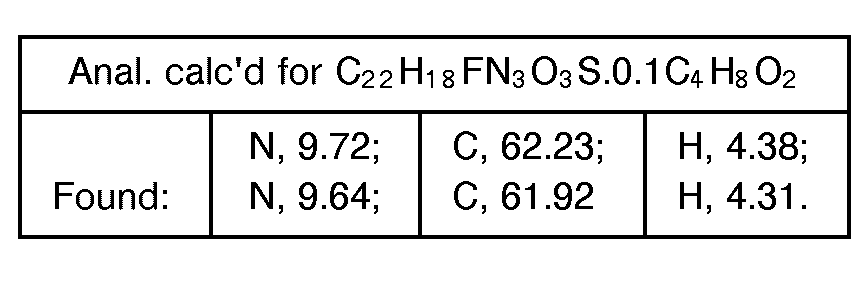
- The procedure of Example 4 was carried out using 1,3 - dihydro - 5 - (2 - fluorophenyl) - 3(RS) - (2 - indolecarbonylamino) - 2H - 1,4 - benzodiazepin - 2 - one (0.92 g, 2.2 mmole) in place of 1,3 - dihydro - 5 - (2 - fluorophenyl) - 3 - (R) - (3' - indolyl) - methyl - 2H - 1,4 - benzodiazepin - 2 - one, and ethyl bromoacetate (0.38 g, 2.25 mmol) in place of methyl iodide. The chromatographed product (10% ether in CH2CI2) (0.05 g, 0.098 mmol) and sodium hydroxide (0.14 ml, 1N, 0.14 mmol) were stirred together in CH30H (3 ml) at room temperature for 36 hours. The mixture was concentrated in vacuo, diluted to 5 ml with H20, made acidic with 1 N HCI, and extracted with CH2CI2 (3 x 5 ml). The organic layers were combined, washed with water (1 x 5 ml), dried over Na2S04, filtered, and evaporated to dryness in vacuo. The residue was crystallized from acetone (0.1 ml) and Et20 (2 ml) and the solid dried in vacuo at 60°; (m.p. 278-278.5° (d)).
- TLC: A single spot (Rf = 0.27, silica gel plate, 180:10:1:1 (v/v/v/v) CH2CI2:CH30H:HOAc:H20).
- NMR: The spectrum was consistent with the title structure and verified the presence of ether and acetone.
- HPLC: 99.4% pure.
- MS: A molecular ion at m/e = 470.

- 3 - (RS) - Amino - 1,3 - dihydro - 5 - (2 - fluorophenyl) - 2H - 1,4 - benzodiazepin - 2 - one (100 mg, 0.398 mmol) was suspended in 2 ml of methylene chloride. 5-fluoroindole-2-carboxylic acid chloride (87 mg, 0.438 mmol) was added to the methylene chloride suspension. The pH of the stirred mixture was adjusted to 9 with 100 µl of triethylamine. The reaction mixture was stirred for 24 hours. The mixture was then diluted with 1 ml of methanol and filtered. The filtrate was pipeted onto a 2000 u Analtech preparative TLC plate which was developed in a 95:5:0.5 chloroform, methanol, water (CMW) solvent system. The product band was collected. The silica was washed with 90:10:1 CMW. The filtrate was evaporated and the residue was dissolved in methanol and placed in a small vial. The solvent was evaporated to yield 15.2 mg of product.
- HPLC: 90% pure.
- MS: M+ (14 ev), m/e 430.
- NMR: Consistent with title product.
- 1,3 - Dihydro - 3 - (RS) - amino - 5 - (2 - fluorophenyl) - 2H - 1,4 - benzodiazepin - 2 - one (100 mg, 0.37 mmol) and 3 - methylindene - 2 - carboxylic acid (70 mg, 0.40 mmol) were combined at room temperature in 5 ml of methylene chloride. To this reaction mixture was added 1 - ethyl - 3 - (3 - dimethylaminopropyl) - carbodiimide hydrochloride (80 mg, 0.41 mmol). The pH of the reaction mixture was then adjusted to 8.0 with triethylamine and stirring was continued at room temperature overnight (19 hours). The reaction mixture was partitioned between methylene chloride and 10% citric acid solution. The phases were separated and the organic layer was washed in succession with 10% citric acid solution (1 x 30 ml), saturated sodium bicarbonate solution (2 x 30 ml), and brine. The dried (MgS04) extrcts were concentrated to yield 130 mg of crude product. Preparative thick layer chromatography (hexane - ethyl acetate, 1:1 v/v) afforded the analytical sample.
- HPLC: Greater than 98% pure.
- NMR (CDCI3): Consistent with the title structure.
- MS (14 ev): 425 (M+), 268, 199, 156.

- 1,3-Dihydro-3(RS)-amino-5-(2-fluorophenyl)-2H-1,4-benzodiazepin-2-one (100 mg, 0.37 mmol) and 2-quinoline carboxylic acid (quinaldic acid) (70 mg, 0.40 mmol) were combined at room temperature in 5 ml of methylene chloride. To this reaction mixture was added 1-ethyl-3-(3-dimethylaminopropyl)carbodiimide hydrochloride (76 mg, 0.40 mmole). The pH of the reaction mixture was then adjusted to 8.5 with triethylamine and stirring was continued at room temperature for 48 hours. The reaction mixture was partioned between methylene chloride and 10% citric acid solution. The phases were separated and the organic layer was washed in succession with 10% citric acid solution (1 x 30 ml), saturated sodium bicarbonate solution (2 x 30 ml) and brine. The dried (MgS04) extracts were concentrated to yield 150 mg of crude product. Preparative thick layer chromatography (chloroform - methanol - ammonia, 97:3:0.3 v/v) afforded the analytical sample (60 mg).
- NMR (CDCI3): Consistent with the title structure.
- MS (14 ev): 424 (M+), 268, 241, 198, 184.

- 1,3 - Dihydro - 3 - (RS) - amino - 5 - (2 - fluorophenyl) - 2H -1,4 - benzodiazepin - 2 - one (100 mg, 0.37 mmol) and L-mandelic acid (63 mg, 0.41 mmol) were combined at room temperature in 10 ml of methylene chloride. To this reaction mixture was added 1 - ethyl - 3 - (3 - dimethylaminopropyl)carbodiimide hydrochloride (79 mg, 0.41 mmol). The pH of the reaction mixture was then adjusted to 8.5 with triethylamine and stirring was continued at room temperature for 96 hours. The reaction mixture was partitioned between methylene chloride and 10% citric acid solution. The phases were separated and the organic layer was washed in succession with 10% citric acid solution (1 x 30 ml), saturated sodium bicarbonate solution (2 x 30 ml) and brine. The dried (MgS04) extracts were concentrated to yield 130 mg of crude product as a mixture of diastereomers. Preparative thick layer chromatography (chloroform - methanol - ammonia, 95:5:0.5, v/v) afforded the analytical sample.
- NMR (CDCl3): consistent with the title structure.
- 3 - (RS) - Amino - -1,3 - dihydro - 5 - (2 - fluorophenyl) - 2H - 1,4 - benzodiazepin - 2 - one (100 mg, 0.391 mmol) was suspended in 2 ml of methylene chloride. 5 - Chloroindole - 2 - carboxylic acid chloride (86.7 mg, 0.438 mmol) was added. The pH of the stirred mixture was adjusted to 9 with triethylamine (95 µl). The reaction mixture was stirred for 24 hours. The mixture was then diluted with 1 ml of methanol and filtered. The filtrate was pipeted onto a 2000 µ Analtech preparative TLC plate which was developed in a 95:5:0.5 chloroform, methanol, water (CMW) solvent system. The product band was collected. The silica was washed with 90:10:1 CMW. The filtrate was evaporated and the residue was dissolved in methanol and placed in a small vial. The solvent was evaporated to yield 16.4 mg of purified product.
- HPLC: 90% pure.
- MS (14 ev): (M+) m/e 446.
- NMR: Consistent with title product.
- 1,3-Dihydro-3-(RS)-methylamino-5-phenyl-2H-1,4-benzodiazepin-2-one (130 mg, 0.49 mmol) and indole-2-carbonyl chloride (88 mg, 0.49 mmol) were combined in CH2Cl2 (5 ml) and stirred 2 hours at 25°C. The reaction was concentrated and chromatographed on silica gel (3% MeOH in CH2CI2) to give the title compound as a white solid from CH2 C12: (m.p. 287-288.5°).
- TLC: Silca GF (5% MeOH in CH2CI2), Rf = 0.41, single homogeneous component.
- NMR: Consistent with title structure and verified the presence of 0.25 H20.
- HPLC: Greater than 97.2% pure.
- MS: Mol. ion = 408 m/e (free base).

- The procedure of Example 114 was carried out using 5 - bromoindole - 2 - carboxylic acid chloride (113 mg, 0.438 mmole) in place of 5-fluoroindole-2-carboxylic acid chloride.
- HPLC: 82% pure.
- MS: M+ (14 ev) , m/e 490.
- NMR: Consistent with title product.
- 3 - (RS) - Amino - 1,3-dihydro - 5 - (2' - fluorophenyl) - 2H -1,4-benzodiazepin - 2 - one (50 mg, 0.186 mmol) was suspended in methylene chloride (1 ml). Cinnamoyl chloride (34.5 mg, 0.207mmol) was added to the methylene chloride mixture. The pH of the stirred mixture was adjusted to 9 with 50 µl of triethylamine. After stirring for 16 hours the mixture was filtered. The product in the filtrate was purified by prep TLC. The product band was collected by washing the silica containing the product, with 80:20:2 CMW. The solvent was evaporated and the residue was dissolved in methanol, placed in a small vial and evaporated. Yield 16.6 mg.
- HPLC: 97% pure.
- MS: M+ (14 ev) m/e 399
- NMR: Consistent with title structure.

- 1,3 - Dihydro - 3 - (RS) - amino - 5 - (2 - fluorophenyl) - 2H -1,4-benzodiazepin - 2 - one (100 mg, 0.37 mmole) and 5 - hydroxyindole - 2 - carboxylic acid (75 mg, 0.44 mmole) were combined at room tempera - ture in a mixture of 1 ml of dimethylformamide and 5 ml of methylene chloride. To this reaction mixture was added 1 - ethyl-3 - (3-dimethylaminopropyl)carbodiimide hydrochloride (76 mg, 0.40 mmol). The pH of the reaction mixture was then adjusted to 8.5 with triethylamine and stirring was continued at room temperature for 48 hours. The solvent was removed under reduced pressure and the residue was partitioned between ethyl acetate and 10% citric acid solution. The phases were separated and the organic layer was washed in succession with 20% citric acid solution (1 x 30 ml), saturated sodium bicarbonate solution (2 x 30 ml) and brine. The dried (MgS04) extracts were concentrated to yield 200 mg of the product. Preparative thick layer chromatography (chloroform - ethanol - ammonia, 90:10:1, v/v) afforded the analytical sample (80 mg).
- NMR (CD30D): Consistent with the title structure.
- MS (14 ev): 428 (M+), 227, 176, 159.

- 1,3-Dihydro-3R-(3-indolylmethyl)-(2-fluorophenyl)-2H-1,4-benzodiazepin-2-one (10 g, 26 mmol) was stirred in 120 ml of degassed DMF at 0°C under nitrogen with sodium hydride (1.25 g, 26 mmol) until homogeneous ( 1 hour). Ethylbromoacetate (2.88 ml, 26 mmol) was added and the reaction mixture was stirred at room temperature for 1 hour. The reaction was quenched in 1 I of water. The aqueous solution was extracted with 3 x 250 ml of methylene chloride. The methylene chloride solution was washed with 250 ml water. The organic phase was separated, dried over sodium sulfate and concentrated in vacuo.
- A portion of the crude ester (530 mg) was dissolved in 50 ml of methanol. The solution was stirred in a pressure bottle and saturated with ammonia at 0°C. The bottle was sealed and the solution was stirred at room temperature for 48 hours. The solution was concentrated in vacuo. This gave a solid which was purified by flash chromatogrphy in a 97:3 chloroform/methanol solvent system to 245 mg of purified product.
- HPLC: 99% pure.
- MS: M+ (14 ev) m/e 440
- NMR: Consistent with title structure.
- 3 - (RS) - Chloro - 1,3-dihydro - 5 - (2 - fluorophenyl) - 2H -1,4-benzodiazepin - 2 - one (150 mg, 0.520 mmol) and 2 - aminomethylindole (75.9 mg, 0.520 mmol) were combined in 1,2 - dimethoxyethane (3 ml) and the mixture stirred 20 min. at 25 °C. The mixture was evaporated to dryness in vacuo and the residue treated with H20 and extracted with EtOAc (3x). The combined extracts were washed with H20 (1X), dried over MgS04, filtered and stripped to dryness in vacuo to give an orange oil which, after chromatography on silica gel (4% MeOH in CH2CI2) provided the title compound as a white solid from ether: (m.p. 200-202°).
- TLC: Silica GF (5% MeOH in CH2CI2), Rf = 0.37, single homogeneous component.
- NMR: Consistent with title structure.
- HPLC: Greater than 97.7% pure.
- MS: Molecular ion at m/e = 398.

- 1,3 - Dihydro - 3 - (RS) - amino - 5 - (2 - fluorophenyl) - 2H -1,4-benzodiazepin - 2 - one (100 mg, 0.37 mmol) and N - phenyl glycine (64 mg, 0.42 mmol) were combined at room temperature in 5 ml of methlylene chloride. To this reaction mixture was added 1 - ethyl-3-(3-dimethylaminopropyl)-carbodiimide hydrochloride (81 mg, 0.42 mmole). The pH of the reaction mixture was then adjusted to 8.5 with triethylamine and stirring was continued at room temperature overnight. More N - phenylglycine and carbodiimide reagent were added (0.2 equivalents) and stirring was continued. The reaction mixture was partitioned between methylene chloride and 10% citric acid solution after 48 hours reaction time. The phases were separated and the organic layer was washed in succession with 20% citric acid solution (1 x 30 ml), saturated sodium bicarbonate solution (2 x 30 ml) and brine. The dried (MgS04) extracts were concentrated to yield 200 mg of crude product. Preparative thick layer chromatography (chloroform - ethanol - ammonia 92:8:0.8 v/v) afforded the analytical sample (100 mg), m.p. 145 -146°.
- NMR (CDCI3): Consistent with the title structure.
- MS (14 ev): 402 (M+), 265.
- 3 - (RS) - Amino - 1,3-dihydro - 5 - (2 - fluorophenyl) - 2H -1,4-benzodiazepin - 2 - one (50 mg, 0.186 mmol) was suspended in 1 ml of methylene chloride. 5 - Methoxyindole - 2-carboxylic acid (36.9 mg, 0.207 mmol) was added to the suspension followed by the addition of 38.5 mg (0.2 mmol) of EDC. The mixture was brought to pH - 8 with - 60 µl of triethylamine. The solid which formed after 3 min. was filtered after 5 hours and washed with chloroform. The filtrate was applied to a 2000 µ preparative TLC plate and eluted with 90:10:1 chloroform:methanol:water (CMW). The product was extracted from silica with methanol and evaporated.
- HPLC: 98% pure.
- MS: M+ (14 ev) m/e 442
- NMR: Consistent with title structure.

- 3 - (RS) - Amino - 1,3-dihydro - 5 - (2 - fluorophenyl) - 2H -1,4-benzodiazepin - 2 - one (50 mg, 0.186 mmol) was suspended in 1 ml of methylene chloride. 1 - Methylindole - 2 - carboxylic acid (36.2 mg, 0.2 mmol) was added to the solution followed by the addition of 38.5 mg (0.2 mmol) of EDC. The pH of the solution was brought to -8 with -60 µl of triethylamine. After stirring for 4 hours the product was purified by preparative TLC on a 2000 µ silica gel plate with a 95:5:0.5 chloroform/methanol/water solvent system. The product band was collected and isolated by washing the silica with 90:10:1 CMW. yield 16.5 mg.
- HPLC: 99% pure
- MS: M+ (14 ev) m/e 426
- NMR: Consistent with title structure.
- 3 - (RS) - Amino - 1,3-dihydro - 5 - (2 - fluorophenyl) - 2H -1,4-benzodiazepin - 2 - one (80 mg, 0.297 mmol), benzofuran-2-carboxylic acid (48 mg, 0.297 mmol), and EDC (56.9 mg, 0.297 mmol) were combined in CH2CI2 (3 ml) and the pH adjusted to 9.5 with triethylamine (41 µl, 0.297 mmol). After stirring 30 minutes at 25 °C, the reaction was concentrated and chromatographed on silica gel (3% MeOH in CH2CI2) to give the title compound as a white solid from CH2CI2/Et20:
- (m.p. 289 - 291 ° ).
- TLC: Silica GF (5% MeOH in CH2CI2), Rf=0.48, single homogeneous component.
- NMR: Consistent with title structure and verified the presence of 0.15 CH2CI2 and 0.1 (C2H5)2O.
- HPLC: Greater than 99.7% pure.
- M.S.: Mol. ion = 413 m/e (free base).
- To a suspension of sodium hydride (50%) (24.4 mg, 0.51 mmole) in 2 ml of dry dimethylformamide at 0°C was added, under nitrogen, 1,3-dihydro-3(RS)-(4-chlorophenylcarbonyl)amino-5-(2-fluorophenyl)-2H-1,4-benzodiazepin-2-one (197.3 mg, 0.48 mmole). The resulting reaction mixture became homogeneous over a one-hour period, was stirred one hour more at 0°C and then treated with ethylbromoacetate (55 µl, 0.50 mmole). The reaction mixture was warmed to room temperature and after one hour was quenched with brine. The aqueous mixture was extracted with ethyl acetate and the combined organic extracts were washed with brine. Rotoevaporation of the dried extracts (MgSO4) gave a semi-solid which was chromatographed on silica gel (chloroform - methanol - ammonia 95:5:0.5 v/v elution) to afford 64 mg of the analytical sample. mp 172° (soften), 177-178°C.
- NMR (CDCl3): Consistent with the title structure.
- MS (14 ev): 493 (M+), 364, 354, 338, 327, 313
- 1,3-Dihydro-3-(RS)-amino-5-phenyl-2H-1,4-benzodiazepin-2-one (500 mg, 1.98 mmole) and p-chlorobenzoyl chloride (255 µl, 2.00 mmole) were combined at room temperature in 30 ml of methylene chloride. The resulting solution was protected from moisture and stirred at room temperature overnight. The reaction mixture was diluted with 70 ml of methylene chloride and washed with sodium bicarbonate solution (sat.) and brine. The organic extracts were dried (MgS04) and concentrated to give the crude product. Trituration with ether afforded the analytical sample as a white solid.
- NMR (CDCI3): Consistent with the title structure.
- MS (14 ev): 389 (M+), 250, 234.
- To a suspension of sodium hydride (50%) (10 mg, 0.21 mmole) in 1 ml of dry dimethylformamide at 0°C was added, under a nitrogen, 1,3 - dihydro - 3 - (RS) - (4 - chlorophenylcarbonyl)amino - 5 - phenyl - 2H-1,4 - benzodiazepin - 2 - one (65.5 mg, 0.166 mmole). The resulting reaction mixture became homo - geneous over a one - hour period, was stirred one hour more at 0°C and then treated with iodomethane (10.8 µl, 0.17 mmole). The reaction mixture was warmed to room temperature and after one hour was quenched with brine. The aqueous mixture was extracted with ethyl acetate and the combined organic extracts were washed with brine. Rotoevaporation of the dried extracts (MgS04) gave a semi-solid which was chromatographed on silica gel (chloroform - methanol - ammonia 95:5:0.5 v/v elution) to give the analytical sample.
- NMR (CDCl3): Consistent with the title structure;
- MS (14 ev): 403 (M+)
- To a suspension of sodium hydride (50%) (14.0 mg, 0.30 mmole) in 2 ml of dry dimethylformamide at 0°C was added, under nitrogen, 1,3-dihydro-3-(RS)-(4-chlorophenylcarbonyl)amino-5-(2-fluorophenyl)-2H-1,4- benzodiazepin-2-one (103.0 mg, 0.25 mmole). The resulting reaction mixture became homogeneous over a one - hour period, was stirred one hour more at 0°C and then treated with 1 ml of dimethylformamide containing sodium iodoacetate (56 mg) (0.27 mmole). The reaction mixture was warmed to room temperature and after 12 hours was quenched with brine. The aqueous mixture was extracted with ethyl acetate and the combined organic extracts were washed with brine. Rotoevaporation of the dried extracts (MgS04) gave a semi-solid which was chromatographed on silica gel (chloroform- methanol - acetic acid, 93:6:1 v/v) to provide the analytical sample: (m.p. 225 - 228 °C, from methanol).
- FABMS: m/e = 466 (M + H), 245, 177.
- NMR (DMSO-d6): consistent with title structure.
- 3-(RS)-Amino-1,3-dihydro-5-phenyl-2H-1,4-benzodiazepin-2-one (100 mg, 0.398 mmol), 1 - indoline - 2 - carboxylic acid (64.9 mg, 0.398 mmol), 1 - hydroxybenzotriazole hydrate (HBT, 53.8 mg, 0.398 mmol), and 1 - ethyl - 3 - (3 - dimethylaminopropyl)carbodiimide hydrochloride (EDC, 76.3 mg, 0.398 mmol) were combined in DMF (2 ml) and the pH of the solution was adjusted to 9.0-9.5 with triethylamine (TEA, 95 µl, 0.683 mmol). After stirring 15 minutes at 25 °C, the DMF was removed in vacuo, the residue treated with H20 and extracted with EtOAc (3x). The combined organic extracts were washed with brine, dried over MgS04, filtered and stripped to dryness in vacuo to give a white solid (180 mg). Flash chromatography on silica gel (267/10/1 of CH2Cl2/MeOH/concentrated NH40H) gave a white solid (38 mg) from EtOAc/hexane. The product is a single stereoisomer whose absolute configuration is unknown; m.p. 252 - 272 ° C (slowly shrinkes to a cloudy melt).
- TLC: Silica GF (190/10/1 of CH2CI2/MeOH/concentrated NH4OH), Rf = 0.40, single, clean component.
- NMR: Consistent with title structure and verifies the presence of EtOAc.
- HPLC: Greater than >96% pure.
- MS: Molecular ion at m/e = 396.

- 1,3 - Dihydro - 3 - (RS) - amino - 5 - (2 - fluorophenyl) - 2H -1,4 - benzodiazepin - 2 - one (42 mg, 0.156 mmole) and p-trifluoromethylbenzoyl chloride (32.5 mg, 0.156 mmole) were combined in 3 ml of methylene chloride (CH2CI2), treated with triethylamine (0.0157 g, 0.156 mmole) and stirred at room temperature 15 minutes. The mixture was diluted with CH2CI2 (20 ml), washed with 10% citric acid (2 x 5 ml), dilute sodium bicarbonate (2 x 5 ml), and water (2 x 5 ml), dried over sodium sulfate, filtered, and evaporated to dryness in vacuo. The residue was crystallized from ethyl acetate (0.4 ml)/ether (1 ml) to give the title compound which was dried in vacuo at 90° : (m.p. 209 - 211 °).
- TLC: Single spot, Rf = 0.62, silica gel plate, 90:10:1:1 (v:v:v:v) CH2Cl2:MeOH:HOAc:H2O.
- NMR: The spectrum was consistent with the title structure and verified the presence of EtOAc.
- HPLC: Greater than 98% pure.
- MS: Molecular ion at m/e = 441.

- The procedure of Example 134 was carried out using p-methylbenzoyl chloride (24 mg, 0.156 mmole) in place of p-trifluoromethylbenzoyl chloride. The title compound was crystallized from CH2CI2 (3 ml)/Et20 (1 ml) and dried in vacuo at 90° : (m.p. 275-276° (d)).
- TLC: Single spot, Rf = 0.62, silica gel plate, 90:10:1:1 (v:v:v:v) CH2Cl2:MeOH:HOAc:H2O.
- NMR: The spectrum was consistent with the title structure.
- HPLC: Greater than 98% pure.
- MS: Molecular ion at m/e = 387.

- The procedure of Example 134 was carried out using p-methoxybenzoyl chloride (26.6 mg, 0.156 mmole) in place of p-trifluoromethylbenzoyl chloride. The title compound was crystallized from CH2CI2 (2 ml)/Et20 (1 ml) and dried in vacuo at 90° : (m.p. 231 -233°).
- TLC: Single spot, Rf = 0.47, silica gel plate, 5% (v/v) MeOH/CH2CI2.
- NMR: The spectrum was consistent with the title structure.
- HPLC: Greater than 97% pure.
- MS: Molecular ion at m/e = 403.

- 3-(RS)-Amino-1,3-dihydro-5-phenyl-2H-1,4-benzodiazepine-2-one (250 mg, 0.93 mmol) was suspended in methylene chloride (10 ml) and treated with o-chlorobenzoylchloride (0.124 ml, 0.97 mmol) followed by triethylamine (0.143 ml, 0.97 mmol). The solution was stirred at room temperature overnight. The reaction solution was chromatographed on silica gel (chloroform followed by 97/3 chloroform/methanol) and the combined product fractions were evaporated to dryness in vacuo. TLC: Silica
- gel (90:10:1, CHCl3:CH3OH:H2O), Rf = 0.85.
- NMR: Consistent with structure.
- HPLC: 99% pure.
- MS: Molecular ion at m/e = 389.
- 3 - (RS) - 1,3-Dihydro - (o - Chlorobenzoylamino) - 5 - ph enyl - 2H -1,4-benzodiazepin - 2 - one (200 mg, 0.51 mmol) and sodium hydride (52 mg of a 50% suspension in mineral oil, 1.094 mmol) were stirred in 2 ml of dry, degassed dimethylformamide under nitrogen in an ice bath. The mixture was stirred until homogeneous. After 2 hours, methyl iodide (38 µl, 1.094 mmol) was added in one portion. The reaction was stirred for 1 hour at 0 °C and 1 hour at room temperature. The reaction was quenched with 3 ml of saturated sodium chloride solution. The mixture was extracted with ethyl acetate. The clear solution obtained when chloroform was added was evaporated to dryness then chromatographed on silica gel with chloroform as the elution solvent. The 7:1 mixture of the di and mono substituted compounds was further purified by preparative TLC. (Analtech silica gel 2000 µ prep TLC plates developed twice in a 98:2 chloroform/methanol solvent system).
- TLC: Silica gel 97:2 CHCl3:MeOH, Rf = 0.35.
- NMR: Consistent with structure.
- MS: Molecular ion m/e = 417
- HPLC: 98%.
- 3 - (RS) - 1,3-Dihydro - (o - Chlorobenzoylamino) - 5 - ph enyl - 2H -1,4-benzodiazepin - 2 - one (207 mg, 0.53 mmol) and sodium hydride (26 mg of a 50% suspension in mineral oil, 0.54 mmol) were stirred in 2 ml of dry, degassed dimethylformamide under nitrogen in an ice bath. The mixture was stirred until homogenous. After 2 hours, methyl iodide (34 µl, 0.547 mmol) was added in one portion. (The remainder of the experiment proceeds as described in Example 139).
- NMR: Consistent with structure.
- HPLC: 98%.
- MS: Molecular ion m/e 403.
-

- The procedure of Example 137 was carried out using m-chlorobenzoyl chloride in place of o-chlorobenzoylchloride. The reaction was chromatographed using chloroform as the elution solvent.
- TLC: Silica gel 90:10:1 CMA; Rf = 0.8.
- NMR: Consistent with structure.
- HPLC: 96%.
- MS: Molecular ion at m/e 389.
- The EDC procedure in Example 126 was carried out using 3,4-dichlorobenzoic acid in place of 5-methoxy - indole - 2 - carboxylic acid. The reaction product was dissolved in chloroform and chromatog - raphed with chloroform followed by 99:1 CHCl3:MeOH(CM).
- TLC: Silica gel 97:3 CM, Rf = 0.45.
- HPLC: 100%.
- NMR: Consistent with structure.
- MS: Molecular ion at m/e 423.
- 3 - (RS) - (p - Chlorobenzoylamino)1,3 - Dihydro - 5 - (2' - fluorophenyl) - 1 - methyl - 2H -1,4-benzodiazepin-2-one (50 mg, 0.118 mmol) was stirred in 3 ml of chloroform. m - Chloroperoxybenzoic acid (23.6 mg, 0.137 mmol) was added. After stirring overnight another 23.6 mg of MCPBA was added. The solution was stirred for 48 hours then diluted with chloroform and washed with cold saturated sodium bicarbonate. The chloroform solution was dried over sodium sulfate and evaporated. The residue obtained after evaporation was purified by preparative TLC with 98:2 CHCl3:MeOH (CM) as the developing solvent.
- TLC: Silica gel 98:2 CM, Rf = 0.4 CM.
- NMR: Consistent with structure.
- HPLC: 95%.
- MS: Molecular ion at m/e = 437.
- The EDC procedure in Example 126 was carried out using 4 - methyl thiobenzoic acid in place of 5 - methoxyindole-2-carboxylic acid. The reaction solution was chromatographed on a silica gel column with chloroform followed by 99:1 CHCl3:MeOH (CM).
- TLC: Silica gel 97:3 CM, Rf = 0.3
- NMR: Consistent with structure.
- HPLC: 97%.
- MS: Molecular ion at m/e 401.
- The procedure of Example 137 was carried out using 4-fluorobenzoyl chloride in place of o-chlorobenzoyl chloride. The reaction was chromatographed on silica gel using chloroform as the elution solvent.
- TLC: Silica gel 97:3 CHCl3:MeOH (CM), Rf = 0.33.
- NMR: Consistent with structure.
- HPLC: 95%.
- MS: Molecular ion at m/e 373.
- The procedure of Example 137 was carried out using 4-trifluoromethylbenzoyl chloride in place of o-chlorobenzoyl chloride. The reaction was chromatographed on silica gel using chloroform as the elution solvent.
- TLC: Silica gel 97:3 CHCl3:MeOH (CM), Rf = 0.3.
- NMR: Consistent with structure.
- HPLC: 99%.
- MS: Molecular ion at m/e 423.
- The procedure of Example 137 was carried out using 4-tert-butylbenzoyl chloride in place of o-chlorobenzoyl chloride. The reaction was chromatographed on silica gel using chloroform as the elution solvent.
- TLC: Silica 97:3, CHCl3:MeOH, Rf = 0.35.
- NMR: Consistent with structure.
- HPLC: 98%.
- MS: Molecular ion at m/e 411.
- The EDC procedure in Example 126 was carried out using 3,5-dichlorobenzoic acid in place of 5-methoxyindole-2-carboxylic acid. The reaction was diluted with chloroform and chromatographed on a silica gel column with chloroform as the elution solvent.
- TLC: Silica gel 97:3 CHCl3:MeOH (CM), Rf = 0.5
- NMR: Consistent with structure.
- HPLC: 96%.
- MS: Molecular ion at m/e 423.
- The EDC procedure in Example 126 was carried out using p-hydroxybenzoic acid in place of 5-methoxyindole-2-carboxylic acid. The reaction was chromatographed on silica gel with chloroform as the elution solvent.
- TLC: Silica gel 97:3 CHCl3:MeOH, Rf = 0.50.
- NMR: Consistent with structure.
- HPLC: 99%.
- MS: Molecular ion at 371.
- The procedure in Example 137 was carried out using 4-cyanobenzoyl chloride in place of o-chlorobenzoyl chloride. The reaction was chromatographed on silica gel using chloroform followed by 98:2 CHCl3:MeOH (CM) as the elution solvents.
- TLC: Silica gel 97:3 CM, Rf = 0.3.
- NMR: Consistent with structure.
- HPLC: 99.6%.
- MS: Molecular ion at m/e = 380.

- The procedure of Example 134 was carried out using 3(S) - (-)-3 - amino - 1,3-dihydro - 5 - phenyl - 1 - methyl-2H-1,4-benzodiazepin-2-one (41.4 mg, 0.156 mmole) in place of 1,3-dihydro - 3(RS)-amino-5-(2-fluorophenyl)-2H-1,4-benzodiazepin-2-one and 2-chlorobenzoylchloride (27.3 mg, 0.156 mmole) in place of p-trifluoromethylbenzoyl chloride. The product was chromatographed on silica gel (5% (v/v) Et20 in CH2CI2 elution). The combined product fractions were evaporated to dryness in vacuo to give the title compound which was dried in vacuo at 78°C: (m.p. 100-118°C).
- TLC: Single spot, Rf = 0.24, silica gel plate, 5% (v/v) Et20 in CH2Cl2.
- NMR: Consistent with structure.
- HPLC: Greater than 99% pure.
- MS: Molecular ion at m/e = 403.
- [α]25 D = -90.4° (1.15 mg/ml, CH2Cl2).

- The procedure of Example 134 was carried out using 3(R)-(+)-3-amino-1,3-dihydro-5-phenyl-1 - methyl - 2H-1,4 - benzodiazepin - 2 - one (41.4 mg, 0.156 mmole) in place of 1,3 - dihydro - 3(RS)-amino-5-(2-fluorophenyl)-2H-1,4-benzodiazepin-2-one, and 2-chlorobenzoyl chloride (27.3 mg, 0.156 mmole) in place of p-trifluoromethylbenzoyl chloride. The product was chromatographed on silica gel (5% (v/v) Et20 in CH2CI2 elution). The combined product fractions were evaporated to dryness in vacuo to give the title compound which was dried in vacuo at 78 °C: (m.p. 102-120°C).
- TLC: Single spot, Rf = 0.24, silica gel plate, 5% (v/v) Et20 in CH2 C12.
- NMR: Consistent with structure.
- HPLC: Greater than 98% pure.
- MS: Molecular ion at m/e = 403.
- [α]25 D = +95.4° (1.75 mg/ml, CH2Cl2).

- The procedure of Example 134 was carried out using p-dimethylaminobenzoyl chloride (28.6 mg, 0.156 mmole) in place of p - trifluoromethylbenzoyl chloride. The citric acid and sodium bicarbonate washes were omitted. The title compound was crystallized from CH2CI2 (6 ml)/Et20 (5 ml) and dried in vacuo at 90° : (m.p. 256-258°C).
- TLC: Single spot, Rf = 0.60, silica gel plate, 90:10:1:1 (v/v/v/v) CH2Cl2:MeOH:HOAc:H2O.
- NMR: The spectrum was consistent with the title structure and verified the presence of H20.
- HPLC: Greater than 98% pure.
- MS: Molecular ion at m/e = 416.

- The procedure of Example 134 was carried out using 3,4-dimethoxybenzoyl chloride (31.3 mg, 0.156 mmole) in place of p-trifluoromethylbenzoyl chloride. The title compound was crystallized from CH2CI2 -(1.5 ml)/Et20 (3 ml) and dried in vacuo at 90° : (m.p. 206-207.5°C).
- TLC: Single spot, Rf = 0.64, silica gel plate, 90:10:1:1 (v:v:v:v) CH2Cl2:MeOH:HOAc:H2O.
- NMR: The spectrum was consistent with the title structure and verified the presence of Et20 and CH2CI2.
- HPLC: Greater than 99% pure.
- MS: Molecular ion at m/e = 433.
- The procedure of Example 134 was carried out using 3(S)-(-)-3-amino-1,3-dihydro-5-(2-fluorophenyl)-1-methyl-2H-1,4-benzodiazepin-2-one (44.2 mg, 0.156 mmole) in place of 1,3-dihydro - 3(RS) - amino - 5 - (2 - fluorophenyl) - 2H -1,4 - benzodiazepin - 2 - one and 3 - bromobenzoyl chloride (34.2 mg, 0.156 mmole) in place of p-trifluoromethylbenzoyl chloride. The title compound was crystallized from Et20 and dried in vacuo at 100°C: (m.p. 172-178°C).
- TLC: Single spot, Rf = 0.66, silica gel plate, 15% (v/v) Et20 in CH2 C12.
- NMR: Consistent with structure.
- HPLC: Greater than 99% pure.
- MS: Molecular ion at m/e = 465.
- [α]25 D = +16.7° (0.0025 g/ml, CH2Cl2).

- 3(RS)-Amino-1,3-dihydro-5-phenyl-2H-1,4-benzodiazepin-2-one (80.0 mg, 0.318 mmole), 3-trifluoromethylthiobenzoic acid (70.7 mg, 0.318 mmole), HBT (43.0 mg, 0.318 mmole) and EDC (61.0 mg, 0.318 mmole) were combined in dry DMF (2 ml) and stirred at room temperature. The pH of the mixture was adjusted to 9.0-9.5 with triethylamine (64.4 mg, 0.636 mmole) and the mixture stirred for 10 minutes. The DMF was removed in vacuo, and the residue was treated with 10% citric acid and extracted with EtOAc. The combined organic fractions were washed with sodium carbonate solution, dried over Na2SO4, filtered, and evaporated to dryness in vacuo. The residue was crystallized from EtOAc to give the title compound which was dried in vacuo at 100°C: (m.p. 230 - 232 °C).
- TLC: Single spot, Rf = 0.32, silica gel plate, 15% (v/v) Et20 in CH2 C12.
- NMR: Consistent with structure.
- HPLC: Greater than 98% pure.
- MS: Molecular ion at m/e = 455.

- The procedure of Example 134 was carried out using 3(S)-(-)-3-amino-1,3-dihydro-5-(2-fluorophenyl)-1-methyl-2H-1,4-benzodiazepin-2-one (44.2 mg, 0.156 mmole) in place of 1,3-dihydro - 3(RS) - amino - 5 - (2 - fluorophenyl) - 2H -1,4 - benzodiazepin - 2 - one and 4 - bromobenzoyl chloride (34.2 mg, 0.156 mmole) in place of p-trifluoromethylbenzoyl chloride. The title compound was chromatographed on silica gel (5% Et20 in CH2Cl2 elution) and the product fractions evaporated to dryness in vacuo. The title compound was dried in vacuo at 82 °C: (m.p. 123-135°C).
- TLC: Single spot, Rf = 0.46, silica gel plate, 10% (v/v) Et20 in CH2Cl2.
- NMR: Consistent with structure.
- HPLC: Greater than 99% pure.
- MS: Molecular ion at m/e = 465.
- [α]25 D = +9.6° (0.0023 g/ml, CH2Cl2).

- The procedure of Example 134 was carried out using 3(S)-(-)-3-amino-1,3-dihydro-5-(2-fluorophenyl)-1-methyl-2H-1,4-benzodiazepin-2-one (44.2 mg, 0.156 mmole) in place of 1,3-dihydro - 3(RS) - amino - 5 - (2 - fluorophenyl)-2H -1,4 - benzodiazepin - 2-one and 4-t-butylbenzoyl chloride (30.7 mg, 0.156 mmole) in place of p-trifluoromethylbenzoyl chloride. The product was chromatographed on silica gel (4% Et20 in CH2CI2 elution), and the product fractions evaporated to dryness in vacuo. The title compound was dried in vacuo at 82 °C: (m.p. 184-190°C).
- TLC: Single spot, Rf = 0.37, silica gel plate, 5% (v/v Et20 in CH2Cl2).
- NMR: Consistent with structure.
- HPLC: Greater than 99% pure.
- MS: Molecular ion at m/e = 443.
- [α]25 D = +6.7° (0.0021 g/ml, CH2Cl2).
- The procedure of Example 134 was carried out using pyrrole-2-carbonyl chloride (20.2 mg, 0.156 mmole) in place of p-trifluoromethylbenzoyl chloride. Without washing, the reaction mixture was chromatographed on silica gel (225:10:1:1 (v:v:v:v) CH2Cl2:MeOH:HOAc:H2O elution). The combined product fractions were evaporated to dryness in vacuo and crystallized from EtOAc to give the title compound which was dried in vacuo at 82 °C: (m.p. 271-274°C).
- TLC: Single spot, Rf = 0.35, silica gel plate, 180:10:1:1 (v/v/v/v) CH2Cl2:MeOH:HOAc:H2O.
- NMR: Consistent with structure, verifies presence of 0.25 EtOAc.
- HPLC: Greater than 95% pure.
- MS: Molecular ion at m/e=362.
-

- The procedure of Example 134 was carried out using 3(S)-(-)-3-amino-1,3-dihydro-5-(2-fluorophenyl)-1-methyl-2H-1,4-benzodiazepin-2-one(44.2 mg, 0.156 mmole) in place of 1,3-(dihydro - 3(RS) - amino - 5 - (2 - fluorophenyl) - 2H -1,4- benzodiazepin - 2 - one and 4 - iodobenzoyl chloride (41.6 mg, 0.156 mmole in place of p-trifluoromethylbenzoyl chloride. The product was chromatographed on silica gel (5% (v/v) Et20 in
CH 2Cl2 elution) and the product fractions evaporated to dryness in vacuo. The title compound was dried in vacuo at 82 ° C: (m.p. 128-140 ° C). - TLC: Sin
gle spot , Rf=0.51, silica gel plate, 10%(v/v) Et 2 0 in CH2 C12. - NMR: Consistent with structure.
- HPLC: Greater than 99% pure.
- MS: Molecular ion at m/e=513.
- [α]25D = +8.4° (0.0028 g/ml, CH2Cl2).
- The procedure of Example 134 was carried out using 3(RS) - amino - 1,3- dihydro - 5 - phenyl - 2H - 1,4-benzodiazepin-2-one(39.2 mg, 0.156 mmole) in place of 1,3-dihydro-3(RS)-amino-5-(2-fluorophenyl)-2H-1,4-benzodiazepin-2-oneand 2-naphthoyl chloride (29.7 mg, 0.156 mmole) in place of p-trifluoromethylbenzoyl chloride. The product was chromatographed on silica gel (15% (v/v) Et20 in CH2C
l 2 elution). The combined product fractions were evaporated to dryness in vacuo and crystallized from CH2CI2/EtOAc to give the title compound which was dried in vacuo at 82°C: (m.p. 293 -294°C). - TLC: Single spot, Rf=0.28, silica gel plate, 15% (v/v) Et20 in C
H 2 Cl 2 . - NMR: Consistent with structure.
- HPLC: Greater than 99% pure.
- MS: Molecular ion at m/e=405.

- The procedure of Example 134 was carried out using 3(S)-(-)-3-amino-1,3-dihydro-5-(2-fluorophenyl)-1-methyl-2H-1,4-benzodiazepin-2-one(44.2 mg, 0.156 mmole) in place of 1,3-dihydro - 3(RS) - amino - 5 - (2 - fluorophenyl) - 2H -1,4 - benzodiazepin - 2 - one and 2 - bromobenzoyl chloride (34.2 mg, 0.156 mmole) in place of p-trifluoromethylbenzoyl chloride. The product was chromatographed on silica gel (5% (v/v) Et20 in CH2CI2 elution). The combined product fractions were evaporated to dryness. The residue was crystallized from Et20 to give the title compound which was dried in vacuo at 82 ° C: (m.p. 165 -185° C).
-
TLC: Sin gle spot, Rf=0.38, silica gel plate, 10% (v/v) Et20 in CH2 C12. - NMR: Consistent with structure.
- HPLC: Greater than 99% pure.
- MS: Molecular ion at m/e=465.
- [α]25D = -24.1 (0.0037 g/ml, CH2Cl2).
- The procedure of Example 134 was carried out using 3(S)-(-)-3-amino-1,3-dihydro-5-(2-fluorophenyl)-1-methyl-2H-1,4-benzodiazepin-2-one(44.2 mg, 0.156 mmole) in place of 1,3-dihydro - 3(RS) - amino - 5 - (2 - fluorophenyl) - 2H -1,4 - benzodiazepin - 2 - one and 4 - cyanobenzoyl chloride (25.8 mg, 0.156 mmole) in place of p-trifluoromethylbenzoyl chloride. The product was chromatographed on silica gel (8% (v/v) Et20 in CH2CI2 elution). The combined product fractions were evaporated to dryness in vacuo to give the title compound which was dried in vacuo at 82 ° C: (m.p. 130 - 147 ° C).
- TLC: Single spot, Rf=0.29, silica gel plate, 10% (v/v) Et20 in CH2 C12.
- NMR: Consistent with structure, verifies presence of 0.1 Et20.
- HPLC: Greater than 98% pure.
- MS: Molecular ion at m/e=412.
- [α]25D = +13.0° (0.0027 g/ml, CH2Cl2).

- The procedure of Example 134 was carried out using 3(RS) - amino - 1,3- dihydro - 5 - phenyl - 2H - 1,4-benzodiazepin-2-one(39.2 mg, 0.156 mmole) in place of 1,3-dihydro-3(RS)-amino-5-(2-fluorophenyl) - 2H1,4 - benzodiazepin - 2 - one and 4 - n - propylbenzoyl chloride (28.5 mg, 0.156 mmole) in place of p-trifluoromethylbenzoyl chloride. The product was chromatographed on silica gel (15% (v/v) Et20 in C
H 2 Cl2 elution).The combined product fractions were evaporated to dryness in vacuo and crystallized from Et20 to give the title compound which was dried in vacuo at 82 ° C: (m.p.. 158 -162 ° C ). - TLC: Single spot, Rf=0.24, silica gel plate, 15% (v/v) Et20 in CH2
Cl 2 . - NMR: Consistent with structure.
- HPLC: Greater than 99% pure.
- MS: Molecular ion at m/e=397.
- The procedure of Example 134 was carried out using 3(RS) - amino - 1,3- dihydro - 5 - phenyl - 2H - 1,4-benzodiazepin-2-one(39.2 mg, 0.156 mmole) in place of 1,3-dihydro-3(RS)-amino-5-(2-fluorophenyl) - 2H1,4 - benzodiazepin - 2 - one and 4 - phenylbenzoyl chloride (33.8 mg, 0.156 mmole) in place of p - trifluoromethylbenzoyl chloride. The product was chromatographed on silica gel (15% (v/v) Et20 in CH2C
l 2 elution).The combined product fractions were evaporated to dryness in vacuo and crystallized from Et20 to give the title compound which was dried in vacuo at 82 ° C: (m.p. 274-276 C) . - TLC: Single spot, Rf=0.24, silica gel plate, 15% (v/v) E
t 2 0 in C H2 C12. - NMR: Consistent with structure.
- HPLC: Greater than 98% pure.
- MS: Molecular ion at m/e=431.
- The procedure of Example 134 was carried out using 3(RS) - amino - 1,3- dihydro - 5 - phenyl - 2H - 1,4-benzodiazepin-2-one(39.2 mg, 0.156 mmole) in place of 1,3-dihydro-3(RS)-amino-5-(2-fluorophenyl) - 2H1,4 - benzodiazepin - 2 - one and 4 - n - pentylbenzoyl chloride (32.9 mg, 0.156 mmole) in place of p-trifluorobenzoyl chloride. The product was chromatographed on silica gel (15%, (v/v) Et20 in CH2CI2 elution). The combined product fractions were evaporated to dryness in vacuo and crystallized from Et20 to give the title compound which was dried in vacuo at 82 ° C: (m.p. 203 -
2 05 ° C) . - TLC: Single spot, Rf=0.28, silica gel plate, 15% (
v/v) Et20 in CH2 C12. - NMR: Consistent with structure.
- HPLC: Greater than 99% pure.
- MS: Molecular ion at m/e=425.
- The procedure of Example 134 was carried out using 3(RS) - amino - 1,3- dihydro - 5 - phenyl - 2H - 1,4-benzodiazepin-2-one(39.2 mg, 0.156 mmole) in place of 1,3-dihydro-3(RS)-amino-5-(2-fluorophenyl)-2H-1,4-benzodiazepin-2-one and 1-naphthoyl chloride (29.7 mg, 0.156 mmole) in place of p-trifluoromethylbenzoyl chloride. The product was chromatographed on silica gel (15% (v/v) Et20 in CH2C
l 2 elution). The combined product fractions were evaporated to dryness in vacuo and crystallized from Et20 to give the title compound which was dried in vacuo at 65 ° C: (m.p. 162-167 ° C ). - TLC: Single spot, Rf=0.22, silica gel plate, 15% (v/v)
Et 2 0 in C H2Cl2. - NMR: Consistent with structure.
- HPLC: Greater than 96% pure.
- MS: Molecular ion at m/e=405.

- The procedure of Example 134 was carried out using 3(S)-(-)-3-amino-1,3-dihydro-5-(2-fluorophenyl)-1-methyl-2H-1,4-benzodiazepin-2-one(44.2 mg, 0.156 mmole) in place of 1,3-dihydro - 3(RS) - amino - 5 - (2 - fluorophenyl) - 2H -1,4-benzodiazepin - 2 - one and 3 - iodobenzoyl chloride (41.6 mg, 0.156 mmole) in place of p-trifluoromethylbenzoyl chloride. The product was chromatographed on silica gel (5% (v/v) Et20 in CH2CI2 elution). The combined product fractions were evaporated to dryness in vacuo to give the title compound which was dried in vacuo at 65 ° C: (m.p. 105-120 ° C).
- TLC: Single spot, Rf=0.34, silica gel plate, 5% (v/v) Et20 in CH2 C12.
- NMR: Consistent with structure.
- HPLC: Greater than 96% pure.
- MS: Molecular ion at m/e=513.
- [α]25D = +13.0° (0.0024 g/ml, CH2 Cl2).
- The procedure of Example 134 was carried out using 3(R)-(+)-3-amino-1,3-dihydro-5-(2-fluorophenyl)-1-methyl-2H-1,4-benzodiazepin-2-one(44.2 mg, 0.156 mmole) in place of 1,3-dihydro - 3(RS) - amino - 5 - (2 - fluorophenyl) - 2H -1,4-benzodiazepin - 2 - one and 3 - iodobenzoyl chloride (41.6 mg, 0.156 mmole) in place of p-trifluoromethylbenzoyl chloride. The product was chromatographed on silica gel (5% (v/v) Et20 in CH2CI2 elution). The combined product fractions were evaporated to dryness in vacuo to give the title compound which was dried in vacuo at 65 ° C: (m.p. 169 - 172 ° C).
- TLC: Single spot, Rf=0.38, silica gel plate, 5% (v/v) Et20 in CH2 C12.
- NMR: Consistent with structure.
- HPLC: Greater than 97% pure.
- MS: Molecular ion at m/e=513.
- [α]25D = -10.2° (0.0026 g/ml, CH2 Cl2).
- The procedure of Example 134 was carried out using 3(R)-(+)-3-amino-1,3-dihydro-5-(2-fluorophenyl)-1-methyl-2H-1,4-benzodiazepin-2-one(44.2 mg, 0.156 mmole) in place of 1,3-dihydro - 3(RS) - amino - 5 - (2 - fluorophenyl) - 2H -1,4- benzodiazepin - 2 - one, and 2 - iodobenzoyl chloride (41.6 mg, 0.156 mmole) in place of p-trifluoromethylbenzoyl chloride. The product was chromatographed on silica gel (5% (v/v) Et20 in CH2CI2 elution). The combined product fractions were evaporated to dryness in vacuo and crystallized from ether to give the title compound which was dried in vacuo at 65 ° C: (m.p. 231 - 235 ° C).
-
TLC: S ingle spot, Rf=0.24, silica gel plate, 5% (v/v) Et20 in CH2 C12. - NMR: Consistent with structure.
- HPLC: Greater than 99% pure.
- MS: Molecular ion at m/e=513.
- [α]25D = +26.1 ° (0.0028 g/ml, CH2Cl2).

- The procedure of Example 134 was carried out using 3(S)-(-)-3-amino-1,3-dihydro-5-(2-fluorophenyl)-1-methyl-2H-1,4-benzodiazepin-2-one(44.2 mg, 0.156 mmole) in place of 1,3-dihydro - 3(RS) - amino - 5 - (2 - fluorophenyl) - 2H -1,4-benzodiazepin - 2 - one and 2 - iodobenzoyl chloride (41.6 mg, 0.156 mmole) in place of p-trifluoromethylbenzoyl chloride. The product was chromatographed on silica gel (5% (v/v) Et20 in CH2CI2 elution). The combined product fractions were evaporated to dryness in vacuo and crystallized from Et20 to give the title compound which was dried in vacuo at 65 ° C: (m.p. 230 - 232 ° C).
-
TLC: S ingle spot, Rf=0.24, silica gel plate, 5% (v/v) Et20 in CH2 C12. - NMR: Consistent with structure.
- HPLC: Greater than 98% pure.
- MS: Molecular ion at m/e=513.
- [α]25D = -25.6° (0.0029 g/ml, CH2Cl2).
- The procedure of Example 134 was carried out using 3(R)-(+)-3-amino-1,3-dihydro-5-(2-fluorophenyl)-1-methyl-2H-1,4-benzodiazepin-2-one(44.2 mg, 0.156 mmole) in place of 1,3-dihydro - 3(RS) - amino - 5 - (2 - fluorophenyl) - 2H -1,4 - benzodiazepin - 2 - one and 2 - bromobenzoyl chloride (34.2 mg, 0.156 mmole) in place of p-trifluoromethylbenzoyl chloride. The product was chromatographed on silica gel (5% (v/v) Et20 in CH2CI2 elution). The combined product fractions were evaporated to dryness in vacuo and crystallized from Et20 to give the title compound which was dried in vacuo at 65 ° C: (m.p. 1
55 -160 ° C). -
TLC: S ingle spot, Rf=0.28, silica gel plate, 5% (v/v) Et20 in CH2 C12. - NMR: Consistent with structure.
- HPLC: Greater than 99% pure.
- MS: Molecular ion at m/e=465.
- [α]25D = +26.3° (0.0034 g/ml, CH2Cl2).
- The procedure of Example 134 was carried out using 3(R)-(+)-3-amino-1,3-dihydro-5-(2-fluorophenyl)-1-methyl-2H-1,4-benzodiazepin-2-one(44.2 mg, 0.156 mmole) in place of 1,3-dihydro - 3(RS) - amino - 5 - (2 - fluorophenyl) - 2H -1,4 - benzodiazepin - 2 - one and 2 - chlorobenzoyl chloride (27.3 mg, 0.156 mmole) in place of p-trifluoromethylbenzoyl chloride. The product was chromatographed on silica gel (5% (v/v) Et20 in CH2CI2 elution). The combined product fractions were evaporated to dryness in vacuo and crystallized from CH2CI2 to give the title compound which was dried in vacuo at 65 ° C: (m.p. 157 -165 ° C).
-
TLC: Sin gle spot, Rf=0.25, silica gel plate, 5% (v/v) Et20 in CH2 C12. - NMR: Consistent with structure.
- HPLC: Greater than 99% pure.
- MS: Molecular ion at m/e=421.
- [α]25D = +16.7° (0.0032 g/ml, CH2Cl2).
- The procedure of Example 134 was carried out using benzoyl chloride (21.9 mg, 0.156 mmole) in place of p-trifluoromethylbenzoyl chloride. The title compound was crystallized from ethyl acetate and dried in va
c uo at 75 ° C: (m.p. 243 - 244 ° C). -
TLC: S ingle spot, Rf=0.18, silica gel plate, (chloroform - methanol, 1:1 v/v). - NMR: The spectrum was consistent with the title structure.
- HPLC: Greater than 98% pure.
- MS: Molecular ion at m/e=373.
- The procedure of Example 134 was carried out using 2-chlorobenzoyl chloride (27.3 mg, 0.156 mmole) in place of p-trifluoromethylbenzoyl chloride. The title compound was crystallized from ethyl acetate and dried in v
a cuo at 75 ° C: (m.p. 224 - 224.5 ° C). - TLC: Single spot,
R f =0.27 , silica gel plate, (chloroform - methanol, 97:3 v/v). - NMR: The spectrum was consistent with the title structure.
- HPLC: Greater than 98% pure.
- MS: Molecular ion at m/e=407.

- The procedure of Example 134 was carried out using benzyl chloroformate (26.6 mg, 0.156 mmole) in place of p-trifluoromethylbenzoyl chloride. The title compound was crystallized from ethyl acetate and dried in v
a cuo at 75 ° C: (m.p. 208 ° C). - TLC:
Si ngle sp ot, Rf=0.37, silica gel plate, (hexane - ethyl acetate, 1:1 v/v). - NMR: The spectrum was consistent with the title structure.
- HPLC: Greater than 98% pure.
- MS: Molecular ion at m/e=403.

- 1,3 - Dihydro - 5 - (2 - fluorophenyl) - 3 - (RS) - benzyloxycarbonylamino - 2H -1,4- benzodiazepin - 2 - one (6.5 g, 16.1 mmole) and 2,4 - bis - (4 - methoxyphenyl) - 2,4 - dithioxo - -1,3,2,4 - dithiaphosphetane (4.9 g, 12.1 mmole) were combined in 500 ml of toluene and heated at reflux for 1.5 hours. The reaction mixture was cooled, diluted to 700 ml with ethyl acetate and washed with 10% sodium hydroxide solution (4 x 50 ml) and brine. The organic phase was dried (Na2SO4) and concentrated under reduced pressure to yield 12 g of crude product. Trituration with ethyl acetate gave 4.0 g of the analytical product as a yellow powder. Chromatography of the mother liquors on silica gel (hexane-ethyl acetate elution, 1:1 v/v) afforded an additional 2.2 g of pure product: m.p. 190 - 191 ° C.
- NMR (CDCl3): Confirmed structure of the title compound.
- MS (14 ev): 419 (M+), 311, 284, 256, 243, 224.
- To a solution of 1,3 - dihydro - 5 - (2 - fluorophenyl) - 3 - amino - 2H -1,4- benzodiazepin - 2 - one (400 mg, 1.49 mmole) in 25 ml of methylene chloride was added p-chlorobenzoyl chloride (380 µl, 3.0 mmole). Triethylamine was added to bring the pH of the reaction mixture to approximately 6 (moist pH paper) followed by 4-dimethylamino pyridine (183 mg, 1.5 mmole). After stirring at room temperature overnight the reaction mixture was diluted with methylene chloride to 200 ml and washed in succession with 10% citric acid solution (3 x 50 ml), saturated sodium bicarbonate solution, and brine. The organic extracts were dried (MgS04) and concentrated to give 890 mg of crude product. Silica gel chromatography (hexane - ethyl acetate, 1:1 v/v) afforded the analytical product: m.p. 190 - 191 ° C.
- TLC: Single spot, Rf=0.70, silica gel (hexane - ethyl acetate, 1:1 v/v).
- NMR: The spectrum is consistent with the title structure.
- HPLC: Greater than 97% pure.
- MS: Molecular ion m/e=546.
-

- A suspension of 1,3-dihydro-5-(2-fluorophenyl)-3-hydroxy-2H-1,4-benzodiazepin-2-one (610 mg, 2.25 mmole) in 25 ml of methylene chloride was treated with 4-chlorobenzoyl chloride (0.314 ml, 2.48 mmole) at room temperature. 4-Dimethylaminopyridine (303 mg, 2.48 mmole) was added and within minutes the reaction mixture became homogeneous. The reaction mixture was protected from moisture and stirred at room temperature overnight. An additional equivalent each of 4-chlorobenzoyl chloride and 4-dimethylaminopyridine were added and stirring was continued for 8 hours at 40 - 45 ° C. The reaction mixture was diluted to 150 ml with methylene chloride and washed in succession with 10% citric acid solution (3 x 50 ml), saturated sodium bicarbonate solution (3 x 50 ml) and brine (50 ml). Rotoevaporation of the dried (MgS04) organic phase gave a foam which on trituration with ether afforded a beige solid. Recrystallization from ethyl acetate afforded 612 mg of the title compound as a white powder in analytical purity: m.p. 198 - 199 C.
- NMR (DMSO-d6): The spectrum is consistent with the title structure.
- MS (14 ev): 547 (M+), 407, 379, 374, 363, 224, 156.
- A suspension of 1,3-dihydro-5-(2-fluorophenyl)-3-hydroxy-2H-1,4-benzodiazepin-2-one (610 mg, 2.25 mmole) in 25 ml of methylene chloride was treated with 4-chlorobenzoyl chloride (0.314 ml, 2.48 mmole) at room temperature. 4-Dimethylaminopyridine (303 mg, 2.48 mmole) was added and within minutes the reaction mixture became homogeneous. The reaction mixture was protected from moisture and stirred at room temperature overnight. An additional equivalent, each of 4-chlorobenzoyl chloride and 4-dimethylaminopyridine were added and stirring was continued for 8 hours at 40 - 45 ° C. The reaction mixture was diluted to 150 ml with methylene chloride and washed in succession with 10% citric acid solution (3 x 50 ml), saturated sodium bicarbonate solution (3 x 50 ml) and brine (50 ml). Rotoevaporation of the dried (MgS04) organic phase gave a foam which on trituration with ether afforded a beige solid. The mother liquors were concentrated and the residue chromatographed on silica gel (hexane-ethyl acetate, 1:1 v/v) to give the title compound.
- NMR (CDCl3): The spectrum is consistent with the title structure.

- A mixture of 1,3 - dihydro - 5 - (2 - fluorophenyl) - 3 - (RS) - amino - 2H-1,4- benzodiazepin - 2 - thione (200 mg, 0.70 mmole), 4-chlorobenzoic acid (120 mg, 0.77 mmole) and 1-ethyl-3-(3-dimethylaminopropyl) carbodiimide hydrochloride (150 mg, 0.77 mmole) were combined in 2 ml of dry N,N-dimethylformamide at room temperature. The pH of the homogeneous reaction mixture was then adjusted to 8 with triethylamine. The reaction mixture was protected from moisture and stirred at room temperature overnight (about 90% complete after 1 hour). The solvent was removed under reduced pressure and the residue dissolved in 100 ml of ethyl acetate. The organic phase was then washed in succession with 10% citric acid solution (2 x 20 ml), saturated sodium bicarbonate solution (20 ml), and brine. The dried (MgS04) organic phase was rotoevaporated to dryness to yield 300 mg of crude product. Preparative thick layer chromatography on Si02 (hexane-ethyl acetate, 2:1) gave the analytical sample as a solvate: m.p. 156 -158 ° C.
- NMR (DMSO-d6): Confirmed structure of the title compound.
- MS (14 ev): 423 (M+), 391, 284, 268, 236, 139.
- A mixture of 1,3 - dihydro - 5 - (2 - fluorophenyl) - 3 - (RS) - amino - 2H-1,4- benzodiazepin - 2 - thione (400 mg, 1.40 mmole), indole-2-carboxylicacid (248 mg, 1.54 mmole) and 1-ethyl)-3-(3-dimethylaminopropyl) carbodiimide hydrochloride (295 mg, 1.54 mmole) were combined in 10 ml of dry N,N-dimethylformamide at room temperature. The pH of the homogeneous reaction mixture was then adjusted to 8 with triethylamine. The reaction mixture was protected from moisture and stirred at room temperature overnight (about 50% complete after 1 hour). The solvent was removed under reduced pressure and the residue dissolved in 200 ml of ethyl acetate. The organic phase was then washed in succession with 10% citric acid solution (2 x 25 ml), saturated sodium bicarbonate solution (25 ml), and brine. The dried (MgS04) organic phase was rotoevaporated to dryness to yield 1.4 g of crude product. Preparative thick layer chromatography on Si02 (hexane-ethylacetate, 1:1) gave the analytical sample as a beige powder: m.p. 209 - 211 °C.
- NMR (CDCl3): Confirmed structure of the title compound.
- MS (14 ev): 428 (M+), 396, 394, 296, 293, 252, 249.
- To a solution of 85 mg (0.315 mmole) of 1,3-dihydro-3(RS)-amino-5-(2-fluorophenyl)-2H-1,4-benzodiazepin-2-one in 8 ml of dry tetrahydrofuran was added 4-chlorophenylisocyanate (40 µl, 0.315 mmole) at room temperature. Within 15 minutes a flocculant, white precipitate formed. Stirring was continued for 8 hours more and the reaction mixture was filtered. The collected solids were washed with hot methanol and dried in vacuo to give the analytical product: m.p. 278 ° C.
- NMR (DMSO-d6):
Confirms structure assignment of product.
- To a suspension of potassium tert-butoxide (24.9 g, 222 mmole) in 600 ml of dry tetrahydrofuran was added 200 ml of dry tert-butylal
coho l at -20°C under nitrogen. To this solution was then added via addition funnel 1,3 - dihydro 1 - methyl - 5 - phenyl - 2H -1,4- benzodiazepin - 2 - one (25 g, 99.9 mmole) in 260 ml of tetrahydrofuran. The resulting wine colored solution was stirred for 2 hours at 20 ° C and treated with 17.4 ml (130 mmole) of isoamyl nitrite. The reaction mixture was warmed to 0 ° C over 15 minutes and quenched with the addition of 60 ml of cold water and 20 ml of glacial acetic acid. All solvents were removed under reduced pressure and the residue was partitioned between ethyl acetate (600 ml) and brine (100 ml). The phases were separated and the organic extracts were dried (Na2S04) and concentrated. The resulting semi - solid was triturated with ether to give 21 g of off-white solid. m.p. 234-235°C; - Rf = 0.15 (ethylacetate - hexane, 1:1); Rf = 0.28 chloroform - ethanol, 95:5);
- ir(KBr, partial): 3300, 1650, 1595, 1320, 1205, 1030, 975 cm-1.
- MS (14 ev.): 279 (M+), 262, 249, 236, 222.
- NMR (CDCI3): 3.5 (3H, CH3 N), confirms structure assignment.

- A solution of 150 ml of methanol containing 5 g (17.9 mmole) of 1,3-dihydro-1-methyl-3- oximino-5-phenyl-1,4-benzodiazepin-2-onewas treated with a slurry of active Raney-nickel catalyst1in ethanol (10 g). The resulting suspension was hydrogenated on a Parr apparatus at 60 psi and 23 ° C for 30 hours. The catalyst was removed by filtration and the filtrate was concentrated to afford the title compound in 95% yield.
- Rf = 0.23 (chloroform - ethanol, 95:5), Rf = 0.23 (chloroform - methanol - acetic acid - water, 90:10:1:1)
- NMR (CDCl3): spectrum confirms structure assignment.
- 1 Raney-Nickel catalyst was prepared according to Fieser & Fieser, Reagents for Organic Synthesis, Vol. I, John Wiley & Sons, Inc., New York 1967, p. 729.


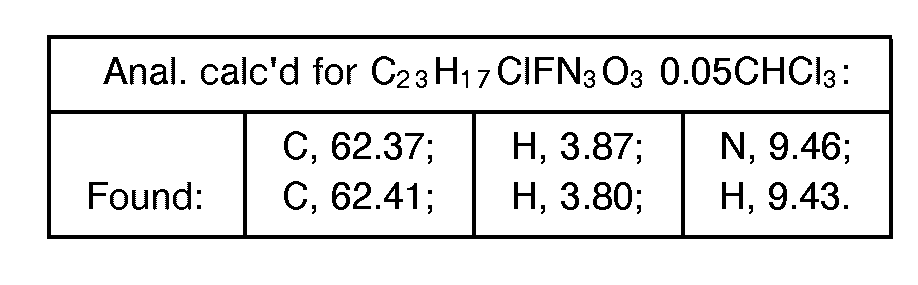


Claims (11)


alkoxy having 1 - 4 carbon atoms or alkylthio having 1 - 4 carbon atoms or the radicals


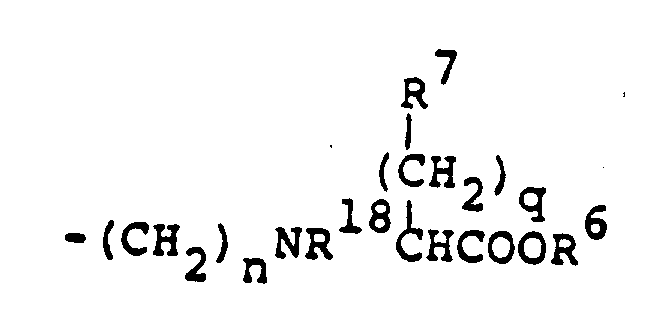

a group of formula -(CH2)mCOOR6
wherein


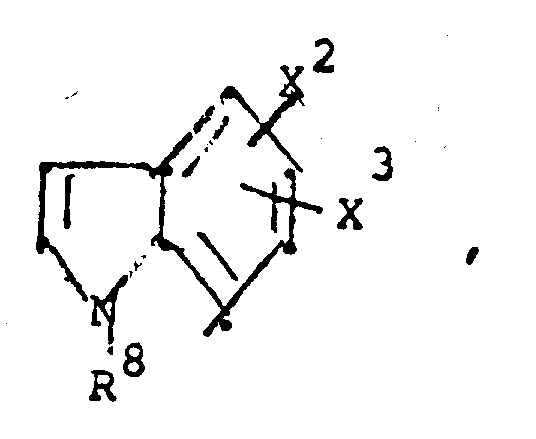

there is used as pharmaceutically active ingredient a compound of formula I or a pharmaceutically acceptable salt or a pharmaceutically acceptable quaternary ammonium salt of said compound of formula I, in which compounds of formula I


the remaining substituents and symbols have the same meaning as in the compounds of formula I defined in claim 1, with the proviso that X7' can only be NR15 when R is not H; or salts or quaternary ammonium salts thereof.


Priority Applications (1)
| Application Number | Priority Date | Filing Date | Title |
|---|---|---|---|
| AT85107842T ATE88998T1 (en) | 1984-06-26 | 1985-06-25 | BENZODIAZEPIN DERIVATIVES AND PHARMACEUTICALS CONTAINING THEM. |
Applications Claiming Priority (6)
| Application Number | Priority Date | Filing Date | Title |
|---|---|---|---|
| US62485484A | 1984-06-26 | 1984-06-26 | |
| US624854 | 1984-06-26 | ||
| US70527285A | 1985-02-25 | 1985-02-25 | |
| US74197285A | 1985-06-10 | 1985-06-10 | |
| US741972 | 1985-06-10 | ||
| US705272 | 1996-08-29 |
Publications (3)
| Publication Number | Publication Date |
|---|---|
| EP0167919A2 EP0167919A2 (en) | 1986-01-15 |
| EP0167919A3 EP0167919A3 (en) | 1986-11-05 |
| EP0167919B1 true EP0167919B1 (en) | 1993-05-05 |
Family
ID=27417360
Family Applications (1)
| Application Number | Title | Priority Date | Filing Date |
|---|---|---|---|
| EP85107842A Expired - Lifetime EP0167919B1 (en) | 1984-06-26 | 1985-06-25 | Benzodiazepine derivatives and pharmaceutical compositions containing them |
Country Status (17)
| Country | Link |
|---|---|
| EP (1) | EP0167919B1 (en) |
| JP (1) | JP2603214B2 (en) |
| KR (1) | KR900003406B1 (en) |
| AT (1) | ATE88998T1 (en) |
| AU (2) | AU4415285A (en) |
| CA (1) | CA1332410C (en) |
| DE (1) | DE3587316T2 (en) |
| DK (1) | DK175264B1 (en) |
| ES (2) | ES8704906A1 (en) |
| GR (1) | GR851539B (en) |
| HK (1) | HK15397A (en) |
| IE (1) | IE59900B1 (en) |
| IL (1) | IL75587A0 (en) |
| NO (1) | NO173651C (en) |
| NZ (1) | NZ212502A (en) |
| PT (1) | PT80717B (en) |
| YU (1) | YU46738B (en) |
Cited By (1)
| Publication number | Priority date | Publication date | Assignee | Title |
|---|---|---|---|---|
| US8039616B2 (en) | 2005-09-19 | 2011-10-18 | Astrazeneca Ab | Benzodiazepine derivatives for treating hepatitis C infection |
Families Citing this family (82)
| Publication number | Priority date | Publication date | Assignee | Title |
|---|---|---|---|---|
| US4755508A (en) * | 1984-06-26 | 1988-07-05 | Merck & Co., Inc. | Benzodiazepine analogs and use as antogonists of gastrin and cholecystokinin |
| US4820834A (en) * | 1984-06-26 | 1989-04-11 | Merck & Co., Inc. | Benzodiazepine analogs |
| EP0166354B1 (en) * | 1984-06-26 | 1992-08-05 | Merck & Co. Inc. | Benzofused lactam compounds and pharmaceutical compositions containing them |
| DE3514696A1 (en) * | 1985-04-24 | 1986-11-06 | Bayer Ag, 5090 Leverkusen | N-INDOLYLETHYL SULPHONIC ACID AMIDES, METHOD FOR THE PRODUCTION THEREOF AND THEIR USE |
| DE3760472D1 (en) * | 1986-07-14 | 1989-09-28 | Merck & Co Inc | Process for resolution and race mization of amines with acidic alpha-hydrogens |
| JPH01211939A (en) * | 1988-02-18 | 1989-08-25 | Nec Kyushu Ltd | Ion-implantation device |
| FR2630440B1 (en) * | 1988-04-25 | 1991-09-20 | Jouveinal Sa | BENZODIAZEPINES, THEIR PREPARATION PROCESS AND INTERMEDIATES AND THEIR THERAPEUTIC APPLICATIONS |
| US4970207A (en) * | 1988-07-07 | 1990-11-13 | Fujisawa Pharmaceutical Company, Ltd. | Benzodiazepine derivatives |
| IL91361A (en) * | 1988-09-09 | 1994-10-07 | Fujisawa Pharmaceutical Co | Disubstituted 1,9-annelated [1,4] benzodiazepinone compounds, processes for the preparation thereof and pharmaceutical compositions containing the same |
| US4957915A (en) * | 1989-02-27 | 1990-09-18 | Biomeasure, Inc. | Benzodiazepine analogs |
| IL93401A (en) * | 1989-03-08 | 1994-08-26 | Kali Chemie Pharma Gmbh | 1,7-fused 1h-indole-2-carboxylic acid n-(1,4-benzodiazepin-3-yl)amides, their preparation and medicaments comprising them |
| DE69030829T2 (en) * | 1989-03-10 | 1998-01-15 | Hoffmann La Roche | Drugs for the detection of drugs |
| JPH0374328A (en) * | 1989-08-04 | 1991-03-28 | Warner Lambert Co | Antagonist for central cholecystokinin having pharmaceutical activity |
| FR2652352A1 (en) * | 1989-09-28 | 1991-03-29 | Jouveinal Sa | BENZODIAZEPINES, THEIR PROCESS AND PREPARATION INTERMEDIATES AND THEIR THERAPEUTIC APPLICATIONS. |
| FR2659331A1 (en) * | 1990-03-08 | 1991-09-13 | Adir | NOVEL 4H-PYRROLO [1,2-A] THIENO [3,2-F] [1,4] -DIAZEPINE DERIVATIVES, PROCESS FOR THEIR PREPARATION AND THE PHARMACEUTICAL COMPOSITIONS CONTAINING THEM |
| CA2056809A1 (en) * | 1990-12-07 | 1992-06-08 | Mark G. Bock | Benzodiazepine analogs |
| JPH07119217B2 (en) * | 1990-12-25 | 1995-12-20 | 山之内製薬株式会社 | New benzodiazepine derivatives |
| IL101514A (en) * | 1991-04-10 | 1996-01-31 | Merck & Co Inc | Benzodiazepinone derivatives and cholecystokinin antagonist pharmaceutical compositions containing them |
| EP0523845A3 (en) * | 1991-06-14 | 1993-11-18 | Merck & Co Inc | New benzodiazepine analogs |
| WO1993007131A1 (en) * | 1991-10-10 | 1993-04-15 | Merck Sharp & Dohme Limited | Benzodiazepine derivatives and their use as antagonists of cholecystokinin and/or gastrin receptors |
| EP0549039B1 (en) * | 1991-12-20 | 1995-08-09 | MERCK SHARP & DOHME LTD. | 3-Phenylureido-1,4-Benzodiazepinones and their use as cholecystokinin or gastrin antagonists |
| GB9203790D0 (en) * | 1992-02-21 | 1992-04-08 | Merck Sharp & Dohme | Therapeutic agents |
| EP0637308A1 (en) * | 1992-03-16 | 1995-02-08 | MERCK SHARP & DOHME LTD. | Benzodiazepine derivatives, compositions containing them and their use in therapy |
| AU670431B2 (en) * | 1992-03-24 | 1996-07-18 | Merck Sharp & Dohme Limited | 3-ureido substituted benzodiazepin-2-ones having cholecystokinin and/or gastrin antagonistic activity and their use in therapy |
| US5360802A (en) * | 1992-05-11 | 1994-11-01 | Merck Sharpe & Dohme Ltd. | Benzodiazepine derivatives, compositions containing them and their use in therapy |
| EP0647632A1 (en) * | 1992-06-24 | 1995-04-12 | Yamanouchi Pharmaceutical Co. Ltd. | Novel benzodiazepine derivative |
| FR2694006A1 (en) * | 1992-07-22 | 1994-01-28 | Esteve Labor Dr | New amide derivs. of benzo-hetero cyclic cpds. - for treating gastrointestinal disorders, including ulcers and gastric hypersecretion |
| WO1994003447A1 (en) * | 1992-07-29 | 1994-02-17 | Merck Sharp & Dohme Limited | Benzodiazepine derivatives |
| WO1994026723A2 (en) * | 1993-05-14 | 1994-11-24 | Genentech, Inc. | ras FARNESYL TRANSFERASE INHIBITORS |
| AU678503B2 (en) * | 1993-09-24 | 1997-05-29 | Takeda Chemical Industries Ltd. | Condensed heterocyclic compounds and their use as squalene synthetase inhibitors |
| AU692916B2 (en) * | 1993-11-22 | 1998-06-18 | Merck & Co., Inc. | N-2,3-dihydro-1-(2-propyl)-2-oxo-5-phenyl-1h-1,4- benzodiazepines |
| FR2716195B1 (en) * | 1994-02-14 | 1996-06-21 | Sanofi Sa | Polysubstituted 3-acylamino-5-phenyl-1,4-benzodiazepin-2-one derivatives, process for their preparation and pharmaceutical compositions containing them |
| FR2716194B1 (en) * | 1994-02-14 | 1996-05-31 | Sanofi Elf | Polysubstituted 3-acylamino-5-phenyl-1,4-benzodiazepin-2-one derivatives, process for their preparation and pharmaceutical compositions containing them |
| ES2139933T3 (en) * | 1994-08-18 | 2000-02-16 | Merck & Co Inc | 2,3-DIHYDRO-1- (2,2,2-TRIFLUOROETHYL) -2-OXO-5-PHENYL-1H-1,4-BENZODIACEPINES. |
| US5556969A (en) * | 1994-12-07 | 1996-09-17 | Merck Sharp & Dohme Ltd. | Benzodiazepine derivatives |
| CA2257948A1 (en) * | 1996-06-28 | 1998-01-08 | Merck & Co., Inc. | Antiarrhythmic combinations of selective iks antagonists with beta-adenergic blocking agents |
| US6063794A (en) | 1996-10-11 | 2000-05-16 | Cor Therapeutics Inc. | Selective factor Xa inhibitors |
| US6194435B1 (en) | 1996-10-11 | 2001-02-27 | Cor Therapeutics, Inc. | Lactams as selective factor Xa inhibitors |
| US6369080B2 (en) | 1996-10-11 | 2002-04-09 | Cor Therapeutics, Inc. | Selective factor Xa inhibitors |
| US6262047B1 (en) | 1996-10-11 | 2001-07-17 | Cor Therapeutics, Inc. | Selective factor Xa inhibitors |
| US6683075B1 (en) | 1996-12-23 | 2004-01-27 | Athena Neurosciences, Inc. | Cycloalkyl, lactam, lactone and related compounds, pharmaceutical compositions comprising same, and methods for inhibiting β-amyloid peptide release and/or its synthesis by use |
| US6635632B1 (en) | 1996-12-23 | 2003-10-21 | Athena Neurosciences, Inc. | Cycloalkyl, lactam, lactone and related compounds, pharmaceutical compositions comprising same, and methods for inhibiting β-amyloid peptide release and/or its synthesis by use of such compounds |
| AU747531B2 (en) | 1997-04-14 | 2002-05-16 | Millennium Pharmaceuticals, Inc. | Selective factor Xa inhibitors |
| AU6896398A (en) | 1997-04-14 | 1998-11-11 | Cor Therapeutics, Inc. | Selective factor xa inhibitors |
| NZ500353A (en) | 1997-04-14 | 2002-02-01 | Cor Therapeutics Inc | Cyclic diaza compounds that are selective inhibitors of factor Xa |
| AU741099B2 (en) * | 1997-04-14 | 2001-11-22 | Millennium Pharmaceuticals, Inc. | Selective factor Xa inhibitors |
| US6228854B1 (en) | 1997-08-11 | 2001-05-08 | Cor Therapeutics, Inc. | Selective factor Xa inhibitors |
| US6218382B1 (en) | 1997-08-11 | 2001-04-17 | Cor Therapeutics, Inc | Selective factor Xa inhibitors |
| US6333321B1 (en) | 1997-08-11 | 2001-12-25 | Cor Therapeutics, Inc. | Selective factor Xa inhibitors |
| US6774125B2 (en) | 1998-06-22 | 2004-08-10 | Elan Pharmaceuticals, Inc. | Deoxyamino acid compounds, pharmaceutical compositions comprising same, and methods for inhibiting β-amyloid peptide release and/or its synthesis by use of such compounds |
| US6569851B1 (en) | 1998-06-22 | 2003-05-27 | Elan Pharmaceutials, Inc. | Cycloalkyl, lactam, lactone and related compounds, pharmaceutical compositions comprising same, and methods for inhibiting β-amyloid peptide release and/or its synthesis by use of such compounds |
| US6552013B1 (en) | 1998-06-22 | 2003-04-22 | Elan Pharmaceuticals, Inc. | Deoxyamino acid compounds, pharmaceutical compositions comprising same, and methods for inhibiting β-amyloid peptide release and/or its synthesis by use of such compounds |
| US6958330B1 (en) | 1998-06-22 | 2005-10-25 | Elan Pharmaceuticals, Inc. | Polycyclic α-amino-ε-caprolactams and related compounds |
| US6528505B1 (en) | 1998-06-22 | 2003-03-04 | Elan Pharmaceuticals, Inc. | Cyclic amino acid compounds pharmaceutical compositions comprising same and methods for inhibiting β-amyloid peptide release and/or its synthesis by use of such compounds |
| US6509331B1 (en) | 1998-06-22 | 2003-01-21 | Elan Pharmaceuticals, Inc. | Deoxyamino acid compounds, pharmaceutical compositions comprising same, and methods for inhibiting β-amyloid peptide release and/or its synthesis by use of such compounds |
| US7160880B1 (en) | 1999-05-14 | 2007-01-09 | Cenes Limited | Short-acting benzodiazepines |
| ES2228633T3 (en) | 1999-12-02 | 2005-04-16 | Zeria Pharmaceutical Co., Ltd. | CALCIUM SALTS OF 1,5-BENZODIAZEPIN DERIVATIVES, MANUFACTURING PROCEDURE FOR THESE SALTS AND MEDICINES INCLUDING THEM. |
| GB0012671D0 (en) * | 2000-05-24 | 2000-07-19 | Merck Sharp & Dohme | Therapeutic agents |
| AU2003267587B2 (en) | 2002-09-20 | 2010-05-20 | Arrow Therapeutics Limited | Benzodiazepine derivatives and pharmaceutical compositions containing them |
| CA2514547A1 (en) | 2003-01-28 | 2004-08-12 | Takeda Pharmaceutical Company Limited | Receptor agonists |
| KR20150081370A (en) | 2006-07-10 | 2015-07-13 | 파이온 유케이 리미티드 | Short-acting benzodiazepine salts and their polymorphic forms |
| EP2450039A1 (en) | 2010-11-08 | 2012-05-09 | PAION UK Ltd. | Dosing regimen for sedation with CNS 7056 (Remimazolam) |
| AR094963A1 (en) | 2013-03-04 | 2015-09-09 | Ono Pharmaceutical Co | EXCELLENT OXIDATION REACTION IN THE CONVERSION INDEX |
| GB201414116D0 (en) | 2014-08-08 | 2014-09-24 | Trio Medicines Ltd | Benzodiazepine derivatives |
| MY197231A (en) * | 2015-07-22 | 2023-06-06 | Enanta Pharm Inc | Benzodiazepine derivatives as rsv inhibitors |
| GB201513979D0 (en) | 2015-08-07 | 2015-09-23 | Trio Medicines Ltd | Synthesis of benzodiazepine derivatives |
| EP3178886A1 (en) | 2015-12-10 | 2017-06-14 | DyStar Colours Distribution GmbH | High wet fast brilliant blue disperse dye mixtures |
| WO2017214442A1 (en) | 2016-06-08 | 2017-12-14 | President And Fellows Of Harvard College | Methods and compositions for reducing tactile dysfunction and anxiety associated with autism spectrum disorder, rett syndrome, and fragile x syndrome |
| WO2019006295A1 (en) | 2017-06-30 | 2019-01-03 | Enanta Pharmaceuticals, Inc. | Heterocyclic compounds as rsv inhibitors |
| WO2019067864A1 (en) | 2017-09-29 | 2019-04-04 | Enanta Pharmaceuticals, Inc. | Combination pharmaceutical agents as rsv inhibitors |
| CA3099751A1 (en) | 2018-05-22 | 2019-11-28 | President And Fellows Of Harvard College | Compositions and methods for reducing tactile dysfunction, anxiety, and social impairment |
| AU2019279858A1 (en) | 2018-05-29 | 2020-11-26 | President And Fellows Of Harvard College | Compositions and methods for reducing tactile dysfunction, anxiety, and social impairment |
| CA3133300A1 (en) | 2019-03-18 | 2020-09-24 | Enanta Pharmaceuticals, Inc. | Benzodiazepine derivatives as rsv inhibitors |
| US12077512B2 (en) | 2019-03-25 | 2024-09-03 | President And Fellows Of Harvard College | Compositions and methods for reducing tactile dysfunction, anxiety, and social impairment |
| US11505558B1 (en) | 2019-10-04 | 2022-11-22 | Enanta Pharmaceuticals, Inc. | Antiviral heterocyclic compounds |
| IL291834B1 (en) | 2019-10-04 | 2026-02-01 | Enanta Pharm Inc | Antiviral heterocyclic compounds |
| UY39032A (en) | 2020-01-24 | 2021-07-30 | Enanta Pharm Inc | HETEROCYCLIC COMPOUNDS AS ANTIVIRAL AGENTS |
| US11534439B2 (en) | 2020-07-07 | 2022-12-27 | Enanta Pharmaceuticals, Inc. | Dihydroquinoxaline and dihydropyridopyrazine derivatives as RSV inhibitors |
| WO2022086840A1 (en) | 2020-10-19 | 2022-04-28 | Enanta Pharmaceuticals, Inc. | Heterocyclic compounds as anti-viral agents |
| US12612412B2 (en) | 2021-02-26 | 2026-04-28 | Enanta Pharmaceuticals, Inc. | Antiviral heterocyclic compounds |
| AR129003A1 (en) | 2022-04-07 | 2024-07-03 | Enanta Pharm Inc | HETEROCYCLIC ANTIVIRAL COMPOUNDS |
| WO2023211997A1 (en) | 2022-04-27 | 2023-11-02 | Enanta Pharmaceuticals, Inc. | Antiviral compounds |
Citations (8)
| Publication number | Priority date | Publication date | Assignee | Title |
|---|---|---|---|---|
| GB1039947A (en) * | 1964-04-06 | 1966-08-24 | Engelhard Ind Inc | Improvements in or relating to gold plating |
| US3270053A (en) * | 1960-12-02 | 1966-08-30 | Hoffmann La Roche | 2-(alpha-halo-lower alkanoylamino)-benzophenones |
| US3344183A (en) * | 1960-12-02 | 1967-09-26 | Hoffmann La Roche | 2 n-substituted amino benzophenones |
| US3344136A (en) * | 1963-12-03 | 1967-09-26 | American Home Prod | Process for producing 3-acetamido-1, 3-dihydro-5-phenyl-2h-1, 4-benzodiazepin-2-ones |
| US3402171A (en) * | 1960-12-02 | 1968-09-17 | Hoffmann La Roche | Process for preparing 5-aryl-3h-1, 4-benzodiazepin-2(1h)-ones |
| DE1923821A1 (en) * | 1969-05-09 | 1970-11-19 | Wuelfing J A Fa | Tetrahydrobenzodiazepinedione derivs with - valuable cns properties |
| US3558603A (en) * | 1967-12-01 | 1971-01-26 | Sumitomo Chemical Co | Process for producing benzodiazepine derivatives |
| US3867529A (en) * | 1970-08-24 | 1975-02-18 | Giorgio Ferrari | Tranquilizing and anti-anxiety pharmaceutical compositions |
Family Cites Families (12)
| Publication number | Priority date | Publication date | Assignee | Title |
|---|---|---|---|---|
| CH414652A (en) * | 1959-12-10 | 1966-06-15 | Hoffmann La Roche | Process for the preparation of 1,4-benzodiazepine derivatives |
| GB1034872A (en) * | 1962-04-16 | 1966-07-06 | American Home Prod | Benzodiazepine derivatives |
| GB1063891A (en) * | 1964-01-14 | 1967-04-05 | Delmar Chem | Method for preparation of benzodiazepinones |
| GB1173320A (en) * | 1966-12-13 | 1969-12-10 | Delmar Chem | Derivatives of Benzodiazepinones |
| US3778433A (en) * | 1969-04-18 | 1973-12-11 | Sumitomo Chemical Co | Process for producing benzodiazepine derivatives |
| US4045569A (en) * | 1971-03-17 | 1977-08-30 | Franjo Kajfez | Optically active 1,4-benzodiazepines and process for use as a tranquilizer |
| US4065451A (en) * | 1971-03-30 | 1977-12-27 | American Home Products | 1,3-Dihydro-3-hydroxy-5-phenyl-2H-1,4-benzodiazepin-2-one, substituted diamino acetate esters and their acid salts |
| US3801568A (en) * | 1972-02-07 | 1974-04-02 | American Home Prod | Optically active 1,3-dihydro-3-substituted 5-phenyl-2h-1,4-benzodiazepin-2-ones and process for their separation |
| CH581606A5 (en) * | 1972-08-02 | 1976-11-15 | Crc Ricerca Chim | 2-(Alpha-ammonio-acylamino) benzophenones - precursors for benzodiazepinone hypnotics and tranquillisers |
| DE2311714A1 (en) * | 1973-03-09 | 1974-09-19 | Thomae Gmbh Dr K | NEW 1,4-BENZODIAZEPINE |
| CH573928A5 (en) * | 1973-07-30 | 1976-03-31 | Crc Ricerca Chim | |
| US5004741A (en) * | 1984-06-26 | 1991-04-02 | Merck & Co., Inc. | Methods of antagonizing CCK or gastrin with benzodiazepine analogs |
-
1985
- 1985-06-19 CA CA000484488A patent/CA1332410C/en not_active Expired - Fee Related
- 1985-06-20 NZ NZ212502A patent/NZ212502A/en unknown
- 1985-06-20 IL IL75587A patent/IL75587A0/en not_active IP Right Cessation
- 1985-06-24 GR GR851539A patent/GR851539B/el unknown
- 1985-06-25 EP EP85107842A patent/EP0167919B1/en not_active Expired - Lifetime
- 1985-06-25 DK DK198502872A patent/DK175264B1/en not_active IP Right Cessation
- 1985-06-25 ES ES544523A patent/ES8704906A1/en not_active Expired
- 1985-06-25 IE IE158285A patent/IE59900B1/en not_active IP Right Cessation
- 1985-06-25 AT AT85107842T patent/ATE88998T1/en not_active IP Right Cessation
- 1985-06-25 DE DE85107842T patent/DE3587316T2/en not_active Expired - Lifetime
- 1985-06-25 AU AU44152/85A patent/AU4415285A/en not_active Abandoned
- 1985-06-25 NO NO852558A patent/NO173651C/en unknown
- 1985-06-26 KR KR1019850004551A patent/KR900003406B1/en not_active Expired
- 1985-06-26 JP JP60138064A patent/JP2603214B2/en not_active Expired - Lifetime
- 1985-06-26 YU YU106785A patent/YU46738B/en unknown
- 1985-06-26 PT PT80717A patent/PT80717B/en unknown
-
1986
- 1986-01-31 ES ES551504A patent/ES8706132A1/en not_active Expired
-
1989
- 1989-11-10 AU AU44563/89A patent/AU640113B2/en not_active Ceased
-
1997
- 1997-02-05 HK HK15397A patent/HK15397A/en not_active IP Right Cessation
Patent Citations (8)
| Publication number | Priority date | Publication date | Assignee | Title |
|---|---|---|---|---|
| US3270053A (en) * | 1960-12-02 | 1966-08-30 | Hoffmann La Roche | 2-(alpha-halo-lower alkanoylamino)-benzophenones |
| US3344183A (en) * | 1960-12-02 | 1967-09-26 | Hoffmann La Roche | 2 n-substituted amino benzophenones |
| US3402171A (en) * | 1960-12-02 | 1968-09-17 | Hoffmann La Roche | Process for preparing 5-aryl-3h-1, 4-benzodiazepin-2(1h)-ones |
| US3344136A (en) * | 1963-12-03 | 1967-09-26 | American Home Prod | Process for producing 3-acetamido-1, 3-dihydro-5-phenyl-2h-1, 4-benzodiazepin-2-ones |
| GB1039947A (en) * | 1964-04-06 | 1966-08-24 | Engelhard Ind Inc | Improvements in or relating to gold plating |
| US3558603A (en) * | 1967-12-01 | 1971-01-26 | Sumitomo Chemical Co | Process for producing benzodiazepine derivatives |
| DE1923821A1 (en) * | 1969-05-09 | 1970-11-19 | Wuelfing J A Fa | Tetrahydrobenzodiazepinedione derivs with - valuable cns properties |
| US3867529A (en) * | 1970-08-24 | 1975-02-18 | Giorgio Ferrari | Tranquilizing and anti-anxiety pharmaceutical compositions |
Non-Patent Citations (15)
| Title |
|---|
| Boll. Chim. Farm., 107(1968) and Chemical Abstract 69:96684Z * |
| Chem. Abstracts 87:5923j * |
| English Translation from Khimiya Geterotsiklicheskikh Soedinenii 1979, No. (4), 545-9, April, 1979 and Chemical Abstract 91:157698k * |
| European Journal of Drug Metabolism and Pharmacokinetics, 1980, Vol. 5, No. 4, pg. 193-200 and Chemical Abstracts 94:202460b * |
| Farmaco, Ed. Sci. 1982 37 (5), 343-52 (Ital.) and Chemical Abstract 97:23755a * |
| Fiziol. Aktiv. Veshchestva 1972, 4, 96-100 (Russia) and Chemical Abstract 78: 136245b * |
| Heterocyclic Chemistry, 1980, 17(5), 865-8 and Chemical Abstract 94:65639a * |
| Japan Journal of Pharmacology 33 Supp. 87 p (1983), Kabota et al * |
| Journal of Chromotography, 174(1979) 447-450 and Chemical Abstracts 91: 90976d * |
| Journal of Chromotography, 259 (1983) 494-498 and Chemical Abstract 99: 15947g * |
| Journal Organic Chemistry 1981, 46, pp. 3945-3949 * |
| Stanley C.Bell et al. article from May 1968 titled "3 Substituted 1, 4 Benzodiapin-2-Ones" pg. 457-461 * |
| Synthesis 1979. (9), 718 and 719 and Chemical Abstract 92:76468d * |
| SZABADALMI LEIRAS 178279 and Chemical Abstract 96: 122830Y * |
| Yamanouchi Seiyaku Kenku Hokoku 1974, 2, 196-205 (Japan) and Chemical Abstract 84: 31018a * |
Cited By (1)
| Publication number | Priority date | Publication date | Assignee | Title |
|---|---|---|---|---|
| US8039616B2 (en) | 2005-09-19 | 2011-10-18 | Astrazeneca Ab | Benzodiazepine derivatives for treating hepatitis C infection |
Also Published As
| Publication number | Publication date |
|---|---|
| AU4456389A (en) | 1990-04-05 |
| AU4415285A (en) | 1986-01-02 |
| DK175264B1 (en) | 2004-08-02 |
| ES8706132A1 (en) | 1987-06-01 |
| HK15397A (en) | 1997-02-14 |
| DE3587316T2 (en) | 1993-11-04 |
| ES551504A0 (en) | 1987-06-01 |
| PT80717B (en) | 1987-10-20 |
| EP0167919A3 (en) | 1986-11-05 |
| KR860000270A (en) | 1986-01-27 |
| JP2603214B2 (en) | 1997-04-23 |
| AU640113B2 (en) | 1993-08-19 |
| NZ212502A (en) | 1989-03-29 |
| EP0167919A2 (en) | 1986-01-15 |
| YU106785A (en) | 1988-12-31 |
| DK287285D0 (en) | 1985-06-25 |
| IE851582L (en) | 1985-12-26 |
| ATE88998T1 (en) | 1993-05-15 |
| NO173651C (en) | 1994-01-12 |
| PT80717A (en) | 1985-07-01 |
| GR851539B (en) | 1985-11-25 |
| IL75587A0 (en) | 1985-10-31 |
| IE59900B1 (en) | 1994-04-20 |
| CA1332410C (en) | 1994-10-11 |
| DK287285A (en) | 1986-02-25 |
| JPS6163666A (en) | 1986-04-01 |
| DE3587316D1 (en) | 1993-06-09 |
| KR900003406B1 (en) | 1990-05-18 |
| NO852558L (en) | 1985-12-27 |
| ES544523A0 (en) | 1987-04-16 |
| ES8704906A1 (en) | 1987-04-16 |
| NO173651B (en) | 1993-10-04 |
| YU46738B (en) | 1994-04-05 |
Similar Documents
| Publication | Publication Date | Title |
|---|---|---|
| HK15397A (en) | Benzodiazepine derivatives and pharmaceutical compositions containing them | |
| US5004741A (en) | Methods of antagonizing CCK or gastrin with benzodiazepine analogs | |
| US4820834A (en) | Benzodiazepine analogs | |
| US5324726A (en) | Benzodiazepine analogs | |
| JP3457312B2 (en) | Benzodiasepine derivative | |
| US6525044B2 (en) | Succinoylamino carbocycles and heterocycles as inhibitors of a-β protein production | |
| EP0434364A2 (en) | Benzodiazepine analogs for treating panic syndrome and for directly inducing analgesia | |
| US4663321A (en) | Triazolobenzodiazepines and pharmaceutical use | |
| IE904560A1 (en) | New benzodiazepine analogs | |
| EP0434369A1 (en) | New benzodiazepine analogs | |
| US4755508A (en) | Benzodiazepine analogs and use as antogonists of gastrin and cholecystokinin | |
| JP2003523932A (en) | Succinoylaminobenzodiazepines as inhibitors of Aβ protein production | |
| EP0490590A1 (en) | New benzodiazepine analogs | |
| JPH08505120A (en) | Benzodiazepine derivative | |
| US5218114A (en) | Cholecystokinin antagonists | |
| HU210354A9 (en) | 1,7-anellated 1h-indol-2-carboxylic acid-n-(1,4-benzodiazepin-3-yl)-amide | |
| JPH0680650A (en) | Cholecystokinin antagonist | |
| HUT74091A (en) | 1,5-benzodiazepine derivatives having cck and/or gastrin antagonistic activity | |
| EP0167920A2 (en) | Benzodiazepine derivatives and pharmaceutical compositions containing them | |
| US5378838A (en) | Benzodiazepine cholecystokinin antagonists | |
| CA2055094A1 (en) | Cholecystokinin antagonist |
Legal Events
| Date | Code | Title | Description |
|---|---|---|---|
| PUAI | Public reference made under article 153(3) epc to a published international application that has entered the european phase |
Free format text: ORIGINAL CODE: 0009012 |
|
| AK | Designated contracting states |
Designated state(s): AT BE CH DE FR GB IT LI LU NL SE |
|
| ITCL | It: translation for ep claims filed |
Representative=s name: SOCIETA' ITALIANA BREVETTI S.P.A. |
|
| PUAL | Search report despatched |
Free format text: ORIGINAL CODE: 0009013 |
|
| AK | Designated contracting states |
Kind code of ref document: A3 Designated state(s): AT BE CH DE FR GB IT LI LU NL SE |
|
| 17P | Request for examination filed |
Effective date: 19870425 |
|
| 17Q | First examination report despatched |
Effective date: 19890227 |
|
| GRAA | (expected) grant |
Free format text: ORIGINAL CODE: 0009210 |
|
| AK | Designated contracting states |
Kind code of ref document: B1 Designated state(s): AT BE CH DE FR GB IT LI LU NL SE |
|
| REF | Corresponds to: |
Ref document number: 88998 Country of ref document: AT Date of ref document: 19930515 Kind code of ref document: T |
|
| REF | Corresponds to: |
Ref document number: 3587316 Country of ref document: DE Date of ref document: 19930609 |
|
| ET | Fr: translation filed | ||
| ITF | It: translation for a ep patent filed | ||
| PLBE | No opposition filed within time limit |
Free format text: ORIGINAL CODE: 0009261 |
|
| STAA | Information on the status of an ep patent application or granted ep patent |
Free format text: STATUS: NO OPPOSITION FILED WITHIN TIME LIMIT |
|
| 26N | No opposition filed | ||
| EPTA | Lu: last paid annual fee | ||
| ITTA | It: last paid annual fee | ||
| EAL | Se: european patent in force in sweden |
Ref document number: 85107842.8 |
|
| REG | Reference to a national code |
Ref country code: GB Ref legal event code: IF02 |
|
| PGFP | Annual fee paid to national office [announced via postgrant information from national office to epo] |
Ref country code: NL Payment date: 20040603 Year of fee payment: 20 |
|
| PGFP | Annual fee paid to national office [announced via postgrant information from national office to epo] |
Ref country code: SE Payment date: 20040604 Year of fee payment: 20 |
|
| PGFP | Annual fee paid to national office [announced via postgrant information from national office to epo] |
Ref country code: FR Payment date: 20040608 Year of fee payment: 20 |
|
| PGFP | Annual fee paid to national office [announced via postgrant information from national office to epo] |
Ref country code: AT Payment date: 20040611 Year of fee payment: 20 |
|
| PGFP | Annual fee paid to national office [announced via postgrant information from national office to epo] |
Ref country code: GB Payment date: 20040623 Year of fee payment: 20 |
|
| PGFP | Annual fee paid to national office [announced via postgrant information from national office to epo] |
Ref country code: LU Payment date: 20040625 Year of fee payment: 20 |
|
| PGFP | Annual fee paid to national office [announced via postgrant information from national office to epo] |
Ref country code: CH Payment date: 20040629 Year of fee payment: 20 |
|
| PGFP | Annual fee paid to national office [announced via postgrant information from national office to epo] |
Ref country code: DE Payment date: 20040708 Year of fee payment: 20 |
|
| PGFP | Annual fee paid to national office [announced via postgrant information from national office to epo] |
Ref country code: BE Payment date: 20040812 Year of fee payment: 20 |
|
| PG25 | Lapsed in a contracting state [announced via postgrant information from national office to epo] |
Ref country code: GB Free format text: LAPSE BECAUSE OF EXPIRATION OF PROTECTION Effective date: 20050624 |
|
| PG25 | Lapsed in a contracting state [announced via postgrant information from national office to epo] |
Ref country code: NL Free format text: LAPSE BECAUSE OF EXPIRATION OF PROTECTION Effective date: 20050625 |
|
| BE20 | Be: patent expired |
Owner name: *MERCK & CO. INC. Effective date: 20050625 |
|
| REG | Reference to a national code |
Ref country code: GB Ref legal event code: PE20 |
|
| REG | Reference to a national code |
Ref country code: CH Ref legal event code: PL |
|
| EUG | Se: european patent has lapsed | ||
| NLV7 | Nl: ceased due to reaching the maximum lifetime of a patent |
Effective date: 20050625 |
|
| BE20 | Be: patent expired |
Owner name: *MERCK & CO. INC. Effective date: 20050625 |