EP0167188A1 - Process for preparing aqueous dispersions of acrylic-urethane graft copolymers - Google Patents
Process for preparing aqueous dispersions of acrylic-urethane graft copolymers Download PDFInfo
- Publication number
- EP0167188A1 EP0167188A1 EP85200747A EP85200747A EP0167188A1 EP 0167188 A1 EP0167188 A1 EP 0167188A1 EP 85200747 A EP85200747 A EP 85200747A EP 85200747 A EP85200747 A EP 85200747A EP 0167188 A1 EP0167188 A1 EP 0167188A1
- Authority
- EP
- European Patent Office
- Prior art keywords
- process according
- acrylate
- racterized
- cha
- urethane
- Prior art date
- Legal status (The legal status is an assumption and is not a legal conclusion. Google has not performed a legal analysis and makes no representation as to the accuracy of the status listed.)
- Granted
Links
- 239000006185 dispersion Substances 0.000 title claims abstract description 46
- 229920000578 graft copolymer Polymers 0.000 title claims abstract description 18
- 238000004519 manufacturing process Methods 0.000 title claims description 4
- JOYRKODLDBILNP-UHFFFAOYSA-N Ethyl urethane Chemical compound CCOC(N)=O JOYRKODLDBILNP-UHFFFAOYSA-N 0.000 claims abstract description 58
- NIXOWILDQLNWCW-UHFFFAOYSA-M Acrylate Chemical compound [O-]C(=O)C=C NIXOWILDQLNWCW-UHFFFAOYSA-M 0.000 claims abstract description 32
- 125000004435 hydrogen atom Chemical group [H]* 0.000 claims abstract description 31
- 125000005442 diisocyanate group Chemical group 0.000 claims abstract description 30
- 150000001875 compounds Chemical class 0.000 claims abstract description 28
- XLYOFNOQVPJJNP-UHFFFAOYSA-N water Substances O XLYOFNOQVPJJNP-UHFFFAOYSA-N 0.000 claims abstract description 23
- 238000007720 emulsion polymerization reaction Methods 0.000 claims abstract description 20
- UHESRSKEBRADOO-UHFFFAOYSA-N ethyl carbamate;prop-2-enoic acid Chemical compound OC(=O)C=C.CCOC(N)=O UHESRSKEBRADOO-UHFFFAOYSA-N 0.000 claims abstract description 20
- -1 vinyl compound Chemical class 0.000 claims abstract description 20
- 239000005056 polyisocyanate Substances 0.000 claims abstract description 10
- 229920001228 polyisocyanate Polymers 0.000 claims abstract description 10
- 238000000576 coating method Methods 0.000 claims abstract description 9
- 150000002894 organic compounds Chemical class 0.000 claims abstract description 8
- 239000004815 dispersion polymer Substances 0.000 claims abstract description 7
- 230000003472 neutralizing effect Effects 0.000 claims abstract description 6
- 239000000976 ink Substances 0.000 claims abstract description 4
- 238000007639 printing Methods 0.000 claims abstract description 4
- 238000007796 conventional method Methods 0.000 claims abstract 2
- 238000000034 method Methods 0.000 claims description 63
- 230000008569 process Effects 0.000 claims description 42
- 238000006243 chemical reaction Methods 0.000 claims description 40
- 239000000178 monomer Substances 0.000 claims description 33
- 239000004970 Chain extender Substances 0.000 claims description 15
- 239000003054 catalyst Substances 0.000 claims description 15
- 239000007787 solid Substances 0.000 claims description 13
- 150000003839 salts Chemical group 0.000 claims description 12
- 150000001252 acrylic acid derivatives Chemical class 0.000 claims description 11
- 150000001412 amines Chemical class 0.000 claims description 7
- 239000012298 atmosphere Substances 0.000 claims description 7
- 239000003795 chemical substances by application Substances 0.000 claims description 7
- 238000006386 neutralization reaction Methods 0.000 claims description 6
- AZIQALWHRUQPHV-UHFFFAOYSA-N prop-2-eneperoxoic acid Chemical compound OOC(=O)C=C AZIQALWHRUQPHV-UHFFFAOYSA-N 0.000 claims description 6
- 150000003512 tertiary amines Chemical class 0.000 claims description 3
- 229910052799 carbon Inorganic materials 0.000 claims description 2
- 229920005862 polyol Polymers 0.000 abstract description 7
- 150000003077 polyols Chemical class 0.000 abstract description 6
- 229920000768 polyamine Polymers 0.000 abstract description 4
- 229920002554 vinyl polymer Polymers 0.000 abstract description 3
- CERQOIWHTDAKMF-UHFFFAOYSA-M Methacrylate Chemical compound CC(=C)C([O-])=O CERQOIWHTDAKMF-UHFFFAOYSA-M 0.000 abstract description 2
- 239000011230 binding agent Substances 0.000 abstract description 2
- 239000012948 isocyanate Substances 0.000 abstract description 2
- 239000000203 mixture Substances 0.000 description 31
- 229920000642 polymer Polymers 0.000 description 22
- 238000002360 preparation method Methods 0.000 description 18
- 230000015572 biosynthetic process Effects 0.000 description 16
- WOBHKFSMXKNTIM-UHFFFAOYSA-N Hydroxyethyl methacrylate Chemical compound CC(=C)C(=O)OCCO WOBHKFSMXKNTIM-UHFFFAOYSA-N 0.000 description 15
- KWYUFKZDYYNOTN-UHFFFAOYSA-M Potassium hydroxide Chemical compound [OH-].[K+] KWYUFKZDYYNOTN-UHFFFAOYSA-M 0.000 description 15
- 239000002253 acid Substances 0.000 description 14
- NIMLQBUJDJZYEJ-UHFFFAOYSA-N isophorone diisocyanate Chemical compound CC1(C)CC(N=C=O)CC(C)(CN=C=O)C1 NIMLQBUJDJZYEJ-UHFFFAOYSA-N 0.000 description 14
- IJGRMHOSHXDMSA-UHFFFAOYSA-N Atomic nitrogen Chemical compound N#N IJGRMHOSHXDMSA-UHFFFAOYSA-N 0.000 description 12
- SOGAXMICEFXMKE-UHFFFAOYSA-N Butylmethacrylate Chemical compound CCCCOC(=O)C(C)=C SOGAXMICEFXMKE-UHFFFAOYSA-N 0.000 description 12
- 239000005058 Isophorone diisocyanate Substances 0.000 description 12
- 239000011541 reaction mixture Substances 0.000 description 12
- 102100026735 Coagulation factor VIII Human genes 0.000 description 11
- 101000911390 Homo sapiens Coagulation factor VIII Proteins 0.000 description 11
- 229920001577 copolymer Polymers 0.000 description 11
- 238000006116 polymerization reaction Methods 0.000 description 11
- QGZKDVFQNNGYKY-UHFFFAOYSA-N Ammonia Chemical compound N QGZKDVFQNNGYKY-UHFFFAOYSA-N 0.000 description 10
- 238000007334 copolymerization reaction Methods 0.000 description 10
- 238000003860 storage Methods 0.000 description 10
- ZMANZCXQSJIPKH-UHFFFAOYSA-N Triethylamine Chemical compound CCN(CC)CC ZMANZCXQSJIPKH-UHFFFAOYSA-N 0.000 description 9
- 239000003995 emulsifying agent Substances 0.000 description 9
- 125000002887 hydroxy group Chemical group [H]O* 0.000 description 8
- 229910052757 nitrogen Inorganic materials 0.000 description 8
- 239000002904 solvent Substances 0.000 description 8
- 125000000391 vinyl group Chemical group [H]C([*])=C([H])[H] 0.000 description 8
- VVQNEPGJFQJSBK-UHFFFAOYSA-N Methyl methacrylate Chemical compound COC(=O)C(C)=C VVQNEPGJFQJSBK-UHFFFAOYSA-N 0.000 description 7
- KORSJDCBLAPZEQ-UHFFFAOYSA-N dicyclohexylmethane-4,4'-diisocyanate Chemical compound C1CC(N=C=O)CCC1CC1CCC(N=C=O)CC1 KORSJDCBLAPZEQ-UHFFFAOYSA-N 0.000 description 7
- 150000002009 diols Chemical class 0.000 description 7
- LYCAIKOWRPUZTN-UHFFFAOYSA-N Ethylene glycol Chemical compound OCCO LYCAIKOWRPUZTN-UHFFFAOYSA-N 0.000 description 6
- HJOVHMDZYOCNQW-UHFFFAOYSA-N isophorone Chemical compound CC1=CC(=O)CC(C)(C)C1 HJOVHMDZYOCNQW-UHFFFAOYSA-N 0.000 description 6
- 229920000058 polyacrylate Polymers 0.000 description 6
- 238000012360 testing method Methods 0.000 description 6
- BEWCNXNIQCLWHP-UHFFFAOYSA-N 2-(tert-butylamino)ethyl 2-methylprop-2-enoate Chemical compound CC(=C)C(=O)OCCNC(C)(C)C BEWCNXNIQCLWHP-UHFFFAOYSA-N 0.000 description 5
- 229940044192 2-hydroxyethyl methacrylate Drugs 0.000 description 5
- FRIBMENBGGCKPD-UHFFFAOYSA-N 3-(2,3-dimethoxyphenyl)prop-2-enal Chemical compound COC1=CC=CC(C=CC=O)=C1OC FRIBMENBGGCKPD-UHFFFAOYSA-N 0.000 description 5
- OAKJQQAXSVQMHS-UHFFFAOYSA-N Hydrazine Chemical compound NN OAKJQQAXSVQMHS-UHFFFAOYSA-N 0.000 description 5
- CERQOIWHTDAKMF-UHFFFAOYSA-N Methacrylic acid Chemical compound CC(=C)C(O)=O CERQOIWHTDAKMF-UHFFFAOYSA-N 0.000 description 5
- DBMJMQXJHONAFJ-UHFFFAOYSA-M Sodium laurylsulphate Chemical compound [Na+].CCCCCCCCCCCCOS([O-])(=O)=O DBMJMQXJHONAFJ-UHFFFAOYSA-M 0.000 description 5
- 229910021529 ammonia Inorganic materials 0.000 description 5
- 125000000129 anionic group Chemical group 0.000 description 5
- 238000004132 cross linking Methods 0.000 description 5
- 238000012986 modification Methods 0.000 description 5
- 230000004048 modification Effects 0.000 description 5
- 229920001451 polypropylene glycol Polymers 0.000 description 5
- 229920003009 polyurethane dispersion Polymers 0.000 description 5
- 239000000376 reactant Substances 0.000 description 5
- 235000019333 sodium laurylsulphate Nutrition 0.000 description 5
- 239000004160 Ammonium persulphate Substances 0.000 description 4
- CIWBSHSKHKDKBQ-JLAZNSOCSA-N Ascorbic acid Chemical compound OC[C@H](O)[C@H]1OC(=O)C(O)=C1O CIWBSHSKHKDKBQ-JLAZNSOCSA-N 0.000 description 4
- NBIIXXVUZAFLBC-UHFFFAOYSA-N Phosphoric acid Chemical compound OP(O)(O)=O NBIIXXVUZAFLBC-UHFFFAOYSA-N 0.000 description 4
- OFOBLEOULBTSOW-UHFFFAOYSA-N Propanedioic acid Natural products OC(=O)CC(O)=O OFOBLEOULBTSOW-UHFFFAOYSA-N 0.000 description 4
- 239000004141 Sodium laurylsulphate Substances 0.000 description 4
- PPBRXRYQALVLMV-UHFFFAOYSA-N Styrene Chemical compound C=CC1=CC=CC=C1 PPBRXRYQALVLMV-UHFFFAOYSA-N 0.000 description 4
- WYURNTSHIVDZCO-UHFFFAOYSA-N Tetrahydrofuran Chemical compound C1CCOC1 WYURNTSHIVDZCO-UHFFFAOYSA-N 0.000 description 4
- 235000019395 ammonium persulphate Nutrition 0.000 description 4
- 125000003118 aryl group Chemical group 0.000 description 4
- 239000003638 chemical reducing agent Substances 0.000 description 4
- 235000019441 ethanol Nutrition 0.000 description 4
- 239000011953 free-radical catalyst Substances 0.000 description 4
- IKDUDTNKRLTJSI-UHFFFAOYSA-N hydrazine hydrate Chemical compound O.NN IKDUDTNKRLTJSI-UHFFFAOYSA-N 0.000 description 4
- 239000001257 hydrogen Substances 0.000 description 4
- 229910052739 hydrogen Inorganic materials 0.000 description 4
- 239000011261 inert gas Substances 0.000 description 4
- 230000035484 reaction time Effects 0.000 description 4
- PTBDIHRZYDMNKB-UHFFFAOYSA-N 2,2-Bis(hydroxymethyl)propionic acid Chemical compound OCC(C)(CO)C(O)=O PTBDIHRZYDMNKB-UHFFFAOYSA-N 0.000 description 3
- QTBSBXVTEAMEQO-UHFFFAOYSA-N Acetic acid Chemical compound CC(O)=O QTBSBXVTEAMEQO-UHFFFAOYSA-N 0.000 description 3
- KFZMGEQAYNKOFK-UHFFFAOYSA-N Isopropanol Chemical compound CC(C)O KFZMGEQAYNKOFK-UHFFFAOYSA-N 0.000 description 3
- 239000004159 Potassium persulphate Substances 0.000 description 3
- JUJWROOIHBZHMG-UHFFFAOYSA-N Pyridine Chemical compound C1=CC=NC=C1 JUJWROOIHBZHMG-UHFFFAOYSA-N 0.000 description 3
- YXFVVABEGXRONW-UHFFFAOYSA-N Toluene Chemical compound CC1=CC=CC=C1 YXFVVABEGXRONW-UHFFFAOYSA-N 0.000 description 3
- 150000007513 acids Chemical class 0.000 description 3
- 150000001298 alcohols Chemical class 0.000 description 3
- 125000001931 aliphatic group Chemical group 0.000 description 3
- 125000000217 alkyl group Chemical group 0.000 description 3
- ROOXNKNUYICQNP-UHFFFAOYSA-N ammonium persulfate Chemical compound [NH4+].[NH4+].[O-]S(=O)(=O)OOS([O-])(=O)=O ROOXNKNUYICQNP-UHFFFAOYSA-N 0.000 description 3
- IISBACLAFKSPIT-UHFFFAOYSA-N bisphenol A Chemical compound C=1C=C(O)C=CC=1C(C)(C)C1=CC=C(O)C=C1 IISBACLAFKSPIT-UHFFFAOYSA-N 0.000 description 3
- 125000004432 carbon atom Chemical group C* 0.000 description 3
- 239000011248 coating agent Substances 0.000 description 3
- 230000000052 comparative effect Effects 0.000 description 3
- 230000001419 dependent effect Effects 0.000 description 3
- 239000003085 diluting agent Substances 0.000 description 3
- 230000000694 effects Effects 0.000 description 3
- 238000010438 heat treatment Methods 0.000 description 3
- 230000007062 hydrolysis Effects 0.000 description 3
- 238000006460 hydrolysis reaction Methods 0.000 description 3
- 239000000463 material Substances 0.000 description 3
- 125000002496 methyl group Chemical group [H]C([H])([H])* 0.000 description 3
- USHAGKDGDHPEEY-UHFFFAOYSA-L potassium persulfate Chemical compound [K+].[K+].[O-]S(=O)(=O)OOS([O-])(=O)=O USHAGKDGDHPEEY-UHFFFAOYSA-L 0.000 description 3
- 235000019394 potassium persulphate Nutrition 0.000 description 3
- 125000002924 primary amino group Chemical group [H]N([H])* 0.000 description 3
- 239000000047 product Substances 0.000 description 3
- 150000003254 radicals Chemical class 0.000 description 3
- 239000004094 surface-active agent Substances 0.000 description 3
- VZCYOOQTPOCHFL-UHFFFAOYSA-N trans-butenedioic acid Natural products OC(=O)C=CC(O)=O VZCYOOQTPOCHFL-UHFFFAOYSA-N 0.000 description 3
- 150000003673 urethanes Chemical class 0.000 description 3
- AKEUNCKRJATALU-UHFFFAOYSA-N 2,6-dihydroxybenzoic acid Chemical compound OC(=O)C1=C(O)C=CC=C1O AKEUNCKRJATALU-UHFFFAOYSA-N 0.000 description 2
- OZAIFHULBGXAKX-UHFFFAOYSA-N 2-(2-cyanopropan-2-yldiazenyl)-2-methylpropanenitrile Chemical compound N#CC(C)(C)N=NC(C)(C)C#N OZAIFHULBGXAKX-UHFFFAOYSA-N 0.000 description 2
- JAHNSTQSQJOJLO-UHFFFAOYSA-N 2-(3-fluorophenyl)-1h-imidazole Chemical compound FC1=CC=CC(C=2NC=CN=2)=C1 JAHNSTQSQJOJLO-UHFFFAOYSA-N 0.000 description 2
- NIXOWILDQLNWCW-UHFFFAOYSA-N 2-Propenoic acid Natural products OC(=O)C=C NIXOWILDQLNWCW-UHFFFAOYSA-N 0.000 description 2
- FEWFXBUNENSNBQ-UHFFFAOYSA-N 2-hydroxyacrylic acid Chemical class OC(=C)C(O)=O FEWFXBUNENSNBQ-UHFFFAOYSA-N 0.000 description 2
- KUDUQBURMYMBIJ-UHFFFAOYSA-N 2-prop-2-enoyloxyethyl prop-2-enoate Chemical compound C=CC(=O)OCCOC(=O)C=C KUDUQBURMYMBIJ-UHFFFAOYSA-N 0.000 description 2
- RNLHGQLZWXBQNY-UHFFFAOYSA-N 3-(aminomethyl)-3,5,5-trimethylcyclohexan-1-amine Chemical compound CC1(C)CC(N)CC(C)(CN)C1 RNLHGQLZWXBQNY-UHFFFAOYSA-N 0.000 description 2
- PLIKAWJENQZMHA-UHFFFAOYSA-N 4-aminophenol Chemical compound NC1=CC=C(O)C=C1 PLIKAWJENQZMHA-UHFFFAOYSA-N 0.000 description 2
- CIWBSHSKHKDKBQ-DUZGATOHSA-N D-isoascorbic acid Chemical compound OC[C@@H](O)[C@H]1OC(=O)C(O)=C1O CIWBSHSKHKDKBQ-DUZGATOHSA-N 0.000 description 2
- 239000004908 Emulsion polymer Substances 0.000 description 2
- IAYPIBMASNFSPL-UHFFFAOYSA-N Ethylene oxide Chemical compound C1CO1 IAYPIBMASNFSPL-UHFFFAOYSA-N 0.000 description 2
- PIICEJLVQHRZGT-UHFFFAOYSA-N Ethylenediamine Chemical compound NCCN PIICEJLVQHRZGT-UHFFFAOYSA-N 0.000 description 2
- VZCYOOQTPOCHFL-OWOJBTEDSA-N Fumaric acid Chemical compound OC(=O)\C=C\C(O)=O VZCYOOQTPOCHFL-OWOJBTEDSA-N 0.000 description 2
- DHMQDGOQFOQNFH-UHFFFAOYSA-N Glycine Chemical compound NCC(O)=O DHMQDGOQFOQNFH-UHFFFAOYSA-N 0.000 description 2
- DGAQECJNVWCQMB-PUAWFVPOSA-M Ilexoside XXIX Chemical compound C[C@@H]1CC[C@@]2(CC[C@@]3(C(=CC[C@H]4[C@]3(CC[C@@H]5[C@@]4(CC[C@@H](C5(C)C)OS(=O)(=O)[O-])C)C)[C@@H]2[C@]1(C)O)C)C(=O)O[C@H]6[C@@H]([C@H]([C@@H]([C@H](O6)CO)O)O)O.[Na+] DGAQECJNVWCQMB-PUAWFVPOSA-M 0.000 description 2
- XEEYBQQBJWHFJM-UHFFFAOYSA-N Iron Chemical compound [Fe] XEEYBQQBJWHFJM-UHFFFAOYSA-N 0.000 description 2
- BAPJBEWLBFYGME-UHFFFAOYSA-N Methyl acrylate Chemical compound COC(=O)C=C BAPJBEWLBFYGME-UHFFFAOYSA-N 0.000 description 2
- YNAVUWVOSKDBBP-UHFFFAOYSA-N Morpholine Chemical compound C1COCCN1 YNAVUWVOSKDBBP-UHFFFAOYSA-N 0.000 description 2
- SECXISVLQFMRJM-UHFFFAOYSA-N N-Methylpyrrolidone Chemical compound CN1CCCC1=O SECXISVLQFMRJM-UHFFFAOYSA-N 0.000 description 2
- PXHVJJICTQNCMI-UHFFFAOYSA-N Nickel Chemical compound [Ni] PXHVJJICTQNCMI-UHFFFAOYSA-N 0.000 description 2
- GLUUGHFHXGJENI-UHFFFAOYSA-N Piperazine Chemical compound C1CNCCN1 GLUUGHFHXGJENI-UHFFFAOYSA-N 0.000 description 2
- 229920003171 Poly (ethylene oxide) Polymers 0.000 description 2
- 239000004721 Polyphenylene oxide Substances 0.000 description 2
- ATUOYWHBWRKTHZ-UHFFFAOYSA-N Propane Chemical compound CCC ATUOYWHBWRKTHZ-UHFFFAOYSA-N 0.000 description 2
- DNIAPMSPPWPWGF-UHFFFAOYSA-N Propylene glycol Chemical compound CC(O)CO DNIAPMSPPWPWGF-UHFFFAOYSA-N 0.000 description 2
- GOOHAUXETOMSMM-UHFFFAOYSA-N Propylene oxide Chemical compound CC1CO1 GOOHAUXETOMSMM-UHFFFAOYSA-N 0.000 description 2
- 238000000944 Soxhlet extraction Methods 0.000 description 2
- UKLDJPRMSDWDSL-UHFFFAOYSA-L [dibutyl(dodecanoyloxy)stannyl] dodecanoate Chemical compound CCCCCCCCCCCC(=O)O[Sn](CCCC)(CCCC)OC(=O)CCCCCCCCCCC UKLDJPRMSDWDSL-UHFFFAOYSA-L 0.000 description 2
- WNLRTRBMVRJNCN-UHFFFAOYSA-N adipic acid Chemical compound OC(=O)CCCCC(O)=O WNLRTRBMVRJNCN-UHFFFAOYSA-N 0.000 description 2
- 125000002947 alkylene group Chemical group 0.000 description 2
- 229910000147 aluminium phosphate Inorganic materials 0.000 description 2
- 150000001414 amino alcohols Chemical class 0.000 description 2
- 229960005070 ascorbic acid Drugs 0.000 description 2
- 239000011668 ascorbic acid Substances 0.000 description 2
- QVGXLLKOCUKJST-UHFFFAOYSA-N atomic oxygen Chemical compound [O] QVGXLLKOCUKJST-UHFFFAOYSA-N 0.000 description 2
- CQEYYJKEWSMYFG-UHFFFAOYSA-N butyl acrylate Chemical compound CCCCOC(=O)C=C CQEYYJKEWSMYFG-UHFFFAOYSA-N 0.000 description 2
- 239000007795 chemical reaction product Substances 0.000 description 2
- 230000008878 coupling Effects 0.000 description 2
- 239000007822 coupling agent Substances 0.000 description 2
- 238000010168 coupling process Methods 0.000 description 2
- 238000005859 coupling reaction Methods 0.000 description 2
- 239000012975 dibutyltin dilaurate Substances 0.000 description 2
- 150000005690 diesters Chemical class 0.000 description 2
- 239000000839 emulsion Substances 0.000 description 2
- 235000010350 erythorbic acid Nutrition 0.000 description 2
- 238000000605 extraction Methods 0.000 description 2
- 150000002334 glycols Chemical class 0.000 description 2
- NAQMVNRVTILPCV-UHFFFAOYSA-N hexane-1,6-diamine Chemical compound NCCCCCCN NAQMVNRVTILPCV-UHFFFAOYSA-N 0.000 description 2
- 239000004615 ingredient Substances 0.000 description 2
- 230000000977 initiatory effect Effects 0.000 description 2
- SUMDYPCJJOFFON-UHFFFAOYSA-N isethionic acid Chemical compound OCCS(O)(=O)=O SUMDYPCJJOFFON-UHFFFAOYSA-N 0.000 description 2
- 229940026239 isoascorbic acid Drugs 0.000 description 2
- VZCYOOQTPOCHFL-UPHRSURJSA-N maleic acid Chemical compound OC(=O)\C=C/C(O)=O VZCYOOQTPOCHFL-UPHRSURJSA-N 0.000 description 2
- 239000011976 maleic acid Substances 0.000 description 2
- 229910052751 metal Inorganic materials 0.000 description 2
- 239000002184 metal Substances 0.000 description 2
- FQPSGWSUVKBHSU-UHFFFAOYSA-N methacrylamide Chemical compound CC(=C)C(N)=O FQPSGWSUVKBHSU-UHFFFAOYSA-N 0.000 description 2
- LVHBHZANLOWSRM-UHFFFAOYSA-N methylenebutanedioic acid Natural products OC(=O)CC(=C)C(O)=O LVHBHZANLOWSRM-UHFFFAOYSA-N 0.000 description 2
- SLCVBVWXLSEKPL-UHFFFAOYSA-N neopentyl glycol Chemical compound OCC(C)(C)CO SLCVBVWXLSEKPL-UHFFFAOYSA-N 0.000 description 2
- 239000003960 organic solvent Substances 0.000 description 2
- UWBHMRBRLOJJAA-UHFFFAOYSA-N oxaluric acid Chemical compound NC(=O)NC(=O)C(O)=O UWBHMRBRLOJJAA-UHFFFAOYSA-N 0.000 description 2
- 239000001301 oxygen Substances 0.000 description 2
- 229910052760 oxygen Inorganic materials 0.000 description 2
- 229920000728 polyester Polymers 0.000 description 2
- 229920000570 polyether Polymers 0.000 description 2
- 239000004814 polyurethane Substances 0.000 description 2
- 229920002635 polyurethane Polymers 0.000 description 2
- 238000012545 processing Methods 0.000 description 2
- 239000001294 propane Substances 0.000 description 2
- YPFDHNVEDLHUCE-UHFFFAOYSA-N propane-1,3-diol Chemical compound OCCCO YPFDHNVEDLHUCE-UHFFFAOYSA-N 0.000 description 2
- 230000009257 reactivity Effects 0.000 description 2
- 239000013074 reference sample Substances 0.000 description 2
- 229910052708 sodium Inorganic materials 0.000 description 2
- VYGBQXDNOUHIBZ-UHFFFAOYSA-L sodium formaldehyde sulphoxylate Chemical compound [Na+].[Na+].O=C.[O-]S[O-] VYGBQXDNOUHIBZ-UHFFFAOYSA-L 0.000 description 2
- 238000003756 stirring Methods 0.000 description 2
- 239000000126 substance Substances 0.000 description 2
- PXQLVRUNWNTZOS-UHFFFAOYSA-N sulfanyl Chemical class [SH] PXQLVRUNWNTZOS-UHFFFAOYSA-N 0.000 description 2
- CIHOLLKRGTVIJN-UHFFFAOYSA-N tert‐butyl hydroperoxide Chemical compound CC(C)(C)OO CIHOLLKRGTVIJN-UHFFFAOYSA-N 0.000 description 2
- YLQBMQCUIZJEEH-UHFFFAOYSA-N tetrahydrofuran Natural products C=1C=COC=1 YLQBMQCUIZJEEH-UHFFFAOYSA-N 0.000 description 2
- 229920001169 thermoplastic Polymers 0.000 description 2
- 239000004416 thermosoftening plastic Substances 0.000 description 2
- DVKJHBMWWAPEIU-UHFFFAOYSA-N toluene 2,4-diisocyanate Chemical compound CC1=CC=C(N=C=O)C=C1N=C=O DVKJHBMWWAPEIU-UHFFFAOYSA-N 0.000 description 2
- 231100000331 toxic Toxicity 0.000 description 2
- 230000002588 toxic effect Effects 0.000 description 2
- IMNIMPAHZVJRPE-UHFFFAOYSA-N triethylenediamine Chemical compound C1CN2CCN1CC2 IMNIMPAHZVJRPE-UHFFFAOYSA-N 0.000 description 2
- LGPAKRMZNPYPMG-UHFFFAOYSA-N (3-hydroxy-2-prop-2-enoyloxypropyl) prop-2-enoate Chemical compound C=CC(=O)OC(CO)COC(=O)C=C LGPAKRMZNPYPMG-UHFFFAOYSA-N 0.000 description 1
- OAKFFVBGTSPYEG-UHFFFAOYSA-N (4-prop-2-enoyloxycyclohexyl) prop-2-enoate Chemical compound C=CC(=O)OC1CCC(OC(=O)C=C)CC1 OAKFFVBGTSPYEG-UHFFFAOYSA-N 0.000 description 1
- KAKVFSYQVNHFBS-UHFFFAOYSA-N (5-hydroxycyclopenten-1-yl)-phenylmethanone Chemical compound OC1CCC=C1C(=O)C1=CC=CC=C1 KAKVFSYQVNHFBS-UHFFFAOYSA-N 0.000 description 1
- BZCOSCNPHJNQBP-UPHRSURJSA-N (z)-2,3-dihydroxybut-2-enedioic acid Chemical compound OC(=O)C(\O)=C(\O)C(O)=O BZCOSCNPHJNQBP-UPHRSURJSA-N 0.000 description 1
- ORTVZLZNOYNASJ-UPHRSURJSA-N (z)-but-2-ene-1,4-diol Chemical compound OC\C=C/CO ORTVZLZNOYNASJ-UPHRSURJSA-N 0.000 description 1
- DIIIISSCIXVANO-UHFFFAOYSA-N 1,2-Dimethylhydrazine Chemical compound CNNC DIIIISSCIXVANO-UHFFFAOYSA-N 0.000 description 1
- WZCQRUWWHSTZEM-UHFFFAOYSA-N 1,3-phenylenediamine Chemical compound NC1=CC=CC(N)=C1 WZCQRUWWHSTZEM-UHFFFAOYSA-N 0.000 description 1
- ALQLPWJFHRMHIU-UHFFFAOYSA-N 1,4-diisocyanatobenzene Chemical compound O=C=NC1=CC=C(N=C=O)C=C1 ALQLPWJFHRMHIU-UHFFFAOYSA-N 0.000 description 1
- ATOUXIOKEJWULN-UHFFFAOYSA-N 1,6-diisocyanato-2,2,4-trimethylhexane Chemical compound O=C=NCCC(C)CC(C)(C)CN=C=O ATOUXIOKEJWULN-UHFFFAOYSA-N 0.000 description 1
- 229940008841 1,6-hexamethylene diisocyanate Drugs 0.000 description 1
- HXKKHQJGJAFBHI-UHFFFAOYSA-N 1-aminopropan-2-ol Chemical compound CC(O)CN HXKKHQJGJAFBHI-UHFFFAOYSA-N 0.000 description 1
- RTBFRGCFXZNCOE-UHFFFAOYSA-N 1-methylsulfonylpiperidin-4-one Chemical compound CS(=O)(=O)N1CCC(=O)CC1 RTBFRGCFXZNCOE-UHFFFAOYSA-N 0.000 description 1
- VILCJCGEZXAXTO-UHFFFAOYSA-N 2,2,2-tetramine Chemical compound NCCNCCNCCN VILCJCGEZXAXTO-UHFFFAOYSA-N 0.000 description 1
- XHWHHMNORMIBBB-UHFFFAOYSA-N 2,2,3,3-tetrahydroxybutanedioic acid Chemical compound OC(=O)C(O)(O)C(O)(O)C(O)=O XHWHHMNORMIBBB-UHFFFAOYSA-N 0.000 description 1
- YAJYJWXEWKRTPO-UHFFFAOYSA-N 2,3,3,4,4,5-hexamethylhexane-2-thiol Chemical compound CC(C)C(C)(C)C(C)(C)C(C)(C)S YAJYJWXEWKRTPO-UHFFFAOYSA-N 0.000 description 1
- OWPUOLBODXJOKH-UHFFFAOYSA-N 2,3-dihydroxypropyl prop-2-enoate Chemical compound OCC(O)COC(=O)C=C OWPUOLBODXJOKH-UHFFFAOYSA-N 0.000 description 1
- OLQFXOWPTQTLDP-UHFFFAOYSA-N 2-(2-hydroxyethoxy)ethyl 2-methylprop-2-enoate Chemical compound CC(=C)C(=O)OCCOCCO OLQFXOWPTQTLDP-UHFFFAOYSA-N 0.000 description 1
- RWXMAAYKJDQVTF-UHFFFAOYSA-N 2-(2-hydroxyethoxy)ethyl prop-2-enoate Chemical compound OCCOCCOC(=O)C=C RWXMAAYKJDQVTF-UHFFFAOYSA-N 0.000 description 1
- SMZOUWXMTYCWNB-UHFFFAOYSA-N 2-(2-methoxy-5-methylphenyl)ethanamine Chemical compound COC1=CC=C(C)C=C1CCN SMZOUWXMTYCWNB-UHFFFAOYSA-N 0.000 description 1
- HZAXFHJVJLSVMW-UHFFFAOYSA-N 2-Aminoethan-1-ol Chemical compound NCCO HZAXFHJVJLSVMW-UHFFFAOYSA-N 0.000 description 1
- GOXQRTZXKQZDDN-UHFFFAOYSA-N 2-Ethylhexyl acrylate Chemical compound CCCCC(CC)COC(=O)C=C GOXQRTZXKQZDDN-UHFFFAOYSA-N 0.000 description 1
- CCJAYIGMMRQRAO-UHFFFAOYSA-N 2-[4-[(2-hydroxyphenyl)methylideneamino]butyliminomethyl]phenol Chemical compound OC1=CC=CC=C1C=NCCCCN=CC1=CC=CC=C1O CCJAYIGMMRQRAO-UHFFFAOYSA-N 0.000 description 1
- POGBEGTVYWWXSF-UHFFFAOYSA-N 2-[bis(3-aminopropyl)amino]ethanol Chemical compound NCCCN(CCO)CCCN POGBEGTVYWWXSF-UHFFFAOYSA-N 0.000 description 1
- YQUDMNIUBTXLSX-UHFFFAOYSA-N 2-ethenyl-5-ethylpyridine Chemical compound CCC1=CC=C(C=C)N=C1 YQUDMNIUBTXLSX-UHFFFAOYSA-N 0.000 description 1
- ZACVGCNKGYYQHA-UHFFFAOYSA-N 2-ethylhexoxycarbonyloxy 2-ethylhexyl carbonate Chemical compound CCCCC(CC)COC(=O)OOC(=O)OCC(CC)CCCC ZACVGCNKGYYQHA-UHFFFAOYSA-N 0.000 description 1
- OMIGHNLMNHATMP-UHFFFAOYSA-N 2-hydroxyethyl prop-2-enoate Chemical compound OCCOC(=O)C=C OMIGHNLMNHATMP-UHFFFAOYSA-N 0.000 description 1
- OELQSSWXRGADDE-UHFFFAOYSA-N 2-methylprop-2-eneperoxoic acid Chemical compound CC(=C)C(=O)OO OELQSSWXRGADDE-UHFFFAOYSA-N 0.000 description 1
- BTVWZWFKMIUSGS-UHFFFAOYSA-N 2-methylpropane-1,2-diol Chemical compound CC(C)(O)CO BTVWZWFKMIUSGS-UHFFFAOYSA-N 0.000 description 1
- KGIGUEBEKRSTEW-UHFFFAOYSA-N 2-vinylpyridine Chemical compound C=CC1=CC=CC=N1 KGIGUEBEKRSTEW-UHFFFAOYSA-N 0.000 description 1
- WJIOHMVWGVGWJW-UHFFFAOYSA-N 3-methyl-n-[4-[(3-methylpyrazole-1-carbonyl)amino]butyl]pyrazole-1-carboxamide Chemical compound N1=C(C)C=CN1C(=O)NCCCCNC(=O)N1N=C(C)C=C1 WJIOHMVWGVGWJW-UHFFFAOYSA-N 0.000 description 1
- UPMLOUAZCHDJJD-UHFFFAOYSA-N 4,4'-Diphenylmethane Diisocyanate Chemical compound C1=CC(N=C=O)=CC=C1CC1=CC=C(N=C=O)C=C1 UPMLOUAZCHDJJD-UHFFFAOYSA-N 0.000 description 1
- KFDVPJUYSDEJTH-UHFFFAOYSA-N 4-ethenylpyridine Chemical compound C=CC1=CC=NC=C1 KFDVPJUYSDEJTH-UHFFFAOYSA-N 0.000 description 1
- HVCNXQOWACZAFN-UHFFFAOYSA-N 4-ethylmorpholine Chemical compound CCN1CCOCC1 HVCNXQOWACZAFN-UHFFFAOYSA-N 0.000 description 1
- JYTYEGKJKIXWOJ-UHFFFAOYSA-N 4-hydroxy-2-methylbutanoic acid Chemical compound OC(=O)C(C)CCO JYTYEGKJKIXWOJ-UHFFFAOYSA-N 0.000 description 1
- HRPVXLWXLXDGHG-UHFFFAOYSA-N Acrylamide Chemical compound NC(=O)C=C HRPVXLWXLXDGHG-UHFFFAOYSA-N 0.000 description 1
- NLHHRLWOUZZQLW-UHFFFAOYSA-N Acrylonitrile Chemical compound C=CC#N NLHHRLWOUZZQLW-UHFFFAOYSA-N 0.000 description 1
- QGZKDVFQNNGYKY-UHFFFAOYSA-O Ammonium Chemical compound [NH4+] QGZKDVFQNNGYKY-UHFFFAOYSA-O 0.000 description 1
- OMPJBNCRMGITSC-UHFFFAOYSA-N Benzoylperoxide Chemical compound C=1C=CC=CC=1C(=O)OOC(=O)C1=CC=CC=C1 OMPJBNCRMGITSC-UHFFFAOYSA-N 0.000 description 1
- RYGMFSIKBFXOCR-UHFFFAOYSA-N Copper Chemical compound [Cu] RYGMFSIKBFXOCR-UHFFFAOYSA-N 0.000 description 1
- 206010011416 Croup infectious Diseases 0.000 description 1
- RPNUMPOLZDHAAY-UHFFFAOYSA-N Diethylenetriamine Chemical compound NCCNCCN RPNUMPOLZDHAAY-UHFFFAOYSA-N 0.000 description 1
- LFQSCWFLJHTTHZ-UHFFFAOYSA-N Ethanol Chemical compound CCO LFQSCWFLJHTTHZ-UHFFFAOYSA-N 0.000 description 1
- JIGUQPWFLRLWPJ-UHFFFAOYSA-N Ethyl acrylate Chemical compound CCOC(=O)C=C JIGUQPWFLRLWPJ-UHFFFAOYSA-N 0.000 description 1
- 239000004471 Glycine Substances 0.000 description 1
- AEMRFAOFKBGASW-UHFFFAOYSA-N Glycolic acid Chemical compound OCC(O)=O AEMRFAOFKBGASW-UHFFFAOYSA-N 0.000 description 1
- 239000005057 Hexamethylene diisocyanate Substances 0.000 description 1
- UFHFLCQGNIYNRP-UHFFFAOYSA-N Hydrogen Chemical compound [H][H] UFHFLCQGNIYNRP-UHFFFAOYSA-N 0.000 description 1
- QNAYBMKLOCPYGJ-REOHCLBHSA-N L-alanine Chemical compound C[C@H](N)C(O)=O QNAYBMKLOCPYGJ-REOHCLBHSA-N 0.000 description 1
- YIVJZNGAASQVEM-UHFFFAOYSA-N Lauroyl peroxide Chemical compound CCCCCCCCCCCC(=O)OOC(=O)CCCCCCCCCCC YIVJZNGAASQVEM-UHFFFAOYSA-N 0.000 description 1
- GYCMBHHDWRMZGG-UHFFFAOYSA-N Methylacrylonitrile Chemical compound CC(=C)C#N GYCMBHHDWRMZGG-UHFFFAOYSA-N 0.000 description 1
- CNCOEDDPFOAUMB-UHFFFAOYSA-N N-Methylolacrylamide Chemical compound OCNC(=O)C=C CNCOEDDPFOAUMB-UHFFFAOYSA-N 0.000 description 1
- IIGAAOXXRKTFAM-UHFFFAOYSA-N N=C=O.N=C=O.CC1=C(C)C(C)=C(C)C(C)=C1C Chemical class N=C=O.N=C=O.CC1=C(C)C(C)=C(C)C(C)=C1C IIGAAOXXRKTFAM-UHFFFAOYSA-N 0.000 description 1
- 239000002202 Polyethylene glycol Substances 0.000 description 1
- 239000004743 Polypropylene Substances 0.000 description 1
- 239000004146 Propane-1,2-diol Substances 0.000 description 1
- UIIMBOGNXHQVGW-DEQYMQKBSA-M Sodium bicarbonate-14C Chemical compound [Na+].O[14C]([O-])=O UIIMBOGNXHQVGW-DEQYMQKBSA-M 0.000 description 1
- HEMHJVSKTPXQMS-UHFFFAOYSA-M Sodium hydroxide Chemical class [OH-].[Na+] HEMHJVSKTPXQMS-UHFFFAOYSA-M 0.000 description 1
- NINIDFKCEFEMDL-UHFFFAOYSA-N Sulfur Chemical compound [S] NINIDFKCEFEMDL-UHFFFAOYSA-N 0.000 description 1
- KKEYFWRCBNTPAC-UHFFFAOYSA-N Terephthalic acid Chemical compound OC(=O)C1=CC=C(C(O)=O)C=C1 KKEYFWRCBNTPAC-UHFFFAOYSA-N 0.000 description 1
- UWHCKJMYHZGTIT-UHFFFAOYSA-N Tetraethylene glycol, Natural products OCCOCCOCCOCCO UWHCKJMYHZGTIT-UHFFFAOYSA-N 0.000 description 1
- GSEJCLTVZPLZKY-UHFFFAOYSA-N Triethanolamine Chemical compound OCCN(CCO)CCO GSEJCLTVZPLZKY-UHFFFAOYSA-N 0.000 description 1
- 238000003848 UV Light-Curing Methods 0.000 description 1
- HVVWZTWDBSEWIH-UHFFFAOYSA-N [2-(hydroxymethyl)-3-prop-2-enoyloxy-2-(prop-2-enoyloxymethyl)propyl] prop-2-enoate Chemical compound C=CC(=O)OCC(CO)(COC(=O)C=C)COC(=O)C=C HVVWZTWDBSEWIH-UHFFFAOYSA-N 0.000 description 1
- MDMKOESKPAVFJF-UHFFFAOYSA-N [4-(2-methylprop-2-enoyloxy)phenyl] 2-methylprop-2-enoate Chemical compound CC(=C)C(=O)OC1=CC=C(OC(=O)C(C)=C)C=C1 MDMKOESKPAVFJF-UHFFFAOYSA-N 0.000 description 1
- CQQXCSFSYHAZOO-UHFFFAOYSA-L [acetyloxy(dioctyl)stannyl] acetate Chemical compound CCCCCCCC[Sn](OC(C)=O)(OC(C)=O)CCCCCCCC CQQXCSFSYHAZOO-UHFFFAOYSA-L 0.000 description 1
- 238000005299 abrasion Methods 0.000 description 1
- 239000000159 acid neutralizing agent Substances 0.000 description 1
- 150000003926 acrylamides Chemical class 0.000 description 1
- 230000004913 activation Effects 0.000 description 1
- 239000001361 adipic acid Substances 0.000 description 1
- 235000011037 adipic acid Nutrition 0.000 description 1
- 125000005250 alkyl acrylate group Chemical group 0.000 description 1
- 125000002877 alkyl aryl group Chemical group 0.000 description 1
- XYLMUPLGERFSHI-UHFFFAOYSA-N alpha-Methylstyrene Chemical compound CC(=C)C1=CC=CC=C1 XYLMUPLGERFSHI-UHFFFAOYSA-N 0.000 description 1
- 150000001408 amides Chemical class 0.000 description 1
- 125000003277 amino group Chemical group 0.000 description 1
- 150000008064 anhydrides Chemical class 0.000 description 1
- JFCQEDHGNNZCLN-UHFFFAOYSA-N anhydrous glutaric acid Natural products OC(=O)CCCC(O)=O JFCQEDHGNNZCLN-UHFFFAOYSA-N 0.000 description 1
- 235000010323 ascorbic acid Nutrition 0.000 description 1
- 125000004429 atom Chemical group 0.000 description 1
- 239000002585 base Substances 0.000 description 1
- UHOVQNZJYSORNB-UHFFFAOYSA-N benzene Substances C1=CC=CC=C1 UHOVQNZJYSORNB-UHFFFAOYSA-N 0.000 description 1
- 235000019400 benzoyl peroxide Nutrition 0.000 description 1
- 230000001588 bifunctional effect Effects 0.000 description 1
- QAOWNCQODCNURD-UHFFFAOYSA-M bisulphate group Chemical group S([O-])(O)(=O)=O QAOWNCQODCNURD-UHFFFAOYSA-M 0.000 description 1
- 230000000903 blocking effect Effects 0.000 description 1
- CHPXLAPHLQIKCA-UHFFFAOYSA-N but-3-en-2-ylbenzene Chemical compound C=CC(C)C1=CC=CC=C1 CHPXLAPHLQIKCA-UHFFFAOYSA-N 0.000 description 1
- CDQSJQSWAWPGKG-UHFFFAOYSA-N butane-1,1-diol Chemical compound CCCC(O)O CDQSJQSWAWPGKG-UHFFFAOYSA-N 0.000 description 1
- ZGPBOPXFOJBLIV-UHFFFAOYSA-N butoxycarbonyloxy butyl carbonate Chemical compound CCCCOC(=O)OOC(=O)OCCCC ZGPBOPXFOJBLIV-UHFFFAOYSA-N 0.000 description 1
- HDFRDWFLWVCOGP-UHFFFAOYSA-N carbonothioic O,S-acid Chemical class OC(S)=O HDFRDWFLWVCOGP-UHFFFAOYSA-N 0.000 description 1
- 239000012986 chain transfer agent Substances 0.000 description 1
- 238000002144 chemical decomposition reaction Methods 0.000 description 1
- PMMYEEVYMWASQN-IMJSIDKUSA-N cis-4-Hydroxy-L-proline Chemical compound O[C@@H]1CN[C@H](C(O)=O)C1 PMMYEEVYMWASQN-IMJSIDKUSA-N 0.000 description 1
- HNEGQIOMVPPMNR-IHWYPQMZSA-N citraconic acid Chemical compound OC(=O)C(/C)=C\C(O)=O HNEGQIOMVPPMNR-IHWYPQMZSA-N 0.000 description 1
- 229940018557 citraconic acid Drugs 0.000 description 1
- 239000008199 coating composition Substances 0.000 description 1
- 229910017052 cobalt Inorganic materials 0.000 description 1
- 239000010941 cobalt Substances 0.000 description 1
- GUTLYIVDDKVIGB-UHFFFAOYSA-N cobalt atom Chemical compound [Co] GUTLYIVDDKVIGB-UHFFFAOYSA-N 0.000 description 1
- 238000001246 colloidal dispersion Methods 0.000 description 1
- 238000001816 cooling Methods 0.000 description 1
- 229910052802 copper Inorganic materials 0.000 description 1
- 239000010949 copper Substances 0.000 description 1
- 201000010549 croup Diseases 0.000 description 1
- 238000001723 curing Methods 0.000 description 1
- 125000000113 cyclohexyl group Chemical group [H]C1([H])C([H])([H])C([H])([H])C([H])(*)C([H])([H])C1([H])[H] 0.000 description 1
- KQWGXHWJMSMDJJ-UHFFFAOYSA-N cyclohexyl isocyanate Chemical compound O=C=NC1CCCCC1 KQWGXHWJMSMDJJ-UHFFFAOYSA-N 0.000 description 1
- 125000004956 cyclohexylene group Chemical group 0.000 description 1
- 230000002939 deleterious effect Effects 0.000 description 1
- 239000003599 detergent Substances 0.000 description 1
- 150000004985 diamines Chemical class 0.000 description 1
- JGFBRKRYDCGYKD-UHFFFAOYSA-N dibutyl(oxo)tin Chemical compound CCCC[Sn](=O)CCCC JGFBRKRYDCGYKD-UHFFFAOYSA-N 0.000 description 1
- AYOHIQLKSOJJQH-UHFFFAOYSA-N dibutyltin Chemical compound CCCC[Sn]CCCC AYOHIQLKSOJJQH-UHFFFAOYSA-N 0.000 description 1
- MTHSVFCYNBDYFN-UHFFFAOYSA-N diethylene glycol Chemical compound OCCOCCO MTHSVFCYNBDYFN-UHFFFAOYSA-N 0.000 description 1
- 239000002270 dispersing agent Substances 0.000 description 1
- 238000001035 drying Methods 0.000 description 1
- 238000005516 engineering process Methods 0.000 description 1
- 230000007613 environmental effect Effects 0.000 description 1
- 150000002148 esters Chemical class 0.000 description 1
- SUPCQIBBMFXVTL-UHFFFAOYSA-N ethyl 2-methylprop-2-enoate Chemical compound CCOC(=O)C(C)=C SUPCQIBBMFXVTL-UHFFFAOYSA-N 0.000 description 1
- IIQWTZQWBGDRQG-UHFFFAOYSA-N ethyl 2-methylprop-2-enoate;isocyanic acid Chemical compound N=C=O.CCOC(=O)C(C)=C IIQWTZQWBGDRQG-UHFFFAOYSA-N 0.000 description 1
- 125000001495 ethyl group Chemical group [H]C([H])([H])C([H])([H])* 0.000 description 1
- 238000001704 evaporation Methods 0.000 description 1
- 230000008020 evaporation Effects 0.000 description 1
- 238000003872 feeding technique Methods 0.000 description 1
- 239000001530 fumaric acid Substances 0.000 description 1
- RRAMGCGOFNQTLD-UHFFFAOYSA-N hexamethylene diisocyanate Chemical compound O=C=NCCCCCCN=C=O RRAMGCGOFNQTLD-UHFFFAOYSA-N 0.000 description 1
- ACCCMOQWYVYDOT-UHFFFAOYSA-N hexane-1,1-diol Chemical compound CCCCCC(O)O ACCCMOQWYVYDOT-UHFFFAOYSA-N 0.000 description 1
- 229940042795 hydrazides for tuberculosis treatment Drugs 0.000 description 1
- 150000002429 hydrazines Chemical class 0.000 description 1
- 238000011065 in-situ storage Methods 0.000 description 1
- 238000010348 incorporation Methods 0.000 description 1
- 150000007529 inorganic bases Chemical class 0.000 description 1
- 229910052742 iron Inorganic materials 0.000 description 1
- 150000002513 isocyanates Chemical class 0.000 description 1
- LADVLFVCTCHOAI-UHFFFAOYSA-N isocyanic acid;toluene Chemical compound N=C=O.CC1=CC=CC=C1 LADVLFVCTCHOAI-UHFFFAOYSA-N 0.000 description 1
- 229960004592 isopropanol Drugs 0.000 description 1
- 150000002596 lactones Chemical class 0.000 description 1
- DSSXKBBEJCDMBT-UHFFFAOYSA-M lead(2+);octanoate Chemical compound [Pb+2].CCCCCCCC([O-])=O DSSXKBBEJCDMBT-UHFFFAOYSA-M 0.000 description 1
- 229940018564 m-phenylenediamine Drugs 0.000 description 1
- HNEGQIOMVPPMNR-NSCUHMNNSA-N mesaconic acid Chemical compound OC(=O)C(/C)=C/C(O)=O HNEGQIOMVPPMNR-NSCUHMNNSA-N 0.000 description 1
- 150000002734 metacrylic acid derivatives Chemical class 0.000 description 1
- 150000002739 metals Chemical class 0.000 description 1
- HNEGQIOMVPPMNR-UHFFFAOYSA-N methylfumaric acid Natural products OC(=O)C(C)=CC(O)=O HNEGQIOMVPPMNR-UHFFFAOYSA-N 0.000 description 1
- 238000002156 mixing Methods 0.000 description 1
- 239000003607 modifier Substances 0.000 description 1
- DNTMQTKDNSEIFO-UHFFFAOYSA-N n-(hydroxymethyl)-2-methylprop-2-enamide Chemical compound CC(=C)C(=O)NCO DNTMQTKDNSEIFO-UHFFFAOYSA-N 0.000 description 1
- 229910052759 nickel Inorganic materials 0.000 description 1
- 150000002825 nitriles Chemical class 0.000 description 1
- 238000010899 nucleation Methods 0.000 description 1
- KZCOBXFFBQJQHH-UHFFFAOYSA-N octane-1-thiol Chemical compound CCCCCCCCS KZCOBXFFBQJQHH-UHFFFAOYSA-N 0.000 description 1
- 229940049964 oleate Drugs 0.000 description 1
- ZQPPMHVWECSIRJ-KTKRTIGZSA-M oleate Chemical compound CCCCCCCC\C=C/CCCCCCCC([O-])=O ZQPPMHVWECSIRJ-KTKRTIGZSA-M 0.000 description 1
- 150000007530 organic bases Chemical class 0.000 description 1
- ATGUVEKSASEFFO-UHFFFAOYSA-N p-aminodiphenylamine Chemical compound C1=CC(N)=CC=C1NC1=CC=CC=C1 ATGUVEKSASEFFO-UHFFFAOYSA-N 0.000 description 1
- PNJWIWWMYCMZRO-UHFFFAOYSA-N pent‐4‐en‐2‐one Natural products CC(=O)CC=C PNJWIWWMYCMZRO-UHFFFAOYSA-N 0.000 description 1
- QQVIHTHCMHWDBS-UHFFFAOYSA-N perisophthalic acid Natural products OC(=O)C1=CC=CC(C(O)=O)=C1 QQVIHTHCMHWDBS-UHFFFAOYSA-N 0.000 description 1
- DGTNSSLYPYDJGL-UHFFFAOYSA-N phenyl isocyanate Chemical compound O=C=NC1=CC=CC=C1 DGTNSSLYPYDJGL-UHFFFAOYSA-N 0.000 description 1
- DYFXGORUJGZJCA-UHFFFAOYSA-N phenylmethanediamine Chemical compound NC(N)C1=CC=CC=C1 DYFXGORUJGZJCA-UHFFFAOYSA-N 0.000 description 1
- 239000006069 physical mixture Substances 0.000 description 1
- 229920001610 polycaprolactone Polymers 0.000 description 1
- 229920000515 polycarbonate Polymers 0.000 description 1
- 239000004417 polycarbonate Substances 0.000 description 1
- 229920001223 polyethylene glycol Polymers 0.000 description 1
- 239000002685 polymerization catalyst Substances 0.000 description 1
- 239000003505 polymerization initiator Substances 0.000 description 1
- 229920001155 polypropylene Polymers 0.000 description 1
- 229940096992 potassium oleate Drugs 0.000 description 1
- 229940114930 potassium stearate Drugs 0.000 description 1
- MLICVSDCCDDWMD-KVVVOXFISA-M potassium;(z)-octadec-9-enoate Chemical compound [K+].CCCCCCCC\C=C/CCCCCCCC([O-])=O MLICVSDCCDDWMD-KVVVOXFISA-M 0.000 description 1
- ANBFRLKBEIFNQU-UHFFFAOYSA-M potassium;octadecanoate Chemical compound [K+].CCCCCCCCCCCCCCCCCC([O-])=O ANBFRLKBEIFNQU-UHFFFAOYSA-M 0.000 description 1
- 150000003141 primary amines Chemical class 0.000 description 1
- HJWLCRVIBGQPNF-UHFFFAOYSA-N prop-2-enylbenzene Chemical compound C=CCC1=CC=CC=C1 HJWLCRVIBGQPNF-UHFFFAOYSA-N 0.000 description 1
- ULWHHBHJGPPBCO-UHFFFAOYSA-N propane-1,1-diol Chemical compound CCC(O)O ULWHHBHJGPPBCO-UHFFFAOYSA-N 0.000 description 1
- 229960004063 propylene glycol Drugs 0.000 description 1
- 235000013772 propylene glycol Nutrition 0.000 description 1
- AOHJOMMDDJHIJH-UHFFFAOYSA-N propylenediamine Chemical compound CC(N)CN AOHJOMMDDJHIJH-UHFFFAOYSA-N 0.000 description 1
- UMJSCPRVCHMLSP-UHFFFAOYSA-N pyridine Natural products COC1=CC=CN=C1 UMJSCPRVCHMLSP-UHFFFAOYSA-N 0.000 description 1
- 239000002994 raw material Substances 0.000 description 1
- 229920005989 resin Polymers 0.000 description 1
- 239000011347 resin Substances 0.000 description 1
- 230000004044 response Effects 0.000 description 1
- 150000003335 secondary amines Chemical class 0.000 description 1
- 125000000467 secondary amino group Chemical group [H]N([*:1])[*:2] 0.000 description 1
- 150000003384 small molecules Chemical class 0.000 description 1
- 239000000344 soap Substances 0.000 description 1
- 239000011734 sodium Substances 0.000 description 1
- 235000011121 sodium hydroxide Nutrition 0.000 description 1
- PMZURENOXWZQFD-UHFFFAOYSA-L sodium sulphate Substances [Na+].[Na+].[O-]S([O-])(=O)=O PMZURENOXWZQFD-UHFFFAOYSA-L 0.000 description 1
- 235000011152 sodium sulphate Nutrition 0.000 description 1
- XZTJQQLJJCXOLP-UHFFFAOYSA-M sodium;decyl sulfate Chemical compound [Na+].CCCCCCCCCCOS([O-])(=O)=O XZTJQQLJJCXOLP-UHFFFAOYSA-M 0.000 description 1
- 239000000758 substrate Substances 0.000 description 1
- IIACRCGMVDHOTQ-UHFFFAOYSA-N sulfamic acid Chemical class NS(O)(=O)=O IIACRCGMVDHOTQ-UHFFFAOYSA-N 0.000 description 1
- 239000011593 sulfur Substances 0.000 description 1
- 229910052717 sulfur Inorganic materials 0.000 description 1
- 150000003467 sulfuric acid derivatives Chemical class 0.000 description 1
- 230000002195 synergetic effect Effects 0.000 description 1
- 238000003786 synthesis reaction Methods 0.000 description 1
- OPQYOFWUFGEMRZ-UHFFFAOYSA-N tert-butyl 2,2-dimethylpropaneperoxoate Chemical compound CC(C)(C)OOC(=O)C(C)(C)C OPQYOFWUFGEMRZ-UHFFFAOYSA-N 0.000 description 1
- FAGUFWYHJQFNRV-UHFFFAOYSA-N tetraethylenepentamine Chemical compound NCCNCCNCCNCCN FAGUFWYHJQFNRV-UHFFFAOYSA-N 0.000 description 1
- 238000005979 thermal decomposition reaction Methods 0.000 description 1
- 150000003568 thioethers Chemical class 0.000 description 1
- CWERGRDVMFNCDR-UHFFFAOYSA-N thioglycolic acid Chemical compound OC(=O)CS CWERGRDVMFNCDR-UHFFFAOYSA-N 0.000 description 1
- 150000004764 thiosulfuric acid derivatives Chemical class 0.000 description 1
- 150000003606 tin compounds Chemical class 0.000 description 1
- KSBAEPSJVUENNK-UHFFFAOYSA-L tin(ii) 2-ethylhexanoate Chemical compound [Sn+2].CCCCC(CC)C([O-])=O.CCCCC(CC)C([O-])=O KSBAEPSJVUENNK-UHFFFAOYSA-L 0.000 description 1
- 238000012546 transfer Methods 0.000 description 1
- 229960001124 trientine Drugs 0.000 description 1
- ZIBGPFATKBEMQZ-UHFFFAOYSA-N triethylene glycol Chemical compound OCCOCCOCCO ZIBGPFATKBEMQZ-UHFFFAOYSA-N 0.000 description 1
- AAAQKTZKLRYKHR-UHFFFAOYSA-N triphenylmethane Chemical compound C1=CC=CC=C1C(C=1C=CC=CC=1)C1=CC=CC=C1 AAAQKTZKLRYKHR-UHFFFAOYSA-N 0.000 description 1
- 229920006305 unsaturated polyester Polymers 0.000 description 1
- 238000004383 yellowing Methods 0.000 description 1
Classifications
-
- C—CHEMISTRY; METALLURGY
- C08—ORGANIC MACROMOLECULAR COMPOUNDS; THEIR PREPARATION OR CHEMICAL WORKING-UP; COMPOSITIONS BASED THEREON
- C08G—MACROMOLECULAR COMPOUNDS OBTAINED OTHERWISE THAN BY REACTIONS ONLY INVOLVING UNSATURATED CARBON-TO-CARBON BONDS
- C08G18/00—Polymeric products of isocyanates or isothiocyanates
- C08G18/06—Polymeric products of isocyanates or isothiocyanates with compounds having active hydrogen
- C08G18/70—Polymeric products of isocyanates or isothiocyanates with compounds having active hydrogen characterised by the isocyanates or isothiocyanates used
- C08G18/81—Unsaturated isocyanates or isothiocyanates
- C08G18/8141—Unsaturated isocyanates or isothiocyanates masked
- C08G18/815—Polyisocyanates or polyisothiocyanates masked with unsaturated compounds having active hydrogen
- C08G18/8158—Polyisocyanates or polyisothiocyanates masked with unsaturated compounds having active hydrogen with unsaturated compounds having only one group containing active hydrogen
- C08G18/8175—Polyisocyanates or polyisothiocyanates masked with unsaturated compounds having active hydrogen with unsaturated compounds having only one group containing active hydrogen with esters of acrylic or alkylacrylic acid having only one group containing active hydrogen
-
- C—CHEMISTRY; METALLURGY
- C08—ORGANIC MACROMOLECULAR COMPOUNDS; THEIR PREPARATION OR CHEMICAL WORKING-UP; COMPOSITIONS BASED THEREON
- C08F—MACROMOLECULAR COMPOUNDS OBTAINED BY REACTIONS ONLY INVOLVING CARBON-TO-CARBON UNSATURATED BONDS
- C08F299/00—Macromolecular compounds obtained by interreacting polymers involving only carbon-to-carbon unsaturated bond reactions, in the absence of non-macromolecular monomers
- C08F299/02—Macromolecular compounds obtained by interreacting polymers involving only carbon-to-carbon unsaturated bond reactions, in the absence of non-macromolecular monomers from unsaturated polycondensates
- C08F299/06—Macromolecular compounds obtained by interreacting polymers involving only carbon-to-carbon unsaturated bond reactions, in the absence of non-macromolecular monomers from unsaturated polycondensates from polyurethanes
- C08F299/065—Macromolecular compounds obtained by interreacting polymers involving only carbon-to-carbon unsaturated bond reactions, in the absence of non-macromolecular monomers from unsaturated polycondensates from polyurethanes from polyurethanes with side or terminal unsaturations
-
- C—CHEMISTRY; METALLURGY
- C08—ORGANIC MACROMOLECULAR COMPOUNDS; THEIR PREPARATION OR CHEMICAL WORKING-UP; COMPOSITIONS BASED THEREON
- C08G—MACROMOLECULAR COMPOUNDS OBTAINED OTHERWISE THAN BY REACTIONS ONLY INVOLVING UNSATURATED CARBON-TO-CARBON BONDS
- C08G18/00—Polymeric products of isocyanates or isothiocyanates
- C08G18/06—Polymeric products of isocyanates or isothiocyanates with compounds having active hydrogen
- C08G18/08—Processes
- C08G18/10—Prepolymer processes involving reaction of isocyanates or isothiocyanates with compounds having active hydrogen in a first reaction step
Definitions
- the present invention relates to a process for preparing aqueous dispersions of urethane-acrylate graftcopolymers and to the thus obtained stable aqueous dispersions, which may be used in waterborne coatings, printing inks, and related applications.
- Drawbacks of the acrylates are for example a rather low solids content in application formulas in view of the viscosity correlation and, with respect to the physically drying types, a rather thermoplastic nature which may induce blocking problems.
- the urethanes are well-known because of their good mechanical resistance (abrasion, mar, scratch), elas- ticity/tensile strength, less thermoplastic behaviour than the acrylates, a higher solvent resistance and in the case of two component systems, a higher solids content at lower viscosities in application formulas.
- Objective of the present invention is to provide a process for preparing storage stable, gel free, one component aqueous dispersions of urethane-acrylate graftcopolymers (or related reticulate polymers) coming up to the outstanding properties of the 2-component systems, free of toxic volatile compounds, which can be used in coatings, printing inks and related applications.
- the process according to the invention for preparing storage stable aqueous dispersions of urethane-acrylate graftcopolymers has four steps.
- a mono-acrylated adduct is prepared. This preparation is usually carried out in a dry atmosphere by reacting an excess of diisocyanate with a hydroxy-acrylate in an equivalent ratio NCO:OH from 2:1, preferably 10:1 to 30:1 at a temperature of about 0-130°C, preferably 20-100°C. Preferably no catalyst is used.
- the adduct (a selectively prepared mono-acrylated diisocyanate compound), prepared in the first step, also in a dry atmosphere together with other polyisocyanates, consisting of the excess and/or additional, whether or not identical polyisocyanate, is reacted with active hydrogen atoms containing compounds, such as polyoles and polyamines, and with compounds having at least one active hydrogen atom and at least one group capable of salt formation in an equivalent ratio of NCO:OH of 1,2:1 to 2,5:1, preferably 1,6:1 to 2,3:1, at a temperature of about 50-130°C, preferably 80-95°C.
- the salt group equivalent weight should be less than 6000, preferably 200 - 5000, in order to obtain stable dispersions.
- any of the known catalysts such as an amine or an organo metal compound, usually a tin compound.
- the catalyst if present, is present in any of the conventional and known catalytically effective amounts, sufficient to carry out the urethane synthesis, preferably from 0,001 to 0,1 %, by weight.
- the partly acrylated urethane prepolymer, prepared in the second step is diluted with polymerizable compounds, like acrylate monomers, in order to reduce the viscosity.
- a prepolymer viscosity of about 10-10.000 mPa.s is preferred to achieve a smooth emulsion polymerization as to be described in the fourth step.
- the neutralization is carried out directly in the prepolymer, followed by dispersion in water, or during the dispersion of the prepolymer in a solution of the neutralization agent in water.
- the chain- extension occurs according to conventional procedures.
- the chain extenders to be used may be defined as active hydrogen atoms containing compounds having at least one active hydrogen atom which is more reactive with NCO-groups than with water, preferably primary and secondary organic amines. Also ammonia may be used.
- the equivalent ratio between the NCO-groups in the mono-acrylated urethane prepolymer and the active hydrogen atoms in the chain extender should be less than 2:1, preferably 1,0:1 to 1,8:1, to obtain gel-free products.
- the final chain extended acrylated urethane polymer dispersions should have a solids content of about 20-80 %, by weight, preferable 30-40 %, by weight.
- the mono-acrylated urethane dispersion. which is obtained in the third step, is subjected tc an emulsion polymerization with acrylate and/or related monomers, to yield a stable urethane-acrylate graftcopolymer.
- the choice of the solids ratio between the acrylate and the urethane part in this embodiment is arbitrary, for instance ranging from 95:5 to 5:95.
- the final copolymer dispersion should have a solids content of 30-70 %, by weight, preferably 40 %, by weight.
- the emulsion polymerization techniques to be used according to the invention are also well known techniques, wherein the emulsion polymerization is carried out with or without pressure and in an inert or not inert atmosphere.
- a mono- acrylated diisocyanate is obtained.
- IPDI isophorone diisocyanate
- 2-HEMA 2-hydroxy-ethyl methacrylate
- this low content of di-acrylated diisocyanates is necessary in order to avoid as many as possible crosslinking reactions during the polymerization reaction, as well as to avoid possible instabilities because of gel formation due to the mentioned crosslinking reactions.
- diisocyanates should be used in the adduct preparation according to the invention.
- polyurethane chains are formed with random vinyl groups, which may cause gelling because of the crosslinking reactions in the emulsion polymerization step, if the urethane chains contain more than two vinyl groups per chain.
- the application of commercially available active hydrogen atoms containing polymerizable compounds in the stable aqueous dispersions of the invention is limited to vinyl compounds which are monofunctional with respect to the NCO reactive group like hydroxyacrylates, the mono-acrylic acid esters of glycols, like ethylene glycol monomethacrylate (USSR Patent No. 933,667), or the mono-esters of 2-methylpropylene glycol (Japanese Patent No. (U) 58/049,339).
- Difunctional compounds like the mono (meth) acrylic acid ester of a trihydric alcohol as 2,3-dihydroxy propylacrylate (US Patent No. 4,366,301) and cis-2-butene-1,4 diol (J. Pol. Sci., Pol.
- the functionality of the reactants in the second and third step is very important for the properties of the acrylated urethane prepolymer and -polymer. If either or both of the reactant types in the prepolymer preparation have a functionality of greater than 2.0 the prepolymer in most instances-will be a gel and not be dispersible at all. However, if the average functionality is reduced by using only difunctional reactants or by introducing monofunctional ingredients and in addition the reaction conditions are controlled to limit the molecular weight, a readily dispersible prepolymer will result.
- a chain extender having an average functionality of greater than 2.0 would probably gel such a high molecular weight product, if used in a stoichiometric amount with the unreacted NCO groups in the acrylated urethane prepolymer. Reducing the average functionality e.g. via introducing monofunctional compounds (to a value ⁇ 2.0) gelling can probably be avoided.
- the chain extenders are preferably water-soluble, although water-dispersible materials may be used. Water-soluble chain extenders are preferred because if the prepolymer is only marginally dispersible, a water-soluble chain extender will enhance the water-dispersibility of the final acrylated urethane polymer.
- the structure of the extended prepolymer, obtained in step 3. can possess one or two ethylenically unsaturated groups dependent on the reaction conditions, for example when starting from:
- urethane-acrylate graftcopolymers may be formed during the emulsion polymerization (step 4), from the diacrylated urethane polymers urethan-acrylate reticulate copolymers.
- Dissolving the acrylated urethane prepolymer in acrylate monomers, as described in the third step of the procedure of the invention, can be an essential step before carrying out the emulsion polymerization.
- anionic emulsifiers such as sodium lauryl sulphate, perform better than non-ionic types or combinations of anionic and non-ionic types do.
- the process according to the invention results in a smooth processing, thereby yielding low viscous polymer dispersions showing a high degree of acrylate/urethane grafting (i.e. in the form of both graft- and reticulate copolymers): over 90% of the acrylate monomers appeared to be coupled to the acrylated urethane polymer.
- the grafting efficiency was checked by a soxhlet extraction wherein the graft and/or reticulate copolymers, finally obtained, were subjected to a 24 hours extraction with tetrahydrofuran or isopropylalcohol.
- a reference sample consisting of a physical blend of vinyl terminated urethane (polymer dispersion) and an acrylate polymer dispersion with the same overall composition as the grafted copolymer was extracted completely during this cycle.
- an adduct consisting of an essentially mono-acrylated diisocyanate
- adduct consisting of an essentially mono-acrylated diisocyanate
- a urethane prepolymer usually contains monomeric diisocyanates - for instance when starting from a NC O :OH equivalent ratio of 2:1, a free diisocyanate content up to 7%, by weight, based on prepolymer, was found - coupling thereof with hydroxy-acrylates will possibly result in a preferred reaction between the free diisocyanate, which shows a higher reactivity.
- diacrylated diisocyanate may be formed to a larger extent, which can not be incorporated into the urethane chain in the extension step.
- these low molecular weight compounds will promote crosslinking reactions during the emulsion polymerization because of their bifunctional unsaturation. Besides, these compounds will detract the film formation.
- the graft and reticulate copolymers, prepared by the process of the invention, show a good storage stability (tested under various conditions), an excellent resistance to hydrolysis in alkaline medium and a good water and solvent repellancy.
- Polymerizable vinyl compounds having a single reactive hydrogen atom (defined according to the Zerewitinoff test), useful in the process of the present invention, are well-known to those, skilled in the art.
- hydroxy-functional acrylates defined by the formula where X is hydrogen or methyl and R is a divalent alkylene having 2 to 6 carbon atoms.
- acrylamides methacrylamide, N-hydroxymethylacrylamide, N-hydroxymethyl- methacrylamide, diethylene glycolacrylate, diethylene glycol- methacrylate and the like, primary and secondary amino group containing acrylate and methacrylate acid esters of the formula: where X is hydrogen or methyl, R 1 is a divalent alkylene having 2 to 6 carbon atoms, R 2 is hydrogen, methyl or a higher alkyl group, and the like.
- the polyisocyanates useful in the process of the invention can be aliphatic, cycloaliphatic and aromatic or mixtures thereof. Aliphatic c.q. cycloaliphatic polyisocyanates are preferred because of a better UV-/weathering resistance in the final application.
- diisocyanates are preferred although also higher polyisocyanates can be used in place of, or in combination with diisocyanates and/or monoisocyanates to achieve an average functionality of 2 in view of possible gel problems when preparing the urethane polymer as described before.
- Suitable monisocyanates are cyclohexyl isocyanate, phenylisocyanate, toluene isocyanate, isocyanate-ethylmethacrylate and a,a-dimethyl-meta-isopropenyl benzylisocyanate.
- Suitable (cyclo-)aliphatic diisocyanates are 2,2,4-trimethyl hexamethylene diisocyanate (TMDI), 1,4-tetramethylene diisocyanate, 1,6-hexamethylene diisocyanate (HDI), isophoronediisocyanate (IPDI), 4,4'-methylene-bis-(cyclohexylene diisocyanate), a,a'-xylylene diisocyanate.
- suitable aromatic diisocyanates are toluene diisocyanate, 1,4-phenylene diisocyanate, 4,4'-diphenylmethane diisocyanate, meta or para tetramethylxylene diisocyanates.
- suitable higher polyisocyanates are 2,4,6-triisocyanate toluene, 4,4',4"-triisocyanate triphenyl methane, 1,2,4-benzene triisocyanate, biurets of the diisocyanates and the like.
- the active hydrogen atoms containing organic compounds defined according to the Zerewitinoff test, suitable in the process of the present invention can be aliphatic, cycloaliphatic, aromatic or mixtures thereof.
- Functional croups according to the Zerewitinoff test are -OH, -SH, NH and -N H 2
- the average functionality is, as mentioned before, important in controlling the tendency of the polymer to gel and should be adjusted to a value of 2, when using higher functional compounds, by monofunctional ones.
- suitable compounds include polyols, polyamines, amino alcohcls, mercapto terminated derivatives, and the like.
- the polyols, useful in the process of this invention have an average molecula weight from 60 to 6,000, preferably 2 hydroxyl groups and a hydroxyl number of about 20 to 1,000 mg KOH/g.
- polyamines one can mention for instance ethylene diamine, 1,2-propylene diamine, 1,8-methane diamine, isophorone diamine, propane 2,2-cyclohexylamine, N,N'-dimethyl-o-phenylene diamine, N,N'-di-p-tolyl-m--phenylene diamine, p-aminodiphenylamine.
- Suitable amino-alcohols and mercapto terminated derivatives are e.g. monoethanolamine, 2-hydroxypropylamine, N,N-bis (3-aminopropyl) ethanolamine, p-aminophenol, S-mercapto ethanol and the like.
- the acrylated urethane prepolymer also contains salt groups, such as acid salt groups, which can be selected from the class consisting of OSO 3 -, -OPO 3 , COO-, SO 2 O-, POO- and PO 3 -.
- salt groups such as acid salt groups, which can be selected from the class consisting of OSO 3 -, -OPO 3 , COO-, SO 2 O-, POO- and PO 3 -.
- the prepolymer can be prepared from reactants containing the salt group, or as is more normally the case, the free acid groups, which can be subsequently neutralized after prepolymer formation.
- Suitable materials for introducing acid groups, when preparing the prepolymer are organic compounds having at least one active hydrogen atom and at least one group capable of salt formation.
- these compounds are hydroxy, aminohydroxy, amino and mercaptocarboxylic acids, sulphonic acids, hydroxy and amino sulphonic acids such as dimethylol propionic acid, oxaluric acid, anilido acetic acid, hydroxyethyl propionic acid, dihydroxy maleic acid, dihydroxy tartaric acid, 2,6-dihydroxybenzoic acid, glycollic acid, thioglycollic acid, glycine, alpha alanine, 6-amino cap-oic acid, 2-hydroxyethane sulphonic acid, 4,6--diamino benzene, 1,3-disulphonic acid, 2-amino diphenylamino sulphonic acid, and the like.
- Suitable salt forming agents for acid groups containing compounds include inorganic and organic bases such as sodium hydroxides, potassium hydroxide, ammonia and tertiary amines.
- Suitable chain extenders having at least one hydrogen atom more reactive with NCO-groups than water are for instance ammonia, primary and secondary amines, preferably diamines, and certain organic polyols, preferably diols. Examplary for these compounds are hydrazine, substituted hydrazines, e.g.
- dimethylhydrazine 1,6-hexamethylene bis- hydrazine, hydrazides of dicarboxylic and disulphonic acids, reaction products of hydrazine with lactones and glycols, ethylene diamine, hexamethylene diamine, isophorone diamine, diaminophenyl methane, ethylene glycol, di-, tri- and tetraethylene glycol, propane 1,2-diol, propane 1,3-diol, neopentyl glycol. Also amino-alcohols and water may be used.
- catalysts such as amines and or g anometal compounds for the urethane reaction
- catalysts include triethylene diamine, morpholine, N-ethyl-morpholine, piperazine, triethanolamine, Triethylamine, dibutyltin dilaurate, stannous octoate, di- octyltin diacetate, lead octoate, stannous oleate, stannous tallate , dibutyltin oxide, and the like.
- acrylated (i.e. acryl terminated) aqueous polyurethane dispersions finally obtained via the route and based on the ingredients described before, are subjected to an emulsion polymerization.
- the procedures, used to prepare the emulsion polymers are well-known in the art and generally involve admixing under rapid stirring the comonomer charge with water, surfactants, or emulsifying agents, a polymerization catalyst or initiator and eventually a chain transfer agent.
- the mixture is then heated to polymerization temperature for the time required to substantially complete the emulsion polymer formation.
- the polymerization can be carried out in equipment heretofore employed for emulsion polymerization whether or not under pressure, usually in an atmosphere of N 2 , C0 21 inert gas and the like.
- the variations include for example the use of the pre-emulsion technique in which the monomer charge is first emulsified in water using a surfactant and then this pre-emulsion is added to the reaction mixture, which contains the remaining reactants.
- This procedure is the so-called "feed-addition" system.
- a variant in this procedure may consist therein, that a part of the monomer is seeded to start the reaction, after a certain reaction period followed by the feed-addition.
- the polymerization of the monomers is effected by the free radical catalysts (free radical formers or free radical forming systems), of which the half life time is dependent on the temperature.
- Some well-known catalysts for example become active or decompose at the temperature used during the polymerization (thermal decomposition), others - especially those having a rather long half life time - are activated by means of a reducing agent (chemical decomposition) which, in the absence of oxygen, immediately produces free radicals.
- a reducing agent chemical decomposition
- These redox couples can be used in feed-addition systems by adding the catalyst to the reaction mixture, being present in the reactor phase, and feeding the reducing agent simultaneously with the (whether or not pre-emulsified) monomer blend to achieve a better control of the polymerization reaction.
- redox systems are based on free radical catalysts in combination with an, eventually chelatable, metal reducing agent, which effect the polymerization reaction already at low temperatures. These systems usually show a reaction exotherm even up to 70°C or more, during which the polymerization is almost completed.
- temperatures used during the polymerization should be sufficient to effect polymerization by activation of the catalyst and double bonds of the monomers. These temperatures should not be too high to cause a run-away reaction and not too low to retard polymerization.
- step 4 the acrylated aqueous polyurethane dispersion is introduced into the reactor phase.
- the pre-emulsified monomers if present, being present in the urethane dispersion, can be considered as the seeded part of the monomer feed when applying the seeding/feeding technique.
- the acrylated aqueous polyurethane dispersion surprisingly appears to function as a conventional monomer: extraction tests, carried out as described before, indicate that this compound for the greater part is incorporated in the growing acrylate polymer chain.
- the polymerizable vinyl monomers can be nitrile like acrylonitrile, methacrylonitrile; an amide like acrylamide, methacrylamide, n-methylolacrylamide, ethacrylamide; an acrylate like methylacrylate, ethylacrylate, butylacrylate, 2-ethyl hexylacrylate; an alkyl acrylate like methyl methacrylate, ethyl methacrylate, butyl methacrylate; an acid like acrylic acid, methacrylic acid, maleic acid, malonic acid, itaconic acid; an aromatic like styrene, vinyl toluene, a-methyl styrene, methyl vinyl toluene; a pyridine like 2- or 4-vinyl pyridine, 2-methyl-5--pyridine and 5-ethyl-2-vinyl pyridine, and the like and mixtures thereof.
- Examplary preferred multifunctional acrylate compounds include ethylene glycol diacrylate, glycerol diacrylate, 1,4-cyclohexane-diol-diacrylate, 1,4-benzene-diol dimethacrylate, pentaerythritol triacrylate and the like and mixtures thereof. See for both types of monomers also "Polymer Handbook" second edition, published by John Wiley & Sons, New York, 1974, pages II-105 and II-387.
- Suitable free radical catalysts are ammonium, sodium and potassium persulphate, bis (2-ethylhexyl) peroxy-dicarbonate, di-n butyl peroxy-dicarbonate, t-butyl perpi- valate, t-butyl hydroperoxide, cumene hydroperoxide, dibenzoyl peroxide, dilauroyl peroxide, 2,2'-azo-bis isobutyronitrile, 2,2'-azobis-2-methylbutyronitrile and the like and mixtures of the same. See also the free radical catalysts as described in p.e.
- Suitable reducing agents are for example ascorbic acid, sodium sulphoxylate formaldehyde, thiosulphates, bisulphates, hydrosulphates, water-soluble amines, such as diethylene triamine, triethylene tetramine, and tetraethylene pentamine, and reducing salts as the sulphates of metals, which are capable of existing in more than one valence state like cobalt, iron, nickel, copper, etc.
- alkyl and/or aralkyl mercaptans having from 8 to 18 carbon atoms, such as n-octyl mercaptan, t-dodecyl mercaptan and so forth and mixtures thereof.
- Emulsifiers such as soaps, surfactants or dispersing agents, being useful in the process of the invention, are used in amounts sufficient to obtain a stable aqueous dispersion of the water and the monomers together with the dispersed acrylated urethane polymer and can be of the anionic or non-ionic types, commonly employed, as well as mixtures thereof. Generally, the anionic types perform better than the non-ionic types do.
- anionic types are potassium laurate, potassium stearate, potassium oleate, sodium dodecyl sulphate, sodium decyl sulphate, sodium rozinate and the like.
- non-ionic types are ethylene oxide and propylene oxide condensates in general, e.g. straight and branched chain alkyl and alkylaryl polyethylene glycol and polypropylene glycolethers and thioethers. Also substances which are members of a homologous series of alkylphenoxypoly (ethyleneoxy) ethanols and the like approved to be suitable.
- the given equivalent data are gram-equivalents.
- This example concerns the preparation of an aqueous dispersion of an acrylate/urethane graft/copolymer, where the HEMA is introduced in the reaction mixture after finishing the preparation of the urethane prepolymer.
- the mixture was mixed during 10 minutes, whereafter 0.2 g dibutyltin dilaurate as catalyst was added. Thereafter the reaction mixture was heated to 55-65°C, which temperature was increased by the exothermic reaction to 95°C, kept at 95°C for one hour to complete the reaction and subsequently cooled to about 60°C. At this temperature, while stirring the reaction mixture, 20.4 g of 2-hydroxyethyl methacrylate was added dropwise. The reaction mixture was then stirred and heated at a temperature of 60°C ( ⁇ 2°C) for 2 hours.
- the reaction mixture thus obtained, was heated to about 90°C, at which temperature a monomer blend of 119.9 g of methyl methacrylate and 359.5 g of N-butyl methacrylate were added over a period of one hour, whereafter the temperature was maintained at 90°C for another half an hour.
- the aqueous acrylate urethane graftcopolymer dispersion thus obtained, showed the following specifications:
- polyurethane dispersion and the acrylate polymer are prepared independently and then they are mixed.
- Desmodur W® 4,4'-methylene bis (cyclohexyl) diisocyanate
- the reactor phase was then heated to 95°C at which temperature 18.5 g of 2-hydroxyethyl methacrylate were added dropwise over a period of one hour, which mixture was kept at this temperature for another half an hour and subsequently cooled down to 60°C.
- reaction mixture was heated to 55-65°C, which temperature was increased by the exothermic reaction to 95°C, kept at 95°C for one hour to complete the reaction and subsequently cooled to 60°C.
- the reaction mixture thus obtained, was heated to about 90°C under nitrogen (or another inert gas) atmosphere, at which temperature a monomer blend of 116.9 g of methyl methacrylate and 350.6 g of N-butyl methacrylate were added over a period of one hour, whereafter the temperature was maintained at 90°C for another half an hour.
- the aqueous acrylate urethane graftcopolymer dispersion thus obtained, showed the following specifications:
- the prepolymer thus obtained was dispersed and extended comparably to example III.
- this aqueous acrylate terminated polyurethane dispersion was copolymerized with acrylate monomers, components (in grams):
- acrylated PU-dispersion To the acrylated PU-dispersion there was added, according to the following components , ammonium persulphate, Gafac RE-610 and demineralized water. After heating the reaction mixture to 70°C the mixture of N-butyl methacrylate, methyl methacrylate, methacrylic acid and cumene hydroperoxide is added at 70-75°C during one hour. Simultaneously, a 1% solution of iso-ascorbic acid is added separately.
- the urethane acrylate graftcopolymer had the following specifications after adjusting the pH on about 8: acrylates on acrylate input)
- the prepolymer was dispersed and extended according to example III.
- the urethane acrylate graftcopolymer had the following specifications after adjusting the pH on a value of about 8:
- the obtained aqueous urethane acrylate dispersion had the following specifications:
- the prepolymer was dispersed and extended in accordance with example III.
Landscapes
- Chemical & Material Sciences (AREA)
- Health & Medical Sciences (AREA)
- Chemical Kinetics & Catalysis (AREA)
- Medicinal Chemistry (AREA)
- Polymers & Plastics (AREA)
- Organic Chemistry (AREA)
- Polyurethanes Or Polyureas (AREA)
- Macromonomer-Based Addition Polymer (AREA)
- Compositions Of Macromolecular Compounds (AREA)
- Polymerisation Methods In General (AREA)
Abstract
Description
- The present invention relates to a process for preparing aqueous dispersions of urethane-acrylate graftcopolymers and to the thus obtained stable aqueous dispersions, which may be used in waterborne coatings, printing inks, and related applications.
- Until recently almost all coatings were applied as a solution in an organic solvent, which after evaporation left behind the dried coating on the article to be coated like solvent based acrylates and urethanes. In addition other systems were developed, which are in essence reactive compositions, being essentially free of volatile solvents and containing reactive diluents, which react during the curing process to become part of the coating itself like e.g. unsaturated polyesters.
- Since the harmfulness of some compounds in these systems (e.g. solvents, reactive diluents, free isocyanates) and their deleterious environmental effects when evaporated became better understood and also the price of organic solvents increased, these systems met with increasing disfavour.
- In response, those skilled in the art endeavoured to develop coating systems wherein the use of the harmful compounds mentioned before is avoided. Among the most successful systems are the colloidal and aqueous dispersions, containing only a small amount of solvent or no solvent at all. Very interesting types in this field are the acrylate and urethane based dispersions. Acrylates are known to have e.g. good adhesion on a great variety of substrates, a very good weathering resistance, dependent on the composition also a good resistance to chemicals and hydrolysis, a great variety in raw materials and a good compatibility with various co- binders.
- Drawbacks of the acrylates are for example a rather low solids content in application formulas in view of the viscosity correlation and, with respect to the physically drying types, a rather thermoplastic nature which may induce blocking problems.
- The urethanes are well-known because of their good mechanical resistance (abrasion, mar, scratch), elas- ticity/tensile strength, less thermoplastic behaviour than the acrylates, a higher solvent resistance and in the case of two component systems, a higher solids content at lower viscosities in application formulas.
- As drawbacks can be mentioned a poorer resistance to weathering (yellowing by UV), hydrolysis and alkaline attack. Urethanes generally are more expensive than acrylates are.
- Although many activities were unfolded in the field of urethane-acrylate combinations such as the 2- component and UV-curing systems in view of possible synergetic effects (combining advantages and concurrently reducing the drawbacks), in these systems still disadvantages as solvent emission, limited potlife and the presence of harmful or toxic reactive diluents remain.
- Physical combinations of aqueous or colloidal dispersions of both types often will result in unstable formulas.
- Objective of the present invention is to provide a process for preparing storage stable, gel free, one component aqueous dispersions of urethane-acrylate graftcopolymers (or related reticulate polymers) coming up to the outstanding properties of the 2-component systems, free of toxic volatile compounds, which can be used in coatings, printing inks and related applications.
- The process according to the invention is therefore characterized in that
- a. a polymerizable acrylate, containing at least one active hydrogen atom, is converted with a diisocyanate into an essentially monoacrylated diisocyanate adduct,
- b. the thus obtained adduct together with other polyisocyanates is converted with an organic compound, containing at least one active hydrogen atom and one organic compound containing at least one active hydrogen atom and a group, which is capable to form a salt group,
- c. the thus obtained prepolymer is neutralized and is dispersed in water, immediately followed by the addition of a chain extender under obtaining a chain-extended acrylated urethane polymer dispersion, and
- d. the thus obtained dispersion is used in an emulsionpolymerization under obtaining a stable aqueous dispersion of urethane-acrylate graftcopolymer.
- The process according to the invention for preparing storage stable aqueous dispersions of urethane-acrylate graftcopolymers has four steps.
- In the first step essentially a mono-acrylated adduct is prepared. This preparation is usually carried out in a dry atmosphere by reacting an excess of diisocyanate with a hydroxy-acrylate in an equivalent ratio NCO:OH from 2:1, preferably 10:1 to 30:1 at a temperature of about 0-130°C, preferably 20-100°C. Preferably no catalyst is used.
- In the second step the adduct (a selectively prepared mono-acrylated diisocyanate compound), prepared in the first step, also in a dry atmosphere together with other polyisocyanates, consisting of the excess and/or additional, whether or not identical polyisocyanate, is reacted with active hydrogen atoms containing compounds, such as polyoles and polyamines, and with compounds having at least one active hydrogen atom and at least one group capable of salt formation in an equivalent ratio of NCO:OH of 1,2:1 to 2,5:1, preferably 1,6:1 to 2,3:1, at a temperature of about 50-130°C, preferably 80-95°C. The salt group equivalent weight should be less than 6000, preferably 200 - 5000, in order to obtain stable dispersions.
- To carry out this reaction one may use any of the known catalysts,such as an amine or an organo metal compound, usually a tin compound. The catalyst, if present, is present in any of the conventional and known catalytically effective amounts, sufficient to carry out the urethane synthesis, preferably from 0,001 to 0,1 %, by weight.
- If required, in the third step the partly acrylated urethane prepolymer, prepared in the second step, is diluted with polymerizable compounds, like acrylate monomers, in order to reduce the viscosity.
- For further handling a prepolymer viscosity of about 10-10.000 mPa.s is preferred to achieve a smooth emulsion polymerization as to be described in the fourth step. Thereafter the prepolymer is converted in a salt form by means of = neutralizing agent, preferably a tertiary amine, at a neutralization percentage of about 50-130% on equivalent base. The neutralization is carried out directly in the prepolymer, followed by dispersion in water, or during the dispersion of the prepolymer in a solution of the neutralization agent in water. Immediately thereafter the chain- extension occurs according to conventional procedures. The chain extenders to be used may be defined as active hydrogen atoms containing compounds having at least one active hydrogen atom which is more reactive with NCO-groups than with water, preferably primary and secondary organic amines. Also ammonia may be used.
- The equivalent ratio between the NCO-groups in the mono-acrylated urethane prepolymer and the active hydrogen atoms in the chain extender should be less than 2:1, preferably 1,0:1 to 1,8:1, to obtain gel-free products. The final chain extended acrylated urethane polymer dispersions should have a solids content of about 20-80 %, by weight, preferable 30-40 %, by weight.
- In the fourth step the mono-acrylated urethane dispersion., which is obtained in the third step, is subjected tc an emulsion polymerization with acrylate and/or related monomers, to yield a stable urethane-acrylate graftcopolymer. The choice of the solids ratio between the acrylate and the urethane part in this embodiment is arbitrary, for instance ranging from 95:5 to 5:95.
- The final copolymer dispersion should have a solids content of 30-70 %, by weight, preferably 40 %, by weight. The emulsion polymerization techniques to be used according to the invention are also well known techniques, wherein the emulsion polymerization is carried out with or without pressure and in an inert or not inert atmosphere.
- For the case of description of the subject of the present invention some simplifications have been made, but are not meant as a restriction of the present specification and claims:
- - The term acrylate is meant as being part of the group acrylates, methacrylates and related polymerizable compounds.
- - In the equivalent reaction ratios the OH-group is mentioned as NCO-reactive group. Generally this group is meant as being part of the groups containing active hydrogens according to the Zerewitinoff test. Accordingly active hydrogens include hydrogen atoms attached to oxygen, nitrogen or sulfur and thus useful compounds will include those having at least one of these groups : - OH, - SH, ) NH, - NH2.
- - Finally for the active hydrogen containing polymerizable vinyl compounds is read (but not limited to) a hydroxy-functional (meth) acrylate.
- In the first step almost selectively a mono- acrylated diisocyanate is obtained. Although not limited thereto, it is according to the invention started from aliphatic diisocyanates, since these compounds perform better in coating compositions in e.g. U.V. stability than the aromatic ones do.
- For example an adduct based on isophorone diisocyanate (IPDI) and 2-hydroxy-ethyl methacrylate (2-HEMA) showed no free hydroxy-acrylate and only a small amount of diacrylated diisocyanate : generally less than 5% of the total amount of acrylated diisocyanates :

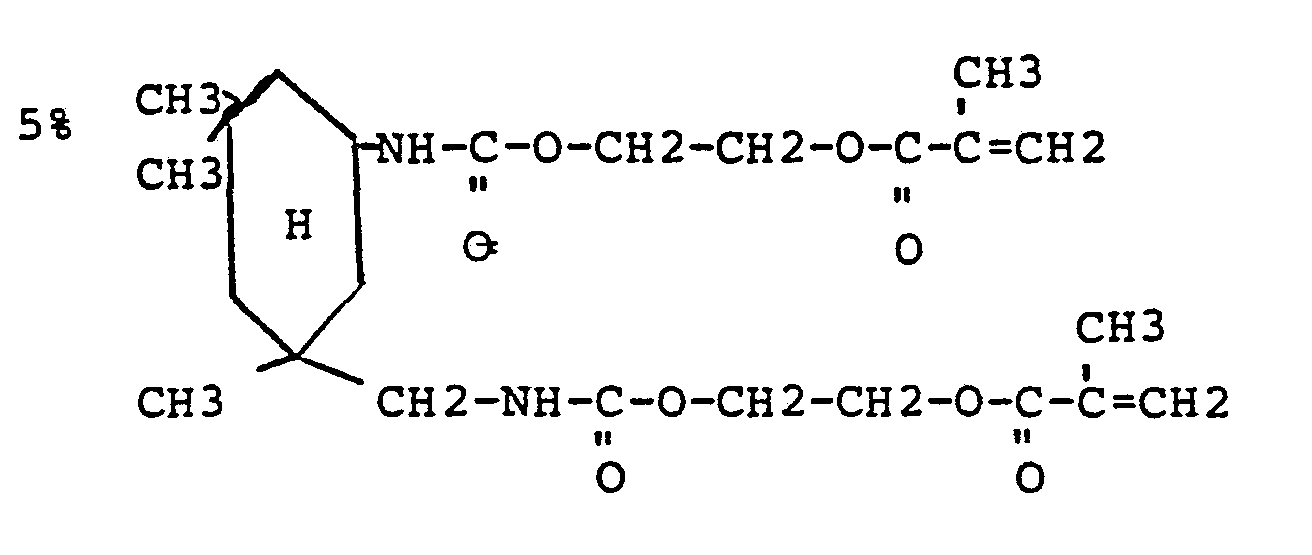
- Although in the European Patent Application no. 015.593 was claimed that only at low temperatures and low catalyst concentrations mono-acrylated diisocyanates can be made selectively, according to the invention surprisingly a high degree of selectivity is observed, within a reasonable short reaction time.
- In the patent application mentioned was stated that formation of mono-acrylated diisocyanates can be achieved only if diisocyanates are applied showing different reactivities between NCO-groups, the so called "asymmetrical" diisocyanates like IPDI.
- Contrary to this statement the inventors surprisingly also succeeded in making mono-acrylated diisocyanates rather selectively by the present procedure; for example with 4,4'-methylene bis (cyclohexylene diisocynate), available from Bayer under the trademark Desmodur W C-) and 2 - HEMA an adduct was made free from monomeric 2 - HEMA and containing no more than 10% of the diacrylated compound on the total amount of acrylated diisocyanates.
- In the light of the emulsion polymerization in step four of the present process, this low content of di-acrylated diisocyanates is necessary in order to avoid as many as possible crosslinking reactions during the polymerization reaction, as well as to avoid possible instabilities because of gel formation due to the mentioned crosslinking reactions.
- Based on the obtained results a wide variety of diisocyanates may be used.
- In this respect it should be noted that in the adduct preparation according to the invention preferably diisocyanates should be used. In the use of higher polyisocyanates finally polyurethane chains are formed with random vinyl groups, which may cause gelling because of the crosslinking reactions in the emulsion polymerization step, if the urethane chains contain more than two vinyl groups per chain.
- The application of commercially available active hydrogen atoms containing polymerizable compounds in the stable aqueous dispersions of the invention is limited to vinyl compounds which are monofunctional with respect to the NCO reactive group like hydroxyacrylates, the mono-acrylic acid esters of glycols, like ethylene glycol monomethacrylate (USSR Patent No. 933,667), or the mono-esters of 2-methylpropylene glycol (Japanese Patent No. (U) 58/049,339). Difunctional compounds like the mono (meth) acrylic acid ester of a trihydric alcohol as 2,3-dihydroxy propylacrylate (US Patent No. 4,366,301) and cis-2-butene-1,4 diol (J. Pol. Sci., Pol. Chem. 1982, Vol. 20, No. 10, 2879) may be less appropriate since polyurethane chains will result with statistically distributed vinyl groups, having the above-mentioned disadvantages of an increased chance of gellation due to crosslinking reactions in the emulsion polymerization.
- The functionality of the reactants in the second and third step is very important for the properties of the acrylated urethane prepolymer and -polymer. If either or both of the reactant types in the prepolymer preparation have a functionality of greater than 2.0 the prepolymer in most instances-will be a gel and not be dispersible at all. However, if the average functionality is reduced by using only difunctional reactants or by introducing monofunctional ingredients and in addition the reaction conditions are controlled to limit the molecular weight, a readily dispersible prepolymer will result.
- Also in the extension step a chain extender, having an average functionality of greater than 2.0 would probably gel such a high molecular weight product, if used in a stoichiometric amount with the unreacted NCO groups in the acrylated urethane prepolymer. Reducing the average functionality e.g. via introducing monofunctional compounds (to a value ≤ 2.0) gelling can probably be avoided.
- The chain extenders are preferably water-soluble, although water-dispersible materials may be used. Water-soluble chain extenders are preferred because if the prepolymer is only marginally dispersible, a water-soluble chain extender will enhance the water-dispersibility of the final acrylated urethane polymer.
- The structure of the extended prepolymer, obtained in step 3., can possess one or two ethylenically unsaturated groups dependent on the reaction conditions, for example when starting from:
- - a diisocyanate : OCN - R1- NCO
- - a chain extender : H2N - R 2 -_NH2
- - a hydroxymethacrylate:




- U = a repeating unit consisting of reaction products of the diisocyanate with the chain extender or other active hydrogens containing compounds being present during the prepolymer preparation.
- n = the degree of polyaddition of the urethane polymer, being equal to zero, unity or a whole number greater than unity.
- 1 = a mono-acrylated urethane polymer, terminated by a chain extender.
- 2 = a mono-acrylated urethane polymer, but terminated by the reaction of NCO with water, yielding an amine group.
- 3 = a diacrylated urethane polymer.
- From the mono-acrylated urethane polymers urethane-acrylate graftcopolymers may be formed during the emulsion polymerization (step 4), from the diacrylated urethane polymers urethan-acrylate reticulate copolymers.
- Since both the mono- and diacrylated urethane polymers may be expected to be present in practice, a combination of both types of copolymers will result in step 4.
- Dissolving the acrylated urethane prepolymer in acrylate monomers, as described in the third step of the procedure of the invention, can be an essential step before carrying out the emulsion polymerization.
- Omitting this step in the given procedure may result in unstable aqueous dispersions, containing a considerable amount of gel. Also recommendable in this step is the introduction of a small amount of emulsifier, preferably to be added to the water phase before starting dispersing the acrylated urethane prepolymer into the water phase.
- Introduction in a later stage, e.g. between the extension and the emulsion polymerization, may influence the processing negatively. In addition anionic emulsifiers, such as sodium lauryl sulphate, perform better than non-ionic types or combinations of anionic and non-ionic types do.
- The process according to the invention results in a smooth processing, thereby yielding low viscous polymer dispersions showing a high degree of acrylate/urethane grafting (i.e. in the form of both graft- and reticulate copolymers): over 90% of the acrylate monomers appeared to be coupled to the acrylated urethane polymer. The grafting efficiency was checked by a soxhlet extraction wherein the graft and/or reticulate copolymers, finally obtained, were subjected to a 24 hours extraction with tetrahydrofuran or isopropylalcohol.
- A reference sample consisting of a physical blend of vinyl terminated urethane (polymer dispersion) and an acrylate polymer dispersion with the same overall composition as the grafted copolymer was extracted completely during this cycle.
- The preparation of an adduct, consisting of an essentially mono-acrylated diisocyanate, is very essential to obtain a high grafting efficiency between the acrylate and urethane chains. First making a urethane prepolymer and then coupling to a hydroxy-acrylate monomer (or related NCO reactive monomers) appeared to be less effective. Possibly one may use a suitable adduct, which is not prepared in situ.
- Since a urethane prepolymer usually contains monomeric diisocyanates - for instance when starting from a NCO:OH equivalent ratio of 2:1, a free diisocyanate content up to 7%, by weight, based on prepolymer, was found - coupling thereof with hydroxy-acrylates will possibly result in a preferred reaction between the free diisocyanate, which shows a higher reactivity. So either the hydroxy-acrylate monomer is coupled to the free NCO-groups of the urethane prepolymer or to the free diisocyanates, in which case the NCO:OH equivalent ratio is very unfavourable: diacrylated diisocyanate may be formed to a larger extent, which can not be incorporated into the urethane chain in the extension step.
- In addition these low molecular weight compounds will promote crosslinking reactions during the emulsion polymerization because of their bifunctional unsaturation. Besides, these compounds will detract the film formation.
- Testing the procedure, where the hydroxy-acrylate monomer is added to the urethane prepolymer, in a reference sample, however, neither gellation tendencies nor a higher gel content was found, but the grafting efficiency appeared to be poor: less than about 50% of the acrylate monomers was coupled to the acrylated urethane chain.
- Also the film formation of this dispersion was poor.
- The graft and reticulate copolymers, prepared by the process of the invention, show a good storage stability (tested under various conditions), an excellent resistance to hydrolysis in alkaline medium and a good water and solvent repellancy.
- Polymerizable vinyl compounds having a single reactive hydrogen atom (defined according to the Zerewitinoff test), useful in the process of the present invention, are well-known to those, skilled in the art. Illustrative for these compounds one can name hydroxy-functional acrylates, defined by the formula

- It also includes products such as acrylamides, methacrylamide, N-hydroxymethylacrylamide, N-hydroxymethyl- methacrylamide, diethylene glycolacrylate, diethylene glycol- methacrylate and the like, primary and secondary amino group containing acrylate and methacrylate acid esters of the formula:

- The polyisocyanates useful in the process of the invention can be aliphatic, cycloaliphatic and aromatic or mixtures thereof. Aliphatic c.q. cycloaliphatic polyisocyanates are preferred because of a better UV-/weathering resistance in the final application.
- In addition, diisocyanates are preferred although also higher polyisocyanates can be used in place of, or in combination with diisocyanates and/or monoisocyanates to achieve an average functionality of 2 in view of possible gel problems when preparing the urethane polymer as described before.
- Examples of suitable monisocyanates are cyclohexyl isocyanate, phenylisocyanate, toluene isocyanate, isocyanate-ethylmethacrylate and a,a-dimethyl-meta-isopropenyl benzylisocyanate. Examples of suitable (cyclo-)aliphatic diisocyanates are 2,2,4-trimethyl hexamethylene diisocyanate (TMDI), 1,4-tetramethylene diisocyanate, 1,6-hexamethylene diisocyanate (HDI), isophoronediisocyanate (IPDI), 4,4'-methylene-bis-(cyclohexylene diisocyanate), a,a'-xylylene diisocyanate. Examples of suitable aromatic diisocyanates are toluene diisocyanate, 1,4-phenylene diisocyanate, 4,4'--diphenylmethane diisocyanate, meta or para tetramethylxylene diisocyanates.
- Examples of suitable higher polyisocyanates are 2,4,6-triisocyanate toluene, 4,4',4"-triisocyanate triphenyl methane, 1,2,4-benzene triisocyanate, biurets of the diisocyanates and the like.
- The active hydrogen atoms containing organic compounds, defined according to the Zerewitinoff test, suitable in the process of the present invention can be aliphatic, cycloaliphatic, aromatic or mixtures thereof. Functional croups according to the Zerewitinoff test are -OH, -SH, NH and -NH 2
- The average functionality is, as mentioned before, important in controlling the tendency of the polymer to gel and should be adjusted to a value of 2, when using higher functional compounds, by monofunctional ones. Examples of suitable compounds include polyols, polyamines, amino alcohcls, mercapto terminated derivatives, and the like. The polyols, useful in the process of this invention have an average molecula weight from 60 to 6,000, preferably 2 hydroxyl groups and a hydroxyl number of about 20 to 1,000 mg KOH/g.
- Illustrative of such polyols are:
- 1. aliphatic diols such as ethylene glycol, propane diol, neopentyl glycol, butane diol, hexane diol and the bivalent alcohols with 1,2-alkylene oxide, like ethylene oxide and propylene oxide.
- 2. cycloaliphatic diols, like 1,4-cyclohexane diol, and 4,4'--dihydroxy cyclohexyl 2,2-propane.
- 3. araliphatic bivalent alcohols, containing 1 to 2 etheroxy atoms like bis (ethoxylated) Bisphenol A and bis (propoxylated) Bisphenol A.
- 4. polyether diols, like polyethylene oxide diols, polyethylene oxide propylene oxide diols, polypropylene oxide diols and polytetramethylene oxide diols.
- 5. polyester diols from the alcohols, mentioned under 1, 2 and 3 and polycarboxylic (preferably dicarboxylic) acids and anhydrides thereof, like maleic acid, fumaric acid, mesaconic acid, citraconic acid, itaconic acid, glutaric acid, adipic acid, isophtalic acid and terephtalic acid.
- 6. polyols, based on polycarbonates and polycaprolactones.
- As suitable polyamines one can mention for instance ethylene diamine, 1,2-propylene diamine, 1,8-methane diamine, isophorone diamine, propane 2,2-cyclohexylamine, N,N'-dimethyl-o-phenylene diamine, N,N'-di-p-tolyl-m--phenylene diamine, p-aminodiphenylamine.
- Suitable amino-alcohols and mercapto terminated derivatives are e.g. monoethanolamine, 2-hydroxypropylamine, N,N-bis (3-aminopropyl) ethanolamine, p-aminophenol, S-mercapto ethanol and the like.
- The acrylated urethane prepolymer also contains salt groups, such as acid salt groups, which can be selected from the class consisting of OSO3-, -OPO3 , COO-, SO2O-, POO- and PO3-.
- The prepolymer can be prepared from reactants containing the salt group, or as is more normally the case, the free acid groups, which can be subsequently neutralized after prepolymer formation.
- Suitable materials for introducing acid groups, when preparing the prepolymer, are organic compounds having at least one active hydrogen atom and at least one group capable of salt formation. Specific examples of these compounds are hydroxy, aminohydroxy, amino and mercaptocarboxylic acids, sulphonic acids, hydroxy and amino sulphonic acids such as dimethylol propionic acid, oxaluric acid, anilido acetic acid, hydroxyethyl propionic acid, dihydroxy maleic acid, dihydroxy tartaric acid, 2,6-dihydroxybenzoic acid, glycollic acid, thioglycollic acid, glycine, alpha alanine, 6-amino cap-oic acid, 2-hydroxyethane sulphonic acid, 4,6--diamino benzene, 1,3-disulphonic acid, 2-amino diphenylamino sulphonic acid, and the like.
- Suitable salt forming agents for acid groups containing compounds include inorganic and organic bases such as sodium hydroxides, potassium hydroxide, ammonia and tertiary amines.
- Suitable chain extenders having at least one hydrogen atom more reactive with NCO-groups than water are for instance ammonia, primary and secondary amines, preferably diamines, and certain organic polyols, preferably diols. Examplary for these compounds are hydrazine, substituted hydrazines, e.g. dimethylhydrazine, 1,6-hexamethylene bis- hydrazine, hydrazides of dicarboxylic and disulphonic acids, reaction products of hydrazine with lactones and glycols, ethylene diamine, hexamethylene diamine, isophorone diamine, diaminophenyl methane, ethylene glycol, di-, tri- and tetraethylene glycol, propane 1,2-diol, propane 1,3-diol, neopentyl glycol. Also amino-alcohols and water may be used.
- During the preparation of the acrylated urethane prepolymer one can have present any of the known catalysts, such as amines and organometal compounds for the urethane reaction These catalysts are well-known and include triethylene diamine, morpholine, N-ethyl-morpholine, piperazine, triethanolamine, Triethylamine, dibutyltin dilaurate, stannous octoate, di- octyltin diacetate, lead octoate, stannous oleate, stannous tallate , dibutyltin oxide, and the like.
- The acrylated (i.e. acryl terminated) aqueous polyurethane dispersions, finally obtained via the route and based on the ingredients described before, are subjected to an emulsion polymerization.
- The procedures, used to prepare the emulsion polymers are well-known in the art and generally involve admixing under rapid stirring the comonomer charge with water, surfactants, or emulsifying agents, a polymerization catalyst or initiator and eventually a chain transfer agent.
- The mixture is then heated to polymerization temperature for the time required to substantially complete the emulsion polymer formation.
- The polymerization can be carried out in equipment heretofore employed for emulsion polymerization whether or not under pressure, usually in an atmosphere of N2, C021 inert gas and the like.
- Many variations of the general preparative procedure are used to obtain for example lower viscosity, high solids content, improved freeze-thaw stability, etc.
- The variations include for example the use of the pre-emulsion technique in which the monomer charge is first emulsified in water using a surfactant and then this pre-emulsion is added to the reaction mixture, which contains the remaining reactants. This procedure is the so-called "feed-addition" system. A variant in this procedure may consist therein, that a part of the monomer is seeded to start the reaction, after a certain reaction period followed by the feed-addition.
- In this system the polymerization of the monomers is effected by the free radical catalysts (free radical formers or free radical forming systems), of which the half life time is dependent on the temperature.
- Some well-known catalysts for example become active or decompose at the temperature used during the polymerization (thermal decomposition), others - especially those having a rather long half life time - are activated by means of a reducing agent (chemical decomposition) which, in the absence of oxygen, immediately produces free radicals. These redox couples can be used in feed-addition systems by adding the catalyst to the reaction mixture, being present in the reactor phase, and feeding the reducing agent simultaneously with the (whether or not pre-emulsified) monomer blend to achieve a better control of the polymerization reaction.
- Other redox systems are based on free radical catalysts in combination with an, eventually chelatable, metal reducing agent, which effect the polymerization reaction already at low temperatures. These systems usually show a reaction exotherm even up to 70°C or more, during which the polymerization is almost completed.
- Generally, temperatures used during the polymerization should be sufficient to effect polymerization by activation of the catalyst and double bonds of the monomers. These temperatures should not be too high to cause a run-away reaction and not too low to retard polymerization.
- In general redox systems perform well at temperatures already from 10°C and feed-addition systems at temperatures from 50°C to about 110°C.
- When applying these emulsion polymerization techniques in the present invention (step 4), the acrylated aqueous polyurethane dispersion is introduced into the reactor phase.
- The pre-emulsified monomers, if present, being present in the urethane dispersion, can be considered as the seeded part of the monomer feed when applying the seeding/feeding technique. During the emulsion polymerization reaction the acrylated aqueous polyurethane dispersion surprisingly appears to function as a conventional monomer: extraction tests, carried out as described before, indicate that this compound for the greater part is incorporated in the growing acrylate polymer chain.
- The polymerizable vinyl monomers, useful in the process of the invention, can be nitrile like acrylonitrile, methacrylonitrile; an amide like acrylamide, methacrylamide, n-methylolacrylamide, ethacrylamide; an acrylate like methylacrylate, ethylacrylate, butylacrylate, 2-ethyl hexylacrylate; an alkyl acrylate like methyl methacrylate, ethyl methacrylate, butyl methacrylate; an acid like acrylic acid, methacrylic acid, maleic acid, malonic acid, itaconic acid; an aromatic like styrene, vinyl toluene, a-methyl styrene, methyl vinyl toluene; a pyridine like 2- or 4-vinyl pyridine, 2-methyl-5--pyridine and 5-ethyl-2-vinyl pyridine, and the like and mixtures thereof.
- It is known that the introduction of small quantities of multifunctional acrylate monomer into the copolymer sometimes improves the properties of coatings resins. Examplary preferred multifunctional acrylate compounds include ethylene glycol diacrylate, glycerol diacrylate, 1,4-cyclohexane-diol-diacrylate, 1,4-benzene-diol dimethacrylate, pentaerythritol triacrylate and the like and mixtures thereof. See for both types of monomers also "Polymer Handbook" second edition, published by John Wiley & Sons, New York, 1974, pages II-105 and II-387.
- Suitable free radical catalysts are ammonium, sodium and potassium persulphate, bis (2-ethylhexyl) peroxy-dicarbonate, di-n butyl peroxy-dicarbonate, t-butyl perpi- valate, t-butyl hydroperoxide, cumene hydroperoxide, dibenzoyl peroxide, dilauroyl peroxide, 2,2'-azo-bis isobutyronitrile, 2,2'-azobis-2-methylbutyronitrile and the like and mixtures of the same. See also the free radical catalysts as described in p.e. "Polymer Handbook", mentioned before, and in the Encyclopedia of Polymer Science and Technology", Interscience Publishers, a division of John Wiley & Sons, Inc., New York, Vol. 2 (1965), Vol. 3 (1965), Vol. 7 (1967) and Vol. 9 (1968).
- Suitable reducing agents, most commonly used, are for example ascorbic acid, sodium sulphoxylate formaldehyde, thiosulphates, bisulphates, hydrosulphates, water-soluble amines, such as diethylene triamine, triethylene tetramine, and tetraethylene pentamine, and reducing salts as the sulphates of metals, which are capable of existing in more than one valence state like cobalt, iron, nickel, copper, etc.
- From the many types of chain transfer agents or modifiers been proposed, it is preferred to use the alkyl and/or aralkyl mercaptans having from 8 to 18 carbon atoms, such as n-octyl mercaptan, t-dodecyl mercaptan and so forth and mixtures thereof.
- Emulsifiers such as soaps, surfactants or dispersing agents, being useful in the process of the invention, are used in amounts sufficient to obtain a stable aqueous dispersion of the water and the monomers together with the dispersed acrylated urethane polymer and can be of the anionic or non-ionic types, commonly employed, as well as mixtures thereof. Generally, the anionic types perform better than the non-ionic types do.
- Examples of the anionic types are potassium laurate, potassium stearate, potassium oleate, sodium dodecyl sulphate, sodium decyl sulphate, sodium rozinate and the like.
- Examples of the non-ionic types are ethylene oxide and propylene oxide condensates in general, e.g. straight and branched chain alkyl and alkylaryl polyethylene glycol and polypropylene glycolethers and thioethers. Also substances which are members of a homologous series of alkylphenoxypoly (ethyleneoxy) ethanols and the like approved to be suitable.
- See also "McCutcheon's Detergents & Emulsifiers", 1974, North American Edition, published by McCutcheon's Division, Allured Publishing Corporation, New Jersey.
- The process of the invention is illustrated in more detail by means of the following examples, however, without any limitation thereto.
- Unless otherwise noted all amounts are indicated in parts by weight.
- The given equivalent data are gram-equivalents.
- This example concerns the preparation of an aqueous dispersion of an acrylate/urethane graft/copolymer, where the HEMA is introduced in the reaction mixture after finishing the preparation of the urethane prepolymer.
- There were charged to a two liter fourneck round bottom flask, equipped with a thermometer, mechanical stirrer, air condenser, dry air or nitrogen blanket, dropping funnel and heating mantle 547.6 grams of 4,4'-methylene bis(cyclohexyl) diisocyanate, 597 grams of a polypropylene glycol having a hydroxyl number of 55.6 mg KOH/g, 338.4 grams of a polypropylene glycol having a hydroxyl number of 111.4 mg KOH/g and 55.4 grams of dimethylol propionic acid.
- The mixture was mixed during 10 minutes, whereafter 0.2 g dibutyltin dilaurate as catalyst was added. Thereafter the reaction mixture was heated to 55-65°C, which temperature was increased by the exothermic reaction to 95°C, kept at 95°C for one hour to complete the reaction and subsequently cooled to about 60°C. At this temperature, while stirring the reaction mixture, 20.4 g of 2-hydroxyethyl methacrylate was added dropwise. The reaction mixture was then stirred and heated at a temperature of 60°C (± 2°C) for 2 hours.
- To this mixture were charged 41 g of triethylamine, as neutralizing agent, dissolved in a monomer blend of 100 g of methyl methacrylate and 300 g of N-butylacrylate and reacted for half an hour. After this reaction the acrylate terminated urethane prepolymer, thus obtained, was cooled to about 30-40°C.
- In a comparable equipment under a nitrogen blanket (or other inert gas) 296.1 g of the prepolymer, thus obtained, was added over a period of one hour to a reaction mixture containing 619.6 g of demineralized water and 67.3 g of sodium lauryl sulphate (solids content 32%) at ambient temperature. Immediately after finishing the prepolymer feeding 6.5 g of hydrazine monohydrate was added to the obtained dispersion. This mixture was reacted for half an hour, whereafter 2.1 g of potassium persulphate and 2.7 g of sodium bicarbonate, dissolved in 526.3 g of demineralized water, were charged.
- The reaction mixture, thus obtained, was heated to about 90°C, at which temperature a monomer blend of 119.9 g of methyl methacrylate and 359.5 g of N-butyl methacrylate were added over a period of one hour, whereafter the temperature was maintained at 90°C for another half an hour. The aqueous acrylate urethane graftcopolymer dispersion, thus obtained, showed the following specifications:

- Soxhlet extraction of the dried polymer with tetrahydrofuran over a period of 24 hours left about 62% of not extracted material. Converting this value to a percentage not extracted acrylate compounds on total input of acrylate monomers a value of about 50% was found. So about 50% of the acrylate monomers approved to be coupled to the acrylate terminated urethane polymer.
-
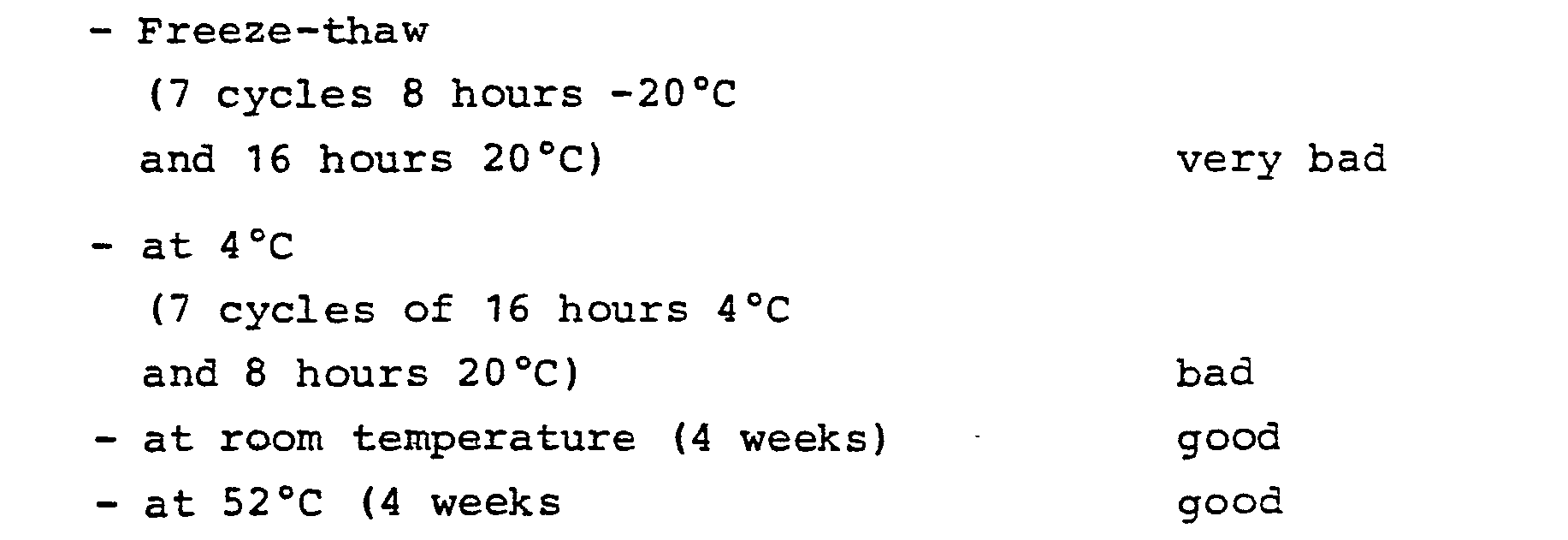
- Herein the polyurethane dispersion and the acrylate polymer are prepared independently and then they are mixed.
- The procedure of this preparation is more or less comparable with comparative example I.
- There are the following modifications:
- - diisocyanate: isophorone diisocyanate
- - the urethane prepolymer was diluted with N-methylpyrrolidone
- - the urethane prepolymer was dispersed without an emulsifier.
- Components for the urethane prepolymer preparation:

- To 2,200.0 g prepolymer are added 33.3 g of 2-hydroxyethyl methacrylate and heated to 50-60°C, followed by cooling of the acrylated prepolymer after 2 hours reaction.
- Components for dispersion and extension:

- Components acrylate polymer preparation:

- Components for mixing the PUR-dispersion with the acrylate polymer:

- Specifications PUR-polyacrylate physical mixture:

- Film formation:

- Film properties:

- There were charged to a two liter fourneck round bottom flask, equipped with a thermometer, mechanical stirrer, air condenser, dry air or nitrogen blanket, dropping funnel and heating mantle, 557.8 g of 4,4'-methylene bis (cyclohexyl) diisocyanate (Desmodur W®). The reactor phase was then heated to 95°C at which temperature 18.5 g of 2-hydroxyethyl methacrylate were added dropwise over a period of one hour, which mixture was kept at this temperature for another half an hour and subsequently cooled down to 60°C. The Desmodur W®-HEMA adduct had the following composition (GPC peak area ratio): Desmodur W HEMA:HEKA/Desmodur W/HEMA = 90:10.
- To this mixture were then charged 603.9 g of a polypropylene glycol having a hydroxyl number of 55.6 mg KOH/g, 340 g of a polypropylene glycol having a hydroxyl number of 111.4 mg KCE/g and 62.8 g of dimethylol propionic acid. The mixture was mixed during 10 minutes, whereafter 0.8 g of dibutyltin filaurate as catalyst was added.
- Thereafter the reaction mixture was heated to 55-65°C, which temperature was increased by the exothermic reaction to 95°C, kept at 95°C for one hour to complete the reaction and subsequently cooled to 60°C.
- To this mixture were charged 46.5 g of triethylamine, as neutralizing agent, dissolved in a monomer blend of 92.4 g cε methyl methacrylate and 277.2 g of N-butyl methacrylate, which mixture was reacted for half an hour and subsequently cooled down to 30-40°C.
- In a comparable equipment under a nitrogen (or other inert gas) blanket 316.3 g of the prepolymer, thus obtained, were added over a period of one hour to a reaction mixture containing 530 g of demineralized water and 52.5 g of sodium laurylsulphate (solids content 32%) at ambient temperature. Immediately after finishing the prepolymer feeding 6.8 g of hydrazine monohydrate were added to the obtained dispersion. This mixture was reacted for half an hour, whereafter 2.3 g of potassium persulphate, dissolved in 624.6 g cf demineralized water, were charged.
- The reaction mixture, thus obtained, was heated to about 90°C under nitrogen (or another inert gas) atmosphere, at which temperature a monomer blend of 116.9 g of methyl methacrylate and 350.6 g of N-butyl methacrylate were added over a period of one hour, whereafter the temperature was maintained at 90°C for another half an hour. The aqueous acrylate urethane graftcopolymer dispersion, thus obtained, showed the following specifications:

- Storage stabilities:

- Film properties:


- The procedure was identical to example III; the urethane polymer, however, was based on isophorone diisocyanate.
- Components for the partially acrylated urethane prepolymer (given in grams):

- The isophorone diisocyanate-HEMA adduct had the following composition (GPC peak area ratio): IPDI/HEMA:HEMA/IPDI/HEMA = 95:5.
- The prepolymer thus obtained was dispersed and extended comparably to example III.
- Components (in grams) :

- Also according to the procedure, described in example III, this aqueous acrylate terminated polyurethane dispersion was copolymerized with acrylate monomers, components (in grams):
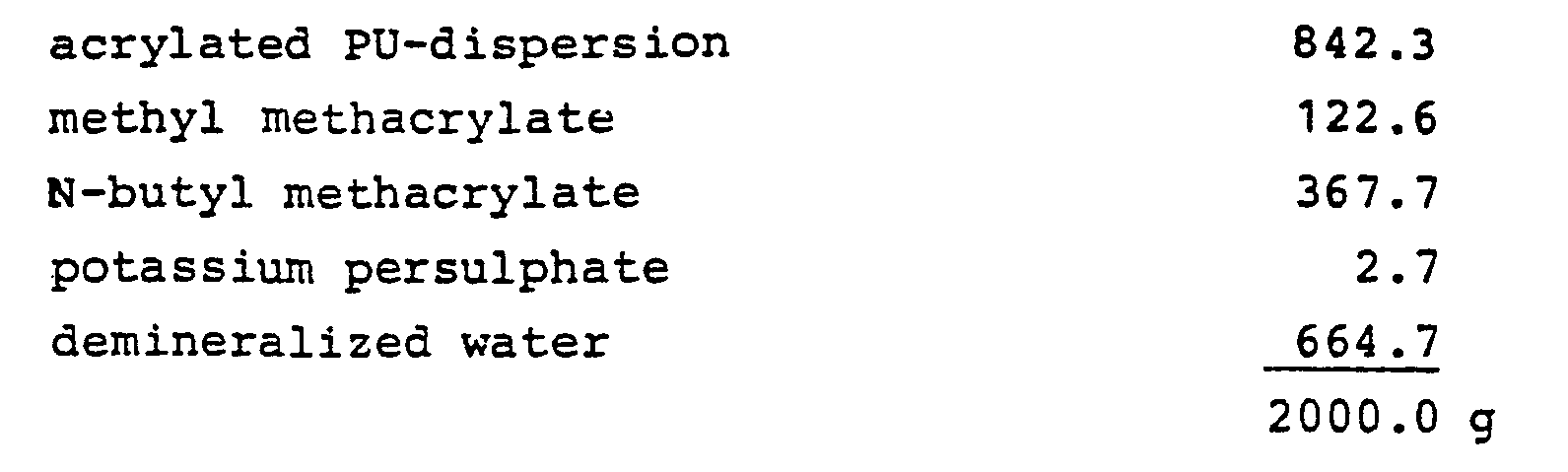
- The aqueous acrylate urethane graftcopolymer dispersion, finally obtained, showed the following specifications:

- Storage stabilities:

- Film formation:

- Film properties:
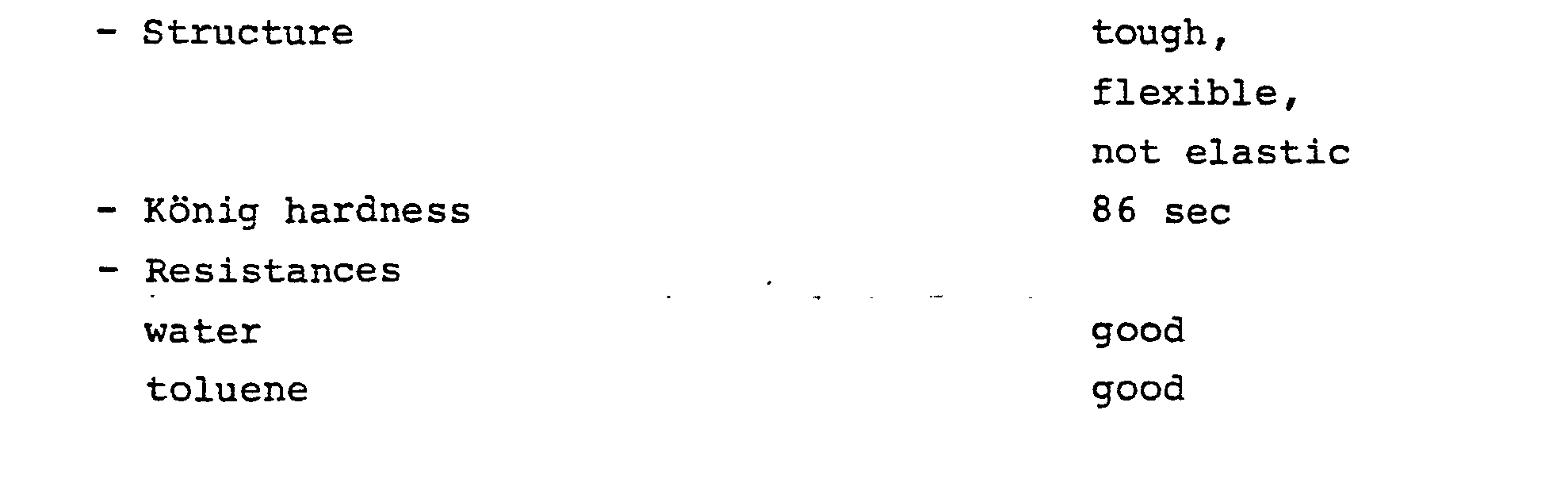

- The procedure was comparable with example III. The following modifications are introduced:
- - Diisocyanate: isophorone diisocyanate
- - In the acrylic part acid functionality was incorporated via copolymerization of a slight amount of methacrylic acid: 5%, by weight, on the total amount of monomers.
- - The copolymerization was initiated by the addition of ammonium persulphate to the acrylated PU-dispersion, cumene hydroperoxide to the acrylate monomers to be introduced and by use of an independent reductor feed of i-ascorbinic acid.
- - The acrylate monomers were metered in one hour at 70-75°C, followed by a post-reaction of half an hour-at 75-80°C.
- - For the copolymerization an additional emulsifier was added; alkylphenoxy poly(ethylene-oxy) ethyl mono- and diesters of phosphoric acid, commercially available under the name Gafac RE-610 .
- - After the copolymerization the pH was increased to a value of about 8 by means of diluted ammonia.
- Components for the acrylated urethane prepolymer (in g=ams) :

- The prepolymer, thus obtained, was dispersed and extended comparably to example III.
- Components (in grams):

- To the acrylated PU-dispersion there was added, according to the following components , ammonium persulphate, Gafac RE-610 and demineralized water. After heating the reaction mixture to 70°C the mixture of N-butyl methacrylate, methyl methacrylate, methacrylic acid and cumene hydroperoxide is added at 70-75°C during one hour. Simultaneously, a 1% solution of iso-ascorbic acid is added separately.
- Hereafter a post-reaction of half an hour was carried out at 75-80°C.
- Components (in grams):
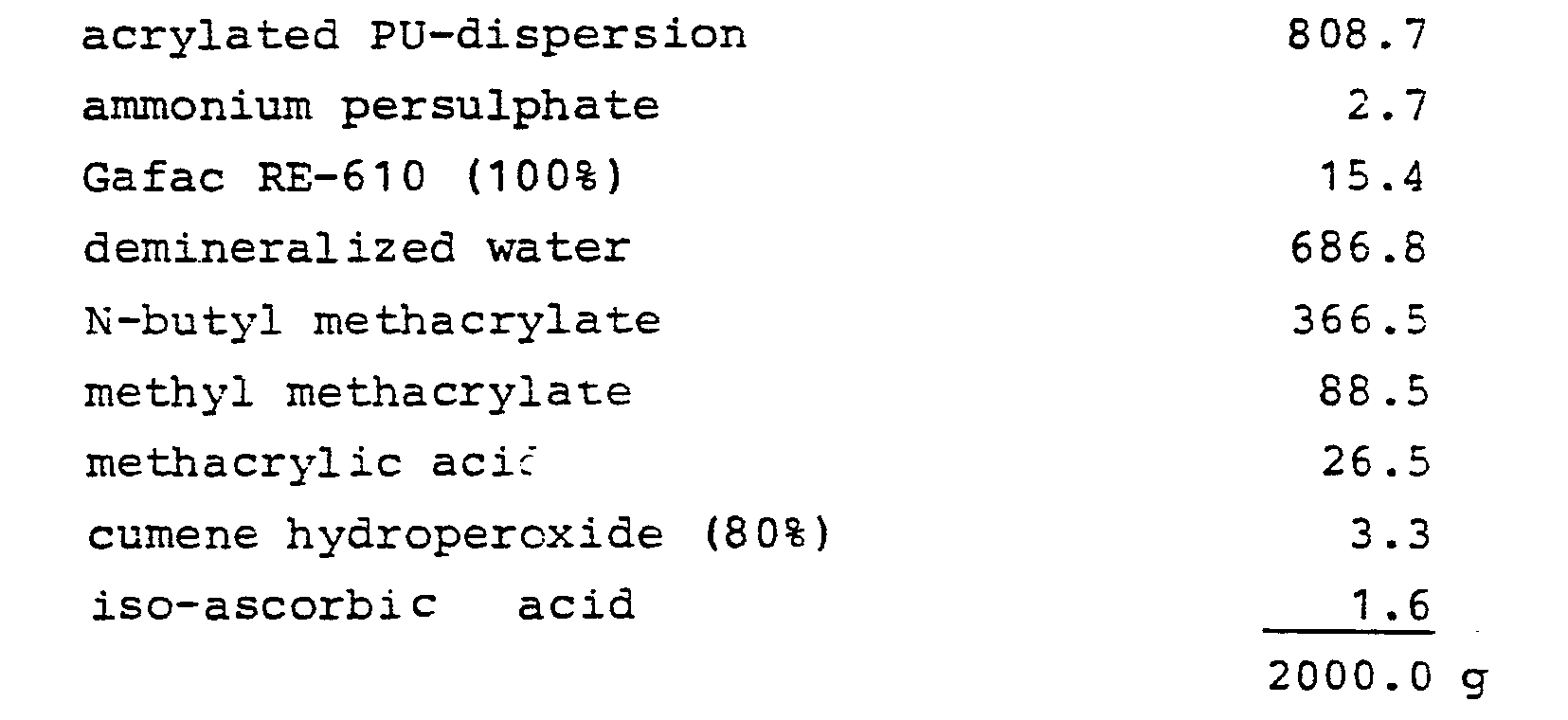
- The urethane acrylate graftcopolymer had the following specifications after adjusting the pH on about 8:

- Storage stabilities:

- Film formation:

- Film properties:

- The procedure is comparable with example III.
- The following modifications are introduced:
- - Diisocyanate: isophorone diisocyanate.
- - In the urethane prepolymer preparation it is started from a polyester instead of a polyether combination.
- - For the urethane prepolymer preparation 10% N-methylpyrrolidone was required in order to reduce the viscosity.
- - In the copolymerization the acid incorporation, initiation, reaction temperature, reaction time, the use of an additional emulsifier and the pH increase were the same as in example V.
- - The post-reaction was carried out with 17% of the cumene hydroperoxide and 25% of the i-ascorbic acid amount: half an hour at 75-80°C.
- Components acrylated urethane prepolymer preparation (in grams):
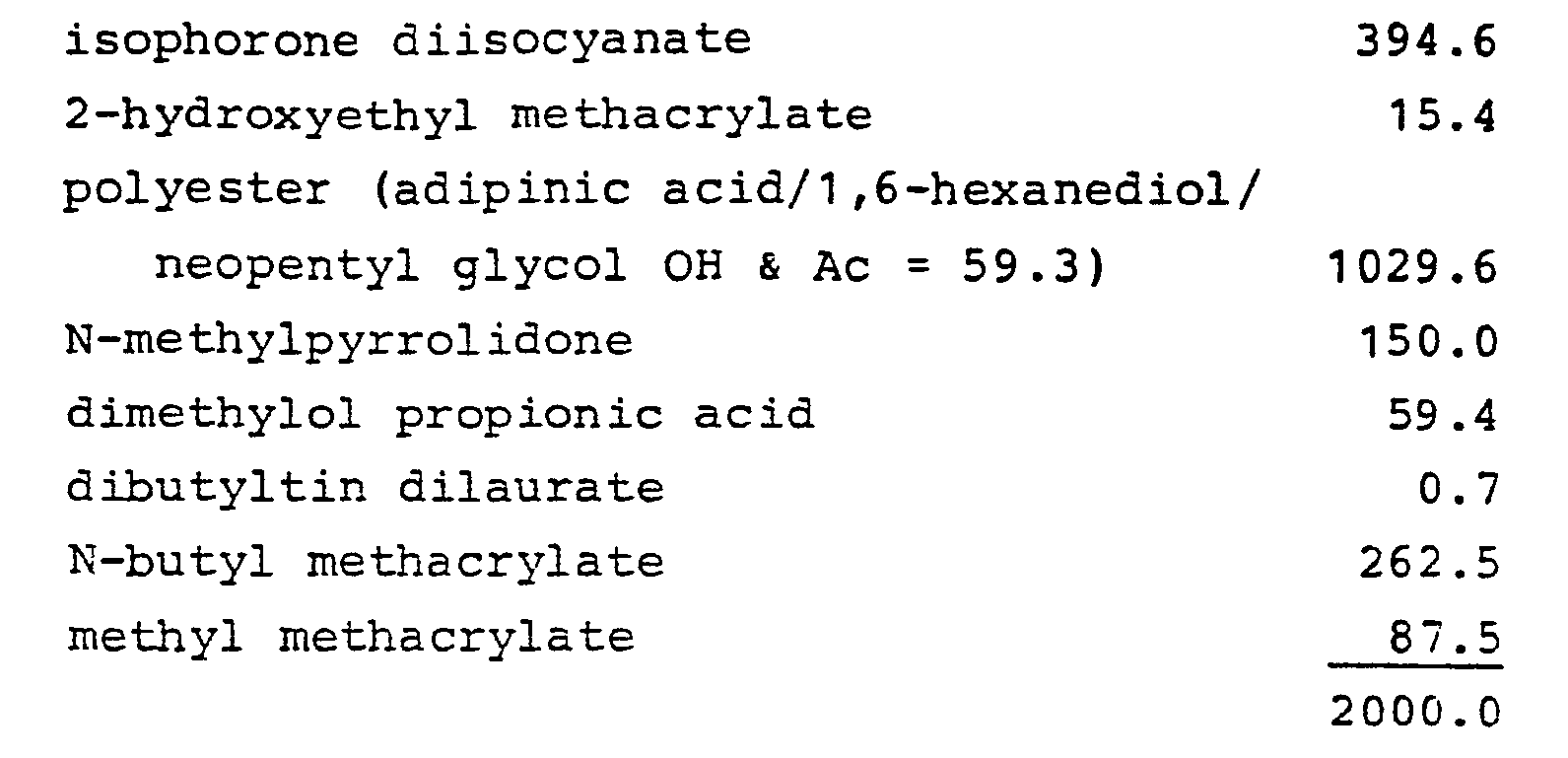
- For the isophorone diisocyanate-HEMA adduct the following compositicn was found (GPC peak area ratio): IPDI/HEMA:HEMA/IPDI, HEMA = 95:5.
- The prepolymer was dispersed and extended according to example III.
- Components (in grams):

- Components copolymerization (in grams):

- The urethane acrylate graftcopolymer had the following specifications after adjusting the pH on a value of about 8:
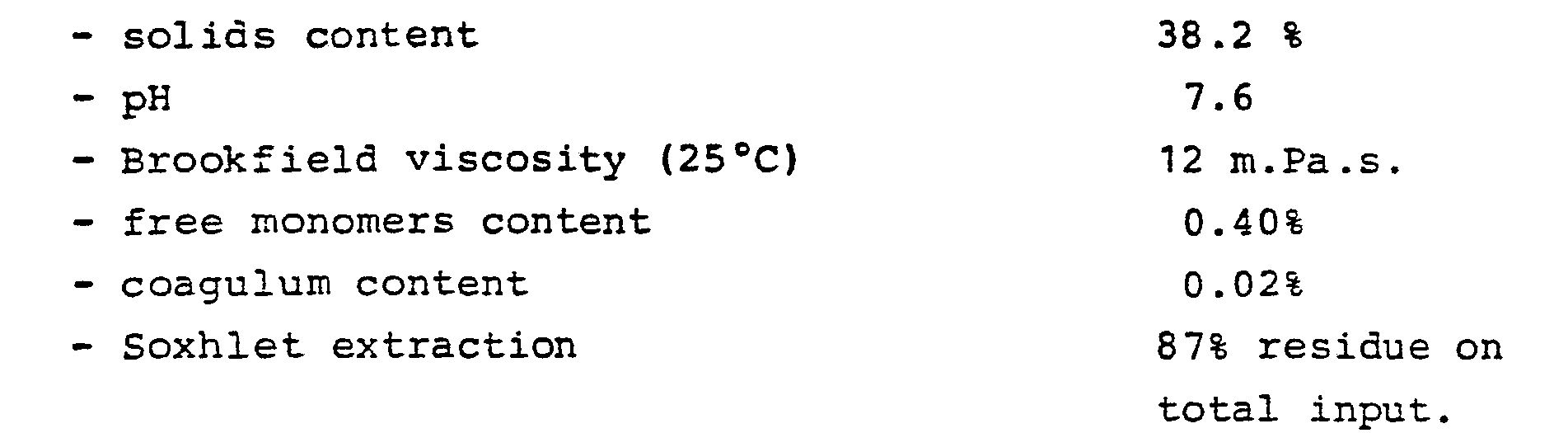
- Storage stabilities:

- Film formation:

- Film properties:

- The procedure is comparable with example III.
- The following modifications are introduced:
- - Diisocyanate: isophorone diisocyanate.
- - Coupling agent: 2-hydroxyethyl acrylate
- - Reaction temperature adduct preparation: 50-55°C.
- - The acrylate part was composed as follows: styrene/ n-butylmethacrylate/methyl methacrylate/ methacrylic acid = 43.6/48.9/2.5/5.0 (in %, by weight).
- - For the copolymerization an additional emulsifier was added; alkylphenoxy poly(ethylene-oxy)ethyl mono-and diesters of phosphoric acid, commercially available under the name Gafac RE-610
- - After the copolymerization a post-reaction was carried out with cumene hydroperoxide and iso-ascorbic acid. Also an additional amount of sodium laurylsulphate was added. Reaction temperature 60-65°C, reaction time half an hour.
- - The pH of the copolymer was adjusted to a value of 8 by means of diluted ammonia.
- Components for the acrylated urethane prepolymer (in grams):

- For the isophorone diisocyanate-HEA adduct the following composition was found (GPC - peak area ratio): IPDI/HEA:HEA/IPDI/HEA = 93:7.
- Components for the dispersion and extension of the urethane prepolymer (in grams) :

- Components copolymerization (in grams):

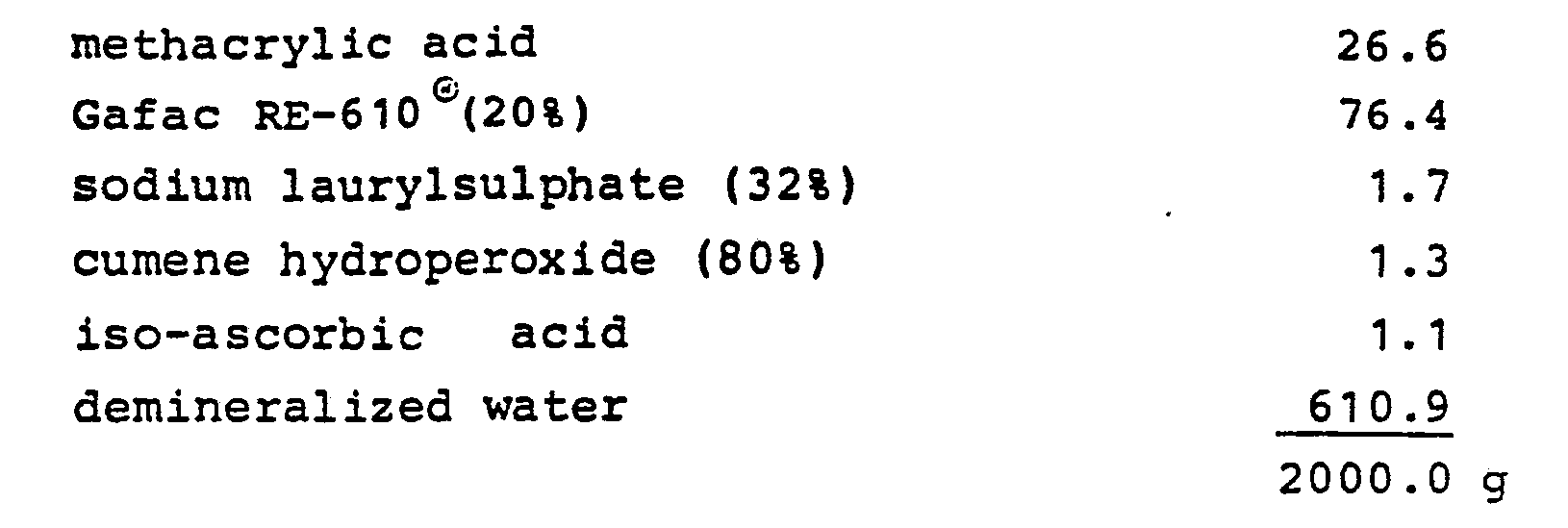
- The obtained aqueous urethane acrylate dispersion had the following specifications:

- Storage stabilities:

- Film formation:

- Film properties:

- The procedure is comparable with example III.
- Modifications:
- - Diisocyanate: toluene diisocyanate.
- - Coupling agent: tertiary butylamino-ethyl methacrylate (TBAEMA). Reaction temperature _adduct preparation:25-30°C.
- - The initiation, reaction temperature and reaction time in the copolymerization were the same as in example V.
- - The following post-reactions were carried out:
- a. with 50% of the indicated amount of ammonium persulphate; half an hour reaction at 90°C.
- b. with sodium sulphoxylate formaldehyde and tertiary butyl hydroperoxide; half an hour at 60-65°C.
- Components for the acrylated urethane prepolymer preparation (in grams):

- Composition TDI-TBAEMA adduct: TDI/TBAEMA:TBAEMA/TDI/TBAEMA = 88:12 (GPC peak area ratio).
- The prepolymer was dispersed and extended in accordance with example III.

- Preparation copolymer (procedure according to example III).

- Specifications urethane acrylate dispersion:
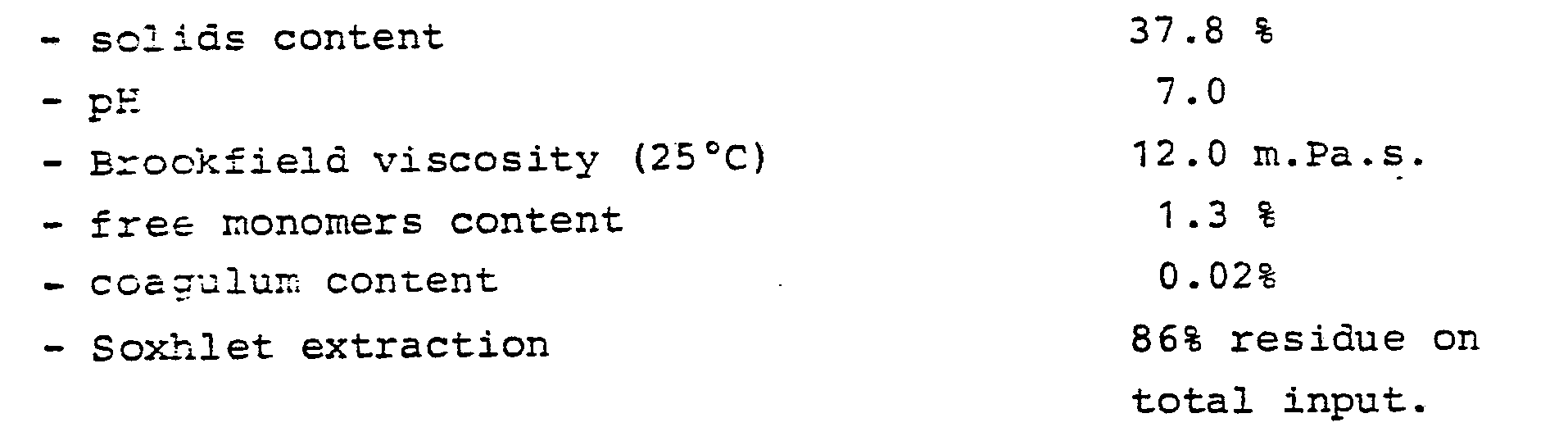
- Storage stabilities:

- Film formation:

- Film properties:


Claims (30)
Priority Applications (1)
| Application Number | Priority Date | Filing Date | Title |
|---|---|---|---|
| AT85200747T ATE39360T1 (en) | 1984-06-04 | 1985-05-10 | PROCESS FOR THE PREPARATION OF AQUEOUS DISPERSIONS OF ACRYLIC-URETHANE GRAFT COPOLYMERS. |
Applications Claiming Priority (2)
| Application Number | Priority Date | Filing Date | Title |
|---|---|---|---|
| NL8401785A NL8401785A (en) | 1984-06-04 | 1984-06-04 | PROCESS FOR PREPARING AN AQUEOUS DISPERSION OF URETHAN ACRYLATE ENTCOPOLYMERS AND STABLE AQUEOUS DISPERSION THUS OBTAINED. |
| NL8401785 | 1984-06-04 |
Publications (2)
| Publication Number | Publication Date |
|---|---|
| EP0167188A1 true EP0167188A1 (en) | 1986-01-08 |
| EP0167188B1 EP0167188B1 (en) | 1988-12-21 |
Family
ID=19844043
Family Applications (1)
| Application Number | Title | Priority Date | Filing Date |
|---|---|---|---|
| EP85200747A Expired EP0167188B1 (en) | 1984-06-04 | 1985-05-10 | Process for preparing aqueous dispersions of acrylic-urethane graft copolymers |
Country Status (6)
| Country | Link |
|---|---|
| US (1) | US4730021A (en) |
| EP (1) | EP0167188B1 (en) |
| JP (1) | JPH0725855B2 (en) |
| AT (1) | ATE39360T1 (en) |
| DE (1) | DE3566895D1 (en) |
| NL (1) | NL8401785A (en) |
Cited By (22)
| Publication number | Priority date | Publication date | Assignee | Title |
|---|---|---|---|---|
| GB2199335A (en) * | 1986-12-08 | 1988-07-06 | Armstrong World Ind Inc | Photosensitive coating composition |
| EP0353797A1 (en) * | 1988-06-30 | 1990-02-07 | Akzo N.V. | A functionalized polyurethane which can be used to prepare aqueous dispersions of polymer hibrids |
| EP0308115A3 (en) * | 1987-09-14 | 1990-09-12 | Polyvinyl Chemie Holland B.V. | Aqueous dispersions |
| EP0399160A1 (en) * | 1989-05-19 | 1990-11-28 | Hüls Aktiengesellschaft | Process for the preparation of aqueous radiation curable urethane-acrylate dispersions |
| EP0350040A3 (en) * | 1988-07-07 | 1991-01-30 | Ministero Dell' Universita' E Della Ricerca Scientifica E Tecnologica | Aqueous dispersions of urethane-acrylic polymers and use thereof in paints |
| US5024674A (en) * | 1986-12-24 | 1991-06-18 | Raffineria Olii Lubrificanti "R.O.L" S.P.A. | Process for improving the dyeability of woven or non-woven textiles: pre-treatment with aqueous dispersion of polyurethane containing random cationic groups |
| EP0424705A3 (en) * | 1989-10-06 | 1991-11-27 | Basf Corporation | Nonionically and partially anionically stabilized waterdispersible polyurethane/acrylic graft copolymers |
| EP0420988A4 (en) * | 1989-03-23 | 1992-01-22 | Nippon Shokubai Kagaku Kogyo Co. Ltd. | Cross-linked spherical particulate, production thereof, coating composition and releasable pressure-sensitive adhesive produced from said particulate, and article comprising the same as laminar component |
| EP0518020A3 (en) * | 1991-06-12 | 1993-02-03 | Huels Aktiengesellschaft | Process for the production of aqueous, radiation curable anionic urethane urea acrylate dispersions |
| DE4343246A1 (en) * | 1993-12-17 | 1995-06-22 | Thera Ges Fuer Patente | Prepolymers, free-radically polymerizable compositions prepared therefrom and their use |
| DE4406547A1 (en) * | 1994-02-28 | 1995-08-31 | Herberts Gmbh | Aqueous polyurethane resin dispersion, their preparation and polyurethane macromers suitable for this purpose, and their use in aqueous coating compositions |
| US5571861A (en) * | 1993-10-23 | 1996-11-05 | Hoechst Aktiengesellschaft | Aqueous, autocrosslinking polyurethane-vinyl hybrid dispersions |
| US6063861A (en) * | 1997-12-01 | 2000-05-16 | Bayer Aktiengesellschaft | Self crosslinkable polyurethane-polyacrylate hybrid dispersions |
| EP0447998B2 (en) † | 1990-03-20 | 2001-04-11 | Toyo Boseki Kabushiki Kaisha | An aqueous resin composition |
| WO2001055237A1 (en) * | 2000-01-31 | 2001-08-02 | Dow Global Technologies Inc. | Polyurethane dispersions having improved shear stability |
| US6316535B1 (en) | 1999-05-18 | 2001-11-13 | Armstrong World Industries, Inc. | Coating system and method of applying the same |
| US6451908B1 (en) | 1999-04-14 | 2002-09-17 | The Dow Chemical Company | Polyurethane films prepared from polyurethane dispersions |
| US6514572B1 (en) | 1999-04-14 | 2003-02-04 | Dow Global Technologies Inc. | Polyurethane films prepared by electrodeposition from polyurethane dispersions |
| US6720385B2 (en) | 1997-03-17 | 2004-04-13 | The Dow Chemical Company | Polyurethane latexes, processes for preparing them and polymers prepared therewith |
| EP2135527A1 (en) | 2008-06-20 | 2009-12-23 | Bayer MaterialScience AG | Profile body for cleaning teeth |
| EP2177551A1 (en) | 2008-10-15 | 2010-04-21 | Bayer MaterialScience AG | Aqueous polyurethane polyurea dispersions |
| EP2377895A1 (en) | 2010-04-14 | 2011-10-19 | Bayer MaterialScience AG | Aqueous polyurethane polyuric dispersions |
Families Citing this family (66)
| Publication number | Priority date | Publication date | Assignee | Title |
|---|---|---|---|---|
| DE3421826A1 (en) * | 1984-06-13 | 1985-12-19 | Hüls AG, 4370 Marl | STORAGE STABLE, NCO-FREE URETHANE UREA ACRYLATES |
| DE3526016A1 (en) * | 1985-07-20 | 1987-01-22 | Huels Chemische Werke Ag | STORAGE-STABLE, RADIATION-HARDENABLE, NCO-FREE, AQUEOUS EMULSIONS |
| DE3722005A1 (en) * | 1987-07-03 | 1989-01-12 | Herberts Gmbh | METHOD FOR PRODUCING A MULTI-LAYER COATING AND AQUEOUS AQUEOUS COATING AGENT THEREFOR |
| JPH0749561B2 (en) * | 1988-05-13 | 1995-05-31 | 関西ペイント株式会社 | Aqueous paint and coating method using the same |
| JP2684679B2 (en) * | 1988-05-30 | 1997-12-03 | 大日本インキ化学工業株式会社 | Method for producing aqueous coating composition |
| DE68904485T3 (en) * | 1988-05-30 | 1998-05-20 | Dainippon Ink & Chemicals | Aqueous paint. |
| DE3829587A1 (en) * | 1988-09-01 | 1990-03-15 | Bayer Ag | COATING AGENT, A PROCESS FOR THE PRODUCTION THEREOF, AND THE USE OF SELECTED TWO-COMPONENT POLYURETHANE SYSTEMS AS BINDER FOR SUCH COATING AGENTS |
| US5091211A (en) * | 1989-08-17 | 1992-02-25 | Lord Corporation | Coating method utilizing phosphoric acid esters |
| US5116901A (en) * | 1989-11-30 | 1992-05-26 | Union Oil Company Of California | Latex-lipophilic polymer graft polymerization process |
| US5037174A (en) * | 1990-01-31 | 1991-08-06 | E. I. Du Pont De Nemours And Company | Optical fiber having an aspherical lens thereon and method of making same |
| US5057569A (en) * | 1990-03-14 | 1991-10-15 | Union Oil Company Of California | Process for manufacturing a latex-lipophilic polymer |
| US5204401A (en) * | 1990-07-13 | 1993-04-20 | Basf Corporation | Metallic water borne base coat composition based on acrylic latex resins using acrylic resins derived from vinyl monomers having nonionic and urethane functionality for aluminum storage and a treated hextorie clay for rheology control - water base 9 |
| DE4022602A1 (en) * | 1990-07-16 | 1992-01-23 | Basf Ag | WAITING PREPARATIONS OF COPOLYMER LIQUIDS AND POLYISOCYANATE DISPERSIONS |
| US5371133A (en) * | 1990-09-12 | 1994-12-06 | National Starch And Chemical Investment Holding Corporation | Process for preparing urethane/acrylic-or-vinyl latexes |
| TW213474B (en) * | 1991-07-17 | 1993-09-21 | Cargill Inc | |
| US5337184A (en) * | 1993-01-07 | 1994-08-09 | Ford Motor Company | Acrylic thermoplastic ionic conductor |
| US6649317B2 (en) | 1994-11-07 | 2003-11-18 | Barbara Wagner | Energy activated electrographic printing process |
| US7041424B2 (en) * | 1994-11-07 | 2006-05-09 | Ming Xu | Energy activated electrographic printing process |
| US6673503B2 (en) | 1994-11-07 | 2004-01-06 | Barbara Wagner | Energy activated electrographic printing process |
| US7654660B2 (en) * | 1994-11-07 | 2010-02-02 | Sawgrass Technologies, Inc. | Energy activated printing process |
| US6384110B1 (en) | 1995-08-15 | 2002-05-07 | Georgia Tech Research Corporation | Water-borne polyurethane coatings by miniemulsion polymerization |
| JPH09157342A (en) * | 1995-12-07 | 1997-06-17 | Nof Corp | Aqueous dispersion of polyurethane resin, aqueous dispersionof polyurethane resin graft polymer, and aqueous coating composition |
| JPH09165425A (en) * | 1995-12-18 | 1997-06-24 | Toyo Ink Mfg Co Ltd | Method for producing aqueous urethane compound |
| US6153690A (en) * | 1996-05-29 | 2000-11-28 | Rohm And Haas Company | Method of producing isocyanate-modified latex polymer |
| AU2669997A (en) * | 1996-05-30 | 1998-01-05 | Arco Chemical Technology L.P. | Two-component waterborne polyurethane coating |
| US5859111A (en) * | 1996-12-18 | 1999-01-12 | National Starch And Chemical Investment Holding Corporation | Processes for making nonionic aqueous polyurethane dispersions |
| US6069217A (en) * | 1997-03-07 | 2000-05-30 | Rheox, Inc. | Urethane-acrylic copolymer thickening compositions for aqueous systems |
| US6166127A (en) * | 1997-06-27 | 2000-12-26 | The Sherwin-Williams Company | Interpenetrating networks of polymers |
| CN1140553C (en) | 1997-07-16 | 2004-03-03 | 纳幕尔杜邦公司 | Graft copolymer emulsion and double-pot water-borne polyurethane coating |
| WO1999021921A1 (en) * | 1997-10-24 | 1999-05-06 | Daikin Industries, Ltd. | Aqueous resin dispersion composition |
| DE19804432A1 (en) | 1998-02-05 | 1999-08-12 | Bayer Ag | Polyurethane-polyacrylate hybrid dispersions containing allophanate groups |
| DE19818312A1 (en) * | 1998-04-23 | 1999-10-28 | Bayer Ag | Aqueous coating system made from UV-curing urethane (meth) acrylate isocyanate groups |
| US6105502A (en) * | 1998-10-02 | 2000-08-22 | Sawgrass Systems, Inc. | Reactive ink printing process |
| US8337006B2 (en) * | 1998-05-06 | 2012-12-25 | Sawgrass Technologies, Inc. | Energy activated printing process |
| US6022925A (en) * | 1998-06-23 | 2000-02-08 | The Sherwin-Williams Company | Partial interpenetrating networks of polymers |
| US6031041A (en) * | 1998-10-14 | 2000-02-29 | National Starch And Chemical Investment Holding Corporation | Polyurethane hybrid dispersions and coatings having increased wet adhesion and solvent resistance |
| DE69902189T2 (en) * | 1998-10-26 | 2003-03-20 | Akzo Nobel N.V., Arnheim/Arnhem | AQUEOUS COATING COMPOSITION CONTAINING A MIXTURE OF POLYURETHANE DISPERSIONS |
| US6239209B1 (en) | 1999-02-23 | 2001-05-29 | Reichhold, Inc. | Air curable water-borne urethane-acrylic hybrids |
| ES2267529T3 (en) | 1999-04-23 | 2007-03-16 | Sawgrass Systems, Inc. | PRINT PROCEDURE FOR INK JET THAT USES REACTIVE INKS. |
| US6635706B1 (en) | 1999-06-23 | 2003-10-21 | Reichhold, Inc. | Urethane-acrylic hybrid polymer dispersion |
| JP4673943B2 (en) * | 1999-09-29 | 2011-04-20 | 日東電工株式会社 | Water-dispersed pressure-sensitive adhesive composition, process for producing the same, and pressure-sensitive adhesive sheets |
| US6414048B1 (en) | 1999-12-07 | 2002-07-02 | Sumitomo Electric Fine Polymer, Inc. | Chemical grafting onto a substrate and coating composition |
| DE10002089A1 (en) * | 2000-01-19 | 2001-07-26 | Basf Ag | Weather-stable, radiation-curable polyurethanes |
| DE10025304A1 (en) * | 2000-05-22 | 2001-11-29 | Bayer Ag | Mixtures of aqueous binders |
| JP2001354736A (en) * | 2000-06-12 | 2001-12-25 | Lock Paint Kk | Aqueous resin composition |
| US7001649B2 (en) | 2001-06-19 | 2006-02-21 | Barbara Wagner | Intermediate transfer recording medium |
| US6849370B2 (en) | 2001-10-16 | 2005-02-01 | Barbara Wagner | Energy activated electrographic printing process |
| DE10237193A1 (en) * | 2002-08-14 | 2004-02-26 | Bayer Ag | Polyurethane-Polyacrylathybride as a coating agent |
| DE102004002526A1 (en) * | 2004-01-16 | 2005-08-04 | Bayer Materialscience Ag | Thermo-yellowing stable polyurethane-polyurea dispersions |
| DE102004002527A1 (en) * | 2004-01-16 | 2005-08-04 | Bayer Materialscience Ag | size composition |
| DE102004002525A1 (en) * | 2004-01-16 | 2005-08-04 | Bayer Materialscience Ag | Coating composition |
| AU2007281272B2 (en) | 2006-07-31 | 2012-09-13 | Lubrizol Advanced Materials, Inc. | Aqueous dispersions of polyurethane compositions with ketone-hydrazide |
| US8142857B2 (en) * | 2008-12-08 | 2012-03-27 | Chung-Shan Institute Of Science And Technology, Armaments Bureau, Ministry Of National Defense | Compound and method for producing the same |
| GB0822674D0 (en) * | 2008-12-12 | 2009-01-21 | Nuplex Resins Bv | A crosslinkable polymer binder |
| US8461256B2 (en) * | 2009-12-28 | 2013-06-11 | Rohm And Haas Company | Low VOC aqueous compositions of acrylic-urethane block copolymers |
| EP2348061A1 (en) * | 2010-01-21 | 2011-07-27 | Bayer MaterialScience AG | Method for producing water emulsion polyurethane polyacrylate hybrid systems |
| US9434884B2 (en) | 2010-10-29 | 2016-09-06 | Lubrizol Advanced Materials, Inc. | Flame-retarding oligomeric brominated urethane compositions |
| KR20140004091A (en) | 2010-10-29 | 2014-01-10 | 루브리졸 어드밴스드 머티어리얼스, 인코포레이티드 | Aqueous cationic polyurethane dispersions |
| CN103524684B (en) * | 2013-09-24 | 2016-01-20 | 江苏荣昌新材料科技有限公司 | There is acrylic polymer and the production method thereof of sag prevention effect |
| TWI513725B (en) * | 2014-01-27 | 2015-12-21 | Daxin Materials Corp | (meth)acrylate compound, (poly)urethane-(meth)acrylate and method of synthesizing the same |
| JP6297888B2 (en) * | 2014-03-31 | 2018-03-20 | 株式会社コーセー | Granules and cosmetics containing the granules |
| EP3184565A1 (en) * | 2015-12-22 | 2017-06-28 | Allnex IP S.à.r.l. | Radiation-curable urethane (meth)acrylates with residual isocyanate groups |
| BR112022004959A2 (en) * | 2019-09-19 | 2022-07-19 | Henkel Ag & Co Kgaa | PHOTOCURABLE (MET)ACRYLATE COMPOSITIONS |
| CN111718469A (en) * | 2020-06-17 | 2020-09-29 | 北京华腾新材料股份有限公司 | Waterborne polyurethane, preparation method thereof and heat-sealing adhesive |
| EP4204462A1 (en) * | 2020-08-28 | 2023-07-05 | Basf Se | Method for uv curing of water-based polyurethane paint dispersions without uv-c-activatable surface initiators |
| CN115976877B (en) * | 2022-12-27 | 2023-10-13 | 广东利宏达包装有限公司 | A surface treatment process for packaging boxes |
Citations (3)
| Publication number | Priority date | Publication date | Assignee | Title |
|---|---|---|---|---|
| FR2211518A1 (en) * | 1972-12-21 | 1974-07-19 | Vianova Kunstharz Ag | |
| FR2359189A1 (en) * | 1976-07-19 | 1978-02-17 | Vianova Kunstharz Ag | PROCESS FOR MANUFACTURING BINDERS FOR VARNISHING BY ELECTROPHORESIS |
| EP0098752A2 (en) * | 1982-07-01 | 1984-01-18 | A.TE.CA. S.r.l. | Process for producing aqueous dispersions of polyurethanes |
Family Cites Families (2)
| Publication number | Priority date | Publication date | Assignee | Title |
|---|---|---|---|---|
| US4206108A (en) * | 1977-08-01 | 1980-06-03 | E. I. Du Pont De Nemours And Company | Acrylic graft copolymers and coating compositions thereof |
| AT356226B (en) * | 1977-10-24 | 1980-04-10 | Vianova Kunstharz Ag | METHOD FOR PRODUCING CATHODICALLY DEPOSIBLE BINDERS |
-
1984
- 1984-06-04 NL NL8401785A patent/NL8401785A/en not_active Application Discontinuation
-
1985
- 1985-05-10 DE DE8585200747T patent/DE3566895D1/en not_active Expired
- 1985-05-10 EP EP85200747A patent/EP0167188B1/en not_active Expired
- 1985-05-10 AT AT85200747T patent/ATE39360T1/en not_active IP Right Cessation
- 1985-06-03 JP JP60120337A patent/JPH0725855B2/en not_active Expired - Lifetime
-
1987
- 1987-01-05 US US07/004,230 patent/US4730021A/en not_active Expired - Fee Related
Patent Citations (3)
| Publication number | Priority date | Publication date | Assignee | Title |
|---|---|---|---|---|
| FR2211518A1 (en) * | 1972-12-21 | 1974-07-19 | Vianova Kunstharz Ag | |
| FR2359189A1 (en) * | 1976-07-19 | 1978-02-17 | Vianova Kunstharz Ag | PROCESS FOR MANUFACTURING BINDERS FOR VARNISHING BY ELECTROPHORESIS |
| EP0098752A2 (en) * | 1982-07-01 | 1984-01-18 | A.TE.CA. S.r.l. | Process for producing aqueous dispersions of polyurethanes |
Cited By (26)
| Publication number | Priority date | Publication date | Assignee | Title |
|---|---|---|---|---|
| GB2199335A (en) * | 1986-12-08 | 1988-07-06 | Armstrong World Ind Inc | Photosensitive coating composition |
| GB2199335B (en) * | 1986-12-08 | 1991-01-09 | Armstrong World Ind Inc | Coating composition and method |
| US5024674A (en) * | 1986-12-24 | 1991-06-18 | Raffineria Olii Lubrificanti "R.O.L" S.P.A. | Process for improving the dyeability of woven or non-woven textiles: pre-treatment with aqueous dispersion of polyurethane containing random cationic groups |
| EP0308115A3 (en) * | 1987-09-14 | 1990-09-12 | Polyvinyl Chemie Holland B.V. | Aqueous dispersions |
| EP0353797A1 (en) * | 1988-06-30 | 1990-02-07 | Akzo N.V. | A functionalized polyurethane which can be used to prepare aqueous dispersions of polymer hibrids |
| EP0350040A3 (en) * | 1988-07-07 | 1991-01-30 | Ministero Dell' Universita' E Della Ricerca Scientifica E Tecnologica | Aqueous dispersions of urethane-acrylic polymers and use thereof in paints |
| EP0420988A4 (en) * | 1989-03-23 | 1992-01-22 | Nippon Shokubai Kagaku Kogyo Co. Ltd. | Cross-linked spherical particulate, production thereof, coating composition and releasable pressure-sensitive adhesive produced from said particulate, and article comprising the same as laminar component |
| EP0399160A1 (en) * | 1989-05-19 | 1990-11-28 | Hüls Aktiengesellschaft | Process for the preparation of aqueous radiation curable urethane-acrylate dispersions |
| EP0424705A3 (en) * | 1989-10-06 | 1991-11-27 | Basf Corporation | Nonionically and partially anionically stabilized waterdispersible polyurethane/acrylic graft copolymers |
| US5169719A (en) * | 1989-10-06 | 1992-12-08 | Basf Corporation | Nonionically and partially anionically stabilized water-dispersible polyurethane/acrylic graft copolymers |
| EP0447998B2 (en) † | 1990-03-20 | 2001-04-11 | Toyo Boseki Kabushiki Kaisha | An aqueous resin composition |
| EP0518020A3 (en) * | 1991-06-12 | 1993-02-03 | Huels Aktiengesellschaft | Process for the production of aqueous, radiation curable anionic urethane urea acrylate dispersions |
| US5571861A (en) * | 1993-10-23 | 1996-11-05 | Hoechst Aktiengesellschaft | Aqueous, autocrosslinking polyurethane-vinyl hybrid dispersions |
| US5623016A (en) * | 1993-10-23 | 1997-04-22 | Hoechst Aktiengesellschaft | Aqueous, autocrosslinking polyurethane-vinyl hybrid dispersions |
| DE4343246A1 (en) * | 1993-12-17 | 1995-06-22 | Thera Ges Fuer Patente | Prepolymers, free-radically polymerizable compositions prepared therefrom and their use |
| DE4406547A1 (en) * | 1994-02-28 | 1995-08-31 | Herberts Gmbh | Aqueous polyurethane resin dispersion, their preparation and polyurethane macromers suitable for this purpose, and their use in aqueous coating compositions |
| US6720385B2 (en) | 1997-03-17 | 2004-04-13 | The Dow Chemical Company | Polyurethane latexes, processes for preparing them and polymers prepared therewith |
| US6063861A (en) * | 1997-12-01 | 2000-05-16 | Bayer Aktiengesellschaft | Self crosslinkable polyurethane-polyacrylate hybrid dispersions |
| US6451908B1 (en) | 1999-04-14 | 2002-09-17 | The Dow Chemical Company | Polyurethane films prepared from polyurethane dispersions |
| US6514572B1 (en) | 1999-04-14 | 2003-02-04 | Dow Global Technologies Inc. | Polyurethane films prepared by electrodeposition from polyurethane dispersions |
| US6316535B1 (en) | 1999-05-18 | 2001-11-13 | Armstrong World Industries, Inc. | Coating system and method of applying the same |
| WO2001055237A1 (en) * | 2000-01-31 | 2001-08-02 | Dow Global Technologies Inc. | Polyurethane dispersions having improved shear stability |
| EP2135527A1 (en) | 2008-06-20 | 2009-12-23 | Bayer MaterialScience AG | Profile body for cleaning teeth |
| EP2177551A1 (en) | 2008-10-15 | 2010-04-21 | Bayer MaterialScience AG | Aqueous polyurethane polyurea dispersions |
| EP2377895A1 (en) | 2010-04-14 | 2011-10-19 | Bayer MaterialScience AG | Aqueous polyurethane polyuric dispersions |
| WO2011128382A1 (en) | 2010-04-14 | 2011-10-20 | Bayer Materialscience Ag | Aqueous polyurethane-polyurea dispersions |
Also Published As
| Publication number | Publication date |
|---|---|
| JPH0725855B2 (en) | 1995-03-22 |
| DE3566895D1 (en) | 1989-01-26 |
| US4730021A (en) | 1988-03-08 |
| JPS612720A (en) | 1986-01-08 |
| NL8401785A (en) | 1986-01-02 |
| EP0167188B1 (en) | 1988-12-21 |
| ATE39360T1 (en) | 1989-01-15 |
Similar Documents
| Publication | Publication Date | Title |
|---|---|---|
| EP0167188B1 (en) | Process for preparing aqueous dispersions of acrylic-urethane graft copolymers | |
| US4644030A (en) | Aqueous polyurethane - polyolefin compositions | |
| US4097439A (en) | Polyurethane coating composition curable by addition polymerization | |
| US5807919A (en) | Water-based sulfonated polymer compositions | |
| US3684758A (en) | Process for the production of modified cationic emulsion polymers with cationic polyurethane | |
| AU751931B2 (en) | Interpenetrating networks of polymers | |
| EP0350040B1 (en) | Aqueous dispersions of urethane-acrylic polymers and use thereof in paints | |
| US5536784A (en) | Water borne crosslinkable compositions | |
| US5314942A (en) | Aqueous dispersions | |
| JPH09511275A (en) | Interpenetrating polymer network composition | |
| CA2034857A1 (en) | Production of polyurethane polymers, the polymers so produced and compositions containing them | |
| EP0308115A2 (en) | Process for the preparation of aqueous polymer dispersions | |
| WO1998006768A9 (en) | Water-based sulfonated polymer compositions | |
| CA2259364A1 (en) | Water-based sulfonated polymer compositions | |
| JPS6241524B2 (en) | ||
| WO1991009895A1 (en) | Polymer composition, aqueous dispersion prepared by using the same as emulsifier, and water-base coating composition | |
| JPH06287259A (en) | Production of aqueous dispersed material of crosslinked polyurethane resin particle | |
| KR0163277B1 (en) | Manufacturing method of nonionic urethane-acrylic water dispersion | |
| JPH03250014A (en) | Hydrophilic polyurethane | |
| EP0119349A2 (en) | Preparation of carboxylic acid-containing monoether or polyether polyol addition products, and polyurethane prepolymers derived therefrom | |
| KR960010251B1 (en) | Manufacturing method of water-dispersible resin for heavy corrosion protection and water-soluble coating composition containing same | |
| WO1998038249A1 (en) | Waterborne dispersions of polyurethane and ethylenic polymers | |
| JP2002121256A (en) | Michael addition type urethane urea resin and its use | |
| MXPA01000282A (en) | Interpenetrating networks of polymers |
Legal Events
| Date | Code | Title | Description |
|---|---|---|---|
| PUAI | Public reference made under article 153(3) epc to a published international application that has entered the european phase |
Free format text: ORIGINAL CODE: 0009012 |
|
| AK | Designated contracting states |
Designated state(s): AT BE CH DE FR GB IT LI LU NL SE |
|
| 17P | Request for examination filed |
Effective date: 19860217 |
|
| 17Q | First examination report despatched |
Effective date: 19870612 |
|
| GRAA | (expected) grant |
Free format text: ORIGINAL CODE: 0009210 |
|
| AK | Designated contracting states |
Kind code of ref document: B1 Designated state(s): AT BE CH DE FR GB IT LI LU NL SE |
|
| PG25 | Lapsed in a contracting state [announced via postgrant information from national office to epo] |
Ref country code: LI Effective date: 19881221 Ref country code: CH Effective date: 19881221 Ref country code: AT Effective date: 19881221 |
|
| REF | Corresponds to: |
Ref document number: 39360 Country of ref document: AT Date of ref document: 19890115 Kind code of ref document: T |
|
| ITF | It: translation for a ep patent filed | ||
| REF | Corresponds to: |
Ref document number: 3566895 Country of ref document: DE Date of ref document: 19890126 |
|
| ET | Fr: translation filed | ||
| REG | Reference to a national code |
Ref country code: CH Ref legal event code: PL |
|
| PG25 | Lapsed in a contracting state [announced via postgrant information from national office to epo] |
Ref country code: LU Free format text: LAPSE BECAUSE OF NON-PAYMENT OF DUE FEES Effective date: 19890531 |
|
| PLBE | No opposition filed within time limit |
Free format text: ORIGINAL CODE: 0009261 |
|
| STAA | Information on the status of an ep patent application or granted ep patent |
Free format text: STATUS: NO OPPOSITION FILED WITHIN TIME LIMIT |
|
| 26N | No opposition filed | ||
| ITTA | It: last paid annual fee | ||
| NLT1 | Nl: modifications of names registered in virtue of documents presented to the patent office pursuant to art. 16 a, paragraph 1 |
Owner name: ICI RESINS B.V. TE WAALWIJK. |
|
| NLT1 | Nl: modifications of names registered in virtue of documents presented to the patent office pursuant to art. 16 a, paragraph 1 |
Owner name: ZENECA RESINS B.V. TE WAALWIJK. |
|
| BECN | Be: change of holder's name |
Effective date: 19940317 |
|
| EAL | Se: european patent in force in sweden |
Ref document number: 85200747.5 |
|
| PGFP | Annual fee paid to national office [announced via postgrant information from national office to epo] |
Ref country code: GB Payment date: 19950501 Year of fee payment: 11 |
|
| PGFP | Annual fee paid to national office [announced via postgrant information from national office to epo] |
Ref country code: FR Payment date: 19950510 Year of fee payment: 11 |
|
| PGFP | Annual fee paid to national office [announced via postgrant information from national office to epo] |
Ref country code: DE Payment date: 19950511 Year of fee payment: 11 |
|
| PGFP | Annual fee paid to national office [announced via postgrant information from national office to epo] |
Ref country code: SE Payment date: 19950517 Year of fee payment: 11 |
|
| PGFP | Annual fee paid to national office [announced via postgrant information from national office to epo] |
Ref country code: NL Payment date: 19950531 Year of fee payment: 11 |
|
| PGFP | Annual fee paid to national office [announced via postgrant information from national office to epo] |
Ref country code: BE Payment date: 19950712 Year of fee payment: 11 |
|
| PG25 | Lapsed in a contracting state [announced via postgrant information from national office to epo] |
Ref country code: GB Effective date: 19960510 |
|
| PG25 | Lapsed in a contracting state [announced via postgrant information from national office to epo] |
Ref country code: SE Effective date: 19960511 |
|
| PG25 | Lapsed in a contracting state [announced via postgrant information from national office to epo] |
Ref country code: BE Effective date: 19960531 |
|
| BERE | Be: lapsed |
Owner name: ZENECA RESINS B.V. Effective date: 19960531 |
|
| PG25 | Lapsed in a contracting state [announced via postgrant information from national office to epo] |
Ref country code: NL Effective date: 19961201 |
|
| GBPC | Gb: european patent ceased through non-payment of renewal fee |
Effective date: 19960510 |
|
| PG25 | Lapsed in a contracting state [announced via postgrant information from national office to epo] |
Ref country code: FR Effective date: 19970131 |
|
| PG25 | Lapsed in a contracting state [announced via postgrant information from national office to epo] |
Ref country code: DE Effective date: 19970201 |
|
| EUG | Se: european patent has lapsed |
Ref document number: 85200747.5 |
|
| NLV4 | Nl: lapsed or anulled due to non-payment of the annual fee |
Effective date: 19961201 |
|
| REG | Reference to a national code |
Ref country code: FR Ref legal event code: ST |