EP0164257B1 - Toner for developing electrostatic latent image - Google Patents
Toner for developing electrostatic latent image Download PDFInfo
- Publication number
- EP0164257B1 EP0164257B1 EP85303876A EP85303876A EP0164257B1 EP 0164257 B1 EP0164257 B1 EP 0164257B1 EP 85303876 A EP85303876 A EP 85303876A EP 85303876 A EP85303876 A EP 85303876A EP 0164257 B1 EP0164257 B1 EP 0164257B1
- Authority
- EP
- European Patent Office
- Prior art keywords
- acid
- toner
- toner according
- bis
- wax
- Prior art date
- Legal status (The legal status is an assumption and is not a legal conclusion. Google has not performed a legal analysis and makes no representation as to the accuracy of the status listed.)
- Expired
Links
Classifications
-
- G—PHYSICS
- G03—PHOTOGRAPHY; CINEMATOGRAPHY; ANALOGOUS TECHNIQUES USING WAVES OTHER THAN OPTICAL WAVES; ELECTROGRAPHY; HOLOGRAPHY
- G03G—ELECTROGRAPHY; ELECTROPHOTOGRAPHY; MAGNETOGRAPHY
- G03G9/00—Developers
- G03G9/08—Developers with toner particles
- G03G9/087—Binders for toner particles
- G03G9/08742—Binders for toner particles comprising macromolecular compounds obtained otherwise than by reactions only involving carbon-to-carbon unsaturated bonds
- G03G9/08755—Polyesters
-
- G—PHYSICS
- G03—PHOTOGRAPHY; CINEMATOGRAPHY; ANALOGOUS TECHNIQUES USING WAVES OTHER THAN OPTICAL WAVES; ELECTROGRAPHY; HOLOGRAPHY
- G03G—ELECTROGRAPHY; ELECTROPHOTOGRAPHY; MAGNETOGRAPHY
- G03G9/00—Developers
- G03G9/08—Developers with toner particles
- G03G9/097—Plasticisers; Charge controlling agents
- G03G9/09733—Organic compounds
- G03G9/09775—Organic compounds containing atoms other than carbon, hydrogen or oxygen
-
- Y—GENERAL TAGGING OF NEW TECHNOLOGICAL DEVELOPMENTS; GENERAL TAGGING OF CROSS-SECTIONAL TECHNOLOGIES SPANNING OVER SEVERAL SECTIONS OF THE IPC; TECHNICAL SUBJECTS COVERED BY FORMER USPC CROSS-REFERENCE ART COLLECTIONS [XRACs] AND DIGESTS
- Y10—TECHNICAL SUBJECTS COVERED BY FORMER USPC
- Y10S—TECHNICAL SUBJECTS COVERED BY FORMER USPC CROSS-REFERENCE ART COLLECTIONS [XRACs] AND DIGESTS
- Y10S430/00—Radiation imagery chemistry: process, composition, or product thereof
- Y10S430/001—Electric or magnetic imagery, e.g., xerography, electrography, magnetography, etc. Process, composition, or product
- Y10S430/105—Polymer in developer
Definitions
- the present invention relates to a toner for developing an electrostatic latent image formed in electrophotography, electrostatic recording, electrostatic printing, etc.
- the image formation process in electrophotography generally comprises a step of forming an electrostatic latent image by uniformly charging and, thereafter, imagewise exposing a photoconductive photoreceptor, a step of developing the thus formed electrostatic latent image with a toner, which is formed of a fine resin powder containing therein a colorant, etc., a step of transferring the thus formed toner image onto, say, a transfer paper, and a step of fixing the toner image by means of heating, pressurizing, etc., to obtain a visualized image.
- the image forming process making use of the electrostatic latent image should preferably be performed as quickly as possible, and in view of this, the heat roll fixing process, which has better heat efficiency and other advantages in comparison with other fixing processes of the art, has been widely applied in this field.
- the toner for the development is required to have a fixability at a lower temperature, and for this purpose, the binder resin to be used should necessarily have a lower softening point.
- polyester resins have been considered.
- a low molecular weight polyester resin which is readily obtainable, it is possible to obtain a toner having a relatively low softening point.
- the toner using the polyester resin as a binder has, in comparison with the toner in which a vinyl-type polymer is used, the advantage that is has better wetting properties against a transfer sheet such as paper and, therefore, fixing at a lower temperature becomes possible compared with the case where a vinyl-type polymer having approximately the same softening point is used.
- toner is incorporated with a mold releasing agent
- a mold releasing agent a polyolefin wax such as a polypropylene or polyethylene. It is generally effective to use such a mold releasing agent; however, in order to make a toner having sufficient off-set prevention and winding prevention properties as well as a wide practical fixing temperature range, the proportion of the mold releasing agent to be incorporated must be increased to a considerable extent.
- the reason for the occurrence of the toner filming is considered to reside in the fact that it is necessary to increase the content of such wax in the toner in order to attain a sufficient off-set prevention effect, and in addition, since the dispersion capability of the resin of such wax is relatively low and the volume of the wax becomes too large, the wax is considered to be present in the toner resin in a separate phase.
- the present invention is aimed at providing a toner for developing an electrostatic latent image which has a low minimum fixing temperature, sufficient off-set prevention properties and good fluidity with less aggregation, which is capable of stably producing visual toner images of good image quality for the long repetition of copying performance, and which is suitably used for the rapid fixing process.
- the present invention provides a toner for developing an electrostatic latent image which comprises (a) a polyester resin of a non-linear copolymer having, as its side chain, an aliphatic hydrocarbon group containing 3 to 22 carbon atoms, said copolymer being obtainable by polymerisation of (i) an etherified bisphenol monomer, (ii) a di-carboxylic acid monomer or an anhydride thereof, (iii) either a polyhydric alcohol with 3 or more OH groups or a polycarboxylic acid, or an anhydride thereof, with 3 or more carboxy groups, or both, and (iv) at least one monomer capable of forming said side chain which is a polyhydric alcohol containing 2 or more OH groups and a saturated or unsaturated hydrocarbon group containing 3 to 22 carbon atoms or a polycarboxylic acid, or anhydride thereof, containing 2 or more carboxy groups and a saturated or unsaturated hydrocarbon group containing 3 to 22 carbon atoms, or
- the monomer components used for the synthesis of the non-linear polyester resin which constitutes the binder resin of the toner of the present invention are as follows: a diol monomer containing as the main constituent thereof (i) an etherified bisphenol or (ii) a dicarboxylic acid monomer, which monomers constitute the main structure of the copolymer; (iii) a polyhydric alcohol monomer with 3 or more OH groups and/or a polycarboxylic acid monomer with 3 or more carboxy groups, which monomers function for the non-linearization of the copolymer, i.e., forming of a branched or a network structure; and (iv) a polyhydric alcohol monomer with 2 or more OH groups and containing a saturated or unsaturated hydrocarbon group having 3 to 22 carbon atoms and/or a polycarboxylic acid monomer with 2 or more carboxy groups and containing a saturated or unsaturated hydrocarbon group having 3 to 22 carbon atoms, either of which
- GB-A-2100873 discloses polyester resin binders derived from alcohols and carboxylic acids. Examples of these include etherified bisphenols, acids such as maleic acid.
- the polyester may also be derived from trifunctional or high monomers which may be alcoholic or carboxylic. However there is no disclosure of monomers which are defined under (iv) above.
- monomers other than those mentioned hereinbefore may also be used in the present invention in an amount which does not jeopardize the advantages of the present invention.
- polyoxypropylene(2.2)-2,2-bis(4-hydroxyphenyl)propane for example polyoxypropylene(2.2)-2,2-bis(4-hydroxyphenyl)propane, polyoxyethylene(2)-2,2-bis(4-hydroxyphenyl)propane, polyoxypropylene(6)-2,2-bis(4-hydroxyphenyl)propane, polyoxypropylene(1.3)-2,2-bis(4-hydroxyphenyl)propane may be mentioned.
- diols for example, ethylene glycol, diethylene glycol, triethylene glycol, 1,2-propylene glycol, 1,3-propylene glycol, 1,4-butanediol, neopentyl glycol, 1,4-butenediol; 1,4-bis(hydroxymethyl) cyclohexane; and other bisphenols such as bisphenol A and hydrogenated bisphenol A may be mentioned.
- dicarboxylic acid monomers maleic acid, fumaric acid, metaconic acid, citraconic acid, itaconic acid, glutaconic acid, phthalic acid, iso-phthalic acid, terephthalic acid, cyclohexane-di-carboxylic acid, succinic acid, adipic acid, sebacic acid, malonic acid and anhydrides thereof, and other dibasic acid monomers may be mentioned.
- the proportion of these acid monmers to be used is, preferably, within the range from 10 to 90 molar % and, more preferably, within the range from 20 to 60 molar % with respect to the total acid component.
- polyhydric alcohol monomer defined in (II) above for example, sorbitol, 1,2,3,6-hexanetetraol, 1,4-sorbitan, pentaerythritol, di-pentaerythritol, tripentaerythritol, saccharose, 1,2,4-butanetriol, 1,2,5-pentanetriol, glycerol, 2-methylpropanetriol, 2-methyl-1,2,4-butanetriol, trimethylol ethane, trimethylol propane and 1,3,5-trihydroxymethyl benzene may be mentioned.
- the amount of the polyhydric alcohol to be used is, preferably, within the range from 5 to 50 molar % and, more preferably, 10 to 40 molar % with respect to the total alcohol component. In the case the proportion exceeds 50 molar %, there will be a tendency that the fixability of the toner becomes insufficient, and at the proportion less than 5%, the non-linearization being insufficient, and the off-set prevention property of the toner will be reduced.
- 1,2,4-benzenetricarboxylic acid 1,2,5-benzene tricarboxylic acid, 1,2,4-cyclohexanetricarboxylic acid, 2,5,7-naphthalenetri-carboxylic acid, 1,2,4-naphthalenetricarboxylic acid, 1,2,4-butanetricarboxylic acid, 1,2,5-hexanetricarboxylic acid, 1,3-dicarboxyl-2-methyl-2-methylenecarboxylic-propane, tetra(methylenecarboxylic)methane, 1,2,7,8-octane-tetracarboxylic acid, empol trimer acid, and acid anhydrides of the heretofore-mentioned organic acids can be mentioned.
- the proportion of the polyhydric alcohol to be used is within the range from 5 to 50 molar % and, more preferably within the range from 10 to 40 molar % with respect to the total acid component. In the case the proportion exceeds 50 molar %, there will be a tendency that the fixability of the toner becomes insufficient, and at the proportion less than 5%, the non-linearization being insufficient, and the off-set prevention property of the toner will be reduced.
- n-dodecenyl succinic acid iso-dodecenyl succinic acid, n-dodecyl succinic acid, iso-dodecyl succinic acid, iso-octyl succinic acid, n-octyl succinic acid and n-butyl succinic acid may be mentioned as preferable compounds.
- the total proportion of these polyhydric alcohol monomer and polycarboxylic acid monomer containing the hydrocarbon group is preferably within the range from 1 to 50 molar % and, more preferably, 1 to 30 molar % with respect to the total monomer components. In the case the proportion exceeds 50 molar %, there will be a tendency that the aggregation preventive property of the toner becomes insufficient, and at the proportion less than 5%, fixability of the toner at low temperature becomes insufficient.
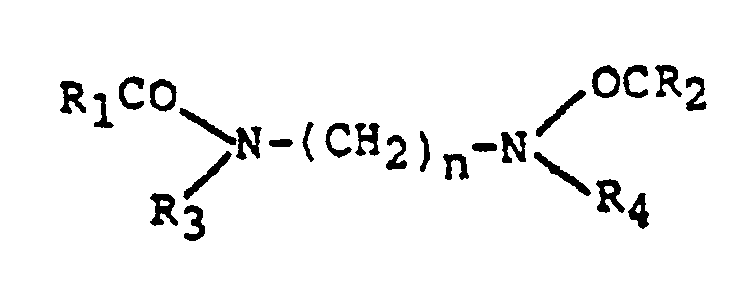
- alkylene-bis-aliphatic acid amide represented by the general formula, which is used in the present invention are given below:
- alkylene bis-aliphatic acidamide compounds available in the market, the following may be mentioned: “BISAMIDE” (Nitto Chemical Ind., Co., Ltd.), “PLASTFLOW” (Nitto Chemical Ind., Co., Ltd), “DIADD 200BIS” (Nippon Hygrogen Co., Ltd.), “LUBRON E” (Nippon Hydrogen Co., Ltd.), “ALFLOW H50S” (Nippon Oil and Fats Co., Ltd.), “ALFLOW V-60” (Nippon Oil and Fats Co., Ltd.), “AMIDE 6-L” (Kawaken Fine Chemical Co.), “AMIDE 7-S” (Kawaken Pine Chemicak Co.), “ARMOWAX-EBS” (Lion-Armer Co.,)' “Hoechst Wax C” (Hoechst), “Nobuko Wax-22DS” (Nobuko Chemi c al Co.,), “Adva Wax-280” (Advance Co.,),
- the alkylene bis-aliphatic acidamide compound generally has an increased softening point with an increase in the number of carbon atoms in the hydrocarbon group or of the length of the alkylene chain contained in the molecule.
- those having a softening point of 100 to 180°C, and more preferably, those having a softening temperature of 130 to 160°C are advantageously used in the present invention.
- n in the general formula is not more than 5.
- the preferable proportion of the amount of the compound as the mold releasing agent to be contained in the toner composition is within the range of 1 to 20% by weight relative to the binder resin and, more preferably, within the range of 1 to 10% by weight.
- the proportion to be contained is less than 1%, there will a tendency that the effect of the compound as the mold releasing agent is hardly exerted and, accordingly, the off-set prevention effect may be weakened and the effect of lowering the minimum fixing temperature may not be obtained.
- the proportion exceeds 20% by weight, the fluidity of the toner is likely to reduce, causing a reduction in the good developability and transferability of the toner, thus making good image formation difficult.
- mold release agent tends to cause adhesion of the mold releasing agent to the sleeve in the developing unit or to the electrostatic latent image-bearing support(i.e., photoreceptor, etc.), and thus to hinder the normal function of the toner.
- the compound (c) used in the present invention contains as a component thereof an ester at a proportion of more than 20% by weight, together with other components such as higher fatty acids, higher alcohols or hydrocarbons, which may optionally be contained therein, and the needle penetration degree of which is not more than 4.
- such compound is selected from waxes having a melting point of between 60 and 110°C.
- the needle penetration degree is a value obtained in accordance with the measuring method described in JIS K2235-1980. That is to say, a sample wax which is heated and melted is taken in a sample container and, after the sample is left and allowed to cool down, the sample is kept constant at a temperature of 25°C in a water bath. A needle the total mass of which is fixed to be 100g is then penetrated vertically into the sample wax for 5 minutes, and the depth of the needle thus penetrated is measured to a precision of 0.1mm.
- the value of the needle penetration degree used in the invention is defined as the value obtained by multiplying the depth by 10.
- the melting point of the resin can be obtained by Differential Scanning Calorimetory (DSC), i.e., the peak fusion value of the sample, when a few mg of sample was heated at a constant temperature rising rate of 10°C/min, is taken as the melting point.
- DSC Differential Scanning Calorimetory
- the preferable proportion of the the wax to be contained in the present invention is within the range of 1 to 20% by weight relative to the binder resin and, more preferably, within the range of 1 to 10% by weight. If the proportion to be contained is less than 1%, the effect as mold releasing agent is hardly exerted and, accordingly, the off-set prevention effect and good fixability at low tem perature of the toner may not be very effective. If, on the other hand, the proportion exceeds 20% by weight the fluidity of the toner is likely to deteriorate causing a reduction in the good developability and transferability of the toner, thus making good image formation difficult.
- the ratio of the alkylene bis-aliphatic acidamide compound to the wax is, in terms of parts by weight, preferably within the range from 0.5 : 1 to 10 : 1, and more preferably, from 0.5 : 1 to 5 : 1.
- the toner of the present invention can be prepared in a fine powder form by incorporating into and dispersing in the above-mentioned binder resin and the mold releasing agent and, if necessary, other additives for the improvment of the properties of the toner, such as colorant and magnetic material.
- the average particle size of the toner is generally 5 to 30 microns.
- any conventionally known colorants can be used; such colorants include carbon black, Nigrosine(C.I. No. 50415B), Aniline Blue( C.I. No. 50405), Ultramarine Blue(C.I. No. 77103), Chrome Yellow(C.I. No. 14090), Quiniline Yellow(C.I. No. 47005), Rose Bengal(C.I. No. 45435), Du Pont Oil Red(C.I. No. 26105), Phthalocyanine Blue(C.I. No. 74160) and Lamp Black(C.I. No. 77266) and a mixture thereof may be used.
- the amount of the colorant to be incorporated into the toner of the present invention is not limited but, in general, 1 to 20 parts by weight relative to 100 parts of the binder resin may be preferable.
- a magnetic material may be incorporated into the toner composition instead of, or together with, the colorants.
- the magnetic material that may be used includes a compound or an alloy containing therein a ferromagnetic element such as iron, cobalt and nickel; ferrite, magnetite ; an alloy such as so-called Heusler's alloy which contains manganese and copper in the alloy, like Mn-Co-Al or Mn-Co-Sn, and which does not contain a magnetic element but shows a ferromagnetic effect under suitable heat treatment or chromium dioxide may be mentioned.
- These magnetic materials are usually incorporated into , and uniformly dispersed in, the toner composition in the form of a fine powder of average particle size 0.1 to 1 micron.
- the amount of the magnetic material to be incorporated is generally 20 to 70 parts by weight relative to 100 parts by weight of toner and, preferably, at a proportion of 40 to 70 parts by weight relative to the same.
- charge controlling agent and fluidity improving lubricants such as fine powdery silica may be mentioned.
- polyester resin of the present invention certain other types of resin may be used for the purpose of improving various properties of the toner, for example, for preventing the occurrence of toner filming or for the purpose of improving the pulverization property or chargeability of the toner.
- the resins preferably used for this purpose include, for example, polymers not having undergone cross-linking treatment and not containing a chloroform-insoluble component.
- resins for example, homopolymers, copolymers or a mixture thereof obtained by polymerizing at least one of the following monomer may be mentioned: Styrenes such as styrene or para-chlorostyrene; vinyl naphthalene; vinyl esters such as vinyl chloride, vinyl bromide, vinyl fluoride, vinyl acetate, vinyl propionate, vinyl benzoate and vinyl butyrate; methylene aliphatic carboxylic acid esters such as methyl acrylate, ethyl acrylate, n-butyl acrylate, iso-butyl acrylate, dodecyl acrylate, n-octyl acrylate, 2-chloroethyl acrylate, phenyl acrylate, alphachloromethehtyl acrylate,methyl methacrylate, ethyl methacrylate, butyl methacrylate; acrylonitrile, methacrylonitrile; acrylamide;
- non-vinyl thermo-plastic resins such as a rosin-modified phenol-formaldehyde resin,an oil- modified epoxy resin, a polyurethane resin, a cellulose resin or a polyether resin, or a mixture of these non-vinyl resins and a heretofore mentioned vinyl resin may also be used.
- the amount of these resins to be incorporated into the toner composition is not limited unless such incorporation jeopartize the effect of the present invention; however, 30 % by weight with respect to the total binder resin may be preferable.
- toner images with sufficiently high density can be obtained at relatively low temperature, without causing off-set phenomenon, at high speed and stably when the copying is repeated for a long time.
- binder resins and the mold releasing agents used are as follows:
- a round bottomed flask equipped with a thermometer, a stainless steel stirrer, a glass tube to introduce nitrogen and a condenser was charged with the above-mentioned composition.
- the flask was set in a mantle heater and heated to 250°C while nitrogen gas was introduced into the flask to keep its interior under an inert atomosphere. Then, the reaction was carried out while stirring the composition. When water, which is formed by the reaction, stopped being produced the acid value was measured to be 1.5.
- This polyester resin is designated as Binder Resin A.
- This polyester resin was designated as Binder Resin B.
- the above composition was heated using the same apparatus as in the case of Resin A, and thereto 0.05 g of dibutyl tin oxide was added and the reaction was carried out at 200°C. The reaction was terminated when the softening point by the Ball and Ring Method was 131°C.
- the thus obtained polyester resin was designated as Binder Resin C.
- the toner components shown in TABLE 1 were mixed and kneaded in an extruder, the temperature of the inside thereof being kept 10°C below the softening point of the resin. Then the mixture was cooled down by water, pulverized and classified to obtain a toner having an average particle size of 11 microns. Finally 0.8% by weight of hydrophobic silica was added to the thus prepared toner, to prepare the toner of the Examples.
- the numerals in the brackets are given in terms of parts by weight.
- toners of Examples 6, 11 and 18 are so-called one-component developers and the respective toners contain, in addition to the component listed in the table, 52 parts by weight of fine powder of magnetic material "BL-100” (Titane Industry Co.) and 1 part by weight of a nigrosine dye as the charge controlling agent, "Nigrosine Base EX” (Orient Chemical Co.).
- the bulk density of the respective toners were measured in order to determine the fluidity of the toners.
- the respective toners were poured down into a container having a diameter of 28mm and the total volume of 100ml to its full through a sieve of 100 mesh and the weight was measured.
- the thus prepared developer was subjected to an image formation test using a electrophotographic copying machine "U-Bix 4500"(product of Konishiroku Photo Industry Co., Ltd.), in which the so-called toner recycling system is employed, and 60000 repeated copying tests were carried out to determine the developability of the electrostatic latent image, transferability of the developed toner image to the transfer sheet and fixability of the toner using a heat roll fixing unit, and the toner density of the copied image of the first and after 60000th copies were measured.
- a electrophotographic copying machine "U-Bix 4500" product of Konishiroku Photo Industry Co., Ltd.
- a fixing test was carried out out using a heat roll fixing unit consisting of a heat roll, the surface of which is formed of TEFLON ( polytetrafluoroethylene produced by du Pont), and a pressure roll, the surface of which is formed of a silicone rubber "KE-1300 RTV" (product of Shinetsu Chemical Industry Co., Ltd.); a sample transfer sheet, onto which 64 g/m2 of toner had been adhered, was passed through the fixing unit at a line feeding speed of 200mm/sec, and this procedure was repeated while increasing stepwise the temperature of the heat roll by 5°C from 100°C.
- the fixed toner image thus obtained was subjected to a rubbing test with KIM wiper and the minimum fixing temperature was determined as the lowest temperature at which the fixed toner image has a sufficient durability against rubbing.
- the fixing unit used does not have a silicone oil providing device.
- the the lowest temperature at which the off-set phenomenon is first observed was determined in a similar manner to the determination of the minimum fixing temperature, that is, the temperature at which the off-set phenomenon is first observed was measured by, first, developing an electrostatic image formed in an ordinary electrophotographic method with a developer and, transferring the toner image onto a plain paper sheet and fixing the transferred image in the above-mentioned fixing unit, and, thereafter, by passing a white paper through the fixing unit under the same conditions, to observe if there is any contamination on the surface of the white paper due to the toner attached to the roll in the fixing unit.
- the temperature, at which off-set phenomenon is first seen was obtained.
- the winding occurrence temperature was measured by the use of a uniformly black original, whereby toner was attached to the whole surface of the transfer sheet by development and transfer processes, and by carrying out fixing test while lowering stepwise the temperature of the heat roll of the fixing unit.
- the toner of the present invention has higher off-set and winding prevention ability, fixability at reduced temperature, excellent developability with sufficient density and excellent stability in image formation after much repetitive copying in comparison with the toner of the prior art. Further no serious contamination in the sleeve of the developing unit or in the surface of the photoreceptor was observed even after 60000 copyings.
- toner of the present invention having the lower minimum fixing temperature, the transfer sheet need not be exposed to high temperature.
- the occurrence of creases can effectively be prevented, which is especially advantageous when both surfaces of the transfer paper sheet are to be used for copying.
- the comparative toner shows a lower off-set occurring temperature, inferior image quality and inferior stability in the image formation.
Landscapes
- Physics & Mathematics (AREA)
- General Physics & Mathematics (AREA)
- Chemical & Material Sciences (AREA)
- Chemical Kinetics & Catalysis (AREA)
- Spectroscopy & Molecular Physics (AREA)
- Developing Agents For Electrophotography (AREA)
Description
- The present invention relates to a toner for developing an electrostatic latent image formed in electrophotography, electrostatic recording, electrostatic printing, etc.
- The image formation process in electrophotography generally comprises a step of forming an electrostatic latent image by uniformly charging and, thereafter, imagewise exposing a photoconductive photoreceptor, a step of developing the thus formed electrostatic latent image with a toner, which is formed of a fine resin powder containing therein a colorant, etc., a step of transferring the thus formed toner image onto, say, a transfer paper, and a step of fixing the toner image by means of heating, pressurizing, etc., to obtain a visualized image.
- The image forming process making use of the electrostatic latent image should preferably be performed as quickly as possible, and in view of this, the heat roll fixing process, which has better heat efficiency and other advantages in comparison with other fixing processes of the art, has been widely applied in this field.
- Recently, however, further speeding-up of the total image formation process is strongly in demand, and for this purpose, it becomes essential for the fixing step to be speeded up. For the fixing of toner to be carried out at a higher speed in the heat roll fixing method, the toner for the development is required to have a fixability at a lower temperature, and for this purpose, the binder resin to be used should necessarily have a lower softening point. However, in general, when the softening point of the binder resin of a toner is lowered, a part of the toner image tends to be transferred to the surface of the heat roll and thus transferred toner is re-transferred to the surface of the subsequent transfer sheet, which is the so-called off-set phenomenon, which causes a deterioration in the toner image. In addition, in the heat roll fixing method there is a tendency for a transfer sheet to wind round the surface of the heat roll, which is the so-called winding penomenon. This winding phenomenon is likely to take place especially when the temperature of the heat roll is too low.
- For the purpose of preventing the off-set or the winding phenomenon from taking place, various measures have been proposed and some of them have been put into practice. As one of such measures, it has been proposed that fixing be carried out while coating the surface of the heat roll with a mold releasing oil such as silicone oil. Another proposed measure is to confer the toner itself with mold releasing properties and thus to give it off-set prevention properties. The latter measure has an advantage over the former that no oil providing system in the copying machine is necessary and, therefore, the structure of the fixing unit could be made simpler and no maintenance, such as replenishing the silicone oil, is needed, etc.
- For conferring the toner itself with good off-set prevention properties there has been proposed a method of (a) using as a binder resin for the toner a polymer having high molecular weight, or (b) incorporating a mold releasing compound into the toner. However, by means of method (a), although the off-set prevention properties of the toner may be improved, due to a rise in the softening point of the resin, it becomes difficult to carry out the fixing operation at low temperature.
- Recently as a binder resin having a low softening point, polyester resins have been considered. By using a low molecular weight polyester resin which is readily obtainable, it is possible to obtain a toner having a relatively low softening point. The toner using the polyester resin as a binder has, in comparison with the toner in which a vinyl-type polymer is used, the advantage that is has better wetting properties against a transfer sheet such as paper and, therefore, fixing at a lower temperature becomes possible compared with the case where a vinyl-type polymer having approximately the same softening point is used.
- On the other hand, as for method (b), wherein toner is incorporated with a mold releasing agent, it has been proposed, as disclosed in Japanese Patent Publication No. 3304/1977 or 3305/1977, to use as a mold releasing agent a polyolefin wax such as a polypropylene or polyethylene. It is generally effective to use such a mold releasing agent; however, in order to make a toner having sufficient off-set prevention and winding prevention properties as well as a wide practical fixing temperature range, the proportion of the mold releasing agent to be incorporated must be increased to a considerable extent. However, with the increase of the proportion of such mold releasing agent in the toner, the fluidity of the toner powder is lowered, and as a result, satisfactory development becomes difficult despite the improvement in the fixing operation and it becomes difficult to obtain an toner image of good image quality.
- Further, with the use of a toner containing a polyolefin wax, there has been observed a disadvantage that, when such toner is used together with carrier particles in a so-called two-component developer, the carrier particles are liable to wear out easily and the effective life time of such carrier is shortened. This is considered to be due to the so-called filming phenomenon by adhesion of the wax component in the toner to the surface of the carrier particles. The reason for the occurrence of the toner filming is considered to reside in the fact that it is necessary to increase the content of such wax in the toner in order to attain a sufficient off-set prevention effect, and in addition, since the dispersion capability of the resin of such wax is relatively low and the volume of the wax becomes too large, the wax is considered to be present in the toner resin in a separate phase.
- The present invention is aimed at providing a toner for developing an electrostatic latent image which has a low minimum fixing temperature, sufficient off-set prevention properties and good fluidity with less aggregation, which is capable of stably producing visual toner images of good image quality for the long repetition of copying performance, and which is suitably used for the rapid fixing process.
- The present invention provides a toner for developing an electrostatic latent image which comprises (a) a polyester resin of a non-linear copolymer having, as its side chain, an aliphatic hydrocarbon group containing 3 to 22 carbon atoms, said copolymer being obtainable by polymerisation of (i) an etherified bisphenol monomer, (ii) a di-carboxylic acid monomer or an anhydride thereof, (iii) either a polyhydric alcohol with 3 or more OH groups or a polycarboxylic acid, or an anhydride thereof, with 3 or more carboxy groups, or both, and (iv) at least one monomer capable of forming said side chain which is a polyhydric alcohol containing 2 or more OH groups and a saturated or unsaturated hydrocarbon group containing 3 to 22 carbon atoms or a polycarboxylic acid, or anhydride thereof, containing 2 or more carboxy groups and a saturated or unsaturated hydrocarbon group containing 3 to 22 carbon atoms, or both, and at least one of (b) an alkylene-bis-aliphatic acid amide compound represented by the general formula;

- The monomer components used for the synthesis of the non-linear polyester resin which constitutes the binder resin of the toner of the present invention are as follows: a diol monomer containing as the main constituent thereof (i) an etherified bisphenol or (ii) a dicarboxylic acid monomer, which monomers constitute the main structure of the copolymer; (iii) a polyhydric alcohol monomer with 3 or more OH groups and/or a polycarboxylic acid monomer with 3 or more carboxy groups, which monomers function for the non-linearization of the copolymer, i.e., forming of a branched or a network structure; and (iv) a polyhydric alcohol monomer with 2 or more OH groups and containing a saturated or unsaturated hydrocarbon group having 3 to 22 carbon atoms and/or a polycarboxylic acid monomer with 2 or more carboxy groups and containing a saturated or unsaturated hydrocarbon group having 3 to 22 carbon atoms, either of which monomers is capable of forming a side chain containing a hydrocarbon group having 3 to 22 carbon atoms.
- GB-A-2100873 discloses polyester resin binders derived from alcohols and carboxylic acids. Examples of these include etherified bisphenols, acids such as maleic acid. The polyester may also be derived from trifunctional or high monomers which may be alcoholic or carboxylic. However there is no disclosure of monomers which are defined under (iv) above.
- If necessary, monomers other than those mentioned hereinbefore may also be used in the present invention in an amount which does not jeopardize the advantages of the present invention.
- As for the etherified phenols, as defined in (i) above, for example
polyoxypropylene(2.2)-2,2-bis(4-hydroxyphenyl)propane,
polyoxyethylene(2)-2,2-bis(4-hydroxyphenyl)propane,
polyoxypropylene(6)-2,2-bis(4-hydroxyphenyl)propane,
polyoxypropylene(1.3)-2,2-bis(4-hydroxyphenyl)propane may be mentioned. - As for other diols, for example, ethylene glycol, diethylene glycol, triethylene glycol, 1,2-propylene glycol, 1,3-propylene glycol, 1,4-butanediol, neopentyl glycol, 1,4-butenediol; 1,4-bis(hydroxymethyl) cyclohexane; and other bisphenols such as bisphenol A and hydrogenated bisphenol A may be mentioned.
- As for examples of dicarboxylic acid monomers, maleic acid, fumaric acid, metaconic acid, citraconic acid, itaconic acid, glutaconic acid, phthalic acid, iso-phthalic acid, terephthalic acid, cyclohexane-di-carboxylic acid, succinic acid, adipic acid, sebacic acid, malonic acid and anhydrides thereof, and other dibasic acid monomers may be mentioned. The proportion of these acid monmers to be used is, preferably, within the range from 10 to 90 molar % and, more preferably, within the range from 20 to 60 molar % with respect to the total acid component.
- Further as for the polyhydric alcohol monomer defined in (II) above, for example, sorbitol, 1,2,3,6-hexanetetraol, 1,4-sorbitan, pentaerythritol, di-pentaerythritol, tripentaerythritol, saccharose, 1,2,4-butanetriol, 1,2,5-pentanetriol, glycerol, 2-methylpropanetriol, 2-methyl-1,2,4-butanetriol, trimethylol ethane, trimethylol propane and 1,3,5-trihydroxymethyl benzene may be mentioned. The amount of the polyhydric alcohol to be used is, preferably, within the range from 5 to 50 molar % and, more preferably, 10 to 40 molar % with respect to the total alcohol component. In the case the proportion exceeds 50 molar %, there will be a tendency that the fixability of the toner becomes insufficient, and at the proportion less than 5%, the non-linearization being insufficient, and the off-set prevention property of the toner will be reduced.
- As for the polycarboxylic acid monomer with 3 or more Carboxy groups, for example, 1,2,4-benzenetricarboxylic acid,
1,2,5-benzene tricarboxylic acid,
1,2,4-cyclohexanetricarboxylic acid,
2,5,7-naphthalenetri-carboxylic acid,
1,2,4-naphthalenetricarboxylic acid,
1,2,4-butanetricarboxylic acid,
1,2,5-hexanetricarboxylic acid,
1,3-dicarboxyl-2-methyl-2-methylenecarboxylic-propane,
tetra(methylenecarboxylic)methane,
1,2,7,8-octane-tetracarboxylic acid, empol trimer acid, and acid anhydrides of the heretofore-mentioned organic acids can be mentioned. - It is preferable in the present invention that the proportion of the polyhydric alcohol to be used is within the range from 5 to 50 molar % and, more preferably within the range from 10 to 40 molar % with respect to the total acid component. In the case the proportion exceeds 50 molar %, there will be a tendency that the fixability of the toner becomes insufficient, and at the proportion less than 5%, the non-linearization being insufficient, and the off-set prevention property of the toner will be reduced.
- As for examples of the polyhydric alcohol as defined in (iv) above, those compounds as listed in (ii) or (iii) above may be used provided that they contain the necessary hydrocarbon side chain grouping. Especially, n-dodecenyl succinic acid, iso-dodecenyl succinic acid, n-dodecyl succinic acid, iso-dodecyl succinic acid, iso-octyl succinic acid, n-octyl succinic acid and n-butyl succinic acid may be mentioned as preferable compounds. The total proportion of these polyhydric alcohol monomer and polycarboxylic acid monomer containing the hydrocarbon group is preferably within the range from 1 to 50 molar % and, more preferably, 1 to 30 molar % with respect to the total monomer components. In the case the proportion exceeds 50 molar %, there will be a tendency that the aggregation preventive property of the toner becomes insufficient, and at the proportion less than 5%, fixability of the toner at low temperature becomes insufficient.
- Representative examples of the alkylene-bis-aliphatic acid amide represented by the general formula, which is used in the present invention are given below:


- As for alkylene bis-aliphatic acidamide compounds available in the market, the following may be mentioned:
"BISAMIDE" (Nitto Chemical Ind., Co., Ltd.),
"PLASTFLOW" (Nitto Chemical Ind., Co., Ltd),
"DIADD 200BIS" (Nippon Hygrogen Co., Ltd.),
"LUBRON E" (Nippon Hydrogen Co., Ltd.),
"ALFLOW H50S" (Nippon Oil and Fats Co., Ltd.),
"ALFLOW V-60" (Nippon Oil and Fats Co., Ltd.),
"AMIDE 6-L" (Kawaken Fine Chemical Co.),
"AMIDE 7-S" (Kawaken Pine Chemicak Co.),
"ARMOWAX-EBS" (Lion-Armer Co.,)'
"Hoechst Wax C" (Hoechst),
"Nobuko Wax-22DS" (Nobuko Chemical Co.,),
"Adva Wax-280" (Advance Co.,),
"Kao Wax-EB" (Kao Soap Co., Ltd.),
"Parycin-285" (Baker-Caster Oil Co.,) - The alkylene bis-aliphatic acidamide compound generally has an increased softening point with an increase in the number of carbon atoms in the hydrocarbon group or of the length of the alkylene chain contained in the molecule. In view of the heating temperature to be applied during the manufacture of the toner and intended lowering of the fixing temperature thereof, those having a softening point of 100 to 180°C, and more preferably, those having a softening temperature of 130 to 160°C are advantageously used in the present invention. For this reason, it is preferred that n in the general formula is not more than 5.
- The preferable proportion of the amount of the compound as the mold releasing agent to be contained in the toner composition is within the range of 1 to 20% by weight relative to the binder resin and, more preferably, within the range of 1 to 10% by weight. When the proportion to be contained is less than 1%, there will a tendency that the effect of the compound as the mold releasing agent is hardly exerted and, accordingly, the off-set prevention effect may be weakened and the effect of lowering the minimum fixing temperature may not be obtained. When, on the other hand, the proportion exceeds 20% by weight, the fluidity of the toner is likely to reduce, causing a reduction in the good developability and transferability of the toner, thus making good image formation difficult. Further, excess addition of the mold release agent tends to cause adhesion of the mold releasing agent to the sleeve in the developing unit or to the electrostatic latent image-bearing support(i.e., photoreceptor, etc.), and thus to hinder the normal function of the toner.
- The compound (c) used in the present invention contains as a component thereof an ester at a proportion of more than 20% by weight, together with other components such as higher fatty acids, higher alcohols or hydrocarbons, which may optionally be contained therein, and the needle penetration degree of which is not more than 4.
- It is preferable in the present invention that such compound is selected from waxes having a melting point of between 60 and 110°C.
- In the present invention the needle penetration degree is a value obtained in accordance with the measuring method described in JIS K2235-1980. That is to say, a sample wax which is heated and melted is taken in a sample container and, after the sample is left and allowed to cool down, the sample is kept constant at a temperature of 25°C in a water bath. A needle the total mass of which is fixed to be 100g is then penetrated vertically into the sample wax for 5 minutes, and the depth of the needle thus penetrated is measured to a precision of 0.1mm. The value of the needle penetration degree used in the invention is defined as the value obtained by multiplying the depth by 10.
- The melting point of the resin can be obtained by Differential Scanning Calorimetory (DSC), i.e., the peak fusion value of the sample, when a few mg of sample was heated at a constant temperature rising rate of 10°C/min, is taken as the melting point.
- Some representative examples of wax of this class are given below:

-

- When the alkylene bis-aliphatic acidamide compound and the wax are used in combination the ratio of the alkylene bis-aliphatic acidamide compound to the wax is, in terms of parts by weight, preferably within the range from 0.5 : 1 to 10 : 1, and more preferably, from 0.5 : 1 to 5 : 1.
- The toner of the present invention can be prepared in a fine powder form by incorporating into and dispersing in the above-mentioned binder resin and the mold releasing agent and, if necessary, other additives for the improvment of the properties of the toner, such as colorant and magnetic material. The average particle size of the toner is generally 5 to 30 microns.
- As for the colorant, any conventionally known colorants can be used; such colorants include carbon black, Nigrosine(C.I. No. 50415B), Aniline Blue( C.I. No. 50405), Ultramarine Blue(C.I. No. 77103), Chrome Yellow(C.I. No. 14090), Quiniline Yellow(C.I. No. 47005), Rose Bengal(C.I. No. 45435), Du Pont Oil Red(C.I. No. 26105), Phthalocyanine Blue(C.I. No. 74160) and Lamp Black(C.I. No. 77266) and a mixture thereof may be used. The amount of the colorant to be incorporated into the toner of the present invention is not limited but, in general, 1 to 20 parts by weight relative to 100 parts of the binder resin may be preferable.
- In the case where the toner of the present invention is applied to a so-called one-component toner, a magnetic material may be incorporated into the toner composition instead of, or together with, the colorants. The magnetic material that may be used includes a compound or an alloy containing therein a ferromagnetic element such as iron, cobalt and nickel; ferrite, magnetite ; an alloy such as so-called Heusler's alloy which contains manganese and copper in the alloy, like Mn-Co-Al or Mn-Co-Sn, and which does not contain a magnetic element but shows a ferromagnetic effect under suitable heat treatment or chromium dioxide may be mentioned.
- These magnetic materials are usually incorporated into , and uniformly dispersed in, the toner composition in the form of a fine powder of average particle size 0.1 to 1 micron. The amount of the magnetic material to be incorporated is generally 20 to 70 parts by weight relative to 100 parts by weight of toner and, preferably, at a proportion of 40 to 70 parts by weight relative to the same.
- As for the other additives for improving other properties of the toner, for example, charge controlling agent and fluidity improving lubricants such as fine powdery silica may be mentioned.
- In addition to the polyester resin of the present invention, certain other types of resin may be used for the purpose of improving various properties of the toner, for example, for preventing the occurrence of toner filming or for the purpose of improving the pulverization property or chargeability of the toner. The resins preferably used for this purpose include, for example, polymers not having undergone cross-linking treatment and not containing a chloroform-insoluble component. As for such resins, for example, homopolymers, copolymers or a mixture thereof obtained by polymerizing at least one of the following monomer may be mentioned:
Styrenes such as styrene or para-chlorostyrene; vinyl naphthalene; vinyl esters such as vinyl chloride, vinyl bromide, vinyl fluoride, vinyl acetate, vinyl propionate, vinyl benzoate and vinyl butyrate; methylene aliphatic carboxylic acid esters such as methyl acrylate, ethyl acrylate, n-butyl acrylate, iso-butyl acrylate, dodecyl acrylate, n-octyl acrylate, 2-chloroethyl acrylate, phenyl acrylate, alphachloromethehtyl acrylate,methyl methacrylate, ethyl methacrylate, butyl methacrylate; acrylonitrile, methacrylonitrile; acrylamide; vinyl ethers such as vinyl methyl ether, vinyl iso-butyl ether or vinyl ethyl ether; vinyl ketones such as vinyl methyl ketone or vinyl hexyl ketone; N-vinyl compounds such as N-vinyl pyrrole, N-vinyl carbazole, N-vinyl indole or N-vinyl pyrrolidone. Further non-vinyl thermo-plastic resins such as a rosin-modified phenol-formaldehyde resin,an oil- modified epoxy resin, a polyurethane resin, a cellulose resin or a polyether resin, or a mixture of these non-vinyl resins and a heretofore mentioned vinyl resin may also be used. The amount of these resins to be incorporated into the toner composition is not limited unless such incorporation jeopartize the effect of the present invention; however, 30 % by weight with respect to the total binder resin may be preferable. - With the useof the toner of the present invention the following technical advantages can be expected.
- (i) Minimum fixing temperature can be lowered and practical fixing temperature range may be widened.
- (ii) Improved off-set and winding prevention effects can be obtained.
- (iii) Toner having improved fluidity and copying durability can be obtained.
- (iv) Even in the recycling system, toner image with a stable image quality can be obtained.
- (v) Contamination due to the adhesion of the toner to carrier, photo-receptor or sleeve will be reduced.
- (vi) Because of good fluidity of the toner the use of fluidity-improving agent such as powdery silica may be reduced in amount or omitted and, therefore, disadvantages with the use of the silica such as the damage of the photoreceptor can be reduced or eliminated.
- And thus according to the present invention toner images with sufficiently high density can be obtained at relatively low temperature, without causing off-set phenomenon, at high speed and stably when the copying is repeated for a long time.
- The present invention is further explained with reference to Examples; however, the scope of the invention is not limited by them.
- In the Examples the binder resins and the mold releasing agents used are as follows:
-

- A round bottomed flask equipped with a thermometer, a stainless steel stirrer, a glass tube to introduce nitrogen and a condenser was charged with the above-mentioned composition. The flask was set in a mantle heater and heated to 250°C while nitrogen gas was introduced into the flask to keep its interior under an inert atomosphere. Then, the reaction was carried out while stirring the composition. When water, which is formed by the reaction, stopped being produced the acid value was measured to be 1.5.
- 65.4 g of 1,2,4-benzene tricarboxylic acid anhydride was added to the reaction product and further reaction was carried out for 8 hours and the reaction was finished when the acid value was 20. The softening point of the thus obtained polyester resin in accordance with the Ball and Ring Method( by JIS K2531-1960 ) was 120°C.
- This polyester resin is designated as Binder Resin A.
-

- The above composition was reacted at 200°C using the same apparatus as in the case of Resin A. When water, which is formed by the reaction, stopped flowing out the acid value was 1.5. 7.9g of 1,2,4-benzene tricarboxylic acid anhydride was added to the reaction product and further reaction was carried out at 200°C. The reaction was terminated when the softening point of the reaction product was 120°C.
- This polyester resin was designated as Binder Resin B.
-


- The above composition was heated using the same apparatus as in the case of Resin A, and thereto 0.05 g of dibutyl tin oxide was added and the reaction was carried out at 200°C. The reaction was terminated when the softening point by the Ball and Ring Method was 131°C. The thus obtained polyester resin was designated as Binder Resin C.
Mold Releasing Agent a1
"HOECHST WAX C" (HOECHST JAPAN Co.)
Mold Releasing Agent a2
Alkylene bis-aliphaticacidamide
"BISAMIDE" (Nitto Chemical Ind., Co., Ltd.)
Mold Releasing Agent a3
Alkylene bis-aliphaticacidamide
"ARMOWAX-EBS" (Lion-Armer Co.,)
Mold Releasing Agent a4
Alkylene bis-aliphaticacidamide
"HOECHST WAX C" (HOECHST JAPAN Co.)
Mold Releasing Agent b1
"Carnauba Wax No. 1" (Noda Wax Co.)
Mold Releasing Agent b2
"Candelilla Wax" (Noda Wax Co.)
Mold Releasing Agent c1
Low molecular polypropylene
"Viscol 660P" (Sanyo Chemical Co.)
Polyolefin Wax, Needle Penetration Degree(N.P.D)=1.5;
Melting Point(m.p.)=142°C
Mold Releasing Agent c2
"Hi-Wax 400P" (Mitsui Petrochemical Co.)
Low molecular polyethylene Wax
Mold Releasing Agent c3
Synthesized Wax(Aliphatic acid ester content of 10% by
weight, N.P.D=1 and m.p.=64°C)
Mold Releasing Agent c4
"HOECHST WAX GL-3" (HOECHST JAPAN Co., a parafin wax,
N.P.D=1, m.p.=74°C)
Mold Releasing Agent c5
"Rice Wax F-1" (Noda Wax Co., aliphatic acidester containing wax, ester content; 93-96 %by weight, N.P.D.=6, m.p.=79°C) - In the following Examples, the toner components shown in TABLE 1 were mixed and kneaded in an extruder, the temperature of the inside thereof being kept 10°C below the softening point of the resin. Then the mixture was cooled down by water, pulverized and classified to obtain a toner having an average particle size of 11 microns. Finally 0.8% by weight of hydrophobic silica was added to the thus prepared toner, to prepare the toner of the Examples. In TABLE 1 the numerals in the brackets are given in terms of parts by weight.


- In TABLE I, toners of Examples 6, 11 and 18 are so-called one-component developers and the respective toners contain, in addition to the component listed in the table, 52 parts by weight of fine powder of magnetic material "BL-100" (Titane Industry Co.) and 1 part by weight of a nigrosine dye as the charge controlling agent, "Nigrosine Base EX" (Orient Chemical Co.).
- Thus obtained toners according to the present invention (Toners 1 to 18) and the toners for comparison (Comparative Toners 1 to 9) were subjected to various tests explained below:
- First, since the higher the fluidity of a powder is, the smaller is the condensation rate of the powder, the bulk density of the respective toners were measured in order to determine the fluidity of the toners. The respective toners were poured down into a container having a diameter of 28mm and the total volume of 100ml to its full through a sieve of 100 mesh and the weight was measured.
- The respective toners, except toners in Examples 6,11 and 18, were mixed with a resin coated carrier to prepare developers, of which the toner content of each was 2% by weight.
- The thus prepared developer was subjected to an image formation test using a electrophotographic copying machine "U-Bix 4500"(product of Konishiroku Photo Industry Co., Ltd.), in which the so-called toner recycling system is employed, and 60000 repeated copying tests were carried out to determine the developability of the electrostatic latent image, transferability of the developed toner image to the transfer sheet and fixability of the toner using a heat roll fixing unit, and the toner density of the copied image of the first and after 60000th copies were measured.
- After 60000 times, the bulk density of the toner, extent of contamination on the surface of the carrier particles, photosensitive drum and developing sleave in the development unit were also observed.
- Further the minimum fixing temperature, the minimum off-set occurring temperature and winding occurring temperature were measured.
- To determine the minimum fixing temperature, a fixing test was carried out out using a heat roll fixing unit consisting of a heat roll, the surface of which is formed of TEFLON ( polytetrafluoroethylene produced by du Pont), and a pressure roll, the surface of which is formed of a silicone rubber "KE-1300 RTV" (product of Shinetsu Chemical Industry Co., Ltd.); a sample transfer sheet, onto which 64 g/m² of toner had been adhered, was passed through the fixing unit at a line feeding speed of 200mm/sec, and this procedure was repeated while increasing stepwise the temperature of the heat roll by 5°C from 100°C. The fixed toner image thus obtained was subjected to a rubbing test with KIM wiper and the minimum fixing temperature was determined as the lowest temperature at which the fixed toner image has a sufficient durability against rubbing.
- Incidentally, the fixing unit used does not have a silicone oil providing device.
- The the lowest temperature at which the off-set phenomenon is first observed was determined in a similar manner to the determination of the minimum fixing temperature, that is, the temperature at which the off-set phenomenon is first observed was measured by, first, developing an electrostatic image formed in an ordinary electrophotographic method with a developer and, transferring the toner image onto a plain paper sheet and fixing the transferred image in the above-mentioned fixing unit, and, thereafter, by passing a white paper through the fixing unit under the same conditions, to observe if there is any contamination on the surface of the white paper due to the toner attached to the roll in the fixing unit. By repeating the above-mentioned operation at various temperatures, the temperature, at which off-set phenomenon is first seen was obtained.
- The winding occurrence temperature was measured by the use of a uniformly black original, whereby toner was attached to the whole surface of the transfer sheet by development and transfer processes, and by carrying out fixing test while lowering stepwise the temperature of the heat roll of the fixing unit.
- Results of the tests are shown in TABLES 2 and 3 below.


- As apparent from TABLES 2 and 3, the toner of the present invention has higher off-set and winding prevention ability, fixability at reduced temperature, excellent developability with sufficient density and excellent stability in image formation after much repetitive copying in comparison with the toner of the prior art. Further no serious contamination in the sleeve of the developing unit or in the surface of the photoreceptor was observed even after 60000 copyings.
- Further, by the use of toner of the present invention, having the lower minimum fixing temperature, the transfer sheet need not be exposed to high temperature. Thus the the occurrence of creases can effectively be prevented, which is especially advantageous when both surfaces of the transfer paper sheet are to be used for copying.
- In contrast thereto the comparative toner shows a lower off-set occurring temperature, inferior image quality and inferior stability in the image formation.
- Further it is apparent from the TABLES that overall excellent copying performance can be obtained when the specified mold releasing agent is used.
Claims (12)
- A toner suitable for developing an electrostatic latent image comprising (a) a polyester resin of a non-linear copolymer having, as a side chain, an aliphatic hydrocarbon group containing 3 to 22 carbon atoms, said copolymer being obtainable by polymerization of (i) an etherified bisphenol, (ii) a di-carboxylic acid or an anhydride thereof, (iii) either a polyhydric alcohol with 3 or more OH groups or a polycarboxylic acid, or an anhydride thereof, containing 3 or more carboxy groups, or both, and (iv) at least one monomer capable of forming said side chain which is a polyhydric alcohol containing 2 or more OH groups and a saturated or unsaturated hydrocarbon group containing 3 to 22 carbon atoms or a polycarboxylic acid, or anhydride thereof, containing 2 or more carboxy groups and a saturated or unsaturated hydrocarbon group containing 3 to 22 carbon atoms, or both, and at least one of (b) an alkylene-bis-aliphatic acid amide compound represented by the general formula:
- A toner according to claim 1, wherein the proportion of said dicarboxylic acid (ii) with respect to the total acid content is from 10 to 90 molar %.
- A toner according to claim 1 or 2 wherein the polyhydric alcohol (iii) is sorbitol, 1,2,3,6-hexanetetraol, 1,4-sorbitan, pentaerythritol, saccharose, 1,2,4-butanetriol, 1,2,5-pentanetriol, glycerol, 2-methylpropanetriol, 2-methyl-1,2,4-butanetriol, trimethylol ethane, trimethylol propane or 1,3,5-trihydroxymethyl benzene.
- A toner according to any one of claims 1 to 3 wherein the proportion of the polyhydric alcohol (iii) with respect to the total alcohol component is from 5 to 50 molar %.
- A toner according to any one of claims 1 to 4 wherein the polycarboxylic acid (iii) is selected:
1,2,4-benzenetricarboxylic acid,
1,2,5-benzenetricarboxylic acid,
1,2,4-cyclohexanetricarboxylic acid,
2,5,7-naphthalenetricarboxylic acid,
1,2,4-naphthalenetricarboxylic acid,
1,2,4-butanetricarboxylic acid,
1,2,5-hexanetricarboxylic acid,
1,3-dicarboxyl-2-methyl-2-methylenecarboxylic-propane,
tetra (methylenecarboxylic)methane,
1,2,7,8-octane-tetracarboxylic acid or empol trimer acid, or an acid anhydride thereof. - A toner according to any one of claims 1 to 5, wherein the proportion of the polycarboxylic acid (iii) with respect to the total acid component is from 5 to 50 molar %.
- A toner according to any one of claims 1 to 6 wherein the alkylene-bis-aliphatic acid amide compound is


- A toner according to any one of claims 1 to 7 wherein the alkylene-bis-aliphatic acid amide compound has a softening point of 100 to 180°C.
- A toner according to any one of claims 1 to 8 wherein said wax has a melting point of 60 to 110°C.
- A toner according to any one of claims 1 to 9 wherein the etherified bisphenol monomer is polyoxypropylene (2.2)-2,2-bis(4-hydroxyphenyl)propane, polyoxyethylene(2)-2,2-bis(4-hydroxyphenyl)propane, polyoxypropylene(6)-2,2-bis(4-hydroxyphenyl)propane, or polyoxypropylene(1.3)-2,2-bis(hydroxyphenyl)propane.
- A toner according to any one of claims 1 to 10 wherein the di-carboxylic acid (ii) is maleic acid, fumaric acid, metaconic acid, citraconic acid, itaconic acid, glutaconic acid, phthalic acid, isophthalic acid, terephthalic acid, cyclohexane-di-carboxylic acid, succinic acid, adipic acid, sebacic acid or malonic acid.
- A toner according to any one of claims 1 to 11 wherein the monomer (iv) is n-dodecenyl succinic acid, iso-dodecenyl succinic acid, n-dodecyl succinic acid, iso-dodecyl succinic acid, iso-octyl succinic acid, n-octyl succinic acid or n-butyl succinic acid, or an anhydride thereof.
Applications Claiming Priority (6)
| Application Number | Priority Date | Filing Date | Title |
|---|---|---|---|
| JP109545/84 | 1984-05-31 | ||
| JP59109543A JPS60254152A (en) | 1984-05-31 | 1984-05-31 | Toner for developing electrostatic charge image |
| JP109544/84 | 1984-05-31 | ||
| JP59109544A JPS60254153A (en) | 1984-05-31 | 1984-05-31 | Toner for development of electrostatic charge image |
| JP109543/84 | 1984-05-31 | ||
| JP59109545A JPS60254154A (en) | 1984-05-31 | 1984-05-31 | Toner for development of electrostatic charge image |
Publications (3)
| Publication Number | Publication Date |
|---|---|
| EP0164257A2 EP0164257A2 (en) | 1985-12-11 |
| EP0164257A3 EP0164257A3 (en) | 1987-05-13 |
| EP0164257B1 true EP0164257B1 (en) | 1991-04-17 |
Family
ID=27311493
Family Applications (1)
| Application Number | Title | Priority Date | Filing Date |
|---|---|---|---|
| EP85303876A Expired EP0164257B1 (en) | 1984-05-31 | 1985-05-31 | Toner for developing electrostatic latent image |
Country Status (3)
| Country | Link |
|---|---|
| US (1) | US4877704A (en) |
| EP (1) | EP0164257B1 (en) |
| DE (1) | DE3582521D1 (en) |
Families Citing this family (13)
| Publication number | Priority date | Publication date | Assignee | Title |
|---|---|---|---|---|
| US5691096A (en) * | 1989-04-04 | 1997-11-25 | Lexmark International, Inc. | Flash fusible toner resins |
| US5304451A (en) * | 1991-12-23 | 1994-04-19 | Xerox Corporation | Method of replenishing a liquid developer |
| US5254424A (en) * | 1991-12-23 | 1993-10-19 | Xerox Corporation | High solids replenishable liquid developer containing urethane-modified polyester toner resin |
| US5306590A (en) * | 1991-12-23 | 1994-04-26 | Xerox Corporation | High solids liquid developer containing carboxyl terminated polyester toner resin |
| US5206108A (en) * | 1991-12-23 | 1993-04-27 | Xerox Corporation | Method of producing a high solids replenishable liquid developer containing a friable toner resin |
| US5406357A (en) * | 1992-06-19 | 1995-04-11 | Canon Kabushiki Kaisha | Developer for developing electrostatic image, image forming method, image forming apparatus and apparatus unit |
| US5300339A (en) * | 1993-03-29 | 1994-04-05 | Xerox Corporation | Development system coatings |
| FR2720843B1 (en) * | 1994-06-03 | 1997-05-23 | Tomoegawa Paper Co Ltd | Toner for developing static charge images, and process for preparing it |
| US6156473A (en) * | 1995-08-31 | 2000-12-05 | Eastman Kodak Company | Monodisperse spherical toner particles containing aliphatic amides or aliphatic acids |
| EP1280013B1 (en) * | 2001-07-23 | 2008-10-15 | Ricoh Company, Ltd. | Oilless toner |
| GB2385643B (en) * | 2002-02-20 | 2005-05-18 | Cross Mfg Company | Improvements relating to a fluid seal |
| JP3779221B2 (en) * | 2002-02-22 | 2006-05-24 | 株式会社巴川製紙所 | Toner for electrophotography |
| JP5568888B2 (en) | 2008-05-23 | 2014-08-13 | 株式会社リコー | Toner, developer, toner container, process cartridge, and image forming method |
Family Cites Families (8)
| Publication number | Priority date | Publication date | Assignee | Title |
|---|---|---|---|---|
| US2297691A (en) * | 1939-04-04 | 1942-10-06 | Chester F Carlson | Electrophotography |
| US3510338A (en) * | 1965-08-06 | 1970-05-05 | Inmont Corp | Method of electrostatic printing |
| US3590000A (en) * | 1967-06-05 | 1971-06-29 | Xerox Corp | Solid developer for latent electrostatic images |
| JPS5111492B2 (en) * | 1973-02-19 | 1976-04-12 | ||
| US4099968A (en) * | 1976-06-03 | 1978-07-11 | Xerox Corporation | Dicarboxylic acid bis-amides in electrostatic imaging compositions and processes |
| JPS5911902B2 (en) * | 1980-08-15 | 1984-03-19 | コニカ株式会社 | Toner for developing electrostatic images |
| GB2100873B (en) * | 1981-06-19 | 1984-11-21 | Konishiroku Photo Ind | Toner for developing electrostatic latent image |
| JPS5938754A (en) * | 1982-08-30 | 1984-03-02 | Konishiroku Photo Ind Co Ltd | Electrostatic charge image developing toner |
-
1985
- 1985-05-31 DE DE8585303876T patent/DE3582521D1/en not_active Expired - Lifetime
- 1985-05-31 EP EP85303876A patent/EP0164257B1/en not_active Expired
-
1988
- 1988-04-28 US US07/191,790 patent/US4877704A/en not_active Expired - Lifetime
Also Published As
| Publication number | Publication date |
|---|---|
| EP0164257A2 (en) | 1985-12-11 |
| EP0164257A3 (en) | 1987-05-13 |
| US4877704A (en) | 1989-10-31 |
| DE3582521D1 (en) | 1991-05-23 |
Similar Documents
| Publication | Publication Date | Title |
|---|---|---|
| US4917983A (en) | Toner for developing an electrostatic latent image comprising linear polyester polymer | |
| US4863824A (en) | Toner for developing electrostatic latent image | |
| JP3310253B2 (en) | Electrophotographic toner | |
| US4877704A (en) | Process for developing latent electrostatic image using toner containing polyester resin | |
| US5116713A (en) | Toner for developing latent electrostatic image | |
| JPH0777837A (en) | Toner for electrostatic image development | |
| JP3445042B2 (en) | Toner for developing electrostatic images | |
| US5637430A (en) | Nonmagnetic one-component toner | |
| JP3631547B2 (en) | Toner for electrophotography | |
| JPH0355821B2 (en) | ||
| JP2708438B2 (en) | Electrophotographic developing toner | |
| JPS60254149A (en) | Toner for developing electrostatic charge image | |
| JP3006054B2 (en) | Dry color toner for full color | |
| JP2706945B2 (en) | Development toner | |
| JPH0314345B2 (en) | ||
| US6194116B1 (en) | Toner containing specific alkyl carboxylic acid with fine particles externally added | |
| JP4063984B2 (en) | Negatively chargeable toner and image forming method | |
| JP3484912B2 (en) | Toner for developing electrostatic latent images | |
| JP3658811B2 (en) | Toner for electrostatic image development | |
| EP0163528A2 (en) | Toner for developing electrostatic latent image | |
| JP3709207B2 (en) | Polyester resin for toner and toner for electrostatic image development | |
| JPS60252365A (en) | Toner for developing electrostatic charge image | |
| JP4361227B2 (en) | Image forming apparatus using toner for developing electrostatic image | |
| JPH11167221A (en) | Electrophotographic toner | |
| JPH0232625B2 (en) |
Legal Events
| Date | Code | Title | Description |
|---|---|---|---|
| PUAI | Public reference made under article 153(3) epc to a published international application that has entered the european phase |
Free format text: ORIGINAL CODE: 0009012 |
|
| AK | Designated contracting states |
Kind code of ref document: A2 Designated state(s): DE FR GB Designated state(s): DE FR GB |
|
| PUAL | Search report despatched |
Free format text: ORIGINAL CODE: 0009013 |
|
| AK | Designated contracting states |
Kind code of ref document: A3 Designated state(s): DE FR GB |
|
| 17P | Request for examination filed |
Effective date: 19871015 |
|
| 17Q | First examination report despatched |
Effective date: 19890130 |
|
| RAP3 | Party data changed (applicant data changed or rights of an application transferred) |
Owner name: KONICA CORPORATION |
|
| GRAA | (expected) grant |
Free format text: ORIGINAL CODE: 0009210 |
|
| AK | Designated contracting states |
Kind code of ref document: B1 Designated state(s): DE FR GB |
|
| REF | Corresponds to: |
Ref document number: 3582521 Country of ref document: DE Date of ref document: 19910523 |
|
| ET | Fr: translation filed | ||
| PLBE | No opposition filed within time limit |
Free format text: ORIGINAL CODE: 0009261 |
|
| STAA | Information on the status of an ep patent application or granted ep patent |
Free format text: STATUS: NO OPPOSITION FILED WITHIN TIME LIMIT |
|
| 26N | No opposition filed | ||
| PGFP | Annual fee paid to national office [announced via postgrant information from national office to epo] |
Ref country code: FR Payment date: 19960510 Year of fee payment: 12 |
|
| PG25 | Lapsed in a contracting state [announced via postgrant information from national office to epo] |
Ref country code: FR Free format text: LAPSE BECAUSE OF NON-PAYMENT OF DUE FEES Effective date: 19980130 |
|
| REG | Reference to a national code |
Ref country code: FR Ref legal event code: ST |
|
| REG | Reference to a national code |
Ref country code: GB Ref legal event code: IF02 |
|
| PGFP | Annual fee paid to national office [announced via postgrant information from national office to epo] |
Ref country code: GB Payment date: 20040526 Year of fee payment: 20 |
|
| PGFP | Annual fee paid to national office [announced via postgrant information from national office to epo] |
Ref country code: DE Payment date: 20040610 Year of fee payment: 20 |
|
| PG25 | Lapsed in a contracting state [announced via postgrant information from national office to epo] |
Ref country code: GB Free format text: LAPSE BECAUSE OF EXPIRATION OF PROTECTION Effective date: 20050530 |
|
| REG | Reference to a national code |
Ref country code: GB Ref legal event code: PE20 |