EP0163530A2 - Block copolymer - Google Patents
Block copolymer Download PDFInfo
- Publication number
- EP0163530A2 EP0163530A2 EP85303780A EP85303780A EP0163530A2 EP 0163530 A2 EP0163530 A2 EP 0163530A2 EP 85303780 A EP85303780 A EP 85303780A EP 85303780 A EP85303780 A EP 85303780A EP 0163530 A2 EP0163530 A2 EP 0163530A2
- Authority
- EP
- European Patent Office
- Prior art keywords
- copolymer
- ethylene
- polymerization
- propylene
- living
- Prior art date
- Legal status (The legal status is an assumption and is not a legal conclusion. Google has not performed a legal analysis and makes no representation as to the accuracy of the status listed.)
- Ceased
Links
Images

Classifications
-
- C—CHEMISTRY; METALLURGY
- C08—ORGANIC MACROMOLECULAR COMPOUNDS; THEIR PREPARATION OR CHEMICAL WORKING-UP; COMPOSITIONS BASED THEREON
- C08G—MACROMOLECULAR COMPOUNDS OBTAINED OTHERWISE THAN BY REACTIONS ONLY INVOLVING UNSATURATED CARBON-TO-CARBON BONDS
- C08G65/00—Macromolecular compounds obtained by reactions forming an ether link in the main chain of the macromolecule
- C08G65/02—Macromolecular compounds obtained by reactions forming an ether link in the main chain of the macromolecule from cyclic ethers by opening of the heterocyclic ring
- C08G65/04—Macromolecular compounds obtained by reactions forming an ether link in the main chain of the macromolecule from cyclic ethers by opening of the heterocyclic ring from cyclic ethers only
- C08G65/06—Cyclic ethers having no atoms other than carbon and hydrogen outside the ring
- C08G65/16—Cyclic ethers having four or more ring atoms
- C08G65/20—Tetrahydrofuran
Definitions
- the present invention relates to a new block copolymer.
- the living polymerization is useful for the production of monodisperse polymers and block copolymers of uniform composition, and many attempts have been made for the production of olefin block copolymers by living polymerization also in the area of coordinate polymerization that employs a Ziegler-Natta catalyst.
- it is difficult to produce block copolymers of uniform composition by living polymerization because chain transfer reactions and termination reactions take place frequently during living polymerization.
- the present inventors found that a catalyst composed of V(acetylacetonate)3 and A1(C 2 H 5 ) 2 C1 provides nearly monodisperse living polypropylene. [Makromol. Chem., 180, 1359 (1979); and Makromolecules., 12, 814 (1979)] The present inventors also found that this technology can be applied to the living copolymerization of ethylene.and propylene. According to this technology, it is possible to produce a nearly monodisperse random living copolymer of ethylene and propylene. This copolymer is reacted with a halogen to convert it into a copolymer having halogenated terminals.
- the gist of this invention resides in a block copolymer having a number-average molecular weight of about 1,000 to about 1,000,000 in which the random copolymer segment (A) is bonded to the polymer segment (B), with the ratio of (A) to (8) being 5/95 to 95/5 by weight, said random copolymer segment (A) being composed of the constitutional units represented by the formulas I and II below, [the amount of I being 30 to 80 wt% and the amount of II being 70 to 20 wt%], and said polymer segment (B) being composed of the constitutional units represented by the formula EO ⁇ (CH2)4].
- Said copolymer is produced by the steps of performing living polymerization of ethylene and propylene in the presence of ⁇ --diketone vanadium chelate and an organoaluminum compound to give a living ethylene-propylene random copolymer, reacting the random copolymer with a halogen to give an ethylene-propylene random copolymer having halogenated terminals, reacting the random copolymer with a terminal converting agent to give terminal carbocations of ethylene-propylene random copolymer, and finally polymerizing tetrahydrofuran in the presence of the terminal carbocations.
- the living ethylene-propylene random copolymer is produced by copolymerizing ethylene and propylene in the presence of a polymerization catalyst composed of ⁇ -diketone vanadium chelate (referred to as vanadium compound hereinafter) and an organoaluminum compound.
- a polymerization catalyst composed of ⁇ -diketone vanadium chelate (referred to as vanadium compound hereinafter) and an organoaluminum compound.
- the vanadium compound is represented by the formula below. (where.R l and R 2 are the same or different alkyl groups or aryl groups.) It includes, for example, V(acetylacetonate) 3 , V(ben- zoylacetylacetonate) 3 , and V(dibenzoylmethanate) 3 .
- the organoaluminum compound is represented by the formula R 2 A1X (where R is an alkyl group or aryl group having 1 to 8 carbon atoms, and X is a halogen atom). It includes, for example, dimethylaluminum chloride, diethylaluminum chloride, diethylaluminum bromide, and diisobutylaluminum chloride.
- the polymerization reaction should preferably be performed in a solvent which is inert and liquid at the time of polymerization.
- the solvent include saturated aliphatic hydrocarbons such as propane, butane, pentane, hexane, and heptane; saturated alicyclic hydrocarbons such as cyclopropane and cyclohexane; and aromatic hydrocarbons such as benzene, toluene, and xylene.
- Ethylene and propylene can be brought into contact with the polymerization catalyst in any manner.
- the contact is accomplished by adding a solution of the organoaluminum compound and then a solution of the vanadium compound to a solvent solution of ethylene and propylene.
- the amounts of the polymerization catalyst used for 1 mol of ethylene and propylene are as follows:
- the amount of the vanadium compound is 1 x 10- 4 to Q.01 mol, preferably 5 x 10⁻⁴ to 5 x 10- 3 mol, and the amount of the organoaluminum compound is 1 x 10- 3 to 0.1 mol, preferably 5 x 10- 3 to 0.01 mol.
- the organoaluminum compound is used in an amount of 5 to 25 mol for 1 mol of the vanadium compound.
- the molecular weight and yields of the living copolymer can be regulated by changing the reaction temperature and reaction time. According to this invention, it is possible to produce a polymer which has a molecular weight distribution similar to that of a monodisperse polymer, if the polymerization temperature is kept low, particularly lower than -50°C. Polymerization at -65°C or below provides a living ethylene-propylene random copolymer having a molecular weight distribution of 1.05 to 1.40 which is defined by Mw/Mn (where Mw is the weight-average molecular weight and Mn is the number-average molecular weight.
- the polymerization reaction may be accompanied by a reaction accelerator such as anisole, water, oxygen, alochol (methanol, ethanol, isopropanol, etc.), and ester (ethyl benzoate, ethyl acetate, etc.).
- the reaction accelerator is used in an amount of 0.1 to 2 mol for 1 mol of the vanadium compound.
- the ratio of ethylene to propylene in the living copolymer should be in such a range that the property of the final block copolymer attributable to the ethylene-propylene random copolymer in it is not adversely affected.
- the ethylene-to- propylene ratio is usually 30/70 to 80/20 by weight.
- the composition of the ethylene-propylene random copolymer can be regulated by changing the ratio of ethylene to propylene at the time of living copolymerization.
- the greater the amount of ethylene used the broader the molecular weight distribution of the resulting polymer, and this is not preferable.
- a living copolymer of high ethylene content having a narrow molecular weight distribution (or a nearly monodisperse living copolymer) can be produced by performing living polymerization of a small amount of propylene prior to the living copolymerization of ethylene and propylene.
- the living copolymer obtained in this way has a narrow molecular weight distribution and yet contains a large amount of ethylene.
- propylene alone is supplied at first to the potymerizatdon system so that living polypropylene having a number-average molecular weight of 500 to 2000 is formed. Subsequently, ethylene is supplied to continue living polymerization in the presence of a large amount of unreacted propylene monomer until the random copolymerization of ethylene and propylene is completed.
- the random copolymer is brought into contact with a halogen so that the polymerization of ethylene and propylene is suspended immediately.
- the resulting product is an . end-halogenated ethylene-propylene random copolymer having the skeletonof the above-mentioned living copolymer.
- the halogen that can be used in that step is iodine, chlorine, or bromine, and it is used in an amount of 2 mol and up, preferably 2 to 5 mol, for 1 mol of the organoaluminum compound used.
- the halogen may be used as such; but it should preferably be used in the form of solution in the same solvent as used for the above-mentioned living copolymerization.
- the concentration of the solution is 0.1 to 5 mol in 1 liter of the solvent.
- halogenation is performed for 5 minutes to 6 hours at -50 to -1000C.
- the halogenated ethylene-propylene random copolymer separates out.
- the halogenated ethylene-propylene random copolymer thus obtained is then reacted with a terminal converting agent represented by the formula MY (where M denotes Ag, Na, Li, K. Rb, or Cs; and Y denotes C10 4 , BF 4 , PF 6 , AsF 6 , or SbF 6 ).
- MY a terminal converting agent represented by the formula MY (where M denotes Ag, Na, Li, K. Rb, or Cs; and Y denotes C10 4 , BF 4 , PF 6 , AsF 6 , or SbF 6 ).
- this agent examples include AgC10 4 , AgBF 4 ,KC10 4 , LiC10 4 , AgSbF 6 , AgPF 6 , AgAsF 6 , NaSbF 6 , KSbF 6 , LiSbF 6 , NaPF 6 , KPF 6 , LiPF 6 , NaAsF 6 , KAsF 6 , LiAsF 6 , NaBF 4 , KBF 4 , and LiBF 4 .
- the terminal converting agent is used in an amount of 1 mol or up, preferably 1.5 to 30 mol, for 1 mol of the halogenated ethylene-propylene random copolymer.
- the reaction between the halogenated copolymer and the terminal converting agent is usually performed in a solvent.
- the same solvent as used for the above-mentioned living polymerization can be used for this purpose, and tetrahydrofuran may also be used as well.
- the terminal conversion reaction of the halogenated ethylene-propylene random copolymer and the subsequent polymerization of THF are performed at -80°C to +50°C, preferably -2 0 oC to +20oC, for 3 hours or longer, preferably 5 hours or longer.
- the polymer segment (B) formed by the ring opening polymerization of THF increases in molecular weight as the polymerization temperature for THF is raised or the polymerization time for THF is extended.
- THF is used in an amount of 10 times (by weight), preferably 20 times, the amount of the halogenated copolymer.
- the polymerization reaction of THF can be suspended by adding an alcohol such as methanol and ethanol to the polymerization system. After polymerization, excess THF is removed and the precipitated solids are washed with acetone, methanol, or the like and dried. In this way, the block copolymer is recovered.
- an alcohol such as methanol and ethanol
- an AB-type block copolymer in which the copolymer segment (A) formed by random copolymerization of ethylene andpropylene is connected to the polymer segment (B) formed by ring opening polymerization of THF.
- This copolymer has a number-average molecular weight of about 1,000 to about 1,000,000, preferably 3,000 to 300,000, more preferably 5,000 to 200,000.
- the ratio of segment (A) to segment (B) in the copolymer is 5/95 to 95/5 (by weight).
- the molecular weight and composition of the block copolymer can be regulated by changing the molecular weight and composition of the living ethylene-propylene random copolymer and the conditions for polymerization of THF.
- the block copolymer of this invention is characterized by that it is a nearly monodisperse polymer of uniform composition having a molecular weight distribution (Mw/Mn) of 1.05 to 1.40.
- the block copolymer of this invention is composed of nonpolar polymer segments (A) and polar polymer segments (B). Therefore, it differs in properties from the conventional block copolymers and polymer mixtures. It is useful as a dyeing agent,. adhesive, polymer modifier, compatibilizing agent, and surface modifier.
- the calibration curve of polypropylene for determination was prepared according to the universal method from the calibration curve of polystyrene obtained by using the standard sample of monodisperse polystyrene available from Waters Co.
- EPR Ethylene-propylene random copolymer
- the polymer was found to contain 42 mol% (equivalent to 50 wt%) of propylene. (Incidentally, the peak indicated by P is assignable to the primary carbon atom.)
- EPR According to thermal analysis by a differential scan-. ning calorimeter (DSC), EPR was found to have no glass transition point (about -10°C) assignable to proylene homopolymer.
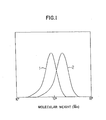
- the resulting copolymer gave a GPC elution curve having a single peak as shown in Fig. 1 (2). It should be noted that the peak is shifted toward the high molecular weight as compared with that of the iodized EPR.
- This copolymer was found to have a number-average_molecular weight of 109,000 and a molecular weight distribution (Mw/Mn) of 1.7, which is close to that of a monodisperse polymer.
- Example 1 Three kinds of living EPRs were prepared as in Example 1 under different polymerization conditions. The resulting living EPRs were iodized in the same way as in Example 1 to give iodized EPRs, the properties of which are shown in Table 1.
- the iodized EPR obtained in the above step was used for polymerization of THF in the same way as in Example 1 except the amount, the terminal converting agent, and the polymerization condition were changed as shown in Table 1. There were obtained AB-type EPR block copolymers having the properties as shown in Table 1.
Landscapes
- Chemical & Material Sciences (AREA)
- Health & Medical Sciences (AREA)
- Chemical Kinetics & Catalysis (AREA)
- Medicinal Chemistry (AREA)
- Polymers & Plastics (AREA)
- Organic Chemistry (AREA)
- Graft Or Block Polymers (AREA)
- Polyethers (AREA)
- Addition Polymer Or Copolymer, Post-Treatments, Or Chemical Modifications (AREA)
Abstract
Description
- The present invention relates to a new block copolymer.
- The living polymerization is useful for the production of monodisperse polymers and block copolymers of uniform composition, and many attempts have been made for the production of olefin block copolymers by living polymerization also in the area of coordinate polymerization that employs a Ziegler-Natta catalyst. However, it is difficult to produce block copolymers of uniform composition by living polymerization because chain transfer reactions and termination reactions take place frequently during living polymerization.
- The present inventors found that a catalyst composed of V(acetylacetonate)3 and A1(C2H5)2C1 provides nearly monodisperse living polypropylene. [Makromol. Chem., 180, 1359 (1979); and Makromolecules., 12, 814 (1979)] The present inventors also found that this technology can be applied to the living copolymerization of ethylene.and propylene. According to this technology, it is possible to produce a nearly monodisperse random living copolymer of ethylene and propylene. This copolymer is reacted with a halogen to convert it into a copolymer having halogenated terminals. The copolymer is then reacted with a terminal converting agent to form the terminal carbocation of the copolymer. Finally, tetrahydrofuran is polymerized in the presence of the cation. Thus there is obtained a block copolymer of uniform composition which is composed of the segments of nearly monodisperse ethylene-propylene random copolymer and the segments of nearly monodisperse polymer formed by ring opening polymerization of tetrahydrofuran. The present invention was completed based on this finding.
- The gist of this invention resides in a block copolymer having a number-average molecular weight of about 1,000 to about 1,000,000 in which the random copolymer segment (A) is bonded to the polymer segment (B), with the ratio of (A) to (8) being 5/95 to 95/5 by weight, said random copolymer segment (A) being composed of the constitutional units represented by the formulas I and II below,


- The living ethylene-propylene random copolymer is produced by copolymerizing ethylene and propylene in the presence of a polymerization catalyst composed of β-diketone vanadium chelate (referred to as vanadium compound hereinafter) and an organoaluminum compound.
- The vanadium compound is represented by the formula below.

- The organoaluminum compound is represented by the formula R2A1X (where R is an alkyl group or aryl group having 1 to 8 carbon atoms, and X is a halogen atom). It includes, for example, dimethylaluminum chloride, diethylaluminum chloride, diethylaluminum bromide, and diisobutylaluminum chloride.
- The polymerization reaction should preferably be performed in a solvent which is inert and liquid at the time of polymerization. Examples of the solvent include saturated aliphatic hydrocarbons such as propane, butane, pentane, hexane, and heptane; saturated alicyclic hydrocarbons such as cyclopropane and cyclohexane; and aromatic hydrocarbons such as benzene, toluene, and xylene.
- Ethylene and propylene can be brought into contact with the polymerization catalyst in any manner. Preferably, the contact is accomplished by adding a solution of the organoaluminum compound and then a solution of the vanadium compound to a solvent solution of ethylene and propylene.
- The amounts of the polymerization catalyst used for 1 mol of ethylene and propylene are as follows: The amount of the vanadium compound is 1 x 10⁻⁴ to Q.01 mol, preferably 5 x 10⁻⁴ to 5 x 10⁻³ mol, and the amount of the organoaluminum compound is 1 x 10⁻³ to 0.1 mol, preferably 5 x 10⁻³ to 0.01 mol. Preferably, the organoaluminum compound is used in an amount of 5 to 25 mol for 1 mol of the vanadium compound.
- The molecular weight and yields of the living copolymer can be regulated by changing the reaction temperature and reaction time. According to this invention, it is possible to produce a polymer which has a molecular weight distribution similar to that of a monodisperse polymer, if the polymerization temperature is kept low, particularly lower than -50°C. Polymerization at -65°C or below provides a living ethylene-propylene random copolymer having a molecular weight distribution of 1.05 to 1.40 which is defined by Mw/Mn (where Mw is the weight-average molecular weight and Mn is the number-average molecular weight.
- The polymerization reaction may be accompanied by a reaction accelerator such as anisole, water, oxygen, alochol (methanol, ethanol, isopropanol, etc.), and ester (ethyl benzoate, ethyl acetate, etc.). The reaction accelerator is used in an amount of 0.1 to 2 mol for 1 mol of the vanadium compound. The ratio of ethylene to propylene in the living copolymer should be in such a range that the property of the final block copolymer attributable to the ethylene-propylene random copolymer in it is not adversely affected. The ethylene-to- propylene ratio is usually 30/70 to 80/20 by weight.
- The composition of the ethylene-propylene random copolymer can be regulated by changing the ratio of ethylene to propylene at the time of living copolymerization. The greater the amount of ethylene used, the broader the molecular weight distribution of the resulting polymer, and this is not preferable. A living copolymer of high ethylene content having a narrow molecular weight distribution (or a nearly monodisperse living copolymer) can be produced by performing living polymerization of a small amount of propylene prior to the living copolymerization of ethylene and propylene. The living copolymer obtained in this way has a narrow molecular weight distribution and yet contains a large amount of ethylene. In actual, propylene alone is supplied at first to the potymerizatdon system so that living polypropylene having a number-average molecular weight of 500 to 2000 is formed. Subsequently, ethylene is supplied to continue living polymerization in the presence of a large amount of unreacted propylene monomer until the random copolymerization of ethylene and propylene is completed.
- In the way mentioned above, it is possible to produce a nearly monodisperse living ethylene-propylene random copolymer having a number-average molecular weight of about 500 to about 500,000 (in terms of propylene, to be repeated hereinafter).
- In the next step, the random copolymer is brought into contact with a halogen so that the polymerization of ethylene and propylene is suspended immediately. The resulting product is an . end-halogenated ethylene-propylene random copolymer having the skeletonof the above-mentioned living copolymer.
- The halogen that can be used in that step is iodine, chlorine, or bromine, and it is used in an amount of 2 mol and up, preferably 2 to 5 mol, for 1 mol of the organoaluminum compound used. -The halogen may be used as such; but it should preferably be used in the form of solution in the same solvent as used for the above-mentioned living copolymerization. The concentration of the solution is 0.1 to 5 mol in 1 liter of the solvent. Usually, halogenation is performed for 5 minutes to 6 hours at -50 to -1000C.
- Upon addition of an alcohol to the reaction system, the halogenated ethylene-propylene random copolymer separates out.
- The halogenated ethylene-propylene random copolymer thus obtained is then reacted with a terminal converting agent represented by the formula MY (where M denotes Ag, Na, Li, K. Rb, or Cs; and Y denotes C104, BF4, PF6, AsF6, or SbF6). Examples of this agent include AgC104, AgBF4,KC104, LiC104, AgSbF6, AgPF6, AgAsF6, NaSbF6, KSbF6, LiSbF6, NaPF6, KPF6, LiPF6, NaAsF6, KAsF6, LiAsF6, NaBF4, KBF4, and LiBF4.
- The terminal converting agent is used in an amount of 1 mol or up, preferably 1.5 to 30 mol, for 1 mol of the halogenated ethylene-propylene random copolymer. The reaction between the halogenated copolymer and the terminal converting agent is usually performed in a solvent. The same solvent as used for the above-mentioned living polymerization can be used for this purpose, and tetrahydrofuran may also be used as well.
- The above-mentioned reaction forms the terminal carbocation of ethylene-propylene random copolymer. This cation serves as an initiator for the polymerization of tetrahydrofuran (abbreviated as THF hereinafter). As the result of the polymerization of THF, there is obtained the block copolymer of this invention.
- The terminal conversion reaction of the halogenated ethylene-propylene random copolymer and the subsequent polymerization of THF are performed at -80°C to +50°C, preferably -20oC to +20oC, for 3 hours or longer, preferably 5 hours or longer. The polymer segment (B) formed by the ring opening polymerization of THF increases in molecular weight as the polymerization temperature for THF is raised or the polymerization time for THF is extended.
- THF is used in an amount of 10 times (by weight), preferably 20 times, the amount of the halogenated copolymer.
- The polymerization reaction of THF can be suspended by adding an alcohol such as methanol and ethanol to the polymerization system. After polymerization, excess THF is removed and the precipitated solids are washed with acetone, methanol, or the like and dried. In this way, the block copolymer is recovered.
- Thus there is obtained an AB-type block copolymer in which the copolymer segment (A) formed by random copolymerization of ethylene andpropylene is connected to the polymer segment (B) formed by ring opening polymerization of THF. This copolymer has a number-average molecular weight of about 1,000 to about 1,000,000, preferably 3,000 to 300,000, more preferably 5,000 to 200,000. The ratio of segment (A) to segment (B) in the copolymer is 5/95 to 95/5 (by weight).
- The molecular weight and composition of the block copolymer can be regulated by changing the molecular weight and composition of the living ethylene-propylene random copolymer and the conditions for polymerization of THF.
- The block copolymer of this invention is characterized by that it is a nearly monodisperse polymer of uniform composition having a molecular weight distribution (Mw/Mn) of 1.05 to 1.40.
- The block copolymer of this invention is composed of nonpolar polymer segments (A) and polar polymer segments (B). Therefore, it differs in properties from the conventional block copolymers and polymer mixtures. It is useful as a dyeing agent,. adhesive, polymer modifier, compatibilizing agent, and surface modifier.
- The invention is now described in more detail with reference to the following examples, in which the characterization of polymers and copolymers was carried out in the following way.
- Molecular weight and molecular weight distribution: Determined by using GPC (gel permeation chromatography), Model .150, made by Waters Co. under the following conditions.
- Solvent: trichlorobenzene
- Temperature: 1350C
- Flow rate of solvent: 1.0 ml/min
- Sample concentration: 0.15 wt/vol%
- Column: GMH6 made by Toyo Soda Kogyo Co.
- The calibration curve of polypropylene for determination was prepared according to the universal method from the calibration curve of polystyrene obtained by using the standard sample of monodisperse polystyrene available from Waters Co.
- Determination of polymer structure (13C-NMR spectrum): Performed by using Model XL-200 made by Varian Co., equipped with the PFT pulse Fourier transformer.
-
- Frequency: 50 MHz
- Temperature: 1200C
- Pulse width: 8.2µsπ/3
- Pulse interval: 4 sec
- Number of integration: 5000
- Sample: prepared by dissolving in a 2:1 mixture solvent of trichlorobenzene and heavy benzene
- Into a 200-ml flask, with the atmosphere therein completely replaced with nitrogen, was placed toluene as a solvent, and the system was cooled to -780C. While keeping that temperature, 35 g (0.83 mol) of propylene was added. (It became liquefied and dissolved.) Then there were added a toluene solution containing 5 mmol of A1(C2H5)2Cl, a toluene solution containing 0.5 mmol of V(acetylacetonate)3, and 0.25 mmol of anisole in the order mentioned. Preliminary polymerization was started at -780C. One hour after preliminary polymerization, nitrogen was evacuated and 1.3 g (4.6 mmol) of ethylene was introduced. Copolymerization of ethylene and propylene was carried out at -780C for 15 minutes under an atmosphere of nitrogen. Thus there was obtained a living ethylene-propylene random copolymer. (Ethylene-propylene random copolymer is abbreviated as EPR hereinafter.)
- To the above-mentioned polymerization system was added 22 ml of toluene solution containing 0.5 mol/liter of iodine, and the reaction was carried out at -780C. Thirty minutes later, the reaction solution was introduced into 500 ml of ethanol which had previously been cooled to -780C, to cause the polymer to separate out. The resulting polymer was washed five times with 500 ml of ethanol and then dried. Thus there was obtained end-iodized EPR.
- The iodized EPR was examined for molecular weight and molecular weight distribution. It was found to be a nearly monodisperse polymer having Mn = 85,000 and Mw/Mn = 1.22. This polymer gave a GPC elution curve as shown in Fig. 1 (1). The single peak should be noted. The polymer also gave the 13C-NMR chart as shown in Fig. 2. The content of propylene in this polymer was calculated according to the following equation from the area of the peak (indicated by S) assignable to the secondary carbon atom and the area of the peak (indicated by T) assignable to the tertiary carbon atom.

- The polymer was found to contain 42 mol% (equivalent to 50 wt%) of propylene. (Incidentally, the peak indicated by P is assignable to the primary carbon atom.)
- According to thermal analysis by a differential scan-. ning calorimeter (DSC), EPR was found to have no glass transition point (about -10°C) assignable to proylene homopolymer.
- In 20 ml of THF was dissolved 0.92 g of the iodized EPR obtained as mentioned above. The solution was placed in a 100 ml flask, and then a slurry composed of 0.1 g (0.82 mmol) of NaCl04 and 30 ml of THF was added at OoC; whereby the polymerization reaction of THE was started.
- After stirring for 430 hours, 10 ml of methanol was added to suspend the polymerization reaction of THF. The solid phase (NaCl) was removed and then the polymer was separated from unreacted THF. The polymer was washed five times with 200 ml of acetone, followed by drying. Thus there was obtained 1.1 g of copolymer.
- The resulting copolymer gave a GPC elution curve having a single peak as shown in Fig. 1 (2). It should be noted that the peak is shifted toward the high molecular weight as compared with that of the iodized EPR. This copolymer was found to have a number-average_molecular weight of 109,000 and a molecular weight distribution (Mw/Mn) of 1.7, which is close to that of a monodisperse polymer.
- The analysis of the copolymer by 13C-NMR gave, in addition to the peaks assignable to the iodized EPR, the peaks assignable to methylene carbons in polytetramethyleneoxide [(0-CH2-CH2-CH2-CH2)n ; 67.7 ppm and (̵0-CH2 CH2-CH2-CH2)̵n; 26.0 ppm]. This result indicates that the copolymer is an AB-type block copolymer composed of the segment (A) which is an ethylene-propylene random copolymer and the segment (B) which is a polymer formed by ring opening polymerization of THF. The ratio of segment (A) to segment (B) in the copolymer was 84/16 (by weight), which was calculated from the yield of the copolymer.
- Three kinds of living EPRs were prepared as in Example 1 under different polymerization conditions. The resulting living EPRs were iodized in the same way as in Example 1 to give iodized EPRs, the properties of which are shown in Table 1.
- The iodized EPR obtained in the above step was used for polymerization of THF in the same way as in Example 1 except the amount, the terminal converting agent, and the polymerization condition were changed as shown in Table 1. There were obtained AB-type EPR block copolymers having the properties as shown in Table 1.

-
- Figure 1 shows the GPC elution curves of the polymer and copolymer of this invention.
- Figure 2 shows the NMR spectrum of the polymer of this invention.
Claims (1)
- A block copolymer having a number-average molecular weight of about 1,000 to about 1,000,000 in which the random copolymer segment (A) is bonded to the polymer segment (B), with the ratio of (A) to (B) being 5/95 to 95/5 by weight, said random copolymer segment (A) being composed of the constitutional units represented by the formulas I and II below.


Applications Claiming Priority (2)
| Application Number | Priority Date | Filing Date | Title |
|---|---|---|---|
| JP59107616A JPS60252623A (en) | 1984-05-29 | 1984-05-29 | Block copolymer |
| JP107616/84 | 1984-05-29 |
Publications (2)
| Publication Number | Publication Date |
|---|---|
| EP0163530A2 true EP0163530A2 (en) | 1985-12-04 |
| EP0163530A3 EP0163530A3 (en) | 1987-11-04 |
Family
ID=14463685
Family Applications (1)
| Application Number | Title | Priority Date | Filing Date |
|---|---|---|---|
| EP85303780A Ceased EP0163530A3 (en) | 1984-05-29 | 1985-05-29 | Block copolymer |
Country Status (5)
| Country | Link |
|---|---|
| US (2) | US4705830A (en) |
| EP (1) | EP0163530A3 (en) |
| JP (1) | JPS60252623A (en) |
| BR (1) | BR8502560A (en) |
| CA (1) | CA1248660A (en) |
Families Citing this family (9)
| Publication number | Priority date | Publication date | Assignee | Title |
|---|---|---|---|---|
| US5382634A (en) * | 1991-03-15 | 1995-01-17 | Tonen Corporation | Terminal-modifed polyolefins |
| US6399206B1 (en) | 1992-09-30 | 2002-06-04 | The Dow Chemical Company | Electrostatically painted polymers and a process for making same |
| JP2001278928A (en) * | 2000-01-25 | 2001-10-10 | Mitsui Chemicals Inc | Films and sheets |
| JP4647109B2 (en) * | 2000-01-28 | 2011-03-09 | 三井化学株式会社 | Molded body for medical / hygiene |
| JP2001278931A (en) * | 2000-01-28 | 2001-10-10 | Mitsui Chemicals Inc | Electrical and electronic components |
| JP2004099694A (en) * | 2002-09-06 | 2004-04-02 | Mitsui Chemicals Inc | Olefin block copolymer and its use |
| CN100526366C (en) * | 2006-12-11 | 2009-08-12 | 江苏钟山化工有限公司 | Polytetrahydrofuryl block polyether diol and its preparation method |
| CN102516554A (en) * | 2011-11-23 | 2012-06-27 | 中北大学 | Method for preparing hydroxyl-terminated polytetrahydrofuran polypropylene oxide block copolyether |
| US9638995B2 (en) | 2013-03-12 | 2017-05-02 | Seagate Technology Llc | Method of sheared guiding patterns |
Family Cites Families (4)
| Publication number | Priority date | Publication date | Assignee | Title |
|---|---|---|---|---|
| GB1097696A (en) * | 1964-05-08 | 1968-01-03 | Rohm & Haas | Oxygenated derivatives of olefin polymers |
| US3497573A (en) * | 1966-01-18 | 1970-02-24 | Dart Ind Inc | Block copolymers of propylene and a polar monomer |
| US3523144A (en) * | 1967-03-01 | 1970-08-04 | Minnesota Mining & Mfg | Block copolymers of tetrahydrofuran and process for their preparation |
| JPS59196317A (en) * | 1983-04-22 | 1984-11-07 | Toa Nenryo Kogyo Kk | Block propylene copolymer and its production |
-
1984
- 1984-05-29 JP JP59107616A patent/JPS60252623A/en active Granted
-
1985
- 1985-05-24 US US06/738,068 patent/US4705830A/en not_active Expired - Fee Related
- 1985-05-28 CA CA000482548A patent/CA1248660A/en not_active Expired
- 1985-05-29 BR BR8502560A patent/BR8502560A/en not_active IP Right Cessation
- 1985-05-29 EP EP85303780A patent/EP0163530A3/en not_active Ceased
-
1987
- 1987-06-12 US US07/061,091 patent/US4801654A/en not_active Expired - Fee Related
Also Published As
| Publication number | Publication date |
|---|---|
| CA1248660A (en) | 1989-01-10 |
| EP0163530A3 (en) | 1987-11-04 |
| JPS60252623A (en) | 1985-12-13 |
| BR8502560A (en) | 1986-02-04 |
| US4705830A (en) | 1987-11-10 |
| JPH0125490B2 (en) | 1989-05-18 |
| US4801654A (en) | 1989-01-31 |
Similar Documents
| Publication | Publication Date | Title |
|---|---|---|
| EP0675153B1 (en) | Process for the preparation of star-shaped polymers | |
| US5382634A (en) | Terminal-modifed polyolefins | |
| Zambelli et al. | Syndiotactic styrene‐butadiene block copolymers synthesized with CpTiX3/MAO (Cp= C5H5, X= Cl, F; Cp= C5Me5, X= Me) and TiXn/MAO (n= 3, X= acac; n= 4, X= O‐tert‐Bu) | |
| EP0188915A2 (en) | Process for producing propylene polymer | |
| EP0166536B1 (en) | Block copolymer | |
| Purgett et al. | Functional polymers. XLVIII. Polymerization of ω‐alkenoate derivatives | |
| EP0163530A2 (en) | Block copolymer | |
| US4079176A (en) | Polymerization process | |
| US4254237A (en) | Process for producing propylene-ethylene block copolymers | |
| US5171800A (en) | Anionic polymerization with bifunctional initiators | |
| Bruzzone et al. | Ethylene‐butadiene copolymers, 1. Preparation with modified vanadium catalysts | |
| EP0311299B1 (en) | A diolefin polymer or copolymer and a process for the production of the same | |
| EP0529102A1 (en) | Terminally modified polyolefin | |
| Santarella et al. | Cationic polymerization of dienes III. Polymerization of 1, 3-pentadiene initiated by ferric chloride in hexane | |
| Kress et al. | Studies of the metathesis polymerization and copolymerization of syn‐and anti‐7‐methylnorbornene initiated by the tungsten‐carbene complex | |
| US3994993A (en) | Diblock copolymers and process of preparing same | |
| JPS6336618B2 (en) | ||
| JP3308982B2 (en) | Terminally modified polyolefin | |
| US5281368A (en) | Norbornene polymerization initiators and process for preparing same | |
| EP0581963B1 (en) | Terminally modified polyolefin | |
| JPH01108202A (en) | Manufacture of polyalkenyl ether | |
| EP0729985A2 (en) | Ethylene-propylene copolymer compositions | |
| US5166286A (en) | Polymers having terminal halogen atoms | |
| JP3319773B2 (en) | Terminally modified polyolefin | |
| JP3273054B2 (en) | Terminally modified polyolefin |
Legal Events
| Date | Code | Title | Description |
|---|---|---|---|
| PUAI | Public reference made under article 153(3) epc to a published international application that has entered the european phase |
Free format text: ORIGINAL CODE: 0009012 |
|
| 17P | Request for examination filed |
Effective date: 19850614 |
|
| AK | Designated contracting states |
Designated state(s): AT BE CH DE FR GB IT LI NL SE |
|
| PUAL | Search report despatched |
Free format text: ORIGINAL CODE: 0009013 |
|
| AK | Designated contracting states |
Kind code of ref document: A3 Designated state(s): AT BE CH DE FR GB IT LI NL SE |
|
| 17Q | First examination report despatched |
Effective date: 19890907 |
|
| RAP1 | Party data changed (applicant data changed or rights of an application transferred) |
Owner name: TONEN CORPORATION |
|
| STAA | Information on the status of an ep patent application or granted ep patent |
Free format text: STATUS: THE APPLICATION HAS BEEN REFUSED |
|
| 18R | Application refused |
Effective date: 19910319 |
|
| RIN1 | Information on inventor provided before grant (corrected) |
Inventor name: UEKI, SATOSHI Inventor name: IMAI, CHIHIRO Inventor name: MAKISHIMA, TOKUO |