EP0163379A2 - Method of welding nitrogen-containing alloys - Google Patents
Method of welding nitrogen-containing alloys Download PDFInfo
- Publication number
- EP0163379A2 EP0163379A2 EP85302083A EP85302083A EP0163379A2 EP 0163379 A2 EP0163379 A2 EP 0163379A2 EP 85302083 A EP85302083 A EP 85302083A EP 85302083 A EP85302083 A EP 85302083A EP 0163379 A2 EP0163379 A2 EP 0163379A2
- Authority
- EP
- European Patent Office
- Prior art keywords
- nitrogen
- welding
- inert gas
- weld
- argon
- Prior art date
- Legal status (The legal status is an assumption and is not a legal conclusion. Google has not performed a legal analysis and makes no representation as to the accuracy of the status listed.)
- Withdrawn
Links
- 238000003466 welding Methods 0.000 title claims abstract description 48
- 238000000034 method Methods 0.000 title claims abstract description 24
- 229910045601 alloy Inorganic materials 0.000 title claims abstract description 14
- 239000000956 alloy Substances 0.000 title claims abstract description 14
- QJGQUHMNIGDVPM-UHFFFAOYSA-N nitrogen group Chemical group [N] QJGQUHMNIGDVPM-UHFFFAOYSA-N 0.000 title claims abstract description 13
- IJGRMHOSHXDMSA-UHFFFAOYSA-N Atomic nitrogen Chemical compound N#N IJGRMHOSHXDMSA-UHFFFAOYSA-N 0.000 claims abstract description 113
- 229910052757 nitrogen Inorganic materials 0.000 claims abstract description 64
- 230000007797 corrosion Effects 0.000 claims abstract description 38
- 238000005260 corrosion Methods 0.000 claims abstract description 38
- 239000011261 inert gas Substances 0.000 claims abstract description 20
- XKRFYHLGVUSROY-UHFFFAOYSA-N Argon Chemical compound [Ar] XKRFYHLGVUSROY-UHFFFAOYSA-N 0.000 claims description 42
- 239000007789 gas Substances 0.000 claims description 35
- 229910052786 argon Inorganic materials 0.000 claims description 21
- 239000000203 mixture Substances 0.000 claims description 14
- 229910001220 stainless steel Inorganic materials 0.000 claims description 12
- 239000010935 stainless steel Substances 0.000 claims description 8
- 229910000859 α-Fe Inorganic materials 0.000 claims description 7
- CURLTUGMZLYLDI-UHFFFAOYSA-N Carbon dioxide Chemical compound O=C=O CURLTUGMZLYLDI-UHFFFAOYSA-N 0.000 claims description 4
- UFHFLCQGNIYNRP-UHFFFAOYSA-N Hydrogen Chemical compound [H][H] UFHFLCQGNIYNRP-UHFFFAOYSA-N 0.000 claims description 4
- 239000001307 helium Substances 0.000 claims description 4
- 229910052734 helium Inorganic materials 0.000 claims description 4
- SWQJXJOGLNCZEY-UHFFFAOYSA-N helium atom Chemical compound [He] SWQJXJOGLNCZEY-UHFFFAOYSA-N 0.000 claims description 4
- 239000001257 hydrogen Substances 0.000 claims description 4
- 229910052739 hydrogen Inorganic materials 0.000 claims description 4
- QVGXLLKOCUKJST-UHFFFAOYSA-N atomic oxygen Chemical compound [O] QVGXLLKOCUKJST-UHFFFAOYSA-N 0.000 claims description 2
- 239000001569 carbon dioxide Substances 0.000 claims description 2
- 229910002092 carbon dioxide Inorganic materials 0.000 claims description 2
- 239000001301 oxygen Substances 0.000 claims description 2
- 229910052760 oxygen Inorganic materials 0.000 claims description 2
- 239000010953 base metal Substances 0.000 description 11
- 239000002184 metal Substances 0.000 description 10
- 229910052751 metal Inorganic materials 0.000 description 10
- 238000007792 addition Methods 0.000 description 7
- 239000000945 filler Substances 0.000 description 5
- WFKWXMTUELFFGS-UHFFFAOYSA-N tungsten Chemical compound [W] WFKWXMTUELFFGS-UHFFFAOYSA-N 0.000 description 4
- 229910052721 tungsten Inorganic materials 0.000 description 4
- 239000010937 tungsten Substances 0.000 description 4
- 239000001996 bearing alloy Substances 0.000 description 3
- 230000015572 biosynthetic process Effects 0.000 description 3
- 230000000694 effects Effects 0.000 description 3
- 238000005204 segregation Methods 0.000 description 3
- 230000009286 beneficial effect Effects 0.000 description 2
- 230000007423 decrease Effects 0.000 description 2
- 239000000463 material Substances 0.000 description 2
- 238000012360 testing method Methods 0.000 description 2
- RYGMFSIKBFXOCR-UHFFFAOYSA-N Copper Chemical compound [Cu] RYGMFSIKBFXOCR-UHFFFAOYSA-N 0.000 description 1
- 229910021578 Iron(III) chloride Inorganic materials 0.000 description 1
- 229910052776 Thorium Inorganic materials 0.000 description 1
- MIQWEMDDUPSLRW-UHFFFAOYSA-N [O].O=C=O Chemical compound [O].O=C=O MIQWEMDDUPSLRW-UHFFFAOYSA-N 0.000 description 1
- 230000002411 adverse Effects 0.000 description 1
- 238000000137 annealing Methods 0.000 description 1
- 229910001566 austenite Inorganic materials 0.000 description 1
- 238000005422 blasting Methods 0.000 description 1
- 238000009835 boiling Methods 0.000 description 1
- 238000005219 brazing Methods 0.000 description 1
- UBAZGMLMVVQSCD-UHFFFAOYSA-N carbon dioxide;molecular oxygen Chemical compound O=O.O=C=O UBAZGMLMVVQSCD-UHFFFAOYSA-N 0.000 description 1
- 230000015556 catabolic process Effects 0.000 description 1
- 239000000470 constituent Substances 0.000 description 1
- 229910052802 copper Inorganic materials 0.000 description 1
- 239000010949 copper Substances 0.000 description 1
- 239000013078 crystal Substances 0.000 description 1
- 238000006731 degradation reaction Methods 0.000 description 1
- 230000001627 detrimental effect Effects 0.000 description 1
- 229910001873 dinitrogen Inorganic materials 0.000 description 1
- 229910001039 duplex stainless steel Inorganic materials 0.000 description 1
- 230000004927 fusion Effects 0.000 description 1
- RBTARNINKXHZNM-UHFFFAOYSA-K iron trichloride Chemical compound Cl[Fe](Cl)Cl RBTARNINKXHZNM-UHFFFAOYSA-K 0.000 description 1
- 238000004519 manufacturing process Methods 0.000 description 1
- 230000008018 melting Effects 0.000 description 1
- 238000002844 melting Methods 0.000 description 1
- 150000002739 metals Chemical class 0.000 description 1
- 238000005096 rolling process Methods 0.000 description 1
- 238000005476 soldering Methods 0.000 description 1
- 238000007711 solidification Methods 0.000 description 1
- 230000008023 solidification Effects 0.000 description 1
- 229910001256 stainless steel alloy Inorganic materials 0.000 description 1
- 238000009864 tensile test Methods 0.000 description 1
Classifications
-
- B—PERFORMING OPERATIONS; TRANSPORTING
- B23—MACHINE TOOLS; METAL-WORKING NOT OTHERWISE PROVIDED FOR
- B23K—SOLDERING OR UNSOLDERING; WELDING; CLADDING OR PLATING BY SOLDERING OR WELDING; CUTTING BY APPLYING HEAT LOCALLY, e.g. FLAME CUTTING; WORKING BY LASER BEAM
- B23K9/00—Arc welding or cutting
- B23K9/16—Arc welding or cutting making use of shielding gas
-
- B—PERFORMING OPERATIONS; TRANSPORTING
- B23—MACHINE TOOLS; METAL-WORKING NOT OTHERWISE PROVIDED FOR
- B23K—SOLDERING OR UNSOLDERING; WELDING; CLADDING OR PLATING BY SOLDERING OR WELDING; CUTTING BY APPLYING HEAT LOCALLY, e.g. FLAME CUTTING; WORKING BY LASER BEAM
- B23K35/00—Rods, electrodes, materials, or media, for use in soldering, welding, or cutting
- B23K35/22—Rods, electrodes, materials, or media, for use in soldering, welding, or cutting characterised by the composition or nature of the material
- B23K35/38—Selection of media, e.g. special atmospheres for surrounding the working area
- B23K35/383—Selection of media, e.g. special atmospheres for surrounding the working area mainly containing noble gases or nitrogen
Definitions
- This invention relates to methods of welding having controlled shielding gas composition to enhance the mechanical properties and corrosion resistance of the welded article. Particularly, this invention relates to welding procedures which include adding nitrogen to the shielding gas for welding nitrogen-bearing alloys to improve .the weldment properties.
- weldments There are known welding procedures for producing weldments and welded articles of strip, sheet, plate and tubing. Such weldments may be made by autogenous welding, such as tungsten inert gas (TIG) or gas tungsten arc welding (GTA), wherein the metal is fused together by melting with an arc produced by a nonconsumable electrode.
- GTA gas metal arc
- MIG metal inert gas
- plasma arc welding is also used and is analogous to tungsten inert gas welding in that weld filler metal is used, but, instead, the material is melted and fused together by the use of a plasma jet.
- TIG welding is generally useful for welding strip or sheet ranging from 0.005 to 0.125 inch (0.013 to 0.32cm), although thicker material can be welded.
- Plasma arc welding is also generally used for thin sections ranging from 0.001 to 0.25 inch (0.025 to 0.635cm) thick.
- MIG welding practice probably is useful from 0.060 to 1.5 inch (0.152 to 3.81cm).
- the welding arc or plasma jet is shielded by inert gas.
- the shielding gas is all argon or mixtures of argon and helium or argon and hydrogen. It is also known, as described in the Metals Handbook, 9th Edition, Vol. 6, Welding, Brazing and Soldering", pages 153 to 224, that other gases may be mixed with inert gas.
- carbon dioxide and carbon dioxide-oxygen may be used for the purpose of improving arc behavior and metal flow characteristics.
- Up to 2% oxygen in the shielding gas is known to improve arc stability and appears useful for welding stainless steel.
- Nitrogen is described useful for welding deoxidized copper in Great Britain when the shielding gas is all or substantially all nitrogen. Nitrogen is also described as being detrimental to arc stability in TIG welding because of attack on the electrodes. Nitrogen has also been reported as used experimentally to control the percent of delta ferrite formed in stainless steels, such as AISI Type 304.
- the mechanical properties and corrosion resistance of the welds may be inferior to the base metal.
- Autogenous welds of corrosion-resistant stainless steels are usually significantly less corrosion resistant than the base metal. This is usually attributed to segregation during solidification, i.e., the newly solidified crystals are heterogenous in composition. It is common practice to use overmatching filler metal, which is more corrosion resistant, to avoid the inferior welds; however, it is not always practical to weld with filler metal.
- the weld and sometimes the adjacent heat-affected zone do not have the same properties. Specifically, the weld zone and sometimes the HAZ are less resistant to crevice corrosion than the remainder of the article. In addition, the weld shows a decrease in strength and appareht ductility relative to the remainder of the weldment. Nitrogen loss from the alloy during the fusing operation incident to welding contributes to the degradation of properties in the weld zone beyond that attributed to segregation. In duplex alloys, such nitrogen loss may also result in formation of delta ferrite in the weld in excess of that due to high temperature of the welding practice alone.
- the nitrogen of 0.15% or more in the stainless steel contributes to strength, ductility and corrosion resistance. Specifically, nitrogen is added to the stainless steel for the purpose of increasing the strength and crevice corrosion resistance, to control the amount of delta ferrite and to retard the formation of brittle second phases; such as sigma and chi. The formation of intermetallic phases impairs corrosion resistance and ductility.
- a method for improving the weld strength, weld structure and crevice corrosion resistance of a nitrogen-containing alloy weldment.
- the weldment is shielded with an inert gas during welding and includes adding nitrogen to the inert gas.
- Nitrogen may be introduced in amounts of 2 to 25% by weight of the shielding gas. Nitrogen-containing stainless steel alloys may be so welded.
- the nitrogen may also b ⁇ added to improve the microstructure, 0163379 including controlling the amount of delta ferrite in the eld.
- the invention includes adding nitrogen gas o the imert gas used fcr shielding during welding.
- the present invention should be useful in any conventional welding procedures which use shielding gases, whether the procedures are autogenous or require the use of weld filler metal.
- Tne nitrogen is added to the inert gas in accordance with the invention within the range of 2 to 25% percent, by weigh-, of the shielding gas.
- the nitrogen may be present within the range of 2.5% up to 20%
- Th practical upper limit of nitrogen may be about 20% in viev of the welding arc stability and performance. More preferably, nitrogen may be added within the range of 5 to 15%.
- the manner in which the nitrogen is added to the shieldin gas does not appear critical.
- the nitrogen may be premied with the shielding gas or be metered separate y 0 the welding arc.
- the shlelding gas may be a conventional inert gas such as argon, helium or mixtures thereof of argon, hydrogen or mixtures thereof.
- the shielding gas may also include ther gases such as oxygen, carbon dioxide or mixtures threof as is known in the art.
- the presert invention appears useful for welding any alloys containing a significant amount of nitrogen which is an integral constituent for providing the desired properi s cf the alloys.
- the present invention has been found particularly useful in welding nitrogen-bearing ainles sueel alloy having nitrogen to provide the structure, mechanical properties or corrosion resistance the sueel.
- such stainless steels may contain foot0.15%, by weight, nitrogen or more, and may range from about 0.15 to 0.25%.
- weldment samples were produced from the following alloy composition in weight percent.
- Coil No. 1 has strip thickness of about 0.055 inch (0.14cm).
- Coil No. 2 has a thickness of 0.047 inch (0.12cm) and is a mill bright annealed coil product.
- Tensile and corrosion coupons were prepared from the as-annealed strip of Coil No. 1.
- the strip was autogenously tungsten inert gas (TIG) welded with shielding gases of (1) pure argon, (2) argon with 2.5% nitrogen, (3) argon with 5% nitrogen, (4) argon with 10% nitrogen, and (5) argon with 20% nitrogen.
- TIG autogenously tungsten inert gas
- the 1 by 2 inch (25.4 by 50.8mm) corrosion coupons of the as-welded specimens were prepared with the welds centrally located parallel to the 2 inch (50.8mm) dimension.
- CCCT critical crevice corrosion temperatures
- the room temperature, transverse tensile properties of the annealed base metal and the as-welded samples were as follows:
- CCCT critical crevice corrosion temperature
- the samples to which 2.5% nitrogen have been added to the argon shielding gas during welding exhibited a higher critical temperature than those welded with pure argon as the shielding gas.
- the samples to which 5% nitrogen has been added to the argon shielding gas during welding exhibited a critical temperature comparable to the mill annealed product and thus comparable to the base metal unaffected by the welding operation.
- the addition of 5% nitrogen provides crevice corrosion in the welds that is equivalent, or nearly so, to the base metal.
- the corrosion coupons were prepared in the manner for Coil No. 1.
- the CCCT for various conditions were determiend for the bright mill annealed surface and for a surface treated by blasting with an abrasive after welding. The reason for surface treating was to remove light oxides formed during welding.
- the CCT for various conditions were as follows:
- the mill annealed base metal had a higher CCCT than Coil No.l, possibly because of a higher annealing temperature during production.
- the above data shows that the addition of 5% nitrogen to the argon shielding gas during welding increased the CCCT, thus improving the crevice corrosion resistance of the untreated surface.
- the nitrogen addition is shown to be beneficial although the effect is smaller.
- the attack at 100°F was confined to the welds in all the surface blasted samples; however, the attack was much greater in the sample welded only with pure argon. The 10% and 20% nitrogen addition reduced the level of attack.
- weldment samples were produced from the following alloy composition in weight percent: From the above composition, a coil of duplex stainless steel strip was obtained from mill product containing approximately 50% austenite and 50% delta ferrite. The strip had a thickness of about 0.056 inch (0.14 cm). The tensile and corrosion coupons were prepared from the strip in the same manner as in Example I. Additionally, corrosion coupons were prepared and intergranular corrosion tested according to ASTM A763-X practice in boiling 50% Fe 2 S0 4 .
- CCC T critical crevice corrosion temperatures
- TC intergranular corrosion
- nitrogen may avoid excessive delta ferrite which could harm toughness, strength and corrosion resistance.
- conventional welding using shielding gas can provide welded articles having improved mechanical properties, corrosion resistance and structure.
Landscapes
- Engineering & Computer Science (AREA)
- Mechanical Engineering (AREA)
- Physics & Mathematics (AREA)
- Plasma & Fusion (AREA)
- Arc Welding In General (AREA)
Abstract
A method for improving the weld strength, structure and crevice corrosion resistance of nitrogen-containing alloy weldments by adding nitrogen to the inert gas used for shielding during the welding operation.
Description
- This invention relates to methods of welding having controlled shielding gas composition to enhance the mechanical properties and corrosion resistance of the welded article. Particularly, this invention relates to welding procedures which include adding nitrogen to the shielding gas for welding nitrogen-bearing alloys to improve .the weldment properties.
- There are known welding procedures for producing weldments and welded articles of strip, sheet, plate and tubing. Such weldments may be made by autogenous welding, such as tungsten inert gas (TIG) or gas tungsten arc welding (GTA), wherein the metal is fused together by melting with an arc produced by a nonconsumable electrode. Another welding practice known as gas metal arc (GMA) or metal inert gas (MIG) involves the use of a consumable welding electrode wherein weld filler metal is used. Plasma arc welding is also used and is analogous to tungsten inert gas welding in that weld filler metal is used, but, instead, the material is melted and fused together by the use of a plasma jet.
- The particular welding practice to be used in any situation depends on numerous factors, such as the article shape, size, thickness and composition among other things. For example, TIG welding is generally useful for welding strip or sheet ranging from 0.005 to 0.125 inch (0.013 to 0.32cm), although thicker material can be welded. Plasma arc welding is also generally used for thin sections ranging from 0.001 to 0.25 inch (0.025 to 0.635cm) thick.. The MIG welding practice probably is useful from 0.060 to 1.5 inch (0.152 to 3.81cm).
- In all of these welding practices, the welding arc or plasma jet is shielded by inert gas. Usually the shielding gas is all argon or mixtures of argon and helium or argon and hydrogen. It is also known, as described in the Metals Handbook, 9th Edition, Vol. 6, Welding, Brazing and Soldering", pages 153 to 224, that other gases may be mixed with inert gas. For example, for GMA welding, carbon dioxide and carbon dioxide-oxygen may be used for the purpose of improving arc behavior and metal flow characteristics. Up to 2% oxygen in the shielding gas is known to improve arc stability and appears useful for welding stainless steel. Nitrogen is described useful for welding deoxidized copper in Great Britain when the shielding gas is all or substantially all nitrogen. Nitrogen is also described as being detrimental to arc stability in TIG welding because of attack on the electrodes. Nitrogen has also been reported as used experimentally to control the percent of delta ferrite formed in stainless steels, such as AISI Type 304.
- In welding operations of the TIG, MIG and plasma arc type, the mechanical properties and corrosion resistance of the welds may be inferior to the base metal. Autogenous welds of corrosion-resistant stainless steels are usually significantly less corrosion resistant than the base metal. This is usually attributed to segregation during solidification, i.e., the newly solidified crystals are heterogenous in composition. It is common practice to use overmatching filler metal, which is more corrosion resistant, to avoid the inferior welds; however, it is not always practical to weld with filler metal.
- Similarly, in welding operations of the above- described type when used with nitrogen-containing alloys, the weld and sometimes the adjacent heat-affected zone (HAZ) do not have the same properties. Specifically, the weld zone and sometimes the HAZ are less resistant to crevice corrosion than the remainder of the article. In addition, the weld shows a decrease in strength and appareht ductility relative to the remainder of the weldment. Nitrogen loss from the alloy during the fusing operation incident to welding contributes to the degradation of properties in the weld zone beyond that attributed to segregation. In duplex alloys, such nitrogen loss may also result in formation of delta ferrite in the weld in excess of that due to high temperature of the welding practice alone. The nitrogen of 0.15% or more in the stainless steel contributes to strength, ductility and corrosion resistance. Specifically, nitrogen is added to the stainless steel for the purpose of increasing the strength and crevice corrosion resistance, to control the amount of delta ferrite and to retard the formation of brittle second phases; such as sigma and chi. The formation of intermetallic phases impairs corrosion resistance and ductility.
- It is an object of the present invention to improve the mechanical properties, corrosion resistance and microstructure of the welds of welded articles.
- It is a further object to minimize the adverse effects of nitrogen loss in the welds of nitrogen-bearing alloys.
- It is an object to improve the properties of welded articles including strip, sheet, plate and tubing.
- It is an object of the present invention to provide a method for welding nitrogen-containing stainless steels wherein the nitrogen loss during welding is compensated for to maintain weld strenght, weld structure and crevice corrosion resistance in the weld zone.
- In accordance with the present invention a method is provided for improving the weld strength, weld structure and crevice corrosion resistance of a nitrogen-containing alloy weldment. The weldment is shielded with an inert gas during welding and includes adding nitrogen to the inert gas. Nitrogen may be introduced in amounts of 2 to 25% by weight of the shielding gas. Nitrogen-containing stainless steel alloys may be so welded. The nitrogen may also b∈ added to improve the microstructure, 0163379 including controlling the amount of delta ferrite in the eld.
- Eroadly, the invention includes adding nitrogen gas o the imert gas used fcr shielding during welding. The present invention should be useful in any conventional welding procedures which use shielding gases, whether the procedures are autogenous or require the use of weld filler metal.
- Tne nitrogen is added to the inert gas in accordance with the invention within the range of 2 to 25% percent, by weigh-, of the shielding gas. Preferably, the nitrogen ma be present within the range of 2.5% up to 20% Th practical upper limit of nitrogen may be about 20% in viev of the welding arc stability and performance. More preferably, nitrogen may be added within the range of 5 to 15%.
- The manner in which the nitrogen is added to the shieldin gas does not appear critical. The nitrogen may be premied with the shielding gas or be metered separate y 0 the welding arc.
- The shlelding gas may be a conventional inert gas such as argon, helium or mixtures thereof of argon, hydrogen or mixtures thereof. The shielding gas may also include ther gases such as oxygen, carbon dioxide or mixtures threof as is known in the art.
- The presert invention appears useful for welding any alloys containing a significant amount of nitrogen which is an integral constituent for providing the desired properi s cf the alloys. The present invention has been found particularly useful in welding nitrogen-bearing ainles sueel alloy having nitrogen to provide the structure, mechanical properties or corrosion resistance the sueel. Typically, such stainless steels may contain foot0.15%, by weight, nitrogen or more, and may range from about 0.15 to 0.25%.
- I. order to more completely understand the present 0163379 invention the following examples are presented.
- As a specific example of the practice of the invention, weldment samples were produced from the following alloy composition in weight percent.

- From the above composition coils of stainless steel strip were obtained from mill annealed coil product. Coil No. 1 has strip thickness of about 0.055 inch (0.14cm). Coil No. 2 has a thickness of 0.047 inch (0.12cm) and is a mill bright annealed coil product.
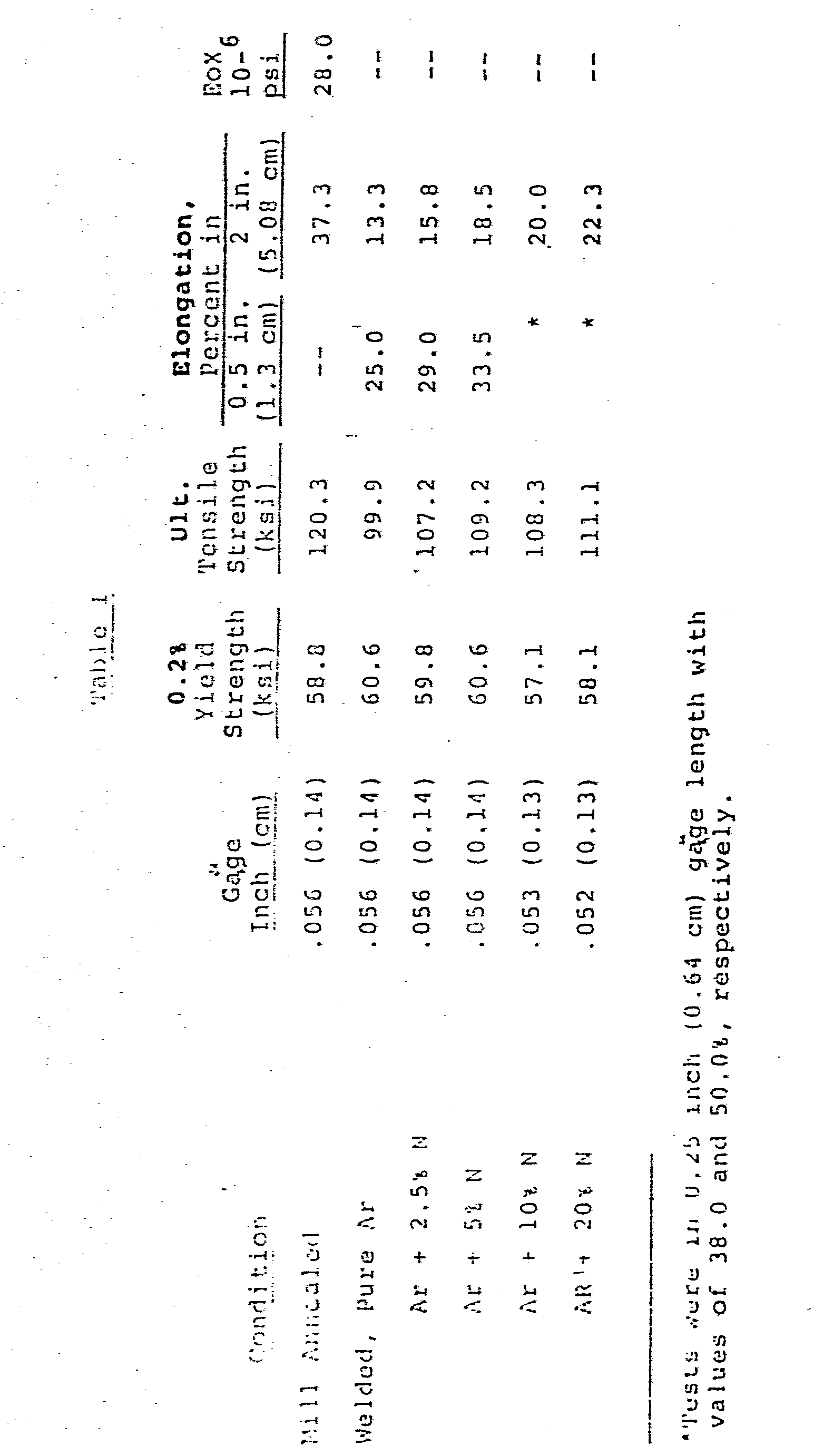
- Tensile and corrosion coupons were prepared from the as-annealed strip of Coil No. 1. The strip was autogenously tungsten inert gas (TIG) welded with shielding gases of (1) pure argon, (2) argon with 2.5% nitrogen, (3) argon with 5% nitrogen, (4) argon with 10% nitrogen, and (5) argon with 20% nitrogen. Tensile Tests of the as-annealed specimens were transverse to the- rolling direction and those from the as-welded coupons were transverse to the weld. The 1 by 2 inch (25.4 by 50.8mm) corrosion coupons of the as-welded specimens were prepared with the welds centrally located parallel to the 2 inch (50.8mm) dimension. These coupons were crevice- corrosion tested (according to ASTM G-48 - Practice B) to establish the critical crevice corrosion temperatures (CCCT). The CCCT is the temperature at which crevice corrosion becomes apparent after a 72-hour test in 10% FeCl3 in accordance with this practice. Higher CCCT demonstrates improved crevice corrosion resistance.
- The room temperature, transverse tensile properties of the annealed base metal and the as-welded samples were as follows:
- 0163379 For Coil No. 1, the critical crevice corrosion temperature (CCCT) for the various conditions were as follows:
- Mill Annealed : About 100°F (37.8°C)
- Welded-Pure Ar : Between 85 and 90°F (29.4 and 32.2°C) Welded-Ar & 2.5% N: About 90°F (32.2°C)
- Welded-Ar & 5% N : Between 95 and 100°F (35 and 37.8°C)
- As may be seen from the above-reported data, introducing nitrogen into the shielding gas improves the apparent as-welded tensile properties as well as the crevice corrosion resistance, which is demonstrated by the CCCT values. All of the welded samples fractured within the weld. The increase in tensile strength and apparent increase in enlongation with nitrogen used in the shielding gas occurred because the weld strength increased and the base metal contributed to elongation. Up to 20% N in the argon shielding gas shows modest increases in strength. Higher nitrogen up to 25% may also be possible.
- Specifically, as may be seen from the above-reported CCCT values, the samples to which 2.5% nitrogen have been added to the argon shielding gas during welding exhibited a higher critical temperature than those welded with pure argon as the shielding gas. The samples to which 5% nitrogen has been added to the argon shielding gas during welding exhibited a critical temperature comparable to the mill annealed product and thus comparable to the base metal unaffected by the welding operation. The addition of 5% nitrogen provides crevice corrosion in the welds that is equivalent, or nearly so, to the base metal.
- For Coil No. 2, the corrosion coupons were prepared in the manner for Coil No. 1. The CCCT for various conditions were determiend for the bright mill annealed surface and for a surface treated by blasting with an abrasive after welding. The reason for surface treating was to remove light oxides formed during welding. The CCT for various conditions were as follows:
-
- Mill Annealed : Between 110 and 115°F (43.3-46.1°C)
- Welded, Pure Ar : Between 90 and 95°F (32.2-35°C)
- Welded, Ar + 5% N : Between 95 and 100°F (35-37.8°C)
- Surface Blasted After welding
- Welded, Pure Ar : Between 95 and 100°F (35-37.8°C)
- Welded, Ar + 10% N : Between 95 and 100°F
- Welded, Ar + 20% N : Between 95 and 100°F
- The mill annealed base metal had a higher CCCT than Coil No.l, possibly because of a higher annealing temperature during production. The above data shows that the addition of 5% nitrogen to the argon shielding gas during welding increased the CCCT, thus improving the crevice corrosion resistance of the untreated surface. As for the treated welded strip, the nitrogen addition is shown to be beneficial although the effect is smaller. The attack at 100°F was confined to the welds in all the surface blasted samples; however, the attack was much greater in the sample welded only with pure argon. The 10% and 20% nitrogen addition reduced the level of attack.
- As a specific example of the practice of the invention with another nitrogen-bearing alloy, weldment samples were produced from the following alloy composition in weight percent:

- The room temperature, transverse tensile properties of the base metal and the as-welded samaples were as follows in Table II:

- The critical crevice corrosion temperatures (CCCT) and intergranular corrosion (TC) rate for various conditions were as follows:
- IC Rate

- As shown by the data, adding nitrogen to the shielding gas improves the apparent as-welded tensile properties and corrosion resistance. For welding with all argon and argon with 5% nitrogen, the weld samples fractured in the weld. At 10% nitrogen in the shielding gas, the fracture was in the fusion line. At 20% nitrogen additions, the fractures occurred wholly in the base metal heat affected zone (HAZ), Accordingly, the transverse elongations over 0.25 inch (0.64 cm) (across the weld) show decreases when the failure occurs outside the weld. This also means the weld deposit is at least as strong as the base metal with the 20% nitrogen addition.
- As for corrosion testing, the effect of introducing nitrogen is clearly beneficial. It is not completely understood why the welded samples, particularly with nitrogen in the shielding gas, exhibit better corrosion resistance than the base metal as measured by CCCT and IC rate. Possibly, a corrosion phenomenon called "end grain attack", which is accelerated subsurface attack in the longitudinal direction (probably segregation related), may be an explanation. Furthermore, with such a duplex alloy, nitrogen additions to the shielding gas could be useful to control weld structures. For example such
- nitrogen may avoid excessive delta ferrite which could harm toughness, strength and corrosion resistance.
- As was an object of the invention, conventional welding using shielding gas can provide welded articles having improved mechanical properties, corrosion resistance and structure.
Claims (13)
1. A method of improving the weld strength, weld ductility and corrosion resistance of a nitrogen-containing alloy weldment, which weldment is shielded with inert gas during welding, characterised in that said method comprises adding nitrogen to said inert gas.
2. A method according to claim 1, wherein said nitrogen-containing alloy is a stainless steel.
3. A method according to claim 2, wherein the stainless steel contains nitrogen within the range-of 0.15 to 0.25%, by weight.
4. A method according to claim 1, 2 or 3, wherein nitrogen is added to the inert gas in an amount within the range of 2 to 25%, by weight, of the shielding gas.
5. A method according to claim 4, wherein nitrogen is added to said inert gas in an amount within the range of 2.5 to 20% by weight of the shielding gas.
6. A method according to any other of the preceding claims, wherein said shielding gas comprises argon, helium or hydrogen or a mixture of two or more thereof.
7. A method according to claim 6, wherein the shielding gas includes oxygen or carbon dioxide or a mixture thereof.
8. A method of improving the weld strength, structure and crevice corrosion resistance of a nitrogen-containing stainless steel weldment which is shielded with inert gas during welding, characterised in that said method comprises adding nitrogen to said inert gas in an amount within the range of 2 to 25%, by weight, of the shielding gas.
9. A method according to claim 8, wherein said inert gas is argon, helium or hydrogen or a mixture of two or more thereof.
10. A method according to claim 8, wherein said inert gas is argon.
11. A method according to claim 8, 9 or 10163379 the stainless steel contains nitrogen within the range of 0.15 to 0.25%, by weight.
12. A method according to any one of claims 8 to 11, wherein nitrogen is added to the inert gas within the range of 2.5 to 20% by weight.
13. A method according to any one of claims 8 to 12, wherein nitrogen is added to improve the microstructure, including delta ferrite content, of the weld.
Applications Claiming Priority (2)
| Application Number | Priority Date | Filing Date | Title |
|---|---|---|---|
| US61584184A | 1984-05-31 | 1984-05-31 | |
| US615841 | 1984-05-31 |
Publications (2)
| Publication Number | Publication Date |
|---|---|
| EP0163379A2 true EP0163379A2 (en) | 1985-12-04 |
| EP0163379A3 EP0163379A3 (en) | 1987-03-25 |
Family
ID=24467034
Family Applications (1)
| Application Number | Title | Priority Date | Filing Date |
|---|---|---|---|
| EP85302083A Withdrawn EP0163379A3 (en) | 1984-05-31 | 1985-03-26 | Method of welding nitrogen-containing alloys |
Country Status (4)
| Country | Link |
|---|---|
| EP (1) | EP0163379A3 (en) |
| JP (1) | JPS60261679A (en) |
| KR (1) | KR850007940A (en) |
| ES (1) | ES8702816A1 (en) |
Cited By (12)
| Publication number | Priority date | Publication date | Assignee | Title |
|---|---|---|---|---|
| GB2253804A (en) * | 1991-03-21 | 1992-09-23 | Serdar Atamert | Open arc welding method and flux cored consumable electrode wires for use in the above method |
| EP0680802A1 (en) * | 1994-05-04 | 1995-11-08 | L'air Liquide, Societe Anonyme Pour L'etude Et L'exploitation Des Procedes Georges Claude | Protection gaseous mixture and process for arc welding of stainless steel workpieces |
| EP0734810A1 (en) * | 1995-03-29 | 1996-10-02 | L'air Liquide, Societe Anonyme Pour L'etude Et L'exploitation Des Procedes Georges Claude | Shielding gas mixture and process for arc welding of stainless steel workpieces |
| EP0826456A1 (en) * | 1996-09-03 | 1998-03-04 | Messer Griesheim Gmbh | Protecting gas mixture used in TIG welding |
| DE19857186A1 (en) * | 1998-12-11 | 2000-06-21 | Messer Griesheim Gmbh | Forming gas mixture for welding protection during inert gas welding |
| EP1055481A1 (en) * | 1999-05-24 | 2000-11-29 | Praxair Technology, Inc. | Shielding gas mixture for gas-metal arc welding |
| DE19961207A1 (en) * | 1999-12-18 | 2001-07-05 | Messer Griesheim Gmbh | Shielding gas mixture for use in metal inert gas welding |
| NL1014512C2 (en) * | 2000-02-28 | 2001-08-29 | Dsm Nv | Method for welding duplex steel. |
| WO2002047864A1 (en) * | 2000-12-15 | 2002-06-20 | Linde Aktiengesellschaft | Shielding gas and arc-welding method |
| EP1595633A1 (en) * | 2004-05-12 | 2005-11-16 | Siemens Aktiengesellschaft | Protecting gas mixture and welding method |
| CZ301415B6 (en) * | 2000-12-15 | 2010-02-24 | Linde Aktiengesellschaft | Protective gas and arc welding process |
| CN116786980A (en) * | 2023-07-22 | 2023-09-22 | 信达科创(唐山)石油设备有限公司 | Welding method for nitrogen-containing high-strength stainless steel continuous pipe cable |
Families Citing this family (1)
| Publication number | Priority date | Publication date | Assignee | Title |
|---|---|---|---|---|
| JP3422970B2 (en) | 2000-05-12 | 2003-07-07 | 東洋エンジニアリング株式会社 | High chrome austenitic stainless steel pipe welding method |
-
1985
- 1985-03-26 KR KR1019850002000A patent/KR850007940A/en not_active Withdrawn
- 1985-03-26 EP EP85302083A patent/EP0163379A3/en not_active Withdrawn
- 1985-05-10 ES ES543055A patent/ES8702816A1/en not_active Expired
- 1985-05-31 JP JP60118663A patent/JPS60261679A/en active Pending
Non-Patent Citations (2)
| Title |
|---|
| DERWENT JAPANESE, vol. 5, no. 15, 7th April 1966-13th April 1966, 7: Metallurgy - page 3, 6566/66; T. KOBAYASHI "Gas shielded arc welding of stainless steel" * |
| WELDING JOURNAL, vol. 62, no. 8, August 1983, pages 204-s-208-s, Miami, US; R.K. OKAGAWA et al.: "The influence of nitrogen from welding on stainless steel weld metal microstructures" * |
Cited By (21)
| Publication number | Priority date | Publication date | Assignee | Title |
|---|---|---|---|---|
| GB2253804A (en) * | 1991-03-21 | 1992-09-23 | Serdar Atamert | Open arc welding method and flux cored consumable electrode wires for use in the above method |
| GB2253804B (en) * | 1991-03-21 | 1994-08-31 | Serdar Atamert | Open arc welding method and flux cored consumable electrode wires for use in the above method |
| EP0680802A1 (en) * | 1994-05-04 | 1995-11-08 | L'air Liquide, Societe Anonyme Pour L'etude Et L'exploitation Des Procedes Georges Claude | Protection gaseous mixture and process for arc welding of stainless steel workpieces |
| FR2719514A1 (en) * | 1994-05-04 | 1995-11-10 | Air Liquide | Protective gas mixture and method of arc welding of stainless steel parts. |
| EP0734810A1 (en) * | 1995-03-29 | 1996-10-02 | L'air Liquide, Societe Anonyme Pour L'etude Et L'exploitation Des Procedes Georges Claude | Shielding gas mixture and process for arc welding of stainless steel workpieces |
| WO1996030158A1 (en) * | 1995-03-29 | 1996-10-03 | L'air Liquide, Societe Anonyme Pour L'etude Et L'exploitation Des Procedes Georges Claude | Shielding gas mixture and method for arc welding stainless steel parts |
| FR2732252A1 (en) * | 1995-03-29 | 1996-10-04 | Air Liquide | PROTECTIVE GAS MIXTURE AND ARC WELDING METHOD FOR STAINLESS STEEL PARTS |
| US5739503A (en) * | 1995-03-29 | 1998-04-14 | L'air Liquide, Societe Anonyme Pour L'etude Et L'exploitation Des Procedes Georges Claude | Shielding gas mixture and process for arc welding of stainless steel workpieces |
| EP0826456A1 (en) * | 1996-09-03 | 1998-03-04 | Messer Griesheim Gmbh | Protecting gas mixture used in TIG welding |
| DE19635497A1 (en) * | 1996-09-03 | 1998-03-05 | Messer Griesheim Gmbh | Shielding gas mixture for use in tungsten inert gas welding |
| DE19857186A1 (en) * | 1998-12-11 | 2000-06-21 | Messer Griesheim Gmbh | Forming gas mixture for welding protection during inert gas welding |
| EP1055481A1 (en) * | 1999-05-24 | 2000-11-29 | Praxair Technology, Inc. | Shielding gas mixture for gas-metal arc welding |
| DE19961207A1 (en) * | 1999-12-18 | 2001-07-05 | Messer Griesheim Gmbh | Shielding gas mixture for use in metal inert gas welding |
| DE19961207C2 (en) * | 1999-12-18 | 2003-05-28 | Messer Griesheim Gmbh | Use of a protective gas mixture for metal-inert gas welding of nickel materials |
| NL1014512C2 (en) * | 2000-02-28 | 2001-08-29 | Dsm Nv | Method for welding duplex steel. |
| WO2001064386A1 (en) * | 2000-02-28 | 2001-09-07 | Dsm N.V. | Process for welding duplex steel |
| US6793119B2 (en) | 2000-02-28 | 2004-09-21 | Dsm Ip Assets B.V. | Process for welding duplex steel |
| WO2002047864A1 (en) * | 2000-12-15 | 2002-06-20 | Linde Aktiengesellschaft | Shielding gas and arc-welding method |
| CZ301415B6 (en) * | 2000-12-15 | 2010-02-24 | Linde Aktiengesellschaft | Protective gas and arc welding process |
| EP1595633A1 (en) * | 2004-05-12 | 2005-11-16 | Siemens Aktiengesellschaft | Protecting gas mixture and welding method |
| CN116786980A (en) * | 2023-07-22 | 2023-09-22 | 信达科创(唐山)石油设备有限公司 | Welding method for nitrogen-containing high-strength stainless steel continuous pipe cable |
Also Published As
| Publication number | Publication date |
|---|---|
| EP0163379A3 (en) | 1987-03-25 |
| ES8702816A1 (en) | 1987-01-16 |
| JPS60261679A (en) | 1985-12-24 |
| KR850007940A (en) | 1985-12-11 |
| ES543055A0 (en) | 1987-01-16 |
Similar Documents
| Publication | Publication Date | Title |
|---|---|---|
| Katherasan et al. | Shielding gas effects on flux cored arc welding of AISI 316L (N) austenitic stainless steel joints | |
| KR101674743B1 (en) | Flux-cored wire for gas-shielded arc welding, method for welding steel for very low temperature use, and method for manufacturing weld joint | |
| JP2009248175A (en) | Tig welding method of high-strength steel using flux-containing wire | |
| CN112512742B (en) | Solid welding wire and method for manufacturing welded joint | |
| WO1998010888A1 (en) | Welding material for stainless steels | |
| EP4253588A1 (en) | Submerged arc welded joint | |
| KR20170140798A (en) | Flux-cored wire for gas-shielded arc welding | |
| EP1055481B1 (en) | Shielding gas mixture for gas-metal arc welding | |
| KR102889833B1 (en) | Weld joint and production method therefor | |
| JPS60261679A (en) | Method of welding alloy containing nitrogen | |
| JP3329261B2 (en) | Welding materials and welded joints for high temperature high strength steel | |
| EP4257281A1 (en) | Tig welding joint | |
| EP3974097A2 (en) | Covered electrode for arc welding high strength steel background | |
| KR100709521B1 (en) | Welding joint of large heat input welding and welding method thereof | |
| US20150034605A1 (en) | High fracture toughness welds in thick workpieces | |
| US4534793A (en) | Cast iron welding materials and method | |
| US4726854A (en) | Cast iron welding electrodes | |
| EP4353404A1 (en) | Metal-cored wire for submerged arc welding and submerged arc welding method using same | |
| JPH07102465B2 (en) | One-sided welding method of stainless clad steel plate | |
| EP4265370A1 (en) | Flux cored wire | |
| EP0844312B1 (en) | Stainless steels excellent in thermal neutron absorption | |
| JP7252051B2 (en) | Solid wire and weld joints for electroslag welding | |
| WO2023032932A1 (en) | Submerged arc welding method | |
| JP3351139B2 (en) | Welding method for low alloy high strength steel | |
| JP2003231950A (en) | Ferritic stainless steel welded structure |
Legal Events
| Date | Code | Title | Description |
|---|---|---|---|
| PUAI | Public reference made under article 153(3) epc to a published international application that has entered the european phase |
Free format text: ORIGINAL CODE: 0009012 |
|
| AK | Designated contracting states |
Designated state(s): BE DE FR GB IT SE |
|
| PUAL | Search report despatched |
Free format text: ORIGINAL CODE: 0009013 |
|
| AK | Designated contracting states |
Kind code of ref document: A3 Designated state(s): BE DE FR GB IT SE |
|
| STAA | Information on the status of an ep patent application or granted ep patent |
Free format text: STATUS: THE APPLICATION IS DEEMED TO BE WITHDRAWN |
|
| 18D | Application deemed to be withdrawn |
Effective date: 19870928 |
|
| RIN1 | Information on inventor provided before grant (corrected) |
Inventor name: AGGEN, GEORGE Inventor name: BEIGAY, JACK MARSHALL |