EP0161602A2 - 6-Chlorobenzazolyloxy-acetamide - Google Patents
6-Chlorobenzazolyloxy-acetamide Download PDFInfo
- Publication number
- EP0161602A2 EP0161602A2 EP85105482A EP85105482A EP0161602A2 EP 0161602 A2 EP0161602 A2 EP 0161602A2 EP 85105482 A EP85105482 A EP 85105482A EP 85105482 A EP85105482 A EP 85105482A EP 0161602 A2 EP0161602 A2 EP 0161602A2
- Authority
- EP
- European Patent Office
- Prior art keywords
- carbon atoms
- straight
- chain
- alkyl
- general formula
- Prior art date
- Legal status (The legal status is an assumption and is not a legal conclusion. Google has not performed a legal analysis and makes no representation as to the accuracy of the status listed.)
- Granted
Links
Classifications
-
- C—CHEMISTRY; METALLURGY
- C07—ORGANIC CHEMISTRY
- C07D—HETEROCYCLIC COMPOUNDS
- C07D263/00—Heterocyclic compounds containing 1,3-oxazole or hydrogenated 1,3-oxazole rings
- C07D263/52—Heterocyclic compounds containing 1,3-oxazole or hydrogenated 1,3-oxazole rings condensed with carbocyclic rings or ring systems
- C07D263/54—Benzoxazoles; Hydrogenated benzoxazoles
- C07D263/58—Benzoxazoles; Hydrogenated benzoxazoles with hetero atoms or with carbon atoms having three bonds to hetero atoms with at the most one bond to halogen, e.g. ester or nitrile radicals, directly attached in position 2
-
- A—HUMAN NECESSITIES
- A01—AGRICULTURE; FORESTRY; ANIMAL HUSBANDRY; HUNTING; TRAPPING; FISHING
- A01N—PRESERVATION OF BODIES OF HUMANS OR ANIMALS OR PLANTS OR PARTS THEREOF; BIOCIDES, e.g. AS DISINFECTANTS, AS PESTICIDES OR AS HERBICIDES; PEST REPELLANTS OR ATTRACTANTS; PLANT GROWTH REGULATORS
- A01N43/00—Biocides, pest repellants or attractants, or plant growth regulators containing heterocyclic compounds
- A01N43/72—Biocides, pest repellants or attractants, or plant growth regulators containing heterocyclic compounds having rings with nitrogen atoms and oxygen or sulfur atoms as ring hetero atoms
- A01N43/74—Biocides, pest repellants or attractants, or plant growth regulators containing heterocyclic compounds having rings with nitrogen atoms and oxygen or sulfur atoms as ring hetero atoms five-membered rings with one nitrogen atom and either one oxygen atom or one sulfur atom in positions 1,3
-
- C—CHEMISTRY; METALLURGY
- C07—ORGANIC CHEMISTRY
- C07D—HETEROCYCLIC COMPOUNDS
- C07D277/00—Heterocyclic compounds containing 1,3-thiazole or hydrogenated 1,3-thiazole rings
- C07D277/60—Heterocyclic compounds containing 1,3-thiazole or hydrogenated 1,3-thiazole rings condensed with carbocyclic rings or ring systems
- C07D277/62—Benzothiazoles
- C07D277/68—Benzothiazoles with hetero atoms or with carbon atoms having three bonds to hetero atoms with at the most one bond to halogen, e.g. ester or nitrile radicals, directly attached in position 2
-
- C—CHEMISTRY; METALLURGY
- C07—ORGANIC CHEMISTRY
- C07D—HETEROCYCLIC COMPOUNDS
- C07D417/00—Heterocyclic compounds containing two or more hetero rings, at least one ring having nitrogen and sulfur atoms as the only ring hetero atoms, not provided for by group C07D415/00
- C07D417/02—Heterocyclic compounds containing two or more hetero rings, at least one ring having nitrogen and sulfur atoms as the only ring hetero atoms, not provided for by group C07D415/00 containing two hetero rings
- C07D417/12—Heterocyclic compounds containing two or more hetero rings, at least one ring having nitrogen and sulfur atoms as the only ring hetero atoms, not provided for by group C07D415/00 containing two hetero rings linked by a chain containing hetero atoms as chain links
Definitions
- the invention relates to new 6-chlorobenzazolyloxyacetamides, a process for their preparation and their use as herbicides and fungicides.
- the new 6-chlorobenzazolyloxyacetamides of the formula (I) are herbicidal, in particular also have selective herbicidal properties and moreover also fungicidal properties.
- the new 6-chlorobenzazolyloxyacetamides of the formula (I) have a considerably improved herbicidal activity against common, difficult to control weeds with a comparatively high tolerance to important crop plants and, at the same time, a better fungicidal activity compared to the benzazolyloxyacetamides known from the prior art, such as for example, N-methyl-2-benzothiazolyloxyacetanilide, which are chemically and functionally obvious compounds.
- Formula (II) provides a general definition of the 6-chlorobenzazoles required as starting materials for carrying out the process according to the invention.
- X preferably represents oxygen or sulfur
- A preferably represents halogen, in particular chlorine or bromine, or for alkylsulfonyl or aralkylsulfonyl, in particular for methylsulfonyl or ethylsulfonyl.
- 6-chlorobenzazoles are known (cf. e.g. EP-OS 43 573 or DE-OS 30 25 910) or can be prepared in a simple, analogous manner by methods known in principle.
- Formula (III) provides a general definition of the glycolic acid amides required to carry out the process according to the invention as starting materials.
- R 1 and R 2 preferably represent those radicals which are already considered in the description of the substances of the formula (I) according to the invention were mentioned for these substituents.
- the glycolic acid amides of the formula (III) are also known (cf., for example, DE-OS 29 04 490, EP-OS 5501, EP-OS 29 171, DE-OS 30 38 598, DE-OS 32 44 956).
- Organic or inorganic solvents are suitable as diluents for the process according to the invention.
- Hydrocarbons such as toluene or cyclohexane, halogenated hydrocarbons such as methylene chloride, chloroform, dichloroethane or chlorobenzene, ketones such as acetone or methyl isobutyl ketone, ethers such as diethyl ether, diisopropyl ether or methyl t-butyl ether, alcohols such as methanol, ethanol or isopropanol, amides are preferred , such as dimethylformamide or dimethylacetamide, sulfoxides such as dimethyl sulfoxide, water or aqueous salt solutions.
- the salts used here are preferably chlorides or sulfates of alkali or alkaline earth metals, such as sodium chloride, potassium chloride or calcium chloride. Sodium chloride is particularly preferred.
- the process according to the invention is advantageously carried out using acid binders.
- strongly basic alkali and alkaline earth metal compounds for example oxides, such as e.g. Sodium, potassium, magnesium and calcium oxide, hydroxides such as e.g. Sodium, potassium, magnesium and calcium hydroxide and / or carbonates, e.g. Sodium, potassium, magnesium and calcium carbonate used.
- reaction temperatures can be varied within a substantial range in the process according to the invention. They are generally between -50 ° C and + 100 ° C, preferably between -20 ° C and + 100 ° C.
- the process according to the invention is generally carried out under normal pressure, but it can also be carried out under increased or reduced pressure, for example between 0.1 and 10 bar.
- 0.1 to 10 mol, preferably 0.8 to 1.2 mol, of glycolic acid amide of the formula (III) and 0.5 to 10 mol are generally employed per mol of 6-chlorobenzazole of the formula (II), preferably 0.5 to 3 moles of base.
- the additions sequence of the reactants can be interchanged as desired, all components can also be metered into the reaction vessel at the same time.
- the reaction can be carried out continuously or batchwise.
- the processing is carried out in the usual way.
- the active compounds according to the invention can be used as defoliants, desiccants, haulm killers and in particular as weed killers. Weeds in the broadest sense are understood to mean all plants that grow up in places where they are undesirable. Whether the substances according to the invention act as total or selective herbicides depends essentially on the amount used.
- the compounds are suitable for total weed control, e.g. on industrial and track systems and on paths and squares with and without tree cover.
- the compounds for weed control in permanent crops e.g. Forestry, ornamental trees, fruit, wine, citrus, nut, banana, coffee, tea, rubber, oil palm, cocoa, berry fruit and hop plants and for selective weed control in annual crops.
- the active compounds according to the invention also have a good tolerance to important crop plants and can therefore be used as selective weed control agents in monocotyledon crops, such as cereals and Rice as well as in dicotyledon crops such as soybeans, cotton, sugar beets and others.
- the active compounds according to the invention also have a strong microbicidal action when used in appropriate amounts and can be used practically to combat unwanted microorganisms.
- the active ingredients are suitable for use as pesticides.
- Fungicidal agents in crop protection are used to control Plasmodiophoromycetes, Oomycetes, Chytridiomycetes, Zygomycetes, Ascomycetes, Basidiomycetes, Deuteromycetes.
- the active compounds according to the invention can be used with particularly good results in combating rice diseases, for example against the rice stain pathogen (Pyricularia oryzae).
- the active compounds according to the invention also show systemic properties.
- the active ingredients can be converted into the usual formulations, such as solutions, emulsions, suspensions sions, powders, foams, pastes, granules, aerosols, active ingredient-impregnated natural and synthetic substances, fine encapsulation in polymeric substances and in coating compositions for seeds, also in formulations with fuel sets, such as smoking cartridges, cans, spirals, etc., as well as ULV cold and warm fog formulations.
- formulations are prepared in a known manner, for example by mixing the active ingredients with extenders, that is to say liquid solvents, pressurized liquefied gases and / or solid carriers, optionally using surface-active agents, that is to say emulsifiers and / or dispersants and / or foam-generating agents. If water is used as an extender, organic solvents can, for example, also be used as auxiliary solvents.
- extenders that is to say liquid solvents, pressurized liquefied gases and / or solid carriers, optionally using surface-active agents, that is to say emulsifiers and / or dispersants and / or foam-generating agents.
- surface-active agents that is to say emulsifiers and / or dispersants and / or foam-generating agents.
- organic solvents can, for example, also be used as auxiliary solvents.
- aromatics such as xylene, toluene, or alkylnaphthalenes
- chlorinated aromatics or chlorinated aliphatic hydrocarbons such as chlorobenzenes, chlorethylenes or methylene chloride
- aliphatic hydrocarbons such as cyclohexane or paraffins, for example petroleum fractions
- alcohols such as butanol or glycol as well as their ethers and esters
- ketones such as acetone, methyl ethyl ketone, methyl isobutyl ketone or cyclohexanone
- strongly polar solvents such as dimethylformamide and dimethyl sulfoxide, and water
- Liquefied gaseous extenders or carriers mean liquids which are gaseous at normal temperature and under normal pressure, for example aerosol propellants such as halogenated hydrocarbons and butane, propane, nitrogen and carbon dioxide
- solid carriers come in Fra ge: for example natural rock meals,
- Adhesives such as carboxymethyl cellulose, natural and synthetic powdery, granular or latex-shaped polymers, such as gum arabic, polyvinyl alcohol, polyvinyl acetate, and natural phospholipids such as cephalins and lecithins and synthetic phospholipids can be used in the formulations.
- Other additives can be mineral and vegetable oils.
- Dyes such as inorganic pigments, for example iron oxide, titanium oxide, ferrocyan blue and organic dyes such as alizarin, azo and metal phthalocyanine dyes and trace nutrients such as salts of iron, manganese, boron, copper, cobalt, molybdenum and zinc can be used.
- the formulations generally contain between 0.1 and 95 percent by weight of active compound, preferably between 0.5 and 90%.
- the active compounds according to the invention when used as herbicides, can also be used in a mixture with known herbicides for weed control, finished formulations and tank mixes being possible.
- Known herbicides such as e.g. 1-amino-6-ethylthio-3- (2,2-dimethylpropyl) -1,3,5-triazine-2,4 (1H, 3H) -dione or N- (2-benzothiazolyl) -N, N'- dimethyl urea for weed control in cereals; 4-amino-3-methyl-6-phenyl-1,2,4-triazin-5 (4H) -one for weed control in sugar beets and 4-amino-6- (1,2-dimethylethyl) -3-methyl-thio -1,2,4-triazin-5 (4H) -one for weed control in soybeans, in question.
- a mixture with other known active compounds such as fungicides, insecticides, acaricides, nematicides, bird repellants, plant nutrients and agents which improve soil structure, is also possible.
- the active ingredients as such in the form of their formulations or from them by further dilution prepared application forms, such as ready-to-use solutions, suspensions, emulsions, powders, pastes and granules. They are used in the customary manner, for example by watering, spraying, spraying or scattering.
- the active compounds according to the invention can be applied both before and after the plants emerge.
- the amount of active ingredient used can vary over a wide range. It essentially depends on the type of effect desired. In general, the application rates when used as herbicides are between 0.01 and 10 kq of active ingredient per hectare of soil, preferably between 0.05 and 5 kg per ha.
- the active compounds according to the invention can also be present in the formulations or in the various use forms in a mixture with other known active compounds, such as fungicides, bactericides, insecticides, acaricides, nematicides, herbicides, bird repellants, growth agents, plant nutrients and agents which improve soil structure.
- the active compounds can be used as such, in the form of their formulations or in the form of further dilution riding application forms, such as ready-to-use solutions, emulsions, suspensions, powders, pastes and granules, are used. They are used in the customary manner, for example by watering, dipping, spraying, spraying, atomizing, evaporating, injecting, slurrying, spreading, dusting, scattering, dry pickling, wet pickling, wet pickling, slurry pickling or incrusting.
- the active substance concentrations in the use forms can be varied over a wide range. They generally lie between 1 and 0.0001% by weight, preferably between 0.5 and 0.001%.
- amounts of active ingredient of 0.001 to 50 g per kilogram of seed, preferably 0.01 to 10 g, are generally required.
- active ingredient concentrations of 0.00001 to 0.1% by weight, preferably 0.0001 to 0.02% by weight, are required at the site of action.
- example A the following compound is also used as a reference substance: 2- (5-chlorobenzthiazol-2-yl) -N, N-hexamethylene-oxyacetamide (known from DE-OS 30 38 652).
- Solvent 5 parts by weight of acetone emulsifier: 1 part by weight of alkylaryl polyglycol ether
- active compound 1 part by weight of active compound is mixed with the stated amount of solvent, the stated amount of emulsifier is added and the concentrate is diluted with water to the desired concentration.
- Solvent 5 parts by weight of acetone emulsifier: 1 part by weight of alkylaryl polyglycol ether
- active compound 1 part by weight of active compound is mixed with the stated amount of solvent, the stated amount of emulsifier is added and the concentrate is diluted with water to the desired concentration.
- Test plants which have a height of 5-15 cm are sprayed with the active substance preparation in such a way that the desired amounts of active substance are applied per unit area.
- the concentration of the spray liquor is chosen so that the desired amounts of active compound are applied in 2000 l of water / ha.
- the degree of damage to the plants is rated in% damage compared to the development of the untreated control.
- Solvent 12.5 parts by weight of acetone emulsifier: 0.3 parts by weight of alkylaryl polyglycol ether
- active compound 1 part by weight of active compound is mixed with the stated amount of solvent and the concentrate is diluted with water and the stated amount of emulsifier to the desired concentration.
- the disease infestation is evaluated 4 days after the inoculation.
Landscapes
- Chemical & Material Sciences (AREA)
- Organic Chemistry (AREA)
- Life Sciences & Earth Sciences (AREA)
- Wood Science & Technology (AREA)
- Environmental Sciences (AREA)
- Plant Pathology (AREA)
- Health & Medical Sciences (AREA)
- Engineering & Computer Science (AREA)
- Dentistry (AREA)
- General Health & Medical Sciences (AREA)
- Agronomy & Crop Science (AREA)
- Zoology (AREA)
- Pest Control & Pesticides (AREA)
- Agricultural Chemicals And Associated Chemicals (AREA)
- Organic Low-Molecular-Weight Compounds And Preparation Thereof (AREA)
- Heterocyclic Carbon Compounds Containing A Hetero Ring Having Nitrogen And Oxygen As The Only Ring Hetero Atoms (AREA)
- Plural Heterocyclic Compounds (AREA)
- Thiazole And Isothizaole Compounds (AREA)
- Chemical Vapour Deposition (AREA)
- Crystals, And After-Treatments Of Crystals (AREA)
Abstract
Die Erfindung betrifft neue 6-Chlorbenzazolyloxyacetamide der allgemeinen Formel (I) <IMAGE> in welcher X für Sauerstoff oder Schwefel steht und R¹ und R² unabhängig voneinander für Alkyl, Alkenyl, Alkinyl, für jeweils gegebenenfalls substituiertes Cycloalkyl oder Cycloalkenyl, für Halogenalkyl, Alkoxyalkyl, Alkoxyalkylenoxy oder Alkoxy, für Aralkyl oder für gegebenenfalls substituiertes Aryl stehen oder R¹ und R² gemeinsam mit dem Stickstoffatom, an welches sie gebunden sind, für einen gegebenenfalls substituierten, gesättigten oder ungesättigten Heterocyclus stehen, der weitere Heteroatome enthalten kann, ein Verfahren zu ihrer Herstellung und ihre Verwendung als Herbizide und Fungizide.The invention relates to new 6-chlorobenzazolyloxyacetamides of the general formula (I) <IMAGE> in which X represents oxygen or sulfur and R¹ and R² independently of one another are alkyl, alkenyl, alkynyl, each optionally substituted cycloalkyl or cycloalkenyl, for haloalkyl, alkoxyalkyl, Alkoxyalkylenoxy or alkoxy, stand for aralkyl or for optionally substituted aryl or R¹ and R² together with the nitrogen atom to which they are attached stand for an optionally substituted, saturated or unsaturated heterocycle, which may contain further heteroatoms, a process for their preparation and their use as herbicides and fungicides.
Description
Die Erfindung betrifft neue 6-Chlorbenzazolyloxyacetamide, ein Verfahren zu ihrer Herstellung und ihre Verwendung als Herbizide und Fungizide.The invention relates to new 6-chlorobenzazolyloxyacetamides, a process for their preparation and their use as herbicides and fungicides.
Es ist bereits bekannt, daß bestimmte Benzazolyloxyacetamide, wie beispielsweise das 2-(Benzthiazol-2-yl)-N-methyl-oxyacetanilid, herbizide, insbesondere auch selektiv-herbizide Eigenschaften besitzen (vgl. z.B.It is already known that certain benzazolyloxyacetamides, such as 2- (benzothiazol-2-yl) -N-methyl-oxyacetanilide, have herbicidal, in particular also selective herbicidal properties (cf. e.g.
DE-OS 29 03 966 bzw. EP-OS 5501). Darüber hinaus sind auch bestimmte 5-Chlorbenzoxazolyloxyacetamide als Herbizide bekannt geworden (vgl. DE-OS 30 38 652).DE-OS 29 03 966 and EP-OS 5501). In addition, certain 5-chlorobenzoxazolyloxyacetamides have become known as herbicides (cf. DE-OS 30 38 652).
Die herbizide Wirkung dieser vorbekannten Verbindungen gegenüber Schadpflanzen ebenso wie ihre Verträglichkeit gegenüber wichtigen Kulturpflanzen ist jedoch insbesondere bei niedrigen Aufwandmengen und Konzentrationen nicht immer in allen Anwendungsbereichen völlig zufriedenstellend. Über eine fungizide Wirkung der vorbekannten Benzazolyloxyacetamide ist bisher nichts bekannt.However, the herbicidal activity of these previously known compounds against harmful plants and their compatibility with important crop plants is not always completely satisfactory in all areas of application, in particular at low application rates and concentrations. So far, nothing is known about a fungicidal action of the known benzazolyloxyacetamides.
Es wurden neue 6-Chlorbenzazolyloxyacetamide der allgemeinen Formel (I),

- X für Sauerstoff oder Schwefel steht und
- R1 und R2 unabhängig voneinander für Alkyl, Alkenyl, Alkinyl, für jeweils gegebenenfalls substituiertes Cycloalkyl oder Cycloalkenyl, für Halogenalkyl, Alkoxyalkyl, Alkoxyalkylenoxy oder Alkoxy, für Aralkyl oder für gegebenenfalls substituiertes Aryl stehen oder
- R1 und R2 gemeinsam mit dem Stickstoffatom, an welches sie gebunden sind, für einen gegebenenfalls substituierten, gesättigten oder ungesättigten Heterocyclus stehen, der weitere Heteroatome enthalten kann,
gefunden.New 6-chlorobenzazolyloxyacetamides of the general formula (I)
- X represents oxygen or sulfur and
- R 1 and R 2 independently of one another are alkyl, alkenyl, alkynyl, in each case optionally substituted cycloalkyl or cycloalkenyl, for haloalkyl, alkoxyalkyl, alkoxyalkyleneoxy or alkoxy, for aralkyl or for optionally substituted aryl or
- R 1 and R 2 together with the nitrogen atom to which they are attached represent an optionally substituted, saturated or unsaturated heterocycle which may contain further heteroatoms,
found.
Weiterhin wurde gefunden, daß man die neuen 6-Chlorbenzazolyloxyacetamide der allgemeinen Formel (I) erhält, wenn man 6-Chlorbenzazole der Formel (II),

- X die oben angegebene Bedeutung hat und
- A für eine elektronenanziehende Abgangsgruppierung steht,
mit Glykolsäureamiden der Formel (III)

- R1 und R2 die oben angegebene Bedeutung haben,
gegebenenfalls in Gegenwart eines Verdünnungsmittels und gegebenenfalls in Gegenwart eines Säurebindemittels sowie gegebenenfalls in Gegenwart eines Katalysators umsetzt.
- X has the meaning given above and
- A stands for an electron-withdrawing leaving group,
with glycolic acid amides of the formula (III)
- R 1 and R 2 have the meaning given above,
if appropriate in the presence of a diluent and if appropriate in the presence of an acid binder and if appropriate in the presence of a catalyst.
Schließlich wurde gefunden, daß die neuen 6-Chlorbenzazolyloxyacetamide der Formel (I) herbizide, insbesondere auch selektiv-herbizide Eigenschaften und darüberhinaus auch fungizide Eigenschaften besitzen.Finally, it was found that the new 6-chlorobenzazolyloxyacetamides of the formula (I) are herbicidal, in particular also have selective herbicidal properties and moreover also fungicidal properties.
überraschenderweise zeigen die neuen 6-Chlorbenzazolyloxyacetamide der Formel (I) eine erheblich verbesserte herbizide Wirksamkeit gegen verbreitete, schwer bekämpfbare Unkräuter bei vergleichbar hoher Verträglichkeit gegenüber wichtigen Kulturpflanzen und gleichzeitig auch eine bessere fungizide Wirksamkeit im Vergleich zu den aus dem Stand der Technik vorbekannten Benzazolyloxyacetamiden, wie beispielsweise das N-Methyl-2-benz- thiazolyloxyacetanilid, welche chemisch und wirkungsmäßig naheliegende Verbindungen sind.Surprisingly, the new 6-chlorobenzazolyloxyacetamides of the formula (I) have a considerably improved herbicidal activity against common, difficult to control weeds with a comparatively high tolerance to important crop plants and, at the same time, a better fungicidal activity compared to the benzazolyloxyacetamides known from the prior art, such as for example, N-methyl-2-benzothiazolyloxyacetanilide, which are chemically and functionally obvious compounds.
Die erfindungsgemäßen 6-Chlorbenzazolyloxyacetamide sind durch die Formel (I) allgemein definiert. Bevorzugt sind Verbindungen der Formel (I), bei welchen
- X für Sauerstoff oder Schwefel steht und
- R und R2 unabhängig voneinander für geradkettiges oder verzweigtes Alkyl mit 1 bis 8 Kohlenstoffatomen, geradkettiges oder verzweigtes Alkenyl und Alkinyl mit jeweils 2 bis 8 Kohlenstoffatomen, für gegebenenfalls einfach oder mehrfach, gleich oder verschieden substituiertes Cycloalkyl oder Cycloalkenyl mit jeweils 3 bis 7 Kohlenstoffatomen, wobei als Substituenten insbesondere Alkylreste mit 1 bis 4 Kohlenstoffatomen in Frage kommen, für jeweils geradkettiges oder verzweigtes Alkoxy, Alkoxyalkylenoxy oder Alkoxyalkyl mit jeweils 1 bis 8 Kohlenstoffatomen in den einzelnen Alkyl- bzw. Alkylenteilen, für Halogenalkyl mit 1 bis 8 Kohlenstoffatomen und 1 bis 5 Halogenatomen, insbesondere Fluor, Chlor und Brom, für Aralkyl mit 6 bis 10 Kohlenstoffatomen im Arylteil und 1 bis 2 Kohlenstoffatomen im Alkylteil, sowie für gegebenenfalls einfach oder mehrfach, gleich oder verschieden substituiertes Aryl mit 6 bis 10 Kohlenstoffatomen stehen, wobei als Substituenten in Frage kommen: Halogen, geradkettiges oder verzweigtes Alkyl, Alkoxy oder Alkylthio mit jeweils 1 bis 4 Kohlenstoffatomen, Halogenalkyl, Halogenalkoxy und Halogenalkylthio mit jeweils 1 bis 2 Kohlenstoffatomen und 1 bis 5 Halogenatomen, insbesondere Fluor, Chlor und Brom, sowie Nitro, oder
- R 1 und R 2 zusammen mit dem Stickstoffatom, an das sie gebunden sind, für einen gegebenenfalls einfach oder mehrfach, gleich oder verschieden substituierten, gesättigten oder ungesättigten, 5- bis 7-gliedrigen Heterocyclus stehen, wobei als Substituenten in Frage kommen: geradkettiges oder verzweigtes Alkyl mit 1 bis 6 Kohlenstoffatomen, auch in Form eines anellierten Ringsystems, Aryl mit 6 bis 10 Kohlenstoffatomen, auch in Form eines anellierten Ringsystems oder Dioxyalkylen mit 2 bis 3 Kohlenstoffatomen.
- X represents oxygen or sulfur and
- R and R 2 independently of one another for straight-chain or branched alkyl having 1 to 8 carbon atoms, straight-chain or branched alkenyl and alkynyl each having 2 to 8 carbon atoms, for optionally mono- or polysubstituted, identically or differently substituted cycloalkyl or cycloalkenyl each having 3 to 7 carbon atoms, where in particular alkyl radicals with 1 to 4 carbon atoms are suitable as substituents, each for straight-chain or branched alkoxy, Alkoxyalkyleneoxy or alkoxyalkyl, each with 1 to 8 carbon atoms in the individual alkyl or alkylene parts, for haloalkyl with 1 to 8 carbon atoms and 1 to 5 halogen atoms, in particular fluorine, chlorine and bromine, for aralkyl with 6 to 10 carbon atoms in the aryl part and 1 to 2 carbon atoms in the alkyl part, as well as aryl with 6 to 10 carbon atoms which are optionally mono- or polysubstituted by identical or different substituents, the following being suitable as substituents: halogen, straight-chain or branched alkyl, alkoxy or alkylthio each having 1 to 4 carbon atoms, haloalkyl, Haloalkoxy and haloalkylthio each having 1 to 2 carbon atoms and 1 to 5 halogen atoms, in particular fluorine, chlorine and bromine, and also nitro, or
- R 1 and R 2 together with the nitrogen atom to which they are attached represent an optionally mono- or polysubstituted, identically or differently substituted, saturated or unsaturated, 5- to 7-membered heterocycle, the following being suitable as substituents: straight-chain or branched alkyl with 1 to 6 carbon atoms, also in the form of a fused ring system, aryl with 6 to 10 carbon atoms, also in the form of a fused ring system or dioxyalkylene with 2 to 3 carbon atoms.
Besonders bevorzugt sind Verbindungen der Formel (I), bei welchen
- X für Sauerstoff oder Schwefel steht und
- R1 und R2 unabhängig voneinander für geradkettiges oder verzweigtes Alkyl mit 1 bis 6 Kohlenstoffatomen, für geradkettiges oder verzweigtes Alkenyl und Alkinyl mit jeweils 2 bis 6 Kohlenstoffatomen, für gegebenenfalls ein- bis dreifach, gleich oder verschieden durch Methyl oder Ethyl substituiertes Cycloalkyl bzw. Cycloalkenyl mit 5 bis 7 Kohlenstoffatomen, für jeweils geradkettiges oder verzweigtes Alkoxy, Alkoxyalkylenoxy oder Alkoxyalkyl mit jeweils 1 bis 6 Kohlenstoffatomen in den einzelnen Alkylteilen, für Halogenalkyl mit 1 bis 6 Kohlenstoffatomen und 1 bis 5 Halogenatomen, insbesondere Fluor, Brom und Chlor, für Benzyl sowie für gegebenenfalls ein- bis dreifach, gleich oder verschieden substituiertes Phenyl stehen, wobei als Substituenten besonders bevorzugt sind: Methyl, Ethyl, Methoxy, Methylthio, Trifluormethyl, Trifluormethoxy, Trifluormethylthio, Fluor, Chlor oder Nitro; oder
- R1 und R2 zusammen mit dem Stickstoffatom, an das sie gebunden sind, für einen gegebenenfalls ein- bis dreifach, gleich oder verschieden substituierten Heterocyclus der Formel

- X represents oxygen or sulfur and
- R 1 and R 2 independently of one another for straight-chain or branched alkyl having 1 to 6 carbon atoms, for straight-chain or branched alkenyl and alkynyl each having 2 to 6 carbon atoms, for optionally cycloalkyl which is monosubstituted to trisubstituted identically or differently by methyl or ethyl or Cycloalkenyl with 5 to 7 carbon atoms, each for straight-chain or branched alkoxy, alkoxyalkyleneoxy or alkoxyalkyl, each with 1 to 6 carbon atoms in the individual alkyl parts, for haloalkyl with 1 to 6 carbon atoms and 1 to 5 halogen atoms, in particular fluorine, bromine and chlorine, for benzyl and also represent optionally mono- to trisubstituted, identically or differently substituted phenyl, the following being particularly preferred as substituents: methyl, ethyl, methoxy, methylthio, trifluoromethyl, trifluoromethoxy, trifluoromethylthio, fluorine, chlorine or nitro; or
- R 1 and R 2 together with the nitrogen atom to which they are attached represent an optionally mono- to trisubstituted, identically or differently substituted heterocycle of the formula
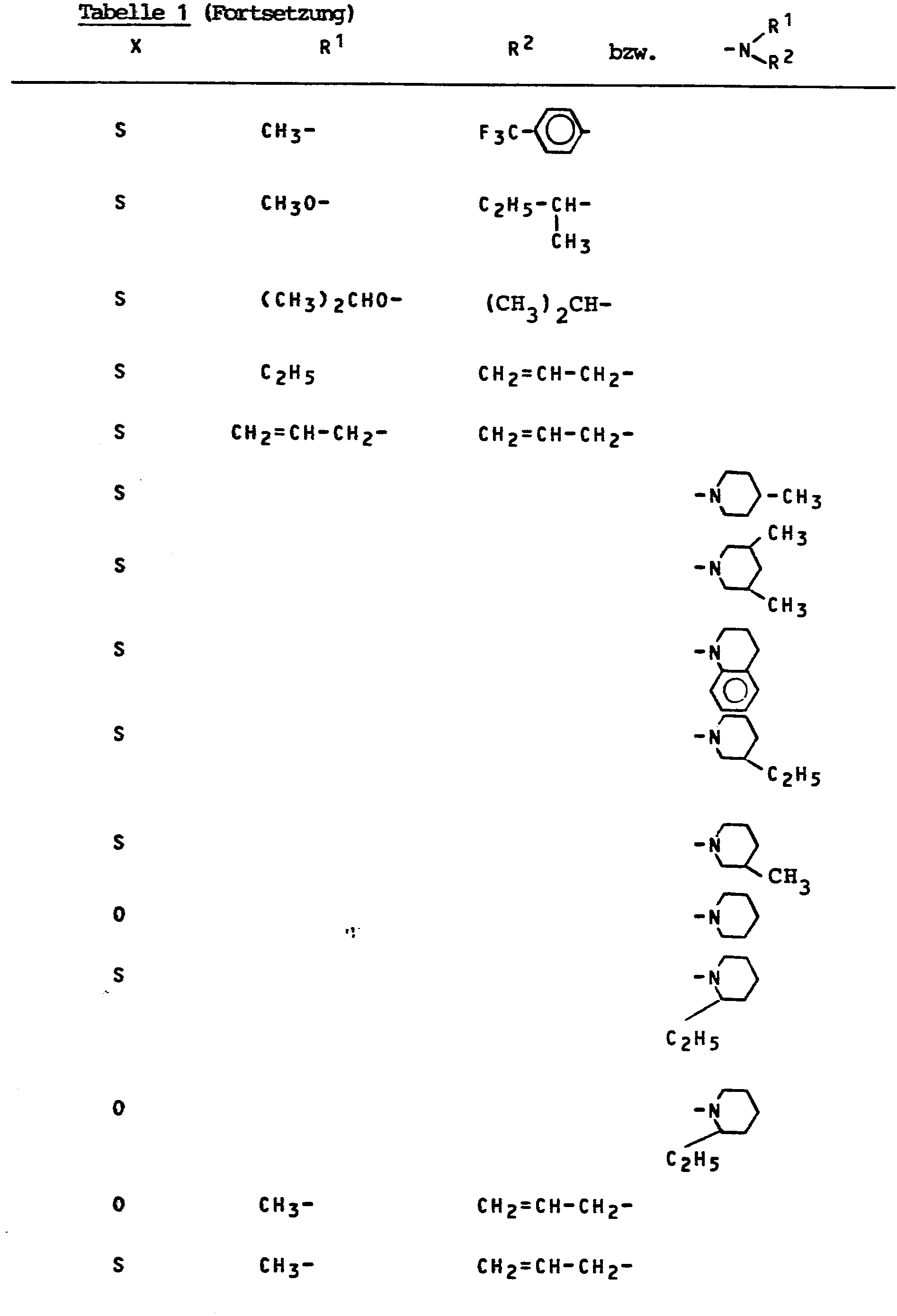
Im einzelnen seien außer den bei den Herstellungsbeispielen genannten Verbindungen die folgenden Verbindungen der allgemeinen Formel (I) genannt:




Verwendet man beispielsweise 2,6-Dichlorbenzoxazol und Glykolsäure-N-methylanilid als Ausgangsstoffe, so läßt sich der Reaktionsablauf des erfindungsgemäßen Verfahrens durch das folgende Formelschema darstellen:
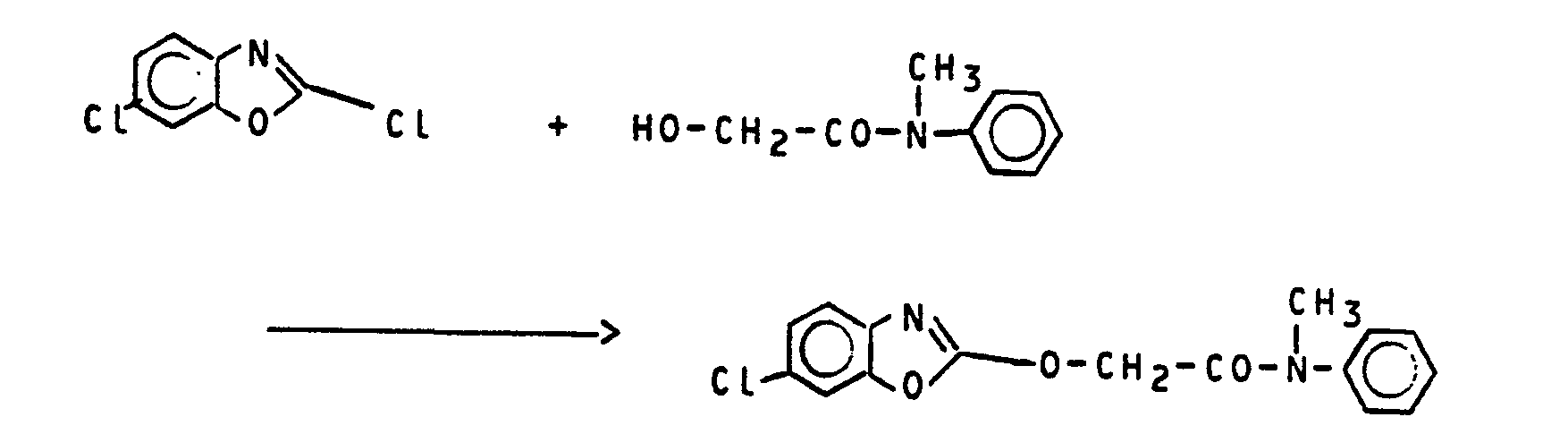
Die zur Durchführung des erfindungsgemäßen Verfahrens als Ausgangsstoffe benötigten 6-Chlorbenzazole sind durch die Formel (II) allgemein definiert. In dieser Formel (II) steht X vorzugsweise für Sauerstoff oder Schwefel, A steht vorzugsweise für Halogen, insbesondere Chlor oder Brom, oder für Alkylsulfonyl bzw. Aralkylsulfonyl, insbesondere für Methylsulfonyl oder Ethylsulfonyl.Formula (II) provides a general definition of the 6-chlorobenzazoles required as starting materials for carrying out the process according to the invention. In this formula (II), X preferably represents oxygen or sulfur, A preferably represents halogen, in particular chlorine or bromine, or for alkylsulfonyl or aralkylsulfonyl, in particular for methylsulfonyl or ethylsulfonyl.
Die 6-Chlorbenzazole sind bekannt (vgl. z.B. EP-OS 43 573 bzw. DE-OS 30 25 910) oder lassen sich nach prinzipiell bekannten Methoden in einfacher analoger Weise herstellen.The 6-chlorobenzazoles are known (cf. e.g. EP-OS 43 573 or DE-OS 30 25 910) or can be prepared in a simple, analogous manner by methods known in principle.
Die zur Durchführung des erfindungsgemäßen Verfahrens weiterhin als Ausgangsstoffe benötigten Glykolsäureamide sind durch die Formel (III) allgemein definiert. In dieser Formel (III) stehen R1 und R 2 vorzugsweise für diejenigen Reste, die schon bei der Beschreibung der erfindungsgemäßen Stoffe der Formel (I) als bevorzugt für diese Substituenten genannt wurden. Die Glykolsäureamide der Formel (III) sind ebenfalls bekannt (vgl. z.B. DE-OS 29 04 490, EP-OS 5501, EP-OS 29 171, DE-OS 30 38 598, DE-OS 32 44 956).Formula (III) provides a general definition of the glycolic acid amides required to carry out the process according to the invention as starting materials. In this formula (III), R 1 and R 2 preferably represent those radicals which are already considered in the description of the substances of the formula (I) according to the invention were mentioned for these substituents. The glycolic acid amides of the formula (III) are also known (cf., for example, DE-OS 29 04 490, EP-OS 5501, EP-OS 29 171, DE-OS 30 38 598, DE-OS 32 44 956).
Als Verdünnungsmittel für das erfindungsgemäße Verfahren kommen organische oder anorganische Lösungsmittel in Frage. Bevorzugt sind Kohlenwasserstoffe, wie Toluol oder Cyclohexan, Halogenkohlenwasserstoffe, wie Methylenchlorid, Chloroform, Dichlorethan oder Chlorbenzol, Ketone, wie Aceton oder Methylisobutylketon, Ether, wie Diethylether, Diisopropylether oder Methyl-t-butylether, Alkohole, wie Methanol, Ethanol oder Isopropanol, Amide, wie Dimethylformamid oder Dimethylacetamid, Sulfoxide, wie Dimethylsulfoxid, Wasser oder wäßrige Salzlösungen.Organic or inorganic solvents are suitable as diluents for the process according to the invention. Hydrocarbons such as toluene or cyclohexane, halogenated hydrocarbons such as methylene chloride, chloroform, dichloroethane or chlorobenzene, ketones such as acetone or methyl isobutyl ketone, ethers such as diethyl ether, diisopropyl ether or methyl t-butyl ether, alcohols such as methanol, ethanol or isopropanol, amides are preferred , such as dimethylformamide or dimethylacetamide, sulfoxides such as dimethyl sulfoxide, water or aqueous salt solutions.
Als Salze verwendet man hierbei vorzugsweise Chloride oder Sulfate von Alkali- oder Erdalkalimetallen, wie beispielsweise Natriumchlorid, Kaliumchlorid oder Calciumchlorid. Besonders bevorzugt ist Natriumchlorid.The salts used here are preferably chlorides or sulfates of alkali or alkaline earth metals, such as sodium chloride, potassium chloride or calcium chloride. Sodium chloride is particularly preferred.
Das erfindungsgemäße Verfahren wird vorteilhaft unter Verwendung von Säurebindemitteln durchgeführt. Als solche werden vorzugsweise stark basische Alkali- und Erdalkalimetallverbindungen, beispielsweise Oxide, wie z.B. Natrium-, Kalium-, Magnesium- und Calciumoxid, Hydroxide, wie z.B. Natrium-, Kalium-, Magnesium- und Calciumhydroxid und/ oder Carbonate, wie z.B. Natrium-, Kalium-, Magnesium- und Calciumcarbonat verwendet.The process according to the invention is advantageously carried out using acid binders. As such, strongly basic alkali and alkaline earth metal compounds, for example oxides, such as e.g. Sodium, potassium, magnesium and calcium oxide, hydroxides such as e.g. Sodium, potassium, magnesium and calcium hydroxide and / or carbonates, e.g. Sodium, potassium, magnesium and calcium carbonate used.
Der Zusatz von 0,01 bis 10 Gew.-% (bezogen auf eingesetztes Glykolsäureamid der Formel (III)) eines Phasentransferkatalysators mag sich in einigen Fällen als vorteilhaft erweisen. Als Beispiele für solche Katalysatoren seien genannt:
- Tetrabutylammoniumchlorid, Tetrabutylammoniumbromid, Tributyl-methylphosphoniumbromid, Trimethyl-C13/C15 alkyl-ammoniumchlorid, Dibenzyl-dimethyl-ammoniummethylsulfat, Dimethyl-C12/C14-alkyl-benzylammonium- chlorid, Tetrabutylammoniumhydroxid, 18-Krone-6, Triethylbenzylammoniumchlorid, Trimethylbenzylammoniumchlorid, Tetraethylammoniumbromid.
- Tetrabutylammonium chloride, tetrabutylammonium bromide, T ributyl-methylphosphonium bromide, trimethyl-C 13 / C 15 alkyl-ammonium chloride, dibenzyl-dimethyl-ammonium-methyl sulfate, dimethyl-C 12 / C 14- alkyl-benzylammonium chloride, tetrabutyl-ammonium chloride, triethylammonium chloride, Trimethylbenzylammonium chloride, tetraethylammonium bromide.
Die Reaktionstemperaturen können bei dem erfindungsgemäßen Verfahren innerhalb eines größeren Bereiches variiert werden. Sie liegen im allgemeinen zwischen -50°C und +100°C, vorzugsweise zwischen -20°C und +100°C.The reaction temperatures can be varied within a substantial range in the process according to the invention. They are generally between -50 ° C and + 100 ° C, preferably between -20 ° C and + 100 ° C.
Das erfindungsgemäße Verfahren wird im allgemeinen bei Normaldruck durchgeführt, es kann aber auch bei erhöhtem oder vermindertem Druck, etwa zwischen 0,1 und 10 bar, durchgeführt werden.The process according to the invention is generally carried out under normal pressure, but it can also be carried out under increased or reduced pressure, for example between 0.1 and 10 bar.
Zur Durchführung des erfindungsgemäßen Verfahrens setzt man pro Mol 6-Chlorbenzazol der Formel (II) im allgemeinen 0,1 bis 10 Mol, vorzugsweise 0,8 bis 1,2 Mol an Glykolsäureamid der Formel (III) und 0,5 bis 10 Mol, vorzugsweise 0,5 bis 3 Mol an Base ein. Die Zugabereihenfolge der Reaktanten kann beliebig vertauscht werden, es können auch alle Komponenten gleichzeitig in das Reaktionsgefäß eindosiert werden. Die Reaktionsführung kann kontinuierlich oder diskontinuierlich gestaltet werden. Die Aufarbeitung erfolgt in üblicher Art und Weise.To carry out the process according to the invention, 0.1 to 10 mol, preferably 0.8 to 1.2 mol, of glycolic acid amide of the formula (III) and 0.5 to 10 mol are generally employed per mol of 6-chlorobenzazole of the formula (II), preferably 0.5 to 3 moles of base. The additions sequence of the reactants can be interchanged as desired, all components can also be metered into the reaction vessel at the same time. The reaction can be carried out continuously or batchwise. The processing is carried out in the usual way.
Die erfindungsgemäßen Wirkstoffe können als Defoliants, Desiccants, Krautabtötungsmittel und insbesondere als Unkrautvernichtungsmittel verwendet werden. Unter Unkraut im weitesten Sinne sind alle Pflanzen zu verstehen, die an Orten aufwachsen, wo sie unerwünscht sind. Ob die erfindungsgemäßen Stoffe als totale oder selektive Herbizide wirken, hängt im wesentlichen von der angewendeten Menge ab.The active compounds according to the invention can be used as defoliants, desiccants, haulm killers and in particular as weed killers. Weeds in the broadest sense are understood to mean all plants that grow up in places where they are undesirable. Whether the substances according to the invention act as total or selective herbicides depends essentially on the amount used.
Die erfindungsgemäßen Wirkstoffe können z.B. bei den folgenden Pflanzen verwendet werden:
- Dikotyle Unkräuter der Gattungen: Sinapis, Lepidium, Galium, Stellaria, Matricaria, Anthemis, Galinsoga, Chenopodium,.Urtica, Senecio, Amaranthus, Portulaca, Xanthium, Convolvulus, Ipomoea, Polygonum, Sesbania, Ambrosia, Cirsium, Carduus, Sonchus, Solanum, Rorippa, Rotala, Lindernia, Lamium, Veronica, Abutilon, Emex, Datura, Viola, Galeopsis, Papaver, Centaurea.
- Dicotyledon weeds of the genera: Sinapis, Lepidium, Galium, Stellaria, Matricaria, Anthemis, Galinsoga, Chenopodium, .Urtica, Senecio, Amaranthus, Portulaca, Xanthium, Convolvulus, Ipomoea, Polygonum, Sesbania, Ambrosia, Cirsium, Sonusum, Carduus Rorippa, Rotala, Lindernia, Lamium, Veronica, Abutilon, Emex, Datura, Viola, Galeopsis, Papaver, Centaurea.
Dikotyle Kulturen der Gattungen: Gossypium, Glycine, Beta, Daucus, Phaseolus, Pisum, Solanum, Linum, Ipomoea, Vicia, Nicotiana, Lycopersicon, Arachis, Brassica, Lactuca, Cucumis, Cucurbita.Dicotyledon cultures of the genera: Gossypium, Glycine, Beta, Daucus, Phaseolus, Pisum, Solanum, Linum, Ipomoea, Vicia, Nicotiana, Lycopersicon, Arachis, Brassica, Lactuca, Cucumis, Cucurbita.
Monokotyle Unkräuter der Gattungen: Echinochloa, Setaria, Panicum, Digitaria, Phleum, Poa, Festuca, Eleusine, Brachiaria, Lolium, Bromus, Avena, Cyperus, Sorghum, Agropyron, Cynodon, Monochoria, Fimbristylis, Sagittaria, Eleocharis, Scirpus, Paspalum, Ischaemum, Sphenoclea, Dactyloctenium, Agrostis, Alopecurus, Apera.Monocotyledonous weeds of the genera: Echinochloa, Setaria, Panicum, Digitaria, Phleum, Poa, Festuca, Eleusine, Brachiaria, Lolium, Bromus, Avena, Cyperus, Sorghum, Agropyron, Cynodon, Monochoria, Fimbristylis, Sagittaria, Iochasemirumum, Scalumum, Scalumumum , Sphenoclea, Dactyloctenium, Agrostis, Alopecurus, Apera.
Monokotyle Kulturen der Gattungen: Oryza, Zea, Triticum, Hordeum, Avena, Secale, Sorghum, Panicum, Saccharum, Ananas, Asparagus, Allium.Monocot cultures of the genera: Oryza, Zea, Triticum, Hordeum, Avena, Secale, Sorghum, Panicum, Saccharum, Pineapple, Asparagus, Allium.
Die Verwendung der erfindungsgemäßen Wirkstoffe ist jedoch keineswegs auf diese Gattungen beschränkt, sondern erstreckt sich in gleicher Weise auch auf andere Pflanzen.However, the use of the active compounds according to the invention is by no means restricted to these genera, but extends in the same way to other plants.
Die Verbindungen eignen sich in Abhängigkeit von der Konzentration zur Totalunkrautbekämpfung z.B. auf Industrie-und Gleisanlagen und auf Wegen und Plätzen mit und ohne Baumbewuchs. Ebenso können die Verbindungen zur Unkrautbekämpfung in Dauerkulturen, z.B. Forst-, Ziergehölz-, Obst-, Wein-, Citrus-, Nuß-, Bananen-, Kaffee-, Tee-, Gummi-, ölpalm-, Kakao-, Beerenfrucht- und Hopfenanlagen und zur selektiven Unkrautbekämpfung in einjährigen Kulturen eingesetzt werden.Depending on the concentration, the compounds are suitable for total weed control, e.g. on industrial and track systems and on paths and squares with and without tree cover. Likewise, the compounds for weed control in permanent crops, e.g. Forestry, ornamental trees, fruit, wine, citrus, nut, banana, coffee, tea, rubber, oil palm, cocoa, berry fruit and hop plants and for selective weed control in annual crops.
Dabei zeigen die erfindungsgemäßen Wirkstoffe neben einer hervorragenden Wirkung gegenüber Schadpflanzen auch eine gute Verträglichkeit gegenüber wichtigen Kulturpflanzen und können daher als selektive Unkrautbekämpfungsmittel in monokotylen Kulturen, wie Getreide und Reis ebenso wie in dikotylen Kulturen, wie Sojabohnen, Baumwolle, Zuckerrüben und anderen eingesetzt werden.In addition to an excellent action against harmful plants, the active compounds according to the invention also have a good tolerance to important crop plants and can therefore be used as selective weed control agents in monocotyledon crops, such as cereals and Rice as well as in dicotyledon crops such as soybeans, cotton, sugar beets and others.
Darüber hinaus weisen die erfindungsgemäßen Wirkstoffe in entsprechenden Aufwandmengen auch eine starke mikrobizide Wirkung auf und können zur Bekämpfung von unerwünschten Mikroorganismen praktisch eingesetzt werden. Die Wirkstoffe sind für den Gebrauch als Pflanzenschutzmittel geeignet.In addition, the active compounds according to the invention also have a strong microbicidal action when used in appropriate amounts and can be used practically to combat unwanted microorganisms. The active ingredients are suitable for use as pesticides.
Fungizide Mittel im Pflanzenschutz werden eingesetzt zur Bekämpfung von Plasmodiophoromycetes, Oomycetes, Chytridiomycetes, Zygomycetes, Ascomycetes, Basidiomycetes, Deuteromycetes.Fungicidal agents in crop protection are used to control Plasmodiophoromycetes, Oomycetes, Chytridiomycetes, Zygomycetes, Ascomycetes, Basidiomycetes, Deuteromycetes.
Die gute Pflanzenverträglichkeit der Wirkstoffe in den zur Bekämpfung von Pflanzenkrankheiten notwendigen Konzentrationen erlaubt eine Behandlung von oberirdischen Pflanzenteilen, von Pflanz- und Saatgut, und des Bodens.The fact that the active compounds are well tolerated by plants in the concentrations required to combat plant diseases permits treatment of above-ground parts of plants, of propagation stock and seeds, and of the soil.
Dabei lassen sich die erfindungsgemäßen Wirkstoffe mit besonders gutem Erfolg zur Bekämpfung von Reiskrankheiten wie beispielsweise gegen den Erreger der Reisfleckenkrankheit (Pyricularia oryzae) einsetzen. Neben einer protektiven Wirksamkeit zeigen die erfindungsgemäßen Wirkstoffe hierbei insbesondere auch systemische Eigenschaften.The active compounds according to the invention can be used with particularly good results in combating rice diseases, for example against the rice stain pathogen (Pyricularia oryzae). In addition to a protective activity, the active compounds according to the invention also show systemic properties.
Die Wirkstoffe können in die üblichen Formulierungen übergeführt werden, wie Lösungen, Emulsionen, Suspensionen, Pulver, Schäume, Pasten, Granulate, Aerosole, Wirkstoff-imprägnierte Natur- und synthetische Stoffe, Feinstverkapselungen in polymeren Stoffen und in Hüllmassen für Saatgut, ferner in Formulierungen mit Brennsätzen, wie Räucherpatronen, -dosen, -spiralen u.ä., sowie ULV-Kalt- und Warmnebel-Formulierungen.The active ingredients can be converted into the usual formulations, such as solutions, emulsions, suspensions sions, powders, foams, pastes, granules, aerosols, active ingredient-impregnated natural and synthetic substances, fine encapsulation in polymeric substances and in coating compositions for seeds, also in formulations with fuel sets, such as smoking cartridges, cans, spirals, etc., as well as ULV cold and warm fog formulations.
Diese Formulierungen werden in bekannter Weise hergestellt, z.B. durch Vermischen der Wirkstoffe mit Streckmitteln, also flüssigen Lösungsmitteln, unter Druck stehenden verflüssigten Gasen und/oder festen Trägerstoffen, gegebenenfalls unter Verwendung von oberflächenaktiven Mitteln, also Emulgiermitteln und/oder Dispergiermitteln und/oder schaumerzeugenden Mitteln. Im Falle der Benutzung von Wasser als Streckmittel können z.B. auch organische Lösungsmittel als Hilfslösungsmittel verwendet werden. Als flüssige Lösungsmittel kommen im wesentlichen in Frage: Aromaten, wie Xylol, Toluol, oder Alkylnaphthaline, chlorierte Aromaten oder chlorierte aliphatische Kohlenwasserstoffe, wie Chlorbenzole, Chlorethylene oder Methylenchlorid, aliphatische Kohlenwasserstoffe, wie Cyclohexan oder Paraffine, z.B. Erdölfraktionen, Alkohole, wie Butanol oder Glycol sowie deren Ether und Ester, Ketone, wie Aceton, Methylethylketon, Methylisobutylketon oder Cyclohexanon, stark polare Lösungsmittel, wie Dimethylformamid und Dimethylsulfoxid, sowie Wasser; mit verflüssigten gasförmigen Streckmitteln oder Trägerstoffen sind solche Flüssigkeiten gemeint, welche bei normaler Temperatur und unter Normaldruck gasförmig sind, z.B. Aerosol-Treibgase, wie Halogenkohlenwasserstoffe sowie Butan, Propan, Stickstoff und Kohlendioxid; als feste Trägerstoffe kommen in Frage: z.B. natürliche Gesteinsmehle, wie Kaoline, Tonerden, Talkum, Kreide, Quarz, Attapulgit, Montmorillonit oder Diatomeenerde und synthetische Gesteinsmehle, wie hochdisperse Kieselsäure, Aluminiumoxid und Silikate; als feste Trägerstoffe für Granulate kommen in Frage: z.B. gebrochene und fraktionierte natürliche Gesteine wie Calcit, Marmor, Bims, Sepiolith, Dolomit sowie synthetische Granulate aus anorganischen und organischen Mehlen sowie Granulate aus organischem Material wie Sägemehl, Kokosnußschalen, Maiskolben und Tabakstengel; als Emulgier- und/oder schaumerzeugende Mittel kommen in Frage: z.B. nichtionogene und anionische Emulgatoren, wie Polyoxyethylen-Fettsäure-Ester, Polyoxyethylen-Fettalkohol-Ether, z.B. Alkylarylpolyglykol-Ether, Alkylsulfonate, Alkylsulfate, Arylsulfonate sowie Eiweißhydrolysate; als Dispergiermittel kommen in Frage: z.B. Lignin-Sulfitablaugen und Methylcellulose.These formulations are prepared in a known manner, for example by mixing the active ingredients with extenders, that is to say liquid solvents, pressurized liquefied gases and / or solid carriers, optionally using surface-active agents, that is to say emulsifiers and / or dispersants and / or foam-generating agents. If water is used as an extender, organic solvents can, for example, also be used as auxiliary solvents. The following are essentially suitable as liquid solvents: aromatics, such as xylene, toluene, or alkylnaphthalenes, chlorinated aromatics or chlorinated aliphatic hydrocarbons, such as chlorobenzenes, chlorethylenes or methylene chloride, aliphatic hydrocarbons, such as cyclohexane or paraffins, for example petroleum fractions, alcohols, such as butanol or glycol as well as their ethers and esters, ketones such as acetone, methyl ethyl ketone, methyl isobutyl ketone or cyclohexanone, strongly polar solvents such as dimethylformamide and dimethyl sulfoxide, and water; Liquefied gaseous extenders or carriers mean liquids which are gaseous at normal temperature and under normal pressure, for example aerosol propellants such as halogenated hydrocarbons and butane, propane, nitrogen and carbon dioxide; as solid carriers come in Fra ge: for example natural rock meals, such as kaolins, clays, talc, chalk, quartz, attapulgite, montmorillonite or diatomaceous earth and synthetic rock meals, such as highly disperse silica, aluminum oxide and silicates; Possible solid carriers for granules are: broken and fractionated natural rocks such as calcite, marble, pumice, sepiolite, dolomite and synthetic granules made from inorganic and organic flours as well as granules made from organic materials such as sawdust, coconut shells, corn cobs and tobacco stalks; suitable emulsifiers and / or foam-generating agents are: for example nonionic and anionic emulsifiers, such as polyoxyethylene fatty acid esters, polyoxyethylene fatty alcohol ethers, for example alkylaryl polyglycol ethers, alkyl sulfonates, alkyl sulfates, aryl sulfonates and protein hydrolyzates; The following may be used as dispersants: for example lignin sulfite waste liquor and methyl cellulose.
Es können in den Formulierungen Haftmittel wie Carboxymethylcellulose, natürliche und synthetische pulverige, körnige oder latexförmige Polymere verwendet werden, wie Gummiarabicum, Polyvinylalkohol, Polyvinylacetat, sowie natürliche Phospholipide, wie Kephaline und Lecithine und synthetische Phospholipide. Weitere Additve können mineralische und vegetabile öle sein.Adhesives such as carboxymethyl cellulose, natural and synthetic powdery, granular or latex-shaped polymers, such as gum arabic, polyvinyl alcohol, polyvinyl acetate, and natural phospholipids such as cephalins and lecithins and synthetic phospholipids can be used in the formulations. Other additives can be mineral and vegetable oils.
Es können Farbstoffe wie anorganische Pigmente, z.B. Eisenoxid, Titanoxid, Ferrocyanblau und organische Farbstoffe, wie Alizarin-, Azo- und Metallphthalocyaninfarbstoffe und Spurennährstoffe wie Salze von Eisen, Mangan, Bor, Kupfer, Kobalt, Molybdän und Zink verwendet werden. Die Formulierungen enthalten im allgemeinen zwischen 0,1 und 95 Gewichtsprozent Wirkstoff, vorzugsweise zwischen 0,5 und 90 %.Dyes such as inorganic pigments, for example iron oxide, titanium oxide, ferrocyan blue and organic dyes such as alizarin, azo and metal phthalocyanine dyes and trace nutrients such as salts of iron, manganese, boron, copper, cobalt, molybdenum and zinc can be used. The formulations generally contain between 0.1 and 95 percent by weight of active compound, preferably between 0.5 and 90%.
Bei der Verwendung als Herbizide können die erfindungsgemäßen Wirkstoffe als solche oder in ihren Formulierungen auch in Mischung mit bekannten Herbiziden zur Unkrautbekämpfung Verwendung finden, wobei Fertigformulierungen und Tankmischungen möglich sind.When used as herbicides, the active compounds according to the invention, as such or in their formulations, can also be used in a mixture with known herbicides for weed control, finished formulations and tank mixes being possible.
Für die Mischung kommen bekannte Herbizide wie z.B. 1-Amino-6-ethylthio-3-(2,2-dimethylpropyl)-1,3,5-triazin-2,4(1H,3H)-dion oder N-(2-Benzthiazolyl)-N,N'-dimethyl-harnstoff zur Unkrautbekämpfung in Getreide; 4-Amino-3-methyl-6-phenyl-1,2,4-triazin-5(4H)-on zur Unkrautbekämpfung in Zuckerrüben und 4-Amino-6-(1,2-dimethylethyl)-3-methyl-thio-1,2,4-triazin-5(4H)-on zur Unkrautbekämpfung in Sojabohen, in Frage. Auch Mischungen mit N,N-Dimethyl-N'-(4-chlor-3-methylphenyl)-harnstoff, N,N-Dimethyl-N'-(4-isopropylphenyl)-harnstoff, mit weiteren Triazindionen oder Pyridyl-phenoxy-propionsäuren sind möglich. Einige Mischungen zeigen überraschenderweise auch synergistische Wirkung.Known herbicides such as e.g. 1-amino-6-ethylthio-3- (2,2-dimethylpropyl) -1,3,5-triazine-2,4 (1H, 3H) -dione or N- (2-benzothiazolyl) -N, N'- dimethyl urea for weed control in cereals; 4-amino-3-methyl-6-phenyl-1,2,4-triazin-5 (4H) -one for weed control in sugar beets and 4-amino-6- (1,2-dimethylethyl) -3-methyl-thio -1,2,4-triazin-5 (4H) -one for weed control in soybeans, in question. Mixtures with N, N-dimethyl-N '- (4-chloro-3-methylphenyl) urea, N, N-dimethyl-N' - (4-isopropylphenyl) urea, with further triazinediones or pyridyl-phenoxy-propionic acids are possible. Surprisingly, some mixtures also show a synergistic effect.
Auch eine Mischung mit anderen bekannten Wirkstoffen, wie Fungiziden, Insektiziden, Akariziden, Nematiziden, Schutzstoffen gegen Vogelfraß, Pflanzennährstoffen und Bodenstrukturverbesserungsmitteln ist möglich.A mixture with other known active compounds, such as fungicides, insecticides, acaricides, nematicides, bird repellants, plant nutrients and agents which improve soil structure, is also possible.
Die Wirkstoffe können als solche, in Form ihrer Formulierungen oder den daraus durch weiteres Verdünnen bereiteten Anwendungsformen, wie gebrauchfertige Lösungen, Suspensionen, Emulsionen, Pulver, Pasten und Granulate angewandt werden. Die Anwendung geschieht in üblicher Weise, z.B. durch Gießen, Spritzen, Sprühen, Streuen.The active ingredients as such, in the form of their formulations or from them by further dilution prepared application forms, such as ready-to-use solutions, suspensions, emulsions, powders, pastes and granules. They are used in the customary manner, for example by watering, spraying, spraying or scattering.
Die erfindungsgemäßen Wirkstoffe können sowohl vor als auch nach dem Auflaufen der Pflanzen appliziert werden.The active compounds according to the invention can be applied both before and after the plants emerge.
Sie können auch vor der Saat in den Boden eingearbeitet werden.They can also be worked into the soil before sowing.
Die angewandte Wirkstoffmenge kann in einem größeren Bereich schwanken. Sie hängt im wesentlichen von der Art des gewünschten Effektes ab. Im allgemeinen liegen die Aufwandmengen bei der Anwendung als Herbizide zwischen 0,01 und 10 kq Wirkstoff pro Hektar Bodenfläche, vorzugsweise zwischen 0,05 und 5 kg pro ha.The amount of active ingredient used can vary over a wide range. It essentially depends on the type of effect desired. In general, the application rates when used as herbicides are between 0.01 and 10 kq of active ingredient per hectare of soil, preferably between 0.05 and 5 kg per ha.
Bei der Verwendung als Fungizide können die erfindungsgemäßen Wirkstoffe ebenfalls in den Formulierungen oder in den verschiedenen Anwendungsformen in Mischung mit anderen bekannten Wirkstoffen vorliegen, wie Fungiziden, Bakteriziden, Insektiziden, Akariziden, Nematiziden, Herbiziden, Schutzstoffen gegen Vogelfraß, Wuchsstoffen, Pflanzennährstoffen und Bodenstrukturverbesserungsmitteln.When used as fungicides, the active compounds according to the invention can also be present in the formulations or in the various use forms in a mixture with other known active compounds, such as fungicides, bactericides, insecticides, acaricides, nematicides, herbicides, bird repellants, growth agents, plant nutrients and agents which improve soil structure.
Die Wirkstoffe können als solche, in Form ihrer Formulierungen oder der daraus durch weiteres Verdünnen bereiteten Anwendungsformen, wie gebrauchsfertige Lösungen, Emulsionen, Suspensionen, Pulver, Pasten und Granulate, angewendet werden. Die Anwendung geschieht in üblicher Weise, z.B. durch Gießen, Tauchen, Spritzen, Sprühen, Vernebeln, Verdampfen, Injizieren, Verschlämmen, Verstreichen, Stäuben, Streuen, Trockenbeizen, Feuchtbeizen, Naßbeizen, Schlämmbeizen oder Inkrustrieren.The active compounds can be used as such, in the form of their formulations or in the form of further dilution riding application forms, such as ready-to-use solutions, emulsions, suspensions, powders, pastes and granules, are used. They are used in the customary manner, for example by watering, dipping, spraying, spraying, atomizing, evaporating, injecting, slurrying, spreading, dusting, scattering, dry pickling, wet pickling, wet pickling, slurry pickling or incrusting.
Bei der Behandlung von Pflanzenteilen können die Wirkstoffkonzentrationen in den Anwendungsformen in einem größeren Berich variiert werden. Sie leigen im allgemeinen zwischen 1 und 0,0001 Gew.-%, vorzugsweise zwischen 0,5 und 0,001 %.When treating parts of plants, the active substance concentrations in the use forms can be varied over a wide range. They generally lie between 1 and 0.0001% by weight, preferably between 0.5 and 0.001%.
Bei der Saatgutbehandlung werden im allgemeinen Wirkstoffmengen von 0,001 bis 50 g je Kilogramm Saatgut, vorzugsweise 0,01 bis 10 g, benötigt.In the seed treatment, amounts of active ingredient of 0.001 to 50 g per kilogram of seed, preferably 0.01 to 10 g, are generally required.
Bei Behandlung des Bodens sind Wirkstoffkonzentrationen von.0,00001 bis 0,1 Gew.-%, vorzugsweise von 0,0001 bis 0,02 Gew.-%, am Wirkungsort erforderlich.When treating the soil, active ingredient concentrations of 0.00001 to 0.1% by weight, preferably 0.0001 to 0.02% by weight, are required at the site of action.
Die nachfolgenden Beispiele dienen zur weiteren Erläuterung der Erfindung.The following examples serve to explain the invention further.
Herstellungsbeispiele:Manufacturing examples:


hydroxid in 80 ml Isopropanol gibt man bei -10°C tropfenweise unter Rühren eine Lösung von 9,4 g (0,05 Mol) 2,6-Dichlorbenzoxazol in 20 ml Isopropanol und rührt nach beendeter Zugabe weitere'15 Stunden bei -5°C. Zur Aufarbeitung gießt man die Reaktionsmischung in Wasser, saugt den ausgefallenen Feststoff ab, wäscht mit Wasser nach und trocknet.hydroxide in 80 ml of isopropanol are added at -10 ° C was added dropwise with stirring a solution of 9.4 g (0.05 mol) of 2,6-dichlorobenzoxazole in 20 ml of isopropanol and stirred after addition is complete more 'for 15 hours at -5 ° C. For working up, the reaction mixture is poured into water, the solid which has precipitated is filtered off with suction, washed with water and dried.
Man erhält 13 g (82 % der Theorie) an 2-(6-Chlorbenz- oxazol-2-yl)-N-methyl-oxyacetanilid vom Schmelzpunkt 139°C.13 g (82% of theory) of 2- (6-chlorobenzoxazol-2-yl) -N-methyl-oxyacetanilide with a melting point of 139 ° C. are obtained.
In entsprechender Weise und gemäß den allgemeinen Herstellungsangaben erhält man die folgenden Verbindungen der allgemeinen Formel (I)


In den nachfolgenden Anwendungsbeispielen wird die nachstehend aufgeführte Verbindung als Vergleichssubstanz herangezogen:

In Beispiel A wird außerdem folgende Verbindung als Vergleichssubstanz herangezogen:

Lösungsmittel: 5 Gewichtsteile Aceton Emulgator: 1 Gewichtsteil AlkylarylpolyglykoletherSolvent: 5 parts by weight of acetone emulsifier: 1 part by weight of alkylaryl polyglycol ether
Zur Herstellung einer zweckmäßigen Wirkstoffzubereitung vermischt man 1 Gewichtsteil Wirkstoff mit der angegebenen Menge Lösungsmittel, gibt die angegebene Menge Emulgator zu und verdünnt das Konzentrat mit Wasser auf die gewünschte Konzentration.To produce a suitable preparation of active compound, 1 part by weight of active compound is mixed with the stated amount of solvent, the stated amount of emulsifier is added and the concentrate is diluted with water to the desired concentration.
Samen der Testpflanzen werden in normalen Boden ausgesät und nach 24 Stunden mit der Wirkstoffzubereitung begossen. Dabei hält man die Wassermenge pro Flächeneinheit zweckmäßigerweise konstant. Die Wirkstoffkonzentration in der Zubereitung spielt keine Rolle, entscheidend ist nur die Aufwandmenge des Wirkstoffs pro Flächeneinheit. Nach drei Wochen wird der Schädigungsgrad der Pflanzen bonitiert in % Schädigung im Vergleich zur Entwicklung der unbehandelten Kontrolle. Es bedeuten:
- 0 % = keine Wirkung (wie unbehandelte Kontrolle)
- 100 % = totale Vernichtung
- 0% = no effect (like untreated control)
- 100% = total annihilation
Eine deutliche Überlegenheit in der herbiziden Wirksamkeit bei vergleichbarer Nutzpflanzenselektivität gegenüber dem Stand der Technik zeigen bei diesem Test z.B. die Verbindungen gemäß folgender Herstellungsbeispiele: 3 und 6.A clear superiority in herbicidal activity with comparable crop selectivity compared to the prior art is shown in this test e.g. the compounds according to the following preparation examples: 3 and 6.
Lösungsmittel: 5 Gewichtsteile Aceton Emulgator: 1 Gewichtsteil AlkylarylpolyglykoletherSolvent: 5 parts by weight of acetone emulsifier: 1 part by weight of alkylaryl polyglycol ether
Zur Herstellung einer zweckmäßigen Wirkstoffzubereitung vermischt man 1 Gewichtsteil Wirkstoff mit der angegebenen Menge Lösungsmittel, gibt die angegebene Menge Emulgator zu und verdünnt das Konzentrat mit Wasser auf die gewünschte Konzentration.To produce a suitable preparation of active compound, 1 part by weight of active compound is mixed with the stated amount of solvent, the stated amount of emulsifier is added and the concentrate is diluted with water to the desired concentration.
Mit der Wirkstoffzubereitung spritzt man Testpflanzen, welche eine Höhe von 5 - 15 cm haben so, daß die jeweils gewünschten Wirkstoffmengen pro Flächeneinheit ausgebracht werden. Die Konzentration der Spritzbrühe wird so gewählt, daß in 2000 1 Wasser/ha die jeweils gewünschten Wirkstoffmengen ausgebracht werden. Nach drei Wochen wird der Schädigungsgrad der Pflanzen bonitiert in % Schädigung im Vergleich zur Entwicklung der unbehandelten Kontrolle.Test plants which have a height of 5-15 cm are sprayed with the active substance preparation in such a way that the desired amounts of active substance are applied per unit area. The concentration of the spray liquor is chosen so that the desired amounts of active compound are applied in 2000 l of water / ha. After three weeks, the degree of damage to the plants is rated in% damage compared to the development of the untreated control.
Es bedeuten:
- O % = keine Wirkung (wie unbehandelte Kontrolle)
- 100 % = totale Vernichtung
- O% = no effect (like untreated control)
- 100% = total annihilation
Eine deutliche Überlegenheit in der herbiziden Wirksamkeit bei vergleichbarer Nutzpflanzenselektivität gegenüber dem Stand der Technik zeigen bei diesem Test z.B. die Verbindungen gemäß folgender Herstellungsbeispiele: 6.A clear superiority in herbicidal activity with comparable crop selectivity compared to the prior art is shown in this test e.g. the compounds according to the following production examples: 6.
Lösungsmittel: 12,5 Gewichtsteile Aceton Emulgator: 0,3 Gewichtsteile Alkylarylpolyglykol- etherSolvent: 12.5 parts by weight of acetone emulsifier: 0.3 parts by weight of alkylaryl polyglycol ether
Zur Herstellung einer zweckmäßigen Wirkstoffzubereitung vermischt man 1 Gewichtsteil Wirkstoff mit der angegebenen Menge Lösungsmittel und verdünnt das Konzentrat mit Wasser und der angegeben Menge Emulgator auf die gewünschte Konzentration.To produce a suitable preparation of active compound, 1 part by weight of active compound is mixed with the stated amount of solvent and the concentrate is diluted with water and the stated amount of emulsifier to the desired concentration.
Zur Prüfung auf systemische Eigenschaften werden 40 ml der Wirkstoffzubereitung auf Einheitserde gegossen, in der jungen Reispflanzen angezogen wurden. 7 Tage nach der Behandlung werden die Pflanzen mit einer wäßrigen Sporensuspension von Pyricularia oryzae inokuliert. Danach verbleiben die Pflanzen in einem Gewächshaus bei einer Temperatur von 25°C und einer rel. Luftfeuchtigkeit von 100 % bis zur Auswertung.To test for systemic properties, 40 ml of the active ingredient preparation are poured onto common soil in which young rice plants have been grown. 7 days after the treatment, the plants are inoculated with an aqueous spore suspension of Pyricularia oryzae. Then the plants remain in a greenhouse at a temperature of 25 ° C and a rel. Air humidity of 100% until evaluation.
4 Tage nach der Inokulation erfolgt die Auswertung des Krankheitsbefalls.The disease infestation is evaluated 4 days after the inoculation.
Eine deutliche Überlegenheit in der Wirksamkeit gegenüber dem Stand der Technik zeigen in diesem Test z.B. die Verbindungen gemäß folgender Herstellungsbeispiele: 3, 6 und 7.In this test, a clear superiority in effectiveness compared to the prior art, e.g. the compounds according to the following preparation examples: 3, 6 and 7.
Claims (10)


mit Glykolsäureamiden der Formel (III)

gegebenenfalls in Gegenwart eines Verdünnungsmittels und gegebenenfalls in Gegenwart eines Säurebindemittels sowie gegebenenfalls in Gegenwart eines Katalysators umsetzt.
with glycolic acid amides of the formula (III)
if appropriate in the presence of a diluent and if appropriate in the presence of an acid binder and if appropriate in the presence of a catalyst.
gemäß Anspruch 1.
according to claim 1.
Priority Applications (1)
| Application Number | Priority Date | Filing Date | Title |
|---|---|---|---|
| AT85105482T ATE46902T1 (en) | 1984-05-16 | 1985-05-06 | 6-CHLOROBENZAZOLYLOXYACETAMIDES. |
Applications Claiming Priority (2)
| Application Number | Priority Date | Filing Date | Title |
|---|---|---|---|
| DE3418168 | 1984-05-16 | ||
| DE19843418168 DE3418168A1 (en) | 1984-05-16 | 1984-05-16 | 6-CHLORBENZAZOLYLOXYACETAMIDE |
Publications (3)
| Publication Number | Publication Date |
|---|---|
| EP0161602A2 true EP0161602A2 (en) | 1985-11-21 |
| EP0161602A3 EP0161602A3 (en) | 1986-12-03 |
| EP0161602B1 EP0161602B1 (en) | 1989-10-04 |
Family
ID=6236006
Family Applications (1)
| Application Number | Title | Priority Date | Filing Date |
|---|---|---|---|
| EP85105482A Expired EP0161602B1 (en) | 1984-05-16 | 1985-05-06 | 6-chlorobenzazolyloxy-acetamide |
Country Status (15)
| Country | Link |
|---|---|
| US (1) | US4784682A (en) |
| EP (1) | EP0161602B1 (en) |
| JP (1) | JPH0717620B2 (en) |
| KR (1) | KR920009883B1 (en) |
| AT (1) | ATE46902T1 (en) |
| AU (1) | AU4251485A (en) |
| BR (1) | BR8502288A (en) |
| CS (1) | CS252829B2 (en) |
| DE (2) | DE3418168A1 (en) |
| DK (1) | DK214285A (en) |
| ES (1) | ES543160A0 (en) |
| HU (1) | HUT38221A (en) |
| IL (1) | IL75178A0 (en) |
| PL (1) | PL142086B1 (en) |
| ZA (1) | ZA853684B (en) |
Cited By (7)
| Publication number | Priority date | Publication date | Assignee | Title |
|---|---|---|---|---|
| US4746351A (en) * | 1986-05-12 | 1988-05-24 | Ppg Industries, Inc. | Herbicidally active substituted phenoxy benzoxazole (or benzothiazole) |
| EP0510479A1 (en) * | 1991-04-25 | 1992-10-28 | Bayer Ag | 7-Chloro-benzothiazolyloxyacetamide |
| EP0573882A1 (en) * | 1992-06-12 | 1993-12-15 | Bayer Ag | 2-(7-chlor-2-benzoxazolyloxy)-acetamide and their use as herbicides |
| EP0588183A1 (en) * | 1992-09-16 | 1994-03-23 | Bayer Ag | Fluoro benzothiazolyloxyacetamide |
| WO1997008160A1 (en) * | 1995-08-22 | 1997-03-06 | Bayer Aktiengesellschaft | N-(1-isopropyl-2-methyl-1-propenyl)heteroaryloxyacetamides and the use thereof as herbicides |
| EP1552746A1 (en) | 2000-05-22 | 2005-07-13 | Bayer CropScience AG | Selective heteroaryloxy-acetamide-based herbicides |
| EP2213171A2 (en) | 1992-07-16 | 2010-08-04 | Bayer CropScience AG | Herbicidal agents based on heteroaryloxyacetamides |
Families Citing this family (18)
| Publication number | Priority date | Publication date | Assignee | Title |
|---|---|---|---|---|
| DE3422861A1 (en) * | 1984-06-20 | 1986-01-02 | Bayer Ag, 5090 Leverkusen | METHOD FOR PRODUCING HETEROARYLOXYACETAMIDES |
| DE4133673A1 (en) * | 1991-10-11 | 1993-04-15 | Bayer Ag | NEW 2- (2-BENZOXAZOLYL-OXY) -ACETAMIDES |
| DE19755904C2 (en) * | 1997-12-16 | 2000-02-03 | Hoechst Schering Agrevo Gmbh | Process for the preparation of chlorobenzoxazoles |
| US6340655B1 (en) | 1999-06-22 | 2002-01-22 | American Cyanamid Co. | Herbicidal emulsifiable concentrate compositions of dinitroaniline and oxyacetamide herbicides |
| SK287461B6 (en) * | 2000-05-22 | 2010-10-07 | Bayer Cropscience Ag | Composition for controlling unedesirable plants, use thereof, method for controlling and process for preparing thereof |
| GB0129267D0 (en) * | 2001-12-06 | 2002-01-23 | Syngenta Ltd | Fungicides |
| GB0227554D0 (en) * | 2002-11-26 | 2002-12-31 | Syngenta Ltd | Fungicides |
| GB0227551D0 (en) | 2002-11-26 | 2002-12-31 | Syngenta Ltd | Fungicides |
| GB0227556D0 (en) * | 2002-11-26 | 2002-12-31 | Syngenta Ltd | Fungicides |
| GB0227558D0 (en) * | 2002-11-26 | 2002-12-31 | Syngenta Ltd | Fungicides |
| GB0227555D0 (en) * | 2002-11-26 | 2002-12-31 | Syngenta Ltd | Fungicides |
| GB0312864D0 (en) * | 2003-06-04 | 2003-07-09 | Syngenta Ltd | Fungicides |
| GB0312863D0 (en) * | 2003-06-04 | 2003-07-09 | Syngenta Ltd | Fungicides |
| EP1805152A4 (en) * | 2004-10-22 | 2009-11-04 | Bayer Cropscience Ag | Insecticidal 3-(dihaloalkenyl) phenyl derivatives |
| EP2392328A1 (en) * | 2005-05-09 | 2011-12-07 | Hydra Biosciences, Inc. | Compounds for modulating TRPV3 Function |
| US8916550B2 (en) * | 2005-05-09 | 2014-12-23 | Hydra Biosciences, Inc. | Compounds for modulating TRPV3 function |
| WO2008033564A1 (en) | 2006-09-15 | 2008-03-20 | Hydra Biosciences Inc. | Compounds for modulating trpv3 function |
| EP4574822A3 (en) | 2020-01-29 | 2025-08-27 | Kamari Pharma Ltd. | Compounds and compositions for use in treating skin disorders |
Family Cites Families (6)
| Publication number | Priority date | Publication date | Assignee | Title |
|---|---|---|---|---|
| DE2961415D1 (en) * | 1978-05-20 | 1982-01-28 | Bayer Ag | Heteroaryloxy-acetamides, process for their preparation and their use as herbicides |
| DE2946524A1 (en) * | 1979-11-17 | 1981-06-11 | Bayer Ag, 5090 Leverkusen | AZOLYLOXY-CARBONIC ACID-N-OXY-AMIDES, METHOD FOR THE PRODUCTION THEREOF AND THEIR USE AS HERBICIDES |
| JPS56140983A (en) * | 1980-04-07 | 1981-11-04 | Nippon Tokushu Noyaku Seizo Kk | Substituted acetanilide compound, its preparation and herbicide containing the same as active constituent |
| DE3038652A1 (en) * | 1980-10-13 | 1982-05-19 | Bayer Ag, 5090 Leverkusen | 5-Chloro-benzoxazol-2-yl oxy:acetic acid amide derivs. - used as selective herbicides for cotton, soya, beet and cereal crops |
| DE3038599A1 (en) * | 1980-10-13 | 1982-05-19 | Bayer Ag, 5090 Leverkusen | Substd.-benzazol-2-yl oxy:acetic acid amide derivs. - used as selective herbicides for cotton, soya, beet and cereal crops |
| JPS57183764A (en) * | 1981-04-06 | 1982-11-12 | Nippon Tokushu Noyaku Seizo Kk | Substituted acetanilide compound, its preparation, and herbicide |
-
1984
- 1984-05-16 DE DE19843418168 patent/DE3418168A1/en not_active Withdrawn
-
1985
- 1985-05-06 DE DE8585105482T patent/DE3573424D1/en not_active Expired
- 1985-05-06 EP EP85105482A patent/EP0161602B1/en not_active Expired
- 1985-05-06 AT AT85105482T patent/ATE46902T1/en not_active IP Right Cessation
- 1985-05-13 IL IL75178A patent/IL75178A0/en unknown
- 1985-05-13 JP JP60099758A patent/JPH0717620B2/en not_active Expired - Fee Related
- 1985-05-14 ES ES543160A patent/ES543160A0/en active Granted
- 1985-05-14 DK DK214285A patent/DK214285A/en not_active Application Discontinuation
- 1985-05-14 CS CS853450A patent/CS252829B2/en unknown
- 1985-05-15 PL PL1985253400A patent/PL142086B1/en unknown
- 1985-05-15 AU AU42514/85A patent/AU4251485A/en not_active Abandoned
- 1985-05-15 KR KR1019850003317A patent/KR920009883B1/en not_active Expired
- 1985-05-15 ZA ZA853684A patent/ZA853684B/en unknown
- 1985-05-15 BR BR8502288A patent/BR8502288A/en unknown
- 1985-05-16 HU HU851839A patent/HUT38221A/en unknown
-
1987
- 1987-05-28 US US07/055,102 patent/US4784682A/en not_active Expired - Lifetime
Cited By (22)
| Publication number | Priority date | Publication date | Assignee | Title |
|---|---|---|---|---|
| US4746351A (en) * | 1986-05-12 | 1988-05-24 | Ppg Industries, Inc. | Herbicidally active substituted phenoxy benzoxazole (or benzothiazole) |
| EP0510479A1 (en) * | 1991-04-25 | 1992-10-28 | Bayer Ag | 7-Chloro-benzothiazolyloxyacetamide |
| EP0573882A1 (en) * | 1992-06-12 | 1993-12-15 | Bayer Ag | 2-(7-chlor-2-benzoxazolyloxy)-acetamide and their use as herbicides |
| EP2213171A2 (en) | 1992-07-16 | 2010-08-04 | Bayer CropScience AG | Herbicidal agents based on heteroaryloxyacetamides |
| EP2236032A2 (en) | 1992-07-16 | 2010-10-06 | Bayer CropScience AG | Herbicidal agent on the basis of heteroaryloxyacetamides |
| EP2236031A2 (en) | 1992-07-16 | 2010-10-06 | Bayer CropScience AG | Herbicidal agent on the basis of heteroaryloxyacetamides |
| EP2213170A2 (en) | 1992-07-16 | 2010-08-04 | Bayer CropScience AG | Herbicidal agents based on heteroaryloxyacetamides |
| CN1043891C (en) * | 1992-09-16 | 1999-06-30 | 拜尔公司 | Fluorobenzothiazolyloxyacetamides |
| EP0588183A1 (en) * | 1992-09-16 | 1994-03-23 | Bayer Ag | Fluoro benzothiazolyloxyacetamide |
| WO1997008160A1 (en) * | 1995-08-22 | 1997-03-06 | Bayer Aktiengesellschaft | N-(1-isopropyl-2-methyl-1-propenyl)heteroaryloxyacetamides and the use thereof as herbicides |
| EP2243367A2 (en) | 2000-05-22 | 2010-10-27 | Bayer CropScience AG | Selective heteroaryloxy-acetamide-based herbicides |
| EP1552746A1 (en) | 2000-05-22 | 2005-07-13 | Bayer CropScience AG | Selective heteroaryloxy-acetamide-based herbicides |
| EP2243365A2 (en) | 2000-05-22 | 2010-10-27 | Bayer CropScience AG | Selective heteroaryloxy-acetamide-based herbicides |
| EP2243370A2 (en) | 2000-05-22 | 2010-10-27 | Bayer CropScience AG | Selective heteroaryloxy-acetamide-based herbicides |
| BG65940B1 (en) * | 2000-05-22 | 2010-06-30 | Bayer Gropscience Ag | SELECTIVE HERBICIDES ON THE BASIS OF HETERORORYLS-ACETAMIDES |
| EP2243363A2 (en) | 2000-05-22 | 2010-10-27 | Bayer CropScience AG | Selective heteroaryloxy-acetamide-based herbicides |
| EP2243362A2 (en) | 2000-05-22 | 2010-10-27 | Bayer CropScience AG | Selective heteroaryloxy-acetamide-based herbicides |
| EP2243368A2 (en) | 2000-05-22 | 2010-10-27 | Bayer CropScience AG | Selective heteroaryloxy-acetamide-based herbicides |
| EP2243366A2 (en) | 2000-05-22 | 2010-10-27 | Bayer CropScience AG | Selective heteroaryloxy-acetamide-based herbicides |
| EP2243369A2 (en) | 2000-05-22 | 2010-10-27 | Bayer CropScience AG | Selective heteroaryloxy-acetamide-based herbicides |
| EP2243361A2 (en) | 2000-05-22 | 2010-10-27 | Bayer CropScience AG | Selective heteroaryloxy-acetamide-based herbicides |
| EP2243364A2 (en) | 2000-05-22 | 2010-10-27 | Bayer CropScience AG | Selective heteroaryloxy-acetamide-based herbicides |
Also Published As
| Publication number | Publication date |
|---|---|
| DK214285D0 (en) | 1985-05-14 |
| PL253400A1 (en) | 1986-08-12 |
| DE3418168A1 (en) | 1985-11-21 |
| ATE46902T1 (en) | 1989-10-15 |
| BR8502288A (en) | 1986-01-14 |
| KR850007975A (en) | 1985-12-11 |
| ES8603851A1 (en) | 1986-01-01 |
| JPS60246379A (en) | 1985-12-06 |
| ZA853684B (en) | 1985-12-24 |
| JPH0717620B2 (en) | 1995-03-01 |
| ES543160A0 (en) | 1986-01-01 |
| EP0161602B1 (en) | 1989-10-04 |
| US4784682A (en) | 1988-11-15 |
| HUT38221A (en) | 1986-05-28 |
| DK214285A (en) | 1985-11-17 |
| IL75178A0 (en) | 1985-09-29 |
| PL142086B1 (en) | 1987-09-30 |
| AU4251485A (en) | 1985-11-21 |
| CS252829B2 (en) | 1987-10-15 |
| EP0161602A3 (en) | 1986-12-03 |
| KR920009883B1 (en) | 1992-11-05 |
| DE3573424D1 (en) | 1989-11-09 |
Similar Documents
| Publication | Publication Date | Title |
|---|---|---|
| EP0161602B1 (en) | 6-chlorobenzazolyloxy-acetamide | |
| EP0412358A1 (en) | 3-Amino-5-aminocarbonyl-1,2,4-triazole derivatives | |
| DE3602016A1 (en) | PYRI (MI) DYL-OXY AND THIO-BENZOESIC ACID DERIVATIVES | |
| EP0148501B1 (en) | 5-haloalkyl-1,3,4-thiadiazol-2-yloxyamides | |
| EP0300344B1 (en) | Halogenated thiadiazolyloxyacetic acid amides, process and intermediates for their preparation and their use as herbicides | |
| DE3505902A1 (en) | 4,5-DISUBSTITUTED 1,3-THIAZOL-2-YLOXYACETAMIDE | |
| EP0192117B1 (en) | 5-chloro-1,3,4-thiadiazol-2-yloxy-acetamides | |
| EP0173312A1 (en) | 1-(2-Trifluoromethoxy-phenylsulfonyl)-3-heteroaryl-(thio) ureas | |
| EP0159576A2 (en) | 2-(Alkoximinoalkyloxycarbonyl)-phenylsulfonyl ureas | |
| EP0164017A2 (en) | Substituted phenyl sulfonyl ureas | |
| EP0510479A1 (en) | 7-Chloro-benzothiazolyloxyacetamide | |
| EP0431270A1 (en) | Substituted sulfonylamidinohydrazones | |
| EP0307753B1 (en) | Sulfonyl isothiourea and process and intermediates for their preparation | |
| EP0348735A2 (en) | 5-Chlor-4-cyano-thiazol-2-yl-oxyacetic-acid amide | |
| DE3335477A1 (en) | 2-ARYL-2-HALOGENALKYL-OXIRANE | |
| EP0460479A1 (en) | Cycloalkyl substituted thiadiazolyloxyacetamides | |
| EP0271780A2 (en) | Substituted 1-benzylsulfonyl-3-heteroaryl(thio) urea | |
| DE3421351A1 (en) | SUBSTITUTED TETRAHYDROTHIOPYRAN-2,4-DIONE | |
| EP0089538B1 (en) | Optically active derivatives of phenoxy-benzoic acid, process for their preparation and their use as herbicides | |
| EP0160219A1 (en) | Substituted sulphonyl ureas | |
| EP0324175A1 (en) | Difluorphenyl urea derivatives | |
| EP0220458A1 (en) | Herbicidal agents on the basis of triazolo pyrimidines | |
| DE3431933A1 (en) | HETEROARYLTHIOHURANE | |
| EP0251079A2 (en) | 3-Substituted 1-(2-halogenoalkoxy-benzensulfonyl)-3-heteroarylurea | |
| DE3035021A1 (en) | 3-Di:methylamino-4-methyl-6-substd. phenyl-1,2,4-triazinone derivs. - with plant growth regulant, herbicidal and fungicidal activity |
Legal Events
| Date | Code | Title | Description |
|---|---|---|---|
| PUAI | Public reference made under article 153(3) epc to a published international application that has entered the european phase |
Free format text: ORIGINAL CODE: 0009012 |
|
| 17P | Request for examination filed |
Effective date: 19850506 |
|
| AK | Designated contracting states |
Designated state(s): AT BE CH DE FR GB IT LI NL SE |
|
| PUAL | Search report despatched |
Free format text: ORIGINAL CODE: 0009013 |
|
| AK | Designated contracting states |
Kind code of ref document: A3 Designated state(s): AT BE CH DE FR GB IT LI NL SE |
|
| 17Q | First examination report despatched |
Effective date: 19880128 |
|
| GRAA | (expected) grant |
Free format text: ORIGINAL CODE: 0009210 |
|
| AK | Designated contracting states |
Kind code of ref document: B1 Designated state(s): AT BE CH DE FR GB IT LI NL SE |
|
| PG25 | Lapsed in a contracting state [announced via postgrant information from national office to epo] |
Ref country code: SE Effective date: 19891004 |
|
| REF | Corresponds to: |
Ref document number: 46902 Country of ref document: AT Date of ref document: 19891015 Kind code of ref document: T |
|
| REF | Corresponds to: |
Ref document number: 3573424 Country of ref document: DE Date of ref document: 19891109 |
|
| GBT | Gb: translation of ep patent filed (gb section 77(6)(a)/1977) | ||
| ET | Fr: translation filed | ||
| ITF | It: translation for a ep patent filed | ||
| PG25 | Lapsed in a contracting state [announced via postgrant information from national office to epo] |
Ref country code: AT Effective date: 19900506 |
|
| PLBE | No opposition filed within time limit |
Free format text: ORIGINAL CODE: 0009261 |
|
| STAA | Information on the status of an ep patent application or granted ep patent |
Free format text: STATUS: NO OPPOSITION FILED WITHIN TIME LIMIT |
|
| 26N | No opposition filed | ||
| ITTA | It: last paid annual fee | ||
| PGFP | Annual fee paid to national office [announced via postgrant information from national office to epo] |
Ref country code: CH Payment date: 19980505 Year of fee payment: 14 |
|
| PGFP | Annual fee paid to national office [announced via postgrant information from national office to epo] |
Ref country code: BE Payment date: 19980527 Year of fee payment: 14 |
|
| PGFP | Annual fee paid to national office [announced via postgrant information from national office to epo] |
Ref country code: NL Payment date: 19980531 Year of fee payment: 14 |
|
| PG25 | Lapsed in a contracting state [announced via postgrant information from national office to epo] |
Ref country code: LI Free format text: LAPSE BECAUSE OF NON-PAYMENT OF DUE FEES Effective date: 19990531 Ref country code: CH Free format text: LAPSE BECAUSE OF NON-PAYMENT OF DUE FEES Effective date: 19990531 Ref country code: BE Free format text: LAPSE BECAUSE OF NON-PAYMENT OF DUE FEES Effective date: 19990531 |
|
| BERE | Be: lapsed |
Owner name: BAYER A.G. Effective date: 19990531 |
|
| PG25 | Lapsed in a contracting state [announced via postgrant information from national office to epo] |
Ref country code: NL Free format text: LAPSE BECAUSE OF NON-PAYMENT OF DUE FEES Effective date: 19991201 |
|
| REG | Reference to a national code |
Ref country code: CH Ref legal event code: PL |
|
| NLV4 | Nl: lapsed or anulled due to non-payment of the annual fee |
Effective date: 19991201 |
|
| PGFP | Annual fee paid to national office [announced via postgrant information from national office to epo] |
Ref country code: GB Payment date: 20000503 Year of fee payment: 16 |
|
| PGFP | Annual fee paid to national office [announced via postgrant information from national office to epo] |
Ref country code: DE Payment date: 20010418 Year of fee payment: 17 |
|
| PG25 | Lapsed in a contracting state [announced via postgrant information from national office to epo] |
Ref country code: GB Free format text: LAPSE BECAUSE OF NON-PAYMENT OF DUE FEES Effective date: 20010506 |
|
| PGFP | Annual fee paid to national office [announced via postgrant information from national office to epo] |
Ref country code: FR Payment date: 20010523 Year of fee payment: 17 |
|
| GBPC | Gb: european patent ceased through non-payment of renewal fee |
Effective date: 20010506 |
|
| PG25 | Lapsed in a contracting state [announced via postgrant information from national office to epo] |
Ref country code: DE Free format text: LAPSE BECAUSE OF NON-PAYMENT OF DUE FEES Effective date: 20021203 |
|
| PG25 | Lapsed in a contracting state [announced via postgrant information from national office to epo] |
Ref country code: FR Free format text: LAPSE BECAUSE OF NON-PAYMENT OF DUE FEES Effective date: 20030131 |
|
| REG | Reference to a national code |
Ref country code: FR Ref legal event code: ST |