EP0161579B1 - Dryer fabric having warp strands made of melt-extrudable polyphenylene sulphide - Google Patents
Dryer fabric having warp strands made of melt-extrudable polyphenylene sulphide Download PDFInfo
- Publication number
- EP0161579B1 EP0161579B1 EP19850105288 EP85105288A EP0161579B1 EP 0161579 B1 EP0161579 B1 EP 0161579B1 EP 19850105288 EP19850105288 EP 19850105288 EP 85105288 A EP85105288 A EP 85105288A EP 0161579 B1 EP0161579 B1 EP 0161579B1
- Authority
- EP
- European Patent Office
- Prior art keywords
- monofilament
- fabric
- polyphenylene sulphide
- dryer fabric
- dryer
- Prior art date
- Legal status (The legal status is an assumption and is not a legal conclusion. Google has not performed a legal analysis and makes no representation as to the accuracy of the status listed.)
- Expired
Links
Images


Classifications
-
- D—TEXTILES; PAPER
- D21—PAPER-MAKING; PRODUCTION OF CELLULOSE
- D21F—PAPER-MAKING MACHINES; METHODS OF PRODUCING PAPER THEREON
- D21F1/00—Wet end of machines for making continuous webs of paper
- D21F1/0027—Screen-cloths
-
- D—TEXTILES; PAPER
- D21—PAPER-MAKING; PRODUCTION OF CELLULOSE
- D21F—PAPER-MAKING MACHINES; METHODS OF PRODUCING PAPER THEREON
- D21F1/00—Wet end of machines for making continuous webs of paper
- D21F1/0027—Screen-cloths
- D21F1/0036—Multi-layer screen-cloths
-
- D—TEXTILES; PAPER
- D21—PAPER-MAKING; PRODUCTION OF CELLULOSE
- D21F—PAPER-MAKING MACHINES; METHODS OF PRODUCING PAPER THEREON
- D21F1/00—Wet end of machines for making continuous webs of paper
- D21F1/0027—Screen-cloths
- D21F1/0072—Link belts
Definitions
- the present invention relates to fabrics made of synthetic materials and particularly, but not exclusively, for use in dryer sections of papermaking machines involving high temperature. Furthermore the present invention relates to monofilaments suitable for use in such fabrics.
- 4,290,209 discloses the use of rectangular cross-section warp strands having a flattening ratio of about 2:1, whereby the resulting fabric acquires superior properties of distortion resistance and surface smoothness, along with more desirable permeability and elastic modulus. None of these improved fabrics, however, are suitable for high temperature applications, again because of the inherent tendency of the polymers normally used to degrade and lose strength.
- U.S. 4,359,501 discloses an industrial fabric, for use in applications involving elevated temperatures, comprised of melt-extrudable polyaryletherketone monofilament strands. This material, however, suffers the major disadvantage of being so costly that the woven end product is not economically attractive to the specific paper mill end-users already identified.
- the present invention is directed towards solving these problems.
- the present invention provides a dryer fabric for use in a dryer section of a paper machine wherein at least the machine direction components of the fabric are monofilaments made from polyphenylene sulphide or a blend of polyphenylene sulphide with heat-stabilized polyamide 66 with the polyamide 66 being present in the range of up to about 20% by night.
- polyphenylene sulphide is blended with about 6% by weight of heat-stabilized polyamide 66.
- the dryer fabric comprises a plurality of interwoven warp and weft strands wherein at least the warps are monofilaments made from polyphenylene sulphide or a blend of polyphenylene sulphide with heat-stabilized polyamide 66 the warp strands having an essentially rectangular cross-section with the long axis of the rectangle lying in the plane of the fabric.
- the dryer fabric comprises a multiplicity of helical coils connected together by hinge pins wherein at least the helical coils are made from polyphenylene sulphide or a blend of polyphenylene sulphide with heat-stabilized polyamide 66.
- the dryer fabric comprises a multiplicity of helical coils connected together by hinge pins wherein at least the helical coils are made from polyphenylene sulphide or a blend of polyphenylene sulphide with heat-stabilized polyamide 66 and wherein the helical coils have an essentially rectangular cross-section when viewed in the machine direction with the long axis of the rectangle lying in the plane of the fabric.
- the present invention also comprises a monofilament as set forth in claim 12 and a synthetic fabric made therefrom. Further advantageous embodiments of the invention are defined in the subordinate class.
- Fig. 1 there is schematically illustrated a sub-section of a typical dryer section in a papermaking machine (not shown).
- the top tier dryer cylinders are generally indicated at 10 and the bottom tier at 11.
- the paper web 13 passes in a serpentine fashion over the top and bottom dryer cylinders as shown.
- An endless top fabric 14 holds the paper web 13 tightly against the upper cylinders 10 as it passes partially around the first upper cylinder, around a felt roll 15, partially around the remaining top cylinders 10 and around the other intervening felt rolls 15, then around return roll 16, passing over guide and tensioning rolls 24 and 23 respectively, and then over other return rolls 16 before it passes again over the first dryer cylinder to complete the cycle.
- an endless bottom fabric 18 holds the paper web 13 tightly against the lower dryer cylinders 11 as it passes around these and the intervening bottom felt rolls 19, return rolls 21, tensioning roll 25, guide roll 26, and other return rolls 21, substantially as shown.
- Polyphenylene sulphide is a linear high molecular weight polymer having the repeating unit and is available commercially under the registered trademark RYTON from Phillips Chemical Corporation. While priced at a fraction of the material of U.S. 4,359,501, pure polyphenylene sulphide of the present invention is difficult to extrude. It is also lacking in "toughness" required for industrial weaving.
- Table 1 shows the results of a test with the percent retained tensile strength of a polyphenylene sulphide strand exposed to saturated steam at 130°C in a pressure vessel (24 gauge psi) for a period of eight days, along with a polyester monofilament strand of the same size.
- Table 2 shows test results for the same materials when exposed to saturated steam at 150°C.
- the material can only be extruded with difficulty in monofilament form in the size range commonly used in dryer fabrics. Also during weaving the pure material is subject to frequent warp breakages due to its lack of toughness and is prone to scraping in the loom heddles and reed dents, all of which renders pure polyphenylene sulphide difficult for heavy industrial weaving.
- the means by which the additive improves toughness while preserving hydrolysis resistance is not entirely known, but the successful monofilaments are characterized by having the additive material present in small, discrete, elongated globules with the long axis parallel to the axis of the monofilament. These discrete globules are not connected to each other or to the outer boundaries of the monofilament, and are thus protected from the harsh environment of the end use application of the filament.
- the melt viscosity of the added material must be higher than the melt viscosity of polyphenylene sulphide at the extrusion temperature and the amount of additive must be limited.
- Another factor to consider in choosing the additive is that it must not degrade during extrusion when it is temporarily exposed to the temperature required to melt the polyphenylene sulphide, the range being 285°C to 315°C.
- Some additives which satisfy the above mentioned requirements do not form globules because they are chemically incompatible with polyphenylene sulphide and react in unsuitable ways.
- heat-stabilized polyamide 66 is the only additive to polyphenylene sulphide which successfully imparts the quality of toughness to the resultant monofilament while preserving hydrolysis resistance.
- Other materials may be found which can also impart the same quality to the blend.
- Some factors which are important in choosing additives are: a higher viscosity at extrusion temperature than polyphenylene sulphide, chemical compatability, resistance to heat degradation during extrusion.
- the woven dryer fabric of the present invention has a warp count preferably in the range of 25 to 80 strands per inch (2.5 cm).
- Warp strands are made by polyphenylene sulphide or a blend of polyphenylene sulphide and polyamide 66.
- the flattened warp strands of the invention will have major axis measurements in the range of 0.0125" to 0.050" (0.32 to 1.27 mm). With respect to weft it is not intended to limit the material utilized to monofilaments. Since in the fabric of the invention the weft strands are non-loadbearing, other materials resistant to high temperature and hydrolytic degradation may be utilized, for example composite strands incorporating asbestos or fibreglass.
- the dryer fabric of spiral construction which is another embodiment of the invention, utilizes helical coils made from polyphenylene sulphide or a blend of polyphenylene sulphide and heat-stabilized polyamide 66 up to 20% by weight of polyamide 66.
- Hinge pins may be made from the same material or alternatively from other temperature resistant materials such as the composite constructions already mentioned.
Landscapes
- Paper (AREA)
- Woven Fabrics (AREA)
- Artificial Filaments (AREA)
Description
- The present invention relates to fabrics made of synthetic materials and particularly, but not exclusively, for use in dryer sections of papermaking machines involving high temperature. Furthermore the present invention relates to monofilaments suitable for use in such fabrics.
- Increasingly dryer fabrics are being manufactured from monofilament strands because such fabrics are easier to keep clean, thus retaining their drying efficiency, and because they are essentially non- absorptive. These are normally of woven construction, but in recent years an alternative non-woven construction is becoming popular - the so-called "spiral fabrics" - which are assembled from a multiplicity of helical coils connected together by inserted hinge pins.
German patent DE 24 19 751 and U.S. 4,481,079 described this type of fabric. The predominant material used in such fabrics, whether woven or spiral, is polyester, with polyamides used less frequently. Unfortunately both of these classes of materials degrade at high temperature, a short-coming which precludes their use in high temperature applications on paper machines. High temperature applications are ones that result in operating temperatures of about 150°C or above. - Some manufacturers of woven fabrics have resorted to NOMEXO or KEVLARO in order to cope with the extreme conditions prevalent in such high temperature applications. Because neither polymer is mett- extrudable, monofilaments made from them are not practicable and so these materials are employed in the form of composite multifilaments, often resin coated. U.S. 4,159,618 teaches such a monofilament-like composite strand for this purpose, but even these composites are deficient in that they lose tensile strength when exposed to moist or dry heat (see Tables 1-3 in U.S. 4,159,618).
- Considering now another property of dryer fabrics, it is highly desirable that such fabrics be distortion resistant, that is, have inherent dimensional stability and retain this property so as to resist skewing throughout their life on the paper machine. Woven fabrics made with monofilament warp of round cross-section, and conventional materials such as polyester while having the desirable advantages of running clean and of non-absorptivity already mentioned, are generally deficient in distortion resistance because of the minimal interlocking contact at the warp and weft cross-overs dictated by the geometry of the respective strands. U.S. 4,290,209 discloses the use of rectangular cross-section warp strands having a flattening ratio of about 2:1, whereby the resulting fabric acquires superior properties of distortion resistance and surface smoothness, along with more desirable permeability and elastic modulus. None of these improved fabrics, however, are suitable for high temperature applications, again because of the inherent tendency of the polymers normally used to degrade and lose strength.
- U.S. 4,359,501 discloses an industrial fabric, for use in applications involving elevated temperatures, comprised of melt-extrudable polyaryletherketone monofilament strands. This material, however, suffers the major disadvantage of being so costly that the woven end product is not economically attractive to the specific paper mill end-users already identified.
- The present invention is directed towards solving these problems.
- Broadly, the present invention provides a dryer fabric for use in a dryer section of a paper machine wherein at least the machine direction components of the fabric are monofilaments made from polyphenylene sulphide or a blend of polyphenylene sulphide with heat-stabilized polyamide 66 with the polyamide 66 being present in the range of up to about 20% by night.
- In a preferred embodiment of the invention the polyphenylene sulphide is blended with about 6% by weight of heat-stabilized polyamide 66.
- In another preferred embodiment the dryer fabric comprises a plurality of interwoven warp and weft strands wherein at least the warps are monofilaments made from polyphenylene sulphide or a blend of polyphenylene sulphide with heat-stabilized polyamide 66 the warp strands having an essentially rectangular cross-section with the long axis of the rectangle lying in the plane of the fabric.
- In another preferred embodiment the dryer fabric comprises a multiplicity of helical coils connected together by hinge pins wherein at least the helical coils are made from polyphenylene sulphide or a blend of polyphenylene sulphide with heat-stabilized polyamide 66.
- In another preferred embodiment the dryer fabric comprises a multiplicity of helical coils connected together by hinge pins wherein at least the helical coils are made from polyphenylene sulphide or a blend of polyphenylene sulphide with heat-stabilized polyamide 66 and wherein the helical coils have an essentially rectangular cross-section when viewed in the machine direction with the long axis of the rectangle lying in the plane of the fabric.
- The present invention also comprises a monofilament as set forth in
claim 12 and a synthetic fabric made therefrom. Further advantageous embodiments of the invention are defined in the subordinate class. - The present invention thus recognizes that monofilaments of the type described above can also be used to advantage in other industrial applications where hydrolysis is encountered. For the sake of completeness it should be pointed out that polyphenylene sulphide fibres are known per se as can be seen from U.S. patent 3,919,177. However, this disclosure does not recognize the property of polyphenylene sulphide monofilaments which is of importance here, namely the resistance to hydrolytic degradation at elevated temperatures. Another publication describing polyphenylene sulphide fibres is the preliminary bulletin of Phillips Petroleum Company issued in Feb. 1983 describing their "Ryton" (Registered Trademark) product. Although this publication demonstrates the chemical inertness of polyphenylene sulphide, it was the present applicants who first proved that a PPS monofilament was immune to hydrolytic attack.
-
- Fig. 1 is a schematic view of a typical dryer section as used in a papermaking machine;
- Fig. 2 is an enlarged sectional view of an all-monofilament plain weave dryer fabric utilizing flattened warp strands;
- Fig. 2A is a fragmented sectional view along section line A-A of Fig. 2;
- Fig. 3 is an enlarged sectional view of an all-monofilament four-shaft eight-repeat duplex-weave dryer fabric utilizing flattened warp strands;
- Fig. 3A is a fragmented sectional view along cross-section line A-A of Fig. 3.
- Fig. 4 is an enlarged cross-section view of the flattened warp strand;
- Fig. 5 is a plan view of a part of a spiral dryer fabric with flattened spirals; and
- Fig. 5A is an enlarged sectional view, along cross-section line A-A of Fig. 5, of the spiral fabric viewed in the machine direction.
- Referring to Fig. 1 there is schematically illustrated a sub-section of a typical dryer section in a papermaking machine (not shown). The top tier dryer cylinders are generally indicated at 10 and the bottom tier at 11. The
paper web 13 passes in a serpentine fashion over the top and bottom dryer cylinders as shown. An endlesstop fabric 14 holds thepaper web 13 tightly against theupper cylinders 10 as it passes partially around the first upper cylinder, around afelt roll 15, partially around the remainingtop cylinders 10 and around the other intervening feltrolls 15, then aroundreturn roll 16, passing over guide andtensioning rolls 24 and 23 respectively, and then overother return rolls 16 before it passes again over the first dryer cylinder to complete the cycle. Similarly, anendless bottom fabric 18 holds thepaper web 13 tightly against the lower dryer cylinders 11 as it passes around these and the intervening bottom feltrolls 19,return rolls 21, tensioning roll 25, guide roll 26, andother return rolls 21, substantially as shown. - Polyphenylene sulphide is a linear high molecular weight polymer having the repeating unit

- We have found that monofilament polyphenylene sulphide has greatly superior resistance to hydrolytic degradation than the polyester strands commonly used in dryer fabrics. Table 1 shows the results of a test with the percent retained tensile strength of a polyphenylene sulphide strand exposed to saturated steam at 130°C in a pressure vessel (24 gauge psi) for a period of eight days, along with a polyester monofilament strand of the same size.
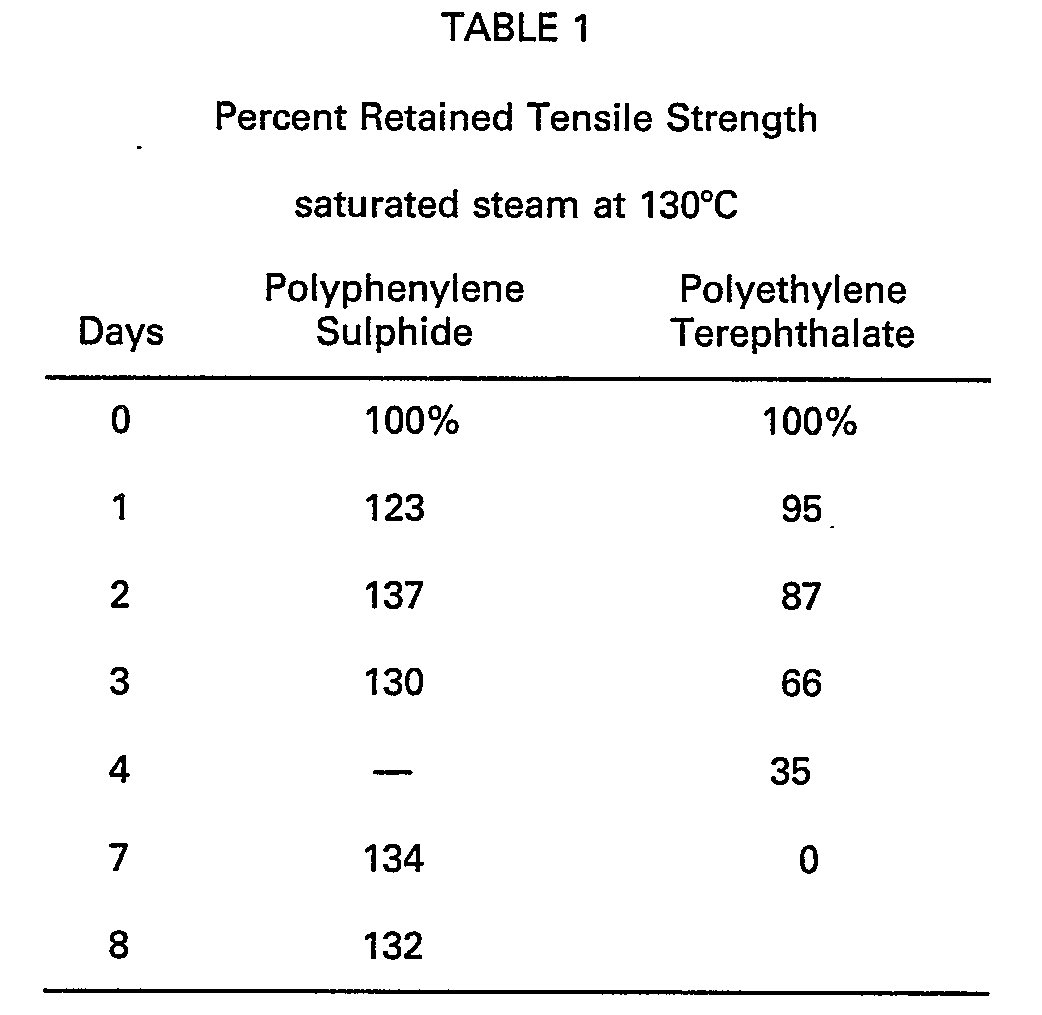

- It will be observed that in these accelerated tests the strength of the polyphenylene-sulphide strand was not only retained but was, in fact, enhanced whereas the polyester strand showed a rapid and catastrophic loss in strength. This extraordinary retention of hydrolysis resistance, even after prolonged exposure, makes polyphenylene sulphide an outstanding candidate material for use in paper machine dryer fabrics, particularly in high-temperature applications.
- Unfortunately, the material can only be extruded with difficulty in monofilament form in the size range commonly used in dryer fabrics. Also during weaving the pure material is subject to frequent warp breakages due to its lack of toughness and is prone to scraping in the loom heddles and reed dents, all of which renders pure polyphenylene sulphide difficult for heavy industrial weaving.
- The addition of a heat-stabilized polyamide 66 to the polyphenylene sulphide before extrusion has greatly alleviated these problems. Experiments in a range of blends has confirmed the following important results:
- 1. the addition of polyamide 66 acts as a processing aid, which makes the commercial extrusion of the blend a more viable process;
- 2. "toughness" is significantly enhanced. For example, the addition of 6% by weight of heat-stabilized polyamide 66 increased the measured knot toughness by a factor of seven times. This property is determined by subjecting a strand, which contains a simple overhand knot, to tensile pull and producing a resulting load-elongation diagram. The area under the curve is a measure of knot toughness;
- 3. full hydrolytic degradation resistance is retained;

- 4. there is no sacrifice in tensile strength when the polyamide is added to the pure polyphenylene sulphide;
- 5. subsequent pilot plant and commercial weaving in a wide range of dryer fabric designs, including those requiring high weaving tensions and high pick counts, confirms that the use of the polyphenylene sulphide/6% polyamide blend in warp strands of dryer fabrics reduced warp breakage and scraping to an acceptable level;
- 6. increasing the polyamide 66 from 6% to 20% increases the toughness of the monofilament, however, the abrasion resistance decreases.
- The means by which the additive improves toughness while preserving hydrolysis resistance is not entirely known, but the successful monofilaments are characterized by having the additive material present in small, discrete, elongated globules with the long axis parallel to the axis of the monofilament. These discrete globules are not connected to each other or to the outer boundaries of the monofilament, and are thus protected from the harsh environment of the end use application of the filament. In order to preserve the additive as discrete globules we have found that the melt viscosity of the added material must be higher than the melt viscosity of polyphenylene sulphide at the extrusion temperature and the amount of additive must be limited. Another factor to consider in choosing the additive is that it must not degrade during extrusion when it is temporarily exposed to the temperature required to melt the polyphenylene sulphide, the range being 285°C to 315°C. Some additives which satisfy the above mentioned requirements do not form globules because they are chemically incompatible with polyphenylene sulphide and react in unsuitable ways.
- In our experiments in blending to date, we have found that heat-stabilized polyamide 66 is the only additive to polyphenylene sulphide which successfully imparts the quality of toughness to the resultant monofilament while preserving hydrolysis resistance. Other materials may be found which can also impart the same quality to the blend. Some factors which are important in choosing additives are: a higher viscosity at extrusion temperature than polyphenylene sulphide, chemical compatability, resistance to heat degradation during extrusion.
- All types of dryer fabrics having monofilaments in the machine direction will benefit in resistance to hydrolysis from this invention. Three preferred constructions utilizing rectangular machine direction components are described below but the invention is not limited to these constructions.
- Figs. 2 and 2A depict a plain
weave dryer fabric 30 representative of a single-layer dryer fabric used in the papermaking industry. In Figs. 2 and2A numeral 31 denotes consecutive warp strands made from polyphenylene sulphide or a blend of polyphenylene sulphide and polyamide 66 flattened to an essentially rectangular cross-section and numeral 32 represents consecutive weft strands. In this structure eachwarp strand 31 passes over afirst weft strand 32, under the second weft strand, over the third and so on. Similarly, the adjacent warp strand passes under the first weft, over the second, under the third and so on. - Figs. 3 and 3A depict a four-shaft eight-repeat duplex-
weave dryer fabric 40, which is a type commonly used in the papermaking industry. In Figs. 3 and3A numerals warp strand 41 passes in sequence over a pair of weft strands 50-51, between the next pair 52-53, under the third pair 54-55, between the fourth pair 56-57, and so on. The nextconsecutive warp strand 42 passes between the first pair of weft strands 50-51, over the second pair, between the third pair and under the fourth pair. Similarly, the third and fourthconsecutive warp strands - Fig. 4 depicts the essentially rectangular cross-section of the polyphenylene sulphide or polyphenylene sulphide/polyamide blend warp strands. Such strands may be produced by rolling round monofilament strands, or by slitting film, or, in the preferred embodiment by melt-extruding through a specially shaped die. The flatness ratio a:b of the preferred embodiment shown in Fig. 4 is 2:1 and is preferably between 1.5:1 and 2.5:1 for the woven dryer fabric embodiments.
- Figs. 5 and 5A depict a spiral construction dryer felt 60 comprising a plurality of helical S-
coils 61 joined together with adjacent Z-coils 62 by means of hinge pins 63. The designations 'S' and 'Z' indicate the direction of twist, following the convention in the textile industry. Thecoils - The woven dryer fabric of the present invention has a warp count preferably in the range of 25 to 80 strands per inch (2.5 cm). Warp strands are made by polyphenylene sulphide or a blend of polyphenylene sulphide and polyamide 66. The flattened warp strands of the invention will have major axis measurements in the range of 0.0125" to 0.050" (0.32 to 1.27 mm). With respect to weft it is not intended to limit the material utilized to monofilaments. Since in the fabric of the invention the weft strands are non-loadbearing, other materials resistant to high temperature and hydrolytic degradation may be utilized, for example composite strands incorporating asbestos or fibreglass.
- The dryer fabric of spiral construction, which is another embodiment of the invention, utilizes helical coils made from polyphenylene sulphide or a blend of polyphenylene sulphide and heat-stabilized polyamide 66 up to 20% by weight of polyamide 66. Hinge pins may be made from the same material or alternatively from other temperature resistant materials such as the composite constructions already mentioned.
- In the preferred embodiments above, rectangular shaped monofilaments have been used, but round monofilaments and other cross-sectional shapes may also be used provided they are made from the material of this invention. We have found that woven fabrics made with rectangular warp strands of pure polyphenylene sulphide, and in a different test with warp strands made from a 6% blend of polyamide 66 and polyphenylene sulphide have superior resistance to distortion compared to equivalent fabrics made with monofilament polyester warp material. Thus, the invention can be used to improve the distortion resistance of fabrics made with round monofilaments which is normally troublesome.
Claims (19)
Applications Claiming Priority (4)
| Application Number | Priority Date | Filing Date | Title |
|---|---|---|---|
| US60582584A | 1984-05-01 | 1984-05-01 | |
| US605825 | 1984-05-01 | ||
| US72766585A | 1985-04-26 | 1985-04-26 | |
| US727665 | 1991-07-09 |
Publications (3)
| Publication Number | Publication Date |
|---|---|
| EP0161579A2 EP0161579A2 (en) | 1985-11-21 |
| EP0161579A3 EP0161579A3 (en) | 1986-08-13 |
| EP0161579B1 true EP0161579B1 (en) | 1990-02-07 |
Family
ID=27085066
Family Applications (1)
| Application Number | Title | Priority Date | Filing Date |
|---|---|---|---|
| EP19850105288 Expired EP0161579B1 (en) | 1984-05-01 | 1985-04-30 | Dryer fabric having warp strands made of melt-extrudable polyphenylene sulphide |
Country Status (4)
| Country | Link |
|---|---|
| EP (1) | EP0161579B1 (en) |
| CA (1) | CA1261989A (en) |
| DE (1) | DE3575960D1 (en) |
| FI (1) | FI85738C (en) |
Cited By (1)
| Publication number | Priority date | Publication date | Assignee | Title |
|---|---|---|---|---|
| DE4141139A1 (en) * | 1991-12-13 | 1993-06-17 | Voith Gmbh J M | SCREEN FABRICS FOR A PAPER MACHINE |
Families Citing this family (8)
| Publication number | Priority date | Publication date | Assignee | Title |
|---|---|---|---|---|
| DE3601565A1 (en) * | 1986-01-21 | 1987-07-23 | Bayer Ag | METHOD FOR PRODUCING SPIRAL SCREENS |
| US4748077A (en) * | 1987-05-19 | 1988-05-31 | Shakespeare Company | Novel monofilaments, fabrics thereof and related process |
| US4862926A (en) * | 1988-10-14 | 1989-09-05 | Asten Group, Inc. | Shaped monofilament coil seam and fabrics |
| US5240763A (en) * | 1989-05-12 | 1993-08-31 | Asten Group, Inc. | Dimensionally stable papermakers fabric |
| US5137601A (en) * | 1991-06-26 | 1992-08-11 | Wangner Systems Corporation | Paper forming fabric for use with a papermaking machine made of PPT fibers |
| US5464685A (en) * | 1994-03-25 | 1995-11-07 | Asten, Inc. | Textile dryer apparatus having an improved textile dryer fabric |
| CA2748789A1 (en) * | 2011-08-15 | 2013-02-15 | Derek Chaplin | Embossing fabric including warp yarn sets |
| CN107988669A (en) * | 2018-01-15 | 2018-05-04 | 苏州耐德新材料科技有限公司 | A kind of modified polyphenyl thioether sewing thread preparation method and its compound filter bag sewing thread |
Family Cites Families (5)
| Publication number | Priority date | Publication date | Assignee | Title |
|---|---|---|---|---|
| US4149571A (en) * | 1978-03-03 | 1979-04-17 | Huyck Corporation | Papermaking fabrics |
| US4290209A (en) * | 1978-05-17 | 1981-09-22 | Jwi Ltd. | Dryer fabric |
| US4267227A (en) * | 1980-01-11 | 1981-05-12 | Albany International Corp. | Press fabric resistant to wad burning |
| US4370375A (en) * | 1981-04-20 | 1983-01-25 | E. I. Du Pont De Nemours And Company | Abrasion-resistant monofilament with molybdenum disulfide useful in the formation of papermaking belts |
| CA1182672A (en) * | 1981-07-17 | 1985-02-19 | John E. Hansen | Paper-making belts of fused polymeric filaments |
-
1985
- 1985-04-29 FI FI851691A patent/FI85738C/en not_active IP Right Cessation
- 1985-04-30 EP EP19850105288 patent/EP0161579B1/en not_active Expired
- 1985-04-30 DE DE8585105288T patent/DE3575960D1/en not_active Expired - Lifetime
- 1985-04-30 CA CA000480451A patent/CA1261989A/en not_active Expired
Cited By (1)
| Publication number | Priority date | Publication date | Assignee | Title |
|---|---|---|---|---|
| DE4141139A1 (en) * | 1991-12-13 | 1993-06-17 | Voith Gmbh J M | SCREEN FABRICS FOR A PAPER MACHINE |
Also Published As
| Publication number | Publication date |
|---|---|
| EP0161579A3 (en) | 1986-08-13 |
| FI851691A0 (en) | 1985-04-29 |
| FI85738B (en) | 1992-02-14 |
| EP0161579A2 (en) | 1985-11-21 |
| CA1261989A (en) | 1989-09-26 |
| DE3575960D1 (en) | 1990-03-15 |
| FI85738C (en) | 1992-05-25 |
| FI851691L (en) | 1985-11-02 |
Similar Documents
| Publication | Publication Date | Title |
|---|---|---|
| US4755420A (en) | Dryer fabric having warp strands made of melt-extrudable polyphenylene sulphide | |
| EP0077901B1 (en) | Hydrolysis resistant fabric for paper making and like uses | |
| KR100851628B1 (en) | Shaped monofilaments with grooves and the fabrics made thereof | |
| US20080169040A1 (en) | Machine side layer weave design for composite forming fabrics | |
| JPH0350037B2 (en) | ||
| US5169711A (en) | Paper makers forming fabric | |
| JP4440085B2 (en) | Industrial two-layer fabric | |
| US4820571A (en) | High temperature industrial fabrics | |
| JPH0583678B2 (en) | ||
| US5998310A (en) | Industrial fabrics containing finned fibers designed to resist distortion | |
| US4829681A (en) | Paper machine clothing | |
| CA1248799A (en) | Abrasion and hydrolysis resistant joining wire and coil material for fabric seams | |
| US4786554A (en) | Dryer fabric having warp strands made of melt-extrudable polyphenylene sulphide | |
| EP0161579A2 (en) | Dryer fabric having warp strands made of melt-extrudable polyphenylene sulphide | |
| CA2060972C (en) | Dryer fabric | |
| US7935225B2 (en) | Papermaker's forming fabrics including monofilaments comprised of a blend of poly(ethylene naphthalate) and poly(ethylene terephthalate) | |
| EP0387395B1 (en) | Stabilized polyurethane modified polyester forming fabric | |
| RU2384662C1 (en) | Shaping wire of papermaking machine | |
| MXPA05004187A (en) | Air channel dryer fabric. | |
| CA2527135C (en) | Polyamide filament and industrial fabric using the polyamide filament | |
| JPH0274693A (en) | Friction-resistant warp type woven fabric for paper making | |
| US5776313A (en) | Papermachine clothing of aliphatic polyketones | |
| JP2010126838A (en) | Polyphenylene sulfide monofilament, method for producing the same, and industrial fabric | |
| CA2134542C (en) | Papermakers fabric of polyphthalamide monofilament | |
| JP2025186673A (en) | Papermaking fabric and its manufacturing method |
Legal Events
| Date | Code | Title | Description |
|---|---|---|---|
| PUAI | Public reference made under article 153(3) epc to a published international application that has entered the european phase |
Free format text: ORIGINAL CODE: 0009012 |
|
| AK | Designated contracting states |
Designated state(s): CH DE FR GB IT LI NL SE |
|
| PUAL | Search report despatched |
Free format text: ORIGINAL CODE: 0009013 |
|
| AK | Designated contracting states |
Kind code of ref document: A3 Designated state(s): CH DE FR GB IT LI NL SE |
|
| 17P | Request for examination filed |
Effective date: 19870127 |
|
| 17Q | First examination report despatched |
Effective date: 19880418 |
|
| GRAA | (expected) grant |
Free format text: ORIGINAL CODE: 0009210 |
|
| AK | Designated contracting states |
Kind code of ref document: B1 Designated state(s): CH DE FR GB IT LI NL SE |
|
| ITF | It: translation for a ep patent filed | ||
| REF | Corresponds to: |
Ref document number: 3575960 Country of ref document: DE Date of ref document: 19900315 |
|
| ET | Fr: translation filed | ||
| PLBI | Opposition filed |
Free format text: ORIGINAL CODE: 0009260 |
|
| PLAB | Opposition data, opponent's data or that of the opponent's representative modified |
Free format text: ORIGINAL CODE: 0009299OPPO |
|
| 26 | Opposition filed |
Opponent name: HOECHST AKTIENGESELLSCHAFT, FRANKFURT Effective date: 19901027 Opponent name: FILZTUCHVERWALTUNGS GMBH Effective date: 19901107 |
|
| R26 | Opposition filed (corrected) |
Opponent name: FILZTUCHVERWALTUNGS GMBH * 901027 HOECHST AKTIENGE Effective date: 19901107 |
|
| NLR1 | Nl: opposition has been filed with the epo |
Opponent name: HOECHST AG Opponent name: FILZTUCHVERWALTUNGS GMBH |
|
| PGFP | Annual fee paid to national office [announced via postgrant information from national office to epo] |
Ref country code: LU Payment date: 19910403 Year of fee payment: 7 |
|
| ITTA | It: last paid annual fee | ||
| EPTA | Lu: last paid annual fee | ||
| PLBM | Termination of opposition procedure: date of legal effect published |
Free format text: ORIGINAL CODE: 0009276 |
|
| STAA | Information on the status of an ep patent application or granted ep patent |
Free format text: STATUS: OPPOSITION PROCEDURE CLOSED |
|
| 27C | Opposition proceedings terminated |
Effective date: 19911219 |
|
| NLR2 | Nl: decision of opposition | ||
| EAL | Se: european patent in force in sweden |
Ref document number: 85105288.6 |
|
| REG | Reference to a national code |
Ref country code: GB Ref legal event code: IF02 |
|
| REG | Reference to a national code |
Ref country code: GB Ref legal event code: 732E |
|
| PGFP | Annual fee paid to national office [announced via postgrant information from national office to epo] |
Ref country code: GB Payment date: 20040220 Year of fee payment: 20 |
|
| PGFP | Annual fee paid to national office [announced via postgrant information from national office to epo] |
Ref country code: FR Payment date: 20040330 Year of fee payment: 20 |
|
| PGFP | Annual fee paid to national office [announced via postgrant information from national office to epo] |
Ref country code: NL Payment date: 20040415 Year of fee payment: 20 |
|
| PGFP | Annual fee paid to national office [announced via postgrant information from national office to epo] |
Ref country code: SE Payment date: 20040416 Year of fee payment: 20 |
|
| PGFP | Annual fee paid to national office [announced via postgrant information from national office to epo] |
Ref country code: CH Payment date: 20040426 Year of fee payment: 20 |
|
| PGFP | Annual fee paid to national office [announced via postgrant information from national office to epo] |
Ref country code: DE Payment date: 20040525 Year of fee payment: 20 |
|
| PG25 | Lapsed in a contracting state [announced via postgrant information from national office to epo] |
Ref country code: GB Free format text: LAPSE BECAUSE OF EXPIRATION OF PROTECTION Effective date: 20050429 |
|
| PG25 | Lapsed in a contracting state [announced via postgrant information from national office to epo] |
Ref country code: NL Free format text: LAPSE BECAUSE OF EXPIRATION OF PROTECTION Effective date: 20050430 |
|
| REG | Reference to a national code |
Ref country code: GB Ref legal event code: PE20 |
|
| REG | Reference to a national code |
Ref country code: CH Ref legal event code: PL |
|
| NLV7 | Nl: ceased due to reaching the maximum lifetime of a patent |
Effective date: 20050430 |
|
| EUG | Se: european patent has lapsed |