EP0160327B1 - Laminar radiation-shielding article - Google Patents
Laminar radiation-shielding article Download PDFInfo
- Publication number
- EP0160327B1 EP0160327B1 EP85200319A EP85200319A EP0160327B1 EP 0160327 B1 EP0160327 B1 EP 0160327B1 EP 85200319 A EP85200319 A EP 85200319A EP 85200319 A EP85200319 A EP 85200319A EP 0160327 B1 EP0160327 B1 EP 0160327B1
- Authority
- EP
- European Patent Office
- Prior art keywords
- aluminium
- lead
- layer
- thickness
- shielding article
- Prior art date
- Legal status (The legal status is an assumption and is not a legal conclusion. Google has not performed a legal analysis and makes no representation as to the accuracy of the status listed.)
- Expired
Links
- 239000004411 aluminium Substances 0.000 claims description 38
- 229910052782 aluminium Inorganic materials 0.000 claims description 38
- XAGFODPZIPBFFR-UHFFFAOYSA-N aluminium Chemical compound [Al] XAGFODPZIPBFFR-UHFFFAOYSA-N 0.000 claims description 38
- 239000005030 aluminium foil Substances 0.000 description 16
- 229910000978 Pb alloy Inorganic materials 0.000 description 14
- 230000001070 adhesive effect Effects 0.000 description 14
- 239000004744 fabric Substances 0.000 description 14
- 239000000853 adhesive Substances 0.000 description 13
- 230000000052 comparative effect Effects 0.000 description 8
- 230000000694 effects Effects 0.000 description 8
- 230000002285 radioactive effect Effects 0.000 description 7
- XLYOFNOQVPJJNP-UHFFFAOYSA-N water Substances O XLYOFNOQVPJJNP-UHFFFAOYSA-N 0.000 description 7
- 229920002379 silicone rubber Polymers 0.000 description 5
- 238000011282 treatment Methods 0.000 description 5
- 239000011888 foil Substances 0.000 description 4
- XEEYBQQBJWHFJM-UHFFFAOYSA-N iron Substances [Fe] XEEYBQQBJWHFJM-UHFFFAOYSA-N 0.000 description 4
- 229910000838 Al alloy Inorganic materials 0.000 description 3
- 239000011521 glass Substances 0.000 description 3
- 229910052742 iron Inorganic materials 0.000 description 3
- 229910052751 metal Inorganic materials 0.000 description 3
- 239000002184 metal Substances 0.000 description 3
- 238000000034 method Methods 0.000 description 3
- 230000005855 radiation Effects 0.000 description 3
- 239000004945 silicone rubber Substances 0.000 description 3
- 229910001369 Brass Inorganic materials 0.000 description 2
- 238000005452 bending Methods 0.000 description 2
- 239000010951 brass Substances 0.000 description 2
- 239000003795 chemical substances by application Substances 0.000 description 2
- 229910052802 copper Inorganic materials 0.000 description 2
- 238000007598 dipping method Methods 0.000 description 2
- 238000005246 galvanizing Methods 0.000 description 2
- PXHVJJICTQNCMI-UHFFFAOYSA-N nickel Substances [Ni] PXHVJJICTQNCMI-UHFFFAOYSA-N 0.000 description 2
- 239000010935 stainless steel Substances 0.000 description 2
- 229910001220 stainless steel Inorganic materials 0.000 description 2
- 230000037303 wrinkles Effects 0.000 description 2
- 229910052725 zinc Inorganic materials 0.000 description 2
- NWONKYPBYAMBJT-UHFFFAOYSA-L zinc sulfate Chemical compound [Zn+2].[O-]S([O-])(=O)=O NWONKYPBYAMBJT-UHFFFAOYSA-L 0.000 description 2
- JOYRKODLDBILNP-UHFFFAOYSA-N Ethyl urethane Chemical compound CCOC(N)=O JOYRKODLDBILNP-UHFFFAOYSA-N 0.000 description 1
- BPQQTUXANYXVAA-UHFFFAOYSA-N Orthosilicate Chemical compound [O-][Si]([O-])([O-])[O-] BPQQTUXANYXVAA-UHFFFAOYSA-N 0.000 description 1
- 229910019142 PO4 Inorganic materials 0.000 description 1
- NIXOWILDQLNWCW-UHFFFAOYSA-N acrylic acid group Chemical group C(C=C)(=O)O NIXOWILDQLNWCW-UHFFFAOYSA-N 0.000 description 1
- 238000012644 addition polymerization Methods 0.000 description 1
- 229910052787 antimony Inorganic materials 0.000 description 1
- NTXGQCSETZTARF-UHFFFAOYSA-N buta-1,3-diene;prop-2-enenitrile Chemical compound C=CC=C.C=CC#N NTXGQCSETZTARF-UHFFFAOYSA-N 0.000 description 1
- 230000005494 condensation Effects 0.000 description 1
- 238000009833 condensation Methods 0.000 description 1
- 238000009713 electroplating Methods 0.000 description 1
- 229920006332 epoxy adhesive Polymers 0.000 description 1
- 230000005251 gamma ray Effects 0.000 description 1
- 230000005484 gravity Effects 0.000 description 1
- 229910052749 magnesium Inorganic materials 0.000 description 1
- 229910052748 manganese Inorganic materials 0.000 description 1
- 239000000463 material Substances 0.000 description 1
- 239000011368 organic material Substances 0.000 description 1
- 230000000149 penetrating effect Effects 0.000 description 1
- 150000002978 peroxides Chemical class 0.000 description 1
- 239000010452 phosphate Substances 0.000 description 1
- NBIIXXVUZAFLBC-UHFFFAOYSA-K phosphate Chemical compound [O-]P([O-])([O-])=O NBIIXXVUZAFLBC-UHFFFAOYSA-K 0.000 description 1
- 238000006116 polymerization reaction Methods 0.000 description 1
- 229920002635 polyurethane Polymers 0.000 description 1
- 239000004814 polyurethane Substances 0.000 description 1
- 238000002203 pretreatment Methods 0.000 description 1
- 229910052710 silicon Inorganic materials 0.000 description 1
- 229910052709 silver Inorganic materials 0.000 description 1
- 229920001187 thermosetting polymer Polymers 0.000 description 1
- 229910052718 tin Inorganic materials 0.000 description 1
Images
Classifications
-
- G—PHYSICS
- G21—NUCLEAR PHYSICS; NUCLEAR ENGINEERING
- G21F—PROTECTION AGAINST X-RADIATION, GAMMA RADIATION, CORPUSCULAR RADIATION OR PARTICLE BOMBARDMENT; TREATING RADIOACTIVELY CONTAMINATED MATERIAL; DECONTAMINATION ARRANGEMENTS THEREFOR
- G21F1/00—Shielding characterised by the composition of the materials
- G21F1/12—Laminated shielding materials
- G21F1/125—Laminated shielding materials comprising metals
-
- Y—GENERAL TAGGING OF NEW TECHNOLOGICAL DEVELOPMENTS; GENERAL TAGGING OF CROSS-SECTIONAL TECHNOLOGIES SPANNING OVER SEVERAL SECTIONS OF THE IPC; TECHNICAL SUBJECTS COVERED BY FORMER USPC CROSS-REFERENCE ART COLLECTIONS [XRACs] AND DIGESTS
- Y10—TECHNICAL SUBJECTS COVERED BY FORMER USPC
- Y10T—TECHNICAL SUBJECTS COVERED BY FORMER US CLASSIFICATION
- Y10T428/00—Stock material or miscellaneous articles
- Y10T428/12—All metal or with adjacent metals
- Y10T428/12493—Composite; i.e., plural, adjacent, spatially distinct metal components [e.g., layers, joint, etc.]
- Y10T428/12632—Four or more distinct components with alternate recurrence of each type component
-
- Y—GENERAL TAGGING OF NEW TECHNOLOGICAL DEVELOPMENTS; GENERAL TAGGING OF CROSS-SECTIONAL TECHNOLOGIES SPANNING OVER SEVERAL SECTIONS OF THE IPC; TECHNICAL SUBJECTS COVERED BY FORMER USPC CROSS-REFERENCE ART COLLECTIONS [XRACs] AND DIGESTS
- Y10—TECHNICAL SUBJECTS COVERED BY FORMER USPC
- Y10T—TECHNICAL SUBJECTS COVERED BY FORMER US CLASSIFICATION
- Y10T428/00—Stock material or miscellaneous articles
- Y10T428/12—All metal or with adjacent metals
- Y10T428/12493—Composite; i.e., plural, adjacent, spatially distinct metal components [e.g., layers, joint, etc.]
- Y10T428/12701—Pb-base component
-
- Y—GENERAL TAGGING OF NEW TECHNOLOGICAL DEVELOPMENTS; GENERAL TAGGING OF CROSS-SECTIONAL TECHNOLOGIES SPANNING OVER SEVERAL SECTIONS OF THE IPC; TECHNICAL SUBJECTS COVERED BY FORMER USPC CROSS-REFERENCE ART COLLECTIONS [XRACs] AND DIGESTS
- Y10—TECHNICAL SUBJECTS COVERED BY FORMER USPC
- Y10T—TECHNICAL SUBJECTS COVERED BY FORMER US CLASSIFICATION
- Y10T428/00—Stock material or miscellaneous articles
- Y10T428/12—All metal or with adjacent metals
- Y10T428/12493—Composite; i.e., plural, adjacent, spatially distinct metal components [e.g., layers, joint, etc.]
- Y10T428/12736—Al-base component
Definitions
- the present invention relates to a shielding article assembled by piling a plurality of multilayer sheets, said multilayer comprising at least one aluminium layer and at least one layer which is bonded to one or both sides of the aluminium layer.
- Such a shielding article is disclosed from US-A-2858451.
- said known shielding article is specifically used for panels, helmets or wall compartments, which require a large thickness for obtaining an adequate stiffness. Therefore said shielding article has no flexibility and cannot be used for instance as a curtain, or attached along a pipe or other structures.
- the piled sheets are fastened at least at one end portion thereof, and that said aluminium layer has a total thickness of 10 to 100 ⁇ m, said lead layer has a total thickness at least twice thicker than the aluminium layer, and said multilayer sheet has a thickness of 50 to 400 p m.
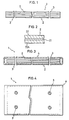
- a shielding article 1 has a plurality of multilayer sheets 2 and are assembled by piling the sheets 2 and by fastening the sheets 2 to each other at both end portions with fasteners 3.
- the multilayer sheet 2 is formed by boqding lead layers 22, 22A to both sides of an aluminium layer 21.
- the aluminium layer is provided for obtaining an improved tensile strength and bending endurance of the multilayer sheet. Therefore, when hanging; the shielding article of the present invention can be prevented from being torn out due to the weight of itself. Further, even if the shielding article is repeatedly bended and folded, bucklings and serious wrinkles are hardly formed or not formed. Those advantages allow to use the article repeatedly for a long time.
- the aluminium layer there may be employed one or more aluminium foils or sheets made of a pure aluminium or an aluminium alloy.
- the pure aluminium are, for instance, an aluminium ingot having a purity of not less than 97% (% by weight, hereinafter the same) such as a virgin aluminium ingot of the first, the second or the third class defined in JIS H 2102 (1968), a secondary aluminium ingot of the first, the second or the third class defined in JIS H 2103 (1965), and the like.
- the aluminium alloy are, for instance, an aluminium alloy containing the other metal element such as Cu, Mg, Si, Fe, Zn or Mn in an amount of 3 to 10%.
- aluminium foil or sheet there are employed various aluminium sheets defined in JIS H 4000 (1982), various aluminium foils defined in JIS H 4160 (1974), an electrolytic aluminium foil, a rolled aluminium foil, and the like, preferably aluminium foils defined in JIS H 4160 (1974).
- Preferable aluminium layer is made of a rolled aluminium foil of the pure aluminium having a purity of not less than 97%, particularly not less than 99%.
- the multilayer sheet may include two or more aluminium layers. In such a case, each aluminium layer may be bonded via the lead layer.
- a thickness of the aluminium layer or, in case where two or more aluminium layers are employed, a total thickness of the layers is 10 to 100 pm, preferably 25 to 60 pm.
- the thickness is less than 10 p m, the above advantages cannot be obtained.
- the thickness is more than 100 um, since the thickness of the multilayer sheet must be 50 to 400 pm as mentioned above, the lead layer becomes thinner, and thus sufficient shielding effect against the radioactive rays, sound, or the like cannot be obtained.
- the lead layer may be made of a pure lead or a lead alloy.
- the pure lead are, for instance, pure leads of not less than 99.5% in purity such as six kinds of pig lead defined in JIS H 2105 (1955). Preferable purity of the pig lead is not less than 99.8%, particularly not less than 99.9%.
- a lead alloy having a similar flexibility to the pure lead may be employed.
- the lead alloy are, for instance, an alloy of lead with Cu, Fe, Zn, Ag, Sn, Sb, and the like in an amount of 0.5 to 50%.
- the lead layer is provided for obtaining the shielding effect against the radioactive rays, sounds, or the like.
- the lead layer may be bonded to one or both sides of the aluminium layer, and when two or more aluminium layers are employed, the lead layer may also be provided between the aluminium layers.
- the thickness of the lead layer or the total thickness of the layers must be at least twice the thickness of the aluminium layer. When the thickness is less than twice the thickness of the aluminium layer, the desired shielding effect cannot be obtained.
- the multilayer sheet must be 50 to 400 pm, preferably 60 to 300 pm in thickness.
- the thickness of the multilayer sheet is less than 50 ⁇ m, it is difficult to use repeatedly the shielding article, since serious wrinkles tend to be produced by bending or folding, even if the multilayer sheet has the aluminium layer.
- the thickness is more than 400 p m, the multilayer sheet becomes too rigid.
- the lead layer is bonded to the aluminium layer by pressing a lead foil or sheet to the aluminium layer, by adhering with an adhesive, by hot dipping, by electroplating, or the like.
- the aluminium layer may be subjected to pre-treatment such as zincate treatment, metal galvanizing treatment, or both treatments prior to the bonding.
- the lead alloy is preferably employed, since the lead alloy is generally better than the pure. lead in an affinity or an adhesive property to aluminium.
- the pure lead or the lead alloy may be employed.
- the pure lead is more preferably employed, since the pure lead is generally between the the lead alloy in flexibility and density (density of the pure lead is higher than that of the lead alloy, and therefore the shielding effect against the radioactive rays is better).
- the pure lead sheet is adhered to the aluminium foil with the adhesive described hereinbelow.
- an organic adhesive or an inorganic adhesive can be employed as the adhesive.
- the organic adhesive are, for instance, urethane adhesives, two component acrylic adhesives, acrylonitrile- butadiene adhesives, epoxy adhesives, and the like.
- the inorganic adhesive are, for instance, silicate adhesives, phosphate adhesives, and the like.
- the multilayer sheet may comprise two or more aluminium layers and two ormore lead layers as mentioned above.
- the total thickness of the aluminium layers, the total thickness of the lead layers and the thickness of the multilayer sheet must satisfy the requirements respectively defined above.
- the multilayer sheets 2 are fastened to each other with the fasteners 3 at the both end portions, the multilayer sheets may be fastened at one end portion.
- the piled multilayer sheets may be tightly secured or may be loosely fastened to each other.
- the material of the fastener there can be employed stainless steel, brass galvanized with Ni, iron or aluminium, and the like. Particularly, stainless steel or brass galvanized with Ni is preferably employed.
- a pluraity of multilayer sheets 2 may be enveloped in a cloth bag 4, as shown in Figs. 3 and 4.
- the multilayer sheets 2 are fastened to each other and also to the cloth bag 4 with the fasteners 3 at both end portions.
- the cloth bag 2 has preferably not only a resistance against ratioactive rays but also a water tightness, because radioactive dusts deposited to the cloth bag 4 must be washed away with water. It is particularly preferable to make the cloth bag completely water tight by treating the all surfaces of the bag (including the seams) with a water proof agent for preventing water from passing through the cloth.
- a water tight cloth are, for instance, a glass cloth coated with silicone rubber, and the like.
- water proof agent examples include one component silicone rubbers of a condensation (deoxime type, deacid type, dealcohol type, or the like) polymerization type or an addition polymerization type, two component silicone rubbers such as a cure type with a peroxide.
- the multilayer sheet is preferably 100 to 1,000 mm in width and 500 to 2,000 mm in length, and more preferably 200 to 500 mm in width and 800 to 1,500 mm in length.
- the shielding article of the present invention comprises a plurality of the multilayer sheets.
- the number of multilayer sheets is optionally selected depending on the conditions to be shielded.
- a sufficient shielding effect can be obtained in general by piling the multilayer sheets so as to be not less than about 2 mm in total lead thickness, e.g. piling 10 to 40 sheets of the multilayer sheets.
- the multilayer sheet in the present invention substantially comprises metal layers, the sheet also has an excellent heat resistance. Therefore, the shielding article of the present invention can be always put on or hung down near a harmful source of a high temperature.
- An aluminium foil (purity: not less than 99.7%, AIN30H-0 defined in JIS H 4160 (1974)) having a thickness shown in Table 1 was subjected to zincate treatment and Cu-galvanizing treatment.
- a pure lead sheet (purity: not less than 99.8%, the 4th class pig lead defined in JIS H 2105 (1955)) having a thickness shown in Table 1 was adhered to both sides of an aluminium foil (purity: not less than 99.3%, AIN30H-0 defined in JIS H 4160 (1974)) having a thickness shown in Table 1 by using a thermosetting polyurethane adhesive to prepare a multilayer sheet according to the present invention.
- Example 1 The procedures in Example 1 were repeated except that an aluminium foil having a thickness of 30 ⁇ m was employed to prepare a comparative multilayer sheet having a lead alloy layer of 10 um in thickness on each side of the aluminium foil. By employing twenty of the sheets, a comparative shielding article was assembled in the same manner as in Example 1.
- Example 3 The procedures in Example 3 were repeated except that an aluminium foil having a thickness of 8 ⁇ m was employed to prepare a comparative multilayer sheet having a lead alloy layer of 40 pm in thickness on each side of the aluminium foil. By employing twenty of the sheets, a comparative shielding article was assembled in the same manner as in Example 3.
- Example 2 Twenty pure lead foils having a thickness of 60 pm were enveloped in a cloth bag in the same manner as in Example 1 to give a comparative shielding article.
- Each shielding effect of the articles was estimated as an index on the basis of the index (100) which corresponds to the radiation dose determined by employing a pure lead sheet (purity: not less than 99.8%, the 4th class defined in JIS H 2105 (1955)) having a thickness of 2 mm.
Landscapes
- Physics & Mathematics (AREA)
- Engineering & Computer Science (AREA)
- General Engineering & Computer Science (AREA)
- High Energy & Nuclear Physics (AREA)
- Laminated Bodies (AREA)
- Shielding Devices Or Components To Electric Or Magnetic Fields (AREA)
Description
- The present invention relates to a shielding article assembled by piling a plurality of multilayer sheets, said multilayer comprising at least one aluminium layer and at least one layer which is bonded to one or both sides of the aluminium layer.
- Such a shielding article is disclosed from US-A-2858451. However, said known shielding article is specifically used for panels, helmets or wall compartments, which require a large thickness for obtaining an adequate stiffness. Therefore said shielding article has no flexibility and cannot be used for instance as a curtain, or attached along a pipe or other structures.
- It is an object of the invention to provide a shielding article which has sufficient flexibility and can be repeatedly used without breakage and which has an excellent binding property and mecahnical strength for an extended period of time.
- In accordance with the invention the piled sheets are fastened at least at one end portion thereof, and that said aluminium layer has a total thickness of 10 to 100 µm, said lead layer has a total thickness at least twice thicker than the aluminium layer, and said multilayer sheet has a thickness of 50 to 400 pm.
- It is to be noted that prior, not pre-published EP-A-0127241 discloses a shielding article per se comprising a lead foil reinforced with an organic material on one or both sides of the lead foil to obtain a flexible shielding article. However, there is not any suggestion of using an aluminium foil as a reinforced layer.
- One embodiment of the invention will now be described, by way of example, with reference to the accompanying drawings, in which:
- Fig. 1 is a sectional view showing an embodiment of the shielding article of the present invention;
- Fig. 2 is a partially enlarged sectional view of a multilayer sheet used in the present invention;
- Fig. 3 is a sectional view showing the shielding article shown in Fig. 1 enveloped in a cloth bag; and
- Fig. 4 is a plan-view of the shielding article shown in Fig. 3.
- In Fig. 1, a
shielding article 1 has a plurality ofmultilayer sheets 2 and are assembled by piling thesheets 2 and by fastening thesheets 2 to each other at both end portions withfasteners 3. As shown in Fig, 2, themultilayer sheet 2 is formed by boqdinglead layers aluminium layer 21. - The aluminium layer is provided for obtaining an improved tensile strength and bending endurance of the multilayer sheet. Therefore, when hanging; the shielding article of the present invention can be prevented from being torn out due to the weight of itself. Further, even if the shielding article is repeatedly bended and folded, bucklings and serious wrinkles are hardly formed or not formed. Those advantages allow to use the article repeatedly for a long time.
- As the aluminium layer, there may be employed one or more aluminium foils or sheets made of a pure aluminium or an aluminium alloy. Examples of the pure aluminium are, for instance, an aluminium ingot having a purity of not less than 97% (% by weight, hereinafter the same) such as a virgin aluminium ingot of the first, the second or the third class defined in JIS H 2102 (1968), a secondary aluminium ingot of the first, the second or the third class defined in JIS H 2103 (1965), and the like. Examples of the aluminium alloy are, for instance, an aluminium alloy containing the other metal element such as Cu, Mg, Si, Fe, Zn or Mn in an amount of 3 to 10%. As the aluminium foil or sheet, there are employed various aluminium sheets defined in JIS H 4000 (1982), various aluminium foils defined in JIS H 4160 (1974), an electrolytic aluminium foil, a rolled aluminium foil, and the like, preferably aluminium foils defined in JIS H 4160 (1974). Preferable aluminium layer is made of a rolled aluminium foil of the pure aluminium having a purity of not less than 97%, particularly not less than 99%.
- The multilayer sheet may include two or more aluminium layers. In such a case, each aluminium layer may be bonded via the lead layer.
- A thickness of the aluminium layer or, in case where two or more aluminium layers are employed, a total thickness of the layers is 10 to 100 pm, preferably 25 to 60 pm. When the thickness is less than 10 pm, the above advantages cannot be obtained. When the thickness is more than 100 um, since the thickness of the multilayer sheet must be 50 to 400 pm as mentioned above, the lead layer becomes thinner, and thus sufficient shielding effect against the radioactive rays, sound, or the like cannot be obtained.
- The lead layer may be made of a pure lead or a lead alloy. Examples of the pure lead are, for instance, pure leads of not less than 99.5% in purity such as six kinds of pig lead defined in JIS H 2105 (1955). Preferable purity of the pig lead is not less than 99.8%, particularly not less than 99.9%. A lead alloy having a similar flexibility to the pure lead may be employed. For shielding radioactive rays, it is preferable to employ a lead alloy having a specific gravity of not less than 10. Examples of the lead alloy are, for instance, an alloy of lead with Cu, Fe, Zn, Ag, Sn, Sb, and the like in an amount of 0.5 to 50%.
- The lead layer is provided for obtaining the shielding effect against the radioactive rays, sounds, or the like. The lead layer may be bonded to one or both sides of the aluminium layer, and when two or more aluminium layers are employed, the lead layer may also be provided between the aluminium layers. The thickness of the lead layer or the total thickness of the layers must be at least twice the thickness of the aluminium layer. When the thickness is less than twice the thickness of the aluminium layer, the desired shielding effect cannot be obtained.
- The multilayer sheet must be 50 to 400 pm, preferably 60 to 300 pm in thickness. When the thickness of the multilayer sheet is less than 50 µm, it is difficult to use repeatedly the shielding article, since serious wrinkles tend to be produced by bending or folding, even if the multilayer sheet has the aluminium layer. When the thickness is more than 400 pm, the multilayer sheet becomes too rigid.
- The lead layer is bonded to the aluminium layer by pressing a lead foil or sheet to the aluminium layer, by adhering with an adhesive, by hot dipping, by electroplating, or the like. The aluminium layer may be subjected to pre-treatment such as zincate treatment, metal galvanizing treatment, or both treatments prior to the bonding.
- In case of the hot dipping, the lead alloy is preferably employed, since the lead alloy is generally better than the pure. lead in an affinity or an adhesive property to aluminium.
- In case of the pressing or adhering, the pure lead or the lead alloy may be employed. However, the pure lead is more preferably employed, since the pure lead is generally between the the lead alloy in flexibility and density (density of the pure lead is higher than that of the lead alloy, and therefore the shielding effect against the radioactive rays is better). Particularly, it is preferable in industrial use that the pure lead sheet is adhered to the aluminium foil with the adhesive described hereinbelow.
- As the adhesive, an organic adhesive or an inorganic adhesive can be employed. Examples of the organic adhesive are, for instance, urethane adhesives, two component acrylic adhesives, acrylonitrile- butadiene adhesives, epoxy adhesives, and the like. Examples of the inorganic adhesive are, for instance, silicate adhesives, phosphate adhesives, and the like.
- In the shielding article of the present invention, the multilayer sheet may comprise two or more aluminium layers and two ormore lead layers as mentioned above. In such a case, the total thickness of the aluminium layers, the total thickness of the lead layers and the thickness of the multilayer sheet must satisfy the requirements respectively defined above.
- In the above-described embodiment, though the
piled multilayer sheets 2 are fastened to each other with thefasteners 3 at the both end portions, the multilayer sheets may be fastened at one end portion. The piled multilayer sheets may be tightly secured or may be loosely fastened to each other. - As the material of the fastener, there can be employed stainless steel, brass galvanized with Ni, iron or aluminium, and the like. Particularly, stainless steel or brass galvanized with Ni is preferably employed.
- A pluraity of
multilayer sheets 2 may be enveloped in acloth bag 4, as shown in Figs. 3 and 4. In this embodiment, themultilayer sheets 2 are fastened to each other and also to thecloth bag 4 with thefasteners 3 at both end portions. - When the shielding article of the present invention is used for shielding the radioactive rays, the
cloth bag 2 has preferably not only a resistance against ratioactive rays but also a water tightness, because radioactive dusts deposited to thecloth bag 4 must be washed away with water. It is particularly preferable to make the cloth bag completely water tight by treating the all surfaces of the bag (including the seams) with a water proof agent for preventing water from passing through the cloth. Examples of the water tight cloth are, for instance, a glass cloth coated with silicone rubber, and the like. Examples of the water proof agent are, for instance, one component silicone rubbers of a condensation (deoxime type, deacid type, dealcohol type, or the like) polymerization type or an addition polymerization type, two component silicone rubbers such as a cure type with a peroxide. - The multilayer sheet is preferably 100 to 1,000 mm in width and 500 to 2,000 mm in length, and more preferably 200 to 500 mm in width and 800 to 1,500 mm in length.
- The shielding article of the present invention comprises a plurality of the multilayer sheets. The number of multilayer sheets is optionally selected depending on the conditions to be shielded. For shielding the radioactive sources, a sufficient shielding effect can be obtained in general by piling the multilayer sheets so as to be not less than about 2 mm in total lead thickness, e.g. piling 10 to 40 sheets of the multilayer sheets.
- Since the multilayer sheet in the present invention substantially comprises metal layers, the sheet also has an excellent heat resistance. Therefore, the shielding article of the present invention can be always put on or hung down near a harmful source of a high temperature.
- The present invention is more specifically described and explained by means of the following Examples. It is to be understood that the present invention is not limited to those Examples..
- An aluminium foil (purity: not less than 99.7%, AIN30H-0 defined in JIS H 4160 (1974)) having a thickness shown in Table 1 was subjected to zincate treatment and Cu-galvanizing treatment. The pre-treated aluminium foil was dipped into a molten lead alloy with Sn (Pb:Sn=90:10 by weight), and then coated with the lead alloy having a thickness shown in Table 1 to prepare a multilayer sheet according to the present invention.
- Twenty of the multilayer sheets (width: 20 cm, length: 60 cm) were envelopped in a cloth bag prepared with a glass cloth coated with silicone rubber, and then fastened with a fastener to give the shielding article of the present invention as shown in Figs. 3 and 4.
- A pure lead sheet (purity: not less than 99.8%, the 4th class pig lead defined in JIS H 2105 (1955)) having a thickness shown in Table 1 was adhered to both sides of an aluminium foil (purity: not less than 99.3%, AIN30H-0 defined in JIS H 4160 (1974)) having a thickness shown in Table 1 by using a thermosetting polyurethane adhesive to prepare a multilayer sheet according to the present invention.
- Twenty of the multilayer sheets (width: 20 cm, length: 60 cm) were enveloped in a cloth bag prepared with a glass cloth coated with silicone rubber, and then fastened with a fastener to give the shielding article of the present invention as shown in Figs. 3 and 4.
- The procedures in Example 1 were repeated except that an aluminium foil having a thickness of 30 µm was employed to prepare a comparative multilayer sheet having a lead alloy layer of 10 um in thickness on each side of the aluminium foil. By employing twenty of the sheets, a comparative shielding article was assembled in the same manner as in Example 1.
- The procedures in Example 3 were repeated except that an aluminium foil having a thickness of 8 µm was employed to prepare a comparative multilayer sheet having a lead alloy layer of 40 pm in thickness on each side of the aluminium foil. By employing twenty of the sheets, a comparative shielding article was assembled in the same manner as in Example 3.
- Twenty pure lead foils having a thickness of 60 pm were enveloped in a cloth bag in the same manner as in Example 1 to give a comparative shielding article.
- With respect to the shielding articles, folding endurance, shielding effect and tensile strength were measured according to the following tests. The results are shown in Table 1.
- The article to be tested was subjected to the fold-extension operation 50 times, and then the surface apperance of the article was observed with naked eyes. In Table 1, 0 and X show the following appearances.
- 0: No breakage
- X: Partially broken
- Radiation dose of gamma ray penetrating through a shielding article from a radiation source was measured. Each shielding effect of the articles was estimated as an index on the basis of the index (100) which corresponds to the radiation dose determined by employing a pure lead sheet (purity: not less than 99.8%, the 4th class defined in JIS H 2105 (1955)) having a thickness of 2 mm.
- According to the procedures defined in JIS C 2318 (1972), tension test was conducted at a tension rate of 10 mm/min.

Claims (4)
Applications Claiming Priority (2)
| Application Number | Priority Date | Filing Date | Title |
|---|---|---|---|
| JP31911/84U | 1984-03-05 | ||
| JP1984031911U JPS60143398U (en) | 1984-03-05 | 1984-03-05 | Shielding material |
Publications (2)
| Publication Number | Publication Date |
|---|---|
| EP0160327A1 EP0160327A1 (en) | 1985-11-06 |
| EP0160327B1 true EP0160327B1 (en) | 1988-08-03 |
Family
ID=12344160
Family Applications (1)
| Application Number | Title | Priority Date | Filing Date |
|---|---|---|---|
| EP85200319A Expired EP0160327B1 (en) | 1984-03-05 | 1985-03-05 | Laminar radiation-shielding article |
Country Status (5)
| Country | Link |
|---|---|
| US (1) | US4771179A (en) |
| EP (1) | EP0160327B1 (en) |
| JP (1) | JPS60143398U (en) |
| CA (1) | CA1232376A (en) |
| DE (1) | DE3564164D1 (en) |
Cited By (1)
| Publication number | Priority date | Publication date | Assignee | Title |
|---|---|---|---|---|
| US8018739B2 (en) | 2003-07-16 | 2011-09-13 | Maxwell Technologies, LLC | Apparatus for shielding integrated circuit devices |
Families Citing this family (25)
| Publication number | Priority date | Publication date | Assignee | Title |
|---|---|---|---|---|
| US4795654A (en) * | 1984-11-05 | 1989-01-03 | Innofinance Altalanos Innovacios Penzintezet | Structure for shielding X-ray and gamma radiation |
| HUT48937A (en) * | 1988-01-13 | 1989-07-28 | Vaw Ver Aluminium Werke Ag | Cover frame for skylights, doors and similars and lead plate for producing same |
| WO1990006581A1 (en) * | 1988-11-28 | 1990-06-14 | Teleki Peter | Structure for shielding radioactive radiation |
| WO1991011011A1 (en) * | 1990-01-22 | 1991-07-25 | Teleki Peter | Solid-state structure for intensifying the effect of x-ray radiation, particularly for industrial applications |
| US5140710A (en) * | 1990-09-04 | 1992-08-25 | Mark Rademacher | Bilayer X-ray eye shield |
| GB9203075D0 (en) * | 1992-02-13 | 1992-03-25 | Philips Electronics Uk Ltd | A radiation shield for use in a radiotherapy machine |
| US5379332A (en) * | 1992-04-28 | 1995-01-03 | Jacobson; Earl B. | Launderable and replaceable lead blanket cover system |
| US5265760A (en) * | 1992-06-03 | 1993-11-30 | Eastman Kodak Company | Individual film packet dispenser and tray dispenser |
| US5880403A (en) | 1994-04-01 | 1999-03-09 | Space Electronics, Inc. | Radiation shielding of three dimensional multi-chip modules |
| US5825042A (en) * | 1993-06-18 | 1998-10-20 | Space Electronics, Inc. | Radiation shielding of plastic integrated circuits |
| US6613978B2 (en) | 1993-06-18 | 2003-09-02 | Maxwell Technologies, Inc. | Radiation shielding of three dimensional multi-chip modules |
| US6455864B1 (en) | 1994-04-01 | 2002-09-24 | Maxwell Electronic Components Group, Inc. | Methods and compositions for ionizing radiation shielding |
| US6261508B1 (en) | 1994-04-01 | 2001-07-17 | Maxwell Electronic Components Group, Inc. | Method for making a shielding composition |
| US6720493B1 (en) | 1994-04-01 | 2004-04-13 | Space Electronics, Inc. | Radiation shielding of integrated circuits and multi-chip modules in ceramic and metal packages |
| US6096145A (en) * | 1997-12-18 | 2000-08-01 | Texas Instruments Incorporated | Method of making clad materials using lead alloys and composite strips made by such method |
| WO1999040803A1 (en) * | 1998-02-12 | 1999-08-19 | Accelerator Technology Corp. | Method and system for electronic pasteurization |
| US7047054B2 (en) * | 1999-03-12 | 2006-05-16 | Cas Medical Systems, Inc. | Laser diode optical transducer assembly for non-invasive spectrophotometric blood oxygenation monitoring |
| GB2349843A (en) * | 1999-05-13 | 2000-11-15 | Secr Defence | Radioactive material container |
| US6368899B1 (en) | 2000-03-08 | 2002-04-09 | Maxwell Electronic Components Group, Inc. | Electronic device packaging |
| USD457690S1 (en) | 2001-06-22 | 2002-05-21 | Julia I. Griffiths | Radiation shield for everyday use in men's briefs |
| US7382043B2 (en) | 2002-09-25 | 2008-06-03 | Maxwell Technologies, Inc. | Method and apparatus for shielding an integrated circuit from radiation |
| US20140145097A1 (en) * | 2004-04-14 | 2014-05-29 | Steven G. Caldwell | Radiation shields and methods of making the same |
| ITMO20060167A1 (en) * | 2006-05-26 | 2007-11-27 | T W R Sas Di Mario Doda & C | MANUFACTURED FOR THE COATING OF SURFACES, PARTICULARLY OF WALLS OF RADIOLOGICAL, DENTAL OR SIMILAR STUDIES |
| US8315273B2 (en) * | 2009-04-10 | 2012-11-20 | Qualcomm Incorporated | Bandwidth segmentation and multi-segment operation and control |
| US11465352B1 (en) * | 2019-03-21 | 2022-10-11 | Tethon Incorporated | Three-dimensional printer resin vat with heated support window |
Citations (1)
| Publication number | Priority date | Publication date | Assignee | Title |
|---|---|---|---|---|
| EP0127241A1 (en) * | 1983-05-23 | 1984-12-05 | Mitsubishi Cable Industries, Ltd. | Pile of lead metal sheets for shielding environment from harmful source |
Family Cites Families (19)
| Publication number | Priority date | Publication date | Assignee | Title |
|---|---|---|---|---|
| BE523755A (en) * | ||||
| US1079035A (en) * | 1913-11-18 | Lewis B Tebbetts | Composite metal article. | |
| US1280908A (en) * | 1916-02-05 | 1918-10-08 | Metalco Company | Reinforced metal. |
| US1611031A (en) * | 1923-06-04 | 1926-12-14 | Henderson Turner | Compound fabric |
| GB698265A (en) * | 1950-11-09 | 1953-10-14 | Unilever Ltd | Improvements in the manufacture of reinforced lead sheet |
| US2640937A (en) * | 1951-07-05 | 1953-06-02 | Kenneth J D Munday | Protector |
| US2858451A (en) * | 1955-03-07 | 1958-10-28 | Herman I Silversher | Laminar ray shielding materials |
| US2928948A (en) * | 1955-05-23 | 1960-03-15 | Herman I Silversher | Laminar ray resistant materials |
| US3050410A (en) * | 1960-09-15 | 1962-08-21 | Gen Motors Corp | Method of coating aluminum with lead |
| US3239669A (en) * | 1960-11-25 | 1966-03-08 | Gentex Corp | Flexible shield for ionizing radiations |
| JPS4320240Y1 (en) * | 1964-01-22 | 1968-08-24 | ||
| DE2063430A1 (en) * | 1970-12-23 | 1972-06-29 | Jung & Lindig Bleiind | Composite x-ray shielding material - for lining rooms etc in the form of plates or sheets |
| US3984645A (en) * | 1974-12-02 | 1976-10-05 | Kresch Warren J | Lightweight headset and retractable cord spool |
| JPS53123360A (en) * | 1977-04-04 | 1978-10-27 | Mitsui Mining & Smelting Co | Composite substance |
| US4196355A (en) * | 1978-01-03 | 1980-04-01 | Shielding, Inc. | Radiation shield vest and skirt |
| JPS54111299U (en) * | 1978-01-23 | 1979-08-04 | ||
| US4432932A (en) * | 1980-11-10 | 1984-02-21 | Earl B. Jacobson | Reactor head shielding system |
| JPS58162896A (en) * | 1982-03-23 | 1983-09-27 | 大林 敏章 | Shielding body for radiation and the like |
| JPS5910098U (en) * | 1982-07-12 | 1984-01-21 | 昭和ラミネ−ト印刷株式会社 | radiation shielding sheet |
-
1984
- 1984-03-05 JP JP1984031911U patent/JPS60143398U/en active Pending
-
1985
- 1985-03-04 CA CA000475699A patent/CA1232376A/en not_active Expired
- 1985-03-05 EP EP85200319A patent/EP0160327B1/en not_active Expired
- 1985-03-05 DE DE8585200319T patent/DE3564164D1/en not_active Expired
- 1985-03-05 US US06/708,615 patent/US4771179A/en not_active Expired - Fee Related
Patent Citations (1)
| Publication number | Priority date | Publication date | Assignee | Title |
|---|---|---|---|---|
| EP0127241A1 (en) * | 1983-05-23 | 1984-12-05 | Mitsubishi Cable Industries, Ltd. | Pile of lead metal sheets for shielding environment from harmful source |
Cited By (1)
| Publication number | Priority date | Publication date | Assignee | Title |
|---|---|---|---|---|
| US8018739B2 (en) | 2003-07-16 | 2011-09-13 | Maxwell Technologies, LLC | Apparatus for shielding integrated circuit devices |
Also Published As
| Publication number | Publication date |
|---|---|
| DE3564164D1 (en) | 1988-09-08 |
| JPS60143398U (en) | 1985-09-24 |
| EP0160327A1 (en) | 1985-11-06 |
| CA1232376A (en) | 1988-02-02 |
| US4771179A (en) | 1988-09-13 |
Similar Documents
| Publication | Publication Date | Title |
|---|---|---|
| US4771179A (en) | Shielding article | |
| EP1605470A1 (en) | Shield material | |
| DE3376987D1 (en) | A method of coating a metal substrate with a protective aluminium-silicon coating, a metal substrate having the coating, and the use of the coated metal substrate | |
| NZ222425A (en) | Multiple layer cook-in film with radiation surface-treated polyamide layer | |
| JPS57137148A (en) | Laminate of aluminum material and alamide fiber | |
| EP0127241B1 (en) | Pile of lead metal sheets for shielding environment from harmful source | |
| GB2209344B (en) | An alluminium alloy sheet having good weldability, filiform corrosion resistance, formability, and bake-hardenability, and a method for manufacturing the same | |
| US20080296100A1 (en) | Elevator Panel And Elevator Car Using The Same | |
| MY8700025A (en) | Self adhesive roofing laminates having metal layer therein | |
| EP0574625A1 (en) | A heat ray reflecting glass structure | |
| EP0119608A3 (en) | Coating composite for extended corrosion resistance | |
| GB2101010B (en) | Weldable paint-coated steel sheets having excellent corrosion resistance | |
| BR8800969A (en) | IMPROVEMENTS IN METALLIC WIRES THROUGH REINFORCEMENT OF ELASTOMERIC MATERIALS | |
| CA2290073A1 (en) | Galvannealed steel sheet and manufacturing method | |
| CA2046288A1 (en) | Zinc-base galvanized sheet steel excellent in press-formability, phosphatability, etc. and process for producing the same | |
| CN214091601U (en) | Cobalt 60 accelerator guard gate | |
| JPS57152386A (en) | Titanium clad steel | |
| CA2022156C (en) | Conductive masking laminate | |
| DE3460855D1 (en) | Coating masses from plastisols or organosols and process for improving the adherence thereof on metallic substrates | |
| JP2703197B2 (en) | Amorphous metal thin film laminated sheet | |
| JPH0632423B2 (en) | Electromagnetic shielded wall covering material | |
| FR2376654A1 (en) | Dishwashing machine coated metal component - comprises metal core with epoxy! and external polypropylene resin coatings | |
| GB8333355D0 (en) | Metallic coating layer thickness | |
| GB2154514A (en) | Marine antifouling | |
| CA2053193A1 (en) | Multilayer Metal-Coated Steel Sheet |
Legal Events
| Date | Code | Title | Description |
|---|---|---|---|
| PUAI | Public reference made under article 153(3) epc to a published international application that has entered the european phase |
Free format text: ORIGINAL CODE: 0009012 |
|
| AK | Designated contracting states |
Designated state(s): BE CH DE FR GB IT LI NL SE |
|
| 17P | Request for examination filed |
Effective date: 19860117 |
|
| 17Q | First examination report despatched |
Effective date: 19870506 |
|
| RAP1 | Party data changed (applicant data changed or rights of an application transferred) |
Owner name: MITSUBISHI CABLE INDUSTRIES, LTD. |
|
| GRAA | (expected) grant |
Free format text: ORIGINAL CODE: 0009210 |
|
| AK | Designated contracting states |
Kind code of ref document: B1 Designated state(s): BE CH DE FR GB IT LI NL SE |
|
| PG25 | Lapsed in a contracting state [announced via postgrant information from national office to epo] |
Ref country code: SE Effective date: 19880803 Ref country code: NL Effective date: 19880803 Ref country code: LI Effective date: 19880803 Ref country code: IT Free format text: LAPSE BECAUSE OF FAILURE TO SUBMIT A TRANSLATION OF THE DESCRIPTION OR TO PAY THE FEE WITHIN THE PRESCRIBED TIME-LIMIT;WARNING: LAPSES OF ITALIAN PATENTS WITH EFFECTIVE DATE BEFORE 2007 MAY HAVE OCCURRED AT ANY TIME BEFORE 2007. THE CORRECT EFFECTIVE DATE MAY BE DIFFERENT FROM THE ONE RECORDED. Effective date: 19880803 Ref country code: CH Effective date: 19880803 Ref country code: BE Effective date: 19880803 |
|
| REF | Corresponds to: |
Ref document number: 3564164 Country of ref document: DE Date of ref document: 19880908 |
|
| ET | Fr: translation filed | ||
| REG | Reference to a national code |
Ref country code: CH Ref legal event code: PL |
|
| NLV1 | Nl: lapsed or annulled due to failure to fulfill the requirements of art. 29p and 29m of the patents act | ||
| PGFP | Annual fee paid to national office [announced via postgrant information from national office to epo] |
Ref country code: FR Payment date: 19890308 Year of fee payment: 5 |
|
| PLBE | No opposition filed within time limit |
Free format text: ORIGINAL CODE: 0009261 |
|
| STAA | Information on the status of an ep patent application or granted ep patent |
Free format text: STATUS: NO OPPOSITION FILED WITHIN TIME LIMIT |
|
| 26N | No opposition filed | ||
| PG25 | Lapsed in a contracting state [announced via postgrant information from national office to epo] |
Ref country code: FR Effective date: 19901130 |
|
| REG | Reference to a national code |
Ref country code: FR Ref legal event code: ST |
|
| PGFP | Annual fee paid to national office [announced via postgrant information from national office to epo] |
Ref country code: GB Payment date: 19910222 Year of fee payment: 7 |
|
| PGFP | Annual fee paid to national office [announced via postgrant information from national office to epo] |
Ref country code: DE Payment date: 19910402 Year of fee payment: 7 |
|
| PG25 | Lapsed in a contracting state [announced via postgrant information from national office to epo] |
Ref country code: GB Effective date: 19920305 |
|
| GBPC | Gb: european patent ceased through non-payment of renewal fee | ||
| PG25 | Lapsed in a contracting state [announced via postgrant information from national office to epo] |
Ref country code: DE Effective date: 19921201 |