EP0154823B1 - Doppelschenklige Platine mit Unterschiedlicher Struktur und damit ausgerüstete Jacquard-Webmaschine - Google Patents
Doppelschenklige Platine mit Unterschiedlicher Struktur und damit ausgerüstete Jacquard-Webmaschine Download PDFInfo
- Publication number
- EP0154823B1 EP0154823B1 EP85101546A EP85101546A EP0154823B1 EP 0154823 B1 EP0154823 B1 EP 0154823B1 EP 85101546 A EP85101546 A EP 85101546A EP 85101546 A EP85101546 A EP 85101546A EP 0154823 B1 EP0154823 B1 EP 0154823B1
- Authority
- EP
- European Patent Office
- Prior art keywords
- lifting hook
- arms
- hook
- lifting
- blade
- Prior art date
- Legal status (The legal status is an assumption and is not a legal conclusion. Google has not performed a legal analysis and makes no representation as to the accuracy of the status listed.)
- Expired
Links
- 210000003323 beak Anatomy 0.000 claims abstract description 11
- 239000002184 metal Substances 0.000 claims abstract description 5
- 238000003466 welding Methods 0.000 claims description 2
- 230000002547 anomalous effect Effects 0.000 description 3
- 238000010586 diagram Methods 0.000 description 1
- 238000000034 method Methods 0.000 description 1
- 238000009941 weaving Methods 0.000 description 1
Images


Classifications
-
- D—TEXTILES; PAPER
- D03—WEAVING
- D03C—SHEDDING MECHANISMS; PATTERN CARDS OR CHAINS; PUNCHING OF CARDS; DESIGNING PATTERNS
- D03C3/00—Jacquards
- D03C3/24—Features common to jacquards of different types
Definitions
- the present invention relates to Jacquard weave machines.
- the present invention therefore proposes to solve the aforementioned problem by supplying, first of all, a two-armed lifting hook having a rationally differentiated structure, allowing to guarantee - on one hand - the stiffness required for an efficient working, with no harmful vibrations and at higher speeds than those usually adopted for weave machines, and providing - on the other hand - the resiliency which characterizes two-armed lifting hooks and which is indispensable for their characteristic way of operating.
- the invention also relates to other improvements in the weave machine, which allow to profit by the advantages deriving from the improved structure of the lifting hooks.
- the improved two-armed lifting hook according to the invention is of the type having an upper resilient portion formed of two filiform metal arms with top beaks and a lower flat stiff portion, already known, for example from FR-A-1350392, and is characterised in that said lower flat stiff portion of the lifting hook consists of a shaped plate, connecting said arms and rigidly connected to each arm along a substantial length thereof so as to form one piece therewith.
- one of said arms has an extension carrying in its lower part a hook for gripping the lifting hook return means.
- the tooth for engaging the fixed blade and the shaped seat for bearing onto the fixed bottom blade are obtained in one piece with said plate, which extends in height from the area of said tooth downward.
- a Jacquard weave machine is in turn characterized by the fact that, in adition to being equipped with two-armed lifting hooks of the type heretofore specified, it comprises for each lifting hook a transversal locking bar, positioned below the level of the fixed blade, substantially at the level of the fixed bottom blade, on the side of the lifting hook opposite to that on which said blades are positioned.
- the lifting hooks motion programme reported on a punched tape 1
- the needles 2 which either lift or keep lowered the pushers 3.
- the pushers 3 being lifted are pressed by blades 4 and impart an axial movement on the main needles 5, against the action of springs 6.
- the main needles 5 are provided with teeth 7, which surround the lifting hooks 8 to control the transversal movements thereof.
- the lifting hooks 8 bear onto fixed bottom blades 9, when having to stay at rest, and on fixed blades 10, when having to stop in the high end-of-stroke position.
- Lower moving blades 11 and upper moving blades 12, provided with reciprocating and opposed vertical motion, are apt to cooperate with the upper beaks 13 of the lifting hooks 8, while - according to the invention - transversal bars 14 are apt to stop the lifting hooks 8 and stabilize the beaks 13 thereof during the lifting and lowering movements.
- the lifting hooks 8 are held crosswise by guides 15 and 16, positioned above and beneath the push needles 5.
- a lifting hook 8 which finds itself in a high position (namely engaged by the blade 10), after having been caught and lifted by a moving blade 12, is pressed to disengage the beak 13 from the blade 10 and is kept pressed up to when, in the downstroke, said beak 13 reaches a level below that of the blade 10, to subsequently regain the original position and move down to bear onto the bottom blade 9, corresponding to the lowest position.
- each lifting hook can lift one or more stitches, and each stitch is under the action of return means.
- the lifting hooks 8 are made with a differentiated structure, having a resilient upper portion and a stiff lower portion.
- FIG. 2 represents, in a diagrammatic form and on an enlarged scale, a preferred (but not restrictive) embodiment of the lifting hook according to the invention.
- the lifting hook 8 is formed of an upper very resilient portion, consisting of two wire arms 17 and 18 ending with top beaks 13, and of a lower very stiff and compact portion, consisting of a shaped metal plate 19, on the sides of which are welded the two arms 17 and 18 and the lower extension 20 of the arm 18 terminating with the hook 21 for gripping the lifting hook return means.
- the shaped plate 19 of the lifting hook embodiment shown in figure 2 comprises, in one piece therewith, the tooth 22 for engaging the fixed blade 10 and the shaped seat 23 for bearing onto the fixed bottom blade 9.
- the plate 19 extends in height, from slightly above the level of the tooth 22 downward.
- the lifting hook thus obtained, while being sufficiently elastic in its upper part in order to guarantee a proper working of the Jacquard machine, to the requirements of which it hence adapts itself in a conventional manner, does not undergo in its lower part thanks to its very stiff and compact structure any significant deformation, deriving from the movements performed thereby and the stresses imparted thereon (of course, as long as operating with normal loads and overloads).
- This particular stiffness allows the lifting hook to work in a precise manner and without vibrations, even at high and very high speeds of the weave machine, guaranteeing a perfect engagement of the beaks 13 by the blades 11 and 12, while a contrasting pulling force acts on the hook 21, due to the return means.
- the structure of the lifting hook 8 is such that, when this latter finds itself in the open-shed condition (top dead point), the return force imparted thereon by the appropriate means forces said lifting hook against the blades 10 and the bottom blades 9, eliminating any possibility of vibration.
- the shape of the lifting hook 8 in its section between the shaped seat 23, where it bears onto the fixed blade 9, and the hook 21 allows to guide said lifting hook in its lifting and lowering movement, permitting to considerably reduce the total height of the Jacquard machine, in order to make it more stable and notably increase its working speed.
- the Jacquard weave machine according to the invention is not only characterized by the presence therein of lifting hooks as those heretofore described, but also by being provided with the already described transversal locking bars 14, the function of said bars - as can be seen at once - being important in order to stabilize even further the behaviour of the lifting hooks in the operation of the Jacquard machine.
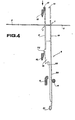
- Figure 3 shows an anomalous position of the lifting hook 8 according to the invention, while it is moving downward and away - for instance due to anomalous vibrations - from the fixed bottom blade 9.
- the advantage provided by the bar 14 for stability purposes is quite evident, said bar preventing the lifting hook from moving even further away from the blade 9, and actually forcing said hook to return in its correct position (which it will finally take up also due to the mutual cooperation between the inclined surfaces 9A and 23A of the fixed bottom blade 9 and of the shaped seat 23).
- the lifting hook 8 is shown while being forced to stay in a lifted position - due to engagement of the blade 12 with the beak 13 -while, not having been shifted by the needle 5, it has to engage with the fixed blade 10; in this phase, always on account of anomalous vibrations, the lifting hook 8 could move sideways up to disengaging from the blade 10, if this were not again prevented by the presence of the bar 14 which forces said lifting hook into the correct position, as clearly shown in the drawing.
- the slack existing between the lifting hook 8 and the bar 14 allows to limit the deformation of the resilient portion of said lifting hook, when it has to disengage from the blade 10, since part of the deformation is eliminated by the actual movement of the lifting hook.
- Less deformation of the lifting hook means less stress applied between the arms of said hook and the teeth 7 of the needle 5, with consequent less possibility of wear of such teeth. This represents a further important advantage of the machine according to the invention.
- the stiffening of the lower part of the lifting hook may be obtained by connecting the shaped plate to the filiform arms otherwise than by welding, or by producing the tooth 22 and the shaped seat 23 as separate pieces, connected one to the other and to the remaining structure of the lifting hook by stiffening brackets.
Landscapes
- Engineering & Computer Science (AREA)
- Textile Engineering (AREA)
- Sewing Machines And Sewing (AREA)
- Looms (AREA)
- Supports For Plants (AREA)
- Golf Clubs (AREA)
- Toys (AREA)
- Mechanical Means For Catching Fish (AREA)
- Load-Engaging Elements For Cranes (AREA)
- Emergency Lowering Means (AREA)
Claims (5)
Priority Applications (1)
| Application Number | Priority Date | Filing Date | Title |
|---|---|---|---|
| AT85101546T ATE39370T1 (de) | 1984-02-29 | 1985-02-13 | Doppelschenklige platine mit unterschiedlicher struktur und damit ausgeruestete jacquardwebmaschine. |
Applications Claiming Priority (2)
| Application Number | Priority Date | Filing Date | Title |
|---|---|---|---|
| IT1984884 | 1984-02-29 | ||
| IT19848/84A IT1173404B (it) | 1984-02-29 | 1984-02-29 | Arpino a due bracci a struttura differenziata e macchina di armatura jacquard con esso realizzata |
Publications (2)
| Publication Number | Publication Date |
|---|---|
| EP0154823A1 EP0154823A1 (de) | 1985-09-18 |
| EP0154823B1 true EP0154823B1 (de) | 1988-12-21 |
Family
ID=11161779
Family Applications (1)
| Application Number | Title | Priority Date | Filing Date |
|---|---|---|---|
| EP85101546A Expired EP0154823B1 (de) | 1984-02-29 | 1985-02-13 | Doppelschenklige Platine mit Unterschiedlicher Struktur und damit ausgerüstete Jacquard-Webmaschine |
Country Status (5)
| Country | Link |
|---|---|
| EP (1) | EP0154823B1 (de) |
| JP (1) | JPS60239542A (de) |
| AT (1) | ATE39370T1 (de) |
| DE (1) | DE3566910D1 (de) |
| IT (1) | IT1173404B (de) |
Families Citing this family (4)
| Publication number | Priority date | Publication date | Assignee | Title |
|---|---|---|---|---|
| FR2742170B1 (fr) * | 1995-12-12 | 1998-01-23 | Staubli Verdol | Perfectionnements aux mecaniques d'armures a double leve |
| JP2003528996A (ja) | 2000-03-27 | 2003-09-30 | テクスティルマ・アクチェンゲゼルシャフト | ジャカード織機 |
| BE1015131A5 (nl) * | 2002-10-04 | 2004-10-05 | Wiele Michel Van De Nv | Werkwijze voor het vervaardigen van componenten bestaande uit een geheel. |
| FR2846343B1 (fr) * | 2002-10-25 | 2004-12-17 | Staubli Lyon | Mecanisme de formation de la foule et metier a tisser equipe d'un tel mecanisme |
Family Cites Families (3)
| Publication number | Priority date | Publication date | Assignee | Title |
|---|---|---|---|---|
| CH400031A (de) * | 1963-02-01 | 1965-09-30 | Webstuhlbau Karl Marx Stadt | Doppelhub-Ganzoffenfach-Jacquardmaschine |
| DE1292090B (de) * | 1965-10-05 | 1969-04-03 | Webstuhlbau Karl Marx Stadt Ve | Platine fuer Jacquardmaschinen |
| FR2498640A1 (fr) * | 1981-01-23 | 1982-07-30 | Verdol Sa | Perfectionnements aux mecaniques d'armure a crochets doubles |
-
1984
- 1984-02-29 IT IT19848/84A patent/IT1173404B/it active
-
1985
- 1985-02-13 EP EP85101546A patent/EP0154823B1/de not_active Expired
- 1985-02-13 DE DE8585101546T patent/DE3566910D1/de not_active Expired
- 1985-02-13 AT AT85101546T patent/ATE39370T1/de not_active IP Right Cessation
- 1985-02-28 JP JP60040268A patent/JPS60239542A/ja active Pending
Also Published As
| Publication number | Publication date |
|---|---|
| DE3566910D1 (en) | 1989-01-26 |
| IT1173404B (it) | 1987-06-24 |
| ATE39370T1 (de) | 1989-01-15 |
| IT8419848A0 (it) | 1984-02-29 |
| EP0154823A1 (de) | 1985-09-18 |
| JPS60239542A (ja) | 1985-11-28 |
Similar Documents
| Publication | Publication Date | Title |
|---|---|---|
| EP0154823B1 (de) | Doppelschenklige Platine mit Unterschiedlicher Struktur und damit ausgerüstete Jacquard-Webmaschine | |
| US4757697A (en) | Machine a tricoter | |
| US3835895A (en) | Loom jacquards of the double-lift type | |
| US3967652A (en) | Spring hook for the harness pull of a double-lift open-shed jacquard machine | |
| US3724511A (en) | Device for controlling a wedge coupling, particularly in a dobby | |
| US20060054236A1 (en) | Method for producing a woven and a heddle particularly for use thereby | |
| US4109490A (en) | Sliding latch needle | |
| EP0716173A1 (de) | Hochgeschwindigkeitsplatine für Rundstrickmaschinen | |
| EP0215746B1 (de) | Vorrichtung zur Platine- und Nadelauswahl in einer automatischen Flachstrickmaschine | |
| US2941551A (en) | Semi-oriental jacquard and method | |
| EP0694639B2 (de) | Platinenanordnung in einer Strickmaschine und Verfahren zur Herstellung eines Gestricks durch Anwendung dieser Anordnung | |
| EP0267883B1 (de) | Automatische Flachstrickmaschine | |
| JPS6223828Y2 (de) | ||
| US4041987A (en) | Jacquard machine equipped with lifting wires and stationary arresting blades | |
| US4469139A (en) | Double lift open shed Jacquard loom | |
| GB2146665A (en) | Weft yarn insertion needle | |
| US4187886A (en) | Dobby for the formation of the shed on looms | |
| EP0135074B1 (de) | Stangenförmige Platine für eine Jacquardmaschine und damit ausgerüstete Maschine | |
| US4418725A (en) | Hook for Jacquard machine | |
| US5031668A (en) | Jacquard weaving machine utilizing selectively reciprocatable control members | |
| CN201362773Y (zh) | 具有导轨调平装置的双匹绒头织物织机 | |
| CN222648275U (zh) | 一种沉降片组件及包括该沉降片组件的剪毛割圈绒提花机 | |
| US4579151A (en) | Machine for making a partly woven partly knitted fabric | |
| CN206916375U (zh) | 一种不使用沉降片的拉舍尔经编机 | |
| US1958823A (en) | Full fashioned knitting machine |
Legal Events
| Date | Code | Title | Description |
|---|---|---|---|
| PUAI | Public reference made under article 153(3) epc to a published international application that has entered the european phase |
Free format text: ORIGINAL CODE: 0009012 |
|
| AK | Designated contracting states |
Designated state(s): AT BE CH DE FR GB LI LU NL SE |
|
| 17P | Request for examination filed |
Effective date: 19860308 |
|
| 17Q | First examination report despatched |
Effective date: 19870803 |
|
| GRAA | (expected) grant |
Free format text: ORIGINAL CODE: 0009210 |
|
| AK | Designated contracting states |
Kind code of ref document: B1 Designated state(s): AT BE CH DE FR GB LI LU NL SE |
|
| PG25 | Lapsed in a contracting state [announced via postgrant information from national office to epo] |
Ref country code: SE Effective date: 19881221 Ref country code: NL Effective date: 19881221 |
|
| REF | Corresponds to: |
Ref document number: 39370 Country of ref document: AT Date of ref document: 19890115 Kind code of ref document: T |
|
| REF | Corresponds to: |
Ref document number: 3566910 Country of ref document: DE Date of ref document: 19890126 |
|
| PG25 | Lapsed in a contracting state [announced via postgrant information from national office to epo] |
Ref country code: LU Free format text: LAPSE BECAUSE OF NON-PAYMENT OF DUE FEES Effective date: 19890228 |
|
| ET | Fr: translation filed | ||
| NLV1 | Nl: lapsed or annulled due to failure to fulfill the requirements of art. 29p and 29m of the patents act | ||
| PLBE | No opposition filed within time limit |
Free format text: ORIGINAL CODE: 0009261 |
|
| STAA | Information on the status of an ep patent application or granted ep patent |
Free format text: STATUS: NO OPPOSITION FILED WITHIN TIME LIMIT |
|
| 26N | No opposition filed | ||
| PGFP | Annual fee paid to national office [announced via postgrant information from national office to epo] |
Ref country code: BE Payment date: 19900131 Year of fee payment: 6 |
|
| PGFP | Annual fee paid to national office [announced via postgrant information from national office to epo] |
Ref country code: AT Payment date: 19900206 Year of fee payment: 6 |
|
| PGFP | Annual fee paid to national office [announced via postgrant information from national office to epo] |
Ref country code: FR Payment date: 19900223 Year of fee payment: 6 |
|
| PGFP | Annual fee paid to national office [announced via postgrant information from national office to epo] |
Ref country code: CH Payment date: 19900227 Year of fee payment: 6 |
|
| PGFP | Annual fee paid to national office [announced via postgrant information from national office to epo] |
Ref country code: GB Payment date: 19900228 Year of fee payment: 6 |
|
| PGFP | Annual fee paid to national office [announced via postgrant information from national office to epo] |
Ref country code: DE Payment date: 19900312 Year of fee payment: 6 |
|
| PG25 | Lapsed in a contracting state [announced via postgrant information from national office to epo] |
Ref country code: GB Effective date: 19910213 Ref country code: AT Effective date: 19910213 |
|
| PG25 | Lapsed in a contracting state [announced via postgrant information from national office to epo] |
Ref country code: LI Effective date: 19910228 Ref country code: CH Effective date: 19910228 Ref country code: BE Effective date: 19910228 |
|
| GBPC | Gb: european patent ceased through non-payment of renewal fee | ||
| PG25 | Lapsed in a contracting state [announced via postgrant information from national office to epo] |
Ref country code: FR Effective date: 19911031 |
|
| REG | Reference to a national code |
Ref country code: CH Ref legal event code: PL |
|
| PG25 | Lapsed in a contracting state [announced via postgrant information from national office to epo] |
Ref country code: DE Effective date: 19911101 |
|
| REG | Reference to a national code |
Ref country code: FR Ref legal event code: ST |