EP0149427B1 - (Poly-)Oxyalkylamino-diphenyläther mit herbizider Wirkung - Google Patents
(Poly-)Oxyalkylamino-diphenyläther mit herbizider Wirkung Download PDFInfo
- Publication number
- EP0149427B1 EP0149427B1 EP84810620A EP84810620A EP0149427B1 EP 0149427 B1 EP0149427 B1 EP 0149427B1 EP 84810620 A EP84810620 A EP 84810620A EP 84810620 A EP84810620 A EP 84810620A EP 0149427 B1 EP0149427 B1 EP 0149427B1
- Authority
- EP
- European Patent Office
- Prior art keywords
- nitro
- chloro
- formula
- poly
- trifluoromethyldiphenyl
- Prior art date
- Legal status (The legal status is an assumption and is not a legal conclusion. Google has not performed a legal analysis and makes no representation as to the accuracy of the status listed.)
- Expired
Links
- 230000002363 herbicidal effect Effects 0.000 title claims description 10
- USIUVYZYUHIAEV-UHFFFAOYSA-N diphenyl ether Chemical class C=1C=CC=CC=1OC1=CC=CC=C1 USIUVYZYUHIAEV-UHFFFAOYSA-N 0.000 title description 2
- -1 benzoylsulfonyl Chemical group 0.000 claims description 39
- RTZKZFJDLAIYFH-UHFFFAOYSA-N Diethyl ether Chemical compound CCOCC RTZKZFJDLAIYFH-UHFFFAOYSA-N 0.000 claims description 18
- 238000000034 method Methods 0.000 claims description 18
- 241000196324 Embryophyta Species 0.000 claims description 16
- 229910052739 hydrogen Inorganic materials 0.000 claims description 16
- 239000001257 hydrogen Substances 0.000 claims description 16
- 239000000203 mixture Substances 0.000 claims description 16
- 150000002431 hydrogen Chemical group 0.000 claims description 11
- 239000002253 acid Substances 0.000 claims description 8
- 238000002360 preparation method Methods 0.000 claims description 8
- ZAMOUSCENKQFHK-UHFFFAOYSA-N Chlorine atom Chemical group [Cl] ZAMOUSCENKQFHK-UHFFFAOYSA-N 0.000 claims description 7
- PXGOKWXKJXAPGV-UHFFFAOYSA-N Fluorine Chemical group FF PXGOKWXKJXAPGV-UHFFFAOYSA-N 0.000 claims description 6
- UFHFLCQGNIYNRP-UHFFFAOYSA-N Hydrogen Chemical compound [H][H] UFHFLCQGNIYNRP-UHFFFAOYSA-N 0.000 claims description 6
- GRYLNZFGIOXLOG-UHFFFAOYSA-N Nitric acid Chemical compound O[N+]([O-])=O GRYLNZFGIOXLOG-UHFFFAOYSA-N 0.000 claims description 6
- 229910052801 chlorine Inorganic materials 0.000 claims description 6
- 239000000460 chlorine Chemical group 0.000 claims description 6
- 229910052736 halogen Inorganic materials 0.000 claims description 6
- 150000002367 halogens Chemical group 0.000 claims description 6
- 238000006396 nitration reaction Methods 0.000 claims description 6
- 229910017604 nitric acid Inorganic materials 0.000 claims description 6
- 239000003960 organic solvent Substances 0.000 claims description 6
- 125000006239 protecting group Chemical group 0.000 claims description 6
- 125000004178 (C1-C4) alkyl group Chemical group 0.000 claims description 5
- 229910052731 fluorine Chemical group 0.000 claims description 5
- 239000011737 fluorine Chemical group 0.000 claims description 5
- 150000004820 halides Chemical class 0.000 claims description 5
- XILPLWOGHPSJBK-UHFFFAOYSA-N 1,2-dichloro-4-(trifluoromethyl)benzene Chemical compound FC(F)(F)C1=CC=C(Cl)C(Cl)=C1 XILPLWOGHPSJBK-UHFFFAOYSA-N 0.000 claims description 3
- 125000002853 C1-C4 hydroxyalkyl group Chemical group 0.000 claims description 3
- VGGSQFUCUMXWEO-UHFFFAOYSA-N Ethene Chemical compound C=C VGGSQFUCUMXWEO-UHFFFAOYSA-N 0.000 claims description 3
- 241000238631 Hexapoda Species 0.000 claims description 3
- 240000008042 Zea mays Species 0.000 claims description 3
- 235000016383 Zea mays subsp huehuetenangensis Nutrition 0.000 claims description 3
- 235000002017 Zea mays subsp mays Nutrition 0.000 claims description 3
- 230000012010 growth Effects 0.000 claims description 3
- 125000005843 halogen group Chemical group 0.000 claims description 3
- 235000009973 maize Nutrition 0.000 claims description 3
- 230000000802 nitrating effect Effects 0.000 claims description 3
- 125000004767 (C1-C4) haloalkoxy group Chemical group 0.000 claims description 2
- 125000004765 (C1-C4) haloalkyl group Chemical group 0.000 claims description 2
- 125000000229 (C1-C4)alkoxy group Chemical group 0.000 claims description 2
- 241000238876 Acari Species 0.000 claims description 2
- 239000005977 Ethylene Substances 0.000 claims description 2
- 235000010469 Glycine max Nutrition 0.000 claims description 2
- 125000005262 alkoxyamine group Chemical group 0.000 claims description 2
- 229910052799 carbon Inorganic materials 0.000 claims description 2
- 125000004093 cyano group Chemical group *C#N 0.000 claims description 2
- 125000004435 hydrogen atom Chemical group [H]* 0.000 claims description 2
- JZMJDSHXVKJFKW-UHFFFAOYSA-M methyl sulfate(1-) Chemical group COS([O-])(=O)=O JZMJDSHXVKJFKW-UHFFFAOYSA-M 0.000 claims description 2
- 125000000449 nitro group Chemical group [O-][N+](*)=O 0.000 claims description 2
- 230000001276 controlling effect Effects 0.000 claims 4
- 230000008635 plant growth Effects 0.000 claims 2
- 230000001105 regulatory effect Effects 0.000 claims 2
- 244000045561 useful plants Species 0.000 claims 2
- 244000068988 Glycine max Species 0.000 claims 1
- 235000010716 Vigna mungo Nutrition 0.000 claims 1
- 240000001417 Vigna umbellata Species 0.000 claims 1
- 235000011453 Vigna umbellata Nutrition 0.000 claims 1
- 239000002671 adjuvant Substances 0.000 claims 1
- 125000006353 oxyethylene group Chemical group 0.000 claims 1
- QQONPFPTGQHPMA-UHFFFAOYSA-N propylene Natural products CC=C QQONPFPTGQHPMA-UHFFFAOYSA-N 0.000 claims 1
- LFQSCWFLJHTTHZ-UHFFFAOYSA-N Ethanol Chemical compound CCO LFQSCWFLJHTTHZ-UHFFFAOYSA-N 0.000 description 22
- 150000001875 compounds Chemical class 0.000 description 22
- 239000004480 active ingredient Substances 0.000 description 17
- YXFVVABEGXRONW-UHFFFAOYSA-N Toluene Chemical compound CC1=CC=CC=C1 YXFVVABEGXRONW-UHFFFAOYSA-N 0.000 description 16
- HEMHJVSKTPXQMS-UHFFFAOYSA-M Sodium hydroxide Chemical compound [OH-].[Na+] HEMHJVSKTPXQMS-UHFFFAOYSA-M 0.000 description 10
- 230000000694 effects Effects 0.000 description 10
- LYCAIKOWRPUZTN-UHFFFAOYSA-N Ethylene glycol Chemical compound OCCO LYCAIKOWRPUZTN-UHFFFAOYSA-N 0.000 description 9
- XLYOFNOQVPJJNP-UHFFFAOYSA-N water Substances O XLYOFNOQVPJJNP-UHFFFAOYSA-N 0.000 description 9
- QGZKDVFQNNGYKY-UHFFFAOYSA-N Ammonia Chemical compound N QGZKDVFQNNGYKY-UHFFFAOYSA-N 0.000 description 8
- 239000003795 chemical substances by application Substances 0.000 description 8
- 235000019441 ethanol Nutrition 0.000 description 8
- 239000007787 solid Substances 0.000 description 8
- 239000004094 surface-active agent Substances 0.000 description 8
- QAOWNCQODCNURD-UHFFFAOYSA-N Sulfuric acid Chemical compound OS(O)(=O)=O QAOWNCQODCNURD-UHFFFAOYSA-N 0.000 description 7
- 239000002585 base Substances 0.000 description 7
- 238000006243 chemical reaction Methods 0.000 description 7
- FYSNRJHAOHDILO-UHFFFAOYSA-N thionyl chloride Chemical compound ClS(Cl)=O FYSNRJHAOHDILO-UHFFFAOYSA-N 0.000 description 7
- CSCPPACGZOOCGX-UHFFFAOYSA-N Acetone Chemical compound CC(C)=O CSCPPACGZOOCGX-UHFFFAOYSA-N 0.000 description 6
- UHOVQNZJYSORNB-UHFFFAOYSA-N Benzene Chemical compound C1=CC=CC=C1 UHOVQNZJYSORNB-UHFFFAOYSA-N 0.000 description 6
- IAZDPXIOMUYVGZ-UHFFFAOYSA-N Dimethylsulphoxide Chemical compound CS(C)=O IAZDPXIOMUYVGZ-UHFFFAOYSA-N 0.000 description 6
- ZMXDDKWLCZADIW-UHFFFAOYSA-N N,N-Dimethylformamide Chemical compound CN(C)C=O ZMXDDKWLCZADIW-UHFFFAOYSA-N 0.000 description 6
- 240000007594 Oryza sativa Species 0.000 description 6
- KWYUFKZDYYNOTN-UHFFFAOYSA-M Potassium hydroxide Chemical compound [OH-].[K+] KWYUFKZDYYNOTN-UHFFFAOYSA-M 0.000 description 6
- 239000000654 additive Substances 0.000 description 6
- 125000004432 carbon atom Chemical group C* 0.000 description 6
- 235000014113 dietary fatty acids Nutrition 0.000 description 6
- 239000000194 fatty acid Substances 0.000 description 6
- 229930195729 fatty acid Natural products 0.000 description 6
- 150000004665 fatty acids Chemical class 0.000 description 6
- 239000004009 herbicide Substances 0.000 description 6
- 239000011541 reaction mixture Substances 0.000 description 6
- 150000003839 salts Chemical class 0.000 description 6
- 239000002904 solvent Substances 0.000 description 6
- 238000012360 testing method Methods 0.000 description 6
- 125000000217 alkyl group Chemical group 0.000 description 5
- 239000000839 emulsion Substances 0.000 description 5
- 150000002170 ethers Chemical class 0.000 description 5
- 238000009472 formulation Methods 0.000 description 5
- 239000000243 solution Substances 0.000 description 5
- WWJVRDMJNJTOBL-UHFFFAOYSA-N 2-[2-(2-ethoxyethoxy)ethoxy]ethanamine Chemical compound CCOCCOCCOCCN WWJVRDMJNJTOBL-UHFFFAOYSA-N 0.000 description 4
- IGFHQQFPSIBGKE-UHFFFAOYSA-N 4-nonylphenol Chemical compound CCCCCCCCCC1=CC=C(O)C=C1 IGFHQQFPSIBGKE-UHFFFAOYSA-N 0.000 description 4
- 235000007164 Oryza sativa Nutrition 0.000 description 4
- 238000009835 boiling Methods 0.000 description 4
- 239000012141 concentrate Substances 0.000 description 4
- 235000008504 concentrate Nutrition 0.000 description 4
- 238000001816 cooling Methods 0.000 description 4
- 239000002736 nonionic surfactant Substances 0.000 description 4
- 239000000843 powder Substances 0.000 description 4
- 235000009566 rice Nutrition 0.000 description 4
- ZWEHNKRNPOVVGH-UHFFFAOYSA-N 2-Butanone Chemical compound CCC(C)=O ZWEHNKRNPOVVGH-UHFFFAOYSA-N 0.000 description 3
- ASDQMECUMYIVBG-UHFFFAOYSA-N 2-[2-(2-aminoethoxy)ethoxy]ethanol Chemical compound NCCOCCOCCO ASDQMECUMYIVBG-UHFFFAOYSA-N 0.000 description 3
- WEVYAHXRMPXWCK-UHFFFAOYSA-N Acetonitrile Chemical compound CC#N WEVYAHXRMPXWCK-UHFFFAOYSA-N 0.000 description 3
- IAYPIBMASNFSPL-UHFFFAOYSA-N Ethylene oxide Chemical group C1CO1 IAYPIBMASNFSPL-UHFFFAOYSA-N 0.000 description 3
- JUJWROOIHBZHMG-UHFFFAOYSA-N Pyridine Chemical compound C1=CC=NC=C1 JUJWROOIHBZHMG-UHFFFAOYSA-N 0.000 description 3
- VYPSYNLAJGMNEJ-UHFFFAOYSA-N Silicium dioxide Chemical compound O=[Si]=O VYPSYNLAJGMNEJ-UHFFFAOYSA-N 0.000 description 3
- 229910021529 ammonia Inorganic materials 0.000 description 3
- 239000011230 binding agent Substances 0.000 description 3
- 239000000969 carrier Substances 0.000 description 3
- 239000007859 condensation product Substances 0.000 description 3
- 238000004821 distillation Methods 0.000 description 3
- 239000008187 granular material Substances 0.000 description 3
- 239000000463 material Substances 0.000 description 3
- VLKZOEOYAKHREP-UHFFFAOYSA-N n-Hexane Chemical compound CCCCCC VLKZOEOYAKHREP-UHFFFAOYSA-N 0.000 description 3
- 239000000047 product Substances 0.000 description 3
- 229910052708 sodium Inorganic materials 0.000 description 3
- 239000011734 sodium Substances 0.000 description 3
- WSLDOOZREJYCGB-UHFFFAOYSA-N 1,2-Dichloroethane Chemical compound ClCCCl WSLDOOZREJYCGB-UHFFFAOYSA-N 0.000 description 2
- NDDRUUNXMMRCIV-UHFFFAOYSA-N 1-(2-chloroethoxy)-2-ethoxyethane Chemical compound CCOCCOCCCl NDDRUUNXMMRCIV-UHFFFAOYSA-N 0.000 description 2
- XNWFRZJHXBZDAG-UHFFFAOYSA-N 2-METHOXYETHANOL Chemical group COCCO XNWFRZJHXBZDAG-UHFFFAOYSA-N 0.000 description 2
- QTBSBXVTEAMEQO-UHFFFAOYSA-N Acetic acid Chemical compound CC(O)=O QTBSBXVTEAMEQO-UHFFFAOYSA-N 0.000 description 2
- 241000256118 Aedes aegypti Species 0.000 description 2
- 239000005995 Aluminium silicate Substances 0.000 description 2
- 229910021532 Calcite Inorganic materials 0.000 description 2
- CURLTUGMZLYLDI-UHFFFAOYSA-N Carbon dioxide Chemical compound O=C=O CURLTUGMZLYLDI-UHFFFAOYSA-N 0.000 description 2
- 241000565391 Fraxinus mandshurica Species 0.000 description 2
- KFZMGEQAYNKOFK-UHFFFAOYSA-N Isopropanol Chemical compound CC(C)O KFZMGEQAYNKOFK-UHFFFAOYSA-N 0.000 description 2
- 241000257162 Lucilia <blowfly> Species 0.000 description 2
- 241000736227 Lucilia sericata Species 0.000 description 2
- 241001465754 Metazoa Species 0.000 description 2
- 229920003171 Poly (ethylene oxide) Polymers 0.000 description 2
- 239000002202 Polyethylene glycol Substances 0.000 description 2
- 229920001214 Polysorbate 60 Polymers 0.000 description 2
- WYURNTSHIVDZCO-UHFFFAOYSA-N Tetrahydrofuran Chemical compound C1CCOC1 WYURNTSHIVDZCO-UHFFFAOYSA-N 0.000 description 2
- 239000013543 active substance Substances 0.000 description 2
- 125000002252 acyl group Chemical group 0.000 description 2
- 230000000996 additive effect Effects 0.000 description 2
- 150000001298 alcohols Chemical class 0.000 description 2
- 150000008055 alkyl aryl sulfonates Chemical class 0.000 description 2
- 235000012211 aluminium silicate Nutrition 0.000 description 2
- 150000003863 ammonium salts Chemical class 0.000 description 2
- 239000003945 anionic surfactant Substances 0.000 description 2
- 238000010533 azeotropic distillation Methods 0.000 description 2
- 125000003785 benzimidazolyl group Chemical class N1=C(NC2=C1C=CC=C2)* 0.000 description 2
- 239000003093 cationic surfactant Substances 0.000 description 2
- 235000013339 cereals Nutrition 0.000 description 2
- 239000003240 coconut oil Substances 0.000 description 2
- 238000009833 condensation Methods 0.000 description 2
- 230000005494 condensation Effects 0.000 description 2
- 244000038559 crop plants Species 0.000 description 2
- JHIVVAPYMSGYDF-UHFFFAOYSA-N cyclohexanone Chemical compound O=C1CCCCC1 JHIVVAPYMSGYDF-UHFFFAOYSA-N 0.000 description 2
- 230000006378 damage Effects 0.000 description 2
- 239000003599 detergent Substances 0.000 description 2
- XXJWXESWEXIICW-UHFFFAOYSA-N diethylene glycol monoethyl ether Chemical compound CCOCCOCCO XXJWXESWEXIICW-UHFFFAOYSA-N 0.000 description 2
- 238000010790 dilution Methods 0.000 description 2
- 239000012895 dilution Substances 0.000 description 2
- 239000003995 emulsifying agent Substances 0.000 description 2
- 238000005516 engineering process Methods 0.000 description 2
- 150000002148 esters Chemical class 0.000 description 2
- 241001233957 eudicotyledons Species 0.000 description 2
- 239000000706 filtrate Substances 0.000 description 2
- 238000004508 fractional distillation Methods 0.000 description 2
- 238000000227 grinding Methods 0.000 description 2
- 239000001963 growth medium Substances 0.000 description 2
- ZSIAUFGUXNUGDI-UHFFFAOYSA-N hexan-1-ol Chemical compound CCCCCCO ZSIAUFGUXNUGDI-UHFFFAOYSA-N 0.000 description 2
- WGCNASOHLSPBMP-UHFFFAOYSA-N hydroxyacetaldehyde Natural products OCC=O WGCNASOHLSPBMP-UHFFFAOYSA-N 0.000 description 2
- NLYAJNPCOHFWQQ-UHFFFAOYSA-N kaolin Chemical compound O.O.O=[Al]O[Si](=O)O[Si](=O)O[Al]=O NLYAJNPCOHFWQQ-UHFFFAOYSA-N 0.000 description 2
- 150000002576 ketones Chemical class 0.000 description 2
- 239000007788 liquid Substances 0.000 description 2
- 238000002156 mixing Methods 0.000 description 2
- 229920001515 polyalkylene glycol Polymers 0.000 description 2
- 229920001223 polyethylene glycol Polymers 0.000 description 2
- 229920000151 polyglycol Polymers 0.000 description 2
- 239000010695 polyglycol Substances 0.000 description 2
- 229920001451 polypropylene glycol Polymers 0.000 description 2
- FGIUAXJPYTZDNR-UHFFFAOYSA-N potassium nitrate Chemical compound [K+].[O-][N+]([O-])=O FGIUAXJPYTZDNR-UHFFFAOYSA-N 0.000 description 2
- 150000003254 radicals Chemical class 0.000 description 2
- 239000000344 soap Substances 0.000 description 2
- 238000003756 stirring Methods 0.000 description 2
- 239000000126 substance Substances 0.000 description 2
- 125000001424 substituent group Chemical group 0.000 description 2
- 125000001273 sulfonato group Chemical class [O-]S(*)(=O)=O 0.000 description 2
- 150000003467 sulfuric acid derivatives Chemical class 0.000 description 2
- 239000000725 suspension Substances 0.000 description 2
- WRIDQFICGBMAFQ-UHFFFAOYSA-N (E)-8-Octadecenoic acid Natural products CCCCCCCCCC=CCCCCCCC(O)=O WRIDQFICGBMAFQ-UHFFFAOYSA-N 0.000 description 1
- 125000004815 1,2-dimethylethylene group Chemical group [H]C([H])([H])C([H])([*:1])C([H])([*:2])C([H])([H])[H] 0.000 description 1
- RYHBNJHYFVUHQT-UHFFFAOYSA-N 1,4-Dioxane Chemical compound C1COCCO1 RYHBNJHYFVUHQT-UHFFFAOYSA-N 0.000 description 1
- LVFVRCPHJZOLAT-UHFFFAOYSA-N 2-(2-butoxyethoxy)ethanamine Chemical compound CCCCOCCOCCN LVFVRCPHJZOLAT-UHFFFAOYSA-N 0.000 description 1
- JUVLKHUNJZRWLN-UHFFFAOYSA-N 2-(2-methoxyethoxy)propan-1-ol Chemical compound COCCOC(C)CO JUVLKHUNJZRWLN-UHFFFAOYSA-N 0.000 description 1
- LBLYYCQCTBFVLH-UHFFFAOYSA-N 2-Methylbenzenesulfonic acid Chemical compound CC1=CC=CC=C1S(O)(=O)=O LBLYYCQCTBFVLH-UHFFFAOYSA-N 0.000 description 1
- JDSQBDGCMUXRBM-UHFFFAOYSA-N 2-[2-(2-butoxypropoxy)propoxy]propan-1-ol Chemical group CCCCOC(C)COC(C)COC(C)CO JDSQBDGCMUXRBM-UHFFFAOYSA-N 0.000 description 1
- WBIQQQGBSDOWNP-UHFFFAOYSA-N 2-dodecylbenzenesulfonic acid Chemical class CCCCCCCCCCCCC1=CC=CC=C1S(O)(=O)=O WBIQQQGBSDOWNP-UHFFFAOYSA-N 0.000 description 1
- LQJBNNIYVWPHFW-UHFFFAOYSA-N 20:1omega9c fatty acid Natural products CCCCCCCCCCC=CCCCCCCCC(O)=O LQJBNNIYVWPHFW-UHFFFAOYSA-N 0.000 description 1
- FOGYNLXERPKEGN-UHFFFAOYSA-N 3-(2-hydroxy-3-methoxyphenyl)-2-[2-methoxy-4-(3-sulfopropyl)phenoxy]propane-1-sulfonic acid Chemical compound COC1=CC=CC(CC(CS(O)(=O)=O)OC=2C(=CC(CCCS(O)(=O)=O)=CC=2)OC)=C1O FOGYNLXERPKEGN-UHFFFAOYSA-N 0.000 description 1
- RJCHCFQTUKAYAA-UHFFFAOYSA-N 5-[[2-amino-5-[(4-methoxyphenyl)methyl]-3-methylimidazol-4-yl]methyl]-2-methoxybenzene-1,3-diol Chemical compound C1=CC(OC)=CC=C1CC1=C(CC=2C=C(O)C(OC)=C(O)C=2)N(C)C(=N)N1 RJCHCFQTUKAYAA-UHFFFAOYSA-N 0.000 description 1
- QSBYPNXLFMSGKH-UHFFFAOYSA-N 9-Heptadecensaeure Natural products CCCCCCCC=CCCCCCCCC(O)=O QSBYPNXLFMSGKH-UHFFFAOYSA-N 0.000 description 1
- 241000256111 Aedes <genus> Species 0.000 description 1
- 241001136792 Alle Species 0.000 description 1
- 241000743985 Alopecurus Species 0.000 description 1
- 241001427556 Anoplura Species 0.000 description 1
- LSNNMFCWUKXFEE-UHFFFAOYSA-M Bisulfite Chemical compound OS([O-])=O LSNNMFCWUKXFEE-UHFFFAOYSA-M 0.000 description 1
- WKBOTKDWSSQWDR-UHFFFAOYSA-N Bromine atom Chemical compound [Br] WKBOTKDWSSQWDR-UHFFFAOYSA-N 0.000 description 1
- 239000004215 Carbon black (E152) Substances 0.000 description 1
- VEXZGXHMUGYJMC-UHFFFAOYSA-M Chloride anion Chemical compound [Cl-] VEXZGXHMUGYJMC-UHFFFAOYSA-M 0.000 description 1
- 244000060011 Cocos nucifera Species 0.000 description 1
- 235000013162 Cocos nucifera Nutrition 0.000 description 1
- 241000254173 Coleoptera Species 0.000 description 1
- 229920000742 Cotton Polymers 0.000 description 1
- XDTMQSROBMDMFD-UHFFFAOYSA-N Cyclohexane Chemical compound C1CCCCC1 XDTMQSROBMDMFD-UHFFFAOYSA-N 0.000 description 1
- 244000108484 Cyperus difformis Species 0.000 description 1
- 235000017896 Digitaria Nutrition 0.000 description 1
- 241001303487 Digitaria <clam> Species 0.000 description 1
- 241000255925 Diptera Species 0.000 description 1
- 244000058871 Echinochloa crus-galli Species 0.000 description 1
- 239000004606 Fillers/Extenders Substances 0.000 description 1
- 241000258937 Hemiptera Species 0.000 description 1
- 241001466007 Heteroptera Species 0.000 description 1
- 240000005979 Hordeum vulgare Species 0.000 description 1
- 235000007340 Hordeum vulgare Nutrition 0.000 description 1
- VEXZGXHMUGYJMC-UHFFFAOYSA-N Hydrochloric acid Chemical compound Cl VEXZGXHMUGYJMC-UHFFFAOYSA-N 0.000 description 1
- 241000257303 Hymenoptera Species 0.000 description 1
- 241000256602 Isoptera Species 0.000 description 1
- 241000255777 Lepidoptera Species 0.000 description 1
- 241000209510 Liliopsida Species 0.000 description 1
- 241000209082 Lolium Species 0.000 description 1
- 241000257166 Lucilia cuprina Species 0.000 description 1
- 229910002651 NO3 Inorganic materials 0.000 description 1
- NHNBFGGVMKEFGY-UHFFFAOYSA-N Nitrate Chemical compound [O-][N+]([O-])=O NHNBFGGVMKEFGY-UHFFFAOYSA-N 0.000 description 1
- JCXJVPUVTGWSNB-UHFFFAOYSA-N Nitrogen dioxide Chemical class O=[N]=O JCXJVPUVTGWSNB-UHFFFAOYSA-N 0.000 description 1
- CTQNGGLPUBDAKN-UHFFFAOYSA-N O-Xylene Chemical compound CC1=CC=CC=C1C CTQNGGLPUBDAKN-UHFFFAOYSA-N 0.000 description 1
- 239000005642 Oleic acid Substances 0.000 description 1
- ZQPPMHVWECSIRJ-UHFFFAOYSA-N Oleic acid Natural products CCCCCCCCC=CCCCCCCCC(O)=O ZQPPMHVWECSIRJ-UHFFFAOYSA-N 0.000 description 1
- 241000238814 Orthoptera Species 0.000 description 1
- 229910019142 PO4 Inorganic materials 0.000 description 1
- 241000209117 Panicum Species 0.000 description 1
- 235000006443 Panicum miliaceum subsp. miliaceum Nutrition 0.000 description 1
- 235000009037 Panicum miliaceum subsp. ruderale Nutrition 0.000 description 1
- 239000004743 Polypropylene Substances 0.000 description 1
- DNIAPMSPPWPWGF-UHFFFAOYSA-N Propylene glycol Chemical group CC(O)CO DNIAPMSPPWPWGF-UHFFFAOYSA-N 0.000 description 1
- GOOHAUXETOMSMM-UHFFFAOYSA-N Propylene oxide Chemical compound CC1CO1 GOOHAUXETOMSMM-UHFFFAOYSA-N 0.000 description 1
- 241001415024 Psocoptera Species 0.000 description 1
- 241000341978 Rotala Species 0.000 description 1
- 241000857233 Rottboellia Species 0.000 description 1
- 244000082988 Secale cereale Species 0.000 description 1
- 235000007238 Secale cereale Nutrition 0.000 description 1
- 239000004113 Sepiolite Substances 0.000 description 1
- 235000005775 Setaria Nutrition 0.000 description 1
- 241000232088 Setaria <nematode> Species 0.000 description 1
- 241000258242 Siphonaptera Species 0.000 description 1
- PMZURENOXWZQFD-UHFFFAOYSA-L Sodium Sulfate Chemical compound [Na+].[Na+].[O-]S([O-])(=O)=O PMZURENOXWZQFD-UHFFFAOYSA-L 0.000 description 1
- PRXRUNOAOLTIEF-ADSICKODSA-N Sorbitan trioleate Chemical compound CCCCCCCC\C=C/CCCCCCCC(=O)OC[C@@H](OC(=O)CCCCCCC\C=C/CCCCCCCC)[C@H]1OC[C@H](O)[C@H]1OC(=O)CCCCCCC\C=C/CCCCCCCC PRXRUNOAOLTIEF-ADSICKODSA-N 0.000 description 1
- 239000004147 Sorbitan trioleate Substances 0.000 description 1
- 240000006394 Sorghum bicolor Species 0.000 description 1
- 235000011684 Sorghum saccharatum Nutrition 0.000 description 1
- 235000021355 Stearic acid Nutrition 0.000 description 1
- VBIIFPGSPJYLRR-UHFFFAOYSA-M Stearyltrimethylammonium chloride Chemical compound [Cl-].CCCCCCCCCCCCCCCCCC[N+](C)(C)C VBIIFPGSPJYLRR-UHFFFAOYSA-M 0.000 description 1
- 241001414989 Thysanoptera Species 0.000 description 1
- GSEJCLTVZPLZKY-UHFFFAOYSA-N Triethanolamine Chemical class OCCN(CCO)CCO GSEJCLTVZPLZKY-UHFFFAOYSA-N 0.000 description 1
- 235000021307 Triticum Nutrition 0.000 description 1
- 244000098338 Triticum aestivum Species 0.000 description 1
- 241000607479 Yersinia pestis Species 0.000 description 1
- 241001414985 Zygentoma Species 0.000 description 1
- 230000002745 absorbent Effects 0.000 description 1
- 239000002250 absorbent Substances 0.000 description 1
- 229960000583 acetic acid Drugs 0.000 description 1
- 239000000853 adhesive Substances 0.000 description 1
- 230000001070 adhesive effect Effects 0.000 description 1
- 230000000274 adsorptive effect Effects 0.000 description 1
- 125000001931 aliphatic group Chemical group 0.000 description 1
- 150000001338 aliphatic hydrocarbons Chemical class 0.000 description 1
- 239000003513 alkali Substances 0.000 description 1
- 229910052783 alkali metal Inorganic materials 0.000 description 1
- 150000001340 alkali metals Chemical class 0.000 description 1
- 229910052784 alkaline earth metal Inorganic materials 0.000 description 1
- 150000001342 alkaline earth metals Chemical class 0.000 description 1
- 125000004183 alkoxy alkyl group Chemical group 0.000 description 1
- 125000004390 alkyl sulfonyl group Chemical group 0.000 description 1
- 125000002947 alkylene group Chemical group 0.000 description 1
- 150000001408 amides Chemical class 0.000 description 1
- 150000001412 amines Chemical class 0.000 description 1
- 239000007900 aqueous suspension Substances 0.000 description 1
- 150000004945 aromatic hydrocarbons Chemical class 0.000 description 1
- 229960000892 attapulgite Drugs 0.000 description 1
- 239000000440 bentonite Substances 0.000 description 1
- 229910000278 bentonite Inorganic materials 0.000 description 1
- SVPXDRXYRYOSEX-UHFFFAOYSA-N bentoquatam Chemical compound O.O=[Si]=O.O=[Al]O[Al]=O SVPXDRXYRYOSEX-UHFFFAOYSA-N 0.000 description 1
- 150000008107 benzenesulfonic acids Chemical class 0.000 description 1
- 235000010233 benzoic acid Nutrition 0.000 description 1
- 150000001559 benzoic acids Chemical class 0.000 description 1
- 125000003236 benzoyl group Chemical group [H]C1=C([H])C([H])=C(C([H])=C1[H])C(*)=O 0.000 description 1
- 125000001797 benzyl group Chemical group [H]C1=C([H])C([H])=C(C([H])=C1[H])C([H])([H])* 0.000 description 1
- BCOZLGOHQFNXBI-UHFFFAOYSA-M benzyl-bis(2-chloroethyl)-ethylazanium;bromide Chemical compound [Br-].ClCC[N+](CC)(CCCl)CC1=CC=CC=C1 BCOZLGOHQFNXBI-UHFFFAOYSA-M 0.000 description 1
- 239000011449 brick Substances 0.000 description 1
- GDTBXPJZTBHREO-UHFFFAOYSA-N bromine Substances BrBr GDTBXPJZTBHREO-UHFFFAOYSA-N 0.000 description 1
- 229910052794 bromium Inorganic materials 0.000 description 1
- 229940105847 calamine Drugs 0.000 description 1
- 239000001569 carbon dioxide Substances 0.000 description 1
- 229910002092 carbon dioxide Inorganic materials 0.000 description 1
- 150000004649 carbonic acid derivatives Chemical class 0.000 description 1
- 239000004359 castor oil Substances 0.000 description 1
- 235000019438 castor oil Nutrition 0.000 description 1
- 239000003054 catalyst Substances 0.000 description 1
- 125000002091 cationic group Chemical group 0.000 description 1
- 239000007795 chemical reaction product Substances 0.000 description 1
- 150000001805 chlorine compounds Chemical class 0.000 description 1
- 239000011248 coating agent Substances 0.000 description 1
- 238000000576 coating method Methods 0.000 description 1
- 235000019864 coconut oil Nutrition 0.000 description 1
- HPXRVTGHNJAIIH-UHFFFAOYSA-N cyclohexanol Chemical compound OC1CCCCC1 HPXRVTGHNJAIIH-UHFFFAOYSA-N 0.000 description 1
- 238000011161 development Methods 0.000 description 1
- GUJOJGAPFQRJSV-UHFFFAOYSA-N dialuminum;dioxosilane;oxygen(2-);hydrate Chemical compound O.[O-2].[O-2].[O-2].[Al+3].[Al+3].O=[Si]=O.O=[Si]=O.O=[Si]=O.O=[Si]=O GUJOJGAPFQRJSV-UHFFFAOYSA-N 0.000 description 1
- MTHSVFCYNBDYFN-UHFFFAOYSA-N diethylene glycol Chemical group OCCOCCO MTHSVFCYNBDYFN-UHFFFAOYSA-N 0.000 description 1
- 239000006185 dispersion Substances 0.000 description 1
- 229940060296 dodecylbenzenesulfonic acid Drugs 0.000 description 1
- 239000010459 dolomite Substances 0.000 description 1
- 229910000514 dolomite Inorganic materials 0.000 description 1
- 238000010410 dusting Methods 0.000 description 1
- 244000078703 ectoparasite Species 0.000 description 1
- 230000001804 emulsifying effect Effects 0.000 description 1
- 238000005538 encapsulation Methods 0.000 description 1
- 150000005452 ethyl sulfates Chemical class 0.000 description 1
- 238000011156 evaluation Methods 0.000 description 1
- 238000002474 experimental method Methods 0.000 description 1
- 150000002191 fatty alcohols Chemical class 0.000 description 1
- 230000002349 favourable effect Effects 0.000 description 1
- 239000003337 fertilizer Substances 0.000 description 1
- 235000013312 flour Nutrition 0.000 description 1
- NVVZQXQBYZPMLJ-UHFFFAOYSA-N formaldehyde;naphthalene-1-sulfonic acid Chemical compound O=C.C1=CC=C2C(S(=O)(=O)O)=CC=CC2=C1 NVVZQXQBYZPMLJ-UHFFFAOYSA-N 0.000 description 1
- 238000005194 fractionation Methods 0.000 description 1
- 239000007789 gas Substances 0.000 description 1
- 239000012362 glacial acetic acid Substances 0.000 description 1
- ZEMPKEQAKRGZGQ-XOQCFJPHSA-N glycerol triricinoleate Natural products CCCCCC[C@@H](O)CC=CCCCCCCCC(=O)OC[C@@H](COC(=O)CCCCCCCC=CC[C@@H](O)CCCCCC)OC(=O)CCCCCCCC=CC[C@H](O)CCCCCC ZEMPKEQAKRGZGQ-XOQCFJPHSA-N 0.000 description 1
- 150000002334 glycols Chemical class 0.000 description 1
- 230000009036 growth inhibition Effects 0.000 description 1
- 230000002140 halogenating effect Effects 0.000 description 1
- 229930195733 hydrocarbon Natural products 0.000 description 1
- 230000001771 impaired effect Effects 0.000 description 1
- 230000000749 insecticidal effect Effects 0.000 description 1
- QXJSBBXBKPUZAA-UHFFFAOYSA-N isooleic acid Natural products CCCCCCCC=CCCCCCCCCC(O)=O QXJSBBXBKPUZAA-UHFFFAOYSA-N 0.000 description 1
- 235000021374 legumes Nutrition 0.000 description 1
- 239000002609 medium Substances 0.000 description 1
- 238000002844 melting Methods 0.000 description 1
- 230000008018 melting Effects 0.000 description 1
- 150000005451 methyl sulfates Chemical class 0.000 description 1
- 238000012986 modification Methods 0.000 description 1
- 230000004048 modification Effects 0.000 description 1
- 229910052901 montmorillonite Inorganic materials 0.000 description 1
- 150000002790 naphthalenes Chemical class 0.000 description 1
- QIQXTHQIDYTFRH-UHFFFAOYSA-N octadecanoic acid Chemical class CCCCCCCCCCCCCCCCCC(O)=O QIQXTHQIDYTFRH-UHFFFAOYSA-N 0.000 description 1
- OQCDKBAXFALNLD-UHFFFAOYSA-N octadecanoic acid Chemical class CCCCCCCC(C)CCCCCCCCC(O)=O OQCDKBAXFALNLD-UHFFFAOYSA-N 0.000 description 1
- UYDLBVPAAFVANX-UHFFFAOYSA-N octylphenoxy polyethoxyethanol Chemical compound CC(C)(C)CC(C)(C)C1=CC=C(OCCOCCOCCOCCO)C=C1 UYDLBVPAAFVANX-UHFFFAOYSA-N 0.000 description 1
- 150000002888 oleic acid derivatives Chemical class 0.000 description 1
- 229910052625 palygorskite Inorganic materials 0.000 description 1
- 230000000361 pesticidal effect Effects 0.000 description 1
- 125000003170 phenylsulfonyl group Chemical group C1(=CC=CC=C1)S(=O)(=O)* 0.000 description 1
- 235000021317 phosphate Nutrition 0.000 description 1
- 150000003013 phosphoric acid derivatives Chemical class 0.000 description 1
- 150000003014 phosphoric acid esters Chemical class 0.000 description 1
- XNGIFLGASWRNHJ-UHFFFAOYSA-L phthalate(2-) Chemical compound [O-]C(=O)C1=CC=CC=C1C([O-])=O XNGIFLGASWRNHJ-UHFFFAOYSA-L 0.000 description 1
- 150000003022 phthalic acids Chemical class 0.000 description 1
- 230000000704 physical effect Effects 0.000 description 1
- 229920000642 polymer Polymers 0.000 description 1
- 229920001155 polypropylene Polymers 0.000 description 1
- 229910052700 potassium Inorganic materials 0.000 description 1
- 239000004323 potassium nitrate Substances 0.000 description 1
- 235000010333 potassium nitrate Nutrition 0.000 description 1
- BDERNNFJNOPAEC-UHFFFAOYSA-N propan-1-ol Chemical compound CCCO BDERNNFJNOPAEC-UHFFFAOYSA-N 0.000 description 1
- 239000008262 pumice Substances 0.000 description 1
- UMJSCPRVCHMLSP-UHFFFAOYSA-N pyridine Natural products COC1=CC=CN=C1 UMJSCPRVCHMLSP-UHFFFAOYSA-N 0.000 description 1
- 150000003242 quaternary ammonium salts Chemical class 0.000 description 1
- 239000000376 reactant Substances 0.000 description 1
- 230000035484 reaction time Effects 0.000 description 1
- 230000000717 retained effect Effects 0.000 description 1
- 239000011435 rock Substances 0.000 description 1
- 239000004576 sand Substances 0.000 description 1
- 229920006395 saturated elastomer Polymers 0.000 description 1
- 150000004671 saturated fatty acids Chemical class 0.000 description 1
- 235000003441 saturated fatty acids Nutrition 0.000 description 1
- 125000000467 secondary amino group Chemical group [H]N([*:1])[*:2] 0.000 description 1
- 229910052624 sepiolite Inorganic materials 0.000 description 1
- 235000019355 sepiolite Nutrition 0.000 description 1
- 230000009528 severe injury Effects 0.000 description 1
- 239000000377 silicon dioxide Substances 0.000 description 1
- 229910052938 sodium sulfate Inorganic materials 0.000 description 1
- 235000011152 sodium sulphate Nutrition 0.000 description 1
- 238000004162 soil erosion Methods 0.000 description 1
- 229960000391 sorbitan trioleate Drugs 0.000 description 1
- 235000019337 sorbitan trioleate Nutrition 0.000 description 1
- 238000009331 sowing Methods 0.000 description 1
- 235000012424 soybean oil Nutrition 0.000 description 1
- 239000003549 soybean oil Substances 0.000 description 1
- 241000894007 species Species 0.000 description 1
- 239000007921 spray Substances 0.000 description 1
- 238000005507 spraying Methods 0.000 description 1
- 235000020354 squash Nutrition 0.000 description 1
- 239000003381 stabilizer Substances 0.000 description 1
- 239000007858 starting material Substances 0.000 description 1
- 239000008117 stearic acid Chemical class 0.000 description 1
- 150000003460 sulfonic acids Chemical class 0.000 description 1
- 150000003462 sulfoxides Chemical class 0.000 description 1
- 239000004546 suspension concentrate Substances 0.000 description 1
- 229940066768 systemic antihistamines aminoalkyl ethers Drugs 0.000 description 1
- 239000000454 talc Substances 0.000 description 1
- 229910052623 talc Inorganic materials 0.000 description 1
- 239000003760 tallow Substances 0.000 description 1
- YLQBMQCUIZJEEH-UHFFFAOYSA-N tetrahydrofuran Natural products C=1C=COC=1 YLQBMQCUIZJEEH-UHFFFAOYSA-N 0.000 description 1
- 125000005490 tosylate group Chemical group 0.000 description 1
- 150000004670 unsaturated fatty acids Chemical class 0.000 description 1
- 235000021122 unsaturated fatty acids Nutrition 0.000 description 1
- 235000015112 vegetable and seed oil Nutrition 0.000 description 1
- 239000008158 vegetable oil Substances 0.000 description 1
- 239000004563 wettable powder Substances 0.000 description 1
- 238000009736 wetting Methods 0.000 description 1
- 239000008096 xylene Substances 0.000 description 1
- CPYIZQLXMGRKSW-UHFFFAOYSA-N zinc;iron(3+);oxygen(2-) Chemical compound [O-2].[O-2].[O-2].[O-2].[Fe+3].[Fe+3].[Zn+2] CPYIZQLXMGRKSW-UHFFFAOYSA-N 0.000 description 1
Classifications
-
- C—CHEMISTRY; METALLURGY
- C07—ORGANIC CHEMISTRY
- C07D—HETEROCYCLIC COMPOUNDS
- C07D493/00—Heterocyclic compounds containing oxygen atoms as the only ring hetero atoms in the condensed system
- C07D493/02—Heterocyclic compounds containing oxygen atoms as the only ring hetero atoms in the condensed system in which the condensed system contains two hetero rings
- C07D493/08—Bridged systems
-
- A—HUMAN NECESSITIES
- A01—AGRICULTURE; FORESTRY; ANIMAL HUSBANDRY; HUNTING; TRAPPING; FISHING
- A01N—PRESERVATION OF BODIES OF HUMANS OR ANIMALS OR PLANTS OR PARTS THEREOF; BIOCIDES, e.g. AS DISINFECTANTS, AS PESTICIDES OR AS HERBICIDES; PEST REPELLANTS OR ATTRACTANTS; PLANT GROWTH REGULATORS
- A01N33/00—Biocides, pest repellants or attractants, or plant growth regulators containing organic nitrogen compounds
- A01N33/16—Biocides, pest repellants or attractants, or plant growth regulators containing organic nitrogen compounds containing nitrogen-to-oxygen bonds
- A01N33/18—Nitro compounds
- A01N33/20—Nitro compounds containing oxygen or sulfur attached to the carbon skeleton containing the nitro group
- A01N33/22—Nitro compounds containing oxygen or sulfur attached to the carbon skeleton containing the nitro group having at least one oxygen or sulfur atom and at least one nitro group directly attached to the same aromatic ring system
-
- A—HUMAN NECESSITIES
- A01—AGRICULTURE; FORESTRY; ANIMAL HUSBANDRY; HUNTING; TRAPPING; FISHING
- A01N—PRESERVATION OF BODIES OF HUMANS OR ANIMALS OR PLANTS OR PARTS THEREOF; BIOCIDES, e.g. AS DISINFECTANTS, AS PESTICIDES OR AS HERBICIDES; PEST REPELLANTS OR ATTRACTANTS; PLANT GROWTH REGULATORS
- A01N37/00—Biocides, pest repellants or attractants, or plant growth regulators containing organic compounds containing a carbon atom having three bonds to hetero atoms with at the most two bonds to halogen, e.g. carboxylic acids
- A01N37/02—Saturated carboxylic acids or thio analogues thereof; Derivatives thereof
-
- A—HUMAN NECESSITIES
- A01—AGRICULTURE; FORESTRY; ANIMAL HUSBANDRY; HUNTING; TRAPPING; FISHING
- A01N—PRESERVATION OF BODIES OF HUMANS OR ANIMALS OR PLANTS OR PARTS THEREOF; BIOCIDES, e.g. AS DISINFECTANTS, AS PESTICIDES OR AS HERBICIDES; PEST REPELLANTS OR ATTRACTANTS; PLANT GROWTH REGULATORS
- A01N37/00—Biocides, pest repellants or attractants, or plant growth regulators containing organic compounds containing a carbon atom having three bonds to hetero atoms with at the most two bonds to halogen, e.g. carboxylic acids
- A01N37/02—Saturated carboxylic acids or thio analogues thereof; Derivatives thereof
- A01N37/04—Saturated carboxylic acids or thio analogues thereof; Derivatives thereof polybasic
-
- A—HUMAN NECESSITIES
- A01—AGRICULTURE; FORESTRY; ANIMAL HUSBANDRY; HUNTING; TRAPPING; FISHING
- A01N—PRESERVATION OF BODIES OF HUMANS OR ANIMALS OR PLANTS OR PARTS THEREOF; BIOCIDES, e.g. AS DISINFECTANTS, AS PESTICIDES OR AS HERBICIDES; PEST REPELLANTS OR ATTRACTANTS; PLANT GROWTH REGULATORS
- A01N37/00—Biocides, pest repellants or attractants, or plant growth regulators containing organic compounds containing a carbon atom having three bonds to hetero atoms with at the most two bonds to halogen, e.g. carboxylic acids
- A01N37/18—Biocides, pest repellants or attractants, or plant growth regulators containing organic compounds containing a carbon atom having three bonds to hetero atoms with at the most two bonds to halogen, e.g. carboxylic acids containing the group —CO—N<, e.g. carboxylic acid amides or imides; Thio analogues thereof
- A01N37/26—Biocides, pest repellants or attractants, or plant growth regulators containing organic compounds containing a carbon atom having three bonds to hetero atoms with at the most two bonds to halogen, e.g. carboxylic acids containing the group —CO—N<, e.g. carboxylic acid amides or imides; Thio analogues thereof containing the group; Thio analogues thereof
-
- A—HUMAN NECESSITIES
- A01—AGRICULTURE; FORESTRY; ANIMAL HUSBANDRY; HUNTING; TRAPPING; FISHING
- A01N—PRESERVATION OF BODIES OF HUMANS OR ANIMALS OR PLANTS OR PARTS THEREOF; BIOCIDES, e.g. AS DISINFECTANTS, AS PESTICIDES OR AS HERBICIDES; PEST REPELLANTS OR ATTRACTANTS; PLANT GROWTH REGULATORS
- A01N37/00—Biocides, pest repellants or attractants, or plant growth regulators containing organic compounds containing a carbon atom having three bonds to hetero atoms with at the most two bonds to halogen, e.g. carboxylic acids
- A01N37/42—Biocides, pest repellants or attractants, or plant growth regulators containing organic compounds containing a carbon atom having three bonds to hetero atoms with at the most two bonds to halogen, e.g. carboxylic acids containing within the same carbon skeleton a carboxylic group or a thio analogue, or a derivative thereof, and a carbon atom having only two bonds to hetero atoms with at the most one bond to halogen, e.g. keto-carboxylic acids
-
- A—HUMAN NECESSITIES
- A01—AGRICULTURE; FORESTRY; ANIMAL HUSBANDRY; HUNTING; TRAPPING; FISHING
- A01N—PRESERVATION OF BODIES OF HUMANS OR ANIMALS OR PLANTS OR PARTS THEREOF; BIOCIDES, e.g. AS DISINFECTANTS, AS PESTICIDES OR AS HERBICIDES; PEST REPELLANTS OR ATTRACTANTS; PLANT GROWTH REGULATORS
- A01N41/00—Biocides, pest repellants or attractants, or plant growth regulators containing organic compounds containing a sulfur atom bound to a hetero atom
- A01N41/02—Biocides, pest repellants or attractants, or plant growth regulators containing organic compounds containing a sulfur atom bound to a hetero atom containing a sulfur-to-oxygen double bond
- A01N41/04—Sulfonic acids; Derivatives thereof
-
- A—HUMAN NECESSITIES
- A01—AGRICULTURE; FORESTRY; ANIMAL HUSBANDRY; HUNTING; TRAPPING; FISHING
- A01N—PRESERVATION OF BODIES OF HUMANS OR ANIMALS OR PLANTS OR PARTS THEREOF; BIOCIDES, e.g. AS DISINFECTANTS, AS PESTICIDES OR AS HERBICIDES; PEST REPELLANTS OR ATTRACTANTS; PLANT GROWTH REGULATORS
- A01N43/00—Biocides, pest repellants or attractants, or plant growth regulators containing heterocyclic compounds
- A01N43/02—Biocides, pest repellants or attractants, or plant growth regulators containing heterocyclic compounds having rings with one or more oxygen or sulfur atoms as the only ring hetero atoms
- A01N43/04—Biocides, pest repellants or attractants, or plant growth regulators containing heterocyclic compounds having rings with one or more oxygen or sulfur atoms as the only ring hetero atoms with one hetero atom
- A01N43/14—Biocides, pest repellants or attractants, or plant growth regulators containing heterocyclic compounds having rings with one or more oxygen or sulfur atoms as the only ring hetero atoms with one hetero atom six-membered rings
- A01N43/16—Biocides, pest repellants or attractants, or plant growth regulators containing heterocyclic compounds having rings with one or more oxygen or sulfur atoms as the only ring hetero atoms with one hetero atom six-membered rings with oxygen as the ring hetero atom
-
- A—HUMAN NECESSITIES
- A01—AGRICULTURE; FORESTRY; ANIMAL HUSBANDRY; HUNTING; TRAPPING; FISHING
- A01N—PRESERVATION OF BODIES OF HUMANS OR ANIMALS OR PLANTS OR PARTS THEREOF; BIOCIDES, e.g. AS DISINFECTANTS, AS PESTICIDES OR AS HERBICIDES; PEST REPELLANTS OR ATTRACTANTS; PLANT GROWTH REGULATORS
- A01N43/00—Biocides, pest repellants or attractants, or plant growth regulators containing heterocyclic compounds
- A01N43/02—Biocides, pest repellants or attractants, or plant growth regulators containing heterocyclic compounds having rings with one or more oxygen or sulfur atoms as the only ring hetero atoms
- A01N43/24—Biocides, pest repellants or attractants, or plant growth regulators containing heterocyclic compounds having rings with one or more oxygen or sulfur atoms as the only ring hetero atoms with two or more hetero atoms
- A01N43/26—Biocides, pest repellants or attractants, or plant growth regulators containing heterocyclic compounds having rings with one or more oxygen or sulfur atoms as the only ring hetero atoms with two or more hetero atoms five-membered rings
- A01N43/28—Biocides, pest repellants or attractants, or plant growth regulators containing heterocyclic compounds having rings with one or more oxygen or sulfur atoms as the only ring hetero atoms with two or more hetero atoms five-membered rings with two hetero atoms in positions 1,3
-
- A—HUMAN NECESSITIES
- A01—AGRICULTURE; FORESTRY; ANIMAL HUSBANDRY; HUNTING; TRAPPING; FISHING
- A01N—PRESERVATION OF BODIES OF HUMANS OR ANIMALS OR PLANTS OR PARTS THEREOF; BIOCIDES, e.g. AS DISINFECTANTS, AS PESTICIDES OR AS HERBICIDES; PEST REPELLANTS OR ATTRACTANTS; PLANT GROWTH REGULATORS
- A01N43/00—Biocides, pest repellants or attractants, or plant growth regulators containing heterocyclic compounds
- A01N43/02—Biocides, pest repellants or attractants, or plant growth regulators containing heterocyclic compounds having rings with one or more oxygen or sulfur atoms as the only ring hetero atoms
- A01N43/24—Biocides, pest repellants or attractants, or plant growth regulators containing heterocyclic compounds having rings with one or more oxygen or sulfur atoms as the only ring hetero atoms with two or more hetero atoms
- A01N43/32—Biocides, pest repellants or attractants, or plant growth regulators containing heterocyclic compounds having rings with one or more oxygen or sulfur atoms as the only ring hetero atoms with two or more hetero atoms six-membered rings
-
- A—HUMAN NECESSITIES
- A01—AGRICULTURE; FORESTRY; ANIMAL HUSBANDRY; HUNTING; TRAPPING; FISHING
- A01N—PRESERVATION OF BODIES OF HUMANS OR ANIMALS OR PLANTS OR PARTS THEREOF; BIOCIDES, e.g. AS DISINFECTANTS, AS PESTICIDES OR AS HERBICIDES; PEST REPELLANTS OR ATTRACTANTS; PLANT GROWTH REGULATORS
- A01N43/00—Biocides, pest repellants or attractants, or plant growth regulators containing heterocyclic compounds
- A01N43/90—Biocides, pest repellants or attractants, or plant growth regulators containing heterocyclic compounds having two or more relevant hetero rings, condensed among themselves or with a common carbocyclic ring system
-
- C—CHEMISTRY; METALLURGY
- C07—ORGANIC CHEMISTRY
- C07C—ACYCLIC OR CARBOCYCLIC COMPOUNDS
- C07C43/00—Ethers; Compounds having groups, groups or groups
- C07C43/02—Ethers
- C07C43/03—Ethers having all ether-oxygen atoms bound to acyclic carbon atoms
- C07C43/04—Saturated ethers
- C07C43/13—Saturated ethers containing hydroxy or O-metal groups
- C07C43/135—Saturated ethers containing hydroxy or O-metal groups having more than one ether bond
-
- C—CHEMISTRY; METALLURGY
- C07—ORGANIC CHEMISTRY
- C07D—HETEROCYCLIC COMPOUNDS
- C07D307/00—Heterocyclic compounds containing five-membered rings having one oxygen atom as the only ring hetero atom
- C07D307/02—Heterocyclic compounds containing five-membered rings having one oxygen atom as the only ring hetero atom not condensed with other rings
- C07D307/04—Heterocyclic compounds containing five-membered rings having one oxygen atom as the only ring hetero atom not condensed with other rings having no double bonds between ring members or between ring members and non-ring members
- C07D307/18—Heterocyclic compounds containing five-membered rings having one oxygen atom as the only ring hetero atom not condensed with other rings having no double bonds between ring members or between ring members and non-ring members with hetero atoms or with carbon atoms having three bonds to hetero atoms with at the most one bond to halogen, e.g. ester or nitrile radicals, directly attached to ring carbon atoms
- C07D307/20—Oxygen atoms
-
- C—CHEMISTRY; METALLURGY
- C07—ORGANIC CHEMISTRY
- C07D—HETEROCYCLIC COMPOUNDS
- C07D309/00—Heterocyclic compounds containing six-membered rings having one oxygen atom as the only ring hetero atom, not condensed with other rings
- C07D309/02—Heterocyclic compounds containing six-membered rings having one oxygen atom as the only ring hetero atom, not condensed with other rings having no double bonds between ring members or between ring members and non-ring members
- C07D309/08—Heterocyclic compounds containing six-membered rings having one oxygen atom as the only ring hetero atom, not condensed with other rings having no double bonds between ring members or between ring members and non-ring members with hetero atoms or with carbon atoms having three bonds to hetero atoms with at the most one bond to halogen, e.g. ester or nitrile radicals, directly attached to ring carbon atoms
- C07D309/10—Oxygen atoms
- C07D309/12—Oxygen atoms only hydrogen atoms and one oxygen atom directly attached to ring carbon atoms, e.g. tetrahydropyranyl ethers
-
- C—CHEMISTRY; METALLURGY
- C07—ORGANIC CHEMISTRY
- C07D—HETEROCYCLIC COMPOUNDS
- C07D317/00—Heterocyclic compounds containing five-membered rings having two oxygen atoms as the only ring hetero atoms
- C07D317/08—Heterocyclic compounds containing five-membered rings having two oxygen atoms as the only ring hetero atoms having the hetero atoms in positions 1 and 3
- C07D317/10—Heterocyclic compounds containing five-membered rings having two oxygen atoms as the only ring hetero atoms having the hetero atoms in positions 1 and 3 not condensed with other rings
- C07D317/14—Heterocyclic compounds containing five-membered rings having two oxygen atoms as the only ring hetero atoms having the hetero atoms in positions 1 and 3 not condensed with other rings with substituted hydrocarbon radicals attached to ring carbon atoms
- C07D317/28—Radicals substituted by nitrogen atoms
-
- C—CHEMISTRY; METALLURGY
- C07—ORGANIC CHEMISTRY
- C07D—HETEROCYCLIC COMPOUNDS
- C07D317/00—Heterocyclic compounds containing five-membered rings having two oxygen atoms as the only ring hetero atoms
- C07D317/08—Heterocyclic compounds containing five-membered rings having two oxygen atoms as the only ring hetero atoms having the hetero atoms in positions 1 and 3
- C07D317/10—Heterocyclic compounds containing five-membered rings having two oxygen atoms as the only ring hetero atoms having the hetero atoms in positions 1 and 3 not condensed with other rings
- C07D317/32—Heterocyclic compounds containing five-membered rings having two oxygen atoms as the only ring hetero atoms having the hetero atoms in positions 1 and 3 not condensed with other rings with hetero atoms or with carbon atoms having three bonds to hetero atoms with at the most one bond to halogen, e.g. ester or nitrile radicals, directly attached to ring carbon atoms
- C07D317/34—Oxygen atoms
- C07D317/36—Alkylene carbonates; Substituted alkylene carbonates
-
- C—CHEMISTRY; METALLURGY
- C07—ORGANIC CHEMISTRY
- C07D—HETEROCYCLIC COMPOUNDS
- C07D319/00—Heterocyclic compounds containing six-membered rings having two oxygen atoms as the only ring hetero atoms
- C07D319/10—1,4-Dioxanes; Hydrogenated 1,4-dioxanes
- C07D319/12—1,4-Dioxanes; Hydrogenated 1,4-dioxanes not condensed with other rings
Definitions
- the present invention relates to new 3- (poly) oxyalkylamino-2'-chloro-4-nitro-4'-trifluoromethyl diphenyl ether with herbicidal activity, processes for their preparation as agents containing herbicides and their use as selective herbicides in crops of useful plants. These compounds also act against insects and representatives of the order Akarina.
- the alkylene radicals A comprise the methylene, ethylene, propylene and butylene radical, such as the branched radicals 1-methylethylene, 2-methylethylene, 1-methylpropylene, 2-methylpropylene, 3-methylpropylene and 1,2 Dimethylethylene.
- the unbranched ethylene, propylene or methylene radicals are preferred.
- the alkyl radicals can be branched or unbranched.
- the compounds of formula I are prepared by various synthetic routes known per se.
- the 3- (poly-) oxyalkylamino-2'-chloro-4-nitro-4'-trifluoromethyldiphenyl ethers of the formula I are prepared by 2'-chloro-3,4-dinitro-4'- trifluoromethyldiphenyl ether of the formula II with a (poly) alkoxyamine of the formula III.
- A, A ', A ", A"', n, n ', n ", n"', R and R have the meaning given under formula I.
- the reaction is advantageously carried out in a solvent which is inert to the reactants, if appropriate in the presence of the molar amount of an acid-binding agent.
- the temperature of this reaction can vary between room temperature and the boiling point of the reaction mixture.
- the 3- (poly) oxyalkylamino-2'-chloro-4-nitro-4'-trifluoromethyldiphenyl ether of the formula 1 are also prepared by using a 3- (poly) alkoxyaminophenol of the formula IV wherein A, A ', A ", A"', n, n ', n ", n"', R and R 1 have the meaning given under formula, first with a 1,2-dichloro-4-trifluoromethylbenzene of the formula V condenses wherein R 2 has the meaning given under formula I and the condensation product of formula VI wherein A, A ', A ", A"', n, n ', n ", n"', R, R 1 and R 2 have the meaning given in formula I, then nitrated with nitric acid, where, if R 1 Hydrogen means that an acyl radical R 1 'must first be introduced as a protective group, which is cleaved off
- condensation of the compounds of the formulas IV and V takes place like that of the compounds of the formulas II and III in the presence of the equimolar amount of a base as an acid-binding agent at a temperature from 0 ° C. to the boiling point of the solvent.
- the nitration of the 3- (poly) oxyalkylaminodiphenyl ether of the formula VI takes place under relatively mild conditions, under which the (poly) alkoxyamino radical is retained, for. B. by means of the 1.5 to 2 molar amount of 100% nitric acid in glacial acetic acid. You can also dissolve the 3- (poly) -oxyalkylaminodiphenyl ether of the formula VI in ethylene chloride, carefully add at least the equimolar amount of sulfuric acid and then slowly add nitrating acid (conc. Sulfuric acid and conc. Drop the nitric acid 1: 1).
- a modification consists in dissolving the 3- (poly) oxyalkylaminodiphenyl ether of the formula VI in ethylene chloride and at least twice the equimolar amount of sulfuric acid, and then adding potassium nitrate in portions with cooling to 0-15 ° C. and stirring.
- a 3,4-dichlorobenzotrifluoride of the formula V can also first be condensed with a meta-hydroxyaniline to give the 3-amino-2'-chloro-4'-trifluoromethyldiphenyl ether of the formula VII, wherein R is hydrogen or C, -C 4 alkyl, and R 2 has the meaning given in formula 1, and then reacting this product in an inert organic solvent, in the presence of a base, with a polyoxyalkyloxyalkyl halide of the formula VIII wherein X represents a halogen atom, methyl sulfate or the tosylate residue and A, A ', A ", A"', n, n ', n ", n"' and R have the meaning given under formula, and the resulting condensation product, which the Formula VI corresponds to nitrate with nitric acid, where if R is hydrogen, an acyl radical R 1 'must first be introduced as a protective group, which is cle
- Protecting groups R 1 ' are acyl residues, such as those derived from lower fatty acids, alkylsulfonyl acids, benzenesulfonic acids, carbonic acid derivatives, or benzoic acids, which are introduced in the form of their halides into the secondary amino residue and after the nitration by brief treatment with a Base such as B. 1 or 2 N sodium hydroxide or potassium hydroxide can be split off again. To remove the protective group, it is generally sufficient to boil briefly in the presence of the base.
- the compounds of the formula I in which R represents an alkyl radical can also be prepared by using a 2'-chloro-4-nitro-3- (poly) hydroxyalkylamino-4'-trifluoromethyldiphenyl ether of the formula IX wherein A, A ', A "and A"', n, n ', n "and n"', R, and R 2 have the meaning given under formula, in an inert organic solvent in the presence of a base with a reactive ester of the formula (X) wherein X represents a halogen atom, a sulfonic acid or fatty acid residue ..
- Preferred radicals X are chlorine, bromine, the toluenesulfonic acid and z.
- B a lower alkyl sulfonic acid residue.
- This condensation or reactions are preferably carried out in inert organic solvents such as.
- examples include ethanol, propanol, isopropanol, hexanol, cyclohexanol, methyl ethyl ketone, dioxane, tetrahydrofuran, benzene, toluene, dimethylformamide, dimethyl sulfoxide, acetonitrile.
- the reaction temperatures are preferably between -20 ° and 120 ° C.
- the reactions are often slightly exothermic and can be carried out at room temperature.
- the mixture is expediently warmed up briefly to the boiling point of the reaction mixture.
- Starting materials of the formulas III and VIII are prepared starting from the corresponding monoethers of polyalkylene glycols, which are in the presence of some solvent and optionally a catalyst with a halogenating agent, such as.
- the compounds of formula I have good herbicidal properties. They can be used as total herbicides in large amounts. However, it is more interesting to use them at application rates of approx. 0.1 to 5 kg per hectare as selective herbicides in crops, in germinated post-emergence processes or in freshly sown pre-emergence processes. There they inhibit or impair the emergence of weeds, dicotyledonous, but above all also of many monocotyledonous species such as Lolium, Alopecurus, Rottboellia, Sorghum, Digitaria, Setaria and Panicum. Cultivated plants, such as cereals, barley, wheat, rye, maize or rice, but also others such as cotton and soy, are spared entirely or at least with the application rate of 1 kg / ha.
- the compounds of the formula can also be used to control ectoparasites, e.g. B. Lucilia sericata, as well as ticks on domestic and farm animals can be used by animal, stall and pasture treatment. They are particularly suitable for controlling insects of the orders Lepidoptera, Coleoptera, Homoptera. Heteroptera, Diptera, Thysanoptera, Orthoptera, Anoplura, Siphonaptera, Mallophage, Thysanura, Isoptera, Psocoptera and Hymenoptera. as well as representatives of the order Akarina.
- the pesticidal activity of the compounds according to the invention corresponds to a mortality rate of at least 50-60% of the pests mentioned.
- the compounds of the formula I have favorable growth-regulating effects (growth inhibition). Both monoccotyledons and dikolyadones are impaired in their growth. So z.
- legumes that are planted as cover crops are selectively inhibited in their growth by the compounds of the formula I, so that soil erosion between the crop plants is prevented, but the cover crops do not compete can be for culture.
- the compounds of formula I are used in unchanged form or preferably as agents together with the auxiliaries customary in formulation technology and are therefore used, for.
- the application methods, such as spraying, atomizing, dusting, scattering or pouring, are selected in the same way as the type of agent, in accordance with the desired objectives and the given conditions.
- the formulations i.e. H. the agents, preparations or compositions containing the active ingredient of formula I and optionally a solid or liquid additive are prepared in a known manner, for. B. by intimately mixing and / or grinding the active ingredients with extenders, such as. B. with solvents, solid carriers, and optionally surface-active compounds (surfactants).
- extenders such as. B. with solvents, solid carriers, and optionally surface-active compounds (surfactants).
- Possible solvents are: aromatic hydrocarbons, preferably the fractions C 8 -C 2 , such as.
- solid carriers e.g. B. for dusts and dispersible powders, natural rock flours are usually used, such as calcite, talc, kaolin, montmorillonite or attapulgite.
- highly disperse silica or highly disperse absorbent polymers can also be added.
- adsorptive granulate carriers come porous types such.
- pumice broken brick, sepiolite or bentonite, as non-sorptive support materials such.
- B. calcite or sand in question.
- a large number of pregranulated materials of inorganic or organic nature such as, in particular, dolomite or comminuted plant residues can be used.
- suitable surface-active compounds are nonionic, cationic and / or anionic surfactants with good emulsifying, dispersing and wetting properties.
- surfactants are also to be understood as mixtures of surfactants.
- Suitable anionic surfactants can be both so-called water-soluble soaps and water-soluble synthetic surface-active compounds.
- soaps are the alkali, alkaline earth or optionally substituted ammonium salts of higher fatty acids (C 10 -C 22 ), such as. B. the Na or K salts of oleic or stearic acid, or of natural fatty acid mixtures which, for. B. can be obtained from coconut or tallow oil.
- the fatty acid methyl taurine salts should also be mentioned.
- the fatty sulfonates or sulfates are generally in the form of alkali metal, alkaline earth metal or optionally substituted ammonium salts and have an alkyl radical with 8 to 22 carbon atoms, alkyl also includes the alkyl portion of acyl residues, e.g. B. the Na or Ca salt of lignosulfonic acid, dodecylsulfuric acid ester or a fatty alcohol sulfate mixture made from natural fatty acids. This subheading also includes the salts of sulfuric acid esters and sulfonic acids from fatty alcohol / ethylene oxide adducts.
- the sulfonated benzimidazole derivatives preferably contain 2-sulfonic acid groups and a fatty acid residue with 8 to 22 carbon atoms.
- Alkylarylsulfonates are e.g. B. the Na, Ca or triethanolamine salts of dodecylbenzenesulfonic acid, dibutylnaphthalenesulfonic acid or a naphthalenesulfonic acid-formaldehyde condensation product.
- Corresponding phosphates such as. B. salts of the phosphoric acid ester of a p-nonylphenol (4-14) ethylene oxide adduct in question.
- Suitable nonionic surfactants are primarily polyglycol ether derivatives of aliphatic or cycloaliphatic alcohols, saturated or unsaturated fatty acids and alkylphenols, which can contain 3 to 30 glycol ether groups and 8 to 20 carbon atoms in the (aliphatic) hydrocarbon radical and 6 to 18 carbon atoms in the alkyl radical of the alkylphenols.
- nonionic surfactants are the water-soluble polyethylene oxide adducts containing 20 to 250 ethylene glycol ether groups and 10 to 100 propylene glycol ether groups with polypropylene glycol, ethylene diaminopolypropylene glycol and alkyl polypropylene glycol with 1 to 10 carbon atoms in the alkyl chain.
- the compounds mentioned usually contain 1 to 5 ethylene glycol units per propylene glycol unit.
- nonionic surfactants are nonylphenol polyethoxyethanols, castor oil polyglycol ethers, polypropylene polyethylene oxide adducts, tributylphenoxypolyethanol, polyethylene glycol and octylphenoxypolyethoxyethanol.
- Fatty acid esters of polyoxyethylene sorbitan such as polyoxyethylene sorbitan trioleate, are also suitable.
- the cationic surfactants are primarily quaternary ammonium salts which contain at least one alkyl radical having 8 to 22 carbon atoms as N substituents and have low, optionally halogenated alkyl, benzyl or low hydroxyalkyl radicals as further substituents.
- the salts are preferably in the form of halides, methyl sulfates or ethyl sulfates, e.g. B. the stearyltrimethylammonium chloride or the benzyldi (2-chloroethyl) ethylammonium bromide.
- the herbicidal preparations generally contain 0.1 to 95%, in particular 0.1 to 80%, active compound of the formula 1 to 99.9% of a solid or liquid additive and 0 to 25%, in particular 0.1 to 25% of a surfactant .
- the use forms can be diluted down to 0.001% of active ingredient.
- the application rates are generally 0.01 to 10 kg ai / ha, preferably 0.025 to 5 kg ai / ha.
- the agents can also contain other additives such as stabilizers, defoamers, viscosity regulators, binders, adhesives and fertilizers or other active ingredients to achieve special effects.
- alkylene glycols required are commercially available or can be prepared according to the following example.
- a mixture of 310.6 g of 3-oxa-butanol, 232 g of propylene oxide and 5 g of solid potassium hydroxide is stirred in an autoclave at 70 ° for one hour. After cooling, solid carbon dioxide is added to the reaction mixture, filtered and distilled through a fractionation column. The main fraction 2-methyl-3,6-dioxa-heptanol boils 239 g at 79-85 ° / 12 mbar yield.
- the active ingredient is mixed well with the additives and ground well in a suitable mill.
- Spray powder is obtained which can be diluted with water to form suspensions of any desired concentration.
- Emulsions of any desired concentration can be prepared from this concentrate by dilution with water.
- Ready-to-use dusts are obtained by mixing the active ingredient with the carrier and grinding it in a suitable mill.
- the active ingredient is mixed with the additives, ground and moistened with water. This mixture is extruded and then dried in an air stream.
- the finely ground active ingredient is applied evenly in a mixer to the kaolin moistened with polyethylene glycol. In this way, dust-free coating granules are obtained.
- the finely ground active ingredient is intimately mixed with the additives. This gives a suspension concentrate from which suspensions of any desired concentration can be prepared by dilution with water.
- a number of weeds and crops, both monocotyledon and dicotyledon, are sprayed onto the plants after emergence (in the 4- to 6-leaf stage) with an aqueous active ingredient dispersion in a dosage of 4 kg of active ingredient per hectare, and these at 24 ° -26 ° and 45 -60% rel. Humidity kept. 15 days after treatment, the test is extended according to the same grading scale as in the preemergent test.
- Rice plants which are 25 days old, were transplanted into large rectangular eternit bowls in the greenhouse. Between the rows of rice plants were then seeds of rice crops occurring weeds Echinochloa crus galli, Cyperus difformis, Ammania and Rotala sown. The bowls were well watered and kept at a temperature of approx. 25 ° C and high humidity. After 12 days, when the weeds had emerged and reached the 2-3 leaf stage, the earth in the bowl was covered with a 2.5 cm high layer of water.
- the active ingredient was then applied as an emulsion concentrate by means of a pipette between the rows of plants, the emulsion concentrate being diluted so that it corresponds to a field application of 1, 0.5, 0.25 or 0.125 kg of active ingredient per hectare.
- the experiment is evaluated after 4 weeks, the results are summarized below. Effect against Lucilia sericata and cuprina
- One ml of an aqueous preparation containing 0.5% of active substance is added to 9 ml of growth medium at 50 ° C. Now about 30 newly hatched Lucilia larvae are added to the culture medium. After 48 and 96 hours, the insecticidal activity is determined by determining the kill rate.
Landscapes
- Life Sciences & Earth Sciences (AREA)
- Organic Chemistry (AREA)
- Chemical & Material Sciences (AREA)
- Health & Medical Sciences (AREA)
- Environmental Sciences (AREA)
- Engineering & Computer Science (AREA)
- Dentistry (AREA)
- General Health & Medical Sciences (AREA)
- Wood Science & Technology (AREA)
- Zoology (AREA)
- Plant Pathology (AREA)
- Pest Control & Pesticides (AREA)
- Agronomy & Crop Science (AREA)
- Organic Low-Molecular-Weight Compounds And Preparation Thereof (AREA)
- Agricultural Chemicals And Associated Chemicals (AREA)
- Heterocyclic Compounds That Contain Two Or More Ring Oxygen Atoms (AREA)
- Pyrane Compounds (AREA)
Description
- Die vorliegende Erfindung betrifft neue 3-(poly-)Oxyalkylamino-2'-chlor-4-nitro-4'-trifluormethyl- diphenyläther mit herbizider Wirkung, Verfahren zu deren Herstellung sie als Herbizide enthaltende Mittel sowie deren Verwendung als selektive Herbizide in Nutzpflanzenkulturen. Diese Verbindungen wirken ebenfalls gegen Insekten und Vertreter der Ordnung Akarina.
- Die neuen 3-(poly-)Oxyalkylamino-2'-chlor-4-nitro-4'-trifluormethyl-diphenyläther entsprechen der Formel I

- n eine Zahl 1 bis 5
- n', n", n"' je Null oder eine Zahl von 1 bis 5 und
- R ein C1-C4-Alkylrest; ein C1-C4-Alkylcarbonylrest, wobei die Alkylreste durch Halogen oder Cyan substituiert sein können ; ein Benzoyl- oder Phenylsulfonylrest der durch Halogen, C1-C4-Alkyl, C1-C4-Alkoxy, C1-C4-Halogenalkyl, C1-C4-Halogenalkoxy oder Nitro substituiert sein kann, oder falls A―O nicht Aethylenoxy und/oder falls die Summe von n, n', n" und n"' grösser als 1 ist, auch Wasserstoff bedeuten,
- R1 Wasserstoff, C1-C4-Alkyl, C1-C4-Hydroxyalkyl, C2-C8-Alkoxyalkyl, C1-C4-Alkylcarbonyl oder C1-C4-Halogenalkylcarbonyl, wobei die Reste R und R, über C--C oder C-O-Bindungen verzweigt oder, gegebenenfalls auch miteinander, ringgeschlossen sein können, und
- R2 Wasserstoff, Chlor oder Fluor bedeuten.
- In dieser Formel umfassen die Alkylenreste A den Methylen-, Aethylen-, Propylen- und Butylenrest, wie die verzweigten Reste 1-Methyläthylen-, 2-Methyläthylen-, 1-Methylpropylen-, 2-Methylpropylen-, 3-Methylpropylen sowie 1,2 Dimethyläthylen. Bevorzugt sind die unverzweigten Aethylen-, Propylen- oder Methylenreste.
- Die Alkylreste können verzweigt oder unverzweigt sein.
- 3-(subst.)Amino-2'-chlor-4-nitro-4'-trifluormethyldiphenyläther mit herbizider Wirkung sind bereits früher postuliert oder hergestellt worden, haben bisher aber keine praktische Bedeutung erlangt, siehe z. B. DE-A-2 311 638 oder US-A-4 046 798, DE-OS-2 304 006, DE-A-2 831 262 oder EP-A-27 555 ferner US-A-4 277 624. Die erfindungsgemässen Aminoalkyläther und deren Säureadditionssalze zeigen überraschenderweise bei guter herbizider Wirkung eine wertvolle Selektivität gegenüber Getreide, Reis, Mais, aber auch gegenüber dikotylen Kulturen, z. B. Soja. Sie scheinen in kleineren Aufwandmengen zu wirken als vergleichbare ähnliche bekannte Diphenyläther-Verbindungen.
- Unter den Verbindungen der Formel sind vor allen diejenigen wirksam, deren Alkylengruppen A, A', A", oder A"' durch Aethylen, 1-Methyläthylen und n-Propylen verkörpert sind. Beispiele für solche Verbindungen sind z. B.
- 3-(3,6-Dioxa-octylamino)-2'-chlor-4-nitro-4'-trifluormethyldiphenyläther,
- 3-(3-Oxa-heptylamino)-2'-chlor-4-nitro-4'-trifluormethyldiphenyläther,
- 2'-Chlor-3-(3,6,9-trioxa-decylamino)-4-nitro-4'-trifluormethyldiphenyläther,
- 2'-Chlor-4-nitro-3-(3,6,9-trioxa-nonylamino)-4'-trifluormethyldiphenyläther,
- 2'-Chlor-3-(4,7,10-trioxa-undec-2-ylamino)-4-nitro-4'-trifluormethyldiphenyläther,
- 2'-Chlor-3-(4,7-dioxa-oct-2-ylamino)-4-nitro-4'-trifluormethyldiphenyläther,
- 3-(3,6-Dioxa-decylamino)-2'-chlor-4-nitro-4'-trifluormethyldiphenyläther,
- 3-(4,7,10-Trioxa-dodec-2-ylamino)-2'-chlor-4-nitro-4'-trifluormethyld iphenyläther,
- 2'-Chlor-3-(4,7,10,13-tetraoxa-tetradec-2-ylamino)-4-nitro-4'-trifluormethyldiphenyläther,
- 3-(2,5,8-Trimethyl-3,6,9,12,15-pentaoxa-nonadecylamino)-2'-chlor-4-nitro-4'-trifluormethyldipheny- läther oder
- 2'-Chlor-3-(3-Oxa-butylamino)-4-nitro-4'-trifluormethyl-diphenyläther.
- Die Verbindungen der Formel I werden nach verschiedenen, an sich bekannten Synthese-Wegen hergestellt.
- Gemäss einem ersten Verfahren werden die 3-(poly-)Oxyalkylamino-2'-chlor-4-nitro-4'-triflu- ormethyldiphenyläther der Formel I hergestellt, indem man 2'-Chlor-3,4-dinitro-4'-trifluormethyldipheny- läther der Formel II


- Die Umsetzung erfolgt vorteilhafterweise in einem den Reaktionspartnern gegenüber inerten Lösungsmittel, gegebenenfalls in Anwesenheit der molaren Menge eines säurebindenden Mittels. Die Temperatur dieser Umsetzung kann zwischen der Raumtemperatur und dem Siedepunkt des Reaktionsgemisches variieren.
- Gemäss einem zweiten Verfahren werden die 3-(poly-)Oxyalkylamino-2'-chlor-4-nitro-4'-triflu- ormethyldiphenyl-äther der Formel 1 auch hergestellt, indem man einen 3-(poly-)Alkoxyaminophenol der Formel IV

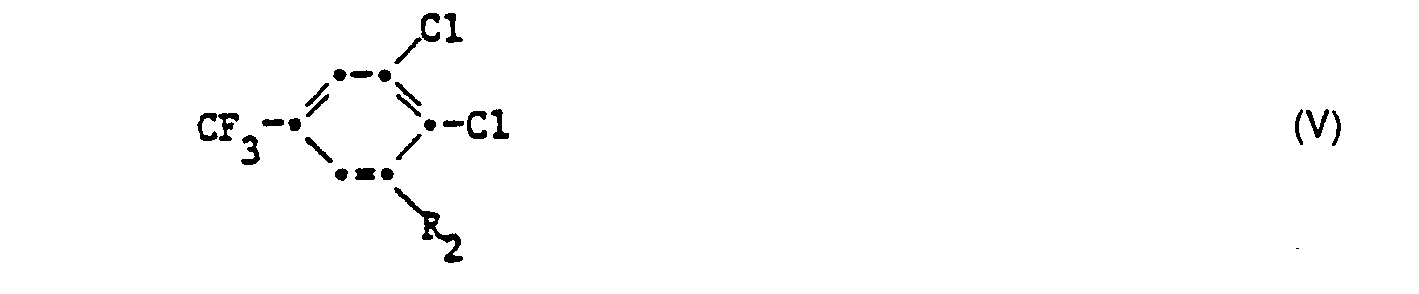

- Die Kondensation der Verbindungen der Formeln IV und V findet wie diejenige der Verbindungen der Formeln II und III in Gegenwart der äquimolaren Menge einer Base als säurebindendes Mittel bei einer Temperatur von 0 °C bis zum Siedepunkt des Lösungsmittels statt.
- Die Nitrierung des 3-(poly)Oxyalkylaminodiphenyläthers der Formel VI findet bei relativ milden Bedingungen statt, unter welchen der (poly)-Alkoxyaminorest erhalten bleibt z. B. mittels der 1,5 bis 2 molaren Menge 100 %iger Salpetersäure in Eisessig. Man kann den 3-(poly)-Oxyalkylaminodiphenyläther der Formel VI auch in Aethylenchlorid lösen, dazu vorsichtig mindestens die äquimolare Menge Schwefelsäure geben und dann unter Kühlen bei 0 bis 15° und Rühren langsam Nitriersäure (konz. Schwefelsäure und konz. Salpetersäure 1 : 1) zutropfen lassen. Eine Modifikation besteht darin, dass man den 3-(poly)Oxyalkylaminodiphenyläther der Formel VI in Aethylenchlorid und mindestens der doppelt äquimolaren Menge Schwefelsäure auflöst, und dann unter Kühlen auf 0-15 °C und Rühren portionenweise Kaliumnitrat zugibt.
- Man kann ein 3,4-Dichlorbenzotrifluorid der Formel V zuerst auch mit einem meta-Hydroxyanilin zum 3-Amino-2'-chlor-4'-trifluormethyldiphenyl-äther der Formel VII kondensieren,


- Als Schutzgruppen R1' kommen Acylreste, wie sie sich von niederen Fettsäuren, Alkylsulfonylsäuren, Benzolsulfonsäuren, Kohlensäurederivaten, oder Benzoesäuren ableiten, in Frage, die in Form ihrer Halide mit in den sekundär-Aminorest eingeführt werden und nach der Nitrierung durch kurzes Behandeln mit einer Base wie z. B. 1 oder 2 N Natriumhydroxyd oder Kaliumhydroxyd wieder abgespalten werden. Um die Schutzgruppe abzuspalten, genügt es im allgemeinen, in Gegenwart der Base kurz aufzukochen.
- Schliesslich können die Verbindungen der Formel I, in denen R einen Alkylrest darstellt, auch hergestellt werden, indem man einen 2'-Chlor-4-nitro-3-(poly)hydroxyalkylamino-4'-trifluormethyldiphe- nyl-äther der Formel IX


- Bevorzugte Reste X sind Chlor, Brom, der Toluolsulfonsäurerest und z. B. ein niederer Alkylsulfonsäurerest.
- Diese Kondensation oder Umsetzungen werden vorzugsweise in inerten organischen Lösungsmitteln wie z. B. Alkanolen, höhersiedenden Ketonen oder Aethern, in Aromaten, Amiden oder Sulfoxiden vorgenommen. Als Beispiele seien genannt Aethanol, Propanol, Isopropanol, Hexanol, Cyclohexanol, Methyläthylketon, Dioxan, Tetrahydrofuran, Benzol, Toluol, Dimethylformamid, Dimethylsulfoxid, Acetonitril.
- Die Reaktionstemperaturen liegen vorzugsweise zwischen -20° und 120 °C. Die Umsetzungen verlaufen oft leicht exotherm und können bei Raumtemperatur durchgeführt werden. Zwecks Abkürzung der Reaktionszeit oder zum Einleiten der Reaktion wird zweckdienlich für kurze Zeit bis zum Siedepunkt des Reaktionsgemisches aufgewärmt.
- Ausgangsstoffe der Formeln III und VIII werden hergestellt, ausgehend von den entsprechenden Monoäthern von poly-Alkylenglykolen, die man in Gegenwart von etwas Lösungsmittel und gegebenenfalls eines Katalysators mit einem Halogenierungsmittel, wie z. B. Thionylchlorid zum poly-Alkylenglykol-monoäther-Halogenid resp. Chlorid umsetzt, dieses gegebenenfalls aus der Reaktionsmasse durch Destillieren isoliert oder gleich in einem Lösungsmittel, wie beispielsweise einem Alkanol oder Aether aufnimmt und im Autoklaven bei einer höheren Temperatur zwischen 50 und 200 °C und erhöhtem Druck mit Ammoniak umsetzt. Das Endprodukt wird durch Destillieren mit Benzol oder Toluol entwässert und dann durch eine fraktionierte Destillation gereinigt.
- Die Verbindungen der Formel I haben gute herbizide Eigenschaften. In grossen Aufwandmengen können sie als Totalherbizide eingesetzt werden. Interessanter jedoch ist ihr Einsatz in Aufwandmengen von ca. 0.1 bis 5 kg pro Hektare als Selektivherbizide in Kulturpflanzungen, bei gekeimten im Nachauflaufverfahren oder bei frisch gesäten im Vorauflaufverfahren. Sie hemmen oder beeinträchtigen dort das Aufkommen von Unkräutern, zweikeimblättrigen, vor allem aber auch von vielen einkeimblättrigen Arten wie Lolium, Alopecurus, Rottboellia, Sorghum, Digitaria, Setaria und Panicum. Kulturpflanzen, wie Getreide, Gerste, Weizen, Roggen, Mais oder Reis aber auch andere wie Baumwolle und Soja werden dabei ganz oder mindestens bei der Aufwandmenge von 1 kg/ha geschont.
- Die Verbindungen der Formel können auch zur Bekämpfung Ektoparasiten, z. B. Lucilia sericata, sowie von Zecken an Haus- und Nutztieren, durch Tier-, Stall- und Weidebehandlung verwendet werden. Insbesondere eignen sie sich zur Bekämpfung von Insekten der Ordnungen Lepidoptera, Coleoptera, Homoptera. Heteroptera, Diptera, Thysanoptera, Orthoptera, Anoplura, Siphonaptera, Mallophage, Thysanura, Isoptera, Psocoptera und Hymenoptera. sowie von Vertretern der Ordnung Akarina. Die pestizide Wirkung der erfindungsgemässen Verbindungen entspricht einer Abtötungsrate (Mortalität) von mindestens 50-60 % der erwähnten Schädlinge.
- Ferner besitzen die Verbindungen der Formel I günstige wachstumsregulierende Effekte (Wuchshemmung). Es werden sowohl Monokkotyledonen wie auch Dikolyadonen in ihrem Wachstum beeinträchtigt. So können z. B. in der Landwirtschaft in tropischen Gegenden häufig als «cover crop (Bodenbedecker) angepflanzte Leguminosen durch die Verbindungen der Formel I in ihrem Wachstum selektiv gehemmt werden, so dass zwar die Bodenerosion zwischen den Kulturpflanzen verhindert wird, die « cover crops jedoch nicht zur Konkurrenz für die Kultur werden können.
- Die Verbindungen der Formel I werden in unveränderter Form oder vorzugsweise als Mittel zusammen mit den in der Formulierungstechnik üblichen Hilfsmitteln eingesetzt und werden daher z. B. zu Emulsionskonzentraten, direkt versprühbaren oder verdünnbaren Lösungen, verdünnten Emulsionen, Spritzpulvern, löslichen Pulvern, Stäubemitteln, Granulaten, auch Verkapselungen in z. B. polymeren Stoffen in bekannter Weise verarbeitet. Die Anwendungsverfahren wie Versprühen, Vernebeln, Verstäuben, Verstreuen oder Giessen werden gleich wie die Art der Mittel den angestrebten Zielen und den gegebenen Verhältnissen entsprechend gewählt.
- Die Formulierungen, d. h. die den Wirkstoff der Formel I und gegebenenfalls einen festen oder flüssigen Zusatzstoff enthaltenden Mittel, Zubereitungen oder Zusammensetzungen werden in bekannter Weise hergestellt, z. B. durch inniges Vermischen und/oder Vermahlen der Wirkstoffe mit Streckmitteln, wie z. B. mit Lösungsmitteln, festen Trägerstoffen, und gegebenenfalls oberflächenaktiven Verbindungen (Tensiden).
- Als Lösungsmittel können in Frage kommen : aromatische Kohlenwasserstoffe, bevorzugt die Fraktionen C8-C,2, wie z. B. Xylolgemische oder substituierte Naphthaline, Phthalsäureester wie Dibutyl-oder Dikotylphthalat, aliphatische Kohlenwasserstoffe wie Cyclohexan oder Paraffine, Alkohole und Glykole sowie deren Aether und Ester, wie Aethanol, Aethylenglykol, Aethylenglykolmonomethyl- oder -äthyläther, Ketone wie Cyclohexanon, stark polare Lösungsmittel wie N-Methyl-2-pyrrolidon, Dimethylsulfoxid oder Dimethylformamid, sowie gegebenenfalls epoxidierte Pflanzenöle, wie epoxidiertes Kokosnussöl oder Sojaöl ; oder Wasser.
- Als feste Trägerstoffe, z. B. für Stäubemittel und dispergierbare Pulver, werden in der Regel natürliche Gesteinsmehle verwendet, wie Calcit, Talkum, Kaolin, Montmorillonit oder Attapulgit. Zur Verbesserung der physikalischen Eigenschaften können auch hochdisperse Kieselsäure oder hochdisperse saugfähige Polymerisate zugesetzt werden. Als gekörnte, adsorptive Granulatträger kommen poröse Typen wie z. B. Bimsstein, Ziegelbruch, Sepiolit oder Bentonit, als nicht sorptive Trägermaterialien z. B. Calcit oder Sand in Frage. Darüberhinaus kann eine Vielzahl von vorgranulierten Materialien anorganischer oder organischer Natur wie insbesondere Dolomit oder zerkleinerte Pflanzenrückstände verwendet werden.
- Als oberflächenaktive Verbindungen kommen je nach der Art des zu formulierenden Wirkstoffes der Formel I nichtionogene, kation- und/oder anionaktive Tenside mit guten Emulgier-, Dispergier- und Netzeigenschaften in Betracht. Unter Tensiden sind auch Tensidgemische zu verstehen.
- Geeignete anionische Tenside können sowohl sogenannte wasserlösliche Seifen als auch wasserlösliche synthetische oberflächenaktive Verbindungen sein.
- Als Seifen seien die Alkali-, Erdalkali- oder gegebenenfalls substituierte Ammoniumsalze von höheren Fettsäuren (C1O-C22), wie z. B. die Na- oder K-Salze der Oel- oder Stearinsäure, oder von natürlichen Fettsäuregemischen, die z. B. aus Kokosnuss- oder Talgöl gewonnen werden können, genannt. Ferner sind auch die Fettsäure-methyl-taurin-salze zu erwähnen.
- Häufiger werden jedoch sogenannte synthetische Tenside verwendet, insbesondere Fettsulfonate, Fettsulfate, sulfonierte Benzimidazolderivate oder Alkylarylsulfonate.
- Die Fettsulfonate oder -sulfate liegen in der Regel als Alkali-, Erdalkali- oder gegebenenfalls substituierte Ammoniumsalze vor und weisen einen Alkylrest mit 8 bis 22 C-Atomen auf, wobei Alkyl auch den Alkylteil von Acylresten einschliesst, z. B. das Na- oder Ca-Salz der Ligninsulfonsäure, des Dodecylschwefelsäureesters oder eines aus natürlichen Fettsäuren hergestellten Fettalkoholsulfatgemisches. Hierher gehören auch die Salze der Schwefelsäureester und Sulfonsäuren von Fettalkohol-Aethylenoxid-Addukten. Die sulfonierten Benzimidazolderivate enthalten vorzugsweise 2-Sulfonsäuregruppen und einen Fettsäurerest mit 8 bis 22 C-Atomen. Alkylarylsulfonate sind z. B. die Na-, Ca- oder Triäthanolaminsalze der Dodecylbenzolsulfonsäure, der Dibutylnaphthalinsulfonsäure oder eines Naphthalinsulfonsäure-Formaldehydkondensationsproduktes.
- Ferner kommen auch entsprechende Phosphate wie z. B. Salze des Phosphorsäureesters eines p-Nonylphenol-(4-14)-Aethylenoxid-Adduktes in Frage.
- Als nichtionische Tenside kommen in erster Linie Polyglykolätherderivate von aliphatischen oder cycloaliphatischen Alkoholen, gesättigten oder ungesättigten Fettsäuren und Alkylphenolen in Frage, die 3 bis 30 Glykoläthergruppen und 8 bis 20 Kohlenstoffatome im (aliphatischen) Kohlenwasserstoffrest und 6 bis 18 Kohlenstoffatome im Alkylrest der Alkylphenole enthalten können.
- Weitere geeignete nichtionische Tenside sind die wasserlöslichen, 20 bis 250 Aethylenglykoläthergruppen und 10 bis 100 Propylenglykoläthergruppen enthaltenden Polyäthylenoxidaddukte an Polypropylenglykol, Aethylendiaminopolypropylenglykol und Alkylpolypropylenglykol mit 1 bis 10 Kohlenstoffatomen in der Alkylkette. Die genannten Verbindungen enthalten üblicherweise pro Propylenglykol-Einheit 1 bis 5 Aethylenglykoleinheiten.
- Als Beispielen nichtionische Tenside seien Nonylphenolpolyäthoxyäthanole, Ricinusölpolyglykoläther, Polypropylenpolyäthylenoxid-Addukte, Tributylphenoxypolyäthanol, Polyäthylenglykol und Octylphenoxypolyäthoxyäthanol erwähnt.
- Ferner kommen auch Fettsäureester von Polyoxyäthylensorbitan wie das Polyoxyäthylensorbitantrioleat in Betracht.
- Bei den kationischen Tensiden handelt es sich vor allem um quaternäre Ammoniumsalze, welche als N-Substituenten mindestens einen Alkylrest mit 8 bis 22 C-Atomen enthalten und als weitere Substituenten niedrige, gegebenenfalls halogenierte Alkyl-, Benzyl- oder niedrige Hydroxyalkylreste aufweisen. Die Salze liegen vorzugsweise als Halogenide, Methylsulfate oder Aethylsulfate vor, z. B. das Stearyltrimethylammoniumchlorid oder das Benzyldi(2-chloräthyl)-äthylammoniumbromid.
- Die in der Formulierungstechnik gebräuchlichen Tenside sind u. a. in folgenden Publikationen beschrieben :
- « Mc Cutcheon's Detergents and Emulsifiers Annual » MC Publishing Corp., Ridgewood, New Jersey, 1979 ;
- J. and M. Ash, « Encyclopedia of Surfactants » Vol 1-111, Chemical Publishing Co. Inc., New York, 1980/81
- Dr. Helmut Stache, « Tensid Taschenbuch » Carl Hauser Verlag, München/Wien 1981.
- Die herbiziden Zubereitungen enthalten in der Regel 0,1 bis 95% insbesondere 0,1 bis 80 %, Wirkstoff der Formel 1 bis 99,9 % eines festen oder flüssigen Zusatzstoffes und 0 bis 25 %, insbesondere 0,1 bis 25 % eines Tensides.
- Insbesondere setzen sich bevorzugte Formulierungen folgendermassen zusammen : (% = Gewichtsprozent)


- Während als Handelsware eher konzentrierte Mittel bevorzugt werden, verwendet der Endverbraucher in der Regel verdünnte Mittel. Die Anwendungsformen können bis hinab zu 0,001 % an Wirkstoff verdünnt werden. Die Aufwandmengen betragen in der Regel 0,01 bis 10 kg AS/ha, vorzugsweise 0,025 bis 5 kg As/ha.
- Die Mittel können auch weitere Zusätze wie Stabilisatoren, Entschäumer, Viskositätsregulatoren, Bindemittel, Haftmittel sowie Dünger oder andere Wirkstoffe zur Erzielung spezieller Effekte enthalten.
- In den folgenden Beispielen sind die Temperaturen in Celsiusgraden °C angegeben.
- Herstellung von 3-(3,6-Dioxa-decylamino)-2'-chlornitro-4'-trifluormethyldiphenyl-äther

- Zu einer Lösung von 9 g 2'-Chlor-3,4-dinitro-4'-trifluormethyldiphenyläther in 30 ml Dimethylsulfoxid gibt man unter Rühren 9 g 3,6-Dioxadecylamin und rührt bei Raumtemperatur während 10 Stunden. Dann wird das Reaktionsgemisch in Wasser gegossen und mit Aether extrahiert. Die Aetherphase wird erst mit verdünnter Salzsäure, dann mit Wasser gewaschen, über Natriumsulfat getrocknet, und eingedampft. Der Rückstand kristallisiert nach Zugabe von etwas Hexan. Man erhält so 7,3 g Titelprodukt mit Schmelzpunkt 73-74°.
- In analoger Weise zu diesem Beispiel werden folgende Verbindungen erhalten :
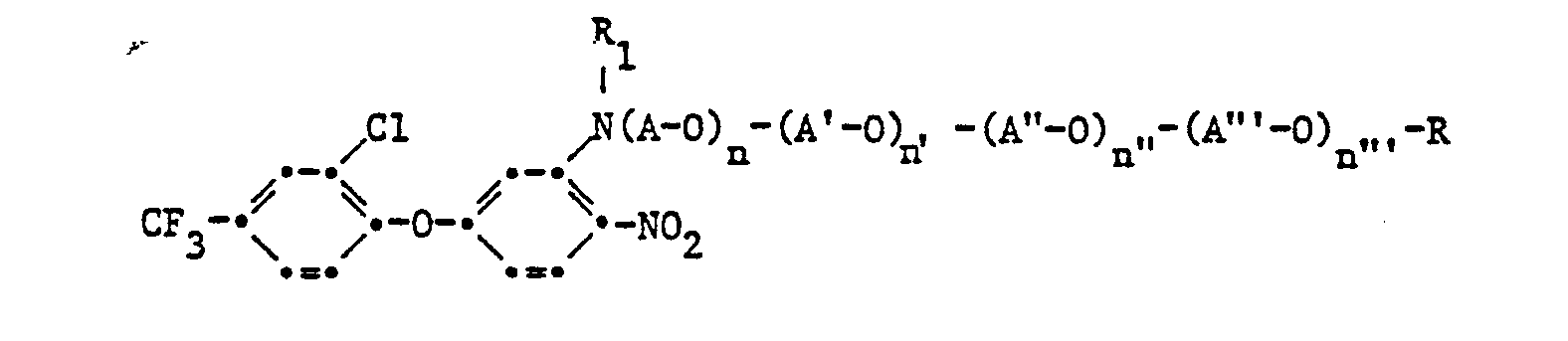


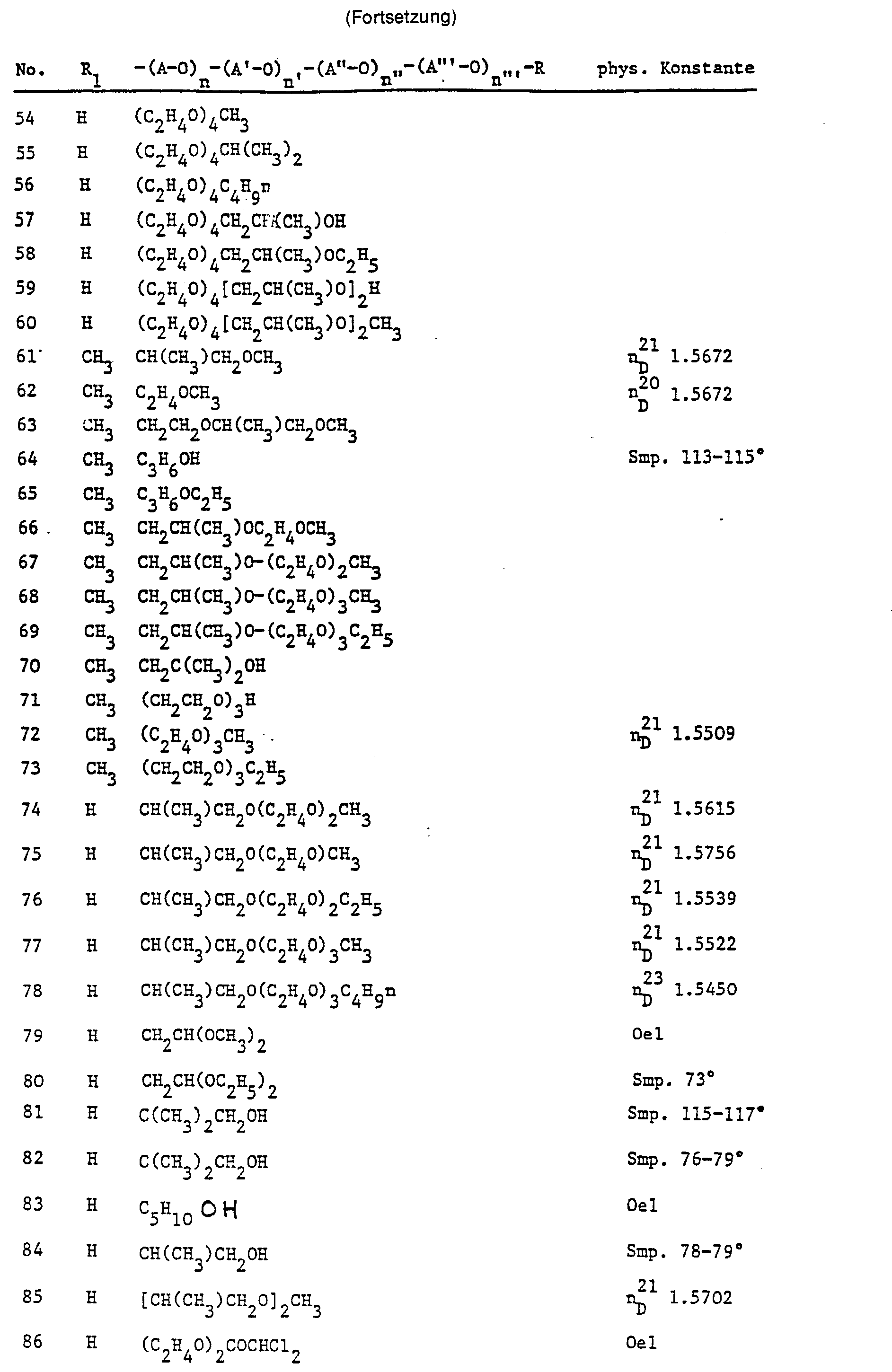


- Die als Ausgangsprodukte verwendeten Polyalkoxyamine werden wie folgt hergestellt :
- a) 3,6,9-Trioxa-nonylamin H2N(C2H40)3H
- Man rührt im Autoklaven bei 130° 168,5 g 3,6-Dioxa-octanol-chlorhydrin in 150 ml Aethanol mit 150 g Ammoniak während 15 Stunden. Nach dem Erkalten versetzt man das Reaktionsgemisch langsam mit 43 g festes Natriumhydroxyd, filtriert und wäscht den festen Rückstand mit Alkohol. Das Filtrat wird eingedampft, durch azeotrope Destillation mit Toluol getrocknet und dann unter Vakuum fraktioniert. Man erhält 61 g 3,6,9-Trioxanonylamin, welches bei 102-106°/0,4 mbar siedet.
- b) 3,6,9-Trioxa-undecylamin H2N―(CH2―CH2―O)2C2H5
- Man rührt eine Lösung von 805 g 3,6-Dioxa-octanol in 10 ml Pyridin und tropft 487 ml Thionylchlorid zu. Nachdem alles zugetropft ist, wird die Mischung aufgeheizt, bis die Innentemperatur 80° erreicht hat. die anfangs lebhafte Gasentwicklung kommt nach ca. 3 Stunden zum Stillstand. Dann wird das Reaktionsgemisch unter Vakuum entgast. Es verbleiben 843 g 3,6-Dioxa-octyl-chlorid, welche in einem 1 Aethanol aufgenommen werden und zusammen mit 750 ml Ammoniak in einem Autoklav während 15 Stunden bei 130° gerührt werden. Nach dem Erkalten gibt man vorsichtig 240 g Natriumhydroxid dazu, filtriert das Ganze und wäscht den Filterrückstand mit Alkohol. Das Filtrat wird eingedampft und der Rückstand durch azeotrope Destillation mit Toluol getrocknet. Der Rückstand wird durch fraktionierte Destillation über eine Vigreux-Kolonne gereinigt. Die Hauptfraktion, das 3,6,9-Trioxa-undecylamin geht bei 73-76°/17 mbar über Ausbeute 382 g (48 % der Theorie).
- Gemäss diesen Beispielen wurden folgende Amine hergestellt :

- Die durch Umsetzung des entsprechenden Alkylenglykols mit Thionylchlorid gemäss Beispiel b) erhaltenen Chloride können durch Destillation rein isoliert werden :

- Die benötigten Alkylenglykole sind käuflich oder können nach dem folgenden Beispiel hergestellt werden.

- Eine Mischung von 310.6 g 3-Oxa-butanol, 232 g Propylenoxyd und 5 g festes Kaliumhydroxyd wird im Autoklaven während einer Stunde bei 70° gerührt. Nach dem Erkalten gibt man festes Kohlendioxyd zum Reaktionsgemisch, filtriert und destilliert über eine Fraktionierungskolonne. Die Hauptfraktion 2-Methyl-3,6-dioxa-heptanol siedet bei 79-85°/12 mbar Ausbeute 239 g.
- Analog zu diesem Beispiel werden folgende Polyoxyäther hergestellt :

- Formulierungsbeispiele für Wirkstoffe der Formel I (% = Gewichtsprozent)

- Der Wirkstoff wird mit den Zusatzstoffen gut vermischt und in einer geeigneten Mühle gut vermahlen. Man erhält Spritzpulver, die sich mit Wasser zu Suspensionen jeder gewünschten Konzentration verdünnen lassen.

- Aus diesem Konzentrat können durch Verdünnen mit Wasser Emulsionen jeder gewünschten Konzentration hergestellt werden.

- Man erhält anwendungsfertige Stäubemittel, indem der Wirkstoff mit dem Träger vermischt und auf einer geeigneten Mühle vermahlen wird.
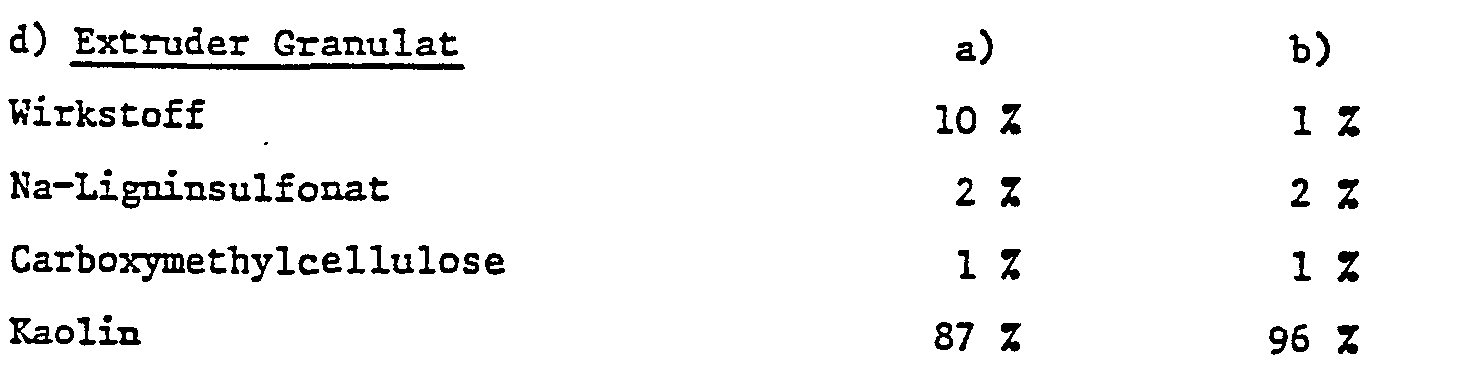
- Der Wirkstoff wird mit den Zusatzstoffen vermischt, vermahlen und mit Wasser angefeuchtet. Dieses Gemisch wird extrudiert und anschliessend im Luftstrom getrocknet.

- Der fein gemahlene Wirkstoff wird in einem Mischer auf das mit Polyäthylenglykol angefeuchtete Kaolin gleichmässig aufgetragen. Auf diese Weise erhält man staubfreie Umhüllungs-Granulate.

- Der fein gemahlene Wirkstoff wird mit den Zusatzstoffen innig vermischt. Man erhält so ein Suspensions-Konzentrat, aus welchem durch Verdünnen mit Wasser Suspensionen jeder gewünschten Konzentration hergestellt werden können.

- Biologische Versuche zum Nachweis der Wirkung der Verbindungen der Formel I Pre-emergente Herbizidwirkung (Vorauflaufwirkung)
- Im Gewächshaus werden Pflanzensamen in Blumentöpfe von 12-15 cm Durchmesser gesät, so dass sich pro Topf 10-25 Pflänzchen entwickeln können. Unmittelbar nach der Einsaat wird die Erdoberfläche mit einer wässrigen Suspension der Wirkstoffe, erhalten aus einem 10 %igen Spritzpulver, behandelt. Es wird eine Konzentration angewendet, welche 4 kg Wirksubstanz pro Hektar entspricht. Die Blumentöpfe werden im Gewächshaus bei 22-25 °C und 50-70 % relativer Luftfeuchtigkeit und regelmässigem Begiessen gehalten und der Versuch nach 3 Wochen ausgewertet. Der Zustand der Pflanzen wurde gemäss dem folgenden Bewertungsschema registriert :
- 9 Pflanze gedeiht wie unbehandelte Kontrolle
- 6-9 leichte Schäden
- 5 mittlere Schäden
- 2-4 schwere Schäden
- 1 Pflanze abgestorben
- Die Resultate sind wie folgt :

- Eine Anzahl Unkräuter und Kulturpflanzen, sowohl monocotyle wie dicotyle, wird nach dem Auflaufen (im 4- bis 6-Blattstadium) mit einer wässrigen Wirkstoffdispersersion in Dosierung von 4 kg Wirksubstanz pro Hektar auf die Pflanzen gespritzt und diese bei 24°-26° und 45-60 % rel. Luftfeuchtigkeit gehalten. 15 Tage nach Behandlung wird der Versuch nach derselben Notenskala wie im Preemergent-Versuch ausgeweitet.
- Die Resultate sind wie folgt :


- Reispflänzchen, welche 25 Tage alt sind, wurden im Gewächshaus in grosse rechteckige Eternitschalen verpflanzt. Zwischen die Reihen der Reispflanzen wurden dann Samen der in Reiskulturen vorkommenden Unkräuter Echinochloa crus galli, Cyperus difformis, Ammania und Rotala gesät. Die Schalen wurden gut bewässert und bei einer Temperatur von ca. 25 °C und hoher Luftfeuchtigkeit gehalten. Nach 12 Tagen, wenn die Unkräuter aufgelaufen sind und das 2-3 Blattstadium erreicht haben, wurde die Erde in der Schale mit einer 2,5 cm hohen Schicht Wasser bedeckt. Der Wirkstoff wurde dann als Emulsionskonzentrat mittels einer Pipette zwischen die Pflanzenreihen appliziert, wobei man das Emulsionskonzentrat so verdünnt dass es einer Feld-Applikation von 1, 0.5, 0.25 oder 0.125 kg Aktivsubstanz pro Hektare entspricht. Der Versuch wird nach 4 Wochen ausgewertet, die Resultate sind untenstehend zusammengefasst.

- Zu 9 ml eines Zuchtmediums wird bei 50 °C ein ml einer 0,5 % Aktivsubstanz enthaltenden wässrigen Zubereitung hinzugefügt. Nun werden ca. 30 frisch geschlüpfte Lucilia Larven zum Zuchtmedium gegeben. Nach 48 und 96 Stunden wird die insektizide Wirkung durch Ermittlung der Abtöthungsrate festgestellt.
- Verbindungen der Formel I zeigen in diesem Test gute Wirkung gegen die geprüften Lucilia Arten.
- Auf die Oberfläche von 150 ml Wasser, das sich in einem Behälter befindet, wird so viel einer 0,1 %igen acetonischen Lösung des Wirkstoffs pipettiert, dass eine Konzentration von 12,5 ppm erhalten wird. Nach Verdunsten des Acetons wird der Behälter mit 30 bis 40 2-tägigen Aedes-Larven beschickt. Nach 2 und 7 Tagen wird die % Mortalität (Anzahl der schwimmun fähigen Larven) geprüft.
- Verbindungen der Formel zeigen in diesem Test gute Wirkung gegen Aedes aegypti.
Claims (25)


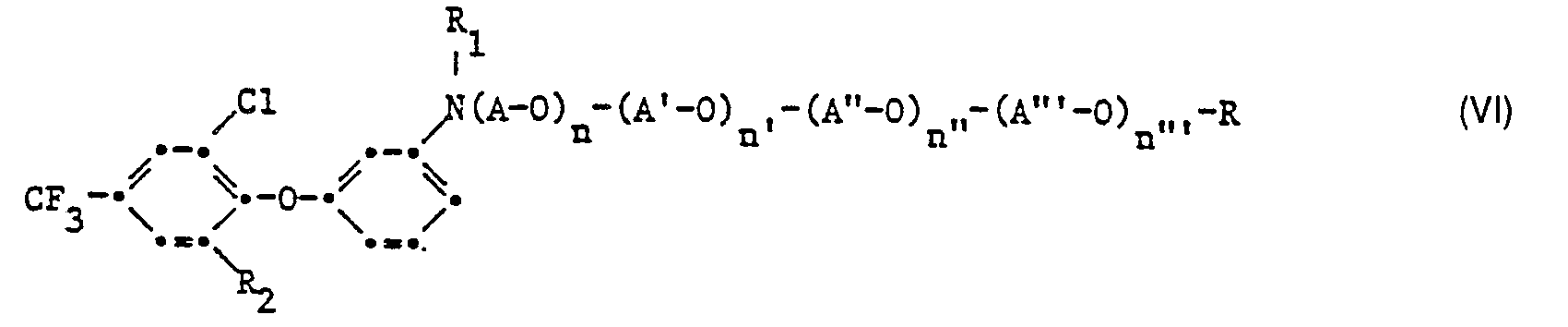


Applications Claiming Priority (2)
| Application Number | Priority Date | Filing Date | Title |
|---|---|---|---|
| CH675883 | 1983-12-20 | ||
| CH6758/83 | 1983-12-20 |
Publications (2)
| Publication Number | Publication Date |
|---|---|
| EP0149427A1 EP0149427A1 (de) | 1985-07-24 |
| EP0149427B1 true EP0149427B1 (de) | 1987-07-08 |
Family
ID=4314578
Family Applications (1)
| Application Number | Title | Priority Date | Filing Date |
|---|---|---|---|
| EP84810620A Expired EP0149427B1 (de) | 1983-12-20 | 1984-12-14 | (Poly-)Oxyalkylamino-diphenyläther mit herbizider Wirkung |
Country Status (5)
| Country | Link |
|---|---|
| US (1) | US4694105A (de) |
| EP (1) | EP0149427B1 (de) |
| JP (1) | JPS60172949A (de) |
| DE (1) | DE3464597D1 (de) |
| IL (1) | IL73867A0 (de) |
Families Citing this family (4)
| Publication number | Priority date | Publication date | Assignee | Title |
|---|---|---|---|---|
| DE3569523D1 (de) * | 1984-09-03 | 1989-05-24 | Ciba Geigy Ag | N-(substituted-alkyl) dichloroacetamide derivatives |
| ES8605220A1 (es) * | 1985-10-25 | 1986-03-16 | Espanola Prod Quimicos | Procedimiento de preparacion de esteres del dietilenglicol |
| US5250708A (en) * | 1991-08-13 | 1993-10-05 | Milliken Research Corporation | Poly(oxyalkylene) substituted aminophenol intermediate and xanthene colorant |
| DE102006010595A1 (de) * | 2006-03-06 | 2007-09-13 | Uhde Gmbh | Lösungsmittel zur Abtrennung von sauren Gasbestandteilen aus technischen Gasen |
Family Cites Families (6)
| Publication number | Priority date | Publication date | Assignee | Title |
|---|---|---|---|---|
| US3928416A (en) * | 1972-03-14 | 1975-12-23 | Rohm & Haas | Herbicidal 4-trifluoromethyl-4{40 nitrodiphenyl ethers |
| US4046798A (en) * | 1973-02-12 | 1977-09-06 | Rohm And Haas Company | Herbicidal 4-trifluoromethyl-4'nitrodiphenyl ethers |
| JPS5513206A (en) * | 1978-07-05 | 1980-01-30 | Mitsui Toatsu Chem Inc | Production of novel diphenyl ethers |
| US4465503A (en) * | 1979-08-07 | 1984-08-14 | Ube Industries Ltd. | Diphenyl ether derivatives, process for preparing the same and herbicidal compositions containing the same |
| DE2938595A1 (de) * | 1979-09-24 | 1981-04-23 | Celamerck Gmbh & Co Kg, 6507 Ingelheim | Verfahren zur herstellung von diphenylaethern |
| US4419123A (en) * | 1981-10-19 | 1983-12-06 | Rohm And Haas Company | Herbicidal 4-trifluoromethyl-3'-carbon-substituted-4'-substituted diphenyl ethers |
-
1984
- 1984-12-10 US US06/679,860 patent/US4694105A/en not_active Expired - Fee Related
- 1984-12-14 DE DE8484810620T patent/DE3464597D1/de not_active Expired
- 1984-12-14 EP EP84810620A patent/EP0149427B1/de not_active Expired
- 1984-12-19 IL IL73867A patent/IL73867A0/xx unknown
- 1984-12-20 JP JP59269595A patent/JPS60172949A/ja active Pending
Also Published As
| Publication number | Publication date |
|---|---|
| IL73867A0 (en) | 1985-03-31 |
| DE3464597D1 (en) | 1987-08-13 |
| US4694105A (en) | 1987-09-15 |
| JPS60172949A (ja) | 1985-09-06 |
| EP0149427A1 (de) | 1985-07-24 |
Similar Documents
| Publication | Publication Date | Title |
|---|---|---|
| EP0179022B1 (de) | Benzoylphenylharnstoffe | |
| EP0077759B1 (de) | Phenylharnstoffe | |
| DE2640730C2 (de) | Benzoxazolyloxy- und Benzothiazolyloxy-phenoxy-Verbindungen und diese enthaltende herbizide Mittel | |
| EP0459949B1 (de) | Sulfonylharnstoffe mit herbizider und pflanzenwuchsregulierender Wirkung | |
| EP0129513A2 (de) | Oxamidsäure-Derivate | |
| CH679396A5 (de) | ||
| EP0103537B1 (de) | N-Arylsulfonyl-N'-triazolylharnstoffe | |
| EP0235089B1 (de) | N-Benzoyl-N'-phenylharnstoffe, ihre Herstellung und Verwendung bei der Kontrolle von Schädlingen | |
| EP0179021A2 (de) | Benzoylphenylharnstoffe | |
| EP0300968B1 (de) | N-Benzoyl-N'-2,5-dihalogen-4-perfluoro-alkoxyphenylharnstoffe, ihre Herstellung und Verwendung bei der Kontrolle von Schädlingen | |
| EP0133418A2 (de) | Die Verwendung von 3-Acylaminobenzisothiazolen in der Schädlingsbekämpfung | |
| EP0058639B1 (de) | 2-(4-(6-Halogen-chinoxalinyl-2-oxy)-phenoxy)-propionsäureester, Verfahren zu ihrer Herstellung sowie ihre Verwendung als Herbizide und Pflanzenwuchsregulatoren | |
| EP0055213B1 (de) | Phenylharnstoffe | |
| EP0179020A2 (de) | Thioxanthene in der Schädlingsbekämpfung | |
| EP0149427B1 (de) | (Poly-)Oxyalkylamino-diphenyläther mit herbizider Wirkung | |
| EP0138756A1 (de) | Neue Oxadiazine | |
| EP0219460A2 (de) | Benzoylphenylharnstoffe | |
| EP0044278A1 (de) | Phenylharnstoffe | |
| EP0098800A1 (de) | Carbaminsäureester | |
| EP0072348A2 (de) | Neue Phenoxyphenyl-aminosäure-Derivate, ihre Herstellung, sie enthaltende Mittel sowie ihre Verwendung | |
| EP0145662A2 (de) | Isothioharnstoffe | |
| EP0165903B1 (de) | Phenylbenzoylharnstoffe | |
| EP0150678A1 (de) | Cyclopropancarbonsäure-alpha-methyl-(6-phenoxy)-2-picolylester | |
| EP0166694B1 (de) | Diphenyläther-hydroxylamine mit herbizider Wirkung | |
| EP0185621A2 (de) | Benzoylphenylharnstoffe |
Legal Events
| Date | Code | Title | Description |
|---|---|---|---|
| PUAI | Public reference made under article 153(3) epc to a published international application that has entered the european phase |
Free format text: ORIGINAL CODE: 0009012 |
|
| 17P | Request for examination filed |
Effective date: 19841217 |
|
| AK | Designated contracting states |
Designated state(s): BE CH DE FR GB IT LI NL |
|
| GRAA | (expected) grant |
Free format text: ORIGINAL CODE: 0009210 |
|
| AK | Designated contracting states |
Kind code of ref document: B1 Designated state(s): BE CH DE FR GB IT LI NL |
|
| REF | Corresponds to: |
Ref document number: 3464597 Country of ref document: DE Date of ref document: 19870813 |
|
| ITF | It: translation for a ep patent filed | ||
| ET | Fr: translation filed | ||
| PGFP | Annual fee paid to national office [announced via postgrant information from national office to epo] |
Ref country code: NL Payment date: 19871231 Year of fee payment: 4 |
|
| PLBE | No opposition filed within time limit |
Free format text: ORIGINAL CODE: 0009261 |
|
| STAA | Information on the status of an ep patent application or granted ep patent |
Free format text: STATUS: NO OPPOSITION FILED WITHIN TIME LIMIT |
|
| 26N | No opposition filed | ||
| PG25 | Lapsed in a contracting state [announced via postgrant information from national office to epo] |
Ref country code: GB Effective date: 19881214 |
|
| PG25 | Lapsed in a contracting state [announced via postgrant information from national office to epo] |
Ref country code: LI Effective date: 19881231 Ref country code: CH Effective date: 19881231 Ref country code: BE Effective date: 19881231 |
|
| BERE | Be: lapsed |
Owner name: CIBA-GEIGY A.G. Effective date: 19881231 |
|
| PG25 | Lapsed in a contracting state [announced via postgrant information from national office to epo] |
Ref country code: NL Effective date: 19890701 |
|
| NLV4 | Nl: lapsed or anulled due to non-payment of the annual fee | ||
| GBPC | Gb: european patent ceased through non-payment of renewal fee | ||
| PG25 | Lapsed in a contracting state [announced via postgrant information from national office to epo] |
Ref country code: FR Free format text: LAPSE BECAUSE OF NON-PAYMENT OF DUE FEES Effective date: 19890831 |
|
| REG | Reference to a national code |
Ref country code: CH Ref legal event code: PL |
|
| PG25 | Lapsed in a contracting state [announced via postgrant information from national office to epo] |
Ref country code: DE Effective date: 19890901 |
|
| REG | Reference to a national code |
Ref country code: FR Ref legal event code: ST |