EP0148623A2 - Quinolone inotropic agents - Google Patents
Quinolone inotropic agents Download PDFInfo
- Publication number
- EP0148623A2 EP0148623A2 EP84308925A EP84308925A EP0148623A2 EP 0148623 A2 EP0148623 A2 EP 0148623A2 EP 84308925 A EP84308925 A EP 84308925A EP 84308925 A EP84308925 A EP 84308925A EP 0148623 A2 EP0148623 A2 EP 0148623A2
- Authority
- EP
- European Patent Office
- Prior art keywords
- compound
- alkyl
- quinolone
- het
- methyl
- Prior art date
- Legal status (The legal status is an assumption and is not a legal conclusion. Google has not performed a legal analysis and makes no representation as to the accuracy of the status listed.)
- Withdrawn
Links
- 0 *C=*C(Nc1ccc(*)cc1)=* Chemical compound *C=*C(Nc1ccc(*)cc1)=* 0.000 description 9
- BYZBCEGNOXCXJB-UHFFFAOYSA-N Cc(cc1C)cc(cc2)c1c(C)c2OC Chemical compound Cc(cc1C)cc(cc2)c1c(C)c2OC BYZBCEGNOXCXJB-UHFFFAOYSA-N 0.000 description 1
Classifications
-
- C—CHEMISTRY; METALLURGY
- C07—ORGANIC CHEMISTRY
- C07D—HETEROCYCLIC COMPOUNDS
- C07D401/00—Heterocyclic compounds containing two or more hetero rings, having nitrogen atoms as the only ring hetero atoms, at least one ring being a six-membered ring with only one nitrogen atom
- C07D401/14—Heterocyclic compounds containing two or more hetero rings, having nitrogen atoms as the only ring hetero atoms, at least one ring being a six-membered ring with only one nitrogen atom containing three or more hetero rings
-
- C—CHEMISTRY; METALLURGY
- C07—ORGANIC CHEMISTRY
- C07D—HETEROCYCLIC COMPOUNDS
- C07D213/00—Heterocyclic compounds containing six-membered rings, not condensed with other rings, with one nitrogen atom as the only ring hetero atom and three or more double bonds between ring members or between ring members and non-ring members
- C07D213/02—Heterocyclic compounds containing six-membered rings, not condensed with other rings, with one nitrogen atom as the only ring hetero atom and three or more double bonds between ring members or between ring members and non-ring members having three double bonds between ring members or between ring members and non-ring members
- C07D213/04—Heterocyclic compounds containing six-membered rings, not condensed with other rings, with one nitrogen atom as the only ring hetero atom and three or more double bonds between ring members or between ring members and non-ring members having three double bonds between ring members or between ring members and non-ring members having no bond between the ring nitrogen atom and a non-ring member or having only hydrogen or carbon atoms directly attached to the ring nitrogen atom
- C07D213/24—Heterocyclic compounds containing six-membered rings, not condensed with other rings, with one nitrogen atom as the only ring hetero atom and three or more double bonds between ring members or between ring members and non-ring members having three double bonds between ring members or between ring members and non-ring members having no bond between the ring nitrogen atom and a non-ring member or having only hydrogen or carbon atoms directly attached to the ring nitrogen atom with substituted hydrocarbon radicals attached to ring carbon atoms
- C07D213/36—Radicals substituted by singly-bound nitrogen atoms
- C07D213/40—Acylated substituent nitrogen atom
-
- A—HUMAN NECESSITIES
- A61—MEDICAL OR VETERINARY SCIENCE; HYGIENE
- A61P—SPECIFIC THERAPEUTIC ACTIVITY OF CHEMICAL COMPOUNDS OR MEDICINAL PREPARATIONS
- A61P9/00—Drugs for disorders of the cardiovascular system
- A61P9/04—Inotropic agents, i.e. stimulants of cardiac contraction; Drugs for heart failure
-
- C—CHEMISTRY; METALLURGY
- C07—ORGANIC CHEMISTRY
- C07D—HETEROCYCLIC COMPOUNDS
- C07D215/00—Heterocyclic compounds containing quinoline or hydrogenated quinoline ring systems
- C07D215/02—Heterocyclic compounds containing quinoline or hydrogenated quinoline ring systems having no bond between the ring nitrogen atom and a non-ring member or having only hydrogen atoms or carbon atoms directly attached to the ring nitrogen atom
- C07D215/16—Heterocyclic compounds containing quinoline or hydrogenated quinoline ring systems having no bond between the ring nitrogen atom and a non-ring member or having only hydrogen atoms or carbon atoms directly attached to the ring nitrogen atom with hetero atoms or with carbon atoms having three bonds to hetero atoms with at the most one bond to halogen, e.g. ester or nitrile radicals, directly attached to ring carbon atoms
- C07D215/18—Halogen atoms or nitro radicals
-
- C—CHEMISTRY; METALLURGY
- C07—ORGANIC CHEMISTRY
- C07D—HETEROCYCLIC COMPOUNDS
- C07D215/00—Heterocyclic compounds containing quinoline or hydrogenated quinoline ring systems
- C07D215/02—Heterocyclic compounds containing quinoline or hydrogenated quinoline ring systems having no bond between the ring nitrogen atom and a non-ring member or having only hydrogen atoms or carbon atoms directly attached to the ring nitrogen atom
- C07D215/16—Heterocyclic compounds containing quinoline or hydrogenated quinoline ring systems having no bond between the ring nitrogen atom and a non-ring member or having only hydrogen atoms or carbon atoms directly attached to the ring nitrogen atom with hetero atoms or with carbon atoms having three bonds to hetero atoms with at the most one bond to halogen, e.g. ester or nitrile radicals, directly attached to ring carbon atoms
- C07D215/20—Oxygen atoms
- C07D215/22—Oxygen atoms attached in position 2 or 4
- C07D215/227—Oxygen atoms attached in position 2 or 4 only one oxygen atom which is attached in position 2
-
- C—CHEMISTRY; METALLURGY
- C07—ORGANIC CHEMISTRY
- C07D—HETEROCYCLIC COMPOUNDS
- C07D215/00—Heterocyclic compounds containing quinoline or hydrogenated quinoline ring systems
- C07D215/02—Heterocyclic compounds containing quinoline or hydrogenated quinoline ring systems having no bond between the ring nitrogen atom and a non-ring member or having only hydrogen atoms or carbon atoms directly attached to the ring nitrogen atom
- C07D215/16—Heterocyclic compounds containing quinoline or hydrogenated quinoline ring systems having no bond between the ring nitrogen atom and a non-ring member or having only hydrogen atoms or carbon atoms directly attached to the ring nitrogen atom with hetero atoms or with carbon atoms having three bonds to hetero atoms with at the most one bond to halogen, e.g. ester or nitrile radicals, directly attached to ring carbon atoms
- C07D215/20—Oxygen atoms
- C07D215/24—Oxygen atoms attached in position 8
- C07D215/26—Alcohols; Ethers thereof
- C07D215/28—Alcohols; Ethers thereof with halogen atoms or nitro radicals in positions 5, 6 or 7
-
- C—CHEMISTRY; METALLURGY
- C07—ORGANIC CHEMISTRY
- C07D—HETEROCYCLIC COMPOUNDS
- C07D215/00—Heterocyclic compounds containing quinoline or hydrogenated quinoline ring systems
- C07D215/02—Heterocyclic compounds containing quinoline or hydrogenated quinoline ring systems having no bond between the ring nitrogen atom and a non-ring member or having only hydrogen atoms or carbon atoms directly attached to the ring nitrogen atom
- C07D215/16—Heterocyclic compounds containing quinoline or hydrogenated quinoline ring systems having no bond between the ring nitrogen atom and a non-ring member or having only hydrogen atoms or carbon atoms directly attached to the ring nitrogen atom with hetero atoms or with carbon atoms having three bonds to hetero atoms with at the most one bond to halogen, e.g. ester or nitrile radicals, directly attached to ring carbon atoms
- C07D215/48—Carbon atoms having three bonds to hetero atoms with at the most one bond to halogen
-
- C—CHEMISTRY; METALLURGY
- C07—ORGANIC CHEMISTRY
- C07D—HETEROCYCLIC COMPOUNDS
- C07D215/00—Heterocyclic compounds containing quinoline or hydrogenated quinoline ring systems
- C07D215/02—Heterocyclic compounds containing quinoline or hydrogenated quinoline ring systems having no bond between the ring nitrogen atom and a non-ring member or having only hydrogen atoms or carbon atoms directly attached to the ring nitrogen atom
- C07D215/16—Heterocyclic compounds containing quinoline or hydrogenated quinoline ring systems having no bond between the ring nitrogen atom and a non-ring member or having only hydrogen atoms or carbon atoms directly attached to the ring nitrogen atom with hetero atoms or with carbon atoms having three bonds to hetero atoms with at the most one bond to halogen, e.g. ester or nitrile radicals, directly attached to ring carbon atoms
- C07D215/48—Carbon atoms having three bonds to hetero atoms with at the most one bond to halogen
- C07D215/54—Carbon atoms having three bonds to hetero atoms with at the most one bond to halogen attached in position 3
-
- C—CHEMISTRY; METALLURGY
- C07—ORGANIC CHEMISTRY
- C07D—HETEROCYCLIC COMPOUNDS
- C07D401/00—Heterocyclic compounds containing two or more hetero rings, having nitrogen atoms as the only ring hetero atoms, at least one ring being a six-membered ring with only one nitrogen atom
- C07D401/02—Heterocyclic compounds containing two or more hetero rings, having nitrogen atoms as the only ring hetero atoms, at least one ring being a six-membered ring with only one nitrogen atom containing two hetero rings
- C07D401/04—Heterocyclic compounds containing two or more hetero rings, having nitrogen atoms as the only ring hetero atoms, at least one ring being a six-membered ring with only one nitrogen atom containing two hetero rings directly linked by a ring-member-to-ring-member bond
-
- C—CHEMISTRY; METALLURGY
- C07—ORGANIC CHEMISTRY
- C07D—HETEROCYCLIC COMPOUNDS
- C07D407/00—Heterocyclic compounds containing two or more hetero rings, at least one ring having oxygen atoms as the only ring hetero atoms, not provided for by group C07D405/00
- C07D407/02—Heterocyclic compounds containing two or more hetero rings, at least one ring having oxygen atoms as the only ring hetero atoms, not provided for by group C07D405/00 containing two hetero rings
- C07D407/04—Heterocyclic compounds containing two or more hetero rings, at least one ring having oxygen atoms as the only ring hetero atoms, not provided for by group C07D405/00 containing two hetero rings directly linked by a ring-member-to-ring-member bond
-
- C—CHEMISTRY; METALLURGY
- C07—ORGANIC CHEMISTRY
- C07D—HETEROCYCLIC COMPOUNDS
- C07D409/00—Heterocyclic compounds containing two or more hetero rings, at least one ring having sulfur atoms as the only ring hetero atoms
- C07D409/02—Heterocyclic compounds containing two or more hetero rings, at least one ring having sulfur atoms as the only ring hetero atoms containing two hetero rings
- C07D409/04—Heterocyclic compounds containing two or more hetero rings, at least one ring having sulfur atoms as the only ring hetero atoms containing two hetero rings directly linked by a ring-member-to-ring-member bond
-
- C—CHEMISTRY; METALLURGY
- C07—ORGANIC CHEMISTRY
- C07D—HETEROCYCLIC COMPOUNDS
- C07D413/00—Heterocyclic compounds containing two or more hetero rings, at least one ring having nitrogen and oxygen atoms as the only ring hetero atoms
- C07D413/02—Heterocyclic compounds containing two or more hetero rings, at least one ring having nitrogen and oxygen atoms as the only ring hetero atoms containing two hetero rings
- C07D413/04—Heterocyclic compounds containing two or more hetero rings, at least one ring having nitrogen and oxygen atoms as the only ring hetero atoms containing two hetero rings directly linked by a ring-member-to-ring-member bond
-
- C—CHEMISTRY; METALLURGY
- C07—ORGANIC CHEMISTRY
- C07D—HETEROCYCLIC COMPOUNDS
- C07D417/00—Heterocyclic compounds containing two or more hetero rings, at least one ring having nitrogen and sulfur atoms as the only ring hetero atoms, not provided for by group C07D415/00
- C07D417/02—Heterocyclic compounds containing two or more hetero rings, at least one ring having nitrogen and sulfur atoms as the only ring hetero atoms, not provided for by group C07D415/00 containing two hetero rings
- C07D417/04—Heterocyclic compounds containing two or more hetero rings, at least one ring having nitrogen and sulfur atoms as the only ring hetero atoms, not provided for by group C07D415/00 containing two hetero rings directly linked by a ring-member-to-ring-member bond
Definitions
- This invention relates to substituted quinolone cardiac stimulants which in general selectively increase the force of myocardial contraction without producing significant increases in the heart rate.
- the compounds are useful in the curative or prophylactic treatment of cardiac conditions, in particular heart failure.
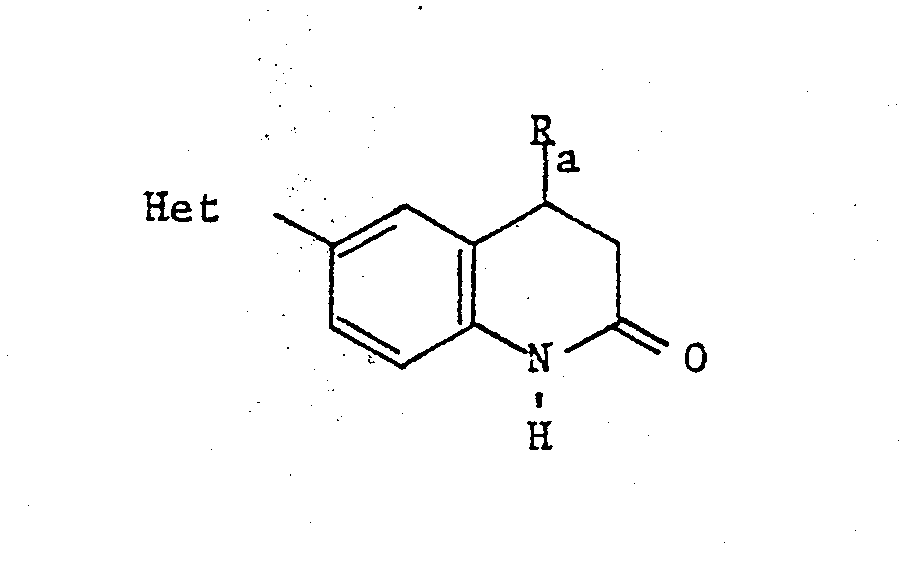
- Het is an optionally substituted 5- or 6-membered monocyclic aromatic heterocyclic group attached by a carbon atom to the 5-, 6-, 7- or 8- position of said quinolone
- R which is attached to the 5-, 6-, 7- or 8- position, is hydrogen, C 1 -C 4 alkyl, C 1 -C 4 alkoxy, C 1 -C 4 alkylthio, C 1 -C 4 alkylsulphinyl, C 1 -C 4 alkylsulphonyl, halo, CF3, hydroxy, hydroxymethyl or cyano
- R 1 is hydrogen, cyano, (C I -C 4 alkoxy)carboayl, C 1 -C 4 alkyl, nitro, halo, -NR 3 R 4 or -CONR 3 R 4 where R 3 and R are each independently H or C 1 -C 4 alkyl or
- R is hydrogen, C 1 -C 4 alkyl, C 1 -C 4 alkcxy, C 1 -C 4 alkylthio, C 1 -C 4 alkylsulphinyl, C 1 -C 4 alkylsulphonyl, halo, CF 3 or hydroxy; and Y is H.
- the invention provides intermediates to the compounds of the formula (I) having the formula:- wherein Het, R, R 1 , Y and the dotted line have the same significance as in formula (I).
- Het is an optionally substituted 5- or 6-membered monocyclic aromatic nitrogen-containing heterocyclic group attached by a carbon atom to the 5-, 6-, 7- or 8- position of said quinolone;
- Het examples include pyridyl, pyrazinyl, pyrimidinyl, pyridazinyl, imidazolyl, pyrazolyl, oxazolyl, isoxazolyl, thiazolyl, isothiazolyl, triazolyl, tetrazolyl, furyl, thienyl, oxadiazolyl, and, when nitrogen containing, their N-oxides, all being optionally substituted by 1 or 2 substituents each independently selected from, e.g., C I -C 4 alkyl, C 1 -C 4 alkoxy, C 1 -C 4 alkylthio, cyano, CF 3 , halo, -NR 3 R 4 or -CONR 3 R 4 where R 3 and R 4 are as defined for formula (I), hydroxymethyl, and (C 1 -C 4 alkoxy)carbonyl.
- the preferred N-oxide is pyridyl-N-oxide.
- Halo means F, Cl, Br and I.
- C 3 and C 4 alkyl and alkoxy groups can be straight or branched chain.
- R 3 and R 4 together with the nitrogen atom to which they are attached form said saturated 5- or 6- membered heterocyclic group
- examples of this heterocyclic group are 1-pyrrolidinyl, piperidino, morpholino and 4-methylpiperazino.
- keto-form is considered the more stable tautomer
- the end products herein will be named and illustrated as quinolones although those skilled in the art will realise that both tautomers may be present or that any particular compound so named may exist predominantly as the hydroxy tautomer and the following disclosure is to be interpreted to incorporate all tautomeric forms.
- Het is preferably pyridyl, an N-oxide thereof, pyrimidinyl, pyridazinyl, pyrazinyl, imidazolyl, triazolyl, tetrazolyl, thiazolyl, oxadiazolyl, thienyl or furyl, all optionally substituted by 1 or 2 substituents each selected from C 1 -C 4 alkyl, C l -C 4 alkoxy, cyano, amino and carbamoyl.
- Het is selected from (a) pyridyl optionally substituted by 1 or 2 methyl groups or by a single methoxy, cyano, amino or carbamoyl group (b) pyridyl-N-oxide (c) pyrimidinyl (d) pyridazinyl (e) pyrazinyl (f) triazolyl or N-methyl triazolyl (g) tetrazolyl or N-(n-butyl)-tetrazolyl (h) N-methylimidazolyl (i) oxadiazolyl (j) thiazolyl (k) thienyl and (1) furyl.
- Het is pyrid-3-yl, pyrid-4-yl, 2,6-dimethylpyrid-3-yl or 1-methyl-(1H)-1,2,4-triazol-5-yl.
- Het is preferably attached to the 5-, 6- or 7-position and most preferably to the 6-position.
- R is preferably H, C 1 -C 4 alkyl, C 1 -C 4 a l koxy, C 1 - C 4 alkylthio, C 1 -C 4 alkylsulphinyl, C 1 -C 4 alkylsulphonyl, halo, hydroxy or hydroxymethyl. More preferably, R is H, C 1 -C 4 alkyl, methoxy, methylthio, methylsulphinyl, methylsulphonyl, bromo, hydroxy or hydroxymethyl.
- R is a substituent, it is preferably in the 7- or 8-position, most preferably in the 8-position, particularly 8-methyl.
- R 1 is preferably H, cyano, C 1 -C 4 alkoxycarbonyl, nitro, halo or amino.
- R 1 is more preferably H, cyano, methoxycarbonyl, nitro, bromo or amino.
- R 1 is most preferably H.
- R 2 is preferably H or CH 3 , most preferably H.
- Y is preferably H or CH 3 , and most preferably H.
- Het is preferably 2,6-dimethylpyrid-3-yl or 1-methyl-(1H)-1,2,4-triazol-5-yl.
- R is preferably methyl.
- the pharmaceutically acceptable salts of the compounds of the formula (I) are non-toxic and include acid addition salts such as the hydrochloride, hydrobromide, hydroiodide, sulphate or bisulphate, phosphate or hydrogen phosphate, acetate, maleate, fumarate, * lactate, tartrate, citrate, gluconate, mesylate and p-toluenesulphonate salts. Also included are the metal salts, especially the alkali metal and alkaline earth metal salts, particularly the sodium and potassium salts.
- the cardiac stimulant activity of the compounds of the formula (I) is shown by their effectiveness in one or more of the following tests: (a) increasing the force of contraction in the "Starling" dog heart - lung preparation measured via a left ventricular catheter; (b) increasing myocardial contractility (left ventricular dp/dt max.) in the anaesthetised dog measured via a left ventricular catheter; (c) increasing myocardial ccntraccility in the conscious dog with an implanted left ventricular transducer (dp/dt max.) or an exteriorised carotid artery loop (systolic time intervals).
- test (a) the positive inotropic effect of the test compound following bolus administration is measured in the "Starling" dog heart-lung preparation. The selectivity for increase in force versus frequency of contraction of the test compound is obtained.
- test (b) the positive inctropic action of the test compound following intravenous administration is measured in the anaesthetised dog.
- the magnitude and duration of this action, and the selectivity for increase in force versus frequency of contraction of the test compound are obtained, as are the peripheral effects, e.g. the effect on blood pressure.
- test (c) the positive inotropic action of the test compound following intravenous or oral administration to a conscious dog with an implanted left ventricular transducer (dp/dt max.) or an exteriorised carotid artery loop (systolic time intervals) is measured.
- the magnitude of the inotropic action, the selectivity for increase in'force versus frequency of contraction, and the duration of action of the inotropic effect of the test compound are all obtained.
- the compounds of the formula (I) can be administered alone but will generally be administered in admixture with a pharmaceutical carrier selected with regard to the intended route of administration and standard pharmaceutical practice.
- a pharmaceutical carrier selected with regard to the intended route of administration and standard pharmaceutical practice.
- they may be administered orally in the form of tablets containing such excipients as starch or lactose, or in capsules either alone or in admixture with excipients, or in the form of elixirs or suspensions containing flavouring or colouring agents.
- They may be injected parenterally, for example, intravenously, intramuscularly or subcutaneously.
- parenteral administration they are best used in the form of a sterile aqueous solution which may contain other solutes, for example, enough salts or glucose to make the solution isotonic.
- oral dosages of the compounds of the invention will be in the range from 10mg to lg daily, taken in 2 to 4 divided doses per day, for an average adult patient (70kg).
- Dosages for intravenous administration would be expected to be within the range I to 100mg per single dose as required, for example in the treatment of acute heart failure.
- individual tablets or capsules might contain 5 to 100mg of active compound, in a suitable pharmaceutically acceptable vehicle or carrier. Variations may occur depending on the weight and condition of the subject being treated as will be known to medical practitioners.
- the present invention provides a pharmaceutical composition
- a pharmaceutical composition comprising a compound of the formula (I) as defined above or pharmaceutically acceptable salt thereof, together with a pharmaceutically acceptable diluent or carrier.
- the invention also provides a method of stimulating the heart of an animal, including a human being, which comprises administering, to the animal a compound of formula (I) or pharmaceutically acceptable salt thereof, or a pharmaceutical composition as defined above, in an amount sufficient to stimulate the heart of the animal.
- the invention yet further provides a compound of the formula (I ) or pharmaceutically acceptable salt thereof, for use in medicine, in particular for use in stimulating the heart of a human being suffering from congestive heart failure.
- the compounds of the invention may be prepared by a number of routes, including the following:-
- R 1 is an alkoxycarbonyl group (e.g. -COOCH 3 )
- the demethylation may convert this group to -COOH, in which case the carboxyl group can be re-esterified conventionally, e.g. using methanol in sulphuric acid.
- Route B This route can be illustrated in general terms as follows:-
- Q is a leaving group such as C 1 -C 4 alkcxy.
- Q is preferably methoxy or ethoxy.
- this reaction involves the cyclisation of a propenamide derivative, typically a 3-ethoxypropenamide, using concentrated (typically 98%) sulphuric acid.
- the reaction is typically carried out by stirring the reactants at room temperature for 8-48 hours.
- the product can then be isolated and purified conventionally.
- the starting materials are either known compounds or can be obtained conventionally.
- reaction is typically carried out by heating the reactants at up to reflux temperature in a suitable organic solvent, e.g. THF.
- a suitable organic solvent e.g. THF.
- Heteroaryl magnesium chlorides may also be used in place of zinc chlorides using other suitable transition metal catalysts (e.g. nickel-based).
- the starting materials are either known compounds or are obtainable conventionally.
- the heteroarylzinc chlorides are most conveniently obtained in situ by reacting the appropriate haloheterocycle at -70 to -100°C in THF with 2 equivalents of t-butyl lithium to obtain the lithio-derivative, followed by reaction with a solution of anhydrous zinc chloride in THF.
- the heteroarylzinc chlorides can also be prepared from the corresponding Grignard reagents by reacting them with a solution of zinc chloride in THF.
- the desired end product is then typically obtained by allowing the reaction mixture to warm to room temperature, followed by adding the appropriate halo-quinolone and the tetrakis (triphenylphosphine) palladium(0) in THF and then heating under reflux until the reaction is complete; typically in 1 to 48 hours.
- the product can then be recovered and purified conventionally.
- This reaction involves reduction of a nitro group, preferably using stannous chloride dihydrate in ethanol.
- the reaction is typically carried out by heating the reactants at up to reflux temperature for 1-8 hours.
- the compounds of the formula (I) in which R 2 is C 1 -C 4 alkyl or 2-hydroxyethyl can also be prepared by the N-alkylation of the corresponding compounds in which R 2 is H. This is typically achieved by reaction of the N-unsubstituted quinolone with sodium hydride or other strong base to form the anion, followed by reaction with, e.g., a C 1 -C 4 alkyl halide, di(C 1 -C 4 alkyl)sulphate or 2-hydroxyethyl halide in conventional manner.
- a typical reaction is illustrated as follows:-
- This reaction involves the catalytic hydrogenation of the 3,4-double bond over an appropriate catalyst, e.g. a transition metal catalyst.
- the reaction is typically carried out by heating the starting material in ethanol at 25-100° and 15-5000 p.s.i. hydrogen pressure over 10% palladised charcoal, for 1-7 days.
- the reaction is typically conducted at 0-70° for 1-16 hours.
- the product can then be purified conventionally.
- This reaction involves bromination of the 3-position of the starting material followed by dehydrobromination to generate the 3,4-double bond.
- the reaction is typically carried out by heating the 3,4-dihydroquinolone starting material with bromine and sodium acetate in acetic acid at 25°-120° for 1-2 hours.
- This reaction involves the nucleophilic substitution of a leaving group Q 1 (e.g. F, Cl, Br, I) by a metal salt (e.g. an alkali metal salt) of a C 1 -C 4 alkylthiol in the presence of a copper (I) catalyst. It is typically conducted using the sodium salt in a high boiling organic solvent such as N-methylpyrrolidone at up to reflux temperature (e.g. at 160°C) for 0.5-48 hours. The product can then be isolated and purified by conventional means.
- a typical reaction is illustrated as follows:-
- the reaction involves the oxidation of the sulphide moiety to the corresponding sulphoxide or sulphone with a suitable oxidising agent such as an organic peracid or sodium metaperiodate. It is typically conducted in an organic solvent such as dichloromethane or chloroform between -70° and +30° for 1-24 hours. Typical reactions are illustrated as follows:-
- the demethylation is preferably carried out by heating the alkoxyquinoline in aqueous mineral acid, preferably 48X HBr, or by treatment with other demethylation reagents such as boron tribromide or pyridinium hydrochloride.
- X Cl, Br, or I
- the reaction is typically carried out at from -75° and 0°C in a suitable organic solvent
- R 2 is H
- at least 2 equivalents of a C 1 -C 4 alkyllithium should be used.
- the preferred alkyllithium is n-butyllithium.
- Salts of the compounds of the formula (I) are preparable by entirely conventional methods, e.g. by reacting a solution of the free base in an organic solvent with a solution of an appropriate acid in an organic solvent to form an acid addition salt, or by reacting the free base with an appropriate base, e.g. an alkali metal or alkaline earth metal hydroxide, preferably aqueous sodium hydroxide, to form a pharmaceutically acceptable metal salt.
- an appropriate base e.g. an alkali metal or alkaline earth metal hydroxide, preferably aqueous sodium hydroxide
- the invention includes the separated enantiomers and diastereoisomers or mixtures thereof.
- the separated forms can be obtained by conventional means.
- Example 37, 42, 46 and 51 The following compounds were prepared similarly to the method of Example 16 using the appropriately substituted 2-methoxy- quinoline and either 10% by volume of 48% aqueous HBr in ethanol (Examples 37, 42, 46 and 51), or 5M aqueous HC1 (remaining Examples).
- Example 43 the starting material was 2-methoxy-6-(I-tributylstannyltetrazol-5 - yl)quinoline, the tributylstannyl group being removed under the acidic reaction conditions.
- Example 37 some hydrolysis of -CN to -CONH 2 occurred.
- the resulting mixture of products was separated by chromatography on silica gel (Merck "MK 60.9385”), eluting with chloroform:methanol:aqueous ammonia (S.G. 0.880), 94:5:1 by volume.
- the carbamoyl-compound is designated as Example 51.
- m-Chloroperbenzoic acid (3.74 g) was added to a stirred solution of 6-(3-pyridyl)-2-(lH)-quinolone (1.49 g) in chloroform (50 cm 3 ) and methanol (50 cm 3 ). After 16 hours, a solution of sodium hydroxide (0.90 g) in water (5 cm 3 ) was added, followed by silica gel (Merck “MK 60.9385" [Trade Mark]; 30 g), and the mixture was evaporated to dryness in vacuo. The resulting powder was placed on top of a silica gel column (Merck “MK 60.9385”) and eluted with chloroform:methanol, 9:1.
- 6-Bromo-4,8-dimethyl-2-methoxyquinoline 0.25 H 2 0, m.p. 105°, was prepared similarly to Preparation 2 using 6-bromo-2-chloro-4,8-dimethylquinoline and sodium methoxide in methanol as the starting materials.
- n-Butyl lithium (2.7 cm 3 of a 1.5M solution in hexane) was added dropwise to a stirred suspension of 2-methoxy-6-bromoquinoline (0.95g) in ether (5 cm 3 ) at -70° under nitrogen.
- 2-methoxy-6-bromoquinoline (0.95g) in ether
- a solution of pyrimidine (0.32g) in ether (1 cm ) was added dropwise and the resulting solution was allowed to warm to room temperature.
- Saturated ammonium chloride solution (5 cm ) was added, the aqueous phase was extracted with chloroform (3 x 10 cm 3 ) and the dried (MgSO 4 ) extracts were concentrated in vacuo to give an oil.
- 6-Bromo-3-cyano-2-[lH]-quinolone (142g) was heated under reflux in phosphorus oxychloride (500 cm 3 ) for 1.5 hours. Volatile material was removed in vacuo and the solid residue was taken into chloroform (400 cm 3 ) and the resulting slurry was poured onto ice. The mixture was neutralised with aqueous ammonia solution (S.G. 0.880) and the aqueous phase was extracted further with chloroform (2 x 150 cm 3 ).
- 6-Bromo-2-chloro-4,8-dimethylquinoline m.p. 182°
- 6-bromo-4,8-dimethyl-2-(lH)-quinolone and phosphorus oxychloride was prepared similarly to Preparation 59, using 6-bromo-4,8-dimethyl-2-(lH)-quinolone and phosphorus oxychloride as the starting materials.
- trans-N-(4-iodophenyl)-3-ethoxypropenamide in Preparation 72
- trans-N-(4-iodo-2-ethylphenyl)-3-ethoxypropenamide in Preparation 73
- trans-N-(4-iodo-2-[prop-2-yl]-phenyl)-3- ethoxypropenamide in Preparation 74
- trans-N-(4-bromo-2-methoxyphenyl)-3-ethoxypropenamide in Preparation 75
- N-[4-Bromo-2-methylphenyl]-acetoacetamide (18 g) was heated for 5 hours with stirring in 98% sulphuric acid (50 cm 3 ) at 100°. The cooled mixture was then poured onto ice (200 g), the solid was filtered off and dried in vacuo at 100° for 2 hours to give the crude product (15.0 g). A small portion (1.5 g) of this material was recrystallised from ethyl acetate/methanol to afford 6-bromo-4,8-dimethyl-2-(lH)-quinolone, m.p. >300° (1.1 g).
- Trans-3-Ethoxypropenoyl chloride (0.74 g) was added at 0° to a stirred solution of 4-bromo-2-methylaniline (0.93 g) in pyridine (10 cm 3 ). After 0.5 hours water (40 cm 3 ) was added, the solid material was filtered off, washed with water (30 cm 3 ) and dried. The product was recrystallised from ethyl acetate to afford trans-N-(4-bromo-2-methylphenyl)-3-ethoxypropenamide, m.p. 163-164°, (1.3 g).
- 6-Cyano-2-methoxyquinoline 0.368 g
- tri-n-butyltin azide 0.73 g
- 2-methoxy-6-(1-tributylstannyl-(lH)-tetrazol-5-yl)quinoline as a crude oil which was not purified further but was used directly in the preparation of 6-(tetrazol-5-yl)-2-(lH)-quinolone (see Example 43).
- 6-Cyano-2-methoxyquinoline (0.368 g) and tri-n-butyltin azide (0.73 g) were heated together at 120° for 18 hours.
- the mixture was then cooled to 100°, n-butyliodide (0.42 g) was added, and the reaction mixture was stirred for 3 hours.
- the residue was partitioned between acetonitrile (20 cm 3 ) and hexane (20 cm 3 ) and the acetonitrile layer was concentrated in vacuo to afford an oil.
- 6-Bromo-3,4-dihydro-2-(lH)-quinolone is a known compound.
- Manganese dioxide (0.044 g) was added to a stirred solution of 2-amino-5-iodobenzyl alcohol (0.125 g) in dichloromethane (10 cm 3 ) and the mixture was stirred for 6 hours. A further portion of manganese dioxide (0.044 g) was then added and stirring was continued for 16 hours. The mixture was then filtered, the filtrate evaporated in vacuo, and the residue chromatographed on silica (Merck "MK 60.9385”) eluting with ethyl acetate. The requisite fractions were combined and concentrated in vacuo to afford 2-amino-5-iodobenzaldehyde. 0.5 H 2 0 as a solid, m.p. 105°, (0.1 g).
- n-Butyl lithium (63 cm 3 of a 1.6 M solution in hexane) was added dropwise to a stirred solution of 6-bromo-2-methoxyquinoline (20 g) in THF (250 cm 3 ) at -70° under nitrogen. After 0.5 hours, solid carbon dioxide (50 g) was added, the solution was allowed to warm to room temperature, and volatile material was removed in vacuo. The residue was partitioned between dichloromethane (100 3 3 cm ) and water (100 cm 3 ), the aqueous phase was separated and acidified to pH 3.5 with 5M hydrochloric acid. The precipitated solid was filtered and dried (14.2 g). Recrystallisation of a small portion from isopropanol afforded 2-methoxyquinoline-6-carboxylic acid, m.p. 220-222°.
- Oxalyl chloride (10.3 cm 3 ) was added dropwise to a stirred solution of 2-methoxyquinoline-6-carboxylic acid (12.0 g) in dichloromethane (100 cm 3 ) and DMF (0.1 g) at 0°. The mixture was warmed to room temperature and after 2 hours volatile material was removed in vacuo. The residue was taken into dichloromethane (100 cm 3 ), cooled to 0° and treated cautiously with aqueous ammonia solution (30 cm 3 of S.G. 0.880). After 2 hours the mixture was concentrated in vacuo and the solid residue was recrystallised from isopropanol to afford 2-methoxyquinoline-6-carboxylic acid amide, m.p. 212-214°, (7.9 g).
- Preparations 116 and 117 were obtained as a mixture of regioisomers which were separated by chromatography on silica (Merck “MK 60.9385”) eluting with ether.
- Preparations 118 and 119 were similarly obtained as a mixture of regioisomers which were separated by chromatography on silica (Merck “MK 60.9385”). Elution with hexane:ether, 1:1, afforded the major isomer, (Preparation 118), while the minor isomer (Preparation 119) was eluted from the column with ethyl acetate.
- Aqueous 5M sodium hydroxide solution (0.94 cm 3 ) was added to a solution of hydroxylamine hydrochloride (0.325 g) in water (3 cm 3 ) and acetic acid (7 cm 3 ).
- 2-Methoxyquinoline-6-N-([dimethyl- aminomethylene])carboxylic acid amide (1.0 g) was added, the mixture was stirred for 10 minutes, water (10 cm 3 ) was added, and the solution was kept at 0° for 1 hour. The precipitate was filtered off, taken into dioxan (5 cm 3 ) and acetic acid (5 cm3), and warmed at 90° for 1.5 hours.
- n-Butyl lithium (9 cm3 of a 1.6 M solution in hexane) was added at - 45° to a stirred solution of 1-methyl-(1H)-imidazole (1.03 cm 3 ) in THF (30 cm 3 ) under nitrogen. After 1.25 hours a solution of anhydrous zinc chloride (1.95 g) in THF (30 cm 3 ) was added dropwise over 5 minutes giving a white precipitate. The mixture was warmed to room temperature, a solution of 6-bromo-2-methoxyquinoline (3 g) and tetrakis (triphenylphosphine) palladium(O) (0.2 g) in THF (20 cm ) was added, and the solution was heated under reflux for 16 hours.
- t-Butyllithium (11.9 cm 3 of a 2.0 M solution in pentane) was added at -70° under nitrogen to a stirred solution of 1-methyl-(1H)-imidazole (0.95 cm 3 ) in THF (8 cm 3 ). After 10 minutes, the mixture was warmed to 0° and stirring was continued for 1 hour. A solution of anhydrous zinc chloride (6.25g) in THF (45 cm ) was then added and the mixture was stirred for a further 1 hour. 6-Bromo-2-methoxy-8-methylquinoline (1.0g) and tetrakis (triphenylphosphine) palladium (0) (0.04g) were added and the mixture was heated under reflux for 18 hours.
Landscapes
- Chemical & Material Sciences (AREA)
- Organic Chemistry (AREA)
- Health & Medical Sciences (AREA)
- Engineering & Computer Science (AREA)
- Bioinformatics & Cheminformatics (AREA)
- Cardiology (AREA)
- Medicinal Chemistry (AREA)
- Life Sciences & Earth Sciences (AREA)
- Chemical Kinetics & Catalysis (AREA)
- General Chemical & Material Sciences (AREA)
- Hospice & Palliative Care (AREA)
- Nuclear Medicine, Radiotherapy & Molecular Imaging (AREA)
- Pharmacology & Pharmacy (AREA)
- Heart & Thoracic Surgery (AREA)
- Animal Behavior & Ethology (AREA)
- General Health & Medical Sciences (AREA)
- Public Health (AREA)
- Veterinary Medicine (AREA)
- Plural Heterocyclic Compounds (AREA)
- Pharmaceuticals Containing Other Organic And Inorganic Compounds (AREA)
- Nitrogen Condensed Heterocyclic Rings (AREA)
Abstract
Description
- This invention relates to substituted quinolone cardiac stimulants which in general selectively increase the force of myocardial contraction without producing significant increases in the heart rate. The compounds are useful in the curative or prophylactic treatment of cardiac conditions, in particular heart failure.
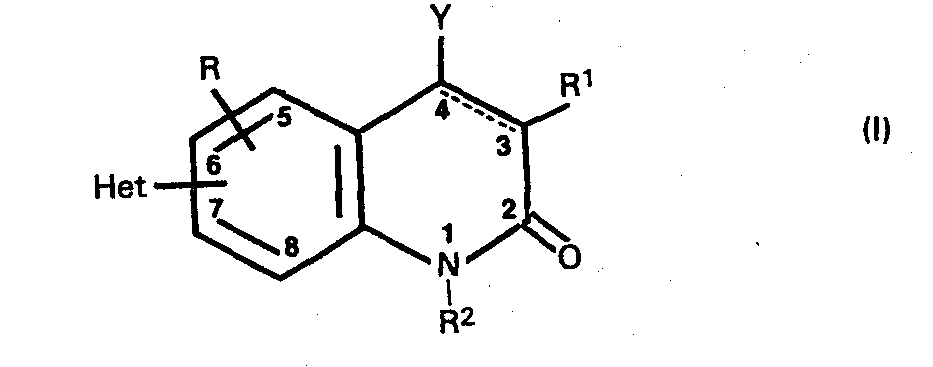
- Thus according to the present invention there are provided compounds having the general formula:-

- In a particular aspect, R is hydrogen, C1-C4 alkyl, C1-C4 alkcxy, C1-C4 alkylthio, C1-C4 alkylsulphinyl, C1-C4 alkylsulphonyl, halo, CF3 or hydroxy; and Y is H.
- Also, the invention provides intermediates to the compounds of the formula (I) having the formula:-

- In a particular aspect of the invention "Het" is an optionally substituted 5- or 6-membered monocyclic aromatic nitrogen-containing heterocyclic group attached by a carbon atom to the 5-, 6-, 7- or 8- position of said quinolone;
- R, which is attached to the 5-, 6-, 7- or 8- position, is hydrogen, CI-C4 alkyl or C1-C4 alkoxy;
- R is hydrogen, cyano, (C1-C4 alkoxy)carbonyl, C1-C4 alkyl,
- -NR3 R4or -CONR3R4 where R3 and R4 are each independently H or C1-C4 alkyl or together with the nitrogen atom to which they are
- attached form a saturated 5- or 6-membered heterocyclic group optionally containing a further heteroatom or group selected from 0, S and N-R5 where R5 is H or C1-C4 alkyl; R2 is H, C1-C4 alkyl, or 2-hydroxyethyl; Y is H;
- and the dotted line between the 3- and 4- positions represents an optional bond.
- Examples of said group "Het" include pyridyl, pyrazinyl, pyrimidinyl, pyridazinyl, imidazolyl, pyrazolyl, oxazolyl, isoxazolyl, thiazolyl, isothiazolyl, triazolyl, tetrazolyl, furyl, thienyl, oxadiazolyl, and, when nitrogen containing, their N-oxides, all being optionally substituted by 1 or 2 substituents each independently selected from, e.g., CI-C4 alkyl, C1-C4 alkoxy, C1-C4 alkylthio, cyano, CF3, halo, -NR3R4 or -CONR3R4 where R3 and R4 are as defined for formula (I), hydroxymethyl, and (C1-C4 alkoxy)carbonyl.
- The preferred N-oxide is pyridyl-N-oxide.
- "Halo" means F, Cl, Br and I. C3 and C4 alkyl and alkoxy groups can be straight or branched chain.
- Where R3 and R4 together with the nitrogen atom to which they are attached form said saturated 5- or 6- membered heterocyclic group, examples of this heterocyclic group are 1-pyrrolidinyl, piperidino, morpholino and 4-methylpiperazino.
- Although the compounds of the formula (I) are written as 2-(lH)-quinolones, it should be realised that the following tautomerism will occur when R2 is H:-

- However, as the keto-form is considered the more stable tautomer, the end products herein will be named and illustrated as quinolones although those skilled in the art will realise that both tautomers may be present or that any particular compound so named may exist predominantly as the hydroxy tautomer and the following disclosure is to be interpreted to incorporate all tautomeric forms.
- In the preferred compounds, "Het" is preferably pyridyl, an N-oxide thereof, pyrimidinyl, pyridazinyl, pyrazinyl, imidazolyl, triazolyl, tetrazolyl, thiazolyl, oxadiazolyl, thienyl or furyl, all optionally substituted by 1 or 2 substituents each selected from C1-C4 alkyl, Cl-C4 alkoxy, cyano, amino and carbamoyl.
- More preferably, "Het" is selected from (a) pyridyl optionally substituted by 1 or 2 methyl groups or by a single methoxy, cyano, amino or carbamoyl group (b) pyridyl-N-oxide (c) pyrimidinyl (d) pyridazinyl (e) pyrazinyl (f) triazolyl or N-methyl triazolyl (g) tetrazolyl or N-(n-butyl)-tetrazolyl (h) N-methylimidazolyl (i) oxadiazolyl (j) thiazolyl (k) thienyl and (1) furyl.
- Most preferably, "Het" is pyrid-3-yl, pyrid-4-yl, 2,6-dimethylpyrid-3-yl or 1-methyl-(1H)-1,2,4-triazol-5-yl.
- "Het" is preferably attached to the 5-, 6- or 7-position and most preferably to the 6-position.
- R is preferably H, C1-C4 alkyl, C1-C4 alkoxy, C 1-C 4 alkylthio, C1-C4 alkylsulphinyl, C1-C4 alkylsulphonyl, halo, hydroxy or hydroxymethyl. More preferably, R is H, C1-C4 alkyl, methoxy, methylthio, methylsulphinyl, methylsulphonyl, bromo, hydroxy or hydroxymethyl.
- When R is a substituent, it is preferably in the 7- or 8-position, most preferably in the 8-position, particularly 8-methyl.
- R1 is preferably H, cyano, C1-C4 alkoxycarbonyl, nitro, halo or amino. R1 is more preferably H, cyano, methoxycarbonyl, nitro, bromo or amino. R1 is most preferably H.
- R2 is preferably H or CH3, most preferably H.
- Y is preferably H or CH3, and most preferably H.
- Preferably there is a double bond between the 3- and 4-positions in the quinolone.
- The preferred compounds have the structure:-

- The pharmaceutically acceptable salts of the compounds of the formula (I) are non-toxic and include acid addition salts such as the hydrochloride, hydrobromide, hydroiodide, sulphate or bisulphate, phosphate or hydrogen phosphate, acetate, maleate, fumarate,*lactate, tartrate, citrate, gluconate, mesylate and p-toluenesulphonate salts. Also included are the metal salts, especially the alkali metal and alkaline earth metal salts, particularly the sodium and potassium salts.
- The cardiac stimulant activity of the compounds of the formula (I) is shown by their effectiveness in one or more of the following tests: (a) increasing the force of contraction in the "Starling" dog heart - lung preparation measured via a left ventricular catheter; (b) increasing myocardial contractility (left ventricular dp/dt max.) in the anaesthetised dog measured via a left ventricular catheter; (c) increasing myocardial ccntraccility in the conscious dog with an implanted left ventricular transducer (dp/dt max.) or an exteriorised carotid artery loop (systolic time intervals).
- In test (a), the positive inotropic effect of the test compound following bolus administration is measured in the "Starling" dog heart-lung preparation. The selectivity for increase in force versus frequency of contraction of the test compound is obtained.
- In test (b), the positive inctropic action of the test compound following intravenous administration is measured in the anaesthetised dog. The magnitude and duration of this action, and the selectivity for increase in force versus frequency of contraction of the test compound are obtained, as are the peripheral effects, e.g. the effect on blood pressure.
- In test (c) the positive inotropic action of the test compound following intravenous or oral administration to a conscious dog with an implanted left ventricular transducer (dp/dt max.) or an exteriorised carotid artery loop (systolic time intervals) is measured. The magnitude of the inotropic action, the selectivity for increase in'force versus frequency of contraction, and the duration of action of the inotropic effect of the test compound are all obtained.
- The compounds of the formula (I) can be administered alone but will generally be administered in admixture with a pharmaceutical carrier selected with regard to the intended route of administration and standard pharmaceutical practice. For example they may be administered orally in the form of tablets containing such excipients as starch or lactose, or in capsules either alone or in admixture with excipients, or in the form of elixirs or suspensions containing flavouring or colouring agents. They may be injected parenterally, for example, intravenously, intramuscularly or subcutaneously. For parenteral administration, they are best used in the form of a sterile aqueous solution which may contain other solutes, for example, enough salts or glucose to make the solution isotonic.
- For administration to man in the curative or prophylactic treatment of cardiac conditions such as congestive heart failure, it is expected that oral dosages of the compounds of the invention will be in the range from 10mg to lg daily, taken in 2 to 4 divided doses per day, for an average adult patient (70kg).
- Dosages for intravenous administration would be expected to be within the range I to 100mg per single dose as required, for example in the treatment of acute heart failure. Thus for a typical adult patient, individual tablets or capsules might contain 5 to 100mg of active compound, in a suitable pharmaceutically acceptable vehicle or carrier. Variations may occur depending on the weight and condition of the subject being treated as will be known to medical practitioners.
- Thus the present invention provides a pharmaceutical composition comprising a compound of the formula (I) as defined above or pharmaceutically acceptable salt thereof, together with a pharmaceutically acceptable diluent or carrier.
- The invention also provides a method of stimulating the heart of an animal, including a human being, which comprises administering, to the animal a compound of formula (I) or pharmaceutically acceptable salt thereof, or a pharmaceutical composition as defined above, in an amount sufficient to stimulate the heart of the animal.
- The invention yet further provides a compound of the formula (I ) or pharmaceutically acceptable salt thereof, for use in medicine, in particular for use in stimulating the heart of a human being suffering from congestive heart failure.
- The compounds of the invention may be prepared by a number of routes, including the following:-
-
- This method for preparing compounds (I) in which R is H is illustrated as follows:

- Typical reactions using 48% aqueous HBr are illustrated as follows:-


- A typical reaction using ethanol containing a catalytic amount of 48% HBr is illustrated as follows:-

- This process can also be carried out using aqueous 5M HC1 instead of 48% HBr under similar conditions. Typical reactions using 5M HCl are illustrated as follows:-

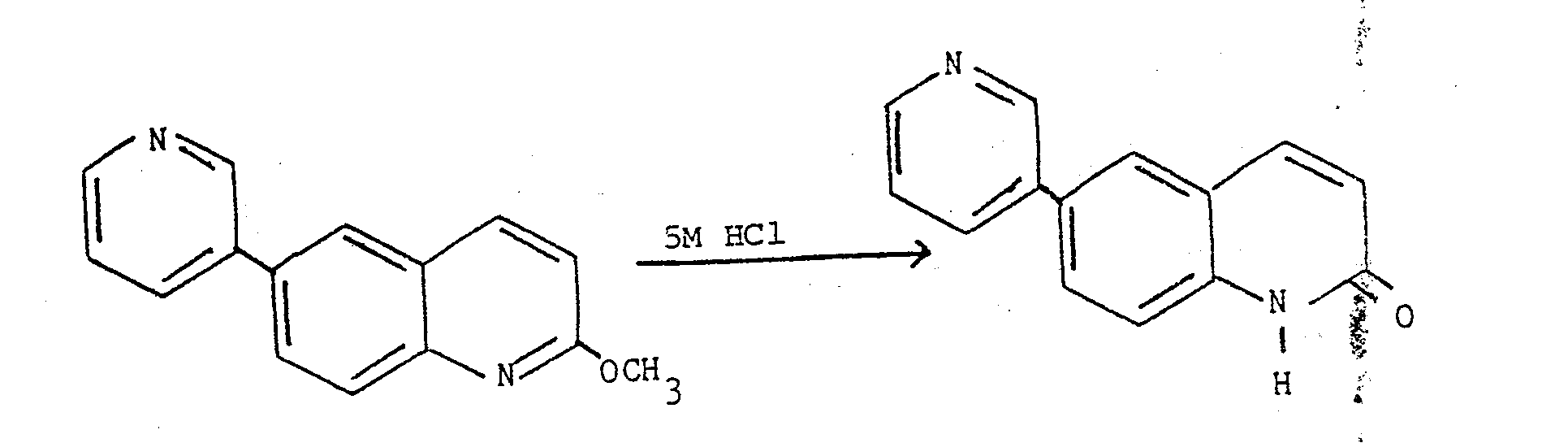


- In cases where R1 is an alkoxycarbonyl group (e.g. -COOCH3), the demethylation may convert this group to -COOH, in which case the carboxyl group can be re-esterified conventionally, e.g. using methanol in sulphuric acid.
- The starting materials of the formula (II) can again be prepared by conventional procedures. Typical routes to these materials, many of which are illustrated in detail in the following Preparations, are as follows:-



- and (1)


- Q is a leaving group such as C1-C4 alkcxy. Q is preferably methoxy or ethoxy.
- Thus it will be seen that this reaction involves the cyclisation of a propenamide derivative, typically a 3-ethoxypropenamide, using concentrated (typically 98%) sulphuric acid. The reaction is typically carried out by stirring the reactants at room temperature for 8-48 hours. The product can then be isolated and purified conventionally.
- A typical reaction is illustrated as follows:-
-

- The starting materials are either known compounds or can be obtained conventionally.
- This route can be illustrated in general terms as follows:-

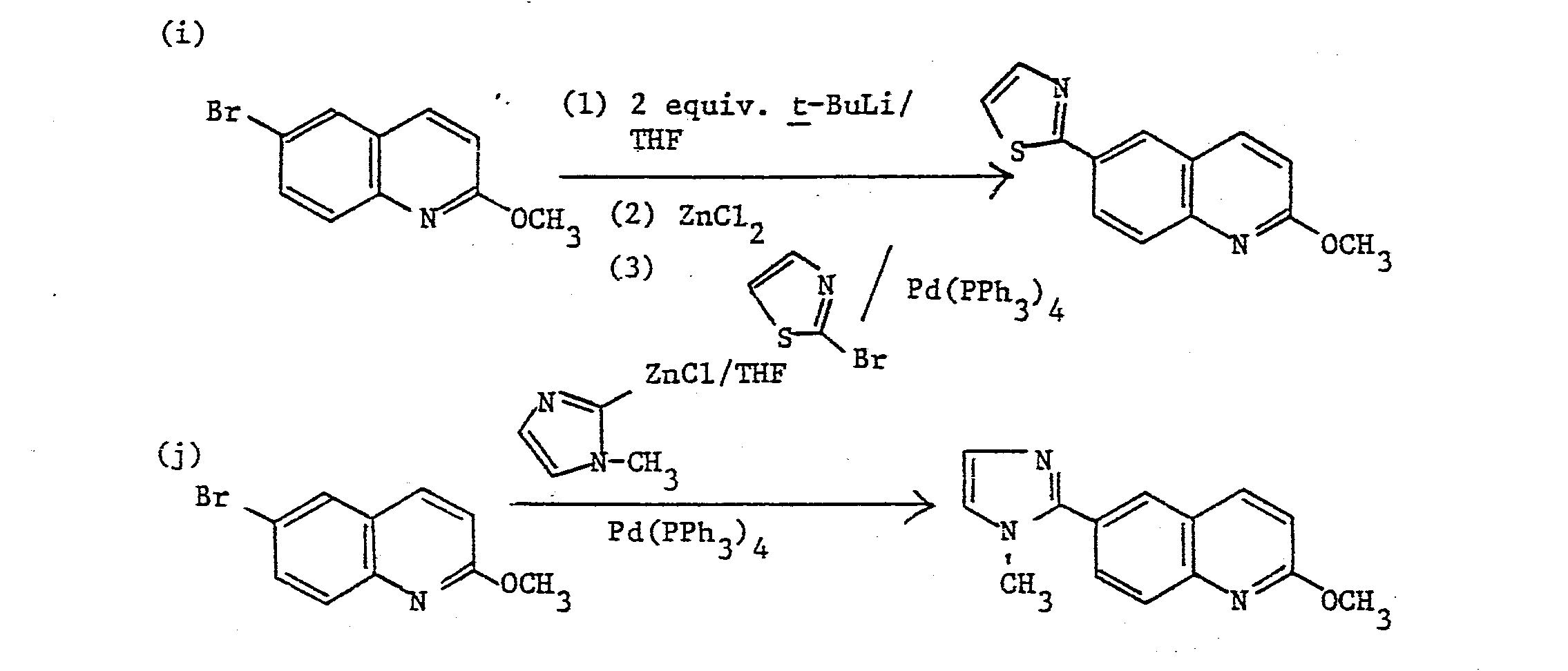
- (triphenylphosphine) palladium(O) catalysis. The reaction is typically carried out by heating the reactants at up to reflux temperature in a suitable organic solvent, e.g. THF.
- Typical reactions are illustrated as follows:-
-


- Heteroaryl magnesium chlorides may also be used in place of zinc chlorides using other suitable transition metal catalysts (e.g. nickel-based).
- The starting materials are either known compounds or are obtainable conventionally. The heteroarylzinc chlorides are most conveniently obtained in situ by reacting the appropriate haloheterocycle at -70 to -100°C in THF with 2 equivalents of t-butyl lithium to obtain the lithio-derivative, followed by reaction with a solution of anhydrous zinc chloride in THF. The heteroarylzinc chlorides can also be prepared from the corresponding Grignard reagents by reacting them with a solution of zinc chloride in THF. The desired end product is then typically obtained by allowing the reaction mixture to warm to room temperature, followed by adding the appropriate halo-quinolone and the tetrakis (triphenylphosphine) palladium(0) in THF and then heating under reflux until the reaction is complete; typically in 1 to 48 hours. The product can then be recovered and purified conventionally.
- The starting materials of this route can be prepared by conventional procedures. Typical routes to these materials, many of which are illustrated in detail in the following Preparations, are as follows:-


- This route can be illustrated in general terms as follows:-

- This reaction involves reduction of a nitro group, preferably using stannous chloride dihydrate in ethanol. The reaction is typically carried out by heating the reactants at up to reflux temperature for 1-8 hours.
- A typical reaction is illustrated as follows:-
-

- The compounds of the formula (I) in which R1 is Cl, Br or I can also be prepared by halogenation of the compounds in which R is H using conventional procedures. A typical reaction is illustrated as follows:-

- The compounds of the formula (I) in which "Het" is an N-oxide can be prepared by the oxidation of the corresponding parent nitrogen-containing heterocycle, typically using a peracid oxidant such as m-chloroperbenzoic or peracetic acid under conventional reaction conditions. A typical reaction is illustrated as follows:-

- The compounds of the formula (I) in which R2 is C1-C4 alkyl or 2-hydroxyethyl can also be prepared by the N-alkylation of the corresponding compounds in which R 2 is H. This is typically achieved by reaction of the N-unsubstituted quinolone with sodium hydride or other strong base to form the anion, followed by reaction with, e.g., a C1-C4 alkyl halide, di(C1-C4 alkyl)sulphate or 2-hydroxyethyl halide in conventional manner. A typical reaction is illustrated as follows:-

- This route can be illustrated in general terms as follows:-

- This reaction involves the catalytic hydrogenation of the 3,4-double bond over an appropriate catalyst, e.g. a transition metal catalyst. The reaction is typically carried out by heating the starting material in ethanol at 25-100° and 15-5000 p.s.i. hydrogen pressure over 10% palladised charcoal, for 1-7 days.
- A typical reaction is illustrated as follows:-
-

- This route can be illustrated in general terms as follows:-
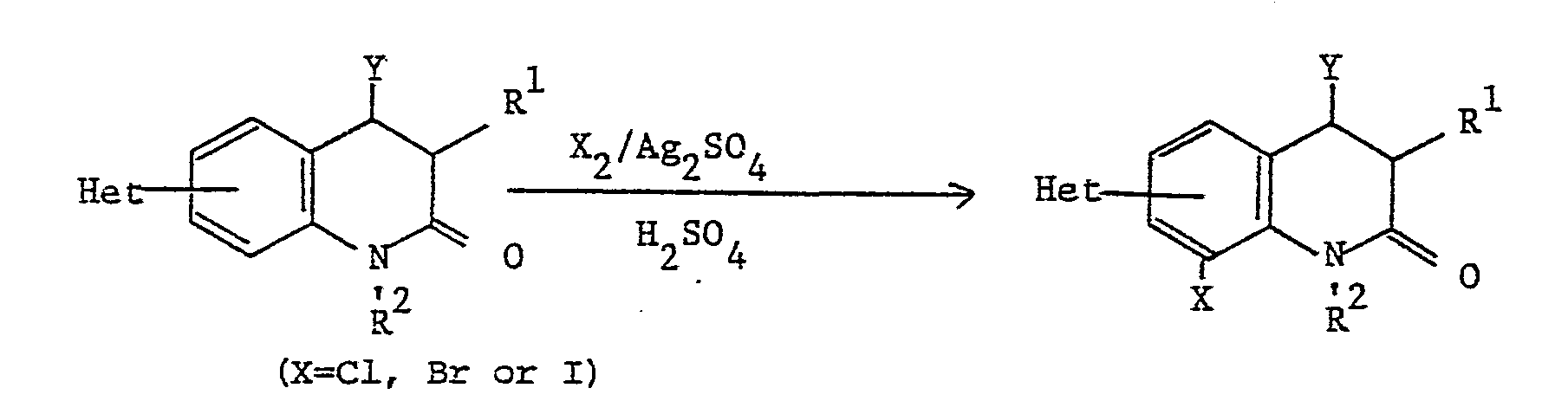
- This reaction involves the electrophilic halogenation of the 8-position of the 3,4-dihydroquinolone starting material in concentrated (preferably 98%) sulphuric acid in the presence of silver sulphate (X = Cl, Br, I). The reaction is typically conducted at 0-70° for 1-16 hours. The product can then be purified conventionally.
- A. typical reaction is illustrated as follows:-
-

- This route can be illustrated in general terms as follows:-

- This reaction involves bromination of the 3-position of the starting material followed by dehydrobromination to generate the 3,4-double bond. The reaction is typically carried out by heating the 3,4-dihydroquinolone starting material with bromine and sodium acetate in acetic acid at 25°-120° for 1-2 hours.
- The product can then be purified conventionally. A typical reaction is illustrated as follows:-
-

- This route can be illustrated in general terms as follows:-

- This reaction involves the nucleophilic substitution of a leaving group Q1 (e.g. F, Cl, Br, I) by a metal salt (e.g. an alkali metal salt) of a C1-C4 alkylthiol in the presence of a copper (I) catalyst. It is typically conducted using the sodium salt in a high boiling organic solvent such as N-methylpyrrolidone at up to reflux temperature (e.g. at 160°C) for 0.5-48 hours. The product can then be isolated and purified by conventional means. A typical reaction is illustrated as follows:-
-

- This route can be illustrated in general terms as follows:-

- The reaction involves the oxidation of the sulphide moiety to the corresponding sulphoxide or sulphone with a suitable oxidising agent such as an organic peracid or sodium metaperiodate. It is typically conducted in an organic solvent such as dichloromethane or chloroform between -70° and +30° for 1-24 hours. Typical reactions are illustrated as follows:-
-


- This route can be illustrated in general terms as follows:-

- The demethylation is preferably carried out by heating the alkoxyquinoline in aqueous mineral acid, preferably 48X HBr, or by treatment with other demethylation reagents such as boron tribromide or pyridinium hydrochloride.
- A typical reaction is illustrated as follows:-
-

- This route can be illustrated in general terms as follows:-

- (e.g. tetrahydrofuran). When R 2 is H, at least 2 equivalents of a C1-C4 alkyllithium should be used. The preferred alkyllithium is n-butyllithium.
- A typical reaction is illustrated as follows:-
-

- Salts of the compounds of the formula (I) are preparable by entirely conventional methods, e.g. by reacting a solution of the free base in an organic solvent with a solution of an appropriate acid in an organic solvent to form an acid addition salt, or by reacting the free base with an appropriate base, e.g. an alkali metal or alkaline earth metal hydroxide, preferably aqueous sodium hydroxide, to form a pharmaceutically acceptable metal salt.
- Where the compounds of the invention contain one or more asymmetric centres, then the invention includes the separated enantiomers and diastereoisomers or mixtures thereof. The separated forms can be obtained by conventional means.
- The following Examples illustrate the preparation of the compounds (I). (All temperatures are in °C):-
- Preparation of 6-(3-pyridyl)-2-(lH)-quinolone
-

- A stirred solution of 2-methoxy-6-(3-pyridyl) quinoline (1.83g) in 48% aqueous hydrobromic acid (6cm3) was heated at 100° for 1.5 hours. The mixture was then cooled in an ice bath, adjusted with 5M sodium hydroxide solution to pH 8, and continuously extracted with chloroform for 6 hours. The dried (MgS04) organic extract was then evaporated to give a solid which was recrystallised from methanol-ethyl acetate to afford 6-(3-pyridyl)-2-[1H]-quinolone, m.p. 217 - 218°, (0.62g).
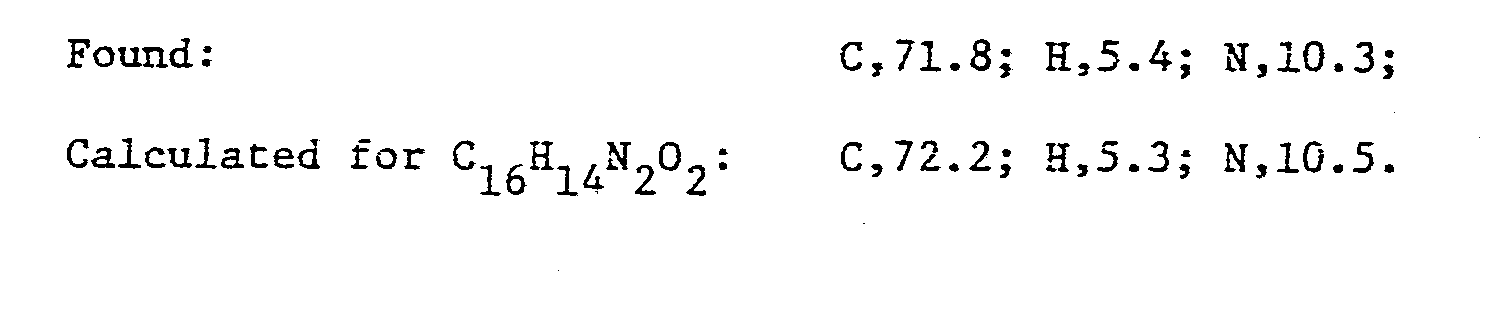
- Analysis %:-
-

- The following compounds were prepared similarly to Example 1 starting from the appropriate 6-substituted-2-methoxyquinoline and 48% aqueous HBr:-
-

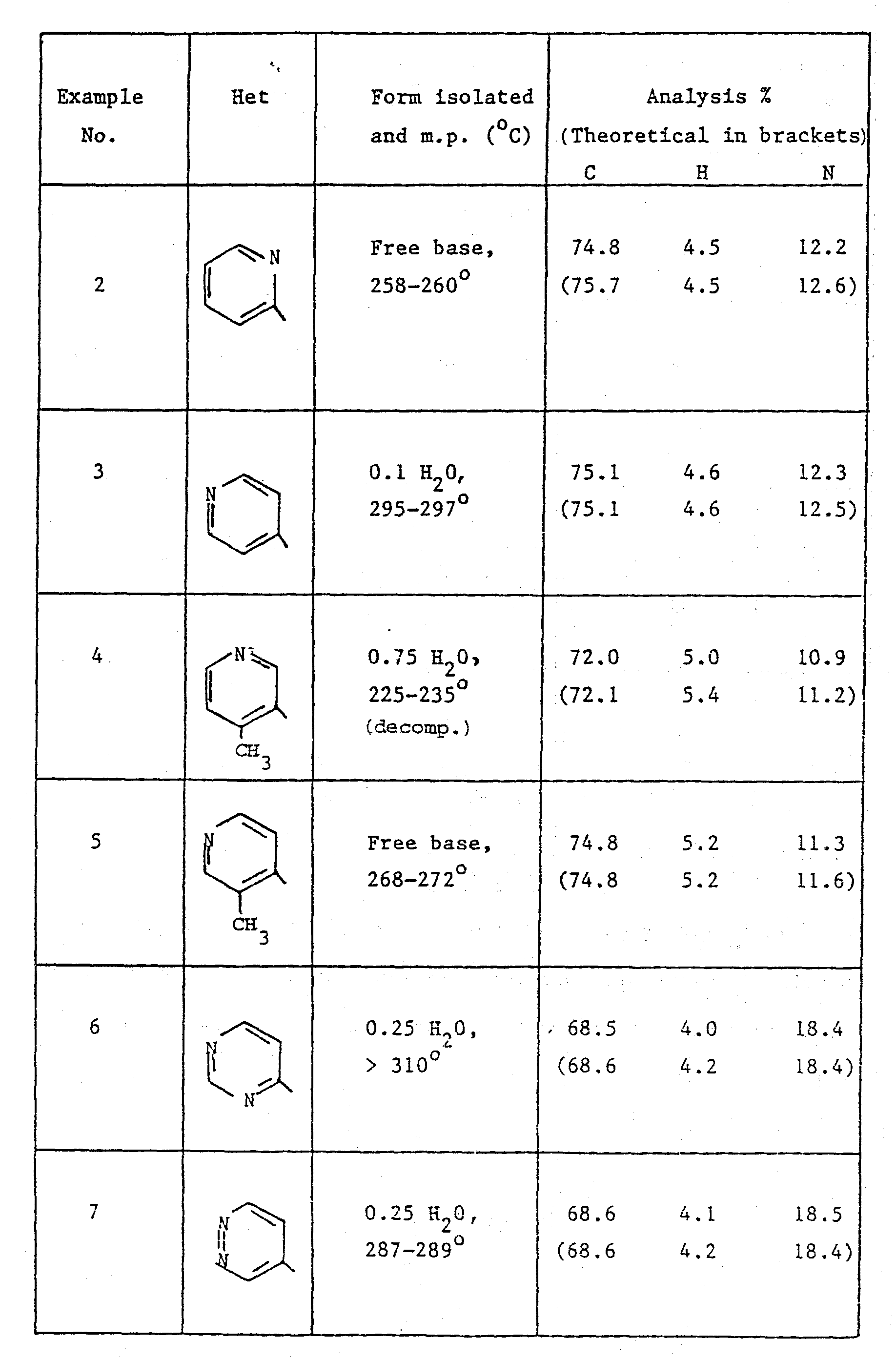

- The following compounds were prepared similarly to Example 1 starting from the appropriate 3,6-disubstituted-2-methoxyquinoline but using aqueous 5M hydrochloric acid instead of 48% hydrobromic acid.


- 3-Methoxycarbonyl-6-(3-pyridyl)-2-[1H]-quinolone hemihydrate
-

- A solution of 2-methoxy-3-methoxycarbonyl-6-(3-pyridyl)-quinoline (0.50 g) in 5M hydrochloric acid (30 cm3) was heated under reflux for 20 minutes. The cooled mixture was filtered and the solid washed with methanol to give the crude intermediate 6-(3-pyridyl)-2-[lH]-quinolone-3-carboxylic acid hydrochloride salt, m.p. 350-352°, (0.45 g). This material was taken into methanol (50 cm3) and heated under reflux with concentrated sulphuric acid (1 cm3) for 1 hour. The mixture was concentrated in vacuo and the residue partitioned between chloroform (100 cm3) and aqueous sodium bicarbonate solution. The aqueous phase was further extracted with chloroform (3 x 25 cm3), and the combined organic extracts were dried (MgSO4) and evaporated to afford 3-methoxycarbonyl-6-(3-pyridyl)-2- [1H]-quinolone hemihydrate, m.p. 223-225°, (0.32 g).
-

- 3-Methoxycarbonyl-6-(4-pyridyl)-2-[lH]-quinolone hemihydrate, m.p. 246-248°, was prepared similarly to the previous Example using 2-methoxy-3- methoxycarbonyl-6-(4-pyridyl)quinoline as the starting material.
-

- Preparation of 8-methyl-6-(3-pyridyl)-2-(1H)-quinolone
-

- A stirred solution of 2-methoxy-8-methyl-6-(3-pyridyl)-quinoline (1.07 g) in 5M hydrochloric acid (10 cm3) was heated under reflux for 2.5 hours and then cooled. The cooled solution was basified to pH 9 with 2M aqueous sodium hydroxide, extracted with chloroform:methanol 9:1 (4 x 100 cm3), and the combined and dried (MgSO4) extracts were concentrated in vacuo to afford a solid. Recrystallisation of the solid from ethyl acetate-methanol gave 8-methyl-6-(3-pyridyl)-2-(lH)-quinolone, m.p. 235.5-236.5°, (0.63 g).
-

- The following compounds were prepared similarly to the method of Example 16 using the appropriately substituted 2-methoxy- quinoline and either 10% by volume of 48% aqueous HBr in ethanol (Examples 37, 42, 46 and 51), or 5M aqueous HC1 (remaining Examples).

- In Example 43, the starting material was 2-methoxy-6-(I-tributylstannyltetrazol-5-yl)quinoline, the tributylstannyl group being removed under the acidic reaction conditions.
- In Example 37, some hydrolysis of -CN to -CONH2 occurred. The resulting mixture of products was separated by chromatography on silica gel (Merck "MK 60.9385"), eluting with chloroform:methanol:aqueous ammonia (S.G. 0.880), 94:5:1 by volume. The carbamoyl-compound is designated as Example 51.


- 6-[l-Methyl-1,2,4-triazol-5-yl]-4,8-dimethyl-2-(lH)-quinolone 0.75 H20, m.p. 327°, was prepared similarly to Example 16 using 6-[1-methyl-1,2,4-triazol-5-yl]-2-methoxy-4,8-dimethylquinoline and 5M HCl as the starting materials.
-

- Preparation of 8-methyl-6-[2,6-dimethylpyrid-3-yl]-2-(lH)-quinolone. 3H2O, sodium salt
-

- 8-Methyl-6-[2,6-dimethylpyrid-3-yl]-2-(1H)-quinalone (94.7 g) was slurried with 5M aqueous sodium hydroxide solution (379 cm3) for 4 hours. The solid material was then filtered off and washed with water (380 cm3). Isopropanol (600 cm3) was added and the volatile material was distilled off to afford a solid which was dissolved in boiling methanol (1620 cm3). The hot solution was filtered, concentrated in vacuo (270 cm3 volume), and cooled to
- 0°. The precipitate was filtered and dried in vacuo at 50° to give the title compound, m.p. >220° (decomp.), (60.4 g).
-

-

- A solution of n-butyl lithium [1.04 cm3 of a 1.6 M solution in n-hexane] was added at -70° to a stirred solution of 8-bromo-6-[2,6-dimethyl-pyrid-3-yl]-2-(lH)-quinolone (0.25 g) in THF (20 cm3) under nitrogen. After 2 hours, gaseous formaldehyde [generated by sublimation of paraformaldehyde (0.3 g)] was passed over the solution, and,after stirring for a further 10 minutes, the mixture was allowed to warm to room temperature. Saturated ammonium chloride solution (10 cm3) was then added and the mixture was extracted with chloroform (3 x 50 cm3). The combined and dried (MgSO4) organic extracts were evaporated and the residue was chromatographed on silica (Merck "MK 60.9385" [Trade Mark]) eluting with dichloromethane:methanol, 19:1. Combination and evaporation of the appropriate fractions afforded 8-hydroxymethyl-6-[2,6-dimethylpyrid-3-yl]-2-(1H)-quinolone. 0.1 H2O, m.p. 218.5-221° (0.094 g).
-

-

- Trans-3-[4-(3-Ethoxypropenamido)phenyl]pyridine (1.43 g) was stirred in 98% sulphuric acid (4.0 cm3) for 16 hours. The mixture was added to ice (50 g) and the resulting solution was basified to pH8 with 2.5 M sodium hydroxide solution. The mixture was extracted with chloroform:methano1,9:1 (10 x 100 cm3),and the combined and dried (MgS04) extracts were concentrated in vacuo to yield a solid which was recrystallised from isopropanol to afford 6-(3-pyridyl)-2-(lH)-quinolone, m.p. 228-2300(0.39 g).
-

-

- A solution of 5-bromo-2-methoxypyridine (1.50 g) in tetrahydrofuran (THF) (10 cm3) was stirred at -70° under nitrogen during the addition of t-butyllithium (8.0 cm3 of a 2.0 M solution in pentane). After 10 minutes a solution of anhydrous zinc chloride (1.09 g) in tetrahydrofuran (THF) (10 cm3) was added and the mixture was allowed to warm to room temperature over 1 hour. A suspension of 6-iodo-2-(lH)-quinolone (0.813 g) and tetrakis (triphenylphosphine) palladium(O) (0.03 g) in THF (10 cm3) was then added and the mixture was heated under reflux for 3 hours. Saturated ammonium chloride solution (1 cm ) was added to the cooled mixture followed by a solution of ethylenediaminetetraacetic acid disodium salt (6.0 g) in water (100 cm3). Chloroform (100 cm ) and methanol (30 cm3) were added and the mixture was warmed until all the solid material dissolved. The phases were separated, the aqueous layer was further extracted with chloroform:methanol 9:1 (3 x 50 cm3), and the combined and dried (MgSO4) extracts were concentrated in vacuo to afford a solid which was recrystallised from isopropanol to give 6-(2-methoxypyrid-5-yl)-2-(lH)-quinolone, m.p. 248-252°, (0.56 g).
-

- The following compounds were prepared similarly to the previous Example starting from the appropriately substituted 6-iodo- or 6-bromo-2-(lH)-quinolone and the appropriate heteroarylzinc chloride with tetrakis (triphenylphosphine) palladium(O) as catalyst.

- In Examples 69-72 the 2,6-dimethylpyrid-3-yl zinc chloride was generated from the appropriate magnesium Grignard reagent (which is a known compound) rather than from the appropriate lithio-derivative.


- The following compounds were prepared similarly to the procedure of Example 61 starting from 6-bromo-3,4-dihydro-2-(lH)-quinolone or 6-bromo-4-methyl-3,4-dihydro-2-(lH)-quinolone and the appropriate pyridylzinc chloride, with tetrakis (triphenylphosphine) palladium(O) as catalyst.

- Preparation of 3-amino-6-(3-pyridyl)-2-(lH)-quinolone 2/3 hydrate
-

- Analysis %:-

- Preparation of 3-bromo-6-(3-pyridyl)-2-(1H)-quinolone
-

- A mixture of 6-(3-pyridyl)-2-(1H)-quinolone monohydrochloride (0.50 g), bromine (3.2 g), acetic acid (10 cm3) and triethylamine (0.195 g) was heated under reflux for 24 hours and then cooled. Ether (20 cm3) was then added to the cooled reaction mixture and the resulting yellow solid was filtered off. This material was purified by preparative layer chromatography eluting with chloroform:methanol, 15:1 (4 elutions), to afford 3-bromo-6-(3-pyridyl)-2-(lH)-quinolone, m.p. 297-300°, (0.11 g).
- Analysis %:-
-

- Preparation of 6-(1-oxopyrid-3-yl)-2-(lH)-quinolone 1/4 hydrate
-

-

- 8-Methyl-6-(1-oxopyrid-3-yl)-2-(lH)-quinolone, 0.35 H20, m.p. 290° (decomp.), was prepared similarly to the previous Example using 8-methyl-6-(3-pyridyl)-2-(lH)-quinolone as the starting material.
-

- 1-Methyl-6-(3-pyridyl)-2-(1H)-quinolone 1/4 hydrate
-

- A stirred solution of 6-(3-pyridyl)-2-[lH]-quinolone (0.05 g) in DMF (0.5 cm3) was treated at room temperature with sodium hydride (0.012 g of a 50% dispersion in oil) for 1 hour. A solution of dimethyl sulphate (0.016 g) in DMF (0.2 cm3) was added and the mixture was stirred for 1.5 hours. The mixture was concentrated in vacuo, water (5 cm3) was added and the mixture was extracted with ethyl acetate (3 x 10 cm3). The combined organic extracts were dried (MgSO4), concentrated in vacuo and the residue chromatographed on silica (Merck "MK 60.9385") eluting with chloroform to yield a solid which was triturated with ether to afford 1-methyl-6-(3-pyridyl)-2-(1H)-quinolone 0.25 H20, m.p. 116-118° , (0.02 g).
-

- 8-Methyl-6-[2,6-dimethylpyrid-3-yl]-3,4-dihydro-2-(1H)-guinolone
-

- A solution of 8-methyl-6-[2,6-dimethylpyrid-3-yl]-2-(lH)-quinolone (0.30 g) was hydrogenated at 60° and 60 p.s.i. (4.13 x 10⁵ Pa) pressure over 10% palladised charcoal (0.10 g) for 48 hours. The cooled solution was then filtered through "Solkafloc" (Trademark for a cellulose-based filtering aid), evaporated to dryness in vacuo, and the residue chromatographed on silica (Merck "MK 60.9385") eluting with chloroform:methanol, 49:1. Combination and evaporation of appropriate fractions afforded a solid (0.16 g) which was recrystallised from ethyl acetate/methanol to give 8-methyl-6-[2,6-dimethylpyrid-3-yl]-3,4-dihydro-2-(1H)-quinolone, m.p. 255-258° (0.110 g).
-

- The following compounds were prepared similarly to the previous Example starting from the appropriately substituted quinolone and H2/Pd-C:-
-


- 4,8-Dimethyl-6-[2,6-dimethylpyrid-3-yl]-3,4-dihydro-2-(lH)-quinolone 0.25 H20, m.p. 177-9°, was prepared similarly to Example 81 using 4,8-dimethyl-6-[2,6-dimethylpyrid-3-yl]-2-(lH)-quinolone and H2/Pd-C as the starting materials.
-

- 8-Bromo-6-[2,6-dimethylpyrid-3-yl]-3,4-dihydro-2-(1H)-quinolone
-

- Bromine (0.46 cm3) was added at room temperature to a stirred solution of 3,4-dihydro-6-[2,6-dimethylpyrid-3-yl]-2-(1H)-quinolone (1.5 g) and silver sulphate (1.4 g) in 98% sulphuric acid (25 cm3). After warming at 50° for 16 hours, the cooled mixture was poured onto ice (100 g) and neutralised to pH7 with 5M sodium hydroxide solution. Chloroform (100 cm3) was added, the phases were separated, and the aqueous phase was further extracted with chloroform (2 x 100 cm3). The combined and dried (MgS04) extracts were evaporated in vacuo to give a solid (1.9 g). A small portion of this material was recrystallised from ethyl acetate/methanol to afford 8-bromo-6-[2,6-dimethylpyrid-3-yl]-3,4-dihydro-2-(lH)- quinolone, m.p. 194-195°.
-

- 8-Bromo-6-[1-methyl-1,2,4-triazol-5-yl]-3,4-dihydro-2-(1H)-quinolone, m.p. 160-163°, was prepared similarly to the previous Example using 6-[1-methyl-1,2,4-triazol-5-yl]-3,4-dihydro-2-(1H)-quinolone, bromine and silver sulphate in sulphuric acid as the starting macerials.
-

- 8-Bromo-6-[2,6-dimethylpyrid-3-yl]-2-(1H)-quinolone
-

- Bromine (0.33 cm3) was added at room temperature to a stirred suspension of 8-bromo-6-[2,6-dimethylpyrid-3-yl]-3,4-dihydro-2-(lH)-quinolone (1.9 g) and sodium acetate (1.06 g) in acetic acid (50 cm3). After warming at 100° for 18 hours, the cooled solution was evaporated in vacuo and the residue was partitioned between 10% sodium carbonate solution (50 cm3) and chloroform (100 cm3). The aqueous phase was further extracted with chloroform (3 x 100 cm3) and the combined and dried (MgS04) extracts were concentrated in vacuo to give a solid which was chromatographed on silica (Merck "MK 60.9385" [Trade Mark]) eluting with chloroform. Combination and evaporation of the appropriate fractions afforded a solid (0.80 g) which was recrystallised from ethyl acetate/methanol to give 8-bromo-6-[2,6-dimethylpyrid-3-yl]-2-(lH)-quinolone, m.p. 212-215° (0.55 g).
-

- 8-Bromo-6-[1-methyl-1,2,4-triazol-5-yl]-2-(lH)-quinolone, m.p. 257-259°, was prepared similarly to the previous Example using 8-bromo-6-[1-methyl-1,2,4-triazol-5-yl]-3,4-dihydro-2-(lH)-quinolone, bromine and sodium acetate in acetic acid as the starting materials.
-

- 6-[2,6-Dimethylpyrid-3-yl]-8-thiomethyl-2-(1H)-quinolone 1/4
-

- A solution of sodium methanethiolate (15 cm3 of a 2.0 M solution in methanol) was added at room temperature to a solution of 8-bromo-6-[2,6-dimethylpyrid-3-yl]-2-(1H)-quinolone (0.50 g) and cuprous iodide (0.15 g) in N-methyl-2-pyrollidone (12 cm3). After heating at 160° for 48 hours the cooled mixture was diluted with chloroform (100 cm3) and water (50 cm3). The separated aqueous phase was further extracted with chloroform (3 x 50 cm3), and the combined and dried (MgSO4) chloroform extracts were evaporated in vacuo to give an oil which was chromatographed on silica (Merck "MK 60.9385" [Trade Mark]) eluting with chloroform. Combination and evaporation of appropriate fractions gave a solid which was recrystallised from ethyl acetate to afford 6-[2,6-dimethyl- pyrid-3-yl]-8-thiomethyl-2-(lH)-quinolone 0.25 H2O, m.p. 146.5-148.5° (0.04 g).
-

- 6-[1-Methyl-1,2,4-triazol-5-yl]-8-thiomethyl-2-(lH)-quinolone, 0.33 H20, m.p. 203-205°, was prepared similarly to the previous Example using 8-bromo-6-[1-methyl-1,2,4-triazol-5-yl]-2-(lH)-quinolone, sodium methanethiolate and cuprous iodide as the starting materials.
-

- 8-Methylsulphinyl-6-[1-methyl-1,2,4-triazol-5-yl]-2-(1H)-quinolone
-

- m-Chloroperbenzoic acid (0.14 g) was added at 0° to a stirred solution of 6-[1-methyl-1,2,4-t-riazol-5-yl]-8-thiomethyl-2-(1H)-quinolone in dichloromethane (10 cm3). After 0.5 hours the solution was concentrated in vacuo, and the residue was chromatographed on silica (Merck "MK 60.9385" [Trade Mark]) eluting with chloroform:methanol, 19:1. Combination and evaporation of the appropriate fractions gave a solid which was recrystallised from ethyl acetate to afford 8-methylsulphinyl-6-[1-methyl-1,2,4-triazol-5-yl]-2-(1H)-quinolone, m.p. 224-227° (0.086 g).
-

- 8-Methylsulphonyl-6-[1-methyl-1,2,4-triazol-5-yl]-2-(1H)-quinolone
-

-

- 8-Hydroxy-6-[2,6-dimethylpyrid-3-yl]-2-(lH)-quinolone
-

- A mixture of 8-methoxy-6-[2,6-dimethylpyrid-3-yl]-2-(lH)-quinolone (0.15 g) and 48% aqueous HBr (5 cm3) was heated under reflux for 19 hours. The mixture was diluted with water (20 cm3), basified to pH7 with 5M sodium hydroxide solution, and extracted with CHC13 (3 x 50 cm3). The combined and dried (MgSO4) chloroform extracts were evaporated in vacuo to afford a solid which was recrystallised from ethyl acetate to give 8-hydroxy-6-[2,6-dimethylpyrid-3-yl]-2-(lH)-quinolone, m.p. 276-277°, (0.132 g).
-
- 8-Hydroxy-6-[2,6-dimethylpyrid-3-yl]-3,4-dihydro-2-(1H)-quinolone 0.5 H20, m.p. 178-185°, was prepared similarly to the previous Example using 8-methoxy-6-[2,6-dimethylpyrid-3-yl]-3,4-dihydro-2- (lH)-quinolone and 48% HBr as the starting materials.
-

- 8-Hydroxy-6-[1-methyl-1,2,4-triazol-5-yl]-2-(1H)-quinolone, m.p. 312-3°, was prepared similarly to Example 98 using 8-methoxy-b-[1-methyl-1,2,4-triazol-5-yl]-2-(1H)-quinolone and 48% HBr as the starting materials.
-

- The following Preparations illustrate the synthesis of the novel starting materials. All temperatures are in °C:-Preparation 1
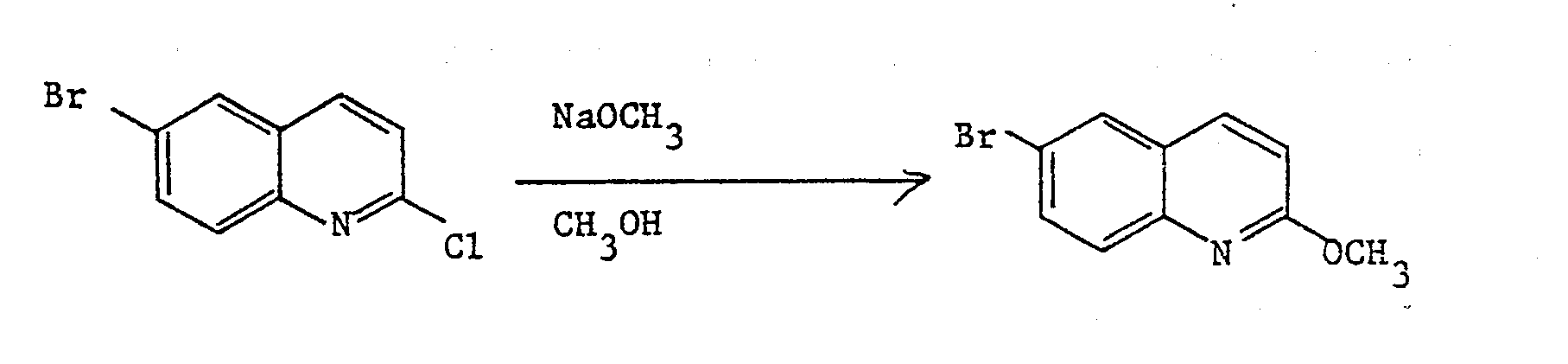
- 2-Methoxy-6-bromoquinoline
-

-

- 2-Methoxy-6-bromoquinoline (alternative to Preparation 1)
-
-

- The following compounds were prepared similarly to Preparation 2 using the appropriately substituted 2-chloroquinoline derivative and sodium methoxide in methanol as the starting materials:-
-


- 6-Bromo-4,8-dimethyl-2-methoxyquinoline, 0.25 H20, m.p. 105°, was prepared similarly to Preparation 2 using 6-bromo-2-chloro-4,8-dimethylquinoline and sodium methoxide in methanol as the starting materials.
-

- 2-Methoxy-8-methyl-6-(3-pyridyl)quinoline

- reflux for 2 hours. The reaction mixture was cooled, concentrated in vacuo, treated with chloroform (100 cm3) and a solution of ethylenediaminetetraacetic acid disodium salt (6 g) in water (100 cm3). The aqueous phase was extracted further with chloroform (3 x 50 cm3) and the combined and dried (MgSO4) extracts were concentrated in vacuo to give an oil. This oil was chromatographed on silica (Merck "MK 60.9385") eluting with ethyl acetate. The fractions containing the product were combined and evaporated to afford a solid which was recrystallised from hexane to afford 2-methoxy-8-methyl-6-(3-pyridyl)quinoline, m.p. 117-118.5°, (1.12 g).
-

- The following compounds were prepared similarly to the previous Preparation using the appropriate bromo-substituted heterocycle and the appropriately substituted 2-methoxyquinoline as starting materials.


- 8-Methyl-b-[2,6-dimethylpyrid-3-yl]-2-methoxyquinoline 0.33 H2o
-

- A solution of 3-bromo-2,6-dimethylpyridine (0.935 g) in tetrahydrofuran (THF) (5 cm3) was added dropwise to a stirred suspension of magnesium turnings (0.133 g) and iodine (0.005 g) in THF (5 cm3) under reflux. The magnesium was completely consumed after heating for a further 1 hour and the solution was then cooled to 0° during the addition of a solution of anhydrous zinc chloride (0.680 g) in THF (4 cm3). After 0.5 hours a solution of 6-bromo-8-methyl-2-methoxyquinoline (1.25 g) and tetrakis-(triphenylphosphine)palladium (0) (0.05 g) in THF (10 cm3) was added and the mixture was heated under reflux for 4 hours. The cooled mixture was partitioned between chloroform (100 cm3) and ethylenediaminetetraacetic acid disodium salt (4 g) in water (80 cm3). The aqueous phase was further extracted with chloroform (2 x 50 cm3) and the combined and dried (MgSO4) extracts were evaporated in vacuo to give an oil which was chromatographed on silica (Merck "MK 60.9385") eluting with chloroform. Combination and evaporation of appropriate fractions gave an oil (1.04 g) which crystallised on trituration with hexane to afford 8-methyl-b-[2,6-dimethyl-pyrid-3-yl]-2-methoxyquinoline 0.33 H20, m.p. 74-6°.
-

- 2-Methoxy-6-(3-pyridyl)-quinoline
-

-

- The following compounds were prepared similarly to the method of the previous Preparation using the appropriate bromopyridine and 6-bromo-3-cyano-2-methoxyquinoline (Preparations 43 and 44) or 6-bromo-2-methoxy-3-methoxycarbonylquinoline (Preparations 45 and 46) as starting materials:-
-


- 2-Methoxy-6-(4-pyrimidinyl) quinoline
-

- (2) pyrimidine
- (3) KMnO4/acetone
- n-Butyl lithium (2.7 cm3 of a 1.5M solution in hexane) was added dropwise to a stirred suspension of 2-methoxy-6-bromoquinoline (0.95g) in ether (5 cm3) at -70° under nitrogen. When all the solid material had dissolved a solution of pyrimidine (0.32g) in ether (1 cm ) was added dropwise and the resulting solution was allowed to warm to room temperature. Saturated ammonium chloride solution (5 cm ) was added, the aqueous phase was extracted with chloroform (3 x 10 cm3) and the dried (MgSO4) extracts were concentrated in vacuo to give an oil. This residue was taken into acetone and treated dropwise with a solution of potassium permanganate (0.63g) in acetone until the purple colour persisted. The mixture was filtered through "Solkafloc" (Trademark) and concentrated in vacuo to give an oil which was chromatographed on silica (Merck "MK. 60.9385" [Trademark]) eluting with ethyl acetate: hexane, 1:1, to give a solid. Recrystallisation from ethyl acetate gave 2-methoxy-6-(4-pyrimidinyl)quinoline, m.p. 164-165°, (0.54g).
-

- The following compounds were prepared similarly to the previous Preparation using pyridazine and 2-methoxy-6- lithioquinoline as starting materials. In this case a mixture of 2-methoxy-6-(4-pyridazinyl) quinoline and 2-methoxy-6-(3-pyridazinyl) quinoline was formed which was separated by chromatography on silica (Merck "MK. 60.9385") eluting with ethyl acetate.

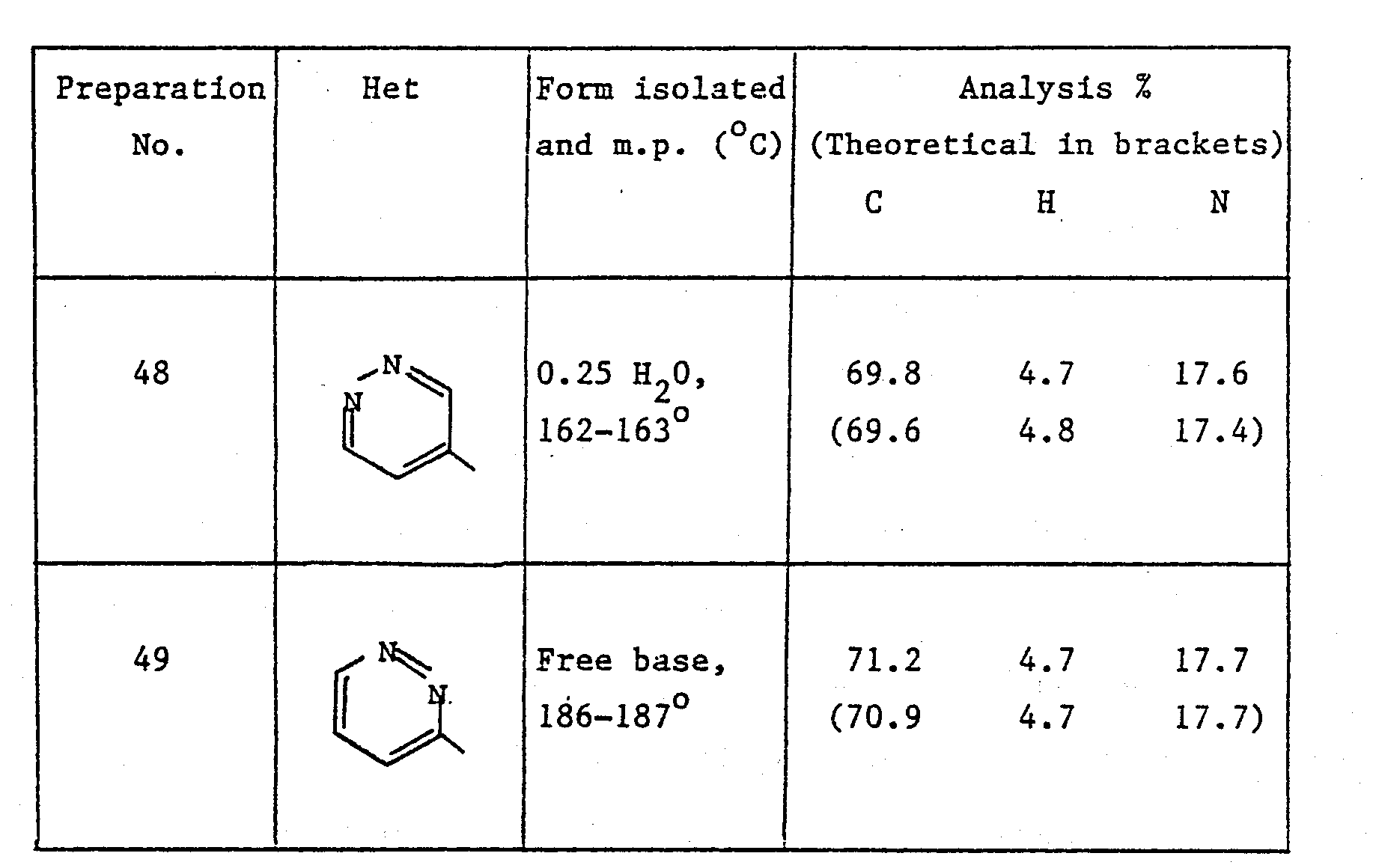
- 2-Methoxy-6-(pyrazin-2-yl)quinoline 1/4 hydrate
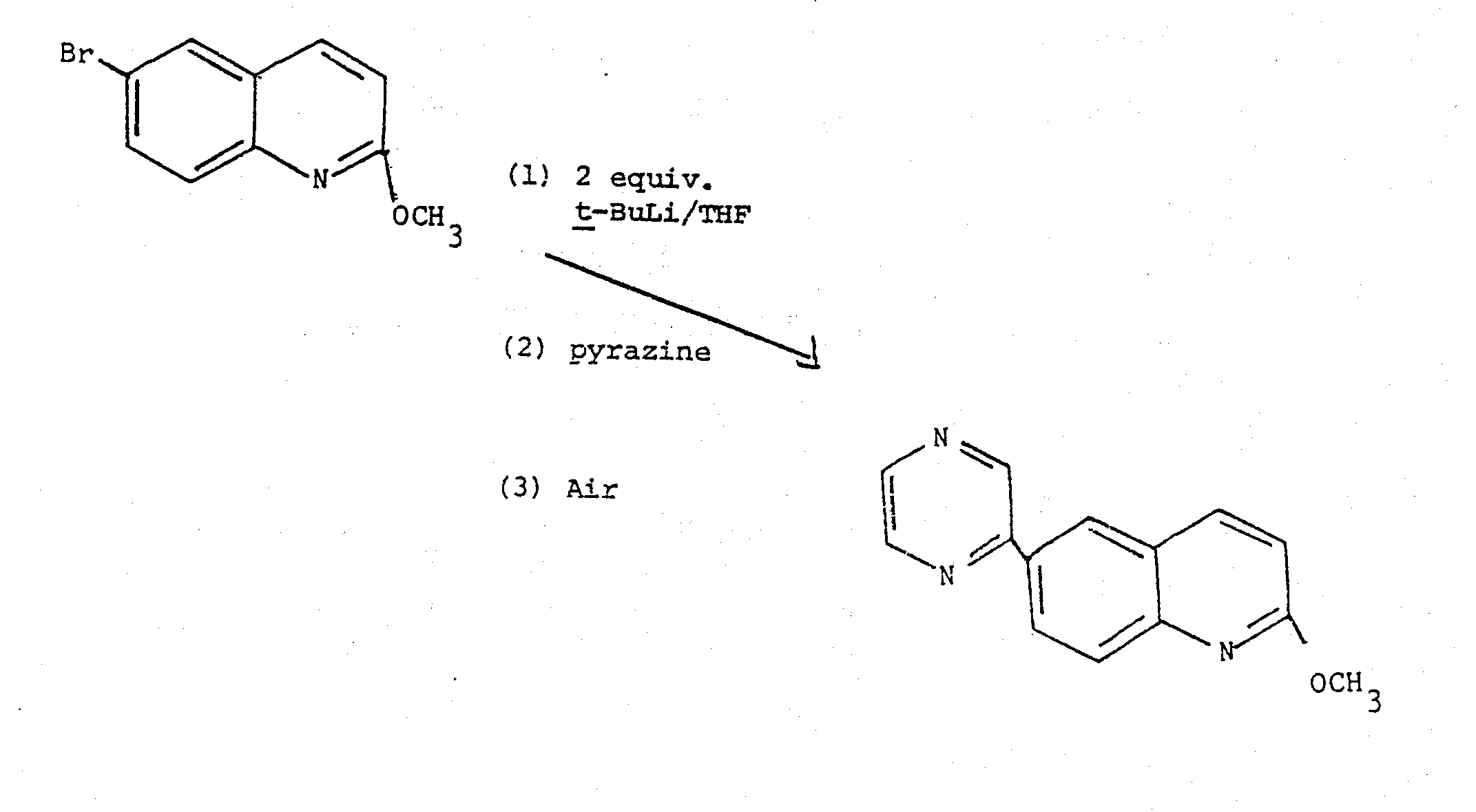
- t-Butyl lithium (4.6 cm3 of a 2.6M solution in pentane) was added dropwise to a stirred solution of 2-methoxy-6-bromoquinoline (1.43g) in THF (10 cm3) at -70° under nitrogen. After 20 minutes a solution of pyrazine (0.48g) in THF (5 cm3) was added and after stirring for a further 20 minutes a stream of dry air was bubbled through the solution for 0.5 hour at -70° and then for a further 1 hour as the mixture warmed to room temperature. Chloroform (50 cm3) was added and the solution was washed with water (10 cm ), dried (MgSO4) and concentrated in vacuo to afford a residue which was chromatographed on silica (Merck "MK 60.9385") eluting with ethyl acetate: hexane, 1:1, to give a solid. Recrystallisation from ethyl acetate gave 2-methoxy-6-(2-pyrazinyl)quinoline. 1/4 H20, m.p. 130-132°, (0.22g).
-

- 3-Cyano-6-bromo-2-(lH)-quinolone

- A suspension of 3-cyano-2-[lH]-quinolone (13.3g) in acetic acid (130 cm ) was treated at room temperature with a solution of bromine (4.1 cm3) in acetic acid (10 cm3). After heating under reflux for 4 hours the mixture was cooled to room temperature, filtered, and the solid washed with ethanol to give 3-cyano-6-bromo-2-[lH]-quinolone (14.63g), a small quantity of which was recrystallised from ethanol, m.p. 308-311°.
-

- 6-Bromo-3-cyano-2-methoxyquinoline

- A suspension of 6-bromo-3-cyano-2-[lH]-quinolone (14.6g) in dichloromethane (150 cm3) was stirred under nitrogen with trimethyloxonium tetrafluoroborate (10.35g) for 2 days. A solution of 2M sodium hydroxide (100 cm ) was added and the aqueous phase was extracted with dichloromethane (3 x 200 cm3). The dried (MgSO4) extracts were concentrated in vacuo and the residue chromatographed on silica (Merck "MK 60.9385") eluting with hexane: ethyl acetate, 4:1, to give a solid which was recrystallised from ethyl acetate to afford 6-bromo-3-cyano-2-methoxyquinoline, m.p. 169-172 , (1.96g).
-

- 2-Chloro-6-Bromo-3-cyano-quinoline
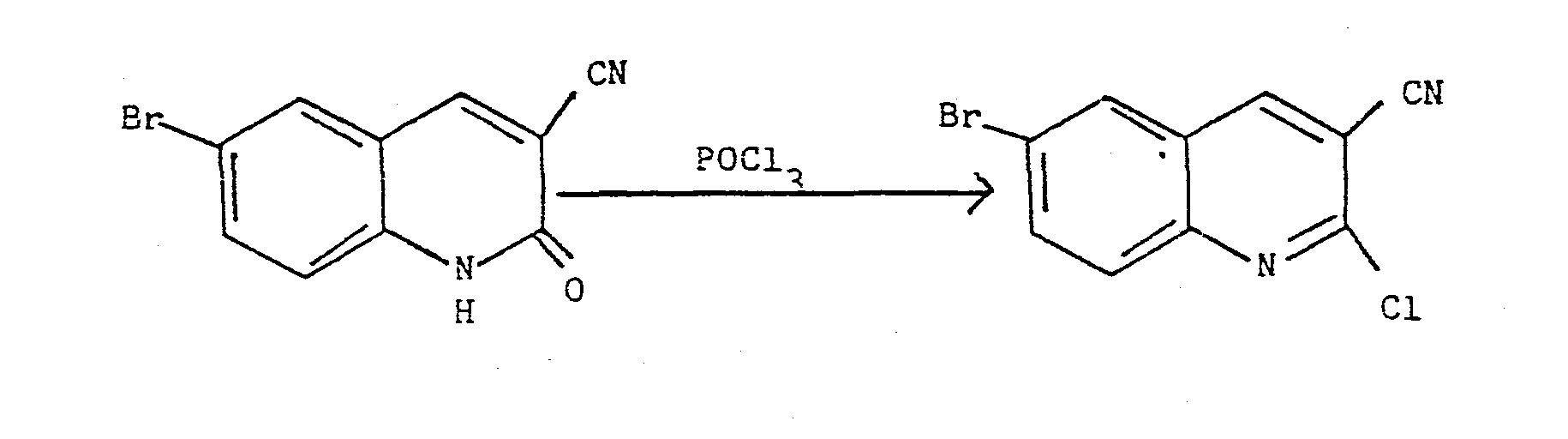
- 6-Bromo-3-cyano-2-[lH]-quinolone (142g) was heated under reflux in phosphorus oxychloride (500 cm3) for 1.5 hours. Volatile material was removed in vacuo and the solid residue was taken into chloroform (400 cm3) and the resulting slurry was poured onto ice. The mixture was neutralised with aqueous ammonia solution (S.G. 0.880) and the aqueous phase was extracted further with chloroform (2 x 150 cm3). The dried (MgS04) organic extracts were concentrated in vacuo and the residue chromatographed on silica (Merck "MK 60.9385") eluting with toluene to give a solid which was recrystallised from ethyl acetate to afford 2-chloro-6-bromo-3-cyano-quinoline, m.p. 228-230 , (80g).
-

-

- A solution of 6-bromo-2-chloro-3-cyano-quinoline (1.2g) in methanol (30 cm3) was heated under reflux for 16 hours with sodium methoxide [made from sodium (0.116g) and methanol (20 cm3)]. The mixture was cooled to 00 and the solid filtered to afford 6-bromo-3-cyano-2-methoxyquinoline, m.p. 172-174°, (0.60g).
-

- Also synthesised by a similar method to the previous Preparation starting from 6-bromo-2-chloro-3-methoxycarbonyl- quinoline was 6-bromo-2-methoxy-3-methoxycarbonyl-quinoline, m.p. 144-145°.
-

- 6-Bromo-2-(1H)-quinolone-3-carboxylic acid

- A stirred solution of 3-ethoxycarbonyl-2-[lH]-quinolone (4.5g) in acetic acid (50 cm3) was treated at room temperature with a solution of bromine (16g) in acetic acid (20 cm3). The mixture was heated under reflux for 24 hours, cooled and filtered to give 6-bromo-2-[lH]-quinolone-3-carboxylic acid, m.p. > 300°, (3.42g) as a crude solid.
- 6-Bromo-2-chloro-3-methoxycarbonylquinoline
-

- A stirred suspension of 6-bromo-2-[lH]-quinolone-3-carboxylic acid (3.4g) in phosphorous oxychloride (40 cm3) was heated under reflux for 2 hours. The mixture was cooled, evaporated to dryness in vacuo and the solid residue was treated at 0° with methanol (50 cm3). After stirring for two hours at room temperature the mixture was filtered and the solid was washed with methanol to afford 6-bromo-2-chloro-3-methoxycarbonylquinoline, m.p. 176-177 , (1.82g).
-

- 6-Iodo-2-(1H)-quinolone

- A solution of 2-[1H]-quinolone (2.0g) and silver sulphate (2.14g) in concentrated sulphuric acid (15.0 cm3) was stirred at room temperature during the addition of iodine (3.5 g). After heating at 500 for 24 hours the mixture was poured onto ice, the solution was neutralised with solid sodium carbonate and the solid was filtered off. This material was chromatographed on silica (Merck "MK 60.9385") eluting with chloroform to afford a residue which was recrystallised from methanol to give 6-iodo-2-[1H]-quinolone, m.p. 261°, (0.8g).
-

- 6-Bromo-2-chloro-8-methylquinoline
-

- A mixture of 6-bromo-8-methyl-2-(lH)-quinolone (12.0 g) in phosphorus oxychloride (100 cm ) was heated under reflux for 2 hours. Volatile material was removed in vacuo, the residue dissolved in chloroform (200 cm3), and the resulting solution was poured onto ice (200 g). The mixture was basified with aqueous ammonia solution (S.G. 0.88) to pH10 and the aqueous phase was further extracted with chloroform (2 x 100 cm3). The combined and dried (MgSO4) extracts were concentrated in vacuo to give a solid (10.7 g) which was recrystallised from ethanol to afford 6-bromo-2-chloro-8-methyl-quinoline, m.p. 114-116°.
-

- The following compounds were prepared similarly to the method of the previous Preparation using a 1.0:1.7 mixture of 5-bromo-2-(lH)-quinolone and 7-bromo-2-(lH)-quinolone (in Preparations 60 and 61) and a 1.0:2.3 mixture of 6-bromo-5-methyl-2-(lH)-quinolone and 6-bromo-7-methyl-2-(lH)-quinolone (in Preparation 62), 6-iodo-8-ethyl-2-(lH)-quinolone (in Preparation 63), 6-iodo-8-[prop-2-yl]-2-(lH)-quinolone (in Preparation 64), and 6-bromo-8-methoxy-2-(lH)-quinolone (in Preparation 65), and phosphorus oxychloride as the starting materials:-
-


- 6-Bromo-2-chloro-4,8-dimethylquinoline, m.p. 182°, was prepared similarly to Preparation 59, using 6-bromo-4,8-dimethyl-2-(lH)-quinolone and phosphorus oxychloride as the starting materials.
-

- 6-Bromo-8-methyl-2-(1H)-quinolone

- Trans-N-(4-bromo-2-methylphenyl)-3-ethoxypropenamide (2.0 g) was added portionwise with stirring to 98X sulphuric acid (15 cm3) at room temperature. After 16 hours the solution was poured onto ice (100 cm3) and the resulting precipitate was filtered off and dried (1.5 g). Recrystallisation from ethyl acetate-methanol afforded 6-bromo-8-methyl-2-(1H)-quinolone, m.p. 272-274°.
-

- The following compounds were prepared similarly to the method of the previous Preparation using trans-N-(3-bromophenyl)-3- ethoxypropenamide (in Preparations 68 and 69), trans-N-(4-bromo-3-methylphenyl)-3-ethoxy-propenamide (in Preparations 70 and 71),
- trans-N-(4-iodophenyl)-3-ethoxypropenamide (in Preparation 72), trans-N-(4-iodo-2-ethylphenyl)-3-ethoxypropenamide (in Preparation 73), trans-N-(4-iodo-2-[prop-2-yl]-phenyl)-3- ethoxypropenamide (in Preparation 74), and trans-N-(4-bromo-2-methoxyphenyl)-3-ethoxypropenamide (in Preparation 75) and 98% sulphuric acid as the starting materials:-
-


- 6-Bromo-4,8-dimethyl-2-(lH)-quinolone
-

- N-[4-Bromo-2-methylphenyl]-acetoacetamide (18 g) was heated for 5 hours with stirring in 98% sulphuric acid (50 cm3) at 100°. The cooled mixture was then poured onto ice (200 g), the solid was filtered off and dried in vacuo at 100° for 2 hours to give the crude product (15.0 g). A small portion (1.5 g) of this material was recrystallised from ethyl acetate/methanol to afford 6-bromo-4,8-dimethyl-2-(lH)-quinolone, m.p. >300° (1.1 g).
-

- N-[4-Bromo-2-methylphenyl]-acetoacetamide
-

- A mixture of 4-bromo-2-methylaniline (25 g) and diketene (11.8 cm3) in toluene (100 cm3) was heated with stirring under reflux for 5 hours. On cooling to room temperature the precipitated solid was filtered off and recrystallised from hexane/ethyl acetate to afford N-[4-bromo-2-methylphenyl]-acetoacetamide, m.p. 109° (14.0 g).
-

- Trans-N-(4-Bromo-2-methylphenyl)-3-ethoxypropenamide
-

- Trans-3-Ethoxypropenoyl chloride (0.74 g) was added at 0° to a stirred solution of 4-bromo-2-methylaniline (0.93 g) in pyridine (10 cm3). After 0.5 hours water (40 cm3) was added, the solid material was filtered off, washed with water (30 cm3) and dried. The product was recrystallised from ethyl acetate to afford trans-N-(4-bromo-2-methylphenyl)-3-ethoxypropenamide, m.p. 163-164°, (1.3 g).
-

- The following compounds were prepared similarly to the method of the previous Preparation using the appropriately substituted aniline and trans-3-ethoxypropenoyl chloride as starting materials:-
-


- 4-Iodo-2-[prop-2-yl]aniline
-

- Iodine monochloride (12.9 cm3) was added at room temperature to a stirred solution of 2-[prop-2-ylJ-aniline (27.0 g) and sodium acetate (16.4 g) in acetic acid (250 cm3). After 1 hour, volatile material was removed in vacuo and the residue was partitioned between ethyl acetate (200 cm3) and 10% sodium carbonate solution (50 cm3). The dried (MGSO4) organic extract was filtered and evaporated in vacuo to afford an oil which was chromatographed on silica (Merck "MK 60.9385") eluting with hexane. Combination and evaporation of the product containing fractions gave the product as a crude dark unstable oil (38 g) which was not characterised fully but was used directly in Preparation 84.
- 4-Iodo-2-ethylaniline (crude oil) was prepared similarly to the previous Preparation using 2-ethylaniline as the starting material. (4-Bromo-2-methoxyaniline is a known compound.)
- 6-Cyano-2-methoxyquinoline
-

- A mixture of 6-bromo-2-methoxyquinoline (0.476 g), potassium cyanide (0.26 g), potassium hydroxide (0.05 mg) and palladium (II) acetate (0.067 g) in DMF (2.0 cm3) were heated at 135° for 3 hours. The cooled solution was then partitioned between water (20 cm3) and chloroform (50 cm ) and the aqueous phase was further extracted with chloroform (2 x 25 cm3). The combined and dried (MgSO4) extracts were evaporated in vacuo and the residue was chromatographed on silica (Merck "MK 60.9385") eluting with toluene to afford, after collection and evaporation of appropriate fractions, 6-cyano-2-methoxyquinoline, m.p. 163-165°, (0.216 g).
-

- 2-Methoxy-6-(1-tributylstannyl-(1H)-tetrazol-5-yl)quinoline
-

- 2-Methoxy-6-(1-butyl-(1H)-tetrazol-5-yl)quinoline and 2-methoxy-6-(2-butyl-(2H)-tetrazol-5-yl)quinoline

- 6-Cyano-2-methoxyquinoline (0.368 g) and tri-n-butyltin azide (0.73 g) were heated together at 120° for 18 hours. The mixture was then cooled to 100°, n-butyliodide (0.42 g) was added, and the reaction mixture was stirred for 3 hours. The residue was partitioned between acetonitrile (20 cm3) and hexane (20 cm3) and the acetonitrile layer was concentrated in vacuo to afford an oil. Chromatography of the oil on silica (Merck MK 60.9385) eluting with dichloromethane gave firstly; (RF 0.75 in chloroform: methanol, 19:1) 2-methoxy-6-(2-butyl-(2H)-tetrazol-5-yl)quinoline as a crude oil (0.087 g) and secondly; (RF 0.62 in chloroform:methanol, 19:1) 2-methoxy-6-(1-butyl-(lH)-tetrazol-5-yl)-quinoline as a crude oil (0.30 g). These compounds were used directly without further purification in Examples 44 and 45.
- 6-Bromo-4-methyl-3,4-dihydro-2-(lH)-quinolone
-

- A solution of bromine (0.08 cm3) in acetic acid (1 cm3) was added at room temperature to a stirred solution of 4-methyl-3,4-dihydro-2-(lH)-quinolone (0.5 g) in acetic acid (4.0 cm ). After 2 hours, volatile material was removed in vacuo, the residue was
- partitioned between chloroform (50 cm ) and water (20 cm ), and the organic phase was further extracted with chloroform (2 x 20 cm3). The combined and dried (MgSO4) organic extracts were evaporated in vacuo and the solid residue was recrystallised from ethyl acetate to afford 6-bromo-4-methyl-3,4-dihydro-2-(lH)-quinolone, m.p. 190°, (0.35 g).
-

-

- A stirred mixture of 2-amino-5-iodobenzaldehyde (2.0 g), ethyl nitroacetate (4.2 g), and piperidine (0.7 g) was heated under reflux for 1.5 hours in o-xylene (100 cm3). The cooled solution was then concentrated in vacuo and the solid residue was recrystallised from chloroform-isopropanol to afford 6-iodo-3-nitro-2-(lH)-quinolone, m.p. 279-282°, (1.14 g).
-

- 2-Amino-5-iodobenzaldehyde hemihydrate
-

- Manganese dioxide (0.044 g) was added to a stirred solution of 2-amino-5-iodobenzyl alcohol (0.125 g) in dichloromethane (10 cm3) and the mixture was stirred for 6 hours. A further portion of manganese dioxide (0.044 g) was then added and stirring was continued for 16 hours. The mixture was then filtered, the filtrate evaporated in vacuo, and the residue chromatographed on silica (Merck "MK 60.9385") eluting with ethyl acetate. The requisite fractions were combined and concentrated in vacuo to afford 2-amino-5-iodobenzaldehyde. 0.5 H20 as a solid, m.p. 105°, (0.1 g).
-

- 2-Amino-5-iodobenzyl alcohol

- A solution of diisobutylaluminium hydride (210 cm3 of a 1.5 M solution in THF) was added at -30° to a stirred solution of methyl-2-amino-5-iodobenzoate (28.0 g) in THF (100 cm3) under nitrogen. The mixture was warmed to room temperature, stirred for 16 hours and treated with methanol (35 cm3). Ethyl acetate (500 cm3) was added and the mixture filtered to remove inorganic material. The filtrate was concentrated in vacuo to afford a solid which was chromatographed on silica (Merck "MK 60.9385") eluting with chloroform:methanol, 49:1 (by volume), and the requisite fractions were combined and evaporated in vacuo to give 2-amino-5-iodobenzyl alcohol, m.p. 125°, (19.0 g).
-

- 2-Methoxyquinoline-6-carboxylic acid

- n-Butyl lithium (63 cm3 of a 1.6 M solution in hexane) was added dropwise to a stirred solution of 6-bromo-2-methoxyquinoline (20 g) in THF (250 cm3) at -70° under nitrogen. After 0.5 hours, solid carbon dioxide (50 g) was added, the solution was allowed to warm to room temperature, and volatile material was removed in vacuo. The residue was partitioned between dichloromethane (100 3 3 cm ) and water (100 cm3), the aqueous phase was separated and acidified to pH 3.5 with 5M hydrochloric acid. The precipitated solid was filtered and dried (14.2 g). Recrystallisation of a small portion from isopropanol afforded 2-methoxyquinoline-6-carboxylic acid, m.p. 220-222°.
-

- The following compounds were prepared similarly to the previous Preparation starting from the appropriately substituted 6-bromo- or 6-iodo-2-methoxyquinoline, n-BuLi and CO2:-
-


- 2-Methoxyquinoline-6-carboxylic acid amide
-

- Oxalyl chloride (10.3 cm3) was added dropwise to a stirred solution of 2-methoxyquinoline-6-carboxylic acid (12.0 g) in dichloromethane (100 cm3) and DMF (0.1 g) at 0°. The mixture was warmed to room temperature and after 2 hours volatile material was removed in vacuo. The residue was taken into dichloromethane (100 cm3), cooled to 0° and treated cautiously with aqueous ammonia solution (30 cm3 of S.G. 0.880). After 2 hours the mixture was concentrated in vacuo and the solid residue was recrystallised from isopropanol to afford 2-methoxyquinoline-6-carboxylic acid amide, m.p. 212-214°, (7.9 g).
-

- The following compounds were prepared similarly to the previous preparation starting from oxalyl chloride, the appropriately substituted 2-methoxyquinoline-6-carboxylic acid, and ammonia:-
-


- 2-Methoxyquinoline-6-(N-[dimethylaminomethylene])carboxylic acid amide
-

-

- The following compounds were prepared similarly to the previous Preparation starting from the appropriately substituted 2-methoxyquinoline-6-carboxylic acid amide and N,N-dimethylformamide dimethylacetal:-
-


- 2-Methoxy-b-[(1H)-1,2,4-triazol-5-yl]quinoline
-

- A mixture of 2-methoxyquinoline-6-(N-[dimethylamino- methylene])carboxylic acid amide (1.0 g) and hydrazine hydrate (0.208 cm3) was stirred at 90° for 1.5 hours in glacial acetic acid (10 cm3). Volatile material was removed in vacuo, the residue was chromatographed on silica (Merck "MK 60.9385") eluting with ethyl acetate:methanol, 49:1 (by volume), and the requisite fractions were combined and evaporated to afford 2-methoxy-6-[(lH)-1,2,4-triazol-5-yl]quinoline, m.p. 198-200°, (0.811 g).
-

- The following compounds were prepared similarly to the previous Preparation starting from the appropriately substituted 2-methoxyquinoline-6-(N-[dimethylaminomethylene]) carboxylic acid amide and hydrazine hydrate (in Preparation 114) or methylhydrazine (in Preparations 115-122):-
-


- Preparations 116 and 117 were obtained as a mixture of regioisomers which were separated by chromatography on silica (Merck "MK 60.9385") eluting with ether. The major isomer, Rf 0.8 in ethyl acetate, eluted first (Preparation 116). The minor isomer, Rf 0.28 in ethyl acetate, was eluted subsequently (Preparation 117).
- Preparations 118 and 119 were similarly obtained as a mixture of regioisomers which were separated by chromatography on silica (Merck "MK 60.9385"). Elution with hexane:ether, 1:1, afforded the major isomer, (Preparation 118), while the minor isomer (Preparation 119) was eluted from the column with ethyl acetate.
- 2-Methoxy-6-(1,2,4-oxadiazol-5-yl)quinoline
-

- Aqueous 5M sodium hydroxide solution (0.94 cm3) was added to a solution of hydroxylamine hydrochloride (0.325 g) in water (3 cm3) and acetic acid (7 cm3). 2-Methoxyquinoline-6-N-([dimethyl- aminomethylene])carboxylic acid amide (1.0 g) was added, the mixture was stirred for 10 minutes, water (10 cm3) was added, and the solution was kept at 0° for 1 hour. The precipitate was filtered off, taken into dioxan (5 cm3) and acetic acid (5 cm3), and warmed at 90° for 1.5 hours. The cooled solution was treated with water (10 cm3), and the precipitate was filtered off and chromatographed on silica (Merck "MK 60.9385") eluting with dichloromethane. The requisite fractions were combined and evaporated in vacuo to afford a solid (0.537 g). A small sample of the solid was recrystallised from ethyl acetate to give 2-methoxy-6-(1,2,4-oxadiazol-5-yl)quinoline, m.p. 150-152°.
-

- 6-[1-Methyl-(1H)-imidazol-2-yl]-2-methoxyquinoline

- n-Butyl lithium (9 cm3 of a 1.6 M solution in hexane) was added at -45° to a stirred solution of 1-methyl-(1H)-imidazole (1.03 cm3) in THF (30 cm3) under nitrogen. After 1.25 hours a solution of anhydrous zinc chloride (1.95 g) in THF (30 cm3) was added dropwise over 5 minutes giving a white precipitate. The mixture was warmed to room temperature, a solution of 6-bromo-2-methoxyquinoline (3 g) and tetrakis (triphenylphosphine) palladium(O) (0.2 g) in THF (20 cm ) was added, and the solution was heated under reflux for 16 hours. Saturated ammonium chloride (2 cm3) was added, the reaction mixture was concentrated in vacuo, and the residue partitioned between chloroform (100 cm3) and a solution of ethylenediaminetetraacetic acid disodium salt (10 g) in water (100 cm3). The aqueous phase was extracted further with chloroform (2 x 50 cm3) and the combined and dried (MgSO4) extracts were evaporated in vacuo to give a solid, which was chromatographed on silica (Merck "MK 60.9385"), eluting with chloroform:methanol, 19:1 (by volume). The requisite fractions were combined and evaporated in vacuo to afford a foam which was recrystallised from ethyl acetate-hexane to give 6-[1-methyl-(1H)-imidazol-2 yl]-2-methoxyquinoline, m.p. 116.5-118.5°, (0.517 g).
-

- Also synthesised by a similar method to the previous preparation using l-methyl-(lH)-imidazole, tetrakis (triphenylphosphine)palladium(O) and 6-bromo-2-methoxy-8-methylquinoline as starting materials was 6-(1-methyl-(lH)-imidazol-2-yl)-2-methoxy-8-methylquinoline hemihydrate, m.p. 158-161°.
-

- 6-[1-Methyl-(1H)-imidazol-5-yl)-2-methoxy-8-methylquinoline

- t-Butyllithium (11.9 cm3 of a 2.0 M solution in pentane) was added at -70° under nitrogen to a stirred solution of 1-methyl-(1H)-imidazole (0.95 cm3) in THF (8 cm3). After 10 minutes, the mixture was warmed to 0° and stirring was continued for 1 hour. A solution of anhydrous zinc chloride (6.25g) in THF (45 cm ) was then added and the mixture was stirred for a further 1 hour. 6-Bromo-2-methoxy-8-methylquinoline (1.0g) and tetrakis (triphenylphosphine) palladium (0) (0.04g) were added and the mixture was heated under reflux for 18 hours. The cooled mixture was concentrated in vacuo and partitioned between chloroform (200 cm3) and a solution of ethylenediaminetetraacetic acid disodium salt (50g) in water (250 cm3). The aqueous phase was further extracted with chloroform (2 x 100 cm3) and the combined and dried (MgSO4) extracts were evaporated to give a solid which was chromatographed on silica (Merck "MK 60.9385") eluting with chloroform. After combination and evaporation of appropriate fractions, this afforded firstly; (Rf 0.32 in chloroform) 6-[1-methyl-(1H)-imidazol-2-yl]-2-methoxy-8-methylquinoline, m.p. 160-162° (0.37 g), identical to the product of Preparation 125; and secondly (Rf 0.26 in chloroform) 6-(1-methyl-(lH)-imidazol-5-yl]-2-methoxy-8-methyl-quinoline, m.p. 174-175°, (0.05 g).
-

Claims (25)
- CLAIMS for the Contracting States BE; CH, DE, FR, GB, IT, LI, LU, NL, SE
- 1. A compound of the formula:

or a pharmaceutically acceptable salt thereof, wherein "Het" is an optionally substituted 5- or 6-membered monocyclic aromatic heterocyclic group attached by a carbon atom to the 5-, 6-, 7- or 8- position of said quinolone; R, which is attached to the 5-, 6-, 7- or 8- position, is hydrogen, C1-C4 alkyl, C1-C4 alkoxy, C1-C4 alkylthio, C1-C4 alkylsulphinyl, C1-C4 alkylsulphonyl, halo, CF3, hydroxy, hydroxymethyl, or cyano; R1 is hydrogen, cyano, (C1-C4 alkoxy)carbonyl, C1-C4 alkyl, nitro, halo, -NR3R4 or -CONR3R4 where R3 and R4 are each independently H or C1-C4 alkyl or together with the nitrogen atom to which they are attached form a saturated 5- or 6-membered heterocyclic group optionally containing a further heteroatom or group selected from 0, S and N-R5 where R5 is H or C1-C4 alkyl; R2 is H, C1-C4 alkyl, or 2-hydroxyethyl; Y is H or C1-C4 alkyl; and the dotted line between the 3- and 4- positions represents an optional bond. - 2. A compound as claimed in claim 1 wherein R is hydrogen, C1-C4 alkyl, C1-C4 alkoxy, C1-C4 alkylthio, C1-C4 alkylsulphinyl, C1-C4 alkylsulphonyl, halo, CF3 or hydroxy; and Y is H.
- 3. A compound as claimed in claim 1, wherein "Het" is an optionally substituted 5- or 6-membered monocyclic aromatic nitrogen-containing heterocyclic group attached by a carbon atom to the 5-, 6-, 7- or 8- position of said quinolone; R, which is attached to the 5-, 6-, 7- or 8- position, is hydrogen, Cl-C4 alkyl or C1-C4 alkoxy;R is hydrogen, cyano, (C1-C4 alkoxy)carbonyl, C1-C4 alkyl, -NR3R4 or -CONR3R4 where R3 and R are each independently H or C1C4 alkyl or together with the nitrogen atom to which they are attached form a saturated 5- or 6-membered heterocyclic group optionally containing a further heteroatom or group selected from 0, S and N-R5 where R5 is H or C1-C4 alkyl;R2 is H, C1-C4 alkyl or 2-hydroxyethyl; Y is H; and the dotted line between the 3- and 4- positions represents an optional bond.
- 4. A compound as claimed in claim 1 wherein "Het" is pyridyl, pyrazinyl, pyrimidinyl, pyridazinyl, imidazolyl, pyrazolyl, oxazolyl, isoxazolyl, thiazolyl, isothiazolyl, triazolyl, tetrazolyl, furyl, thienyl, oxadiazolyl, and, when nitrogen containing, their N-oxides, all being optionally substituted by 1 or 2 substituents each independently selected from C1-C4 alkyl, C1-C4 alkoxy, Cl-C4 alkylthio., cyano, CF3, halo, -NR3R4 or -CONR3R4 where Rand R are as defined for formula (I), hydroxymethyl, and (C1-C4 alkoxy)carbonyl.
- 5. A compound as claimed in claim 4, wherein "Het" is attached to the 5-, 6- or 7-position and is pyridyl, pyridyl-N-oxide, pyrimidinyl, pyridazinyl, pyrazinyl, imidazolyl, triazolyl, tetrazolyl, thiazolyl, oxadiazolyl, thienyl or furyl, all optionally substituted by 1 or 2 substituents each selected from C1-C4 alkyl, C1-C4 alkoxy, cyano, amino and carbamoyl.
- 6. A compound as claimed in claim 5, wherein "Het" is selected from (a) pyridyl optionally substituted by 1 or 2 methyl groups or by a single methoxy, cyano, amino or carbamoyl group (b) pyridyl-N-oxide (c) pyrimidinyl (d) pyridazinyl (e) pyrazinyl (f) triazolyl or N-methyltriazolyl (g) tetrazolyl or N-(n-butyl)-tetrazolyl (h) N-methylimidazolyl (i) oxadiazolyl (j) thiazolyl (k) thienyl and (1) furyl.
- 7. A compound as claimed in claim 6, wherein "Het" is in the 6-position.
- 8. A compound as claimed in claim 7, wherein "Het" is 2,6-dimethylpyrid-3-yl or 1-methyl-(1H)-1,2,4-triazol-5-yl.
- 9. A compound as claimed in any one of the preceding claims 1 and 4 to 8, wherein R is H, C1-C4 alkyl, C1-C4 alkoxy, C 1-C 4 alkylthio, C1-C4 alkylsulphinyl, C1-C4 alkylsulphonyl, halo, hydroxy, or hydroxymethyl; and Y is H or CH3.
- 10. A compound as claimed in claim 9, wherein R is attached to the 7- or 8-position and is H, C1-C4 alkyl, methoxy, methylthio, methylsulphinyl, methylsulphonyl, bromo, hydroxy or hydroxymethyl.
- 11. A compound as claimed in claim 10, wherein R is a substituent in the 8-position.
- 12. A compound as claimed in claim 11, wherein R is 8-methyl.
- 13. A compound as claimed in any one of the preceding claims 1 and 4 to 12, wherein R1 is H, cyano, C1-C4 alkoxycarbonyl, nitro, halo or amino.
- 14. A compound as claimed in claim 13 wherein R1 is H.
- 15. A compound as claimed in any one of the preceding claims 1 and 4 to 14 wherein R2 is H or CH3.
- 16. A compound as claimed in claim 15, wherein R 2 is H.
- 17. A compound as claimed in any one of the preceding claims 1 and 4 to 16, which has a double bond between the 3- and 4- positions of the quinolone ring.
- 18. A compound as claimed in claim 1 having the formula:-

- 19. A compound as claimed in claim 18, wherein "Het" is 2,6-dimethylpyrid-3-yl or l-methyl-(lH)-1,2,4-triazol-5-yl and R is methyl.
- 20. A compound as claimed in claim 19, wherein "Het" is 2,6-dimethylpyrid-3-yl and which is in the form of a sodium salt.
- 21. A pharmaceutical composition comprising a compound as claimed in any one of the preceding claims, or a pharmaceutically acceptable salt thereof, together with a pharmaceutically acceptable diluent or carrier.
- 22. A compound of the formula (I) as claimed in any one of claims 1 to 20, or a pharmaceutically acceptable salt thereof, for use in medicine, especially for use as a cardiac stimulant.
- 23. A compound of the formula:-

- 24. A compound as claimed in claim 23, which has the formula:

Applications Claiming Priority (4)
| Application Number | Priority Date | Filing Date | Title |
|---|---|---|---|
| GB838334282A GB8334282D0 (en) | 1983-12-22 | 1983-12-22 | Quinolone inotropic agents |
| GB8334282 | 1983-12-22 | ||
| GB8417340 | 1984-07-06 | ||
| GB848417340A GB8417340D0 (en) | 1984-07-06 | 1984-07-06 | Quinoline inotropic agents |
Publications (2)
| Publication Number | Publication Date |
|---|---|
| EP0148623A2 true EP0148623A2 (en) | 1985-07-17 |
| EP0148623A3 EP0148623A3 (en) | 1986-06-04 |
Family
ID=26287130
Family Applications (1)
| Application Number | Title | Priority Date | Filing Date |
|---|---|---|---|
| EP84308925A Withdrawn EP0148623A3 (en) | 1983-12-22 | 1984-12-19 | Quinolone inotropic agents |
Country Status (17)
| Country | Link |
|---|---|
| US (1) | US4710507A (en) |
| EP (1) | EP0148623A3 (en) |
| KR (1) | KR870000911B1 (en) |
| AU (1) | AU556494B2 (en) |
| CA (1) | CA1253497A (en) |
| CS (1) | CS249533B2 (en) |
| DK (1) | DK619584A (en) |
| ES (1) | ES8603863A1 (en) |
| FI (1) | FI845036A7 (en) |
| GR (1) | GR82511B (en) |
| HU (1) | HUT36472A (en) |
| IL (1) | IL73877A (en) |
| NO (1) | NO845228L (en) |
| NZ (1) | NZ210670A (en) |
| PL (1) | PL144816B1 (en) |
| PT (1) | PT79699B (en) |
| SU (1) | SU1407397A3 (en) |
Cited By (22)
| Publication number | Priority date | Publication date | Assignee | Title |
|---|---|---|---|---|
| FR2580646A1 (en) * | 1985-04-19 | 1986-10-24 | Synthelabo | 2(1H)-Quinolinone derivatives, their preparation and their application in therapeutics |
| EP0191298A3 (en) * | 1985-01-14 | 1986-12-03 | Sterling Drug Inc. | 1,6 -naphthyridin-2(1h) - ones useful as cardiotonics and preparation thereof |
| US4666913A (en) * | 1985-11-22 | 1987-05-19 | William H. Rorer, Inc. | Hydroxy and aminothiazolyl-benzodiazinone compounds, cardiotonic compositions including the same, and their uses |
| EP0226357A1 (en) * | 1985-11-28 | 1987-06-24 | Pfizer Limited | Quinolone cardiac stimulants |
| EP0190857A3 (en) * | 1985-01-30 | 1987-08-19 | Pfizer Limited | Quinolone inotropic agents |
| EP0189853A3 (en) * | 1985-01-28 | 1987-12-16 | Sterling Drug Inc. | 1,6-naphthyridin-2(1h)-ones having cardiotonic activity and preparation |
| WO1988000188A1 (en) * | 1986-06-25 | 1988-01-14 | Rorer International (Overseas) Inc. | 6-(6-alkylpyridone)-carbostyril compounds and their cardiotonic uses |
| EP0257918A1 (en) * | 1986-08-15 | 1988-03-02 | Pfizer Limited | Quinolone cardiac stimulants |
| US4792561A (en) * | 1986-05-29 | 1988-12-20 | Syntex (U.S.A.) Inc. | Carbostyril derivatives as combined thromboxane synthetase and cyclic-AMP phosphodiesterase inhibitors |
| US4921862A (en) * | 1986-05-29 | 1990-05-01 | Syntex (U.S.A.) Inc. | Carbostyril derivatives as combined thromboxane synthetase and cyclic-amp phosphodiesterase inhibitors |
| EP0236140A3 (en) * | 1986-03-05 | 1990-05-02 | Otsuka Pharmaceutical Co., Ltd. | Carbostyril derivatives and salts thereof and anti-arrhythmic agents containing the carbostyril derivatives |
| US4937248A (en) * | 1986-12-23 | 1990-06-26 | Burroughs Wellcome Co. | 6-piperidyl carbostyril compounds and compositions containing them |
| WO1991006545A1 (en) * | 1989-10-25 | 1991-05-16 | Boehringer Mannheim Gmbh | Bicyclo-imidazoles, process for producing them and drugs containing them |
| US5166160A (en) * | 1986-12-23 | 1992-11-24 | Burroughs Wellcome Co. | Quinoline compound |
| FR2703681A1 (en) * | 1993-04-08 | 1994-10-14 | Bellon Labor Sa Roger | Process for the preparation of 6-fluoro-2-haloquinoline |
| US5358949A (en) * | 1986-03-05 | 1994-10-25 | Otsuka Pharmaceutical Co., Ltd. | Carbostyril derivatives and salts thereof and anti-arrhythmic agents containing the carbostyril derivatives |
| WO2000040562A1 (en) * | 1999-01-08 | 2000-07-13 | Japan Tobacco Inc. | 2-oxoquinoline compounds and medicinal uses thereof |
| JP2006517976A (en) * | 2003-02-14 | 2006-08-03 | スミスクライン・ビーチャム・コーポレイション | New compounds |
| WO2009135651A1 (en) | 2008-05-06 | 2009-11-12 | Universität Saarlandes | 6-pyridin-3-yl-3,4-dihydro-1h-quinolin-2-one derivatives and related compounds as inhibitors of the human aldosterone synthase cyp11b2 |
| US8541404B2 (en) | 2009-11-09 | 2013-09-24 | Elexopharm Gmbh | Inhibitors of the human aldosterone synthase CYP11B2 |
| WO2014135561A1 (en) * | 2013-03-08 | 2014-09-12 | F. Hoffmann-La Roche Ag | New dihydroquinoline-2-one derivatives as aldosterone synthase (cyp1 1 b2 or cyp1 1 b1 ) inhibitors |
| CN115504933A (en) * | 2022-10-13 | 2022-12-23 | 广东工业大学 | Preparation method and application of polysubstituted quinolinone compound |
Families Citing this family (32)
| Publication number | Priority date | Publication date | Assignee | Title |
|---|---|---|---|---|
| NZ212209A (en) * | 1984-05-29 | 1988-08-30 | Pfizer | Quinolone derivatives and pharmaceutical compositions |
| GB8516573D0 (en) * | 1985-07-01 | 1985-08-07 | Janssen Pharmaceuticaa Nv | Controlling weeds |
| US4859672A (en) * | 1986-10-29 | 1989-08-22 | Rorer Pharmaceutical Corporation | Pyrido[2,3-d]pyrimidinone and imidazo[4,5-b]pyrimidinone |
| US5002944A (en) * | 1986-10-29 | 1991-03-26 | Rhone-Poulenc Rorer Pharmaceuticals Inc. | Compounds having cardiotonic activity |
| GB8709448D0 (en) * | 1987-04-21 | 1987-05-28 | Pfizer Ltd | Heterobicyclic quinoline derivatives |
| JPH07110853B2 (en) * | 1990-09-07 | 1995-11-29 | シェリング・コーポレーション | Antiviral and antihypertensive compounds |
| HU207308B (en) * | 1990-11-09 | 1993-03-29 | Richter Gedeon Vegyeszet | Process for producing 1- /2-/5-/dimethyl-amino-methyl/-2-/furyl-methyl-thio/-ethyl//- -amino-1-/methyl-amino-2-nitro-ethylene |
| US5141931A (en) * | 1991-01-03 | 1992-08-25 | Sterling Winthrop Inc. | 5-Quinolinylpyridinones, cardiotonic compositions and methods |
| GB9200781D0 (en) * | 1992-01-15 | 1992-03-11 | Merck Sharp & Dohme | Therapeutic agents |
| JP2686887B2 (en) * | 1992-08-11 | 1997-12-08 | キッセイ薬品工業株式会社 | Piperidino-3,4-dihydrocarbostyril derivative |
| PL353792A1 (en) | 1999-08-27 | 2003-12-01 | Ligand Pharmaceuticals Incorporatedligand Pharmaceuticals Incorporated | Androgen receptor modulator compounds and methods |
| US6667313B1 (en) | 1999-08-27 | 2003-12-23 | Ligand Pharmaceuticals Inc. | 8-substituted-6-triflouromethyl-9-pyrido [3,2-G] quinoline compounds as androgen receptor modulators |
| US6566372B1 (en) * | 1999-08-27 | 2003-05-20 | Ligand Pharmaceuticals Incorporated | Bicyclic androgen and progesterone receptor modulator compounds and methods |
| WO2001019770A2 (en) | 1999-09-14 | 2001-03-22 | Ligand Pharmaceuticals Incorporated | Rxr modulators with improved pharmacologic profile |
| AU2002256085A1 (en) * | 2001-04-06 | 2002-10-21 | Smithkline Beecham Corporation | Quinoline inhibitors of hyak1 and hyak3 kinases |
| UA79293C2 (en) * | 2002-07-03 | 2007-06-11 | Univ Wayne State | 4-(7'-halo-2-quino (xa-) linyloxy)phenoxy propionic acid derivatives as antineoplastic agents |
| WO2004065379A1 (en) | 2003-01-17 | 2004-08-05 | Warner-Lambert Company Llc | Androgen receptor antagonists |
| JP4709759B2 (en) * | 2003-08-22 | 2011-06-22 | リガンド・ファーマシューティカルズ・インコーポレイテッド | 6-cycloamino-2-quinolinone derivatives as androgen receptor modulator compounds |
| TWI417099B (en) * | 2007-03-23 | 2013-12-01 | Neuraxon Inc | Quinolone and tetrahydroquinoline and related compounds having nos inhibitory activity |
| RS59737B1 (en) * | 2011-09-15 | 2020-02-28 | Hoffmann La Roche | New dihydroquinoline-2-one derivatives |
| LT2785695T (en) | 2011-11-30 | 2020-08-25 | F. Hoffmann-La Roche Ag | New bicyclic dihydroisoquinoline-1-one derivatives |
| US9309222B2 (en) | 2012-10-16 | 2016-04-12 | Janssen Pharmaceutica Nv | Phenyl linked quinolinyl modulators of RORγt |
| CN104884448A (en) | 2012-10-16 | 2015-09-02 | 詹森药业有限公司 | Heteroaryl linked quinolinyl modulators of roryt |
| JP6466335B2 (en) | 2012-10-16 | 2019-02-06 | ヤンセン ファーマシューティカ エヌ.ベー. | ROR-γ-T methylene-linked quinolinyl modulators |
| PT3004077T (en) * | 2013-05-27 | 2019-12-19 | Hoffmann La Roche | New 3,4-dihydro-2h-isoquinoline-1-one and 2,3-dihydro-isoindol-1-one compounds |
| CN105873439A (en) | 2013-10-15 | 2016-08-17 | 詹森药业有限公司 | Alkyl linked quinolinyl modulators of RORyt |
| KR20160068956A (en) | 2013-10-15 | 2016-06-15 | 얀센 파마슈티카 엔.브이. | QUINOLINYL MODULATORS OF RORyT |
| US9328095B2 (en) | 2013-10-15 | 2016-05-03 | Janssen Pharmaceutica Nv | Heteroaryl linked quinolinyl modulators of RORgammat |
| US10555941B2 (en) | 2013-10-15 | 2020-02-11 | Janssen Pharmaceutica Nv | Alkyl linked quinolinyl modulators of RORγt |
| US9221804B2 (en) | 2013-10-15 | 2015-12-29 | Janssen Pharmaceutica Nv | Secondary alcohol quinolinyl modulators of RORγt |
| US9403816B2 (en) | 2013-10-15 | 2016-08-02 | Janssen Pharmaceutica Nv | Phenyl linked quinolinyl modulators of RORγt |
| US9284308B2 (en) | 2013-10-15 | 2016-03-15 | Janssen Pharmaceutica Nv | Methylene linked quinolinyl modulators of RORγt |
Family Cites Families (9)
| Publication number | Priority date | Publication date | Assignee | Title |
|---|---|---|---|---|
| US3907808A (en) * | 1971-05-17 | 1975-09-23 | Sterling Drug Inc | 1,4-Dihydro-4-oxo-7-pyridyl-3-quinolinecarboxylic acid derivatives |
| US3962445A (en) * | 1973-05-19 | 1976-06-08 | Beecham Group Limited | Anti-allergenic carbostyril derivatives |
| US3993656A (en) * | 1974-11-19 | 1976-11-23 | Merck & Co., Inc. | 1,8-Naphthyridine compounds |
| JPS5473783A (en) * | 1977-11-15 | 1979-06-13 | Otsuka Pharmaceut Co Ltd | Pyridine derivative |
| US4258185A (en) * | 1978-10-17 | 1981-03-24 | Yoshitomi Pharmaceutical Industries, Ltd. | Pyridazinone compounds |
| FR2439196A1 (en) * | 1978-10-17 | 1980-05-16 | Yoshitomi Pharmaceutical | NOVEL PYRIDAZINONE DERIVATIVES FOR USE IN THERAPEUTICS AS ANTI-THROMBOTIC AND ANTI-HYPERTENSTANT AGENTS |
| JPS5777676A (en) * | 1980-10-31 | 1982-05-15 | Otsuka Pharmaceut Co Ltd | Carbostyril derivative |
| CA1164459A (en) * | 1980-11-11 | 1984-03-27 | Yung-Hsiung Yang | Process for preparing (imidazo¬1,2-a|pyridine- 2-yl)-carbostyril or -3,4-dihydrocarbostyryl derivatives |
| EP0102046A1 (en) * | 1982-08-26 | 1984-03-07 | Schering Corporation | Tricyclic lactams, method for making them, pharmaceutical compositions containing them |
-
1984
- 1984-12-18 PT PT79699A patent/PT79699B/en unknown
- 1984-12-18 US US06/683,440 patent/US4710507A/en not_active Expired - Lifetime
- 1984-12-19 EP EP84308925A patent/EP0148623A3/en not_active Withdrawn
- 1984-12-19 FI FI845036A patent/FI845036A7/en not_active Application Discontinuation
- 1984-12-19 CS CS8410000A patent/CS249533B2/en unknown
- 1984-12-19 ES ES538805A patent/ES8603863A1/en not_active Expired
- 1984-12-19 GR GR82511A patent/GR82511B/en unknown
- 1984-12-20 IL IL73877A patent/IL73877A/en unknown
- 1984-12-20 NZ NZ210670A patent/NZ210670A/en unknown
- 1984-12-20 PL PL1984251092A patent/PL144816B1/en unknown
- 1984-12-20 CA CA000470605A patent/CA1253497A/en not_active Expired
- 1984-12-21 HU HU844800A patent/HUT36472A/en unknown
- 1984-12-21 DK DK619584A patent/DK619584A/en not_active Application Discontinuation
- 1984-12-21 SU SU843826174A patent/SU1407397A3/en active
- 1984-12-21 KR KR1019840008229A patent/KR870000911B1/en not_active Expired
- 1984-12-21 NO NO845228A patent/NO845228L/en unknown
- 1984-12-21 AU AU37017/84A patent/AU556494B2/en not_active Ceased
Cited By (30)
| Publication number | Priority date | Publication date | Assignee | Title |
|---|---|---|---|---|
| EP0191298A3 (en) * | 1985-01-14 | 1986-12-03 | Sterling Drug Inc. | 1,6 -naphthyridin-2(1h) - ones useful as cardiotonics and preparation thereof |
| EP0189853A3 (en) * | 1985-01-28 | 1987-12-16 | Sterling Drug Inc. | 1,6-naphthyridin-2(1h)-ones having cardiotonic activity and preparation |
| EP0190857A3 (en) * | 1985-01-30 | 1987-08-19 | Pfizer Limited | Quinolone inotropic agents |
| US4728654A (en) * | 1985-01-30 | 1988-03-01 | Pfizer Inc. | Quinolone inotropic agents |
| FR2580646A1 (en) * | 1985-04-19 | 1986-10-24 | Synthelabo | 2(1H)-Quinolinone derivatives, their preparation and their application in therapeutics |
| US4666913A (en) * | 1985-11-22 | 1987-05-19 | William H. Rorer, Inc. | Hydroxy and aminothiazolyl-benzodiazinone compounds, cardiotonic compositions including the same, and their uses |
| EP0247167A4 (en) * | 1985-11-22 | 1988-12-12 | Rorer Internat Overseas Inc | Hydroxy and aminothiazolyl-benzodiazinone compounds, cardiotonic compositions including the same, and their uses. |
| EP0226357A1 (en) * | 1985-11-28 | 1987-06-24 | Pfizer Limited | Quinolone cardiac stimulants |
| US5358949A (en) * | 1986-03-05 | 1994-10-25 | Otsuka Pharmaceutical Co., Ltd. | Carbostyril derivatives and salts thereof and anti-arrhythmic agents containing the carbostyril derivatives |
| EP0236140A3 (en) * | 1986-03-05 | 1990-05-02 | Otsuka Pharmaceutical Co., Ltd. | Carbostyril derivatives and salts thereof and anti-arrhythmic agents containing the carbostyril derivatives |
| US4921862A (en) * | 1986-05-29 | 1990-05-01 | Syntex (U.S.A.) Inc. | Carbostyril derivatives as combined thromboxane synthetase and cyclic-amp phosphodiesterase inhibitors |
| US4792561A (en) * | 1986-05-29 | 1988-12-20 | Syntex (U.S.A.) Inc. | Carbostyril derivatives as combined thromboxane synthetase and cyclic-AMP phosphodiesterase inhibitors |
| WO1988000188A1 (en) * | 1986-06-25 | 1988-01-14 | Rorer International (Overseas) Inc. | 6-(6-alkylpyridone)-carbostyril compounds and their cardiotonic uses |
| US4785005A (en) * | 1986-06-25 | 1988-11-15 | Rorer Pharmaceutical Corporation | 6-(6-alkylpyridone)-carbostyril compounds and their cardiotonic uses |
| EP0257918A1 (en) * | 1986-08-15 | 1988-03-02 | Pfizer Limited | Quinolone cardiac stimulants |
| US4937248A (en) * | 1986-12-23 | 1990-06-26 | Burroughs Wellcome Co. | 6-piperidyl carbostyril compounds and compositions containing them |
| US5166160A (en) * | 1986-12-23 | 1992-11-24 | Burroughs Wellcome Co. | Quinoline compound |
| WO1991006545A1 (en) * | 1989-10-25 | 1991-05-16 | Boehringer Mannheim Gmbh | Bicyclo-imidazoles, process for producing them and drugs containing them |
| FR2703681A1 (en) * | 1993-04-08 | 1994-10-14 | Bellon Labor Sa Roger | Process for the preparation of 6-fluoro-2-haloquinoline |
| WO1994024113A1 (en) * | 1993-04-08 | 1994-10-27 | Rhone-Poulenc Rorer S.A. | Method of preparation of 6-fluoro-2-halogen quinoline |
| US5624933A (en) * | 1993-04-08 | 1997-04-29 | Rhone-Poulenc Rorer S.A. | Process for the preparation of a 6-fluoro-2-halo-quinoline |
| WO2000040562A1 (en) * | 1999-01-08 | 2000-07-13 | Japan Tobacco Inc. | 2-oxoquinoline compounds and medicinal uses thereof |
| JP2006517976A (en) * | 2003-02-14 | 2006-08-03 | スミスクライン・ビーチャム・コーポレイション | New compounds |
| WO2009135651A1 (en) | 2008-05-06 | 2009-11-12 | Universität Saarlandes | 6-pyridin-3-yl-3,4-dihydro-1h-quinolin-2-one derivatives and related compounds as inhibitors of the human aldosterone synthase cyp11b2 |
| US8685960B2 (en) | 2008-05-06 | 2014-04-01 | Elexopharm Gmbh | 6-pyridin-3-yl-3,4-dihydro-1h-quinolin-2-one derivatives and related compounds as inhibitors of the human aldosterone synthase CYP11B2 |
| US8541404B2 (en) | 2009-11-09 | 2013-09-24 | Elexopharm Gmbh | Inhibitors of the human aldosterone synthase CYP11B2 |
| WO2014135561A1 (en) * | 2013-03-08 | 2014-09-12 | F. Hoffmann-La Roche Ag | New dihydroquinoline-2-one derivatives as aldosterone synthase (cyp1 1 b2 or cyp1 1 b1 ) inhibitors |
| US9458135B2 (en) | 2013-03-08 | 2016-10-04 | Hoffmann-La Roche Inc. | Dihydroquinoline-2-one derivatives |
| CN115504933A (en) * | 2022-10-13 | 2022-12-23 | 广东工业大学 | Preparation method and application of polysubstituted quinolinone compound |
| CN115504933B (en) * | 2022-10-13 | 2024-12-13 | 深圳万知达企业管理有限公司 | A preparation method and application of polysubstituted quinolinone compounds |
Also Published As
| Publication number | Publication date |
|---|---|
| FI845036L (en) | 1985-06-23 |
| FI845036A0 (en) | 1984-12-19 |
| EP0148623A3 (en) | 1986-06-04 |
| AU556494B2 (en) | 1986-11-06 |
| NO845228L (en) | 1985-06-24 |
| ES538805A0 (en) | 1986-01-01 |
| US4710507A (en) | 1987-12-01 |
| PT79699B (en) | 1986-12-10 |
| KR850004478A (en) | 1985-07-15 |
| PL251092A1 (en) | 1985-12-17 |
| CA1253497A (en) | 1989-05-02 |
| FI845036A7 (en) | 1985-06-23 |
| CS249533B2 (en) | 1987-03-12 |
| NZ210670A (en) | 1987-03-31 |
| DK619584A (en) | 1985-06-23 |
| ES8603863A1 (en) | 1986-01-01 |
| IL73877A0 (en) | 1985-03-31 |
| GR82511B (en) | 1985-04-22 |
| PL144816B1 (en) | 1988-07-30 |
| AU3701784A (en) | 1985-07-04 |
| SU1407397A3 (en) | 1988-06-30 |
| PT79699A (en) | 1985-01-01 |
| HUT36472A (en) | 1985-09-30 |
| IL73877A (en) | 1988-10-31 |
| DK619584D0 (en) | 1984-12-21 |
| KR870000911B1 (en) | 1987-05-06 |
Similar Documents
| Publication | Publication Date | Title |
|---|---|---|
| KR870000911B1 (en) | Method for preparing quinolone | |
| KR970005927B1 (en) | Pyridine and dyridine n-oxide derivatives of diaryl methyl piperidines or piperazines, and compositions and process for preparation thereof | |
| EP2440546B1 (en) | Compounds useful for treating premature aging and in particular progeria | |
| JP3042156B2 (en) | Naphthalene derivative, its production method and its synthetic intermediate | |
| EP0516392A2 (en) | Naphthyridine derivatives as angiotensin II inhibitors | |
| HU195961B (en) | Process for producing substituted 2-/1h/-quinolone derivatives | |
| EP0333727A1 (en) | Heterocyclic substituted bicycloureas having cardiotonic activity | |
| EP2638041B1 (en) | Substituted azaindazole compounds | |
| US5380730A (en) | Pyridine compounds which have useful pharmaceutical utility | |
| CA1155848A (en) | 6-(pyridinyl)-3(2h)-pyridazinones, their preparation and use as cardiotonics | |
| AU640208B2 (en) | Pyridine and related aza heterocycle derivatives as cardiovascular agents | |
| US5045548A (en) | Quinolyl methoxy compounds and their use as antiasthmatic agents | |
| US4728654A (en) | Quinolone inotropic agents | |
| US4599336A (en) | Derivatives of (E)-3-(4-oxo-4H-quinazolin-3-yl)-2-propenamide | |
| CA2188809A1 (en) | Therapeutic phenoxyalkylazoles and phenoxyalkylazines | |
| JPH107571A (en) | Use of naphthalene derivatives in the treatment of lung cancer | |
| JP4294469B2 (en) | PDEIV inhibitor | |
| JPS6412247B2 (en) | ||
| US4337253A (en) | 4,5-Dihydro-2-methyl-6-(4-pyridinyl)-3(2H)-pyridazinone and its use as a cardiotonic | |
| CA1178960A (en) | Pyrimidone derivatives | |
| JPS60156687A (en) | Quinolone modifier | |
| JPH0255431B2 (en) | ||
| WO2006093253A1 (en) | Novel cyclic compound having quinolylalkylthio group | |
| CA1166255A (en) | 4,5-dihydro-2-substituted-6-(pyridinyl)-3(2h)- pyridazinones, preparation and cardiotonic use thereof | |
| JPH0633255B2 (en) | Tetrahydroquinoline derivative |
Legal Events
| Date | Code | Title | Description |
|---|---|---|---|
| PUAI | Public reference made under article 153(3) epc to a published international application that has entered the european phase |
Free format text: ORIGINAL CODE: 0009012 |
|
| 17P | Request for examination filed |
Effective date: 19841219 |
|
| AK | Designated contracting states |
Designated state(s): AT BE CH DE FR GB IT LI LU NL SE |
|
| PUAL | Search report despatched |
Free format text: ORIGINAL CODE: 0009013 |
|
| AK | Designated contracting states |
Kind code of ref document: A3 Designated state(s): AT BE CH DE FR GB IT LI LU NL SE |
|
| 17Q | First examination report despatched |
Effective date: 19870914 |
|
| STAA | Information on the status of an ep patent application or granted ep patent |
Free format text: STATUS: THE APPLICATION IS DEEMED TO BE WITHDRAWN |
|
| 18D | Application deemed to be withdrawn |
Effective date: 19890704 |
|
| RIN1 | Information on inventor provided before grant (corrected) |
Inventor name: CAMPELL, S.F., DR.,GREY FRAIRS Inventor name: ROBERTS, DAVID A., 'MERRYBANKS' |