EP0148540A1 - Aktiver Katalysator mit erhöhter Stabilität - Google Patents
Aktiver Katalysator mit erhöhter Stabilität Download PDFInfo
- Publication number
- EP0148540A1 EP0148540A1 EP84300131A EP84300131A EP0148540A1 EP 0148540 A1 EP0148540 A1 EP 0148540A1 EP 84300131 A EP84300131 A EP 84300131A EP 84300131 A EP84300131 A EP 84300131A EP 0148540 A1 EP0148540 A1 EP 0148540A1
- Authority
- EP
- European Patent Office
- Prior art keywords
- catalyst
- activity
- zeolite
- fresh
- steamed
- Prior art date
- Legal status (The legal status is an assumption and is not a legal conclusion. Google has not performed a legal analysis and makes no representation as to the accuracy of the status listed.)
- Granted
Links
- 239000003054 catalyst Substances 0.000 title claims abstract description 138
- 239000010457 zeolite Substances 0.000 title claims abstract description 65
- 229910021536 Zeolite Inorganic materials 0.000 title claims abstract description 55
- HNPSIPDUKPIQMN-UHFFFAOYSA-N dioxosilane;oxo(oxoalumanyloxy)alumane Chemical compound O=[Si]=O.O=[Al]O[Al]=O HNPSIPDUKPIQMN-UHFFFAOYSA-N 0.000 title claims abstract description 55
- 230000000694 effects Effects 0.000 claims abstract description 73
- 238000006555 catalytic reaction Methods 0.000 claims abstract description 8
- VYPSYNLAJGMNEJ-UHFFFAOYSA-N Silicium dioxide Chemical compound O=[Si]=O VYPSYNLAJGMNEJ-UHFFFAOYSA-N 0.000 claims description 34
- 238000000034 method Methods 0.000 claims description 34
- 238000006243 chemical reaction Methods 0.000 claims description 27
- 230000008569 process Effects 0.000 claims description 21
- PNEYBMLMFCGWSK-UHFFFAOYSA-N aluminium oxide Inorganic materials [O-2].[O-2].[O-2].[Al+3].[Al+3] PNEYBMLMFCGWSK-UHFFFAOYSA-N 0.000 claims description 17
- 239000000377 silicon dioxide Substances 0.000 claims description 17
- 239000008096 xylene Substances 0.000 claims description 17
- 238000010025 steaming Methods 0.000 claims description 16
- YNQLUTRBYVCPMQ-UHFFFAOYSA-N Ethylbenzene Chemical compound CCC1=CC=CC=C1 YNQLUTRBYVCPMQ-UHFFFAOYSA-N 0.000 claims description 14
- CTQNGGLPUBDAKN-UHFFFAOYSA-N O-Xylene Chemical compound CC1=CC=CC=C1C CTQNGGLPUBDAKN-UHFFFAOYSA-N 0.000 claims description 14
- 239000000203 mixture Substances 0.000 claims description 12
- 229910052751 metal Inorganic materials 0.000 claims description 5
- 239000002184 metal Substances 0.000 claims description 5
- 239000000376 reactant Substances 0.000 claims description 5
- -1 carbon atom aromatic hydrocarbon Chemical class 0.000 claims description 4
- 230000003197 catalytic effect Effects 0.000 claims description 4
- 150000003738 xylenes Chemical class 0.000 claims description 3
- 229910052799 carbon Inorganic materials 0.000 claims description 2
- 238000006317 isomerization reaction Methods 0.000 description 13
- YXFVVABEGXRONW-UHFFFAOYSA-N Toluene Chemical compound CC1=CC=CC=C1 YXFVVABEGXRONW-UHFFFAOYSA-N 0.000 description 9
- 238000002441 X-ray diffraction Methods 0.000 description 7
- ATUOYWHBWRKTHZ-UHFFFAOYSA-N Propane Chemical compound CCC ATUOYWHBWRKTHZ-UHFFFAOYSA-N 0.000 description 6
- 239000011159 matrix material Substances 0.000 description 6
- 150000001340 alkali metals Chemical group 0.000 description 4
- QGZKDVFQNNGYKY-UHFFFAOYSA-O ammonium group Chemical group [NH4+] QGZKDVFQNNGYKY-UHFFFAOYSA-O 0.000 description 4
- VLKZOEOYAKHREP-UHFFFAOYSA-N n-Hexane Chemical compound CCCCCC VLKZOEOYAKHREP-UHFFFAOYSA-N 0.000 description 4
- UHOVQNZJYSORNB-UHFFFAOYSA-N Benzene Chemical compound C1=CC=CC=C1 UHOVQNZJYSORNB-UHFFFAOYSA-N 0.000 description 3
- OKKJLVBELUTLKV-UHFFFAOYSA-N Methanol Chemical compound OC OKKJLVBELUTLKV-UHFFFAOYSA-N 0.000 description 3
- MCMNRKCIXSYSNV-UHFFFAOYSA-N ZrO2 Inorganic materials O=[Zr]=O MCMNRKCIXSYSNV-UHFFFAOYSA-N 0.000 description 3
- 239000002253 acid Substances 0.000 description 3
- 229910052783 alkali metal Inorganic materials 0.000 description 3
- 239000011230 binding agent Substances 0.000 description 3
- 238000001354 calcination Methods 0.000 description 3
- 238000007323 disproportionation reaction Methods 0.000 description 3
- 125000004435 hydrogen atom Chemical group [H]* 0.000 description 3
- 238000005342 ion exchange Methods 0.000 description 3
- 239000000463 material Substances 0.000 description 3
- 239000001294 propane Substances 0.000 description 3
- PXHVJJICTQNCMI-UHFFFAOYSA-N Nickel Chemical compound [Ni] PXHVJJICTQNCMI-UHFFFAOYSA-N 0.000 description 2
- KDLHZDBZIXYQEI-UHFFFAOYSA-N Palladium Chemical compound [Pd] KDLHZDBZIXYQEI-UHFFFAOYSA-N 0.000 description 2
- 150000001336 alkenes Chemical class 0.000 description 2
- 235000012211 aluminium silicate Nutrition 0.000 description 2
- 150000004945 aromatic hydrocarbons Chemical class 0.000 description 2
- 230000015572 biosynthetic process Effects 0.000 description 2
- 238000005336 cracking Methods 0.000 description 2
- 230000007423 decrease Effects 0.000 description 2
- 230000003292 diminished effect Effects 0.000 description 2
- 239000000446 fuel Substances 0.000 description 2
- 239000000499 gel Substances 0.000 description 2
- 230000000977 initiatory effect Effects 0.000 description 2
- 229910052809 inorganic oxide Inorganic materials 0.000 description 2
- NLYAJNPCOHFWQQ-UHFFFAOYSA-N kaolin Chemical compound O.O.O=[Al]O[Si](=O)O[Si](=O)O[Al]=O NLYAJNPCOHFWQQ-UHFFFAOYSA-N 0.000 description 2
- 229910044991 metal oxide Inorganic materials 0.000 description 2
- 150000004706 metal oxides Chemical class 0.000 description 2
- 238000012545 processing Methods 0.000 description 2
- 239000011701 zinc Substances 0.000 description 2
- 239000005995 Aluminium silicate Substances 0.000 description 1
- OYPRJOBELJOOCE-UHFFFAOYSA-N Calcium Chemical compound [Ca] OYPRJOBELJOOCE-UHFFFAOYSA-N 0.000 description 1
- RYGMFSIKBFXOCR-UHFFFAOYSA-N Copper Chemical compound [Cu] RYGMFSIKBFXOCR-UHFFFAOYSA-N 0.000 description 1
- HCHKCACWOHOZIP-UHFFFAOYSA-N Zinc Chemical compound [Zn] HCHKCACWOHOZIP-UHFFFAOYSA-N 0.000 description 1
- 238000010306 acid treatment Methods 0.000 description 1
- 230000032683 aging Effects 0.000 description 1
- 150000001298 alcohols Chemical class 0.000 description 1
- HPTYUNKZVDYXLP-UHFFFAOYSA-N aluminum;trihydroxy(trihydroxysilyloxy)silane;hydrate Chemical group O.[Al].[Al].O[Si](O)(O)O[Si](O)(O)O HPTYUNKZVDYXLP-UHFFFAOYSA-N 0.000 description 1
- LTPBRCUWZOMYOC-UHFFFAOYSA-N beryllium oxide Inorganic materials O=[Be] LTPBRCUWZOMYOC-UHFFFAOYSA-N 0.000 description 1
- 229910052791 calcium Inorganic materials 0.000 description 1
- 239000011575 calcium Substances 0.000 description 1
- 238000004523 catalytic cracking Methods 0.000 description 1
- 238000004517 catalytic hydrocracking Methods 0.000 description 1
- 150000001768 cations Chemical class 0.000 description 1
- 238000007385 chemical modification Methods 0.000 description 1
- 229910052804 chromium Inorganic materials 0.000 description 1
- 239000004927 clay Substances 0.000 description 1
- 239000000470 constituent Substances 0.000 description 1
- 229910052802 copper Inorganic materials 0.000 description 1
- 239000010949 copper Substances 0.000 description 1
- 230000009849 deactivation Effects 0.000 description 1
- 230000020335 dealkylation Effects 0.000 description 1
- 238000006900 dealkylation reaction Methods 0.000 description 1
- 230000003247 decreasing effect Effects 0.000 description 1
- 230000007850 degeneration Effects 0.000 description 1
- 238000011161 development Methods 0.000 description 1
- 230000018109 developmental process Effects 0.000 description 1
- GUJOJGAPFQRJSV-UHFFFAOYSA-N dialuminum;dioxosilane;oxygen(2-);hydrate Chemical compound O.[O-2].[O-2].[O-2].[Al+3].[Al+3].O=[Si]=O.O=[Si]=O.O=[Si]=O.O=[Si]=O GUJOJGAPFQRJSV-UHFFFAOYSA-N 0.000 description 1
- 229910001649 dickite Inorganic materials 0.000 description 1
- 239000007789 gas Substances 0.000 description 1
- 229910052621 halloysite Inorganic materials 0.000 description 1
- 229930195733 hydrocarbon Natural products 0.000 description 1
- 150000002430 hydrocarbons Chemical class 0.000 description 1
- 230000008676 import Effects 0.000 description 1
- 238000005470 impregnation Methods 0.000 description 1
- 230000006872 improvement Effects 0.000 description 1
- 238000010348 incorporation Methods 0.000 description 1
- 229910010272 inorganic material Inorganic materials 0.000 description 1
- 239000011147 inorganic material Substances 0.000 description 1
- 229910052500 inorganic mineral Inorganic materials 0.000 description 1
- 229910052622 kaolinite Inorganic materials 0.000 description 1
- 239000000395 magnesium oxide Substances 0.000 description 1
- CPLXHLVBOLITMK-UHFFFAOYSA-N magnesium oxide Inorganic materials [Mg]=O CPLXHLVBOLITMK-UHFFFAOYSA-N 0.000 description 1
- 238000005259 measurement Methods 0.000 description 1
- 239000011707 mineral Substances 0.000 description 1
- 229910052901 montmorillonite Inorganic materials 0.000 description 1
- 229910052759 nickel Inorganic materials 0.000 description 1
- 150000002894 organic compounds Chemical class 0.000 description 1
- 229910052763 palladium Inorganic materials 0.000 description 1
- 230000000737 periodic effect Effects 0.000 description 1
- 229910052697 platinum Inorganic materials 0.000 description 1
- 239000002244 precipitate Substances 0.000 description 1
- 238000002360 preparation method Methods 0.000 description 1
- 230000001737 promoting effect Effects 0.000 description 1
- 229910052761 rare earth metal Inorganic materials 0.000 description 1
- 150000002910 rare earth metals Chemical class 0.000 description 1
- 239000000126 substance Substances 0.000 description 1
- 238000003786 synthesis reaction Methods 0.000 description 1
- 238000012360 testing method Methods 0.000 description 1
- GWEVSGVZZGPLCZ-UHFFFAOYSA-N titanium dioxide Inorganic materials O=[Ti]=O GWEVSGVZZGPLCZ-UHFFFAOYSA-N 0.000 description 1
- 229910052725 zinc Inorganic materials 0.000 description 1
Images


Classifications
-
- C—CHEMISTRY; METALLURGY
- C07—ORGANIC CHEMISTRY
- C07C—ACYCLIC OR CARBOCYCLIC COMPOUNDS
- C07C2/00—Preparation of hydrocarbons from hydrocarbons containing a smaller number of carbon atoms
-
- B—PERFORMING OPERATIONS; TRANSPORTING
- B01—PHYSICAL OR CHEMICAL PROCESSES OR APPARATUS IN GENERAL
- B01J—CHEMICAL OR PHYSICAL PROCESSES, e.g. CATALYSIS OR COLLOID CHEMISTRY; THEIR RELEVANT APPARATUS
- B01J29/00—Catalysts comprising molecular sieves
- B01J29/04—Catalysts comprising molecular sieves having base-exchange properties, e.g. crystalline zeolites
- B01J29/06—Crystalline aluminosilicate zeolites; Isomorphous compounds thereof
- B01J29/40—Crystalline aluminosilicate zeolites; Isomorphous compounds thereof of the pentasil type, e.g. types ZSM-5, ZSM-8 or ZSM-11, as exemplified by patent documents US3702886, GB1334243 and US3709979, respectively
-
- B—PERFORMING OPERATIONS; TRANSPORTING
- B01—PHYSICAL OR CHEMICAL PROCESSES OR APPARATUS IN GENERAL
- B01J—CHEMICAL OR PHYSICAL PROCESSES, e.g. CATALYSIS OR COLLOID CHEMISTRY; THEIR RELEVANT APPARATUS
- B01J37/00—Processes, in general, for preparing catalysts; Processes, in general, for activation of catalysts
- B01J37/08—Heat treatment
- B01J37/10—Heat treatment in the presence of water, e.g. steam
-
- C—CHEMISTRY; METALLURGY
- C07—ORGANIC CHEMISTRY
- C07C—ACYCLIC OR CARBOCYCLIC COMPOUNDS
- C07C5/00—Preparation of hydrocarbons from hydrocarbons containing the same number of carbon atoms
- C07C5/22—Preparation of hydrocarbons from hydrocarbons containing the same number of carbon atoms by isomerisation
- C07C5/27—Rearrangement of carbon atoms in the hydrocarbon skeleton
- C07C5/2702—Catalytic processes not covered by C07C5/2732 - C07C5/31; Catalytic processes covered by both C07C5/2732 and C07C5/277 simultaneously
- C07C5/2708—Catalytic processes not covered by C07C5/2732 - C07C5/31; Catalytic processes covered by both C07C5/2732 and C07C5/277 simultaneously with crystalline alumino-silicates, e.g. molecular sieves
-
- B—PERFORMING OPERATIONS; TRANSPORTING
- B01—PHYSICAL OR CHEMICAL PROCESSES OR APPARATUS IN GENERAL
- B01J—CHEMICAL OR PHYSICAL PROCESSES, e.g. CATALYSIS OR COLLOID CHEMISTRY; THEIR RELEVANT APPARATUS
- B01J2229/00—Aspects of molecular sieve catalysts not covered by B01J29/00
- B01J2229/30—After treatment, characterised by the means used
- B01J2229/36—Steaming
-
- C—CHEMISTRY; METALLURGY
- C07—ORGANIC CHEMISTRY
- C07C—ACYCLIC OR CARBOCYCLIC COMPOUNDS
- C07C2529/00—Catalysts comprising molecular sieves
- C07C2529/04—Catalysts comprising molecular sieves having base-exchange properties, e.g. crystalline zeolites, pillared clays
- C07C2529/06—Crystalline aluminosilicate zeolites; Isomorphous compounds thereof
- C07C2529/40—Crystalline aluminosilicate zeolites; Isomorphous compounds thereof of the pentasil type, e.g. types ZSM-5, ZSM-8 or ZSM-11
Definitions
- This invention relates to a process for presteaming a zeolite catalyst so as to substantially retain its initial activity and to a process for the preparation of superior zeolite catalysts to be used in acid-catalyzed reactions.
- Acid-catalyzed reactions e.g., xylene isomerization, toluene disproportionation, etc.
- Acid-catalyzed reactions e.g., xylene isomerization, toluene disproportionation, etc.
- mild-to-severely steamed zeolite catalysts provide improved stability but suffer from lowered activity in acid-catalyzed reactions.
- U. S. Patent No. 4,224,141 discloses a xylene isomerization process with a catalyst steamed at a temperature in excess of 538°C (1000°F) for a period of time longer than 15 hours.
- the resulting catalyst is highly stable, but suffers from lowered activity.
- U. S. Patent No. 4,188,282 discloses a xylene isomerization process using a catalyst with a silica/alumina ratio of at least 200. The catalyst is severely steamed to a lowered activity as described in United States Patent No. 4,016,218 and United States Patent No. 3,965,209.
- U. S. Patent No. 4,236,996 discloses a xylene isomerization process wherein the catalyst is steamed at a high temperature to reduce the activity such that the conversion reaction temperature must be increased by at least 10°C (50°F) to equal the conversion capability of an unsteamed zeolite.
- U. S. Patent No. 3,965,209 discloses a process whereby the zeolite is steamed to reduce the alpha activity to less than 500 by treating the zeolite in a steam atmosphere at a temperature of from 250°C to about 1000°C (526°F to about 2026°F) for from about 1/2 hour to 100 hours.
- the present invention relates to a method of producing a zeolite-based catalyst of improved stability wherein the zeolite component of this catalyst comprises a zeolite having a silica/alumina ratio greater than 12 and a constraint index of 1 to 12.
- a process comprises steaming the zeolite-based catalyst in its fresh state under controlled conditions of temperature, time and steam partial pressure so as to initially increase the a-activity of said catalyst and produce a steamed catalyst having a peak a-activity, and to subsequently reduce the ⁇ -activity from said peak a-activity to an a-activity which is no more than 25% below the initial a-activity of said fresh catalyst.
- Such a steamed catalyst has enhanced stability over the fresh catalyst. Claims to the stabilized zeolite-based catalyst produced by this method are also presented.
- the present invention also relates to-an improved process for the catalytic conversion of an organic reactant involving an acid-catalyzed reaction using a catalyst comprising a zeolite having a silica/alumina ratio greater than 12 and a constraint index of 1 to 12.
- a process comprises subjecting such a zeolite-containing catalyst in its fresh state to a steaming procedure under controlled conditions of temperature, time and steam partial pressure so as to initially increase the a-activity of said catalyst and produce a steamed catalyst having a peak a-activity, and to subsequently reduce the a-activity from said peak a-activity no more than 25% below the initial a-activity of said fresh catalyst.
- the catalyst when steamed in this manner, has enhanced stability over the fresh catalyst.
- the organic reactant conversion process involves isomerizing the xylene content of a charge mixture of eight carbon atom aromatic hydrocarbon compounds, which mixture contains xylenes and ethylbenzene, by contacting the mixture under conversion conditions with a catalyst comprising a zeolite having a silica/alumina ratio greater than 12 and a constraint index of 1 to 12.
- a catalyst comprising a zeolite having a silica/alumina ratio greater than 12 and a constraint index of 1 to 12.
- Such a xylene isomerization process utilizes such a catalyst which has been steamed in a particular manner while maintaining a conversion temperature of about 260°C to 538°C.
- the zeolite-based catalyst Prior to contact with the charge mixture, the zeolite-based catalyst is steamed at a temperature and pressure and for a period of time so as to initially increase the a-activity of the catalyst and produce a steamed catalyst having a peak a-activity and to subsequently reduce the a-activity from said peak ⁇ -activity to an a-activity no less than 75% of the initial a-activity of the fresh, unsteamed zeolite-based catalyst.
- the catalyst when steamed in this manner, has enhanced stability over the fresh catalyst.
- This invention is accomplished by presteaming a fresh zeolite catalyst under mild conditions until the activity of the mildly steamed catalyst has been increased to a peak and then reduced to a level which is substantially equivalent to that of a fresh, unsteamed catalyst.
- the siliceous crystalline zeolites used in such catalysts are generally members of a class of zeolites that exhibits unusual properties. Such zeolite materials are those which have a silica to alumina molar ratio of at least 12 and a constraint index within the range of 1 to 12. Zeolite materials of this type are well known. Such zeolites and their use as catalysts for conversion of aromatic hydrocarbons are generally described, for example, in the aforementioned U. S. Patent No. 4,236,996. Crystalline zeolites of the type useful in the catalysts of the present invention include ZSM-5, ZSM-11, ZSM-12, ZSM-23, ZSM-35, ZSM-38 and ZSM-48, with ZSM-5 being particularly preferred.
- ZSM-5 is described in greater detail in U. S. Patent Nos. 3,702,886 and Re 29,948, which patents provide the X-ray diffraction pattern of the therein disclosed ZSM-5.
- ZSM-11 is described in U. S. Patent No. 3,709,979, which discloses in particular the X-ray diffraction pattern of ZSM-11.
- ZSM-12 is described in U. S. Patent No. 3,832,449, which discloses in particular the X-ray diffraction pattern of ZSM-12.
- ZSM-23 is described in U. S. Patent No. 4,076,842, which discloses in particular the X-ray diffraction pattern for ZSM-23.
- ZSM-35 is described in U. S. Patent No. 4,016,245, which discloses in particular the X-ray diffraction pattern for ZSM-35.
- ZSM-38 is described in U. S. Patent No. 4,046,859, which discloses in particular the X-ray diffraction pattern for ZSM-38.
- ZSM-48 is more particularly described ih European Patent Publication EP-A-0015132 which includes the X-ray diffraction pattern for ZSM-48.
- the zeolite used to form the catalysts herein can be conveniently converted in a conventional manner to the hydrogen form, generally by intermediate formation of the ammonium form as a result of ammonium ion exchange and calcination of the ammonium form to yield the hydrogen form of the zeolite.
- other forms of the zeolite can be employed in the catalyst compositions herein so long as the original alkali metal has been reduced to less than about 50% by weight of the original alkali metal contained in the zeolite as-synthesized, usually 0.5% by weight or less.
- the original alkali metal of the zeolite may be replaced by ion exchange with other suitable metal cations of Groups I through VIII of the Periodic Table, including, by way of example, nickel, copper, zinc, palladium, calcium or rare earth metals.
- the above-described siliceous crystalline zeolite material can be combined with an inorganic oxide binder or matrix comprising another material resistant to the temperature and other conditions employed in the organic reactant conversion process embodiments of the present invention.
- Such matrix.material is useful as a binder and imparts greater resistance to the catalyst for the severe temperature, pressure and reactant feed stream velocity conditions encountered in such processes.
- Useful matrix materials include both synthetic and naturally occurring substances, as well as inorganic materials such as clay, silica - and/or metal oxides.
- the latter may be either naturally occurring or in the form of gelatinous precipitates or gels including mixtures of silica and metal oxides.
- Naturally occurring clays which can be composited with the zeolite include those of the montmorillonite and kaolin families, which families include the sub-bentonites and the kaolins commonly known as Dixie, McNamee-Georgia and Florida clays or others in which the main mineral constituent is halloysite, kaolinite, dickite, nacrite or anauxite.
- Such clays can be used in the raw state as originally mined or initially subjected to calcination, acid treatment or chemical modification.
- the binder for the siliceous crystalline zeolite material employed herein can comprise a porous matrix material, such as alumina, silica-alumina, silica-magnesia, silica-zirconia, silica-thoria, silica-beryllia, and silica-titania, as well as ternary compositions, such as silica-alumina-thoria, silica- alumina-zirconia, silica-alumina-magnesia and silica-magnesia-zirconia.
- the matrix may be in the form of a cogel.
- the relative proportions of zeolite component and inorganic oxide gel matrix, on an anhydrous basis, may vary widely with the zeolite content ranging from between about 1 to about 99 percent by weight and more usually in the range of about 25 to about 80 percent by weight of the dry catalyst.
- the zeolite-based catalysts hereinbefore described are known to be useful in promoting a wide variety of organic compound conversion reactions including, for example, processing of aromatic hydrocarbons.
- Such catalysts have low acid activity by reason of the small number of sites capable of being rendered protonic by ammonium exchange and calcination.
- Table 1 illustrates the effect of very mild presteaming on fresh zeolite catalyst for use in xylene isomerization.
- the catalyst employed in each example is HZSM-5 with a silica/alumina ratio of 70.
- a represents the degree of activity of the mildly steamed catalyst; a represents the degree of activity of the fresh, unsteamed catalyst, and a/a represents the degree in which a increases over or decreases below a .
- the a-activity gives an approximate indication of the catalytic cracking activity of the catalyst compared to a standard catalyst and it gives the relative rate constant (rate of normal hexane conversion per volume of catalyst composition per unit time). It is based on the activity of the highly active silica alumina cracking catalyst taken as an a of 1. This test is described in U. S. Patent No. 3,354,078 and in The Journal of Catalysis, Vol. 4, pp. 522 - 529, August 1965.
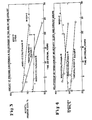
- Illustrated in Figure 1 is the relationship of activity of the mildly presteamed catalyst to the steaming severity of the catalyst.
- the parameters for steaming severity are represented in Table 1. It is understood that the term "steaming severity" represents a proportional relationship between the length of time, the temperature, the partial pressure and the percent of steam in the steam treatment.
- steaming severity represents a proportional relationship between the length of time, the temperature, the partial pressure and the percent of steam in the steam treatment.
- Table 2 and Figure 1 show the effect of mildly presteaming a zeolite catalyst, e.g., HZSM-5, silica/alumina ratio 40.
- a zeolite catalyst e.g., HZSM-5, silica/alumina ratio 40.
- Such a catalyst is desirable for the conversion of propane to aromatics.
- Figure 3 represents the relationship of the amount of propane conversion to the age of the catalyst (time on stream) for three catalysts illustrated by Examples 11, 14 and 15 of Table 2.
- the broken curves represent the conversion level ( Figure 3) and selectivity level ( Figure 4) of the optimally steamed catalyst (Example 15) after its WHSV was changed from 2.3 to 2 and the catalyst remained on stream for an additional 20 hours.
- the initial activity of the optimally steamed catalyst was slightly less than that for either the fresh catalyst (Example 11) or the mildly steam treated catalyst (Example 14), the activity of the optimally steamed catalyst showed greater stability than either of the other catalysts.
- Figure 4 represents the relationship between catalyst selectivity to BTX (Benzene, Toluene, Xylene) and catalyst aging for three catalysts.
- the selectivity to BTX of the catalyst of Example 15 was greater than that of the fresh catalyst (Example 11).
- the initial selectivity of the catalyst of Example 14 was slightly greater than the optimally steamed catalyst of Example 15, however, the optimally steamed catalyst shows a greater stability.
- the zeolite catalysts to be steamed according to the invention are generally those zeolites of at least 12 silica/alumina ratio and a constraint index of 1 to 12 which, in the acid form, have activity to convert about 30% of the ethylbenzene in a mixture thereof with xylenes under the isomerization conditions of the aforementioned U. S. Patent No. 3,856,872, say 316°C - 371°C (600°-700°F).
- the degree of steaming should be such that the a-activity of the steamed catalyst should be less than the a-activity of the fresh, unsteamed catalyst but no greater than 25% less than the ⁇ -activity of the fresh catalyst and preferably no greater than 10% less.
- the reaction temperature of xylene isomerization reactions should increase by no more than 14°C (25°F) to attain the same ethylbenzene conversion as was observed before steaming.
- the reaction of the present invention will be conducted at such elevated temperatures, above 316°C (600°F), as to realize about 30% conversion of the ethylbenzene in the charge.
- the temperature is further increased to and above about 343°C (650°F) the reaction of ethylbenzene shifts from disproportionation to dealkylation.
- the present invention involves using mild temperature presteaming to partially deactivate the catalyst.
- the deactivation should be conducted to a level such that the steamed catalyst activity is no less than 75% of the activity of the fresh, unsteamed catalyst and the process requires a maximum 14°C (25°F) rise in operating temperature, well below the minimum 28°C (50°F) rise referred to in U. S. Patent No. 4,236,996.
- the mildly presteamed catalyst demonstrates superior stability characteristics while maintaining catalytic activity substantially equivalent to that of fresh, unsteamed catalysts.
- zeolite catalysts particularly ZSM-5
- acid catalyzed reactions e.g., xylene isomerization, propane conversion to BTX, toluene disproportionation, hydrocracking, dewaxing, conversion of alcohols to hydrocarbons such as methanol to gasoline and/or olefins, synthesis gas conversion to fuels, conversion of olefins to heavier fuels, etc.
- Such reactions would preferably incorporate a catalyst with the unique qualities of stabililty and catalytic activity similar to fresh, unsteamed catalysts.
- zeolites of the present invention with metal promoters such as Zn, ZnPd, Pt, Cr, etc.
- metal promoters such as Zn, ZnPd, Pt, Cr, etc.
- Such promoters may be incorporated with the zeolite in accordance with the ion exchange technique described hereinbefore or may be incorporated by other techniques such as impregnation. Incorporation of such metal promoters can occur either before or after the zeolite catalysts are steamed in accordance with the present invention.
Landscapes
- Chemical & Material Sciences (AREA)
- Organic Chemistry (AREA)
- Chemical Kinetics & Catalysis (AREA)
- Crystallography & Structural Chemistry (AREA)
- Engineering & Computer Science (AREA)
- Materials Engineering (AREA)
- Physics & Mathematics (AREA)
- Thermal Sciences (AREA)
- Catalysts (AREA)
- Organic Low-Molecular-Weight Compounds And Preparation Thereof (AREA)
- Low-Molecular Organic Synthesis Reactions Using Catalysts (AREA)
Priority Applications (1)
| Application Number | Priority Date | Filing Date | Title |
|---|---|---|---|
| DE8484300131T DE3477746D1 (en) | 1984-01-10 | 1984-01-10 | Active zeolite catalysts of improved stability |
Applications Claiming Priority (1)
| Application Number | Priority Date | Filing Date | Title |
|---|---|---|---|
| US06/346,440 US4429176A (en) | 1982-02-08 | 1982-02-08 | Active zeolite catalysts of improved stability |
Publications (2)
| Publication Number | Publication Date |
|---|---|
| EP0148540A1 true EP0148540A1 (de) | 1985-07-17 |
| EP0148540B1 EP0148540B1 (de) | 1989-04-19 |
Family
ID=23359397
Family Applications (1)
| Application Number | Title | Priority Date | Filing Date |
|---|---|---|---|
| EP84300131A Expired EP0148540B1 (de) | 1982-02-08 | 1984-01-10 | Aktiver Katalysator mit erhöhter Stabilität |
Country Status (5)
| Country | Link |
|---|---|
| US (1) | US4429176A (de) |
| EP (1) | EP0148540B1 (de) |
| JP (1) | JPS60153944A (de) |
| AU (1) | AU566588B2 (de) |
| CA (1) | CA1207734A (de) |
Families Citing this family (27)
| Publication number | Priority date | Publication date | Assignee | Title |
|---|---|---|---|---|
| US4663492A (en) * | 1982-02-08 | 1987-05-05 | Mobil Oil Corporation | Active zeolite catalysts of improved stability for producing gasoline from methanol |
| US4480145A (en) * | 1982-09-16 | 1984-10-30 | Mobil Oil Corporation | Catalysts for the conversion of methanol to ethylene plus gasoline |
| US4594146A (en) * | 1983-10-06 | 1986-06-10 | Mobil Oil Corporation | Conversion with zeolite catalysts prepared by steam treatment |
| US4579993A (en) * | 1984-08-22 | 1986-04-01 | Mobil Oil Corporation | Catalyst for methanol conversion by a combination of steaming and acid-extraction |
| JPS61278351A (ja) * | 1985-05-31 | 1986-12-09 | ダブリユー・アール・グレイス・アンド・カンパニー−コネチカツト | 接触クラツキング触媒及びその使用法 |
| US5063038A (en) * | 1985-10-21 | 1991-11-05 | Mobil Oil Corp. | Zeolite synthesis using an alcohol or like molecule |
| US4812223A (en) * | 1987-05-01 | 1989-03-14 | Mobil Oil Corporation | Hydrocracking naphthas using mildly steamed, noble metal-containing zeolite beta |
| US5236880A (en) * | 1989-12-11 | 1993-08-17 | W. R. Grace & Co.-Conn. | Catalyst for cracking of paraffinic feedstocks |
| US5157183A (en) * | 1990-12-10 | 1992-10-20 | Cotterman Ronald L | Aromatization process using an improved catalyst |
| US5488193A (en) * | 1992-11-06 | 1996-01-30 | Mobil Oil Corporation | Process for reducing polynuclear aromatic mutagenicity by alkylation |
| US6010617A (en) * | 1992-11-13 | 2000-01-04 | Mobil Oil Corporation | Process for producing non-carcinogenic coal-tar-derived products |
| US5789331A (en) * | 1993-09-30 | 1998-08-04 | Sanyo Petrochemical Co., Ltd. | Method for partially dealuminating a zeolite catalyst |
| BR9507387A (pt) * | 1994-04-12 | 2002-04-16 | Solutia Inc | Catalisador para produção de fenóis e seus derivados |
| RU2058286C1 (ru) * | 1994-04-12 | 1996-04-20 | Институт катализа им.Г.К.Борескова СО РАН | Способ получения фенола или его производных |
| US6919491B1 (en) | 1997-05-08 | 2005-07-19 | Exxonmobil Oil Corporation | Process for preparing short chain alkyl aromatic compounds |
| US6090272A (en) * | 1998-12-28 | 2000-07-18 | Phillips Petroleum Company | Process for converting a cracked gasoline using a zeolite-based catalyst material |
| US6525234B1 (en) | 2000-11-21 | 2003-02-25 | Exxonmobil Oil Corporation | Process for liquid phase aromatics alkylation comprising in-situ catalyst reactivation with polar compounds |
| KR20080081940A (ko) * | 2005-12-01 | 2008-09-10 | 바스프 카탈리스트 엘엘씨 | 작은 올레핀 탄화수소 분자에 대한 열수 안정성ag-제올라이트 트랩 |
| US7425659B2 (en) * | 2006-01-31 | 2008-09-16 | Exxonmobil Chemical Patents Inc. | Alkylaromatics production |
| WO2007130054A1 (en) | 2006-05-08 | 2007-11-15 | Exxonmobil Chemical Patents Inc. | Improved catalyst composition |
| TWI406707B (zh) | 2006-08-30 | 2013-09-01 | Jgc Corp | 含鹼土類金屬化合物之沸石催化劑及其調製方法與再生方法、以及低級烴之製造方法 |
| US7649122B2 (en) * | 2006-11-15 | 2010-01-19 | Exxonmobile Chemical Patents Inc. | Alkylaromatics production |
| JP5018161B2 (ja) * | 2007-03-20 | 2012-09-05 | 株式会社明電舎 | 低級炭化水素改質触媒の製造方法 |
| RU2548362C2 (ru) * | 2009-06-25 | 2015-04-20 | Чайна Петролеум & Кемикал Корпорейшн | Катализатор каталитического крекинга и способ повышения селективности катализатора(варианты) |
| RU2563461C2 (ru) | 2010-08-30 | 2015-09-20 | Эксонмобил Кемикэл Пейтентс Инк. | Улучшенный способ алкилирования |
| WO2013059172A1 (en) * | 2011-10-17 | 2013-04-25 | Exxonmobil Research And Engineering Company | Process for producing phosphorus modified zeolite catalysts |
| US9744530B2 (en) | 2013-05-09 | 2017-08-29 | Exxonmobil Chemical Patents Inc. | Treatment of aromatic alkylation catalysts |
Citations (6)
| Publication number | Priority date | Publication date | Assignee | Title |
|---|---|---|---|---|
| US3965209A (en) * | 1975-01-06 | 1976-06-22 | Mobil Oil Corporation | Selective production of para-xylene |
| FR2310963A1 (fr) * | 1975-05-16 | 1976-12-10 | Union Carbide Corp | Tamis moleculaires zeolitiques, leur procede de preparation et leur application au traitement des hydrocarbures |
| EP0021604A1 (de) * | 1979-05-25 | 1981-01-07 | Mobil Oil Corporation | Isomerisierung von Xylol |
| EP0034444A2 (de) * | 1980-02-14 | 1981-08-26 | Mobil Oil Corporation | Erhöhung der katalytischen Aktivität eines Zeolithen |
| EP0036704A2 (de) * | 1980-02-14 | 1981-09-30 | Mobil Oil Corporation | Behandlung von Aromaten |
| US4356338A (en) * | 1979-07-27 | 1982-10-26 | Mobil Oil Corporation | Extending catalyst life by treating with phosphorus and/or steam |
Family Cites Families (5)
| Publication number | Priority date | Publication date | Assignee | Title |
|---|---|---|---|---|
| JPS5821953B2 (ja) * | 1977-09-05 | 1983-05-04 | ユニオン・カ−バイド・コ−ポレ−シヨン | 炭化水素の水素化分解法 |
| US4188282A (en) | 1978-06-12 | 1980-02-12 | Mobile Oil Corporation | Manufacture of benzene, toluene and xylene |
| US4224141A (en) | 1979-05-21 | 1980-09-23 | Mobil Oil Corporation | Manufacture of aromatic compounds |
| US4324696A (en) | 1980-03-10 | 1982-04-13 | Mobil Oil Corporation | Method of preparing crystalline zeolite catalyst of high activity |
| US4283584A (en) | 1980-04-14 | 1981-08-11 | Mobil Oil Corporation | Manufacture of aromatic compounds |
-
1982
- 1982-02-08 US US06/346,440 patent/US4429176A/en not_active Expired - Lifetime
-
1983
- 1983-12-29 CA CA000444433A patent/CA1207734A/en not_active Expired
- 1983-12-29 AU AU22944/83A patent/AU566588B2/en not_active Expired
-
1984
- 1984-01-10 EP EP84300131A patent/EP0148540B1/de not_active Expired
- 1984-01-13 JP JP59003677A patent/JPS60153944A/ja active Granted
Patent Citations (6)
| Publication number | Priority date | Publication date | Assignee | Title |
|---|---|---|---|---|
| US3965209A (en) * | 1975-01-06 | 1976-06-22 | Mobil Oil Corporation | Selective production of para-xylene |
| FR2310963A1 (fr) * | 1975-05-16 | 1976-12-10 | Union Carbide Corp | Tamis moleculaires zeolitiques, leur procede de preparation et leur application au traitement des hydrocarbures |
| EP0021604A1 (de) * | 1979-05-25 | 1981-01-07 | Mobil Oil Corporation | Isomerisierung von Xylol |
| US4356338A (en) * | 1979-07-27 | 1982-10-26 | Mobil Oil Corporation | Extending catalyst life by treating with phosphorus and/or steam |
| EP0034444A2 (de) * | 1980-02-14 | 1981-08-26 | Mobil Oil Corporation | Erhöhung der katalytischen Aktivität eines Zeolithen |
| EP0036704A2 (de) * | 1980-02-14 | 1981-09-30 | Mobil Oil Corporation | Behandlung von Aromaten |
Also Published As
| Publication number | Publication date |
|---|---|
| JPH0512024B2 (de) | 1993-02-17 |
| JPS60153944A (ja) | 1985-08-13 |
| EP0148540B1 (de) | 1989-04-19 |
| US4429176A (en) | 1984-01-31 |
| AU2294483A (en) | 1985-07-04 |
| CA1207734A (en) | 1986-07-15 |
| AU566588B2 (en) | 1987-10-22 |
Similar Documents
| Publication | Publication Date | Title |
|---|---|---|
| EP0148540B1 (de) | Aktiver Katalysator mit erhöhter Stabilität | |
| US4594146A (en) | Conversion with zeolite catalysts prepared by steam treatment | |
| US4720602A (en) | Process for converting C2 to C12 aliphatics to aromatics over a zinc-activated zeolite | |
| CA1262363A (en) | Aromatization reactions with zeolites | |
| US4522929A (en) | Active zeolite catalysts of improved stability | |
| US4590321A (en) | Aromatization reactions with zeolites containing phosphorus oxide | |
| US4465884A (en) | Olefin processing | |
| US4891463A (en) | Aromatization of aliphatics over a zeolite containing framework gallium | |
| US4326994A (en) | Enhancement of zeolite catalytic activity | |
| US4418235A (en) | Hydrocarbon conversion with zeolite having enhanced catalytic activity | |
| US5554274A (en) | Manufacture of improved catalyst | |
| CA2327688A1 (en) | Catalyst and process for converting methanol to hydrocarbons | |
| EP0220933A1 (de) | Vierblattkleeförmige katalytische Extrudate | |
| US4983276A (en) | Octane improvement in catalytic cracking and cracking catalyst composition therefor | |
| US4808295A (en) | Two stage process for the production of a high benzene aromatic product | |
| US4663492A (en) | Active zeolite catalysts of improved stability for producing gasoline from methanol | |
| US4804801A (en) | Process for converting C2 to C8 aliphatics to aromatics over a metal-activated zeolite | |
| EP0134330B1 (de) | Behandlung von Zeoliten | |
| US4483760A (en) | Process for dewaxing middle distillates | |
| US4790928A (en) | Catalytic conversion over dehydroxylated zeolite | |
| US5220086A (en) | Catalytic processes in the presence of zeolites of increased internal acid activity and decreased external acid activity | |
| US4861933A (en) | Process for converting aliphatics to aromatics over a gallium-activated zeolite | |
| US20030127356A1 (en) | Eu-1 zeolite catalyst and a process for the pour point of feeds containing paraffins | |
| EP0250879B1 (de) | Verfahren zur direkten katalytischen Alkylierung von aromatischen Kohlenwasserstoffen mit niedrigen Alkanen | |
| US4567310A (en) | Preparation of modified zeolites and their utilization |
Legal Events
| Date | Code | Title | Description |
|---|---|---|---|
| PUAI | Public reference made under article 153(3) epc to a published international application that has entered the european phase |
Free format text: ORIGINAL CODE: 0009012 |
|
| AK | Designated contracting states |
Designated state(s): BE DE FR GB IT NL SE |
|
| 17P | Request for examination filed |
Effective date: 19851223 |
|
| 17Q | First examination report despatched |
Effective date: 19860912 |
|
| D17Q | First examination report despatched (deleted) | ||
| GRAA | (expected) grant |
Free format text: ORIGINAL CODE: 0009210 |
|
| AK | Designated contracting states |
Kind code of ref document: B1 Designated state(s): BE DE FR GB IT NL SE |
|
| REF | Corresponds to: |
Ref document number: 3477746 Country of ref document: DE Date of ref document: 19890524 |
|
| ET | Fr: translation filed | ||
| ITF | It: translation for a ep patent filed | ||
| PLBE | No opposition filed within time limit |
Free format text: ORIGINAL CODE: 0009261 |
|
| STAA | Information on the status of an ep patent application or granted ep patent |
Free format text: STATUS: NO OPPOSITION FILED WITHIN TIME LIMIT |
|
| 26N | No opposition filed | ||
| ITTA | It: last paid annual fee | ||
| EAL | Se: european patent in force in sweden |
Ref document number: 84300131.4 |
|
| REG | Reference to a national code |
Ref country code: GB Ref legal event code: IF02 |
|
| PGFP | Annual fee paid to national office [announced via postgrant information from national office to epo] |
Ref country code: GB Payment date: 20021210 Year of fee payment: 20 |
|
| PGFP | Annual fee paid to national office [announced via postgrant information from national office to epo] |
Ref country code: NL Payment date: 20021216 Year of fee payment: 20 |
|
| PGFP | Annual fee paid to national office [announced via postgrant information from national office to epo] |
Ref country code: SE Payment date: 20030107 Year of fee payment: 20 Ref country code: FR Payment date: 20030107 Year of fee payment: 20 |
|
| PGFP | Annual fee paid to national office [announced via postgrant information from national office to epo] |
Ref country code: DE Payment date: 20030131 Year of fee payment: 20 |
|
| PGFP | Annual fee paid to national office [announced via postgrant information from national office to epo] |
Ref country code: BE Payment date: 20030213 Year of fee payment: 20 |
|
| PG25 | Lapsed in a contracting state [announced via postgrant information from national office to epo] |
Ref country code: GB Free format text: LAPSE BECAUSE OF EXPIRATION OF PROTECTION Effective date: 20040109 |
|
| PG25 | Lapsed in a contracting state [announced via postgrant information from national office to epo] |
Ref country code: NL Free format text: LAPSE BECAUSE OF EXPIRATION OF PROTECTION Effective date: 20040110 |
|
| BE20 | Be: patent expired |
Owner name: *MOBIL OIL CORP. Effective date: 20040110 |
|
| REG | Reference to a national code |
Ref country code: GB Ref legal event code: PE20 |
|
| NLV7 | Nl: ceased due to reaching the maximum lifetime of a patent |
Effective date: 20040110 |
|
| EUG | Se: european patent has lapsed |