EP0147628A2 - Disposable capillary tube device - Google Patents
Disposable capillary tube device Download PDFInfo
- Publication number
- EP0147628A2 EP0147628A2 EP84114162A EP84114162A EP0147628A2 EP 0147628 A2 EP0147628 A2 EP 0147628A2 EP 84114162 A EP84114162 A EP 84114162A EP 84114162 A EP84114162 A EP 84114162A EP 0147628 A2 EP0147628 A2 EP 0147628A2
- Authority
- EP
- European Patent Office
- Prior art keywords
- capillary tube
- plunger
- support member
- tube
- card
- Prior art date
- Legal status (The legal status is an assumption and is not a legal conclusion. Google has not performed a legal analysis and makes no representation as to the accuracy of the status listed.)
- Granted
Links
- 239000007788 liquid Substances 0.000 claims abstract description 36
- 230000000717 retained effect Effects 0.000 claims description 8
- 239000004033 plastic Substances 0.000 description 5
- 229920003023 plastic Polymers 0.000 description 5
- 239000000463 material Substances 0.000 description 4
- -1 polyethylene Polymers 0.000 description 2
- 239000004925 Acrylic resin Substances 0.000 description 1
- 229920000178 Acrylic resin Polymers 0.000 description 1
- 229920008347 Cellulose acetate propionate Polymers 0.000 description 1
- VVQNEPGJFQJSBK-UHFFFAOYSA-N Methyl methacrylate Chemical compound COC(=O)C(C)=C VVQNEPGJFQJSBK-UHFFFAOYSA-N 0.000 description 1
- 239000004698 Polyethylene Substances 0.000 description 1
- 239000004743 Polypropylene Substances 0.000 description 1
- 239000004793 Polystyrene Substances 0.000 description 1
- 239000000853 adhesive Substances 0.000 description 1
- 230000001070 adhesive effect Effects 0.000 description 1
- 239000008280 blood Substances 0.000 description 1
- 210000004369 blood Anatomy 0.000 description 1
- 229920006217 cellulose acetate butyrate Polymers 0.000 description 1
- 238000007599 discharging Methods 0.000 description 1
- 239000012530 fluid Substances 0.000 description 1
- 239000011521 glass Substances 0.000 description 1
- 230000004048 modification Effects 0.000 description 1
- 238000012986 modification Methods 0.000 description 1
- 229920001281 polyalkylene Polymers 0.000 description 1
- 239000004431 polycarbonate resin Substances 0.000 description 1
- 229920005668 polycarbonate resin Polymers 0.000 description 1
- 229920000573 polyethylene Polymers 0.000 description 1
- 229920001155 polypropylene Polymers 0.000 description 1
- 229920002223 polystyrene Polymers 0.000 description 1
- 229920005989 resin Polymers 0.000 description 1
- 239000011347 resin Substances 0.000 description 1
- 229920003002 synthetic resin Polymers 0.000 description 1
- 239000000057 synthetic resin Substances 0.000 description 1
- 239000012815 thermoplastic material Substances 0.000 description 1
- 229920001187 thermosetting polymer Polymers 0.000 description 1
- 239000012780 transparent material Substances 0.000 description 1
Images

Classifications
-
- B—PERFORMING OPERATIONS; TRANSPORTING
- B01—PHYSICAL OR CHEMICAL PROCESSES OR APPARATUS IN GENERAL
- B01L—CHEMICAL OR PHYSICAL LABORATORY APPARATUS FOR GENERAL USE
- B01L3/00—Containers or dishes for laboratory use, e.g. laboratory glassware; Droppers
- B01L3/02—Burettes; Pipettes
- B01L3/021—Pipettes, i.e. with only one conduit for withdrawing and redistributing liquids
- B01L3/0217—Pipettes, i.e. with only one conduit for withdrawing and redistributing liquids of the plunger pump type
- B01L3/022—Capillary pipettes, i.e. having very small bore
Definitions
- This invention relates to a disposable capillary tube device used in the field of fluid handling.
- U.S. patents 3 828 987 and 3 720 534 each disclose a capillary tube containing a piston which is withdrawn to pick up liquid and advanced to discharge liquid.
- the presence of the piston in the capillary tube while liquid is being drawn into the tube is a disadvantage when consistent .accuracy is desired since it can cause the presence of an air bubble in the capillary tube.
- the prior art recognizes the desirability of having such devices disposable, it still contemplates using operating parts to be removed from the disposable capillary tube and piston for reuse. This involves time-consuming operations.
- a disposable capillary tube device comprising a support member to which a capillary tube is secured with one end of the tube extending beyond the support member for the pickup fo a liquid.
- a plunger is releasably mounted for axial movement on the support. member with space for the passage of air out of the capillary tube as it picks up liquid.
- the plunger is mounted on the axis of the capillary tube for passage through the capillary tube to expel liquid from the capillary tube.
- a capillary tube is provided mounted on a support member in alignment with a piston with space for the passage of air from the capillary tube as it picks up liquid.
- the entire unit can be disposed of after use.
- the disposable capillary tube device comprises a card, a capillary tube, means for securing the capillary tube to the card with one end of the tube extending beyond the card for the pickup of a liquid, a plunger adapted to cooperate with the capillary tube to discharge liquid from the capillary tube, and means for securing the plunger to the card with the axis of the plunger substantially in line with the axis of the capillary tube and with the plunger spaced from the tube for axial movement for passage through the tube to drive liquid out of the tube.
- the means for securing the capillary tube to the card comprises slots in the card and the means for securing the plunger to the card comprises a plurality of opposed raised bands integral with the card engaging opposite sides of the plunger and slidably holding the plunger on the axis of the capillary tube.
- the: disposable capillary tube device comprises an elongated hollow support member, a capillary tube having an outer end and inner end with its inner end secured in the hollow support member, and a plunger having an inner end and an outer end releasably mounted for axial movement in the support member with its inner end spaced from the inner end of the capillary tube and with space between the plunger and the support member for the passage of air as the capillary tube picks up liquid, said plunger being adapted to being advanced to and through the capillary tube and to expel liquid picked up by the capillary tube.
- the hollow support member may have an extension portion which extends over a substantial portion of the capillary tube to protect the capillary tube from being broken.
- the plunger is a wire having a pointed inner end.
- the plunger can be a wire having at least one bent portion engaging the inside of the hollow support member for frictionally holding the plunger in place when not in use.
- the support member may have a reduced diameter portion frictionally engaging the plunger to hold the plunger in position when not in use.
- the plunger has a portion deviating from its axis which is retained by inwardly extending portions of the hollow support member on either side of the first mentioned portion.
- the plunger is retained in position when not in use by a member removably attached to the exterior of the hollow support member and to a portion of the plunger exterior of the hollow support member.
- a cap may be press fit onto the free end of said hollow support member extension portion to further protect the capillary tube from being broken.
- thermoplastic material such as an acrylic resin, such as methyl methacrylate, a polycarbonate resin or polystyrene to form the support tube since with these materials it is easy to reduce the tube diameter at a desired point, flatten the tube or indent bosses into the tube by simple deformation of the tube when it is in the plastic state.
- Glass may be employed but, being relatively fragile, it is not a preferred material. Many other materials obviously may be employed such as thermosetting plastics which may be molded to the desired shape.
- the capillary tube device 2 (Fig. 1) has a card 4 advantageously of a plastic (synthetic resin) material, for example a polyalkylene resin such as polyethylene or polypropylene, or cellulose acetate butyrate, or cellulose acetate propionate.
- a plastic (synthetic resin) material for example a polyalkylene resin such as polyethylene or polypropylene, or cellulose acetate butyrate, or cellulose acetate propionate.
- a capillary tube 6 is secured by a pressed fit in identical slots 8 and 10 in the right side 12 of card 4 and in a similar slot 16 in the left side 18 of card 4.
- the tube 6 is placed in the slots by sliding the tube axially into the slots.
- Card 4 has an opening 22 therethrough between slots 8 and 16 and an opening 24 therethrough between slots 10 and 16.
- the inner end 26 of tube 6 overlies an opening 28 in card 4 to permit viewing the tube 6 to see of it is full of liquid.
- the outer end 30 extends beyond card 4 to facilitate the picking up of a liquid.
- a wire piston 32 having a diameter to fit snugly inside capillary tube 6, is received in an opening 34 through card 4 and is retained by a pressed fit in slots 36 and 38 in the right side 12 of card 4 and in a similar slot 40 (Fig. 3) in the left side 18 of card 4 which has openings 44 and 46 therethrough which lie respectively between slots 38 and 40 and slots 36 and 40.
- Piston 32 is secured by a pressed fit in an opening 52 in piston rod 54.
- Piston rod 54 is slidably retained in card 4 by straps 56 and 58 integral with card 4 on one side of rod 48 and strap 60 integral with card 4 on the opposite side of rod 48. Straps 56, 58 and 60 keep the axis of piston rod 54 in alignment with the axis of capillary tube 6.
- Piston rod 54 has an enlarged end 64 to facilitate its manipulation.
- Piston 32 and piston rod 54 are mounted on card 4 by axially sliding them into the position shown in Fig. 1.where they are frictionally held in place until used.
- the device 2 In operation the device 2 is moved to bring end 30 of capillary tube 6 into contact with the liquid to be picked up. The liquid fully fills tube 6 by capillary action, air being free to pass out of tube 6.
- the capillary tube 6 is selected to provide the precise amount of liquid to be picked up. Since the wire piston 32 is withdrawn from the capillary tube 6, there is positive assurance that no air bubbles will be formed in capillary tube 6, thus insuring the accuracy of the amount of liquid picked up.
- the .device 2 is then moved to a position with the capillary tube 6 at the desired point of discharge at which time piston rod 54 is advanced causing wire piston 32 to enter capillary tube 6 and move through the capillary tube to discharge all of the contained liquid.
- An alternative capillary tube device 70 (Fig. 5) is identical with device 2 except piston 74 is plastic and integral with plastic piston rod 72.
- a disposable capillary tube device 90 in accordance with the invention has a transparent support tube 92 having a forward end 94 and a rear end 96.
- a capillary tube 98 has its inner end 100 retained inside the outer end 94 of retaining tube 92 by a pressed fit.
- a wire plunger 104 has a pointed forward end 106 to facilitate entry into capillary tube 98.
- the pointed end 106 is spaced away from the capillary tube 98.
- Plunger 104 has a bent rear portion 108 forming a handle exterior of support tube 92.
- plunger 104 has opposed bent portions 112 and 114 frictionally engaging the inner wall 116 of support tube 92 to hold plunger 104 in support tube 92 and spaced away from capillary tube 98 until it is desired to advance the plunger 104 into capillary tube 98 to expel liquid picked up by the capillary tube.
- the outer diameter of the wire from which plunger 104 is formed is smaller than the inner diameter of support tube 92 in order to permit the passage of air through support tube 92 when capillary tube 98 is picking up a liquid.
- the inner wall 116 of support tube 92 is funneled in the area indicated at 120 to facilitate the entry of plunger 104 into capillary tube 98 which is also facilitated by pointed end 106.
- Fig. 7 shows the device of Fig. 6 modified by providing a support tube 92A which is identical with support tube 92 with the exception of having an extended forward reduced diameter portion 94A which holds capillary tube 98 by a pressed fit and extends over most (advantageously over 80%) of the capillary tube 98 leaving only a small portion proj ecting for the pickup of liquid.
- the portion 94A provides protection against breakage of capillary tube 98.
- the thus modified device of Fig. 6 is the preferred embodiment of the invention.
- a modified device 110 in accordance with the invention is shown in Fig. 8.
- the device 110 is the same as the device of Fig. 6 with the exceptions that plunger 104B does not have the bent portions 112 and 114 found in plunger 104 and support tube 92B has its rear end 96B formed into a reduced diameter portion to engage plunger 104B with sufficient friction to retain it in support tube 92B spaced from capillary tube 98 until it is desired to advance it through the capillary tube.
- FIG. 10 An alternative device 120 in accordance with the invention is shown in Fig. 10.
- the device 120 is identical with the device of Fig. 6 except it employs a modified plunger 104C which eliminates the bent portions 112 and 114 of plunger 104 and the support tube 92C of the device 120 differs from the support tube 92 of the device of Fig. 6 in having three inwardly extending bosses 122, 124 and 126 spaced apart 120° and engaging plunger 104C with sufficient friction to hold it in mounting tube 92C spaced from capillary tube 98 until it is desired to advance the plunger to expel liquid from capillary tube 98.
- FIG. 12 An alternative device 130 in accordance with the invention shown in Fig. 12 is the same as the device of Fig. 6 with the exceptions that a plunger 104D has a single bent portion 132 retained between a flattened portion 134 .(Fig. 13) of retaining tube 92D which also has an inwardly extending boss 136 on one side of bent wire portion 132 and inwardly extending boss 138 on the other side of bent wire portion 132.
- the bosses retain the plunger 104D in mounting tube 92D spaced from capillary tube 98 until it is desired to advance the plunger 104D through the capillary tube 98 at which time the user urges plunger 104D towards capillary tube 98 which causes bent portion 132 to engage boss 136 and be deformed sufficiently to permit the bent portion 132 to pass beyond boss 136 as shown in Fig. 14.
- the flattened portion 134 of tube 92D prevents the rotation of the bent ' portion 132 and hence keeps it in alignment with the bosses 136 and 138.
- a device 140 in accordance with the invention is shown in Fig. 15.
- Device 140 is the same as the device shown in Fig. 6 with the exception that the plunger 104E does not have the bent portions 112 and 114 of plunger 104 and plunger 104E is held in its preoperating position by means of a piece of tape 142 adhesively secured to the end 96E of mounting tube 92E and to plunger 104E by an adhesive (not shown).
- the plunger 104E can be separated from tape 142 either by simply advancing the plunger towards the capillary tube 98 or by removal of the tape 142 from support tube 92E and plunger 104E.
- Fig. 16 discloses capillary tube device of Fig. 7 with a synthetic plastic cap 144 having a tapered inner diameter which forms a press fit with the free end of support tube 92A to further protect the pickup end of capillary tube. 98 before user When used, of course, the cap 144 is first removed from support tube reduced diameter portion 94A.
Landscapes
- Health & Medical Sciences (AREA)
- Clinical Laboratory Science (AREA)
- Chemical & Material Sciences (AREA)
- Chemical Kinetics & Catalysis (AREA)
- Devices For Use In Laboratory Experiments (AREA)
- External Artificial Organs (AREA)
- Media Introduction/Drainage Providing Device (AREA)
- Sampling And Sample Adjustment (AREA)
Abstract
Description
- This invention relates to a disposable capillary tube device used in the field of fluid handling.
- Devices for picking up and discharging liquid, for example blood, employing a capillary tube are wellknown to the art. U.S.
patents 3 828 987 and 3 720 534 each disclose a capillary tube containing a piston which is withdrawn to pick up liquid and advanced to discharge liquid. The presence of the piston in the capillary tube while liquid is being drawn into the tube is a disadvantage when consistent .accuracy is desired since it can cause the presence of an air bubble in the capillary tube. While the prior art recognizes the desirability of having such devices disposable, it still contemplates using operating parts to be removed from the disposable capillary tube and piston for reuse. This involves time-consuming operations. - It is the object of the invention to eliminate these drawbacks.
- This object is obtained.by a disposable capillary tube device comprising a support member to which a capillary tube is secured with one end of the tube extending beyond the support member for the pickup fo a liquid. A plunger is releasably mounted for axial movement on the support. member with space for the passage of air out of the capillary tube as it picks up liquid. The plunger is mounted on the axis of the capillary tube for passage through the capillary tube to expel liquid from the capillary tube.
- Thus, according to the invention a capillary tube is provided mounted on a support member in alignment with a piston with space for the passage of air from the capillary tube as it picks up liquid. The entire unit can be disposed of after use.
- According to a first embodiment, the disposable capillary tube device comprises a card, a capillary tube, means for securing the capillary tube to the card with one end of the tube extending beyond the card for the pickup of a liquid, a plunger adapted to cooperate with the capillary tube to discharge liquid from the capillary tube, and means for securing the plunger to the card with the axis of the plunger substantially in line with the axis of the capillary tube and with the plunger spaced from the tube for axial movement for passage through the tube to drive liquid out of the tube.
- Advantageously the means for securing the capillary tube to the card comprises slots in the card and the means for securing the plunger to the card comprises a plurality of opposed raised bands integral with the card engaging opposite sides of the plunger and slidably holding the plunger on the axis of the capillary tube.
- According to a second embodiment, the: disposable capillary tube device comprises an elongated hollow support member, a capillary tube having an outer end and inner end with its inner end secured in the hollow support member, and a plunger having an inner end and an outer end releasably mounted for axial movement in the support member with its inner end spaced from the inner end of the capillary tube and with space between the plunger and the support member for the passage of air as the capillary tube picks up liquid, said plunger being adapted to being advanced to and through the capillary tube and to expel liquid picked up by the capillary tube.
- The hollow support member may have an extension portion which extends over a substantial portion of the capillary tube to protect the capillary tube from being broken.
- Conveniently, the plunger is a wire having a pointed inner end.
- The plunger can be a wire having at least one bent portion engaging the inside of the hollow support member for frictionally holding the plunger in place when not in use.
- The support member may have a reduced diameter portion frictionally engaging the plunger to hold the plunger in position when not in use.
- In a further modification,.the plunger has a portion deviating from its axis which is retained by inwardly extending portions of the hollow support member on either side of the first mentioned portion.
- According to another embodiment, the plunger is retained in position when not in use by a member removably attached to the exterior of the hollow support member and to a portion of the plunger exterior of the hollow support member.
- Further, a cap may be press fit onto the free end of said hollow support member extension portion to further protect the capillary tube from being broken.
- It is advantageous to make the support tubes of a transparent material since this permits observing when the liquid being picked up has filled the capillary tube and also per- nuts viewing the entry of the plunger into the capillary tube. 'It is preferred to use a thermoplastic material such as an acrylic resin, such as methyl methacrylate, a polycarbonate resin or polystyrene to form the support tube since with these materials it is easy to reduce the tube diameter at a desired point, flatten the tube or indent bosses into the tube by simple deformation of the tube when it is in the plastic state. Glass may be employed but, being relatively fragile, it is not a preferred material. Many other materials obviously may be employed such as thermosetting plastics which may be molded to the desired shape.
- Further embodiments of the invention are explained by means of drawings, in which
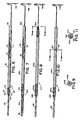
- Fig. 1 is a left side elevational view of a capillary tube device in accordance with the invention,
- Fig. 2 is a vertical section taken on the plane indicated by the line 2-2 in Fig. 1,
- Fig. 3 is a vertical section taken on the plane indicated by the line 3-3 in Fig. 1,
- Fig. 4 is a vertical section taken on the plane indicated by the line 4-4 in Fig. 1,
- Fig. 5 is a left side elevational view of a capillary tube device of the invention, partially broken away and showing a modified piston and piston rod,
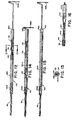
- Fig. 6 is a plan view, partially broken away, of another disposable capillary tube device in accordance with the invention,
- Fig. 7 is a plan view, partially broken away of another disposable capillary tube device in accordance with the invention,
- Fig. 8 is a plan view, partially broken away, of another disposable capillary tube device in accordance with the invention,
- Fig. 9 is a vertical section taken on the plane indicated by the line 9-9 in Fig. 8,
- Fig. 10 is a plan view, partially broken away, of another disposable capillary tube device in accordance with the invention,
- Fig. 11 is a vertical section taken on the plane indicated by the line 11-11 in Fig. 10,
- Fig. 12 is a plan view, partially broken away, of another disposable capillary tube device in accordance with the invention,
- Fig. 13 is a vertical section taken on the plane indicated by the line 13-13 in Fig. 12,
- Fig. 14 is a plan view of the device of Fig. 12 showing the plunger advanced through the capillary tube,
- Fig. 15 is a plan view, partially broken away, of another disposable capillary.tube device in accordance with the invention,
- Fig. 16 is a view, partly broken away, of the capillary tube device of Fig. 7 with a cap added that provides protection to the capillary tube.
- The capillary tube device 2 (Fig. 1) has a
card 4 advantageously of a plastic (synthetic resin) material, for example a polyalkylene resin such as polyethylene or polypropylene, or cellulose acetate butyrate, or cellulose acetate propionate. - A
capillary tube 6 is secured by a pressed fit inidentical slots right side 12 ofcard 4 and in asimilar slot 16 in theleft side 18 ofcard 4. Thetube 6 is placed in the slots by sliding the tube axially into the slots.Card 4 has an opening 22 therethrough betweenslots slots inner end 26 oftube 6 overlies an opening 28 incard 4 to permit viewing thetube 6 to see of it is full of liquid. Theouter end 30 extends beyondcard 4 to facilitate the picking up of a liquid. - A
wire piston 32 having a diameter to fit snugly insidecapillary tube 6, is received in anopening 34 throughcard 4 and is retained by a pressed fit inslots right side 12 ofcard 4 and in a similar slot 40 (Fig. 3) in theleft side 18 ofcard 4 which hasopenings slots slots - Piston 32 is secured by a pressed fit in an opening 52 in
piston rod 54. Pistonrod 54 is slidably retained incard 4 bystraps card 4 on one side of rod 48 andstrap 60 integral withcard 4 on the opposite side of rod 48.Straps piston rod 54 in alignment with the axis ofcapillary tube 6. Pistonrod 54 has an enlargedend 64 to facilitate its manipulation. Piston 32 andpiston rod 54 are mounted oncard 4 by axially sliding them into the position shown in Fig. 1.where they are frictionally held in place until used. - In operation the
device 2 is moved to bringend 30 ofcapillary tube 6 into contact with the liquid to be picked up. The liquid fully fillstube 6 by capillary action, air being free to pass out oftube 6. Thecapillary tube 6 is selected to provide the precise amount of liquid to be picked up. Since thewire piston 32 is withdrawn from thecapillary tube 6, there is positive assurance that no air bubbles will be formed incapillary tube 6, thus insuring the accuracy of the amount of liquid picked up. The .device 2 is then moved to a position with thecapillary tube 6 at the desired point of discharge at whichtime piston rod 54 is advanced causingwire piston 32 to entercapillary tube 6 and move through the capillary tube to discharge all of the contained liquid. - An alternative capillary tube device 70 (Fig. 5) is identical with
device 2 exceptpiston 74 is plastic and integral withplastic piston rod 72. - Adverting-to Fig. 6, a disposable
capillary tube device 90 in accordance with the invention has atransparent support tube 92 having aforward end 94 and arear end 96. Acapillary tube 98 has itsinner end 100 retained inside theouter end 94 ofretaining tube 92 by a pressed fit. - A
wire plunger 104 has a pointedforward end 106 to facilitate entry intocapillary tube 98. Thepointed end 106 is spaced away from thecapillary tube 98.Plunger 104 has a bentrear portion 108 forming a handle exterior ofsupport tube 92.Intermediate end 106 and handle 108,plunger 104 has opposedbent portions inner wall 116 ofsupport tube 92 to holdplunger 104 insupport tube 92 and spaced away fromcapillary tube 98 until it is desired to advance theplunger 104 intocapillary tube 98 to expel liquid picked up by the capillary tube. The outer diameter of the wire from which plunger 104 is formed is smaller than the inner diameter ofsupport tube 92 in order to permit the passage of air throughsupport tube 92 whencapillary tube 98 is picking up a liquid. Theinner wall 116 ofsupport tube 92 is funneled in the area indicated at 120 to facilitate the entry ofplunger 104 intocapillary tube 98 which is also facilitated bypointed end 106. - . Fig. 7 shows the device of Fig. 6 modified by providing a
support tube 92A which is identical withsupport tube 92 with the exception of having an extended forward reduceddiameter portion 94A which holdscapillary tube 98 by a pressed fit and extends over most (advantageously over 80%) of thecapillary tube 98 leaving only a small portion proj ecting for the pickup of liquid. Theportion 94A provides protection against breakage ofcapillary tube 98. The thus modified device of Fig. 6 is the preferred embodiment of the invention. - A modified
device 110 in accordance with the invention is shown in Fig. 8. Thedevice 110 is the same as the device of Fig. 6 with the exceptions that plunger 104B does not have thebent portions plunger 104 and support tube 92B has itsrear end 96B formed into a reduced diameter portion to engageplunger 104B with sufficient friction to retain it in support tube 92B spaced fromcapillary tube 98 until it is desired to advance it through the capillary tube. - An
alternative device 120 in accordance with the invention is shown in Fig. 10. Thedevice 120 is identical with the device of Fig. 6 except it employs a modifiedplunger 104C which eliminates thebent portions plunger 104 and thesupport tube 92C of thedevice 120 differs from thesupport tube 92 of the device of Fig. 6 in having three inwardly extendingbosses plunger 104C with sufficient friction to hold it in mountingtube 92C spaced fromcapillary tube 98 until it is desired to advance the plunger to expel liquid fromcapillary tube 98. - An
alternative device 130 in accordance with the invention shown in Fig. 12 is the same as the device of Fig. 6 with the exceptions that aplunger 104D has a singlebent portion 132 retained between a flattened portion 134 .(Fig. 13) of retainingtube 92D which also has an inwardly extendingboss 136 on one side ofbent wire portion 132 and inwardly extendingboss 138 on the other side ofbent wire portion 132. The bosses retain theplunger 104D in mountingtube 92D spaced fromcapillary tube 98 until it is desired to advance theplunger 104D through thecapillary tube 98 at which time the user urgesplunger 104D towardscapillary tube 98 which causesbent portion 132 to engageboss 136 and be deformed sufficiently to permit thebent portion 132 to pass beyondboss 136 as shown in Fig. 14. The flattened portion 134 oftube 92D prevents the rotation of the bent 'portion 132 and hence keeps it in alignment with thebosses - A
device 140 in accordance with the invention is shown in Fig. 15.Device 140 is the same as the device shown in Fig. 6 with the exception that theplunger 104E does not have thebent portions plunger 104 andplunger 104E is held in its preoperating position by means of a piece oftape 142 adhesively secured to theend 96E of mountingtube 92E and toplunger 104E by an adhesive (not shown). Theplunger 104E can be separated fromtape 142 either by simply advancing the plunger towards thecapillary tube 98 or by removal of thetape 142 fromsupport tube 92E andplunger 104E. - Fig. 16 discloses capillary tube device of Fig. 7 with a synthetic
plastic cap 144 having a tapered inner diameter which forms a press fit with the free end ofsupport tube 92A to further protect the pickup end of capillary tube. 98 before user When used, of course, thecap 144 is first removed from support tube reduceddiameter portion 94A.
Claims (11)
said plunger (32, 74, 104) being mounted substantially on the axis of the capillary tube (6, 98) for passage through the capillary tube (6, 98) to expel liquid in the capillary tube (6, 98).
Applications Claiming Priority (2)
| Application Number | Priority Date | Filing Date | Title |
|---|---|---|---|
| US06/568,350 US4662545A (en) | 1984-01-05 | 1984-01-05 | Disposable capillary tube device |
| US568350 | 1984-01-05 |
Publications (3)
| Publication Number | Publication Date |
|---|---|
| EP0147628A2 true EP0147628A2 (en) | 1985-07-10 |
| EP0147628A3 EP0147628A3 (en) | 1987-02-04 |
| EP0147628B1 EP0147628B1 (en) | 1989-05-31 |
Family
ID=24270918
Family Applications (1)
| Application Number | Title | Priority Date | Filing Date |
|---|---|---|---|
| EP84114162A Expired EP0147628B1 (en) | 1984-01-05 | 1984-11-23 | Disposable capillary tube device |
Country Status (5)
| Country | Link |
|---|---|
| US (1) | US4662545A (en) |
| EP (1) | EP0147628B1 (en) |
| JP (1) | JPS60222065A (en) |
| DE (1) | DE3478404D1 (en) |
| DK (1) | DK6485A (en) |
Cited By (1)
| Publication number | Priority date | Publication date | Assignee | Title |
|---|---|---|---|---|
| EP0209705A3 (en) * | 1985-07-22 | 1988-06-01 | Drummond Scientific Company | A disposable preselected-volume capillary pipet device |
Families Citing this family (14)
| Publication number | Priority date | Publication date | Assignee | Title |
|---|---|---|---|---|
| US4893738A (en) * | 1988-10-11 | 1990-01-16 | Loctite Corporation | Self-aligning positive displacement dispenser |
| US5454491A (en) * | 1993-08-30 | 1995-10-03 | World Precision Instruments, Inc. | Non-metallic precision fluid transfer devices |
| GB2283692A (en) * | 1993-11-11 | 1995-05-17 | Miles Atholl Blackwood Sewell | Dispensing device such as a pipette |
| US5440940A (en) * | 1994-03-18 | 1995-08-15 | Wilkins; Judd R. | Pipette-syringe-tubular microbial retrieval and sampler |
| US5616871A (en) * | 1995-09-28 | 1997-04-01 | Drummond Scientific Company | Pipet gun assembly |
| US5770158A (en) * | 1996-06-13 | 1998-06-23 | Diametrics Medical, Inc. | Capillary syringe |
| US6253628B1 (en) | 1998-08-21 | 2001-07-03 | Becton Dickinson And Company | Apparatus for drawing liquids into and expelling liquids from a pipet at variable flow rates |
| US6814936B1 (en) | 1999-07-01 | 2004-11-09 | Goran Enhorning | Pipette assembly having a small volume disposable tip |
| AU6583800A (en) * | 1999-08-17 | 2001-03-13 | Technology Partnership Plc, The | Flexible pipette strip and method of its use |
| USD510629S1 (en) | 2004-01-16 | 2005-10-11 | Heathrow Scientific Llc | Pipette device with pivotable nozzle assembly |
| US7381371B2 (en) * | 2004-01-16 | 2008-06-03 | Heathrow Scientific Llc | Pipette device with pivotable nozzle assembly |
| US20090010809A1 (en) * | 2007-07-03 | 2009-01-08 | Hadjis Peter T | Manual pipette filler |
| US20090007701A1 (en) * | 2007-07-03 | 2009-01-08 | Hadjis Peter T | Pivoting pipette device |
| US20110046657A1 (en) * | 2009-08-20 | 2011-02-24 | Boston Scientific Scimed, Inc. | Embolic Coil Introducer Catheter Locking Mechanisms |
Family Cites Families (16)
| Publication number | Priority date | Publication date | Assignee | Title |
|---|---|---|---|---|
| CA836207A (en) * | 1970-03-10 | J. Denver William | Dip stick guide and wiper | |
| FR960103A (en) * | 1950-04-13 | |||
| US2254662A (en) * | 1940-12-13 | 1941-09-02 | Angelo F Naples | Oil gauge rod |
| US3153496A (en) * | 1961-11-20 | 1964-10-20 | Barber Colman Co | Syringe |
| US3401692A (en) * | 1964-06-26 | 1968-09-17 | Micro Tek Instr Corp | Syringe provided with a lateral vent and having high compression seals within the syringe bore |
| US3595090A (en) * | 1969-09-17 | 1971-07-27 | Drummond Instr Co | Apparatus for drawing fluid into, and discharging fluid from, a pipette |
| US3720354A (en) * | 1970-09-24 | 1973-03-13 | Drummond Instr Co | Dispensing micropipette apparatus having disposable parts |
| US3828987A (en) * | 1970-09-24 | 1974-08-13 | Drummond Instr Co | Dispensing micropipette apparatus having disposable parts for delivering a preselected quantity of fluid |
| US3677448A (en) * | 1971-01-29 | 1972-07-18 | Precision Sampling Corp | Syringe with wire plunger for dispensing infinitesimally small, accurately measured quantities of fluid |
| US3809298A (en) * | 1973-07-18 | 1974-05-07 | Precision Sampling Corp | Syringe |
| US4003262A (en) * | 1974-12-16 | 1977-01-18 | Becton, Dickinson And Company | Apparatus for measuring precise micro quantities of fluid samples |
| FR2319117A1 (en) * | 1975-07-25 | 1977-02-18 | Pasteur Institut | DEVICE FOR TAKING AND / OR DELIVERY OF LOW DOSE QUANTITIES OF LIQUID |
| US4050316A (en) * | 1975-11-03 | 1977-09-27 | Becton, Dickinson And Company | Pipette aspirator device |
| US4023716A (en) * | 1976-04-20 | 1977-05-17 | Justin Joel Shapiro | Micro-dispensing liquid pipet |
| US4063662A (en) * | 1976-07-08 | 1977-12-20 | Drummond Scientific Company | Calibrating means for a microdispenser |
| US4404862A (en) * | 1981-11-02 | 1983-09-20 | Dynatech Precision Sampling Corporation | Microdispensing springs with a needle in a tubular extension |
-
1984
- 1984-01-05 US US06/568,350 patent/US4662545A/en not_active Expired - Fee Related
- 1984-11-23 EP EP84114162A patent/EP0147628B1/en not_active Expired
- 1984-11-23 DE DE8484114162T patent/DE3478404D1/en not_active Expired
-
1985
- 1985-01-04 JP JP60000321A patent/JPS60222065A/en active Pending
- 1985-01-04 DK DK6485A patent/DK6485A/en not_active Application Discontinuation
Cited By (1)
| Publication number | Priority date | Publication date | Assignee | Title |
|---|---|---|---|---|
| EP0209705A3 (en) * | 1985-07-22 | 1988-06-01 | Drummond Scientific Company | A disposable preselected-volume capillary pipet device |
Also Published As
| Publication number | Publication date |
|---|---|
| EP0147628A3 (en) | 1987-02-04 |
| JPS60222065A (en) | 1985-11-06 |
| DK6485A (en) | 1985-07-06 |
| EP0147628B1 (en) | 1989-05-31 |
| US4662545A (en) | 1987-05-05 |
| DK6485D0 (en) | 1985-01-04 |
| DE3478404D1 (en) | 1989-07-06 |
Similar Documents
| Publication | Publication Date | Title |
|---|---|---|
| EP0147628A2 (en) | Disposable capillary tube device | |
| US4270536A (en) | Disposable syringe | |
| US3809068A (en) | Container unit for liquid sample | |
| US3322114A (en) | Apparatus for securing a sample of blood plasma for testing | |
| US5368578A (en) | Hypodermic syringe holder | |
| CA2053470C (en) | Snap together hypodermic syringe holder | |
| US3958571A (en) | Swab applicator | |
| PL344014A1 (en) | Fluid collection device with captured rectractable needle | |
| CA2130390A1 (en) | Blood Collection Assembly Including Clot-Accelerating Plastic Insert | |
| EP0192453A2 (en) | Needle guard | |
| EP0079498B1 (en) | Needle holding assembly | |
| AP9700944A0 (en) | Single-use device for detecting or analyzing a body fluid. | |
| US4320982A (en) | Writing implement | |
| US7004352B2 (en) | Acupuncture needle container and dispenser | |
| US6832797B1 (en) | Caulk tube carrier | |
| AU745029B2 (en) | Safety vacuum syringe for blood sampling conformed to ergonomics | |
| USD266895S (en) | Holder for a stockpot handle | |
| USD253270S (en) | Combined set of canisters and display holder therefor | |
| JPH05184949A (en) | Microquantitative pipette | |
| GB2277905A (en) | Sleeve for chalk | |
| JPH08308819A (en) | Blood collection device and manufacturing method thereof | |
| CN221070942U (en) | Ampoule breaker | |
| CA1104523A (en) | Writing implement | |
| EP0894014A1 (en) | Hypodermic syringe holder with disposable body | |
| CN214895322U (en) | Sample reserving groove component for body fluid detection device and body fluid detection device |
Legal Events
| Date | Code | Title | Description |
|---|---|---|---|
| PUAI | Public reference made under article 153(3) epc to a published international application that has entered the european phase |
Free format text: ORIGINAL CODE: 0009012 |
|
| AK | Designated contracting states |
Designated state(s): DE FR GB |
|
| PUAL | Search report despatched |
Free format text: ORIGINAL CODE: 0009013 |
|
| AK | Designated contracting states |
Kind code of ref document: A3 Designated state(s): DE FR GB |
|
| 17P | Request for examination filed |
Effective date: 19870218 |
|
| 17Q | First examination report despatched |
Effective date: 19871113 |
|
| GRAA | (expected) grant |
Free format text: ORIGINAL CODE: 0009210 |
|
| AK | Designated contracting states |
Kind code of ref document: B1 Designated state(s): DE FR GB |
|
| REF | Corresponds to: |
Ref document number: 3478404 Country of ref document: DE Date of ref document: 19890706 |
|
| ET | Fr: translation filed | ||
| PLBE | No opposition filed within time limit |
Free format text: ORIGINAL CODE: 0009261 |
|
| STAA | Information on the status of an ep patent application or granted ep patent |
Free format text: STATUS: NO OPPOSITION FILED WITHIN TIME LIMIT |
|
| 26N | No opposition filed | ||
| PGFP | Annual fee paid to national office [announced via postgrant information from national office to epo] |
Ref country code: FR Payment date: 19901129 Year of fee payment: 7 |
|
| PGFP | Annual fee paid to national office [announced via postgrant information from national office to epo] |
Ref country code: DE Payment date: 19910130 Year of fee payment: 7 |
|
| PGFP | Annual fee paid to national office [announced via postgrant information from national office to epo] |
Ref country code: GB Payment date: 19911105 Year of fee payment: 8 |
|
| PG25 | Lapsed in a contracting state [announced via postgrant information from national office to epo] |
Ref country code: FR Effective date: 19920731 |
|
| PG25 | Lapsed in a contracting state [announced via postgrant information from national office to epo] |
Ref country code: DE Effective date: 19920801 |
|
| REG | Reference to a national code |
Ref country code: FR Ref legal event code: ST |
|
| PG25 | Lapsed in a contracting state [announced via postgrant information from national office to epo] |
Ref country code: GB Effective date: 19921123 |
|
| GBPC | Gb: european patent ceased through non-payment of renewal fee |
Effective date: 19921123 |