EP0142045B1 - Secondary battery - Google Patents
Secondary battery Download PDFInfo
- Publication number
- EP0142045B1 EP0142045B1 EP84112320A EP84112320A EP0142045B1 EP 0142045 B1 EP0142045 B1 EP 0142045B1 EP 84112320 A EP84112320 A EP 84112320A EP 84112320 A EP84112320 A EP 84112320A EP 0142045 B1 EP0142045 B1 EP 0142045B1
- Authority
- EP
- European Patent Office
- Prior art keywords
- negative electrode
- surface area
- electrode
- positive electrode
- polyacetylene
- Prior art date
- Legal status (The legal status is an assumption and is not a legal conclusion. Google has not performed a legal analysis and makes no representation as to the accuracy of the status listed.)
- Expired
Links
- HSFWRNGVRCDJHI-UHFFFAOYSA-N alpha-acetylene Natural products C#C HSFWRNGVRCDJHI-UHFFFAOYSA-N 0.000 claims description 23
- 229920001197 polyacetylene Polymers 0.000 claims description 23
- -1 polyparaphenylene Polymers 0.000 claims description 13
- 229920000642 polymer Polymers 0.000 claims description 12
- 150000001450 anions Chemical class 0.000 claims description 4
- 239000003792 electrolyte Substances 0.000 claims description 4
- 229920000265 Polyparaphenylene Polymers 0.000 claims description 3
- 229920000767 polyaniline Polymers 0.000 claims description 3
- 150000001768 cations Chemical class 0.000 claims description 2
- 239000002019 doping agent Substances 0.000 description 15
- 150000002500 ions Chemical class 0.000 description 6
- WEVYAHXRMPXWCK-UHFFFAOYSA-N Acetonitrile Chemical compound CC#N WEVYAHXRMPXWCK-UHFFFAOYSA-N 0.000 description 5
- 239000008151 electrolyte solution Substances 0.000 description 5
- 229910019785 NBF4 Inorganic materials 0.000 description 4
- 239000003125 aqueous solvent Substances 0.000 description 4
- 239000002904 solvent Substances 0.000 description 4
- 239000000203 mixture Substances 0.000 description 3
- OKTJSMMVPCPJKN-UHFFFAOYSA-N Carbon Chemical compound [C] OKTJSMMVPCPJKN-UHFFFAOYSA-N 0.000 description 2
- XTHFKEDIFFGKHM-UHFFFAOYSA-N Dimethoxyethane Chemical compound COCCOC XTHFKEDIFFGKHM-UHFFFAOYSA-N 0.000 description 2
- 125000004432 carbon atom Chemical group C* 0.000 description 2
- 239000007772 electrode material Substances 0.000 description 2
- 125000001183 hydrocarbyl group Chemical group 0.000 description 2
- 239000000463 material Substances 0.000 description 2
- 229910052751 metal Inorganic materials 0.000 description 2
- 239000002184 metal Substances 0.000 description 2
- 238000000034 method Methods 0.000 description 2
- TZIHFWKZFHZASV-UHFFFAOYSA-N methyl formate Chemical compound COC=O TZIHFWKZFHZASV-UHFFFAOYSA-N 0.000 description 2
- 239000004745 nonwoven fabric Substances 0.000 description 2
- 230000000737 periodic effect Effects 0.000 description 2
- XLYOFNOQVPJJNP-UHFFFAOYSA-N water Substances O XLYOFNOQVPJJNP-UHFFFAOYSA-N 0.000 description 2
- WSLDOOZREJYCGB-UHFFFAOYSA-N 1,2-Dichloroethane Chemical compound ClCCCl WSLDOOZREJYCGB-UHFFFAOYSA-N 0.000 description 1
- RYHBNJHYFVUHQT-UHFFFAOYSA-N 1,4-Dioxane Chemical compound C1COCCO1 RYHBNJHYFVUHQT-UHFFFAOYSA-N 0.000 description 1
- JWUJQDFVADABEY-UHFFFAOYSA-N 2-methyltetrahydrofuran Chemical compound CC1CCCO1 JWUJQDFVADABEY-UHFFFAOYSA-N 0.000 description 1
- 238000004438 BET method Methods 0.000 description 1
- 229910013462 LiC104 Inorganic materials 0.000 description 1
- 229910001290 LiPF6 Inorganic materials 0.000 description 1
- 239000004743 Polypropylene Substances 0.000 description 1
- 229910001413 alkali metal ion Inorganic materials 0.000 description 1
- 229910052782 aluminium Inorganic materials 0.000 description 1
- XAGFODPZIPBFFR-UHFFFAOYSA-N aluminium Chemical compound [Al] XAGFODPZIPBFFR-UHFFFAOYSA-N 0.000 description 1
- 150000001408 amides Chemical class 0.000 description 1
- 150000001412 amines Chemical class 0.000 description 1
- QVGXLLKOCUKJST-UHFFFAOYSA-N atomic oxygen Chemical compound [O] QVGXLLKOCUKJST-UHFFFAOYSA-N 0.000 description 1
- 229910052799 carbon Inorganic materials 0.000 description 1
- 150000004649 carbonic acid derivatives Chemical class 0.000 description 1
- 150000008280 chlorinated hydrocarbons Chemical class 0.000 description 1
- 230000000052 comparative effect Effects 0.000 description 1
- 150000001875 compounds Chemical class 0.000 description 1
- 239000004020 conductor Substances 0.000 description 1
- 238000007796 conventional method Methods 0.000 description 1
- 238000005260 corrosion Methods 0.000 description 1
- 230000007797 corrosion Effects 0.000 description 1
- 238000009792 diffusion process Methods 0.000 description 1
- 230000000694 effects Effects 0.000 description 1
- 150000002148 esters Chemical class 0.000 description 1
- 150000002170 ethers Chemical class 0.000 description 1
- 239000004744 fabric Substances 0.000 description 1
- 239000010408 film Substances 0.000 description 1
- 239000006260 foam Substances 0.000 description 1
- 239000003365 glass fiber Substances 0.000 description 1
- 229910002804 graphite Inorganic materials 0.000 description 1
- 239000010439 graphite Substances 0.000 description 1
- 229910052736 halogen Inorganic materials 0.000 description 1
- 150000002576 ketones Chemical class 0.000 description 1
- 229910001496 lithium tetrafluoroborate Inorganic materials 0.000 description 1
- GINQYTLDMNFGQP-UHFFFAOYSA-N n,n-dimethylformamide;methylsulfinylmethane Chemical compound CS(C)=O.CN(C)C=O GINQYTLDMNFGQP-UHFFFAOYSA-N 0.000 description 1
- SKECXRFZFFAANN-UHFFFAOYSA-N n,n-dimethylmethanethioamide Chemical compound CN(C)C=S SKECXRFZFFAANN-UHFFFAOYSA-N 0.000 description 1
- 150000002825 nitriles Chemical class 0.000 description 1
- 150000002828 nitro derivatives Chemical class 0.000 description 1
- 229910052760 oxygen Inorganic materials 0.000 description 1
- 239000001301 oxygen Substances 0.000 description 1
- VLTRZXGMWDSKGL-UHFFFAOYSA-M perchlorate Inorganic materials [O-]Cl(=O)(=O)=O VLTRZXGMWDSKGL-UHFFFAOYSA-M 0.000 description 1
- 229920001155 polypropylene Polymers 0.000 description 1
- 229920000128 polypyrrole Polymers 0.000 description 1
- 229920000123 polythiophene Polymers 0.000 description 1
- FVSKHRXBFJPNKK-UHFFFAOYSA-N propionitrile Chemical compound CCC#N FVSKHRXBFJPNKK-UHFFFAOYSA-N 0.000 description 1
- RUOJZAUFBMNUDX-UHFFFAOYSA-N propylene carbonate Chemical compound CC1COC(=O)O1 RUOJZAUFBMNUDX-UHFFFAOYSA-N 0.000 description 1
- 239000011347 resin Substances 0.000 description 1
- 229920005989 resin Polymers 0.000 description 1
- 238000007086 side reaction Methods 0.000 description 1
- 229910001488 sodium perchlorate Inorganic materials 0.000 description 1
- 229910001220 stainless steel Inorganic materials 0.000 description 1
- 239000010935 stainless steel Substances 0.000 description 1
- HXJUTPCZVOIRIF-UHFFFAOYSA-N sulfolane Chemical compound O=S1(=O)CCCC1 HXJUTPCZVOIRIF-UHFFFAOYSA-N 0.000 description 1
- 150000003464 sulfur compounds Chemical class 0.000 description 1
- 239000010409 thin film Substances 0.000 description 1
- 239000002759 woven fabric Substances 0.000 description 1
Images


Classifications
-
- H—ELECTRICITY
- H01—ELECTRIC ELEMENTS
- H01M—PROCESSES OR MEANS, e.g. BATTERIES, FOR THE DIRECT CONVERSION OF CHEMICAL ENERGY INTO ELECTRICAL ENERGY
- H01M10/00—Secondary cells; Manufacture thereof
- H01M10/05—Accumulators with non-aqueous electrolyte
-
- H—ELECTRICITY
- H01—ELECTRIC ELEMENTS
- H01M—PROCESSES OR MEANS, e.g. BATTERIES, FOR THE DIRECT CONVERSION OF CHEMICAL ENERGY INTO ELECTRICAL ENERGY
- H01M4/00—Electrodes
- H01M4/02—Electrodes composed of, or comprising, active material
- H01M4/36—Selection of substances as active materials, active masses, active liquids
- H01M4/60—Selection of substances as active materials, active masses, active liquids of organic compounds
-
- Y—GENERAL TAGGING OF NEW TECHNOLOGICAL DEVELOPMENTS; GENERAL TAGGING OF CROSS-SECTIONAL TECHNOLOGIES SPANNING OVER SEVERAL SECTIONS OF THE IPC; TECHNICAL SUBJECTS COVERED BY FORMER USPC CROSS-REFERENCE ART COLLECTIONS [XRACs] AND DIGESTS
- Y02—TECHNOLOGIES OR APPLICATIONS FOR MITIGATION OR ADAPTATION AGAINST CLIMATE CHANGE
- Y02E—REDUCTION OF GREENHOUSE GAS [GHG] EMISSIONS, RELATED TO ENERGY GENERATION, TRANSMISSION OR DISTRIBUTION
- Y02E60/00—Enabling technologies; Technologies with a potential or indirect contribution to GHG emissions mitigation
- Y02E60/10—Energy storage using batteries
-
- Y—GENERAL TAGGING OF NEW TECHNOLOGICAL DEVELOPMENTS; GENERAL TAGGING OF CROSS-SECTIONAL TECHNOLOGIES SPANNING OVER SEVERAL SECTIONS OF THE IPC; TECHNICAL SUBJECTS COVERED BY FORMER USPC CROSS-REFERENCE ART COLLECTIONS [XRACs] AND DIGESTS
- Y02—TECHNOLOGIES OR APPLICATIONS FOR MITIGATION OR ADAPTATION AGAINST CLIMATE CHANGE
- Y02P—CLIMATE CHANGE MITIGATION TECHNOLOGIES IN THE PRODUCTION OR PROCESSING OF GOODS
- Y02P70/00—Climate change mitigation technologies in the production process for final industrial or consumer products
- Y02P70/50—Manufacturing or production processes characterised by the final manufactured product
Definitions
- This invention relates to a secondary battery having a long charge-discharge cycle life.
- the invention provides a secondary battery as set forth in claim 1.
- Figure 1 is a perspective view with partially cross-sectional of a unit cell and Figure 2 is an enlarged cross-sectional view of the circle A in Figure 1.
- Numeral 1 denotes a casing, the outer surface of which is covered by a resin film laminated with a thin film (1-100 pm) of aluminum, since polyacetylene and doped polyacetylene are unstable for water and oxygen.
- Numeral 2 is an electrode which is made from, for example, polyacetylene and preferably has therein expanded metal or metal net 3 made of a corrosion-resistant material such as stainless steel, etc., in order to enhance a current collecting effect and to take out an electrode terminal 5.
- Numeral 4 is a separator in the form of fabric (woven or non-woven fabric) or foam made from a conventional material such as polypropylene, glass fibers, etc., to prevent short circuit between the electrodes and to maintain an electrolytic solution dissolving a dopant. It is possible to stack a number of such unit cells by using a proper electroconductive separator between unit cells so as to prevent transfer of the electrolytic solution between the unit cells.
- dopant ions are doped on the electrodes to give a positive electrode and a negative electrode.
- the negative electrode should have a larger surface area than the positive electrode in order to maintain a balance of the positive and negative electrodes at the time of charge and discharge, and to make a difference in current density at the positive and negative electrodes.
- a polymer having conjugated double bonds in a main chain for example, polyacetylene [(CH)J reduces a resistance value by doping of dopant ions to convert to a metallic state.
- the electrode since the electrode has a thickness, a distribution of dopant ions is formed at the direction of the electrode thickness, which results in making it impossible to use the whole polyacetylene effectively.
- the current density is lowered, this tendency can be improved.
- the electrode area should be made large; this is not suitable for practical use.
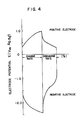
- the difference in diffusion speed of dopant ions due to the difference in current density is remarkable at the negative electrode. Changes of electrode potential at the time of charge and discharge when the current density at the positive and negative electrodes is constant are shown in Figure 4.
- Figure 4 is a graph showing a relationship between the charge rate (%), the discharge rate (%) and the electrode potential E (V vs. Ag/Ag + ).
- Figure 4 clearly shows that the discharge efficiency of the negative electrode is low. Therefore, it is necessary to lower the current density of only the negative electrode. In other to lower the current density of the negative electrode, it is preferable to make the electrode surface area of the negative electrode larger.
- the specific surface area is measured by a conventional method, such as the BET method.
- the number of charge-discharge cycles increases with an increase of the ratio of the geometric surface area of the negative electrode to the geometric surface area of the positive electrode as shown in Figure 5.
- the number of cycles means the number of charge-discharge cycles until the coulombic efficiency becomes lower than 50% at the doping level of 4 mole %.
- the coulombic efficiency is defined by the following equation: As is clear from Figure 5, when the ratio of the negative electrode geometric surface area to the positive electrode geometric surface area increases to, for example, 1.5, the number of cycles does not increase in linear proportion to the increase of the geometric surface area ratio. Therefore, the negative electrode has a geometric surface area preferably 1.03 to 1.20 times (3 to 20% larger), more preferably 1.05 to 1.1 times (5 to 10% larger) as large as the geometric surface area of the positive electrode.
- the lowering in the doping level at the negative electrode is preferably 20% or less compared with the doping level of positive electrode. That is, the product of the weight and the specific surface area of the negative electrode is preferably 20% or less and 5% or more larger than that of the positive electrode.
- polyacetylene As the polymer having conjugated double bonds in a main chain, there can be used polyacetylene, polyphenylene, polythienylene, polypyrrole, polyaniline, and polythiophene alone or as a mixture thereof. Among them, polyparaphenylene, polyaniline and polyacetylene are preferable, and polyacetylene is more preferable.
- Polyacetylene can be obtained by a conventional process, for example, a process disclosed in J. Polymer Sci, Polymer Chemistry Edition, vol. 12,11-20 (1974). Such a polymer can be used in the form of fibril.
- the negative electrode there can be used that made from the polymer having conjugated double bonds in a main chain mentioned above or graphite.
- the positive electrode can be made from the same or different polymer having conjugated double bonds in a main chain.
- the negative electrode is formed so as to make the geometric surface area larger than the positive electrode, since the doping of dopant ions to the polyacetylene takes place at the surfaces of polyacetylene fibrils (string-like form of crystalline polyacetylene having a diameter of about 20 nm).
- the negative electrode is made from polyacetylene having a smaller bulk density (that is, having a larger specific surface area).
- the negative electrode is made from polyacetylene having a smaller fibril diameter so as to make the specific surface area of the electrode active material larger and to make the current density of the negative electrode substantially smaller than that of the positive electrode.
- Dopant ions which can be electrochemically doped with the polymer having conjugated double bonds in a main chain such as polyacetylene include:
- Examples of compounds (dopants) which can provide the dopant anions and dopant cations mentioned above are LiPF 6 , LiBF 4 , LiC10 4 , Nal, NaCl0 4 , KCI0 4 , (C 2 H s ) 4 NBF 4 , (C 2 H 5 ) 4 NCIO 4 , (C 4 H 9 ) 4 NBF 4 , (C 4 Hg) 4 NCI0 4 , etc. These dopants can be used alone or as a mixture thereof.
- An electrolytic solution used in this invention is obtained by dissolving the dopant mentioned above in water or non-aqueous solvent.
- the use of the non-aqueous solvent is preferable for secondary batteries.
- the non-aqueous solvent are ethers, ketones, nitriles, amines, amides, sulfur compounds, chlorinated hydrocarbons, esters, carbonates, nitro compounds, etc.
- non-aqueous solvent examples include tetrahydrafuran 2 - methyltetrahydrofuran, 1,4 - dioxane, monoglyme, acetonitrile, propionitrile, 1,2 - dichloroethane, y-butyrolactone, dimethoxyethane, methyl formate, propylene carbonate, dimethyl formamide dimethyl sulfoxide, dimethyl thioformamide, sulfolane, etc.
- solvents can be used alone or as a mixture thereof.
- the concentration of the electrolytic solution changes depending on the kind of electrolyte (dopant) and solvent, but is usually in the range of 0.001 to 10 mole/liter, more preferably 1 to 5 mol/liter.
- the electrolytic solution can be impregnated in a separator such as non-woven fabric, etc., which is placed between the two electrodes.
- the secondary battery according to this invention is well balanced in the positive and negative electrodes at the time of charge and discharge, and the charge-discharge cycle life is remarkably improved.
- a secondary battery was constructed by using (C 2 H s ) 4 NBF 4 as a dopant, CH 3 CN as a solvent in a concentration of 1 mole/liter and electrodes made from polyacetylene.
- the gross geometric surface area of a negative electrode was made 10% larger than that of a positive electrode.
- the thickness of the negative electrode was 190 pm and that of the positive electrode was 200 pm.
- a secondary battery was constructed in the same manner as described in Example 1 except that the weight of a negative electrode was made 10% larger than that of a positive electrode. That is, the product of the weight and the specific surface area of the negative electrode was increased in 10%. The number of charge-discharge cycles maintaining the coulombic efficiency of 50% or more was 172.
- a secondary battery was constructed in the same manner as described in Example 1 except that the weight of a negative electrode was made 50% larger than that of a positive electrode.
- the number of charge-discharge cycles maintaining the coulombic efficiency of 50% or more was 201.
- a secondary battery was constructed by using (C 2 H s ) 4 NBF 4 as a dopant, CH 3 CN as a solvent in a concentration of 1.0 mole/liter and two electrodes made from polyacetylene and having a thickness of 200 pm with the same gross geometric surface area.
- the relationship between the coulombic efficiency and the number of charge-discharge cycles was as shown in Figure 3.
- the number pf charge-discharge cycles measured in the same manner as described in Example 1 was about 50.
Landscapes
- Chemical & Material Sciences (AREA)
- Chemical Kinetics & Catalysis (AREA)
- Electrochemistry (AREA)
- General Chemical & Material Sciences (AREA)
- Engineering & Computer Science (AREA)
- Manufacturing & Machinery (AREA)
- Secondary Cells (AREA)
- Battery Electrode And Active Subsutance (AREA)
Description
- This invention relates to a secondary battery having a long charge-discharge cycle life.
- There have been known secondary batteries having one or two electrodes made from a polymer having conjugated double bonds in a main chain such as polyacetylene [(CH)J. (U.S. Patent Nos. 4,321,114 and 4,442,187) This polymer works as an electrode active material and it can be used with conductive material such as carbon. But these batteries have a charge-discharge cycle life as short as 50 cycles, which is not sufficient for practical use. One reason for the short cycle life seems to that a balance between doping and undoping on positive and negative electrodes is lost. Further, these batteries have an initial coulombic efficiency of about 95%, which means that any side reactions are taking place.
- It is an object of this invention to provide a secondary battery having a long charge-discharge cycle life.
- To meet with this object, the invention provides a secondary battery as set forth in claim 1.
-
- Figure 1 is a perspective and partially cross-sectional view of a secondary battery of one embodiment of this invention.
- Figure 2 is an enlarged cross-sectional view of the circle A in Figure 1.
- Figure 3 is a graph showing a relationship between the coulombic efficiency and the number of charge-discharge cycles according to prior art.
- Figure 4 is a graph showing changes of electrode potentials by charge and discharge.
- Figure 5 is a graph showing a relationship between the charge-discharge cycle and the geometric area ratio of the negative electrode to the positive electrode.
- Figure 6 is a graph showing a relationship between the charge-discharge cycle and the specific surface area of the negative electrode made from polyacetylene.
- Figure 7 is a graph showing a relationship between the charge-discharge cycle and the doping level ratio of the negative electrode to the positive electrode.
- One embodiment of secondary batteries usable in this invention is explained referring to Figures 1 and 2. Figure 1 is a perspective view with partially cross-sectional of a unit cell and Figure 2 is an enlarged cross-sectional view of the circle A in Figure 1. Numeral 1 denotes a casing, the outer surface of which is covered by a resin film laminated with a thin film (1-100 pm) of aluminum, since polyacetylene and doped polyacetylene are unstable for water and oxygen. Numeral 2 is an electrode which is made from, for example, polyacetylene and preferably has therein expanded metal or metal net 3 made of a corrosion-resistant material such as stainless steel, etc., in order to enhance a current collecting effect and to take out an electrode terminal 5.
Numeral 4 is a separator in the form of fabric (woven or non-woven fabric) or foam made from a conventional material such as polypropylene, glass fibers, etc., to prevent short circuit between the electrodes and to maintain an electrolytic solution dissolving a dopant. It is possible to stack a number of such unit cells by using a proper electroconductive separator between unit cells so as to prevent transfer of the electrolytic solution between the unit cells. - When a direct current is flowed through electrodes, dopant ions are doped on the electrodes to give a positive electrode and a negative electrode.
- According to this invention, the negative electrode should have a larger surface area than the positive electrode in order to maintain a balance of the positive and negative electrodes at the time of charge and discharge, and to make a difference in current density at the positive and negative electrodes.
- A polymer having conjugated double bonds in a main chain, for example, polyacetylene [(CH)J reduces a resistance value by doping of dopant ions to convert to a metallic state. But since the electrode has a thickness, a distribution of dopant ions is formed at the direction of the electrode thickness, which results in making it impossible to use the whole polyacetylene effectively. When the current density is lowered, this tendency can be improved. But when the current density is lowered, the electrode area should be made large; this is not suitable for practical use. The difference in diffusion speed of dopant ions due to the difference in current density is remarkable at the negative electrode. Changes of electrode potential at the time of charge and discharge when the current density at the positive and negative electrodes is constant are shown in Figure 4. Figure 4 is a graph showing a relationship between the charge rate (%), the discharge rate (%) and the electrode potential E (V vs. Ag/Ag+). Figure 4 clearly shows that the discharge efficiency of the negative electrode is low. Therefore, it is necessary to lower the current density of only the negative electrode. In other to lower the current density of the negative electrode, it is preferable to make the electrode surface area of the negative electrode larger.
- The specific surface area is measured by a conventional method, such as the BET method.
- In the case of the geometric surface area the number of charge-discharge cycles increases with an increase of the ratio of the geometric surface area of the negative electrode to the geometric surface area of the positive electrode as shown in Figure 5. In Figure 5, the number of cycles means the number of charge-discharge cycles until the coulombic efficiency becomes lower than 50% at the doping level of 4 mole %. The coulombic efficiency is defined by the following equation:

- In the case of the product of the weight and the specific surface area the number of cycles changes with an increase of a ratio of the doping level of negative electrode to the doping level of positive electrode (in negative value), that is, an increase of the weight of negative electrode (in other words, the total surface area) as shown in Figure 6. In Figure 6, the line ―O―O― shows the case wherein the ratio of negative electrode geometric surface area/positive electrode geometric surface area (AS)=1/1 and the line ―•―•― shows the case wherein the ratio of negative electrode geometric surface area/positive electrode geometric surface area (AS)=1.1/1. As is clear from Figure 6, when the doping level of negative electrode is lowered and the electrode surface is enlarged, the number of charge-discharge cycles increases. But considering the structure of battery, the lowering in the doping level at the negative electrode is preferably 20% or less compared with the doping level of positive electrode. That is, the product of the weight and the specific surface area of the negative electrode is preferably 20% or less and 5% or more larger than that of the positive electrode.
- As the polymer having conjugated double bonds in a main chain, there can be used polyacetylene, polyphenylene, polythienylene, polypyrrole, polyaniline, and polythiophene alone or as a mixture thereof. Among them, polyparaphenylene, polyaniline and polyacetylene are preferable, and polyacetylene is more preferable. Polyacetylene can be obtained by a conventional process, for example, a process disclosed in J. Polymer Sci, Polymer Chemistry Edition, vol. 12,11-20 (1974). Such a polymer can be used in the form of fibril.
- As the negative electrode, there can be used that made from the polymer having conjugated double bonds in a main chain mentioned above or graphite. In such a case, the positive electrode can be made from the same or different polymer having conjugated double bonds in a main chain.
- More concretely, in the case of forming the electrodes by using polyacetylene fibrils having the same structure (e.g. diameter) and the same bulk density when made into electrodes, the negative electrode is formed so as to make the geometric surface area larger than the positive electrode, since the doping of dopant ions to the polyacetylene takes place at the surfaces of polyacetylene fibrils (string-like form of crystalline polyacetylene having a diameter of about 20 nm). When polyacetylene having different bulk densities is used, the negative electrode is made from polyacetylene having a smaller bulk density (that is, having a larger specific surface area). When polyacetylene having different fibril diameters is used, the negative electrode is made from polyacetylene having a smaller fibril diameter so as to make the specific surface area of the electrode active material larger and to make the current density of the negative electrode substantially smaller than that of the positive electrode.
- Dopant ions which can be electrochemically doped with the polymer having conjugated double bonds in a main chain such as polyacetylene include:
- (i) halogenated anions of the elements in the Va group in the periodic table such as PF6- , SbF6 , AsF6-, SbCl6- , etc.,
- (ii) halogenated anions of the elements in the Illa group in the periodic table such as BF4- , etc.,
- (iii) halogen anions such as I-(I3 -), Br-, CI-, etc.,
- (iv) perchlorate anions such as CIO4 -,
- (v) alkali metal ions such as Li+, Na+, K+, and Cs+,
- (vi) quaternary ammonium ions represented by the formula: R4N+, wherein R is a hydrocarbon group having 1 to 20 carbon atoms, and
- (vii) phosphonium ions represented by the formula: R4P+, wherein R is a hydrocarbon group having 1 to 20 carbon atoms.
- Examples of compounds (dopants) which can provide the dopant anions and dopant cations mentioned above are LiPF6, LiBF4, LiC104, Nal, NaCl04, KCI04, (C2Hs)4NBF4, (C2H5)4NCIO4, (C4H9)4NBF4, (C4Hg)4NCI04, etc. These dopants can be used alone or as a mixture thereof.
- An electrolytic solution used in this invention is obtained by dissolving the dopant mentioned above in water or non-aqueous solvent. The use of the non-aqueous solvent is preferable for secondary batteries. Examples of the non-aqueous solvent are ethers, ketones, nitriles, amines, amides, sulfur compounds, chlorinated hydrocarbons, esters, carbonates, nitro compounds, etc. Typical examples of the non-aqueous solvent are tetrahydrafuran 2 - methyltetrahydrofuran, 1,4 - dioxane, monoglyme, acetonitrile, propionitrile, 1,2 - dichloroethane, y-butyrolactone, dimethoxyethane, methyl formate, propylene carbonate, dimethyl formamide dimethyl sulfoxide, dimethyl thioformamide, sulfolane, etc. These solvents can be used alone or as a mixture thereof.
- The concentration of the electrolytic solution changes depending on the kind of electrolyte (dopant) and solvent, but is usually in the range of 0.001 to 10 mole/liter, more preferably 1 to 5 mol/liter.
- The electrolytic solution can be impregnated in a separator such as non-woven fabric, etc., which is placed between the two electrodes.
- The secondary battery according to this invention is well balanced in the positive and negative electrodes at the time of charge and discharge, and the charge-discharge cycle life is remarkably improved.
- This invention is illustrated by way of the following Examples.
- A secondary battery was constructed by using (C2Hs)4NBF4 as a dopant, CH3CN as a solvent in a concentration of 1 mole/liter and electrodes made from polyacetylene. The gross geometric surface area of a negative electrode was made 10% larger than that of a positive electrode. The thickness of the negative electrode was 190 pm and that of the positive electrode was 200 pm. When the charge-discharge cycle properties were measured at doping level of 4 mole % with a current density of 5 mA/cm2 against the positive electrode, the number of charge-discharge cycles maintaining the coulombic efficiency of 50% or more was 143.
- A secondary battery was constructed in the same manner as described in Example 1 except that the weight of a negative electrode was made 10% larger than that of a positive electrode. That is, the product of the weight and the specific surface area of the negative electrode was increased in 10%. The number of charge-discharge cycles maintaining the coulombic efficiency of 50% or more was 172.
- A secondary battery was constructed in the same manner as described in Example 1 except that the weight of a negative electrode was made 50% larger than that of a positive electrode. The number of charge-discharge cycles maintaining the coulombic efficiency of 50% or more was 201.
- A secondary battery was constructed by using (C2Hs)4NBF4 as a dopant, CH3CN as a solvent in a concentration of 1.0 mole/liter and two electrodes made from polyacetylene and having a thickness of 200 pm with the same gross geometric surface area. The relationship between the coulombic efficiency and the number of charge-discharge cycles was as shown in Figure 3. The number pf charge-discharge cycles measured in the same manner as described in Example 1 was about 50.
Claims (3)
Applications Claiming Priority (2)
| Application Number | Priority Date | Filing Date | Title |
|---|---|---|---|
| JP190980/83 | 1983-10-14 | ||
| JP58190980A JPS6084776A (en) | 1983-10-14 | 1983-10-14 | Secondary battery |
Publications (2)
| Publication Number | Publication Date |
|---|---|
| EP0142045A1 EP0142045A1 (en) | 1985-05-22 |
| EP0142045B1 true EP0142045B1 (en) | 1989-02-22 |
Family
ID=16266861
Family Applications (1)
| Application Number | Title | Priority Date | Filing Date |
|---|---|---|---|
| EP84112320A Expired EP0142045B1 (en) | 1983-10-14 | 1984-10-12 | Secondary battery |
Country Status (5)
| Country | Link |
|---|---|
| US (1) | US4559284A (en) |
| EP (1) | EP0142045B1 (en) |
| JP (1) | JPS6084776A (en) |
| CA (1) | CA1231754A (en) |
| DE (1) | DE3476843D1 (en) |
Families Citing this family (8)
| Publication number | Priority date | Publication date | Assignee | Title |
|---|---|---|---|---|
| EP0183053B1 (en) * | 1984-11-29 | 1990-02-07 | VARTA Batterie Aktiengesellschaft | Galvanic element with a polymeric electrode |
| DE3506659A1 (en) * | 1985-02-26 | 1986-08-28 | Basf Ag, 6700 Ludwigshafen | COMPOSITE ELECTRODE |
| DE3604568A1 (en) * | 1986-02-14 | 1987-08-20 | Basf Ag | MEDIUM FOR IRREVERSIBLE INFORMATION STORAGE AND METHOD FOR ITS IMPLEMENTATION |
| DE3607378A1 (en) * | 1986-03-06 | 1987-09-10 | Basf Ag | ELECTROCHEMICAL SECONDARY ELEMENT WITH AT LEAST ONE POLYMER ELECTRODE |
| US4714665A (en) * | 1986-12-23 | 1987-12-22 | The Dow Chemical Company | Secondary battery |
| US4824745A (en) * | 1987-02-25 | 1989-04-25 | Bridgestone Corporation | Electric cell comprising a polymeric material film electrode having a collection integrated therewith |
| US5714053A (en) * | 1995-07-21 | 1998-02-03 | Motorola, Inc. | Conducting polymer electrodes for energy storage devices and method of making same |
| JP4213687B2 (en) * | 2005-07-07 | 2009-01-21 | 株式会社東芝 | Nonaqueous electrolyte battery and battery pack |
Family Cites Families (5)
| Publication number | Priority date | Publication date | Assignee | Title |
|---|---|---|---|---|
| FR82314E (en) * | 1961-07-05 | 1964-01-24 | Accumulateurs Fixes | Improvements made to electrolytic cells and more particularly to sealed accumulators operating without gas release |
| US4442187A (en) * | 1980-03-11 | 1984-04-10 | University Patents, Inc. | Batteries having conjugated polymer electrodes |
| US4321114A (en) * | 1980-03-11 | 1982-03-23 | University Patents, Inc. | Electrochemical doping of conjugated polymers |
| JPS5840781A (en) * | 1981-09-02 | 1983-03-09 | Showa Denko Kk | Secondary battery |
| US4327157A (en) * | 1981-02-20 | 1982-04-27 | The United States Of America As Represented By The Secretary Of The Navy | Stabilized nickel-zinc battery |
-
1983
- 1983-10-14 JP JP58190980A patent/JPS6084776A/en active Pending
-
1984
- 1984-10-11 CA CA000465204A patent/CA1231754A/en not_active Expired
- 1984-10-11 US US06/659,682 patent/US4559284A/en not_active Expired - Fee Related
- 1984-10-12 EP EP84112320A patent/EP0142045B1/en not_active Expired
- 1984-10-12 DE DE8484112320T patent/DE3476843D1/en not_active Expired
Also Published As
| Publication number | Publication date |
|---|---|
| CA1231754A (en) | 1988-01-19 |
| US4559284A (en) | 1985-12-17 |
| DE3476843D1 (en) | 1989-03-30 |
| EP0142045A1 (en) | 1985-05-22 |
| JPS6084776A (en) | 1985-05-14 |
Similar Documents
| Publication | Publication Date | Title |
|---|---|---|
| US4957833A (en) | Non-aqueous liquid electrolyte cell | |
| US6787267B2 (en) | Electrolyte for electrochemical device | |
| US4804594A (en) | Predoped conductive polymers as battery electrode materials | |
| US4463072A (en) | Secondary batteries containing room-temperature molten 1,2,3-trialkylimidazolium halide non-aqueous electrolyte | |
| USRE34991E (en) | Secondary battery | |
| US5442197A (en) | Super-capacitor comprising positive and negative electrodes made of a p-doped electron conductive polymer and an electrolyte containing an organic redox compound | |
| US4550067A (en) | Secondary battery | |
| EP1205995B1 (en) | Secondary battery of proton conductive polymer | |
| US4869977A (en) | Electrolyte additive for lithium-sulfur dioxide electrochemical cell | |
| US4654280A (en) | Nonaqueous cell employing a cathode-electrolyte solution containing a boron-containing additive | |
| US4537843A (en) | Secondary battery | |
| DE102022105096A1 (en) | PRELITHIATED NEGATIVE ELECTRODES WITH LI-SI ALLOY COMPOSITE PARTICLES AND PROCESS FOR THEIR MANUFACTURE | |
| EP0165589A2 (en) | Secondary battery and method of manufacturing the same | |
| US4559284A (en) | Secondary battery | |
| US6461773B1 (en) | Electrolyte for electrochemical device | |
| DE2557600C3 (en) | Galvanic element with a nitrile as solvent for the electrolyte salt | |
| JPH0568829B2 (en) | ||
| JP2610026B2 (en) | Battery electrode | |
| JP2542221B2 (en) | Battery using polyaniline composite electrode | |
| JPH06275267A (en) | Electrode, battery using the same, and its manufacture | |
| JPH0821430B2 (en) | Secondary battery | |
| JP2669672B2 (en) | Joint | |
| JP2908794B2 (en) | How to use polyaniline electrode | |
| JP2765974B2 (en) | Rechargeable battery | |
| EP0198484A2 (en) | Secondary battery |
Legal Events
| Date | Code | Title | Description |
|---|---|---|---|
| PUAI | Public reference made under article 153(3) epc to a published international application that has entered the european phase |
Free format text: ORIGINAL CODE: 0009012 |
|
| 17P | Request for examination filed |
Effective date: 19841220 |
|
| AK | Designated contracting states |
Designated state(s): BE CH DE FR GB IT LI NL |
|
| 17Q | First examination report despatched |
Effective date: 19860605 |
|
| R17C | First examination report despatched (corrected) |
Effective date: 19870511 |
|
| GRAA | (expected) grant |
Free format text: ORIGINAL CODE: 0009210 |
|
| AK | Designated contracting states |
Kind code of ref document: B1 Designated state(s): BE CH DE FR GB IT LI NL |
|
| REF | Corresponds to: |
Ref document number: 3476843 Country of ref document: DE Date of ref document: 19890330 |
|
| ET | Fr: translation filed | ||
| ITF | It: translation for a ep patent filed | ||
| PLBE | No opposition filed within time limit |
Free format text: ORIGINAL CODE: 0009261 |
|
| STAA | Information on the status of an ep patent application or granted ep patent |
Free format text: STATUS: NO OPPOSITION FILED WITHIN TIME LIMIT |
|
| 26N | No opposition filed | ||
| ITTA | It: last paid annual fee | ||
| PGFP | Annual fee paid to national office [announced via postgrant information from national office to epo] |
Ref country code: FR Payment date: 19920814 Year of fee payment: 9 |
|
| PGFP | Annual fee paid to national office [announced via postgrant information from national office to epo] |
Ref country code: BE Payment date: 19920827 Year of fee payment: 9 |
|
| PGFP | Annual fee paid to national office [announced via postgrant information from national office to epo] |
Ref country code: GB Payment date: 19921002 Year of fee payment: 9 |
|
| PGFP | Annual fee paid to national office [announced via postgrant information from national office to epo] |
Ref country code: NL Payment date: 19921031 Year of fee payment: 9 |
|
| PGFP | Annual fee paid to national office [announced via postgrant information from national office to epo] |
Ref country code: DE Payment date: 19921222 Year of fee payment: 9 |
|
| PGFP | Annual fee paid to national office [announced via postgrant information from national office to epo] |
Ref country code: CH Payment date: 19921229 Year of fee payment: 9 |
|
| PG25 | Lapsed in a contracting state [announced via postgrant information from national office to epo] |
Ref country code: GB Effective date: 19931012 |
|
| PG25 | Lapsed in a contracting state [announced via postgrant information from national office to epo] |
Ref country code: LI Effective date: 19931031 Ref country code: CH Effective date: 19931031 Ref country code: BE Effective date: 19931031 |
|
| BERE | Be: lapsed |
Owner name: HITACHI LTD Effective date: 19931031 Owner name: SHOWA DENKO K.K. Effective date: 19931031 |
|
| PG25 | Lapsed in a contracting state [announced via postgrant information from national office to epo] |
Ref country code: NL Effective date: 19940501 |
|
| GBPC | Gb: european patent ceased through non-payment of renewal fee |
Effective date: 19931012 |
|
| NLV4 | Nl: lapsed or anulled due to non-payment of the annual fee | ||
| PG25 | Lapsed in a contracting state [announced via postgrant information from national office to epo] |
Ref country code: FR Effective date: 19940630 |
|
| REG | Reference to a national code |
Ref country code: CH Ref legal event code: PL |
|
| PG25 | Lapsed in a contracting state [announced via postgrant information from national office to epo] |
Ref country code: DE Effective date: 19940701 |
|
| REG | Reference to a national code |
Ref country code: FR Ref legal event code: ST |