EP0141614A2 - Surface treatment of paper and paperboard - Google Patents
Surface treatment of paper and paperboard Download PDFInfo
- Publication number
- EP0141614A2 EP0141614A2 EP84307298A EP84307298A EP0141614A2 EP 0141614 A2 EP0141614 A2 EP 0141614A2 EP 84307298 A EP84307298 A EP 84307298A EP 84307298 A EP84307298 A EP 84307298A EP 0141614 A2 EP0141614 A2 EP 0141614A2
- Authority
- EP
- European Patent Office
- Prior art keywords
- web
- cylinder
- pressure
- paperboard
- paper
- Prior art date
- Legal status (The legal status is an assumption and is not a legal conclusion. Google has not performed a legal analysis and makes no representation as to the accuracy of the status listed.)
- Withdrawn
Links
Images
Classifications
-
- D—TEXTILES; PAPER
- D21—PAPER-MAKING; PRODUCTION OF CELLULOSE
- D21G—CALENDERS; ACCESSORIES FOR PAPER-MAKING MACHINES
- D21G1/00—Calenders; Smoothing apparatus
- D21G1/0073—Accessories for calenders
- D21G1/0093—Web conditioning devices
Definitions
- the nip pressures are so high in a calender stack, due to the weight and number of its component rollers,that substantial densification of the web is unavoidable.
- Machine glazing is more satisfactory from the standpoint of less densification of the web as a whole, but the cylinders used therefor are large and expensive, e.g. 4.5- 6.0 metres (15 to 20 feet) in diameter, they are difficult to operate, and they require particular operating limitations related to the drying of the web which render their use impractical or uneconomic.
- the treatment of the invention is applied initially to a web of paper or paperboard which has been partially dried, for example, to a solids content of substantially 70% or more, throughout the major portion of its thickness including one surface, but which has a thin layer adjacent the other surface, and constituting a minor portion of its total thickness, of a substantially lower solids content, i.e. it is considerably wetter than the remainder of the web.
- a substantially lower solids content i.e. it is considerably wetter than the remainder of the web.
- the next step in the practice of the invention is to present the wetted surface of the web to at least one dryer drum or other heated smooth-surfaced cylinder whilst pressing the web into a condition of intimate contact between its wet surface and the surface of the heated cylinder.
- the desired engagement between the wet web surface and the heated cylinder is preferably established and maintained without applying so much pressure to a limited area of the web as to effect significant reduction in its thickness as a whole.
- the invention to a considerable degree depends upon certain principles including that when the web has been dried to an essentially uniform solids content of greater than 70%, and preferably to a higher consistency in the range of 80-95%, it has correspondingly greater strength and resistance to compaction than at lower consistencies.
- a web of that degree of dryness is also hignly resistant to change in its surface characteristics, because the layers adjacent the surface are likely to be even more highly dried than the interior of the web, since they have been directly exposed to the high surface temperature of the dryer drums and to the air circulating in the dryer section.
- samples of board made from waste paper and having an initial thickness of 0.81mm (0.32 inch), a surface smoothness of 1,800 Bendtsen units and a consistency of 70% were treated according to the invention, and after such treatment, their thickness had been decreased only very slightly, to 0.76mm (0.030 inch) hit their smoothness had greatly improved, to an average of 305 units.
- a sample of the same board treated by conventional calendering had a smoothness of 180 units, but its thickness had been reduced 0.65mm (0.0255 inch), namely a reduction in tnickness of more than 20% or more than three times the compaction produced by treatment in accordance with the invention.
- the samples treated in accordance with the invention had substantially higher bursting strength, measured as 945 kPa as compared with 750 hPa for the calendered sheet, as well as substantially greater stiffness.
- this step of the invention does not require pressures comparable to the nip pressures developed in calenders, and the range of nip pressures which have been found to produce satisfactory results in testing the invention is substantially 8.9 - 125 Kg/linear cm (50-700 lbs/linear inch) where the nip width is in the range of 12.7 - 76.2mm (0.5 - 3.0 inches).
- Optimum conditions may require preliminary testing in accordance with the principles of the invention as described above and also hereinafter in connection with the drawings.
- the web is directly supported during its passage around the heated cylinder by an endless band having a textured outer surface which is brought into pressure engagement with the opposed surface of the web during its wrapped engagement with the heated cylinder.
- the pressure of the textured band against the paperboard web may be created initially by its own tension, but this may be augmented by an additional tensioned endless belt and/or one or more pressure roller nips against the heated cylinder.
- the rewetting may be by water alone or by various acqueous solutions or suspensions of materials capable of giving the treated surface particular desired characteristics, e.g. starch, CMC, etc. It should also be understood that after treatment according to the invention, the web may be subjected to other treatments such as coating, brushing and light calendering.
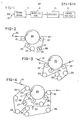
- FIG. 1 The diagramatic view in Fig. 1 shows the newly formed web 10 of paper or paperboard as undergoing a normal drying treatment, represented by the box 11, which will increase its consistency to a range of 70-85% solids, a typical example being approximately 80%.
- the surface of the web to be smoothed is then rewetted in a wetting stage 12, using conventional means such as roll application, rotary brushes or sprays.
- the rewetted web is then subjected to smoothing at 13, as described above and also below in connection with the several showings in the drawing of specific apparatus for this purpose.
- the final treatment stage 15 represents any desired further treatment as also discussed above, including smoothing of the back side of the web by repeating the rewetting and smoothing steps represented by boxes 12 and 13, etc.
- the element 20 represents a heated cylinder, such as a dryer drum, which preferably has a highly polished surface, and the web 10 is assumed to have a thin layer adjacent its upper surface which is of substantially lower consistency than the rest of the web, as the result of either preferential drying or rewetting as already described.
- Fig. 2 represents a preferred form of the practice of the invention wherein the web 10 first engages the cylinder 20 when it passes through a bare pressure nip between the cylinder 20 and a pressure roller 21.
- a major part of the portion of the web which wraps the cylinder 20 is also held in pressure engagement with the cylinder by an endless belt 22, which may be similar to a dryer felt but, preferaply, is a non-absorbent foraminous fabric belt, such as, a woven plastics or metal belt of the type used as a paper machine forming wire.
- the belt 22 is supported by a plurality of rollers, shown as pressure rollers 23 and 24, an idler roller 25 and a tensioning roller 26 which is mounted for movement, as indicated by the arrow 27, for the purpose of establishing and maintaining desired high linear tension in the belt 22.
- a plurality of rollers shown as pressure rollers 23 and 24, an idler roller 25 and a tensioning roller 26 which is mounted for movement, as indicated by the arrow 27, for the purpose of establishing and maintaining desired high linear tension in the belt 22.
- Fig. 3 The arrangement in Fig. 3 is similar to that of Fig. 2, and employs the same reference characters, but the belt 22 is extended to pass through all three pressure nips, there are two idler rollers 25,and there is a different arrangement of tensioning rollers 30.
- the mode of operation of this arrangement of apparatus is otherwise essentially the same as described in connection with Fig. 1, except that the web is cushioned by the belt 22 in each of the pressure nips so that the effective width of each nip is wider than at the bare pressure nip in Fig. 2.
- Fig. 4 illustrates a modified arrangement of apparatus for the purpose of texturing one side of the web lOwhilst the other side is being smoothed.
- the endless band 33 in Fig. 4 which may be a felt or textile band, has a desired texture on its outer surface, and it is supported by guide rollers 35, idler rollers 36 and tensioning rollers 37 so that it engages and overlies the entire portion of the web 10 which wraps the heated cylinder 20.
- the endless belt 22 in Fig. 4 is arranged in substantially the same way as in Fig. 3, by means of pressure rollers 21,23 and 24, and a tensioning roller 26, except that the belt 22 also wraps the pressure roller 21 so that the web 10, the belt 22 and the band 33 all pass through the nip formed by roller 21 and cylinder 20.
- the web 10 is pressed against the cylinder 20 by its own tension, the tension of belt 22 and band 33, and the pressure nips which each of rollers 21,23 and 24 forms with cylinder 20.
- the belt 22 should be capable of withstanding an applied tension of 1.8-8.9 Kg/linear cm (10-50 pounds/Linear inch) and as previously noted, satisfactory results have been obtained utilizing a belt equivalent to a paper machine forming wire woven from metal wire or plastic filament material.
- the cylinder or cylinders -- one or more additional stations like those in Figs. 2 and 3 could pe added if needed -- on which the surfacing treatment is carried out preferably may have a diameter in the range of 1.2 - 2.1 metres (4 - 7 feet), and may be heated to a surface temperature in the range from 120 - 315°C (250° - 600°F).
- Typical nip pressures utilized in the process of the invention are in the range from 8.9 - 125 Kg/linear cm, with nip widths in the range from 12.7 - 76.2 mm.
- the waste paper board described above was treated on a cylinder having a surface temperature of 140°C (285°F), and was passed through two pressure nips wherein the pressure was 35.7 Kg/linear cm (200 pli) on a supporting belt tensioned to 5.4 Kg/linear cm (30 pli). It is significant that in addition to the other characteristics of that web as compared with calendered samples of the same material, . there was no difference in the ply bond as between the web treated in accordance with the invention and the same bare web given the standard calendering treatment.
Landscapes
- Paper (AREA)
Abstract
Paper or paperboard (10) which has been thoroughly dried, but not calendered is provided with a smooth surface by rewetting a thin layer along one surface thereof and then pressing the resulting damp surface against a substantial portion of the surface of a heated smooth-surfaced drying cylinder (20). This technique provides the web (10) with a surface comparable in smoothness with that which can be obtained by calendaring, but without the degree of compaction which occurs in calendaring, due to the fact that with the major portion of the web dried, it is highly resistant to such compaction.
Description
- In the production of paper and paperboard, it is very often an objective to produce as smooth a finish as possible on at least one surface of the web, but at the same time to minimize compaction or densification of the web as a whole, especially in the case of paperboard.
- Conventional practice has employed a variety of techniques and equipment in an effort to accomplish this result, including various forms of calendering, machine glazing by means of an M.G. cylinder or Yankee dryer, the use of a nip roller on a dryer roller in the dryer section, and a breaker stack. All of these techniques and equipment have some disadvantages.
- More specifically, the nip pressures are so high in a calender stack, due to the weight and number of its component rollers,that substantial densification of the web is unavoidable. Machine glazing is more satisfactory from the standpoint of less densification of the web as a whole, but the cylinders used therefor are large and expensive, e.g. 4.5- 6.0 metres (15 to 20 feet) in diameter, they are difficult to operate, and they require particular operating limitations related to the drying of the web which render their use impractical or uneconomic.
- It is accordingly an object of the present invention to provide improved and simple methods and apparatus for the treatment of webs of paper and paperboard which will produce a satisfactorily smooth surface on one or both sides of the web with less densification than can be achieved by prior practices.
- The treatment of the invention is applied initially to a web of paper or paperboard which has been partially dried, for example, to a solids content of substantially 70% or more, throughout the major portion of its thickness including one surface, but which has a thin layer adjacent the other surface, and constituting a minor portion of its total thickness, of a substantially lower solids content, i.e. it is considerably wetter than the remainder of the web. These desired characteristics can be obtained by rewetting one surface of a web which has already been dried to an essentially uniform high consistency, or the web may be subjected to preferential or unsymmetrical drying which leaves one surface wetter than the major portion of the web, as by presenting only one surface to the dryer drums.
- The next step in the practice of the invention is to present the wetted surface of the web to at least one dryer drum or other heated smooth-surfaced cylinder whilst pressing the web into a condition of intimate contact between its wet surface and the surface of the heated cylinder. The desired engagement between the wet web surface and the heated cylinder is preferably established and maintained without applying so much pressure to a limited area of the web as to effect significant reduction in its thickness as a whole.
- The invention to a considerable degree depends upon certain principles including that when the web has been dried to an essentially uniform solids content of greater than 70%, and preferably to a higher consistency in the range of 80-95%, it has correspondingly greater strength and resistance to compaction than at lower consistencies. On the other hand, a web of that degree of dryness is also hignly resistant to change in its surface characteristics, because the layers adjacent the surface are likely to be even more highly dried than the interior of the web, since they have been directly exposed to the high surface temperature of the dryer drums and to the air circulating in the dryer section.
- In accordance with the invention, however, it has been found that when a thin surface layer of a thoroughly dry but uncalendered web is rewetted, the fibers therein can be rearranged to a high state of smoothness, but the dry condition of the remainder of the sheet enables it to resist further compaction, particularly under the moderate pressure conditions applied thereto in the practice of this invention. The effect of the invention is therefore to produce notably improved surface smoothness with minimum reduction in the thickness of the web and, in fact, also to develop increased bursting strength and stiffness in the web.
- As an illustration of experimental results of the practice of the invention, samples of board made from waste paper and having an initial thickness of 0.81mm (0.32 inch), a surface smoothness of 1,800 Bendtsen units and a consistency of 70% were treated according to the invention, and after such treatment, their thickness had been decreased only very slightly, to 0.76mm (0.030 inch) hit their smoothness had greatly improved, to an average of 305 units.
- A sample of the same board treated by conventional calendering had a smoothness of 180 units, but its thickness had been reduced 0.65mm (0.0255 inch), namely a reduction in tnickness of more than 20% or more than three times the compaction produced by treatment in accordance with the invention. In addition, the samples treated in accordance with the invention had substantially higher bursting strength, measured as 945 kPa as compared with 750 hPa for the calendered sheet, as well as substantially greater stiffness.
- In carrying out the surface-smoothing step of the invention on a heated cylinder as briefly described above, it may be possible to establish and maintain the desired intimate contact between the wet surface of the web and the cylinder by maintaining the web itself under sufficient tension, but it has generally found desirable to augment that pressure by other means, including particularly one or more pressure nips between a pressure roller or rollers and the heated cylinder, an endless belt, such as a wire or felt, which is maintained under tension in overlying relation with the portion of the web which wraps the heated cylinder, or a combination of such a supporting belt and one or more pressure nips.
- In any event, this step of the invention does not require pressures comparable to the nip pressures developed in calenders, and the range of nip pressures which have been found to produce satisfactory results in testing the invention is substantially 8.9 - 125 Kg/linear cm (50-700 lbs/linear inch) where the nip width is in the range of 12.7 - 76.2mm (0.5 - 3.0 inches). Optimum conditions may require preliminary testing in accordance with the principles of the invention as described above and also hereinafter in connection with the drawings.
- While the invention appears to have its greatest application to the provision of a smooth surface on one side of a web of paperboard, for example, in the production of box board which can be utilized with,one surface relatively unfinished, it can also be employed to finish both surfaces of the web. For example, if it is desired to have two smooth surfaces, the steps of the invention as summarized above can be repeated for the second surface of the web, namely the rewetting and pressure drying steps.
- In another embodiment of the invention, it is possible to create a textured surface on one side of the web whilst the other side is being smoothed in accordance with the primary embodiment of the invention. For this purpose, the web is directly supported during its passage around the heated cylinder by an endless band having a textured outer surface which is brought into pressure engagement with the opposed surface of the web during its wrapped engagement with the heated cylinder. The pressure of the textured band against the paperboard web may be created initially by its own tension, but this may be augmented by an additional tensioned endless belt and/or one or more pressure roller nips against the heated cylinder.
- It should also be understood that when the web is rewetted in accordance with the invention, the rewetting may be by water alone or by various acqueous solutions or suspensions of materials capable of giving the treated surface particular desired characteristics, e.g. starch, CMC, etc. It should also be understood that after treatment according to the invention, the web may be subjected to other treatments such as coating, brushing and light calendering.
- In order that the invention may be more readily understood, reference will now be made tn the drawings, in which:-
- Fig. 1 is a block diagram illustrating the method of the invention as applied to a web of paper or paperboard which requires surface rewetting; and
- Figs. 2-4 are line diagrams illustrating alternative arrangements of apparatus for carrying out the process of the invention.
- The diagramatic view in Fig. 1 shows the newly formed
web 10 of paper or paperboard as undergoing a normal drying treatment, represented by the box 11, which will increase its consistency to a range of 70-85% solids, a typical example being approximately 80%. The surface of the web to be smoothed is then rewetted in awetting stage 12, using conventional means such as roll application, rotary brushes or sprays. - The rewetted web is then subjected to smoothing at 13, as described above and also below in connection with the several showings in the drawing of specific apparatus for this purpose. The
final treatment stage 15 represents any desired further treatment as also discussed above, including smoothing of the back side of the web by repeating the rewetting and smoothing steps represented byboxes - In the remaining views in the drawing, the
element 20 represents a heated cylinder, such as a dryer drum, which preferably has a highly polished surface, and theweb 10 is assumed to have a thin layer adjacent its upper surface which is of substantially lower consistency than the rest of the web, as the result of either preferential drying or rewetting as already described. - Fig. 2 represents a preferred form of the practice of the invention wherein the
web 10 first engages thecylinder 20 when it passes through a bare pressure nip between thecylinder 20 and apressure roller 21. In addition, a major part of the portion of the web which wraps thecylinder 20 is also held in pressure engagement with the cylinder by anendless belt 22, which may be similar to a dryer felt but, preferaply, is a non-absorbent foraminous fabric belt, such as, a woven plastics or metal belt of the type used as a paper machine forming wire. Thebelt 22 is supported by a plurality of rollers, shown aspressure rollers idler roller 25 and atensioning roller 26 which is mounted for movement, as indicated by thearrow 27, for the purpose of establishing and maintaining desired high linear tension in thebelt 22. - Under some circumstances, as already pointed out, adequate pressure engagement between the
web 10 andcylinder 20 can be effected by maintaining the web itself under sufficient tension, created by a reel or other means located downstream of thecylinder 20. Similarly, the desired pressure engagement may be sufficiently augmented by the tension in thebelt 22, in which case therollers cylinder 20, and thepressure roller 21 would be spaced from thecylinder 20 to act simply as a guide roller. Preferred results, however, in the testing of the invention thus far have been obtained with the combination of the lead-in bare pressure nip followed by the additional pressure nips at therollers web 10 is cushioned by thebelt 22, all as illustrated in Fig. 2. - The arrangement in Fig. 3 is similar to that of Fig. 2, and employs the same reference characters, but the
belt 22 is extended to pass through all three pressure nips, there are twoidler rollers 25,and there is a different arrangement of tensioning rollers 30.The mode of operation of this arrangement of apparatus is otherwise essentially the same as described in connection with Fig. 1, except that the web is cushioned by thebelt 22 in each of the pressure nips so that the effective width of each nip is wider than at the bare pressure nip in Fig. 2. - Fig. 4 illustrates a modified arrangement of apparatus for the purpose of texturing one side of the web lOwhilst the other side is being smoothed. The endless band 33 in Fig. 4, which may be a felt or textile band, has a desired texture on its outer surface, and it is supported by
guide rollers 35,idler rollers 36 andtensioning rollers 37 so that it engages and overlies the entire portion of theweb 10 which wraps the heatedcylinder 20. - The
endless belt 22 in Fig. 4 is arranged in substantially the same way as in Fig. 3, by means ofpressure rollers tensioning roller 26, except that thebelt 22 also wraps thepressure roller 21 so that theweb 10, thebelt 22 and the band 33 all pass through the nip formed byroller 21 andcylinder 20. Thus theweb 10 is pressed against thecylinder 20 by its own tension, the tension ofbelt 22 and band 33, and the pressure nips which each ofrollers cylinder 20. - The parameters for the several conditions involved in the practice of the invention are relatively imprecise, and provide for substantial variation in the practice of the invention depending upon the characteristics of the particular web being treated and the results to be achieved. For example, the
belt 22 should be capable of withstanding an applied tension of 1.8-8.9 Kg/linear cm (10-50 pounds/Linear inch) and as previously noted, satisfactory results have been obtained utilizing a belt equivalent to a paper machine forming wire woven from metal wire or plastic filament material. - The cylinder or cylinders -- one or more additional stations like those in Figs. 2 and 3 could pe added if needed -- on which the surfacing treatment is carried out preferably may have a diameter in the range of 1.2 - 2.1 metres (4 - 7 feet), and may be heated to a surface temperature in the range from 120 - 315°C (250° - 600°F). Typical nip pressures utilized in the process of the invention are in the range from 8.9 - 125 Kg/linear cm, with nip widths in the range from 12.7 - 76.2 mm.
- As a more specific example, the waste paper board described above was treated on a cylinder having a surface temperature of 140°C (285°F), and was passed through two pressure nips wherein the pressure was 35.7 Kg/linear cm (200 pli) on a supporting belt tensioned to 5.4 Kg/linear cm (30 pli). It is significant that in addition to the other characteristics of that web as compared with calendered samples of the same material, . there was no difference in the ply bond as between the web treated in accordance with the invention and the same bare web given the standard calendering treatment.
Claims (8)
1. A method of producing a smooth surface on a web of paper or paperboard characterised by the steps of:
(a) producing an unfinished web (10) of paper or paperboard having a solids content of at least substantially 70% throughout the major portion of the thickness thereof measured from one surface thereof and having a lower solids content in a layer including the other surface thereof and constituting a minor portion of the thickness thereof,
(b) guiding the web (10) into partially wrapping relation with at least one heated cylinder (20) with said lower solids content surface in contact with said cylinder, and
(c) pressing said web into intimate contact with the cylinder (20) over the wrapped portion thereof.
2. A method according to claim 1, characterised by the steps of:-
(a) producing an unfinished web of paper or paperboard having a solids content of at least substantially 70% and preferably approximately 80% throughout the entire thickness thereof, and
(b) applying an aqueous liquid to said other surface of said web at a rate sufficient to rewet only a layer of said web adjacent said other surface thereby to produce said layer of lower solids content constituting a minor portion of the thickness of said web (10).
3. A method according to claim 1 or 2, characterised in that the pressing step is carried out by maintaining the web (10) under tension.
4. A method according to claim 1 or 2, characterised in that the pressing step is carried out by means of an endless belt (22) which is guided into overlying relation with at least a part of the cylinder-wrapping portion of the web (10) and is maintained under tension creating pressure against said cylinder (20).
5. A method according to claim 1,2,3 or 4, characterised in that the pressing step is carried out by means of at least one pressure roller (21) forming a bare pressure nip with the cylinder (20) through which the web (10) passes.
6. A method according to claim 4, characterised by the step of augmenting the pressure of the belt (22) against the cylinder (20) by a plurality of pressure rollers (21,23,24) forming pressure nips with said cylinder through which said belt passes.
7. A method according to claim 1 or 2, characterised in that the pressing step is carried out by means of a pressure roller (21) forming a bare pressure nip with the cylinder (20) through which the web (10) passes, and by means of an endless belt (22) which is guided into overlying relation with a part of the cylinder-wrapping portion of the web (10) and is maintained under tension creating pressure against the cylinder.
8. A method according to any preceding claim characterised by the steps of:
(a) guiding an endless band (33) having a textured surface into overlying relation with at least a part of the cylinder-wrapping portion of the web (10), and
(b) maintaining said band in pressure engagement with the outer surface of said part of said cylinder-wrapping portion of the web to emboss a corresponding textured surface thereon.
Applications Claiming Priority (2)
| Application Number | Priority Date | Filing Date | Title |
|---|---|---|---|
| GB838328354A GB8328354D0 (en) | 1983-10-24 | 1983-10-24 | Surface treatment of paper and paperboard |
| GB8328354 | 1983-10-24 |
Publications (2)
| Publication Number | Publication Date |
|---|---|
| EP0141614A2 true EP0141614A2 (en) | 1985-05-15 |
| EP0141614A3 EP0141614A3 (en) | 1986-08-13 |
Family
ID=10550643
Family Applications (1)
| Application Number | Title | Priority Date | Filing Date |
|---|---|---|---|
| EP84307298A Withdrawn EP0141614A3 (en) | 1983-10-24 | 1984-10-24 | Surface treatment of paper and paperboard |
Country Status (4)
| Country | Link |
|---|---|
| US (1) | US4596633A (en) |
| EP (1) | EP0141614A3 (en) |
| FI (1) | FI844179A7 (en) |
| GB (1) | GB8328354D0 (en) |
Cited By (12)
| Publication number | Priority date | Publication date | Assignee | Title |
|---|---|---|---|---|
| DE3920204A1 (en) * | 1988-10-31 | 1990-05-10 | Escher Wyss Gmbh | METHOD FOR SMOOTHING A PAPER OR CARDBOARD SHEET |
| DE4322876A1 (en) * | 1993-07-09 | 1993-11-18 | Voith Gmbh J M | Device for smoothing a paper or cardboard web |
| US5387782A (en) * | 1991-04-17 | 1995-02-07 | Sulzer-Escher Wyss Gmbh | Apparatus for smoothing paper webs |
| DE4407405A1 (en) * | 1994-03-05 | 1995-09-07 | Escher Wyss Gmbh | Dryer section |
| US5894679A (en) * | 1996-02-28 | 1999-04-20 | Valmet Corporation | Dryer sections with intermediate calendering in a paper machine |
| EP0828028A3 (en) * | 1996-09-10 | 1999-05-19 | Voith Sulzer Papiertechnik Patent GmbH | Smoothing device and process for smoothing a paper web |
| US5913587A (en) * | 1996-02-28 | 1999-06-22 | Valmet Corporation | Dryer sections with intermediate calendering in a paper machine |
| US6065222A (en) * | 1996-02-28 | 2000-05-23 | Valmet Corporation | Dryer sections with intermediate calendering in a paper machine |
| EP1887131A1 (en) | 2006-08-09 | 2008-02-13 | Voith Patent GmbH | Calendering assembly |
| EP2270280A1 (en) * | 2009-06-30 | 2011-01-05 | Andritz Küsters GmbH | Calender for treating a material web |
| EP2295632A1 (en) * | 2009-08-25 | 2011-03-16 | Voith Patent GmbH | Calendar |
| EP2492394A1 (en) | 2011-02-25 | 2012-08-29 | Voith Patent GmbH | Calendar |
Families Citing this family (26)
| Publication number | Priority date | Publication date | Assignee | Title |
|---|---|---|---|---|
| US4710271A (en) * | 1986-04-08 | 1987-12-01 | Ray R. Miller | Belt and drum-type press |
| US4877487A (en) * | 1986-04-08 | 1989-10-31 | Miller Ray R | Belt and drum-type press with supplemental nip loading means |
| US4758310A (en) * | 1986-04-08 | 1988-07-19 | Miller Ray R | Belt and drum-type pressing apparatus |
| US4781795A (en) * | 1986-04-08 | 1988-11-01 | Ray R. Miller | Heated drum having high thermal flux and belt press using same |
| EP0514595A1 (en) * | 1991-05-20 | 1992-11-25 | Union Camp Corporation | Method of making coated paper and paperboard utilizing impulse drying |
| US6007921A (en) * | 1992-10-09 | 1999-12-28 | Champion International Corporation | Continuous finishing belt capable of finishing surface of a web of paper |
| US5378497A (en) * | 1993-02-10 | 1995-01-03 | Westvaco Corporation | Method for providing irreversible smoothness in a paper rawstock |
| US5505820A (en) * | 1995-01-11 | 1996-04-09 | Westvaco Corporation | Method for providing enhanced smoothness for a paper web |
| US6475342B1 (en) | 1996-12-10 | 2002-11-05 | Metso Paper, Inc. | Method of and arrangement for treating a fiber web |
| FI101985B1 (en) * | 1996-12-10 | 1998-09-30 | Valmet Corp | Method and apparatus for drying fiber web |
| FI102304B1 (en) | 1997-04-02 | 1998-11-13 | Valmet Corp | Calendaring process and calendar for application of the process |
| FI102305B (en) * | 1997-04-02 | 1998-11-13 | Valmet Corp | Calendaring process and calendar for application of the process |
| US6203307B1 (en) * | 1997-08-28 | 2001-03-20 | Champion International Corporation | System for finishing surface of a web of paper having an improved continuous finishing belt |
| US6274001B1 (en) * | 1997-10-21 | 2001-08-14 | International Paper Company | Method for calendering surface sized paper/paperboard to improve smoothness |
| CA2337198C (en) | 1998-07-10 | 2007-02-20 | Valmet Corporation | Method and apparatus for manufacturing calendered paper |
| US6287424B1 (en) | 1998-09-22 | 2001-09-11 | International Paper Company | Method for finishing paperboard to achieve improved smoothness |
| US6190500B1 (en) | 1998-10-02 | 2001-02-20 | International Paper Company | Multilayer linerboard having improved printing properties and related method of manufacture |
| FI106318B (en) * | 1999-07-07 | 2001-01-15 | Bki Holding Corp | Method and calendering device for calendering an absorbent layer formed from fibrous material by dry forming technology |
| US6726810B2 (en) * | 2000-02-25 | 2004-04-27 | Meadwestvaco Corporation | Apparatus for smoothening a paper web before coating |
| US6485611B2 (en) * | 2000-02-25 | 2002-11-26 | Westvaco Corporation | Method for smoothening a paper web before coating |
| US6749723B2 (en) * | 2000-06-28 | 2004-06-15 | Metso Paper Karlstad Ab | Measuring arrangements in a shortened dry end of a tissue machine |
| US6669818B2 (en) | 2000-06-28 | 2003-12-30 | Metso Paper Karlstad Ab | Shortened layout from dryer to reel in tissue machine |
| FI20011455A7 (en) * | 2001-07-03 | 2003-01-04 | Metso Paper Inc | Method for producing size-treated paper or board |
| US7413629B2 (en) * | 2004-05-21 | 2008-08-19 | The Procter & Gamble Company | Process for producing deep-nested embossed paper products |
| ATE520820T1 (en) | 2007-12-20 | 2011-09-15 | Stora Enso Oyj | ARRANGEMENT FOR THE PRESS SECTION OF A MACHINE FOR PRODUCING A WEB OF MATERIAL AND CARDBOARD OR PAPER PRODUCED IN SUCH ARRANGEMENT |
| US10994525B2 (en) * | 2015-11-27 | 2021-05-04 | Tetra Laval Holdings & Finance S.A. | Method for manufacturing a laminated packaging material, the laminated packaging material and packaging containers made therefrom |
Family Cites Families (9)
| Publication number | Priority date | Publication date | Assignee | Title |
|---|---|---|---|---|
| US3149025A (en) * | 1964-09-15 | Manufacture of cellulosic product | ||
| DE300381C (en) * | ||||
| DE472842C (en) * | 1926-07-02 | 1929-03-06 | F H Banning & Seybold Maschb G | Process and device for producing paper that is smooth on one side |
| US2251890A (en) * | 1937-06-25 | 1941-08-05 | Champion Paper & Fibre Co | Supercalendering process |
| US3124504A (en) * | 1960-04-04 | 1964-03-10 | Gloss finishing of uncoated paper | |
| US3024129A (en) * | 1960-05-02 | 1962-03-06 | West Virginia Pulp & Paper Co | Process of finishing paper |
| US3319352A (en) * | 1964-04-29 | 1967-05-16 | Albemarle Paper Mfg Company | Apparatus and method for drying a fibrous web |
| US3362869A (en) * | 1965-01-12 | 1968-01-09 | Clupak Inc | Method of forming machine glazed extensible paper |
| US3938261A (en) * | 1972-12-06 | 1976-02-17 | Anderson James K | Apparatus for improving printing surface of printing material |
-
1983
- 1983-10-24 GB GB838328354A patent/GB8328354D0/en active Pending
-
1984
- 1984-10-24 EP EP84307298A patent/EP0141614A3/en not_active Withdrawn
- 1984-10-24 FI FI844179A patent/FI844179A7/en not_active Application Discontinuation
- 1984-11-21 US US06/674,107 patent/US4596633A/en not_active Expired - Lifetime
Cited By (22)
| Publication number | Priority date | Publication date | Assignee | Title |
|---|---|---|---|---|
| DE3920204A1 (en) * | 1988-10-31 | 1990-05-10 | Escher Wyss Gmbh | METHOD FOR SMOOTHING A PAPER OR CARDBOARD SHEET |
| EP0370185A1 (en) * | 1988-10-31 | 1990-05-30 | Sulzer-Escher Wyss Gmbh | Process for smoothing a paper or cardboard web |
| US5163364A (en) * | 1988-10-31 | 1992-11-17 | Sulzer-Escher Wyss Gmbh | Method for calendering a paper or cardboard web |
| US5387782A (en) * | 1991-04-17 | 1995-02-07 | Sulzer-Escher Wyss Gmbh | Apparatus for smoothing paper webs |
| DE4322876A1 (en) * | 1993-07-09 | 1993-11-18 | Voith Gmbh J M | Device for smoothing a paper or cardboard web |
| DE4407405C2 (en) * | 1994-03-05 | 2000-03-16 | Voith Sulzer Papiermasch Gmbh | Dryer section |
| US5551164A (en) * | 1994-03-05 | 1996-09-03 | Voith Sulzer Papiermaschinen Gmbh | Drying section with an adjacent finishing roller |
| DE4407405A1 (en) * | 1994-03-05 | 1995-09-07 | Escher Wyss Gmbh | Dryer section |
| US5894679A (en) * | 1996-02-28 | 1999-04-20 | Valmet Corporation | Dryer sections with intermediate calendering in a paper machine |
| US5913587A (en) * | 1996-02-28 | 1999-06-22 | Valmet Corporation | Dryer sections with intermediate calendering in a paper machine |
| US6065222A (en) * | 1996-02-28 | 2000-05-23 | Valmet Corporation | Dryer sections with intermediate calendering in a paper machine |
| EP0828028A3 (en) * | 1996-09-10 | 1999-05-19 | Voith Sulzer Papiertechnik Patent GmbH | Smoothing device and process for smoothing a paper web |
| DE102006037358B4 (en) * | 2006-08-09 | 2008-09-25 | Voith Patent Gmbh | calender |
| DE102006037358A1 (en) * | 2006-08-09 | 2008-02-14 | Voith Patent Gmbh | calender |
| EP1887131A1 (en) | 2006-08-09 | 2008-02-13 | Voith Patent GmbH | Calendering assembly |
| EP2270280A1 (en) * | 2009-06-30 | 2011-01-05 | Andritz Küsters GmbH | Calender for treating a material web |
| WO2011000529A1 (en) | 2009-06-30 | 2011-01-06 | Andritz Küsters GmbH & Co. KG | Calender for treating a product web |
| EP2278067A1 (en) | 2009-06-30 | 2011-01-26 | Andritz Küsters GmbH | Calender for treating a material web |
| US8545677B2 (en) | 2009-06-30 | 2013-10-01 | Andritz Kusters Gmbh | Calender for treating a product web |
| EP2295632A1 (en) * | 2009-08-25 | 2011-03-16 | Voith Patent GmbH | Calendar |
| EP2492394A1 (en) | 2011-02-25 | 2012-08-29 | Voith Patent GmbH | Calendar |
| DE102011004730A1 (en) | 2011-02-25 | 2012-08-30 | Voith Patent Gmbh | calender |
Also Published As
| Publication number | Publication date |
|---|---|
| GB8328354D0 (en) | 1983-11-23 |
| FI844179A0 (en) | 1984-10-24 |
| EP0141614A3 (en) | 1986-08-13 |
| FI844179L (en) | 1985-04-25 |
| US4596633A (en) | 1986-06-24 |
| FI844179A7 (en) | 1985-04-25 |
Similar Documents
| Publication | Publication Date | Title |
|---|---|---|
| US4596633A (en) | Surface treatment of paper and paperboard | |
| US5126015A (en) | Method for simultaneously drying and imprinting moist fibrous webs | |
| US7662260B2 (en) | Method for the manufacture of a fiber web provided with a three-dimensional surface structure | |
| US7428786B2 (en) | Method and an apparatus for manufacturing a fiber web provided with a three-dimensional surface structure | |
| US6994771B1 (en) | Method and apparatus for handling a paper or board web | |
| US4196045A (en) | Method and apparatus for texturizing and softening non-woven webs | |
| KR100210356B1 (en) | Spiral construction of grooved void-volume lnp belts | |
| US20120055644A1 (en) | Apparatus and method for treating a fibrous material web in a long nip press unit | |
| US20040089434A1 (en) | Method and apparatus for producing calendered paper or board | |
| US4238284A (en) | Method for dewatering a tissue web | |
| US3460222A (en) | Paper manufacturing roll constructions and processes | |
| DE69922041T2 (en) | METHOD AND DEVICE FOR TREATING PAPER OR PAPER WEBSTS | |
| US20080314540A1 (en) | Method for dewatering a fabric | |
| RU2360057C2 (en) | Belt used in paper industry with surface structure that contains porous membrane | |
| KR20030064823A (en) | Method for Calendering an Uncreped Throughdried Tissue Sheet | |
| EP1208266B1 (en) | Method and arrangement for surface treatment of a paper and/or board web | |
| EP0966566B1 (en) | Method of and arrangement for treating a fiber web | |
| CA2350479A1 (en) | Aerodynamic method for making tissue paper | |
| US1163252A (en) | Paper-making. | |
| US1163251A (en) | Paper-making. | |
| FI66934B (en) | FOERFARANDE FOER SLAETNING AV YTAN AV EN FILT VIRA ELLER LIKNANDE AENDLOES THERMOPLASTIC BEHANDLINGSBANA SAMT ANLAEGGNING FOER TILLAEMPNING AV DETTA FOERFARANDE | |
| US1595474A (en) | Treatment of material in a vacuum | |
| US6733630B1 (en) | Method and apparatus for supporting a paper and board web in finishing equipment | |
| US20080236776A1 (en) | Method For the Production of a Paper Web, Especially Rotogravure Paper | |
| JPS5930999A (en) | Paper with high translucency and its manufacturing method |
Legal Events
| Date | Code | Title | Description |
|---|---|---|---|
| PUAI | Public reference made under article 153(3) epc to a published international application that has entered the european phase |
Free format text: ORIGINAL CODE: 0009012 |
|
| AK | Designated contracting states |
Designated state(s): DE FR GB IT SE |
|
| PUAL | Search report despatched |
Free format text: ORIGINAL CODE: 0009013 |
|
| AK | Designated contracting states |
Kind code of ref document: A3 Designated state(s): DE FR GB IT SE |
|
| STAA | Information on the status of an ep patent application or granted ep patent |
Free format text: STATUS: THE APPLICATION IS DEEMED TO BE WITHDRAWN |
|
| 18D | Application deemed to be withdrawn |
Effective date: 19870214 |
|
| RIN1 | Information on inventor provided before grant (corrected) |
Inventor name: ATTWOOD, BRIAN WILLIAM |