EP0140149B1 - Leistungsumwandlungsvorrichtung für Solarzelle - Google Patents
Leistungsumwandlungsvorrichtung für Solarzelle Download PDFInfo
- Publication number
- EP0140149B1 EP0140149B1 EP84111325A EP84111325A EP0140149B1 EP 0140149 B1 EP0140149 B1 EP 0140149B1 EP 84111325 A EP84111325 A EP 84111325A EP 84111325 A EP84111325 A EP 84111325A EP 0140149 B1 EP0140149 B1 EP 0140149B1
- Authority
- EP
- European Patent Office
- Prior art keywords
- solar cell
- frequency
- output
- electrical power
- power source
- Prior art date
- Legal status (The legal status is an assumption and is not a legal conclusion. Google has not performed a legal analysis and makes no representation as to the accuracy of the status listed.)
- Expired - Lifetime
Links
- 238000006243 chemical reaction Methods 0.000 title claims description 10
- 230000007423 decrease Effects 0.000 claims description 10
- 230000001360 synchronised effect Effects 0.000 claims description 3
- 230000008878 coupling Effects 0.000 claims 1
- 238000010168 coupling process Methods 0.000 claims 1
- 238000005859 coupling reaction Methods 0.000 claims 1
- 238000004804 winding Methods 0.000 description 39
- 239000003990 capacitor Substances 0.000 description 19
- 238000010586 diagram Methods 0.000 description 13
- 230000002441 reversible effect Effects 0.000 description 8
- 229920006395 saturated elastomer Polymers 0.000 description 7
- 230000004907 flux Effects 0.000 description 6
- 230000010355 oscillation Effects 0.000 description 6
- 230000000694 effects Effects 0.000 description 4
- 230000001965 increasing effect Effects 0.000 description 4
- 230000000717 retained effect Effects 0.000 description 4
- 230000006870 function Effects 0.000 description 3
- 238000012423 maintenance Methods 0.000 description 3
- 230000003247 decreasing effect Effects 0.000 description 2
- 238000011161 development Methods 0.000 description 2
- MYMOFIZGZYHOMD-UHFFFAOYSA-N Dioxygen Chemical compound O=O MYMOFIZGZYHOMD-UHFFFAOYSA-N 0.000 description 1
- UFHFLCQGNIYNRP-UHFFFAOYSA-N Hydrogen Chemical compound [H][H] UFHFLCQGNIYNRP-UHFFFAOYSA-N 0.000 description 1
- 238000013459 approach Methods 0.000 description 1
- 238000010276 construction Methods 0.000 description 1
- 230000002950 deficient Effects 0.000 description 1
- 229910001882 dioxygen Inorganic materials 0.000 description 1
- 239000003792 electrolyte Substances 0.000 description 1
- 238000002474 experimental method Methods 0.000 description 1
- 238000010348 incorporation Methods 0.000 description 1
- 230000001939 inductive effect Effects 0.000 description 1
- 239000013589 supplement Substances 0.000 description 1
Images

Classifications
-
- H—ELECTRICITY
- H02—GENERATION; CONVERSION OR DISTRIBUTION OF ELECTRIC POWER
- H02M—APPARATUS FOR CONVERSION BETWEEN AC AND AC, BETWEEN AC AND DC, OR BETWEEN DC AND DC, AND FOR USE WITH MAINS OR SIMILAR POWER SUPPLY SYSTEMS; CONVERSION OF DC OR AC INPUT POWER INTO SURGE OUTPUT POWER; CONTROL OR REGULATION THEREOF
- H02M7/00—Conversion of AC power input into DC power output; Conversion of DC power input into AC power output
- H02M7/42—Conversion of DC power input into AC power output without possibility of reversal
- H02M7/44—Conversion of DC power input into AC power output without possibility of reversal by static converters
- H02M7/48—Conversion of DC power input into AC power output without possibility of reversal by static converters using discharge tubes with control electrode or semiconductor devices with control electrode
- H02M7/53—Conversion of DC power input into AC power output without possibility of reversal by static converters using discharge tubes with control electrode or semiconductor devices with control electrode using devices of a triode or transistor type requiring continuous application of a control signal
- H02M7/537—Conversion of DC power input into AC power output without possibility of reversal by static converters using discharge tubes with control electrode or semiconductor devices with control electrode using devices of a triode or transistor type requiring continuous application of a control signal using semiconductor devices only, e.g. single switched pulse inverters
- H02M7/538—Conversion of DC power input into AC power output without possibility of reversal by static converters using discharge tubes with control electrode or semiconductor devices with control electrode using devices of a triode or transistor type requiring continuous application of a control signal using semiconductor devices only, e.g. single switched pulse inverters in a push-pull configuration
- H02M7/53803—Conversion of DC power input into AC power output without possibility of reversal by static converters using discharge tubes with control electrode or semiconductor devices with control electrode using devices of a triode or transistor type requiring continuous application of a control signal using semiconductor devices only, e.g. single switched pulse inverters in a push-pull configuration with automatic control of output voltage or current
- H02M7/53806—Conversion of DC power input into AC power output without possibility of reversal by static converters using discharge tubes with control electrode or semiconductor devices with control electrode using devices of a triode or transistor type requiring continuous application of a control signal using semiconductor devices only, e.g. single switched pulse inverters in a push-pull configuration with automatic control of output voltage or current in a push-pull configuration of the parallel type
-
- G—PHYSICS
- G05—CONTROLLING; REGULATING
- G05F—SYSTEMS FOR REGULATING ELECTRIC OR MAGNETIC VARIABLES
- G05F1/00—Automatic systems in which deviations of an electric quantity from one or more predetermined values are detected at the output of the system and fed back to a device within the system to restore the detected quantity to its predetermined value or values, i.e. retroactive systems
- G05F1/66—Regulating electric power
- G05F1/67—Regulating electric power to the maximum power available from a generator, e.g. from solar cell
-
- Y—GENERAL TAGGING OF NEW TECHNOLOGICAL DEVELOPMENTS; GENERAL TAGGING OF CROSS-SECTIONAL TECHNOLOGIES SPANNING OVER SEVERAL SECTIONS OF THE IPC; TECHNICAL SUBJECTS COVERED BY FORMER USPC CROSS-REFERENCE ART COLLECTIONS [XRACs] AND DIGESTS
- Y02—TECHNOLOGIES OR APPLICATIONS FOR MITIGATION OR ADAPTATION AGAINST CLIMATE CHANGE
- Y02E—REDUCTION OF GREENHOUSE GAS [GHG] EMISSIONS, RELATED TO ENERGY GENERATION, TRANSMISSION OR DISTRIBUTION
- Y02E10/00—Energy generation through renewable energy sources
- Y02E10/50—Photovoltaic [PV] energy
- Y02E10/56—Power conversion systems, e.g. maximum power point trackers
-
- Y—GENERAL TAGGING OF NEW TECHNOLOGICAL DEVELOPMENTS; GENERAL TAGGING OF CROSS-SECTIONAL TECHNOLOGIES SPANNING OVER SEVERAL SECTIONS OF THE IPC; TECHNICAL SUBJECTS COVERED BY FORMER USPC CROSS-REFERENCE ART COLLECTIONS [XRACs] AND DIGESTS
- Y10—TECHNICAL SUBJECTS COVERED BY FORMER USPC
- Y10S—TECHNICAL SUBJECTS COVERED BY FORMER USPC CROSS-REFERENCE ART COLLECTIONS [XRACs] AND DIGESTS
- Y10S136/00—Batteries: thermoelectric and photoelectric
- Y10S136/291—Applications
- Y10S136/293—Circuits
-
- Y—GENERAL TAGGING OF NEW TECHNOLOGICAL DEVELOPMENTS; GENERAL TAGGING OF CROSS-SECTIONAL TECHNOLOGIES SPANNING OVER SEVERAL SECTIONS OF THE IPC; TECHNICAL SUBJECTS COVERED BY FORMER USPC CROSS-REFERENCE ART COLLECTIONS [XRACs] AND DIGESTS
- Y10—TECHNICAL SUBJECTS COVERED BY FORMER USPC
- Y10S—TECHNICAL SUBJECTS COVERED BY FORMER USPC CROSS-REFERENCE ART COLLECTIONS [XRACs] AND DIGESTS
- Y10S323/00—Electricity: power supply or regulation systems
- Y10S323/906—Solar cell systems
Definitions
- This invention relates to a power conversion device for a solar cell. More particularly, this invention relates to a power conversion device for a solar cell which can draw from the solar cell the maximum electric power corresponding to the amount of sunlight impinging upon the solar cell and can establish interconnection between the solar cell and a commercial ac power source.
- Solar cells as widely known are designed to absorb sunlight and generate electric current.
- the generated electric current or electric power therefore, varies with the varying amount of sunlight impinging upon the solar cell.
- no electric power can be drawn from the solar cell.
- the lead battery which has found popular use when adopted as the secondary battery, it not merely entails the danger due to the generation of hydrogen gas and oxygen gas but also necessitates maintenance such as replenishment of electrolyte.
- the lead battery therefore, has a disadvantage that it cannot be utilized in such a small power system as owned by any household power consumer.
- the solar cell system is desired to be capable of connection to the commercial power source.
- An object of this invention is to provide a power conversion device of simple configuration for a solar cell which permits the solar cell to be connected to the commercial power source and enables the maximum electric power corresponding to the amount of incident sunlight to be drawn from the solar cell.
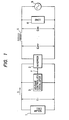
- Fig. 1 is a block diagram of one embodiment of this invention.
- a solar cell 1 supplies electric power corresponding to the amount of incident sunlight to an inverter 2.
- a voltage controlled oscillator (VCO) 3 oscillates with a frequency f corresponding to the output voltage Ei of the solar cell 1.
- the aforementioned inverter 2 operates with the aforementioned frequency f and converts the direct current from the solar cell 1 into an alternating current.
- the aforementioned frequency f of the oscillation increases in proportion as the magnitude of the output voltage Ei increases.
- the output (ac) side of the inverter 2 is connected via an inductor 4 to a commercial ac power source 5.
- a load 6 is connected to the output side of the inverter 2 or to the commercial ac power source 5.
- the current li generated by the solar cell 1 is supplied to the inverter 2 and the voltage controlled oscillator 3.
- the terminal voltage of the solar cell 1 is Ei.
- the voltage controlled oscillator 3 generates oscillation with the frequency f and, as the result, the inverter 2 generates an alternating current voltage Einv with the aforementioned frequency f.
- Einv denotes the effective value of fundamental frequency component.
- phase of the ac voltage Einv of the inverter 2 is in advance of that of the ac waveform Eac of the commercial power source 5, the power flows from the inverter 2 side via the inductor 4 to the commercial power source 5 side, effecting power supply from the solar cell 1 to the load 6.
- the output frequency of the inverter 2 is automatically synchronized with the frequency of the commercial power source 5. Now, the principle underlying this automatic synchronization will be described below.
- the voltage controlled oscillator 3 is caused to generate oscillation with the frequency f and the inverter 2 to generate the ac voltage Einv with the fundamental frequency f. It is further assumed that the phase of the output ac voltage Einv of the inverter 2 is in advance of that of the commercial power source 5 and, as the result, the power is flowing from the solar cell 1 side via the inductor 4 to the commercial power source side 5.
- the oscillation frequency f of the voltage controlled oscillator 3 tends to increase proportionally.
- the frequency of the output ac of the inverter 2 tends to increase and the phase of the output ac voltage thereof tends to advance, namely the advanced phase angle of the output ac voltage Einv of the inverter 2 relative to the voltage Eac of the commercial power source 5 tends to increase.
- the voltage drop due to the internal resistance of the solar cell 1 decreased effectively to increase the output voltage Ei of the solar cell 1.
- a decrease of the output voltage Ei of the solar cell 1 and the falling ac frequency of the inverter 2 are effectively non-linear.
- the frequency of the output ac voltage Einv of the inverter 2 is automatically retained at a fixed value and synchronized with the frequency of the commercial power source 5 in spite of variation in the amount of incident sunlight reaching the solar cell.
- Fig. 2 shows the relation between the terminal voltage in V (horizontal axis) and the output power in mW (vertical axis) of the solar cell 1, with the amount of incident sunlight or the solar energy in mW/cm 2 as the parameter. It is noted from this graph that the power which can be drawn from the solar cell 1 is naturally increased by the increase of the incident solar energy and is also varied by the terminal voltage.
- the output power increases in proportion as the terminal voltage increases but the output power conversely decreases when the terminal voltage surpasses a certain value.
- this optimum terminal voltage is substantially constant (in the neighborhood of 4 volts) as noted from Fig. 2.
- the maximum power corresponding to the existing amount of incident sunlight can be drawn at all times from the solar cell 1 when the circuit constants of the various parts are selected so as to equalize the output voltage Ei of the solar cell 1 with the aforementioned optimum terminal voltage.
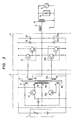
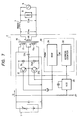
- Fig. 3 is a diagram illustrating a typical circuit of another embodiment of the present invention.
- the same numerical symbols as those of Fig. 1 denote identical or equal component parts of the device.
- primary windings 8, 8a, secondary windings 9,9a, and output windings 10, 10a are coiled.
- the center terminals of the primary windings 8,8a are joined mutually and connected to the positive terminal of the solar cell 1.
- the remaining terminals are connected to the collectors of the corresponding transistors 12,12a.
- the emitters of the aforementioned transistors 12, 12a are joined mutually and connected to the negative terminal of the solar cell 1.
- the bases of the aforementioned transistors 12, 12a are respectively connected to the terminals of the secondary windings 9, 9a.
- the remaining terminals of the secondary windings 9, 9a are mutually joined through their respective series- connected resistors and connected through another resistor to the positive terminal of the solar cell 1.
- the primary windings 8, 8a, secondary windings 9,9a, output windings 10, 10a, transistors 12, 12a, etc. described above make up a well-known Royer's oscillator circuit, which functions in this embodiment as a voltage controlled oscillator 3.
- Capacitors 23, 23a are serially connected between the positive and negative terminals of the solar cell 1.
- Diodes 24, 24a are serially connected in a reversely polarized manner between the positive and negative terminals of the solar cell 1.
- Transistors 21, 21 a are each formed of a Darling- ton transistor and are connected in reverse parallelism to the aforementioned diodes 24, 24a.
- the bases and emitters of the aforementioned transistors 21, 21 a are respectively connected to the opposite terminals of the output windings 10, 10a.
- the node of the aforementioned diodes 24, 24a is connected via the inductor 4 to one of the input terminals of the output transformer 16.
- the node of the aforementioned capacitors 23, 23a is connected to the other input terminal of the aforementioned output transformer 16 and one terminal of the commercial power source 5.
- the other terminal of the commercial power source 5 is connected to the output terminal of the output transformer 16.
- the transistors 21, 21a, capacitors 23, 23a and diodes 24, 24a mentioned above make up a half bridge inverter 2.
- either of the transistors 12,12a is turned on.
- a primary current flows through a circuit of solar cell 1 primary winding 8 - transistor 12 ⁇ solar cell 1, inducing a voltage in the secondary windings 9,9a.
- the voltage of the secondary winding 9 confers a forward bias upon the transistor 12 and the voltage of the secondary winding 9a confers a reverse bias upon the transistor 12a. As the result, there is generated a so-called positive feedback action, which induces abrupt saturation of the transistor 12.
- the core 7 is excited by the current flowing through the primary winding.
- the voltage of the secondary winding 9 is extinguished and the positive bias of the base current of the transistor 12 is lowered to 0, with the result that the transistor 12 is shut off.
- the magnetic flux of the core begins to decrease.
- a voltage of reversed polarity is induced in the secondary windings 9,9a and a forward bias is applied to the transistor 12a.
- a primary current flows through a circuit of solar cell 1 ⁇ primary winding 8a ⁇ transistor 12a solar cell 1.
- the transistor 12a is saturated in due course of time and the core 7 is excited so that the magnetic flux of the core 7 is saturated in the reverse direction.
- the transistors 21, 21a alternately assume the status of forward bias.
- the capacitors 23, 23a are charged by means of the solar cell 1.
- the transistor 21 is turned on, therefore, the charge of the capacitor 23 is released through a path of capacitor 23 ⁇ transistor 21 ⁇ inductor 4 ⁇ output transformer 16-j capacitor 23.
- the rate of saturation of the transistors 12, 12a and that of the saturable core 7 in the voltage controlled oscillator 3 depend on the voltage of the solar cell 1. In other words, the saturation rates increase with the increasing magnitude of the voltage of the solar cell 1.
- the Royer's oscillator satisfactorily fulfils its function as the voltage controlled oscillator 3. The same operation and effect as described with reference to Fig. 1 can be attained by the circuit of Fig. 3.
- Fig. 4 is a graph of the data obtained in an operation of the embodiment of Fig. 3, except that a power source unit formed by series connection of a battery of 64V and a variable resistor as internal resistance to serve as a model simulating the solar cell 1. Specifically, the graph shows the variations of output voltage (Ei), output power (P), and conversion efficiency ( ⁇ ) as caused by varying the internal resistance and consequently the output current li in the model.
- the inductance of the inductor 4 is fixed at 30 mH and the voltage of the commercial power source 5 and the output ac voltage of the inverter 2 are fixed at 27 V.
- theterminal voltage is retained substantially constant at 60 V and the conversion efficiency is as high as about 90%.
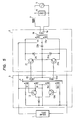
- Fig. 5 is a diagram of a typical circuit of another embodiment of this invention.
- the same numerical signs as those found in Fig. 3 denote identical or equal component parts.
- the terminals of the output windings 10, 10a are mutually joined and the remaining terminals thereof are connected to the bases of the transistors 21, 21a.
- the common node of the aforementioned output windings 10, 10a is connected to the emitters of the transistors 21, 21a and to the negative terminal of the solar cell 1 and one of the terminals of the capacitor 23c.
- the diodes 24, 24a are connected in reverse polarity.
- the collectors of the transistors 21, 21a are connected respectively to the terminals of the primary windings 17, 17a of the output transformer 16.
- the remaining terminals of the primary windings 17, 17a of the aforementioned output transformer 16 are mutually joined and the node is connected to the positive terminal of the solar cell 1 and the remaining terminal of the capacitor 23c.
- the secondary winding 18 of the output transformer 16 is connected via the inductor 4 to the commercial power source 5.
- the transistors 21 and 21a are alternately turned on in much the same manner as in the embodiment of Fig. 3.
- an alternating current is generated in a secondary winding 18 and is fed via the inductor 4 to the load 6 and the commercial power source 5.
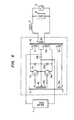
- Fig. 6 is a diagram of a typical circuit of yet another embodiment of the present invention.
- the same numerical signs as those found in Fig. 5 denote identical or equal component parts.
- the transistor 21 If the transistor 21 is turned on, the current from the solar cell 1 and the discharge current by the charge accumulated in the capacitor 23c are caused to flow through the primary winding 17 and the transistor 21.
- the voltage induced in the tertiary winding 19 is applied to the feedback winding 19a.
- the voltages induced in the output windings 10, 10a by the feedback winding 19a give a forward bias upon the transistor 21 and a reverse bias upon the transistor 21a.
- the voltage of the output winding 10 is extinguished and the base current of the transistor 21 is reduced to 0, with the result that the transistor 21 is shut off. Since the magnetic flux of the saturable core 7 consequently begins to decrease, a voltage of reverse polarity is induced in the output windings 10, 10a.
- the transistor 21a assumes a forward bias and the transistor 21 a reverse bias.
- the transistor 21 a is turned on to start flow of the current from the primary winding 17a through the transistor 21 a.
- the transistor 21a a is saturated in this time and the saturable core 7 is excited so that the magnetic flux of the core 7 is saturated in a reverse direction.
- the two transistors 21 and 21 a are alternately turned on, with the result that a primary current is supplied to the primary windings 17, 17a and an alternating current (rectangular waveform) is generated in the secondary winding 18.
- This alternating current is filtered by the inductor 4 and supplied to the commercial power source 5 and to the load 6.
- the foregoing embodiments have been invariably described on the assumption that the operating frequency of the inverter, namely the output frequency f of the voltage controlled oscillator 3, is substantially equal to the fundamental frequency of the ac output of the inverter 2 or the frequency of the commercial power source 5.
- a PWM (pulse width modulation) inverter may be used as the inverter 2 of this invention.
- Fig. 7 is a block diagram of yet another embodiment of this invention involving the use of a PWM inverter.
- the same numerical symbols as those of Fig. 5 denote identical or equal component parts.
- the voltage controlled oscillator 3A generates oscillation with a frequency which is an integral multiple of the frequency of the commercial power source 5.
- An address counter 32 serves to take count of the output pulses of the voltage controlled oscillator 3A and gives the counted value as an address signal to a ROM (read only memory) 34.
- the ROM 34 issues the output of "1" or "0” corresponding to the sine wave in accordance with the aforementioned address signal. By the aforementioned output "1” or "0”, one of the transistors 21, 21a is turned ON and the other transistor OFF respectively. In this configuration, the inverter output Einv to be obtained is free from higher harmonics.
- the present invention has been described as used in the form of a power source for an ac load.
- this invention can be applied to a dc load.
- the given dc load may, for example, be connected directly to the solar cell 1.
- the excess power is transmitted to the commercial power source 5 side as described above.
- the supplement of dc current is fed from the commercial power source 5 via the inverter 2 to the dc load because the inverter 2 functions as a rectifier (or ac-to-dc converter). Consequently, the terminal voltage of the solar cell 1 is retained substantially constant.
Landscapes
- Engineering & Computer Science (AREA)
- Power Engineering (AREA)
- Life Sciences & Earth Sciences (AREA)
- Sustainable Development (AREA)
- Sustainable Energy (AREA)
- Physics & Mathematics (AREA)
- Electromagnetism (AREA)
- General Physics & Mathematics (AREA)
- Radar, Positioning & Navigation (AREA)
- Automation & Control Theory (AREA)
- Inverter Devices (AREA)
- Control Of Electrical Variables (AREA)
Claims (3)
Applications Claiming Priority (2)
| Application Number | Priority Date | Filing Date | Title |
|---|---|---|---|
| JP186011/83 | 1983-10-06 | ||
| JP58186011A JPS6079417A (ja) | 1983-10-06 | 1983-10-06 | 同期制御手段不要の太陽電池用電力変換装置 |
Publications (2)
| Publication Number | Publication Date |
|---|---|
| EP0140149A1 EP0140149A1 (de) | 1985-05-08 |
| EP0140149B1 true EP0140149B1 (de) | 1990-12-12 |
Family
ID=16180812
Family Applications (1)
| Application Number | Title | Priority Date | Filing Date |
|---|---|---|---|
| EP84111325A Expired - Lifetime EP0140149B1 (de) | 1983-10-06 | 1984-09-22 | Leistungsumwandlungsvorrichtung für Solarzelle |
Country Status (6)
| Country | Link |
|---|---|
| US (1) | US4626983A (de) |
| EP (1) | EP0140149B1 (de) |
| JP (1) | JPS6079417A (de) |
| AU (1) | AU565171B2 (de) |
| CA (1) | CA1227535A (de) |
| DE (1) | DE3483744D1 (de) |
Families Citing this family (113)
| Publication number | Priority date | Publication date | Assignee | Title |
|---|---|---|---|---|
| US4636931A (en) * | 1985-06-28 | 1987-01-13 | Shikoku Denryoku Kabushiki Kaisha | Photovoltaic power control system |
| WO1987000312A1 (en) * | 1985-07-11 | 1987-01-15 | Allan Russell Jones | Electronic control circuit |
| US4750102A (en) * | 1986-03-20 | 1988-06-07 | Sanyo Electric Co., Ltd. | Power converting apparatus |
| GB2189097A (en) * | 1986-04-07 | 1987-10-14 | Powamate Ltd | Solar power systems |
| ES2003363A6 (es) * | 1986-10-02 | 1988-11-01 | Gh Ind Sa | Perfeccionamientos en generadores de alta frecuencia para aplicaciones de calentamiento por induccion laser plasma y similares |
| US4727470A (en) * | 1986-10-10 | 1988-02-23 | Nilssen Ole K | Resonant inverter having crest factor control |
| US4871959A (en) * | 1988-07-15 | 1989-10-03 | Gali Carl E | Solar trickle charger for lead acid batteries |
| US5063341A (en) * | 1990-10-16 | 1991-11-05 | Gali Carl E | Lead acid battery rejuvenator and charger |
| US5262756A (en) * | 1991-03-15 | 1993-11-16 | Chien Tseng L | Solar powered warning light |
| US5276393A (en) * | 1992-06-10 | 1994-01-04 | Gali Carl E | Solar radiation powered battery reclaimer and charger |
| GB2271478A (en) * | 1992-10-12 | 1994-04-13 | Central Research Lab Ltd | Converter circuit arrangement |
| JP2771096B2 (ja) * | 1993-06-11 | 1998-07-02 | キヤノン株式会社 | 電力制御装置、電力制御方法及び電力発生装置 |
| US5525892A (en) * | 1993-08-24 | 1996-06-11 | Pulse Charge Systems, Inc. | Pulsed battery rejuvenator having variable trailing edge shaped pulses |
| JPH0795774A (ja) * | 1993-09-20 | 1995-04-07 | Asia Denshi Kogyo Kk | 低ノイズコンバータ |
| JP2810630B2 (ja) * | 1993-11-16 | 1998-10-15 | キヤノン株式会社 | 太陽電池の電力制御装置、電力制御システム、電力制御方法及び電圧電流出力特性の測定方法 |
| US5822200A (en) * | 1997-04-21 | 1998-10-13 | Nt International, Inc. | Low level, high efficiency DC/DC converter |
| US6738275B1 (en) * | 1999-11-10 | 2004-05-18 | Electromed Internationale Ltee. | High-voltage x-ray generator |
| US8571179B2 (en) | 1999-11-10 | 2013-10-29 | Robert Beland | Computed tomography systems |
| US6184650B1 (en) | 1999-11-22 | 2001-02-06 | Synergistic Technologies, Inc. | Apparatus for charging and desulfating lead-acid batteries |
| US6367259B1 (en) * | 2000-02-15 | 2002-04-09 | Miguel A. Timm | Battery-less solar power system |
| US8067855B2 (en) * | 2003-05-06 | 2011-11-29 | Enecsys Limited | Power supply circuits |
| ATE445254T1 (de) | 2003-05-06 | 2009-10-15 | Enecsys Ltd | Stromversorgungsschaltungen |
| DE602005009510D1 (de) * | 2004-03-05 | 2008-10-16 | Koninkl Philips Electronics Nv | Lampentreiber mit solarzellen |
| US7352549B1 (en) * | 2004-11-05 | 2008-04-01 | Sma Technologie Ag | Method of automatically recognizing an electrical system |
| GB2415841B (en) | 2004-11-08 | 2006-05-10 | Enecsys Ltd | Power conditioning unit |
| US7193872B2 (en) * | 2005-01-28 | 2007-03-20 | Kasemsan Siri | Solar array inverter with maximum power tracking |
| US20070000535A1 (en) * | 2005-06-30 | 2007-01-04 | Intel Corporation | Integrated energy conversion |
| US10693415B2 (en) | 2007-12-05 | 2020-06-23 | Solaredge Technologies Ltd. | Testing of a photovoltaic panel |
| US11881814B2 (en) | 2005-12-05 | 2024-01-23 | Solaredge Technologies Ltd. | Testing of a photovoltaic panel |
| GB2454389B (en) | 2006-01-13 | 2009-08-26 | Enecsys Ltd | Power conditioning unit |
| US8405367B2 (en) | 2006-01-13 | 2013-03-26 | Enecsys Limited | Power conditioning units |
| AU2007229854B2 (en) * | 2006-03-23 | 2011-02-03 | Enphase Energy, Inc. | Method and apparatus for converting direct current to alternating current |
| US9436198B2 (en) | 2006-03-23 | 2016-09-06 | Enphase Energy, Inc. | Method and apparatus for power conversion |
| US9461552B2 (en) | 2006-03-23 | 2016-10-04 | Enphase Energy, Inc. | Method and apparatus for power conversion |
| US12316274B2 (en) | 2006-12-06 | 2025-05-27 | Solaredge Technologies Ltd. | Pairing of components in a direct current distributed power generation system |
| US11569659B2 (en) | 2006-12-06 | 2023-01-31 | Solaredge Technologies Ltd. | Distributed power harvesting systems using DC power sources |
| US8384243B2 (en) | 2007-12-04 | 2013-02-26 | Solaredge Technologies Ltd. | Distributed power harvesting systems using DC power sources |
| US8963369B2 (en) | 2007-12-04 | 2015-02-24 | Solaredge Technologies Ltd. | Distributed power harvesting systems using DC power sources |
| US11296650B2 (en) | 2006-12-06 | 2022-04-05 | Solaredge Technologies Ltd. | System and method for protection during inverter shutdown in distributed power installations |
| US8319483B2 (en) | 2007-08-06 | 2012-11-27 | Solaredge Technologies Ltd. | Digital average input current control in power converter |
| US9088178B2 (en) | 2006-12-06 | 2015-07-21 | Solaredge Technologies Ltd | Distributed power harvesting systems using DC power sources |
| US11687112B2 (en) | 2006-12-06 | 2023-06-27 | Solaredge Technologies Ltd. | Distributed power harvesting systems using DC power sources |
| US8473250B2 (en) | 2006-12-06 | 2013-06-25 | Solaredge, Ltd. | Monitoring of distributed power harvesting systems using DC power sources |
| US8816535B2 (en) | 2007-10-10 | 2014-08-26 | Solaredge Technologies, Ltd. | System and method for protection during inverter shutdown in distributed power installations |
| US11888387B2 (en) | 2006-12-06 | 2024-01-30 | Solaredge Technologies Ltd. | Safety mechanisms, wake up and shutdown methods in distributed power installations |
| US8947194B2 (en) | 2009-05-26 | 2015-02-03 | Solaredge Technologies Ltd. | Theft detection and prevention in a power generation system |
| US9112379B2 (en) | 2006-12-06 | 2015-08-18 | Solaredge Technologies Ltd. | Pairing of components in a direct current distributed power generation system |
| US9130401B2 (en) | 2006-12-06 | 2015-09-08 | Solaredge Technologies Ltd. | Distributed power harvesting systems using DC power sources |
| US8618692B2 (en) | 2007-12-04 | 2013-12-31 | Solaredge Technologies Ltd. | Distributed power system using direct current power sources |
| US11735910B2 (en) | 2006-12-06 | 2023-08-22 | Solaredge Technologies Ltd. | Distributed power system using direct current power sources |
| US8013472B2 (en) | 2006-12-06 | 2011-09-06 | Solaredge, Ltd. | Method for distributed power harvesting using DC power sources |
| US11855231B2 (en) | 2006-12-06 | 2023-12-26 | Solaredge Technologies Ltd. | Distributed power harvesting systems using DC power sources |
| US11309832B2 (en) | 2006-12-06 | 2022-04-19 | Solaredge Technologies Ltd. | Distributed power harvesting systems using DC power sources |
| US8319471B2 (en) | 2006-12-06 | 2012-11-27 | Solaredge, Ltd. | Battery power delivery module |
| WO2009051853A1 (en) | 2007-10-15 | 2009-04-23 | And, Llc | Systems for highly efficient solar power |
| CA2693109A1 (en) * | 2007-07-16 | 2009-01-22 | Enphase Energy, Inc. | Method and apparatus for anti-islanding of distributed power generation systems |
| WO2009055474A1 (en) | 2007-10-23 | 2009-04-30 | And, Llc | High reliability power systems and solar power converters |
| WO2009072076A2 (en) | 2007-12-05 | 2009-06-11 | Solaredge Technologies Ltd. | Current sensing on a mosfet |
| WO2009072075A2 (en) | 2007-12-05 | 2009-06-11 | Solaredge Technologies Ltd. | Photovoltaic system power tracking method |
| WO2009073867A1 (en) | 2007-12-05 | 2009-06-11 | Solaredge, Ltd. | Parallel connected inverters |
| EP2232663B2 (de) | 2007-12-05 | 2021-05-26 | Solaredge Technologies Ltd. | Sicherheitsmechanismen, aufweck- und herunterfahrverfahren in verteilten strominstallationen |
| US11264947B2 (en) | 2007-12-05 | 2022-03-01 | Solaredge Technologies Ltd. | Testing of a photovoltaic panel |
| EP2235807B1 (de) | 2007-12-20 | 2019-05-08 | SolarCity Corporation | Netzsynchronisierung |
| US8157405B1 (en) | 2008-02-15 | 2012-04-17 | Steven Eric Schlanger | Traffic barricade light |
| EP2269290B1 (de) | 2008-03-24 | 2018-12-19 | Solaredge Technologies Ltd. | Schaltwandler mit einer aktiven klemmung zur erzielung von nullspannungsschaltung |
| WO2009136358A1 (en) | 2008-05-05 | 2009-11-12 | Solaredge Technologies Ltd. | Direct current power combiner |
| JP2011521735A (ja) * | 2008-05-30 | 2011-07-28 | コロラド ステート ユニバーシティ リサーチ ファンデーション | プラズマを発生させるためのシステム、方法、および装置 |
| US8378656B2 (en) * | 2008-09-19 | 2013-02-19 | General Electric Company | Quasi-AC, photovoltaic module for unfolder photovoltaic inverter |
| WO2010077977A1 (en) * | 2008-12-17 | 2010-07-08 | 4 Front Engineered Solutions, Inc. | Alternative power operation of loading docks and loading dock equipment |
| US9442504B2 (en) | 2009-04-17 | 2016-09-13 | Ampt, Llc | Methods and apparatus for adaptive operation of solar power systems |
| WO2011049985A1 (en) | 2009-10-19 | 2011-04-28 | Ampt, Llc | Novel solar panel string converter topology |
| US12418177B2 (en) | 2009-10-24 | 2025-09-16 | Solaredge Technologies Ltd. | Distributed power system using direct current power sources |
| TWI422136B (zh) | 2010-10-08 | 2014-01-01 | Ind Tech Res Inst | 應用於太陽光電交流模組直流轉交流換器之電路模組 |
| US10673222B2 (en) | 2010-11-09 | 2020-06-02 | Solaredge Technologies Ltd. | Arc detection and prevention in a power generation system |
| US10673229B2 (en) | 2010-11-09 | 2020-06-02 | Solaredge Technologies Ltd. | Arc detection and prevention in a power generation system |
| US10230310B2 (en) | 2016-04-05 | 2019-03-12 | Solaredge Technologies Ltd | Safety switch for photovoltaic systems |
| GB2485527B (en) | 2010-11-09 | 2012-12-19 | Solaredge Technologies Ltd | Arc detection and prevention in a power generation system |
| GB2486408A (en) | 2010-12-09 | 2012-06-20 | Solaredge Technologies Ltd | Disconnection of a string carrying direct current |
| GB2496140B (en) | 2011-11-01 | 2016-05-04 | Solarcity Corp | Photovoltaic power conditioning units |
| GB2483317B (en) | 2011-01-12 | 2012-08-22 | Solaredge Technologies Ltd | Serially connected inverters |
| GB2485423B (en) | 2011-01-18 | 2014-06-04 | Enecsys Ltd | Solar photovoltaic systems |
| GB2487368B (en) | 2011-01-18 | 2012-12-05 | Enecsys Ltd | Inverters |
| US8570005B2 (en) | 2011-09-12 | 2013-10-29 | Solaredge Technologies Ltd. | Direct current link circuit |
| GB2496139B (en) | 2011-11-01 | 2016-05-04 | Solarcity Corp | Photovoltaic power conditioning units |
| GB2496163B (en) | 2011-11-03 | 2015-11-11 | Enecsys Ltd | Transformer construction |
| GB2497275A (en) | 2011-11-25 | 2013-06-12 | Enecsys Ltd | Modular adjustable power factor renewable energy inverter system |
| GB2498365A (en) | 2012-01-11 | 2013-07-17 | Solaredge Technologies Ltd | Photovoltaic module |
| GB2498790A (en) | 2012-01-30 | 2013-07-31 | Solaredge Technologies Ltd | Maximising power in a photovoltaic distributed power system |
| US9853565B2 (en) | 2012-01-30 | 2017-12-26 | Solaredge Technologies Ltd. | Maximized power in a photovoltaic distributed power system |
| GB2498791A (en) | 2012-01-30 | 2013-07-31 | Solaredge Technologies Ltd | Photovoltaic panel circuitry |
| GB2499991A (en) | 2012-03-05 | 2013-09-11 | Solaredge Technologies Ltd | DC link circuit for photovoltaic array |
| US9379543B2 (en) | 2012-04-10 | 2016-06-28 | Sol Chip Ltd. | Integrated circuit energy harvester |
| US10115841B2 (en) | 2012-06-04 | 2018-10-30 | Solaredge Technologies Ltd. | Integrated photovoltaic panel circuitry |
| US9941813B2 (en) | 2013-03-14 | 2018-04-10 | Solaredge Technologies Ltd. | High frequency multi-level inverter |
| US9548619B2 (en) | 2013-03-14 | 2017-01-17 | Solaredge Technologies Ltd. | Method and apparatus for storing and depleting energy |
| EP3506370B1 (de) | 2013-03-15 | 2023-12-20 | Solaredge Technologies Ltd. | Bypass-mechanismus |
| US9397497B2 (en) | 2013-03-15 | 2016-07-19 | Ampt, Llc | High efficiency interleaved solar power supply system |
| US9882507B2 (en) | 2013-04-16 | 2018-01-30 | Solarcity Corporation | Power factor adjustment in multi-phase power system |
| US9318974B2 (en) | 2014-03-26 | 2016-04-19 | Solaredge Technologies Ltd. | Multi-level inverter with flying capacitor topology |
| US10081504B2 (en) | 2014-05-02 | 2018-09-25 | Assa Abloy Entrance Systems Ab | Systems and methods for automatically controlling loading dock equipment |
| US11234581B2 (en) | 2014-05-02 | 2022-02-01 | Endochoice, Inc. | Elevator for directing medical tool |
| US20170093382A1 (en) * | 2015-09-29 | 2017-03-30 | E-Gen Gmbh | Apparatus comprising an oscillator circuit, use of such an apparatus in a radiation field as well as method for operating such an apparatus in a radiation field |
| US12057807B2 (en) | 2016-04-05 | 2024-08-06 | Solaredge Technologies Ltd. | Chain of power devices |
| US11018623B2 (en) | 2016-04-05 | 2021-05-25 | Solaredge Technologies Ltd. | Safety switch for photovoltaic systems |
| US11177663B2 (en) | 2016-04-05 | 2021-11-16 | Solaredge Technologies Ltd. | Chain of power devices |
| US11305953B2 (en) | 2016-05-03 | 2022-04-19 | Assa Abloy Entrance Systems Ab | Control systems for operation of loading dock equipment, and associated methods of manufacture and use |
| US11225824B2 (en) | 2016-05-03 | 2022-01-18 | Assa Abloy Entrance Systems Ab | Control systems for operation of loading dock equipment, and associated methods of manufacture and use |
| US10878386B2 (en) | 2018-11-26 | 2020-12-29 | Assa Abloy Entrance Systems Ab | Systems and methods for automated dock station servicing |
| US10494205B1 (en) | 2018-12-06 | 2019-12-03 | Assa Abloy Entrance Systems Ab | Remote loading dock authorization systems and methods |
| US11142413B2 (en) | 2019-01-28 | 2021-10-12 | Assa Abloy Entrance Systems Ab | Systems and methods for automated loading and unloading at a dock station |
| US11262747B2 (en) | 2019-06-11 | 2022-03-01 | Assa Abloy Entrance Systems Ab | Vehicle identification and guidance systems and associated methods |
| AU2022303567A1 (en) | 2021-07-02 | 2024-01-04 | Assa Abloy Entrance Systems Ab | Powered trailer systems |
| US12400175B2 (en) | 2021-11-30 | 2025-08-26 | Assa Abloy Entrance Systems Ab | Trailer validation systems |
Family Cites Families (6)
| Publication number | Priority date | Publication date | Assignee | Title |
|---|---|---|---|---|
| DE2903559A1 (de) * | 1979-01-31 | 1980-12-18 | Eckhard Kienscherf | Solargenerator-leistungsadapter |
| DE2915222C3 (de) * | 1979-04-14 | 1981-12-17 | Licentia Patent-Verwaltungs-Gmbh, 6000 Frankfurt | Einrichtung zur kontinuierlichen Wechselstromversorgung von Verbrauchern |
| US4375662A (en) * | 1979-11-26 | 1983-03-01 | Exxon Research And Engineering Co. | Method of and apparatus for enabling output power of solar panel to be maximized |
| DE3144694A1 (de) * | 1981-11-06 | 1983-05-19 | Licentia Patent-Verwaltungs-Gmbh, 6000 Frankfurt | "verfahren zum betrieb eines photovoltaischen generators" |
| US4404472A (en) * | 1981-12-28 | 1983-09-13 | General Electric Company | Maximum power control for a solar array connected to a load |
| JPS5932369A (ja) * | 1982-08-11 | 1984-02-21 | Sanyo Electric Co Ltd | インバ−タ装置 |
-
1983
- 1983-10-06 JP JP58186011A patent/JPS6079417A/ja active Granted
-
1984
- 1984-09-22 DE DE8484111325T patent/DE3483744D1/de not_active Expired - Fee Related
- 1984-09-22 EP EP84111325A patent/EP0140149B1/de not_active Expired - Lifetime
- 1984-09-24 AU AU33450/84A patent/AU565171B2/en not_active Ceased
- 1984-09-26 CA CA000464085A patent/CA1227535A/en not_active Expired
- 1984-09-26 US US06/654,858 patent/US4626983A/en not_active Expired - Lifetime
Non-Patent Citations (1)
| Title |
|---|
| Photovoltaic Solar Energy Conference, Berlin, W. Germany, April 23-26 1979, pp. 1038-1046, C. Franx: "A New Approach to Solar Pump Systems using Submersible Motors" * |
Also Published As
| Publication number | Publication date |
|---|---|
| AU565171B2 (en) | 1987-09-10 |
| JPH0563811B2 (de) | 1993-09-13 |
| CA1227535A (en) | 1987-09-29 |
| DE3483744D1 (de) | 1991-01-24 |
| EP0140149A1 (de) | 1985-05-08 |
| US4626983A (en) | 1986-12-02 |
| JPS6079417A (ja) | 1985-05-07 |
| AU3345084A (en) | 1985-04-18 |
Similar Documents
| Publication | Publication Date | Title |
|---|---|---|
| EP0140149B1 (de) | Leistungsumwandlungsvorrichtung für Solarzelle | |
| JP5081596B2 (ja) | 電力供給システム | |
| CN100573400C (zh) | 3-相太阳能变换器电路和方法 | |
| US20050057214A1 (en) | Systems and methods for generating renewable energy | |
| US20050057215A1 (en) | Systems and methods for charging a battery | |
| KR101116428B1 (ko) | 에너지 저장 시스템 | |
| CN110021955B (zh) | 集成储能功能的光伏发电系统及动态平衡电能的方法 | |
| US20130039104A1 (en) | Bidirectional multimode power converter | |
| JPS62200668A (ja) | 蓄電装置 | |
| KR20040014328A (ko) | 전력변환장치 및 발전장치 | |
| Kusmantoro | Enhancement DC Microgrid Power Stability With a Centralized | |
| US11811329B2 (en) | Remotely programmable multi mode bidirectional power converter | |
| CN216086237U (zh) | 一种小功率风光互补电源 | |
| Priyatharshini et al. | Power management by using multiport Dc-Dc converter for renewable energy | |
| Amudhavalli et al. | Quadratic boost converter with integrated energy storage using pi controller for low power photovoltaic applications | |
| US7539029B2 (en) | 3-phase solar converter circuit and method | |
| CN116646910B (zh) | 一种基于共享母线电压控制能量流动的方法 | |
| CN203826988U (zh) | 用于储能型光伏并网系统的光伏逆变器 | |
| SHOME | HYBRID INVERTER WITH SOLAR BATTERY CHARGER | |
| Vasugi et al. | Sholar charged stand alone inverter | |
| Nanda et al. | Control of a Two-Stage Multiple Photovoltaic and Central BES Based Microgrid | |
| US5798671A (en) | Charge coupled, silicon controlled power supply/battery charger | |
| Chakraborty et al. | State of Charge Based Active Power Sharing Control Between Two Battery Energy Storage Units and Solar PV Array Based Standalone System | |
| Bose | Closed loop control of high step up converter with focus on photovoltaic systems | |
| JP3164343U (ja) | 無損失dc−dc変換器 |
Legal Events
| Date | Code | Title | Description |
|---|---|---|---|
| PUAI | Public reference made under article 153(3) epc to a published international application that has entered the european phase |
Free format text: ORIGINAL CODE: 0009012 |
|
| 17P | Request for examination filed |
Effective date: 19841227 |
|
| AK | Designated contracting states |
Designated state(s): DE FR GB |
|
| 17Q | First examination report despatched |
Effective date: 19871214 |
|
| GRAA | (expected) grant |
Free format text: ORIGINAL CODE: 0009210 |
|
| AK | Designated contracting states |
Kind code of ref document: B1 Designated state(s): DE FR GB |
|
| REF | Corresponds to: |
Ref document number: 3483744 Country of ref document: DE Date of ref document: 19910124 |
|
| ET | Fr: translation filed | ||
| PLBE | No opposition filed within time limit |
Free format text: ORIGINAL CODE: 0009261 |
|
| STAA | Information on the status of an ep patent application or granted ep patent |
Free format text: STATUS: NO OPPOSITION FILED WITHIN TIME LIMIT |
|
| 26N | No opposition filed | ||
| PGFP | Annual fee paid to national office [announced via postgrant information from national office to epo] |
Ref country code: GB Payment date: 19990816 Year of fee payment: 16 |
|
| PGFP | Annual fee paid to national office [announced via postgrant information from national office to epo] |
Ref country code: FR Payment date: 19990817 Year of fee payment: 16 |
|
| PGFP | Annual fee paid to national office [announced via postgrant information from national office to epo] |
Ref country code: DE Payment date: 19990917 Year of fee payment: 16 |
|
| PG25 | Lapsed in a contracting state [announced via postgrant information from national office to epo] |
Ref country code: GB Free format text: LAPSE BECAUSE OF NON-PAYMENT OF DUE FEES Effective date: 20000922 |
|
| GBPC | Gb: european patent ceased through non-payment of renewal fee |
Effective date: 20000922 |
|
| PG25 | Lapsed in a contracting state [announced via postgrant information from national office to epo] |
Ref country code: FR Free format text: LAPSE BECAUSE OF NON-PAYMENT OF DUE FEES Effective date: 20010531 |
|
| PG25 | Lapsed in a contracting state [announced via postgrant information from national office to epo] |
Ref country code: DE Free format text: LAPSE BECAUSE OF NON-PAYMENT OF DUE FEES Effective date: 20010601 |
|
| REG | Reference to a national code |
Ref country code: FR Ref legal event code: ST |