EP0139620A2 - Verfahren und Vorrichtung zur Bildung von gedehnten elastischen Elementen aus einem kontinuierlichen elastischen Band,insbesondere für die Herstellung von Hygieneartikeln wie Wegwerfwindeln o. dgl. - Google Patents
Verfahren und Vorrichtung zur Bildung von gedehnten elastischen Elementen aus einem kontinuierlichen elastischen Band,insbesondere für die Herstellung von Hygieneartikeln wie Wegwerfwindeln o. dgl. Download PDFInfo
- Publication number
- EP0139620A2 EP0139620A2 EP84830272A EP84830272A EP0139620A2 EP 0139620 A2 EP0139620 A2 EP 0139620A2 EP 84830272 A EP84830272 A EP 84830272A EP 84830272 A EP84830272 A EP 84830272A EP 0139620 A2 EP0139620 A2 EP 0139620A2
- Authority
- EP
- European Patent Office
- Prior art keywords
- web
- clamping element
- velocity
- drum
- movable
- Prior art date
- Legal status (The legal status is an assumption and is not a legal conclusion. Google has not performed a legal analysis and makes no representation as to the accuracy of the status listed.)
- Granted
Links
Images

Classifications
-
- A—HUMAN NECESSITIES
- A61—MEDICAL OR VETERINARY SCIENCE; HYGIENE
- A61F—FILTERS IMPLANTABLE INTO BLOOD VESSELS; PROSTHESES; DEVICES PROVIDING PATENCY TO, OR PREVENTING COLLAPSING OF, TUBULAR STRUCTURES OF THE BODY, e.g. STENTS; ORTHOPAEDIC, NURSING OR CONTRACEPTIVE DEVICES; FOMENTATION; TREATMENT OR PROTECTION OF EYES OR EARS; BANDAGES, DRESSINGS OR ABSORBENT PADS; FIRST-AID KITS
- A61F13/00—Bandages or dressings; Absorbent pads
- A61F13/15—Absorbent pads, e.g. sanitary towels, swabs or tampons for external or internal application to the body; Supporting or fastening means therefor; Tampon applicators
- A61F13/15577—Apparatus or processes for manufacturing
- A61F13/15585—Apparatus or processes for manufacturing of babies' napkins, e.g. diapers
- A61F13/15593—Apparatus or processes for manufacturing of babies' napkins, e.g. diapers having elastic ribbons fixed thereto; Devices for applying the ribbons
-
- Y—GENERAL TAGGING OF NEW TECHNOLOGICAL DEVELOPMENTS; GENERAL TAGGING OF CROSS-SECTIONAL TECHNOLOGIES SPANNING OVER SEVERAL SECTIONS OF THE IPC; TECHNICAL SUBJECTS COVERED BY FORMER USPC CROSS-REFERENCE ART COLLECTIONS [XRACs] AND DIGESTS
- Y10—TECHNICAL SUBJECTS COVERED BY FORMER USPC
- Y10T—TECHNICAL SUBJECTS COVERED BY FORMER US CLASSIFICATION
- Y10T156/00—Adhesive bonding and miscellaneous chemical manufacture
- Y10T156/12—Surface bonding means and/or assembly means with cutting, punching, piercing, severing or tearing
- Y10T156/1317—Means feeding plural workpieces to be joined
- Y10T156/1322—Severing before bonding or assembling of parts
- Y10T156/133—Delivering cut part to indefinite or running length web
-
- Y—GENERAL TAGGING OF NEW TECHNOLOGICAL DEVELOPMENTS; GENERAL TAGGING OF CROSS-SECTIONAL TECHNOLOGIES SPANNING OVER SEVERAL SECTIONS OF THE IPC; TECHNICAL SUBJECTS COVERED BY FORMER USPC CROSS-REFERENCE ART COLLECTIONS [XRACs] AND DIGESTS
- Y10—TECHNICAL SUBJECTS COVERED BY FORMER USPC
- Y10T—TECHNICAL SUBJECTS COVERED BY FORMER US CLASSIFICATION
- Y10T83/00—Cutting
- Y10T83/04—Processes
- Y10T83/0405—With preparatory or simultaneous ancillary treatment of work
- Y10T83/0419—By distorting within elastic limit
- Y10T83/0424—By stretching
-
- Y—GENERAL TAGGING OF NEW TECHNOLOGICAL DEVELOPMENTS; GENERAL TAGGING OF CROSS-SECTIONAL TECHNOLOGIES SPANNING OVER SEVERAL SECTIONS OF THE IPC; TECHNICAL SUBJECTS COVERED BY FORMER USPC CROSS-REFERENCE ART COLLECTIONS [XRACs] AND DIGESTS
- Y10—TECHNICAL SUBJECTS COVERED BY FORMER USPC
- Y10T—TECHNICAL SUBJECTS COVERED BY FORMER US CLASSIFICATION
- Y10T83/00—Cutting
- Y10T83/202—With product handling means
- Y10T83/2092—Means to move, guide, or permit free fall or flight of product
- Y10T83/2183—Product mover including gripper means
- Y10T83/219—Rotating or oscillating product handler
-
- Y—GENERAL TAGGING OF NEW TECHNOLOGICAL DEVELOPMENTS; GENERAL TAGGING OF CROSS-SECTIONAL TECHNOLOGIES SPANNING OVER SEVERAL SECTIONS OF THE IPC; TECHNICAL SUBJECTS COVERED BY FORMER USPC CROSS-REFERENCE ART COLLECTIONS [XRACs] AND DIGESTS
- Y10—TECHNICAL SUBJECTS COVERED BY FORMER USPC
- Y10T—TECHNICAL SUBJECTS COVERED BY FORMER US CLASSIFICATION
- Y10T83/00—Cutting
- Y10T83/323—With means to stretch work temporarily
-
- Y—GENERAL TAGGING OF NEW TECHNOLOGICAL DEVELOPMENTS; GENERAL TAGGING OF CROSS-SECTIONAL TECHNOLOGIES SPANNING OVER SEVERAL SECTIONS OF THE IPC; TECHNICAL SUBJECTS COVERED BY FORMER USPC CROSS-REFERENCE ART COLLECTIONS [XRACs] AND DIGESTS
- Y10—TECHNICAL SUBJECTS COVERED BY FORMER USPC
- Y10T—TECHNICAL SUBJECTS COVERED BY FORMER US CLASSIFICATION
- Y10T83/00—Cutting
- Y10T83/465—Cutting motion of tool has component in direction of moving work
- Y10T83/4766—Orbital motion of cutting blade
- Y10T83/4795—Rotary tool
- Y10T83/483—With cooperating rotary cutter or backup
Definitions
- the present invention relates to a method for forming elastic elements under tension from a continuous elastic web.
- the invention is preferably applied to the manufacture of sanitary products such as, for example, disposable diapers for infants or incontinent adults.
- tensioned elastic elements are fixed along the longitudinal edges of a sheet of impermeable plastics material which constitutes the outer cover of the product, in order to achieve better adherence of the diaper around a user's legs.
- U.S. Patent No. 4, 081, 301 proposes the uniform stretching of a rubber web, the application of adhesive to discrete lengths of this web, and the sticking of this web to a continuous sheet of impermeable plastics material defining the outer cover of the diaper.
- the web is kept under tension until the adhesive sets and is subsequently cut in the regions free from adhesive. As a result of this cutting, the adhesive-free regions stuck to the sheet of plastics material contract and return to the rest condition.
- U.S. Patent No. 4,297,157 discloses a method in which a continuous elastic web is tensioned and clamped between two jaws spaced by a distance greater than the final length of the elastic element it is wished to form. After the piece of web' between the two jaws is separated from the body of the continuous web, the two jaws are brought closer together until they are at a distance corresponding to the final length. Under these conditions, the piece between the two jaws is stuck to a product such as a disposable diaper.
- the main advantage of this method lies in the fact that, before the elastic element can be brought to the length corresponding to the state of tension in which it is applied to the diaper, it is subjected to an initial intense stretching operation ("over-stretching") whereby it is extended to a length typically twice that for the final application. This operation can compromise the elastic characteristics and the integrity of the elastic element, consequently reducing the production yield.
- the object of the present invention is to provide a method the type specified above, which does not have the disadvantages described previously and which can be carried out economically on an industrial scale.
- this object is achieved by virtue of a process of the type specified, characterised in that it includes the steps of:
- the method according to the invention is characterised in that it includes the steps of:
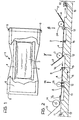
- a disposable absorbent diaper for infants or incontinent adults is generally indicated 1.
- the diaper 1 is constituted essentially by a sheet 2 of impermeable plastics material, for example a polyethylene film having a thickness of 25 - 30 microns.
- an absorbent body 3 of elongate form constituted by a wad of dry ground cellulose or like material.
- the- absorbent body 3 may however have different shapes from that shown in Figure 1, for example an anatomical shape with end parts which are wider than the central area.
- Two elastic strip elements 4 are glued to the sheet 2 along the longer edges of the absorbent body 3.
- the longer sides of the impermeable sheet 2 have central parts which are curved inwardly and define the so-called leg portions of the-diaper,that is, the portions of the edge which will surround a user's legs.
- the elastic elements 4 are supplied to the impermeable sheet 2 in a state of tension; the resilient contraction force they exert causes the diaper 1 to curve into an anatomical bowl shape which helps the flow of physiological liquids to the absorbent body 3.
- the diaper is secured around the user's waist by interconnecting the shorter sides of the impermeable sheet 2 constituting the outer covering of the diaper at their ends by means of the usual adhesive tabs, indicated 5.
- the absorbent body 3 is normally fixed to the impermeable sheet 2 by a further fluid-permeable covering sheet, indicated 6.
- the covering sheet 6, which is intended to come into contact with the user's skin, is preferably made from a nonwoven fabric so as to minimise the irritation resulting from chafing against the user's skin.
- the elastic elements 4 are fixed to the impermeable body 2 by an adhesive strip of hot-melt material, the setting time of which is quick enough to allow the elastic elements 4 to be applied to the impermeable sheet 2 at the high rate used in industrial production.
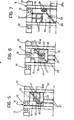
- FIGs 2 to 7 illustrate schematically apparatus for use in the formation of elastic elements 4 in the method of manufacture of the diaper of Figure 1.
- a drum, generally indicated 10 is rotated in a clockwise sense by drive means, not illustrated.
- the outer surface of the drum 10, indicated 11, is illustrated schematically in a rectilinear development in Figure 2.
- First jaws 12 for clamping a web 13 of rubber or similar elastic material to the outer surface of the drum are mounted in equiangularly distributed positions on the outer surface 11 of the drum 10.
- the web 13 is supplied continuously to the drum from a supply source illustrated schematically as a group of motor-driven pulleys or rollers, generally indicated 14.
- the velocity at which the web 13 is supplied from the source 14 may be controlled precisely,in the manner which will be explained in greater detail below.
- the jaws 12, of which there are four, are located at 90° to each other around the perimeter of the drum 10 and may be of any known type, for example of the type illustrated in the U.S. Patent No. 4,297,157 mentioned above.
- the jaws 15 are substantially similar to the jaws 12.
- each of the jaws 15 ( Figures 4 to 7) is mounted on a support carriage 16 which can effect a translational movement along the surface 11 of the drum 10 on profiled sliding guides 17 which are typically arcuate and extend tangentially relative to the drum 10 in planes perpendicular to the axis of the drum 10 itself.
- each jaw 15 can effect a translational movement along the surface 11 of the drum 10 between two extreme positions indicated A and B respectively in Figures 2 and 3.
- FIG 2 which, as mentioned above, shows an ideal linear development of the surface of the drum 10
- a jaw 15 in the first position A is shown on the left-hand side
- two jaws 15 in the second position B are shown in the centre
- a jaw 15 which is returning to the first position A from the position B is shown on the right-hand-side.
- each jaw 15 (movable jaw) is immediately behind the jaw 12 (fixed jaw) preceding it in the direction of movement of the surface 11 of the drum 10.
- each movable jaw 15 is in a position intermediate the fixed jaws 12 between which it is positioned.
- the length of the guides 17, that is,the amplitude of the movement of the movable jaws 15 between the first position A and the second position B, is selected so that, in the second position B, the distance between each movable jaw 15 and the fixed jaw 12 which it follows in the direction of movement of the outer surface 11 of the drum 10 is substantially identical to the length of the tensioned elastic elements to be formed.
- the terms "upstream” and “downstream” are used for the relative positions of the jaws 12 and 15 on the surface 11 of the drum 10, with reference to the direction of movement of the surface acting as a support for the formation of the elastic elements 4. More particularly, of two adjacent jaws which pass successively in front of the group of pulleys 14 which supply the web 13, the first jaw is termed the “upstream” jaw while the other jaw is termed the “downstream” jaw. Hence,with reference to the development of Figure 2, each jaw illustrated in this drawing is “upstream” of the jaws to its left and “downstream” of the jaws to its right.
- Each support carriage 16 has a pair of rollers or bearings 18 beneath it which cooperate with the opposite faces of a rib provided on the radially outer face of a drive carriage 19 underlying it (in a radial direction relative to the drum 10).
- This rib indicated 20 in the drawings, has a generally arcuate course which follows the curvature of the drum 10 and extends in a plane inclined at about 45° to the planes containing the guides 17.
- the rib 20 constitutes a ramp part for causing the translational movement of the support carriage 16 along the guides 17 as a result of the translation of the drive carriage 19 axially relative to the drum 10.
- each drive carriage 19 is movable along straight guides 21 which extend axially relative to the drum 10.
- the reference 22 indicates a horizontal-axis drive shaft on which is rigidly keyed a disc 23(or functionally equivalent element such as a ring) supporting the outer surface 11 of the drum 10 on its free edge.
- This surface is normally constituted by a curved sheet-metal plate possibly treated with a non-stick material, such as a silicone rubber, for reasons which will be better explained below.
- the guides 21 extend between the disc or ring (rotor) 23 and the front surface of the drum 10 in correspondence with which the movable jaws 15 and the fixed jaws 12 aligned therewith act.
- the guides 21 are connected by a stiffening element 24 which is also rotated by the shaft 22.
- Two annular elements, indicated 25 and 26, are fitted onto the drive shaft 22 with the interposition of bearings 27 and 28, but are not free to rotate relative to the shaft 22 itself.
- annular elements 25 and 26 which are rigid with each other, are connected by fixing means, not illustrated, to the support frame of the drum 10, schematically indicated H in Figure 3. These are therefore stationary relative to the drum 10 and may act easily as support elements for the shaft 22.
- the annular elements 25 and 26 have profiled peripheral edges which act as operating cams for the jaws 12, 15 and for the carriages 16 supporting the movable jaws 15.
- the operation (opening-closing) of the jaws 12 and 15 is effected by the movement of movable units 29, one of which is illustrated schematically in Figure 4 and each of which has a feeler roller 30 which rolls on the peripheral edge of the annular element 21 against which it is urged by a spring 31.
- each jaw 12, 15 can receive the web 13 supplied from the supply station 14 or, as will be better seen below, allow the removal of a web piece constituting one of the tensioned elastic elements to be formed from the surface of the drum 10.
- the feeler roller is returned to the drum 10 under the action of the spring 31, the corresponding jaw 12, 15 closes to clamp the web 13 onto the surface of the drum 10.
- the peripheral edge of the annular element 25 comprises two consecutive semicircular portions concentric with the drum 10.
- One of these portions, indicated 25a, has a larger radius and extends in correspondence with the lower half of the circular path of movement of the outer surface of the drum 11 between two angular positions schematically indicated o( and ⁇ in Figure 3.
- the other edge portion of the element 25, indicated 25b extends between the angular positions 0( and ⁇ in correspondence with the upper half of the circular path of movement of the surface of the drum 10.
- the rib 32 which extend in continuity with the outer edges of the annular element 26, includes portions disposed in different orthogonal planes to the drive shaft 22 and inclined portions which connect these portions orthogonal to the shaft 22.
- the rib 32 thus constitutes a cam which controls the axial translational movement of the drive carriages 19 along the guides 21,and consequently the translational movement of the carriages 16 supporting the movable jaws l5,between the positions A and B defined above.
- Figure 6 illustrates a situation in which, as a result of the rotation of the drum 10, the rollers: 33,which are only partially visible in the drawing since they are shown in broken outline engage an inclined portion 32b of the rib 32, that is, a portion of the rib 32 which is moving gradually away from the frontal face of the drum 10. Under these conditions, the drive carriage 19 also moves away from the front surface, while the rollers 18 of the support carriage 16 slide along the rib 20 , gradually drawing the support carriage 16 towards the other end position of its translational movement along the guides 17.
- Figure 7 illustrates a situation in which, as a result of the further rotation of the drum 10, the rollers 33 slidingly engage a further portion of the rib 32, 'indicated 32c, which lies in a plane normal to the axis of rotation of the drum.
- the axial position of this plane relative to the drum 10 is such that the drive carriage 19 driven by the rollers 33 is in the position of maximum withdrawal relative to the frontal face of the drum 10.
- rollers 18 have completed their course of sliding movement along the rib 20, carrying the support carriage 10 and the movable jaw 15 mounted thereon into the travel limit position indicated B.
- ⁇ and ⁇ indicate two further angular positions of the path of rotation of the surface of the drum 10. These angular positions are diametrally opposed in a direction perpendicular to the direction of alignment of the angular positions ⁇ and ⁇ previously defined.
- Figure 2 shows approximately the location of the angular position ⁇ in the rectilinear development of the surface of the drum 10.
- the rib 32 provided on the peripheral edge of the tubular element 26 has a profile such that all the support carriages 16 and their movable jaws 15 are in the first position A in correspondence with the angular position ⁇ , and move gradually towards the second position B during the advance from the angular position ⁇ to the angular position o caused by the rotation of the drum 10.
- Two rollers, indicated 34, are located in positions substantially tangential to the roller 20 in correspondence with this path portion.
- the sheet portion 2 between the rollers 34 adheres to the outer surface 11 of the drum 10 and is drawn thereby as a result of the rotation of the drum itself.
- an adhesive for example a hot-melt adhesive, is applied to the sheet 2 so as to form a firm connection between the sheet 2 and the elastic web pieces 13 which are brought into contact therewith in the manner which will be described more fully below.
- the hot-melt adhesive to the sheet is carried out at a spreading station,not shown in the drawings.
- the hot-melt adhesive may be applied to the elastic web 13 by a spreading device which acts on the elastic web 13 adjacent to the angular position
- This spreading device is illustrated schematically in broken outline and indicated S in Figure 3.
- each diaper 1 has two elastic elements 4 disposed parallel to each other on opposite sides of the absorbent body 3, in its application to the manufacture of these products the apparatus according to the invention includes two structures for forming elastic elements which are identical to each other and operate in parallel.
- the apparatus according to the invention includes two structures for forming elastic elements which are identical to each other and operate in parallel.
- the support carriages 16 and the movable jaws 15 mounted thereon are carried gradually towards the first position A.
- the rib 32 acting as an operating cam for the carriages 16 and 19, is profiled so that the carriages 16 and the jaws 15 remain in the position B until the angular position d is reached, and then turn to the first position A during the advance along the arc of the path of movement of the surface of the drum between the angular position or and the angular position ⁇ , returning to the initial conditions described above.
- a cutting element 35 for example a rotary blade, which acts on the elastic web 13 applied to the surface of the drum 10 in correspondence with the angular position ⁇ . More specifically, the cutting element 35 can act on the web portion 13 between each fixed jaw 12 and the movable jaw 15 downstream of this fixed jaw 12, when the two jaws pass through the angular position 0( as a result of the rotation of the drum 10. As indicated above, under these conditions,the movable jaw 15 is in the first position A.
- the cutting member 35 is intended to section the continuous web 13, cutting tensioned web pieces constituting the elastic elements 4 to be applied to the plastics sheet 2 from the continuous body of the web 13.
- the operation of the apparatus according to the invention is effected by rotating of the drum 10 and operating of the supply source for the web 13 (shown schematically as the rollers 14) and the cutting member 35 simultaneously and continuously.
- the rotation of the drum 10 drives the closing and opening of the jaws 12 and 15,and the reciprocating movement of the jaws 15 between the first position A and the second position B, as explained above.
- the drum 10 has a rotational velocity ⁇ 1 such that the outer surface 11 of the drum 10 moves in a clockwise sense with a tangential velocity V 1 .
- the portion of the rib 32 between the angular positions ⁇ and ⁇ , which acts as a drive cam for the carriages 16 on which the jaws 15 are mounted, has a profile such that the translational movement of the jaws 15 between the position A and the positionB is effected at a velocity V 2 (relative to the surface 11 of the drum 10) which is less than the velocity V 1 of advance imparted to the surface itself as a result of the rotation of the drum 10.
- the translational velocity of the jaws 15 from the first position A to the second position B is in the opposite direction from that of the velocity V 1 , as shown schematically by the respective arrows in Figure 2.
- the superposition of the rotational movement of the drum 10 on the movement of the jaws 15 from the first position A to the second position B means that, while the surface 11 of the drum 10 travels with a tangential velocity V 1 through the arc between the angular position ⁇ and the angular position ⁇ , the jaws 15 mounted thereon have a tangential velocity equal to V 1 - V 2 and thus travel only through a part of this arc.
- the value of the velocity V 2 is chosen so that (see Figure 3) each movable jaw 15 reaches the second position B having left the first position A exactly when the fixed jaw 12 located downstream in the direction of advance of the surface of the drum reaches the angular position in which the cutting member 35 acts.
- the second position B of the movable jaws 15 is chosen so that, in this second position, each movable jaw 15 is in a median position relative to the fixed jaws 12 between which it is positioned.
- the profile of the rib 32 is thus selected so that the value of the velocity V 2 is equal to half the value of the tangential velocity V 1 of the surface of the drum 10.
- each movable jaw 15 stops moving translationally relative to the drum 10 and is drawn thereby at the velocity V 1 .
- V 3 With regard to the supply velocity of the web 13 from the source 14, the velocity indicated V 3 , this is chosen so as to be less than the difference between the tangential velocity V 1 of the surface 11 of the drum 10 and the translational velocity V 2 of the jaws 15 from the first position A to the position B.
- This difference (V 1 - V 2 ) determines the velocity at which each movable jaw 12 passes through the initial portion of the arc between the angular positiondand the angular position intermediate the positions ⁇ and ⁇ at which the jaw 15 itself reaches the second position B.
- V 2 is equal to half V 1 whereby this difference is also equal to half V 1 .
- a value of the web supply velocity is chosen to be less than the velocity difference means that the web 13 is applied to the surface of the drum 10 under tension.
- Figure 2 illustrates the relative positions assumed by a movable jaw 15 and the fixed jaw 12 located downstream thereof in the direction of advance of the surface 11 of the drum when the web 13 is clamped in the movable jaw 15 which is located in the first position A in correspondence with the position ⁇ .
- the web piece 13 which is clamped in the movable jaw 15 corresponds,in fact,to the free end of the web 13 itself in that, immediately upstream of the jaw 15, the cutting member 35 cuts the web 13 to separate a piece of web formed previously in the manner which will now be described.
- the movable jaw 15 starts to move on the surface 11 towards the second position B at a velocity V 2 the value of which, as indicated above, is equal to half the value of the tangential velocity V 1 .
- the end of the web 13 clamped in the jaw 15 advances relative to the source 14, which is stationary, at a velocity equal to the difference V 1 - V 2 , that is, at a velocity equal to half V 1 .
- the web 13 is supplied at a velocity equal to a quarter of V 1 , that is, at a velocity less than the difference V 1 - V 2 .
- the web portion 13 between the movable jaw 1 5 and the source 14 is thus stretched longitudinally, which puts it under tension.
- the movable jaw 15 reaches the position B at half the arc of the path between the angular positions ⁇ and ⁇ exactly when the fixed jaw 12 located downstream. thereof reaches the angular position ⁇ together with a further movable jaw 15 which has just returned to the first position A.
- the fixed jaw 12 and the further movable jaw 15 close on the web supplied by the source 14. Between the fixed jaw 12 and the movable jaws 15 located upstream in positions intermediate the positions ⁇ and there is thus formed a tensioned web piece which can be applied to the sheet 2. This piece is separated from the main body of the web 13 by the cutting member 35 which actson the web portion between the fixed jaw 12 and the further movable jaw located immediately downstream.
- the cutting member 35 thus forms a new free end of the web 13 destined to be drawn at the velocity V1 - V 2 by the further movable jaw during the cycle of formation of a new tensioned elastic piece.
- the tensioned elastic piece which has just been formed advances towards the angular position at a tangential velocity V 1 .
- the piece is stuck to the plastics sheets 2 as an elastic element 4 which can confer elasticity and greater adherence to the diaper.
- At least those portions of the surface 11 of the drum 10 for conveying the web pieces 13 are preferably coated with a resilient material, such as a silicone rubber, in order to facilitate the detachment of the sheet 2 carrying the applied elastic elements 4 from the drum 10 itself.
- a resilient material such as a silicone rubber
- the movable jaw 15 In the end part of the path of movement of the surface 11, between the angular position ⁇ and ⁇ , the movable jaw 15 returns to the first position A to receive the web 13 again and to start a new cycle of formation of an elastic element 4.
- a method and apparatus are thus described which allow the rapid formation of tensioned elastic elements, in a manner which can be achieved practically and economically on an industrial scale, it being possible to stick these tensioned elastic elements to a support such as a sheet of impermeable plastics material forming the outer covering of a sanitary product such as a disposable diaper.
- the invention allows the formation of tensioned elastic elements while avoiding the disadvantages typical of the prior art.
- the elastic elements formed according to the invention can be stuck to an inelastic support avoiding the wastage of material resulting from the formation of tails which will return to the rest condition after application.
Landscapes
- Health & Medical Sciences (AREA)
- Engineering & Computer Science (AREA)
- Animal Behavior & Ethology (AREA)
- General Health & Medical Sciences (AREA)
- Biomedical Technology (AREA)
- Heart & Thoracic Surgery (AREA)
- Vascular Medicine (AREA)
- Life Sciences & Earth Sciences (AREA)
- Manufacturing & Machinery (AREA)
- Epidemiology (AREA)
- Public Health (AREA)
- Veterinary Medicine (AREA)
- Absorbent Articles And Supports Therefor (AREA)
- Treatments Of Macromolecular Shaped Articles (AREA)
- Golf Clubs (AREA)
- Moulding By Coating Moulds (AREA)
Priority Applications (1)
| Application Number | Priority Date | Filing Date | Title |
|---|---|---|---|
| AT84830272T ATE35608T1 (de) | 1983-10-12 | 1984-10-11 | Verfahren und vorrichtung zur bildung von gedehnten elastischen elementen aus einem kontinuierlichen elastischen band,insbesondere fuer die herstellung von hygieneartikeln wie wegwerfwindeln o. dgl. |
Applications Claiming Priority (2)
| Application Number | Priority Date | Filing Date | Title |
|---|---|---|---|
| IT6805283 | 1983-10-12 | ||
| IT68052/83A IT1161511B (it) | 1983-10-12 | 1983-10-12 | Procedimento ed apparecchiatura per la formazione di elementi elastici in tensione a partire da un nastro elastico continuo particolarmente per la fabbricazione di prodotti sanitari quali pannolini mono uso e simili |
Publications (3)
| Publication Number | Publication Date |
|---|---|
| EP0139620A2 true EP0139620A2 (de) | 1985-05-02 |
| EP0139620A3 EP0139620A3 (en) | 1986-09-03 |
| EP0139620B1 EP0139620B1 (de) | 1988-07-13 |
Family
ID=11307489
Family Applications (1)
| Application Number | Title | Priority Date | Filing Date |
|---|---|---|---|
| EP84830272A Expired EP0139620B1 (de) | 1983-10-12 | 1984-10-11 | Verfahren und Vorrichtung zur Bildung von gedehnten elastischen Elementen aus einem kontinuierlichen elastischen Band,insbesondere für die Herstellung von Hygieneartikeln wie Wegwerfwindeln o. dgl. |
Country Status (6)
| Country | Link |
|---|---|
| US (1) | US4572043A (de) |
| EP (1) | EP0139620B1 (de) |
| AT (1) | ATE35608T1 (de) |
| DE (1) | DE3472618D1 (de) |
| ES (1) | ES536971A0 (de) |
| IT (1) | IT1161511B (de) |
Cited By (9)
| Publication number | Priority date | Publication date | Assignee | Title |
|---|---|---|---|---|
| FR2594651A1 (fr) * | 1986-02-21 | 1987-08-28 | Colgate Palmolive Co | Machine pour fixer sur une nappe en defilement continu des troncons tendus de bande elastique et installation pour la production de couches culottes en comportant application |
| EP0183668A3 (en) * | 1984-11-30 | 1987-09-16 | Molnlycke Ab | Absorption article such as a diaper or a sanitary napkin, and a method for the manufacture thereof |
| EP0304044A1 (de) * | 1987-08-18 | 1989-02-22 | Uni-Charm Corporation | Vorrichtung zum Anbringen elastischer Bänder an einer kontinuierlich bewegten Werkstoffbahn |
| EP0338662A3 (de) * | 1988-04-19 | 1990-04-04 | Paper Converting Machine Company | Verfahren und Vorrichtung zum Anbringen eines elastischen Taillenbandes auf Wegwerfwindeln |
| US5000806A (en) * | 1988-04-19 | 1991-03-19 | Paper Converting Machine Company | Method and apparatus for applying an elastic strand to a disposable diaper |
| EP0464865A3 (en) * | 1985-10-28 | 1992-08-26 | Kimberly-Clark Corporation | Method and apparatus for applying contoured elastic to a substrate |
| GB2260906A (en) * | 1991-10-31 | 1993-05-05 | Ardfert Ltd | Process for the manufacture of disposable nappies |
| WO1995011650A1 (en) * | 1993-10-25 | 1995-05-04 | The Procter & Gamble Company | Method and apparatus for combining a tensioned elastic member with a moving substrate web |
| US5660665A (en) * | 1995-12-15 | 1997-08-26 | Kimberly-Clark Corporation | Rotating transfer roll with rotating extensible platen |
Families Citing this family (8)
| Publication number | Priority date | Publication date | Assignee | Title |
|---|---|---|---|---|
| DE3444331A1 (de) * | 1984-12-05 | 1986-06-05 | Winkler & Dünnebier, Maschinenfabrik und Eisengießerei GmbH & Co KG, 5450 Neuwied | Verfahren und vorrichtung zum aufbringen elastischer baender auf eine werkstoffbahn |
| DE3637110C1 (de) * | 1986-10-31 | 1988-05-19 | Heidelberger Druckmasch Ag | Vorrichtung zum Schneiden und Aufteilen eines kontinuierlichen Stroms von Druckprodukten |
| US5716478A (en) * | 1995-10-17 | 1998-02-10 | Kimberly-Clark Worldwide, Inc. | Apparatus and method for applying discrete parts onto a moving web |
| US6165306A (en) | 1998-06-01 | 2000-12-26 | Kimberly-Clark Worldwide, Inc. | Process and apparatus for cutting of discrete components of a multi-component workpiece and depositing them with registration on a moving web of material |
| US6059710A (en) * | 1998-12-24 | 2000-05-09 | Kimberly-Clark Worldwide, Inc. | Process for cutting of discrete components of a multi-component workpiece and depositing them with registration on a moving web of material |
| US6074333A (en) * | 1998-12-24 | 2000-06-13 | Kimberly-Clark Worldwide, Inc. | Machine for cutting discrete components of a multi-component workpiece and depositing them with registration on a moving web of material |
| CN101173490B (zh) * | 2007-11-01 | 2010-04-14 | 安庆市恒昌机械制造有限责任公司 | 全周边高透气性木浆纤维立体成型轮毂 |
| US7901534B2 (en) * | 2008-09-25 | 2011-03-08 | Attends Healthcare Products, Inc. | Method of making diapers with substantially reduced production of discarded waste material |
Family Cites Families (8)
| Publication number | Priority date | Publication date | Assignee | Title |
|---|---|---|---|---|
| US4022456A (en) * | 1975-07-11 | 1977-05-10 | The Procter & Gamble Company | Method and apparatus for folding and cutting an interconnected web of disposable diapers or the like having stretched elastic leg bands secured thereto |
| US4081301A (en) * | 1975-10-30 | 1978-03-28 | The Procter & Gamble Company | Method and apparatus for continuously attaching discrete, stretched elastic strands to predetermined isolated portions of disposable abosrbent products |
| US4297157A (en) * | 1980-06-23 | 1981-10-27 | Weyerhaeuser Company | Method for application of elastic to articles |
| CA1146129A (en) * | 1980-08-22 | 1983-05-10 | Edmund Radzins | Apparatus for applying elastic ribbon segments to diapers |
| US4397704A (en) * | 1980-10-20 | 1983-08-09 | Kimberly-Clark Corporation | Method and apparatus for applying discrete lengths of elastic strip material to a continuously moving web |
| DE3136643A1 (de) * | 1981-09-16 | 1983-04-21 | Albert 2800 Bremen Stichhan | Verfahren und einrichtungen zum aufbringen einzelner elastischer baender auf laufende bahnen |
| JPS59112010A (ja) * | 1982-12-15 | 1984-06-28 | ユニ・チャ−ム株式会社 | 使い捨て衛生物品に弾性部材を取り付ける方法 |
| US4523969A (en) * | 1984-01-09 | 1985-06-18 | Paper Converting Machine Company | Method and apparatus for manufacturing a product having elastic means disposed in a direction transverse to product movement |
-
1983
- 1983-10-12 IT IT68052/83A patent/IT1161511B/it active
-
1984
- 1984-10-11 ES ES536971A patent/ES536971A0/es active Granted
- 1984-10-11 EP EP84830272A patent/EP0139620B1/de not_active Expired
- 1984-10-11 DE DE8484830272T patent/DE3472618D1/de not_active Expired
- 1984-10-11 AT AT84830272T patent/ATE35608T1/de not_active IP Right Cessation
- 1984-10-12 US US06/660,193 patent/US4572043A/en not_active Expired - Lifetime
Cited By (12)
| Publication number | Priority date | Publication date | Assignee | Title |
|---|---|---|---|---|
| EP0183668A3 (en) * | 1984-11-30 | 1987-09-16 | Molnlycke Ab | Absorption article such as a diaper or a sanitary napkin, and a method for the manufacture thereof |
| EP0464865A3 (en) * | 1985-10-28 | 1992-08-26 | Kimberly-Clark Corporation | Method and apparatus for applying contoured elastic to a substrate |
| FR2594651A1 (fr) * | 1986-02-21 | 1987-08-28 | Colgate Palmolive Co | Machine pour fixer sur une nappe en defilement continu des troncons tendus de bande elastique et installation pour la production de couches culottes en comportant application |
| EP0236032A3 (en) * | 1986-02-21 | 1988-11-30 | Colgate-Palmolive Company | Machine for fastening stretched pieces of elastic band to a continuously moving sheet and apparatus for the production of diapers involving its use |
| EP0304044A1 (de) * | 1987-08-18 | 1989-02-22 | Uni-Charm Corporation | Vorrichtung zum Anbringen elastischer Bänder an einer kontinuierlich bewegten Werkstoffbahn |
| EP0338662A3 (de) * | 1988-04-19 | 1990-04-04 | Paper Converting Machine Company | Verfahren und Vorrichtung zum Anbringen eines elastischen Taillenbandes auf Wegwerfwindeln |
| US5000806A (en) * | 1988-04-19 | 1991-03-19 | Paper Converting Machine Company | Method and apparatus for applying an elastic strand to a disposable diaper |
| US5296080A (en) * | 1988-04-19 | 1994-03-22 | Paper Converting Machine Company | Apparatus for applying an elastic waistband to a disposable diaper |
| GB2260906A (en) * | 1991-10-31 | 1993-05-05 | Ardfert Ltd | Process for the manufacture of disposable nappies |
| GB2260906B (en) * | 1991-10-31 | 1995-11-15 | Ardfert Ltd | Disposable nappy manufacturing process |
| WO1995011650A1 (en) * | 1993-10-25 | 1995-05-04 | The Procter & Gamble Company | Method and apparatus for combining a tensioned elastic member with a moving substrate web |
| US5660665A (en) * | 1995-12-15 | 1997-08-26 | Kimberly-Clark Corporation | Rotating transfer roll with rotating extensible platen |
Also Published As
| Publication number | Publication date |
|---|---|
| ES8600612A1 (es) | 1985-10-16 |
| DE3472618D1 (en) | 1988-08-18 |
| IT8368052A1 (it) | 1985-04-12 |
| IT8368052A0 (it) | 1983-10-12 |
| EP0139620A3 (en) | 1986-09-03 |
| US4572043A (en) | 1986-02-25 |
| ES536971A0 (es) | 1985-10-16 |
| ATE35608T1 (de) | 1988-07-15 |
| EP0139620B1 (de) | 1988-07-13 |
| IT1161511B (it) | 1987-03-18 |
Similar Documents
| Publication | Publication Date | Title |
|---|---|---|
| EP0139620B1 (de) | Verfahren und Vorrichtung zur Bildung von gedehnten elastischen Elementen aus einem kontinuierlichen elastischen Band,insbesondere für die Herstellung von Hygieneartikeln wie Wegwerfwindeln o. dgl. | |
| US4525229A (en) | Method for attaching elastic band to sanitary articles | |
| EP0047106B1 (de) | Verfahren und Vorrichtung zum Anbringen von elastischen Bändern zwischen zwei, im wesentlichen nicht elastischen, gegenüberliegenden Bahnen | |
| EP0209207B1 (de) | Verfahren und Vorrichtung zum Befestigen elastischer Bänder an absorbierenden Wegwerfartikeln | |
| US4081301A (en) | Method and apparatus for continuously attaching discrete, stretched elastic strands to predetermined isolated portions of disposable abosrbent products | |
| US4801345A (en) | Process for manufacturing disposable diapers and diaper briefs, and disposable diapers and diaper briefs obtained by application of this process | |
| US5000806A (en) | Method and apparatus for applying an elastic strand to a disposable diaper | |
| US4479836A (en) | Method for effecting securement of alternating stretched and unstretched elastic ribbon to a moving web | |
| US4666542A (en) | Process for the production of disposable diaper panties | |
| EP2260813B1 (de) | Vorrichtung und Verfharen zur Herstellung von gespannte elastizierten Streifen, z.B. für Hygieneartikel und Computerprogrammprodukt für ihre Herstellung | |
| US4409049A (en) | Method and apparatus for effecting intermittent securement of a stretched elastic member to a moving web | |
| US4360398A (en) | Method for applying elastic bands to webs | |
| JP5462253B2 (ja) | 吸収性製品の製造装置 | |
| EP0409876B1 (de) | Vorrichtung zur befestigung eines elastischen bandes auf der oberflaeche von bahnfoermigen materialien | |
| US4412881A (en) | Method and apparatus for manufacturing elastic leg disposable diapers | |
| JPH0333201A (ja) | 使い捨てブリーフの製造方法 | |
| KR20100024428A (ko) | 흡수성 제품을 제조하는 제조기 및 제조 방법 | |
| CA2547464A1 (en) | High speed vacuum porting | |
| GB2113983A (en) | Apparatus and method for applying elastic strip material to a moving web | |
| US4432823A (en) | Method and apparatus for manufacturing elastic leg disposable diapers | |
| US4488923A (en) | Method for producing a fabric having unsecured elastic in areas intermittently disposed along an edge thereof | |
| JP5014533B2 (ja) | 個別のウェブ部分を受け入れウェブへ適用するための製造方法 | |
| HUT66590A (en) | Disposabble elastic cruthc elements and method and apparatus for continuous making thereof | |
| JPS648082B2 (de) | ||
| CA1211745A (en) | Method and apparatus for forming tensioned elastic elements |
Legal Events
| Date | Code | Title | Description |
|---|---|---|---|
| PUAI | Public reference made under article 153(3) epc to a published international application that has entered the european phase |
Free format text: ORIGINAL CODE: 0009012 |
|
| AK | Designated contracting states |
Designated state(s): AT BE CH DE FR GB LI LU NL SE |
|
| PUAL | Search report despatched |
Free format text: ORIGINAL CODE: 0009013 |
|
| AK | Designated contracting states |
Kind code of ref document: A3 Designated state(s): AT BE CH DE FR GB LI LU NL SE |
|
| 17P | Request for examination filed |
Effective date: 19870221 |
|
| 17Q | First examination report despatched |
Effective date: 19870915 |
|
| GRAA | (expected) grant |
Free format text: ORIGINAL CODE: 0009210 |
|
| AK | Designated contracting states |
Kind code of ref document: B1 Designated state(s): AT BE CH DE FR GB LI LU NL SE |
|
| PG25 | Lapsed in a contracting state [announced via postgrant information from national office to epo] |
Ref country code: SE Effective date: 19880713 Ref country code: NL Effective date: 19880713 Ref country code: AT Effective date: 19880713 |
|
| REF | Corresponds to: |
Ref document number: 35608 Country of ref document: AT Date of ref document: 19880715 Kind code of ref document: T |
|
| REF | Corresponds to: |
Ref document number: 3472618 Country of ref document: DE Date of ref document: 19880818 |
|
| ET | Fr: translation filed | ||
| PG25 | Lapsed in a contracting state [announced via postgrant information from national office to epo] |
Ref country code: LU Free format text: LAPSE BECAUSE OF NON-PAYMENT OF DUE FEES Effective date: 19881031 |
|
| NLV1 | Nl: lapsed or annulled due to failure to fulfill the requirements of art. 29p and 29m of the patents act | ||
| PLBE | No opposition filed within time limit |
Free format text: ORIGINAL CODE: 0009261 |
|
| STAA | Information on the status of an ep patent application or granted ep patent |
Free format text: STATUS: NO OPPOSITION FILED WITHIN TIME LIMIT |
|
| RAP4 | Party data changed (patent owner data changed or rights of a patent transferred) |
Owner name: FAMECCANICA S.P.A. |
|
| 26N | No opposition filed | ||
| PGFP | Annual fee paid to national office [announced via postgrant information from national office to epo] |
Ref country code: CH Payment date: 19960919 Year of fee payment: 13 Ref country code: BE Payment date: 19960919 Year of fee payment: 13 |
|
| PGFP | Annual fee paid to national office [announced via postgrant information from national office to epo] |
Ref country code: DE Payment date: 19960923 Year of fee payment: 13 |
|
| PGFP | Annual fee paid to national office [announced via postgrant information from national office to epo] |
Ref country code: FR Payment date: 19961030 Year of fee payment: 13 |
|
| PG25 | Lapsed in a contracting state [announced via postgrant information from national office to epo] |
Ref country code: LI Free format text: LAPSE BECAUSE OF NON-PAYMENT OF DUE FEES Effective date: 19971031 Ref country code: FR Free format text: THE PATENT HAS BEEN ANNULLED BY A DECISION OF A NATIONAL AUTHORITY Effective date: 19971031 Ref country code: CH Free format text: LAPSE BECAUSE OF NON-PAYMENT OF DUE FEES Effective date: 19971031 Ref country code: BE Free format text: LAPSE BECAUSE OF NON-PAYMENT OF DUE FEES Effective date: 19971031 |
|
| REG | Reference to a national code |
Ref country code: GB Ref legal event code: 732E |
|
| BERE | Be: lapsed |
Owner name: FAMECCANICA S.P.A. Effective date: 19971031 |
|
| REG | Reference to a national code |
Ref country code: CH Ref legal event code: PL |
|
| PG25 | Lapsed in a contracting state [announced via postgrant information from national office to epo] |
Ref country code: DE Free format text: LAPSE BECAUSE OF NON-PAYMENT OF DUE FEES Effective date: 19980701 |
|
| REG | Reference to a national code |
Ref country code: FR Ref legal event code: ST |
|
| PGFP | Annual fee paid to national office [announced via postgrant information from national office to epo] |
Ref country code: GB Payment date: 20010914 Year of fee payment: 18 |
|
| REG | Reference to a national code |
Ref country code: GB Ref legal event code: IF02 |
|
| PG25 | Lapsed in a contracting state [announced via postgrant information from national office to epo] |
Ref country code: GB Free format text: LAPSE BECAUSE OF NON-PAYMENT OF DUE FEES Effective date: 20021011 |
|
| GBPC | Gb: european patent ceased through non-payment of renewal fee |
Effective date: 20021011 |