EP0139552B1 - Compound labelled with acetylcholine sterase from electrophorus electricus, method for its preparation and its use as a marker in enzyme immuno assays - Google Patents
Compound labelled with acetylcholine sterase from electrophorus electricus, method for its preparation and its use as a marker in enzyme immuno assays Download PDFInfo
- Publication number
- EP0139552B1 EP0139552B1 EP84401664A EP84401664A EP0139552B1 EP 0139552 B1 EP0139552 B1 EP 0139552B1 EP 84401664 A EP84401664 A EP 84401664A EP 84401664 A EP84401664 A EP 84401664A EP 0139552 B1 EP0139552 B1 EP 0139552B1
- Authority
- EP
- European Patent Office
- Prior art keywords
- enzyme
- compound according
- antibody
- molecule
- antigen
- Prior art date
- Legal status (The legal status is an assumption and is not a legal conclusion. Google has not performed a legal analysis and makes no representation as to the accuracy of the status listed.)
- Expired
Links
- 102000004190 Enzymes Human genes 0.000 title claims abstract description 68
- 108090000790 Enzymes Proteins 0.000 title claims abstract description 68
- 229940088598 enzyme Drugs 0.000 title claims abstract description 68
- 150000001875 compounds Chemical class 0.000 title claims abstract description 36
- 108010022752 Acetylcholinesterase Proteins 0.000 title claims abstract description 29
- 241000277305 Electrophorus electricus Species 0.000 title claims abstract description 27
- 229940022698 acetylcholinesterase Drugs 0.000 title claims abstract description 27
- 238000000034 method Methods 0.000 title claims description 28
- 238000002360 preparation method Methods 0.000 title claims description 13
- 102000012440 Acetylcholinesterase Human genes 0.000 title description 23
- 238000003018 immunoassay Methods 0.000 title description 7
- 239000003550 marker Substances 0.000 title description 4
- 239000000427 antigen Substances 0.000 claims abstract description 49
- 102000036639 antigens Human genes 0.000 claims abstract description 49
- 108091007433 antigens Proteins 0.000 claims abstract description 49
- 230000002441 reversible effect Effects 0.000 claims abstract description 4
- 102100033639 Acetylcholinesterase Human genes 0.000 claims abstract 6
- 150000002148 esters Chemical class 0.000 claims description 23
- QDZOEBFLNHCSSF-PFFBOGFISA-N (2S)-2-[[(2R)-2-[[(2S)-1-[(2S)-6-amino-2-[[(2S)-1-[(2R)-2-amino-5-carbamimidamidopentanoyl]pyrrolidine-2-carbonyl]amino]hexanoyl]pyrrolidine-2-carbonyl]amino]-3-(1H-indol-3-yl)propanoyl]amino]-N-[(2R)-1-[[(2S)-1-[[(2R)-1-[[(2S)-1-[[(2S)-1-amino-4-methyl-1-oxopentan-2-yl]amino]-4-methyl-1-oxopentan-2-yl]amino]-3-(1H-indol-3-yl)-1-oxopropan-2-yl]amino]-1-oxo-3-phenylpropan-2-yl]amino]-3-(1H-indol-3-yl)-1-oxopropan-2-yl]pentanediamide Chemical group C([C@@H](C(=O)N[C@H](CC=1C2=CC=CC=C2NC=1)C(=O)N[C@@H](CC(C)C)C(=O)N[C@@H](CC(C)C)C(N)=O)NC(=O)[C@@H](CC=1C2=CC=CC=C2NC=1)NC(=O)[C@H](CCC(N)=O)NC(=O)[C@@H](CC=1C2=CC=CC=C2NC=1)NC(=O)[C@H]1N(CCC1)C(=O)[C@H](CCCCN)NC(=O)[C@H]1N(CCC1)C(=O)[C@H](N)CCCNC(N)=N)C1=CC=CC=C1 QDZOEBFLNHCSSF-PFFBOGFISA-N 0.000 claims description 12
- CSEWAUGPAQPMDC-UHFFFAOYSA-N 2-(4-aminophenyl)acetic acid Chemical compound NC1=CC=C(CC(O)=O)C=C1 CSEWAUGPAQPMDC-UHFFFAOYSA-N 0.000 claims description 8
- 101800003906 Substance P Proteins 0.000 claims description 8
- 239000000700 radioactive tracer Substances 0.000 claims description 8
- NQTADLQHYWFPDB-UHFFFAOYSA-N N-Hydroxysuccinimide Chemical compound ON1C(=O)CCC1=O NQTADLQHYWFPDB-UHFFFAOYSA-N 0.000 claims description 6
- 150000003180 prostaglandins Chemical class 0.000 claims description 6
- 239000000203 mixture Substances 0.000 claims description 2
- 150000000640 6-keto-prostaglandin F1α derivatives Chemical class 0.000 claims 1
- 102100024304 Protachykinin-1 Human genes 0.000 claims 1
- YBJHBAHKTGYVGT-ZKWXMUAHSA-N (+)-Biotin Chemical compound N1C(=O)N[C@@H]2[C@H](CCCCC(=O)O)SC[C@@H]21 YBJHBAHKTGYVGT-ZKWXMUAHSA-N 0.000 description 27
- 238000003556 assay Methods 0.000 description 26
- ZMXDDKWLCZADIW-UHFFFAOYSA-N N,N-Dimethylformamide Chemical compound CN(C)C=O ZMXDDKWLCZADIW-UHFFFAOYSA-N 0.000 description 21
- 238000006243 chemical reaction Methods 0.000 description 20
- 230000002255 enzymatic effect Effects 0.000 description 15
- 239000011616 biotin Substances 0.000 description 13
- 229960002685 biotin Drugs 0.000 description 13
- 238000005859 coupling reaction Methods 0.000 description 13
- 235000020958 biotin Nutrition 0.000 description 12
- 230000008878 coupling Effects 0.000 description 11
- 238000010168 coupling process Methods 0.000 description 11
- 239000000243 solution Substances 0.000 description 11
- 239000007790 solid phase Substances 0.000 description 8
- 108090001008 Avidin Proteins 0.000 description 7
- 102400000096 Substance P Human genes 0.000 description 7
- 239000003153 chemical reaction reagent Substances 0.000 description 7
- IJGRMHOSHXDMSA-UHFFFAOYSA-N Atomic nitrogen Chemical compound N#N IJGRMHOSHXDMSA-UHFFFAOYSA-N 0.000 description 6
- OKKJLVBELUTLKV-UHFFFAOYSA-N Methanol Chemical compound OC OKKJLVBELUTLKV-UHFFFAOYSA-N 0.000 description 6
- 238000011088 calibration curve Methods 0.000 description 6
- 239000000872 buffer Substances 0.000 description 5
- 230000000694 effects Effects 0.000 description 5
- 239000008363 phosphate buffer Substances 0.000 description 5
- RTZKZFJDLAIYFH-UHFFFAOYSA-N Diethyl ether Chemical compound CCOCC RTZKZFJDLAIYFH-UHFFFAOYSA-N 0.000 description 4
- FAPWRFPIFSIZLT-UHFFFAOYSA-M Sodium chloride Chemical compound [Na+].[Cl-] FAPWRFPIFSIZLT-UHFFFAOYSA-M 0.000 description 4
- AUYYCJSJGJYCDS-LBPRGKRZSA-N Thyrolar Chemical compound IC1=CC(C[C@H](N)C(O)=O)=CC(I)=C1OC1=CC=C(O)C(I)=C1 AUYYCJSJGJYCDS-LBPRGKRZSA-N 0.000 description 4
- 230000015572 biosynthetic process Effects 0.000 description 4
- 210000000056 organ Anatomy 0.000 description 4
- 102000004169 proteins and genes Human genes 0.000 description 4
- 108090000623 proteins and genes Proteins 0.000 description 4
- 230000035945 sensitivity Effects 0.000 description 4
- 238000000926 separation method Methods 0.000 description 4
- JXSSPZOCHGZWJP-UHFFFAOYSA-N 1,2-difluoro-3,4-dinitrobenzene Chemical compound [O-][N+](=O)C1=CC=C(F)C(F)=C1[N+]([O-])=O JXSSPZOCHGZWJP-UHFFFAOYSA-N 0.000 description 3
- BTBUEUYNUDRHOZ-UHFFFAOYSA-N Borate Chemical compound [O-]B([O-])[O-] BTBUEUYNUDRHOZ-UHFFFAOYSA-N 0.000 description 3
- 235000000638 D-biotin Nutrition 0.000 description 3
- 239000011665 D-biotin Substances 0.000 description 3
- 241001465754 Metazoa Species 0.000 description 3
- 238000001042 affinity chromatography Methods 0.000 description 3
- 238000010828 elution Methods 0.000 description 3
- 238000013198 immunometric assay Methods 0.000 description 3
- 150000002617 leukotrienes Chemical class 0.000 description 3
- 238000004519 manufacturing process Methods 0.000 description 3
- 229910052757 nitrogen Inorganic materials 0.000 description 3
- 239000011541 reaction mixture Substances 0.000 description 3
- 239000000758 substrate Substances 0.000 description 3
- RZWIIPASKMUIAC-VQTJNVASSA-N thromboxane Chemical compound CCCCCCCC[C@H]1OCCC[C@@H]1CCCCCCC RZWIIPASKMUIAC-VQTJNVASSA-N 0.000 description 3
- FMNQRUKVXAQEAZ-JNRFBPFXSA-N (5z,8s,9r,10e,12s)-9,12-dihydroxy-8-[(1s)-1-hydroxy-3-oxopropyl]heptadeca-5,10-dienoic acid Chemical compound CCCCC[C@H](O)\C=C\[C@@H](O)[C@H]([C@@H](O)CC=O)C\C=C/CCCC(O)=O FMNQRUKVXAQEAZ-JNRFBPFXSA-N 0.000 description 2
- 102000004506 Blood Proteins Human genes 0.000 description 2
- 108010017384 Blood Proteins Proteins 0.000 description 2
- BVKZGUZCCUSVTD-UHFFFAOYSA-L Carbonate Chemical compound [O-]C([O-])=O BVKZGUZCCUSVTD-UHFFFAOYSA-L 0.000 description 2
- 206010057248 Cell death Diseases 0.000 description 2
- 241000588724 Escherichia coli Species 0.000 description 2
- SXRSQZLOMIGNAQ-UHFFFAOYSA-N Glutaraldehyde Chemical compound O=CCCCC=O SXRSQZLOMIGNAQ-UHFFFAOYSA-N 0.000 description 2
- 241000124008 Mammalia Species 0.000 description 2
- 241000283973 Oryctolagus cuniculus Species 0.000 description 2
- RJKFOVLPORLFTN-LEKSSAKUSA-N Progesterone Chemical compound C1CC2=CC(=O)CC[C@]2(C)[C@@H]2[C@@H]1[C@@H]1CC[C@H](C(=O)C)[C@@]1(C)CC2 RJKFOVLPORLFTN-LEKSSAKUSA-N 0.000 description 2
- 239000007983 Tris buffer Substances 0.000 description 2
- 241000251539 Vertebrata <Metazoa> Species 0.000 description 2
- 239000002253 acid Substances 0.000 description 2
- -1 amphetamines Chemical compound 0.000 description 2
- 229940125717 barbiturate Drugs 0.000 description 2
- 230000003197 catalytic effect Effects 0.000 description 2
- 238000007796 conventional method Methods 0.000 description 2
- 238000001514 detection method Methods 0.000 description 2
- 229940079593 drug Drugs 0.000 description 2
- 239000003814 drug Substances 0.000 description 2
- 210000000031 electric organ Anatomy 0.000 description 2
- 230000008030 elimination Effects 0.000 description 2
- 238000003379 elimination reaction Methods 0.000 description 2
- 238000006911 enzymatic reaction Methods 0.000 description 2
- 238000002523 gelfiltration Methods 0.000 description 2
- 125000000291 glutamic acid group Chemical group N[C@@H](CCC(O)=O)C(=O)* 0.000 description 2
- 125000000487 histidyl group Chemical group [H]N([H])C(C(=O)O*)C([H])([H])C1=C([H])N([H])C([H])=N1 0.000 description 2
- 229940088597 hormone Drugs 0.000 description 2
- 239000005556 hormone Substances 0.000 description 2
- JYGXADMDTFJGBT-VWUMJDOOSA-N hydrocortisone Chemical compound O=C1CC[C@]2(C)[C@H]3[C@@H](O)C[C@](C)([C@@](CC4)(O)C(=O)CO)[C@@H]4[C@@H]3CCC2=C1 JYGXADMDTFJGBT-VWUMJDOOSA-N 0.000 description 2
- 238000011534 incubation Methods 0.000 description 2
- NOESYZHRGYRDHS-UHFFFAOYSA-N insulin Chemical compound N1C(=O)C(NC(=O)C(CCC(N)=O)NC(=O)C(CCC(O)=O)NC(=O)C(C(C)C)NC(=O)C(NC(=O)CN)C(C)CC)CSSCC(C(NC(CO)C(=O)NC(CC(C)C)C(=O)NC(CC=2C=CC(O)=CC=2)C(=O)NC(CCC(N)=O)C(=O)NC(CC(C)C)C(=O)NC(CCC(O)=O)C(=O)NC(CC(N)=O)C(=O)NC(CC=2C=CC(O)=CC=2)C(=O)NC(CSSCC(NC(=O)C(C(C)C)NC(=O)C(CC(C)C)NC(=O)C(CC=2C=CC(O)=CC=2)NC(=O)C(CC(C)C)NC(=O)C(C)NC(=O)C(CCC(O)=O)NC(=O)C(C(C)C)NC(=O)C(CC(C)C)NC(=O)C(CC=2NC=NC=2)NC(=O)C(CO)NC(=O)CNC2=O)C(=O)NCC(=O)NC(CCC(O)=O)C(=O)NC(CCCNC(N)=N)C(=O)NCC(=O)NC(CC=3C=CC=CC=3)C(=O)NC(CC=3C=CC=CC=3)C(=O)NC(CC=3C=CC(O)=CC=3)C(=O)NC(C(C)O)C(=O)N3C(CCC3)C(=O)NC(CCCCN)C(=O)NC(C)C(O)=O)C(=O)NC(CC(N)=O)C(O)=O)=O)NC(=O)C(C(C)CC)NC(=O)C(CO)NC(=O)C(C(C)O)NC(=O)C1CSSCC2NC(=O)C(CC(C)C)NC(=O)C(NC(=O)C(CCC(N)=O)NC(=O)C(CC(N)=O)NC(=O)C(NC(=O)C(N)CC=1C=CC=CC=1)C(C)C)CC1=CN=CN1 NOESYZHRGYRDHS-UHFFFAOYSA-N 0.000 description 2
- GWNVDXQDILPJIG-NXOLIXFESA-N leukotriene C4 Chemical compound CCCCC\C=C/C\C=C/C=C/C=C/[C@H]([C@@H](O)CCCC(O)=O)SC[C@@H](C(=O)NCC(O)=O)NC(=O)CC[C@H](N)C(O)=O GWNVDXQDILPJIG-NXOLIXFESA-N 0.000 description 2
- 239000007788 liquid Substances 0.000 description 2
- 125000003588 lysine group Chemical group [H]N([H])C([H])([H])C([H])([H])C([H])([H])C([H])([H])C([H])(N([H])[H])C(*)=O 0.000 description 2
- 239000002609 medium Substances 0.000 description 2
- 239000012071 phase Substances 0.000 description 2
- 239000000047 product Substances 0.000 description 2
- 238000000746 purification Methods 0.000 description 2
- 239000012429 reaction media Substances 0.000 description 2
- 239000011780 sodium chloride Substances 0.000 description 2
- 150000003431 steroids Chemical class 0.000 description 2
- 239000000126 substance Substances 0.000 description 2
- ADNPLDHMAVUMIW-CUZNLEPHSA-N substance P Chemical compound C([C@@H](C(=O)NCC(=O)N[C@@H](CC(C)C)C(=O)N[C@@H](CCSC)C(N)=O)NC(=O)[C@H](CC=1C=CC=CC=1)NC(=O)[C@H](CCC(N)=O)NC(=O)[C@H](CCC(N)=O)NC(=O)[C@H]1N(CCC1)C(=O)[C@H](CCCCN)NC(=O)[C@H]1N(CCC1)C(=O)[C@@H](N)CCCN=C(N)N)C1=CC=CC=C1 ADNPLDHMAVUMIW-CUZNLEPHSA-N 0.000 description 2
- 229940035722 triiodothyronine Drugs 0.000 description 2
- LENZDBCJOHFCAS-UHFFFAOYSA-N tris Chemical compound OCC(N)(CO)CO LENZDBCJOHFCAS-UHFFFAOYSA-N 0.000 description 2
- 125000005454 tryptophanyl group Chemical group 0.000 description 2
- 125000001493 tyrosinyl group Chemical group [H]OC1=C([H])C([H])=C(C([H])=C1[H])C([H])([H])C([H])(N([H])[H])C(*)=O 0.000 description 2
- 238000005406 washing Methods 0.000 description 2
- LOTKRQAVGJMPNV-UHFFFAOYSA-N 1-fluoro-2,4-dinitrobenzene Chemical compound [O-][N+](=O)C1=CC=C(F)C([N+]([O-])=O)=C1 LOTKRQAVGJMPNV-UHFFFAOYSA-N 0.000 description 1
- KIUMMUBSPKGMOY-UHFFFAOYSA-N 3,3'-Dithiobis(6-nitrobenzoic acid) Chemical compound C1=C([N+]([O-])=O)C(C(=O)O)=CC(SSC=2C=C(C(=CC=2)[N+]([O-])=O)C(O)=O)=C1 KIUMMUBSPKGMOY-UHFFFAOYSA-N 0.000 description 1
- QCVGEOXPDFCNHA-UHFFFAOYSA-N 5,5-dimethyl-2,4-dioxo-1,3-oxazolidine-3-carboxamide Chemical compound CC1(C)OC(=O)N(C(N)=O)C1=O QCVGEOXPDFCNHA-UHFFFAOYSA-N 0.000 description 1
- USSIQXCVUWKGNF-UHFFFAOYSA-N 6-(dimethylamino)-4,4-diphenylheptan-3-one Chemical compound C=1C=CC=CC=1C(CC(C)N(C)C)(C(=O)CC)C1=CC=CC=C1 USSIQXCVUWKGNF-UHFFFAOYSA-N 0.000 description 1
- KFGOFTHODYBSGM-IJCBKZNRSA-N 6-Keto-prostaglandin F1a Chemical compound CCCCC[C@H](O)C=C[C@H]1[C@H](O)C[C@H](O)[C@@H]1CC(=O)CCCCC(O)=O KFGOFTHODYBSGM-IJCBKZNRSA-N 0.000 description 1
- 241000251468 Actinopterygii Species 0.000 description 1
- 102000002260 Alkaline Phosphatase Human genes 0.000 description 1
- 108020004774 Alkaline Phosphatase Proteins 0.000 description 1
- 208000035404 Autolysis Diseases 0.000 description 1
- 241000271566 Aves Species 0.000 description 1
- JROVTRZFYZDJAF-UHFFFAOYSA-N CC(C1N2)SCC1NC2O Chemical compound CC(C1N2)SCC1NC2O JROVTRZFYZDJAF-UHFFFAOYSA-N 0.000 description 1
- XUIIKFGFIJCVMT-GFCCVEGCSA-N D-thyroxine Chemical compound IC1=CC(C[C@@H](N)C(O)=O)=CC(I)=C1OC1=CC(I)=C(O)C(I)=C1 XUIIKFGFIJCVMT-GFCCVEGCSA-N 0.000 description 1
- LTMHDMANZUZIPE-AMTYYWEZSA-N Digoxin Natural products O([C@H]1[C@H](C)O[C@H](O[C@@H]2C[C@@H]3[C@@](C)([C@@H]4[C@H]([C@]5(O)[C@](C)([C@H](O)C4)[C@H](C4=CC(=O)OC4)CC5)CC3)CC2)C[C@@H]1O)[C@H]1O[C@H](C)[C@@H](O[C@H]2O[C@@H](C)[C@H](O)[C@@H](O)C2)[C@@H](O)C1 LTMHDMANZUZIPE-AMTYYWEZSA-N 0.000 description 1
- 238000002965 ELISA Methods 0.000 description 1
- 206010014096 Echinococciasis Diseases 0.000 description 1
- 208000009366 Echinococcosis Diseases 0.000 description 1
- 108010000912 Egg Proteins Proteins 0.000 description 1
- 102000002322 Egg Proteins Human genes 0.000 description 1
- 241000251729 Elasmobranchii Species 0.000 description 1
- 101000801357 Electrophorus electricus Acetylcholinesterase Proteins 0.000 description 1
- VGGSQFUCUMXWEO-UHFFFAOYSA-N Ethene Chemical compound C=C VGGSQFUCUMXWEO-UHFFFAOYSA-N 0.000 description 1
- 239000005977 Ethylene Substances 0.000 description 1
- CEAZRRDELHUEMR-URQXQFDESA-N Gentamicin Chemical compound O1[C@H](C(C)NC)CC[C@@H](N)[C@H]1O[C@H]1[C@H](O)[C@@H](O[C@@H]2[C@@H]([C@@H](NC)[C@@](C)(O)CO2)O)[C@H](N)C[C@@H]1N CEAZRRDELHUEMR-URQXQFDESA-N 0.000 description 1
- 229930182566 Gentamicin Natural products 0.000 description 1
- 102000014702 Haptoglobin Human genes 0.000 description 1
- 108050005077 Haptoglobin Proteins 0.000 description 1
- 108010001336 Horseradish Peroxidase Proteins 0.000 description 1
- 102000004877 Insulin Human genes 0.000 description 1
- 108090001061 Insulin Proteins 0.000 description 1
- 244000061176 Nicotiana tabacum Species 0.000 description 1
- 235000002637 Nicotiana tabacum Nutrition 0.000 description 1
- 241000224017 Plasmodium berghei Species 0.000 description 1
- 241000223801 Plasmodium knowlesi Species 0.000 description 1
- 241000710799 Rubella virus Species 0.000 description 1
- 241000607142 Salmonella Species 0.000 description 1
- 241000242678 Schistosoma Species 0.000 description 1
- 241000242680 Schistosoma mansoni Species 0.000 description 1
- 229920005654 Sephadex Polymers 0.000 description 1
- 239000012507 Sephadex™ Substances 0.000 description 1
- XNRNNGPBEPRNAR-UHFFFAOYSA-N Thromboxane B2 Natural products CCCCCC(O)C=CC1OC(O)CC(O)C1CC=CCCCC(O)=O XNRNNGPBEPRNAR-UHFFFAOYSA-N 0.000 description 1
- 241001415771 Torpedinidae Species 0.000 description 1
- 241000223997 Toxoplasma gondii Species 0.000 description 1
- 241000589884 Treponema pallidum Species 0.000 description 1
- 241000243777 Trichinella spiralis Species 0.000 description 1
- 241000223104 Trypanosoma Species 0.000 description 1
- 241000223109 Trypanosoma cruzi Species 0.000 description 1
- 241000607626 Vibrio cholerae Species 0.000 description 1
- 240000008042 Zea mays Species 0.000 description 1
- 238000002835 absorbance Methods 0.000 description 1
- OIPILFWXSMYKGL-UHFFFAOYSA-N acetylcholine Chemical compound CC(=O)OCC[N+](C)(C)C OIPILFWXSMYKGL-UHFFFAOYSA-N 0.000 description 1
- 229960004373 acetylcholine Drugs 0.000 description 1
- 229930013930 alkaloid Natural products 0.000 description 1
- 125000003275 alpha amino acid group Chemical group 0.000 description 1
- 150000001412 amines Chemical group 0.000 description 1
- 229940035676 analgesics Drugs 0.000 description 1
- 150000008064 anhydrides Chemical class 0.000 description 1
- 239000000730 antalgic agent Substances 0.000 description 1
- 239000003242 anti bacterial agent Substances 0.000 description 1
- 229940088710 antibiotic agent Drugs 0.000 description 1
- 229940125681 anticonvulsant agent Drugs 0.000 description 1
- 239000001961 anticonvulsive agent Substances 0.000 description 1
- 239000003472 antidiabetic agent Substances 0.000 description 1
- 229940125708 antidiabetic agent Drugs 0.000 description 1
- 239000002220 antihypertensive agent Substances 0.000 description 1
- 229940030600 antihypertensive agent Drugs 0.000 description 1
- 239000002246 antineoplastic agent Substances 0.000 description 1
- 229940034982 antineoplastic agent Drugs 0.000 description 1
- 239000012911 assay medium Substances 0.000 description 1
- HFACYLZERDEVSX-UHFFFAOYSA-N benzidine Chemical compound C1=CC(N)=CC=C1C1=CC=C(N)C=C1 HFACYLZERDEVSX-UHFFFAOYSA-N 0.000 description 1
- 102000005936 beta-Galactosidase Human genes 0.000 description 1
- 108010005774 beta-Galactosidase Proteins 0.000 description 1
- 230000027455 binding Effects 0.000 description 1
- 210000004556 brain Anatomy 0.000 description 1
- 244000309466 calf Species 0.000 description 1
- 150000001718 carbodiimides Chemical class 0.000 description 1
- 230000000747 cardiac effect Effects 0.000 description 1
- 239000002368 cardiac glycoside Substances 0.000 description 1
- 229940097217 cardiac glycoside Drugs 0.000 description 1
- 230000015556 catabolic process Effects 0.000 description 1
- 210000003169 central nervous system Anatomy 0.000 description 1
- 238000005119 centrifugation Methods 0.000 description 1
- OEYIOHPDSNJKLS-UHFFFAOYSA-N choline Chemical compound C[N+](C)(C)CCO OEYIOHPDSNJKLS-UHFFFAOYSA-N 0.000 description 1
- 229960001231 choline Drugs 0.000 description 1
- 238000007398 colorimetric assay Methods 0.000 description 1
- 230000021615 conjugation Effects 0.000 description 1
- 238000006731 degradation reaction Methods 0.000 description 1
- 238000010586 diagram Methods 0.000 description 1
- 239000012954 diazonium Substances 0.000 description 1
- 150000001989 diazonium salts Chemical class 0.000 description 1
- 229960005156 digoxin Drugs 0.000 description 1
- LTMHDMANZUZIPE-PUGKRICDSA-N digoxin Chemical compound C1[C@H](O)[C@H](O)[C@@H](C)O[C@H]1O[C@@H]1[C@@H](C)O[C@@H](O[C@@H]2[C@H](O[C@@H](O[C@@H]3C[C@@H]4[C@]([C@@H]5[C@H]([C@]6(CC[C@@H]([C@@]6(C)[C@H](O)C5)C=5COC(=O)C=5)O)CC4)(C)CC3)C[C@@H]2O)C)C[C@@H]1O LTMHDMANZUZIPE-PUGKRICDSA-N 0.000 description 1
- LTMHDMANZUZIPE-UHFFFAOYSA-N digoxine Natural products C1C(O)C(O)C(C)OC1OC1C(C)OC(OC2C(OC(OC3CC4C(C5C(C6(CCC(C6(C)C(O)C5)C=5COC(=O)C=5)O)CC4)(C)CC3)CC2O)C)CC1O LTMHDMANZUZIPE-UHFFFAOYSA-N 0.000 description 1
- 235000014103 egg white Nutrition 0.000 description 1
- 210000000969 egg white Anatomy 0.000 description 1
- 239000003480 eluent Substances 0.000 description 1
- 229940011871 estrogen Drugs 0.000 description 1
- 239000000262 estrogen Substances 0.000 description 1
- 238000001914 filtration Methods 0.000 description 1
- 238000005194 fractionation Methods 0.000 description 1
- 230000008014 freezing Effects 0.000 description 1
- 238000007710 freezing Methods 0.000 description 1
- 150000003278 haem Chemical class 0.000 description 1
- 239000000380 hallucinogen Substances 0.000 description 1
- HNDVDQJCIGZPNO-UHFFFAOYSA-N histidine Natural products OC(=O)C(N)CC1=CN=CN1 HNDVDQJCIGZPNO-UHFFFAOYSA-N 0.000 description 1
- 229960000890 hydrocortisone Drugs 0.000 description 1
- 230000002209 hydrophobic effect Effects 0.000 description 1
- 125000002887 hydroxy group Chemical group [H]O* 0.000 description 1
- 239000002917 insecticide Substances 0.000 description 1
- 229940125396 insulin Drugs 0.000 description 1
- 230000003993 interaction Effects 0.000 description 1
- 230000002452 interceptive effect Effects 0.000 description 1
- 210000000936 intestine Anatomy 0.000 description 1
- 150000002576 ketones Chemical group 0.000 description 1
- 238000005259 measurement Methods 0.000 description 1
- 229960001797 methadone Drugs 0.000 description 1
- CWWARWOPSKGELM-SARDKLJWSA-N methyl (2s)-2-[[(2s)-2-[[2-[[(2s)-2-[[(2s)-2-[[(2s)-5-amino-2-[[(2s)-5-amino-2-[[(2s)-1-[(2s)-6-amino-2-[[(2s)-1-[(2s)-2-amino-5-(diaminomethylideneamino)pentanoyl]pyrrolidine-2-carbonyl]amino]hexanoyl]pyrrolidine-2-carbonyl]amino]-5-oxopentanoyl]amino]-5 Chemical group C([C@@H](C(=O)NCC(=O)N[C@@H](CC(C)C)C(=O)N[C@@H](CCSC)C(=O)OC)NC(=O)[C@H](CC=1C=CC=CC=1)NC(=O)[C@H](CCC(N)=O)NC(=O)[C@H](CCC(N)=O)NC(=O)[C@H]1N(CCC1)C(=O)[C@H](CCCCN)NC(=O)[C@H]1N(CCC1)C(=O)[C@@H](N)CCCN=C(N)N)C1=CC=CC=C1 CWWARWOPSKGELM-SARDKLJWSA-N 0.000 description 1
- 229940035363 muscle relaxants Drugs 0.000 description 1
- 239000003158 myorelaxant agent Substances 0.000 description 1
- 230000009871 nonspecific binding Effects 0.000 description 1
- 229940127240 opiate Drugs 0.000 description 1
- 229940094443 oxytocics prostaglandins Drugs 0.000 description 1
- 244000052769 pathogen Species 0.000 description 1
- 210000001428 peripheral nervous system Anatomy 0.000 description 1
- ISWSIDIOOBJBQZ-UHFFFAOYSA-N phenol group Chemical group C1(=CC=CC=C1)O ISWSIDIOOBJBQZ-UHFFFAOYSA-N 0.000 description 1
- 229920001184 polypeptide Polymers 0.000 description 1
- 235000015277 pork Nutrition 0.000 description 1
- 239000002244 precipitate Substances 0.000 description 1
- 238000001556 precipitation Methods 0.000 description 1
- 102000004196 processed proteins & peptides Human genes 0.000 description 1
- 108090000765 processed proteins & peptides Proteins 0.000 description 1
- 229960003387 progesterone Drugs 0.000 description 1
- 239000000186 progesterone Substances 0.000 description 1
- 150000003815 prostacyclins Chemical class 0.000 description 1
- 238000011160 research Methods 0.000 description 1
- 230000028043 self proteolysis Effects 0.000 description 1
- 210000002966 serum Anatomy 0.000 description 1
- 239000007787 solid Substances 0.000 description 1
- 238000001179 sorption measurement Methods 0.000 description 1
- 229930002534 steroid glycoside Natural products 0.000 description 1
- 150000008143 steroidal glycosides Chemical class 0.000 description 1
- 239000000021 stimulant Substances 0.000 description 1
- 238000003860 storage Methods 0.000 description 1
- 239000006228 supernatant Substances 0.000 description 1
- 238000012360 testing method Methods 0.000 description 1
- 229940034208 thyroxine Drugs 0.000 description 1
- XUIIKFGFIJCVMT-UHFFFAOYSA-N thyroxine-binding globulin Natural products IC1=CC(CC([NH3+])C([O-])=O)=CC(I)=C1OC1=CC(I)=C(O)C(I)=C1 XUIIKFGFIJCVMT-UHFFFAOYSA-N 0.000 description 1
- 210000001519 tissue Anatomy 0.000 description 1
- 239000003204 tranquilizing agent Substances 0.000 description 1
- 230000002936 tranquilizing effect Effects 0.000 description 1
- 229940096911 trichinella spiralis Drugs 0.000 description 1
- 229940118696 vibrio cholerae Drugs 0.000 description 1
- 229940088594 vitamin Drugs 0.000 description 1
- 229930003231 vitamin Natural products 0.000 description 1
- 235000013343 vitamin Nutrition 0.000 description 1
- 239000011782 vitamin Substances 0.000 description 1
- 150000003722 vitamin derivatives Chemical class 0.000 description 1
Images

Classifications
-
- C—CHEMISTRY; METALLURGY
- C12—BIOCHEMISTRY; BEER; SPIRITS; WINE; VINEGAR; MICROBIOLOGY; ENZYMOLOGY; MUTATION OR GENETIC ENGINEERING
- C12Q—MEASURING OR TESTING PROCESSES INVOLVING ENZYMES, NUCLEIC ACIDS OR MICROORGANISMS; COMPOSITIONS OR TEST PAPERS THEREFOR; PROCESSES OF PREPARING SUCH COMPOSITIONS; CONDITION-RESPONSIVE CONTROL IN MICROBIOLOGICAL OR ENZYMOLOGICAL PROCESSES
- C12Q1/00—Measuring or testing processes involving enzymes, nucleic acids or microorganisms; Compositions therefor; Processes of preparing such compositions
- C12Q1/34—Measuring or testing processes involving enzymes, nucleic acids or microorganisms; Compositions therefor; Processes of preparing such compositions involving hydrolase
- C12Q1/44—Measuring or testing processes involving enzymes, nucleic acids or microorganisms; Compositions therefor; Processes of preparing such compositions involving hydrolase involving esterase
- C12Q1/46—Measuring or testing processes involving enzymes, nucleic acids or microorganisms; Compositions therefor; Processes of preparing such compositions involving hydrolase involving esterase involving cholinesterase
-
- G—PHYSICS
- G01—MEASURING; TESTING
- G01N—INVESTIGATING OR ANALYSING MATERIALS BY DETERMINING THEIR CHEMICAL OR PHYSICAL PROPERTIES
- G01N33/00—Investigating or analysing materials by specific methods not covered by groups G01N1/00 - G01N31/00
- G01N33/48—Biological material, e.g. blood, urine; Haemocytometers
- G01N33/50—Chemical analysis of biological material, e.g. blood, urine; Testing involving biospecific ligand binding methods; Immunological testing
- G01N33/53—Immunoassay; Biospecific binding assay; Materials therefor
- G01N33/531—Production of immunochemical test materials
- G01N33/532—Production of labelled immunochemicals
-
- G—PHYSICS
- G01—MEASURING; TESTING
- G01N—INVESTIGATING OR ANALYSING MATERIALS BY DETERMINING THEIR CHEMICAL OR PHYSICAL PROPERTIES
- G01N33/00—Investigating or analysing materials by specific methods not covered by groups G01N1/00 - G01N31/00
- G01N33/48—Biological material, e.g. blood, urine; Haemocytometers
- G01N33/50—Chemical analysis of biological material, e.g. blood, urine; Testing involving biospecific ligand binding methods; Immunological testing
- G01N33/53—Immunoassay; Biospecific binding assay; Materials therefor
- G01N33/531—Production of immunochemical test materials
- G01N33/532—Production of labelled immunochemicals
- G01N33/535—Production of labelled immunochemicals with enzyme label or co-enzymes, co-factors, enzyme inhibitors or enzyme substrates
-
- G—PHYSICS
- G01—MEASURING; TESTING
- G01N—INVESTIGATING OR ANALYSING MATERIALS BY DETERMINING THEIR CHEMICAL OR PHYSICAL PROPERTIES
- G01N33/00—Investigating or analysing materials by specific methods not covered by groups G01N1/00 - G01N31/00
- G01N33/48—Biological material, e.g. blood, urine; Haemocytometers
- G01N33/50—Chemical analysis of biological material, e.g. blood, urine; Testing involving biospecific ligand binding methods; Immunological testing
- G01N33/58—Chemical analysis of biological material, e.g. blood, urine; Testing involving biospecific ligand binding methods; Immunological testing involving labelled substances
- G01N33/581—Chemical analysis of biological material, e.g. blood, urine; Testing involving biospecific ligand binding methods; Immunological testing involving labelled substances with enzyme label (including co-enzymes, co-factors, enzyme inhibitors or substrates)
-
- G—PHYSICS
- G01—MEASURING; TESTING
- G01N—INVESTIGATING OR ANALYSING MATERIALS BY DETERMINING THEIR CHEMICAL OR PHYSICAL PROPERTIES
- G01N33/00—Investigating or analysing materials by specific methods not covered by groups G01N1/00 - G01N31/00
- G01N33/48—Biological material, e.g. blood, urine; Haemocytometers
- G01N33/50—Chemical analysis of biological material, e.g. blood, urine; Testing involving biospecific ligand binding methods; Immunological testing
- G01N33/88—Chemical analysis of biological material, e.g. blood, urine; Testing involving biospecific ligand binding methods; Immunological testing involving prostaglandins or their receptors
Definitions
- the subject of the present invention is a compound labeled with an enzyme, its preparation process and its use as a marker in enzymoimmunoassays, in the form for example of labeled antigen, labeled hapten or labeled antibody.
- an antigen can induce in a higher vertebrate the production of specific antibodies capable of forming with the antigen a reversible complex with high binding energy.
- Haptens are low molecular weight substances which do not cause the formation of antibodies when injected into an animal, but which react with antibodies. These antibodies directed against haptens can be produced when an animal or a human is injected with a compound, for example hapten and a protein.
- Antigen-antibody or hapten-antibody reactions can be used to measure the concentrations of haptens, antigens or antibodies in a given medium, using immunoanalytic techniques such as enzymoimmunological techniques.
- the reaction involves an antibody, an antigen or a hapten and a molecule labeled with an enzyme which can be either the antigen, the antibody or the hapten.
- the labeled molecule is the antigen or the hapten
- the principle of the assay is based on the competition between the labeled antigen or hapten, on the one hand, and the antigen or hapten, on the other hand, vis-à-vis a number limited antibody sites. Therefore, for the immunoassay, it is necessary to establish a standard curve by reacting constant quantities of antibodies and labeled molecules of antigen or hapten in limiting quantities, with variable quantities of antigen or d 'hapten.
- a fractionation method is applied to the mixture which makes it possible to separate the labeled complex from the antigen or hapten which remains free in solution and by measuring the enzymatic activity of the fraction. bound (complex) or of the free fraction (labeled antigen or hapten), one can determine the activity which corresponds to the different concentrations of antigen or hapten and establish the calibration curve. Once this curve has been established, the antigen or hapten concentration of a sample can be determined by applying the same process and by referring to the calibration curve to obtain the hapten or antigen concentration which corresponds to the activity. enzyme found during the assay.
- IRMA Immunoradiometric Assay
- a homogeneous assay is based on the fact that the activity of the labeled molecule is modified when it is linked with the corresponding antibody or antigen.
- the enzymatic activity of the reaction mixture is directly related to the proportion of labeled molecules involved in the formation of the antigen-antibody complex. Therefore, it is not necessary to carry out a separation and the measurement of the enzymatic activity can take place directly in the reaction medium.
- the acetylcholinesterase of Electrophorus Electricus constitutes an enzyme having these optimal characteristics for use in an immunoenzymatic assay and the present invention relates specifically to the use of this enzyme to prepare compounds. which can be used as labeled molecules in an enzyme immunoassay.
- the compound according to the invention consists of a molecule chosen from antibodies, the an tigens and haptens, linked by a covalent bond or a reversible bond to an enzyme and it is characterized in that the enzyme is constituted by the acetylcholinesterase of Electrophorus Electricus.
- acetylcholinesterase (E.C.3.1.1.7) is part of a group of enzymes which rapidly hydrolyze the esters of choline and it is characterized by the fact that acetylcholine is its best substrate. It is widespread in many animal tissues and in the central and peripheral nervous systems of vertebrates. It is found in particularly high concentrations in the electrical organs of certain fish such as Electrophorus Electricus (Gymnote) and Tor proceedingsdo Marmorata (Torpille). In the electrical organs of Electrophorus Electricus, acetylcholinesterase is 100 times more concentrated than in the brains of birds or mammals.
- Electrophorus Electricus is quickly and simply purified in a single step by affinity chromatography. Its purification is much easier to achieve than that of acetylcholinesterases from torpedoes, birds or mammals which all have, at least in part, hydrophobic characteristics and whose stability is less.
- the acetylcholinesterase of Electrophorus Electricus also has a very high catalytic constant, and it can be detected by colorimetric assay up to concentrations of the order of 10-13 M. This detection sensitivity is much higher than that we can observe with the main enzymes used in enzymoimmunology namely: Horseradish peroxidase (EC1.11.1.7), ⁇ galactosidase from Escherichia Coli (EC3.2.1.23) and alkaline phosphatase from calf intestine (EC3 .1.3.1).
- this enzyme has reactive groups, in particular lysyl, tyrosyl, histidyl, tryptophanyl and glutamyl groups which can react with certain reactive groups of antigens, haptens or antibodies to form labeled compounds which can be used in enzymoimmunology.
- this enzyme is very stable at -20 ° C or -173 ° C as long as it is stored in an adequate medium.
- acetylcholinesterase of Electrophorus Electricus as an enzymatic marker has numerous advantages both over other acetylcholinesterases and over other enzymes commonly used in the field of enzymoimmunology.
- the acetylcholinesterase of Electrophorus Electricus (E.C.3.1.1.7) is obtained from the electrical organs of Electrophorus Electricus and purified by affinity chromatography.
- acetylcholinesterase exists in several molecular forms called A 12 ' A 8 , A 4 , G 4 , G 2 and G, as described by Bon et al. in Ann. Rev. Neurosci. 1982, 5, p. 57-106.
- a 12 ' A s and G 4 forms predominate and when the pure enzyme is stored, covalent aggregates can spontaneously form between the A 12 and A s forms.
- the compound can be formed from natural molecular forms such as A, 2 , A 8 and G 4 , but also from molecular forms obtained by degradation of the latter, namely A 4 , G 2 and G, or even from covalent aggregates between asymmetric forms.
- the molecule constituted by an antigen or a hapten can be chosen from drugs such as analgesics, antibiotics, anticonvulsants, anti-diabetic agents, antihypertensive agents, antineoplastic agents, barbiturates, depressants cardiac, cardiac glycosides, hallucinogens, insecticides, muscle relaxants, steroids, stimulants, tobacco alkaloids and tranquilizers.
- This molecule can also be made up of a plasma protein or a hormone, for example a polypeptide, a steroid or other smaller molecules.
- the antigens can be serum proteins such as IgG, IgE, haptoglobin, alpha-2-H-globulin, alpha-FP, CEA and PAM; hormones can be HCG, HPL, TSH, insulin, estrogens, progesterone, cortisol and thyroxine; and the drugs may be barbiturates, opiates, methadone, amphetamines, digoxin and gentamycin.
- serum proteins such as IgG, IgE, haptoglobin, alpha-2-H-globulin, alpha-FP, CEA and PAM
- hormones can be HCG, HPL, TSH, insulin, estrogens, progesterone, cortisol and thyroxine
- the drugs may be barbiturates, opiates, methadone, amphetamines, digoxin and gentamycin.
- the molecule can also be made up of antibodies to certain pathogens such as Echinococcosis granulosus, Trichinella Spiralis, Toxoplasma gondii, Treponema pallidum, Salmonella O antigens, Escherichia Coli, Rubella virus, Trypanosoma brucci, Trypanosoma cruzi, Schistosoma mansoni, Schistosoma haem , Plasmodium berghei, Plasmodium knowlesi and Vibrio cholerae. It can in particular be constituted by a monoclonal antibody.
- pathogens such as Echinococcosis granulosus, Trichinella Spiralis, Toxoplasma gondii, Treponema pallidum, Salmonella O antigens, Escherichia Coli, Rubella virus, Trypanosoma brucci, Trypanosoma cruzi, Schistosoma mansoni, Schistosoma hae
- substance P substance P
- prostaglandins thromboxane
- leukotriene thromboxane
- T3 Triiodothyronine
- one of the reactive groups carried by the enzyme is reacted such as lysyl, tyrosyl, histidyl, tryptophanyl or glutamyl groups with a reactive group carried by the antigen, hapten or antibody, for example with an acid function, an amine function, a phenol function, a hydroxyl function or a ketone function.
- This can be done in particular by commonly used coupling reactions, using reagents such as carbodiimides, glutaraldehyde, benzidine, mixed anhydrides, active esters of hapten and paraaminophenylacetic acid.
- the bond between the antigen, the hapten or the antibody can also be obtained by means of a non-covalent resible bond such as that which involves avidin and biotin or an antigen and an antibody.
- the method of the invention consists in reacting the molecule chosen from antigens, haptens and antibodies with the acetylcholinesterase from Electrophorus Electricus.
- a derivative of substance P is first prepared by reaction of the latter with an active ester of paraaminophenylacetic acid, and the reaction is carried out the derivative thus obtained with acetylcholinesterase from Electrophorus Electricus.
- an active ester of prostaglandin is first prepared, and the ester thus obtained is reacted with Electrophorus Electricus acetylcholinesterase.
- the active ester is obtained by reaction of the free acid of the molecule with the N-hydroxysuccinimide.
- an intermediate compound is first prepared by reacting the molecule with dinitrofluorobenzene before reacting it with acetylcholinesterase from Electrophorus Electricus.
- biotin is first covalently attached to the antibody and to the acetylcholinesterase of Electrophorus Electricus using an active ester of biotin.
- the compounds of the invention can be used in particular as markers in enzymoimmunoassay methods for determining the antigen, antibody or hapten concentration of a sample, using either the “homogeneous” assay technique or the technique “heterogeneous” assay.
- the separation between the bound fraction and the free fraction of the molecule labeled with the enzyme is carried out by conventional methods, for example, by precipitation using a second antibody. It is also possible to use solid phases consisting of a support on which an antigen or an antibody is immobilized.
- the enzymatic activity of acetylcholinesterase can be determined by a conventional method, in particular by the method described by Ellman et al. in Biochemical Pharmacol- ogy 1961, vol. 7, p. 88-95, whose implementation is particularly simple and which makes it possible to detect concentrations of enzymes of the order of 10- 3 M.
- FIGS. 1 and 2 represent the calibration curves for enzymoimmunoassays according to l 'invention.
- This coupling reaction corresponds to the following diagram: 50 ⁇ l of a 0.5% aqueous NaNO 2 solution are added to 100 ⁇ l of 1 N HCl containing approximately 130 pmol of SP-PAPA obtained previously, operating at 4 ° C. After one minute, this solution is added to 1 ml of an enzyme solution (100 ⁇ g) in a 0.5 M carbonate buffer (pH 9). It is left to react for 30 minutes at + 4 ° C. protected from light. The excess of SP-PAPA reagent not coupled to the enzyme is neutralized by adding 100 ⁇ l of histidine (100 ⁇ g) to the carbonate buffer.
- reaction mixture is filtered through a column of Sephadex® (G25) of 2 cm x 40 cm by successively using as eluent 10 -2 M TRIS buffer, MgCl 2 5.10 2 M and 1 M NaCl (pH 7.4).
- the purpose of this operation is to eliminate substance P not coupled to the enzyme.
- the enzymatic activity of the various fractions collected is then measured and the elution profile of the enzymatic activity is thus determined.
- the fractions are combined, then distributed into several freezing tubes and stored in liquid nitrogen.
- the compounds corresponding to the different forms of the enzyme are then purified by gel filtration (aggregates-forms A 8 -A 12 and G 4 ) using gel A15m (from Biorad) in a column of 90 cm by 1.5 cm. and eluting with the TRIS buffer previously used.
- the different fractions of the peak which correspond to the elution of the different forms are combined, and the enzymatic tracer is stored in liquid nitrogen until it is used.
- the compound is produced in two stages which consist respectively of forming an active ester of 6-keto-PGF 1a and then coupling the active ester with the enzyme.
- step a) 2 ⁇ l of the solution of active ester in DMF diluted 50 times obtained in step a) are added (ie about 10 nmol of active ester) to 500 ⁇ l of 0.1 M borate buffer (pH 9) containing 250 ⁇ g of acetylcholinesterase.
- the reaction is allowed to proceed for one hour at + 4 ° C. and the excess ester is neutralized by the addition of 1 ml of 0.1 M phosphate buffer, 0.4 M NaCl, ethylene acid-diaminety-traacetic 10 - 3 M and 0.5% BSA.
- the coupling of the enzyme is thus obtained according to the reaction scheme:
- the compounds corresponding to the different forms of the enzyme are then purified by gel filtration, using the method described in Example 1.
- Example 2 The procedure is as in Example 2 to prepare PGD 2 -MO, thromboxane B2 and triiodothyronine labeled with acetylcholinesterase from Electrophorus Electricus using the same synthetic routes.
- Leukotriene C 4 (LTC 4 ) corresponds to the following formula:
- the compound is produced in two stages which respectively consist in forming an active derivative of LTC 4 and in then coupling this derivative with the enzyme.
- phosphate buffer containing 50 ⁇ g of LTC 4 0.1 M; pH 7.4
- methanol containing 200 ⁇ g of DFDB difluorodinitrobenzene
- the reaction is allowed to continue for 30 minutes at 22 ° C.
- the methanol is evaporated in vacuo and the excess DFDB is extracted with 3 x 0.5 ml of ether.
- the excess ether is evaporated under nitrogen.
- the principle of coupling is based on the very strong interaction that exists between avidin which is a protein extracted from egg white and biotin which is a vitamin.
- Avidin has the property of being able to fix several molecules of biotin and can therefore serve as a link between two molecules on which biotin will have been fixed beforehand.
- Biotin corresponds to the following formula:
- an active ester of the molecule may for example be an ester of N-hydroxysuccinimide prepared under conditions similar to those described in Example 3.
- the reaction of the ester with the antibody and the enzyme is also obtained in the same way as in Example 2.
- This example illustrates the use of the compound obtained in Example 4 for the enzymoimmunoassay of thromboxane B 2 (TXB 2 ).
- the TXB 2 labeled with the forms A 8 -A 12 of the acetylcholinesterase of Electrophorus Electricus a first antibody constituted by rabbit anti-TXB 2 antiserum and a second antibody constituted by l, is used. anti-rabbit anti-y-globulin pork serum. The latter antibody is immobilized on a solid phase.
- 300 ⁇ l of a rabbit anti-IgG solution purified by affinity chromatography (10 ⁇ g / ml) containing 2% glutaraldehyde is added to each well of an "ImmunoNunc" ® 96 F microtiter plate. in phosphate buffer (10- 2 M, pH 7.4). After 12 hours of incubation at 22 ° C, the solution is eliminated in each well and 300 ⁇ l of phosphate buffer B5A (previously described) are added.
- each well is eliminated and 50 ⁇ l of an enzyme tracer solution, 50 ⁇ l of an anti solution are added to each well anti TXB 2 and 50 ⁇ l body of different concentrations of TXB 2 or 50 ⁇ l of the sample to be assayed.
- FIG. 1 (curve 1) which illustrates the standard curve for the enzymoimmunoassay of TXB 2 using the compound of example 4 as a marker, the concentration of TXB 2 in the sample can be determined.
- the dose (pg / well) of TXB 2 is plotted on the abscissa and the ratio B / Bo (in%) in which Y represents the enzymatic activity linked to antibodies in the presence of TXB 2 and Bo represents the ordinate the enzymatic activity linked to the antibodies in the absence of TXB 2 .
- Non-specific binding values were subtracted and represent less than 5% of the total activity.
- Example 2 illustrates the use of the compound obtained in Example 2 for the enzymoimmunoassay of 6-keto-PGF 1 ⁇ .
- the experimental protocol is identical to that described for thromboxane in Example 8.
- the calibration curve relating to this assay is shown in Figure 1 (curve 2).
- Example 3 illustrates the use of the compound obtained in Example 3 for the enzymoimmunological assay of PGD 2 MO.
- the experimental protocol is identical to that described in Example 8.
- the calibration curve relating to this assay is shown in Figure 1 (curve 3).
- Example 5 illustrates the use of the compound obtained in Example 5 for the enzymoimmunological assay of triiodothyronine (T 3 ).
- the experimental protocol is identical to that described in Example 8.
- the calibration curve relating to this assay is shown in FIG. 2.
Landscapes
- Health & Medical Sciences (AREA)
- Life Sciences & Earth Sciences (AREA)
- Immunology (AREA)
- Engineering & Computer Science (AREA)
- Chemical & Material Sciences (AREA)
- Molecular Biology (AREA)
- Urology & Nephrology (AREA)
- Hematology (AREA)
- Biomedical Technology (AREA)
- Analytical Chemistry (AREA)
- Biotechnology (AREA)
- Biochemistry (AREA)
- Microbiology (AREA)
- Physics & Mathematics (AREA)
- General Health & Medical Sciences (AREA)
- Cell Biology (AREA)
- Pathology (AREA)
- General Physics & Mathematics (AREA)
- Medicinal Chemistry (AREA)
- Food Science & Technology (AREA)
- Organic Chemistry (AREA)
- Proteomics, Peptides & Aminoacids (AREA)
- Wood Science & Technology (AREA)
- Zoology (AREA)
- Bioinformatics & Cheminformatics (AREA)
- Biophysics (AREA)
- Genetics & Genomics (AREA)
- General Engineering & Computer Science (AREA)
- Measuring Or Testing Involving Enzymes Or Micro-Organisms (AREA)
- Medicines Containing Antibodies Or Antigens For Use As Internal Diagnostic Agents (AREA)
- Preparation Of Compounds By Using Micro-Organisms (AREA)
Abstract
Description
La présente invention a pour objet un composé marqué par une enzyme, son procédé de préparation et son utilisation comme marqueur dans des dosages enzymoimmunologiques, sous la forme par exemple d'antigène marqué, d'haptène marqué ou d'anticorps marqué.The subject of the present invention is a compound labeled with an enzyme, its preparation process and its use as a marker in enzymoimmunoassays, in the form for example of labeled antigen, labeled hapten or labeled antibody.
On sait qu'un antigène peut induire chez un vertébré supérieur la production d'anticorps spécifiques capables de former avec l'antigène un complexe réversible à haute énergie de liaison. Les haptènes sont des substances de bas poids moléculaire qui ne provoquent pas la formation d'anticorps lorsqu'on les injecte à un animal, mais qui réagissent avec les anticorps. Ces anticorps dirigés contre les haptènes peuvent être produits lorsqu'on injecte à un animal ou à l'homme, un composé conjugué par exemple de l'haptène et d'une protéine.It is known that an antigen can induce in a higher vertebrate the production of specific antibodies capable of forming with the antigen a reversible complex with high binding energy. Haptens are low molecular weight substances which do not cause the formation of antibodies when injected into an animal, but which react with antibodies. These antibodies directed against haptens can be produced when an animal or a human is injected with a compound, for example hapten and a protein.
Les réactions antigène-anticorps ou haptène- anticorps peuvent être utilisées pour mesurer les concentrations en haptènes, en antigènes ou en anticorps d'un milieu donné, en utilisant des techniques immunoanalytiques telles que les techniques enzymoimmunologiques. Dans ce dernier cas, la réaction met en jeu un anticorps, un antigène ou un haptène et une molécule marquée par une enzyme qui peut être soit l'antigène, soit l'anticorps, soit l'haptène.Antigen-antibody or hapten-antibody reactions can be used to measure the concentrations of haptens, antigens or antibodies in a given medium, using immunoanalytic techniques such as enzymoimmunological techniques. In the latter case, the reaction involves an antibody, an antigen or a hapten and a molecule labeled with an enzyme which can be either the antigen, the antibody or the hapten.
Selon la nature de la molécule qui est marquée par l'enzyme, on distingue deux types de dosage immunologique. Lorsque la molécule marquée est l'antigène ou l'haptène, on parlera de «dosage par compétition» ou de «dosage en quantité limitée de réactif». Dans ce cas, le principe du dosage repose sur la compétition entre l'antigène ou l'haptène marqué, d'une part, et l'antigène ou l'haptène, d'autre part, vis-à-vis d'un nombre limité de sites anticorps. De ce fait, pour le dosage immunologique, il faut établir une courbe d'étalonnage en faisant réagir des quantités constantes d'anticorps et de molécules marquées d'antigène ou d'haptène en quantités limitantes, avec des quantités variables d'antigène ou d'haptène. Après établissement de l'équilibre antigène-anticorps, on applique au mélange, une méthode de fractionnement permettant de séparer le complexe marqué de l'antigène ou de l'haptène qui reste libre en solution et par mesure de l'activité enzymatique de la fraction liée (complexe) ou de la fraction libre (antigène ou haptène marqué), on peut déterminer l'activité qui correspond aux différentes concentrations en antigène ou en haptène et établir la courbe d'étalonnage. Une fois cette courbe établie, on peut déterminer la concentration en antigène ou en haptène d'un échantillon en appliquant le même processus et en se reportant à la courbe d'étalonnage pour obtenir la concentration en haptène ou en antigène qui correspond à l'activité enzymatique trouvée lors du dosage.Depending on the nature of the molecule which is marked by the enzyme, there are two types of immunoassay. When the labeled molecule is the antigen or the hapten, we will speak of "dosage by competition" or "dosage in limited quantity of reagent". In this case, the principle of the assay is based on the competition between the labeled antigen or hapten, on the one hand, and the antigen or hapten, on the other hand, vis-à-vis a number limited antibody sites. Therefore, for the immunoassay, it is necessary to establish a standard curve by reacting constant quantities of antibodies and labeled molecules of antigen or hapten in limiting quantities, with variable quantities of antigen or d 'hapten. After establishing the antigen-antibody balance, a fractionation method is applied to the mixture which makes it possible to separate the labeled complex from the antigen or hapten which remains free in solution and by measuring the enzymatic activity of the fraction. bound (complex) or of the free fraction (labeled antigen or hapten), one can determine the activity which corresponds to the different concentrations of antigen or hapten and establish the calibration curve. Once this curve has been established, the antigen or hapten concentration of a sample can be determined by applying the same process and by referring to the calibration curve to obtain the hapten or antigen concentration which corresponds to the activity. enzyme found during the assay.
Lorsque la molécule marquée est l'anticorps, on parlera de méthodes «Immunométriques» ou de dosage «en excès de réactif». Parmi ces méthodes on peut distinguer plusieurs variantes, les trois principales sont présentées ci-dessous.When the labeled molecule is the antibody, we will speak of "immunometric" or "excess reagent" methods. Among these methods we can distinguish several variants, the three main ones are presented below.
Ce type de dosage est connu sous le nom de dosage Immunoradiométrique (IRMA) quand il met en jeu un anticorps marqué radioactivement.This type of assay is known as an Immunoradiometric Assay (IRMA) when it involves a radioactively labeled antibody.
Réaction de l'antigène avec un excès d'anticorps iodé
Adsorption de l'excès d'anticorps par un antigène immobilisé sur phase solide (excès d'antigène)

Séparation des deux phases et comptage du surnageant.Separation of the two phases and counting of the supernatant.
Réaction de l'antigène avec un premier anticorps adsorbé sur phase solide (excès d'anticorps)

Ajout d'un anticorps marqué reconnaissant un autre site de l'antigène (anticorps en excès)

Elimination de l'excès d'anticorps marqué par lavage et comptage de la phase solide.Removal of excess labeled antibody by washing and counting the solid phase.
Ce type de dosage ainsi que le dosage immunométrique à deux sites sont connus sous le nom de méthode ELISA (Enzymo-Linked-Immumo-Sorbent-Assay) quand ils mettent en jeu un traceur enzymatique:This type of assay as well as the two-site immunometric assay are known as ELISA method (Enzymo-Linked-Immumo-Sorbent-Assay) when they involve an enzymatic tracer:
Réaction de l'anticorps spécifique avec l'antigène immobilisé (excès d'antigène).

Réaction du double anticorps marqué (ou de la protéine A marquée) avec l'anticorps fixé sur la phase solide.
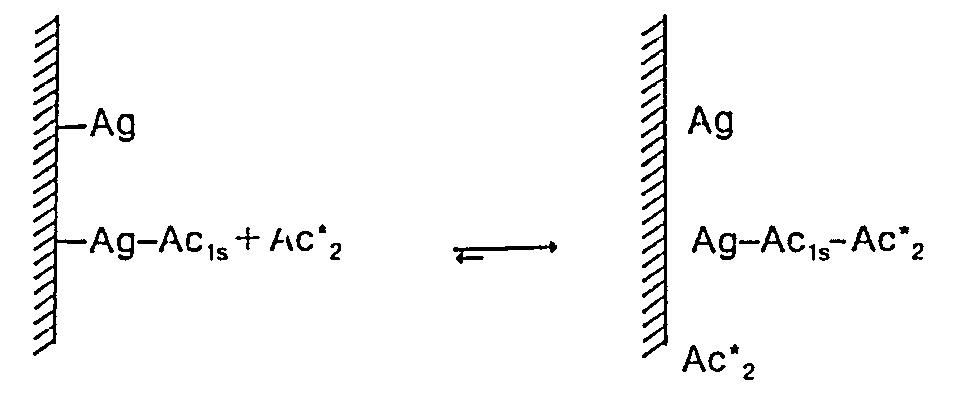
Elimination de l'excès de double anticorps marqué par lavage et comptage de la phase solide.
- Ag: antigène
- Ac1s: premier anticorps spécifique de l'antigène
- Ac1ns: premier anticorps non spécifique de l'antigène
- Ac'2: deuxième anticorps marqué.
- Ag: antigen
- Ac 1s : first antibody specific for the antigen
- Ac 1ns : first non-specific antibody to the antigen
- Ac ' 2 : second labeled antibody.
Elles ont toutes en commun les caractéristiques suivantes:
- - l'anticorps est marqué soit directement, soit par l'intermédiaire d'une autre molécule marquée avec laquelle il peut entrer en réaction. Ces réactifs spécifiques de l'anticorps peuvent être des «seconds anticorps» ou la protéine A de «staphilococus aureus»,
- - l'un des participants à la réaction qui peut être soit l'anticorps, soit l'antigène ou l'haptène est immobilisé sur une phase solide de façon à séparer l'anticorps qui a réagi de celui qui est resté libre en solution (voir dosages I, II et 111),
- - l'un ou plusieurs des participants à la réaction qui peut être soit l'anticorps, soit l'antigène ou l'haptène est en large excès par rapport à un ou plusieurs autres participants. C'est pour cette raison que ces méthodes sont appelées méthodes «en excès de réactif».
- - The antibody is labeled either directly, or through another labeled molecule with which it can react. These specific reagents of the antibody can be “second antibodies” or protein A of “staphilococus aureus”,
- - one of the participants in the reaction, which can be either the antibody, the antigen or the hapten, is immobilized on a solid phase so as to separate the antibody which has reacted from that which has remained free in solution ( see dosages I, II and 111),
- - one or more of the participants in the reaction which can be either the antibody, or the antigen or the hapten is in large excess compared to one or more other participants. It is for this reason that these methods are called "excess reagent" methods.
En plus de la classification que nous venons d'envisager, on distingue parmi les dosages enzymoimmunologiques, deux types de dosages qui sont les dosages «homogènes» et les dosages «hétérogènes». Un dosage homogène est basé sur le fait que l'activité de la molécule marquée est modifiée lorsqu'elle est liée avec l'anticorps ou l'antigène correspondant. Dans ce cas, l'activité enzymatique du mélange réactionnel est directement reliée à la proportion de molécules marquées impliquées dans la formation du complexe antigène-anticorps. De ce fait, il n'est pas nécessaire d'effectuer une séparation et la mesure de l'activité enzymatique peut avoir lieu directement dans le milieu réactionnel.In addition to the classification that we have just considered, there are two types of assays, which are “homogeneous” and “heterogeneous” assays, among enzyme-immunoassays. A homogeneous assay is based on the fact that the activity of the labeled molecule is modified when it is linked with the corresponding antibody or antigen. In this case, the enzymatic activity of the reaction mixture is directly related to the proportion of labeled molecules involved in the formation of the antigen-antibody complex. Therefore, it is not necessary to carry out a separation and the measurement of the enzymatic activity can take place directly in the reaction medium.
En revanche, dans un dosage enzymoimmunologique «hétérogène», il est nécessaire d'avoir recours à un procédé de séparation, car dans ce cas, l'activité enzymatique de la molécule marquée par l'enzyme qui a participé à la formation du complexe, n'est pas modifiée. Dans ce cas, on doit séparer le complexe antigène-anticorps du milieu réactionnel pour effectuer la mesure de l'activité enzymatique du complexe, ou de l'antigène (ou anticorps) libre. C'est à cette catégorie qu'appartiennent la plupart des dosages enzymoimmunologiques développés à ce jour.On the other hand, in a “heterogeneous” enzymoimmunoassay, it is necessary to have recourse to a separation process, because in this case, the enzymatic activity of the molecule marked by the enzyme which participated in the formation of the complex, is not changed. In this case, the antigen-antibody complex must be separated from the reaction medium to measure the enzymatic activity of the complex, or of the free antigen (or antibody). Most of the enzyme immunoassays developed to date belong to this category.
Dans tous ces dosages, l'enzyme utilisée joue un rôle très important car elle conditionne les performances du dosage, et on recherche des enzymes capables de répondre aux impératifs suivants:
- 1) - Disponibilité de l'enzyme à l'état pur en quantité importante, afin que l'on puisse réaliser dans de bonnes conditions la fabrication des molécules marquées d'antigène, d'haptène ou d'anticorps.
- 2) - Possibilité de détecter l'enzyme avec une grande sensibilité afin que l'on puisse mesurer de très faibles quantités de complexe antigène-anticorps et donc de très faibles quantités d'antigène, d'haptène ou d'anticorps dans les échantillons. Cette sensibilité de détection dépend bien entendu de la constante catalytique de l'enzyme, mais aussi de la sensibilité avec laquelle peuvent être mesurés les produits de la réaction enzymatique.
- 3) - Dosage enzymatique aussi simple que possible à réaliser.
- 4) - Présence dans l'enzyme de groupements réactifs capables de réagir avec des antigènes, des haptènes ou des anticorps pour former la molécule marquée.
- 5) - Stabilité de l'enzyme dans les conditions de conservation standard.
- 6) - Activité enzymatique de l'enzyme non identique à celle du milieu de dosage et ne présentant pas de facteurs interférant avec le dosage.
- 7) - Autolyse du substrat enzymatique aussi faible que possible.
- 1) - Availability of the enzyme in the pure state in a large quantity, so that one can carry out under good conditions the manufacture of molecules marked with antigen, hapten or antibody.
- 2) - Possibility of detecting the enzyme with great sensitivity so that we can measure very small quantities of antigen-antibody complex and therefore very small quantities of antigen, hapten or antibody in the samples. This detection sensitivity naturally depends on the catalytic constant of the enzyme, but also on the sensitivity with which the products of the enzymatic reaction can be measured.
- 3) - Enzymatic determination as simple as possible to carry out.
- 4) - Presence in the enzyme of reactive groups capable of reacting with antigens, haptens or antibodies to form the labeled molecule.
- 5) - Stability of the enzyme under standard storage conditions.
- 6) - Enzyme activity of the enzyme not identical to that of the assay medium and having no factors interfering with the assay.
- 7) - Autolysis of the enzyme substrate as low as possible.
A la suite de différentes recherches, on a trouvé que l'acétylcholinestérase d'Electrophorus Electricus constituait une enzyme présentant ces caractéristiques optimales pour être utilisés dans un dosage immunoenzymatique et la présente invention a précisément pour objet l'utilisation de cette enzyme pour préparer des composés qui peuvent être utilisés comme molécules marquées dans un dosage immunoenzymatique.Following various researches, it has been found that the acetylcholinesterase of Electrophorus Electricus constitutes an enzyme having these optimal characteristics for use in an immunoenzymatic assay and the present invention relates specifically to the use of this enzyme to prepare compounds. which can be used as labeled molecules in an enzyme immunoassay.
Le composé selon l'invention est constitué par une molécule choisie parmi les anticorps, les antigènes et les haptènes, liée par une liaison de covalence ou une liaison réversible à une enzyme et il se caractérise en ce que l'enzyme est constituée par l'acétylcholinestérase d'Electrophorus Electricus.The compound according to the invention consists of a molecule chosen from antibodies, the an tigens and haptens, linked by a covalent bond or a reversible bond to an enzyme and it is characterized in that the enzyme is constituted by the acetylcholinesterase of Electrophorus Electricus.
Grâce à l'utilisation de cette enzyme, on peut réaliser des dosages enzymoimmunologiques dans de bonnes conditions.Thanks to the use of this enzyme, enzymoimmunoassays can be carried out under good conditions.
En effet, l'acétylcholinesterase (E.C.3.1.1.7) fait partie d'un groupe d'enzymes qui hydrolysent rapidement les esters de la choline et elle se caractérise par le fait que l'acétylcholine est son meilleur substrat. Elle est très répandue dans dé nombreux tissus animaux et dans le système nerveux central et périphérique des vertébrés. On la trouve en concentration particulièrement importante dans les organes électriques de certains poissons comme Electrophorus Electricus (Gymnote) et Torpédo Marmorata (Torpille). Dans les organes électriques d'Electrophorus Electricus, l'acétylcholinestérase est 100 fois plus concentrée que dans le cerveau des oiseaux ou des mammifères. L'enzyme contenue dans ces organes électriques d'Electrophorus Electricus est rapidement et simplement purifiée en une seule étape par chromatographie d'affinité. Sa purification est beaucoup plus facile à réaliser que celle des acé- tylcholinestérases de Torpilles, d'oiseaux ou de mammifères qui possèdent toutes, au moins en partie, des caractéristiques hydrophobes et dont la stabilité est moindre.Indeed, acetylcholinesterase (E.C.3.1.1.7) is part of a group of enzymes which rapidly hydrolyze the esters of choline and it is characterized by the fact that acetylcholine is its best substrate. It is widespread in many animal tissues and in the central and peripheral nervous systems of vertebrates. It is found in particularly high concentrations in the electrical organs of certain fish such as Electrophorus Electricus (Gymnote) and Torpédo Marmorata (Torpille). In the electrical organs of Electrophorus Electricus, acetylcholinesterase is 100 times more concentrated than in the brains of birds or mammals. The enzyme contained in these electric organs of Electrophorus Electricus is quickly and simply purified in a single step by affinity chromatography. Its purification is much easier to achieve than that of acetylcholinesterases from torpedoes, birds or mammals which all have, at least in part, hydrophobic characteristics and whose stability is less.
L'acétylcholinestérase d'Electrophorus Electricus possède de plus une constante catalytique très élevée, et elle peut être détectée par dosage colorimétrique jusqu'à des concentrations de l'ordre de 10-13 M. Cette sensibilité de détection est nettement supérieure à celle qu'on peut observer avec les principales enzymes utilisées en enzymoimmunologie à savoir: la Peroxydase de Raifort (E.C.1.11.1.7), la β galactosidase d'Escherichia Coli (E.C.3.2.1.23) et la phosphatase alcaline d'intestin de veau (E.C.3.1.3.1).The acetylcholinesterase of Electrophorus Electricus also has a very high catalytic constant, and it can be detected by colorimetric assay up to concentrations of the order of 10-13 M. This detection sensitivity is much higher than that we can observe with the main enzymes used in enzymoimmunology namely: Horseradish peroxidase (EC1.11.1.7), β galactosidase from Escherichia Coli (EC3.2.1.23) and alkaline phosphatase from calf intestine (EC3 .1.3.1).
Par ailleurs, elle possède des groupements réactifs, en particulier des groupes lysyle, tyrosyle, histidyle, tryptophanyle etglutamyle qui peuvent réagir avec certains groupements réactifs des antigènes, des haptènes ou des anticorps pour former des composés marqués utilisables en enzymoimmunologie. Enfin, cette enzyme est très stable à -20 °C ou à -173 °C pour peu qu'elle soit conservée dans un milieu adéquat.Furthermore, it has reactive groups, in particular lysyl, tyrosyl, histidyl, tryptophanyl and glutamyl groups which can react with certain reactive groups of antigens, haptens or antibodies to form labeled compounds which can be used in enzymoimmunology. Finally, this enzyme is very stable at -20 ° C or -173 ° C as long as it is stored in an adequate medium.
Par conséquent, l'utilisation comme marqueur enzymatique de l'acétylcholinestérase d'Electrophorus Electricus présente de nombreux avantages aussi bien par rapport aux autres acétylcho- linestérases que par rapport aux autres enzymes couramment utilisées dans le domaine de l'enzymoimmunologie.Consequently, the use of the acetylcholinesterase of Electrophorus Electricus as an enzymatic marker has numerous advantages both over other acetylcholinesterases and over other enzymes commonly used in the field of enzymoimmunology.
Selon l'invention, l'acétylcholinestérase d'Electrophorus Electricus (E.C.3.1.1.7) est obtenu à partir des organes électriques d'Electrophorus Electricus et purifié par chromatographie d'affinité. On peut utiliser en particulier la méthode décrite par Bon et Coll. dans Eur. J. Biochemical 68, p. 531-539 (1976) qui permet d'obtenir environ 30 mg d'enzyme pure en quelques jours à partir d'un kilogramme d'organe électrique d'Electrophorus Electricus.According to the invention, the acetylcholinesterase of Electrophorus Electricus (E.C.3.1.1.7) is obtained from the electrical organs of Electrophorus Electricus and purified by affinity chromatography. One can use in particular the method described by Bon et al. in Eur. J. Biochemical 68, p. 531-539 (1976) which makes it possible to obtain approximately 30 mg of pure enzyme in a few days from a kilogram of electric organ of Electrophorus Electricus.
On sait que l'acétylcholinestérase existe sous plusieurs formes moléculaires nommées A12' A8, A4, G4, G2 et G, comme cela est décrit par Bon et Coll. dans Ann. Rev. Neurosci. 1982, 5, p. 57-106. Dans les organes électriques d'Electrophorus Electricus, ce sont les formes A12' As et G4 qui prédominent et quand l'enzyme pure est stockée, il peut se former spontanément des agrégats covalents entre les formes A12 et As.It is known that acetylcholinesterase exists in several molecular forms called A 12 ' A 8 , A 4 , G 4 , G 2 and G, as described by Bon et al. in Ann. Rev. Neurosci. 1982, 5, p. 57-106. In the electrical organs of Electrophorus Electricus, the A 12 ' A s and G 4 forms predominate and when the pure enzyme is stored, covalent aggregates can spontaneously form between the A 12 and A s forms.
Selon l'invention, le composé peut être formé à partir des formes moléculaires naturelles telles que A,2, A8 et G4, mais aussi à partir des formes moléculaires obtenues par dégradation de ces dernières, à savoir A4, G2 et G, ou même à partir d'agrégats covalents entre les formes asymétriques.According to the invention, the compound can be formed from natural molecular forms such as A, 2 , A 8 and G 4 , but also from molecular forms obtained by degradation of the latter, namely A 4 , G 2 and G, or even from covalent aggregates between asymmetric forms.
Selon l'invention, la molécule constituée par un antigène ou un haptène peut être choisie parmi les médicaments tels que les analgésiques, les antibiotiques, les anticonvulsants, les agents anti- diabétiques, les agent antihypertensions, les agents antinéoplastiques, les barbiturates, les dépresseurs cardiaques, les glycosides cardiaques, les hallucinogènes, les insecticides, les agents relaxants des muscles, les steroïdes, les stimulants, les alcaloïdes du tabac et les tranquillisants. Cette molécule peut aussi être constituée par une protéine du plasma ou une hormone, par exemple un polypeptide, un stéroïde ou d'autres molécules plus petites.According to the invention, the molecule constituted by an antigen or a hapten can be chosen from drugs such as analgesics, antibiotics, anticonvulsants, anti-diabetic agents, antihypertensive agents, antineoplastic agents, barbiturates, depressants cardiac, cardiac glycosides, hallucinogens, insecticides, muscle relaxants, steroids, stimulants, tobacco alkaloids and tranquilizers. This molecule can also be made up of a plasma protein or a hormone, for example a polypeptide, a steroid or other smaller molecules.
A titre d'exemple, les antigènes peuvent être des protéines du sérum telles que les IgG, IgE, l'haptoglobine, l'alpha-2-H-globuline, l'alpha-FP, le CEA et le PAM; les hormones peuvent être HCG, HPL, TSH, l'insuline, les oestrogènes, la progestérone, le cortisol et la thyroxine; et les médicaments peuvent être des barbiturates, des opiates, la méthadone, des amphétamines, la digoxine et le gentamycine.For example, the antigens can be serum proteins such as IgG, IgE, haptoglobin, alpha-2-H-globulin, alpha-FP, CEA and PAM; hormones can be HCG, HPL, TSH, insulin, estrogens, progesterone, cortisol and thyroxine; and the drugs may be barbiturates, opiates, methadone, amphetamines, digoxin and gentamycin.
La molécule peut encore être constituée par des anticorps de certains pathogènes tels que Echinococcosis granulosus, Trichinella Spiralis, Toxoplasma gondii, Treponema pallidum, les Salmonella O antigènes, Escherichia Coli, Rubella virus, Trypanosoma brucci, Trypanosoma cruzi, Schistosoma mansoni, Schistosoma haemato- bium, Plasmodium berghei, Plasmodium knowlesi et Vibrio cholerae. Elle peut en particulier être constituée par un anticorps monoclonal.The molecule can also be made up of antibodies to certain pathogens such as Echinococcosis granulosus, Trichinella Spiralis, Toxoplasma gondii, Treponema pallidum, Salmonella O antigens, Escherichia Coli, Rubella virus, Trypanosoma brucci, Trypanosoma cruzi, Schistosoma mansoni, Schistosoma haem , Plasmodium berghei, Plasmodium knowlesi and Vibrio cholerae. It can in particular be constituted by a monoclonal antibody.
A titre d'exemple, nous citerons quelques résultats obtenus avec les molécules suivantes: substance P, prostaglandines, thromboxane, leukotriène, Triiodothyronine (T3), anticorps anti-IgE humaine.As an example, we will cite some results obtained with the following molecules: substance P, prostaglandins, thromboxane, leukotriene, Triiodothyronine (T3), anti-human IgE antibody.
Selon l'invention, pour lier par une liaison de covalence l'acétylcholinestérase d'Electrophorus Electricus à la molécule choisie parmi les antigènes, les haptènes et les anticorps, on fait réagir l'un des groupements réactifs portés par l'enzyme tel que les groupes lysyle, tyrosyle, histidyle, tryptophanyle ou glutamyle avec un groupement réactif porté par l'antigène, l'haptène ou l'anticorps, par exemple avec une fonction acide, une fonction amine, une fonction phénol, une fonction hydroxyle ou une fonction cétone. Ceci peut être effectué en particulier par des réactions de couplage couramment utilisées, au moyen de réactifs tels que les carbodiimides, le glutaraldéhyde, la benzidine, les anhydrides mixtes, les esters actifs de l'haptène et l'acide paraaminophénylacétique.According to the invention, in order to bind the acetylcholinesterase of Electrophorus Electricus with a covalent bond to the molecule chosen from antigens, haptens and antibodies, one of the reactive groups carried by the enzyme is reacted such as lysyl, tyrosyl, histidyl, tryptophanyl or glutamyl groups with a reactive group carried by the antigen, hapten or antibody, for example with an acid function, an amine function, a phenol function, a hydroxyl function or a ketone function. This can be done in particular by commonly used coupling reactions, using reagents such as carbodiimides, glutaraldehyde, benzidine, mixed anhydrides, active esters of hapten and paraaminophenylacetic acid.
Selon l'invention, la liaison entre l'antigène, l'haptène ou l'anticorps peut aussi être obtenue par l'intermédiaire d'une liaison non covalente résersible comme celle qui met en jeu l'avidine et la biotine ou un antigène et un anticorps.According to the invention, the bond between the antigen, the hapten or the antibody can also be obtained by means of a non-covalent resible bond such as that which involves avidin and biotin or an antigen and an antibody.
Ainsi, le procédé de l'invention consiste à faire réagir la molécule choisie parmi les antigènes, les haptènes et les anticorps avec l'acétylcholinesté- rase d'Electrophorus Electricus.Thus, the method of the invention consists in reacting the molecule chosen from antigens, haptens and antibodies with the acetylcholinesterase from Electrophorus Electricus.
Selon un mode particulier de réalisation de ce procédé, lorsque la molécule est la substance P, on prépare tout d'abord un dérivé de la substance P par réaction de celle-ci avec un ester actif de l'acide paraaminophénylacétique, et on fait réagir le dérivé ainsi obtenu avec l'acétylcholinestérase d'Electrophorus Electricus.According to a particular embodiment of this process, when the molecule is substance P, a derivative of substance P is first prepared by reaction of the latter with an active ester of paraaminophenylacetic acid, and the reaction is carried out the derivative thus obtained with acetylcholinesterase from Electrophorus Electricus.
Selon un autre mode particulier de réalisation du procédé de l'invention, lorsque la molécule est une prostaglandine, un thromboxane ou la triiodothyronine, on prépare tout d'abord un ester actif de la prostaglandine, et on fait réagir l'ester ainsi obtenu avec l'acétylcholinestérase d'Electrophorus Electricus.According to another particular embodiment of the process of the invention, when the molecule is a prostaglandin, a thromboxane or triiodothyronine, an active ester of prostaglandin is first prepared, and the ester thus obtained is reacted with Electrophorus Electricus acetylcholinesterase.
Avantageusement, l'ester actif est obtenu par réaction de l'acide libre de la molécule avec le N-hydroxysuccinimide.Advantageously, the active ester is obtained by reaction of the free acid of the molecule with the N-hydroxysuccinimide.
Lorsque la molécule est un leukotriène, on prépare d'abord un composé intermédiaire en faisant réagir la molécule avec le dinitrofluoro- benzène avant de le faire réagir avec l'acétylcho- linestérase d'Electrophorus Electricus.When the molecule is a leukotriene, an intermediate compound is first prepared by reacting the molecule with dinitrofluorobenzene before reacting it with acetylcholinesterase from Electrophorus Electricus.
Lorsque la molécule est un anticorps, par exemple un anticorps anti-IgE humaine, on fixe d'abord de façon covalente de la biotine sur l'anticorps et sur l'acétylcholinestérase d'Electrophorus Electricus à l'aide d'un ester actif de la biotine.When the molecule is an antibody, for example an anti-human IgE antibody, biotin is first covalently attached to the antibody and to the acetylcholinesterase of Electrophorus Electricus using an active ester of biotin.
La liaison entre l'anticorps et l'enzyme est assurée par l'avidine qui forme un complexe très stable avec les molécules de biotine.The connection between the antibody and the enzyme is ensured by avidin which forms a very stable complex with the biotin molecules.
Les composés de l'invention peuvent être utilisés en particulier comme marqueurs dans des procédés de dosage enzymoimmunologique pour déterminer la concentration en antigène, en anticorps ou en haptène d'un échantillon, en utilisant soit la technique de dosage «homogène», soit la technique de dosage «hétérogène».The compounds of the invention can be used in particular as markers in enzymoimmunoassay methods for determining the antigen, antibody or hapten concentration of a sample, using either the “homogeneous” assay technique or the technique "heterogeneous" assay.
Lorsqu'on utilise la technique de dosage hétérogène, la séparation entre la fraction liée et la fraction libre de la molécule marquée par l'enzyme est réalisée par des méthodes classiques, par exemple, par précipitation à l'aide d'un second anticorps. On peut utiliser aussi des phases solides constituées par un support sur lequel est immobilisé un antigène ou un anticorps. Dans ces dosages, l'activité enzymatique de l'acétylcho- linestérase peut être déterminée par une méthode classique, en particulier par la méthode décrite par Ellman et Coll. dans Biochemical Pharmacol- ogy 1961, vol. 7, p. 88-95, dont la mise en oeuvre est particulièrement simple et qui permet de détecter des concentrations d'enzymes de l'ordre de 10-3 M. When using the heterogeneous assay technique, the separation between the bound fraction and the free fraction of the molecule labeled with the enzyme is carried out by conventional methods, for example, by precipitation using a second antibody. It is also possible to use solid phases consisting of a support on which an antigen or an antibody is immobilized. In these assays, the enzymatic activity of acetylcholinesterase can be determined by a conventional method, in particular by the method described by Ellman et al. in Biochemical Pharmacol- ogy 1961, vol. 7, p. 88-95, whose implementation is particularly simple and which makes it possible to detect concentrations of enzymes of the order of 10- 3 M.
D'autres caractéristiques et avantages de l'invention apparaîtront mieux à la lecture des exemples suivants donnés bien entendu à titre illustratif et non limitatif en référence au dessin annexé sur lequel les figures 1 et 2 représentent les courbes d'étalonnage de dosages enzymoimmunologiques selon l'invention.Other characteristics and advantages of the invention will appear better on reading the following examples given of course by way of nonlimiting illustration with reference to the appended drawing in which FIGS. 1 and 2 represent the calibration curves for enzymoimmunoassays according to l 'invention.
Préparation d'un traceur enzymatique pour le dosage immunoenzymatique de la substance P (SP).Preparation of an enzyme tracer for the immunoenzymatic determination of substance P (SP).
Cette substance correspond à la séquence d'acides aminés suivante:
- Arg-Pro-Lys-Pro-Gln-Gln-Phe-Phe-Gly-Leu-Met-NH2.
- Arg-Pro-Lys-Pro-Gln-Gln-Phe-Phe-Gly-Leu-Met-NH 2 .
Pour préparer le composé covalent entre la substance P et l'acétylcholinestérase d'Electrophorus Electricus, on procède en deux étapes qui consistent respectivement à préparer un dérivé intermédiaire de la substance P par conjugaison avec l'acide para-aminophénylacétique (PAPA) et à coupler le dérivé ainsi obtenu à l'enzyme par l'intermédiaire d'un sel de diazonium.To prepare the covalent compound between substance P and the acetylcholinesterase of Electrophorus Electricus, two steps are carried out which consist respectively in preparing an intermediate derivative of substance P by conjugation with para-aminophenylacetic acid (PAPA) and in coupling the derivative thus obtained to the enzyme via a diazonium salt.
On prépare tout d'abord un ester actif de l'acide para-aminophénylacétique (PAPA) avec la N-hydroxysuccinimide (NHS) selon le schéma réactionnel suivant:


Pour préparer l'ester actif, on fait réagir 15,1 mg PAPA, 11,5 mg de NHS et20,6 mg de dicyclocarbodiimide (DCC) dans 2 ml de diméthylformamide (DMF) pendant 18 h à 22°C dans l'obscurité. On élimine alors le précipité formé par centrifugation, puis on ajoute 20 µl (1 µmol) du mélange réactionnel ainsi obtenu à 100 µl de DMF/tampon borate 0,1 M pH 9 (V/V) contenant 1 µmol de substance P (SP) et on laisse réagir pendant une heure à 4°C à l'obscurité. On obtient ainsi le dérivé intermédiaire.To prepare the active ester, 15.1 mg PAPA, 11.5 mg NHS and 20.6 mg dicyclocarbodiimide (DCC) in 2 ml of dimethylformamide (DMF) are reacted for 18 h at 22 ° C in the dark. . The precipitate formed is then eliminated by centrifugation, then 20 μl (1 μmol) of the reaction mixture thus obtained is added to 100 μl of DMF / 0.1 M borate buffer pH 9 (V / V) containing 1 μmol of substance P (SP ) and allowed to react for one hour at 4 ° C in the dark. The intermediate derivative is thus obtained.
Cette réaction de couplage correspond au schéma suivant:
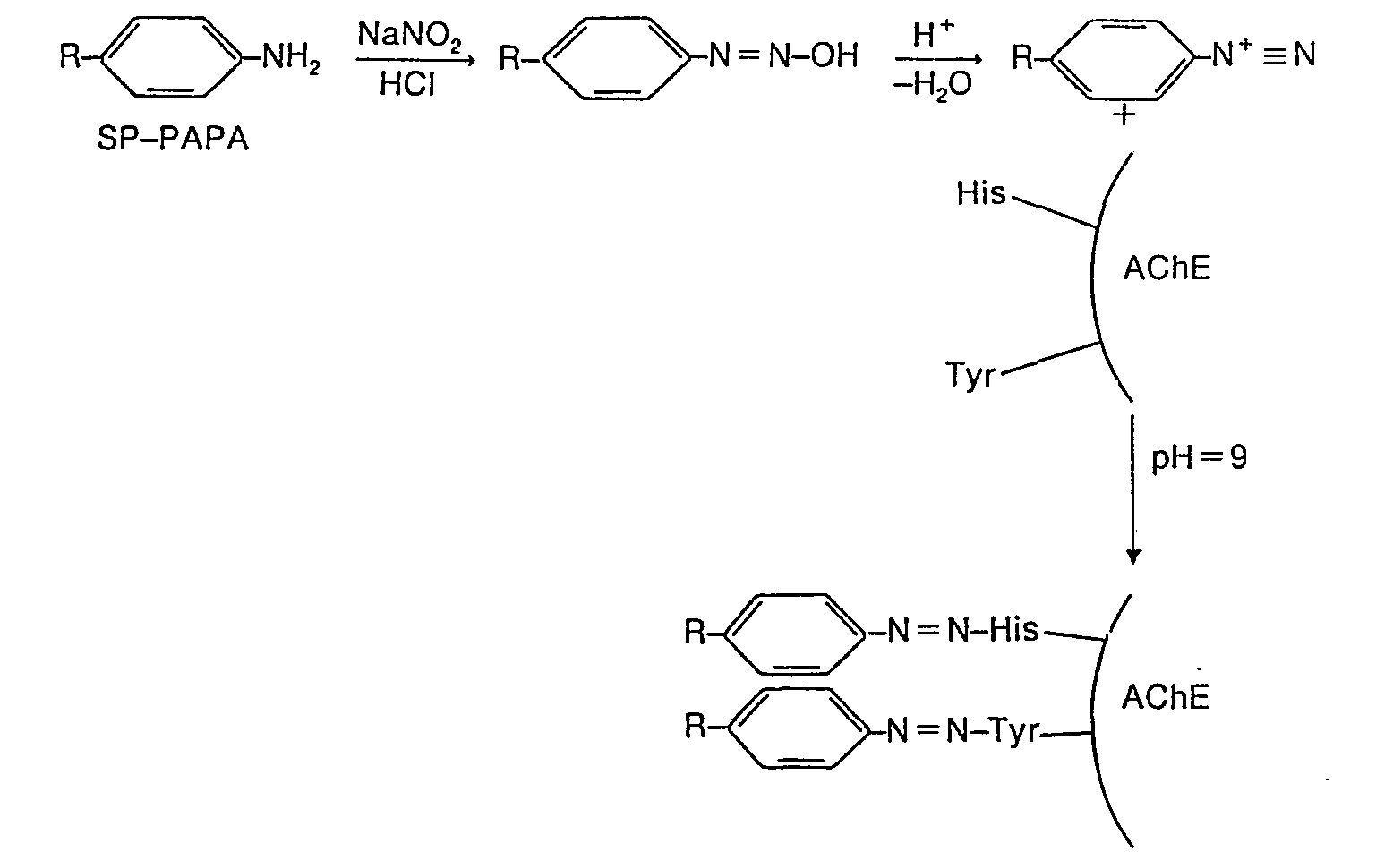
Le but de cette opération est d'éliminer la substance P non couplée à l'enzyme.The purpose of this operation is to eliminate substance P not coupled to the enzyme.
On mesure ensuite l'activité enzymatique des différentes fractions collectées et on détermine ainsi le profil d'élution de l'activité enzymatique. On réunit les fractions, puis on les distribue dans plusieurs tubes à congélation et on les conserve dans l'azote liquide. On purifie ensuite par filtration sur gel les composés correspondant aux différentes formes de l'enzyme (agrégats-formes A8-A12 et G4) en utilisant le gel A15m (de Biorad) dans une colonne de 90 cm sur 1,5 cm et en éluant par le tampon TRIS précédemment utilisé. Après avoir réalisé le profil d'élution de l'activité enzymatique, on réunit les différentes fractions du pic qui correspondent à l'élution des différentes formes, et on stocke le traceur enzymatique dans l'azote liquide jusqu'à son utilisation.The enzymatic activity of the various fractions collected is then measured and the elution profile of the enzymatic activity is thus determined. The fractions are combined, then distributed into several freezing tubes and stored in liquid nitrogen. The compounds corresponding to the different forms of the enzyme are then purified by gel filtration (aggregates-forms A 8 -A 12 and G 4 ) using gel A15m (from Biorad) in a column of 90 cm by 1.5 cm. and eluting with the TRIS buffer previously used. After having produced the elution profile for the enzymatic activity, the different fractions of the peak which correspond to the elution of the different forms are combined, and the enzymatic tracer is stored in liquid nitrogen until it is used.
Préparation d'un traceur enzymatique pour le dosage immunoenzymatique de la 6-keto-PGF1u qui est un métabolite de la prostacycline.Preparation of an enzyme tracer for the immunoenzymatic assay of 6-keto-PGF 1u which is a metabolite of prostacyclin.
La 6-kéto-PGF1u correspond à la formule suivante:
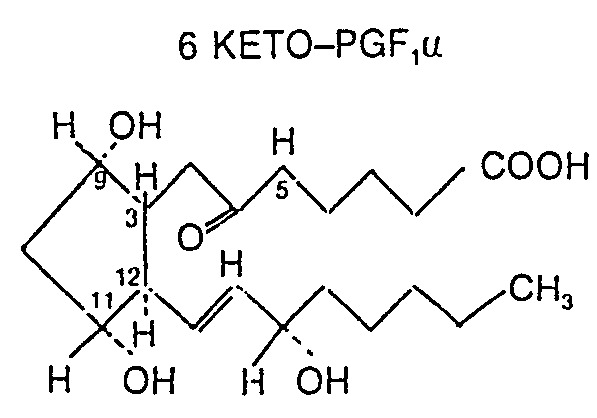
On réalise le composé en deux étapes qui consistent respectivement à former un ester actif de la 6-kéto-PGF1a et à coupler ensuite l'ester actif avec l'enzyme.The compound is produced in two stages which consist respectively of forming an active ester of 6-keto-PGF 1a and then coupling the active ester with the enzyme.
On ajotue 10 µl de DMF contenant 5,1 µmol de N-hydroxysuccinimide (NHS) et 10 pl de DMF contenant 5,1 µmol de dicyclocarbodiimide (DCC) à 100 µl de DMF anhydre contenant 5,1 µmol de 6- kéto-PGF1u et on laisse réagir pendant 18 heures à 22 °C à l'obscurité, ce qui conduit à la formation de l'ester actif de la 6-kéto-PGF1u selon le schéma réactionnel suivant:

On ajoute 2 µl de la solution d'ester actif dans le DMF dilué 50 fois obtenu dans l'étape a), (soit environ 10 nmol d'ester actif) à 500 pl de tampon borate 0,1 M, (pH 9) contenant 250 pg d'acétylcho- linestérase. On laisse la réaction se dérouler pendant une heure à +4°C et on neutralise l'excès d'ester par addition d'1 ml de tampon phosphate 0,1 M, NaCl 0,4 M, acide éthylène-diamineté- traacétique 10-3 M et BSA 0,5%. On obtient ainsi le couplage de l'enzyme selon le schéma réactionnel:

On purifie ensuite les composés correspondant aux différentes formes de l'enzyme par filtration sur gel, en suivant la méthode décrite dans l'exemple 1.The compounds corresponding to the different forms of the enzyme are then purified by gel filtration, using the method described in Example 1.
On procède comme dans l'exemple 2 pour préparer le PGD2-MO, le thromboxane B2 et la triiodothyronine marqués par l'acétylcholinesté- rase d'Electrophorus Electricus en utilisant les mêmes voies de synthèse.The procedure is as in Example 2 to prepare PGD 2 -MO, thromboxane B2 and triiodothyronine labeled with acetylcholinesterase from Electrophorus Electricus using the same synthetic routes.
Préparation d'un traceur enzymatique pour le dosage immuno-enzymatique des leukotriènes. On citera l'exemple du leukotriène C4.Preparation of an enzyme tracer for the immunoenzymatic assay of leukotrienes. We will cite the example of leukotriene C 4 .
Le leukotriène C4 (LTC4) correspond à la formule suivante:

On réalise le composé en deux étapes qui consistent respectivement à former un dérivé actif du LTC4 et à coupler ensuite ce dérivé avec l'enzyme.The compound is produced in two stages which respectively consist in forming an active derivative of LTC 4 and in then coupling this derivative with the enzyme.
A 100 µl de tampon phosphate contenant 50 µg de LTC4 (0,1 M; pH 7,4) sont ajoutés 60 µl de méthanol contenant 200 µg de DFDB (difluorodini- trobenzène). On laisse la réaction se poursuivre pendant 30 minutes à 22 °C. On évapore le méthanol sous vide et on extrait l'excès de DFDB par 3 x 0,5 ml d'éther. L'excès d'éther est évaporé sous azote.To 100 µl of phosphate buffer containing 50 µg of LTC 4 (0.1 M; pH 7.4) are added 60 µl of methanol containing 200 µg of DFDB (difluorodinitrobenzene). The reaction is allowed to continue for 30 minutes at 22 ° C. The methanol is evaporated in vacuo and the excess DFDB is extracted with 3 x 0.5 ml of ether. The excess ether is evaporated under nitrogen.
On ajoute 60 µl du réactif précédemment obtenu à 250 µl de tampon borate (0,1 M; pH 9) contenant environ 100 µg d'enzyme. Après 4 heures de réaction à 22°C, on ajoute 200 µl de tampon phosphate, BSA précédemment décrit. La purification des produits de couplage est effectuée suivant la méthode décrite dans l'exemple 1 utilisant la filtration sur gel A15m (Biorad).60 μl of the reagent previously obtained are added to 250 μl of borate buffer (0.1 M; pH 9) containing approximately 100 μg of enzyme. After 4 hours of reaction at 22 ° C., 200 μl of phosphate buffer, BSA previously described, is added. The purification of the coupling products is carried out according to the method described in Example 1 using filtration on gel A15m (Biorad).
Préparation d'un traceur enzymatique pour le dosage de IgE humaine en utilisant un anticorps anti-IgE humaine marqué à l'acétylcholinestérase par l'intermédiaire du système avidine-biotine.Preparation of an enzyme tracer for the assay of human IgE using an anti-human IgE antibody labeled with acetylcholinesterase via the avidin-biotin system.
Le principe du couplage repose sur l'interaction très forte qui existe entre l'avidine qui est une protéine extraite du blanc d'oeuf et la biotine qui est une vitamine. L'avidine a la propriété de pouvoir fixer plusieurs molécules de biotine et peut donc servir de lien entre deux molécules sur lesquelles on aura fixé au préalable de la biotine.The principle of coupling is based on the very strong interaction that exists between avidin which is a protein extracted from egg white and biotin which is a vitamin. Avidin has the property of being able to fix several molecules of biotin and can therefore serve as a link between two molecules on which biotin will have been fixed beforehand.
La biotine correspond à la formule suivante:

Pour marquer de façon covalente l'anticorps et l'enzyme par la biotine on utilise un ester actif de la molécule, il peut s'agir par exemple d'un ester du N-hydroxysuccinimide préparé dans des conditions similaires à celles décrites dans l'exemple 3. La réaction de l'ester avec l'anticorps et l'enzyme est aussi obtenue de la même façon que dans l'exemple 2.To covalently label the antibody and the enzyme with biotin, an active ester of the molecule is used, it may for example be an ester of N-hydroxysuccinimide prepared under conditions similar to those described in Example 3. The reaction of the ester with the antibody and the enzyme is also obtained in the same way as in Example 2.
Le couplage entre l'anticorps et l'enzyme est effectué au moment du dosage de la façon suivante:
- - L'anticorps anti-IgE marqué à la biotine est mis à réagir avec des IgE humaines préalablement immobilisées sur un support solide par l'intermédiaire d'un autre anticorps anti-IgE non marqué.
- - Après réaction et élimination de l'excès d'anticorps marqué qui n'a pas réagi, on ajoute un excès d'avidine qui se fixe sur l'anticorps marqué à la biotine.
- - Après élimination de l'excès d'avidine qui n'a pas réagi, on ajoute l'acétylcholinestérase marquée par la biotine qui se fixe sur les molécules d'avidine liées à l'anticorps marqué réalisant ainsi le couplage entre l'anticorps et l'enzyme.
- - The anti-IgE antibody labeled with biotin is reacted with human IgE previously immobilized on a solid support by means of another unlabeled anti-IgE antibody.
- - After reaction and elimination of the excess of labeled antibody which has not reacted, an excess of avidin is added which binds to the antibody labeled with biotin.
- - After elimination of the excess of unreacted avidin, the biotin-labeled acetylcholinesterase is added, which binds to the avidin molecules linked to the labeled antibody, thus achieving coupling between the antibody and the enzyme.
Cet exemple illustre l'utilisation du composé obtenu dans l'exemple 4 pour le dosage enzymoimmunologique du thromboxane B2 (TXB2).This example illustrates the use of the compound obtained in Example 4 for the enzymoimmunoassay of thromboxane B 2 (TXB 2 ).
Pour cet essai, on utilise le TXB2 marqué avec les formes A8-A12 de l'acétylcholinestérase d'Electrophorus Electricus, un premier anticorps constitué par de l'antisérum de lapin anti-TXB2 et un deuxième anticorps constitué par de l'anti- sérum de porc anti-y-globuline de lapin. Ce dernier anticorps est immobilisé sur une phase solide.For this test, the TXB 2 labeled with the forms A 8 -A 12 of the acetylcholinesterase of Electrophorus Electricus, a first antibody constituted by rabbit anti-TXB 2 antiserum and a second antibody constituted by l, is used. anti-rabbit anti-y-globulin pork serum. The latter antibody is immobilized on a solid phase.
Pour effectuer l'essai immunologique, on procède de la façon suivante:To carry out the immunoassay, proceed as follows:
Dans chaque puits d'une plaque de microtitra- tion «ImmunoNunc»® 96 F est ajouté 300 µl d'une solution d'anti-IgG de lapin purifié par chromatographie d'affinité (10 pg/ml) contenant du glutaraldéhyde à 2% dans un tampon phosphate (10-2 M, pH 7,4). Après 12 heures d'incubation à 22°C, on élimine la solution dans chaque puits et on ajoute 300 µl du tampon phosphate B5A (précédemment décrit).300 μl of a rabbit anti-IgG solution purified by affinity chromatography (10 μg / ml) containing 2% glutaraldehyde is added to each well of an "ImmunoNunc" ® 96 F microtiter plate. in phosphate buffer (10- 2 M, pH 7.4). After 12 hours of incubation at 22 ° C, the solution is eliminated in each well and 300 μl of phosphate buffer B5A (previously described) are added.
Le contenu de chaque puits est éliminé et on ajoute dans chaque puits 50 µl d'une solution du traceur enzymatique, 50 µl d'une solution d'anticorps anti TXB2 et 50 pl de différentes concentrations de TXB2 ou 50 µl de l'échantillon à doser.The content of each well is eliminated and 50 μl of an enzyme tracer solution, 50 μl of an anti solution are added to each well anti TXB 2 and 50 μl body of different concentrations of TXB 2 or 50 μl of the sample to be assayed.
Après 12 heures d'incubation à +4°C, le contenu de chaque puits est éliminé et on ajoute 200 pl du substrat enzymatique (réactif d'Ellman). Après 1 heure de réaction enzymatique à 22°C l'absorbance à 414 nm est mesurée dans chaque puits à l'aide du spectrophotomètre Multiskan TITERTEK@ (Flow Laboratories). En se référant à la figure 1 (courbe 1) qui illustre la courbe d'étalonnage du dosage enzymoimmunologique du TXB2 utilisant le composé de l'exemple 4 comme marqueur, on peut déterminer la concentration en TXB2 de l'échantillon.After 12 hours of incubation at + 4 ° C, the content of each well is eliminated and 200 μl of the enzyme substrate (Ellman reagent) are added. After 1 hour of enzymatic reaction at 22 ° C the absorbance at 414 nm is measured in each well using the Multiskan TITERTEK @ spectrophotometer (Flow Laboratories). Referring to FIG. 1 (curve 1) which illustrates the standard curve for the enzymoimmunoassay of TXB 2 using the compound of example 4 as a marker, the concentration of TXB 2 in the sample can be determined.
Sur cette figure, on a porté en abscisse la dose (pg/puits) de TXB2 et en ordonnée le rapport B/Bo (en %) dans lequel B représente l'activité enzymatique liée aux anticorps en présence de TXB2 et Bo représente l'activité enzymatique liée aux anticorps en l'absence de TXB2. Les valeurs de liaison non spécifiques ont été soustraites et représentent moins de 5% de l'activité totale.In this figure, the dose (pg / well) of TXB 2 is plotted on the abscissa and the ratio B / Bo (in%) in which Y represents the enzymatic activity linked to antibodies in the presence of TXB 2 and Bo represents the ordinate the enzymatic activity linked to the antibodies in the absence of TXB 2 . Non-specific binding values were subtracted and represent less than 5% of the total activity.
Cet exemple illustre l'utilisation du composé obtenu dans l'exemple 2 pour le dosage enzymoimmunologique du 6-keto-PGF1α. Le protocole expérimental est identique à celui décrit pour le thromboxane dans l'exemple 8. La courbe d'étalonnage se rapportant à ce dosage est représentée sur la figure 1 (courbe 2).This example illustrates the use of the compound obtained in Example 2 for the enzymoimmunoassay of 6-keto-PGF 1α . The experimental protocol is identical to that described for thromboxane in Example 8. The calibration curve relating to this assay is shown in Figure 1 (curve 2).
Cet exemple illustre l'utilisation du composé obtenu dans l'exemple 3 pour le dosage enzymoimmunologique de la PGD2-MO. Le protocole expérimental est identique à celui décrit dans l'exemple 8. La courbe d'étalonnage se rapportant à ce dosage est représentée sur la figure 1 (courbe 3).This example illustrates the use of the compound obtained in Example 3 for the enzymoimmunological assay of PGD 2 MO. The experimental protocol is identical to that described in Example 8. The calibration curve relating to this assay is shown in Figure 1 (curve 3).
Cet exemple illustre l'utilisation du composé obtenu dans l'exemple 5 pour le dosage enzymoimmunologique de la triiodothyronine (T3). Le protocole expérimental est identique à celui décrit dans l'exemple 8. La courbe d'étalonnage se rapportant à ce dosage est représentée sur la figure 2.This example illustrates the use of the compound obtained in Example 5 for the enzymoimmunological assay of triiodothyronine (T 3 ). The experimental protocol is identical to that described in Example 8. The calibration curve relating to this assay is shown in FIG. 2.
Claims (15)
Applications Claiming Priority (2)
| Application Number | Priority Date | Filing Date | Title |
|---|---|---|---|
| FR8313389A FR2550799B1 (en) | 1983-08-17 | 1983-08-17 | COMPOUND MARKED BY AN ENZYME, ITS PREPARATION METHOD AND ITS USE IN ENZYMOIMMUNOLOGY |
| FR8313389 | 1983-08-17 |
Publications (2)
| Publication Number | Publication Date |
|---|---|
| EP0139552A1 EP0139552A1 (en) | 1985-05-02 |
| EP0139552B1 true EP0139552B1 (en) | 1989-02-08 |
Family
ID=9291658
Family Applications (1)
| Application Number | Title | Priority Date | Filing Date |
|---|---|---|---|
| EP84401664A Expired EP0139552B1 (en) | 1983-08-17 | 1984-08-13 | Compound labelled with acetylcholine sterase from electrophorus electricus, method for its preparation and its use as a marker in enzyme immuno assays |
Country Status (6)
| Country | Link |
|---|---|
| US (1) | US5047330A (en) |
| EP (1) | EP0139552B1 (en) |
| JP (1) | JPS6070357A (en) |
| DE (1) | DE3476700D1 (en) |
| ES (1) | ES535198A0 (en) |
| FR (1) | FR2550799B1 (en) |
Families Citing this family (12)
| Publication number | Priority date | Publication date | Assignee | Title |
|---|---|---|---|---|
| JPS6111664A (en) * | 1984-06-28 | 1986-01-20 | Ono Pharmaceut Co Ltd | Reagent composition for enzyme immunomeasurement of prostaglandin and measuring method of prostaglandin using said composition |
| US6461825B1 (en) * | 1987-09-30 | 2002-10-08 | Sanofi (Societe Anonyme) | Immunometric assay kit and method applicable to whole cells |
| FR2773802B1 (en) * | 1998-01-22 | 2000-04-28 | Pasteur Institut | FUSION POLYPEPTIDE COMPRISING A MONOMERIC ACETYLCHOLINESTERASE LINKED TO A PROTEIN RECEPTOR AND POLYNUCLEOTIDE ENCODING SUCH A POLYPEPTIDE. APPLICATION TO THE DETECTION OF LIGAND MOLECULES |
| FR2791357B1 (en) | 1999-03-26 | 2003-05-16 | Didier Raoult | WHIPPLE DISEASE DIAGNOSIS |
| FR2822238B1 (en) * | 2001-03-16 | 2003-08-29 | Gemac | METHOD AND KIT FOR MONITORING NEURODEGENERATIVE DISEASES |
| US7189366B2 (en) * | 2001-05-25 | 2007-03-13 | The United States Of America As Represented By The Secretary Of The Interior | Molecular tag reader |
| FR2865541B1 (en) | 2003-05-20 | 2006-08-11 | Commissariat Energie Atomique | METHOD OF DETECTING FLUORIDE OR HYDROGEN FLUORIDE AND DETECTION KIT |
| US20070287991A1 (en) * | 2006-06-08 | 2007-12-13 | Mckay William F | Devices and methods for detection of markers of axial pain with or without radiculopathy |
| US8420054B2 (en) * | 2009-09-18 | 2013-04-16 | The Procter & Gamble Company | Noninvasive method for measuring histamine from skin as an objective measurement of itch |
| EP2612147B1 (en) | 2010-11-17 | 2016-03-30 | Karl-Heinz Kellner | Automatic immunoassay for biogenic amines |
| CN106278982B (en) * | 2011-06-02 | 2019-06-14 | 奇诺因私人有限公司 | Novel method for the preparation of prostaglandin amides |
| MX367307B (en) | 2012-12-14 | 2019-08-14 | Procter & Gamble | ANTIPERSPIRANT and DEODORANT COMPOSITIONS. |
Family Cites Families (11)
| Publication number | Priority date | Publication date | Assignee | Title |
|---|---|---|---|---|
| USRE29169E (en) * | 1971-02-10 | 1977-04-05 | Akzona Incorporated | Process for the demonstration and determination of reaction components having specific binding affinity for each other |
| USRE31006E (en) * | 1968-09-24 | 1982-08-03 | Akzona Incorporated | Process for the demonstration and determination of reaction components having specific binding affinity for each other |
| NL154600B (en) * | 1971-02-10 | 1977-09-15 | Organon Nv | METHOD FOR THE DETERMINATION AND DETERMINATION OF SPECIFIC BINDING PROTEINS AND THEIR CORRESPONDING BINDABLE SUBSTANCES. |
| US3654090A (en) * | 1968-09-24 | 1972-04-04 | Organon | Method for the determination of antigens and antibodies |
| NL154598B (en) * | 1970-11-10 | 1977-09-15 | Organon Nv | PROCEDURE FOR DETERMINING AND DETERMINING LOW MOLECULAR COMPOUNDS AND PROTEINS THAT CAN SPECIFICALLY BIND THESE COMPOUNDS AND TEST PACKAGING. |
| US4152411A (en) * | 1977-07-27 | 1979-05-01 | Akzona Incorporated | High specific activity labeled substances |
| US4228237A (en) * | 1978-09-21 | 1980-10-14 | Calbiochem-Behring Corp. | Methods for the detection and determination of ligands |
| DK159276C (en) * | 1980-03-31 | 1991-02-18 | Takeda Chemical Industries Ltd | PROCEDURE FOR THE ISOLATION OF SPECIFIC ANTIBODIES AND ENZYM IMMUNE DETERMINATION METHOD USING THE ISOLATED ANTIBODY |
| GB2090598B (en) * | 1980-12-11 | 1984-03-21 | Mini Agriculture & Fisheries | Enzyme-immunoassay method |
| JPS5818167A (en) * | 1981-07-24 | 1983-02-02 | Fuji Photo Film Co Ltd | Analyzing film and analysis using said film |
| US4411989A (en) * | 1981-08-13 | 1983-10-25 | Midwest Research Institute | Processes and devices for detection of substances such as enzyme inhibitors |
-
1983
- 1983-08-17 FR FR8313389A patent/FR2550799B1/en not_active Expired
-
1984
- 1984-08-13 EP EP84401664A patent/EP0139552B1/en not_active Expired
- 1984-08-13 DE DE8484401664T patent/DE3476700D1/en not_active Expired
- 1984-08-16 JP JP59170962A patent/JPS6070357A/en active Granted
- 1984-08-16 ES ES535198A patent/ES535198A0/en active Granted
-
1988
- 1988-01-06 US US07/142,247 patent/US5047330A/en not_active Expired - Lifetime
Non-Patent Citations (5)
| Title |
|---|
| Bioch.Biophys.Res.COMM 1987 (469-476) * |
| Clinica Chimica Acta, 81 (1977) 1-40 * |
| J.Clin.Chem.Clin.Biochem., vol. 18 (1980), 197-208 * |
| Trends in cluster headache pp. 125-134 * |
| Z.Anol.Chem. 279 (2), 1976-146 * |
Also Published As
| Publication number | Publication date |
|---|---|
| ES8504928A1 (en) | 1985-05-01 |
| FR2550799B1 (en) | 1986-02-21 |
| JPH0579943B2 (en) | 1993-11-05 |
| FR2550799A1 (en) | 1985-02-22 |
| DE3476700D1 (en) | 1989-03-16 |
| JPS6070357A (en) | 1985-04-22 |
| ES535198A0 (en) | 1985-05-01 |
| EP0139552A1 (en) | 1985-05-02 |
| US5047330A (en) | 1991-09-10 |
Similar Documents
| Publication | Publication Date | Title |
|---|---|---|
| EP0539477B1 (en) | Method for amplifying a signal emitted by a luminescent compound | |
| FR2695405A1 (en) | Process for the preparation of intrinsic factor-horseradish peroxidase conjugates | |
| EP0139552A1 (en) | Compound labelled with acetylcholine sterase from Electrophorus electricus, method for its preparation and its use as a marker in enzyme immuno assays | |
| EP0230166A1 (en) | Diagnostic reagents | |
| EP0022005B1 (en) | Process for the separation of a proteinic substance starting from a solution containing it upon affinity filtration, and application of the process to enzymatic analyses | |
| EP0041426A1 (en) | Coupled product between a lectin and a specific ligand, obtention and use in the biological field | |
| JPS61502417A (en) | Polyclonal antibodies, manufacturing method and uses | |
| EP0539435B1 (en) | Method for reducing interference in a fluorescent assay | |
| JPS6078350A (en) | Reverse latency specific binding assay | |
| EP0830601A1 (en) | Use of a phycobiliprotein-binding peptide complex as a fluorescent tracer | |
| EP0006792A1 (en) | Iodinated compound usable as radio-immunological tracer and its process of preparation | |
| FR2729759A1 (en) | ULTRASENSITIVE DOSING METHOD FOR THE CARDIAC TROPONIN I | |
| FR2678387A1 (en) | METHOD FOR THE IMMUNO-ENZYMATIC ASSAY OF VITAMIN B12 AND PREPARATION OF A SAMPLE FOR THE ASSAY | |
| FR2508486A1 (en) | IMMUNO-ENZYMATIC DETERMINATION METHOD AND KIT FOR IMPLEMENTING IT | |
| EP0733903B1 (en) | Immunoassay for the detection of urinary cortisol and reagents therefor | |
| FR2637897A1 (en) | IMMUNOLOGICAL ASSAYS OF AZT, DERIVATIVES AND CONJUGATES AND ANTIBODIES | |
| EP2252897A2 (en) | Method for direct detection of ischaemia-modified albumin using a partner for binding to an aldehyde derivative resulting from the peroxidation of lipids in bound form | |
| FR2523311A1 (en) | Conjugates of specific ligand and albumin - for use in immunoassay | |
| EP0232348B1 (en) | Homogeneous process for the luminescent determination and/or detection of an analyte in a medium susceptible of containing it | |
| FR2601781A1 (en) | MYCOTOXIN ASSAY REAGENT AND METHOD USING THE SAME FOR DOSING MYCOTOXIN | |
| EP0187076B1 (en) | Fluorescent compounds, (amino-4) naphthalimide derivatives, their use in immunological determinations of fluorescence polarization | |
| FR2652163A1 (en) | METHOD OF DETECTING BIOLOGICAL SUBSTANCE USING LIGANDS | |
| EP0122833B1 (en) | Heterogeneous assay method for antigenic biological substances using antibody-hybrid conjugates, and reagent therefor | |
| EP0007879A1 (en) | Delta 5,3-cetosteroid isomerase and its use in immuno-enzyme quantifications | |
| CA2210166C (en) | Ultrasensitive process for assaying cardiac troponine i |
Legal Events
| Date | Code | Title | Description |
|---|---|---|---|
| PUAI | Public reference made under article 153(3) epc to a published international application that has entered the european phase |
Free format text: ORIGINAL CODE: 0009012 |
|
| AK | Designated contracting states |
Designated state(s): BE CH DE FR GB IT LI LU NL SE |
|
| 17P | Request for examination filed |
Effective date: 19851011 |
|
| 17Q | First examination report despatched |
Effective date: 19870612 |
|
| RAP1 | Party data changed (applicant data changed or rights of an application transferred) |
Owner name: COMMISSARIAT A L'ENERGIE ATOMIQUE |
|
| GRAA | (expected) grant |
Free format text: ORIGINAL CODE: 0009210 |
|
| AK | Designated contracting states |
Kind code of ref document: B1 Designated state(s): BE CH DE FR GB IT LI LU NL SE |
|
| REF | Corresponds to: |
Ref document number: 3476700 Country of ref document: DE Date of ref document: 19890316 |
|
| ITF | It: translation for a ep patent filed | ||
| GBT | Gb: translation of ep patent filed (gb section 77(6)(a)/1977) | ||
| PLBE | No opposition filed within time limit |
Free format text: ORIGINAL CODE: 0009261 |
|
| STAA | Information on the status of an ep patent application or granted ep patent |
Free format text: STATUS: NO OPPOSITION FILED WITHIN TIME LIMIT |
|
| 26N | No opposition filed | ||
| ITTA | It: last paid annual fee | ||
| EPTA | Lu: last paid annual fee | ||
| EAL | Se: european patent in force in sweden |
Ref document number: 84401664.2 |
|
| REG | Reference to a national code |
Ref country code: GB Ref legal event code: IF02 |
|
| PGFP | Annual fee paid to national office [announced via postgrant information from national office to epo] |
Ref country code: SE Payment date: 20030806 Year of fee payment: 20 |
|
| PGFP | Annual fee paid to national office [announced via postgrant information from national office to epo] |
Ref country code: LU Payment date: 20030813 Year of fee payment: 20 Ref country code: GB Payment date: 20030813 Year of fee payment: 20 |
|
| PGFP | Annual fee paid to national office [announced via postgrant information from national office to epo] |
Ref country code: DE Payment date: 20030822 Year of fee payment: 20 |
|
| PGFP | Annual fee paid to national office [announced via postgrant information from national office to epo] |
Ref country code: CH Payment date: 20030825 Year of fee payment: 20 |
|
| PGFP | Annual fee paid to national office [announced via postgrant information from national office to epo] |
Ref country code: FR Payment date: 20030826 Year of fee payment: 20 |
|
| PGFP | Annual fee paid to national office [announced via postgrant information from national office to epo] |
Ref country code: NL Payment date: 20030831 Year of fee payment: 20 |
|
| PGFP | Annual fee paid to national office [announced via postgrant information from national office to epo] |
Ref country code: BE Payment date: 20031010 Year of fee payment: 20 |
|
| PG25 | Lapsed in a contracting state [announced via postgrant information from national office to epo] |
Ref country code: LI Free format text: LAPSE BECAUSE OF EXPIRATION OF PROTECTION Effective date: 20040812 Ref country code: GB Free format text: LAPSE BECAUSE OF EXPIRATION OF PROTECTION Effective date: 20040812 Ref country code: CH Free format text: LAPSE BECAUSE OF EXPIRATION OF PROTECTION Effective date: 20040812 |
|
| PG25 | Lapsed in a contracting state [announced via postgrant information from national office to epo] |
Ref country code: NL Free format text: LAPSE BECAUSE OF EXPIRATION OF PROTECTION Effective date: 20040813 Ref country code: LU Free format text: LAPSE BECAUSE OF EXPIRATION OF PROTECTION Effective date: 20040813 |
|
| BE20 | Be: patent expired |
Owner name: *COMMISSARIAT A L'ENERGIE ATOMIQUE Effective date: 20040813 |
|
| REG | Reference to a national code |
Ref country code: GB Ref legal event code: PE20 |
|
| REG | Reference to a national code |
Ref country code: CH Ref legal event code: PL |
|
| EUG | Se: european patent has lapsed | ||
| NLV7 | Nl: ceased due to reaching the maximum lifetime of a patent |