EP0135898A2 - Desinfektionsmittel-Konzentrat auf der Basis von kurzkettigen Fettsäuren - Google Patents
Desinfektionsmittel-Konzentrat auf der Basis von kurzkettigen Fettsäuren Download PDFInfo
- Publication number
- EP0135898A2 EP0135898A2 EP84110982A EP84110982A EP0135898A2 EP 0135898 A2 EP0135898 A2 EP 0135898A2 EP 84110982 A EP84110982 A EP 84110982A EP 84110982 A EP84110982 A EP 84110982A EP 0135898 A2 EP0135898 A2 EP 0135898A2
- Authority
- EP
- European Patent Office
- Prior art keywords
- emulsifiers
- fatty acids
- acids
- disinfectant
- concentrates
- Prior art date
- Legal status (The legal status is an assumption and is not a legal conclusion. Google has not performed a legal analysis and makes no representation as to the accuracy of the status listed.)
- Withdrawn
Links
- 239000012141 concentrate Substances 0.000 title claims abstract description 35
- 239000000645 desinfectant Substances 0.000 title claims abstract description 28
- 235000014113 dietary fatty acids Nutrition 0.000 title claims description 26
- 239000000194 fatty acid Substances 0.000 title claims description 26
- 229930195729 fatty acid Natural products 0.000 title claims description 26
- 150000004665 fatty acids Chemical class 0.000 title claims description 24
- 239000003995 emulsifying agent Substances 0.000 claims abstract description 22
- 125000004432 carbon atom Chemical group C* 0.000 claims abstract description 15
- XLYOFNOQVPJJNP-UHFFFAOYSA-N water Substances O XLYOFNOQVPJJNP-UHFFFAOYSA-N 0.000 claims abstract description 15
- 150000007933 aliphatic carboxylic acids Chemical class 0.000 claims abstract description 10
- 229920006395 saturated elastomer Polymers 0.000 claims abstract description 10
- 229920000642 polymer Polymers 0.000 claims abstract description 8
- 239000001993 wax Substances 0.000 claims abstract description 8
- 239000000654 additive Substances 0.000 claims abstract description 6
- 150000001735 carboxylic acids Chemical class 0.000 claims description 12
- 239000000203 mixture Substances 0.000 claims description 11
- 239000002253 acid Substances 0.000 claims description 4
- 150000007513 acids Chemical class 0.000 claims description 4
- 150000001447 alkali salts Chemical class 0.000 claims description 3
- 150000001412 amines Chemical class 0.000 claims description 2
- 150000003863 ammonium salts Chemical class 0.000 claims description 2
- 125000000129 anionic group Chemical group 0.000 claims description 2
- 239000003945 anionic surfactant Substances 0.000 claims description 2
- 239000003093 cationic surfactant Substances 0.000 claims description 2
- 239000003205 fragrance Substances 0.000 claims description 2
- 125000002887 hydroxy group Chemical group [H]O* 0.000 claims description 2
- 239000002736 nonionic surfactant Substances 0.000 claims description 2
- 150000002894 organic compounds Chemical class 0.000 claims description 2
- 239000007864 aqueous solution Substances 0.000 claims 1
- 239000000126 substance Substances 0.000 abstract description 2
- 239000000243 solution Substances 0.000 description 15
- 238000004659 sterilization and disinfection Methods 0.000 description 12
- WWZKQHOCKIZLMA-UHFFFAOYSA-N octanoic acid Chemical compound CCCCCCCC(O)=O WWZKQHOCKIZLMA-UHFFFAOYSA-N 0.000 description 10
- PEDCQBHIVMGVHV-UHFFFAOYSA-N Glycerine Chemical compound OCC(O)CO PEDCQBHIVMGVHV-UHFFFAOYSA-N 0.000 description 6
- 239000000839 emulsion Substances 0.000 description 6
- 230000002070 germicidal effect Effects 0.000 description 6
- 239000000725 suspension Substances 0.000 description 6
- 230000000694 effects Effects 0.000 description 5
- 229960002446 octanoic acid Drugs 0.000 description 5
- 239000001888 Peptone Substances 0.000 description 4
- 108010080698 Peptones Proteins 0.000 description 4
- 230000000845 anti-microbial effect Effects 0.000 description 4
- 244000052616 bacterial pathogen Species 0.000 description 4
- 239000003795 chemical substances by application Substances 0.000 description 4
- 230000000052 comparative effect Effects 0.000 description 4
- 235000013312 flour Nutrition 0.000 description 4
- 235000019319 peptone Nutrition 0.000 description 4
- 238000002360 preparation method Methods 0.000 description 4
- 108010009004 proteose-peptone Proteins 0.000 description 4
- 239000005635 Caprylic acid (CAS 124-07-2) Substances 0.000 description 3
- HEMHJVSKTPXQMS-UHFFFAOYSA-M Sodium hydroxide Chemical compound [OH-].[Na+] HEMHJVSKTPXQMS-UHFFFAOYSA-M 0.000 description 3
- 238000004140 cleaning Methods 0.000 description 3
- 239000003599 detergent Substances 0.000 description 3
- 239000012895 dilution Substances 0.000 description 3
- 238000010790 dilution Methods 0.000 description 3
- 230000002401 inhibitory effect Effects 0.000 description 3
- 239000011734 sodium Substances 0.000 description 3
- 238000003756 stirring Methods 0.000 description 3
- WBIQQQGBSDOWNP-UHFFFAOYSA-N 2-dodecylbenzenesulfonic acid Chemical compound CCCCCCCCCCCCC1=CC=CC=C1S(O)(=O)=O WBIQQQGBSDOWNP-UHFFFAOYSA-N 0.000 description 2
- OVBFMEVBMNZIBR-UHFFFAOYSA-N 2-methylvaleric acid Chemical compound CCCC(C)C(O)=O OVBFMEVBMNZIBR-UHFFFAOYSA-N 0.000 description 2
- OAOABCKPVCUNKO-UHFFFAOYSA-N 8-methyl Nonanoic acid Chemical compound CC(C)CCCCCCC(O)=O OAOABCKPVCUNKO-UHFFFAOYSA-N 0.000 description 2
- 241000894006 Bacteria Species 0.000 description 2
- VEXZGXHMUGYJMC-UHFFFAOYSA-M Chloride anion Chemical compound [Cl-] VEXZGXHMUGYJMC-UHFFFAOYSA-M 0.000 description 2
- 241000588724 Escherichia coli Species 0.000 description 2
- LFQSCWFLJHTTHZ-UHFFFAOYSA-N Ethanol Chemical compound CCO LFQSCWFLJHTTHZ-UHFFFAOYSA-N 0.000 description 2
- 241000233866 Fungi Species 0.000 description 2
- 150000001299 aldehydes Chemical class 0.000 description 2
- OBETXYAYXDNJHR-UHFFFAOYSA-N alpha-ethylcaproic acid Natural products CCCCC(CC)C(O)=O OBETXYAYXDNJHR-UHFFFAOYSA-N 0.000 description 2
- 239000007957 coemulsifier Substances 0.000 description 2
- 150000001875 compounds Chemical class 0.000 description 2
- GHVNFZFCNZKVNT-UHFFFAOYSA-N decanoic acid Chemical compound CCCCCCCCCC(O)=O GHVNFZFCNZKVNT-UHFFFAOYSA-N 0.000 description 2
- 238000007865 diluting Methods 0.000 description 2
- 239000006185 dispersion Substances 0.000 description 2
- POULHZVOKOAJMA-UHFFFAOYSA-N dodecanoic acid Chemical compound CCCCCCCCCCCC(O)=O POULHZVOKOAJMA-UHFFFAOYSA-N 0.000 description 2
- YRIUSKIDOIARQF-UHFFFAOYSA-N dodecyl benzenesulfonate Chemical compound CCCCCCCCCCCCOS(=O)(=O)C1=CC=CC=C1 YRIUSKIDOIARQF-UHFFFAOYSA-N 0.000 description 2
- 229940071161 dodecylbenzenesulfonate Drugs 0.000 description 2
- LEQAOMBKQFMDFZ-UHFFFAOYSA-N glyoxal Chemical compound O=CC=O LEQAOMBKQFMDFZ-UHFFFAOYSA-N 0.000 description 2
- FUZZWVXGSFPDMH-UHFFFAOYSA-N hexanoic acid Chemical compound CCCCCC(O)=O FUZZWVXGSFPDMH-UHFFFAOYSA-N 0.000 description 2
- VLHZUYUOEGBBJB-UHFFFAOYSA-N hydroxy stearic acid Natural products OCCCCCCCCCCCCCCCCCC(O)=O VLHZUYUOEGBBJB-UHFFFAOYSA-N 0.000 description 2
- 230000007794 irritation Effects 0.000 description 2
- SIOLDWZBFABPJU-UHFFFAOYSA-N isotridecanoic acid Chemical compound CC(C)CCCCCCCCCC(O)=O SIOLDWZBFABPJU-UHFFFAOYSA-N 0.000 description 2
- 239000012170 montan wax Substances 0.000 description 2
- FBUKVWPVBMHYJY-UHFFFAOYSA-N nonanoic acid Chemical compound CCCCCCCCC(O)=O FBUKVWPVBMHYJY-UHFFFAOYSA-N 0.000 description 2
- 239000002674 ointment Substances 0.000 description 2
- 239000002304 perfume Substances 0.000 description 2
- 239000008389 polyethoxylated castor oil Substances 0.000 description 2
- 230000001681 protective effect Effects 0.000 description 2
- 150000003839 salts Chemical class 0.000 description 2
- -1 saturated aliphatic fatty acids Chemical class 0.000 description 2
- 229910052708 sodium Inorganic materials 0.000 description 2
- 239000008399 tap water Substances 0.000 description 2
- 235000020679 tap water Nutrition 0.000 description 2
- SZHOJFHSIKHZHA-UHFFFAOYSA-N tridecanoic acid Chemical compound CCCCCCCCCCCCC(O)=O SZHOJFHSIKHZHA-UHFFFAOYSA-N 0.000 description 2
- ZDPHROOEEOARMN-UHFFFAOYSA-N undecanoic acid Chemical compound CCCCCCCCCCC(O)=O ZDPHROOEEOARMN-UHFFFAOYSA-N 0.000 description 2
- NQPDZGIKBAWPEJ-UHFFFAOYSA-N valeric acid Chemical compound CCCCC(O)=O NQPDZGIKBAWPEJ-UHFFFAOYSA-N 0.000 description 2
- CPKVUHPKYQGHMW-UHFFFAOYSA-N 1-ethenylpyrrolidin-2-one;molecular iodine Chemical compound II.C=CN1CCCC1=O CPKVUHPKYQGHMW-UHFFFAOYSA-N 0.000 description 1
- XYHKNCXZYYTLRG-UHFFFAOYSA-N 1h-imidazole-2-carbaldehyde Chemical compound O=CC1=NC=CN1 XYHKNCXZYYTLRG-UHFFFAOYSA-N 0.000 description 1
- OXQGTIUCKGYOAA-UHFFFAOYSA-N 2-Ethylbutanoic acid Chemical compound CCC(CC)C(O)=O OXQGTIUCKGYOAA-UHFFFAOYSA-N 0.000 description 1
- TWJNQYPJQDRXPH-UHFFFAOYSA-N 2-cyanobenzohydrazide Chemical compound NNC(=O)C1=CC=CC=C1C#N TWJNQYPJQDRXPH-UHFFFAOYSA-N 0.000 description 1
- WLAMNBDJUVNPJU-UHFFFAOYSA-N 2-methylbutyric acid Chemical compound CCC(C)C(O)=O WLAMNBDJUVNPJU-UHFFFAOYSA-N 0.000 description 1
- JBVOQKNLGSOPNZ-UHFFFAOYSA-N 2-propan-2-ylbenzenesulfonic acid Chemical compound CC(C)C1=CC=CC=C1S(O)(=O)=O JBVOQKNLGSOPNZ-UHFFFAOYSA-N 0.000 description 1
- GWYFCOCPABKNJV-UHFFFAOYSA-M 3-Methylbutanoic acid Natural products CC(C)CC([O-])=O GWYFCOCPABKNJV-UHFFFAOYSA-M 0.000 description 1
- OEOIWYCWCDBOPA-UHFFFAOYSA-N 6-methyl-heptanoic acid Chemical compound CC(C)CCCCC(O)=O OEOIWYCWCDBOPA-UHFFFAOYSA-N 0.000 description 1
- 229920001817 Agar Polymers 0.000 description 1
- 239000005632 Capric acid (CAS 334-48-5) Substances 0.000 description 1
- OKTJSMMVPCPJKN-UHFFFAOYSA-N Carbon Chemical compound [C] OKTJSMMVPCPJKN-UHFFFAOYSA-N 0.000 description 1
- 235000013162 Cocos nucifera Nutrition 0.000 description 1
- 244000060011 Cocos nucifera Species 0.000 description 1
- SXRSQZLOMIGNAQ-UHFFFAOYSA-N Glutaraldehyde Chemical compound O=CCCCC=O SXRSQZLOMIGNAQ-UHFFFAOYSA-N 0.000 description 1
- DGAQECJNVWCQMB-PUAWFVPOSA-M Ilexoside XXIX Chemical compound C[C@@H]1CC[C@@]2(CC[C@@]3(C(=CC[C@H]4[C@]3(CC[C@@H]5[C@@]4(CC[C@@H](C5(C)C)OS(=O)(=O)[O-])C)C)[C@@H]2[C@]1(C)O)C)C(=O)O[C@H]6[C@@H]([C@H]([C@@H]([C@H](O6)CO)O)O)O.[Na+] DGAQECJNVWCQMB-PUAWFVPOSA-M 0.000 description 1
- 206010061217 Infestation Diseases 0.000 description 1
- KFZMGEQAYNKOFK-UHFFFAOYSA-N Isopropanol Chemical compound CC(C)O KFZMGEQAYNKOFK-UHFFFAOYSA-N 0.000 description 1
- 239000005639 Lauric acid Substances 0.000 description 1
- 235000021360 Myristic acid Nutrition 0.000 description 1
- TUNFSRHWOTWDNC-UHFFFAOYSA-N Myristic acid Natural products CCCCCCCCCCCCCC(O)=O TUNFSRHWOTWDNC-UHFFFAOYSA-N 0.000 description 1
- 239000005643 Pelargonic acid Substances 0.000 description 1
- ULUAUXLGCMPNKK-UHFFFAOYSA-N Sulfobutanedioic acid Chemical compound OC(=O)CC(C(O)=O)S(O)(=O)=O ULUAUXLGCMPNKK-UHFFFAOYSA-N 0.000 description 1
- 230000002378 acidificating effect Effects 0.000 description 1
- 239000008272 agar Substances 0.000 description 1
- 230000001476 alcoholic effect Effects 0.000 description 1
- 229910001854 alkali hydroxide Inorganic materials 0.000 description 1
- 150000008044 alkali metal hydroxides Chemical class 0.000 description 1
- 230000000844 anti-bacterial effect Effects 0.000 description 1
- 239000004599 antimicrobial Substances 0.000 description 1
- 125000003118 aryl group Chemical group 0.000 description 1
- 230000037358 bacterial metabolism Effects 0.000 description 1
- GWYFCOCPABKNJV-UHFFFAOYSA-N beta-methyl-butyric acid Natural products CC(C)CC(O)=O GWYFCOCPABKNJV-UHFFFAOYSA-N 0.000 description 1
- 230000015572 biosynthetic process Effects 0.000 description 1
- 229910052799 carbon Inorganic materials 0.000 description 1
- 125000002091 cationic group Chemical group 0.000 description 1
- 239000012459 cleaning agent Substances 0.000 description 1
- 229920001577 copolymer Polymers 0.000 description 1
- 239000003246 corticosteroid Substances 0.000 description 1
- 229940071118 cumenesulfonate Drugs 0.000 description 1
- 238000004090 dissolution Methods 0.000 description 1
- 229940060296 dodecylbenzenesulfonic acid Drugs 0.000 description 1
- 235000013305 food Nutrition 0.000 description 1
- 230000000855 fungicidal effect Effects 0.000 description 1
- 239000000417 fungicide Substances 0.000 description 1
- 230000001408 fungistatic effect Effects 0.000 description 1
- 239000000499 gel Substances 0.000 description 1
- 239000011521 glass Substances 0.000 description 1
- 229940015043 glyoxal Drugs 0.000 description 1
- MNWFXJYAOYHMED-UHFFFAOYSA-N heptanoic acid Chemical compound CCCCCCC(O)=O MNWFXJYAOYHMED-UHFFFAOYSA-N 0.000 description 1
- 238000011086 high cleaning Methods 0.000 description 1
- GPRLSGONYQIRFK-UHFFFAOYSA-N hydron Chemical compound [H+] GPRLSGONYQIRFK-UHFFFAOYSA-N 0.000 description 1
- 239000003978 infusion fluid Substances 0.000 description 1
- 239000004615 ingredient Substances 0.000 description 1
- 230000005764 inhibitory process Effects 0.000 description 1
- 239000006210 lotion Substances 0.000 description 1
- WSFSSNUMVMOOMR-NJFSPNSNSA-N methanone Chemical compound O=[14CH2] WSFSSNUMVMOOMR-NJFSPNSNSA-N 0.000 description 1
- 238000000034 method Methods 0.000 description 1
- 210000004400 mucous membrane Anatomy 0.000 description 1
- 150000007524 organic acids Chemical class 0.000 description 1
- 235000005985 organic acids Nutrition 0.000 description 1
- 235000016236 parenteral nutrition Nutrition 0.000 description 1
- 150000002989 phenols Chemical class 0.000 description 1
- 239000004033 plastic Substances 0.000 description 1
- 239000000843 powder Substances 0.000 description 1
- 239000003755 preservative agent Substances 0.000 description 1
- BDERNNFJNOPAEC-UHFFFAOYSA-N propan-1-ol Chemical compound CCCO BDERNNFJNOPAEC-UHFFFAOYSA-N 0.000 description 1
- 150000003242 quaternary ammonium salts Chemical class 0.000 description 1
- 235000003441 saturated fatty acids Nutrition 0.000 description 1
- 150000004671 saturated fatty acids Chemical class 0.000 description 1
- 159000000000 sodium salts Chemical class 0.000 description 1
- 239000002904 solvent Substances 0.000 description 1
- 238000005556 structure-activity relationship Methods 0.000 description 1
- 150000003460 sulfonic acids Chemical class 0.000 description 1
- 239000004094 surface-active agent Substances 0.000 description 1
- 230000004083 survival effect Effects 0.000 description 1
- 239000012085 test solution Substances 0.000 description 1
- UAXOELSVPTZZQG-UHFFFAOYSA-N tiglic acid Natural products CC(C)=C(C)C(O)=O UAXOELSVPTZZQG-UHFFFAOYSA-N 0.000 description 1
- 210000001519 tissue Anatomy 0.000 description 1
- 230000001988 toxicity Effects 0.000 description 1
- 231100000419 toxicity Toxicity 0.000 description 1
- 150000004670 unsaturated fatty acids Chemical class 0.000 description 1
- 235000021122 unsaturated fatty acids Nutrition 0.000 description 1
- 229940005605 valeric acid Drugs 0.000 description 1
Classifications
-
- A—HUMAN NECESSITIES
- A01—AGRICULTURE; FORESTRY; ANIMAL HUSBANDRY; HUNTING; TRAPPING; FISHING
- A01N—PRESERVATION OF BODIES OF HUMANS OR ANIMALS OR PLANTS OR PARTS THEREOF; BIOCIDES, e.g. AS DISINFECTANTS, AS PESTICIDES OR AS HERBICIDES; PEST REPELLANTS OR ATTRACTANTS; PLANT GROWTH REGULATORS
- A01N37/00—Biocides, pest repellants or attractants, or plant growth regulators containing organic compounds containing a carbon atom having three bonds to hetero atoms with at the most two bonds to halogen, e.g. carboxylic acids
- A01N37/02—Saturated carboxylic acids or thio analogues thereof; Derivatives thereof
Definitions
- the invention relates to disinfectant concentrates which contain unbranched and / or branched saturated aliphatic carboxylic acids having 5 to 14 carbon atoms, emulsifiers and, if appropriate, water, and small amounts of perfumes, waxes, polymers and similar additives which modify the use properties.
- US Pat. No. 2,190,714 claims the use of straight-chain and / or branched fatty acids with 3 to 12 carbon atoms as fungistatic preservatives in the food industry.
- U.S. Patent 2,466,663 describes the use of octanoic acid and its salts at pH 4.5 to 10.5 as a fungicide in solutions, ointments and powders for use on living tissue, e.g. on the skin.
- CA-PS 1 098 039 claims the protection of infusion solutions which are used for parenteral nutrition against infestation by fungi and bacteria by the addition of free organic acids, in particular saturated or unsaturated fatty acids with 4 to 12 carbon atoms.
- US Pat. No. 4,343,798 describes the antimicrobial activity of ointments containing aliphatic carboxylic acids having 5 to 12 carbon atoms, which, however, additionally contain corticosteroid components.
- JV Karabinos et al also refer to a study on the inhibition of bacterial metabolism by various cationic and anionic detergents. Their inhibitory effect is strongly influenced by the hydrogen ion concentration. The authors of this study showed that anionic Detergents develop their best inhibitory effect in the acidic pH range.
- EP-A 0 068 552 describes locally applicable antimicrobial agents which contain fatty acids with 5 to 12 carbon atoms, preferably with 8 to 10 carbon atoms, and their salts, and are not larger than aqueous gels and aqueous lotions with a pH are formulated as 5.
- This object is achieved in that unbranched and / or branched, saturated aliphatic carboxylic acids are solved in water with the aid of emulsifiers and / or solubilizers, so that concentrates are formed which result in homogeneous solutions or suspensions when dissolved in water.
- the invention thus relates to disinfectant concentrates which contain unbranched and / or branched, saturated aliphatic carboxylic acids having 5 to 14 carbon atoms, emulsifiers and, if appropriate, water and small amounts of perfumes, waxes, polymers and similar additives which modify the use properties.
- Unbranched, saturated aliphatic carboxylic acids such as valeric acid, caproic acid, oenanthic acid, caprylic acid, pelargonic acid, capric acid, undecanoic acid, lauric acid, tridecanoic acid or myristic acid or else mixtures of two or more of these acids are used as carboxylic acids for the purposes of the present invention.
- aliphatic carboxylic acids such as 2-methylbutyric acid, isovaleric acid, 2-methylvaleric acid, 2-ethylbutyric acid, isooctanoic acid, isodecanoic acid, isotridecanoic acid, and also comparable branched carboxylic acid, and also mixtures of these acids or mixtures of branched and unbranched aliphatic carboxylic acids.
- Technical mixtures of aliphatic fatty acids with 5 to 14 carbon atoms can advantageously be used.
- the disinfectant concentrates according to the invention contain the fatty acids mentioned in an amount of 5 to 95% by weight, based on the finished concentrate.
- the carboxylic acids are contained in an amount of 10 to 60% by weight.
- the disinfectant concentrates according to the invention also contain emulsifiers with the aid of which the above-mentioned fatty acids are soluble in water to give clear solutions or homogeneous suspensions.
- the emulsifiers are at the same time surfactants, as a result of which the disinfectant concentrates, after being diluted to a concentration suitable for the application, also have a high cleaning power.
- Anionic, nonionic and / or cationic surfactants can be used as emulsifiers for the purposes of the present invention.
- alkali salts of fatty acids, sulfonated fatty acids and / or sulfonic acids containing an aromatic ring are used.
- a part of the fatty acids used according to the invention can be saponified by adding aqueous alkali hydroxide solution to the alkali salt of the respective fatty acid, which then takes on the role of an emulsifier.
- organic compounds containing several hydroxyl groups for example glycerol, and also mono- or poly-ethoxylated fatty acids or fatty amines or their ammonium salts and also mixtures of these compounds can be used as emulsifiers be set.
- Pentaoxethylstearylammonium chloride or ethoxylated oxystearic acid, for example, are used as compounds of this class.
- the emulsifiers mentioned are used in an amount of 5 to 30 percent by weight, based on the finished disinfectant concentrate.
- two different emulsifiers of the substance classes mentioned are used in an emulsifier / co-emulsifier weight ratio of 2: 1 to 10: 1.
- the disinfectant concentrates according to the present invention also contain, in small amounts, fragrances, waxes, polymers and similar additives which modify the use properties of the concentrates in use.
- Suitable wax emulsions are, for example, LGE montan wax emulsions (BASF), suitable polymer preparations are, for example, Licomer A 53 R , a dispersion of an acrylate copolymer (from Hoechst).
- the disinfectant concentrates according to the invention can be excellently diluted with tap water to any desired application concentration. Usually clear solutions are created.
- Disinfectants with test concentrations according to Table 2 were prepared by diluting the disinfectant concentrates of Examples 1 to 19 with water of standardized hardness (WSH).
- test germs were pre-grown in casein peptone soy flour peptone solution and mixed with the agent to be tested.
- the initial germ count in the disinfectant-test germ mixture was 1 x 10 7 to 5 x 10 7 / ml.
- Table 2 contains the killing times in min at which there was no increase in the subculture for the first time.
- the specified kill times (min) are those times in which there was no further multiplication in the subculture for the first time.
- test germs (Staph. Aureaus and E. coli) were pre-grown on casein peptone soy flour peptone agar and washed off with casein peptone soy flour peptone solution.
- Each 0.1 ml of the germ suspension was distributed with a glass spatula onto a 5 cm x 5 cm PVC floor covering, which was sprayed with the test solution after the test germs had dried on. After exposure times of 5, 10, 20, 30 and 60 min, a survival germ was checked using a smear culture. Efficacy on the PVC surface was considered to be demonstrated if less than 10 colonies of the test germ were visible on the subcultures.
- a disinfectant concentrate which was mixed with tap water in a ratio of 1: 9 was prepared by stirring together 2 parts by weight of caprylic acid, 3 parts by weight of glycerol and 15 parts by weight and 0.5 part by weight of NaOH.
- a cloudy caprylic acid emulsion with a pH of approx. 6.0 was formed.
- a concentrate according to the invention with a care effect for floors is produced by stirring together 15% octanoic acid, 2% Na dodecylbenzenesulfonate and 83% of a 21% aqueous montan wax emulsion (trade name LGE wax, BASF).
Landscapes
- Life Sciences & Earth Sciences (AREA)
- Agronomy & Crop Science (AREA)
- Pest Control & Pesticides (AREA)
- Plant Pathology (AREA)
- Health & Medical Sciences (AREA)
- Engineering & Computer Science (AREA)
- Dentistry (AREA)
- General Health & Medical Sciences (AREA)
- Wood Science & Technology (AREA)
- Zoology (AREA)
- Environmental Sciences (AREA)
- Agricultural Chemicals And Associated Chemicals (AREA)
- Acyclic And Carbocyclic Compounds In Medicinal Compositions (AREA)
Abstract
Description
- Gegenstand der Erfindung sind Desinfektionsmittel-Konzentrate, die unverzweigte und/oder verzweigte gesättigte aliphatische Carbonsäuren mit 5 bis 14 C-Atomen, Emulgatoren und gegebenenfalls Wasser sowie geringe Mengen an Parfümen, Wachsen, Polymeren und ähnlichen, die Gebrauchseigenschaften modifizierenden Zusätzen enthalten.
- Die antimikrobielle Wirkung gesättigter und ungesättigter aliphatischer Carbonsäuren ist aus zahlreichen Publikationen bekannt. So werden in J.J. Kabara, AOCS Monograph No.5, S.1 ff. (1978) zahlreiche Arbeiten referiert und Struktur-Wirkungs-Beziehungen erläutert: Gesättigte Carbonsäuren mit 10 bis 12 C-Atomen, einfach ungesättigte Carbonsäuren mit 16 C-Atomen sowie zweifach ungesättigte Carbonsäuren mit 18 C-Atomen zeigen optimale antimikrobielle Aktivität.
- Der Einfluß des pH-Wertes auf die bakterizide Wirkung bestimmter Fettsäuren ist Gegenstand einer referierenden Arbeit von J.V. Karabinos und H.J. Ferlin (J.Amer. Oil Chem. Soc. 31, 228 (1954)). Fettsäuren mit 8 bis 12 C-Atomen werden als am meisten effektiv in der Inhibierung des Wachstums von Schimmel referiert, während Carbonsäuren ungerader C-Zahlen zwischen 7 und 13 sowie ihre Natrium-Salze Verwendung als ausgezeichnete Fungistatica fanden.
- In der US-PS 2 190 714 wird die Verwendung von geradkettigen und/oder verzweigten Fettsäuren mit 3 bis 12 C-Atomen als fungistatisch wirkendes Konservierungsmittel in der Nahrungsmittelindustrie beansprucht. Die US-PS 2 466 663 beschreibt den Einsatz von Octansäure und ihren Salzen bei pH-Werten von 4,5 bis 10,5 als Fungizid in Lösungen, Salben und Pudern für die Anwendung auf lebendem Gewebe, z.B. auf der Haut.
- In der CA-PS 1 098 039 wird der Schutz von Infusionslösungen, die zur parenteralen Ernährung dienen, vor dem Befall durch Pilze und Bakterien durch den Zusatz freier organischer Säuren, insbesondere gesättigter oder ungesättigter Fettsäuren mit 4 bis 12 C-Atomen, beansprucht. In der US-PS 4 343 798 wird die antimikrobielle Wirksamkeit von Salben mit aliphatischen Carbonsäuren mit 5 bis 12 C-Atomen beschrieben, die allerdings zusätzlich noch Corticosteroid-Komponenten enthalten.
- J.V. Karabinos et al referieren (a.a.O.) außerdem eine Studie über eine Inhibierung des bakteriellen Stoffwechsels durch verschiedene kationische und anionische Detergentien. Deren Inhibierungswirkung wird stark durch die Wasserstoffionen-Konzentration beeinflußt. Die Verfasser dieser Studie zeigten, daß anionische Detergentien ihre beste Inhibierungswirkung im sauren pH-Bereich entfalten.
- Die EP-A 0 068 552 beschreibt lokal anwendbare antimikrobielle Mittel, die Fettsäuren mit 5 bis 12 C-Atomen, bevorzugt mit 8 bis 10 C-Atomen, sowie deren Salze enthalten und als wäßrige Gele und wäßrige Lotionen mit einem pH-Wert nicht größer als 5 formuliert sind.
- Ein Hinweis auf die Anwendung von Fettsäuren für die Instrumentendesinfektion oder die Flächendesinfektion läßt sich der Literatur bisher nicht entnehmen.
- Während für die chirurgische und hygienische Haut- und Hände-Desinfektion bisher nur alkoholische Präparate (Ethanol, n- und i-Propanol) sowie Mittel auf der Basis von PVP-Iod Bedeutung haben, die sich aufgrund ihres extrem raschen Wirkungseintritts durchsetzen konnten, ist eine sachgerechte Flächendesinfektion, die auch den entsprechenden Prüfrichtlinien der Deutschen Gesellschaft für Hygiene und Mikrobiologie (DGHM) entspricht, nach dem heutigen Stand der Technik praktisch nur mit Präparaten auf der Basis von Aldehydgemischen (Formaldehyd, Glutaraldehyd, Glyoxal), von Aldehydgemischen mit quartären Ammoniumsalzen oder von Phenolen durchzuführen, vgl. DE-OS 32 05 318, S. 3, Z. 5 ff. und Hyg. und Med. 7, 467 ff (1982). Abgesehen davon, daß diese Mittel nicht immer die den Anforderungen entsprechende Wirkung zeigen, führen ihre Dämpfe zu nicht unerheblicher Geruchsbelästigung, die sogar Irritationen oder Reizungen der Schleimhäute zur Folge haben kann.
- Überraschenderweise wurde nun gefunden, daß verzweigte und/oder unverzeigte Fettsäuren in der Geschwindigkeit des Wirkungseintrittes den herkömmlichen, für die Flächen- oder Gerätedesinfektion verwendeten Mitteln ebenbürtig oder z.T sogar überlegen sind. Zudem sind sie besser verträglich und toxikologisch absolut unbedenklich. Sie können außerdem in deutlich niedrigeren Anwendungskonzentrationen im Vergleich zu bekannten Desinfektionsmitteln eingesetzt werden und weisen wesentlich bessere galenische Voraussetzungen auf.
- Versucht man jedoch, lineare und/oder verzweigte, gesättigte aliphatische Fettsäuren entsprechend den für diese Zwecke vorgesehenen Richtlinien der DGHM auf ihre Wirksamkeit für die Flächen- oder Gerätedesinfektion zu prüfen, so findet man, daß die Mehrzahl von ihnen selbst in einer Konzentration von 1% in Wasser ohne weitere Zusätze für Desinfektionsaufgaben ungeeignet sind. Dies liegt in erster Linie daran, daß die Löslichkeit der Fettsäuren in Wasser bzw. in den sonstigen Prüfmedien zu gering ist, um die Auflösung einer für die Desinfektion ausreichend wirksamen Menge zu erreichen. Dieser Grund ist um so mehr ausschlaggebend, als herkömmliche, für die Flächen- oder Gerätedesinfektion angebotenen Mittel ausschließlich als Konzentrate in den Handel gebracht werden, die der Anwender unmittelbar vor der Applikation mit Wasser auf die erforderliche Anwendungskonzentration verdünnt.
- Es bestand also die Aufgabe, Desinfektionsmittel-Konzentrate auf der Basis von Fettsäuren herzustellen, welche durch Verdünnen mit Wasser Zubereitungen ergeben, die nach den Richtlinien der DGHM in Wasser gelöst werden können und die die entsprechenden Anforderungen der DGHM für die Flächen- und/oder Gerätedesinfektion hinsichtlich Wirksamkeit, Reinigungswert und Toxizität erfüllen.
- Diese Aufgabe wird dadurch gelöst, daß unverzweigte und/oder verzweigte, gesättigte aliphatische Carbonsäuren mit Hilfe von Emulgatoren und/oder Lösungsvermittlern in Wasser gelöst werden, so daß Konzentrate entstehen, die beim Lösen in Wasser homogene Lösungen bzw. Suspensionen ergeben.
- Gegenstand der Erfindung sind somit Desinfektionsmittel-Konzentrate, die unverzweigte und/oder verzweigte, gesättigte aliphatische Carbonsäuren mit 5 bis 14 C-Atomen, Emulgatoren und gegebenenfalls Wasser sowie geringe Mengen an Parfümen, Wachsen, Polymeren und ähnlichen, die Gebrauchseigenschaften modifizierenden Zusätzen enthalten.
- Als Carbonsäuren im Sinne der vorliegenden Erfindung werden unverzweigte, gesättigte aliphatische Carbonsäuren wie Valeriansäure, Capronsäure, önanthsäure, Caprylsäure, Pelargonsäure, Caprinsäure, Undecansäure, Laurinsäure, Tridecansäure oder Myristinsäure oder auch Gemische zweier oder mehrerer dieser Säuren verwendet.
- Es sind jedoch auch verzweigte, gesättigte aliphatische Carbonsäure, wie 2-Methylbuttersäure, Isovaleriansäure, 2-Methylvaleriansäure, 2-Ethylbuttersäure, Isooctansäure, Isodecansäure, Isotridecansäure wie auch vergleichbare verzweigte Carbonsäure sowie Gemische dieser Säuren oder auch Gemische verzweigter und unverzweigter aliphatischer Carbonsäuren verwendbar. Vorteilhaft lassen sich technische Gemische aliphatischer Fettsäuren mit 5 bis 14 C-Atomen einsetzen.
- Die erfindungsgemäßen Desinfektionsmittel-Konzentrate enthalten die genannten Fettsäuren in einer Menge von 5 bis 95 Gew.-%, bezogen auf das fertige Konzentrat.
- In bevorzugten Ausführungsformen sind die Carbonsäuren in einer Menge von 10 bis 60 Gew.-% enthalten.
- Die erfindungsgemäßen Desinfektionsmittel-Konzentrate enthalten zudem Emulgatoren, mit deren Hilfe die oben genannten Fettsäuren in Wasser zu klaren Lösungen bzw. homogenen Suspensionen löslich sind. In einer bevorzugten Ausführungsform der vorgelegten Erfindung sind die Emulgatoren gleichzeitig Tenside, wodurch die Desinfektionsmittel-Konzentrate, nachdem sie auf eine für die Anwendung geeignete Konzentration verdünnt worden sind, gleichzeitig eine hohe Reinigungskraft haben.
- Überraschend zeigte sich, daß bei Verwendung derartiger Emulgatoren nicht nur die Löslichkeit der genannten Fettsäuren verbessert wurde, sondern auch die keimtötende Wirkung gesteigert werden konnte.
- Als Emulgatoren im Sinne der vorliegenden Erfindung können anionische, nicht-ionische und/oder kationische Tenside verwendet werden. Insbesondere finden Alkalisalze von Fettsäuren, sulfonierten Fettsäuren und/oder einen aromatischen Ring enthaltenden Sulfonsäuren Verwendung.
- In einer bevorzugten Ausführungsform der Erfindung kann ein Teil der erfindungsgemäß verwendeten Fettsäuren durch Zugabe von wäßriger Alkalihydroxidlösung zum Alkalisalz der jeweiligen Fettsäure verseift werden, welche dann die Aufgabe eines Emulgators übernimmt.
- Außerdem können als Emulgatoren mehrere Hydroxy-Gruppen enthaltende organische Verbindungen, beispielsweise Glycerin, sowie auch einfach- oder mehrfach-ethoxylierte Fettsäuren oder Fettamine bzw. deren Ammoniumsalze sowie auch Mischungen dieser Verbindungen eingesetzt werden. Als Verbindungen dieser Klasse werden beispielsweise Pentaoxethylstearylammoniumchlorid oder ethoxylierte Oxystearinsäure verwendet.
- Die genannten Emulgatoren werden in einer Menge von 5 bis 30 Gew.-Prozenten, bezogen auf das fertige Desinfektionsmittel-Konzentrat, eingesetzt. In bevorzugten Ausführungsformen der vorliegenden Erfindung werden zwei unterschiedliche Emulgatoren der genannten Stoffklassen in einem Gewichtsverhältnis Emulgator/Co-Emulgator von 2:1 bis 10:1 eingesetzt.
- Die Desinfektionsmittel-Konzentrate gemäß der vorliegenden Erfindung enthalten außerdem in geringen Mengen Duftstoffe, Wachse, Polymere und ähnliche, die Gebrauchseigenschaften der Konzentrate in der Anwendung modifizierende Zusätze.
- Bei der heute üblichen Fußbodenpflege, insbesondere von Kunststoffböden, wünscht man nicht nur eine einwandfreie Reinigungswirkung des Pflegemittels, sondern ist darüber hinaus bestrebt, im gleichen Arbeitsgang einen Schutzfilm aus einer Wachs- bzw. Polymeremulsion auf den Fußboden aufzubringen. Ein besonders arbeitssparendes Desinfektionsmittel für Fußböden soll daher neben einer Reinigungswirkung auch noch zusätzlich eine Polymeremulsion für die Bildung eines Schutzfilmes enthalten. Geeignete Wachsemulsionen sind z.B. LGE-Montanwachsemulsionen (BASF), geeignete Polymerpräparate sind z.B. Licomer A 53R, eine Dispersion eines Acrylat-Copolymers (Fa. Hoechst).
- Die erfindungsgemäßen Desinfektionsmittel-Konzentrate lassen sich ausgezeichnet mit Leitungswasser auf jede gewünschte Anwendungskonzentration verdünnen. Es entstehen dabei überwiegend klare Lösungen.
- Die keimtötende Wirkung sowohl der Konzentrate als auch der jeweiligen Verdünnungen der Konzentrate werden im Flächenversuch bzw. im Suspensionsversuch entsprechend den Richtlinien der DGHM geprüft. Dabei zeigte sich, daß Desinfektionsmittel-Konzentrate mit Carbonsäuren im Bereich von 8 bis 10 C-Atomen ein Wirkungsmaximum gegenüber Bakterien und Pilzen aufweisen. Besonders an diesen Beispielen zeigt sich auch, daß die keimtötende Wirkung der Fettsäuren durch den Zusatz von Emulgatoren überraschenderweise stark gesteigert werden kann.
- Die Erfindung wird durch die nachfolgenden Beispiele näher erläutert.
- Durch Zusammenrühren der in Tabelle 1 angegebenen Inhaltsstoffe Fettsäure, Emulgator und Wasser wurden die ebenfalls in Tabelle 1 angegebenen Konzentrate hergestellt.
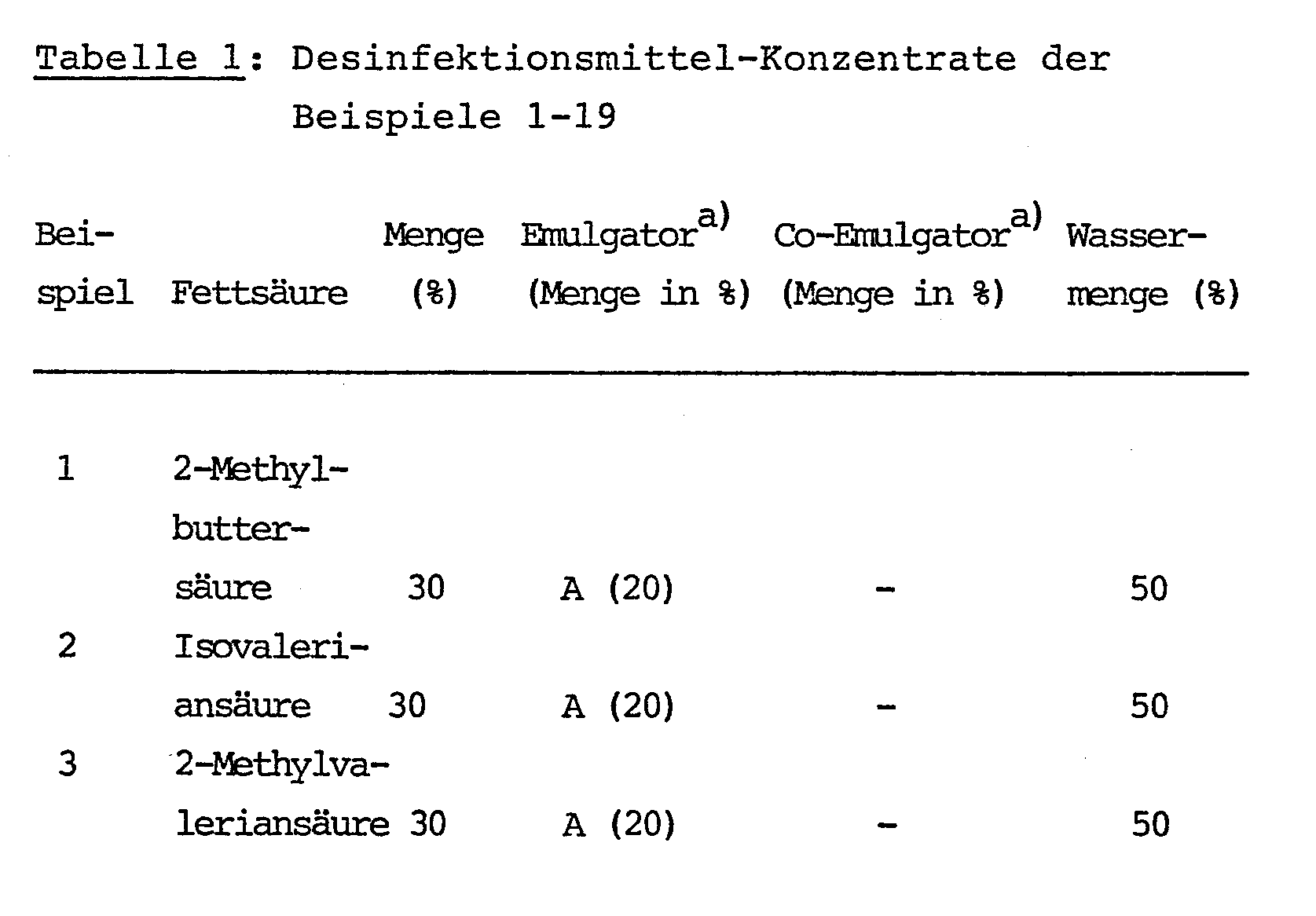

- Bemerkungen zu Tabelle 1:
- a) Verzeichnis der Emulgatoren und Co-Emulgatoren der Beispiele 1-16:
- A Na-Dodecylbenzolsulfonat
- B Dodecylbenzolsulfonsäure
- C Genamin KS 5 : 21%ige Lösung von Pentaoxethylstearylammoniumchlorid (Hoechst)
- D Na-Cumolsulfonat
- E Cremophor HS 15R: Ethoxylierte Oxystearinsäure (BASF)
- F Alkylphenol mit 8EO
- G 65%ige Lösung von Natriumddisooctylsulfosuccinat Steinapol SB-DO 70R (Rewo)
- H Kokosfettsäurediethanolamid
- b) Carbonsäure -8.9.1 (Hoechst)
- c) EDENOR V 85 KR: Fettsäuregemisch (60% C8 und 35% C10)(Henkel)
- Keimtötende Wirkung von Verdünnungen der Konzentrate der Beispiele 1 bis 19 im Suspensionsversuch
- Durch Verdünnen der Desinfektionsmittel-Konzentrate der Beispiele 1 bis 19 mit Wasser standardisierter Härte (WSH) wurden Desinfektionsmittel mit Prüfkonzentrationen entsprechend Tabelle 2, Spalte 2 hergestellt.
- Die Testkeime wurden in Caseinpepton-Sojamehlpepton-Lösung vorgezüchtet und mit dem zu prüfenden Mittel vermischt. Die Ausgangskeimzahl im Desinfektionsmittel-Prüfkeim-Gemisch betrug 1 x 10⁷ bis 5 x 10⁷/ml.
- Nach Einwirkungszeiten von 2,5, 5, 10, 20, 30 und 60 min wurden 0,1 ml aus dem Reaktionsgefäß entnommen und in Caseinpepton-Sojamehlpepton-Lösung mit Enthemmungsmittel (Tween-Lecithin-Histidin) überführt. Die keimtötende Wirkung galt als nachgewiesen, wenn in der Subkultur keine Vermehrung stattfand.
- Tabelle 2 enthält die Abtötungszeiten in min, bei der erstmals keine Vermehrung in der Subkultur mehr stattfand.

- In den nachfolgenden Vergleichsbeispielen 1 bis 5 wurde wie in Beispiel 20 vorgegangen. Als zu prüfende Desinfektionsmittel wurden jedoch die in der nachfolgenden Tabelle 3 angegebenen Fettsäuren in den entsprechenden Konzentrationen ohne Zugabe eines Emulgators verwendet.
- Die angegebenen Abtötungszeiten (min) sind diejenigen Zeiten, in denen erstmals in der Subkultur keine Vermehrung mehr stattfand.

- Keimtötende Wirkung von Verdünnungen der Konzentrate der Beispiele 1 bis 8 im Flächentest auf PVC
- Durch Verdünnen mit Wasser standardisierter Härte (17°DH), WSH, wurden aus den Desinfektionsmittel-Konzentraten der Beispiele 1 bis 8 auf Konzentrationen entsprechend der nachfolgenden Tabelle 4, Spalte 2 Desinfektionsmittel-Lösungen hergestellt.
- Die Testkeime (Staph. aureaus und E.coli) wurden auf Caseinpepton-Sojamehlpepton-Agar vorgezüchtet und mit Caseinpepton-Sojamehlpepton-Lösung abgeschwemmt.
- Je 0,1 ml der Keimsuspension wurden mit einem Glasspatel auf einen 5 cm x 5 cm großen PVC-Fußbodenbelag verteilt, der nach dem Antrocknen der Testkeime mit der jeweiligen Prüflösung besprüht wurde. Nach Einwirkungszeiten von 5, 10, 20, 30 und 60 min wurde mittels Abstrichkultur auf überlebende Keime geprüft. Eine Wirksamkeit auf der PVC-Fläche galt als nachgewiesen, wenn auf den Subkulturen weniger als 10 Kolonien des Testkeimes sichtbar wurden.
- In der nachfolgenden Tabelle 4 sind in Spalten 3 und 4 diejenigen Einwirkungszeiten angegeben, nach denen erstmals weniger als 10 Kolonien des Testkeimes auf den Subkulturen sichtbar wurden.

- Die nachfolgenden Vergleichsbeispiele 6 bis 8 wurden entsprechend Beispiel 21 durchgeführt. Es wurden jedoch zur Desinfektion nur die in der nachfolgenden Tabelle 5 angegebenen Carbonsäuren ohne Emulgatorzusatz verwendet.
-

- Durch Zusammenrühren von 2 Gew.-Teilen Caprylsäure, 3 Gew.-Teilen Glycerin und 15 Gew.-Teilen und 0,5 Gew.-Teilen NaOH wurde ein Desinfektionsmittel-Konzentrat hergestellt, das mit Leitungswasser im Verhältnis 1:9 vermischt wurde. Es entstand eine trübe Caprylsäure-Emulsion mit einem pH-Wert von ca. 6,0.
- Die antimikrobielle Wirkung dieser Desinfektionsmittellösung wurde im Suspensionsversuch entsprechend Beispiel 20 geprüft.
- Die Abtötungszeiten gegenüber zahlreichen Testkeimen sind der nachfolgenden Tabelle 6 zu entnehmen.

- Ein erfindungsgemäßes Konzentrat mit Pflegewirkung für Fußböden wird hergestellt, indem man 15% Octansäure, 2% Na-Dodecylbenzolsulfonat und 83% einer 21%igen wäßrigen Montanwachsemulsion (Handelsname LGE-Wachs, BASF) miteinander verrührt.
- Wird eine 0,5%ige Lösung dieses Konzentrats entsprechend Beispiel 21 auf Desinfektionswirkung geprüft, so findet nach 30 Minuten in der Subkultur bei Staph. aureus und E. coli keine Vermehrung mehr statt. Ein analoges Desinfektionsmittelkonzentrat kann mit einer LicomerR-Dispersion hergestellt werden.
Claims (6)
Applications Claiming Priority (2)
| Application Number | Priority Date | Filing Date | Title |
|---|---|---|---|
| DE19833333443 DE3333443A1 (de) | 1983-09-16 | 1983-09-16 | Desinfektionsmittel-konzentrate auf der basis von kurzkettigen fettsaeuren |
| DE3333443 | 1983-09-16 |
Publications (2)
| Publication Number | Publication Date |
|---|---|
| EP0135898A2 true EP0135898A2 (de) | 1985-04-03 |
| EP0135898A3 EP0135898A3 (de) | 1986-09-03 |
Family
ID=6209228
Family Applications (1)
| Application Number | Title | Priority Date | Filing Date |
|---|---|---|---|
| EP84110982A Withdrawn EP0135898A3 (de) | 1983-09-16 | 1984-09-14 | Desinfektionsmittel-Konzentrat auf der Basis von kurzkettigen Fettsäuren |
Country Status (2)
| Country | Link |
|---|---|
| EP (1) | EP0135898A3 (de) |
| DE (1) | DE3333443A1 (de) |
Cited By (6)
| Publication number | Priority date | Publication date | Assignee | Title |
|---|---|---|---|---|
| EP0245928A3 (en) * | 1986-03-17 | 1989-12-06 | Diversey Corporation | Antimicrobial compositions |
| EP0495792A4 (en) * | 1989-10-13 | 1992-10-28 | Safer, Inc. | Fatty acid based herbicidal compositions |
| WO1995004459A1 (en) * | 1993-08-05 | 1995-02-16 | Ecolab Inc. | Sanitizing compositions |
| WO1999007222A1 (fr) * | 1997-08-05 | 1999-02-18 | Sopura S.A. | Composition desinfectante |
| US9006286B2 (en) | 2011-05-10 | 2015-04-14 | Ecolab Usa Inc. | Couplers for medium-chain fatty acids and disinfecting compositions |
| WO2016037853A1 (de) | 2014-09-11 | 2016-03-17 | Bode Chemie Gmbh | Tuberkulozides desinfektionsmittel |
Families Citing this family (4)
| Publication number | Priority date | Publication date | Assignee | Title |
|---|---|---|---|---|
| DE3632399A1 (de) * | 1986-09-24 | 1988-03-31 | Hoelter Heinz | Waschverfahren zur beseitigung von geruechen in fisch-verarbeitenden betrieben |
| DE4226581C1 (de) * | 1992-08-11 | 1994-02-03 | Perycut Chemie Ag | Verwendung von Kokosvorlauffettsäure zur Insektenabwehr |
| DE19516705C2 (de) * | 1995-05-06 | 1997-10-02 | Beiersdorf Ag | Gegen Bakterien, Mycota und Viren wirksame Substanzen |
| DE19850994A1 (de) * | 1998-11-05 | 2000-05-11 | Menno Chemie Vertriebsges M B | Mittel zur Abwehr und Inaktivierung pathogener Erreger von Pflanzenwurzeln, -stengeln, -blüten, -blättern und -samen |
Family Cites Families (16)
| Publication number | Priority date | Publication date | Assignee | Title |
|---|---|---|---|---|
| DD9444A (de) * | ||||
| US1589866A (en) * | 1924-11-17 | 1926-06-22 | Siegler Edouard Horace | Insecticide and process of preparing the same |
| US2190714A (en) * | 1936-12-01 | 1940-02-20 | Ward Baking Co | Process for inhibition of mold |
| US2466663A (en) * | 1944-10-20 | 1949-04-05 | Ward Baking Co | Fungicide containing caprylic acid and its salt |
| US3272693A (en) * | 1962-02-09 | 1966-09-13 | Du Pont | Methods of controlling fungi with alpha, alpha-dialkyl and alkylene aliphatic acids and salts thereof |
| GB1200331A (en) * | 1967-01-05 | 1970-07-29 | Ici Ltd | Compositions having improved wetting properties |
| GB1249674A (en) * | 1968-11-28 | 1971-10-13 | Exxon Research Engineering Co | Novel agricultural compositions and leaf-desiccating method |
| GB1438946A (en) * | 1972-06-15 | 1976-06-09 | Nat Res Dev | Control of fungi |
| US3867300A (en) * | 1972-08-10 | 1975-02-18 | Carbolabs Inc | Bactericidal composition |
| DD111633A1 (de) * | 1974-01-16 | 1975-03-05 | ||
| GB1505388A (en) * | 1975-11-27 | 1978-03-30 | Bp Chem Int Ltd | Acid salt solutions |
| GB1542390A (en) * | 1977-04-29 | 1979-03-21 | Hager Ab | Preservative against blue stain |
| US4404040A (en) * | 1981-07-01 | 1983-09-13 | Economics Laboratory, Inc. | Short chain fatty acid sanitizing composition and methods |
| DK315482A (da) * | 1981-07-20 | 1983-01-21 | Kimberly Clark Co | Fremgangsmaade til hindring af spredning af aandedraetsvira og middel til anvendelse ved fremgangsmaaden |
| US4410442A (en) * | 1982-01-13 | 1983-10-18 | The Procter & Gamble Company | Disinfecting solutions for hydrophilic contact lenses |
| DE3229097A1 (de) * | 1982-08-04 | 1984-02-09 | Schülke & Mayr GmbH, 2000 Hamburg | Mikrobizide mittel |
-
1983
- 1983-09-16 DE DE19833333443 patent/DE3333443A1/de not_active Withdrawn
-
1984
- 1984-09-14 EP EP84110982A patent/EP0135898A3/de not_active Withdrawn
Cited By (10)
| Publication number | Priority date | Publication date | Assignee | Title |
|---|---|---|---|---|
| EP0245928A3 (en) * | 1986-03-17 | 1989-12-06 | Diversey Corporation | Antimicrobial compositions |
| EP0495792A4 (en) * | 1989-10-13 | 1992-10-28 | Safer, Inc. | Fatty acid based herbicidal compositions |
| WO1995004459A1 (en) * | 1993-08-05 | 1995-02-16 | Ecolab Inc. | Sanitizing compositions |
| WO1999007222A1 (fr) * | 1997-08-05 | 1999-02-18 | Sopura S.A. | Composition desinfectante |
| BE1011314A3 (fr) * | 1997-08-05 | 1999-07-06 | Sopura Sa | Composition desinfectante. |
| US9006286B2 (en) | 2011-05-10 | 2015-04-14 | Ecolab Usa Inc. | Couplers for medium-chain fatty acids and disinfecting compositions |
| US9686981B2 (en) | 2011-05-10 | 2017-06-27 | Ecolab Usa Inc. | Couplers for medium-chain fatty acids and disinfecting compositions |
| US9795132B2 (en) | 2011-05-10 | 2017-10-24 | Ecolab Usa Inc. | Couplers for medium-chain fatty acids and disinfecting compositions |
| WO2016037853A1 (de) | 2014-09-11 | 2016-03-17 | Bode Chemie Gmbh | Tuberkulozides desinfektionsmittel |
| DE102014013241A1 (de) | 2014-09-11 | 2016-03-17 | Bode Chemie Gmbh | Tuberkulozides Desinfektionsmittel |
Also Published As
| Publication number | Publication date |
|---|---|
| DE3333443A1 (de) | 1985-03-28 |
| EP0135898A3 (de) | 1986-09-03 |
Similar Documents
| Publication | Publication Date | Title |
|---|---|---|
| DE3229097C2 (de) | ||
| EP0087049B1 (de) | Desinfektionsmittelkonzentrat | |
| EP0551975B1 (de) | Desinfektionsmittelkonzentrat und Desinfektionsmittel auf Amin- und Alkoholbasis und deren Verwendung | |
| EP0185970B1 (de) | Flüssige Desinfektionsmittelzubereitungen mit Breitbandwirkung | |
| WO1993001714A1 (de) | Antimikrobiell wirksame gemische | |
| DE19653785C2 (de) | Spraydesinfektionsmittelzubereitung | |
| DE2800766C2 (de) | ||
| DE3333443A1 (de) | Desinfektionsmittel-konzentrate auf der basis von kurzkettigen fettsaeuren | |
| EP1189507A1 (de) | Desinfektionsmittel | |
| EP0612470B1 (de) | Desinfektionsmittelkonzentrat und Desinfektionsmittel auf Amin- und Alkoholbasis und deren Verwendung | |
| DE2125893C3 (de) | Präparate zur Bekämpfung von Mikroorganismen und deren Verwendung | |
| DE69029360T2 (de) | Keinen Rückstand hinterlassende antimikrobielle Zusammensetzung | |
| DE19801821B4 (de) | Tuberkulozides Desinfektionsmittel | |
| EP0582360A1 (de) | Desinfektionsmittel auf Carbonsäurebasis | |
| EP1516042A1 (de) | Schaumdesinfektionsmittel | |
| EP0552853A1 (de) | Stabilisiertes aldehydisches Desinfektions- und Konservierungsmittel | |
| EP0940145B1 (de) | O/W-Mikroemulsionen mit einem Gehalt an einem oder mehreren Alkylthiouronium und/oder alpha-omega-Alkylendithiouroniumsalzen als mikrobiozide Wirkstoffe sowie die Verwendung derselben zur manuellen und/oder maschinellen Instrumentendesinfektion | |
| EP1195091A1 (de) | Desinfektionsmittelkonzentrate sowie die Verwendung derselben zur maschinellen Instrumentendesinfektion | |
| EP1627646B1 (de) | Reinigungs- und Desinfektionsmittel für medizinische Instrumente mit verbesserter Wirksamkeit gegen Hepatitis-B-Viren | |
| EP0784930B1 (de) | Desinfektionsmittelkonzentrat und Desinfektionsmittel auf Aminbasis und deren Verwendung | |
| DE4301295A1 (de) | Wäßriges Desinfektionsmittelkonzentrat und Desinfektionsmittel auf Aldehyd- und Alkoholbasis und deren Verwendung | |
| EP1454638A1 (de) | Desinfektionsmittelkonzentrate auf Basis quaternärer Ammoniumverbindungen sowie die Verwendung derselben zur chemothermischen Instrumentenaufbereitung | |
| EP0601452A1 (de) | Flächendesinfektionsmittel, insbesondere für Kunststoffoberflächen | |
| EP0867115B1 (de) | Mikrobizides Mittel und dessen Anwendung | |
| DE3927908C2 (de) | Verwendung von Glykolethern |
Legal Events
| Date | Code | Title | Description |
|---|---|---|---|
| PUAI | Public reference made under article 153(3) epc to a published international application that has entered the european phase |
Free format text: ORIGINAL CODE: 0009012 |
|
| AK | Designated contracting states |
Designated state(s): AT BE CH DE FR GB IT LI LU NL SE |
|
| RTI1 | Title (correction) | ||
| PUAL | Search report despatched |
Free format text: ORIGINAL CODE: 0009013 |
|
| AK | Designated contracting states |
Kind code of ref document: A3 Designated state(s): AT BE CH DE FR GB IT LI LU NL SE |
|
| 17P | Request for examination filed |
Effective date: 19861209 |
|
| 17Q | First examination report despatched |
Effective date: 19880509 |
|
| RAP1 | Party data changed (applicant data changed or rights of an application transferred) |
Owner name: B. BRAUN-SSC AG |
|
| STAA | Information on the status of an ep patent application or granted ep patent |
Free format text: STATUS: THE APPLICATION HAS BEEN WITHDRAWN |
|
| 18W | Application withdrawn |
Withdrawal date: 19881101 |
|
| RIN1 | Information on inventor provided before grant (corrected) |
Inventor name: SCHROEDER, JUERGEN, DR. Inventor name: KOPPENSTEINER, GUENTER, DR. |