EP0134677B1 - Radiation-activatable anaerobic adhesive composition - Google Patents
Radiation-activatable anaerobic adhesive composition Download PDFInfo
- Publication number
- EP0134677B1 EP0134677B1 EP84304970A EP84304970A EP0134677B1 EP 0134677 B1 EP0134677 B1 EP 0134677B1 EP 84304970 A EP84304970 A EP 84304970A EP 84304970 A EP84304970 A EP 84304970A EP 0134677 B1 EP0134677 B1 EP 0134677B1
- Authority
- EP
- European Patent Office
- Prior art keywords
- composition
- compound
- radiation
- formula
- monomer
- Prior art date
- Legal status (The legal status is an assumption and is not a legal conclusion. Google has not performed a legal analysis and makes no representation as to the accuracy of the status listed.)
- Expired
Links
- 0 CC(CN(C)*)=O Chemical compound CC(CN(C)*)=O 0.000 description 3
Classifications
-
- C—CHEMISTRY; METALLURGY
- C09—DYES; PAINTS; POLISHES; NATURAL RESINS; ADHESIVES; COMPOSITIONS NOT OTHERWISE PROVIDED FOR; APPLICATIONS OF MATERIALS NOT OTHERWISE PROVIDED FOR
- C09J—ADHESIVES; NON-MECHANICAL ASPECTS OF ADHESIVE PROCESSES IN GENERAL; ADHESIVE PROCESSES NOT PROVIDED FOR ELSEWHERE; USE OF MATERIALS AS ADHESIVES
- C09J4/00—Adhesives based on organic non-macromolecular compounds having at least one polymerisable carbon-to-carbon unsaturated bond ; adhesives, based on monomers of macromolecular compounds of groups C09J183/00 - C09J183/16
-
- C—CHEMISTRY; METALLURGY
- C08—ORGANIC MACROMOLECULAR COMPOUNDS; THEIR PREPARATION OR CHEMICAL WORKING-UP; COMPOSITIONS BASED THEREON
- C08F—MACROMOLECULAR COMPOUNDS OBTAINED BY REACTIONS ONLY INVOLVING CARBON-TO-CARBON UNSATURATED BONDS
- C08F290/00—Macromolecular compounds obtained by polymerising monomers on to polymers modified by introduction of aliphatic unsaturated end or side groups
- C08F290/02—Macromolecular compounds obtained by polymerising monomers on to polymers modified by introduction of aliphatic unsaturated end or side groups on to polymers modified by introduction of unsaturated end groups
- C08F290/06—Polymers provided for in subclass C08G
Definitions
- This invention relates to adhesive compositions. More particularly, it relates to anaerobic curing compositions activatable, with respect to polymerization, by exposure to suitable radiation, which may be in the ultraviolet or visible region of the spectrum.
- a drawback with anaerobic curable adhesives is that they are extremely dependent on the substrate used and on the gap size between the two parts that are to be adhered together.
- inactive substrates e.g. glass or brass
- large gaps occur when using anaerobic adhesives, weak bonds or no bonds at all are obtained.
- This problem is normally overcome by using either a heat cure or a two-part adhesive or an activator pre-applied as a spray from a dilute solvent solution to one or both substrates.
- a heat cure is expensive; two part systems introduce problems of mixing, and pre-applied primers can lead to noxious fumes and vapors.
- the invention seeks, among its objects, to ameliorate or overcome some or all of the above recited disadvantages by providing a composition which may be used as a one-part adhesive or sealant.
- a one-part composition having anaerobic curing properties, activatable with respect to polymerization by irradiation with ultraviolet or visible light which is suitable for adhering sealing surfaces without the application thereto of heat or primers.
- the composition comprises an anaerobically curable acrylate ester monomer and a cure system for the monomer, characterised in that the cure system comprises a compound which decomposes upon exposure to ultraviolet or visible radiation to generate a strong acid; a peroxy free radical initiator capable of initiating the polymerization, of the monomer in the substantial absence of oxygen; and an activator of anaerobic polymerization, which in the presence of a strong acid reacts with peroxide initiator to produce free radicals to catalyze the anaerobic polymerization of the monomer.
- the cure system comprises a compound which decomposes upon exposure to ultraviolet or visible radiation to generate a strong acid; a peroxy free radical initiator capable of initiating the polymerization, of the monomer in the substantial absence of oxygen; and an activator of anaerobic polymerization, which in the presence of a strong acid reacts with peroxide initiator to produce free radicals to catalyze the anaerobic polymerization of the monomer.
- compositions of the present invention may undergo polymerization when irradiated, but there is no evidence that polymerization will continue after the source of irradiation is removed.
- the invention also embraces a process for adhering or sealing surfaces which comprises applying to at least one of said surfaces the above polymerizable composition, then placing the surfaces in abutting relationship, thereby excluding oxygen and causing the composition to cure, i.e., polymerize to adhere the abutting surfaces.
- compositions of the present invention are formulated as one-part compositions, in which the radiation decomposible compound, initiator and accelerator compounds are combined with the polymerizable acrylate ester to form an anaerobic composition which can adhere abutting surfaces without the use of heat or primers.
- Anaerobic compositions are characterized by their ability to remain liquid in the presence of air, but cure to a strong adhesive bond when air is excluded, as by assembling overlapped surfaces to which the composition has been applied.
- exemplary of anaerobic polymerizable acrylate ester compositions useful in the practice of the present invention include alkylene glycol poly-acrylates such as di-, tri and tetraethylene glycol dimethacrylate, di(pentamethyleneglycol)dimethacrylate; tetraethylene glycol diacrylate; tetraethyleneglycol di(choloroacrylate), diglycerol diacrylate; diglycerol tetramethacrylate; butyleneglycol dimethacrylate; neopentylglycol diacrylate; and trimethylolpropane triacrylate.
- a class of monomers preferred in the practice of the present invention are those acrylate-terminated compounds containing one, and preferably multiple urethane linkages in the backbone, in a ring structure incorporated in the backbone, or pendant from the backbone. For convenience, these are all referred to herin as "urethane-acrylates”.
- the urethane-acrylates disclosed in U.S. Patent No. 3,425,988 may be regarded as the reaction products of an organic polyisocyanate (e.g. toluene diisocyanate) and a mono-acrylate having a reactive hydrogen atom in the alcoholic portion thereof (e.g. hydroxypropyl methacrylate).
- an organic polyisocyanate e.g. toluene diisocyanate
- a mono-acrylate having a reactive hydrogen atom in the alcoholic portion thereof e.g. hydroxypropyl methacrylate
- organic polyisocyanate compounds useful in the preparation of the urethane-acrylates include the higher alkenyl diisocyanates, the cycloalkenyl diisocyanates and the aromatic diisocyanates containing 8 to 30 carbon atoms, such as, for example, octamethylene diisocyanate, durene diisocyanate, 4,4' diphenyl-diisocyanate and toluene diisocyanate.
- alkyl and aryl acrylate esters such as hydroxyethyl acrylate, hydroxyethyl methacrylate, 3-hydroxypropyl methacrylate, hydroxyhexyl acrylate and hydroxyoctyl methacrylate.
- urethane-acrylates useful in the preparation of the compositions of the present invention are those disclosed by Baccei which are one-component polymerizable block copolymers (prepolymers) having rigid and flexible segments. This is achieved by the chemical linking of precursor "prepolymers", such as a polyisocyanate/polyalkylene glycol reaction product having unreacted isocyanate functionality, which are subsequently "capped” with an acrylate, e.g. methacrylate functionality.
- precursor "prepolymers” such as a polyisocyanate/polyalkylene glycol reaction product having unreacted isocyanate functionality, which are subsequently "capped” with an acrylate, e.g. methacrylate functionality.
- These monomers include a urethane-acrylate-capped polybutadiene polyol (U.S. 4,295,909) a urethane-acrylate capped poly (methylene) ethyl polyol (U.S. 4,309,526) and
- the polymerizable acrylate compounds generally comprise 40 percent to 97 percent by weight of the composition of the present invention and preferably comprise 90 to 97 percent by weight of the composition, the remainder of the composition being comprised of the radiation decomposable compounds, initiator and activator compounds.
- Salts of complex halogenides represented by formula 1 decompose, upon exposure to ultraviolet or visible radiation to release strong acids.
- Complex halogenide anions preferred in the practice of the present invention include BF4- (tetrafluoroborate) PF 6 - (hexafluorophosphate), AsF 6 - (hexafluoroarsenate) and SbF 6 - (hexafluoroantimonate).
- metals represented by M the metal or metalloid central atom
- the metal or metalloid central atom include, Sb, Fe, Sn, Bi,AI,Ga, In, Ti, Zr, Sc,V, Cr, Mn, rare earth elements such as the lanthanides, for example, Ce, Pr, Nd, actinides such as Th, Pa, U, Np and metalloids such as B,P and As.
- halogens represented by X in formula I include chlorine, fluorine and bromine.
- lodonium cations represented by A of the complex halogenide salts of formula I include compounds of the formula wherein R 1 and R 2 are monovalent aromatic organic radicals which may be the same or different.
- Radicals included by R 1 and R 2 are for example, C( 6-20) aromatic univalent carbocyclic or heterocyclic radicals which radicals can be substituted with 1 to 4 monovalent radicals selected from C( 1-8 ) alkoxy, alkylphenyl, chlorophenyl, nitrophenyl, methoxyphenyl and pyridyl or R 1 and R 2 , taken together, may represent a bivalent radical having the structure: wherein Z is selected from - CH 2a or a single bond, R 3 is a C (1-8) alkyl radical and a is an integer equal to 1 to 8 inclusive.
- lodonium salts useful in the practice of the present invention include: di-(f-t-butylphenyl) iodonium hexafluorophosphate.
- Group VI a-onium cations represented by A of the complex halogenide salts of formula I include compounds of the formula where R 4 is a monovalent radical selected from alkyl, alkoxy and aromatic radicals, R 5 is a monovalent organic aliphatic radical selected from alkyl, cycloalkyl and substituted alkyl and R S is a bivalent radical selected from alkylene radicals and alkylene radicals having ⁇ O ⁇ or ⁇ S ⁇ in the chain and alkylene radicals having at least one aryl group pendant therefrom, b is a whole number equal to 0 to 3 inclusive, c is a whole number equal to 0 to 2 inclusive, d is a whole number equal to 0 or 1 where the sum of b + c + 2d is a value equal to 3, and G is a Group VI a element selected from sulfur, selenium and tellurium.
- Radicals included by R 4 are for example alkyl radicals of 1 to 8 carbon atoms, alkoxy radicals of 1 to 8 carbon atoms, C( 6-13) aromatic hydrocarbon radicals such as phenyl, tolyl, napthyl, anthryl, and such radicals substituted with nitro, chloro, hydroxy, thioaryloxy, aromatic heterocyclic radicals such as pyridyl and furfuryl.
- R 5 radicals include C (1-18) alkyls such as methyl, ethyl, propyl, substituted alkyl such as ⁇ C 2 H 4 OCH 3 , ⁇ CH 2 COOC 2 H 5 ⁇ , ⁇ CH 2 ⁇ CO ⁇ CH 3 and R 6 radicals include such structures as:
- Sulphonium compounds included by formula I are for example:
- Thiopyrylium cations represented by A of the complex halogenide salts of formula I include compounds of the formula: wherein R 7 , R 8 and R 9 each can represent (a) a hydrogen atom, (b) an alkyl group having from 1 to 10 carbon atoms e.g. methyl, ethyl, propyl, tertiarybutyl, amyl, isoamyl, hexyl, octyl, nonyl, dodecyl and (c) aryl groups including substituted aryl groups having from 6 to 12 carbon atoms including phenyl, 4-diphenyl, 4-ethylphenyl and 4-propylphenyl.
- Thiopyrylium salts useful in the practice of the present invention include phenyl thiopyrylium hexafluorophosphate, 2,6-dimethyl thiopyrylium hexafluoroantimonate and 4-ethyl thiopyrylium hexafluoroarsenate.
- Diazonium cations represented by A of the complex halogenide salts of formula I include compounds of the formula: wherein the aryl group Ar is bonded to a diazonium group by replacing one of the hydrogen atoms at a carbon atom of the aromatic nucleus and where the aryl group may carry at least one pendant group except an amino group.
- the pendant substituent may be alkyl or another common substituent or both.
- Illustrative diazonium salts which may be used in the practice of the present invention include benzene diazonium tetrafluoroborate, benzene diazonium hexafluorophosphate, benzene diazonium hexafluoroarsenate and benzene diazonium hexafluoroantimonate.
- the salts of complex halogenides represented by formula I and compounds represented by formula II are generally incorporated in the anaerobic adhesive compositions of the present invention at concentrations of 0.05 to 15.0 percent by weight and preferably 0.075 to 3.0 percent by weight of the total weight of the composition.
- Peroxy free radical initiators useful in the practice of the present invention include any of a wide variety of known peroxy initiators capable of initiating the polymerization of the acrylate monomer in the substantial absence of oxygen such as hydrogen peroxide, diacyl peroxides such as benzoyl peroxide, ketone peroxides such as methylethyl ketone hydroperoxide, hydroperoxides such as cumene hydroperoxide, tert-butyl hydroperoxide and paramethane hydroperoxide. Of these, cumene hydroperoxide is especially preferred.
- the initiators are generally used in the compositions of the present invention at a concentration of 0.25 to 10.0 percent by weight of the total composition and preferably 0.5 to 5.0 percent by weight.
- Activators which in the presence of a strong acid react with peroxide initiators to produce free radicals which catalyze the anaerobic polymerization of the acrylate monomer include acetyl phenylhydrazine, thiourea and organic compounds having a ferrocenyl moiety which include ferrocene (a chemical compound having the formula (C 5 H 5 ) 2 Fe) and derivatives of ferrocene having the formula wherein R" and R' 2 which may be the same or different, are each H, -COOH, -CO.CH 3 , -CO.0, n-alkyl or vinyl.
- Ferrocene and its derivatives are preferred as activator compounds in the practice of the present invention.
- the activators are generally used in the anaerobic adhesive compositions of the present invention at a concentration of 0.10 to 5.0 percent by weight and preferably 0.25 to 2.0 percent by weight.
- the adhesive formulations of this invention may be preapared, if desired, with reactive diluents which are capable of copolymerizing with the polymerizable acrylate esters.
- reactive diluents which are capable of copolymerizing with the polymerizable acrylate esters.
- Typical of such diluents are the hydroxyalkyl acrylates, such as hydroxyethyl acrylate, hydroxy propyl acrylate, and the corresponding methacrylate compounds, such as hydroxyethyl methacrylate and hydroxypropyl methacrylate.
- the anaerobic adhesive composition may additionally contain adjuvants commonly used in the art, such as stabilizers, plasticizers, thixotropes and chelating agents. Also present may be visible light sensitizers, of which chlorothioxanthone and perylene may be cited as examples.
- adjuvants commonly used in the art such as stabilizers, plasticizers, thixotropes and chelating agents. Also present may be visible light sensitizers, of which chlorothioxanthone and perylene may be cited as examples.
- free radical scavengers such as hydroquinone, naphthoquinone, benzophenone, 4-methoxyphenol and butylated hydroxytoluene
- scavengers of residual acid such as tri-n-butylamine and 2,6-ditert-butyl-4-methylpyridine.
- chelating agents such as the sodium derivatives of polycarboxylated alkylene diamines, e.g. tetrasodium ethylene diamine tetraacetic acid also stabilize the anaerobic adhesive composition against premature polymerization.
- stablizing compounds are normally incorporated in the compositions of the present invention in 10 to 1000 ppm range.
- the proportions of other adjuvants, such as antioxidants, if used, are familiar to those skilled in the art.
- compositions of the present invention after application as a liquid film layer on a suitable substrate such as mild steel or glass and upon exposure to an appropriate source of radiation, the radiation decomposible salts, such as the onium salts of complex halogenides, release strong acid compounds which activate the cure system.
- the liberated acid reacts with the activator compound such as ferrocene to yield an intermediate compound of unknown structure which reacts with the peroxy initiator (e.g. cumene hydroperoxide) to generate free radicals.
- the peroxy initiator e.g. cumene hydroperoxide
- the polymerization reaction is of a free radical nature, it exhibits oxygen stablization, so that as long as ambient oxygen remains in contact with the irradiated film layer, polymerization is inhibited.
- oxygen is removed or otherwise excluded from the film layer as by application of an abutting second substrate surface to the irradiated film layer, polymerization will continue to completion, although a complete cure may take up to 24 hours.
- the adhesive compositions claimed herein may be applied to a surface, irradiated to activate it, and then assembled to another surface some time after activation, to yield a satisfactory adhesive bond. This property is advantageous for manufacturing processes, where such a delay may be needed or helpful.
- the type, intensity and duration of irradiation for activation of the compositions of the present invention are important, but can easily be found by trial and error for any given composition of the invention. In general, it has been found that an ultraviolet source with a substantial output at a wave length of 250 nm gives acceptable results. When certain onium compounds are used in the adhesive composition of the present invention, a tungsten lamp may be used. Inadequate irradiation results in weak bonds, whereas excessive irradiation is to be avoided as excessive irradiation overactivates the cure system causing the composition to gel rapidly. A suitable intensity of irradiation may be found by routine experimentation.
- the adhesive film layer may be irradiated after application to the substrate surface or the liquid adhesive may be irradiated before it is applied to the substrate.
- the adhesive may be dispensed through a thin tube of transparent glass or plastics, such as polyethylene of 1 mm bore and 1 cm to 1 m long having a wall thickness of about 0.1 or 0.2 mm.
- the radiation intensity in such a case is about 10,000 pW/cm 2 , measured at wavelength of 365 nm and the dwell time of the liquid under exposure is about 2 to 5 minutes, preferably about 3 minutes.
- the liquid which emerges from the end of the tube after this treatment can be spread on a substrate, in the presence of air, and will harden when air is excluded as by applying another substrate. If the irradiated adhesive is left too long in the tube, however, it will set, e.g. after several minutes to 1 hour; thus the described procedure is specially adapted for production runs in factory conditions. Wider diameter tubing may be used in conjunction with static mixers. The static mixers help insure that the composition is homogeneously irradiated.
- a radiation activatable anaerobic adhesive composition was prepared by mixing the following ingredients together in the following weight percentages:
- Monomer A was a urethane-acrylate block prepolymer of toluene diisocyanate and the hydroxpolyoxypropylene derivative of trimethylolpropane (commercially available under the trade name Pluracol TP 2450) having unreacted isocyanate functionality capped with hydroxyethyl methacrylate.
- Monomer B was urethane-acrylate block prepolymer prepared by reacting two moles of toluene diisocyanate with 1 mole of hydrogenated bisphenol A, diluting the reaction mixture with methyl methacrylate and further reacting it with two moles of hydroxethyl methacrylate in the manner disclosed in Example V of U.S. Patent 3,425,988.
- the coated surfaces of each pair were firmly placed in contact 45 seconds after cessation of irradiation, to give in each case a 1/2 inch (1.27 cm) overlap in the length direction of the lapshears for an adhesive bond to develop.
- the bonds were left for 24 hours at room temperature to cure.
- the bond strengths were measured in the tensile shear mode, using conventional tensile testing equipment. The results are summarized in Table I below.
- Example II The procedure of Example I was repeated with the exception that after the adhesive composition was applied to the lapshears and activated (at 7500 pW/cm 2 , 365 nm for 3] minutes), the period of time before the coated surfaces were placed in contact with each other (at a 0.5 inch (1.27 cms) overlap) was varied from 15-3600 seconds to demonstrate that the composition was air stabilized after radiation activation. The overlapped surfaces were left at 24 hours at room temperature to cure. Thereafter the tensile strength of the bonded surfaces was measured and the results are recorded in Table II below.
- Example I The procedure of Example I was repeated with the exception that the layer of adhesive composition coated on the lapshears was irradiated at 13,000 pW/cm 2 , measured at 365 nm wherein an average tensile shear strength of 16671 kPa (170 kg/cm 2 ) was achieved with a 1.5 minute irradiation.
- Example I The procedure of Example I was repeated with the exception that a mixture of two related urethane-acrylate resins was substituted for Monomers A and B and a series of ferrocene derivatives having the formula (RC 5 H 4 ) C 5 H 5 Fe wherein R is a vinyl, carbonyl, alkyl (n-butyl), acetyl or benzoyl group and the formula CH 3 C 5 H 4 ) ⁇ Fe(CH 3 C 5 H 4 ) were substituted for ferrocene as the accelerator compound in the anaerobic adhesive formulation.
- R is a vinyl, carbonyl, alkyl (n-butyl), acetyl or benzoyl group and the formula CH 3 C 5 H 4 ) ⁇ Fe(CH 3 C 5 H 4 )
- the first of the urethane-acrylate resins was a polymerizable block copolymer prepared by first reacting a flexible polymeric methylene either diol with a molar excess of diisocyanate such as a toluene diisocyanate so that the product had an -NCO group at each end of the diol.
- the product of the reaction was reacted with a molar equivalence of a hydroxyalkyl methacrylate to form a flexible dimethacrylate block copolymer as disclosed in Bacci U.S. 4,309,526.
- the second resin was a urethane-acrylate resin of the type disclosed in U.S. 3,425,988.
- composition of these radiation activatable anaerobic adhesive formulations as well as the typical tensile strength properties thereof and the irradiation time required to achieve these tensile strengths are summarized in Table III and Table IV below.
- Example IV The procedure of Example IV was repeated with the exception that other salts of complex halogenides were substituted for diphenyl iodonium hexafluorophosphate and the layer of adhesive composition coated on the lapshears was irradiated at 10,000 pW/cm 2 (measured at 365 nm) for 1.75 to 3.0 minutes.
- Example V The procedure of Example V was repeated using adhesive composition Number 3 with the exception that although both contacting surfaces of the lapshears were coated with the composition only one surface was irradiated (at 10,000 ⁇ W/cm 2 for 2 minutes). The two lapshears were assembled 45 seconds after irradiation with a 0.5 inch (1.27 cm) overlap. When tested for tensile strength 24 hours later, the bond exhibited an average (5 tests) tensile shear strength of 170 daN/cm 2 .
- Example VI demonstrates that strong bonds can be achieved using the compositions of the present invention when only one of the contacting surfaces is irradiated prior to assembly.
- Example V The procedure of Example V was repeated using adhesive composition Number 3 with the exception that only one of the lapshears was coated with the composition.
- the coated surface was irradiated for 2 minutes at 10,000 ⁇ W/cm 2 and assembled with the uncoated lapshear with a 0.5 inch (1.27 cm) overlap 45 seconds after being irradiated. Ten minutes after assembly it was not found possible to separate the lapshears in a tensile shear mode.
- Example VII In a control test, the procedure of Example VII was repeated with the exception that the coated surface was not exposed to the source of radiation. Ten minutes after assembly the lapshears could be easily separated using gentle finger pressure.
- Example VII demonstrates that strong bonds can be achieved using compositions of the present invention when only one of the surfaces to be bonded is coated with the compositions and irradiated prior to assembly.
- Example VII The procedure of Example VII was repeated with the exception that glass slides were used instead of lapshears.
- One glass slide was coated with the composition and irradiated for 2 minutes at 10,000 pW/cm 2 .
- the coated surface of the slide was then covered with a second uncoated glass slide with a 0.5 inch (1.27 cm) overlap 45 seconds after irradiation of the coated surface.
- the slides broke.
- Example VIII In a control test, the procedure of Example VIII was repeated with the exception that the coated glass surface was not exposed to the source of irradiation. Three minutes after assembly it was possible to separate the slides using gentle finger pressure.
- Example VIII demonstrates that strong bonds can be achieved using the compositions of the present invention when inactive or passive surfaces are to be bonded.
Landscapes
- Chemical & Material Sciences (AREA)
- Organic Chemistry (AREA)
- Health & Medical Sciences (AREA)
- Chemical Kinetics & Catalysis (AREA)
- Medicinal Chemistry (AREA)
- Polymers & Plastics (AREA)
- Adhesives Or Adhesive Processes (AREA)
- Polymerisation Methods In General (AREA)
- Organic Low-Molecular-Weight Compounds And Preparation Thereof (AREA)
Description
- This invention relates to adhesive compositions. More particularly, it relates to anaerobic curing compositions activatable, with respect to polymerization, by exposure to suitable radiation, which may be in the ultraviolet or visible region of the spectrum.
- A drawback with anaerobic curable adhesives is that they are extremely dependent on the substrate used and on the gap size between the two parts that are to be adhered together. When inactive substrates (e.g. glass or brass) or large gaps occur when using anaerobic adhesives, weak bonds or no bonds at all are obtained. This problem is normally overcome by using either a heat cure or a two-part adhesive or an activator pre-applied as a spray from a dilute solvent solution to one or both substrates. A heat cure is expensive; two part systems introduce problems of mixing, and pre-applied primers can lead to noxious fumes and vapors. The invention seeks, among its objects, to ameliorate or overcome some or all of the above recited disadvantages by providing a composition which may be used as a one-part adhesive or sealant.
- In accordance with the present invention, there is provided a one-part composition having anaerobic curing properties, activatable with respect to polymerization by irradiation with ultraviolet or visible light which is suitable for adhering sealing surfaces without the application thereto of heat or primers. The composition comprises an anaerobically curable acrylate ester monomer and a cure system for the monomer, characterised in that the cure system comprises a compound which decomposes upon exposure to ultraviolet or visible radiation to generate a strong acid; a peroxy free radical initiator capable of initiating the polymerization, of the monomer in the substantial absence of oxygen; and an activator of anaerobic polymerization, which in the presence of a strong acid reacts with peroxide initiator to produce free radicals to catalyze the anaerobic polymerization of the monomer.
- It has been determined that when either the peroxide initiator, accelerator or radiation decomposible compound is absent from the compositions of the present invention, the composition may undergo polymerization when irradiated, but there is no evidence that polymerization will continue after the source of irradiation is removed.
- The invention also embraces a process for adhering or sealing surfaces which comprises applying to at least one of said surfaces the above polymerizable composition, then placing the surfaces in abutting relationship, thereby excluding oxygen and causing the composition to cure, i.e., polymerize to adhere the abutting surfaces.
- The curable compositions of the present invention are formulated as one-part compositions, in which the radiation decomposible compound, initiator and accelerator compounds are combined with the polymerizable acrylate ester to form an anaerobic composition which can adhere abutting surfaces without the use of heat or primers.
- Anaerobic compositions are characterized by their ability to remain liquid in the presence of air, but cure to a strong adhesive bond when air is excluded, as by assembling overlapped surfaces to which the composition has been applied. Exemplary of anaerobic polymerizable acrylate ester compositions useful in the practice of the present invention include alkylene glycol poly-acrylates such as di-, tri and tetraethylene glycol dimethacrylate, di(pentamethyleneglycol)dimethacrylate; tetraethylene glycol diacrylate; tetraethyleneglycol di(choloroacrylate), diglycerol diacrylate; diglycerol tetramethacrylate; butyleneglycol dimethacrylate; neopentylglycol diacrylate; and trimethylolpropane triacrylate.
- A class of monomers preferred in the practice of the present invention are those acrylate-terminated compounds containing one, and preferably multiple urethane linkages in the backbone, in a ring structure incorporated in the backbone, or pendant from the backbone. For convenience, these are all referred to herin as "urethane-acrylates".
- Urethane-acrylates are known to the art, the preparation of such monomers being disclosed in U.S. Patent No. 3,425,988.
- The urethane-acrylates disclosed in U.S. Patent No. 3,425,988 may be regarded as the reaction products of an organic polyisocyanate (e.g. toluene diisocyanate) and a mono-acrylate having a reactive hydrogen atom in the alcoholic portion thereof (e.g. hydroxypropyl methacrylate).
- Illustrative of the organic polyisocyanate compounds useful in the preparation of the urethane-acrylates include the higher alkenyl diisocyanates, the cycloalkenyl diisocyanates and the aromatic diisocyanates containing 8 to 30 carbon atoms, such as, for example, octamethylene diisocyanate, durene diisocyanate, 4,4' diphenyl-diisocyanate and toluene diisocyanate.
- Illustrative of mono-acrylate compounds used to prepare the urethane-acrylates are alkyl and aryl acrylate esters such as hydroxyethyl acrylate, hydroxyethyl methacrylate, 3-hydroxypropyl methacrylate, hydroxyhexyl acrylate and hydroxyoctyl methacrylate.
- Another group of urethane-acrylates useful in the preparation of the compositions of the present invention are those disclosed by Baccei which are one-component polymerizable block copolymers (prepolymers) having rigid and flexible segments. This is achieved by the chemical linking of precursor "prepolymers", such as a polyisocyanate/polyalkylene glycol reaction product having unreacted isocyanate functionality, which are subsequently "capped" with an acrylate, e.g. methacrylate functionality. These monomers include a urethane-acrylate-capped polybutadiene polyol (U.S. 4,295,909) a urethane-acrylate capped poly (methylene) ethyl polyol (U.S. 4,309,526) and a urethane-acrylate-capped vinyl grafted poly (alkylene) ether polyol (U.S. 4,018,851).
- The polymerizable acrylate compounds generally comprise 40 percent to 97 percent by weight of the composition of the present invention and preferably comprise 90 to 97 percent by weight of the composition, the remainder of the composition being comprised of the radiation decomposable compounds, initiator and activator compounds.
- Compounds which decompose upon exposure to ultraviolet or visible radiation useful in the practice of the present invention include salts of complex halogenides represented by the formula


- Salts of complex halogenides represented by formula 1 decompose, upon exposure to ultraviolet or visible radiation to release strong acids.
- Complex anions included by [MXe]-(e-f) of Formula I are for example FeC14, SnCl6 =, SnCl6 -, SbC6s -, BiCl5 =, AlF6―' =, GaCl4 - , InF4 - , TiF6 = and ZrF6 =. Complex halogenide anions preferred in the practice of the present invention include BF4- (tetrafluoroborate) PF6 - (hexafluorophosphate), AsF6 - (hexafluoroarsenate) and SbF6 - (hexafluoroantimonate). Illustrative of metals represented by M, the metal or metalloid central atom, include, Sb, Fe, Sn, Bi,AI,Ga, In, Ti, Zr, Sc,V, Cr, Mn, rare earth elements such as the lanthanides, for example, Ce, Pr, Nd, actinides such as Th, Pa, U, Np and metalloids such as B,P and As.
- Illustrative of halogens represented by X in formula I include chlorine, fluorine and bromine.
- lodonium cations represented by A of the complex halogenide salts of formula I include compounds of the formula

- Radicals included by R1 and R2 are for example, C(6-20) aromatic univalent carbocyclic or heterocyclic radicals which radicals can be substituted with 1 to 4 monovalent radicals selected from C(1-8) alkoxy, alkylphenyl, chlorophenyl, nitrophenyl, methoxyphenyl and pyridyl or R1 and R2, taken together, may represent a bivalent radical having the structure:


- lodonium salts useful in the practice of the present invention include:


- Group VI a-onium cations represented by A of the complex halogenide salts of formula I include compounds of the formula

- Radicals included by R4, are for example alkyl radicals of 1 to 8 carbon atoms, alkoxy radicals of 1 to 8 carbon atoms, C(6-13) aromatic hydrocarbon radicals such as phenyl, tolyl, napthyl, anthryl, and such radicals substituted with nitro, chloro, hydroxy, thioaryloxy, aromatic heterocyclic radicals such as pyridyl and furfuryl. R5 radicals include C(1-18) alkyls such as methyl, ethyl, propyl, substituted alkyl such as ―C2H4OCH3, ―CH2COOC2H5―, ―CH2―CO―CH3 and R6 radicals include such structures as:


- Sulphonium compounds included by formula I are for example:


- Thiopyrylium cations represented by A of the complex halogenide salts of formula I include compounds of the formula:

- Thiopyrylium salts useful in the practice of the present invention include phenyl thiopyrylium hexafluorophosphate, 2,6-dimethyl thiopyrylium hexafluoroantimonate and 4-ethyl thiopyrylium hexafluoroarsenate.
- Diazonium cations represented by A of the complex halogenide salts of formula I include compounds of the formula:

- Illustrative diazonium salts which may be used in the practice of the present invention include benzene diazonium tetrafluoroborate, benzene diazonium hexafluorophosphate, benzene diazonium hexafluoroarsenate and benzene diazonium hexafluoroantimonate.
- Compounds included by formula II are for example:


- The salts of complex halogenides represented by formula I and compounds represented by formula II are generally incorporated in the anaerobic adhesive compositions of the present invention at concentrations of 0.05 to 15.0 percent by weight and preferably 0.075 to 3.0 percent by weight of the total weight of the composition.
- Peroxy free radical initiators useful in the practice of the present invention include any of a wide variety of known peroxy initiators capable of initiating the polymerization of the acrylate monomer in the substantial absence of oxygen such as hydrogen peroxide, diacyl peroxides such as benzoyl peroxide, ketone peroxides such as methylethyl ketone hydroperoxide, hydroperoxides such as cumene hydroperoxide, tert-butyl hydroperoxide and paramethane hydroperoxide. Of these, cumene hydroperoxide is especially preferred. The initiators are generally used in the compositions of the present invention at a concentration of 0.25 to 10.0 percent by weight of the total composition and preferably 0.5 to 5.0 percent by weight.
- Activators which in the presence of a strong acid react with peroxide initiators to produce free radicals which catalyze the anaerobic polymerization of the acrylate monomer include acetyl phenylhydrazine, thiourea and organic compounds having a ferrocenyl moiety which include ferrocene (a chemical compound having the formula (C5H5)2Fe) and derivatives of ferrocene having the formula

- Ferrocene and its derivatives are preferred as activator compounds in the practice of the present invention.
- The activators are generally used in the anaerobic adhesive compositions of the present invention at a concentration of 0.10 to 5.0 percent by weight and preferably 0.25 to 2.0 percent by weight.
- The adhesive formulations of this invention may be preapared, if desired, with reactive diluents which are capable of copolymerizing with the polymerizable acrylate esters. Typical of such diluents are the hydroxyalkyl acrylates, such as hydroxyethyl acrylate, hydroxy propyl acrylate, and the corresponding methacrylate compounds, such as hydroxyethyl methacrylate and hydroxypropyl methacrylate.
- The anaerobic adhesive composition may additionally contain adjuvants commonly used in the art, such as stabilizers, plasticizers, thixotropes and chelating agents. Also present may be visible light sensitizers, of which chlorothioxanthone and perylene may be cited as examples. Among the common stablizers are included (i) free radical scavengers such as hydroquinone, naphthoquinone, benzophenone, 4-methoxyphenol and butylated hydroxytoluene, and (ii) scavengers of residual acid, such as tri-n-butylamine and 2,6-ditert-butyl-4-methylpyridine. The addition of chelating agents such as the sodium derivatives of polycarboxylated alkylene diamines, e.g. tetrasodium ethylene diamine tetraacetic acid also stabilize the anaerobic adhesive composition against premature polymerization. These stablizing compounds are normally incorporated in the compositions of the present invention in 10 to 1000 ppm range. The proportions of other adjuvants, such as antioxidants, if used, are familiar to those skilled in the art.
- Although the invention is to be understood as not bound by or dependant on any particular theory as to its operation, the following is postulated as to the method of operability of the compositions of the invention as one-part anaerobic adhesive compositions.
- The compositions of the present invention after application as a liquid film layer on a suitable substrate such as mild steel or glass and upon exposure to an appropriate source of radiation, the radiation decomposible salts, such as the onium salts of complex halogenides, release strong acid compounds which activate the cure system. The liberated acid reacts with the activator compound such as ferrocene to yield an intermediate compound of unknown structure which reacts with the peroxy initiator (e.g. cumene hydroperoxide) to generate free radicals. Once the intermediate compound has. been formed, polymerization takes place in due course, so that further radiation is unnecessary.
- As the polymerization reaction is of a free radical nature, it exhibits oxygen stablization, so that as long as ambient oxygen remains in contact with the irradiated film layer, polymerization is inhibited. When oxygen is removed or otherwise excluded from the film layer as by application of an abutting second substrate surface to the irradiated film layer, polymerization will continue to completion, although a complete cure may take up to 24 hours. It will be clear that in the practice of the present invention, the adhesive compositions claimed herein may be applied to a surface, irradiated to activate it, and then assembled to another surface some time after activation, to yield a satisfactory adhesive bond. This property is advantageous for manufacturing processes, where such a delay may be needed or helpful.
- It will be appreciated that the presence of acids in the compositions of the present invention will tend to destabilize the cure system described above, for which reason monomers having acidic functional groups should be avoided or restricted to low concentrations, for acceptable shelf life properties of the adhesive compositions.
- The type, intensity and duration of irradiation for activation of the compositions of the present invention are important, but can easily be found by trial and error for any given composition of the invention. In general, it has been found that an ultraviolet source with a substantial output at a wave length of 250 nm gives acceptable results. When certain onium compounds

- The location chosen for irradiation is not critical. Thus the adhesive film layer may be irradiated after application to the substrate surface or the liquid adhesive may be irradiated before it is applied to the substrate. For example, the adhesive may be dispensed through a thin tube of transparent glass or plastics, such as polyethylene of 1 mm bore and 1 cm to 1 m long having a wall thickness of about 0.1 or 0.2 mm. The radiation intensity in such a case is about 10,000 pW/cm2, measured at wavelength of 365 nm and the dwell time of the liquid under exposure is about 2 to 5 minutes, preferably about 3 minutes. The liquid which emerges from the end of the tube after this treatment can be spread on a substrate, in the presence of air, and will harden when air is excluded as by applying another substrate. If the irradiated adhesive is left too long in the tube, however, it will set, e.g. after several minutes to 1 hour; thus the described procedure is specially adapted for production runs in factory conditions. Wider diameter tubing may be used in conjunction with static mixers. The static mixers help insure that the composition is homogeneously irradiated.
- The following examples provide specific illustrations of various aspects of the present invention and are in no way intended to limit it. All parts and percentages are by weight unless otherwise indicated.
- A radiation activatable anaerobic adhesive composition was prepared by mixing the following ingredients together in the following weight percentages:
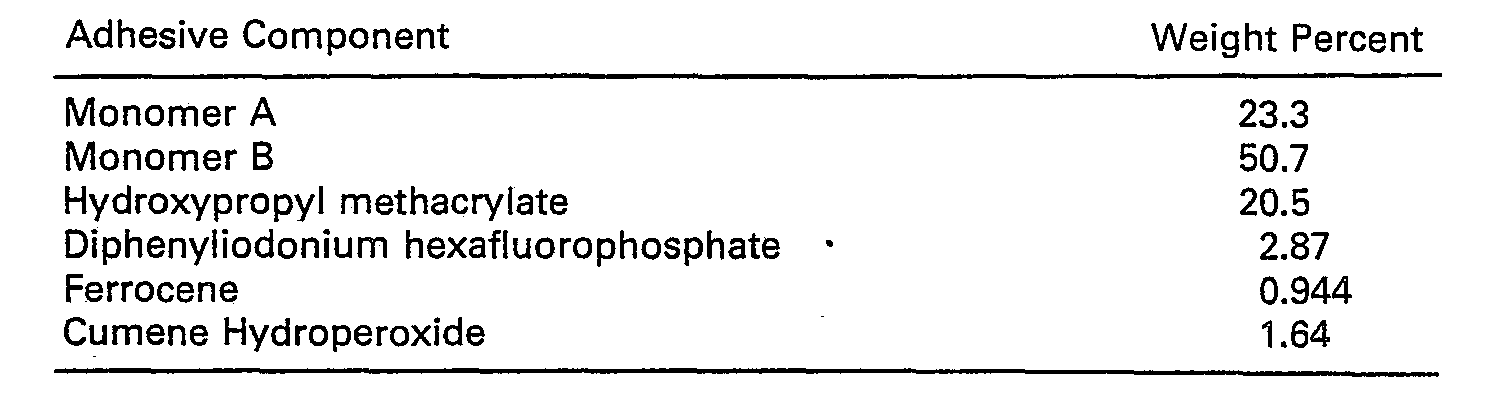
- Monomer A was a urethane-acrylate block prepolymer of toluene diisocyanate and the hydroxpolyoxypropylene derivative of trimethylolpropane (commercially available under the trade name Pluracol TP 2450) having unreacted isocyanate functionality capped with hydroxyethyl methacrylate.
- Monomer B was urethane-acrylate block prepolymer prepared by reacting two moles of toluene diisocyanate with 1 mole of hydrogenated bisphenol A, diluting the reaction mixture with methyl methacrylate and further reacting it with two moles of hydroxethyl methacrylate in the manner disclosed in Example V of U.S. Patent 3,425,988.
- Pairs of mild steel grit blasted lapshears, 2 centimeters wide, were coated on one face with the adhesive composition of Example I and irradiated at 7000 pW/cm2 (measured at 365 nm) for a time interval which was different for each of seven groups of pairs. The coated surfaces of each pair were firmly placed in contact 45 seconds after cessation of irradiation, to give in each case a 1/2 inch (1.27 cm) overlap in the length direction of the lapshears for an adhesive bond to develop. The bonds were left for 24 hours at room temperature to cure. The bond strengths were measured in the tensile shear mode, using conventional tensile testing equipment. The results are summarized in Table I below.

- The data in Table I indicate that maximum bond strength was achieved with an irradiation time of 4 minutes. Such bond strength corresponds to a commercially useful adhesive composition. If irradiation is continued for longer than 4 minutes the system becomes overactivated and is not thereafter effectively stabilized by oxygen, resulting in weak bond strengths.
- The procedure of Example I was repeated with the exception that after the adhesive composition was applied to the lapshears and activated (at 7500 pW/cm2, 365 nm for 3] minutes), the period of time before the coated surfaces were placed in contact with each other (at a 0.5 inch (1.27 cms) overlap) was varied from 15-3600 seconds to demonstrate that the composition was air stabilized after radiation activation. The overlapped surfaces were left at 24 hours at room temperature to cure. Thereafter the tensile strength of the bonded surfaces was measured and the results are recorded in Table II below.

- A reference to the data in Table II indicates that the bond strength remains fairly constant over the delay time range indicating that the activated adhesive composition was air stabilized.
- The procedure of Example I was repeated with the exception that the layer of adhesive composition coated on the lapshears was irradiated at 13,000 pW/cm2, measured at 365 nm wherein an average tensile shear strength of 16671 kPa (170 kg/cm2) was achieved with a 1.5 minute irradiation.
- The procedure of Example I was repeated with the exception that a mixture of two related urethane-acrylate resins was substituted for Monomers A and B and a series of ferrocene derivatives having the formula (RC5H4) C5H5Fe wherein R is a vinyl, carbonyl, alkyl (n-butyl), acetyl or benzoyl group and the formula CH3C5H4)―Fe(CH3C5H4) were substituted for ferrocene as the accelerator compound in the anaerobic adhesive formulation.
- The first of the urethane-acrylate resins was a polymerizable block copolymer prepared by first reacting a flexible polymeric methylene either diol with a molar excess of diisocyanate such as a toluene diisocyanate so that the product had an -NCO group at each end of the diol. The product of the reaction was reacted with a molar equivalence of a hydroxyalkyl methacrylate to form a flexible dimethacrylate block copolymer as disclosed in Bacci U.S. 4,309,526. The second resin was a urethane-acrylate resin of the type disclosed in U.S. 3,425,988.
- The composition of these radiation activatable anaerobic adhesive formulations as well as the typical tensile strength properties thereof and the irradiation time required to achieve these tensile strengths are summarized in Table III and Table IV below.


- The procedure of Example IV was repeated with the exception that other salts of complex halogenides were substituted for diphenyl iodonium hexafluorophosphate and the layer of adhesive composition coated on the lapshears was irradiated at 10,000 pW/cm2 (measured at 365 nm) for 1.75 to 3.0 minutes.
- The composition of these radiation activable anaerobic adhesive formulations as well as the irradiation time required to achieve these tensile strengths are summarized in Table V below:

- The procedure of Example V was repeated using adhesive composition Number 3 with the exception that although both contacting surfaces of the lapshears were coated with the composition only one surface was irradiated (at 10,000 µW/cm2 for 2 minutes). The two lapshears were assembled 45 seconds after irradiation with a 0.5 inch (1.27 cm) overlap. When tested for tensile strength 24 hours later, the bond exhibited an average (5 tests) tensile shear strength of 170 daN/cm2.
- Thus Example VI demonstrates that strong bonds can be achieved using the compositions of the present invention when only one of the contacting surfaces is irradiated prior to assembly.
- The procedure of Example V was repeated using adhesive composition Number 3 with the exception that only one of the lapshears was coated with the composition. The coated surface was irradiated for 2 minutes at 10,000 µW/cm2 and assembled with the uncoated lapshear with a 0.5 inch (1.27 cm) overlap 45 seconds after being irradiated. Ten minutes after assembly it was not found possible to separate the lapshears in a tensile shear mode.
- In a control test, the procedure of Example VII was repeated with the exception that the coated surface was not exposed to the source of radiation. Ten minutes after assembly the lapshears could be easily separated using gentle finger pressure.
- Thus Example VII demonstrates that strong bonds can be achieved using compositions of the present invention when only one of the surfaces to be bonded is coated with the compositions and irradiated prior to assembly.
- The procedure of Example VII was repeated with the exception that glass slides were used instead of lapshears. One glass slide was coated with the composition and irradiated for 2 minutes at 10,000 pW/cm2. The coated surface of the slide was then covered with a second uncoated glass slide with a 0.5 inch (1.27 cm) overlap 45 seconds after irradiation of the coated surface. When an attempt was made, 3 minutes after assembly, to separate the slides, the slides broke.
- In a control test, the procedure of Example VIII was repeated with the exception that the coated glass surface was not exposed to the source of irradiation. Three minutes after assembly it was possible to separate the slides using gentle finger pressure.
- Thus Example VIII demonstrates that strong bonds can be achieved using the compositions of the present invention when inactive or passive surfaces are to be bonded.
- Note: All examples were carried out using a Philips HP 400 Watt glass coated mercury lamp. Other light sources giving suitable output may be used.
Claims (13)

Applications Claiming Priority (2)
| Application Number | Priority Date | Filing Date | Title |
|---|---|---|---|
| US06/515,540 US4533446A (en) | 1983-07-20 | 1983-07-20 | Radiation-activatable anaerobic adhesive composition |
| US515540 | 1983-07-20 |
Publications (2)
| Publication Number | Publication Date |
|---|---|
| EP0134677A1 EP0134677A1 (en) | 1985-03-20 |
| EP0134677B1 true EP0134677B1 (en) | 1987-05-06 |
Family
ID=24051762
Family Applications (1)
| Application Number | Title | Priority Date | Filing Date |
|---|---|---|---|
| EP84304970A Expired EP0134677B1 (en) | 1983-07-20 | 1984-07-20 | Radiation-activatable anaerobic adhesive composition |
Country Status (6)
| Country | Link |
|---|---|
| US (1) | US4533446A (en) |
| EP (1) | EP0134677B1 (en) |
| JP (1) | JPH0613676B2 (en) |
| AU (1) | AU572528B2 (en) |
| CA (1) | CA1243142A (en) |
| DE (1) | DE3463523D1 (en) |
Families Citing this family (55)
| Publication number | Priority date | Publication date | Assignee | Title |
|---|---|---|---|---|
| EP0152377B1 (en) * | 1984-02-10 | 1987-12-09 | Ciba-Geigy Ag | Curable compositions and their use |
| US4746685A (en) * | 1984-08-31 | 1988-05-24 | Nippon Oil And Fats Co., Ltd. | Light curable dental composition |
| FR2579611B1 (en) * | 1985-03-28 | 1987-08-21 | Saint Gobain Vitrage | ADHESIVE LAYER USED IN THE MANUFACTURE OF SHEET WINDOWS AND SHEET WINDOWS COMPRISING SUCH A LAYER |
| US4656229A (en) * | 1985-12-02 | 1987-04-07 | National Starch And Chemical Corporation | Anaerobic adhesive compositions |
| DE3604580A1 (en) * | 1986-02-14 | 1987-08-20 | Basf Ag | CURABLE MIXTURES CONTAINING N-SULFONYLAMINOSULFONIUM SALTS AS CATIONICALLY EFFECTIVE CATALYSTS |
| US4780487A (en) * | 1986-10-22 | 1988-10-25 | Thomas Kurpiewski | Radiation curable coating compositions |
| US5234730A (en) * | 1986-11-07 | 1993-08-10 | Tremco, Inc. | Adhesive composition, process, and product |
| US4965117A (en) * | 1986-11-07 | 1990-10-23 | The B. F. Goodrich Company | Adhesive composition, process, and product |
| US4814215A (en) * | 1986-11-07 | 1989-03-21 | The B. F. Goodrich Company | Adhesive composition, process, and product |
| US4964938A (en) * | 1987-04-13 | 1990-10-23 | Dymax Corporation | Bonding method using photocurable acrylate adhesive containing perester/tautomeric acid adhesion promoter |
| US5039715A (en) * | 1987-04-13 | 1991-08-13 | Dymax Corporation | Photocurable acrylate adhesive containing perester/tautomeric acid adhesion promoter |
| DE3724838A1 (en) * | 1987-07-27 | 1989-02-09 | Henkel Kgaa | USE OF LIGHT-INDUCED CROSS-LINKABLE MONOMER COMPOSITIONS AS DARK-CURING ADHESIVES |
| US4952612A (en) * | 1987-08-28 | 1990-08-28 | Minnesota Mining And Manufacturing Company | Energy-induced curable compositions |
| US5147900A (en) * | 1987-08-28 | 1992-09-15 | Minnesosta Mining And Manufacturing Company | Energy-induced dual curable compositions |
| US5086086A (en) * | 1987-08-28 | 1992-02-04 | Minnesota Mining And Manufacturing Company | Energy-induced curable compositions |
| US4950696A (en) * | 1987-08-28 | 1990-08-21 | Minnesota Mining And Manufacturing Company | Energy-induced dual curable compositions |
| DE3880642T2 (en) * | 1987-12-08 | 1993-11-18 | Mitsui Petrochemical Ind | Composition, curable with active rays, and medium for optical registration with this hardened composition. |
| FR2624872B1 (en) * | 1987-12-22 | 1991-10-18 | Elf Aquitaine | CHEMICALLY STABLE ANAEROBIC ACRYLIC ADHESIVE FORMULATION CAPABLE OF PROVIDING A HARDENED ADHESIVE JOINT HAVING IMPROVED SHOCK AND SHEAR RESISTANCE OR / AND GOOD THERMAL RESISTANCE |
| US5273662A (en) * | 1988-01-11 | 1993-12-28 | Loctite Corporation | Process for treating impregnation process waste water |
| US4946531A (en) * | 1988-12-01 | 1990-08-07 | General Electric Company | Process for hardcoating polycarbonate sheet |
| US4940633A (en) * | 1989-05-26 | 1990-07-10 | Hermansen Ralph D | Method of bonding metals with a radio-opaque adhesive/sealant for void detection and product made |
| US5506326A (en) * | 1991-03-06 | 1996-04-09 | Loctite (Ireland) Limited | Air-activatable polymerizable compositions containing onium salts |
| JPH05111097A (en) * | 1991-10-15 | 1993-04-30 | Murata Mfg Co Ltd | Piezoelectric sounder |
| US5149441A (en) * | 1991-10-18 | 1992-09-22 | Loctite Corporation | Method of treating wastewater containing heat-curable (meth) acrylic monomer compositions |
| US5135663A (en) * | 1991-10-18 | 1992-08-04 | Loctite Corporation | Method of treating (meth)acrylic monomer-containing wastewater |
| CA2110008A1 (en) * | 1992-12-22 | 1994-06-23 | Ronald F. Sieloff | Method and apparatus for production of a hard coated substrate |
| US5618857A (en) * | 1993-06-24 | 1997-04-08 | Loctite Corporation | Impregnation sealant composition of superior high temperature resistance, and method of making same |
| JP2955488B2 (en) * | 1995-04-25 | 1999-10-04 | セメダイン株式会社 | Fast curing bonding method |
| US5922783A (en) | 1997-02-27 | 1999-07-13 | Loctite Corporation | Radiation-curable, cyanoacrylate-containing compositions |
| US6512511B2 (en) | 1998-07-20 | 2003-01-28 | Alphagrip, Inc. | Hand grippable combined keyboard and game controller system |
| US7146897B1 (en) | 1999-07-19 | 2006-12-12 | Henkel Corporation | UV/visible light and anaerobic curable composition |
| US6883413B2 (en) * | 1999-07-19 | 2005-04-26 | Henkel Corporation | Visible and UV/visible light anaerobic curable primer mix coating |
| US6460464B1 (en) | 1999-07-19 | 2002-10-08 | Henkel Loctite Corporation | Adhesive for ring seal in center fire ammunition |
| US6451948B1 (en) * | 1999-08-19 | 2002-09-17 | Loctite Corporation | Radical-curable adhesive compositions, reaction products of which demonstrate superior resistance to thermal degradation |
| US6346361B1 (en) * | 1999-10-06 | 2002-02-12 | Clariant Finance (Bvi) Limited | Method for synthesizing polymeric AZO dyes |
| US20030032736A1 (en) * | 2000-01-11 | 2003-02-13 | Kneafsey Brendan J. | Acrylic adhesive compositions containing ketonyl (meth)acrylate |
| US6617371B2 (en) * | 2001-06-08 | 2003-09-09 | Addison Clear Wave, Llc | Single component room temperature stable heat-curable acrylate resin adhesive |
| US6867241B2 (en) * | 2002-01-31 | 2005-03-15 | Henkel Corporation | Radiation-curable, cyanoacrylate-containing compositions |
| AU2002357674A1 (en) * | 2002-02-05 | 2003-09-02 | Henkel Corporation | Luminescing and/or fluorescing radiation-curable, cyanoacrylate-containing compositions |
| US6632908B1 (en) | 2002-03-12 | 2003-10-14 | Henkel Loctite Corporation | Bonding system having adherence to low energy surfaces |
| WO2004011848A2 (en) | 2002-07-25 | 2004-02-05 | Dahm Jonathan S | Method and apparatus for using light emitting diodes for curing |
| US7323222B2 (en) * | 2002-11-18 | 2008-01-29 | Henkel Corporation | Anaerobic adhesive compositions curable on inactive surfaces |
| US7196268B2 (en) * | 2004-08-17 | 2007-03-27 | Ilsco Corporation | Self sealing electrical connector |
| WO2007120630A2 (en) * | 2006-04-10 | 2007-10-25 | Abm Associates Llc | Activated anaerobic adhesive and use thereof |
| US20080251195A1 (en) * | 2007-04-10 | 2008-10-16 | Abm Associates Llc | Activated anaerobic adhesive and use thereof |
| US20100154333A1 (en) * | 2008-12-18 | 2010-06-24 | Huber Engineered Woods Llc | Structural Members And Structures Using Them, And Methods |
| CN102439705B (en) * | 2009-02-20 | 2015-04-01 | 汉高知识产权及控股有限公司 | Electrode connection method and connection composition used therein |
| JP4816800B2 (en) * | 2010-03-10 | 2011-11-16 | オムロン株式会社 | Electronic component, method for manufacturing electronic component, and electronic thermometer |
| US9080084B2 (en) | 2011-07-25 | 2015-07-14 | Henkel IP & Holding GmbH | Photolytically induced redox curable compositions |
| EP2744835A4 (en) * | 2011-07-25 | 2015-05-06 | Henkel US IP LLC | Photolytically induced redox curable compositions |
| JP6766315B2 (en) * | 2016-06-01 | 2020-10-14 | 株式会社スリーボンド | Anaerobic curable composition |
| JP7036810B2 (en) * | 2016-06-20 | 2022-03-15 | デンツプライ シロナ インコーポレイテッド | 3D modeling material system and method for manufacturing layered dental products |
| GB201812113D0 (en) * | 2018-07-25 | 2018-09-05 | Henkel IP & Holding GmbH | Anerobically curable compositions |
| EP3892466A4 (en) * | 2018-12-05 | 2022-08-31 | Furukawa Electric Co., Ltd. | Layered body |
| CN113165371A (en) * | 2018-12-18 | 2021-07-23 | 三键有限公司 | Method for producing laminated steel sheet, apparatus for producing laminated steel sheet, and curable composition for use in same |
Family Cites Families (12)
| Publication number | Priority date | Publication date | Assignee | Title |
|---|---|---|---|---|
| US3855040A (en) * | 1972-07-03 | 1974-12-17 | Loctite Corp | Anaerobic compositions |
| GB1465200A (en) * | 1973-09-03 | 1977-02-23 | Dainichi Nippon Cables Ltd | Composition for electrical insulation |
| US3880956A (en) * | 1973-10-29 | 1975-04-29 | Nat Starch Chem Corp | Adhesive and sealant compositions |
| JPS5818960B2 (en) * | 1977-01-31 | 1983-04-15 | 大倉工業株式会社 | Photocurable adhesive composition and method for bonding or sealing using the same |
| US4343885A (en) * | 1978-05-09 | 1982-08-10 | Dynachem Corporation | Phototropic photosensitive compositions containing fluoran colorformer |
| JPS5524479A (en) * | 1978-08-09 | 1980-02-21 | Nec Corp | Semiconductor |
| US4376839A (en) * | 1980-01-21 | 1983-03-15 | Technicon Instruments Corporation | Heat stable, polymer-forming composition |
| JPS5765712A (en) * | 1980-10-11 | 1982-04-21 | Suriibondo:Kk | Curable composition |
| CA1214298A (en) * | 1980-11-03 | 1986-11-18 | Edward W. Janssen | Anaerobically-curing compositions |
| US4380613A (en) * | 1981-07-02 | 1983-04-19 | Loctite Corporation | Gasketing and sealing composition |
| US4460759A (en) * | 1981-11-20 | 1984-07-17 | Minnesota Mining & Manufacturing Company | Adhesive compositions and bonding methods employing the same |
| US4446246A (en) * | 1982-09-09 | 1984-05-01 | Three Bond Co., Ltd. | Catalyst systems for two-pack acrylic adhesive formulations |
-
1983
- 1983-07-20 US US06/515,540 patent/US4533446A/en not_active Expired - Lifetime
-
1984
- 1984-07-12 CA CA000458765A patent/CA1243142A/en not_active Expired
- 1984-07-19 AU AU30850/84A patent/AU572528B2/en not_active Ceased
- 1984-07-19 JP JP59150456A patent/JPH0613676B2/en not_active Expired - Lifetime
- 1984-07-20 EP EP84304970A patent/EP0134677B1/en not_active Expired
- 1984-07-20 DE DE8484304970T patent/DE3463523D1/en not_active Expired
Also Published As
| Publication number | Publication date |
|---|---|
| CA1243142A (en) | 1988-10-11 |
| EP0134677A1 (en) | 1985-03-20 |
| US4533446A (en) | 1985-08-06 |
| AU572528B2 (en) | 1988-05-12 |
| JPS6040177A (en) | 1985-03-02 |
| DE3463523D1 (en) | 1987-06-11 |
| AU3085084A (en) | 1985-01-24 |
| JPH0613676B2 (en) | 1994-02-23 |
Similar Documents
| Publication | Publication Date | Title |
|---|---|---|
| US4533446A (en) | Radiation-activatable anaerobic adhesive composition | |
| US4525232A (en) | Polymerizable acrylic compositions having vinyl ether additive | |
| US4574142A (en) | Curable adhesive composition toughened with styrene-butadiene block copolymer rubbers | |
| US4596857A (en) | Two part type acrylic adhesives | |
| EP0224730B1 (en) | Anaerobic adhesive compositions | |
| JPS63142001A (en) | Structural adhesive composition | |
| JPH0233049B2 (en) | ||
| CA1283992C (en) | Adhesive compositions | |
| EP0738286B1 (en) | Activator formulation and composition utilizing same | |
| JP2017179125A (en) | Thin substrate composition and temporary fixing method | |
| PT730615E (en) | COMPOUNDS OF PRATICALLY TOILET COMPREHENDING (META) ACRILATOS) CONTAINING GROUPS URETHANE | |
| CA2279354A1 (en) | Color changing two-part system and method of determining the curing of an adhesive | |
| JP3087374B2 (en) | UV-curable anaerobic adhesive composition having quick-setting properties | |
| JP4306918B2 (en) | Flame retardant resin composition, flame retardant adhesive composition, and metal joined body | |
| JP4418992B2 (en) | Curing method for dark reaction curing composition | |
| JP4311852B2 (en) | Flame retardant resin composition, flame retardant adhesive composition, and metal joined body | |
| JPH0332593B2 (en) | ||
| EP0478220B1 (en) | Peroxy cured (meth)acrylic ester compositions employing metal dithiolate catalysts | |
| AU671397B2 (en) | Hydrazones as polymerization initiators | |
| EP0081972B1 (en) | Two-part, two-tier cure adhesive composition | |
| EP3827062B1 (en) | Anaerobically curable compositions comprising a metallocene and acetyl phenyl hydrazine curing system | |
| WO1993017048A1 (en) | Two-component coating formulation | |
| WO2020126442A1 (en) | One-part photocurable (meth) acrylate compositions | |
| JP4672103B2 (en) | Flame retardant resin composition, flame retardant adhesive composition, and metal joined body | |
| JPS5818960B2 (en) | Photocurable adhesive composition and method for bonding or sealing using the same |
Legal Events
| Date | Code | Title | Description |
|---|---|---|---|
| PUAI | Public reference made under article 153(3) epc to a published international application that has entered the european phase |
Free format text: ORIGINAL CODE: 0009012 |
|
| AK | Designated contracting states |
Designated state(s): DE FR GB |
|
| 17P | Request for examination filed |
Effective date: 19850718 |
|
| 17Q | First examination report despatched |
Effective date: 19860128 |
|
| GRAA | (expected) grant |
Free format text: ORIGINAL CODE: 0009210 |
|
| AK | Designated contracting states |
Kind code of ref document: B1 Designated state(s): DE FR GB |
|
| REF | Corresponds to: |
Ref document number: 3463523 Country of ref document: DE Date of ref document: 19870611 |
|
| ET | Fr: translation filed | ||
| PLBE | No opposition filed within time limit |
Free format text: ORIGINAL CODE: 0009261 |
|
| STAA | Information on the status of an ep patent application or granted ep patent |
Free format text: STATUS: NO OPPOSITION FILED WITHIN TIME LIMIT |
|
| 26N | No opposition filed | ||
| PGFP | Annual fee paid to national office [announced via postgrant information from national office to epo] |
Ref country code: FR Payment date: 19990630 Year of fee payment: 16 |
|
| PGFP | Annual fee paid to national office [announced via postgrant information from national office to epo] |
Ref country code: GB Payment date: 19990702 Year of fee payment: 16 Ref country code: DE Payment date: 19990702 Year of fee payment: 16 |
|
| PG25 | Lapsed in a contracting state [announced via postgrant information from national office to epo] |
Ref country code: GB Free format text: LAPSE BECAUSE OF NON-PAYMENT OF DUE FEES Effective date: 20000720 |
|
| GBPC | Gb: european patent ceased through non-payment of renewal fee |
Effective date: 20000720 |
|
| PG25 | Lapsed in a contracting state [announced via postgrant information from national office to epo] |
Ref country code: FR Free format text: LAPSE BECAUSE OF NON-PAYMENT OF DUE FEES Effective date: 20010330 |
|
| REG | Reference to a national code |
Ref country code: FR Ref legal event code: ST |
|
| PG25 | Lapsed in a contracting state [announced via postgrant information from national office to epo] |
Ref country code: DE Free format text: LAPSE BECAUSE OF NON-PAYMENT OF DUE FEES Effective date: 20010501 |