EP0132376A2 - Faserige Strukturen - Google Patents
Faserige Strukturen Download PDFInfo
- Publication number
- EP0132376A2 EP0132376A2 EP84304891A EP84304891A EP0132376A2 EP 0132376 A2 EP0132376 A2 EP 0132376A2 EP 84304891 A EP84304891 A EP 84304891A EP 84304891 A EP84304891 A EP 84304891A EP 0132376 A2 EP0132376 A2 EP 0132376A2
- Authority
- EP
- European Patent Office
- Prior art keywords
- filaments
- composition
- polymeric composition
- fibrous structure
- portions
- Prior art date
- Legal status (The legal status is an assumption and is not a legal conclusion. Google has not performed a legal analysis and makes no representation as to the accuracy of the status listed.)
- Granted
Links
Images

Classifications
-
- D—TEXTILES; PAPER
- D04—BRAIDING; LACE-MAKING; KNITTING; TRIMMINGS; NON-WOVEN FABRICS
- D04H—MAKING TEXTILE FABRICS, e.g. FROM FIBRES OR FILAMENTARY MATERIAL; FABRICS MADE BY SUCH PROCESSES OR APPARATUS, e.g. FELTS, NON-WOVEN FABRICS; COTTON-WOOL; WADDING ; NON-WOVEN FABRICS FROM STAPLE FIBRES, FILAMENTS OR YARNS, BONDED WITH AT LEAST ONE WEB-LIKE MATERIAL DURING THEIR CONSOLIDATION
- D04H1/00—Non-woven fabrics formed wholly or mainly of staple fibres or like relatively short fibres
- D04H1/70—Non-woven fabrics formed wholly or mainly of staple fibres or like relatively short fibres characterised by the method of forming fleeces or layers, e.g. reorientation of fibres
- D04H1/72—Non-woven fabrics formed wholly or mainly of staple fibres or like relatively short fibres characterised by the method of forming fleeces or layers, e.g. reorientation of fibres the fibres being randomly arranged
- D04H1/728—Non-woven fabrics formed wholly or mainly of staple fibres or like relatively short fibres characterised by the method of forming fleeces or layers, e.g. reorientation of fibres the fibres being randomly arranged by electro-spinning
-
- D—TEXTILES; PAPER
- D04—BRAIDING; LACE-MAKING; KNITTING; TRIMMINGS; NON-WOVEN FABRICS
- D04H—MAKING TEXTILE FABRICS, e.g. FROM FIBRES OR FILAMENTARY MATERIAL; FABRICS MADE BY SUCH PROCESSES OR APPARATUS, e.g. FELTS, NON-WOVEN FABRICS; COTTON-WOOL; WADDING ; NON-WOVEN FABRICS FROM STAPLE FIBRES, FILAMENTS OR YARNS, BONDED WITH AT LEAST ONE WEB-LIKE MATERIAL DURING THEIR CONSOLIDATION
- D04H3/00—Non-woven fabrics formed wholly or mainly of yarns or like filamentary material of substantial length
- D04H3/08—Non-woven fabrics formed wholly or mainly of yarns or like filamentary material of substantial length characterised by the method of strengthening or consolidating
- D04H3/16—Non-woven fabrics formed wholly or mainly of yarns or like filamentary material of substantial length characterised by the method of strengthening or consolidating with bonds between thermoplastic filaments produced in association with filament formation, e.g. immediately following extrusion
Definitions
- the invention relates to fibrous structures, for example fibrous mats or fibrous tubular structures. More particularly but not exclusively, the invention relates to fibrous synthetic vascular grafts.
- different polymeric composition is intended to cover a variation of the composition of the filaments where the polymer itself does not change across the structure but, for example, an additive is present in the composition at one side of the structure but not present at the opposite side of the structure.
- the structure may comprise a transition area between the sides of the structure, and the portions of the filaments in the transition area may have a polymeric composition comprising a mixture of the first and second polymeric compositions.
- the polymeric composition of the filaments may vary progressively between the two sides of the structure, and the composition of the portions of the filaments in the transition area adjacent the one side of the structure may contain a large proportion of the first polymeric composition and the portions of the filaments adjacent the opposite side of the structure may contain a large proportion of the second polymeric composition.
- the composition of the filaments may change abruptly to provide distinct layers within the structure having different polymeric compositions. There may be more than two layers in the structure.
- the structure may be in the form of a mat, or may be a tubular member.
- the portions of the filaments at the inner surface of the tubular member are preferably of the first polymeric composition to provide compatibility with material with which the inner surface will come into contact, and the portions of the filaments at the outer surface of the tubular member are preferably of the second polymeric composition to provide desirable strength characteristics and other physical properties to the tubular member.”
- the tubular member may be cut to provide one or more segmental elements from the tubular wall. If the internal diameter of the tubular member is large enough, for example a few centimetres, the segmental element or elements will tend towards being planar, and may be used as pledgets.
- the invention further provides a method of forming an integral fibrous structure according to the invention, which method comprises the steps of directing filaments of a first polymeric composition at a surface to start building up a fibrous structure of the first polymeric composition, and altering the composition of the filaments during production thereof such that the portions of the filaments at the side of the structure remote from the surface is of the second polymeric composition.
- composition of the filaments may be changed abruptly or may be varied gradually across the structure.
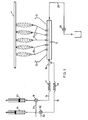
- Figure 1 shows diagrammatically apparatus for electrostatically spinning a synthetic vascular graft.
- Polymer solution is ejected from capillary needles 10 towards an electrostatically charged mandrel 11 rotating at several thousand revolutions per minute, for example 5000 r.p.m.
- the mandrel 11 is at a potential of -12kV with respect to the needles 10.
- polymer solution leaves the needles.10 polymer filaments form and these filaments are attracted to the rotating electrostatically charged mandrel 11 to form a.fibrous structure around the mandrel.
- the fibrous structure has been built up, the structure is removed from the mandrel to provide a fibrous tube.
- Mechanical properties of the tubular fibrous structure formed on the mandrel 11 can be controlled by variation of the speed of rotation of the mandrel, the type of polymer used and by altering the potential of auxiliary electrodes 12.
- the capillary needles 10 are supplied with polymer solution from a manifold 13, the manifold 13 being supplied by tubes 14 and 15 meeting in a T connector 16. Both tubes 14 and 15 include a flexible coil 17 and 18 respectively.
- the tube 14 has a valve 19 and the tube 15 has a valve 20 to enable the respective tubes to be closed. Control lines 21 and 22 control opening and closing of the valves 19 and 20.
- the tube 14 is supplied from a first air-ram driven syringe 23 and the tube 15 is fed from a second air-ram driven syringe 24 and the apparatus enables polymer solution from either syringe 23 or syringe 24 to be ejected from the needles 10 towards the mandrel 11.
- a purge line 25 including a closure valve 26 allows purging of the manifold 13.
- the apparatus of Figure 1 allows formation of an integral, uninterrupted fibrous structure of continuous polymeric filaments around the surface of the mandrel 11, the portions of the filaments at the inside surface having a different polymeric composition from the portions of the filaments of the outside surface of the fibrous structure.
- This can be advantageous when the tubular fibrous structures are used for, for example, synthetic vascular grafts.
- different polymers have different haemocompatibilities and that different polymers have different strength characteristics.
- one polyurethane has advantageous haemocompatibility but poor elastic properties, exhibiting high creep.
- a second polyurethane having a higher Young's modulus has satisfactory strength properties but poor haemocompatibility.
- the apparatus of Figure 1 allows production of a synthetic vascular graft having a thin inner lining of the first polyurethane on a wall of the second polyurethane, the graft, however, being formed of fibres spun continuously, with individual fibres changing composition between their ends to provide an integral, uninterrupted, fibrous structure.
- polymers can be used in the electrostatic spinning process.
- polyurethanes such as polyurethanes, polyamides and polyacrylonitrile, all of which can be spun from solution, and polytetrafluorethylene and polyesters which may be spun from dispersion.
- Water soluble polymers such as polyvinyl alcohol, polyvinyl pyrrolidone and polyethylene oxide may be spun from aqueous solution.
- the constraint on the fibrous structure and method of production according to the invention is that the two or more polymers used to vary the composition of the filaments during the spinning process must be either dispersible or alternatively soluble in the same solvent system.
- the two or more polymers used to vary the composition of the filaments during the spinning process must be either dispersible or alternatively soluble in the same solvent system.
- a silicone lubricant could be added to a polyurethane polymer and spun' as the inner surface of a graft, the outer surface of the graft being the same polyurethane without the silicone lubricant. Such an example is included in the scope of the invention.
- the advantage of the embodiments of grafts hereinbefore described are that the different layers can be optimised for particular properties, either in its morphology (e.g. porosity, pore shape, fibre size) or in its chemistry (e.g. type of polymer, presence of drug.
- a drug such as heparin or prostacylin may be included in the inner layer to improve the property with regard to contacting blood). If such layers are built up discontinuously, lines of weakness exist between the contiguous surfaces and delamination is likely to occur at quite low mechanical stresses.
- the advantage of the method hereinbefore described is that it builds different layers into an integrally formed fibrous structure so that the successive wall components are merged in a well controlled way.
- tubular fibrous structures for use as vascular grafts
- the invention is equally applicable to planar fibrous structures such as mats and that such alternative structures would have wide applications.
Landscapes
- Engineering & Computer Science (AREA)
- Textile Engineering (AREA)
- Artificial Filaments (AREA)
- Multicomponent Fibers (AREA)
- Materials For Medical Uses (AREA)
- Prostheses (AREA)
- Inorganic Fibers (AREA)
- Yarns And Mechanical Finishing Of Yarns Or Ropes (AREA)
- Spinning Methods And Devices For Manufacturing Artificial Fibers (AREA)
- Medicinal Preparation (AREA)
- Nonwoven Fabrics (AREA)
Priority Applications (1)
| Application Number | Priority Date | Filing Date | Title |
|---|---|---|---|
| AT84304891T ATE40424T1 (de) | 1983-07-21 | 1984-07-18 | Faserige strukturen. |
Applications Claiming Priority (2)
| Application Number | Priority Date | Filing Date | Title |
|---|---|---|---|
| GB8319727 | 1983-07-21 | ||
| GB08319727A GB2145443B (en) | 1983-07-21 | 1983-07-21 | Improvements in fibrous structures |
Publications (3)
| Publication Number | Publication Date |
|---|---|
| EP0132376A2 true EP0132376A2 (de) | 1985-01-30 |
| EP0132376A3 EP0132376A3 (en) | 1986-10-01 |
| EP0132376B1 EP0132376B1 (de) | 1989-01-25 |
Family
ID=10546086
Family Applications (1)
| Application Number | Title | Priority Date | Filing Date |
|---|---|---|---|
| EP84304891A Expired EP0132376B1 (de) | 1983-07-21 | 1984-07-18 | Faserige Strukturen |
Country Status (12)
| Country | Link |
|---|---|
| EP (1) | EP0132376B1 (de) |
| JP (1) | JPS60190947A (de) |
| AT (1) | ATE40424T1 (de) |
| AU (1) | AU558207B2 (de) |
| BR (1) | BR8403634A (de) |
| CA (1) | CA1248720A (de) |
| DE (1) | DE3476432D1 (de) |
| DK (1) | DK357184A (de) |
| ES (1) | ES8603776A1 (de) |
| GB (1) | GB2145443B (de) |
| HK (2) | HK67187A (de) |
| SG (2) | SG6887G (de) |
Families Citing this family (3)
| Publication number | Priority date | Publication date | Assignee | Title |
|---|---|---|---|---|
| GB2195251A (en) * | 1986-09-02 | 1988-04-07 | Ethicon Inc | Improvements in synthetic vascular grafts |
| US7780973B2 (en) * | 2003-12-15 | 2010-08-24 | Ethicon Endo-Surgery, Inc. | Method and device for minimally invasive implantation of biomaterial |
| CN111317594B (zh) * | 2020-02-28 | 2023-10-20 | 广州迈普再生医学科技股份有限公司 | 一种人工血管自动化生产装置 |
Family Cites Families (3)
| Publication number | Priority date | Publication date | Assignee | Title |
|---|---|---|---|---|
| GB1527592A (en) * | 1974-08-05 | 1978-10-04 | Ici Ltd | Wound dressing |
| GB1530990A (en) * | 1974-08-05 | 1978-11-01 | Ici Ltd | Electrostatically spun tubular product |
| DE2806030C2 (de) * | 1978-02-14 | 1984-02-02 | B. Braun Melsungen Ag, 3508 Melsungen | Verfahren zur Herstellung einer schlauchförmigen Blutgefäßprothese |
-
1983
- 1983-07-21 GB GB08319727A patent/GB2145443B/en not_active Expired
-
1984
- 1984-07-18 EP EP84304891A patent/EP0132376B1/de not_active Expired
- 1984-07-18 JP JP59147749A patent/JPS60190947A/ja active Pending
- 1984-07-18 DE DE8484304891T patent/DE3476432D1/de not_active Expired
- 1984-07-18 AT AT84304891T patent/ATE40424T1/de not_active IP Right Cessation
- 1984-07-19 CA CA000459285A patent/CA1248720A/en not_active Expired
- 1984-07-20 AU AU30924/84A patent/AU558207B2/en not_active Ceased
- 1984-07-20 ES ES534506A patent/ES8603776A1/es not_active Expired
- 1984-07-20 DK DK357184A patent/DK357184A/da not_active Application Discontinuation
- 1984-07-20 BR BR8403634A patent/BR8403634A/pt unknown
-
1987
- 1987-02-02 SG SG68/87A patent/SG6887G/en unknown
- 1987-09-17 HK HK671/87A patent/HK67187A/xx not_active IP Right Cessation
-
1989
- 1989-04-14 SG SG256/89A patent/SG25689G/en unknown
- 1989-08-24 HK HK684/89A patent/HK68489A/en not_active IP Right Cessation
Also Published As
| Publication number | Publication date |
|---|---|
| EP0132376A3 (en) | 1986-10-01 |
| EP0132376B1 (de) | 1989-01-25 |
| DK357184A (da) | 1985-01-22 |
| ES534506A0 (es) | 1986-01-01 |
| GB2145443B (en) | 1986-07-23 |
| JPS60190947A (ja) | 1985-09-28 |
| SG25689G (en) | 1989-07-14 |
| AU3092484A (en) | 1985-01-24 |
| HK68489A (en) | 1989-09-01 |
| ATE40424T1 (de) | 1989-02-15 |
| CA1248720A (en) | 1989-01-17 |
| DE3476432D1 (en) | 1989-03-02 |
| ES8603776A1 (es) | 1986-01-01 |
| DK357184D0 (da) | 1984-07-20 |
| AU558207B2 (en) | 1987-01-22 |
| GB2145443A (en) | 1985-03-27 |
| SG6887G (en) | 1987-06-05 |
| GB8319727D0 (en) | 1983-08-24 |
| BR8403634A (pt) | 1985-07-02 |
| HK67187A (en) | 1987-09-25 |
Similar Documents
| Publication | Publication Date | Title |
|---|---|---|
| US4657793A (en) | Fibrous structures | |
| EP0266035A1 (de) | Synthetisches Gefässtransplantat | |
| US4767400A (en) | Porous ventricular catheter | |
| US4965110A (en) | Electrostatically produced structures and methods of manufacturing | |
| DE2806030C2 (de) | Verfahren zur Herstellung einer schlauchförmigen Blutgefäßprothese | |
| EP1355677B1 (de) | Verfahren und gerät zur herstellung von polymerfaserhüllen durch elektrospinnen | |
| US4475972A (en) | Implantable material | |
| US5866217A (en) | Silicone composite vascular graft | |
| EP0009941B2 (de) | Herstellung elektrostatisch gesponnener Erzeugnisse | |
| US7888275B2 (en) | Porous composite materials comprising a plurality of bonded fiber component structures | |
| US20090091065A1 (en) | Electrospinning Apparatus For Producing Nanofibers and Process Thereof | |
| CA1297147C (en) | Electrostatically produced structures and methods of manufacturing thereof | |
| EP1465843A1 (de) | Gefässimplantat mit chemisch gebundener durch elektrospinning versponnener faserschicht und herstellungsverfahren dafür | |
| JPS6043981B2 (ja) | 生体内導管補綴用の管状フイブリル製品およびその製法 | |
| EP0132376B1 (de) | Faserige Strukturen | |
| WO1991001695A1 (en) | Improvements in synthetic vascular grafts and their methods of manufacture | |
| EP0323397A1 (de) | Künstliche Organ- oder Gefässwand | |
| KR870000456A (ko) | 멀티필라멘트 광섬유의 제조방법 | |
| JPH0125579B2 (de) | ||
| DE102010025302A1 (de) | Stent mit elektrogesponnener Faserbeschichtung, hülsenförmiger Vlieskörper sowie Verfahren zu deren Herstellung | |
| JPS6316261B2 (de) | ||
| Haseeb | Controlled deposition and alignment of electrospun PMMA-g-PDMS nanofibers by novel electrospinning setups | |
| KR102197253B1 (ko) | 전기방사용 노즐블럭 | |
| JPS58156012A (ja) | ウルトラファインプラスチックチュ−ブの製法 | |
| JPH05117955A (ja) | 筒状不織布とその製造方法 |
Legal Events
| Date | Code | Title | Description |
|---|---|---|---|
| PUAI | Public reference made under article 153(3) epc to a published international application that has entered the european phase |
Free format text: ORIGINAL CODE: 0009012 |
|
| AK | Designated contracting states |
Designated state(s): AT BE CH DE FR GB IT LI NL SE |
|
| PUAL | Search report despatched |
Free format text: ORIGINAL CODE: 0009013 |
|
| AK | Designated contracting states |
Kind code of ref document: A3 Designated state(s): AT BE CH DE FR GB IT LI NL SE |
|
| 17P | Request for examination filed |
Effective date: 19870306 |
|
| 17Q | First examination report despatched |
Effective date: 19880422 |
|
| GRAA | (expected) grant |
Free format text: ORIGINAL CODE: 0009210 |
|
| AK | Designated contracting states |
Kind code of ref document: B1 Designated state(s): AT BE CH DE FR GB IT LI NL SE |
|
| PG25 | Lapsed in a contracting state [announced via postgrant information from national office to epo] |
Ref country code: SE Effective date: 19890125 Ref country code: NL Effective date: 19890125 Ref country code: LI Effective date: 19890125 Ref country code: IT Free format text: LAPSE BECAUSE OF FAILURE TO SUBMIT A TRANSLATION OF THE DESCRIPTION OR TO PAY THE FEE WITHIN THE PRESCRIBED TIME-LIMIT;WARNING: LAPSES OF ITALIAN PATENTS WITH EFFECTIVE DATE BEFORE 2007 MAY HAVE OCCURRED AT ANY TIME BEFORE 2007. THE CORRECT EFFECTIVE DATE MAY BE DIFFERENT FROM THE ONE RECORDED. Effective date: 19890125 Ref country code: CH Effective date: 19890125 Ref country code: BE Effective date: 19890125 Ref country code: AT Effective date: 19890125 |
|
| REF | Corresponds to: |
Ref document number: 40424 Country of ref document: AT Date of ref document: 19890215 Kind code of ref document: T |
|
| REF | Corresponds to: |
Ref document number: 3476432 Country of ref document: DE Date of ref document: 19890302 |
|
| ET | Fr: translation filed | ||
| REG | Reference to a national code |
Ref country code: CH Ref legal event code: PL |
|
| PGFP | Annual fee paid to national office [announced via postgrant information from national office to epo] |
Ref country code: SE Payment date: 19890619 Year of fee payment: 6 |
|
| PGFP | Annual fee paid to national office [announced via postgrant information from national office to epo] |
Ref country code: FR Payment date: 19890712 Year of fee payment: 6 |
|
| NLV1 | Nl: lapsed or annulled due to failure to fulfill the requirements of art. 29p and 29m of the patents act | ||
| PLBE | No opposition filed within time limit |
Free format text: ORIGINAL CODE: 0009261 |
|
| STAA | Information on the status of an ep patent application or granted ep patent |
Free format text: STATUS: NO OPPOSITION FILED WITHIN TIME LIMIT |
|
| 26N | No opposition filed | ||
| PG25 | Lapsed in a contracting state [announced via postgrant information from national office to epo] |
Ref country code: FR Effective date: 19910329 |
|
| REG | Reference to a national code |
Ref country code: FR Ref legal event code: ST |
|
| PGFP | Annual fee paid to national office [announced via postgrant information from national office to epo] |
Ref country code: GB Payment date: 19980709 Year of fee payment: 15 |
|
| PGFP | Annual fee paid to national office [announced via postgrant information from national office to epo] |
Ref country code: DE Payment date: 19980724 Year of fee payment: 15 |
|
| PG25 | Lapsed in a contracting state [announced via postgrant information from national office to epo] |
Ref country code: GB Free format text: LAPSE BECAUSE OF NON-PAYMENT OF DUE FEES Effective date: 19990718 |
|
| GBPC | Gb: european patent ceased through non-payment of renewal fee |
Effective date: 19990718 |
|
| PG25 | Lapsed in a contracting state [announced via postgrant information from national office to epo] |
Ref country code: DE Free format text: LAPSE BECAUSE OF NON-PAYMENT OF DUE FEES Effective date: 20000503 |