EP0131997B1 - Verriegelungselement - Google Patents
Verriegelungselement Download PDFInfo
- Publication number
- EP0131997B1 EP0131997B1 EP84200962A EP84200962A EP0131997B1 EP 0131997 B1 EP0131997 B1 EP 0131997B1 EP 84200962 A EP84200962 A EP 84200962A EP 84200962 A EP84200962 A EP 84200962A EP 0131997 B1 EP0131997 B1 EP 0131997B1
- Authority
- EP
- European Patent Office
- Prior art keywords
- bolt
- jaws
- bolt element
- temperature
- temperature responsive
- Prior art date
- Legal status (The legal status is an assumption and is not a legal conclusion. Google has not performed a legal analysis and makes no representation as to the accuracy of the status listed.)
- Expired
Links
- 229910045601 alloy Inorganic materials 0.000 claims description 24
- 239000000956 alloy Substances 0.000 claims description 24
- 229910001285 shape-memory alloy Inorganic materials 0.000 claims description 12
- 229910001297 Zn alloy Inorganic materials 0.000 claims description 3
- 239000007788 liquid Substances 0.000 description 5
- 230000000717 retained effect Effects 0.000 description 5
- XLYOFNOQVPJJNP-UHFFFAOYSA-N water Substances O XLYOFNOQVPJJNP-UHFFFAOYSA-N 0.000 description 5
- 239000011701 zinc Substances 0.000 description 5
- 229910052802 copper Inorganic materials 0.000 description 4
- 239000010949 copper Substances 0.000 description 4
- 229910000734 martensite Inorganic materials 0.000 description 4
- 230000004044 response Effects 0.000 description 4
- 229910052725 zinc Inorganic materials 0.000 description 4
- 238000005452 bending Methods 0.000 description 3
- 230000003446 memory effect Effects 0.000 description 3
- 230000009466 transformation Effects 0.000 description 3
- RYGMFSIKBFXOCR-UHFFFAOYSA-N Copper Chemical compound [Cu] RYGMFSIKBFXOCR-UHFFFAOYSA-N 0.000 description 2
- ATUOYWHBWRKTHZ-UHFFFAOYSA-N Propane Chemical compound CCC ATUOYWHBWRKTHZ-UHFFFAOYSA-N 0.000 description 2
- HCHKCACWOHOZIP-UHFFFAOYSA-N Zinc Chemical compound [Zn] HCHKCACWOHOZIP-UHFFFAOYSA-N 0.000 description 2
- 238000001816 cooling Methods 0.000 description 2
- 238000001704 evaporation Methods 0.000 description 2
- 230000008020 evaporation Effects 0.000 description 2
- 239000011521 glass Substances 0.000 description 2
- 238000010438 heat treatment Methods 0.000 description 2
- 239000000203 mixture Substances 0.000 description 2
- 238000013021 overheating Methods 0.000 description 2
- 230000003313 weakening effect Effects 0.000 description 2
- 229910000838 Al alloy Inorganic materials 0.000 description 1
- 229910017518 Cu Zn Inorganic materials 0.000 description 1
- 229910017752 Cu-Zn Inorganic materials 0.000 description 1
- 229910017943 Cu—Zn Inorganic materials 0.000 description 1
- 241000950314 Figura Species 0.000 description 1
- 241000826860 Trapezium Species 0.000 description 1
- 230000002159 abnormal effect Effects 0.000 description 1
- 239000004411 aluminium Substances 0.000 description 1
- XAGFODPZIPBFFR-UHFFFAOYSA-N aluminium Chemical compound [Al] XAGFODPZIPBFFR-UHFFFAOYSA-N 0.000 description 1
- 229910052782 aluminium Inorganic materials 0.000 description 1
- 229910001566 austenite Inorganic materials 0.000 description 1
- 239000001273 butane Substances 0.000 description 1
- 229910052793 cadmium Inorganic materials 0.000 description 1
- 229910052804 chromium Inorganic materials 0.000 description 1
- 238000010276 construction Methods 0.000 description 1
- TVZPLCNGKSPOJA-UHFFFAOYSA-N copper zinc Chemical compound [Cu].[Zn] TVZPLCNGKSPOJA-UHFFFAOYSA-N 0.000 description 1
- 238000010586 diagram Methods 0.000 description 1
- 230000000694 effects Effects 0.000 description 1
- 230000004927 fusion Effects 0.000 description 1
- 230000017525 heat dissipation Effects 0.000 description 1
- 229910052742 iron Inorganic materials 0.000 description 1
- 229910052748 manganese Inorganic materials 0.000 description 1
- IJDNQMDRQITEOD-UHFFFAOYSA-N n-butane Chemical compound CCCC IJDNQMDRQITEOD-UHFFFAOYSA-N 0.000 description 1
- OFBQJSOFQDEBGM-UHFFFAOYSA-N n-pentane Natural products CCCCC OFBQJSOFQDEBGM-UHFFFAOYSA-N 0.000 description 1
- 229910052759 nickel Inorganic materials 0.000 description 1
- 239000001294 propane Substances 0.000 description 1
- 229910002059 quaternary alloy Inorganic materials 0.000 description 1
- 229910000679 solder Inorganic materials 0.000 description 1
- 230000000087 stabilizing effect Effects 0.000 description 1
- 229910002058 ternary alloy Inorganic materials 0.000 description 1
- 238000009423 ventilation Methods 0.000 description 1
Images
Classifications
-
- A—HUMAN NECESSITIES
- A62—LIFE-SAVING; FIRE-FIGHTING
- A62C—FIRE-FIGHTING
- A62C37/00—Control of fire-fighting equipment
- A62C37/08—Control of fire-fighting equipment comprising an outlet device containing a sensor, or itself being the sensor, i.e. self-contained sprinklers
- A62C37/10—Releasing means, e.g. electrically released
-
- A—HUMAN NECESSITIES
- A62—LIFE-SAVING; FIRE-FIGHTING
- A62C—FIRE-FIGHTING
- A62C2/00—Fire prevention or containment
- A62C2/06—Physical fire-barriers
- A62C2/24—Operating or controlling mechanisms
- A62C2/241—Operating or controlling mechanisms having mechanical actuators and heat sensitive parts
- A62C2/242—Operating or controlling mechanisms having mechanical actuators and heat sensitive parts with fusible links
-
- G—PHYSICS
- G05—CONTROLLING; REGULATING
- G05D—SYSTEMS FOR CONTROLLING OR REGULATING NON-ELECTRIC VARIABLES
- G05D23/00—Control of temperature
- G05D23/01—Control of temperature without auxiliary power
- G05D23/02—Control of temperature without auxiliary power with sensing element expanding and contracting in response to changes of temperature
- G05D23/024—Control of temperature without auxiliary power with sensing element expanding and contracting in response to changes of temperature the sensing element being of the rod type, tube type, or of a similar type
-
- F—MECHANICAL ENGINEERING; LIGHTING; HEATING; WEAPONS; BLASTING
- F16—ENGINEERING ELEMENTS AND UNITS; GENERAL MEASURES FOR PRODUCING AND MAINTAINING EFFECTIVE FUNCTIONING OF MACHINES OR INSTALLATIONS; THERMAL INSULATION IN GENERAL
- F16B—DEVICES FOR FASTENING OR SECURING CONSTRUCTIONAL ELEMENTS OR MACHINE PARTS TOGETHER, e.g. NAILS, BOLTS, CIRCLIPS, CLAMPS, CLIPS OR WEDGES; JOINTS OR JOINTING
- F16B2200/00—Constructional details of connections not covered for in other groups of this subclass
- F16B2200/77—Use of a shape-memory material
-
- Y—GENERAL TAGGING OF NEW TECHNOLOGICAL DEVELOPMENTS; GENERAL TAGGING OF CROSS-SECTIONAL TECHNOLOGIES SPANNING OVER SEVERAL SECTIONS OF THE IPC; TECHNICAL SUBJECTS COVERED BY FORMER USPC CROSS-REFERENCE ART COLLECTIONS [XRACs] AND DIGESTS
- Y10—TECHNICAL SUBJECTS COVERED BY FORMER USPC
- Y10S—TECHNICAL SUBJECTS COVERED BY FORMER USPC CROSS-REFERENCE ART COLLECTIONS [XRACs] AND DIGESTS
- Y10S411/00—Expanded, threaded, driven, headed, tool-deformed, or locked-threaded fastener
- Y10S411/02—Temperature modification
-
- Y—GENERAL TAGGING OF NEW TECHNOLOGICAL DEVELOPMENTS; GENERAL TAGGING OF CROSS-SECTIONAL TECHNOLOGIES SPANNING OVER SEVERAL SECTIONS OF THE IPC; TECHNICAL SUBJECTS COVERED BY FORMER USPC CROSS-REFERENCE ART COLLECTIONS [XRACs] AND DIGESTS
- Y10—TECHNICAL SUBJECTS COVERED BY FORMER USPC
- Y10S—TECHNICAL SUBJECTS COVERED BY FORMER USPC CROSS-REFERENCE ART COLLECTIONS [XRACs] AND DIGESTS
- Y10S411/00—Expanded, threaded, driven, headed, tool-deformed, or locked-threaded fastener
- Y10S411/909—Fastener or fastener element composed of thermo-responsive memory material
-
- Y—GENERAL TAGGING OF NEW TECHNOLOGICAL DEVELOPMENTS; GENERAL TAGGING OF CROSS-SECTIONAL TECHNOLOGIES SPANNING OVER SEVERAL SECTIONS OF THE IPC; TECHNICAL SUBJECTS COVERED BY FORMER USPC CROSS-REFERENCE ART COLLECTIONS [XRACs] AND DIGESTS
- Y10—TECHNICAL SUBJECTS COVERED BY FORMER USPC
- Y10T—TECHNICAL SUBJECTS COVERED BY FORMER US CLASSIFICATION
- Y10T403/00—Joints and connections
- Y10T403/21—Utilizing thermal characteristic, e.g., expansion or contraction, etc.
Definitions
- the invention relates to a temperature responsive bolt element, and to temperature responsive bolts operating with such element.
- a conduit comprises a valve body which is pushed by a force in the opening or closing sense, but which is kept in open (in the case of a ventilation tube), respectively closed position (in the case uf an automatic sprinkler of a possible seat of a fire) because the valve body is retained by a bolt.
- the latter is however designed to give way as soon as the ambient temperature reaches an abnormal level, and the protection system then enters in action, under influence of the said force,
- the bolt element comprises a pair of coplanar flat jaws opposite to each other and having a common basis, the resistance moment to flexion in the plane of each jaw being at least tenfold the resistance moment to flexion in a plane perpendicular to the plane of the jaw, and further comprises a shape memory alloy, treated for moving said jaws apart from each other in a direction substantially perpendicular to the plane of the jaws, when the alloy exceeds its reaction temperature.
- the abovementioned preferred first type of bolt serving to connect two body parts (i.e. two parts of different bodies or of a same deformable body) in an unboltable way
- a temperature responsive bolt element i.e. a temperature responsive bolt element according to the invention
- a hookable body i.e. hookable by the jaws of the bolt element
- the bolt element being pivotably fixed to the second body part, the pivoting axis being the intersecting line between both planes.
- the ternary Cu-AI-Zn alloys with shape memory effect are well known, of which the composition is represented in a ternary diagram inside a trapezium having the following corner points (expressed in percentages by weight of Cu, AI and Zn respectively: A (64; 1; 35), B (74; 5; 21), C (87,5; 12,5; O) and D (86; 14; 0).
- the alloy In order to obtain a desired shape memory effect, the alloy must be treated accordingly, as well known.
- the alloy After deformation, has memorized its initial shape.
- the alloy takes again, more or less perfectly, said second shape.
- the alloy can then be deformed again in the exact second shape, and the alloy, when then heated up towards the austenitic state, will change shape towards the initial shape again.
- the return towards said second shape will be the more perfect, according as the alloy will have undergone more cycles of heating up - cooling down-deformation to second shape, as described hereabove, this constituting the treatment of the alloy.
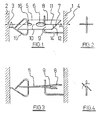
- Figura 1 shows a bolt of the first type.
- Two bodies schematically indicated under reference numerals 1 and 2 have the tendency to move apart under the influence of the forces 3 and 4. These forces are however detained by a bolt element in the form of a small plate 5 having an aperture 6 and a slit 7 connecting the aperture 6 with laws 8 and 9 with common basis 10.
- the plate 5 must not necessarily be rectangular, but can also e.g.
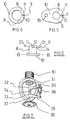
- Another hookable body 15 also in the form of a wire with circular section, but bent into a triangle in the plane of wire 14, is connected in a fixed way to body 2, and is hooked by the plate 5 because it passes through an additional aperture 16 in the plate, where it is also caught by the plate. It is remarked here that this wire 15 can also be made to pass through the opening 6 which comprises the slit, as shown fur the round plate on Figure 6, but an additional aperture 16, in the prolongation of the of slit 7, is preferred ( Figures 1 and 5) for the mechanical stability of the construction.
- the plate is made of a Cu-Zn-Al-alloy No. 1221, this means: 73.7 % Cu - 18.9 % Zn - 6.4 % AI - 0.024 % Ti and 0.39 % Co, which results in an As -temperature (starting temperature of the austenitic transformation) of about 68° C.
- This plate has been treated so as to have both jaws 8 and 9 in coplanar position (Figure 1) in a martensitic state (below the reaction temperature) and to make jaws 8 and 9 to bend upward, respectively downward out of the plane of the plate ( Figure 3) when the latter exceeds the reaction temperature.
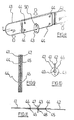
- FIG. 8 A second type of bolt, using a bolt element according to the invention, is shown in Figure 8.
- Two plates 41 and 42 forming part of a whole bolting system (not shown), are clamped in parallel, the one against the other, by means of a bolt element 43.
- These plates have the tendency to separate by sliding over each other's surface, under influence of a traction force T, a pression force F, or a flexion force D. They are however retained by a bolt element 43 that clamps both plates together.
- the correct positioning is guaranteed by the protrusions 44 in the contact surface of plate 41, which fit into the recesses or holes 45.
- This bolt element is shown in front view on Figure 10. It has the form of an oval plate having an aperture 49 connected via a slit with the external circumference of the plate, which need not be oval, but can have any appropriate other form, e.g. rectangular or circular. Both plates 41 and 42 are clamped in the slit 50.
- the bolt element must not necessarily be made completely of a shape memory alloy, although this embodiment is simple and cheap, It will be sufficient that only the part intended for the deformation be made of shape memory alloy, and this part must not necessarily be localized at the extremities of the jaws.
- the jaws produce both a deformation:. it is sufficient that the part where the jaws are in proximity to each other are moved apart from each other, i.e. that the distance becomes larger, and this can occur by a deformation of a single jaw.
Landscapes
- Health & Medical Sciences (AREA)
- Public Health (AREA)
- Business, Economics & Management (AREA)
- Emergency Management (AREA)
- Engineering & Computer Science (AREA)
- Mechanical Engineering (AREA)
- Physics & Mathematics (AREA)
- General Physics & Mathematics (AREA)
- Automation & Control Theory (AREA)
- Clamps And Clips (AREA)
- Connection Of Plates (AREA)
- Thermally Actuated Switches (AREA)
Claims (11)
Priority Applications (1)
| Application Number | Priority Date | Filing Date | Title |
|---|---|---|---|
| AT84200962T ATE24279T1 (de) | 1983-07-11 | 1984-07-04 | Verriegelungselement. |
Applications Claiming Priority (4)
| Application Number | Priority Date | Filing Date | Title |
|---|---|---|---|
| LU84905A LU84905A1 (fr) | 1983-07-11 | 1983-07-11 | Element de verrouillage et verrou thermosensible |
| LU84905 | 1983-07-11 | ||
| LU85260A LU85260A1 (fr) | 1984-03-21 | 1984-03-21 | Verrou thermosensible |
| LU85260 | 1984-03-21 |
Publications (2)
| Publication Number | Publication Date |
|---|---|
| EP0131997A1 EP0131997A1 (de) | 1985-01-23 |
| EP0131997B1 true EP0131997B1 (de) | 1986-12-17 |
Family
ID=26640301
Family Applications (1)
| Application Number | Title | Priority Date | Filing Date |
|---|---|---|---|
| EP84200962A Expired EP0131997B1 (de) | 1983-07-11 | 1984-07-04 | Verriegelungselement |
Country Status (3)
| Country | Link |
|---|---|
| US (1) | US4596483A (de) |
| EP (1) | EP0131997B1 (de) |
| DE (1) | DE3461685D1 (de) |
Families Citing this family (42)
| Publication number | Priority date | Publication date | Assignee | Title |
|---|---|---|---|---|
| US4699314A (en) * | 1986-12-17 | 1987-10-13 | Carrier Corporation | Actuator for a heating/cooling diffuser |
| GB8723226D0 (en) * | 1987-10-02 | 1987-11-04 | Bolton & Johnson Ltd Thomas | Fire sprinklers |
| US4842106A (en) * | 1987-10-08 | 1989-06-27 | Hughes Aircraft Company | Rate controllable damping mechanism |
| US4905765A (en) * | 1988-08-22 | 1990-03-06 | Hein George P | Smoke detector/remote controlled shape-memory alloy fire extinguisher discharge apparatus |
| US4887430A (en) * | 1988-12-21 | 1989-12-19 | Eaton Corporation | Bistable SME actuator with retainer |
| US5024549A (en) * | 1989-06-28 | 1991-06-18 | Mrj Group, Inc. | Method and apparatus for joining structural members |
| EP0456950A1 (de) * | 1990-05-16 | 1991-11-21 | CONTRAVES ITALIANA S.p.A. | Antrieb für Festhalte-/Auslösevorrichtungen, insbesondere zur Weltraumanwendung |
| US5540689A (en) * | 1990-05-22 | 1996-07-30 | Sanders; Albert E. | Apparatus for securing a rod adjacent to a bone |
| US5192147A (en) * | 1991-09-03 | 1993-03-09 | Lockheed Missiles & Space Company, Inc. | Non-pyrotechnic release system |
| FI90394C (sv) * | 1992-04-23 | 1994-02-10 | Goeran Sundholm | Eldsläckningsanordning |
| US5494113A (en) * | 1994-02-01 | 1996-02-27 | Central Sprinkler Corporation | Sprinklers with shape-memory alloy actuators |
| US5686878A (en) * | 1995-04-03 | 1997-11-11 | Gueli; Carmen | Temperature sensitive fusible link assembly having cooperating projections and slots |
| GB2320277B (en) * | 1996-12-09 | 2001-10-10 | Univ Brunel | Improvements relating to product disassembly |
| GB9818052D0 (en) * | 1998-08-20 | 1998-10-14 | British Aerospace | Fastening arrangements |
| US20030170092A1 (en) * | 1999-12-22 | 2003-09-11 | Chiodo Joseph David | Releasable fasteners |
| FR2825766B1 (fr) * | 2001-06-08 | 2003-10-10 | Lacroix Soc E | Mecanisme a liberation controlee par un effet thermique |
| KR20040022268A (ko) * | 2002-09-03 | 2004-03-12 | 마임인터내셔날코포레이션 주식회사 | 스프링클러 |
| JP4328229B2 (ja) * | 2003-06-04 | 2009-09-09 | 株式会社ユニオン精密 | ねじ付属品を用いた締結体構造及びねじ付属品を用いた解体方法 |
| US7422403B1 (en) | 2003-10-23 | 2008-09-09 | Tini Alloy Company | Non-explosive releasable coupling device |
| US7586828B1 (en) | 2003-10-23 | 2009-09-08 | Tini Alloy Company | Magnetic data storage system |
| US7632361B2 (en) * | 2004-05-06 | 2009-12-15 | Tini Alloy Company | Single crystal shape memory alloy devices and methods |
| US20060118210A1 (en) * | 2004-10-04 | 2006-06-08 | Johnson A D | Portable energy storage devices and methods |
| US7763342B2 (en) * | 2005-03-31 | 2010-07-27 | Tini Alloy Company | Tear-resistant thin film methods of fabrication |
| US7441888B1 (en) | 2005-05-09 | 2008-10-28 | Tini Alloy Company | Eyeglass frame |
| US7540899B1 (en) | 2005-05-25 | 2009-06-02 | Tini Alloy Company | Shape memory alloy thin film, method of fabrication, and articles of manufacture |
| US8720722B2 (en) * | 2005-12-15 | 2014-05-13 | Cornerstone Research Group, Inc. | Venting mechanism for containers |
| US20070246233A1 (en) * | 2006-04-04 | 2007-10-25 | Johnson A D | Thermal actuator for fire protection sprinkler head |
| US20080075557A1 (en) * | 2006-09-22 | 2008-03-27 | Johnson A David | Constant load bolt |
| US20080213062A1 (en) * | 2006-09-22 | 2008-09-04 | Tini Alloy Company | Constant load fastener |
| WO2008133738A2 (en) | 2006-12-01 | 2008-11-06 | Tini Alloy Company | Method of alloying reactive components |
| US8584767B2 (en) * | 2007-01-25 | 2013-11-19 | Tini Alloy Company | Sprinkler valve with active actuation |
| WO2008092028A1 (en) * | 2007-01-25 | 2008-07-31 | Tini Alloy Company | Frangible shape memory alloy fire sprinkler valve actuator |
| DE102007028503B3 (de) * | 2007-06-18 | 2008-09-18 | Thomas Magnete Gmbh | Haltevorrichtung |
| US8007674B2 (en) | 2007-07-30 | 2011-08-30 | Tini Alloy Company | Method and devices for preventing restenosis in cardiovascular stents |
| WO2009073609A1 (en) | 2007-11-30 | 2009-06-11 | Tini Alloy Company | Biocompatible copper-based single-crystal shape memory alloys |
| US8382917B2 (en) * | 2007-12-03 | 2013-02-26 | Ormco Corporation | Hyperelastic shape setting devices and fabrication methods |
| US7842143B2 (en) * | 2007-12-03 | 2010-11-30 | Tini Alloy Company | Hyperelastic shape setting devices and fabrication methods |
| US8899342B2 (en) * | 2008-07-31 | 2014-12-02 | Lyle H Chesley | Safety apparatus |
| US11040230B2 (en) | 2012-08-31 | 2021-06-22 | Tini Alloy Company | Fire sprinkler valve actuator |
| US10124197B2 (en) | 2012-08-31 | 2018-11-13 | TiNi Allot Company | Fire sprinkler valve actuator |
| US12097394B2 (en) * | 2018-03-22 | 2024-09-24 | Johnson Controls Tyco IP Holdings LLP | Smart material mechanism for fire sprinklers |
| US20200289861A1 (en) * | 2019-03-15 | 2020-09-17 | Richard E. Venturini | Fire rated pet door assembly and activation system |
Family Cites Families (8)
| Publication number | Priority date | Publication date | Assignee | Title |
|---|---|---|---|---|
| US2396906A (en) * | 1945-02-06 | 1946-03-19 | Antoine E Windson | Balloon sealing device |
| US3561537A (en) * | 1968-06-20 | 1971-02-09 | Fire Protection Co | Automatic sprinkler head |
| US3740839A (en) * | 1971-06-29 | 1973-06-26 | Raychem Corp | Cryogenic connection method and means |
| US3783429A (en) * | 1972-06-21 | 1974-01-01 | Raychem Corp | Temperature actuated connector |
| FR2254184A5 (en) * | 1973-11-07 | 1975-07-04 | Vindry Georges | Sprinkler for automatic fire fighting - bimetallic strip releases trigger to release plug over delivery conduit |
| US4068820A (en) * | 1974-08-26 | 1978-01-17 | Texas Instruments Incorporated | Valve |
| JPS588817A (ja) * | 1981-07-03 | 1983-01-19 | 株式会社山科精工所 | 弾性座金 |
| US4414716A (en) * | 1981-10-05 | 1983-11-15 | Frank Stastney | Garment clasping device |
-
1984
- 1984-07-04 EP EP84200962A patent/EP0131997B1/de not_active Expired
- 1984-07-04 DE DE8484200962T patent/DE3461685D1/de not_active Expired
- 1984-07-10 US US06/629,416 patent/US4596483A/en not_active Expired - Fee Related
Also Published As
| Publication number | Publication date |
|---|---|
| US4596483A (en) | 1986-06-24 |
| DE3461685D1 (en) | 1987-01-29 |
| EP0131997A1 (de) | 1985-01-23 |
Similar Documents
| Publication | Publication Date | Title |
|---|---|---|
| EP0131997B1 (de) | Verriegelungselement | |
| US5494113A (en) | Sprinklers with shape-memory alloy actuators | |
| US3561537A (en) | Automatic sprinkler head | |
| US20070246233A1 (en) | Thermal actuator for fire protection sprinkler head | |
| US3974844A (en) | Valve | |
| US5071064A (en) | Shape memory actuator smart connector | |
| US5176544A (en) | Shape memory actuator smart connector | |
| US5788212A (en) | Pressure relief device with shaped memory alloy thermally activated trigger | |
| US4757865A (en) | Fast response sprinkler head | |
| US3911940A (en) | Delayed closing fire sprinkler heads | |
| US20160201816A1 (en) | Self-Contained Actuated Safety Valve For Gaseous or Liquid Fuel Lines and the Like | |
| US3996952A (en) | Control damper | |
| US4068820A (en) | Valve | |
| US1681911A (en) | Train-heating system | |
| US4763711A (en) | Fire damper | |
| US4283006A (en) | Thermally-activated closure device | |
| US4298068A (en) | Heat sensitive release devices | |
| US3599723A (en) | Fusible element for center strut sprinklers | |
| US4990883A (en) | Actuator which can be locked when exposed to a high temperature | |
| GB2209200A (en) | Thermal cut-off valve | |
| US4048962A (en) | Water tank heated by smoke from a furnace | |
| US6338624B1 (en) | Automatic putting-out apparatus | |
| US3845931A (en) | Valve | |
| RU2195986C1 (ru) | Тепловой замок спринклерного оросителя | |
| US4805261A (en) | Resettable fire link |
Legal Events
| Date | Code | Title | Description |
|---|---|---|---|
| PUAI | Public reference made under article 153(3) epc to a published international application that has entered the european phase |
Free format text: ORIGINAL CODE: 0009012 |
|
| AK | Designated contracting states |
Designated state(s): AT BE CH DE FR GB IT LI NL SE |
|
| 17P | Request for examination filed |
Effective date: 19850327 |
|
| 17Q | First examination report despatched |
Effective date: 19860313 |
|
| GRAA | (expected) grant |
Free format text: ORIGINAL CODE: 0009210 |
|
| AK | Designated contracting states |
Kind code of ref document: B1 Designated state(s): AT BE CH DE FR GB IT LI NL SE |
|
| REF | Corresponds to: |
Ref document number: 24279 Country of ref document: AT Date of ref document: 19870115 Kind code of ref document: T |
|
| ITF | It: translation for a ep patent filed | ||
| REF | Corresponds to: |
Ref document number: 3461685 Country of ref document: DE Date of ref document: 19870129 |
|
| ET | Fr: translation filed | ||
| PLBE | No opposition filed within time limit |
Free format text: ORIGINAL CODE: 0009261 |
|
| STAA | Information on the status of an ep patent application or granted ep patent |
Free format text: STATUS: NO OPPOSITION FILED WITHIN TIME LIMIT |
|
| 26N | No opposition filed | ||
| PGFP | Annual fee paid to national office [announced via postgrant information from national office to epo] |
Ref country code: SE Payment date: 19900620 Year of fee payment: 7 |
|
| PGFP | Annual fee paid to national office [announced via postgrant information from national office to epo] |
Ref country code: GB Payment date: 19900622 Year of fee payment: 7 |
|
| PGFP | Annual fee paid to national office [announced via postgrant information from national office to epo] |
Ref country code: AT Payment date: 19900706 Year of fee payment: 7 |
|
| PGFP | Annual fee paid to national office [announced via postgrant information from national office to epo] |
Ref country code: CH Payment date: 19900726 Year of fee payment: 7 |
|
| ITTA | It: last paid annual fee | ||
| PGFP | Annual fee paid to national office [announced via postgrant information from national office to epo] |
Ref country code: NL Payment date: 19900731 Year of fee payment: 7 |
|
| PGFP | Annual fee paid to national office [announced via postgrant information from national office to epo] |
Ref country code: DE Payment date: 19900827 Year of fee payment: 7 |
|
| PGFP | Annual fee paid to national office [announced via postgrant information from national office to epo] |
Ref country code: FR Payment date: 19910618 Year of fee payment: 8 |
|
| PGFP | Annual fee paid to national office [announced via postgrant information from national office to epo] |
Ref country code: BE Payment date: 19910619 Year of fee payment: 8 |
|
| PG25 | Lapsed in a contracting state [announced via postgrant information from national office to epo] |
Ref country code: GB Effective date: 19910704 Ref country code: AT Effective date: 19910704 |
|
| PG25 | Lapsed in a contracting state [announced via postgrant information from national office to epo] |
Ref country code: SE Effective date: 19910705 |
|
| PG25 | Lapsed in a contracting state [announced via postgrant information from national office to epo] |
Ref country code: LI Effective date: 19910731 Ref country code: CH Effective date: 19910731 |
|
| PG25 | Lapsed in a contracting state [announced via postgrant information from national office to epo] |
Ref country code: NL Effective date: 19920201 |
|
| GBPC | Gb: european patent ceased through non-payment of renewal fee | ||
| NLV4 | Nl: lapsed or anulled due to non-payment of the annual fee | ||
| REG | Reference to a national code |
Ref country code: CH Ref legal event code: PL |
|
| PG25 | Lapsed in a contracting state [announced via postgrant information from national office to epo] |
Ref country code: DE Effective date: 19920401 |
|
| PG25 | Lapsed in a contracting state [announced via postgrant information from national office to epo] |
Ref country code: BE Effective date: 19920731 |
|
| BERE | Be: lapsed |
Owner name: LEUVEN RESEARCH & DEVELOPMENT Effective date: 19920731 |
|
| PG25 | Lapsed in a contracting state [announced via postgrant information from national office to epo] |
Ref country code: FR Effective date: 19930331 |
|
| REG | Reference to a national code |
Ref country code: FR Ref legal event code: ST |
|
| EUG | Se: european patent has lapsed |
Ref document number: 84200962.3 Effective date: 19920210 |