EP0131933A2 - Photographisches Farbdiffusionsübertragungselement - Google Patents
Photographisches Farbdiffusionsübertragungselement Download PDFInfo
- Publication number
- EP0131933A2 EP0131933A2 EP84108244A EP84108244A EP0131933A2 EP 0131933 A2 EP0131933 A2 EP 0131933A2 EP 84108244 A EP84108244 A EP 84108244A EP 84108244 A EP84108244 A EP 84108244A EP 0131933 A2 EP0131933 A2 EP 0131933A2
- Authority
- EP
- European Patent Office
- Prior art keywords
- photographic element
- diffusion transfer
- color diffusion
- processing solution
- transfer photographic
- Prior art date
- Legal status (The legal status is an assumption and is not a legal conclusion. Google has not performed a legal analysis and makes no representation as to the accuracy of the status listed.)
- Granted
Links
- 238000012546 transfer Methods 0.000 title claims abstract description 26
- 238000009792 diffusion process Methods 0.000 title claims abstract description 22
- 238000012545 processing Methods 0.000 claims abstract description 83
- 150000001875 compounds Chemical class 0.000 claims abstract description 38
- 239000000839 emulsion Substances 0.000 claims abstract description 29
- -1 silver halide Chemical class 0.000 claims abstract description 28
- 229910052709 silver Inorganic materials 0.000 claims abstract description 26
- 239000004332 silver Substances 0.000 claims abstract description 26
- NDGRWYRVNANFNB-UHFFFAOYSA-N pyrazolidin-3-one Chemical compound O=C1CCNN1 NDGRWYRVNANFNB-UHFFFAOYSA-N 0.000 claims abstract description 25
- 238000010438 heat treatment Methods 0.000 claims abstract description 23
- 239000003795 chemical substances by application Substances 0.000 claims abstract description 20
- 239000002243 precursor Substances 0.000 claims abstract description 6
- 125000000217 alkyl group Chemical group 0.000 claims description 7
- 125000004435 hydrogen atom Chemical group [H]* 0.000 claims description 7
- 125000002887 hydroxy group Chemical group [H]O* 0.000 claims description 5
- 125000003118 aryl group Chemical group 0.000 claims description 4
- 125000002496 methyl group Chemical group [H]C([H])([H])* 0.000 claims description 3
- 125000003545 alkoxy group Chemical group 0.000 claims description 2
- 125000004104 aryloxy group Chemical group 0.000 claims description 2
- 125000000565 sulfonamide group Chemical group 0.000 claims description 2
- 239000010410 layer Substances 0.000 description 66
- 239000000243 solution Substances 0.000 description 65
- 239000000975 dye Substances 0.000 description 24
- 239000000463 material Substances 0.000 description 14
- 230000008859 change Effects 0.000 description 12
- 108010010803 Gelatin Proteins 0.000 description 11
- 229920000159 gelatin Polymers 0.000 description 11
- 239000008273 gelatin Substances 0.000 description 11
- 235000019322 gelatine Nutrition 0.000 description 11
- 235000011852 gelatine desserts Nutrition 0.000 description 11
- GWEVSGVZZGPLCZ-UHFFFAOYSA-N Titan oxide Chemical compound O=[Ti]=O GWEVSGVZZGPLCZ-UHFFFAOYSA-N 0.000 description 8
- 125000004432 carbon atom Chemical group C* 0.000 description 7
- 239000006229 carbon black Substances 0.000 description 6
- BQCADISMDOOEFD-UHFFFAOYSA-N Silver Chemical compound [Ag] BQCADISMDOOEFD-UHFFFAOYSA-N 0.000 description 5
- 238000011161 development Methods 0.000 description 5
- 238000000034 method Methods 0.000 description 5
- 239000000203 mixture Substances 0.000 description 5
- 230000035945 sensitivity Effects 0.000 description 5
- 239000002562 thickening agent Substances 0.000 description 5
- 229910052751 metal Inorganic materials 0.000 description 4
- 239000002184 metal Substances 0.000 description 4
- 230000003472 neutralizing effect Effects 0.000 description 4
- 239000002667 nucleating agent Substances 0.000 description 4
- 230000003647 oxidation Effects 0.000 description 4
- 238000007254 oxidation reaction Methods 0.000 description 4
- 229920000642 polymer Polymers 0.000 description 4
- 238000003825 pressing Methods 0.000 description 4
- ADZWSOLPGZMUMY-UHFFFAOYSA-M silver bromide Chemical compound [Ag]Br ADZWSOLPGZMUMY-UHFFFAOYSA-M 0.000 description 4
- GPNPYLFVYDZBHS-UHFFFAOYSA-N 2,5-dihydroxy-4-pentadecylbenzenesulfonic acid Chemical compound CCCCCCCCCCCCCCCC1=CC(O)=C(S(O)(=O)=O)C=C1O GPNPYLFVYDZBHS-UHFFFAOYSA-N 0.000 description 3
- WVDDGKGOMKODPV-UHFFFAOYSA-N Benzyl alcohol Chemical compound OCC1=CC=CC=C1 WVDDGKGOMKODPV-UHFFFAOYSA-N 0.000 description 3
- KWYUFKZDYYNOTN-UHFFFAOYSA-M Potassium hydroxide Chemical compound [OH-].[K+] KWYUFKZDYYNOTN-UHFFFAOYSA-M 0.000 description 3
- HEMHJVSKTPXQMS-UHFFFAOYSA-M Sodium hydroxide Chemical compound [OH-].[Na+] HEMHJVSKTPXQMS-UHFFFAOYSA-M 0.000 description 3
- 229910052783 alkali metal Inorganic materials 0.000 description 3
- 239000002585 base Substances 0.000 description 3
- 238000006243 chemical reaction Methods 0.000 description 3
- 229920001577 copolymer Polymers 0.000 description 3
- 239000002245 particle Substances 0.000 description 3
- 230000008569 process Effects 0.000 description 3
- 238000011160 research Methods 0.000 description 3
- 159000000000 sodium salts Chemical class 0.000 description 3
- 239000000126 substance Substances 0.000 description 3
- 125000001424 substituent group Chemical group 0.000 description 3
- 239000004408 titanium dioxide Substances 0.000 description 3
- IELLVVGAXDLVSW-UHFFFAOYSA-N tricyclohexyl phosphate Chemical compound C1CCCCC1OP(OC1CCCCC1)(=O)OC1CCCCC1 IELLVVGAXDLVSW-UHFFFAOYSA-N 0.000 description 3
- SMZOUWXMTYCWNB-UHFFFAOYSA-N 2-(2-methoxy-5-methylphenyl)ethanamine Chemical compound COC1=CC=C(C)C=C1CCN SMZOUWXMTYCWNB-UHFFFAOYSA-N 0.000 description 2
- NIXOWILDQLNWCW-UHFFFAOYSA-N 2-Propenoic acid Natural products OC(=O)C=C NIXOWILDQLNWCW-UHFFFAOYSA-N 0.000 description 2
- WSFSSNUMVMOOMR-UHFFFAOYSA-N Formaldehyde Chemical compound O=C WSFSSNUMVMOOMR-UHFFFAOYSA-N 0.000 description 2
- BAPJBEWLBFYGME-UHFFFAOYSA-N Methyl acrylate Chemical compound COC(=O)C=C BAPJBEWLBFYGME-UHFFFAOYSA-N 0.000 description 2
- CDBYLPFSWZWCQE-UHFFFAOYSA-L Sodium Carbonate Chemical compound [Na+].[Na+].[O-]C([O-])=O CDBYLPFSWZWCQE-UHFFFAOYSA-L 0.000 description 2
- PPBRXRYQALVLMV-UHFFFAOYSA-N Styrene Chemical compound C=CC1=CC=CC=C1 PPBRXRYQALVLMV-UHFFFAOYSA-N 0.000 description 2
- SMEGJBVQLJJKKX-HOTMZDKISA-N [(2R,3S,4S,5R,6R)-5-acetyloxy-3,4,6-trihydroxyoxan-2-yl]methyl acetate Chemical compound CC(=O)OC[C@@H]1[C@H]([C@@H]([C@H]([C@@H](O1)O)OC(=O)C)O)O SMEGJBVQLJJKKX-HOTMZDKISA-N 0.000 description 2
- XCFIVNQHHFZRNR-UHFFFAOYSA-N [Ag].Cl[IH]Br Chemical compound [Ag].Cl[IH]Br XCFIVNQHHFZRNR-UHFFFAOYSA-N 0.000 description 2
- 229940081735 acetylcellulose Drugs 0.000 description 2
- 125000001931 aliphatic group Chemical group 0.000 description 2
- 239000003513 alkali Substances 0.000 description 2
- 229910052799 carbon Inorganic materials 0.000 description 2
- 229920002301 cellulose acetate Polymers 0.000 description 2
- 238000003776 cleavage reaction Methods 0.000 description 2
- 238000010276 construction Methods 0.000 description 2
- 230000006866 deterioration Effects 0.000 description 2
- 239000006185 dispersion Substances 0.000 description 2
- 230000000694 effects Effects 0.000 description 2
- 230000007062 hydrolysis Effects 0.000 description 2
- 238000006460 hydrolysis reaction Methods 0.000 description 2
- 230000007246 mechanism Effects 0.000 description 2
- PSZYNBSKGUBXEH-UHFFFAOYSA-N naphthalene-1-sulfonic acid Chemical compound C1=CC=C2C(S(=O)(=O)O)=CC=CC2=C1 PSZYNBSKGUBXEH-UHFFFAOYSA-N 0.000 description 2
- 238000006386 neutralization reaction Methods 0.000 description 2
- 229920003229 poly(methyl methacrylate) Polymers 0.000 description 2
- 239000004926 polymethyl methacrylate Substances 0.000 description 2
- CPRMKOQKXYSDML-UHFFFAOYSA-M rubidium hydroxide Chemical compound [OH-].[Rb+] CPRMKOQKXYSDML-UHFFFAOYSA-M 0.000 description 2
- 230000007017 scission Effects 0.000 description 2
- NDVLTYZPCACLMA-UHFFFAOYSA-N silver oxide Chemical compound [O-2].[Ag+].[Ag+] NDVLTYZPCACLMA-UHFFFAOYSA-N 0.000 description 2
- SQGYOTSLMSWVJD-UHFFFAOYSA-N silver(1+) nitrate Chemical compound [Ag+].[O-]N(=O)=O SQGYOTSLMSWVJD-UHFFFAOYSA-N 0.000 description 2
- 230000003595 spectral effect Effects 0.000 description 2
- UMGDCJDMYOKAJW-UHFFFAOYSA-N thiourea Chemical compound NC(N)=S UMGDCJDMYOKAJW-UHFFFAOYSA-N 0.000 description 2
- WFKWXMTUELFFGS-UHFFFAOYSA-N tungsten Chemical compound [W] WFKWXMTUELFFGS-UHFFFAOYSA-N 0.000 description 2
- 229910052721 tungsten Inorganic materials 0.000 description 2
- 239000010937 tungsten Substances 0.000 description 2
- 239000001043 yellow dye Substances 0.000 description 2
- ONDPHDOFVYQSGI-UHFFFAOYSA-N zinc nitrate Chemical compound [Zn+2].[O-][N+]([O-])=O.[O-][N+]([O-])=O ONDPHDOFVYQSGI-UHFFFAOYSA-N 0.000 description 2
- OEPOKWHJYJXUGD-UHFFFAOYSA-N 2-(3-phenylmethoxyphenyl)-1,3-thiazole-4-carbaldehyde Chemical compound O=CC1=CSC(C=2C=C(OCC=3C=CC=CC=3)C=CC=2)=N1 OEPOKWHJYJXUGD-UHFFFAOYSA-N 0.000 description 1
- SHKUUQIDMUMQQK-UHFFFAOYSA-N 2-[4-(oxiran-2-ylmethoxy)butoxymethyl]oxirane Chemical compound C1OC1COCCCCOCC1CO1 SHKUUQIDMUMQQK-UHFFFAOYSA-N 0.000 description 1
- MFGOFGRYDNHJTA-UHFFFAOYSA-N 2-amino-1-(2-fluorophenyl)ethanol Chemical compound NCC(O)C1=CC=CC=C1F MFGOFGRYDNHJTA-UHFFFAOYSA-N 0.000 description 1
- CDAWCLOXVUBKRW-UHFFFAOYSA-N 2-aminophenol Chemical class NC1=CC=CC=C1O CDAWCLOXVUBKRW-UHFFFAOYSA-N 0.000 description 1
- BKMMTJMQCTUHRP-UHFFFAOYSA-N 2-aminopropan-1-ol Chemical compound CC(N)CO BKMMTJMQCTUHRP-UHFFFAOYSA-N 0.000 description 1
- MRIBCCHYZOSDOM-UHFFFAOYSA-N 3-(1-phenyltetrazol-5-yl)sulfanylpropanenitrile Chemical compound N#CCCSC1=NN=NN1C1=CC=CC=C1 MRIBCCHYZOSDOM-UHFFFAOYSA-N 0.000 description 1
- HHEBHJLYNLALHM-UHFFFAOYSA-N 5,6-dichloro-2h-benzotriazole Chemical compound C1=C(Cl)C(Cl)=CC2=NNN=C21 HHEBHJLYNLALHM-UHFFFAOYSA-N 0.000 description 1
- LQGKDMHENBFVRC-UHFFFAOYSA-N 5-aminopentan-1-ol Chemical compound NCCCCCO LQGKDMHENBFVRC-UHFFFAOYSA-N 0.000 description 1
- LRUDIIUSNGCQKF-UHFFFAOYSA-N 5-methyl-1H-benzotriazole Chemical compound C1=C(C)C=CC2=NNN=C21 LRUDIIUSNGCQKF-UHFFFAOYSA-N 0.000 description 1
- SUTWPJHCRAITLU-UHFFFAOYSA-N 6-aminohexan-1-ol Chemical compound NCCCCCCO SUTWPJHCRAITLU-UHFFFAOYSA-N 0.000 description 1
- XPAZGLFMMUODDK-UHFFFAOYSA-N 6-nitro-1h-benzimidazole Chemical compound [O-][N+](=O)C1=CC=C2N=CNC2=C1 XPAZGLFMMUODDK-UHFFFAOYSA-N 0.000 description 1
- WSNMPAVSZJSIMT-UHFFFAOYSA-N COc1c(C)c2COC(=O)c2c(O)c1CC(O)C1(C)CCC(=O)O1 Chemical compound COc1c(C)c2COC(=O)c2c(O)c1CC(O)C1(C)CCC(=O)O1 WSNMPAVSZJSIMT-UHFFFAOYSA-N 0.000 description 1
- 229920002134 Carboxymethyl cellulose Polymers 0.000 description 1
- VEXZGXHMUGYJMC-UHFFFAOYSA-M Chloride anion Chemical compound [Cl-] VEXZGXHMUGYJMC-UHFFFAOYSA-M 0.000 description 1
- 244000007835 Cyamopsis tetragonoloba Species 0.000 description 1
- 229920000663 Hydroxyethyl cellulose Polymers 0.000 description 1
- 239000004354 Hydroxyethyl cellulose Substances 0.000 description 1
- DGAQECJNVWCQMB-PUAWFVPOSA-M Ilexoside XXIX Chemical compound C[C@@H]1CC[C@@]2(CC[C@@]3(C(=CC[C@H]4[C@]3(CC[C@@H]5[C@@]4(CC[C@@H](C5(C)C)OS(=O)(=O)[O-])C)C)[C@@H]2[C@]1(C)O)C)C(=O)O[C@H]6[C@@H]([C@H]([C@@H]([C@H](O6)CO)O)O)O.[Na+] DGAQECJNVWCQMB-PUAWFVPOSA-M 0.000 description 1
- HNDVDQJCIGZPNO-YFKPBYRVSA-N L-histidine Chemical compound OC(=O)[C@@H](N)CC1=CN=CN1 HNDVDQJCIGZPNO-YFKPBYRVSA-N 0.000 description 1
- WUGQZFFCHPXWKQ-UHFFFAOYSA-N Propanolamine Chemical compound NCCCO WUGQZFFCHPXWKQ-UHFFFAOYSA-N 0.000 description 1
- 229910021607 Silver chloride Inorganic materials 0.000 description 1
- 229920002125 Sokalan® Polymers 0.000 description 1
- XSQUKJJJFZCRTK-UHFFFAOYSA-N Urea Natural products NC(N)=O XSQUKJJJFZCRTK-UHFFFAOYSA-N 0.000 description 1
- YIMQCDZDWXUDCA-UHFFFAOYSA-N [4-(hydroxymethyl)cyclohexyl]methanol Chemical compound OCC1CCC(CO)CC1 YIMQCDZDWXUDCA-UHFFFAOYSA-N 0.000 description 1
- BWVAOONFBYYRHY-UHFFFAOYSA-N [4-(hydroxymethyl)phenyl]methanol Chemical compound OCC1=CC=C(CO)C=C1 BWVAOONFBYYRHY-UHFFFAOYSA-N 0.000 description 1
- SJOOOZPMQAWAOP-UHFFFAOYSA-N [Ag].BrCl Chemical compound [Ag].BrCl SJOOOZPMQAWAOP-UHFFFAOYSA-N 0.000 description 1
- 238000010521 absorption reaction Methods 0.000 description 1
- VJHCJDRQFCCTHL-UHFFFAOYSA-N acetic acid 2,3,4,5,6-pentahydroxyhexanal Chemical compound CC(O)=O.OCC(O)C(O)C(O)C(O)C=O VJHCJDRQFCCTHL-UHFFFAOYSA-N 0.000 description 1
- 125000002777 acetyl group Chemical group [H]C([H])([H])C(*)=O 0.000 description 1
- 206010000496 acne Diseases 0.000 description 1
- 239000000654 additive Substances 0.000 description 1
- 230000002411 adverse Effects 0.000 description 1
- 235000010443 alginic acid Nutrition 0.000 description 1
- 229920000615 alginic acid Polymers 0.000 description 1
- 229910000288 alkali metal carbonate Inorganic materials 0.000 description 1
- 150000008041 alkali metal carbonates Chemical class 0.000 description 1
- 229910001515 alkali metal fluoride Inorganic materials 0.000 description 1
- 150000001340 alkali metals Chemical class 0.000 description 1
- 239000012670 alkaline solution Substances 0.000 description 1
- 150000001412 amines Chemical class 0.000 description 1
- CBTVGIZVANVGBH-UHFFFAOYSA-N aminomethyl propanol Chemical compound CC(C)(N)CO CBTVGIZVANVGBH-UHFFFAOYSA-N 0.000 description 1
- 239000001000 anthraquinone dye Substances 0.000 description 1
- QVGXLLKOCUKJST-UHFFFAOYSA-N atomic oxygen Chemical compound [O] QVGXLLKOCUKJST-UHFFFAOYSA-N 0.000 description 1
- 239000000987 azo dye Substances 0.000 description 1
- 159000000009 barium salts Chemical class 0.000 description 1
- 235000019445 benzyl alcohol Nutrition 0.000 description 1
- CQEYYJKEWSMYFG-UHFFFAOYSA-N butyl acrylate Chemical compound CCCCOC(=O)C=C CQEYYJKEWSMYFG-UHFFFAOYSA-N 0.000 description 1
- CXKCTMHTOKXKQT-UHFFFAOYSA-N cadmium oxide Inorganic materials [Cd]=O CXKCTMHTOKXKQT-UHFFFAOYSA-N 0.000 description 1
- CFEAAQFZALKQPA-UHFFFAOYSA-N cadmium(2+);oxygen(2-) Chemical compound [O-2].[Cd+2] CFEAAQFZALKQPA-UHFFFAOYSA-N 0.000 description 1
- HUCVOHYBFXVBRW-UHFFFAOYSA-M caesium hydroxide Inorganic materials [OH-].[Cs+] HUCVOHYBFXVBRW-UHFFFAOYSA-M 0.000 description 1
- 239000001768 carboxy methyl cellulose Substances 0.000 description 1
- 235000010948 carboxy methyl cellulose Nutrition 0.000 description 1
- 239000008112 carboxymethyl-cellulose Substances 0.000 description 1
- 125000002091 cationic group Chemical group 0.000 description 1
- 239000000084 colloidal system Substances 0.000 description 1
- 230000001419 dependent effect Effects 0.000 description 1
- HPNMFZURTQLUMO-UHFFFAOYSA-N diethylamine Chemical compound CCNCC HPNMFZURTQLUMO-UHFFFAOYSA-N 0.000 description 1
- 150000002170 ethers Chemical class 0.000 description 1
- 150000004676 glycans Chemical class 0.000 description 1
- 229910052736 halogen Inorganic materials 0.000 description 1
- 150000002367 halogens Chemical class 0.000 description 1
- 125000005842 heteroatom Chemical group 0.000 description 1
- XXMIOPMDWAUFGU-UHFFFAOYSA-N hexane-1,6-diol Chemical compound OCCCCCCO XXMIOPMDWAUFGU-UHFFFAOYSA-N 0.000 description 1
- HNDVDQJCIGZPNO-UHFFFAOYSA-N histidine Natural products OC(=O)C(N)CC1=CN=CN1 HNDVDQJCIGZPNO-UHFFFAOYSA-N 0.000 description 1
- 229940042795 hydrazides for tuberculosis treatment Drugs 0.000 description 1
- 150000002429 hydrazines Chemical class 0.000 description 1
- 150000007857 hydrazones Chemical class 0.000 description 1
- XMBWDFGMSWQBCA-UHFFFAOYSA-N hydrogen iodide Chemical compound I XMBWDFGMSWQBCA-UHFFFAOYSA-N 0.000 description 1
- 235000019447 hydroxyethyl cellulose Nutrition 0.000 description 1
- 125000004029 hydroxymethyl group Chemical group [H]OC([H])([H])* 0.000 description 1
- 230000003100 immobilizing effect Effects 0.000 description 1
- 239000012535 impurity Substances 0.000 description 1
- 238000010030 laminating Methods 0.000 description 1
- 239000004816 latex Substances 0.000 description 1
- 229920000126 latex Polymers 0.000 description 1
- 229910000464 lead oxide Inorganic materials 0.000 description 1
- 230000031700 light absorption Effects 0.000 description 1
- FPYJFEHAWHCUMM-UHFFFAOYSA-N maleic anhydride Chemical compound O=C1OC(=O)C=C1 FPYJFEHAWHCUMM-UHFFFAOYSA-N 0.000 description 1
- 238000005259 measurement Methods 0.000 description 1
- 229910000474 mercury oxide Inorganic materials 0.000 description 1
- UKWHYYKOEPRTIC-UHFFFAOYSA-N mercury(ii) oxide Chemical compound [Hg]=O UKWHYYKOEPRTIC-UHFFFAOYSA-N 0.000 description 1
- 229910000000 metal hydroxide Inorganic materials 0.000 description 1
- 150000004692 metal hydroxides Chemical class 0.000 description 1
- 238000012986 modification Methods 0.000 description 1
- 230000004048 modification Effects 0.000 description 1
- AJDUTMFFZHIJEM-UHFFFAOYSA-N n-(9,10-dioxoanthracen-1-yl)-4-[4-[[4-[4-[(9,10-dioxoanthracen-1-yl)carbamoyl]phenyl]phenyl]diazenyl]phenyl]benzamide Chemical compound O=C1C2=CC=CC=C2C(=O)C2=C1C=CC=C2NC(=O)C(C=C1)=CC=C1C(C=C1)=CC=C1N=NC(C=C1)=CC=C1C(C=C1)=CC=C1C(=O)NC1=CC=CC2=C1C(=O)C1=CC=CC=C1C2=O AJDUTMFFZHIJEM-UHFFFAOYSA-N 0.000 description 1
- 150000003891 oxalate salts Chemical class 0.000 description 1
- YEXPOXQUZXUXJW-UHFFFAOYSA-N oxolead Chemical compound [Pb]=O YEXPOXQUZXUXJW-UHFFFAOYSA-N 0.000 description 1
- 239000001301 oxygen Substances 0.000 description 1
- 229910052760 oxygen Inorganic materials 0.000 description 1
- 125000000951 phenoxy group Chemical group [H]C1=C([H])C([H])=C(O*)C([H])=C1[H] 0.000 description 1
- 150000004986 phenylenediamines Chemical class 0.000 description 1
- 239000001007 phthalocyanine dye Substances 0.000 description 1
- 239000000049 pigment Substances 0.000 description 1
- 229920000172 poly(styrenesulfonic acid) Polymers 0.000 description 1
- 239000004584 polyacrylic acid Substances 0.000 description 1
- 229920000728 polyester Polymers 0.000 description 1
- 229920000139 polyethylene terephthalate Polymers 0.000 description 1
- 239000005020 polyethylene terephthalate Substances 0.000 description 1
- 238000006116 polymerization reaction Methods 0.000 description 1
- 229920001282 polysaccharide Polymers 0.000 description 1
- 239000005017 polysaccharide Substances 0.000 description 1
- 229940005642 polystyrene sulfonic acid Drugs 0.000 description 1
- 238000002360 preparation method Methods 0.000 description 1
- 238000004321 preservation Methods 0.000 description 1
- 239000011241 protective layer Substances 0.000 description 1
- 125000004151 quinonyl group Chemical group 0.000 description 1
- 238000006479 redox reaction Methods 0.000 description 1
- 230000002829 reductive effect Effects 0.000 description 1
- 230000002441 reversible effect Effects 0.000 description 1
- 150000003839 salts Chemical class 0.000 description 1
- 238000007789 sealing Methods 0.000 description 1
- 125000000467 secondary amino group Chemical group [H]N([*:1])[*:2] 0.000 description 1
- 230000001235 sensitizing effect Effects 0.000 description 1
- 238000000926 separation method Methods 0.000 description 1
- ZUNKMNLKJXRCDM-UHFFFAOYSA-N silver bromoiodide Chemical compound [Ag].IBr ZUNKMNLKJXRCDM-UHFFFAOYSA-N 0.000 description 1
- HKZLPVFGJNLROG-UHFFFAOYSA-M silver monochloride Chemical compound [Cl-].[Ag+] HKZLPVFGJNLROG-UHFFFAOYSA-M 0.000 description 1
- 229910001961 silver nitrate Inorganic materials 0.000 description 1
- 229910001923 silver oxide Inorganic materials 0.000 description 1
- 229910052708 sodium Inorganic materials 0.000 description 1
- 239000011734 sodium Substances 0.000 description 1
- 229910000029 sodium carbonate Inorganic materials 0.000 description 1
- 230000007480 spreading Effects 0.000 description 1
- 125000000547 substituted alkyl group Chemical group 0.000 description 1
- 125000003107 substituted aryl group Chemical group 0.000 description 1
- 239000004094 surface-active agent Substances 0.000 description 1
- 125000001302 tertiary amino group Chemical group 0.000 description 1
- XOLBLPGZBRYERU-UHFFFAOYSA-N tin dioxide Chemical compound O=[Sn]=O XOLBLPGZBRYERU-UHFFFAOYSA-N 0.000 description 1
- 229910001887 tin oxide Inorganic materials 0.000 description 1
- 229920001285 xanthan gum Polymers 0.000 description 1
Images
Classifications
-
- G—PHYSICS
- G03—PHOTOGRAPHY; CINEMATOGRAPHY; ANALOGOUS TECHNIQUES USING WAVES OTHER THAN OPTICAL WAVES; ELECTROGRAPHY; HOLOGRAPHY
- G03C—PHOTOSENSITIVE MATERIALS FOR PHOTOGRAPHIC PURPOSES; PHOTOGRAPHIC PROCESSES, e.g. CINE, X-RAY, COLOUR, STEREO-PHOTOGRAPHIC PROCESSES; AUXILIARY PROCESSES IN PHOTOGRAPHY
- G03C7/00—Multicolour photographic processes or agents therefor; Regeneration of such processing agents; Photosensitive materials for multicolour processes
-
- G—PHYSICS
- G03—PHOTOGRAPHY; CINEMATOGRAPHY; ANALOGOUS TECHNIQUES USING WAVES OTHER THAN OPTICAL WAVES; ELECTROGRAPHY; HOLOGRAPHY
- G03C—PHOTOSENSITIVE MATERIALS FOR PHOTOGRAPHIC PURPOSES; PHOTOGRAPHIC PROCESSES, e.g. CINE, X-RAY, COLOUR, STEREO-PHOTOGRAPHIC PROCESSES; AUXILIARY PROCESSES IN PHOTOGRAPHY
- G03C5/00—Photographic processes or agents therefor; Regeneration of such processing agents
- G03C5/26—Processes using silver-salt-containing photosensitive materials or agents therefor
-
- G—PHYSICS
- G03—PHOTOGRAPHY; CINEMATOGRAPHY; ANALOGOUS TECHNIQUES USING WAVES OTHER THAN OPTICAL WAVES; ELECTROGRAPHY; HOLOGRAPHY
- G03C—PHOTOSENSITIVE MATERIALS FOR PHOTOGRAPHIC PURPOSES; PHOTOGRAPHIC PROCESSES, e.g. CINE, X-RAY, COLOUR, STEREO-PHOTOGRAPHIC PROCESSES; AUXILIARY PROCESSES IN PHOTOGRAPHY
- G03C8/00—Diffusion transfer processes or agents therefor; Photosensitive materials for such processes
- G03C8/32—Development processes or agents therefor
- G03C8/36—Developers
Definitions
- the present invention relates to a color diffusion transfer process, and, in more detail, to a processing solution for color diffusion transfer process and photographic elements combined with such processing solution.
- a dye releasing redox compound capable of releasing a diffusible dye (hereinafter referred to as "DRR compound") as a result of a redox reaction with an oxidation product of a developing agent formed by development of silver halide
- DRR compound dye releasing redox compound capable of releasing a diffusible dye
- Known silver halide developing agents include 3-pyrazolidinones, aminophenols, phenylenediamines and reductones, etc.
- the best available silver halide developing agents thereof are the 3-pyrazolidinones, from the viewpoint of low degree of stain (low Dmin stain) and high efficiency of reaction between the oxidation product and the dye releasing redox compound.
- an alkaline processing solution containing 3-pyrazolidinones as the silver halide developing agent is disadvantageous in that the performance thereof changes with the passage of time.
- processing solution typically is put on sale in the form of an instant photographic film containing the processing solution, and it often takes a fairly long time before photographic is conducted by purchasers of the film.
- the passage of time has an adverse influence upon photographic properties, e.g.., the processing solution increases its sensitivity by the passage of time.
- a silver halide emulsion layer placed nearer the processing solution is easily subjected to more influence by the change of performance of the processing solution when carried out development. Accordingly, in the case of multicolor diffusion transfer photography, a balance of each color changes by the passage of time to cause deterioration of quality of images.
- an object of the present invention is to provide a color diffusion transfer photographic element using a developing solution wherein changes due to the passage of time before use, particularly changes of gradation, are greatly inhibited or prevented.
- a color diffusion transfer photographic element which comprises a support having provided thereon at least one silver halide emulsion layer containing a nondiffusible redox compound capable of releasing a diffusible dye or a precursor thereof by processing with an alkaline processing solution in the presence of a silver halide developing agent after exposure to light, wherein
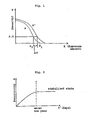
- Figure 1 is a explanatory graph of a characteristic curve of the light-sensitive material developed with the processing solution and a characteristic value.
- Figure 2 is a explanatory graph showing a change in a performance of a processing solution.
- the maximum temperature represented by X means the maximum temperature applied in any step of the heat treatment.
- the maximum temperature means 40°C.
- heat treatment it is preferred to heat at a maximum temperature of from 50°C to 80°C for from 1 day to 20 days with proviso that heat treatment is conducted for at least T days wherein T is represented by the formula: wherein X is the same meaning as in formula (I). And it is particularly preferred to heat at a maximum temperature of about 60°C for about 3 days.
- the maximum temperature applied is 80°C or less.
- Processing solution which is not subjected to a heating treatment gradually increases its performance and reaches to a stabilized state about one year later- as is shown in Figure 2.
- Figure 2 shows the change in the performance of the processing solution.
- the ordinate represents sensitivity of the light-sensitive material treated by the processing solution and the abscissa represents days (T') during which the processing solution is stored.
- T' days during which the processing solution is stored.
- An effect of increasing performance of the processing solution before a stabilized state is reached is shown primarily on the silver halide emulsion layer nearest to the place where the processing solution is applied.
- the layer primarily influenced by the increasing performance is the blue sensitive layer.
- the effects of increasing performance is seen only in the blue sensitive layer, but is not seen in a green sensitive layer, nor in a red sensitive layer, which are more remote from the place where the processing solution is spread. Therefore, the apparent sensitivities of layers result in being different from each other. This means that the material has poor sensitivity-balance, and furthermore poor color-balance. That is, the color reproducibility of the material deteriorates.
- the present invention overcomes this problem.
- the processing solution reaches the stabilized state in a short time by heating artificially in an oxygen-free system, in spite of the fact that it has been believed that 3-pyrazolidinones are decomposed by heating in the prior art.
- minimum days means the number of days sufficient to reach to a stabilized state, i.e., at least the number of days sufficient to obtain about two-thirds the sensitivity of the stabilized state.
- 1-aryl-4-substituted-3-pyrazolidinones are preferred examples. Particularly preferred examples are those represented by the formula (II) wherein R 1 and R 2 each represents a hydrogen atom, a lower alkyl group preferably having 1 to 4 carbon atoms (more preferably, a methyl group), or a hydroxyl substituted lower alkyl group preferably having 1 to 4 carbon atoms (more preferably, a hydroxymethyl group), and R 3 , R 4 and R 5 each represents a hydrogen atom, a hydroxyl group, an alkyl group, preferably having 1 to 2 carbon atoms, an alkoxy group preferably having 1 to 2 carbon atoms, an aryloxy group preferably being a phenoxy group, a sulfonamide group, or an aromatic group.
- R3 , R 4 and R 5 may represent a hydrogen atom, a lower alkyl group preferably having 1 to 4 carbon atoms (more preferably, a methyl group), or a
- examples of useful 3-pyrazolidinones include compounds having the following R 1 - R 5 groups in the above described formula (II).
- W.E. Lee has examined hydrolysis of 3-pyrazolidinones in an oxygen-free system and has reported that they are finally decomposed into pieces as follows, in Phot. Sci. Eng. Vol. 8, page 120 (1964).
- the present invention is based on the discovery and application of the above described phenomena 1) and 2).
- the amount of 3-pyrazolidinones used in the present invention is not restricted, but they are generally used in an amount of from about 1 g/i up to the solubility limited thereof (i.e., the upper limit is the maximum amount of the compound that will dissolve). Preferably, it is in a range of from 5 to 20 g/i.
- alkalinity providing substances in the alkaline processing solution used in the present invention alkali metal and other metal hydroxides, such as sodium hydroxide, potassium hydroxide, rubidium hydroxide or cesium hydroxide, etc., are desirably used. Furthermore, alkali metal carbonate such as sodium carbonate and amines such as diethylamine can be used. It is preferred that the alkaline processing solution contain the above described alkalinity providing substances so as to have a pH of 11 or more.
- a thickening agent such as ethers that are inactive to alkaline solutions, such as hydroxyethyl cellulose or alkali metal salt of carboxymethyl cellulose (for example, sodium . carboxymethyl cellulose), etc.
- the amount of the thickening agent depends on the kind or the degree of polymerization of the thickening agent, but it is generally advantageous to use it in a concentration of from 1 to 10% by weight, based on the total weight of the processing solution.
- the viscosity is preferred to be in a range of from about 100 to 250,000 cps.
- thickening agents such as guar gums, xanthanes, and algins as described in Research Disclosure, No. 15162, Nov., 1976, as thickening agents.
- the alkaline processing solution used in the present invention may contain various agents for providing opacity, such as, for example, carbon black, titanium dioxide and other light-absorbing dyes, for example, indicator dyes the color of which varies depending on the pH.
- agents for providing opacity such as, for example, carbon black, titanium dioxide and other light-absorbing dyes, for example, indicator dyes the color of which varies depending on the pH.
- the photographic element of the present invention may contain additives for the purpose of increasing the density of transferred images.
- aromatic alcohols such as benzyl alcohol or p-xylene-a,a'-diol, etc., as described in U.S. Patent 3,846,129 may be used for this purpose.
- Patent 4,030,920 such as 1,4-cyclohexanedimethanol, 1,6-hexanediol, 3-amino-l-propanol, 2-amino-l-propanol, 5-amino-l-pentanol, 6-amino-1-hexanol or 2-amino-2-methyl-l-propanol, etc., may also be added for this purpose.
- the photographic element of the present invention may contain compounds as described in U.S. Patent 3,942,987 such as alkali metal fluorides, oxalates, barium salts, etc., for the purpose of preventing pimple-like deformations generating after substantial conclusion of development.
- the photographic element of the present invention may further contain compounds as described in U.S. Patent 2,497,917, such as 5-methylbenzotriazole, 5,6-dichloro- benzotriazole, 6-nitrobenzimidazole, histidine, etc.
- pigments such as carbon black or titanium dioxide may be uniformly dispersed therein.
- dispersing assistants and surface active agents known hitherto can be used. Examples include alkali metal salts of compounds such as polyacrylic acid, naphthalenesulfonic acid, polycondensate of naphthalenesulfonic acid and formalin, polystyrenesulfonic acid, etc.
- Particularly available carbon black dispersions are those prepared by methods using compounds as described in Japanese Patent Applications (OPI) 150228/81 and 200862/82 (The term “O P I” as used herein refers to a "published unexamined Japanese patent application").
- various compounds may be incorporated, including metal salts such as silver nitrate, silver oxide, lead oxide, tin oxide, cadmium oxide, zinc nitrate, mercury oxide, etc.
- Light-sensitive silver halide emulsions used in the present invention are hydrophilic colloid dispersions of silver chloride, silver bromide, silver chlorobromide, silver iodobromide, silver chloroiodobromide or a mixture of them.
- the halogen composition is selected according to the particular purpose of use and processing conditions to be used for the light-sensitive material, but it is particularly preferred to use silver bromide, silver .iodobromide, or silver chloroiodobromide having an iodide content of 10 mole % or less and a chloride content of 30 mole % or less.
- inner latent image type direct reversal silver halide emulsions As emulsions of this type include, for example, conversion type emulsions, core/shell type emulsions and hetero metal incorporated emulsions such as these described in U.S. Patents 2,592,250, 3,206,313, 3,447,927, 3,761,276 and 3,935,014, etc.
- nucleating agents for emulsions of this type include hydrazines as described in U.S. Patents 2,588,982 and 2,563,785, hydrazides and hydrazones as described in U.S. Patent 3,227,552, quaternary salt compounds as described in British Patent 1,283,835, Japanese Patent Publication 38164/74 and U.S. Patents 4,115,122, 3,734,738, 3,719,494 and 3,615,615, sensitizing dyes having a nucleating substituent in the dye molecule as described in U.S. Patent 3,718,470, and thiourea linking acylhydrazine compounds as described in U.S. Patents 4,030,925, 4,031,127, 4,245,037, 4,255,511, 4,266,013, 4,276,364, etc.
- Dye-releasing redox (DRR) compounds preferably used in the present invention are immobile under an alkaline processing condition, and can be represented generally by the formula (III)
- (Ballast) represents a ballast group for immobilizing the compound under an alkaline processing condition
- (Dye) represents a dye group which can move in the light-sensitive element under at least an alkaline processing condition or a precursor thereof
- (Link) represents a redox cleavage group having the property of cleaving upon oxidation due to development or of preventing cleavage directly or indirectly upon the oxidation.
- DRR compounds used in the present invention there are negative type DRR compounds, examples of which have been described in Japanese Patent Applications (OPI) 33826/73, 54021/79, 113624/76 and 71072/81, etc.
- Examples of (B-allast)-(Link)-moieties which can release a diffusible dye under an alkaline condition by development of silver halide include the following groups:
- DRR compounds include compounds having a positive type redox nucleus as described in Japanese Patent Applications (OPI) Nos. 111628/74, 63618/76, 4819/77, 110827/78, corresponding to U.S. Patent 4,139,379, 110828/78, corresponding to U.S. Patent 4.139,379, 130927/79, 164342/81 corresponding to U.S. Patent 4,371,604, U.S. Patent 4,199,354, etc.
- OPI Japanese Patent Applications
- Particularly preferred compounds are those having a redox carrier moiety represented by formula (IV): wherein Ballast has the same meaning as in the case of formula (III), Q represents a quinone nucleus (which may contain various substituents), x represents an integer of 1 or 2, R 1 represents an alkyl group or substituted alkyl group having from 1 to about 40 carbon atoms or an aryl group or substituted aryl group having 6 to 40 carbon atoms, and a is 0 or 1, but is 1 when R 1 represents a group having less than 8 carbon atoms.
- Ballast has the same meaning as in the case of formula (III)
- Q represents a quinone nucleus (which may contain various substituents)
- x represents an integer of 1 or 2
- R 1 represents an alkyl group or substituted alkyl group having from 1 to about 40 carbon atoms or an aryl group or substituted aryl group having 6 to 40 carbon atoms
- a is 0 or 1, but is 1 when R 1 represents
- the dye released from the DRR compound may be a known dye or may be a dye precursor capable of changing into a dye in the photographic processing step or an additional processing step.
- the dye of the final image may or may not be chelated with a metal.
- Typical dyes include azo dyes, azomethine dyes, anthraquinone dyes and phthalocyanine dyes, and these may be chelated or not chelated with a metal.
- azo type cyan, magenta, and yellow dyes are particularly useful.
- yellow DRR compounds are described, for example, in Japanese Patent Publication Nos. 2618/74 and 12140/82; Japanese Patent Application (OPI) Nos. 114930/76, 64036/78, 79031/79, 23527/79, 111344/79, 16130/81, and 71072/81; U.S. Patents 3,309,199, 4,148,641 and 4,148,643; and in Research Disclosure, Nos. 17630 (1978) and 16475 (1977).
- magenta DRR compounds are described, for example, in Japanese Patent Publication No. 43950/71; Japanese Patent Application (OPI) Nos. 115528/75, 106727/77, 23628/78, 35533/73, 65034/79, 161332/79, 134/30, 4028/80, 36804/80, 71060/81 and 73057/81; and U.S. Patents 3,453,107, 3,932,380, 3,932,381, 3,931,144, 4,207,104, 4,287,292, 4,357,410 and 4,357,412.
- cyan DRR compounds are described in Japanese Patent Publication No. 32130/73, Japanese Patent Application (OPI) Nos. 126331/74, 109928/76, 8827/77, 47823/73, 64035/78, 143323/78, 149328/78, 99431/79, 121125/79, and 71061/31; U.S. Patents 4,142,891, 4,147,544, 4,148,642, and 4,195,994; European Patents 53,037 and 53,040; and in Research Disclosure, Nos. 16475 (1975), 16475 (1977), and 17630 (1978).
- DRR compounds having a dye part, light absorption of which is temporarily shifted in the light-sensitive element, can be used in the present invention. Examples thereof are described in Japanese Patent Applications (OPI) Nos. 53329/80 and 53330/80; U.S. Patents 3,336,287, 3,579,334 and 3,982,946; and British Patent 1,467,317.
- the amount of a DRR compound applied is generally in a range of from 1 x 10 -4 to 1 x 10 -2 moles/m 2 , and preferably in a range of from 2 x 10 -4 to 2 x 10 -3 moles/m 2
- light-sensitive materials having at least two, and preferably three, combinations of an emulsion having a selective spectral sensitivity to a certain wavelength range and a DRR compound having a selective spectral absorption in the same wavelength range as the emulsion described above are used.
- light-sensitive elements having a combination of a blue-sensitive silver halide emulsion and a yellow DRR compound, a combination of a green-sensitive emulsion and a magenta DRR compound, and a combination of a red-sensitive emulsion and a cyan DRR compound are available.
- These combination units of emulsion and DRR compound may be applied in layers so as to have a face-to-face relation in the light-sensitive material or may be applied as one layer by forming particles of each combination (wherein the DRR compound and the silver halide grains are present in the same particle) and mixing them.
- Image receiving elements containing at least a mordanting layer, neutralizing layers, layers for controlling neutralization rate (timing layer), reflection layers, light-shielding layers and cover sheets, etc., capable of use in the photographic element of the present invention include those described, for example, in Japanese Patent Application (OPI) 64533/77, corresponding to U.S. Patent 4,268,625.
- OPI Japanese Patent Application
- polymer mordanting agents that can be used in the mordanting layer include polymers having secondary and tertiary amino groups, polymers having nitrogen containing heterocyclic parts and polymers having quaternary cationic groups, which have a molecular weight of 5,000 or more, and preferably 10,000 or more.
- the photographic element of the present invention is in the form of a photographic film unit, and more particularly in the case of a film unit having such a construction that the photographic processing is carried out by passing the film unit between a pair of pressing members placed in parallel after imagewise exposure to light, it comprises, for example, the following elements:
- a very desirable embodiment for the present invention is a type involving superposing layers in a body in the manner disclosed in Belgium Patent 757,959, corresponding to U.S. Patent 3,689,262.
- an image receiving layer, a light reflection layer which substantially shields light for example, a combination of a TiO 2 layer and a carbon black layer
- a single or plurality of light-sensitive layers for example, a single or plurality of light-sensitive layers (light-sensitive element) are applied in turn to a transparent base, and a transparent cover sheet is placed thereon in a face-to-face relation.
- a container destructible by pressure which accommodates an alkaline processing solution containing an agent for providing opacity (for example, carbon black) in order to shield the light is disposed so as to be adjacent to the top layer (protective layer) of the above described light-sensitive layers and to the transparent cover sheet.
- This film unit is exposed to light through the transparent cover sheet.
- a neutralization mechanism In the film unit of this embodiment, it is desirable to incorporate a neutralization mechanism. It is especially preferred to provide a neutralizing layer on a cover sheet (if necessary, a timing layer is additionally provided on the other side from where the processing solution is spread).
- an image receiving element having a multilayer construction composed of a neutralizing layer, a timing layer, and a mordanting layer on a support and an element comprising a single or plurality of light-sensitive layers on another support (light-sensitive element) are placed in layers so as to have a face-to-face relation, and they are processed by spreading an alkaline processing solution as described herein between both elements.
- the image receiving element may be separated after transfer of images.
- the support of the image receiving layer may be transparent, and a reflection layer can be provided between the image receiving layer and the light-sensitive layers, by which images can be observed directly without separating the layers.
- the neutralizing layer and the timing layer can be omitted.
- a light-sensitive material was produced by applying the following layers in turn to a transparent polyethylene terephthalate support.
- a cover sheet was produced by applying the following layers (1') - (3') in turn to a transparent polyester support.
- processing solution was put in a destructible container (wherein the container was interrupted from oxygen and it would be placed in such a position that the content in the container was spread between the light-sensitive material and the cover sheet in the film unit when pressure is applied by the pressing members during processing of the film unit), it was subjected to heat treatment together with the container under the following conditions. Thereafter, each container was placed between the light-sensitive material and the cover sheet in each film unit to unify in a body.
- Processing solution A No heating (for comparison)
- Processing solution B Heating to 45°C for 30 days
- Performances of Processing solutions A - D which were allowed to stand at room temperature for 1 year and 8 months were compared with performances of the corresponding Processing solutions A' - D' (for control) which were obtained by preserving the Processing solutions A - D in a frozen state for 1 year and 8 months.
- the processing solution preserved in a frozen state is taken as a processing solution just after preparation, since it is believed that frozen processing solution causes no change in its performance during preservation.
- the changes of performances of the processing solutions A - D due to passage of time were compared based on the frozen processing solutions A' - D'.
- tungsten light of 2854°K (tungsten lamp) was used, and the above described film unit was imagewise exposed through a continuous wedge by applying the light obtained by passing through a Davis Gibbson Filter to convert it into the light of 4800°K type, applied to the side of the transparent base of the light-sensitive layers.
- the maximum exposure in this case was 10 CMS).
- FIG. 1 shows a characteristic curves of the light-sensitive material developed with the processing solution A and A'. Characteristic curves relating to the processing solutions B and B', C and C' and D and D' are almost the same as that relating to the processing solution A.
- the characteristic value ⁇ S means the difference between S 2 and S 1 , which is represented as the unit mm, wherein S 1 represents an exposure amount (logarithmic value) corresponding to the transfer density of 0.5 (measurement of reflection density) in the characteristic curve of the light-sensitive material developed with the processing solutions A - D which were allowed to stand at room temperature for 1 year and 8 months, and S 2 represents an exposure amount (logaritbmic value) corresponding to the transfer density of 0.5 in the characteristic curve of the light-sensitive material developed with the processing solutions A' - D' preserved in a frozen state (5 mm corresponds to logarithm of exposure amount of 0.1).
- S 1 represents an exposure amount (logarithmic value) corresponding to the transfer density of 0.5 (measurement of reflection density) in the characteristic curve of the light-sensitive material developed with the processing solutions A - D which were allowed to stand at room temperature for 1 year and 8 months
- S 2 represents an exposure amount (logaritbmic value) corresponding to the transfer density of 0.5 in the characteristic curve of the
Landscapes
- Physics & Mathematics (AREA)
- General Physics & Mathematics (AREA)
- Silver Salt Photography Or Processing Solution Therefor (AREA)
Applications Claiming Priority (2)
| Application Number | Priority Date | Filing Date | Title |
|---|---|---|---|
| JP58128226A JPS6019139A (ja) | 1983-07-14 | 1983-07-14 | カラ−拡散転写用写真要素 |
| JP128226/83 | 1983-07-14 |
Publications (3)
| Publication Number | Publication Date |
|---|---|
| EP0131933A2 true EP0131933A2 (de) | 1985-01-23 |
| EP0131933A3 EP0131933A3 (en) | 1987-11-19 |
| EP0131933B1 EP0131933B1 (de) | 1990-04-11 |
Family
ID=14979610
Family Applications (1)
| Application Number | Title | Priority Date | Filing Date |
|---|---|---|---|
| EP84108244A Expired EP0131933B1 (de) | 1983-07-14 | 1984-07-13 | Photographisches Farbdiffusionsübertragungselement |
Country Status (4)
| Country | Link |
|---|---|
| US (1) | US4576906A (de) |
| EP (1) | EP0131933B1 (de) |
| JP (1) | JPS6019139A (de) |
| DE (1) | DE3481937D1 (de) |
Family Cites Families (4)
| Publication number | Priority date | Publication date | Assignee | Title |
|---|---|---|---|---|
| NL110302C (de) * | 1961-01-20 | |||
| US3369898A (en) * | 1963-09-05 | 1968-02-20 | Morton Int Inc | Stabilized 1-phenyl-3-pyrazolidone photographic developer system |
| US4209580A (en) * | 1978-10-02 | 1980-06-24 | Eastman Kodak Company | Substituted 1-phenyl-3-pyrazolidinone electron transfer agents |
| DE2853573A1 (de) * | 1978-12-12 | 1980-07-03 | Bayer Ag | Herstellung von n-substituierten derivaten des l-desoxynojirimycins |
-
1983
- 1983-07-14 JP JP58128226A patent/JPS6019139A/ja active Pending
-
1984
- 1984-07-13 DE DE8484108244T patent/DE3481937D1/de not_active Expired - Lifetime
- 1984-07-13 EP EP84108244A patent/EP0131933B1/de not_active Expired
-
1985
- 1985-07-02 US US06/751,093 patent/US4576906A/en not_active Expired - Lifetime
Also Published As
| Publication number | Publication date |
|---|---|
| JPS6019139A (ja) | 1985-01-31 |
| US4576906A (en) | 1986-03-18 |
| EP0131933A3 (en) | 1987-11-19 |
| DE3481937D1 (de) | 1990-05-17 |
| EP0131933B1 (de) | 1990-04-11 |
Similar Documents
| Publication | Publication Date | Title |
|---|---|---|
| US3260597A (en) | Photographic multicolor diffusion transfer process using dye developers and development arrestors | |
| US3930864A (en) | Auxiliary mordant layer for excess dye formed in integral color transfer assemblage | |
| CA1126999A (en) | Use of azole compounds with a n,n disubstituted carbamoyl group on a ring nitrogen as development restrainer precursors in photographic elements | |
| US4511644A (en) | Photographic elements with development inhibitor precursor | |
| EP0009837B1 (de) | Substituiertes 1-Phenyl-3-pyrazolidon als Elektronentransfermittel enthaltendes photographisches Element | |
| US4547452A (en) | Color diffusion transfer photographic element with sufinic acid | |
| US4246333A (en) | Development inhibitor precursor and a photographic element containing the same | |
| US3161506A (en) | Photographic multicolor diffusion transfer process using dye developers | |
| JPS5914739B2 (ja) | カラ−拡散転写法 | |
| US4626494A (en) | Hardened color diffusion transfer photographic materials | |
| US4069048A (en) | Diffusion transfer photographic materials with color developer scavenger | |
| US4444866A (en) | Photographic light-sensitive material with forced oxidized carbon black | |
| US4584257A (en) | Photographic elements containing naphthylsulfonylethylthio heterocycle developement inhibitor precursor | |
| EP0131933B1 (de) | Photographisches Farbdiffusionsübertragungselement | |
| US4429031A (en) | Color diffusion transfer photographic element | |
| US4649095A (en) | Color diffusion transfer photographic film unit containing aluminum compound | |
| US4511643A (en) | Color diffusion transfer photographic element | |
| GB2074744A (en) | Photographic sensitive materials for colour diffusion transfer process | |
| US4575481A (en) | Light-sensitive material for color diffusion transfer with mixed oxidized developer scavenger particles | |
| US4559291A (en) | Ligands for metallizable dyes | |
| CA1141580A (en) | Timing layers for color transfer assemblages | |
| US4758498A (en) | Processing composition for use in color diffusion transfer photography containing a dye image stabilizer | |
| US3411904A (en) | Photographic multicolor diffusion transfer process using dye developers and element | |
| US4220703A (en) | Photographic receiving layer with acid processed gelatin | |
| CA1119871A (en) | Alkaline processing compositon containing a saturated, aliphatic w-amino acid or a mixture of a saturated carboxylic acid and a primary amine |
Legal Events
| Date | Code | Title | Description |
|---|---|---|---|
| PUAI | Public reference made under article 153(3) epc to a published international application that has entered the european phase |
Free format text: ORIGINAL CODE: 0009012 |
|
| AK | Designated contracting states |
Designated state(s): DE GB |
|
| PUAL | Search report despatched |
Free format text: ORIGINAL CODE: 0009013 |
|
| AK | Designated contracting states |
Kind code of ref document: A3 Designated state(s): DE GB |
|
| 17P | Request for examination filed |
Effective date: 19880517 |
|
| 17Q | First examination report despatched |
Effective date: 19881110 |
|
| GRAA | (expected) grant |
Free format text: ORIGINAL CODE: 0009210 |
|
| AK | Designated contracting states |
Kind code of ref document: B1 Designated state(s): DE GB |
|
| REF | Corresponds to: |
Ref document number: 3481937 Country of ref document: DE Date of ref document: 19900517 |
|
| PLBE | No opposition filed within time limit |
Free format text: ORIGINAL CODE: 0009261 |
|
| STAA | Information on the status of an ep patent application or granted ep patent |
Free format text: STATUS: NO OPPOSITION FILED WITHIN TIME LIMIT |
|
| 26N | No opposition filed | ||
| REG | Reference to a national code |
Ref country code: GB Ref legal event code: IF02 |
|
| PGFP | Annual fee paid to national office [announced via postgrant information from national office to epo] |
Ref country code: GB Payment date: 20020710 Year of fee payment: 19 |
|
| PGFP | Annual fee paid to national office [announced via postgrant information from national office to epo] |
Ref country code: DE Payment date: 20020717 Year of fee payment: 19 |
|
| PG25 | Lapsed in a contracting state [announced via postgrant information from national office to epo] |
Ref country code: GB Free format text: LAPSE BECAUSE OF NON-PAYMENT OF DUE FEES Effective date: 20030713 |
|
| PG25 | Lapsed in a contracting state [announced via postgrant information from national office to epo] |
Ref country code: DE Free format text: LAPSE BECAUSE OF NON-PAYMENT OF DUE FEES Effective date: 20040203 |
|
| GBPC | Gb: european patent ceased through non-payment of renewal fee |
Effective date: 20030713 |