EP0130881B1 - Method and apparatus for providing a non-radioactive coolant for a nuclear reactor - Google Patents
Method and apparatus for providing a non-radioactive coolant for a nuclear reactor Download PDFInfo
- Publication number
- EP0130881B1 EP0130881B1 EP84401274A EP84401274A EP0130881B1 EP 0130881 B1 EP0130881 B1 EP 0130881B1 EP 84401274 A EP84401274 A EP 84401274A EP 84401274 A EP84401274 A EP 84401274A EP 0130881 B1 EP0130881 B1 EP 0130881B1
- Authority
- EP
- European Patent Office
- Prior art keywords
- water
- deuterium
- coolant
- light
- circulating
- Prior art date
- Legal status (The legal status is an assumption and is not a legal conclusion. Google has not performed a legal analysis and makes no representation as to the accuracy of the status listed.)
- Expired
Links
- 239000002826 coolant Substances 0.000 title claims description 36
- 238000000034 method Methods 0.000 title claims description 11
- 230000002285 radioactive effect Effects 0.000 title description 4
- XLYOFNOQVPJJNP-UHFFFAOYSA-N water Substances O XLYOFNOQVPJJNP-UHFFFAOYSA-N 0.000 claims description 29
- YZCKVEUIGOORGS-OUBTZVSYSA-N Deuterium Chemical compound [2H] YZCKVEUIGOORGS-OUBTZVSYSA-N 0.000 claims description 26
- 229910052805 deuterium Inorganic materials 0.000 claims description 24
- XLYOFNOQVPJJNP-ZSJDYOACSA-N Heavy water Chemical compound [2H]O[2H] XLYOFNOQVPJJNP-ZSJDYOACSA-N 0.000 claims description 18
- YZCKVEUIGOORGS-NJFSPNSNSA-N Tritium Chemical compound [3H] YZCKVEUIGOORGS-NJFSPNSNSA-N 0.000 claims description 13
- 229910052722 tritium Inorganic materials 0.000 claims description 13
- 238000004821 distillation Methods 0.000 claims description 12
- 230000015572 biosynthetic process Effects 0.000 claims description 6
- 230000008016 vaporization Effects 0.000 claims 1
- 229910052770 Uranium Inorganic materials 0.000 description 3
- 239000000446 fuel Substances 0.000 description 3
- 229910052739 hydrogen Inorganic materials 0.000 description 3
- 239000001257 hydrogen Substances 0.000 description 3
- JFALSRSLKYAFGM-UHFFFAOYSA-N uranium(0) Chemical compound [U] JFALSRSLKYAFGM-UHFFFAOYSA-N 0.000 description 3
- UFHFLCQGNIYNRP-UHFFFAOYSA-N Hydrogen Chemical compound [H][H] UFHFLCQGNIYNRP-UHFFFAOYSA-N 0.000 description 2
- 238000009835 boiling Methods 0.000 description 2
- JEGUKCSWCFPDGT-UHFFFAOYSA-N h2o hydrate Chemical compound O.O JEGUKCSWCFPDGT-UHFFFAOYSA-N 0.000 description 2
- 239000000463 material Substances 0.000 description 2
- QVGXLLKOCUKJST-UHFFFAOYSA-N atomic oxygen Chemical compound [O] QVGXLLKOCUKJST-UHFFFAOYSA-N 0.000 description 1
- 238000001816 cooling Methods 0.000 description 1
- 239000000498 cooling water Substances 0.000 description 1
- 230000005611 electricity Effects 0.000 description 1
- 230000004992 fission Effects 0.000 description 1
- 239000012530 fluid Substances 0.000 description 1
- 239000007789 gas Substances 0.000 description 1
- 150000002431 hydrogen Chemical class 0.000 description 1
- 239000007788 liquid Substances 0.000 description 1
- 238000004519 manufacturing process Methods 0.000 description 1
- 239000001301 oxygen Substances 0.000 description 1
- 229910052760 oxygen Inorganic materials 0.000 description 1
- 238000010992 reflux Methods 0.000 description 1
- 239000000126 substance Substances 0.000 description 1
- JFALSRSLKYAFGM-OIOBTWANSA-N uranium-235 Chemical compound [235U] JFALSRSLKYAFGM-OIOBTWANSA-N 0.000 description 1
Images
Classifications
-
- G—PHYSICS
- G21—NUCLEAR PHYSICS; NUCLEAR ENGINEERING
- G21C—NUCLEAR REACTORS
- G21C19/00—Arrangements for treating, for handling, or for facilitating the handling of, fuel or other materials which are used within the reactor, e.g. within its pressure vessel
- G21C19/28—Arrangements for introducing fluent material into the reactor core; Arrangements for removing fluent material from the reactor core
- G21C19/30—Arrangements for introducing fluent material into the reactor core; Arrangements for removing fluent material from the reactor core with continuous purification of circulating fluent material, e.g. by extraction of fission products deterioration or corrosion products, impurities, e.g. by cold traps
- G21C19/307—Arrangements for introducing fluent material into the reactor core; Arrangements for removing fluent material from the reactor core with continuous purification of circulating fluent material, e.g. by extraction of fission products deterioration or corrosion products, impurities, e.g. by cold traps specially adapted for liquids
-
- Y—GENERAL TAGGING OF NEW TECHNOLOGICAL DEVELOPMENTS; GENERAL TAGGING OF CROSS-SECTIONAL TECHNOLOGIES SPANNING OVER SEVERAL SECTIONS OF THE IPC; TECHNICAL SUBJECTS COVERED BY FORMER USPC CROSS-REFERENCE ART COLLECTIONS [XRACs] AND DIGESTS
- Y02—TECHNOLOGIES OR APPLICATIONS FOR MITIGATION OR ADAPTATION AGAINST CLIMATE CHANGE
- Y02E—REDUCTION OF GREENHOUSE GAS [GHG] EMISSIONS, RELATED TO ENERGY GENERATION, TRANSMISSION OR DISTRIBUTION
- Y02E30/00—Energy generation of nuclear origin
- Y02E30/30—Nuclear fission reactors
Definitions
- This invention relates to the art of nuclear reactors, particularly the art of light-water cooled nuclear power plants.
- the known fission nuclear reactor employs a fuel, such as uranium, to produce heat which is transferred to a generating apparatus, typically a turbine driven generator.
- a known uranium fuel is enriched uranium-235.
- a coolant medium is circulated through the reactor to absorb heat produced by the nuclear reaction to create steam much as in oil or gas steam-generating processes. The steam is directed to a turbine to drive a generator, and the steam is then condensed and reintroduced to the coolant stream as a liquid.
- a significant problem with the known nuclear reactor is that the coolant medium becomes radioactive because of bombardment of the medium with neutrons produced by the nuclear reaction.
- the bombardment with neutrons produces tritium which is highly radioactive and dangerous.
- the production of tritium is a two- step process. First, light hydrogen accepts one neutron to produce deuterium (heavy hydrogen). Second, the heavy hydrogen accepts another neutron to become the heaviest known hydrogen, which is called tritium. The second reaction is much slower than the first.
- the major technique of preventing escape of tritium is to seal the coolant medium so as to prevent its escape. It is impossible, however, to fully prevent escape of the coolant medium since there must be a pressure relief valve for those instances when the coolant medium becomes overheated. It is a major safety hazard for the reactor to overheat thus causing the pressure relief valve of the coolant circuit to open and release tritium into the atmosphere.
- the invention prevents a safety hazard caused by the presence of tritium in a coolant medium of a light-water reactor by removing deuterium from the coolant.
- a portion of said circulating light-water coolant medium is diverted to removing deuterium and deuterium is continuously removed from said portion of the coolant medium, during operation of the reactor and formation of tritium is accordingly reduced or prevented.
- Deutrium formed in the coolant medium combines with oxygen and either hydrogen or deuterium to form intermediate weight water or heavy water.
- Intermediate weight water and heavy water may be separated from light water by known apparatus. Since the difference in boiling points of the intermediate weight and light weight water is about one-half degree Celsius while that of the heavy water and the light water is about one degree Celsius, a preferred apparatus for separating these materials is a distillation column having about one hundred plates.
- the distillation column has one advantage that heat from the circulating coolant may be used to boil the material in the distillation column, and a second advantage that heat removed by the column's condenser can be used to preheat a coolant used in a secondary circuit.
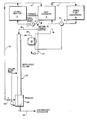
- the figure shows a schematic view of a nuclear reactor system.
- the figure shows a schematic view of a typical power plant using an atomic reactor as the heat source.
- the atomic reactor 2 uses enriched uranium as a fuel to heat a coolant medium to produce a high temperature stream 4 which is directed to a heat exchanger 6. After passing through the heat exchanger 6, a lower temperature stream 8 is directed back to the reactor 2 to complete a circuit.
- a pump 10 serves to drive the coolant medium in the circuit.
- the heat exchanger 6 transfers heat from a primary cooling medium to a secondary stream which is used to drive electric generators.
- a high temperature secondary stream 12 exits the heat exchanger 6 and is directed to a power plant 14.
- This power plant typically contains a plurality of turbines which are driven by a high temperature steam and which are in turn connected to generators for generating electricity.
- a low temperature secondary stream 16 is directed from the power plant back to the heat exchanger 6.
- a second pump 18 is used to drive the fluid in the secondary stream.
- the primary and secondary streams are used to prevent radioactive medium from being introduced into the power plant.
- the plant may be designed so that the primary stream drives the turbines.
- a bleed stream 20 is taken from the primary coolant stream and is fed into a distillation column 22.
- This bleed stream is preferably one percent of the primary stream, but need not be so limited, depending upon the particular circumstances.
- the size of the bleed stream should be adequate to reduce the amount of deuterium in the primary stream to below the concentration of deuterium found in nature.
- the normal concentration of deuterium is 1/6,400, and it is preferred to reduce the concentration of deuterium in the primary stream to at least between 1/6400-1/10,000. It may be practical in some instances to reduce the deuterium concentration even further.
- the bleed stream 20 is directed through a pressure relief valve 24 and into the reboiler 26 of the distillation column. Since the heavy water in the bleed stream has a higher boiling point that that of the light water in the bleed stream, the distillation column will separate the deuterium- containing water from the light water. Vaporized light water is taken out of the top of the distillation column at 28, and the light-water vapor is then directed to a condenser 30. Part of the condensed light water 32 is directed back into the low- temperature primary stream 8, and part becomes reflux water for the distillation column and is carried through line 38.
- Heavy water and intermediate weight water, containing deuterium, are taken from the distillation column at 34 and disposed of or sold for known uses.
- the condenser is a heat exchanger with cooling supplied by cool water 36 from the lower- temperature secondary stream 16.
- the cooling water 36 is returned to the stream 16 after passing through the condenser 30. This arrangement provides for a very efficient use of energy in the plant since the heat removed from the light-water steam 38 is added back to the circulating stream 16.
Landscapes
- Physics & Mathematics (AREA)
- Engineering & Computer Science (AREA)
- Plasma & Fusion (AREA)
- General Engineering & Computer Science (AREA)
- High Energy & Nuclear Physics (AREA)
- Vaporization, Distillation, Condensation, Sublimation, And Cold Traps (AREA)
- Devices And Processes Conducted In The Presence Of Fluids And Solid Particles (AREA)
Applications Claiming Priority (2)
| Application Number | Priority Date | Filing Date | Title |
|---|---|---|---|
| US50902783A | 1983-06-29 | 1983-06-29 | |
| US509027 | 1983-06-29 |
Publications (2)
| Publication Number | Publication Date |
|---|---|
| EP0130881A1 EP0130881A1 (en) | 1985-01-09 |
| EP0130881B1 true EP0130881B1 (en) | 1989-03-01 |
Family
ID=24025007
Family Applications (1)
| Application Number | Title | Priority Date | Filing Date |
|---|---|---|---|
| EP84401274A Expired EP0130881B1 (en) | 1983-06-29 | 1984-06-20 | Method and apparatus for providing a non-radioactive coolant for a nuclear reactor |
Country Status (4)
| Country | Link |
|---|---|
| EP (1) | EP0130881B1 (OSRAM) |
| JP (1) | JPS6036996A (OSRAM) |
| CA (1) | CA1222076A (OSRAM) |
| DE (1) | DE3476939D1 (OSRAM) |
Families Citing this family (1)
| Publication number | Priority date | Publication date | Assignee | Title |
|---|---|---|---|---|
| US4820477A (en) * | 1983-06-29 | 1989-04-11 | Mcnally Lillian | Method and apparatus for providing a non-radioactive coolant for a nuclear reactor |
Family Cites Families (3)
| Publication number | Priority date | Publication date | Assignee | Title |
|---|---|---|---|---|
| FR1526867A (fr) * | 1966-08-09 | 1968-05-31 | Commissariat Energie Atomique | Perfectionnements apportés aux moyens pour retirer le protonium et le tritium de l'eau lourde |
| FR1580313A (OSRAM) * | 1968-06-21 | 1969-09-05 | ||
| DE2300185B2 (de) * | 1973-01-03 | 1974-10-31 | Siemens Ag, 1000 Berlin Und 8000 Muenchen | Leichtwassergekühlter Kernreaktor |
-
1984
- 1984-06-20 EP EP84401274A patent/EP0130881B1/en not_active Expired
- 1984-06-20 DE DE8484401274T patent/DE3476939D1/de not_active Expired
- 1984-06-26 CA CA000457457A patent/CA1222076A/en not_active Expired
- 1984-06-28 JP JP59135009A patent/JPS6036996A/ja active Granted
Also Published As
| Publication number | Publication date |
|---|---|
| JPH0412438B2 (OSRAM) | 1992-03-04 |
| JPS6036996A (ja) | 1985-02-26 |
| EP0130881A1 (en) | 1985-01-09 |
| DE3476939D1 (en) | 1989-04-06 |
| CA1222076A (en) | 1987-05-19 |
Similar Documents
| Publication | Publication Date | Title |
|---|---|---|
| KR100189168B1 (ko) | 원자로의 피동 격납용기 냉각장치 | |
| EP0389231B1 (en) | Containment heat removal system | |
| US4190515A (en) | Apparatus for removal and recovery of tritium from light and heavy water | |
| JPH032277B2 (OSRAM) | ||
| CN114180661B (zh) | 基于精馏的核电站含氚重水除氚工艺及设备 | |
| US3222255A (en) | Method of purifying primary fluid of nuclear reactor circuit | |
| US3305450A (en) | Nuclear reactors with pressurizer operating with noncondensible gas | |
| EP0130881B1 (en) | Method and apparatus for providing a non-radioactive coolant for a nuclear reactor | |
| US4820477A (en) | Method and apparatus for providing a non-radioactive coolant for a nuclear reactor | |
| JPS6225999B2 (OSRAM) | ||
| US4533514A (en) | Nuclear reactor degassing method and degassing system | |
| US3012957A (en) | Power production system | |
| US2989454A (en) | Nuclear reactor | |
| US3162580A (en) | Method of operating nuclear power plants | |
| US3211624A (en) | Method and means for controlling the start of a homogeneous nuclear reactor | |
| US3151031A (en) | Method of regulating the operation of homogeneous nuclear reactors | |
| KR940008250B1 (ko) | 핵연료 채널 및 이를 이용한 고유안전 수냉각형 튜브 원자로 | |
| KR960011210B1 (ko) | 피동형 가압경수로 | |
| Regan et al. | Design and safety aspects of the nuclear reactors for Koeberg power station | |
| WO2025227185A1 (en) | Reactor core and reactor | |
| Pocock | Water technology experience for materials protection in light water and heavy water reactor systems | |
| Beeley et al. | THE SODIUM GRAPHITE REACTOR: TOMMORROW'S POWER PLANT | |
| Lurie et al. | PWR secondary water chemistry guidelines: Revision 3 | |
| Yamashita | Secondary water chemistry control and experience in Japanese PWR | |
| Hradil | Safety aspects of chemical regime of nuclear power plant secondary circuit |
Legal Events
| Date | Code | Title | Description |
|---|---|---|---|
| PUAI | Public reference made under article 153(3) epc to a published international application that has entered the european phase |
Free format text: ORIGINAL CODE: 0009012 |
|
| AK | Designated contracting states |
Designated state(s): BE DE FR GB IT NL SE |
|
| 17P | Request for examination filed |
Effective date: 19850624 |
|
| 17Q | First examination report despatched |
Effective date: 19860722 |
|
| D17Q | First examination report despatched (deleted) | ||
| GRAA | (expected) grant |
Free format text: ORIGINAL CODE: 0009210 |
|
| AK | Designated contracting states |
Kind code of ref document: B1 Designated state(s): BE DE FR GB IT NL SE |
|
| PG25 | Lapsed in a contracting state [announced via postgrant information from national office to epo] |
Ref country code: NL Effective date: 19890301 Ref country code: IT Free format text: LAPSE BECAUSE OF FAILURE TO SUBMIT A TRANSLATION OF THE DESCRIPTION OR TO PAY THE FEE WITHIN THE PRESCRIBED TIME-LIMIT;WARNING: LAPSES OF ITALIAN PATENTS WITH EFFECTIVE DATE BEFORE 2007 MAY HAVE OCCURRED AT ANY TIME BEFORE 2007. THE CORRECT EFFECTIVE DATE MAY BE DIFFERENT FROM THE ONE RECORDED. Effective date: 19890301 |
|
| REF | Corresponds to: |
Ref document number: 3476939 Country of ref document: DE Date of ref document: 19890406 |
|
| ET | Fr: translation filed | ||
| NLV1 | Nl: lapsed or annulled due to failure to fulfill the requirements of art. 29p and 29m of the patents act | ||
| PLBE | No opposition filed within time limit |
Free format text: ORIGINAL CODE: 0009261 |
|
| STAA | Information on the status of an ep patent application or granted ep patent |
Free format text: STATUS: NO OPPOSITION FILED WITHIN TIME LIMIT |
|
| 26N | No opposition filed | ||
| EAL | Se: european patent in force in sweden |
Ref document number: 84401274.0 |
|
| REG | Reference to a national code |
Ref country code: GB Ref legal event code: IF02 |
|
| PGFP | Annual fee paid to national office [announced via postgrant information from national office to epo] |
Ref country code: GB Payment date: 20020501 Year of fee payment: 19 |
|
| PGFP | Annual fee paid to national office [announced via postgrant information from national office to epo] |
Ref country code: SE Payment date: 20020604 Year of fee payment: 19 |
|
| PGFP | Annual fee paid to national office [announced via postgrant information from national office to epo] |
Ref country code: FR Payment date: 20020605 Year of fee payment: 19 |
|
| PGFP | Annual fee paid to national office [announced via postgrant information from national office to epo] |
Ref country code: DE Payment date: 20020628 Year of fee payment: 19 |
|
| PGFP | Annual fee paid to national office [announced via postgrant information from national office to epo] |
Ref country code: BE Payment date: 20020717 Year of fee payment: 19 |
|
| PG25 | Lapsed in a contracting state [announced via postgrant information from national office to epo] |
Ref country code: GB Free format text: LAPSE BECAUSE OF NON-PAYMENT OF DUE FEES Effective date: 20030620 |
|
| PG25 | Lapsed in a contracting state [announced via postgrant information from national office to epo] |
Ref country code: SE Free format text: LAPSE BECAUSE OF NON-PAYMENT OF DUE FEES Effective date: 20030621 |
|
| PG25 | Lapsed in a contracting state [announced via postgrant information from national office to epo] |
Ref country code: BE Free format text: LAPSE BECAUSE OF NON-PAYMENT OF DUE FEES Effective date: 20030630 |
|
| BERE | Be: lapsed |
Owner name: *MCNALLY LILLIAN A. Effective date: 20030630 |
|
| PG25 | Lapsed in a contracting state [announced via postgrant information from national office to epo] |
Ref country code: DE Free format text: LAPSE BECAUSE OF NON-PAYMENT OF DUE FEES Effective date: 20040101 |
|
| EUG | Se: european patent has lapsed | ||
| GBPC | Gb: european patent ceased through non-payment of renewal fee |
Effective date: 20030620 |
|
| PG25 | Lapsed in a contracting state [announced via postgrant information from national office to epo] |
Ref country code: FR Free format text: LAPSE BECAUSE OF NON-PAYMENT OF DUE FEES Effective date: 20040227 |
|
| REG | Reference to a national code |
Ref country code: FR Ref legal event code: ST |