EP0128571B1 - An insecticidal composition - Google Patents
An insecticidal composition Download PDFInfo
- Publication number
- EP0128571B1 EP0128571B1 EP84106620A EP84106620A EP0128571B1 EP 0128571 B1 EP0128571 B1 EP 0128571B1 EP 84106620 A EP84106620 A EP 84106620A EP 84106620 A EP84106620 A EP 84106620A EP 0128571 B1 EP0128571 B1 EP 0128571B1
- Authority
- EP
- European Patent Office
- Prior art keywords
- insecticidal composition
- compound
- pyrethroid
- insecticidal
- test
- Prior art date
- Legal status (The legal status is an assumption and is not a legal conclusion. Google has not performed a legal analysis and makes no representation as to the accuracy of the status listed.)
- Expired
Links
- 0 C*C1C(C)(C)[C@@]1C=CCl Chemical compound C*C1C(C)(C)[C@@]1C=CCl 0.000 description 1
Images


Classifications
-
- A—HUMAN NECESSITIES
- A01—AGRICULTURE; FORESTRY; ANIMAL HUSBANDRY; HUNTING; TRAPPING; FISHING
- A01N—PRESERVATION OF BODIES OF HUMANS OR ANIMALS OR PLANTS OR PARTS THEREOF; BIOCIDES, e.g. AS DISINFECTANTS, AS PESTICIDES OR AS HERBICIDES; PEST REPELLANTS OR ATTRACTANTS; PLANT GROWTH REGULATORS
- A01N53/00—Biocides, pest repellants or attractants, or plant growth regulators containing cyclopropane carboxylic acids or derivatives thereof
-
- H—ELECTRICITY
- H10—SEMICONDUCTOR DEVICES; ELECTRIC SOLID-STATE DEVICES NOT OTHERWISE PROVIDED FOR
- H10F—INORGANIC SEMICONDUCTOR DEVICES SENSITIVE TO INFRARED RADIATION, LIGHT, ELECTROMAGNETIC RADIATION OF SHORTER WAVELENGTH OR CORPUSCULAR RADIATION
- H10F99/00—Subject matter not provided for in other groups of this subclass
-
- H—ELECTRICITY
- H10—SEMICONDUCTOR DEVICES; ELECTRIC SOLID-STATE DEVICES NOT OTHERWISE PROVIDED FOR
- H10F—INORGANIC SEMICONDUCTOR DEVICES SENSITIVE TO INFRARED RADIATION, LIGHT, ELECTROMAGNETIC RADIATION OF SHORTER WAVELENGTH OR CORPUSCULAR RADIATION
- H10F30/00—Individual radiation-sensitive semiconductor devices in which radiation controls the flow of current through the devices, e.g. photodetectors
- H10F30/20—Individual radiation-sensitive semiconductor devices in which radiation controls the flow of current through the devices, e.g. photodetectors the devices having potential barriers, e.g. phototransistors
Definitions
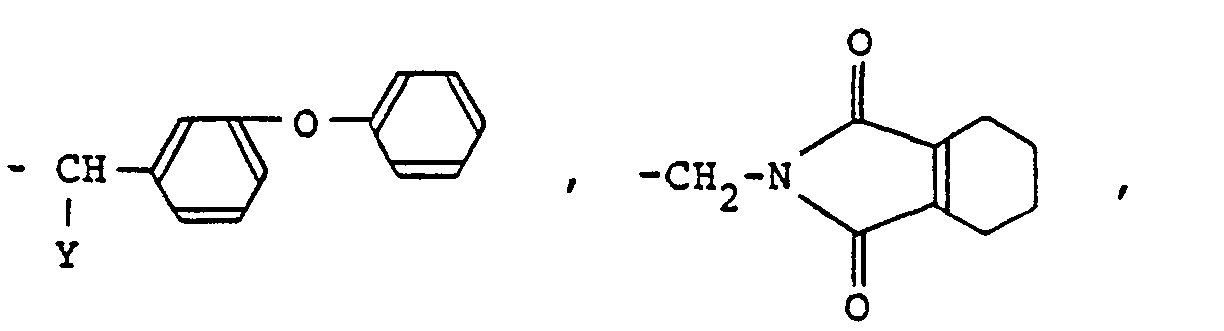
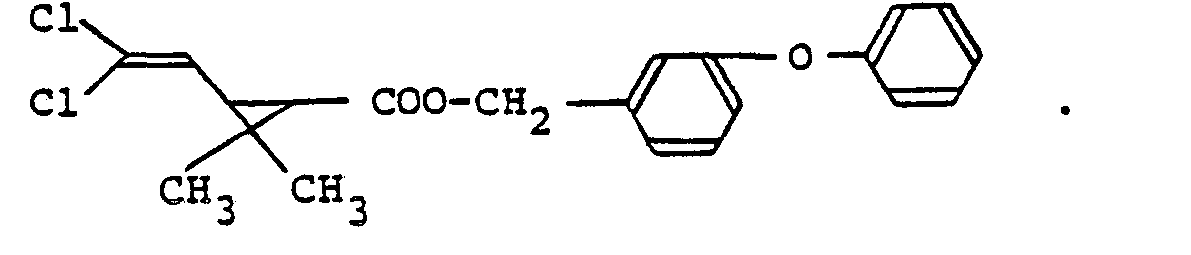
- the present invention relates to an insecticidal composition, and more particularly, it relates to an insecticidal composition characterized in that said composition contains 3-(2-methoxyphenyl)-5-methoxy-1,3,4-oxadiazol-2(3H)-one [hereinafter referred to as compound (A)] and at least one pyrethroid represented by the formula (I), wherein X represents a methyl group or chlorine atom, and R represents a group selected from the formulae, in which Y is a hydrogen atom or a cyano group, Z is a 2-propenyl or 2-propynyl group, in a weight ratio of 1:5 to 2:1.
- the present inventors found that the composition described above has a remarkable synergistic action in both the rapid knock-down effect and a high lethal effect, and confirmed that said composition is particularly superior in the effect on cockroaches, the control of which has been strongly demanded in recent years.
- the present invention will be illustrated in detail hereinafter.
- the above pyrethroid (I) includes permethrins (permethrin and its optical and/ or geometrical isomers), cypermethrins (cypermethrin and its optical and/or geometrical isomers), cyphenothrins (cyphenothrin and its optical and/or geometrical isomers), phenothrins (phenothrin and its optical and/or geometrical isomers), tetramethrins (tetramethrin and its optical and/or geometrical isomers), allethrins (allethrin and its optical and/or geometrical isomers), prallethrins (dl-2-propargyl-3-methyl-cyclopent-2-en-1-one dl-cis/trans-chrysanthemate and its optical and/or geometrical isomers), resmethrins (resmethrin and its optical and/or geometrical isomers).
- this composition it is formulated, according to the common insecticide-preparation methods well known to those skilled in the art, into various preparation forms such as emulsifiable concentrates, wettable powders, dusts, oily liquids, aerosols, fumigants (e.g. mosquito coils, mosquito mats for electric fumigators) and foggings by mixing with a solid, liquid or gaseous carrier or other auxiliaries for formulation (e.g. surface active agents, dispersing agents, wetting agents, stabilizers).
- a solid, liquid or gaseous carrier or other auxiliaries for formulation e.g. surface active agents, dispersing agents, wetting agents, stabilizers.
- solid carriers for example fine powders or granules of clays (e.g. kaolin, bentonite, terra abla, pyrophyllite, sericite), talcs and other inorganic minerals (e.g. hydrated silicon dioxide, pumice, diatomaceous earth, sulfur powder, activated carbon) are used.
- clays e.g. kaolin, bentonite, terra abla, pyrophyllite, sericite
- talcs and other inorganic minerals e.g. hydrated silicon dioxide, pumice, diatomaceous earth, sulfur powder, activated carbon
- liquid carriers for example alcohols (e.g. methyl alcohol), ketones (e.g. acetone, methyl ethyl ketone), ethers (e.g. ethyl ether, dioxane, cellosolve, tetrahydrofuran), aromatic hydrocarbons (e.g. benzene, toluene, xylene, methylnaphthalene), aliphatic hydrocarbons (e.g. kerosene), esters, nitriles, acid amides (e.g. dimethylformamide, dimethylacetamide), and halogenated hydrocarbons (e.g. dichloroethane, trichloroethylene, carbon tetrachloride) are used.
- alcohols e.g. methyl alcohol
- ketones e.g. acetone, methyl ethyl ketone
- ethers e.g. ethyl ether, dioxane, cellosolv
- surface active agents for example alkyl sulfates, alkylsulfonates, alkylarylsulfonates, polyethylene glycol ethers and polyhydric alcohol esters are used.
- the usable fixing agent and dispersing agent include for example casein, gelatin, starch powder, CMC, sodium-CMC, gum arabic, alginic acid, lignosulfonates, bentonite, molasses, polyvinyl alcohol, pine oil and agar.
- stabilizers for example PAP (isopropyl phosphate), TCP (tricresyl phosphate), tall oil, epoxidized oil, various surface active agents, and various fatty acids or their esters, are used.
- the insecticidal composition of the present invention is particularly suitable for the control of cockroaches so that, in using it for such purpose, its insecticidal effect can be developed more efficiently by using it in the form of a fumigant, aerosol and oily liquid.
- the fumigant containing cypermethrins, permethrins or cyphenothrins as the pyrethroid compound and the aerosol containing cypermethrins, permethrins, cyphenothrins or tetramethrins as the pyrethroid compound are most preferable.
- fumigants are types suitable for burning (e.g. "jet” type formulations, “rod” type formulations), exothermic reaction (e.g. types generating heat by water addition or air oxidation) and electric heating (e.g. mat).
- a nitrate or nitrite and a thermal decomposition-stimulating agent e.g. salts of an alkaline earth metal or alkali metal
- a thermal decomposition-stimulating agent e.g. bichromates, chromates
- a burning agent e.g. ethyl cellulose, nitrocellulose
- a flame-extinguishing agent e.g. melamine, flour
- a filler e.g. diatomaceous earth
- a heat-generating agent e.g. sulfides, polysulfides or hydrosulfides of an alkali metal, their hydrated salts
- a catalytic substance e.g. carbon black, activated carbon, charcoal, coke, asphalt
- a filler e.g. natural fibers, synthetic fibers, synthetic resin foams
- an organic foaming agent e.g. azodicarbonamide, benzenesulfonyl hydrazide
- a heat-generating agent e.g. calcium oxide
- the mat for example, mats produced by impregnating the porous plate of asbestos, pulp, ceramics, etc. with an active ingredient dissolved in an organic solvent such as acetone are used.
- aerosol for example, aerosol containing the organic solvent such as methylene chloride, kerosene or the like as the liquid carrier and being charged with propellant such as liquid petroleum gas is used.
- oils liquid for example the oily liquid containing the organic solvent such as methylene chloride, or kerosene is used.
- composition contains 0.5 to 40% by weight, generally 1 to 30% by weight, of the active ingredients.
- active ingredients 0.5 to 40% by weight, generally 1 to 30% by weight.
- Fig. 1 shows a diagram illustrating the test result on 10 minutes' exposure among the test results described in the following Table 1 which were obtained in the following Experimental example 1.
- curve CD shows the value of mortality found
- curve 1 the theoretical value of the same
- curve @ the value of a knock-down ratio found
- curve 02' the theoretical value of the same.
- the abscissa indicates the mixing ratio of compound (A) to compound (B)
- the left ordinate indicates the knock-down ratio (%)
- the right ordinate indicates the mortality (%).
- the attached Fig. 2 shows the positions in the Peet Grady's chamber in the following Experimental Example 2 at which the test plots (1), (2) and (3) were placed.
- the attached Fig. 3 shows the positions in the Peet Grady's chamber in the following Experimental Example 3 at which the triangular shelters were placed.
- H indicates the position of the electro-heating type fumigant or mat, and distances, a and b, are 30 cm and 180 cm, respectively.
- the "rod" type formulations for fumigation are prepared.
- a mixture of one part of the compound (A) and 0.1 part of compound (B), (C), (D), (E), (F), (G), (H), (I), (J), (K), (L), (M) or (N) is dissolved in 20 parts of methylene chloride and made up to 60 parts of solution with deodorized kerosene.
- the solution is filled in an aerosol container. After attaching a valve portion to the container, 40 parts of a propellant (liquid petroleum gas) are charged therein under pressure through the valve to obtain the aerosol.
- a propellant liquid petroleum gas
- a mixture of 0.5 part of compound (A) and 0.1 part of compound (F), (G), (H) or (K) is dissolved in 16 parts of methylene chloride and made up to 100 parts with kerosene to obtain the oily liquid.
- a mixture of 5 parts of the compound (A) and 5 parts of the compound (B), (C), (D) or (E) is dissolved in 55 parts of methylene chloride.
- the solution is filled in an aerosol container. After attaching a valve portion to the container, 35 parts of a propellant (liquid petroleum gas) are charged therein under pressure through the valve to obtain the aerosol.
- a propellant liquid petroleum gas
- a mixture of one part of compound (A) and 0.1 part of compound (F), (G), (H) or (M) is dissolved in 20 parts of methylene chloride and made up to 100 parts with kerosene to obtain the oily liquid.
- a mixture of one part of compound (A) and one part of compound of (B), (C), (D) or (E) is dissolved in 20 parts of methylene chloride and made up to 100 parts with kerosene to obtain the oily liquid.
- a rod-form base was prepared by mixing 35% of nitrocellulose and a mixture of a flame-extinguishing agent, a diluent and diatomaceous earth so that the total was 100%. Thereafter, the prescribed amount of the insecticidal active ingredient and Yoshinox 424 which was added at one-half of the weight of said insecticidal active ingredient, were impregnated, as an acetone solution, onto the rod-form base to prepare a "rod" type formulation for fumigation to be tested.
- the compounds in Table 3 were dissolved in acetone so as to be combined as described in the table and impregnated into a porous ceramic plate [4 cm x 4 cm x 1.2 cm (thickness)] to prepare electro-heating type test mats.
- test plots were prepared using Petri dishes, 14 cm in diameter and 7 cm in height, of which the inside wall was coated with butter for preventing insects from escape: (1) An open Petri dish test plot where a Petri dish is used as such; (2) an absorptive surface test pilot which is a Petri dish having a filter paper at the bottom; and (3) a Petri dish (with cover) test plot which is a Petri dish covered at the top with a round filter paper having a rectangular opening of which the area corresponds to one-fifth of the top area of the Petri dish.
- Each test plot was arranged as shown in Fig. 2 in a Peet Grady's chamber (180 cml 3 .
- An electro-heating fumigant placed at the center of the chamber was heated electrically to about 300°C for 15 minutes.
- test insects were transferred into a recovery container with water and diets, and after three days, the mortality rate was observed.
- the results are as shown in Table 3.
- An electro-heating type fumigating mat was prepared in the same manner as in Experimental Example 2.
- a Petri dish 20 cm in diameter and 5 cm in height, of which the inside wall was coated with butter for preventing insects from escape, was placed a triangular wooden shelter, 15 cm in height and 3 cm inside, in which ten German cockroaches (5 males and 5 females) (Blattella germanica) had previously acclimatized themselves.
- These Petri dishes were placed at the prescribed positions in a (180 cm) 3 Peet Grady's chamber as shown in Fig. 3.
- the electro-heating type fumigating mat at the center of the chamber was heated in the same manner as in Experimental Example 2, and the number of the insects flushing out of the shelter and that of the knocked-down ones among them were counted at the lapse of time.
- the flushing-out effect and the knock-down effect were determined by Finney's method, the former effect being expressed by a time required for 50% of the test insects to be flushed out (FT so value) and the latter effect being expressed by a time required for 50% of the test insects to be knocked down (KT so value). After 60 minutes' exposure, all the test insects were transferred into a recovery container with water and diets, and after three days, the mortality rate was obtained.
Landscapes
- Life Sciences & Earth Sciences (AREA)
- Agronomy & Crop Science (AREA)
- Pest Control & Pesticides (AREA)
- Plant Pathology (AREA)
- Health & Medical Sciences (AREA)
- Engineering & Computer Science (AREA)
- Dentistry (AREA)
- General Health & Medical Sciences (AREA)
- Wood Science & Technology (AREA)
- Zoology (AREA)
- Environmental Sciences (AREA)
- Agricultural Chemicals And Associated Chemicals (AREA)
Description
- The present invention relates to an insecticidal composition, and more particularly, it relates to an insecticidal composition characterized in that said composition contains 3-(2-methoxyphenyl)-5-methoxy-1,3,4-oxadiazol-2(3H)-one [hereinafter referred to as compound (A)] and at least one pyrethroid represented by the formula (I),


- As a result of an extensive study to search for higher performance insecticides which are of lower toxicity as well as more rapid insecticidal effect, the present inventors found that the composition described above has a remarkable synergistic action in both the rapid knock-down effect and a high lethal effect, and confirmed that said composition is particularly superior in the effect on cockroaches, the control of which has been strongly demanded in recent years. The present invention will be illustrated in detail hereinafter.
- In the present invention, the above pyrethroid (I) includes permethrins (permethrin and its optical and/ or geometrical isomers), cypermethrins (cypermethrin and its optical and/or geometrical isomers), cyphenothrins (cyphenothrin and its optical and/or geometrical isomers), phenothrins (phenothrin and its optical and/or geometrical isomers), tetramethrins (tetramethrin and its optical and/or geometrical isomers), allethrins (allethrin and its optical and/or geometrical isomers), prallethrins (dl-2-propargyl-3-methyl-cyclopent-2-en-1-one dl-cis/trans-chrysanthemate and its optical and/or geometrical isomers), resmethrins (resmethrin and its optical and/or geometrical isomers).
- Also, in the practical application of this composition, it is formulated, according to the common insecticide-preparation methods well known to those skilled in the art, into various preparation forms such as emulsifiable concentrates, wettable powders, dusts, oily liquids, aerosols, fumigants (e.g. mosquito coils, mosquito mats for electric fumigators) and foggings by mixing with a solid, liquid or gaseous carrier or other auxiliaries for formulation (e.g. surface active agents, dispersing agents, wetting agents, stabilizers).
- In these preparations, as solid carriers for example fine powders or granules of clays (e.g. kaolin, bentonite, terra abla, pyrophyllite, sericite), talcs and other inorganic minerals (e.g. hydrated silicon dioxide, pumice, diatomaceous earth, sulfur powder, activated carbon) are used.
- As liquid carriers for example alcohols (e.g. methyl alcohol), ketones (e.g. acetone, methyl ethyl ketone), ethers (e.g. ethyl ether, dioxane, cellosolve, tetrahydrofuran), aromatic hydrocarbons (e.g. benzene, toluene, xylene, methylnaphthalene), aliphatic hydrocarbons (e.g. kerosene), esters, nitriles, acid amides (e.g. dimethylformamide, dimethylacetamide), and halogenated hydrocarbons (e.g. dichloroethane, trichloroethylene, carbon tetrachloride) are used.
- As surface active agents for example alkyl sulfates, alkylsulfonates, alkylarylsulfonates, polyethylene glycol ethers and polyhydric alcohol esters are used.
- Further, the usable fixing agent and dispersing agent include for example casein, gelatin, starch powder, CMC, sodium-CMC, gum arabic, alginic acid, lignosulfonates, bentonite, molasses, polyvinyl alcohol, pine oil and agar. As stabilizers for example PAP (isopropyl phosphate), TCP (tricresyl phosphate), tall oil, epoxidized oil, various surface active agents, and various fatty acids or their esters, are used.
- As described above, the insecticidal composition of the present invention is particularly suitable for the control of cockroaches so that, in using it for such purpose, its insecticidal effect can be developed more efficiently by using it in the form of a fumigant, aerosol and oily liquid. In particular, the fumigant containing cypermethrins, permethrins or cyphenothrins as the pyrethroid compound, and the aerosol containing cypermethrins, permethrins, cyphenothrins or tetramethrins as the pyrethroid compound are most preferable.
- Examples of such fumigants are types suitable for burning (e.g. "jet" type formulations, "rod" type formulations), exothermic reaction (e.g. types generating heat by water addition or air oxidation) and electric heating (e.g. mat).
- As a main base for the "jet" type formulations, for example, mixtures of a nitrate or nitrite and a thermal decomposition-stimulating agent (e.g. salts of an alkaline earth metal or alkali metal) and mixtures of a guanidine salt and a thermal decomposition-stimulating agent (e.g. bichromates, chromates) are used.
- As a main base for the "rod" type formulations, for example, mixtures of a burning agent (e.g. ethyl cellulose, nitrocellulose), a flame-extinguishing agent (e.g. melamine, flour), a filler (e.g. diatomaceous earth) and a vehicle are used. This mixture is kneaded and then formed into a rod.
- As a main base for the type which generates heat by air oxidation, for example, mixtures of a heat-generating agent (e.g. sulfides, polysulfides or hydrosulfides of an alkali metal, their hydrated salts), a catalytic substance (e.g. carbon black, activated carbon, charcoal, coke, asphalt) and a filler (e.g. natural fibers, synthetic fibers, synthetic resin foams), are used.
- As a main base for the type which generates heat by water addition, for example, mixtures of an organic foaming agent (e.g. azodicarbonamide, benzenesulfonyl hydrazide) and a heat-generating agent (e.g. calcium oxide), are used.
- As the mat, for example, mats produced by impregnating the porous plate of asbestos, pulp, ceramics, etc. with an active ingredient dissolved in an organic solvent such as acetone are used. And as the aerosol, for example, aerosol containing the organic solvent such as methylene chloride, kerosene or the like as the liquid carrier and being charged with propellant such as liquid petroleum gas is used.
- As the oils liquid, for example the oily liquid containing the organic solvent such as methylene chloride, or kerosene is used.
- The foregoing composition contains 0.5 to 40% by weight, generally 1 to 30% by weight, of the active ingredients. In the following, the present invention will be illustrated in more detail with reference to the following examples, but it is not to be interpreted as being limited thereto.
- The attached Fig. 1 shows a diagram illustrating the test result on 10 minutes' exposure among the test results described in the following Table 1 which were obtained in the following Experimental example 1. In the figure, curve CD shows the value of mortality found, curve ① the theoretical value of the same, curve @ the value of a knock-down ratio found and curve 02' the theoretical value of the same. The abscissa indicates the mixing ratio of compound (A) to compound (B), the left ordinate indicates the knock-down ratio (%) and the right ordinate indicates the mortality (%).
- The attached Fig. 2 shows the positions in the Peet Grady's chamber in the following Experimental Example 2 at which the test plots (1), (2) and (3) were placed. The attached Fig. 3 shows the positions in the Peet Grady's chamber in the following Experimental Example 3 at which the triangular shelters were placed. In Figs. 2 and 3, H indicates the position of the electro-heating type fumigant or mat, and distances, a and b, are 30 cm and 180 cm, respectively.
- In the following examples, the symbols of the pyrethroid type compounds are as shown below and the parts are by weight.
-
- (B) permethrin
- (C) cypermethrin
- (D) d-cyphenothrin (a-cyano-3-phenoxybenzyl d-cis/trans-chrysanthemate)
- (E) d-phenothrin (3-phenoxybenzyl d-cis/trans-chrysanthemate)
- (F) tetramethrin
- (G) d-tetramethrin
(3,4,5,6-tetrahydrophthalimidomethyl d-cis/trans-chrysanthemate) - (H) d-allethrin (allethronyl d-cis/trans-chrysanthemate)
- (I) bio-allethrin (allethronyl d-trans-chrysanthemate)
- (J) (S)bioallethrin (d-allethronyl d-trans-chrysanthemate)
- (K) Esbiothrin (the mixture of bio-allethrin and (S) bioallethrin)
- (L) resmethrin
- (M) d-resmethrin (5-benzyl-3-furylmethyl d-cis/trans-chrysanthemate)
- (N) bio-resmethrin (5-benzyl-3-furylmethyl d-trans-chrysanthemate
- By mixing in each case the active ingredients, nitrocellulose, melamine, sodium-CMC and diatomaceous earth at the mixing ratios as given in the Table below, the "rod" type formulations for fumigation are prepared.
-

- The mixture of the active ingredients and the Yoshinox 424 [2,2'-methylenebis(4-ethyl-6-tertbutylphenol); stabilizer (manufactured by Yoshitomi Pharmaceutical Industries, Ltd.)] at the mixing ratio as given in the Table below was dissolved in 5 ml of acetone. And the solution was adsorbed uniformly on the porous ceramic plate [4 cm x 4 cm x 1.2 cm (thickness)] having a weight of 10 g to prepare an insecticidal mat for heating fumigation.
-

- A mixture of one part of the compound (A) and 0.1 part of compound (B), (C), (D), (E), (F), (G), (H), (I), (J), (K), (L), (M) or (N) is dissolved in 20 parts of methylene chloride and made up to 60 parts of solution with deodorized kerosene.
- The solution is filled in an aerosol container. After attaching a valve portion to the container, 40 parts of a propellant (liquid petroleum gas) are charged therein under pressure through the valve to obtain the aerosol.
- A mixture of 0.5 part of compound (A) and 0.1 part of compound (F), (G), (H) or (K) is dissolved in 16 parts of methylene chloride and made up to 100 parts with kerosene to obtain the oily liquid.
- A mixture of 5 parts of the compound (A) and 5 parts of the compound (B), (C), (D) or (E) is dissolved in 55 parts of methylene chloride.
- The solution is filled in an aerosol container. After attaching a valve portion to the container, 35 parts of a propellant (liquid petroleum gas) are charged therein under pressure through the valve to obtain the aerosol.
- A mixture of one part of compound (A) and 0.1 part of compound (F), (G), (H) or (M) is dissolved in 20 parts of methylene chloride and made up to 100 parts with kerosene to obtain the oily liquid.
- A mixture of one part of compound (A) and one part of compound of (B), (C), (D) or (E) is dissolved in 20 parts of methylene chloride and made up to 100 parts with kerosene to obtain the oily liquid.
- "Rod" type formulations for fumigation having a composition as shown in Tables 1 and 2, were prepared according to the following preparation method.
- A rod-form base was prepared by mixing 35% of nitrocellulose and a mixture of a flame-extinguishing agent, a diluent and diatomaceous earth so that the total was 100%. Thereafter, the prescribed amount of the insecticidal active ingredient and Yoshinox 424 which was added at one-half of the weight of said insecticidal active ingredient, were impregnated, as an acetone solution, onto the rod-form base to prepare a "rod" type formulation for fumigation to be tested.
- A Petri dish, 14 cm in diameter and 7 cm in height, was coated with butter on the cylindrical inside wall, and 10 German cockroaches (5 males and 5 females) (Blattella germanica) per group were liberated in the Petri dish. Ten pieces of this Petri dish were placed for each test at the center of the bottom of a (70 cm)3 glass chamber. Thereafter, a small window leading to the inside of the chamber was opened, a stand having 0.7 g of each "rod" type formulation was placed in the chamber and after firing it, the window was closed. Every time 10 and 20 minutes elapsed, five Petri dishes containing the cockroaches were taken out and placed in an observation room, and the number of knocked-down insects was counted with the lapse of time for 60 minutes. Then, the cockroaches were transferred to a clean container with water and diets, and after three days, the number of dead and live cockroaches was observed.
- The test results are as shown in Table 1.


- From the results in Table 1, a synergistic effect due to combination is clearly noticed on comparing the effect of each single ingredient with that of the mixture thereof. That said synergistic effect is remarkable and may be seen more clearly from Fig. 1 in which the knock-down ratio after 10 minutes' exposure and 20 minutes' lapse subsequent thereto, and the mortality were each plotted against the mixing ratio.
- It was found that the synergistic effect is noticed when the mixing ratio of compound (A) to compound (B) is in the range of 1:5 to 2:1, and that it is particularly remarkable when the mixing ratio is near to 1:2. Based on this result, the following Table 2 was made for the purpose of confirming the combination effect of a 2:1 mixture of the other pyrethroid type compound and the compound (A) as compared with the effect of the each compound constituting the mixture.

- From the result of Table 2, it can be confirmed that either of the mixtures of the present invention has a higher insecticidal effect than that of each of the compounds constituting said mixtures.
- The compounds in Table 3 were dissolved in acetone so as to be combined as described in the table and impregnated into a porous ceramic plate [4 cm x 4 cm x 1.2 cm (thickness)] to prepare electro-heating type test mats.
- The following test plots were prepared using Petri dishes, 14 cm in diameter and 7 cm in height, of which the inside wall was coated with butter for preventing insects from escape: (1) An open Petri dish test plot where a Petri dish is used as such; (2) an absorptive surface test pilot which is a Petri dish having a filter paper at the bottom; and (3) a Petri dish (with cover) test plot which is a Petri dish covered at the top with a round filter paper having a rectangular opening of which the area corresponds to one-fifth of the top area of the Petri dish.
- Ten German cockroaches (5 males and 5 females) (Blattella germanica) were liberated in each Petri dish.
- Each test plot was arranged as shown in Fig. 2 in a Peet Grady's chamber (180 cml3. An electro-heating fumigant placed at the center of the chamber was heated electrically to about 300°C for 15 minutes.
- After 60 minutes' exposure, the test insects were transferred into a recovery container with water and diets, and after three days, the mortality rate was observed. The results are as shown in Table 3.

- From the result of the tests under various conditions described in Table 3, it can be confirmed that either of the mixtures of the present invention has a higher insecticidal effect than that of each of the compounds constituting said mixtures.
- An electro-heating type fumigating mat was prepared in the same manner as in Experimental Example 2. At the center of the bottom of a Petri dish, 20 cm in diameter and 5 cm in height, of which the inside wall was coated with butter for preventing insects from escape, was placed a triangular wooden shelter, 15 cm in height and 3 cm inside, in which ten German cockroaches (5 males and 5 females) (Blattella germanica) had previously acclimatized themselves. These Petri dishes were placed at the prescribed positions in a (180 cm)3 Peet Grady's chamber as shown in Fig. 3.
- The electro-heating type fumigating mat at the center of the chamber was heated in the same manner as in Experimental Example 2, and the number of the insects flushing out of the shelter and that of the knocked-down ones among them were counted at the lapse of time.
- The flushing-out effect and the knock-down effect were determined by Finney's method, the former effect being expressed by a time required for 50% of the test insects to be flushed out (FTso value) and the latter effect being expressed by a time required for 50% of the test insects to be knocked down (KTso value). After 60 minutes' exposure, all the test insects were transferred into a recovery container with water and diets, and after three days, the mortality rate was obtained.
- The results are shown in Table 4.

- From Table 4, it is clearly noticed that an effective insect control can be attained by flushing out the insect lying in hiding, and also that either of the mixture of the present invention has a higher insecticidal effect than that of each of the compounds constituting said mixtures.
- Direct spray test of aerosols, which were prepared in the manner of Formulation Example 3, was made for cockroaches by the test method as follows:
- Ten German cockroaches were released into the container and then the container was put in a glass cylinder having a diameter of 20 cm and a height of 60 cm.
- 400 Mg ± 100 mg of each of test aerosol prepared in Formulation Example 3 was sprayed onto the insects in the container and then the number of knocked-down cockroaches was counted at prescribed time intervals up to 20 minutes.
- Then, the tested cockroaches were transferred into a fresh container with water and diets, and after three days, the mortality rate was observed.
- From the relation between knock-down ratio and time, the KT50 value (50% knock-down time) was calculated by Bliss's probit method.
- The results obtained are shown in Table 5.


Claims (6)


Applications Claiming Priority (2)
| Application Number | Priority Date | Filing Date | Title |
|---|---|---|---|
| JP58104533A JPS59227806A (en) | 1983-06-10 | 1983-06-10 | Insecticidal composition |
| JP104533/83 | 1983-06-10 |
Publications (2)
| Publication Number | Publication Date |
|---|---|
| EP0128571A1 EP0128571A1 (en) | 1984-12-19 |
| EP0128571B1 true EP0128571B1 (en) | 1987-09-16 |
Family
ID=14383128
Family Applications (1)
| Application Number | Title | Priority Date | Filing Date |
|---|---|---|---|
| EP84106620A Expired EP0128571B1 (en) | 1983-06-10 | 1984-06-08 | An insecticidal composition |
Country Status (7)
| Country | Link |
|---|---|
| US (1) | US4562062A (en) |
| EP (1) | EP0128571B1 (en) |
| JP (1) | JPS59227806A (en) |
| KR (1) | KR920000280B1 (en) |
| BR (1) | BR8402770A (en) |
| DE (1) | DE3466161D1 (en) |
| MY (1) | MY101383A (en) |
Families Citing this family (8)
| Publication number | Priority date | Publication date | Assignee | Title |
|---|---|---|---|---|
| CA1275108A (en) * | 1985-01-16 | 1990-10-09 | Laszlo Pap | Insecticidal composition comprising more than one active ingredients |
| JPH0735323B2 (en) * | 1985-05-21 | 1995-04-19 | 大日本除蟲菊株式会社 | Insecticide propellant |
| JP2676082B2 (en) * | 1987-12-25 | 1997-11-12 | 住友化学工業株式会社 | Microcapsules for cockroach control |
| JP2598938B2 (en) * | 1988-01-25 | 1997-04-09 | 大日本除蟲菊株式会社 | Water-based insecticide propellant |
| US20060108406A1 (en) * | 2004-11-22 | 2006-05-25 | The Coca-Cola Company | Carton with article opening |
| US8110608B2 (en) | 2008-06-05 | 2012-02-07 | Ecolab Usa Inc. | Solid form sodium lauryl sulfate (SLS) pesticide composition |
| US8968757B2 (en) | 2010-10-12 | 2015-03-03 | Ecolab Usa Inc. | Highly wettable, water dispersible, granules including two pesticides |
| JP6086757B2 (en) * | 2013-02-28 | 2017-03-01 | ライオン株式会社 | Aerosol insecticide |
Citations (1)
| Publication number | Priority date | Publication date | Assignee | Title |
|---|---|---|---|---|
| DE2004634A1 (en) * | 1970-02-03 | 1971-09-02 | Friedrich Maurer Sohne Stahlbau, 8000 München | Joint bridging device for expansion joints |
Family Cites Families (6)
| Publication number | Priority date | Publication date | Assignee | Title |
|---|---|---|---|---|
| JPS5710842B2 (en) * | 1973-10-18 | 1982-03-01 | ||
| FR2299328A1 (en) * | 1975-02-03 | 1976-08-27 | Rhone Poulenc Ind | DERIVATIVES OF ALCOYLOXY-5 PHENYL-3 OXIDE AZO |
| JPS5823844B2 (en) * | 1977-01-31 | 1983-05-18 | 松下電工株式会社 | How to get rid of cockroaches |
| US4308262A (en) * | 1979-09-18 | 1981-12-29 | Shell Oil Company | Pyrethroid pesticidal compositions |
| JPS57154108A (en) * | 1981-03-19 | 1982-09-22 | Mitsubishi Chem Ind Ltd | Insecticide |
| JPS5824505A (en) * | 1981-08-06 | 1983-02-14 | Mitsubishi Chem Ind Ltd | Insecticidal composition |
-
1983
- 1983-06-10 JP JP58104533A patent/JPS59227806A/en active Granted
-
1984
- 1984-06-04 US US06/617,031 patent/US4562062A/en not_active Expired - Lifetime
- 1984-06-07 BR BR8402770A patent/BR8402770A/en not_active IP Right Cessation
- 1984-06-08 DE DE8484106620T patent/DE3466161D1/en not_active Expired
- 1984-06-08 EP EP84106620A patent/EP0128571B1/en not_active Expired
- 1984-06-09 KR KR1019840003252A patent/KR920000280B1/en not_active Expired
-
1987
- 1987-09-30 MY MYPI87002638A patent/MY101383A/en unknown
Patent Citations (1)
| Publication number | Priority date | Publication date | Assignee | Title |
|---|---|---|---|---|
| DE2004634A1 (en) * | 1970-02-03 | 1971-09-02 | Friedrich Maurer Sohne Stahlbau, 8000 München | Joint bridging device for expansion joints |
Also Published As
| Publication number | Publication date |
|---|---|
| JPH0559083B2 (en) | 1993-08-30 |
| JPS59227806A (en) | 1984-12-21 |
| EP0128571A1 (en) | 1984-12-19 |
| BR8402770A (en) | 1985-05-14 |
| KR920000280B1 (en) | 1992-01-11 |
| KR850000186A (en) | 1985-02-26 |
| MY101383A (en) | 1991-10-23 |
| DE3466161D1 (en) | 1987-10-22 |
| US4562062A (en) | 1985-12-31 |
Similar Documents
| Publication | Publication Date | Title |
|---|---|---|
| AU679622B2 (en) | Synergistic termiticidal composition of pyrethroid and N-phenyl-pyrazole | |
| KR100316353B1 (en) | Insecticidal and acaricidal compositions | |
| EP0233288B1 (en) | Acaricide | |
| CN1153596A (en) | Pesticidal composition | |
| DE69414662T2 (en) | Fumigants | |
| US4562062A (en) | Insecticidal composition comprising synergistic combinations of 3-(2-methoxyphenyl)-5-methoxy-1,3,4-oxadiazol-2(3H)-one and pyrethroid type compounds | |
| DE69032656T2 (en) | Acaricidal agents | |
| JP3121683B2 (en) | Aromatic indoor mite repellent | |
| EP1065252B1 (en) | Method and device for thermally evaporating an active chemical ingredient | |
| JP4813870B2 (en) | 粉 Pest control powder | |
| US4612327A (en) | Repellent compositions against insects, ticks and mites employing mixtures of O-alkyl-N-phenylthiocarbamates and Deet | |
| JPH0461842B2 (en) | ||
| PL146893B1 (en) | Insekticide | |
| US5531981A (en) | Method for treatment of termite | |
| JP2615729B2 (en) | Insecticidal composition | |
| US4308262A (en) | Pyrethroid pesticidal compositions | |
| PL148101B1 (en) | Insecticide and/or acaricide | |
| JP2569698B2 (en) | Indoor dust mite control agent | |
| JPH08225417A (en) | Aerosol for indoor tick control | |
| JP2615089B2 (en) | Acaricide containing an alkyldiaminoalkylglycine and a salt thereof as an active ingredient | |
| JPH01190609A (en) | Aqueous insecticidal aerosol | |
| JPH0649641B2 (en) | Tick control agent | |
| JP4223104B2 (en) | Insecticidal composition | |
| KR100325080B1 (en) | Liquid Heat Evaporator Without Transformer | |
| JPS61282364A (en) | Trihaloimidazole derivative, production thereof and acaricide containing said derivative as active constituent |
Legal Events
| Date | Code | Title | Description |
|---|---|---|---|
| PUAI | Public reference made under article 153(3) epc to a published international application that has entered the european phase |
Free format text: ORIGINAL CODE: 0009012 |
|
| AK | Designated contracting states |
Designated state(s): BE CH DE FR GB IT LI NL |
|
| 17P | Request for examination filed |
Effective date: 19850424 |
|
| 17Q | First examination report despatched |
Effective date: 19860627 |
|
| ITF | It: translation for a ep patent filed | ||
| GRAA | (expected) grant |
Free format text: ORIGINAL CODE: 0009210 |
|
| AK | Designated contracting states |
Kind code of ref document: B1 Designated state(s): BE CH DE FR GB IT LI NL |
|
| REF | Corresponds to: |
Ref document number: 3466161 Country of ref document: DE Date of ref document: 19871022 |
|
| ET | Fr: translation filed | ||
| PLBE | No opposition filed within time limit |
Free format text: ORIGINAL CODE: 0009261 |
|
| STAA | Information on the status of an ep patent application or granted ep patent |
Free format text: STATUS: NO OPPOSITION FILED WITHIN TIME LIMIT |
|
| 26N | No opposition filed | ||
| ITTA | It: last paid annual fee | ||
| PGFP | Annual fee paid to national office [announced via postgrant information from national office to epo] |
Ref country code: FR Payment date: 19970510 Year of fee payment: 14 |
|
| PGFP | Annual fee paid to national office [announced via postgrant information from national office to epo] |
Ref country code: BE Payment date: 19970515 Year of fee payment: 14 |
|
| PGFP | Annual fee paid to national office [announced via postgrant information from national office to epo] |
Ref country code: GB Payment date: 19970520 Year of fee payment: 14 |
|
| PGFP | Annual fee paid to national office [announced via postgrant information from national office to epo] |
Ref country code: DE Payment date: 19970523 Year of fee payment: 14 |
|
| PGFP | Annual fee paid to national office [announced via postgrant information from national office to epo] |
Ref country code: NL Payment date: 19970526 Year of fee payment: 14 |
|
| PGFP | Annual fee paid to national office [announced via postgrant information from national office to epo] |
Ref country code: CH Payment date: 19970603 Year of fee payment: 14 |
|
| PG25 | Lapsed in a contracting state [announced via postgrant information from national office to epo] |
Ref country code: GB Free format text: LAPSE BECAUSE OF NON-PAYMENT OF DUE FEES Effective date: 19980608 |
|
| PG25 | Lapsed in a contracting state [announced via postgrant information from national office to epo] |
Ref country code: LI Free format text: LAPSE BECAUSE OF NON-PAYMENT OF DUE FEES Effective date: 19980630 Ref country code: CH Free format text: LAPSE BECAUSE OF NON-PAYMENT OF DUE FEES Effective date: 19980630 Ref country code: BE Free format text: LAPSE BECAUSE OF NON-PAYMENT OF DUE FEES Effective date: 19980630 |
|
| BERE | Be: lapsed |
Owner name: SUMITOMO CHEMICAL CY LTD Effective date: 19980630 |
|
| PG25 | Lapsed in a contracting state [announced via postgrant information from national office to epo] |
Ref country code: NL Free format text: LAPSE BECAUSE OF NON-PAYMENT OF DUE FEES Effective date: 19990101 |
|
| GBPC | Gb: european patent ceased through non-payment of renewal fee |
Effective date: 19980608 |
|
| REG | Reference to a national code |
Ref country code: CH Ref legal event code: PL |
|
| PG25 | Lapsed in a contracting state [announced via postgrant information from national office to epo] |
Ref country code: FR Free format text: LAPSE BECAUSE OF NON-PAYMENT OF DUE FEES Effective date: 19990226 |
|
| NLV4 | Nl: lapsed or anulled due to non-payment of the annual fee |
Effective date: 19990101 |
|
| PG25 | Lapsed in a contracting state [announced via postgrant information from national office to epo] |
Ref country code: DE Free format text: LAPSE BECAUSE OF NON-PAYMENT OF DUE FEES Effective date: 19990401 |
|
| REG | Reference to a national code |
Ref country code: FR Ref legal event code: ST |