EP0119676B1 - Refractory, heat-insulating articles - Google Patents
Refractory, heat-insulating articles Download PDFInfo
- Publication number
- EP0119676B1 EP0119676B1 EP84300126A EP84300126A EP0119676B1 EP 0119676 B1 EP0119676 B1 EP 0119676B1 EP 84300126 A EP84300126 A EP 84300126A EP 84300126 A EP84300126 A EP 84300126A EP 0119676 B1 EP0119676 B1 EP 0119676B1
- Authority
- EP
- European Patent Office
- Prior art keywords
- zone
- ladle
- face
- tundish
- article
- Prior art date
- Legal status (The legal status is an assumption and is not a legal conclusion. Google has not performed a legal analysis and makes no representation as to the accuracy of the status listed.)
- Expired
Links
Images
Classifications
-
- B—PERFORMING OPERATIONS; TRANSPORTING
- B22—CASTING; POWDER METALLURGY
- B22D—CASTING OF METALS; CASTING OF OTHER SUBSTANCES BY THE SAME PROCESSES OR DEVICES
- B22D11/00—Continuous casting of metals, i.e. casting in indefinite lengths
- B22D11/10—Supplying or treating molten metal
-
- F—MECHANICAL ENGINEERING; LIGHTING; HEATING; WEAPONS; BLASTING
- F27—FURNACES; KILNS; OVENS; RETORTS
- F27D—DETAILS OR ACCESSORIES OF FURNACES, KILNS, OVENS OR RETORTS, IN SO FAR AS THEY ARE OF KINDS OCCURRING IN MORE THAN ONE KIND OF FURNACE
- F27D1/00—Casings; Linings; Walls; Roofs
- F27D1/04—Casings; Linings; Walls; Roofs characterised by the form, e.g. shape of the bricks or blocks used
- F27D1/06—Composite bricks or blocks, e.g. panels, modules
- F27D1/063—Individual composite bricks or blocks
-
- B—PERFORMING OPERATIONS; TRANSPORTING
- B22—CASTING; POWDER METALLURGY
- B22D—CASTING OF METALS; CASTING OF OTHER SUBSTANCES BY THE SAME PROCESSES OR DEVICES
- B22D41/00—Casting melt-holding vessels, e.g. ladles, tundishes, cups or the like
- B22D41/02—Linings
-
- F—MECHANICAL ENGINEERING; LIGHTING; HEATING; WEAPONS; BLASTING
- F27—FURNACES; KILNS; OVENS; RETORTS
- F27B—FURNACES, KILNS, OVENS OR RETORTS IN GENERAL; OPEN SINTERING OR LIKE APPARATUS
- F27B3/00—Hearth-type furnaces, e.g. of reverberatory type; Electric arc furnaces ; Tank furnaces
- F27B3/10—Details, accessories or equipment, e.g. dust-collectors, specially adapted for hearth-type furnaces
- F27B3/12—Working chambers or casings; Supports therefor
- F27B3/14—Arrangements of linings
-
- Y—GENERAL TAGGING OF NEW TECHNOLOGICAL DEVELOPMENTS; GENERAL TAGGING OF CROSS-SECTIONAL TECHNOLOGIES SPANNING OVER SEVERAL SECTIONS OF THE IPC; TECHNICAL SUBJECTS COVERED BY FORMER USPC CROSS-REFERENCE ART COLLECTIONS [XRACs] AND DIGESTS
- Y10—TECHNICAL SUBJECTS COVERED BY FORMER USPC
- Y10T—TECHNICAL SUBJECTS COVERED BY FORMER US CLASSIFICATION
- Y10T428/00—Stock material or miscellaneous articles
- Y10T428/22—Nonparticulate element embedded or inlaid in substrate and visible
Definitions
- the invention relates to molten metal handling ladles or tundishes having an expendable side wall lining.
- molten metal is poured from a ladle into a continuous casting mould via an intermediate vessel which acts as a constant head reservoir and is called a tundish.
- the tundish has a metal floor and side-walls and one or more outlet nozzles set in the floor or a sidewall.
- To protect the metal floor and walls of the tundish from the effects of molten metal it is usual to line the interior of the tundish with a relatively permanent lining, often made of bricks.
- the tundish may additionally be provided with an inner, expendable lining of refractory, heat-insulating slabs. This is described in U.K. patent specification 1364665 and is highly advantageous.
- the expendable lining described above is intended to be expendable, it needs to survive satisfactorily for the duration of a cast and this may involve the passage of more than one ladleful of metal through the tundish, a practice known as sequence casting.
- the lining needs to withstand not only the temperature of the molten metal but also erosion by the metal and any slag associated with it.
- EP-A1-0042767 discloses a refractory, heat-insulating article for use as a lining in metallurgical vessels comprising particulate refractory material, a water-soluble borate compound and as binder a urea-formaldehyde resin and a starch.
- a molten metal handling ladle or tundish having an expendable side wall lining is characterised in that the expendable side wall lining comprises at least one preformed, shaped, refractory, heat-insulating article having a face at part of which is exposed a zone of matter of high resistance to erosion by molten metal and accompanying slag so positioned that part at least of the high erosion resistance zone and part at least of the face material face into the ladle or tundish.
- molten metal handling ladles or tundishes In molten metal handling ladles or tundishes some areas are more subject to erosion than others and, in particular, areas that come into contact with molten slag are more inclined to be eroded than areas which only come into contact with molten metal.
- the articles for use in molten metal handling ladles or tundishes of the invention enables molten metal handling ladles or tundishes to be provided with expendable linings having a valuable combination of erosion resistance properties and other properties e.g. thermal capacity and conductivity properties.
- the level of molten metal in the tundish usually changes relatively little and thus the same area of the sidewall lining is in prolonged contact with slag on the surface of the molten metal and is therefore particularly subject to erosion.
- Articles for use in molten metal handling ladles or tundishes of the invention in the form of slabs are particularly advantageous for lining the sidewalls of ladles or tundishes and for this purpose the high erosion resistance zone of the slab is at or near the upper end of the slab in use.
- the uppermost part of the slab in use is usually subject to little or no contact with molten metal and slag and thus it is generally preferred that the high erosion resistance zone of the slab should be somewhat spaced from the upper edge of the slab in use.
- Part of the article for use in molten metal handling ladles or tundishes of the invention maybe of lower specific heat and thermal conductivity than the high erosion resistance zone which can be of great value in that it enables advantageous thermal properties to be achieved in those areas of the lining where these properties are particularly important.
- the hot metal is chilled by contact with the colder lining and, even if the thermal properties of the lining are subsequently adequate, the initial chilling of the metal can lead to problems.
- the initial chilling can lead to difficulties at the start of casting and require special measures to be taken in preparing the tundish for use and/or require supplying the metal at a higher temperature.
- the part of the face other than the high erosion resistance zone may be of higher specific heat and thermal conductivity than the zone.
- tundish lining slabs for use in the invention may have are related to the steelmaking practice in use at the steelworks where the slabs are used.
- a low viscosity slag may be used as a cover for the molten steel in a tundish for the purpose of removing deleterious alumina inclusions from the steel.
- Such low viscosity slags generally have a high residual level of sodium oxide present which reacts with sidewall lining slabs, containing as principal fillers, magnesite, silica and olivine or mixtures of these, causing severe erosion in a short time period at the slag/slab reaction interface. Failure of the slabs in this way is most disadvantageous since the slabs will need replacement thus interrupting the continuous casting sequence which is clearly undesirable.
- limefluorspar slags carried over into the tundish i.e. generally not deliberately added as a covering slag by a steelmaker, but present in the tundish as a result of the secondary ladle steelmaking process and high manganese oxide containing slags which are often encountered in a tundish when the steei therein is produced using a basic oxygen process.
- the articles for use in molten metal handling ladles or tundishes of the invention are formed with the high erosion resistant zone exposed at the face destined to face the molten metal.
- the zone may have the following characteristics:-
- the high erosion resistance zone is exposed at a face of the article but it is generally preferred that this zone should not extend throughout the thickness of the article.
- An advantage of the articles for use in molten metal handling ladles or tundishes of the invention is that compared with articles composed wholly of dense material of high erosion resistance the articles can be made with lower overall-densities, thereby rendering handling of the articles easier.
- material of relatively low specific heat and thermal conductivity is generally more permeable than material of high erosion resistance and this aids escape through the lining rather than into the molten metal of any deleterious gases formed as a result of the metal contacting the lining.
- the inclusion of the high erosion resistance zone may enable suitable properties to be achieved with thinner, and therefore lighter and more easily handled, articles.
- the high erosion resistance zone of an article for use in molten metal handling ladles or tundishes of the invention may comprise refractory filler and binder.
- suitable refractory fillers are silica, olivine, alumina, alumino-silicates and chromite.
- the refractory filler comprises one or more of calcined magnesite, calcined bauxite, corundum and zircon.
- the binder may be organic and/or inorganic.
- suitable organic binders are phenolformaldehyde, urea-formaldehyde resins and starches. If organic binder alone is used the amount is preferably 3 to 6% by weight.
- suitable inorganic binders are silicates, especially sodium silicate, and phosphates. Inorganic binder if used is preferably present in an amount of 3 to 12% by weight.
- the high erosion resistance zone may be made by a slurry-forming technique i.e. an aqueous slurry of the ingredients is de-watered in a suitably shaped permeable mould and the product then heated to dry it and render the binder effective.
- a slurry-forming technique i.e. an aqueous slurry of the ingredients is de-watered in a suitably shaped permeable mould and the product then heated to dry it and render the binder effective.
- the zone preferably contains inorganic fibre, e.g. calcium silicate fibre, fibreglass and aluminosilicate fibre, preferably in an amount of 0.2 to 5% by weight.
- the high erosion resistance zone may be made by ramming a damp mixture of its ingredients into a suitable mould or former or into a recess formed in the face of the article.
- the erosion resistant zone may also be made by casting a pourable slurry or paste of the ingredients comprising a cementitious binder into a suitable mould or former and allowing the slurry or paste to set. As above, the casting of the zone can be into a recess formed in the face of the article.
- the ingredients for casting in the manner prescribed above may comprise a high purity source of alumina e.g.. corundum or alumino-silicate e.g. bauxite and a high-alumina cement.
- the other part or parts of the article for use in molten metal handling ladles or tundishes may also comprise refractory filler and binder and the same or different refractory fillers may be used and the same binders may be used.
- Lightweight refractory fillers e.g. expanded perlite may be included e.g. in amounts of 2 to 8% by weight.
- the part is preferably made by a slurry-forming technique and may contain 0.5 to 3% of organic fibre e.g. scrap paper.
- Inorganic fibre is preferably present if there is no organic fibre and may be present in any event e.g. in amounts of 2 to 8% by weight. Suitable inorganic fibres include calcium silicate fibre and fibre-glass.
- the formation of the high erosion resistance zone and the remainder of the face have been separately described above but it is in fact preferred to form the zone first and then form the rest of the face around it.
- the high erosion resistance zone first, (but not to heat it to dry it and render the binder effective) and then to form the material of the rest of the face around the already formed zone and heat the article to dry it and render the binder effective throughout the article.
- this zone may be heated to dry it and render the binder effective and the rest of the face then formed around the high erosion resistance zone in a "keying" relationship and heated to dry it and render the binder effective.
- the cement bonded material may be preformed and the face formed around it in a "keying" relationship.
- the preformed high erosion resistance zone may be adhered to the face of an article for use in molten metal handling ladles or tundishes of the invention by any suitable means e.g. a refractory cement or adhesive.
- An article for use in molten metal handling ladles or tundishes of the invention may be formed which comprises a facing layer at the surface of which the zone is exposed and a backing layer of lower specific heat and thermal conductivity than that of the facing layer.
- the invention Whilst the invention has been described chiefly in relation to tundishes, it is also applicable to ladles.
- the invention is particularly valuable in relation to ferrous metals e.g. steel and iron.
- the tundish may be used for continuously casting steel.
- the ladle may be used for making iron or steel castings by pouring the molten metal into a mould from the ladle.
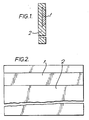
- the slab of Figures 1 and 2 has a zone 1, of high resistance to erosion by molten metal and accompanying slag, towards the upper end of the inner face of the slab and the remainder of the slab is a part 2 of lower specific heat and thermal conductivity than the zone 1.
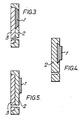
- the slab of Figure 3 has a zone 1 of high resistance to erosion by molten metal and accompanying slag, towards the upper end of the inner face of the slab and the remainder of the inner face is a part 2 of the same composition as zone 1 but having a lower density and behind part 2 is a different composition of highly heat-insulating material 3.
- a slab is shown which has a zone 1 formed of a preformed castable cementitious composition partly in a recess formed in the remainder 2 of the slab.
- a slab which has a zone 1 formed of a preformed castable cementitious composition adhered to the face 2 of a two layer slab having a backing layer 3 by means of a refractory cement.
- compositions for the high erosion resistance zone are as follows:
- compositions 1 and 2 may be formed by slurry-forming techniques to give shapes having densities of 1.7 and 1.6 g.cm' 3 respectively whilst composition 3 can be formed into a shape of density 2.1 g.CM-3 by a ramming technique.
- Suitable castable cementitious compositions for the high erosion resistance zone are as follows:
- Compositions 4, 5 and 6 were formed by the addition of sufficient water to form a pourable slurry or paste and allowed to set for 24 hours in a former or mould, to give shapes.
- compositions for the remainder of the face are as follows:
- Compositions A and B may be formed by slurry-forming techniques to give shapes having densities of 1.15 and 1.4 g.cm- 3 respectively.
- the backing layer may be formed of the following highly heat-insulating composition:
- the density of the above slurry-formed composition after drying for 4 hours at 180°C was 0.87 g.cm- 3 .
Landscapes
- Engineering & Computer Science (AREA)
- Mechanical Engineering (AREA)
- General Engineering & Computer Science (AREA)
- Casting Support Devices, Ladles, And Melt Control Thereby (AREA)
- Furnace Housings, Linings, Walls, And Ceilings (AREA)
- Aftertreatments Of Artificial And Natural Stones (AREA)
- Thermal Insulation (AREA)
- Table Devices Or Equipment (AREA)
- Ceramic Products (AREA)
- Continuous Casting (AREA)
- Compositions Of Oxide Ceramics (AREA)
- Building Environments (AREA)
- Thermally Insulated Containers For Foods (AREA)
Abstract
Description
- The invention relates to molten metal handling ladles or tundishes having an expendable side wall lining..
- In the continuous casting of metals, e.g. steel, molten metal is poured from a ladle into a continuous casting mould via an intermediate vessel which acts as a constant head reservoir and is called a tundish. The tundish has a metal floor and side-walls and one or more outlet nozzles set in the floor or a sidewall. To protect the metal floor and walls of the tundish from the effects of molten metal it is usual to line the interior of the tundish with a relatively permanent lining, often made of bricks. The tundish may additionally be provided with an inner, expendable lining of refractory, heat-insulating slabs. This is described in U.K. patent specification 1364665 and is highly advantageous.
- Although the expendable lining described above is intended to be expendable, it needs to survive satisfactorily for the duration of a cast and this may involve the passage of more than one ladleful of metal through the tundish, a practice known as sequence casting. The lining needs to withstand not only the temperature of the molten metal but also erosion by the metal and any slag associated with it.
- To extend the usefulness of expendable tundish linings much work has been done over the years to enhance the erosion resistance of the linings. EP-A1-0042767 discloses a refractory, heat-insulating article for use as a lining in metallurgical vessels comprising particulate refractory material, a water-soluble borate compound and as binder a urea-formaldehyde resin and a starch.
- According to the invention a molten metal handling ladle or tundish having an expendable side wall lining is characterised in that the expendable side wall lining comprises at least one preformed, shaped, refractory, heat-insulating article having a face at part of which is exposed a zone of matter of high resistance to erosion by molten metal and accompanying slag so positioned that part at least of the high erosion resistance zone and part at least of the face material face into the ladle or tundish.
- In molten metal handling ladles or tundishes some areas are more subject to erosion than others and, in particular, areas that come into contact with molten slag are more inclined to be eroded than areas which only come into contact with molten metal. The articles for use in molten metal handling ladles or tundishes of the invention enables molten metal handling ladles or tundishes to be provided with expendable linings having a valuable combination of erosion resistance properties and other properties e.g. thermal capacity and conductivity properties.
- During continuous casting the level of molten metal in the tundish usually changes relatively little and thus the same area of the sidewall lining is in prolonged contact with slag on the surface of the molten metal and is therefore particularly subject to erosion. Articles for use in molten metal handling ladles or tundishes of the invention in the form of slabs are particularly advantageous for lining the sidewalls of ladles or tundishes and for this purpose the high erosion resistance zone of the slab is at or near the upper end of the slab in use. The uppermost part of the slab in use is usually subject to little or no contact with molten metal and slag and thus it is generally preferred that the high erosion resistance zone of the slab should be somewhat spaced from the upper edge of the slab in use.
- Part of the article for use in molten metal handling ladles or tundishes of the invention maybe of lower specific heat and thermal conductivity than the high erosion resistance zone which can be of great value in that it enables advantageous thermal properties to be achieved in those areas of the lining where these properties are particularly important. When molten metal is initially introduced into a molten metal handling ladle or tundish, the hot metal is chilled by contact with the colder lining and, even if the thermal properties of the lining are subsequently adequate, the initial chilling of the metal can lead to problems. For example, in the case of tundishes the initial chilling can lead to difficulties at the start of casting and require special measures to be taken in preparing the tundish for use and/or require supplying the metal at a higher temperature. As the molten metal initially introduced contacts first the lining of the base of the tundish and the lower part of the sidewall lining, the thermal properties of these parts of the lining are particularly important in relation to the initial chilling effect. Accordingly, sidewall lining slabs for use in molten metal handling ladles or tundishes of the invention in which the lower part in use is of relatively low specific heat and thermal conductivity enable the initial chilling effect to be kept low and such slabs are particularly useful in tundishes.
- Alternatively, in circumstances where the initial chilling effect is not a particular problem or the lining is preheated before introduction of the molten metal into the tundish, the part of the face other than the high erosion resistance zone may be of higher specific heat and thermal conductivity than the zone.
- Other factors which influence the form which tundish lining slabs for use in the invention may have are related to the steelmaking practice in use at the steelworks where the slabs are used.
- In some instances a low viscosity slag may be used as a cover for the molten steel in a tundish for the purpose of removing deleterious alumina inclusions from the steel. Such low viscosity slags generally have a high residual level of sodium oxide present which reacts with sidewall lining slabs, containing as principal fillers, magnesite, silica and olivine or mixtures of these, causing severe erosion in a short time period at the slag/slab reaction interface. Failure of the slabs in this way is most disadvantageous since the slabs will need replacement thus interrupting the continuous casting sequence which is clearly undesirable.
- Other types of slags encountered in a tundish which are particularly troublesome from the point of view of rapid erosion of the sidewall lining slabs at the slab/slag interface are limefluorspar slags carried over into the tundish i.e. generally not deliberately added as a covering slag by a steelmaker, but present in the tundish as a result of the secondary ladle steelmaking process and high manganese oxide containing slags which are often encountered in a tundish when the steei therein is produced using a basic oxygen process.
- In each case the articles for use in molten metal handling ladles or tundishes of the invention are formed with the high erosion resistant zone exposed at the face destined to face the molten metal. The zone may have the following characteristics:-
- i) a higher density than the density of the matter at the remainder of the face of the article where both are formed from substantially the same composition especially having regard to the refractory filler content and types:
- or ii) a higher density than the remainder of the matter at the face of the article where the zone is formed of a different composition from the remainder of the face especially having regard to the refractory filler content and type:
- or iii) a lower density than the remainder of the face where the zone is formed of a different composition from the remainder of the face having regard to the refractory filler content and type.
- In articles for use in molten metal handling ladles or tundishes of the invention the high erosion resistance zone is exposed at a face of the article but it is generally preferred that this zone should not extend throughout the thickness of the article.
- An advantage of the articles for use in molten metal handling ladles or tundishes of the invention is that compared with articles composed wholly of dense material of high erosion resistance the articles can be made with lower overall-densities, thereby rendering handling of the articles easier. Moreover, material of relatively low specific heat and thermal conductivity is generally more permeable than material of high erosion resistance and this aids escape through the lining rather than into the molten metal of any deleterious gases formed as a result of the metal contacting the lining. Furthermore the inclusion of the high erosion resistance zone may enable suitable properties to be achieved with thinner, and therefore lighter and more easily handled, articles.
- The high erosion resistance zone of an article for use in molten metal handling ladles or tundishes of the invention may comprise refractory filler and binder. Examples of suitable refractory fillers are silica, olivine, alumina, alumino-silicates and chromite. Preferably the refractory filler comprises one or more of calcined magnesite, calcined bauxite, corundum and zircon. The binder may be organic and/or inorganic. Examples of suitable organic binders are phenolformaldehyde, urea-formaldehyde resins and starches. If organic binder alone is used the amount is preferably 3 to 6% by weight. Examples of suitable inorganic binders are silicates, especially sodium silicate, and phosphates. Inorganic binder if used is preferably present in an amount of 3 to 12% by weight.
- The high erosion resistance zone may be made by a slurry-forming technique i.e. an aqueous slurry of the ingredients is de-watered in a suitably shaped permeable mould and the product then heated to dry it and render the binder effective. If the zone is made by a slurry-forming technique, it preferably contains inorganic fibre, e.g. calcium silicate fibre, fibreglass and aluminosilicate fibre, preferably in an amount of 0.2 to 5% by weight. Alternatively, the high erosion resistance zone may be made by ramming a damp mixture of its ingredients into a suitable mould or former or into a recess formed in the face of the article.
- The erosion resistant zone may also be made by casting a pourable slurry or paste of the ingredients comprising a cementitious binder into a suitable mould or former and allowing the slurry or paste to set. As above, the casting of the zone can be into a recess formed in the face of the article. The ingredients for casting in the manner prescribed above may comprise a high purity source of alumina e.g.. corundum or alumino-silicate e.g. bauxite and a high-alumina cement.
- The other part or parts of the article for use in molten metal handling ladles or tundishes may also comprise refractory filler and binder and the same or different refractory fillers may be used and the same binders may be used. Lightweight refractory fillers e.g. expanded perlite may be included e.g. in amounts of 2 to 8% by weight. The part is preferably made by a slurry-forming technique and may contain 0.5 to 3% of organic fibre e.g. scrap paper. Inorganic fibre is preferably present if there is no organic fibre and may be present in any event e.g. in amounts of 2 to 8% by weight. Suitable inorganic fibres include calcium silicate fibre and fibre-glass.
- The formation of the high erosion resistance zone and the remainder of the face have been separately described above but it is in fact preferred to form the zone first and then form the rest of the face around it. In particular in the case where all the components are formed from aqueous slurries it is preferred to form the high erosion resistance zone first, (but not to heat it to dry it and render the binder effective) and then to form the material of the rest of the face around the already formed zone and heat the article to dry it and render the binder effective throughout the article. As an alternative after formation of the high erosion resistance zone, this zone may be heated to dry it and render the binder effective and the rest of the face then formed around the high erosion resistance zone in a "keying" relationship and heated to dry it and render the binder effective. Similarly, the cement bonded material may be preformed and the face formed around it in a "keying" relationship. Furthermore, the preformed high erosion resistance zone may be adhered to the face of an article for use in molten metal handling ladles or tundishes of the invention by any suitable means e.g. a refractory cement or adhesive.
- An article for use in molten metal handling ladles or tundishes of the invention may be formed which comprises a facing layer at the surface of which the zone is exposed and a backing layer of lower specific heat and thermal conductivity than that of the facing layer.
- Whilst the invention has been described chiefly in relation to tundishes, it is also applicable to ladles. The invention is particularly valuable in relation to ferrous metals e.g. steel and iron. The tundish may be used for continuously casting steel. The ladle may be used for making iron or steel castings by pouring the molten metal into a mould from the ladle.
- The invention is further described with reference to the accompanying drawings in which:
- Figure 1 is a vertical section through a slab for lining the sidewall of a tundish,
- Figure 2 is an elevation of the inward facing face of the slab of Figure 1,
- Figure 3 is a vertical section through a multi-layer slab for lining the sidewall of a tundish,
- Figure 4 is a vertical section through a slab for lining the sidewall of a tundish of which part of the high erosion resistance zone extends into the interior of a tundish in use,
- Figure 5 is a vertical section through a two layer slab for lining the sidewall of a tundish of which the high erosion zone is adhered to the face of the facing layer of the slab.
- The slab of Figures 1 and 2 has a zone 1, of high resistance to erosion by molten metal and accompanying slag, towards the upper end of the inner face of the slab and the remainder of the slab is a
part 2 of lower specific heat and thermal conductivity than the zone 1. - The slab of Figure 3 has a zone 1 of high resistance to erosion by molten metal and accompanying slag, towards the upper end of the inner face of the slab and the remainder of the inner face is a
part 2 of the same composition as zone 1 but having a lower density and behindpart 2 is a different composition of highly heat-insulatingmaterial 3. - In Figure 4 a slab is shown which has a zone 1 formed of a preformed castable cementitious composition partly in a recess formed in the
remainder 2 of the slab. - In Figure 5 a slab is shown which has a zone 1 formed of a preformed castable cementitious composition adhered to the
face 2 of a two layer slab having abacking layer 3 by means of a refractory cement. - Examples of suitable compositions for the high erosion resistance zone are as follows:

-
Compositions 1 and 2 may be formed by slurry-forming techniques to give shapes having densities of 1.7 and 1.6 g.cm'3 respectively whilstcomposition 3 can be formed into a shape of density 2.1 g.CM-3 by a ramming technique. - Examples of suitable castable cementitious compositions for the high erosion resistance zone are as follows:

- Compositions 4, 5 and 6 were formed by the addition of sufficient water to form a pourable slurry or paste and allowed to set for 24 hours in a former or mould, to give shapes. The shapes when subsequently dried at 110°C for 2 hours and heated to 600°C and cooled to ambient over an extended period had a density of 3.0 g.cm-3, 2.4 g.cm-3 and 3.4 g.cm-3 respectively.
- Examples of suitable compositions for the remainder of the face are as follows:
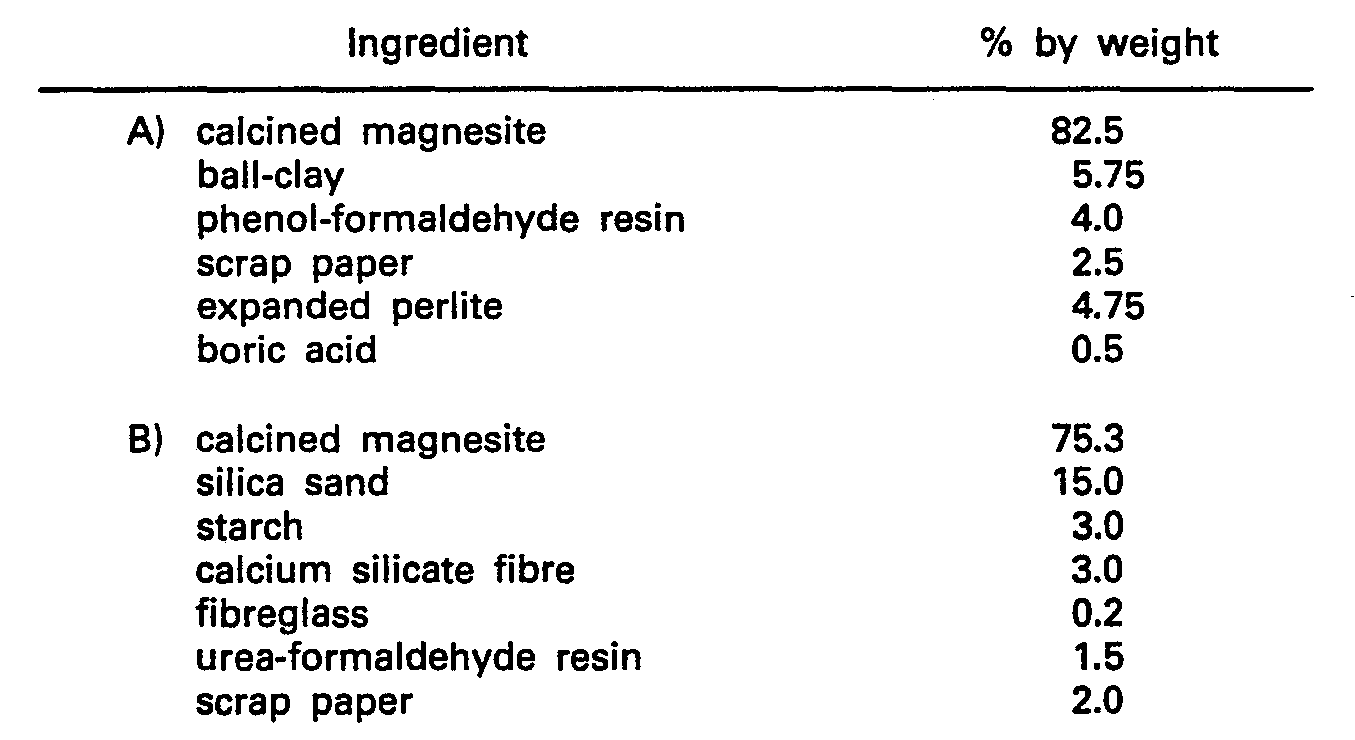
- Compositions A and B may be formed by slurry-forming techniques to give shapes having densities of 1.15 and 1.4 g.cm-3 respectively.
- In the case where the part of the article other than the zone comprises a plurality of layers, the backing layer may be formed of the following highly heat-insulating composition:

- The density of the above slurry-formed composition after drying for 4 hours at 180°C was 0.87 g.cm-3.
Claims (15)
Priority Applications (1)
| Application Number | Priority Date | Filing Date | Title |
|---|---|---|---|
| AT84300126T ATE26883T1 (en) | 1983-01-20 | 1984-01-10 | REFRACTORY OBJECT FOR THERMAL INSULATION. |
Applications Claiming Priority (2)
| Application Number | Priority Date | Filing Date | Title |
|---|---|---|---|
| GB838301543A GB8301543D0 (en) | 1983-01-20 | 1983-01-20 | Refractory heat-insulating articles |
| GB8301543 | 1983-01-20 |
Publications (2)
| Publication Number | Publication Date |
|---|---|
| EP0119676A1 EP0119676A1 (en) | 1984-09-26 |
| EP0119676B1 true EP0119676B1 (en) | 1987-04-29 |
Family
ID=10536628
Family Applications (1)
| Application Number | Title | Priority Date | Filing Date |
|---|---|---|---|
| EP84300126A Expired EP0119676B1 (en) | 1983-01-20 | 1984-01-10 | Refractory, heat-insulating articles |
Country Status (13)
| Country | Link |
|---|---|
| US (1) | US4900603A (en) |
| EP (1) | EP0119676B1 (en) |
| JP (1) | JPS59137163A (en) |
| KR (1) | KR840007372A (en) |
| AT (1) | ATE26883T1 (en) |
| BR (1) | BR8400220A (en) |
| CA (1) | CA1228478A (en) |
| DE (1) | DE3463413D1 (en) |
| ES (1) | ES285914Y (en) |
| GB (1) | GB8301543D0 (en) |
| IN (1) | IN160343B (en) |
| MX (1) | MX161908A (en) |
| ZA (1) | ZA84226B (en) |
Families Citing this family (5)
| Publication number | Priority date | Publication date | Assignee | Title |
|---|---|---|---|---|
| GB2267559A (en) * | 1992-05-23 | 1993-12-08 | Detrick M H Co | Composite heat insulating bodies and a method for producing same |
| FR2798653B1 (en) * | 1999-09-20 | 2002-04-19 | Pem Abrasifs Refractaires | CERAMIC FIBERS FOR REINFORCING REFRACTORY MATERIALS |
| DE10255068B4 (en) * | 2002-11-25 | 2006-06-01 | Refractory Intellectual Property Gmbh & Co. Kg | Without addition of water flowable refractory mass and their use |
| FI128018B (en) * | 2013-12-20 | 2019-08-15 | 9282 3087 Quebec Dba Tmc Canada | Metallurgical oven |
| FR3028203B1 (en) * | 2014-11-07 | 2017-07-14 | Plastic Omnium Cie | DEVICE FOR REGULATING THE TEMPERATURE OF A MOLD BY LASER BEAM |
Citations (1)
| Publication number | Priority date | Publication date | Assignee | Title |
|---|---|---|---|---|
| EP0042767A1 (en) * | 1980-06-25 | 1981-12-30 | Foseco Trading A.G. | Refractory, heat-insulating articles |
Family Cites Families (14)
| Publication number | Priority date | Publication date | Assignee | Title |
|---|---|---|---|---|
| US2704419A (en) * | 1950-06-29 | 1955-03-22 | Laclede Christy Company | Glass furnace |
| FR1170666A (en) * | 1956-04-05 | 1959-01-16 | Foundry Services Ltd | Improvements in the casting of metals into ingots and castings |
| GB805823A (en) * | 1956-04-05 | 1958-12-17 | Foundry Services Ltd | Improvements in or relating to the manufacture of metal ingots and castings |
| GB1264202A (en) * | 1969-03-18 | 1972-02-16 | ||
| BE754315A (en) * | 1969-08-05 | 1971-01-18 | Hajduk Stan | WATER-COOLED CONTINUOUS CASTING LINGOTIER |
| US3764125A (en) * | 1970-08-28 | 1973-10-09 | Martin & Pagenstecher Gmbh | Ladle for steel or pig iron and mass for the lining thereof |
| GB1364665A (en) * | 1971-12-07 | 1974-08-29 | Foseco Trading Ag | Tundishes |
| GB1542962A (en) * | 1976-04-07 | 1979-03-28 | Foseco Trading Ag | Tundishes |
| FR2467648A1 (en) * | 1979-10-23 | 1981-04-30 | Daussan & Co | THERMALLY INSULATING COATING FOR METALLURGICAL CONTAINER |
| EP0030308A1 (en) * | 1979-11-27 | 1981-06-17 | Concast Holding Ag | Continuous casting mould for pouring steel |
| JPS5732857A (en) * | 1980-07-12 | 1982-02-22 | Foseco Trading Ag | Tundish |
| GB2080505A (en) * | 1980-07-12 | 1982-02-03 | Foseco Trading Ag | Composite Refractory Slabs for Lining Tundishes |
| GB2112374B (en) * | 1981-12-24 | 1985-05-30 | Foseco Trading Ag | Molten metal handling vessels |
| US4623131A (en) * | 1981-12-24 | 1986-11-18 | Foseco Trading A.G. | Molten metal handling vessels |
-
1983
- 1983-01-20 GB GB838301543A patent/GB8301543D0/en active Pending
-
1984
- 1984-01-06 US US06/568,708 patent/US4900603A/en not_active Expired - Fee Related
- 1984-01-10 DE DE8484300126T patent/DE3463413D1/en not_active Expired
- 1984-01-10 AT AT84300126T patent/ATE26883T1/en active
- 1984-01-10 EP EP84300126A patent/EP0119676B1/en not_active Expired
- 1984-01-11 ZA ZA84226A patent/ZA84226B/en unknown
- 1984-01-13 CA CA000445298A patent/CA1228478A/en not_active Expired
- 1984-01-18 JP JP59006993A patent/JPS59137163A/en active Pending
- 1984-01-19 ES ES1984285914U patent/ES285914Y/en not_active Expired
- 1984-01-19 KR KR1019840000223A patent/KR840007372A/en not_active Withdrawn
- 1984-01-19 IN IN29/MAS/84A patent/IN160343B/en unknown
- 1984-01-19 MX MX200096A patent/MX161908A/en unknown
- 1984-01-19 BR BR8400220A patent/BR8400220A/en not_active IP Right Cessation
Patent Citations (1)
| Publication number | Priority date | Publication date | Assignee | Title |
|---|---|---|---|---|
| EP0042767A1 (en) * | 1980-06-25 | 1981-12-30 | Foseco Trading A.G. | Refractory, heat-insulating articles |
Also Published As
| Publication number | Publication date |
|---|---|
| GB8301543D0 (en) | 1983-02-23 |
| US4900603A (en) | 1990-02-13 |
| EP0119676A1 (en) | 1984-09-26 |
| IN160343B (en) | 1987-07-04 |
| CA1228478A (en) | 1987-10-27 |
| ES285914Y (en) | 1986-06-01 |
| BR8400220A (en) | 1984-08-28 |
| ES285914U (en) | 1985-11-01 |
| MX161908A (en) | 1991-03-01 |
| JPS59137163A (en) | 1984-08-07 |
| DE3463413D1 (en) | 1987-06-04 |
| ZA84226B (en) | 1984-08-29 |
| KR840007372A (en) | 1984-12-07 |
| ATE26883T1 (en) | 1987-05-15 |
Similar Documents
| Publication | Publication Date | Title |
|---|---|---|
| Ewais | Carbon based refractories | |
| GB1469513A (en) | Tundishes | |
| US3962492A (en) | Method of protecting refractory lining in containers for molten metal | |
| US4623131A (en) | Molten metal handling vessels | |
| JPH0615423A (en) | Flux composition for metallurgy | |
| EP0076577B1 (en) | Molten metal transfer channels | |
| US5036029A (en) | Sprayable insulating liner compositions for metal vessels | |
| US4869468A (en) | Alumina and MgO preheatable insulating refractory liners and methods of using | |
| CA1269405A (en) | Refractory compositions | |
| US4900603A (en) | Refractory, heat insulating articles | |
| WO2000001639A1 (en) | Refractory compositions | |
| EP0460823B1 (en) | Refractory composition | |
| EP0189258A2 (en) | Refractory compositions | |
| CA1153396A (en) | Refractory, heat-insulating articles | |
| US5214006A (en) | Cement-free silicon carbide monoliths | |
| GB1475613A (en) | Process of ingot casting | |
| CA1202463A (en) | Refractory, heat-insulating slabs | |
| GB2080505A (en) | Composite Refractory Slabs for Lining Tundishes | |
| CA1066479A (en) | Casting of molten metals | |
| CA1195472A (en) | Metal casting and lined ladles therefor | |
| GB2131139A (en) | Refractory heat-insulating slabs | |
| GB2112374A (en) | Molten metal handling vessels | |
| US5318277A (en) | Lined ladles, linings therefor, and method of forming the same | |
| AU673065B2 (en) | Lining of molten metal handling vessels | |
| EP0447088B1 (en) | Pouring molten metal |
Legal Events
| Date | Code | Title | Description |
|---|---|---|---|
| PUAI | Public reference made under article 153(3) epc to a published international application that has entered the european phase |
Free format text: ORIGINAL CODE: 0009012 |
|
| AK | Designated contracting states |
Designated state(s): AT BE CH DE FR GB IT LI LU NL SE |
|
| 17P | Request for examination filed |
Effective date: 19840924 |
|
| GRAA | (expected) grant |
Free format text: ORIGINAL CODE: 0009210 |
|
| AK | Designated contracting states |
Kind code of ref document: B1 Designated state(s): AT BE CH DE FR GB IT LI LU NL SE |
|
| REF | Corresponds to: |
Ref document number: 26883 Country of ref document: AT Date of ref document: 19870515 Kind code of ref document: T |
|
| ITF | It: translation for a ep patent filed | ||
| REF | Corresponds to: |
Ref document number: 3463413 Country of ref document: DE Date of ref document: 19870604 |
|
| ET | Fr: translation filed | ||
| PLBE | No opposition filed within time limit |
Free format text: ORIGINAL CODE: 0009261 |
|
| STAA | Information on the status of an ep patent application or granted ep patent |
Free format text: STATUS: NO OPPOSITION FILED WITHIN TIME LIMIT |
|
| 26N | No opposition filed | ||
| ITTA | It: last paid annual fee | ||
| REG | Reference to a national code |
Ref country code: GB Ref legal event code: 732E |
|
| PGFP | Annual fee paid to national office [announced via postgrant information from national office to epo] |
Ref country code: AT Payment date: 19931213 Year of fee payment: 11 |
|
| PGFP | Annual fee paid to national office [announced via postgrant information from national office to epo] |
Ref country code: CH Payment date: 19931217 Year of fee payment: 11 |
|
| BECN | Be: change of holder's name |
Effective date: 19931022 |
|
| REG | Reference to a national code |
Ref country code: CH Ref legal event code: PFA Free format text: FOSECO TRADING AG |
|
| EPTA | Lu: last paid annual fee | ||
| REG | Reference to a national code |
Ref country code: CH Ref legal event code: PFA Free format text: FOSECO TRADING AG |
|
| NLS | Nl: assignments of ep-patents |
Owner name: FOSECO HOLDING AG TE ZUG, ZWITSERLAND. |
|
| ITPR | It: changes in ownership of a european patent |
Owner name: CAMBIO RAGIONE SOCIALE;FOSECO TRADING A.G. |
|
| NLT1 | Nl: modifications of names registered in virtue of documents presented to the patent office pursuant to art. 16 a, paragraph 1 |
Owner name: FOSECO TRADING AG TE ZUG, ZWITSERLAND. |
|
| REG | Reference to a national code |
Ref country code: FR Ref legal event code: CD Ref country code: FR Ref legal event code: TP |
|
| PG25 | Lapsed in a contracting state [announced via postgrant information from national office to epo] |
Ref country code: AT Effective date: 19950110 |
|
| EAL | Se: european patent in force in sweden |
Ref document number: 84300126.4 |
|
| PG25 | Lapsed in a contracting state [announced via postgrant information from national office to epo] |
Ref country code: LI Effective date: 19950131 Ref country code: CH Effective date: 19950131 |
|
| REG | Reference to a national code |
Ref country code: CH Ref legal event code: PL |
|
| PGFP | Annual fee paid to national office [announced via postgrant information from national office to epo] |
Ref country code: FR Payment date: 19981211 Year of fee payment: 16 |
|
| PGFP | Annual fee paid to national office [announced via postgrant information from national office to epo] |
Ref country code: SE Payment date: 19981218 Year of fee payment: 16 |
|
| PGFP | Annual fee paid to national office [announced via postgrant information from national office to epo] |
Ref country code: GB Payment date: 19981222 Year of fee payment: 16 Ref country code: NL Payment date: 19981222 Year of fee payment: 16 |
|
| PGFP | Annual fee paid to national office [announced via postgrant information from national office to epo] |
Ref country code: DE Payment date: 19981223 Year of fee payment: 16 |
|
| PGFP | Annual fee paid to national office [announced via postgrant information from national office to epo] |
Ref country code: LU Payment date: 19990104 Year of fee payment: 16 |
|
| PGFP | Annual fee paid to national office [announced via postgrant information from national office to epo] |
Ref country code: BE Payment date: 19990106 Year of fee payment: 16 |
|
| PG25 | Lapsed in a contracting state [announced via postgrant information from national office to epo] |
Ref country code: GB Free format text: LAPSE BECAUSE OF NON-PAYMENT OF DUE FEES Effective date: 20000110 Ref country code: LU Free format text: LAPSE BECAUSE OF NON-PAYMENT OF DUE FEES Effective date: 20000110 |
|
| PG25 | Lapsed in a contracting state [announced via postgrant information from national office to epo] |
Ref country code: SE Free format text: LAPSE BECAUSE OF NON-PAYMENT OF DUE FEES Effective date: 20000111 |
|
| PG25 | Lapsed in a contracting state [announced via postgrant information from national office to epo] |
Ref country code: BE Free format text: LAPSE BECAUSE OF NON-PAYMENT OF DUE FEES Effective date: 20000131 |
|
| BERE | Be: lapsed |
Owner name: FOSECO TRADING A.G. Effective date: 20000131 |
|
| PG25 | Lapsed in a contracting state [announced via postgrant information from national office to epo] |
Ref country code: NL Free format text: LAPSE BECAUSE OF NON-PAYMENT OF DUE FEES Effective date: 20000801 |
|
| GBPC | Gb: european patent ceased through non-payment of renewal fee |
Effective date: 20000110 |
|
| EUG | Se: european patent has lapsed |
Ref document number: 84300126.4 |
|
| PG25 | Lapsed in a contracting state [announced via postgrant information from national office to epo] |
Ref country code: FR Free format text: LAPSE BECAUSE OF NON-PAYMENT OF DUE FEES Effective date: 20000929 |
|
| NLV4 | Nl: lapsed or anulled due to non-payment of the annual fee |
Effective date: 20000801 |
|
| PG25 | Lapsed in a contracting state [announced via postgrant information from national office to epo] |
Ref country code: DE Free format text: LAPSE BECAUSE OF NON-PAYMENT OF DUE FEES Effective date: 20001101 |
|
| REG | Reference to a national code |
Ref country code: FR Ref legal event code: ST |