EP0115198B1 - Electrophotographic photoconductive elements - Google Patents
Electrophotographic photoconductive elements Download PDFInfo
- Publication number
- EP0115198B1 EP0115198B1 EP83307944A EP83307944A EP0115198B1 EP 0115198 B1 EP0115198 B1 EP 0115198B1 EP 83307944 A EP83307944 A EP 83307944A EP 83307944 A EP83307944 A EP 83307944A EP 0115198 B1 EP0115198 B1 EP 0115198B1
- Authority
- EP
- European Patent Office
- Prior art keywords
- group
- zinc oxide
- bis
- photosensitive element
- electrophotographic photosensitive
- Prior art date
- Legal status (The legal status is an assumption and is not a legal conclusion. Google has not performed a legal analysis and makes no representation as to the accuracy of the status listed.)
- Expired
Links
Classifications
-
- G—PHYSICS
- G03—PHOTOGRAPHY; CINEMATOGRAPHY; ANALOGOUS TECHNIQUES USING WAVES OTHER THAN OPTICAL WAVES; ELECTROGRAPHY; HOLOGRAPHY
- G03G—ELECTROGRAPHY; ELECTROPHOTOGRAPHY; MAGNETOGRAPHY
- G03G5/00—Recording-members for original recording by exposure, e.g. to light, to heat or to electrons; Manufacture thereof; Selection of materials therefor
- G03G5/02—Charge-receiving layers
- G03G5/04—Photoconductive layers; Charge-generation layers or charge-transporting layers; Additives therefor; Binders therefor
- G03G5/05—Organic bonding materials; Methods for coating a substrate with a photoconductive layer; Inert supplements for use in photoconductive layers
- G03G5/0503—Inert supplements
- G03G5/051—Organic non-macromolecular compounds
- G03G5/0517—Organic non-macromolecular compounds comprising one or more cyclic groups consisting of carbon-atoms only
-
- G—PHYSICS
- G03—PHOTOGRAPHY; CINEMATOGRAPHY; ANALOGOUS TECHNIQUES USING WAVES OTHER THAN OPTICAL WAVES; ELECTROGRAPHY; HOLOGRAPHY
- G03G—ELECTROGRAPHY; ELECTROPHOTOGRAPHY; MAGNETOGRAPHY
- G03G5/00—Recording-members for original recording by exposure, e.g. to light, to heat or to electrons; Manufacture thereof; Selection of materials therefor
- G03G5/02—Charge-receiving layers
- G03G5/04—Photoconductive layers; Charge-generation layers or charge-transporting layers; Additives therefor; Binders therefor
- G03G5/05—Organic bonding materials; Methods for coating a substrate with a photoconductive layer; Inert supplements for use in photoconductive layers
-
- G—PHYSICS
- G03—PHOTOGRAPHY; CINEMATOGRAPHY; ANALOGOUS TECHNIQUES USING WAVES OTHER THAN OPTICAL WAVES; ELECTROGRAPHY; HOLOGRAPHY
- G03G—ELECTROGRAPHY; ELECTROPHOTOGRAPHY; MAGNETOGRAPHY
- G03G5/00—Recording-members for original recording by exposure, e.g. to light, to heat or to electrons; Manufacture thereof; Selection of materials therefor
- G03G5/02—Charge-receiving layers
- G03G5/04—Photoconductive layers; Charge-generation layers or charge-transporting layers; Additives therefor; Binders therefor
- G03G5/06—Photoconductive layers; Charge-generation layers or charge-transporting layers; Additives therefor; Binders therefor characterised by the photoconductive material being organic
- G03G5/0601—Acyclic or carbocyclic compounds
- G03G5/0612—Acyclic or carbocyclic compounds containing nitrogen
- G03G5/0614—Amines
- G03G5/06142—Amines arylamine
- G03G5/06144—Amines arylamine diamine
Definitions
- This invention relates to the electrophotographic art and more particularly, to electrophotographic photosensitive elements comprising zinc oxide as a photoconductive material.
- a number of photoconductive materials have been used in electrophotographic photosensitive elements, including amorphous selenium alloys, zinc oxide, cadmium sulfide, and organic photoconductors.
- zinc oxide has a number of advantages: because the oxide itself has no toxicity, photosensitive elements comprising the oxide show no toxicity; the oxide is inexpensive and can be applied by any known coating techniques; it is easy to apply the coating in large areas; images of good quality can be obtained; spectral response of photosensitivity can be suitably controlled; and the oxide is electrically chargeable and photosensitive in both negative and positive modes.
- photosensitive materials In recent years, there arise serious problems of chemical substances on human body and environmental pollution. This is no exception to photosensitive materials. In currently employed photosensitive materials or elements including starting materials, it is only zinc oxide that is confirmed as ecologically innoxious. In this sense, zinc oxide has been recently revaluated.
- Zinc oxide photosensitive elements have been heretofore fabricated by forming, on conductive support, a photoconductive layer which is made of zinc oxide powder sensitized with organic dye sensitizers and organic polymer binders.
- Electrophotographic properties of zinc oxide photosensitive elements are greatly influenced by the types of zinc oxide, dye sensitizer and resin binder contained in the photoconductive layer and the mixing ratio of these constituents.
- the resin binder used in the zinc oxide photosensitive element usually contains therein given amounts of electron-acceptive polar groups such as carboxyl group, hydroxyl group, epoxy group, silanol group and the like. These polar groups serve to improve the dispersability and fluidity of coating paint for the photoconductive layer by interaction with the surface of zinc oxide. Once the photosensitive element is formed, the interaction between the zinc oxide surface and the polar groups contributes to control a charge acceptance and a photosensitivity.
- the vital drawback of zinc oxide photosensitive elements is that their durability is very low.
- Selenium photosensitive elements or cadmium sulfide photosensitive elements have a durability corresponding to 20,000 to 100,000 copies but zinc oxide photosensitive elements have a durability of as small as 500 to 2,500 copies.
- the reason why the durability of zinc oxide photosensitive element is so low is considered as follows: electrical chemical and photochemical degradations. take place due to repetitions of a charging and exposing cycle; and physical and mechanical degradations occur due to repetitions of a development-transfer-cleaning cycle.
- the former degradation involve (1) degradation caused by corona discharging current, (2) degradation by oxidation of dye and binder with ozone, (3) degradation by oxidation dye and binder with singlet oxygen, (4) degradation by oxidation of dye and binder with photo-generated positive holes, and (5) degradation by oxidation of dye and binder with OH radicals.
- the latter degradations likewise involve (1) destruction of the surface of photoconductive layer by developer, transfer paper and cleaner, and (2) filming of toner.
- the photosensitive material or element degraded by these factors is found to involve a number of disadvantages such as a decreasing of surface potential, an increase of dark decay rate, a lowering of photosensitivity, an increase of residual potential, and a remarkable pre-exposure effect.
- the resulting image will have defects such as a lowering of image density, increasing of background density, a decreasing of image contrast, remaining of residual image, occurrence of white spots and a fading of photosensitive element.
- the durability of zinc oxide photosensitive material depends on degradation of dye sensitizer and mechanical destruction of the photosensitive material.
- a second problem involved in zinc oxide photosensitive elements is applicability of the elements to various cleaning mechanisms and particularly to a blade cleaning apparatus.
- the photoconductive layer contains 10 to 50% of voids therein and has irregularities of 2-10 microns in height on the surface thereof. Accordingly, the zinc oxide photosensitive element is low in mechanical strength, so that it was difficult to apply a blade cleaning system to the element.
- a third problem involved in the zinc oxide photosensitive element is its low photosensitivity.
- a photosensitive layer obtained by dispersing photoconductive pigments such as zinc oxide in resin binder shows a so-called induction effect in photo-induced discharge curves in which attenuation of the surface potential decay immediately after light irradiation is delayed, thus causing the sensitivity to be lowered (Electrophotography of Japan, Vol. 20, page 60 (1982)).
- Zinc oxide photosensitive elements may be imparted with charge acceptance and photo-response in both positive and negative charging polarities. For instance, the following techniques are known in the art.
- a photosensitive material which comprises a two-layer structure composed of a charge-generating layer containing a sensitizing dye, and a charge transfer layer of zinc oxide powder bonded by a resin having a refractive index not smaller than 1.59 (Japanese Laid-open Patent Application No. 55 ⁇ 60953).
- an electrophotographic photosensitive element which comprises a conductive support and at least a photosensitive layer formed on the conductive support, the photosensitive layer comprising zinc oxide, a polycarbonate binder, and a compound of the general formula (I) in which R 1' R 2 , R 3 and R 4 independently represent a hydrogen atom, a substituted or unsubstituted alkyl group, a cycloalkyl group, an alkenyl group, or an aryl group, R 5 and R 6 independently represent a hydrogen atom, a substituted or unsubstituted alkyl group, a cycloalkyl group, an alkenyl group, a cycloalkenyl group, or an aryl group, R 7 , R a , Rg and R 10 independently represent a hydrogen atom, a hydroxyl group, a substituted or unsubstituted alkyl group, a cycloalkyl group, an alken
- the compound of the general formula (I) is usually used in an amount of from 5 to 500 parts by weight per 100 parts by weight of the zinc oxide.
- R 1' R 2 , R 3 and R 4 independently represent an ethyl group or a benzyl group
- R s , R 8 and R 10 independently represent hydrogen
- R 6 represents a phenyl group
- R 7 and Rg independently represent a methyl group.
- the zinc oxide used in the electrophotographic photosensitive element may be treated with a sensitizing dye.
- the photosensitive elements according to the invention have the following features.
- the polycarbonate resin used in the practice of the invention is a polyester having a carbonic acid ester in the structural unit thereof and may be prepared by an ester interchange method, a phosgene method or a self-polycondensation method.
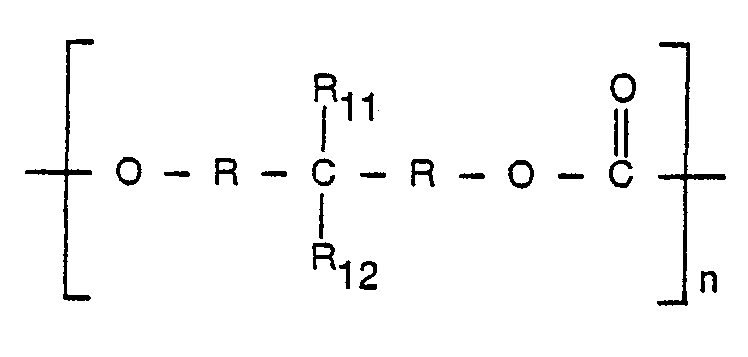
- the polycarbonate should have repeating units of the formula in which each R represents an unsubstituted phenylene group and a phenylene group substituted with a halogen or alkyl group, R 11 and R 12 independently represent a hydrogen atom, a substituted or unsubstituted alkyl group or a substituted or unsubstituted aryl group.
- R 11 and R 12 may jointly form a saturated or unsaturated hydrocarbon ring having 3 to 19 carbon atoms.
- polycarbonate suitable for the purpose of the invention are as follows.
- the electrophotographic photosensitive element of the invention can be made as follows: a mixture of a dye adsorbed, zinc oxide powder, the polycarbonate indicated before, a compound of the general formula (I) and solvents are dispersed homogeneously to obtain a coating paint for the photoconductive layer, and the coating is applied onto a conductive support and dried.
- Various conductive supports may be used including, for example, plates of metals such as aluminium, nickel, chromium and the like, paper sheets or plastic films on which metals such as aluminium, nickel, palladium and the like are deposited in vacuo or sputtered, laminates of metal foils such as aluminium and paper sheets or plastic films, carbon black-containing paper, conductive paper sheets treated with organic or inorganic conductive materials, and glass plates or plastic films provided with transparant tin oxide and/ or indium oxide films on the surface thereof.
- the conductive support may take any forms such as sheet, roll, belt, drum and the like.
- the photosensitive element of the invention comprises, on conductive support, a photoconductive layer made of a mixture of zinc oxide powder, polycarbonate and a compound of the general formula (I). It is very effective to provide an intermediate layer between the conductive support and the photoconductive layer. This intermediate layer serves to block free carriers from the conductive support from being injected into the photoconductive layer. It also serves as an adhesive layer for integrally combining the photoconductive layer with the conductive support. At the time of corona charging, the intermediate layer acts to prevent the photoconductive layer from dielectric breakdown caused by over current occurring during the corona discharge.
- the intermediate layer may be made of a number of water-soluble polymeric materials such as gelatin, casein, starch, polyvinyl alcohol, polyvinyl pyrrolidone, carboxymethyl cellulose, hydroxypropyl cellulose, water-soluble polyvinyl butyral, polyacrylic acid, polyethyleneimine, polyethylene glycol, polypropylene glycol, and the like. Of these, casein, polyvinyl pyrrolidone or water-soluble butyral resin are preferred.
- the intermediate layer had generally a thickness ranging from 0.5 to 10 microns.
- Zinc oxide powder used in the photoconductive layer may be of the type which is ordinarily employed for the manufacture of known electrophotographic photosensitive elements.
- known photosensitizers for zinc oxide may be used in combination.
- sensitizers include triphenylmethane dyes, xanthane dyes, thiazine dyes, azine dyes, and the like.
- dye compounds which have the xanthene structure or triphenylmethane structure with a free acid group or lactone ring are preferred in view of their solubility and adsorptivity to zinc oxide.
- dye sensitizers are dibromofluorescein, diiodofluorescein, tetrachlorofluorescein, tetrabromofluorescein, tetraiodofluorescein, tetrachlorotetraiodofluorescein, tetrabromotetraiodofluorescein, Bromophenol Blue, Tetrabromo Phenol Blue, Tetraiodo Phenol Blue, Bromothymol Blue, Bromocresol Purple, Bromocresol Green, and the like.
- the amount of the dye sensitizer is generally in the range of 10- 3 to 5 parts by weight, preferably from 10- 2 to 2 parts by weight, per 100 parts by weight of zinc oxide.
- the dye sensitizer may be adsorbed on zinc oxide by any known techniques.
- One of favorable adsorption techniques is a technique in which a dye is dissolved in a suitable solvent, to which is added zinc oxid. Subsequently, the mixture is dispersed, for example, in a ball mill to permit the dye to be adsorbed on the surface of the zinc oxide. From the mixture is then removed the solvent, thereby ontained a zinc oxide powder adsorbing the dye on the surface thereof (hereinafter referred to simply as dyes zinc oxide).
- the removal of the solvent from the mixture may be effected by filtration, heat drying, spray drying, or a technique disclosed in Japanese Patent Publication No. 56-39819.
- Solvents which are employed for the preparation of a coating paint for photoconductive layer should preferably be solvents for polycarbonate and compounds of the general formula (I).
- the solvents include ethers such as tetrahydrofuran, 1,4-dioxane and the like, ketones such as methyl ethyl ketone, cyclohexanone and the like, aromatic hydrocarbons such as toluene, xylene and the like, aprotic polar solvents such as N,N-dimethylformamide, acetamide, N-methylpyrrolidone, dimethylsulfoxide and the like, esters such as ethyl acetate, methylcellosolve acetate and the like, chlorinated aliphatic hydrocarbons such as methylene chloride, 1,2-dichloroethane, chloroform and the like, chlorinated aromatic hydrocarbons such as monochlorobenzene and the like, and mixtures thereof.
- the amount of polycarbonate is generally used in the range of from 5 to 400 parts by weight per 100 parts by weight of zinc oxide.
- the amount of the polycarbonate is in the range of 50 parts by weight or more per 100 parts by weight of zinc oxide from the standpoint of mechanical strength and durability in repeated use.
- the amount of the general formula (I) is in the range not less than 5 parts by weight per 100 parts by weight of zinc oxide. Amounts less than 5 parts by weight are unfavorable because the purpose of the invention cannot be achieved.
- polycarbonate and the compound of the general formula (I) are both dissolved in solvent.
- the coating paint can be prepared by any known dispersion apparatus such as ball mill, sand mill, attritor, three-roll mill, Kady mill, colloid mill and the like.
- the coating paint can be applied onto conductive support by various coating methods including, for example, blade coating, rod coating, knife coating, dip coating, spray coating and the like.
- the photoconductive layer formed on conductive support is controlled to have a thickness of from 5 to 100 microns, preferably 10 to 50 microns.
- the zinc oxide photosensitive element of the present invention has a number of advantages over known zinc oxide photosensitive elements as described below.
- the electrophotographic photosensitive elements of the invention can be applied to electrophotographic copying machine of the PPC type and especially to any PPC electrophotographic or xerographic copying machine making use of the Carlson process in which no limitation is imposed on the charging poarity.
- the elements are suitable as a photosensitive elements for the PPC microfilm reader printer in which copies are obtained from negative and positive microfilms.
- the elements are applicable as a photosensitive element for dichromatic colour duplicators or as a photosensitive element for the PPC color printer.
- aqueous 10 wt% solution of water-soluble polyvinyl butyral (S-lek W201, made by Sekisui Chem. Co., Ltd.) was applied onto a laminate film of polyethylene terephthalate and aluminium on the aluminium side thereof by a blade coating method, followed by drying at 110°C for 1 minute to obtain a 1 micron thick intermediate layer.
- 10 g of polycarbonate resin (Lexin 121-111, General Electric Inc. of U.S.A.) was dissolved in 100 ml of methylene chloride, to which was added 10 g of compound C11 indicated before, followed by complete dissolution.
- Example 1 The procedure of Example 1 was repeated except that compound C22 was used instead of compound C11 and the mixing ratio of the polycarbonate and the dyed zinc oxide was changed. As a result, electrophotographic photosensitive elements 2-1 through 2-6 were made. Electrophotographic characteristics of these elements are shown in Table 1 below.
- the photosensitive elements of this example are all excellent in the electrophotographic characteristics.
- Example 1 The procedure of Example 1 was repeated except that compound C42 was used instead of compound C11 and the mixing ratio of compound C42 and the dyed zinc oxide was changed, thereby making electrophotographic photosensitive elements 3-1 through 3 ⁇ 6.
- Example 1 The procedure of Example 1 was repeated using compounds indicated in Table 3 instead of compound C11, thereby making electrophotographic photosensitive elements Nos. 4-1 through 4-5 of this example. The characteristics of the elements are shown in Table 3 below.
- the photosensitive elements of this example were found to have excellent characteristics.
- Example 1 The procedure of Example 1 was repeated except that an aluminum drum was uses as the support, C45 was used as compound C11, and a dipping method was used for the coating, thereby making two electrophotographic photosensitive drums in this example.
- the drums were mounted in the xerographic testing apparatus having a blade cleaning mechanism and capable of arbitrarily selecting polarity for charging.
- the surface potential was set at +500 V, followed by the running test in repetition mode of charging-imagewise exposure-two-component dry development-transfer on ordinary paper-AC discharging with erase light-blade cleaning.
- the drum was replaced by a fresh one whose surface potential was set at -500 V by the negative charging process, followed by repeating the runing test in the same manner as described above. Good image characteristics were obtained to an extent of 10,000 operation cycles.
- Example 1 The procedure of Example 1 was repeated using, instead of C11, a compound of the following formula thereby making an electrophotographic photosensitive element for comparison.
- Example 1 The procedure of Example 1 was repeated except that vinyl chloride-vinyl acetate-maleic anhydride copolymer (VMCA, by Union Carbide Co., Ltd. of U.S.A.) was used instead of the polycarbonate and a mixed solvent of isobutyl acetate and dichloromethane in a mixing ratio of 1:1 was used instead of dichloromethane as the solvent.
- VMCA vinyl chloride-vinyl acetate-maleic anhydride copolymer
- VMCA vinyl chloride-vinyl acetate-maleic anhydride copolymer
Landscapes
- Physics & Mathematics (AREA)
- General Physics & Mathematics (AREA)
- Spectroscopy & Molecular Physics (AREA)
- Photoreceptors In Electrophotography (AREA)
Description
- This invention relates to the electrophotographic art and more particularly, to electrophotographic photosensitive elements comprising zinc oxide as a photoconductive material.
- As is well known, a number of photoconductive materials have been used in electrophotographic photosensitive elements, including amorphous selenium alloys, zinc oxide, cadmium sulfide, and organic photoconductors. Among them, zinc oxide has a number of advantages: because the oxide itself has no toxicity, photosensitive elements comprising the oxide show no toxicity; the oxide is inexpensive and can be applied by any known coating techniques; it is easy to apply the coating in large areas; images of good quality can be obtained; spectral response of photosensitivity can be suitably controlled; and the oxide is electrically chargeable and photosensitive in both negative and positive modes. In recent years, there arise serious problems of chemical substances on human body and environmental pollution. This is no exception to photosensitive materials. In currently employed photosensitive materials or elements including starting materials, it is only zinc oxide that is confirmed as ecologically innoxious. In this sense, zinc oxide has been recently revaluated.
- Zinc oxide photosensitive elements have been heretofore fabricated by forming, on conductive support, a photoconductive layer which is made of zinc oxide powder sensitized with organic dye sensitizers and organic polymer binders.
- Electrophotographic properties of zinc oxide photosensitive elements are greatly influenced by the types of zinc oxide, dye sensitizer and resin binder contained in the photoconductive layer and the mixing ratio of these constituents. The resin binder used in the zinc oxide photosensitive element usually contains therein given amounts of electron-acceptive polar groups such as carboxyl group, hydroxyl group, epoxy group, silanol group and the like. These polar groups serve to improve the dispersability and fluidity of coating paint for the photoconductive layer by interaction with the surface of zinc oxide. Once the photosensitive element is formed, the interaction between the zinc oxide surface and the polar groups contributes to control a charge acceptance and a photosensitivity. With regard to the mixing ratio of resin binder, when a mixing ratio of a resin binder to zinc oxide is too low, potential stability of photosensitive element in repeated use and mechanical strength of the photosensitive layer undesirably lower. On the contrary, when a mixing ratio of resin binder is too high, a practical level of photosensitivity cannot be obtained. For the reason described above, resin binders which are employed in known zinc oxide photosensitive elements should essentially contain given amounts of electron-acceptive groups as indicated above. Moreover, an amount of resin binder is limited to a range of 10 to 40 wt % based on zinc oxide.
- The vital drawback of zinc oxide photosensitive elements is that their durability is very low. Selenium photosensitive elements or cadmium sulfide photosensitive elements have a durability corresponding to 20,000 to 100,000 copies but zinc oxide photosensitive elements have a durability of as small as 500 to 2,500 copies.
- The reason why the durability of zinc oxide photosensitive element is so low is considered as follows: electrical chemical and photochemical degradations. take place due to repetitions of a charging and exposing cycle; and physical and mechanical degradations occur due to repetitions of a development-transfer-cleaning cycle. The former degradation involve (1) degradation caused by corona discharging current, (2) degradation by oxidation of dye and binder with ozone, (3) degradation by oxidation dye and binder with singlet oxygen, (4) degradation by oxidation of dye and binder with photo-generated positive holes, and (5) degradation by oxidation of dye and binder with OH radicals. The latter degradations likewise involve (1) destruction of the surface of photoconductive layer by developer, transfer paper and cleaner, and (2) filming of toner. The photosensitive material or element degraded by these factors is found to involve a number of disadvantages such as a decreasing of surface potential, an increase of dark decay rate, a lowering of photosensitivity, an increase of residual potential, and a remarkable pre-exposure effect. The resulting image will have defects such as a lowering of image density, increasing of background density, a decreasing of image contrast, remaining of residual image, occurrence of white spots and a fading of photosensitive element. Of these defects or factors, the durability of zinc oxide photosensitive material depends on degradation of dye sensitizer and mechanical destruction of the photosensitive material.
- In order to avoid the above problem, a number of techniques for improving the repeated durability of zinc oxide photosensitive elements have been recently proposed. For instance, there are proposed the following techniques:
- (1) zinc oxide particles are encapsulated with compositions comprising dye sensitizers (Japanese Laid-open Patent Application No. 54-99635);
- (2) an insulative protection layer is formed on a zinc oxide photoconductive layer (Japanese Patent Publication No. 57-19780);
- (3) a mixing ratio of resin binder is increased (Japanese Laid-open Patent Application No. 56-65141); and
- (4) poly-N-vinylcarbazole (PVK) is used as a resin binder for zinc oxide (Japanese Laid-open Patent Application No. 56-125746). However, all the known techniques have the respective drawbacks. In (1), capsulation conditions are very severe in order to obtain good photosensitivity. In (2), in order to form an electrostatic latent image on a photosensitive material, it is necessary to use techniques disclosed, for example, in United States Patent No. 3,041,167, Japanese Patent Publication Nos. 42-19748, 42-25223, 43-1552, 47-17871 and 48-2965. This involves a complicate process of copying machine. In (3), durability in repeated use is unsatisfactory. In (4), photosensitivity is unsatisfactory.
- A second problem involved in zinc oxide photosensitive elements is applicability of the elements to various cleaning mechanisms and particularly to a blade cleaning apparatus. In zinc oxide photosensitive elements, it is usual that the photoconductive layer contains 10 to 50% of voids therein and has irregularities of 2-10 microns in height on the surface thereof. Accordingly, the zinc oxide photosensitive element is low in mechanical strength, so that it was difficult to apply a blade cleaning system to the element.
- A third problem involved in the zinc oxide photosensitive element is its low photosensitivity. A photosensitive layer obtained by dispersing photoconductive pigments such as zinc oxide in resin binder shows a so-called induction effect in photo-induced discharge curves in which attenuation of the surface potential decay immediately after light irradiation is delayed, thus causing the sensitivity to be lowered (Electrophotography of Japan, Vol. 20, page 60 (1982)).
- Zinc oxide photosensitive elements may be imparted with charge acceptance and photo-response in both positive and negative charging polarities. For instance, the following techniques are known in the art.
- 1) Zinc oxide which is thermally treated in hydrogen sulfide is used (United States Patent No. 3,060,134).
- 2) Zinc oxide which is thermally treated in the presence of hydrogen sulfide and ammonia gas is used (Japanese Patent Publication No. 53-20856).
- 3) Inorganic salts of manganese or cobalt are incorporated in photoconductive layer (Japanese Patent Publication No. 52-3303).
- 4) Organic manganese compounds are incorporated in photoconductive layer (Photographic Science and Engineering, Vol. 16, page 231 (1972)).
- 5) A copolymer comprising 50 to 95% of an alkyl acrylate and 1 to 5% of an organic acid having vinyl group is used as a binder (Japanese Patent Publication No. 51-16148).
- In order to impart positive charge acceptance and photo-responce to zinc oxide photosensitive elements, there is known the following technique.
- 6) A photosensitive material is provided which comprises a two-layer structure composed of a charge-generating layer containing a sensitizing dye, and a charge transfer layer of zinc oxide powder bonded by a resin having a refractive index not smaller than 1.59 (Japanese Laid-open Patent Application No. 55―60953).
- However, these known techniques 1) through 6) have, respectively, preparatory and/or characteristic problems. For instance, in 1) and 2), the treatment of zinc oxide with toxic hydrogen sulfide needs a specific apparatus. An allowance range for the treating conditions for zinc oxide is very limited in order to obtain good photosensitivity. In 3) and 4), when amounts of additives are increased so as to impart positive chargeability, photosensitivity lowers. The photosensitive material of 5) is poor in photosensitivity. In 6), formation of the two-layer structure of the charge-generating layer and the charge transfer layer by coating involves a difficulty from the manufacturing standpoint. The characteristic problem common to the known techniques is that photosensitivity of photosensitive elements is so low that their use is limited only to a so-called Electrofax® system for copying machines of the direct system. In other words, the elements cannot be used in PPC xerographic system in which repeated use is possible.
- It is accordingly an object of the present invention to provide a zinc oxide photosensitive element which is excellent in electrical and chemical stabilities and mechanical strength and which is much improved in durability in repeated use.
- It is another object of the invention to provide a zinc oxide photosensitive element which is suitably applied to a xerographic machine having a blade cleaning mechanism.
- It is a further object of the invention to provide a zinc oxide photosensitive element which does not show any induction effect in photo-induced discharge curves.
- It is a still further object of the invention to provide a zinc oxide photosensitive element which has charge acceptance and photo-response in both positive and negative charging polarities and exhibits excellent durability when repeatedly used.
- It is an additional object of the invention to provide a zinc oxide photosensitive element which is made without use of any specific materials and any specific manufacturing steps.
- The above objects can be achieved, according to the present invention, by an electrophotographic photosensitive element which comprises a conductive support and at least a photosensitive layer formed on the conductive support, the photosensitive layer comprising zinc oxide, a polycarbonate binder, and a compound of the general formula (I)

- The compound of the general formula (I) is usually used in an amount of from 5 to 500 parts by weight per 100 parts by weight of the zinc oxide.
- In the formula (1), it is preferred that R1' R2, R3 and R4 independently represent an ethyl group or a benzyl group, Rs, R8 and R10 independently represent hydrogen, R6 represents a phenyl group, and R7 and Rg independently represent a methyl group.
- The zinc oxide used in the electrophotographic photosensitive element may be treated with a sensitizing dye.
- We have made intensive studies on resin binders for zinc oxide photosensitive elements. As a result, it was found that when a polycarbonate which has very small contents of electron-acceptive functional groups such as carboxyl group, hydroxyl group, epoxy group, silanol group and the like is used as a binder in combination with a compound of the general formula (I) and zinc oxide, the resulting zinc oxide photosensitive element showed characteristics completely different from known zinc oxide photosensitive elements.
- The photosensitive elements according to the invention have the following features.
- 1) Positive and negative chargeability of the elements varies depending on the weight ratio of the compound (I) to zinc oxide.
- 2) Photosensitivity of positively charged photosensitive elements increases with an increase in amount of the compound (I). On the other hand, photosensitivity of negatively charged elements does not change by the addition of the compound (I). Moreover, photosensitivity of positively or negatively charged elements does not change when the ratio by weight of polycarbonate and zinc oxide in the range of 5/100 to 200/100.
- 3) The induction effect by photo discharge disappears.
- These features or effects are considered to result from a combination of zinc oxide, polycarbonate and the compound (I). Photosensitive elements using hitherto employed resin binders such as acryl resins, silicone resins, epoxy resins and vinyl chloride-vinyl acetate copolymers do not show any such effects.
- The polycarbonate resin used in the practice of the invention is a polyester having a carbonic acid ester in the structural unit thereof and may be prepared by an ester interchange method, a phosgene method or a self-polycondensation method. Preferably, the polycarbonate should have repeating units of the formula

- Specific examples of the polycarbonate suitable for the purpose of the invention are as follows.
- 1) Poly(4,4'-dioxydiphenylcarbonate)
- 2) Poly(4,4'-dioxydiphenylmethanecarbonate)
- 3) Poly(4,4'-dioxydiphenyl-1,1-ethanecarbonate)
- 4) Poly(4,4'-dioxydiphenyl-1,2-ethanecarbonate)
- 5) Poly(4,4'-dioxydiphenyl-2,2-propanecarbonate)
- 6) Poly(4,4'-dioxydiphenyl-1,1-butanecarbonate)
- 7) Poly(4,4'-dioxydiphenyl-2,2-butanecarbonate)
- 8) Poly(4,4'-dioxydiphenyl-1,1-isobutanecarbonate)
- 9) Poly(4,4'-dioxydiphenyl-1,1-cyclohexanecarbonate)
- 10) Poly(4,4'-dioxy-2,2'-dimethyldiphenyl-2,2-propanecarbonate)
- Examples of the compound of the general formula (1) suitable for the purpose of the invention are indicated below.
- C1 1,1-bis(4-N,N-dimethylaminophenyl)-1-phenylmethane
- C2 1,1-bis(4-N,N-dimethylamino-2-methylphenyl)-1-phenylmethane
- C3 1,1-bis(4-N,N-dimethydamino-2-methylphenyl)-1-(2-chlorophenyl)methane
- C4 1,1-bis(4-N,N-dimethylamino-2-methylphenyl)-1-(4-methoxyphenyl)methane
- C5 1,1-bis(4-N,N-dimethylaminophenyl)-1-(4-hydroxyphenyl)methane
- C6 1,1-bis(4-N,N-dimethylaminophenyl)-1-(2,4-dimethoxyphenyl)methane
- C7 1,1-bis(4-N,N-dimethylamino-2-ethylphenyl)-1-phenylmethane
- C8 1,1-bis(4-N,N-dimethylamino-2-methoxyphenyl)-1-phenylmethane
- C9 1,1-bis(4-N,N-dimethylamino-2-ethoxyphenyl)-1-phenylmethane
- C10 1,1-bis(4-N,N-diethylaminophenyl)-i-phenylmethane
- C11 1,1-bis(4-N,N-diethylamino-2-methylphenyl)-1-phenylmethane
- C12 1,1-bis(4-N,N-diethylamino-2-methylphenyl)-1-(2-chlorophenyl)methane
- C13 1,1-bis(4-N,N-diethylamino-2-methylphenyl)-1-(4-methoxyphenyl)methane
- C14 1,1-bis(4-N,N-diethylaminophenyl)-1-(4-hydroxyphenyl)methane
- C15 1,1-bis(4-N,N-diethylaminophenyl)-1-(2,4-dimethoxyphenyl)methane
- C16 1,1-bis(4-N,N-diethylamino-2-ethylphenyl)-i-phenylmethane
- C17 1,1-bis(4-N,N-diethylamino-2-methoxyphenyl)-1-phenylmethane
- C18 1,1-bis(4-N,N-diethylamino-2-ethoxyphenyl)-1-phenylmethane
- C19 1,1-bis(4-N,N-diethylamino-2-methylphenyl)-1-(2,6-dichlorophenyl)methane
- C20 1,1-bis(4-N,N-diethylamino-2,5-dimethoxyphenyl)-i-phenylmethane
- C21 1,1-bis(4-N,N-dibenzylaminophenyl)-i-phenylmethane
- C22 1,1-bis(4-N,N-dibenzylamino-2-methylphenyl)-i-phenylmethane
- C23 1,1-bis(4-N,N-dibenzylamino-2,5-dimethylphenyl)-1-phenylmethane
- C24 1,1-bisl4-N,N-dibenzylamino-2-methoxyphenyl)-1-phenylmethane
- C25 1,1-bis(4-N,N-dimethylamino-2-methylphenyl)-1-(2,4-dimethoxyphenyl)methane
- C26 1,1,1-tris(4-N,N-dimethylaminophenyl)-1-phenylmethane
- C27 1,1,1-tris(4-N,N-dimethylamino-2-methylphenyl)methane
- C28 1,1-bis(4-N,N-diethylamino-2,5-dimethylphenyl)-1-(4-N,N-dimethylaminophenyl)methane
- C29 1,1-bis(4-N,N-diethylamino-2-methylphenyl)-1-(4-N,N-dimethylamino-2-chlorophenyl)methane
- C30 1,1-bis(4-N,N-diethylamino-2-methylphenyl)-1-(4-N,N-dimethylamino-2-methylphenyl)methane
- C31 1,1-bis(4-amino-2-methylphenyl)-1-(4-N,N-dimethylaminophenyl)methane
- C32 1,1-bis(4-amino-2,5-dimethylphenyl)-1-(4-N,N-dimethylaminophenyl)methane
- C33 1-(4-N,N-dimethylaminophenyl)-1,1,1-triphenylmethane
- C34 1-(4-N,N-diethylaminophenyl)-1,1,1-triphenylmethane
- C35 1,1-bis(4-N,N-dimethylaminophenyl)-1,1-diphenylmethane
- C36 1,1-bis(4-N,N-diethylaminophenyl)-1,1-diphenylmethane
- C37 1,1-bis(4-N,N-dibenzylamino-2-methylphenyl)-1-cyclohexylmethane
- C38 1,1-bis(4-N,N-dibenzylamino-2-methoxyphenyl)-1-cyclohexylmethane
- C39 1,1-bis(4-N,N -dibenzylaminophenyl)-1-cyclohexylmethane
- C40 1,1-bis(4-N,N-dibenzylamino-2,5-dimethylphenyl)-1-cyclohexylmethane
- C41 1,1-bis(4-N,N-dibenzylamino-2,5-dimethoxyphenyl)-1-cyclohexylmethane
- C42 1,1-bis(4-N,N-diethylamino-2-methylphenyl)-1-(4-N,N-diethylaminophenyl)methane
- C43 1,1-bis(4-N,N-diethylamino-2-methylphenyl)heptane
- C44 1,1-bis(4-N,N-diethylamino-2-methoxyphenyl)-2-methylpropane
- C45 1,1,1-tris(4-N,N-diethylamino-2-methylphenyl)methane
- C46 a,a,a',a',-tetrakis(4-N,N-diethylamin-2-methylphenyl)-p-xylene
- C47 1,1-bis(4-N,N-diethylamino-2-ethylphenyl)-2-phenylethane
- C48 1,1,5,5-tetrakis(4-N,N-dimethylamino-2-methylphenyl)pentane
- C49 1,1-bis(4-N,N-diethylamino-2-ethylphenyl)-4-methylcyclohexane
- C50 1,1-bis(4-N,N-dimethylamino-2-methylphenyl)-cyclohexane
- C51 1,1-bis(4-N-ethyl-N-methylamino-2-methylphenyl)-3-methylcyclohexane
- C52 1,1,2,2-tetrakis(4-N,N-diethylamino-2-methylphenyl)ethane
- C53 1,1-bis(4-N,N-diethylamino-2-methylphenyl)-3-phenylpropane
- C54 1,1-bis(4-N,N-dibenzylamino-2-methylphenyl)pentane
- C55 1,1-bis(4-N,N-dibenzylamino-2-methoxyphenyl)-2-methylpropane
- C56 1,1-bis(4-N,N-dibenzylamino-2-methylphenyl)cyclohexane
- C57 1,1-bis(4-N,N-benzylamino-2-methylphenyl)propane
- C58 1,1-bis(4-N,N-dibenzylamino-2-methylphenyl)normal butane
- C59 1,1-bis(4-N,N-dibenzylamino-2-methoxyphenyl)propane
- C60 1,1-bis(4-N,N-dibenzylamino-2-methoxyphenyl)normal butane
- C61 1,1-bis(4-N,N-diethylaminophenyl)heptane
- C62 1,1-bis(4-N,N-dimethylaminophenyl)-2-methylpropane
- C63 1,1-bis(4-N,N-dibenzylaminophenyl)pentane
- C64 1,1-bis(4-N,N-dibenzylaminophenyl)-2-methylpropane
- C65 1,1-bis(4-N,N-dibenzylaminophenyl)cyclohexane
- C66 1,1-bis(4,N,N-dibenzylaminophenyl)propane
- C67 1,1-bis(4,N,N-dibenzylaminophenyl)normal butane
- C68 1,1-bis(4,N,N-dibenzylamino-2,5-dimethylphenyl)heptane
- C69 1,1-bis(4,N,N-dibenzylamino-2,5-dimethylphenyl)normal butane
- C70 1,1-bis(4,N,N-dibenzylamino-2,5-dimethoxyphenyl)normal butane
- C71 1,1-bis[4,N,N-di(p-tolyl)aminophenyl]cyclohexane
- C72 2,2-bis[4-N,N-di(p-tolyl)aminophenyl]propane
- C73 1,1-bis[4-N,N-di(p-tolyl)aminophenyl]-I-phenylethane
- C74 1,1-bis[4-N,N-di(p-tolyl)aminophenyl]-1,1-diphenylethane
- C75 1,1-bis[4-N,N-di(p-tolyl)aminophenyl]methane
- C76 1,1-bis[4-N,N-di(p-tolyl)aminophenyl]-I-phenylmethane
- C77 1,1-bis[4-N,N-di(p-tolyl)aminophenyl]-4-tert-butylcyclohexane
- C78 1,1-bis[4-N,N-di(p-tolyl)aminophenyl]-2-methylpropane
- C79 1,1-bis[4-N,N-di(p-tolyl)aminophenyl]ethane
- C80 1,1-bis[4-N,N-di(p-tolyl)aminophenyl-3-methylbutane
- C81 1,1-bis[4-N,N-di(p-tolyl)amino-2-methyphenyl]ethane
- C82 1,1-bis[4-N,N-di(p-tolyl)amino-2-methylphenyl]cyclohexane
- C83 1,1-bis(4-N,N-dibenzylaminophenyl)ethane
- C84 1,1-bis(4-N,N-dibenzylaminophenyl)propane
- C85 1,1-bis(4-N,N-dibenzylaminophenyl)-n-butane
- C86 1,1-bis(4-N,N-dibenzylaminophenyl)-2-methylbutane
- C87 1,1-bis(4-N,N-dibenzy)aminopheny))-n-hexane
- C88 1,1-bis(4-N,N-dibenzylaminophenyl)-2-ethylhexane
- C89 1,1-bis(4-N,N-dibenzylaminophenyl)-n-dodecane
- C90 1,1-bis[4-N,N-di(p-chlorobenzyl)aminophenyl]-n-ethane
- C91 1,1-bis[4-N,N-di(o-chlorobenzyl)aminophenyl]-n-butane
- C92 1,1-bis[4-N,N-di(p-bromobenzyl)aminophenyl]-n-butane
- C93 1,1-bis[4-N,N-di(p-methylbenzyl)aminophenyl]propane
- C94 1,1-bis[4-N,N-di(p-nitrobenzyl)aminophenyl]-2-ethylhexane
- C95 1,1-bis(4-N,N-dibenzylamino-2-methylphenyl)methane
- C96 1,1-bis(4-N,N-dibenzylamino-2-ethylphenyl)methane
- C97 1,1-bis[4-N,N-di(p-chlorobenzyl)amino-2-ethylphenyl]methane
- C98 1,1-bis(4-N,N-dibenzylamino-2-methylphenyl)ethane
- C99 1,1-bis(4-N,N-dibenzylamino-2-ethylphenyl)ethane
- C100 1,1-bis(4-N,N-dibenzylamino-2-methylphenyl)propane
- C101 1,1-bis[4-N,N-di(o-chlorobenzyl)amino-2-ethylphenyl]propane
- C102 1,1-bis(4-N,N-dibenzylamino-2-methylphenyl)butane
- C103 1,1-bis[4-N,N-di(p-chlorobenzyl)amino-2-ethylphenyl]butane
- C104 1,1-bis(4-N,N-dibenzylamino-2-methylphenyl)-2-methylpropane
- C105 1,1-bis(4-N,N-dibenzy)amino-2-methoxypheny))butane
- C106 1,1-bis(4-N,N-dibenzylamino-2-methylphenyl)heptane
- C107 1,1-bis[4-N,N-di(p-tolylamino)-2-methoxyphenyl]heptane
- C108 1,1-bis(4-N,N-dibenzylamino-2-methylphenyl)hexane
- C109 2,2-bis(4-N,N-dibenzylamino-2-methylphenyl)butane
- C110 2,2-bis(4-N,N-dibenzylamino-2-methylphenyl)propane
- The electrophotographic photosensitive element of the invention can be made as follows: a mixture of a dye adsorbed, zinc oxide powder, the polycarbonate indicated before, a compound of the general formula (I) and solvents are dispersed homogeneously to obtain a coating paint for the photoconductive layer, and the coating is applied onto a conductive support and dried.
- Various conductive supports may be used including, for example, plates of metals such as aluminium, nickel, chromium and the like, paper sheets or plastic films on which metals such as aluminium, nickel, palladium and the like are deposited in vacuo or sputtered, laminates of metal foils such as aluminium and paper sheets or plastic films, carbon black-containing paper, conductive paper sheets treated with organic or inorganic conductive materials, and glass plates or plastic films provided with transparant tin oxide and/ or indium oxide films on the surface thereof. The conductive support may take any forms such as sheet, roll, belt, drum and the like.
- As described, the photosensitive element of the invention comprises, on conductive support, a photoconductive layer made of a mixture of zinc oxide powder, polycarbonate and a compound of the general formula (I). It is very effective to provide an intermediate layer between the conductive support and the photoconductive layer. This intermediate layer serves to block free carriers from the conductive support from being injected into the photoconductive layer. It also serves as an adhesive layer for integrally combining the photoconductive layer with the conductive support. At the time of corona charging, the intermediate layer acts to prevent the photoconductive layer from dielectric breakdown caused by over current occurring during the corona discharge. The intermediate layer may be made of a number of water-soluble polymeric materials such as gelatin, casein, starch, polyvinyl alcohol, polyvinyl pyrrolidone, carboxymethyl cellulose, hydroxypropyl cellulose, water-soluble polyvinyl butyral, polyacrylic acid, polyethyleneimine, polyethylene glycol, polypropylene glycol, and the like. Of these, casein, polyvinyl pyrrolidone or water-soluble butyral resin are preferred. The intermediate layer had generally a thickness ranging from 0.5 to 10 microns.
- Zinc oxide powder used in the photoconductive layer may be of the type which is ordinarily employed for the manufacture of known electrophotographic photosensitive elements. As a matter of course, known photosensitizers for zinc oxide may be used in combination. Examples of such sensitizers include triphenylmethane dyes, xanthane dyes, thiazine dyes, azine dyes, and the like. Of these, dye compounds which have the xanthene structure or triphenylmethane structure with a free acid group or lactone ring are preferred in view of their solubility and adsorptivity to zinc oxide. Specific and preferred examples of dye sensitizers are dibromofluorescein, diiodofluorescein, tetrachlorofluorescein, tetrabromofluorescein, tetraiodofluorescein, tetrachlorotetraiodofluorescein, tetrabromotetraiodofluorescein, Bromophenol Blue, Tetrabromo Phenol Blue, Tetraiodo Phenol Blue, Bromothymol Blue, Bromocresol Purple, Bromocresol Green, and the like.
- The amount of the dye sensitizer is generally in the range of 10-3 to 5 parts by weight, preferably from 10-2 to 2 parts by weight, per 100 parts by weight of zinc oxide. The dye sensitizer may be adsorbed on zinc oxide by any known techniques. One of favorable adsorption techniques is a technique in which a dye is dissolved in a suitable solvent, to which is added zinc oxid. Subsequently, the mixture is dispersed, for example, in a ball mill to permit the dye to be adsorbed on the surface of the zinc oxide. From the mixture is then removed the solvent, thereby ontained a zinc oxide powder adsorbing the dye on the surface thereof (hereinafter referred to simply as dyes zinc oxide). The removal of the solvent from the mixture may be effected by filtration, heat drying, spray drying, or a technique disclosed in Japanese Patent Publication No. 56-39819.
- Solvents which are employed for the preparation of a coating paint for photoconductive layer should preferably be solvents for polycarbonate and compounds of the general formula (I). Examples of the solvents include ethers such as tetrahydrofuran, 1,4-dioxane and the like, ketones such as methyl ethyl ketone, cyclohexanone and the like, aromatic hydrocarbons such as toluene, xylene and the like, aprotic polar solvents such as N,N-dimethylformamide, acetamide, N-methylpyrrolidone, dimethylsulfoxide and the like, esters such as ethyl acetate, methylcellosolve acetate and the like, chlorinated aliphatic hydrocarbons such as methylene chloride, 1,2-dichloroethane, chloroform and the like, chlorinated aromatic hydrocarbons such as monochlorobenzene and the like, and mixtures thereof.
- The amount of polycarbonate is generally used in the range of from 5 to 400 parts by weight per 100 parts by weight of zinc oxide. Preferably, the amount of the polycarbonate is in the range of 50 parts by weight or more per 100 parts by weight of zinc oxide from the standpoint of mechanical strength and durability in repeated use. The amount of the general formula (I) is in the range not less than 5 parts by weight per 100 parts by weight of zinc oxide. Amounts less than 5 parts by weight are unfavorable because the purpose of the invention cannot be achieved.
- It is preferred that when a coating paint for photoconductive layer is prepared, polycarbonate and the compound of the general formula (I) are both dissolved in solvent.
- The coating paint can be prepared by any known dispersion apparatus such as ball mill, sand mill, attritor, three-roll mill, Kady mill, colloid mill and the like. The coating paint can be applied onto conductive support by various coating methods including, for example, blade coating, rod coating, knife coating, dip coating, spray coating and the like.
- The photoconductive layer formed on conductive support is controlled to have a thickness of from 5 to 100 microns, preferably 10 to 50 microns.
- The zinc oxide photosensitive element of the present invention has a number of advantages over known zinc oxide photosensitive elements as described below.
- 1) Polycarbonate which has excellent electrical insulative property, chemical stability, film-forming property and mechanical strength is used in the element of the invention. High photosensitivity is ensured even through a mixing ratio of polycarbonate to zinc oxide is made much greater than in prior art cases. Accordingly, the photosensitive element of the invention exhibits excellent chemical stability and mechanical strength and has much improved durability in repeated use.
- 2) The photosensitive element of the invention are so excellent in film strength and mechanical strength that it can suitably be adapted to a xerographic apparatus having a blade cleaning mecahanism.
- 3) The induction effect in photo-induced disappears by addition of compound (I), so that zinc oxide photosensitive elements of very high sensitivity can be obtained.
- 4) Addition of compound (I) results in zinc oxide photosensitive elements which have charge acceptance and photosensitivity in both negative and positive modes and which are excellent in repeated durability.
- 5) Zinc oxide photosensitive elements of the invention can be fabricated without resorting to any specific materials other than compound (I) and/or any specific production process.
- Accordingly, the electrophotographic photosensitive elements of the invention can be applied to electrophotographic copying machine of the PPC type and especially to any PPC electrophotographic or xerographic copying machine making use of the Carlson process in which no limitation is imposed on the charging poarity. Alternatively, the elements are suitable as a photosensitive elements for the PPC microfilm reader printer in which copies are obtained from negative and positive microfilms. Still alternatively, the elements are applicable as a photosensitive element for dichromatic colour duplicators or as a photosensitive element for the PPC color printer.
- The present invention is described more particularly by way of examples, which should not be construed as limiting the present invention thereto.
- 1.0 part of tetraiodofluorescein was added to and dissolved in 100 parts by weight of tetrahydrofuran. To the solution was added 100 parts by weight of zinc oxide powder (Sazex 4000, made by Sakai Chem, Ind. Co., Ltd.). Then, the mixture was dispersed for 3 hours by a porcelain ball mill. The resulting coating paint was transferred to a beaker and agitated at 70°C to completely evaporate the tetrahydrofuran. The resulting zinc oxide powder which had been dyed with tetraiodofluorescein was used as dyed or sensitized zinc oxide in the following examples and comparative examples.
- An aqueous 10 wt% solution of water-soluble polyvinyl butyral (S-lek W201, made by Sekisui Chem. Co., Ltd.) was applied onto a laminate film of polyethylene terephthalate and aluminium on the aluminium side thereof by a blade coating method, followed by drying at 110°C for 1 minute to obtain a 1 micron thick intermediate layer. 10 g of polycarbonate resin (Lexin 121-111, General Electric Inc. of U.S.A.) was dissolved in 100 ml of methylene chloride, to which was added 10 g of compound C11 indicated before, followed by complete dissolution. To the solution was added 10 g of the dyed zinc oxide and the mixture was subjected to dispersion in a porcelain ball mill. The so formed composition was coated on the above intermediate layer by a blade coating method and dried at 90°Cfor 1 minute. The resulting photoconductive layer had a thickness of 22 microns. The so obtained photosensitive element was allowed to stand in the dark place for 24 hours, and the charge acceptance was measured by using an electrostatic copying paper tester [Model SP-428, made by Kawaguchi Electric K.K.]. The sample was set in the tester and charged under conditions of a corona discharge voltage of ±6 KV with a scanning speed of 250 mm/sec. Immediately after the charging, potential Vo [V] was measured. Thereafter, the sample was allowed to stand in the dark for 5 seconds (potential Vs[V]) and was then irradiated with tungsten lamp with a color temperature of 2854°K an a illumination intensity of 2 luxes. An exposure necessary for discharging the surface potential to Vg/2[V], i.e. a half exposure E½[lux-second], was recorded as a photosensitivity. Moreover, a potential after exposure of 60 lux. second was measured as a residual potential VR[V]. During exposure, the photo induced discharge rate

- As a consequence, it was found that the electrophotographic photosensitive element of this example had the following good results: V. = +585 V, E1/2 = 4.0 lux-sec, VR = +10 V, and tmax = 0.0 second in positive charge; and Vo = -570 V, El/2 = 3.9 lux-sec, VR = 0 V, and tmax = 0.0 second in negative charge.
- The procedure of Example 1 was repeated except that compound C22 was used instead of compound C11 and the mixing ratio of the polycarbonate and the dyed zinc oxide was changed. As a result, electrophotographic photosensitive elements 2-1 through 2-6 were made. Electrophotographic characteristics of these elements are shown in Table 1 below.

- From the results of the above table, the photosensitive elements of this example are all excellent in the electrophotographic characteristics.
- The procedure of Example 1 was repeated except that compound C42 was used instead of compound C11 and the mixing ratio of compound C42 and the dyed zinc oxide was changed, thereby making electrophotographic photosensitive elements 3-1 through 3―6.
- The electrophotographic characteristics of the elements are shown in Table 2.

- From the above results, it will be seen that when compound C42 is added, positive and negative charging potentials increase in proportion to the amount of the compound. Moreover, the addition contributes to improve the sensitivity both in positive and negative charging modes and to lower the residual potential under positive charging conditions. Thus, it will be appreciated that the elements (3-2 through 3-6) of the present invention have excellent characteristics.
- The procedure of Example 1 was repeated using compounds indicated in Table 3 instead of compound C11, thereby making electrophotographic photosensitive elements Nos. 4-1 through 4-5 of this example. The characteristics of the elements are shown in Table 3 below.

- The photosensitive elements of this example were found to have excellent characteristics.
- The procedure of Example 1 was repeated except that an aluminum drum was uses as the support, C45 was used as compound C11, and a dipping method was used for the coating, thereby making two electrophotographic photosensitive drums in this example. The drums were mounted in the xerographic testing apparatus having a blade cleaning mechanism and capable of arbitrarily selecting polarity for charging. By the positive charging process, the surface potential was set at +500 V, followed by the running test in repetition mode of charging-imagewise exposure-two-component dry development-transfer on ordinary paper-AC discharging with erase light-blade cleaning. As a result, it was found that good image characteristics were obtained until the above operation reached 10,000 cycles. The drum was replaced by a fresh one whose surface potential was set at -500 V by the negative charging process, followed by repeating the runing test in the same manner as described above. Good image characteristics were obtained to an extent of 10,000 operation cycles.
- The procedure of Example 1 was repeated using, instead of C11, a compound of the following formula

- The procedure of Example 1 was repeated except that vinyl chloride-vinyl acetate-maleic anhydride copolymer (VMCA, by Union Carbide Co., Ltd. of U.S.A.) was used instead of the polycarbonate and a mixed solvent of isobutyl acetate and dichloromethane in a mixing ratio of 1:1 was used instead of dichloromethane as the solvent. The resulting electrophotographic photosensitive element was evaluated with respect to electrophotographic characteristics. As a result, it was found that Vo = +600 V, E½ = 20 lux-sec, VR = +100 V, and tmax = 2.1 seconds in positive charge and VO = -610 V, E½ = 15 lux-sec, VR = O V, and tmax = 2.1 seconds in negative charge. Thus, photosensitivity was poor.
- Three samples CE-1 through CE-3 were made in the same manner as in Example 1 except that undyed zinc oxide was used instead of the dyed zinc oxide, 0.1 g of tetraiodofluorescein was used instead of the dyed zinc oxide, and compound C11 was not used, respectively. The electrophotographic characteristics of the samples for comparison are shown in Table 4 below.

Claims (10)

Applications Claiming Priority (2)
| Application Number | Priority Date | Filing Date | Title |
|---|---|---|---|
| JP57224894A JPS59116662A (en) | 1982-12-23 | 1982-12-23 | Electrophotographic sensitive body |
| JP224894/82 | 1982-12-23 |
Publications (2)
| Publication Number | Publication Date |
|---|---|
| EP0115198A1 EP0115198A1 (en) | 1984-08-08 |
| EP0115198B1 true EP0115198B1 (en) | 1987-03-11 |
Family
ID=16820820
Family Applications (1)
| Application Number | Title | Priority Date | Filing Date |
|---|---|---|---|
| EP83307944A Expired EP0115198B1 (en) | 1982-12-23 | 1983-12-23 | Electrophotographic photoconductive elements |
Country Status (5)
| Country | Link |
|---|---|
| US (1) | US4539282A (en) |
| EP (1) | EP0115198B1 (en) |
| JP (1) | JPS59116662A (en) |
| CA (1) | CA1211976A (en) |
| DE (1) | DE3370201D1 (en) |
Families Citing this family (13)
| Publication number | Priority date | Publication date | Assignee | Title |
|---|---|---|---|---|
| US4673627A (en) * | 1984-12-27 | 1987-06-16 | Fuji Photo Film Co., Ltd. | Electrophotographic lithographic printing plate |
| US4820620A (en) * | 1986-07-17 | 1989-04-11 | Minnesota Mining And Manufacturing Company | Supersensitization of and reduction of dark decay rate in photoconductive films |
| US4788336A (en) * | 1987-01-23 | 1988-11-29 | Eastman Kodak Company | Novel organic compounds for use in electrophotographic elements |
| US4822705A (en) * | 1987-02-24 | 1989-04-18 | Ricoh Company, Ltd. | Electrophotographic photoconductor with layer preventing charge injection |
| US4801517A (en) * | 1987-06-10 | 1989-01-31 | Xerox Corporation | Polyarylamine compounds and systems utilizing polyarylamine compounds |
| US4871634A (en) * | 1987-06-10 | 1989-10-03 | Xerox Corporation | Electrophotographic elements using hydroxy functionalized arylamine compounds |
| US4818650A (en) * | 1987-06-10 | 1989-04-04 | Xerox Corporation | Arylamine containing polyhydroxy ether resins and system utilizing arylamine containing polyhydroxyl ether resins |
| US5126223A (en) * | 1988-03-08 | 1992-06-30 | Canon Kabushiki Kaisha | Ozone resistant electrophotographic photosensitive member |
| USH1607H (en) * | 1991-08-22 | 1996-11-05 | Eastman Kodak Company | Multiactive electrophotographic element |
| US5190840A (en) * | 1991-08-22 | 1993-03-02 | Eastman Kodak Company | Multiactive electrophotographic element comprising a polyester of a tetramethyl bisphenol A derivative |
| DE4317059A1 (en) * | 1993-05-21 | 1994-11-24 | Basf Ag | Electrostatic toners containing polyamines as charge stabilisers |
| US5792582A (en) * | 1997-03-03 | 1998-08-11 | Xerox Corporation | Electrophotographic imaging member resistant to charge depletion |
| US6906125B2 (en) * | 2002-09-30 | 2005-06-14 | Xerox Corporation | Composition comprising trisamino-triphenyl compound |
Family Cites Families (21)
| Publication number | Priority date | Publication date | Assignee | Title |
|---|---|---|---|---|
| US3052540A (en) * | 1954-06-02 | 1962-09-04 | Rca Corp | Dye sensitization of electrophotographic materials |
| US3060134A (en) * | 1959-03-03 | 1962-10-23 | New Jersey Zinc Co | Photoconductive zinc oxide pigment |
| US3041167A (en) * | 1959-08-19 | 1962-06-26 | Xerox Corp | Xerographic process |
| US3589897A (en) * | 1968-03-18 | 1971-06-29 | Eastman Kodak Co | Novel electrophotographic sensitizers |
| IL35903A0 (en) * | 1970-01-14 | 1971-02-25 | Gaf Corp | Protoconductive layers for electrophotography |
| JPS5628259B2 (en) * | 1973-02-13 | 1981-06-30 | ||
| CA1069372A (en) * | 1974-12-20 | 1980-01-08 | William Mey | Aggregate photoconductive layer contacting inorganic photoconductive-containing layer in multi-active photoconductive element |
| US4218247A (en) * | 1975-02-28 | 1980-08-19 | Teijin Limited | Photoconductive resin containing tertiary amino groups for electrophotography |
| JPS51117635A (en) * | 1975-04-09 | 1976-10-15 | Ricoh Co Ltd | Electrostatic recording method |
| GB1594352A (en) * | 1976-06-09 | 1981-07-30 | Fujitsu Ltd | Photoconductive recording element |
| US4092162A (en) * | 1976-12-22 | 1978-05-30 | Eastman Kodak Company | Nitrogen containing polymers aelements |
| US4304829A (en) * | 1977-09-22 | 1981-12-08 | Xerox Corporation | Imaging system with amino substituted phenyl methane charge transport layer |
| DE2902705C2 (en) * | 1978-01-24 | 1982-12-30 | Kinoshita Laboratory, Shizuoka | Process for the preparation of a sensitized zinc oxide and use of the sensitized zinc oxide for the preparation of photosensitive layers of electrostatographic recording materials |
| JPS5560953A (en) * | 1978-10-31 | 1980-05-08 | Ricoh Co Ltd | Photoreceptor for electrophotography |
| US4346158A (en) * | 1978-12-04 | 1982-08-24 | Xerox Corporation | Imaging system with a diamine charge transport material in a polycarbonate resin |
| JPS5614240A (en) * | 1979-07-16 | 1981-02-12 | Konishiroku Photo Ind Co Ltd | Electrophotographic receptor |
| US4297425A (en) * | 1979-09-24 | 1981-10-27 | Xerox Corporation | Imaging member |
| JPS5665141A (en) * | 1979-11-01 | 1981-06-02 | Tomoegawa Paper Co Ltd | Transfer type electrophotographic sensitive medium |
| JPS56121044A (en) * | 1980-02-28 | 1981-09-22 | Ricoh Co Ltd | Electrophotographic composite receptor |
| JPS56125746A (en) * | 1980-03-08 | 1981-10-02 | Mita Ind Co Ltd | Electrophotographic receptive layer |
| US4337305A (en) * | 1981-02-23 | 1982-06-29 | Minnesota Mining And Manufacturing Company | Sensitized organic electron donor compounds |
-
1982
- 1982-12-23 JP JP57224894A patent/JPS59116662A/en active Granted
-
1983
- 1983-12-20 US US06/563,437 patent/US4539282A/en not_active Expired - Lifetime
- 1983-12-23 EP EP83307944A patent/EP0115198B1/en not_active Expired
- 1983-12-23 CA CA000444184A patent/CA1211976A/en not_active Expired
- 1983-12-23 DE DE8383307944T patent/DE3370201D1/en not_active Expired
Also Published As
| Publication number | Publication date |
|---|---|
| JPS59116662A (en) | 1984-07-05 |
| JPS6357780B2 (en) | 1988-11-14 |
| EP0115198A1 (en) | 1984-08-08 |
| US4539282A (en) | 1985-09-03 |
| DE3370201D1 (en) | 1987-04-16 |
| CA1211976A (en) | 1986-09-30 |
Similar Documents
| Publication | Publication Date | Title |
|---|---|---|
| US4539282A (en) | Electrophotographic photoconductive elements | |
| JPS61156131A (en) | Photoconductive image forming material | |
| JPS6255659B2 (en) | ||
| US3655378A (en) | Charge-transfer complexes of dibenzofuran-formaldehyde or dibenzothiophene-formaldehyde resins as photoconductive materials | |
| US4218528A (en) | Electrophotographic photoreceptor with phthalocyanine in phenol resin binder | |
| GB1602515A (en) | Photosensitive medium for electrophotography | |
| CA2023623C (en) | Electrophotographic photoreceptor | |
| CA1112934A (en) | Electrophotographic papers employing organic photoconductors sensitized with cellulose nitrate | |
| US5066796A (en) | Electrophotographic imaging members with bichromophoric bisazo phthalocyanine photoconductive materials | |
| US5952139A (en) | Electrophotographic photoconductor | |
| CA1109713A (en) | Sensitization of organic photoconductive compositions with polymeric chemical sensitizers having appended monovalent chlorendate radicals | |
| JPS646454B2 (en) | ||
| US4082550A (en) | Hexachlorocyclopentene chemical sensitizers for heterogeneous organic photoconductive compositions | |
| JPH03122649A (en) | Laminated photosensitive body | |
| GB1603278A (en) | Photoconductive insulating layers | |
| EP0146123A2 (en) | Novel squarylium compound and photoreceptor containing same | |
| DE10141925A1 (en) | Improving the ozone resistance and electrical characteristics stability of electrophotographic photoconductors by including a mono-carboxylate ester of an optionally substituted hydroquinone in a photo-sensitive layer | |
| KR940002842B1 (en) | Electrophotographic photosensitive member | |
| JPS5886549A (en) | Electrophotographic sensitive layer | |
| JPH0823702B2 (en) | Electrophotography method | |
| JPS62200360A (en) | Electrophotographic sensitive body having double electrostatic chargeability | |
| JPH07109518B2 (en) | Electrophotographic photoconductor | |
| JPH0217107B2 (en) | ||
| JP2007108474A (en) | Electrophotographic photoreceptor | |
| JPH1048857A (en) | Electrophotographic photoreceptor |
Legal Events
| Date | Code | Title | Description |
|---|---|---|---|
| PUAI | Public reference made under article 153(3) epc to a published international application that has entered the european phase |
Free format text: ORIGINAL CODE: 0009012 |
|
| AK | Designated contracting states |
Designated state(s): CH DE FR GB IT LI NL |
|
| 17P | Request for examination filed |
Effective date: 19841212 |
|
| 17Q | First examination report despatched |
Effective date: 19860421 |
|
| GRAA | (expected) grant |
Free format text: ORIGINAL CODE: 0009210 |
|
| AK | Designated contracting states |
Kind code of ref document: B1 Designated state(s): CH DE FR GB IT LI NL |
|
| ITF | It: translation for a ep patent filed | ||
| REF | Corresponds to: |
Ref document number: 3370201 Country of ref document: DE Date of ref document: 19870416 |
|
| ET | Fr: translation filed | ||
| PLBE | No opposition filed within time limit |
Free format text: ORIGINAL CODE: 0009261 |
|
| STAA | Information on the status of an ep patent application or granted ep patent |
Free format text: STATUS: NO OPPOSITION FILED WITHIN TIME LIMIT |
|
| 26N | No opposition filed | ||
| PGFP | Annual fee paid to national office [announced via postgrant information from national office to epo] |
Ref country code: GB Payment date: 19901212 Year of fee payment: 8 |
|
| PGFP | Annual fee paid to national office [announced via postgrant information from national office to epo] |
Ref country code: FR Payment date: 19901215 Year of fee payment: 8 |
|
| ITTA | It: last paid annual fee | ||
| PGFP | Annual fee paid to national office [announced via postgrant information from national office to epo] |
Ref country code: NL Payment date: 19901231 Year of fee payment: 8 |
|
| PGFP | Annual fee paid to national office [announced via postgrant information from national office to epo] |
Ref country code: CH Payment date: 19910121 Year of fee payment: 8 |
|
| PGFP | Annual fee paid to national office [announced via postgrant information from national office to epo] |
Ref country code: DE Payment date: 19910131 Year of fee payment: 8 |
|
| PG25 | Lapsed in a contracting state [announced via postgrant information from national office to epo] |
Ref country code: GB Effective date: 19911223 |
|
| PG25 | Lapsed in a contracting state [announced via postgrant information from national office to epo] |
Ref country code: LI Effective date: 19911231 Ref country code: CH Effective date: 19911231 |
|
| PG25 | Lapsed in a contracting state [announced via postgrant information from national office to epo] |
Ref country code: NL Effective date: 19920701 |
|
| NLV4 | Nl: lapsed or anulled due to non-payment of the annual fee | ||
| GBPC | Gb: european patent ceased through non-payment of renewal fee | ||
| PG25 | Lapsed in a contracting state [announced via postgrant information from national office to epo] |
Ref country code: FR Effective date: 19920831 |
|
| REG | Reference to a national code |
Ref country code: CH Ref legal event code: PL |
|
| PG25 | Lapsed in a contracting state [announced via postgrant information from national office to epo] |
Ref country code: DE Effective date: 19920901 |
|
| REG | Reference to a national code |
Ref country code: FR Ref legal event code: ST |