EP0104640B1 - Sintered apatite bodies and composites thereof - Google Patents
Sintered apatite bodies and composites thereof Download PDFInfo
- Publication number
- EP0104640B1 EP0104640B1 EP83109582A EP83109582A EP0104640B1 EP 0104640 B1 EP0104640 B1 EP 0104640B1 EP 83109582 A EP83109582 A EP 83109582A EP 83109582 A EP83109582 A EP 83109582A EP 0104640 B1 EP0104640 B1 EP 0104640B1
- Authority
- EP
- European Patent Office
- Prior art keywords
- apatite
- sintered
- composite
- fiber material
- fiber
- Prior art date
- Legal status (The legal status is an assumption and is not a legal conclusion. Google has not performed a legal analysis and makes no representation as to the accuracy of the status listed.)
- Expired
Links
- 229910052586 apatite Inorganic materials 0.000 title claims abstract description 154
- VSIIXMUUUJUKCM-UHFFFAOYSA-D pentacalcium;fluoride;triphosphate Chemical compound [F-].[Ca+2].[Ca+2].[Ca+2].[Ca+2].[Ca+2].[O-]P([O-])([O-])=O.[O-]P([O-])([O-])=O.[O-]P([O-])([O-])=O VSIIXMUUUJUKCM-UHFFFAOYSA-D 0.000 title claims abstract description 153
- 239000002131 composite material Substances 0.000 title claims abstract description 73
- 239000000463 material Substances 0.000 claims abstract description 77
- 239000002657 fibrous material Substances 0.000 claims abstract description 41
- 229910052588 hydroxylapatite Inorganic materials 0.000 claims abstract description 36
- XYJRXVWERLGGKC-UHFFFAOYSA-D pentacalcium;hydroxide;triphosphate Chemical group [OH-].[Ca+2].[Ca+2].[Ca+2].[Ca+2].[Ca+2].[O-]P([O-])([O-])=O.[O-]P([O-])([O-])=O.[O-]P([O-])([O-])=O XYJRXVWERLGGKC-UHFFFAOYSA-D 0.000 claims abstract description 36
- 239000013078 crystal Substances 0.000 claims abstract description 35
- XLYOFNOQVPJJNP-UHFFFAOYSA-N water Substances O XLYOFNOQVPJJNP-UHFFFAOYSA-N 0.000 claims abstract description 34
- 239000002557 mineral fiber Substances 0.000 claims abstract description 19
- 239000003462 bioceramic Substances 0.000 claims abstract description 15
- 230000003014 reinforcing effect Effects 0.000 claims abstract description 9
- 230000006866 deterioration Effects 0.000 claims abstract description 5
- 238000000034 method Methods 0.000 claims description 36
- 238000005245 sintering Methods 0.000 claims description 32
- 239000011159 matrix material Substances 0.000 claims description 19
- 239000011575 calcium Substances 0.000 claims description 18
- 239000000203 mixture Substances 0.000 claims description 17
- 239000012783 reinforcing fiber Substances 0.000 claims description 11
- 239000012779 reinforcing material Substances 0.000 claims description 8
- 229910052587 fluorapatite Inorganic materials 0.000 claims description 7
- 239000011148 porous material Substances 0.000 claims description 7
- 239000012298 atmosphere Substances 0.000 claims description 6
- 229910052791 calcium Inorganic materials 0.000 claims description 5
- 229910052698 phosphorus Inorganic materials 0.000 claims description 5
- OYPRJOBELJOOCE-UHFFFAOYSA-N Calcium Chemical compound [Ca] OYPRJOBELJOOCE-UHFFFAOYSA-N 0.000 claims description 4
- BVKZGUZCCUSVTD-UHFFFAOYSA-L Carbonate Chemical compound [O-]C([O-])=O BVKZGUZCCUSVTD-UHFFFAOYSA-L 0.000 claims description 4
- OAICVXFJPJFONN-UHFFFAOYSA-N Phosphorus Chemical compound [P] OAICVXFJPJFONN-UHFFFAOYSA-N 0.000 claims description 4
- 239000011574 phosphorus Substances 0.000 claims description 4
- 229940043430 calcium compound Drugs 0.000 claims description 3
- 239000002243 precursor Substances 0.000 claims description 3
- ZQBZAOZWBKABNC-UHFFFAOYSA-N [P].[Ca] Chemical compound [P].[Ca] ZQBZAOZWBKABNC-UHFFFAOYSA-N 0.000 claims description 2
- 239000000835 fiber Substances 0.000 description 27
- 229920000049 Carbon (fiber) Polymers 0.000 description 11
- 239000004917 carbon fiber Substances 0.000 description 11
- 210000001519 tissue Anatomy 0.000 description 11
- 238000005452 bending Methods 0.000 description 8
- 239000003365 glass fiber Substances 0.000 description 8
- VNWKTOKETHGBQD-UHFFFAOYSA-N methane Chemical compound C VNWKTOKETHGBQD-UHFFFAOYSA-N 0.000 description 8
- VTYYLEPIZMXCLO-UHFFFAOYSA-L Calcium carbonate Chemical compound [Ca+2].[O-]C([O-])=O VTYYLEPIZMXCLO-UHFFFAOYSA-L 0.000 description 6
- 230000000052 comparative effect Effects 0.000 description 6
- KZHJGOXRZJKJNY-UHFFFAOYSA-N dioxosilane;oxo(oxoalumanyloxy)alumane Chemical compound O=[Si]=O.O=[Si]=O.O=[Al]O[Al]=O.O=[Al]O[Al]=O.O=[Al]O[Al]=O KZHJGOXRZJKJNY-UHFFFAOYSA-N 0.000 description 6
- 238000010438 heat treatment Methods 0.000 description 6
- 239000000126 substance Substances 0.000 description 6
- 229920000914 Metallic fiber Polymers 0.000 description 5
- QORWJWZARLRLPR-UHFFFAOYSA-H tricalcium bis(phosphate) Chemical compound [Ca+2].[Ca+2].[Ca+2].[O-]P([O-])([O-])=O.[O-]P([O-])([O-])=O QORWJWZARLRLPR-UHFFFAOYSA-H 0.000 description 5
- XEEYBQQBJWHFJM-UHFFFAOYSA-N Iron Chemical compound [Fe] XEEYBQQBJWHFJM-UHFFFAOYSA-N 0.000 description 4
- 241001465754 Metazoa Species 0.000 description 4
- VYPSYNLAJGMNEJ-UHFFFAOYSA-N Silicium dioxide Chemical compound O=[Si]=O VYPSYNLAJGMNEJ-UHFFFAOYSA-N 0.000 description 4
- 125000004429 atom Chemical group 0.000 description 4
- 210000000988 bone and bone Anatomy 0.000 description 4
- 229910052863 mullite Inorganic materials 0.000 description 4
- BQCADISMDOOEFD-UHFFFAOYSA-N Silver Chemical compound [Ag] BQCADISMDOOEFD-UHFFFAOYSA-N 0.000 description 3
- 229910000019 calcium carbonate Inorganic materials 0.000 description 3
- 229910010293 ceramic material Inorganic materials 0.000 description 3
- 150000001875 compounds Chemical class 0.000 description 3
- 230000006835 compression Effects 0.000 description 3
- 238000007906 compression Methods 0.000 description 3
- 125000002887 hydroxy group Chemical group [H]O* 0.000 description 3
- 230000000704 physical effect Effects 0.000 description 3
- HBMJWWWQQXIZIP-UHFFFAOYSA-N silicon carbide Chemical compound [Si+]#[C-] HBMJWWWQQXIZIP-UHFFFAOYSA-N 0.000 description 3
- 229910010271 silicon carbide Inorganic materials 0.000 description 3
- 229910052709 silver Inorganic materials 0.000 description 3
- 239000004332 silver Substances 0.000 description 3
- 125000001424 substituent group Chemical group 0.000 description 3
- 239000003826 tablet Substances 0.000 description 3
- 238000012360 testing method Methods 0.000 description 3
- 238000005979 thermal decomposition reaction Methods 0.000 description 3
- 239000011800 void material Substances 0.000 description 3
- ZOXJGFHDIHLPTG-UHFFFAOYSA-N Boron Chemical compound [B] ZOXJGFHDIHLPTG-UHFFFAOYSA-N 0.000 description 2
- 229910052581 Si3N4 Inorganic materials 0.000 description 2
- PNEYBMLMFCGWSK-UHFFFAOYSA-N aluminium oxide Inorganic materials [O-2].[O-2].[O-2].[Al+3].[Al+3] PNEYBMLMFCGWSK-UHFFFAOYSA-N 0.000 description 2
- 210000001124 body fluid Anatomy 0.000 description 2
- 239000010839 body fluid Substances 0.000 description 2
- 229910052796 boron Inorganic materials 0.000 description 2
- AXCZMVOFGPJBDE-UHFFFAOYSA-L calcium dihydroxide Chemical compound [OH-].[OH-].[Ca+2] AXCZMVOFGPJBDE-UHFFFAOYSA-L 0.000 description 2
- 239000000920 calcium hydroxide Substances 0.000 description 2
- 229910001861 calcium hydroxide Inorganic materials 0.000 description 2
- 239000002775 capsule Substances 0.000 description 2
- -1 carbonate compound Chemical class 0.000 description 2
- 238000009826 distribution Methods 0.000 description 2
- 239000007789 gas Substances 0.000 description 2
- 239000011521 glass Substances 0.000 description 2
- 238000001513 hot isostatic pressing Methods 0.000 description 2
- 239000007943 implant Substances 0.000 description 2
- 229910052500 inorganic mineral Inorganic materials 0.000 description 2
- 238000011835 investigation Methods 0.000 description 2
- 229910052742 iron Inorganic materials 0.000 description 2
- 239000011707 mineral Substances 0.000 description 2
- 239000000843 powder Substances 0.000 description 2
- 239000011347 resin Substances 0.000 description 2
- 229920005989 resin Polymers 0.000 description 2
- 239000000377 silicon dioxide Substances 0.000 description 2
- HQVNEWCFYHHQES-UHFFFAOYSA-N silicon nitride Chemical compound N12[Si]34N5[Si]62N3[Si]51N64 HQVNEWCFYHHQES-UHFFFAOYSA-N 0.000 description 2
- 239000000057 synthetic resin Substances 0.000 description 2
- 229920003002 synthetic resin Polymers 0.000 description 2
- OKTJSMMVPCPJKN-UHFFFAOYSA-N Carbon Chemical compound [C] OKTJSMMVPCPJKN-UHFFFAOYSA-N 0.000 description 1
- 241000124008 Mammalia Species 0.000 description 1
- 239000000654 additive Substances 0.000 description 1
- 230000000996 additive effect Effects 0.000 description 1
- 239000003513 alkali Substances 0.000 description 1
- 229910052785 arsenic Inorganic materials 0.000 description 1
- 239000008280 blood Substances 0.000 description 1
- 210000004369 blood Anatomy 0.000 description 1
- 239000000316 bone substitute Substances 0.000 description 1
- 150000001674 calcium compounds Chemical class 0.000 description 1
- 229910052799 carbon Inorganic materials 0.000 description 1
- 125000005587 carbonate group Chemical group 0.000 description 1
- 239000000969 carrier Substances 0.000 description 1
- 239000000919 ceramic Substances 0.000 description 1
- 239000003086 colorant Substances 0.000 description 1
- 239000000805 composite resin Substances 0.000 description 1
- 238000007796 conventional method Methods 0.000 description 1
- 238000009770 conventional sintering Methods 0.000 description 1
- 238000000354 decomposition reaction Methods 0.000 description 1
- 230000003247 decreasing effect Effects 0.000 description 1
- 230000002542 deteriorative effect Effects 0.000 description 1
- 238000004090 dissolution Methods 0.000 description 1
- 239000012776 electronic material Substances 0.000 description 1
- 239000000945 filler Substances 0.000 description 1
- 238000007731 hot pressing Methods 0.000 description 1
- 239000011261 inert gas Substances 0.000 description 1
- 230000000622 irritating effect Effects 0.000 description 1
- 229910052745 lead Inorganic materials 0.000 description 1
- 238000003754 machining Methods 0.000 description 1
- 229910052748 manganese Inorganic materials 0.000 description 1
- 239000011812 mixed powder Substances 0.000 description 1
- 231100000344 non-irritating Toxicity 0.000 description 1
- 239000004745 nonwoven fabric Substances 0.000 description 1
- 230000001590 oxidative effect Effects 0.000 description 1
- 125000004437 phosphorous atom Chemical group 0.000 description 1
- 229910052700 potassium Inorganic materials 0.000 description 1
- 238000003825 pressing Methods 0.000 description 1
- 230000002787 reinforcement Effects 0.000 description 1
- 238000011160 research Methods 0.000 description 1
- 229920006395 saturated elastomer Polymers 0.000 description 1
- 238000000926 separation method Methods 0.000 description 1
- 229910052710 silicon Inorganic materials 0.000 description 1
- 229910052708 sodium Inorganic materials 0.000 description 1
- 208000024891 symptom Diseases 0.000 description 1
- WFKWXMTUELFFGS-UHFFFAOYSA-N tungsten Chemical compound [W] WFKWXMTUELFFGS-UHFFFAOYSA-N 0.000 description 1
- 229910052721 tungsten Inorganic materials 0.000 description 1
- 239000010937 tungsten Substances 0.000 description 1
- 229910052720 vanadium Inorganic materials 0.000 description 1
- 239000002759 woven fabric Substances 0.000 description 1
Images
Classifications
-
- C—CHEMISTRY; METALLURGY
- C04—CEMENTS; CONCRETE; ARTIFICIAL STONE; CERAMICS; REFRACTORIES
- C04B—LIME, MAGNESIA; SLAG; CEMENTS; COMPOSITIONS THEREOF, e.g. MORTARS, CONCRETE OR LIKE BUILDING MATERIALS; ARTIFICIAL STONE; CERAMICS; REFRACTORIES; TREATMENT OF NATURAL STONE
- C04B35/00—Shaped ceramic products characterised by their composition; Ceramics compositions; Processing powders of inorganic compounds preparatory to the manufacturing of ceramic products
- C04B35/01—Shaped ceramic products characterised by their composition; Ceramics compositions; Processing powders of inorganic compounds preparatory to the manufacturing of ceramic products based on oxide ceramics
- C04B35/447—Shaped ceramic products characterised by their composition; Ceramics compositions; Processing powders of inorganic compounds preparatory to the manufacturing of ceramic products based on oxide ceramics based on phosphates, e.g. hydroxyapatite
-
- C—CHEMISTRY; METALLURGY
- C04—CEMENTS; CONCRETE; ARTIFICIAL STONE; CERAMICS; REFRACTORIES
- C04B—LIME, MAGNESIA; SLAG; CEMENTS; COMPOSITIONS THEREOF, e.g. MORTARS, CONCRETE OR LIKE BUILDING MATERIALS; ARTIFICIAL STONE; CERAMICS; REFRACTORIES; TREATMENT OF NATURAL STONE
- C04B35/00—Shaped ceramic products characterised by their composition; Ceramics compositions; Processing powders of inorganic compounds preparatory to the manufacturing of ceramic products
- C04B35/71—Ceramic products containing macroscopic reinforcing agents
- C04B35/78—Ceramic products containing macroscopic reinforcing agents containing non-metallic materials
- C04B35/80—Fibres, filaments, whiskers, platelets, or the like
-
- A—HUMAN NECESSITIES
- A61—MEDICAL OR VETERINARY SCIENCE; HYGIENE
- A61F—FILTERS IMPLANTABLE INTO BLOOD VESSELS; PROSTHESES; DEVICES PROVIDING PATENCY TO, OR PREVENTING COLLAPSING OF, TUBULAR STRUCTURES OF THE BODY, e.g. STENTS; ORTHOPAEDIC, NURSING OR CONTRACEPTIVE DEVICES; FOMENTATION; TREATMENT OR PROTECTION OF EYES OR EARS; BANDAGES, DRESSINGS OR ABSORBENT PADS; FIRST-AID KITS
- A61F2/00—Filters implantable into blood vessels; Prostheses, i.e. artificial substitutes or replacements for parts of the body; Appliances for connecting them with the body; Devices providing patency to, or preventing collapsing of, tubular structures of the body, e.g. stents
- A61F2/02—Prostheses implantable into the body
- A61F2/28—Bones
-
- A—HUMAN NECESSITIES
- A61—MEDICAL OR VETERINARY SCIENCE; HYGIENE
- A61L—METHODS OR APPARATUS FOR STERILISING MATERIALS OR OBJECTS IN GENERAL; DISINFECTION, STERILISATION OR DEODORISATION OF AIR; CHEMICAL ASPECTS OF BANDAGES, DRESSINGS, ABSORBENT PADS OR SURGICAL ARTICLES; MATERIALS FOR BANDAGES, DRESSINGS, ABSORBENT PADS OR SURGICAL ARTICLES
- A61L27/00—Materials for grafts or prostheses or for coating grafts or prostheses
- A61L27/02—Inorganic materials
- A61L27/12—Phosphorus-containing materials, e.g. apatite
-
- A—HUMAN NECESSITIES
- A61—MEDICAL OR VETERINARY SCIENCE; HYGIENE
- A61L—METHODS OR APPARATUS FOR STERILISING MATERIALS OR OBJECTS IN GENERAL; DISINFECTION, STERILISATION OR DEODORISATION OF AIR; CHEMICAL ASPECTS OF BANDAGES, DRESSINGS, ABSORBENT PADS OR SURGICAL ARTICLES; MATERIALS FOR BANDAGES, DRESSINGS, ABSORBENT PADS OR SURGICAL ARTICLES
- A61L27/00—Materials for grafts or prostheses or for coating grafts or prostheses
- A61L27/40—Composite materials, i.e. containing one material dispersed in a matrix of the same or different material
- A61L27/42—Composite materials, i.e. containing one material dispersed in a matrix of the same or different material having an inorganic matrix
- A61L27/425—Composite materials, i.e. containing one material dispersed in a matrix of the same or different material having an inorganic matrix of phosphorus containing material, e.g. apatite
-
- C—CHEMISTRY; METALLURGY
- C04—CEMENTS; CONCRETE; ARTIFICIAL STONE; CERAMICS; REFRACTORIES
- C04B—LIME, MAGNESIA; SLAG; CEMENTS; COMPOSITIONS THEREOF, e.g. MORTARS, CONCRETE OR LIKE BUILDING MATERIALS; ARTIFICIAL STONE; CERAMICS; REFRACTORIES; TREATMENT OF NATURAL STONE
- C04B35/00—Shaped ceramic products characterised by their composition; Ceramics compositions; Processing powders of inorganic compounds preparatory to the manufacturing of ceramic products
- C04B35/622—Forming processes; Processing powders of inorganic compounds preparatory to the manufacturing of ceramic products
- C04B35/64—Burning or sintering processes
-
- C—CHEMISTRY; METALLURGY
- C08—ORGANIC MACROMOLECULAR COMPOUNDS; THEIR PREPARATION OR CHEMICAL WORKING-UP; COMPOSITIONS BASED THEREON
- C08K—Use of inorganic or non-macromolecular organic substances as compounding ingredients
- C08K7/00—Use of ingredients characterised by shape
- C08K7/02—Fibres or whiskers
- C08K7/04—Fibres or whiskers inorganic
-
- A—HUMAN NECESSITIES
- A61—MEDICAL OR VETERINARY SCIENCE; HYGIENE
- A61F—FILTERS IMPLANTABLE INTO BLOOD VESSELS; PROSTHESES; DEVICES PROVIDING PATENCY TO, OR PREVENTING COLLAPSING OF, TUBULAR STRUCTURES OF THE BODY, e.g. STENTS; ORTHOPAEDIC, NURSING OR CONTRACEPTIVE DEVICES; FOMENTATION; TREATMENT OR PROTECTION OF EYES OR EARS; BANDAGES, DRESSINGS OR ABSORBENT PADS; FIRST-AID KITS
- A61F2310/00—Prostheses classified in A61F2/28 or A61F2/30 - A61F2/44 being constructed from or coated with a particular material
- A61F2310/00005—The prosthesis being constructed from a particular material
- A61F2310/00179—Ceramics or ceramic-like structures
- A61F2310/00293—Ceramics or ceramic-like structures containing a phosphorus-containing compound, e.g. apatite
-
- Y—GENERAL TAGGING OF NEW TECHNOLOGICAL DEVELOPMENTS; GENERAL TAGGING OF CROSS-SECTIONAL TECHNOLOGIES SPANNING OVER SEVERAL SECTIONS OF THE IPC; TECHNICAL SUBJECTS COVERED BY FORMER USPC CROSS-REFERENCE ART COLLECTIONS [XRACs] AND DIGESTS
- Y10—TECHNICAL SUBJECTS COVERED BY FORMER USPC
- Y10S—TECHNICAL SUBJECTS COVERED BY FORMER USPC CROSS-REFERENCE ART COLLECTIONS [XRACs] AND DIGESTS
- Y10S428/00—Stock material or miscellaneous articles
- Y10S428/902—High modulus filament or fiber
Definitions
- This invention relates to a sintered apatite body comprising needle-like crystals and a sintered apatite-mineral fiber material composite. More particularly, this invention relates to a process for producing a sintered apatite body and a sintered composite consisting essentially of a matrix amount of an apatite and an effective amount of a reinforcing mineral fiber material, as well as the resulting sintered apatite-mineral fiber material composite.
- the process for sintering is characterized by baking an apatite material at a defined, relatively low temperature under pressure in the presence of water.
- Apatite materials for sintering are typically represented by hydroxyapatite, carbonate-apatite, fluoroapatite and chloroapatite. Processes have been proposed hitherto for sintering these apatites and especially hydroxyapatite by a hot press at high temperatures of about 1100°C or higher in the absence of water. These sintered hydroxyapatite products, however, had a variety of serious problems such as poor mechanical strength properties (especially, impact strength and bending strength) due to their crystalline structures, large pores or flaws, and the like. For example, refer to R. W. Rice, et al., J. Am. Ceram. Soc., 63 (3-4), (1980) 129-136, and T.
- a process for sintering hydroxyapatite is shown in Chemical Abstracts, Vol. 94, No. 179537 W. With reference to Japanese Laid-open Patent Application No. 130,854/1980 cited therein, the process teaches hot-pressing hydroxyapatite at 700 to 1200°C in a reducing gas containing moisture corresponding to saturated steam at 5°C or more. It is noted, however, that the sintering temperature is as high as 700 to 1200°C, and that in the course of sintering the water contained in the apatite material will be substantially evaporated away because the water content in the reducing gas is too low. Thus, it will be difficult to obtain an apatite sintered body or composite having the properties as obtained according to the present invention.
- the inventor also made intensive investigations into a sintered apatite- reinforcing fiber material composite to further enhance its mechanical properties.
- the present inventor used glass fibers and iron fibers which are normally excellent as reinforcing materials and readily available at low cost, but the expected increase in mechanical properties was not observed with respect to sintered apatite composites baked at about 700°C.
- the inventor presumed that the problems were due to the deterioration of the fiber materials under oxidizing atmospheres, even at about 700°C, and also due to the chemical affinity of the fiber materials with apatite at such a temperature.
- the inventor therefore tried to produce apatite-fiber composites wherein glass fiber or carbon fiber was used as reinforcing material at baking temperatures lower than 400°C and 500°C, respectively, and unexpectedly succeeded in producing apatite composites having excellent properties.
- glass fiber or iron fiber has physical and chemical affinity with apatite at a baking temperature of about 700°C and thus the reinforcing fiber is deteriorated and also firmly bonded to the sintered apatite, whereby a sliding action between the fiber and sintered apatite is lost and the resulting composite is readily broken by a force applied thereto.
- the reinforcing fiber materials to be used in the present invention have sufficient physical affinity with apatite but are completely or substantially inert from the viewpoint of chemical affinity with apatite at a baking temperature of the present invention.
- an apatite- reinforcing fiber composite having excellent mechanical properties, and especially impact and bending strength properties can be unexpectedly obtained, because some sliding actions between the fiber material and sintered apatite are present in composites according to the present invention.
- this is rather surprising in view of the fact that, in conventional resin-fiber composites consisting of fiber materials and synthetic resins, the bonding affinity between the fibers and resins (for example by using a bonding accelerator) is desired and taken seriously, but the problems as raised above seem different in the case of sintered apatite-mineral fiber composites because in the case of the resin composites the resin itself has some flexibility and the like instead of the above mentioned sliding actions.
- a process for sintering apatite by baking under pressure in a steam containing atmosphere an apatite material selected from hydroxyapatite, carbonate apatite, fluoroapatite, chloroapatite, precursor materials thereof, and mixtures thereof in the absence or presence of a reinforcing fiber; characterized by baking the apatite material in the presence of water, preferably in the presence of water in addition to crystal water thereof, under pressure at a temperature lower than 700°C to sinter the apatite material into sintered apatite having fine dense crystalline structures wherein the crystals thereof contain at least about 30% by weight of needle-like fine crystals and are entangled together.
- a matrix amount of the apatite material is baked in contact with an effective amount of a reinforcing mineral fiber material at a temperature lower than 700°C and lower than the temperature causing substantial deterioration of the fiber material.
- the invention further provides a sintered apatite composite comprising a reinforcing material and a sintered apatite matrix wherein the apatite is selected from hydroxyapatite, carbonate apatite, fluoroapatite, chloroapatite and mixtures thereof, consisting essentially of an effective amount of a reinforcing fiber material and a matrix amount of sintered apatite in contact with the fiber material, characterized in that the composite is produced according to claim 2, wherein the crystals of the sintered appatite having fine dense crystalline structures comprising at least about 30% by weight of needle-like fine crystals and are entangled together, and the fiber material is not substantially deteriorated and substantially is not chemically bonded to the sintered apatite.
- novel sintered apatite bodies having fine dense polycrystalline structures wherein the crystals comprise or consist essentially of straight and/or curved needle-like crystals and are entangled together, which exhibit excellent physical properties, as well as a novel sintered apatite-mineral fiber material composite composed of the above mentioned sintered apatite matrix and a reinforcing mineral fiber material which is not substantially deteriorated and not substantially bonded to the sintered apatite.
- the features of the present invention are exhibited if at least about 30%, generally 40% or more, and preferably about 60% or more by weight, of the sintered crystals are composed of the needle-like crystals which are entangled together, although normally the crystals consist essentially of the needle-like crystals.
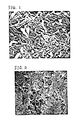
- Fig. 1 is a scanning electrophotomicrograph (magnification x30,000) of a sintered hydroxy- apatite body according to the present invention, showing the fine needle-like crystalline structures thereof, and
- Fig. 2 is a scanning electrophotomicrograph (magnification x7,500) of a sintered hydroxyapatite body according to a conventional sintering process at a high temperature, showing the hexagonal-system crystalline structures thereof.
- the apatites used in the present invention include, hydroxyapatite, carbonate-apatite, fluoroapatite, chloroapatite, mixtures thereof, and mixtures of subunit materials thereof which are converted to these apatites in the course of the baking step (hereinafter referred to as an apatite precursor).
- the apatite to be used in the present invention is more limited.
- the apatites used in the present invention are those compounds which have fundamental structures represented by the following formula (II) and of which the atomic ratio of calcium to phosphorus (hereinafter referred to as Ca/P ratio) is within the range specified below; wherein Z is selected from OH, C0 3 , F, CI and mixtures thereof, and m is a number satisfying atomic valences substantially (e.g., 2 or 1). More specifically, in the formula (II) given above, the Ca/P ratio is not necessarily a stoichiometric ratio (5/3) but can be a non-stoichiometric ratio. In general, the Ca/P ratio is approximately in the range of 4/3 to 11/6 and preferably about 9/6 to about 5/3.
- an inorganic non-phosphorus calcium compound such as calcium hydroxide can be intimately mixed with an apatite material having a Ca/P ratio of less than 5/3 to adjust its Ca/P ratio to about 5/3.
- a carbonate group-containing calcium compound such as calcium carbonate
- a sintered apatite body or apatite-fiber composite containing C0 3 groups can be obtained by baking the materials at a temperature lower than the decomposition temperature of the carbonate compound.
- the Ca and/or P atom may be substituted by a small or impure amount of other atoms as illustrated in the definition of formula (I).
- the symbol Z in formula (11) above can be one or two or more atoms or groups selected from OH, C0 3 , F and Cl.
- the apatite is herein classified into hydroxy-apatite, carbonate-apatite, fluoroapatite or chloro-apatite, respectively, in accordance with the largest amount of OH, C0 3 , F or CI contained therein. All these apatites fall within the same hexagonal crystalline system, space group C6 3 /m, and chemical formula number in unit lattice, and thus they have substantially the same sintering properties and similar physical properties. These apatites are available commercially and can be purified as necessary, or can be synthesized chemically.
- the apatite to be used in the present invention is preferably hydroxy-apatite represented by the formula (II) above wherein substantially all or a major amount (normally about 90% or more) of Z is OH group and the balance amount (normally about 10% or less) of Z if any is the other substituents.
- the balance of Z if any is preferred to be substantially C0 3 group.
- a matrix amount of apatite used with respect to the apatite-fiber material composite is meant the amount of the apatite material which can bind a reinforcing mineral fiber material (hereinafter sometimes referred to as fiber material) by the sintered apatite to form the sintered composite.
- fiber material a reinforcing mineral fiber material
- an effective amount of the fiber material means the amount thereof which can reinforce the sintered composite and can be bound by the sintered apatite matrix to form the sintered composite.
- the effective amount of the fiber material depends on the density and the like of the fiber material to be used, the ratio of the effective amount of fiber materials to the matrix amount of apatites is by weight preferably in the range of 0.5-70% to 99.5-30%, desirably 1-50% to 99-50%, preferably 2-40% to 98-60%, more preferably 5-30% to 95-70%, and typically 7 ⁇ 25% to 93-75%.
- the actual amount of the fiber material is in the range of about 1 % to about 50% by weight, and the amount of the apatite material is in the range of about 99% to about 50% by weight.
- the sintered composite of the present invention can, of course, also contain optional materials such as fillers and coloring agents which are compatible with the apatite and fiber materials and are inert under the conditions of baking, machining and uses, so far as the properties of the resulting composite are not substantially deteriorated.
- optional materials such as fillers and coloring agents which are compatible with the apatite and fiber materials and are inert under the conditions of baking, machining and uses, so far as the properties of the resulting composite are not substantially deteriorated.
- the mineral fiber materials to be used essentially as reinforcing materials encompass mineral (i.e. inorganic or metallic) fiber materials which have sufficient strength and will not be substantially deteriorated when they are baked in contact with the apatite material in the presence of moisture for at least 0.5 hour at a sintering temperature higher than about 150°C, and preferably above 170°C (but lower than 700°C).
- the fiber materials preferred for use in the present invention preferably include, for example, mullite fibers (800°C), nitrogen-modified mullite (Sialon) fibers (1000°C), silicon carbide fibers (800°C), carbon fibers (500°C), apatite glass fibers (750°C), glass fibers and alkali-resistant glass fibers (500°C), as well as silicon nitride fibers (1000°C), silica fibers (1000°C), alumina fibers (1000°C), and the like, the temperatures shown in the parentheses being the approximate maximum values at which the fiber- containing apatite composite material could be baked without deteriorating the properties of the fiber material or the sintered apatite.
- mullite fibers 800°C
- Sialon fibers 1000°C
- silicon carbide fibers 800°C
- carbon fibers 500°C
- apatite glass fibers 750°C
- glass fibers and alkali-resistant glass fibers 500°C
- chemically inert metallic fiber materials such as metallic fibers coated thereon with an inorganic element or compound or substantially inert metallic fibers can also be used as the reinforcing fiber materials.
- Coated metallic fibers are generally preferred.
- boron fibers wherein boron was vapor-deposited onto tungsten fibers can be advantageously used.
- reinforcing fiber materials are not restricted to the materials illustrated above and can be used alone or as optional mixtures thereof, as far as they exhibit satisfactory reinforcing effects and are not deteriorated in the course of baking.
- the forms and dimensions of the reinforcing fiber materials technical knowledge of conventional glass fiber-synthetic resin composites can be applied.
- they can be in the form of short fibers, long fibers, fiber yarns, fiber strands, woolly fibers, whiskers, nonwoven or woven fabrics, mixtures thereof, and the like.
- the fiber length thereof is desirably longer than the crystal length of the sintered apatite.
- the distribution of the mineral fiber material in the present sintered apatite composite can be in a state substantially orientated mono-, bi- or triaxially or in a state substantially unorientated and distributed irregularly. Also, the distribution of the fiber material can be uniformly dispersed in the sintered apatite matrix or dispersed variably, dense (or rare or zero) toward the core of the composite and rare or zero (or dense) toward the surfaces of the composite. It is preferred that the fiber material is distributed dense toward the surface and is not exposed to the surface from the viewpoint of stress-resistant structural materials.
- the sintered apatite body of the present invention can be produced by baking the above mentioned apatite material under pressure in the presence of a suitable amount of water at a temperature of about 150°C to less than 700°C and preferably about 160°C to less than 700°C.
- a suitable amount of water at a temperature of about 150°C to less than 700°C and preferably about 160°C to less than 700°C.
- the sintering temperature is lower, the needle-like I ⁇ I f crystalline structures peculair to the present sintered apatite tend to become finer and increase in mechanical strength. This tendency is markedly noted when the sintering temperature is less than 700°C, especially about 600°C or less and typically about 500°C or less, although the sintering is accelerated at a higher temperature.
- the lower sintering temperature is generally preferred in the present invention from the viewpoint of the enhanced mechanical properties of the resulting sintered body or composite.
- the amount of water to be coexisting with the apatite material in the baking step is in addition to crystal water, an amount of non-crystal water (i.e. water except crystal water) in the range of 0.01 % to about 25%, preferably about 0.05% to about 20%, more preferably about 0.1 % to about 20% and typically about 3% to about 18% by weight of the apatite material used.
- the amount of water is large, the sintering of the apatite tends to be accelerated.
- the voids of the resulting sintered apatite will generally become too large.
- the amount of water to be charged may be larger than 25%.
- the mineral fiber-sintered apatite composite of the present invention can be produced by baking a matrix amount of the apatite material and an effective amount of the reinforcing mineral fiber material in a substantially contacted state at a temperature defined above and lower than the temperature causing substantial deterioration of the fiber material and substantial bonding thereof to the apatite material.
- the sintering mechanism of the apatite in the present invention has not yet been fully clarified, it is assumed that the apatite is dissolved and separated out at the baking temperature and then the separated apatite is recrystallized, entangled together and sintered.
- the dissolution and separation of apatite tend to be promoted under a higher pressure and/or in the presence of sufficient water.
- the baking or sintering temperature can be considerably lowered under a higher pressure and in the presence of sufficient water in the baking step.
- the pressure to be employed in the sintering of the present invention is at least about 0,5 MPa, preferably about 5 MPa or more, and typically about 50 MPa or more.
- the time of baking is generally in the range of about 0.5 to about 30 hours.
- the material such as an apatite material, a mixture of an apatite material and a mineral fiber material, or a premolded article thereof may be baked at a temperature defined above by means of a hot press under a pressure of about 0,5 MPa or more by applying thereto an atmosphere of steam or a steam-containing inert gas, preferably at a temperature of about 150°C to about 500°C under a pressure of about 1 to about 100 MPa.
- This method may be rather difficult to give constant sintering conditions.
- the material as mentioned above may be baked in the presence of water at a temperature defined above by means of a pressure-proof vessel such as an autoclave under a pressure of five to several thousands atmospheres.
- a pressure-proof vessel such as an autoclave
- a relatively longer time is needed for sintering the material.
- the pressure is as high as 100 MPa or more, the sintering can be advantageously conducted even at a temperature of 150°C to about 200°C.
- the material can be baked at a temperature of about 150°C to about 500°C under a pressure of about 2 to about 200 MPa.
- the material mentioned above can be sintered more effectively by baking the material which has been sealed in a pressure-deformable chemically-inert vessel (e.g., a capsule or a tube) together with water.
- a pressure-deformable chemically-inert vessel e.g., a capsule or a tube
- the baking conditions are substantially the same as in (ii) above, and preferably at a pressure of about 4 to about 300 MPa and a temperature of about 150°C to about 500°C.
- method (ii) is preferred and method (iii) is most preferred.
- An apatite material or a mixture of an apatite material and a reinforcing fiber material can be molded into a desired shape by means of pressing or the like before the baking step; or the resulting sintered apatite body or composite can be machined into a desired shape.
- the sintered apatite body obtained according to the present invention comprises or consists essentially of fine dense polycrystalline structures wherein the crystals are needle-like fine crystals and are entangled together, and the sintered apatite can be provided with suitable microporosity as necessary.
- the sintered apatite-fiber material composite is a composite wherein the fiber material is present in the unchanged state in contact with the sintered apatite matrix having the above mentioned crystalline structures, and the sintered composite can also be provided with suitable microporosity.
- the crystals of the present sintered apatite body or matrix have fine dense polycrystalline structures wherein the crystals comprise or consist essentially of straight and/or curved needle-like fine crystals and are entangled together, whereby the mechanical strength properties of the present sintered apatite body or apatite-fiber material composite are enhanced markedly.
- the resulting sintered apatite is composed of relatively large hexagonal system crystals, and thus has markedly decreased mechanical strength properties.
- the strength properties of the sintered apatite body or composite is naturally reduced when the void volume or pore size of the sintered apatite body or matrix is too large.
- the sintering process is carried out under a relatively high pressure at a temperature as low as possible in the presence of moisture.
- the micropores obtained according to the present invention are normally in the form of open (continuous) pores.
- the properties of the sintered apatite body and the sintered apatite-fiber material composite according to the present invention can have, for example, the following approximate values.
- the sintered apatite body and apatite-fiber composite can be advantageously applied in a broad range of uses and especially in fields where strength properties are required.
- Typical applications are ceramic materials which need strength properties, electronics materials, filter materials, chromatographic carriers, sensor elements (especially for physiological use), bioceramics (e.g. artificial bone, tooth and joint for the human or animal bodies), other uses where conventional fine ceramics are utilized, and the like.
- the above mentioned applications can be classified into industrial ceramic materials and bioceramic materials.
- the bioceramics require compatibility with living organisms such as the human or animal bodies in addition to strength properties and microporosity. This compatibility will be discussed in the following.
- hard tissues bone, tooth, etc.
- human bodies consist essentially of densified hydroxyapatite and more specifically consist of densified hydroxyapatite containing a small amount (several %) of C0 3 group.
- sintered hydroxyapatite bodies for artificial bone and tooth implants.
- porous sintered hydroxy- apatite having a void of several percent or more has been appreciated to be practically satisfactory for compatibility with human tissues.
- fiber materials are satisfactory for the physiological compatibility especially when they are included as the composite in the sintered hydoxyapatite matrix. It is generally preferred that the surface of the present composite for bioceramic uses is substantially covered with the apatite matrix, that is, the fiber material is not substantially exposed.
- the preferred strength properties and open micropores having a void of 3% to about 60% and normally 5% to 50% by volume which have been required for such bioceramics are sufficiently provided by the sintered hydroxyapatite body and composite according to the present invention.
- artificial hard tissue materials having suitable open pores, satisfactory strength properties and compatibility with human and animal bodies can be obtained according to the present invention, wherein the above described conventional problems have been eliminated.
- the present sintered hydroxyapatite body and composite thereof improved in mechanical properties, suitable open pores, etc. can be used satisfactorily as such bioceramics.
- the mode how the sintered hydroxyapatite body is successfully united with human (or animal) tissues has not yet been fully elucidated. It is believed, however, that, when a hydroxyapatite bioceramic material such as tooth or bone substitute is implanted in human tissues, the human body fluids such as blood contact the bioceramic material and pass through the open micropores of the bioceramic material without rejection symptoms, and thus the hydroxyapatite components contained in the body fluids gradually deposit onto the micropores and surface of the hydroxyapatite bioceramic material to form natural deposition-densified hydroxyapatite layers, whereby the sintered hydroxyapatite body can be successfully unified with the human tissues by the aid of the natural densified hydroxyapatite layers.
- hydroxyapatite bioceramic materials have a Ca/P ratio in the vicinity of its theoretical value 5/3, e.g., in the range of about 9/ 6 to about 5/3.
- apatite materials to be used in the present invention have substantially the same chemical structures, crystalline systems, sintering properties and the like.
- those skilled in the art can readily produce substantially the same or similar sintered apatite bodies or composites of the present invention on the basis of the disclosure herein by using the materials and/or processes other than those shown in the Examples.
- the hydroxyapatite powder was sealed in a pressure-deformable silver tube and then baked at 500°C under a pressure of 100 MPa for 3 hours by means of a pressure-tight vessel.
- the resulting sintered apatite body exhibited the following properties.
- Fig. 1 magnification x30,000
- Example 1 A mixture of 85% hydroxyapatite powder used in Example 1 and 15% carbon fiber having a mean length of about 9 mm (thermal decomposition process grade) was adjusted to a water content of 5%. The mixture was then sealed in a pressure-deformable silver tube and baked at 400°C for 7 hours as in Example 1. The resulting sintered apatite composite exhibited the following properties, the units of the strength properties being the same as in Example 1.
- Example 2 The process of Example 2 was repeated except that 15% of mullite fiber having a mean length of about 9 mm was used instead of the carbon fiber.
- the resulting sintered apatite composite exhibited the following properties, the units of the strength properties being the same as in Example 1.
- the mixed powder 85% was admixed with 15% of carbon fiber having a mean length of about 9 mm (thermal decomposition process grade).
- the resulting mixed material was adjusted to a water content of 5%, sealed in a pressure-deformable silver tube, and baked as in Example 2.
- the resulting sintered apatite composite exhibited the following properties, the units being the same as in Example 1. Incidentally, it is especially preferred from the viewpoint of compatibility with human tissues that the resulting composite contains a suitable amount of C0 3 group.
- Example 4 The process of Example 4 was repeated except that the carbon fiber and calcium carbonate were replaced by 15% of silicon carbide fiber having a mean length of about 9 mm and by the corresponding amount of calcium hydroxide powder to make the Ca/P about 99/60, respectively.
- the resulting sintered apatite composite exhibited the following properties, the units being the same as in Example 1.
- the hydroxyapatite was compressed and baked at 1100°C under 200 kgf/cm 2 for 2 hours by means of a hot press.
- the resulting sintered apatite body of the conventional type exhibited the following properties, the units being the same as in Example 1.
- Fig. 2 magnification x7,500
- Fig. 2 magnification x7,500
- Example 2 The process of Example 2 was repeated except that 95% of the hydroxyapatite powder and 5% of carbon fiber were used.
- the resulting sintered apatite composite exhibited compression strength of 66 MPa.
Landscapes
- Chemical & Material Sciences (AREA)
- Engineering & Computer Science (AREA)
- Health & Medical Sciences (AREA)
- Ceramic Engineering (AREA)
- Materials Engineering (AREA)
- Organic Chemistry (AREA)
- Manufacturing & Machinery (AREA)
- General Health & Medical Sciences (AREA)
- Veterinary Medicine (AREA)
- Life Sciences & Earth Sciences (AREA)
- Animal Behavior & Ethology (AREA)
- Transplantation (AREA)
- Public Health (AREA)
- Medicinal Chemistry (AREA)
- Oral & Maxillofacial Surgery (AREA)
- Structural Engineering (AREA)
- Inorganic Chemistry (AREA)
- Chemical Kinetics & Catalysis (AREA)
- Epidemiology (AREA)
- Dermatology (AREA)
- Biomedical Technology (AREA)
- Cardiology (AREA)
- Orthopedic Medicine & Surgery (AREA)
- Vascular Medicine (AREA)
- Heart & Thoracic Surgery (AREA)
- Polymers & Plastics (AREA)
- Composite Materials (AREA)
- Materials For Medical Uses (AREA)
- Compositions Of Oxide Ceramics (AREA)
- Woven Fabrics (AREA)
- Nonwoven Fabrics (AREA)
Abstract
Description
- This invention relates to a sintered apatite body comprising needle-like crystals and a sintered apatite-mineral fiber material composite. More particularly, this invention relates to a process for producing a sintered apatite body and a sintered composite consisting essentially of a matrix amount of an apatite and an effective amount of a reinforcing mineral fiber material, as well as the resulting sintered apatite-mineral fiber material composite. The process for sintering is characterized by baking an apatite material at a defined, relatively low temperature under pressure in the presence of water.
- Apatite materials for sintering are typically represented by hydroxyapatite, carbonate-apatite, fluoroapatite and chloroapatite. Processes have been proposed hitherto for sintering these apatites and especially hydroxyapatite by a hot press at high temperatures of about 1100°C or higher in the absence of water. These sintered hydroxyapatite products, however, had a variety of serious problems such as poor mechanical strength properties (especially, impact strength and bending strength) due to their crystalline structures, large pores or flaws, and the like. For example, refer to R. W. Rice, et al., J. Am. Ceram. Soc., 63 (3-4), (1980) 129-136, and T. Kijima et al., J. Am. Ceram. Soc., 62, (9-10) (1979) 455-460. These sintered apatite products were expected to be useful for broad applications such as ceramic materials, electronic materials, filter materials, bioceramics (e.g., artificial bone and tooth implants) and the like, but it can not be said that they have ever been successfully utilized in these uses because of their inadequate mechanical properties, etc.
- Attempts to reinforce sintered apatite with reinforcing materials such as fibers would naturally be considered by those skilled in the art. These attempts, however, have been impeded by the following fundamental problems; (i) sintered apatite bodies baked at such high temperatures are rather brittle and weak in mechanical strength, and thus reinforcement with such fiber materials is not so effective, and (ii) most of such reinforcing materials deteriorate markedly in mechanical strength under the conventional baking conditions of 1100°C or higher for sintering apatite- reinforcing material composites.
- A process for sintering hydroxyapatite is shown in Chemical Abstracts, Vol. 94, No. 179537 W. With reference to Japanese Laid-open Patent Application No. 130,854/1980 cited therein, the process teaches hot-pressing hydroxyapatite at 700 to 1200°C in a reducing gas containing moisture corresponding to saturated steam at 5°C or more. It is noted, however, that the sintering temperature is as high as 700 to 1200°C, and that in the course of sintering the water contained in the apatite material will be substantially evaporated away because the water content in the reducing gas is too low. Thus, it will be difficult to obtain an apatite sintered body or composite having the properties as obtained according to the present invention.
- In accordance with conventional technical ideas for producing a sintered apatite, it has been considered that the satisfactory sintering of a pure apatite material containing no additive compound is substantially impossible at a temperature lower than 1100° or 1000°C and especially lower than 800°C, or that, even when the apatite could be narrowly sintered at such low temperatures, the physical properties of the resulting sintered apatite are inevitably reduced to the point of uselessness. In this connection, the present inventor has surprisingly found that apatite can be sintered under pressurization at a temperature lower than 700°C in the presence of water to produce a sintered apatite body having far superior mechanical properties and uniform porosity in comparison with conventional sintered apatite.
- In addition to his intensive investigations into sintered apatite products resulting in the above mentioned invention, the inventor also made intensive investigations into a sintered apatite- reinforcing fiber material composite to further enhance its mechanical properties. Initially the present inventor used glass fibers and iron fibers which are normally excellent as reinforcing materials and readily available at low cost, but the expected increase in mechanical properties was not observed with respect to sintered apatite composites baked at about 700°C. The inventor presumed that the problems were due to the deterioration of the fiber materials under oxidizing atmospheres, even at about 700°C, and also due to the chemical affinity of the fiber materials with apatite at such a temperature. The inventor therefore tried to produce apatite-fiber composites wherein glass fiber or carbon fiber was used as reinforcing material at baking temperatures lower than 400°C and 500°C, respectively, and unexpectedly succeeded in producing apatite composites having excellent properties.
- The full reasons for the above-mentioned phenomena have not yet been fully clarified. It is conjectured, however, that glass fiber or iron fiber has physical and chemical affinity with apatite at a baking temperature of about 700°C and thus the reinforcing fiber is deteriorated and also firmly bonded to the sintered apatite, whereby a sliding action between the fiber and sintered apatite is lost and the resulting composite is readily broken by a force applied thereto. However, the reinforcing fiber materials to be used in the present invention have sufficient physical affinity with apatite but are completely or substantially inert from the viewpoint of chemical affinity with apatite at a baking temperature of the present invention. Thus, it can be conjectured that an apatite- reinforcing fiber composite having excellent mechanical properties, and especially impact and bending strength properties, can be unexpectedly obtained, because some sliding actions between the fiber material and sintered apatite are present in composites according to the present invention. Incidentally, this is rather surprising in view of the fact that, in conventional resin-fiber composites consisting of fiber materials and synthetic resins, the bonding affinity between the fibers and resins (for example by using a bonding accelerator) is desired and taken seriously, but the problems as raised above seem different in the case of sintered apatite-mineral fiber composites because in the case of the resin composites the resin itself has some flexibility and the like instead of the above mentioned sliding actions.
- It is an object of the invention to provide a process for producing a novel sintered apatite body and a novel sintered apatite-mineral fiber material composite.
- It is another object of the invention to provide a novel sintered apatite body and a novel sintered apatite-fiber material composite having broad ranges of applications by utilizing their excellent properties.
- Further objects of the present invention will become apparent from the following description.
- In accordance with the present invention there is provided a process for sintering apatite by baking under pressure in a steam containing atmosphere an apatite material selected from hydroxyapatite, carbonate apatite, fluoroapatite, chloroapatite, precursor materials thereof, and mixtures thereof in the absence or presence of a reinforcing fiber; characterized by baking the apatite material in the presence of water, preferably in the presence of water in addition to crystal water thereof, under pressure at a temperature lower than 700°C to sinter the apatite material into sintered apatite having fine dense crystalline structures wherein the crystals thereof contain at least about 30% by weight of needle-like fine crystals and are entangled together. Preferably, a matrix amount of the apatite material is baked in contact with an effective amount of a reinforcing mineral fiber material at a temperature lower than 700°C and lower than the temperature causing substantial deterioration of the fiber material.
- The invention further provides a sintered apatite composite comprising a reinforcing material and a sintered apatite matrix wherein the apatite is selected from hydroxyapatite, carbonate apatite, fluoroapatite, chloroapatite and mixtures thereof, consisting essentially of an effective amount of a reinforcing fiber material and a matrix amount of sintered apatite in contact with the fiber material, characterized in that the composite is produced according to claim 2, wherein the crystals of the sintered appatite having fine dense crystalline structures comprising at least about 30% by weight of needle-like fine crystals and are entangled together, and the fiber material is not substantially deteriorated and substantially is not chemically bonded to the sintered apatite.
- Thus, novel sintered apatite bodies are provided having fine dense polycrystalline structures wherein the crystals comprise or consist essentially of straight and/or curved needle-like crystals and are entangled together, which exhibit excellent physical properties, as well as a novel sintered apatite-mineral fiber material composite composed of the above mentioned sintered apatite matrix and a reinforcing mineral fiber material which is not substantially deteriorated and not substantially bonded to the sintered apatite. The features of the present invention are exhibited if at least about 30%, generally 40% or more, and preferably about 60% or more by weight, of the sintered crystals are composed of the needle-like crystals which are entangled together, although normally the crystals consist essentially of the needle-like crystals.
- The present invention will be better understood by reference to the accompanying drawings in which:
- Fig. 1 is a scanning electrophotomicrograph (magnification x30,000) of a sintered hydroxy- apatite body according to the present invention, showing the fine needle-like crystalline structures thereof, and
- Fig. 2 is a scanning electrophotomicrograph (magnification x7,500) of a sintered hydroxyapatite body according to a conventional sintering process at a high temperature, showing the hexagonal-system crystalline structures thereof.
- The apatites used in the present invention include, hydroxyapatite, carbonate-apatite, fluoroapatite, chloroapatite, mixtures thereof, and mixtures of subunit materials thereof which are converted to these apatites in the course of the baking step (hereinafter referred to as an apatite precursor). Apatite compounds are broadly defined by the following formula (I);

- The apatites used in the present invention are those compounds which have fundamental structures represented by the following formula (II) and of which the atomic ratio of calcium to phosphorus (hereinafter referred to as Ca/P ratio) is within the range specified below;

- The symbol Z in formula (11) above can be one or two or more atoms or groups selected from OH, C03, F and Cl. In this case, the apatite is herein classified into hydroxy-apatite, carbonate-apatite, fluoroapatite or chloro-apatite, respectively, in accordance with the largest amount of OH, C03, F or CI contained therein. All these apatites fall within the same hexagonal crystalline system, space group C63/m, and chemical formula number in unit lattice, and thus they have substantially the same sintering properties and similar physical properties. These apatites are available commercially and can be purified as necessary, or can be synthesized chemically.
- From the viewpoint of uses and the like, the apatite to be used in the present invention is preferably hydroxy-apatite represented by the formula (II) above wherein substantially all or a major amount (normally about 90% or more) of Z is OH group and the balance amount (normally about 10% or less) of Z if any is the other substituents. For bioceramic uses, the balance of Z if any is preferred to be substantially C03 group.
- By the term "a matrix amount" of apatite used with respect to the apatite-fiber material composite is meant the amount of the apatite material which can bind a reinforcing mineral fiber material (hereinafter sometimes referred to as fiber material) by the sintered apatite to form the sintered composite. The term "an effective amount" of the fiber material means the amount thereof which can reinforce the sintered composite and can be bound by the sintered apatite matrix to form the sintered composite.
- Although the effective amount of the fiber material depends on the density and the like of the fiber material to be used, the ratio of the effective amount of fiber materials to the matrix amount of apatites is by weight preferably in the range of 0.5-70% to 99.5-30%, desirably 1-50% to 99-50%, preferably 2-40% to 98-60%, more preferably 5-30% to 95-70%, and typically 7―25% to 93-75%.
- Consequently, the actual amount of the fiber material is in the range of about 1 % to about 50% by weight, and the amount of the apatite material is in the range of about 99% to about 50% by weight.
- The sintered composite of the present invention can, of course, also contain optional materials such as fillers and coloring agents which are compatible with the apatite and fiber materials and are inert under the conditions of baking, machining and uses, so far as the properties of the resulting composite are not substantially deteriorated.
- The mineral fiber materials to be used essentially as reinforcing materials encompass mineral (i.e. inorganic or metallic) fiber materials which have sufficient strength and will not be substantially deteriorated when they are baked in contact with the apatite material in the presence of moisture for at least 0.5 hour at a sintering temperature higher than about 150°C, and preferably above 170°C (but lower than 700°C). The fiber materials preferred for use in the present invention preferably include, for example, mullite fibers (800°C), nitrogen-modified mullite (Sialon) fibers (1000°C), silicon carbide fibers (800°C), carbon fibers (500°C), apatite glass fibers (750°C), glass fibers and alkali-resistant glass fibers (500°C), as well as silicon nitride fibers (1000°C), silica fibers (1000°C), alumina fibers (1000°C), and the like, the temperatures shown in the parentheses being the approximate maximum values at which the fiber- containing apatite composite material could be baked without deteriorating the properties of the fiber material or the sintered apatite. Moreover, chemically inert metallic fiber materials such as metallic fibers coated thereon with an inorganic element or compound or substantially inert metallic fibers can also be used as the reinforcing fiber materials. Coated metallic fibers are generally preferred. For example, boron fibers wherein boron was vapor-deposited onto tungsten fibers can be advantageously used.
- These reinforcing fiber materials are not restricted to the materials illustrated above and can be used alone or as optional mixtures thereof, as far as they exhibit satisfactory reinforcing effects and are not deteriorated in the course of baking. As to the forms and dimensions of the reinforcing fiber materials, technical knowledge of conventional glass fiber-synthetic resin composites can be applied. For example, they can be in the form of short fibers, long fibers, fiber yarns, fiber strands, woolly fibers, whiskers, nonwoven or woven fabrics, mixtures thereof, and the like. In the case of short fibers, the fiber length thereof is desirably longer than the crystal length of the sintered apatite. The distribution of the mineral fiber material in the present sintered apatite composite can be in a state substantially orientated mono-, bi- or triaxially or in a state substantially unorientated and distributed irregularly. Also, the distribution of the fiber material can be uniformly dispersed in the sintered apatite matrix or dispersed variably, dense (or rare or zero) toward the core of the composite and rare or zero (or dense) toward the surfaces of the composite. It is preferred that the fiber material is distributed dense toward the surface and is not exposed to the surface from the viewpoint of stress-resistant structural materials.
- The sintered apatite body of the present invention can be produced by baking the above mentioned apatite material under pressure in the presence of a suitable amount of water at a temperature of about 150°C to less than 700°C and preferably about 160°C to less than 700°C. When the sintering temperature is lower, the needle-like I θI f crystalline structures peculair to the present sintered apatite tend to become finer and increase in mechanical strength. This tendency is markedly noted when the sintering temperature is less than 700°C, especially about 600°C or less and typically about 500°C or less, although the sintering is accelerated at a higher temperature. Thus, the lower sintering temperature is generally preferred in the present invention from the viewpoint of the enhanced mechanical properties of the resulting sintered body or composite. Usually, the amount of water to be coexisting with the apatite material in the baking step is in addition to crystal water, an amount of non-crystal water (i.e. water except crystal water) in the range of 0.01 % to about 25%, preferably about 0.05% to about 20%, more preferably about 0.1 % to about 20% and typically about 3% to about 18% by weight of the apatite material used. When the amount of water is large, the sintering of the apatite tends to be accelerated. In the case where the water is more than about 25% and pressure is relatively low, the voids of the resulting sintered apatite will generally become too large. However, when the apatite is baked in an open-heating means such as a hot press, the amount of water to be charged may be larger than 25%.
- In the same fashion and conditions as described above, the mineral fiber-sintered apatite composite of the present invention can be produced by baking a matrix amount of the apatite material and an effective amount of the reinforcing mineral fiber material in a substantially contacted state at a temperature defined above and lower than the temperature causing substantial deterioration of the fiber material and substantial bonding thereof to the apatite material.
- Although the sintering mechanism of the apatite in the present invention has not yet been fully clarified, it is assumed that the apatite is dissolved and separated out at the baking temperature and then the separated apatite is recrystallized, entangled together and sintered. The dissolution and separation of apatite tend to be promoted under a higher pressure and/or in the presence of sufficient water. In this connection, in accordance with the present invention, the baking or sintering temperature can be considerably lowered under a higher pressure and in the presence of sufficient water in the baking step. Thus, the pressure to be employed in the sintering of the present invention is at least about 0,5 MPa, preferably about 5 MPa or more, and typically about 50 MPa or more.
- In the baking step of the present invention, conventional techniques known to the sintering art can be employed. For example, a hot press method under a steam atmosphere can be used, or a closed heating method under pressure by means of an autoclave and the like, a closed highfrequency heating method under pressure, a hot isostatic pressing method, etc. The typical methods for the baking are summarized in the following. The time of baking is generally in the range of about 0.5 to about 30 hours.
- The material such as an apatite material, a mixture of an apatite material and a mineral fiber material, or a premolded article thereof may be baked at a temperature defined above by means of a hot press under a pressure of about 0,5 MPa or more by applying thereto an atmosphere of steam or a steam-containing inert gas, preferably at a temperature of about 150°C to about 500°C under a pressure of about 1 to about 100 MPa. This method, however, may be rather difficult to give constant sintering conditions.
- The material as mentioned above may be baked in the presence of water at a temperature defined above by means of a pressure-proof vessel such as an autoclave under a pressure of five to several thousands atmospheres. When both the temperature and pressure are relatively low, a relatively longer time is needed for sintering the material. When the pressure is as high as 100 MPa or more, the sintering can be advantageously conducted even at a temperature of 150°C to about 200°C. Preferably, the material can be baked at a temperature of about 150°C to about 500°C under a pressure of about 2 to about 200 MPa.
- In the closed heating method, closed highfrequency heating method, hot isostatic pressing method and the like described above, the material mentioned above can be sintered more effectively by baking the material which has been sealed in a pressure-deformable chemically-inert vessel (e.g., a capsule or a tube) together with water. The baking conditions are substantially the same as in (ii) above, and preferably at a pressure of about 4 to about 300 MPa and a temperature of about 150°C to about 500°C. By employing such a sealed vessel, the contents of the material and water can be maintained unchanged.
- Of the methods described above, method (ii) is preferred and method (iii) is most preferred. An apatite material or a mixture of an apatite material and a reinforcing fiber material can be molded into a desired shape by means of pressing or the like before the baking step; or the resulting sintered apatite body or composite can be machined into a desired shape.
- The sintered apatite body obtained according to the present invention comprises or consists essentially of fine dense polycrystalline structures wherein the crystals are needle-like fine crystals and are entangled together, and the sintered apatite can be provided with suitable microporosity as necessary. The sintered apatite-fiber material composite is a composite wherein the fiber material is present in the unchanged state in contact with the sintered apatite matrix having the above mentioned crystalline structures, and the sintered composite can also be provided with suitable microporosity. In accordance with the sintering conditions of the present invention, the crystals of the present sintered apatite body or matrix have fine dense polycrystalline structures wherein the crystals comprise or consist essentially of straight and/or curved needle-like fine crystals and are entangled together, whereby the mechanical strength properties of the present sintered apatite body or apatite-fiber material composite are enhanced markedly. According to the conventional process for sintering the apatite at a temperature as high as 1100°C, the resulting sintered apatite is composed of relatively large hexagonal system crystals, and thus has markedly decreased mechanical strength properties.
- The strength properties of the sintered apatite body or composite is naturally reduced when the void volume or pore size of the sintered apatite body or matrix is too large. In order to obtain a sintered apatite body or composite having both excellent strength and sufficient microporosity, it is desired that the sintering process is carried out under a relatively high pressure at a temperature as low as possible in the presence of moisture. The micropores obtained according to the present invention are normally in the form of open (continuous) pores.
- The properties of the sintered apatite body and the sintered apatite-fiber material composite according to the present invention can have, for example, the following approximate values.
- (a) Mean diameter of sintered apatite crystals: 0.01 to 5 urn 0.
- (b) Mean length of sintered apatite crystals: 1 to 1000 um.
- (c) Mean pore size of sintered apatite: 5 to 1000 µm.
- (d) Voids of sintered apatite: 0 to 60% by volume.
- (e) Compression strength of sintered apatite: 30 to 150 MPa.
- (f) Bending strength of sintered apatite: 10 to 80 MPa.
- (g) Impact strength of sintered apatite: 1 to 4 J/ cm2.
- (h) Tensile strength of sintered apatite: 4 to 7 MPa.
- (i) Compression strength of sintered composite: 35 to 200 MPa.
- (j) Bending strength of sintered composite: 100 to 350 MPa.
- (k) Impact strength (charpy) of sintered composite: 5 to 20 J/cm2.
- (I) Tensile strength of sintered composite: 7 to 35 MPa.
- Some typical properties of conventional sintered apatite bodies and composites, which were sintered at about 1100°C by means of a hot press without a steam atmosphere applied thereto, are shown in Comparative Examples I to III below.
- The sintered apatite body and apatite-fiber composite can be advantageously applied in a broad range of uses and especially in fields where strength properties are required. Typical applications are ceramic materials which need strength properties, electronics materials, filter materials, chromatographic carriers, sensor elements (especially for physiological use), bioceramics (e.g. artificial bone, tooth and joint for the human or animal bodies), other uses where conventional fine ceramics are utilized, and the like. The above mentioned applications can be classified into industrial ceramic materials and bioceramic materials. The bioceramics require compatibility with living organisms such as the human or animal bodies in addition to strength properties and microporosity. This compatibility will be discussed in the following.
- It is known that hard tissues (bone, tooth, etc.) of mammals and especially human bodies consist essentially of densified hydroxyapatite and more specifically consist of densified hydroxyapatite containing a small amount (several %) of C03 group. In this connection, much research has been reported on using sintered hydroxyapatite bodies for artificial bone and tooth implants. For example, refer to M. Jarco et al., J. Bioeng., 1, (1977) 79 and E. B. Nery et al., J. Periodontol, 46, (1975) 328. Especially, porous sintered hydroxy- apatite having a void of several percent or more has been appreciated to be practically satisfactory for compatibility with human tissues. Conventional sintered hydroxyapatite, however, is not used in practice at present, which may be essentially due to non-uniform porosity and unsatisfactory mechanical properties such as impact strength and bending strength. On the other hand, mineral fiber materials to be used in the present invention and especially fiber materials of carbon, silicon carbide, mullite, nitrogen-modified mullite (Sialon), silica, alumina, apatite glass and silicon nitride are known to have chemically and physiologically non-irritating properties as well as excellent strength and elasticity. Moreover, it has been appreciated in the art that these fiber materials are in practice satisfactory for compatibility with human tissues. These fiber materials are satisfactory for the physiological compatibility especially when they are included as the composite in the sintered hydoxyapatite matrix. It is generally preferred that the surface of the present composite for bioceramic uses is substantially covered with the apatite matrix, that is, the fiber material is not substantially exposed.
- The preferred strength properties and open micropores having a void of 3% to about 60% and normally 5% to 50% by volume which have been required for such bioceramics are sufficiently provided by the sintered hydroxyapatite body and composite according to the present invention. Thus, artificial hard tissue materials having suitable open pores, satisfactory strength properties and compatibility with human and animal bodies can be obtained according to the present invention, wherein the above described conventional problems have been eliminated. In other words, because it has been confirmed in the art that conventional porous sintered hydroxyapatite bodies have compatibility with human tissues as shown in the above mentioned literature, the present sintered hydroxyapatite body and composite thereof improved in mechanical properties, suitable open pores, etc. can be used satisfactorily as such bioceramics.
- Again, the mode how the sintered hydroxyapatite body is successfully united with human (or animal) tissues has not yet been fully elucidated. It is believed, however, that, when a hydroxyapatite bioceramic material such as tooth or bone substitute is implanted in human tissues, the human body fluids such as blood contact the bioceramic material and pass through the open micropores of the bioceramic material without rejection symptoms, and thus the hydroxyapatite components contained in the body fluids gradually deposit onto the micropores and surface of the hydroxyapatite bioceramic material to form natural deposition-densified hydroxyapatite layers, whereby the sintered hydroxyapatite body can be successfully unified with the human tissues by the aid of the natural densified hydroxyapatite layers. In the case of the present sintered hydroxyapatite-reinforcing mineral fiber material composite, the same mode of unification with human tissues can be applied because the fiber material is substantially covered with or is contained in the sintered hydroxyapatite matrix and also the fiber material itself is compatible with human tissues. In this connection, it is preferred that hydroxyapatite bioceramic materials have a Ca/P ratio in the vicinity of its theoretical value 5/3, e.g., in the range of about 9/ 6 to about 5/3.
- The present invention will be further explained by way of the following examples. All the apatite materials to be used in the present invention have substantially the same chemical structures, crystalline systems, sintering properties and the like. Thus, those skilled in the art can readily produce substantially the same or similar sintered apatite bodies or composites of the present invention on the basis of the disclosure herein by using the materials and/or processes other than those shown in the Examples.
- In the following examples, the ratios and percentages are by weight unless otherwise specified.
- Hydroxyapatite containing hydroxyl group and no other atom or group as the substituent (Ca/P ratio=95/60) was adjusted to a water content (except crystal water) of 5%. The hydroxyapatite powder was sealed in a pressure-deformable silver tube and then baked at 500°C under a pressure of 100 MPa for 3 hours by means of a pressure-tight vessel. The resulting sintered apatite body exhibited the following properties.

- The crystals of the sintered body are shown in Fig. 1 (magnification x30,000) wherein fine needle-like crystals are entangled together.
- A mixture of 85% hydroxyapatite powder used in Example 1 and 15% carbon fiber having a mean length of about 9 mm (thermal decomposition process grade) was adjusted to a water content of 5%. The mixture was then sealed in a pressure-deformable silver tube and baked at 400°C for 7 hours as in Example 1. The resulting sintered apatite composite exhibited the following properties, the units of the strength properties being the same as in Example 1.

- It was observed in the bending test that on the rupture cross-section the carbon fibers were somewhat drawn out of the cross-section surface and ruptured. This demonstrates that some sliding actions exist between the fiber material and sintered apatite in the resulting composite.
- The process of Example 2 was repeated except that 15% of mullite fiber having a mean length of about 9 mm was used instead of the carbon fiber. The resulting sintered apatite composite exhibited the following properties, the units of the strength properties being the same as in Example 1.
-

- It was again observed in the bending test that the mullite fibers were somewhat drawn out of the rupture cross-section and ruptured.
- Calcium carbonate powder was incorporated into the hydroxyapatite powder (Ca/P ratio=95/ 60) to make the Ca/P ratio of the resulting mixture about 99/60. The mixed powder 85% was admixed with 15% of carbon fiber having a mean length of about 9 mm (thermal decomposition process grade). The resulting mixed material was adjusted to a water content of 5%, sealed in a pressure-deformable silver tube, and baked as in Example 2. The resulting sintered apatite composite exhibited the following properties, the units being the same as in Example 1. Incidentally, it is especially preferred from the viewpoint of compatibility with human tissues that the resulting composite contains a suitable amount of C03 group.

- The process of Example 4 was repeated except that the carbon fiber and calcium carbonate were replaced by 15% of silicon carbide fiber having a mean length of about 9 mm and by the corresponding amount of calcium hydroxide powder to make the Ca/P about 99/60, respectively. The resulting sintered apatite composite exhibited the following properties, the units being the same as in Example 1.

- Hydroxyapatite containing hydroxyl group and no other atom or group as the substituent (Ca/P ratio=95/60) was molded into a tablet about 5 mmxabout 50 mm 0 and then adjusted to a water content of 5%. The hydroxyapatite was compressed and baked at 1100°C under 200 kgf/cm2 for 2 hours by means of a hot press. The resulting sintered apatite body of the conventional type exhibited the following properties, the units being the same as in Example 1.

- The crystals of the resulting sintered body are shown in Fig. 2 (magnification x7,500), which are composed of hexagonal system crystalline structures.
- A mixture of 85% hydroxyapatite powder used in Comp. Ex. I and 15% carbon fiber having a mean length of about 9 mm (thermal decomposition process grade) was molded into a tablet and then adjusted to a water content of 5%. The tablet was sintered as in Comp. Example I to show the following properties, the units being the same as in Example 1.

- The process of the above Comp. Ex. II was repeated except that 15% of glass fiber having a mean length of about 9 mm was used instead of the carbon fiber. The resulting sintered apatite composite exhibited the following properties, the units being the same as in Example 1.
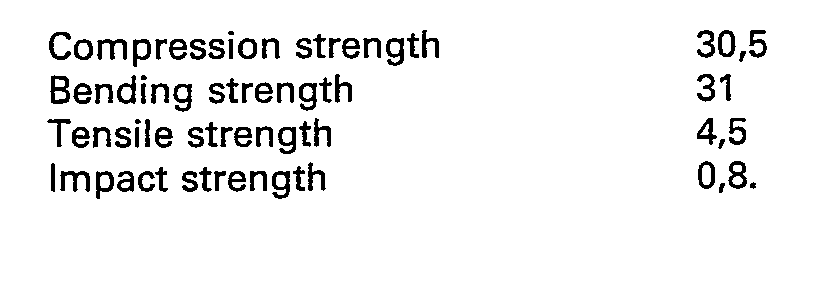
- Incidentally, in Comparative Examples II and III, it was observed in the bending test that the carbon fibers or glass fibers were ruptured on the cross-sectional surfaces. These facts demonstrate that the fiber materials were deteriorated and also firmly bonded to the sintered apatite in the resulting composites. Also, it is to be noted that the hot press sintering steps in Comparative Examples I to III were conducted without applying a steam atmosphere thereto. This sintering step corresponds to the baking of hydroxyapatite in the absence of water, since substantially all the water present in the apatite is rapidly vaporized away from the mold of the hot press.
- The process of Example 2 was repeated except that 95% of the hydroxyapatite powder and 5% of carbon fiber were used. The resulting sintered apatite composite exhibited compression strength of 66 MPa.
Claims (10)


Applications Claiming Priority (6)
| Application Number | Priority Date | Filing Date | Title |
|---|---|---|---|
| JP167013/82 | 1982-09-25 | ||
| JP57167013A JPS5957970A (en) | 1982-09-25 | 1982-09-25 | Carbon fiber-apatite baked composite body |
| JP191347/82 | 1982-10-30 | ||
| JP57191347A JPS5957971A (en) | 1982-10-30 | 1982-10-30 | Mineral fiber-apatite baked composite body |
| US489520 | 1983-04-28 | ||
| US06/489,520 US4503157A (en) | 1982-09-25 | 1983-04-28 | Sintered apatite bodies and composites thereof |
Publications (3)
| Publication Number | Publication Date |
|---|---|
| EP0104640A2 EP0104640A2 (en) | 1984-04-04 |
| EP0104640A3 EP0104640A3 (en) | 1985-05-02 |
| EP0104640B1 true EP0104640B1 (en) | 1988-01-13 |
Family
ID=27322785
Family Applications (1)
| Application Number | Title | Priority Date | Filing Date |
|---|---|---|---|
| EP83109582A Expired EP0104640B1 (en) | 1982-09-25 | 1983-09-26 | Sintered apatite bodies and composites thereof |
Country Status (6)
| Country | Link |
|---|---|
| US (1) | US4503157A (en) |
| EP (1) | EP0104640B1 (en) |
| KR (1) | KR910001364B1 (en) |
| AT (1) | ATE31914T1 (en) |
| DE (1) | DE3375298D1 (en) |
| GB (1) | GB2130187B (en) |
Cited By (1)
| Publication number | Priority date | Publication date | Assignee | Title |
|---|---|---|---|---|
| DE102004049140B4 (en) * | 2004-10-07 | 2011-05-05 | Leonora Ivanusch | Workpiece and method for producing a surgical implant or an artificial tooth material |
Families Citing this family (66)
| Publication number | Priority date | Publication date | Assignee | Title |
|---|---|---|---|---|
| US6306297B1 (en) | 1968-07-08 | 2001-10-23 | Asahi Kogaku Kogyo Kabushiki Kaisha | Packing material for liquid chromatography and process for producing the same |
| US5441635A (en) * | 1986-07-05 | 1995-08-15 | Asahi Kogaku Kogyo Kabushiki Kaisha | Packing material for liquid chromatography |
| US5039408A (en) * | 1986-07-05 | 1991-08-13 | Asahi Kogaku Kogyo K.K. | Packing material for liquid chromatography |
| JPS6014860A (en) * | 1983-07-06 | 1985-01-25 | 三菱鉱業セメント株式会社 | Inorganic implant material |
| NL8402158A (en) * | 1983-07-09 | 1985-02-01 | Sumitomo Cement Co | POROUS CERAMIC MATERIAL AND METHOD FOR THE PREPARATION THEREOF. |
| JPS6069007A (en) * | 1983-09-26 | 1985-04-19 | Kyocera Corp | Artificial corona dentis and its preparation |
| DE3433210C1 (en) * | 1984-09-10 | 1986-06-05 | Hans Dr.med. Dr.med.dent. 8000 München Scheicher | Means for filling bone and tooth defects, for bone building, for bone contact layers and for bone and tooth root replacement and use of carbonate apatite for this purpose |
| US4659617A (en) * | 1984-09-11 | 1987-04-21 | Toa Nenryo Kogyo Kabushiki Kaisha | Fibrous apatite and method for producing the same |
| US4629464A (en) * | 1984-09-25 | 1986-12-16 | Tdk Corporation | Porous hydroxyapatite material for artificial bone substitute |
| US4674898A (en) * | 1984-11-05 | 1987-06-23 | The Fern Group, Inc. | Printwheel |
| DE3447583A1 (en) * | 1984-12-28 | 1986-07-10 | Battelle-Institut E.V., 6000 Frankfurt | METHOD FOR PRODUCING IMPLANTABLE BONE REPLACEMENT MATERIALS |
| JPS61235752A (en) * | 1985-04-11 | 1986-10-21 | Asahi Optical Co Ltd | Material, device and method for separating cell |
| US4772573A (en) * | 1986-01-10 | 1988-09-20 | Agency Of Industrial Science And Technology | High-strength sintered article of calcium phosphate compound, raw material for production of said sintered article, and method for production of said sintered article |
| JPS62202884A (en) * | 1986-02-28 | 1987-09-07 | 工業技術院長 | Live body substitute ceramic material |
| JPS62221358A (en) * | 1986-03-20 | 1987-09-29 | 東燃株式会社 | Bone lack part and gap part filling material |
| US4839215A (en) * | 1986-06-09 | 1989-06-13 | Ceramed Corporation | Biocompatible particles and cloth-like article made therefrom |
| JPS62295666A (en) * | 1986-06-16 | 1987-12-23 | 呉羽化学工業株式会社 | Continuous two-dimensional porous implant material and its production |
| USRE35340E (en) * | 1986-07-05 | 1996-10-01 | Asahi Kogaku Kogyo K.K. | Packing material for liquid chromatography |
| US4746632A (en) * | 1986-09-08 | 1988-05-24 | Corning Glass Works | Inorganic crystalline fibers |
| US4737411A (en) * | 1986-11-25 | 1988-04-12 | University Of Dayton | Controlled pore size ceramics particularly for orthopaedic and dental applications |
| US4861733A (en) * | 1987-02-13 | 1989-08-29 | Interpore International | Calcium phosphate bone substitute materials |
| US4793809A (en) * | 1987-05-21 | 1988-12-27 | Myron International, Inc. | Fiber filled dental porcelain |
| US4897370A (en) * | 1987-06-30 | 1990-01-30 | Lion Corporation | Process for preparing ceramics composite sintered bodies |
| NL8702058A (en) * | 1987-09-02 | 1989-04-03 | Philips Nv | METHOD FOR MANUFACTURING A CERAMIC BODY FILLED WITH METAL PARTICLES. |
| US5171440A (en) * | 1987-09-17 | 1992-12-15 | Asahi Kogaku Kogyo K.K. | Column for liquid chromatography |
| US5204319A (en) * | 1988-01-30 | 1993-04-20 | Ibiden Co., Ltd. | Fiber reinforced ceramics of calcium phosphate series compounds |
| US5091344A (en) * | 1988-01-30 | 1992-02-25 | Ibiden Corporation | Fiber reinforced ceramics of calcium phosphate series compounds and method of producing the same |
| US5047031A (en) * | 1988-04-20 | 1991-09-10 | Norian Corporation | In situ calcium phosphate minerals method |
| US5082808A (en) * | 1988-07-04 | 1992-01-21 | Tdk Corporation | Ceramic material and method for making |
| US5032552A (en) * | 1988-07-04 | 1991-07-16 | Tdk Corporation | Biomedical material |
| JPH0231749A (en) * | 1988-07-20 | 1990-02-01 | Mitsubishi Mining & Cement Co Ltd | Filler for bone depleted part and osteoporosis part |
| US4952530A (en) * | 1988-12-01 | 1990-08-28 | Erico International Corporation | Dental composite material and process |
| US5034059A (en) * | 1989-02-17 | 1991-07-23 | Norian Corporation | Composition comprising octacalcium phosphate crystals and polypeptide |
| DE3914999C1 (en) * | 1989-05-08 | 1990-09-13 | Battelle-Institut Ev, 6000 Frankfurt, De | |
| EP0411208A1 (en) * | 1989-07-04 | 1991-02-06 | TDK Corporation | Ceramic material and method for making the same |
| US5258044A (en) * | 1992-01-30 | 1993-11-02 | Etex Corporation | Electrophoretic deposition of calcium phosphate material on implants |
| US5143752A (en) * | 1992-01-30 | 1992-09-01 | Bestex Kabushiki-Kaisha | Filtering material of apatite and glucan used for surgical masks and method of making it |
| DE4212970A1 (en) * | 1992-04-18 | 1993-10-21 | Heidenhain Gmbh Dr Johannes | Length measuring device |
| WO1994023944A1 (en) * | 1993-04-09 | 1994-10-27 | Dentalyt, Inc. | Fluorapatite thermally engineered dental restoratives |
| GB9310321D0 (en) * | 1993-05-19 | 1993-06-30 | Queen Mary & Westfield College | Method for the preparation of carbonated hydroxyapatite compositions |
| US7001371B1 (en) * | 1993-07-02 | 2006-02-21 | Med Usa | Porous drug delivery system |
| JP2775386B2 (en) * | 1993-10-04 | 1998-07-16 | 科学技術庁無機材質研究所長 | Apatite-organic compound composite and its manufacturing method |
| US5629186A (en) * | 1994-04-28 | 1997-05-13 | Lockheed Martin Corporation | Porous matrix and method of its production |
| US5652056A (en) * | 1995-08-25 | 1997-07-29 | Pepin; John N. | Hydroxyapatite filament |
| US6846493B2 (en) * | 1995-09-01 | 2005-01-25 | Millenium Biologix Inc. | Synthetic biomaterial compound of calcium phosphate phases particularly adapted for supporting bone cell activity |
| ATE289572T1 (en) | 1995-09-01 | 2005-03-15 | Millenium Biologix Inc | STABILIZED COMPOSITION OF CALCIUM PHOSPHATE PHASES PARTICULARLY SUITABLE FOR SUPPORTING BONE CELL ACTIVITY |
| DE19741286A1 (en) * | 1996-09-30 | 1998-04-02 | Degussa | Polymerisable dental material |
| US6013591A (en) | 1997-01-16 | 2000-01-11 | Massachusetts Institute Of Technology | Nanocrystalline apatites and composites, prostheses incorporating them, and method for their production |
| US6919070B1 (en) * | 1997-10-17 | 2005-07-19 | Zakrytoe Aktsionernoe Obschestvo “OSTIM” | Stomatic composition |
| DE69836151T2 (en) * | 1998-01-29 | 2007-02-01 | Millenium Biologix Inc., Kingston | SYNTHETIC BIOMATERIAL |
| JP3400740B2 (en) * | 1999-04-13 | 2003-04-28 | 東芝セラミックス株式会社 | Calcium phosphate porous sintered body and method for producing the same |
| DE19930335A1 (en) * | 1999-07-02 | 2001-01-18 | Henkel Kgaa | Composite materials made from calcium compounds and protein components |
| WO2001054746A2 (en) | 2000-01-31 | 2001-08-02 | Advanced Research And Technology Institute, Inc. | Composite biomaterial including anisometric calcium phosphate reinforcement particles |
| US7045105B2 (en) * | 2001-12-21 | 2006-05-16 | Lagow Richard J | Calcium phosphate bone replacement materials and methods of use thereof |
| RU2225380C1 (en) * | 2002-06-17 | 2004-03-10 | Томский политехнический университет | Method of manufacturing porous bioceramics |
| KR100492270B1 (en) * | 2002-06-27 | 2005-05-30 | 재단법인서울대학교산학협력재단 | Ceramic composite implant and manufacturing method thereof |
| AU2003278258A1 (en) * | 2002-09-06 | 2004-03-29 | Sanofi-Aventis | Composition for reinforcing apatite-based materials |
| FR2844199B1 (en) * | 2002-09-06 | 2008-08-22 | Sanofi Synthelabo | COMPOSITION FOR IMPROVING THE PHYSICOCHEMICAL CHARACTERISTICS OF APATITE MATERIALS, USE THEREOF AND METHOD FOR IMPLEMENTING THE SAME |
| EP3498312A1 (en) | 2003-09-05 | 2019-06-19 | Synthes GmbH | Bone cement compositions having fiber-reinforcement and/or increased flowability |
| JP2007507306A (en) * | 2003-09-30 | 2007-03-29 | ジンテーズ アクチエンゲゼルシャフト クール | Antimicrobial hyaluronic acid coating on orthopedic implants |
| DE102006009793A1 (en) * | 2005-10-31 | 2007-09-06 | Sus Tech Gmbh & Co. Kg | Use of sparingly water-soluble calcium salts and / or their composites |
| DE102006009799A1 (en) * | 2006-03-01 | 2007-09-06 | Henkel Kgaa | Predominantly platelet-shaped sparingly water-soluble calcium salts and / or their composite materials, including these |
| WO2011044182A2 (en) * | 2009-10-07 | 2011-04-14 | Bio2 Technologies, Inc. | Devices and methods for tissue engineering |
| US8468673B2 (en) | 2010-09-10 | 2013-06-25 | Bio2 Technologies, Inc. | Method of fabricating a porous orthopedic implant |
| CN111592362B (en) * | 2019-02-21 | 2022-08-02 | 泽塔纳米科技(苏州)有限公司 | SI 3 N 4 Reinforced hydroxyapatite composite nano ceramic material and preparation method thereof |
| CN114496584B (en) * | 2022-02-24 | 2022-11-18 | 武汉大学 | A tooth-based conductive material and its preparation method and application |
Family Cites Families (10)
| Publication number | Priority date | Publication date | Assignee | Title |
|---|---|---|---|---|
| GB292997A (en) * | 1927-06-29 | 1929-03-14 | Gen Electric Co Ltd | Improvements in the manufacture of solid bodies of high density |
| US3929971A (en) * | 1973-03-30 | 1975-12-30 | Research Corp | Porous biomaterials and method of making same |
| GB1487181A (en) * | 1974-10-30 | 1977-09-28 | Colgate Palmolive Co | Sintered ceramics |
| JPS5264199A (en) * | 1975-11-21 | 1977-05-27 | Tokyo Ika Shika Daigakuchiyou | Artificial bone and dental root with sintered apatite and method of producing same |
| SE414399B (en) * | 1976-03-16 | 1980-07-28 | Hans Scheicher | CERAMIC MATERIAL FOR USE IN MEDICINE, IN PARTICULAR FOR MANUFACTURE OF IMPLANTS, FOREIGN ODONTOLOGICAL IMPLANTS AND SET FOR MANUFACTURING THE MATERIAL |
| US4149894A (en) * | 1976-06-02 | 1979-04-17 | Asahi Kogaku Kogyo Kabushiki Kaisha | Process for producing an apatite powder having improved sinterability |
| JPS59219B2 (en) * | 1976-06-07 | 1984-01-05 | 旭光学工業株式会社 | Artificial teeth, artificial bones and their manufacturing method |
| JPS53144194A (en) * | 1977-05-20 | 1978-12-15 | Kureha Chemical Ind Co Ltd | Compound implanted material and making method thereof |
| DE2759214A1 (en) * | 1977-12-31 | 1979-07-05 | Scheicher Hans | METHOD OF MANUFACTURING IMPLANTS |
| JPS5645814A (en) * | 1979-09-25 | 1981-04-25 | Kureha Chem Ind Co Ltd | Hydroxyapatite, its ceramic material and its manufacture |
-
1983
- 1983-04-28 US US06/489,520 patent/US4503157A/en not_active Expired - Fee Related
- 1983-09-23 GB GB08325517A patent/GB2130187B/en not_active Expired
- 1983-09-26 AT AT83109582T patent/ATE31914T1/en not_active IP Right Cessation
- 1983-09-26 EP EP83109582A patent/EP0104640B1/en not_active Expired
- 1983-09-26 KR KR1019830004502A patent/KR910001364B1/en not_active Expired
- 1983-09-26 DE DE8383109582T patent/DE3375298D1/en not_active Expired
Cited By (1)
| Publication number | Priority date | Publication date | Assignee | Title |
|---|---|---|---|---|
| DE102004049140B4 (en) * | 2004-10-07 | 2011-05-05 | Leonora Ivanusch | Workpiece and method for producing a surgical implant or an artificial tooth material |
Also Published As
| Publication number | Publication date |
|---|---|
| ATE31914T1 (en) | 1988-01-15 |
| GB8325517D0 (en) | 1983-10-26 |
| KR910001364B1 (en) | 1991-03-04 |
| KR840006435A (en) | 1984-11-30 |
| DE3375298D1 (en) | 1988-02-18 |
| EP0104640A3 (en) | 1985-05-02 |
| US4503157A (en) | 1985-03-05 |
| GB2130187A (en) | 1984-05-31 |
| GB2130187B (en) | 1987-01-07 |
| EP0104640A2 (en) | 1984-04-04 |
Similar Documents
| Publication | Publication Date | Title |
|---|---|---|
| US4503157A (en) | Sintered apatite bodies and composites thereof | |
| EP0353476B1 (en) | Biomedical material and method for making the same | |
| US4957509A (en) | Ceramic implant materials | |
| Suchanek et al. | Hydroxyapatite/hydroxyapatite‐whisker composites without sintering additives: Mechanical properties and microstructural evolution | |
| Suchanek et al. | Preparation of fibrous, porous hydroxyapatite ceramics from hydroxyapatite whiskers | |
| CA1107582A (en) | Composite implant materials and process for preparing same | |
| US5356436A (en) | Materials for living hard tissue replacements | |
| US5679294A (en) | α-tricalcium phosphate ceramic and production method thereof | |
| Tancred et al. | A quantitative study of the sintering and mechanical properties of hydroxyapatite/phosphate glass composites | |
| US5071434A (en) | Biologically active surface ceramic and process for producing the same | |
| JPS63156073A (en) | Nitirde base sintered ceramic body and manufacture | |
| Balbinotti et al. | Microstructure development on sintered Ti/HA biocomposites produced by powder metallurgy | |
| Champion et al. | Characterization of hot pressed Al2O3-platelet reinforced hydroxyapatite composites | |
| Chaim et al. | Microstructure and Mechanical Properties of SiC Platelet/Cordierite Glass‐Ceramic Composites | |
| BG60551B1 (en) | METHOD OF PREPARATION OF BORIDE CERAMIC PRODUCTS | |
| JPS6327308B2 (en) | ||
| EP0410601B1 (en) | Composite ceramic material | |
| EP0335359A2 (en) | Porous ceramic material and production process thereof | |
| EP0572464B1 (en) | A self-reinforced silicon nitride ceramic with crystalline grain boundary phase, and a method of preparing the same | |
| EP0419150B1 (en) | Sintered ceramic composite body and method of manufacturing same | |
| JPS6141876B2 (en) | ||
| US5091344A (en) | Fiber reinforced ceramics of calcium phosphate series compounds and method of producing the same | |
| DE69022776T2 (en) | Use of ceramic materials as replacement materials for living tissue. | |
| CA1271784A (en) | Zirconia ceramic article toughened with sic whiskers | |
| KR19980073543A (en) | Surface-modified sialon complexes and method for preparing the same |
Legal Events
| Date | Code | Title | Description |
|---|---|---|---|
| PUAI | Public reference made under article 153(3) epc to a published international application that has entered the european phase |
Free format text: ORIGINAL CODE: 0009012 |
|
| AK | Designated contracting states |
Designated state(s): AT BE CH DE FR IT LI LU NL SE |
|
| PUAL | Search report despatched |
Free format text: ORIGINAL CODE: 0009013 |
|
| AK | Designated contracting states |
Designated state(s): AT BE CH DE FR IT LI LU NL SE |
|
| 17P | Request for examination filed |
Effective date: 19851104 |
|
| 17Q | First examination report despatched |
Effective date: 19861029 |
|
| GRAA | (expected) grant |
Free format text: ORIGINAL CODE: 0009210 |
|
| AK | Designated contracting states |
Kind code of ref document: B1 Designated state(s): AT BE CH DE FR IT LI LU NL SE |
|
| REF | Corresponds to: |
Ref document number: 31914 Country of ref document: AT Date of ref document: 19880115 Kind code of ref document: T |
|
| RAP2 | Party data changed (patent owner data changed or rights of a patent transferred) |
Owner name: INAX CORPORATION |
|
| REF | Corresponds to: |
Ref document number: 3375298 Country of ref document: DE Date of ref document: 19880218 |
|
| ET | Fr: translation filed | ||
| ITF | It: translation for a ep patent filed | ||
| REG | Reference to a national code |
Ref country code: FR Ref legal event code: CD |
|
| BECN | Be: change of holder's name |
Effective date: 19880113 |
|
| PLBE | No opposition filed within time limit |
Free format text: ORIGINAL CODE: 0009261 |
|
| STAA | Information on the status of an ep patent application or granted ep patent |
Free format text: STATUS: NO OPPOSITION FILED WITHIN TIME LIMIT |
|
| 26N | No opposition filed | ||
| PGFP | Annual fee paid to national office [announced via postgrant information from national office to epo] |
Ref country code: SE Payment date: 19910816 Year of fee payment: 9 |
|
| PGFP | Annual fee paid to national office [announced via postgrant information from national office to epo] |
Ref country code: LU Payment date: 19910821 Year of fee payment: 9 Ref country code: FR Payment date: 19910821 Year of fee payment: 9 |
|
| PGFP | Annual fee paid to national office [announced via postgrant information from national office to epo] |
Ref country code: AT Payment date: 19910910 Year of fee payment: 9 |
|
| PGFP | Annual fee paid to national office [announced via postgrant information from national office to epo] |
Ref country code: BE Payment date: 19910927 Year of fee payment: 9 |
|
| ITTA | It: last paid annual fee | ||
| PGFP | Annual fee paid to national office [announced via postgrant information from national office to epo] |
Ref country code: NL Payment date: 19910930 Year of fee payment: 9 |
|
| PGFP | Annual fee paid to national office [announced via postgrant information from national office to epo] |
Ref country code: CH Payment date: 19911127 Year of fee payment: 9 |
|
| PGFP | Annual fee paid to national office [announced via postgrant information from national office to epo] |
Ref country code: DE Payment date: 19911129 Year of fee payment: 9 |
|
| EPTA | Lu: last paid annual fee | ||
| PG25 | Lapsed in a contracting state [announced via postgrant information from national office to epo] |
Ref country code: LU Free format text: LAPSE BECAUSE OF NON-PAYMENT OF DUE FEES Effective date: 19920926 Ref country code: AT Effective date: 19920926 |
|
| PG25 | Lapsed in a contracting state [announced via postgrant information from national office to epo] |
Ref country code: SE Effective date: 19920927 |
|
| PG25 | Lapsed in a contracting state [announced via postgrant information from national office to epo] |
Ref country code: LI Effective date: 19920930 Ref country code: CH Effective date: 19920930 Ref country code: BE Effective date: 19920930 |
|
| BERE | Be: lapsed |
Owner name: INAX CORP. Effective date: 19920930 |
|
| PG25 | Lapsed in a contracting state [announced via postgrant information from national office to epo] |
Ref country code: NL Effective date: 19930401 |
|
| NLV4 | Nl: lapsed or anulled due to non-payment of the annual fee | ||
| PG25 | Lapsed in a contracting state [announced via postgrant information from national office to epo] |
Ref country code: FR Effective date: 19930528 |
|
| REG | Reference to a national code |
Ref country code: CH Ref legal event code: PL |
|
| PG25 | Lapsed in a contracting state [announced via postgrant information from national office to epo] |
Ref country code: DE Effective date: 19930602 |
|
| REG | Reference to a national code |
Ref country code: FR Ref legal event code: ST |
|
| EUG | Se: european patent has lapsed |
Ref document number: 83109582.3 Effective date: 19930406 |