EP0102271B1 - Verfahren zur Stabilisierung von reaktiven Iminen; die durch dieses Verfahren erhaltenen stabilen Iminiumsalze und ihre Anwendung - Google Patents
Verfahren zur Stabilisierung von reaktiven Iminen; die durch dieses Verfahren erhaltenen stabilen Iminiumsalze und ihre Anwendung Download PDFInfo
- Publication number
- EP0102271B1 EP0102271B1 EP19830401529 EP83401529A EP0102271B1 EP 0102271 B1 EP0102271 B1 EP 0102271B1 EP 19830401529 EP19830401529 EP 19830401529 EP 83401529 A EP83401529 A EP 83401529A EP 0102271 B1 EP0102271 B1 EP 0102271B1
- Authority
- EP
- European Patent Office
- Prior art keywords
- imine
- iminium salts
- iminium
- imines
- acid
- Prior art date
- Legal status (The legal status is an assumption and is not a legal conclusion. Google has not performed a legal analysis and makes no representation as to the accuracy of the status listed.)
- Expired
Links
- 150000002466 imines Chemical class 0.000 title claims description 71
- 150000007975 iminium salts Chemical class 0.000 title claims description 41
- 238000000034 method Methods 0.000 title claims description 22
- 230000006641 stabilisation Effects 0.000 title claims 2
- IJGRMHOSHXDMSA-UHFFFAOYSA-N Atomic nitrogen Chemical compound N#N IJGRMHOSHXDMSA-UHFFFAOYSA-N 0.000 claims description 44
- 239000002253 acid Substances 0.000 claims description 28
- 229910052757 nitrogen Inorganic materials 0.000 claims description 22
- 238000006243 chemical reaction Methods 0.000 claims description 18
- 238000003786 synthesis reaction Methods 0.000 claims description 15
- 230000015572 biosynthetic process Effects 0.000 claims description 14
- 239000007787 solid Substances 0.000 claims description 12
- NYVSDPNXBIEFPW-UHFFFAOYSA-N n-methylmethanimine Chemical compound CN=C NYVSDPNXBIEFPW-UHFFFAOYSA-N 0.000 claims description 9
- 239000012038 nucleophile Substances 0.000 claims description 9
- 239000003960 organic solvent Substances 0.000 claims description 9
- 238000006352 cycloaddition reaction Methods 0.000 claims description 8
- 150000001875 compounds Chemical class 0.000 claims description 6
- 150000007513 acids Chemical class 0.000 claims description 5
- 238000007259 addition reaction Methods 0.000 claims description 5
- 150000001450 anions Chemical class 0.000 claims description 5
- 239000000543 intermediate Substances 0.000 claims description 5
- 238000006704 dehydrohalogenation reaction Methods 0.000 claims description 4
- -1 olefin compounds Chemical class 0.000 claims description 4
- 230000009466 transformation Effects 0.000 claims description 4
- 229930013930 alkaloid Natural products 0.000 claims description 3
- 230000008018 melting Effects 0.000 claims description 3
- 238000002844 melting Methods 0.000 claims description 3
- WDWDWGRYHDPSDS-UHFFFAOYSA-O methylideneazanium Chemical compound [NH2+]=C WDWDWGRYHDPSDS-UHFFFAOYSA-O 0.000 claims description 3
- KPUSZZFAYGWAHZ-UHFFFAOYSA-N 3-azabicyclo[2.2.2]octane Chemical compound C1CC2CCC1NC2 KPUSZZFAYGWAHZ-UHFFFAOYSA-N 0.000 claims description 2
- QDHHCQZDFGDHMP-UHFFFAOYSA-N Chloramine Chemical compound ClN QDHHCQZDFGDHMP-UHFFFAOYSA-N 0.000 claims description 2
- JRZJOMJEPLMPRA-UHFFFAOYSA-N olefin Natural products CCCCCCCC=C JRZJOMJEPLMPRA-UHFFFAOYSA-N 0.000 claims description 2
- 239000000843 powder Substances 0.000 claims description 2
- SBYHFKPVCBCYGV-UHFFFAOYSA-N quinuclidine Chemical compound C1CC2CCN1CC2 SBYHFKPVCBCYGV-UHFFFAOYSA-N 0.000 claims description 2
- 150000003797 alkaloid derivatives Chemical class 0.000 claims 1
- 239000007792 gaseous phase Substances 0.000 claims 1
- 150000002391 heterocyclic compounds Chemical class 0.000 claims 1
- 238000002955 isolation Methods 0.000 claims 1
- 230000001131 transforming effect Effects 0.000 claims 1
- 239000011973 solid acid Substances 0.000 description 19
- RTZKZFJDLAIYFH-UHFFFAOYSA-N Diethyl ether Chemical compound CCOCC RTZKZFJDLAIYFH-UHFFFAOYSA-N 0.000 description 14
- 150000003839 salts Chemical class 0.000 description 14
- 239000000047 product Substances 0.000 description 10
- SUVIGLJNEAMWEG-UHFFFAOYSA-N propane-1-thiol Chemical compound CCCS SUVIGLJNEAMWEG-UHFFFAOYSA-N 0.000 description 8
- 239000002904 solvent Substances 0.000 description 8
- YZUPZGFPHUVJKC-UHFFFAOYSA-N 1-bromo-2-methoxyethane Chemical compound COCCBr YZUPZGFPHUVJKC-UHFFFAOYSA-N 0.000 description 7
- 238000007792 addition Methods 0.000 description 7
- 230000005588 protonation Effects 0.000 description 7
- 239000000243 solution Substances 0.000 description 7
- QGZKDVFQNNGYKY-UHFFFAOYSA-N Ammonia Chemical compound N QGZKDVFQNNGYKY-UHFFFAOYSA-N 0.000 description 6
- YMWUJEATGCHHMB-UHFFFAOYSA-N Dichloromethane Chemical compound ClCCl YMWUJEATGCHHMB-UHFFFAOYSA-N 0.000 description 6
- 150000001412 amines Chemical class 0.000 description 5
- 239000007789 gas Substances 0.000 description 5
- 239000000203 mixture Substances 0.000 description 5
- MAGVJLLHDZWQFM-UHFFFAOYSA-N n-chloro-n-methylmethanamine Chemical compound CN(C)Cl MAGVJLLHDZWQFM-UHFFFAOYSA-N 0.000 description 5
- LPNYRYFBWFDTMA-UHFFFAOYSA-N potassium tert-butoxide Chemical compound [K+].CC(C)(C)[O-] LPNYRYFBWFDTMA-UHFFFAOYSA-N 0.000 description 5
- VYPSYNLAJGMNEJ-UHFFFAOYSA-N Silicium dioxide Chemical compound O=[Si]=O VYPSYNLAJGMNEJ-UHFFFAOYSA-N 0.000 description 4
- 239000007788 liquid Substances 0.000 description 4
- 230000009257 reactivity Effects 0.000 description 4
- 229920005989 resin Polymers 0.000 description 4
- 239000011347 resin Substances 0.000 description 4
- 125000001424 substituent group Chemical group 0.000 description 4
- RZVAJINKPMORJF-UHFFFAOYSA-N Acetaminophen Chemical compound CC(=O)NC1=CC=C(O)C=C1 RZVAJINKPMORJF-UHFFFAOYSA-N 0.000 description 3
- JUJWROOIHBZHMG-UHFFFAOYSA-N Pyridine Chemical compound C1=CC=NC=C1 JUJWROOIHBZHMG-UHFFFAOYSA-N 0.000 description 3
- 229910021529 ammonia Inorganic materials 0.000 description 3
- 239000003153 chemical reaction reagent Substances 0.000 description 3
- 238000010438 heat treatment Methods 0.000 description 3
- 125000002887 hydroxy group Chemical group [H]O* 0.000 description 3
- 230000007935 neutral effect Effects 0.000 description 3
- 239000005297 pyrex Substances 0.000 description 3
- 230000000087 stabilizing effect Effects 0.000 description 3
- MYRTYDVEIRVNKP-UHFFFAOYSA-N 1,2-Divinylbenzene Chemical compound C=CC1=CC=CC=C1C=C MYRTYDVEIRVNKP-UHFFFAOYSA-N 0.000 description 2
- SDJHPPZKZZWAKF-UHFFFAOYSA-N 2,3-dimethylbuta-1,3-diene Chemical compound CC(=C)C(C)=C SDJHPPZKZZWAKF-UHFFFAOYSA-N 0.000 description 2
- HEDRZPFGACZZDS-UHFFFAOYSA-N Chloroform Chemical compound ClC(Cl)Cl HEDRZPFGACZZDS-UHFFFAOYSA-N 0.000 description 2
- 238000005698 Diels-Alder reaction Methods 0.000 description 2
- VEXZGXHMUGYJMC-UHFFFAOYSA-N Hydrochloric acid Chemical compound Cl VEXZGXHMUGYJMC-UHFFFAOYSA-N 0.000 description 2
- WCUXLLCKKVVCTQ-UHFFFAOYSA-M Potassium chloride Chemical compound [Cl-].[K+] WCUXLLCKKVVCTQ-UHFFFAOYSA-M 0.000 description 2
- PPBRXRYQALVLMV-UHFFFAOYSA-N Styrene Chemical compound C=CC1=CC=CC=C1 PPBRXRYQALVLMV-UHFFFAOYSA-N 0.000 description 2
- DKGAVHZHDRPRBM-UHFFFAOYSA-N Tert-Butanol Chemical compound CC(C)(C)O DKGAVHZHDRPRBM-UHFFFAOYSA-N 0.000 description 2
- WYURNTSHIVDZCO-UHFFFAOYSA-N Tetrahydrofuran Chemical compound C1CCOC1 WYURNTSHIVDZCO-UHFFFAOYSA-N 0.000 description 2
- DTQVDTLACAAQTR-UHFFFAOYSA-N Trifluoroacetic acid Chemical compound OC(=O)C(F)(F)F DTQVDTLACAAQTR-UHFFFAOYSA-N 0.000 description 2
- PNEYBMLMFCGWSK-UHFFFAOYSA-N aluminium oxide Inorganic materials [O-2].[O-2].[O-2].[Al+3].[Al+3] PNEYBMLMFCGWSK-UHFFFAOYSA-N 0.000 description 2
- 230000005587 bubbling Effects 0.000 description 2
- 229920001429 chelating resin Polymers 0.000 description 2
- 238000009833 condensation Methods 0.000 description 2
- 230000005494 condensation Effects 0.000 description 2
- 238000010586 diagram Methods 0.000 description 2
- CJSBUWDGPXGFGA-UHFFFAOYSA-N dimethyl-butadiene Natural products CC(C)=CC=C CJSBUWDGPXGFGA-UHFFFAOYSA-N 0.000 description 2
- 239000011491 glass wool Substances 0.000 description 2
- 238000004519 manufacturing process Methods 0.000 description 2
- 238000000655 nuclear magnetic resonance spectrum Methods 0.000 description 2
- 238000005935 nucleophilic addition reaction Methods 0.000 description 2
- 238000006384 oligomerization reaction Methods 0.000 description 2
- 229920000642 polymer Polymers 0.000 description 2
- 229920001343 polytetrafluoroethylene Polymers 0.000 description 2
- 239000004810 polytetrafluoroethylene Substances 0.000 description 2
- 239000002243 precursor Substances 0.000 description 2
- 239000000377 silicon dioxide Substances 0.000 description 2
- 238000011144 upstream manufacturing Methods 0.000 description 2
- 239000012808 vapor phase Substances 0.000 description 2
- QFLWZFQWSBQYPS-AWRAUJHKSA-N (3S)-3-[[(2S)-2-[[(2S)-2-[5-[(3aS,6aR)-2-oxo-1,3,3a,4,6,6a-hexahydrothieno[3,4-d]imidazol-4-yl]pentanoylamino]-3-methylbutanoyl]amino]-3-(4-hydroxyphenyl)propanoyl]amino]-4-[1-bis(4-chlorophenoxy)phosphorylbutylamino]-4-oxobutanoic acid Chemical compound CCCC(NC(=O)[C@H](CC(O)=O)NC(=O)[C@H](Cc1ccc(O)cc1)NC(=O)[C@@H](NC(=O)CCCCC1SC[C@@H]2NC(=O)N[C@H]12)C(C)C)P(=O)(Oc1ccc(Cl)cc1)Oc1ccc(Cl)cc1 QFLWZFQWSBQYPS-AWRAUJHKSA-N 0.000 description 1
- LSNNMFCWUKXFEE-UHFFFAOYSA-M Bisulfite Chemical compound OS([O-])=O LSNNMFCWUKXFEE-UHFFFAOYSA-M 0.000 description 1
- GIMHETOMMUYESU-WAVJCGAHSA-N C=C/C=C/C=N Chemical compound C=C/C=C/C=N GIMHETOMMUYESU-WAVJCGAHSA-N 0.000 description 1
- 238000006683 Mannich reaction Methods 0.000 description 1
- 238000006972 Polonovski rearrangement reaction Methods 0.000 description 1
- ZLMJMSJWJFRBEC-UHFFFAOYSA-N Potassium Chemical compound [K] ZLMJMSJWJFRBEC-UHFFFAOYSA-N 0.000 description 1
- 238000007059 Strecker synthesis reaction Methods 0.000 description 1
- 238000003833 Wallach reaction Methods 0.000 description 1
- 150000001336 alkenes Chemical class 0.000 description 1
- 230000004075 alteration Effects 0.000 description 1
- 239000011324 bead Substances 0.000 description 1
- 239000003795 chemical substances by application Substances 0.000 description 1
- 229920001577 copolymer Polymers 0.000 description 1
- 238000004821 distillation Methods 0.000 description 1
- VVDUZZGYBOWDSQ-UHFFFAOYSA-M eschenmoser's salt Chemical compound [I-].C[N+](C)=C VVDUZZGYBOWDSQ-UHFFFAOYSA-M 0.000 description 1
- 125000001495 ethyl group Chemical group [H]C([H])([H])C([H])([H])* 0.000 description 1
- 238000001704 evaporation Methods 0.000 description 1
- 230000008020 evaporation Effects 0.000 description 1
- 239000000706 filtrate Substances 0.000 description 1
- 239000012467 final product Substances 0.000 description 1
- 239000012530 fluid Substances 0.000 description 1
- 238000013467 fragmentation Methods 0.000 description 1
- 238000006062 fragmentation reaction Methods 0.000 description 1
- 150000004820 halides Chemical class 0.000 description 1
- 125000000623 heterocyclic group Chemical group 0.000 description 1
- 239000008241 heterogeneous mixture Substances 0.000 description 1
- GPRLSGONYQIRFK-UHFFFAOYSA-N hydron Chemical compound [H+] GPRLSGONYQIRFK-UHFFFAOYSA-N 0.000 description 1
- 239000011261 inert gas Substances 0.000 description 1
- 238000002329 infrared spectrum Methods 0.000 description 1
- 239000003456 ion exchange resin Substances 0.000 description 1
- 229920003303 ion-exchange polymer Polymers 0.000 description 1
- 238000001819 mass spectrum Methods 0.000 description 1
- WDWDWGRYHDPSDS-UHFFFAOYSA-N methanimine Chemical compound N=C WDWDWGRYHDPSDS-UHFFFAOYSA-N 0.000 description 1
- 230000011987 methylation Effects 0.000 description 1
- 238000007069 methylation reaction Methods 0.000 description 1
- QXJIABOUHLYVHP-UHFFFAOYSA-N n-chloromethanamine Chemical compound CNCl QXJIABOUHLYVHP-UHFFFAOYSA-N 0.000 description 1
- 230000000269 nucleophilic effect Effects 0.000 description 1
- 239000012071 phase Substances 0.000 description 1
- 229910052700 potassium Inorganic materials 0.000 description 1
- 239000011591 potassium Substances 0.000 description 1
- 239000001103 potassium chloride Substances 0.000 description 1
- 235000011164 potassium chloride Nutrition 0.000 description 1
- 150000003141 primary amines Chemical class 0.000 description 1
- 125000001436 propyl group Chemical group [H]C([*])([H])C([H])([H])C([H])([H])[H] 0.000 description 1
- 238000000425 proton nuclear magnetic resonance spectrum Methods 0.000 description 1
- 238000004064 recycling Methods 0.000 description 1
- 230000000717 retained effect Effects 0.000 description 1
- 229920006395 saturated elastomer Polymers 0.000 description 1
- 239000012047 saturated solution Substances 0.000 description 1
- 238000007789 sealing Methods 0.000 description 1
- 150000003335 secondary amines Chemical class 0.000 description 1
- 239000007858 starting material Substances 0.000 description 1
- 238000003756 stirring Methods 0.000 description 1
- 239000000126 substance Substances 0.000 description 1
- 150000003512 tertiary amines Chemical class 0.000 description 1
- YLQBMQCUIZJEEH-UHFFFAOYSA-N tetrahydrofuran Natural products C=1C=COC=1 YLQBMQCUIZJEEH-UHFFFAOYSA-N 0.000 description 1
- 238000009834 vaporization Methods 0.000 description 1
- 230000008016 vaporization Effects 0.000 description 1
- 238000010792 warming Methods 0.000 description 1
Images
Classifications
-
- C—CHEMISTRY; METALLURGY
- C07—ORGANIC CHEMISTRY
- C07C—ACYCLIC OR CARBOCYCLIC COMPOUNDS
- C07C323/00—Thiols, sulfides, hydropolysulfides or polysulfides substituted by halogen, oxygen or nitrogen atoms, or by sulfur atoms not being part of thio groups
- C07C323/23—Thiols, sulfides, hydropolysulfides or polysulfides substituted by halogen, oxygen or nitrogen atoms, or by sulfur atoms not being part of thio groups containing thio groups and nitrogen atoms, not being part of nitro or nitroso groups, bound to the same carbon skeleton
- C07C323/24—Thiols, sulfides, hydropolysulfides or polysulfides substituted by halogen, oxygen or nitrogen atoms, or by sulfur atoms not being part of thio groups containing thio groups and nitrogen atoms, not being part of nitro or nitroso groups, bound to the same carbon skeleton having the sulfur atoms of the thio groups bound to acyclic carbon atoms of the carbon skeleton
- C07C323/25—Thiols, sulfides, hydropolysulfides or polysulfides substituted by halogen, oxygen or nitrogen atoms, or by sulfur atoms not being part of thio groups containing thio groups and nitrogen atoms, not being part of nitro or nitroso groups, bound to the same carbon skeleton having the sulfur atoms of the thio groups bound to acyclic carbon atoms of the carbon skeleton the carbon skeleton being acyclic and saturated
Definitions
- the present invention firstly relates to a process for stabilizing these reactive imines by their transformation into iminium salts, which are perfectly stable at ordinary temperature or at temperatures of the order of 50 ° C., so that these salts are storable and marketable products and therefore usable as synthons, that is to say as key synthetic molecules that are both reactive and stable.
- iminium salts have a very high reactivity towards nucleophiles and lend themselves to cycloaddition reactions. They therefore occupy an important place in organic synthesis, given their exceptional reactivity, which is linked to the fact that one of their mesomeric contributions can be represented in the form of a carbenium ion stabilized by an amine function:
- the known and stable iminium salts are essentially salts disubstituted on nitrogen, and in particular the Potter's salt [P. Potier et al :, “JACS”, 90 (1968) 5622] and the salt of Eschenmoser [A. Eschenmoser et al., “Angew. Chem. Int. ”, Ed. 10 (1971) 330]: CF 3 COO e Salt Potier Sef Eschenmoser
- R representing a substituent and X an anion are practically unknown, having never been able to be isolated.
- iminium salts can however be considered as building blocks of high potential, since they are capable of introducing, into the various additions with nucleophiles, a secondary or primary amine very useful for subsequent synthetic applications, said amine can be functionalized, while the Potter's salt or the Eschenmoser's salt only allow the introduction of a tertiary amine.
- the applicants first attempted to form a monosubstituted iminium salt on nitrogen by protecting a simple imine, namely N-methylmethanimine (formula 2 above), using hydrochloric acid or trifluoroacetic acid.
- the iminium salts obtained are not very stable and very hygroscopic and they cannot be purified and easily used in organic synthesis.
- the reaction was carried out by adding the iminium at low temperature (below -60 ° C) in a saturated solution of the acid. It has been observed that the formation of iminium salts by reaction between the imine and an acid in solution does not constitute an advantageous method for stabilizing the imines. Furthermore, the reaction yield is very low.
- the imines used which are prepared by the above-mentioned process, are essentially volatile imines, corresponding to formulas 1 to 11 above, these imines preferably having to have a vapor pressure sufficient to volatilize under conventional vacuum above, which is for example that of the vane pump.
- Volatility is less necessary when the imine is involved in solution, although it is convenient in practice to mix the imine and the organic solvent in the form of vapors under vacuum.
- the organic solvent with a low melting point used according to this second procedure can be ether, chloroform, tetrahydrofuran, methylene chloride, the mixture CH2CIz-CFCI3, or mixtures of these solvents, the list of which is not not limiting.
- the strong solid acid used as an protonating agent for the imine is advantageously in the form of porous grains or powder, in order to provide a large specific surface for the addition of the imine.
- Sulfonated resins are used, that is to say polymers in which the acid sites are dispersed. These are polybenzenesulfonic acids, the schematic formula of which is as follows:
- ion exchange resins Amberlite and Amberlyst 15 from the company Rôhm and Haas, which are sulfonated copolymers of styrene and of divinylbenzene, the acid spherosils from the company Rhône-Poulenc and Nafion-H, which is a sulfonated and perfluorinated resin manufactured by the American company DuPont de Nemours.
- the imine binds to the acid sites, generating the iminium salt.
- the content of said resins in equivalents of hydrogen ion per gram is known, which makes it possible to carry out the reaction with imine in stoichiometric proportions or in any other desired ratio.
- These resins which are commercial reagents, are advantageous for the industrial manufacture of iminium salts.
- the imine used resulting from the dehydrohalogenation of the corresponding chloramine and being prepared in the vapor phase under vacuum as mentioned above, it is unnecessary to isolate the imine obtained intermediate, which is passed through the same vacuum line on solid acid, or that is mixed under vacuum with a volatile solvent, the mixture then being cooled to be collected in the liquid state in a collector, where it is brought into contact with the acid very strong.
- the final product consists of this strong solid acid on which the imine is fixed.
- This product can be stored without alteration for a very long time in the absence of air, for example under nitrogen.
- a subject of the invention is also the stable iminium salts thus obtained, characterized in that they are monosubstituted or unsubstituted iminium salts on the nitrogen of formula where R represents a substituent and X an anion of polybenzenesulfonic acid, these iminium salts being addition compounds on a strong solid acid, chosen from polybenzenesulfonic acids, of a reactive imine chosen from simple imines 1 to 11 sus -indicated.
- Another object of the invention is the application of these iminium salts, as precursors of commercially accessible syntheses, to the manufacture of very elaborate compounds, unknown until then and of high potential.
- Scheme 1 gives free nucleophilic addition
- Scheme 2 an example of [4 + 2] type cycloaddition
- Scheme 3 another example of [4 + 2] type cycloaddition between dihydro-3 , 4 pyridine (compound 11) and an activated olefin, providing an unsaturated isoquinudidine:
- Scheme 1 (addition of nucleophiles)
- Diagram 2 (cycloaddition [4 + 2])
- Diagram 3 (cycloaddition [4 + 2])
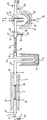
- the starting material 27 is N-chlorodimethylamine of formula (CH 3 ) 2 N-Cl (9.15 g, 1- -1 mol), placed in a container 1, in order to react with a solid hydroxyl base 2, which is potassium tert-butoxide (34 g, 0.3 mol), placed in the internal tube 3, in Pyrex for example, of a rotary furnace 4.
- the tube in Pyrex 3 is filled with the solid base up to half-section, this base being held in the central region of the tube between two glass wool pads 28 and 29.
- the tube 3 is mounted to rotate in 5 and 6, by means of ball bearings and O-rings ensuring the sealing between a pipe 7 connecting to the container 1 and a vacuum pipe 8.
- Vacuum is provided at the end of the pipe or vacuum line 8 by a vane pump (flow rate 35 m 3 ).
- the vacuum created is of the order of 10 -1 to 10 -2 mm Hg; it causes the dimethylchloramine to vaporize towards the rotary kiln 4.
- the mechanical drive of the rotary kiln is not shown.
- a polytetrafluoroethylene needle valve shown diagrammatically at 9 makes it possible to regulate the introduction of the starting substance 1.
- a Pirani gauge can be connected upstream or downstream of the oven to measure the pressure.
- the potassium tert-butoxide 2 is advantageously mixed with a solid support such as silica or alumina.
- the dimethylchloramine used is dehydrohalogenated; it results from the reaction of solid potassium chloride, which remains in the furnace, and a mixture of vapors of N-methylmethanimine and tertiary butanol, which escapes from the furnace rotating 4 in 10 to penetrate into a trap in U 11 maintained at a temperature of -80 ° C. and which allows tertiary butanol to be separated by condensation at 12.
- the imine still in the vapor state, which escapes at 33, then crosses a protonation bench 13, in the form of a Pyrex tube comparable to tube 3, also rotatably mounted on the vacuum line by l intermediate ball bearings and O-rings 14 and 15.
- This protonation bench is filled up to half section and between two glass wool pads of a strong solid acid 16, such as Amberlyst 15 from the company Rôhm and Haas, which is a polybenzene sulfonic acid in the form of small porous beads called macroreticular with a diameter of between approximately 0.8 mm and approximately 0.3 mm.
- the protonation bench 13 like the rotary kiln 4, is driven in slow rotation, by a mechanical device not shown, in order to renew the active sites of the solid acid during the passage of imine vapor, this in order to d 'optimize the yield of the addition reaction.
- One equivalent of acid sites is used for one equivalent of imine; the protonation bench therefore contains 21.2 g of the solid acid, or 10- 1 molar equivalent of acid sites.
- Dimethyl chloramine is introduced into the apparatus by vaporization under vacuum for 1 h.
- the iminium salt formed is retained in the protonation bench, while the unreacted imine escaping at 17 is condensed in the internal enclosure 18 of a Dewar vase, the external enclosure of which 19 is a reservoir of liquid nitrogen 20.
- the gas flow passing through this tube is maintained at approximately 25 ° C. up to the base thereof. a circulation of heating fluid in the enclosure 22.
- valves 23 and 24 placed on the vacuum line on either side of the Dewar are closed and the Dewar is brought back to ordinary pressure by the introduction of an inert gas such as l 'nitrogen at 25. It follows a heating which causes the rapid flow of the liquid deposited on the wall of the internal enclosure 18 to a manifold 26 in connection with the bottom of the Dewar and cooled with liquid nitrogen. The unreacted imine is thus collected in the condensed state and can be recycled in the device.
- an inert gas such as l 'nitrogen
- valve 23 By opening valve 23 and continuing to introduce neutral gas at 25, the protonation bench is also placed under full nitrogen and the strong solid acid containing the iminium salt formed by addition is then introduced under nitrogen in a container which, if it is tightly sealed, allows the salt formed to be stored for a long time.
- the yield of iminium salt is 30%, when using, as mentioned above, an equivalent of acid sites for an equivalent of imine (1/1 ratio).
- the yield is 80% relative to the acid, when 5 Eq of imine are used for 1 Eq of acid sites.
- the yields are determined by the increase in the mass of Amberlyst 15, by the mass of the products collected in 12 and 26, and they are confirmed by the amount of adduct formed after reaction of the iminium salt on a nucleophile (see examples 3 and 4 below).
- the imine passing in the vapor state on the bank of strong solid acid its passage time is relatively short , of the order of a second, and all the acid sites are not affected, which explains why the yield is about 30% with a single pass of the imine; with three passes of the imine collected successively, the yield can reach 80%.
- yields are understood by weight of the iminium salt obtained relative to the weight of the imine used, that is to say of the imine formed by reaction in the rotary kiln 4.
- the iminium salt is obtained in a very pure form, since only the imine is fixed by the solid acid and that this imine, as it is obtained by the process described above, is itself very pure.
- the operation is carried out in the rotary oven at a temperature of approximately 50 ° C.
- propanethiol a powerful nucleophile
- the reaction is as follows: Pr represents a propyl group and Et an ethyl group.
- the iminium salt of N-methylmethanimine 13 (22.1 g of Amberlyst 15.3 ⁇ 10 -2 mol Eq of the iminium salt 13) is introduced under nitrogen into a 100 cm 3 flask fitted with a desiccator and a nitrogen inlet.
- Propanethiol (3.0 g, 4 ⁇ 10 -2 mol) in 20 cm 3 of anhydrous ethyl ether is added dropwise for 15 min and the solution is further stirred 10 min after the end of the addition.
- the whole is filtered, the solid washed several times with ethyl ether and brought to dryness with a vane pump. 30 cm 3 of ethyl ether are then added.
- Example 2 The same apparatus is used as in Example 1, but without the protonation bench 13.
- the strong solid acid Amberlyst 15 is placed in the collector 26 and a reservoir 30 of ethyl ether 31 or of a similar volatile organic solvent is connected to the vacuum pipe upstream of the valve 23.
- a needle valve made of polytetrafluoroethylene 32 makes it possible to regulate the introduction of the organic solvent into the vacuum pipe.
- the solvent must be anhydrous.
- Example 2 The operation is carried out with the same amounts of N-chlorodimethylamine, potassium tert-butanolate and strong solid acid as in Example 1 and the procedure is as in this example, except that the needle valve 32 is open, organic solvent is introduced in the vaporized state into the vacuum pipe, where it mixes with the imine vapor leaving the U-shaped trap 11. The mixture of imine and solvent is condensed in the internal enclosure 18 of the Dewar vessel under as a solution of imine in the solvent.
- the quantity of anhydrous ethyl ether to be used to dissolve the imine formed is approximately 2 cm 3 of ether per 85 mg of N-methylmethanimine.
- the valves 23 and 24 are closed and the Dewar is brought back to ordinary pressure by the introduction of a neutral gas such as nitrogen at 25.
- the imine solution in the organic solvent then flows into the collector 26 containing the strong solid acid, maintained at a temperature of approximately -80 ° C. and stirred by means of a magnetic stirrer.
- the time necessary for the addition reaction of the imine to the acid to occur takes place in contact. This time, relatively long due to the low temperature which reduces the reactivity, is of the order of an hour.
- the whole is allowed to warm to ordinary temperature, the content of the collector 26 is filtered under nitrogen and the filtrate is evaporated with a vane pump to remove the solvent.
- the product obtained is collected and stored under nitrogen.
- the yield is of the order of 40% relative to the imine; the formation of imine polymers cannot be avoided.
- a cycloaddition reaction [4 + 2] between the iminium salt 13 and dimethylbutadiene is carried out (Diels-Alder reaction).
- N-methylmethaniminium 13 prepared according to Example 1 (20 g of Amberlyst 15 neutralized at 30% by imine 2, i.e. 28.2 10 -3 Eq desin of iminium) is introduced under nitrogen into a flask containing 20 ml of dry methylene chloride. Dimethylbutadiene (2.46 g, ie 30 ⁇ 10 -3 mol) is then introduced under nitrogen at 20 ° C. After 48 h with stirring at room temperature, the heterogeneous mixture is neutralized by a stream of dry ammonia. After evaporation of the solvent and distillation, 2.75 g of tetrahydro-1,2,5,6 trimethyl-1,3,4 pyridine 16 are collected (Yield 77% relative to salt 13).
- Product 16 is identified by comparison of its mass, IR and NMR spectra with a sample of the same product obtained by unequivocal synthesis (EM Fryet EL May, “J. Org. Chem.”, 26, 1961, p. 2592) .
- the strong solid acid placed in the collector 26 can just be covered with anhydrous organic solvent.
Landscapes
- Chemical & Material Sciences (AREA)
- Organic Chemistry (AREA)
- Organic Low-Molecular-Weight Compounds And Preparation Thereof (AREA)
Claims (7)


Applications Claiming Priority (2)
| Application Number | Priority Date | Filing Date | Title |
|---|---|---|---|
| FR8213273 | 1982-07-29 | ||
| FR8213273A FR2531081A1 (fr) | 1982-07-29 | 1982-07-29 | Procede de stabilisation d'imines reactives, sels d'iminium stables obtenus par ce procede et application de ces sels |
Publications (2)
| Publication Number | Publication Date |
|---|---|
| EP0102271A1 EP0102271A1 (de) | 1984-03-07 |
| EP0102271B1 true EP0102271B1 (de) | 1986-01-08 |
Family
ID=9276457
Family Applications (1)
| Application Number | Title | Priority Date | Filing Date |
|---|---|---|---|
| EP19830401529 Expired EP0102271B1 (de) | 1982-07-29 | 1983-07-26 | Verfahren zur Stabilisierung von reaktiven Iminen; die durch dieses Verfahren erhaltenen stabilen Iminiumsalze und ihre Anwendung |
Country Status (3)
| Country | Link |
|---|---|
| EP (1) | EP0102271B1 (de) |
| DE (1) | DE3361788D1 (de) |
| FR (1) | FR2531081A1 (de) |
Families Citing this family (1)
| Publication number | Priority date | Publication date | Assignee | Title |
|---|---|---|---|---|
| CN107913730B (zh) * | 2017-11-30 | 2020-04-10 | 万华化学集团股份有限公司 | 亚胺型季铵盐催化剂、其制备方法及多异氰酸酯组合物 |
Family Cites Families (1)
| Publication number | Priority date | Publication date | Assignee | Title |
|---|---|---|---|---|
| US2278163A (en) * | 1939-05-12 | 1942-03-31 | Petrolite Corp | Aldimine salts of petroleum sulphonic acids |
-
1982
- 1982-07-29 FR FR8213273A patent/FR2531081A1/fr active Granted
-
1983
- 1983-07-26 DE DE8383401529T patent/DE3361788D1/de not_active Expired
- 1983-07-26 EP EP19830401529 patent/EP0102271B1/de not_active Expired
Also Published As
| Publication number | Publication date |
|---|---|
| DE3361788D1 (en) | 1986-02-20 |
| FR2531081B1 (de) | 1984-11-30 |
| EP0102271A1 (de) | 1984-03-07 |
| FR2531081A1 (fr) | 1984-02-03 |
Similar Documents
| Publication | Publication Date | Title |
|---|---|---|
| CA1138896A (fr) | Procede de preparation directe d'aldehyde beta-methylthiopropionique | |
| US10014089B2 (en) | Liquid precursor compositions, preparation methods thereof, and methods for forming layer using the composition | |
| Oberdorfer et al. | Preparation of a new 18F-labelled precursor: 1-[18F] fluoro-2-pyridone | |
| López et al. | Selective synthesis of trisubstituted pyrroles through the reactions of alkynyl Fischer carbene complexes with oxazolones | |
| EP2780333B1 (de) | Verfahren zur herstellung funktioneller tetraazacycloalkan-verbindungen mittels einer spezifischen cyclischen bisaminalverbindung | |
| EP0785919B1 (de) | Herstellung der carbonsäuren oder ihrer ester durch carbonylierung in gegenwart von iridium | |
| EP0946504A1 (de) | Verbindungen verwendbar zur perhaloalkylierung, reagenz für ihrer durchführung und verfahren zu ihrer herstellung | |
| EP0102271A1 (de) | Verfahren zur Stabilisierung von reaktiven Iminen; die durch dieses Verfahren erhaltenen stabilen Iminiumsalze und ihre Anwendung | |
| Puglisi et al. | Inclusion complexation of 4-biphenylacetic acid with β-cyclodextrin | |
| Rebek et al. | The rugulovasines: synthesis, structure and interconversions | |
| Tetour et al. | Preparations of spherical nanoparticles of chiral Cinchona alkaloid-based bridged silsesquioxanes and their use in heterogeneous catalysis of enantioselective reactions | |
| CA1072970A (fr) | Procede de preparation d'halogenoacetals a partir d'enoxysilanes | |
| FR2553761A1 (fr) | Procede continu pour la preparation de bisfluoroxydifluoromethane | |
| Uccello‐Barretta et al. | 1, 3, 5‐Triazine multiselector systems: New tools for chiral discrimination | |
| EP0908448B1 (de) | Thermisch stabile Aminoschwefeltrifluoride | |
| WO2003011844A2 (fr) | Reactif et procede pour la perfluoroalcoylation | |
| CA1077952A (fr) | Procede de preparation d'halogenoacetals a partir d'esters | |
| EP0187631B1 (de) | Verfahren zur Herstellung von Pyrrolopyridinderivaten und so erhaltene Derivate | |
| Bohn et al. | Silyl Chloroalkenyl and Alkynyl Sulfur Pentafluorides as versatile reagents to access novel fundamental SF5 building blocks | |
| Shirai et al. | Synthesis and crystal structure of a [70] fullerene–pentacene monoadduct | |
| Skell et al. | Hydrogen abstraction selectivities for ground-state, S. pi., and excited-state, S. sigma., succinimidyl radicals: cyclopentane/cyclohexane. Origins and resolution of disputed data | |
| Kenar et al. | Synthesis of Δ2-isoxazoline fatty acid ester heterocycles | |
| RU2772722C2 (ru) | 1,9-Морфолино-1,9-дигидро-(C60- Ih)[5,6]фуллерен и способ его получения | |
| FR2632643A1 (fr) | Nouveau procede de preparation de derives n-(vinblastinoyl-23) d'acide amino-1 methylphosphonique | |
| Iesce et al. | Reactivity of N-(hydroperoxyalkyl) nitrones towards dipolarophiles. Synthesis of some 2-(hydroperoxyalkyl)-2, 3-dihydroisoxazoles |
Legal Events
| Date | Code | Title | Description |
|---|---|---|---|
| PUAI | Public reference made under article 153(3) epc to a published international application that has entered the european phase |
Free format text: ORIGINAL CODE: 0009012 |
|
| AK | Designated contracting states |
Designated state(s): BE CH DE GB IT LI LU NL |
|
| 17P | Request for examination filed |
Effective date: 19840721 |
|
| ITF | It: translation for a ep patent filed | ||
| GRAA | (expected) grant |
Free format text: ORIGINAL CODE: 0009210 |
|
| AK | Designated contracting states |
Designated state(s): BE CH DE GB IT LI LU NL |
|
| REF | Corresponds to: |
Ref document number: 3361788 Country of ref document: DE Date of ref document: 19860220 |
|
| PG25 | Lapsed in a contracting state [announced via postgrant information from national office to epo] |
Ref country code: LU Free format text: LAPSE BECAUSE OF NON-PAYMENT OF DUE FEES Effective date: 19860731 |
|
| PLBE | No opposition filed within time limit |
Free format text: ORIGINAL CODE: 0009261 |
|
| STAA | Information on the status of an ep patent application or granted ep patent |
Free format text: STATUS: NO OPPOSITION FILED WITHIN TIME LIMIT |
|
| 26N | No opposition filed | ||
| PGFP | Annual fee paid to national office [announced via postgrant information from national office to epo] |
Ref country code: LU Payment date: 19890705 Year of fee payment: 7 |
|
| PGFP | Annual fee paid to national office [announced via postgrant information from national office to epo] |
Ref country code: CH Payment date: 19890710 Year of fee payment: 7 |
|
| PGFP | Annual fee paid to national office [announced via postgrant information from national office to epo] |
Ref country code: BE Payment date: 19890719 Year of fee payment: 7 |
|
| ITTA | It: last paid annual fee | ||
| PGFP | Annual fee paid to national office [announced via postgrant information from national office to epo] |
Ref country code: NL Payment date: 19890731 Year of fee payment: 7 Ref country code: GB Payment date: 19890731 Year of fee payment: 7 |
|
| PGFP | Annual fee paid to national office [announced via postgrant information from national office to epo] |
Ref country code: DE Payment date: 19890922 Year of fee payment: 7 |
|
| PG25 | Lapsed in a contracting state [announced via postgrant information from national office to epo] |
Ref country code: GB Effective date: 19900726 |
|
| PG25 | Lapsed in a contracting state [announced via postgrant information from national office to epo] |
Ref country code: LI Effective date: 19900731 Ref country code: CH Effective date: 19900731 Ref country code: BE Effective date: 19900731 |
|
| BERE | Be: lapsed |
Owner name: CENTRE NATIONAL DE LA RECHERCHE SCIENTIFIQUE CNRS Effective date: 19900731 |
|
| PG25 | Lapsed in a contracting state [announced via postgrant information from national office to epo] |
Ref country code: NL Effective date: 19910201 |
|
| NLV4 | Nl: lapsed or anulled due to non-payment of the annual fee | ||
| GBPC | Gb: european patent ceased through non-payment of renewal fee | ||
| REG | Reference to a national code |
Ref country code: CH Ref legal event code: PL |
|
| PG25 | Lapsed in a contracting state [announced via postgrant information from national office to epo] |
Ref country code: DE Effective date: 19910403 |